WO2023042287A1 - 採用支援装置、採用支援方法、及び採用支援プログラム - Google Patents
採用支援装置、採用支援方法、及び採用支援プログラム Download PDFInfo
- Publication number
- WO2023042287A1 WO2023042287A1 PCT/JP2021/033835 JP2021033835W WO2023042287A1 WO 2023042287 A1 WO2023042287 A1 WO 2023042287A1 JP 2021033835 W JP2021033835 W JP 2021033835W WO 2023042287 A1 WO2023042287 A1 WO 2023042287A1
- Authority
- WO
- WIPO (PCT)
- Prior art keywords
- target
- personnel
- graph
- nodes
- destination
- Prior art date
- Legal status (The legal status is an assumption and is not a legal conclusion. Google has not performed a legal analysis and makes no representation as to the accuracy of the status listed.)
- Ceased
Links
Images








Classifications
-
- G—PHYSICS
- G06—COMPUTING OR CALCULATING; COUNTING
- G06Q—INFORMATION AND COMMUNICATION TECHNOLOGY [ICT] SPECIALLY ADAPTED FOR ADMINISTRATIVE, COMMERCIAL, FINANCIAL, MANAGERIAL OR SUPERVISORY PURPOSES; SYSTEMS OR METHODS SPECIALLY ADAPTED FOR ADMINISTRATIVE, COMMERCIAL, FINANCIAL, MANAGERIAL OR SUPERVISORY PURPOSES, NOT OTHERWISE PROVIDED FOR
- G06Q10/00—Administration; Management
- G06Q10/06—Resources, workflows, human or project management; Enterprise or organisation planning; Enterprise or organisation modelling
- G06Q10/063—Operations research, analysis or management
- G06Q10/0631—Resource planning, allocation, distributing or scheduling for enterprises or organisations
- G06Q10/06311—Scheduling, planning or task assignment for a person or group
- G06Q10/063112—Skill-based matching of a person or a group to a task
-
- G—PHYSICS
- G06—COMPUTING OR CALCULATING; COUNTING
- G06Q—INFORMATION AND COMMUNICATION TECHNOLOGY [ICT] SPECIALLY ADAPTED FOR ADMINISTRATIVE, COMMERCIAL, FINANCIAL, MANAGERIAL OR SUPERVISORY PURPOSES; SYSTEMS OR METHODS SPECIALLY ADAPTED FOR ADMINISTRATIVE, COMMERCIAL, FINANCIAL, MANAGERIAL OR SUPERVISORY PURPOSES, NOT OTHERWISE PROVIDED FOR
- G06Q10/00—Administration; Management
- G06Q10/06—Resources, workflows, human or project management; Enterprise or organisation planning; Enterprise or organisation modelling
-
- G—PHYSICS
- G06—COMPUTING OR CALCULATING; COUNTING
- G06Q—INFORMATION AND COMMUNICATION TECHNOLOGY [ICT] SPECIALLY ADAPTED FOR ADMINISTRATIVE, COMMERCIAL, FINANCIAL, MANAGERIAL OR SUPERVISORY PURPOSES; SYSTEMS OR METHODS SPECIALLY ADAPTED FOR ADMINISTRATIVE, COMMERCIAL, FINANCIAL, MANAGERIAL OR SUPERVISORY PURPOSES, NOT OTHERWISE PROVIDED FOR
- G06Q10/00—Administration; Management
- G06Q10/10—Office automation; Time management
-
- G—PHYSICS
- G06—COMPUTING OR CALCULATING; COUNTING
- G06Q—INFORMATION AND COMMUNICATION TECHNOLOGY [ICT] SPECIALLY ADAPTED FOR ADMINISTRATIVE, COMMERCIAL, FINANCIAL, MANAGERIAL OR SUPERVISORY PURPOSES; SYSTEMS OR METHODS SPECIALLY ADAPTED FOR ADMINISTRATIVE, COMMERCIAL, FINANCIAL, MANAGERIAL OR SUPERVISORY PURPOSES, NOT OTHERWISE PROVIDED FOR
- G06Q10/00—Administration; Management
- G06Q10/10—Office automation; Time management
- G06Q10/105—Human resources
- G06Q10/1053—Employment or hiring
Definitions
- the present invention relates to a recruitment support device or the like that supports personnel affairs.
- Patent Literature 1 discloses an information processing device that outputs photo data of workers and generates a reference model for person evaluation using a target person selected from the output photo data as a model. It is
- Patent Document 1 high performer analysis for analyzing good-performing workers, low performer analysis for analyzing low-performing workers, absentee analysis for analyzing workers on leave, and retired retiree analysis etc. By using this to evaluate candidates for employment, it is also possible to hire those who are likely to become high-performing workers.
- Patent Document 1 can analyze employees on leave of absence and analyzes of retired employees, but leave of absence and retirement are greatly affected by compatibility with recipients as described above, in addition to individual qualities. For this reason, it is not necessarily the case that those who are evaluated as being unlikely to take a leave of absence/retire in the analyzes of those on leave of absence and those who retire in Patent Literature 1 can continue to work. This applies not only to recruiting personnel, but also to reassignment within an organization, team formation, and the like.
- One aspect of the present invention has been made in view of the above problems, and an example of the purpose thereof is to provide a technology capable of suitably performing personnel support in consideration of various information regarding the recipient of human resources. That is.
- a recruitment support apparatus includes a receiving unit that receives a request regarding an assignment destination of a target human resource, at least one of skills and work histories of each of a plurality of persons, and the affiliation of each of the plurality of persons.
- Estimating means for estimating candidates for assignment of the target personnel that match the request, using a learned model that has learned relationships, and an output for outputting information indicating the candidates for assignment of the target personnel estimated by the estimation means.
- a means
- a recruitment support method is characterized in that at least one processor receives a request regarding an assignment destination of a target human resource, at least one of skills and job histories of each of a plurality of persons, and estimating a candidate for assignment of the target personnel that matches the request by using a learned model that has learned the relationship with the organization, and outputting information indicating the estimated candidate for assignment of the target personnel; including.
- a recruitment support program comprises: a computer, receiving means for receiving a request regarding an assignment destination of a target human resource; estimating means for estimating a candidate for assignment of the target human resource that matches the request using a learned model that has learned the relationship with the target personnel; It functions as output means for outputting.
- FIG. 1 is a block diagram showing the configuration of a recruitment support device according to the first exemplary embodiment of the present invention
- FIG. 4 is a flow chart showing the flow of a recruitment support method according to the first exemplary embodiment of the present invention
- It is a figure explaining learning of the feature-value in graph-based relationship learning.
- FIG. 7 is a block diagram showing the configuration of a recruitment support device according to a second exemplary embodiment of the present invention
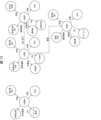
- FIG. 11 is a schematic diagram showing an example of a method of generating a target personnel graph by a graph generation unit according to the second exemplary embodiment of the present invention
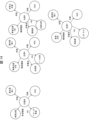
- FIG. 11 is a schematic diagram showing an example of a prediction method by a link prediction unit according to the second exemplary embodiment of the present invention
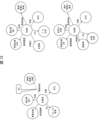
- FIG. 11 is a schematic diagram showing an example of a prediction method by a link prediction unit, a specification unit, and a compatibility determination unit according to the second exemplary embodiment of the present invention
- FIG. 10 is a flow diagram showing a first example of processing performed by the recruitment support device according to the second exemplary embodiment of the present invention
- FIG. 11 is a schematic diagram showing another example of a prediction method by the link prediction unit, the identification unit, and the compatibility determination unit according to the second exemplary embodiment of the present invention
- FIG. 10 is a diagram for explaining an example of a recommendation method by a recommendation unit according to the second exemplary embodiment of the present invention.
- FIG. 10 is a flow diagram showing a second example of processing performed by the recruitment support device according to the second exemplary embodiment of the present invention
- Fig. 10 is a diagram showing an example presentation by the output unit according to the second exemplary embodiment of the present invention
- FIG. 11 is a schematic diagram showing an example of a prediction method by a link prediction unit according to the third exemplary embodiment of the present invention
- FIG. 13 is a schematic diagram showing another example of a prediction method by the link prediction unit according to the third exemplary embodiment of the present invention
- FIG. 10 is a diagram outlining a recruitment assistance method according to a fourth exemplary embodiment of the present invention
- FIG. 12 is a block diagram showing the configuration of a recruitment support device according to a fourth exemplary embodiment of the present invention
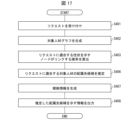
- FIG. 11 is a flow diagram showing the flow of processing executed by a recruitment support device according to the fourth exemplary embodiment of the present invention
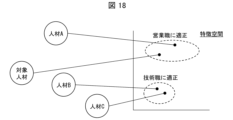
- FIG. 10 is a diagram illustrating an example of predicting the characteristics of a target human resource based on feature amounts calculated from a target human resource graph and an acceptance destination graph
- FIG. 2 is a configuration diagram for realizing a recruitment support device by software
- FIG. 1 is a block diagram showing the configuration of a recruitment support device 1 according to this exemplary embodiment.
- the recruitment support device 1 includes a reception section (reception means) 11, an estimation section (estimation means) 12, and an output section (output means) 13.
- the reception unit 11 receives requests regarding the assignment destination of the target personnel.
- Information on the target personnel such as skills and work history of the target personnel is information that should be considered when deciding where to assign the target personnel. included in the category of requests relating to
- the estimating unit 12 adapts to the request received by the receiving unit 11 using a learned model that has learned the relationship between at least one of the skills and work histories of each of the plurality of persons and the affiliation of each of the plurality of persons. to presume a candidate for the target personnel to be assigned.
- the output unit 13 outputs information indicating the candidates for assignment of the target personnel estimated by the estimation unit 12 .
- the job history of a certain person includes the department to which the person belongs, the department he or she has belonged to, the number of years he or she has belonged to each department, the order of the departments to which he/she has belonged, etc. ) can include but are not limited to.
- departments include, but are not limited to, departments, sections, groups, and the like.
- the recruitment support apparatus 1 having the above configuration, assignment of a target person who can be said to match the request based on the relationship between at least one of the skills and work histories of each of the plurality of persons and the affiliation of each of the plurality of persons. Candidates can be presented to the user. Therefore, according to the above configuration, it is possible to obtain the effect that it is possible to suitably perform personnel support for the target human resources in consideration of various information regarding the receiving destination.
- the functions of the recruitment support device 1 described above can also be realized by a program.
- the recruitment support program according to this exemplary embodiment provides a computer with a process of accepting a request regarding the assignment destination of a target human resource, at least one of the skills and work experience of each of a plurality of persons, and A process of estimating a candidate for assignment of the target personnel that matches the request, using a learned model that has learned the relationship with the organization, and an output process of outputting information indicating the estimated candidate for assignment of the target personnel. and let it run.
- this recruitment support program it is possible to obtain the effect that it is possible to suitably perform personnel support for the target human resources in consideration of various information regarding the receiving destination.
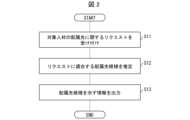
- FIG. 2 is a flow diagram showing the flow of the recruitment support method according to the first exemplary embodiment of the present invention.
- the computer accepts a request regarding the assignment destination of the target personnel.
- Requests may be accepted via any input device.
- a request may be received via a mouse, keyboard, touch panel, or voice input device.
- the computer uses a learned model that has learned the relationship between at least one of the skills and work histories of each of the plurality of persons and the affiliation of each of the plurality of persons, to identify the target personnel that matches the request. Candidates for assignments are estimated.
- the computer outputs information indicating the estimated candidates for assignment of the target personnel.
- Any device may be used as the output destination.
- the information may be output to a display device to display and output the information, or may be output to an audio output device to output the information as sound.
- the computer at least one processor, receives a request regarding the assignment destination of the target human resource (S11); and estimating a candidate for an assignment destination of the target personnel that matches the request by using a learned model that has learned the relationship between at least one of the above and the affiliation of each of the plurality of persons (S12); and outputting information indicating the estimated candidates for assignment of the target personnel (S13).
- this recruitment support method it is possible to obtain the effect that it is possible to suitably perform personnel support for the target human resources in consideration of various information regarding the recipient.
- the execution subject of each step in the above recruitment support method may be one computer (for example, the recruitment support device 1), or the execution subject of each step may be different computers. This also applies to the flows described in the second exemplary embodiment and thereafter.
- the graph here refers to data having a structure consisting of a plurality of nodes and links connecting the nodes.
- a type of link representing a relationship between nodes is also called a “relation”.
- a link may also be called an edge.
- Graphs are roughly classified into directed graphs in which each link has directionality and undirected graphs in which each link has no directionality. It is possible to use either directed graphs or undirected graphs, and it is also possible to use them in combination.
- the nodes may represent tangible or intangible elements of a person.
- ⁇ Personal identification information such as name and person ID ⁇ Age ⁇ Personality ⁇ Current occupation or desired occupation ⁇ Current affiliation or desired assignment ⁇ Skill can.
- ⁇ Personal identification information such as name and person ID ⁇ Basic attributes (occupation, gender, affiliation, title, grade, etc.) ⁇ Achievements and history (job history (including affiliation history), educational background, evaluation history, training attendance history, history of superiors and subordinates, achievements, receipt history, commendation history, attendance history) ⁇ Ability, skills and qualifications (skill level, language proficiency, qualifications held, etc.) ⁇ Mind (personality, aptitude test results, personality diagnosis results, career orientation, satisfaction survey results, interview history, boss notes, etc.) ⁇ Job description (mission, goal, work content, etc.) ⁇ Business characteristics (whether it has contributed to a new business or whether it can contribute, whether it is a ready-to-use or a late bloomer, whether it is suitable for overseas work or domestic work, etc.) ⁇ Behavior data (location information, main communication partners, etc.) A graph containing nodes representing various elements such as Here, the information about the main communication partner can be specified from the usage status of tools such as an in
- the graph may contain multiple nodes corresponding to one element.
- nodes indicating skills each skill possessed by a person may be represented by individual nodes, such as a node indicating a first skill, a node indicating a second skill, and a node indicating a third skill. . The same is true for other elements.
- the relationship represented by the links is ⁇ Relationship between a certain element and a person ⁇ Relationship between a certain element and age ⁇ Relationship between a certain element and personality ⁇ Relationship between a certain element and a desired occupation ⁇ Relationship between a certain element and skill
- a link connecting a node indicating a personality and a node indicating an achievement may represent a relationship in which the personality is a factor in the achievement.
- the feature value of each node is calculated.
- the feature amount may be calculated, for example, in the form of a feature amount vector.
- graph-based relationship learning can be performed on graphs including images and numerical values indicating various elements as described above. For example, a photo of a human resource can be used as a node.
- FIG. 3 is a diagram for explaining feature amount learning in graph-based relationship learning.
- the graph shown in FIG. 3 includes four nodes A to D.
- Node A is connected to nodes B and C, and node C is connected to node D.
- multiple convolutions are performed as described below to update the features of each node.
- the initial feature amount of node A is multiplied by the feature amounts of nodes B and C connected to node A by a predetermined weight and then added.
- the initial feature amount of node C is multiplied by the feature amount of node D by a predetermined weight and then added. Note that if the graph is valid, the weight is adjusted according to the direction of the link.
- the feature amount of each node is multiplied by the feature amount of the node linked to that node by a predetermined weight and then added.
- the feature amount of node C reflects the feature amount of node D by the first convolution. Therefore, not only the feature amount of node C but also the feature amount of node D are reflected in node A by the second convolution.
- node prediction Also, by performing the learning described above, it becomes possible to predict a node that is connected to a certain node by a predetermined link.
- the user can specify one node and a link starting from that node, and request that the linked node be returned. For example, it is assumed that a user inputs a request for a node that is connected to a node of "Person A" by a link of "Personality”.
- node prediction it is possible to predict whether the node connected to the node of "person A" by the link of "personality” is "strong sense of responsibility” or "full of curiosity". is.
- FIG. 4 is a block diagram showing the configuration of the recruitment support device 2 according to this exemplary embodiment.
- the recruitment support apparatus 2 includes a reception unit 201, a graph generation unit 202, a link prediction unit 203, a specification unit 204, a compatibility determination unit 205, a recommendation unit 206, a learning unit 207, an estimation unit 208, and a basis generation unit 209. , and an output unit 210 .
- the recruitment support device 2 includes an input device for receiving user input operations, an output device for data output by the recruitment support device 2, and a communication device for the recruitment support device 2 to communicate with other devices.
- a device or the like may be provided.
- the output mode of the output device is arbitrary, and may be, for example, display output or audio output.
- the reception unit 201 receives a request regarding the assignment destination of the target personnel.
- the request includes information about the target personnel to whom the user wishes to assign.
- the request includes, but is not limited to, the name (or person ID), age, personality, desired occupation, desired assignment, and skills of the target personnel.
- the request may include the current occupation and current affiliation of the target personnel.
- various elements illustrated in the first exemplary embodiment may be included.
- the graph generation unit 202 refers to the request received by the reception unit 201, and based on the information on the target personnel to whom the user wants to determine the assignment destination indicated by the request, generates a target personnel graph that represents the target personnel in a graph. do. Specifically, the graph generation unit 202 generates a target personnel graph including a plurality of nodes relating to the skills or work history of the target personnel and links indicating relationships between the nodes. According to this configuration, the estimating unit 208, which will be described later, can estimate an assignment destination candidate in consideration of not only the skill and job history of the target human resource, but also the relationship between them. Note that specific processing by the graph generation unit 202 will be described later.
- the link prediction unit 203 uses the target personnel graph including a plurality of nodes related to the target personnel generated by the graph generation unit 202 and the receiving destination graph to determine the nodes that are not connected by links in the target personnel graph and the receiving destination graph.
- human resource nodes linked to nodes included in the target human resource graph from among the human resource nodes indicating human resources belonging to the receiving destination included in the receiving destination graph by link prediction for predicting interrelationships to predict.
- the receiving destination graph includes a plurality of nodes related to the receiving destinations that may accept the target human resource, the skills or work history of each of the plurality of persons, and links indicating the relationships between the nodes. It is a graph containing In other words, the recipient graph is a graph that represents one or more persons with nodes representing the person's affiliation, skills, and work history, and edges representing relationships between the nodes.
- the destination graph is a learned graph and a learned model of nodes and relationships between nodes.
- a destination graph can also be called a knowledge graph.
- a graph corresponding to one person may be called an acceptance graph, and a graph corresponding to a plurality of persons may be called an acceptance graph.
- the human resource nodes linked to the nodes included in the target human resource graph are predicted from among the human resource nodes in the receiving destination graph, and candidate assignment destinations are estimated based on the predicted human resource nodes. Since it is useful in the personnel affairs of the target human resources how the target human resources are related to which human resources of the host company, according to the above configuration, personnel support related to the target human resources and considering the human resources of the host company can be provided. Realized.
- the identifying unit 204 identifies well-matched personnel who are well-suited to a specific human resource from among the human resources included in the receiving destination graph.
- the above-described link prediction unit 203 may be configured to predict similar personnel who are similar to the target personnel among the personnel belonging to the receiving destination by the link prediction.
- the identification unit 204 determines whether the node and the link included in the receiving destination graph indicate that the similar human resources are compatible with the similar human resources. Identify talent.
- a human resource node indicating a similar human resource similar to the target human resource is predicted, and the nodes and links included in the receiving destination graph identify the well-matched human resource indicating that the similar human resource has good compatibility.
- a well-matched human resource who has good compatibility with similar human resources is highly likely to have good compatibility with the target human resource.
- the identifying unit 204 may identify human resources that are incompatible with a specific human resource from among the human resources included in the acceptance destination graph.
- human resources nodes indicating similar human resources similar to the target human resources are predicted, and the nodes and links included in the receiving destination graph identify human resources that are incompatible with similar human resources. Personnel who have poor compatibility with similar personnel are highly likely to have poor compatibility with target personnel.
- a compatibility determining unit 205 determines the compatibility between the target personnel and the receiving destination based on the degree of similarity between each personnel belonging to the receiving destination and the well-matched personnel identified by the identifying unit 204. judge.
- the compatibility between the target personnel and the receiving destination is determined based on the degree of similarity indicating the degree of similarity between each personnel belonging to the receiving destination and the compatible human resources. This makes it possible to accurately determine the compatibility between the target personnel and the recipient.
- the compatibility determination unit 205 determines the degree of similarity between the target personnel and the receiving destination based on the degree of similarity between each personnel belonging to the receiving destination and the personnel with poor compatibility identified by the identifying unit 204. compatibility can be determined.
- compatibility between the target personnel and the receiving destination is determined based on the degree of similarity between each personnel belonging to the receiving destination and the personnel with poor compatibility. This makes it possible to accurately determine the compatibility between the target personnel and the recipient.
- the compatibility determination unit 205 identifies the department to which the person with good compatibility identified by the identification unit 204 belongs, among the plurality of departments included in the acceptance destination, and each person belonging to the department and the person with good compatibility
- the compatibility between the department and the target personnel may be determined based on the degree of similarity indicating the degree of similarity between the departments.
- the department to which the person with good chemistry belongs is likely to have good compatibility with the target person, and if the department has a person who is similar to the person with good chemistry, there is a high possibility that the compatibility will be even better. Therefore, according to the above configuration, the department to which the well-matched person belongs is specified, and based on the degree of similarity between each person belonging to the department and the well-matched person, the department and the Determine compatibility with target personnel. This makes it possible to accurately determine the compatibility between the target personnel and the accepting department.
- the compatibility determination unit 205 identifies the department to which the personnel with bad compatibility identified by the identification unit 204 belongs, among a plurality of departments included in the acceptance destination, and each personnel belonging to the department belongs to the personnel with poor compatibility.
- the compatibility between the department and the target personnel may be determined based on the degree of similarity indicating the degree of similarity between the department and the target personnel.
- the department to which the person with the bad compatibility belongs has a bad compatibility with the target person, and if the department has a person similar to the person with the bad compatibility, there is a high possibility that the compatibility is still bad. . Therefore, according to the above configuration, the department to which the person with bad compatibility belongs is specified, and each person belonging to the department and the person with bad compatibility are similar based on the degree of similarity , to determine compatibility between the department and the target personnel. This makes it possible to accurately determine the compatibility between the target personnel and the accepting department.
- the recommendation unit 206 refers to the result of processing by at least one of the link prediction unit 203, the identification unit 204, and the compatibility determination unit 205, and selects a department that is recommended as an acceptance destination for each of the plurality of target personnel. to decide.
- the compatibility determining unit 205 described above may be configured to determine compatibility between each of the plurality of target personnel and each of the plurality of departments.
- the recommendation unit 206 determines, for each of the plurality of target personnel, a department recommended as a receiving destination for the target personnel based on the compatibility determination result by the compatibility determination unit 205 .
- the compatibility between each of the plurality of target human resources and each of the plurality of departments is determined, and based on the determination result, the department recommended as the receiving destination for each of the plurality of target human resources is determined. do.
- the processing by the recommendation unit 206 is not limited to the above example.
- the recommending unit 206 may be configured to recommend the affiliated company of the person with good chemistry specified by the specifying unit 204 as the accepting company of the target person.
- the learning unit 207 learns the relationship between each node included in the receiving destination graph based on various information about multiple persons who are existing employees, and generates a learned receiving destination graph. It should be noted that unless otherwise specified, the destination graph refers to the one that has already been learned by the learning unit 207 . Also, the learned recipient graph may be read into the recruitment support apparatus 2, and in this case, the learning unit 207 may be omitted.
- the estimating unit 208 is configured to estimate candidate assignment destinations of the target personnel that match the target personnel request, based on the learned model and the request regarding the assignment destination of the target personnel received by the receiving unit 201 .
- the learned model is a learned model that has learned the relationship between at least one of the skills and work histories of each of the plurality of persons and the affiliation of each of the plurality of persons.
- the trained model includes a plurality of nodes relating to potential recipients of the target personnel, the skills or work experience of each of the plurality of persons, and the relationships between the nodes. This is the recipient graph described above.
- the estimation unit 208 may estimate the assignment destination candidate of the target personnel that matches the request received by the reception unit 201 based on the node predicted by the link prediction unit 203 through the above-described processing. Also, the estimation unit 208 may refer to the determination result by the recommendation unit 206 to estimate the assignment destination of the target personnel that matches the request.
- the basis generation unit 209 generates basis information indicating the basis for the estimation by the estimation unit 208 .
- Various methods can be applied as a method of generating the basis information. A method for generating ground information will be described later.
- the output unit 210 outputs various information generated by the recruitment support device 2, such as information indicating assignment candidates estimated by the estimation unit 208.
- the information can be output to any destination. For example, if the recruitment support device 2 has an output device as described above, the information may be output to that output device. Alternatively, for example, the information may be output to an external output device of the recruitment support device 2 .
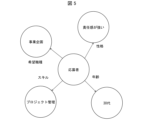
- FIG. 5 is a schematic diagram showing an example of a method of generating a target personnel graph by the graph generation unit 202.
- the graph generation unit 202 first refers to the request received by the reception unit 201, and specifies information about the target human resources (applicants) to whom the user wants to determine the assignment, indicated by the request.
- Figure 5 shows the request, Personality: Strong sense of responsibility Age: 30's Skill: Project management Desired job type: Business planning
- the target personnel graph generated by the graph generation unit 202 is shown when information is included.
- the types of nodes included in the target personnel graph generated by the graph generation unit 202 are not limited to those shown in the figure, and can include the various types of nodes described above.
- FIG. 6 is diagrams for explaining a first processing example related to a method of identifying a similar person by the link prediction unit 203, a method of identifying a person with good compatibility by the identification unit 204, and a compatibility determination method by the compatibility determination unit 205.
- FIG. 6 shows a recipient graph in which existing employees A to C are represented by nodes representing the personality, age, skills, affiliation, and job history of the existing employees, and links representing relationships between the nodes.
- nodes representing the personality, age, skills, affiliation, and job history of the existing employees
- links representing relationships between the nodes.
- the node of ⁇ existing employee A'' and the node of ⁇ strong sense of responsibility'' are connected by an edge indicating ⁇ personality'', which expresses that existing employee A has a personality of a strong sense of responsibility.
- the accepting destination graph shown in FIG. 6 includes nodes of multiple existing employees A to C, but a graph consisting of only one existing employee node may also be called an accepting destination graph.
- the link prediction unit 203 identifies similar human resources using a plurality of acceptance destination graphs corresponding to each of the number of existing employees.
- Such a receiving company graph can be generated from each existing employee's personality, age, skills, affiliation, and work history.
- the target personnel can be identified from the personality, age, skills, desired occupation, etc. It becomes possible to infer the affiliation suitable for
- FIG. 6 shows a target human resource graph in which target human resources (applicants) are represented by nodes representing the target human resource's personality, age, skill, or desired job type, and edges (links) representing the relationships between the nodes. is also shown. More specifically, as in FIG. 5, the target human resource graph shown in FIG. 6 includes nodes and links indicating that the target human resource has a personality of “strong sense of responsibility” and the age of the target human resource of “30s”. a node and link indicating that the target human resource has the skill of "project management”; and a node and link indicating that the target human resource has the desired occupation of "business planning" It is included. As described above, the target personnel graph is generated by the graph generator 202. FIG.
- the link prediction unit 203 uses the target personnel graph and the receiving destination graph generated in this way to predict the relationship between nodes that are not connected by links in the target personnel graph and the receiving destination graph. Make predictions. By executing the link prediction, the link prediction unit 203, as an example, selects a node included in the graph of the target personnel from among the personnel nodes that indicate the personnel belonging to the receiving destination included in the receiving destination graph. Predict which talent nodes to link to.
- the link prediction unit 203 can predict the probability that the relationships between these nodes are “same”. Then, based on the predicted probability, the link prediction unit 203 can identify the nodes of the existing employee graph linked to the nodes included in the target personnel graph. For example, the link prediction unit 203 may identify a node of the existing employee graph for which the predicted probability value is greater than or equal to a threshold as a node linked to a node of the target personnel graph.
- the link prediction unit 203 predicts a node linked to a node included in the target personnel graph from among nodes included in the existing employee graph including nodes that match preset conditions or conditions set by the user. It is also possible to
- the link prediction unit 203 can predict a node linked to a node included in the graph of the target human resource from among the nodes included in the existing employee graph including nodes that match predetermined personalities and skills. be.
- the link prediction unit 203 can also identify existing employees who have a predetermined relationship with the target personnel by using the target personnel graph and the receiving destination graph. For example, it is possible to identify existing employees who are similar to the target human resources, existing employees who are dissimilar to the target human resources, existing employees who belong to the same classification as the target human resources, existing employees who have common characteristics with the target human resources, etc. can also be specified.
- FIG. 7 is a diagram for explaining the link prediction. Similar to FIG. 6, FIG. 7 shows a target human resources (applicants) graph and an acceptance destination graph including existing employees A to C graphs. As indicated by the dashed line in FIG. 7, there is no link between the "applicant" node in the target personnel graph and the "existing employee A" node in the recipient graph.
- the link prediction unit 203 can predict the probability that the relationships between these nodes are "similar”. Similarly, the link prediction unit 203 can predict the probability that the relationship between the "applicant" node and the nodes of the existing employees B and C included in the accepting destination graph is "similar”. can. Then, the link prediction unit 203 can identify similar personnel based on the predicted probability. For example, the link prediction unit 203 may identify an existing employee whose predicted probability value is greater than or equal to a threshold value as a similar human resource. In the example shown in FIG. 7, the link prediction unit 203 identifies the existing employee A as a similar human resource similar to the applicant.
- the link prediction unit 203 can also identify existing employees who meet preset conditions or conditions set by the user as existing employees who have a predetermined relationship with the target personnel. For example, it is possible to identify an existing employee whose personality is at least partially in common with the target human resource as a similar human resource, or to identify an existing employee whose skills are at least partially in common with the target human resource as a similar human resource.
- the identification unit 204 refers to the graph of the similar personnel identified as described above, and determines that the nodes and links included in the receiving destination graph are compatible with the similar personnel from among the personnel belonging to the receiving destination. Identify a person with good compatibility, who is a person who shows.
- the identifying unit 204 identifies that existing employees A and B, who are similar personnel, have a high affinity.
- the identifying unit 204 identifies the existing employee B as a person with good chemistry.
- the processing for calculating the degree of affinity by the identification unit 204 can be performed by referring to the action data of each person, as an example. For example, when the degree of similarity between the history of location information of existing employee A and the history of location information of existing employee B is equal to or greater than a predetermined value, it is determined that existing employee A and existing employee B have a high affinity. good too. Alternatively, if the behavior data of existing employee A and existing employee B indicate that both of them are main communication partners with each other, it can be judged that existing employee A and existing employee B have a high affinity. good.
- the compatibility determination unit 205 determines compatibility between the target personnel and the receiving destination based on the degree of similarity between each personnel belonging to the receiving destination and the person with good compatibility.
- the link prediction unit 203 can predict the probability (similarity) that the relationship between an existing employee's node and another existing employee's node included in the acceptance destination graph is "similar".
- the compatibility determination unit 205 calculates that the degree of similarity between the existing employee B and the existing employee C who are well-suited personnel is x, and the existing employee B and the existing employee D who are well-suited personnel. is calculated to be y.
- the compatibility determination unit 205 determines compatibility between the target personnel and the receiving party based on the degree of similarity predicted by the link prediction unit 203 . For example, the affiliation to which the existing employee whose degree of similarity with existing employee B, who is a well-matched person, is equal to or greater than a threshold is determined to be a well-suited host, and the degree of similarity with existing employee B, who is a well-matched person, is determined. is less than the threshold, it may be determined that the company to which the existing employee belongs is an incompatible company.
- the compatibility between the target personnel and the receiving destination is determined based on the degree of similarity indicating the degree of similarity between each personnel belonging to the receiving destination and the compatible human resources. This makes it possible to accurately determine the compatibility between the target personnel and the recipient.
- FIG. 8 is a flow chart showing the flow of processing according to the processing example 1 described above, which is processing executed by the recruitment support apparatus 2 .
- the reception unit 201 receives a request regarding the assignment destination of the target personnel.
- a request including the age, personality, desired occupation, skills, etc. of the target personnel is accepted. That is, as described above, the request includes at least one of the age, personality, desired occupation, skill, and the like of the target human resource.
- the graph generation unit 202 refers to the request received in S201, and based on the information about the target personnel indicated by the request, generates a target personnel graph that represents the target personnel in a graph.
- a target personnel graph may be generated that includes nodes indicating the age, personality, desired occupation, or skills of the target personnel, and links indicating relationships between the nodes.
- the link prediction unit 203 predicts nodes linked to nodes included in the target personnel graph generated in S202. As described above, this node is predicted by link prediction using the learned recipient graph and the above target personnel graph.
- the link prediction unit 203 may predict a node that is connected to the "target personnel" node by a "personality” or “skill” link. It may also predict nodes that lead to nodes that indicate personality or skill. For example, it is possible to predict a node connected to a node indicating skills by a link of “qualification”. This makes it possible to predict nodes that lead to more detailed nodes related to the personality and skills of the target human resource.
- the identifying unit 204 identifies, from among the personnel belonging to the receiving destination, the well-matched personnel who are the personnel whose nodes and links included in the receiving destination graph indicate that the similar personnel are well-matched.
- the compatibility determination unit 205 determines the degree of similarity between the target personnel and the receiving destination based on the degree of similarity between each personnel belonging to the receiving destination and the well-matched personnel identified in S204. determine compatibility.
- the estimating unit 208 estimates candidate assignment destinations of the target personnel that match the request based on the learned model and the request regarding the assignment destination of the target personnel received in S201.
- the estimating unit 208 may refer to the determination result by the compatibility determining unit 205 in S205, and estimate the receiving destination whose degree of compatibility is equal to or higher than a predetermined level as an assignment destination candidate that matches the request.
- the basis generation unit 209 generates basis information indicating the basis for the estimation by the estimation unit 208 . Specifically, basis information including the degree of similarity between the attributes of the target personnel and the attributes of the person belonging to the candidate for assignment estimated by the estimation unit 208 in S206 may be generated.
- the output unit 210 outputs the assignment candidate estimated at S206.
- the output unit 210 may be configured to output the basis information generated in S207 together with the assignment candidate estimated in S206.
- the processing of S205 may be omitted, and the affiliation of the person with good chemistry identified in S204 may be estimated as the candidate for the target personnel's assignment.
- the link prediction unit 203 can directly predict assignment destination candidates for the target personnel by link prediction using the target personnel graph and the receiving destination graph. Even without going through the process of identifying similar human resources and compatible human resources, it is possible to consider the similarity and compatibility between human resources when learning the host graph, is learned. In this case, S204-S205 are omitted.
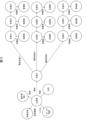
- FIG. 9 is a diagram for explaining a second processing example related to the method of specifying a similar person by the link prediction unit 203, the method of specifying a person with good compatibility by the specifying unit 204, and the method of determining compatibility by the compatibility determination unit 205. As shown in FIG.
- Fig. 9 shows a recipient graph containing nodes indicating the affiliations of existing employees A1 to A3, existing employees B1 to B3, and existing employees C1 to C3, and links indicating relationships between the nodes.
- a node indicating the existing employee A is also shown in the recipient graph shown in FIG.
- existing employees A1 to A3 belong to the sales department
- existing employees B1 to B3 belong to the planning department
- existing employees C1 to C3 belong to the manufacturing department. is expressed.
- existing employee A, existing employees A1 to A3, existing employees B1 to B3, and existing employees C1 to C3 shown in FIG. 9 also have links between other nodes, but the illustration is omitted in FIG. are doing.
- the accepting destination graph shown in FIG. 9 includes nodes of multiple existing employees A1 to C3
- a graph consisting of only one existing employee node may also be called an accepting destination graph.
- the link prediction unit 203 identifies similar personnel using a plurality of acceptance destination graphs corresponding to each of the plurality of existing employees.
- FIG. 9 the target human resources (applicants) are shown in the same way as FIGS. It also shows the target talent graph represented by (link).
- the link prediction unit 203 can identify existing employees who have a predetermined relationship with the target personnel by using the target personnel graph and the receiving destination graph. Further, the above identification can be realized by link prediction for predicting the relationship between nodes that are not connected by links in the target personnel graph and the receiving destination graph. For example, as indicated by the dashed line in FIG. 9, there is no link between the "applicant" node in the target personnel graph and the "existing employee A" node in the recipient graph.
- the link prediction unit 203 can predict the probability that the relationships between these nodes are "similar”. Similarly, the link prediction unit 203 determines that the relationships between the node of “applicant” and the nodes of existing employees A1 to A3, B1 to B3, and C1 to C3 included in the acceptance destination graph are “similar”. can predict the probability that Then, the link prediction unit 203 can identify similar personnel based on the predicted probability. For example, the link prediction unit 203 may identify an existing employee whose predicted probability value is greater than or equal to a threshold value as a similar human resource.
- the link prediction unit 203 identifies an existing employee who meets a preset condition or a condition set by the user as an existing employee who has a predetermined relationship with the target personnel. can also For example, it is possible to identify an existing employee whose personality is at least partially in common with the target human resource as a similar human resource, or to identify an existing employee whose skills are at least partially in common with the target human resource as a similar human resource.
- the identification unit 204 refers to the graph of the similar personnel identified as described above, and determines that the nodes and links included in the receiving destination graph are compatible with the similar personnel from among the personnel belonging to the receiving destination. Identify a person with good compatibility, who is a person who shows.
- the identifying unit 204 identifies that the existing employee A, who is a similar human resource, and the existing employees A1 to A3 have a high affinity. In this case, the identifying unit 204 identifies the existing employees A1 to A3 as well-matched personnel.
- the process of calculating the degree of affinity by the specifying unit 204 can be performed by referring to the action data of each person as described in the processing example 1.
- the compatibility determination unit 205 identifies the department to which the person with good chemistry identified by the identification unit 204 belongs among a plurality of departments included in the acceptance destination, and determines that each person belonging to the department and the person with good chemistry are similar.
- the compatibility between the department and the target personnel is determined based on the degree of similarity that indicates the extent to which they are working together.
- the link prediction unit 203 calculates the degree of similarity between existing employee A1, who is a person with good chemistry, and existing employees A2 and A3, who belong to the same department (sales department). Then, the compatibility determination unit 205 determines compatibility between the department (sales department) and the target personnel according to the degree of similarity between the existing employees A1 and A2 and the degree of similarity between the existing employees A1 and A3.
- both the degree of similarity between existing employees A1 and A2 and the degree of similarity between existing employees A1 and A3 are equal to or greater than a predetermined threshold, it may be determined that the sales department and the target personnel have good compatibility.
- a predetermined threshold For example, if both the degree of similarity between existing employees A1 and A2 and the degree of similarity between existing employees A1 and A3 are equal to or greater than a predetermined threshold, it may be determined that the sales department and the target personnel have good compatibility.
- the department to which the person with good chemistry belongs is likely to have good compatibility with the target person, and if the department has a person who is similar to the person with good chemistry, there is a high possibility that the compatibility will be even better. Therefore, according to the above configuration, the department to which the well-matched person belongs is specified, and based on the degree of similarity between each person belonging to the department and the well-matched person, the department and the Determine compatibility with target personnel. This makes it possible to accurately determine the compatibility between the target personnel and the accepting department.
- the recommendation unit 206 determines, for each of the plurality of target personnel, a department recommended as a recipient of the target personnel based on the compatibility determination result by the compatibility determination unit 205 .
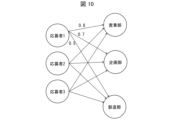
- FIG. 10 is a diagram for explaining processing by the recommendation unit 206. As shown in FIG.
- the processing by the link prediction unit 203, the identification unit 204, and the compatibility determination unit 205 indicates that the degree of compatibility between the applicant 1 and the sales department is 0.8, and the degree of compatibility between the applicant 1 and the planning department is 0.8. is 0.7, and the degree of compatibility between Applicant 1 and the manufacturing department is estimated to be 0.5. Although omitted in FIG. 10, the degree of compatibility between other applicants and each department is also estimated.
- the recommendation unit 206 determines, for each of applicants 1 to 3, the department recommended as a destination for the applicant. For example, for applicant 1, the sales department, which is the department with the highest degree of compatibility, is determined as the recommended department.
- the recommendation unit 206 may determine an assignment destination that maximizes the total degree of affinity (the degree of compatibility) while satisfying constraints specified by the user (such as the number of people assigned to each department). At this time, an optimization solver such as MaxSAT (Maximum SATisfiability) may be used.
- MaxSAT Maximum SATisfiability
- the compatibility between each of the plurality of target human resources and each of the plurality of departments is determined, and based on the determination result, the department recommended as the receiving destination for each of the plurality of target human resources is determined. do.
- FIG. 11 is a flow diagram showing the flow of the process executed by the recruitment support apparatus 2 and related to the process example 2 described above.
- the compatibility determining unit 205 identifies the department to which the person with good chemistry identified by the identifying unit 204 in S204 belongs, among the plurality of departments included in the accepting destination, and identifies each human resource belonging to the department. Then, the compatibility between the department and the target personnel is determined based on the degree of similarity indicating the degree of similarity between the department and the target personnel.
- the recommendation unit 206 determines, for each of the plurality of target personnel, a department recommended as a receiving destination for the target personnel based on the compatibility determination result by the compatibility determination unit 205 in S205a.
- the estimating unit 208 estimates the assignment destination of the target personnel that matches the target personnel request based on the learned model and the request regarding the assignment destination of the target personnel received in S201.
- the estimating unit 208 may, as an example, estimate the recommended department determined by the recommending unit 206 in S205b as an assignment destination candidate for the target personnel that matches the request received by the receiving unit 201.
- the basis generation unit 209 generates basis information indicating the basis for the estimation by the estimation unit 208 . Specifically, basis information including the degree of similarity between the attributes of the target personnel and the attributes of the person belonging to the candidate for assignment estimated by the estimation unit 208 in S206 may be generated.
- the output unit 210 outputs the assignment candidate estimated at S206.
- the output unit 210 may be configured to output together with the assignment candidate estimated in S206 and the base information generated in S207.
- FIG. 12 is a diagram showing an example of estimation results output by the output unit 210 according to this processing example.
- the output unit 210 presents, as an example, the assignment destination candidate, which is the result of estimation by the estimation unit 208 , and the degree of recommendation calculated based on the determination result of the compatibility determination unit 205 .
- a method of generating basis information by the basis generation unit 209 will be described. As described above, various methods can be applied as a method of generating ground information. As an example, the basis generation unit 209 generates basis information including the degree of similarity between the attributes of the target personnel and the attributes of the person belonging to the candidate for assignment estimated by the estimation means. The generated basis information is output by the output unit 210 .
- the attributes of the target personnel may include age, personality, skills, etc., but are not limited to these.
- the attributes of the target personnel may include any of the elements of the nodes described in [Graph and Learning].
- the basis generation unit 209 can generate basis information such as "the degree of similarity between the personality of the target personnel and the personality of existing employee A who belongs to the sales department is 0.8.”
- basis information including the degree of similarity between the attributes of the target personnel and the attributes of the person belonging to the estimated candidate for assignment is generated.
- the user can refer to the assignment candidate based on the grounds thereof.
- ground information since it is important to ensure transparency in personnel affairs, it is a great advantage to be able to generate ground information.
- the basis generation unit 209 may generate basis information based on the result of link prediction by the link prediction unit 203 .
- the link prediction unit 203 uses the recipient graph and the target personnel graph that include nodes that indicate the attributes of the target personnel, and calculates the probability that the nodes that indicate the attributes will link to the nodes included in the target personnel graph. Predict. Then, the basis generation unit 209 generates basis information according to the predicted probability.
- the basis generation unit 209 can generate basis information such as "The probability that the skill of the target personnel and the skill of the existing employee A belonging to the sales department are linked is 0.9.”
- the user can refer to candidates for assignment based on the grounds.
- the basis generation unit 209 can also generate basis information by analyzing the target human resources graph and the acceptance destination graph. A method of generating ground information by analyzing the target personnel graph and the receiving destination graph will be described below.
- the rationale generation unit 209 uses PCA (Principal Component Analysis) reliability based on OWA (Open-world assumption) to generate one or more You may mine the rules of Then, the basis generation unit 209 may generate basis information using one or a plurality of mined rules.
- PCA Principal Component Analysis
- OWA Open-world assumption
- the basis generation unit 209 may generate basis information using one or a plurality of mined rules.
- rule mining for example, the technique described in the following document can also be applied.
- a rule to be processed by the rationale generation unit 209 is represented by Head r (x, y) and Body ⁇ B1 , .
- Head r(x, y) is also called atom.
- the grounds generation unit 209 has the following conditions for the mining process: ⁇ Connected: All values (variables, entities) in the rule are shared between different atoms ⁇ Closed: All variables in the rule appear more than once ⁇ Not reflexive: r(x, x), a rule containing a reflective atom is mined under the condition that it is not mined.
- the basis generation unit 209 With hc (head coverage) defined by A mining process may be performed using the PCA confidence defined by By using PCA reliability, it is possible to mine rules with higher accuracy than when using standard reliability. Therefore, by using the above configuration, the basis generation unit 209 can generate highly reliable basis information.
- the basis generation unit 209 creates a rule that "elements included in one person can be applied to the other person" for two persons who satisfy the condition of "having a common personality" or "having a common skill".
- the link prediction unit 203 predicts an element included in a certain existing employee as an element included in the target personnel
- the ground generation unit 209 determines that the existing employee and the target personnel are " It suffices to generate basis information indicating that the characters have the same character or have the same skill.
- the user can refer to candidate assignments based on the grounds.
- the link predicting unit 203 generates links indicating a plurality of nodes relating to potential recipients of the target human resource, skills or work histories of the plurality of persons, and relationships between the nodes. and a target personnel graph including a plurality of nodes related to target personnel, link prediction for predicting a relationship between nodes that are not connected by links in the target personnel graph and the receiving destination graph identifies the personnel or department of the receiving destination that has a predetermined relationship with the target personnel.
- the estimating unit 208 estimates candidates for assignment destinations of the target personnel that match the request, based on the personnel or department of the receiving destination specified by the link predicting unit 203 .
- the personnel or department of the receiving destination having a predetermined relationship with the target human resource is specified, and based on the human resource or department, candidates for the target human resource that match the request received by the reception unit 201 are selected.
- candidates for the target human resource that match the request received by the reception unit 201 are selected.
- FIG. 13 shows an example of processing for estimating a relationship between a target human resource and an existing employee, and estimating an assignment candidate based on the estimated relationship, by the link prediction unit 203 and the estimation unit 208 according to this exemplary embodiment.
- 1 is a diagram for explaining 1.
- FIG. 13 shows a recipient graph in which existing employees A to C are represented by nodes representing the personality, age, skills, affiliation, and job history of the existing employees, and edges (links) representing the relationships between the nodes. ing.
- the receiving destination graph shown in FIG. 13 includes nodes of multiple existing employees A to C, but a graph consisting of only nodes related to one existing employee may be called a receiving destination graph.
- Such a receiving destination graph can be generated from each existing employee's personality, age, skills, affiliation, and work history, as in the second exemplary embodiment.
- the personality, age, skills, and work history shown in the acceptance graph and the affiliation the personality, age, skills, and desired occupation of the target personnel and the affiliation of existing employees It becomes possible to infer the relationship with the destination.
- FIG. 6 shows a target human resource graph in which target human resources (applicants) are represented by nodes representing the target human resource's personality, age, skill, or desired job type, and edges (links) representing the relationships between the nodes. is also shown.
- the link prediction unit 203 uses the target personnel graph and the receiving destination graph generated in this way to predict the relationship between nodes that are not connected by links in the target personnel graph and the receiving destination graph. Make predictions. Then, by executing the link prediction, the link prediction unit 203 identifies, as an example, the human resources of the receiving destination who have a predetermined relationship with the target human resources.
- the link prediction unit 203 can predict the probability that the relationship between these nodes is a predetermined relationship. For example, the link prediction unit 203 predicts the probability that the relationship between these nodes is ⁇ the applicant is a good subordinate for existing employee A'' or ⁇ the applicant respects existing employee A''. be able to.
- the link prediction unit 203 may identify a node of an existing employee whose probability value predicted for a certain relationship is greater than or equal to a threshold as a node that links to the node of the target personnel with that relationship.
- the estimating unit 208 estimates candidate assignment destinations for the target personnel that match the request received by the receiving unit 201, based on the personnel of the receiving destination identified by the link predicting unit 203 in this way. As an example, the estimation unit 208 determines that the relationship with the target personnel is good (for example, "the applicant is a good subordinate to existing employee A" or "the applicant respects existing employee A"). ) to which the existing employee belongs may be estimated as a candidate for the assignment of the target human resource that matches the request.
- the link prediction unit 203 selects existing employees to link to the node of the target personnel with a predetermined relationship from among the nodes included in the existing employee graph including nodes that match preset conditions or conditions set by the user. It is also possible to predict employees.
- the link prediction unit 203 can identify existing employees who are similar to the target human resource by using the target human resource graph and the receiving destination graph, or can identify existing employees who are dissimilar to the target human resource and belong to the same classification as the target human resource. It is also possible to identify existing employees, existing employees who have a common personality with the target personnel, and the like.
- FIG. 14 shows a processing example of estimating a relationship between a target human resource and an existing employee and estimating an assignment candidate based on the estimated relationship by the link prediction unit 203 and the estimation unit 208 according to this exemplary embodiment.
- 1 is a diagram for explaining 1.
- FIG. 14 shows a recipient graph in which existing employees A to C are represented by nodes representing the personality, age, skills, affiliation, and work history of the existing employees, and edges (links) representing the relationships between the nodes. ing.
- accepting destination graph shown in FIG. 14 includes nodes of multiple existing employees A to C, but a graph consisting of only nodes related to one existing employee may be called an accepting destination graph.
- Such a receiving destination graph can be generated from each existing employee's personality, age, skills, affiliation, and work history, as in the second exemplary embodiment.
- the relationship between the personality, age, skills, and work history shown in the acceptance graph and the organization it is possible to find the target human resources according to the personality, age, skills, and desired occupation of the target human resources. It becomes possible to infer the affiliation suitable for
- FIG. 14 shows a target human resource graph in which the target human resources (applicants) are represented by nodes representing the personality, age, skills, or desired job type of the target human resources and edges (links) representing the relationships between the nodes. is also shown.
- the link prediction unit 203 uses the target personnel graph and the receiving destination graph generated in this way to predict the relationship between nodes that are not connected by links in the target personnel graph and the receiving destination graph. Make predictions. Then, by executing the link prediction, the link prediction unit 203 identifies, as an example, a receiving department having a predetermined relationship with the target personnel.
- the link prediction unit 203 can predict the probability that the relationship between these nodes is a predetermined relationship. For example, the link prediction unit 203 can predict the probability that the relationship between these nodes is good.
- the link prediction unit 203 may identify a node of an existing employee whose probability value predicted for a certain relationship is greater than or equal to a threshold as a node that links to the node of the target personnel with that relationship.
- the estimating unit 208 estimates candidates for assignment destinations of the target personnel that match the request received by the receiving unit 201.
- the estimating unit 208 may estimate the receiving department predicted to have a good relationship with the target human resource as an assignment destination candidate for the target human resource that matches the request.
- a recruitment support device 4 according to a fourth exemplary embodiment of the present invention will be described with reference to the drawings.
- the recruitment support device 4 provides personnel support for target personnel.
- a personnel support method there is a case where it is determined whether or not the target personnel has the job characteristics desired by the user.
- the recruitment support device 4 provides personnel support in such cases.
- FIG. 15 is a diagram showing an outline of a recruitment support method according to this exemplary embodiment.
- link prediction is performed using the target personnel graph and the recipient graph.
- the target personnel graph shown at the upper left end of FIG. 15 includes nodes and links indicating that the target personnel has a personality of “strong sense of responsibility”.
- the recipient graph shown on the right end of the upper part of FIG. 15 includes nodes and links indicating that existing employee A has a personality of "strong sense of responsibility” and that his work characteristics include “contribution to new business.” is Similarly, in the recipient graph shown on the right end of the lower part of FIG. 14, there are nodes and links indicating that existing employee B has a personality of “brimming with curiosity” and that his work characteristics include “appropriate for overseas work.” It is included.
- a target talent graph is generated, and the probability that the target talent shown in the target talent graph has the requested job specification is linked predicted.
- the probability that the node "contribution to new business” is connected to the node "applicant” in the target personnel graph shown on the upper left by the link "job characteristics” is estimated to be 70%. From this, it can be said that this applicant is a person who is likely to "contribute to a new business.”
- the recruitment support method it is possible to present to the user the probability that the target personnel has the desired work characteristics, thereby supporting the recruitment of personnel.
- FIG. 16 is a block diagram showing the configuration of the recruitment support device 4 according to this exemplary embodiment.
- the recruitment support device 4 includes a reception unit 401, a graph generation unit 402, a link prediction unit 403, an estimation unit 405, a basis generation unit 406, and an output unit 407. Further, similarly to the recruitment support device 2 of the exemplary embodiment 2, in addition to these components, the recruitment support device 4 includes an input device that receives user input operations, an output device for data output by the recruitment support device 4, The recruitment support device 4 may include a communication device or the like for communicating with other devices.
- the reception unit 401 receives requests regarding the assignment destination of the target personnel.
- the request includes information about the target personnel to whom the user wishes to assign.
- the request includes, but is not limited to, the name (or person ID), age, personality, desired job type, desired assignment destination, and characteristics of the target personnel.
- the graph generation unit 402 refers to the request received by the reception unit 401, and based on the information on the target personnel to whom the user wants to determine the assignment destination indicated by the request, generates a target personnel graph that represents the target personnel in a graph. do. Specifically, the graph generation unit 402 generates a target personnel graph including a plurality of nodes relating to the skills, characteristics, or work history of the target personnel, and links indicating relationships between the nodes.
- the link prediction unit 403 uses the target personnel graph including a plurality of nodes related to the target personnel generated by the graph generation unit 202 and the receiving destination graph to determine the nodes that are not connected by links in the target personnel graph and the receiving destination graph.
- Link prediction for predicting inter-relationships is used to calculate the probability that a node that exhibits a predetermined property will link to a node included in the target personnel graph.
- the predetermined property is a property suitable for the request received by the receiving unit 401, and includes, as an example, the business characteristics described above.
- the estimation unit 405 estimates the destination of the target personnel who matches the request. In other words, the estimating unit 405 estimates candidate assignment destinations of the target personnel that match the target personnel request based on the learned model and the request regarding the assignment destination of the target personnel received by the receiving unit 401 .
- the learned model is a learned model that has learned the relationship between at least one of the skills and work histories of each of the plurality of persons and the affiliation of each of the plurality of persons.
- the estimation unit 405 performs estimation based on the learned model by performing the above estimation based on the result of link prediction by the link prediction unit 403 .
- the basis generation unit 406 generates basis information indicating the basis for the estimation by the estimation unit 405 .
- Evidence generation unit 406 is similar to evidence generation unit 209 of exemplary embodiment 2, and thus detailed description will not be repeated.
- the output unit 407 outputs various information generated by the recruitment support device 4, such as information indicating assignment candidates estimated by the estimation unit 405. As with the output unit 210 of exemplary embodiment 2, the output destination of the information output by the output unit 407 is not particularly limited.
- the recruitment support device 4 includes a host that may accept a target human resource, a plurality of nodes related to the skills or work histories of each of a plurality of persons, and a link indicating the relationship between the nodes.
- a graph and a target human resource graph containing multiple nodes related to target human resources link prediction for predicting the relationship between nodes that are not connected by links in the target human resource graph and the host graph
- a link prediction unit 403 is provided for calculating the probability that a node exhibiting a predetermined property is linked to the included node. Candidates for assignments are estimated.
- response information is generated based on the probability that a node that exhibits a predetermined property links to a node included in the target personnel graph.
- the probability that a node having a predetermined property is linked to a node included in the target personnel graph indicates the possibility that the target personnel has the predetermined property. Therefore, according to the above configuration, it is possible to provide useful information for personnel support, such as what characteristics the target personnel are likely to have.
- FIG. 17 is a flowchart showing the flow of processing executed by the recruitment support device 4. As shown in FIG.
- the reception unit 401 receives a request regarding the assignment destination of the target personnel.
- the request includes information about the target personnel to whom the user wishes to assign.
- the request includes, but is not limited to, the name (or person ID), age, personality, desired job type, desired assignment destination, and characteristics of the target personnel.
- the graph generation unit 402 generates a target personnel graph based on the information input at S401. For example, in S401, when the characteristics of the target personnel are received, the graph generating unit 402 may generate a target personnel graph including each node and link indicating the characteristics.
- the link prediction unit 403 uses the target personnel graph including a plurality of nodes related to the target personnel generated in S402 and the receiving destination graph to determine whether the target personnel graph and the receiving destination graph are not connected by links.
- a link prediction for predicting relationships between nodes is used to calculate the probability that a node having a predetermined property links to a node included in the target personnel graph.
- the estimating unit 405 estimates candidates for assignment destinations of the target personnel that match the request received in S401. Specifically, the estimation unit 405 estimates the assignment destination of the target personnel that matches the request based on the probability calculated in S403. For example, in S403, the probability that the target personnel will “contribute to the new business” is calculated. Candidates may be estimated.
- the basis generation unit 406 generates basis information indicating the basis for the estimation in S406. Specifically, the basis generation unit 406 may generate basis information including the degree of similarity between the attribute of the target personnel and the attribute of the person belonging to the candidate for assignment estimated by the estimation unit 405 in S406.
- the output unit 407 outputs information indicating the assignment destination estimated at S406. At this time, the output unit 407 may also output the ground information generated in S407. Thus, the processing shown in FIG. 17 ends.
- a target personnel graph including the affiliation of the target personnel may be generated.
- the link prediction of S406 it is possible to predict the characteristics that the target personnel will have when the target personnel is assigned to the place of affiliation. In other words, it is possible to simulate the results of assigning the target personnel to various affiliations.
- the assignment destination with the highest probability of obtaining the desired property may be estimated as the assignment destination candidate for the target human resource.
- FIG. 18 is a diagram illustrating an example of predicting the characteristics of a target human resource based on the feature amount calculated from the target human resource graph and the acceptance destination graph.
- FIG. 18 shows an existing employee graph of existing employees (human resources) A to C and a target human resource graph of target human resources. Note that the nodes and links included in these graphs are omitted from the illustration.
- the feature amount calculated from the existing employee graph of human resource A falls within the range corresponding to the property of "suitable for a sales job" in the feature space.
- learning is performed so that the feature amount calculated from the existing employee graph of personnel B and personnel C, who are known to be suitable for engineering jobs, is within the range corresponding to the property of "suitable for engineering jobs" in the feature space.
- Some or all of the functions of the recruitment support devices 1, 2, 4 may be realized by hardware such as integrated circuits (IC chips), or by software. You may
- the recruitment support device 1 and the like are implemented by, for example, a computer that executes instructions of a program that is software that implements each function.
- a computer that executes instructions of a program that is software that implements each function.
- An example of such a computer (hereinafter referred to as computer C) is shown in FIG.
- Computer C comprises at least one processor C1 and at least one memory C2.
- a program P for operating the computer C as the recruitment support device 1 or the like is recorded in the memory C2.
- the processor C1 reads the program P from the memory C2 and executes it, thereby realizing each function of the recruitment support device 1 and the like.
- processor C1 for example, CPU (Central Processing Unit), GPU (Graphics Processing Unit), DSP (Digital Signal Processor), MPU (Micro Processing Unit), FPU (Floating point number Processing Unit), PPU (Physics Processing Unit) , a microcontroller, or a combination thereof.
- memory C2 for example, a flash memory, HDD (Hard Disk Drive), SSD (Solid State Drive), or a combination thereof can be used.
- the computer C may further include a RAM (Random Access Memory) for expanding the program P during execution and temporarily storing various data.
- Computer C may further include a communication interface for sending and receiving data to and from other devices.
- Computer C may further include an input/output interface for connecting input/output devices such as a keyboard, mouse, display, and printer.
- the program P can be recorded on a non-temporary tangible recording medium M that is readable by the computer C.
- a recording medium M for example, a tape, disk, card, semiconductor memory, programmable logic circuit, or the like can be used.
- the computer C can acquire the program P via such a recording medium M.
- the program P can be transmitted via a transmission medium.
- a transmission medium for example, a communication network or broadcast waves can be used.
- Computer C can also obtain program P via such a transmission medium.
- a recruitment support apparatus comprising: estimation means for estimating a candidate for assignment of the target personnel that matches a request; and output means for outputting information indicating the candidate for assignment of the target personnel estimated by the estimation means.
- requests regarding the assignment of the target personnel are accepted. Then, using a learned model that has learned the relationship between at least one of the skills and work histories of each of the plurality of persons and the affiliation of each of the plurality of persons, candidates for assignment of the target personnel that match the request to estimate As a result, it becomes possible to estimate candidate assignment destinations for the target personnel that match the request, taking into consideration various information regarding the receiving destination. Therefore, according to the above configuration, it is possible to suitably perform personnel support for the target human resources in consideration of various information regarding the receiving destination.
- Appendix 2 a basis information generating means for generating basis information including, as a basis for the estimation, the degree of similarity between the attributes of the target personnel and the attributes of the person belonging to the candidate for assignment estimated by the estimation means; , the recruitment support device according to appendix 1, further outputting the basis information.
- basis information including the degree of similarity between the attributes of the target personnel and the attributes of the person belonging to the estimated candidate for assignment is generated.
- the user can refer to the assignment candidate based on the grounds thereof.
- ground information since it is important to ensure transparency in personnel affairs, it is a great advantage to be able to generate ground information.
- Said trained model is a receiving place graph including a plurality of nodes relating to a receiving place that may accept said target human resource, skills or work history of each of said plurality of persons, and links indicating relationships between said nodes.
- the human resource nodes linked to the nodes included in the target human resource graph are predicted from among the human resource nodes in the receiving destination graph, and candidate assignment destinations are estimated based on the predicted human resource nodes. Since it is useful in the personnel affairs of the target human resources how the target human resources are related to which human resources of the host company, according to the above configuration, personnel support related to the target human resources and considering the human resources of the host company can be provided. Realized.
- (Appendix 4) Link prediction for predicting a relationship between nodes that are not connected by links in the target personnel graph and the receiving destination graph, using a target personnel graph including a plurality of nodes related to the target personnel and the receiving destination graph a link prediction means for predicting a human resource node linked to a node included in the graph of the target human resource from among the human resource nodes that indicate the human resources belonging to the receiving destination included in the receiving destination graph, and the estimation 3.
- the recruitment support device according to appendix 3, wherein the means estimates an assignment destination candidate for the target human resource that matches the request based on the human resource node predicted by the link prediction means.
- the human resource nodes linked to the nodes included in the target human resource graph are predicted from among the human resource nodes in the receiving destination graph, and candidate assignment destinations are estimated based on the predicted human resource nodes. Since it is useful in the personnel affairs of the target human resources how the target human resources are related to which human resources of the host company, according to the above configuration, personnel support related to the target human resources and considering the human resources of the host company can be provided. Realized.
- (Appendix 5) The recruitment support device according to appendix 4, wherein the target personnel graph includes a plurality of nodes relating to skills or work history of the target personnel, and links indicating relationships between the nodes.
- the link prediction means predicts a similar human resource similar to the target human resource among human resources belonging to the receiving destination by the link prediction, and selects human resources included in the receiving destination graph from among the human resources belonging to the receiving destination.
- the recruitment support device according to appendix 4 or 5, further comprising specifying means for specifying a well-matched person who is a person who indicates that the node and the link associated with the similar person have good compatibility with the similar person.
- a human resource node indicating a similar human resource similar to the target human resource is predicted, and the nodes and links included in the receiving destination graph identify the well-matched human resource indicating that the similar human resource has good compatibility.
- a well-matched human resource who has good compatibility with similar human resources is highly likely to have good compatibility with the target human resource.
- Supplementary note 6 comprising compatibility determination means for determining compatibility between the target personnel and the receiving destination based on a degree of similarity indicating the degree of similarity between each personnel belonging to the receiving destination and the well-matched personnel 2.
- the compatibility between the target personnel and the receiving destination is determined based on the degree of similarity indicating the degree of similarity between each personnel belonging to the receiving destination and the compatible human resources. This makes it possible to accurately determine the compatibility between the target personnel and the recipient.
- the recruitment support device (Appendix 8) Among the plurality of departments included in the acceptance destination, the department to which the well-matched person belongs is specified, and based on the degree of similarity indicating the degree of similarity between each person belonging to the department and the well-matched person 7.
- the recruitment support device further comprising compatibility determination means for determining compatibility between the department and the target personnel.
- the department to which the person with good chemistry belongs is likely to have good compatibility with the target person, and if the department has a person who is similar to the person with good chemistry, there is a high possibility that the compatibility will be even better. Therefore, according to the above configuration, the department to which the well-matched person belongs is specified, and based on the degree of similarity between each person belonging to the department and the well-matched person, the department and the Determine compatibility with target personnel. This makes it possible to accurately determine the compatibility between the target personnel and the accepting department.
- the compatibility determination means determines compatibility between each of the plurality of target personnel and each of the plurality of departments, and accepts the target personnel for each of the plurality of target personnel based on the compatibility determination result.
- Recruitment support device comprising recommendation means for determining a department to be recommended first.
- the compatibility between each of the plurality of target human resources and each of the plurality of departments is determined, and based on the determination result, the department recommended as the receiving destination for each of the plurality of target human resources is determined. do.
- a link predicting means for specifying a person or a department of a receiving destination is provided, and the estimating means selects an assignment destination candidate for the target human resource that matches the request based on the human resource or the department of the receiving destination specified by the link predicting means.
- the personnel or department of the recipient who has a predetermined relationship with the target human resource is specified, and based on the personnel or department, candidates for the target human resource that match the request are estimated. Since the information on personnel and departments having a predetermined relationship with the target personnel is useful information in the personnel affairs of the target personnel, according to the above configuration, personnel support for the target personnel can be performed accurately.
- a receiving destination graph including a receiving destination that may accept the target human resource, a plurality of nodes related to the skills or work history of each of the plurality of people, and a link indicating the relationship between the nodes; Using a target human resource graph including nodes, a predetermined node included in the target human resource graph by link prediction for predicting a relationship between nodes that are not connected by a link in the target human resource graph and the receiving destination graph link predicting means for calculating a probability that a node indicating the nature of the link is linked, and the estimating means estimates a candidate for assignment of the target personnel that matches the request based on the probability calculated by the link predicting means. 3.
- the employment support device according to appendix 1 or 2.
- response information is generated based on the probability that a node that exhibits a predetermined property links to a node included in the target personnel graph.
- the probability that a node having a predetermined property is linked to a node included in the target personnel graph indicates the possibility that the target personnel has the predetermined property. Therefore, according to the above configuration, it is possible to provide useful information for personnel support, such as what characteristics the target personnel are likely to have.
- the computer receives a request regarding the assignment of the target human resources, and uses a learned model that has learned the relationship between at least one of the skills and work history of each of the plurality of people and the affiliation of each of the plurality of people, A recruitment support method for estimating a candidate for assignment of the target human resource that matches a request, and outputting information indicating the estimated candidate for the target human resource.
- Appendix 13 For a computer, a process of accepting a request regarding the assignment destination of the target human resources, and a trained model that has learned the relationship between at least one of the skills and work history of each of the plurality of persons and the affiliation of each of the plurality of persons.
- a recruitment support program for executing a process of estimating a candidate for assignment of the target personnel that matches the request, and a process of outputting information indicating the estimated candidate for assignment of the target personnel.
- At least one processor is provided, and the processor performs reception processing for receiving a request regarding an assignment destination of a target human resource, and a relationship between at least one of skills and work histories of each of a plurality of persons and the affiliation of each of the plurality of persons. an estimation process of estimating a candidate for assignment of the target human resource that matches the request using a trained model that has learned the above, and an output process of outputting information indicating the estimated candidate for assignment of the target human resource Recruitment support device to execute.
- the employment support device may further include a memory, and the memory stores a program for causing the processor to execute the acceptance process, the estimation process, and the output process. good too. Also, this program may be recorded in a computer-readable non-temporary tangible recording medium.
Landscapes
- Business, Economics & Management (AREA)
- Human Resources & Organizations (AREA)
- Engineering & Computer Science (AREA)
- Strategic Management (AREA)
- Entrepreneurship & Innovation (AREA)
- Economics (AREA)
- Educational Administration (AREA)
- Marketing (AREA)
- Operations Research (AREA)
- Quality & Reliability (AREA)
- Tourism & Hospitality (AREA)
- Physics & Mathematics (AREA)
- General Business, Economics & Management (AREA)
- General Physics & Mathematics (AREA)
- Theoretical Computer Science (AREA)
- Game Theory and Decision Science (AREA)
- Development Economics (AREA)
- Data Mining & Analysis (AREA)
- Management, Administration, Business Operations System, And Electronic Commerce (AREA)
Priority Applications (3)
| Application Number | Priority Date | Filing Date | Title |
|---|---|---|---|
| US18/682,490 US20240346406A1 (en) | 2021-09-15 | 2021-09-15 | Recruitment support apparatus, recruitment support method, and recording medium |
| JP2023547989A JP7652272B2 (ja) | 2021-09-15 | 2021-09-15 | 採用支援装置、採用支援方法、及び採用支援プログラム |
| PCT/JP2021/033835 WO2023042287A1 (ja) | 2021-09-15 | 2021-09-15 | 採用支援装置、採用支援方法、及び採用支援プログラム |
Applications Claiming Priority (1)
| Application Number | Priority Date | Filing Date | Title |
|---|---|---|---|
| PCT/JP2021/033835 WO2023042287A1 (ja) | 2021-09-15 | 2021-09-15 | 採用支援装置、採用支援方法、及び採用支援プログラム |
Publications (1)
| Publication Number | Publication Date |
|---|---|
| WO2023042287A1 true WO2023042287A1 (ja) | 2023-03-23 |
Family
ID=85601951
Family Applications (1)
| Application Number | Title | Priority Date | Filing Date |
|---|---|---|---|
| PCT/JP2021/033835 Ceased WO2023042287A1 (ja) | 2021-09-15 | 2021-09-15 | 採用支援装置、採用支援方法、及び採用支援プログラム |
Country Status (3)
| Country | Link |
|---|---|
| US (1) | US20240346406A1 (https=) |
| JP (1) | JP7652272B2 (https=) |
| WO (1) | WO2023042287A1 (https=) |
Cited By (3)
| Publication number | Priority date | Publication date | Assignee | Title |
|---|---|---|---|---|
| JP2025049199A (ja) * | 2023-09-21 | 2025-04-03 | ソフトバンクグループ株式会社 | システム |
| JP7751780B1 (ja) * | 2024-11-29 | 2025-10-09 | 準 小田 | 情報処理装置、及びプログラム |
| JP7763445B1 (ja) * | 2025-02-19 | 2025-11-04 | 株式会社ラフール | 情報処理システム、情報処理方法及びプログラム |
Citations (3)
| Publication number | Priority date | Publication date | Assignee | Title |
|---|---|---|---|---|
| JP2020038599A (ja) * | 2018-08-31 | 2020-03-12 | カシオ計算機株式会社 | 情報処理装置及びプログラム |
| JP2020077361A (ja) * | 2018-11-05 | 2020-05-21 | 株式会社トランス | 学習モデル構築装置、入社後評価予測装置、学習モデル構築方法および入社後評価予測方法 |
| JP6917664B1 (ja) * | 2021-01-19 | 2021-08-11 | 株式会社ラーニングエージェンシー | 情報処理装置、情報処理方法及びプログラム |
-
2021
- 2021-09-15 US US18/682,490 patent/US20240346406A1/en active Pending
- 2021-09-15 JP JP2023547989A patent/JP7652272B2/ja active Active
- 2021-09-15 WO PCT/JP2021/033835 patent/WO2023042287A1/ja not_active Ceased
Patent Citations (3)
| Publication number | Priority date | Publication date | Assignee | Title |
|---|---|---|---|---|
| JP2020038599A (ja) * | 2018-08-31 | 2020-03-12 | カシオ計算機株式会社 | 情報処理装置及びプログラム |
| JP2020077361A (ja) * | 2018-11-05 | 2020-05-21 | 株式会社トランス | 学習モデル構築装置、入社後評価予測装置、学習モデル構築方法および入社後評価予測方法 |
| JP6917664B1 (ja) * | 2021-01-19 | 2021-08-11 | 株式会社ラーニングエージェンシー | 情報処理装置、情報処理方法及びプログラム |
Cited By (3)
| Publication number | Priority date | Publication date | Assignee | Title |
|---|---|---|---|---|
| JP2025049199A (ja) * | 2023-09-21 | 2025-04-03 | ソフトバンクグループ株式会社 | システム |
| JP7751780B1 (ja) * | 2024-11-29 | 2025-10-09 | 準 小田 | 情報処理装置、及びプログラム |
| JP7763445B1 (ja) * | 2025-02-19 | 2025-11-04 | 株式会社ラフール | 情報処理システム、情報処理方法及びプログラム |
Also Published As
| Publication number | Publication date |
|---|---|
| JP7652272B2 (ja) | 2025-03-27 |
| JPWO2023042287A1 (https=) | 2023-03-23 |
| US20240346406A1 (en) | 2024-10-17 |
Similar Documents
| Publication | Publication Date | Title |
|---|---|---|
| US12124956B2 (en) | Systems and processes for bias removal in a predictive performance model | |
| Yeh | A problem‐based selection of multi‐attribute decision‐making methods | |
| US20210357835A1 (en) | Resource Deployment Predictions Using Machine Learning | |
| US8838688B2 (en) | Inferring user interests using social network correlation and attribute correlation | |
| Bititci et al. | Strategy management through quantitative modelling of performance measurement systems | |
| Cheng et al. | Information priority‐setting for better resource allocation using analytic hierarchy process (AHP) | |
| US7987110B2 (en) | Managing organizational resources | |
| KR102298722B1 (ko) | 동영상 콘텐츠 플랫폼 서비스를 이용한 인공지능 기반 인재 매칭 및 추천 방법, 장치 및 시스템 | |
| US10885477B2 (en) | Data processing for role assessment and course recommendation | |
| WO2021027260A1 (zh) | 处理交互序列数据的方法及装置 | |
| EP4162416A1 (en) | Machine learning systems for remote role evaluation and methods for using same | |
| JP7652272B2 (ja) | 採用支援装置、採用支援方法、及び採用支援プログラム | |
| CA2959340A1 (en) | Customizable machine learning models | |
| Adam et al. | Building information modelling (BIM) readiness of construction professionals: the context of the Seychelles construction industry | |
| AU2018250383A1 (en) | Skill proficiency system | |
| JP7079882B1 (ja) | 情報処理方法、コンピュータプログラム及び情報処理装置 | |
| KR102800881B1 (ko) | 방문 예측 | |
| Singh et al. | Consumer behaviour-based innovation diffusion modelling using stochastic differential equation incorporating change in adoption rate | |
| Johnson et al. | Identifying “best” applicants in recruiting using data envelopment analysis | |
| US10599658B2 (en) | Search device, search method, and non-transitory computer readable medium for performing a search for candidate experts and displaying results of the search | |
| US20100023947A1 (en) | System, method, and computer program product for resource collaboration optimization | |
| Burgess | Modelling the impact of reengineering with system dynamics | |
| JP2019164738A (ja) | 予測装置、予測方法、予測プログラム、生成装置、生成方法及び生成プログラム | |
| JP2019160089A (ja) | 情報処理装置、情報処理方法及び情報処理プログラム | |
| Shen et al. | The selection of benchmarking partners for value management: an analytic approach |
Legal Events
| Date | Code | Title | Description |
|---|---|---|---|
| 121 | Ep: the epo has been informed by wipo that ep was designated in this application |
Ref document number: 21957470 Country of ref document: EP Kind code of ref document: A1 |
|
| WWE | Wipo information: entry into national phase |
Ref document number: 18682490 Country of ref document: US |
|
| WWE | Wipo information: entry into national phase |
Ref document number: 2023547989 Country of ref document: JP |
|
| NENP | Non-entry into the national phase |
Ref country code: DE |
|
| 122 | Ep: pct application non-entry in european phase |
Ref document number: 21957470 Country of ref document: EP Kind code of ref document: A1 |