WO2023032084A1 - ステントデバイスおよびステントデリバリーシステム - Google Patents
ステントデバイスおよびステントデリバリーシステム Download PDFInfo
- Publication number
- WO2023032084A1 WO2023032084A1 PCT/JP2021/032146 JP2021032146W WO2023032084A1 WO 2023032084 A1 WO2023032084 A1 WO 2023032084A1 JP 2021032146 W JP2021032146 W JP 2021032146W WO 2023032084 A1 WO2023032084 A1 WO 2023032084A1
- Authority
- WO
- WIPO (PCT)
- Prior art keywords
- stent
- stent device
- cover
- expansion
- fixing
- Prior art date
- Legal status (The legal status is an assumption and is not a legal conclusion. Google has not performed a legal analysis and makes no representation as to the accuracy of the status listed.)
- Ceased
Links
Images











Classifications
-
- A—HUMAN NECESSITIES
- A61—MEDICAL OR VETERINARY SCIENCE; HYGIENE
- A61F—FILTERS IMPLANTABLE INTO BLOOD VESSELS; PROSTHESES; DEVICES PROVIDING PATENCY TO, OR PREVENTING COLLAPSING OF, TUBULAR STRUCTURES OF THE BODY, e.g. STENTS; ORTHOPAEDIC, NURSING OR CONTRACEPTIVE DEVICES; FOMENTATION; TREATMENT OR PROTECTION OF EYES OR EARS; BANDAGES, DRESSINGS OR ABSORBENT PADS; FIRST-AID KITS
- A61F2/00—Filters implantable into blood vessels; Prostheses, i.e. artificial substitutes or replacements for parts of the body; Appliances for connecting them with the body; Devices providing patency to, or preventing collapsing of, tubular structures of the body, e.g. stents
- A61F2/02—Prostheses implantable into the body
- A61F2/04—Hollow or tubular parts of organs, e.g. bladders, tracheae, bronchi or bile ducts
- A61F2/06—Blood vessels
- A61F2/07—Stent-grafts
-
- A—HUMAN NECESSITIES
- A61—MEDICAL OR VETERINARY SCIENCE; HYGIENE
- A61F—FILTERS IMPLANTABLE INTO BLOOD VESSELS; PROSTHESES; DEVICES PROVIDING PATENCY TO, OR PREVENTING COLLAPSING OF, TUBULAR STRUCTURES OF THE BODY, e.g. STENTS; ORTHOPAEDIC, NURSING OR CONTRACEPTIVE DEVICES; FOMENTATION; TREATMENT OR PROTECTION OF EYES OR EARS; BANDAGES, DRESSINGS OR ABSORBENT PADS; FIRST-AID KITS
- A61F2/00—Filters implantable into blood vessels; Prostheses, i.e. artificial substitutes or replacements for parts of the body; Appliances for connecting them with the body; Devices providing patency to, or preventing collapsing of, tubular structures of the body, e.g. stents
- A61F2/95—Instruments specially adapted for placement or removal of stents or stent-grafts
-
- A—HUMAN NECESSITIES
- A61—MEDICAL OR VETERINARY SCIENCE; HYGIENE
- A61F—FILTERS IMPLANTABLE INTO BLOOD VESSELS; PROSTHESES; DEVICES PROVIDING PATENCY TO, OR PREVENTING COLLAPSING OF, TUBULAR STRUCTURES OF THE BODY, e.g. STENTS; ORTHOPAEDIC, NURSING OR CONTRACEPTIVE DEVICES; FOMENTATION; TREATMENT OR PROTECTION OF EYES OR EARS; BANDAGES, DRESSINGS OR ABSORBENT PADS; FIRST-AID KITS
- A61F2/00—Filters implantable into blood vessels; Prostheses, i.e. artificial substitutes or replacements for parts of the body; Appliances for connecting them with the body; Devices providing patency to, or preventing collapsing of, tubular structures of the body, e.g. stents
- A61F2/82—Devices providing patency to, or preventing collapsing of, tubular structures of the body, e.g. stents
- A61F2/86—Stents in a form characterised by the wire-like elements; Stents in the form characterised by a net-like or mesh-like structure
- A61F2/90—Stents in a form characterised by the wire-like elements; Stents in the form characterised by a net-like or mesh-like structure characterised by a net-like or mesh-like structure
-
- A—HUMAN NECESSITIES
- A61—MEDICAL OR VETERINARY SCIENCE; HYGIENE
- A61F—FILTERS IMPLANTABLE INTO BLOOD VESSELS; PROSTHESES; DEVICES PROVIDING PATENCY TO, OR PREVENTING COLLAPSING OF, TUBULAR STRUCTURES OF THE BODY, e.g. STENTS; ORTHOPAEDIC, NURSING OR CONTRACEPTIVE DEVICES; FOMENTATION; TREATMENT OR PROTECTION OF EYES OR EARS; BANDAGES, DRESSINGS OR ABSORBENT PADS; FIRST-AID KITS
- A61F2/00—Filters implantable into blood vessels; Prostheses, i.e. artificial substitutes or replacements for parts of the body; Appliances for connecting them with the body; Devices providing patency to, or preventing collapsing of, tubular structures of the body, e.g. stents
- A61F2/95—Instruments specially adapted for placement or removal of stents or stent-grafts
- A61F2/962—Instruments specially adapted for placement or removal of stents or stent-grafts having an outer sleeve
- A61F2/966—Instruments specially adapted for placement or removal of stents or stent-grafts having an outer sleeve with relative longitudinal movement between outer sleeve and prosthesis, e.g. using a push rod
-
- A—HUMAN NECESSITIES
- A61—MEDICAL OR VETERINARY SCIENCE; HYGIENE
- A61F—FILTERS IMPLANTABLE INTO BLOOD VESSELS; PROSTHESES; DEVICES PROVIDING PATENCY TO, OR PREVENTING COLLAPSING OF, TUBULAR STRUCTURES OF THE BODY, e.g. STENTS; ORTHOPAEDIC, NURSING OR CONTRACEPTIVE DEVICES; FOMENTATION; TREATMENT OR PROTECTION OF EYES OR EARS; BANDAGES, DRESSINGS OR ABSORBENT PADS; FIRST-AID KITS
- A61F2/00—Filters implantable into blood vessels; Prostheses, i.e. artificial substitutes or replacements for parts of the body; Appliances for connecting them with the body; Devices providing patency to, or preventing collapsing of, tubular structures of the body, e.g. stents
- A61F2/02—Prostheses implantable into the body
- A61F2/04—Hollow or tubular parts of organs, e.g. bladders, tracheae, bronchi or bile ducts
- A61F2/06—Blood vessels
- A61F2/07—Stent-grafts
- A61F2002/072—Encapsulated stents, e.g. wire or whole stent embedded in lining
-
- A—HUMAN NECESSITIES
- A61—MEDICAL OR VETERINARY SCIENCE; HYGIENE
- A61F—FILTERS IMPLANTABLE INTO BLOOD VESSELS; PROSTHESES; DEVICES PROVIDING PATENCY TO, OR PREVENTING COLLAPSING OF, TUBULAR STRUCTURES OF THE BODY, e.g. STENTS; ORTHOPAEDIC, NURSING OR CONTRACEPTIVE DEVICES; FOMENTATION; TREATMENT OR PROTECTION OF EYES OR EARS; BANDAGES, DRESSINGS OR ABSORBENT PADS; FIRST-AID KITS
- A61F2220/00—Fixations or connections for prostheses classified in groups A61F2/00 - A61F2/26 or A61F2/82 or A61F9/00 or A61F11/00 or subgroups thereof
- A61F2220/0008—Fixation appliances for connecting prostheses to the body
-
- A—HUMAN NECESSITIES
- A61—MEDICAL OR VETERINARY SCIENCE; HYGIENE
- A61F—FILTERS IMPLANTABLE INTO BLOOD VESSELS; PROSTHESES; DEVICES PROVIDING PATENCY TO, OR PREVENTING COLLAPSING OF, TUBULAR STRUCTURES OF THE BODY, e.g. STENTS; ORTHOPAEDIC, NURSING OR CONTRACEPTIVE DEVICES; FOMENTATION; TREATMENT OR PROTECTION OF EYES OR EARS; BANDAGES, DRESSINGS OR ABSORBENT PADS; FIRST-AID KITS
- A61F2230/00—Geometry of prostheses classified in groups A61F2/00 - A61F2/26 or A61F2/82 or A61F9/00 or A61F11/00 or subgroups thereof
- A61F2230/0063—Three-dimensional shapes
- A61F2230/0069—Three-dimensional shapes cylindrical
-
- A—HUMAN NECESSITIES
- A61—MEDICAL OR VETERINARY SCIENCE; HYGIENE
- A61F—FILTERS IMPLANTABLE INTO BLOOD VESSELS; PROSTHESES; DEVICES PROVIDING PATENCY TO, OR PREVENTING COLLAPSING OF, TUBULAR STRUCTURES OF THE BODY, e.g. STENTS; ORTHOPAEDIC, NURSING OR CONTRACEPTIVE DEVICES; FOMENTATION; TREATMENT OR PROTECTION OF EYES OR EARS; BANDAGES, DRESSINGS OR ABSORBENT PADS; FIRST-AID KITS
- A61F2240/00—Manufacturing or designing of prostheses classified in groups A61F2/00 - A61F2/26 or A61F2/82 or A61F9/00 or A61F11/00 or subgroups thereof
- A61F2240/001—Designing or manufacturing processes
- A61F2240/002—Designing or making customized prostheses
-
- A—HUMAN NECESSITIES
- A61—MEDICAL OR VETERINARY SCIENCE; HYGIENE
- A61F—FILTERS IMPLANTABLE INTO BLOOD VESSELS; PROSTHESES; DEVICES PROVIDING PATENCY TO, OR PREVENTING COLLAPSING OF, TUBULAR STRUCTURES OF THE BODY, e.g. STENTS; ORTHOPAEDIC, NURSING OR CONTRACEPTIVE DEVICES; FOMENTATION; TREATMENT OR PROTECTION OF EYES OR EARS; BANDAGES, DRESSINGS OR ABSORBENT PADS; FIRST-AID KITS
- A61F2310/00—Prostheses classified in A61F2/28 or A61F2/30 - A61F2/44 being constructed from or coated with a particular material
- A61F2310/00005—The prosthesis being constructed from a particular material
- A61F2310/00011—Metals or alloys
Definitions
- the present invention relates to stent devices and stent delivery systems.
- a procedure is known in which a stent is placed and expanded for stenosis or obstruction (hereinafter referred to as "stenosis, etc.") that occurs in the digestive tract.
- a stent delivery system is used to place a stent in a stenosis or the like.
- a stent delivery system passes through a treatment instrument channel of an endoscope to deliver a stent to a stenosis or the like.
- a stent device in which a stent is coated with a thin film (cover), is used.
- a stent device coated with a film (cover) can prevent infiltration of cells and blood into the stent in stenosis or the like.
- Patent Document 1 describes a covered stent that can easily maintain its bent state.
- the covered stent described in Patent Literature 1 is formed by passing an outer tape and an inner tape through rhombic spaces between wires and adhering them.
- the bonded portion between the tape located outside and the tape located inside may hinder movement of the wire. Covered stents are less likely to bend when movement of the wire is blocked by the bonded portion.
- an object of the present invention is to provide a stent device that is easy to bend even if the wire is covered with a thin film (cover), and a stent delivery system that includes the stent device.
- a stent device comprises: a stent formed into a tubular shape by weaving wires; an inner cover arranged inside the stent; an outer cover arranged outside the stent; and a cover formed by superimposing a cover, wherein the cover is formed of a fixing portion to which the inner cover and the outer cover are fixed, and the inner cover and the outer cover, and accommodates the wire a receiving portion, the receiving portion having a normal receiving portion and an expanded receiving portion radially wider than the normal receiving portion.
- a stent delivery system comprises an operating section, an outer cylinder member configured to extend distally from the operating section, and a tubular member configured to extend distally from the operating section. , an inner tubular member located inside the outer tubular member, and the above-described stent device accommodated between the outer tubular member and the inner tubular member, wherein the operation section is provided in the outer tubular member or the inner tubular member.
- the stent device is configured to deploy by longitudinally moving the tubular member.
- the stent device of the present invention bends easily even when the wire is covered with a thin film (cover).
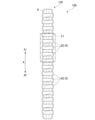
- FIG. 4 is a diagram showing the overall configuration of the stent of the same stent device;
- FIG. 4 is an exploded view of the stent in the F2 region shown in FIG. 3;
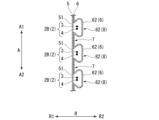
- Figure 3 shows the same stent device in the F1 region shown in Figure 2;
- FIG. 6 is a cross-sectional view taken along line S1-S1 shown in FIG. 5;
- 6 is a cross-sectional view along line S2-S2 shown in FIG. 5;
- FIG. FIG. 4 is a partially transparent view of the same stent device curved to one side.
- FIG. 4 is a diagram showing the overall configuration of the stent of the same stent device;
- FIG. 4 is an exploded view of the stent in the F2 region shown in FIG. 3;
- Figure 3 shows the same stent device in the F1 region shown in Figure 2;
- FIG. 6 is a cross-sectional view taken along line S1-S1 shown in FIG. 5;
- 6 is a cross
- FIG. 9 is a cross-sectional view taken along line S3-S3 shown in FIG. 8;
- FIG. 4 is a see-through view of a portion of the same stent device curved to the other side.
- FIG. 11 is a cross-sectional view taken along line S4-S4 shown in FIG. 10;
- FIG. 10 is a diagram showing a modification of the expansion accommodating portion of the same stent device;
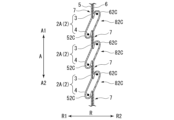
- Fig. 2 is a cross-sectional view of a stent device according to a second embodiment of the invention; It is a sectional view of the same stent device. It is a sectional view of the same stent device.
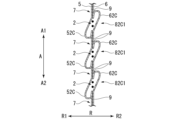
- FIG. 3 is a cross-sectional view of a stent device according to a third embodiment of the invention; It is a sectional view of the same stent device. It is a sectional view of the same stent device. It is a sectional view of the modification of the same stent device. It is a sectional view of the same modification of the same stent device.
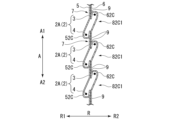
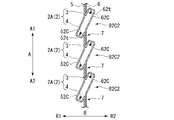
- FIG. 4 is a cross-sectional view of another variation of the same stent device; It is a sectional view of the same modification of the same stent device.
- FIG. 4 is an exploded view of a stent device according to a fourth embodiment of the invention; FIG. 11 shows a portion of a stent device according to a fifth embodiment of the invention; FIG. 3 shows part of the same stent device twisted.
- FIG. 4 is an exploded view of a modification of the same stent device;
- FIG. 1 is a diagram showing the overall configuration of an endoscope system 300. As shown in FIG.
- the endoscope system 300 includes an endoscope 200 and a stent delivery system 150 inserted through a channel of the endoscope 200.
- the endoscope 200 is a known side-viewing flexible endoscope, and includes an elongated insertion section 210 and an operation section 220 provided at the proximal end of the insertion section 210 . Note that the endoscope 200 may be a direct-view flexible endoscope.
- the insertion section 210 includes a distal rigid portion 211 provided at the distal end portion, a bendable bending portion 212 provided at the proximal end side of the distal rigid portion 211, and a flexible portion provided at the proximal end side of the bending portion 212. and a flexible tube portion 213 .
- An imaging unit 216 having a light guide 215 and a CCD is provided on the side surface of the distal end rigid portion 211 in a state of being exposed to the outside.
- the insertion portion 210 is formed with a treatment instrument channel 230 through which an endoscopic treatment instrument such as the stent delivery system 150 is inserted.
- a distal end portion 230 a of the treatment instrument channel 230 is open on the side surface of the distal end rigid portion 211 .
- a proximal end portion of the treatment instrument channel 230 extends to the operating portion 220 .
- a riser 214 is provided on the distal end hard portion 211 of the treatment instrument channel 230 .
- a base end portion of the raising base 214 is rotatably supported by the distal end rigid portion 211 .
- An elevator operating wire (not shown) fixed to the distal end of the elevator 214 extends through the insertion section 210 toward the proximal end.
- the bending portion 212 is configured to be freely bendable in the vertical and horizontal directions.
- the distal end of the operation wire is fixed to the distal end side of the bending portion 212 .
- the operation wire extends through the insertion portion 210 to the operation portion 220 .
- a knob 223 for operating the operation wire and a switch 224 for operating the imaging unit 216 and the like are provided on the proximal end side of the operation section 220 .
- the user can bend the bending portion 212 in a desired direction by operating the knob 223 .
- a forceps port 222 that communicates with the treatment instrument channel 230 is provided on the distal end side of the operation portion 220 .
- a user can insert an endoscopic instrument such as the stent delivery system 150 through the forceps port 222 .
- a forceps plug 225 is attached to the forceps port 222 to prevent leakage of bodily fluids.
- the stent delivery system 150 is elongated as a whole and includes a stent device 100 , an outer tubular member 160 , an inner tubular member 170 and an operating section 140 .
- the outer cylindrical member 160 is made of resin or the like in a cylindrical shape and has flexibility.
- the outer cylinder member 160 can be inserted through the treatment instrument channel 230 of the endoscope 200 .
- the inner cylinder member 170 has an outer diameter smaller than the inner diameter of the outer cylinder member 160 and can be passed through the internal space (lumen) of the outer cylinder member 160 .
- the inner cylindrical member 170 is made of resin or the like and has flexibility.
- a tip 180 having an outer diameter larger than the outer diameter of the outer cylinder member 160 is provided at the tip of the inner cylinder member 170 .
- the stent device 100 is housed at the distal end of the stent delivery system 150, as shown in FIG.
- the stent device 100 is accommodated in the gap between the inner tubular member 170 and the outer tubular member 160 in a state in which the inner tubular member 170 is passed through the interior thereof and the diameter thereof is reduced.
- the operation part 140 is connected to the proximal end sides of the outer cylinder member 160 and the inner cylinder member 170, and is configured to allow the outer cylinder member 160 to move relative to the inner cylinder member 170 in the longitudinal direction.
- the operator moves the outer tubular member 160 relative to the inner tubular member 170, thereby exposing the accommodated stent device 100, and as a result, the stent device 100 can be placed.
- the operator operates the outer cylinder member 160 to move in the opposite direction to the inner cylinder member 170, so that the stent device 100 is separated from the inner cylinder member 170 and the outer cylinder member. 160 can be re-accommodated.
- FIG. 2 is a diagram showing the overall configuration of the stent device 100.
- the stent device 100 is indwelled in a digestive system body lumen such as a bile duct, esophagus, duodenum, small intestine, large intestine, etc., and is used mainly for the purpose of expanding and maintaining the lumen.
- Stent device 100 comprises stent 110 and cover 120 .
- the stent device 100 is a covered stent in which a stent 110 formed by weaving wires is covered with a cover 120 .
- first direction A1 one longitudinal direction (axial direction) A of the stent device 100 is referred to as "first direction A1”
- second direction A2 the other longitudinal direction A of the stent device 100
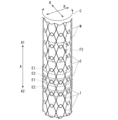
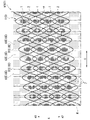
- FIG. 3 is a diagram showing the overall configuration of stent 110. As shown in FIG. The stent 110 is formed by weaving wires and has a cylindrical shape.
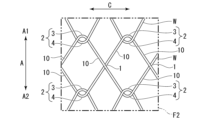
- FIG. 4 is an exploded view of stent 110 in region F2 shown in FIG.
- the stent 110 is formed in the shape of a circular tube having meshes on its peripheral surface by means of wires W that extend obliquely in the circumferential direction C while repeating bending.
- the stent 110 has a plurality of straight crossing portions 1 and a plurality of hooking portions 2 .
- the straight-line crossing portion 1 is formed by straight-line crossing of the straight portions 10 of the wire W.
- the straight portion 10 is a substantially straight portion of the wire W and includes a gently curved portion.
- the engaging portion (entangled portion) 2 is formed by intersecting the mountain-shaped bent portion 3 and the valley-shaped bent portion 4 .
- the mountain-shaped bent portion (mountain) 3 is a convex portion in which the wire W extending obliquely in the circumferential direction C is folded back in the longitudinal axis direction A and convexes in the first direction A1.
- the valley-shaped bent portion (trough) 4 is a convex portion (concave in the first direction A1 side) in which the wire W extending in the circumferential direction is folded back in the longitudinal direction A and bent in the second direction A2 side (concave in the first direction A1 side). concave).
- the mountain-shaped bent portion 3 and the valley-shaped bent portion 4 intersect each other in a hook shape, so that the mountain-shaped bent portion 3 and the valley-shaped bent portion 4 are connected so as to be relatively movable although they cannot be separated. be done.
- the engaging portions 2 adjacent in the circumferential direction C are arranged at approximately the same position in the longitudinal axis direction A. Also, the engaging portions 2 adjacent to each other in the longitudinal direction A are arranged at substantially the same position in the circumferential direction C. As shown in FIG.
- the plurality of straight line intersections 1 are arranged parallel to the circumferential direction C. Further, the plurality of straight line intersections 1 are arranged parallel to the circumferential direction C. As shown in FIG. The first regions E1 in which the plurality of straight crossing portions 1 are arranged and the second regions E2 in which the plurality of engaging portions 2 are arranged are alternately arranged in the longitudinal axis direction A. As shown in FIG.
- FIG. 5 shows the stent device 100 in the F1 region shown in FIG.
- FIG. 6 is a cross-sectional view along line S1-S1 shown in FIG.
- FIG. 7 is a cross-sectional view along line S2-S2 shown in FIG.
- Cover 120 covers the entire stent 110 .
- the cover 120 is made of a flexible material such as polytetrafluoroethylene (PTFE) or polyurethane nonwoven fabric, and can prevent infiltration of cells and blood.
- PTFE polytetrafluoroethylene
- the cover 120 includes an inner cover 5 arranged on the inner side R1 in the radial direction R of the stent 110, an outer cover 6 arranged on the outer side R2 in the radial direction R of the stent 110, are formed by overlapping.
- the inner cover 5 and the outer cover 6 may be integrally formed or may be formed separately.
- the cover 120 has a fixing portion 7 to which the inner cover 5 and the outer cover 6 are fixed, and an accommodating portion 8 that accommodates the wire W. As shown in FIG.
- the fixing portion (fixing region) 7 is a region sandwiched between the engaging portions 2 adjacent to each other in the longitudinal axis direction A, and is surrounded by the mountain-shaped bent portion 3 and the valley-shaped bent portion 4. It is formed in a substantially rhombic region.
- the fixed portion 7 is a region where the inner cover 5 and the outer cover 6 are fixed by adhesion, pressure bonding, or the like. Since the inner cover 5 and the outer cover 6 are fixed, the wire W cannot pass through the fixing portion 7 .
- the accommodation portion (unfixed area) 8 is an area formed by the inner cover 5 and the outer cover 6 that are not fixed.
- the accommodation portion 8 accommodates the wire W in an inner region sandwiched between the inner cover 5 and the outer cover 6 .
- the accommodating portion 8 has a normal accommodating portion 81 and an extended accommodating portion 82 extending in the radial direction R from the normal accommodating portion 81 .
- the normal housing portion 81 is formed by an inner cover 5 extending along the longitudinal direction A and an outer cover 6 extending along the longitudinal direction A, as shown in FIGS.
- the normal accommodation portion 81 is formed in a first region E1 where a plurality of straight line intersection portions 1 are arranged in the circumferential direction C. As shown in FIG.
- the normal accommodation portion 81 accommodates the straight line intersection portion 1 and the wires W in the vicinity of the straight line intersection portion 1 in an inner region sandwiched between the inner cover 5 and the outer cover 6 .
- the expansion accommodation portion 82 includes a non-expansion portion 51 that is a portion of the inner cover 5 extending along the longitudinal direction A and a portion of the outer cover 6 that bulges outward R2. and a formed outer extension 62 .
- the expansion accommodating portion 82 is formed in the second region E2 where the plurality of engaging portions 2 are arranged in the circumferential direction C.
- the extension accommodating portion 82 accommodates a plurality of engaging portions 2 arranged in the circumferential direction C in an inner region sandwiched between the inner cover 5 and the outer cover 6 . Note that the expansion accommodation portion 82 may be formed separately for each engaging portion 2 .
- the fixed parts 7 and the expansion accommodating parts 82 are alternately arranged one by one. 6, the non-expanding portion 51 of the inner cover 5 closes the opening of the outer expanding portion 62 of the outer cover 6. As shown in FIG.
- the outer expanding portion 62 can be displaced to a position where it overlaps with the fixing portion 7 when viewed from the radial direction R.
- the outer expanding portion 62 of the outer cover 6 may have elasticity, and may be displaceable to a position where it overlaps with the fixing portion 7 when viewed from the radial direction R by deformation.
- the fixing parts 7 arranged on both sides of the expansion accommodation part 82 in the longitudinal direction A are defined as a first fixing part 71 and a second fixing part 72 .
- a path length L2 of the outer cover 6 from the first fixing part 71 to the second fixing part 72 is longer than a path length L1 of the inner cover 5 from the first fixing part 71 to the second fixing part 72 .
- the surface area of the outer expanded portion 62 of the outer cover 6 forming the expanded housing portion 82 is larger than the surface area of the non-expanded portion 51 of the inner cover 5 forming the expanded housing portion 82 .
- the normal accommodating portions 81 and the extended accommodating portions 82 are alternately arranged one by one. 7, the internal region of the extended accommodation portion 82 communicates with the internal region of the normal accommodation portion 81 in the cross section along line S2-S2 shown in FIG.
- the engaging portion 2 arranged on the inner side in the bending direction is referred to as “inner engaging portion 2A”. Further, the engaging portion 2 arranged on the outer side in the bending direction is referred to as an “outer engaging portion 2B”.
- FIG. 8 is a partially transparent view of the stent device 100 curved to one side.
- FIG. 9 is a cross-sectional view along line S3-S3 shown in FIG.
- the mountain-shaped bent portion 3 of the inner engaging portion 2A accommodated in the expansion accommodating portion 82 can move in the first direction A1 to a position where it overlaps with the fixed portion 7 when viewed from the radial direction R.
- the valley-shaped bent portion 4 of the inner engaging portion 2A housed in the expansion housing portion 82 can move in the second direction A2 to a position where it overlaps with the fixing portion 7 when viewed from the radial direction R. Therefore, in the bending operation of the stent device 100, the fixing portion 7 does not prevent the movement of the mountain-shaped bent portion 3 and the valley-shaped bent portion 4 of the inner engaging portion 2A away from each other.
- FIG. 10 is a see-through view of a portion of the stent device 100 curved to the other side.
- FIG. 11 is a cross-sectional view taken along line S4-S4 shown in FIG.
- the mountain-shaped bent portion 3 of the outer engaging portion 2B accommodated in the extended accommodation portion 82 can move in the second direction A2 until it contacts the valley-shaped bent portion 4 .
- the valley-shaped bent portion 4 of the outer engaging portion 2B accommodated in the extended accommodation portion 82 can move in the first direction A1 until it contacts the mountain-shaped bent portion 3 . Therefore, in the bending operation of the stent device 100, the fixing portion 7 does not prevent the movement of the mountain-shaped bent portion 3 and the valley-shaped bent portion 4 of the outer engaging portion 2B to approach each other.
- a stent placement method using an endoscope system 300 including a stent delivery system 150 will be described by taking a procedure for placing the stent device 100 in a bile duct as an example.
- the operator inserts the insertion portion 210 of the endoscope 200 into the patient's body cavity through a natural opening such as the mouth. At that time, the operator bends the bending portion 212 by operating the knob 223 or the like as necessary.
- the operator passes the guidewire through the treatment instrument channel 230 of the endoscope 200 and inserts the guidewire into the bile duct while observing with the endoscope 200 . Subsequently, the operator operates the guidewire under X-ray fluoroscopy to break through the narrowed site in the bile duct, and moves the distal end of the guidewire to the liver side of the narrowed site (target position).
- the operator inserts the proximal end of the guide wire protruding from the forceps plug 225 of the endoscope 200 into the through hole of the tip 180 of the stent delivery system 150 .
- the operator advances the stent delivery system 150 along the guidewire by pushing the stent delivery system 150 while holding the guidewire.
- the distal end of stent delivery system 150 protrudes from the distal end of treatment instrument channel 230 of endoscope 200 .
- the operator advances and retracts the stent delivery system 150 to determine the indwelling position of the stent device 100 . Note that the operator may insert the stent delivery system 150 into the treatment instrument channel 230 without using a guide wire.
- the operator After determining the target position of the stent device 100 , the operator retracts the outer cylinder member 160 with respect to the inner cylinder member 170 . As a result, as shown in FIG. 1, the stent device 100 is gradually exposed and expanded from the distal side.
- the stent device 100 When the stent device 100 is completely exposed, the stent device 100 expands as a whole and the inner diameter of the stent device 100 becomes larger than the outer diameter of the inner tubular member 170 . Along with this, the locking between the stent device 100 and the inner tubular member 170 is released.
- the stent device 100 After the locking between the stent device 100 and the inner tubular member 170 is released, when the operator retracts the inner tubular member 170, the stent device 100 remains at the indwelling position and the inner tubular member 170 is removed from the stent device 100. be.
- the placement procedure of the stent device 100 is completed.
- the stent 110 is easily curved even when covered with the cover 120 .
- the bending operation is not hindered by the fixing portion 7 regardless of whether the engaging portion 2 is arranged on the inner side or the outer side in the bending direction.
- the expansion receiving portion 82 is formed by the non-expansion portion 51 of the inner cover 5 and the outer expansion portion 62 of the outer cover 6 .
- the mode of the extension accommodating portion 82 is not limited to this.
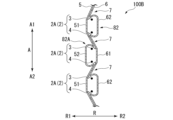
- 12A and 12B are diagrams showing an expansion accommodation portion 82A that is a modification of the expansion accommodation portion 82.
- the expansion housing portion 82A is formed by an inner expansion portion 52 formed by expanding a portion of the inner cover 5 toward the inside R1 and a non-expansion portion 61 extending along the longitudinal axis direction A and being a portion of the outer cover 6. It is formed.
- a second embodiment of the present invention will be described with reference to FIGS. 13 to 15.
- FIG. In the following description, the same reference numerals are given to the same configurations as those already described, and redundant descriptions will be omitted.
- a stent device 100B according to the second embodiment is housed in a stent delivery system 150, like the stent device 100 according to the first embodiment.
- Stent device 100B comprises stent 110 and cover 120B.
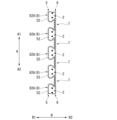
- FIG. 13 is a cross-sectional view of a stent device 100B including a securing portion 7 and expansion accommodation portions 82, 82A.
- FIG. 14 is a cross-sectional view of stent device 100B including normal housing portion 81 and expanded housing portions 82, 82A.
- FIG. 15 is a cross-sectional view of stent device 100B including inner hook 2A.
- the expansion accommodation portions 82 and the expansion accommodation portions 82A are alternately arranged one by one in the longitudinal axis direction A.
- the cover 120B is less bulky in the radial direction R than the cover 120 of the first embodiment. Therefore, the operator can easily release the stent device 100B from the stent delivery system 150. FIG. Also, the operator can easily recapture the stent device 100B into the stent delivery system 150. FIG.
- the mountain-shaped bent portion 3 of the inner engaging portion 2A housed in the expansion housing portion 82 can move in the first direction A1 to a position where it overlaps the fixed portion 7 when viewed from the radial direction R.
- the valley-shaped bent portion 4 of the inner engaging portion 2A housed in the expansion housing portion 82 can move in the second direction A2 to a position where it overlaps with the fixing portion 7 when viewed from the radial direction R. Therefore, in the bending operation of the stent device 100B, the fixing portion 7 does not prevent the movement of the mountain-shaped bent portion 3 and the valley-shaped bent portion 4 of the inner engaging portion 2A away from each other.
- the stent 110 is easily bent even when covered with the cover 120B.
- the bending operation is not hindered by the fixing portion 7 regardless of whether the engaging portion 2 is arranged on the inner side or the outer side in the bending direction.
- the expansion accommodation portions 82 and the expansion accommodation portions 82A are alternately arranged one by one in the longitudinal direction A. As shown in FIG.
- the arrangement mode of the extension accommodating portion 82 and the extension accommodating portion 82A is not limited to this.
- the expansion accommodation portions 82 and the expansion accommodation portions 82A may alternately arrange two continuous expansion accommodation portions 82 and one expansion accommodation portion 82A.
- a third embodiment of the present invention will be described with reference to FIGS. 16 to 18.
- FIG. In the following description, the same reference numerals are given to the same configurations as those already described, and redundant descriptions will be omitted.
- a stent device 100C according to the third embodiment is housed in a stent delivery system 150, like the stent device 100 according to the first embodiment.
- Stent device 100C comprises stent 110 and cover 120C.
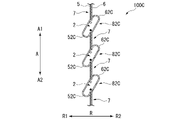
- FIG. 16 is a cross-sectional view of a stent device 100C including a securing portion 7 and an expansion receiving portion 82C.
- FIG. 17 is a cross-sectional view of stent device 100C including normal housing portion 81 and expanded housing portion 82C.
- FIG. 18 is a cross-sectional view of a stent device 100C including inner hooks 2A.
- the cover 120C has an extension accommodating portion 82C instead of the extension accommodating portion 82 of the first embodiment.
- the expansion accommodating portion 82C is formed by an inner expansion portion 52C formed by expanding a portion of the inner cover 5 toward the inside R1 and an outside expansion portion 62C formed by expanding a portion of the outer cover 6 toward the outside R2. be done.
- the extension accommodating portion 82C accommodates the engaging portion 2 in an inner region sandwiched between the inner cover 5 and the outer cover 6. As shown in FIG.
- the cover 120C is less bulky in the radial direction R than the cover 120 of the first embodiment. Therefore, the operator can easily release the stent device 100C from the stent delivery system 150. FIG. Also, it is easier for the operator to recapture the stent device 100C into the stent delivery system 150. FIG.
- the mountain-shaped bent portion 3 of the inner engaging portion 2A housed in the expansion housing portion 82C can move in the first direction A1 to a position where it overlaps the fixing portion 7 when viewed from the radial direction R.
- the valley-shaped bent portion 4 of the inner engaging portion 2A accommodated in the expansion accommodating portion 82C can move in the second direction A2 to a position where it overlaps with the fixed portion 7 when viewed from the radial direction R. Therefore, in the bending operation of the stent device 100C, the fixing portion 7 does not prevent the movement of the mountain-shaped bent portion 3 and the valley-shaped bent portion 4 of the inner engaging portion 2A away from each other.
- the stent 110 is easily bent even when covered with the cover 120C.
- the bending operation is not hindered by the fixing portion 7 regardless of whether the engaging portion 2 is arranged on the inner side or the outer side in the bending direction.
- (Modification 3-1) 19 and 20 are cross-sectional views of an expansion accommodation portion 82C1 that is a modification of the expansion accommodation portion 82C.
- the extension accommodation portion 82C1 is formed of an inner extension portion 52C and an outer extension portion 62C, similarly to the extension accommodation portion 82C.
- the outer extension portion 62C is attached to the fixed portion 7 by the adhesive portion 9 while extending in the first direction A1.
- the inner expanding portion 52C is attached to the fixing portion 7 by the bonding portion 9 while extending in the second direction A2.
- the expansion accommodating portion 82C1 is less bulky in the radial direction R and does not interfere with the operation of the engaging portion 2. As shown in FIG.
- (Modification 3-2) 21 and 22 are cross-sectional views of an expansion accommodation portion 82C2 that is a modification of the expansion accommodation portion 82C.
- the extension accommodation portion 82C2 is formed of an inner extension portion 52C and an outer extension portion 62C, similarly to the extension accommodation portion 82C.
- the distal end portion 62t of the outer extension portion 62C is fixed to the mountain-shaped bent portion 3.
- the distal end portion 52t of the inner expansion portion 52C is fixed to the valley-shaped bent portion 4 in the expansion accommodation portion 82C2.
- the expansion accommodating portion 82C1 is less bulky in the radial direction R. As shown in FIG.
- a fourth embodiment of the present invention will be described with reference to FIG. In the following description, the same reference numerals are given to the same configurations as those already described, and redundant descriptions will be omitted.
- a stent device 100D according to the fourth embodiment is housed in a stent delivery system 150, like the stent device 100 according to the first embodiment.
- Stent device 100D comprises stent 110D and cover 120D.
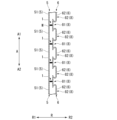
- FIG. 23 is a developed view of the stent device 100D deployed in the circumferential direction C.
- FIG. A stent 110D differs from the stent 110 of the first embodiment only in the arrangement of a plurality of linear crossing portions 1 and a plurality of engaging portions 2.
- FIG. In the stent 110D the first regions E1 in which the plurality of linear crossing portions 1 are arranged and the second regions E2 in which the plurality of engaging portions 2 are arranged are alternately arranged in the longitudinal axis direction A.
- the first region E1 is spirally arranged along the longitudinal axis direction A.
- the second region E2 is spirally arranged along the longitudinal axis direction A.
- the cover 120D has a fixed portion 7 to which the inner cover 5 and the outer cover 6 are fixed, and a housing portion 8D for housing the wire W.
- the accommodating portion (unfixed area) 8D is an area formed by the inner cover 5 and the outer cover 6 that are not fixed, similar to the accommodating portion 8 .
- the accommodating portion 8D has a normal accommodating portion 81D and an expanded accommodating portion 82D that is wider in the radial direction R than the normal accommodating portion 81D.
- the normal housing portion 81D is formed in a first region E1 in which a plurality of straight line intersection portions 1 are spirally arranged along the longitudinal axis direction A.
- the extension accommodating portion 82D is formed in a second region E2 where a plurality of engaging portions 2 are spirally arranged along the longitudinal axis direction A. As shown in FIG.
- the stent 110D is easily bent even when covered with the cover 120D.
- the bending operation is not hindered by the fixing portion 7 regardless of whether the engaging portion 2 is arranged on the inner side or the outer side in the bending direction.
- the weaving method of the stent is not limited to the stent 110 of the first embodiment and the stent 110D of the fourth embodiment. Other braiding schemes for the stent are possible.
- a fifth embodiment of the present invention will be described with reference to FIGS. 24 and 25.
- FIG. In the following description, the same reference numerals are given to the same configurations as those already described, and redundant descriptions will be omitted.
- a stent device 100E according to the fifth embodiment is housed in a stent delivery system 150, like the stent device 100 according to the first embodiment.
- Stent device 100E comprises stent 110 and cover 120E.
- FIG. 24 shows a portion of stent device 100E.
- the cover 120E like the cover 120 of the first embodiment, has an inner cover 5 arranged on the inner side R1 in the radial direction R of the stent 110 and an outer cover 6 arranged on the outer side R2 in the radial direction R of the stent 110. , are superimposed on each other.
- the cover 120E has a fixing portion 7 to which the inner cover 5 and the outer cover 6 are fixed, and an accommodating portion 8E that accommodates the wire W. As shown in FIG.
- the accommodating portion (non-fixed area) 8E is an area formed by the inner cover 5 and the outer cover 6 that are not fixed, similar to the accommodating portion 8 .
- the accommodating portion 8E has a normal accommodating portion 81E and an extended accommodating portion 82E that is wider in the radial direction R than the normal accommodating portion 81E.
- the normal accommodating portion 81E is formed in a third region E3 where a plurality of engaging portions 2 are arranged in the longitudinal axis direction A.
- the extension accommodating portion 82E is formed in a fourth region E4 where a plurality of straight line intersections 1 are arranged in the longitudinal axis direction A. As shown in FIG.
- the extension accommodating portion 82E accommodates a plurality of straight-line intersections 1 arranged in the longitudinal axis direction A and the wires W in the vicinity of the straight-line intersections 1 in an inner region sandwiched between the inner cover 5 and the outer cover 6 .
- FIG. 25 shows a portion of twisted stent device 100E. Even when the stent device 100E is twisted, as shown in FIG. 25, the straight line intersection 1 and the wire W in the vicinity of the straight line intersection 1 move to a position where they overlap the fixing section 7 when viewed from the radial direction R. can.
- the stent 110 is easily twisted even when covered with the cover 120D.
- FIG. 26 is an exploded view of a stent device 100E1, which is a modification of the stent device 100E.
- Stent device 100E1 comprises stent 110D and cover 120E.
- the expansion accommodating portion 82E is formed as a continuous area along the longitudinal axis direction A. As shown in FIG. Therefore, even in the case where the straight crossing portion 1 and the engaging portion 2 are spirally arranged along the longitudinal axis direction A as in the stent 110D, the manufacturing cost of the expansion accommodating portion 82E is low.
- the present invention can be applied to a stent covered with a cover.
- Endoscope system 200 Endoscope 150 Stent delivery system 140 Operation unit 160 Outer cylinder member 170 Inner cylinder member 180 Chip 100, 100B, 100C, 100D, 100E Stent device 110, 110D Stent 120, 120B, 120C, 120D, 120E Cover 1 Straight intersection part 10 Straight part 2 Engagement part (entanglement part) 3 Mountain-shaped bend (mountain) 4 valley type bend (valley) 5 Inner cover 6 Outer cover 7 Fixed part 8 Accommodating part 81 Normal accommodating part 82 Extended accommodating part
Landscapes
- Health & Medical Sciences (AREA)
- Engineering & Computer Science (AREA)
- Biomedical Technology (AREA)
- Cardiology (AREA)
- Oral & Maxillofacial Surgery (AREA)
- Transplantation (AREA)
- Heart & Thoracic Surgery (AREA)
- Vascular Medicine (AREA)
- Life Sciences & Earth Sciences (AREA)
- Animal Behavior & Ethology (AREA)
- General Health & Medical Sciences (AREA)
- Public Health (AREA)
- Veterinary Medicine (AREA)
- Gastroenterology & Hepatology (AREA)
- Pulmonology (AREA)
- Media Introduction/Drainage Providing Device (AREA)
Priority Applications (6)
| Application Number | Priority Date | Filing Date | Title |
|---|---|---|---|
| CN202180101942.7A CN117897121A (zh) | 2021-09-01 | 2021-09-01 | 支架装置及支架输送系统 |
| EP21955974.7A EP4397284A4 (en) | 2021-09-01 | 2021-09-01 | STENT DEVICE AND STENT DELIVERY SYSTEM |
| KR1020247006275A KR20240033283A (ko) | 2021-09-01 | 2021-09-01 | 스텐트 디바이스 및 스텐트 전달 시스템 |
| PCT/JP2021/032146 WO2023032084A1 (ja) | 2021-09-01 | 2021-09-01 | ステントデバイスおよびステントデリバリーシステム |
| JP2023544877A JP7587049B2 (ja) | 2021-09-01 | 2021-09-01 | ステントデバイスおよびステントデリバリーシステム |
| US18/587,198 US20240189125A1 (en) | 2021-09-01 | 2024-02-26 | Stent device and stent delivery system |
Applications Claiming Priority (1)
| Application Number | Priority Date | Filing Date | Title |
|---|---|---|---|
| PCT/JP2021/032146 WO2023032084A1 (ja) | 2021-09-01 | 2021-09-01 | ステントデバイスおよびステントデリバリーシステム |
Related Child Applications (1)
| Application Number | Title | Priority Date | Filing Date |
|---|---|---|---|
| US18/587,198 Continuation US20240189125A1 (en) | 2021-09-01 | 2024-02-26 | Stent device and stent delivery system |
Publications (1)
| Publication Number | Publication Date |
|---|---|
| WO2023032084A1 true WO2023032084A1 (ja) | 2023-03-09 |
Family
ID=85410928
Family Applications (1)
| Application Number | Title | Priority Date | Filing Date |
|---|---|---|---|
| PCT/JP2021/032146 Ceased WO2023032084A1 (ja) | 2021-09-01 | 2021-09-01 | ステントデバイスおよびステントデリバリーシステム |
Country Status (6)
| Country | Link |
|---|---|
| US (1) | US20240189125A1 (https=) |
| EP (1) | EP4397284A4 (https=) |
| JP (1) | JP7587049B2 (https=) |
| KR (1) | KR20240033283A (https=) |
| CN (1) | CN117897121A (https=) |
| WO (1) | WO2023032084A1 (https=) |
Cited By (1)
| Publication number | Priority date | Publication date | Assignee | Title |
|---|---|---|---|---|
| WO2024209584A1 (ja) * | 2023-04-05 | 2024-10-10 | オリンパス株式会社 | ステントデバイス |
Citations (3)
| Publication number | Priority date | Publication date | Assignee | Title |
|---|---|---|---|---|
| GB2346559A (en) * | 1998-12-23 | 2000-08-16 | Stephen George Edward Barker | Endoluminal stent |
| JP2007505687A (ja) * | 2003-09-17 | 2007-03-15 | ボストン サイエンティフィック リミテッド | 生物化学的な活性物質を有するカバードステント |
| WO2021166156A1 (ja) * | 2020-02-20 | 2021-08-26 | オリンパス株式会社 | ステントデリバリーシステム、内視鏡システムおよびステント留置方法 |
Family Cites Families (4)
| Publication number | Priority date | Publication date | Assignee | Title |
|---|---|---|---|---|
| GB2449784B8 (en) * | 2004-02-09 | 2009-04-29 | Cook Biotech Inc | Stent graft devices having collagen coating. |
| US8034096B2 (en) * | 2004-03-31 | 2011-10-11 | Cook Medical Technologies Llc | Stent-graft with graft to graft attachment |
| JP5813230B2 (ja) * | 2012-07-13 | 2015-11-17 | 株式会社パイオラックスメディカルデバイス | ステント |
| KR101557010B1 (ko) * | 2014-07-11 | 2015-10-02 | 주식회사 비씨엠 | 커버드 스텐트와 그 제조방법 |
-
2021
- 2021-09-01 KR KR1020247006275A patent/KR20240033283A/ko not_active Withdrawn
- 2021-09-01 JP JP2023544877A patent/JP7587049B2/ja active Active
- 2021-09-01 EP EP21955974.7A patent/EP4397284A4/en active Pending
- 2021-09-01 WO PCT/JP2021/032146 patent/WO2023032084A1/ja not_active Ceased
- 2021-09-01 CN CN202180101942.7A patent/CN117897121A/zh active Pending
-
2024
- 2024-02-26 US US18/587,198 patent/US20240189125A1/en active Pending
Patent Citations (3)
| Publication number | Priority date | Publication date | Assignee | Title |
|---|---|---|---|---|
| GB2346559A (en) * | 1998-12-23 | 2000-08-16 | Stephen George Edward Barker | Endoluminal stent |
| JP2007505687A (ja) * | 2003-09-17 | 2007-03-15 | ボストン サイエンティフィック リミテッド | 生物化学的な活性物質を有するカバードステント |
| WO2021166156A1 (ja) * | 2020-02-20 | 2021-08-26 | オリンパス株式会社 | ステントデリバリーシステム、内視鏡システムおよびステント留置方法 |
Non-Patent Citations (1)
| Title |
|---|
| See also references of EP4397284A4 |
Cited By (1)
| Publication number | Priority date | Publication date | Assignee | Title |
|---|---|---|---|---|
| WO2024209584A1 (ja) * | 2023-04-05 | 2024-10-10 | オリンパス株式会社 | ステントデバイス |
Also Published As
| Publication number | Publication date |
|---|---|
| KR20240033283A (ko) | 2024-03-12 |
| CN117897121A (zh) | 2024-04-16 |
| JP7587049B2 (ja) | 2024-11-19 |
| EP4397284A1 (en) | 2024-07-10 |
| EP4397284A4 (en) | 2025-07-02 |
| US20240189125A1 (en) | 2024-06-13 |
| JPWO2023032084A1 (https=) | 2023-03-09 |
Similar Documents
| Publication | Publication Date | Title |
|---|---|---|
| KR102678341B1 (ko) | 담관 스텐트 | |
| JP5611451B2 (ja) | 胆管アクセスシース | |
| ES2950893T3 (es) | Dispositivo endoluminal | |
| JP7446310B2 (ja) | 拡張可能な作業チャネルを有する内視鏡 | |
| JP5575654B2 (ja) | カテーテル | |
| KR101382524B1 (ko) | 돌출형 부분이중구조 스텐트 | |
| WO2015083644A1 (ja) | 内視鏡のための受動湾曲部と内視鏡 | |
| JP7631632B2 (ja) | ステント | |
| WO2023032084A1 (ja) | ステントデバイスおよびステントデリバリーシステム | |
| WO2023032052A1 (ja) | ステントおよびステントデリバリーシステム | |
| WO2024209584A1 (ja) | ステントデバイス | |
| JP6705025B2 (ja) | ステント | |
| CN114931692B (zh) | 导管系统 | |
| JP7612885B2 (ja) | ステントおよびステントデリバリーシステム | |
| JP7490922B2 (ja) | ステント | |
| JP7578047B2 (ja) | 管腔臓器間バイパス用ステント | |
| CN118843438A (zh) | 导管及输送系统 | |
| US20230030449A1 (en) | Stent | |
| JP2004223104A (ja) | 内視鏡 | |
| WO2022249464A1 (ja) | デリバリーデバイスおよび内視鏡システム |
Legal Events
| Date | Code | Title | Description |
|---|---|---|---|
| 121 | Ep: the epo has been informed by wipo that ep was designated in this application |
Ref document number: 21955974 Country of ref document: EP Kind code of ref document: A1 |
|
| ENP | Entry into the national phase |
Ref document number: 20247006275 Country of ref document: KR Kind code of ref document: A |
|
| WWE | Wipo information: entry into national phase |
Ref document number: 1020247006275 Country of ref document: KR |
|
| WWE | Wipo information: entry into national phase |
Ref document number: 2023544877 Country of ref document: JP |
|
| WWE | Wipo information: entry into national phase |
Ref document number: 202180101942.7 Country of ref document: CN |
|
| WWE | Wipo information: entry into national phase |
Ref document number: 2021955974 Country of ref document: EP |
|
| NENP | Non-entry into the national phase |
Ref country code: DE |
|
| ENP | Entry into the national phase |
Ref document number: 2021955974 Country of ref document: EP Effective date: 20240402 |
|
| WWW | Wipo information: withdrawn in national office |
Ref document number: 1020247006275 Country of ref document: KR |