WO2023013385A1 - フィルムコンデンサ - Google Patents
フィルムコンデンサ Download PDFInfo
- Publication number
- WO2023013385A1 WO2023013385A1 PCT/JP2022/027851 JP2022027851W WO2023013385A1 WO 2023013385 A1 WO2023013385 A1 WO 2023013385A1 JP 2022027851 W JP2022027851 W JP 2022027851W WO 2023013385 A1 WO2023013385 A1 WO 2023013385A1
- Authority
- WO
- WIPO (PCT)
- Prior art keywords
- electrode
- fuse
- regions
- dielectric film
- adjacent
- Prior art date
- Legal status (The legal status is an assumption and is not a legal conclusion. Google has not performed a legal analysis and makes no representation as to the accuracy of the status listed.)
- Ceased
Links
Images



Classifications
-
- H—ELECTRICITY
- H01—ELECTRIC ELEMENTS
- H01G—CAPACITORS; CAPACITORS, RECTIFIERS, DETECTORS, SWITCHING DEVICES, LIGHT-SENSITIVE OR TEMPERATURE-SENSITIVE DEVICES OF THE ELECTROLYTIC TYPE
- H01G4/00—Fixed capacitors; Processes of their manufacture
- H01G4/32—Wound capacitors
-
- H—ELECTRICITY
- H01—ELECTRIC ELEMENTS
- H01G—CAPACITORS; CAPACITORS, RECTIFIERS, DETECTORS, SWITCHING DEVICES, LIGHT-SENSITIVE OR TEMPERATURE-SENSITIVE DEVICES OF THE ELECTROLYTIC TYPE
- H01G4/00—Fixed capacitors; Processes of their manufacture
- H01G4/33—Thin- or thick-film capacitors (thin- or thick-film circuits; capacitors without a potential-jump or surface barrier specially adapted for integrated circuits, details thereof, multistep manufacturing processes therefor)
Definitions
- the present disclosure relates generally to film capacitors, and more particularly to film capacitors with fuses.
- Patent Document 1 discloses a metallized film capacitor.
- This metallized film capacitor comprises a pair of vapor-deposited electrodes and at least two dielectric films having insulating margins at different positions, and has metallikon on both end faces.
- the vapor-deposited electrodes are formed by forming split electrodes on the side closer to the insulating margin and connecting them with fuses.
- Patent Document 1 has the problem that it is difficult to increase the sensitivity of the fuse.
- An object of the present disclosure is to provide a film capacitor that can enhance the sensitivity of the fuse.
- a film capacitor according to an aspect of the present disclosure includes a dielectric film having a first surface and a second surface opposite to the first surface, a first electrode disposed on the first surface, and the second a second electrode disposed on the surface and facing the first electrode via the dielectric film. At least one of the first electrode and the second electrode includes a plurality of regions and a fuse connecting two adjacent regions among the plurality of regions. At least one of the two adjacent regions has a recess recessed in the direction in which the fuse extends, and is connected to the fuse inside the recess.
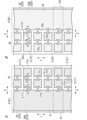
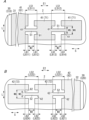
- FIG. 1 is an explanatory diagram showing the film capacitor according to the first embodiment.
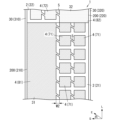
- FIG. 2A is a schematic plan view of a first metallized film in the same film capacitor.
- FIG. 2B is a schematic plan view of a second metallized film in the film capacitor;
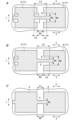
- FIG. 3A is an enlarged view (X portion in FIG. 1) of the film capacitor same as the above.
- FIG. 3B is an enlarged view of a main portion (corresponding to the X portion in FIG. 1) as a modified example of the film capacitor.
- FIG. 3C is a diagram for comparison with FIGS. 3A and 3B.
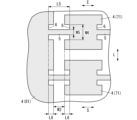
- FIG. 4 is an enlarged view (Y portion of FIG. 1) of the main part of the film capacitor according to the first embodiment.
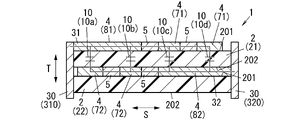
- FIG. 5 is a schematic sectional view along line ZZ of FIG.
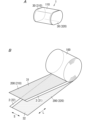
- FIG. 6A is a schematic perspective view showing an example of a film capacitor.
- FIG. 6B is a schematic perspective view showing a state in the middle of manufacturing a film capacitor.
- FIG. 7A is an enlarged view (corresponding to part X in FIG. 1) of a film capacitor according to the second embodiment.
- FIG. 7B is an enlarged view of a main part of the same film capacitor (corresponding to the Y portion in FIG. 1).
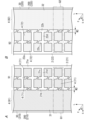
- FIG. 8A is an enlarged view (corresponding to P1 portion of FIG. 2A) of a main part of the film capacitor according to the third embodiment.
- FIG. 8B is an enlarged view of a main portion of the film capacitor (corresponding to P2 portion in FIG. 2B).
- FIG. 9 is an explanatory diagram showing a film capacitor according to the fourth embodiment.
- FIG. 9 is an explanatory diagram showing a film capacitor according to the fourth embodiment.
- FIG. 10A is a schematic plan view of a first metallized film in the film capacitor
- FIG. 10B is a schematic plan view of a second metallized film in the film capacitor
- FIG. 11A is an enlarged view (corresponding to Q1 portion of FIG. 10A) of a main part of the film capacitor according to the fifth embodiment.
- FIG. 11B is an enlarged view of a main portion of the same film capacitor (corresponding to Q2 portion in FIG. 10B).
- FIG. 6A shows an example of a film capacitor 1 .
- the film capacitor 1 has, for example, a flat cylindrical shape.
- the film capacitor 1 is manufactured, for example, as shown in FIG. 6B.
- the cylindrical body 100 is formed by stacking and winding two elongated metallized films 200 (a first metallized film 210 and a second metallized film 220).
- the first metallized film 210 includes the dielectric film 2 (the first dielectric film 21) and the first electrode 31.
- a first electrode 31 is arranged on one side of the first dielectric film 21 .
- the first electrode 31 is shown in simplified form in FIG. 6B, in detail the first electrode 31 includes a plurality of regions 4 and a fuse 5 as shown in FIG. 2A.
- the region 4 is not particularly limited, but includes, for example, the first small electrodes 71 and the first undivided electrodes 81 .
- a fuse 5 connects two adjacent regions 4 among the plurality of regions 4 . Specifically, as shown in FIG. 2A, the fuse 5 connects the first small electrodes 71 together. The fuse 5 also connects the first small electrode 71 and the first undivided electrode 81 .
- the second metallized film 220 includes the dielectric film 2 (second dielectric film 22) and the second electrode 32.
- a second electrode 32 is arranged on one side of the second dielectric film 22 .
- the second electrode 32 is also shown in simplified form in FIG. 6B. ,including.
- the region 4 is not particularly limited, but includes, for example, the second small electrodes 72 and the second non-divided electrodes 82 .
- a fuse 5 connects two adjacent regions 4 among the plurality of regions 4 . Specifically, as shown in FIG. 2B, the fuse 5 connects the second small electrodes 72 together. The fuse 5 also connects the second small electrode 72 and the second undivided electrode 82 .
- first small electrode 71 and the second small electrode 72 may be collectively referred to as "small electrode 7".
- first undivided electrode 81 and the second undivided electrode 82 may be collectively referred to as "non-divided electrode 8".
- the film capacitor 1 can include a plurality of unit capacitors 10 in the lateral direction S (synonymous with the width direction and one direction) of the dielectric film 2 (see FIG. 5). Note that FIG. 5 is not a strict cross-sectional view of FIG. 6A, but is a schematic illustration to facilitate understanding of the following description.
- a film capacitor 1 shown in FIG. 5 includes four unit capacitors 10 connected in parallel in the lateral direction S of the dielectric film 2 .
- the first unit capacitor 10a is formed in a portion where the first non-divided electrode 81 and the left second small electrode 72 face each other with the first dielectric film 21 interposed therebetween.
- a second unit capacitor 10b is formed in a portion where the first non-divided electrode 81 and the right second small electrode 72 face each other with the first dielectric film 21 interposed therebetween.
- a third unit capacitor 10c is formed in a portion where the left first small electrode 71 and the second non-divided electrode 82 face each other with the first dielectric film 21 interposed therebetween.
- a fourth unit capacitor 10d is formed in a portion where the right first small electrode 71 and the second non-divided electrode 82 face each other with the first dielectric film 21 interposed therebetween. Furthermore, each of these four unit capacitors 10 is arranged in a plurality in the longitudinal direction L of the dielectric film 2 (the direction perpendicular to the plane of the paper in FIG. 5).
- the first electrode 31 and the second electrode 32 face each other with the dielectric film 2 interposed therebetween.
- Edge electrodes 30 are present at both ends of the film capacitor 1 .
- the first end surface electrode 310 is arranged on one side of the dielectric film 2 in the transverse direction S (the left side in FIG. 5).
- the first electrode 31 is connected to the first edge electrode 310 .
- the second end face electrode 320 is arranged on the other side of the dielectric film 2 in the transverse direction S (on the right side in FIG. 5).
- the second electrode 32 is connected to the second edge electrode 320 .
- the fuse 5 is a part that melts and cuts off the circuit when an excessive current flows. That is, when an excessive current flows through the dielectric film 2 due to dielectric breakdown, the fuse 5 is disconnected, thereby protecting the film capacitor 1 .
- the inventors have improved the fuse 5 shown in FIG. 3C to develop the fuse 5 as shown in FIGS. 3A and 3B.
- increasing the electrical resistance of the fuse 5 can be considered.
- the width W5 of the fuse 5 should be narrowed or the length L5 of the fuse 5 should be lengthened.
- narrowing the width W5 of the fuse 5 has a limitation in construction.
- the distance (slit width W2) between two adjacent regions 4 is also lengthened.
- the area of the region 4 decreases as the slit width W2 increases.
- the electrode area of the film capacitor 1 (the area where the first electrode 31 and the second electrode 32 face each other) becomes smaller, so that the capacity (electrostatic capacity) of the film capacitor 1 decreases.
- the electrical resistance of the fuse 5 is increased by increasing the length L5 of the fuse 5 without increasing the slit width W2. That is, at least one of the two adjacent regions 4 has a recessed portion 6 recessed in the direction E in which the fuse 5 extends, and is connected to the fuse 5 inside the recessed portion 6 .
- the length L5 of the fuse 5 is made longer by a length corresponding to the depth L6 (recess amount L6) of the recess 6 compared to the distance (slit width W2) between the two adjacent regions 4. be able to.
- the electric resistance of the fuse 5 can be increased. Therefore, the sensitivity of fuse 5 can be enhanced.
- FIG. 1 is an explanatory diagram showing a film capacitor 1 according to this embodiment. Specifically, FIG. 1 illustrates two sheets of metallized film 200 that are not wound but overlapped with being shifted in the longitudinal direction L in order to facilitate understanding of the following description.
- a film capacitor 1 according to this embodiment includes a dielectric film 2 , a first electrode 31 and a second electrode 32 .
- the second electrode 32 faces the first electrode 31 via the dielectric film 2 (the first dielectric film 21 in this embodiment).
- the film capacitor 1 includes a plurality of (four in this embodiment) unit capacitors 10 connected in parallel in the lateral direction S (see FIG. 5).
- the dielectric film 2, the first electrode 31, and the second electrode 32 are described below.
- the dielectric film 2 is a film made of a dielectric.
- the dielectric is not particularly limited, but examples thereof include polypropylene (PP) and polyethylene terephthalate (PET).
- the dielectric film 2 has an elongated film shape. That is, the dielectric film 2 is a film extending in the longitudinal direction L orthogonal to the lateral direction S. As shown in FIG.
- the dielectric film 2 has a first surface 201 and a second surface 202 (see FIG. 5).
- the first surface 201 is a surface facing one side in the thickness direction T of the dielectric film 2 .
- the second surface 202 is the surface opposite to the first surface 201 . That is, the second surface 202 is a surface facing the other side in the thickness direction T of the dielectric film 2 .
- the thickness direction T is a direction orthogonal to the lateral direction S and the longitudinal direction L, in other words, a direction connecting the first surface 201 and the second surface 202 .
- the dielectric film 2 includes a first dielectric film 21 and a second dielectric film 22.
- the first electrode 31 may be any of a vapor deposition electrode, a metal foil electrode, and a plated electrode.
- the material of the first electrode 31 is not particularly limited, but examples thereof include aluminum.
- the first electrode 31 is arranged on the first surface 201 of the dielectric film 2 (the first dielectric film 21 in this embodiment). Thereby, a metallized film 200 (first metallized film 210 in this embodiment) is formed (see FIG. 2A).
- the first electrode 31 includes multiple regions 4 and fuses 5 .
- a fuse 5 connects two adjacent regions 4 among the plurality of regions 4 .
- the region 4 included in the first electrode 31 may be referred to as "first region 41". Also, the fuse 5 included in the first electrode 31 may be referred to as a "first fuse 51”.
- the first electrode 31 is partitioned into a first non-split electrode 81 and a first split electrode 91 by a first partition slit portion 21b. Furthermore, the first divided electrode 91 is partitioned into a plurality of first small electrodes 71 by the first longitudinal direction slit portion 21c and the first lateral direction slit portion 21d.
- each of the first undivided electrodes 81 and the first small electrodes 71 corresponds to one first region 41 .
- the first divided electrode 91 since the first divided electrode 91 includes a plurality of first small electrodes 71 , it includes a plurality of first regions 41 . Therefore, the first split electrode 91 does not correspond to one first region 41 .
- the first partition slit portion 21b is a portion of the first surface 201 of the first dielectric film 21 where the first electrode 31 is not arranged. Therefore, the dielectric film 2 is exposed at this portion.
- the first partition slit portion 21b extends in the longitudinal direction L with a constant width, except for the portion where the first fuse 51 exists.
- the first undivided electrode 81 is a solid electrode extending in the longitudinal direction L. That is, the first non-divided electrode 81 is arranged entirely between the first partitioning slit portion 21 b and the end portion on one side (left side) in the transverse direction S of the dielectric film 2 . A left end portion of the first non-split electrode 81 is connected to the first edge electrode 310 .
- the first split electrode 91 is arranged between the first partition slit portion 21b and the first end margin portion 21a.
- the first end margin portion 21a exists at the end portion on the other side (right side) of the dielectric film 2 in the transverse direction S.
- the first end margin portion 21a is also a portion where the first electrode 31 is not arranged, like the first partition slit portion 21b. Therefore, the dielectric film 2 is also exposed in this portion.
- the first end margin portion 21a extends in the longitudinal direction L with a constant width. The presence of the first end margin portion 21a allows the first split electrode 91 and the second end face electrode 320 to be separated from each other.
- the width of the first end margin portion 21a is the same as the width of the first partitioning slit portion 21b, but may differ within a range that does not impair the effects of the present embodiment.
- the first split electrode 91 is partitioned into a plurality of first small electrodes 71 by the first longitudinal slits 21c and the first transverse slits 21d.
- the first longitudinal slit portion 21c is also a portion of the first surface 201 of the first dielectric film 21 where the first electrode 31 is not arranged, like the first partitioning slit portion 21b. Therefore, the dielectric film 2 is also exposed in this portion.
- the first longitudinal slit portion 21c also extends in the longitudinal direction L with a constant width, except for the portion where the first fuse 51 exists.
- the width of the first longitudinal direction slit portion 21c is the same as the width of the first partitioning slit portion 21b, but may differ within a range that does not impair the effects of the present embodiment.
- the first lateral direction slit portion 21d is also a portion of the first surface 201 of the first dielectric film 21 where the first electrode 31 is not arranged, like the first partitioning slit portion 21b. Therefore, the dielectric film 2 is also exposed in this portion.
- the first lateral direction slit portion 21d extends in the lateral direction S with a constant width.
- the first lateral direction slit portion 21d intersects with the first longitudinal direction slit portion 21c and is connected to the first partitioning slit portion 21b and the first end margin portion 21a.
- the width of the first lateral direction slit portion 21d is the same as the width of the first partitioning slit portion 21b, but may differ within a range that does not impair the effects of the present embodiment.
- the plurality of first small electrodes 71 are arranged in the longitudinal direction L in a plurality of rows (two rows in this embodiment). Each of the plurality of first small electrodes 71 in the left row is adjacent to each of the plurality of first small electrodes 71 in the right row in the transverse direction S. Furthermore, each of the plurality of first small electrodes 71 in the left column is adjacent to the first undivided electrode 81 in the lateral direction S. As shown in FIG. Thus, the first undivided electrodes 81 are larger than the first sub-electrodes 71 .
- the first small electrode 71 When viewed from the thickness direction T of the dielectric film 2, the first small electrode 71 has a polygonal shape (rectangular shape in this embodiment) having three or more sides. In this embodiment, the sizes of the plurality of first small electrodes 71 are the same, but they may be different as long as the effects of this embodiment are not impaired.
- the first fuse 51 is a part that melts when an excessive current flows to break the circuit.
- the first fuse 51 has an elongated linear shape extending in the lateral direction S. As shown in FIG. Thus, the direction E in which the first fuse 51 extends is parallel to the lateral direction S in this embodiment.
- the first fuse 51 connects two adjacent first regions 41 among the plurality of first regions 41 as described above.
- at least one of the two adjacent first regions 41 has the recessed portion 6 .
- the recessed portion 6 is recessed in the direction E in which the first fuse 51 extends (the lateral direction S in this embodiment).
- the recessed portion 6 has a rectangular shape when viewed from the thickness direction T of the dielectric film 2 .
- the recessed portion 6 is connected to the first partition slit portion 21b and the first longitudinal slit portion 21c. Dielectric film 2 is exposed in recessed portion 6 except for a portion where first fuse 51 is present.
- region 41 has may be called "the 1st recessed part 61.”
- the recessed portion 6 has a width W6 and a depth L6 (see FIGS. 3A and 3B).
- the width W6 of the recessed portion 6 is the length of the recessed portion 6 in the longitudinal direction L. As shown in FIG. Width W6 of recess 6 is wider than width W5 of first fuse 51 . However, from the viewpoint of increasing the electrode area of the film capacitor 1, the width W6 of the recessed portion 6 is preferably as narrow as possible.
- the depth L6 of the recessed portion 6 is the length of the recessed portion 6 in the direction E in which the first fuse 51 extends (the lateral direction S in this embodiment).
- At least one of the two adjacent first regions 41 is connected to the first fuse 51 inside the recess 6 . That is, both of the two adjacent first regions 41 may be connected to the first fuse 51 inside the recess 6 (see FIG. 3A), or only one of the two adjacent first regions 41 may , may be connected to the first fuse 51 inside the recess 6 (see FIG. 3B).
- the first fuse 51 connects two first small electrodes 71 adjacent to each other in the lateral direction S.
- Each of these two first small electrodes 71 has a recess 6 .
- the recessed portion 6 is recessed in the direction E in which the first fuse 51 extends (the lateral direction S in this embodiment).
- the recessed portion 6 exists on at least one of the three or more sides of the first small electrode 71 . That is, in the first small electrode 71 on the left side, the recessed portions 6 are present on the two sides on the left and right sides. The recessed portion 6 present on the left side is used to be connected to the region 4 (not shown in FIG. 3A) present further to the left by the first fuse 51 . The recessed portion 6 present on the right side is used for connection with the first small electrode 71 on the right side and the first fuse 51 . On the other hand, in the first small electrode 71 on the right side, the recessed portion 6 exists only on the left side. Each of the two first small electrodes 71 is connected to the first fuse 51 inside the recess 6 .
- the first fuse 51 connects two first small electrodes 71 adjacent to each other in the lateral direction S, as in FIG. 3A.
- the first small electrode 71 on the right side has the recessed portion 6
- the first small electrode 71 on the left side does not have the recessed portion 6 .
- the first small electrode 71 on the left side has a recessed portion 6 that is used for connection with the region 4 (not shown in FIG. 3B) located further to the left by the first fuse 51 .
- the recessed portion 6 is recessed in the direction E in which the first fuse 51 extends (the lateral direction S in this embodiment). Focusing on the two first small electrodes 71 , only the right first small electrode 71 is connected to the first fuse 51 inside the recess 6 .
- the recessed portion 6 exists on at least one of the three or more sides of the first small electrode 71 . That is, in each of the two first small electrodes 71, the recessed portion 6 exists only on the left side.
- the first fuse 51 connects the first undivided electrode 81 and the plurality of first small electrodes 71 adjacent in the lateral direction S.
- Each of the first undivided electrode 81 and the plurality of first small electrodes 71 has a recessed portion 6 .
- the recessed portion 6 is recessed in the direction E in which the first fuse 51 extends (the lateral direction S in this embodiment).
- Each of the first undivided electrode 81 and the plurality of first small electrodes 71 is connected to the first fuse 51 inside the recess 6 .
- the length L5 of the fuse 5 includes the length L51 of the first fuse 51 unless otherwise specified.
- the length L5 of the fuse 5 is the length in the direction E in which the fuse 5 extends.
- the second electrode 32 may also be any of a vapor deposition electrode, a metal foil electrode, and a plated electrode.
- the material of the second electrode 32 is also the same as the material of the first electrode 31 .
- the second electrode 32 is arranged on the second surface 202 of the dielectric film 2 (the first dielectric film 21 in this embodiment). In other words, the second electrode 32 is arranged on the first surface 201 of the second dielectric film 22 in this embodiment. Thereby, a metallized film 200 (second metallized film 220 in this embodiment) is formed (see FIG. 2B).
- the second electrode 32 includes multiple regions 4 and fuses 5 .
- a fuse 5 connects two adjacent regions 4 among the plurality of regions 4 .
- the region 4 included in the second electrode 32 may be referred to as "second region 42". Also, the fuse 5 included in the second electrode 32 may be referred to as a "second fuse 52".
- the second electrode 32 is partitioned into a second non-split electrode 82 and a second split electrode 92 by a second partition slit portion 22b. Further, the second divided electrode 92 is partitioned into a plurality of second small electrodes 72 by the second longitudinal direction slit portion 22c and the second lateral direction slit portion 22d.
- the first split electrode 91 and the second split electrode 92 may be collectively referred to as the "split electrode 9".
- each of the second undivided electrodes 82 and the second small electrodes 72 corresponds to one second region 42 .
- the second segmented electrode 92 includes a plurality of second sub-electrodes 72 and therefore includes a plurality of second regions 42 . Therefore, the second split electrode 92 does not correspond to one second region 42 .
- the second partition slit portion 22b is a portion of the first surface 201 of the second dielectric film 22 (the second surface 202 of the first dielectric film 21) where the second electrode 32 is not arranged. Therefore, the dielectric film 2 is exposed at this portion.
- the second partition slit portion 22b extends in the longitudinal direction L with a constant width, except for a portion where the second fuse 52 is present.
- the width of the second partitioning slit portion 22b is the same as the width of the first partitioning slit portion 21b, but may be different within a range that does not impair the effects of this embodiment.
- the second non-split electrode 82 is a solid electrode extending in the longitudinal direction L. That is, the second non-divided electrode 82 is arranged entirely between the second partitioning slit portion 22b and the other (right) end of the dielectric film 2 in the transverse direction S. As shown in FIG. A right end portion of the second non-split electrode 82 is connected to the second edge electrode 320 .
- the second split electrode 92 is arranged between the second partition slit portion 22b and the second end margin portion 22a.
- the second end margin portion 22a exists at the end portion on one side (left side) of the dielectric film 2 in the transverse direction S.
- the second end margin portion 22a is also a portion where the second electrode 32 is not arranged, like the second partition slit portion 22b. Therefore, the dielectric film 2 is also exposed in this portion.
- the second end margin portion 22a extends in the longitudinal direction L with a constant width. The presence of the second edge margin portion 22a allows the second split electrode 92 and the first edge electrode 310 to be separated from each other.
- the width of the second end margin portion 22a is the same as the width of the second partition slit portion 22b, but may be different within a range that does not impair the effects of the present embodiment.
- the second split electrode 92 is partitioned into a plurality of second small electrodes 72 by the second longitudinal slits 22c and the second transverse slits 22d.
- the second longitudinal direction slit portion 22c is also located on the first surface 201 of the second dielectric film 22 (the second surface 202 of the first dielectric film 21). This is the portion where the electrode 32 is not arranged. Therefore, the dielectric film 2 is also exposed in this portion.
- the second longitudinal slit portion 22c also extends in the longitudinal direction L with a constant width, except where the second fuse 52 is present.
- the width of the second longitudinal direction slit portion 22c is the same as the width of the second partitioning slit portion 22b, but may differ within a range that does not impair the effects of the present embodiment.
- the second lateral direction slit portion 22d is also formed on the first surface 201 of the second dielectric film 22 (the second surface 202 of the first dielectric film 21). This is the portion where the electrode 32 is not arranged. Therefore, the dielectric film 2 is also exposed in this portion.
- the second transverse direction slit portion 22d extends in the transverse direction S with a constant width.
- the second lateral direction slit portion 22d intersects with the second longitudinal direction slit portion 22c and is connected to the second partition slit portion 22b and the second end margin portion 22a.
- the width of the second lateral direction slit portion 22d is the same as the width of the second partitioning slit portion 22b, but may be different within a range that does not impair the effects of this embodiment.
- the plurality of second small electrodes 72 are arranged in the longitudinal direction L in a plurality of rows (two rows in this embodiment). Each of the plurality of second small electrodes 72 in the right column is adjacent to each of the plurality of second small electrodes 72 in the left column in the transverse direction S. Furthermore, each of the plurality of second small electrodes 72 in the right column is adjacent to the second undivided electrode 82 in the lateral direction S. As shown in FIG. Thus, the second undivided electrodes 82 are larger than the second sub-electrodes 72 .
- the second small electrode 72 When viewed from the thickness direction T of the dielectric film 2, the second small electrode 72 has a polygonal shape (rectangular shape in this embodiment) having three or more sides. Although the sizes of the plurality of second small electrodes 72 are the same in this embodiment, they may be different within a range that does not impair the effects of this embodiment. Furthermore, in this embodiment, the size of the second small electrode 72 is the same as the size of the first small electrode 71, but it may be different as long as the effects of this embodiment are not impaired.
- the second fuse 52 is basically the same as the first fuse 51 . That is, in FIG. 2B, the second fuse 52 connects two second small electrodes 72 adjacent to each other in the lateral direction S. As shown in FIG. Each of these two second small electrodes 72 has a recess 6 . The recessed portion 6 is recessed in the direction E in which the second fuse 52 extends (the lateral direction S in this embodiment). Each of the two second small electrodes 72 is connected to the second fuse 52 inside the recess 6 . In addition, below, the recessed part 6 which the 2nd area
- the second fuse 52 connects the second undivided electrode 82 and the plurality of second small electrodes 72 adjacent in the lateral direction S.
- Each of the second undivided electrode 82 and the plurality of second small electrodes 72 has a recessed portion 6 .
- the recessed portion 6 is recessed in the direction E in which the second fuse 52 extends (the lateral direction S in this embodiment).
- Each of the second undivided electrode 82 and the plurality of second small electrodes 72 is connected to the second fuse 52 inside the recess 6 .
- the second electrode 32 described above faces the first electrode 31 via the dielectric film 2 (the first dielectric film 21 in this embodiment) (see FIG. 5).
- the film capacitor 1 can include a plurality of (four in this embodiment) unit capacitors 10 in the lateral direction S of the dielectric film 2 .
- the second small electrode 72 on the left side of the second electrode 32 faces the first undivided electrode 81 of the first electrode 31 with the dielectric film 2 interposed therebetween.
- a first unit capacitor 10a is formed in this portion.
- the second small electrode 72 on the right side of the second electrode 32 faces the first undivided electrode 81 of the first electrode 31 with the dielectric film 2 interposed therebetween.
- a second unit capacitor 10b is formed in this portion.
- the second non-divided electrode 82 of the second electrode 32 faces the first small electrode 71 on the left side of the first electrode 31 with the dielectric film 2 interposed therebetween.
- a third unit capacitor 10c is formed in this portion.
- the second non-divided electrode 82 of the second electrode 32 faces the first small electrode 71 on the right side of the first electrode 31 with the dielectric film 2 interposed therebetween.
- a fourth unit capacitor 10d is formed in this portion.
- These four unit capacitors 10 are connected in parallel in the lateral direction S of the dielectric film 2 . Furthermore, a plurality of these four unit capacitors 10 are arranged in the longitudinal direction L of the dielectric film 2 .
- the sensitivity of the fuse 5 can be enhanced for the following reasons.
- the width W5 of the fuse 5 should be narrowed or the length L5 of the fuse 5 should be lengthened.
- narrowing the width W5 of the fuse 5 has a construction method limit.
- an oil mask method may be performed.
- the oil mask method is a masking method in which oil is applied to areas where the first electrode 31 and the second electrode 32 are not to be formed.
- the distance (slit width W2) between the two adjacent regions 4 is also lengthened.
- the area of the region 4 decreases as the slit width W2 increases. Specifically, the area of at least one of the small electrodes 7 and the undivided electrodes 8 is reduced. As a result, the electrode area of the film capacitor 1 (the area where the first electrode 31 and the second electrode 32 face each other) becomes smaller, so that the capacity of the film capacitor 1 decreases.
- the electrical resistance of the fuse 5 is increased by increasing the length L5 of the fuse 5 without increasing the slit width W2. That is, at least one of the two adjacent regions 4 has a recessed portion 6 recessed in the direction E in which the fuse 5 extends, and is connected to the fuse 5 inside the recessed portion 6 . In this manner, the length L5 of the fuse 5 can be made longer by a length corresponding to the depth L6 of the recessed portion 6 compared to the distance (slit width W2) between the two adjacent regions 4. FIG. Thereby, the electric resistance of the fuse 5 can be increased.
- the sensitivity of the fuse 5 can be enhanced.
- the length L5 of the fuse 5 includes the length L52 of the second fuse 52 unless otherwise specified.
- the depth L6 of the recessed portion 6 includes both the depth L61 of the first recessed portion 61 and the depth L62 of the second recessed portion 62 unless otherwise specified.
- a film capacitor 1 according to a second embodiment will be described with reference to FIGS. 7A and 7B.
- the same reference numerals as in the first embodiment may be assigned to the same components as in the first embodiment, and detailed description thereof may be omitted.
- the direction E in which the fuse 5 extends is inclined with respect to the direction in which two adjacent regions 4 are arranged (transverse direction S).
- the angle formed by the extending direction E of the fuse 5 and the lateral direction S is ⁇ (inclination angle ⁇ ), 0° ⁇ 90° and 0 ⁇ cos ⁇ 1.
- ⁇ is closer to 90° and cos ⁇ is closer to 0.
- the length L5 of the fuse 5 can be made longer.
- the sensitivity of the fuse 5 can be further enhanced for the following reasons.
- the electrical resistance of the fuse 5 is increased by increasing the length L5 of the fuse 5 without increasing the slit width W2. That is, at least one of the two adjacent regions 4 has a recessed portion 6 recessed in the direction E in which the fuse 5 extends, and is connected to the fuse 5 inside the recessed portion 6 . Further, in this embodiment, the direction E in which the fuse 5 extends is inclined by an inclination angle ⁇ with respect to the direction in which the two adjacent regions 4 are arranged (the lateral direction S in this embodiment).
- the length of the inclined fuse 5 (W2/cos ⁇ ) is equal to the length of the non-inclined fuse 5 (slit width W2) even if the recessed portion 6 does not exist. longer than In this embodiment, since the recessed portion 6 exists and is connected to the fuse 5 inside the recessed portion 6, the length L5 of the inclined fuse 5 is obviously longer than W2/cos ⁇ described above. . Thereby, the electric resistance of the fuse 5 can be further increased.
- the sensitivity of the fuse 5 can be further enhanced.
- a film capacitor 1 according to a third embodiment will be described with reference to FIGS. 8A and 8B.
- components similar to those in the first and second embodiments are given the same reference numerals as those in the first and second embodiments, and detailed description thereof may be omitted.
- the present embodiment is different from the first embodiment in that the length L5 of the fuse 5 increases in the lateral direction S of the dielectric film 2 as the distance from the end face electrode 30 increases (see FIGS. 8A and 8B).
- the first electrode 31 includes three or more first regions 41 and first fuses 51 .
- first regions 41 are arranged in the lateral direction S of the dielectric film 2 .
- the three first regions 41 are one first undivided electrode 81 and two first small electrodes 71 . That is, in this embodiment, one first non-split electrode 81 and two first small electrodes 71 are arranged in the lateral direction S of the dielectric film 2 .
- the first fuse 51 connects two adjacent first regions 41 out of three or more (three in this embodiment) first regions 41 .
- two first fuses 51 are present along the lateral direction S of the dielectric film 2 .
- Three first regions 41 are connected by two first fuses 51 . That is, the first first fuse 51 connects the first undivided electrode 81 and the first small electrode 71 (first small electrode 71 on the left side) adjacent to each other in the lateral direction S.
- the second first fuse 51 connects the first small electrodes 71 adjacent in the lateral direction S (the left first small electrode 71 and the right first small electrode 71). In the lateral direction S, the position of the second first fuse 51 is farther from the first end face electrode 310 than the position of the first first fuse 51 is.
- the length L51 of the first fuse 51 increases in the lateral direction S as the distance from the first end surface electrode 310 increases. That is, in the present embodiment, the length L51 (particularly L512) of the second first fuse 51 is longer than the length L51 (particularly L511) of the first first fuse 51. is also long (L512>L511).
- the length L51 of the first fuse 51 can be adjusted by the depth L61 of the first recess 61.
- FIG. 8A shows an example in which first recesses 61 are present on both left and right sides of the first fuse 51 .
- the first recess is such that (L613+L614)>(L611+L612).
- the length L512 of the second first fuse 51 can be made longer than the length L511 of the first first fuse 51 (L512>L511).
- the depth L61 of the first recessed portion 61 may be increased in the lateral direction S as the distance from the first end surface electrode 310 increases (L611 ⁇ L612 ⁇ L613 ⁇ L614). Also in this case, the length L51 of the first fuse 51 can be increased in the lateral direction S as the distance from the first end surface electrode 310 increases.
- the second electrode 32 includes three or more second regions 42 and second fuses 52 .
- Three or more (three in this embodiment) second regions 42 are arranged in the lateral direction S of the dielectric film 2 .
- the three second regions 42 are one second non-split electrode 82 and two second sub-electrodes 72 . That is, in this embodiment, one second non-split electrode 82 and two second small electrodes 72 are arranged in the lateral direction S of the dielectric film 2 .
- the second fuse 52 connects two adjacent second regions 42 out of three or more (three in this embodiment) second regions 42 .
- two second fuses 52 are present along the lateral direction S of the dielectric film 2 .
- Three second regions 42 are connected by two second fuses 52 . That is, the first second fuse 52 connects the second non-divided electrode 82 and the second small electrode 72 (second small electrode 72 on the right side) adjacent to each other in the lateral direction S.
- the second fuse 52 connects the second small electrodes 72 adjacent to each other in the lateral direction S (the left second small electrode 72 and the right second small electrode 72). In the lateral direction S, the position of the second second fuse 52 is farther from the second end surface electrode 320 than the position of the first second fuse 52 .
- the length L52 of the second fuse 52 increases in the lateral direction S as the distance from the second end surface electrode 320 increases. That is, in the present embodiment, the length L5 (particularly L522) of the second second fuse 52 is longer than the length L52 (particularly L521) of the first second fuse 52. is also long (L522>L521).
- the length L52 of the second fuse 52 can be adjusted by the depth L62 of the second recess 62.
- FIG. 8B shows an example in which the second recessed portions 62 are present on both left and right sides of the second fuse 52 .
- the second recessed portion 62 is formed so that (L623+L624)>(L621+L622).
- the length L522 of the second second fuse 52 can be made longer than the length L521 of the first second fuse 52 (L522>L521).
- the depth L62 of the second recessed portion 62 may be increased in the lateral direction S as the distance from the second end surface electrode 320 increases (L621 ⁇ L622 ⁇ L623 ⁇ L624). Also in this case, the length L52 of the second fuse 52 can be increased in the lateral direction S as the distance from the second end surface electrode 320 increases.
- the sensitivity of the fuse 5 can be enhanced for the following reasons.
- the current flowing through the fuses 5 near the end face electrodes 30 is higher than the current flowing through the end face electrodes 30 .
- the current flowing through the fuse 5 located far from the electrode 30 tends to be smaller.
- the current flowing through the first fuse 51 located far from the first edge electrode 310 tends to be smaller than the current flowing through the first fuse 51 located near the first edge electrode 310 .
- the current flowing through the second fuse 52 located far from the second edge electrode 320 tends to be smaller than the current flowing through the second fuse 52 located near the second edge electrode 320 .
- the end face electrode A fuse 5 located far from 30 may be less sensitive.
- the lengths L51 of the plurality of first fuses 51 arranged along the lateral direction S of the dielectric film 2 are uniformly the same, the first fuses 51 located near the first end surface electrode 310 Even if the sensitivity of the first fuse 51 located far from the first end face electrode 310 is high, the sensitivity of the first fuse 51 may be lowered.
- the sensitivity of the second fuses 52 present near the second end surface electrode 320 is is high, the sensitivity of the second fuse 52 located far from the second end face electrode 320 may be low.
- the length L5 of the fuse 5 is made longer in the lateral direction S of the dielectric film 2 as the distance from the end face electrode 30 increases.
- the sensitivity of the fuses 5 located far from the end-face electrodes 30 can be enhanced, as well as the sensitivity of the fuses 5 located near the end-face electrodes 30 .
- the length L5 of the fuse 5 is made shorter in the lateral direction S of the dielectric film 2 as it approaches the end face electrode 30 .
- the heat generation of the fuse 5 near the end surface electrode 30 can also be suppressed.
- a film capacitor 1 according to a fourth embodiment will be described with reference to FIGS. 9 to 10B.
- the same reference numerals as in the first to third embodiments may be assigned to the same components as in the first to third embodiments, and detailed description thereof may be omitted.
- This embodiment is the same as the second embodiment in that the direction E in which the fuse 5 extends is inclined with respect to the direction in which the two adjacent regions 4 are arranged (the lateral direction S). It is different from the second embodiment in that there are no depressions 6 on both sides in the direction E.
- FIG. 1 is the same as the second embodiment in that the direction E in which the fuse 5 extends is inclined with respect to the direction in which the two adjacent regions 4 are arranged (the lateral direction S). It is different from the second embodiment in that there are no depressions 6 on both sides in the direction E.
- FIG. 9 also shows two sheets of the metallized film 200 that are not wound but overlapped with being shifted in the longitudinal direction L, as in FIG. 1 .
- the angle between the extending direction E of the fuse 5 and the lateral direction S is ⁇ (inclination angle ⁇ ), 0° ⁇ 90° and 0 ⁇ cos ⁇ 1. From the viewpoint of improving the sensitivity of the fuse 5, it is preferable that ⁇ is closer to 90° and cos ⁇ is closer to 0. Thereby, the length L5 of the fuse 5 can be lengthened.
- the sensitivity of the fuse 5 can be enhanced for the following reasons.
- the electrical resistance of the fuse 5 is increased by increasing the length L5 of the fuse 5 without increasing the slit width W2. That is, in this embodiment, the direction E in which the fuse 5 extends is inclined by the inclination angle ⁇ with respect to the direction in which the two adjacent regions 4 are arranged (the lateral direction S in this embodiment). Since it is inclined in this way, the length of the inclined fuse 5 (W2/cos ⁇ ) is greater than the length of the non-inclined fuse 5 (slit width W2) even if the recessed portion 6 does not exist. also longer. Thereby, the electric resistance of the fuse 5 can be increased.
- the sensitivity of the fuse 5 can be enhanced. Furthermore, in this embodiment, since the recessed portion 6 does not exist, it is easy to increase the electrode area of the film capacitor 1 .
- a film capacitor 1 according to a fifth embodiment will be described with reference to FIGS. 11A and 11B.
- the same reference numerals as in the first to fourth embodiments may be assigned to the same components as in the first to fourth embodiments, and detailed description thereof may be omitted.
- This embodiment differs from the fourth embodiment in that the length L5 of the fuse 5 in the lateral direction S of the dielectric film 2 increases with distance from the end face electrode 30 (see FIGS. 11A and 11B).
- the length L51 of the first fuse 51 increases in the lateral direction S as the distance from the first end surface electrode 310 increases. That is, in the present embodiment, the length L51 (particularly L512) of the right first fuse 51 is longer than the length L51 (particularly L511) of the left first fuse 51 (L512>L511).
- the length L51 of the first fuse 51 can be adjusted by the inclination angle ⁇ 1.
- the inclination angle ⁇ 1 is an angle formed between the extending direction E1 of the first fuse 51 and the lateral direction S (0° ⁇ 1 ⁇ 90°).
- the inclination angles ⁇ 1 of the first fuse 51 are ⁇ 11 and ⁇ 12 in order from the left side, when the slit width W2 is constant, if the first fuse 51 is inclined so that ⁇ 11 ⁇ 12, the right side
- the length L512 of the first fuse 51 on the left can be longer than the length L511 of the first fuse 51 on the left (L512>L511).
- the length L52 of the second fuse 52 increases in the lateral direction S as the distance from the second end surface electrode 320 increases. That is, in the present embodiment, the length L5 (particularly L522) of the left second fuse 52 is longer than the length L52 (particularly L521) of the right second fuse 52 (L522>L521).
- the length L52 of the second fuse 52 can be adjusted by the tilt angle ⁇ 2.
- the inclination angle ⁇ 2 is an angle formed between the extending direction E2 of the second fuse 52 and the lateral direction S (0° ⁇ 1 ⁇ 90°).
- the inclination angles ⁇ 2 of the second fuse 52 are ⁇ 21 and ⁇ 22 in order from the right side, when the slit width W2 is constant, if the second fuse 52 is inclined so that ⁇ 21 ⁇ 22, the left side
- the length L522 of the second fuse 52 on the right side can be longer than the length L521 of the second fuse 52 on the right side (L522>L521).
- the sensitivity of the fuse 5 can be enhanced for the same reason as in the third embodiment.
- the length L5 of the fuse 5 is made longer in the lateral direction S of the dielectric film 2 as the distance from the end face electrode 30 increases.
- the sensitivity of the fuses 5 located far from the end-face electrodes 30 can be enhanced, as well as the sensitivity of the fuses 5 located near the end-face electrodes 30 .
- the recessed portion 6 since the recessed portion 6 does not exist, it is easy to increase the electrode area of the film capacitor 1 .
- the length L5 of the fuse 5 is made shorter in the lateral direction S of the dielectric film 2 as it approaches the end face electrode 30 .
- the heat generation of the fuse 5 near the end surface electrode 30 can also be suppressed.
- both the first electrode 31 and the second electrode 32 include the plurality of regions 4 and the fuse 5, but either the first electrode 31 or the second electrode 32 Only one may include multiple regions 4 and fuses 5 .
- the recessed portion 6 has a rectangular shape when viewed from the thickness direction T of the dielectric film 2, but the shape of the recessed portion 6 is not particularly limited.
- the shape of the recessed portion 6 may be a semicircular shape.
- the first recesses 61 exist on both sides in the direction E1 in which the first fuse 51 extends (FIG. 8A), but the first recesses 61 exist only on one side in the direction E1 in which the first fuse 51 extends. may be present.
- the second depressions 62 are present on both sides in the direction E2 in which the second fuse 52 extends (FIG. 8B), but the second depressions are present only on one side in the direction E2 in which the second fuse 52 extends. A portion 62 may be present.
- the fuse 5 extends from the upper left to the lower right and is slanted, but conversely, it may be extended from the lower left to the upper right and slanted.
- the first to fifth embodiments there are two small electrodes 7 along the lateral direction S of the dielectric film 2, but only one small electrode 7 or three small electrodes 7 are present along the lateral direction S of the dielectric film 2. More than one small electrode 7 may be present.
- fuses 5 may be present.
Landscapes
- Engineering & Computer Science (AREA)
- Power Engineering (AREA)
- Microelectronics & Electronic Packaging (AREA)
- Manufacturing & Machinery (AREA)
- Fixed Capacitors And Capacitor Manufacturing Machines (AREA)
Priority Applications (3)
| Application Number | Priority Date | Filing Date | Title |
|---|---|---|---|
| DE112022003846.2T DE112022003846T5 (de) | 2021-08-06 | 2022-07-15 | Folienkondensator |
| CN202280045754.1A CN117581318A (zh) | 2021-08-06 | 2022-07-15 | 薄膜电容器 |
| JP2023540224A JP7850994B2 (ja) | 2021-08-06 | 2022-07-15 | フィルムコンデンサ |
Applications Claiming Priority (2)
| Application Number | Priority Date | Filing Date | Title |
|---|---|---|---|
| JP2021130203 | 2021-08-06 | ||
| JP2021-130203 | 2021-08-06 |
Publications (1)
| Publication Number | Publication Date |
|---|---|
| WO2023013385A1 true WO2023013385A1 (ja) | 2023-02-09 |
Family
ID=85155920
Family Applications (1)
| Application Number | Title | Priority Date | Filing Date |
|---|---|---|---|
| PCT/JP2022/027851 Ceased WO2023013385A1 (ja) | 2021-08-06 | 2022-07-15 | フィルムコンデンサ |
Country Status (4)
| Country | Link |
|---|---|
| JP (1) | JP7850994B2 (https=) |
| CN (1) | CN117581318A (https=) |
| DE (1) | DE112022003846T5 (https=) |
| WO (1) | WO2023013385A1 (https=) |
Citations (4)
| Publication number | Priority date | Publication date | Assignee | Title |
|---|---|---|---|---|
| JP2000114089A (ja) * | 1998-10-09 | 2000-04-21 | Oji Paper Co Ltd | 保安機能付き金属蒸着フィルムコンデンサ |
| JP2004200588A (ja) * | 2002-12-20 | 2004-07-15 | Matsushita Electric Ind Co Ltd | 金属化フィルムコンデンサ |
| JP2016207823A (ja) * | 2015-04-22 | 2016-12-08 | 小島プレス工業株式会社 | フィルムコンデンサ素子 |
| JP2020025051A (ja) * | 2018-08-08 | 2020-02-13 | 日新電機株式会社 | 金属化フィルムおよびフィルムコンデンサ |
Family Cites Families (1)
| Publication number | Priority date | Publication date | Assignee | Title |
|---|---|---|---|---|
| JP3914854B2 (ja) | 2002-10-10 | 2007-05-16 | 松下電器産業株式会社 | 金属化フィルムコンデンサとそれを用いたインバータ平滑用コンデンサと自動車用コンデンサ |
-
2022
- 2022-07-15 WO PCT/JP2022/027851 patent/WO2023013385A1/ja not_active Ceased
- 2022-07-15 CN CN202280045754.1A patent/CN117581318A/zh active Pending
- 2022-07-15 JP JP2023540224A patent/JP7850994B2/ja active Active
- 2022-07-15 DE DE112022003846.2T patent/DE112022003846T5/de active Pending
Patent Citations (4)
| Publication number | Priority date | Publication date | Assignee | Title |
|---|---|---|---|---|
| JP2000114089A (ja) * | 1998-10-09 | 2000-04-21 | Oji Paper Co Ltd | 保安機能付き金属蒸着フィルムコンデンサ |
| JP2004200588A (ja) * | 2002-12-20 | 2004-07-15 | Matsushita Electric Ind Co Ltd | 金属化フィルムコンデンサ |
| JP2016207823A (ja) * | 2015-04-22 | 2016-12-08 | 小島プレス工業株式会社 | フィルムコンデンサ素子 |
| JP2020025051A (ja) * | 2018-08-08 | 2020-02-13 | 日新電機株式会社 | 金属化フィルムおよびフィルムコンデンサ |
Also Published As
| Publication number | Publication date |
|---|---|
| JP7850994B2 (ja) | 2026-04-24 |
| DE112022003846T5 (de) | 2024-05-23 |
| CN117581318A (zh) | 2024-02-20 |
| JPWO2023013385A1 (https=) | 2023-02-09 |
Similar Documents
| Publication | Publication Date | Title |
|---|---|---|
| US20190237253A1 (en) | Film capacitor | |
| JP4561832B2 (ja) | 金属化フィルムコンデンサと自動車用インバータ平滑用コンデンサ | |
| JP4698474B2 (ja) | フィルムコンデンサ | |
| JP4428446B2 (ja) | 積層コンデンサ | |
| WO2023013385A1 (ja) | フィルムコンデンサ | |
| JP5548343B2 (ja) | 金属化フィルムコンデンサ | |
| JP2015023173A (ja) | 積層コンデンサ | |
| JP5294123B2 (ja) | 金属化フィルムコンデンサ | |
| JP4146858B2 (ja) | 積層コンデンサ | |
| JP6868221B2 (ja) | 蓄電装置 | |
| KR101781512B1 (ko) | 전극형성필름 및 이를 이용한 필름 커패시터 | |
| US12057269B2 (en) | Film capacitor device | |
| CN109755022B (zh) | 电能存储装置和用于制造电能存储装置的方法 | |
| JP2010199479A (ja) | 金属化フィルムコンデンサ | |
| WO2019142561A1 (ja) | フィルムコンデンサ | |
| JP6107344B2 (ja) | 蓄電装置 | |
| JP7352303B2 (ja) | キャパシタ材料を有する溝部を備えるエネルギ貯蔵装置 | |
| CN114586122B (zh) | 薄膜电容器元件 | |
| JP7583731B2 (ja) | フィルムコンデンサ素子 | |
| WO2024171702A1 (ja) | コンデンサ | |
| KR20190026400A (ko) | 금속화 필름 커패시터 | |
| WO2022259900A1 (ja) | フィルムコンデンサ | |
| WO2024176721A1 (ja) | フィルムコンデンサ及び金属化フィルム | |
| KR101992114B1 (ko) | 증착 필름 및 그를 이용한 저압용 콘덴서 | |
| JP2024116038A (ja) | フィルムコンデンサ及び金属化フィルム |
Legal Events
| Date | Code | Title | Description |
|---|---|---|---|
| 121 | Ep: the epo has been informed by wipo that ep was designated in this application |
Ref document number: 22852809 Country of ref document: EP Kind code of ref document: A1 |
|
| WWE | Wipo information: entry into national phase |
Ref document number: 202280045754.1 Country of ref document: CN |
|
| WWE | Wipo information: entry into national phase |
Ref document number: 2023540224 Country of ref document: JP |
|
| 122 | Ep: pct application non-entry in european phase |
Ref document number: 22852809 Country of ref document: EP Kind code of ref document: A1 |