WO2023002562A1 - 動画像分析システム - Google Patents
動画像分析システム Download PDFInfo
- Publication number
- WO2023002562A1 WO2023002562A1 PCT/JP2021/027116 JP2021027116W WO2023002562A1 WO 2023002562 A1 WO2023002562 A1 WO 2023002562A1 JP 2021027116 W JP2021027116 W JP 2021027116W WO 2023002562 A1 WO2023002562 A1 WO 2023002562A1
- Authority
- WO
- WIPO (PCT)
- Prior art keywords
- moving image
- user
- users
- unit
- analysis
- Prior art date
- Legal status (The legal status is an assumption and is not a legal conclusion. Google has not performed a legal analysis and makes no representation as to the accuracy of the status listed.)
- Ceased
Links
Images




Classifications
-
- H—ELECTRICITY
- H04—ELECTRIC COMMUNICATION TECHNIQUE
- H04N—PICTORIAL COMMUNICATION, e.g. TELEVISION
- H04N7/00—Television systems
- H04N7/14—Systems for two-way working
Definitions
- the present invention relates to a moving image analysis system that analyzes participants' biological reactions based on moving images obtained from online sessions conducted by multiple participants.
- Patent Document 1 A technique for analyzing the emotions others receive in response to a speaker's remarks (see Patent Document 1, for example).
- Patent Document 2 For example.
- Patent Document 3 A technique for chronologically analyzing changes in a subject's facial expression over a long period of time and estimating the emotions held during that period.
- Patent Documents 3 to 5 There are also known techniques for identifying the factors that most affected changes in emotions (see Patent Documents 3 to 5, for example).
- Patent Documents 3 to 5 There is also known a technique that compares the subject's usual facial expression with the current facial expression and issues an alert when the facial expression is dark (see Patent Document 6, for example).
- Patent Document 6 There is also known a technique for determining the degree of emotion of a subject by comparing the subject's normal (expressionless) facial expression with the current facial expression (see, for example, Patent Documents 7 to 9).
- Techniques for analyzing the emotions of an organization and the atmosphere felt by individuals within a group are also known (see Patent Documents 10 and 11, for example).
- the purpose of the present invention is to objectively evaluate these communications in order to conduct more efficient communication in situations where online communication is the main focus, such as meetings and lectures.
- a moving image analysis system that analyzes reactions of users, comprising: a moving image acquiring unit that acquires a moving image obtained by photographing the user during the online session for each of the plurality of users; Based on the moving image acquired by the acquisition unit, an analysis unit that analyzes changes in biological reactions of the user, a position information acquisition unit that acquires position information of the user, and is associated with the position information of the user, an output unit that outputs analysis results of changes in the biological reaction; A moving image analysis system is obtained.
- FIG. 1 is an example of a functional block diagram of an evaluation terminal according to an embodiment of the present invention
- FIG. 3 is a diagram showing functional configuration example 1 of the evaluation terminal according to the embodiment of the present invention
- FIG. 8 is a diagram showing functional configuration example 2 of the evaluation terminal according to the embodiment of the present invention
- FIG. 10 is a diagram showing a functional configuration example 3 of the evaluation terminal according to the embodiment of the present invention
- 7 is a screen display example according to the functional configuration example 3 of FIG. 6.
- FIG. FIG. 7 is another screen display example according to the functional configuration example 3 of FIG. 6.
- FIG. FIG. 12 is a diagram showing another configuration of functional configuration example 3 of the evaluation terminal according to the embodiment of the present invention
- FIG. 12 is a diagram showing another configuration of functional configuration example 3 of the evaluation terminal according to the embodiment of the present invention. It is a figure showing an example of functional composition of a system concerning this embodiment. It is a figure which shows an example of the screen output by the output part 25 which concerns on this embodiment. It is a figure which shows an example of the output mode by the evaluation output part which concerns on this embodiment.
- the contents of the embodiments of the present disclosure are listed and described.
- the present disclosure has the following configurations. (Item 1) In an environment where an online session is held by a plurality of users, the reaction of the user is analyzed based on a moving image obtained by photographing the user regardless of whether or not the user is displayed on a screen during the online session.
- a moving image analysis system a moving image acquisition unit that acquires a moving image obtained by photographing the user during the online session for each of the plurality of users; an analysis unit that analyzes changes in biological reactions of the user based on the moving image acquired by the moving image acquisition unit; a location information acquisition unit that acquires location information of the user; an output unit that outputs an analysis result of the change in the biological reaction in association with the location information of the user;
- a moving image analysis system (Item 2) The moving image analysis system according to item 1, The moving image analysis system, wherein the output unit displays the analysis result at a position corresponding to the position information of each of the users on one screen.
- (Item 3) The moving image analysis system according to item 2, The moving image analysis system, wherein the output unit displays the analysis result at a position corresponding to the position information in the map information displayed on the one screen.
- (Item 4) The moving image analysis system according to any one of items 1 to 3, The moving image analysis system, wherein the output unit outputs the analysis results of the biological reactions of the plurality of users analyzed by the analysis unit in association with the position information of each of the plurality of users.
- (Item 5) The moving image analysis system according to item 4, further comprising a statistical information generation unit that statistically processes analysis results of biological reactions of the plurality of users and generates statistical information; The moving image analysis system, wherein the output unit outputs the statistical information in association with position information of each of the plurality of users.
- a video session in an environment where a video session (hereinafter referred to as an online session including one-way and two-way sessions) is held by a plurality of people, the person to be analyzed among the plurality of people is different from the others. It is a system that analyzes and evaluates specific emotions (feelings that occur in response to one's own or others' words and actions. pleasant/unpleasant, or their degree).
- Online sessions are, for example, online meetings, online classes, online chats, etc. Terminals installed in multiple locations are connected to a server via a communication network such as the Internet, and moving images are transmitted between multiple terminals through the server. It's made to be interactable.
- Moving images handled in online sessions include facial images and voices of users using terminals.
- Moving images also include images such as materials that are shared and viewed by a plurality of users. It is possible to switch between the face image and the document image on the screen of each terminal to display only one of them, or to divide the display area and display the face image and the document image at the same time. In addition, it is possible to display the image of one user out of a plurality of users on the full screen, or divide the images of some or all of the users into small screens and display them. It is possible to designate one or a plurality of users among a plurality of users participating in an online session using terminals as analysis subjects.
- an online session leader, moderator, or manager designates any user as an analysis subject.
- Hosts of online sessions are, for example, instructors of online classes, chairpersons and facilitators of online meetings, coaches of sessions for coaching purposes, and the like.
- An online session host is typically one of the users participating in the online session, but may be another person who does not participate in the online session. It should be noted that all participants may be subject to analysis without specifying the person to be analyzed.
- an online session leader, moderator, or administrator hereinafter collectively referred to as the organizer to designate any user as an analysis subject.
- Hosts of online sessions are, for example, instructors of online classes, chairpersons and facilitators of online meetings, coaches of sessions for coaching purposes, and the like.
- An online session host is typically one of the users participating in the online session, but may be another person who does not participate in the online session.
- the video session evaluation system displays at least moving images obtained from a video session established between a plurality of terminals.
- the displayed moving image is acquired by the terminal, and at least a face image included in the moving image is identified for each predetermined frame unit. An evaluation value for the identified face image is then calculated.
- the evaluation value is shared as necessary.
- the acquired moving image is stored in the terminal, analyzed and evaluated on the terminal, and the result is provided to the user of the terminal. Therefore, for example, even a video session containing personal information or a video session containing confidential information can be analyzed and evaluated without providing the moving image itself to an external evaluation agency or the like.
- the evaluation result evaluation value
- the video session evaluation system includes user terminals 10 and 20 each having at least an input unit such as a camera unit and a microphone unit, a display unit such as a display, and an output unit such as a speaker. , a video session service terminal 30 for providing an interactive video session to the user terminals 10, 20, and an evaluation terminal 40 for performing part of the evaluation of the video session.
- Each functional block, functional unit, and functional module described below can be configured by any of hardware, DSP (Digital Signal Processor), and software provided in a computer, for example.
- DSP Digital Signal Processor
- a computer CPU random access memory
- RAM random access memory
- ROM read-only memory
- a series of processes by the systems and terminals described herein may be implemented using software, hardware, or a combination of software and hardware. It is possible to prepare a computer program for realizing each function of the user terminal 10 according to the present embodiment and to implement it in a PC or the like. It is also possible to provide a computer-readable recording medium storing such a computer program.
- the recording medium is, for example, a magnetic disk, an optical disk, a magneto-optical disk, a flash memory, or the like.
- the above computer program may be distributed, for example, via a network without using a recording medium.
- the evaluation terminal acquires a moving image from a video session service terminal, identifies at least a face image included in the moving image for each predetermined frame unit, and calculates an evaluation value for the face image ( will be described in detail later).
- the video session service provided by the video session service terminal (hereinafter sometimes simply referred to as "this service") provides user terminals 10 and 20 with two-way images and voice. Communication is possible.
- this service a moving image captured by the camera of the other user's terminal is displayed on the display of the user's terminal, and audio captured by the microphone of the other's user's terminal can be output from the speaker.
- this service allows both or either of the user terminals to record moving images and sounds (collectively referred to as "moving images, etc.") in the storage unit of at least one of the user terminals. configured as possible.
- the recorded moving image information Vs (hereinafter referred to as “recorded information”) is cached in the user terminal that started recording and is locally recorded only in one of the user terminals. If necessary, the user can view the recorded information by himself or share it with others within the scope of using this service.
- FIG. 3 is a block diagram showing a configuration example according to this embodiment.
- the video session evaluation system of this embodiment is implemented as a functional configuration of the user terminal 10.
- the user terminal 10 has, as its functions, a moving image acquisition unit 11, a biological reaction analysis unit 12, a peculiar determination unit 13, a related event identification unit 14, a clustering unit 15, and an analysis result notification unit 16.
- the moving image acquisition unit 11 acquires from each terminal a moving image obtained by photographing a plurality of people (a plurality of users) with a camera provided in each terminal during an online session. It does not matter whether the moving image acquired from each terminal is set to be displayed on the screen of each terminal. That is, the moving image acquisition unit 11 acquires moving images from each terminal, including moving images being displayed and moving images not being displayed on each terminal.
- the biological reaction analysis unit 12 analyzes changes in the biological reaction of each of a plurality of people based on the moving images (whether or not they are being displayed on the screen) acquired by the moving image acquiring unit 11.
- the biological reaction analysis unit 12 separates the moving image acquired by the moving image acquisition unit 11 into a set of images (collection of frame images) and voice, and analyzes changes in the biological reaction from each.
- the biological reaction analysis unit 12 analyzes the user's facial image using a frame image separated from the moving image acquired by the moving image acquisition unit 11 to obtain at least one of facial expression, gaze, pulse, and facial movement. Analyze changes in biological reactions related to Further, the biological reaction analysis unit 12 analyzes the voice separated from the moving image acquired by the moving image acquisition unit 11 to analyze changes in the biological reaction related to at least one of the user's utterance content and voice quality.
- the biological reaction analysis unit 12 calculates a biological reaction index value reflecting the change in biological reaction by quantifying the change in biological reaction according to a predetermined standard.
- the analysis of changes in facial expressions is performed as follows. That is, for each frame image, a facial region is identified from the frame image, and the identified facial expressions are classified into a plurality of types according to an image analysis model machine-learned in advance. Then, based on the classification results, it analyzes whether positive facial expression changes occur between consecutive frame images, whether negative facial expression changes occur, and to what extent the facial expression changes occur, A facial expression change index value corresponding to the analysis result is output.
- the analysis of changes in line of sight is performed as follows. That is, for each frame image, the eye region is specified in the frame image, and the orientation of both eyes is analyzed to analyze where the user is looking. For example, it analyzes whether the user is looking at the face of the speaker being displayed, whether the user is looking at the shared material being displayed, or whether the user is looking outside the screen. Also, it may be analyzed whether the eye movement is large or small, or whether the movement is frequent or infrequent. A change in line of sight is also related to the user's degree of concentration.
- the biological reaction analysis unit 12 outputs a line-of-sight change index value according to the analysis result of the line-of-sight change.
- the analysis of pulse changes is performed, for example, as follows. That is, for each frame image, the face area is specified in the frame image. Then, using a trained image analysis model that captures numerical values of face color information (G of RGB), changes in the G color of the face surface are analyzed. By arranging the results along the time axis, a waveform representing changes in color information is formed, and the pulse is identified from this waveform. When a person is tense, the pulse speeds up, and when the person is calm, the pulse slows down. The biological reaction analysis unit 12 outputs a pulse change index value according to the analysis result of the pulse change.
- G of RGB face color information
- analysis of changes in facial movement is performed as follows. That is, for each frame image, the face area is specified in the frame image, and the direction of the face is analyzed to analyze where the user is looking. For example, it analyzes whether the user is looking at the face of the speaker being displayed, whether the user is looking at the shared material being displayed, or whether the user is looking outside the screen. Further, it may be analyzed whether the movement of the face is large or small, or whether the movement is frequent or infrequent. The movement of the face and the movement of the line of sight may be analyzed together. For example, it may be analyzed whether the face of the speaker being displayed is viewed straight, whether the face is viewed with upward or downward gaze, or whether the face is viewed obliquely.
- the biological reaction analysis unit 12 outputs a face orientation change index value according to the analysis result of the face orientation change.
- the biological reaction analysis unit 12 converts the voice into a character string by performing known voice recognition processing on the voice for a specified time (for example, about 30 to 150 seconds), and morphologically analyzes the character string. By doing so, words such as particles and articles that are unnecessary for expressing conversation are removed. Then, vectorize the remaining words, analyze whether a positive emotional change has occurred, whether a negative emotional change has occurred, and to what extent the emotional change has occurred. Outputs the utterance content index value.
- Voice quality analysis is performed, for example, as follows. That is, the biological reaction analysis unit 12 identifies the acoustic features of the voice by performing known voice analysis processing on the voice for a specified time (for example, about 30 to 150 seconds). Then, based on the acoustic features, it analyzes whether a positive change in voice quality has occurred, whether a negative change in voice quality has occurred, and to what extent the change in voice quality has occurred, and according to the analysis results, output the voice quality change index value.
- a specified time for example, about 30 to 150 seconds
- the biological reaction analysis unit 12 uses at least one of the facial expression change index value, eye line change index value, pulse change index value, face direction change index value, statement content index value, and voice quality change index value calculated as described above. to calculate the biological reaction index value.
- the biological reaction index value is calculated by weighting the facial expression change index value, eye line change index value, pulse change index value, face direction change index value, statement content index value, and voice quality change index value.
- the peculiarity determination unit 13 determines whether or not the change in the analyzed biological reaction of the person to be analyzed is more specific than the change in the analyzed biological reaction of the person other than the person to be analyzed. In the present embodiment, the peculiarity determination unit 13 compares changes in the biological reaction of the person to be analyzed with those of others based on the biological reaction index values calculated for each of the plurality of users by the biological reaction analysis unit 12. is specific or not.
- the peculiar determination unit 13 calculates the variance of the biological reaction index values calculated for each of the plurality of persons by the biological reaction analysis unit 12, and compares the biological reaction index values calculated for the analysis subject with the variance, It is determined whether or not the change in the analyzed biological reaction of the person to be analyzed is specific compared to others.
- the following three patterns are conceivable as cases where the changes in biological reactions analyzed for the subject of analysis are more specific than those of others.
- the first is a case where a relatively large change in biological reaction occurs in the subject of analysis, although no particularly large change in biological reaction has occurred in the other person.
- the second is a case where a particularly large change in biological reaction has not occurred in the subject of analysis, but a relatively large change in biological reaction has occurred in the other person.
- the third is a case where a relatively large change in biological reaction occurs in both the subject of analysis and the other person, but the content of the change differs between the subject of analysis and the other person.
- the related event identification unit 14 identifies an event occurring in relation to at least one of the person to be analyzed, the other person, and the environment when the change in the biological reaction determined to be peculiar by the peculiarity determination unit 13 occurs. .
- the related event identification unit 14 identifies from the moving image the speech and behavior of the person to be analyzed when a specific change in biological reaction occurs in the person to be analyzed.
- the related event identifying unit 14 identifies, from the moving image, the speech and behavior of the other person when a specific change in the biological reaction of the person to be analyzed occurs.
- the related event identification unit 14 identifies from the moving image the environment in which a specific change in the biological reaction of the person to be analyzed occurs.
- the environment is, for example, the shared material being displayed on the screen, the background image of the person to be analyzed, and the like.
- the clustering unit 15 clusters the change in the biological reaction determined to be specific by the peculiarity determination unit 13 (for example, one or a combination of eye gaze, pulse, facial movement, statement content, and voice quality), and the peculiarity Analyzing the degree of correlation with an event (event identified by the related event identification unit 14) that occurs when a change in biological reaction occurs, and if it is determined that the correlation is at a certain level or more , to cluster the subjects or events based on the correlation analysis results.
- the peculiarity determination unit 13 for example, one or a combination of eye gaze, pulse, facial movement, statement content, and voice quality
- the clustering unit 15 clusters the person to be analyzed or the event into one of a plurality of pre-segmented categories according to the content of the event, the degree of negativity, the magnitude of the correlation, and the like.
- the clustering unit 15 clusters the person to be analyzed or the event into one of a plurality of pre-segmented classifications according to the content of the event, the degree of positivity, the degree of correlation, and the like.
- the analysis result notification unit 16 reports at least one of the changes in the biological reaction determined to be specific by the peculiar determination unit 13, the event identified by the related event identification unit 14, and the classification clustered by the clustering unit 15. , to notify the designator of the subject of analysis (the subject of analysis or the organizer of the online session).
- the analysis result notification unit 16 recognizes that when a change in a specific biological reaction that is different from that of the other person occurs in the person to be analyzed (one of the three patterns described above; the same applies hereinafter), the analysis target is Notifies the person to be analyzed of his/her own behavior. This allows the person to be analyzed to understand that he/she has a different feeling from others when he or she performs a certain behavior. At this time, the person to be analyzed may also be notified of the change in the specific biological reaction identified for the person to be analyzed. Furthermore, the person to be analyzed may be further notified of the change in the biological reaction of the other person to be compared.
- the words and deeds of the person to be analyzed performed without being particularly conscious of their usual emotions, or the words and deeds of the person to be analyzed consciously accompanied by certain emotions, and the emotions and behaviors that others received
- the emotion held by the person to be analyzed is different from the feeling held by the person to be analyzed at the time
- the person to be analyzed is notified of the speech and behavior of the person to be analyzed at that time.
- the analysis result notification unit 16 notifies the organizer of the online session of the event occurring when the person to be analyzed undergoes a specific change in biological reaction that is different from that of the other person, together with the change in the specific biological reaction. to notify.
- the organizer of the online session can know what kind of event affects what kind of emotional change as a phenomenon specific to the specified analysis subject. Then, it becomes possible to perform appropriate treatment on the person to be analyzed according to the grasped contents.
- the analysis result notification unit 16 notifies the organizer of the online session of the event occurring when a specific change in biological reaction occurs in the analysis subject, which is different from that of others, or the clustering result of the analysis subject. do.
- online session organizers can grasp behavioral tendencies peculiar to analysis subjects and predict possible future behaviors and situations, depending on which classification the specified analysis subjects have been clustered into. be able to. Then, it becomes possible to take appropriate measures for the person to be analyzed.
- the biological reaction index value is calculated by quantifying the change in biological reaction according to a predetermined standard, and the analysis subject is analyzed based on the biological reaction index value calculated for each of the plurality of people.
- the biological reaction analysis unit 12 analyzes the movement of the line of sight for each of a plurality of people and generates a heat map indicating the direction of the line of sight.
- the peculiar determination unit 13 compares the heat map generated for the person to be analyzed by the biological reaction analysis unit 12 with the heat map generated for the other person, so that the change in the biological reaction analyzed for the person to be analyzed It is determined whether it is specific compared with the change in biological response analyzed for.
- moving images of a video session are stored in the local storage of the user terminal 10, and the above analysis is performed on the user terminal 10.
- the machine specs of the user terminal 10 it is possible to analyze the moving image information without providing it to the outside.
- the video session evaluation system of this embodiment may include a moving image acquisition unit 11, a biological reaction analysis unit 12, and a reaction information presentation unit 13a as functional configurations.
- the reaction information presentation unit 13a presents information indicating changes in biological reactions analyzed by the biological reaction analysis unit 12, including participants not displayed on the screen.
- the reaction information presenting unit 13a presents information indicating changes in biological reactions to an online session leader, moderator, or administrator (hereinafter collectively referred to as the organizer).
- Hosts of online sessions are, for example, instructors of online classes, chairpersons and facilitators of online meetings, coaches of sessions for coaching purposes, and the like.
- An online session host is typically one of the users participating in the online session, but may be another person who does not participate in the online session.
- the organizer of the online session can also grasp the state of the participants who are not displayed on the screen in an environment where the online session is held by multiple people.
- FIG. 5 is a block diagram showing a configuration example according to this embodiment. As shown in FIG. 5, in the video session evaluation system of the present embodiment, functions similar to those of the above-described first embodiment are given the same reference numerals, and description thereof may be omitted.
- the system includes a camera unit that acquires images of a video session, a microphone unit that acquires audio, an analysis unit that analyzes and evaluates moving images, and information obtained by evaluating the acquired moving images.
- an object generator for generating a display object (described below) based on the display; and a display for displaying both the moving image of the video session and the display object during execution of the video session.
- the analysis unit includes the moving image acquisition unit 11, the biological reaction analysis unit 12, the peculiar determination unit 13, the related event identification unit 14, the clustering unit 15, and the analysis result notification unit 16, as described above.
- the function of each element is as described above.
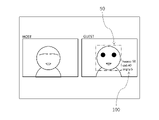
- the object generation unit generates an object 50 representing the recognized face part and the above-mentioned Information 100 indicating the content of the analysis/evaluation performed is superimposed on the moving image and displayed.
- the object 50 may identify and display all faces of a plurality of persons when the faces of the plurality of persons are moved in the moving image.
- the object 50 is, for example, when the camera function of the video session is stopped at the other party's terminal (that is, it is stopped by software within the application of the video session instead of physically covering the camera). If the other party's face is recognized by the other party's camera, the object 50 or the object 100 may be displayed in the part where the other party's face is located. This makes it possible for both parties to confirm that the other party is in front of the terminal even if the camera function is turned off. In this case, for example, in a video session application, the information obtained from the camera may be hidden while only the object 50 or object 100 corresponding to the face recognized by the analysis unit is displayed. Also, the video information acquired from the video session and the information recognized by the analysis unit may be divided into different display layers, and the layer relating to the former information may be hidden.
- the objects 50 and 100 may be displayed in all areas or only in some areas. For example, as shown in FIG. 7, it may be displayed only on the moving image on the guest side.
- the embodiments of the invention described in functional configuration example 1 to functional configuration example 3 described above may be implemented as a single device, or a plurality of devices (for example, cloud servers) partially or wholly connected by a network. and the like.
- the control unit 110 and the storage 130 of each terminal 10 may be realized by different servers connected to each other via a network. That is, the system includes user terminals 10, 20, a video session service terminal 30 for providing an interactive video session to the user terminals 10, 20, and an evaluation terminal 40 for evaluating the video session, Variation combinations of the following configurations are conceivable. (1) Processing everything only on the user terminal As shown in FIG. 8, by performing the processing by the analysis unit on the terminal that is performing the video session (although a certain processing capacity is required), the video session can be performed.
- an analysis unit may be provided in an evaluation terminal connected via a network or the like.
- the moving images acquired by the user terminal are shared with the evaluation terminal at the same time as or after the video session, and are analyzed and evaluated by the analysis unit in the evaluation terminal.
- the moving image data that is, information including at least analysis data
- a moving image analysis system (hereinafter simply referred to as "system") according to an embodiment of the present disclosure shoots all participants or only a specific participant in an environment where an online session is held with a plurality of participants. Participants' reactions are analyzed based on the moving images obtained by this process. The analysis may occur whether or not participants are on screen during the online session.
- the system analyzes moving images to statistically analyze and output contents such as user's emotions.
- the analysis unit described above can analyze the content of the utterance based on not only the user's emotion but also the moving image described above. Such analysis of the content of the utterance can be performed, for example, by a known speech analysis technique or natural language processing technique for moving images.
- the target of such analysis may be, for example, speech and behavior such as reaction and cheering when one user is watching an event.
- speech and behavior such as reaction and cheering when one user is watching an event.
- Such behavior is difficult to convey to users who are watching the same event, athletes, and event managers, as vocalization and communication at the event venue are restricted due to recent measures against infectious diseases. .
- a system is realized that enables one's feelings to be conveyed to people in the same event environment.
- FIG. 10 is a diagram showing an example of the functional configuration of the system according to this embodiment.
- the system shown in FIG. 10 includes an analysis result DB 21 , a position information acquisition section 22 , an event information acquisition section 23 , a statistical information generation section 24 and an output section 25 .
- the analysis result DB 21 can be realized by the above-described storage medium or the like.
- the position information acquisition unit 22, the event information acquisition unit 23, the statistical information generation unit 24, and the output unit 25 are stored in a storage medium or the like provided in the user terminals 10, 20, the evaluation terminal 40, or the like, for example. It can be realized by reading a program into a memory or the like and executing it by a processor such as a CPU.
- the analysis result DB 21 is, for example, a database that stores analysis result data obtained by the various functional units described above.
- the analysis result data may be, for example, the analysis result data obtained from the change in the user's biological reaction described above, or the analysis result data relating to the user's utterance.
- These analysis results are obtained by analysis of moving images of online sessions.
- these analysis result data include a user ID that identifies the user, analysis information obtained as a result of analysis of movement on a moving image caused by the user, or an input generated by the user's input to the user terminal Information and the like may be included as user information.
- the moving images to be analyzed in this embodiment are not limited to those captured in an online session.
- such a moving image may be an offline moving image captured by a terminal such as a smartphone.
- a terminal such as a smartphone.
- the analysis target is not limited to such a moving image, and a still image may be analyzed.
- the location information acquisition unit 22 has a function of acquiring user location information.
- the user's location information means, for example, the location information of the user terminals 10 and 20 used by the user.
- the location information of the user terminals 10 and 20 is obtained by known methods such as sensors based on GPS (Global Positioning System) installed in the user terminals 10 and 20, and location estimation based on communication of the user terminals 10 and 20. can be obtained by Further, the granularity of the location information may be, for example, the granularity of a municipality or a country, or may be the granularity of an address, latitude, longitude, or the like, and is not particularly limited.
- the event information acquisition unit 23 has a function of acquiring information on the event that the user is watching.
- Events can include, for example, global sports competitions, political, entertainment, and other large-scale events.
- the scale of the event according to this embodiment is not particularly limited, and may be relatively small.
- Such event information may be specified, for example, by user input or selection, or may be automatically obtained from data such as attributes attached to streaming videos distributed online that users are watching.
- Event information includes, for example, the name of the event, the type of event, the time of the event, the location of the event, the participants of the event, the operator of the event, the number of participants in the event, the number of people watching the event, etc. It can contain any information of interest. These pieces of information can be used for linking with events in the display of analysis results, etc., as will be described later.
- the statistical information generation unit 24 has a function of statistically processing the analysis results of biological reactions of multiple users and generating statistical information. For example, the statistical information generation unit 24 can aggregate the number of results per unit time for each analysis result, regarding the analysis results of the biological reactions of a plurality of users divided according to the location information of each user. As a result, it is possible to obtain how much a specific analysis result (for example, emotions such as happiness and sadness) was expressed in a predetermined time period at a predetermined position. Statistical information may also include information on the ratio of emotions per unit time, trends in changes in emotions, differences in emotions by region, etc., in addition to the aggregated results.
- Statistical information may also include information on the ratio of emotions per unit time, trends in changes in emotions, differences in emotions by region, etc., in addition to the aggregated results.
- the output unit 25 has a function of outputting analysis results of changes in biological reactions in association with the user's position information.
- the output unit 25 can display the analysis result at a position corresponding to each user's position information on one screen. This makes it possible to easily grasp what kind of feelings people in which region have.
- On this screen for example, in map information such as a map or an image of the earth, the analysis result of the position corresponding to the user's position information may be displayed.
- the output unit 25 may output the analysis results of the biological reactions of multiple users in association with the position information of each of the multiple users.
- FIG. 11 is a diagram showing an example of a screen output by the output unit 25 according to this embodiment.
- a screen 1000 of the user terminal 10 or the like displays an earth object 1001 that is an example of map information, a list of emotions 1002 that is an example of analysis results, and a graph showing the aggregated results corresponding to the emotions. 1003 are displayed.
- a graph 1003 is displayed for each region of the earth object 1001 .
- Such a graph 1003 is a graph obtained by aggregating analysis results of users associated with location information corresponding to regions, and can indicate how many users have feelings in each region.
- the display mode of the graph 1003 is not particularly limited, and arbitrary graphics, text such as numbers, sound volume, visual effects, and the like can be used as appropriate.
- the display mode by the output unit 25 is not limited to the display of such a screen, and may be output via voice or other media, or may be data itself.
- the output screen of the output information by the output unit 25 may be, for example, a projector, a screen, a monitor, or the like.
- FIG. 12 is a flowchart showing an example of the flow of processing by the system according to this embodiment.
- the analysis result is obtained from the analysis result DB 21, and the position information and the like are obtained by the position information obtaining unit 22 and the like (step S101).
- the statistical information generation unit 24 generates statistical information about multiple analysis results for each region (step S103). Then, from the generated statistical information, the output unit 25 associates the data such as the analysis result with the position information (for example, as a graph for each region) and outputs it to the screen of the user terminal 10 or the like (step S105).
- the embodiment of the present disclosure it is possible to easily convey the feelings of a user who is watching an event to other users, people involved in the event, and the like.
- the emotions of many users who are watching one event can be shared with other users and people involved in the event in the form of being associated with each region.
- by linking the analysis result to the event and displaying it on a map or the like it is possible to more reliably convey the emotion of the specific event.
Landscapes
- Engineering & Computer Science (AREA)
- Multimedia (AREA)
- Signal Processing (AREA)
- Management, Administration, Business Operations System, And Electronic Commerce (AREA)
- Image Analysis (AREA)
- Measurement Of The Respiration, Hearing Ability, Form, And Blood Characteristics Of Living Organisms (AREA)
Priority Applications (3)
| Application Number | Priority Date | Filing Date | Title |
|---|---|---|---|
| JP2022517959A JPWO2023002562A1 (https=) | 2021-07-20 | 2021-07-20 | |
| PCT/JP2021/027116 WO2023002562A1 (ja) | 2021-07-20 | 2021-07-20 | 動画像分析システム |
| JP2022130295A JP2023016042A (ja) | 2021-07-20 | 2022-08-17 | 動画像分析システム |
Applications Claiming Priority (1)
| Application Number | Priority Date | Filing Date | Title |
|---|---|---|---|
| PCT/JP2021/027116 WO2023002562A1 (ja) | 2021-07-20 | 2021-07-20 | 動画像分析システム |
Publications (1)
| Publication Number | Publication Date |
|---|---|
| WO2023002562A1 true WO2023002562A1 (ja) | 2023-01-26 |
Family
ID=84979175
Family Applications (1)
| Application Number | Title | Priority Date | Filing Date |
|---|---|---|---|
| PCT/JP2021/027116 Ceased WO2023002562A1 (ja) | 2021-07-20 | 2021-07-20 | 動画像分析システム |
Country Status (2)
| Country | Link |
|---|---|
| JP (2) | JPWO2023002562A1 (https=) |
| WO (1) | WO2023002562A1 (https=) |
Citations (3)
| Publication number | Priority date | Publication date | Assignee | Title |
|---|---|---|---|---|
| JP2013011734A (ja) * | 2011-06-29 | 2013-01-17 | Sharp Corp | 電子写真感光体の製造方法 |
| JP2019126101A (ja) * | 2014-07-18 | 2019-07-25 | ソニー株式会社 | 情報処理装置及び方法、表示制御装置及び方法、プログラム、並びに情報処理システム |
| JP2021022909A (ja) * | 2019-07-30 | 2021-02-18 | 株式会社リコー | 情報処理装置、情報処理プログラム、情報処理システム、情報処理方法 |
Family Cites Families (1)
| Publication number | Priority date | Publication date | Assignee | Title |
|---|---|---|---|---|
| JP5663423B2 (ja) * | 2011-07-13 | 2015-02-04 | 株式会社日立製作所 | 生体計測システム |
-
2021
- 2021-07-20 JP JP2022517959A patent/JPWO2023002562A1/ja active Pending
- 2021-07-20 WO PCT/JP2021/027116 patent/WO2023002562A1/ja not_active Ceased
-
2022
- 2022-08-17 JP JP2022130295A patent/JP2023016042A/ja active Pending
Patent Citations (3)
| Publication number | Priority date | Publication date | Assignee | Title |
|---|---|---|---|---|
| JP2013011734A (ja) * | 2011-06-29 | 2013-01-17 | Sharp Corp | 電子写真感光体の製造方法 |
| JP2019126101A (ja) * | 2014-07-18 | 2019-07-25 | ソニー株式会社 | 情報処理装置及び方法、表示制御装置及び方法、プログラム、並びに情報処理システム |
| JP2021022909A (ja) * | 2019-07-30 | 2021-02-18 | 株式会社リコー | 情報処理装置、情報処理プログラム、情報処理システム、情報処理方法 |
Also Published As
| Publication number | Publication date |
|---|---|
| JP2023016042A (ja) | 2023-02-01 |
| JPWO2023002562A1 (https=) | 2023-01-26 |
Similar Documents
| Publication | Publication Date | Title |
|---|---|---|
| JP7121433B1 (ja) | 動画像分析プログラム | |
| JP7121439B1 (ja) | 動画像分析システム | |
| JP7197955B1 (ja) | ビデオミーティング評価端末 | |
| JP7121436B1 (ja) | 動画像分析プログラム | |
| JP7138997B1 (ja) | ビデオミーティング評価端末 | |
| JP2023016042A (ja) | 動画像分析システム | |
| JP2022146949A (ja) | 動画像分析プログラム | |
| JP2022180533A (ja) | 動画像分析プログラム | |
| WO2022230066A1 (ja) | 動画像分析システム | |
| JP2022151612A (ja) | 動画像分析プログラム | |
| WO2022254494A1 (ja) | 動画像分析システム | |
| WO2022201265A1 (ja) | 動画像分析プログラム | |
| WO2022269801A1 (ja) | 動画像分析システム | |
| WO2022269802A1 (ja) | 動画像分析システム | |
| WO2023032056A1 (ja) | 動画像分析システム | |
| WO2023013026A1 (ja) | 動画像分析システム | |
| WO2022254495A1 (ja) | 動画像分析システム | |
| WO2022201267A1 (ja) | 動画像分析プログラム | |
| WO2022249460A1 (ja) | 動画像分析システム | |
| WO2022201274A1 (ja) | 動画像分析プログラム | |
| WO2022201264A1 (ja) | 動画像分析プログラム | |
| WO2022254489A1 (ja) | 動画像分析システム | |
| WO2022264220A1 (ja) | 動画像分析システム | |
| WO2022230070A1 (ja) | 動画像分析システム | |
| WO2022230137A1 (ja) | 動画像分析システム |
Legal Events
| Date | Code | Title | Description |
|---|---|---|---|
| ENP | Entry into the national phase |
Ref document number: 2022517959 Country of ref document: JP Kind code of ref document: A |
|
| 121 | Ep: the epo has been informed by wipo that ep was designated in this application |
Ref document number: 21950915 Country of ref document: EP Kind code of ref document: A1 |
|
| NENP | Non-entry into the national phase |
Ref country code: DE |
|
| 122 | Ep: pct application non-entry in european phase |
Ref document number: 21950915 Country of ref document: EP Kind code of ref document: A1 |