WO2022244717A1 - ポリイミド含有部形成用組成物、接合体の製造方法、接合体、デバイスの製造方法、及び、デバイス。 - Google Patents
ポリイミド含有部形成用組成物、接合体の製造方法、接合体、デバイスの製造方法、及び、デバイス。 Download PDFInfo
- Publication number
- WO2022244717A1 WO2022244717A1 PCT/JP2022/020338 JP2022020338W WO2022244717A1 WO 2022244717 A1 WO2022244717 A1 WO 2022244717A1 JP 2022020338 W JP2022020338 W JP 2022020338W WO 2022244717 A1 WO2022244717 A1 WO 2022244717A1
- Authority
- WO
- WIPO (PCT)
- Prior art keywords
- group
- polyimide
- containing portion
- substrate
- forming
- Prior art date
- Legal status (The legal status is an assumption and is not a legal conclusion. Google has not performed a legal analysis and makes no representation as to the accuracy of the status listed.)
- Ceased
Links
Images


Classifications
-
- C—CHEMISTRY; METALLURGY
- C08—ORGANIC MACROMOLECULAR COMPOUNDS; THEIR PREPARATION OR CHEMICAL WORKING-UP; COMPOSITIONS BASED THEREON
- C08L—COMPOSITIONS OF MACROMOLECULAR COMPOUNDS
- C08L79/00—Compositions of macromolecular compounds obtained by reactions forming in the main chain of the macromolecule a linkage containing nitrogen with or without oxygen or carbon only, not provided for in groups C08L61/00 - C08L77/00
- C08L79/04—Polycondensates having nitrogen-containing heterocyclic rings in the main chain; Polyhydrazides; Polyamide acids or similar polyimide precursors
- C08L79/08—Polyimides; Polyester-imides; Polyamide-imides; Polyamide acids or similar polyimide precursors
-
- H—ELECTRICITY
- H10—SEMICONDUCTOR DEVICES; ELECTRIC SOLID-STATE DEVICES NOT OTHERWISE PROVIDED FOR
- H10W—GENERIC PACKAGES, INTERCONNECTIONS, CONNECTORS OR OTHER CONSTRUCTIONAL DETAILS OF DEVICES COVERED BY CLASS H10
- H10W72/00—Interconnections or connectors in packages
- H10W72/071—Connecting or disconnecting
-
- H—ELECTRICITY
- H10—SEMICONDUCTOR DEVICES; ELECTRIC SOLID-STATE DEVICES NOT OTHERWISE PROVIDED FOR
- H10W—GENERIC PACKAGES, INTERCONNECTIONS, CONNECTORS OR OTHER CONSTRUCTIONAL DETAILS OF DEVICES COVERED BY CLASS H10
- H10W72/00—Interconnections or connectors in packages
- H10W72/071—Connecting or disconnecting
- H10W72/073—Connecting or disconnecting of die-attach connectors
-
- H—ELECTRICITY
- H10—SEMICONDUCTOR DEVICES; ELECTRIC SOLID-STATE DEVICES NOT OTHERWISE PROVIDED FOR
- H10W—GENERIC PACKAGES, INTERCONNECTIONS, CONNECTORS OR OTHER CONSTRUCTIONAL DETAILS OF DEVICES COVERED BY CLASS H10
- H10W72/00—Interconnections or connectors in packages
- H10W72/071—Connecting or disconnecting
- H10W72/073—Connecting or disconnecting of die-attach connectors
- H10W72/07311—Treating the bonding area before connecting, e.g. by applying flux or cleaning
-
- H—ELECTRICITY
- H10—SEMICONDUCTOR DEVICES; ELECTRIC SOLID-STATE DEVICES NOT OTHERWISE PROVIDED FOR
- H10W—GENERIC PACKAGES, INTERCONNECTIONS, CONNECTORS OR OTHER CONSTRUCTIONAL DETAILS OF DEVICES COVERED BY CLASS H10
- H10W72/00—Interconnections or connectors in packages
- H10W72/071—Connecting or disconnecting
- H10W72/073—Connecting or disconnecting of die-attach connectors
- H10W72/07331—Connecting techniques
-
- H—ELECTRICITY
- H10—SEMICONDUCTOR DEVICES; ELECTRIC SOLID-STATE DEVICES NOT OTHERWISE PROVIDED FOR
- H10W—GENERIC PACKAGES, INTERCONNECTIONS, CONNECTORS OR OTHER CONSTRUCTIONAL DETAILS OF DEVICES COVERED BY CLASS H10
- H10W72/00—Interconnections or connectors in packages
- H10W72/071—Connecting or disconnecting
- H10W72/073—Connecting or disconnecting of die-attach connectors
- H10W72/07331—Connecting techniques
- H10W72/07332—Compression bonding, e.g. thermocompression bonding
-
- H—ELECTRICITY
- H10—SEMICONDUCTOR DEVICES; ELECTRIC SOLID-STATE DEVICES NOT OTHERWISE PROVIDED FOR
- H10W—GENERIC PACKAGES, INTERCONNECTIONS, CONNECTORS OR OTHER CONSTRUCTIONAL DETAILS OF DEVICES COVERED BY CLASS H10
- H10W72/00—Interconnections or connectors in packages
- H10W72/30—Die-attach connectors
-
- H—ELECTRICITY
- H10—SEMICONDUCTOR DEVICES; ELECTRIC SOLID-STATE DEVICES NOT OTHERWISE PROVIDED FOR
- H10W—GENERIC PACKAGES, INTERCONNECTIONS, CONNECTORS OR OTHER CONSTRUCTIONAL DETAILS OF DEVICES COVERED BY CLASS H10
- H10W72/00—Interconnections or connectors in packages
- H10W72/30—Die-attach connectors
- H10W72/351—Materials of die-attach connectors
- H10W72/353—Materials of die-attach connectors not comprising solid metals or solid metalloids, e.g. ceramics
- H10W72/354—Materials of die-attach connectors not comprising solid metals or solid metalloids, e.g. ceramics comprising polymers
-
- H—ELECTRICITY
- H10—SEMICONDUCTOR DEVICES; ELECTRIC SOLID-STATE DEVICES NOT OTHERWISE PROVIDED FOR
- H10W—GENERIC PACKAGES, INTERCONNECTIONS, CONNECTORS OR OTHER CONSTRUCTIONAL DETAILS OF DEVICES COVERED BY CLASS H10
- H10W74/00—Encapsulations, e.g. protective coatings
- H10W74/01—Manufacture or treatment
-
- H—ELECTRICITY
- H10—SEMICONDUCTOR DEVICES; ELECTRIC SOLID-STATE DEVICES NOT OTHERWISE PROVIDED FOR
- H10W—GENERIC PACKAGES, INTERCONNECTIONS, CONNECTORS OR OTHER CONSTRUCTIONAL DETAILS OF DEVICES COVERED BY CLASS H10
- H10W74/00—Encapsulations, e.g. protective coatings
- H10W74/10—Encapsulations, e.g. protective coatings characterised by their shape or disposition
-
- H—ELECTRICITY
- H10—SEMICONDUCTOR DEVICES; ELECTRIC SOLID-STATE DEVICES NOT OTHERWISE PROVIDED FOR
- H10W—GENERIC PACKAGES, INTERCONNECTIONS, CONNECTORS OR OTHER CONSTRUCTIONAL DETAILS OF DEVICES COVERED BY CLASS H10
- H10W74/00—Encapsulations, e.g. protective coatings
- H10W74/40—Encapsulations, e.g. protective coatings characterised by their materials
-
- H—ELECTRICITY
- H10—SEMICONDUCTOR DEVICES; ELECTRIC SOLID-STATE DEVICES NOT OTHERWISE PROVIDED FOR
- H10W—GENERIC PACKAGES, INTERCONNECTIONS, CONNECTORS OR OTHER CONSTRUCTIONAL DETAILS OF DEVICES COVERED BY CLASS H10
- H10W72/00—Interconnections or connectors in packages
- H10W72/851—Dispositions of multiple connectors or interconnections
- H10W72/874—On different surfaces
- H10W72/884—Die-attach connectors and bond wires
-
- H—ELECTRICITY
- H10—SEMICONDUCTOR DEVICES; ELECTRIC SOLID-STATE DEVICES NOT OTHERWISE PROVIDED FOR
- H10W—GENERIC PACKAGES, INTERCONNECTIONS, CONNECTORS OR OTHER CONSTRUCTIONAL DETAILS OF DEVICES COVERED BY CLASS H10
- H10W74/00—Encapsulations, e.g. protective coatings
- H10W74/10—Encapsulations, e.g. protective coatings characterised by their shape or disposition
- H10W74/15—Encapsulations, e.g. protective coatings characterised by their shape or disposition on active surfaces of flip-chip devices, e.g. underfills
-
- H—ELECTRICITY
- H10—SEMICONDUCTOR DEVICES; ELECTRIC SOLID-STATE DEVICES NOT OTHERWISE PROVIDED FOR
- H10W—GENERIC PACKAGES, INTERCONNECTIONS, CONNECTORS OR OTHER CONSTRUCTIONAL DETAILS OF DEVICES COVERED BY CLASS H10
- H10W90/00—Package configurations
- H10W90/701—Package configurations characterised by the relative positions of pads or connectors relative to package parts
- H10W90/721—Package configurations characterised by the relative positions of pads or connectors relative to package parts of bump connectors
- H10W90/722—Package configurations characterised by the relative positions of pads or connectors relative to package parts of bump connectors between stacked chips
-
- H—ELECTRICITY
- H10—SEMICONDUCTOR DEVICES; ELECTRIC SOLID-STATE DEVICES NOT OTHERWISE PROVIDED FOR
- H10W—GENERIC PACKAGES, INTERCONNECTIONS, CONNECTORS OR OTHER CONSTRUCTIONAL DETAILS OF DEVICES COVERED BY CLASS H10
- H10W90/00—Package configurations
- H10W90/701—Package configurations characterised by the relative positions of pads or connectors relative to package parts
- H10W90/731—Package configurations characterised by the relative positions of pads or connectors relative to package parts of die-attach connectors
- H10W90/732—Package configurations characterised by the relative positions of pads or connectors relative to package parts of die-attach connectors between stacked chips
-
- H—ELECTRICITY
- H10—SEMICONDUCTOR DEVICES; ELECTRIC SOLID-STATE DEVICES NOT OTHERWISE PROVIDED FOR
- H10W—GENERIC PACKAGES, INTERCONNECTIONS, CONNECTORS OR OTHER CONSTRUCTIONAL DETAILS OF DEVICES COVERED BY CLASS H10
- H10W90/00—Package configurations
- H10W90/701—Package configurations characterised by the relative positions of pads or connectors relative to package parts
- H10W90/731—Package configurations characterised by the relative positions of pads or connectors relative to package parts of die-attach connectors
- H10W90/734—Package configurations characterised by the relative positions of pads or connectors relative to package parts of die-attach connectors between a chip and a stacked insulating package substrate, interposer or RDL
-
- H—ELECTRICITY
- H10—SEMICONDUCTOR DEVICES; ELECTRIC SOLID-STATE DEVICES NOT OTHERWISE PROVIDED FOR
- H10W—GENERIC PACKAGES, INTERCONNECTIONS, CONNECTORS OR OTHER CONSTRUCTIONAL DETAILS OF DEVICES COVERED BY CLASS H10
- H10W90/00—Package configurations
- H10W90/701—Package configurations characterised by the relative positions of pads or connectors relative to package parts
- H10W90/751—Package configurations characterised by the relative positions of pads or connectors relative to package parts of bond wires
- H10W90/754—Package configurations characterised by the relative positions of pads or connectors relative to package parts of bond wires between a chip and a stacked insulating package substrate, interposer or RDL
Definitions
- the present invention relates to a composition for forming a polyimide-containing part, a method for producing a joined body, a method for producing a joined body, a device, and a device.
- Electronic devices such as mobile phones and tablet terminals are getting smaller and smaller, while their functions are diversifying. To meet these needs, electronic circuits incorporated in electronic devices are required to be further miniaturized, highly integrated, and mounted at high density.
- Packaging technologies such as SIP (System in Package), MCM (Multi Chip Module), and POP (Package on Package) are attracting attention as technologies that achieve miniaturization while maintaining high performance and reliability with multiple functions. . Since these techniques can reduce the number of parts and simplify the semiconductor manufacturing process, they are also expected to reduce the cost of electronic devices.
- FIG. 1 is a cross-sectional view showing the structure of a typical COC.
- the COC in this example comprises a daughter chip (first substrate) 1 and a mother chip (second substrate) 2 .
- An electronic circuit (not shown) and flip chip electrodes (not shown) are formed on the mother chip 2 , and the daughter chip 1 is supported and connected via solder electrodes (bumps) 93 .
- the periphery of the solder electrode 93 is filled with an underfill 94 to ensure insulation.
- the mother chip 2 is mounted on the base substrate 98 while maintaining insulation by being adhered to the base substrate 98 by the bonding film 91 .
- the electrical connection is made through wire bonding pad 97b, wire bonding 96 and substrate electrode 97a.
- Such a COC structure is sealed with a sealing resin 95 to form a semiconductor device 90 .
- the semiconductor device 90 is provided with solder balls 99, through which it is incorporated into electronic equipment. Further, by further applying this flip-chip mounting technique, techniques and materials for three-dimensional mounting using TSV (Through Silicon Via) are being studied (Non-Patent Document 1).
- the underfill 94 is filled in the gap. Therefore, a fluid resin is used as the material forming the underfill, and the resin is cured and molded after being filled between the solder bumps.
- the daughter chip 1 and the mother chip 2 are bonded together by the adhesive strength of the resin, and from the viewpoint of improving the adhesiveness, it is desired to improve the maximum peeling resistance between these two substrates.
- the present invention provides a composition for forming a polyimide-containing portion that can provide a bonded body having a large maximum peeling force between two substrates when bonding two substrates, and bonding using the composition for forming a polyimide-containing portion.
- An object of the present invention is to provide a method for manufacturing a body, a bonded body obtained by the manufacturing method, a method for manufacturing a device including the method for manufacturing the bonded body, and a device including the bonded body.
- the polyimide-containing portion is a member formed from the polyimide-containing portion-forming composition, A composition for forming a polyimide-containing portion, wherein the glass transition temperature of the polyimide-containing portion is lower than the bonding temperature in the bonding step.
- composition for forming a polyimide-containing part according to ⁇ 1> containing a polyimide precursor and a solvent.
- composition for forming a polyimide-containing part according to ⁇ 1> or ⁇ 2> further comprising a migration inhibitor.
- ⁇ 4> The composition for forming a polyimide-containing portion according to any one of ⁇ 1> to ⁇ 3>, wherein the polyimide-containing portion has a glass transition temperature of 350° C. or lower.
- ⁇ 5> The composition for forming a polyimide-containing part according to any one of ⁇ 1> to ⁇ 4>, wherein the glass transition temperature of the polyimide-containing part is lower than the bonding temperature in the bonding step by 30° C.
- ⁇ 6> The composition for forming a polyimide-containing portion according to any one of ⁇ 1> to ⁇ 5>, wherein the bonding temperature in the bonding step is 380° C. or less.
- ⁇ 7> The composition for forming a polyimide-containing portion according to any one of ⁇ 1> to ⁇ 6>, wherein the substrate A is in the form of a wafer.
- ⁇ 8> The composition for forming a polyimide-containing part according to any one of ⁇ 1> to ⁇ 7>, wherein the form of the substrate B is a chip.
- ⁇ 12> The composition for forming a polyimide-containing portion according to ⁇ 11>, wherein the planarization step is performed by physical polishing.
- ⁇ 13> The composition for forming a polyimide-containing portion according to ⁇ 11>, wherein the planarization step is performed by chemical polishing.
- the bonding step the electrodes included in the surface of the substrate A having the polyimide-containing portion and the electrodes on the surface of the substrate B including the wiring terminals are bonded so as to be in direct contact with each other, ⁇ 1> to The composition for forming a polyimide-containing portion according to any one of ⁇ 13>.
- ⁇ 15> ⁇ 1> to ⁇ 14> further including a second polyimide-containing portion forming step of forming a second polyimide-containing portion on the surface of the substrate B provided with the wiring terminals before the bonding step.
- the composition for forming a polyimide-containing portion according to any one of . ⁇ 16> The composition for forming a polyimide-containing portion according to any one of ⁇ 1> to ⁇ 15>, further comprising a photosensitive compound.
- the polyimide-containing portion forming step includes applying a composition for forming a polyimide-containing portion onto the surface of the substrate A provided with the wiring terminal and heating the composition.
- composition for forming a polyimide-containing portion according to 1.
- ⁇ 20> A joined body obtained by the production method according to ⁇ 19>.
- ⁇ 21> A method of manufacturing a device, including the method of manufacturing a joined body according to ⁇ 19>.
- ⁇ 22> A device comprising the conjugate according to ⁇ 20>.
- a composition for forming a polyimide-containing part that can obtain a bonded body having a large maximum peeling force between two substrates when bonding two substrates, and the composition for forming a polyimide-containing part are used.
- a method for manufacturing a bonded body, a bonded body obtained by the manufacturing method a method for manufacturing a device including the method for manufacturing the bonded body, and a device including the bonded body.
- FIG. 1 is a cross-sectional view schematically showing the structure of a COC semiconductor device
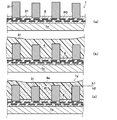
- FIG. BRIEF DESCRIPTION OF THE DRAWINGS It is process explanatory drawing which showed the process when joining a board
- FIG. 2 is a process explanatory diagram showing a schematic cross-sectional view of a process of bonding substrates in a method for manufacturing a bonded body using the composition for forming a polyimide-containing portion of the present invention according to one embodiment of the present invention (FIG. 2 continuation).
- FIG. 2 is a process explanatory diagram showing a schematic cross-sectional view of a process of bonding substrates in a method for manufacturing a bonded body using the composition for forming a polyimide-containing portion of the present invention according to one embodiment of the present invention (FIG. 2
- FIG. 2 is a process explanatory diagram showing a schematic cross-sectional view of a process of bonding substrates in a method for manufacturing a bonded body using the composition for forming a polyimide-containing portion of the present invention according to one embodiment of the present invention (FIG. 3 continued).
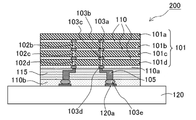
- 1 is a cross-sectional view schematically showing an example of a three-dimensionally mounted semiconductor device using TSVs;
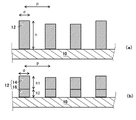
- FIG. It is a schematic cross-sectional view showing details of a substrate used in Examples.
- an "alkyl group” includes not only an alkyl group having no substituent (unsubstituted alkyl group) but also an alkyl group having a substituent (substituted alkyl group).
- the term "exposure” includes not only exposure using light but also drawing using particle beams such as electron beams and ion beams, unless otherwise specified.
- the light used for exposure generally includes actinic rays or radiation such as emission line spectra of mercury lamps, far ultraviolet rays represented by excimer lasers, extreme ultraviolet rays (EUV light), X-rays and electron beams.
- EUV light extreme ultraviolet rays
- a numerical range represented by "to” means a range including the numerical values before and after "to” as lower and upper limits.
- (meth)acrylate represents both or either of “acrylate” and “methacrylate”
- (meth)acrylic represents both “acrylic” and “methacrylic", or Either is represented
- (meth)acryloyl represents both or either of “acryloyl” and “methacryloyl”.
- process includes not only an independent process, but also when the intended action of the process is achieved even if it cannot be clearly distinguished from other processes.
- the solid content is the mass percentage of other components excluding the solvent relative to the total mass of the composition. Further, the solid content concentration refers to the concentration at 25° C. unless otherwise specified. The temperature in the present invention is 25° C.
- weight average molecular weight (Mw) and number average molecular weight (Mn) are defined as polystyrene equivalent values according to gel permeation chromatography (GPC measurement), unless otherwise specified.
- the weight average molecular weight (Mw) and number average molecular weight (Mn) are, for example, HLC-8220 (manufactured by Tosoh Corporation), guard column HZ-L, TSKgel Super HZM-M, TSKgel It can be obtained by using either Super HZ4000, TSKgel Super HZ3000, or TSKgel Super HZ2000 (manufactured by Tosoh Corporation).
- THF tetrahydrofuran
- a UV ray (ultraviolet) wavelength detector of 254 nm is used for detection.
- composition for forming polyimide-containing part of the present invention includes: a step of preparing a substrate A having a surface provided with wiring terminals; a step of forming a polyimide-containing portion on the surface of the substrate A provided with the wiring terminals; A joined body comprising: a step of preparing a substrate B having a surface provided with wiring terminals; A composition for forming a polyimide-containing part used in the manufacturing method, wherein the polyimide-containing part is a member formed from the composition for forming a polyimide-containing part, and the glass transition temperature of the polyimide-containing part is the above bonding Lower than the bonding temperature in the process.
- the composition for forming a polyimide-containing part of the present invention (hereinafter also simply referred to as "resin composition"), when bonding two substrates such as a wafer and a wafer or a wafer and a chip through the polyimide-containing part , it is possible to produce a bonded body with a high maximum peel force between the two substrates.
- the glass transition temperature (Tg) of the polyimide-containing portion is lower than the bonding temperature, it is possible to ensure sufficient fluidity of the polyimide-containing portion during bonding. It is possible to increase the maximum peel resistance.
- the bonding temperature is the temperature of the polyimide-containing portion during bonding, and can be, for example, the set temperature of the device used for bonding.
- the bonding time can be shortened, and the tact time of the bonding process can also be reduced.
- the alignment accuracy at the time of joining is low, and the joining gap between the metal parts such as electrodes on each substrate occurs, and the wiring part is exposed. may occur.
- the polyimide-containing portion between the wiring portions is required to have withstand voltage performance.
- the composition for forming the polyimide-containing portion contains a migration inhibitor, it is possible to suppress the migration of the metal from the metal portion to the polyimide-containing portion, thereby improving the withstand voltage performance. It is considered possible. Details of the resin composition of the present invention are described below.
- a method for producing a bonded body using the composition for forming a polyimide-containing portion of the present invention includes a step of preparing a substrate A having a surface provided with wiring terminals.
- the substrate A may be manufactured by a known method (for example, plating on a substrate such as a silicon substrate), or may be obtained by means such as purchase.
- the substrate A has a surface with wiring terminals.
- the wiring terminals on the substrate A are also referred to as wiring terminals A hereinafter.
- the form of the substrate A may be either a wafer or a chip, but being a wafer is also one of the preferred aspects of the present invention.
- a wafer means a substrate containing a semiconductor, and is a concept including a panel or the like formed of a plurality of elements such as semiconductors.
- a chip means an individual piece containing a semiconductor formed by dicing or the like, and may be a single-sided chip or a double-sided chip.
- the shape of the substrate A is not particularly limited, but examples thereof include a polygonal plate shape, a disc shape, and a polyhedron shape.
- the thickness of the substrate A is preferably 0.1-5 mm, more preferably 0.2-1 mm.
- the wiring terminal A on the substrate A is preferably a pillar electrode.
- the wiring terminal A preferably contains a metal such as tin (Sn), gold (Au), silver (Ag), copper (Cu), aluminum (Al), tungsten (W), palladium (Pd), Platinum (Pt), Cobalt (Co), Nickel (Ni), Zinc (Zn), Ruthenium (Ru), Iridium (Ir), Rhodium (Rh), Lead (Pb), Bismuth (Bi) and Indium (In) More preferably, it contains at least one metal selected from the group consisting of, more preferably at least one metal selected from the group consisting of copper, tin and nickel.
- a metal such as tin (Sn), gold (Au), silver (Ag), copper (Cu), aluminum (Al), tungsten (W), palladium (Pd), Platinum (Pt), Cobalt (Co), Nickel (Ni), Zinc (Zn), Ruthenium (Ru), Iridium (Ir), Rhodium (Rh), Lead (Pb), Bismuth (Bi) and Indium
- the alloy may contain elements other than those exemplified above.
- a copper alloy may contain silicon atoms to form a Corson alloy.
- oxygen that is inevitably dissolved, organic residues of the raw material compound mixed during precipitation, and the like may be present.
- the wiring terminal A may be a wiring terminal comprising a plurality of different members.
- a substrate has a portion that is used as an electrode (hereinafter also referred to as an “electrode”) made of a metal such as copper, silver, gold, or an alloy containing one or more of these, and on the electrode such as copper , nickel, tin, lead, or an alloy containing one or more of these metals (hereinafter also referred to as a “conducting path”) that is used as solder is formed, and the electrode and the conducting path are formed.
- One wiring terminal A may be formed by existing in series. Among these, the wiring terminal A preferably includes at least a member containing copper and a member containing tin.
- An example of the substrate A having a surface provided with such wiring terminals A is the substrate b) used in the examples of the present application. In substrate b), conductive paths made of tin are formed on electrodes made of copper.
- the electrodes are not particularly limited, but include tin, gold, silver, copper, aluminum, tungsten, palladium, platinum, cobalt, nickel, zinc, ruthenium, iridium, rhodium, and alloys thereof.
- the electrode is preferably a metal containing copper, a metal containing aluminum, a metal containing tungsten, a metal containing nickel, or a metal containing gold, more preferably a metal containing copper, and still more preferably copper.
- the metal used for the electrodes it is preferable to use a metal that does not melt even in the joining process.
- the melting point of the metal used for the electrodes is preferably 500° C. or higher, more preferably 700° C.
- the material used for the conductive path is not particularly limited, but includes tin, lead, silver, copper, zinc, bismuth, or indium, or alloys thereof. Among them, solder of tin or a tin alloy (a metal containing tin) is preferable in the present invention. Recently, the technology of lead-free solder, which does not use lead, is also progressing, and it is also preferable to select such a material.
- the metal used for the conducting path a metal that melts in the joining process is preferable.
- the melting point of the metal used for the conducting paths is preferably 400° C.
- the lower limit of the melting point is not particularly limited as long as it is solid at room temperature. Moreover, it is preferable that a plurality of wiring terminals A are formed on the substrate A. As shown in FIG.
- the material used for the substrate A is not particularly limited, and includes semiconductor fabrication substrates such as silicon, silicon nitride, polysilicon, silicon oxide, and amorphous silicon, quartz, glass, optical films, ceramic materials, deposited films, magnetic films, reflective films, Metal substrates such as Ni, Cu, Cr, and Fe, paper, SOG (Spin On Glass), TFT (Thin Film Transistor) array substrates, plasma display panel (PDP) electrode plates, etc. are not particularly limited.
- the substrate may be provided with a layer such as an adhesion layer or an oxide layer made of hexamethyldisilazane (HMDS) or the like on the surface.
- HMDS hexamethyldisilazane
- a semiconductor fabrication substrate is particularly preferred, and a silicon substrate (silicon wafer) is more preferred.
- Substrate A may have an electronic circuit area containing electronic circuits. Moreover, the electronic circuit may have an element such as a semiconductor. Moreover, it is preferable that the electronic circuit is electrically connected to the wiring terminal A.
- the diameter can be 100 mm or more. Moreover, as a large substrate, for example, it is preferably 200 mm or more, and more preferably 250 mm or more. Although there is no particular upper limit, it is preferably 2,000 mm or less.
- the diameter is preferably 7 mm or more, more preferably 10 mm or more, and even more preferably 20 mm or more.
- the upper limit is, for example, preferably 50 mm or less, more preferably 40 mm or less, and even more preferably 30 mm or less.
- a method for producing a bonded body using the composition for forming a polyimide-containing portion of the present invention includes a polyimide-containing portion forming step of forming a polyimide-containing portion on the surface of the substrate A provided with the wiring terminal (wiring terminal A). .
- the polyimide-containing portion is preferably formed so as to be in contact with the wiring terminal A, and more preferably formed so as to fill the concave portion between the wiring terminals A.
- the polyimide-containing portion may be formed on at least a part of the wiring terminals A, but for example, an embodiment in which the polyimide-containing portion is formed on all of the wiring terminals A is also one of the preferred embodiments of the present invention.
- the polyimide-containing portion forming step preferably includes applying a composition for forming a polyimide-containing portion onto the surface of the substrate A provided with the wiring terminals and heating. Application and heating details are described below.
- the polyimide-containing portion is a member formed from the polyimide-containing portion-forming composition, and is preferably a member obtained by at least heating the polyimide-containing portion-forming composition.
- the polyimide-containing portion is a member containing polyimide, and may further contain components other than polyimide.
- components other than polyimide include components other than polyimide and its precursor contained in the resin composition described later, and components modified by heating (decomposition, polymerization, structural change, etc.).
- the glass transition temperature of the polyimide-containing portion may be lower than the bonding temperature in the bonding step, but is preferably 350° C. or lower, more preferably 320° C. or lower, and even more preferably 300° C. or lower.
- the lower limit of the glass transition temperature is not particularly limited, it is preferably 200° C. or higher from the viewpoint of heat resistance.
- the glass transition temperature of the polyimide-containing portion is preferably 30 ° C. or more lower than the bonding temperature in the bonding step, more preferably 50 ° C. or more, and further preferably 70 ° C. or more. preferable.
- the glass transition temperature of the polyimide-containing portion is preferably 30° C. or more higher than the bonding temperature in the bonding step.
- the thickness of the polyimide-containing portion is not particularly limited, but from the viewpoint of exhibiting the effect of its physical properties, the thickness immediately before the bonding step (when the planarization step described later is performed, the state immediately before the planarization step is performed) thickness) is preferably 100 nm or more, more preferably 300 nm or more, still more preferably 500 nm or more, still more preferably 1 ⁇ m or more, and even more preferably 2 ⁇ m or more. Although there is no particular upper limit, it is preferably 1 mm or less, more preferably 500 ⁇ m or less, and even more preferably 200 ⁇ m or less.
- the thickness of the film can be measured using a known film thickness measuring device.
- the thermal diffusivity of the polyimide-containing portion in the joined body described later is preferably 2.0 ⁇ 10 ⁇ 7 m 2 s ⁇ 1 or more, and more preferably 3.0 ⁇ 10 ⁇ 7 m 2 s ⁇ 1 or more. More preferably, it is 5.0 ⁇ 10 ⁇ 7 m 2 s ⁇ 1 or more.
- the thermal diffusivity of the polyimide-containing part is, for example, when the polyimide-containing part contains a filler, the material type of the filler, the particle size of the filler (a combination of the particle sizes when two or more types of filler are included), and the thermal diffusion of the filler. It can be adjusted by designing factors such as the rate, content of filler, structure of polyimide, thermal diffusivity of polyimide, content of polyimide, and the like.
- the polyimide-containing portion is preferably an insulating member.
- the insulation (electrical resistance) of the polyimide-containing portion is not particularly limited, but the volume resistivity is preferably 1 ⁇ 10 15 ⁇ cm or more, more preferably 1 ⁇ 10 16 ⁇ cm or more. Although there is no particular upper limit, it is practical to be 1 ⁇ 10 19 ⁇ cm or less.
- the dielectric breakdown voltage is preferably 1 kV/mm or more, more preferably 10 kV/mm or more. Although the upper limit is not particularly limited, it is practically 1000 kV/mm or less. In this specification, measurements of volume resistivity and dielectric breakdown voltage shall comply with JIS C2151:2006 and JIS C2318:2007.
- the polyimide-containing portion forming step is a step including applying the polyimide-containing portion forming composition (resin composition) of the present invention onto the surface of the substrate A having the wiring terminal A (application step). is preferred.
- Means for applying the resin composition onto the substrate A include dip coating, air knife coating, curtain coating, wire bar coating, gravure coating, extrusion coating, spray coating, spin coating, A slit coat method, an inkjet method, and the like are exemplified. From the viewpoint of uniformity of film thickness, spin coating, slit coating, spray coating, or inkjet method is more preferable, and spin coating from the viewpoint of uniformity of film thickness and productivity. and slit coating methods are preferred. A film having a desired thickness can be obtained by adjusting the solid content concentration and application conditions of the resin composition according to the method. In addition, the coating method can be appropriately selected depending on the shape of the substrate. Spin coating, spray coating, inkjet method, etc.
- slit coating and spray coating are preferable for rectangular substrates.
- method, inkjet method, and the like are preferred.
- the spin coating method for example, it can be applied at a rotation speed of 500 to 3,500 rpm for about 10 seconds to 3 minutes.
- a method of transferring a coating film, which is formed on a temporary support in advance by the application method described above, onto a base material can be applied.
- the transfer method the manufacturing methods described in paragraphs 0023 and 0036 to 0051 of JP-A-2006-023696 and paragraphs 0096-0108 of JP-A-2006-047592 can also be preferably used in the present invention.
- a step of removing excess film at the edge of the substrate may be performed.
- processes include edge bead rinsing (EBR), back rinsing, and the like.
- EBR edge bead rinsing
- a pre-wetting step may also be employed in which the substrate is coated with various solvents before applying the resin composition to the substrate to improve the wettability of the substrate, and then the resin composition is applied.
- a step (drying step) of drying the member (hereinafter also simply referred to as "film") made of the resin composition is performed.
- the drying temperature in the drying step is preferably 50 to 150°C, more preferably 70 to 130°C, even more preferably 90 to 110°C.
- the drying time is exemplified from 30 seconds to 20 minutes, preferably from 1 minute to 10 minutes, more preferably from 2 minutes to 7 minutes.
- the thickness immediately after application (the thickness after drying when a drying step is performed) is not particularly limited, and may be adjusted as appropriate so that the thickness of the resulting polyimide-containing portion will be the thickness described later.
- the polyimide-containing portion forming step may include a step of patterning the member made of the resin composition.
- a resin composition containing a photosensitive compound such as a photopolymerization initiator, which will be described later, is used, this patterning can be performed by exposure and development.
- the surface After forming the polyimide-containing portion, the surface may be planarized. Details of the planarization will be described later. Note that when patterning is performed, the thickness of the portion removed by development or the like is not used for calculating the film thickness difference (T1-T2) described later.
- the film may be subjected to an exposure step that selectively exposes the film. That is, it is also referred to as a polyimide-containing portion (hereinafter, “cured product”) related to the composition for forming a polyimide-containing portion of the present invention. ) may include an exposure step of selectively exposing the film formed by the applying step. Selectively exposing means exposing a portion of the film. Also, by selectively exposing, the film is formed with exposed regions (exposed portions) and non-exposed regions (non-exposed portions). The amount of exposure is not particularly defined as long as the resin composition of the present invention can be cured . is more preferred.
- the exposure wavelength can be appropriately determined in the range of 190-1,000 nm, preferably 240-550 nm.
- the exposure wavelength is (1) semiconductor laser (wavelength 830 nm, 532 nm, 488 nm, 405 nm, 375 nm, 355 nm etc.), (2) metal halide lamp, (3) high pressure mercury lamp, g-line (wavelength 436 nm), h-line (wavelength 405 nm), i-line (wavelength 365 nm), broad (three wavelengths of g, h, i-line), (4) excimer laser, KrF excimer laser (wavelength 248 nm), ArF excimer laser (wavelength 193 nm) ), F2 excimer laser ( wavelength 157 nm), (5) extreme ultraviolet; EUV (wavelength 13.6 nm), (6) electron beam, (7) YAG laser second harmonic 532 nm, third harmonic 355 nm, etc.
- semiconductor laser wavelength 830 nm, 532 nm, 488 nm, 405 nm, 375 nm, 355
- the resin composition of the present invention exposure with a high-pressure mercury lamp is particularly preferred, and exposure with i-line is particularly preferred. Thereby, particularly high exposure sensitivity can be obtained.
- the method of exposure is not particularly limited as long as at least a part of the film made of the resin composition of the present invention is exposed. Exposure using a photomask, exposure by a laser direct imaging method, etc. mentioned.
- the film may be subjected to a step of heating after exposure (post-exposure heating step). That is, the method for producing a cured product of the composition for forming a polyimide-containing portion of the present invention may include a post-exposure heating step of heating the film exposed in the exposure step.
- the post-exposure heating step can be performed after the exposure step and before the development step.
- the heating temperature in the post-exposure heating step is preferably 50°C to 140°C, more preferably 60°C to 120°C.
- the heating time in the post-exposure heating step is preferably 30 seconds to 300 minutes, more preferably 1 minute to 10 minutes.
- the heating rate in the post-exposure heating step is preferably 1 to 12° C./min, more preferably 2 to 10° C./min, still more preferably 3 to 10° C./min, from the temperature at the start of heating to the maximum heating temperature. Also, the rate of temperature increase may be appropriately changed during heating.
- the heating means in the post-exposure heating step is not particularly limited, and known hot plates, ovens, infrared heaters and the like can be used. Moreover, it is also preferable to carry out the heating in an atmosphere of low oxygen concentration by, for example, flowing an inert gas such as nitrogen, helium or argon.
- the film after exposure may be subjected to a development step in which the film is developed using a developer to form a pattern.
- the method for producing a cured product of the composition for forming a polyimide-containing portion of the present invention may include a development step of developing a film exposed in the exposure step with a developer to form a pattern. By performing development, one of the exposed and non-exposed portions of the film is removed to form a pattern.
- development in which the unexposed portion of the film is removed by the development process is called negative development
- development in which the exposed portion of the film is removed by the development process is called positive development.
- Examples of the developer used in the development process include an aqueous alkaline solution and a developer containing an organic solvent.
- basic compounds that the alkaline aqueous solution may contain include inorganic alkalis, primary amines, secondary amines, tertiary amines, and quaternary ammonium salts.
- TMAH tetramethylammonium hydroxide
- potassium hydroxide sodium carbonate, sodium hydroxide, sodium silicate, sodium metasilicate, ammonia, ethylamine, n-propylamine, diethylamine, di-n-butylamine, triethylamine, methyldiethylamine , dimethylethanolamine, triethanolamine, tetraethylammonium hydroxide, tetrapropylammonium hydroxide, tetrabutylammonium hydroxide, tetrapentylammonium hydroxide, tetrahexylammonium hydroxide, tetraoctylammonium hydroxide, ethyltrimethylammonium hydroxide , butyltrimethylammonium hydroxide, methyltriamylammonium hydroxide, dibutyldipentylammonium hydroxide, dimethylbis(2-hydroxyethyl)am
- the content of the basic compound in the developer is preferably 0.01 to 10% by mass, more preferably 0.1 to 5% by mass, more preferably 0.3 to 3% by mass, based on the total mass of the developer. is more preferred.
- the organic solvent may be an ester such as ethyl acetate, n-butyl acetate, amyl formate, isoamyl acetate, isobutyl acetate, butyl propionate, isopropyl butyrate, ethyl butyrate, butyl butyrate, Methyl lactate, ethyl lactate, ⁇ -butyrolactone, ⁇ -caprolactone, ⁇ -valerolactone, alkyl alkyloxyacetate (e.g. methyl alkyloxyacetate, ethyl alkyloxyacetate, butyl alkyloxyacetate (e.g.
- 3-alkyloxypropionate alkyl esters e.g., methyl 3-alkyloxypropionate, ethyl 3-alkyloxypropionate, etc. (e.g., 3-methoxy methyl propionate, ethyl 3-methoxypropionate, methyl 3-ethoxypropionate, ethyl 3-ethoxypropionate, etc.
- 2-alkyloxypropionate alkyl esters e.g.
- methyl 2-alkyloxypropionate, 2- ethyl alkyloxypropionate, propyl 2-alkyloxypropionate, etc. e.g., methyl 2-methoxypropionate, ethyl 2-methoxypropionate, propyl 2-methoxypropionate, methyl 2-ethoxypropionate, 2-ethoxypropionic acid ethyl
- methyl 2-alkyloxy-2-methylpropionate and ethyl 2-alkyloxy-2-methylpropionate e.g.
- ethers such as diethylene glycol dimethyl ether, tetrahydrofuran, Ethylene glycol monomethyl ether, ethylene glycol monoethyl ether, methyl cellosolve acetate, ethyl cellosolve acetate, diethylene glycol monomethyl ether, diethylene glycol monoethyl ether, diethylene glycol monobutyl ether, propylene glycol monomethyl ether (PGME), propylene glycol monomethyl ether acetate (PGMEA), propylene Glycol monoethyl ether acetate
- the organic solvent can be used singly or in combination of two or more.
- a developer containing at least one selected from the group consisting of cyclopentanone, ⁇ -butyrolactone, dimethylsulfoxide, N-methyl-2-pyrrolidone, and cyclohexanone is particularly preferred, and cyclopentanone and ⁇ -butyrolactone. and dimethylsulfoxide is more preferred, and a developer containing cyclopentanone is most preferred.
- the content of the organic solvent relative to the total weight of the developer is preferably 50% by mass or more, more preferably 70% by mass or more, and 80% by mass or more. is more preferable, and 90% by mass or more is particularly preferable. Moreover, the content may be 100% by mass.
- the developer may further contain other components.
- Other components include, for example, known surfactants and known antifoaming agents.
- the method of supplying the developer is not particularly limited as long as the desired pattern can be formed, and a method of immersing the substrate on which the film is formed in the developer, and supplying the developer to the film formed on the substrate using a nozzle.
- the type of nozzle is not particularly limited, and straight nozzles, shower nozzles, spray nozzles and the like can be mentioned. From the viewpoint of permeability of the developer, removability of the non-image area, and efficiency in production, a method of supplying the developer with a straight nozzle or a method of continuously supplying the developer with a spray nozzle is preferable.
- the method of supplying with a spray nozzle is more preferable.
- the substrate is spun to remove the developer from the substrate.
- a step of removing from above may be employed, and this step may be repeated multiple times.
- the method of supplying the developer in the development process includes a process in which the developer is continuously supplied to the base material, a process in which the developer is kept substantially stationary on the base material, and a process in which the developer exceeds the developer on the base material.
- a process of vibrating with sound waves or the like and a process of combining them can be employed.
- the development time is preferably 10 seconds to 10 minutes, more preferably 20 seconds to 5 minutes.
- the temperature of the developer during development is not particularly limited, but is preferably 10 to 45°C, more preferably 18 to 30°C.
- the pattern may be washed (rinsed) with a rinse.
- a method of supplying the rinse liquid before the developer in contact with the pattern is completely dried may be adopted.
- Rinse liquid When the developer is an alkaline aqueous solution, water, for example, can be used as the rinse.
- the developer is a developer containing an organic solvent, for example, a solvent different from the solvent contained in the developer (for example, water, an organic solvent different from the organic solvent contained in the developer) is used as the rinse liquid. be able to.
- the organic solvent includes esters such as ethyl acetate, n-butyl acetate, amyl formate, isoamyl acetate, isobutyl acetate, butyl propionate, isopropyl butyrate, ethyl butyrate, and butyl butyrate. , methyl lactate, ethyl lactate, ⁇ -butyrolactone, ⁇ -caprolactone, ⁇ -valerolactone, alkyl alkyloxyacetates (e.g. methyl alkyloxyacetate, ethyl alkyloxyacetate, butyl alkyloxyacetate (e.g.
- 3-alkyloxypropionate alkyl esters e.g., methyl 3-alkyloxypropionate, ethyl 3-alkyloxypropionate, etc. (e.g., 3- methyl methoxypropionate, ethyl 3-methoxypropionate, methyl 3-ethoxypropionate, ethyl 3-ethoxypropionate, etc.
- 2-alkyloxypropionate alkyl esters e.g.
- methyl 2-alkyloxypropionate 2 -ethyl alkyloxypropionate, propyl 2-alkyloxypropionate, etc. (e.g., methyl 2-methoxypropionate, ethyl 2-methoxypropionate, propyl 2-methoxypropionate, methyl 2-ethoxypropionate, 2-ethoxypropionate ethyl acid)), methyl 2-alkyloxy-2-methylpropionate and ethyl 2-alkyloxy-2-methylpropionate (e.g.
- ethers such as diethylene glycol dimethyl ether, tetrahydrofuran , ethylene glycol monomethyl ether, ethylene glycol monoethyl ether, methyl cellosolve acetate, ethyl cellosolve acetate, diethylene glycol monomethyl ether, diethylene glycol monoethyl ether, diethylene glycol monobutyl ether, propylene glycol monomethyl ether (PGME), propylene glycol monomethyl ether acetate (PGMEA), Propylene glycol monoethyl ether a
- the organic solvent can be used singly or in combination of two or more.
- the organic solvent can be used singly or in combination of two or more.
- cyclopentanone, ⁇ -butyrolactone, dimethylsulfoxide, N-methylpyrrolidone, cyclohexanone, PGMEA and PGME are particularly preferred, cyclopentanone, ⁇ -butyrolactone, dimethylsulfoxide, PGMEA and PGME are more preferred, and cyclohexanone and PGMEA are more preferred. More preferred.
- the rinse liquid contains an organic solvent
- the rinse liquid is preferably 50% by mass or more of the organic solvent, more preferably 70% by mass or more of the organic solvent, and 90% by mass or more of the organic solvent. is more preferred. Further, 100% by mass of the rinse liquid may be an organic solvent.
- the rinse solution may further contain other components.
- Other components include, for example, known surfactants and known antifoaming agents.
- the method of supplying the rinse solution is not particularly limited as long as the desired pattern can be formed, and includes a method of immersing the base material in the rinse solution, a method of supplying the rinse solution to the base material by piling up the base material, and a method of supplying the rinse solution to the base material by showering. and a method of continuously supplying the rinsing liquid onto the substrate by means of a straight nozzle or the like.
- the permeability of the rinse liquid From the viewpoint of the permeability of the rinse liquid, the removability of the non-image areas, and the efficiency in manufacturing, there are methods of supplying the rinse liquid using a shower nozzle, a straight nozzle, a spray nozzle, etc., and a continuous supply method using a spray nozzle is preferable. From the viewpoint of the permeability of the rinsing liquid to the image area, the method of supplying the rinsing liquid with a spray nozzle is more preferable.
- the type of nozzle is not particularly limited, and straight nozzles, shower nozzles, spray nozzles and the like can be mentioned.
- the rinsing step is preferably a step of supplying the rinse liquid to the film after exposure through a straight nozzle or a step of continuously supplying the same, and more preferably a step of supplying the rinse liquid through a spray nozzle.
- the method of supplying the rinse liquid in the rinse step includes a process in which the rinse liquid is continuously supplied to the base material, a process in which the rinse liquid is kept substantially stationary on the base material, and a process in which the rinse liquid is kept on the base material in a substantially stationary state. A process of vibrating with sound waves or the like and a process of combining them can be adopted.
- the rinse time is preferably 10 seconds to 10 minutes, more preferably 20 seconds to 5 minutes.
- the temperature of the rinsing liquid during rinsing is not particularly specified, but is preferably 10 to 45°C, more preferably 18 to 30°C.
- the pattern obtained by the developing step (the pattern after rinsing when the rinsing step is performed) is preferably subjected to a heating step of heating the pattern obtained by the above developing (the member made of the resin composition). That is, the method for producing a cured product of the composition for forming a polyimide-containing portion of the present invention may include a heating step of heating the pattern obtained by the developing step. Further, the method for producing a cured product according to the composition for forming a polyimide-containing portion of the present invention includes a pattern obtained by another method without performing the developing step, or a heating step of heating the film obtained by the applying step It is also preferable to include a heating step of heating the film obtained by the applying step without performing the developing step.
- a resin such as a polyimide precursor is cyclized into a resin such as polyimide.
- cross-linking of unreacted cross-linkable groups in the specific resin or a cross-linking agent other than the specific resin also progresses.
- the heating temperature (maximum heating temperature) in the heating step is preferably 375° C. or lower, more preferably 350° C. or lower, even more preferably 300° C. or lower, and may be 250° C. or lower.
- the lower limit of the heating temperature is preferably 160° C. or higher, more preferably 170° C. or higher, and even more preferably 180° C. or higher.
- heating conditions such as heating temperature and heating time in the heating step
- the heating step is preferably a step of promoting the cyclization reaction of the polyimide precursor in the pattern by the action of the base generated from the base generator by heating.
- Heating in the heating step is preferably carried out at a temperature rising rate of 1 to 12° C./min from the temperature at the start of heating to the maximum heating temperature.
- the rate of temperature increase is more preferably 2 to 10°C/min, still more preferably 3 to 10°C/min.
- By setting the temperature rise rate to 1°C/min or more it is possible to prevent excessive volatilization of the acid or solvent while ensuring productivity.
- the residual stress of the object can be relaxed.
- the temperature at the start of heating is preferably 20°C to 150°C, more preferably 20°C to 130°C, and even more preferably 25°C to 120°C.
- the temperature at the start of heating refers to the temperature at which the process of heating up to the maximum heating temperature is started.
- the temperature of the film (layer) after drying is, for example, the boiling point of the solvent contained in the resin composition of the present invention.
- the heating time (heating time at the highest heating temperature) is preferably 5 to 360 minutes, more preferably 10 to 300 minutes, even more preferably 15 to 240 minutes.
- the heating temperature is preferably 30° C. or higher, more preferably 80° C. or higher, and further preferably 100° C. or higher, from the viewpoint of adhesion between layers. 120° C. or higher is particularly preferred.
- the upper limit of the heating temperature is preferably 350° C. or lower, more preferably 250° C. or lower, and even more preferably 240° C. or lower.
- Heating may be done in stages. As an example, the temperature is raised from 25° C. to 120° C. at 3° C./min, held at 120° C. for 60 minutes, heated from 120° C. to 180° C. at 2° C./min, and held at 180° C. for 120 minutes. , may be performed. It is also preferable to carry out the treatment while irradiating ultraviolet rays as described in US Pat. No. 9,159,547. Such a pretreatment process can improve the properties of the film.
- the pretreatment step is preferably performed for a short time of about 10 seconds to 2 hours, more preferably 15 seconds to 30 minutes.
- the pretreatment may be performed in two or more steps.
- the first pretreatment step may be performed in the range of 100 to 150°C, and then the second pretreatment step may be performed in the range of 150 to 200°C. good. Further, cooling may be performed after heating, and the cooling rate in this case is preferably 1 to 5°C/min.
- the heating step is preferably carried out in an atmosphere of low oxygen concentration, such as by flowing an inert gas such as nitrogen, helium or argon, or under reduced pressure, in order to prevent decomposition of the specific resin.
- the oxygen concentration is preferably 50 ppm (volume ratio) or less, more preferably 20 ppm (volume ratio) or less.
- the heating means in the heating step is not particularly limited, and examples thereof include a hot plate, an infrared oven, an electric heating oven, a hot air oven, an infrared oven and the like.
- the pattern obtained by the development step (the pattern after rinsing when the rinsing step is performed) is subjected to a post-development exposure step of exposing the pattern after the development step instead of or in addition to the heating step.
- the method for producing a cured product of the composition for forming a polyimide-containing portion of the present invention may include a post-development exposure step of exposing the pattern obtained in the development step.
- the method for producing a cured product of the composition for forming a polyimide-containing portion of the present invention may include a heating step and a post-development exposure step, or may include only one of the heating step and the post-development exposure step.
- the post-development exposure step for example, a reaction in which cyclization of a polyimide precursor or the like proceeds by exposure of a photobase generator, or a reaction in which elimination of an acid-decomposable group proceeds by exposure of a photoacid generator is promoted. can do.
- the post-development exposure step at least part of the pattern obtained in the development step may be exposed, but it is preferable to expose the entire pattern.
- the exposure amount in the post-development exposure step is preferably 50 to 20,000 mJ/cm 2 , more preferably 100 to 15,000 mJ/cm 2 in terms of exposure energy at the wavelength to which the photosensitive compound is sensitive. preferable.
- the post-development exposure step can be performed using, for example, the light source used in the exposure step described above, and broadband light is preferably used.
- a method for manufacturing a bonded body using the composition for forming a polyimide-containing portion of the present invention includes a step of preparing a substrate B having a surface provided with wiring terminals.
- the form of the substrate B may be either a wafer or a chip. These may be selected according to the desired design of the joined body.
- the substrate B has wiring terminals.
- the wiring terminals on the substrate B are also referred to as wiring terminals B hereinafter.
- the thickness of the substrate B is preferably 0.1-5 mm, more preferably 0.2-1 mm. At least a portion of the wiring terminal B is electrically connected to the wiring terminal A on the substrate A in the bonded body obtained by the bonding step described later.
- the material used for the substrate B is not particularly limited, and the same materials as those for the substrate A described above are preferably used.
- the preferable aspect of the wiring terminal B is also the same as the preferable aspect of the wiring terminal A.
- Substrate B may have an electronic circuit area containing electronic circuits.
- the electronic circuit may have an element such as a semiconductor.
- it is preferable that the electronic circuit is electrically connected to the wiring terminal.
- the diameter maximum diameter if the substrate B is not circular
- it is preferably 200 mm or more, and more preferably 250 mm or more.
- the diameter is preferably 7 mm or more, more preferably 8 mm or more, and even more preferably 10 mm or more.
- the upper limit is, for example, preferably 50 mm or less, more preferably 30 mm or less, and even more preferably 20 mm or less.
- a second polyimide-containing portion is formed on the surface of the substrate B provided with the wiring terminal. It is preferable to further include a polyimide-containing portion forming step.
- the second polyimide-containing portion forming step can be performed, for example, by the same method as the polyimide-containing portion forming step for the substrate A described above.
- the composition for forming a polyimide-containing portion of the present invention may be used, or another known composition for forming a polyimide-containing portion may be used. It is preferable to use the polyimide-containing part-forming composition of the invention.
- the composition of the polyimide-containing portion-forming composition of the present invention used in the second polyimide-containing portion-forming step the composition of the polyimide-containing portion-forming composition of the present invention used in the second polyimide-containing portion-forming step,
- the composition for forming the polyimide-containing portion used in the step of forming the polyimide-containing portion on the substrate A may be the same as or different from the composition.
- Preferred aspects of the second polyimide-containing portion are the same as preferred aspects of the polyimide-containing portion formed on the substrate A described above. It is believed that in the bonding step described later, the second polyimide-containing portion and the polyimide-containing portion formed on the substrate A are bonded so that at least a portion thereof is in contact with each other, thereby improving the adhesiveness of the bonded body.
- the glass transition temperature of the second polyimide-containing portion is preferably lower than the bonding temperature in the bonding step.
- the glass transition temperature of the second polyimide-containing portion is preferably 30 ° C. or more lower than the bonding temperature in the bonding step, more preferably 50 ° C. or more, and 70 ° C. or more. is more preferred.
- the glass transition temperature of the second polyimide-containing portion is preferably 30° C. or more higher than the bonding temperature in the bonding step.
- a planarization step of planarizing the surface of the polyimide-containing portion of the substrate A is performed between the polyimide-containing portion forming step and the bonding step. It is preferred to include In the bonding step described later, the flattened polyimide-containing portion of the base material A and the surface of the base material B (or the surface of the second polyimide-containing portion, which may be flattened) are in contact with each other. preferably.
- the wiring terminal A on the substrate A is exposed from the polyimide-containing portion by the planarization.
- the flattening may be performed by physical polishing such as cutting, mechanical polishing, grinding, plasma treatment, laser ablation, or by chemical polishing such as CMP (Chemical Mechanical Polishing). Also, these methods may be combined, such as performing CMP after cutting. Specifically, for example, the surface of the polyimide-containing portion is cut with a diamond cutting tool to expose a new surface of the polyimide-containing portion and the wiring terminal A. By flattening the wiring terminal A and the polyimide-containing portion on the substrate A so that the wiring terminal A is exposed, the wiring terminal A and the polyimide-containing portion can be collectively flattened to expose the wiring terminal A. Become.
- Planarization can be performed, for example, with a surface planer.
- the surface planer include those in which a diamond tool is attached to a spindle, such as DFS8910, DFS8960, DAS8920, and DAS8930 (all trade names) manufactured by Disco.
- the polyimide-containing portion is preferably planarized together with the wiring terminal A.
- the TTV (Total Thickness Variation) of the polyimide-containing portion and the wiring terminal A is preferably 10 ⁇ m or less, more preferably 5 ⁇ m or less, and 3 ⁇ m or less. More preferred.
- TTV means that the area 1 mm or more inside from the edge of the polyimide-containing portion is divided into 2 mm square sections (if the area of the polyimide containing portion is small, etc., it cannot be divided into 2 mm square sections,
- the entire area inside 1 mm or more from the edge of the part is defined as one section), and for each section, the maximum thickness between one surface and the other surface (T1), and the one surface and the other surface Measure the minimum thickness (T2) between, calculate the film thickness difference (T1-T2) for each section, rank each section in descending order of the film thickness difference (T1-T2), the highest section
- the number of partition groups corresponding to 10% of the total number of partitions (rounded down if there is a decimal point) and the lowest partition (smallest film thickness difference) in descending order of film thickness difference from (largest film thickness difference) 10% of the total number of compartments (rounded down if there is a decimal point) in descending order of film thickness difference from the remaining compartment groups.
- TTV of a polyimide-containing portion when specifically referring to the TTV of a polyimide-containing portion as defined herein, it may be referred to as a "compartment-rated TTV.”
- the TTV of the polyimide-containing portion By setting the TTV of the polyimide-containing portion to the upper limit value or less, the film thickness becomes generally uniform, and the adhesiveness to the substrate B is improved.
- the polyimide-containing portion of the present invention preferably has a surface roughness Ra of 10 nm or more and 1.5 ⁇ m or less on the side opposite to the side in contact with the surface of the substrate A.
- the upper limit is preferably 1 ⁇ m or less, more preferably 500 nm or less, still more preferably 300 nm or less, even more preferably 200 nm or less, even more preferably 150 nm or less, and 120 nm. The following are even more preferred.
- a second planarization for planarizing the surface of the second polyimide-containing portion is performed between the step of forming the second polyimide-containing portion and the bonding step. It is preferable to include steps.
- the second planarization process can be performed by the same method as the planarization process for the substrate A described above.
- a method for producing a bonded body using the composition for forming a polyimide-containing portion of the present invention includes a bonding step of bonding the surface of the substrate A having the polyimide-containing portion and the surface of the substrate B having the wiring terminal. .
- the bonding step is a step of bonding the surface of the substrate A having the polyimide-containing portion and the surface of the substrate B having the second polyimide-containing portion.
- the wiring terminal A on the substrate A and the wiring terminal B on the substrate B are electrically bonded.
- the electrodes included in the surface of the substrate A having the polyimide-containing portion and the electrodes on the surface of the substrate B having the wiring terminals are in direct contact with each other. is one of That is, it is also preferable that neither the wiring terminal A nor the wiring terminal B have a conducting path.
- the glass transition temperature of the polyimide-containing portion is lower than the bonding temperature, so that the adhesiveness and electrical connectivity between the substrates A and B can be ensured even when no conducting paths are used. .
- Bonding is preferably performed by means including heating, more preferably by means including heating and pressure.
- the temperature during bonding (bonding temperature) is preferably 100° C. or higher, more preferably 150° C. or higher, and even more preferably 180° C. or higher.
- the upper limit is preferably 450°C or lower, more preferably 400°C or lower, even more preferably 380°C or lower, particularly preferably 350°C or lower, and preferably 300°C or lower. It is more preferably 280° C. or lower, even more preferably 260° C. or lower, and even more preferably 250° C. or lower.
- This temperature is preferably a temperature near the melting point of the conductive path, considering that the conductive path is melted and the electrodes can be joined together, as described above.
- the heating time in the bonding step is not particularly limited, but is preferably 5 seconds or longer, more preferably 1 minute or longer, and even more preferably 2 minutes or longer.
- a practical upper limit is 30 minutes or less.
- the heating environment is not particularly limited, but it is preferable to perform the heating under a reduced pressure atmosphere while mechanically pressurizing the polyimide-containing portion.
- the atmospheric pressure is preferably 1 ⁇ 10 ⁇ 5 mbar or higher, more preferably 1 ⁇ 10 ⁇ 4 mbar or higher, and even more preferably 5 ⁇ 10 ⁇ 4 mbar or higher.
- the upper limit is preferably 0.1 mbar or less, more preferably 1 ⁇ 10 ⁇ 2 mbar or less, and even more preferably 5 ⁇ 10 ⁇ 3 mbar or less.
- Bonding is preferably performed by sandwiching two substrates (substrate A and substrate B), and at this time, it is preferable to apply pressure to the substrates.
- the pressure applied to the substrate is preferably 1 kN or more, more preferably 5 kN or more, and even more preferably 10 kN or more.
- a practical upper limit is 100 kN or less.
- the device used in the bonding step is not particularly limited, but a device used for reflowing electronic components can be preferably used.
- the temperature of the substrate A provided with the polyimide-containing portion is preheated to 70° C. or higher.
- the substrate B includes the second polyimide-containing part, it is also preferable that the temperature of the substrate B is preheated to 70° C. or higher.
- the temperature is preferably 70° C. or higher, more preferably 90° C. or higher.
- the upper limit of the temperature is not particularly limited, it is preferably 130° C. or less. According to the above aspect, the tact time of the bonding process can be reduced. In addition, the fluidity of the polyimide-containing portion during bonding is improved, and the maximum peel resistance may be improved.
- the method for producing a joined body using the composition for forming a polyimide-containing portion of the present invention does not preclude interposing other steps between the steps defined above.
- the bonding process the example in which the substrate A and the substrate B are faced face-to-face and bonded has been mainly described, but a form in which a plurality of substrates B are arranged in parallel with respect to the substrate A and bonded together has been described. good too.
- FIG. 2 is a process explanatory view schematically showing (a part of) the process of bonding the substrates in the method of manufacturing a joined body according to one embodiment of the present invention, using cross-sectional views.
- a substrate A (underlying substrate) 1 having an electronic circuit region 8 provided on a silicon wafer 1x and electrodes 31 (wiring terminals A) attached thereon is prepared (FIG. 2(a)).
- An electronic circuit 81 made of a conductor or a semiconductor is already formed inside the electronic circuit area 8 of the substrate A1.
- a method for forming an electronic circuit is not particularly limited, and it can be formed by a standard method.
- the structure and members of the electronic circuit are not particularly limited, and examples thereof include a transistor and a wiring structure that electrically connects the transistor to an electrode.
- a member (resin composition layer) 4 made of the resin composition is formed by applying a resin composition to the surface P0 of the substrate A1 on which the electrodes are arranged (the surface having the electronic circuit region) (FIG. 2(b)).
- the resin composition layer may be heated and dried (drying step). After drying, the resin composition layer 4 may be patterned by photolithography, ion sputtering, or the like.
- the resin composition layer 4 is heated to promote cyclization to form a cured polyimide-containing portion 41 (FIG. 2(c)).
- a polyimide-containing portion-provided substrate 1y in which the polyimide-containing portion 41 is disposed on the substrate A1 is formed.
- the polyimide-containing portion 41 may shrink compared to the resin composition layer 4 due to curing.
- the shrinkage rate is not particularly limited, and a smaller shrinkage rate may be used, or no shrinkage may occur upon curing.
- the substrate A shown in the drawing has only the electrodes 31 as the wiring terminals A, a conductive path may be formed on the electrodes 31 .
- the conductive path may be formed in the substrate A from the beginning, or the polyimide-containing portion may be patterned before curing, and the conductive path may be formed in the patterned portion by plating or the like.
- the heights h1 and h2 of the electrodes 31 vary.
- the surface 4a of the polyimide-containing portion is also wavy and not flat.
- planarization is performed to eliminate such variations in the height of the electrode 31, expose the tip surface thereof, and planarize the surface of the polyimide-containing portion. It is considered that the adhesion of the substrate is improved by planarizing in this way. Also, it is considered that the bondability between the wiring terminals can be improved without forming the conducting path.
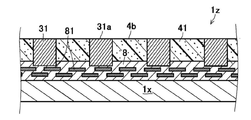
- FIG. 3 shows the polyimide-containing portion-disposed substrate (laminate) 1z after flattening.
- the tip 31a of the electrode 31 is exposed on the surface 4b of the polyimide-containing portion, and the entire surface 4b of the polyimide-containing portion is flattened.
- a substrate B is separately prepared for the laminate (flattened polyimide-containing portion-disposed substrate) 1z (FIG. 4A).
- the substrate B2 includes a silicon wafer 2x having through-hole electrodes 2y, a circuit wiring region 8 having circuit wiring 81 disposed therein, and electrodes 32 (wiring terminals B) formed in the circuit wiring region 8.
- the second polyimide-containing portion 42 is also formed on the surface of the substrate B having the wiring terminal B, and the surface 2a thereof is planarized in the same manner as the surface of the polyimide-containing portion 41 of the substrate A.
- the formation and flattening of the second polyimide-containing portion 42 can be performed by the same method as the formation and flattening of the polyimide-containing portion 41 .
- the surface of the polyimide-containing portion 41 and the electrode 31 of the substrate A and the surface of the second polyimide-containing portion 42 and the electrode 32 of the substrate B are both flattened. Even if there is no conductive path, the electrical connectivity is improved. At this time, alignment (alignment) is performed so that the electrodes 31 of the laminate and the electrodes 32 provided on the substrate B2 are in contact with each other.
- alignment is performed so that the electrodes 31 of the laminate and the electrodes 32 provided on the substrate B2 are in contact with each other.
- the electrode 31 is separated from the polyimide-containing portion 41 (second polyimide-containing portion 41).
- a conductive path may be formed on the electrode 32 at the wiring terminal B as well.
- the conducting path may be formed in the substrate B from the beginning, or the second polyimide-containing portion may be patterned before curing, and the patterning portion may be plated to form the conducting path.
- the aligned substrate B2 and the laminate 1z are brought into contact with each other via the polyimide-containing portion 41 and the second polyimide-containing portion 42 at the bonding surface P1 and bonded (FIG. 4B). ).
- a bonded body 100 in which two substrates are bonded is formed.
- the electrodes 31 and 32 are electrically joined (joining step).
- the polyimide-containing portion 41 is softened by the above heating, and the surface 4b of the polyimide-containing portion of the laminate 1z and the surface 2a of the substrate B (flattened surface of the second polyimide-containing portion 42) are bonded together. to form the bonded body 100 .
- the glass transition temperature of the polyimide-containing portion is lower than the bonding temperature in the bonding step, the polyimide-containing portion is sufficiently softened and is considered to have excellent adhesiveness.
- the substrate A and the substrate B can be electrically connected to each other, and both can be firmly fixed.
- the contact surfaces are in a precise and accurate contact state with the substrate B2. can be obtained. By realizing a more precise and accurate contact state, it is possible to effectively suppress voids that tend to occur on the contact surface.
- a device according to the present invention includes a joined body obtained by a method for producing a joined body using the composition for forming a polyimide-containing portion of the present invention.
- a method of manufacturing a semiconductor device of the present invention includes the method of manufacturing a bonded body of the present invention.
- Devices according to the present invention include semiconductor devices, electronic devices, etc., and are preferably semiconductor devices or electronic devices. For devices, see, for example, "Illustrated All About State-of-the-Art Semiconductor Package Technology" edited by the Semiconductor New Technology Study Group, pp.
- composition for forming a polyimide-containing portion of the present invention can be applied to a wide variety of applications such as mounting of LED (light emitting diode) elements, mounting of optical elements for flat panel displays, and mounting of power semiconductor packages.
- FIG. 5 is a cross-sectional view schematically showing a three-dimensional mounting device.
- a laminate 101 in which a plurality of semiconductor elements (semiconductor chips) 101a to 101d are laminated is arranged on a wiring substrate 120.
- Each of the plurality of semiconductor elements 101a-101d is made of a semiconductor wafer such as a silicon substrate.
- a laminated body 101 has a structure in which a semiconductor element 101a having no through electrodes and semiconductor elements 101b to 101d having through electrodes 102b to 102d are flip-chip connected. Connection pads on the semiconductor element side having through electrodes are connected by metal bumps 103a, 103b, 103c such as solder bumps.
- a resin layer 110 is formed between the semiconductor elements 101a to 101d.
- the method for manufacturing a joined body in the present invention can be used. That is, for example, at least one (preferably all) of the resin layers 110 can be a polyimide-containing portion made of the composition for forming a polyimide-containing portion of the present invention.
- a surface electrode 120 a is provided on one surface of the wiring board 120 .
- An insulating layer 115 having a rewiring layer 105 formed thereon is arranged between the wiring substrate 120 and the laminate (substrate/substrate laminate) 101 .
- One end of the rewiring layer 105 is connected to an electrode pad formed on the surface of the semiconductor element 101d facing the rewiring layer 105 via a metal bump 103d such as a solder bump.
- the other end of the rewiring layer 105 is connected to the surface electrode 120a of the wiring board via a metal bump 103e such as a solder bump.
- a resin layer 110 a is formed between the insulating layer 115 and the laminate 101 .
- the composition for forming a polyimide-containing portion of the present invention can also be used to bond the insulating layer 115 and the laminate 101 together. That is, for example, the resin layer 110a can be used as the polyimide-containing portion described above. A resin layer 110 b is formed between the insulating layer 115 and the wiring board 120 .
- the composition for forming a polyimide-containing portion of the present invention can also be used to bond the insulating layer 115 and the wiring substrate 120 together. That is, for example, the resin layer 110b can be the polyimide-containing portion described above.
- the composition for forming a polyimide-containing part of the present invention preferably contains at least one resin selected from the group consisting of polyimides and polyimide precursors (hereinafter also referred to as "specific resin"), and a solvent. It preferably contains a precursor and a solvent. Moreover, it is preferable that the composition for forming a polyimide-containing part of the present invention further contains a photosensitive compound.
- the photosensitive compound includes a photopolymerization initiator, a photoacid generator, and the like, and a photopolymerization initiator is preferred.
- the resin composition of the present invention preferably contains at least one resin (specific resin) selected from the group consisting of polyimides and polyimide precursors, and more preferably contains a polyimide precursor.
- the specific resin preferably has a polymerizable group, and more preferably contains a radically polymerizable group.
- the resin composition of the present invention preferably contains a radical polymerization initiator described later, and contains a radical polymerization initiator described later and a radical cross-linking agent described later. is more preferred.
- a sensitizer described later can be included.
- a negative photosensitive film is formed from the resin composition of the present invention.
- the specific resin may have a polarity conversion group such as an acid-decomposable group.
- the resin composition of the present invention preferably contains a photoacid generator, which will be described later. From such a resin composition of the present invention, for example, a chemically amplified positive photosensitive film or negative photosensitive film is formed.
- polyimide precursor Although the type of the polyimide precursor used in the present invention is not particularly limited, it preferably contains a repeating unit represented by the following formula (2).
- a 1 and A 2 each independently represent an oxygen atom or -NH-
- R 111 represents a divalent organic group
- R 115 represents a tetravalent organic group
- R 113 and R 114 each independently represent a hydrogen atom or a monovalent organic group.
- a 1 and A 2 in formula (2) each independently represent an oxygen atom or —NH—, preferably an oxygen atom.
- R 111 in formula (2) represents a divalent organic group.
- divalent organic groups include groups containing linear or branched aliphatic groups, cyclic aliphatic groups and aromatic groups, linear or branched aliphatic groups having 2 to 20 carbon atoms, A cyclic aliphatic group having 3 to 20 carbon atoms, an aromatic group having 3 to 20 carbon atoms, or a group consisting of a combination thereof is preferable, and a group containing an aromatic group having 6 to 20 carbon atoms is more preferable.
- the hydrocarbon group in the chain may be substituted with a group containing a hetero atom, and in the cyclic aliphatic group and the aromatic group, the ring member hydrocarbon group is a hetero atom.
- may be substituted with a group containing Groups represented by -Ar- and -Ar-L-Ar- are exemplified as preferred embodiments of the present invention, and groups represented by -Ar-L-Ar- are particularly preferred.
- Ar is each independently an aromatic group
- L is a single bond, or an aliphatic hydrocarbon group having 1 to 10 carbon atoms which may be substituted with a fluorine atom, -O-, -CO -, -S-, -SO 2 - or -NHCO-, or a group consisting of a combination of two or more of the above. Preferred ranges for these are as described above.
- R 111 is preferably derived from a diamine.
- Diamines used in the production of polyimide precursors include linear or branched aliphatic, cyclic aliphatic or aromatic diamines. Only one type of diamine may be used, or two or more types may be used. Specifically, a linear or branched aliphatic group having 2 to 20 carbon atoms, a cyclic aliphatic group having 3 to 20 carbon atoms, an aromatic group having 3 to 20 carbon atoms, or a group consisting of a combination thereof is preferably a diamine containing, more preferably a diamine containing an aromatic group having 6 to 20 carbon atoms. In the straight-chain or branched aliphatic group, the hydrocarbon group in the chain may be substituted with a group containing a heteroatom. may be substituted with a group containing Examples of groups containing aromatic groups include:
- * represents a binding site with other structures.
- diamines include 1,2-diaminoethane, 1,2-diaminopropane, 1,3-diaminopropane, 1,4-diaminobutane or 1,6-diaminohexane; ,3-diaminocyclopentane, 1,2-, 1,3- or 1,4-diaminocyclohexane, 1,2-, 1,3- or 1,4-bis(aminomethyl)cyclohexane, bis-(4- aminocyclohexyl)methane, bis-(3-aminocyclohexyl)methane, 4,4′-diamino-3,3′-dimethylcyclohexylmethane or isophoronediamine; m- or p-phenylenediamine, diaminotoluene, 4,4′- or 3,3'-diaminobiphenyl, 4,4'-diaminodiphenyl ether, 3, 3,3
- diamines (DA-1) to (DA-18) described in paragraphs 0030 to 0031 of International Publication No. 2017/038598.
- diamines having two or more alkylene glycol units in the main chain described in paragraphs 0032 to 0034 of International Publication No. 2017/038598 are preferably used.
- R 111 is preferably represented by -Ar-L-Ar- from the viewpoint of the flexibility of the resulting organic film.
- Ar is each independently an aromatic group
- L is an aliphatic hydrocarbon group having 1 to 10 carbon atoms which may be substituted with a fluorine atom, -O-, -CO-, -S- , —SO 2 — or —NHCO—, or a group consisting of a combination of two or more of the above.
- Ar is preferably a phenylene group
- L is preferably an aliphatic hydrocarbon group having 1 or 2 carbon atoms which may be substituted with a fluorine atom, -O-, -CO-, -S- or -SO 2 - .
- the aliphatic hydrocarbon group here is preferably an alkylene group.
- R 111 is preferably a divalent organic group represented by the following formula (51) or (61).
- a divalent organic group represented by Formula (61) is more preferable.
- Equation (51) In formula (51), R 50 to R 57 are each independently a hydrogen atom, a fluorine atom or a monovalent organic group, and at least one of R 50 to R 57 is a fluorine atom, a methyl group or a trifluoro It is a methyl group, and each * independently represents a binding site to the nitrogen atom in formula (2).
- the monovalent organic groups represented by R 50 to R 57 include unsubstituted alkyl groups having 1 to 10 carbon atoms (preferably 1 to 6 carbon atoms), A fluorinated alkyl group and the like can be mentioned.
- R 58 and R 59 are each independently a fluorine atom, a methyl group, or a trifluoromethyl group, and * is each independently a bonding site to the nitrogen atom in formula (2) show.
- Diamines that give the structure of formula (51) or (61) include 2,2′-dimethylbenzidine, 2,2′-bis(trifluoromethyl)-4,4′-diaminobiphenyl, 2,2′-bis (Fluoro)-4,4'-diaminobiphenyl, 4,4'-diaminooctafluorobiphenyl and the like. These may be used alone or in combination of two or more.
- R 115 in formula (2) represents a tetravalent organic group.
- a tetravalent organic group containing an aromatic ring is preferable, and a group represented by the following formula (5) or (6) is more preferable.
- each * independently represents a binding site to another structure.
- R 112 is a single bond or a divalent linking group, a single bond, or an aliphatic hydrocarbon group having 1 to 10 carbon atoms optionally substituted with a fluorine atom, —O—, -CO-, -S-, -SO 2 -, and -NHCO-, and preferably a group selected from combinations thereof, and the number of carbon atoms optionally substituted with a single bond or a fluorine atom It is more preferably a group selected from 1 to 3 alkylene groups, -O-, -CO-, -S- and -SO 2 -, and -CH 2 -, -C(CF 3 ) 2 -, - More preferably, it is a divalent group selected from the group consisting of C(CH 3 ) 2 -, -O-, -CO-, -S- and -SO 2 -.
- R 115 includes a tetracarboxylic acid residue remaining after removal of an anhydride group from a tetracarboxylic dianhydride.
- the polyimide precursor may contain only one type of tetracarboxylic dianhydride residue as a structure corresponding to R115 , or may contain two or more types thereof.
- the tetracarboxylic dianhydride is preferably represented by the following formula (O).
- R 115 represents a tetravalent organic group.
- the preferred range of R 115 is synonymous with R 115 in formula (2), and the preferred range is also the same.
- tetracarboxylic dianhydrides include pyromellitic dianhydride (PMDA), 3,3′,4,4′-biphenyltetracarboxylic dianhydride, 3,3′,4,4′- Diphenyl sulfide tetracarboxylic dianhydride, 3,3′,4,4′-diphenylsulfonetetracarboxylic dianhydride, 3,3′,4,4′-benzophenonetetracarboxylic dianhydride, 3,3′ ,4,4′-diphenylmethanetetracarboxylic dianhydride, 2,2′,3,3′-diphenylmethanetetracarboxylic dianhydride, 2,3,3′,4′-biphenyltetracarboxylic dianhydride, 2,3,3′,4′-benzophenonetetracarboxylic dianhydride, 4,4′-oxydiphthalic dianhydride,
- tetracarboxylic dianhydrides (DAA-1) to (DAA-5) described in paragraph 0038 of WO 2017/038598 are also preferred examples.
- R 111 and R 115 has an OH group. More specifically, R 111 includes residues of bisaminophenol derivatives.
- R 113 and R 114 in formula (2) each independently represent a hydrogen atom or a monovalent organic group.
- the monovalent organic group preferably includes a linear or branched alkyl group, a cyclic alkyl group, an aromatic group, or a polyalkyleneoxy group.
- At least one of R 113 and R 114 preferably contains a polymerizable group, more preferably both contain a polymerizable group. It is also preferred that at least one of R 113 and R 114 contains two or more polymerizable groups.
- the polymerizable group is a group capable of undergoing a cross-linking reaction by the action of heat, radicals, or the like, and is preferably a radically polymerizable group.
- the polymerizable group examples include a group having an ethylenically unsaturated bond, an alkoxymethyl group, a hydroxymethyl group, an acyloxymethyl group, an epoxy group, an oxetanyl group, a benzoxazolyl group, a blocked isocyanate group, and an amino group. be done.
- a group having an ethylenically unsaturated bond is preferred.
- Groups having an ethylenically unsaturated bond include a vinyl group, an allyl group, an isoallyl group, a 2-methylallyl group, a group having an aromatic ring directly bonded to a vinyl group (e.g., vinylphenyl group), and a (meth)acrylamide group.
- a (meth)acryloyloxy group a group represented by the following formula (III), and the like, and a group represented by the following formula (III) is preferable.
- R 200 represents a hydrogen atom, a methyl group, an ethyl group or a methylol group, preferably a hydrogen atom or a methyl group.
- * represents a binding site with another structure.
- R 201 represents an alkylene group having 2 to 12 carbon atoms, —CH 2 CH(OH)CH 2 —, a cycloalkylene group or a polyalkyleneoxy group.
- R 201 examples include ethylene, propylene, trimethylene, tetramethylene, pentamethylene, hexamethylene, octamethylene, alkylene groups such as dodecamethylene, 1,2-butanediyl, 1, 3-butanediyl group, —CH 2 CH(OH)CH 2 —, polyalkyleneoxy group, ethylene group, alkylene group such as propylene group, —CH 2 CH(OH)CH 2 —, cyclohexyl group, polyalkylene An oxy group is more preferred, and an alkylene group such as an ethylene group, a propylene group, or a polyalkyleneoxy group is even more preferred.
- alkylene groups such as dodecamethylene, 1,2-butanediyl, 1, 3-butanediyl group, —CH 2 CH(OH)CH 2 —, polyalkyleneoxy group, ethylene group, alkylene group such as propylene group, —CH 2 CH(OH)CH 2
- a polyalkyleneoxy group refers to a group in which two or more alkyleneoxy groups are directly bonded.
- the alkylene groups in the plurality of alkyleneoxy groups contained in the polyalkyleneoxy group may be the same or different.
- the arrangement of the alkyleneoxy groups in the polyalkyleneoxy group may be a random arrangement or a block arrangement. Alternatively, it may be arranged in a pattern such as an alternating pattern.
- the number of carbon atoms in the alkylene group (including the number of carbon atoms in the substituent when the alkylene group has a substituent) is preferably 2 or more, more preferably 2 to 10, and 2 to 6.
- the said alkylene group may have a substituent.
- Preferred substituents include alkyl groups, aryl groups, and halogen atoms.
- the number of alkyleneoxy groups contained in the polyalkyleneoxy group is preferably 2 to 20, more preferably 2 to 10, and even more preferably 2 to 6.
- a group to which an oxy group is bonded is preferable, a polyethyleneoxy group or a polypropyleneoxy group is more preferable, and a polyethyleneoxy group is still more preferable.
- the ethyleneoxy groups and the propyleneoxy groups may be arranged randomly, or may be arranged to form blocks. , may be arranged in a pattern such as alternately. Preferred embodiments of the number of repetitions of ethyleneoxy groups and the like in these groups are as described above.
- the polyimide precursor when R 113 is a hydrogen atom, or when R 114 is a hydrogen atom, the polyimide precursor may form a tertiary amine compound having an ethylenically unsaturated bond and a counter salt. good.
- tertiary amine compounds having such ethylenically unsaturated bonds include N,N-dimethylaminopropyl methacrylate.
- R 113 and R 114 may be a polarity conversion group such as an acid-decomposable group.
- the acid-decomposable group is not particularly limited as long as it is decomposed by the action of an acid to generate an alkali-soluble group such as a phenolic hydroxy group or a carboxyl group. , a tertiary alkyl ester group and the like are preferable, and from the viewpoint of exposure sensitivity, an acetal group or a ketal group is more preferable.
- acid-decomposable groups include tert-butoxycarbonyl, isopropoxycarbonyl, tetrahydropyranyl, tetrahydrofuranyl, ethoxyethyl, methoxyethyl, ethoxymethyl, trimethylsilyl, and tert-butoxycarbonylmethyl. groups, trimethylsilyl ether groups, and the like. From the viewpoint of exposure sensitivity, an ethoxyethyl group or a tetrahydrofuranyl group is preferred.
- the polyimide precursor preferably has a fluorine atom in its structure.
- the content of fluorine atoms in the polyimide precursor is preferably 10% by mass or more, and preferably 20% by mass or less.
- the polyimide precursor may be copolymerized with an aliphatic group having a siloxane structure.
- an aliphatic group having a siloxane structure there is an embodiment using bis(3-aminopropyl)tetramethyldisiloxane, bis(p-aminophenyl)octamethylpentasiloxane, or the like as the diamine.
- the repeating unit represented by formula (2) is preferably a repeating unit represented by formula (2-A). That is, at least one polyimide precursor used in the present invention is preferably a precursor having a repeating unit represented by formula (2-A). By including the repeating unit represented by the formula (2-A) in the polyimide precursor, it becomes possible to further widen the width of the exposure latitude.
- a 1 and A 2 represent an oxygen atom
- R 111 and R 112 each independently represent a divalent organic group
- R 113 and R 114 each independently represents a hydrogen atom or a monovalent organic group
- at least one of R 113 and R 114 is a group containing a polymerizable group, and both are preferably groups containing a polymerizable group.
- a 1 , A 2 , R 111 , R 113 and R 114 are each independently synonymous with A 1 , A 2 , R 111 , R 113 and R 114 in formula (2), and preferred ranges are also the same.
- R 112 has the same definition as R 112 in formula (5), and the preferred range is also the same.
- the polyimide precursor may contain one type of repeating unit represented by formula (2), but may contain two or more types. It may also contain structural isomers of the repeating unit represented by formula (2). It goes without saying that the polyimide precursor may also contain other types of repeating units in addition to the repeating units of formula (2) above.
- the content of the repeating unit represented by formula (2) is 50 mol% or more of the total repeating units.
- the total content is more preferably 70 mol % or more, still more preferably 90 mol % or more, and particularly preferably more than 90 mol %.
- the upper limit of the total content is not particularly limited, and all repeating units in the polyimide precursor excluding terminals may be repeating units represented by formula (2).
- the weight average molecular weight (Mw) of the polyimide precursor is preferably 5,000 to 100,000, more preferably 10,000 to 50,000, still more preferably 15,000 to 40,000. Also, the number average molecular weight (Mn) is preferably 2,000 to 40,000, more preferably 3,000 to 30,000, still more preferably 4,000 to 20,000.
- the polyimide precursor preferably has a molecular weight distribution of 1.5 or more, more preferably 1.8 or more, and even more preferably 2.0 or more. Although the upper limit of the polyimide precursor's molecular weight dispersity is not particularly defined, it is preferably 7.0 or less, more preferably 6.5 or less, and even more preferably 6.0 or less.
- the molecular weight dispersity is a value calculated by weight average molecular weight/number average molecular weight.
- the weight average molecular weight, number average molecular weight, and degree of dispersion of at least one polyimide precursor are preferably within the above ranges. It is also preferable that the weight-average molecular weight, the number-average molecular weight, and the degree of dispersion calculated from the plurality of types of polyimide precursors as one resin are within the ranges described above.
- the polyimide used in the present invention may be an alkali-soluble polyimide or a polyimide soluble in a developer containing an organic solvent as a main component.
- the alkali-soluble polyimide refers to a polyimide that dissolves in 100 g of a 2.38% by mass tetramethylammonium aqueous solution at 23° C. by 0.1 g or more, and from the viewpoint of pattern formation, 0.5 g or more. It is preferably a polyimide that dissolves, and more preferably a polyimide that dissolves 1.0 g or more. Although the upper limit of the dissolved amount is not particularly limited, it is preferably 100 g or less.
- the polyimide is preferably a polyimide having a plurality of imide structures in its main chain from the viewpoint of the film strength and insulating properties of the resulting organic film.
- the term "main chain” refers to the relatively longest linking chain in the molecule of the polymer compound that constitutes the resin, and the term “side chain” refers to the other linking chain.
- the polyimide preferably has a fluorine atom.
- a fluorine atom is preferably included in, for example, R 132 in a repeating unit represented by formula (4) described later or R 131 in a repeating unit represented by formula (4) described later, and the formula ( It is more preferably contained as a fluorinated alkyl group in R 132 in the repeating unit represented by 4) or R 131 in the repeating unit represented by formula (4) described later.
- the amount of fluorine atoms relative to the total mass of polyimide is preferably 5% by mass or more and preferably 20% by mass or less.
- the polyimide preferably has a silicon atom.
- a silicon atom for example, is preferably contained in R 131 in a repeating unit represented by formula (4) described later, and R 131 in a repeating unit represented by formula (4) described later is an organically modified (poly ) is more preferably contained as a siloxane structure.
- the silicon atom or the organically modified (poly)siloxane structure may be contained in the side chain of the polyimide, but is preferably contained in the main chain of the polyimide.
- the amount of silicon atoms relative to the total mass of polyimide is preferably 1% by mass or more, and more preferably 20% by mass or less.
- the polyimide preferably has an ethylenically unsaturated bond.
- the polyimide may have an ethylenically unsaturated bond at the end of its main chain or in a side chain, preferably in a side chain.
- the ethylenically unsaturated bond preferably has radical polymerizability.
- the ethylenically unsaturated bond is preferably contained in R 132 in a repeating unit represented by the formula (4) described later, or R 131 in a repeating unit represented by the formula (4) described later.
- the ethylenically unsaturated bond is preferably contained in R 131 in the repeating unit represented by formula (4) described later, and ethylene is contained in R 131 in the repeating unit represented by formula (4) described later It is more preferably included as a group having a polyunsaturated bond.
- the group having an ethylenically unsaturated bond includes a group having an optionally substituted vinyl group directly bonded to an aromatic ring such as a vinyl group, an allyl group, a vinylphenyl group, a (meth)acrylamide group, a (meth) Examples include an acryloyloxy group and a group represented by the following formula (IV).
- R 20 represents a hydrogen atom, a methyl group, an ethyl group or a methylol group, preferably a hydrogen atom or a methyl group.
- R 21 is an alkylene group having 2 to 12 carbon atoms, —O—CH 2 CH(OH)CH 2 —, —C( ⁇ O)O—, —O(C ⁇ O)NH— , a (poly)alkyleneoxy group having 2 to 30 carbon atoms (the number of carbon atoms in the alkylene group is preferably 2 to 12, more preferably 2 to 6, and particularly preferably 2 or 3; the number of repetitions is preferably 1 to 12, 1 to 6 are more preferable, and 1 to 3 are particularly preferable), or a group in which two or more of these are combined.
- the alkylene group having 2 to 12 carbon atoms may be a linear, branched, cyclic, or a combination of these alkylene groups.
- an alkylene group having 2 to 8 carbon atoms is preferable, and an alkylene group having 2 to 4 carbon atoms is more preferable.
- R 21 is preferably a group represented by any one of the following formulas (R1) to (R3), more preferably a group represented by formula (R1).
- L represents a single bond, an alkylene group having 2 to 12 carbon atoms, a (poly)alkyleneoxy group having 2 to 30 carbon atoms, or a group in which two or more of these are combined
- X represents an oxygen atom or a sulfur atom
- * represents a bonding site with another structure
- ⁇ represents a bonding site with the oxygen atom to which R 21 in formula (IV) bonds.
- a preferred embodiment of an alkylene group having 2 to 12 carbon atoms or a (poly)alkyleneoxy group having 2 to 30 carbon atoms in L is the above-mentioned R 21 having 2 to 12 carbon atoms. It is the same as the preferred embodiment of the 12 alkylene group or the (poly)alkyleneoxy group having 2 to 30 carbon atoms.
- X is preferably an oxygen atom.
- * has the same meaning as * in formula (IV), and preferred embodiments are also the same.
- the structure represented by formula (R1) is, for example, a polyimide having a hydroxy group such as a phenolic hydroxy group, and a compound having an isocyanato group and an ethylenically unsaturated bond (e.g., 2-isocyanatoethyl methacrylate, etc.). Obtained by reaction.
- the structure represented by formula (R2) can be obtained, for example, by reacting a polyimide having a carboxy group with a compound having a hydroxy group and an ethylenically unsaturated bond (eg, 2-hydroxyethyl methacrylate, etc.).
- the structure represented by formula (R3) can be obtained, for example, by reacting a polyimide having a hydroxy group such as a phenolic hydroxy group with a compound having a glycidyl group and an ethylenically unsaturated bond (e.g., glycidyl methacrylate, etc.) can get.
- a polyimide having a hydroxy group such as a phenolic hydroxy group
- a compound having a glycidyl group and an ethylenically unsaturated bond e.g., glycidyl methacrylate, etc.
- * represents a binding site with another structure, preferably a binding site with the main chain of polyimide.
- the amount of ethylenically unsaturated bonds relative to the total mass of the polyimide is preferably 0.0001-0.1 mol/g, more preferably 0.0005-0.05 mol/g.
- Polyimide may have a polymerizable group other than the group having an ethylenically unsaturated bond.
- Polymerizable groups other than groups having an ethylenically unsaturated bond include cyclic ether groups such as an epoxy group and an oxetanyl group, alkoxymethyl groups such as a methoxymethyl group, and methylol groups.
- a polymerizable group other than a group having an ethylenically unsaturated bond is preferably included, for example, in R 131 in a repeating unit represented by formula (4) described below.
- the amount of the polymerizable group other than the group having an ethylenically unsaturated bond with respect to the total mass of the polyimide is preferably 0.0001 to 0.1 mol / g, preferably 0.001 to 0.05 mol / g. more preferred.
- the polyimide may have a polarity conversion group such as an acid-decomposable group.
- the acid-decomposable group in the polyimide is the same as the acid-decomposable group described for R 113 and R 114 in formula (2) above, and preferred embodiments are also the same.
- Polar conversion groups are included, for example, at R 131 and R 132 in the repeating unit represented by formula (4) described later, the terminal of polyimide, and the like.
- the acid value of polyimide is preferably 30 mgKOH/g or more, more preferably 50 mgKOH/g or more, and more preferably 70 mgKOH/g or more, from the viewpoint of improving developability. is more preferable. Moreover, the acid value is preferably 500 mgKOH/g or less, more preferably 400 mgKOH/g or less, and even more preferably 200 mgKOH/g or less. Further, when the polyimide is subjected to development using a developer containing an organic solvent as a main component (for example, "solvent development” described later), the acid value of the polyimide is preferably 1 to 35 mgKOH/g, and 2 to 30 mgKOH.
- the acid value is measured by a known method, for example, by the method described in JIS K 0070:1992.
- an acid group having a pKa of 0 to 10 is preferable, and an acid group having a pKa of 3 to 8 is more preferable, from the viewpoint of both storage stability and developability.
- the pKa is a dissociation reaction in which hydrogen ions are released from an acid, and its equilibrium constant Ka is represented by its negative common logarithm pKa.
- pKa is a value calculated by ACD/ChemSketch (registered trademark).
- the acid group is a polyvalent acid such as phosphoric acid
- the pKa is the first dissociation constant.
- the polyimide preferably contains at least one selected from the group consisting of a carboxy group and a phenolic hydroxy group, more preferably a phenolic hydroxy group.
- the polyimide preferably has a phenolic hydroxy group from the viewpoint of making the development speed with an alkaline developer appropriate.
- the polyimide may have a phenolic hydroxy group at the end of the main chain or in the side chain.
- a phenolic hydroxy group is preferably contained in, for example, R 132 in a repeating unit represented by formula (4) described later or R 131 in a repeating unit represented by formula (4) described later.
- the amount of phenolic hydroxy groups relative to the total weight of the polyimide is preferably 0.1-30 mol/g, more preferably 1-20 mol/g.
- the polyimide used in the present invention is not particularly limited as long as it is a polymer compound having an imide structure, but it preferably contains a repeating unit represented by the following formula (4).
- R 131 represents a divalent organic group and R 132 represents a tetravalent organic group.
- the polymerizable group may be located on at least one of R 131 and R 132 , and the terminal of the polyimide as shown in the following formula (4-1) or (4-2) may be located in Formula (4-1)
- R 133 is a polymerizable group, and other groups are the same as in formula (4).
- Formula (4-2) At least one of R 134 and R 135 is a polymerizable group, and when it is not a polymerizable group, it is an organic group, and the other groups are as defined in formula (4).
- R 131 represents a divalent organic group.
- Examples of the divalent organic group are the same as those for R 111 in formula (2), and the preferred range is also the same.
- R 131 also includes a diamine residue remaining after removal of the amino group of the diamine.
- Diamines include aliphatic, cycloaliphatic or aromatic diamines.
- a specific example is the example of R 111 in formula (2) of the polyimide precursor.
- R 131 is preferably a diamine residue having at least two alkylene glycol units in its main chain from the viewpoint of more effectively suppressing warping during baking. More preferably, it is a diamine residue containing two or more ethylene glycol chains, propylene glycol chains, or both in one molecule, and more preferably the above diamine, which does not contain an aromatic ring. is.
- Diamines containing two or more ethylene glycol chains, propylene glycol chains, or both in one molecule include Jeffamine (registered trademark) KH-511, ED-600, ED-900, ED-2003, and EDR. -148, EDR-176, D-200, D-400, D-2000, D-4000 (trade names, manufactured by HUNTSMAN Co., Ltd.), 1-(2-(2-(2-aminopropoxy)ethoxy) propoxy)propan-2-amine, 1-(1-(1-(2-aminopropoxy)propan-2-yl)oxy)propan-2-amine, and the like.
- R 132 represents a tetravalent organic group.
- examples of the tetravalent organic group are the same as those for R 115 in formula (2), and the preferred range is also the same.
- four bonds of a tetravalent organic group exemplified as R 115 combine with four —C( ⁇ O)— moieties in the above formula (4) to form a condensed ring.
- R 132 includes a tetracarboxylic acid residue remaining after removal of the anhydride group from the tetracarboxylic dianhydride.
- a specific example is the example of R 115 in formula (2) of the polyimide precursor. From the viewpoint of strength of the organic film, R 132 is preferably an aromatic diamine residue having 1 to 4 aromatic rings.
- R 131 and R 132 has an OH group. More specifically, R 131 is 2,2-bis(3-hydroxy-4-aminophenyl)propane, 2,2-bis(3-hydroxy-4-aminophenyl)hexafluoropropane, 2,2- Bis(3-amino-4-hydroxyphenyl)propane, 2,2-bis(3-amino-4-hydroxyphenyl)hexafluoropropane, and the above (DA-1) to (DA-18) are preferred examples. and more preferred examples of R 132 are the above (DAA-1) to (DAA-5).
- the polyimide preferably has a fluorine atom in its structure.
- the content of fluorine atoms in the polyimide is preferably 10% by mass or more, and preferably 20% by mass or less.
- the polyimide may be copolymerized with an aliphatic group having a siloxane structure.
- the diamine component include bis(3-aminopropyl)tetramethyldisiloxane and bis(p-aminophenyl)octamethylpentasiloxane.
- the main chain end of the polyimide is blocked with a terminal blocking agent such as monoamine, acid anhydride, monocarboxylic acid, monoacid chloride compound, monoactive ester compound. preferably.
- monoamines examples include aniline, 2-ethynylaniline, 3-ethynylaniline, 4-ethynylaniline, 5-amino-8-hydroxyquinoline, 1-hydroxy-7 -aminonaphthalene, 1-hydroxy-6-aminonaphthalene, 1-hydroxy-5-aminonaphthalene, 1-hydroxy-4-aminonaphthalene, 2-hydroxy-7-aminonaphthalene, 2-hydroxy-6-aminonaphthalene, 2 -hydroxy-5-aminonaphthalene, 1-carboxy-7-aminonaphthalene, 1-carboxy-6-aminonaphthalene, 1-carboxy-5-aminonaphthalene, 2-carboxy-7-aminonaphthalene, 2-carboxy-6- Aminonaphthalene, 2-carboxy-5-aminonaphthalene, 2-aminobenzoic acid, 3-aminobenzoic acid, 4-aminobenzoic acid, 2-aminobenzoic acid
- the imidization rate (also referred to as "ring closure rate") of the polyimide is preferably 70% or more, more preferably 80% or more, from the viewpoint of the film strength, insulating properties, etc. of the resulting organic film. More preferably, it is 90% or more.
- the upper limit of the imidization rate is not particularly limited, and may be 100% or less.
- the imidization rate is measured, for example, by the method described below. The infrared absorption spectrum of the polyimide is measured, and the peak intensity P1 near 1377 cm ⁇ 1 , which is the absorption peak derived from the imide structure, is obtained. Next, after heat-treating the polyimide at 350° C.
- the polyimide may contain repeating units represented by the above formula (4) that all contain one type of R 131 or R 132 , and the above formula ( 4) may contain a repeating unit. Moreover, the polyimide may contain other types of repeating units in addition to the repeating units represented by the above formula (4). Other types of repeating units include, for example, repeating units represented by formula (2) above.
- polyimide for example, a method of reacting a tetracarboxylic dianhydride and a diamine (partially replaced with a monoamine terminal blocker) at a low temperature, a method of reacting a tetracarboxylic dianhydride (partially with an acid anhydride) at a low temperature a monoacid chloride compound or a monoactive ester compound) and a diamine, a diester is obtained by a tetracarboxylic dianhydride and an alcohol, and then a diamine (a part of which is a monoamine A method of reacting in the presence of a condensing agent) with a condensing agent, a diester is obtained by tetracarboxylic acid dianhydride and alcohol, then the remaining dicarboxylic acid is acid chloride, diamine (part of which is a monoamine Using a method such as a method of reacting with a terminal blocking agent) to obtain a polyimide precursor
- the weight average molecular weight (Mw) of the polyimide is preferably 5,000 to 100,000, more preferably 10,000 to 50,000, still more preferably 15,000 to 40,000. By setting the weight average molecular weight to 5,000 or more, the folding resistance of the cured film can be improved. A weight-average molecular weight of 15,000 or more is particularly preferable in order to obtain an organic film having excellent mechanical properties (e.g., elongation at break). Also, the number average molecular weight (Mn) of the polyimide is preferably 2,000 to 40,000, more preferably 3,000 to 30,000, still more preferably 4,000 to 20,000. The polyimide has a molecular weight distribution of preferably 1.5 or more, more preferably 1.8 or more, and even more preferably 2.0 or more.
- the upper limit of the polyimide molecular weight dispersion is not particularly defined, it is preferably 7.0 or less, more preferably 6.5 or less, and even more preferably 6.0 or less.
- the weight-average molecular weight, number-average molecular weight, and degree of dispersion of at least one type of polyimide are preferably within the above ranges. It is also preferable that the weight-average molecular weight, the number-average molecular weight, and the degree of dispersion calculated using the above plural kinds of polyimides as one resin are within the ranges described above.
- Polyimide precursors and the like for example, a method of reacting a tetracarboxylic dianhydride and a diamine at a low temperature, a method of reacting a tetracarboxylic dianhydride and a diamine at a low temperature to obtain a polyamic acid, a condensing agent or an alkylating agent A method of esterification using a tetracarboxylic dianhydride and an alcohol to obtain a diester, followed by a reaction with a diamine in the presence of a condensing agent, a method of reacting a tetracarboxylic dianhydride and an alcohol to obtain a diester, After that, the remaining dicarboxylic acid can be acid-halogenated using a halogenating agent and reacted with a diamine.
- the method of obtaining a diester from a tetracarboxylic dianhydride and an alcohol, then acid-halogenating the remaining dicarboxylic acid with a halogenating agent, and reacting it with a diamine is more preferred.
- the condensing agent include dicyclohexylcarbodiimide, diisopropylcarbodiimide, 1-ethoxycarbonyl-2-ethoxy-1,2-dihydroquinoline, 1,1-carbonyldioxy-di-1,2,3-benzotriazole, N, N'-disuccinimidyl carbonate, trifluoroacetic anhydride and the like can be mentioned.
- alkylating agent examples include N,N-dimethylformamide dimethyl acetal, N,N-dimethylformamide diethyl acetal, N,N-dialkylformamide dialkyl acetal, trimethyl orthoformate and triethyl orthoformate.
- halogenating agent examples include thionyl chloride, oxalyl chloride, phosphorus oxychloride and the like.
- organic solvent In the method for producing a polyimide precursor or the like, it is preferable to use an organic solvent in the reaction. One type of organic solvent may be used, or two or more types may be used.
- the organic solvent can be appropriately determined depending on the raw material, but pyridine, diethylene glycol dimethyl ether (diglyme), N-methylpyrrolidone, N-ethylpyrrolidone, ethyl propionate, dimethylacetamide, dimethylformamide, tetrahydrofuran, ⁇ -butyrolactone, and the like. are exemplified.
- a basic compound In the method for producing a polyimide precursor or the like, it is preferable to add a basic compound during the reaction.
- One type of basic compound may be used, or two or more types may be used.
- the basic compound can be appropriately determined depending on the raw material, but triethylamine, diisopropylethylamine, pyridine, 1,8-diazabicyclo[5.4.0]undec-7-ene, N,N-dimethyl-4-amino Pyridine and the like are exemplified.
- terminal blocking agents include monoalcohols, phenols, thiols, thiophenols, monoamines, and the like. It is more preferable to use monoalcohols, phenols and monoamines from the viewpoint of their properties.
- Preferred monoalcohol compounds include primary alcohols such as methanol, ethanol, propanol, butanol, hexanol, octanol, dodecinol, benzyl alcohol, 2-phenylethanol, 2-methoxyethanol, 2-chloromethanol and furfuryl alcohol, and isopropanol. , 2-butanol, cyclohexyl alcohol, cyclopentanol and 1-methoxy-2-propanol, and tertiary alcohols such as t-butyl alcohol and adamantane alcohol.
- Preferable phenolic compounds include phenols such as phenol, methoxyphenol, methylphenol, naphthalene-1-ol, naphthalene-2-ol, and hydroxystyrene.
- Preferred monoamine compounds include aniline, 2-ethynylaniline, 3-ethynylaniline, 4-ethynylaniline, 5-amino-8-hydroxyquinoline, 1-hydroxy-7-aminonaphthalene, 1-hydroxy-6- aminonaphthalene, 1-hydroxy-5-aminonaphthalene, 1-hydroxy-4-aminonaphthalene, 2-hydroxy-7-aminonaphthalene, 2-hydroxy-6-aminonaphthalene, 2-hydroxy-5-aminonaphthalene, 1- Carboxy-7-aminonaphthalene, 1-carboxy-6-aminonaphthalene, 1-carboxy-5-aminonaphthalene, 2-carboxy-7-aminonaphthalene, 2-carboxy-6-amin
- Preferred capping agents for amino groups are carboxylic acid anhydrides, carboxylic acid chlorides, carboxylic acid bromide, sulfonic acid chlorides, sulfonic anhydrides, sulfonic acid carboxylic acid anhydrides, etc., more preferably carboxylic acid anhydrides and carboxylic acid chlorides. preferable.
- Preferred carboxylic anhydride compounds include acetic anhydride, propionic anhydride, oxalic anhydride, succinic anhydride, maleic anhydride, phthalic anhydride, benzoic anhydride, 5-norbornene-2,3-dicarboxylic anhydride, and the like. is mentioned.
- Preferred compounds of carboxylic acid chlorides include acetyl chloride, acrylic acid chloride, propionyl chloride, methacrylic acid chloride, pivaloyl chloride, cyclohexanecarbonyl chloride, 2-ethylhexanoyl chloride, cinnamoyl chloride, and 1-adamantanecarbonyl chloride. , heptafluorobutyryl chloride, stearic acid chloride, benzoyl chloride, and the like.
- a step of depositing a solid may be included in the production of the polyimide precursor or the like. Specifically, after filtering off the water absorption by-products of the dehydration condensation agent coexisting in the reaction solution as necessary, water, aliphatic lower alcohol, or a poor solvent such as a mixture thereof, the obtained A polyimide precursor or the like can be obtained by adding a polymer component and depositing the polymer component, depositing it as a solid, and drying it. In order to improve the degree of purification, operations such as redissolution, reprecipitation, drying, etc. of the polyimide precursor may be repeated. Furthermore, a step of removing ionic impurities using an ion exchange resin may be included.
- the content of the specific resin in the resin composition of the present invention is preferably 20% by mass or more, more preferably 30% by mass or more, and 40% by mass or more with respect to the total solid content of the resin composition. is more preferable, and 50% by mass or more is even more preferable. Further, the content of the resin in the resin composition of the present invention is preferably 99.5% by mass or less, more preferably 99% by mass or less, more preferably 98% by mass, based on the total solid content of the resin composition. % or less, more preferably 97 mass % or less, and even more preferably 95 mass % or less.
- the resin composition of the present invention may contain only one type of specific resin, or may contain two or more types. When two or more types are included, the total amount is preferably within the above range.
- the resin composition of the present invention preferably contains at least two resins.
- the resin composition of the present invention may contain a total of two or more of the specific resin and other resins described later, or may contain two or more of the specific resins. It is preferable to include two or more kinds.
- the resin composition of the present invention contains two or more specific resins, for example, two or more polyimides that are polyimide precursors and have different dianhydride-derived structures (R 115 in the above formula (2)) It preferably contains a precursor.
- the resin composition of the present invention may contain the specific resin described above and other resins different from the specific resin (hereinafter also simply referred to as "other resins").
- Other resins include phenolic resins, polyamides, epoxy resins, polysiloxanes, resins containing siloxane structures, (meth)acrylic resins, (meth)acrylamide resins, urethane resins, butyral resins, styryl resins, polyether resins, and polyester resins. etc.
- a resin composition having excellent applicability can be obtained, and a pattern (cured product) having excellent solvent resistance can be obtained.
- a high polymerizable group value having a weight average molecular weight of 20,000 or less for example, the molar amount of the polymerizable group in 1 g of the resin is 1 ⁇ 10 ⁇ 3 mol/g or more
- the coating properties of the resin composition, the solvent resistance of the pattern (cured product), etc. can be improved.
- Other resins can also be added to the resin composition as dispersants for fillers. In such an embodiment, as the other resin, a known filler dispersant can be used without particular limitation.
- the content of the other resins is preferably 0.01% by mass or more, and 0.05% by mass or more, relative to the total solid content of the resin composition. More preferably, it is more preferably 1% by mass or more, even more preferably 2% by mass or more, even more preferably 5% by mass or more, and further preferably 10% by mass or more. More preferred.
- the content of other resins in the resin composition of the present invention is preferably 80% by mass or less, more preferably 75% by mass or less, based on the total solid content of the resin composition. It is more preferably 60% by mass or less, even more preferably 50% by mass or less.
- the content of other resins may be low.
- the content of the other resin is preferably 20% by mass or less, more preferably 15% by mass or less, and 10% by mass or less, relative to the total solid content of the resin composition. is more preferable, 5% by mass or less is even more preferable, and 1% by mass or less is even more preferable.
- the lower limit of the content is not particularly limited as long as it is 0% by mass or more.
- the resin composition of the present invention may contain only one kind of other resin, or may contain two or more kinds thereof. When two or more types are included, the total amount is preferably within the above range.
- the resin composition of the present invention preferably contains a polymerizable compound.
- Polymerizable compounds include radical cross-linking agents or other cross-linking agents.
- the resin composition of the present invention preferably contains a radical cross-linking agent.
- a radical cross-linking agent is a compound having a radically polymerizable group.
- the radically polymerizable group a group containing an ethylenically unsaturated bond is preferred.
- Examples of the group containing an ethylenically unsaturated bond include groups containing an ethylenically unsaturated bond such as a vinyl group, an allyl group, a vinylphenyl group, a (meth)acryloyl group, a maleimide group, and a (meth)acrylamide group.
- the group containing an ethylenically unsaturated bond is preferably a (meth)acryloyl group, a (meth)acrylamide group, or a vinylphenyl group, and more preferably a (meth)acryloyl group from the viewpoint of reactivity.
- the radical cross-linking agent is preferably a compound having one or more ethylenically unsaturated bonds, more preferably a compound having two or more.
- the radical cross-linking agent may have 3 or more ethylenically unsaturated bonds.
- the compound having two or more ethylenically unsaturated bonds is preferably a compound having 2 to 15 ethylenically unsaturated bonds, more preferably a compound having 2 to 10 ethylenically unsaturated bonds, and 2 to 6.
- the resin composition of the present invention contains a compound having two ethylenically unsaturated bonds and a compound having three or more ethylenically unsaturated bonds. It is also preferred to include
- the molecular weight of the radical cross-linking agent is preferably 2,000 or less, more preferably 1,500 or less, and even more preferably 900 or less.
- the lower limit of the molecular weight of the radical cross-linking agent is preferably 100 or more.
- radical cross-linking agent examples include unsaturated carboxylic acids (eg, acrylic acid, methacrylic acid, itaconic acid, crotonic acid, isocrotonic acid, maleic acid, etc.), their esters, and amides. They are esters of saturated carboxylic acids and polyhydric alcohol compounds, and amides of unsaturated carboxylic acids and polyhydric amine compounds.
- addition reaction products of unsaturated carboxylic acid esters or amides having a nucleophilic substituent such as a hydroxy group, an amino group, or a sulfanyl group with monofunctional or polyfunctional isocyanates or epoxies, or monofunctional or polyfunctional is also preferably used.
- addition reaction products of unsaturated carboxylic acid esters or amides having electrophilic substituents such as isocyanate groups and epoxy groups with monofunctional or polyfunctional alcohols, amines, and thiols, and halogeno groups
- substitution reaction products of unsaturated carboxylic acid esters or amides having a leaving substituent such as a tosyloxy group and monofunctional or polyfunctional alcohols, amines, and thiols.
- paragraphs 0113 to 0122 of JP-A-2016-027357 can be referred to, and the contents thereof are incorporated herein.
- the radical cross-linking agent is preferably a compound having a boiling point of 100°C or higher under normal pressure.
- examples include polyethylene glycol di(meth)acrylate, trimethylolethane tri(meth)acrylate, neopentyl glycol di(meth)acrylate, pentaerythritol tri(meth)acrylate, pentaerythritol tetra(meth)acrylate, dipentaerythritol penta(meth)acrylate, dipentaerythritol hexa(meth)acrylate, hexanediol di(meth)acrylate, trimethylolpropane tri(acryloyloxypropyl)ether, tri(acryloyloxyethyl)isocyanurate, glycerin, trimethylolethane, etc.
- polyfunctional (meth)acrylate obtained by reacting polyfunctional carboxylic acid with a compound having a cyclic ether group such as glycidyl (meth)acrylate and an ethylenically unsaturated bond can also be used.
- JP-A-2010-160418, JP-A-2010-129825, JP-A-4364216, etc. have a fluorene ring and an ethylenically unsaturated bond. It is also possible to use compounds having two or more groups and cardo resins.
- JP-B-46-043946 JP-B-01-040337, JP-B-01-040336, and JP-A-02-025493.
- vinyl phosphonic acid compounds and the like can also be mentioned.
- Compounds containing perfluoroalkyl groups described in JP-A-61-022048 can also be used.
- the journal of the Japan Adhesive Association vol. 20, No. 7, pp. 300-308 (1984) as photopolymerizable monomers and oligomers can also be used.
- dipentaerythritol triacrylate (commercially available as KAYARAD D-330 (manufactured by Nippon Kayaku Co., Ltd.)), dipentaerythritol tetraacrylate (commercially available as KAYARAD D-320 (Nippon Kayaku ( Ltd.), A-TMMT (manufactured by Shin-Nakamura Chemical Co., Ltd.), dipentaerythritol penta(meth)acrylate (commercially available as KAYARAD D-310 (manufactured by Nippon Kayaku Co., Ltd.)), dipenta Erythritol hexa(meth)acrylate (commercially available products are KAYARAD DPHA (manufactured by Nippon Kayaku Co., Ltd.) and A-DPH (manufactured by Shin-Nakamura Chemical Co., Ltd.)), and their (meth)acryloyl groups are ethylene glycol,
- radical cross-linking agents examples include SR-494, a tetrafunctional acrylate having four ethyleneoxy chains, manufactured by Sartomer, SR-209, a bifunctional methacrylate having four ethyleneoxy chains, manufactured by Sartomer. 231, 239, Nippon Kayaku Co., Ltd.
- DPCA-60 a hexafunctional acrylate having 6 pentyleneoxy chains, TPA-330, a trifunctional acrylate having 3 isobutyleneoxy chains, urethane oligomer UAS-10 , UAB-140 (manufactured by Nippon Paper Industries), NK Ester M-40G, NK Ester 4G, NK Ester M-9300, NK Ester A-9300, UA-7200 (manufactured by Shin-Nakamura Chemical Co., Ltd.), DPHA-40H (Japan Kayaku Co., Ltd.), UA-306H, UA-306T, UA-306I, AH-600, T-600, AI-600 (manufactured by Kyoeisha Chemical Co., Ltd.), Blenmer PME400 (manufactured by NOF Corporation) etc.
- radical cross-linking agents examples include urethane acrylates such as those described in JP-B-48-041708, JP-A-51-037193, JP-B-02-032293, JP-B-02-016765, Urethane compounds having an ethylene oxide skeleton described in JP-B-58-049860, JP-B-56-017654, JP-B-62-039417 and JP-B-62-039418 are also suitable.
- compounds having an amino structure or a sulfide structure in the molecule described in JP-A-63-277653, JP-A-63-260909, and JP-A-01-105238 are used. can also
- the radical cross-linking agent may be a radical cross-linking agent having an acid group such as a carboxy group or a phosphoric acid group.
- a radical cross-linking agent having an acid group is preferably an ester of an aliphatic polyhydroxy compound and an unsaturated carboxylic acid. is more preferable.
- the aliphatic polyhydroxy compound is pentaerythritol or dipentaerythritol is a compound.
- Examples of commercially available products include polybasic acid-modified acrylic oligomers manufactured by Toagosei Co., Ltd. such as M-510 and M-520.
- the acid value of the radical cross-linking agent having an acid group is preferably 0.1-300 mgKOH/g, particularly preferably 1-100 mgKOH/g. If the acid value of the radical cross-linking agent is within the above range, the handleability in production is excellent, and furthermore the developability is excellent. Moreover, the polymerizability is good. The acid value is measured according to JIS K 0070:1992.
- the resin composition preferably uses a bifunctional methacrylate or acrylate.
- Specific compounds include triethylene glycol diacrylate, triethylene glycol dimethacrylate, tetraethylene glycol dimethacrylate, tetraethylene glycol diacrylate, PEG (polyethylene glycol) 200 diacrylate, PEG200 dimethacrylate, PEG600 diacrylate, and PEG600 diacrylate.
- PEG200 diacrylate is a polyethylene glycol diacrylate having a polyethylene glycol chain formula weight of about 200.
- a monofunctional radical cross-linking agent can be preferably used as the radical cross-linking agent from the viewpoint of suppressing warpage associated with the elastic modulus control of the pattern (cured product).
- Monofunctional radical cross-linking agents include n-butyl (meth)acrylate, 2-ethylhexyl (meth)acrylate, 2-hydroxyethyl (meth)acrylate, butoxyethyl (meth)acrylate, carbitol (meth)acrylate, cyclohexyl (meth)acrylate, ) acrylate, benzyl (meth) acrylate, phenoxyethyl (meth) acrylate, N-methylol (meth) acrylamide, glycidyl (meth) acrylate, polyethylene glycol mono (meth) acrylate, polypropylene glycol mono (meth) acrylate, etc.
- N-vinyl compounds such as N-vinylpyrrolidone and N-vinylcaprolactam
- allyl glycidyl ether are preferably used.
- the monofunctional radical cross-linking agent a compound having a boiling point of 100° C. or higher under normal pressure is also preferable in order to suppress volatilization before exposure.
- Other di- or higher functional radical cross-linking agents include allyl compounds such as diallyl phthalate and triallyl trimellitate.
- a radical cross-linking agent When a radical cross-linking agent is contained, its content is preferably more than 0% by mass and 60% by mass or less with respect to the total solid content of the resin composition of the present invention. More preferably, the lower limit is 5% by mass or more. The upper limit is more preferably 50% by mass or less, and even more preferably 30% by mass or less.
- a single radical cross-linking agent may be used alone, or two or more may be used in combination. When two or more are used in combination, the total amount is preferably within the above range.
- the resin composition of the present invention contains another cross-linking agent different from the radical cross-linking agent described above.
- the other cross-linking agent refers to a cross-linking agent other than the above-described radical cross-linking agent, and the above-described photoacid generator or photobase generator reacts with other compounds in the composition or reacts with them.
- the compound has a plurality of groups in the molecule that promote the reaction forming covalent bonds with the product, and covalent bonds are formed with other compounds in the composition or reaction products thereof. Compounds having a plurality of groups in the molecule, the reaction of which is promoted by the action of an acid or base, are preferred.
- the acid or base is preferably an acid or base generated from a photoacid generator or a photobase generator in the exposure step.
- compounds having at least one group selected from the group consisting of acyloxymethyl groups, methylol groups and alkoxymethyl groups are preferred, and the compounds are preferably selected from the group consisting of acyloxymethyl groups, methylol groups and alkoxymethyl groups. More preferred is a compound having a structure in which at least one group is directly bonded to a nitrogen atom.
- cross-linking agents include, for example, an amino group-containing compound such as melamine, glycoluril, urea, alkylene urea, and benzoguanamine, which is reacted with formaldehyde or formaldehyde and alcohol, and the hydrogen atom of the amino group is converted to an acyloxymethyl group, methylol group, or A compound having a structure substituted with an alkoxymethyl group can be mentioned.
- the method for producing these compounds is not particularly limited as long as they have the same structure as the compounds produced by the above methods. Oligomers formed by self-condensation of methylol groups of these compounds may also be used.
- a melamine-based crosslinking agent is a melamine-based crosslinking agent
- a glycoluril, urea or alkyleneurea-based crosslinking agent is a urea-based crosslinking agent
- an alkyleneurea-based crosslinking agent is an alkyleneurea-based crosslinking agent.
- a cross-linking agent using benzoguanamine is called a benzoguanamine-based cross-linking agent.
- the resin composition of the present invention preferably contains at least one compound selected from the group consisting of urea-based cross-linking agents and melamine-based cross-linking agents. More preferably, it contains at least one compound selected from the group consisting of agents.
- an alkoxymethyl group or an acyloxymethyl group is directly substituted on the nitrogen atom of an aromatic group or the following urea structure, or on a triazine.
- the alkoxymethyl group or acyloxymethyl group of the above compound preferably has 2 to 5 carbon atoms, preferably 2 or 3 carbon atoms, and more preferably 2 carbon atoms.
- the total number of alkoxymethyl groups and acyloxymethyl groups in the above compound is preferably 1-10, more preferably 2-8, and particularly preferably 3-6.
- the molecular weight of the compound is preferably 1500 or less, preferably 180-1200.
- R 100 represents an alkyl group or an acyl group.
- R 101 and R 102 each independently represent a monovalent organic group and may combine with each other to form a ring.
- Examples of compounds in which an alkoxymethyl group or an acyloxymethyl group is directly substituted by an aromatic group include compounds represented by the following general formula.
- X represents a single bond or a divalent organic group
- each R 104 independently represents an alkyl group or an acyl group
- R 103 represents a hydrogen atom, an alkyl group, an alkenyl group, an aryl group, an aralkyl group , or a group that decomposes under the action of an acid to produce an alkali-soluble group (e.g., a group that leaves under the action of an acid, a group represented by —C(R 4 ) 2 COOR 5 (R 4 is independently It represents a hydrogen atom or an alkyl group having 1 to 4 carbon atoms, and R 5 represents a group that leaves under the action of an acid.)).
- R 105 each independently represents an alkyl group or alkenyl group, a, b and c are each independently 1 to 3, d is 0 to 4, e is 0 to 3, f is 0 to 3 , a+d is 5 or less, b+e is 4 or less, and c+f is 4 or less.
- R 5 in the group represented by —C(R 4 ) 2 COOR 5 a group that is decomposed by the action of an acid to produce an alkali-soluble group, a group that is eliminated by the action of an acid, and —C(R 36 )(R 37 )(R 38 ), —C(R 36 )(R 37 )(OR 39 ), —C(R 01 )(R 02 )(OR 39 ), and the like.
- R 36 to R 39 each independently represent an alkyl group, cycloalkyl group, aryl group, aralkyl group or alkenyl group.
- R 36 and R 37 may combine with each other to form a ring.
- alkyl group an alkyl group having 1 to 10 carbon atoms is preferable, and an alkyl group having 1 to 5 carbon atoms is more preferable.
- the alkyl group may be linear or branched.
- a cycloalkyl group having 3 to 12 carbon atoms is preferable, and a cycloalkyl group having 3 to 8 carbon atoms is more preferable.
- the cycloalkyl group may have a monocyclic structure or a polycyclic structure such as a condensed ring.
- the aryl group is preferably an aromatic hydrocarbon group having 6 to 30 carbon atoms, more preferably a phenyl group.
- an aralkyl group having 7 to 20 carbon atoms is preferable, and an aralkyl group having 7 to 16 carbon atoms is more preferable.
- the aralkyl group is intended to be an aryl group substituted with an alkyl group, and preferred embodiments of these alkyl and aryl groups are the same as the preferred embodiments of the alkyl and aryl groups described above.
- the alkenyl group is preferably an alkenyl group having 3 to 20 carbon atoms, more preferably an alkenyl group having 3 to 16 carbon atoms. Moreover, these groups may further have a known substituent within the range in which the effects of the present invention can be obtained.
- R 01 and R 02 each independently represent a hydrogen atom, an alkyl group, a cycloalkyl group, an aryl group, an aralkyl group or an alkenyl group.
- the group that is decomposed by the action of an acid to form an alkali-soluble group or the group that is eliminated by the action of an acid is preferably a tertiary alkyl ester group, an acetal group, a cumyl ester group, an enol ester group, or the like. More preferred are tertiary alkyl ester groups and acetal groups.
- compounds having an alkoxymethyl group include the following structures.
- Examples of the compound having an acyloxymethyl group include compounds obtained by changing the alkoxymethyl group of the following compounds to an acyloxymethyl group.
- Compounds having an alkoxymethyl group or acyloxymethyl in the molecule include, but are not limited to, the following compounds.
- the compound containing at least one of an alkoxymethyl group and an acyloxymethyl group a commercially available one or a compound synthesized by a known method may be used. From the viewpoint of heat resistance, compounds in which an alkoxymethyl group or acyloxymethyl group is directly substituted on an aromatic ring or a triazine ring are preferred.
- melamine-based cross-linking agents include hexamethoxymethylmelamine, hexaethoxymethylmelamine, hexapropoxymethylmelamine, and hexabutoxybutylmelamine.
- urea-based cross-linking agents include monohydroxymethylated glycoluril, dihydroxymethylated glycoluril, trihydroxymethylated glycoluril, tetrahydroxymethylated glycoluril, monomethoxymethylated glycoluril, and dimethoxymethylated glycol.
- Uril trimethoxymethylated glycoluril, tetramethoxymethylated glycoluril, monoethoxymethylated glycoluril, diethoxymethylated glycoluril, triethoxymethylated glycoluril, tetraethoxymethylated glycoluril, monopropoxymethylated glycoluril , dipropoxymethylated glycoluril, tripropoxymethylated glycoluril, tetrapropoxymethylated glycoluril, monobutoxymethylated glycoluril, dibutoxymethylated glycoluril, tributoxymethylated glycoluril, or tetrabutoxymethylated glycoluril glycoluril-based crosslinkers such as uril; urea-based cross-linking agents such as bismethoxymethylurea, bisethoxymethylurea, bispropoxymethylurea, and bisbutoxymethylurea; monohydroxymethylated ethyleneurea or dihydroxymethylated ethyleneurea, monomethoxymethylated ethyleneurea, dimethoxymethylated
- benzoguanamine-based cross-linking agents include monohydroxymethylated benzoguanamine, dihydroxymethylated benzoguanamine, trihydroxymethylated benzoguanamine, tetrahydroxymethylated benzoguanamine, monomethoxymethylated benzoguanamine, dimethoxymethylated benzoguanamine, and trimethoxymethylated benzoguanamine.
- tetramethoxymethylated benzoguanamine monoethoxymethylated benzoguanamine, diethoxymethylated benzoguanamine, triethoxymethylated benzoguanamine, tetraethoxymethylated benzoguanamine, monopropoxymethylated benzoguanamine, dipropoxymethylated benzoguanamine, tripropoxymethylated benzoguanamine, tetra propoxymethylated benzoguanamine, monobutoxymethylated benzoguanamine, dibutoxymethylated benzoguanamine, tributoxymethylated benzoguanamine, tetrabutoxymethylated benzoguanamine, and the like.
- the compound having at least one group selected from the group consisting of a methylol group and an alkoxymethyl group includes at least one group selected from the group consisting of a methylol group and an alkoxymethyl group on an aromatic ring (preferably a benzene ring).
- Compounds to which a seed group is directly attached are also preferably used. Specific examples of such compounds include benzenedimethanol, bis(hydroxymethyl)cresol, bis(hydroxymethyl)dimethoxybenzene, bis(hydroxymethyl)diphenyl ether, bis(hydroxymethyl)benzophenone, hydroxymethylphenyl hydroxymethylbenzoate.
- suitable commercial products include 46DMOC, 46DMOEP (manufactured by Asahi Organic Chemicals Industry Co., Ltd.), DML-PC, DML-PEP, DML-OC, and DML-OEP.
- DML-34X DML-PTBP, DML-PCHP, DML-OCHP, DML-PFP, DML-PSBP, DML-POP, DML-MBOC, DML-MBPC, DML-MTrisPC, DML-BisOC-Z, DML-BisOCHP -Z, DML-BPC, DMLBisOC-P, DMOM-PC, DMOM-PTBP, DMOM-MBPC, TriML-P, TriML-35XL, TML-HQ, TML-BP, TML-pp-BPF, TML-BPE, TML -BPA, TML-BPAF, TML-BPAP, TMOM-BP, TMOM-BPE, TMOM-BPA, TMOM-BPAF, TMOM-BPAP, HML-TPPHBA, HML-TPHAP, HMOM-TPPHBA, HMOM-TPHAP (Honshu Chemical Industry Co., Ltd.), Nikalac (registered
- the resin composition of the present invention preferably contains at least one compound selected from the group consisting of epoxy compounds, oxetane compounds, and benzoxazine compounds as another cross-linking agent.
- Epoxy compound (compound having an epoxy group) -
- the epoxy compound is preferably a compound having two or more epoxy groups in one molecule.
- the epoxy group undergoes a cross-linking reaction at 200° C. or less and does not undergo a dehydration reaction resulting from the cross-linking, so film shrinkage does not easily occur. Therefore, containing an epoxy compound is effective for low-temperature curing and suppression of warpage of the resin composition of the present invention.
- the epoxy compound preferably contains a polyethylene oxide group.
- the polyethylene oxide group means that the number of repeating units of ethylene oxide is 2 or more, and the number of repeating units is preferably 2-15.
- epoxy compounds include bisphenol A type epoxy resin; bisphenol F type epoxy resin; propylene glycol diglycidyl ether, neopentyl glycol diglycidyl ether, ethylene glycol diglycidyl ether, butylene glycol diglycidyl ether, hexamethylene glycol diglycidyl ether.
- alkylene glycol type epoxy resins such as trimethylolpropane triglycidyl ether or polyhydric alcohol hydrocarbon type epoxy resins
- polyalkylene glycol type epoxy resins such as polypropylene glycol diglycidyl ether
- epoxy groups such as polymethyl (glycidyloxypropyl) siloxane Examples include, but are not limited to, containing silicones and the like.
- Epiclon (registered trademark) 850-S Epiclon (registered trademark) HP-4032, Epiclon (registered trademark) HP-7200, Epiclon (registered trademark) HP-820, Epiclon (registered trademark) HP-4700, Epiclon (registered trademark) HP-4770, Epiclon (registered trademark) EXA-830LVP, Epiclon (registered trademark) EXA-8183, Epiclon (registered trademark) EXA-8169, Epiclon (registered trademark) N-660, Epiclon (registered trademark) N-665-EXP-S, Epiclon (registered trademark) N-740 (trade name, manufactured by DIC Corporation), Ricaresin (registered trademark) BEO-20E, Jamaicaresin (registered trademark) BEO-60E, Ricaresin (registered trademark) ) HBE-100, Ricaresin (registered trademark) DME-100, Ricaresin (registered trademark)
- n is an integer of 1-5 and m is an integer of 1-20.
- n 1 to 2 and m is 3 to 7 from the viewpoint of achieving both heat resistance and elongation improvement.
- oxetane compounds include compounds having two or more oxetane rings in one molecule, 3-ethyl-3-hydroxymethyloxetane, 1,4-bis ⁇ [(3-ethyl-3-oxetanyl)methoxy]methyl ⁇ benzene, 3-ethyl-3-(2-ethylhexylmethyl)oxetane, 1,4-benzenedicarboxylic acid-bis[(3-ethyl-3-oxetanyl)methyl]ester and the like can be mentioned.
- Aron oxetane series manufactured by Toagosei Co., Ltd. eg, OXT-121, OXT-221
- OXT-121, OXT-221 can be suitably used, and these can be used alone or in combination of two or more. good.
- a benzoxazine compound (compound having a benzoxazolyl group)-
- a benzoxazine compound is preferable because it is a cross-linking reaction derived from a ring-opening addition reaction, so that degassing does not occur during curing, and thermal shrinkage is reduced to suppress the occurrence of warping.
- benzoxazine compounds include Pd-type benzoxazine, Fa-type benzoxazine (these are trade names, manufactured by Shikoku Kasei Kogyo Co., Ltd.), benzoxazine adducts of polyhydroxystyrene resins, phenol novolac-type dihydrobenzoxazines, oxazine compounds. These may be used alone or in combination of two or more.
- the content of the other cross-linking agent is preferably 0.1 to 30% by mass, more preferably 0.1 to 20% by mass, more preferably 0.1 to 20% by mass, based on the total solid content of the resin composition of the present invention. It is more preferably 5 to 15% by mass, particularly preferably 1.0 to 10% by mass.
- Other cross-linking agents may be contained alone, or may be contained in two or more. When two or more other cross-linking agents are contained, the total is preferably within the above range.
- the resin composition of the present invention preferably contains a polymerization initiator capable of initiating polymerization by light and/or heat. In particular, it preferably contains a photopolymerization initiator.
- the photopolymerization initiator is preferably a photoradical polymerization initiator.
- the radical photopolymerization initiator is not particularly limited and can be appropriately selected from known radical photopolymerization initiators. For example, a photoradical polymerization initiator having photosensitivity to light in the ultraviolet region to the visible region is preferred. It may also be an activator that produces an active radical by producing some action with a photoexcited sensitizer.
- the radical photopolymerization initiator contains at least one compound having a molar extinction coefficient of at least about 50 L ⁇ mol ⁇ 1 ⁇ cm ⁇ 1 within the wavelength range of about 240 to 800 nm (preferably 330 to 500 nm). is preferred.
- the molar extinction coefficient of a compound can be measured using known methods. For example, it is preferable to measure with an ultraviolet-visible spectrophotometer (Cary-5 spectrophotometer manufactured by Varian) using an ethyl acetate solvent at a concentration of 0.01 g/L.
- any known compound can be used as the photoradical polymerization initiator.
- halogenated hydrocarbon derivatives e.g., compounds having a triazine skeleton, compounds having an oxadiazole skeleton, compounds having a trihalomethyl group, etc.
- acylphosphine compounds such as acylphosphine oxide, hexaarylbiimidazole, oxime derivatives, etc.
- ketone compounds include compounds described in paragraph 0087 of JP-A-2015-087611, the content of which is incorporated herein.
- Kayacure-DETX-S manufactured by Nippon Kayaku Co., Ltd. is also suitably used.
- a hydroxyacetophenone compound, an aminoacetophenone compound, and an acylphosphine compound can be suitably used as the radical photopolymerization initiator. More specifically, for example, aminoacetophenone-based initiators described in JP-A-10-291969 and acylphosphine oxide-based initiators described in Japanese Patent No. 4225898 can be used. incorporated.
- ⁇ -hydroxyketone initiators include Omnirad 184, Omnirad 1173, Omnirad 2959, Omnirad 127 (manufactured by IGM Resins B.V.), IRGACURE 184 (IRGACURE is a registered trademark), DAROCUR 1173, IRGACURE 500, IRGACURE -2959 and IRGACURE 127 (trade names: both manufactured by BASF) can be used.
- ⁇ -aminoketone initiators examples include Omnirad 907, Omnirad 369, Omnirad 369E, Omnirad 379EG (manufactured by IGM Resins B.V.), IRGACURE 907, IRGACURE 369, and IRGACURE 379 (trade names: all BASF company) can be used.
- the compound described in JP-A-2009-191179 whose maximum absorption wavelength is matched to a wavelength light source such as 365 nm or 405 nm can also be used, the content of which is incorporated herein.
- Acylphosphine oxide initiators include 2,4,6-trimethylbenzoyl-diphenyl-phosphine oxide.
- Omnirad 819, Omnirad TPO (manufactured by IGM Resins B.V.), IRGACURE-819 and IRGACURE-TPO (trade names: all manufactured by BASF) can also be used.
- metallocene compounds examples include IRGACURE-784, IRGACURE-784EG (both manufactured by BASF) and Keycure VIS 813 (manufactured by King Brother Chem).
- the photoradical polymerization initiator is more preferably an oxime compound.
- an oxime compound By using an oxime compound, the exposure latitude can be improved more effectively.
- Oxime compounds are particularly preferred because they have a wide exposure latitude (exposure margin) and also act as photocuring accelerators.
- oxime compound examples include compounds described in JP-A-2001-233842, compounds described in JP-A-2000-080068, compounds described in JP-A-2006-342166, J. Am. C. S. Compounds described in Perkin II (1979, pp.1653-1660); C. S. Compounds described in Perkin II (1979, pp.156-162), compounds described in Journal of Photopolymer Science and Technology (1995, pp.202-232), compounds described in JP-A-2000-066385, Compounds described in JP-A-2004-534797, compounds described in JP-A-2017-019766, compounds described in Patent No.
- Preferred oxime compounds include, for example, compounds having the following structures, 3-(benzoyloxy(imino))butan-2-one, 3-(acetoxy(imino))butan-2-one, 3-(propionyloxy( imino))butan-2-one, 2-(acetoxy(imino))pentan-3-one, 2-(acetoxy(imino))-1-phenylpropan-1-one, 2-(benzoyloxy(imino)) -1-phenylpropan-1-one, 3-((4-toluenesulfonyloxy)imino)butan-2-one, and 2-(ethoxycarbonyloxy(imino))-1-phenylpropan-1-one, etc.
- an oxime compound an oxime-based radical photopolymerization initiator
- DFI-091 manufactured by Daito Chemix Co., Ltd.
- SpeedCure PDO manufactured by SARTOMER ARKEMA
- an oxime compound having the following structure can be used.
- An oxime compound having a fluorene ring can also be used as the photoradical polymerization initiator.
- Specific examples of the oxime compound having a fluorene ring include compounds described in JP-A-2014-137466 and compounds described in Japanese Patent No. 06636081, the contents of which are incorporated herein.
- an oxime compound having a skeleton in which at least one benzene ring of the carbazole ring is a naphthalene ring can also be used.
- Specific examples of such oxime compounds include compounds described in WO2013/083505, the contents of which are incorporated herein.
- oxime compound having a fluorine atom examples include compounds described in JP-A-2010-262028, compounds 24, 36-40 described in paragraph 0345 of JP-A-2014-500852, and JP-A-2013. and compound (C-3) described in paragraph 0101 of JP-A-164471, the contents of which are incorporated herein.
- An oxime compound having a nitro group can be used as the photopolymerization initiator.
- the oxime compound having a nitro group is also preferably a dimer.
- Specific examples of the oxime compound having a nitro group include the compounds described in paragraph numbers 0031 to 0047 of JP-A-2013-114249 and paragraph numbers 0008-0012 and 0070-0079 of JP-A-2014-137466; Included are compounds described in paragraphs 0007-0025 of Japanese Patent No. 4223071, the contents of which are incorporated herein.
- the oxime compound having a nitro group also includes ADEKA Arkles NCI-831 (manufactured by ADEKA Co., Ltd.).
- An oxime compound having a benzofuran skeleton can also be used as the photoradical polymerization initiator.
- Specific examples include OE-01 to OE-75 described in WO 2015/036910.
- an oxime compound in which a substituent having a hydroxy group is bonded to the carbazole skeleton can also be used.
- photoinitiators include compounds such as those described in WO2019/088055, the contents of which are incorporated herein.
- an oxime compound having an aromatic ring group Ar 2 OX1 in which an electron-withdrawing group is introduced into the aromatic ring (hereinafter also referred to as oxime compound OX) can be used.
- the electron-withdrawing group of the aromatic ring group Ar OX1 include an acyl group, a nitro group, a trifluoromethyl group, an alkylsulfinyl group, an arylsulfinyl group, an alkylsulfonyl group, an arylsulfonyl group, and a cyano group.
- a benzoyl group may have a substituent.
- substituents include halogen atoms, cyano groups, nitro groups, hydroxy groups, alkyl groups, alkoxy groups, aryl groups, aryloxy groups, heterocyclic groups, heterocyclic oxy groups, alkenyl groups, alkylsulfanyl groups, arylsulfanyl groups, It is preferably an acyl group or an amino group, more preferably an alkyl group, an alkoxy group, an aryl group, an aryloxy group, a heterocyclic oxy group, an alkylsulfanyl group, an arylsulfanyl group or an amino group.
- a sulfanyl group or an amino group is more preferred.
- the oxime compound OX is preferably at least one selected from the compounds represented by the formula (OX1) and the compounds represented by the formula (OX2), more preferably the compound represented by the formula (OX2). preferable.
- R X1 is an alkyl group, alkenyl group, alkoxy group, aryl group, aryloxy group, heterocyclic group, heterocyclicoxy group, alkylsulfanyl group, arylsulfanyl group, alkylsulfinyl group, arylsulfinyl group, alkylsulfonyl a group, an arylsulfonyl group, an acyl group, an acyloxy group, an amino group, a phosphinoyl group, a carbamoyl group or a sulfamoyl group
- R X2 is an alkyl group, alkenyl group, alkoxy group, aryl group, aryloxy group, heterocyclic group,
- R X12 is an electron-withdrawing group
- R X10 , R X11 , R X13 and R X14 are preferably hydrogen atoms.
- oxime compound OX examples include compounds described in paragraphs 0083 to 0105 of Japanese Patent No. 4600600, the contents of which are incorporated herein.
- oxime compounds having specific substituents shown in JP-A-2007-269779 and oxime compounds having a thioaryl group shown in JP-A-2009-191061. incorporated herein.
- photoradical polymerization initiators include trihalomethyltriazine compounds, benzyldimethylketal compounds, ⁇ -hydroxyketone compounds, ⁇ -aminoketone compounds, acylphosphine compounds, phosphine oxide compounds, metallocene compounds, oxime compounds, triaryl selected from the group consisting of imidazole dimers, onium salt compounds, benzothiazole compounds, benzophenone compounds, acetophenone compounds and derivatives thereof, cyclopentadiene-benzene-iron complexes and salts thereof, halomethyloxadiazole compounds, and 3-aryl-substituted coumarin compounds; are preferred.
- More preferred radical photopolymerization initiators are trihalomethyltriazine compounds, ⁇ -aminoketone compounds, acylphosphine compounds, phosphine oxide compounds, metallocene compounds, oxime compounds, triarylimidazole dimers, onium salt compounds, benzophenone compounds, and acetophenone compounds.
- At least one compound selected from the group consisting of trihalomethyltriazine compounds, ⁇ -aminoketone compounds, metallocene compounds, oxime compounds, triarylimidazole dimers, and benzophenone compounds is more preferred, and metallocene compounds or oxime compounds are even more preferred. .
- the photoradical polymerization initiator includes benzophenone, N,N'-tetraalkyl-4,4'-diaminobenzophenone such as N,N'-tetramethyl-4,4'-diaminobenzophenone (Michler's ketone), 2-benzyl -aromatic ketones such as 2-dimethylamino-1-(4-morpholinophenyl)-butanone-1,2-methyl-1-[4-(methylthio)phenyl]-2-morpholino-propanone-1, alkylanthraquinones, etc.
- benzophenone N,N'-tetraalkyl-4,4'-diaminobenzophenone
- 2-benzyl -aromatic ketones such as 2-dimethylamino-1-(4-morpholinophenyl)-butanone-1,2-methyl-1-[4-(methylthio)phenyl]-2-morpholino-propanone-1, alkylanthr
- benzoin ether compounds such as benzoin alkyl ether
- benzoin compounds such as benzoin and alkylbenzoin
- benzyl derivatives such as benzyl dimethyl ketal
- a compound represented by the following formula (I) can also be used.
- R 100 is an alkyl group having 1 to 20 carbon atoms, an alkyl group having 2 to 20 carbon atoms interrupted by one or more oxygen atoms, an alkoxy group having 1 to 12 carbon atoms, a phenyl group, Alternatively, an alkyl group having 1 to 20 carbon atoms, an alkoxy group having 1 to 12 carbon atoms, a halogen atom, a cyclopentyl group, a cyclohexyl group, an alkenyl group having 2 to 12 carbon atoms, a carbon number interrupted by one or more oxygen atoms a phenyl group or a biphenyl group substituted with at least one of an alkyl group having 2 to 18 carbon atoms and an alkyl group having 1 to 4 carbon atoms, and R I01 is a group represented by formula (II); R 102 to R 104 are each independently an alkyl group having 1 to 12 carbon atoms, an alkoxy group having 1 to 12 carbon atoms, an
- R 105 to R 107 are the same as R 102 to R 104 in formula (I) above.
- radical photopolymerization initiator a difunctional or trifunctional or higher radical photopolymerization initiator may be used.
- a radical photopolymerization initiator two or more radicals are generated from one molecule of the radical photopolymerization initiator, so good sensitivity can be obtained.
- the crystallinity is lowered, the solubility in a solvent or the like is improved, and precipitation becomes difficult over time, and the stability over time of the resin composition can be improved.
- Specific examples of bifunctional or trifunctional or higher photoradical polymerization initiators include Japanese Patent Publication No. 2010-527339, Japanese Patent Publication No. 2011-524436, International Publication No.
- a photopolymerization initiator When a photopolymerization initiator is included, its content is preferably 0.1 to 30% by mass, more preferably 0.1 to 20% by mass, based on the total solid content of the resin composition of the present invention. , more preferably 0.5 to 15% by mass, and still more preferably 1.0 to 10% by mass. Only one type of photopolymerization initiator may be contained, or two or more types may be contained. When two or more photopolymerization initiators are contained, the total amount is preferably within the above range. In addition, since the photopolymerization initiator may also function as a thermal polymerization initiator, the crosslinking by the photopolymerization initiator may be further advanced by heating with an oven, a hot plate, or the like.
- the resin composition according to the present invention preferably also contains a thermal polymerization initiator.
- the thermal polymerization initiator can be selected depending on the type of polymerizable compound, but a thermal radical polymerization initiator is preferred.
- a thermal radical polymerization initiator is a compound that generates radicals by thermal energy and initiates or promotes a polymerization reaction of a polymerizable compound.
- the photopolymerization initiator described above may also have a function of initiating polymerization by heat, and may be added as a thermal polymerization initiator.
- thermal polymerization initiators include known azo compounds and known peroxide compounds.
- azo-based compounds include azobis-based compounds.
- the azo compound may be a compound having a cyano group or a compound having no cyano group.
- Peroxide compounds include ketone peroxides, peroxyketals, hydroperoxides, dialkyl peroxides, diacyl peroxides, peroxydicarbonates, peroxyesters, and the like.
- thermal polymerization initiator such as V-40, V-601, and VF-096 manufactured by Fuji Film Wako Pure Chemical Industries, Ltd., perhexyl O manufactured by NOF Corporation, per Hexyl D, Perhexyl I, Perhexa 25O, Perhexa 25Z, Percmyl D, Percmyl D-40, Percmyl D-40MB, Percmyl H, Percmyl P, Percmyl ND and the like.
- specific examples of thermal radical polymerization initiators include compounds described in paragraphs 0074 to 0118 of JP-A-2008-063554, the contents of which are incorporated herein.
- the content of the thermal polymerization initiator in the resin composition is preferably 0.05% by mass or more and 10% by mass or less, more preferably 0.1% by mass or more and 10% by mass or less, relative to the total solid content of the composition. , more preferably 0.1% by mass or more and 5% by mass or less, and particularly preferably 0.5% by mass or more and 3% by mass or less.
- the resin composition (particularly, the second resin composition) may contain one type of thermal polymerization initiator alone, or two or more types thereof. When two or more types are included, the total amount is preferably within the above range.
- the resin composition may contain a sensitizer.
- a sensitizer absorbs specific actinic radiation and enters an electronically excited state.
- the sensitizer in an electronically excited state comes into contact with a thermal radical polymerization initiator, a photoradical polymerization initiator, or the like, and causes electron transfer, energy transfer, heat generation, or the like.
- the thermal radical polymerization initiator and the photoradical polymerization initiator undergo chemical changes and are decomposed to generate radicals, acids or bases.
- Usable sensitizers include benzophenones, Michler's ketones, coumarins, pyrazole azos, anilinoazos, triphenylmethanes, anthraquinones, anthracenes, anthrapyridones, benzylidenes, oxonols, and pyrazolotriazole azos. , pyridone azo, cyanine, phenothiazine, pyrrolopyrazole azomethine, xanthene, phthalocyanine, benzopyran, and indigo compounds.
- Sensitizers include, for example, Michler's ketone, 4,4'-bis(diethylamino)benzophenone, 2,5-bis(4'-diethylaminobenzal)cyclopentane, 2,6-bis(4'-diethylaminobenzal) Cyclohexanone, 2,6-bis(4'-diethylaminobenzal)-4-methylcyclohexanone, 4,4'-bis(dimethylamino)chalcone, 4,4'-bis(diethylamino)chalcone, p-dimethylaminocinnamyl denindanone, p-dimethylaminobenzylideneindanone, 2-(p-dimethylaminophenylbiphenylene)-benzothiazole, 2-(p-dimethylaminophenylvinylene)benzothiazole, 2-(p-dimethylaminophenylvinylene)iso naphthothiazole,
- the content of the sensitizer is preferably 0.01 to 20% by mass, preferably 0.1 to 15% by mass, based on the total solid content of the resin composition. more preferably 0.5 to 10% by mass.
- the sensitizers may be used singly or in combination of two or more.
- the resin composition of the present invention may contain a chain transfer agent.
- the chain transfer agent is defined, for example, in Kobunshi Dictionary, 3rd edition (edited by Kobunshi Gakkai, 2005), pp. 683-684.
- Chain transfer agents include, for example, a group of compounds having —S—S—, —SO 2 —S—, —NO—, SH, PH, SiH, and GeH in the molecule, RAFT (Reversible Addition Fragmentation Chain Transfer )
- Dithiobenzoate, trithiocarbonate, dithiocarbamate, xanthate compounds and the like having a thiocarbonylthio group used for polymerization are used. They can either donate hydrogen to less active radicals to generate radicals, or they can be oxidized and then deprotonated to generate radicals.
- thiol compounds can be preferably used.
- chain transfer agent can also use the compounds described in paragraphs 0152 to 0153 of International Publication No. 2015/199219, the contents of which are incorporated herein.
- the content of the chain transfer agent is preferably 0.01 to 20 parts by mass, preferably 0.01 to 20 parts by mass, based on 100 parts by mass of the total solid content of the resin composition of the present invention. 1 to 10 parts by mass is more preferable, and 0.5 to 5 parts by mass is even more preferable.
- One type of chain transfer agent may be used, or two or more types may be used. When two or more chain transfer agents are used, the total is preferably within the above range.
- the resin composition of the present invention preferably contains a photoacid generator.
- a photoacid generator is a compound that generates at least one of Bronsted acid and Lewis acid upon irradiation with light of 200 nm to 900 nm.
- the light to be irradiated is preferably light with a wavelength of 300 nm to 450 nm, more preferably light with a wavelength of 330 nm to 420 nm.
- the photoacid generator is preferably a photoacid generator capable of generating an acid upon exposure.
- generated acids include hydrogen halides, carboxylic acids, sulfonic acids, sulfinic acids, thiosulfinic acids, phosphoric acid, phosphoric monoesters, phosphoric diesters, boron derivatives, phosphorus derivatives, antimony derivatives, halogen peroxides, Sulfonamide and the like are preferred.
- Examples of the photoacid generator used in the resin composition of the present invention include quinone diazide compounds, oxime sulfonate compounds, organic halogenated compounds, organic borate compounds, disulfone compounds, and onium salt compounds.
- Organic halogen compounds, oxime sulfonate compounds, and onium salt compounds are preferred from the viewpoint of sensitivity and storage stability, and oxime esters are preferred from the viewpoint of the mechanical properties of the film to be formed.
- quinonediazide compounds include monovalent or polyvalent hydroxy compounds in which quinonediazide sulfonic acids are ester-bonded, monovalent or polyvalent amino compounds in which quinonediazide sulfonic acids are sulfonamide-bonded, and polyhydroxypolyamino compounds with quinonediazide. and/or sulfonic acid having an ester bond and/or a sulfonamide bond.
- hydroxy compounds include phenol, trihydroxybenzophenone, 4-methoxyphenol, isopropanol, octanol, t-Bu alcohol, cyclohexanol, naphthol, Bis-Z, BisP-EZ, TekP-4HBPA, TrisP-HAP, TrisP- PA, TrisP-SA, TrisOCR-PA, BisOCHP-Z, BisP-MZ, BisP-PZ, BisP-IPZ, BisOCP-IPZ, BisP-CP, BisRS-2P, BisRS-3P, BisP-OCHP, methylene tris-FR -CR, BisRS-26X, DML-MBPC, DML-MBOC, DML-OCHP, DML-PCHP, DML-PC, DML-PTBP, DML-34X, DML-EP, DML-POP, Dimethylol-BisOC-P, DML -PFP, DML-PSBP, DML-MTrisPC, TriML
- amino compounds include aniline, methylaniline, diethylamine, butylamine, 1,4-phenylenediamine, 1,3-phenylenediamine, 4,4′-diaminodiphenyl ether, 4,4′-diaminodiphenylmethane, 4,4 '-diaminodiphenyl sulfone, 4,4'-diaminodiphenyl sulfide, and the like, but are not limited thereto.
- polyhydroxypolyamino compounds include 2,2-bis(3-amino-4-hydroxyphenyl)hexafluoropropane and 3,3′-dihydroxybenzidine, but are not limited to these. .
- the quinonediazide compound preferably contains a phenol compound and an ester with a 4-naphthoquinonediazide sulfonyl group. This makes it possible to obtain higher sensitivity to i-line exposure and higher resolution.
- the content of the quinonediazide compound used in the resin composition of the present invention is preferably 1 to 50 parts by mass, more preferably 10 to 40 parts by mass, based on 100 parts by mass of the resin.
- the content of the quinonediazide compound is preferably 1 to 50 parts by mass, more preferably 10 to 40 parts by mass, based on 100 parts by mass of the resin.
- the photoacid generator is preferably a compound containing an oximesulfonate group (hereinafter also simply referred to as "oximesulfonate compound").
- the oxime sulfonate compound is not particularly limited as long as it has an oxime sulfonate group. 105) is preferably an oxime sulfonate compound.
- X3 represents an alkyl group, an alkoxy group, or a halogen atom. When there are multiple X3's, they may be the same or different.
- the alkyl group and alkoxy group in X3 above may have a substituent.
- the alkyl group for X 3 above is preferably a linear or branched alkyl group having 1 to 4 carbon atoms.
- the alkoxy group for X 3 is preferably a linear or branched alkoxy group having 1 to 4 carbon atoms.
- halogen atom for X3 a chlorine atom or a fluorine atom is preferable.
- m3 represents an integer of 0 to 3, preferably 0 or 1.
- R 34 represents an alkyl group or an aryl group, an alkyl group having 1 to 10 carbon atoms, an alkoxy group having 1 to 10 carbon atoms, a halogenated alkyl group having 1 to 5 carbon atoms, a carbon It is preferably a halogenated alkoxy group of number 1 to 5, a phenyl group optionally substituted with W, a naphthyl group optionally substituted with W or an anthranyl group optionally substituted with W.
- W is a halogen atom, a cyano group, a nitro group, an alkyl group having 1 to 10 carbon atoms, an alkoxy group having 1 to 10 carbon atoms, a halogenated alkyl group having 1 to 5 carbon atoms, or a halogenated alkoxy group having 1 to 5 carbon atoms; group, an aryl group having 6 to 20 carbon atoms, and an aryl halide group having 6 to 20 carbon atoms.
- m3 is 3
- X 3 is a methyl group
- the substitution position of X 3 is the ortho position
- R 34 is a linear alkyl group having 1 to 10 carbon atoms
- Compounds with a 7-dimethyl-2-oxonorbornylmethyl group or a p-tolyl group are particularly preferred.
- oxime sulfonate compound represented by formula (OS-1) are described in paragraph numbers 0064 to 0068 of JP-A-2011-209692 and paragraph numbers 0158-0167 of JP-A-2015-194674.
- the following compounds are exemplified, the contents of which are incorporated herein.
- R s1 represents an alkyl group, an aryl group or a heteroaryl group
- R s2 which may be present in plurality, is each independently a hydrogen atom, an alkyl group, or an aryl represents a group or a halogen atom
- each R s6 which may be present in plurality independently represents a halogen atom, an alkyl group, an alkyloxy group, a sulfonic acid group, an aminosulfonyl group or an alkoxysulfonyl group
- Xs represents O or S.
- ns represents 1 or 2
- ms represents an integer of 0-6.
- an alkyl group preferably having 1 to 30 carbon atoms
- an aryl group preferably having 6 to 30 carbon atoms
- a heteroaryl group preferably having 6 to 30 carbon atoms represented by R s1 Numbers 4 to 30 are preferable
- R s1 Numbers 4 to 30 may have a known substituent as long as the effects of the present invention can be obtained.
- R s2 is preferably a hydrogen atom, an alkyl group (preferably having 1 to 12 carbon atoms) or an aryl group (preferably having 6 to 30 carbon atoms). , a hydrogen atom or an alkyl group.
- R s2 that may be present in the compound at least two times, one or two are preferably an alkyl group, an aryl group or a halogen atom, and one is more preferably an alkyl group, an aryl group or a halogen atom.
- one is an alkyl group and the rest are hydrogen atoms.
- the alkyl group or aryl group represented by R s2 may have a known substituent as long as the effects of the present invention can be obtained.
- Xs represents O or S, preferably O.
- the ring containing Xs as a ring member is a 5- or 6-membered ring.
- ns represents 1 or 2, and when Xs is O, ns is preferably 1, and when Xs is S, ns is 2 is preferred.
- the alkyl group (preferably having 1 to 30 carbon atoms) and alkyloxy group (preferably having 1 to 30 carbon atoms) represented by R s6 are substituents. may have.
- ms represents an integer of 0 to 6, preferably an integer of 0 to 2, more preferably 0 or 1, and 0 is particularly preferred.
- the compound represented by the above formula (OS-103) is particularly preferably a compound represented by the following formula (OS-106), formula (OS-110) or formula (OS-111).
- the compound represented by the formula (OS-104) is particularly preferably a compound represented by the following formula (OS-107), and the compound represented by the above formula (OS-105) is a compound represented by the following formula (OS -108) or a compound represented by the formula (OS-109).
- R t1 represents an alkyl group, an aryl group or a heteroaryl group
- R t7 represents a hydrogen atom or a bromine atom
- R t8 represents a hydrogen atom, the number of carbon atoms 1 to 8 alkyl group, halogen atom, chloromethyl group, bromomethyl group, bromoethyl group, methoxymethyl group, phenyl group or chlorophenyl group
- R t9 represents a hydrogen atom, a halogen atom, a methyl group or a methoxy group
- t2 represents a hydrogen atom or a methyl group.
- R t7 represents a hydrogen atom or a bromine atom, preferably a hydrogen atom.
- R t8 is a hydrogen atom, an alkyl group having 1 to 8 carbon atoms, a halogen atom, a chloromethyl group, a bromomethyl group, a bromoethyl group, a methoxymethyl group, a phenyl group. or represents a chlorophenyl group, preferably an alkyl group having 1 to 8 carbon atoms, a halogen atom or a phenyl group, more preferably an alkyl group having 1 to 8 carbon atoms, and an alkyl group having 1 to 6 carbon atoms is more preferred, and a methyl group is particularly preferred.
- R t9 represents a hydrogen atom, a halogen atom, a methyl group or a methoxy group, preferably a hydrogen atom.
- R t2 represents a hydrogen atom or a methyl group, preferably a hydrogen atom.
- the oximes may have either one of the three-dimensional structures (E, Z) or may be a mixture.
- Specific examples of the oxime sulfonate compounds represented by the formulas (OS-103) to (OS-105) include paragraphs 0088 to 0095 of JP-A-2011-209692 and paragraphs of JP-A-2015-194674. Compounds described in numbers 0168-0194 are exemplified, the contents of which are incorporated herein.
- oximesulfonate compound containing at least one oximesulfonate group include compounds represented by the following formulas (OS-101) and (OS-102).
- R u9 is a hydrogen atom, an alkyl group, an alkenyl group, an alkoxy group, an alkoxycarbonyl group, an acyl group, a carbamoyl group, a sulfamoyl group, a sulfo group, a cyano group, It represents an aryl group or a heteroaryl group.
- An aspect in which Ru9 is a cyano group or an aryl group is more preferred, and an aspect in which Ru9 is a cyano group, a phenyl group or a naphthyl group is even more preferred.
- R u2a represents an alkyl group or an aryl group.
- Xu is -O-, -S-, -NH-, -NR u5 -, -CH 2 -, -CR u6 H- or CR u6 R u7 —, and R u5 to R u7 each independently represent an alkyl group or an aryl group.
- R u1 to R u4 are each independently a hydrogen atom, a halogen atom, an alkyl group, an alkenyl group, an alkoxy group, an amino group, an alkoxycarbonyl group, an alkylcarbonyl group. , an arylcarbonyl group, an amido group, a sulfo group, a cyano group or an aryl group.
- Two of R u1 to R u4 may each combine to form a ring. At this time, the ring may be condensed to form a condensed ring together with the benzene ring.
- R u1 to R u4 are preferably hydrogen atoms, halogen atoms or alkyl groups, and an aspect in which at least two of R u1 to R u4 are bonded to each other to form an aryl group is also preferable. Among them, an aspect in which all of R u1 to R u4 are hydrogen atoms is preferable. Any of the substituents described above may further have a substituent.
- the compound represented by formula (OS-101) is more preferably a compound represented by formula (OS-102).
- the stereostructures (E, Z, etc.) of the oxime and benzothiazole rings may be either one or a mixture.
- Specific examples of the compound represented by formula (OS-101) include compounds described in paragraph numbers 0102 to 0106 of JP-A-2011-209692 and paragraph numbers 0195-0207 of JP-A-2015-194674. and the contents of which are incorporated herein.
- the following b-9, b-16, b-31 and b-33 are preferred.
- Examples of commercially available products include WPAG-336 (manufactured by FUJIFILM Wako Pure Chemical Industries, Ltd.), WPAG-443 (manufactured by FUJIFILM Wako Pure Chemical Industries, Ltd.), MBZ-101 (manufactured by Midori Chemical Co., Ltd.), and the like. can be done.
- organic halogenated compounds include those described by Wakabayashi et al., "Bull Chem. Soc Japan” 42, 2924 (1969), US Pat. 48-36281, JP-A-55-32070, JP-A-60-239736, JP-A-61-169835, JP-A-61-169837, JP-A-62-58241 , JP-A-62-212401, JP-A-63-70243, JP-A-63-298339, M.P. P. Hutt "Journal of Heterocyclic Chemistry” 1 (No 3), (1970), the contents of which are incorporated herein.
- Particularly preferred examples include an oxazole compound substituted with a trihalomethyl group: an S-triazine compound. More preferably, s-triazine derivatives having at least one mono-, di-, or trihalogen-substituted methyl group attached to the s-triazine ring, specifically, for example, 2,4,6-tris(monochloromethyl)- s-triazine, 2,4,6-tris(dichloromethyl)-s-triazine, 2,4,6-tris(trichloromethyl)-s-triazine, 2-methyl-4,6-bis(trichloromethyl)- s-triazine, 2-n-propyl-4,6-bis(trichloromethyl)-s-triazine, 2-( ⁇ , ⁇ , ⁇ -trichloroethyl)-4,6-bis(trichloromethyl)-s-triazine , 2-phenyl-4,6-bis(trichloromethyl)-
- organic borate compounds include JP-A-62-143044, JP-A-62-150242, JP-A-9-188685, JP-A-9-188686, and JP-A-9-188710. Publications, JP-A-2000-131837, JP-A-2002-107916, JP-A-2764769, JP-A-2002-116539, etc., and Kunz, Martin "Rad Tech'98. Proceeding April 19-22 , 1998, Chicago", etc., organic boron sulfonium complexes or organic boron oxosulfonium described in JP-A-6-157623, JP-A-6-175564, and JP-A-6-175561.
- JP-A-6-175554 organic boron-iodonium complexes described in JP-A-6-175553, organic boron-phosphonium complexes described in JP-A-9-188710, JP-A-6-348011, JP-A-H9 No. 7-128785, JP-A-7-140589, JP-A-7-306527, JP-A-7-292014 and the like organoboron transition metal coordination complexes are mentioned as specific examples. incorporated herein.
- disulfone compound examples include compounds described in JP-A-61-166544, Japanese Patent Application No. 2001-132318, and diazodisulfone compounds.
- onium salt compound for example, S.I. I. Schlesinger, Photograph. Sci. Eng. , 18, 387 (1974); S. Bal et al, Polymer, 21,423 (1980), diazonium salts, US Pat. , 055, 4,069,056, EP 104,143, US Pat. 2-150848, iodonium salts described in JP-A-2-296514, European Patent Nos. 370,693, 390,214, 233,567, 297,443, 297,442, U.S. Pat. Nos. 4,933,377, 161,811, 410,201, 339,049, 4,760,013, 4,734,444, 2,833,827 German Patent Nos.
- Onium salts include onium salts represented by the following general formulas (RI-I) to (RI-III).
- Ar 11 represents an aryl group having 20 or less carbon atoms which may have 1 to 6 substituents. ⁇ 12 alkenyl groups, alkynyl groups having 2 to 12 carbon atoms, aryl groups having 6 to 12 carbon atoms, alkoxy groups having 1 to 12 carbon atoms, aryloxy groups having 1 to 12 carbon atoms, halogen atoms, and 1 to 12 carbon atoms.
- an alkylamino group a dialkylamino group having 2 to 12 carbon atoms, an alkylamide group having an alkyl group having 1 to 12 carbon atoms or an arylamide group having an aryl group having 6 to 20 carbon atoms, a carbonyl group, a carboxy group, a cyano groups, sulfonyl groups, thioalkyl groups having 1 to 12 carbon atoms, and thioaryl groups having 1 to 12 carbon atoms.
- Z 11 - represents a monovalent anion such as a halogen ion, a perchlorate ion, a hexafluorophosphate ion, a tetrafluoroborate ion, a sulfonate ion, a sulfinate ion, a thiosulfonate ion, a sulfate ion, and a stable Perchlorate ion, hexafluorophosphate ion, tetrafluoroborate ion, sulfonate ion, and sulfinate ion are preferred from the aspect.
- Ar 21 and Ar 22 each independently represent an aryl group having 1 to 20 carbon atoms which may have 1 to 6 substituents, and preferred substituents are 1 to 12 carbon atoms.
- an alkyl group having 2 to 12 carbon atoms an alkenyl group having 2 to 12 carbon atoms, an alkynyl group having 2 to 12 carbon atoms, an aryl group having 1 to 12 carbon atoms, an alkoxy group having 1 to 12 carbon atoms, an aryloxy group having 1 to 12 carbon atoms, a halogen an atom, a monoalkylamino group having 1 to 12 carbon atoms, a dialkylamino group having an alkyl group having 1 to 12 carbon atoms, an alkylamido group or an arylamide group having an alkyl group having 1 to 12 carbon atoms, carbonyl group, carboxy group, cyano group, sulfonyl group, thioalkyl group having 1 to 12 carbon atoms.
- Z21 ⁇ represents a monovalent anion, and is a halogen ion, perchlorate ion, hexafluorophosphate ion, tetrafluoroborate ion, sulfonate ion, sulfinate ion, thiosulfonate ion, sulfate ion, stability, reaction Perchlorate ions, hexafluorophosphate ions, tetrafluoroborate ions, sulfonate ions, sulfinate ions, and carboxylate ions are preferred from the viewpoint of their properties.
- R 31 , R 32 and R 33 each independently represents an aryl group, an alkyl group, an alkenyl group or an alkynyl group having 6 to 20 carbon atoms which may have 1 to 6 substituents. In view of reactivity and stability, it is preferably an aryl group.
- Preferred substituents include an alkyl group having 1 to 12 carbon atoms, an alkenyl group having 2 to 12 carbon atoms, an alkynyl group having 2 to 12 carbon atoms, an aryl group having 1 to 12 carbon atoms, an alkoxy group having 1 to 12 carbon atoms, an aryloxy group having 1 to 12 carbon atoms, a halogen atom, a monoalkylamino group having 1 to 12 carbon atoms, a dialkylamino group having 1 to 12 carbon atoms in each alkyl group, and an alkyl group having 1 to 12 carbon atoms; 1 to 12 alkylamide or arylamido groups, carbonyl groups, carboxy groups, cyano groups, sulfonyl groups, C1 to C12 thioalkyl groups, and C1 to C12 thioaryl groups.
- Z 31 ⁇ represents a monovalent anion and is a halogen ion, perchlorate ion, hexafluorophosphate ion, tetrafluoroborate ion, sulfonate ion, sulfinate ion, thiosulfonate ion, sulfate ion, stability, From the viewpoint of reactivity, perchlorate ion, hexafluorophosphate ion, tetrafluoroborate ion, sulfonate ion, sulfinate ion, and carboxylate ion are preferred.
- preferred photoacid generators include the following.
- the photoacid generator is preferably used in an amount of 0.1 to 20% by mass, more preferably 0.5 to 18% by mass, and 0.5 to 10% by mass, based on the total solid content of the resin composition. It is more preferably used, more preferably 0.5 to 3% by mass, and even more preferably 0.5 to 1.2% by mass.
- a photo-acid generator may be used individually by 1 type, or may be used in multiple types combination. In the case of a combination of multiple types, the total amount thereof is preferably within the above range.
- the resin composition of the present invention may contain a base generator.
- the base generator is a compound capable of generating a base by physical or chemical action.
- Preferred base generators for the resin composition of the present invention include thermal base generators and photobase generators.
- the resin composition when the resin composition contains a cyclized resin precursor, the resin composition preferably contains a base generator.
- the base generator may be an ionic base generator or a non-ionic base generator.
- bases generated from base generators include secondary amines and tertiary amines. There are no particular restrictions on the base generator used in the present invention, and known base generators can be used. Examples of known base generators include carbamoyloxime compounds, carbamoylhydroxylamine compounds, carbamic acid compounds, formamide compounds, acetamide compounds, carbamate compounds, benzylcarbamate compounds, nitrobenzylcarbamate compounds, sulfonamide compounds, imidazole derivative compounds, and amine imides.
- Nonionic base generator examples include compounds represented by Formula (B1), Formula (B2), or Formula (B3).
- Rb 1 , Rb 2 and Rb 3 are each independently an organic group having no tertiary amine structure, a halogen atom or a hydrogen atom. However, Rb 1 and Rb 2 are not hydrogen atoms at the same time. Also, none of Rb 1 , Rb 2 and Rb 3 has a carboxy group.
- the tertiary amine structure refers to a structure in which all three bonds of a trivalent nitrogen atom are covalently bonded to a hydrocarbon-based carbon atom. Therefore, when the bonded carbon atom is a carbon atom forming a carbonyl group, that is, when forming an amide group together with the nitrogen atom, this is not the case.
- Rb 1 , Rb 2 and Rb 3 preferably contains a cyclic structure, and more preferably at least two of them contain a cyclic structure.
- the cyclic structure may be either a single ring or a condensed ring, preferably a single ring or a condensed ring in which two single rings are condensed.
- the monocyclic ring is preferably a 5- or 6-membered ring, more preferably a 6-membered ring.
- the monocyclic ring is preferably a cyclohexane ring and a benzene ring, more preferably a cyclohexane ring.
- Rb 1 and Rb 2 are a hydrogen atom, an alkyl group (preferably 1 to 24 carbon atoms, more preferably 2 to 18 carbon atoms, even more preferably 3 to 12 carbon atoms), an alkenyl group (preferably 2 to 24 carbon atoms). , more preferably 2 to 18, more preferably 3 to 12), an aryl group (preferably 6 to 22 carbon atoms, more preferably 6 to 18, even more preferably 6 to 10), or an arylalkyl group (7 carbon atoms to 25 are preferred, 7 to 19 are more preferred, and 7 to 12 are even more preferred). These groups may have substituents to the extent that the effects of the present invention are exhibited. Rb 1 and Rb 2 may combine with each other to form a ring.
- the ring to be formed is preferably a 4- to 7-membered nitrogen-containing heterocyclic ring.
- Rb 1 and Rb 2 are particularly linear, branched or cyclic alkyl groups (having preferably 1 to 24 carbon atoms, more preferably 2 to 18 carbon atoms, and still more preferably 3 to 12 carbon atoms) which may have a substituent.
- Rb 3 is an alkyl group (preferably 1 to 24 carbon atoms, more preferably 2 to 18 carbon atoms, still more preferably 3 to 12 carbon atoms), an aryl group (preferably 6 to 22 carbon atoms, more preferably 6 to 18 carbon atoms, 6 to 10 are more preferred), alkenyl groups (preferably 2 to 24 carbon atoms, more preferably 2 to 12, more preferably 2 to 6), arylalkyl groups (preferably 7 to 23 carbon atoms, more preferably 7 to 19 preferably 7 to 12), arylalkenyl groups (preferably 8 to 24 carbon atoms, more preferably 8 to 20, more preferably 8 to 16), alkoxyl groups (preferably 1 to 24 carbon atoms, 2 to 18 is more preferred, and 3 to 12 are even more preferred), an aryloxy group (preferably 6 to 22 carbon atoms, more preferably 6 to 18, and even more preferably 6 to 12), or an arylalkyloxy group (preferably 7 to 12 carbon atoms).
- an aryl group preferably
- Rb 3 may further have a substituent as long as the effects of the present invention are exhibited.
- the compound represented by formula (B1) is preferably a compound represented by formula (B1-1) or formula (B1-2) below.
- Rb 11 and Rb 12 and Rb 31 and Rb 32 are respectively the same as Rb 1 and Rb 2 in formula (B1).
- Rb 13 is an alkyl group (preferably 1 to 24 carbon atoms, more preferably 2 to 18 carbon atoms, still more preferably 3 to 12 carbon atoms), an alkenyl group (preferably 2 to 24 carbon atoms, more preferably 2 to 18 carbon atoms, 3 to 12 is more preferred), an aryl group (preferably 6 to 22 carbon atoms, more preferably 6 to 18, more preferably 6 to 12), an arylalkyl group (preferably 7 to 23 carbon atoms, more preferably 7 to 19, 7 to 12 are more preferable), and may have a substituent within the range in which the effects of the present invention are exhibited.
- Rb 13 is preferably an arylalkyl group.
- Rb 33 and Rb 34 each independently represents a hydrogen atom, an alkyl group (preferably 1 to 12 carbon atoms, more preferably 1 to 8 carbon atoms, and even more preferably 1 to 3 carbon atoms), an alkenyl group (preferably 2 to 12 carbon atoms , more preferably 2 to 8, more preferably 2 to 3), an aryl group (preferably 6 to 22 carbon atoms, more preferably 6 to 18, more preferably 6 to 10), an arylalkyl group (7 to 23 is preferred, 7 to 19 are more preferred, and 7 to 11 are even more preferred), and a hydrogen atom is preferred.
- an alkyl group preferably 1 to 12 carbon atoms, more preferably 1 to 8 carbon atoms, and even more preferably 1 to 3 carbon atoms
- an alkenyl group preferably 2 to 12 carbon atoms , more preferably 2 to 8, more preferably 2 to 3
- an aryl group preferably 6 to 22 carbon atoms, more preferably 6 to 18, more preferably 6 to 10
- Rb 35 is an alkyl group (preferably 1 to 24 carbon atoms, more preferably 1 to 12 carbon atoms, still more preferably 3 to 8 carbon atoms), an alkenyl group (preferably 2 to 12 carbon atoms, more preferably 2 to 10 carbon atoms, 3 to 8 is more preferred), an aryl group (preferably 6 to 22 carbon atoms, more preferably 6 to 18, even more preferably 6 to 12), an arylalkyl group (preferably 7 to 23 carbon atoms, more preferably 7 to 19 , 7 to 12 are more preferred), and aryl groups are preferred.
- the compound represented by formula (B1-1) is also preferably the compound represented by formula (B1-1a).
- Rb 11 and Rb 12 have the same definitions as Rb 11 and Rb 12 in formula (B1-1).
- Rb 15 and Rb 16 are hydrogen atoms, alkyl groups (preferably 1 to 12 carbon atoms, more preferably 1 to 6, even more preferably 1 to 3), alkenyl groups (preferably 2 to 12 carbon atoms, 2 to 6 more preferably 2 to 3), an aryl group (preferably 6 to 22 carbon atoms, more preferably 6 to 18, even more preferably 6 to 10), an arylalkyl group (preferably 7 to 23 carbon atoms, 7 to 19 are more preferred, and 7 to 11 are even more preferred), and a hydrogen atom or a methyl group is preferred.
- Rb 17 is an alkyl group (preferably 1 to 24 carbon atoms, more preferably 1 to 12 carbon atoms, still more preferably 3 to 8 carbon atoms), an alkenyl group (preferably 2 to 12 carbon atoms, more preferably 2 to 10 carbon atoms, 3 to 8 is more preferred), an aryl group (preferably 6 to 22 carbon atoms, more preferably 6 to 18, more preferably 6 to 12), an arylalkyl group (preferably 7 to 23 carbon atoms, more preferably 7 to 19, 7 to 12 are more preferable), and aryl groups are particularly preferable.
- an alkyl group preferably 1 to 24 carbon atoms, more preferably 1 to 12 carbon atoms, still more preferably 3 to 8 carbon atoms
- an alkenyl group preferably 2 to 12 carbon atoms, more preferably 2 to 10 carbon atoms, 3 to 8 is more preferred
- an aryl group preferably 6 to 22 carbon atoms, more preferably 6 to 18, more preferably 6 to 12
- L is a divalent hydrocarbon group having a saturated hydrocarbon group on a connecting chain route connecting adjacent oxygen atoms and carbon atoms, wherein the number of atoms on the connecting chain route is represents a hydrocarbon group of 3 or more.
- R N1 and R N2 each independently represent a monovalent organic group.
- the term “connected chain” refers to the shortest (minimum number of atoms) of atomic chains on a path connecting two atoms or groups of atoms to be connected.
- L is composed of a phenylene ethylene group, has an ethylene group as a saturated hydrocarbon group
- the linking chain is composed of four carbon atoms, and on the route of the linking chain
- the number of atoms of (that is, the number of atoms constituting the linked chain, hereinafter also referred to as "linked chain length" or "linked chain length”) is 4.
- the number of carbon atoms in L (including carbon atoms other than carbon atoms in the connecting chain) in formula (B3) is preferably 3-24.
- the upper limit is more preferably 12 or less, still more preferably 10 or less, and particularly preferably 8 or less. More preferably, the lower limit is 4 or more.
- the upper limit of the linking chain length of L is preferably 12 or less, more preferably 8 or less, further preferably 6 or less, and 5 The following are particularly preferred.
- the linking chain length of L is preferably 4 or 5, most preferably 4.
- Specific preferred compounds of the base generator include, for example, compounds described in paragraph numbers 0102 to 0168 of WO2020/066416, and compounds described in paragraph numbers 0143 to 0177 of WO2018/038002. mentioned.
- the base generator preferably contains a compound represented by the following formula (N1).
- R N1 and R N2 each independently represent a monovalent organic group
- RC1 represents a hydrogen atom or a protecting group
- L represents a divalent linking group
- L is a divalent linking group, preferably a divalent organic group.
- the linking chain length of the linking group is preferably 1 or more, more preferably 2 or more.
- the upper limit is preferably 12 or less, more preferably 8 or less, and even more preferably 5 or less.
- the linking chain length is the number of atoms present in the atomic arrangement that provides the shortest path between two carbonyl groups in the formula.
- R N1 and R N2 each independently represent a monovalent organic group (preferably 1 to 24 carbon atoms, more preferably 2 to 18 carbon atoms, more preferably 3 to 12 carbon atoms), and a hydrocarbon group (preferably 1 to 24 carbon atoms, more preferably 1 to 12 carbon atoms, more preferably 1 to 10 carbon atoms), specifically, an aliphatic hydrocarbon group (preferably 1 to 24 carbon atoms, 1 to 12 is more preferable, 1 to 10 are more preferable) or an aromatic hydrocarbon group (preferably 6 to 22 carbon atoms, more preferably 6 to 18, more preferably 6 to 10), and an aliphatic hydrocarbon groups are preferred.
- a monovalent organic group preferably 1 to 24 carbon atoms, more preferably 2 to 18 carbon atoms, more preferably 3 to 12 carbon atoms
- a hydrocarbon group preferably 1 to 24 carbon atoms, more preferably 1 to 12 carbon atoms, more preferably 1 to 10 carbon atoms
- an aliphatic hydrocarbon group preferably 1 to
- an aliphatic hydrocarbon group as R N1 and R N2 because the generated base has high basicity.
- the aliphatic hydrocarbon group and the aromatic hydrocarbon group may have a substituent, and the aliphatic hydrocarbon group and the aromatic hydrocarbon group are in the aliphatic hydrocarbon chain or in the aromatic ring, You may have an oxygen atom in the substituent.
- an aspect in which the aliphatic hydrocarbon group has an oxygen atom in the hydrocarbon chain is exemplified.
- Aliphatic hydrocarbon groups constituting R N1 and R N2 include linear or branched chain alkyl groups, cyclic alkyl groups, groups related to combinations of chain alkyl groups and cyclic alkyl groups, and oxygen atoms in the chains.
- Alkyl groups having The linear or branched chain alkyl group preferably has 1 to 24 carbon atoms, more preferably 2 to 18 carbon atoms, and still more preferably 3 to 12 carbon atoms.
- Linear or branched chain alkyl groups are, for example, methyl, ethyl, propyl, butyl, pentyl, hexyl, heptyl, octyl, nonyl, decyl, undecyl, dodecyl, isopropyl group, isobutyl group, secondary butyl group, tertiary butyl group, isopentyl group, neopentyl group, tertiary pentyl group, isohexyl group and the like.
- the cyclic alkyl group preferably has 3 to 12 carbon atoms, more preferably 3 to 6 carbon atoms.
- Cyclic alkyl groups include, for example, cyclopropyl, cyclobutyl, cyclopentyl, cyclohexyl, and cyclooctyl groups.
- Groups associated with a combination of a chain alkyl group and a cyclic alkyl group preferably have 4 to 24 carbon atoms, more preferably 4 to 18 carbon atoms, and even more preferably 4 to 12 carbon atoms.
- Groups related to combinations of chain alkyl groups and cyclic alkyl groups include, for example, a cyclohexylmethyl group, a cyclohexylethyl group, a cyclohexylpropyl group, a methylcyclohexylmethyl group, and an ethylcyclohexylethyl group.
- the alkyl group having an oxygen atom in the chain preferably has 2 to 12 carbon atoms, more preferably 2 to 6 carbon atoms, and still more preferably 2 to 4 carbon atoms.
- An alkyl group having an oxygen atom in the chain may be chain or cyclic, and may be linear or branched.
- R 1 N1 and R 2 N2 are preferably alkyl groups having 5 to 12 carbon atoms.
- a group having a cyclic alkyl group or an alkyl group having 1 to 8 carbon atoms is preferable.
- RN1 and RN2 may be linked to each other to form a ring structure.
- the chain may have an oxygen atom or the like.
- the cyclic structure formed by R N1 and R N2 may be a monocyclic ring or a condensed ring, but is preferably a monocyclic ring.
- the cyclic structure to be formed is preferably a 5- or 6-membered ring containing a nitrogen atom in formula (N1), such as pyrrole ring, imidazole ring, pyrazole ring, pyrroline ring, pyrrolidine ring, imidazolidine ring, A pyrazolidine ring, a piperidine ring, a piperazine ring, a morpholine ring and the like can be mentioned, and a pyrroline ring, a pyrrolidine ring, a piperidine ring, a piperazine ring and a morpholine ring are preferably mentioned.
- N1 nitrogen atom in formula (N1)
- R C1 represents a hydrogen atom or a protecting group, preferably a hydrogen atom.
- the protective group is preferably a protective group that is decomposed by the action of an acid or a base, and preferably includes a protective group that is decomposed by an acid.
- protecting groups include chain or cyclic alkyl groups or chain or cyclic alkyl groups having an oxygen atom in the chain.
- Chain or cyclic alkyl groups include methyl group, ethyl group, isopropyl group, tert-butyl group, cyclohexyl group and the like.
- the chain alkyl group having an oxygen atom in the chain specifically includes an alkyloxyalkyl group, more specifically a methyloxymethyl (MOM) group, an ethyloxyethyl (EE) group, and the like. mentioned.
- Cyclic alkyl groups having an oxygen atom in the chain include epoxy group, glycidyl group, oxetanyl group, tetrahydrofuranyl group, tetrahydropyranyl (THP) group and the like.
- the divalent linking group constituting L is not particularly defined, but is preferably a hydrocarbon group, more preferably an aliphatic hydrocarbon group.
- the hydrocarbon group may have substituents and may have atoms of types other than carbon atoms in the hydrocarbon chain. More specifically, it is preferably a divalent hydrocarbon linking group which may have an oxygen atom in the chain, and a divalent aliphatic hydrocarbon which may have an oxygen atom in the chain group, a divalent aromatic hydrocarbon group, or a group related to a combination of a divalent aliphatic hydrocarbon group which may have an oxygen atom in the chain and a divalent aromatic hydrocarbon group, A divalent aliphatic hydrocarbon group which may have an oxygen atom in the chain is more preferred.
- the divalent hydrocarbon linking group preferably has 1 to 24 carbon atoms, more preferably 2 to 12 carbon atoms, and even more preferably 2 to 6 carbon atoms.
- the divalent aliphatic hydrocarbon group preferably has 1 to 12 carbon atoms, more preferably 2 to 6 carbon atoms, and still more preferably 2 to 4 carbon atoms.
- the divalent aromatic hydrocarbon group preferably has 6 to 22 carbon atoms, more preferably 6 to 18 carbon atoms, and even more preferably 6 to 10 carbon atoms.
- a group related to a combination of a divalent aliphatic hydrocarbon group and a divalent aromatic hydrocarbon group preferably has 7 to 22 carbon atoms, more preferably 7 to 18, and 7 to 10 is more preferred.
- linking group L examples include a linear or branched chain alkylene group, a cyclic alkylene group, a group related to a combination of a chain alkylene group and a cyclic alkylene group, and an alkylene group having an oxygen atom in the chain.
- a linear or branched alkenylene group, a cyclic alkenylene group, an arylene group and an arylenealkylene group are preferred.
- the linear or branched chain alkylene group preferably has 1 to 12 carbon atoms, more preferably 2 to 6 carbon atoms, and still more preferably 2 to 4 carbon atoms.
- the cyclic alkylene group preferably has 3 to 12 carbon atoms, more preferably 3 to 6 carbon atoms.
- the group associated with the combination of a chain alkylene group and a cyclic alkylene group preferably has 4 to 24 carbon atoms, more preferably 4 to 12 carbon atoms, and even more preferably 4 to 6 carbon atoms.
- An alkylene group having an oxygen atom in the chain may be chain or cyclic, and may be linear or branched.
- the alkylene group having an oxygen atom in the chain preferably has 1 to 12 carbon atoms, more preferably 1 to 6 carbon atoms, and still more preferably 1 to 3 carbon atoms.
- the linear or branched chain alkenylene group preferably has 2 to 12 carbon atoms, more preferably 2 to 6 carbon atoms, and still more preferably 2 to 3 carbon atoms.
- the linear or branched chain alkenylene group preferably has 1 to 10 C ⁇ C bonds, more preferably 1 to 6, even more preferably 1 to 3.
- the cyclic alkenylene group preferably has 3 to 12 carbon atoms, more preferably 3 to 6 carbon atoms.
- the number of C ⁇ C bonds in the cyclic alkenylene group is preferably 1-6, more preferably 1-4, even more preferably 1-2.
- the arylene group preferably has 6 to 22 carbon atoms, more preferably 6 to 18 carbon atoms, and even more preferably 6 to 10 carbon atoms.
- the arylene alkylene group preferably has 7 to 23 carbon atoms, more preferably 7 to 19 carbon atoms, and even more preferably 7 to 11 carbon atoms.
- a chain alkylene group, a cyclic alkylene group, an alkylene group having an oxygen atom in the chain, a chain alkenylene group, an arylene group, and an arylene alkylene group are preferable, and a 1,2-ethylene group and a propanediyl group (especially 1, 3-propanediyl group), cyclohexanediyl group (especially 1,2-cyclohexanediyl group), vinylene group (especially cis-vinylene group), phenylene group (1,2-phenylene group), phenylenemethylene group (especially 1,2-phenylene methylene group) and ethyleneoxyethylene group (especially 1,2-ethyleneoxy-1,2-ethylene group) are more preferable.
- base generators include the following, but the present invention should not be construed as being limited thereto.
- the molecular weight of the nonionic base generator is preferably 800 or less, more preferably 600 or less, and even more preferably 500 or less.
- the lower limit is preferably 100 or more, more preferably 200 or more, and even more preferably 300 or more.
- Specific preferred compounds of the ionic base generator include, for example, compounds described in paragraphs 0148 to 0163 of International Publication No. 2018/038002.
- ammonium salts include the following compounds, but the present invention is not limited thereto.
- iminium salts include the following compounds, but the present invention is not limited thereto.
- the content of the base generator is preferably 0.1 to 50 parts by mass with respect to 100 parts by mass of the resin in the resin composition of the present invention.
- the lower limit is more preferably 0.3 parts by mass or more, and even more preferably 0.5 parts by mass or more.
- the upper limit is more preferably 30 parts by mass or less, still more preferably 20 parts by mass or less, even more preferably 10 parts by mass or less, and may be 5 parts by mass or less, or may be 4 parts by mass or less.
- One or two or more base generators can be used. When two or more are used, the total amount is preferably within the above range.
- the resin composition of the present invention preferably contains a solvent. Any known solvent can be used as the solvent.
- the solvent is preferably an organic solvent.
- Organic solvents include compounds such as esters, ethers, ketones, cyclic hydrocarbons, sulfoxides, amides, ureas, and alcohols.
- Esters such as ethyl acetate, n-butyl acetate, isobutyl acetate, hexyl acetate, amyl formate, isoamyl acetate, butyl propionate, isopropyl butyrate, ethyl butyrate, butyl butyrate, methyl lactate, ethyl lactate, ⁇ -butyrolactone , ⁇ -caprolactone, ⁇ -valerolactone, alkyl alkyloxyacetates (e.g. methyl alkyloxyacetate, ethyl alkyloxyacetate, butyl alkyloxyacetate (e.g.
- 3-alkyloxypropionic acid alkyl esters e.g., methyl 3-alkyloxypropionate, ethyl 3-alkyloxypropionate, etc.
- 2-alkyloxypropionate alkyl esters e.g., methyl 2-alkyloxypropionate, ethyl 2-alkyloxypropionate, 2-alkyl propyl oxypropionate (e.g., methyl 2-methoxypropionate, ethyl 2-methoxypropionate, propyl 2-methoxypropionate, methyl 2-ethoxypropionate, ethyl 2-ethoxypropionate)
- 2-alkyloxy- Methyl 2-methylpropionate and ethyl 2-alkyloxy-2-methylpropionate e.g., methyl 2-methoxy-2-methylpropionate, ethyl 2-ethoxy-2-methylpropionate, etc.
- ethers include ethylene glycol dimethyl ether, diethylene glycol dimethyl ether, diethylene glycol diethyl ether, diethylene glycol ethyl methyl ether, diethylene glycol butyl methyl ether, triethylene glycol dimethyl ether, tetraethylene glycol dimethyl ether, tetrahydrofuran, ethylene glycol monomethyl ether, ethylene glycol monoethyl ether, Methyl cellosolve acetate, ethyl cellosolve acetate, diethylene glycol monomethyl ether, diethylene glycol monoethyl ether, diethylene glycol monobutyl ether, propylene glycol monomethyl ether, propylene glycol dimethyl ether, propylene glycol dimethyl ether, propylene glycol monomethyl ether acetate, propylene glycol monoethyl ether acetate, ethylene glycol monobutyl ether, ethylene glycol Preferred examples include monobutyl ether acetate
- Suitable ketones include, for example, methyl ethyl ketone, cyclohexanone, cyclopentanone, 2-heptanone, 3-heptanone, 3-methylcyclohexanone, levoglucosenone, dihydrolevoglucosenone and the like.
- Suitable examples of cyclic hydrocarbons include aromatic hydrocarbons such as toluene, xylene and anisole, and cyclic terpenes such as limonene.
- Suitable sulfoxides include, for example, dimethyl sulfoxide.
- Suitable ureas include N,N,N',N'-tetramethylurea, 1,3-dimethyl-2-imidazolidinone, and the like.
- Alcohols such as methanol, ethanol, 1-propanol, 2-propanol, 1-butanol, 1-pentanol, 1-hexanol, benzyl alcohol, ethylene glycol monomethyl ether, 1-methoxy-2-propanol, 2-ethoxyethanol, Diethylene glycol monoethyl ether, diethylene glycol monohexyl ether, triethylene glycol monomethyl ether, propylene glycol monoethyl ether, propylene glycol monomethyl ether, polyethylene glycol monomethyl ether, polypropylene glycol, tetraethylene glycol, ethylene glycol monobutyl ether, ethylene glycol monobenzyl ether, ethylene glycol monophenyl ether, methylphenyl carbinol, n-amyl alcohol, methyl amyl alcohol, diacetone alcohol and the like.
- a combination of dimethyl sulfoxide and ⁇ -butyrolactone or a combination of N-methyl-2-pyrrolidone and ethyl lactate is particularly
- the content of the solvent is preferably an amount such that the total solid concentration of the resin composition of the present invention is 5 to 80% by mass, more preferably 5 to 75% by mass. More preferably, the amount is from 10 to 70% by mass, and even more preferably from 20 to 70% by mass.
- the solvent content may be adjusted according to the desired thickness of the coating and the method of application.
- the resin composition of the present invention may contain only one type of solvent, or may contain two or more types. When two or more solvents are contained, the total is preferably within the above range.
- the resin composition of the present invention preferably contains a metal adhesion improver for improving adhesion to metal materials used for electrodes, wiring, and the like.
- metal adhesion improvers include alkoxysilyl group-containing silane coupling agents, aluminum-based adhesion aids, titanium-based adhesion aids, compounds having a sulfonamide structure and compounds having a thiourea structure, phosphoric acid derivative compounds, and ⁇ -ketoesters. compounds, amino compounds, and the like.
- silane coupling agent examples include compounds described in paragraph 0167 of WO 2015/199219, compounds described in paragraphs 0062 to 0073 of JP 2014-191002, and paragraphs of WO 2011/080992.
- Compounds described in 0063-0071, compounds described in paragraphs 0060-0061 of JP-A-2014-191252, compounds described in paragraphs 0045-0052 of JP-A-2014-041264, International Publication No. 2014/097594 Compounds described in paragraph 0055, compounds described in paragraphs 0067 to 0078 of JP-A-2018-173573, the contents of which are incorporated herein.
- silane coupling agents include, for example, vinyltrimethoxysilane, vinyltriethoxysilane, 2-(3,4-epoxycyclohexyl)ethyltrimethoxysilane, 3-glycidoxypropylmethyldimethoxysilane, 3-glycid.
- xypropyltrimethoxysilane 3-glycidoxypropylmethyldiethoxysilane, 3-glycidoxypropyltriethoxysilane, p-styryltrimethoxysilane, 3-methacryloxypropylmethyldimethoxysilane, 3-methacryloxypropyltrimethoxysilane Silane, 3-methacryloxypropylmethyldiethoxysilane, 3-methacryloxypropyltriethoxysilane, 3-acryloxypropyltrimethoxysilane, N-2-(aminoethyl)-3-aminopropylmethyldimethoxysilane, N-2 -(aminoethyl)-3-aminopropyltrimethoxysilane, 3-aminopropyltrimethoxysilane, 3-aminopropyltrimethoxysilane, 3-aminopropyltrimethoxysilane, 3-aminopropyltrimeth
- Aluminum-based adhesion aids include aluminum tris(ethylacetoacetate), aluminum tris(acetylacetonate), ethylacetoacetate aluminum diisopropylate, and the like.
- the content of the metal adhesion improver is preferably 0.01 to 30 parts by mass, more preferably 0.1 to 10 parts by mass, and still more preferably 0.01 to 30 parts by mass with respect to 100 parts by mass of the specific resin. It is in the range of 5 to 5 parts by mass. When it is at least the above lower limit value, the adhesiveness between the pattern and the metal layer is improved, and when it is at most the above upper limit value, the heat resistance and mechanical properties of the pattern are improved.
- One type of metal adhesion improver may be used, or two or more types may be used. When two or more types are used, the total is preferably within the above range.
- the resin composition of the present invention preferably further contains a migration inhibitor.
- a migration inhibitor By including the migration inhibitor, it becomes possible to effectively suppress the migration of metal ions derived from the metal layer (metal wiring) into the film.
- Migration inhibitors are not particularly limited, but heterocyclic rings (pyrrole ring, furan ring, thiophene ring, imidazole ring, oxazole ring, thiazole ring, pyrazole ring, isoxazole ring, isothiazole ring, tetrazole ring, pyridine ring, pyridazine ring, pyrimidine ring, pyrazine ring, piperidine ring, piperazine ring, morpholine ring, 2H-pyran ring and 6H-pyran ring, triazine ring), compounds having thioureas and sulfanyl groups, hindered phenolic compounds , salicylic acid derivative-based compounds, and hydrazide derivative-based compounds.
- heterocyclic rings pyrrole ring, furan ring, thiophene ring, imidazole ring, oxazole ring, thiazole ring,
- triazole compounds such as 1,2,4-triazole, benzotriazole, 3-amino-1,2,4-triazole, 3,5-diamino-1,2,4-triazole, 1H-tetrazole, 5- Tetrazole compounds such as phenyltetrazole and 5-amino-1H-tetrazole can be preferably used.
- an ion trapping agent that traps anions such as halogen ions can be used.
- Other migration inhibitors include rust inhibitors described in paragraph 0094 of JP-A-2013-015701, compounds described in paragraphs 0073 to 0076 of JP-A-2009-283711, and JP-A-2011-059656.
- the compound described in paragraph 0052, the compound described in paragraphs 0114, 0116 and 0118 of JP-A-2012-194520, the compound described in paragraph 0166 of WO 2015/199219, etc. can be used, and these The contents are incorporated herein.
- migration inhibitors include the following compounds.
- the content of the migration inhibitor is preferably 0.01 to 5.0% by mass with respect to the total solid content of the resin composition of the present invention. , more preferably 0.05 to 2.0% by mass, and even more preferably 0.1 to 1.0% by mass.
- migration inhibitor Only one type of migration inhibitor may be used, or two or more types may be used. When two or more migration inhibitors are used, the total is preferably within the above range.
- the resin composition of the present invention preferably contains a polymerization inhibitor.
- Polymerization inhibitors include phenol compounds, quinone compounds, amino compounds, N-oxyl free radical compound compounds, nitro compounds, nitroso compounds, heteroaromatic compounds, metal compounds and the like.
- Specific compounds of polymerization inhibitors include p-hydroquinone, o-hydroquinone, o-methoxyphenol, p-methoxyphenol, di-tert-butyl-p-cresol, pyrogallol, p-tert-butylcatechol, 1, 4-benzoquinone, diphenyl-p-benzoquinone, 4,4′-thiobis(3-methyl-6-tert-butylphenol), 2,2′-methylenebis(4-methyl-6-tert-butylphenol), N-nitrosophenyl hydroxylamine cerium salt, N-nitroso-N-phenylhydroxyamine aluminum salt, N-nitrosodiphenylamine, N-phenylnaphthylamine, ethylenediaminetetraacetic acid, 1,2-cyclohexanediaminetetraacetic acid, glycol etherdiaminetetraacetic acid, 2, 6-di-tert-butyl-4-methylphenol,
- the content of the polymerization inhibitor is preferably 0.01 to 20% by mass with respect to the total solid content of the resin composition of the present invention. It is more preferably 0.02 to 15% by mass, and even more preferably 0.05 to 10% by mass.
- polymerization inhibitor Only one type of polymerization inhibitor may be used, or two or more types may be used. When two or more polymerization inhibitors are used, the total is preferably within the above range.
- the resin composition of the present invention preferably contains an acid scavenger in order to reduce performance changes over time from exposure to heating.
- the acid scavenger refers to a compound that can scavenge the generated acid when present in the system, and is preferably a compound with low acidity and high pKa.
- the acid scavenger is preferably a compound having an amino group, preferably a primary amine, secondary amine, tertiary amine, ammonium salt, tertiary amide, etc. Primary amine, secondary amine, tertiary amine, ammonium salt are preferred, and secondary amines, tertiary amines and ammonium salts are more preferred.
- acid scavengers include compounds having an imidazole structure, diazabicyclo structure, onium structure, trialkylamine structure, aniline structure or pyridine structure, alkylamine derivatives having hydroxyl groups and/or ether bonds, and anilines having hydroxyl groups and/or ether bonds. Derivatives and the like can be mentioned preferably.
- the acid scavenger is a salt having a cation selected from ammonium, diazonium, iodonium, sulfonium, phosphonium, pyridinium, etc., and an anion of an acid less acidic than the acid generated by the acid generator. is preferred.
- acid scavengers having an imidazole structure include imidazole, 2,4,5-triphenylimidazole, benzimidazole, 2-phenylbenzimidazole and the like.
- Acid scavengers having a diazabicyclo structure include 1,4-diazabicyclo[2,2,2]octane, 1,5-diazabicyclo[4,3,0]non-5-ene, 1,8-diazabicyclo[5,4 ,0]undecar-7-ene and the like.
- Acid scavengers having an onium structure include tetrabutylammonium hydroxide, triarylsulfonium hydroxide, phenacylsulfonium hydroxide, sulfonium hydroxides having a 2-oxoalkyl group, specifically triphenylsulfonium hydroxide, tris ( t-butylphenyl)sulfonium hydroxide, bis(t-butylphenyl)iodonium hydroxide, phenacylthiophenium hydroxide, 2-oxopropylthiophenium hydroxide and the like.
- acid scavengers having a trialkylamine structure include tri(n-butyl)amine and tri(n-octyl)amine.
- Acid scavengers having an aniline structure include 2,6-diisopropylaniline, N,N-dimethylaniline, N,N-dibutylaniline and N,N-dihexylaniline.
- acid scavengers having a pyridine structure include pyridine and 4-methylpyridine.
- alkylamine derivatives having hydroxyl groups and/or ether bonds include ethanolamine, diethanolamine, triethanolamine, N-phenyldiethanolamine, tris(methoxyethoxyethyl)amine and the like.
- aniline derivatives having hydroxyl groups and/or ether bonds include N,N-bis(hydroxyethyl)aniline.
- preferred acid scavengers include ethanolamine, diethanolamine, triethanolamine, ethylamine, diethylamine, triethylamine, hexylamine, dodecylamine, cyclohexylamine, cyclohexylmethylamine, cyclohexyldimethylamine, aniline, N-methylaniline, N , N-dimethylaniline, diphenylamine, pyridine, butylamine, isobutylamine, dibutylamine, tributylamine, dicyclohexylamine, DBU (diazabicycloundecene), DABCO (1,4-diazabicyclo[2.2.2]octane), N,N-diisopropylethylamine, tetramethylammonium hydroxide, ethylenediamine, 1,5-diaminopentane, N-methylhexylamine, N-methyldicyclohexyl
- compositions according to the present invention may or may not contain an acid scavenger, but when it does, the content of the acid scavenger is usually from 0.001 to 0.001 based on the total solid content of the composition. 10% by mass, preferably 0.01 to 5% by mass.
- the acid generator/acid scavenger (molar ratio) is more preferably 5.0-200, still more preferably 7.0-150.
- the resin composition of the present invention may contain a filler.
- the filler is preferably thermally conductive.
- the filler may be electrically insulating, semiconducting, or electrically conductive.
- the degree of electrical insulation and conductivity is appropriately selected according to the design and purpose.
- the lower limit of the volume resistivity of the filler is preferably 1.0 ⁇ 10 11 ⁇ cm or more, more preferably 3.0 ⁇ 10 11 ⁇ cm or more. is more preferable, and 1.0 ⁇ 10 12 ⁇ cm or more is particularly preferable.
- the upper limit of the volume resistivity is not particularly limited, it is preferably 1.0 ⁇ 10 18 or less ⁇ cm, for example.
- the lower limit of the volume resistivity of the filler is not particularly limited, but practically it is 1.0 ⁇ 10 ⁇ 7 ⁇ cm or more.
- the upper limit of the volume resistivity is preferably less than 1.0 ⁇ 10 11 ⁇ cm.
- the thermal diffusivity of the filler is, for example, preferably 5.0 ⁇ 10 ⁇ 7 m 2 s ⁇ 1 or more, more preferably 1.0 ⁇ 10 ⁇ 6 m 2 s ⁇ 1 or more, and more preferably 2.0. It is more preferably 3.0 ⁇ 10 ⁇ 6 m 2 s ⁇ 1 or more, particularly preferably 3.0 ⁇ 10 ⁇ 6 m 2 s ⁇ 1 or more.
- the upper limit of the thermal diffusivity of the filler is not particularly limited, it is preferably 1.0 ⁇ 10 ⁇ 4 m 2 s ⁇ 1 or less, for example.
- the density of the filler is, for example, preferably 4.0 g/cm 3 or less, more preferably 3.0 g/cm 3 or less.
- the lower limit of the density of the filler is not particularly limited, it is preferably 1.0 g/cm 3 or more, for example.
- the density of the filler in this specification means the density of the solid content among the components constituting the filler. do.
- the filler contains an electrically insulating material.
- the electrically insulating filler material is, for example, an electrically insulating ceramic made of a nitrogen compound, an oxygen compound, a silicon compound, a boron compound, a carbon compound, or a composite compound thereof.
- Nitrogen compounds include, for example, boron nitride, aluminum nitride, and silicon nitride.
- oxygen compounds include metal oxides such as aluminum oxide (alumina), magnesium oxide (magnesia), zinc oxide, silicon oxide (silica), beryllium oxide, titanium oxide (titania), copper oxide and cuprous oxide.
- Silicon compounds and carbon compounds include silicon carbide.
- Boron compounds include, for example, metal borides such as titanium boride.
- carbon compounds are, for example, carbon matrix materials with predominantly ⁇ bonds, such as diamond.
- the composite compound include mineral ceramics such as magnesite (magnesium carbonate), perovskite (calcium titanate), talc, mica, kaolin, bentonite, and pyroferrite.
- the electrically insulating filler material may also be a metal hydroxide such as magnesium hydroxide or aluminum hydroxide.
- the filler material preferably contains at least one of ceramics made of nitrogen compounds, ceramics made of metal oxides, and metal hydroxides.
- the filler material preferably contains, for example, boron nitride, aluminum nitride, silicon nitride, aluminum oxide, magnesium oxide, zinc oxide, and at least one selected from the group consisting of beryllium oxide and aluminum hydroxide.
- the filler material particularly preferably contains at least one selected from the group consisting of boron nitride, aluminum nitride, silicon nitride, aluminum oxide, magnesium oxide, zinc oxide and beryllium oxide. More preferably, it contains at least one of silicon and aluminum oxide.
- boron nitride has c-BN (cubic crystal structure), w-BN (wurtzite structure), h-BN (hexagonal crystal structure), r-BN (rhombohedral crystal structure), t-BN (turbulent structure ) or any other structure.
- Boron nitride has a spherical shape and a scaly shape, and both can be used.
- the IX-3 series manufactured by Nippon Shokubai Co., Ltd., etc. can be suitably used.
- Examples of conductive filler materials include carbon substrate materials in which ⁇ bonds are dominant, such as graphite, carbon black, graphite, carbon fibers (pitch-based, PAN-based), carbon nanotubes (CNT), and carbon nanofibers (CNF). is mentioned.
- Such filler materials may be metals such as silver, copper, iron, nickel, aluminum and titanium, and alloys such as stainless steel (SUS).
- conductive metal oxides such as zinc oxide doped with different elements and conductive ceramics such as ferrite can also be used as such filler materials.
- the filler may have a structure in which semiconductor or conductive thermally conductive particles are coated or surface-treated with an electrically insulating material such as silica. According to such an aspect, it becomes easy to control the thermal conductivity and the electrical insulation individually, so that the adjustment of the thermal conductivity and the electrical insulation becomes easy.
- methods for forming a silica film on the surface include a water glass method and a sol-gel method.
- fillers can be used singly or in combination of two or more.
- the shape of the filler is not particularly limited, and various shapes can be used.
- the filler may be subjected to surface treatment such as silane coupling treatment, titanate coupling treatment, epoxy treatment, urethane treatment, and oxidation treatment.
- Surface treatment agents used for surface treatment include, for example, polyol, aluminum oxide, aluminum hydroxide, silica (silicon oxide), hydrated silica, alkanolamine, stearic acid, organosiloxane, zirconium oxide, hydrogen dimethicone, silane coupling agent, Titanate coupling agents and the like. Among them, silane coupling agents are preferred.
- the average particle size of the filler is preferably 30 ⁇ m or less, more preferably 20 ⁇ m or less, and even more preferably 10 ⁇ m or less.
- the average particle size of the filler is preferably 0.01 ⁇ m or more, more preferably 0.05 ⁇ m or more, still more preferably 0.1 ⁇ m or more, and particularly preferably 0.3 ⁇ m or more. preferable.
- the "average particle size" of the filler can be obtained by observing the filler in the polyimide-containing portion with a scanning electron microscope (SEM) and observing the portion (primary particles) where the particles of the filler are not aggregated.
- the average particle size can be calculated as the average diameter of the smallest enclosing circle for the apparent outline of each particle observed by SEM. Specifically, it can be described by the method described in Examples described later.
- the filler may contain a particulate mixture in which at least two types of particle groups with different particle sizes are mixed.
- the "particle size" of a certain particle group is also determined by the same method as the "particle size” of the filler. With this configuration, the smaller particles are embedded between the larger particles, reducing the spacing between the fillers and thus increasing the number of contact points compared to only single-diameter fillers, thus increasing the thermal conductivity. improve sexuality. For example, when two types of particle groups with different particle sizes are mixed, two peaks are observed in the particle size distribution of the filler containing these particle groups. Therefore, by confirming the number of peaks in the particle size distribution of the filler, it is possible to confirm how many types of particle groups with different particle diameters are included in the particulate mixture that is the filler.
- the peak particle size ratio (the ratio of particle sizes corresponding to peak apexes) between at least two peaks is preferably 1.5 to 50. .
- the lower limit is preferably 2 or more, more preferably 4 or more.
- the upper limit is preferably 40 or less, more preferably 20 or less. If the peak ratio is within the above range, it becomes easy for the small-diameter filler to occupy the space between the large-diameter fillers while preventing the large-diameter filler from becoming coarse particles.
- the peak intensity ratio of the peak with large particle size to the peak with small particle size is preferably 0.2 to 5.0.
- the lower limit is preferably 0.2 or more, more preferably 0.5 or more.
- the upper limit is preferably 5.0 or less, more preferably 3.0 or less.
- the filler content is preferably 10% by mass or more, more preferably 30% by mass or more, relative to the total solid content of the resin composition.
- the upper limit of the content is not particularly limited, it is preferably 90% by mass or less, more preferably 75% by mass or less, from the viewpoint of processability by lithography.
- the ratio of the particle group having a particle diameter of 0.5 to 15 ⁇ m in the total filler is preferably 50% by mass or more, more preferably 80% by mass or more.
- the upper limit of this ratio can be 100% by mass, or can be 99% by mass or less. This ratio is preferably 99% by mass or less, more preferably 95% by mass or less.
- the filler can be used singly or in combination of two or more.
- the total amount thereof is preferably within the above range.
- the resin composition of the present invention may contain various additives such as surfactants, higher fatty acid derivatives, ultraviolet absorbers, organic titanium compounds, antioxidants, Aggregation inhibitors, phenolic compounds, other polymer compounds, plasticizers and other auxiliaries (for example, antifoaming agents, flame retardants, etc.), etc., can be blended. Properties such as film physical properties can be adjusted by appropriately containing these components. These components are described, for example, from paragraph number 0183 of JP-A-2012-003225 (paragraph number 0237 of corresponding US Patent Application Publication No. 2013/0034812), paragraph of JP-A-2008-250074 The descriptions of numbers 0101 to 0104, 0107 to 0109, etc. can be referred to, and the contents thereof are incorporated herein. When these additives are blended, the total blending amount is preferably 3% by mass or less of the solid content of the resin composition of the present invention.
- additives such as surfactants, higher fatty acid derivatives, ultraviolet absorbers, organic titanium compounds, antioxidants
- surfactant various surfactants such as fluorine-based surfactants, silicone-based surfactants, and hydrocarbon-based surfactants can be used.
- the surfactant may be a nonionic surfactant, a cationic surfactant, or an anionic surfactant.
- the liquid properties (especially fluidity) when prepared as a coating liquid are further improved, and the uniformity of coating thickness and liquid saving are further improved. can do. That is, when a film is formed using a coating liquid to which a composition containing a surfactant is applied, the interfacial tension between the surface to be coated and the coating liquid is reduced, and the wettability to the surface to be coated is improved. , the coatability to the surface to be coated is improved. Therefore, it is possible to more preferably form a film having a uniform thickness with little unevenness in thickness.
- fluorosurfactants include Megafac F171, F172, F173, F176, F177, F141, F142, F143, F144, R30, F437, F475, F479, F482, F554, F780, RS-72-K (manufactured by DIC Corporation), Florado FC430, FC431, FC171, Novec FC4430, FC4432 (manufactured by 3M Japan Ltd.), Surflon S-382, SC-101, SC-103, SC-104, SC-105, SC1068, SC-381, SC-383, S393, KH-40 (Asahi Glass Co., Ltd.
- Fluorinated surfactants compounds described in paragraphs 0015 to 0158 of JP-A-2015-117327, compounds described in paragraphs 0117-0132 of JP-A-2011-132503 can also be used, the contents of which are incorporated herein.
- a block polymer can also be used as the fluorosurfactant, and specific examples thereof include compounds described in JP-A-2011-89090, the contents of which are incorporated herein.
- the fluorosurfactant has a repeating unit derived from a (meth)acrylate compound having a fluorine atom and 2 or more (preferably 5 or more) alkyleneoxy groups (preferably ethyleneoxy groups and propyleneoxy groups) (meta)
- a fluorine-containing polymer compound containing a repeating unit derived from an acrylate compound can also be preferably used, and the following compounds are also exemplified as fluorine-based surfactants used in the present invention.
- the weight average molecular weight of the above compound is preferably 3,000 to 50,000, more preferably 5,000 to 30,000.
- a fluorine-containing polymer having an ethylenically unsaturated group in a side chain can also be used as a fluorine-based surfactant. Specific examples include compounds described in paragraphs 0050 to 0090 and paragraphs 0289 to 0295 of JP-A-2010-164965, the contents of which are incorporated herein.
- Commercially available products include Megafac RS-101, RS-102 and RS-718K manufactured by DIC Corporation.
- the fluorine content in the fluorine-based surfactant is preferably 3-40% by mass, more preferably 5-30% by mass, and particularly preferably 7-25% by mass.
- a fluorosurfactant having a fluorine content within this range is effective in terms of uniformity of the thickness of the coating film and saving liquid, and has good solubility in the composition.
- silicone-based surfactants examples include Toray Silicone DC3PA, Toray Silicone SH7PA, Toray Silicone DC11PA, Toray Silicone SH21PA, Toray Silicone SH28PA, Toray Silicone SH29PA, Toray Silicone SH30PA, and Toray Silicone SH8400 (the above, Toray Dow Corning Co., Ltd.
- TSF-4440, TSF-4300, TSF-4445, TSF-4460, TSF-4452 manufactured by Momentive Performance Materials
- KP341, KF6001, KF6002 manufactured by Shin-Etsu Silicone Co., Ltd.
- BYK307, BYK323, and BYK330 manufactured by BYK-Chemie Co., Ltd.
- Hydrocarbon surfactants include, for example, Pionin A-76, Nucalgen FS-3PG, Pionin B-709, Pionin B-811-N, Pionin D-1004, Pionin D-3104, Pionin D-3605, Pionin D-6112, Pionin D-2104-D, Pionin D-212, Pionin D-931, Pionin D-941, Pionin D-951, Pionin E-5310, Pionin P-1050-B, Pionin P-1028-P, Pionin P-4050-T and the like (manufactured by Takemoto Oil & Fat Co., Ltd.), and the like.
- Nonionic surfactants include glycerol, trimethylolpropane, trimethylolethane and their ethoxylates and propoxylates (e.g., glycerol propoxylate, glycerol ethoxylate, etc.), polyoxyethylene lauryl ether, polyoxyethylene stearyl ether, Examples include polyoxyethylene oleyl ether, polyoxyethylene octylphenyl ether, polyoxyethylene nonylphenyl ether, polyethylene glycol dilaurate, polyethylene glycol distearate, and sorbitan fatty acid ester.
- cationic surfactants include organosiloxane polymer KP341 (manufactured by Shin-Etsu Chemical Co., Ltd.), (meth)acrylic acid-based (co)polymer Polyflow No. 75, No. 77, No. 90, No. 95 (manufactured by Kyoeisha Chemical Co., Ltd.), W001 (manufactured by Yusho Co., Ltd.), and the like.
- anionic surfactants include W004, W005, W017 (manufactured by Yusho Co., Ltd.), and Sandet BL (manufactured by Sanyo Kasei Co., Ltd.).
- the surfactant content is preferably 0.001 to 2.0% by mass, more preferably 0.005 to 1.0% by mass, based on the total solid content of the composition.
- the resin composition of the present invention is added with a higher fatty acid derivative such as behenic acid or behenic acid amide, and the resin composition of the present invention is dried in the process of drying after coating. may be unevenly distributed on the surface of the
- the content of the higher fatty acid derivative is preferably 0.1 to 10% by mass relative to the total solid content of the resin composition of the present invention. Only one type of higher fatty acid derivative may be used, or two or more types thereof may be used. When two or more higher fatty acid derivatives are used, the total is preferably within the above range.
- the composition of the present invention may contain an ultraviolet absorber.
- an ultraviolet absorber As the ultraviolet absorber, salicylate-based, benzophenone-based, benzotriazole-based, substituted acrylonitrile-based, and triazine-based ultraviolet absorbers can be used.
- salicylate-based UV absorbers include phenyl salicylate, p-octylphenyl salicylate, pt-butylphenyl salicylate, and the like.
- benzophenone-based UV absorbers examples include 2,2'-dihydroxy-4- Methoxybenzophenone, 2,2'-dihydroxy-4,4'-dimethoxybenzophenone, 2,2',4,4'-tetrahydroxybenzophenone, 2-hydroxy-4-methoxybenzophenone, 2,4-dihydroxybenzophenone, 2- and hydroxy-4-octoxybenzophenone.
- benzotriazole-based UV absorbers examples include 2-(2'-hydroxy-3',5'-di-tert-butylphenyl)-5-chlorobenzotriazole, 2-(2'-hydroxy-3 '-tert-butyl-5'-methylphenyl)-5-chlorobenzotriazole, 2-(2'-hydroxy-3'-tert-amyl-5'-isobutylphenyl)-5-chlorobenzotriazole, 2-( 2'-hydroxy-3'-isobutyl-5'-methylphenyl)-5-chlorobenzotriazole, 2-(2'-hydroxy-3'-isobutyl-5'-propylphenyl)-5-chlorobenzotriazole, 2 -(2'-hydroxy-3',5'-di-tert-butylphenyl)benzotriazole, 2-(2'-hydroxy-5'-methylphenyl)benzotriazole, 2-[2'-hydroxy-5' -(1,
- Examples of substituted acrylonitrile UV absorbers include ethyl 2-cyano-3,3-diphenylacrylate and 2-ethylhexyl 2-cyano-3,3-diphenylacrylate.
- examples of triazine-based UV absorbers include 2-[4-[(2-hydroxy-3-dodecyloxypropyl)oxy]-2-hydroxyphenyl]-4,6-bis(2,4-dimethylphenyl )-1,3,5-triazine, 2-[4-[(2-hydroxy-3-tridecyloxypropyl)oxy]-2-hydroxyphenyl]-4,6-bis(2,4-dimethylphenyl) -mono(hydroxyphenyl)triazine compounds such as 1,3,5-triazine, 2-(2,4-dihydroxyphenyl)-4,6-bis(2,4-dimethylphenyl)-1,3,5-triazine 2,4-bis(2-hydroxy-4-propyloxyphenyl)-6-(
- the above various ultraviolet absorbers may be used singly or in combination of two or more.
- the composition of the present invention may or may not contain an ultraviolet absorber, but when it does, the content of the ultraviolet absorber is 0.001% by mass with respect to the total solid mass of the composition of the present invention. It is preferably at least 1% by mass, more preferably at least 0.01% by mass and not more than 0.1% by mass.
- the resin composition of this embodiment may contain an organic titanium compound. By including the organic titanium compound in the resin composition, it is possible to form a resin layer having excellent chemical resistance even when cured at a low temperature.
- Organotitanium compounds that can be used include those in which organic groups are attached to titanium atoms through covalent or ionic bonds. Specific examples of organotitanium compounds are shown below in I) to VII): I) Titanium chelate compound: Among them, a titanium chelate compound having two or more alkoxy groups is more preferable because the storage stability of the resin composition is good and a good curing pattern can be obtained.
- titanium bis(triethanolamine) diisopropoxide titanium di(n-butoxide) bis(2,4-pentanedionate), titanium diisopropoxide bis(2,4-pentanedionate ), titanium diisopropoxide bis(tetramethylheptanedionate), titanium diisopropoxide bis(ethylacetoacetate), and the like.
- Tetraalkoxytitanium compounds for example titanium tetra(n-butoxide), titanium tetraethoxide, titanium tetra(2-ethylhexoxide), titanium tetraisobutoxide, titanium tetraisopropoxide, titanium tetramethoxide , titanium tetramethoxypropoxide, titanium tetramethylphenoxide, titanium tetra(n-nonyloxide), titanium tetra(n-propoxide), titanium tetrastearyloxide, titanium tetrakis[bis ⁇ 2,2-(allyloxymethyl) butoxide ⁇ ] and the like.
- Titanocene compounds for example, pentamethylcyclopentadienyltitanium trimethoxide, bis( ⁇ 5-2,4-cyclopentadien-1-yl)bis(2,6-difluorophenyl)titanium, bis( ⁇ 5-2, 4-cyclopentadien-1-yl)bis(2,6-difluoro-3-(1H-pyrrol-1-yl)phenyl)titanium and the like.
- Monoalkoxy titanium compounds for example, titanium tris(dioctylphosphate) isopropoxide, titanium tris(dodecylbenzenesulfonate) isopropoxide, and the like.
- Titanium oxide compounds for example, titanium oxide bis(pentanedionate), titanium oxide bis(tetramethylheptanedionate), phthalocyanine titanium oxide and the like.
- the organotitanium compound at least one compound selected from the group consisting of I) titanium chelate compounds, II) tetraalkoxytitanium compounds, and III) titanocene compounds provides better chemical resistance. It is preferable from the viewpoint of performance.
- titanium diisopropoxide bis(ethylacetoacetate), titanium tetra(n-butoxide) and bis( ⁇ 5-2,4-cyclopentadien-1-yl)bis(2,6-difluoro-3-(1H) -pyrrol-1-yl)phenyl)titanium is preferred.
- the blending amount is preferably 0.05 to 10 parts by mass, more preferably 0.1 to 2 parts by mass, per 100 parts by mass of the specific resin.
- the amount is 0.05 parts by mass or more, the resulting cured pattern exhibits good heat resistance and chemical resistance more effectively. Excellent.
- compositions of the present invention may contain antioxidants.
- an antioxidant By containing an antioxidant as an additive, it is possible to improve the elongation properties of the cured film and the adhesion to metal materials.
- Antioxidants include phenol compounds, phosphite ester compounds, thioether compounds and the like. Any phenolic compound known as a phenolic antioxidant can be used as the phenolic compound.
- Preferred phenolic compounds include hindered phenolic compounds.
- a compound having a substituent at a site adjacent to the phenolic hydroxy group (ortho position) is preferred.
- a substituted or unsubstituted alkyl group having 1 to 22 carbon atoms is preferable as the above substituent.
- the antioxidant is also preferably a compound having a phenol group and a phosphite ester group in the same molecule.
- Phosphorus-based antioxidants can also be suitably used as antioxidants.
- a phosphorus antioxidant tris[2-[[2,4,8,10-tetrakis(1,1-dimethylethyl)dibenzo[d,f][1,3,2]dioxaphosphepin-6 -yl]oxy]ethyl]amine, tris[2-[(4,6,9,11-tetra-tert-butyldibenzo[d,f][1,3,2]dioxaphosphepin-2-yl ) oxy]ethyl]amine, ethyl bis(2,4-di-tert-butyl-6-methylphenyl) phosphite, and the like.
- antioxidants examples include Adekastab AO-20, Adekastab AO-30, Adekastab AO-40, Adekastab AO-50, Adekastab AO-50F, Adekastab AO-60, Adekastab AO-60G, Adekastab AO-80. , ADEKA STAB AO-330 (manufactured by ADEKA Corporation) and the like.
- compounds described in paragraphs 0023 to 0048 of Japanese Patent No. 6268967 can also be used, the contents of which are incorporated herein.
- the composition of the present invention may also contain latent antioxidants, if desired.
- the latent antioxidant is a compound in which the site functioning as an antioxidant is protected with a protective group, and is heated at 100 to 250°C, or heated at 80 to 200°C in the presence of an acid/base catalyst.
- a compound that functions as an antioxidant by removing the protective group by the reaction is exemplified.
- latent antioxidants include compounds described in WO 2014/021023, WO 2017/030005, and JP 2017-008219, the contents of which are incorporated herein.
- Commercially available latent antioxidants include ADEKA Arkles GPA-5001 (manufactured by ADEKA Co., Ltd.).
- Examples of preferred antioxidants include 2,2-thiobis(4-methyl-6-t-butylphenol), 2,6-di-t-butylphenol and compounds of formula (3).
- R 5 represents a hydrogen atom or an alkyl group having 2 or more carbon atoms (preferably 2 to 10 carbon atoms), and R 6 represents alkylene having 2 or more carbon atoms (preferably 2 to 10 carbon atoms). represents a group.
- R 7 represents a monovalent to tetravalent organic group containing at least one of an alkylene group having 2 or more carbon atoms (preferably 2 to 10 carbon atoms), an oxygen atom and a nitrogen atom.
- k represents an integer of 1 to 4;
- the compound represented by formula (3) suppresses oxidative deterioration of the aliphatic groups and phenolic hydroxyl groups of the resin. In addition, metal oxidation can be suppressed by the antirust action on the metal material.
- R7 includes an alkyl group, a cycloalkyl group, an alkoxy group, an alkyl ether group, an alkylsilyl group, an alkoxysilyl group, an aryl group, an aryl ether group, a carboxyl group, a carbonyl group, an allyl group, a vinyl group, a heterocyclic group, -O-, -NH-, -NHNH-, combinations thereof, and the like, which may further have a substituent.
- Examples of compounds represented by general formula (3) include the following, but are not limited to the structures below.
- the amount of antioxidant to be added is preferably 0.1 to 10 parts by mass, more preferably 0.5 to 5 parts by mass, per 100 parts by mass of the specific resin.
- the addition amount 0.1 parts by mass or more By making the addition amount 0.1 parts by mass or more, the effect of improving elongation characteristics and adhesion to metal materials can be easily obtained even in a high-temperature and high-humidity environment.
- the interaction with the agent improves the sensitivity of the resin composition.
- Only one kind of antioxidant may be used, or two or more kinds thereof may be used. When two or more kinds are used, it is preferable that the total amount thereof is within the above range.
- the resin composition of the present embodiment may contain an anti-aggregation agent as necessary.
- Anti-aggregating agents include sodium polyacrylate and the like.
- the aggregation inhibitor may be used alone or in combination of two or more.
- the composition of the present invention may or may not contain an anti-aggregating agent, but when it is included, the content of the anti-aggregating agent is 0.01% by mass relative to the total solid mass of the composition of the present invention. It is preferably at least 10% by mass, more preferably at least 0.02% by mass and not more than 5% by mass.
- the resin composition of the present embodiment may contain a phenolic compound as necessary.
- phenolic compounds include Bis-Z, BisP-EZ, TekP-4HBPA, TrisP-HAP, TrisP-PA, BisOCHP-Z, BisP-MZ, BisP-PZ, BisP-IPZ, BisOCP-IPZ, BisP-CP, BisRS-2P, BisRS-3P, BisP-OCHP, methylenetris-FR-CR, BisRS-26X (these are trade names, manufactured by Honshu Chemical Industry Co., Ltd.), BIP-PC, BIR-PC, BIR-PTBP, BIR -BIPC-F (these are trade names, manufactured by Asahi Organic Chemicals Industry Co., Ltd.) and the like.
- one type of phenolic compound may be used alone, or two or more types may be used in combination.
- the composition of the present invention may or may not contain a phenolic compound, but if it does, the content of the phenolic compound is 0.01% by mass relative to the total solid mass of the composition of the present invention. It is preferably at least 30% by mass, more preferably at least 0.02% by mass and not more than 20% by mass.
- Other polymer compounds include siloxane resins, (meth)acrylic polymers obtained by copolymerizing (meth)acrylic acid, novolac resins, resole resins, polyhydroxystyrene resins, and copolymers thereof.
- Other polymer compounds may be modified products into which cross-linking groups such as methylol groups, alkoxymethyl groups and epoxy groups have been introduced.
- composition of the present invention may or may not contain other polymer compounds, but when it does, the content of the other polymer compound is 0 relative to the total solid mass of the composition of the present invention. It is preferably 0.01% by mass or more and 30% by mass or less, and more preferably 0.02% by mass or more and 20% by mass or less.
- the viscosity of the resin composition of the present invention can be adjusted by adjusting the solid content concentration of the resin composition. From the viewpoint of coating film thickness, it is preferably 1,000 mm 2 /s to 12,000 mm 2 /s, more preferably 2,000 mm 2 /s to 10,000 mm 2 /s, and 2,500 mm 2 /s to 8,000 mm. 2 /s is more preferred. If it is the said range, it will become easy to obtain a coating film with high uniformity. If it is 1,000 mm 2 /s or more , it is easy to apply the film with a film thickness required, for example, as an insulating film for rewiring. A coating is obtained.
- the water content of the resin composition of the present invention is preferably less than 2.0% by mass, more preferably less than 1.5% by mass, and even more preferably less than 1.0% by mass. If it is less than 2.0%, the storage stability of the resin composition is improved. Methods for maintaining the moisture content include adjusting the humidity in the storage conditions and reducing the porosity of the storage container during storage.
- the metal content of the resin composition of the present invention is preferably less than 5 mass ppm (parts per million), more preferably less than 1 mass ppm, and even more preferably less than 0.5 mass ppm.
- metals include sodium, potassium, magnesium, calcium, iron, copper, chromium, and nickel, but metals contained as complexes of organic compounds and metals are excluded. When multiple metals are included, the total of these metals is preferably within the above range.
- a raw material having a low metal content is selected as a raw material constituting the resin composition of the present invention.
- the raw material constituting the product is filtered through a filter, or the inside of the apparatus is lined with polytetrafluoroethylene or the like to perform distillation under conditions in which contamination is suppressed as much as possible.
- the resin composition of the present invention preferably has a halogen atom content of less than 500 ppm by mass, more preferably less than 300 ppm by mass, and less than 200 ppm by mass from the viewpoint of wiring corrosion. is more preferred.
- those present in the form of halogen ions are preferably less than 5 ppm by mass, more preferably less than 1 ppm by mass, and even more preferably less than 0.5 ppm by mass.
- Halogen atoms include chlorine and bromine atoms. It is preferable that the total amount of chlorine atoms and bromine atoms or chlorine ions and bromine ions is within the above ranges.
- ion exchange treatment and the like are preferably mentioned.
- a conventionally known container can be used as the container for the resin composition of the present invention.
- the inner wall of the container is a multi-layer bottle composed of 6 types and 6 layers of resin, and 6 types of resin are used. It is also preferred to use bottles with a seven-layer structure. Examples of such a container include the container described in JP-A-2015-123351.
- a cured product of this resin composition By curing the resin composition of the present invention, a cured product of this resin composition can be obtained.
- the cured product of the present invention is a cured product obtained by curing the resin composition of the present invention. Curing of the resin composition is preferably by heating, and the heating temperature is more preferably in the range of 120°C to 400°C, more preferably in the range of 140°C to 380°C, and 170°C. It is particularly preferred to be in the range of -350°C.
- the form of the cured product of the resin composition is not particularly limited, and can be selected from film-like, rod-like, spherical, pellet-like, etc. according to the application.
- this cured product is preferably in the form of a film.
- pattern processing of the resin composition can be used to form protective films on walls, form via holes for conduction, adjust impedance, capacitance or internal stress, and impart heat dissipation functions. You can also choose the shape.
- the film thickness of the cured product (film made of the cured product) is preferably 0.5 ⁇ m or more and 150 ⁇ m or less.
- the shrinkage ratio when the resin composition of the present invention is cured is preferably 50% or less, more preferably 45% or less, and even more preferably 40% or less.
- the imidization reaction rate of the cured product of the resin composition of the present invention is preferably 70% or higher, more preferably 80% or higher, and even more preferably 90% or higher. If it is 70% or more, a cured product having excellent mechanical properties may be obtained.
- the elongation at break of the cured product of the resin composition of the present invention is preferably 30% or more, more preferably 40% or more, and even more preferably 50% or more.
- the glass transition temperature (Tg) of the cured product of the resin composition of the present invention is preferably 180° C. or higher, more preferably 210° C. or higher, and even more preferably 230° C. or higher.
- the manufacturing method of the joined body of the present invention comprises a step of preparing a substrate A having a surface provided with a wiring terminal, a polyimide-containing portion forming step of forming a polyimide-containing portion on the surface of the substrate A provided with the wiring terminal, and a wiring terminal. and a bonding step of bonding the surface of the substrate A having the polyimide-containing portion and the surface of the substrate B having the wiring terminal, wherein the polyimide-containing portion is lower than the bonding temperature in the bonding step.
- the details of the substrate A, the substrate B, and each step in the method for producing a joined body of the present invention are as follows: , and preferred embodiments are also the same.
- the conjugate of the present invention is a conjugate obtained by the method for producing a conjugate of the present invention.
- Preferred aspects of the joined body are the same as the preferred aspects of the joined body in the above-described method for producing a joined body using the composition for forming a polyimide-containing portion of the present invention.
- a precipitate formed in the reaction mixture was removed by filtration to obtain a reaction liquid.
- the resulting reaction solution was added to 3 liters of ethyl alcohol to produce a precipitate consisting of crude polymer.
- the resulting crude polymer was collected by filtration and dissolved in 200 mL of tetrahydrofuran to obtain a crude polymer solution.
- the resulting crude polymer solution was dropped into 3 liters of water to precipitate the polymer, and the resulting precipitate was collected by filtration and dried in vacuo to obtain a powdery polymer P-1.
- the weight average molecular weight (Mw) of this polymer was measured and found to be 23,000.
- Polymer P-1 is a resin having the following structure. Subscripts in parentheses represent the molar ratio of each repeating unit.
- each component was mixed as described in Table 1 to prepare a uniform solution.
- the resulting solution was pressure filtered at a pressure of 0.4 MPa through a filter with a pore width of 20 ⁇ m to obtain a resin composition.
- the contents of the components described in the table were the amounts (parts by mass) described in the table.
- the description of "-" indicates that the composition does not contain the corresponding component.
- ⁇ B-1 Tetraethylene glycol dimethacrylate (manufactured by Arkema)
- ⁇ B-2 Light acrylate DCP-A (manufactured by Kyoeisha Chemical) *B-3: A compound having the following structure, the subscript in the parenthesis represents the number of repetitions.
- ⁇ B-4 NK Ester A-TMMT (manufactured by Shin-Nakamura Chemical)
- H-1 GBL ( ⁇ -butyrolactone)
- H-2 EL (ethyl lactate)
- H-3 NMP (N-methylpyrrolidone)
- H-4 DMSO (dimethyl sulfoxide)
- Pillar substrates having the following sizes and metal types were produced by plating. a) Pitch: 25 ⁇ m, copper pillar diameter: 10 ⁇ m, copper pillar height: 10 ⁇ m b) Pitch: 45 ⁇ m, copper/tin pillar diameter: 20 ⁇ m, copper/tin pillar height: 2/8 ⁇ mm, silicon wafer, copper, and tin are formed in this order.
- FIG. 6(a) is a schematic sectional view of the above a) and c).
- 10 denotes a substrate
- 12 denotes wiring terminals (pillars) made of copper.
- the arithmetic mean value of the pillar diameters d in each pillar is the pillar diameter, which is 10 ⁇ m in a) and 20 ⁇ m in c).
- the arithmetic average value of the pillar spacing p in each pillar is the pitch, which is 10 ⁇ m in a) and 20 ⁇ m in c).
- FIG. 6(a) the arithmetic mean value of the pillar height h of each pillar is the pillar height, which is 10 ⁇ m in a) and 10 ⁇ m in c).
- FIG. 6(b) is a schematic sectional view of the above b).
- 10 denotes a substrate and 12 denotes a wiring terminal.
- the wiring terminal 12 is formed of a pillar (conducting path) 14 made of tin and a pillar (electrode) 16 made of copper.
- the arithmetic mean value of the pillar diameters d in each pillar is the pillar diameter, which is 20 ⁇ m in b).
- FIG. 6(b) the arithmetic mean value of the pillar diameters d in each pillar is the pillar diameter, which is 20 ⁇ m in b).
- the arithmetic mean value of the pillar spacing p of each pillar is the pitch, which is 45 ⁇ m in b).
- the arithmetic mean value of the height h1 of the conduction path in each pillar is the tin pillar height, and in b) it is 8 ⁇ m.
- the arithmetic mean value of the electrode height h2 in each pillar is the copper pillar height, which is 2 ⁇ m in b).
- Example 15 ⁇ Production of substrate/substrate laminate (bonded body) (Example 15)>
- Example 15 after preparing two flattened substrates (substrate A and substrate B in the table), only the substrate B was coated with the composition on the surface with RAD3510F/12 (manufactured by LINTEC). Affixed the tape. After that, using DFG8560 (manufactured by DISCO), the back surface (the surface opposite to the composition coated surface) was polished to the substrate B, and after forming the wafer to a thickness of 150 ⁇ m, the substrate was bonded with a bonder 540 manufactured by EVG. Evaluation was carried out in the same manner as in Example 1, except that they were joined together.
- Example 17 ⁇ Production of substrate/substrate laminate (bonded body) (Example 17)>
- substrate preparation and evaluation were carried out in the same manner as in Example 1, except that composition 4 was used for substrate B and was applied to a film thickness of 10 ⁇ m.
- Example 18 ⁇ Production of substrate/substrate laminate (bonded body) (Example 18)>
- substrate preparation and evaluation were carried out in the same manner as in Example 1, except that the substrate d) was used as the substrate B.
- Example 20 ⁇ Production of substrate/substrate laminate (bonded body) (Example 20)>
- substrate preparation and evaluation were carried out in the same manner as in Example 2, except that the substrate B was preheated at 70°C and then bonding was started at 70°C.
- Substrate A (underlying substrate, daughter chip) 1x silicon wafer 1y substrate provided with polyimide containing portion 1z laminate 2 substrate B (mother chip) 2a surface of the second polyimide-containing portion of substrate B 2x silicon wafer 2y through-hole electrode 31 electrode (metal portion) 31a electrode tip 32 electrode (metal part) 4 Resin composition layer 4a Surface of polyimide-containing portion (before flattening) 4b Surface of polyimide-containing part (after flattening) 41 polyimide-containing portion 42 second polyimide-containing portion 8 electronic circuit region 10 substrate 12 wiring terminal A 14 conductive path 16 electrode 81 electronic circuit 90 semiconductor device 91 bonding film 93 solder electrode (bump) 94 underfill 95 sealing resin 96 wire bonding 97a substrate electrode 97b wire bonding pad 98 base substrate 99 solder ball 100 bonded body 101a to 101d semiconductor element 101 bonded body 102b to 102d through electrode 103a to 103e metal bump 105 rewiring layer 110, 110a, 110b resin layer 115
Landscapes
- Chemical & Material Sciences (AREA)
- Health & Medical Sciences (AREA)
- Chemical Kinetics & Catalysis (AREA)
- Medicinal Chemistry (AREA)
- Polymers & Plastics (AREA)
- Organic Chemistry (AREA)
- Internal Circuitry In Semiconductor Integrated Circuit Devices (AREA)
Priority Applications (3)
| Application Number | Priority Date | Filing Date | Title |
|---|---|---|---|
| KR1020237039473A KR20230171470A (ko) | 2021-05-17 | 2022-05-16 | 폴리이미드 함유부 형성용 조성물, 접합체의 제조 방법, 접합체, 디바이스의 제조 방법, 및, 디바이스 |
| JP2023522647A JPWO2022244717A1 (https=) | 2021-05-17 | 2022-05-16 | |
| CN202280035809.0A CN117378044A (zh) | 2021-05-17 | 2022-05-16 | 含聚酰亚胺部形成用组合物、接合体的制造方法、接合体、器件的制造方法及器件 |
Applications Claiming Priority (2)
| Application Number | Priority Date | Filing Date | Title |
|---|---|---|---|
| JP2021-082953 | 2021-05-17 | ||
| JP2021082953 | 2021-05-17 |
Publications (1)
| Publication Number | Publication Date |
|---|---|
| WO2022244717A1 true WO2022244717A1 (ja) | 2022-11-24 |
Family
ID=84140477
Family Applications (1)
| Application Number | Title | Priority Date | Filing Date |
|---|---|---|---|
| PCT/JP2022/020338 Ceased WO2022244717A1 (ja) | 2021-05-17 | 2022-05-16 | ポリイミド含有部形成用組成物、接合体の製造方法、接合体、デバイスの製造方法、及び、デバイス。 |
Country Status (5)
| Country | Link |
|---|---|
| JP (1) | JPWO2022244717A1 (https=) |
| KR (1) | KR20230171470A (https=) |
| CN (1) | CN117378044A (https=) |
| TW (1) | TW202307090A (https=) |
| WO (1) | WO2022244717A1 (https=) |
Cited By (4)
| Publication number | Priority date | Publication date | Assignee | Title |
|---|---|---|---|---|
| WO2024202901A1 (ja) * | 2023-03-30 | 2024-10-03 | 富士フイルム株式会社 | 接合体の製造方法、処理液および処理方法 |
| WO2024219502A1 (ja) * | 2023-04-19 | 2024-10-24 | Hdマイクロシステムズ株式会社 | 絶縁膜形成材料、半導体装置の製造方法及び半導体装置 |
| WO2026070909A1 (ja) * | 2024-09-27 | 2026-04-02 | 富士フイルム株式会社 | 基材接合用樹脂組成物、積層体の製造方法及び半導体デバイスの製造方法 |
| KR102957547B1 (ko) | 2023-03-30 | 2026-04-27 | 후지필름 가부시키가이샤 | 접합체의 제조 방법, 처리액 및 처리 방법 |
Citations (3)
| Publication number | Priority date | Publication date | Assignee | Title |
|---|---|---|---|---|
| JP2002299505A (ja) * | 2001-03-29 | 2002-10-11 | Nippon Steel Chem Co Ltd | 半導体素子の製造方法 |
| WO2012005079A1 (ja) * | 2010-07-09 | 2012-01-12 | 東レ株式会社 | 感光性接着剤組成物、感光性接着剤フィルムおよびこれらを用いた半導体装置 |
| WO2017209176A1 (ja) * | 2016-06-02 | 2017-12-07 | 富士フイルム株式会社 | 積層体の製造方法、半導体素子の製造方法および積層体 |
-
2022
- 2022-05-12 TW TW111117890A patent/TW202307090A/zh unknown
- 2022-05-16 CN CN202280035809.0A patent/CN117378044A/zh active Pending
- 2022-05-16 WO PCT/JP2022/020338 patent/WO2022244717A1/ja not_active Ceased
- 2022-05-16 JP JP2023522647A patent/JPWO2022244717A1/ja active Pending
- 2022-05-16 KR KR1020237039473A patent/KR20230171470A/ko not_active Ceased
Patent Citations (3)
| Publication number | Priority date | Publication date | Assignee | Title |
|---|---|---|---|---|
| JP2002299505A (ja) * | 2001-03-29 | 2002-10-11 | Nippon Steel Chem Co Ltd | 半導体素子の製造方法 |
| WO2012005079A1 (ja) * | 2010-07-09 | 2012-01-12 | 東レ株式会社 | 感光性接着剤組成物、感光性接着剤フィルムおよびこれらを用いた半導体装置 |
| WO2017209176A1 (ja) * | 2016-06-02 | 2017-12-07 | 富士フイルム株式会社 | 積層体の製造方法、半導体素子の製造方法および積層体 |
Cited By (4)
| Publication number | Priority date | Publication date | Assignee | Title |
|---|---|---|---|---|
| WO2024202901A1 (ja) * | 2023-03-30 | 2024-10-03 | 富士フイルム株式会社 | 接合体の製造方法、処理液および処理方法 |
| KR102957547B1 (ko) | 2023-03-30 | 2026-04-27 | 후지필름 가부시키가이샤 | 접합체의 제조 방법, 처리액 및 처리 방법 |
| WO2024219502A1 (ja) * | 2023-04-19 | 2024-10-24 | Hdマイクロシステムズ株式会社 | 絶縁膜形成材料、半導体装置の製造方法及び半導体装置 |
| WO2026070909A1 (ja) * | 2024-09-27 | 2026-04-02 | 富士フイルム株式会社 | 基材接合用樹脂組成物、積層体の製造方法及び半導体デバイスの製造方法 |
Also Published As
| Publication number | Publication date |
|---|---|
| CN117378044A (zh) | 2024-01-09 |
| KR20230171470A (ko) | 2023-12-20 |
| TW202307090A (zh) | 2023-02-16 |
| JPWO2022244717A1 (https=) | 2022-11-24 |
Similar Documents
| Publication | Publication Date | Title |
|---|---|---|
| JP7558278B2 (ja) | 硬化性樹脂組成物、硬化物、積層体、硬化物の製造方法、及び、半導体デバイス | |
| JP7504213B2 (ja) | 硬化物の製造方法、積層体の製造方法、及び、半導体デバイスの製造方法 | |
| JP7530430B2 (ja) | 硬化性樹脂組成物、硬化物、積層体、硬化物の製造方法、半導体デバイス、ポリイミド前駆体及びその製造方法 | |
| JP7481462B2 (ja) | 硬化性樹脂組成物、硬化物、積層体、硬化物の製造方法、半導体デバイス、ポリイミド前駆体及びその製造方法 | |
| JP7756110B2 (ja) | 樹脂組成物、硬化物、積層体、硬化物の製造方法、及び、半導体デバイス | |
| JP7612698B2 (ja) | 硬化性樹脂組成物、硬化物、積層体、硬化物の製造方法、及び、半導体デバイス、並びに、光塩基発生剤 | |
| JP7354479B1 (ja) | 接合体の製造方法、接合体、積層体の製造方法、積層体、デバイスの製造方法、及び、デバイス、並びに、ポリイミド含有前駆体部形成用組成物 | |
| JP7799007B2 (ja) | 感光性樹脂組成物、硬化物、積層体、硬化物の製造方法、及び、半導体デバイス | |
| WO2022244717A1 (ja) | ポリイミド含有部形成用組成物、接合体の製造方法、接合体、デバイスの製造方法、及び、デバイス。 | |
| JP7808591B2 (ja) | 樹脂組成物、硬化物、積層体、硬化物の製造方法、及び、半導体デバイス | |
| JP7712424B2 (ja) | 樹脂組成物、硬化物、積層体、硬化物の製造方法、及び、半導体デバイス | |
| JP7542069B2 (ja) | 硬化物の製造方法、積層体の製造方法、及び、半導体デバイスの製造方法 | |
| JP7558293B2 (ja) | 樹脂組成物、硬化物、積層体、硬化物の製造方法、及び、半導体デバイス | |
| JP7620024B2 (ja) | 複合パターンの製造方法、樹脂組成物、積層体の製造方法、及び、半導体デバイスの製造方法 | |
| JP7498281B2 (ja) | 硬化性樹脂組成物、硬化物、積層体、硬化物の製造方法、及び、半導体デバイス | |
| WO2022265030A1 (ja) | 永久膜の製造方法、積層体の製造方法、及び、デバイスの製造方法、並びに、永久膜 | |
| WO2022176869A1 (ja) | 永久膜の製造方法、積層体の製造方法、及び、半導体デバイスの製造方法 | |
| KR102906195B1 (ko) | 접합체의 제조 방법, 반도체 디바이스의 제조 방법, 및, 수지 조성물 | |
| JP7500740B2 (ja) | 硬化性樹脂組成物、硬化物、積層体、硬化物の製造方法、及び、半導体デバイス、並びに、化合物 | |
| JP7653442B2 (ja) | 樹脂組成物、硬化物、積層体、硬化物の製造方法、及び、半導体デバイス | |
| JP7526272B2 (ja) | ポリイミド前駆体の製造方法、及び、硬化性樹脂組成物の製造方法 | |
| JP7641975B2 (ja) | 樹脂組成物、硬化物、積層体、硬化物の製造方法、及び、半導体デバイス | |
| WO2022210226A1 (ja) | 樹脂組成物、硬化物、積層体、硬化物の製造方法、及び、半導体デバイス、並びに、化合物 | |
| JP7605851B2 (ja) | 樹脂組成物、硬化物、積層体、硬化物の製造方法、及び、半導体デバイス | |
| JP7627700B2 (ja) | 硬化物の製造方法、樹脂組成物、現像液、積層体の製造方法、及び、半導体デバイスの製造方法 |
Legal Events
| Date | Code | Title | Description |
|---|---|---|---|
| 121 | Ep: the epo has been informed by wipo that ep was designated in this application |
Ref document number: 22804629 Country of ref document: EP Kind code of ref document: A1 |
|
| WWE | Wipo information: entry into national phase |
Ref document number: 2023522647 Country of ref document: JP |
|
| ENP | Entry into the national phase |
Ref document number: 20237039473 Country of ref document: KR Kind code of ref document: A |
|
| WWE | Wipo information: entry into national phase |
Ref document number: 1020237039473 Country of ref document: KR |
|
| WWE | Wipo information: entry into national phase |
Ref document number: 202280035809.0 Country of ref document: CN |
|
| NENP | Non-entry into the national phase |
Ref country code: DE |
|
| 122 | Ep: pct application non-entry in european phase |
Ref document number: 22804629 Country of ref document: EP Kind code of ref document: A1 |