WO2022220117A1 - 蓄電装置 - Google Patents
蓄電装置 Download PDFInfo
- Publication number
- WO2022220117A1 WO2022220117A1 PCT/JP2022/015748 JP2022015748W WO2022220117A1 WO 2022220117 A1 WO2022220117 A1 WO 2022220117A1 JP 2022015748 W JP2022015748 W JP 2022015748W WO 2022220117 A1 WO2022220117 A1 WO 2022220117A1
- Authority
- WO
- WIPO (PCT)
- Prior art keywords
- membrane
- exterior body
- power storage
- storage device
- ventilation
- Prior art date
- Legal status (The legal status is an assumption and is not a legal conclusion. Google has not performed a legal analysis and makes no representation as to the accuracy of the status listed.)
- Ceased
Links
Images



Classifications
-
- H—ELECTRICITY
- H01—ELECTRIC ELEMENTS
- H01G—CAPACITORS; CAPACITORS, RECTIFIERS, DETECTORS, SWITCHING DEVICES, LIGHT-SENSITIVE OR TEMPERATURE-SENSITIVE DEVICES OF THE ELECTROLYTIC TYPE
- H01G11/00—Hybrid capacitors, i.e. capacitors having different positive and negative electrodes; Electric double-layer [EDL] capacitors; Processes for the manufacture thereof or of parts thereof
- H01G11/14—Arrangements or processes for adjusting or protecting hybrid or EDL capacitors
-
- H—ELECTRICITY
- H01—ELECTRIC ELEMENTS
- H01G—CAPACITORS; CAPACITORS, RECTIFIERS, DETECTORS, SWITCHING DEVICES, LIGHT-SENSITIVE OR TEMPERATURE-SENSITIVE DEVICES OF THE ELECTROLYTIC TYPE
- H01G11/00—Hybrid capacitors, i.e. capacitors having different positive and negative electrodes; Electric double-layer [EDL] capacitors; Processes for the manufacture thereof or of parts thereof
- H01G11/78—Cases; Housings; Encapsulations; Mountings
-
- H—ELECTRICITY
- H01—ELECTRIC ELEMENTS
- H01M—PROCESSES OR MEANS, e.g. BATTERIES, FOR THE DIRECT CONVERSION OF CHEMICAL ENERGY INTO ELECTRICAL ENERGY
- H01M50/00—Constructional details or processes of manufacture of the non-active parts of electrochemical cells other than fuel cells, e.g. hybrid cells
- H01M50/20—Mountings; Secondary casings or frames; Racks, modules or packs; Suspension devices; Shock absorbers; Transport or carrying devices; Holders
- H01M50/204—Racks, modules or packs for multiple batteries or multiple cells
-
- H—ELECTRICITY
- H01—ELECTRIC ELEMENTS
- H01M—PROCESSES OR MEANS, e.g. BATTERIES, FOR THE DIRECT CONVERSION OF CHEMICAL ENERGY INTO ELECTRICAL ENERGY
- H01M50/00—Constructional details or processes of manufacture of the non-active parts of electrochemical cells other than fuel cells, e.g. hybrid cells
- H01M50/20—Mountings; Secondary casings or frames; Racks, modules or packs; Suspension devices; Shock absorbers; Transport or carrying devices; Holders
- H01M50/249—Mountings; Secondary casings or frames; Racks, modules or packs; Suspension devices; Shock absorbers; Transport or carrying devices; Holders specially adapted for aircraft or vehicles, e.g. cars or trains
-
- H—ELECTRICITY
- H01—ELECTRIC ELEMENTS
- H01M—PROCESSES OR MEANS, e.g. BATTERIES, FOR THE DIRECT CONVERSION OF CHEMICAL ENERGY INTO ELECTRICAL ENERGY
- H01M50/00—Constructional details or processes of manufacture of the non-active parts of electrochemical cells other than fuel cells, e.g. hybrid cells
- H01M50/30—Arrangements for facilitating escape of gases
- H01M50/342—Non-re-sealable arrangements
-
- Y—GENERAL TAGGING OF NEW TECHNOLOGICAL DEVELOPMENTS; GENERAL TAGGING OF CROSS-SECTIONAL TECHNOLOGIES SPANNING OVER SEVERAL SECTIONS OF THE IPC; TECHNICAL SUBJECTS COVERED BY FORMER USPC CROSS-REFERENCE ART COLLECTIONS [XRACs] AND DIGESTS
- Y02—TECHNOLOGIES OR APPLICATIONS FOR MITIGATION OR ADAPTATION AGAINST CLIMATE CHANGE
- Y02E—REDUCTION OF GREENHOUSE GAS [GHG] EMISSIONS, RELATED TO ENERGY GENERATION, TRANSMISSION OR DISTRIBUTION
- Y02E60/00—Enabling technologies; Technologies with a potential or indirect contribution to GHG emissions mitigation
- Y02E60/10—Energy storage using batteries
Definitions
- the present invention relates to a power storage device that includes a power storage element and an exterior body that accommodates the power storage element.
- Patent Literature 1 discloses a non-aqueous electrolyte secondary battery that includes a closed and flat square sealed container.
- the container is provided with a safety valve device, and the safety valve device consists of a metal foil splitting valve provided so as to seal the opening of the container, and an outer side of the splitting valve so that the tip abuts on the splitting valve. and a fixed hollow needle.
- a power storage device that includes a power storage element and an exterior body that houses the power storage element
- the gas when gas is discharged from the power storage element, the gas is discharged from a predetermined position to the outside of the exterior body from the viewpoint of safety of the power storage device.
- the exterior body when gas is discharged from the power storage element, the exterior body may be damaged due to an increase in the internal pressure of the exterior body. If the enclosure is damaged, gas may leak from unexpected locations on the enclosure.
- the present invention has been made by the inventor of the present application by newly paying attention to the above problem, and an object of the present invention is to provide a power storage device with improved safety.
- a power storage device includes a power storage element, an exterior body that accommodates the power storage element, a membrane breaking mechanism disposed in a gas flow path that connects the inside and the outside of the exterior body, wherein the membrane rupture mechanism section includes a membrane member, a membrane holding member that holds the membrane member, and a membrane rupture member having a projection projecting toward the membrane member.
- FIG. 1 is a perspective view showing the appearance of a power storage device according to an embodiment.
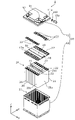
- FIG. 2 is an exploded perspective view of the power storage device according to the embodiment.
- FIG. 3A is a first exploded perspective view showing the configuration of the membrane rupture mechanism according to the embodiment.
- FIG. 3B is a second exploded perspective view showing the configuration of the membrane rupture mechanism according to the embodiment.
- FIG. 4 is a cross-sectional view showing the configuration of the membrane rupture mechanism attached to the exterior body according to the embodiment.
- FIG. 5 is a cross-sectional view for explaining the membrane breaking operation in the membrane breaking mechanism part according to the embodiment.
- FIG. 6 is a cross-sectional view showing the configuration of the membrane rupture mechanism attached to the exterior body according to Modification 1 of the embodiment.
- FIG. 7 is a cross-sectional view showing the configuration of the membrane rupture mechanism attached to the exterior body according to Modification 2 of the embodiment.
- a power storage device includes a power storage element, an exterior body that accommodates the power storage element, a membrane breaking mechanism disposed in a gas flow path that connects the inside and the outside of the exterior body, wherein the membrane rupture mechanism section includes a membrane member, a membrane holding member that holds the membrane member, and a membrane rupture member having a projection projecting toward the membrane member.
- the membrane member when the membrane member swells toward the membrane rupture member due to the internal pressure of the outer package, when the swelling amount exceeds a predetermined value, the membrane ruptures (membrane member breaks). Therefore, when the gas is discharged from the electric storage element, the membrane member breaks due to the increase in the internal pressure of the exterior body. As a result, the gas is discharged from the inside of the exterior body to the outside, and an increase in the internal pressure of the exterior body is suppressed. As a result, damage to the exterior body due to an increase in the internal pressure of the exterior body is suppressed, thereby making it difficult for gas to leak from an unexpected position of the exterior body.
- the membrane holding member has a ventilation chamber forming a part of the flow path, and the ventilation chamber includes a first flow path positioned upstream in the flow path extending from the inside of the exterior body to the outside.
- a vent hole and a second vent hole positioned downstream and inside the exterior body are formed.
- the membrane member may be arranged at a position closer to the second vent than the membrane member.
- the membrane member when the internal pressure of the outer package rises, the membrane member tends to swell toward the membrane rupture member. As a result, the membrane member is more reliably broken when the internal pressure of the exterior body rises.
- the membrane holding member may further have a tubular vent pipe that is provided downstream of the vent chamber and communicates with the second vent hole.
- the film holding member has the vent pipe, so that the gas can be smoothly discharged from the inside of the exterior body to the outside through the second vent hole.
- the exterior body may have an insertion section into which the ventilation pipe is inserted, the insertion section communicating with the exterior of the exterior body.
- the ventilation pipe of the membrane holding member is fixed to the exterior body by being inserted into the insertion portion of the exterior body. Therefore, even when gas is discharged from the power storage element, the gas is less likely to leak from the ventilation pipe to the inside of the exterior body. Thereby, the gas can be efficiently discharged from the inside of the exterior body to the outside.
- the vent pipe may be arranged in a state in which the distal end protrudes to the outside of the exterior body by penetrating the insertion portion of the exterior body.
- the ventilation pipe of the membrane holding member extends from the second ventilation hole to the outside of the exterior body, the gas that has flowed into the ventilation chamber from the first ventilation hole reaches the outside of the exterior body. less likely to leak inside the
- the exterior body has a cylindrical connection pipe that protrudes into the interior of the exterior body and communicates with the exterior of the exterior body, and the vent pipe has an insertion portion into which the connection pipe is inserted. You may
- the membrane holding member is more stably fixed to the exterior body by inserting the connection pipe provided in the exterior body into the ventilation pipe. Therefore, in order to balance the internal and external pressures of the exterior body, when the gas outside the exterior body flows into the interior of the exterior body through the air-permeable membrane member, the gas flow from the outside to the interior of the exterior body. is done efficiently. If the pressure difference between the inside and outside of the exterior body increases, the exterior body may be deformed or damaged. Contribute to improvement.
- the membrane rupture mechanism part may be arranged inside the exterior body.
- the membrane rupture mechanism is arranged inside the exterior body. Therefore, damage to the membrane rupture mechanism due to external impact or the like is suppressed.
- the direction in which a plurality of power storage elements are arranged is defined as the X-axis direction.
- the Y-axis direction is defined as the direction in which the electrode terminals of one storage element are arranged or the direction in which the short sides of the container of the storage element face each other.
- a Z-axis direction is defined as the direction in which the main body and the lid are arranged, the direction in which the energy storage elements and the bus bars are arranged, or the vertical direction in the exterior body of the power storage device.
- X-axis direction, Y-axis direction, and Z-axis direction are directions that intersect each other (in the following embodiments and modifications thereof, they are orthogonal).
- the Z-axis direction may not be the vertical direction, but for convenience of explanation, the Z-axis direction will be described below as the vertical direction.
- the X-axis direction plus side indicates the arrow direction side of the X-axis
- the X-axis direction minus side indicates the side opposite to the X-axis direction plus side.
- a simple reference to the "X-axis direction" means either or both directions parallel to the X-axis. The same applies to terms relating to the Y-axis and Z-axis.
- FIG. 1 is a perspective view showing the appearance of a power storage device 1 according to an embodiment.
- FIG. 2 is an exploded perspective view of the power storage device 1 according to the embodiment.
- the power storage device 1 is a device that can charge electricity from the outside and discharge electricity to the outside, and has a substantially rectangular parallelepiped shape in the present embodiment.
- the power storage device 1 is a battery module (assembled battery) used for power storage or power supply.
- the power storage device 1 is, for example, an automobile, a motorcycle, a watercraft, a ship, a snowmobile, an agricultural machine, a construction machine, or a rolling stock for an electric railway. It is used as a battery etc.
- the vehicles include electric vehicles (EV), hybrid electric vehicles (HEV), plug-in hybrid electric vehicles (PHEV), and fossil fuel (gasoline, light oil, natural gas, etc.) vehicles.
- Electric trains, monorails, and maglev trains are exemplified as railway vehicles for the electric railway.
- the power storage device 1 can also be used as a stationary battery or the like for home or business use.
- the power storage device 1 includes a plurality of power storage elements 20 and an exterior body 10 that accommodates the plurality of power storage elements 20 .
- exterior body 10 accommodates eight power storage elements 20 .
- the number of power storage elements 20 included in power storage device 1 is not limited to eight.
- the power storage device 1 may include one or more power storage elements 20 .
- one storage element unit 24 is composed of a plurality of storage elements 20 arranged in the X-axis direction.
- the storage element unit 24 may have a spacer, an insulating film, and the like (not shown).
- the exterior body 10 has a body portion 12 that accommodates the electric storage element unit 24 and a lid body 11 that closes the body opening portion 15 of the body portion 12 .
- a bus bar plate 17 is arranged between the storage element unit 24 housed in the body portion 12 and the lid body 11 .
- a plurality of busbars 33 are held on the busbar plate 17 .
- electrical equipment such as a relay and a control device, and wiring connected to the electrical equipment may be accommodated, but illustrations and descriptions of these members are omitted. .
- the exterior body 10 is a rectangular (box-shaped) container (module case) that constitutes the outer shell of the power storage device 1 .
- the exterior body 10 is a member that fixes the power storage element unit 24, the bus bar plate 17, and the like at predetermined positions and protects them from impacts and the like.
- the exterior body 10 is made of, for example, polycarbonate (PC), polypropylene (PP), polyethylene (PE), polystyrene (PS), polyphenylene sulfide resin (PPS), polyphenylene ether (PPE (including modified PPE)), polyethylene terephthalate ( PET), polybutylene terephthalate (PBT), polyetheretherketone (PEEK), tetrafluoroethylene-perfluoroalkyl vinyl ether (PFA), polytetrafluoroethylene (PTFE), polyethersulfone (PES), polyamide (PA) , ABS resin, or an insulating member such as a composite material thereof, or a metal coated with an insulating coating.
- PC polycarbonate
- PP polypropylene
- PE polyethylene
- PS polystyrene
- PPS polyphenylene sulfide resin
- PPE polyphenylene ether
- PPE polyphenylene ether
- PET polyethylene terephthalate
- the lid 11 of the exterior body 10 is a rectangular member that closes the main body opening 15 of the main body 12 and has a positive external terminal 91 and a negative external terminal 92 .
- the external terminals 91 and 92 are electrically connected to a plurality of power storage elements 20, and the power storage device 1 charges electricity from the outside and discharges electricity to the outside through the external terminals 91 and 92. do.
- the external terminals 91 and 92 are made of a conductive member made of metal such as aluminum or aluminum alloy.
- the main body 12 is a bottomed rectangular tubular housing (casing) in which a main body opening 15 for accommodating the storage element unit 24 is formed.
- the membrane rupture mechanism section 100 has a ventilation chamber in the lid body 11 through which gas (such as air and gas discharged from the storage element 20) that moves from one of the inside and the outside of the exterior body 10 to the other passes.
- gas such as air and gas discharged from the storage element 20
- an exhaust pipe 150 are provided.
- the exhaust pipe 150 is fixed to the lid 11 while passing through an insertion portion 11 a provided in the lid 11 .
- the membrane rupture mechanism 100 is arranged inside the exterior body 10 at a position communicating with the exhaust pipe 150 .
- the membrane rupture mechanism 100 is provided with a membrane member at a position that closes the flow path of the gas that passes through the exhaust pipe 150 and that connects the inside and the outside of the exterior body 10 .
- this membrane member is a breathable waterproof membrane, the internal pressure and the external pressure of the exterior body 10 are balanced in a normal state. When the internal pressure of the exterior body 10 rises excessively, the membrane member is broken, and the internal pressure of the exterior body 10 is quickly reduced.
- the structure of the membrane rupture mechanism 100 and its surroundings will be described later with reference to FIGS. 3A to 5.
- the power storage element 20 is a secondary battery (single battery) capable of charging and discharging electricity.
- storage element 20 is a non-aqueous electrolyte secondary battery such as a lithium ion secondary battery.
- the power storage element 20 has a flat rectangular parallelepiped (rectangular) shape, and in the present embodiment, as described above, eight power storage elements 20 are arranged in the X-axis direction.
- the power storage element 20 includes a metal container 21 .
- the container 21 is a rectangular case having a pair of long sides 21a facing each other and a pair of short sides 21b facing each other.
- the container 21 accommodates an electrode assembly, a current collector, an electrolytic solution, and the like.
- each of the plurality of power storage elements 20 is arranged in a row in the X-axis direction with the long side 21a facing the X-axis direction (the short side 21b is parallel to the X-axis direction).
- a cover plate 21 c of the container 21 is provided with metal electrode terminals 22 (a positive electrode terminal and a negative electrode terminal) electrically connected to the electrode body inside the container 21 .
- the electrode terminal 22 is arranged to protrude from the cover plate 21c of the container 21 toward the busbar plate 17 (upward, that is, toward the positive side in the Z-axis direction).
- the cover plate 21c of the container 21 is further provided with a gas discharge valve 23 for discharging the gas inside the container 21 to the outside.
- the gas discharge valve 23 is opened (opened) when the internal pressure of the container 21 rises due to the vaporization of the electrolytic solution inside the container 21 , thereby discharging the gas inside the container 21 to the outside of the container 21 . It has the function of discharging.
- a gas exhaust valve 23 having such a function is provided for each of the plurality of power storage elements 20 .
- each of the plurality of power storage elements 20 is arranged with the gas discharge valve 23 facing the positive side in the Z-axis direction.
- the storage element 20 may not be provided with the gas discharge valve 23 .
- the storage element 20 is not limited to a non-aqueous electrolyte secondary battery, and may be a secondary battery other than a non-aqueous electrolyte secondary battery, or may be a capacitor.
- the storage element 20 may be a primary battery that allows the stored electricity to be used without being charged by the user.
- the power storage element 20 having a rectangular parallelepiped shape square shape
- the shape of the power storage element 20 is not limited to a rectangular parallelepiped shape. It may be in the shape of an oval column or the like.
- a pouch-type power storage element may be provided in the power storage device 1 as the power storage element 20 .
- the busbar 33 is a rectangular plate-shaped member that is arranged on at least two storage elements 20 while being held by the busbar plate 17 and electrically connects the electrode terminals 22 of the at least two storage elements 20 .
- the material of the bus bar 33 is not particularly limited. For example, it may be made of a metal such as aluminum, an aluminum alloy, copper, a copper alloy, or stainless steel, a combination thereof, or a conductive member other than metal.
- five bus bars 33 are used to connect the energy storage elements 20 two by two in parallel to form four groups of energy storage elements 20, and the four groups of energy storage elements 20 are connected in series. Connected.
- the busbar plate 17 is a resin member that holds the busbars 33 . More specifically, the busbar plate 17 is a member that holds a plurality of busbars 33 and other wirings (not shown) and can regulate the positions of these members.
- the busbar plate 17 is provided with a plurality of busbar openings 17 a that hold the plurality of busbars 33 and expose a portion of each of the plurality of busbars 33 to the plurality of power storage elements 20 .
- a path forming portion 19 extending in the X-axis direction and protruding to the positive side in the Z-axis direction is provided along the arrangement of the gas discharge valves 23 of the plurality of power storage elements 20 .
- the path forming portion 19 covers all the gas discharge valves 23 from the positive side in the Z-axis direction.
- Path outlets 18 are provided at both ends of the path forming portion 19 in the longitudinal direction. Therefore, the gas discharged from the electric storage element 20 mainly passes through the path outlet 18 and is discharged to the outside of the exterior body 10 via the membrane breaking mechanism 100 and the exhaust pipe 150 described above.
- the busbar plate 17 configured in this manner is fixed to the main body portion 12 of the exterior body 10 by a predetermined method such as adhesion or heat welding.
- FIG. 3A and 3B are first and second exploded perspective views showing the configuration of the membrane rupture mechanism section 100 according to the embodiment. 3A and 3B, in order to show the structural relationship between the membrane rupture mechanism section 100 and the exhaust pipe 150 provided in the exterior body 10, a part of the exterior body 10 (lid 11) is cut out. Illustrated.
- FIG. 4 is a cross-sectional view showing the configuration of the membrane rupture mechanism 100 attached to the exterior body 10 according to the embodiment.
- FIG. 4 shows a cross-section of the membrane rupture mechanism 100 on a plane passing through line IV-IV of FIG. 3B.
- the position of the cross section in the cross-sectional views shown in FIG. 5 and subsequent drawings conforms to the position of the cross section in FIG.
- FIG. 5 is a cross-sectional view for explaining the membrane rupture operation in the membrane rupture mechanism section 100 according to the embodiment.
- the membrane rupture mechanism part 100 is separate from the exterior body 10 and arranged inside the exterior body 10.
- the membrane rupture mechanism section 100 has a membrane holding member 101 having a ventilation chamber 102 (see FIG. 4) and a membrane member 130 held by the membrane holding member 101 .
- the membrane holding member 101 has a main body part 110 having a ventilation chamber forming part 113 forming the ventilation chamber 102, and a membrane frame 120 to which a membrane member 130 is fixed.
- the membrane frame 120 is fixed to the upstream (Y-axis direction minus side) opening of the airflow chamber forming portion 113 of the main body 110 in the flow path of the gas flowing from the inside of the exterior body 10 to the outside.
- the upstream side and the opposite downstream side (the positive side in the X-axis direction) of the gas flow path may be simply referred to as "upstream side” and "downstream side.”
- the membrane frame 120 has four through-holes formed by partitioning one through-hole provided in the central portion into four by the lattice portion 125 .
- a set of these four through-holes is treated as the first vent hole 121 .
- the first vent 121 may be realized by three or less or five or more through holes.
- the membrane member 130 is arranged so as to close the first ventilation holes 121 .
- the peripheral portion of the membrane member 130 is fixed to the peripheral portion of the first vent hole 121 on the downstream side surface of the membrane frame 120 by adhesion, welding, or the like.
- the ventilation chamber forming portion 113 of the main body portion 110 of the membrane holding member 101 forms the ventilation chamber 102 together with the membrane frame 120 .
- a second vent hole 112 that allows gas to pass is provided at the downstream end of the vent chamber forming portion 113 . That is, the vent chamber 102 of the membrane holding member 101 is formed with the first vent hole 121 located upstream and the second vent hole 112 located downstream.
- the main body portion 110 of the membrane holding member 101 further has a tubular vent pipe 115 communicating with the second vent hole 112 on the downstream side of the vent chamber forming portion 113 .
- the vent pipe 115 is inserted into an insertion portion 150a provided in the exterior body 10 with an annular gasket 118 attached.
- the insertion portion 150a is an opening on the upstream side of the exhaust pipe 150 provided in the exterior body 10 .
- the exhaust pipe 150 included in the exterior body 10 is fixed to the lid body 11 by a predetermined method such as adhesion, welding, screwing, or press-fitting while passing through the insertion portion 11a of the lid body 11. ing.
- a predetermined method such as adhesion, welding, screwing, or press-fitting while passing through the insertion portion 11a of the lid body 11.
- Examples of the material forming the exhaust pipe 150 include resin with high heat resistance, and metal such as iron or aluminum alloy.
- the insertion portion 150a and the ventilation tube 115 are fixed to each other by a predetermined method such as adhesion, welding, screwing, or press-fitting.
- the exhaust pipe 150 included in the lid 11 is illustrated as a member separate from the exterior body 10 in FIG. , may be formed in the exterior body 10 . When the exhaust pipe 150 is a separate member from the exterior body 10 , a gasket may be arranged between the exhaust pipe 150 and the exterior body 10 .
- the membrane rupture mechanism section 100 further has a membrane rupture member 140 having a projection 141 arranged at a position closer to the second vent hole 112 than the membrane member 130 is.
- membrane rupture member 140 has an annular body portion and four projections 141 protruding upstream from the body portion.
- the flow path of the gas passing through the membrane rupture mechanism section 100 includes, from the upstream side, the first vent hole 121, the vent chamber 102, the membrane rupture member 140, the second vent hole 112, the Trachea 115 and exhaust pipe 150 are arranged in this order.
- the membrane member 130 is a breathable waterproof membrane in this embodiment.
- the air-permeable waterproof membrane is a membrane made of a waterproof and moisture-permeable material having waterproofness and air permeability (moisture permeability) such as Gore-Tex (registered trademark) and TEMISH (registered trademark). Therefore, even if water enters the membrane rupture mechanism section 100 from the exhaust pipe 150, the water cannot pass through the membrane member 130, so that the water is prevented from entering the exterior body 10.
- moisture permeability moisture permeability
- Gore-Tex registered trademark
- TEMISH registered trademark
- the membrane member 130 When the one or more power storage elements 20 (see FIG. 2) accommodated in the exterior body 10 open the valves to discharge the gas, thereby excessively increasing the internal pressure of the exterior body 10, the membrane member 130 It deforms to swell downstream by receiving internal pressure. Specifically, when the valves of one or more power storage elements 20 are opened and gas is discharged, the amount of gas passing through the membrane member 130 per unit time is , the pressure inside the exterior body 10 rises sharply. As a result, the membrane member 130 swells downstream, for example, as shown in FIG.
- the membrane member 130 is broken from the portion in contact with the protrusion 141 , and the gas inside the exterior body 10 passes through the membrane rupture mechanism section 100 and is discharged to the outside of the exterior body 10 through the exhaust pipe 150 .
- the internal pressure of the exterior body 10 is quickly lowered, and the possibility of deformation or damage of the exterior body 10 is reduced.
- the membrane member 130 receives pressure toward the upstream side due to the external pressure of the exterior body 10 being higher than the internal pressure during normal use.
- the membrane member 130 since the membrane member 130 is supported by the lattice portion 125 of the membrane frame 120 arranged on the upstream side, the swelling of the membrane member 130 toward the upstream side is suppressed. This reduces the possibility that the film member 130 will malfunction due to the external pressure of the exterior body 10 becoming higher than the internal pressure.
- power storage device 1 includes power storage element 20, exterior body 10 that accommodates power storage element 20, and gas flow path that connects the inside and outside of exterior body 10. and a membrane rupture mechanism section 100 .
- the membrane rupture mechanism section 100 has a membrane member 130 , a membrane holding member 101 that holds the membrane member 130 , and a membrane rupture member 140 .
- the membrane breaking member 140 has a protrusion 141 projecting toward the membrane member 130 .
- the membrane rupture member 140 breaks (the membrane member 130 breaks) by contacting the protrusion 141 . Therefore, when gas is discharged from the storage element 20 by opening the valve of the storage element 20, the internal pressure of the exterior body 10 is increased, and the film member 130 is broken. As a result, the gas is discharged from the inside of the exterior body 10 to the outside, and an increase in the internal pressure of the exterior body 10 is suppressed. As a result, for example, damage to the exterior body 10 due to an increase in the internal pressure of the exterior body 10 is suppressed, thereby making it difficult for gas to leak from an unexpected position of the exterior body 10 .
- the membrane holding member 101 has a ventilation chamber 102 that forms part of the gas flow path.
- the ventilation chamber 102 has a first ventilation hole 121 located upstream and a second ventilation hole 112 located downstream and inside the exterior body 10 in the flow path from the inside to the outside of the exterior body 10 . formed.
- the membrane member 130 is fixed to the membrane holding member 101 while blocking the first vent hole 121 .
- the membrane breaking member 140 is arranged at a position closer to the second vent hole 112 than the membrane member 130 .
- the membrane member 130 tends to swell toward the membrane rupture member 140 when the internal pressure of the outer package 10 increases. Thereby, when the internal pressure of the exterior body 10 rises, the film member 130 is broken more reliably.
- the membrane holding member 101 has a tubular ventilation pipe 115 that is provided downstream of the ventilation chamber 102 and communicates with the second ventilation hole 112 .
- the film holding member 101 has the ventilation pipe 115, so that the gas flowing through the second ventilation hole 112 is guided to efficiently flow from one of the inside and the outside of the exterior body 10 to the other. be able to. That is, the gas discharged from the storage element 20 when the storage element 20 is open (when an abnormality occurs) can be efficiently discharged from the interior of the exterior body 10 to the outside. Under normal conditions, gas (air) can be efficiently exchanged for balancing the internal and external pressures of the exterior body 10 . Therefore, deformation, damage, or the like of the exterior body 10 due to the pressure difference between the inside and outside of the exterior body 10 is suppressed more reliably.
- the exterior body 10 has an insertion portion 150a into which the ventilation pipe 115 is inserted and communicates with the exterior of the exterior body 10 .
- an insertion portion 150 a is formed by an opening at the upstream end of exhaust pipe 150 of cover 11 of exterior body 10 .
- the ventilation pipe 115 of the membrane holding member 101 is fixed to the exterior body 10 by being inserted into the insertion portion 150a of the exterior body 10 . Therefore, when the gas is discharged through the vent chamber 102 and the vent pipe 115 when the electric storage element 20 is open, the gas is less likely to leak from the vent pipe 115 to the inside of the exterior body 10 . That is, the gas can be discharged efficiently, thereby quickly suppressing an increase in the internal pressure of the exterior body 10 .
- the membrane rupture mechanism section 100 is arranged inside the exterior body 10 .
- the membrane rupture mechanism part 100 is less likely to be affected by impacts from the outside of the outer package 10 . Therefore, even if an impact or the like is received from the outside of the exterior body 10, damage to the membrane rupture mechanism section 100 is suppressed. Furthermore, the possibility of the membrane rupture mechanism part 100 coming off from the exterior body 10 due to the internal pressure of the exterior body 10 is reduced. In other words, the membrane rupture mechanism part 100 is arranged in the exterior body 10 in such a manner that it does not easily lose its original function.
- the membrane rupture mechanism section 100 is a component separate from the exterior body 10 . Therefore, it is easy to change the specifications of the membrane rupture mechanism part 100, such as the size of the ventilation chamber 102, the number and arrangement layout of the projections 141 in the membrane rupture member 140, and the size of the first vent hole 121, and , the degree of freedom is also high.
- the power storage device 1 may have a configuration different from the configuration shown in FIGS. . Therefore, a modification of the membrane rupture mechanism section 100 in the power storage device 1 will be described, focusing on differences from the above embodiment.
- FIG. 6 is a cross-sectional view showing the configuration of the membrane rupture mechanism part 100a attached to the exterior body 10 according to Modification 1 of the embodiment.
- the membrane breaking mechanism part 100a according to the present modification closes the gas flow path connecting the inside and the outside of the packaging body 10 inside the packaging body 10. placed in a state.
- the membrane rupture mechanism section 100a has a membrane holding member 101a and a membrane member 130 held by the membrane holding member 101a.
- the membrane holding member 101a has a membrane frame 120 and a body portion 110a including a ventilation chamber forming portion 113 and a ventilation pipe 115a.
- the membrane member 130 is fixed to the membrane frame 120 in such a posture as to block the first ventilation holes 121 of the membrane frame 120 .
- a membrane rupture member 140 having a projection 141 is arranged downstream of the membrane member 130 .
- the membrane rupture mechanism section 100a according to this modification is common to the membrane rupture mechanism section 100 according to the embodiment.
- the vent tube 115a is arranged to pass through the insertion section 11a provided in the exterior body 10.
- vent pipe 115a is arranged in a state in which the distal end protrudes outside the exterior body 10 by penetrating the insertion portion 11a of the exterior body 10 .
- the ventilation pipe 115a of the membrane holding member 101a extends from the second ventilation hole 112 to the outside of the exterior body 10.
- FIG. 7 is a cross-sectional view showing the configuration of a membrane rupture mechanism portion 100b attached to the exterior body 10 according to Modification 2 of the embodiment.
- the membrane breaking mechanism part 100b according to the present modification closes the gas flow path connecting the inside and the outside of the package 10 inside the package 10. placed in a state.
- the membrane rupture mechanism section 100b has a membrane holding member 101b and a membrane member 130 held by the membrane holding member 101b.
- the membrane holding member 101b has a membrane frame 120 and a body portion 110b including a ventilation chamber forming portion 113 and a ventilation pipe 115b.
- the membrane member 130 is fixed to the membrane frame 120 in such a posture as to block the first ventilation holes 121 of the membrane frame 120 .
- a membrane rupture member 140 having a projection 141 is arranged downstream of the membrane member 130 .
- the membrane rupture mechanism section 100b according to this modification is common to the membrane rupture mechanism section 100 according to the embodiment.
- the membrane rupture mechanism section 100b according to this modified example differs from the membrane rupture mechanism section 100 according to the embodiment in that the connection tube 156 provided in the exterior body 10 is inserted into the vent tube 115b.
- the exterior body 10 has a cylindrical connection pipe 156 that protrudes into the interior of the exterior body 10 and communicates with the outside of the exterior body 10, and the ventilation pipe 115b has an insertion portion 115c into which the connection pipe 156 is inserted.
- an exhaust pipe 155 that penetrates the insertion portion 11 a of the lid 11 is provided as a part of the exterior body 10 , and the upstream end of the exhaust pipe 155 functions as a connecting pipe 156 .
- An annular gasket 119 is arranged between the tip (downstream end) of the vent pipe 115 b and the flange portion 157 of the exhaust pipe 155 .
- the membrane holding member 101b is more stably fixed to the exterior body 10 by inserting the connecting pipe 156 provided in the exterior body 10 into the ventilation pipe 115b. Therefore, when the gas outside the exterior body 10 flows into the interior of the exterior body 10 through the air-permeable membrane member 130, the gas flows efficiently. done. When the pressure difference between the inside and outside of the exterior body 10 increases, the exterior body 10 may be deformed or damaged. Contribute to improvement.
- connection pipe 156 and the insertion portion 115c of the ventilation pipe 115b according to this modification are preferably fixed to each other by a predetermined method such as adhesion, welding, screwing, or press-fitting.
- the exhaust pipe 155 including the connection pipe 156 is a separate member from the lid 11 , but the exhaust pipe 155 may be provided in the lid 11 as a member integrated with the lid 11 .
- the exhaust pipes 150 and 155 do not need to protrude sideways (sideways), but may protrude upward or downward. It is not essential that the exhaust pipes 150 and 155 are provided in the lid body 11 , and the exhaust pipes 150 and 155 may be provided in the body portion 12 of the exterior body 10 . In other words, the postures and positions of the exhaust pipes 150 and 155 in the exterior body 10 do not have to be the postures and positions shown in FIGS. It may be determined as appropriate.
- the exterior body 10 may not have the exhaust pipes 150 and 155.
- the ventilation tubes 115, 115a, 115b of the membrane rupture mechanisms 100, 100a, 100b according to the embodiment or the modification may be directly fixed to the insertion portion 11a of the lid 11. In this case, the ventilation pipes 115, 115a, and 115b do not need to protrude outside the exterior body 10.
- FIG. This will be explained using the membrane rupture mechanism 100a (see FIG. 6) according to the first modification. good too. Even in this case, the constituent elements involved in the membrane rupture action in the membrane rupture mechanism section 100a, including the second vent hole 112 on the downstream side, are located inside the exterior body 10 .
- the membrane rupture mechanism part 100a is arranged in the exterior body 10 in such a manner that it does not easily lose its original function.
- the membrane holding members 101, 101a, 101b of the membrane rupture mechanism parts 100, 100a, 100b are fixed to the body parts 110, 110a, 110b and the upstream openings of the body parts 110, 110a, 110b. and a membrane frame 120 .
- the configuration of the film holding members 101, 101a, 101b is not limited to this.
- the membrane frame 120 may be formed integrally with the body portions 110, 110a, 110b. That is, the first vent holes 125 may be formed in the bottom portions of the body portions 110, 110a, and 110b, which are bottomed cylindrical members, and the membrane member 130 may be fixed to the bottom portions.
- a separate member having the second vent 113 may be fixed to the openings of the main bodies 110, 110a, 110b on the downstream side. The separate member may be part of the exhaust pipe 115 .
- the shape, number, and layout of the protrusions 141 on the membrane rupture members 140 of the membrane rupture mechanisms 100, 100a, and 100b are not limited to those shown in FIGS. 3A and 3B.
- the protrusion 141 may be arranged at a position facing the central portion (see FIG. 5) of the film member 130 that receives the internal pressure of the exterior body 10 and swells into a dome shape where the displacement is the largest. This makes it easier for the film member 130 to come into contact with the protrusion 141, and as a result, the film member 130 is more likely to break.
- the protrusion 141 is arranged at a position that avoids the central portion of the membrane member 130, so that even if a part of the broken membrane member 130 is caught on the protrusion 141, the gas flow is prevented.
- the road is easily secured.
- the film member 130 bulging downstream can be prevented from coming into contact with the protrusion 141 at an early stage.
- the protrusion 141 by arranging the protrusion 141 at a position where it is difficult to contact the membrane member 130, when the membrane rupture mechanism parts 100, 100a, and 100b are downsized, the membrane member 130 can be displaced when the internal pressure of the exterior body 10 is relatively low. It is possible to suppress the occurrence of malfunction such as breakage.
- the membrane member 130 may not be a breathable waterproof membrane.
- the membrane member 130 may be a member made of resin that does not have air permeability but has only waterproofness. Even in this case, the film member 130 prevents at least the water outside the exterior body 10 from entering the interior of the exterior body 10 . Moreover, when the internal pressure of the exterior body 10 rises excessively, the internal pressure of the exterior body 10 can be rapidly reduced by swelling and contacting the projection 141 and breaking as shown in FIG.
- the shape of the membrane rupture mechanism parts 100, 100a, 100b and the exhaust pipes 150, 155 does not have to be cylindrical, and may be other shapes such as rectangular tube. As long as the membrane rupture mechanism part 100 and the exhaust pipe 150 are formed so as to form a gas flow path, various shapes such as a circular shape and a polygonal shape can be adopted as the shape of the cross section perpendicular to the axial direction. .
- the membrane rupture mechanism parts 100, 100a, and 100b may be attached to the outside of the exterior body 10 (the lid body 11 or the main body part 12).
- the membrane rupture mechanism parts 100, 100a, and 100b may be formed integrally with the exterior body 10 as part of the exterior body 10 (the lid body 11 or the main body part 12).
- a form constructed by arbitrarily combining the plurality of components described above is also included within the scope of the present invention.
- the present invention can be applied to a power storage device having a power storage element such as a lithium ion secondary battery.
- electricity storage device 10 exterior body 11 cover body 11a, 115c, 150a insertion portion 12 main body portion 20 electricity storage element 23 gas discharge valve 100, 100a, 100b membrane breaking mechanism portion 101, 101a, 101b membrane holding member 102 ventilation chamber 110, 110a, 110b body portion 112 second vent hole 113 vent chamber forming portion 115, 115a, 115b vent pipe 120 membrane frame 121 first vent hole 125 lattice portion 130 membrane member 140 membrane rupture member 141 projections 150, 155 exhaust pipe 156 connecting pipe
Landscapes
- Engineering & Computer Science (AREA)
- Power Engineering (AREA)
- Chemical & Material Sciences (AREA)
- Chemical Kinetics & Catalysis (AREA)
- Electrochemistry (AREA)
- General Chemical & Material Sciences (AREA)
- Microelectronics & Electronic Packaging (AREA)
- Aviation & Aerospace Engineering (AREA)
- Electric Double-Layer Capacitors Or The Like (AREA)
Priority Applications (1)
| Application Number | Priority Date | Filing Date | Title |
|---|---|---|---|
| JP2023514585A JPWO2022220117A1 (https=) | 2021-04-12 | 2022-03-30 |
Applications Claiming Priority (2)
| Application Number | Priority Date | Filing Date | Title |
|---|---|---|---|
| JP2021067108 | 2021-04-12 | ||
| JP2021-067108 | 2021-04-12 |
Publications (1)
| Publication Number | Publication Date |
|---|---|
| WO2022220117A1 true WO2022220117A1 (ja) | 2022-10-20 |
Family
ID=83640670
Family Applications (1)
| Application Number | Title | Priority Date | Filing Date |
|---|---|---|---|
| PCT/JP2022/015748 Ceased WO2022220117A1 (ja) | 2021-04-12 | 2022-03-30 | 蓄電装置 |
Country Status (2)
| Country | Link |
|---|---|
| JP (1) | JPWO2022220117A1 (https=) |
| WO (1) | WO2022220117A1 (https=) |
Cited By (1)
| Publication number | Priority date | Publication date | Assignee | Title |
|---|---|---|---|---|
| JP2025116801A (ja) * | 2024-01-29 | 2025-08-08 | 恵州億緯▲リ▼能股▲フン▼有限公司 | 上蓋に一体化された防爆弁及び電池パック |
Citations (3)
| Publication number | Priority date | Publication date | Assignee | Title |
|---|---|---|---|---|
| JP2013506966A (ja) * | 2009-10-05 | 2013-02-28 | リ−テック・バッテリー・ゲーエムベーハー | 電気化学的セル |
| JP2015056325A (ja) * | 2013-09-12 | 2015-03-23 | 株式会社リチウムエナジージャパン | 蓄電装置 |
| CN112331967A (zh) * | 2020-09-29 | 2021-02-05 | 广东维都利新能源有限公司 | 一种具有防爆功能的锂离子电池盖 |
-
2022
- 2022-03-30 WO PCT/JP2022/015748 patent/WO2022220117A1/ja not_active Ceased
- 2022-03-30 JP JP2023514585A patent/JPWO2022220117A1/ja active Pending
Patent Citations (3)
| Publication number | Priority date | Publication date | Assignee | Title |
|---|---|---|---|---|
| JP2013506966A (ja) * | 2009-10-05 | 2013-02-28 | リ−テック・バッテリー・ゲーエムベーハー | 電気化学的セル |
| JP2015056325A (ja) * | 2013-09-12 | 2015-03-23 | 株式会社リチウムエナジージャパン | 蓄電装置 |
| CN112331967A (zh) * | 2020-09-29 | 2021-02-05 | 广东维都利新能源有限公司 | 一种具有防爆功能的锂离子电池盖 |
Cited By (1)
| Publication number | Priority date | Publication date | Assignee | Title |
|---|---|---|---|---|
| JP2025116801A (ja) * | 2024-01-29 | 2025-08-08 | 恵州億緯▲リ▼能股▲フン▼有限公司 | 上蓋に一体化された防爆弁及び電池パック |
Also Published As
| Publication number | Publication date |
|---|---|
| JPWO2022220117A1 (https=) | 2022-10-20 |
Similar Documents
| Publication | Publication Date | Title |
|---|---|---|
| JP7581630B2 (ja) | 蓄電装置 | |
| WO2022009564A1 (ja) | 蓄電装置 | |
| WO2024085134A1 (ja) | 蓄電装置 | |
| JP7419926B2 (ja) | 蓄電装置 | |
| WO2023176568A1 (ja) | 蓄電素子及び蓄電装置 | |
| JP7852515B2 (ja) | 蓄電装置 | |
| US12300845B2 (en) | Energy storage apparatus | |
| JP7605204B2 (ja) | 蓄電設備 | |
| JP7459516B2 (ja) | 蓄電装置 | |
| WO2022220117A1 (ja) | 蓄電装置 | |
| WO2020189161A1 (ja) | 蓄電装置 | |
| JP4822760B2 (ja) | 電源装置 | |
| JP7721939B2 (ja) | 蓄電装置 | |
| JP2021157984A (ja) | 蓄電装置 | |
| EP4287230A1 (en) | Power storage device | |
| JP7310426B2 (ja) | 蓄電装置 | |
| JP7749922B2 (ja) | 蓄電装置 | |
| JP2024021479A (ja) | 蓄電装置 | |
| JP6318979B2 (ja) | 電池ユニット | |
| JP2024021469A (ja) | 蓄電装置 | |
| JP2024021509A (ja) | 蓄電装置 | |
| WO2021166626A1 (ja) | 蓄電装置 | |
| WO2022254933A1 (ja) | 蓄電装置 | |
| JP7834986B2 (ja) | 蓄電装置 | |
| JP7516809B2 (ja) | 蓄電装置 |
Legal Events
| Date | Code | Title | Description |
|---|---|---|---|
| 121 | Ep: the epo has been informed by wipo that ep was designated in this application |
Ref document number: 22788042 Country of ref document: EP Kind code of ref document: A1 |
|
| ENP | Entry into the national phase |
Ref document number: 2023514585 Country of ref document: JP Kind code of ref document: A |
|
| NENP | Non-entry into the national phase |
Ref country code: DE |
|
| 122 | Ep: pct application non-entry in european phase |
Ref document number: 22788042 Country of ref document: EP Kind code of ref document: A1 |