WO2022210376A1 - 基材レス両面粘着シート - Google Patents
基材レス両面粘着シート Download PDFInfo
- Publication number
- WO2022210376A1 WO2022210376A1 PCT/JP2022/014491 JP2022014491W WO2022210376A1 WO 2022210376 A1 WO2022210376 A1 WO 2022210376A1 JP 2022014491 W JP2022014491 W JP 2022014491W WO 2022210376 A1 WO2022210376 A1 WO 2022210376A1
- Authority
- WO
- WIPO (PCT)
- Prior art keywords
- film
- sensitive adhesive
- pressure
- release film
- release
- Prior art date
- Legal status (The legal status is an assumption and is not a legal conclusion. Google has not performed a legal analysis and makes no representation as to the accuracy of the status listed.)
- Ceased
Links
Classifications
-
- C—CHEMISTRY; METALLURGY
- C09—DYES; PAINTS; POLISHES; NATURAL RESINS; ADHESIVES; COMPOSITIONS NOT OTHERWISE PROVIDED FOR; APPLICATIONS OF MATERIALS NOT OTHERWISE PROVIDED FOR
- C09J—ADHESIVES; NON-MECHANICAL ASPECTS OF ADHESIVE PROCESSES IN GENERAL; ADHESIVE PROCESSES NOT PROVIDED FOR ELSEWHERE; USE OF MATERIALS AS ADHESIVES
- C09J7/00—Adhesives in the form of films or foils
- C09J7/30—Adhesives in the form of films or foils characterised by the adhesive composition
- C09J7/38—Pressure-sensitive adhesives [PSA]
- C09J7/381—Pressure-sensitive adhesives [PSA] based on macromolecular compounds obtained by reactions involving only carbon-to-carbon unsaturated bonds
- C09J7/385—Acrylic polymers
-
- B—PERFORMING OPERATIONS; TRANSPORTING
- B32—LAYERED PRODUCTS
- B32B—LAYERED PRODUCTS, i.e. PRODUCTS BUILT-UP OF STRATA OF FLAT OR NON-FLAT, e.g. CELLULAR OR HONEYCOMB, FORM
- B32B27/00—Layered products comprising a layer of synthetic resin
-
- B—PERFORMING OPERATIONS; TRANSPORTING
- B32—LAYERED PRODUCTS
- B32B—LAYERED PRODUCTS, i.e. PRODUCTS BUILT-UP OF STRATA OF FLAT OR NON-FLAT, e.g. CELLULAR OR HONEYCOMB, FORM
- B32B7/00—Layered products characterised by the relation between layers; Layered products characterised by the relative orientation of features between layers, or by the relative values of a measurable parameter between layers, i.e. products comprising layers having different physical, chemical or physicochemical properties; Layered products characterised by the interconnection of layers
- B32B7/04—Interconnection of layers
- B32B7/06—Interconnection of layers permitting easy separation
-
- B—PERFORMING OPERATIONS; TRANSPORTING
- B32—LAYERED PRODUCTS
- B32B—LAYERED PRODUCTS, i.e. PRODUCTS BUILT-UP OF STRATA OF FLAT OR NON-FLAT, e.g. CELLULAR OR HONEYCOMB, FORM
- B32B7/00—Layered products characterised by the relation between layers; Layered products characterised by the relative orientation of features between layers, or by the relative values of a measurable parameter between layers, i.e. products comprising layers having different physical, chemical or physicochemical properties; Layered products characterised by the interconnection of layers
- B32B7/04—Interconnection of layers
- B32B7/12—Interconnection of layers using interposed adhesives or interposed materials with bonding properties
-
- C—CHEMISTRY; METALLURGY
- C09—DYES; PAINTS; POLISHES; NATURAL RESINS; ADHESIVES; COMPOSITIONS NOT OTHERWISE PROVIDED FOR; APPLICATIONS OF MATERIALS NOT OTHERWISE PROVIDED FOR
- C09J—ADHESIVES; NON-MECHANICAL ASPECTS OF ADHESIVE PROCESSES IN GENERAL; ADHESIVE PROCESSES NOT PROVIDED FOR ELSEWHERE; USE OF MATERIALS AS ADHESIVES
- C09J11/00—Features of adhesives not provided for in group C09J9/00, e.g. additives
- C09J11/02—Non-macromolecular additives
- C09J11/06—Non-macromolecular additives organic
-
- C—CHEMISTRY; METALLURGY
- C09—DYES; PAINTS; POLISHES; NATURAL RESINS; ADHESIVES; COMPOSITIONS NOT OTHERWISE PROVIDED FOR; APPLICATIONS OF MATERIALS NOT OTHERWISE PROVIDED FOR
- C09J—ADHESIVES; NON-MECHANICAL ASPECTS OF ADHESIVE PROCESSES IN GENERAL; ADHESIVE PROCESSES NOT PROVIDED FOR ELSEWHERE; USE OF MATERIALS AS ADHESIVES
- C09J133/00—Adhesives based on homopolymers or copolymers of compounds having one or more unsaturated aliphatic radicals, each having only one carbon-to-carbon double bond, and at least one being terminated by only one carboxyl radical, or of salts, anhydrides, esters, amides, imides, or nitriles thereof; Adhesives based on derivatives of such polymers
-
- C—CHEMISTRY; METALLURGY
- C09—DYES; PAINTS; POLISHES; NATURAL RESINS; ADHESIVES; COMPOSITIONS NOT OTHERWISE PROVIDED FOR; APPLICATIONS OF MATERIALS NOT OTHERWISE PROVIDED FOR
- C09J—ADHESIVES; NON-MECHANICAL ASPECTS OF ADHESIVE PROCESSES IN GENERAL; ADHESIVE PROCESSES NOT PROVIDED FOR ELSEWHERE; USE OF MATERIALS AS ADHESIVES
- C09J201/00—Adhesives based on unspecified macromolecular compounds
-
- C—CHEMISTRY; METALLURGY
- C09—DYES; PAINTS; POLISHES; NATURAL RESINS; ADHESIVES; COMPOSITIONS NOT OTHERWISE PROVIDED FOR; APPLICATIONS OF MATERIALS NOT OTHERWISE PROVIDED FOR
- C09J—ADHESIVES; NON-MECHANICAL ASPECTS OF ADHESIVE PROCESSES IN GENERAL; ADHESIVE PROCESSES NOT PROVIDED FOR ELSEWHERE; USE OF MATERIALS AS ADHESIVES
- C09J7/00—Adhesives in the form of films or foils
- C09J7/10—Adhesives in the form of films or foils without carriers
-
- C—CHEMISTRY; METALLURGY
- C09—DYES; PAINTS; POLISHES; NATURAL RESINS; ADHESIVES; COMPOSITIONS NOT OTHERWISE PROVIDED FOR; APPLICATIONS OF MATERIALS NOT OTHERWISE PROVIDED FOR
- C09J—ADHESIVES; NON-MECHANICAL ASPECTS OF ADHESIVE PROCESSES IN GENERAL; ADHESIVE PROCESSES NOT PROVIDED FOR ELSEWHERE; USE OF MATERIALS AS ADHESIVES
- C09J7/00—Adhesives in the form of films or foils
- C09J7/30—Adhesives in the form of films or foils characterised by the adhesive composition
- C09J7/38—Pressure-sensitive adhesives [PSA]
-
- C—CHEMISTRY; METALLURGY
- C09—DYES; PAINTS; POLISHES; NATURAL RESINS; ADHESIVES; COMPOSITIONS NOT OTHERWISE PROVIDED FOR; APPLICATIONS OF MATERIALS NOT OTHERWISE PROVIDED FOR
- C09J—ADHESIVES; NON-MECHANICAL ASPECTS OF ADHESIVE PROCESSES IN GENERAL; ADHESIVE PROCESSES NOT PROVIDED FOR ELSEWHERE; USE OF MATERIALS AS ADHESIVES
- C09J7/00—Adhesives in the form of films or foils
- C09J7/40—Adhesives in the form of films or foils characterised by release liners
Definitions
- the present invention relates to a substrate-less double-sided pressure-sensitive adhesive sheet and a laminate using the same.
- a polarizing plate formed by laminating a protective film on one or both sides of a polarizer is an optical member used in image display devices such as liquid crystal display devices and organic electroluminescence (organic EL) display devices.
- An optical member such as a polarizing plate is often used by bonding it to another member (for example, an optical member such as a liquid crystal cell in a liquid crystal display device) via an adhesive layer.
- This pressure-sensitive adhesive layer may be obtained from a substrate-less double-sided pressure-sensitive adhesive sheet.
- a substrate-less double-sided PSA sheet generally has a release film with relatively low release force (light release film) laminated on one side of an adhesive layer that does not have a core substrate, and the other side of the adhesive layer. It has a structure in which a release film having a relatively high release force (heavy release film) is laminated on one surface.
- the easy release film is usually peeled off from the substrate-less double-sided adhesive sheet, and the exposed adhesive layer surface is then attached to one of the optical components. After combining, the pressure-sensitive adhesive layer surface exposed by peeling off the heavy release film is laminated on the other optical member, and the optical members are bonded together.
- the release force difference between the light release film and the heavy release film laminated on both sides of the substrate-less double-sided PSA sheet is small, when the light release film of the substrate-less double-sided PSA sheet is peeled off, the pressure-sensitive adhesive layer Part of the film follows the light release film, stretches between the heavy release film and the light release film, then breaks and transfers to the light release film side. be.
- the optical members do not adhere to each other in the first place. There arises a problem that the optical characteristics of the optical member are degraded.
- Patent Document 1 As a method for suppressing poor peeling (crying apart), in Patent Document 1, by using a heavy release film in which a release treatment layer is formed on a plastic film from a composition containing a silicone release agent, which is a heavy release additive, It is described that the release force of the heavy release film is increased to increase the difference in release force between the light release film and the heavy release film.
- the present invention includes the following inventions [1] to [4].
- [1] A substrate-less double-sided pressure-sensitive adhesive sheet comprising a pressure-sensitive adhesive layer, a light release film laminated on one side of the pressure-sensitive adhesive layer, and a heavy release film laminated on the other side of the pressure-sensitive adhesive layer. and A substrate-less double-sided pressure-sensitive adhesive sheet in which the Si element amount Si A on the light release film side surface of the pressure-sensitive adhesive layer and the Si element amount Si B on the heavy release film side surface of the pressure-sensitive adhesive layer satisfy the following formula.
- the heavy release film is a film in which a release layer containing a heavy release additive is formed on a plastic film
- a laminate comprising an optical member, an adhesive layer and a heavy release film in this order, Si element amount Si C on the optical member side surface of the pressure-sensitive adhesive layer; A laminate in which the Si element amount Si D on the surface of the pressure-sensitive adhesive layer on the side of the heavy release film satisfies the following formula. SiD / SiC >0.6
- a substrate-less double-sided pressure-sensitive adhesive sheet that can suppress transfer of the pressure-sensitive adhesive layer to the light release film when the light release film is peeled off.
- the substrate-less double-sided pressure-sensitive adhesive sheet of the present invention comprises a pressure-sensitive adhesive layer, a light release film laminated on one side of the pressure-sensitive adhesive layer, and a heavy release film laminated on the other side of the pressure-sensitive adhesive layer. including.
- the Si element amount Si A on the light release film side surface of the pressure-sensitive adhesive layer and the Si element amount Si B on the heavy release film side surface of the pressure-sensitive adhesive layer are represented by Si B /Si It is characterized by satisfying A >0.6.
- Si B /Si A is preferably 0.65 or more. Moreover, it is more preferably greater than 0.8, more preferably 0.85 or more, particularly preferably 1.0 or more, and preferably 3.0 or less.
- Si B /Si A is more than 0.6, the difference in peel strength between the light release film and the heavy release film is appropriate, and the occurrence of tearing apart is suppressed.
- Si B /Si A is 3.0 or less, the adhesion between the light release film and the pressure-sensitive adhesive layer is good, and the pressure-sensitive adhesive layer is prevented from being undesirably peeled off without permission. It tends to be able to perform a protective function.
- SiB is preferably 0.08 to 45 [atom %]. It is preferable that Si B is in the range of 0.08 to 45 [atom %] from the viewpoint of suppressing changes in physical properties of the adhesive layer due to migration of the heavy release additive described later to the adhesive layer.
- Si A is preferably 0.1 to 15 [atom %]. When the Si A is in the range of 0.1 to 15 [atom %], it is preferable from the viewpoint of suppressing changes in the physical properties of the adhesive layer due to migration of the heavy release additive described later to the adhesive layer.
- the amount of Si element on the surface of the pressure-sensitive adhesive layer can be measured by peeling off the release film and measuring the exposed surface of the pressure-sensitive adhesive layer with an X-ray photoelectron spectroscopic analyzer such as XPS and ESCA. Specifically, it can be measured by the method described in the section of Examples.
- the light release film and heavy release film in the substrate-less double-sided pressure-sensitive adhesive sheet of the present invention indicate whether the release force of each release film is relatively light or heavy, and each release film is not particularly limited. , preferably a release film composed of a plastic film and a release treatment layer.
- each of the light release film and the heavy release film is laminated on the pressure-sensitive adhesive layer with the release treatment layer facing the pressure-sensitive adhesive layer.
- the release treatment layers of the light release film and the heavy release film are each in contact with the surface of the pressure-sensitive adhesive layer.
- plastic films examples include polyester films such as polyethylene terephthalate film, polybutylene terephthalate film and polyethylene naphthalate film, and polyolefin films such as polypropylene film.
- polyester films such as polyethylene terephthalate film, polybutylene terephthalate film and polyethylene naphthalate film
- polyolefin films such as polypropylene film.
- a polyethylene terephthalate film is preferable from the viewpoint of optical properties and quality
- a biaxially stretched polyethylene terephthalate film is preferable because of its excellent dimensional stability.
- the release treatment layer can be formed from a release treatment layer-forming composition.
- the release treatment composition is a resin composition containing a resin, and may further contain an additive such as a release additive in order to control the release force. From the viewpoint of easy control of the release force, it is preferable to use, as the heavy release film, a heavy release film on which a release treatment layer containing a heavy release additive is formed.
- As the light release film it is preferable to use a light release film having a release treatment layer containing no heavy release additive.
- the resin constituting the composition for forming the release treatment layer is not particularly limited, and examples thereof include silicone resins, alkyd resins, acrylic resins, and long-chain alkyl resins. Among them, silicone resin is preferable.
- silicone resins examples include silicone resins having dimethylpolysiloxane as a basic skeleton.
- the silicone resin may be of an addition reaction type, a condensation reaction type, an ultraviolet curing type, an electron beam curing type, or the like, but an addition reaction type silicone resin is preferred.
- Addition reaction type silicone resins are preferred because of their high reactivity and excellent productivity, as well as their advantages over condensation reaction types, such as small changes in release force after production and no cure shrinkage.
- addition reaction type silicone resin examples include, for example, two or more alkenyl groups having 2 to 10 carbon atoms, such as vinyl groups, allyl groups, propenyl groups, and hexenyl groups, at the ends and/or side chains of the molecule. organopolysiloxane and the like.
- addition-type reactive silicone resin a commercially available product may be used. company), and “KS-847” (manufactured by Shin-Etsu Chemical Co., Ltd.).
- cross-linking agents include organopolysiloxanes having at least two silicon-bonded hydrogen atoms in one molecule, specifically dimethylhydrogensiloxy end-blocked dimethylsiloxane-methylhydrogensiloxane copolymers, trimethylsiloxy group end-blocked dimethylsiloxane-methylhydrogensiloxane copolymer, trimethylsiloxy group end-blocked methylhydrogenpolysiloxane, poly(hydrogensilsesquioxane) and the like.
- the catalyst examples include particulate platinum, particulate platinum adsorbed on a carbon powder carrier, chloroplatinic acid, alcohol-modified chloroplatinic acid, olefin complexes of chloroplatinic acid, and platinum metal compounds such as palladium and rhodium. be done. By using such a catalyst, the curing reaction of the composition for forming a release treatment layer can proceed more efficiently.
- a commercially available product may be used, such as "SRX212" (manufactured by Dow Toray Industries, Inc.), “SRX212P” (manufactured by Dow Toray Industries, Inc.), “CAT-PL-50T” (manufactured by Shin-Etsu Chemical Co., Ltd. ) and the like.
- the composition for forming the release layer that constitutes the release layer contains a heavy release additive.
- the heavy release additive is preferably a polyorganosiloxane having one or more reactive sites in the molecule, more preferably a silicone resin having one or more reactive sites in the molecule.
- reactive sites include hydrolyzable groups such as hydroxyl groups, carboxyl groups, alkoxy groups having 1 to 6 carbon atoms, halogen atoms, acyloxy groups and oxime groups; and alkenyl groups such as vinyl groups.
- silicone resins include MQ resins containing M units that are monofunctional siloxane units [R 3 SiO 1/2 ] and Q units that are tetrafunctional siloxane units [SiO 4/2 ].
- Three R's in the M unit each independently represent a hydrogen atom, a hydroxyl group, or an organic group, and one or more of the three R's is preferably the reactive site described above.
- the heavy release additive is preferably a polyorganosiloxane having an alkenyl group as a reactive site, more preferably a vinyl-modified polyorganosiloxane, and particularly preferably a vinyl-modified silicone resin.
- the heavy release additive preferably has a weight average molecular weight (Mw) in terms of standard polystyrene by gel permeation chromatography (GPC) of 500 to 500,000, more preferably 800 to 100,000, and 1,000 to 1,000. 10,000 is more preferable.
- Mw weight average molecular weight
- GPC gel permeation chromatography
- the weight-average molecular weight of the heavy release additive is less than 500, the resin (preferably silicone resin) is poorly retained, and tends to easily migrate to the pressure-sensitive adhesive layer surface when laminated to the pressure-sensitive adhesive layer. be.
- the weight average molecular weight exceeds 500,000, the viscosity of the heavy release additive becomes too high, making industrial synthesis difficult.
- the amount added is preferably 80 parts by mass or less, more preferably 60 parts by mass or less, and 50 parts by mass or less with respect to 100 parts by mass of the resin. is more preferred. Moreover, it is preferably 0.01 parts by mass or more, and more preferably 0.1 parts by mass or more.
- the heavy release additive exceeds 80 parts by mass, the peeling force becomes too high when the heavy release film is peeled off from the pressure-sensitive adhesive layer, making it difficult to peel off.
- the heavy release additive is less than 0.01 parts by mass
- a release film lightly release film
- the heavy release film and the light release film The difference in the peeling force between the film and the film tends to be small, and the adhesive layer tends to transfer to the light peeling film side, resulting in poor peeling (parting).
- Additives other than those described above may be appropriately added to the composition for forming a release treatment layer.
- Additives include catalysts, dyes, dispersants, and the like.
- the composition for forming a release treatment layer may appropriately contain a dispersion medium or a solvent in order to adjust the viscosity at the time of application to an appropriate range.
- the dispersion medium or solvent include aromatic hydrocarbons such as toluene and xylene, fatty acid esters such as ethyl acetate and methyl acetate, ketones such as methyl ethyl ketone (MEK), and organic solvents such as aliphatic hydrocarbons such as hexane and heptane. mentioned.
- the release film can be produced, for example, by applying a release treatment layer-forming composition diluted with a solvent to one surface of a plastic film by a known method, and drying the resulting coating layer.
- coating methods include gravure coating, bar coating, spray coating, spin coating, air knife coating, roll coating, blade coating, gate roll coating and die coating. Among these, the gravure coating method and the bar coating method are preferred, and the gravure coating method is more preferred.
- a drying method of the coating layer of the release treatment layer-forming composition for example, a method of thermally drying in a hot air drying oven or the like can be mentioned.
- the drying temperature is, for example, 50°C or higher and 200°C or lower, preferably 70°C or higher and 150°C or lower.
- the drying time is preferably, for example, 5 seconds to 5 minutes.
- the thickness of the release film can be controlled by the thickness of the plastic film and the thickness of the release treatment layer. Among them, the thickness of the plastic film is dominant, and can be controlled by selecting a polyester film having a target thickness.
- the thickness of the plastic film is preferably 15 ⁇ m or more, more preferably 19 ⁇ m or more, and even more preferably 25 ⁇ m or more.
- the upper limit of the film thickness of the plastic film is not particularly limited, it is usually 200 ⁇ m or less, and from the viewpoint of facilitating the peeling of the release film, it is preferably 150 ⁇ m or less, and 100 ⁇ m. The following are more preferable.
- the thickness of the release treatment layer is preferably 25 nm or more, more preferably 30 nm or more, and even more preferably 40 nm or more. Also, it is preferably 500 nm or less, more preferably 300 nm or less, and even more preferably 250 nm or less.
- the thickness of the release treatment layer is preferably 25 nm or more, more preferably 30 nm or more, and even more preferably 40 nm or more.
- it is preferably 500 nm or less, more preferably 300 nm or less, and even more preferably 250 nm or less.
- the pressure-sensitive adhesive composition forming the pressure-sensitive adhesive layer is not particularly limited, but is preferably an acrylic pressure-sensitive adhesive composition.
- the acrylic pressure-sensitive adhesive composition contains a (meth)acrylic resin and a cross-linking agent.
- the acrylic pressure-sensitive adhesive composition may further contain a silane compound and an antistatic agent.
- (meth)acrylic resin means either acrylic resin or methacrylic resin, and "(meth)" such as (meth)acrylate has the same meaning.
- (Meth)acrylic resin means a polymer mainly composed of structural units derived from (meth)acrylic acid ester.
- the (meth)acrylic resin may contain one or more structural units derived from monomers other than (meth)acrylic acid esters (for example, structural units derived from monomers having polar functional groups).
- (Meth)acrylic acid esters include (meth)acrylic acid esters represented by the following formula (I).
- R 1 represents a hydrogen atom or a methyl group
- R 2 represents an alkyl group or an aralkyl group having 1 to 14 carbon atoms, preferably an alkyl group
- the hydrogen atom of the alkyl group or aralkyl group is It may be substituted with an alkoxy group having 1 to 10 carbon atoms.
- R 2 is preferably an alkyl group having 1 to 14 carbon atoms.
- (Meth) acrylic acid ester Linear alkyl acrylates such as methyl acrylate, ethyl acrylate, propyl acrylate, n-butyl acrylate, n-octyl acrylate, and lauryl acrylate; isobutyl acrylate, 2-ethylhexyl acrylate, acrylic acid branched acrylic acid alkyl esters such as isooctyl; Linear alkyl methacrylates such as methyl methacrylate, ethyl methacrylate, propyl methacrylate, n-butyl methacrylate, n-octyl methacrylate, and lauryl methacrylate; Branched alkyl methacrylates such as isobutyl methacrylate, 2-ethylhexyl methacrylate, isooctyl methacrylate; Alkoxyalkyl esters of (meth)acrylic acid such as 2-methoxye
- the (meth)acrylic resin may contain structural units derived from two or more (meth)acrylic esters, and the homopolymer has a glass transition temperature (Tg) of 0° C. or less. It preferably contains a structural unit derived from and a structural unit derived from a (meth)acrylic acid ester whose homopolymer Tg is 0° C. or higher.
- Tg glass transition temperature
- n-butyl acrylate is preferred.
- Methyl acrylate is preferable as the (meth)acrylic acid ester having a Tg of 0° C. or higher.
- the (meth)acrylic resin may contain structural units derived from monomers other than those described above.
- Structural units derived from monomers other than those described above are preferably structural units derived from monomers having polar functional groups, and more preferably structural units derived from (meth)acrylate esters having polar functional groups.
- Polar functional groups include hydroxy groups, substituted or unsubstituted amino groups, and heterocyclic groups such as epoxy groups.
- the content of the structural unit derived from the monomer having a polar functional group in the (meth)acrylic resin is preferably 10 parts by mass or less with respect to 100 parts by mass of the total structural units of the (meth)acrylic resin. It is more preferably 0.5 to 10 parts by mass, still more preferably 0.5 to 5 parts by mass, and particularly preferably 1 to 5 parts by mass.
- Examples of the monomer having a polar functional group include monomers having a carboxyl group as a polar functional group (e.g., acrylic acid, methacrylic acid, etc.).
- the content of the structural unit derived from the body is less than 2 parts by mass with respect to 100 parts by mass of all the structural units of the (meth)acrylic resin, thereby suppressing corrosion of the transparent electrode under moist heat conditions. can be done.
- the (meth)acrylic resin may contain a structural unit derived from a monomer having an aromatic group.
- a monomer having an aromatic group includes a monomer having one olefinic double bond and one or more aromatic rings (e.g., benzene ring, naphthalene ring, etc.) in the molecule and having no polar functional group.
- Polymers are preferred, and (meth)acrylic acid esters having a phenoxyethyl group are more preferred.
- Examples of (meth)acrylic acid esters having a phenoxyethyl group include 2-phenoxyethyl (meth)acrylate, 2-(2-phenoxyethoxy)ethyl (meth)acrylate, and ethylene oxide-modified nonylphenol ester of (meth)acrylic acid. , 2-(o-phenylphenoxy)ethyl (meth)acrylate, and the like. Among them, 2-phenoxyethyl (meth)acrylate and 2-(2-phenoxyethoxy)ethyl (meth)acrylate are preferred.
- the content of the structural unit derived from the monomer having an aromatic group in the (meth)acrylic resin is preferably 20 parts by mass or less with respect to 100 parts by mass of the total structural units of the (meth)acrylic resin. It is more preferably 4 parts by mass or more and 20 parts by mass or less, and still more preferably 4 parts by mass or more and 16 parts by mass or less.
- the (meth)acrylic resin is a structural unit derived from a (meth)acrylic acid ester having an alicyclic structure, a structural unit derived from a styrene monomer, and a structure derived from a vinyl monomer.
- a unit, a structural unit derived from a monomer having multiple (meth)acryloyl groups in the molecule, a structural unit derived from a (meth)acrylamide-based monomer, and the like may be included.
- the alicyclic structure includes a cycloparaffin structure having 5 or more carbon atoms, preferably 5 to 7 carbon atoms.
- (meth)acrylic acid esters having an alicyclic structure include isobornyl acrylate, cyclohexyl acrylate, dicyclopentanyl acrylate, cyclododecyl acrylate, methylcyclohexyl acrylate, trimethylcyclohexyl acrylate, and tert-butyl acrylate.
- Cyclohexyl alpha-cyclohexyl acrylate, cyclohexylphenyl acrylate, isobornyl methacrylate, cyclohexyl methacrylate, dicyclopentanyl methacrylate, cyclododecyl methacrylate, methylcyclohexyl methacrylate, trimethylcyclohexyl methacrylate, tert-butylcyclohexyl methacrylate , cyclohexylphenyl methacrylate and the like.
- Styrenic monomers include styrene; alkylstyrenes such as methylstyrene, dimethylstyrene, trimethylstyrene, ethylstyrene, diethylstyrene, triethylstyrene, propylstyrene, butylstyrene, hexylstyrene, heptylstyrene and octylstyrene; halogenated styrenes such as chlorostyrene, bromostyrene, dibromostyrene, iodostyrene; nitrostyrene; acetylstyrene; methoxystyrene; and divinylbenzene.
- alkylstyrenes such as methylstyrene, dimethylstyrene, trimethylstyrene, ethylstyrene
- Vinyl monomers include fatty acid vinyl esters such as vinyl acetate, vinyl propionate, vinyl butyrate, vinyl 2-ethylhexanoate and vinyl laurate; vinyl halides such as vinyl chloride and vinyl bromide; vinylidene halides; nitrogen-containing heteroaromatic vinyls such as vinylpyridine, vinylpyrrolidone and vinylcarbazole; conjugated dienes such as butadiene, isoprene and chloroprene; and unsaturated nitriles such as acrylonitrile and methacrylonitrile.
- fatty acid vinyl esters such as vinyl acetate, vinyl propionate, vinyl butyrate, vinyl 2-ethylhexanoate and vinyl laurate
- vinyl halides such as vinyl chloride and vinyl bromide
- vinylidene halides nitrogen-containing heteroaromatic vinyls such as vinylpyridine, vinylpyrrolidone and vinylcarbazole
- conjugated dienes such as butadiene, isoprene and
- Examples of monomers having a plurality of (meth)acryloyl groups in the molecule include 1,4-butanediol di(meth)acrylate, 1,6-hexanediol di(meth)acrylate, 1, 9-nonanediol di (meth) acrylate, ethylene glycol di (meth) acrylate, diethylene glycol di (meth) acrylate, tetraethylene glycol di (meth) acrylate, tripropylene glycol di (meth) acrylate, etc.
- Two molecules in the molecule Monomers having (meth)acryloyl groups; Monomers having three (meth)acryloyl groups in the molecule such as trimethylolpropane tri(meth)acrylate.
- (Meth)acrylamide-based monomers include N-methylol(meth)acrylamide, N-(2-hydroxyethyl)(meth)acrylamide, N-(3-hydroxypropyl)(meth)acrylamide, N-(4- hydroxybutyl) (meth)acrylamide, N-(5-hydroxypentyl) (meth)acrylamide, N-(6-hydroxyhexyl) (meth)acrylamide, N,N-dimethyl(meth)acrylamide, N,N-diethyl ( meth)acrylamide, N-isopropyl(meth)acrylamide, N-(3-dimethylaminopropyl)(meth)acrylamide, N-(1,1-dimethyl-3-oxobutyl)(meth)acrylamide, N-[2-( 2-oxo-1-imidazolidinyl)ethyl](meth)acrylamide, 2-acryloylamino-2-methyl-1-propanesulfonic acid, N-
- the (meth)acrylic resin is preferably a monomer having a hydroxy group (preferably, a (meth) acrylic acid ester) and a structural unit derived from a monomer having an aromatic group (preferably, one olefinic double bond and one or more aromatic rings (e.g., benzene ring , a naphthalene ring, etc.) and having no polar functional group).
- a monomer having a hydroxy group preferably, a (meth) acrylic acid ester
- an aromatic group preferably, one olefinic double bond and one or more aromatic rings (e.g., benzene ring , a naphthalene ring, etc.) and having no polar functional group).
- the (meth)acrylic resin preferably has a weight average molecular weight (Mw) of 500,000 to 2,500,000. If the weight-average molecular weight is 500,000 or more, the adhesiveness of the pressure-sensitive adhesive layer is improved in a hot and humid environment, and there is a possibility that lifting or peeling may occur between the release film or the optical member and the pressure-sensitive adhesive layer. It tends to be low, and the reworkability tends to be improved. If the weight-average molecular weight is 2,500,000 or less, even if the dimensions of the optical member change, the pressure-sensitive adhesive layer tends to follow the dimensional change and fluctuate. and color unevenness tend to be suppressed.
- Mw weight average molecular weight
- the molecular weight distribution (Mw/Mn) represented by the ratio of the weight average molecular weight (Mw) to the number average molecular weight (Mn) is usually 2-10.
- the weight average molecular weight can be analyzed by gel permeation chromatography and is a value converted to standard polystyrene.
- the pressure-sensitive adhesive composition may contain two or more (meth)acrylic resins, for example, the main component is a structural unit derived from a (meth)acrylic acid ester represented by formula (I), and the weight average molecular weight is A (meth)acrylic resin of 500,000 to 2,500,000 and a structural unit derived from a (meth)acrylic acid ester represented by the formula (I) are the main components, and have a weight average molecular weight of 50,000 to 300,000 ( A meth)acrylic resin may also be included.
- the main component is a structural unit derived from a (meth)acrylic acid ester represented by formula (I)
- the weight average molecular weight is A (meth)acrylic resin of 500,000 to 2,500,000 and a structural unit derived from a (meth)acrylic acid ester represented by the formula (I) are the main components, and have a weight average molecular weight of 50,000 to 300,000 ( A meth)acrylic resin may also be included.
- the (meth)acrylic resin is dissolved in ethyl acetate to prepare a polymer solution with a concentration of 20% by mass, and the viscosity of the polymer solution at 25 ° C. is 20 Pa s or less
- a meth)acrylic resin is preferred, and a (meth)acrylic resin having a viscosity of 0.1 to 7 Pa ⁇ s is more preferred.
- the pressure-sensitive adhesive layer formed from a pressure-sensitive adhesive composition containing a (meth)acrylic resin having a viscosity of 20 Pa s or less at this time has improved adhesiveness in a high humidity and heat environment, and is a release film or optical There is a tendency to reduce the possibility of occurrence of lifting or peeling between the member and the pressure-sensitive adhesive layer, and there is also a tendency to improve reworkability.
- the viscosity can be measured with a Brookfield viscometer.
- the glass transition temperature of the (meth)acrylic resin is preferably -10°C to -60°C.
- a glass transition temperature can be measured by a differential scanning calorimeter (DSC).
- (Meth)acrylic resins can usually be produced by known polymerization methods such as solution polymerization, bulk polymerization, suspension polymerization, and emulsion polymerization. In the production of (meth)acrylic resins, polymerization is usually carried out in the presence of a polymerization initiator. The amount of the polymerization initiator to be used is usually 0.001 to 5 parts by mass with respect to 100 parts by mass of all monomers constituting the (meth)acrylic resin.
- the (meth)acrylic resin can also be produced by a method of polymerizing with active energy rays such as ultraviolet rays.
- Polymerization initiators include thermal polymerization initiators and photopolymerization initiators.
- Photoinitiators include 4-(2-hydroxyethoxy)phenyl(2-hydroxy-2-propyl)ketone.
- Thermal polymerization initiators include 2,2′-azobisisobutyronitrile, 2,2′-azobis(2-methylbutyronitrile), 1,1′-azobis(cyclohexane-1-carbonitrile), 2 , 2'-azobis(2,4-dimethylvaleronitrile), 2,2'-azobis(2,4-dimethyl-4-methoxyvaleronitrile), dimethyl 2,2'-azobis(2-methylpropionate) , 2,2′-azobis(2-hydroxymethylpropionitrile) and other azo compounds; lauryl peroxide, tert-butyl hydroperoxide, benzoyl peroxide, tert-butyl peroxybenzoate, cumene hydroperoxide, diisopropyl peroxide Organic peroxides
- the (meth)acrylic resin is preferably produced by a solution polymerization method. Specifically, a desired monomer and an organic solvent are mixed, and a thermal polymerization initiator is added to the resulting solution under a nitrogen atmosphere. The resulting mixture is stirred at about 40° C. to 90° C., preferably about 60° C. to 80° C. for about 3 to 10 hours to obtain a (meth)acrylic resin.
- a monomer, a thermal polymerization initiator, or both are added continuously or intermittently to the reaction system during the polymerization reaction, or added in a state of being dissolved in an organic solvent. good too.
- organic solvents examples include aromatic hydrocarbon solvents such as toluene and xylene; ester solvents such as ethyl acetate and butyl acetate; aliphatic alcohol solvents such as propyl alcohol and isopropyl alcohol; and ketone solvents such as acetone, methyl ethyl ketone and methyl isobutyl ketone. mentioned.
- the adhesive composition contains a cross-linking agent.
- cross-linking agents include isocyanate compounds, epoxy compounds, aziridine compounds, and metal chelate compounds.
- An isocyanate compound is a compound having at least two isocyanato groups (--NCO) in the molecule.
- Specific examples include tolylene diisocyanate, hexamethylene diisocyanate, isophorone diisocyanate, xylylene diisocyanate, hydrogenated xylylene diisocyanate, diphenylmethane diisocyanate, hydrogenated diphenylmethane diisocyanate, naphthalene diisocyanate, and triphenylmethane triisocyanate.
- adducts obtained by reacting these isocyanate compounds with polyols such as glycerol and trimethylolpurone, and dimers and trimers of these isocyanate compounds. You may combine 2 or more types of isocyanate compounds.
- Epoxy compounds are compounds that have at least two epoxy groups in the molecule. Specifically, bisphenol A type epoxy resin, ethylene glycol diglycidyl ether, polyethylene glycol diglycidyl ether, glycerin diglycidyl ether, glycerin triglycidyl ether, 1,6-hexanediol diglycidyl ether, trimethylolpropane triglycidyl ether. , N,N-diglycidylaniline, N,N,N′,N′-tetraglycidyl-m-xylenediamine, 1,3-bis(N,N′-diglycidylaminomethyl)cyclohexane and the like. You may combine two or more types of epoxy compounds.
- An aziridine compound is a compound having at least two ethyleneimine skeletons, that is, three-membered ring skeletons each composed of one nitrogen atom and two carbon atoms, in the molecule.
- Metal chelate compounds include compounds in which polyvalent metals such as aluminum, iron, copper, zinc, tin, titanium, nickel, antimony, magnesium, vanadium, chromium, and zirconium are coordinated with acetylacetone and ethyl acetoacetate.
- isocyanate compounds are preferred, and tolylene diisocyanate, an adduct obtained by reacting tolylene diisocyanate with a polyol, a dimer of tolylene diisocyanate, a trimer of tolylene diisocyanate, xylylene diisocyanate, xylylene diisocyanate and Adduct obtained by reacting with polyol, dimer of xylylene diisocyanate, trimer of xylylene diisocyanate, hexamethylene diisocyanate, adduct obtained by reacting hexamethylene diisocyanate with polyol, hexamethylene diisocyanate Dimers, trimers of hexamethylene diisocyanate, and mixtures thereof are more preferred.
- the content of the cross-linking agent in the pressure-sensitive adhesive composition is usually 0.05 to 5 parts per 100 parts by mass of the (meth)acrylic resin (the total if two or more (meth)acrylic resins are included). part by mass.
- the amount of the cross-linking agent is 0.05 parts by mass or more, the durability of the pressure-sensitive adhesive layer tends to be improved, and when it is 5 parts by mass or less, the laminate of the present invention, which will be described later, is applied to a liquid crystal display device. The white omission at the edge becomes inconspicuous.
- the adhesive composition may further contain a silane compound.
- Silane compounds include vinyltrimethoxysilane, vinyltriethoxysilane, vinyltris(2-methoxyethoxy)silane, 3-glycidoxypropyltrimethoxysilane, 3-glycidoxypropyltriethoxysilane, and 3-glycidoxypropyl.
- methyldimethoxysilane 3-glycidoxypropylethoxydimethylsilane, 2-(3,4-epoxycyclohexyl)ethyltrimethoxysilane, 3-chloropropylmethyldimethoxysilane, 3-chloropropyltrimethoxysilane, 3-methacryloyloxypropyl trimethoxysilane, 3-mercaptopropyltrimethoxysilane, and the like.
- the silane compound may be a silicone oligomer.
- silicone oligomers are shown below. In the following specific examples, silicone oligomers are represented in the form of combinations of monomers. 3-mercaptopropyltrimethoxysilane-tetramethoxysilane oligomer, 3-mercaptopropyltrimethoxysilane-tetraethoxysilane oligomer, 3-mercaptopropyltriethoxysilane-tetramethoxysilane oligomer, 3-mercaptopropyltriethoxysilane-tetraethoxysilane Mercaptopropyl group-containing oligomers such as oligomers;
- Mercaptomethyl group-containing oligomers such as mercaptomethyltrimethoxysilane-tetramethoxysilane oligomer, mercaptomethyltrimethoxysilane-tetraethoxysilane oligomer, mercaptomethyltriethoxysilane-tetramethoxysilane oligomer, and mercaptomethyltriethoxysilane-tetraethoxysilane oligomer ;
- 3-methacryloyloxypropyltrimethoxysilane-tetramethoxysilane oligomer 3-methacryloyloxypropyltrimethoxysilane-tetraethoxysilane oligomer, 3-methacryloyloxypropyltriethoxysilane-tetramethoxysilane oligomer, 3-methacryloyloxypropyltriethoxysilane -tetraethoxysilane oligomer, 3-methacryloyloxypropylmethyldimethoxysilane-tetramethoxysilane oligomer, 3-methacryloyloxypropylmethyldimethoxysilane-tetraethoxysilane oligomer, 3-methacryloyloxypropylmethyldiethoxysilane-tetramethoxysilane oligomer, 3 - methacryloyloxypropyl group-containing oligomers such
- 3-acryloyloxypropyltrimethoxysilane-tetramethoxysilane oligomer 3-acryloyloxypropyltrimethoxysilane-tetraethoxysilane oligomer, 3-acryloyloxypropyltriethoxysilane-tetramethoxysilane oligomer, 3-acryloyloxypropyltriethoxysilane -tetraethoxysilane oligomer, 3-acryloyloxypropylmethyldimethoxysilane-tetramethoxysilane oligomer, 3-acryloyloxypropylmethyldimethoxysilane-tetraethoxysilane oligomer, 3-acryloyloxypropylmethyldiethoxysilane-tetramethoxysilane oligomer, 3 - acryloyloxypropyl group-containing oligomers such as acryloyloxypropylmethyldiethoxys
- vinyltrimethoxysilane-tetramethoxysilane oligomer vinyltrimethoxysilane-tetraethoxysilane oligomer, vinyltrimethoxysilane-tetraethoxysilane oligomer, vinyltriethoxysilane-tetramethoxysilane oligomer, vinyltriethoxysilane-tetraethoxysilane oligomer, vinylmethyldimethoxysilane-tetramethoxysilane oligomer, Vinyl group-containing oligomers such as vinylmethyldimethoxysilane-tetraethoxysilane oligomer, vinylmethyldiethoxysilane-tetramethoxysilane oligomer, and vinylmethyldiethoxysilane-tetraethoxysilane oligomer.
- the content of the silane compound in the pressure-sensitive adhesive composition is usually 0.01 part by mass with respect to 100 parts by mass of the (meth)acrylic resin (the total if two or more (meth)acrylic resins are included). to 10 parts by mass, preferably 0.05 to 5 parts by mass.
- the content of the silane compound is 0.01 parts by mass or more with respect to 100 parts by mass of the (meth)acrylic resin, the adhesion between the adhesive layer and the optical member tends to be improved.
- the amount is not more than parts by mass, bleeding out of the silane compound from the pressure-sensitive adhesive layer tends to be suppressed.
- the adhesive composition may further contain an antistatic agent.
- Antistatic agents include known ones, and ionic antistatic agents are preferred.
- Cationic components constituting the ionic antistatic agent include organic cations and inorganic cations.
- Organic cations include pyridinium cations, imidazolium cations, ammonium cations, sulfonium cations, and phosphonium cations.
- Examples of inorganic cations include alkali metal cations such as lithium cations, potassium cations, sodium cations and cesium cations, and alkaline earth metal cations such as magnesium cations and calcium cations.
- the anion component constituting the ionic antistatic agent may be either an inorganic anion or an organic anion, but an anion component containing a fluorine atom is preferable from the viewpoint of excellent antistatic performance.
- fluorine atom-containing anion components include hexafluorophosphate anion (PF 6 ⁇ ), bis(trifluoromethanesulfonyl)imide anion [(CF 3 SO 2 ) 2 N ⁇ ], bis(fluorosulfonyl)imide anion [(FSO 2 ) 2 N ⁇ ] anion.
- An ionic antistatic agent that is solid at room temperature is preferable in that the antistatic performance of the pressure-sensitive adhesive composition is excellent in stability over time.
- the thickness of the adhesive layer in the present invention may be less than 20 ⁇ m.
- the thickness of the adhesive layer is preferably 2 to 18 ⁇ m, more preferably 3 to 15 ⁇ m, particularly preferably 3 to 10 ⁇ m.
- the adhesive layer tends to separate when the light release film is peeled off.
- separation can be suppressed even when the adhesive layer is thin. .
- the method for controlling the value of Si B /Si A is not particularly limited, but from the viewpoint of ease of production, a substrate-less double-sided pressure-sensitive adhesive sheet can be produced by a method including the following steps (A) to (C). is preferred.
- the coating step is a step of applying an adhesive composition to a light release film to obtain a coating layer.
- the coating method of the pressure-sensitive adhesive composition is not particularly limited, and for example, slot die method, reverse gravure coating method, micro gravure method, dipping method, spin coating method, brush coating method, roll coating method, flexographic printing method, etc. are used. be able to.
- the pressure-sensitive adhesive composition is applied to the release-treated layer surface of the light release film.
- corona treatment, plasma treatment, ultraviolet irradiation treatment, flame (flame) treatment, and saponification treatment are applied to at least one selected from the release-treated layer surface of the light release film and the adhesive layer.
- a surface treatment such as a primer layer forming treatment may be applied.
- the viscosity of the adhesive composition is usually 20000 cPs or less, preferably 15000 cPs or less, and 1 cPs or more. Further, the solid content concentration in the adhesive composition is usually 1 to 20% by mass, preferably 2 to 15% by mass.
- a drying process is a process of drying the coating layer of the adhesive composition obtained by the said coating process.
- the method for drying the coating layer is not particularly limited, and examples thereof include a method of heat drying in a hot air drying oven or the like. Moreover, when drying, you may pressure-reduce.
- the drying temperature is usually 30-200° C., preferably 50-160° C., and the drying time can be 5 seconds to 10 minutes.
- the lamination step is a step of laminating a heavy release film on the adhesive layer obtained in the drying step.
- the heavy release film and the pressure-sensitive adhesive layer are laminated so that the release treatment layer of the heavy release film and the pressure-sensitive adhesive layer are in contact with each other.
- at least one selected from the release treatment layer surface of the heavy release film and the adhesive layer is subjected to corona treatment, plasma treatment, ultraviolet irradiation treatment, flame (flame)
- a surface treatment such as treatment, saponification treatment, or primer layer formation treatment may be applied.
- the substrate-less double-sided pressure-sensitive adhesive sheet obtained in step (C) may be subjected to curing treatment.
- the performance of the adhesive can be stabilized by storing it for 12 hours to 14 days in an environment with a temperature of 5 to 40°C and a relative humidity of 10 to 85%.
- the substrate-less double-sided pressure-sensitive adhesive sheet obtained by the production method described above can satisfy Si B /Si A >0.6.
- Si A and Si B cannot satisfy Si B /Si A >0.6.
- the heavy release additive contained in the release treatment layer of the heavy release film migrates and diffuses into the adhesive layer and reaches the surface of the light release film side, resulting in It can be assumed that this is because the amount of Si element SiA increases.
- the heavy release additive reaches the surface of the adhesive layer on the side of the light release film and the Si element amount Si A increases, the light release film in contact with the surface of the adhesive layer is also affected by the heavy release additive, resulting in light release.
- the substrate-less double-sided pressure-sensitive adhesive sheet obtained by the above production method can suppress an increase in the amount of Si element Si A because the pressure-sensitive adhesive composition is applied to the light release film, and the release force and heavy release of the light release film can be suppressed. It is speculated that the difference with the peel force of the film can be maintained. Therefore, when using the substrate-less double-sided pressure-sensitive adhesive sheet of the present invention, even if the release force difference between the release force of the light release film and the release force of the heavy release film laminated on both sides is less than 98 mN/25 mm.
- the difference in peel strength between the peel strength of the light release film and the peel strength of the heavy release film is preferably 1 mN/25 mm to 80 mN/25 mm.
- the peel force can be measured using a precision universal tester.
- the substrate-less double-faced pressure-sensitive adhesive sheet of the present invention can suppress the occurrence of tearing apart when the light release film is peeled off, and is therefore useful for lamination of optical members.
- the present invention also includes a laminate of an optical member and a pressure-sensitive adhesive layer obtained from the substrate-less double-sided pressure-sensitive adhesive sheet of the present invention.
- the laminate of the invention can be produced by peeling off the light release film from the substrate-less double-sided pressure-sensitive adhesive sheet of the invention and laminating the exposed pressure-sensitive adhesive layer and the optical member.
- the laminate of the present invention is a laminate including an optical member, an adhesive layer, and a heavy release film in this order, and the amount of Si element Si C and the adhesive layer on the optical member side surface of the adhesive layer and the Si element amount Si D on the heavy release film side surface satisfies Si D /Si C >0.6.
- Si D /Si C is preferably 0.8 or more, more preferably more than 0.8, still more preferably 1.0 or more, and preferably 3.0 or less.
- Si 2 C preferably satisfies the range of 0.1 to 15 [atom %]
- Si 2 D preferably satisfies the range of 0.08 to 45 [atom %].
- the optical member is not particularly limited as long as it is various optical films (films having optical properties) that can be incorporated in an image display device such as a liquid crystal display device.
- the optical film may have a single layer structure or a multilayer structure.
- the optical film includes a polarizer, a polarizing plate, a retardation film, a brightness enhancement film, an antiglare film, an antireflection film, a diffusion film, a light-condensing film, etc., and is a polarizer, a polarizing plate or a retardation film. is preferred.
- the thickness of the optical member may be less than 150 ⁇ m.
- the thickness of the optical member is preferably 5 to 120 ⁇ m or less, more preferably 10 to 100 ⁇ m.
- a polarizer is a layer or film having a function of selectively transmitting linearly polarized light in one direction from natural light.
- the polarizer include a film obtained by adsorbing and aligning a dichroic dye on a polyvinyl alcohol-based resin film.
- dichroic dyes include iodine and dichroic organic dyes.
- the polarizer may also be a coated polarizing film in which a base film is coated with a dichroic dye in the lyotropic liquid crystal state, and the dye is oriented and fixed. These polarizers are called absorption polarizers because they selectively transmit linearly polarized light in one direction from natural light and absorb linearly polarized light in another direction.
- the polarizer is not limited to an absorptive polarizer, and may be a reflective polarizer that selectively transmits linearly polarized light in one direction from natural light and reflects linearly polarized light in another direction, or linearly polarized light in another direction.
- a scattering-type polarizer that scatters may be used, but an absorption-type polarizer is preferable from the viewpoint of excellent visibility.
- a polyvinyl alcohol-based polarizing film composed of a polyvinyl alcohol-based resin film is more preferable. More preferably, a polyvinyl alcohol polarizing film obtained by adsorbing and orienting iodine on a polyvinyl alcohol resin film is particularly preferable.
- polyvinyl alcohol-based resin saponified polyvinyl acetate-based resin
- examples of polyvinyl acetate-based resins include polyvinyl acetate, which is a homopolymer of vinyl acetate, and copolymers of vinyl acetate with other monomers that can be copolymerized.
- Other monomers copolymerizable with vinyl acetate include unsaturated carboxylic acids, olefins, vinyl ethers, unsaturated sulfonic acids, and (meth)acrylamides having an ammonium group.
- the saponification degree of the polyvinyl alcohol resin is usually 85 mol% or more and 100 mol% or less, preferably 98 mol% or more.
- the polyvinyl alcohol-based resin may be modified, and for example, polyvinyl formal or polyvinyl acetal modified with aldehydes may be used.
- the average degree of polymerization of the polyvinyl alcohol resin is usually 1000 or more and 10000 or less, preferably 1500 or more and 5000 or less.
- the average degree of polymerization of the polyvinyl alcohol-based resin can be determined according to JIS K 6726:1994.
- a product obtained by forming such a polyvinyl alcohol-based resin is used as a raw film for a polarizing film composed of a polyvinyl alcohol-based resin film.
- a method for forming a polyvinyl alcohol-based resin into a film is not particularly limited, and a known method is adopted.
- the thickness of the polyvinyl alcohol-based raw film is, for example, 150 ⁇ m or less, preferably 100 ⁇ m or less (eg, 50 ⁇ m or less), and 5 ⁇ m or more.
- a polarizing film composed of a polyvinyl alcohol-based resin film can be produced by a known method. Specifically, the process of uniaxially stretching the polyvinyl alcohol resin film; the process of dyeing the polyvinyl alcohol resin film with a dichroic dye to adsorb the dichroic dye; the polyvinyl alcohol adsorbed with the dichroic dye It can be produced by a method comprising a step of treating (crosslinking) a system resin film with an aqueous boric acid solution; and a step of washing with water after the treatment with an aqueous boric acid solution.
- the thickness of the polarizer can be 40 ⁇ m or less, preferably 30 ⁇ m or less (for example, 20 ⁇ m or less, further 15 ⁇ m or less, furthermore 10 ⁇ m or less or 8 ⁇ m or less).
- a thin film polarizer can be more easily produced, and the thickness of the polarizer can be set to, for example, 20 ⁇ m or less, or even 15 ⁇ m. Below, it becomes easier to set the thickness to 10 ⁇ m or less or 8 ⁇ m or less.
- the thickness of the polarizer is usually 2 ⁇ m or more. Reducing the thickness of the polarizer is advantageous for thinning the laminate including the polarizer or the polarizing plate and the image display device including the same.
- a polarizing plate has a protective film laminated on one or both sides of a polarizer.
- a transparent resin film is mentioned as a protective film laminated
- transparent resins include cellulose resins, acrylic resins, polyester resins, polyolefin resins, polycarbonate resins, polyetheretherketone resins, and polysulfone resins.
- Cellulose-based resins include cellulose acetate, propionate, butyrate, and mixed esters thereof. Among them, triacetyl cellulose, diacetyl cellulose, cellulose acetate propionate and cellulose acetate butyrate are preferred.
- Commercially available cellulose resin films include "Fujitac TD” (trade name, sold by Fuji Film Co., Ltd.) and "Konica Minolta TAC Film KC” (trade name, sold by Konica Minolta Opto, Inc.).
- An acrylic resin film is a film formed from acrylic resin obtained by mixing methacrylic resin and additives added as necessary and melt-kneading the mixture.
- a methacrylic resin is a polymer mainly composed of a methacrylic acid ester.
- the methacrylic resin may be a homopolymer of one methacrylic acid ester, a copolymer of two or more methacrylic acid esters, or a copolymer of a methacrylic acid ester and an acrylic acid ester. It may be a polymer.
- Methacrylic acid esters include C 1-4 alkyl esters of methacrylic acid such as methyl methacrylate, ethyl methacrylate and butyl methacrylate.
- alkyl esters of acrylic acid having 1 to 8 carbon atoms are preferable, and specifically, methyl acrylate, ethyl acrylate, butyl acrylate, and 2-ethyl acrylate. hexyl and the like. Further, it may be a copolymer with a compound having at least one polymerizable carbon-carbon double bond in the molecule (for example, an aromatic vinyl compound such as styrene, a vinyl cyanide compound such as acrylonitrile, etc.).
- the protective film may optionally be provided with one or more surface-treated layers on the side opposite to the surface in contact with the polarizer.
- An antistatic layer may be mentioned.
- the protective film is attached to the polarizer via an adhesive layer or adhesive layer.
- a known adhesive composition or a known pressure-sensitive adhesive composition may be used for bonding the polarizer and the protective film.
- the polarizing plate is a single-sided protective film in which a protective film is laminated only on one side of the polarizer, the polarizer and the pressure-sensitive adhesive layer obtained from the substrate-less double-sided pressure-sensitive adhesive sheet of the present invention are laminated.
- the polarizing plate is a double-sided protective film in which protective films are laminated on both sides of a polarizer, the protective film and the pressure-sensitive adhesive layer obtained from the substrate-less double-sided pressure-sensitive adhesive sheet of the present invention are laminated, and the pressure-sensitive adhesive
- the protective film in contact with the layer is preferably a triacetyl cellulose film, an acrylic resin film, a polyolefin resin film, or a polycarbonate resin film.
- the retardation film is an optical film exhibiting optical anisotropy.
- Styrene-based resins sulfone-based resins such as polysulfone and polyethersulfone, polyvinylidene fluoride/polymethyl methacrylate, liquid crystal polyester resins, cellulose-based resins including triacetyl cellulose, saponified ethylene-vinyl acetate copolymers, polychlorides
- a stretched film obtained by stretching a resin film made of a vinyl resin, an acrylic resin, or the like by about 1.01 to 6 times may be mentioned.
- the retardation film includes a zero retardation film, and also includes a film called a uniaxial retardation film, a low photoelasticity retardation film, a wide viewing angle retardation film, and the like. Further, the retardation film may have a single layer structure or a multilayer structure.
- cycloolefin resins include thermoplastic resins having cycloolefin monomer units such as norbornene, tetracyclododecene, and derivatives thereof. It may be a hydrogenated product of a ring-opening copolymer, an addition copolymer of a cycloolefin and a linear olefin or an aromatic compound having a vinyl group, or a polar group is introduced.
- thermoplastic cycloolefin resins include, for example, “TOPAS” produced by TOPAS ADVANCED POLYMERS GmbH in Germany and sold by Polyplastics Co., Ltd. in Japan, and sold by JSR Corporation. "ARTON (registered trademark)”, “ZEONEX (registered trademark)” and “ZEONOR (registered trademark)” sold by Nippon Zeon Co., Ltd., “APEL (registered trademark)” sold by Mitsui Chemicals, Inc. ” and so on.
- Examples of the method for obtaining a film by forming a cycloolefin resin include known film forming methods such as solvent casting and melt extrusion.
- a cycloolefin resin film is also commercially available.
- "ARTON (registered trademark) film” sold by JSR Corporation, "ZEONOR (registered trademark) film” sold by Nippon Zeon Co., Ltd., Sekisui Chemical Examples include “Escina (registered trademark)” and "SCA40" (trade name) sold by Kogyo Co., Ltd.
- a cellulose-based resin film is a film made of partial or complete esterification of cellulose.
- examples thereof include films made of cellulose acetate, propionate, butyrate, mixed esters thereof, and the like. Among them, triacetyl cellulose film, diacetyl cellulose film, cellulose acetate propionate film and cellulose acetate butyrate film are preferable.
- Commercially available cellulose resin films include "Fujitac TD" sold by Fuji Film Co., Ltd., "Konica Minolta TAC Film KC” sold by Konica Minolta Opto, Inc., and the like.
- a polyester resin is a polymer obtained by condensation polymerization of a dibasic acid and a dihydric alcohol, and examples include polyethylene terephthalate.
- Polycarbonate resins are polymers having carbonate bonds (--O--CO--O--) in the main chain, and include those obtained by condensation polymerization of bisphenol A and phosgene.
- the zero-retardation film is an optically isotropic film in which both the front retardation R e and the thickness direction retardation R th are ⁇ 15 to 15 nm.
- Examples of zero retardation films include resin films made of cellulose resins, polyolefin resins (chain polyolefin resins, polycycloolefin resins, etc.) or polyethylene terephthalate resins. Cellulose-based resins or polyolefin-based resins are preferable in that they are easy to use. A zero retardation film can also be used as a protective film.
- Z-TAC As the zero retardation film, "Z-TAC” (trade name) sold by Fuji Film Co., Ltd., "Zerotac (registered trademark)” sold by Konica Minolta Opto Co., Ltd., and Nippon Zeon Co., Ltd. and "ZF-14” (trade name) sold by the company.
- a solvent casting method is used in which a resin dissolved in a solvent is cast onto a metal band or drum, and the solvent is removed by drying to obtain a film.
- a melt extrusion method in which a resin is heated to a temperature higher than its melting temperature, kneaded, extruded through a die, and cooled by a cooling drum to obtain a film.
- the melt extrusion method is suitable for polyolefin-based resins
- the solvent casting method is suitable for cellulose-based resins.
- the retardation film examples include a film that exhibits optical anisotropy by coating and aligning a liquid crystalline compound, and a film that exhibits optical anisotropy by coating an inorganic layered compound.
- a film examples include a film called a temperature-compensated retardation film, "NH Film” (trade name; film in which rod-like liquid crystals are obliquely oriented) sold by JX Nikko Nisseki Energy Co., Ltd., Fuji “WV Film” (trade name; film in which disk-shaped liquid crystals are obliquely oriented) sold by Film Co., Ltd., "VAC Film” (trade name; complete biaxial orientation type) sold by Sumitomo Chemical Co., Ltd. film), “new VAC film” (trade name: biaxially oriented film) sold by Sumitomo Chemical Co., Ltd., and the like.
- the laminate of the present invention is a laminate in which the adhesive layer obtained from the substrate-less double-sided adhesive sheet of the present invention and an optical member are laminated, and the occurrence of separation in the adhesive layer can be suppressed. Therefore, when the laminate of the present invention is bonded to another optical member, it can be adhered well, and deterioration of the optical properties of the optical member can be suppressed. It can be suitably used for image display devices such as devices and liquid crystal display devices.
- release treatment layer forming composition b Silicone resin toluene solution (manufactured by Dow Toray Industries, Inc., trade name: “LTC759” (solid concentration: 30%))
- a release additive a solution of vinyl-modified silicone resin in xylene and ethylbenzene (manufactured by Dow Toray Industries, Inc., trade name: "SD7292" (solid concentration: 65%, containing 3% by mass of vinyl groups in the solid content) was added at 10%.
- a release layer-forming composition b was obtained in the same manner as the release layer-forming composition a, except that
- release treatment layer forming composition e 1 part of catalyst “SRX212” is added to 100 parts of release treatment main agent “SRX211” (manufactured by Dow Toray Industries, Inc., solid content concentration 30%). Mixed. The resulting mixture was mixed with a mixed solvent of toluene and methyl ethyl ketone (1:1 in mass ratio) to prepare a solid content concentration of 1.5%, and a release treatment layer forming composition e was prepared. Obtained.
- release film 2 Except for using the release layer-forming composition b obtained in (1-2) instead of the release layer-forming composition a, the same as the release film 1 A release film 2 (heavy release film) was obtained in which a release treatment layer containing a heavy release additive was formed on a PET film by the method.
- release film 3 A transparent polyethylene terephthalate (PET) film (manufactured by Mitsubishi Chemical Corporation, trade name: Diafoil T190E38) having a thickness of 38 ⁇ m was prepared. Next, on one side of the PET film, the release treatment layer forming composition c was applied with a bar coater so that the thickness after drying was 100 nm, dried at 100 ° C. for 3 minutes, and coated on the PET film. A release treated layer was formed. The resulting film was stored for 5 days or longer under an environment of 23° C. and 60% relative humidity to obtain release film 3 (light release film).
- PET polyethylene terephthalate
- Release film 9 (heavy release film) was obtained in the same manner as for release film 4, except that the drying temperature was changed from 100°C to 80°C.
- This temperature is maintained for 1 hour after the addition of the initiator, and then ethyl acetate is continuously added into the reaction vessel at an addition rate of 17.3 parts/hr while maintaining the internal temperature at 54 to 56° C. to obtain an acrylic resin.
- the addition of ethyl acetate was stopped when the concentration of 35%, and the mixture was maintained at this temperature until 12 hours had passed since the addition of ethyl acetate.
- ethyl acetate was added to adjust the concentration of the acrylic resin to 20% to prepare an acrylic resin solution 1.
- the obtained acrylic resin had a weight average molecular weight Mw of 1,300,000 and a molecular weight distribution Mw/Mn of 4.2.
- Mw and Mn were measured by connecting two "TSKgel GMHHR-H(S)" manufactured by Tosoh Corporation as a column in the GPC apparatus in series, using tetrahydrofuran as an eluent, and using a sample concentration of 2 mg/ mL, sample introduction amount of 100 ⁇ L, temperature of 40° C., flow rate of 1 mL/min, and standard polystyrene conversion.
- adhesive composition 4 0.5 of the crosslinking agent "D-103" is added to 100 parts of the solid content of the acrylic resin solution 1 obtained in (2-1) on an active ingredient basis. 0.01 part of a silane compound (manufactured by Shin-Etsu Chemical Co., Ltd.: product name "KR-519" (mercapto group-containing silicone oligomer) is added based on the active ingredient, and the solid content concentration becomes 7%.
- Adhesive composition 4 was obtained by adding ethyl acetate as in the above.
- Example 1 Preparation of substrate-less double-sided pressure-sensitive adhesive sheet [Example 1]
- the pressure-sensitive adhesive composition 1 prepared in (2-2) above is applied to the release layer of the release film 1 using an applicator and then dried at 100 ° C. for 1 minute to form a pressure-sensitive adhesive layer having a thickness of 5 ⁇ m. got
- the release film 2 was laminated by laminating the release treatment layer side of the release film 2 on the exposed pressure-sensitive adhesive surface on the opposite side of the release film 1 of the obtained pressure-sensitive adhesive layer.
- the resulting laminate was allowed to stand in an environment of a temperature of 23° C. and a relative humidity of 55% for 7 days or more to prepare a substrate-less double-faced pressure-sensitive adhesive sheet 1 .
- Example 2 The pressure-sensitive adhesive composition 2 prepared in (2-3) above is applied on the release layer of the release film 3 using an applicator and then dried at 100 ° C. for 1 minute to form a pressure-sensitive adhesive layer having a thickness of 5 ⁇ m. got The release film 4 was laminated by laminating the release treatment layer side of the release film 4 on the exposed pressure-sensitive adhesive surface on the opposite side of the release film 3 of the obtained pressure-sensitive adhesive layer. The resulting laminate was allowed to stand in an environment of a temperature of 23° C. and a relative humidity of 60% for 7 days or more to prepare a substrate-less double-faced pressure-sensitive adhesive sheet 2 .
- Example 3 The pressure-sensitive adhesive composition 2 prepared in (2-3) above is applied to the release layer of the release film 5 using an applicator and then dried at 100 ° C. for 1 minute to form a pressure-sensitive adhesive layer having a thickness of 5 ⁇ m. got The release film 6 was laminated by laminating the release treatment layer side of the release film 6 on the exposed pressure-sensitive adhesive surface on the opposite side of the release film 5 of the obtained pressure-sensitive adhesive layer. The resulting laminate was allowed to stand in an environment of a temperature of 23° C. and a relative humidity of 60% for 7 days or more to prepare a substrate-less double-faced pressure-sensitive adhesive sheet 3 .
- Example 4 The pressure-sensitive adhesive composition 3 prepared in (2-4) above is applied on the release layer of the release film 3 using an applicator and then dried at 100 ° C. for 1 minute to form a pressure-sensitive adhesive layer having a thickness of 5 ⁇ m. got The release film 4 was laminated by laminating the release treatment layer side of the release film 4 on the exposed pressure-sensitive adhesive surface on the opposite side of the release film 3 of the obtained pressure-sensitive adhesive layer. The resulting laminate was allowed to stand in an environment of a temperature of 23° C. and a relative humidity of 60% for 7 days or more to prepare a substrate-less double-faced pressure-sensitive adhesive sheet 4 .
- Example 5 The pressure-sensitive adhesive composition 3 prepared in (2-4) above is applied to the release layer of the release film 5 using an applicator and then dried at 100 ° C. for 1 minute to form a pressure-sensitive adhesive layer having a thickness of 5 ⁇ m. got The release film 6 was laminated by laminating the release treatment layer side of the release film 6 on the exposed pressure-sensitive adhesive surface on the opposite side of the release film 5 of the obtained pressure-sensitive adhesive layer. The resulting laminate was allowed to stand in an environment of a temperature of 23° C. and a relative humidity of 60% for 7 days or more to prepare a substrate-less double-faced pressure-sensitive adhesive sheet 5 .
- Example 6 The pressure-sensitive adhesive composition 4 prepared in (2-5) above is applied to the release layer of the release film 5 using an applicator and then dried at 100 ° C. for 1 minute to form a pressure-sensitive adhesive layer having a thickness of 5 ⁇ m. got The release film 7 was laminated by laminating the release treatment layer side of the release film 7 on the exposed pressure-sensitive adhesive surface on the opposite side of the release film 5 of the obtained pressure-sensitive adhesive layer. The resulting laminate was allowed to stand in an environment of a temperature of 23° C. and a relative humidity of 60% for 7 days or more to prepare a substrate-less double-faced pressure-sensitive adhesive sheet 6 .
- Example 7 The pressure-sensitive adhesive composition 3 prepared in (2-4) above is applied to the release layer of the release film 8 using an applicator and then dried at 100 ° C. for 1 minute to form a pressure-sensitive adhesive layer having a thickness of 5 ⁇ m. got The release film 9 was laminated by laminating the release treatment layer side of the release film 9 on the exposed pressure-sensitive adhesive surface on the opposite side of the release film 8 of the obtained pressure-sensitive adhesive layer. The resulting laminate was allowed to stand in an environment of a temperature of 23° C. and a relative humidity of 60% for 7 days or more to prepare a substrate-less double-faced pressure-sensitive adhesive sheet 7 .
- ⁇ XPS measurement conditions Irradiation X-ray: monochromatic Al K ⁇ (12 kV/6 mA), 400 ⁇ m Dwell Time: 50ms Pass Energy: 50eV Trajectories of interest: C1s, O1s, Si2p
- the amount of Si element on the pressure-sensitive adhesive layer surface was also measured.
- the amount of Si element on the surface of the pressure-sensitive adhesive layer exposed by peeling the light release film was measured, and then the amount of Si element on the surface of the pressure-sensitive adhesive layer exposed by peeling the heavy release film was measured.
- the exposed pressure-sensitive adhesive surface was subjected to an XPS device (K-Alpha+, Thermofisher Scientific)). was used and measured under the same conditions as above. After that, a 38 ⁇ m PET film was attached to the exposed adhesive surface, the release film 5 (light release film) on the opposite surface was peeled off, and the exposed adhesive surface was subjected to XPS measurement in the same manner.
- the amount of Si element on the pressure-sensitive adhesive layer surface was also measured.
- Comparative Example 1 after measuring the water contact angle of the surface of the pressure-sensitive adhesive layer exposed by peeling the heavy release film, the amount of Si element on the surface of the pressure-sensitive adhesive layer exposed by peeling of the light release film was measured.
- the silicon element concentration (Si) with respect to the total 100 atom% of the carbon atom concentration (C), the oxygen atom concentration (O), and the silicon atom concentration (Si) i.e., the carbon atom concentration (C), the oxygen atom concentration (O)
- Si element content A value calculated by multiplying the value of Si/(Si+C+O) by 100 based on the silicon atom concentration (Si) was defined as the Si element content. The results are shown in [Table 1].
- the substrate-less double-sided pressure-sensitive adhesive sheet 1 prepared in Example 1 was cut into 50 mm wide ⁇ 190 mm pieces, and the release film 2 (heavy release film) side of the obtained test piece was fixed to a glass plate using double-sided tape.
- AGS-X 50N autograph
- a glass plate is chucked on the lower chuck, a release film 1 (light release film) is chucked on the upper chuck, and a speed of 300 mm / min is applied.
- Judgment was made according to the state of transfer of the pressure-sensitive adhesive layer to the release film 1 (light release film) when the pressure-sensitive adhesive layer was peeled in the 180° direction at a high speed.
- Good No or slight transfer of the adhesive layer to the release film 1 (light release film).
- x Transfer of the adhesive layer to the release film 1 (light release film) is confirmed over the entire surface.
- the peel sensitivity was also measured and evaluated for the substrate-less double-sided pressure-sensitive adhesive sheets 2-11 produced in Examples 2-7 and Comparative Examples 1-4. The results are shown in [Table 1]. In the same manner as in Example 1, the light release film was chucked to check the state of transfer of the pressure-sensitive adhesive layer to the light release film.
- the substrate-less double-sided pressure-sensitive adhesive sheet described in 1. could suppress the occurrence of tearing apart.
Landscapes
- Chemical & Material Sciences (AREA)
- Organic Chemistry (AREA)
- Chemical Kinetics & Catalysis (AREA)
- Adhesives Or Adhesive Processes (AREA)
- Laminated Bodies (AREA)
- Adhesive Tapes (AREA)
Abstract
Description
すなわち、本発明は、以下の[1]~[4]の発明を含む。
[1]粘着剤層と、前記粘着剤層の一方の面に積層される軽剥離フィルムと、前記粘着剤層のもう一方の面に積層される重剥離フィルムとを含む基材レス両面粘着シートであって、
前記粘着剤層の軽剥離フィルム側表面におけるSi元素量SiAと、前記粘着剤層の重剥離フィルム側表面におけるSi元素量SiBとが以下の式を満たす、基材レス両面粘着シート。
SiB/SiA>0.6
[2]前記重剥離フィルムは、重剥離添加剤を含む離型処理層がプラスチックフィルム上に形成されたフィルムであり、
前記軽剥離フィルムは、重剥離添加剤を含まない離型処理層がプラスチックフィルム上に形成されたフィルムである、[1]に記載の基材レス両面粘着シート。
[3]光学部材と粘着剤層と重剥離フィルムとをこの順に含む積層体であって、
前記粘着剤層の光学部材側表面のSi元素量SiCと、
前記粘着剤層の重剥離フィルム側表面のSi元素量SiDとが以下の式を満たす、積層体。
SiD/SiC>0.6
[4]前記重剥離フィルムが、重剥離添加剤を含む離型処理層がプラスチックフィルム上に形成されたフィルムである、[3]に記載の積層体。
本発明の基材レス両面粘着シートは、粘着剤層と、該粘着剤層の一方の面に積層される軽剥離フィルムと、該粘着剤層のもう一方の面に積層される重剥離フィルムとを含む。
本発明の基材レス両面粘着シートは、粘着剤層の軽剥離フィルム側表面におけるSi元素量SiAと、粘着剤層の重剥離フィルム側表面におけるSi元素量SiBとが、SiB/SiA>0.6を満たすことを特徴とする。
SiBは、0.08~45[atom%]であることが好ましい。SiBが0.08~45[atom%]の範囲であると、後述する重剥離添加剤の粘着剤層への移行による粘着剤層の物性変化抑制の点から好ましい。
SiAは、0.1~15[atom%]であることが好ましい。SiAが0.1~15[atom%]の範囲であると、後述する重剥離添加剤の粘着剤層への移行による粘着剤層の物性変化抑制の点から好ましい。
粘着剤層表面におけるSi元素量は、剥離フィルムを剥離し、露出した粘着剤層の表面をXPS、ESCA等のX線光電子分光分析装置等で測定することができる。具体的には、実施例の項に記載の方法で測定することができる。
本発明の基材レス両面粘着シートにおける軽剥離フィルム及び重剥離フィルムはそれぞれの剥離フィルムの剥離力が相対的に軽いか重いかを表しており、各剥離フィルムは特に限定されるものではないが、プラスチックフィルムと離型処理層とから構成された剥離フィルムであることが好ましい。
基材レス両面粘着シートにおいて、軽剥離フィルム及び重剥離フィルムはそれぞれ、その離型処理層を粘着剤層に向けて、粘着剤層上に積層される。好ましくは、軽剥離フィルム及び重剥離フィルムの離型処理層はそれぞれ、粘着剤層の表面に接している。
付加反応型シリコーン樹脂を用いる際には、架橋剤及び触媒を併用することが好ましい。
重剥離添加剤としては、分子中に1個以上の反応性部位を有するポリオルガノシロキサンであることが好ましく、分子中に1個以上の反応性部位を有するシリコーンレジンであることがより好ましい。反応性部位としては、水酸基、カルボキシル基、炭素原子数1~6のアルコキシ基、ハロゲン原子、アシルオキシ基、オキシム基等の加水分解性基;ビニル基等のアルケニル基が挙げられる。シリコーンレジンとしては、例えば、一官能シロキサン単位[R3SiO1/2]であるM単位と、四官能シロキサン単位[SiO4/2]であるQ単位とを含むMQレジンが挙げられる。M単位中の3つのRは、それぞれ独立して、水素原子、水酸基、又は有機基を表し、この3つのRの1つ以上は、上記反応性部位であることが好ましい。重剥離添加剤としては、反応性部位としてアルケニル基を有するポリオルガノシロキサンであることが好ましく、ビニル変性ポリオルガノシロキサンであることがより好ましく、ビニル変性シリコーンレジンであることが特に好ましい。
分散媒又は溶媒としては、トルエン、キシレンなどの芳香族炭化水素、酢酸エチル、酢酸メチルなどの脂肪酸エステル、メチルエチルケトン(MEK)などのケトン、ヘキサン、ヘプタンなどの脂肪族炭化水素等の有機溶剤等が挙げられる。
また、離型処理層形成用組成物の塗布層の乾燥方法としては、例えば、熱風乾燥炉等で熱乾燥する方法等が挙げられる。乾燥温度は、例えば、50℃以上200℃以下であり、好ましくは70℃以上150℃以下である。また、乾燥時間は、例えば、5秒間~5分間であることが好ましい。
粘着剤層を形成する粘着剤組成物は、特に限定されないが、アクリル系粘着剤組成物であることが好ましい。アクリル系粘着剤組成物は、(メタ)アクリル系樹脂及び架橋剤を含む。アクリル系粘着剤組成物は、さらにシラン化合物、帯電防止剤を含んでいてもよい。
なお、本明細書において、(メタ)アクリル系樹脂とはアクリル樹脂又はメタクリル樹脂のいずれでもよいことを意味し、(メタ)アクリレートなどの「(メタ)」も同様の意味である。
(メタ)アクリル酸エステルとしては、下式(I)で示される(メタ)アクリル酸エステルが挙げられる。

[式(I)において、R1は水素原子又はメチル基を表し、R2は炭素数1~14のアルキル基又はアラルキル基、好ましくはアルキル基を表し、該アルキル基又はアラルキル基の水素原子は炭素数1~10のアルコキシ基で置き換わっていてもよい。]
式(I)において、R2は炭素数1~14のアルキル基であることが好ましい。
アクリル酸メチル、アクリル酸エチル、アクリル酸プロピル、アクリル酸n-ブチル、アクリル酸n-オクチル、アクリル酸ラウリル等の直鎖状のアクリル酸アルキルエステル;アクリル酸イソブチル、アクリル酸2-エチルヘキシル、アクリル酸イソオクチル等の分枝状のアクリル酸アルキルエステル;
メタクリル酸メチル、メタクリル酸エチル、メタクリル酸プロピル、メタクリル酸n-ブチル、メタクリル酸n-オクチル、メタクリル酸ラウリル等の直鎖状のメタクリル酸アルキルエステル;
メタクリル酸イソブチル、メタクリル酸2-エチルヘキシル、メタクリル酸イソオクチル等の分枝状のメタクリル酸アルキルエステル;
アクリル酸2-メトキシエチル、アクリル酸エトキシメチル、メタクリル酸2-メトキシエチル、メタクリル酸エトキシメチル等の(メタ)アクリル酸のアルコキシアルキルエステル;及び
アクリル酸ベンジル、メタクリル酸ベンジル等の(メタ)アクリル酸アラルキルエステル挙げられる。
Tgが0℃以下の(メタ)アクリル酸エステルとしては、アクリル酸n-ブチルが好ましい。Tgが0℃以上の(メタ)アクリル酸エステルとしては、アクリル酸メチルが好ましい。
極性官能基を有する単量体としては、
(メタ)アクリル酸2-ヒドロキシエチル、(メタ)アクリル酸3-ヒドロキシプロピル、(メタ)アクリル酸4-ヒドロキシブチル、(メタ)アクリル酸2-(2-ヒドロキシエトキシ)エチル、(メタ)アクリル酸2-クロロ-2-ヒドロキシプロピル、(メタ)アクリル酸3-クロロ-2-ヒドロキシプロピル、ジエチレングリコールモノ(メタ)アクリレート等のヒドロキシ基を有する単量体;
アクリロイルモルホリン、ビニルカプロラクタム、N-ビニル-2-ピロリドン、ビニルピリジン、テトラヒドロフルフリル(メタ)アクリレート、カプロラクトン変性テトラヒドロフルフリルアクリレート、3,4-エポキシシクロヘキシルメチル(メタ)アクリレート、グリシジル(メタ)アクリレート、2,5-ジヒドロフラン等の複素環基を有する単量体;
アミノエチル(メタ)アクリレート、N,N-ジメチルアミノエチル(メタ)アクリレート、ジメチルアミノプロピル(メタ)アクリレート等の置換もしくは無置換アミノ基を有する単量体が挙げられる。中でも、ヒドロキシ基を有する単量体が好ましく、(メタ)アクリル系樹脂と架橋剤との反応性の点で、ヒドロキシ基を有する(メタ)アクリル酸エステルがより好ましい。
フェノキシエチル基を有する(メタ)アクリル酸エステルとしては、(メタ)アクリル酸2-フェノキシエチル、(メタ)アクリル酸2-(2-フェノキシエトキシ)エチル、(メタ)アクリル酸のエチレンオキサイド変性ノニルフェノールエステル、(メタ)アクリル酸2-(o-フェニルフェノキシ)エチルなどが挙げられる。中でも、(メタ)アクリル酸2-フェノキシエチル及び(メタ)アクリル酸2-(2-フェノキシエトキシ)エチルが好ましい。
9-ノナンジオールジ(メタ)アクリレート、エチレングリコールジ(メタ)アクリレート、ジエチレングリコールジ(メタ)アクリレート、テトラエチレングリコールジ(メタ)アクリレート、トリプロピレングリコールジ(メタ)アクリレート等の分子内に2個の(メタ)アクリロイル基を有する単量体;トリメチロールプロパントリ(メタ)アクリレート等の分子内に3個の(メタ)アクリロイル基を有する単量体が挙げられる。
粘着剤組成物は、架橋剤を含有する。架橋剤としては、イソシアネート化合物、エポキシ化合物、アジリジン化合物、金属キレート化合物などが挙げられる。
粘着剤組成物は、さらにシラン化合物を含んでいてもよい。
シラン化合物としては、ビニルトリメトキシシラン、ビニルトリエトキシシラン、ビニルトリス(2-メトキシエトキシ)シラン、3-グリシドキシプロピルトリメトキシシラン、3-グリシドキシプロピルトリエトキシシラン、3-グリシドキシプロピルメチルジメトキシシラン、3-グリシドキシプロピルエトキシジメチルシラン、2-(3,4-エポキシシクロヘキシル)エチルトリメトキシシラン、3-クロロプロピルメチルジメトキシシラン、3-クロロプロピルトリメトキシシラン、3-メタクリロイルオキシプロピルトリメトキシシラン、3-メルカプトプロピルトリメトキシシランなどが挙げられる。
3-メルカプトプロピルトリメトキシシラン-テトラメトキシシランオリゴマー、3-メルカプトプロピルトリメトキシシラン-テトラエトキシシランオリゴマー、3-メルカプトプロピルトリエトキシシラン-テトラメトキシシランオリゴマー、3-メルカプトプロピルトリエトキシシラン-テトラエトキシシランオリゴマー等のメルカプトプロピル基含有オリゴマー;
粘着剤組成物は、帯電防止剤をさらに含んでもよい。帯電防止剤としては、公知のものが挙げられ、イオン性帯電防止剤が好適である。イオン性帯電防止剤を構成するカチオン成分としては、有機カチオン及び無機カチオンが挙げられる。有機カチオンとしては、ピリジニウムカチオン、イミダゾリウムカチオン、アンモニウムカチオン、スルホニウムカチオン、ホスホニウムカチオンなどが挙げられる。無機カチオンとしては、リチウムカチオン、カリウムカチオン、ナトリウムカチオン、セシウムカチオンなどのアルカリ金属カチオン、マグネシウムカチオン、カルシウムカチオンなどのアルカリ土類金属カチオンなどが挙げられる。イオン性帯電防止剤を構成するアニオン成分としては、無機アニオン及び有機アニオンのいずれでもよいが、帯電防止性能に優れるという点で、フッ素原子を含むアニオン成分が好ましい。フッ素原子を含むアニオン成分としては、ヘキサフルオロホスフェートアニオン(PF6 -)、ビス(トリフルオロメタンスルホニル)イミドアニオン[(CF3SO2)2N-]、ビス(フルオロスルホニル)イミドアニオン[(FSO2)2N-]アニオンなどが挙げられる。
粘着剤組成物の帯電防止性能の経時安定性に優れるという点で、室温で固体であるイオン性帯電防止剤が好ましい。
工程(A):軽剥離フィルムに粘着剤組成物を塗工して塗工層を形成する塗工工程
工程(B):該塗工層を乾燥させて、粘着剤層を得る乾燥工程
工程(C):該粘着剤層に、重剥離フィルムを積層させる積層工程
塗工工程は、軽剥離フィルムに粘着剤組成物を塗工して塗工層を得る工程である。粘着剤組成物の塗工方法は特に限定されず、例えば、スロットダイ法、リバースグラビアコート法、マイクログラビア法、ディップ法、スピンコート法、刷毛塗り法、ロールコート法、フレキソ印刷法等を用いることができる。
粘着剤組成物の塗工は、軽剥離フィルムの離型処理層面に実施される。また、粘着剤組成物の塗工前に、軽剥離フィルムの離型処理層面及び粘着剤層から選ばれる少なくとも一方に、コロナ処理、プラズマ処理、紫外線照射処理、フレーム(火炎)処理、ケン化処理、プライマー層形成処理のような表面処理を施してもよい。
粘着剤組成物の粘度は通常20000cPs以下であり、好ましくは15000cPs以下であり、1cPs以上である。また、粘着剤組成物中の固形分濃度は通常1~20質量%であり、好ましくは2~15質量%である。
乾燥工程は、上記塗工工程で得られた粘着剤組成物の塗工層を乾燥させる工程である。
塗工層を乾燥方法は特に限定されず、熱風乾燥炉などで熱乾燥する方法などが挙げられる。また、乾燥する際に、減圧を行ってもよい。乾燥温度は通常30~200℃、好ましくは50~160℃であり、乾燥時間は5秒~10分であることができる。
積層工程は、上記乾燥工程で得られた粘着剤層に重剥離フィルムを積層させる工程である。重剥離フィルムと粘着剤層との積層は、重剥離フィルムの離型処理層と粘着剤層とが接するように積層される。また、重剥離フィルムと粘着剤層とを積層させる前に、重剥剥離フィルムの離型処理層面及び粘着剤層から選ばれる少なくとも一方に、コロナ処理、プラズマ処理、紫外線照射処理、フレーム(火炎)処理、ケン化処理、プライマー層形成処理のような表面処理を施してもよい。
本発明の基材レス両面粘着シートは、軽剥離フィルムを剥離する際の泣き別れの発生を抑制できることから、光学部材同士の貼合にも有用である。
本発明は、本発明の基材レス両面粘着シートから得られる粘着剤層と光学部材との積層体も含む。本発明の積層体は、本発明の基材レス両面粘着シートから軽剥離フィルムを剥離し、露出した粘着剤層と光学部材とを貼合させることにより製造することができる。したがって、本発明の積層体は、光学部材と、粘着剤層と、重剥離フィルムとをこの順に含む積層体であり、該粘着剤層の光学部材側表面におけるSi元素量SiCと粘着剤層の重剥離フィルム側表面におけるSi元素量SiDとがSiD/SiC>0.6を満たすこと特徴とする。SiD/SiCは0.8以上であることが好ましく、0.8超であることがより好ましく、1.0以上であることがさらに好ましく、3.0以下であることが好ましい。SiCは0.1~15[atom%]の範囲を満たすことが好ましく、SiDは0.08~45[atom%]の範囲を満たすことが好ましい。
光学部材の厚みは、150μm未満であってもよい。光学部材の厚みは、5~120μm以下であることが好ましく、10~100μmであることがより好ましい。
偏光子は、自然光からある一方向の直線偏光を選択的に透過する機能を有する層又はフィルムである。偏光子としては、例えば、ポリビニルアルコール系樹脂フィルムに二色性色素を吸着・配向させたフィルムが挙げられる。二色性色素としては、ヨウ素、二色性有機染料等が挙げられる。また、偏光子は、リオトロピビック液晶状態の二色性染料を基材フィルムにコーティングし、配向・固定化した塗布型偏光フィルムであってもよい。これらの偏光子は、自然光からある一方向の直線偏光を選択的に透過し、もう一方向の直線偏光を吸収するため吸収型偏光子と呼ばれている。
偏光板は、偏光子の片面又は両面に保護フィルムが積層されている。偏光子の片面又は両面に積層される保護フィルムとしては、透明な樹脂フィルムが挙げられる。透明樹脂としては、セルロース系樹脂、アクリル樹脂、ポリエステル樹脂、ポリオレフィン系樹脂、ポリカーボネート樹脂、ポリエーテルエーテルケトン樹脂、ポリスルホン樹脂などが挙げられる。
位相差フィルムとは、光学異方性を示す光学フィルムであり、例えば、ポリビニルアルコール系樹脂、ポリカーボネート系樹脂、ポリエステル系樹脂、ポリアリレート系樹脂、ポリイミド系樹脂、オレフィン系樹脂、シクロオレフィン系樹脂、スチレン系樹脂、ポリサルホン及びポリエーテルサルホン等のサルホン系樹脂、ポリビニリデンフルオライド/ポリメチルメタクリレート、液晶ポリエステル樹脂、トリアセチルセルロースを含むセルロース系樹脂、エチレン-酢酸ビニル共重合体ケン化物、ポリ塩化ビニル系樹脂、アクリル樹脂などからなる樹脂フィルムを、1.01~6倍程度に延伸することにより得られる延伸フィルムが挙げられる。中でも、シクロオレフィン系樹脂フィルム、セルロース系樹脂フィルム、ポリエステル系樹脂フィルム及びポリカーボネートフィルムを一軸延伸又は二軸延伸した樹脂フィルムが好ましい。なお、本明細書において、位相差フィルムは、ゼロレタデーションフィルムを含み、一軸性位相差フィルム、低光弾性率位相差フィルム、広視野角位相差フィルムなどと称されるフィルムも含む。また、位相差フィルムは単層構造であってもよいし、多層構造であってもよい。
(1-1)離型処理層形成用組成物aの調製
離型処理主剤としてのシリコーン樹脂のトルエン溶液(ダウ・東レ株式会社製、商品名:「LTC759」(固形分濃度30%))100部に対して、触媒として1,3-ジエテニル-1,1,3,3-テトラメチルジシロキサン白金錯体(ダウ・東レ株式会社から入手した、商品名:「SRX212」)1部を混合した。得られた混合物に、トルエンとメチルエチルケトンとの混合溶媒(質量比で1:1)を混合して固形分濃度が1.5%となるように調製し、離型処理層形成用組成物aを得た。
シリコーン樹脂のトルエン溶液(ダウ・東レ株式会社製、商品名:「LTC759」(固形分濃度30%))100部に対して、重剥離添加剤としてビニル変性シリコーンレジンのキシレン及びエチルベンゼン溶液(ダウ・東レ株式会社社製、商品名:「SD7292」(固形分濃度65%、固形分中、ビニル基は3質量%含まれる)を10部さらに加えた以外は離型処理層形成用組成物aと同様にして、離型処理層形成用組成物bを得た。
離型処理主剤「LTC759」100部に対して、触媒「SRX212」1部を混合した。得られた混合物に、メチルエチルケトンを混合して固形分濃度が1.5%となるように調製し、離型処理層形成用組成物cを得た。
離型処理主剤「LTC759」100部に対して、触媒「SRX212」1部、重剥離添加剤「SD7292」1部を混合した。得られた混合物に、メチルエチルケトンを混合して固形分濃度が1.5%となるように調製し、離型処理層形成用組成物dを得た。
離型処理主剤「SRX211」(ダウ・東レ株式会社製、固形分濃度30%)100部に対して、触媒「SRX212」1部を混合した。得られた混合物に、トルエンとメチルエチルケトンとの混合溶媒(質量比で1:1)を混合して固形分濃度が1.5%となるように調製し、離型処理層形成用組成物eを得た。
離型処理主剤「SRX211」100部に対して、触媒「SRX212」1部、重剥離添加剤「SD7292」1部を混合した。得られた混合物に、トルエンとメチルエチルケトンとの混合溶媒(質量比で1:1)を混合して固形分濃度が1.5%となるように調製し、離型処理層形成用組成物fを得た。
離型処理主剤「SRX211」100部に対して、触媒「SRX212」1部、重剥離添加剤「SD7292」5部を混合した。得られた混合物に、トルエンとメチルエチルケトンとの混合溶媒(質量比で1:1)を混合して固形分濃度が1.5%となるように調製し、離型処理層形成用組成物gを得た。
厚み38μmである透明ポリエチレンテレフタレート(PET)フィルム(「テトロン」G2フィルム、帝人デュポン株式会社製)を用意した。次に、PETフィルムの一方の面に、(1-1)で得られた離型処理層形成組成物aを、乾燥後の厚みが190nmとなるようにフィルムアプリケーターにて塗布し、120℃で1分間乾燥してPETフィルム上に離型処理層を形成した。得られたフィルムを温度23℃、相対湿度55%の環境下で5日間以上保管し、PETフィルム上に重剥離添加剤を含まない離型処理層が形成された剥離フィルム1(軽剥離フィルム)を得た。
離型処理層形成組成物aの代わりに(1-2)で得られた離型処理層形成組成物bを用いたこと以外は剥離フィルム1と同様の方法により、PETフィルム上に重剥離添加剤を含む離型処理層が形成された剥離フィルム2(重剥離フィルム)を得た。
厚み38μmである透明ポリエチレンテレフタレート(PET)フィルム(三菱ケミカル社製、商品名:ダイヤホイルT190E38)を用意した。次に、PETフィルムの一方の面に、離型処理層形成組成物cを、乾燥後の厚みが100nmとなるようにバーコーターにて塗布し、100℃で3分間乾燥してPETフィルム上に離型処理層を形成した。得られたフィルムを温度23℃、相対湿度60%の環境下で5日間以上保管し、剥離フィルム3(軽剥離フィルム)を得た。
離型処理層形成組成物cの代わりに離型処理層形成組成物dを用いたこと以外は剥離フィルム3と同様の方法により、剥離フィルム4(重剥離フィルム)を得た。
離型処理層形成組成物cの代わりに離型処理層形成組成物eを用いたこと以外は剥離フィルム3と同様の方法により、剥離フィルム5(軽剥離フィルム)を得た。
離型処理層形成組成物cの代わりに離型処理層形成組成物fを用いたこと以外は剥離フィルム3と同様の方法により、剥離フィルム6(重剥離フィルム)を得た。
離型処理層形成組成物cの代わりに離型処理層形成組成物gを用いたこと以外は剥離フィルム3と同様の方法により、剥離フィルム7(重剥離フィルム)を得た。
乾燥温度を100℃から80℃に変更したこと以外は剥離フィルム3と同様の方法により、剥離フィルム8(軽剥離フィルム)を得た。
乾燥温度を100℃から80℃に変更したこと以外は剥離フィルム4と同様の方法により、剥離フィルム9(重剥離フィルム)を得た。
(2-1)アクリル樹脂溶液1の調製
冷却管、窒素導入管、温度計及び攪拌機を備えた反応容器に、酢酸エチル40部、アクリル酸ブチル34部、アクリル酸メチル10部、アクリル酸2-ヒドロキシエチル0.5部、及びアクリル酸0.5部の混合溶液を仕込み、窒素ガスで装置内の空気を置換して酸素不含としながら内温を55℃に上げた。その後、重合開始剤としてアゾビスイソブチロニトリル0.14部を酢酸エチル9.86部に溶かした溶液を全量添加した。開始剤の添加後1時間をこの温度で保持し、次に内温を54~56℃に保ちながら、添加速度17.3部/hrで酢酸エチルを反応容器内へ連続的に加えてアクリル樹脂の濃度が35%となった時点で酢酸エチルの添加を止め、さらに酢酸エチルの添加開始から12時間経過するまでこの温度で保温した。最後に酢酸エチルを加え、アクリル樹脂の濃度が20%となるように調節し、アクリル樹脂溶液1を調製した。得られたアクリル樹脂は、重量平均分子量Mwが130万、分子量分布Mw/Mnが4.2であった。なお、Mw及びMnは、GPC装置にカラムとして、東ソー(株)製の「TSKgel GMHHR-H(S)」を2本直列につないで配置し、溶出液としてテトラヒドロフランを用い、試料濃度2mg/
mL、試料導入量100μL、温度40℃、流速1mL/分の条件で、標準ポリスチレン換算により測定した。
(2-1)にて得られたアクリル樹脂溶液1の固形分100部に対して、架橋剤(東ソー株式会社製:商品名「コロネートL」(トリレンジイソシアネートのトリメチロールプロパンアダクト体の酢酸エチル溶液(固形分濃度75質量%))を有効成分ベースで0.5部添加し、更に固形分濃度が7%となるように酢酸エチルを添加して粘着剤組成物1を得た。
(2-1)にて得られたアクリル樹脂溶液1の固形分100部に対して、架橋剤(三井化学製:商品名「D-103」(トリレンジイソシアネートのトリメチロールプロパンアダクト体の酢酸エチル溶液(固形分濃度75質量%))を有効成分ベースで0.5部添加し、更に固形分濃度が7%となるように酢酸エチルを添加して粘着剤組成物2を得た。
(2-1)にて得られたアクリル樹脂溶液1の固形分100部に対して、架橋剤「D-103」を有効成分ベースで0.5部添加し、シラン化合物(信越化学工業(株)製:商品名「KBM-403」(3-グリシドキシプロピルトリメトキシシラン)を有効成分ベースで0.01部添加し、更に固形分濃度が7%となるように酢酸エチルを添加して粘着剤組成物3を得た。
(2-1)にて得られたアクリル樹脂溶液1の固形分100部に対して、架橋剤「D-103」を有効成分ベースで0.5部添加し、シラン化合物(信越化学工業(株)製:商品名「KR-519」(メルカプト基含有シリコーンオリゴマー)を有効成分ベースで0.01部添加し、更に固形分濃度が7%となるように酢酸エチルを添加して粘着剤組成物4を得た。
[実施例1]
上記(2-2)で調製した粘着剤組成物1を、剥離フィルム1の離型処理層上に、アプリケーターを用いて塗布したのち100℃で1分間乾燥して、厚さ5μmの粘着剤層を得た。得られた粘着剤層の剥離フィルム1と反対側の露出した粘着剤面に、剥離フィルム2の離型処理層側で積層して剥離フィルム2を貼合した。得られた積層体を温度23℃、相対湿度55%環境下に7日間以上静置し、基材レス両面粘着シート1を作製した。
上記(2-3)で調製した粘着剤組成物2を、剥離フィルム3の離型処理層上に、アプリケーターを用いて塗布したのち100℃で1分間乾燥して、厚さ5μmの粘着剤層を得た。得られた粘着剤層の剥離フィルム3と反対側の露出した粘着剤面に、剥離フィルム4の離型処理層側で積層して剥離フィルム4を貼合した。得られた積層体を温度23℃、相対湿度60%環境下に7日間以上静置し、基材レス両面粘着シート2を作製した。
上記(2-3)で調製した粘着剤組成物2を、剥離フィルム5の離型処理層上に、アプリケーターを用いて塗布したのち100℃で1分間乾燥して、厚さ5μmの粘着剤層を得た。得られた粘着剤層の剥離フィルム5と反対側の露出した粘着剤面に、剥離フィルム6の離型処理層側で積層して剥離フィルム6を貼合した。得られた積層体を温度23℃、相対湿度60%環境下に7日間以上静置し、基材レス両面粘着シート3を作製した。
上記(2-4)で調製した粘着剤組成物3を、剥離フィルム3の離型処理層上に、アプリケーターを用いて塗布したのち100℃で1分間乾燥して、厚さ5μmの粘着剤層を得た。得られた粘着剤層の剥離フィルム3と反対側の露出した粘着剤面に、剥離フィルム4の離型処理層側で積層して剥離フィルム4を貼合した。得られた積層体を温度23℃、相対湿度60%環境下に7日間以上静置し、基材レス両面粘着シート4を作製した。
上記(2-4)で調製した粘着剤組成物3を、剥離フィルム5の離型処理層上に、アプリケーターを用いて塗布したのち100℃で1分間乾燥して、厚さ5μmの粘着剤層を得た。得られた粘着剤層の剥離フィルム5と反対側の露出した粘着剤面に、剥離フィルム6の離型処理層側で積層して剥離フィルム6を貼合した。得られた積層体を温度23℃、相対湿度60%環境下に7日間以上静置し、基材レス両面粘着シート5を作製した。
上記(2-5)で調製した粘着剤組成物4を、剥離フィルム5の離型処理層上に、アプリケーターを用いて塗布したのち100℃で1分間乾燥して、厚さ5μmの粘着剤層を得た。得られた粘着剤層の剥離フィルム5と反対側の露出した粘着剤面に、剥離フィルム7の離型処理層側で積層して剥離フィルム7を貼合した。得られた積層体を温度23℃、相対湿度60%環境下に7日間以上静置し、基材レス両面粘着シート6を作製した。
上記(2-4)で調製した粘着剤組成物3を、剥離フィルム8の離型処理層上に、アプリケーターを用いて塗布したのち100℃で1分間乾燥して、厚さ5μmの粘着剤層を得た。得られた粘着剤層の剥離フィルム8と反対側の露出した粘着剤面に、剥離フィルム9の離型処理層側で積層して剥離フィルム9を貼合した。得られた積層体を温度23℃、相対湿度60%環境下に7日間以上静置し、基材レス両面粘着シート7を作製した。
上記(2-3)で調製した粘着剤組成物2を、剥離フィルム6の離型処理層上に、アプリケーターを用いて塗布したのち100℃で1分間乾燥して、厚さ5μmの粘着剤層を得た。得られた粘着剤層の剥離フィルム6と反対側の露出した粘着剤面に、剥離フィルム5の離型処理層側で積層して剥離フィルム5を貼合した。得られた積層体を温度23℃、相対湿度60%環境下に7日間以上静置し、基材レス両面粘着シート8を作製した。
上記(2-4)で調製した粘着剤組成物3を、剥離フィルム6の離型処理層上に、アプリケーターを用いて塗布したのち100℃で1分間乾燥して、厚さ5μmの粘着剤層を得た。得られた粘着剤層の剥離フィルム6と反対側の露出した粘着剤面に、剥離フィルム5の離型処理層側で積層して剥離フィルム5を貼合した。得られた積層体を温度23℃、相対湿度60%環境下に7日間以上静置し、基材レス両面粘着シート9を作製した。
上記(2-5)で調製した粘着剤組成物4を、剥離フィルム7の離型処理層上に、アプリケーターを用いて塗布したのち100℃で1分間乾燥して、厚さ5μmの粘着剤層を得た。得られた粘着剤層の剥離フィルム7と反対側の露出した粘着剤面に、剥離フィルム5の離型処理層側で積層して剥離フィルム5を貼合した。得られた積層体を温度23℃、相対湿度60%環境下に7日間以上静置し、基材レス両面粘着シート10を作製した。
上記(2-4)で調製した粘着剤組成物3を、剥離フィルム9の離型処理層上に、アプリケーターを用いて塗布したのち100℃で1分間乾燥して、厚さ5μmの粘着剤層を得た。得られた粘着剤層の剥離フィルム9と反対側の露出した粘着剤面に、剥離フィルム8の離型処理層側で積層して剥離フィルム8を貼合した。得られた積層体を温度23℃、相対湿度60%環境下に7日間以上静置し、基材レス両面粘着シート11を作製した。
実施例1で作製した基材レス両面粘着シート1から剥離フィルム1(軽剥離フィルム)を剥離した後、露出した粘着剤面に対し、XPS装置(K-Alpha+、Thermofisher Scientific社製))を用い、下記条件において測定を行った。その後、露出した粘着剤面に38μmのPETフィルムを貼合し、反対面の剥離フィルム2(重剥離フィルム)を剥離し、露出した粘着剤面に対し、同様にしてXPS測定を行った。
<XPS測定条件>
照射X線:単色化Al Kα(12kV/6mA)、400μm
Dwell Time:50ms
Pass Energy:50eV
着目軌道:C1s,O1s,Si2p
実施例1で作製した基材レス両面粘着シート1を50mm幅×190mmにカットし、得られた試験片の剥離フィルム2(重剥離フィルム)側をガラス板に両面テープを用いて固定した後、オートグラフ(AGS-X 50N、(株)島津製作所社製)を用い、下側チャックにガラス板をチャッキングし、上側チャックに剥離フィルム1(軽剥離フィルム)をチャッキングし、300mm/minの速度で180°方向に剥離した際の粘着剤層の剥離フィルム1(軽剥離フィルム)への転着の状態に応じて判断した。
〇:剥離フィルム1(軽剥離フィルム)への粘着剤層の転着がみられない又は僅かである。
×:剥離フィルム1(軽剥離フィルム)への粘着剤層の転着が全面に渡って確認される。
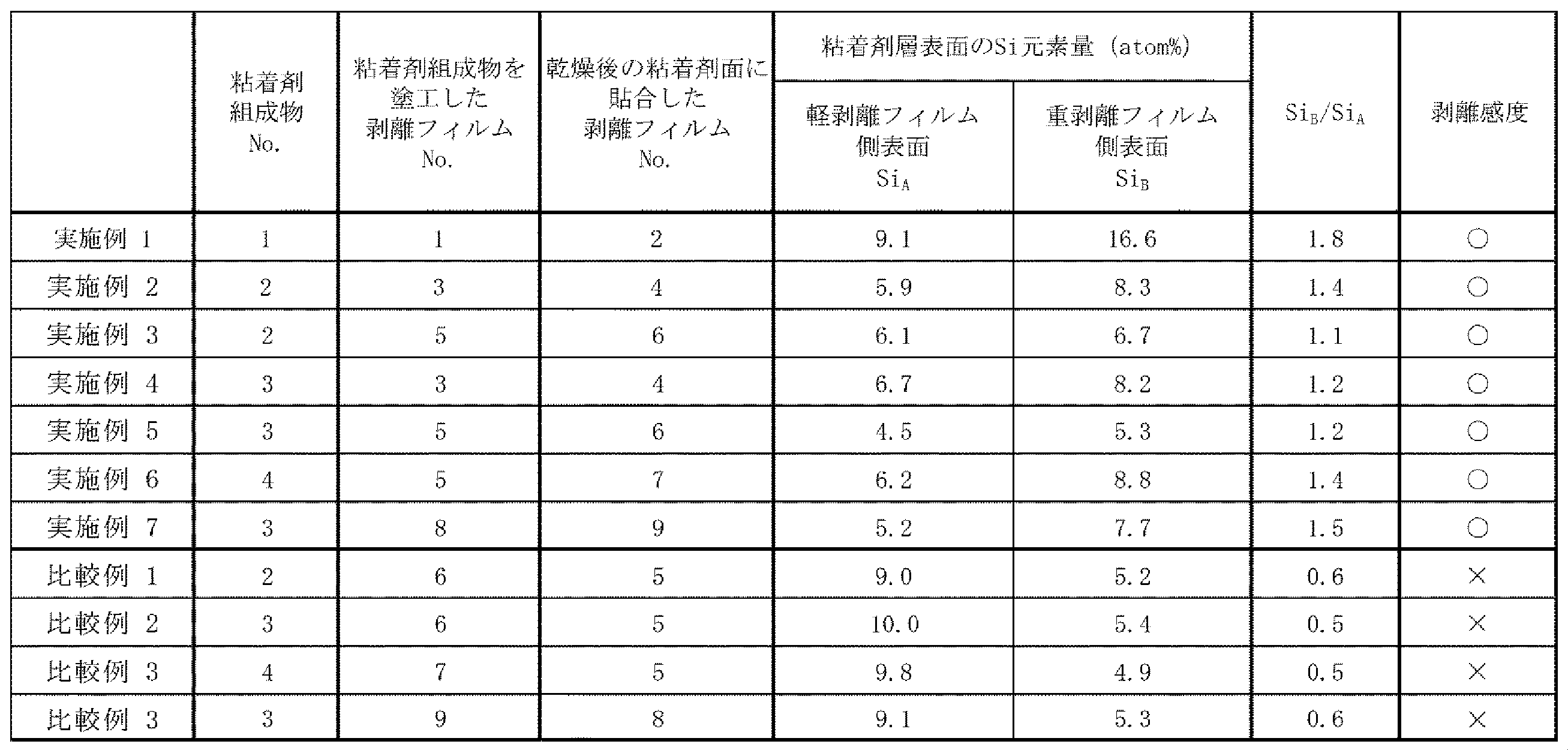
Claims (4)
- 粘着剤層と、前記粘着剤層の一方の面に積層される軽剥離フィルムと、前記粘着剤層のもう一方の面に積層される重剥離フィルムとを含む基材レス両面粘着シートであって、
前記粘着剤層の軽剥離フィルム側表面におけるSi元素量SiAと、前記粘着剤層の重剥離フィルム側表面におけるSi元素量SiBとが以下の式を満たす、基材レス両面粘着シート。
SiB/SiA>0.6 - 前記重剥離フィルムは、重剥離添加剤を含む離型処理層がプラスチックフィルム上に形成されたフィルムであり、
前記軽剥離フィルムは、重剥離添加剤を含まない離型処理層がプラスチックフィルム上に形成されたフィルムである、請求項1に記載の基材レス両面粘着シート。 - 光学部材と、粘着剤層と、重剥離フィルムとをこの順に含む積層体であって、
前記粘着剤層の光学部材側表面のSi元素量SiCと、前記粘着剤層の重剥離フィルム側表面のSi元素量SiDとが以下の式を満たす、積層体。
SiD/SiC>0.6 - 前記重剥離フィルムが、重剥離添加剤を含む離型処理層がプラスチックフィルム上に形成されたフィルムである、請求項3に記載の積層体。
Priority Applications (2)
| Application Number | Priority Date | Filing Date | Title |
|---|---|---|---|
| CN202280021959.6A CN116997625A (zh) | 2021-03-29 | 2022-03-25 | 无基材双面粘合片 |
| KR1020237034849A KR20230164083A (ko) | 2021-03-29 | 2022-03-25 | 무기재 양면 점착 시트 |
Applications Claiming Priority (4)
| Application Number | Priority Date | Filing Date | Title |
|---|---|---|---|
| JP2021054699 | 2021-03-29 | ||
| JP2021-054699 | 2021-03-29 | ||
| JP2022-045161 | 2022-03-22 | ||
| JP2022045161A JP2022153306A (ja) | 2021-03-29 | 2022-03-22 | 基材レス両面粘着シート |
Publications (1)
| Publication Number | Publication Date |
|---|---|
| WO2022210376A1 true WO2022210376A1 (ja) | 2022-10-06 |
Family
ID=83459095
Family Applications (1)
| Application Number | Title | Priority Date | Filing Date |
|---|---|---|---|
| PCT/JP2022/014491 Ceased WO2022210376A1 (ja) | 2021-03-29 | 2022-03-25 | 基材レス両面粘着シート |
Country Status (3)
| Country | Link |
|---|---|
| KR (1) | KR20230164083A (ja) |
| TW (1) | TWI923732B (ja) |
| WO (1) | WO2022210376A1 (ja) |
Citations (3)
| Publication number | Priority date | Publication date | Assignee | Title |
|---|---|---|---|---|
| JP2009197150A (ja) * | 2008-02-22 | 2009-09-03 | Lintec Corp | 基材レス両面粘着シート及び剥離シート |
| JP2017013387A (ja) * | 2015-07-02 | 2017-01-19 | 三菱樹脂株式会社 | 基材レス両面粘着シート用離型フィルム |
| JP2019065218A (ja) * | 2017-10-03 | 2019-04-25 | リンテック株式会社 | 基材レス両面粘着シート |
Family Cites Families (1)
| Publication number | Priority date | Publication date | Assignee | Title |
|---|---|---|---|---|
| WO2014080715A1 (ja) * | 2012-11-22 | 2014-05-30 | 三菱樹脂株式会社 | 基材レス両面粘着シート |
-
2022
- 2022-03-25 KR KR1020237034849A patent/KR20230164083A/ko active Pending
- 2022-03-25 WO PCT/JP2022/014491 patent/WO2022210376A1/ja not_active Ceased
- 2022-03-25 TW TW111111390A patent/TWI923732B/zh active
Patent Citations (3)
| Publication number | Priority date | Publication date | Assignee | Title |
|---|---|---|---|---|
| JP2009197150A (ja) * | 2008-02-22 | 2009-09-03 | Lintec Corp | 基材レス両面粘着シート及び剥離シート |
| JP2017013387A (ja) * | 2015-07-02 | 2017-01-19 | 三菱樹脂株式会社 | 基材レス両面粘着シート用離型フィルム |
| JP2019065218A (ja) * | 2017-10-03 | 2019-04-25 | リンテック株式会社 | 基材レス両面粘着シート |
Also Published As
| Publication number | Publication date |
|---|---|
| TW202246054A (zh) | 2022-12-01 |
| KR20230164083A (ko) | 2023-12-01 |
| TWI923732B (zh) | 2026-05-01 |
Similar Documents
| Publication | Publication Date | Title |
|---|---|---|
| CN104927691B (zh) | 带粘合剂的树脂膜及使用其的光学层叠体 | |
| TWI416177B (zh) | Adhesive-containing polarizing film, optical laminates and polarized film sets | |
| CN102618183B (zh) | 粘合剂薄片、带粘合剂的光学膜和光学层叠体 | |
| TWI752054B (zh) | 經積層分離膜之附黏著劑層的光學膜 | |
| JP6428202B2 (ja) | 光学積層体 | |
| CN102721992B (zh) | 涂布有粘合剂的光学膜 | |
| JP2019053291A (ja) | 光学積層体 | |
| JP2017095717A (ja) | 粘着剤シート、粘着剤付き光学フィルム、光学積層体及び粘着剤シートの製造方法 | |
| TW201243015A (en) | Optical film with pressure sensitive adhesive and optical laminate using the same | |
| CN101796439A (zh) | 带有粘合剂的光学膜及光学层叠体 | |
| JP7789038B2 (ja) | 粘着剤層付偏光板 | |
| CN102179976A (zh) | 光学层叠体及其制造方法 | |
| TWI761474B (zh) | 附黏著劑層之偏光薄膜及影像顯示裝置 | |
| JP2008003556A (ja) | 粘着剤付き偏光フィルム、光学積層体及び偏光フィルムのセット | |
| KR20060045854A (ko) | 아크릴 수지 조성물 | |
| JP2022153306A (ja) | 基材レス両面粘着シート | |
| TWI923732B (zh) | 無基材之雙面黏著薄片 | |
| WO2022210375A1 (ja) | 基材レス両面粘着シートの製造方法 | |
| CN110268292B (zh) | 带光学功能层的偏振膜及液晶显示装置 | |
| JPWO2018164052A1 (ja) | 光学機能層付光学部材 | |
| CN116997625A (zh) | 无基材双面粘合片 | |
| CN116964169A (zh) | 无基材双面粘合片的制造方法 | |
| JP2016026240A (ja) | 粘着剤付き光学フィルム及びそれを用いた光学積層体 |
Legal Events
| Date | Code | Title | Description |
|---|---|---|---|
| 121 | Ep: the epo has been informed by wipo that ep was designated in this application |
Ref document number: 22780589 Country of ref document: EP Kind code of ref document: A1 |
|
| WWE | Wipo information: entry into national phase |
Ref document number: 202280021959.6 Country of ref document: CN |
|
| ENP | Entry into the national phase |
Ref document number: 20237034849 Country of ref document: KR Kind code of ref document: A |
|
| NENP | Non-entry into the national phase |
Ref country code: DE |
|
| 122 | Ep: pct application non-entry in european phase |
Ref document number: 22780589 Country of ref document: EP Kind code of ref document: A1 |