WO2022201567A1 - 感染症検査方法 - Google Patents
感染症検査方法 Download PDFInfo
- Publication number
- WO2022201567A1 WO2022201567A1 PCT/JP2021/023270 JP2021023270W WO2022201567A1 WO 2022201567 A1 WO2022201567 A1 WO 2022201567A1 JP 2021023270 W JP2021023270 W JP 2021023270W WO 2022201567 A1 WO2022201567 A1 WO 2022201567A1
- Authority
- WO
- WIPO (PCT)
- Prior art keywords
- facility
- sample
- collection
- sewage
- information
- Prior art date
- Legal status (The legal status is an assumption and is not a legal conclusion. Google has not performed a legal analysis and makes no representation as to the accuracy of the status listed.)
- Ceased
Links
Images

Classifications
-
- G—PHYSICS
- G01—MEASURING; TESTING
- G01N—INVESTIGATING OR ANALYSING MATERIALS BY DETERMINING THEIR CHEMICAL OR PHYSICAL PROPERTIES
- G01N1/00—Sampling; Preparing specimens for investigation
- G01N1/02—Devices for withdrawing samples
- G01N1/10—Devices for withdrawing samples in the liquid or fluent state
- G01N1/20—Devices for withdrawing samples in the liquid or fluent state for flowing or falling materials
- G01N1/2035—Devices for withdrawing samples in the liquid or fluent state for flowing or falling materials by deviating part of a fluid stream, e.g. by drawing-off or tapping
-
- G—PHYSICS
- G16—INFORMATION AND COMMUNICATION TECHNOLOGY [ICT] SPECIALLY ADAPTED FOR SPECIFIC APPLICATION FIELDS
- G16H—HEALTHCARE INFORMATICS, i.e. INFORMATION AND COMMUNICATION TECHNOLOGY [ICT] SPECIALLY ADAPTED FOR THE HANDLING OR PROCESSING OF MEDICAL OR HEALTHCARE DATA
- G16H10/00—ICT specially adapted for the handling or processing of patient-related medical or healthcare data
- G16H10/40—ICT specially adapted for the handling or processing of patient-related medical or healthcare data for data related to laboratory analysis, e.g. patient specimen analysis
-
- C—CHEMISTRY; METALLURGY
- C12—BIOCHEMISTRY; BEER; SPIRITS; WINE; VINEGAR; MICROBIOLOGY; ENZYMOLOGY; MUTATION OR GENETIC ENGINEERING
- C12M—APPARATUS FOR ENZYMOLOGY OR MICROBIOLOGY; APPARATUS FOR CULTURING MICROORGANISMS FOR PRODUCING BIOMASS, FOR GROWING CELLS OR FOR OBTAINING FERMENTATION OR METABOLIC PRODUCTS, i.e. BIOREACTORS OR FERMENTERS
- C12M1/00—Apparatus for enzymology or microbiology
- C12M1/26—Inoculator or sampler
-
- C—CHEMISTRY; METALLURGY
- C12—BIOCHEMISTRY; BEER; SPIRITS; WINE; VINEGAR; MICROBIOLOGY; ENZYMOLOGY; MUTATION OR GENETIC ENGINEERING
- C12Q—MEASURING OR TESTING PROCESSES INVOLVING ENZYMES, NUCLEIC ACIDS OR MICROORGANISMS; COMPOSITIONS OR TEST PAPERS THEREFOR; PROCESSES OF PREPARING SUCH COMPOSITIONS; CONDITION-RESPONSIVE CONTROL IN MICROBIOLOGICAL OR ENZYMOLOGICAL PROCESSES
- C12Q1/00—Measuring or testing processes involving enzymes, nucleic acids or microorganisms; Compositions therefor; Processes of preparing such compositions
- C12Q1/02—Measuring or testing processes involving enzymes, nucleic acids or microorganisms; Compositions therefor; Processes of preparing such compositions involving viable microorganisms
- C12Q1/04—Determining presence or kind of microorganism; Use of selective media for testing antibiotics or bacteriocides; Compositions containing a chemical indicator therefor
-
- C—CHEMISTRY; METALLURGY
- C12—BIOCHEMISTRY; BEER; SPIRITS; WINE; VINEGAR; MICROBIOLOGY; ENZYMOLOGY; MUTATION OR GENETIC ENGINEERING
- C12Q—MEASURING OR TESTING PROCESSES INVOLVING ENZYMES, NUCLEIC ACIDS OR MICROORGANISMS; COMPOSITIONS OR TEST PAPERS THEREFOR; PROCESSES OF PREPARING SUCH COMPOSITIONS; CONDITION-RESPONSIVE CONTROL IN MICROBIOLOGICAL OR ENZYMOLOGICAL PROCESSES
- C12Q1/00—Measuring or testing processes involving enzymes, nucleic acids or microorganisms; Compositions therefor; Processes of preparing such compositions
- C12Q1/02—Measuring or testing processes involving enzymes, nucleic acids or microorganisms; Compositions therefor; Processes of preparing such compositions involving viable microorganisms
- C12Q1/24—Methods of sampling, or inoculating or spreading a sample; Methods of physically isolating an intact microorganisms
-
- G—PHYSICS
- G01—MEASURING; TESTING
- G01N—INVESTIGATING OR ANALYSING MATERIALS BY DETERMINING THEIR CHEMICAL OR PHYSICAL PROPERTIES
- G01N33/00—Investigating or analysing materials by specific methods not covered by groups G01N1/00 - G01N31/00
- G01N33/48—Biological material, e.g. blood, urine; Haemocytometers
- G01N33/50—Chemical analysis of biological material, e.g. blood, urine; Testing involving biospecific ligand binding methods; Immunological testing
- G01N33/53—Immunoassay; Biospecific binding assay; Materials therefor
- G01N33/569—Immunoassay; Biospecific binding assay; Materials therefor for microorganisms, e.g. protozoa, bacteria, viruses
- G01N33/56911—Bacteria
-
- G—PHYSICS
- G01—MEASURING; TESTING
- G01N—INVESTIGATING OR ANALYSING MATERIALS BY DETERMINING THEIR CHEMICAL OR PHYSICAL PROPERTIES
- G01N33/00—Investigating or analysing materials by specific methods not covered by groups G01N1/00 - G01N31/00
- G01N33/48—Biological material, e.g. blood, urine; Haemocytometers
- G01N33/50—Chemical analysis of biological material, e.g. blood, urine; Testing involving biospecific ligand binding methods; Immunological testing
- G01N33/53—Immunoassay; Biospecific binding assay; Materials therefor
- G01N33/569—Immunoassay; Biospecific binding assay; Materials therefor for microorganisms, e.g. protozoa, bacteria, viruses
- G01N33/56983—Viruses
-
- G—PHYSICS
- G16—INFORMATION AND COMMUNICATION TECHNOLOGY [ICT] SPECIALLY ADAPTED FOR SPECIFIC APPLICATION FIELDS
- G16H—HEALTHCARE INFORMATICS, i.e. INFORMATION AND COMMUNICATION TECHNOLOGY [ICT] SPECIALLY ADAPTED FOR THE HANDLING OR PROCESSING OF MEDICAL OR HEALTHCARE DATA
- G16H50/00—ICT specially adapted for medical diagnosis, medical simulation or medical data mining; ICT specially adapted for detecting, monitoring or modelling epidemics or pandemics
- G16H50/80—ICT specially adapted for medical diagnosis, medical simulation or medical data mining; ICT specially adapted for detecting, monitoring or modelling epidemics or pandemics for detecting, monitoring or modelling epidemics or pandemics, e.g. flu
-
- G—PHYSICS
- G16—INFORMATION AND COMMUNICATION TECHNOLOGY [ICT] SPECIALLY ADAPTED FOR SPECIFIC APPLICATION FIELDS
- G16H—HEALTHCARE INFORMATICS, i.e. INFORMATION AND COMMUNICATION TECHNOLOGY [ICT] SPECIALLY ADAPTED FOR THE HANDLING OR PROCESSING OF MEDICAL OR HEALTHCARE DATA
- G16H70/00—ICT specially adapted for the handling or processing of medical references
- G16H70/60—ICT specially adapted for the handling or processing of medical references relating to pathologies
-
- C—CHEMISTRY; METALLURGY
- C12—BIOCHEMISTRY; BEER; SPIRITS; WINE; VINEGAR; MICROBIOLOGY; ENZYMOLOGY; MUTATION OR GENETIC ENGINEERING
- C12Q—MEASURING OR TESTING PROCESSES INVOLVING ENZYMES, NUCLEIC ACIDS OR MICROORGANISMS; COMPOSITIONS OR TEST PAPERS THEREFOR; PROCESSES OF PREPARING SUCH COMPOSITIONS; CONDITION-RESPONSIVE CONTROL IN MICROBIOLOGICAL OR ENZYMOLOGICAL PROCESSES
- C12Q1/00—Measuring or testing processes involving enzymes, nucleic acids or microorganisms; Compositions therefor; Processes of preparing such compositions
- C12Q1/68—Measuring or testing processes involving enzymes, nucleic acids or microorganisms; Compositions therefor; Processes of preparing such compositions involving nucleic acids
- C12Q1/6876—Nucleic acid products used in the analysis of nucleic acids, e.g. primers or probes
- C12Q1/6888—Nucleic acid products used in the analysis of nucleic acids, e.g. primers or probes for detection or identification of organisms
- C12Q1/689—Nucleic acid products used in the analysis of nucleic acids, e.g. primers or probes for detection or identification of organisms for bacteria
-
- C—CHEMISTRY; METALLURGY
- C12—BIOCHEMISTRY; BEER; SPIRITS; WINE; VINEGAR; MICROBIOLOGY; ENZYMOLOGY; MUTATION OR GENETIC ENGINEERING
- C12Q—MEASURING OR TESTING PROCESSES INVOLVING ENZYMES, NUCLEIC ACIDS OR MICROORGANISMS; COMPOSITIONS OR TEST PAPERS THEREFOR; PROCESSES OF PREPARING SUCH COMPOSITIONS; CONDITION-RESPONSIVE CONTROL IN MICROBIOLOGICAL OR ENZYMOLOGICAL PROCESSES
- C12Q1/00—Measuring or testing processes involving enzymes, nucleic acids or microorganisms; Compositions therefor; Processes of preparing such compositions
- C12Q1/70—Measuring or testing processes involving enzymes, nucleic acids or microorganisms; Compositions therefor; Processes of preparing such compositions involving virus or bacteriophage
- C12Q1/701—Specific hybridization probes
-
- G—PHYSICS
- G01—MEASURING; TESTING
- G01N—INVESTIGATING OR ANALYSING MATERIALS BY DETERMINING THEIR CHEMICAL OR PHYSICAL PROPERTIES
- G01N2333/00—Assays involving biological materials from specific organisms or of a specific nature
- G01N2333/005—Assays involving biological materials from specific organisms or of a specific nature from viruses
- G01N2333/08—RNA viruses
- G01N2333/165—Coronaviridae, e.g. avian infectious bronchitis virus
-
- G—PHYSICS
- G16—INFORMATION AND COMMUNICATION TECHNOLOGY [ICT] SPECIALLY ADAPTED FOR SPECIFIC APPLICATION FIELDS
- G16H—HEALTHCARE INFORMATICS, i.e. INFORMATION AND COMMUNICATION TECHNOLOGY [ICT] SPECIALLY ADAPTED FOR THE HANDLING OR PROCESSING OF MEDICAL OR HEALTHCARE DATA
- G16H15/00—ICT specially adapted for medical reports, e.g. generation or transmission thereof
Definitions
- the present invention relates to an infectious disease testing method, and in particular, an infectious disease testing method that utilizes the natural law of uneven distribution of infectious pathogens such as viruses in the community to prevent the occurrence of clusters (mass infections) in facilities. Regarding.
- infectious diseases such as coronaviruses, infectious disease tests (such as antigen tests, etc.), and if a positive reaction is found, measures are taken such as quarantining including those who have had close contact with them.
- Patent Document 1 In order to predict the state of infection on a macro scale, attempts have been made to analyze sewage collected from sewage treatment plants and estimate infectious diseases such as norovirus (for example, Patent Document 1).
- the present invention aims to prevent the occurrence of clusters of infectious diseases, and provides a test method for determining the possibility of infection of a resident without performing a regular PCR test on the resident of the facility. intended to provide
- One aspect of the present invention includes a collection step of collecting a sample from the sewage during the collection period on the route until the sewage discharged from the facility flows into the public sewage pipe, and analyzing the sample, and a notification step of notifying said facility along with said collection period, wherein said notified information and said collection period are at least said collection period.
- This is an infectious disease test method for indicating the possibility that a person infected with the infectious pathogen exists among residents of the facility in the facility.
- “Facilities” here refer to buildings such as nursing homes, hospitals, schools, companies, etc., where the main residents (employees, residents, visitors, etc.) can be identified, regardless of whether the building is single or multiple.
- “stayers” here are not limited to those who live in the facility (residents) or those who stay at the facility (guests), but also those who use the facility only during the day (users). It is a concept that also includes
- “facility's sewage” refers to sewage discharged from the facility, and exists in the route until the sewage discharged from the facility flows into the public sewage pipe.
- the inventor of the present application came up with the idea that it would be useful to conduct inspections on a facility-by-facility basis where clusters occur in order to understand the distribution of infectious pathogens typified by viruses in the city.
- Pseudovirus in the amount contained in the excrement of the infected person was poured into the sewage, and the sample captured by the collection means placed in the sewage for the collection period was analyzed. As a result, they were able to detect a sufficient amount of virus for detection, which led to the completion of the testing method of the present invention.
- Infectious pathogens include viruses such as coronaviruses, influenza viruses, and noroviruses, as well as bacteria such as Salmonella, tuberculosis, and Escherichia coli O157, and microscopic organisms such as Entamoeba histolytica, Campylobacter, and mites.
- the present invention is an invention of an infectious disease testing method that uses the natural law of the uneven distribution of infectious pathogens such as viruses in the city to prevent the occurrence of clusters.
- the present invention it is possible to determine the possibility of a resident's infection without having to perform regular PCR tests on the resident, and as a result, it is possible to prevent the occurrence of clusters.
- an infectious pathogen when observed in a sample, it is possible to specifically identify the infected person and prevent the occurrence of a cluster by performing a PCR test or the like on all members.
- FIG. 1 shows an inspection system
- An embodiment of the infectious disease testing method according to the present invention is performed by a facility 1, a management company 2, a contract analysis company 3, a collector 4, and a public health center 5.
- a facility 1 a management company 2, a contract analysis company 3, a collector 4, and a public health center 5.
- Step ⁇ 1 ⁇ The management company 2 receives a request from the facility 1, visits the facility 1, investigates the drainage equipment of the facility 1, and determines the sampling location and scheduled sampling period.
- Step ⁇ 2 ⁇ The management company 2 transmits the determined collection site, collection period, information specifying the sample, and information specifying the facility 1 to the collection company 4, and requests the collection of the sample.
- Step ⁇ 3 ⁇ Upon receipt of the request, the collector 4 goes to the facility 1, collects the sample during the specified collection period at the specified sampling location in the sewage of the facility, and analyzes it together with the information specifying the sample received at the time of the request. Submit to Trustee Company 3.
- Step ⁇ 4 ⁇ Analysis contract company 3 that has received the submission analyzes the sample, obtains information on the presence of infectious pathogens in the sample, and reports the information and the information identifying the sample to management company 2. .
- Step ⁇ 5 ⁇ Upon receiving the report, the management company 2 identifies the information identifying the facility 1, the collection location, and the collection period based on the information identifying the reported sample, and provides information on the presence of infectious pathogens in the sample. together with the facility 1.
- Step ⁇ 6 ⁇ If the information on the presence of infectious pathogens in the sample indicates the presence of an infected person, Facility 1 that received the information identifies the resident of Facility 1 during the collection period that received the information, and informs the resident. A PCR test will be carried out. As a result, measures such as isolation can be taken for residents who have tested positive and those who have been in close contact with them.
- the management company 2 receives a request from the facility 1, visits the facility 1, investigates the drainage equipment of the facility 1, and determines the sampling location and scheduled sampling period.
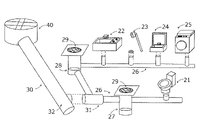
- a drainage facility in this case will be described with reference to FIG.
- a toilet 21, a kitchen 22, a bathroom 23, a washroom/hand washing place 24, and a laundry place 25 are provided. It is not necessary to have all of these facilities that may drain into the sewer. In addition to these, there may also be facilities that may discharge to sewage. Waste water generated by these facilities is discharged to the public sewage system 30 through drainage facilities.
- the drainage facility is composed of a drainage pipe 26, a sewage basin 27, other sewage basins 28, and a manhole cover 29 provided on each sewage basin. It is led to a public sewage pipe 31 of a public sewage system 30 through a drain pipe 26 via a sewage basin 27 and other sewage basins 28 .
- the drainage facility may include a septic tank, but is not limited to this. Wastewater guided to the public sewage pipe 31 is concentrated in the sewage treatment plant 40 through the public sewage system 32 .
- manhole covers 29 are provided in manhole covers 29 to facilitate access from the ground to the excreta pit 27 and other filth pits 28, making them preferable to the drainpipe 26 as a collection site.
- excrement of the resident from the toilet 21 temporarily stays in the excrement cesspool 27 through the drain pipe 26, and that infectious pathogens such as viruses are detected in high concentration from the excrement and sputum. , it is more desirable to select the excrement cesspool 27 as the collection location.
- the selection of the collection site is not limited to the above criteria, as long as it is a place where the wastewater containing infectious pathogens released from the body of the resident passes through and before it flows into the public sewage system 32. , various collection locations can be set.
- bathroom 23 drains a large amount of water during cleaning.
- the period of time when this wastewater passes through the drainage system is not suitable for collection because the concentration of infectious pathogens is diluted. Therefore, it is desirable to interview the person who manages the facility 1 and select a time slot different from the time slot for cleaning the bathroom 23 or the time slot for washing the dishes in the kitchen 22 as the planned sampling period.
- the facility 1 is a facility such as a school or a facility dedicated to day care services, in which visitors concentrate during the daytime, it is desirable to set the scheduled collection period to the daytime hours.
- the scheduled collection period may be determined based on various other factors, and as long as it is a period during which excrement from residents can flow into the sewage and infectious pathogens can be detected from the sample collected, the scheduled collection period. Various periods can be determined.
- the management company 2 transmits the determined collection site, scheduled collection period, information specifying the sample, and information specifying the facility 1 to the collection company 4, and requests the collection of the sample.
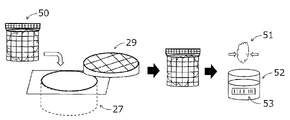
- the information specifying the sample is, for example, the bar code 53 (see FIG. 3).
- the bar code 53 is coded with a number that enables the sample to be collected to be distinguished from the sample collected at another facility or at another location or time period in the same facility 1 .
- Information specifying the sample is not limited to a barcode, and may be an RF tag, a serial number stored in a storage medium, or the like.
- the information specifying the facility 1 includes contact information such as a telephone number, address, name of the person in charge of the facility 1, etc. for the convenience of the collection work, but it may simply be an ID assigned to each facility. .
- the bar code 53 is affixed to the surface of the collection container 52 (see FIG. 3), and necessary items such as the name of the infectious disease to be tested, the name of the facility 1, and the scheduled collection period are printed.
- the collection container 52 is sent to the collection agent 4 .
- information can be properly transmitted without any omission.
- these descriptions may be submitted as printed paper documents separately from the collection container 52, or may be transmitted to the collection agent 4 as electronic data.
- the collection container 52 itself may be prepared by the collection company 4 .
- various modifications are possible.
- the collector 4 Upon receipt of the request, the collector 4 goes to the facility 1, collects the samples during the specified collection period at the specified sampling location in the sewage of the facility, and collects the samples together with the information specifying the samples received at the time of the request. Submit to Analysis Contract Company 3. A method for collecting the sample will be described with reference to FIG. Upon arrival at the facility 1, the collector 4 opens, for example, the manhole cover 29 based on the collection location information, and makes the sample collection absorber 51 included in the sample kit 50 infiltrate the sewage in the sewage pit 27.
- the sample kit 50 has a structure in which a sample-collecting absorber 51 is wrapped in a net, and is installed directly below the manhole cover 29 or the like by being hung by a string (not shown). By suspending the sample kit 50 with a string, even if it is exposed to garbage such as toilet paper that flows through sewage for a long time, the sample kit 50 will sway when it collides with the garbage. Efficient collection of pathogens.
- the cord body is made of wire net, for example, and is fixed to the installation location with a load tightening belt or the like attached to the wire net, or a buckle adjuster may be provided, in which case height adjustment becomes easy. .
- the fixing point of the string can be swung by the tension of the fixed string. It is preferable that the fixing point is fixed to the manhole cover 29 or the like from the viewpoint of ease of collection of the sample kit 50 .
- This state is continued for the scheduled sampling period, and the sample-collecting absorbent body 51 is pulled up from the sewage basin 27 after the scheduled sampling period has elapsed. Thereafter, the sample-collecting absorber 51 is squeezed to extract the liquid sample into the collection container 52 . At this time, it is desirable to attach a bar code 53 to the collection container 52 .
- the sample-collecting absorber 51 is an absorber such as polymer, absorbent cotton, etc., placed in a bag-like net.
- the detection of infectious agents can be performed without being affected by time fluctuations.
- the period from the actual start of collection to withdrawal is entered in the collection container 52 as the collection period and submitted to the contract analysis company 3 .
- the analysis entrusted company 3 is informed of the collected sample, as well as the information specifying the sample and the collection period.
- the bar code 53 is used as the information for specifying the sample, but if the sample can be specified, a simple serial number, symbol, or other ID may be used, and the name of the facility 1 and the collection period are combined. Letters are fine.
- various measures can be taken as long as the samples can be distinguished from those collected at other facilities or during other time periods.
- the collection period may be communicated to the management company 2 instead of being communicated to the analysis entrusted company 3 .
- the period may also be expressed by including the date and time of the start of collection and the date and time of the end of collection, or may be expressed by the date and time of the start of collection and the duration of the collection.
- the aspect can be variously changed.
- Analysis contract company 3 that has received the submission analyzes the sample, obtains information on the presence of infectious pathogens in the sample, and reports the information and the information identifying the sample to management company 2. .
- the analysis contract company 3 preprocesses the sample in the collection container 52, and then performs an infectious disease test method (otherwise, an antigen test, etc.) that can confirm infection at the time of testing, such as a known PCR test. .
- an infectious disease test method otherwise, an antigen test, etc.
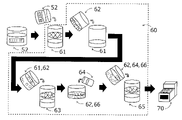
- the procedure of the preprocessing will be described with reference to FIG.
- the first filtration container 61, the antibody beads 62, the second filtration container 63, A pretreatment kit 60 with an enzyme 64 and a third filtration vessel 65 is used.
- the preprocessing procedure of this embodiment is generally as follows.
- the sample in the collection container 52 is passed through the first filtration container 61 to remove relatively large dust.
- Antibody beads 62 are added to the filtrate and stirred.
- This antibody bead 62 is obtained by immobilizing an antibody that selectively captures an infectious pathogen to be detected on the surface of the bead, and a commercially available product can be used.
- the filtrate containing the antibody beads 62 is put into the second filtration container 63 to extract the antibody beads 62 .
- the extracted antibody beads 62 are mixed with pure water 66 or the like, and an enzyme 64 is introduced therein.
- the enzyme 64 selectively cleaves a portion of the antibody to cleave the antibody free from the bead.
- infectious agents liberated from the beads by the cleavage of the antibodies are introduced into the third filtration container 65 to be separated from the antibody beads 62 .
- the filtrate is then detected by a known infectious agent detection kit 70, such as a PCR test kit.
- the sample is pretreated using the pretreatment kit 60, but depending on the type of infectious pathogen, the treatment may be completed only with the infectious pathogen detection kit 70 in the latter stage.
- the infectious pathogen detection kit 70 for example, one using PCR, ELISA (Enzyme-Linked Immuno Sorbent Assay), or the like can be used.
- infectious pathogens may be detected using an analytical instrument that combines a liquid chromatography such as LCMS and a mass spectrometer.
- the pretreatment kit 60 or the infectious pathogen detection kit 70 as described above may not necessarily be used for the pretreatment of the sample or the subsequent detection of the infectious pathogen.
- various modifications are possible as long as infectious pathogens can be detected.
- the analysis entrusted company 3 provides the management company 2 with numerical information of the bar code 53 as information for specifying the sample, presence or absence of detection of infectious pathogens as the detection result of infectious pathogens, and presence of infectious pathogens per 1 L of sample. Notify quantity.
- the detection result of infectious pathogens may be only the presence or absence of detection, or may be a level notation that discretizes the amount of existence.
- the aspect can be changed in various ways.
- the management company 2 that received the report identifies the information identifying the facility 1, the collection location, and the collection period based on the information identifying the reported sample, and determines the presence of infectious pathogens in the sample. It is provided to facility 1 along with the information. In this case, the information on the collection location is not necessarily required, but the information on the actual collection period is absolutely necessary for identifying potential infected residents, which will be described later. Furthermore, the management company 2 may notify the public health center 5 of the results in order to grasp the number of infected people in the region and manage the amount of test kits such as PCR test stockpiled. In that case, it is necessary to obtain the consent of the administrator of the facility 1 to notify the public health center 5 in advance.
- step ⁇ 6 ⁇ If the information on the presence of infectious pathogens in the sample indicates the presence of an infected person, Facility 1 that received the information identifies the resident of Facility 1 during the collection period that received the information, and informs the resident. A PCR test will be carried out. At this time, there is a possibility that the sewage of the facility may contain excrement of the resident before the collection period. It is desirable to check the collection period retroactively to the time when the act was performed and the period of stay of the resident. However, the comparison method can be changed in various ways as long as the visitor whose staying time is included in at least a part of the collection period is specified. As a result, measures such as isolation can be taken for residents who have tested positive and those who have been in close contact with them.
- Facility 1 It is also possible for Facility 1 to outsource the identification of residents to Management Company 2.
- the management company 2 by entering the entry/exit information and personal ID in the ledger that manages entry/exit to the facility 1, and making the list available for viewing by the management company 2, the management company 2 can determine the period of stay and the period of collection. After checking with the facility 1, it is possible to notify. As a result, the manager of the facility 1 only needs to recommend or arrange for a PCR test for the resident corresponding to the notified personal ID, which makes management easier. Since only the ID is exchanged, personal information can be prevented from leaking from the facility 1 to the management company 2, which is preferable.
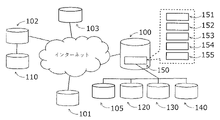
- the web system includes a management server 100, a collection company terminal 101, a facility terminal 102, a contract analysis company terminal 103, and a database stored in a cloud storage. It is composed of a DB 105 , a collection plan DB 120 , a collection result DB 130 , an analysis result DB 140 , and a program 150 operating on the management server 100 .
- the collection agency terminal 101, the facility terminal 102, and the commissioned analysis agency terminal 103 can access the management server 100 through the Internet line.
- the management server 100 is configured to be able to access each database 105 , 120 , 130 , 140 .
- the program 150 is either a Web server program that issues HTML source or an ASP program that runs on the server, or a combination thereof, and is configured to be able to access each of the above databases. Furthermore, the facility terminal 102 is configured to be able to access a visitor DB 110, which is a database stored in a separate storage.
- the visitor DB 110 is a database whose fields are facility ID, visitor ID, visitor name, stay period, and PCR test history.
- the facility DB 105 is a database whose fields are facility IDs, facility names, passwords, and contact information (facility address, telephone number, name of person in charge, etc.).
- the collection plan DB 120 includes a collection request ID, a requested pathogen type, research facility information, research requester information, scheduled sample installation time, scheduled sample collection time, scheduled collection date, and scheduled collection location information. , and the collection requesting company information as fields.
- the collection result DB 130 is a database whose fields are a collection sample ID, a collection request ID, a collection company ID, and an actual collection period.
- the analysis result DB 140 is a database whose fields are pathogen detection values, infection possibility determination results, analysis request dates, analysis result notification dates, and analyst IDs.
- the program 150 is roughly divided into a facility management program 151 , an order management program 152 , a collection management program 153 , an analysis management program 154 and an inspection result management program 155 .
- the facility management program 151 displays a web page for accepting new registration of the facility 1 on the access destination terminal, for example, the facility terminal 102 .
- the facility name, password, contact information, etc. can be entered, and registered in the facility DB 105 together with a newly numbered facility ID.
- the contact information the address, telephone number, name of the person in charge, etc. of the facility 1 are registered.
- the order management program 152 displays a web page for accepting a request from the facility 1 on the access destination terminal, for example, the facility terminal 102 .
- a login screen is displayed to accept entry of the facility ID and password.
- the facility ID and password are collated with the data in the facility DB 105, and if the authentication is successful, a new request page is displayed.
- a new collection request ID is numbered, the facility ID is stored in the survey facility information, and the contact information is stored in the survey requester information. to register.
- the order management program 152 displays a Web page for the administrator when logged in with the administrator's ID.
- the Web page for the administrator displays the telephone number, address, and name of the person in charge of facility 1 from the facility DB 105 based on the contact information stored in the survey requester information for the newly received collection request ID. .
- the person in charge of the management company 2 sets the date and time of the visit by calling the facility 1, visits the facility 1 based on the address and the name of the person in charge, and makes a request based on the interview at the time of the visit.
- the target pathogen type, investigation requester information, scheduled collection time, collection collection time, scheduled collection date, scheduled collection location information, collection requester information, etc. are registered in the collection plan DB 120 .
- the sampling planning step (step ⁇ 1 ⁇ in FIG. 1) can be executed.
- the collection management program 153 displays a Web page for the collection company accessed from the collection company terminal 101 .
- the Web page When logged in with the ID of the collection company, the Web page displays a list of cases registered in the collection plan DB 120 that have not yet been registered in the collection result DB 130, and an acceptance button corresponding to each case. .
- the acceptance button When the acceptance button is clicked, the selected collection request ID and collection company ID are registered in the collection result DB 130 together with a newly automatically numbered collected sample ID.
- the page displays the number of the collected sample ID and the corresponding bar code 53, which can be printed.
- the collection agent 4 prints them on a seal or the like and attaches it to the collection container 52 .
- the sampling agent brings the sampling container 52 and the absorbent body 51 for sampling, executes the sampling step (step ⁇ 3 ⁇ in FIG. 1), and inputs the actual sampling period on the web page. , is registered in the collection result DB 130 .
- This web system can automatically perform the process ⁇ 2 ⁇ (requested process) in FIG. Accordingly, a collection company ID may be assigned individually, and the collection company 4 may be notified to that effect.
- the analysis management program 154 displays a Web page for contract analysis companies accessed from the contract analysis company terminal 103 .
- a screen for inputting the collection sample ID is displayed.
- the collection result DB 130 can be processed.
- the collection request ID is read out, the requested pathogen type corresponding to the collection request ID is read out from the collection plan DB 120, and displayed on the web page, along with the pathogen detection value, the infection possibility determination result, the analysis request date, and the analysis.
- the commissioned analysis company 5 executes the pathogen analysis step (step ⁇ 4 ⁇ in FIG. 1) based on the requested pathogen type, appropriately inputs the accepted input items, and registers them in the analysis result DB 140. .
- Management company 2 can execute step ⁇ 5 ⁇ in FIG.
- the inspection result management program 155 is executed by the facility terminal 102 .
- the inspection result management program 155 accepts input of the facility ID and password from the facility terminal 102 .
- the input facility ID and password are compared with the data in the facility DB 105, and if the authentication is successful, the analysis result of the facility corresponding to the authenticated facility ID is read out from the analysis result DB 140, and the facility terminal 102 is sent to
- the person in charge of facility 1 refers to the infection possibility determination result with the latest analysis result notification date among the analysis results read from the analysis result DB 140, and the infection possibility determination result indicates the presence of an infected person.
- the visitor ID whose actual collection period in the collection result DB 130 and the stay period in the visitor DB 110 overlap is extracted, and a list in which the name of the visitor, the period of stay, and the PCR test history is described is created. It is displayed on the screen of the facility terminal 102 .
- the administrator of the facility 1 submits the list to the public health center 5 and requests the hospital or the like to perform the PCR test.
- the PCR test result is added to the PCR test history and registered in the sojourner DB 110 . As a result, it is possible to prevent the occurrence of clusters by conducting individual infectious disease tests for the minimum number of visitors only when necessary.
- the inspection result management program 155 is executed by the facility terminal 102 in this embodiment, it may be executed by the management server 100 and displayed on the facility terminal 102 as a web page. In that case, by making the fields in the sojourner DB 110 that can identify individuals inaccessible from the management server 100, it is possible to prevent personal information from being leaked.
- the infectious disease testing method comprises: A collection step of collecting a sample from the sewage during the collection period on the route until the sewage discharged from the facility flows into the public sewage pipe; an analytical step of analyzing the sample to obtain information regarding the presence of infectious agents in the sample; a notification step of notifying the facility of the information together with the collection period; The notified information and the collection period indicate the possibility that there is a person infected with the infectious pathogen among the residents of the facility at least during the collection period.
- the infectious disease test method described in Section 1 is The collecting step may collect a sample from a cesspool into which wastewater from a toilet of the facility flows, among the sewage of the facility.
- the infectious disease test method described in Section 1 is Prior to the sampling step, the method may further include a sampling planning step of specifying a location from which the sample is to be sampled and/or the sampling period during which the sample is to be sampled in the sewage of the facility.
- the infectious disease test method described in Section 1 is The collecting step may include recovering an absorbent body for sample collection after placing it in the sewage of the facility, and recovering the substance retained in the absorbent body as the sample.
- Section 5 The infectious disease test method described in Section 1 is If the information indicates that there is a possibility that there is a person infected with the infectious pathogen among the residents of the facility during the collection period, the residents of the facility during the collection period A step of inspecting the presence or absence of infection with the infectious pathogen may be further performed on at least a part of the cells.
- the infectious disease control system is Collection that associates and stores the collection period and information identifying the sample collected from the sewage during the collection period on the route until the sewage discharged from the facility flows into the public sewage pipe.
- a results database an analysis results database that stores information about the presence of infectious pathogens in the sample, obtained by analyzing the sample, together with information identifying the sample; a resident database that records information identifying a resident at the facility together with the period during which the resident stayed at the facility; and a computer program that can access each database, said computer program comprising: When the information on the presence of the infectious agent in the sample indicates that there is a possibility that there is a person infected with the infectious agent among the residents of the facility during the collection period, each of the above-mentioned Based on the data stored in the database, extracting a list of said visitors whose collection period overlaps with the period during which said visitors stayed at said facility can be executed.
- the infectious disease control system described in Section 6, further comprising a facility database that stores information identifying the facility; the information identifying the facility includes a login ID and password;
- the computer program comprises input receiving means for receiving input of the login ID and the password, means for authenticating the login ID and password, and infection in the sample for the facility corresponding to the authenticated login ID.
- Display means for displaying information on the presence of sexual pathogens and a list of said so journeyners.
Landscapes
- Health & Medical Sciences (AREA)
- Life Sciences & Earth Sciences (AREA)
- Engineering & Computer Science (AREA)
- Chemical & Material Sciences (AREA)
- General Health & Medical Sciences (AREA)
- Organic Chemistry (AREA)
- Immunology (AREA)
- Zoology (AREA)
- Wood Science & Technology (AREA)
- Bioinformatics & Cheminformatics (AREA)
- Biotechnology (AREA)
- Biochemistry (AREA)
- Biomedical Technology (AREA)
- Molecular Biology (AREA)
- Microbiology (AREA)
- Physics & Mathematics (AREA)
- Pathology (AREA)
- Analytical Chemistry (AREA)
- Public Health (AREA)
- Medicinal Chemistry (AREA)
- Urology & Nephrology (AREA)
- General Engineering & Computer Science (AREA)
- Genetics & Genomics (AREA)
- Hematology (AREA)
- Medical Informatics (AREA)
- Proteomics, Peptides & Aminoacids (AREA)
- General Physics & Mathematics (AREA)
- Virology (AREA)
- Epidemiology (AREA)
- Primary Health Care (AREA)
- Cell Biology (AREA)
- Food Science & Technology (AREA)
- Biophysics (AREA)
- Sustainable Development (AREA)
- Tropical Medicine & Parasitology (AREA)
- Hydrology & Water Resources (AREA)
- Data Mining & Analysis (AREA)
- Toxicology (AREA)
- Databases & Information Systems (AREA)
- Medical Treatment And Welfare Office Work (AREA)
Priority Applications (6)
| Application Number | Priority Date | Filing Date | Title |
|---|---|---|---|
| EP21933168.3A EP4317395A4 (en) | 2021-03-25 | 2021-06-18 | TESTING METHODS FOR INFECTIOUS DISEASES |
| CN202180095879.0A CN116997662A (zh) | 2021-03-25 | 2021-06-18 | 传染病检查方法 |
| JP2021568917A JP7031957B1 (ja) | 2021-03-25 | 2021-06-18 | 感染症検査方法 |
| US18/279,339 US20240142350A1 (en) | 2021-03-25 | 2021-06-18 | Infectious Disease Testing Method |
| AU2021436402A AU2021436402B2 (en) | 2021-03-25 | 2021-06-18 | Infectious disease testing method |
| JP2022024052A JP7118370B1 (ja) | 2021-03-25 | 2022-02-18 | 検査方法及び試料キット |
Applications Claiming Priority (2)
| Application Number | Priority Date | Filing Date | Title |
|---|---|---|---|
| JP2021052117 | 2021-03-25 | ||
| JP2021-052117 | 2021-03-25 |
Publications (1)
| Publication Number | Publication Date |
|---|---|
| WO2022201567A1 true WO2022201567A1 (ja) | 2022-09-29 |
Family
ID=82849858
Family Applications (1)
| Application Number | Title | Priority Date | Filing Date |
|---|---|---|---|
| PCT/JP2021/023270 Ceased WO2022201567A1 (ja) | 2021-03-25 | 2021-06-18 | 感染症検査方法 |
Country Status (6)
| Country | Link |
|---|---|
| US (1) | US20240142350A1 (enExample) |
| EP (1) | EP4317395A4 (enExample) |
| JP (4) | JP7031957B1 (enExample) |
| CN (1) | CN116997662A (enExample) |
| AU (1) | AU2021436402B2 (enExample) |
| WO (1) | WO2022201567A1 (enExample) |
Cited By (1)
| Publication number | Priority date | Publication date | Assignee | Title |
|---|---|---|---|---|
| WO2024185253A1 (ja) * | 2023-03-08 | 2024-09-12 | 国立大学法人東北大学 | 下水の排水領域における疾病、疾患、又は感染症の状況を推定する方法及びシステム |
Families Citing this family (1)
| Publication number | Priority date | Publication date | Assignee | Title |
|---|---|---|---|---|
| WO2023210597A1 (ja) * | 2022-04-25 | 2023-11-02 | 株式会社島津テクノリサーチ | 試料採取装置 |
Citations (2)
| Publication number | Priority date | Publication date | Assignee | Title |
|---|---|---|---|---|
| JP2011155919A (ja) | 2010-02-02 | 2011-08-18 | Fisheries Research Agency | ノロウイルス検出用材料および該材料を用いるノロウイルスの検出方法 |
| US20200385296A1 (en) * | 2019-06-04 | 2020-12-10 | Biobot Analytics, Inc. | Method for characterizing the prevalence of a biochemical condition within a population |
Family Cites Families (9)
| Publication number | Priority date | Publication date | Assignee | Title |
|---|---|---|---|---|
| US5319543A (en) * | 1992-06-19 | 1994-06-07 | First Data Health Services Corporation | Workflow server for medical records imaging and tracking system |
| JPH11256543A (ja) * | 1998-03-13 | 1999-09-21 | Hitachi Ltd | 感染症病原リスク管理マッピングシステム |
| US7399447B2 (en) | 2004-04-01 | 2008-07-15 | Enigma Science, Llc | Active sampler for detecting contaminants in liquids |
| CN201395237Y (zh) | 2009-03-27 | 2010-02-03 | 北京师范大学 | 应用于突发性污染河流应急处理的竹排式吸附筏 |
| DE102009042056B4 (de) * | 2009-09-15 | 2021-02-04 | Mirion Technologies (Canberra CA) Ltd. | Verfahren zur Erfassung einer Kontamination an einem bewegten Objekt |
| CN202297198U (zh) | 2011-09-30 | 2012-07-04 | 北京师范大学 | 对溢油污染海水具有吸附功能的可生物降解浮床 |
| JP2015143924A (ja) * | 2014-01-31 | 2015-08-06 | ケーディーアイコンズ株式会社 | 情報処理装置及びプログラム |
| EP3570315B1 (en) * | 2015-03-06 | 2024-01-31 | Micromass UK Limited | Rapid evaporative ionisation mass spectrometry ("reims") and desorption electrospray ionisation mass spectrometry ("desi-ms") analysis of biopsy samples |
| CN111444279B (zh) * | 2020-04-03 | 2023-04-21 | 长春市万易科技有限公司 | 一种基于区块链的人员流动记录系统及方法 |
-
2021
- 2021-06-18 US US18/279,339 patent/US20240142350A1/en active Pending
- 2021-06-18 AU AU2021436402A patent/AU2021436402B2/en active Active
- 2021-06-18 EP EP21933168.3A patent/EP4317395A4/en active Pending
- 2021-06-18 WO PCT/JP2021/023270 patent/WO2022201567A1/ja not_active Ceased
- 2021-06-18 CN CN202180095879.0A patent/CN116997662A/zh active Pending
- 2021-06-18 JP JP2021568917A patent/JP7031957B1/ja active Active
-
2022
- 2022-02-18 JP JP2022024052A patent/JP7118370B1/ja active Active
- 2022-07-19 JP JP2022114813A patent/JP7582272B2/ja active Active
-
2024
- 2024-10-31 JP JP2024191592A patent/JP2025016645A/ja active Pending
Patent Citations (2)
| Publication number | Priority date | Publication date | Assignee | Title |
|---|---|---|---|---|
| JP2011155919A (ja) | 2010-02-02 | 2011-08-18 | Fisheries Research Agency | ノロウイルス検出用材料および該材料を用いるノロウイルスの検出方法 |
| US20200385296A1 (en) * | 2019-06-04 | 2020-12-10 | Biobot Analytics, Inc. | Method for characterizing the prevalence of a biochemical condition within a population |
Non-Patent Citations (3)
| Title |
|---|
| "Development of new coronavirus monitoring methods through industry-academia collaboration", GUIDELINES ON CORONAVIRUS, KYOTO CITY HEALTH AND WELFARE BUREAU, pages 1, XP009540152, Retrieved from the Internet <URL:https://www.city.kyoto.lg.jp/gyozai/cmsfiles/contents/0000267/267621/0303180500sangakurenkei.pdf> [retrieved on 20221027] * |
| KITAJIMA, M. ET AL.: "SARS-CoV-2 in wastewater: State of the knowledge and research needs", SCIENCE OF THE TOTAL ENVIRONMENT, vol. 739, no. 139076, 2020, pages 1 - 19, XP086251948, DOI: 10.1016/j.scitotenv.2020.139076 * |
| See also references of EP4317395A4 |
Cited By (1)
| Publication number | Priority date | Publication date | Assignee | Title |
|---|---|---|---|---|
| WO2024185253A1 (ja) * | 2023-03-08 | 2024-09-12 | 国立大学法人東北大学 | 下水の排水領域における疾病、疾患、又は感染症の状況を推定する方法及びシステム |
Also Published As
| Publication number | Publication date |
|---|---|
| US20240142350A1 (en) | 2024-05-02 |
| JP7582272B2 (ja) | 2024-11-13 |
| JP2025016645A (ja) | 2025-02-04 |
| AU2021436402B2 (en) | 2025-06-26 |
| JP2022151884A (ja) | 2022-10-07 |
| AU2021436402A1 (en) | 2023-10-12 |
| JP7118370B1 (ja) | 2022-08-16 |
| JP7031957B1 (ja) | 2022-03-08 |
| JP2022151641A (ja) | 2022-10-07 |
| JPWO2022201567A1 (enExample) | 2022-09-29 |
| EP4317395A1 (en) | 2024-02-07 |
| EP4317395A4 (en) | 2024-09-11 |
| CN116997662A (zh) | 2023-11-03 |
Similar Documents
| Publication | Publication Date | Title |
|---|---|---|
| Keshaviah et al. | Developing a flexible national wastewater surveillance system for COVID-19 and beyond | |
| Rafiee et al. | Moore swab performs equal to composite and outperforms grab sampling for SARS-CoV-2 monitoring in wastewater | |
| JP2025016645A (ja) | 感染症検査方法 | |
| Li et al. | Monitoring of SARS-CoV-2 in sewersheds with low COVID-19 cases using a passive sampling technique | |
| Schmidt | Watcher in the wastewater | |
| World Health Organization | Environmental surveillance for SARS-COV-2 to complement public health surveillance: interim guidance, 14 April 2022 | |
| Boehm et al. | Human norovirus (HuNoV) GII RNA in wastewater solids at 145 United States wastewater treatment plants: comparison to positivity rates of clinical specimens and modeled estimates of HuNoV GII shedders | |
| Hrudey et al. | The devil is in the details: emerging insights on the relevance of wastewater surveillance for SARS-CoV-2 to public health | |
| Honda et al. | Public health benefits and ethical aspects in the collection and open sharing of wastewater-based epidemic data on COVID-19 | |
| Mac Mahon et al. | Wastewater-based epidemiology (WBE) for SARS-CoV-2–A review focussing on the significance of the sewer network using a Dublin city catchment case study | |
| Scassa et al. | The Datafication of Wastewater:: Legal, Ethical and Civic Considerations | |
| Joung et al. | Coupling wastewater-based epidemiological surveillance and modelling of SARS-COV-2/COVID-19: practical applications at the Public Health Agency of Canada | |
| Kirrage et al. | Investigation of an outbreak of Legionnaires’ disease: Hereford, UK 2003 | |
| D’Aoust et al. | SARS-CoV-2 viral titer measurements in Ontario, Canada wastewaters throughout the COVID-19 pandemic | |
| Carducci et al. | Critical needs for integrated surveillance: Wastewater-based and clinical epidemiology in evolving scenarios with lessons learned from SARS-CoV-2 | |
| Kshatri et al. | Serological surveys to inform SARS-CoV-2 epidemic curve: a cross-sectional study from Odisha, India | |
| Maal-Bared et al. | To sample or not to sample: A governance-focused decision tree for wastewater service providers considering participation in wastewater-based epidemiology (WBE) in support of public health programs | |
| Young et al. | Implementing community-based Dried Blood Spot (DBS) testing for HIV and hepatitis C: a qualitative analysis of key facilitators and ongoing challenges | |
| Neyra et al. | Establishing a statewide wastewater surveillance system in response to the COVID-19 pandemic: a reliable model for continuous and emerging public health threats | |
| Jones et al. | Wastewater surveillance of SARS-CoV-2 and influenza in a dynamic university community: understanding how wastewater measurements correspond to reported cases | |
| Clancy et al. | Uses of protozoan monitoring data | |
| Besijn et al. | Agile, on-demand wastewater surveillance of virus infections to support pandemic and outbreak response in Rotterdam-Rijnmond, the Netherlands, 2020 to 2022 | |
| Knutsson | From end-use characterization to decentralized reuse design: closing the data-to-system gap | |
| Sohail et al. | Wastewater Surveillance as a Population-Level Early Warning Signal: From COVID-19 Lessons to Routine Infectious Disease Monitoring | |
| Brault et al. | Public Health Surveillance Through Wastewater Testing |
Legal Events
| Date | Code | Title | Description |
|---|---|---|---|
| ENP | Entry into the national phase |
Ref document number: 2021568917 Country of ref document: JP Kind code of ref document: A |
|
| 121 | Ep: the epo has been informed by wipo that ep was designated in this application |
Ref document number: 21933168 Country of ref document: EP Kind code of ref document: A1 |
|
| WWE | Wipo information: entry into national phase |
Ref document number: 18279339 Country of ref document: US |
|
| WWE | Wipo information: entry into national phase |
Ref document number: 202180095879.0 Country of ref document: CN |
|
| WWE | Wipo information: entry into national phase |
Ref document number: 2021436402 Country of ref document: AU Ref document number: AU2021436402 Country of ref document: AU |
|
| ENP | Entry into the national phase |
Ref document number: 2021436402 Country of ref document: AU Date of ref document: 20210618 Kind code of ref document: A |
|
| WWE | Wipo information: entry into national phase |
Ref document number: 202317072300 Country of ref document: IN |
|
| WWE | Wipo information: entry into national phase |
Ref document number: 2021933168 Country of ref document: EP |
|
| NENP | Non-entry into the national phase |
Ref country code: DE |
|
| WWE | Wipo information: entry into national phase |
Ref document number: 11202306987S Country of ref document: SG |
|
| ENP | Entry into the national phase |
Ref document number: 2021933168 Country of ref document: EP Effective date: 20231025 |