WO2022201428A1 - 推定システム、推定方法、及びプログラム - Google Patents
推定システム、推定方法、及びプログラム Download PDFInfo
- Publication number
- WO2022201428A1 WO2022201428A1 PCT/JP2021/012539 JP2021012539W WO2022201428A1 WO 2022201428 A1 WO2022201428 A1 WO 2022201428A1 JP 2021012539 W JP2021012539 W JP 2021012539W WO 2022201428 A1 WO2022201428 A1 WO 2022201428A1
- Authority
- WO
- WIPO (PCT)
- Prior art keywords
- location
- user
- attribute
- estimation
- center
- Prior art date
- Legal status (The legal status is an assumption and is not a legal conclusion. Google has not performed a legal analysis and makes no representation as to the accuracy of the status listed.)
- Ceased
Links
Images









Classifications
-
- G—PHYSICS
- G06—COMPUTING OR CALCULATING; COUNTING
- G06Q—INFORMATION AND COMMUNICATION TECHNOLOGY [ICT] SPECIALLY ADAPTED FOR ADMINISTRATIVE, COMMERCIAL, FINANCIAL, MANAGERIAL OR SUPERVISORY PURPOSES; SYSTEMS OR METHODS SPECIALLY ADAPTED FOR ADMINISTRATIVE, COMMERCIAL, FINANCIAL, MANAGERIAL OR SUPERVISORY PURPOSES, NOT OTHERWISE PROVIDED FOR
- G06Q30/00—Commerce
- G06Q30/02—Marketing; Price estimation or determination; Fundraising
- G06Q30/0201—Market modelling; Market analysis; Collecting market data
- G06Q30/0204—Market segmentation
- G06Q30/0205—Market segmentation based on location or geographical consideration
-
- G—PHYSICS
- G06—COMPUTING OR CALCULATING; COUNTING
- G06Q—INFORMATION AND COMMUNICATION TECHNOLOGY [ICT] SPECIALLY ADAPTED FOR ADMINISTRATIVE, COMMERCIAL, FINANCIAL, MANAGERIAL OR SUPERVISORY PURPOSES; SYSTEMS OR METHODS SPECIALLY ADAPTED FOR ADMINISTRATIVE, COMMERCIAL, FINANCIAL, MANAGERIAL OR SUPERVISORY PURPOSES, NOT OTHERWISE PROVIDED FOR
- G06Q30/00—Commerce
- G06Q30/02—Marketing; Price estimation or determination; Fundraising
Definitions
- the present disclosure relates to an estimation system, an estimation method, and a program.
- Patent Document 1 based on the user's current location obtained using GPS, wireless communication, etc., and other information such as the user's lifestyle, the user's shopping satisfaction is comprehensively evaluated.
- a communication terminal is described that makes decisions and recommends the best store to the user.
- One of the purposes of the present disclosure is to improve the accuracy of estimation of places that users are likely to visit in the future.
- An estimation system includes first position information based on a position of a first place, which is a place visited by a first user in the past, and places visited by the first user after the first place.
- a storage means for storing a learning model in which the relationship between the second position information based on the position of the second place and the third position based on the position of the third place that is the place visited by the second user in the past an acquisition means for acquiring location information, and an estimation result of the learning model corresponding to the third location information as an estimation result of the fourth location information based on the location of a fourth location that is a location likely to be visited by the second user in the future.
- future estimation means for obtaining the output.
- the accuracy of estimating places that the user is likely to visit in the future increases.
- FIG. 10 is a diagram showing an example of a case where the degree of variation in places visited by a veteran user when he was a novice user is small;
- FIG. 10 is a diagram showing an example of a case where the locations visited by a veteran user when he was a novice user vary widely.
- It is a figure which shows the outline
- It is a functional block diagram showing an example of the function realized by the estimation system of the first embodiment. It is a figure which shows the data storage example of a user database.
- FIG. 10 is a diagram showing a data storage example of attribute definition data
- FIG. 11 is a flow chart showing an example of processing executed by the estimation system of the second embodiment; It is a functional block diagram in a modification.
- FIG. 14 is a diagram showing a data storage example of attribute definition data in modification (2-1);
- FIG. 13 is a diagram showing a data storage example of attribute definition data in modification (2-2);
- FIG. 13 is a diagram showing a data storage example of attribute definition data in modification (2-3);
- a first embodiment which is an example of an embodiment of an estimation system according to the present disclosure, will be described below.
- an estimation system for estimating the center of a place that a communication service user is likely to visit in the future will be taken as an example.
- the estimation system is applicable to any other service. Examples of application to other services will be described in modified examples below.
- FIG. 1 is a diagram showing an example of the overall configuration of an estimation system.
- the estimation system S includes a server 10, a wireless communication device 20, and a user terminal 30.
- FIG. Each of the server 10, the wireless communication device 20, and the user terminal 30 can be connected to a network N such as the Internet.
- the estimation system S only needs to include at least one computer, and is not limited to the example in FIG.
- the server 10 is a server computer.
- the server 10 includes a control section 11 , a storage section 12 and a communication section 13 .
- Control unit 11 includes at least one processor.
- the storage unit 12 includes a volatile memory such as RAM and a nonvolatile memory such as a hard disk.
- the communication unit 13 includes at least one of a communication interface for wired communication and a communication interface for wireless communication.
- the wireless communication device 20 is a device capable of wireless communication.
- the wireless communication device 20 is a wireless LAN access point such as Wi-Fi (registered trademark), an access point compatible with communication standards such as Bluetooth (registered trademark), or a mobile phone base station.
- Wi-Fi registered trademark
- Bluetooth registered trademark
- a mobile phone base station As the wireless communication device 20 itself, devices conforming to various known communication standards can be applied.
- the wireless communication device 20 is placed at any location.
- the user terminal 30 is a computer operated by a user.
- the user terminal 30 is a smartphone, tablet terminal, wearable terminal, or personal computer.
- the user terminal 30 includes a control section 31 , a storage section 32 , a communication section 33 , an operation section 34 , a display section 35 , a GPS receiver section 36 and an IC chip 37 .
- Physical configurations of the control unit 31, the storage unit 32, and the communication unit 33 are the same as those of the control unit 11, the storage unit 12, and the communication unit 13, respectively.
- the operation unit 34 is an input device such as a touch panel.
- the display unit 35 is a liquid crystal display or an organic EL display.
- GPS receiver 36 includes a receiver that receives signals from satellites. The GPS receiver 36 is used to acquire the current position or current date and time.
- the IC chip 37 may be any standard chip, for example, a FeliCa (registered trademark) chip or a so-called Type A or Type B chip in the contactless standard.
- At least one of the programs and data stored in each of the server 10, the wireless communication device 20, and the user terminal 30 may be supplied via the network N.
- each of the server 10, the wireless communication device 20, and the user terminal 30 has a reader (for example, an optical disk drive or a memory card slot) that reads a computer-readable information storage medium, and inputs and outputs data to and from an external device. and/or an input/output (eg, USB port) for
- a reader for example, an optical disk drive or a memory card slot
- an input/output eg, USB port
- the user operates the user terminal 30 and performs predetermined use registration.
- a user ID that can uniquely identify the user is issued.
- the user ID is recorded in the user terminal 30.
- FIG. When the user ID is issued, the user can use the communication service.
- FIG. 2 is a diagram showing an example of how a user uses a communication service.
- the wireless communication device 20 is a wireless LAN access point is taken as an example.
- a communicable range R which is a range where radio waves from a certain wireless communication device 20 reach
- the wireless communication device 20 connects to the user terminal. 30 and use communication services.
- the user terminal 30 transmits the input user ID to the wireless communication device 20 .
- the user ID stored in the user terminal 30 may be transmitted to the wireless communication device 20 instead of the user inputting the user ID.
- the wireless communication device 20 transmits to the server 10 a device ID that can uniquely identify itself and the user ID received from the user terminal 30 . It is assumed that the device ID is stored in the storage unit within the wireless communication device 20 .
- the server 10 can identify which user is in the communicable range R of which wireless communication device 20 based on the device ID and the user ID.
- the server 10 Upon receiving the device ID and user ID from the wireless communication device 20, the server 10 confirms the validity of the user ID. After confirming the validity of the user ID, the server 10 permits the use of the communication service. Thereafter, the user can connect the user terminal 30 to the wireless communication device 20 and use the communication service.
- the wireless communication devices 20 are placed at various locations, and users can use the wireless communication devices 20 at any location.
- the wireless communication device 20 is placed in places such as shops, stations, airports, event venues, accommodation facilities, public facilities, tourist facilities, stadiums, or office buildings, and the user is placed in a place where he or she has moved. It is possible to connect to the wireless communication device 20 and use the communication service.
- the estimating system S acquires the center of a plurality of places frequently visited by the user based on the usage history of the communication service by the user, and provides information based on the center, for example, information on places around the center. .
- This center can be said to be a place that is likely to be of interest to the user.
- the center may have some kind of facility, or it may be a point without any particular facility.
- the information provided based on the user's central location may be arbitrary information, for example, information about stores around the central location, benefits available at those stores, or information about events around the central location.
- the estimation system S can acquire the current position of the user terminal 30 in real time and provide information based on the current position, but if the center can be acquired, useful information based on the center can be provided at an earlier stage. can.
- the estimating system S can acquire a highly accurate central location for experienced users by calculating the central location from past usage records.
- the estimation system S may not be able to obtain a very accurate center location for a novice user even if the center location is calculated from past usage records.
- the estimation system S estimates the center of a plurality of locations that a novice user is likely to visit in the future using a learning model that has learned the tendencies of veteran users. It is possible to obtain the center of gravity with high accuracy.
- the tendency of veteran users is the variation in the distance from the center of multiple places visited when the veteran user was a beginner user and the distance from there to each place. It was confirmed that there is a correlation between the central location after the user has accumulated a sufficient track record of usage.
- FIG. 3 is a diagram showing an example of a case in which there is little variation in the locations visited by veteran users when they were novice users.
- the locations of wireless communication devices 20 connected by veteran users are plotted on a map M of communication service areas. Note that roads, buildings, and the like on the map M are omitted in FIG.
- the center when the veteran user was a novice user is indicated by the code "C1”
- the center after the veteran user has accumulated a sufficient track record of use is indicated by the code "C2”.
- the learning model of the first embodiment learns the tendencies of veteran users as shown in FIG. Therefore, if there is little variation in the distances between the center of a plurality of places visited by the novice user so far and the positions of the individual places, the future center of the novice user is determined from the current center. estimated to be not far apart.
- the learning model of the first embodiment also learns other factors such as the number of times of use of veteran users, age, or place of residence. It is becoming important to focus on the center of
- FIG. 4 is a diagram showing an example of a case where the places visited by a veteran user when he was a novice user vary widely.
- the center when the veteran user was a novice user is indicated by the code "C3”
- the center after the veteran user has accumulated a sufficient track record of use is indicated by the code "C4".
- the learning model of the first embodiment also learns the tendencies of veteran users as shown in FIG. Therefore, if there is a large variation in the distance between the center of a plurality of places visited by the novice user and the positions of the individual places, the future center of the novice user will be different from the current center. It is estimated to be some distance away. If the degree of variation is small, the learning model will place more importance on other factors such as the number of times of use, age, or place of residence than on the current center.
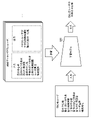
- FIG. 5 is a diagram showing an overview of the learning model in the first embodiment.
- the learning model M1 is trained with training data created based on the usage records of veteran users.
- the input portion of the training data is in the same format as the actual input to the learning model M1, and the output portion of the training data is in the same format as the actual output from the learning model M1.
- the input portion of the training data is created based on the experience of the veteran user when he was a novice user.
- the place visited by a certain user during the day and the place visited by the user at night may differ greatly, so the center of the day and the center of the night are estimated by different learning models M1.
- FIG. 5 shows the learning model M1 for daytime use, but the learning model M1 for nighttime use also has only the nighttime information as the input part, and the basic mechanism is the same.
- the training data includes, as an input part, the veteran user's "daytime center”, “daytime variation”, “daytime usage frequency”, and “overall center”. "Location”, “Overall Variation”, “Overall Number of Uses”, “User Attribute”, and “Location Attribute” are included.
- the degree of variation is, as described above, the degree of variation in the distances between the centers of a plurality of locations and the positions of individual locations. Whole is the period of the whole day including day and night. This input portion is information indicating the characteristics of the veteran user when he was a novice user.
- User attributes are attributes for classifying users.
- User attributes may be any attribute that can classify users in some way, such as age, place of residence, gender, occupation, annual income, or a combination thereof.
- User attributes are sometimes called demographic information.
- the user attribute is not limited to the example of this embodiment, and may be any attribute that can classify users in some way.
- a user attribute can also be referred to as a user's nature, type, category, or genre.
- a location attribute is an attribute for classifying locations.
- the location attribute may be any information that can classify the location in some way. or a combination thereof.
- the location attribute is not limited to the example of this embodiment, and may be anything that can classify locations.
- a location attribute can also be the nature, type, category, or genre of a location.
- the training data includes location attributes of locations most visited by experienced users.
- the training data includes, as an output part, the central location after a veteran user has accumulated a sufficient track record of usage.
- This center is the correct center.
- This central location may be the central location calculated from the usage record in all periods, or may be the central location calculated from the usage record in a part of the period including the current time.
- the novice user's "daytime center”, “daytime variation”, “daytime usage frequency”, and "overall center ', 'overall degree of variation', 'overall number of times of use', 'user attribute', and 'location attribute' are input to the learning model M1.
- the input to the learning model M1 is information indicating the characteristics of a novice user. Based on this input, learning model M1 outputs the future center of the novice user.
- the estimating system S determines the variation in the center and the distance from the place visited by the veteran user when he was a novice user, and the center after the veteran user has accumulated a sufficient track record of use. , is used to improve the accuracy of estimation of a place that a novice user is likely to visit in the future. The details of this technique are described below.
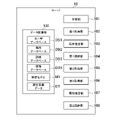
- FIG. 6 is a functional block diagram showing an example of functions realized by the estimation system S of the first embodiment.
- server 10 implements data storage unit 100 , learning unit 101 , first acquisition unit 102 , future estimation unit 103 , and first provision unit 104 .
- the data storage unit 100 is realized mainly by the storage unit 12 .
- Other functions are realized mainly by the control unit 11 .
- the data storage unit 100 stores data necessary for estimating the future center of a novice user.
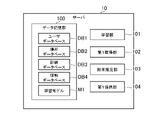
- the data storage unit 100 stores a user database DB1, a location database DB2, a training database DB3, an information database DB4, and a learning model M1.
- FIG. 7 is a diagram showing an example of data storage in the user database DB1.
- the user database DB1 is a database storing information about each of a plurality of users.
- the user database DB1 stores user IDs, names, history information, user attributes, and center locations.
- a new record is created in the user database DB1, and information about that user is stored.
- the user database DB1 may store the date and time when the user registered for use.
- History information is information about the usage history of communication services.
- the history information indicates when and where each user has used the communication service.
- history information includes the location of places visited by individual users, the location attributes of the places, and the dates and times when the places were visited by the user.
- the history information may include other information, for example, if the payment is made at a location, it may include the payment amount, or may include other information such as the user's stay time and products purchased at that location. .
- a large amount of user history information means that the user has a large number of usage records.
- the location of the place visited by the user is indicated by the latitude/longitude, coordinates, or address of that place.
- the place where the wireless communication device 20 is arranged corresponds to the place visited by the user. Therefore, the place where the wireless communication device 20 is arranged in the first embodiment can be read as the place visited by the user.
- the position of each place included in the history information may be the current position detected by the communication unit 33 or the GPS receiver 36 of the user terminal 30 when the user visited that place.
- the server 10 when a user moves to the communicable range R of a wireless communication device 20 and uses a communication service, the server 10 sends the location of the wireless communication device 20, History information including the location attribute and the date and time at that time is created and stored in the record corresponding to the user.
- the position of the place where the wireless communication device 20 is arranged and the place attribute of the place are stored in the place database DB2.
- the history information includes the location of the convenience store, the location attribute indicating "convenience store", and the date and time at that time.
- the history information includes the position of the station, the location attribute indicating "station”, and the date and time at that time.
- the user attributes stored in the user database DB1 may be entered at the time of registration for use, or may be determined dynamically based on history information. For example, static user attributes such as the user's age and place of residence are entered at the time of use registration. For example, user attributes such as user preferences and behavior patterns are dynamically determined based on history information. Further, for example, the user's current location, the IP address of the user terminal 30, the user's past payment amounts, and the like may be stored as user attributes.
- the center stored in the user database DB1 is the center estimated using the learning model M1 or the center calculated based on history information.
- the record of the novice user stores the center estimated using the learning model M1.
- a veteran user's record stores a center point that is calculated based on historical information.
- the center may be stored for each time zone such as morning, noon, and night, or the center for each day such as day of the week, weekday, and holiday may be stored. In addition, for example, the center for each location attribute may be stored.
- FIG. 8 is a diagram showing an example of data storage in the location database DB2.
- the location database DB2 is a database storing information about each of a plurality of locations.
- the location database DB2 stores the device ID of each wireless communication device 20, the position of the location where the wireless communication device 20 is arranged, and the location attribute of the location.
- the content of the location database DB2 is specified by the estimation system S administrator.
- FIG. 9 is a diagram showing an example of data storage in the training database DB3.
- the training database DB3 is a database storing training data to be learned by the learning model M1.
- training data teacher data
- a collection of these pairs is stored in the training database DB3. Details of the training data are as described in FIG. In the first embodiment, the training data is created by the learning unit 101, but the administrator may manually create the training data.
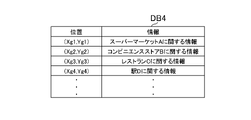
- FIG. 10 is a diagram showing a data storage example of the information database DB4.
- the information database DB4 is a database storing information provided to each of a plurality of users.
- the information database stores the location of each of a plurality of locations and information about that location. This location may be a location where the wireless communication device 20 is located, or may be a location where the wireless communication device 20 is not located.
- information regarding locations where other services affiliated with the communication service are provided may be stored in the information database DB4.
- the data storage unit 100 stores the program and parameters of the learned learning model M1.
- the learning model M1 is a model using supervised machine learning and is sometimes called artificial intelligence. Machine learning itself can use various techniques, for example, a convolutional neural network or a recursive neural network. In a broad sense, deep learning or reinforcement learning is also classified as machine learning, but the learning model M1 may be a model created using deep learning or reinforcement learning.
- the data storage unit 100 of the first embodiment stores first position information based on the position of a first place, which is a place visited by a certain veteran user in the past, and places visited by the veteran user after the first place.
- a learning model M1 in which the relationship between the second position information based on the position of the second place and the learned model is stored.
- a veteran user visits each of the first location and the second location to use the communication service.
- a veteran user is an example of a first user. Therefore, the description of the veteran user can be read as the first user.
- a first user is a user for creating training data.
- the first user is a user who knows the correct result.
- the first user may be a user different from the second user.
- the first user may be a user who has a usage track record similar to that of the second user, or a user who has a lower usage track record than the second user.
- the first place is a place visited by a veteran user during some period of time in the past. This period is a period that does not include the current time. In the first embodiment, the first place is the place visited by the first user in the first period immediately after starting to use the service. For example, the period when the veteran user was a novice user corresponds to the first period. The first period does not have to be a period like when the veteran user was a novice user, and may include a part of the period during which a certain amount of usage has been accumulated.
- the first period may have a fixed length, or may have a length according to a veteran user.
- the first period corresponds to a period from when the veteran user registers for use until a certain period of time later, or from when the veteran user registers for use until the number of times of use reaches a predetermined number.
- the first period may be of any length, for example, it may be a period of about one day to several months, or it may be a period of time until the number of times of use reaches about 3 to 10 times. good. "When the veteran user was a novice user" in the first embodiment means this period.
- the first location information is information obtained based on the location of the first location.
- the first position information is information obtained based on the positions of each of a plurality of first locations. information.
- the first position information may indicate the position of a certain pinpoint, or may indicate an area having a certain size.
- the first location information may be any information that can specify a certain location.
- the center when the veteran user was a novice user corresponds to the first position information.
- the first location information is not limited to the example of the first embodiment.
- the first location information may include the location of each of a plurality of first places visited by the veteran user when he was a novice user. In other words, the first position information may correspond to the position from which the central location is calculated.
- the second place is the place visited later than the first place among the places visited by the veteran user in the past.
- the second place is a place visited by the first user during the second period after the first period.
- the second period may include the current point in time, or may include a past point in time most recently used by a veteran user.
- the second period should be closer to the local point than the first period.
- the second period corresponds to a period after the veteran user ceases to be a novice user, that is, after a sufficient track record of use is accumulated.
- the second location information is information obtained based on the location of the second location.
- the second location information is information acquired based on the location of each of a plurality of second locations. It may be information. In the first embodiment, a case will be described in which the second location information is acquired based on both the location of the first location and the location of the second location.
- Location information may be obtained.
- the second position information may indicate the position of a certain pinpoint, or may indicate an area having a certain size.
- the second location information may be any information that can identify some location. In the first embodiment, the center after the veteran user is no longer a novice user corresponds to the second position information.
- the second location information is not limited to the example of the first embodiment.
- the second location information may include the location of each of a plurality of second locations visited by the veteran user after he ceased to be a novice user. In other words, the position from which the central location is calculated may correspond to the second position information.
- the data stored in the data storage unit 100 is not limited to the above examples.
- the data storage unit 100 may store a learning model M1 before training data is learned and a program necessary for learning the training data.
- the learning unit 101 causes the learning model M1 to learn the training data stored in the training database DB3.
- Various techniques can be used for the learning method itself of the learning model M1, and for example, the gradient descent method or the error backpropagation method can be used. As previously mentioned, deep learning or reinforcement learning techniques may be utilized.
- the learning unit 101 adjusts the parameters of the learning model M1 so that the output portion of the training data is output when the input portion of the training data is input.
- the first location information includes a first central location, which is a central location based on a plurality of first locations visited by the experienced user in the past.
- the second location information includes a second centroid that is a centroid based on the plurality of second locations visited by the experienced user after the plurality of first locations.
- the learning model M1 learns the relationship between the first center of a veteran user and the second center of the veteran user.
- the first center may be calculated inside the learning model M1.
- the learning model M1 may be input with individual positions necessary for calculating the first center point.
- the learning unit 101 identifies a plurality of first places visited by the veteran user when he was a novice user, based on the history information of the veteran user stored in the user database DB1.
- the learning unit 101 identifies, as a first place, a place where the date and time of use included in the history information is included in the first period.
- the learning unit 101 calculates the average position of each of the specified plurality of first places and acquires it as the first central location.
- the first center may be a simple average of the positions of each of the plurality of first places, or may be a weighted average using a weighting factor according to the date and time of visit by the experienced user. In the case of weighted averaging, the closer to the current time, the greater the weighting factor may be.
- a first center may be calculated for each area having a certain extent. By calculating the first center of gravity for each region, the center of the experienced user can be calculated for each region, such as the center near the home of the experienced user or the center near the workplace.
- the learning unit 101 identifies a plurality of second places visited by the veteran user after he ceased to be a novice user, based on the history information of the veteran user stored in the user database DB1.
- a case will be described in which all periods are considered in the calculation of the second central location. Calculate the average of each position and take it as the second centroid.
- the second center may be a simple average or a weighted average.
- the learning unit 101 creates training data including the first center of a certain experienced user and the second center of the experienced user.
- the learning unit 101 creates training data for each of a plurality of veteran users, and stores it in the training database DB3. Based on the training data, the learning unit 101 adjusts the parameters of the learning model M1 so that when the first center of a certain experienced user is input, the second center of the experienced user is output.
- the first position information further includes a first degree of variation, which is the degree of variation in distance between the first center and the positions of each of the plurality of first locations.
- the learning model M1 learns the relationship between the first center of a certain veteran user and the degree of variation, and the second center of the veteran user.
- the first degree of variation may be calculated inside the learning model M1.
- the learning model M1 may be input with individual positions necessary for calculating the first degree of variation.
- the learning unit 101 calculates the distance between the first center and the positions of each of the multiple first places visited by the veteran user when he was a novice user.
- the learning unit 101 calculates the degree of dispersion of the calculated distance for each first location, and obtains the degree of dispersion as the first degree of dispersion.
- the degree of dispersion can be expressed by any index, such as standard deviation, variance, or covariance.
- a known calculation formula may be used as the calculation formula itself for calculating these indexes.
- the degree of variation can also be referred to as the degree of scattering or the degree of concentration.
- the learning unit 101 creates training data including the first center and the degree of variation of a certain experienced user, and the second center of the experienced user.
- the learning unit 101 creates training data for each of a plurality of veteran users, and stores it in the training database DB3. Based on the training data, the learning unit 101 sets the learning model M1 so that the second center of the experienced user is output when the first center and the first degree of variation of a certain experienced user are input. Adjust parameters.
- the learning model M1 is created based on the first feature information regarding the veteran user, which is different from the first position information.
- the first feature information is information related to the features of a veteran user. In terms of features of places visited by veteran users, the first position information also indicates some features, but the first feature information is information indicating features other than places visited by veteran users. Specific examples of the first characteristic information will be described later, but in addition to the examples described later, information such as the veteran user's gender, occupation, annual income, past usage amount, or usage status of other services corresponds to the first characteristic information. may
- the first feature information of a veteran user is included in the training data and used for learning the learning model M1. Therefore, learning the first feature information of the experienced user by the learning model M1 means that the learning model M1 is created based on the first feature information.
- the training data shown in FIG. 9 information other than the center and the degree of variation corresponds to the first feature information.
- Separate learning models M1 may be prepared for each feature indicated by the first feature information. For example, separate learning models M1 may be prepared for each feature such as the age, sex, place of residence, or number of times of use of a veteran user. Therefore, preparing a separate learning model M1 for each feature indicated by the first feature information of the experienced user may mean that the learning model M1 is created based on the first feature information.
- separate learning models M1 may be prepared for each location attribute.
- a learning model M1 dedicated to each location attribute may be prepared, such as a learning model M1 for convenience stores, a learning model M1 for stations, or a learning model M1 for supermarkets.
- preparing separate learning models M1 for each location attribute may mean that the learning models M1 are created based on the first feature information.
- the calculation of the center and degree of dispersion may be performed based on the location of the location attribute. That is, the locations of the other location attributes may not be referenced in the centroid and variability calculations, or may be given less weight in the centroid and variability calculations.
- the central location and degree of variation are calculated based on the location of the location attribute of "convenience store". The same is true for other location attributes. The same applies to the center of the novice user and the degree of variation input to the learning model M1 that has already been learned, and is calculated based on the position of the location attribute corresponding to the learning model M1.
- the first feature information includes the first number of times of use, which is the number of times the service has been used by experienced users.
- the learning model M1 may be created based on the first usage count. Based on the user database DB1, the learning unit 101 counts the number of times of use when the veteran user was a novice user, and acquires it as the first number of times of use. The learning unit 101 creates training data including the first usage count of a certain veteran user. The learning unit 101 sets the learning model M1 so that when the first number of times of use of a certain veteran user is input together with other features such as the first center, the second center of the veteran user is output. Adjust parameters.
- the first characteristic information includes the first number of times of use in a predetermined period.
- the learning model M1 may be created based on the first number of times of use in a predetermined period.
- the predetermined period is part of the first period.
- the daytime learning model M1 is created, so the daytime period corresponds to the predetermined period.
- the predetermined period may be another period, such as morning or evening, weekdays, holidays, or days of the week.
- the predetermined time period may be a season, or a unique time period not specifically classified into these may be defined.
- the learning unit 101 Based on the user database DB1, the learning unit 101 counts the number of times of use during the day when the experienced user was a novice user, and acquires it as the first number of times of use during the day.
- the learning unit 101 creates training data including the number of times of first use during the daytime by a certain veteran user.
- the learning unit 101 sets the learning model so that when the first number of times of daytime use of a certain veteran user is input together with other features such as the first center, the second center of the veteran user is output. Adjust the parameters of M1.
- the first feature information includes user attributes that are attributes of experienced users.
- the learning model M1 may be created based on user attributes.
- the learning unit 101 acquires the user attributes of the veteran user based on the user database DB1.
- the learning unit 101 creates training data including user attributes of a veteran user.
- the learning unit 101 sets the parameters of the learning model M1 so that when the user attribute of a certain veteran user is input together with other features such as the first center, the second center of the veteran user is output. adjust.
- the first feature information includes a first location attribute, which is an attribute of the first location.
- a learning model M1 may be created based on the first location attribute.
- the learning unit 101 acquires the first location attribute based on the location database DB2.
- the learning unit 101 creates training data based on first place attributes of first places visited by an experienced user.
- the learning unit 101 is configured so that when a first location attribute of a first location visited by a veteran user is input together with other features such as a first center, the second center of the veteran user is output. , the parameters of the learning model M1 are adjusted.
- the first feature information includes the second location attribute, which is the attribute of the second location.
- a learning model M1 may be created based on the second location attribute.
- the learning unit 101 acquires the second location attribute based on the location database DB2.
- the learning unit 101 creates training data based on second place attributes of second places visited by a veteran user. For example, the learning unit 101 creates training data based on a second place with the same second place attribute as the first place attribute of the first place visited by a certain veteran user.
- the learning unit 101 adjusts the parameters of the learning model M1 so that the output portion of the training data is output when the input portion of the training data created based on the second location attribute is input. This point is as described above using the location attribute of "convenience store" as an example.
- training data may be created based on the locations of "convenience stores” that veteran users have visited in the past, and the learning model M1 may be learned.
- the input to the trained learning model M1 may be created based on the locations of "convenience stores” visited by the novice user in the past.
- the learning model M1 may be created based on the first location information based on the location of the first location visited by the experienced user during a predetermined period of time in the past.
- the meaning of the predetermined period is as described above.
- the learning unit 101 acquires the first location information based on the user database DB1, based on the location of the first location visited during the day when the veteran user was a novice user.
- the learning unit 101 creates training data including this first position information and adjusts the parameters of the learning model M1.
- the first acquisition unit 102 acquires third position information based on the position of the third place, which is the place visited by the novice user in the past.
- a novice user is an example of a second user. Therefore, the description of the novice user can be read as the second user.
- the second user is a user whose center is to be estimated. In the first embodiment, the second user visits the third place to use the service, and is a user who uses the service less frequently than the first user. A different user may be used.
- the third place is a place visited by the novice user during all or part of the past period.
- the length of this period may be different than the length of the first period described above.
- the third location information is information obtained based on the location of the third location.
- the third location information is information acquired based on the location of each of a plurality of third locations. It may be information.
- the third position information may indicate the position of a certain pinpoint, or may indicate an area having a certain size.
- the third location information may be any information that can specify some location.
- the third location information includes a third central location, which is a central location based on a plurality of third locations visited by the novice user in the past.
- the third location information is not limited to the example of the first embodiment, and for example, the location of each of a plurality of third places visited by the novice user may be included in the third location information. That is, the position from which the center is calculated may correspond to the third position information.
- the first acquisition unit 102 identifies a plurality of third places visited by the novice user based on the history information of the novice user stored in the user database DB1.
- the first obtaining unit 102 calculates the average position of each of the specified plurality of third places and obtains it as the third central location.
- the third central location may be a simple average or a weighted average, like the first central location and the second central location.
- the third position information further includes a second degree of variation, which is the degree of variation in the distance between the third center and the positions of each of the plurality of third locations.
- the first acquisition unit 102 calculates the distance between the third center and the position of each of the plurality of third places visited by the novice user.
- the first acquisition unit 102 calculates the degree of dispersion of the calculated distance for each third location and acquires it as a second degree of dispersion.
- the second degree of variation can be expressed by an arbitrary index, and can be calculated based on a formula corresponding to each index.
- the first acquisition unit 102 acquires the third location information based on the location of the third location visited by the novice user during a predetermined period of time in the past.
- the meaning of the predetermined period is as described above.
- the first acquisition unit 102 acquires the third location information based on the location of the third location visited by the novice user during the day, based on the user database DB1.
- the predetermined period is not limited to the daytime hours.
- the future estimation unit acquires the output of the learning model M1 corresponding to the third position information as the estimation result of the fourth position information based on the position of the fourth place, which is the place that the novice user is likely to visit in the future.
- the fourth place is a place that is estimated to be visited by novice users in the future.
- the fourth position information is information acquired based on the output of the learning model M1. In the first embodiment, the case where the output of the learning model M1 directly corresponds to the fourth position information will be described, but information obtained by processing the output of the learning model M1 in some way may correspond to the fourth position information.
- the fourth position information may indicate the position of a certain pinpoint, or may indicate an area having a certain size.
- the fourth position information may be any information that can specify some position.
- the fourth location information may include multiple locations. For example, the fourth location information may include the location of each of a plurality of fourth locations likely to be visited by a novice user.
- the fourth location information includes a fourth central location, which is a central location based on a plurality of fourth locations that novice users are likely to visit in the future.
- the future estimation unit 103 acquires the output of the learning model M1 corresponding to the third center as the estimation result of the beginner user's fourth center.
- the third central location and the second degree of variation are input to the learning model M1, and the future estimation unit 103 obtains the third central location and the second degree of variation as the estimation result of the fourth central location of the beginner user. Get the output of the learning model M1 corresponding to .
- the learning model M1 acquires the third center and the degree of second variation as one of the features of the novice user, and outputs the result of estimation of the fourth center according to the feature.
- the learning model M1 learns the first feature information of the veteran user, the future estimation unit 103, based on the second feature information of the novice user, which is different from the third position information, , to obtain the estimation result of the fourth location information.
- the learning model M1 acquires the second feature information as one of the features of the novice user, and outputs a result of estimating the fourth central location according to the feature.
- the second characteristic information includes the second number of times of use, which is the number of times the service is used by a novice user.
- the future estimation unit 103 acquires the estimation result of the fourth location information based on the second number of times of use.
- the learning model M1 acquires the second number of times of use as one of the features of the novice user, and outputs a result of estimating the fourth central location according to the feature.
- the second characteristic information includes the second number of times of use in a predetermined period.
- the future estimation unit 103 acquires the estimation result of the fourth location information based on the second number of times of use in the predetermined period.
- the learning model M1 acquires the second number of times of use, which is the number of times of daytime use by the novice user, as one of the characteristics of the novice user, and outputs the estimation result of the fourth central location according to the characteristic.
- the second feature information includes novice user attributes that are attributes of novice users.
- the future estimation unit 103 acquires the estimation result of the fourth position information based on the novice user attribute.
- the learning model M1 acquires the novice user attribute as one of the features of the novice user, and outputs the result of estimation of the fourth central location according to the feature.
- information such as the third center of the novice user may be input to the learning model M1 corresponding to the novice user attribute.
- the second feature information includes the third location attribute, which is the attribute of the third location.
- the future estimation unit 103 acquires estimation results of the fourth location information based on the third location attribute.
- the learning model M1 acquires the third location attribute as one of the features of the novice user, and outputs a result of estimating the fourth central location according to the feature.
- the learning model M1 is prepared for each place attribute, the information of the third center etc. is input to the learning model M1 corresponding to the location attribute of the place used in the calculation of the third center etc. should be
- the future estimation unit 103 acquires the result of estimating the fourth position information based on the positions of the fourth places that are likely to be visited during a predetermined period of time in the future.
- the learning model M1 outputs a result of estimating the fourth position information based on the positions of the fourth places that the novice user is likely to visit in the future daytime.
- the future estimation unit 103 acquires the output of the learning model M1 as the estimation result of the fourth location information of the novice user who uses the service less frequently than the first user.
- the first providing unit 104 provides the novice user with information determined based on the fourth position information.
- the first providing unit 104 provides the novice user with information associated with a location within a predetermined distance from the location indicated by the fourth location information based on the information database DB4.
- This predetermined distance may be of any length and may be a fixed value or a variable value. The length of this predetermined distance may differ according to the area of the position indicated by the fourth position information. For example, in rural areas, the predetermined distance may be longer than in urban areas. If the fourth location information is an area having a certain size, information about the location within this area may be provided.
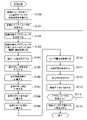
- FIG. 11 is a flow diagram showing an example of learning processing.
- the server 10 calculates the number of times communication services are used by each of a plurality of users based on the user database DB1 (S100).
- S100 the number of uses for all users is calculated, but the number of uses for some users may be calculated.
- the number of times of use is calculated for all periods, the number of times of use may be calculated only for a part of the period.
- the number of history information is acquired as the number of times of use.
- the server 10 identifies a plurality of veteran users based on the number of times the communication service has been used (S101).
- the server 10 identifies multiple users whose number of times of use is equal to or greater than a threshold as veteran users.
- the threshold for identifying the veteran user is assumed to be a fixed value, but the threshold may be a variable value.
- a predetermined number of users or a predetermined percentage of users may be identified as the veteran users in descending order of the number of times of use.
- the server 10 determines a veteran user to be processed in S103 to S113 from among the plurality of veteran users identified in S101 (S102). In S102, the server 10 determines one of the veteran users for whom training data has not yet been created, from among the plurality of veteran users identified in S101, as the veteran user to be processed.
- the server 10 acquires, from the history information of the veteran user to be processed, history information from when the veteran user was a novice user (S103). In S ⁇ b>103 , the server 10 acquires a predetermined number of pieces of history information in descending order of date and time of use included in the history information of the veteran user to be processed. The server 10 may acquire, instead of acquiring a predetermined number of pieces of history information, history information within a certain period of time after the veteran user to be processed has registered for use.
- the server 10 calculates the center of daytime when the veteran user to be processed was a novice user (S104). In S104, the server 10 calculates the average of the usage positions in the daytime hours included in the history information acquired in S103, and acquires it as the center of daytime.
- the server 10 calculates the variation during the day when the experienced user to be processed was a novice user (S105).
- the server 10 calculates the distance between the use position and the daytime center calculated in S104 for each use position of which the use date and time included in the history information acquired in S103 is in the daytime. .
- the server 10 calculates the standard deviation or the like of the calculated distance and acquires it as the degree of variation.
- the server 10 calculates the number of times of use during the day when the veteran user to be processed was a novice user (S106).
- the server 10 counts the number of pieces of history information whose date and time of use are during the daytime period among the history information acquired in S ⁇ b>103 , and obtains the number of times of use during the daytime.
- the server 10 calculates the overall center when the veteran user to be processed was a novice user (S107).
- the calculation method of S107 is the same as that of S104, but the history information of all time periods when the veteran user to be processed was a novice user, in addition to the history information of the daytime period of use included in the history information. It differs in that the information is used in calculations. This point is the same for the processing of S108 and S109.
- the server 10 calculates the degree of overall variation when the veteran user to be processed was a novice user (S108). Based on the history information acquired in S103, the server 10 calculates the total number of times of use when the veteran user to be processed was a novice user (S109).
- the server 10 acquires the user attributes of the veteran user to be processed based on the user database DB1 (S110). Based on the history information acquired in S103, the server 10 acquires the location attributes of the places visited by the veteran user when he was a novice user (S111). In S111, the most frequently visited place attribute is acquired.
- the server 10 calculates the central location after the veteran user ceases to be a novice user, that is, after the veteran user has accumulated a sufficient track record of use, based on the history information for all periods of the veteran user to be processed (S112).
- the calculation method of S112 is the same as that of S104 and S107, but differs in that the calculation uses not only the history information when the veteran user was a novice user, but also the history information of the entire period of the user. It should be noted that the history information of only part of the period may be used in the calculation instead of the entire period.
- the server 10 creates a pair of each information acquired in S104 to S111 and the correct central location calculated in S112 as training data corresponding to the veteran user to be processed, and stores it in the training database DB3. (S113).
- the server 10 determines whether there is a veteran user who has not yet created training data (S114). If it is determined that there is a veteran user who has not created training data yet (S114; Y), the process returns to S102. In this case, a veteran user for whom training data is to be created next is determined, and the processes of S103 to S113 are executed for that veteran user to create training data corresponding to that veteran user.
- the server 10 causes the learning model M1 to learn the individual training data stored in the training database DB3 (S115), and performs this process. ends.
- the parameters of the learning model M1 are adjusted so as to obtain the relationship between the input and output contained in each piece of training data.
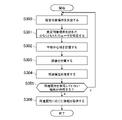
- FIG. 12 is a flowchart illustrating an example of estimation processing.
- the server 10 calculates the number of times communication services are used by each of the plurality of users based on the user database DB1 (S200).
- the processing of S200 is the same as that of S100.
- the server 10 identifies a plurality of novice users based on the number of times communication services are used (S201).
- the process of S201 is similar to the process of S101, but differs from the process of S101 in that a plurality of users whose number of times of use is less than the threshold are identified instead of users whose number of times of use is equal to or greater than the threshold.
- the server 10 determines, from among the plurality of novice users identified in S201, a novice user to be processed in S203 to S212 (S202). In S202, the server 10 determines, as a processing target beginner user, one of the plurality of beginner users identified in S201, whose center location has not yet been estimated.
- the server 10 calculates the noon center of the novice user based on the history information of the novice user to be processed (S203). In S ⁇ b>203 , the server 10 calculates the average of the usage positions in the daytime hours of usage included in the history information of the novice user to be processed, and obtains it as the center of the daytime.
- the server 10 calculates the degree of variation during the daytime for the novice user based on the history information of the novice user to be processed (S204). In S204, the server 10 calculates the distance between the usage location and the daytime center calculated in S203 for each usage location whose usage date and time included in the history information of the novice user to be processed is during the daytime. calculate. The server 10 calculates the standard deviation or the like of the calculated distance and acquires it as the degree of variation.
- the server 10 calculates the number of uses during the daytime by the novice user based on the history information of the novice user to be processed (S205). In S ⁇ b>205 , the server 10 counts the number of pieces of history information for which the date and time of use are during the daytime, among the history information of the novice user to be processed, and obtains the number of times of use during the daytime.
- the server 10 calculates the overall center of the novice user based on the history information of the novice user to be processed (S206).
- the calculation method of S206 is the same as that of S203, except that the history information of all time periods of the novice user is used in the calculation, in addition to the history information of the daytime period of use included in the history information. different. This point is the same for the processing of S207 and S208.
- the server 10 calculates the overall degree of variation for the novice user based on the history information of the novice user to be processed (S207).
- the server 10 calculates the total number of uses of the novice user based on the history information of the novice user to be processed (S208).
- the server 10 acquires the user attributes of the novice user to be processed based on the user database DB1 (S209).
- the server 10 acquires the location attributes of the places visited by the novice user based on the history information of the novice user to be processed (S210).
- the server 10 inputs each information acquired in S203 to S210 to the learning model M1 (S211), acquires the output from the learning model M1 as the future center of the beginner user to be processed, and stores it in the user database DB1. (S212).
- the server 10 determines whether or not there is a novice user who has not yet estimated the center (S213). If it is determined that there is a novice user who has not estimated the center yet (S213; Y), the process returns to S202. In this case, a novice user to be processed whose center is to be estimated next is determined, the processes of S203 to S212 are executed for the novice user, and the future center of the novice user is estimated.
- the server 10 based on the user database DB1 and the information database DB4, for each of the plurality of users, the user is provided (S214), and the process ends.
- the learning model M1 is used to acquire the fourth center, which is the future center of the novice user, thereby estimating the place that the novice user is likely to visit in the future. accuracy is increased.
- the learning model M1 learns the tendencies of veteran users when they were novice users, and the output from the learning model M1 reflects the tendencies of the veteran users, so the accuracy of the estimation results is increased.
- the estimation system S causes the learning model M1 to learn the relationship between the veteran user's first center and the veteran user's second center, and as a result of estimating the future fourth center of the novice user, ,
- the learning model M1 learns the relationship between the veteran user's first center and the veteran user's second center, and as a result of estimating the future fourth center of the novice user, .
- the learning model M1 learns the relationship between the center of the case and the center of the case more strongly, and the accuracy of estimation of the fourth center is effectively increased.
- the estimation system S causes the learning model M1 to learn the relationship between the veteran user's first center and the degree of variation, and the veteran user's second center.
- the learning model M1 By acquiring the output of the learning model M1 corresponding to the past third center and the second variation of the center of the novice user as the estimation result of the location, the first variation that will have a stronger influence on the future center of the learning model is obtained. Since M1 is learning, the accuracy of the estimation of the fourth center location is effectively increased.
- the estimation system S has a learning model M1 created based on the first feature information about the experienced user, and acquires the estimation result of the fourth center based on the second feature information about the novice user. Since information other than the position of the center, etc., is also learned by the learning model M1, the accuracy of estimation of the fourth center is effectively increased. For example, if the current center of a novice user is unreliable, the tendency of experienced users with similar characteristics is emphasized to estimate the fourth center. Even the user can estimate the fourth center to some extent.
- the learning model M1 is created based on the first number of times of use, which is the number of times of use of the communication service by the experienced user, and based on the second number of times of use, which is the number of times of use of the service by the novice user,
- the fourth central location is estimated based on the tendency of other users with similar usage counts, so the accuracy of estimating the fourth location information is effectively increased.
- the fourth center is estimated based on the tendency of veteran users who have used similar numbers of times for a certain period of time after registering for use, even if the current center is unreliable for novice users, can estimate the fourth center of
- the estimation system S has a learning model M1 created based on the first number of times of use in the daytime, and acquires the estimation result of the fourth center based on the second number of times of use in the daytime.
- a fourth center can be estimated.
- the estimation system S has the learning model M1 created based on the user attributes of the experienced user, and obtains the estimation result of the fourth central location based on the user attributes of the novice user. Since the fourth central location is estimated based on the tendencies of other users, the estimation accuracy of the fourth central location is effectively increased. For example, if the current center of the novice user is unreliable, the tendency of experienced users with similar user attributes is emphasized and the fourth center is estimated. Even so, it is possible to infer a certain degree of a fourth center.
- the estimation system S estimates the fourth center location based on the information with the same location attribute. effectively increases the accuracy of For example, for a novice user who frequently visits locations with the location attribute “cafe”, the tendency of experienced users who often visit locations with the location attribute “cafe” is higher than the tendency of veteran users who often visit locations with the location attribute “convenience store”. Considering the location attribute effectively increases the accuracy of the estimation of the fourth centroid, as it may be more reliable.
- the estimation system S uses the center of the place with the same place attribute as the place visited by the veteran user when he was a novice user. , the accuracy of estimation of the fourth central location is effectively increased.
- the learning model M1 can learn the central location when a veteran user visits a "convenience store.” As a result, it is possible to accurately estimate the center of the "convenience store" that the novice user will visit in the future.
- the estimation system S has a learning model M1 created based on the first position information based on the position of the first place visited by the veteran user in the daytime, and the estimation result of the fourth center that the veteran user will visit in the future in the daytime.
- the fourth central location is estimated according to the time zone, and the accuracy of the estimation of the fourth central location is effectively increased.
- the estimation system S learns the relationship between the places visited by the veteran user in the first period immediately after starting to use the service and the places visited by the veteran user in the second period after the first period.
- the output of the learning model M1 as the estimation result of the fourth central location of the novice user who has been trained by the model M1 and who has used the service less frequently than the veteran user, the user with insufficient usage record is obtained. , the accuracy of estimation of the fourth center is increased.
- the estimation system S can provide the user with useful information in advance by providing the novice user with information determined based on the fourth central location. For example, if the current position of a novice user is acquired in real time and information corresponding to the current position is provided, the novice user may not notice the information, but the future center of the novice user can be estimated and By providing information according to the center in advance, it becomes easier for a novice user to notice the information. Furthermore, since the information is provided based on the fourth center that the user is likely to visit in the future, it is possible to provide information that the user is more interested in.
- the usage attribute (details will be described later), which is the attribute of the place where a certain wireless communication device 20 is arranged, is based on the distance between the position of the place and the center of the user who visited the place. An estimated case will be explained. In the second embodiment, description of the same configuration as in the first embodiment is omitted.
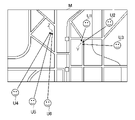
- FIG. 13 is a diagram showing an overview of the second embodiment.
- FIG. 13 shows a map M of a resort area X where ski resorts are located.
- the locations of stores Y and Z, which are convenience stores, are plotted on map M in FIG.
- a wireless communication device 20 is arranged in each of the stores Y and Z.
- FIG. A location attribute of "convenience store" is associated with each of the stores Y and Z, and the stores Y and Z may be approximately the same distance from each other from the nearest station.
- the uses of the shops where the wireless communication devices 20 of shops Y and Z are arranged may differ from each other.
- store Y may be used mainly by users U1 to U3 who are residents of the neighborhood.
- the store Z may be used mainly by users U4 to U6 who are tourists.
- the usage of each of the stores Y and Z can be determined based on the residence of the users who used the wireless communication devices 20 of each of the stores Y and Z. can be identified. For example, if the user who uses the wireless communication device 20 of the store Y resides near the resort area X, it can be specified that the store Y is a "convenience store” "for nearby residents". If the user who uses the wireless communication device 20 of the store Z resides in an urban area far from the resort area X, the store Z can be identified as a "convenience store” for tourists.
- Information such as "for local residents” and “for tourists” is a type of attribute because it is possible to classify stores Y and Z from some point of view.
- This attribute is an attribute from a different point of view from the location attribute "convenience store” associated with stores Y and Z. Since this attribute is information capable of classifying the uses of stores Y and Z, it will be referred to as a use attribute hereinafter.
- the usage attribute of a place can be estimated from the distance between the position of the place and the positions of places usually visited by users who have visited the place.
- the user has registered the correct place of residence with the communication service. Users often register their old place of residence before moving with the communication service. In this case, the correct usage attribute cannot be estimated. In addition, the user may not register the place of residence with the communication service, and some communication services do not require registration of the place of residence. In this case, it is not possible to estimate the usage attribute itself using the place of residence.
- the estimation system S of the second embodiment provides a distance based on, the usage attribute of the wireless communication device 20 is estimated with high accuracy. The details of this technique are described below.
- FIG. 14 is a functional block diagram showing an example of functions realized by the estimation system S of the second embodiment.
- the server 10 includes a data storage unit 100, a learning unit 101, a first acquisition unit 102, a future estimation unit 103, a first provision unit 104, a second acquisition unit 105, a third acquisition unit 106, an attribute An estimator 107 and a second provider 108 are implemented.
- the data storage unit 100 is similar to that of the first embodiment, but some functions are different from those of the first embodiment.
- the learning unit 101, the first acquisition unit 102, the future estimation unit 103, and the first provision unit 104 are the same as in the first embodiment.
- Each of second acquisition unit 105 , third acquisition unit 106 , attribute estimation unit 107 , and second provision unit 108 is implemented mainly by control unit 11 .
- the estimation system S of the second embodiment may not include the learning unit 101, the first acquisition unit 102, the future estimation unit 103, and the first provision unit 104.
- the center of the novice user may not be used in estimating the usage attribute, and only the center of the veteran user may be used in estimating the usage attribute.
- the novice user's center of gravity may be used in estimating usage attributes. In this case, the novice user's center is calculated in the same way as for the experienced user.
- the data storage unit 100 stores data necessary for estimating the usage attribute of the location where the wireless communication device 20 is arranged.
- the data storage unit 100 stores attribute definition data DT in addition to the same data as in the first embodiment. Also, part of the location database DB2 is different from that of the first embodiment.
- FIG. 15 is a diagram showing a data storage example of the location database DB2 in the second embodiment.
- the location database DB2 stores device IDs of the wireless communication devices 20 placed at each of a plurality of locations in association with usage attributes of the location.
- This usage attribute is an attribute estimated by the attribute estimation unit 107 .
- the location attribute is an attribute that can roughly classify the business type of each location, and the usage attribute is an attribute that can finely classify the usage of each location.
- FIG. 16 is a diagram showing a data storage example of the attribute definition data DT.
- the attribute definition data DT defines the relationship between a condition related to the distance from the center of a user visiting a place and the use attribute associated with the place when the condition is met. This is the data that has been In the example of FIG. 16, the attribute definition data DT defines two-step distance ranges with one threshold value as a condition. If the distance is less than the threshold, then the usage attribute "for neighbors" is defined. If the distance is greater than or equal to the threshold, the usage attribute "for tourists" is defined. There may be two or more thresholds, and three or more stages of distance ranges may be defined in the attribute definition data DT.
- the second acquisition unit 105 acquires position information related to the positions of other places visited by the user who visited the estimation target location, which is the location for which the usage attribute is to be estimated.
- the second acquisition unit is an example of a position information acquisition unit. Therefore, the part described as the second acquisition unit can be read as the position information acquisition unit.
- the estimation target location may be any location that has been visited by at least one user.
- the location where the wireless communication device 20 is arranged corresponds to the estimation target location.
- the estimation target location may be any one of the first to third locations described in the first embodiment.
- the location to be estimated may be any location other than the first to third locations as long as communication services are available.
- Other locations are locations different from the estimated location.
- Other places are places used to estimate the usage attribute of the estimation target place.
- the other place may be a place visited by the user before the place to be estimated, or a place visited by the user after the place to be estimated. At least one other location may exist for one estimation target location.
- each of the estimation target location and other locations is the store used by the user.
- the estimation target location can be called an estimation target store.
- the other location can be said to be another store different from the estimation target store.
- the usage attribute can be said to be an attribute that indicates the usage of the estimation target store.
- Location information is information obtained based on the location of other places.
- the location information may be obtained based on the location of each of multiple other locations, or may be obtained based on the location of one other location.
- the location information includes an average central location, which is the average of the central location of each of the locations visited by each of the plurality of users who have visited the location to be estimated.
- the location information is not limited to the average center location, and may be other information.
- at least one of the first to third position information described in the first embodiment may correspond to the position information in the second embodiment.
- the center of a plurality of other locations visited by that user may correspond to the location information.
- the location information may indicate the location of another location visited by the user before or after visiting the estimation target location.
- the location information may include the location of each of multiple other locations visited by the user.
- the second acquisition unit 105 identifies multiple users who have visited the estimation target location based on the history information stored in the user database DB1.
- the second acquisition unit 105 calculates an average center based on the specified center of the plurality of users stored in the user database DB1, and acquires it as position information.
- the average center is not the average of the centers of each of the multiple users, but rather the center of all other places visited by each of the multiple users without calculating the center of each individual user. may be calculated as the mean centroid.
- a third acquisition unit 106 acquires the positional relationship between the position of the estimation target location and the position indicated by the positional information.
- the third acquisition unit is an example of a positional relationship acquisition unit. Therefore, the portion described as the third acquisition unit can be read as the positional relationship acquisition unit.
- the position information includes the average central location, so the third acquisition unit 106 acquires the positional relationship between the location of the estimation target location and the average central location.
- a positional relationship is the degree of deviation between one position and another.
- a distance is an example of a positional relationship. Therefore, the location described as distance can be read as positional relationship.
- the positional relationship may be information other than distance.
- a vector between the position of the estimation target location and the position indicated by the position information may correspond to the positional relationship. That is, the positional relationship may mean information on both distance and direction. Alternatively, for example, only the direction may correspond to the positional relationship without including distance information.
- the third acquisition unit 106 acquires the distance between the position of the estimation target location and the average center as the positional relationship. This distance may be a straight-line distance, or may be a distance in consideration of the movement route of the user. In the second embodiment, since a plurality of estimation target locations exist, the third acquisition unit 106 obtains, for each estimation target location, the position of the estimation target location and the average center of the plurality of users who have visited the estimation target location. Get the distance between the ground and
- the attribute estimation unit 107 estimates the use attribute of the estimation target location based on the positional relationship acquired by the third acquisition unit 106 .
- the attribute definition data DT defines the relationship between the positional relationship acquired by the third acquisition unit 106 and the usage attribute of the estimation target location.
- the attribute estimation unit 107 estimates the use attribute of the location to be estimated based on the attribute definition data DT and the positional relationship acquired by the third acquisition unit 106 .
- the attribute definition data DT has been described as data in a table format, but the attribute definition data DT may be in any data format.
- the attribute definition data DT may be defined as part of the program code or defined by a calculation formula.
- the learning model M2 can be used to estimate the usage attribute, so the learning model M2 described in the modification (2-8) also It can also be said to be an example of the attribute definition data DT. That is, the attribute definition data DT may be in the form of a model using machine learning.
- the attribute estimation unit 107 estimates the use attribute of the estimation target location based on the distance acquired by the third acquisition unit 106 . Based on the attribute definition data DT, the attribute estimating unit 107 identifies the condition that the distance acquired by the third acquiring unit 106 satisfies, and estimates the usage attribute associated with the condition as the usage attribute of the location to be estimated. . In the data storage example of FIG. If the obtained distance is 20 km or more, the use attribute of "for tourists" is estimated.
- an estimation target location is associated with a location attribute from a viewpoint different from the use attribute estimated by the attribute estimation unit 107 .
- a location attribute is an example of another attribute. Therefore, the location attribute can be read as another attribute.
- a viewpoint is a way of defining an attribute. For example, the location attribute is defined from a first viewpoint such as the type of industry of the estimation target location, and the usage attribute is defined from a second perspective that is the usage of the estimation target location.
- the location attribute is determined from the first group of candidates in which location attribute candidates are defined. For example, the location attribute is determined from the first candidate group such as "convenience store”, “station”, “cafe”, and “event venue”.
- the usage attribute is determined from a second set of candidates defined for the usage attribute. For example, the usage attribute is determined from the second candidate group such as "for local residents” and "for tourists”.
- the attribute estimation unit 107 estimates the usage of the location to be estimated as a usage attribute different from the location attribute.
- the attribute estimating unit 107 may estimate the usage attribute of the estimation target location in consideration of other factors such as the location attribute of the estimation target location, the user's usage amount, the user's age, or the user's usage frequency. . Also, the attribute estimated by the attribute estimation unit 107 is not limited to the usage attribute.
- the attribute estimating unit 107 may be any attribute that can be estimated from the positional relationship acquired by the third acquiring unit 106 . For example, if the location attribute described in the first embodiment has a correlation with this positional relationship, the attribute estimation unit 107 may estimate the location attribute. Alternatively, for example, the attribute estimation unit 107 may estimate a user attribute of a user who visits the estimation target location, or may estimate an attribute indicating the purpose of the user's visit to the estimation target location.
- the second providing unit 108 provides the user with information about the estimation target location based on the usage attribute of the estimation target location. For example, the second providing unit 108 determines a user to whom information regarding the inferred target location is to be provided based on the use attribute of the inferred target location, and provides the determined user with the information. In the example of FIG. 13 , the usage attribute “for local residents” is estimated for store Y, so the second providing unit 108 provides information about store Y to users whose center location is less than the threshold from store Y. I will provide a.
- the second providing unit 108 provides information on the store Y to users whose central location is greater than or equal to the threshold from the store Z.
- the second providing unit 108 may determine the content of the information itself based on the usage attribute instead of determining the user to whom the information is provided based on the usage attribute.
- FIG. 17 is a flow chart showing an example of processing executed by the estimation system S of the second embodiment.
- the processing of FIG. 17 is executed by the control unit 11 operating according to the program stored in the storage unit 12 .
- the processing in FIG. 17 is an example of processing executed by the functional blocks shown in FIG.
- the server 10 determines an estimation target location from locations where each of the plurality of wireless communication devices 20 is arranged, based on the location database DB2 (S300).
- the server 10 sequentially selects the records of the location database DB2 from the beginning, and determines the location corresponding to the record as the estimated location.
- the server 10 identifies at least one user who has visited the estimation target location based on the user database DB1 (S301).
- the server 10 identifies at least one user whose position of the location to be estimated is indicated in the history information stored in the user database DB1.
- at least one user whose position of the estimation target location is indicated is identified from the history information in all periods. At least one user may be identified whose location location is indicated.
- the server 10 calculates the average center based on the center of at least one user identified in S301 (S302). In S302, the server 10 calculates the average of the centers of each of the at least one user identified in S301, stored in the user database DB1, and obtains the average center.
- the server 10 calculates the distance between the position of the estimation target location and the average center calculated in S302 (S303), and based on the distance calculated in S303 and the attribute definition data DT, the estimation target location
- the usage attribute is estimated and the location database DB2 is updated (S304).
- the server 10 estimates the use attribute associated with the condition satisfied by the distance calculated in S303 as the use attribute of the estimation target location.
- the server 10 determines whether or not there is a location for which the usage attribute has not yet been estimated (S305). If it is determined that there is a location whose usage attribute has not been estimated yet (S305; Y), the process returns to S300. In this case, the location whose usage attribute is to be estimated next is determined, and the processing of S301 to S304 is executed for that location to estimate the usage attribute of that location.
- the server 10 based on the user database DB1 and the location database DB2, assigns individual location is provided (S306), and the process ends.
- the estimation target location which is the location for which the usage attribute is to be estimated, the location indicated by the location information related to the location of another location visited by the user who visited the estimation target location, the usage attribute can be estimated with high accuracy. For example, even if the store has a location attribute of "convenience store,” it is possible to infer usage attributes that indicate how the store is actually used, such as "for local residents” or "for tourists.” Furthermore, even if the customer base that uses the store changes, the change is reflected in the usage attribute, so the change in the customer base can be flexibly detected.
- the estimation system S estimates the usage attribute of the estimation target location based on the distance between the location of the estimation target location and the location indicated by the location information. Attributes can be estimated with high accuracy.
- the estimation system S acquires the positional relationship between the location of the estimation target location and the average central location, thereby taking into consideration the tendency of multiple users who have visited the estimation target location and accurately estimating the usage attribute. .
- the estimation system S estimates the usage of the estimation target location as a usage attribute different from the location attribute associated with the estimation target location, thereby accurately estimating the usage attribute from a viewpoint different from a mere industry.
- the estimation system S uses the central location estimated as in the first embodiment as position information, so that the usage attribute can be estimated based on the central location that the user usually visits, and the usage attribute can be accurately estimated. .
- the estimation system S can accurately estimate the usage attribute of a store, which is an example of an estimation target location. As a result, it is possible to estimate how the store is actually used.
- the estimation system S can provide useful information to the user by providing the user with information regarding the location to be estimated based on the usage attribute of the location to be estimated. For example, it is possible to provide the user with information according to how the store is actually used, and provide information that the user is more interested in.
- FIG. 18 is a functional block diagram in a modified example. As shown in FIG. 18, in the modified example described below, in addition to the functions described in the first and second embodiments, an attribute utilization unit 109, a first condition identification unit 110, a second condition identification unit 111, A third condition specifying unit 112, a first candidate specifying unit 113, a second candidate specifying unit 114, and a third candidate specifying unit 115 are realized. Each of these functions is realized mainly by the control unit 11 .
- the estimation system S of modification (1-1) includes an attribute estimation unit 107 and an attribute utilization unit 109. Based on the positional relationship between the position of the fifth place, which is the place visited by the novice user, and the future center of the novice user, the attribute estimation unit 107 calculates the fifth place attribute, which is the usage attribute of the fifth place. to estimate
- the fifth place is the place visited by the novice user whose future center is estimated.
- the fifth place is a place visited by a novice user after the novice user's center is estimated.
- the fifth place may be a place visited by a novice user before the center of the novice user is estimated. That is, the fifth place may be the same as the third place.
- the meaning of the positional relationship, the meaning of the use attribute, and the method of estimating the use attribute by the attribute estimation unit 107 are as described in the second embodiment.
- the attribute estimated by the attribute estimation unit 107 is not limited to the usage attribute.
- the second providing unit 108 described in the second embodiment may be implemented, or the second providing unit 108 may be omitted.
- the attribute using unit 109 uses the fifth location attribute estimated by the attribute estimating unit 107 in estimating the future center of the novice user. For example, the attribute using unit 109 updates the place database DB2 based on the fifth place attribute estimated by the attribute estimating unit 107. FIG. The updated location database DB2 is used in estimating the future center of the novice user.
- the learning unit 101 refers to the location database DB2 updated by the attribute utilization unit 109 to determine whether the veteran user was a novice user. Add a fifth place attribute of places visited in the past as an input part of the training data. That is, this fifth location attribute is used as a new feature quantity for the input portion of the training data.
- the learning unit 101 creates training data that includes the fifth location attribute estimated by the attribute estimation unit 107 in the input part.
- the learning unit 101 learns the learning model M1 based on the training data including the fifth location attribute estimated by the attribute estimation unit 107 .
- a fifth location attribute which is the usage attribute of the location visited by the novice user, is also input to the learning model M1 after learning.
- the fifth place attribute estimated by the attribute estimation unit 107 is used in this estimation by using the learning model M1 after learning in estimating the future center of the novice user.
- the learning unit 101 may create a learning model M1 for each fifth location attribute.
- the fifth place attribute which is the use attribute, is estimated based on the positional relationship between the position of the fifth place visited by the novice user and the future center of the novice user. , the accuracy of estimating the future center of the novice user can be increased by using it in estimating the future center of the novice user.
- the usage attribute represents the actual usage of a store or the like, so it is possible to accurately estimate the central location according to the actual conditions of the place visited by the user.
- the estimation system S is applied to communication services, but the estimation system S can be applied to any other service.
- other services may be electronic payment services, route guidance services, restaurant reservation services, travel reservation services, ticket reservation services, financial services, or insurance services.
- the user terminal 30 is installed with an application for electronic payment (hereinafter referred to as an electronic payment application).
- an electronic payment application A user can make a payment using any payment method based on the electronic payment application.
- the payment means is electronic money, electronic cash, points, virtual currency, credit card, debit card, bank account, or wallet.
- the user executes electronic payment by holding the user terminal 30 over the reader device installed in the store.
- the electronic payment itself can be executed by any method.
- a type that reads an IC chip, or a type that is completed only by operating the user terminal 30 may be used.
- electronic payment using an IC card or magnetic card without using the user terminal 30 may be used.
- the history information of the user database DB1 indicates the history of stores where the user has used the electronic payment service in the past.
- the history information indicates the history of electronic payments executed by the user in the past.
- the history information includes the location of the store where the user used the electronic payment service, the location attribute, the date and time of use, and the payment amount.
- the store where the user uses the electronic payment service corresponds to the place visited by the user. Therefore, each of the first place and the second place in this modified example is a shop that the veteran user has used in the past.
- the third place is the store that the novice user has used in the past, and the fourth place is the store that the novice user will use in the future.
- the learning model M1 learns the relationship between the first central location based on the location of the store visited by the veteran user when he was a novice user and the second central location based on the location of the shop visited by the veteran user later. It is
- the future estimation unit 103 estimates the centers of multiple shops that a novice user is likely to visit in the future.
- the first providing unit 102 provides the novice user with information about shops located near the center based on the future center of the new user. For example, the first providing unit 102 provides coupon information of a store near the future center of a certain novice user, or provides recommended information about the store.
- the accuracy of estimating the center of a plurality of stores that a novice user is likely to visit in the future increases.
- the relationship between the input and output of the learning model M1 is not limited to the example of the first embodiment.
- the learning model M1 learns the relationship between some position-based information of places visited by a veteran user when he was a novice user and some position-based information of places visited later by the veteran user. It is good if there is for example, the learning model M1 includes the positions of each of n (n is a natural number) places visited by a veteran user when he was a novice user, and the center after the veteran user is no longer a novice user. Relationships may be learned. In this case, the learning model M1, when n positions are input, outputs the corresponding center location. If the number of input positions is less than n, the missing value may be treated as a missing value, or may be supplemented with a provisional value.
- the central location estimated using the learning model M1 can be used for various purposes other than providing information on shops around the central location. For example, a user's central location is compared with the user's registered home or work address to detect an address change due to the user's move or job change, and the registered home or work address is detected. A message may be sent prompting the user to change the.
- an address change due to a job change may be detected by comparing a user's center of daytime and the user's work address, or a user's center of daytime or holiday may be detected.
- a move may be detected by comparing the location with the user's home address.
- the degree of contribution of the learning model M1 may be lowered for places that are less relevant to the place attributes of places that are usually visited by novice users who are estimating the future center.
- the future center of the novice user may be estimated for each time period or day of the week, and information corresponding to the time period or day of the week may be provided.
- information about locations with different location attributes may be provided for each time slot or day of the week. For example, based on a novice user's weekday lunchtime center, information such as restaurants or cafes available on weekday lunchtime may be provided. Also, for example, information such as supermarkets or convenience stores available on weekday nights may be provided based on the center of a certain novice user on weekday nights.
- the number of times of use by the user may be calculated for each time period or day of the week, and the estimated center of the time period or day of the week with the highest number of times of use may be acquired as the overall center of the user. Further, for example, if a certain user's center is in the city center, information regarding places relatively close to the center may be presented. Also, for example, if a certain user's center is in a rural area, information regarding locations relatively far from the center may be presented. Further, for example, information may be presented to the user based on the user's usual activity range according to the user's center and the degree of variation. In this case, a relatively narrow range of information may be presented for a user whose range of activity is usually narrow, and a relatively wide range of information may be presented for a user who normally has a wide range of activity.
- FIG. 19 is a diagram showing a data storage example of the attribute definition data DT in the modified example (2-1).
- the attribute definition data DT of the modified example (2-1) conditions related to usage attribute estimation and usage attribute candidates are associated for each area.
- the area may be a region having a certain size. For example, areas may be divided from the perspective of urban areas and rural areas, and areas may be divided from the perspective of business districts and residential areas. good.
- FIG. 19 a case will be described in which the candidates for the use attribute associated with each area are the same. may
- the first condition specifying unit 110 specifies a condition related to usage attribute estimation based on the area to which the estimation target location belongs, among a plurality of areas.
- the first condition specifying unit 110 specifies the position of the estimation target place based on the place database DB2, and specifies the area to which the specified position belongs from among a plurality of areas.
- the first condition identifying unit 110 identifies conditions associated with the identified area based on the attribute definition data DT.
- the attribute estimation unit 107 estimates the usage attribute of the estimation target location based on the conditions specified by the first condition specification unit 110 and the positional relationship acquired by the third acquisition unit 106 . Unlike the second embodiment in that the conditions specified by the first condition specifying unit 110 are used for estimation, the usage attribute estimation method itself is as described in the second embodiment.
- the use attribute of the estimation target location is determined based on the condition specified based on the area to which the estimation target location belongs and the positional relationship acquired by the third acquisition unit 106.
- the use attribute is estimated under the condition corresponding to the area, and the estimation accuracy of the use attribute is improved. For example, a place that a user in a rural area would take two hours by car to would not be presumed to be for tourists, but would be presumed to be for local residents. will be presumed to be “for tourists” rather than “for local residents”.
- the conditions for estimating the usage attribute may differ depending on the location attribute associated with the location where the wireless communication device 20 is located. For example, a user who visits the place attribute "outlet mall" often travels a longer distance than a user who visits the place attribute "convenience store”. For this reason, if the location attribute of the location where the wireless communication device 20 is located is "outlet mall", the threshold for estimating the usage attribute is increased, and the location where the wireless communication device 20 is located has the location attribute "convenience store". , the threshold for estimating the usage attribute may be reduced.
- FIG. 20 is a diagram showing a data storage example of the attribute definition data DT in the modified example (2-2). As shown in FIG. 20, in the attribute definition data DT of the modified example (2-2), conditions related to usage attribute estimation and usage attribute candidates are associated with each location attribute. In the example of FIG. 20, a case will be described in which the candidate for the use attribute associated with each location attribute is the same. may differ.
- the second condition specifying unit 111 specifies a condition for estimating the usage attribute based on the location attribute associated with the estimation target location among the plurality of location attributes.
- the second condition specifying unit 111 specifies the location attribute of the estimation target location based on the location database DB2.
- the first condition identifying unit 110 identifies a condition associated with the identified location attribute based on the attribute definition data DT.
- the attribute estimation unit 107 estimates the usage attribute of the estimation target location based on the conditions specified by the second condition specification unit 111 and the positional relationship acquired by the third acquisition unit 106 . Unlike the second embodiment in that the conditions specified by the second condition specifying unit 111 are used for estimation, the usage attribute estimation method itself is as described in the second embodiment.
- the estimation target location is determined based on the condition specified based on the location attribute associated with the estimation target location and the positional relationship acquired by the third acquisition unit 106.
- the use attribute is estimated under conditions corresponding to the location attribute, and the estimation accuracy of the use attribute is increased.
- the conditions for estimating usage attributes differ depending on the degree of variation in the distance between the center of the user visiting the place where the wireless communication device 20 is arranged and the position of each place.
- the place is a place that is easily visited by users who like to go out, so a larger threshold value may be set.
- the degree of variation in users visiting a certain place is small, the place is a place that is easily visited by users who do not usually go out, so a smaller threshold value may be set.
- FIG. 21 is a diagram showing a data storage example of the attribute definition data DT in the modified example (2-3). As shown in FIG. 21, in the attribute definition data DT of the modified example (2-3), conditions related to usage attribute estimation and usage attribute candidates are associated with each degree of variation. In the example of FIG. 21, a case will be described in which the candidates for the use attribute associated with each degree of variation are the same. may differ.
- the third condition specifying unit 112 specifies a condition for estimating the usage attribute based on the variation in distance between the center of the plurality of other places visited by the user and the positions of each of the plurality of other places. do.
- the third condition specifying unit 112 determines the degree of variation among users based on the center of the user who visited a certain place and the position included in the history information of the user, which is acquired based on the user database DB1. get.
- the third condition identifying unit 112 calculates an average degree of variation among users who have visited a certain place, and identifies a condition associated with the degree of variation in the calculated average.
- the attribute estimation unit 107 estimates the usage attribute of the estimation target location based on the conditions specified by the third condition specifying unit 112 and the positional relationship acquired by the third acquisition unit 106 . Unlike the second embodiment in that the conditions specified by the third condition specifying unit 112 are used for estimation, the usage attribute estimation method itself is as described in the second embodiment.
- the use attribute of the location to be estimated based on the positional relationship acquired by the third acquisition unit 106 the use attribute is estimated under conditions corresponding to the degree of variation, and the estimation accuracy of the use attribute is increased.
- a restaurant visited by a user who likes to go out to eat (a user with a large degree of variation) will be presumed to be "for gourmet users” rather than "for tourists”.
- Restaurants visited by users who do not travel far are estimated to be “for tourists” rather than “for gourmet users”.
- the first candidate identification unit 113 identifies multiple candidates for the usage attribute based on the area to which the estimation target location belongs, among the multiple areas.
- the first candidate identifying unit 113 identifies the position of the estimation target location based on the location database DB2, and identifies the area to which the identified position belongs from among the plurality of areas.
- the first candidate identification unit 113 identifies candidates associated with the identified area based on the attribute definition data DT.
- the attribute estimation unit 107 estimates the use attribute of the location to be estimated from among the candidates identified by the first candidate identification unit 113. Unlike the second embodiment in that the candidates specified by the first candidate specifying unit 113 are used for estimation, the usage attribute estimation method itself is as described in the second embodiment.
- the usage attribute of the estimation target location is estimated from among the plurality of candidates identified based on the area to which the estimation target location belongs, thereby estimating the usage attribute according to the area.
- the usage attribute is estimated from among the candidates for "for tourists” and “for local residents", and for a restaurant in an urban area, it is possible to select "for entertaining nearby companies" and "for dates”. Usage attributes are estimated from the candidates.
- the second candidate identification unit 114 identifies a plurality of candidates for the usage attribute based on the location attribute associated with the location to be estimated, among the plurality of location attributes.
- the second candidate identification unit 114 identifies the location attribute of the estimation target location based on the location database DB2.
- the second candidate identification unit 114 identifies candidates associated with the identified location attribute based on the attribute definition data DT.
- the attribute estimation unit 107 estimates the use attribute of the location to be estimated from among the candidates identified by the second candidate identification unit 114. Unlike the second embodiment in that the candidates specified by the second candidate specifying unit 114 are used for estimation, the usage attribute estimation method itself is as described in the second embodiment.
- the usage attribute of the estimated target location by estimating the use attribute of the estimated target location from among a plurality of candidates identified based on the location attributes associated with the estimated target location, It is possible to estimate the usage attribute according to the location attribute obtained. For example, for a store with the location attribute "shopping mall", the usage attribute is estimated from among the candidates "for tourists" and “for local residents", and for a store with the location attribute "restaurant” Use attributes will be estimated from candidates for "" and "for dates”.
- a use attribute specific to the variation may be associated.
- the attribute definition data DT of the modified example (2-6) is associated with use attribute candidates for each degree of variation.
- the format of the attribute definition data DT itself is the same as that shown in FIG. 21, but the use attribute candidates differ depending on the degree of variation. For example, candidates for "for gourmet users” and “for local residents” are associated with a relatively large degree of variation. Also, for example, candidates for "for tourists” and “for local residents” are associated with relatively small variations.
- the third candidate identification unit 115 identifies a plurality of candidates for the usage attribute based on the variation in distance between the center of the plurality of other locations visited by the user and the positions of each of the plurality of other locations. do.
- the third candidate specifying unit 115 determines the degree of variation among users based on the centers of users who have visited a certain place and the positions included in the history information of the users, which are acquired based on the user database DB1. get.
- the third candidate identification unit 115 calculates an average degree of variation among users who have visited a certain place, and identifies candidates associated with the degree of variation in the calculated average.
- the attribute estimation unit 107 estimates the use attribute of the location to be estimated from among the candidates identified by the third candidate identification unit 115. Unlike the second embodiment in that the candidates specified by the third candidate specifying unit 115 are used for estimation, the usage attribute estimation method itself is as described in the second embodiment.
- the usage attribute of the location to be estimated from among these can be estimated according to the degree of variation. For example, if there is a large degree of variation in the number of users who have visited a certain place, the usage attribute is estimated from among the candidates for "for gourmet users" and “for local residents.” The usage attribute is estimated from among the candidates for "for customers" and "for local residents”.
- the second acquisition unit 105 acquires position information based on the positions of other places associated with the same place attribute as the estimation target place, among the plurality of other places visited by the user. may be obtained. For example, when location attributes such as “restaurant” and “convenience store” are defined in advance, the second acquisition unit 105 determines the center of the user as the location of another store associated with the same location attribute as the estimation target store. Calculated based on
- the second acquisition unit 105 may not consider the location of the "convenience store” visited by the user important in estimating the usage attribute. Exclude it from the calculation of the center, or give it less weight in the calculation of the center. If the location attribute of the estimation target store is "convenience store”, the second acquisition unit 105 may determine that the location of the "restaurant” visited by the user is not important in estimating the usage attribute. Therefore, it is excluded from the calculation of the center, or the weight in the calculation of the center is reduced.
- the accuracy of usage attribute estimation is increased by obtaining the center of the user based on the location of another location associated with the same location attribute as the estimation target location. For example, in order to estimate the usage attribute of the estimation target location of the location attribute "convenience store", the user visits the same location attribute "convenience store” instead of the center when the user visits the location attribute "cafe". Considering the location attribute effectively increases the accuracy of the estimation of the usage attribute, since the center of time may be more reliable. Furthermore, when it is desired to provide information on "convenience stores" to the user, more useful information can be provided.
- the attribute estimating unit 107 uses the learning model M2 in which the relationship between the positional relationship corresponding to the other estimation target location and the usage attribute associated with the other estimation target location has been learned. use attributes may be inferred.
- the learning model M2 learns the relationship between the distance (the distance acquired by the third acquisition unit 106) corresponding to another estimation target location for which the correct use attribute is known and the correct use attribute. ing.
- the attribute estimation unit 107 inputs the distance corresponding to the estimation target location acquired by the third acquisition unit 106 to the learning model M2, and acquires the use attribute output from the learning model M2.
- the learning model M2 may have learned the conditions, candidates, etc. described in the modified examples (2-1) to (2-7).
- the accuracy of the use attribute estimation is effectively increased.
- the learning model M2 instead of using a fixed threshold specified by the administrator, the learning model M2 naturally learns changes in the user's tendency, and the changes are used to estimate the usage attribute. Since it is reflected, it is possible to estimate usage attributes that are in line with the actual situation.
- the use attribute of the estimation target location is used in estimating the future center of the novice user, thereby increasing the accuracy of estimating the future center of the novice user.
- the usage attribute represents how the store or the like is actually used, it is possible to estimate the central location with high accuracy according to the actual conditions of the place visited by the user.
- the center of the user is calculated based on the places visited by the user on weekdays. good too. For example, if the user goes on a trip on a weekend, the locations visited at that time may not calculate the correct center location, so the center location should be calculated based on the locations the user visited on weekdays. can be
- the distance distribution can be calculated using a mixed normal distribution. may be calculated.
- a probability indicating which distribution mountain each of the estimation target location and the user belongs to may be estimated, and the probability of belonging to the mountain may be higher.
- the number of mountains can be defined in various ways. For example, if it is predetermined to distinguish only local users and tourist users, it can be assumed to be a mixture of two normal distributions. .
- a suitable distribution peak number may be estimated.
- a suitable distribution peak number may be estimated.
- the meaning of each peak in the distribution may be changed depending on the location attribute and the number of peaks.
- the stores may be divided into a plurality of clusters when the averages and variances within the stores with the same location attribute are aggregated. By doing so, it is possible to define how each location attribute should be distributed.
Landscapes
- Business, Economics & Management (AREA)
- Strategic Management (AREA)
- Engineering & Computer Science (AREA)
- Accounting & Taxation (AREA)
- Development Economics (AREA)
- Finance (AREA)
- Entrepreneurship & Innovation (AREA)
- Physics & Mathematics (AREA)
- Economics (AREA)
- Marketing (AREA)
- Game Theory and Decision Science (AREA)
- General Business, Economics & Management (AREA)
- General Physics & Mathematics (AREA)
- Theoretical Computer Science (AREA)
- Data Mining & Analysis (AREA)
- Management, Administration, Business Operations System, And Electronic Commerce (AREA)
- Information Retrieval, Db Structures And Fs Structures Therefor (AREA)
- Inorganic Insulating Materials (AREA)
- Saccharide Compounds (AREA)
- Oscillators With Electromechanical Resonators (AREA)
Priority Applications (5)
| Application Number | Priority Date | Filing Date | Title |
|---|---|---|---|
| JP2022515736A JP7171968B1 (ja) | 2021-03-25 | 2021-03-25 | 推定システム、推定方法、及びプログラム |
| US17/783,651 US20240185276A1 (en) | 2021-03-25 | 2021-03-25 | Estimation system, estimation method and program |
| EP21895924.5A EP4089610A4 (en) | 2021-03-25 | 2021-03-25 | ESTIMATING SYSTEM, ESTIMATING METHOD AND PROGRAM |
| PCT/JP2021/012539 WO2022201428A1 (ja) | 2021-03-25 | 2021-03-25 | 推定システム、推定方法、及びプログラム |
| TW111110846A TWI815367B (zh) | 2021-03-25 | 2022-03-23 | 推定系統、推定方法、及程式產品 |
Applications Claiming Priority (1)
| Application Number | Priority Date | Filing Date | Title |
|---|---|---|---|
| PCT/JP2021/012539 WO2022201428A1 (ja) | 2021-03-25 | 2021-03-25 | 推定システム、推定方法、及びプログラム |
Publications (1)
| Publication Number | Publication Date |
|---|---|
| WO2022201428A1 true WO2022201428A1 (ja) | 2022-09-29 |
Family
ID=83395488
Family Applications (1)
| Application Number | Title | Priority Date | Filing Date |
|---|---|---|---|
| PCT/JP2021/012539 Ceased WO2022201428A1 (ja) | 2021-03-25 | 2021-03-25 | 推定システム、推定方法、及びプログラム |
Country Status (5)
| Country | Link |
|---|---|
| US (1) | US20240185276A1 (https=) |
| EP (1) | EP4089610A4 (https=) |
| JP (1) | JP7171968B1 (https=) |
| TW (1) | TWI815367B (https=) |
| WO (1) | WO2022201428A1 (https=) |
Cited By (1)
| Publication number | Priority date | Publication date | Assignee | Title |
|---|---|---|---|---|
| JP2023126441A (ja) * | 2022-10-20 | 2023-09-07 | 光寶科技股フン有限公司 | ハンドオーバターゲットの決定方法および装置 |
Citations (3)
| Publication number | Priority date | Publication date | Assignee | Title |
|---|---|---|---|---|
| JP2017502401A (ja) * | 2013-12-09 | 2017-01-19 | カタリナ マーケティング コーポレーション | 小売施設内で消費者の位置を予測するシステム及び方法 |
| JP2018041189A (ja) | 2016-09-06 | 2018-03-15 | 株式会社Nttドコモ | 通信端末、サーバ装置、店舗推奨方法、プログラム |
| JP2018160219A (ja) * | 2017-03-24 | 2018-10-11 | 株式会社 日立産業制御ソリューションズ | 移動経路予測装置、及び移動経路予測方法 |
Family Cites Families (12)
| Publication number | Priority date | Publication date | Assignee | Title |
|---|---|---|---|---|
| US8036632B1 (en) * | 2007-02-02 | 2011-10-11 | Resource Consortium Limited | Access of information using a situational network |
| US9589270B2 (en) * | 2009-10-23 | 2017-03-07 | Service Management Group, Inc. | Electronically capturing consumer location data for analyzing consumer behavior |
| CN114240372A (zh) * | 2013-03-15 | 2022-03-25 | 美国结构数据有限公司 | 用于将数据记录分组的设备、系统以及方法 |
| JP6645150B2 (ja) * | 2015-12-04 | 2020-02-12 | 株式会社Jvcケンウッド | 情報提供装置、情報提供方法、プログラム |
| JP6594529B2 (ja) * | 2016-04-27 | 2019-10-23 | 株式会社日立製作所 | 情報処理装置及び方法 |
| TWI644273B (zh) * | 2017-02-15 | 2018-12-11 | 立創智能股份有限公司 | 個人化廣告系統 |
| CN107146096B (zh) * | 2017-03-07 | 2020-08-18 | 浙江工业大学 | 一种智能视频广告展示方法及装置 |
| CN107679661B (zh) * | 2017-09-30 | 2021-03-19 | 桂林电子科技大学 | 一种基于知识图谱的个性化旅游路线规划方法 |
| CN110414732B (zh) * | 2019-07-23 | 2020-09-18 | 中国科学院地理科学与资源研究所 | 一种出行未来轨迹预测方法、装置、储存介质及电子设备 |
| CN110928993B (zh) * | 2019-11-26 | 2023-06-30 | 重庆邮电大学 | 基于深度循环神经网络的用户位置预测方法及系统 |
| CN112270349B (zh) * | 2020-10-23 | 2023-02-21 | 福州大学 | 基于gcn-lstm的个体位置预测方法 |
| CN112488155A (zh) * | 2020-11-09 | 2021-03-12 | 北京三快在线科技有限公司 | 用户信息预测方法、装置、设备及介质 |
-
2021
- 2021-03-25 EP EP21895924.5A patent/EP4089610A4/en active Pending
- 2021-03-25 WO PCT/JP2021/012539 patent/WO2022201428A1/ja not_active Ceased
- 2021-03-25 JP JP2022515736A patent/JP7171968B1/ja active Active
- 2021-03-25 US US17/783,651 patent/US20240185276A1/en active Pending
-
2022
- 2022-03-23 TW TW111110846A patent/TWI815367B/zh active
Patent Citations (3)
| Publication number | Priority date | Publication date | Assignee | Title |
|---|---|---|---|---|
| JP2017502401A (ja) * | 2013-12-09 | 2017-01-19 | カタリナ マーケティング コーポレーション | 小売施設内で消費者の位置を予測するシステム及び方法 |
| JP2018041189A (ja) | 2016-09-06 | 2018-03-15 | 株式会社Nttドコモ | 通信端末、サーバ装置、店舗推奨方法、プログラム |
| JP2018160219A (ja) * | 2017-03-24 | 2018-10-11 | 株式会社 日立産業制御ソリューションズ | 移動経路予測装置、及び移動経路予測方法 |
Non-Patent Citations (1)
| Title |
|---|
| See also references of EP4089610A4 |
Cited By (2)
| Publication number | Priority date | Publication date | Assignee | Title |
|---|---|---|---|---|
| JP2023126441A (ja) * | 2022-10-20 | 2023-09-07 | 光寶科技股フン有限公司 | ハンドオーバターゲットの決定方法および装置 |
| JP7635305B2 (ja) | 2022-10-20 | 2025-02-25 | 光寶科技股フン有限公司 | ハンドオーバターゲットの決定方法および装置 |
Also Published As
| Publication number | Publication date |
|---|---|
| US20240185276A1 (en) | 2024-06-06 |
| EP4089610A1 (en) | 2022-11-16 |
| TW202248926A (zh) | 2022-12-16 |
| TWI815367B (zh) | 2023-09-11 |
| JPWO2022201428A1 (https=) | 2022-09-29 |
| JP7171968B1 (ja) | 2022-11-15 |
| EP4089610A4 (en) | 2022-12-28 |
Similar Documents
| Publication | Publication Date | Title |
|---|---|---|
| CN100595787C (zh) | 访问场所确定装置及访问场所确定方法 | |
| US8838586B2 (en) | Relevancy ranking for map-related search | |
| US8207844B2 (en) | Methods and systems for identifying points of interest | |
| US9703804B2 (en) | Systems and methods for ranking points of interest | |
| US20130179246A1 (en) | Providing targeted offers based on aggregate demand and aggregate supply | |
| US11605141B2 (en) | Facility rating device and facility rating method | |
| JP5356100B2 (ja) | 情報処理システム及び方法 | |
| JP6171388B2 (ja) | ナビゲーションシステム、ナビゲーション方法、及びナビゲーションプログラム | |
| JP6745925B2 (ja) | データ処理装置、データ処理方法およびプログラム | |
| JP2011060059A (ja) | 滞留時間を考慮した行動計画情報提供方法 | |
| US20150248436A1 (en) | Methods, Circuits, Devices, Systems and Associated Computer Executable Code for Assessing a Presence Likelihood of a Subject at One or More Venues | |
| Philp et al. | Archetypes of footfall context: quantifying temporal variations in retail footfall in relation to micro-location characteristics | |
| JP7171968B1 (ja) | 推定システム、推定方法、及びプログラム | |
| JP2014190952A (ja) | ナビゲーションシステム、ナビゲーション方法、及びナビゲーションプログラム | |
| JP7087147B1 (ja) | 推定システム、推定方法、及びプログラム | |
| JP7549053B2 (ja) | アイコン処理装置、アイコン処理方法、及びアイコン処理プログラム | |
| JP7551857B1 (ja) | 経由施設決定装置及び経由施設決定方法 | |
| JP7377322B2 (ja) | 情報処理システム、方法及びプログラム | |
| JP7661096B2 (ja) | コンピュータシステム、および、処理方法 | |
| US11830023B2 (en) | Information processing device, method, and medium | |
| JP7514291B2 (ja) | 情報分析装置及び情報分析方法 | |
| JP2021110976A (ja) | 不動産の商用価値を推定するプログラム、装置及び方法 | |
| CN120146893A (zh) | 营销场景智能训练管理方法、设备及存储介质 |
Legal Events
| Date | Code | Title | Description |
|---|---|---|---|
| ENP | Entry into the national phase |
Ref document number: 2022515736 Country of ref document: JP Kind code of ref document: A |
|
| ENP | Entry into the national phase |
Ref document number: 2021895924 Country of ref document: EP Effective date: 20220602 |
|
| WWE | Wipo information: entry into national phase |
Ref document number: 17783651 Country of ref document: US |
|
| NENP | Non-entry into the national phase |
Ref country code: DE |