WO2022189592A1 - Liquid composition comprising a neonictonoid - Google Patents
Liquid composition comprising a neonictonoid Download PDFInfo
- Publication number
- WO2022189592A1 WO2022189592A1 PCT/EP2022/056258 EP2022056258W WO2022189592A1 WO 2022189592 A1 WO2022189592 A1 WO 2022189592A1 EP 2022056258 W EP2022056258 W EP 2022056258W WO 2022189592 A1 WO2022189592 A1 WO 2022189592A1
- Authority
- WO
- WIPO (PCT)
- Prior art keywords
- composition
- liquid
- surfactant
- amide solvent
- low polarity
- Prior art date
- Legal status (The legal status is an assumption and is not a legal conclusion. Google has not performed a legal analysis and makes no representation as to the accuracy of the status listed.)
- Ceased
Links
Classifications
-
- A—HUMAN NECESSITIES
- A01—AGRICULTURE; FORESTRY; ANIMAL HUSBANDRY; HUNTING; TRAPPING; FISHING
- A01N—PRESERVATION OF BODIES OF HUMANS OR ANIMALS OR PLANTS OR PARTS THEREOF; BIOCIDES, e.g. AS DISINFECTANTS, AS PESTICIDES OR AS HERBICIDES; PEST REPELLANTS OR ATTRACTANTS; PLANT GROWTH REGULATORS
- A01N47/00—Biocides, pest repellants or attractants, or plant growth regulators containing organic compounds containing a carbon atom not being member of a ring and having no bond to a carbon or hydrogen atom, e.g. derivatives of carbonic acid
- A01N47/40—Biocides, pest repellants or attractants, or plant growth regulators containing organic compounds containing a carbon atom not being member of a ring and having no bond to a carbon or hydrogen atom, e.g. derivatives of carbonic acid the carbon atom having a double or triple bond to nitrogen, e.g. cyanates, cyanamides
-
- A—HUMAN NECESSITIES
- A01—AGRICULTURE; FORESTRY; ANIMAL HUSBANDRY; HUNTING; TRAPPING; FISHING
- A01N—PRESERVATION OF BODIES OF HUMANS OR ANIMALS OR PLANTS OR PARTS THEREOF; BIOCIDES, e.g. AS DISINFECTANTS, AS PESTICIDES OR AS HERBICIDES; PEST REPELLANTS OR ATTRACTANTS; PLANT GROWTH REGULATORS
- A01N43/00—Biocides, pest repellants or attractants, or plant growth regulators containing heterocyclic compounds
- A01N43/34—Biocides, pest repellants or attractants, or plant growth regulators containing heterocyclic compounds having rings with one nitrogen atom as the only ring hetero atom
- A01N43/40—Biocides, pest repellants or attractants, or plant growth regulators containing heterocyclic compounds having rings with one nitrogen atom as the only ring hetero atom six-membered rings
-
- A—HUMAN NECESSITIES
- A01—AGRICULTURE; FORESTRY; ANIMAL HUSBANDRY; HUNTING; TRAPPING; FISHING
- A01N—PRESERVATION OF BODIES OF HUMANS OR ANIMALS OR PLANTS OR PARTS THEREOF; BIOCIDES, e.g. AS DISINFECTANTS, AS PESTICIDES OR AS HERBICIDES; PEST REPELLANTS OR ATTRACTANTS; PLANT GROWTH REGULATORS
- A01N43/00—Biocides, pest repellants or attractants, or plant growth regulators containing heterocyclic compounds
- A01N43/72—Biocides, pest repellants or attractants, or plant growth regulators containing heterocyclic compounds having rings with nitrogen atoms and oxygen or sulfur atoms as ring hetero atoms
- A01N43/86—Biocides, pest repellants or attractants, or plant growth regulators containing heterocyclic compounds having rings with nitrogen atoms and oxygen or sulfur atoms as ring hetero atoms six-membered rings with one nitrogen atom and either one oxygen atom or one sulfur atom in positions 1,3
-
- A—HUMAN NECESSITIES
- A01—AGRICULTURE; FORESTRY; ANIMAL HUSBANDRY; HUNTING; TRAPPING; FISHING
- A01N—PRESERVATION OF BODIES OF HUMANS OR ANIMALS OR PLANTS OR PARTS THEREOF; BIOCIDES, e.g. AS DISINFECTANTS, AS PESTICIDES OR AS HERBICIDES; PEST REPELLANTS OR ATTRACTANTS; PLANT GROWTH REGULATORS
- A01N51/00—Biocides, pest repellants or attractants, or plant growth regulators containing organic compounds having the sequences of atoms O—N—S, X—O—S, N—N—S, O—N—N or O-halogen, regardless of the number of bonds each atom has and with no atom of these sequences forming part of a heterocyclic ring
Definitions
- the present disclosure relates to liquid agrochemical compositions comprising neonicotinoid insecticides, a process of preparing the liquid agrochemical compositions, use of the liquid compositions for controlling the pests and a method of controlling pests using the liquid agrochemical compositions.
- Neonicotinoid pesticides have unique mechanism of action. Unlike pesticides that evaporate or disperse shortly after application, neonicotinoids are systemic pesticides. They have reduced toxicity compared to organophosphates and carbamates that provide similar broad-spectrum control against numerous crop-damaging insects. Neonicotinoids paralyze insects by blocking a pathway that transmits nerve impulses in the insects’ central nervous system. Neonicotinoids are used to control a wide variety of insects. The commonly used neonicotinoids available are imidacloprid, acetamiprid, clothianidin, dinotefuran, nitenpyram, thiacloprid, and thiamethoxam.
- Acetamiprid is a neonicotinoid pesticide used in foliar as well as seed treatment applications. Acetamiprid is slightly water soluble and hence its liquid formulations often exhibit stability problems.
- Suspension concentrate (SC), emulsifiable concentrate (EC) and Microemulsion (ME) formulations of Acetamiprid are known to have stability problems.
- Emulsifiable concentrates are the stable liquid, homogeneous liquid formulations that comprise an insecticidal active ingredient, a solvent and emulsifying agent. When diluted with water, they form an emulsion after dilution in water.
- a stable suspension comprises active constituent(s) with water as the continuous phase and is intended for dilution with water before use.
- Micro-emulsions comprise an active ingredient, oil- and water, and are to be applied directly or after dilution in water.
- Suspension concentrate (SC) formulations comprising acetamiprid are known to be prone to rapid crystal formation, gelling, caking and settling.
- Emulsifiable concentrate (EC) formulations comprising acetamiprid are known to suffer crystallization upon dilution with water and cause nozzle choking.
- Microemulsion (ME) comprising acetamiprid too face stability issues and requires large amount of surfactant to achieve thermodynamic stability. These problems further aggravate when formulators try to achieve high loading of active ingredients in liquid formulations of acetamiprid alone or in combination with other active ingredients that can withstand extreme temperature, especially low temperatures.
- An objective of the present disclosure is to provide stable liquid agrochemical compositions comprising neonicotinoid insecticide.
- Another objective of the present disclosure is to provide stable liquid agrochemical compositions comprising high loading neonicotinoid insecticides alone or in combination with an additional pesticide.
- Yet another objective of the present disclosure is to provide stable liquid agrochemical compositions comprising high loading neonicotinoid insecticides alone or in combination with an additional pesticide, capable of withstanding low temperature.
- Yet another objective of the present disclosure is to provide a process of preparing liquid agrochemical compositions comprising high loading neonicotinoid insecticide alone or in combination with an additional pesticide.
- liquid agrochemical composition comprising:
- liquid agrochemical composition comprising:
- the present disclosure provides a process of preparing the liquid agrochemical composition, wherein the process comprises: combining at least one neonicotinoid insecticide with at least one low polarity amide solvent and at least one surfactant having HLB value from about 10 to about 18.
- liquid agrochemical composition comprising:
- the present disclosure provides the use of the liquid agrochemical composition for controlling pests by applying to the plant or to the locus at which the plant is growing or intended to be grown or to a plant propagation material, or the habitat area.
- the present disclosure provides a method of controlling pests, said method comprising applying to a plant or to a locus at which the plant is growing or intended to be grown or to a plant propagation material, or an habitat area, a liquid agrochemical composition comprising:
- kits comprises a plurality of components, each of which components may include at least one, or more, of the ingredients of the liquid composition according to the present disclosure.
- reference to a range of 90-100% includes 91%, 92%, 93%, 94%, 95%, 95%, 97%, etc., as well as 91.1%, 91.2%, 91.3%, 91.4%, 91.5%, etc., 92.1%, 92.2%, 92.3%, 92.4%, 92.5%, etc., and so forth. All methods described herein can be performed in a suitable order unless otherwise indicated herein or otherwise clearly contradicted by context.
- composition described includes or comprises, or consists of, or consists essentially of, or consists substantially of the specific components recited therein, to the exclusion of other ingredients or excipients not specifically recited therein.
- Alkyl means a straight or branched chain saturated aliphatic hydrocarbon having the specified number of carbon atoms, specifically 1 to 12 carbon atoms, more specifically 1 to 6 carbon atoms. Alkyl groups include, for example, groups having from 1 to 50 carbon atoms (Ci to C50 alkyl).
- Alkylene means a straight or branched chain, saturated, divalent aliphatic hydrocarbon group, (e.g., methylene (-CH2-) or, propylene (-(CH 2 )3-)).
- the neonicotinoid insecticide or other active ingredients includes their salts, esters, ethers, isomers, and polymorphs including solvates and hydrates.
- a salt includes salts that retain the biological effectiveness and properties of the active ingredient, and which are not biologically or otherwise undesirable, and include derivatives of the disclosed compounds in which the parent compound is modified by making inorganic and organic, non-toxic, acid or base addition salts thereof.
- the salts can be synthesized from the parent compound by conventional chemical methods.
- a "solvate” means the insecticide or its agriculturally acceptable salt, wherein molecules of a suitable solvent are incorporated in the crystal lattice.
- a suitable solvent is physiologically tolerable at the dosage administered. Examples of suitable solvents are ethanol, water and the like.
- solvates When water is the solvent, the molecule is referred to as a "hydrate".
- solvates are formed by dissolving the compound in the appropriate solvent and isolating the solvate by cooling or using an antisolvent.
- the solvate is typically dried or azeotroped under ambient conditions.
- the solvate is a hydrate.
- plant refers to all physical parts of a plant, including seeds, seedlings, saplings, roots, tubers, stems, stalks, foliage and fruits.
- plant includes transgenic and non-transgenic plants.
- locus refers to the vicinity, area, or place in which the plants are growing, where plant propagation materials of the plants are sown (e.g., placed into the soil), and/or where plant propagation materials of the plants will be sown.
- plant propagation material refers to the generative parts of a plant, such as seeds, vegetative material such as cuttings or tubers, roots, fruits, tubers, bulbs, rhizomes, and other parts of plants, germinated plants, and/or young plants, which are to be transplanted after germination or after emergence from the soil. These young plants may be protected prior to transplantation by a total or partial immersion treatment/system.
- an amount of active ingredient is an amount of active ingredient, such as the disclosed combinations, which has an adverse effect on insects and/or which prevents diseases caused by them in a plant.
- the adverse effect can include killing of the insects (insecticidal), preventing growth of the insect, blocking of biosynthetic pathway(s), or a combination thereof.
- an “agriculturally acceptable salt” means a salt which is accepted for use in agricultural or horticultural use.
- the low temperature stability is critical requirement of liquid agrochemical formulations such as EC and ME as they often need to be used in cold temperature regions or be exposed to cold temperatures. Precipitation of actives or freezing of such liquid formulations at low temperature in cold climatic regions leads to practical difficulties in handling the products and result in poor bio-efficacy.
- the stability, particularly low temperature stability has been of great concern when liquid formulations are exposed to cold temperatures i.e. from about 20°C to about -10°C.
- liquid agrochemical compositions of stable neonicotinoid insecticide alone or in combination with additional pesticides can be obtained by incorporating a low polarity amide solvent and a surfactant with HLB value from about 10 to about 18. It was also found by the inventors that the high loading of neonicotinoid insecticides in the liquid agrochemical compositions is possible by combining low polarity amide solvent and a surfactant with HLB value from 10-18. The high loading compositions thus obtained were found to withstand extremely low temperature and to remain quite stable throughout storage as well as during application upon dilution with water.
- an embodiment of the present disclosure provides a liquid agrochemical composition comprising:
- the liquid agrochemical composition is stable at low temperature.
- low polarity amide solvent refers to solvents comprising N-C2-8 alkylpyrrolidone group and having polarity value lower than 0.350.
- low polarity amide solvent refers to solvents comprising N-C2-8 alkylpyrrolidone and having polarity value lower than 0.340 on Reichardt scale of polarity (E T n ).
- low-temperature refers to a temperature ranging from 20 °C to about -10°C.
- the liquid agrochemical composition is stable at temperature lower than 20°C.
- the liquid agrochemical composition is stable at temperature lower than 10°C.
- the liquid agrochemical composition is stable at temperature lower than 5°C.
- the liquid agrochemical composition is stable at temperature lower than 0°C. According to still another embodiment, the liquid agrochemical composition is stable at temperature lower than -5°C.
- the liquid agrochemical composition comprises at least one neonicotinoid insecticide.
- the neonicotinoid insecticide is selected from the group comprising of acetamiprid, clothianidin, imidacloprid, nitenpyram, nithiazine, thiacloprid, thiamethoxam and combinations thereof.
- neonicotinoid insecticide comprises imidacloprid.
- neonicotinoid insecticide comprises acetamiprid.
- the liquid agrochemical composition comprises from about 0.1% to about 90% w/w neonicotinoid insecticide of the total weight of the liquid composition.
- the liquid agrochemical composition comprises from about 10% to about 80% w/w neonicotinoid insecticide of the total weight of the liquid composition.
- the liquid agrochemical composition comprises from about 20% to about 70% w/w neonicotinoid insecticide of the total weight of the liquid composition.
- the liquid agrochemical composition comprises at least one low polarity amide solvent.
- the low polarity amide solvent comprises N-C2-8 alkylpyrrolidone group.
- the present disclosure provides a liquid composition comprising:
- low polarity amide solvent comprises N-C2- 8 alkylpyrrolidone
- the low polarity amide solvent is selected from the group comprising of N-butylpyrrolidone (NBP), N-octylpyrrolidone and N-ethylpyrrolidone (NEP).
- the low polarity amide solvent is selected from the group comprising of N-butylpyrrolidone (NBP) and N-ethylpyrrolidone (NEP).
- the low polarity amide solvent is N- butylpyrrolidone (NBP).
- the liquid agrochemical composition comprises from about 1% to about 90% w/w low polarity amide solvent of the total weight of the liquid composition.
- the liquid agrochemical composition comprises from about 10% to about 80% w/w low polarity amide solvent of the total weight of the liquid composition.
- the liquid agrochemical composition comprises from about 20% to about 75% w/w low polarity amide solvent of the total weight of the liquid composition.
- the liquid agrochemical composition comprises at least one surfactant with HLB ranging from about 10 to about 18.
- the liquid agrochemical composition comprises at least one surfactant with HLB ranging from about 10 to about 18 is selected from the group comprising of sorbitan derivatives and ethylene oxide-propylene oxide (EO/PO) block copolymers.
- HLB ethylene oxide-propylene oxide
- sorbitan derivatives are selected from sorbitan esters and ethoxylated sorbitan esters with HLB ranging from about 10 to about 18.
- sorbitan derivatives are selected from the group comprising of Polyoxyethylene monooleate, Polyoxyethylene monostearate, Polyoxyethylene monolaurate, Polyoxyethylene sorbitan monolaurate, Polyoxyethylene sorbitan monolaurate, Polyoxyethylene sorbitan monopalmitate, Polyoxyethylene sorbitan monostearate, Polyoxyethylene sorbitan tristearate, Polyoxyethylene sorbitan monooleate, and Polyoxyethylene sorbitan trioleate.
- ethoxylated sorbitan ester is Polyoxyethylene sorbitan monooleate.
- EO/PO block copolymers with HLB ranging 10-18 are selected from the group comprising of Block Copolymer of Ethylene Oxide, Propylene Oxide and Propylene Glycol, Oxirane, methyl-, polymer with oxirane and Butyl EO/PO block polymer.
- the liquid agrochemical composition comprises from about 0.01% w/w to about 50% w/w surfactant with HLB ranging from about 10 to about 18 of the total weight of the liquid composition.
- the liquid composition comprises from about 0.1% w/w to about 40% w/w surfactant with HLB ranging from about 10 to about 18 of the total weight of the liquid composition.
- the liquid agrochemical composition comprises from about 0.5% w/w to about 30% w/w surfactant with HLB ranging 10-18 of the total weight of the liquid composition.
- the liquid agrochemical composition may be formulated as emulsifiable concentrate, soluble liquid, microemulsion, suspension concentrate, suspoemulsion and oil dispersion.
- the liquid agrochemical composition comprises:
- the liquid agrochemical composition comprises additional pesticide.
- the liquid agrochemical composition comprises one or more insecticides selected from oxadiazine insecticides, avermectin insecticides, phosphoramidothioate insecticides, phenylpyrazole insecticides, benzoylurea insecticides, pyrethroid insecticides, their salts, esters, optically active isomers and combinations thereof.
- the liquid agrochemical composition comprises one or more insecticide selected from oxadiazine insecticide such as indoxacarb, avermectin insecticides such as abamectin, doramectin, emamectin, eprinomectin, ivermectin and selamectin; phosphoramidothioate insecticides such as acephate, methamidophos, monocrotophos; phenylpyrazole insecticides such as flupyrazofos, pyraclofos, pyrolan, ethiprole, fipronil, flufiprole; pyridylpyrazole insecticides such as chlorantraniliprole, cyantraniliprole, cyclaniliprole, tetrachlorantraniliprole, tetraniliprole; benzoyl urea insecticide such as lufenuron, no
- the liquid agrochemical composition comprises from about 1% w/w to about 90% w/w neonicotinoid insecticide, 1% w/w to about 40% w/w additional insecticide, from about 20% w/w to 90% w/w about low polarity amide solvent and from about 0.1% w/w to about 10% w/w surfactant with HLB value ranging from 10 to about 18.
- the liquid agrochemical composition comprises from about 1% w/w to 90% w/w acetamiprid, 1% w/w to 40% w/w emamectin-benzoate, from about 20% w/w to 90% w/w low polarity amide solvent comprises n-butylpyrrolidone and from about 0.1% w/w to 10% w/w surfactant with HLB value ranging from 10-18.
- the liquid agrochemical composition comprises from about 1% w/w to 90% w/w acetamiprid, 1% w/w to 40% w/w indoxacarb, from about 20% w/w to 90% w/w low polarity amide solvent comprising n-butylpyrrolidone and from about 0.1% w/w to 10% w/w surfactant with HLB value ranging from 10 to about 18.
- the liquid agrochemical composition may further comprise one or more additional solvents.
- the additional solvent is selected from the group comprising of a non-polar water-immiscible solvent or a polar aprotic water miscible organic solvent.
- additional solvent in the liquid composition is selected from polar and non-polar water-immiscible solvents, substituted or unsubstituted aromatic or aliphatic hydrocarbons and alkyl esters of plant oils or mixtures thereof.
- the liquid composition comprises the additional polar solvent selected from the group comprising of cyclohexanone; dibasic esters such as, but not limited to, dimethyl 2- methylglutarate, and a dibasic ester mixture composed of dimethyl glutarate, dimethyl succinate and dimethyl adipate; glycol ethers and polyalkylene diglycol ethers such as, but not limited to, dipropylene glycol methyl ether; alkylene carbonates such as, but not limited to, propylene carbonate; methyl-5- (dimethylamino)-2-methyl-5-oxopentanoate; ketones such as, but not limited to, cyclopentanone and cyclohexanone; water-miscible polar aprotic solvents include, for example, alkyl lactates, isopropyl lactate, alkyl carbonates, polyethylene glycols, polyethylene glycol alkyl ethers, monopropylene glycol, polypropylene glycols
- the additional solvent in the liquid composition is fatty acid ester solvent such as Ce-Ci 4 fatty acid ester prepared from plant oils.
- additional solvent in the liquid composition is selected from one or more of aromatic hydrocarbons derived from benzene, such as, for example, toluene, xylenes, mesitylene, diisopropylbenzene and its higher homologs, indane and naphthalene derivatives, such as 1- methylnaphthalene, 2-methylnaphthalene; C5-C12 aliphatic hydrocarbons (straight, branched or cyclic), such as, pentane, hexane, cyclohexane, octane, 2-ethylhexane, decane; C4-C10 aliphatic alcohols (straight or branched), such as butan-l-ol, hexanol, 2-ethyl butanol, heptanol, octanol, 2-octanol, and 2- ethylhexanol; and aromatic alcohols such
- solvent in the liquid composition is selected from water-miscible polar aprotic solvents including, for example, from alkyl lactates, isopropyl lactate, alkyl carbonates, polyethylene glycols, polyethylene glycol alkyl ethers, monopropylene glycol, polypropylene glycols, and polypropylene glycol alkyl ethers, or mixtures thereof.
- water-miscible polar aprotic solvents including, for example, from alkyl lactates, isopropyl lactate, alkyl carbonates, polyethylene glycols, polyethylene glycol alkyl ethers, monopropylene glycol, polypropylene glycols, and polypropylene glycol alkyl ethers, or mixtures thereof.
- the liquid composition comprises from about 1% w/w to about 99% w/w additional solvent of the total weight of the liquid composition.
- the liquid composition comprises from about 10% w/w to about 90% w/w additional solvent of the total weight of the liquid composition.
- the additional solvent comprises water.
- the liquid composition comprises from about 30% w/w to about 80% w/w solvent of the total weight of the liquid composition.
- the liquid composition may include one or more adjuvants selected from surfactants (emulsifier), crop oil, fertilizers, dispersing agents, compatibility agents, defoamers, antimicrobial agents, antioxidants, correctives, and spray colorants (dyes).
- surfactants emulsifier
- crop oil emulsifier
- fertilizers emulsifier
- dispersing agents emulsifier
- compatibility agents e.g.ifier
- defoamers emulsifiersifiers, crop oil, fertilizers, dispersing agents, compatibility agents, defoamers, antimicrobial agents, antioxidants, correctives, and spray colorants (dyes).
- the liquid composition comprises antioxidant selected from the group comprising of butylated hydroxyanisole (BHA), butylated hydroxytoluene (BHT), tertiary butylhydroquinone (TBHQ) and propyl gallate (PG) and mixtures thereof.
- antioxidant selected from the group comprising of butylated hydroxyanisole (BHA), butylated hydroxytoluene (BHT), tertiary butylhydroquinone (TBHQ) and propyl gallate (PG) and mixtures thereof.
- the liquid composition comprises defoamer selected from the group comprising of silicone-based compounds, alcohols, glycol ethers, mineral spirits, acetylene diols, polysiloxanes, organosiloxanes, siloxane glycols, reaction products of silicon dioxide and organosiloxane polymer, polydimethylsiloxanes or polyalkylene glycols alone or in combination.
- defoamer selected from the group comprising of silicone-based compounds, alcohols, glycol ethers, mineral spirits, acetylene diols, polysiloxanes, organosiloxanes, siloxane glycols, reaction products of silicon dioxide and organosiloxane polymer, polydimethylsiloxanes or polyalkylene glycols alone or in combination.
- the liquid composition optionally comprises from about 0.1% w/w to about 40% w/w of one or more adjuvants of the total weight of the emulsifiable concentrate composition.
- the liquid composition optionally comprises from about 0.5% w/w to about 30% w/w of one or more adjuvants of the total weight of the emulsifiable concentrate composition.
- the liquid composition comprises from about 0.1% w/w to about 90% w/w neonicotinoid insecticide, from 0.01% w/w to about 90% w/w low polarity amide solvent, from about 0.01% w/w to about 50% w/w surfactant with HLB value from about 10 to about 18 of the total weight of the liquid composition.
- the liquid composition comprises from about 1% w/w to about 40% w/w neonicotinoid insecticide, 10% w/w to about 80% w/w low polarity amide solvent, from about 0.01% w/w to about 30% w/w surfactant with HLB value from about 10 to about 18 of the total weight of the liquid composition.
- the liquid composition comprises from about 1% w/w to about 40% w/w neonicotinoid insecticide, 20% w/w to about 75% w/w low polarity amide solvent, from about 0.01% w/w to about 20% w/w surfactant with HLB value from about 10 to about 18 of the total weight of the liquid composition.
- the liquid composition comprises from about 0.1% w/w to about 90% w/w acetamiprid, 0.01% w/w to about 90% w/w low polarity amide solvent comprising n-butylpyrrolidone, from about 0.01% w/w to about 50% w/w surfactant with HLB value ranging from about 10 to about 18 comprising polyoxyethylene sorbitan monooleate of the total weight of the liquid composition.
- liquid agrochemical composition as described in any of the embodiments in this specification may be Microemulsion (ME).
- liquid agrochemical composition as described in any of the embodiments in this specification may be Soluble Liquid (SL).
- liquid agrochemical composition as described in any of the embodiments in this specification may be Emulsifiable Concentrate (EC).
- the present disclosure provides a process of preparing the liquid agrochemical composition, wherein the process comprises: combining at least one neonicotinoid insecticide with at least one low polarity amide solvent and at least one surfactant having HLB value from about 10 to about 18.
- the present disclosure provides a process of preparing a soluble liquid agrochemical composition, wherein the process comprises: combining at least one neonicotinoid insecticide with at least one low polarity amide solvent to obtain a mixture; combining water and a surfactant with HLB value ranging from about 10 to about 18 with the mixture; and homogenizing the mixture at least one neonicotinoid insecticide, at least one low polarity amide solvent, water and the surfactant to obtain the soluble liquid agrochemical composition.
- the present disclosure provides a process of preparing an emulsifiable concentrate agrochemical composition, wherein the process comprises: combining at least one neonicotinoid insecticide with at least one low polarity amide solvent to obtain a mixture; combining water and a surfactant with HLB value ranging from about 10 to about 18 with the mixture; and homogenizing the mixture at least one neonicotinoid insecticide, at least one low polarity amide solvent, water and the surfactant to obtain the emulsifiable concentrate agrochemical composition.
- the present disclosure provides a process of preparing a microemulsion agrochemical composition, wherein the process comprises: combining water and at least one neonicotinoid insecticide to obtain a mixture combining a surfactant with HLB value ranging from about 10 to about 18 with the mixture; and homogenizing the mixture at least one neonicotinoid insecticide, at least one low polarity amide solvent, water and the surfactant to obtain the microemulsion agrochemical composition.
- the process of combining at least one neonicotinoid insecticide with at least one low polarity amide solvent to obtain a mixture involves stirring.
- the process of combining at least one neonicotinoid insecticide with water to obtain a mixture involves stirring.
- the process of combining at least one neonicotinoid insecticide, water and at least one low polarity amide solvent to obtain a mixture involves stirring.
- the process comprises combining at least one neonicotinoid insecticide, and the additional pesticide with at least one low polarity amide solvent.
- the homogenization comprises particle size reduction.
- the particle size reduction is done by applying shear to the mixture of active ingredients, low polarity amide solvent and surfactant with HLB ranging from 10-18 and optionally other auxiliary agents.
- Suitable devices for applying shear include any high shear devices, e.g. high shear mixers, such as Ultra-Turrax apparatus, and dissolvers, static mixers, e.g. systems having mixing nozzles, bead mills, vibratory mills, agitator bead mills, colloid mills, cone mills, circulating mills (agitator ball mills with pin grinding system), disk mills, annular chamber mills, double cone mills, sprocket dispersers or homogenizers and other homogenizers.
- the liquid composition is intended to be diluted with water (or a water- based liquid) to form the corresponding end-use agrochemical formulations, typically spray formulations.
- the liquid composition has a pH ranging from 5-7.
- the liquid composition has a variation in pH of no more than 20% when at 54°C between 24 hours and 28 days.
- the liquid composition has a variation in pH of no more than 10% when at 54°C between 24 hours and 28 days.
- the liquid composition has a variation in pH of no more than 5% when at 54°C between 24 hours and 28 days.
- the liquid composition provides a formulation that allows the active compounds to be taken up by the plant/the target organisms.
- the liquid composition is used as the source of active agrochemical ingredients and is diluted to form end-use formulations, typically spray formulations.
- the dilution may be with water at from 1 to 10,000, particularly 10 to 1,000, times the total weight of the composition to form the spray formulation.
- the agrochemical active concentration may be in the range from about 0.001 wt.% to about 1 wt.% of the total spray formulation.
- the spray formulations can be made by simple dilution of the liquid agrochemical compositions.
- the spray formulations can be made by combining individual components used in preparing the liquid agrochemical compositions and water.
- Such end use mixing is carried out in the tank from which the formulation is sprayed, or alternatively in a holding tank for fdling the spray tank.
- Such mixing and mixtures are typically termed tank mixing and tank mixtures.
- a liquid composition comprising:
- the method of controlling pests comprises applying the liquid compositions comprising acetamiprid.
- the method of controlling pests comprises applying the liquid compositions comprising acetamiprid and the additional pesticides.
- crops on which the present compositions may be used include, are not limited to, com, rice, wheat, barley, rye, oat, sorghum, cotton, soybean, peanut, buckwheat, beet, rapeseed, sunflower, sugar cane, tobacco, etc.; vegetables: solanaceous vegetables such as eggplant, tomato, pimento, pepper, potato, etc., cucurbit vegetables such as cucumber, pumpkin, zucchini, water melon, melon, squash, etc., cruciferous vegetables such as radish, white turnip, horseradish, kohlrabi, Chinese cabbage, cabbage, leaf mustard, broccoli, cauliflower, etc., asteraceous vegetables such as burdock, crown daisy, artichoke, lettuce, etc, liliaceous vegetables such as green onion, onion, garlic, and asparagus, ammiaceous vegetables such as carrot, parsley, celery, parsnip, etc., chenopodiaceous vegetables such as spinach, Swiss chard, etc., lamiace
- the pests controlled by the present compositions include but are not limited to Planococcus citri and Panonychus citri.
- the kit comprising liquid composition comprises a plurality of components, each of which components may include at least one, or more, of the ingredients of the liquid composition.
- compositions described throughout the present disclosure are insecticidally active and are stable. It has been found that the combination of low polarity amide solvent and a surfactant with HLB ranging from about 10 to about 18 provides excellent stability over time and at various temperatures, and even when said liquid composition is subjected to shear forces for example on mixing. Also, the liquid composition obtained has excellent suspensibility, dispersibility, very low or no sedimentation and little particle degradation.
- Example 1 Acetamiprid 200g/L Soluble Liquid (SL) (working example)
- Example- 1 was taken for physico-chemical study at various testing conditions such as ambient temperature (at room temperature) testing, and at low temperature. Testing at low temperature was performed after keeping the composition of Example- 1 for 7 days at 0°C, oven stability performed as accelerated heat stability (AHS) after keeping sample in oven for 2 weeks at 54°C and also for 8 weeks at 40°C.
- AHS accelerated heat stability
- compositions were maintained at 0°C for 1 h and the volume of any separated solid or oily matter was then recorded. Storage at 0°C is continued for 7 days, any solid matter is settled by centrifuging and its volume recorded. In all the four stability conditions, composition of Example- 1 remained as clear yellowish liquid. Density of the composition remained at about 1, and degradation of active remained within acceptable range. Persistent foam in the composition remained within acceptable range. And pH of the composition was found to be around 7 in all the conditions.
- Example 2 Acetamiprid 120 g/1 + Emamectin Benzoate 15 g/1 ME (working example)
- Example-2 was taken for physico-chemical study at various testing conditions such as ambient temperature (at room temperature) testing, and at low temperature. Testing at low temperature was performed after keeping the composition of Example-2 in refrigerator for 7 days at 0°C, oven stability was performed as accelerated heat stability (AHS) testing after keeping sample in oven for 2 weeks at 54°C and also for 8 weeks at 40°C. In all the four stability conditions, composition of Example-2 remained as homogeneous and transparent liquid. Density of the composition remained as 0.993, Degradation of active remained within acceptable range. Persistent foam in the composition remained within acceptable range. And pH of the composition was found to be around 6 in all the conditions.
- ambient temperature at room temperature
- AHS accelerated heat stability
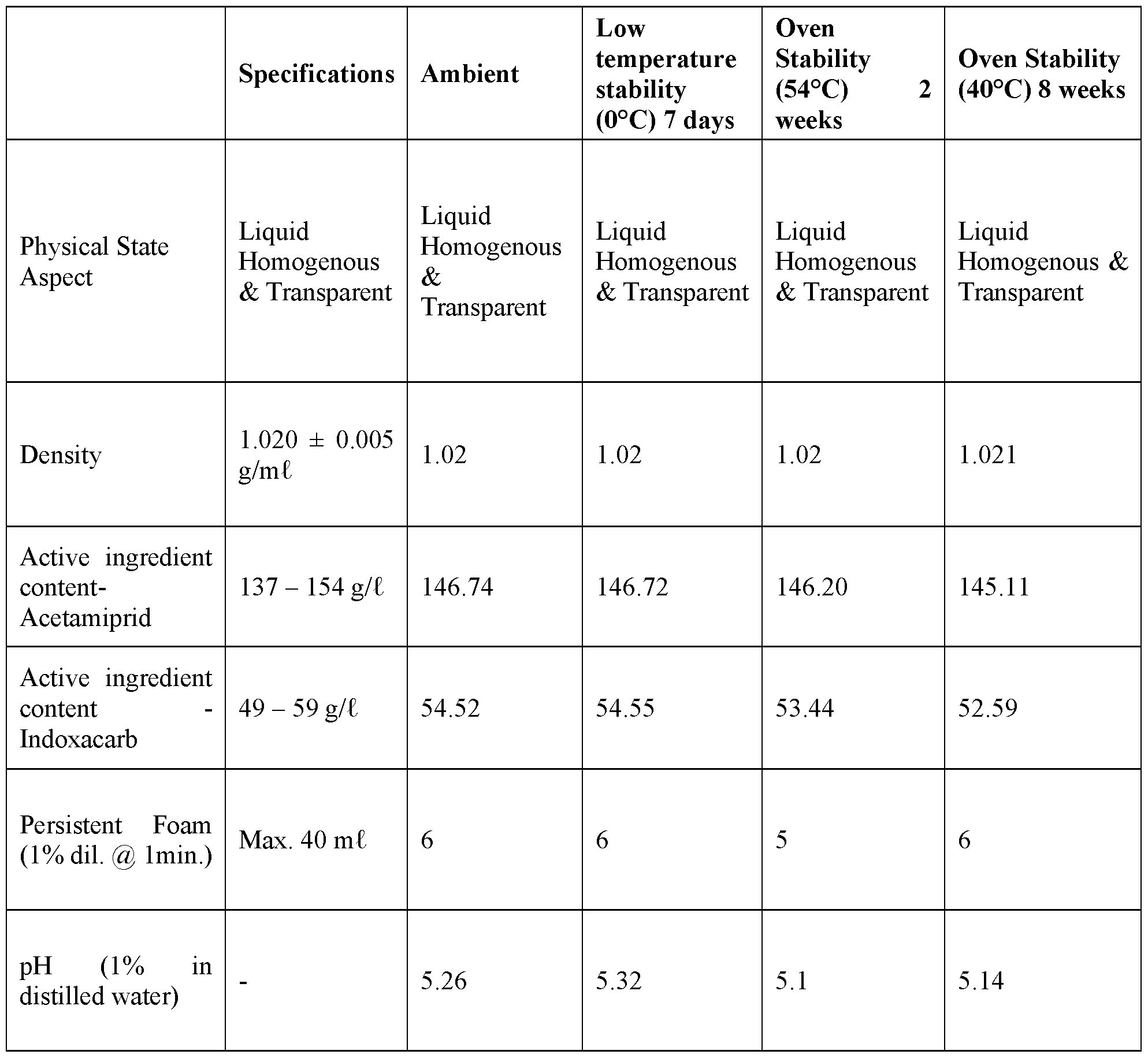
- Example 3 Acetamiprid 146 + Indoxacarb 54 emulsifiable concentrate (EC)
- 360g cyclohexanone was charged in a mixing vessel.
- 350g n-butylpyrrolidone was added to the same mixing vessel under continuous agitation.
- 56.84g indoxacarb and 149g acetamiprid were added under continuous stirring to obtain a mixture.
- Further lOOg butyl EO.PO block polymer and remaining 60g cyclohexanone were added to the mixture and mixed for around 30 minutes to obtain emulsifiable concentrate.
- Example-3 was taken for physico-chemical study at various testing conditions such as ambient (at room temperature) testing, low temperature testing performed after keeping the composition of Example-3 in refrigerator for 7 days at 0°C, oven stability performed as accelerated heat stability (AHS) after keeping sample in oven for 2 weeks at 54°C and also for 8 weeks at 40°C.
- ambient (at room temperature) testing low temperature testing performed after keeping the composition of Example-3 in refrigerator for 7 days at 0°C
- oven stability performed as accelerated heat stability (AHS) after keeping sample in oven for 2 weeks at 54°C and also for 8 weeks at 40°C.
- AHS accelerated heat stability
- Example 5 The compositions of Example 1-3 were tested for dilution stability wherein each composition was diluted with standard water to make 1% dilution aliquot. The stability of the diluted composition was assessed at various time intervals. Further assessment was done after 24.5 hours post re-emulsifying the compositions. This was also repeated twice. The composition of Example-1 remained as homogeneous and stable liquid throughout in all the above specified time intervals. Similarly, composition of Exampel- 0 2 and Example-3 remained quite stable without any noticeable cream or oil formation.
- Std. ]3 ⁇ 40 A stands for CIPAC Standard water A with 20 ppm hardness; Std. H2O D stands for CIPAC Standard water D with 342ppm hardness.
- Example 4-7 are for compositions of ME formulation of acetamiprid and Emamectin-benzoate.
- Various solvent and surfactant were tried in preparing neonicotinoid based liquid compositions that remain stable at low temperature .
- the Compositions were taken for dilution stability study as per CIPAC 41.1 wherein said compositions were diluted in water and allowed to stand for 24 hours after which the quantity and nature of any separated material were assessed.
- Composition of Example-4 was prepared using anionic/non-ionic blend of surfactants with HLB value 9.6. On performing dilution stability, 1ml creme and some oil observed after 0.5. Thus, it failed in test and could not be considered for further stability testing.
- composition of Example-5 was prepared using salt of dodecylbenzene sulfonate having HLB 8.6. BHA remained immiscible in the solvent. Composition failed to form ME formulation and was therefore, found to be unsuitable for low temperature testing.
- composition of Example-6 and Example-7 were prepared using dimethylsulfoxide (DMSO) and propylene carbonate respectively. Both compositions exhibited crystallization in dilution stability testing which indicated crystal formation upon keeping at 0°C.
- DMSO dimethylsulfoxide
- compositions of example 8-11 are EC compositions comprising acetamiprid and indoxacarb.
- Composition of Example-8 was prepared using anionic/non-ionic blend of surfactants with HLB value 9.6.
- composition of Example-9 was prepared using salt of dodecylbenzene sulfonate having HLB 8.6.
- 1ml oil and 2ml creme was observed when kept for dilution stability and could not be considered for further stability testing.
- Composition of Example- 10 and Example- 11 were prepared using dimethylsulfoxide (DMSO) and propylene carbonate respectively. Both compositions exhibited crystallization in dilution stability testing which indicated crystal formation upon keeping at 0°C.
- DMSO dimethylsulfoxide
- compositions of example 12-15 are SL compositions comprising acetamiprid and indoxacarb.
- Composition of Example-12 was prepared using salt of dodecylbenzene sulfonate having HLB 8.6.
- composition of Example-13 was prepared using anionic/non-ionic blend with HLB value 9.6. In both the compositions, crystals observed within 24 hours when kept for dilution stability.
- Composition of Example- 14 and Example- 15 were prepared using dimethylsulfoxide (DMSO) and propylene carbonate respectively. Both compositions exhibited crystallization in dilution stability testing which indicated crystal formation upon keeping at 0°C.
- DMSO dimethylsulfoxide
- compositions of Example-2 and Example-3 were assessed on citrus for control of mealy bugs. Mealybug causes physical and cosmetic damage to citrus fruit, making them unsuitable for export. Composition of Example-2 was tested at dosage rate of 54 mh. Composition of Example-3 was tested at dosage rate of 36 mh. The effectiveness of the compositions was studied against untreated control. The number of mealy bugs were counted per plot on 25 citrus fruits sampled per plot at various intervals viz. 7DAT (Days After Treatment), 14DAT and 21DAT. The study was performed on two different locations (Trial 1 and Trial 2) for both the compositions of Example-2 and Example-3. Composition of Example-2 and Example-3 at both doses found to control more than 96% mealy bugs and successfully protected the crop.
- compositions of Example-2 and Example-3 were assessed on citrus for control of red spider mites.
- the Red spider mite (P. ulmi) is one of the pests common to citrus that cause damage to older leaves and fruit.
- Composition of Example-2 was tested at dosage rate of 54 mh.
- Composition of Example-3 was tested at dosage rate of 36 mh.
- the effectiveness of the compositions was studied against untreated control. The number of mites counted on a 30-leaf sample per plot and percentage control of red spider mites were calculated at various intervals viz. 7DAT (Days After Treatment), 14DAT and 21DAT. The study was performed on two different locations (Trial 1 and Trial 2) for both the compositions of Example-2 and Example-3. Compositions of Example-2 and Example-3 at both doses and in both trials found to control more than 90% red spider mites and successfully protected the crop.
- inventors of the present disclosure successfully stabilized various liquid composition of neonicotinoid insecticides alone and in combination with other pesticides using a low polarity amide solvent and a surfactant with HLB ranging from 10-18.
- the combination of low polarity amide solvent and a surfactant with HLB ranging from about 10 to about 18 successfully stabilized neonicotinoid insecticide in the composition as well as imparted low temperature stability to the composition.
- the stable liquid composition also exhibited stability upon dilution.
- the liquid compositions were found to be highly efficacious in controlling pests. It is to be understood that the disclosure is not to be limited to the details of the above embodiments, which are described by way of example only.
Landscapes
- Life Sciences & Earth Sciences (AREA)
- Agronomy & Crop Science (AREA)
- Pest Control & Pesticides (AREA)
- Plant Pathology (AREA)
- Health & Medical Sciences (AREA)
- Engineering & Computer Science (AREA)
- Dentistry (AREA)
- General Health & Medical Sciences (AREA)
- Wood Science & Technology (AREA)
- Zoology (AREA)
- Environmental Sciences (AREA)
- Agricultural Chemicals And Associated Chemicals (AREA)
- Detergent Compositions (AREA)
- Fats And Perfumes (AREA)
Abstract
Description




Claims
Priority Applications (5)
| Application Number | Priority Date | Filing Date | Title |
|---|---|---|---|
| AU2022231890A AU2022231890A1 (en) | 2021-03-10 | 2022-03-10 | Liquid composition comprising a neonictonoid |
| CN202280023738.2A CN117560993A (en) | 2021-03-10 | 2022-03-10 | Liquid compositions containing neonicotinoids |
| MX2023010527A MX2023010527A (en) | 2021-03-10 | 2022-03-10 | Liquid composition comprising a neonictonoid. |
| CONC2023/0013308A CO2023013308A2 (en) | 2021-03-10 | 2023-10-05 | Liquid composition comprising a neonictonoid |
| ZA2023/09363A ZA202309363B (en) | 2021-03-10 | 2023-10-06 | Liquid composition comprising a neonictonoid |
Applications Claiming Priority (2)
| Application Number | Priority Date | Filing Date | Title |
|---|---|---|---|
| IN202121010121 | 2021-03-10 | ||
| IN202121010121 | 2021-03-10 |
Publications (1)
| Publication Number | Publication Date |
|---|---|
| WO2022189592A1 true WO2022189592A1 (en) | 2022-09-15 |
Family
ID=80999299
Family Applications (1)
| Application Number | Title | Priority Date | Filing Date |
|---|---|---|---|
| PCT/EP2022/056258 Ceased WO2022189592A1 (en) | 2021-03-10 | 2022-03-10 | Liquid composition comprising a neonictonoid |
Country Status (8)
| Country | Link |
|---|---|
| CN (1) | CN117560993A (en) |
| AR (1) | AR125069A1 (en) |
| AU (1) | AU2022231890A1 (en) |
| CO (1) | CO2023013308A2 (en) |
| MX (1) | MX2023010527A (en) |
| PY (1) | PY2216635A (en) |
| WO (1) | WO2022189592A1 (en) |
| ZA (1) | ZA202309363B (en) |
Cited By (4)
| Publication number | Priority date | Publication date | Assignee | Title |
|---|---|---|---|---|
| WO2024201452A1 (en) * | 2023-03-24 | 2024-10-03 | Adama Makhteshim Ltd. | Liquid homogeneous agrochemical composition of insecticides |
| WO2025119860A1 (en) | 2023-12-05 | 2025-06-12 | Bayer Aktiengesellschaft | Liquid agrochemical formulations comprising flupyradifurone |
| CN120158136A (en) * | 2025-04-01 | 2025-06-17 | 广州携创办公用品有限公司 | Preparation method and application of water-in-oil emulsion ink for stencil |
| WO2025217491A1 (en) * | 2024-04-11 | 2025-10-16 | Corteva Agriscience Llc | Stable soluble liquid formulation for insecticide |
Citations (6)
| Publication number | Priority date | Publication date | Assignee | Title |
|---|---|---|---|---|
| CN105580830A (en) * | 2014-10-22 | 2016-05-18 | 陕西美邦农药有限公司 | Insecticidal composition containing ZJ3757 |
| CN105638714A (en) * | 2014-11-13 | 2016-06-08 | 陕西美邦农药有限公司 | Insecticidal composition containing wufuchongzong |
| DE102016210164A1 (en) * | 2016-06-08 | 2017-12-14 | Clariant International Ltd | Use of N-substituted pyrrolidones to promote the penetration of agrochemical active ingredients |
| CN108782585A (en) * | 2017-04-28 | 2018-11-13 | 江苏龙灯化学有限公司 | A kind of water-dispersed composition containing avermectin and Acetamiprid |
| CN110477000A (en) * | 2019-09-19 | 2019-11-22 | 山东省林业科学研究院 | A kind of liquid formulation for trunk injection and its preparation method and application of Japanese red pine limb portion pest |
| CN111084190A (en) * | 2019-12-04 | 2020-05-01 | 河北威远生物化工有限公司 | Insecticidal composition containing emamectin benzoate B2a and application thereof |
-
2022
- 2022-03-10 AR ARP220100551A patent/AR125069A1/en unknown
- 2022-03-10 CN CN202280023738.2A patent/CN117560993A/en active Pending
- 2022-03-10 PY PY202202216635A patent/PY2216635A/en unknown
- 2022-03-10 AU AU2022231890A patent/AU2022231890A1/en active Pending
- 2022-03-10 WO PCT/EP2022/056258 patent/WO2022189592A1/en not_active Ceased
- 2022-03-10 MX MX2023010527A patent/MX2023010527A/en unknown
-
2023
- 2023-10-05 CO CONC2023/0013308A patent/CO2023013308A2/en unknown
- 2023-10-06 ZA ZA2023/09363A patent/ZA202309363B/en unknown
Patent Citations (6)
| Publication number | Priority date | Publication date | Assignee | Title |
|---|---|---|---|---|
| CN105580830A (en) * | 2014-10-22 | 2016-05-18 | 陕西美邦农药有限公司 | Insecticidal composition containing ZJ3757 |
| CN105638714A (en) * | 2014-11-13 | 2016-06-08 | 陕西美邦农药有限公司 | Insecticidal composition containing wufuchongzong |
| DE102016210164A1 (en) * | 2016-06-08 | 2017-12-14 | Clariant International Ltd | Use of N-substituted pyrrolidones to promote the penetration of agrochemical active ingredients |
| CN108782585A (en) * | 2017-04-28 | 2018-11-13 | 江苏龙灯化学有限公司 | A kind of water-dispersed composition containing avermectin and Acetamiprid |
| CN110477000A (en) * | 2019-09-19 | 2019-11-22 | 山东省林业科学研究院 | A kind of liquid formulation for trunk injection and its preparation method and application of Japanese red pine limb portion pest |
| CN111084190A (en) * | 2019-12-04 | 2020-05-01 | 河北威远生物化工有限公司 | Insecticidal composition containing emamectin benzoate B2a and application thereof |
Non-Patent Citations (4)
| Title |
|---|
| .: "Miscellaneous surfactants - Polymer-based products", SURFACTANTS EUROPE. A DIRECTORY OF SURFACE ACTIVE AGENTS AVAILABLE IN EUROPE, 1 January 1995 (1995-01-01), pages 345, XP055930358, ISBN: 978-0-85404-804-5, Retrieved from the Internet <URL:https://books.google.de/books/about/Surfactants_Europa.html?id=3S6QKaJmlEIC&redir_esc=y> [retrieved on 20220613] * |
| MANSOUR RAMZI ET AL: "Vine and citrus mealybug pest control based on synthetic chemicals. A review", AGRONOMY FOR SUSTAINABLE DEVELOPMENT, SPRINGER PARIS, PARIS, vol. 38, no. 4, 9 July 2018 (2018-07-09), pages 1 - 20, XP036830168, ISSN: 1774-0746, [retrieved on 20180709], DOI: 10.1007/S13593-018-0513-7 * |
| N. N ZAKI ET AL: "Propylene oxide-ethylene oxide block copolymers as demulsifiers for water-in-oil emulsions, I. Effect of molecular weight and hydrophilic-lipophylic balance on the demulsification efficiency", MONATSHEFTE F R CHEMIE CHEMICAL MONTHLY, 1 January 1996 (1996-01-01), pages 621 - 629, XP055488413, Retrieved from the Internet <URL:https://link.springer.com/content/pdf/10.1007/BF00817254.pdf> DOI: 10.1007/BF00817254 * |
| OHBA NORIAKI: "Hydrophile-Lipophile Balance Values for O/W Emulsions Stabilized by Nonionic Surfactants. I. Hydrophile-Lipophile Balance Values of Nonionic Surfactants Determined by Emulsification", BULLETIN OF THE CHEMICAL SOCIETY OF JAPAN, vol. 35, no. 6, 1 June 1962 (1962-06-01), JP, pages 1016 - 1020, XP055930320, ISSN: 0009-2673, Retrieved from the Internet <URL:https://www.journal.csj.jp/doi/pdf/10.1246/bcsj.35.1016> DOI: 10.1246/bcsj.35.1016 * |
Cited By (4)
| Publication number | Priority date | Publication date | Assignee | Title |
|---|---|---|---|---|
| WO2024201452A1 (en) * | 2023-03-24 | 2024-10-03 | Adama Makhteshim Ltd. | Liquid homogeneous agrochemical composition of insecticides |
| WO2025119860A1 (en) | 2023-12-05 | 2025-06-12 | Bayer Aktiengesellschaft | Liquid agrochemical formulations comprising flupyradifurone |
| WO2025217491A1 (en) * | 2024-04-11 | 2025-10-16 | Corteva Agriscience Llc | Stable soluble liquid formulation for insecticide |
| CN120158136A (en) * | 2025-04-01 | 2025-06-17 | 广州携创办公用品有限公司 | Preparation method and application of water-in-oil emulsion ink for stencil |
Also Published As
| Publication number | Publication date |
|---|---|
| MX2023010527A (en) | 2023-12-05 |
| PY2216635A (en) | 2023-02-28 |
| AR125069A1 (en) | 2023-06-07 |
| CO2023013308A2 (en) | 2024-01-25 |
| CN117560993A (en) | 2024-02-13 |
| ZA202309363B (en) | 2025-04-30 |
| AU2022231890A1 (en) | 2023-10-12 |
Similar Documents
| Publication | Publication Date | Title |
|---|---|---|
| WO2022189592A1 (en) | Liquid composition comprising a neonictonoid | |
| US9770021B2 (en) | Pesticidal compositions | |
| CA2611848C (en) | Seed treatment method and pesticidal composition | |
| KR20230119667A (en) | Isocycloceram Formulation | |
| WO2023232559A1 (en) | Formulation | |
| BR112021001409A2 (en) | stable liquid agrochemical formulation | |
| US20250261634A1 (en) | Liquid herbicidal compositions | |
| KR20220088841A (en) | Synergistic antiseptic composition | |
| UA127879C2 (en) | PESTICIDE COMPOSITIONS | |
| OA21455A (en) | Liquid composition comprising a neonictonoid | |
| US20240389580A1 (en) | Stabilized cyclohexanedione oxime composition | |
| WO2022190133A1 (en) | A tank mix compatible composition | |
| CN103945692B (en) | Agricultural formulations with aromatic solvents and acyl morpholines | |
| US12144356B2 (en) | Insecticidal compositions | |
| OA21729A (en) | A tank mix compatible composition. | |
| AU2011253579B2 (en) | Seed treatment method and pesticidal composition | |
| BR102022017717A2 (en) | INSECTICIDE COMPOSITIONS | |
| WO2024180226A1 (en) | Insecticidal composition and process for preparation thereof | |
| WO2025005227A1 (en) | Composition, pest control preparation, and pest control method | |
| OA20007A (en) | A stable liquid agrochemical formulation. | |
| TW201332439A (en) | Agricultural formulations with aromatic solvents and acyl morpholines | |
| CN104186468A (en) | Pesticide composition |
Legal Events
| Date | Code | Title | Description |
|---|---|---|---|
| 121 | Ep: the epo has been informed by wipo that ep was designated in this application |
Ref document number: 22713925 Country of ref document: EP Kind code of ref document: A1 |
|
| WWE | Wipo information: entry into national phase |
Ref document number: MX/A/2023/010527 Country of ref document: MX |
|
| WWE | Wipo information: entry into national phase |
Ref document number: 202280023738.2 Country of ref document: CN Ref document number: 2022231890 Country of ref document: AU Ref document number: AU2022231890 Country of ref document: AU |
|
| WWE | Wipo information: entry into national phase |
Ref document number: NC2023/0013308 Country of ref document: CO |
|
| NENP | Non-entry into the national phase |
Ref country code: DE |
|
| ENP | Entry into the national phase |
Ref document number: 2022231890 Country of ref document: AU Date of ref document: 20220310 Kind code of ref document: A |
|
| WWP | Wipo information: published in national office |
Ref document number: NC2023/0013308 Country of ref document: CO |
|
| 122 | Ep: pct application non-entry in european phase |
Ref document number: 22713925 Country of ref document: EP Kind code of ref document: A1 |