WO2022186358A1 - 情報処理装置、情報処理方法及び情報処理プログラム - Google Patents
情報処理装置、情報処理方法及び情報処理プログラム Download PDFInfo
- Publication number
- WO2022186358A1 WO2022186358A1 PCT/JP2022/009254 JP2022009254W WO2022186358A1 WO 2022186358 A1 WO2022186358 A1 WO 2022186358A1 JP 2022009254 W JP2022009254 W JP 2022009254W WO 2022186358 A1 WO2022186358 A1 WO 2022186358A1
- Authority
- WO
- WIPO (PCT)
- Prior art keywords
- information
- biometric information
- user
- biometric
- information processing
- Prior art date
- Legal status (The legal status is an assumption and is not a legal conclusion. Google has not performed a legal analysis and makes no representation as to the accuracy of the status listed.)
- Ceased
Links
Images



Classifications
-
- G—PHYSICS
- G16—INFORMATION AND COMMUNICATION TECHNOLOGY [ICT] SPECIALLY ADAPTED FOR SPECIFIC APPLICATION FIELDS
- G16H—HEALTHCARE INFORMATICS, i.e. INFORMATION AND COMMUNICATION TECHNOLOGY [ICT] SPECIALLY ADAPTED FOR THE HANDLING OR PROCESSING OF MEDICAL OR HEALTHCARE DATA
- G16H50/00—ICT specially adapted for medical diagnosis, medical simulation or medical data mining; ICT specially adapted for detecting, monitoring or modelling epidemics or pandemics
- G16H50/70—ICT specially adapted for medical diagnosis, medical simulation or medical data mining; ICT specially adapted for detecting, monitoring or modelling epidemics or pandemics for mining of medical data, e.g. analysing previous cases of other patients
-
- A—HUMAN NECESSITIES
- A61—MEDICAL OR VETERINARY SCIENCE; HYGIENE
- A61B—DIAGNOSIS; SURGERY; IDENTIFICATION
- A61B5/00—Measuring for diagnostic purposes; Identification of persons
-
- G—PHYSICS
- G16—INFORMATION AND COMMUNICATION TECHNOLOGY [ICT] SPECIALLY ADAPTED FOR SPECIFIC APPLICATION FIELDS
- G16H—HEALTHCARE INFORMATICS, i.e. INFORMATION AND COMMUNICATION TECHNOLOGY [ICT] SPECIALLY ADAPTED FOR THE HANDLING OR PROCESSING OF MEDICAL OR HEALTHCARE DATA
- G16H10/00—ICT specially adapted for the handling or processing of patient-related medical or healthcare data
- G16H10/60—ICT specially adapted for the handling or processing of patient-related medical or healthcare data for patient-specific data, e.g. for electronic patient records
-
- G—PHYSICS
- G16—INFORMATION AND COMMUNICATION TECHNOLOGY [ICT] SPECIALLY ADAPTED FOR SPECIFIC APPLICATION FIELDS
- G16H—HEALTHCARE INFORMATICS, i.e. INFORMATION AND COMMUNICATION TECHNOLOGY [ICT] SPECIALLY ADAPTED FOR THE HANDLING OR PROCESSING OF MEDICAL OR HEALTHCARE DATA
- G16H40/00—ICT specially adapted for the management or administration of healthcare resources or facilities; ICT specially adapted for the management or operation of medical equipment or devices
- G16H40/60—ICT specially adapted for the management or administration of healthcare resources or facilities; ICT specially adapted for the management or operation of medical equipment or devices for the operation of medical equipment or devices
- G16H40/63—ICT specially adapted for the management or administration of healthcare resources or facilities; ICT specially adapted for the management or operation of medical equipment or devices for the operation of medical equipment or devices for local operation
Definitions
- the present disclosure relates to an information processing device, an information processing method, and an information processing program.
- thermometers thermometers, sphygmomanometers, urinalysis devices, etc. placed in towns.
- biological information such as heartbeat and arterial blood oxygen saturation is acquired by a wearable terminal worn by a user.
- Japanese Patent Application Laid-Open No. 2018-101255 describes that biomedical information and biometric information obtained from the same user (that is, originally linked according to the user) are associated in chronological order. , there is no description about associating biometric information that is not originally associated with each other. Therefore, with the technique described in Japanese Patent Application Laid-Open No. 2018-101255, it is not possible to utilize a plurality of pieces of biological information that are not originally linked.
- the present disclosure provides an information processing device, an information processing method, and an information processing program that enable utilization of biological information that is not originally linked.
- a first aspect of the present disclosure is an information processing device, comprising at least one processor, the processor is biometric information of a user, user information about the user, and the time when the biometric information was acquired.
- the processor is biometric information of a user, user information about the user, and the time when the biometric information was acquired.
- a plurality of pieces of biometric information to which attribute information including at least one of environment information and environment information is attached are obtained, and pieces of biometric information having at least one piece of the same attribute information are linked.
- the user information includes user identification information
- the processor acquires biometric information to which identification information of a plurality of users different from each other is attached, and the same identification information is The given biometric information may be associated with each other.
- the user information is the time when the biometric information is acquired from the user, or the biometric information within a predetermined period until the time when the biometric information is acquired from the user. It may also include behavior information indicating the behavior of the user who acquired it.
- the environmental information may include climate information indicating at least one of temperature, humidity, atmospheric pressure, and weather at the time the biometric information is acquired from the user.
- the environment information may include location information indicating the location where the biometric information was obtained from the user.
- date and time information indicating the date and time when the biometric information was acquired from the user is added to the biometric information, and the processor, based on the date and time information, biometric information may be associated with each other.
- the processor acquires a plurality of pieces of biological information that are different from each other, and at least one piece of information included in the attribute information is the same, and the pieces of biological information that are different from each other are You can tie it.
- the types of biological information are body temperature, heart rate, electrocardiogram, myoelectricity, blood pressure, body weight, body fat percentage, muscle mass, bone density, blood sugar level, and arterial blood oxygen saturation. , urinary sugar, urinary protein and urinary occult blood.
- the biometric information is publicly used by an unspecified number of users and is acquired by a first biometric information acquisition device that acquires the biometric information of an unspecified number of users.
- the first biological information acquisition device may acquire the biological information sporadically.
- the first biometric information acquisition device may acquire biometric information without receiving an instruction to acquire biometric information.
- the biometric information may be used privately by the individual user, and may be acquired by a second biometric information acquisition device that acquires the user's biometric information.
- the second biological information acquisition device may acquire the biological information over time.
- a fourteenth aspect of the present disclosure is the twelfth aspect or the thirteenth aspect, wherein the second biological information acquisition device may acquire the biological information when receiving an instruction to acquire the biological information.
- the second biological information acquisition device may be wearable.
- a sixteenth aspect of the present disclosure is an information processing method, the biometric information of a user including at least one of user information about the user and environment information about the environment at the time when the biometric information was acquired.
- a computer acquires a plurality of pieces of biometric information to which attribute information has been added, and performs a process of linking pieces of biometric information having the same at least one piece of information included in the attribute information.
- a seventeenth aspect of the present disclosure is an information processing program, which is biometric information of a user and includes at least one of user information about the user and environment information about the environment at the time when the biometric information was acquired. This is for causing a computer to execute a process of acquiring a plurality of pieces of biometric information to which attribute information has been added and linking pieces of biometric information having at least one piece of the same piece of information included in the attribute information.
- the information processing device, the information processing method, and the information processing program of the present disclosure make it possible to utilize biometric information that is not originally linked.
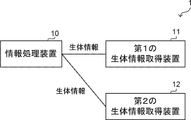
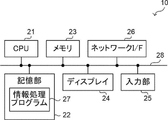
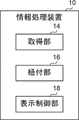
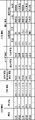
- FIG. 1 is a schematic configuration diagram of an information processing system; FIG. It is a block diagram which shows an example of the hardware constitutions of an information processing apparatus. 1 is a block diagram showing an example of a functional configuration of an information processing device; FIG. It is an example of biometric information and attribute information.
- FIG. 10 is a diagram showing an example of a result of linking biometric information having the same identification information of a user; FIG. 10 is a diagram showing an example of a result of linking pieces of biometric information having the same behavior information. It is an example of a screen displayed on a display. It is a flow chart which shows an example of information processing.
- an information processing system 1 includes an information processing device 10, at least one first biological information acquisition device 11, and at least one second biological information acquisition device 12. Configured. Although FIG. 1 shows one first biometric information acquisition device 11 and one second biometric information acquisition device 12, the information processing system 1 is not limited to this. biometric information acquisition device 11 and a plurality of second biometric information acquisition devices 12 .
- the information processing device 10 and the first biometric information acquiring device 11, and the information processing device 10 and the second biometric information acquiring device 12 can communicate with each other by wired or wireless communication.
- a biometric information acquisition device has a function of acquiring biometric information of a user.
- Biological information includes, for example, at least one of body temperature, heart rate, electrocardiogram, myoelectricity, blood pressure, body weight, body fat percentage, muscle mass, bone density, blood sugar level, arterial blood oxygen saturation, urine sugar, urine protein, and urine occult blood. This is information indicating one (details will be described later).
- the first biometric information acquisition device 11 is a device that is publicly used by an unspecified number of users and acquires the biometric information of an unspecified number of users.
- “Publicly” means places where the first biological information acquisition device 11 gathers (for example, hospitals, pharmacies, department stores, shopping malls, convenience stores, stations, airports, companies, public halls, facilities for the elderly, and spa facilities). etc.) and can be used by anyone.
- a thermometer provided at an entrance/exit of a store or the like, a urine test device provided in a public restroom, or the like can be applied.
- the plurality of first biological information acquisition devices 11 may be installed at different locations.
- the first biometric information acquisition device 11 acquires biometric information sporadically without receiving an instruction to acquire biometric information from the user. Specifically, the first biometric information acquisition device 11 automatically acquires biometric information of an unspecified number of users who have entered a range where biometric information can be measured. That is, from the user's point of view, the first biometric information acquisition device 11 passively acquires the biometric information of the user.
- the second biometric information acquisition device 12 is a device that is privately used by the user and acquires the user's biometric information. “Privately” means that only the user who is the owner can use the second biometric information acquisition device 12 .
- a wearable terminal such as a smart watch, a blood glucose self-monitoring device, and the like can be applied.
- the second biometric information acquisition device 12 acquires biometric information when receiving an instruction to acquire biometric information from the user.
- the user instructs the smart watch worn on the wrist by the user to measure the heart rate. That is, from the user's point of view, the second biometric information acquisition device 12 actively acquires the biometric information of the user.
- the second biometric information acquisition device 12 may acquire biometric information over time.
- a smartwatch may capture heartbeats over time.
- the user instructs the smart watch worn on his or her wrist to start measuring the heartbeat over time.
- the information processing apparatus 10 includes a CPU (Central Processing Unit) 21, a non-volatile storage section 22, and a memory 23 as a temporary storage area.
- the information processing apparatus 10 also includes a display 24 such as a liquid crystal display, an input unit 25 such as a keyboard, a mouse and buttons, and a network I/ An F (Interface) 26 is included.
- the CPU 21, the storage unit 22, the memory 23, the display 24, the input unit 25, and the network I/F 26 are connected via a bus 28 such as a system bus and a control bus so that various information can be exchanged with each other.
- a smart phone, a wearable terminal, a personal computer, a server computer, or the like can be applied.
- the storage unit 22 is implemented by a storage medium such as a HDD (Hard Disk Drive), SSD (Solid State Drive), flash memory, or the like.
- An information processing program 27 for the information processing apparatus 10 is stored in the storage unit 22 .
- the CPU 21 reads out the information processing program 27 from the storage unit 22 , expands it in the memory 23 , and executes the expanded information processing program 27 .
- CPU 21 is an example of a processor of the present disclosure.
- the information processing device 10 includes an acquisition unit 14 , a linking unit 16 and a display control unit 18 .
- the CPU 21 executes the information processing program 27 to function as the acquisition unit 14 , the linking unit 16 and the display control unit 18 .
- the acquisition unit 14 acquires a plurality of user's biometric information from the biometric information acquisition device.
- FIG. 4 shows an example of biometric information according to this exemplary embodiment.
- the biometric information includes the type of biometric information and the measurement result of the biometric information, and the acquisition unit 14 acquires different types of biometric information.
- the measurement results may be represented by, for example, measured values as shown in FIG. 4, or may be represented by judgment results such as negative or positive, good or bad based on the measured values.
- date and time information indicating the date and time when the biometric information was acquired from the user and identification information of the biometric information acquisition device from which the biometric information was acquired are added to the biometric information.
- the date and time information and the identification information of the biometric information acquisition device are added to the biometric information by the biometric information acquisition device and then transmitted to the information processing device 10 .
- attribute information including at least one of user information about the user who acquired the biometric information and environmental information about the environment at the time when the biometric information was acquired is added to the biometric information.
- the attribute information may be attached to the biometric information by the biometric information acquiring apparatus and then transmitted to the information processing apparatus 10, or may be attached after the information processing apparatus 10 acquires the biometric information.
- the user information includes user identification information and behavior information that indicates the behavior of the user from whom the biometric information was obtained at the time the biometric information was obtained from the user.
- “User identification information” is information that can identify a user from whom biometric information is obtained, and is information that differs from user to user. That is, the acquisition unit 14 acquires biometric information to which identification information of a plurality of users different from each other is added from the biometric information acquisition device.
- the first biometric information acquisition device 11 when the first biometric information acquisition device 11 acquires biometric information, the first biometric information acquisition device 11 is a terminal device (for example, a smartphone, a wearable terminal, etc.) owned by an individual user from whom the biometric information is acquired. may be detected, and the detected identification information of the terminal device may be added to the biometric information as user identification information.
- the terminal device may be detected by using known short-range wireless communication such as Bluetooth (registered trademark), BLE (Bluetooth Low Energy) beacon, and RFID (Radio Frequency Identifier).
- the second biometric information acquisition device 12 when the second biometric information acquisition device 12 acquires biometric information, the second biometric information acquisition device 12 grasps in advance the identification information of the user who owns the biometric information. At the time of obtaining the biometric information, the user's identification information that has been grasped may be added to the biometric information.
- biometric information acquisition device detects which action of the user is “walking", “exercising”, or “resting” by means of the accelerometer. Behavior information indicating the detected behavior may be added to the biometric information. Further, for example, when the biometric information acquisition device is installed in a restaurant, the biometric information acquisition device may add the behavior information of "meal" to the biometric information. Further, for example, after the information processing apparatus 10 acquires biometric information, input of behavior information by the user may be received via the input unit 25, and the received behavior information may be added to the biometric information.
- the behavior information may be information indicating the behavior of the user who acquired the biometric information within a predetermined period up to the time when the biometric information was acquired from the user. For example, even when biometric information is acquired after an action such as after eating or after exercise (that is, when the user is not doing anything at the time of acquiring biometric information), the behavior information of “meal” and “exercise” is acquired. may be given.
- the environmental information includes climate information indicating at least one of temperature, humidity, air pressure, and weather at the time when the biometric information was acquired from the user.
- the biological information acquisition device may include a sensor for measuring temperature, and the temperature measured by the sensor may be added to the biological information as climate information.
- the information processing apparatus 10 accesses a server that accumulates climate information for each hour at each location, thereby acquiring climate information at the time of acquisition of biometric information based on date and time information and location information (details will be described later). , may be attached to the biometric information.
- the environment information also includes location information indicating the location where the biometric information was obtained from the user.
- location information include prefectures, municipalities, facilities, and structures in facilities such as entrances and exits and toilets.
- the location information is subdivided step by step into “wide area” location information corresponding to municipalities and “narrow area” location information corresponding to facilities.
- GPS Global Positioning System
- the information processing apparatus 10 accesses a table in which the identification information of the biometric information acquisition device and its installation location are associated and stored, thereby acquiring the location information based on the identification information of the biometric information acquisition device. , may be attached to the biometric information.
- the linking unit 16 links pieces of biometric information having at least one piece of attribute information that is the same.
- the linking unit 16 may link different types of biometric information to each other as long as at least one piece of information included in the attribute information is the same.
- different types of biological information such as body temperature and heart rate, and body temperature and urine protein may be linked.
- a combination of different types of biometric information may be a combination that is not used for normal disease testing.
- FIG. 5 shows an example of linking biometric information to which "U01" is assigned as user identification information.
- the linking unit 16 links pieces of biometric information having the same user identification information, so that a plurality of pieces of biometric information about a certain user can be comprehensively viewed and utilized for diagnosis, health management, and the like.
- FIG. 6 shows an example in which biometric information to which "meal" is added as action information is linked to each other.
- the linking unit 16 links the biometric information with the same behavior information to each other, so that the general tendency of the biometric information of a plurality of users at the time when a certain behavior is performed (or within a predetermined period before the behavior is performed) It can be used for analysis such as understanding of For example, by comparing biometric information for each piece of behavioral information, it may be possible to grasp a tendency such as deterioration (or improvement) of a symptom peculiarly indicated by the biometric information in a certain behavior.
- the linking unit 16 may link biometric information to which the same climate information and/or location information is attached. For example, by linking and analyzing the biometric information obtained in areas where the new coronavirus is prevalent, and using the analysis results, we can identify trends in the biometric information of users in other areas and identify the prevalence of the new coronavirus Sometimes the situation can be estimated.
- the linking unit 16 may link the biometric information in stages based on the attribute information. For example, the linking unit 16 may link biometric information of one user based on user identification information, and then link some of the biometric information based on behavior information.
- the linking unit 16 may further link the biometric information to each other based on the date and time information. For example, after linking the biometric information of one user based on the identification information of the user, the linking unit 16 links some of the biometric information to which date and time information indicating within a predetermined period of time has been added. You can tie it further.
- the "predetermined period" may be set in time zones such as morning, noon and night, or may be set in terms of dates such as 1 day, 1 week, 1 month and 1 year. Alternatively, it may be set according to seasons such as spring, summer, autumn and winter, and rainy and dry seasons.
- the display control unit 18 provides various guidance to the user by controlling the display of the screen D on the display 24 .
- FIG. 7 shows an example of a screen D displayed on the display 24 by the display control section 18.
- the linking unit 16 links biological information such as "body temperature”, "heartbeat” and "urinary protein” to which "U01" is assigned as user identification information.
- biometric information is associated with each other is shown.
- the display control unit 18 shows the maximum body temperature for each date in a line graph, and shows the urine protein determination results for each date by changing the color of the plot. In this manner, the display control unit 18 may process the linked biological information into a format that is easy to see using graphs, color coding, and the like, and display the processed information.
- FIG. 8 the information processing shown in FIG. 8 is executed by the CPU 21 executing the information processing program 27.
- FIG. Information processing is executed, for example, when a user gives an instruction to start execution via the input unit 25 .
- step S10 the acquisition unit 14 acquires a plurality of biometric information to which attribute information including at least one of user information and environment information is added from the biometric information acquisition device.
- step S12 the associating unit 16 associates pieces of biometric information having at least one piece of the same attribute information included in the plurality of pieces of biometric information acquired in step S10.
- step S14 the display control unit 18 displays the biological information linked in step S12 on the display 24, and ends this information processing.
- FIG. 8 describes the case where the attribute information has already been added to the biometric information in step S10 (that is, the biometric information acquisition device has already added the attribute information to the biometric information), but the present invention is not limited to this.
- the acquiring unit 14 acquires biometric information without attribute information from the biometric information acquisition device, and after step S10, the acquiring unit 14 adds attribute information to the biometric information. good too.
- the information processing apparatus 10 includes at least one processor, and the processor stores biometric information of the user, including user information about the user and environmental information about the environment at the time when the biometric information was acquired.
- a plurality of pieces of biometric information to which attribute information including at least one of (1) and (2) is attached is obtained, and the pieces of biometric information having at least one piece of attribute information that is the same are linked. That is, since biometric information can be linked to each other based on user information and/or environmental information attached to the biometric information, biometric information that is not originally linked can be utilized for diagnosis, health management, analysis, and the like.
- the acquisition unit 14 acquires biometric information of a plurality of different users from the biometric information acquisition device, but the present invention is not limited to this.
- the acquisition unit 14 may acquire a plurality of biometric information of only one user from the biometric information acquisition device.
- both user information and environmental information are added as attribute information to biometric information
- Attribute information including at least one of user information and environment information may be added to the biometric information, and either one may not be added.
- both user information and environment information may be assigned to some of them, and only one of the user information and environment information may be assigned to some of them. For example, even if user information is not attached to the biometric information (that is, the individual who acquired the biometric information cannot be identified), the linking unit 16 can link biometric information having the same environmental information. , and can be used for analysis of biological information according to environmental information.
- the hardware structure of the processing unit (processing unit) that executes various processes includes the following various A processor can be used.
- the various processors include, in addition to the CPU, which is a general-purpose processor that executes software (programs) and functions as various processing units, circuits such as FPGAs (Field Programmable Gate Arrays), etc.
- Programmable Logic Device (PLD) which is a processor whose configuration can be changed, ASIC (Application Specific Integrated Circuit) etc. Circuits, etc. are included.
- One processing unit may be composed of one of these various processors, or a combination of two or more processors of the same type or different types (for example, a combination of multiple FPGAs, a combination of a CPU and an FPGA). combination). Also, a plurality of processing units may be configured by one processor.
- a single processor is configured by combining one or more CPUs and software.
- a processor functions as multiple processing units.
- SoC System on Chip
- the various processing units are configured using one or more of the above various processors as a hardware structure.
- an electric circuit combining circuit elements such as semiconductor elements can be used.
- the information processing program 27 is pre-stored (installed) in the storage unit 22, but the present invention is not limited to this.
- the information processing program 27 is provided in a form recorded in a recording medium such as a CD-ROM (Compact Disc Read Only Memory), a DVD-ROM (Digital Versatile Disc Read Only Memory), and a USB (Universal Serial Bus) memory. good too.
- the information processing program 27 may be downloaded from an external device via a network.
- the technology of the present disclosure extends to a storage medium that non-temporarily stores an information processing program in addition to the information processing program.
- the technology of the present disclosure can also appropriately combine the exemplary embodiments described above.
- the description and illustration shown above are detailed descriptions of the parts related to the technology of the present disclosure, and are merely examples of the technology of the present disclosure.
- the above descriptions of configurations, functions, actions, and effects are descriptions of examples of configurations, functions, actions, and effects of portions related to the technology of the present disclosure. Therefore, unnecessary parts may be deleted, new elements added, or replaced with respect to the above-described description and illustration without departing from the gist of the technology of the present disclosure. Needless to say.
Landscapes
- Engineering & Computer Science (AREA)
- Health & Medical Sciences (AREA)
- Public Health (AREA)
- Medical Informatics (AREA)
- Biomedical Technology (AREA)
- General Health & Medical Sciences (AREA)
- Data Mining & Analysis (AREA)
- Primary Health Care (AREA)
- Epidemiology (AREA)
- Pathology (AREA)
- Life Sciences & Earth Sciences (AREA)
- Databases & Information Systems (AREA)
- Biophysics (AREA)
- Animal Behavior & Ethology (AREA)
- Veterinary Medicine (AREA)
- Physics & Mathematics (AREA)
- Heart & Thoracic Surgery (AREA)
- Surgery (AREA)
- Molecular Biology (AREA)
- Business, Economics & Management (AREA)
- General Business, Economics & Management (AREA)
- Measuring And Recording Apparatus For Diagnosis (AREA)
Priority Applications (2)
| Application Number | Priority Date | Filing Date | Title |
|---|---|---|---|
| JP2023503959A JPWO2022186358A1 (cg-RX-API-DMAC7.html) | 2021-03-05 | 2022-03-03 | |
| US18/455,570 US20240006081A1 (en) | 2021-03-05 | 2023-08-24 | Information processing apparatus, information processing method, and information processing program |
Applications Claiming Priority (2)
| Application Number | Priority Date | Filing Date | Title |
|---|---|---|---|
| JP2021035799 | 2021-03-05 | ||
| JP2021-035799 | 2021-03-05 |
Related Child Applications (1)
| Application Number | Title | Priority Date | Filing Date |
|---|---|---|---|
| US18/455,570 Continuation US20240006081A1 (en) | 2021-03-05 | 2023-08-24 | Information processing apparatus, information processing method, and information processing program |
Publications (1)
| Publication Number | Publication Date |
|---|---|
| WO2022186358A1 true WO2022186358A1 (ja) | 2022-09-09 |
Family
ID=83155400
Family Applications (1)
| Application Number | Title | Priority Date | Filing Date |
|---|---|---|---|
| PCT/JP2022/009254 Ceased WO2022186358A1 (ja) | 2021-03-05 | 2022-03-03 | 情報処理装置、情報処理方法及び情報処理プログラム |
Country Status (3)
| Country | Link |
|---|---|
| US (1) | US20240006081A1 (cg-RX-API-DMAC7.html) |
| JP (1) | JPWO2022186358A1 (cg-RX-API-DMAC7.html) |
| WO (1) | WO2022186358A1 (cg-RX-API-DMAC7.html) |
Citations (5)
| Publication number | Priority date | Publication date | Assignee | Title |
|---|---|---|---|---|
| JP2011209871A (ja) * | 2010-03-29 | 2011-10-20 | Omron Healthcare Co Ltd | 健康管理支援装置、健康管理支援システムおよび健康管理支援プログラム |
| KR20130015105A (ko) * | 2011-08-02 | 2013-02-13 | (주) 나인원 | 공용 혈압계를 이용한 개인혈압정보 관리시스템 및 그 방법 |
| JP2013098980A (ja) * | 2011-11-03 | 2013-05-20 | Yuekang Healthcare Management Consultans Inc | 非接触式外部データ取得方法、非接触式外部データ取得電子装置及びそのアプリケーションプログラム |
| JP2019191998A (ja) * | 2018-04-26 | 2019-10-31 | 株式会社Primes | 情報処理システム |
| JP2020160569A (ja) * | 2019-03-25 | 2020-10-01 | オムロンヘルスケア株式会社 | 生活習慣改善提案装置、生活習慣改善提案方法、及び生活習慣改善提案プログラム |
-
2022
- 2022-03-03 JP JP2023503959A patent/JPWO2022186358A1/ja active Pending
- 2022-03-03 WO PCT/JP2022/009254 patent/WO2022186358A1/ja not_active Ceased
-
2023
- 2023-08-24 US US18/455,570 patent/US20240006081A1/en active Pending
Patent Citations (5)
| Publication number | Priority date | Publication date | Assignee | Title |
|---|---|---|---|---|
| JP2011209871A (ja) * | 2010-03-29 | 2011-10-20 | Omron Healthcare Co Ltd | 健康管理支援装置、健康管理支援システムおよび健康管理支援プログラム |
| KR20130015105A (ko) * | 2011-08-02 | 2013-02-13 | (주) 나인원 | 공용 혈압계를 이용한 개인혈압정보 관리시스템 및 그 방법 |
| JP2013098980A (ja) * | 2011-11-03 | 2013-05-20 | Yuekang Healthcare Management Consultans Inc | 非接触式外部データ取得方法、非接触式外部データ取得電子装置及びそのアプリケーションプログラム |
| JP2019191998A (ja) * | 2018-04-26 | 2019-10-31 | 株式会社Primes | 情報処理システム |
| JP2020160569A (ja) * | 2019-03-25 | 2020-10-01 | オムロンヘルスケア株式会社 | 生活習慣改善提案装置、生活習慣改善提案方法、及び生活習慣改善提案プログラム |
Also Published As
| Publication number | Publication date |
|---|---|
| JPWO2022186358A1 (cg-RX-API-DMAC7.html) | 2022-09-09 |
| US20240006081A1 (en) | 2024-01-04 |
Similar Documents
| Publication | Publication Date | Title |
|---|---|---|
| US11568993B2 (en) | System and method of predicting a healthcare event | |
| Plasqui et al. | Daily physical activity assessment with accelerometers: new insights and validation studies | |
| JP6160029B2 (ja) | ストレスモニタリングシステム | |
| JP6089443B2 (ja) | データ収集プラットフォーム | |
| JP5867282B2 (ja) | 腎臓のドップラ超音波法により作成されたストレスプロファイルを使用したストレスの連続したモニタリング | |
| JP6044111B2 (ja) | 人のストレスモデルを生成するシステム | |
| Rohit et al. | Iot based health monitoring system using raspberry PI-review | |
| US20100217096A1 (en) | A health monitor and a method for health monitoring | |
| EP3079119B1 (en) | User authentication system | |
| JP2012239890A (ja) | 加速度計のデータを使用したストレスの連続的なモニタリング | |
| Rykov et al. | Activity tracker–based metrics as digital markers of cardiometabolic health in working adults: Cross-sectional study | |
| JP7119707B2 (ja) | 診断支援装置、診断支援方法及び診断支援プログラム | |
| Bagula et al. | Cyber-healthcare kiosks for healthcare support in developing countries | |
| JP2017533495A (ja) | 健康関連の問題の管理のためのスマートロギング | |
| KR101971298B1 (ko) | 바이오마커 모니터링 장치 및 방법 | |
| Mhatre et al. | Non invasive e-health care monitoring system using iot | |
| WO2022186358A1 (ja) | 情報処理装置、情報処理方法及び情報処理プログラム | |
| Howell et al. | A low-power wearable substance monitoring device | |
| CN109074855B (zh) | 终端装置、信息处理系统 | |
| WO2022114010A1 (ja) | 情報処理装置、情報処理方法及び情報処理プログラム | |
| Różanowski et al. | Multisensor system for monitoring human psychophysiologic state in extreme conditions with the use of microwave sensor | |
| JP6906179B2 (ja) | 体動分析システム、体動分析方法及びプログラム | |
| Casaccia et al. | Smartwatches selection: market analysis and metrological characterization on the measurement of number of steps | |
| WO2022186359A1 (ja) | 情報処理装置、情報処理システム、情報処理方法及び情報処理プログラム | |
| Shinde et al. | Economical and wearable pulse oximeter using IoT |
Legal Events
| Date | Code | Title | Description |
|---|---|---|---|
| 121 | Ep: the epo has been informed by wipo that ep was designated in this application |
Ref document number: 22763410 Country of ref document: EP Kind code of ref document: A1 |
|
| WWE | Wipo information: entry into national phase |
Ref document number: 2023503959 Country of ref document: JP |
|
| NENP | Non-entry into the national phase |
Ref country code: DE |
|
| 122 | Ep: pct application non-entry in european phase |
Ref document number: 22763410 Country of ref document: EP Kind code of ref document: A1 |