WO2022186167A1 - 太陽電池モジュール及びその製造方法 - Google Patents
太陽電池モジュール及びその製造方法 Download PDFInfo
- Publication number
- WO2022186167A1 WO2022186167A1 PCT/JP2022/008457 JP2022008457W WO2022186167A1 WO 2022186167 A1 WO2022186167 A1 WO 2022186167A1 JP 2022008457 W JP2022008457 W JP 2022008457W WO 2022186167 A1 WO2022186167 A1 WO 2022186167A1
- Authority
- WO
- WIPO (PCT)
- Prior art keywords
- solar cell
- electrode
- interconnector
- electrodes
- cell module
- Prior art date
- Legal status (The legal status is an assumption and is not a legal conclusion. Google has not performed a legal analysis and makes no representation as to the accuracy of the status listed.)
- Ceased
Links
Images




Classifications
-
- H—ELECTRICITY
- H10—SEMICONDUCTOR DEVICES; ELECTRIC SOLID-STATE DEVICES NOT OTHERWISE PROVIDED FOR
- H10F—INORGANIC SEMICONDUCTOR DEVICES SENSITIVE TO INFRARED RADIATION, LIGHT, ELECTROMAGNETIC RADIATION OF SHORTER WAVELENGTH OR CORPUSCULAR RADIATION
- H10F19/00—Integrated devices, or assemblies of multiple devices, comprising at least one photovoltaic cell covered by group H10F10/00, e.g. photovoltaic modules
- H10F19/90—Structures for connecting between photovoltaic cells, e.g. interconnections or insulating spacers
- H10F19/902—Structures for connecting between photovoltaic cells, e.g. interconnections or insulating spacers for series or parallel connection of photovoltaic cells
- H10F19/904—Structures for connecting between photovoltaic cells, e.g. interconnections or insulating spacers for series or parallel connection of photovoltaic cells characterised by the shapes of the structures
-
- H—ELECTRICITY
- H10—SEMICONDUCTOR DEVICES; ELECTRIC SOLID-STATE DEVICES NOT OTHERWISE PROVIDED FOR
- H10F—INORGANIC SEMICONDUCTOR DEVICES SENSITIVE TO INFRARED RADIATION, LIGHT, ELECTROMAGNETIC RADIATION OF SHORTER WAVELENGTH OR CORPUSCULAR RADIATION
- H10F19/00—Integrated devices, or assemblies of multiple devices, comprising at least one photovoltaic cell covered by group H10F10/00, e.g. photovoltaic modules
- H10F19/90—Structures for connecting between photovoltaic cells, e.g. interconnections or insulating spacers
- H10F19/902—Structures for connecting between photovoltaic cells, e.g. interconnections or insulating spacers for series or parallel connection of photovoltaic cells
- H10F19/906—Structures for connecting between photovoltaic cells, e.g. interconnections or insulating spacers for series or parallel connection of photovoltaic cells characterised by the materials of the structures
-
- Y—GENERAL TAGGING OF NEW TECHNOLOGICAL DEVELOPMENTS; GENERAL TAGGING OF CROSS-SECTIONAL TECHNOLOGIES SPANNING OVER SEVERAL SECTIONS OF THE IPC; TECHNICAL SUBJECTS COVERED BY FORMER USPC CROSS-REFERENCE ART COLLECTIONS [XRACs] AND DIGESTS
- Y02—TECHNOLOGIES OR APPLICATIONS FOR MITIGATION OR ADAPTATION AGAINST CLIMATE CHANGE
- Y02E—REDUCTION OF GREENHOUSE GAS [GHG] EMISSIONS, RELATED TO ENERGY GENERATION, TRANSMISSION OR DISTRIBUTION
- Y02E10/00—Energy generation through renewable energy sources
- Y02E10/50—Photovoltaic [PV] energy
Definitions
- the technology disclosed in this specification relates to a solar cell module and a manufacturing method thereof.
- a solar cell module in which a plurality of solar cells are electrically connected by a linear wiring member such as an interconnector.
- a solar cell module usually has a structure in which wiring members and electrodes provided on the solar cells are joined by soldering, and solder is used to join them between the wiring members and the solar cells. A portion is formed (for example, Patent Document 1).
- the present invention was created in view of the above points, and aims to provide a solar cell module capable of extending its life and a method for manufacturing the same.
- a solar cell module includes: a plurality of solar cells each having a metal electrode for extracting electric power; and a metal electrically connected to the electrodes of the plurality of solar cells. a wiring member; and a plated portion formed of a plated metal between the electrode and the wiring member and joining the electrode and the wiring member.
- a solar battery module includes a solar battery cell provided with an electrode, a wiring member made of metal, and a plated metal between the electrode and the wiring member. and a plated portion that joins the wiring material.
- a plating solution is allowed to enter between the bonding surface of a belt-shaped or wire-shaped wiring member made of metal and the bonding surface of an electrode formed on a solar cell. and the wiring member and the electrode are connected to each other by causing the columnar crystals of the plated metal grown from the respective surfaces to be joined to associate between the surface to be joined of the wiring member and the surface to be joined of the electrode. It has a joining process of joining with plated metal.
- the wiring member and the electrode of the solar cell are joined by the plating portion formed of the plating metal, the separation of the wiring member from the electrode is prevented or suppressed, and the plating metal of the joint portion is prevented or suppressed.
- the durability of the junction between the wiring material and the solar cell can be enhanced, and the life of the solar cell module can be extended.
- FIG. 1 is a side view of a solar cell module according to a first embodiment
- FIG. FIG. 3 is a top view of solar cells connected to interconnectors
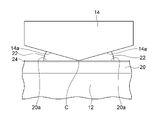
- FIG. 3 is a cross-sectional view taken along the line III-III in FIG. 2 and is a cross-sectional view enlarging the plated portion
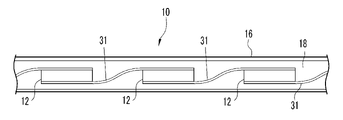
- FIG. 4 is a side view of a solar cell module according to a second embodiment
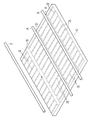
- FIG. 3 is a perspective view showing finger electrodes and busbar electrodes formed on the surface of a solar cell, and an interconnector joined to the busbar electrodes.
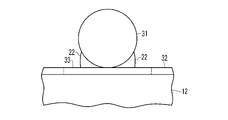
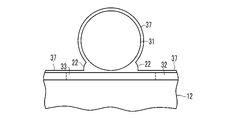
- FIG. 4 is a cross-sectional view showing a state in which a wire-like interconnector is joined to busbar electrodes
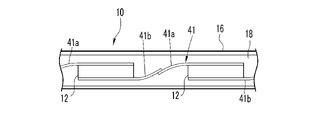
- FIG. 3 is a side view of a solar cell module showing an example in which a pair of coupled connector members are used as an interconnector;
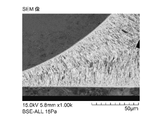
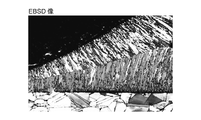
- FIG. 4 is a cross-sectional view showing an example in which coating layers are formed on the surfaces of finger electrodes, busbar electrodes, and interconnectors with a plating metal; It is a SEM image of the cross section of the plated portion. It is the EBSD image which measured the crystal orientation of the cross section of the plating part.
- 4 is a graph showing the difference between bonding by plating and bonding by solder with respect to property loss in a temperature cycle test of a solar cell module.
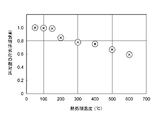
- 4 is a graph showing the Vickers hardness ratio of the plated portion before and after heat treatment for each heat treatment temperature.
- 4 is a graph showing, for each heat treatment temperature, the characteristic deterioration ratio after a thermal stress test of a solar cell module with and without heat treatment of the plating portion.
- the solar battery module 10 includes a plurality of solar battery cells 12 and an interconnector 14 as a wiring material that electrically connects the solar battery cells 12 .
- each solar cell 12 and interconnector 14 are accommodated in housing 16 and sealed with sealing material 18 .
- the interconnector 14 is strip-shaped and arranged linearly, and includes a plurality of electrodes 20 (see FIG. 2) for extracting electric power provided in the solar cell 12 . is joined by a plated portion 22 (see FIG. 3).
- the interconnector 14 and the plurality of electrodes 20 are electrically connected.
- the plurality of photovoltaic cells 12 are linearly arranged at predetermined intervals.
- the arrangement of the plurality of photovoltaic cells 12 is not limited to this, and may be arranged in a matrix, for example.
- Each solar cell 12 is mainly made of silicon (Si) and has a flat plate shape.
- the interconnector 14 is made of copper and has an elongated strip shape.
- the solar cell 12 has a plurality of electrodes 20 formed on both sides thereof.
- the plurality of electrodes 20 linearly extend in a direction orthogonal to the extending direction (extending direction) of the interconnector 14, and are arranged at predetermined intervals in the extending direction of the interconnector 14. , not all the surfaces facing the solar cells 12 are joined to the solar cells 12, but only the portions intersecting the electrodes 20 are joined to the electrodes 20.
- the electrode 20 as an example of the electrode is a so-called finger electrode, but it goes without saying that the electrode may be another electrode such as a busbar electrode. 2 and FIGS. 6 and 8 to be described later, hatching indicating a cross section is omitted.
- the interconnector 14 Since the interconnector 14 is locally bonded in this way, the stress applied to the plated portion 22 is effectively relieved compared to a configuration in which all surfaces facing the solar cells 12 are bonded. . Therefore, the durability of the plated portion 22 is enhanced, and the life of the solar cell module 10 is extended as compared with the conventional solar cell module.
- the interconnector 14 has a mountain-shaped cross section that protrudes toward the side that contacts the electrode 20 of the photovoltaic cell 12 , and is joined with the top portion in contact with the electrode 20 . Since the top of the interconnector 14 extends linearly in the extending direction of the interconnector 14, the interconnector 14 and the electrodes 20 are in linear contact. In the extending direction of the interconnector 14, there is no problem even if part or all of the top of the interconnector 14 is separated from the electrode 20 as long as it can be regarded as being close to the electrode 20 as described later.
- the interconnector 14 having a mountain-shaped cross section is exemplified in the present embodiment
- the shape of the interconnector is not limited to this.
- the interconnector may be wire-shaped and its cross-section may be circular.
- the outer peripheral surface of the interconnector is joined to the electrodes in a linear contact state or a linear proximity state.
- the interconnector 14 is not limited to extending linearly.
- a part of the surface of the interconnector 14 serves as a joint surface 14 a that is used for joining with the electrode 20 of the solar cell 12 .
- a silver paste 24 is sintered as silver on the surface of the electrode 20 , and a part of the surface serves as a surface to be joined 20 a to be joined to the interconnector 14 . That is, the electrodes 20 are substantially made of silver (sintered silver). The distance between the surface to be joined 14a of the interconnector 14 and the surface to be joined 20a of the electrode 20 gradually widens from the contact portion C between the interconnector 14 and the electrode 20 toward the outside.
- the distance between the surfaces 14a and 20a to be welded gradually increases continuously as the partial regions of the surfaces 14a and 20a to be welded move away from the contact portion C where they are in contact with each other.
- the cross section of the interconnector is circular as described above, and the outer peripheral surface of the interconnector is in linear contact with the electrode, the distance between the surfaces to be joined gradually increases as the distance from the contact portion increases. do.
- the plating part 22 is formed of nickel (Ni) as a metal by plating using a plating solution between the interconnector 14 and the solar cell 12 .
- This plated portion 22 is formed between the surface to be joined 14 a of the interconnector 14 and the surface to be joined 20 a of the electrode 20 of the solar cell 12 in a state in which the generation of voids is prevented or suppressed. As a result, the plating portion 22 is prevented or suppressed from interfacial breakage.
- the interconnector 14 and the electrode 20 of the photovoltaic cell 12 are in linear contact.
- the interconnector 14 and the electrode 20 may be in point contact, as in the case where the pointed portion and the electrode 20 of the solar cell 12 are joined.
- the interconnector 14 and the electrode 20 of the solar cell 12 may be close to each other in a dotted or linear manner. That is, the distance between the surfaces to be joined 14a of the interconnector 14 and the surfaces to be joined 20a of the electrodes 20 of the solar cell 12 increases as the partial regions of these surfaces to be joined 14a and 20a move away from the position where they are close to each other. It may be continuously incremented.
- the interconnector 14 and the electrode 20 of the photovoltaic cell 12 are close to each other in a point-like or line-like manner means that the portions of the interconnector 14 and the electrode 20 of the photovoltaic cell 12 to be joined 14a and 20a are in a point-like manner. Or, in a state that can be regarded as linear, it means that the distance between the adjacent portions of the surfaces 14a and 20a to be joined is small.
- the interconnector 14 is strip-shaped, the distance between the adjacent portions of the mating surfaces 14a and 20a is 1/10 or less of its width, and if the interconnector 14 is wire-shaped, it is 1/10 or less of its diameter.
- the interval between the adjacent portions of the surfaces to be joined is preferably about 20 ⁇ m or less.
- the configuration in which the distance between the surfaces to be bonded 14a and 20a is widened outward from the contact portion C of the surfaces to be bonded 14a and 20a, or from the adjacent portion, will be described later in detail.
- the occurrence of voids is prevented or suppressed at the portion where the columnar crystals that grow from 20a and become the plated portion 22 meet. Therefore, the bonding strength between interconnector 14 and electrode 20 of photovoltaic cell 12 can be increased.
- columnar crystals that form the plating portion 22 grow from the bonding surface 20a of the electrode 20 on which the silver paste 24 is sintered, corrosion of the silver constituting the silver paste 24 can be suppressed. A decrease in the life of the solar cell module 10 due to corrosion can be suppressed.
- the interconnector 14 and the electrode 20 of the solar battery cell 12 may be partially in contact with each other or in close proximity to each other. In this case, it is preferable to have a portion where the distance between the surfaces to be bonded 14a and 20a is widened outward from the contact portion C of the surfaces to be bonded 14a and 20a or from the adjacent portion. Even with such a configuration, the columnar crystals that grow from the contacting portion C or the adjacent portions to the outside and become the plated portions 22 grown from the joint surfaces 14a and 20a whose distance gradually increases toward the outside are met. Void generation is prevented or suppressed.
- the joint between the interconnector 14 and the solar cell 12 is excellent in joint strength.
- the junction between the interconnector 14 and the solar cell 12 is made of nickel instead of the solder generally applied to the junction between the wiring member and the solar cell in a conventional solar cell module.
- the nickel used for the plating part 22 has a smaller difference in thermal expansion coefficient from copper, which is the material of the interconnector 14, than the difference between solder and copper, and thus the plating part 22 is resistant to repeated temperature changes. Detachment or the like of the interconnector 14 due to deterioration is less likely to occur.
- the plated portion 22 maintains good bonding between the interconnector 14 and the solar cell 12, and suppresses an increase in resistance due to deterioration of the bonding and, in turn, a decrease in power generation efficiency.
- the solar cell module 10 In the manufacturing process of the solar cell module 10 in which the interconnector 14 and the solar cell 12 are joined, it is preferable not to perform the heat treatment, or to perform the heat treatment for the purpose of relaxing (removing or reducing) the distortion of the plated portion 22 .
- By removing or relaxing the distortion of the plating part 22 by heat treatment flexibility can be given to the plating part 22, that is, the junction between the interconnector 14 and the electrode 20, and the interconnector 14 and the solar cell 12 when in use. Destruction of the plated portion 22 due to expansion and contraction due to temperature changes is suppressed, and the life of the solar cell module 10 can be extended.
- the solar cell module 10 of the present embodiment is subjected to heat treatment as described above, thereby relaxing the distortion of the plated portion 22 and extending the life of the solar cell module 10 .
- the silver serving as the base electrode formed on the surface of the electrode 20 and the plated metal forming the plated portion 22 are diffused to improve adhesion and resistance. Improves releasability.
- the heat treatment temperature is too high, the electrical resistance increases, so it is preferable to perform the heat treatment at a low temperature.
- the heat treatment is preferably performed at 500° C. or less, and when the plating metal is copper, the heat treatment is preferably performed at 450° C. or less.
- the thickness of the diffusion layer formed by diffusing the metal forming the base electrode and the plating metal is preferably 0.005 ⁇ m or more and 1 ⁇ m or less.
- the elimination or relaxation of strain in the plated portion 22 can be confirmed as a decrease in Vickers hardness.
- the Vickers hardness of the plating portion 22 after the above heat treatment is preferably in the range of 100 to 250 HV when the plating metal constituting the plating portion 22 is nickel, and is in the range of 100 to 230 HV. is more preferable. That is, when the heat treatment is performed, the heat treatment is performed so that the Vickers hardness of the plated portion 22 made of nickel is preferably in the range of 100 to 250 HV, more preferably in the range of 100 to 230 HV.
- the Vickers hardness of the plated portion 22 can be measured in micro Vickers by a known measuring method according to Japanese Industrial Standard JIS Z 2244.
- nickel is used as the plating metal forming the plating portion 22, but it is not limited to nickel.
- the plating metal forming the plating portion 22 is preferably nickel, nickel alloy, copper, copper alloy, or the like.
- Nickel alloys include Ni--P, Ni--B, Ni--S and the like, and copper alloys include Cu--Zn, Cu--Sn, Cu--Ag and Cu--Pd.
- the nickel alloy contains a small amount of elements other than nickel (for example, 10% or less), and the copper alloy contains a small amount of elements other than copper (e.g., 10% or less). for example, 10% or less).
- the Vickers hardness of the plated portion 22 is preferably in the range of 40 to 105 HV. Even in this case, the distortion of the plated portion 22 is alleviated compared to before the heat treatment, and the life of the solar cell module 10 can be extended.
- the plating portion 22 is formed of an Fe—Ni alloy having a nickel content within the range of 32% or more and 45% or less. It is also preferable to use a plating metal that The plated portion 22 made of such an Fe—Ni alloy is particularly useful when the solar cell module 10 is used in an environment with a large temperature difference where thermal stress is large.
- the manufacturing processes of the solar cell module 10 can be performed using known manufacturing methods related to solar cell modules, so the description thereof is omitted.
- the interconnector 14 is prepared.
- the interconnector 14 is produced by processing the belt-like material made of copper so that the portion of the solar battery cell 12 on the side to be joined to the electrode 20 is formed into a mountain shape (taper shape).
- the surfaces of the interconnector 14 and the electrodes 20 are subjected to alkaline degreasing and acid cleaning to remove dust, oil, and the like from the surfaces.
- an organic film such as a resist film is coated on portions of the surfaces of the interconnector 14 and the electrodes 20 that do not require plating (portions other than the surfaces to be joined 14a and 20a).
- the joining surface 14a of the interconnector 14 and the joining surface 20a of the electrode 20 of the solar cell 12 are joined by plating.
- the plating process is performed by fixing only the ends of the mountain-shaped portions of the interconnector 14 in linear contact with the electrodes 20 of the solar cells 12 or in close proximity to each electrode 20 .
- the outer peripheral surface of the interconnector may be fixed in contact with or in close proximity to each electrode 20 .
- a sulfamic acid bath can be used for plating.
- the plating solution is allowed to enter between the bonding surface 14a of the interconnector 14 and the bonding surface 20a (silver paste 24) of each electrode 20 of the solar cell 12, and the plating portion 22 is formed therebetween.
- the temperature of the plating solution is preferably about 55°C.
- the interconnector 14 and each electrode 20 of the solar cell 12 are in a state of being electrically connected, and each of them is equipotential. It is preferable to keep the surfaces to be joined 14a and 20a at the same potential.
- the plating solution used for the plating treatment is preferably adjusted so that the columnar crystals meet sequentially outward from the region where the distance between the surfaces to be bonded 14a and the surfaces to be bonded 20a is small.
- each electrode 20 of the interconnector 14 and the solar cell 12 By plating each electrode 20 of the interconnector 14 and the solar cell 12 as described above, elongated nickel columnar crystals grow from the surfaces of the interconnector 14 and the electrode 20 of the solar cell 12, respectively. do.
- the columnar crystals grown from the surfaces to be joined 14a of the interconnector 14 and the columnar crystals grown from the surfaces to be joined 20a of the electrodes 20 of the solar cell 12 collide with each other at their tips to meet, and the surfaces to be joined 14a , 20a form a meeting interface.
- This meeting interface is formed in order from a point where the distance between the surfaces 14a and 20a to be joined is narrow to a point where the distance is wide. As a result, the generation of voids in the plated portion 22 is prevented or suppressed.
- a heat treatment is performed to heat the interconnector 14 and the solar cell 12 that are joined by the plating portion 22 .
- the plating metal is nickel
- this heat treatment is preferably performed at a temperature within the range of 200° C. or higher and 500° C. or lower in the atmosphere. This is because the heat treatment at 200° C. or higher lowers the internal stress of the electrolytic nickel plating and increases the resistance to thermal stress.
- the heat treatment temperature is 500° C. or less, it is possible to suppress adverse effects (increase in electrical resistance due to diffusion, coarsening of metal crystal grains, etc.) on the characteristics of the solar cell mainly made of silicon. It's for.
- the distortion of the plated portion 22 is reduced compared to before the heat treatment.
- the plating metal is nickel
- the Vickers hardness of the plated portion 22 is approximately 275 HV before the heat treatment, but is reduced to approximately 140 HV after the heat treatment.
- the heat treatment is preferably performed in the temperature range of 150° C. or more and 450° C. or less because the melting point is lower than that of nickel.
- the interconnector 14 and each electrode 20 of the solar cell 12 are joined. Bonding according to the above procedure can be performed collectively for a plurality of solar cells 12 .
- the plurality of photovoltaic cells 12 to which the interconnectors 14 are joined are then housed in a housing 16 and then sealed with a sealing material 18 to form a photovoltaic module 10 .
- the durability of the plated portion 22 is enhanced, and a long life is achieved.
- FIG. 4 shows the solar cell module 10 of the second embodiment.
- this embodiment is the same as the first embodiment, and substantially the same members are denoted by the same reference numerals, and detailed description thereof will be omitted.
- one interconnector 31 connects two adjacent solar cells 12 , and multiple solar cells 12 are electrically connected in series by the multiple interconnectors 31 .
- a plurality of solar cells 12 are arranged in a matrix, and two adjacent solar cells 12 in each row are connected by one interconnector 31 . That is, one interconnector 31 connects the electrode on the surface of one of the two solar cells 12 and the electrode on the back of the other solar cell 12 .
- the electrode on the surface of the solar cell 12 is connected to the electrode on the back surface of the adjacent solar cell 12 on the left side in the figure via the interconnector 31, and the solar cell
- the electrode on the back surface of the cell 12 is connected to the electrode on the surface of the adjacent solar cell 12 on the right side in the figure via another interconnector 31 .
- each solar cell 12 has a positive electrode on the front surface and a negative electrode on the back surface.
- the solar cells 12 in each row are electrically connected in series by the interconnectors 31 .
- the arrangement of the plurality of photovoltaic cells 12 and the manner of connection of the interconnector 31 are not limited to this.
- a plurality of finger electrodes 32 are provided on the surface of the solar cell 12 .
- the plurality of finger electrodes 32 linearly extend in one direction and are formed parallel to each other at predetermined intervals.
- a busbar electrode 33 is provided to collect current flowing through the finger electrodes 32 generated by the solar cell 12. As shown in FIG. In this example, three busbar electrodes 33 are provided at predetermined intervals from each other.
- the busbar electrodes 33 are provided extending in a direction perpendicular to the finger electrodes 32 and are electrically connected to the plurality of finger electrodes 32 at intersecting positions.
- the finger electrodes 32 and the busbar electrodes 33 are made of silver (Ag), and the surface of the busbar electrodes 33 serves as one surface to be joined. Note that the finger electrodes 32 and the busbar electrodes 33 may be made of copper, nickel, or the like.
- Interconnectors 31 are provided corresponding to the three busbar electrodes 33, and each interconnector 31 is arranged to extend in a direction perpendicular to the finger electrodes 32, that is, in the direction in which the busbar electrodes 33 extend. ing. Each interconnector 31 is joined to a corresponding busbar electrode 33 by a plating portion 22 (see FIG. 6).
- the interconnector 31 in this example is a wire having a circular cross section made of highly conductive metal, such as a copper wire. It should be noted that the interconnector 31 may be of a mountain-shaped cross-section as in the first embodiment.
- the interconnector 31 has its outer peripheral surface in contact with the busbar electrode 33, and is joined by the plating portion 22 in a state of linear contact with the busbar electrode 33 in its extending direction.
- a plurality of plated portions 22 are intermittently formed in the extending direction of the interconnector 31 . That is, the plating portions 22 are formed at a plurality of locations at predetermined intervals in the extending direction of the interconnector 31, and the busbar electrodes 33 and the interconnector 31 are locally joined at a plurality of locations.
- the configuration in which the interconnector 31 and the busbar electrode 33 are locally joined at a plurality of locations causes stress acting on the plating portion 22 due to the difference in thermal expansion coefficient between the interconnector 31 and the solar cell 12. mitigate Therefore, the durability of the plated portion 22 is enhanced, and the life of the solar cell module 10 can be extended as compared with the conventional solar cell module.
- Finger electrodes and busbar electrodes are provided on the rear surface of the solar cell 12 as well as on the front surface, and the interconnector 31 is joined to the busbar electrode 33 by a plating portion.
- the portions where the interconnector 31 and the busbar electrodes 33 are close to each other may be joined by the plating portion 22, and the portions of the interconnector 31 that are not joined to the busbar electrodes 33 may be separated from the busbar electrodes 33.
- the plating portion 22 may be formed continuously in the extending direction of the interconnector 31 . That is, the entire area of the interconnector 31 on the busbar electrode 33 may be joined to the busbar electrode 33 by the plating portion 22 in the extending direction of the interconnector 31 .
- the structure of the plated portion 22 is the same as in the case of localized bonding even in such joining by the continuously long plated portion 22 .
- the interconnector 31 in the above example is formed as a single piece during its manufacturing stage, but as in the example shown in FIG. , 41b may be joined to form one interconnector 41.
- FIG. In this example, one end of the connector member 41a is joined to the busbar electrode 33 on the surface of the solar cell 12 by the plated portion 22 .
- one end of the connector member 41 b is joined to the busbar electrode by the plating portion 22 .
- the connector members 41a and 41b are made of copper wire with a circular cross section. Note that the connector members 41a and 41b may have a belt-like shape with a cross section. Also, the other ends of the connector members 41a and 41b may have a shape or the like that facilitates their joining.
- the connector member 41a joined to the surface of the solar cell 12 and the connector member 41b joined to the back surface are joined to the solar cell 12 so as to protrude from the solar cell 12 in opposite directions.
- the connector member 41a and the connector member 41b are joined to the solar cell 12 so that the other end protrudes to the left side of the solar cell 12 and the connector member 41b to the right side of the solar cell 12, respectively.
- the other end of the connector member 41a of the solar cell 12 and the connector member 14b of the left solar cell 12 of the solar cell 12 are connected.
- the other end is joined and connected to be electrically connected.
- joining by ultrasonic joining or spot electric welding can be used.
- interconnector 41 it is no longer necessary to join the interconnector to the plurality of solar cells 12 all at once or continuously, and a plurality of solar cells can be efficiently connected using a compact processing apparatus.
- An interconnector 41 can be joined to the battery cell 12 . Since the connector members 41a and 41b are made of the same material, they are not affected by differences in thermal expansion.
- the surface of the busbar electrode 33 and the outer peripheral surface of the interconnector 31 on which the plating portion 22 is not formed, and the surfaces of the finger electrodes 32 may be covered with a plating metal.
- a coating layer 37 made of a plated metal is formed on the surface of the busbar electrode 33 and the outer peripheral surface of the interconnector 31 where the plating portion 22 is not formed, and on the surface of the finger electrode 32 .
- the coating layer 37 can be formed together with the plated portion 22 by plating without applying a resist film or the like to the portion where the coating layer 37 is to be formed.
- the interconnector is joined to the electrodes (finger electrodes, busbar electrodes) formed on the surface of the solar cell.
- a plated portion may be formed between the surface to be joined and the surface to be joined of the interconnector, and the interconnector may be joined to the solar cell. By doing so, the bonding strength between the interconnector and the solar cell can be improved.
- the surface itself of the silicon substrate to be joined becomes an electrode connected to the interconnector.
- the busbar electrodes and the finger electrodes may be formed of a plated metal on the surface of the solar cell (silicon substrate) by plating when the interconnector and the solar cell are joined by plating.
- the surfaces to be bonded surfaces of the solar cells (silicon substrates), the surfaces on which the busbar electrodes and finger electrodes are to be formed are subjected to a treatment for obtaining good conductivity, that is, the insulating layer on the surface is removed by an etching treatment or the like. Processing such as forming a plating underlying conductive film is performed.
- Example 1 (1) Preparation of Sample In Example 1, a sample of a bonded structure in which a wire-shaped interconnector made of copper and one solar battery cell were bonded at a plated portion was prepared, and a cross section of the bonded structure was observed. gone. A wire-like interconnector (copper wire) having a diameter of 300 ⁇ m and made of copper (purity 99.9%) was used. A rectangular parallelepiped solar cell having long and short sides of 52 ⁇ 26 mm and a thickness of 0.17 mm was prepared. Nickel was used as the plating metal forming the plating portion. The sample preparation method was the same as the production method in the above embodiment.
- the surfaces of the interconnector and busbar electrodes were degreased with alkali and washed with acid to remove dust and oil on the surface. Thereafter, a resist film was applied to portions of the surfaces of the electrodes (busbar electrodes) formed on the interconnector and the solar cell, which did not require plating.
- the outer peripheral surface of the interconnector is fixed in linear contact with the electrode of the solar cell, and plating is performed to connect the surface to be joined of the interconnector and the electrode of the solar cell.
- a plated portion was formed between the two surfaces to be joined.
- a sulfamic acid bath was used, the temperature of the plating solution was 55° C., and the current density for plating was 1.5 A/dm 2 .
- the interconnector was continuously joined to the electrodes with a predetermined length, and the plating width was 0.14 mm. A sample of the bonded structure was produced by the above procedure.
- a wire-shaped interconnector made of copper (purity 99.9%) and having a diameter of 300 ⁇ m and a plurality of solar cells were each joined at a plated portion to prepare a sample, and a temperature cycle test was performed. After (TC test), loss evaluation of electrical properties was performed.
- the same interconnector and solar cell as in the first example were prepared, and the interconnector and the electrode of the solar cell were joined by the same joining method as in the first example. Nickel was used as the plating metal forming the plating portion. Parts other than the joints between the interconnector and each solar cell were manufactured by a known manufacturing method.
- a comparative sample a sample was produced in which the interconnector and the electrode of each solar cell were joined by solder instead of joining by the plated portion.
- a temperature cycle test was performed on the prepared sample and the comparative sample.
- a temperature cycle tester manufactured by Espec Co., Ltd. was used, and the conditions were -40°C to 150°C for the sample of Example 2 and -40°C to 85°C for the comparative sample. 600 cycles each in between. After 200 cycles, 400 cycles, and 600 cycles, each sample was evaluated for loss of electrical properties (maximum output (P max )) (decrease rate of maximum output from before the start of the temperature cycle test).
- P max maximum output
- a desktop solar simulator was used, and a Xe lamp was used to irradiate light of 100 mW/cm 2 and IV measurement was performed.
- a sample was prepared by joining a wire-shaped interconnector made of copper (purity 99.9%) and having a diameter of 200 ⁇ m and a plurality of solar cells at their respective plating portions. was heat treated in the atmosphere for 30 minutes, and the Vickers hardness ratio (hardness after heat treatment/hardness before heat treatment) of the plated portion before and after heat treatment was evaluated for each heat treatment temperature.
- the characteristic deterioration ratio of the sample after the temperature cycle test (characteristic deterioration of the sample with heat treatment/characteristic deterioration of the sample without heat treatment) depending on the presence or absence of heat treatment of the plated portion was evaluated for each heat treatment temperature.
- Nickel was used as the plated metal forming the plated portion, and the interconnection between the interconnector and the electrode of the solar cell was performed by the same manufacturing method as in the second example.
- the Vickers hardness was measured using a micro Vickers tester MHT-1 manufactured by Matsuzawa Seiki Co., Ltd. according to a known measuring method according to Japanese Industrial Standard JIS Z 2244.
- a temperature cycle tester TSA-73ES-W manufactured by Espec Co., Ltd. was used, and the number of cycles was set to 500 cycles.
- the hardness of the plated portion decreased when the heat treatment temperature was 200°C or higher. Further, the Vickers hardness ratio was approximately 0.5 at a heat treatment temperature of around 500° C., and even if the heat treatment temperature was increased beyond that point, the hardness did not decrease significantly. As described above, the Vickers hardness of the plated portion before the heat treatment was about 275 HV, and after the heat treatment at 500° C. was about 140 HV.
- the rate of deterioration of the electrical properties after the temperature cycle test for the samples that were not heat-treated was assumed to be 100%, and the deterioration of the electrical properties was evaluated as a ratio to this.
- the ratio of deterioration of electrical characteristics was about 0.8 at a heat treatment temperature of 200 ° C. or higher, and a decrease in the deterioration rate of electrical characteristics was observed. . That is, it was found that the electrical properties are less likely to deteriorate when the heat treatment temperature is 200° C. or higher.
- the heat treatment temperature of 500° C. or less can reduce the possibility of adversely affecting the characteristics of the solar cell, it is preferable to set the heat treatment temperature in the range of 200° C. or higher and 500° C. or lower. Recognize. By performing the heat treatment at a temperature within the above range, it is possible to improve the adhesion between the interconnector and the electrodes and to relax the stress of the plated metal.
Landscapes
- Photovoltaic Devices (AREA)
Priority Applications (2)
| Application Number | Priority Date | Filing Date | Title |
|---|---|---|---|
| JP2023503843A JPWO2022186167A1 (https=) | 2021-03-01 | 2022-02-28 | |
| US18/547,967 US20240128391A1 (en) | 2021-03-01 | 2022-02-28 | Solar battery module and method for manufacturing same |
Applications Claiming Priority (2)
| Application Number | Priority Date | Filing Date | Title |
|---|---|---|---|
| JP2021032159 | 2021-03-01 | ||
| JP2021-032159 | 2021-03-01 |
Publications (1)
| Publication Number | Publication Date |
|---|---|
| WO2022186167A1 true WO2022186167A1 (ja) | 2022-09-09 |
Family
ID=83153801
Family Applications (1)
| Application Number | Title | Priority Date | Filing Date |
|---|---|---|---|
| PCT/JP2022/008457 Ceased WO2022186167A1 (ja) | 2021-03-01 | 2022-02-28 | 太陽電池モジュール及びその製造方法 |
Country Status (3)
| Country | Link |
|---|---|
| US (1) | US20240128391A1 (https=) |
| JP (1) | JPWO2022186167A1 (https=) |
| WO (1) | WO2022186167A1 (https=) |
Families Citing this family (1)
| Publication number | Priority date | Publication date | Assignee | Title |
|---|---|---|---|---|
| CN118969902A (zh) * | 2024-07-29 | 2024-11-15 | 环晟光伏(江苏)有限公司 | 一种栅线应力小的太阳能电池片及其制备方法与应用 |
Citations (6)
| Publication number | Priority date | Publication date | Assignee | Title |
|---|---|---|---|---|
| JPH0381649U (https=) * | 1989-12-08 | 1991-08-21 | ||
| JP2011210868A (ja) * | 2010-03-29 | 2011-10-20 | Hitachi Cable Ltd | 太陽電池接続用複合平角線及びその製造方法 |
| JP2012094625A (ja) * | 2010-10-26 | 2012-05-17 | Hitachi Cable Ltd | 太陽電池用導体及びその製造方法 |
| JP2013524495A (ja) * | 2010-04-01 | 2013-06-17 | ゾモント・ゲーエムベーハー | 太陽電池および太陽電池を製造する方法 |
| US20160225730A1 (en) * | 2013-10-09 | 2016-08-04 | Waseda University | Electrode connection structure and electrode connection method |
| JP2018022748A (ja) * | 2016-08-02 | 2018-02-08 | 日立金属株式会社 | はんだめっき線及び太陽電池モジュール |
Family Cites Families (1)
| Publication number | Priority date | Publication date | Assignee | Title |
|---|---|---|---|---|
| WO2017056370A1 (ja) * | 2015-09-30 | 2017-04-06 | パナソニックIpマネジメント株式会社 | 太陽電池セルおよび太陽電池セルの製造方法 |
-
2022
- 2022-02-28 JP JP2023503843A patent/JPWO2022186167A1/ja active Pending
- 2022-02-28 WO PCT/JP2022/008457 patent/WO2022186167A1/ja not_active Ceased
- 2022-02-28 US US18/547,967 patent/US20240128391A1/en not_active Abandoned
Patent Citations (6)
| Publication number | Priority date | Publication date | Assignee | Title |
|---|---|---|---|---|
| JPH0381649U (https=) * | 1989-12-08 | 1991-08-21 | ||
| JP2011210868A (ja) * | 2010-03-29 | 2011-10-20 | Hitachi Cable Ltd | 太陽電池接続用複合平角線及びその製造方法 |
| JP2013524495A (ja) * | 2010-04-01 | 2013-06-17 | ゾモント・ゲーエムベーハー | 太陽電池および太陽電池を製造する方法 |
| JP2012094625A (ja) * | 2010-10-26 | 2012-05-17 | Hitachi Cable Ltd | 太陽電池用導体及びその製造方法 |
| US20160225730A1 (en) * | 2013-10-09 | 2016-08-04 | Waseda University | Electrode connection structure and electrode connection method |
| JP2018022748A (ja) * | 2016-08-02 | 2018-02-08 | 日立金属株式会社 | はんだめっき線及び太陽電池モジュール |
Also Published As
| Publication number | Publication date |
|---|---|
| US20240128391A1 (en) | 2024-04-18 |
| JPWO2022186167A1 (https=) | 2022-09-09 |
Similar Documents
| Publication | Publication Date | Title |
|---|---|---|
| JP5491682B2 (ja) | 太陽電池用平角導体及びその製造方法並びに太陽電池用リード線 | |
| CN103650153B (zh) | 太阳能电池 | |
| JP5667543B2 (ja) | 銀めっき材およびその製造方法 | |
| JP2005142282A (ja) | インターコネクタ、並びに、それを用いる太陽電池ストリングおよびその製造方法、並びに、その太陽電池ストリングを用いる太陽電池モジュール | |
| CN209822766U (zh) | 电池组及其输出结构 | |
| US20090260689A1 (en) | Solar cell lead wire, method of making the same, and solar cell | |
| US20080011347A1 (en) | Connecting lead wire for a solar battery module, method for fabricating same, and solar battery module using the connecting lead wire | |
| CN1702881A (zh) | 热电转换装置 | |
| WO2022186167A1 (ja) | 太陽電池モジュール及びその製造方法 | |
| JP2004300524A (ja) | Sn被覆を施した銅または銅合金部材およびその製造方法 | |
| CN1591989A (zh) | 端子及其电镀方法 | |
| JPWO2011111639A1 (ja) | コンタクト製造用組成物およびこれを用いたコンタクト並びにコネクタ | |
| JP5234487B2 (ja) | フレキシブルフラットケーブルおよびその製造方法 | |
| CN100521246C (zh) | 太阳能电池单元 | |
| CN102856694A (zh) | 电连接器端子 | |
| JP2010044983A (ja) | 接触子及びその製造方法、ならびに前記接触子を備える接続装置及びその製造方法 | |
| CA2911076C (en) | Terminal plate for fuel cell, and fuel cell | |
| JP2011210868A (ja) | 太陽電池接続用複合平角線及びその製造方法 | |
| GB2469449A (en) | Connecting Structure for exteriorly connecting battery cells | |
| JP4683466B2 (ja) | 太陽電池用電極接続線材及びその線材によって接続された太陽電池 | |
| JP5565519B1 (ja) | 太陽電池モジュール | |
| JP2015162548A (ja) | 太陽電池モジュール | |
| JP2004207717A (ja) | 熱電モジュール | |
| CN118472078B (zh) | 一种太阳能电池的互连片及连接方法 | |
| JP2000091650A (ja) | 高温度熱電変換素子 |
Legal Events
| Date | Code | Title | Description |
|---|---|---|---|
| 121 | Ep: the epo has been informed by wipo that ep was designated in this application |
Ref document number: 22763222 Country of ref document: EP Kind code of ref document: A1 |
|
| WWE | Wipo information: entry into national phase |
Ref document number: 2023503843 Country of ref document: JP |
|
| WWE | Wipo information: entry into national phase |
Ref document number: 18547967 Country of ref document: US |
|
| NENP | Non-entry into the national phase |
Ref country code: DE |
|
| 122 | Ep: pct application non-entry in european phase |
Ref document number: 22763222 Country of ref document: EP Kind code of ref document: A1 |