WO2022181512A1 - アルカリ水電解用アノード - Google Patents
アルカリ水電解用アノード Download PDFInfo
- Publication number
- WO2022181512A1 WO2022181512A1 PCT/JP2022/006824 JP2022006824W WO2022181512A1 WO 2022181512 A1 WO2022181512 A1 WO 2022181512A1 JP 2022006824 W JP2022006824 W JP 2022006824W WO 2022181512 A1 WO2022181512 A1 WO 2022181512A1
- Authority
- WO
- WIPO (PCT)
- Prior art keywords
- anode
- nickel
- lithium
- coating
- water electrolysis
- Prior art date
- Legal status (The legal status is an assumption and is not a legal conclusion. Google has not performed a legal analysis and makes no representation as to the accuracy of the status listed.)
- Ceased
Links
Classifications
-
- C—CHEMISTRY; METALLURGY
- C25—ELECTROLYTIC OR ELECTROPHORETIC PROCESSES; APPARATUS THEREFOR
- C25B—ELECTROLYTIC OR ELECTROPHORETIC PROCESSES FOR THE PRODUCTION OF COMPOUNDS OR NON-METALS; APPARATUS THEREFOR
- C25B11/00—Electrodes; Manufacture thereof not otherwise provided for
- C25B11/04—Electrodes; Manufacture thereof not otherwise provided for characterised by the material
- C25B11/051—Electrodes formed of electrocatalysts on a substrate or carrier
- C25B11/073—Electrodes formed of electrocatalysts on a substrate or carrier characterised by the electrocatalyst material
-
- Y—GENERAL TAGGING OF NEW TECHNOLOGICAL DEVELOPMENTS; GENERAL TAGGING OF CROSS-SECTIONAL TECHNOLOGIES SPANNING OVER SEVERAL SECTIONS OF THE IPC; TECHNICAL SUBJECTS COVERED BY FORMER USPC CROSS-REFERENCE ART COLLECTIONS [XRACs] AND DIGESTS
- Y02—TECHNOLOGIES OR APPLICATIONS FOR MITIGATION OR ADAPTATION AGAINST CLIMATE CHANGE
- Y02E—REDUCTION OF GREENHOUSE GAS [GHG] EMISSIONS, RELATED TO ENERGY GENERATION, TRANSMISSION OR DISTRIBUTION
- Y02E60/00—Enabling technologies; Technologies with a potential or indirect contribution to GHG emissions mitigation
- Y02E60/30—Hydrogen technology
- Y02E60/36—Hydrogen production from non-carbon containing sources, e.g. by water electrolysis
-
- Y—GENERAL TAGGING OF NEW TECHNOLOGICAL DEVELOPMENTS; GENERAL TAGGING OF CROSS-SECTIONAL TECHNOLOGIES SPANNING OVER SEVERAL SECTIONS OF THE IPC; TECHNICAL SUBJECTS COVERED BY FORMER USPC CROSS-REFERENCE ART COLLECTIONS [XRACs] AND DIGESTS
- Y02—TECHNOLOGIES OR APPLICATIONS FOR MITIGATION OR ADAPTATION AGAINST CLIMATE CHANGE
- Y02P—CLIMATE CHANGE MITIGATION TECHNOLOGIES IN THE PRODUCTION OR PROCESSING OF GOODS
- Y02P20/00—Technologies relating to chemical industry
- Y02P20/10—Process efficiency
- Y02P20/133—Renewable energy sources, e.g. sunlight
Definitions
- the present invention relates to an anode for alkaline water electrolysis and a manufacturing method thereof.
- Hydrogen is a secondary energy that is suitable for storage and transportation and has a low environmental impact. For this reason, interest is focused on hydrogen energy systems using hydrogen as an energy carrier.
- hydrogen is mainly produced by steam reforming of fossil fuels. From the viewpoint of global warming and fossil fuel depletion problems, the importance of alkaline water electrolysis using renewable energy sources such as solar cells, wind power generation, and hydroelectric power generation is increasing. Anodes for alkaline water electrolysis using renewable energy are required to have a low Oxygen Over Voltage and a long life.
- Patent document 1 aims to provide an anode for alkaline water electrolysis that can produce hydrogen by water electrolysis using electric power with large output fluctuations such as renewable energy and has high durability against output fluctuations. , describes an anode for alkaline water electrolysis using a catalyst layer comprising a lithium-containing nickel oxide. However, the anode described in Patent Document 1 is not practical because its firing temperature is as high as 900°C to 1000°C.
- the catalyst component constituting the electrode catalyst layer is nickel cobalt spinel oxide or lanthanide nickel
- An anode for alkaline water electrolysis comprising a first catalytic component comprising cobalt perovskite oxide and a second catalytic component comprising at least one of iridium oxide and ruthenium oxide.
- An object of the present invention is to provide an anode for alkaline water electrolysis that has a low oxygen overvoltage and a long life, and a method for producing the same.
- the present inventors have found that by forming a coating containing iridium oxide, nickel oxide, and lithium oxide on a conductive substrate, the oxygen overvoltage in alkaline water electrolysis is reduced, and furthermore, The inventors have found that the catalytic activity of the electrode can be maintained for a long period of time, that is, the life of the electrode can be extended, and have completed the present invention.
- anode for alkaline water electrolysis comprising a conductive substrate and a coating, wherein the coating comprises 1) iridium oxide, 2) nickel oxide, and 3) lithium oxide. .
- the metal elements are present in the coating at a ratio of 15 to 80 mol% in total of iridium element and nickel element, and 20 to 85 mol% of lithium element. anode.
- the metal elements are present in the coating in a ratio of 25 to 55 mol % of the sum of the iridium element and the nickel element and 45 to 75 mol % of the lithium element.
- Anode for alkaline water electrolysis [4] The anode for alkaline water electrolysis according to any one of [1] to [3], which has an intermediate layer containing nickel oxide and lithium oxide between the conductive substrate and the coating. [5] 1) A solution containing iridium ions, nickel ions, and lithium ions is applied to the surface of the conductive substrate or the surface of the intermediate layer provided on the conductive substrate, and dried to obtain an anode precursor. 2) A method for producing an anode for alkaline water electrolysis, comprising the steps of heat-treating the anode precursor obtained in step 1) at a temperature of 400°C to 600°C in an oxygen-containing atmosphere.
- anode for alkaline water electrolysis that has a low oxygen overvoltage and a long life.
- the anode for alkaline water electrolysis includes a conductive substrate and a coating formed on the surface, and the coating includes 1) iridium oxide, 2) nickel oxide, and 3) lithium oxide.
- the coating includes 1) iridium oxide, 2) nickel oxide, and 3) lithium oxide.
- the conductive substrate may be any material that has electrical conductivity and certain chemical stability against alkalis, such as stainless steel, nickel, nickel-based alloys, iron, or nickel-plated iron materials.
- at least the surface of the conductive substrate is nickel or a nickel-based alloy.
- the size and thickness of the conductive substrate can be selected without limitation according to the requirements of the alkaline water electrolysis apparatus.
- the thickness of the conductive substrate is preferably 0.05 to 5 mm, more preferably 0.1 to 3 mm, still more preferably 0.5 to 1 mm.
- the conductive substrate preferably has a shape having openings for removing generated oxygen bubbles, and for example, a shape such as a punching plate or an expanded mesh is preferably used.
- the aperture ratio is preferably 10 to 95%, more preferably 20 to 60%, even more preferably 30 to 50%.
- the coating in the anode for alkaline water electrolysis according to this embodiment contains iridium oxide, nickel oxide, and lithium oxide.
- iridium oxides include IrO2 .
- nickel oxides include NiO.
- lithium oxides include Li 2 O and Li 2 O 2 .
- the proportions of the elements iridium, nickel and lithium are from 15 to 80 mol % sum of the iridium and nickel elements and from 20 to 20 mol % of the lithium elements. 85 mol %, preferably 25 to 55 mol % of the sum of the iridium element and the nickel element, and 45 to 75 mol % of the lithium element, more preferably 25 to 35 mol % of the sum of the iridium element and the nickel element and 65 to 75 mol % lithium element.
- the ratio of iridium element, nickel element and lithium element can be calculated from the raw material used for the coating precursor, but it is possible to use a fluorescent X-ray device and / or high frequency inductively coupled plasma (ICP) emission spectroscopy. It is also possible to measure using an analytical method or the like.
- ICP inductively coupled plasma
- the ratio of elemental iridium and elemental nickel present in the coating is preferably from 1:1 to 1:15, more preferably from 1:3 to 1:10. A ratio of 1:5 to 1:7 is more preferred.
- the ratio of the iridium element and the nickel element can be calculated from the raw material used for the coating precursor. It is also possible to measure using
- the coating further contains a composite oxide containing two or more elements selected from the group consisting of iridium element, nickel element and lithium element.
- composite oxides include lithium-containing nickel oxides and lithium-containing iridium oxides.
- the amount of iridium oxide, nickel oxide and lithium oxide in the coating per actual surface area is preferably 3.0 to 20.0 g/m 2 in total in terms of metal of the constituent components. 4.0 to 17.0 g/m 2 is more preferred, 5.0 to 16.0 g/m 2 is even more preferred, and 6.0 to 15.0 g/m 2 is particularly preferred. .
- the amount of iridium oxide, nickel oxide and lithium oxide in the coating can be calculated from the raw materials used in the coating precursor, but can also be calculated from the fluorescent X-ray device and/or the weight difference after coating. is
- the coating also includes substances other than the oxides mentioned above.
- Materials other than the above oxides that can be included in the coating include iron oxides, manganese oxides, lanthanum oxides, strontium oxides, calcium oxides, magnesium oxides, and the like.
- the ratio of these substances contained in the coating is preferably 55 mol % or less, more preferably 45 mol % or less, and even more preferably 35 mol % or less.
- the thickness of the coating can be selected without limitation according to the requirements of the alkaline water electrolysis device.
- the average thickness of the coating is preferably 1.0-50 ⁇ m, more preferably 1.5-20 ⁇ m, even more preferably 2.0-10 ⁇ m.
- the average thickness of the coating is obtained by measuring the thickness of at least 5 points from a cross-sectional photographic image obtained using a scanning electron microscope, and taking the average value as the average thickness.
- the anode for alkaline water electrolysis has an intermediate layer comprising nickel oxide and lithium oxide between the conductive substrate and the coating.
- the ratio of the nickel element and the lithium element among the metal elements present in the intermediate layer is 50 to 99 mol % of the nickel element and 1 to 50 mol % of the lithium element, preferably the nickel element. 60 to 85 mol % and 10 to 45 mol % of lithium element, more preferably 65 to 80 mol % of nickel element and 20 to 35 mol % of lithium element.
- the intermediate layer further contains a composite oxide containing nickel element and lithium element.
- composite oxides include lithium-containing nickel oxides.
- the intermediate layer includes materials other than the oxides described above. Substances other than the above oxides that can be contained in the intermediate layer include iron oxides, manganese oxides, lanthanum oxides, strontium oxides, calcium oxides, magnesium oxides, and the like. The ratio of these substances contained in the intermediate layer is preferably 55 mol % or less, more preferably 45 mol % or less, even more preferably 35 mol % or less.
- the amount of nickel oxide and lithium oxide in the intermediate layer is preferably 1.0 to 40 g/m 2 in total, more preferably 2.0 to 30 g/m 2 in terms of the metal of the constituent components. more preferably 3.0 to 20 g/m 2 , particularly preferably 4.0 to 10 g/m 2 .
- the thickness of the intermediate layer can be selected without limitation according to the requirements of the alkaline water electrolysis device.
- the thickness of the intermediate layer is preferably 1.0 to 50 ⁇ m, more preferably 1.5 to 20 ⁇ m, still more preferably 2.0 to 10 ⁇ m.
- the method for producing an anode for alkaline water electrolysis includes: 1) applying a solution containing iridium ions, nickel ions, and lithium ions to the surface of a conductive substrate or the surface of an intermediate layer on a conductive substrate; and 2) heat-treating the anode precursor obtained in step 1) at a temperature of 400° C. to 600° C. in an atmosphere containing oxygen.
- the method of applying the solution is not particularly limited, and conventionally known methods such as spray coating, brush coating, roller coating, spin coating, and electrostatic coating can be used.
- a desired oxide is obtained as a coating component and the coating strength is increased.
- the heat treatment temperature is 400°C to 600°C, preferably 450°C to 550°C, more preferably 475°C to 525°C, particularly preferably 500°C. That is, the method for manufacturing an anode for alkaline water electrolysis according to the present embodiment can be performed under practical temperature conditions that enable mass production, and thus has high productivity.
- the heat treatment time is preferably 5 to 60 minutes, more preferably 5 to 20 minutes, even more preferably 5 to 15 minutes, and particularly preferably 10 minutes.
- solutions containing iridium ions, nickel ions and lithium ions include aqueous solutions in which iridium hydroxyacetochloride complex, nickel acetate and lithium nitrate are dissolved in water.
- Iridium (IV) nitrate solution can be used instead of the iridium hydroxyacetochloride complex
- nickel nitrate can be used instead of nickel acetate
- nickel acetate can be used instead of lithium nitrate
- nitric acid, acetic acid, alcohol, organic solvent, etc. can be used instead of water.
- the molar ratio of (iridium and nickel) to (lithium) in the solution is preferably 80:20 to 95:5, more preferably 85:15 to 95:5.
- the concentration of the iridium element in the solution is, for example, preferably 5 to 30 g/L, more preferably 10 to 25 g/L.
- the concentration of nickel element in the solution is, for example, preferably 10 to 40 g/L, more preferably 15 to 35 g/L.
- the concentration of elemental lithium in the solution is, for example, preferably 0.1 to 15 g/L, more preferably 0.5 to 12 g/L.
- the atmosphere containing oxygen contains enough oxygen to obtain iridium oxide, nickel oxide and lithium oxide by heat treatment.
- oxygen concentration of the atmosphere containing oxygen include 1 to 40%, 5 to 30%, and 10 to 25%.
- the intermediate layer can be formed on the conductive substrate by the step of heat-treating the conductive substrate at a temperature within the range of 450° C. or higher and 600° C. or lower.
- the drying temperature is preferably a temperature (for example, about 60 to 80° C.) that prevents rapid evaporation of the solvent.
- the drying time can be appropriately set, but is preferably 5 to 20 minutes, more preferably 5 to 15 minutes.
- the heat treatment temperature is 450°C to 600°C, preferably 450°C to 550°C, more preferably 475°C to 525°C, and particularly preferably 500°C.
- the heat treatment time can be appropriately set in consideration of the reaction rate, productivity, and oxidation resistance of the catalyst layer surface, but is preferably 5 to 20 minutes, more preferably 5 to 15 minutes.
- nickel carboxylate examples include nickel formate and nickel acetate.
- nickel nitrate can be used instead of nickel carboxylate, and nickel acetate can be used instead of lithium nitrate.
- the molar ratio of nickel and lithium in the solution is preferably between 1.98:0.02 and 1.02:0.98, preferably between 1.70:0.30 and 1.30:0.70. is more preferred.
- the concentration of the nickel element in the solution in this embodiment is, for example, preferably 10 to 40 g/L, more preferably 15 to 35 g/L.
- concentration of elemental lithium in the solution in this embodiment is, for example, preferably 0.1 to 15 g/L, more preferably 0.5 to 12 g/L.
- the surface of the conductive substrate or the surface of the intermediate layer formed on the conductive substrate may be roughened before the step of applying the solution.
- the surface roughening treatment includes blasting, etching using an acid or alkali soluble in the substrate, plasma spraying, and the like.
- the arithmetic mean roughness Ra after the roughening treatment is preferably 0.1 ⁇ m or more, more preferably 1.0 ⁇ m or more, and even more preferably 1.5 ⁇ m or more.
- Example 1 Oxygen overvoltage measurement and survival rate after oxygen overvoltage measurement
- Anodes were manufactured as follows. Preparation of Conductive Substrate A nickel mesh (100 mm ⁇ 100 mm, thickness: 0.8 mm) with an open area ratio of 36.4% was prepared, and its surface was blasted with alumina powder (median particle size: 250 to 212 ⁇ m). Next, the nickel mesh was etched with a boiling 20 wt % hydrochloric acid aqueous solution for 3 minutes to prepare a nickel mesh as a conductive substrate.
- Coating Liquid As a coating precursor, an iridium hydroxyacetochloride complex, nickel acetate and/or lithium nitrate were mixed in desired proportions to prepare a solution containing iridium ions, nickel ions and/or lithium ions.
- the average thickness was 3.15 ⁇ m.
- Overvoltage measurement For each anode, the overvoltage was measured in a 30 wt% potassium hydroxide aqueous solution at 80°C and a current density of 10 kA/m 2 . Measurement of residual rate The residual rate of iridium before and after the overvoltage measurement was calculated from the fluorescent X-ray intensity ratio of iridium using a fluorescent X-ray analyzer.
- INTL1.0 is an anode manufactured using a solution containing iridium ions, nickel ions and/or lithium ions, and DN714 is ⁇ Example 2> of Patent Document 2 (International Publication No. 2019/172160). 3. An anode manufactured using the coating liquid described in . Table 2 shows the results.
- the overvoltage of bare Ni is 342 mV.
- the overvoltage of the coating that combined nickel and lithium (Ni—Li) on the bare Ni was 343 mV, which was the same value as the bare Ni.
- the overvoltage of the combined iridium and lithium (Ir—Li) coating was 306 mV.
- iridium, nickel and lithium (Ir--Ni--Li, INTL 1.0) were combined, a significant improvement of 243 mV was observed. Its composition is 12% iridium, 66% nickel and 22% lithium in molar ratio.
- the overvoltage value of INTL 1.0 was improved by 100 mV compared to the conventional bare Ni, and improved by 12 mV compared to DN714.
- the consumption rate of iridium after overvoltage measurement was 12% for DN714, but not observed for INTL1.0, and the catalyst stability was also improved.
- Example 2 Examination of lithium ratio at INTL 1.0
- Example 1 there was a tendency for the overvoltage to improve as the lithium ratio in the coating increased. Therefore, with the aim of further improving performance, the lithium ratio in INTL 1.0 was investigated.
- Anodes of B2 to B7 were prepared in a manner similar to that of INTL 1.0 in Example 1, except that the lithium ratio was changed.
- B1 is the composition of INTL 1.0 in Example 1. Table 3 shows the results.
- Example 3 Shutdown (S/D) resistance
- Anodes used in alkaline water electrolysis using renewable energy as a power source are exposed to severe conditions such as output fluctuations and severe start-stops. Therefore, there is a demand for durability against such output fluctuations. Therefore, an S/D test was performed for INTL1.0 (C5) and INTL2.0 (C6).
- the test conditions were as follows: anode: target sample; cathode: NRG-r; separator: AGFA UTP500; electrolytic cell: two-chamber cell; Went with m2 .
- INTL2.0 is an anode manufactured by forming an intermediate layer on the surface of a conductive substrate and forming a coating on the intermediate layer using a solution containing iridium ions, nickel ions and/or lithium ions. be.
- the results are shown in Tables 4 and 5.
- INTL2.0 which has an intermediate layer, has twice the S/D resistance compared to INTL1.0 (C5).
- ALT Accelerated life test
- the anode of the present invention not only has a low overvoltage, but also maintains the catalytic activity of the electrode for a long period of time, that is, has a long service life.
Landscapes
- Chemical & Material Sciences (AREA)
- Engineering & Computer Science (AREA)
- Chemical Kinetics & Catalysis (AREA)
- Electrochemistry (AREA)
- Materials Engineering (AREA)
- Metallurgy (AREA)
- Organic Chemistry (AREA)
- Electrodes For Compound Or Non-Metal Manufacture (AREA)
- Electrolytic Production Of Non-Metals, Compounds, Apparatuses Therefor (AREA)
Abstract
【課題】酸素過電圧が低く、長寿命を有するアルカリ水電解用アノード及びその製造方法を提供する。
【解決手段】導電性基体及びコーティングを含む、アルカリ水電解用アノードであって、コーティングが、1)イリジウム酸化物、2)ニッケル酸化物、並びに3)リチウム酸化物、を含む、アルカリ水電解用アノードが提供される。
Description
本発明は、アルカリ水電解用アノード及びその製造方法に関する。
水素は、貯蔵、輸送に適し、環境負荷が小さい二次エネルギーである。このため、水素をエネルギーキャリアに用いた水素エネルギーシステムに関心が集まっている。現在、水素は主に化石燃料の水蒸気改質などにより製造されている。地球温暖化や化石燃料枯渇問題の観点から、太陽電池、風力発電、水力発電等の再生可能エネルギーを動力源に用いたアルカリ水電解の重要性が増してきている。
再生可能エネルギーを用いたアルカリ水電解用のアノードには、酸素過電圧(Oxygen Over Voltage)が低いこと、又、長寿命であることが要求される。
再生可能エネルギーを用いたアルカリ水電解用のアノードには、酸素過電圧(Oxygen Over Voltage)が低いこと、又、長寿命であることが要求される。
特許文献1には、再生可能エネルギーのような出力変動の大きい電力を用いた水電解で水素を製造することができ、出力変動に対する耐久性の高いアルカリ水電解用アノードを提供することを目的として、リチウム含有ニッケル酸化物よりなる触媒層を用いたアルカリ水電解用アノードが記載されている。しかし、特許文献1に記載の陽極は、その焼成温度が900℃から1000℃と非常に高温であるため実用的ではない。
特許文献2には、耐食性を維持したまま低いセル電圧を有するアルカリ水電解用アノード及びその製造方法を提供することを目的として、電極触媒層を構成する触媒成分がニッケルコバルトスピネル酸化物又はランタノイドニッケルコバルトペロブスカイト酸化物を有する第1の触媒成分と、イリジウム酸化物及びルテニウム酸化物のうちの少なくとも一方を有する第2の触媒成分よりなるアルカリ水電解用アノードが記載されている。
特許文献2には、耐食性を維持したまま低いセル電圧を有するアルカリ水電解用アノード及びその製造方法を提供することを目的として、電極触媒層を構成する触媒成分がニッケルコバルトスピネル酸化物又はランタノイドニッケルコバルトペロブスカイト酸化物を有する第1の触媒成分と、イリジウム酸化物及びルテニウム酸化物のうちの少なくとも一方を有する第2の触媒成分よりなるアルカリ水電解用アノードが記載されている。
本発明は、酸素過電圧が低く、長寿命を有するアルカリ水電解用アノード及びその製造方法を提供することを目的とする。
本発明者は、種々の研究を行った結果、イリジウム酸化物、ニッケル酸化物、並びにリチウム酸化物を含むコーティングを導電性基体上に形成したことにより、アルカリ水電解において酸素過電圧が低下し、更に、電極の触媒活性を長期間維持する、即ち、長寿命化できるとの知見を得て、本発明を完成するに至った。
すなわち、本発明は、以下に関するものである。
[1]導電性基体及びコーティングを含む、アルカリ水電解用アノードであって、コーティングが、1)イリジウム酸化物、2)ニッケル酸化物、並びに3)リチウム酸化物、を含む、アルカリ水電解用アノード。
[2]金属元素が、イリジウム元素及びニッケル元素の合計が15から80モル%、並びにリチウム元素が20から85モル%、の比率でコーティング中に存在する、[1]に記載のアルカリ水電解用アノード。
[3]金属元素が、イリジウム元素及びニッケル元素の合計が25から55モル%、並びにリチウム元素が45から75モル%、の比率でコーティング中に存在する、[1]又は[2]に記載のアルカリ水電解用アノード。
[4]導電性基体とコーティングとの間に、ニッケル酸化物及びリチウム酸化物を含む中間層を有する、[1]から[3]のいずれかに記載のアルカリ水電解用アノード。
[5]1)導電性基体の表面、又は導電性基体上に設けられた中間層の表面に、イリジウムイオン、ニッケルイオン、並びにリチウムイオンを含む溶液を塗布し、乾燥してアノード前駆体を得る工程、及び2)工程1)で得られたアノード前駆体を、400℃から600℃の温度で酸素を含む雰囲気中で熱処理する工程を含む、アルカリ水電解用アノードの製造方法。
本発明によれば、酸素過電圧が低く、長寿命を有するアルカリ水電解用アノードを提供することができる。
以下、本発明の一実施形態について詳細に説明する。本発明は、以下の実施形態に限定されるものではなく、本発明の効果を阻害しない範囲で適宜変更を加えて実施することができる。なお、以下の説明において、「AからB」は、「A以上かつB以下」を意味する。
本実施形態に係るアルカリ水電解用アノードは、導電性基体及び表面に形成されたコーティングを含み、コーティングが、1)イリジウム酸化物、2)ニッケル酸化物、並びに3)リチウム酸化物を含む。コーティングが、上記1)から3)の成分を含むことにより、アルカリ水電解用アノードとして酸素過電圧が低下し、且つアルカリ水電解用アノードとしての使用において電極の触媒活性を長期間維持する。このような特異な特性が発現する理由としては、リチウム元素によりニッケル酸化物被膜の電子伝導性が向上することや、それぞれの酸化物が相互作用により安定化することなどが考えられる。
<導電性基材>
導電性基体は、導電性とアルカリに対する一定の化学的安定性を有している材料であればよく、例えば、ステンレス、ニッケル、ニッケル基合金、鉄又はニッケルメッキ鉄材料等である。導電性基体は、少なくとも表面がニッケル又はニッケル基合金であることが好ましい。導電性基体の大きさや厚さは、アルカリ水電解装置の要求に応じて限定なく選択することができる。導電性基体の厚さは好ましくは0.05~5mmであり、より好ましくは0.1~3mmであり、さらに好ましくは0.5~1mmである。
導電性基体は、生成する酸素気泡を除去するために開口部を有する形状であることが好ましく、例えば、パンチングプレート、エクスパンドメッシュ等の形状が好ましく使用される。その開口率は10~95%であることが好ましく、20~60%がより好ましく、30~50%がさらに好ましい。
<コーティング>
本実施形態に係るアルカリ水電解用アノードにおけるコーティングは、イリジウム酸化物、ニッケル酸化物、及びリチウム酸化物を含む。イリジウム酸化物の例としては、IrO2が挙げられる。ニッケル酸化物の例としては、NiOが挙げられる。リチウム酸化物の例としては、Li2O、Li2O2が挙げられる。
本実施形態に係るアルカリ水電解用アノードにおけるコーティングは、イリジウム酸化物、ニッケル酸化物、及びリチウム酸化物を含む。イリジウム酸化物の例としては、IrO2が挙げられる。ニッケル酸化物の例としては、NiOが挙げられる。リチウム酸化物の例としては、Li2O、Li2O2が挙げられる。
本発明の一実施形態において、コーティング中に存在する金属元素のうち、イリジウム元素、ニッケル元素及びリチウム元素の比率は、イリジウム元素及びニッケル元素の合計が15から80モル%、並びにリチウム元素が20から85モル%であり、好ましくはイリジウム元素及びニッケル元素の合計が25から55モル%、並びにリチウム元素が45から75モル%であり、より好ましくはイリジウム元素及びニッケル元素の合計が25から35モル%、並びにリチウム元素が65から75モル%である。
イリジウム元素、ニッケル元素及びリチウム元素の比率の測定は、コーティング前駆体に用いる原料から算出することも可能であるが、蛍光X線装置及び/又は高周波誘導結合プラズマ(Inductively Coupled Plasma:ICP)発光分光分析法などを用いて測定することも可能である。
イリジウム元素、ニッケル元素及びリチウム元素の比率の測定は、コーティング前駆体に用いる原料から算出することも可能であるが、蛍光X線装置及び/又は高周波誘導結合プラズマ(Inductively Coupled Plasma:ICP)発光分光分析法などを用いて測定することも可能である。
また、本発明の一実施形態において、コーティング中に存在するイリジウム元素とニッケル元素との比率は、1:1~1:15であることが好ましく、1:3~1:10であることがより好ましく、1:5~1:7であることがさらに好ましい。
イリジウム元素及びニッケル元素の比率の測定は、コーティング前駆体に用いる原料から算出することも可能であるが、蛍光X線装置及び/又は高周波誘導結合プラズマ(Inductively Coupled Plasma:ICP)発光分光分析法などを用いて測定することも可能である。
イリジウム元素及びニッケル元素の比率の測定は、コーティング前駆体に用いる原料から算出することも可能であるが、蛍光X線装置及び/又は高周波誘導結合プラズマ(Inductively Coupled Plasma:ICP)発光分光分析法などを用いて測定することも可能である。
本発明の一実施形態において、コーティングは、イリジウム元素、ニッケル元素及びリチウム元素からなる群から選択される2以上の元素を含む複合酸化物をさらに含む。複合酸化物の例としては、リチウム含有ニッケル酸化物、リチウム含有イリジウム酸化物等が挙げられる。
実表面積当たりにおけるコーティング中のイリジウム酸化物、ニッケル酸化物及びリチウム酸化物の量としては、構成成分のメタルに換算して、合計で3.0~20.0g/m2であることが好ましく、4.0~17.0g/m2であることがより好ましく、5.0~16.0g/m2であることがさらに好ましく、6.0~15.0g/m2であることが特に好ましい。
コーティング中のイリジウム酸化物、ニッケル酸化物及びリチウム酸化物の量は、コーティング前駆体に用いる原料から算出することも可能であるが、蛍光X線装置及び/又はコーティング後の重量差からも算出可能である
コーティング中のイリジウム酸化物、ニッケル酸化物及びリチウム酸化物の量は、コーティング前駆体に用いる原料から算出することも可能であるが、蛍光X線装置及び/又はコーティング後の重量差からも算出可能である
さらなる実施形態においては、コーティングには上記の酸化物以外の物質も含まれる。コーティングに含まれ得る上記の酸化物以外の物質としては、鉄酸化物、マンガン酸化物、ランタン酸化物、ストロンチウム酸化物、カルシウム酸化物、マグネシウム酸化物等が挙げられる。コーティングに含まれるこれらの物質の比率は、55モル%以下であることが好ましく、45モル%以下であることがより好ましく、35モル%以下であることがさらに好ましい。
コーティングの厚さは、アルカリ水電解装置の要求に応じて限定なく選択することができる。コーティングの平均厚みは好ましくは1.0~50μmであり、より好ましくは1.5~20μmであり、さらに好ましくは2.0~10μmである。
コーティングの平均厚さは、走査型電子顕微鏡を用いて取得した断面写真画像から、最低5点の厚みを測定し、その平均値を平均厚みとする。
コーティングの平均厚さは、走査型電子顕微鏡を用いて取得した断面写真画像から、最低5点の厚みを測定し、その平均値を平均厚みとする。
<中間層>
本発明の一実施形態において、アルカリ水電解用アノードは、導電性基体とコーティングとの間に、ニッケル酸化物及びリチウム酸化物を含む中間層を有する。
本発明の一実施形態において、アルカリ水電解用アノードは、導電性基体とコーティングとの間に、ニッケル酸化物及びリチウム酸化物を含む中間層を有する。
さらなる実施形態において、中間層中に存在する金属元素のうち、ニッケル元素及びリチウム元素の比率は、ニッケル元素が50~99モル%及びリチウム元素が1~50モル%であり、好ましくはニッケル元素が60~85モル%及びリチウム元素が10~45モル%であり、より好ましくはニッケル元素が65~80モル%及びリチウム元素が20~35モル%である。
本発明の一実施形態において、中間層は、ニッケル元素及びリチウム元素を含む複合酸化物をさらに含む。複合酸化物の例としては、リチウム含有ニッケル酸化物が挙げられる。
さらなる実施形態において、中間層には上記の酸化物以外の物質も含まれる。中間層に含まれ得る上記の酸化物以外の物質としては、鉄酸化物、マンガン酸化物、ランタン酸化物、ストロンチウム酸化物、カルシウム酸化物、マグネシウム酸化物等が挙げられる。中間層に含まれるこれらの物質の比率は、55モル%以下であることが好ましく、45モル%以下であることがより好ましく、35モル%以下であることがさらに好ましい。
さらなる実施形態において、中間層には上記の酸化物以外の物質も含まれる。中間層に含まれ得る上記の酸化物以外の物質としては、鉄酸化物、マンガン酸化物、ランタン酸化物、ストロンチウム酸化物、カルシウム酸化物、マグネシウム酸化物等が挙げられる。中間層に含まれるこれらの物質の比率は、55モル%以下であることが好ましく、45モル%以下であることがより好ましく、35モル%以下であることがさらに好ましい。
中間層中のニッケル酸化物及びリチウム酸化物の量としては、構成成分のメタルに換算して、合計で1.0~40g/m2であることが好ましく、2.0~30g/m2であることがより好ましく、3.0~20g/m2であることがさらにさらに好ましく、4.0~10g/m2であることが特に好ましい。
中間層の厚さは、アルカリ水電解装置の要求に応じて限定なく選択することができる。中間層の厚さは好ましくは1.0~50μmであり、より好ましくは1.5~20μmであり、さらに好ましくは2.0~10μmである。
<アルカリ水電解用アノードの製造方法>
本実施形態に係るアルカリ水電解用アノードの製造方法は、1)導電性基体の表面又は導電性基体上の中間層の表面に、イリジウムイオン、ニッケルイオン、並びにリチウムイオンを含む溶液を塗布し、乾燥してアノード前駆体を得る工程、及び2)工程1)で得られたアノード前駆体を、400℃から600℃の温度で酸素を含む雰囲気中で熱処理する工程を含む。
本実施形態に係るアルカリ水電解用アノードの製造方法は、1)導電性基体の表面又は導電性基体上の中間層の表面に、イリジウムイオン、ニッケルイオン、並びにリチウムイオンを含む溶液を塗布し、乾燥してアノード前駆体を得る工程、及び2)工程1)で得られたアノード前駆体を、400℃から600℃の温度で酸素を含む雰囲気中で熱処理する工程を含む。
溶液を塗布する方法は、特に限定されず、スプレーコーティング、刷毛、ローラー、スピンコート、静電塗装等の従来公知の方法を用いることができる。
溶液を塗布し、乾燥させたアノード前駆体を熱処理することにより、コーティング成分として所望の酸化物が得られると共に、被覆強度が強固となる。熱処理温度は、400℃から600℃、好ましくは450℃から550℃、より好ましくは475℃から525℃、特に好ましくは500℃である。即ち、本実施形態に係るアルカリ水電解用アノードの製造方法は、量産が可能な実用的な温度条件で行うことができるため、生産性が高い。
熱処理の時間は、5~60分とすることが好ましく、5~20分とすることがより好ましく、5~15分とすることが更により好ましく、10分とすることが特に好ましい。
溶液を塗布し、乾燥させたアノード前駆体を熱処理することにより、コーティング成分として所望の酸化物が得られると共に、被覆強度が強固となる。熱処理温度は、400℃から600℃、好ましくは450℃から550℃、より好ましくは475℃から525℃、特に好ましくは500℃である。即ち、本実施形態に係るアルカリ水電解用アノードの製造方法は、量産が可能な実用的な温度条件で行うことができるため、生産性が高い。
熱処理の時間は、5~60分とすることが好ましく、5~20分とすることがより好ましく、5~15分とすることが更により好ましく、10分とすることが特に好ましい。
イリジウムイオン、ニッケルイオン及びリチウムイオンを含む溶液としては、例えば、イリジウムヒドロキシアセトクロリド錯体、酢酸ニッケル及び硝酸リチウムを水に溶解させた水溶液が挙げられる。イリジウムヒドロキシアセトクロリド錯体に替えて硝酸イリジウム(IV)溶液、酢酸ニッケルに替えて硝酸ニッケル、硝酸リチウムに替えて酢酸ニッケル、水に替えて硝酸、酢酸、アルコール、有機溶媒等を用いることもできる。溶液中の(イリジウム及びニッケル)と(リチウム)とのモル比は、80:20~95:5であることが好ましく、85:15~95:5であることがより好ましい。
溶液中のイリジウム元素の濃度は、例えば、5~30g/Lであることが好ましく、10~25g/Lあることがさらに好ましい。
溶液中のニッケル元素の濃度は、例えば、10~40g/Lであることが好ましく、15~35g/Lであることがさらに好ましい。
溶液中のリチウム元素の濃度は、例えば、0.1~15g/Lであることが好ましく、0.5~12g/Lであることがさらに好ましい。
溶液中のイリジウム元素の濃度は、例えば、5~30g/Lであることが好ましく、10~25g/Lあることがさらに好ましい。
溶液中のニッケル元素の濃度は、例えば、10~40g/Lであることが好ましく、15~35g/Lであることがさらに好ましい。
溶液中のリチウム元素の濃度は、例えば、0.1~15g/Lであることが好ましく、0.5~12g/Lであることがさらに好ましい。
酸素を含む雰囲気は、熱処理によりイリジウム酸化物、ニッケル酸化物及びリチウム酸化物が得られるのに十分な酸素を含む。酸素を含む雰囲気の酸素濃度として、例えば1~40%、5~30%、10~25%が挙げられる。
<中間層の形成方法>
本発明の一実施形態において、例えばカルボン酸ニッケル及び硝酸リチウムを水などの溶媒に溶解させた、ニッケルイオン及びリチウムイオンを含有する水溶液を導電性基体の表面に塗布する工程と、水溶液を塗布した導電性基体を450℃以上600℃以下の範囲内の温度で熱処理する工程とによって、中間層を導電性基体上に形成することができる。
本発明の一実施形態において、例えばカルボン酸ニッケル及び硝酸リチウムを水などの溶媒に溶解させた、ニッケルイオン及びリチウムイオンを含有する水溶液を導電性基体の表面に塗布する工程と、水溶液を塗布した導電性基体を450℃以上600℃以下の範囲内の温度で熱処理する工程とによって、中間層を導電性基体上に形成することができる。
水溶液の塗布後、乾燥させる。乾燥温度は、急激な溶媒の蒸発を防ぐ温度(例えば、60~80℃程度)とするのが好ましい。
乾燥の時間は、適宜設定することができるが、5~20分とすることが好ましく、5~15分とすることがより好ましい。
乾燥の時間は、適宜設定することができるが、5~20分とすることが好ましく、5~15分とすることがより好ましい。
熱処理温度は、450℃~600℃、好ましくは450~550℃、より好ましくは475~525℃、特に好ましくは500℃である。
熱処理の時間は、反応速度と生産性、触媒層表面の酸化抵抗を考慮して適宜設定することができるが、5~20分とすることが好ましく、5~15分とすることがより好ましい。
熱処理の時間は、反応速度と生産性、触媒層表面の酸化抵抗を考慮して適宜設定することができるが、5~20分とすることが好ましく、5~15分とすることがより好ましい。
カルボン酸ニッケルとしては、ギ酸ニッケル、酢酸ニッケル等を挙げることができる。また、カルボン酸ニッケルに替えて硝酸ニッケル、硝酸リチウムに替えて酢酸ニッケルを用いることもできる。溶液中のニッケル及びリチウムのモル比は、1.98:0.02~1.02:0.98であることが好ましく、1.70:0.30~1.30:0.70であることがより好ましい。
本実施形態における溶液中のニッケル元素の濃度は、例えば、10~40g/Lであることが好ましく、15~35g/Lであることがさらに好ましい。
本実施形態における溶液中のリチウム元素の濃度は、例えば、0.1~15g/Lであることが好ましく、0.5~12g/Lであることがさらに好ましい。
本実施形態における溶液中のニッケル元素の濃度は、例えば、10~40g/Lであることが好ましく、15~35g/Lであることがさらに好ましい。
本実施形態における溶液中のリチウム元素の濃度は、例えば、0.1~15g/Lであることが好ましく、0.5~12g/Lであることがさらに好ましい。
<その他の処理>
コーティングの密着力を高めるために、溶液を塗布する工程の前に、導電性基体の表面又は導電性基体上に形成された中間層の表面に粗面化処理を行ってもよい。粗面化処理としては、ブラスト処理、基体可溶性の酸又はアルカリを用いたエッチング処理、プラズマ溶射処理などがある。更に、表面の汚染物質を除去するための化学エッチング処理を行うことが好ましい。粗面化処理後の算術平均粗さRaは、0.1μm以上であることが好ましく、1.0μm以上であることがより好ましく、1.5μm以上であることがさらに好ましい。
コーティングの密着力を高めるために、溶液を塗布する工程の前に、導電性基体の表面又は導電性基体上に形成された中間層の表面に粗面化処理を行ってもよい。粗面化処理としては、ブラスト処理、基体可溶性の酸又はアルカリを用いたエッチング処理、プラズマ溶射処理などがある。更に、表面の汚染物質を除去するための化学エッチング処理を行うことが好ましい。粗面化処理後の算術平均粗さRaは、0.1μm以上であることが好ましく、1.0μm以上であることがより好ましく、1.5μm以上であることがさらに好ましい。
<その他の被膜形成方法>
表面に溶液を塗布し、その後熱処理する以外の方法として、CVD、PVDなどの皮膜形成技術を用いることも可能である。
表面に溶液を塗布し、その後熱処理する以外の方法として、CVD、PVDなどの皮膜形成技術を用いることも可能である。
以下に本発明の実施例を示す。本発明の内容はこれらの実施例により限定して解釈されるものではない。
(実施例1:酸素過電圧の測定及び酸素過電圧測定後の残存率)
以下のように、アノードを製造した。
導電性基材の調製
開口率36.4%のニッケルメッシュ(100mm×100mm、厚さ:0.8mm)を用意し、その表面をアルミナ粉末(中心粒径:250~212μm)でブラスティングした。次に、沸騰20wt%塩酸水溶液でニッケルメッシュを3分間エッチングし、導電性基材としてのニッケルメッシュを調製した。
以下のように、アノードを製造した。
導電性基材の調製
開口率36.4%のニッケルメッシュ(100mm×100mm、厚さ:0.8mm)を用意し、その表面をアルミナ粉末(中心粒径:250~212μm)でブラスティングした。次に、沸騰20wt%塩酸水溶液でニッケルメッシュを3分間エッチングし、導電性基材としてのニッケルメッシュを調製した。
コーティング液の調製
コーティング前駆体として、イリジウムヒドロキシアセトクロリド錯体、酢酸ニッケル及び/又は硝酸リチウムを所望の割合で混合し、イリジウムイオン、ニッケルイオン及び/又はリチウムイオンを含む溶液を調整した。
コーティング前駆体として、イリジウムヒドロキシアセトクロリド錯体、酢酸ニッケル及び/又は硝酸リチウムを所望の割合で混合し、イリジウムイオン、ニッケルイオン及び/又はリチウムイオンを含む溶液を調整した。
アノードの製造
各溶液を、表1に記載されるメタル濃度となるように、ニッケルメッシュに塗布した。その後、基材を乾燥機内で60℃の温度条件で10分間乾燥させ、更に電気炉内で500℃の温度条件で10分間熱処理を行った。基材を常温になるまで放置し、各アノードを製造した。
製造した各アノードについて、蛍光X線分析装置にてX線回折分析及び電子線マイクロアナライザ(EPMA)にて元素マッピングを行い、意図するコーティングに意図する酸化物が形成されたことを確認した。コーティングにイリジウム酸化物及びニッケル酸化物が存在していることが示された(なお、リチウムはEPMAの元素マッピング像には現れていないが存在していることは明らかである)。
また、走査型電子顕微鏡を用いて、任意の箇所で2枚の断面画像を取得し、各断面画像からコーティングの厚みを任意5点、計10点について測定し、その平均値を平均厚みとした。その結果、平均厚みは3.15μmであった。

過電圧測定
各アノードのそれぞれについて、30wt%の水酸化カリウム水溶液中にて80℃で電流密度10kA/m2にて過電圧を測定した。
残存率の測定
過電圧の測定前後におけるイリジウムの残存率を、蛍光X線分析装置を用いて、イリジウムの蛍光X線強度比から算出した。
各アノードのそれぞれについて、30wt%の水酸化カリウム水溶液中にて80℃で電流密度10kA/m2にて過電圧を測定した。
残存率の測定
過電圧の測定前後におけるイリジウムの残存率を、蛍光X線分析装置を用いて、イリジウムの蛍光X線強度比から算出した。
なお、INTL1.0とはイリジウムイオン、ニッケルイオン及び/又はリチウムイオンを含む溶液を用いて製造したアノードであり、DN714とは特許文献2(国際公開第2019/172160号)の<実施例2>に記載の塗布液を用いて製造したアノードである。結果を表2に示す。
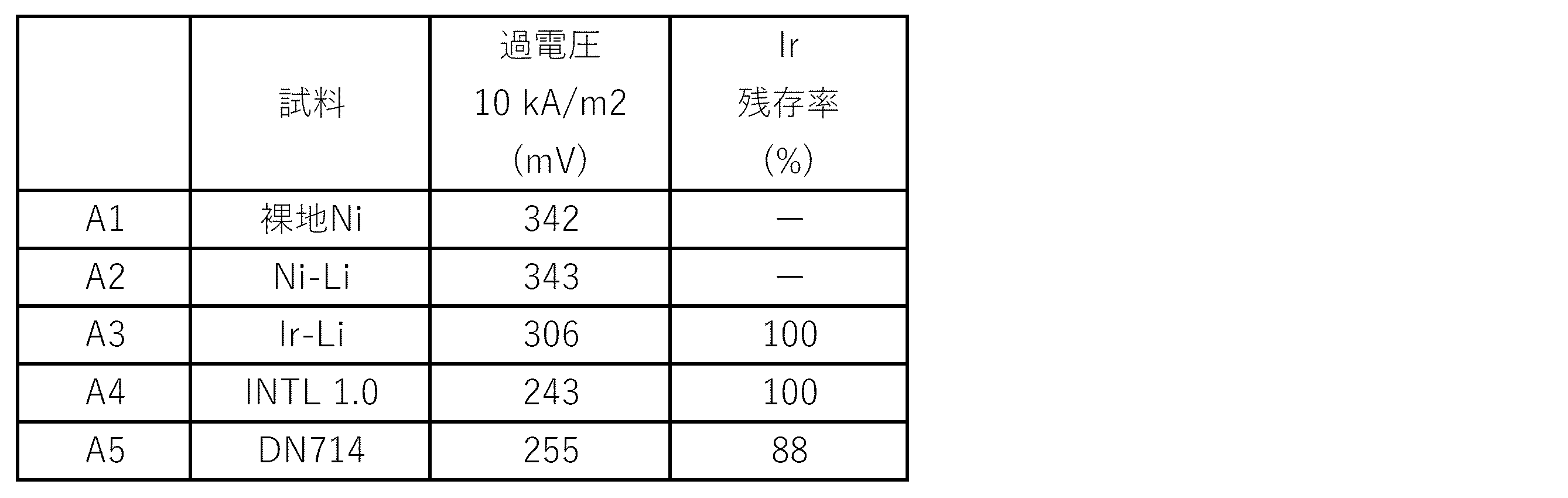
裸地Niの過電圧は342mVである。この裸地Ni上に、ニッケルとリチウム(Ni-Li)を組み合わせたコーティングの過電圧は343mVであり、裸地Niと同等の値であった。イリジウムとリチウム(Ir-Li)を組み合わせたコーティングの過電圧は306mVであった。イリジウムとニッケルとリチウム(Ir-Ni-Li、INTL1.0)を組みわせると、243mVと大幅な向上が見られた。その組成は、モル比でイリジウム12%、ニッケル66%、リチウム22%である。このように、INTL1.0の過電圧の値は、従来の裸地Niと比べて100mVも向上し、DN714と比較しても、12mVの向上を達成することができた。
また、過電圧測定後のイリジウムの消耗率は、DN714は12%であったが、INTL1.0では見られず、触媒安定性も改善した。
また、過電圧測定後のイリジウムの消耗率は、DN714は12%であったが、INTL1.0では見られず、触媒安定性も改善した。
(実施例2:INTL1.0におけるリチウム比の検討)
実施例1において、コーティング中のリチウム比が増加すると、過電圧が向上する傾向が認められた。そこで、さらなる性能向上を目指し、INTL1.0中のリチウム比の検討を行った。B2からB7のアノードを、リチウム比を変更した以外は、実施例1におけるINTL1.0の製造と同様の方法で製造した。なお、B1は、実施例1におけるINTL1.0の組成である。結果を表3に示す。
実施例1において、コーティング中のリチウム比が増加すると、過電圧が向上する傾向が認められた。そこで、さらなる性能向上を目指し、INTL1.0中のリチウム比の検討を行った。B2からB7のアノードを、リチウム比を変更した以外は、実施例1におけるINTL1.0の製造と同様の方法で製造した。なお、B1は、実施例1におけるINTL1.0の組成である。結果を表3に示す。
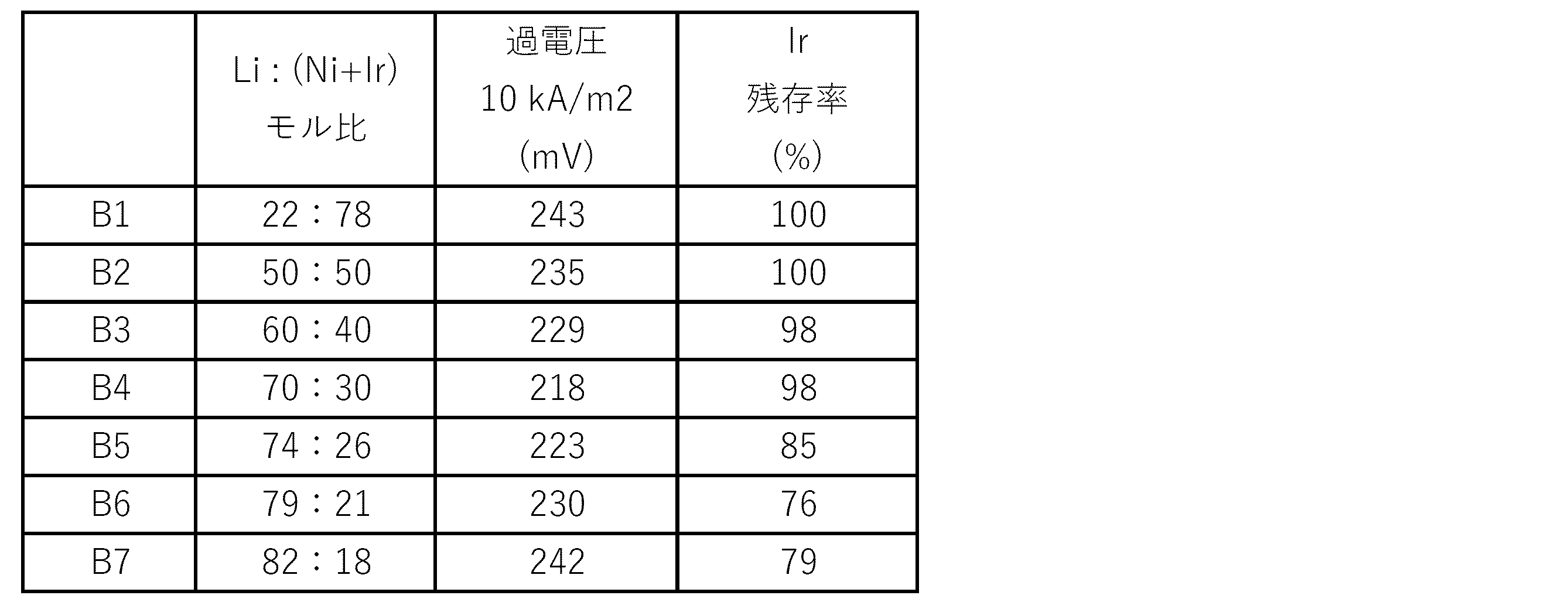
50:50~70:30(B2~B4)において、過電圧およびIrの残存率の双方の観点から、B1よりも向上が見られた。とりわけ、現在得られている最高値は70:30(B4)の218mVであり、B1よりも約30mVの性能向上が達成できた。DN714と比較すると、37mV向上したこととなる。
(実施例3:シャットダウン(S/D)耐性)
再生可能エネルギーを動力源に用いたアルカリ水電解に用いられるアノードは、出力変動や、激しい起動停止などの過酷な条件にさらされる。そのため、このような出力変動に対する耐久性が求められている。そこで、INTL1.0(C5)およびINTL2.0(C6)についてS/D試験を実施した。試験条件は、陽極は対象サンプル、陰極はNRG-r、セパレータは、AGFA UTP500、電解セルは2室型セル、電解液は25%の水酸化ナトリウム水溶液、温度は80℃、電流密度は10kA/m2で行った。なお、INTL2.0とは、導電性基材表面に中間層を形成し、イリジウムイオン、ニッケルイオン及び/又はリチウムイオンを含む溶液を用いて中間層上にコーティングを形成することにより製造したアノードである。結果を表4及び表5に示す。
再生可能エネルギーを動力源に用いたアルカリ水電解に用いられるアノードは、出力変動や、激しい起動停止などの過酷な条件にさらされる。そのため、このような出力変動に対する耐久性が求められている。そこで、INTL1.0(C5)およびINTL2.0(C6)についてS/D試験を実施した。試験条件は、陽極は対象サンプル、陰極はNRG-r、セパレータは、AGFA UTP500、電解セルは2室型セル、電解液は25%の水酸化ナトリウム水溶液、温度は80℃、電流密度は10kA/m2で行った。なお、INTL2.0とは、導電性基材表面に中間層を形成し、イリジウムイオン、ニッケルイオン及び/又はリチウムイオンを含む溶液を用いて中間層上にコーティングを形成することにより製造したアノードである。結果を表4及び表5に示す。
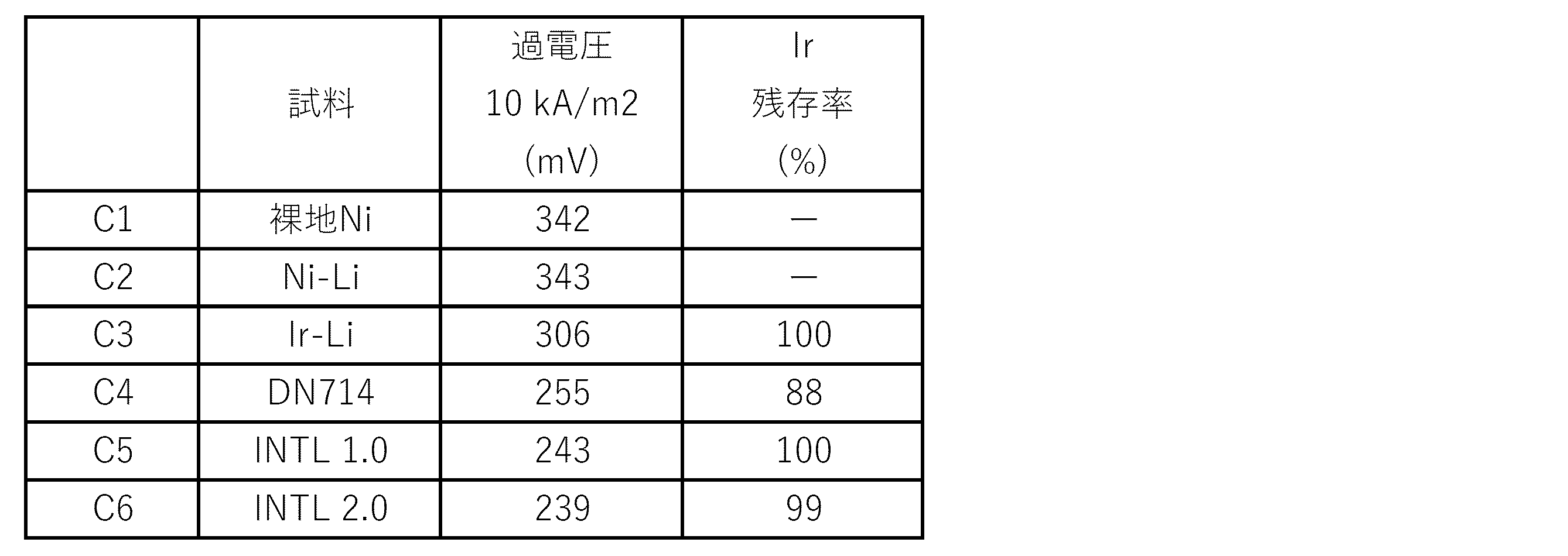

中間層を設けたINTL2.0(C6)は、INTL1.0(C5)と比較してS/D耐性が2倍向上した。
(実施例4:加速寿命試験(ALT))
DN714、INTL1.0(C5)およびINTL2.0(C6)についてALTを実施した。試験条件は、陽極は対象サンプル、陰極はニッケル、陽陰極の距離は10mm、電解セルは1室型セル、電解液は30%の水酸化ナトリウム水溶液、温度は88℃、電流密度は30kA/m2で行った。結果は、表6に示されるように、すべての試料のセル電圧は1500時間安定していた。
DN714、INTL1.0(C5)およびINTL2.0(C6)についてALTを実施した。試験条件は、陽極は対象サンプル、陰極はニッケル、陽陰極の距離は10mm、電解セルは1室型セル、電解液は30%の水酸化ナトリウム水溶液、温度は88℃、電流密度は30kA/m2で行った。結果は、表6に示されるように、すべての試料のセル電圧は1500時間安定していた。

(まとめ)
・INTL1.0の過電圧の値は、DN714と比較して、12mVの向上を達成することができた。また、過電圧測定後のイリジウムの消耗率は、DN714は12%であったが、INTL1.0では見られず、触媒安定性も改善した。
・50:50~70:30(B2~B4)において、過電圧及びIrの残存率の双方の観点から、B1よりも向上が見られた。とりわけ、現在得られている最高値は70:30(B4)の218mVであり、B1よりも約30mVの性能向上が達成できた。DN714と比較すると、37mV向上したこととなる。
・INTL1.0の過電圧の値は、DN714と比較して、12mVの向上を達成することができた。また、過電圧測定後のイリジウムの消耗率は、DN714は12%であったが、INTL1.0では見られず、触媒安定性も改善した。
・50:50~70:30(B2~B4)において、過電圧及びIrの残存率の双方の観点から、B1よりも向上が見られた。とりわけ、現在得られている最高値は70:30(B4)の218mVであり、B1よりも約30mVの性能向上が達成できた。DN714と比較すると、37mV向上したこととなる。
以上のように、本発明のアノードは、過電圧が低いのみならず、電極の触媒活性を長期間維持する、即ち、長寿命化するというアルカリ水電解用アノードとして非常に優れた特性を有する。
Claims (5)
- 導電性基体及びコーティングを含む、アルカリ水電解用アノードであって、
コーティングが、
1)イリジウム酸化物、
2)ニッケル酸化物、並びに
3)リチウム酸化物、
を含む、アルカリ水電解用アノード。 - 金属元素が、イリジウム元素及びニッケル元素の合計が15から80モル%、並びにリチウム元素が20から85モル%、の比率でコーティング中に存在する、請求項1に記載のアルカリ水電解用アノード。
- 金属元素が、イリジウム元素及びニッケル元素の合計が25から55モル%、並びにリチウム元素が45から75モル%、の比率でコーティング中に存在する、請求項1又は2に記載のアルカリ水電解用アノード。
- 導電性基体とコーティングとの間に、ニッケル酸化物及びリチウム酸化物を含む中間層を有する、請求項1から3のいずれか一項に記載のアルカリ水電解用アノード。
- 1)導電性基体の表面、又は導電性基体上に設けられた中間層の表面に、イリジウムイオン、ニッケルイオン、並びにリチウムイオンを含む溶液を塗布し、乾燥してアノード前駆体を得る工程、及び
2)工程1)で得られたアノード前駆体を、400℃から600℃の温度で酸素を含む雰囲気中で熱処理する工程
を含む、アルカリ水電解用アノードの製造方法。
Applications Claiming Priority (2)
| Application Number | Priority Date | Filing Date | Title |
|---|---|---|---|
| JP2021027138A JP7174091B2 (ja) | 2021-02-24 | 2021-02-24 | アルカリ水電解用アノード |
| JP2021-027138 | 2021-02-24 |
Publications (1)
| Publication Number | Publication Date |
|---|---|
| WO2022181512A1 true WO2022181512A1 (ja) | 2022-09-01 |
Family
ID=83048002
Family Applications (1)
| Application Number | Title | Priority Date | Filing Date |
|---|---|---|---|
| PCT/JP2022/006824 Ceased WO2022181512A1 (ja) | 2021-02-24 | 2022-02-21 | アルカリ水電解用アノード |
Country Status (2)
| Country | Link |
|---|---|
| JP (1) | JP7174091B2 (ja) |
| WO (1) | WO2022181512A1 (ja) |
Families Citing this family (1)
| Publication number | Priority date | Publication date | Assignee | Title |
|---|---|---|---|---|
| JPWO2024101105A1 (ja) | 2022-11-10 | 2024-05-16 |
Citations (3)
| Publication number | Priority date | Publication date | Assignee | Title |
|---|---|---|---|---|
| JP2017190476A (ja) * | 2016-04-12 | 2017-10-19 | デノラ・ペルメレック株式会社 | アルカリ水電解用陽極及びアルカリ水電解用陽極の製造方法 |
| WO2019172160A1 (ja) * | 2018-03-07 | 2019-09-12 | デノラ・ペルメレック株式会社 | 電解用電極及びその製造方法 |
| WO2022044417A1 (ja) * | 2020-08-28 | 2022-03-03 | デノラ・ペルメレック株式会社 | アルカリ水電解用アノード |
-
2021
- 2021-02-24 JP JP2021027138A patent/JP7174091B2/ja active Active
-
2022
- 2022-02-21 WO PCT/JP2022/006824 patent/WO2022181512A1/ja not_active Ceased
Patent Citations (3)
| Publication number | Priority date | Publication date | Assignee | Title |
|---|---|---|---|---|
| JP2017190476A (ja) * | 2016-04-12 | 2017-10-19 | デノラ・ペルメレック株式会社 | アルカリ水電解用陽極及びアルカリ水電解用陽極の製造方法 |
| WO2019172160A1 (ja) * | 2018-03-07 | 2019-09-12 | デノラ・ペルメレック株式会社 | 電解用電極及びその製造方法 |
| WO2022044417A1 (ja) * | 2020-08-28 | 2022-03-03 | デノラ・ペルメレック株式会社 | アルカリ水電解用アノード |
Also Published As
| Publication number | Publication date |
|---|---|
| JP2022128748A (ja) | 2022-09-05 |
| JP7174091B2 (ja) | 2022-11-17 |
Similar Documents
| Publication | Publication Date | Title |
|---|---|---|
| CN111918983B (zh) | 钛基材、钛基材的制造方法及水电解用电极、水电解装置 | |
| JP6615682B2 (ja) | アルカリ水電解用陽極及びアルカリ水電解用陽極の製造方法 | |
| CA2928790C (en) | Anode for alkaline water electrolysis | |
| US12612706B2 (en) | Anode for alkaline water electrolysis | |
| WO2019172160A1 (ja) | 電解用電極及びその製造方法 | |
| CN112023961A (zh) | 基于P-MoS2@CoP复合材料全水解催化剂制备方法 | |
| US20250389035A1 (en) | Water electrolysis catalyst made from iridium oxide powder, water electrolysis electrode membrane, and membrane with catalyst layer | |
| US10505205B2 (en) | Titanium product, separator, and proton exchange membrane fuel cell, and method for producing titanium product | |
| US20230143743A1 (en) | Titanium substrate, method for producing titanium substrate, electrode for water electrolysis, and water electrolysis apparatus | |
| JP2015527693A (ja) | 燃料電池電極として適している白金およびパラジウム合金 | |
| EP4204608A1 (en) | Electrode for gas evolution in electrolytic processes | |
| Lee et al. | Accelerated degradation of Pt-coated Ti porous transport layers under dynamic potential pulses in PEMWEs | |
| Mei et al. | Enhanced electrocatalytic activity of carbon cloth by synergetic effect of plasma and acid treatment | |
| JP7174091B2 (ja) | アルカリ水電解用アノード | |
| Gao et al. | Synergistic enhancement on corrosion resistance and electrical conductivity of N-doped TiO2 coatings for bipolar plate of PEM electrolyzer | |
| JP5806099B2 (ja) | 燃料電池用セパレータの表面処理方法 | |
| US20250382713A1 (en) | Electrolysis electrode and method for producing same | |
| KR20180010355A (ko) | 고체산화물 연료전지용 공기극 집전체 및 이의 제조방법 | |
| JP5625902B2 (ja) | 固体高分子形燃料電池セパレータ用ステンレス鋼およびその製造方法 | |
| US20250188630A1 (en) | Oxynitride catalyst and hydrogen evolution device | |
| HỒNG et al. | Fabrication of platinum coating on titanium transport layer for Proton exchange membrane water electrolyzer (PEMWE) | |
| WO2024101105A1 (ja) | 電解用陽極及びその製造方法 |
Legal Events
| Date | Code | Title | Description |
|---|---|---|---|
| 121 | Ep: the epo has been informed by wipo that ep was designated in this application |
Ref document number: 22759548 Country of ref document: EP Kind code of ref document: A1 |
|
| NENP | Non-entry into the national phase |
Ref country code: DE |
|
| 122 | Ep: pct application non-entry in european phase |
Ref document number: 22759548 Country of ref document: EP Kind code of ref document: A1 |