WO2022158551A1 - バクテリオファージ由来のトキシン-アンチトキシンシステム及びその用途 - Google Patents
バクテリオファージ由来のトキシン-アンチトキシンシステム及びその用途 Download PDFInfo
- Publication number
- WO2022158551A1 WO2022158551A1 PCT/JP2022/002101 JP2022002101W WO2022158551A1 WO 2022158551 A1 WO2022158551 A1 WO 2022158551A1 JP 2022002101 W JP2022002101 W JP 2022002101W WO 2022158551 A1 WO2022158551 A1 WO 2022158551A1
- Authority
- WO
- WIPO (PCT)
- Prior art keywords
- amino acid
- acid sequence
- seq
- present
- protein
- Prior art date
- Legal status (The legal status is an assumption and is not a legal conclusion. Google has not performed a legal analysis and makes no representation as to the accuracy of the status listed.)
- Ceased
Links
Images


Classifications
-
- C—CHEMISTRY; METALLURGY
- C07—ORGANIC CHEMISTRY
- C07K—PEPTIDES
- C07K14/00—Peptides having more than 20 amino acids; Gastrins; Somatostatins; Melanotropins; Derivatives thereof
- C07K14/005—Peptides having more than 20 amino acids; Gastrins; Somatostatins; Melanotropins; Derivatives thereof from viruses
-
- C—CHEMISTRY; METALLURGY
- C12—BIOCHEMISTRY; BEER; SPIRITS; WINE; VINEGAR; MICROBIOLOGY; ENZYMOLOGY; MUTATION OR GENETIC ENGINEERING
- C12N—MICROORGANISMS OR ENZYMES; COMPOSITIONS THEREOF; PROPAGATING, PRESERVING, OR MAINTAINING MICROORGANISMS; MUTATION OR GENETIC ENGINEERING; CULTURE MEDIA
- C12N1/00—Microorganisms; Compositions thereof; Processes of propagating, maintaining or preserving microorganisms or compositions thereof; Processes of preparing or isolating a composition containing a microorganism; Culture media therefor
-
- C—CHEMISTRY; METALLURGY
- C12—BIOCHEMISTRY; BEER; SPIRITS; WINE; VINEGAR; MICROBIOLOGY; ENZYMOLOGY; MUTATION OR GENETIC ENGINEERING
- C12N—MICROORGANISMS OR ENZYMES; COMPOSITIONS THEREOF; PROPAGATING, PRESERVING, OR MAINTAINING MICROORGANISMS; MUTATION OR GENETIC ENGINEERING; CULTURE MEDIA
- C12N15/00—Mutation or genetic engineering; DNA or RNA concerning genetic engineering, vectors, e.g. plasmids, or their isolation, preparation or purification; Use of hosts therefor
- C12N15/09—Recombinant DNA-technology
- C12N15/11—DNA or RNA fragments; Modified forms thereof; Non-coding nucleic acids having a biological activity
-
- C—CHEMISTRY; METALLURGY
- C12—BIOCHEMISTRY; BEER; SPIRITS; WINE; VINEGAR; MICROBIOLOGY; ENZYMOLOGY; MUTATION OR GENETIC ENGINEERING
- C12N—MICROORGANISMS OR ENZYMES; COMPOSITIONS THEREOF; PROPAGATING, PRESERVING, OR MAINTAINING MICROORGANISMS; MUTATION OR GENETIC ENGINEERING; CULTURE MEDIA
- C12N9/00—Enzymes; Proenzymes; Compositions thereof; Processes for preparing, activating, inhibiting, separating or purifying enzymes
- C12N9/14—Hydrolases (3)
-
- C—CHEMISTRY; METALLURGY
- C12—BIOCHEMISTRY; BEER; SPIRITS; WINE; VINEGAR; MICROBIOLOGY; ENZYMOLOGY; MUTATION OR GENETIC ENGINEERING
- C12N—MICROORGANISMS OR ENZYMES; COMPOSITIONS THEREOF; PROPAGATING, PRESERVING, OR MAINTAINING MICROORGANISMS; MUTATION OR GENETIC ENGINEERING; CULTURE MEDIA
- C12N9/00—Enzymes; Proenzymes; Compositions thereof; Processes for preparing, activating, inhibiting, separating or purifying enzymes
- C12N9/14—Hydrolases (3)
- C12N9/16—Hydrolases (3) acting on ester bonds (3.1)
- C12N9/22—Ribonucleases [RNase]; Deoxyribonucleases [DNase]
Definitions
- the present invention relates to a novel toxin-antitoxin system and uses thereof. More specifically, the present invention relates to a bacteriophage-derived protein (toxin) having ribonuclease activity, a protein (antitoxin) that binds to the protein and inhibits its activity, nucleic acids encoding them, and the use thereof.
- the present invention relates to a method for regulating degradation of RNA and a method for regulating cell growth.
- the toxin-antitoxin (TA) system is present in most prokaryotic genomes and is involved in multiple biological activities of bacteria, such as nutrient starvation, programmed cell death, and defense against bacteriophages.
- the TA system is usually composed of a pair of genes that are dicistronically expressed, one encoding a stable toxin protein and the other an unstable antitoxin that neutralizes the toxicity of the toxin.
- stress such as starvation or specific factors such as phage infection accelerate the decomposition of antitoxin, the toxin is activated and causes cell growth arrest and cell death.
- TA systems are classified into six types, from type I to type VI, depending on the antitoxin molecular species (protein, non-coding RNA) and toxicity neutralization mechanism.
- type II TA system is one in which antitoxin is a protein that binds directly to the toxin protein to form a complex, thereby inhibiting the activity of the toxin.
- type II TA system is one in which antitoxin is a protein that binds directly to the toxin protein to form a complex, thereby inhibiting the activity of the toxin.
- the types of toxins differ depending on the family, most of them are known to have ribonuclease activity (see, for example, Non-Patent Document 1).
- the purpose of the present invention is to identify a novel TA system and provide various applications of the TA system in biotechnology.
- the present inventors found that the diabetes-inducing bacterium Fusimonas intestini AJ110941 strain belonging to the family Lachnospiraceae previously isolated by the present inventors (Kusada, H. et al., Sci. Rep. , 7: 18087 (2017)), a pair of ORFs with about 30% homology at the amino acid level with the TA system (BrnT/BrnA) derived from Brucella abortus was found in the genome of bacteriophages that infect B. , LinT and LinA.
- LinT and LinA are novel TA systems derived from bacteriophages. The present inventors have completed the present invention as a result of further studies based on these findings.
- the present invention is as follows.
- [1] derived from a bacteriophage and having the following (a) to (c): (a) the amino acid sequence represented by SEQ ID NO: 2 (b) in the amino acid sequence represented by SEQ ID NO: 2, one to several amino acid sequences are substituted and/or deleted and/or inserted and/or added
- a protein having ribonuclease activity comprising any amino acid sequence having 95% or more identity with the amino acid sequence represented by amino acid sequence (c) SEQ ID NO:2.
- the protein of [1] which consists of the amino acid sequence represented by SEQ ID NO:2.
- [3] A nucleic acid encoding the protein of [1] or [2].
- [4] derived from a bacteriophage and having the following (a) to (c): (a) amino acid sequence represented by SEQ ID NO: 4 (b) amino acid sequence represented by SEQ ID NO: 4, 1 to several amino acid sequences are substituted and / or deleted and / or inserted and / or added Amino acid sequence (c) containing any amino acid sequence having 95% or more identity with the amino acid sequence represented by SEQ ID NO: 4, binding to the protein of [1] or [2] and A protein that inhibits ribonuclease activity. [5] The protein of [4], which consists of the amino acid sequence represented by SEQ ID NO:4. [6] A nucleic acid encoding the protein of [4] or [5].
- a toxin-antitoxin (TA) system comprising a combination of the protein of [1] or [2] and the protein of [4] or [5].
- a TA system comprising a combination of the nucleic acid of [3] and the nucleic acid of [6].
- a method for degrading substrate RNA which comprises contacting the substrate RNA with the protein of [1] or [2].
- a method for inhibiting proliferation of cells which comprises contacting a cell with the protein of [1] or [2] or the nucleic acid of [3].
- a method for regulating a cell comprising contacting the cell with the TA system of [7] or [8].
- a novel TA system derived from bacteriophage is provided.
- the TA system can be used for the use of toxins as ribonucleases, the use of antitoxins as their inhibitors, and the inhibition and growth control of cells by both proteins or nucleic acids encoding them.
- FIG. 3 shows an alignment of the phage-derived TA system of the present invention (LinT/LinA) and the TA system from Brucella abortus (BrnT/BrnA). All five amino acid residues essential for BrnT activity were conserved in LinT (arrows).
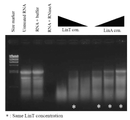
- FIG. 2 shows the activity of LinT to decompose host bacterium-derived RNA and the activity of LinA to neutralize LinT.
- FIG. 4 shows that expression of LinT in E. coli suppresses cell growth (A) and colony-forming ability (B), and co-expression of LinA restores them.
- the present invention provides a novel TA system derived from bacteriophage (hereinafter also referred to as "the TA system of the present invention").
- the TA system of the present invention belongs to the type II TA system.
- antitoxins are proteins that neutralize the toxicity of toxins by directly binding to toxin proteins to form complexes.
- the TA system of the present invention is (1) a toxin protein containing an amino acid sequence identical or substantially identical to the amino acid sequence represented by SEQ ID NO: 2 and having ribonuclease activity (hereinafter also referred to as “the toxin of the present invention”); (2) a protein comprising an amino acid sequence identical or substantially identical to the amino acid sequence represented by SEQ ID NO: 4 and binding to the toxin protein to inhibit its ribonuclease activity (hereinafter also referred to as "antitoxin of the present invention”); Say) Consists of
- the Toxin of the Present Invention is derived from a bacteriophage and contains (a) the amino acid sequence represented by SEQ ID NO: 2, or an amino acid sequence substantially identical to the amino acid sequence of (a), and a ribonuclease. active.
- the amino acid sequence substantially identical to the amino acid sequence represented by SEQ ID NO: 2 means (b) an amino acid sequence in which one to several amino acid sequences are substituted and/or deleted and/or inserted and/or added in the amino acid sequence represented by SEQ ID NO: 2, or (c) SEQ ID NO: 2 An amino acid sequence having 95% or more identity with the amino acid sequence described herein.
- derived from a bacteriophage does not only have an amino acid sequence encoded by a gene that is actually isolated from the genome of a bacteriophage, but also is derived from the amino acid sequence, the above (b) or ( As long as it contains an amino acid sequence that satisfies the conditions of c) and has ribonuclease activity, it is used in the sense of including proteins that are not isolated from natural bacteriophage.
- amino acid sequence of (b) above for example, (i) 1 to several (2, 3, 4 or 5), preferably 1 to 4, more preferably 1 in the amino acid sequence represented by SEQ ID NO: 2
- Amino acids with similar physico-chemical properties (“similar amino acids”) when replaced by other amino acids, such as aromatic amino acids (Phe, Trp, Tyr), aliphatic amino acids (Ala, Leu, Ile, Val), Polar amino acids (Gln, Asn), basic amino acids (Lys, Arg, His), acidic amino acids (Glu, Asp), amino acids with hydroxyl groups (Ser, Thr), amino acids with small side chains (Gly, Ala, Ser, Thr , Met) are preferably substituted with amino acids classified in the same group. Substitution with such similar amino acids is expected not to change the phenotype of the protein (that is, it is a conservative amino acid substitution).
- identity refers to the optimal alignment when two amino acid sequences are aligned using a mathematical algorithm known in the art (preferably, the algorithm is the optimal alignment). It means the ratio (%) of identical amino acid residues to all overlapping amino acid residues in the case where introduction of gaps in one or both of the sequences can be taken into consideration).
- the identity with the amino acid sequence represented by SEQ ID NO: 2 is preferably 96% or more, more preferably 97% or more, even more preferably 98% or more, and particularly preferably 99% or more.
- the toxin of the present invention containing the amino acid sequence (b) or (c) above has substantially the same activity as the protein consisting of the amino acid sequence represented by SEQ ID NO:2.
- activity refers to ribonuclease activity.
- substantially homogeneous means that the properties are qualitatively the same, for example, physiologically or pharmacologically. Therefore, it is preferred that the ribonuclease activities are similar, but the degree of activity (eg, 0.5-2 fold) may differ.
- the ribonuclease activity can be measured, for example, by bringing the substrate RNA into contact with the toxin of the present invention, reacting them, and then subjecting the reaction solution to gel electrophoresis and analyzing the band pattern.
- the RNA that serves as a substrate for the toxin of the present invention is not particularly limited, and any RNA can be degraded.
- the toxin of the present invention is a protein consisting of the amino acid sequence represented by SEQ ID NO:2.
- Antitoxins of the invention are derived from a bacteriophage, (a) contains the amino acid sequence represented by SEQ ID NO: 4 or an amino acid sequence substantially identical to the amino acid sequence of (a), and has the activity of neutralizing the ribonuclease activity of the toxin of the present invention.
- the amino acid sequence substantially identical to the amino acid sequence represented by SEQ ID NO: 4" means (b) an amino acid sequence in which one to several amino acid sequences are substituted and/or deleted and/or inserted and/or added in the amino acid sequence represented by SEQ ID NO: 4, or (c) an amino acid sequence represented by SEQ ID NO: 4 An amino acid sequence having 95% or more identity with the amino acid sequence described herein.
- "derived from a bacteriophage” is synonymous with the toxin of the present invention.
- amino acid sequence of (b) above for example, (i) 1 to several (2, 3, 4 or 5), preferably 1 to 4, more preferably 1 in the amino acid sequence represented by SEQ ID NO: 4
- substitutions with similar amino acids are preferred, as described above.
- amino acid sequence is substituted, deleted or
- identity has the same meaning as in the case of the toxin of the present invention.
- the identity with the amino acid sequence represented by SEQ ID NO: 4 is preferably 96% or higher, more preferably 97% or higher, even more preferably 98% or higher, particularly preferably 99% or higher.
- the antitoxin of the present invention containing the amino acid sequence (b) or (c) above has substantially the same activity as the protein consisting of the amino acid sequence represented by SEQ ID NO:4.
- activity refers to the activity of neutralizing the ribonuclease activity of the toxin of the present invention.
- substantially homogeneous means that the properties are qualitatively the same, for example, physiologically or pharmacologically. Therefore, it is preferred that the neutralizing activity is similar, but the degree of activity (eg, 0.5-2 fold) may differ.
- the neutralizing activity can be measured, for example, by contacting the substrate RNA with the toxin of the present invention and the antitoxin of the present invention, allowing them to react, then subjecting the reaction solution to gel electrophoresis and analyzing the band pattern. can be done.
- the antitoxin of the present invention is a protein consisting of the amino acid sequence represented by SEQ ID NO:4.
- the TA system of the present invention is the Fusimonas intestini AJ110941 strain (Accession No. FERM BP-11443) National Institute of Advanced Industrial Science and Technology Patent Organism Depositary Center (1-1-1 Higashi, Tsukuba, Ibaraki Prefecture Central 6 ) [Current National Institute of Technology and Evaluation Biotechnology Center Patent Microorganism Depositary Center (2-5-8 Kazusa Kamatari, Kisarazu City, Chiba Prefecture)] Internationally deposited based on the Budapest Treaty (acceptance date: 2011) November 30))), and a toxin consisting of the amino acid sequence represented by SEQ ID NO: 2, encoded in the genome of the bacteriophage LSP1 strain that uses the same strain as a host, and a toxin represented by SEQ ID NO: 4. It is a TA system that is combined with an antitoxin consisting of an amino acid sequence that is
- the toxin of the present invention and the antitoxin of the present invention (hereinafter also collectively referred to as "the protein of the present invention") have a C-terminal of carboxyl group (-COOH), carboxylate (-COO- ) , amide ( -CONH2 ) or an ester (-COOR).
- R in the ester includes, for example, C 1-6 alkyl groups such as methyl, ethyl, n-propyl, isopropyl and n-butyl; C 3-8 cycloalkyl groups such as cyclopentyl and cyclohexyl; C 6-12 aryl groups such as , ⁇ -naphthyl; phenyl-C 1-2 alkyl groups such as benzyl, phenethyl; C 7- such as ⁇ -naphthyl-C 1-2 alkyl groups such as ⁇ -naphthylmethyl 14 Aralkyl group; pivaloyloxymethyl group and the like are used.
- C 1-6 alkyl groups such as methyl, ethyl, n-propyl, isopropyl and n-butyl
- C 3-8 cycloalkyl groups such as cyclopentyl and cyclohexyl
- the protein of the present invention When the protein of the present invention has a carboxyl group (or carboxylate) in addition to the C-terminus, the protein of the present invention also includes those in which the carboxyl group is amidated or esterified. As the ester in this case, for example, the above-described C-terminal ester or the like is used. Furthermore, in the protein of the present invention, the amino group of the amino acid residue at the N-terminus is protected with a protective group (for example, a formyl group, a C1-6 acyl group such as a C1-6 alkanoyl such as an acetyl group, etc.).
- a protective group for example, a formyl group, a C1-6 acyl group such as a C1-6 alkanoyl such as an acetyl group, etc.
- the protein of the present invention may be in the free form or in the salt form.
- Salts of the proteins of the present invention include physiologically acceptable salts with acids or bases, with physiologically acceptable acid addition salts being particularly preferred.
- Such salts include, for example, salts with inorganic acids (eg, hydrochloric acid, phosphoric acid, hydrobromic acid, sulfuric acid), or organic acids (eg, acetic acid, formic acid, propionic acid, fumaric acid, maleic acid, succinic acid). acid, tartaric acid, citric acid, malic acid, oxalic acid, benzoic acid, methanesulfonic acid, benzenesulfonic acid) and the like.
- inorganic acids eg, hydrochloric acid, phosphoric acid, hydrobromic acid, sulfuric acid
- organic acids eg, acetic acid, formic acid, propionic acid, fumaric acid, maleic acid, succinic acid.
- the proteins of the present invention can also be produced from bacteriophages that produce them (eg, bacteriophage LSP1 strain) by methods known per se for protein purification. Alternatively, it can be produced according to a known peptide synthesis method. In a preferred embodiment, the proteins of the present invention can be produced by culturing transformants containing nucleic acids encoding them, and separating and purifying the resulting culture.
- a nucleic acid encoding a protein of the present invention may be DNA or RNA, or a DNA/RNA chimera. DNA is preferred.
- DNAs encoding the proteins of the present invention can be obtained, for example, by using, as templates, genomic DNA fractions and total RNA or mRNA fractions prepared from bacteriophages that produce them (e.g., bacteriophage LSP1 strain), followed by Polymerase Chain Reaction (PCR) method and reverse transcriptase-PCR (RT-PCR) method can be directly amplified.
- PCR Polymerase Chain Reaction
- RT-PCR reverse transcriptase-PCR
- Nucleic acid encoding the toxin of the present invention examples include DNA containing the nucleotide sequence represented by SEQ ID NO: 1, or the nucleotide sequence represented by SEQ ID NO: 1 and stringent conditions. Examples include DNA containing nucleotide sequences that hybridize below and encoding proteins having ribonuclease activity as described above.
- a DNA that can hybridize with the nucleotide sequence represented by SEQ ID NO: 1 under stringent conditions is, for example, 70% or more, preferably 80% or more, more preferably 90% of the nucleotide sequence represented by SEQ ID NO: 1.
- a DNA containing a nucleotide sequence having an identity of 95% or more, more preferably 97% or more, and particularly preferably 98% or more is used.
- Hybridization should be carried out according to a method known per se or a method analogous thereto, for example, the method described in Molecular Cloning, Second Edition (J. Sambrook et al., Cold Spring Harbor Lab. Press, 1989). can be done.
- Hybridization is preferably performed under stringent conditions.
- Highly stringent conditions include, for example, a sodium salt concentration of about 19 to about 40 mM, preferably about 19 to about 20 mM, and a temperature of about 50 to about 70°C, preferably about 60 to about 65°C. mentioned. Particularly preferred is when the sodium salt concentration is about 19 mM and the temperature is about 65°C.
- the toxin-encoding nucleic acid of the present invention is a nucleic acid consisting of the nucleotide acid sequence represented by SEQ ID NO:1.
- nucleic acid encoding the antitoxin of the present invention includes, for example, a DNA containing the nucleotide sequence represented by SEQ ID NO:3, or a stringent DNA containing the nucleotide sequence represented by SEQ ID NO:3. Also included are DNAs encoding proteins containing nucleotide sequences that hybridize under suitable conditions and having activity to neutralize the ribonuclease activity of the toxins of the present invention.
- a DNA that can hybridize with the nucleotide sequence represented by SEQ ID NO: 3 under stringent conditions is, for example, 70% or more, preferably 80% or more, more preferably 90% of the nucleotide sequence represented by SEQ ID NO: 3.
- a DNA containing a nucleotide sequence having an identity of 95% or more, more preferably 97% or more, and particularly preferably 98% or more is used.
- identity has the same meaning as in the nucleic acid encoding the toxin of the present invention.
- the nucleic acid encoding the antitoxin of the present invention is a nucleic acid consisting of the nucleotide acid sequence represented by SEQ ID NO:3.
- the TA system of the present invention is the nucleotide represented by SEQ ID NO: 1, which is contained in the genomic DNA of the bacteriophage LSP1 strain isolated from the culture medium of the Fusimonas intestini AJ110941 strain and whose host is the same strain.
- the TA system is a combination of a toxin-encoding DNA consisting of a sequence and an antitoxin-encoding DNA consisting of the nucleotide sequence represented by SEQ ID NO:3.
- DNA encoding the toxin of the present invention and the DNA encoding the antitoxin of the present invention are part of the nucleotide sequences encoding these proteins. or hybridize the DNA incorporated into an appropriate expression vector with a labeled DNA fragment or synthetic DNA encoding part or all of the protein It can be cloned by Hybridization can be performed, for example, according to the method described in Molecular Cloning, 2nd edition (mentioned above).
- each DNA is amplified separately by PCR. It can be cloned as a single DNA sequence, or can be cloned as one DNA sequence with both DNAs overlapping. The latter DNA can be expressed dicistronically by introduction into prokaryotic cells.
- the nucleotide sequence of the DNA is determined by ODA-LA PCR method, gapped duplex method, It can be converted according to a method known per se such as the Kunkel method or a method based thereon.
- the cloned DNA can be used as it is, or after digestion with a restriction enzyme or addition of a linker, if desired.
- An expression vector containing a DNA encoding the protein of the present invention is produced, for example, by excising a DNA fragment of interest from the DNA encoding the protein and ligating the DNA fragment downstream of the promoter in an appropriate expression vector.
- Expression vectors include E. coli-derived plasmids (eg, pBR322, pBR325, pUC12, pUC13); Bacillus subtilis-derived plasmids (eg, pUB110, pTP5, pC194); yeast-derived plasmids (eg, pSH19, pSH15); insect cell expression Plasmids (e.g. pFast-Bac); animal cell expression plasmids (e.g.
- bacteriophages such as phage ⁇
- insect virus vectors such as baculovirus ( Examples: BmNPV, AcNPV)
- animal virus vectors such as retrovirus, vaccinia virus, adenovirus, etc. are used. Any promoter may be used as long as it is suitable for the host used for gene expression.
- SR ⁇ promoter when the host is an animal cell, SR ⁇ promoter, SV40 promoter, LTR promoter, CMV (cytomegalovirus) promoter, RSV (Rous sarcoma virus) promoter, MoMuLV (Moloney murine leukemia virus) LTR, HSV-TK (herpes simplex viral thymidine kinase) promoter and the like are used. Among them, CMV promoter, SR ⁇ promoter and the like are preferable. When the host is Escherichia, trp promoter, lac promoter, recA promoter, ⁇ PL promoter, lpp promoter, T7 promoter and the like are preferred.
- SPO1 promoter When the host is Bacillus, SPO1 promoter, SPO2 promoter, penP promoter and the like are preferred.
- yeast PHO5 promoter, PGK promoter, GAP promoter, ADH promoter and the like are preferred.
- PHO5 promoter When the host is Bacillus, SPO1 promoter, SPO2 promoter, penP promoter and the like are preferred.
- yeast PHO5 promoter, PGK promoter, GAP promoter, ADH promoter and the like are preferred.
- the polyhedrin promoter, P10 promoter and the like are preferred.
- selection markers include, for example, dihydrofolate reductase gene (hereinafter sometimes abbreviated as dhfr, methotrexate (MTX) resistance), ampicillin resistance gene (hereinafter sometimes abbreviated as ampr ), neomycin resistance gene ( G418 resistance, which may be abbreviated as neo r hereinafter), and the like.
- the target gene can also be selected using a thymidine-free medium.
- a nucleotide sequence (signal codon) encoding a signal sequence suitable for the host may be added to the 5' end of the DNA encoding the protein of the present invention.
- the host is Escherichia, the PhoA signal sequence, OmpA signal sequence, etc.; when the host is Bacillus, the ⁇ -amylase signal sequence, subtilisin signal sequence, etc.; when the host is yeast.
- MF ⁇ signal sequence, SUC2 signal sequence, etc. when the host is an animal cell, insulin signal sequence, ⁇ -interferon signal sequence, antibody molecule signal sequence, etc. are used, respectively.
- the DNA encoding the toxin of the present invention and the DNA encoding the antitoxin of the present invention may be inserted into separate expression vectors, or may be inserted into a single expression vector.
- each DNA may be under the control of separate promoters (the types of promoters may be the same or different), or under the control of a single promoter.
- a sequence enabling dicistronic expression of both DNAs e.g. , IRES, 2A sequence.
- the protein of the present invention can be produced by transforming a host with an expression vector containing the DNA encoding the protein of the present invention and culturing the resulting transformant.
- hosts that can be used include Escherichia spp., Bacillus spp., yeast, insect cells, insects, animal cells, and plant cells.
- Escherichia bacteria for example, Escherichia coli K12 DH1 [Proceedings of the National Academy of Sciences of the USA (Proc. Natl. Acad. Sci.
- Bacillus spp. include Bacillus subtilis MI114 [Gene, Vol. 24, 255 (1983)], Bacillus subtilis 207-21 [Journal of Biochemistry, 95, 87 (1984)].
- yeast examples include Saccharomyces cerevisiae AH22, AH22R ⁇ , NA87-11A, DKD-5D, 20B-12, Schizosaccharomyces pombe NCYC1913, NCYC2036, Pichia pastoris KM71 etc. are used.
- insect cells for example, when the virus is AcNPV, Spodoptera frugiperda cells (Sf cells), Trichoplusia ni midgut-derived MG1 cells, Trichoplusia ni egg-derived High Five TM cells , Mamestra brassicae-derived cells, Estigmena acrea-derived cells, and the like.
- Sf cells silkworm-derived established cell lines (Bombyx mori N cells; BmN cells) and the like are used as insect cells.
- Sf cells include Sf9 cells (ATCC CRL1711) and Sf21 cells (Vaughn, JL et al., In Vivo, 13, 213-217, (1977)).
- silkworm larvae are used [Maeda et al., Nature, Vol. 315, 592 (1985)].
- animal cells examples include monkey COS-7 cells, monkey Vero cells, Chinese hamster ovary cells (hereinafter abbreviated as CHO cells), dhfr gene-deficient CHO cells (hereinafter abbreviated as CHO (dhfr ⁇ ) cells), and mouse L cells.
- CHO cells Chinese hamster ovary cells
- dhfr gene-deficient CHO cells hereinafter abbreviated as CHO (dhfr ⁇ ) cells
- mouse L cells examples include monkey COS-7 cells, monkey Vero cells, Chinese hamster ovary cells (hereinafter abbreviated as CHO cells), dhfr gene-deficient CHO cells (hereinafter abbreviated as CHO (dhfr ⁇ ) cells), and mouse L cells.
- mice AtT-20 cells mouse myeloma cells, rat GH3 cells, human FL cells, etc. are used.
- Plant cells were prepared from various plants (e.g., grains such as rice, wheat, and corn; commercial crops such as tomatoes, cucumbers, and eggplants; garden plants such as carnations and lisianthus; experimental plants such as tobacco and Arabidopsis thaliana). Suspension cultured cells, callus, protoplasts, leaf slices, root slices and the like are used.
- Transformation can be performed according to known methods depending on the type of host. Escherichia spp., for example, Proc. Natl. Acad. Sci. USA, Vol. 69, 2110 (1972) and Gene ( Gene), vol. 17, 107 (1982). Bacillus can be transformed according to the method described in, for example, Molecular & General Genetics, Vol. 168, 111 (1979). Yeast, for example, Methods in Enzymology, Vol. 194, 182-187 (1991), Proceedings of the National Academy of Sciences of the USA ( Proc. Natl. Acad. Sci. USA), vol.75, 1929 (1978). Insect cells and insects can be transformed, for example, according to the method described in Bio/Technology, Vol. 6, 47-55 (1988).
- Animal cells can be transformed according to the method described, for example, in Cell Engineering Separate Volume 8, New Cell Engineering Experimental Protocol, 263-267 (1995) (published by Shujunsha), Virology, Vol. 52, 456 (1973). can be done. Plant cells can be transformed by the electroporation method or microinjection method for protoplasts, or by the Agrobacterium method, plant virus vector method or particle gun method for intact cells.
- Cultivation of transformants can be carried out according to known methods depending on the type of host. For example, when culturing a transformant whose host is Escherichia spp. or Bacillus spp., a liquid medium is preferred as the medium used for culturing.
- the medium preferably contains carbon sources, nitrogen sources, inorganic substances and the like necessary for the growth of transformants.
- carbon sources include, for example, glucose, dextrin, soluble starch, sucrose, etc.
- nitrogen sources include, for example, ammonium salts, nitrates, corn steep liquor, peptone, casein, meat extract, soybean meal, Inorganic or organic substances such as potato extract
- inorganic substances include, for example, calcium chloride, sodium dihydrogen phosphate, magnesium chloride, and the like, respectively.
- yeast extract, vitamins, growth promoting factors, etc. may be added to the medium.
- the pH of the medium is preferably from about 5 to about 8.
- a medium for culturing a transformant whose host is Escherichia spp. for example, M9 medium containing glucose and casamino acids [Miller, Journal of Experiments in Molecular Genetics ( Journal of Experiments in Molecular Genetics), 431-433, Cold Spring Harbor Laboratory, New York 1972].
- a drug such as 3 ⁇ -indolylacrylic acid may be added to the medium in order to make the promoter work efficiently.
- Culturing of a transformant whose host is Escherichia spp. is usually carried out at about 15 to about 43° C. for about 3 to about 24 hours. If necessary, aeration and stirring may be performed.
- Cultivation of a transformant whose host is Bacillus is usually carried out at about 30 to about 40° C. for about 6 to about 24 hours. If necessary, aeration and stirring may be performed.
- media for culturing a transformant whose host is yeast include Burkholder's minimal medium [Bostian, KL et al., Proceedings of the National Academy of Sciences. USA (Proc. Natl. Acad. Sci. USA), Vol. 77, 4505 (1980)] and SD medium containing 0.5% casamino acids [Bitter, GA et al., Proceedings of the National Academy - Of Sciences of the USA (Proc. Natl. Acad. Sci. USA), Vol. 81, 5330 (1984)].
- the pH of the medium is preferably from about 5 to about 8. Cultivation is usually carried out at about 20° C. to about 35° C. for about 24 to about 72 hours. Aeration and stirring may be performed as necessary.
- the medium may be, for example, Grace's Insect Medium [Grace, TCC, Nature, Vol. 195, 788 (1962)], inactivated 10% bovine serum. and the like are used as appropriate.
- the pH of the medium is preferably from about 6.2 to about 6.4. Cultivation is usually carried out at about 27° C. for about 3 to about 5 days. Aeration and stirring may be performed as necessary.
- a medium for culturing a transformant whose host is an animal cell for example, a minimum essential medium (MEM) containing about 5 to about 20% fetal bovine serum [Science, Vol. 122, 501 (1952 )], Dulbecco's Modified Eagle Medium (DMEM) [Virology, Vol. 8, 396 (1959)], RPMI 1640 Medium [The Journal of the American Medical Association, 199, 519 (1967)], 199 medium [Proceeding of the Society for the Biological Medicine, 73, 1 (1950)], etc. Used.
- the pH of the medium is preferably from about 6 to about 8. Cultivation is usually carried out at about 30° C. to about 40° C. for about 15 to about 60 hours.
- MS medium, LS medium, B5 medium and the like are used as media for culturing transformants whose hosts are plant cells.
- the pH of the medium is preferably from about 5 to about 8.
- Cultivation is usually carried out at about 20°C to about 30°C.
- Aeration and stirring may be performed as necessary.
- the protein of the present invention can be produced intracellularly or extracellularly in a transformant.
- the protein of the present invention can be separated and purified from the culture obtained by culturing the transformant according to a method known per se.
- a method known per se For example, when the protein of the present invention is extracted from the cytoplasm of cultured bacterial bodies or cells, the bacterial bodies or cells collected from the culture by a known method are suspended in an appropriate buffer and subjected to ultrasonication, lysozyme and/or freeze-thawing.
- a method for obtaining a crude extract of soluble proteins by centrifugation or filtration after disrupting the cells or cells by, for example, appropriate methods can be used.
- the buffer may contain protein denaturants such as urea and guanidine hydrochloride, and surfactants such as Triton X-100 TM .
- a method such as separating the culture supernatant from the culture by centrifugation, filtration, or the like is used. Isolation and purification of the protein of the present invention contained in the thus-obtained fungal (cell) extract or culture supernatant can be carried out according to a method known per se. Examples of such methods include methods utilizing solubility such as salting out and solvent precipitation; dialysis, ultrafiltration, gel filtration, and SDS-polyacrylamide gel electrophoresis primarily utilizing differences in molecular weight.
- the free form can be converted into a salt by a method known per se or a method analogous thereto, and when the protein is obtained as a salt, a method known per se can be used.
- the salt can be converted into the free form or other salt by analogous methods.
- the presence of the protein of the present invention thus obtained can be confirmed by enzyme immunoassay using a specific antibody, Western blotting, or the like.
- the protein of the present invention is synthesized in vitro using a cell-free protein translation system consisting of rabbit reticulocyte lysate, wheat germ lysate, E. coli lysate, etc., using RNA corresponding to the DNA encoding the protein of the present invention as a template. can do.
- a cell-free transcription/translation system further comprising RNA polymerase can be used to synthesize DNA encoding the protein of the present invention as a template.
- an expression vector containing the DNA encoding the toxin of the present invention and/or the DNA encoding the antitoxin of the present invention is introduced into a host cell of interest, thereby inhibiting and controlling growth of cells described later, and further , they can be used for various purposes.
- RNA that can be a substrate for the toxin of the present invention is not particularly limited and can be any ribonucleotide.
- the toxin of the present invention can exhibit enzymatic activity at a temperature of at least around 37°C and a pH of around neutrality.
- the antitoxin of the present invention can inhibit the ribonuclease activity of the toxin of the present invention, it can be used for various purposes such as research reagents as a specific ribonuclease inhibitor.
- the toxin of the present invention is cytotoxic due to its ribonuclease activity, so that it can suppress the proliferation of cells when brought into contact with the cells.
- Examples of cells include prokaryotic cells such as Escherichia coli and Bacillus subtilis, and eukaryotic cells such as yeast, insect, plant, and animal cells.
- contacting the protein with the cell can be carried out, for example, by adding the toxin of the present invention to the medium of the cell.
- the toxin of the present invention when used in the form of a nucleic acid that encodes it, it can be carried out by introducing the nucleic acid into the target cell and expressing it using a transformation method known per se.
- the antitoxin of the present invention can neutralize the cytotoxicity of the toxin by inhibiting the ribonuclease activity of the toxin of the present invention.
- cell proliferation can be partially suppressed by adding the toxin of the present invention and the antitoxin of the present invention to the medium of cells and culturing them.
- the toxin-encoding nucleic acid of the present invention and the antitoxin-encoding nucleic acid of the present invention are introduced into cells, and, for example, both proteins are expressed, or only the antitoxin is expressed.
- the proliferation of the cells can be stopped by expressing the toxin and suppressing the expression of the antitoxin.
- Such expression regulation is achieved, for example, by transforming the antitoxin-encoding DNA with an expression vector under the control of an inducible promoter (e.g., a drug-responsive promoter) and controlling its expression by addition/removal of an inducer. It can be done by The toxin-encoding DNA can be under the control of a constitutive promoter or another inducible promoter.
- an expression vector in which the toxin-encoding DNA is under the control of the Tet-on promoter and an expression vector in which the antitoxin-encoding DNA is under the control of the Tet-off promoter is under the control of the Tet-off promoter.
- each protein After introduction into cells and culturing in the absence of doxycycline to grow the cells, the growth of the cells can be stopped by adding doxycycline and culturing.
- the expression control of each protein may be performed by introducing into cells a substance that suppresses the expression of the nucleic acid that encodes it. Examples thereof include antisense nucleic acids, siRNA/shRNA, and the like against each nucleic acid.
- a substance that binds to the antitoxin of the present invention and inhibits the binding to the toxin of the present invention is used to inhibit the neutralizing activity of the antitoxin, thereby strongly expressing the cytotoxicity of the toxin.
- Such substances include antibodies against antitoxins, fragments thereof, aptamers against antitoxins, and the like.
- the TA system of the present invention can be used as a tool for biotechnology/molecular biology, as a tool for gene therapy against cancer and infectious diseases, in the same manner as conventionally known TA systems derived from bacteria, etc. (For example, Mobile Genetic Elements, 3:5, e26219 (2013); Afr. J. Biotechnol., 13(1), 11-17 (2013); Toxins, 8, 49 (2016 ), etc.).
- an expression vector containing a nucleic acid encoding the toxin of the present invention is used, and a restriction enzyme capable of cleaving inside the nucleic acid is used.
- an expression vector containing a nucleic acid encoding the toxin of the invention is inserted into the genome of the host cell, and the expression vector containing a portion of the nucleic acid encoding the antitoxin of the invention is fused with the remainder of the nucleic acid.
- the growth of cells from which the introduced plasmid has been lost is suppressed by the expression of toxin from the genome, so the use of antibiotics can be avoided.
- a nucleic acid encoding the toxin of the present invention is inserted between the attP sites on the expression vector side, and a homologous pair with the DNA fragment to be cloned inserted between the attB sites. By recombination, only host cells containing the vector into which the DNA fragment has been integrated can be propagated.
- host cells are transfected with a nucleic acid encoding a toxin of the invention under the control of the Tet-off promoter, and in the presence of doxycycline.
- Transformed cells that grow normally and whose growth is sufficiently suppressed in the absence of the cells are selected, and a nucleic acid encoding the target protein and a nucleic acid encoding the antitoxin of the present invention are transformed under the control of a single promoter.
- the transformed cells are transfected with an expression vector containing a form capable of being tronically expressed, and cultured in the presence of doxycycline to select cells that proliferate normally, so that the target protein is placed at a position where it can be highly expressed. Cells into which the expression vector has been integrated can be selected.
- Example 1 In silico Analysis of Toxin-Antitoxin System Derived from Bacteriophage LSP1
- the Toxin (LinT) protein derived from bacteriophage LSP1 is associated with the ribonuclease BrnT (Heaton, BE et al., Journal of Biological Chemistry, 287(15), 12098-12110 (2012)) showed 26% homology.
- As a result of amino acid sequence alignment all five amino acid residues essential for BrnT activity were conserved in LinT (Fig. 1).
- the bacteriophage LSP1-derived Antitoxin (LinA) protein showed 32% homology to Brucella abortus-derived BrnA (BrnT Antitoxin) at the amino acid sequence (SEQ ID NO: 4) level (Fig. 1).
- SEQ ID NO: 1 MEYISFEWDENKNKINKAKHGIDFEEAATVFYDDDAIMFDDPEHSMEEERFLILGITKHENLCIVSHCYRGDDNIIRIISARKATKSEIKTYNRYVGGEINERGV
- SEQ ID NO:2 MKEEYDIESLNPRKNPYVKRLKKQITINIDNDTVDFFKVQSEESGIPYQTLINLYLSDCAKNKKKLQMSWK
- LinA-LinT may be a novel Toxin-Antitoxin system. Characterization was performed.
- Example 2 Construction of high-expression plasmid vectors for bacteriophage LSP1-derived Toxin and Antitoxin
- the linT, linA and linT-linA gene regions of the LSP1 phage genome were amplified by PCR (see below for primer sequences), pET28-b (Novagen) Recombinant plasmids pET-LinT28, pET-LinA28 and pET-LinTA28 inserted into the multiple cloning site of the plasmid vector for gene expression were prepared.
- Escherichia coli DH5 ⁇ competent cells (GMbiolab) were transformed with each plasmid constructed by the heat shock method.
- coli transformants were selected by colony PCR, inoculated into 10 mL of LB medium, and cultured with shaking at 37°C for 12 hours.
- Each plasmid DNA was purified from each culture solution using QIAprep Spin Miniprep Kit (manufactured by QIAGEN). The concentration and purity of each purified plasmid DNA were calculated by measurement using a spectrophotometer.
- linT gene amplification primer Forward 5'-GGAATTC CATATG GAATATATAAGTTTTGAATGGGACG-3' (underlined NdeI restriction enzyme site) (SEQ ID NO: 5) Reverse: 5'-CCG GAATTC TACTCCTCTTTCATTGATTTCACCTC-3' (underlined is EcoRI restriction enzyme site) (SEQ ID NO: 6) linA gene amplification primer Forward: 5'-CATG CCATGG AAGAGGAGTATGATATTGAAAGTTTG-3' (underlined NcoI restriction enzyme site) (SEQ ID NO: 7) Reverse: 5'-CCG GAATTC CTTCCAAGACATCTGCAACTTCTT-3' (underlined part is EcoRI restriction enzyme site) (SEQ ID NO: 8) linT-linA gene amplification primer Forward: 5'-GGAATTC CATATG GAATATATAAGTTTTGAATGGGACG-3' (underlined NdeI restriction enzyme site) (SEQ ID NO: 5) Re
- Example 3 Purification of Recombinant LinT and LinA Escherichia coli BL21 (DE3) pLysS competent cells (manufactured by BioDynamics Laboratory) were transformed with the obtained plasmids pET-LinT28, pET-LinA28 and pET-LinTA28. A single colony of the obtained transformant was inoculated into an LB medium containing kanamycin and cultured overnight at 37°C. 1% of each culture solution was inoculated into a new LB medium, and cultured with shaking at 37°C until the OD 600 value reached around 0.5. IPTG at a final concentration of 100 ⁇ M was added to each culture solution, and cultured with shaking at 20° C.
- the washed resin was eluted with Elution buffer (50 mM sodium phosphate, 300 mM NaCl, 10% glycerol, 300 mM imidazole) to obtain purified LinA and LinT proteins and LinT-LinA complex protein.
- Elution buffer 50 mM sodium phosphate, 300 mM NaCl, 10% glycerol, 300 mM imidazole
- LinA and LinT proteins and LinT-LinA complex protein As a result of SDS polyacrylamide gel electrophoresis, a protein band with higher purity was observed when LinT-LinA was co-expressed than when LinT and LinA were each expressed alone. This is probably because toxin and antitoxin are usually structurally stabilized by forming a complex.
- Example 4 In Vitro Analysis of Toxin-Antitoxin System Derived from Bacteriophage LSP1
- RNA-degrading activity of Fusimonas intestini strain AJ110941 (FERM BP-11443), the host bacterium of LSP1
- RNA of the F. intestini strain AJ110941 was extracted according to the standard method using RNeasy Mini kit (manufactured by QIAGEN). Purified LinT was added to this RNA, and after incubation at 37° C. for 30 minutes, it was injected into a 1% agarol gel and subjected to electrophoresis at 100 V for 30 minutes.
- Fig. 2 Next, in order to clarify whether LinA functions as an antitoxin for LinT, purified LinT and LinA were added to the extracted RNA, incubated at 37°C for 30 min, and subjected to agarol gel electrophoresis. As a result, it was found that RNA degradation by LinT was inhibited in a concentration-dependent manner by LinA, indicating that LinA functions as an antitoxin for LinT (Fig. 2).
- Example 5 In vivo analysis of bacteriophage LSP1-derived Toxin-Antitoxin system Escherichia coli BL21 (DE3) pLysS competent cells (BioDynamics Laboratory) were transformed with the obtained plasmids pET-LinT28, pET-LinA28 and pET-LinTA28. . A single colony of the obtained transformant was inoculated into an LB medium containing kanamycin and cultured overnight at 37°C. 1% of each culture solution was newly inoculated into kanamycin-containing LB medium, and cultured with shaking at 37°C until the OD 600 value reached around 0.1.
- the toxin in the TA system of the present invention has ribonuclease activity
- an antitoxin that inhibits the enzyme activity is useful as an inhibitor for RNA degradation reagents.
- proteins or nucleic acids encoding them can be used to suppress or control cell growth.
Landscapes
- Life Sciences & Earth Sciences (AREA)
- Health & Medical Sciences (AREA)
- Chemical & Material Sciences (AREA)
- Genetics & Genomics (AREA)
- Engineering & Computer Science (AREA)
- Organic Chemistry (AREA)
- Zoology (AREA)
- Bioinformatics & Cheminformatics (AREA)
- Wood Science & Technology (AREA)
- Biotechnology (AREA)
- Molecular Biology (AREA)
- Biomedical Technology (AREA)
- Biochemistry (AREA)
- General Engineering & Computer Science (AREA)
- General Health & Medical Sciences (AREA)
- Microbiology (AREA)
- Medicinal Chemistry (AREA)
- Biophysics (AREA)
- Virology (AREA)
- Tropical Medicine & Parasitology (AREA)
- Gastroenterology & Hepatology (AREA)
- Proteomics, Peptides & Aminoacids (AREA)
- Physics & Mathematics (AREA)
- Plant Pathology (AREA)
- Micro-Organisms Or Cultivation Processes Thereof (AREA)
- Peptides Or Proteins (AREA)
- Enzymes And Modification Thereof (AREA)
Abstract
本発明は、バクテリオファージ由来であって、以下の(a)~(c): (a)配列番号2で表されるアミノ酸配列 (b)配列番号2で表されるアミノ酸配列において、1ないし数個のアミノ酸配列が置換、欠失、挿入、及び/又は付加されたアミノ酸配列 (c)配列番号2で表されるアミノ酸配列と95%以上の同一性を有するアミノ酸配列 のいずれかのアミノ酸配列を含み、リボヌクレアーゼ活性を有するタンパク質、を提供する。
Description
本発明は、新規なトキシン-アンチトキシンシステム及びその用途に関する。より詳細には、本発明は、バクテリオファージ由来のリボヌクレアーゼ活性を有するタンパク質(トキシン)と、該タンパク質に結合してその活性を阻害するタンパク質(アンチトキシン)、それらをコードする核酸、並びにそれらを用いたRNAの分解制御及び細胞の増殖制御方法等に関する。
トキシン-アンチトキシン(TA)システムは、ほとんどの原核生物ゲノムに存在し、栄養飢餓、プログラム細胞死、バクテリオファージからの防御など、細菌の複数の生命活動に関与している。TAシステムは通常、ジシストロニックに発現する一対の遺伝子から構成され、一方は安定なトキシンタンパク質をコードし、他方は該トキシンの毒性を中和する不安定なアンチトキシンをコードしている。飢餓等のストレスやファージ感染等の特定の要因によりアンチトキシンの分解が促進されると、トキシンが活性化されて細胞増殖の停止や細胞死を引き起こす。
既知のTAシステムは、アンチトキシンの分子種(タンパク質、非コードRNA)と毒性中和メカニズムに応じて、I型からVI型まで6種類に分類されている。それらのうち、最も広く研究されているII型のTAシステムは、アンチトキシンがタンパク質であり、トキシンタンパク質に直接結合して複合体を形成することにより、トキシンの活性を阻害するものである。トキシンの種類はファミリーにより異なるが、リボヌクレアーゼ活性を有するものが最も多く知られている(例えば、非特許文献1を参照)。
しかしながら、既知のTAシステムはいずれも細菌や古細菌といった原核生物由来のものであり、ウイルス由来のTAシステムに関する報告は皆無に等しい。
Heaton, B.E. et al., J. Biol. Chem., 287 (15): 12098-12110 (2012)
本発明は、新規のTAシステムを同定し、該TAシステムのバイオテクノロジーにおける種々の応用を提供することを目的とする。
本発明者らは、上記目的を達成すべく鋭意検討した結果、本発明者らが以前に分離したラクノスピラ科に属する糖尿病誘起細菌Fusimonas intestini AJ110941株(Kusada, H. et al., Sci. Rep., 7: 18087 (2017))に感染するバクテリオファージのゲノム中に、Brucella abortus由来のTAシステム(BrnT/BrnA)とアミノ酸レベルで30%前後の相同性を有する一対のORFが存在することを見出し、LinT及びLinAと命名した。LinT及びLinAをそれぞれコードする核酸をクローニングし、大腸菌で組換え発現させ、得られたLinTタンパク質のRNA分解活性を調べたところ、LinTはリボヌクレアーゼ活性を有することが明らかとなった。LinAはLinTのリボヌクレアーゼ活性を濃度依存的に阻害したことから、LinAはLinTのアンチトキシンとして作用することが示された。さらに、LinTを発現する組換え大腸菌は細胞増殖が強力に抑制されたが、LinTとLinAを共発現させると、LinTの細胞毒性が中和され、細胞増殖が回復した。以上のことから、LinT及びLinAは、バクテリオファージ由来の新規TAシステムであることが明らかとなった。
本発明者らは、これらの知見に基づいてさらに研究を重ねた結果、本発明を完成するに至った。
本発明者らは、これらの知見に基づいてさらに研究を重ねた結果、本発明を完成するに至った。
即ち、本発明は以下の通りである。
[1]バクテリオファージ由来であって、以下の(a)~(c):
(a)配列番号2で表されるアミノ酸配列
(b)配列番号2で表されるアミノ酸配列において、1ないし数個のアミノ酸配列が置換及び/又は欠失及び/又は挿入及び/又は付加されたアミノ酸配列
(c)配列番号2で表されるアミノ酸配列と95%以上の同一性を有するアミノ酸配列
のいずれかのアミノ酸配列を含み、リボヌクレアーゼ活性を有するタンパク質。
[2]配列番号2で表されるアミノ酸配列からなる、[1]に記載のタンパク質。
[3][1]又は[2]に記載のタンパク質をコードする核酸。
[4]バクテリオファージ由来であって、以下の(a)~(c):
(a)配列番号4で表されるアミノ酸配列
(b)配列番号4で表されるアミノ酸配列において、1ないし数個のアミノ酸配列が置換及び/又は欠失及び/又は挿入及び/又は付加されたアミノ酸配列
(c)配列番号4で表されるアミノ酸配列と95%以上の同一性を有するアミノ酸配列
のいずれかのアミノ酸配列を含み、[1]又は[2]に記載のタンパク質と結合してそのリボヌクレアーゼ活性を阻害するタンパク質。
[5]配列番号4で表されるアミノ酸配列からなる、[4]に記載のタンパク質。
[6][4]又は[5]に記載のタンパク質をコードする核酸。
[7][1]又は[2]に記載のタンパク質と、[4]又は[5]に記載のタンパク質とを組み合わせてなる、トキシン-アンチトキシン(TA)システム。
[8][3]に記載の核酸と、[6]に記載の核酸とを組み合わせてなる、TAシステム。
[9]基質RNAを[1]又は[2]に記載のタンパク質に接触させることを含む、該RNAの分解方法。
[10]細胞に[1]又は[2]に記載のタンパク質、あるいは[3]に記載の核酸を接触させることを含む、該細胞の増殖抑制方法。
[11]細胞に[7]又は[8]に記載のTAシステムを接触させることを含む、該細胞の制御方法。
[1]バクテリオファージ由来であって、以下の(a)~(c):
(a)配列番号2で表されるアミノ酸配列
(b)配列番号2で表されるアミノ酸配列において、1ないし数個のアミノ酸配列が置換及び/又は欠失及び/又は挿入及び/又は付加されたアミノ酸配列
(c)配列番号2で表されるアミノ酸配列と95%以上の同一性を有するアミノ酸配列
のいずれかのアミノ酸配列を含み、リボヌクレアーゼ活性を有するタンパク質。
[2]配列番号2で表されるアミノ酸配列からなる、[1]に記載のタンパク質。
[3][1]又は[2]に記載のタンパク質をコードする核酸。
[4]バクテリオファージ由来であって、以下の(a)~(c):
(a)配列番号4で表されるアミノ酸配列
(b)配列番号4で表されるアミノ酸配列において、1ないし数個のアミノ酸配列が置換及び/又は欠失及び/又は挿入及び/又は付加されたアミノ酸配列
(c)配列番号4で表されるアミノ酸配列と95%以上の同一性を有するアミノ酸配列
のいずれかのアミノ酸配列を含み、[1]又は[2]に記載のタンパク質と結合してそのリボヌクレアーゼ活性を阻害するタンパク質。
[5]配列番号4で表されるアミノ酸配列からなる、[4]に記載のタンパク質。
[6][4]又は[5]に記載のタンパク質をコードする核酸。
[7][1]又は[2]に記載のタンパク質と、[4]又は[5]に記載のタンパク質とを組み合わせてなる、トキシン-アンチトキシン(TA)システム。
[8][3]に記載の核酸と、[6]に記載の核酸とを組み合わせてなる、TAシステム。
[9]基質RNAを[1]又は[2]に記載のタンパク質に接触させることを含む、該RNAの分解方法。
[10]細胞に[1]又は[2]に記載のタンパク質、あるいは[3]に記載の核酸を接触させることを含む、該細胞の増殖抑制方法。
[11]細胞に[7]又は[8]に記載のTAシステムを接触させることを含む、該細胞の制御方法。
本発明によれば、バクテリオファージ由来の新規なTAシステムが提供される。当該TAシステムは、トキシンのリボヌクレアーゼとしての利用、アンチトキシンのその阻害剤としての利用や、両タンパク質又はそれらをコードする核酸による細胞の増殖抑制・増殖制御等に利用することができる。
1.本発明のトキシン-アンチトキシン(TA)システム
本発明は、バクテリオファージ由来の新規TAシステム(以下、「本発明のTAシステム」ともいう)を提供する。本発明のTAシステムはII型のTAシステムに属する。即ち、アンチトキシンはタンパク質であり、トキシンタンパク質に直接結合して複合体を形成することにより、トキシンの毒性を中和する。
本発明は、バクテリオファージ由来の新規TAシステム(以下、「本発明のTAシステム」ともいう)を提供する。本発明のTAシステムはII型のTAシステムに属する。即ち、アンチトキシンはタンパク質であり、トキシンタンパク質に直接結合して複合体を形成することにより、トキシンの毒性を中和する。
より具体的には、本発明のTAシステムは、
(1)配列番号2で表されるアミノ酸配列と同一もしくは実質的に同一のアミノ酸配列を含み、リボヌクレアーゼ活性を有するトキシンタンパク質(以下、「本発明のトキシン」ともいう)と、
(2)配列番号4で表されるアミノ酸配列と同一もしくは実質的に同一のアミノ酸配列を含み、上記トキシンタンパク質と結合してそのリボヌクレアーゼ活性を阻害するタンパク質(以下、「本発明のアンチトキシン」ともいう)
とからなる。
(1)配列番号2で表されるアミノ酸配列と同一もしくは実質的に同一のアミノ酸配列を含み、リボヌクレアーゼ活性を有するトキシンタンパク質(以下、「本発明のトキシン」ともいう)と、
(2)配列番号4で表されるアミノ酸配列と同一もしくは実質的に同一のアミノ酸配列を含み、上記トキシンタンパク質と結合してそのリボヌクレアーゼ活性を阻害するタンパク質(以下、「本発明のアンチトキシン」ともいう)
とからなる。
1-1.本発明のトキシン
本発明のトキシンは、バクテリオファージ由来であって、(a)配列番号2で表されるアミノ酸配列、もしくは(a)のアミノ酸配列と実質的に同一のアミノ酸配列を含み、且つリボヌクレアーゼ活性を有する。
ここで「配列番号2で表されるアミノ酸配列と実質的に同一のアミノ酸配列」とは、
(b)配列番号2で表されるアミノ酸配列において、1ないし数個のアミノ酸配列が置換及び/又は欠失及び/又は挿入及び/又は付加されたアミノ酸配列、あるいは
(c)配列番号2で表されるアミノ酸配列と95%以上の同一性を有するアミノ酸配列
を意味する。
また、「バクテリオファージ由来」であるとは、実際に、バクテリオファージのゲノムから単離された遺伝子にコードされたアミノ酸配列を有するだけでなく、当該アミノ酸配列から派生し、上記(b)又は(c)の条件を満たすアミノ酸配列を含み、且つリボヌクレアーゼ活性を有するタンパク質であれば、天然のバクテリオファージから単離されたものでないものをも包含する意味で用いられる。
本発明のトキシンは、バクテリオファージ由来であって、(a)配列番号2で表されるアミノ酸配列、もしくは(a)のアミノ酸配列と実質的に同一のアミノ酸配列を含み、且つリボヌクレアーゼ活性を有する。
ここで「配列番号2で表されるアミノ酸配列と実質的に同一のアミノ酸配列」とは、
(b)配列番号2で表されるアミノ酸配列において、1ないし数個のアミノ酸配列が置換及び/又は欠失及び/又は挿入及び/又は付加されたアミノ酸配列、あるいは
(c)配列番号2で表されるアミノ酸配列と95%以上の同一性を有するアミノ酸配列
を意味する。
また、「バクテリオファージ由来」であるとは、実際に、バクテリオファージのゲノムから単離された遺伝子にコードされたアミノ酸配列を有するだけでなく、当該アミノ酸配列から派生し、上記(b)又は(c)の条件を満たすアミノ酸配列を含み、且つリボヌクレアーゼ活性を有するタンパク質であれば、天然のバクテリオファージから単離されたものでないものをも包含する意味で用いられる。
上記(b)のアミノ酸配列として、例えば、(i)配列番号2で表されるアミノ酸配列中の1~数(2、3、4もしくは5)個、好ましくは1~4個、より好ましくは1~3個、さらに好ましくは1もしくは2個のアミノ酸が他のアミノ酸で置換されたアミノ酸配列、(ii)配列番号2で表されるアミノ酸配列中の1~数(2、3、4もしくは5)個、好ましくは1~4個、より好ましくは1~3個、さらに好ましくは1もしくは2個のアミノ酸が欠失したアミノ酸配列、(iii)配列番号2で表されるアミノ酸配列に1~数(2、3、4もしくは5)個、好ましくは1~4個、より好ましくは1~3個、さらに好ましくは1もしくは2個のアミノ酸が挿入されたアミノ酸配列、(iv)配列番号2で表されるアミノ酸配列に1~数(2、3、4もしくは5)個、好ましくは1~4個、より好ましくは1~3個、さらに好ましくは1もしくは2個のアミノ酸が付加したアミノ酸配列、または(v)それらを組み合わせたアミノ酸配列が挙げられる。他のアミノ酸で置換される場合、物理化学的性質が類似したアミノ酸(「類似アミノ酸」)、例えば、芳香族アミノ酸(Phe、Trp、Tyr)、脂肪族アミノ酸(Ala、Leu、Ile、Val)、極性アミノ酸(Gln、Asn)、塩基性アミノ酸(Lys、Arg、His)、酸性アミノ酸(Glu、Asp)、水酸基を有するアミノ酸(Ser、Thr)、側鎖の小さいアミノ酸(Gly、Ala、Ser、Thr、Met)などの同じグループに分類されるアミノ酸に置換されることが好ましい。このような類似アミノ酸による置換は蛋白質の表現型に変化をもたらさない(即ち、保存的アミノ酸置換である)ことが予測される。保存的アミノ酸置換の具体例は当該技術分野で周知であり、種々の文献に記載されている(例えば、Bowieら,Science, 247:1306-1310 (1990)を参照)。
また、上記のようにアミノ酸配列が置換、欠失又は挿入されている場合、その置換、欠失又は挿入の位置は、リボヌクレアーゼ活性が保持される限り、特に限定されない。
また、上記のようにアミノ酸配列が置換、欠失又は挿入されている場合、その置換、欠失又は挿入の位置は、リボヌクレアーゼ活性が保持される限り、特に限定されない。
上記(c)において、「同一性」とは、当該技術分野において公知の数学的アルゴリズムを用いて2つのアミノ酸配列をアラインさせた場合の、最適なアラインメント(好ましくは、該アルゴリズムは最適なアラインメントのために配列の一方もしくは両方へのギャップの導入を考慮し得るものである)における、オーバーラップする全アミノ酸残基に対する同一アミノ酸残基の割合(%)を意味する。本明細書におけるアミノ酸配列の同一性は、相同性計算アルゴリズムNCBI BLAST(National Center for Biotechnology Information Basic Local Alignment Search Tool)を用い、以下の条件(期待値=10;ギャップを許す;マトリクス=BLOSUM62;フィルタリング=OFF)にて計算することができる。
上記(c)において、配列番号2で表されるアミノ酸配列との同一性は、好ましくは96%以上、より好ましくは97%以上、さらに好ましくは98%以上、特に好ましくは99%以上である。
上記(b)又は(c)のアミノ酸配列を含む本発明のトキシンは、配列番号2で表されるアミノ酸配列からなるタンパク質と実質的に同質の活性を有する。ここで「活性」とは、リボヌクレアーゼ活性をいう。また、「実質的に同質」とは、例えば生理学的に、あるいは薬理学的にみて、その性質が定性的に同じであることを意味する。したがって、リボヌクレアーゼ活性が同等であることが好ましいが、活性の程度(例、0.5~2倍)は異なっていてもよい。リボヌクレアーゼ活性は、例えば、基質RNAと本発明のトキシンとを接触させ、反応させた後、反応液をゲル電気泳動して、バンドパターンを分析することにより測定することができる。本発明のトキシンの基質となるRNAは特に限定されず、任意のRNAを分解可能である。
好ましい一実施態様において、本発明のトキシンは、配列番号2で表されるアミノ酸配列からなるタンパク質である。
1-2.本発明のアンチトキシン
本発明のアンチトキシンは、バクテリオファージ由来であって、
(a)配列番号4で表されるアミノ酸配列、もしくは(a)のアミノ酸配列と実質的に同一のアミノ酸配列を含み、且つ本発明のトキシンのリボヌクレアーゼ活性を中和する活性を有する。
ここで「配列番号4で表されるアミノ酸配列と実質的に同一のアミノ酸配列」とは、
(b)配列番号4で表されるアミノ酸配列において、1ないし数個のアミノ酸配列が置換及び/又は欠失及び/又は挿入及び/又は付加されたアミノ酸配列、あるいは
(c)配列番号4で表されるアミノ酸配列と95%以上の同一性を有するアミノ酸配列
を意味する。
また、「バクテリオファージ由来」であるとは、上記本発明のトキシンの場合と同義である。
本発明のアンチトキシンは、バクテリオファージ由来であって、
(a)配列番号4で表されるアミノ酸配列、もしくは(a)のアミノ酸配列と実質的に同一のアミノ酸配列を含み、且つ本発明のトキシンのリボヌクレアーゼ活性を中和する活性を有する。
ここで「配列番号4で表されるアミノ酸配列と実質的に同一のアミノ酸配列」とは、
(b)配列番号4で表されるアミノ酸配列において、1ないし数個のアミノ酸配列が置換及び/又は欠失及び/又は挿入及び/又は付加されたアミノ酸配列、あるいは
(c)配列番号4で表されるアミノ酸配列と95%以上の同一性を有するアミノ酸配列
を意味する。
また、「バクテリオファージ由来」であるとは、上記本発明のトキシンの場合と同義である。
上記(b)のアミノ酸配列として、例えば、(i)配列番号4で表されるアミノ酸配列中の1~数(2、3、4もしくは5)個、好ましくは1~4個、より好ましくは1~3個、さらに好ましくは1もしくは2個のアミノ酸が他のアミノ酸で置換されたアミノ酸配列、(ii)配列番号4で表されるアミノ酸配列中の1~数(2、3、4もしくは5)個、好ましくは1~4個、より好ましくは1~3個、さらに好ましくは1もしくは2個のアミノ酸が欠失したアミノ酸配列、(iii)配列番号4で表されるアミノ酸配列に1~数(2、3、4もしくは5)個、好ましくは1~4個、より好ましくは1~3個、さらに好ましくは1もしくは2個のアミノ酸が挿入されたアミノ酸配列、(iv)配列番号4で表されるアミノ酸配列に1~数(2、3、4もしくは5)個、好ましくは1~4個、より好ましくは1~3個、さらに好ましくは1もしくは2個のアミノ酸が付加したアミノ酸配列、または(v)それらを組み合わせたアミノ酸配列が挙げられる。他のアミノ酸で置換される場合、上述のように、類似アミノ酸による置換が好ましい。
また、上記のようにアミノ酸配列が置換、欠失又は挿入されている場合、その置換、欠失又は挿入の位置は、本発明のトキシンのリボヌクレアーゼ活性を中和する活性が保持される限り、特に限定されない。
また、上記のようにアミノ酸配列が置換、欠失又は挿入されている場合、その置換、欠失又は挿入の位置は、本発明のトキシンのリボヌクレアーゼ活性を中和する活性が保持される限り、特に限定されない。
上記(c)において、「同一性」とは、上記本発明のトキシンの場合と同義である。配列番号4で表されるアミノ酸配列との同一性は、好ましくは96%以上、より好ましくは97%以上、さらに好ましくは98%以上、特に好ましくは99%以上である。
上記(b)又は(c)のアミノ酸配列を含む本発明のアンチトキシンは、配列番号4で表されるアミノ酸配列からなるタンパク質と実質的に同質の活性を有する。ここで「活性」とは、本発明のトキシンのリボヌクレアーゼ活性を中和する活性をいう。また、「実質的に同質」とは、例えば生理学的に、あるいは薬理学的にみて、その性質が定性的に同じであることを意味する。したがって、中和活性は同等であることが好ましいが、活性の程度(例、0.5~2倍)は異なっていてもよい。当該中和活性は、例えば、基質RNAと本発明のトキシン及び本発明のアンチトキシンとを接触させ、反応させた後、反応液をゲル電気泳動して、バンドパターンを分析することにより測定することができる。
好ましい一実施態様において、本発明のアンチトキシンは、配列番号4で表されるアミノ酸配列からなるタンパク質である。
好ましい一実施態様において、本発明のTAシステムは、Fusimonas intestini AJ110941株(受託番号FERM BP-11443として独立行政法人産業技術総合研究所特許生物寄託センター(茨城県つくば市東1-1-1 中央第6)[現独立行政法人製品評価技術基盤機構バイオテクノロジーセンター特許微生物寄託センター(千葉県木更津市かずさ鎌足2-5-8)]にブダペスト条約に基づき国際寄託されている(受託日:平成23年11月30日))の培養液から分離された、同菌株を宿主とするバクテリオファージLSP1株のゲノムにコードされる、配列番号2で表されるアミノ酸配列からなるトキシンと、配列番号4で表されるアミノ酸配列からなるアンチトキシンとを組み合わせてなるTAシステムである。
本発明のトキシン及び本発明のアンチトキシン(以下、包括的に「本発明のタンパク質」ともいう)は、C末端がカルボキシル基(-COOH)、カルボキシレート(-COO-)、アミド(-CONH2)またはエステル(-COOR)の何れであってもよい。
ここでエステルにおけるRとしては、例えば、メチル、エチル、n-プロピル、イソプロピル、n-ブチルなどのC1-6アルキル基;例えば、シクロペンチル、シクロヘキシルなどのC3-8シクロアルキル基;例えば、フェニル、α-ナフチルなどのC6-12アリール基;例えば、ベンジル、フェネチルなどのフェニル-C1-2アルキル基;α-ナフチルメチルなどのα-ナフチル-C1-2アルキル基などのC7-14アラルキル基;ピバロイルオキシメチル基などが用いられる。
本発明のタンパク質がC末端以外にカルボキシル基(またはカルボキシレート)を有している場合、カルボキシル基がアミド化またはエステル化されているものも本発明のタンパク質に含まれる。この場合のエステルとしては、例えば上記したC末端のエステルなどが用いられる。
さらに、本発明のタンパク質には、N末端のアミノ酸残基のアミノ基が保護基(例えば、ホルミル基、アセチル基などのC1-6アルカノイルなどのC1-6アシル基など)で保護されているもの、生体内で切断されて生成し得るN末端のグルタミン残基がピログルタミン酸化したもの、分子内のアミノ酸の側鎖上の置換基(例えば-OH、-SH、アミノ基、イミダゾール基、インドール基、グアニジノ基など)が適当な保護基(例えば、ホルミル基、アセチル基などのC1-6アルカノイル基などのC1-6アシル基など)で保護されているものなども含まれる。
ここでエステルにおけるRとしては、例えば、メチル、エチル、n-プロピル、イソプロピル、n-ブチルなどのC1-6アルキル基;例えば、シクロペンチル、シクロヘキシルなどのC3-8シクロアルキル基;例えば、フェニル、α-ナフチルなどのC6-12アリール基;例えば、ベンジル、フェネチルなどのフェニル-C1-2アルキル基;α-ナフチルメチルなどのα-ナフチル-C1-2アルキル基などのC7-14アラルキル基;ピバロイルオキシメチル基などが用いられる。
本発明のタンパク質がC末端以外にカルボキシル基(またはカルボキシレート)を有している場合、カルボキシル基がアミド化またはエステル化されているものも本発明のタンパク質に含まれる。この場合のエステルとしては、例えば上記したC末端のエステルなどが用いられる。
さらに、本発明のタンパク質には、N末端のアミノ酸残基のアミノ基が保護基(例えば、ホルミル基、アセチル基などのC1-6アルカノイルなどのC1-6アシル基など)で保護されているもの、生体内で切断されて生成し得るN末端のグルタミン残基がピログルタミン酸化したもの、分子内のアミノ酸の側鎖上の置換基(例えば-OH、-SH、アミノ基、イミダゾール基、インドール基、グアニジノ基など)が適当な保護基(例えば、ホルミル基、アセチル基などのC1-6アルカノイル基などのC1-6アシル基など)で保護されているものなども含まれる。
本発明のタンパク質は、フリー体であっても塩の形態であってもよい。本発明のタンパク質の塩としては、酸または塩基との生理学的に許容される塩が挙げられ、とりわけ生理学的に許容される酸付加塩が好ましい。この様な塩としては、例えば、無機酸(例えば、塩酸、リン酸、臭化水素酸、硫酸)との塩、あるいは有機酸(例えば、酢酸、ギ酸、プロピオン酸、フマル酸、マレイン酸、コハク酸、酒石酸、クエン酸、リンゴ酸、蓚酸、安息香酸、メタンスルホン酸、ベンゼンスルホン酸)との塩などが用いられる。
本発明のタンパク質は、それらを産生するバクテリオファージ(例、バクテリオファージLSP1株)から自体公知のタンパク質の精製方法によっても製造することができる。また、公知のペプチド合成法に従って製造することもできる。
好ましい一実施態様において、本発明のタンパク質は、それらをコードする核酸を含む形質転換体を培養し、得られる培養物から分離精製することによって製造することができる。本発明のタンパク質をコードする核酸はDNAであってもRNAであってもよく、あるいはDNA/RNAキメラであってもよい。好ましくはDNAが挙げられる。本発明のタンパク質をコードするDNAは、例えば、それらを産生するバクテリオファージ(例、バクテリオファージLSP1株)より調製したゲノムDNA画分及び全RNAもしくはmRNA画分をそれぞれ鋳型として用い、Polymerase Chain Reaction(PCR)法及びReverse Transcriptase-PCR(RT-PCR)法によって直接増幅することができる。
好ましい一実施態様において、本発明のタンパク質は、それらをコードする核酸を含む形質転換体を培養し、得られる培養物から分離精製することによって製造することができる。本発明のタンパク質をコードする核酸はDNAであってもRNAであってもよく、あるいはDNA/RNAキメラであってもよい。好ましくはDNAが挙げられる。本発明のタンパク質をコードするDNAは、例えば、それらを産生するバクテリオファージ(例、バクテリオファージLSP1株)より調製したゲノムDNA画分及び全RNAもしくはmRNA画分をそれぞれ鋳型として用い、Polymerase Chain Reaction(PCR)法及びReverse Transcriptase-PCR(RT-PCR)法によって直接増幅することができる。
1-3.本発明のトキシンをコードする核酸
本発明のトキシンをコードする核酸としては、例えば、配列番号1で表されるヌクレオチド配列を含有するDNA、または配列番号1で表されるヌクレオチド配列とストリンジェントな条件下でハイブリダイズするヌクレオチド配列を含有し、前記したリボヌクレアーゼ活性を有するタンパク質をコードするDNAなどが挙げられる。
配列番号1で表されるヌクレオチド配列とストリンジェントな条件下でハイブリダイズできるDNAとしては、例えば、配列番号1で表される塩基配列と70%以上、好ましくは80%以上、より好ましくは90%以上、さらに好ましくは95%以上、いっそう好ましくは97%以上、特に好ましくは98%以上の同一性を有するヌクレオチド配列を含むDNAなどが用いられる。
本明細書におけるヌクレオチド配列の同一性は、相同性計算アルゴリズムNCBI BLAST(National Center for Biotechnology Information Basic Local Alignment Search Tool)を用い、以下の条件(期待値=10;ギャップを許す;フィルタリング=ON;マッチスコア=1;ミスマッチスコア=-3)にて計算することができる。
本発明のトキシンをコードする核酸としては、例えば、配列番号1で表されるヌクレオチド配列を含有するDNA、または配列番号1で表されるヌクレオチド配列とストリンジェントな条件下でハイブリダイズするヌクレオチド配列を含有し、前記したリボヌクレアーゼ活性を有するタンパク質をコードするDNAなどが挙げられる。
配列番号1で表されるヌクレオチド配列とストリンジェントな条件下でハイブリダイズできるDNAとしては、例えば、配列番号1で表される塩基配列と70%以上、好ましくは80%以上、より好ましくは90%以上、さらに好ましくは95%以上、いっそう好ましくは97%以上、特に好ましくは98%以上の同一性を有するヌクレオチド配列を含むDNAなどが用いられる。
本明細書におけるヌクレオチド配列の同一性は、相同性計算アルゴリズムNCBI BLAST(National Center for Biotechnology Information Basic Local Alignment Search Tool)を用い、以下の条件(期待値=10;ギャップを許す;フィルタリング=ON;マッチスコア=1;ミスマッチスコア=-3)にて計算することができる。
ハイブリダイゼーションは、自体公知の方法あるいはそれに準じる方法、例えば、モレキュラー・クローニング(Molecular Cloning)第2版(J. Sambrook et al., Cold Spring Harbor Lab. Press, 1989)に記載の方法などに従って行なうことができる。ハイブリダイゼーションは、好ましくは、ストリンジェントな条件に従って行なうことができる。
ハイストリンジェントな条件としては、例えば、ナトリウム塩濃度が約19~約40mM、好ましくは約19~約20mMで、温度が約50~約70℃、好ましくは約60~約65℃の条件等が挙げられる。特に、ナトリウム塩濃度が約19mMで温度が約65℃の場合が好ましい。
ハイストリンジェントな条件としては、例えば、ナトリウム塩濃度が約19~約40mM、好ましくは約19~約20mMで、温度が約50~約70℃、好ましくは約60~約65℃の条件等が挙げられる。特に、ナトリウム塩濃度が約19mMで温度が約65℃の場合が好ましい。
好ましい一実施態様において、本発明のトキシンをコードする核酸は、配列番号1で表されるヌクレオチド酸配列からなる核酸である。
1-4.本発明のアンチトキシンをコードする核酸
本発明のアンチトキシンをコードする核酸としては、例えば、配列番号3で表されるヌクレオチド配列を含有するDNA、または配列番号3で表されるヌクレオチド配列とストリンジェントな条件下でハイブリダイズするヌクレオチド配列を含有し、本発明のトキシンのリボヌクレアーゼ活性を中和する活性を有するタンパク質をコードするDNAなどが挙げられる。
配列番号3で表されるヌクレオチド配列とストリンジェントな条件下でハイブリダイズできるDNAとしては、例えば、配列番号3で表される塩基配列と70%以上、好ましくは80%以上、より好ましくは90%以上、さらに好ましくは95%以上、いっそう好ましくは97%以上、特に好ましくは98%以上の同一性を有するヌクレオチド配列を含むDNAなどが用いられる。ここで「同一性」とは、上記本発明のトキシンをコードする核酸の場合と同義である。
本発明のアンチトキシンをコードする核酸としては、例えば、配列番号3で表されるヌクレオチド配列を含有するDNA、または配列番号3で表されるヌクレオチド配列とストリンジェントな条件下でハイブリダイズするヌクレオチド配列を含有し、本発明のトキシンのリボヌクレアーゼ活性を中和する活性を有するタンパク質をコードするDNAなどが挙げられる。
配列番号3で表されるヌクレオチド配列とストリンジェントな条件下でハイブリダイズできるDNAとしては、例えば、配列番号3で表される塩基配列と70%以上、好ましくは80%以上、より好ましくは90%以上、さらに好ましくは95%以上、いっそう好ましくは97%以上、特に好ましくは98%以上の同一性を有するヌクレオチド配列を含むDNAなどが用いられる。ここで「同一性」とは、上記本発明のトキシンをコードする核酸の場合と同義である。
好ましい一実施態様において、本発明のアンチトキシンをコードする核酸は、配列番号3で表されるヌクレオチド酸配列からなる核酸である。
好ましい一実施態様において、本発明のTAシステムは、Fusimonas intestini AJ110941株の培養液から分離された、同菌株を宿主とするバクテリオファージLSP1株のゲノムDNAに含まれる、配列番号1で表されるヌクレオチド配列からなるトキシンをコードするDNAと、配列番号3で表されるヌクレオチド配列からなるアンチトキシンをコードするDNAとを組み合わせてなるTAシステムである。
本発明のトキシンをコードするDNA及び本発明のアンチトキシンをコードするDNA(以下、包括的に「本発明のタンパク質をコードするDNA」ともいう)は、それらのタンパク質をコードするヌクレオチド配列の一部を有する合成DNAプライマーを用いてPCR法によって増幅するか、または適当な発現ベクターに組み込んだDNAを、該タンパク質の一部あるいは全領域をコードするDNA断片もしくは合成DNAを標識したものとハイブリダイゼーションすることによってクローニングすることができる。ハイブリダイゼーションは、例えば、モレキュラー・クローニング(Molecular Cloning)第2版(前述)に記載の方法などに従って行なうことができる。
バクテリオファージLSP1株のゲノムDNAから本発明のタンパク質をコードするDNAをクローニングする場合、トキシンをコードするDNAとアンチトキシンをコードするDNAが一部オーバーラップしているので、各DNAを別個にPCR増幅してクローニングすることもできるし、両DNAがオーバーラップした状態で1つのDNA配列としてクローニングすることもできる。後者のDNAは、原核細胞に導入することにより、ジシストロニックに発現させることができる。
バクテリオファージLSP1株のゲノムDNAから本発明のタンパク質をコードするDNAをクローニングする場合、トキシンをコードするDNAとアンチトキシンをコードするDNAが一部オーバーラップしているので、各DNAを別個にPCR増幅してクローニングすることもできるし、両DNAがオーバーラップした状態で1つのDNA配列としてクローニングすることもできる。後者のDNAは、原核細胞に導入することにより、ジシストロニックに発現させることができる。
DNAのヌクレオチド配列は、公知のキット、例えば、MutanTM-super Express Km(宝酒造(株))、MutanTM-K(宝酒造(株))等を用いて、ODA-LA PCR法、Gapped duplex法、Kunkel法等の自体公知の方法あるいはそれらに準じる方法に従って変換することができる。
クローン化されたDNAは、目的によりそのまま、または所望により制限酵素で消化するか、リンカーを付加した後に、使用することができる。
クローン化されたDNAは、目的によりそのまま、または所望により制限酵素で消化するか、リンカーを付加した後に、使用することができる。
本発明のタンパク質をコードするDNAを含む発現ベクターは、例えば、該タンパク質をコードするDNAから目的とするDNA断片を切り出し、該DNA断片を適当な発現ベクター中のプロモーターの下流に連結することにより製造することができる。
発現ベクターとしては、大腸菌由来のプラスミド(例、pBR322,pBR325,pUC12,pUC13);枯草菌由来のプラスミド(例、pUB110,pTP5,pC194);酵母由来プラスミド(例、pSH19,pSH15);昆虫細胞発現プラスミド(例:pFast-Bac);動物細胞発現プラスミド(例:pA1-11、pXT1、pRc/CMV、pRc/RSV、pcDNAI/Neo);λファージなどのバクテリオファージ;バキュロウイルスなどの昆虫ウイルスベクター(例:BmNPV、AcNPV);レトロウイルス、ワクシニアウイルス、アデノウイルスなどの動物ウイルスベクターなどが用いられる。
プロモーターとしては、遺伝子の発現に用いる宿主に対応して適切なプロモーターであればいかなるものでもよい。
例えば、宿主が動物細胞である場合、SRαプロモーター、SV40プロモーター、LTRプロモーター、CMV(サイトメガロウイルス)プロモーター、RSV(ラウス肉腫ウイルス)プロモーター、MoMuLV(モロニーマウス白血病ウイルス)LTR、HSV-TK(単純ヘルペスウイルスチミジンキナーゼ)プロモーターなどが用いられる。なかでも、CMVプロモーター、SRαプロモーターなどが好ましい。
宿主がエシェリヒア属菌である場合、trpプロモーター、lacプロモーター、recAプロモーター、λPLプロモーター、lppプロモーター、T7プロモーターなどが好ましい。
宿主がバチルス属菌である場合、SPO1プロモーター、SPO2プロモーター、penPプロモーターなどが好ましい。
宿主が酵母である場合、PHO5プロモーター、PGKプロモーター、GAPプロモーター、ADHプロモーターなどが好ましい。
宿主が昆虫細胞である場合、ポリヘドリンプロモーター、P10プロモーターなどが好ましい。
発現ベクターとしては、大腸菌由来のプラスミド(例、pBR322,pBR325,pUC12,pUC13);枯草菌由来のプラスミド(例、pUB110,pTP5,pC194);酵母由来プラスミド(例、pSH19,pSH15);昆虫細胞発現プラスミド(例:pFast-Bac);動物細胞発現プラスミド(例:pA1-11、pXT1、pRc/CMV、pRc/RSV、pcDNAI/Neo);λファージなどのバクテリオファージ;バキュロウイルスなどの昆虫ウイルスベクター(例:BmNPV、AcNPV);レトロウイルス、ワクシニアウイルス、アデノウイルスなどの動物ウイルスベクターなどが用いられる。
プロモーターとしては、遺伝子の発現に用いる宿主に対応して適切なプロモーターであればいかなるものでもよい。
例えば、宿主が動物細胞である場合、SRαプロモーター、SV40プロモーター、LTRプロモーター、CMV(サイトメガロウイルス)プロモーター、RSV(ラウス肉腫ウイルス)プロモーター、MoMuLV(モロニーマウス白血病ウイルス)LTR、HSV-TK(単純ヘルペスウイルスチミジンキナーゼ)プロモーターなどが用いられる。なかでも、CMVプロモーター、SRαプロモーターなどが好ましい。
宿主がエシェリヒア属菌である場合、trpプロモーター、lacプロモーター、recAプロモーター、λPLプロモーター、lppプロモーター、T7プロモーターなどが好ましい。
宿主がバチルス属菌である場合、SPO1プロモーター、SPO2プロモーター、penPプロモーターなどが好ましい。
宿主が酵母である場合、PHO5プロモーター、PGKプロモーター、GAPプロモーター、ADHプロモーターなどが好ましい。
宿主が昆虫細胞である場合、ポリヘドリンプロモーター、P10プロモーターなどが好ましい。
発現ベクターとしては、上記の他に、所望によりエンハンサー、スプライシングシグナル、ポリA付加シグナル、選択マーカー、SV40複製起点(以下、SV40 oriと略称する場合がある)などを含有しているものを用いることができる。選択マーカーとしては、例えば、ジヒドロ葉酸還元酵素遺伝子(以下、dhfrと略称する場合がある、メソトレキセート(MTX)耐性)、アンピシリン耐性遺伝子(以下、amprと略称する場合がある)、ネオマイシン耐性遺伝子(以下、neorと略称する場合がある、G418耐性)等が挙げられる。特に、dhfr遺伝子欠損チャイニーズハムスター細胞を用い、dhfr遺伝子を選択マーカーとして使用する場合、チミジンを含まない培地によって目的遺伝子を選択することもできる。
また、必要に応じて、宿主に合ったシグナル配列をコードする塩基配列(シグナルコドン)を、本発明のタンパク質をコードするDNAの5’末端側に付加してもよい。例えば、宿主がエシェリヒア属菌である場合、PhoA・シグナル配列、OmpA・シグナル配列などが;宿主がバチルス属菌である場合、α-アミラーゼ・シグナル配列、サブチリシン・シグナル配列などが;宿主が酵母である場合、MFα・シグナル配列、SUC2・シグナル配列などが;宿主が動物細胞である場合、インスリン・シグナル配列、α-インターフェロン・シグナル配列、抗体分子・シグナル配列などがそれぞれ用いられる。
また、必要に応じて、宿主に合ったシグナル配列をコードする塩基配列(シグナルコドン)を、本発明のタンパク質をコードするDNAの5’末端側に付加してもよい。例えば、宿主がエシェリヒア属菌である場合、PhoA・シグナル配列、OmpA・シグナル配列などが;宿主がバチルス属菌である場合、α-アミラーゼ・シグナル配列、サブチリシン・シグナル配列などが;宿主が酵母である場合、MFα・シグナル配列、SUC2・シグナル配列などが;宿主が動物細胞である場合、インスリン・シグナル配列、α-インターフェロン・シグナル配列、抗体分子・シグナル配列などがそれぞれ用いられる。
本発明のトキシンをコードするDNAと、本発明のアンチトキシンをコードするDNAとは、別個の発現ベクター中に挿入されてもよいし、あるいは、単一の発現ベクター中に挿入されてもよい。両DNAが同一の発現ベクター中に挿入される場合、各DNAは別個のプロモーター(プロモーターの種類は同一でも異なってもよい)の制御下におかれてもよいし、単一のプロモーターの制御下におかれてもよい。単一のプロモーターの制御下におかれる場合、真核細胞内で本発明のトキシン及び本発明のアンチトキシンを機能的に発現させるために、両DNAをジシストロニックな発現を可能にする配列(例、IRES、2A配列)を介して連結することができる。
上記した本発明のタンパク質をコードするDNAを含む発現ベクターで宿主を形質転換し、得られる形質転換体を培養することによって、本発明のタンパク質を製造することができる。
宿主としては、例えば、エシェリヒア属菌、バチルス属菌、酵母、昆虫細胞、昆虫、動物細胞、植物細胞などが用いられる。
エシェリヒア属菌としては、例えば、エシェリヒア・コリ(Escherichia coli)K12・DH1〔プロシージングズ・オブ・ザ・ナショナル・アカデミー・オブ・サイエンシイズ・オブ・ザ・ユーエスエー(Proc. Natl. Acad. Sci. USA),60巻,160 (1968)〕,エシェリヒア・コリJM103〔ヌクレイック・アシッズ・リサーチ(Nucleic Acids Research),9巻,309 (1981)〕,エシェリヒア・コリJA221〔ジャーナル・オブ・モレキュラー・バイオロジー(Journal of Molecular Biology),120巻,517 (1978)〕,エシェリヒア・コリHB101〔ジャーナル・オブ・モレキュラー・バイオロジー,41巻,459 (1969)〕,エシェリヒア・コリC600〔ジェネティックス(Genetics),39巻,440 (1954)〕などが用いられる。
バチルス属菌としては、例えば、バチルス・サブチルス(Bacillus subtilis)MI114〔ジーン (Gene),24巻,255 (1983)〕,バチルス・サブチルス207-21〔ジャーナル・オブ・バイオケミストリー(Journal of Biochemistry),95巻,87 (1984)〕などが用いられる。
酵母としては、例えば、サッカロマイセス・セレビシエ(Saccharomyces cerevisiae)AH22,AH22R-,NA87-11A,DKD-5D,20B-12、シゾサッカロマイセス・ポンベ(Schizosaccharomyces pombe)NCYC1913,NCYC2036、ピキア・パストリス(Pichia pastoris)KM71などが用いられる。
宿主としては、例えば、エシェリヒア属菌、バチルス属菌、酵母、昆虫細胞、昆虫、動物細胞、植物細胞などが用いられる。
エシェリヒア属菌としては、例えば、エシェリヒア・コリ(Escherichia coli)K12・DH1〔プロシージングズ・オブ・ザ・ナショナル・アカデミー・オブ・サイエンシイズ・オブ・ザ・ユーエスエー(Proc. Natl. Acad. Sci. USA),60巻,160 (1968)〕,エシェリヒア・コリJM103〔ヌクレイック・アシッズ・リサーチ(Nucleic Acids Research),9巻,309 (1981)〕,エシェリヒア・コリJA221〔ジャーナル・オブ・モレキュラー・バイオロジー(Journal of Molecular Biology),120巻,517 (1978)〕,エシェリヒア・コリHB101〔ジャーナル・オブ・モレキュラー・バイオロジー,41巻,459 (1969)〕,エシェリヒア・コリC600〔ジェネティックス(Genetics),39巻,440 (1954)〕などが用いられる。
バチルス属菌としては、例えば、バチルス・サブチルス(Bacillus subtilis)MI114〔ジーン (Gene),24巻,255 (1983)〕,バチルス・サブチルス207-21〔ジャーナル・オブ・バイオケミストリー(Journal of Biochemistry),95巻,87 (1984)〕などが用いられる。
酵母としては、例えば、サッカロマイセス・セレビシエ(Saccharomyces cerevisiae)AH22,AH22R-,NA87-11A,DKD-5D,20B-12、シゾサッカロマイセス・ポンベ(Schizosaccharomyces pombe)NCYC1913,NCYC2036、ピキア・パストリス(Pichia pastoris)KM71などが用いられる。
昆虫細胞としては、例えば、ウイルスがAcNPVの場合、夜盗蛾の幼虫由来株化細胞(Spodoptera frugiperda cell;Sf細胞)、Trichoplusia niの中腸由来のMG1細胞、Trichoplusia niの卵由来のHigh FiveTM細胞、Mamestra brassicae由来の細胞、Estigmena acrea由来の細胞などが用いられる。ウイルスがBmNPVの場合、昆虫細胞としては、蚕由来株化細胞(Bombyx mori N 細胞;BmN細胞)などが用いられる。該Sf細胞としては、例えば、Sf9細胞(ATCC CRL1711)、Sf21細胞(以上、Vaughn, J.L.ら、イン・ヴィボ(In Vivo),13, 213-217,(1977))などが用いられる。
昆虫としては、例えば、カイコの幼虫などが用いられる〔前田ら、ネイチャー(Nature),315巻,592 (1985)〕。
昆虫としては、例えば、カイコの幼虫などが用いられる〔前田ら、ネイチャー(Nature),315巻,592 (1985)〕。
動物細胞としては、例えば、サルCOS-7細胞、サルVero細胞、チャイニーズハムスター卵巣細胞(以下、CHO細胞と略記)、dhfr遺伝子欠損CHO細胞(以下、CHO(dhfr-)細胞と略記)、マウスL細胞,マウスAtT-20細胞、マウスミエローマ細胞、ラットGH3細胞、ヒトFL細胞などが用いられる。
植物細胞としては、種々の植物(例えば、イネ、コムギ、トウモロコシ等の穀物、トマト、キュウリ、ナス等の商品作物、カーネーション、トルコギキョウ等の園芸植物、タバコ、シロイヌナズナ等の実験植物など)から調製した懸濁培養細胞、カルス、プロトプラスト、葉切片、根切片などが用いられる。
形質転換は、宿主の種類に応じ、公知の方法に従って実施することができる。
エシェリヒア属菌は、例えば、プロシージングズ・オブ・ザ・ナショナル・アカデミー・オブ・サイエンジイズ・オブ・ザ・ユーエスエー(Proc. Natl. Acad. Sci. USA),69巻,2110 (1972)やジーン(Gene),17巻,107 (1982)などに記載の方法に従って形質転換することができる。
バチルス属菌は、例えば、モレキュラー・アンド・ジェネラル・ジェネティックス(Molecular & General Genetics),168巻,111 (1979)などに記載の方法に従って形質転換することができる。
酵母は、例えば、メソッズ・イン・エンザイモロジー(Methods in Enzymology),194巻,182-187 (1991)、プロシージングズ・オブ・ザ・ナショナル・アカデミー・オブ・サイエンシイズ・オブ・ザ・ユーエスエー(Proc. Natl. Acad. Sci. USA),75巻,1929 (1978)などに記載の方法に従って形質転換することができる。
昆虫細胞および昆虫は、例えば、バイオ/テクノロジー(Bio/Technology),6巻,47-55 (1988)などに記載の方法に従って形質転換することができる。
動物細胞は、例えば、細胞工学別冊8 新細胞工学実験プロトコール,263-267 (1995)(秀潤社発行)、ヴィロロジー(Virology),52巻,456 (1973)に記載の方法に従って形質転換することができる。
植物細胞は、プロトプラストに対するエレクトロポレーション法やマイクロインジェクション法、無傷細胞に対するアグロバクテリウム法や植物ウイルスベクター法、パーティグルガン法により形質転換することができる。
エシェリヒア属菌は、例えば、プロシージングズ・オブ・ザ・ナショナル・アカデミー・オブ・サイエンジイズ・オブ・ザ・ユーエスエー(Proc. Natl. Acad. Sci. USA),69巻,2110 (1972)やジーン(Gene),17巻,107 (1982)などに記載の方法に従って形質転換することができる。
バチルス属菌は、例えば、モレキュラー・アンド・ジェネラル・ジェネティックス(Molecular & General Genetics),168巻,111 (1979)などに記載の方法に従って形質転換することができる。
酵母は、例えば、メソッズ・イン・エンザイモロジー(Methods in Enzymology),194巻,182-187 (1991)、プロシージングズ・オブ・ザ・ナショナル・アカデミー・オブ・サイエンシイズ・オブ・ザ・ユーエスエー(Proc. Natl. Acad. Sci. USA),75巻,1929 (1978)などに記載の方法に従って形質転換することができる。
昆虫細胞および昆虫は、例えば、バイオ/テクノロジー(Bio/Technology),6巻,47-55 (1988)などに記載の方法に従って形質転換することができる。
動物細胞は、例えば、細胞工学別冊8 新細胞工学実験プロトコール,263-267 (1995)(秀潤社発行)、ヴィロロジー(Virology),52巻,456 (1973)に記載の方法に従って形質転換することができる。
植物細胞は、プロトプラストに対するエレクトロポレーション法やマイクロインジェクション法、無傷細胞に対するアグロバクテリウム法や植物ウイルスベクター法、パーティグルガン法により形質転換することができる。
形質転換体の培養は、宿主の種類に応じ、公知の方法に従って実施することができる。
例えば、宿主がエシェリヒア属菌またはバチルス属菌である形質転換体を培養する場合、培養に使用される培地としては液体培地が好ましい。また、培地は、形質転換体の生育に必要な炭素源、窒素源、無機物などを含有することが好ましい。ここで、炭素源としては、例えば、グルコース、デキストリン、可溶性澱粉、ショ糖などが;窒素源としては、例えば、アンモニウム塩類、硝酸塩類、コーンスチープ・リカー、ペプトン、カゼイン、肉エキス、大豆粕、バレイショ抽出液などの無機または有機物質が;無機物としては、例えば、塩化カルシウム、リン酸二水素ナトリウム、塩化マグネシウムなどがそれぞれ挙げられる。また、培地には、酵母エキス、ビタミン類、生長促進因子などを添加してもよい。培地のpHは、好ましくは約5~約8である。
宿主がエシェリヒア属菌である形質転換体を培養する場合の培地としては、例えば、グルコース、カザミノ酸を含むM9培地〔ミラー(Miller),ジャーナル・オブ・エクスペリメンツ・イン・モレキュラー・ジェネティックス (Journal of Experiments in Molecular Genetics), 431-433, Cold Spring Harbor Laboratory, New York 1972〕が好ましい。必要により、プロモーターを効率よく働かせるために、例えば、3β-インドリルアクリル酸のような薬剤を培地に添加してもよい。
宿主がエシェリヒア属菌である形質転換体の培養は、通常約15~約43℃で、約3~約24時間行なわれる。必要により、通気や撹拌を行ってもよい。
宿主がバチルス属菌である形質転換体の培養は、通常約30~約40℃で、約6~約24時間行なわれる。必要により、通気や撹拌を行ってもよい。
宿主が酵母である形質転換体を培養する場合の培地としては、例えば、バークホールダー(Burkholder)最小培地〔Bostian, K.L.ら,プロシージングズ・オブ・ザ・ナショナル・アカデミー・オブ・サイエンシイズ・オブ・ザ・ユーエスエー(Proc. Natl. Acad. Sci. USA),77巻,4505 (1980)〕や0.5%カザミノ酸を含有するSD培地〔Bitter, G.A.ら,プロシージングズ・オブ・ザ・ナショナル・アカデミー・オブ・サイエンシイズ・オブ・ザ・ユーエスエー(Proc. Natl. Acad. Sci. USA),81巻,5330 (1984)〕などが挙げられる。培地のpHは、好ましくは約5~約8である。培養は、通常約20℃~約35℃で、約24~約72時間行なわれる。必要に応じて、通気や撹拌を行ってもよい。
宿主が昆虫細胞または昆虫である形質転換体を培養する場合の培地としては、例えばGrace's Insect Medium〔Grace, T.C.C.,ネイチャー(Nature),195巻,788 (1962)〕に非働化した10%ウシ血清等の添加物を適宜加えたものなどが用いられる。培地のpHは、好ましくは約6.2~約6.4である。培養は、通常約27℃で、約3~約5日間行なわれる。必要に応じて通気や撹拌を行ってもよい。
宿主が動物細胞である形質転換体を培養する場合の培地としては、例えば、約5~約20%の胎児ウシ血清を含む最小必須培地(MEM)〔サイエンス(Science),122巻,501 (1952)〕,ダルベッコ改変イーグル培地(DMEM)〔ヴィロロジー(Virology),8巻,396 (1959)〕,RPMI 1640培地〔ジャーナル・オブ・ザ・アメリカン・メディカル・アソシエーション(The Journal of the American Medical Association),199巻,519 (1967)〕,199培地〔プロシージング・オブ・ザ・ソサイエティ・フォー・ザ・バイオロジカル・メディスン(Proceeding of the Society for the Biological Medicine),73巻,1 (1950)〕などが用いられる。培地のpHは、好ましくは約6~約8である。培養は、通常約30℃~約40℃で、約15~約60時間行なわれる。必要に応じて通気や撹拌を行ってもよい。
宿主が植物細胞である形質転換体を培養する培地としては、MS培地、LS培地、B5培地などが用いられる。培地のpHは好ましくは約5~約8である。培養は、通常約20℃~約30℃で行なわれる。必要に応じて通気や撹拌を行ってもよい。
以上のようにして、形質転換体の細胞内または細胞外に本発明のタンパク質を製造せしめることができる。
例えば、宿主がエシェリヒア属菌またはバチルス属菌である形質転換体を培養する場合、培養に使用される培地としては液体培地が好ましい。また、培地は、形質転換体の生育に必要な炭素源、窒素源、無機物などを含有することが好ましい。ここで、炭素源としては、例えば、グルコース、デキストリン、可溶性澱粉、ショ糖などが;窒素源としては、例えば、アンモニウム塩類、硝酸塩類、コーンスチープ・リカー、ペプトン、カゼイン、肉エキス、大豆粕、バレイショ抽出液などの無機または有機物質が;無機物としては、例えば、塩化カルシウム、リン酸二水素ナトリウム、塩化マグネシウムなどがそれぞれ挙げられる。また、培地には、酵母エキス、ビタミン類、生長促進因子などを添加してもよい。培地のpHは、好ましくは約5~約8である。
宿主がエシェリヒア属菌である形質転換体を培養する場合の培地としては、例えば、グルコース、カザミノ酸を含むM9培地〔ミラー(Miller),ジャーナル・オブ・エクスペリメンツ・イン・モレキュラー・ジェネティックス (Journal of Experiments in Molecular Genetics), 431-433, Cold Spring Harbor Laboratory, New York 1972〕が好ましい。必要により、プロモーターを効率よく働かせるために、例えば、3β-インドリルアクリル酸のような薬剤を培地に添加してもよい。
宿主がエシェリヒア属菌である形質転換体の培養は、通常約15~約43℃で、約3~約24時間行なわれる。必要により、通気や撹拌を行ってもよい。
宿主がバチルス属菌である形質転換体の培養は、通常約30~約40℃で、約6~約24時間行なわれる。必要により、通気や撹拌を行ってもよい。
宿主が酵母である形質転換体を培養する場合の培地としては、例えば、バークホールダー(Burkholder)最小培地〔Bostian, K.L.ら,プロシージングズ・オブ・ザ・ナショナル・アカデミー・オブ・サイエンシイズ・オブ・ザ・ユーエスエー(Proc. Natl. Acad. Sci. USA),77巻,4505 (1980)〕や0.5%カザミノ酸を含有するSD培地〔Bitter, G.A.ら,プロシージングズ・オブ・ザ・ナショナル・アカデミー・オブ・サイエンシイズ・オブ・ザ・ユーエスエー(Proc. Natl. Acad. Sci. USA),81巻,5330 (1984)〕などが挙げられる。培地のpHは、好ましくは約5~約8である。培養は、通常約20℃~約35℃で、約24~約72時間行なわれる。必要に応じて、通気や撹拌を行ってもよい。
宿主が昆虫細胞または昆虫である形質転換体を培養する場合の培地としては、例えばGrace's Insect Medium〔Grace, T.C.C.,ネイチャー(Nature),195巻,788 (1962)〕に非働化した10%ウシ血清等の添加物を適宜加えたものなどが用いられる。培地のpHは、好ましくは約6.2~約6.4である。培養は、通常約27℃で、約3~約5日間行なわれる。必要に応じて通気や撹拌を行ってもよい。
宿主が動物細胞である形質転換体を培養する場合の培地としては、例えば、約5~約20%の胎児ウシ血清を含む最小必須培地(MEM)〔サイエンス(Science),122巻,501 (1952)〕,ダルベッコ改変イーグル培地(DMEM)〔ヴィロロジー(Virology),8巻,396 (1959)〕,RPMI 1640培地〔ジャーナル・オブ・ザ・アメリカン・メディカル・アソシエーション(The Journal of the American Medical Association),199巻,519 (1967)〕,199培地〔プロシージング・オブ・ザ・ソサイエティ・フォー・ザ・バイオロジカル・メディスン(Proceeding of the Society for the Biological Medicine),73巻,1 (1950)〕などが用いられる。培地のpHは、好ましくは約6~約8である。培養は、通常約30℃~約40℃で、約15~約60時間行なわれる。必要に応じて通気や撹拌を行ってもよい。
宿主が植物細胞である形質転換体を培養する培地としては、MS培地、LS培地、B5培地などが用いられる。培地のpHは好ましくは約5~約8である。培養は、通常約20℃~約30℃で行なわれる。必要に応じて通気や撹拌を行ってもよい。
以上のようにして、形質転換体の細胞内または細胞外に本発明のタンパク質を製造せしめることができる。
前記形質転換体を培養して得られる培養物から本発明のタンパク質を自体公知の方法に従って分離精製することができる。
例えば、本発明のタンパク質を培養菌体あるいは細胞の細胞質から抽出する場合、培養物から公知の方法で集めた菌体あるいは細胞を適当な緩衝液に懸濁し、超音波、リゾチームおよび/または凍結融解などによって菌体あるいは細胞を破壊した後、遠心分離やろ過により可溶性蛋白質の粗抽出液を得る方法などが適宜用いられる。該緩衝液は、尿素や塩酸グアニジンなどの蛋白質変性剤や、トリトンX-100TMなどの界面活性剤を含んでいてもよい。また、本発明のタンパク質が菌体(細胞)外に分泌される場合には、培養物から遠心分離またはろ過等により培養上清を分取するなどの方法が用いられる。
このようにして得られた菌体(細胞)抽出液あるいは培養上清中に含まれる本発明のタンパク質の単離精製は、自体公知の方法に従って行うことができる。このような方法としては、塩析や溶媒沈澱法などの溶解度を利用する方法;透析法、限外ろ過法、ゲルろ過法、およびSDS-ポリアクリルアミドゲル電気泳動法などの主として分子量の差を利用する方法;イオン交換クロマトグラフィーなどの荷電の差を利用する方法;アフィニティークロマトグラフィーなどの特異的親和性を利用する方法;逆相高速液体クロマトグラフィーなどの疎水性の差を利用する方法;等電点電気泳動法などの等電点の差を利用する方法;などが用いられる。これらの方法は、適宜組み合わせることもできる。
例えば、本発明のタンパク質を培養菌体あるいは細胞の細胞質から抽出する場合、培養物から公知の方法で集めた菌体あるいは細胞を適当な緩衝液に懸濁し、超音波、リゾチームおよび/または凍結融解などによって菌体あるいは細胞を破壊した後、遠心分離やろ過により可溶性蛋白質の粗抽出液を得る方法などが適宜用いられる。該緩衝液は、尿素や塩酸グアニジンなどの蛋白質変性剤や、トリトンX-100TMなどの界面活性剤を含んでいてもよい。また、本発明のタンパク質が菌体(細胞)外に分泌される場合には、培養物から遠心分離またはろ過等により培養上清を分取するなどの方法が用いられる。
このようにして得られた菌体(細胞)抽出液あるいは培養上清中に含まれる本発明のタンパク質の単離精製は、自体公知の方法に従って行うことができる。このような方法としては、塩析や溶媒沈澱法などの溶解度を利用する方法;透析法、限外ろ過法、ゲルろ過法、およびSDS-ポリアクリルアミドゲル電気泳動法などの主として分子量の差を利用する方法;イオン交換クロマトグラフィーなどの荷電の差を利用する方法;アフィニティークロマトグラフィーなどの特異的親和性を利用する方法;逆相高速液体クロマトグラフィーなどの疎水性の差を利用する方法;等電点電気泳動法などの等電点の差を利用する方法;などが用いられる。これらの方法は、適宜組み合わせることもできる。
かくして得られるタンパク質が遊離体である場合には、自体公知の方法あるいはそれに準じる方法によって、該遊離体を塩に変換することができ、タンパク質が塩として得られた場合には、自体公知の方法あるいはそれに準じる方法により、該塩を遊離体または他の塩に変換することができる。
かくして得られる本発明のタンパク質の存在は、特異抗体を用いたエンザイムイムノアッセイやウエスタンブロッティングなどにより確認することができる。
かくして得られる本発明のタンパク質の存在は、特異抗体を用いたエンザイムイムノアッセイやウエスタンブロッティングなどにより確認することができる。
さらに、本発明のタンパク質は、上記の本発明のタンパク質をコードするDNAに対応するRNAを鋳型として、ウサギ網状赤血球ライセート、コムギ胚芽ライセート、大腸菌ライセートなどからなる無細胞蛋白質翻訳系を用いてインビトロ合成することができる。あるいは、さらにRNAポリメラーゼを含む無細胞転写/翻訳系を用いて、本発明のタンパク質をコードするDNAを鋳型としても合成することができる。
一方、本発明のトキシンをコードするDNA及び/又は本発明のアンチトキシンをコードするDNAを含む発現ベクターは、目的の宿主細胞に導入することにより、後述する細胞の増殖抑制及び増殖制御、さらには、それらを応用した種々の目的に使用することができる。
2.本発明のTAシステムの利用
2-1.RNAの分解及びその阻害
本発明のトキシンは、リボヌクレアーゼ活性を有するので、基質RNAを本発明のトキシンに接触させることにより、該RNAを分解することができる。従って、本発明のトキシンは、新規なリボヌクレアーゼとして、研究用試薬等の種々の用途に利用することができる。本発明のトキシンの基質となり得るRNAは、特に限定されず、任意のリボヌクレオチドであり得る。本発明のトキシンは、少なくとも37℃付近の温度、中性付近のpHで酵素活性を発揮し得る。
一方、本発明のアンチトキシンは、本発明のトキシンのリボヌクレアーゼ活性を阻害することができるので、該リボヌクレアーゼの特異的な阻害剤として、研究用試薬等の種々の用途に利用することができる。
2-1.RNAの分解及びその阻害
本発明のトキシンは、リボヌクレアーゼ活性を有するので、基質RNAを本発明のトキシンに接触させることにより、該RNAを分解することができる。従って、本発明のトキシンは、新規なリボヌクレアーゼとして、研究用試薬等の種々の用途に利用することができる。本発明のトキシンの基質となり得るRNAは、特に限定されず、任意のリボヌクレオチドであり得る。本発明のトキシンは、少なくとも37℃付近の温度、中性付近のpHで酵素活性を発揮し得る。
一方、本発明のアンチトキシンは、本発明のトキシンのリボヌクレアーゼ活性を阻害することができるので、該リボヌクレアーゼの特異的な阻害剤として、研究用試薬等の種々の用途に利用することができる。
2-2.細胞の増殖抑制
本発明のトキシンは、そのリボヌクレアーゼ活性による細胞毒性のために、細胞に接触させることにより、該細胞の増殖を抑制することができる。ここで、細胞としては、大腸菌や枯草菌等の原核細胞、酵母、昆虫、植物、動物等の真核細胞など、任意の細胞を挙げることができる。本発明のトキシンをタンパク質の形態で使用する場合、該タンパク質と細胞との接触は、例えば、該細胞の培地に本発明のトキシンを添加することにより実施することができる。一方、本発明のトキシンを、それをコードする核酸の形態で使用する場合、自体公知の形質転換法を用いて、目的の細胞に該核酸を導入し、発現させることにより実施することができる。
本発明のトキシンは、そのリボヌクレアーゼ活性による細胞毒性のために、細胞に接触させることにより、該細胞の増殖を抑制することができる。ここで、細胞としては、大腸菌や枯草菌等の原核細胞、酵母、昆虫、植物、動物等の真核細胞など、任意の細胞を挙げることができる。本発明のトキシンをタンパク質の形態で使用する場合、該タンパク質と細胞との接触は、例えば、該細胞の培地に本発明のトキシンを添加することにより実施することができる。一方、本発明のトキシンを、それをコードする核酸の形態で使用する場合、自体公知の形質転換法を用いて、目的の細胞に該核酸を導入し、発現させることにより実施することができる。
2-3.細胞の増殖制御
本発明のアンチトキシンは、本発明のトキシンのリボヌクレアーゼ活性を阻害することにより、その細胞毒性を中和することができるので、本発明のトキシンと組み合わせて用いることにより、細胞の増殖を制御することができる。例えば、本発明のトキシンと本発明のアンチトキシンとを、細胞の培地に添加して培養することにより、細胞の増殖を部分的に抑制することができる。別の好ましい態様として、本発明のトキシンをコードする核酸と本発明のアンチトキシンをコードする核酸とを細胞に導入し、例えば、両タンパク質を発現させるか、アンチトキシンのみを発現させることで、細胞を増殖させた後、トキシンを発現させ、かつアンチトキシンの発現を抑制することにより、細胞の増殖を停止させることができる。そのような発現調節は、例えば、アンチトキシンをコードするDNAを誘導プロモーター(例、薬剤応答性プロモーター)の制御下においた発現ベクターで形質転換し、誘導物質の添加/除去によりその発現を制御することにより行うことができる。トキシンをコードするDNAは構成プロモーター又は別の誘導プロモーターの制御下におくことができる。好ましい一実施態様においては、トキシンをコードするDNAがTet-onプロモーターの制御下におかれた発現ベクターと、アンチトキシンをコードするDNAがTet-offプロモーターの制御下におかれた発現ベクターとを細胞に導入し、ドキシサイクリンの非存在下で培養して細胞を増殖させた後、ドキシサイクリンを添加して培養することで細胞の増殖を停止させることができる。
あるいは、各タンパク質の発現制御は、それをコードする核酸の発現を抑制する物質を細胞に導入することによって行われてもよい。例えば、各核酸に対するアンチセンス核酸、siRNA/shRNA等を挙げることができる。
あるいは、例えば、本発明のアンチトキシンに結合して、本発明のトキシンとの結合を阻害する物質を用いて、アンチトキシンの中和活性を阻害することで、トキシンの細胞毒性を強力に発現させることもできる。そのような物質としては、アンチトキシンに対する抗体やそのフラグメント、アンチトキシンに対するアプタマー等を挙げることができる。
本発明のアンチトキシンは、本発明のトキシンのリボヌクレアーゼ活性を阻害することにより、その細胞毒性を中和することができるので、本発明のトキシンと組み合わせて用いることにより、細胞の増殖を制御することができる。例えば、本発明のトキシンと本発明のアンチトキシンとを、細胞の培地に添加して培養することにより、細胞の増殖を部分的に抑制することができる。別の好ましい態様として、本発明のトキシンをコードする核酸と本発明のアンチトキシンをコードする核酸とを細胞に導入し、例えば、両タンパク質を発現させるか、アンチトキシンのみを発現させることで、細胞を増殖させた後、トキシンを発現させ、かつアンチトキシンの発現を抑制することにより、細胞の増殖を停止させることができる。そのような発現調節は、例えば、アンチトキシンをコードするDNAを誘導プロモーター(例、薬剤応答性プロモーター)の制御下においた発現ベクターで形質転換し、誘導物質の添加/除去によりその発現を制御することにより行うことができる。トキシンをコードするDNAは構成プロモーター又は別の誘導プロモーターの制御下におくことができる。好ましい一実施態様においては、トキシンをコードするDNAがTet-onプロモーターの制御下におかれた発現ベクターと、アンチトキシンをコードするDNAがTet-offプロモーターの制御下におかれた発現ベクターとを細胞に導入し、ドキシサイクリンの非存在下で培養して細胞を増殖させた後、ドキシサイクリンを添加して培養することで細胞の増殖を停止させることができる。
あるいは、各タンパク質の発現制御は、それをコードする核酸の発現を抑制する物質を細胞に導入することによって行われてもよい。例えば、各核酸に対するアンチセンス核酸、siRNA/shRNA等を挙げることができる。
あるいは、例えば、本発明のアンチトキシンに結合して、本発明のトキシンとの結合を阻害する物質を用いて、アンチトキシンの中和活性を阻害することで、トキシンの細胞毒性を強力に発現させることもできる。そのような物質としては、アンチトキシンに対する抗体やそのフラグメント、アンチトキシンに対するアプタマー等を挙げることができる。
また、本発明のTAシステムは、従来公知の細菌等由来のTAシステムと同様に、バイオテクノロジー・分子生物学のためのツールとして、あるいは、がんや感染症に対する遺伝子治療のツールとして等、種々の用途に利用することができる(例えば、Mobile Genetic Elements, 3:5, e26219 (2013); Afr. J. Biotechnol., 13(1), 11-17 (2013); Toxins, 8, 49 (2016)等を参照)。例えば、線状化したベクターへのDNA断片の低頻度の挿入というDNAクローニングにおける課題に対して、本発明のトキシンをコードする核酸を含む発現ベクターを用い、該核酸の内部で切断し得る制限酵素で該発現ベクターを消化し、クローン化しようとするDNA断片とライゲーションした後、適当な宿主細胞にトランスフェクトして培養することにより、該DNA断片が挿入されたベクターを含む宿主細胞のみを増殖させることができる。あるいは、本発明のトキシンをコードする核酸を含む発現ベクターを宿主細胞のゲノムに挿入し、本発明のアンチトキシンをコードする核酸の一部を含む発現ベクターと、該核酸の残りの部分を融合させた目的のDNA断片とをライゲーションし、前記宿主細胞にトランスフェクトすることにより、目的のDNA断片が正しい方向で挿入されたベクターを含む宿主細胞のみを増殖させることができる。この場合、導入したプラスミドが脱落した細胞はゲノムからのトキシンの発現により増殖が抑制されるので、抗生物質等の使用を避けることができる。また、GatewayTMシステムを利用する場合に、発現ベクター側のattPサイトの間に本発明のトキシンをコードする核酸を挿入し、attBサイト間に挿入されたクローン化しようとするDNA断片との相同組換えにより、該DNA断片が組み込まれたベクターを含む宿主細胞のみを増殖させることができる。
あるいは、宿主細胞で異種タンパク質を大量に組換え生産する手法として、例えば、Tet-offプロモーターの制御下にある本発明のトキシンをコードする核酸で宿主細胞をトランスフェクトして、ドキシサイクリンの存在下で正常に増殖し、非存在下で十分に増殖が抑制される形質転換細胞を選択し、目的タンパク質をコードする核酸と本発明のアンチトキシンをコードする核酸とを単一のプロモーターの制御下にジシストロニックに発現可能な形態で含む発現ベクターを用いて該形質転換細胞をトランスフェクトし、ドキシサイクリンの存在下で培養して正常に増殖する細胞を選択することにより、目的タンパク質を高発現し得る位置に該発現ベクターが組み込まれた細胞を選択することができる。
あるいは、宿主細胞で異種タンパク質を大量に組換え生産する手法として、例えば、Tet-offプロモーターの制御下にある本発明のトキシンをコードする核酸で宿主細胞をトランスフェクトして、ドキシサイクリンの存在下で正常に増殖し、非存在下で十分に増殖が抑制される形質転換細胞を選択し、目的タンパク質をコードする核酸と本発明のアンチトキシンをコードする核酸とを単一のプロモーターの制御下にジシストロニックに発現可能な形態で含む発現ベクターを用いて該形質転換細胞をトランスフェクトし、ドキシサイクリンの存在下で培養して正常に増殖する細胞を選択することにより、目的タンパク質を高発現し得る位置に該発現ベクターが組み込まれた細胞を選択することができる。
以下、実施例を示して本発明をより具体的に説明するが、本発明は以下に示す実施例によって何ら限定されるものではない。
実施例1 バクテリオファージLSP1由来Toxin-Antitoxinシステムのin silico解析
バクテリオファージLSP1由来のToxin (LinT) タンパク質は、アミノ酸配列(配列番号2)レベルでBrucella abortus由来のリボヌクレアーゼBrnT(Heaton, B.E. et al., Journal of Biological Chemistry, 287(15), 12098-12110 (2012))に26%の相同性を示した。アミノ酸配列のアライメントの結果、BrnTの活性に必須となるアミノ酸残基5つが、LinTにおいても全て保存されていた(図1)。一方で、バクテリオファージLSP1由来のAntitoxin (LinA) タンパク質は、アミノ酸配列(配列番号4)レベルでBrucella abortus由来のBrnA(BrnTのAntitoxin)に32%の相同性を示した(図1)。
バクテリオファージLSP1由来のToxin (LinT) タンパク質は、アミノ酸配列(配列番号2)レベルでBrucella abortus由来のリボヌクレアーゼBrnT(Heaton, B.E. et al., Journal of Biological Chemistry, 287(15), 12098-12110 (2012))に26%の相同性を示した。アミノ酸配列のアライメントの結果、BrnTの活性に必須となるアミノ酸残基5つが、LinTにおいても全て保存されていた(図1)。一方で、バクテリオファージLSP1由来のAntitoxin (LinA) タンパク質は、アミノ酸配列(配列番号4)レベルでBrucella abortus由来のBrnA(BrnTのAntitoxin)に32%の相同性を示した(図1)。
配列番号1:
MEYISFEWDENKNKINKAKHGIDFEEAATVFYDDDAIMFDDPEHSMEEERFLILGITKHENLCIVSHCYRGDDNIIRIISARKATKSEIKTYNRYVGGEINERGV
配列番号2:
MKEEYDIESLNPRKNPYVKRLKKQITINIDNDTVDFFKVQSEESGIPYQTLINLYLSDCAKNKKKLQMSWK
MEYISFEWDENKNKINKAKHGIDFEEAATVFYDDDAIMFDDPEHSMEEERFLILGITKHENLCIVSHCYRGDDNIIRIISARKATKSEIKTYNRYVGGEINERGV
配列番号2:
MKEEYDIESLNPRKNPYVKRLKKQITINIDNDTVDFFKVQSEESGIPYQTLINLYLSDCAKNKKKLQMSWK
以上の解析結果から、LinA-LinTは新規なToxin-Antitoxinシステムである可能性が示唆されたため、各遺伝子のクローニングおよび大腸菌を宿主とした遺伝子発現系を構築し、組換え酵素の生化学的な特徴づけを実施した。
実施例2 バクテリオファージLSP1由来ToxinおよびAntitoxinの高発現プラスミドベクターの構築
LSP1ファージゲノムのlinT、linAおよびlinT-linAの各遺伝子領域をPCR増幅し(プライマー配列は下記参照)、pET28-b(ノバジェン社製)遺伝子発現用プラスミドベクターのマルチクローニングサイトに挿入した組換えプラスミド、pET-LinT28、pET-LinA28およびpET-LinTA28を作製した。ヒートショック法により構築した各プラスミドでEscherichia coli DH5αコンピテントセル(GMbiolab社製)を形質転換した。E.coli形質転換体はコロニーPCRにより選抜し、10mLのLB培地に植菌後37℃にて12時間振盪培養した。各培養液からQIAprep Spin Miniprep Kit(QIAGEN社製)を用いて各プラスミドDNAを精製した。精製した各プラスミドDNAの濃度と純度は分光光度計を用いた測定により算出した。
LSP1ファージゲノムのlinT、linAおよびlinT-linAの各遺伝子領域をPCR増幅し(プライマー配列は下記参照)、pET28-b(ノバジェン社製)遺伝子発現用プラスミドベクターのマルチクローニングサイトに挿入した組換えプラスミド、pET-LinT28、pET-LinA28およびpET-LinTA28を作製した。ヒートショック法により構築した各プラスミドでEscherichia coli DH5αコンピテントセル(GMbiolab社製)を形質転換した。E.coli形質転換体はコロニーPCRにより選抜し、10mLのLB培地に植菌後37℃にて12時間振盪培養した。各培養液からQIAprep Spin Miniprep Kit(QIAGEN社製)を用いて各プラスミドDNAを精製した。精製した各プラスミドDNAの濃度と純度は分光光度計を用いた測定により算出した。
linT遺伝子増幅プライマー
Forward: 5’-GGAATTCCATATGGAATATATAAGTTTTGAATGGGACG-3’ (下線部はNdeI制限酵素サイト)(配列番号5)
Reverse: 5’-CCGGAATTCTACTCCTCTTTCATTGATTTCACCTC-3’ (下線部はEcoRI制限酵素サイト)(配列番号6)
linA遺伝子増幅プライマー
Forward: 5’-CATGCCATGGAAGAGGAGTATGATATTGAAAGTTTG-3’ (下線部はNcoI制限酵素サイト)(配列番号7)
Reverse: 5’-CCGGAATTCCTTCCAAGACATCTGCAACTTCTT-3’ (下線部はEcoRI制限酵素サイト)(配列番号8)
linT-linA遺伝子増幅プライマー
Forward: 5’-GGAATTCCATATGGAATATATAAGTTTTGAATGGGACG-3’ (下線部はNdeI制限酵素サイト)(配列番号5)
Reverse: 5’-CCGGAATTCCTTCCAAGACATCTGCAACTTCTT-3’ (下線部はEcoRI制限酵素サイト)(配列番号8)
Forward: 5’-GGAATTCCATATGGAATATATAAGTTTTGAATGGGACG-3’ (下線部はNdeI制限酵素サイト)(配列番号5)
Reverse: 5’-CCGGAATTCTACTCCTCTTTCATTGATTTCACCTC-3’ (下線部はEcoRI制限酵素サイト)(配列番号6)
linA遺伝子増幅プライマー
Forward: 5’-CATGCCATGGAAGAGGAGTATGATATTGAAAGTTTG-3’ (下線部はNcoI制限酵素サイト)(配列番号7)
Reverse: 5’-CCGGAATTCCTTCCAAGACATCTGCAACTTCTT-3’ (下線部はEcoRI制限酵素サイト)(配列番号8)
linT-linA遺伝子増幅プライマー
Forward: 5’-GGAATTCCATATGGAATATATAAGTTTTGAATGGGACG-3’ (下線部はNdeI制限酵素サイト)(配列番号5)
Reverse: 5’-CCGGAATTCCTTCCAAGACATCTGCAACTTCTT-3’ (下線部はEcoRI制限酵素サイト)(配列番号8)
実施例3 組換えLinTおよびLinAの精製
取得したプラスミドpET-LinT28、pET-LinA28およびpET-LinTA28でEscherichia coli BL21 (DE3) pLysSコンピテントセル(BioDynamics Laboratory社製)を形質転換した。得られた形質転換体のシングルコロニーをカナマイシン含有LB培地に植菌し37℃で一晩培養した。各培養液を新たなLB培地に1%植菌し、OD600の値が0.5付近になるまで37℃で振盪培養した。各培養液に終濃度100 μMのIPTGを添加し、20℃で18時間振盪培養した。この培養液を遠心分離(8,000 rpm, 10分, 4℃)により集菌し、Lysis buffer(50 mMリン酸ナトリウム、300mM NaCl, 10%グリセロール)に懸濁後、超音波破砕を行った。回収した可溶性画分をHis-select Nickelレジン(Sigma-Aldrich社製)に吸着させWash buffer(50 mMリン酸ナトリウム、300mM NaCl, 10%グリセロール, 40mM イミダゾール)で洗浄した。洗浄後のレジンをElution buffer(50 mMリン酸ナトリウム、300mM NaCl, 10%グリセロール, 300mM イミダゾール)で溶出して精製LinAとLinTタンパク質、およびLinT-LinA複合タンパク質を獲得した。SDSポリアクリルアミドゲル電気泳動の結果、LinTおよびLinAをそれぞれ単独で発現させた場合と比較して、LinT-LinAを共発現させた方がより純度の高いタンパク質のバンドが観察された。これはトキシンとアンチトキシンが通常では複合体を形成することで構造的に安定化しているためであると考えられる。
取得したプラスミドpET-LinT28、pET-LinA28およびpET-LinTA28でEscherichia coli BL21 (DE3) pLysSコンピテントセル(BioDynamics Laboratory社製)を形質転換した。得られた形質転換体のシングルコロニーをカナマイシン含有LB培地に植菌し37℃で一晩培養した。各培養液を新たなLB培地に1%植菌し、OD600の値が0.5付近になるまで37℃で振盪培養した。各培養液に終濃度100 μMのIPTGを添加し、20℃で18時間振盪培養した。この培養液を遠心分離(8,000 rpm, 10分, 4℃)により集菌し、Lysis buffer(50 mMリン酸ナトリウム、300mM NaCl, 10%グリセロール)に懸濁後、超音波破砕を行った。回収した可溶性画分をHis-select Nickelレジン(Sigma-Aldrich社製)に吸着させWash buffer(50 mMリン酸ナトリウム、300mM NaCl, 10%グリセロール, 40mM イミダゾール)で洗浄した。洗浄後のレジンをElution buffer(50 mMリン酸ナトリウム、300mM NaCl, 10%グリセロール, 300mM イミダゾール)で溶出して精製LinAとLinTタンパク質、およびLinT-LinA複合タンパク質を獲得した。SDSポリアクリルアミドゲル電気泳動の結果、LinTおよびLinAをそれぞれ単独で発現させた場合と比較して、LinT-LinAを共発現させた方がより純度の高いタンパク質のバンドが観察された。これはトキシンとアンチトキシンが通常では複合体を形成することで構造的に安定化しているためであると考えられる。
実施例4 バクテリオファージLSP1由来Toxin-Antitoxinシステムのin vitro解析
LinTのリボヌクレアーゼ活性の有無を確認するため、LSP1の宿主細菌であるFusimonas intestini AJ110941株(FERM BP-11443)のRNAに対する分解活性を測定した。F. intestini AJ110941株のRNAはRNeasy Mini kit(QIAGEN社製)を用いて定法に倣って抽出した。
このRNAに精製したLinTを添加し、37℃で30分インキュベーション後に1%アガロールゲルに注入し、100Vで30分間の電気泳動を実施した。電気泳動後のゲルを核酸染色試薬(富士フイルム和光純薬社製)で染色し観察した結果、LinTの添加によりRNAが強力に分解されていることが判明し、LinTはリボヌクレアーゼ活性を示すことが明らかになった(図2)。
次に、LinAがLinTのAntitoxinとして機能するかを明らかにするため、抽出したRNAに精製LinTおよびLinAを添加し、37℃で30分インキュベーションした後にアガロールゲル電気泳動を実施した。その結果、LinAの濃度依存的にLinTによるRNAの分解が抑制されることが判明し、LinAがLinTのAntitoxinとして機能することが明らかとなった(図2)。
LinTのリボヌクレアーゼ活性の有無を確認するため、LSP1の宿主細菌であるFusimonas intestini AJ110941株(FERM BP-11443)のRNAに対する分解活性を測定した。F. intestini AJ110941株のRNAはRNeasy Mini kit(QIAGEN社製)を用いて定法に倣って抽出した。
このRNAに精製したLinTを添加し、37℃で30分インキュベーション後に1%アガロールゲルに注入し、100Vで30分間の電気泳動を実施した。電気泳動後のゲルを核酸染色試薬(富士フイルム和光純薬社製)で染色し観察した結果、LinTの添加によりRNAが強力に分解されていることが判明し、LinTはリボヌクレアーゼ活性を示すことが明らかになった(図2)。
次に、LinAがLinTのAntitoxinとして機能するかを明らかにするため、抽出したRNAに精製LinTおよびLinAを添加し、37℃で30分インキュベーションした後にアガロールゲル電気泳動を実施した。その結果、LinAの濃度依存的にLinTによるRNAの分解が抑制されることが判明し、LinAがLinTのAntitoxinとして機能することが明らかとなった(図2)。
実施例5 バクテリオファージLSP1由来Toxin-Antitoxinシステムのin vivo解析
取得したプラスミドpET-LinT28、pET-LinA28およびpET-LinTA28でEscherichia coli BL21 (DE3) pLysSコンピテントセル(BioDynamics Laboratory社製)を形質転換した。得られた形質転換体のシングルコロニーをカナマイシン含有LB培地に植菌し37℃で一晩培養した。各培養液を新たにカナマイシン含有LB培地に1%植菌し、OD600の値が0.1付近になるまで37℃で振盪培養した。各培養液に終濃度100 μMのIsopropyl β-D-1-thiogalactopyranoside (IPTG) を添加後、37℃で振盪培養しながら30分ごとに濁度(OD600値)を測定した。その結果、linA遺伝子を高発現する組換えE.coliはpET28bベクターのみを保持する対照区と同様の増殖を示すのに対して、linT遺伝子を高発現する組換えE.coliはLinTの細胞毒性により増殖が強力に抑制されることが判明した(図3A)。また、linT-linAを共発現させた系では、LinAがLinTのAntitoxinとして機能することで、LinTによる細胞毒性を有意に低下させることが判明した(図3A)。
同様に各培養時間におけるコロニー形成能を調べたところ、linA遺伝子を高発現する組換えE.coliはpET28bベクターのみを保持する対照区と同等のコロニー形性能を有する一方で、linT遺伝子を高発現する組換えE.coliのコロニー形性能は培養5時間後には全く無くなることが判明した(図3B)。これはLinTの細胞毒性により宿主E.coliの生育が強力に抑制されたためと考えられる。また、linT-linAを共発現した組換えE.coliでは、LinAがLinTのAntitoxinとして機能することで、LinTの細胞毒性を低下させ、コロニー形性能が一定数維持されることが判明した(図3B)。以上の結果から、バクテリオファージLSP1由来のLinT-LinAは確かにToxin-Antitoxinシステムとして機能することが明らかとなった。
取得したプラスミドpET-LinT28、pET-LinA28およびpET-LinTA28でEscherichia coli BL21 (DE3) pLysSコンピテントセル(BioDynamics Laboratory社製)を形質転換した。得られた形質転換体のシングルコロニーをカナマイシン含有LB培地に植菌し37℃で一晩培養した。各培養液を新たにカナマイシン含有LB培地に1%植菌し、OD600の値が0.1付近になるまで37℃で振盪培養した。各培養液に終濃度100 μMのIsopropyl β-D-1-thiogalactopyranoside (IPTG) を添加後、37℃で振盪培養しながら30分ごとに濁度(OD600値)を測定した。その結果、linA遺伝子を高発現する組換えE.coliはpET28bベクターのみを保持する対照区と同様の増殖を示すのに対して、linT遺伝子を高発現する組換えE.coliはLinTの細胞毒性により増殖が強力に抑制されることが判明した(図3A)。また、linT-linAを共発現させた系では、LinAがLinTのAntitoxinとして機能することで、LinTによる細胞毒性を有意に低下させることが判明した(図3A)。
同様に各培養時間におけるコロニー形成能を調べたところ、linA遺伝子を高発現する組換えE.coliはpET28bベクターのみを保持する対照区と同等のコロニー形性能を有する一方で、linT遺伝子を高発現する組換えE.coliのコロニー形性能は培養5時間後には全く無くなることが判明した(図3B)。これはLinTの細胞毒性により宿主E.coliの生育が強力に抑制されたためと考えられる。また、linT-linAを共発現した組換えE.coliでは、LinAがLinTのAntitoxinとして機能することで、LinTの細胞毒性を低下させ、コロニー形性能が一定数維持されることが判明した(図3B)。以上の結果から、バクテリオファージLSP1由来のLinT-LinAは確かにToxin-Antitoxinシステムとして機能することが明らかとなった。
本明細書中で挙げられた特許及び特許出願明細書を含む全ての刊行物に記載された内容は、本明細書での引用により、その全てが明示されたと同程度に本明細書に組み込まれるものである。
本発明のTAシステムにおけるトキシンはリボヌクレアーゼ活性を有するので、RNA分解用の試薬等に、該酵素活性を阻害するアンチトキシンは、その阻害剤として有用である。また、両タンパク質又はそれらをコードする核酸を用いて、細胞の増殖抑制・増殖制御等が可能となる。
本出願は、日本で出願された特願2021-009194(出願日:2021年1月22日)を基礎としており、その内容は本明細書に全て包含されるものである。
Claims (11)
- バクテリオファージ由来であって、以下の(a)~(c):
(a)配列番号2で表されるアミノ酸配列
(b)配列番号2で表されるアミノ酸配列において、1ないし数個のアミノ酸配列が置換、欠失、挿入、及び/又は付加されたアミノ酸配列
(c)配列番号2で表されるアミノ酸配列と95%以上の同一性を有するアミノ酸配列
のいずれかのアミノ酸配列を含み、リボヌクレアーゼ活性を有するタンパク質。 - 配列番号2で表されるアミノ酸配列からなる、請求項1に記載のタンパク質。
- 請求項1又は2に記載のタンパク質をコードする核酸。
- バクテリオファージ由来であって、以下の(a)~(c):
(a)配列番号4で表されるアミノ酸配列
(b)配列番号4で表されるアミノ酸配列において、1ないし数個のアミノ酸配列が置換、欠失、挿入、及び/又は付加されたアミノ酸配列
(c)配列番号4で表されるアミノ酸配列と95%以上の同一性を有するアミノ酸配列
のいずれかのアミノ酸配列を含み、請求項1又は2に記載のタンパク質と結合してそのリボヌクレアーゼ活性を阻害するタンパク質。 - 配列番号4で表されるアミノ酸配列からなる、請求項4に記載のタンパク質。
- 請求項4又は5に記載のタンパク質をコードする核酸。
- 請求項1又は2に記載のタンパク質と、請求項4又は5に記載のタンパク質とを組み合わせてなる、トキシン-アンチトキシン(TA)システム。
- 請求項3に記載の核酸と、請求項6に記載の核酸とを組み合わせてなる、TAシステム。
- 基質RNAを請求項1又は2に記載のタンパク質に接触させることを含む、該RNAの分解方法。
- 細胞に請求項1又は2に記載のタンパク質、あるいは請求項3に記載の核酸を接触させることを含む、該細胞の増殖抑制方法。
- 細胞に請求項7又は8に記載のTAシステムを接触させることを含む、該細胞の制御方法。
Applications Claiming Priority (2)
| Application Number | Priority Date | Filing Date | Title |
|---|---|---|---|
| JP2021009194A JP7561424B2 (ja) | 2021-01-22 | 2021-01-22 | バクテリオファージ由来のトキシン-アンチトキシンシステム及びその用途 |
| JP2021-009194 | 2021-01-22 |
Publications (1)
| Publication Number | Publication Date |
|---|---|
| WO2022158551A1 true WO2022158551A1 (ja) | 2022-07-28 |
Family
ID=82548748
Family Applications (1)
| Application Number | Title | Priority Date | Filing Date |
|---|---|---|---|
| PCT/JP2022/002101 Ceased WO2022158551A1 (ja) | 2021-01-22 | 2022-01-21 | バクテリオファージ由来のトキシン-アンチトキシンシステム及びその用途 |
Country Status (2)
| Country | Link |
|---|---|
| JP (1) | JP7561424B2 (ja) |
| WO (1) | WO2022158551A1 (ja) |
-
2021
- 2021-01-22 JP JP2021009194A patent/JP7561424B2/ja active Active
-
2022
- 2022-01-21 WO PCT/JP2022/002101 patent/WO2022158551A1/ja not_active Ceased
Non-Patent Citations (3)
| Title |
|---|
| DATABASE UniProtKB 7 November 2018 (2018-11-07), ANONYMOUS ·: "A0A358PKV4 · A0A358PKV4_9FIRM", XP055951931, retrieved from UNIPROT Database accession no. A0A358PKV4 * |
| HEATON BROOK E., HERROU JULIEN, BLACKWELL ANNE E., WYSOCKI VICKI H., CROSSON SEAN: "Molecular Structure and Function of the Novel BrnT/BrnA Toxin-Antitoxin System of Brucella abortus", JOURNAL OF BIOLOGICAL CHEMISTRY, AMERICAN SOCIETY FOR BIOCHEMISTRY AND MOLECULAR BIOLOGY, US, vol. 287, no. 15, 1 April 2012 (2012-04-01), US , pages 12098 - 12110, XP055951933, ISSN: 0021-9258, DOI: 10.1074/jbc.M111.332163 * |
| HIROYUKI KUSADA, KAMEYAMA KEISHI, MENG XIAN-YING, KAMAGATA YOICHI, TAMAKI HIDEYUKI: "Fusimonas intestini gen. nov., sp. nov., a novel intestinal bacterium of the family Lachnospiraceae associated with diabetes in mice", SCIENTIFIC REPORTS, vol. 7, no. 1, 1 December 2017 (2017-12-01), pages 18087, XP055662676, DOI: 10.1038/s41598-017-18122-2 * |
Also Published As
| Publication number | Publication date |
|---|---|
| JP7561424B2 (ja) | 2024-10-04 |
| JP2022113069A (ja) | 2022-08-03 |
Similar Documents
| Publication | Publication Date | Title |
|---|---|---|
| CA2850411C (en) | Split inteins and uses thereof | |
| US9493804B2 (en) | Agents and methods for the expression and secretion of peptides and proteins | |
| CN111278979B (zh) | 重组大肠杆菌天冬酰胺酶的生产方法 | |
| JP2012528579A (ja) | ペプチドの組換え生成 | |
| Huang et al. | Soluble fusion expression and characterization of bioactive human beta-defensin 26 and 27 | |
| CN113481226A (zh) | 信号肽相关序列及其在蛋白质合成中的应用 | |
| KR101659732B1 (ko) | 중금속에 의해 유도되는 단백질 발현 시스템 및 중금속 검출용 바이오센서 | |
| JP7561424B2 (ja) | バクテリオファージ由来のトキシン-アンチトキシンシステム及びその用途 | |
| CA2159079C (en) | Methods and dna expression systems for over-expression of proteins in host cells | |
| KR20170141240A (ko) | 성장 및 단백질 생성의 탈결합 | |
| CN113755459A (zh) | 固氮酶蛋白变体 | |
| WO2018087760A1 (en) | Highly efficient and tunable system for the incorporation of unnatural amino acids into proteins in escherichia coli | |
| Chung et al. | Effective non-denaturing purification method for improving the solubility of recombinant actin-binding proteins produced by bacterial expression | |
| WO2020179714A1 (ja) | 3',3'-cGAMPの実践的酵素合成法 | |
| CN114875000B (zh) | 一种使用融合蛋白体外重组多亚基scf e3连接酶的方法及应用 | |
| US20260110012A1 (en) | Compositions and methods for enzymatic production of polyphenol aglycone compounds | |
| KR100625100B1 (ko) | 말토펜타오스 생성 아밀라아제 및 말토펜타오스의 생산방법 | |
| JP5109460B2 (ja) | 3−アミノ−4−ヒドロキシベンズアルデヒドの製造に用いられる新規微生物、該微生物を用いて3−アミノ−4−ヒドロキシベンズアルデヒドを製造する方法および該3−アミノ−4−ヒドロキシベンズアルデヒドにより得られたポリマー | |
| KR102667373B1 (ko) | 탄수화물결합모듈66과 레반을 이용한 재조합 단백질의 가용성 발현 및 정제를 위한 신규 융합 태그 시스템 및 이의 활용 | |
| WO2013066264A1 (en) | Enzymatic synthesis of cyclic and linear diadenosine monophosphate | |
| WO2006066925A2 (en) | Novel genes involved in gluconeogenesis | |
| Beh et al. | Production of Novel Antimicrobial Peptide Human Beta-defensin 9 (hBD9) Using the Pet Sumo Expression System in Escherichia coli and Characterisation of Its Antimicrobial Activity. | |
| CN101627120B (zh) | 用于切断和/或连结单链dna的组合物 | |
| US7399620B2 (en) | Polypeptides and bacterial strains for increased protein production | |
| KR100591238B1 (ko) | 신규한 내열성 히스톤 탈아세틸화 효소 |
Legal Events
| Date | Code | Title | Description |
|---|---|---|---|
| 121 | Ep: the epo has been informed by wipo that ep was designated in this application |
Ref document number: 22742670 Country of ref document: EP Kind code of ref document: A1 |
|
| NENP | Non-entry into the national phase |
Ref country code: DE |
|
| 122 | Ep: pct application non-entry in european phase |
Ref document number: 22742670 Country of ref document: EP Kind code of ref document: A1 |