WO2022145282A1 - 前処理装置、前処理方法、製造方法、及び水溶液 - Google Patents
前処理装置、前処理方法、製造方法、及び水溶液 Download PDFInfo
- Publication number
- WO2022145282A1 WO2022145282A1 PCT/JP2021/047231 JP2021047231W WO2022145282A1 WO 2022145282 A1 WO2022145282 A1 WO 2022145282A1 JP 2021047231 W JP2021047231 W JP 2021047231W WO 2022145282 A1 WO2022145282 A1 WO 2022145282A1
- Authority
- WO
- WIPO (PCT)
- Prior art keywords
- pretreatment
- aqueous solution
- recording medium
- coating
- solution containing
- Prior art date
- Legal status (The legal status is an assumption and is not a legal conclusion. Google has not performed a legal analysis and makes no representation as to the accuracy of the status listed.)
- Ceased
Links
Images


Classifications
-
- B—PERFORMING OPERATIONS; TRANSPORTING
- B41—PRINTING; LINING MACHINES; TYPEWRITERS; STAMPS
- B41M—PRINTING, DUPLICATING, MARKING, OR COPYING PROCESSES; COLOUR PRINTING
- B41M5/00—Duplicating or marking methods; Sheet materials for use therein
- B41M5/0011—Pre-treatment or treatment during printing of the recording material, e.g. heating, irradiating
- B41M5/0017—Application of ink-fixing material, e.g. mordant, precipitating agent, on the substrate prior to printing, e.g. by ink-jet printing, coating or spraying
-
- B—PERFORMING OPERATIONS; TRANSPORTING
- B41—PRINTING; LINING MACHINES; TYPEWRITERS; STAMPS
- B41M—PRINTING, DUPLICATING, MARKING, OR COPYING PROCESSES; COLOUR PRINTING
- B41M5/00—Duplicating or marking methods; Sheet materials for use therein
-
- C—CHEMISTRY; METALLURGY
- C09—DYES; PAINTS; POLISHES; NATURAL RESINS; ADHESIVES; COMPOSITIONS NOT OTHERWISE PROVIDED FOR; APPLICATIONS OF MATERIALS NOT OTHERWISE PROVIDED FOR
- C09D—COATING COMPOSITIONS, e.g. PAINTS, VARNISHES OR LACQUERS; FILLING PASTES; CHEMICAL PAINT OR INK REMOVERS; INKS; CORRECTING FLUIDS; WOODSTAINS; PASTES OR SOLIDS FOR COLOURING OR PRINTING; USE OF MATERIALS THEREFOR
- C09D11/00—Inks
- C09D11/02—Printing inks
- C09D11/03—Printing inks characterised by features other than the chemical nature of the binder
- C09D11/037—Printing inks characterised by features other than the chemical nature of the binder characterised by the pigment
-
- C—CHEMISTRY; METALLURGY
- C09—DYES; PAINTS; POLISHES; NATURAL RESINS; ADHESIVES; COMPOSITIONS NOT OTHERWISE PROVIDED FOR; APPLICATIONS OF MATERIALS NOT OTHERWISE PROVIDED FOR
- C09D—COATING COMPOSITIONS, e.g. PAINTS, VARNISHES OR LACQUERS; FILLING PASTES; CHEMICAL PAINT OR INK REMOVERS; INKS; CORRECTING FLUIDS; WOODSTAINS; PASTES OR SOLIDS FOR COLOURING OR PRINTING; USE OF MATERIALS THEREFOR
- C09D11/00—Inks
- C09D11/02—Printing inks
- C09D11/14—Printing inks based on carbohydrates
-
- C—CHEMISTRY; METALLURGY
- C09—DYES; PAINTS; POLISHES; NATURAL RESINS; ADHESIVES; COMPOSITIONS NOT OTHERWISE PROVIDED FOR; APPLICATIONS OF MATERIALS NOT OTHERWISE PROVIDED FOR
- C09D—COATING COMPOSITIONS, e.g. PAINTS, VARNISHES OR LACQUERS; FILLING PASTES; CHEMICAL PAINT OR INK REMOVERS; INKS; CORRECTING FLUIDS; WOODSTAINS; PASTES OR SOLIDS FOR COLOURING OR PRINTING; USE OF MATERIALS THEREFOR
- C09D11/00—Inks
- C09D11/30—Inkjet printing inks
- C09D11/38—Inkjet printing inks characterised by non-macromolecular additives other than solvents, pigments or dyes
-
- C—CHEMISTRY; METALLURGY
- C09—DYES; PAINTS; POLISHES; NATURAL RESINS; ADHESIVES; COMPOSITIONS NOT OTHERWISE PROVIDED FOR; APPLICATIONS OF MATERIALS NOT OTHERWISE PROVIDED FOR
- C09D—COATING COMPOSITIONS, e.g. PAINTS, VARNISHES OR LACQUERS; FILLING PASTES; CHEMICAL PAINT OR INK REMOVERS; INKS; CORRECTING FLUIDS; WOODSTAINS; PASTES OR SOLIDS FOR COLOURING OR PRINTING; USE OF MATERIALS THEREFOR
- C09D11/00—Inks
- C09D11/30—Inkjet printing inks
- C09D11/40—Ink-sets specially adapted for multi-colour inkjet printing
-
- C—CHEMISTRY; METALLURGY
- C09—DYES; PAINTS; POLISHES; NATURAL RESINS; ADHESIVES; COMPOSITIONS NOT OTHERWISE PROVIDED FOR; APPLICATIONS OF MATERIALS NOT OTHERWISE PROVIDED FOR
- C09D—COATING COMPOSITIONS, e.g. PAINTS, VARNISHES OR LACQUERS; FILLING PASTES; CHEMICAL PAINT OR INK REMOVERS; INKS; CORRECTING FLUIDS; WOODSTAINS; PASTES OR SOLIDS FOR COLOURING OR PRINTING; USE OF MATERIALS THEREFOR
- C09D11/00—Inks
- C09D11/54—Inks based on two liquids, one liquid being the ink, the other liquid being a reaction solution, a fixer or a treatment solution for the ink
-
- D—TEXTILES; PAPER
- D06—TREATMENT OF TEXTILES OR THE LIKE; LAUNDERING; FLEXIBLE MATERIALS NOT OTHERWISE PROVIDED FOR
- D06P—DYEING OR PRINTING TEXTILES; DYEING LEATHER, FURS OR SOLID MACROMOLECULAR SUBSTANCES IN ANY FORM
- D06P1/00—General processes of dyeing or printing textiles, or general processes of dyeing leather, furs, or solid macromolecular substances in any form, classified according to the dyes, pigments, or auxiliary substances employed
- D06P1/44—General processes of dyeing or printing textiles, or general processes of dyeing leather, furs, or solid macromolecular substances in any form, classified according to the dyes, pigments, or auxiliary substances employed using insoluble pigments or auxiliary substances, e.g. binders
- D06P1/46—General processes of dyeing or printing textiles, or general processes of dyeing leather, furs, or solid macromolecular substances in any form, classified according to the dyes, pigments, or auxiliary substances employed using insoluble pigments or auxiliary substances, e.g. binders using compositions containing natural macromolecular substances or derivatives thereof
- D06P1/48—Derivatives of carbohydrates
-
- D—TEXTILES; PAPER
- D06—TREATMENT OF TEXTILES OR THE LIKE; LAUNDERING; FLEXIBLE MATERIALS NOT OTHERWISE PROVIDED FOR
- D06P—DYEING OR PRINTING TEXTILES; DYEING LEATHER, FURS OR SOLID MACROMOLECULAR SUBSTANCES IN ANY FORM
- D06P1/00—General processes of dyeing or printing textiles, or general processes of dyeing leather, furs, or solid macromolecular substances in any form, classified according to the dyes, pigments, or auxiliary substances employed
- D06P1/44—General processes of dyeing or printing textiles, or general processes of dyeing leather, furs, or solid macromolecular substances in any form, classified according to the dyes, pigments, or auxiliary substances employed using insoluble pigments or auxiliary substances, e.g. binders
- D06P1/64—General processes of dyeing or printing textiles, or general processes of dyeing leather, furs, or solid macromolecular substances in any form, classified according to the dyes, pigments, or auxiliary substances employed using insoluble pigments or auxiliary substances, e.g. binders using compositions containing low-molecular-weight organic compounds without sulfate or sulfonate groups
- D06P1/642—Compounds containing nitrogen
- D06P1/647—Nitrogen-containing carboxylic acids or their salts
-
- D—TEXTILES; PAPER
- D06—TREATMENT OF TEXTILES OR THE LIKE; LAUNDERING; FLEXIBLE MATERIALS NOT OTHERWISE PROVIDED FOR
- D06P—DYEING OR PRINTING TEXTILES; DYEING LEATHER, FURS OR SOLID MACROMOLECULAR SUBSTANCES IN ANY FORM
- D06P1/00—General processes of dyeing or printing textiles, or general processes of dyeing leather, furs, or solid macromolecular substances in any form, classified according to the dyes, pigments, or auxiliary substances employed
- D06P1/44—General processes of dyeing or printing textiles, or general processes of dyeing leather, furs, or solid macromolecular substances in any form, classified according to the dyes, pigments, or auxiliary substances employed using insoluble pigments or auxiliary substances, e.g. binders
- D06P1/653—Nitrogen-free carboxylic acids or their salts
- D06P1/6533—Aliphatic, araliphatic or cycloaliphatic
-
- D—TEXTILES; PAPER
- D06—TREATMENT OF TEXTILES OR THE LIKE; LAUNDERING; FLEXIBLE MATERIALS NOT OTHERWISE PROVIDED FOR
- D06P—DYEING OR PRINTING TEXTILES; DYEING LEATHER, FURS OR SOLID MACROMOLECULAR SUBSTANCES IN ANY FORM
- D06P1/00—General processes of dyeing or printing textiles, or general processes of dyeing leather, furs, or solid macromolecular substances in any form, classified according to the dyes, pigments, or auxiliary substances employed
- D06P1/44—General processes of dyeing or printing textiles, or general processes of dyeing leather, furs, or solid macromolecular substances in any form, classified according to the dyes, pigments, or auxiliary substances employed using insoluble pigments or auxiliary substances, e.g. binders
- D06P1/667—Organo-phosphorus compounds
-
- D—TEXTILES; PAPER
- D06—TREATMENT OF TEXTILES OR THE LIKE; LAUNDERING; FLEXIBLE MATERIALS NOT OTHERWISE PROVIDED FOR
- D06P—DYEING OR PRINTING TEXTILES; DYEING LEATHER, FURS OR SOLID MACROMOLECULAR SUBSTANCES IN ANY FORM
- D06P1/00—General processes of dyeing or printing textiles, or general processes of dyeing leather, furs, or solid macromolecular substances in any form, classified according to the dyes, pigments, or auxiliary substances employed
- D06P1/44—General processes of dyeing or printing textiles, or general processes of dyeing leather, furs, or solid macromolecular substances in any form, classified according to the dyes, pigments, or auxiliary substances employed using insoluble pigments or auxiliary substances, e.g. binders
- D06P1/673—Inorganic compounds
- D06P1/67333—Salts or hydroxides
- D06P1/67341—Salts or hydroxides of elements different from the alkaline or alkaline-earth metals or with anions containing those elements
-
- D—TEXTILES; PAPER
- D06—TREATMENT OF TEXTILES OR THE LIKE; LAUNDERING; FLEXIBLE MATERIALS NOT OTHERWISE PROVIDED FOR
- D06P—DYEING OR PRINTING TEXTILES; DYEING LEATHER, FURS OR SOLID MACROMOLECULAR SUBSTANCES IN ANY FORM
- D06P1/00—General processes of dyeing or printing textiles, or general processes of dyeing leather, furs, or solid macromolecular substances in any form, classified according to the dyes, pigments, or auxiliary substances employed
- D06P1/44—General processes of dyeing or printing textiles, or general processes of dyeing leather, furs, or solid macromolecular substances in any form, classified according to the dyes, pigments, or auxiliary substances employed using insoluble pigments or auxiliary substances, e.g. binders
- D06P1/673—Inorganic compounds
- D06P1/67333—Salts or hydroxides
- D06P1/6735—Salts or hydroxides of alkaline or alkaline-earth metals with anions different from those provided for in D06P1/67341
-
- D—TEXTILES; PAPER
- D06—TREATMENT OF TEXTILES OR THE LIKE; LAUNDERING; FLEXIBLE MATERIALS NOT OTHERWISE PROVIDED FOR
- D06P—DYEING OR PRINTING TEXTILES; DYEING LEATHER, FURS OR SOLID MACROMOLECULAR SUBSTANCES IN ANY FORM
- D06P5/00—Other features in dyeing or printing textiles, or dyeing leather, furs, or solid macromolecular substances in any form
- D06P5/002—Locally enhancing dye affinity of a textile material by chemical means
-
- D—TEXTILES; PAPER
- D06—TREATMENT OF TEXTILES OR THE LIKE; LAUNDERING; FLEXIBLE MATERIALS NOT OTHERWISE PROVIDED FOR
- D06P—DYEING OR PRINTING TEXTILES; DYEING LEATHER, FURS OR SOLID MACROMOLECULAR SUBSTANCES IN ANY FORM
- D06P5/00—Other features in dyeing or printing textiles, or dyeing leather, furs, or solid macromolecular substances in any form
- D06P5/22—Effecting variation of dye affinity on textile material by chemical means that react with the fibre
-
- D—TEXTILES; PAPER
- D06—TREATMENT OF TEXTILES OR THE LIKE; LAUNDERING; FLEXIBLE MATERIALS NOT OTHERWISE PROVIDED FOR
- D06P—DYEING OR PRINTING TEXTILES; DYEING LEATHER, FURS OR SOLID MACROMOLECULAR SUBSTANCES IN ANY FORM
- D06P5/00—Other features in dyeing or printing textiles, or dyeing leather, furs, or solid macromolecular substances in any form
- D06P5/30—Ink jet printing
Definitions
- the present disclosure relates to a pretreatment apparatus, a pretreatment method, a manufacturing method, and an aqueous solution.
- a pretreatment method In printing an image by an inkjet method, a pretreatment method is known in which a pretreatment agent (hereinafter, also referred to as PT) is dispensed into a print image range in advance in order to improve the image quality.
- PT pretreatment agent
- bleeding of the PT outside the print range may occur.
- the present inventors have found that when an aqueous solution containing alginate is used as PPT, there arises a problem that the alginate contained in PPT and the calcium ion of PT gel and a trace of gelation remains.
- the present disclosure discloses a pretreatment apparatus, a pretreatment method, a manufacturing method, and a pretreatment method, which can prevent bleeding of the pretreatment agent (PT) and reduce the traces due to the reaction between the pretreatment agent (PPT) and the PT. It is intended to provide an aqueous solution.
- the pretreatment apparatus of the present disclosure is A pretreatment device for pretreating a recording medium to which ink is applied, which has permeability, and a first coating portion for applying an aqueous solution containing alginate to the recording medium.
- a third coating portion for applying a pretreatment agent containing a polyvalent metal salt to the recording medium is included, and the third coating portion is the first coating portion and the second coating portion after the coating. Apply pretreatment agent.
- the pretreatment method of the present disclosure is A pretreatment method for pretreating a recording medium to which ink is applied, which has permeability, and is a first coating step of applying an aqueous solution containing alginate to the recording medium.
- the third coating step includes a third coating step of applying a pretreatment agent containing a polyvalent metal salt to the recording medium, and the third coating step is performed after the coating by the first coating step and the second coating step. Apply pretreatment agent.
- the manufacturing method of the present disclosure is A method for manufacturing a pretreated recording medium.
- the pretreatment step of pretreating the recording medium is included.
- the pretreatment step is carried out by the pretreatment method of the present disclosure.
- the aqueous solution of the present disclosure is The aqueous solution supplied to a pretreatment apparatus that pretreats an aqueous solution containing alginate and a pretreatment agent containing a polyvalent metal salt in this order on a recording medium having permeability and to which ink is applied.
- a pretreatment apparatus that pretreats an aqueous solution containing alginate and a pretreatment agent containing a polyvalent metal salt in this order on a recording medium having permeability and to which ink is applied.
- it contains a chelating agent.
- the pretreatment apparatus of the present disclosure can provide a pretreatment apparatus capable of preventing bleeding of a pretreatment agent (PT) and reducing traces due to a reaction between the pretreatment agent (PPT) and PT. can.
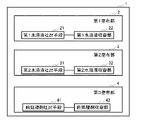
- FIG. 1 is a schematic diagram showing a configuration of an example of the pretreatment device of the present disclosure.
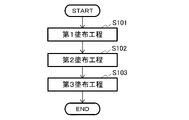
- FIG. 2 is a flowchart showing an example of processing in the preprocessing method of the first embodiment.
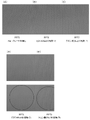
- FIG. 3 is a photograph of the fabric in Example 1.
- FIG. 4 is a photograph of the fabric in Example 2.
- the pretreatment apparatus of the present disclosure is a pretreatment apparatus that pretreats a recorded medium to which ink is applied and has permeability, and is a first coating that applies an aqueous solution containing alginate to the recorded medium.
- the coating portion applies the pretreatment agent after the coating by the first coating portion and the second coating portion.
- aqueous solution containing alginate the aqueous solution containing the chelating agent, the pretreatment agent containing the polyvalent metal salt, the ink, and the recording medium in the present disclosure will be described.
- the aqueous solution containing alginate contains alginate.
- other configurations are not particularly limited.
- alginate examples include sodium alginate.
- water-soluble salts such as potassium alginate and ammonium alginate can be used.
- the concentration of alginate may be any range as long as it can exert the effect as a pretreatment agent for pretreatment, and is not particularly limited, and is, for example, 0.5% by mass to 15% by mass. Yes, preferably 1% by mass.
- the aqueous solution containing the chelating agent contains the chelating agent.
- other configurations are not particularly limited.
- chelating agent examples include EDTA4Natetrahydrate and citric acid3Nadihydrate.
- EDTA4Natetrahydrate and citric acid3Nadihydrate.
- this is not limited to this, and for example, EDTA (Ethylenediaminetetraacetic Acid), NTA (NitriloTriaceticAcid), DTPA (DiethyleneTriaminePentaaceticAcid), HEDTA (HydroxyethylEthyleneDiamineTriaceticAcid), TTHA (Triethylene).
- Tetrasodium salt / L-aspartate-N, N-diacetic acid tetrasodium salt), Gluconic Acid, other chelating agents such as citric acid and malic acid; and the like can be used.
- “sodium” is also referred to as "Na”.
- the concentration of the chelating agent is, for example, 5% or less and 1% or more.
- the concentration of the chelating agent can be, for example, 1%, 3%, and 5%.
- the pretreatment agent containing the polyvalent metal salt contains the polyvalent metal salt.
- other configurations are not particularly limited.
- polyvalent metal salt examples include calcium nitrate dihydrate.
- the present invention is not limited to this, and for example, water-soluble salts of magnesium, calcium, strontium, barium, aluminum, copper, iron, nickel, and zinc can be used, and water-soluble salts of magnesium and calcium are preferable.
- the ink can be an ink used for applying ink by a general inkjet method, and is not particularly limited.
- the ink may contain, for example, a pigment, a dye, or the like as a colorant. Further, for example, a resin such as urethane resin or acrylic resin may be contained.
- the ink may further contain, for example, water and other components such as a wetting agent and a surfactant.
- the recorded medium has permeability.
- other configurations are not particularly limited.
- Examples of the recordable medium having the permeability include cloth, paper, corrugated cardboard, ceramics, non-woven fabric, sponge, metal mesh and the like.
- the permeable recording medium is made of, for example, a porous material.
- the pretreatment apparatus of the present disclosure will be described.
- the pretreatment apparatus of the present disclosure may be an integrated type having a first coating portion, a second coating portion, and a third coating portion inside one housing, or may be a separately independent first.
- the system may include a coating portion, a second coating portion, and a third coating portion.
- FIG. 1 shows an example of the configuration of the pretreatment device of the present disclosure.
- the pretreatment device 1 includes a first coating unit 2, a second coating unit 3, a third coating unit 4, and a control unit.
- the control unit has an arbitrary configuration, and may or may not be present, for example.
- the preprocessing device 1 can have, for example, the same configuration as a general inkjet type image forming device.
- the first coating unit 2 coats the recording medium with an aqueous solution containing the alginate.
- the first coating unit 2 includes a first aqueous solution discharging means 21 and a first aqueous solution accommodating unit 22.
- the first aqueous solution discharging means 21 may be a spray.
- the present invention is not limited to this, and the first aqueous solution ejection means 21 may be any means as long as the aqueous solution containing the alginate can be ejected to the recording medium, for example, a liquid having an inkjet nozzle row. It may be a ejection head, a stamp for applying ink to the cloth, a brush, a roller, or the like.
- the first aqueous solution accommodating portion 22 contains the aqueous solution containing the alginate.
- an accommodating container such as a cartridge or a tank is connected to the first aqueous solution discharging means 21 via a supply tube.
- the second coating unit 3 coats the recording medium with an aqueous solution containing the chelating agent.
- the second coating unit 3 includes a second aqueous solution discharging means 31 and a second aqueous solution accommodating unit 32.
- the second aqueous solution discharging means 31 is the same as the first aqueous solution discharging means 21.
- the second aqueous solution accommodating portion 32 contains the aqueous solution containing the chelating agent.
- an accommodating container such as a cartridge or a tank is connected to the second aqueous solution discharging means 31 via a supply tube.
- the second coating portion 3 is provided separately from the first coating portion 2.
- the first coating unit 2 also serves as the second coating unit 3, and the first coating unit 2 contains an aqueous solution containing the alginate and the chelating agent. It may be configured to be applied to the recording medium.
- the first aqueous solution accommodating portion 22 may contain an aqueous solution containing the alginate and the chelating agent
- the first aqueous solution accommodating portion 22 and the second aqueous solution accommodating portion 32 may contain the alginate.
- An aqueous solution containing the chelating agent and an aqueous solution containing the chelating agent may be contained, respectively.
- the aqueous solution containing the alginate and the aqueous solution containing the alginate are uniformly diffused in the aqueous solution. Gelation can be suppressed uniformly.
- the third coating unit 4 coats the recording medium with the pretreatment agent containing the polyvalent metal salt.
- the third coating unit 4 applies the pretreatment agent after the coating by the first coating unit 2 and the second coating unit 3.
- the third coating unit 4 includes a pretreatment agent discharging means 41 and a pretreatment agent accommodating unit 42.
- the pretreatment agent ejection means 41 includes a liquid ejection head having an inkjet nozzle row.
- the present invention is not limited to this, and the pretreatment agent ejection means 41 may be any means as long as the pretreatment agent can be ejected into the print range on the recording medium.
- the pretreatment agent containing the polyvalent metal salt is stored in the pretreatment agent accommodating portion 42.
- a pretreatment agent accommodating container such as a cartridge or a tank is connected to the pretreatment agent discharging means 41 via a supply tube.
- the third coating unit 4 can apply the pretreatment agent to the recording medium in a wet state of the aqueous solution containing the chelating agent applied by the second coating unit 3.
- the third coating unit 4 can apply the pretreatment agent to the recording medium in a wet state by not performing the drying treatment.
- the pretreatment agent is applied before the preset time elapses, so that the pretreatment agent is applied in a wet state. Can be applied to the recording medium.
- the preset time can be appropriately set, and is, for example, 1 to 60 seconds.
- the third coating unit 4 By applying the pretreatment agent to the recording medium while the aqueous solution containing the chelating agent is wet, the third coating unit 4, for example, an aqueous solution containing the chelating agent and an aqueous solution containing the alginate. Since the pretreatment agent is applied to the recording medium in a state where is uniformly applied, gelation can be uniformly suppressed. In addition, bleeding of the pretreatment agent can be prevented.
- a central processing unit for example, a CPU (Central Processing Unit), a ROM (Read Only Memory), a RAM (Random Access Memory), an input interface, and an output interface are electrically connected via a bus. It is connected.
- a CPU Central Processing Unit
- ROM Read Only Memory
- RAM Random Access Memory
- the CPU performs various operations and processes based on, for example, signals input by a display device, an operation panel, buttons, etc. that receive user input, and various programs and data in ROM and RAM. Then, data or the like is transmitted to each component such as the first coating unit 2, the second coating unit 3, and the third coating unit 4 via the output interface.
- the RAM is a volatile storage device that can be read / written, and stores various calculation results of the CPU.
- the pretreatment device 1 may further include, for example, an ink coating unit.
- the ink coating portion is pretreated by the first coating portion 2, the second coating portion 3, and the third coating portion 4 to contain the aqueous solution containing alginate, the aqueous solution containing the chelating agent, and the polyvalent metal salt.
- the ink is applied to the recording medium to which the agent is applied.
- the mechanism by which it is possible to reduce the traces (hereinafter, also referred to as “gelation traces”) due to the reaction between the pretreatment agent (PPT) and the pretreatment agent (PT) in the pretreatment is, for example, It is inferred as follows. That is, as described above, when the present inventors used an aqueous solution containing alginate as PPT, the alginate contained in PPT and the calcium ion of PT gelled, and traces of gelation were left outside the printing range. I found that the problem of remaining arises.
- the chelating agent can recover the calcium ion bound to alginic acid, thereby suppressing gelation due to the binding between the calcium ion and alginate.
- this disclosure is not limited to the above speculation.
- the pretreatment method of the present disclosure is a pretreatment method for pretreating a recording medium to which an ink is applied, which has permeability, and is a first coating method in which an aqueous solution containing alginate is applied to the recording medium.
- the first coating step includes a step, a second coating step of applying an aqueous solution containing a chelating agent to the recorded medium, and a third coating step of applying a pretreatment agent containing a polyvalent metal salt to the recorded medium. 3
- the pretreatment agent is applied after the coating by the first coating step and the second coating step.
- FIG. 2 is a flowchart showing an example of the preprocessing method.
- the pretreatment method of the present embodiment can be carried out as follows, for example, by using the above-mentioned pretreatment device 1.
- the pretreatment method of the present embodiment is not limited to the use of the pretreatment device 1.
- the first coating step (S101) is performed by the first coating unit 2.
- an aqueous solution containing alginate is applied to the recording medium.
- the aqueous solution containing the alginate may be entirely coated on the recording medium or may be coated on the print range.
- the pretreatment agent (PPT) for pretreatment that is, the aqueous solution containing the alginate and the aqueous solution containing the chelating agent to the recording medium as a whole.
- the amount of the aqueous solution containing the alginate applied to the recording medium is not particularly limited, and may be, for example, 5 mg / cm 2 to 50 mg / cm 2 . From the viewpoint of further suppressing the occurrence of PT bleeding in the coating of the pretreatment agent (PT) in the third coating step (S103) described later, the first coating step (S101) and the second coating step described later In (S102), it is preferable that the pretreatment agent (PPT) for pretreatment, that is, the aqueous solution containing the alginate and the aqueous solution containing the chelating agent is wet enough to immerse the recording medium.
- the pretreatment agent (PPT) for pretreatment that is, the aqueous solution containing the alginate and the aqueous solution containing the chelating agent is wet enough to immerse the recording medium.
- the second coating step (S102) is performed by the second coating unit 3.
- an aqueous solution containing a chelating agent is applied to the recording medium.
- the aqueous solution containing the chelating agent may be entirely coated on the recording medium or may be coated on the print range.
- the amount of the aqueous solution containing the chelating agent applied to the recording medium is not particularly limited, and may be, for example, 5 mg / cm 2 to 50 mg / cm 2 .
- the third coating step (S103) is performed by the third coating unit 4.
- a pretreatment agent containing a polyvalent metal salt is applied to the recording medium.
- the pretreatment agent can be applied to the print range on the recording medium.
- the amount of the pretreatment agent applied to the recording medium is not particularly limited, and may be, for example, 1 mg / cm 2 to 32 mg / cm 2 .
- the pretreatment agent can be applied while the aqueous solution containing the chelating agent applied in the second coating step (S102) is wet.
- the interval time between the second coating step (S102) and the third coating step (S103) can be set to the preset time.
- the pretreatment method of the present embodiment may include, for example, an ink coating step after the third coating step (S103).
- the ink is applied to the recording medium.
- the present invention is not limited to this, and for example, the first coating step (S101) is the first. 2 It also serves as a coating step (S102) (S101'), and in the first coating step (S101'), an aqueous solution containing the arginate and the chelating agent may be coated on the recording medium.
- the manufacturing method of the present disclosure is a method of manufacturing a recorded medium to which a pretreatment has been performed, and includes a pretreatment step of performing a pretreatment of the recorded medium, and the pretreatment step is the pretreatment of the present disclosure. It is carried out by the method.
- the manufacturing method of the present disclosure is not particularly limited except for this point.
- the manufacturing method of the present disclosure can be carried out using, for example, the above-mentioned pretreatment device 1.
- the manufacturing method of this embodiment is not limited to the use of the pretreatment device 1.
- the manufacturing method of the present disclosure may include, for example, an ink coating step after the pretreatment step.
- the ink application step is the same as the ink application step in the pretreatment method of the present disclosure.
- the aqueous solution of the present disclosure is an aqueous solution containing alginate, and further contains a chelating agent.
- a chelating agent for the aqueous solution containing alginate, the chelating agent, the pretreatment agent containing the polyvalent metal salt, and the pretreatment device, the above-mentioned description of the pretreatment device 1 and the pretreatment method can be referred to.
- the aqueous solution of the present disclosure can be used, for example, as an aqueous solution containing the alginate and the chelating agent in the above-mentioned pretreatment device 1 and the pretreatment method of the present disclosure.
- the kit of the present embodiment is not limited to use in the pretreatment device 1 and the pretreatment method of the present disclosure.
- kit Next, a kit containing an aqueous solution for pretreatment on a recording medium having the permeability of the present disclosure and to which the ink is applied will be described.
- the kit of the present disclosure includes a first aqueous solution containing alginate, a second aqueous solution containing a chelating agent, and a pretreatment agent containing a polyvalent metal salt.
- the order of application to the recording medium is the order of the first aqueous solution, the second aqueous solution, the pretreatment agent, and the ink.
- the kit of the present disclosure is, for example, the above-mentioned pretreatment device 1, and the pretreatment agent containing the alginate-containing aqueous solution, the chelating agent-containing aqueous solution, and the polyvalent metal salt in the pretreatment method of the present disclosure. Can be used as.
- the kit of the present embodiment is not limited to use in the pretreatment device 1 and the pretreatment method of the present disclosure.
- the first aqueous solution may also serve as the second aqueous solution, and the first aqueous solution may contain the alginate and the chelating agent.
- the kit of the present disclosure may further include, for example, the ink.
- Example 1 It was confirmed that the range of gelation traces was reduced by using an aqueous solution containing sodium alginate and a chelating agent as the pretreatment agent (PPT) for the pretreatment.
- PPT pretreatment agent
- Pretreatment agent for pretreatment As the PPT, an aqueous solution (PPT1 to 4) having the composition shown in Table 1 was prepared.
- the PPT1 is a comparative PPT that does not contain a chelating agent.
- Pretreatment agent An aqueous solution containing calcium nitrate dihydrate was prepared as a pretreatment agent (PT).
- the print area is the character "eternal" shown in FIG. 3, which will be described later.
- the ink was ejected to the printing area using a general inkjet printing machine.
- 3 (A) to 3 (D) are photographs of the cloth when the PPTs 1 to 4 are applied as the pretreatment agent (PPT) for the pretreatment, respectively.
- PPT pretreatment agent
- the left is the photograph
- the right is a schematic diagram showing the state of the photograph.
- the range of gelation traces is shown in gray (reference numeral “X”).
- a region where unevenness such as bleeding has occurred is indicated by dots (reference numeral “Y”).
- Table 2 summarizes the results of FIG. 3 in a table.
- the range of gelation traces is reduced, the density of gelation traces does not increase, and unevenness such as bleeding does not occur, which is preferable. It can be said that.
- PPT 5-9 an aqueous solution having the composition shown in Table 3 was prepared.
- PPTs 5 to 7 are aqueous solutions having the same composition as PPTs 1 to 3 in Example 1.
- PPT application First, a worker used a dropper (commercially available) to drop a few drops of the PPT onto the fabric as a whole.
- FIG. 4 is a photograph of the fabric when the PPTs 5 to 9 are applied, where (A) is PPT5, (B) is PPT6, (C) is PPT7, and (D) is PPT8, ( E) shows the result of PPT9.
- the upper part is the photograph, and the lower part is the range in which the trace of PPT was confirmed in the photograph, and the inside of the line is the PPT. It is the range where the trace is confirmed.
- Table 4 summarizes the results of FIG. 4 in a table.
- the concentration of the chelating agent exceeds 5%, it is considered that the trace of the PPT itself becomes even thicker. Therefore, it can be said that it is preferable to use the PPT having a concentration of the chelating agent of 5% or less. Further, it can be said that it is more preferable to use the PPT having a concentration of the chelating agent of 1% or less because no trace of the PPT itself is generated.
- a pretreatment apparatus capable of preventing bleeding of the pretreatment agent (PT) and reducing gelation traces in printing of a recording medium having permeability and being coated with ink. can.
Landscapes
- Chemical & Material Sciences (AREA)
- Engineering & Computer Science (AREA)
- Life Sciences & Earth Sciences (AREA)
- Textile Engineering (AREA)
- Wood Science & Technology (AREA)
- Materials Engineering (AREA)
- Organic Chemistry (AREA)
- Chemical Kinetics & Catalysis (AREA)
- Health & Medical Sciences (AREA)
- Molecular Biology (AREA)
- General Chemical & Material Sciences (AREA)
- Inorganic Chemistry (AREA)
- Ink Jet (AREA)
- Ink Jet Recording Methods And Recording Media Thereof (AREA)
- Coloring (AREA)
Abstract
前処理剤のにじみを防ぎ、且つ、前処理の前処理剤と前処理剤との反応による跡残りを低減可能な前処理装置を提供する。本開示の前処理装置は、浸透性を有しインクが塗布される被記録媒体に、前処理を行う前処理装置であって、アルギン酸塩を含む水溶液を前記被記録媒体に塗布する第1塗布部と、キレート剤を含む水溶液を前記被記録媒体に塗布する第2塗布部と、多価金属塩を含む前処理剤を前記被記録媒体に塗布する第3塗布部と、を含み、前記第3塗布部は、前記第1塗布部及び前記第2塗布部による前記塗布後、前記前処理剤を塗布する。
Description
本開示は、前処理装置、前処理方法、製造方法、及び水溶液に関する。
インクジェット方式による画像の印刷において、画質の改善等のために、印刷イメージ範囲に予め前処理剤(以下、PTともいう。)を吐出する前処理方法が知られている。しかし、印刷範囲外への前記PTのにじみが生じる場合があった。
これを改善するために、さらに、前処理の前処理剤(以下、PPTともいう。)を塗布し、その後、前記PTの塗布を行う技術が開示されている(例えば、特許文献1参照)。
本発明者らは、PPTとしてアルギン酸塩を含む水溶液を用いた場合、PPTに含まれるアルギン酸塩とPTのカルシウムイオンとがゲル化し、ゲル化の跡が残るという問題が生じることを見出した。
本開示は、前処理剤(PT)のにじみを防ぎ、且つ、前処理の前処理剤(PPT)とPTとの反応による跡残りを低減可能な前処理装置、前処理方法、製造方法、及び水溶液を提供することを目的とする。
前記目的を達成するために、本開示の前処理装置は、
浸透性を有しインクが塗布される被記録媒体に、前処理を行う前処理装置であって、アルギン酸塩を含む水溶液を前記被記録媒体に塗布する第1塗布部と、
キレート剤を含む水溶液を前記被記録媒体に塗布する第2塗布部と、
多価金属塩を含む前処理剤を前記被記録媒体に塗布する第3塗布部と、を含み、前記第3塗布部は、前記第1塗布部及び前記第2塗布部による前記塗布後、前記前処理剤を塗布する。
浸透性を有しインクが塗布される被記録媒体に、前処理を行う前処理装置であって、アルギン酸塩を含む水溶液を前記被記録媒体に塗布する第1塗布部と、
キレート剤を含む水溶液を前記被記録媒体に塗布する第2塗布部と、
多価金属塩を含む前処理剤を前記被記録媒体に塗布する第3塗布部と、を含み、前記第3塗布部は、前記第1塗布部及び前記第2塗布部による前記塗布後、前記前処理剤を塗布する。
本開示の前処理方法は、
浸透性を有しインクが塗布される被記録媒体に、前処理を行う前処理方法であって、アルギン酸塩を含む水溶液を前記被記録媒体に塗布する第1塗布工程と、
キレート剤を含む水溶液を前記被記録媒体に塗布する第2塗布工程と、
多価金属塩を含む前処理剤を前記被記録媒体に塗布する第3塗布工程と、を含み、前記第3塗布工程は、前記第1塗布工程及び前記第2塗布工程による前記塗布後、前記前処理剤を塗布する。
浸透性を有しインクが塗布される被記録媒体に、前処理を行う前処理方法であって、アルギン酸塩を含む水溶液を前記被記録媒体に塗布する第1塗布工程と、
キレート剤を含む水溶液を前記被記録媒体に塗布する第2塗布工程と、
多価金属塩を含む前処理剤を前記被記録媒体に塗布する第3塗布工程と、を含み、前記第3塗布工程は、前記第1塗布工程及び前記第2塗布工程による前記塗布後、前記前処理剤を塗布する。
本開示の製造方法は、
前処理が行われた被記録媒体の製造方法であって、
前記被記録媒体の前処理を行う前処理工程を含み、
前記前処理工程が、前記本開示の前処理方法により実施される。
前処理が行われた被記録媒体の製造方法であって、
前記被記録媒体の前処理を行う前処理工程を含み、
前記前処理工程が、前記本開示の前処理方法により実施される。
本開示の水溶液は、
浸透性を有しインクが塗布される被記録媒体に、アルギン酸塩を含む水溶液、及び多価金属塩を含む前処理剤の順に前処理を行う前処理装置に供給される前記水溶液であって、さらに、キレート剤を含む。
浸透性を有しインクが塗布される被記録媒体に、アルギン酸塩を含む水溶液、及び多価金属塩を含む前処理剤の順に前処理を行う前処理装置に供給される前記水溶液であって、さらに、キレート剤を含む。
本開示の前処理装置は、前処理剤(PT)のにじみを防ぎ、且つ、前処理の前処理剤(PPT)とPTとの反応による跡残りを低減可能な前処理装置を提供することができる。
本開示の前処理装置は、浸透性を有しインクが塗布される被記録媒体に、前処理を行う前処理装置であって、アルギン酸塩を含む水溶液を前記被記録媒体に塗布する第1塗布部と、キレート剤を含む水溶液を前記被記録媒体に塗布する第2塗布部と、多価金属塩を含む前処理剤を前記被記録媒体に塗布する第3塗布部と、を含み、前記第3塗布部は、前記第1塗布部及び前記第2塗布部による前記塗布後、前記前処理剤を塗布する。
本開示における、前記アルギン酸塩を含む水溶液、前記キレート剤を含む水溶液、前記多価金属塩を含む前処理剤、前記インク、及び前記被記録媒体について、説明する。
前記アルギン酸塩を含む水溶液は、アルギン酸塩を含む。前記アルギン酸塩を含む水溶液において、その他の構成は、特に制限されない。
前記アルギン酸塩は、例えば、アルギン酸ナトリウムがあげられる。ただし、これには制限されず、例えば、アルギン酸カリウム、アルギン酸アンモニウム等の水溶性塩を用いることができる。
前記アルギン酸塩を含む水溶液において、アルギン酸塩の濃度は、前処理の前処理剤としての効果を発揮可能な範囲であればよく、特に制限されず、例えば、0.5質量%~15質量%であり、好ましくは、1質量%である。
前記キレート剤を含む水溶液は、キレート剤を含む。前記キレート剤を含む水溶液において、その他の構成は、特に制限されない。
前記キレート剤は、例えば、EDTA4Na4水和物、クエン酸3Na2水和物があげられる。ただし、これには制限されず、例えば、EDTA(エチレンジアミン四酢酸類/Ethylenediamine tetraacetic Acid)、NTA(Nitrilo Triacetic Acid)、DTPA(Diethylene Triamine Pentaacetic Acid)、HEDTA(Hydroxyethyl Ethylene Diamine Triacetic Acid)、TTHA(Triethylene Tetramine Hexaacetic Acid)、PDTA(1,3-Propanediamine Tetraacetic Acid)、DPTA-OH(1,3-Diamino-2-hydroxypropane Tetraacetic Acid)、HIDA(Hydroxyethyl Imino Diacetic Acid)、DHEG(Dihydroxyethyl Glycine)、GEDTA(Glycol Ether Diamine Tetraacetic Acid)、CMGA(Dicarboxymethyl Glutamic Acid)、EDDS (S,S)‐Ethylene Diamine Disuccinic Acid)、HIDS系(ヒドロキシイミノジコハク酸)等のアミノカルボン酸系キレート剤;HEDP(Hydroxyethylidene Diphosphonic Acid)、NTMP(Nitrilotris (Methylene Phosphonic Acid))、PBTC(Phosphonobutane Tricarboxylic Acid)、EDTMP(Ethylene Diamine Tetra(Methylene Phosphonic Acid))等のホスホン酸系キレート剤;ASDA(L-アスパラギン酸-N,N-二酢酸四ナトリウム塩/L-aspartate-N, N- diacetic acid tetrasodium salt)、グルコン酸(Gluconic Acid)、クエン酸、リンゴ酸等のその他のキレート剤;等を用いることができる。なお、以下の説明において、「ナトリウム」を「Na」とも記載する。
前記キレート剤を含む水溶液において、前記キレート剤の濃度は、例えば、5%以下、および1%以上である。前記キレート剤の濃度は、例えば、1%、3%、および5%とすることができる。
前記多価金属塩を含む前処理剤は、多価金属塩を含む。前記多価金属塩を含む水溶液において、その他の構成は、特に制限されない。
前記多価金属塩は、例えば、硝酸カルシウム2水和物があげられる。ただし、これには制限されず、例えば、マグネシウム、カルシウム、ストロンチウム、バリウム、アルミニウム、銅、鉄、ニッケル、及び亜鉛の水溶性塩を用いることができ、マグネシウム、及びカルシウムの水溶性塩が好ましい。
前記インクは、一般的なインクジェット方式によるインクの塗布に用いられるインクとすることができ、特に制限されない。前記インクは、例えば、着色剤として、顔料、及び染料等を含んでもよい。また、例えば、ウレタン樹脂、アクリル樹脂等の樹脂を含んでもよい。前記インクは、例えば、さらに、水、並びに、湿潤剤、及び界面活性剤等のその他の成分を含んでもよい。
前記被記録媒体は、浸透性を有する。前記被記録媒体において、その他の構成は、特に制限されない。前記浸透性を有する被記録媒体は、例えば、布帛、紙、段ボール、セラミックス、不織布、スポンジ、金属メッシュ等があげられる。前記浸透性を有する被記録媒体は、例えば、多孔質の素材からなる。
(前処理装置)
本開示の前処理装置について説明する。本開示の前処理装置は、一つの筐体の内部に第1塗布部、第2塗布部、及び、第3塗布部を備えた一体型のものであってもよいし、別個独立した第1塗布部、第2塗布部、及び、第3塗布部を含むシステムであってもよい。
本開示の前処理装置について説明する。本開示の前処理装置は、一つの筐体の内部に第1塗布部、第2塗布部、及び、第3塗布部を備えた一体型のものであってもよいし、別個独立した第1塗布部、第2塗布部、及び、第3塗布部を含むシステムであってもよい。
図1に、本開示の前処理装置の構成の一例を示す。図1に示すように、前処理装置1は、第1塗布部2、第2塗布部3、第3塗布部4、及び制御部を含む。前処理装置1において、前記制御部は、任意の構成であり、例えば、あってもよいし、なくてもよい。前処理装置1は、例えば、一般的なインクジェット方式の画像形成装置と同様の構成とすることができる。
第1塗布部2は、前記アルギン酸塩を含む水溶液を前記被記録媒体に塗布する。第1塗布部2は、第1水溶液吐出手段21、及び第1水溶液収容部22を含む。
第1水溶液吐出手段21は、スプレーがあげられる。ただし、これには制限されず、第1水溶液吐出手段21は、前記アルギン酸塩を含む水溶液を前記被記録媒体に吐出可能であればいかなる手段であってもよく、例えば、インクジェットノズル列を有する液体吐出ヘッド、インクを布帛に塗布するスタンプ、刷毛、ローラ等であってもよい。
第1水溶液収容部22には、前記アルギン酸塩を含む水溶液が収容されている。第1水溶液収容部22において、カートリッジやタンク等の収容容器が、供給チューブを介して第1水溶液吐出手段21に接続されている。
第2塗布部3は、前記キレート剤を含む水溶液を前記被記録媒体に塗布する。第2塗布部3は、第2水溶液吐出手段31、及び第2水溶液収容部32を含む。
第2水溶液吐出手段31は、第1水溶液吐出手段21と同様である。
第2水溶液収容部32には、前記キレート剤を含む水溶液が収容されている。第2水溶液収容部32において、カートリッジやタンク等の収容容器が、供給チューブを介して第2水溶液吐出手段31に接続されている。
図1において、第2塗布部3は、第1塗布部2とは別に設けられている。ただし、これには制限されず、前処理装置1において、第1塗布部2が第2塗布部3を兼ねており、第1塗布部2が前記アルギン酸塩と前記キレート剤とを含む水溶液を、前記被記録媒体に塗布する構成であってもよい。この場合、第1水溶液収容部22に、前記アルギン酸塩と前記キレート剤とを含む水溶液が収容されていてもよいし、第1水溶液収容部22及び第2水溶液収容部32に、前記アルギン酸塩を含む水溶液及び前記キレート剤を含む水溶液が、それぞれ収容されていてもよい。前者の場合、前記アルギン酸塩と前記キレート剤との両方を含む水溶液を用いることにより、例えば、前記キレート剤を含む水溶液、及び前記アルギン酸塩を含む水溶液が水溶液中に均一に拡散しているため、ゲル化を均一に抑えることができる。
第3塗布部4は、前記多価金属塩を含む前処理剤を前記被記録媒体に塗布する。第3塗布部4は、第1塗布部2及び第2塗布部3による前記塗布後、前記前処理剤を塗布する。第3塗布部4は、前処理剤吐出手段41、及び前処理剤収容部42を含む。
前処理剤吐出手段41は、インクジェットノズル列を有する液体吐出ヘッドがあげられる。ただし、これには制限されず、前処理剤吐出手段41は、前記前処理剤を前記被記録媒体における印刷範囲に吐出可能であればいかなる手段でもよい。
前処理剤収容部42には、前記多価金属塩を含む前処理剤が収容されている。前処理剤収容部42において、カートリッジやタンク等の前処理剤収容容器が、供給チューブを介して前処理剤吐出手段41に接続されている。
第3塗布部4は、第2塗布部3が塗布した前記キレート剤を含む水溶液がウエットの状態で、前記前処理剤を前記被記録媒体に塗布することができる。第3塗布部4は、例えば、乾燥処理を行わないことで、ウエットの状態で、前記前処理剤を前記被記録媒体に塗布することができる。また、第3塗布部4は、例えば、第2塗布部3による前記塗布後、予め設定した時間が経過する前に前記前処理剤の塗布を行うことで、ウエットの状態で、前記前処理剤を前記被記録媒体に塗布することができる。前記予め設定した時間は、適宜設定でき、例えば、1~60秒である。
第3塗布部4が、前記キレート剤を含む水溶液がウエットの状態で、前記前処理剤を前記被記録媒体に塗布することにより、例えば、前記キレート剤を含む水溶液、及び前記アルギン酸塩を含む水溶液が均一に塗布されている状態で、前記前処理剤が前記被記録媒体に塗布されるため、ゲル化を均一に抑えることができる。また、前記前処理剤のにじみを防ぐことができる。
前記制御部は、中央演算装置(例えば、CPU(Central Processing Unit)と、ROM(Read Only Memory)と、RAM(Random Access Memory)と、入力インターフェースと、出力インターフェースとがバスを介して電気的に接続されている。
前記CPUは、例えば、ユーザの入力を受付けする、表示装置、操作パネル、ボタン等によって入力された信号や、ROM及びRAM内の各種プログラムやデータに基づいて各種演算や処理を行う。そして、前記出力インターフェースを介して、第1塗布部2、第2塗布部3、及び第3塗布部4等の各構成部材にデータ等を送信する。RAMは、読み出し・書き込み可能な揮発性記憶装置であって、CPUでの各種演算結果等が記憶される。
前処理装置1は、例えば、さらに、インク塗布部を含んでもよい。前記インク塗布部は、第1塗布部2、第2塗布部3、及び第3塗布部4により、前記アルギン酸塩を含む水溶液、前記キレート剤を含む水溶液、及び前記多価金属塩を含む前処理剤が塗布された前記被記録媒体に、前記インクを塗布する。
本開示により、前処理の前処理剤(PPT)と前処理剤(PT)との反応による跡残り(以下、「ゲル化跡」ともいう。)を低減可能であることのメカニズムは、例えば、つぎのように推察される。すなわち、前述のように、本発明者らは、PPTとしてアルギン酸塩を含む水溶液を用いた場合、PPTに含まれるアルギン酸塩とPTのカルシウムイオンとがゲル化し、印刷範囲外までゲル化の跡が残るという問題が生じることを見出した。これに対し、本開示によれば、アルギン酸と結合したカルシウムイオンをキレート剤が回収することができ、これにより、カルシウムイオンとアルギン酸塩との結合によるゲル化が抑制されると推察される。ただし、本開示は、前記推察に限定されない。
(前処理方法)
本開示の前処理方法について説明する。
本開示の前処理方法について説明する。
本開示の前処理方法は、浸透性を有しインクが塗布される被記録媒体に、前処理を行う前処理方法であって、アルギン酸塩を含む水溶液を前記被記録媒体に塗布する第1塗布工程と、キレート剤を含む水溶液を前記被記録媒体に塗布する第2塗布工程と、多価金属塩を含む前処理剤を前記被記録媒体に塗布する第3塗布工程と、を含み、前記第3塗布工程は、前記第1塗布工程及び前記第2塗布工程による前記塗布後、前記前処理剤を塗布する。
本実施形態の前処理方法について、図2を用いて説明する。図2は、前記前処理方法の一例を示すフローチャートである。本実施形態の前処理方法は、例えば、前述の、前処理装置1を用いて、次のように実施できる。ただし、本実施形態の前処理方法は、前処理装置1の使用には限定されない。
第1塗布部2により、前記第1塗布工程(S101)を行う。前記第1塗布工程(S101)は、アルギン酸塩を含む水溶液を前記被記録媒体に塗布する。
前記第1塗布工程(S101)において、例えば、前記アルギン酸塩を含む水溶液を、前記被記録媒体において全体的に塗布してもよいし、印刷範囲に塗布してもよい。なお、後述する第3塗布工程(S103)における前記前処理剤(PT)の塗布において、PTのにじみの発生をより抑制する観点から、前記第1塗布工程(S101)及び後述する第2塗布工程(S102)において、前処理の前処理剤(PPT)、すなわち、前記アルギン酸塩を含む水溶液及び前記キレート剤を含む水溶液を、前記被記録媒体に全体的に塗布することが好ましい。
前記被記録媒体への前記アルギン酸塩を含む水溶液の塗布量は、特に制限されず、例えば、5mg/cm2~50mg/cm2であればよい。なお、後述する第3塗布工程(S103)における前記前処理剤(PT)の塗布において、PTのにじみの発生をより抑制する観点から、前記第1塗布工程(S101)及び後述する第2塗布工程(S102)において、前処理の前処理剤(PPT)、すなわち、前記アルギン酸塩を含む水溶液及び前記キレート剤を含む水溶液を、前記被記録媒体が浸る程度に濡れている状態にすることが好ましい。
つぎに、第2塗布部3により、前記第2塗布工程(S102)を行う。前記第2塗布工程(S102)は、キレート剤を含む水溶液を前記被記録媒体に塗布する。
前記第2塗布工程(S102)において、例えば、前記キレート剤を含む水溶液を、前記被記録媒体において全体的に塗布してもよいし、印刷範囲に塗布してもよい。
前記被記録媒体への前記キレート剤を含む水溶液の塗布量は、特に制限されず、例えば、5mg/cm2~50mg/cm2であればよい。
つぎに、第3塗布部4により、前記第3塗布工程(S103)を行う。前記第3塗布工程(S103)は、多価金属塩を含む前処理剤を前記被記録媒体に塗布する。
前記第3塗布工程(S103)において、例えば、前記前処理剤を、前記被記録媒体における印刷範囲に塗布することができる。
前記被記録媒体への前記前処理剤の塗布量は、特に制限されず、例えば、1mg/cm2~32mg/cm2であればよい。
前記第3塗布工程(S103)は、前記第2塗布工程(S102)において塗布した前記キレート剤を含む水溶液がウエットの状態で、前記前処理剤を塗布することができる。この場合、前記第2塗布工程(S102)及び前記第3塗布工程(S103)の間隔時間は、前記予め設定した時間とすることができる。
本実施形態の前処理方法は、例えば、前記第3塗布工程(S103)の後、さらに、インク塗布工程を含んでもよい。前記インク塗布工程は、前記インクを、前記被記録媒体に塗布する。
図1では、前記第1塗布工程(S101)後、前記第2塗布工程(S102)を行う場合について説明したが、これには制限されず、例えば、前記第1塗布工程(S101)が前記第2塗布工程(S102)を兼ねており(S101’)、前記第1塗布工程(S101’)において、前記アルギン酸塩と前記キレート剤とを含む水溶液を前記被記録媒体に塗布してもよい。
(製造方法)
本開示の前処理が行われた被記録媒体の製造方法について説明する。
本開示の前処理が行われた被記録媒体の製造方法について説明する。
本開示の製造方法は、前処理が行われた被記録媒体の製造方法であって、前記被記録媒体の前処理を行う前処理工程を含み、前記前処理工程が、前記本開示の前処理方法により実施される。本開示の製造方法において、この点以外は、特に制限されない。
本開示の製造方法は、例えば、前述の、前処理装置1を用いて実施できる。ただし、本実施形態の製造方法は、前処理装置1の使用には限定されない。
本開示の製造方法は、例えば、前記前処理工程の後、さらに、インク塗布工程を含んでもよい。前記インク塗布工程は、前記本開示の前処理方法における前記インク塗布工程と同様である。
(水溶液)
本開示の浸透性を有しインクが塗布される被記録媒体に、アルギン酸塩を含む水溶液、及び多価金属塩を含む前処理剤の順に前処理を行う前処理装置に供給される前記水溶液について説明する。
本開示の浸透性を有しインクが塗布される被記録媒体に、アルギン酸塩を含む水溶液、及び多価金属塩を含む前処理剤の順に前処理を行う前処理装置に供給される前記水溶液について説明する。
本開示の水溶液は、アルギン酸塩を含む水溶液であり、さらに、キレート剤を含む。前記アルギン酸塩を含む水溶液、前記キレート剤、前記多価金属塩を含む前処理剤、及び前記前処理装置は、前述の、前処理装置1、及び前処理方法の説明を参照することができる。
本開示の水溶液は、例えば、前述の、前処理装置1、及び本開示の前処理方法における、前記アルギン酸塩と前記キレート剤とを含む水溶液として使用できる。ただし、本実施形態のキットは、前処理装置1、及び本開示の前処理方法における使用には限定されない。
(キット)
つぎに、本開示の浸透性を有しインクが塗布される被記録媒体に、前処理を行うための水溶液を含むキットについて説明する。
つぎに、本開示の浸透性を有しインクが塗布される被記録媒体に、前処理を行うための水溶液を含むキットについて説明する。
本開示のキットは、アルギン酸塩を含む第1水溶液と、キレート剤を含む第2水溶液と、多価金属塩を含む前処理剤と、を含む。本開示のキットは、前記被記録媒体への塗布順が、前記第1水溶液および前記第2水溶液、前記前処理剤、ならびに前記インク、の順番である。
本開示のキットは、例えば、前述の、前処理装置1、及び本開示の前処理方法における、前記アルギン酸塩を含む水溶液、前記キレート剤を含む水溶液、及び前記多価金属塩を含む前処理剤として使用できる。ただし、本実施形態のキットは、前処理装置1、及び本開示の前処理方法における使用には限定されない。
本開示のキットは、例えば、前記第1水溶液が前記第2水溶液を兼ねており、前記第1水溶液が前記アルギン酸塩と前記キレート剤とを含んでもよい。
本開示のキットは、例えば、さらに、前記インクを含んでもよい。
つぎに、本開示の実施例について比較例と併せて説明する。なお、本開示は、下記の実施例及び比較例により限定及び制限されない。
[実施例1]
前処理の前処理剤(PPT)として、アルギン酸ナトリウム及びキレート剤を含む水溶液を用いることにより、ゲル化跡の範囲が減少することを確認した。
前処理の前処理剤(PPT)として、アルギン酸ナトリウム及びキレート剤を含む水溶液を用いることにより、ゲル化跡の範囲が減少することを確認した。
(前処理の前処理剤)
前記PPTとして、表1に示す組成の水溶液(PPT1~4)を調製した。なお、前記PPT1は、キレート剤を含まない、比較例のPPTである。

前記PPTとして、表1に示す組成の水溶液(PPT1~4)を調製した。なお、前記PPT1は、キレート剤を含まない、比較例のPPTである。
(前処理剤)
前処理剤(PT)として、硝酸カルシウム2水和物を含む水溶液を調製した。
前処理剤(PT)として、硝酸カルシウム2水和物を含む水溶液を調製した。
(インク)
インクとして、市販のインクジェット方式のプリンターに用いられるホワイトインクを使用した。
インクとして、市販のインクジェット方式のプリンターに用いられるホワイトインクを使用した。
(布帛)
被記録媒体である布帛として、市販のTシャツ(ポリエステル製、薄青色)を使用した。
被記録媒体である布帛として、市販のTシャツ(ポリエステル製、薄青色)を使用した。
(印刷)
まず、作業者により、スプレー(市販のもの)を用いて、前記布帛に全体的に前記PPTを塗布した。塗布量は、約67mg/cm2とした。
まず、作業者により、スプレー(市販のもの)を用いて、前記布帛に全体的に前記PPTを塗布した。塗布量は、約67mg/cm2とした。
つぎに、一般的なインクジェット印刷機を用いて、前記PTを印刷領域に吐出した。前記印刷領域は、後述する図3に示す、「永」の文字とした。
つぎに、一般的なインクジェット印刷機を用いて、前記インクを前記印刷領域に吐出した。
つぎに、一般的なオーブンを用いて、110℃、10分の条件で、定着を行った。
前記PPTの塗布から、前記定着による乾燥までを、ウエットな状態で行った。前記ウエットな状態は、作業者により、前記PPT、前記PT、及び前記インクが乾燥していないことを目視により確認した。
(ゲル化跡確認)
前記定着後の前記布帛について、前記印刷領域からはみ出したゲル化跡の範囲及び濃さを、目視で確認した。
前記定着後の前記布帛について、前記印刷領域からはみ出したゲル化跡の範囲及び濃さを、目視で確認した。
この結果を図3および表2に示す。図3(A)~(D)は、それぞれ、前処理の前処理剤(PPT)として、前記PPT1~4を塗布した場合における、前記布帛の写真である。各図中、左が、前記写真であり、右が、前記写真の状態を示す模式図である。図3(A)~(D)の前記模式図において、ゲル化跡の範囲を、グレーで示す(符号「X」)。また、図3(D)の前記模式図において、にじみのようなムラが生じていた領域を、ドットで示す(符号「Y」)。表2は、前記図3の結果を表にまとめたものである。

図3(A)に示すように、前記PPTとして、比較例であるPPT1を塗布した場合、全体的に、各文字の周りにゲル化跡が見えていた。これに対し、図3(B)に示すように、前記PPTとしてPPT2を塗布した場合、PPT1を塗布した場合と比較して、ゲル化跡の濃さはほぼ同程度であったが、ゲル化跡の範囲がやや減少していた。図3(C)に示すように、前記PPTとしてPPT3を塗布した場合、PPT1を塗布した場合と比較して、ゲル化跡の範囲がやや狭くなっていた。一方、ゲル化跡については濃くなっていた。図3(D)に示すように、前記PPTとしてPPT3を塗布した場合、PPT1を塗布した場合と比較して、ゲル化跡の範囲が大幅に狭くなっていた。一方、ゲル化跡とは別に、にじみのようなムラが生じていた。
以上のように、前記PPTとして、アルギン酸ナトリウム及びキレート剤を含む水溶液を用いることにより、前記PPTとして、アルギン酸ナトリウムのみを含む水溶液を用いた場合と比較して、ゲル化跡の範囲が減少することが確認できた。
前記キレート剤としてEDTA4Na4水和物を含む前記PPTを用いることで、ゲル化跡の範囲を減少させ、ゲル化跡の濃さの上昇がなく、にじみのようなムラの発生がないことから、好ましいといえる。
[実施例2]
前記PPTを塗布することによる、前記PPT自体の跡残りを確認した。
前記PPTを塗布することによる、前記PPT自体の跡残りを確認した。
前記PPTとして、表3に示す組成の水溶液(PPT5~9)を調製した。なお、PPT5~7は、実施例1におけるPPT1~3と同じ組成の水溶液である。
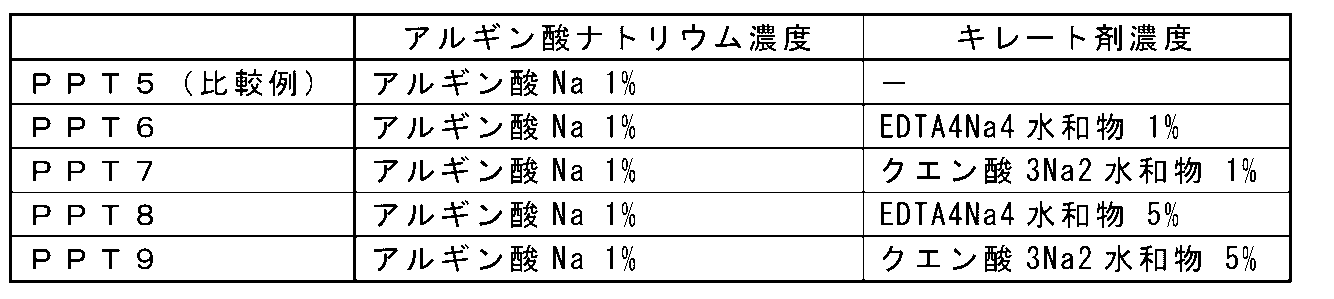
布帛として、実施例1と同じものを使用した。
(PPT塗布)
まず、作業者により、スポイト(市販のもの)を用いて、前記布帛に全体的に前記PPTを数滴滴下した。
まず、作業者により、スポイト(市販のもの)を用いて、前記布帛に全体的に前記PPTを数滴滴下した。
つぎに、実施例1と同様にして、110℃、10分の条件で、定着を行った。
(跡残り確認)
前記定着後の前記布帛について、前記PPTの跡残りの状態を、目視で確認した。
前記定着後の前記布帛について、前記PPTの跡残りの状態を、目視で確認した。
この結果を図4および表4に示す。図4は、前記PPT5~9を塗布した場合における、前記布帛の写真であり、(A)が、PPT5、(B)が、PPT6、(C)が、PPT7、(D)が、PPT8、(E)が、PPT9の結果を示す。図4(D)および(E)において、上段が、前記写真であり、下段が、前記写真において、PPTの跡残りが確認された範囲を線で示したものであり、線の内側がPPTの跡残りが確認された範囲である。表4は、前記図4の結果を表にまとめたものである。

図4(A)~(C)に示すように、前記PPTとして、PPT5~7を塗布した場合、前記PPTの跡残りは確認されなかった。これに対し、図3(D)及び(E)に示すように、前記PPTとして、PPT8及び9を塗布した場合、前記PPTの跡残りがわずかに確認された。
以上のように、前記キレート剤の種類に関わらず、キレート剤の濃度が1%以下である前記PPTを塗布した場合、前記PPTの跡残りは確認されず、キレート剤の濃度が5%である前記PPTを塗布した場合、前記PPTの跡残りがわずかに確認された。
前記キレート剤の濃度が5%を超えると前記PPT自体の跡残りがさらに濃くなると考えられることから、前記キレート剤の濃度が5%以下である前記PPTを用いることが、好ましいといえる。また、前記キレート剤の濃度が1%以下である前記PPTを用いることで、前記PPT自体の跡残りが生じないことから、より好ましいといえる。
以上のように、浸透性を有しインクが塗布される被記録媒体の印刷において、前処理剤(PT)のにじみを防ぎ、且つ、ゲル化跡を低減可能な前処理装置を提供することができる。
1 前処理装置
2 第1塗布部
3 第2塗布部
4 第3塗布部
2 第1塗布部
3 第2塗布部
4 第3塗布部
Claims (9)
- 浸透性を有しインクが塗布される被記録媒体に、前処理を行う前処理装置であって、アルギン酸塩を含む水溶液を前記被記録媒体に塗布する第1塗布部と、
キレート剤を含む水溶液を前記被記録媒体に塗布する第2塗布部と、
多価金属塩を含む前処理剤を前記被記録媒体に塗布する第3塗布部と、を含み、前記第3塗布部は、前記第1塗布部及び前記第2塗布部による前記塗布後、前記前処理剤を塗布する、
前処理装置。 - 前記第2塗布部は、前記キレート剤を含む水溶液における前記キレート剤の濃度が5%以下である前記水溶液を塗布する、
請求項1記載の前処理装置。 - 前記第2塗布部は、前記キレート剤を含む水溶液における前記キレート剤の濃度が1%以上である前記水溶液を塗布する、
請求項1または2記載の前処理装置。 - 前記第2塗布部は、前記キレート剤を含む水溶液における前記キレート剤としてEDTA4Na4水和物を含む前記水溶液を塗布する、
請求項1から3のいずれか一項に記載の前処理装置。 - 前記第3塗布部は、前記第2塗布部が塗布した前記キレート剤を含む水溶液がウエットの状態で、前記前処理剤を塗布する、
請求項1から4のいずれか一項に記載の前処理装置。 - 前記第1塗布部が前記第2塗布部を兼ねており、前記第1塗布部が前記アルギン酸塩と前記キレート剤とを含む水溶液を前記被記録媒体に塗布する、
請求項1から5のいずれか一項に記載の前処理装置。 - 浸透性を有しインクが塗布される被記録媒体に、前処理を行う前処理方法であって、アルギン酸塩を含む水溶液を前記被記録媒体に塗布する第1塗布工程と、
キレート剤を含む水溶液を前記被記録媒体に塗布する第2塗布工程と、
多価金属塩を含む前処理剤を前記被記録媒体に塗布する第3塗布工程と、を含み、前記第3塗布工程は、前記第1塗布工程及び前記第2塗布工程による前記塗布後、前記前処理剤を塗布する、
前処理方法。 - 前処理が行われた被記録媒体の製造方法であって、
前記被記録媒体の前処理を行う前処理工程を含み、
前記前処理工程が、請求項7記載の前処理方法により実施される、
製造方法。 - 浸透性を有しインクが塗布される被記録媒体に、アルギン酸塩を含む水溶液、及び多価金属塩を含む前処理剤の順に前処理を行う前処理装置に供給される前記水溶液であって、さらに、キレート剤を含む、
水溶液。
Priority Applications (1)
| Application Number | Priority Date | Filing Date | Title |
|---|---|---|---|
| US18/023,921 US12403710B2 (en) | 2020-12-28 | 2021-12-21 | Pretreatment apparatus, pretreatment method, producing method, and aqueous solution |
Applications Claiming Priority (2)
| Application Number | Priority Date | Filing Date | Title |
|---|---|---|---|
| JP2020-219238 | 2020-12-28 | ||
| JP2020219238A JP7711377B2 (ja) | 2020-12-28 | 2020-12-28 | 前処理装置、前処理方法、製造方法、及び水溶液 |
Publications (1)
| Publication Number | Publication Date |
|---|---|
| WO2022145282A1 true WO2022145282A1 (ja) | 2022-07-07 |
Family
ID=82259275
Family Applications (1)
| Application Number | Title | Priority Date | Filing Date |
|---|---|---|---|
| PCT/JP2021/047231 Ceased WO2022145282A1 (ja) | 2020-12-28 | 2021-12-21 | 前処理装置、前処理方法、製造方法、及び水溶液 |
Country Status (3)
| Country | Link |
|---|---|
| US (1) | US12403710B2 (ja) |
| JP (1) | JP7711377B2 (ja) |
| WO (1) | WO2022145282A1 (ja) |
Families Citing this family (1)
| Publication number | Priority date | Publication date | Assignee | Title |
|---|---|---|---|---|
| JP2025042400A (ja) | 2023-09-14 | 2025-03-27 | 株式会社リコー | 画像形成方法、画像形成装置及び画像形成システム |
Citations (3)
| Publication number | Priority date | Publication date | Assignee | Title |
|---|---|---|---|---|
| JP2007230080A (ja) * | 2006-03-01 | 2007-09-13 | Konica Minolta Ij Technologies Inc | 捺染用インクジェット記録方法、インクおよびプリント物 |
| JP2017132048A (ja) * | 2016-01-25 | 2017-08-03 | セイコーエプソン株式会社 | 前処理液、油性インクジェット記録用インクセット及び油性インクジェット記録方法 |
| JP2018048244A (ja) * | 2016-09-21 | 2018-03-29 | コニカミノルタ株式会社 | インクジェット捺染インク及びインクジェット捺染方法 |
Family Cites Families (4)
| Publication number | Priority date | Publication date | Assignee | Title |
|---|---|---|---|---|
| JP4797360B2 (ja) | 2004-10-26 | 2011-10-19 | コニカミノルタホールディングス株式会社 | インクジェット捺染方法 |
| EP3101069B1 (en) | 2014-01-30 | 2018-12-05 | Konica Minolta, Inc. | Inkjet ink and inkjet recording method |
| US9944820B2 (en) | 2016-01-25 | 2018-04-17 | Seiko Epson Corporation | Pretreatment liquid, oil-based ink jet printing ink set, and oil-based ink jet printing method |
| JP2020100008A (ja) * | 2018-12-20 | 2020-07-02 | セイコーエプソン株式会社 | 媒体製造装置、及び、媒体 |
-
2020
- 2020-12-28 JP JP2020219238A patent/JP7711377B2/ja active Active
-
2021
- 2021-12-21 US US18/023,921 patent/US12403710B2/en active Active
- 2021-12-21 WO PCT/JP2021/047231 patent/WO2022145282A1/ja not_active Ceased
Patent Citations (3)
| Publication number | Priority date | Publication date | Assignee | Title |
|---|---|---|---|---|
| JP2007230080A (ja) * | 2006-03-01 | 2007-09-13 | Konica Minolta Ij Technologies Inc | 捺染用インクジェット記録方法、インクおよびプリント物 |
| JP2017132048A (ja) * | 2016-01-25 | 2017-08-03 | セイコーエプソン株式会社 | 前処理液、油性インクジェット記録用インクセット及び油性インクジェット記録方法 |
| JP2018048244A (ja) * | 2016-09-21 | 2018-03-29 | コニカミノルタ株式会社 | インクジェット捺染インク及びインクジェット捺染方法 |
Also Published As
| Publication number | Publication date |
|---|---|
| JP2022104191A (ja) | 2022-07-08 |
| JP7711377B2 (ja) | 2025-07-23 |
| US12403710B2 (en) | 2025-09-02 |
| US20230322006A1 (en) | 2023-10-12 |
Similar Documents
| Publication | Publication Date | Title |
|---|---|---|
| DE69423286T2 (de) | Tintenstrahldrucksystem, welches zum Drucken auf Stoff und Papier geeignet ist | |
| US5825380A (en) | Ink-jet recording head cleaning method and cleaning cartridge therefor | |
| WO2022145282A1 (ja) | 前処理装置、前処理方法、製造方法、及び水溶液 | |
| US4285727A (en) | Ink compositions for ink jet recoding | |
| CN1105409A (zh) | 印刷媒体及其生产方法以及采用该媒体的织物印花方法和喷墨印刷设备 | |
| US5382298A (en) | Cleansing and desensitizing solutions and methods for use in offset printing | |
| JP2016513286A (ja) | 平版印刷の版面を処理する措置および方法 | |
| JP4488272B2 (ja) | モノクロルトリアジン系反応性染料の安定な液状組成物及びそれを含有するインクジェット用捺染インク | |
| EP0965444A1 (en) | A system and method for offset lithographic printing utilizing a reusable plate | |
| US11065912B2 (en) | Method of restoring paintings | |
| US3796603A (en) | Method of removing insolubilized light sensitized poly(vinyl alcohol) from a surface utilizing periodate ions | |
| JP2011093216A (ja) | ヘッドクリーニング液及びクリーニング方法 | |
| US2051942A (en) | Typewriter ribbon rehabilitating | |
| DE250203C (ja) | ||
| JPS5825995A (ja) | リトグラフ原液における複合多糖の使用法 | |
| JP7180028B1 (ja) | 親水化剤 | |
| JP7394170B1 (ja) | 無処理版用現像液および現像された無処理版の製造方法 | |
| US2395654A (en) | Dampener for lithographic printing | |
| JPH05509172A (ja) | 写真処理溶液補充のための方法及び装置 | |
| JPS60236796A (ja) | 平版印刷用不感脂化液 | |
| US337703A (en) | Island | |
| JPH07257061A (ja) | オフセット印刷用不感脂化処理液 | |
| JPH0250957B2 (ja) | ||
| JP2023178505A (ja) | 無処理版用現像液および現像された無処理版の製造方法 | |
| US584442A (en) | Liams |
Legal Events
| Date | Code | Title | Description |
|---|---|---|---|
| 121 | Ep: the epo has been informed by wipo that ep was designated in this application |
Ref document number: 21915142 Country of ref document: EP Kind code of ref document: A1 |
|
| NENP | Non-entry into the national phase |
Ref country code: DE |
|
| 122 | Ep: pct application non-entry in european phase |
Ref document number: 21915142 Country of ref document: EP Kind code of ref document: A1 |
|
| WWG | Wipo information: grant in national office |
Ref document number: 18023921 Country of ref document: US |