WO2022145147A1 - 撥水撥油剤組成物、繊維処理剤、繊維の処理方法、繊維加工品およびコーティング剤 - Google Patents
撥水撥油剤組成物、繊維処理剤、繊維の処理方法、繊維加工品およびコーティング剤 Download PDFInfo
- Publication number
- WO2022145147A1 WO2022145147A1 PCT/JP2021/042599 JP2021042599W WO2022145147A1 WO 2022145147 A1 WO2022145147 A1 WO 2022145147A1 JP 2021042599 W JP2021042599 W JP 2021042599W WO 2022145147 A1 WO2022145147 A1 WO 2022145147A1
- Authority
- WO
- WIPO (PCT)
- Prior art keywords
- mass
- structural unit
- copolymer
- oil
- water
- Prior art date
- Legal status (The legal status is an assumption and is not a legal conclusion. Google has not performed a legal analysis and makes no representation as to the accuracy of the status listed.)
- Ceased
Links
Classifications
-
- C—CHEMISTRY; METALLURGY
- C08—ORGANIC MACROMOLECULAR COMPOUNDS; THEIR PREPARATION OR CHEMICAL WORKING-UP; COMPOSITIONS BASED THEREON
- C08F—MACROMOLECULAR COMPOUNDS OBTAINED BY REACTIONS ONLY INVOLVING CARBON-TO-CARBON UNSATURATED BONDS
- C08F220/00—Copolymers of compounds having one or more unsaturated aliphatic radicals, each having only one carbon-to-carbon double bond, and only one being terminated by only one carboxyl radical or a salt, anhydride ester, amide, imide or nitrile thereof
- C08F220/02—Monocarboxylic acids having less than ten carbon atoms; Derivatives thereof
- C08F220/10—Esters
- C08F220/12—Esters of monohydric alcohols or phenols
- C08F220/16—Esters of monohydric alcohols or phenols of phenols or of alcohols containing two or more carbon atoms
- C08F220/18—Esters of monohydric alcohols or phenols of phenols or of alcohols containing two or more carbon atoms with acrylic or methacrylic acids
-
- C—CHEMISTRY; METALLURGY
- C09—DYES; PAINTS; POLISHES; NATURAL RESINS; ADHESIVES; COMPOSITIONS NOT OTHERWISE PROVIDED FOR; APPLICATIONS OF MATERIALS NOT OTHERWISE PROVIDED FOR
- C09K—MATERIALS FOR MISCELLANEOUS APPLICATIONS, NOT PROVIDED FOR ELSEWHERE
- C09K3/00—Materials not provided for elsewhere
-
- C—CHEMISTRY; METALLURGY
- C09—DYES; PAINTS; POLISHES; NATURAL RESINS; ADHESIVES; COMPOSITIONS NOT OTHERWISE PROVIDED FOR; APPLICATIONS OF MATERIALS NOT OTHERWISE PROVIDED FOR
- C09K—MATERIALS FOR MISCELLANEOUS APPLICATIONS, NOT PROVIDED FOR ELSEWHERE
- C09K3/00—Materials not provided for elsewhere
- C09K3/18—Materials not provided for elsewhere for application to surfaces to minimize adherence of ice, mist or water thereto; Thawing or antifreeze materials for application to surfaces
-
- D—TEXTILES; PAPER
- D06—TREATMENT OF TEXTILES OR THE LIKE; LAUNDERING; FLEXIBLE MATERIALS NOT OTHERWISE PROVIDED FOR
- D06M—TREATMENT, NOT PROVIDED FOR ELSEWHERE IN CLASS D06, OF FIBRES, THREADS, YARNS, FABRICS, FEATHERS OR FIBROUS GOODS MADE FROM SUCH MATERIALS
- D06M15/00—Treating fibres, threads, yarns, fabrics, or fibrous goods made from such materials, with macromolecular compounds; Such treatment combined with mechanical treatment
- D06M15/19—Treating fibres, threads, yarns, fabrics, or fibrous goods made from such materials, with macromolecular compounds; Such treatment combined with mechanical treatment with synthetic macromolecular compounds
- D06M15/21—Macromolecular compounds obtained by reactions only involving carbon-to-carbon unsaturated bonds
- D06M15/263—Macromolecular compounds obtained by reactions only involving carbon-to-carbon unsaturated bonds of unsaturated carboxylic acids; Salts or esters thereof
-
- D—TEXTILES; PAPER
- D06—TREATMENT OF TEXTILES OR THE LIKE; LAUNDERING; FLEXIBLE MATERIALS NOT OTHERWISE PROVIDED FOR
- D06M—TREATMENT, NOT PROVIDED FOR ELSEWHERE IN CLASS D06, OF FIBRES, THREADS, YARNS, FABRICS, FEATHERS OR FIBROUS GOODS MADE FROM SUCH MATERIALS
- D06M15/00—Treating fibres, threads, yarns, fabrics, or fibrous goods made from such materials, with macromolecular compounds; Such treatment combined with mechanical treatment
- D06M15/19—Treating fibres, threads, yarns, fabrics, or fibrous goods made from such materials, with macromolecular compounds; Such treatment combined with mechanical treatment with synthetic macromolecular compounds
- D06M15/21—Macromolecular compounds obtained by reactions only involving carbon-to-carbon unsaturated bonds
- D06M15/285—Macromolecular compounds obtained by reactions only involving carbon-to-carbon unsaturated bonds of unsaturated carboxylic acid amides or imides
-
- D—TEXTILES; PAPER
- D06—TREATMENT OF TEXTILES OR THE LIKE; LAUNDERING; FLEXIBLE MATERIALS NOT OTHERWISE PROVIDED FOR
- D06M—TREATMENT, NOT PROVIDED FOR ELSEWHERE IN CLASS D06, OF FIBRES, THREADS, YARNS, FABRICS, FEATHERS OR FIBROUS GOODS MADE FROM SUCH MATERIALS
- D06M15/00—Treating fibres, threads, yarns, fabrics, or fibrous goods made from such materials, with macromolecular compounds; Such treatment combined with mechanical treatment
- D06M15/19—Treating fibres, threads, yarns, fabrics, or fibrous goods made from such materials, with macromolecular compounds; Such treatment combined with mechanical treatment with synthetic macromolecular compounds
- D06M15/37—Macromolecular compounds obtained otherwise than by reactions only involving carbon-to-carbon unsaturated bonds
- D06M15/643—Macromolecular compounds obtained otherwise than by reactions only involving carbon-to-carbon unsaturated bonds containing silicon in the main chain
- D06M15/647—Macromolecular compounds obtained otherwise than by reactions only involving carbon-to-carbon unsaturated bonds containing silicon in the main chain containing polyether sequences
Definitions
- the present invention relates to a water and oil repellent composition, a fiber treatment agent, a fiber treatment method, a fiber processed product and a coating agent.
- Some water- and oil-repellent repellent compositions contain a compound having a perfluoroalkyl group having 8 or more carbon atoms.
- a compound containing a perfluoroalkyl group having 8 or more carbon atoms may produce perfluorooctanoic acid (perfluoro-octanoic acid (hereinafter, may be abbreviated as "PFOA")) by decomposition or metabolism.
- PFOA perfluoro-octanoic acid
- Perfluorooctanoic acid is required by the US Environmental Protection Agency to reduce its production. Therefore, a water-repellent oil-repellent composition having a compound containing a perfluoroalkyl group having a short carbon chain has been proposed.
- Patent Document 1 describes a pyrazole-block hydrophobic polyisocyanate aqueous dispersion containing a pyrazole-block hydrophobic polyisocyanate and a nonionic surfactant, and a water-repellent solution having a perfluoroalkyl group having 6 or less carbon atoms.
- a water repellent oil repellent composition comprising an oil repellent component has been described.
- Patent Document 2 includes a fluorine-containing polymer having a structural unit having a polyfluoroalkyl group having 1 to 6 carbon atoms, a fluorine-containing polymer having a structural unit based on a fluoroolefin, and an aqueous medium.
- a water / oil repellent composition is described.
- the copolymer (A) containing a structural unit based on an ethylenically unsaturated carboxylic acid ester monomer and a structural unit based on an ethylenically unsaturated carboxylic acid monomer is an aqueous medium.
- An oil-repellent composition containing an aqueous emulsion dispersed in (B) and a polyether-modified polydimethylsiloxane (C) is described.
- Patent Document 4 describes a silicone obtained by polymerizing a (meth) acrylate having a quaternary ammonium group, a bi-terminal (meth) acrylic-modified silicone oil, and a monomer containing a nonionic hydrophobic ethylenically unsaturated monomer. -An oil repellent for fiber treatment containing an acrylic copolymer is described.
- the conventional water-repellent oil-repellent composition containing no fluorine-based compound may not be able to impart sufficient oil repellency and water repellency to the base material.
- the present invention has been made in view of the above circumstances, and an object of the present invention is to provide a water-repellent oil-repellent agent composition capable of imparting high oil-repellent property and water repellency to a base material. Another object of the present invention is to provide a fiber treatment agent, a paper treatment agent and a coating agent capable of imparting high oil repellency and water repellency to a base material.
- the present inventor has made extensive studies in order to solve the above problems. As a result, it has a copolymer having a structural unit derived from a compound having an ethylenically unsaturated bond and an amide bond, and a structural unit and an ethylenically unsaturated bond derived from a compound having an ethylenically unsaturated bond and an amide bond.
- the present invention has been conceived after finding that a water-repellent oil-repellent composition containing a copolymer having a structural unit derived from polydimethylsiloxane may be used. That is, the present invention relates to the following matters.
- the first aspect of the present invention provides the following water and oil repellent composition.
- the copolymer (A) is A structural unit (a1) derived from a compound having an ethylenically unsaturated bond and an ester bond and no amide bond, and It has a structural unit (a2) derived from a compound having an ethylenically unsaturated bond and an amide bond, and has.
- the copolymer (B) is A structural unit (b1) derived from a compound having an ethylenically unsaturated bond and an ester bond and no amide bond, and A water- and oil-repellent composition having a structural unit (b2) derived from a compound having an ethylenically unsaturated bond and an amide bond, and a structural unit (b3) derived from a polydimethylsiloxane having an ethylenically unsaturated bond.
- the water- and oil-repellent agent composition according to the first aspect of the present invention preferably has the characteristics described in the following [2] to [12]. It is also preferable to arbitrarily combine two or more of the features described in the following [2] to [12].
- the structural unit (a1) and the structural unit (b1) are structural units derived from either or both of a hydrocarbon having an ethylenically unsaturated bond or a (meth) acrylic acid alkyl ester [1]. ]
- the water- and oil-repellent agent composition according to. [3] The water- and oil-repellent agent composition according to [1] or [2], wherein the structural unit (a2) and the structural unit (b2) are structural units derived from (meth) acrylamide.
- R 1 represents a hydrogen atom or a methyl group
- R 2 represents a divalent aliphatic group having 1 to 6 carbon atoms which may contain an ether bond
- R 3 represents 1 to 6 carbon atoms.
- 30 represents an aliphatic group, an aromatic group, or a hydroxyl group; h is either 0, 1, or 2.
- j represents an integer from 0 to 500.
- the water- and oil-repellent agent composition according to any one of [1] to [8], wherein the polyether-modified polydimethylsiloxane (C) has a hydroxyl group at the end of the polyether chain.
- the polyether-modified polydimethylsiloxane (C) is contained in an amount of 0.10 parts by mass or more and 20 parts by mass or less with respect to a total of 100 parts by mass of the copolymer (A) and the copolymer (B).
- the water- and oil-repellent agent composition according to any one of [1] to [9].
- a second aspect of the present invention provides the following fiber treatment agents. [13] A fiber treatment agent containing the water-repellent oil-repellent composition according to any one of [1] to [12].
- a third aspect of the present invention provides the following method for treating fibers. [14] A method for treating fibers using the fiber treatment agent according to [13].
- a fourth aspect of the present invention provides the following coating agents. [15] A coating agent containing the water-repellent oil-repellent composition according to any one of [1] to [12].
- a fifth aspect of the present invention provides the following processed fiber products. [16] A processed fiber product in which the solid content contained in the fiber treatment agent of [13] adheres to the fiber.
- water-repellent oil-repellent composition of the present invention high oil repellency and water repellency can be imparted to the base material. Further, since the fiber treatment agent, the paper treatment agent, and the coating agent of the present invention contain the water-repellent oil-repellent composition of the present invention, high oil repellency and water repellency can be imparted to the base material.
- the water / oil repellent composition the fiber treatment agent, the paper treatment agent, and the coating agent of the present invention will be described in detail.
- the present invention is not limited to the embodiments shown below.
- the configuration described below can be appropriately modified without departing from the scope of the present invention.
- the present invention is not limited to the following examples, and additions, omissions, and substitutions are added, omitted, and substituted with respect to numbers, quantities, ratios, compositions, types, positions, materials, configurations, etc., without departing from the spirit of the present invention. Or, it can be changed.
- the "monomer” means a compound having a radically polymerizable ethylene unsaturated bond.
- the "ethylene unsaturated bond” means a double bond between carbon atoms excluding the carbon atom forming an aromatic ring.
- (Meta) acrylic means “acrylic” or “methacrylic”.
- (Meta) acrylate means “acrylate” or “methacrylate”.
- nonvolatile component means a component contained in the composition or the like having a boiling point of 130 ° C. or higher at 1 atm (1013 hPa).
- active ingredient means a component in a mixture corresponding to a certain category when the component in a certain category is used as a mixture such as a solution.
- the active ingredient in a propylene glycol 1-monomethyl ether solution of a polyether-modified polydimethylsiloxane refers to all of the compounds corresponding to the polyether-modified polydimethylsiloxane contained in the solution.
- the number average molecular weight and the weight average molecular weight are polystyrene-equivalent values measured by gel permeation chromatography (GPC).
- the "ethylenically unsaturated bond” refers to an ethylenically unsaturated bond having radical polymerization unless otherwise specified.
- the structural unit derived from the compound having a certain ethylenically unsaturated bond is the chemical structure of the portion other than the ethylenically unsaturated bond of the compound and its structure in the polymer. It is assumed that the chemical structure of the portion other than the portion corresponding to the ethylenically unsaturated bond of the unit is the same.
- the structural unit derived from acrylic acid has a structure represented by -CH 2 CH (COOH)-in the polymer.
- the compound from which the structural unit of the polymer is derived refers to a compound having a corresponding relationship with the structural unit, and is consistent with the monomer used in the actual polymer manufacturing process. There is no need.
- the polymer has an ionic functional group such as a carboxy group and has a structural unit derived from a compound having an ethylenically unsaturated bond, a part of the functional group is used.
- a polymer not only the structure represented by -CH 2 -C (CH 3 ) (COOH)-but also the structural unit represented by -CH 2 -C (CH 3 ) (COONa)-is methacrylic. It is a structural unit derived from acid.
- the chemical structure of the monomer used and the ethylenically unsaturated bond of the obtained polymer are obtained by chemically reacting a portion other than the chain portion corresponding to the ethylenically unsaturated bond of the polymer.
- the structural unit of the polymer is based on the chemical structure after the above-mentioned chemical reaction or the like after the polymerization.
- the chemical structure of the polymer obtained by saponification is used as a reference. Therefore, the saponified structural unit is not a structural unit derived from vinyl acetate, but a structural unit derived from vinyl alcohol.
- the water- and oil-repellent agent composition of the present embodiment contains a copolymer (A) having a siloxane bond (-Si-O-Si-) and no structural unit, and a copolymer containing a structural unit having a siloxane bond (-Si-O-Si-). B), a polyether-modified polydimethylsiloxane (C), and an aqueous medium (D).
- the water- and oil-repellent agent composition of the present embodiment may further contain other components such as the surfactant (E), if necessary.
- the water- and oil-repellent agent composition of the present embodiment does not have to contain a compound having a perfluoroalkyl group having 8 or more carbon atoms.
- the water- and oil-repellent agent composition of the present embodiment may not contain a fluorine-containing compound.
- the copolymer (A) and the copolymer (B) form an emulsion in the aqueous medium (D).
- the copolymer (A) and the copolymer (B) may form liquid particles or solid particles.
- the copolymer (A) does not contain a structural unit having a siloxane bond.
- the copolymer (A) may be abbreviated as a structural unit (a1) derived from a compound having an ethylenically unsaturated bond and an ester bond and not having an amide bond (hereinafter, abbreviated as “structural unit (a1)”). It has a structural unit (a2) derived from a compound having an ethylenically unsaturated bond and an amide bond (hereinafter, may be abbreviated as “structural unit (a2)”).
- the copolymer (A) is preferably composed of only the structural unit (a1) and the structural unit (a2) except for the terminal structure.
- the copolymer (A) imparts good oil repellency to the base material to which the water repellent oil repellent composition of the present embodiment is attached.
- the structural unit (a1) Since the copolymer (A) has the structural unit (a1), it becomes a water-repellent oil-repellent composition which can impart high oil-repellent property to the base material and has high stability.
- the structural unit (a1) may be composed of one type of structure or may include two or more types of structures.
- the type of the compound from which the structural unit (a1) is derived and the content thereof may be appropriately determined, for example, in order to adjust the glass transition point Tg of the copolymer (A).
- a large number of compounds having a low glass transition point of the homopolymer may be included as the compound from which the structural unit (a1) is derived.
- a large number of compounds having a high glass transition point of the homopolymer may be included as the compound from which the structural unit (a1) is derived.
- the structural unit (a1) is preferably a structural unit derived from either or both of a hydrocarbon having an ethylenically unsaturated bond or a (meth) acrylic acid alkyl ester, and is derived from the (meth) acrylic acid alkyl ester. It is more preferable that it is a structural unit.
- the compound from which the structural unit (a1) is derived is a (meth) acrylic acid alkyl ester
- the number of carbon atoms in the hydrocarbon structure other than the (meth) acryloyloxy group is 1 or more and 8 or less (meth).
- Acrylic acid alkyl esters are even more preferred.
- the number of carbon atoms is preferably 2 or more and 7 or less, more preferably 3 or more and 6 or less, and further preferably 4 or more and 5 or less. This is because the texture of the base material treated by the water-repellent and oil-repellent composition according to the present embodiment can be easily adjusted.
- Examples of (meth) acrylic acid alkyl esters having 1 or more and 8 or less carbon atoms in the hydrocarbon structure other than the (meth) acryloyloxy group include methyl (meth) acrylate, ethyl (meth) acrylate, and allyl (meth).
- the compound from which the structural unit (a1) is derived is the above-mentioned compound.
- one or more selected from the group consisting of methyl (meth) acrylate, ethyl (meth) acrylate, butyl (meth) acrylate, and 2-ethylhexyl (meth) acrylate is particularly preferable.
- the compound from which the structural unit (a1) is derived contains a (meth) acrylic acid alkyl ester having a chain hydrocarbon structure having 9 or more carbon atoms as a hydrocarbon structure of a portion other than the (meth) acryloyloxy group. You may be. In this case, a water-repellent oil-repellent composition that imparts better water repellency to the substrate while maintaining oil repellency can be obtained.
- the structural unit (a1) is a structural unit derived from a hydrocarbon having an ethylenically unsaturated bond, it is preferably an aromatic vinyl compound.
- aromatic vinyl compounds include styrene, ⁇ -methylstyrene, p-methylstyrene and the like.
- the structural unit (a2) Since the copolymer (A) has the structural unit (a2), it becomes a water- and oil-repellent agent composition that can impart high oil-repellent properties to the base material.
- the structural unit (a2) may be composed of one type of structure or may include two or more types of structures.
- the compound from which the structural unit (a2) is derived is a compound having an ethylenically unsaturated bond and an amide bond.
- Examples of the compound from which the structural unit (a2) is derived include acrylamide, methacrylamide, N-vinylacetamide, N-methyl (meth) acrylamide, N-ethyl (meth) acrylamide, N, N-dimethyl (meth) acrylamide, and N. -Methyl-N-ethyl (meth) acrylamide, N, N-diethyl (meth) acrylamide and the like can be mentioned.
- the compound from which the structural unit (a2) is derived preferably contains either or both of acrylamide and methacrylamide, and more preferably one or both of acrylamide and methacrylamide.
- the structural unit (a2) may or may not contain an ester bond.
- the content of the structural unit (a1) in the copolymer (A) is preferably 30% by mass or more, more preferably 50% by mass or more, still more preferably 70% by mass or more. It is particularly preferable that it is 85% by mass or more. This is because the composition is a water- and oil-repellent agent having good stability.
- the content of the structural unit (a1) in the copolymer (A) is preferably 99% by mass or less, preferably 98% by mass or less, because it is easy to secure the content of the structural unit (a2). Is more preferable, 97% by mass or less is further preferable, and 96% by mass or less is particularly preferable.
- the content of the structural unit (a1) in the copolymer (A) is, for example, 30% by mass to 99% by mass, 40% by mass to 60% by mass, or 60% by mass to 70% by mass, as required. It may be 70% by mass to 80% by mass, 88% by mass to 99% by mass, 90% by mass to 98% by mass, 93% by mass to 97% by mass, or 94% by mass to 96% by mass. ..
- the copolymer When the compound from which the structural unit (a1) is derived is a (meth) acrylic acid alkyl ester in which the number of carbon atoms in the hydrocarbon structure other than the (meth) acryloyloxy group is 1 or more and 8 or less, the copolymer
- the content of the structural unit (a1) in (A) is preferably 30% by mass or more, more preferably 50% by mass or more, and further preferably 70% by mass or more. This is because the texture of the base material treated by the water-repellent and oil-repellent composition according to the present embodiment can be easily adjusted.
- the copolymer When the compound from which the structural unit (a1) is derived is a (meth) acrylic acid alkyl ester in which the number of carbon atoms in the hydrocarbon structure other than the (meth) acryloyloxy group is 1 or more and 8 or less, the copolymer
- the content of the structural unit (a1) in (A) is preferably 99% by mass or less, more preferably 98% by mass or less, because it is easy to secure the content of the structural unit (a2). ..
- the content of the structural unit (a2) in the copolymer (A) is preferably 0.10% by mass or more, more preferably 0.50% by mass or more, and more preferably 1.0% by mass or more. It is more preferably present, and particularly preferably 1.8% by mass or more. This is because the composition is a water- and oil-repellent agent that can impart better oil-repellent properties to the base material.
- the content of the structural unit (a2) in the copolymer (A) is preferably 20% by mass or less, more preferably 10% by mass or less, and further preferably 5.0% by mass or less. It is preferably 3.0% by mass or less, and particularly preferably 3.0% by mass or less.
- the content of the structural unit (a2) in the copolymer (A) may be, for example, 0.10% by mass to 20.0% by mass, 0.30% by mass to 15.0% by mass, or, as required. , 0.50% by mass to 8.0% by mass, 0.8% by mass to 7.0% by mass, 1.0% by mass to 6.0% by mass, 1.2% by mass to 4.0% by mass. %, And may be 1.5% by mass to 3.5% by mass.
- the copolymer (A) may contain a polymerization initiator used at the time of polymerization for producing the copolymer (A).
- the polymerization initiator can be arbitrarily selected, and examples thereof include hydrogen peroxide, azo compounds, and organic peroxides.
- the polymerization initiator may be contained as a redox-based initiator in which the above-mentioned polymerization initiator and reducing agent are used in combination. Only one type of polymerization initiator may be contained, or two or more types may be contained.
- the copolymer (A) may contain a chain transfer agent used at the time of polymerization for producing the copolymer (A). The chain transfer agent adjusts the molecular weight of the copolymer (A) produced by the polymerization.
- chain transfer agents include, for example, mercaptan, thioglycolic acid and its esters, ⁇ -mercaptopropionic acid and its esters, and the like. Only one type of chain transfer agent may be contained, or two or more types may be contained.
- the amount of the polymerization initiator and the chain transfer agent can be arbitrarily selected. For example, the content of these compounds is 0.1 to 10.0% by mass, 0.5 to 5.0% by mass, or 1.0 to 3. 0% by mass and the like can be mentioned, but the present invention is not limited to these examples.
- the copolymer (B) may be abbreviated as a structural unit (b1) derived from a compound having an ethylenically unsaturated bond and an ester bond and not having an amide bond (hereinafter, abbreviated as “structural unit (b1)”). It has an ethylenically unsaturated bond, a structural unit (b2) derived from a compound having an ethylenically unsaturated bond and an amide bond (hereinafter, may be abbreviated as "structural unit (b2)”), and an ethylenically unsaturated bond.
- the structural unit (b3) derived from polydimethylsiloxane (hereinafter, may be abbreviated as "structural unit (b3)").
- the structural unit (b1) and the structural unit (b2) in the present embodiment do not include the structural unit having a siloxane bond.
- the copolymer (B) is preferably composed of a structural unit (b1), a structural unit (b2), and a structural unit (b3) except for the terminal structure.
- the copolymer (B) imparts oil repellency and good water repellency to the base material to which the water repellent oil repellent composition of the present embodiment is attached.
- the structural unit (b3) is a structural unit derived from polydimethylsiloxane having an ethylenically unsaturated bond, and is a portion of the copolymer (B) that forms a polysiloxane side chain. Since the copolymer (B) has the structural unit (b3), it becomes a water- and oil-repellent agent composition that can impart high water repellency to the base material.
- the structural unit (b3) may be composed of one type of structure or may include two or more types of structures.
- the structural unit (b3) is preferably a structural unit derived from the compound represented by the following formula (1).
- R 1 represents a hydrogen atom or a methyl group
- R 2 represents a divalent aliphatic group having 1 to 6 carbon atoms which may contain an ether bond
- R 3 represents 1 to 6 carbon atoms.
- 30 represents an aliphatic group, an aromatic group, or a hydroxyl group; h is either 0, 1, or 2.
- j represents an integer from 0 to 500.
- R 1 in the formula (1) represents a hydrogen atom or a methyl group.
- R 2 in the formula (1) is a divalent aliphatic group having 1 to 6 carbon atoms which may contain an ether bond.
- the number of carbon atoms of R2 is preferably 1 to 4, and may be 1 to 4 or 2 to 3 as needed. This is because, according to the number of atoms, the water- and oil-repellent agent composition can impart high oil-repellent properties to the base material.
- R2 is more preferably a hydrocarbon chain and more preferably a linear hydrocarbon chain. This is because the composition is a water- and oil-repellent agent that can impart high water repellency to the base material.
- R 3 in the formula (1) is an aliphatic group, an aromatic group, or a hydroxyl group having 1 to 30 carbon atoms.
- R 3 is preferably an aliphatic group having 1 to 30 carbon atoms, more preferably an aliphatic group having 2 to 18 carbon atoms, and more preferably an aliphatic group having 2 to 10 carbon atoms. Is more preferable, and an aliphatic group having 2 to 6 carbon atoms is particularly preferable.
- the number of carbon atoms may be 3 to 5 or 2 to 4.
- R 3 is more preferably a hydrocarbon chain, and even more preferably a linear hydrocarbon chain. This is because the composition is a water- and oil-repellent agent that can impart high water repellency to the base material.
- j in the formula (1) is an integer of 0 to 500 and the number average molecular weight of the compound represented by the formula (1) is in a preferable range, it is preferably an integer of 1 to 400 and an integer of 10 to 300. Is more preferable.
- j may be an integer in the range of 1 to 200, 1 to 150, 1 to 80, 1 to 30, 1 to 10, and 1 to 5.
- the compound from which the structural unit (b3) is derived may be only one kind of the compound represented by the formula (1), or may contain two or more kinds.
- the number average molecular weight of the compound represented by the formula (1) is preferably 300 or more, more preferably 1,000 or more, further preferably 3,000 or more, and 7,000 or more. It is particularly preferable to have. This is because better water repellency can be obtained in the base material treated with the water-repellent oil-repellent composition.
- the number average molecular weight of the compound represented by the formula (1) is preferably 40,000 or less, more preferably 20,000 or less, and further preferably 15,000 or less. This is because the copolymerizability of the compound represented by the formula (1) at the time of polymerization for producing the copolymer (B) is improved.
- the content of the structural unit (b1) in the copolymer (B) is preferably 30% by mass or more, more preferably 40% by mass or more, still more preferably 50% by mass or more. It is particularly preferable that the content is 70% by mass or more. This is because the composition is a water- and oil-repellent agent having good stability.
- the content of the structural unit (b1) in the copolymer (B) is preferably 96% by mass or less in order to facilitate the securing of the content of the structural unit (b2) and the structural unit (b3), 93. It is more preferably 0% by mass or less, and further preferably 90% by mass or less.
- the content of the structural unit (b1) in the copolymer (B) is, for example, 30% by mass to 96% by mass, 45% by mass to 95% by mass, 55% by mass to 94% by mass, or 60% by mass. It may be up to 85% by mass or 65% by mass to 80% by mass.
- the copolymer When the compound from which the structural unit (b1) is derived is a (meth) acrylic acid alkyl ester in which the number of carbon atoms in the hydrocarbon structure other than the (meth) acryloyloxy group is 1 or more and 8 or less, the copolymer
- the content of the structural unit (b1) in (B) is preferably 30% by mass or more, more preferably 50% by mass or more, and further preferably 70% by mass or more. This is because the texture of the base material treated by the water-repellent and oil-repellent composition according to the present embodiment can be easily adjusted.
- the copolymer When the compound from which the structural unit (b1) is derived is a (meth) acrylic acid alkyl ester in which the number of carbon atoms in the hydrocarbon structure other than the (meth) acryloyloxy group is 1 or more and 8 or less, the copolymer
- the content of the structural unit (b1) in (B) is preferably 96% by mass or less, preferably 93% by mass or less, in order to facilitate the securing of the content of the structural unit (b2) and the structural unit (b3). Is more preferable.
- the content of the structural unit (b2) in the copolymer (B) is preferably 0.10% by mass or more, more preferably 0.50% by mass or more, and 0.85% by mass or more. It is more preferably present, and particularly preferably 1.8% by mass or more. This is because the composition is a water- and oil-repellent agent that can impart better oil-repellent properties to the base material.
- the content of the structural unit (b2) in the copolymer (B) is preferably 20% by mass or less, more preferably 10% by mass or less, and further preferably 5.0% by mass or less. It is preferably 3.0% by mass or less, and particularly preferably 3.0% by mass or less. This is because it is a low-cost water-repellent and oil-repellent composition.
- the content of the structural unit (b2) in the copolymer (B) is, for example, 0.10% by mass to 20.0% by mass, 0.30% by mass to 15.0% by mass, or 0.7% by mass. Even if it is% to 10.0% by mass, 1.0% by mass to 8.0% by mass, 1.2% by mass to 6.0% by mass, or 1.5% by mass to 3.0% by mass. good.
- the content of the structural unit (b3) in the copolymer (B) is preferably 3.0% by mass or more, more preferably 5.0% by mass or more, and 7.0% by mass or more. It is more preferable to have. This is because the composition is a water- and oil-repellent agent that can impart better water repellency to the base material.
- the content of the structural unit (b3) in the copolymer (B) is preferably 50% by mass or less, more preferably 30% by mass or less, and further preferably 15% by mass or less. This is because the contents of the structural unit (b1) and the structural unit (b2) can be easily secured, and the texture of the base material treated by the water-repellent and oil-repellent composition can be maintained satisfactorily.
- the content of the structural unit (b3) in the copolymer (B) is, for example, 3.0% by mass to 50.0% by mass, 4.0% by mass to 47.0% by mass, or 5.0% by mass. % To 45.0% by mass, 6.0% by mass to 43% by mass, 8.0% by mass to 40.0% by mass, 10.0% by mass to 25.0% by mass, and 15.0% by mass. It may be% to 20.0% by mass.
- the content of the structural unit (b3) in the total amount of the copolymer (A) and the copolymer (B) is preferably 1.5% by mass or more, preferably 2.5% by mass.
- the above is more preferable, and 3.5% by mass or more is further preferable.
- the content of the structural unit (b3) in the total amount of the copolymer (A) and the copolymer (B) is preferably 30% by mass or less, more preferably 15% by mass or less, and 7. It is more preferably 5% by mass or less.
- the content of the structural units (a1), (a2), (b1) and (b2) can be easily secured, and the water-repellent oil-repellent composition can impart better water repellency and oil repellency to the base material.
- the content of the structural unit (b3) in the total amount is 1.5% by mass or more and 30% by mass or less, 2.0% by mass or more and 25% by mass or less, or 3.0% by mass or more and 20% by mass or less. Or, it may be 4.0% by mass or more and 15% by mass or less, 5.0% by mass or more and 10% by mass or less.
- the copolymer (B) may contain a polymerization initiator used at the time of polymerization for producing the copolymer (B).
- examples of the polymerization initiator include those that may be contained in the copolymer (A).
- the copolymer (A) and the copolymer (B) contain a polymerization initiator, the polymerization initiator contained in the copolymer (A).
- the polymerization initiator contained in the copolymer (B) may be the same or different.
- the copolymer (B) may contain a chain transfer agent used at the time of polymerization for producing the copolymer (B).
- Examples of the chain transfer agent include the same ones that may be contained in the copolymer (A).
- the chain transfer agent contained in the copolymer (A) is contained.
- the chain transfer agent contained in the copolymer (B) may be the same or different.
- the value of the compounding ratio based on the mass of the copolymer (A) and the copolymer (B) (mass of the copolymer (A) / copolymer (B). ) Is preferably 10/90 or more, and more preferably 20/80 or more. This is because the composition is a water- and oil-repellent agent that can impart better oil-repellent properties to the base material.
- the value of the compounding ratio based on the mass of the copolymer (A) and the copolymer (B) may be 30/70 or more, and may be 40/60. It may be the above.
- the value of the blending ratio based on the mass of the copolymer (A) and the copolymer (B) is preferably 90/10 or less, preferably 80/20. It is more preferably 70/30 or less, and particularly preferably 60/40 or less. This is because the composition is a water- and oil-repellent agent that can impart better water repellency to the base material.
- the polyether-modified polydimethylsiloxane (C) is a compound in which a part or all of the hydrogen atom of the methyl group of the polydimethylsiloxane is replaced with a polyether chain. That is, the polyether-modified polydimethylsiloxane is a graft copolymer having a main chain of polysiloxane and a side chain of polyether.
- the polyether-modified polydimethylsiloxane (C) imparts good water repellency and oil repellency to the substrate to which the water-repellent oil-repellent composition of the present embodiment is attached.
- the polyether-modified polydimethylsiloxane (C) preferably has at least one of an alkoxy group and a hydroxyl group at the end of the polyether chain, and more preferably has a hydroxyl group at the end of the polyether chain. preferable.
- the composition is a water-repellent oil-repellent agent capable of imparting better oil repellency to the substrate.
- the type and number of additions of the polyether chain can be arbitrarily selected.
- the position and number of polyether chains bonded to Si of polydimethylsiloxane can be arbitrarily selected.
- Examples of the polyether chain include, but are not limited to, ⁇ (CH 2 O) x (C 2 H 4 O) y (C 3 H 6 O) z R and the like.
- x, y, and z are integers of 0 or 1 or more, respectively, and not all of them become 0 at the same time.
- R is preferably any of an alkyl group having 1 to 10 carbon atoms and hydrogen.
- x, y, and z may be, for example, 0 or more and 300 or less, 0 or more and 100 or less, 0 or more and 50 or less, 0 or more and 20 or less, and 0 or more and 10 or less, respectively.
- the number and arrangement of the methylene oxide, ethylene oxide, and propylene oxide in the polyether chain can be arbitrarily selected, and each of them may be arranged continuously, alternately, or randomly.
- Examples of commercially available compositions containing a polyether-modified polydimethylsiloxane (C) having a hydroxyl group at the end of the polyether chain include BYK SILCLEAN3720 manufactured by BYK, TEGO® (registered trademark) 5100N manufactured by Ebonic, and Shinetsu. Examples thereof include KP-109 manufactured by Silicone.
- the weight average molecular weight of the polyether-modified polydimethylsiloxane (C) is preferably 1,000 or more, more preferably 5,000 or more, and even more preferably 7,000 or more. This is because the composition is a water- and oil-repellent agent that can impart better oil-repellent properties to the base material.
- the weight average molecular weight of the polyether-modified polydimethylsiloxane (C) is preferably 50,000 or less, more preferably 30,000 or less, and even more preferably 14,000 or less. This is because the composition is a water- and oil-repellent agent that can impart better water repellency to the base material.
- the content of the polyether-modified polydimethylsiloxane (C) is preferably 0.10 part by mass or more with respect to 100 parts by mass in total of the copolymer (A) and the copolymer (B), and is 0. It is more preferably 20 parts by mass or more, further preferably 0.50 parts by mass or more, and particularly preferably 0.90 parts by mass or more. This is because the composition is a water- and oil-repellent agent that can impart better oil-repellent properties to the base material.
- the content of the polyether-modified polydimethylsiloxane (C) is preferably 20 parts by mass or less, preferably 10 parts by mass, based on 100 parts by mass of the total of the copolymer (A) and the copolymer (B). It is more preferably less than or equal to, more preferably 7.0 parts by mass or less, particularly preferably 3.5 parts by mass or less, and most preferably 1.5 parts by mass or less. This is to improve the texture of the fiber or paper treated with the water-repellent oil-repellent composition.
- the content of the polyether-modified polydimethylsiloxane (C) is, for example, 0.10 parts by mass or more and 5.0 parts by mass or less, 0.20 parts by mass or more and 3.0 parts by mass or less, or 0.30 parts by mass. It may be 2.0 parts by mass or less, 0.40 parts by mass or more and 1.0 part by mass or less.
- the aqueous medium (D) contains water as an essential component.
- the aqueous medium (D) may contain a hydrophilic solvent in addition to water.
- the content of water in the aqueous medium (D) can be arbitrarily selected, but is preferably 90% by mass or more, more preferably 95% by mass or more, still more preferably 98% by mass or more. It may be 100% by mass.
- the hydrophilic solvent include alcohols such as methyl alcohol, ethanol, propylene glycol 1-monomethyl ether, n-propyl alcohol, isopropyl alcohol, t-butyl alcohol and benzyl alcohol, and nitrogen-containing organic solvents such as N-methylpyrrolidone. Be done.
- the content of the hydrophilic solvent in the aqueous medium (D) is preferably 10% by mass or less, more preferably 5.0% by mass or less. When the content of the hydrophilic solvent is 10% by mass or less, the cost increase due to the use of the hydrophilic solvent can be suppressed.
- the content of the aqueous medium (D) contained in the water-repellent oil-repellent composition is preferably determined so that the non-volatile content concentration of the water-repellent oil-repellent composition is a desired value.
- the non-volatile content concentration of the water- and oil-repellent composition is preferably 10% by mass or more, more preferably 20% by mass or more, and further preferably 30% by mass or more. This is because the composition is a water- and oil-repellent agent that can efficiently impart a water- and oil-repellent effect to the base material with a small amount of use.
- the non-volatile content concentration of the water- and oil-repellent composition is preferably 70% by mass or less, more preferably 60% by mass or less, and further preferably 50% by mass or less. This is because the composition is a water-repellent and oil-repellent agent that has good storage stability and can be easily applied uniformly to the substrate.
- the content of the aqueous medium (D) contained in the water- and oil-repellent composition can be arbitrarily selected, and for example, 2% by mass or more and 95% by mass or less, 5% by mass or more and 90% by mass or less, or 10% by mass or more. Examples thereof include, but are not limited to, 80% by mass or less, 30% by mass or more and 70% by mass or less, 40% by mass or more and 60% by mass or less.
- the water- and oil-repellent agent composition of the present embodiment is required in addition to the copolymer (A), the copolymer (B), the polyether-modified polydimethylsiloxane (C), and the aqueous medium (D).
- Other components may be included, depending on the circumstances.
- Other components that may be contained in the water-repellent oil-repellent composition of the present embodiment include resins, cross-linking agents, thickeners, pH adjusters, film-forming aids, plasticizers, preservatives, defoamers, and surfactants.
- the agent (E) and the like can be mentioned.
- Other components may be contained alone or in combination of two or more as long as the object of the present invention can be achieved, depending on the specifications of the water-repellent and oil-repellent composition.
- Surfactant (E) As the surfactant (E), an anionic surfactant, a nonionic surfactant, or a cationic surfactant can be used, and a commercially available product may be used.
- the surfactant (E) does not have an ethylenically unsaturated bond.
- the copolymerizable surfactant such as ethylenically unsaturated bond is contained in the compound from which the structural unit (a1) is derived.
- anionic surfactant examples include an alkylbenzene sulfonate, an alkyl sulfate ester salt, a polyoxyethylene alkyl ether sulfate ester salt, a fatty acid salt and the like.
- nonionic surfactant examples include polyoxyethylene alkyl ether, polyoxyethylene alkyl phenyl ether, polyoxyethylene polycyclic finyl ether, polyoxyalkylene alkyl ether, sorbitan fatty acid ester, polyoxyethylene sorbitan fatty acid ester and the like.
- the cationic surfactant examples include alkyltrimethylammonium chloride, diarrhealtrimethylammonium bromide, laurylpyridinium chloride and the like.
- the surfactant (E) preferably contains a cationic surfactant. This is because the composition is a water- and oil-repellent agent having high adhesion to the base material, and the types of additives that can be selected such as antibacterial agents are increased.
- As the cationic surfactant it is preferable to use a hydrochloride of a compound having an ammonium group, and it is more preferable to use a quaternary ammonium chloride.
- the content of the surfactant (E) with respect to a total of 100 parts by mass of the copolymer (A) and the copolymer (B) is , 0.15 parts by mass or more, more preferably 0.40 parts by mass or more, and further preferably 0.90 parts by mass or more. This is because the copolymer (A) and the copolymer (B) can be stably dispersed in the water-repellent and oil-repellent composition.
- the content of the surfactant (E) with respect to a total of 100 parts by mass of the copolymer (A) and the copolymer (B) is 5.0 parts by mass or less. It is preferably 3.0 parts by mass or less, more preferably 1.5 parts by mass or less. This is because the substrate adhesion of the coating layer obtained by the water-repellent and oil-repellent agent composition can be maintained without impairing the water resistance.
- the surfactant (E) contained in the water-repellent oil-repellent composition of the present embodiment is a surfactant and / or a co-weight used at the time of polymerization for producing the copolymer (A) in part or in whole. It may be a surfactant used at the time of polymerization for producing the coalescence (B).
- the surfactant used in the polymerization for producing the copolymer (A) and the surfactant used in the polymerization for producing the copolymer (B) may be different or the same. There may be.
- the surfactant (E) contained in the water-repellent and oil-repellent composition of the present embodiment is partially or wholly added after the copolymer (A) and the copolymer (B) are produced. May be.
- the water- and oil-repellent agent composition of the present embodiment can be produced, for example, by the method shown below.
- the method for producing a water-repellent oil-repellent composition according to the present invention is not limited to the method described below.
- a first polymerization step is performed to produce an aqueous emulsion ( ⁇ ) in which the copolymer (A) is dispersed in the aqueous medium (D).
- a second polymerization step is performed to produce an aqueous emulsion ( ⁇ ) in which the copolymer (B) is dispersed in the aqueous medium (D).
- a mixing step of mixing the aqueous emulsion ( ⁇ ), the aqueous emulsion ( ⁇ ), and the polyether-modified polydimethylsiloxane (C) is performed.
- the water-repellent and oil-repellent agent composition of the present embodiment can be obtained.
- a monomer containing a compound from which the structural unit (a1) is derived and a compound from which the structural unit (a2) is derived, a surfactant (E), and an aqueous medium (D) are required. It is preferable to carry out emulsion polymerization by mixing the polymerization initiator used according to the above and the chain transfer agent. As a result, a copolymer (A) obtained by copolymerizing a monomer containing a compound from which the structural unit (a1) is derived and a compound from which the structural unit (a2) is derived is produced, and a surfactant (surfactant (a2) is produced.
- aqueous emulsion ( ⁇ ) containing E) and having the copolymer (A) dispersed in the aqueous medium (D) is obtained.
- emulsion polymerization can be carried out at a temperature of, for example, 30 to 85 ° C.
- the chemical structure of the copolymer (A) obtained by polymerization is not changed (however, ion exchange may be performed), it can be used as a material for the aqueous emulsion ( ⁇ ).
- Each monomer used maintains a structure other than the ethylenically unsaturated bond even after polymerization (excluding ion exchange).
- the amount of the aqueous medium (D) used as the material of the aqueous emulsion ( ⁇ ) is the total of the compound from which the structural unit (a1) is derived and the compound from which the structural unit (a2) is derived (total of monomers). ) With respect to 100 parts by mass, it is preferably 50 parts by mass or more, more preferably 70 parts by mass or more, and further preferably 100 parts by mass or more.
- the compound from which the structural unit (a1) is derived and the compound from which the structural unit (a2) is derived can be emulsified in the aqueous medium (D) for efficient emulsion polymerization, and the copolymer (A) produced by the emulsion polymerization. ) Can be stably dispersed in the aqueous medium (D).
- the amount of the aqueous medium (D) used as the material of the aqueous emulsion ( ⁇ ) is 100 parts by mass in total of the compound from which the structural unit (a1) is derived and the compound from which the structural unit (a2) is derived. , 400 parts by mass or less, more preferably 300 parts by mass or less, still more preferably 200 parts by mass or less.
- the amount of the surfactant (E) used with respect to the total mass of the monomers used as the material of the aqueous emulsion ( ⁇ ) is 100 parts by mass of the copolymer (A) in the aqueous emulsion ( ⁇ ). It is the same as the content of the surfactant (E) with respect to.
- the amount of the polymerization initiator used is the total of the compound from which the structural unit (a1) is derived and the compound from which the structural unit (a2) is derived (total of monomers) 100 in order to obtain an appropriate polymerization rate. It is preferably 0.01 to 1.0 parts by mass, more preferably 0.05 to 0.80 parts by mass, and 0.1 to 0.5 parts by mass with respect to the parts by mass. More preferred.
- each component used as a material of the aqueous emulsion ( ⁇ ) may be collectively charged and emulsion-polymerized, or each component may be continuously supplied and emulsion-polymerized.
- the method shown below can be used.
- a part of the aqueous medium (D) and a part of the surfactant (E) are mixed to prepare a mixed solution.
- a part of the polymerization initiator is mixed with the obtained mixed solution to prepare a polymerization initiator solution.
- the compound from which the structural unit (a1) is derived, the compound from which the structural unit (a2) is derived, the balance of the aqueous medium (D), and the balance of the surfactant (E) are mixed and emulsified.
- a mixed emulsion is obtained.
- a method can be used in which the mixed emulsion and the rest of the polymerization initiator are stirred while being continuously supplied at the same time in the polymerization initiator solution to carry out emulsion polymerization.
- Second polymerization step In the second polymerization step, a monomer containing a compound from which the structural unit (b1) is derived, a compound from which the structural unit (b2) is derived, and a compound from which the structural unit (b3) is derived, and a surfactant ( It is preferable to carry out emulsion polymerization by mixing E), the aqueous medium (D), the polymerization initiator used as necessary, and the chain transfer agent. As a result, the copolymer (B) obtained by copolymerizing the compound from which the structural unit (b1) is derived, the compound from which the structural unit (b2) is derived, and the compound from which the structural unit (b3) is derived. Is produced, the aqueous emulsion ( ⁇ ) containing the surfactant (E) and the copolymer (B) dispersed in the aqueous medium (D) is obtained.
- emulsion polymerization can be carried out at a temperature of, for example, 30 to 85 ° C.
- the second polymerization step may be carried out after the first polymerization step, before the first polymerization step, or at the same time as the first polymerization step.
- the chemical structure of the copolymer (B) obtained by polymerization is not changed (however, ion exchange may be performed), it can be used as a material for an aqueous emulsion ( ⁇ ).
- Each monomer used maintains a structure other than the ethylenically unsaturated bond even after polymerization (excluding ion exchange).
- the preferable amount of the aqueous medium (D) used as the material of the aqueous emulsion ( ⁇ ) is the preferable amount of the aqueous medium (D) used as the material of the aqueous emulsion ( ⁇ ). It is the same.
- the amount of the surfactant (E) used with respect to the total mass of the monomers used as the material of the aqueous emulsion ( ⁇ ) is 100 parts by mass of the copolymer (B) in the aqueous emulsion ( ⁇ ). It is the same as the content of the surfactant (E) with respect to.
- the preferable amount of the surfactant (E) used as the material of the water-based emulsion ( ⁇ ) (the preferable amount to be used with respect to the total amount of the monomers) is the preferable use of the surfactant (E) used as the material of the water-based emulsion ( ⁇ ). Same as quantity.
- the second polymerization step it is preferable to use the above-mentioned polymerization initiator as in the first polymerization step.
- the amount of the polymerization initiator used (preferably the amount used relative to the total amount of the monomers) is the same as when the polymerization initiator is used in the first polymerization step.
- each component used as a material of the aqueous emulsion ( ⁇ ) may be collectively charged and emulsion-polymerized, or each component may be continuously supplied and emulsion-polymerized.
- a method similar to the method that can be used in the first polymerization step can be used.
- the mixing step the aqueous emulsion ( ⁇ ) obtained in the first polymerization step, the aqueous emulsion ( ⁇ ) obtained in the second polymerization step, and the polyether-modified polydimethylsiloxane (C) are mixed.
- a known method can be used.
- a mixing method a method of stirring for 5 minutes at a temperature of 23 ° C. and a rotation speed of 500 rpm using a homodisper 2.5 type (manufactured by PRIMIX Corporation) can be mentioned.
- the aqueous emulsion ( ⁇ ) is produced by using the surfactant (E) in the first polymerization step, and the surfactant (E) is produced in the second polymerization step.
- the timing of adding the surfactant (E) can be appropriately adjusted according to the purpose of using the surfactant (E). Is.
- the surfactant (E) is used not only in the first polymerization step and the second polymerization step, but also after the first polymerization step and the second polymerization step and before the mixing step, if necessary. It may be added to the aqueous emulsion ( ⁇ ) and / or the aqueous emulsion ( ⁇ ).
- the copolymer (A) can be more stably dispersed in the aqueous emulsion ( ⁇ )
- / or the copolymer (B) can be more stably dispersed in the aqueous emulsion ( ⁇ ). be able to.
- the surfactant (E) may be added together with the water-based emulsion ( ⁇ ) and the water-based emulsion ( ⁇ ) in the mixing step, if necessary, or the water-repellent oil-repellent composition obtained after the mixing step. May be further added to.
- the copolymer (A) and the copolymer (B) can be stably dispersed in the water-repellent oil-repellent composition.
- the aqueous medium (D) is used as the material of the aqueous emulsion ( ⁇ ) and the aqueous emulsion ( ⁇ ) has been described as an example, but the aqueous medium (D) has been described.
- ) May be added to the aqueous emulsion ( ⁇ ) and / or the aqueous emulsion ( ⁇ ), if necessary, after the first polymerization step and the second polymerization step and before the mixing step.
- the aqueous medium (D) may be added together with the aqueous emulsion ( ⁇ ) and the aqueous emulsion ( ⁇ ) in the mixing step, if necessary, or may be added to the water-repellent oil-repellent composition obtained after the mixing step. Further may be added. Further, after the mixing step, a part of the aqueous medium (D) may be removed by concentrating the water-repellent oil-repellent composition using a known method, if necessary.
- the water-repellent oil-repellent composition of the present embodiment contains the copolymer (A) and the copolymer (B), it is possible to impart high water repellency and oil repellency to the base material.
- the water-repellent oil-repellent composition containing only the copolymer (B) without containing the copolymer (A) contains the water-repellent oil-repellent composition of the present embodiment and the structural unit (b3). When the ratios are the same, the oil repellency that can be applied to the substrate is inferior.
- the water-repellent oil-repellent composition of the present embodiment can impart high oil repellency and water repellency to the base material, and has good adsorptivity to the base material.
- the water-repellent oil-repellent composition of the present embodiment can impart high oil repellency and water repellency to a base material such as fiber, paper, and glass. Therefore, suitable uses of the water-repellent and oil-repellent composition of the present embodiment include materials for fiber treatment agents, paper treatment agents, and coating agents.
- the fiber treatment agent of the present embodiment contains the water-repellent oil-repellent composition of the present embodiment, and may consist only of the water-repellent oil-repellent composition of the present embodiment, or the water-repellent oil-repellent agent.
- the present invention provides known and commonly used additives such as defoaming agents, preservatives, pH regulators, surfactants, cross-linking agents, antistatic agents, wetting agents, thickeners, pigments, etc., as required. It may be appropriately selected and contained within the range in which the above-mentioned object can be achieved.
- the fiber treatment agent of the present embodiment can impart high oil repellency and water repellency to the fiber.
- the term "fiber” means a fiber and an article made of the fiber.
- the fiber treated by the fiber treatment agent may be in any form such as staple fiber (fiber), linter, roving, sliver, yarn, woven fabric, knitted fabric, non-woven fabric, and paper.
- the fiber also includes paper.
- the fiber material to be treated with fibers include cotton, flax, yellow hemp, cannabis, ramie, regenerated fiber cellulose, cellulose fibers such as rayon, polyvinyl alcohol-based synthetic fibers, and pulp.
- the fiber treated with the fiber treatment agent preferably contains the above-mentioned material in an amount of 30% by mass or more.
- the fiber treatment agent of the present embodiment can impart high oil repellency and water repellency to paper.
- the paper treated with the fiber treatment agent is not particularly limited, and examples thereof include general-purpose paper using pulp cellulose.
- the fiber treatment agent containing the water-repellent oil-repellent agent composition of the present embodiment is attached to the fiber as a base material.
- the total amount of the water- and oil-repellent agent composition adhered to 100 parts by mass of the fiber as a base material is preferably 1.0 part by mass or more, and more preferably 2.0 parts by mass or more. This is because the water repellency and the oil repellency of the water and oil repellent fibers are improved.
- the amount of the water-repellent oil-repellent agent composition adhered to 100 parts by mass of the fiber as a base material is preferably 20 parts by mass or less, and more preferably 10 parts by mass or less. This is because it is possible to suppress the deterioration of the texture and the increase in the mass due to the adhesion of the fiber treatment agent to the fiber.
- Examples of the method for treating the fiber as a base material using the fiber treatment agent of the present embodiment that is, the method for producing a processed fiber product using the fiber treatment agent include the methods shown below.
- a fiber treatment agent is impregnated or applied to the fiber as a base material.
- a method of impregnation or coating for example, a method such as dipping, spray coating, roll coating or the like can be used.
- the amount of the fiber treatment agent attached to the fiber is adjusted.
- Examples of the method for adjusting the amount of adhesion include, but are not limited to, a method of squeezing using a mangle roll or the like.
- the processed fiber product is obtained by impregnating or applying the fiber treatment agent of the present embodiment to the fiber and drying it. That is, the processed fiber product means an article in which the solid content (nonvolatile content) contained in the fiber treatment agent adheres to the fiber.
- the coating agent of the present embodiment contains the water-repellent oil-repellent composition of the present embodiment, and may consist only of the water-repellent oil-repellent composition of the present embodiment, or may be composed of only the water-repellent oil-repellent composition of the present embodiment.
- the present invention provides known and commonly used additives such as antifoaming agents, preservatives, pH regulators, surfactants, cross-linking agents, antistatic agents, wetting agents, thickeners, pigments, etc., as required. It may be selected and contained for convenience as long as the purpose of the above is not impaired.
- Examples of the base material coated with the coating agent of the present embodiment include glass, polyolefin resin, polyester resin, polycarbonate resin, acrylonitrile butadiene styrene copolymer (ABS resin), polystyrene resin and the like, or molding thereof. Examples include, but are not limited to, products (films, sheets, cups, etc.), metals, etc.
- Examples of the method for treating the above-mentioned substrate by using the coating agent of the present embodiment include the methods shown below.
- a coating agent is applied to the substrate.
- Examples of the method of applying the coating agent to the base material include a method of using a spray, a brush coating, a roller coating, a trowel coating, a dipping, an air knife, a flow coat, a bar coat, a roll coat, a gravure coat, an applicator and the like.
- the drying temperature at the time of drying the base material to which the coating agent is applied is preferably 80 ° C. or higher, more preferably 100 ° C. or higher. This is because the drying time can be shortened and high productivity can be obtained.
- the drying temperature at the time of drying the base material to which the coating agent is applied is preferably 170 ° C. or lower, more preferably 150 ° C. or higher. When the drying temperature is 170 ° C. or lower, deterioration of the water-repellent and oil-repellent composition contained in the coating agent can be suppressed.
- the drying time can be determined according to the amount of the coating agent applied to the substrate and the like, and is not particularly limited.
- the obtained mixed solution is kept at 80 ° C., and 10 g of a 3% by mass aqueous solution of AAPH (2,2'-azobis (2-methylpropionamidine) dihydrochloride) as a polymerization initiator is added to the mixed solution as a polymerization initiator. It was made into a solution.
- AAPH 2,2'-azobis (2-methylpropionamidine) dihydrochloride
- the monomer (a1) and the monomer (a2) shown in Table 1 were placed in a 1-liter beaker at the ratios shown in Table 1, and 420 g of ion-exchanged water as the aqueous medium (D) and a surfactant ( 15 g of TML (registered trademark) as E) was added, and the mixture was mixed and emulsified with a homomixer to obtain a mixed emulsion.
- the monomer (a1) or (b1) is a compound from which the structural unit (a1) or (b1) is derived.
- the monomer (a2) or (b2) is a compound from which the structural unit (a2) or (b2) is derived.
- the monomer (b3) is a compound from which the structural unit (b3) is derived.
- Table 1 The materials used in Table 1 are as follows. Monomer (b3); Polydimethylsiloxane having an ethylenically unsaturated bond (manufactured by JNC Corporation, Cyraplane (registered trademark) FM-0725 (a compound represented by the formula (1), R in the formula (1)). 1 represents a methyl group. R 2 represents -CH 2 CH 2 CH 2- . R 3 represents an n-butyl group. H is 2. j is 125. The number average molecular weight (Mn) is.
- the numerical values shown in the columns of the aqueous medium (D), the surfactant (E), and the polymerization initiator in Table 1 are the aqueous emulsions ( ⁇ -1), ( ⁇ -2), and the aqueous emulsions ( ⁇ -1) to (( ⁇ -1). It is the total mass (total of monomers) used as the material of ⁇ -6). Therefore, the numerical values of the aqueous medium (D) shown in Table 1 do not include water contained in the surfactant (E) and the polymerization initiator.
- the numerical values shown in the columns of the copolymer (A) in Tables 2 and 3 are the water-based emulsions ( ⁇ -) used in the water- and oil-repellent composition of Examples 1 to 12 and Comparative Examples 1 to 8. It is the mass of 1) and ( ⁇ -2), and the numerical value in parentheses is the mass of the copolymer (A) contained in the aqueous emulsion ( ⁇ -1) and ( ⁇ -2).
- the content of the copolymer (A) in the aqueous emulsions ( ⁇ -1) and ( ⁇ -2) accounts for the total amount of the monomer, the surfactant, the polymerization initiator, and the aqueous medium in Table 1. The proportion of monomers.
- the numerical values shown in the columns of the copolymer (B) in Tables 2 and 3 are the aqueous emulsions ( ⁇ -) used in the water- and oil-repellent composition of Examples 1 to 12 and Comparative Examples 1 to 8. It is the mass of 1) to ( ⁇ -6), and the numerical value in parentheses is the mass of the copolymer (B) contained in each of the aqueous emulsions ( ⁇ -1) to ( ⁇ -6).
- the mass of the copolymer (B) in the aqueous emulsions ( ⁇ -1) to ( ⁇ -6) is simply the total amount of the monomer, the surfactant, the polymerization initiator, and the aqueous medium in Table 1. It is the proportion of the weight.
- the polyether-modified polydimethylsiloxane (C) used in Tables 2 and 3 is as follows.
- BYK SILCLEAN3720 a polyether-modified polydimethylsiloxane having a hydroxyl group at the end of the polyether chain, a weight average molecular weight (Mw) of 10,000, and a solvent (methoxypropanol) other than the active ingredient.
- Mw weight average molecular weight
- solvent methoxypropanol
- Oil repellency evaluation > Using the water-repellent oil-repellent composition of Examples 1 to 12 and Comparative Examples 1 to 8 thus obtained, the first test and the second test shown below were carried out to evaluate the oil repellency. The results are shown in Tables 2 and 3.
- the water-repellent oil-repellent composition was diluted with ion-exchanged water twice by mass.
- a square cotton cloth (cotton gold width No. 3) having a length of 200 mm and a width of 200 mm was immersed in the diluted water- and oil-repellent composition. Then, the cotton cloth was heated at 130 ° C. for 5 minutes in an oven and dried to obtain a test cloth.
- the test cloth was prepared so that the amount of the water-repellent oil-repellent composition component adhered after drying was 20 parts by mass with respect to 100 parts by mass of the cotton cloth.
- the test solution 0.03 ml of the test solution was dropped onto one side of the obtained test cloth and allowed to stand, and the state of the test solution after 1 minute was visually observed and evaluated according to the following criteria.
- the test cloth and the test solution those having a temperature of 23 ° C. were used. The test solution was allowed to stand on the test cloth and visually observed in a constant temperature room at 23 ° C.
- Test criteria Very good: The test solution keeps the bulb. Good: The ball droplets of the test solution collapse and the test solution gets wet and spreads on the test cloth, but does not soak into the test cloth. Somewhat good: The test solution soaks into the test cloth within 30 seconds to 1 minute after the test solution is allowed to stand. Bad: The test solution soaks into the test cloth within 30 seconds after the test solution is allowed to stand.
- Grade 1 The one that shows wetness on the entire surface.
- Grade 2 Wetness is shown on more than half of the surface area, and small individual wettings permeate the cloth.
- Grade 3 Wet area is less than half of the surface, showing small individual water droplet-like wetting on the surface.
- Grade 4 Those that do not show wetness on the surface but show the adhesion of small water droplets.
- Grade 5 No wetness or water droplets on the surface.
- the base material treated with the water-repellent oil-repellent composition of Comparative Examples 3, 4 and 8 containing (copolymer (A)) has an area of more than half of the surface. Showed wetness. Therefore, the water-repellent and oil-repellent composition of Comparative Examples 1, 3, 4, and 8 could not impart sufficient water repellency to the base material. From the above, it was found that the water-repellent oil-repellent composition according to the present invention can impart high oil repellency and water repellency to the base material.
- the present invention can provide a water-repellent oil-repellent composition that can impart high oil repellency and water repellency to a base material.
Landscapes
- Chemical & Material Sciences (AREA)
- Engineering & Computer Science (AREA)
- Chemical Kinetics & Catalysis (AREA)
- Textile Engineering (AREA)
- Organic Chemistry (AREA)
- Materials Engineering (AREA)
- Combustion & Propulsion (AREA)
- Health & Medical Sciences (AREA)
- Medicinal Chemistry (AREA)
- Polymers & Plastics (AREA)
- Treatments For Attaching Organic Compounds To Fibrous Goods (AREA)
Abstract
Description
本願は、2020年12月28日に、日本に出願された特願2020-218523号に基づき優先権を主張し、その内容をここに援用する。
本発明は、上記事情を鑑みてなされたものであり、基材に高い撥油性及び撥水性を付与できる撥水撥油剤組成物を提供することを目的とする。
また、本発明は、基材に高い撥油性及び撥水性を付与できる繊維処理剤、紙処理剤およびコーティング剤を提供することを目的とする。
すなわち、本発明は以下の事項に関する。
[1] シロキサン結合を有する構造単位を含まない共重合体(A)と、シロキサン結合を有する構造単位を含む共重合体(B)と、ポリエーテル変性ポリジメチルシロキサン(C)と、水性媒体(D)とを含み、
前記共重合体(A)は、
エチレン性不飽和結合及びエステル結合を有し、かつアミド結合を有さない化合物に由来する構造単位(a1)と、
エチレン性不飽和結合及びアミド結合を有する化合物に由来する構造単位(a2)とを有し、
前記共重合体(B)は、
エチレン性不飽和結合及びエステル結合を有し、かつアミド結合を有さない化合物に由来する構造単位(b1)と、
エチレン性不飽和結合及びアミド結合を有する化合物に由来する構造単位(b2)と、 エチレン性不飽和結合を有するポリジメチルシロキサンに由来する構造単位(b3)とを有する撥水撥油剤組成物。
[3] 前記構造単位(a2)及び前記構造単位(b2)は、(メタ)アクリルアミドに由来する構造単位である[1]または[2]に記載の撥水撥油剤組成物。

(式(1)において、R1は水素原子又はメチル基を示す;R2はエーテル結合を含んでもよい炭素原子数1~6の2価脂肪族基を示す;R3は炭素原子数1~30の脂肪族基、芳香族基、または水酸基を示す;hは0、1、2のいずれかである。jは0~500の整数を示す。)
[6] 前記共重合体(A)は、前記構造単位(a2)を0.10質量%以上20質量%以下含有する[1]~[5]のいずれかに記載の撥水撥油剤組成物。
[7] 前記共重合体(B)は、前記構造単位(b2)を0.10質量%以上20質量%以下含有する[1]~[6]のいずれかに記載の撥水撥油剤組成物。
[8] 前記共重合体(B)は、前記構造単位(b3)を3.0質量%以上50質量%以下含有する[1]~[7]のいずれかに記載の撥水撥油剤組成物。
[10] 前記ポリエーテル変性ポリジメチルシロキサン(C)を、前記共重合体(A)と前記共重合体(B)の合計100質量部に対して、0.10質量部以上20質量部以下含有する[1]~[9]のいずれかに記載の撥水撥油剤組成物。
[12] 前記界面活性剤(E)は、カチオン性界面活性剤である[11]に記載の撥水撥油剤組成物。
[13] [1]~[12]のいずれかに記載の撥水撥油剤組成物を含む繊維処理剤。
本発明の第三の態様は、以下の繊維の処理方法を提供する。
[14] [13]に記載の繊維処理剤を用いる、繊維の処理方法。
本発明の第四の態様は、以下のコーティング剤を提供する。
[15] [1]~[12]のいずれかに記載の撥水撥油剤組成物を含むコーティング剤。
本発明の第五の態様は、以下の繊維加工品を提供する。
[16] [13]の繊維処理剤に含まれる固形分が繊維に付着した、繊維加工品。
また、本発明の繊維処理剤、紙処理剤、コーティング剤は、本発明の撥水撥油剤組成物を含むため、基材に高い撥油性及び撥水性を付与できる。
「(メタ)アクリル」は、「アクリル」または「メタクリル」を意味する。「(メタ)アクリレート」は、「アクリレート」または「メタクリレート」を意味する。
「有効成分」とは、あるカテゴリーの成分が溶液等の混合物として用いられる場合、そのカテゴリーに該当する混合物中の成分を意味する。例えば、ポリエーテル変性ポリジメチルシロキサンのプロピレングリコール1-モノメチルエーテル溶液中の有効成分とは、その溶液に含まれる、ポリエーテル変性ポリジメチルシロキサンに該当する化合物の全てを指す。
エチレン性不飽和結合を有する化合物の重合体において、あるエチレン性不飽和結合を有する化合物に由来する構造単位は、その化合物のエチレン性不飽和結合以外の部分の化学構造と、重合体におけるその構造単位のエチレン性不飽和結合に対応する部分以外の部分の化学構造とが、同じであるとする。例えば、アクリル酸由来の構造単位は、重合体において-CH2CH(COOH)-で表される構造を有している。
特に断りがなければ、重合体が、カルボキシ基のようなイオン性の官能基を有し、かつ、エチレン性不飽和結合を有する化合物に由来する構造単位を有する場合、その官能基の一部が、イオン交換されていても、またはイオン交換されていなくても、同じ化合物に由来する構造単位とする。例えば、重合体において、-CH2-C(CH3)(COOH)-で表される構造だけでなく、-CH2-C(CH3)(COONa)-で表される構造単位も、メタクリル酸に由来する構造単位とする。
本実施形態の撥水撥油剤組成物は、シロキサン結合(-Si-O-Si-)を有する構造単位を含まない共重合体(A)と、シロキサン結合を有する構造単位を含む共重合体(B)と、ポリエーテル変性ポリジメチルシロキサン(C)と、水性媒体(D)とを含む。本実施形態の撥水撥油剤組成物は、必要に応じて、さらに、界面活性剤(E)など、その他の成分を含んでいてもよい。本実施形態の撥水撥油剤組成物は、炭素原子数8以上のパーフルオロアルキル基を有する化合物を含まなくてもよい。本実施形態の撥水撥油剤組成物は、フッ素含有化合物を含まなくてもよい。
共重合体(A)は、シロキサン結合を有する構造単位を含まない。共重合体(A)は、エチレン性不飽和結合及びエステル結合を有し、かつアミド結合を有さない化合物に由来する構造単位(a1)(以下「構造単位(a1)」と略記する場合がある。)と、エチレン性不飽和結合及びアミド結合を有する化合物に由来する構造単位(a2)(以下「構造単位(a2)」と略記する場合がある。)とを有する。共重合体(A)は、末端構造以外は構造単位(a1)及び構造単位(a2)のみからなることが好ましい。
共重合体(A)は、本実施形態の撥水撥油剤組成物を付着させた基材に、良好な撥油性を付与する。
共重合体(A)が、構造単位(a1)を有することにより、基材に高い撥油性を付与でき、かつ安定性の高い撥水撥油剤組成物となる。構造単位(a1)は、1種類の構造からなるものであってもよいし、2種類以上の構造を含むものであってもよい。
構造単位(a1)の由来となる化合物の種類及びその含有率は、例えば、共重合体(A)のガラス転移点Tgを調整するために適宜決めてよい。具体的には、共重合体(A)のガラス転移点を低くする場合には、構造単位(a1)の由来となる化合物として、そのホモポリマーのガラス転移点が低い化合物を多く含めばよい。共重合体(A)のガラス転移点を高くする場合には、構造単位(a1)の由来となる化合物として、そのホモポリマーのガラス転移点が高い化合物を多く含めばよい。
構造単位(a1)の由来となる化合物が、(メタ)アクリル酸アルキルエステルである場合、(メタ)アクリロイルオキシ基以外の部分の炭化水素構造の炭素原子数が1以上8以下である(メタ)アクリル酸アルキルエステルであることがさらに好ましい。前記炭素原子数は、2以上7以下であることが好ましく、3以上6以下であることがより好ましく、4以上5以下であることがさらに好ましい。本実施形態にかかる撥水撥油剤組成物によって処理される基材の風合いの調整が容易になるためである。
共重合体(A)が、構造単位(a2)を有することにより、基材に高い撥油性を付与できる撥水撥油剤組成物となる。構造単位(a2)は、1種類の構造からなるものであってもよいし、2種類以上の構造を含むものであってもよい。
構造単位(a2)の由来となる化合物は、エチレン性不飽和結合及びアミド結合を有する化合物である。構造単位(a2)の由来となる化合物として例えば、アクリルアミド、メタクリルアミド、N-ビニルアセトアミド、N-メチル(メタ)アクリルアミド、N-エチル(メタ)アクリルアミド、N,N-ジメチル(メタ)アクリルアミド、N-メチル-N-エチル(メタ)アクリルアミド、N,N-ジエチル(メタ)アクリルアミド等が挙げられる。構造単位(a2)の由来となる化合物は、アクリルアミドまたはメタクリルアミドのいずれか一方または両方を含むことが好ましく、アクリルアミドまたはメタクリルアミドのいずれか一方または両方であることがより好ましい。構造単位(a2)は、エステル結合を含んでも含まなくても良い。
共重合体(A)中の構造単位(a1)の含有率は、30質量%以上であることが好ましく、50質量%以上であることがより好ましく、70質量%以上であることがさらに好ましく、85質量%以上であることが特に好ましい。安定性の良好な撥水撥油剤組成物となるためである。
共重合体(A)中の構造単位(a1)の含有率は、構造単位(a2)の含有率を確保しやすくなるため、99質量%以下であることが好ましく、98質量%以下であることがより好ましく、97質量%以下であることがさらに好ましく、96質量%以下であることが特に好ましい。共重合体(A)中の構造単位(a1)の含有率は、必要に応じて、例えば、30質量%~99質量%や、40質量%~60質量%や、60質量%~70質量%や、70質量%~80質量%や、88質量%~99質量%や、90質量%~98質量%や、93質量%~97質量%や、94質量%~96質量%であってもよい。
構造単位(a1)の由来となる化合物が、(メタ)アクリロイルオキシ基以外の部分の炭化水素構造の炭素原子数が1以上8以下である(メタ)アクリル酸アルキルエステルである場合、共重合体(A)中の構造単位(a1)の含有率は、構造単位(a2)の含有率を確保しやすくなるため、99質量%以下であることが好ましく、98質量%以下であることがより好ましい。
共重合体(A)中の構造単位(a2)の含有率は、20質量%以下であることが好ましく、10質量%以下であることがより好ましく、5.0質量%以下であることがさらに好ましく、3.0質量%以下であることが特に好ましい。低コストの撥水撥油剤組成物となるためである。また、構造単位(a1)の含有率を確保しやすくなるため、撥水撥油剤組成物で処理した基材における良好な撥水性を確保しやすくなる。共重合体(A)中の構造単位(a2)の含有率は、必要に応じて、例えば、0.10質量%~20.0質量%や、0.30質量%~15.0質量%や、0.50質量%~8.0質量%や、0.8質量%~7.0質量%や、1.0質量%~6.0質量%や、1.2質量%~4.0質量%や、1.5質量%~3.5質量%であってもよい。
共重合体(A)は、共重合体(A)を製造するための重合時に用いた連鎖移動剤を含んでいてもよい。連鎖移動剤は、重合により生成する共重合体(A)の分子量を調整するものである。連鎖移動剤の例としては、例えば、メルカプタン、チオグリコール酸及びそのエステル、β-メルカプトプロピオン酸及びそのエステル等が挙げられる。連鎖移動剤は、1種類のみ含まれていてもよいし、2種類以上含まれていてもよい。重合開始剤や連鎖移動剤の量は任意に選択できる。例えば、単量体の合計100質量部に対して、これらの化合物の含有率は、0.1~10.0質量%や、0.5~5.0質量%や、1.0~3.0質量%等が挙げられるが、これら例のみに限定されない。
共重合体(B)は、エチレン性不飽和結合及びエステル結合を有し、かつアミド結合を有さない化合物に由来する構造単位(b1)(以下「構造単位(b1)」と略記する場合がある。)と、エチレン性不飽和結合及びアミド結合を有する化合物に由来する構造単位(b2)(以下「構造単位(b2)」と略記する場合がある。)と、エチレン性不飽和結合を有するポリジメチルシロキサンに由来する構造単位(b3)(以下「構造単位(b3)」と略記する場合がある。)とを有する。
本実施形態における構造単位(b1)および構造単位(b2)は、シロキサン結合を有する構造単位を含まない。
共重合体(B)は、末端構造以外は構造単位(b1)、構造単位(b2)、及び構造単位(b3)からなることが好ましい。
共重合体(B)は、本実施形態の撥水撥油剤組成物を付着させた基材に、撥油性を付与するとともに良好な撥水性を付与する。
構造単位(b1)の要件となる構造、好ましい構造、及び具体例については、構造単位(a1)と同様である。本実施形態の撥水撥油剤組成物において、共重合体(A)の有する構造単位(a1)と、共重合体(B)の有する構造単位(b1)とは同じであってもよいし、異なっていてもよい。
構造単位(b2)の要件となる構造、好ましい構造、及び具体例については、構造単位(a2)と同様である。本実施形態の撥水撥油剤組成物において、共重合体(A)の有する構造単位(a2)と、共重合体(B)の有する構造単位(b2)とは同じであってもよいし、異なっていてもよい。
構造単位(b3)は、エチレン性不飽和結合を有するポリジメチルシロキサンに由来する構造単位であり、共重合体(B)におけるポリシロキサン側鎖を形成する部分である。共重合体(B)が、構造単位(b3)を有することにより、基材に高い撥水性を付与できる撥水撥油剤組成物となる。構造単位(b3)は、1種類の構造からなるものであってもよいし、2種類以上の構造を含むものであってもよい。
構造単位(b3)は、下記式(1)で表わされる化合物に由来する構造単位であることが好ましい。

(式(1)において、R1は水素原子又はメチル基を示す;R2はエーテル結合を含んでもよい炭素原子数1~6の2価脂肪族基を示す;R3は炭素原子数1~30の脂肪族基、芳香族基、または水酸基を示す;hは0、1、2のいずれかである。jは0~500の整数を示す。)
式(1)におけるR2はエーテル結合を含んでもよい炭素原子数1~6の2価脂肪族基である。R2の炭素原子数は、1~4であることが好ましく、必要に応じて、1~4や、2~3であってもよい。前記原子数によれば、基材に高い撥油性を付与できる撥水撥油剤組成物となるためである。R2は、炭化水素鎖であることがより好ましく、直鎖状炭化水素鎖であることがより好ましい。基材に高い撥水性を付与できる撥水撥油剤組成物となるためである。
構造単位(b3)の由来となる化合物は、式(1)で表わされる化合物のうち1種類のみであってもよいし、2種以上を含んでいてもよい。
共重合体(B)中の構造単位(b1)の含有率は、30質量%以上であることが好ましく、40質量%以上であることがより好ましく、50質量%以上であることがさらに好ましく、70質量%以上含であることが特に好ましい。安定性の良好な撥水撥油剤組成物となるためである。
共重合体(B)中の構造単位(b1)の含有率は、構造単位(b2)および構造単位(b3)の含有率を確保しやすくするため、96質量%以下であることが好ましく、93質量%以下であることがより好ましく、90質量%以下であることがさらに好ましい。共重合体(B)中の構造単位(b1)の含有率は、例えば、30質量%~96質量%や、45質量%~95質量%や、55質量%~94質量%や、60質量%~85質量%や、65質量%~80質量%であってもよい。
構造単位(b1)の由来となる化合物が、(メタ)アクリロイルオキシ基以外の部分の炭化水素構造の炭素原子数が1以上8以下である(メタ)アクリル酸アルキルエステルである場合、共重合体(B)中の構造単位(b1)の含有率は、構造単位(b2)および構造単位(b3)の含有率を確保しやすくするため、96質量%以下であることが好ましく、93質量%以下であることがより好ましい。
共重合体(B)中の構造単位(b2)の含有率は、20質量%以下であることが好ましく、10質量%以下であることがより好ましく、5.0質量%以下であることがさらに好ましく、3.0質量%以下であることが特に好ましい。低コストの撥水撥油剤組成物となるためである。また、構造単位(b1)および構造単位(b3)の含有率を確保しやすくなるため、撥水撥油剤組成物で処理した基材における良好な撥水性を確保しやすくなる。共重合体(B)中の構造単位(b2)の含有率は、例えば、0.10質量%~20.0質量%や、0.30質量%~15.0質量%や、0.7質量%~10.0質量%や、1.0質量%~8.0質量%や、1.2質量%~6.0質量%や、1.5質量%~3.0質量%であってもよい。
共重合体(B)中の構造単位(b3)の含有率は、50質量%以下であることが好ましく、30質量%以下であることがより好ましく、15質量%以下であることがさらに好ましい。構造単位(b1)および構造単位(b2)の含有率を確保しやすく、撥水撥油剤組成物によって処理される基材の風合いを良好に維持できるものとなるためである。共重合体(B)中の構造単位(b3)の含有率は、例えば、3.0質量%~50.0質量%や、4.0質量%~47.0質量%や、5.0質量%~45.0質量%や、6.0質量%~43質量%や、8.0質量%~40.0質量%や、10.0質量%~25.0質量%や、15.0質量%~20.0質量%であってもよい。
共重合体(A)及び共重合体(B)の合計量における構造単位(b3)の含有率は、30質量%以下であることが好ましく、15質量%以下であることがより好ましく、7.5質量%以下であることがさらに好ましい。構造単位(a1)(a2)(b1)および(b2)の含有率を確保しやすくなり、より良好な撥水性および撥油性を基材に付与できる撥水撥油剤組成物となるためである。例えば、前記合計量における構造単位(b3)の含有率は、1.5質量%以上30質量%以下や、2.0質量%以上25質量%以下や、3.0質量%以上20質量%以下や、4.0質量%以上15質量%以下や、5.0質量%以上10質量%以下などであってもよい。
共重合体(B)は、共重合体(B)を製造するための重合時に用いた連鎖移動剤を含んでいてもよい。連鎖移動剤としては、共重合体(A)に含まれていてもよいものと同じものが挙げられる。本実施形態の撥水撥油剤組成物において、共重合体(A)および共重合体(B)に連鎖移動剤が含まれている場合、共重合体(A)に含まれている連鎖移動剤と、共重合体(B)に含まれている連鎖移動剤とは同じであってもよいし、異なっていてもよい。
本実施形態にかかる撥水撥油剤組成物において、共重合体(A)と共重合体(B)との質量に基づく配合比の値(共重合体(A)の質量/共重合体(B)の質量)は、10/90以上であることが好ましく、20/80以上であることがより好ましい。より良好な撥油性を基材に付与できる撥水撥油剤組成物となるためである。本実施形態にかかる撥水撥油剤組成物において、共重合体(A)と共重合体(B)との質量に基づく配合比の値は、30/70以上であってもよく、40/60以上であってもよい。
本実施形態にかかる撥水撥油剤組成物において、共重合体(A)と共重合体(B)との質量に基づく配合比の値は、90/10以下であることが好ましく、80/20以下であることがより好ましく、70/30以下であることがさらに好ましく、60/40以下であることが特に好ましい。より良好な撥水性を基材に付与できる撥水撥油剤組成物となるためである。
ポリエーテル変性ポリジメチルシロキサン(C)は、ポリジメチルシロキサンのメチル基の水素原子の一部または全部をポリエーテル鎖で置換した化合物である。すなわち、ポリエーテル変性ポリジメチルシロキサンは、主鎖がポリシロキサンで、ポリエーテルの側鎖を有するグラフト共重合体である。
ポリエーテル変性ポリジメチルシロキサン(C)は、本実施形態の撥水撥油剤組成物を付着させた基材に、良好な撥水性および撥油性を付与する。
ポリエーテル鎖の末端に水酸基を有するポリエーテル変性ポリジメチルシロキサン(C)を含む組成物の市販品の例としては、BYK社製のBYK SILCLEAN3720、エボニック社製のTEGO(登録商標)Protect 5100N、信越シリコーン社製のKP-109等が挙げられる。
ポリエーテル変性ポリジメチルシロキサン(C)の重量平均分子量は50,000以下であることが好ましく、30,000以下であることがより好ましく、14,000以下であることがさらに好ましい。より良好な撥水性を基材に付与できる撥水撥油剤組成物となるためである。
ポリエーテル変性ポリジメチルシロキサン(C)の含有量は、共重合体(A)と共重合体(B)との合計100質量部に対して、20質量部以下であることが好ましく、10質量部以下であることがより好ましく、7.0質量部以下であることがさらに好ましく、3.5質量部以下であることが特に好ましく、1.5質量部以下であることが最も好ましい。撥水撥油剤組成物を用いて処理を行った繊維または紙の風合いを良好にするためである。前記ポリエーテル変性ポリジメチルシロキサン(C)の含有量は、例えば、0.10質量部以上5.0質量部以下や、0.20質量部以上3.0質量部以下や、0.30質量部以上2.0質量部以下や、0.40質量部以上1.0質量部以下などであってもよい。
水性媒体(D)は水を必須成分とする。水性媒体(D)は水以外に親水性溶媒を含んでいても良い。水性媒体(D)中の水の含有量は任意に選択できるが、90質量%以上であることが好ましく、95質量%以上であることがより好ましく、98質量%以上であることがさらに好ましく、100質量%であってもよい。 親水性溶媒としては、メチルアルコール、エタノール、プロピレングリコール1-モノメチルエーテル、n-プロピルアルコール、イソプロピルアルコール、t-ブチルアルコール、ベンジルアルコールなどのアルコール、N-メチルピロリドンなどの含窒素有機溶媒等が挙げられる。親水性溶媒は、1種類のみ含まれていてもよいし、2種以上を含まれていてもよい。
水性媒体(D)中の親水性溶媒の含有率は、10質量%以下であることが好ましく、5.0質量%以下であることがより好ましい。親水性溶媒の含有率が10質量%以下であると、親水性溶媒を使用することによるコスト上昇を抑えることができる。
撥水撥油性組成物の不揮発分濃度は、10質量%以上であることが好ましく、20質量%以上であることがより好ましく、30質量%以上であることがさらに好ましい。少ない使用量で、効率的に基材に撥水撥油効果を付与できる撥水撥油剤組成物となるためである。
撥水撥油性組成物の不揮発分濃度は、70質量%以下であることが好ましく、60質量%以下であることがより好ましく、50質量%以下であることがさらに好ましい。貯蔵安定性が良好であり、かつ基材に均一に塗布しやすい撥水撥油剤組成物となるためである。
撥水撥油性組成物中に含まれる水性媒体(D)の含有率は任意に選択でき、例えば、2質量%以上95質量%以下や、5質量%以上90質量%以下や、10質量%以上80質量%以下や、30質量%以上70質量%以下、40質量%以上60質量%以下等が挙げられるが、これら例のみに限定されない。
本実施形態の撥水撥油剤組成物は、共重合体(A)と、共重合体(B)と、ポリエーテル変性ポリジメチルシロキサン(C)と、水性媒体(D)の他に、必要に応じて、その他の成分を含んでもよい。本実施形態の撥水撥油剤組成物に含まれうる他の成分としては、樹脂、架橋剤、増粘剤、pH調整剤、成膜助剤、可塑剤、防腐剤、消泡剤、界面活性剤(E)等が挙げられる。他の成分は、撥水撥油剤組成物の仕様に応じて、本発明の目的を達成できる範囲で、1種類または2種類以上含有してもよい。
界面活性剤(E)としては、アニオン性界面活性剤、ノニオン性界面活性剤、カチオン性界面活性剤を使用でき、市販品を用いてもよい。界面活性剤(E)は、エチレン性不飽和結合を有さない。本実施形態においては、エチレン性不飽和結合などの共重合性を有する界面活性剤は、構造単位(a1)の由来となる化合物に含まれる。
ノニオン性界面活性剤としては、ポリオキシエチレンアルキルエーテル、ポリオキシエチレンアルキルフェニルエーテル、ポリオキシエチレン多環フィニルエーテル、ポリオキシアルキレンアルキルエーテル、ソルビタン脂肪酸エステル、ポリオキシエチレンソルビタン脂肪酸エステル等が挙げられる。
本実施形態の撥水撥油剤組成物において、共重合体(A)及び共重合体(B)の合計100質量部に対する界面活性剤(E)の含有量は、5.0質量部以下であることが好ましく、3.0質量部以下であることがより好ましく、1.5質量部以下であることがさらに好ましい。耐水性を損なうことなく、撥水撥油剤組成物により得られるコーティング層の基材密着性を維持できるためである。
また、本実施形態の撥水撥油剤組成物に含まれる界面活性剤(E)は、一部または全部が、共重合体(A)および共重合体(B)を製造した後に添加されたものであってもよい。
本実施形態の撥水撥油剤組成物は、例えば、以下に示す方法により製造できる。本発明にかかる撥水撥油剤組成物の製造方法は、以下に説明する方法に限定されない。
まず、共重合体(A)が水性媒体(D)中に分散した水系エマルジョン(α)を製造する第1重合工程を行う。また、共重合体(B)が水性媒体(D)中に分散した水系エマルジョン(β)を製造する第2重合工程を行う。その後、水系エマルジョン(α)と水系エマルジョン(β)とポリエーテル変性ポリジメチルシロキサン(C)とを混合する混合工程を行う。以上の工程により、本実施形態の撥水撥油剤組成物が得られる。
第1重合工程では、構造単位(a1)の由来となる化合物及び構造単位(a2)の由来となる化合物を含む単量体と、界面活性剤(E)と、水性媒体(D)と、必要に応じて使用される重合開始剤と、連鎖移動剤とを混合して乳化重合することが好ましい。このことにより、構造単位(a1)の由来となる化合物及び構造単位(a2)の由来となる化合物を含む単量体が共重合されてなる共重合体(A)が生成し、界面活性剤(E)を含み、共重合体(A)が水性媒体(D)中に分散された水系エマルジョン(α)が得られる。
第1重合工程においては、乳化重合を、例えば30~85℃の温度で行うことができる。
まず、水性媒体(D)の一部と、界面活性剤(E)の一部とを混合し、混合液とする。得られた混合液に、重合開始剤の一部を混合して重合開始剤溶液とする。
一方、構造単位(a1)の由来となる化合物と、構造単位(a2)の由来となる化合物と、水性媒体(D)の残部と、界面活性剤(E)の残部とを混合して乳化させることにより、混合乳化液とする。
そして、重合開始剤溶液中に、混合乳化液と、重合開始剤の残部とを、同時に連続供給しながら撹拌し、乳化重合する方法を用いることができる。
第2重合工程では、構造単位(b1)の由来となる化合物、構造単位(b2)の由来となる化合物、及び構造単位(b3)の由来となる化合物を含む単量体と、界面活性剤(E)と、水性媒体(D)と、必要に応じて使用される重合開始剤と、連鎖移動剤とを混合して乳化重合することが好ましい。このことにより、構造単位(b1)の由来となる化合物、構造単位(b2)の由来となる化合物、及び構造単位(b3)の由来となる化合物とが共重合されてなる共重合体(B)が生成し、界面活性剤(E)を含み、共重合体(B)が水性媒体(D)中に分散された水系エマルジョン(β)が得られる。
第2重合工程は、第1重合工程の後に行ってもよいし、第1重合工程の前に行ってもよいし、第1重合工程と同時に行ってもよい。
水系エマルジョン(β)の材料として用いる界面活性剤(E)の好ましい使用量(単量体の合計に対する好ましい使用量)は、水系エマルジョン(α)の材料として用いる界面活性剤(E)の好ましい使用量と同じである。
混合工程では、第1重合工程において得られた水系エマルジョン(α)と、第2重合工程において得られた水系エマルジョン(β)と、ポリエーテル変性ポリジメチルシロキサン(C)とを混合する。
混合方法としては、公知の方法を用いることができる。例えば、混合方法として、ホモディスパー2.5型(PRIMIX社製)を用いて、温度23℃、回転数500rpmで、5分間撹拌する方法が挙げられる。
また、界面活性剤(E)は必要に応じて、混合工程において、水系エマルジョン(α)および水系エマルジョン(β)とともに添加してもよいし、混合工程の後に得られた撥水撥油剤組成物にさらに添加してもよい。この場合、撥水撥油剤組成物中に共重合体(A)及び共重合体(B)を安定して分散させることができる。
また、水性媒体(D)は必要に応じて、混合工程において、水系エマルジョン(α)および水系エマルジョン(β)とともに添加してもよいし、混合工程の後に得られた撥水撥油剤組成物にさらに添加してもよい。また、混合工程の後に、必要に応じて撥水撥油剤組成物を公知の方法を用いて濃縮することにより、水性媒体(D)の一部を除去してもよい。
これに対し、例えば、共重合体(A)を含まず共重合体(B)のみを含む撥水撥油剤組成物では、本実施形態の撥水撥油剤組成物と構造単位(b3)の含有率が同じである場合、基材に付与できる撥油性が劣るものとなる。これは、共重合体(B)のみを含む撥水撥油剤組成物では、共重合体(B)中における構造単位(b3)が油を呼び込むことによって、基材に付与できる撥油性が低下するためであると推定される。
本実施形態の撥水撥油剤組成物は、基材に高い撥油性及び撥水性を付与でき、かつ基材に対する吸着性が良好である。本実施形態の撥水撥油剤組成物は、繊維、紙、ガラスなどの基材に対して、高い撥油性及び撥水性を付与できる。したがって、本実施形態の撥水撥油剤組成物の好適な用途としては、繊維処理剤、紙処理剤、コーティング剤の材料が挙げられる。
本実施形態の繊維処理剤は、本実施形態の撥水撥油剤組成物を含むものであり、本実施形態の撥水撥油剤組成物のみからなるものであってもよいし、撥水撥油剤組成物の他に必要に応じて消泡剤、防腐剤、pH調整剤、界面活性剤、架橋剤、帯電防止剤、濡れ剤、増粘剤、顔料等、公知慣用の添加剤を、本発明の目的を達成できる範囲で適宜選択して含有してもよい。
まず、基材としての繊維に、繊維処理剤を含侵または塗布する。含侵または塗布する方法としては、例えば、ディッピング、スプレー塗布、ロール塗布等の方法を用いることができる。繊維に繊維処理剤を含浸または塗布した後、繊維への繊維処理剤の付着量を調整する。付着量の調整方法としては、マングルロールなどを用いて絞る方法等が挙げられるが、この方法に限られない。繊維に繊維処理剤を含浸または塗布した後、繊維を乾燥させることが好ましい。繊維の乾燥温度は、80℃~170℃であることが好ましく、90℃~150℃であることがより好ましい。
繊維加工品は、本実施形態の繊維処理剤を繊維に含侵または塗布し、乾燥させてなる。すなわち、繊維加工品は繊維処理剤に含まれる固形分(不揮発分)が繊維に付着してなる物品を意味する。
本実施形態のコーティング剤は、本実施形態の撥水撥油剤組成物を含むものであり、本実施形態の撥水撥油剤組成物のみからなるものであってもよいし、撥水撥油剤組成物の他に必要に応じて、消泡剤、防腐剤、pH調整剤、界面活性剤、架橋剤、帯電防止剤、濡れ剤、増粘剤、顔料等、公知慣用の添加剤を、本発明の目的を損なわない範囲で便宜選択して含有してもよい。
まず、基材にコーティング剤を塗布する。基材にコーティング剤を塗布する方法としては、例えば、スプレー、刷毛塗り、ローラー塗り、コテ塗り、ディッピング、エアナイフ、フローコート、バーコート、ロールコート、グラビアコート、アプリケーター等を用いる方法が挙げられる。
<1.水系エマルジョン(α-1)の製造>
撹拌機、温度計、窒素ガス導入管、還流冷却器、滴下ロートを取り付けた五つ口セパラブルフラスコに、水性媒体(D)としてのイオン交換水を120gと、界面活性剤(E)としてのカチオーゲン(登録商標)TMLを1gとを入れ、80℃に昇温して混合液とした。得られた混合液を80℃に保ち、混合液に、重合開始剤としてのAAPH(2,2’-アゾビス(2-メチルプロピオンアミジン)二塩酸塩)3質量%水溶液を10g加え、重合開始剤溶液とした。
滴下終了後1時間、五つ口フラスコ内を攪拌しながら五つ口フラスコ内の温度を80℃に保った。その後、五つ口フラスコの冷却を開始し、五つ口フラスコ内の温度を30℃まで冷却した。以上の工程により、共重合体(A)を含む水系エマルジョン(α-1)を得た。
表1に示す単量体(a1)および単量体(a2)を表1に示す割合で用いたこと以外は、水系エマルジョン(α-1)の製造と同様にして、共重合体(A)を含む水系エマルジョン(α-2)を得た。
表1に示す単量体(a1)および単量体(a2)に代えて、表1に示す単量体(b1)(b2)(b3)を表1に示す割合で用いたこと以外は、水系エマルジョン(α-1)の製造と同様にして、共重合体(B)をそれぞれ含む水系エマルジョン(β-1)~(β-6)を得た。

単量体(b3);エチレン性不飽和結合を有するポリジメチルシロキサン(JNC社製、サイラプレーン(登録商標)FM-0725(式(1)で表される化合物であり、式(1)におけるR1はメチル基を示す。R2は-CH2CH2CH2-を示す。R3はn-ブチル基を示す。hは2である。jは125である。数平均分子量(Mn)は10,000である。))
界面活性剤(E);カチオーゲン(登録商標)TML(第一工業製薬社製:アルキルトリメチルアンモニウムクロライド(ラウリルトリメチルアンモニウムクロライドを含む)(カチオン性界面活性剤)、30質量%水溶液)
重合開始剤;AAPH3質量%水溶液(2,2’-アゾビス(2-メチルプロピオンアミジン)二塩酸塩(AAPH)の3質量%水溶液)
表1に示す水系エマルジョン(α-1)または(α-2)と、表1に示す水系エマルジョン(β-1)~(β-6)と、ポリエーテル変性ポリジメチルシロキサン(C)とを、表2または表3に示す割合で混合し、共重合体(A)、共重合体(B)、ポリエーテル変性ポリジメチルシロキサン(C)を、表2または表3に示す割合で含む実施例1~実施例12、比較例1~比較例8の撥水撥油剤組成物を得た。
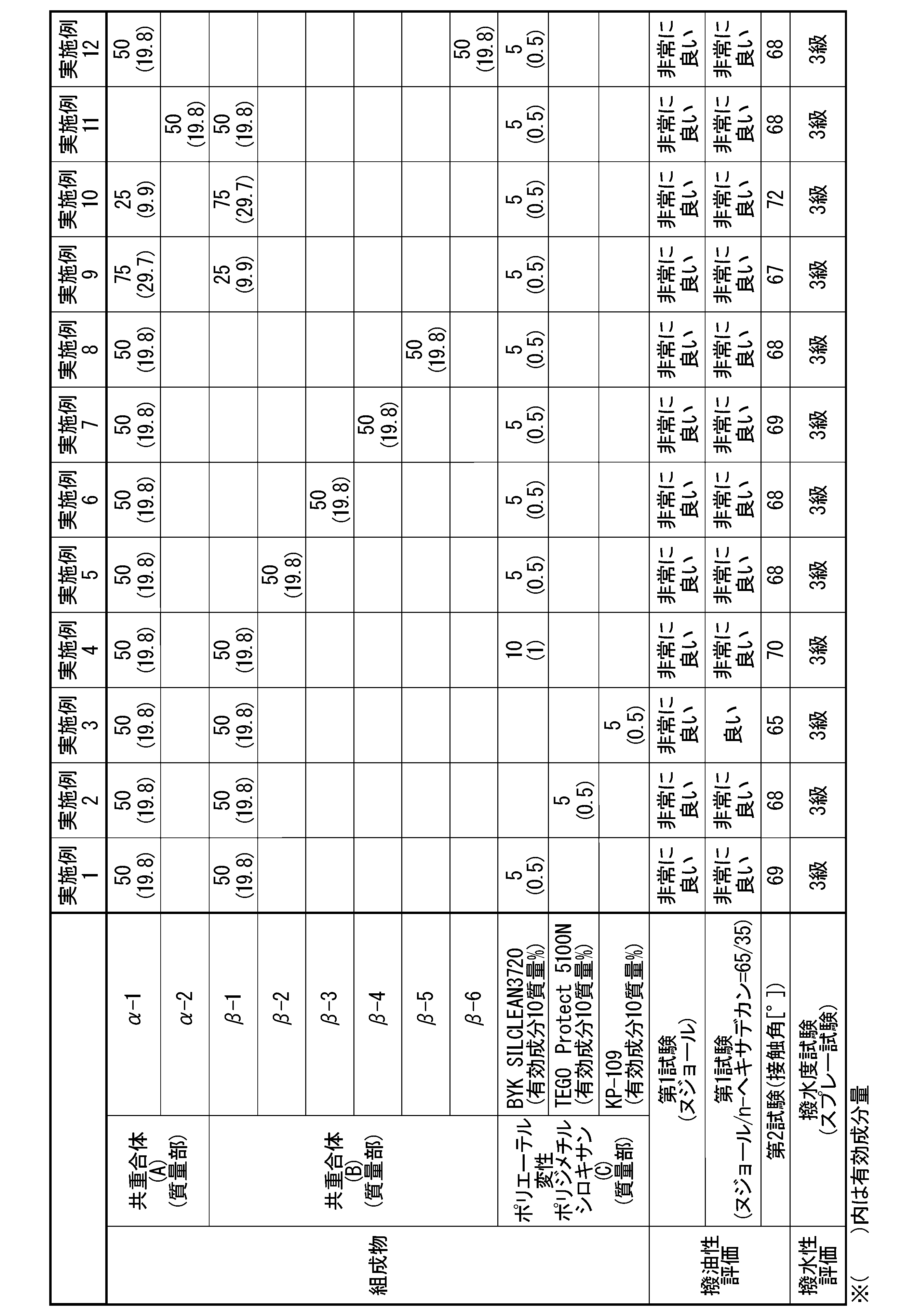
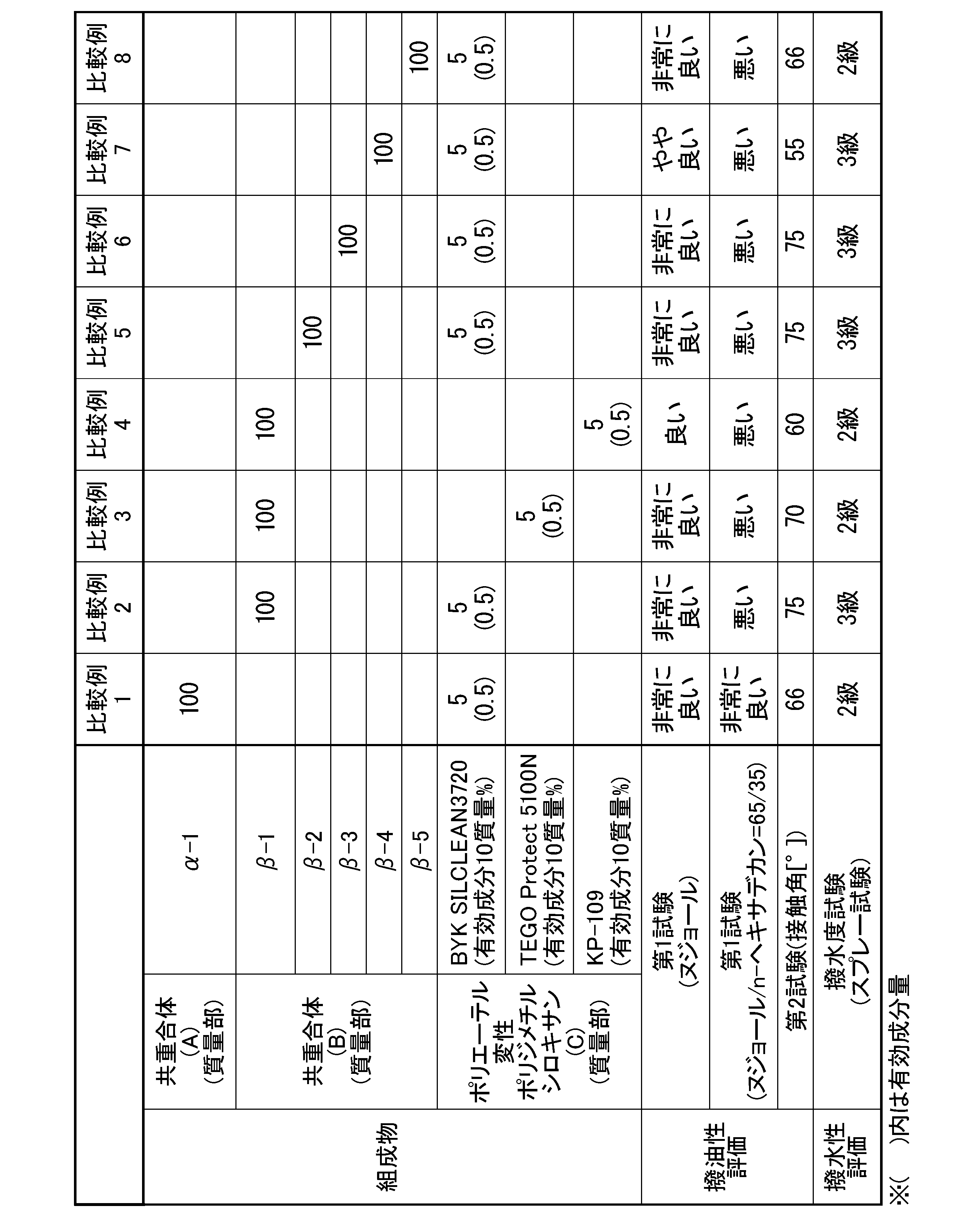
BYK SILCLEAN3720;ポリエーテル鎖の末端に水酸基を有するポリエーテル変性ポリジメチルシロキサン、重量平均分子量(Mw)10,000、有効成分以外は溶媒(メトキシプロパノール)である。(BYK社製)
TEGO(登録商標)Protect 5100N;ポリエーテル鎖の末端に水酸基を有するポリエーテル変性ポリジメチルシロキサン、重量平均分子量(Mw)10,000、有効成分以外は溶媒(水)である。(エボニック社製)
KP-109;ポリエーテル変性ポリジメチルシロキサン、重量平均分子量(Mw)10,000、有効成分以外は溶媒(プロピレングリコールモノメチルエーテル)である。(信越シリコーン社製)
このようにして得られた実施例1~12及び比較例1~8の撥水撥油剤組成物を用いて、以下に示す第1試験および第2試験を行い、撥油性を評価した。その結果を表2、表3に示す。
撥水撥油剤組成物をイオン交換水で質量基準の2倍に希釈した。希釈後の撥水撥油剤組成物に、縦200mm、横200mmの正方形の綿布(綿金巾3号)を浸漬した。その後、綿布を、オーブンを用いて130℃で5分間加熱して乾燥させ、試験布とした。試験布は、乾燥後の撥水撥油剤組成物成分の付着量が、綿布100質量部に対して、20質量部の割合となるように作製した。
第1試験は、試験液としてAATCC118法の撥油性試験に規定される撥油1級の試験液(ヌジョール)を用いた場合と、試験液として撥油2級の試験液(ヌジョール/n-ヘキサデカン=65/35)を用いた場合について、それぞれ行った。また、試験布および試験液として、23℃のものを用いた。試験布上の試験液の静置および目視観察は、23℃の恒温室で行った。
非常に良い:試験液が球滴を保っている。
良い:試験液の球滴が崩れて、試験布上に試験液が濡れ広がるが、試験布には浸み込まない。
やや良い:試験液の静置後30秒超~1分以内に試験液が試験布に浸み込む。
悪い:試験液の静置後30秒以内に試験液が試験布に浸み込む。
撥水撥油剤組成物を、基材であるガラス板上に、厚みが150μm(乾燥しない状態)となるようにアプリケーターを用いて塗布し、オーブンを用いて130℃で5分間熱処理して乾燥させ、試験体(コーティング材料)を得た。
得られた試験体の撥水撥油剤組成物を塗布した面に、AATCC118法の撥油性試験に規定される撥油1級の試験液(ヌジョール)2μlを静かに置き、10秒後の試験液の接触角を自動接触角計CA-VP型(協和界面科学社製)を用いてθ/2法にて測定した。接触角が大きいほど、優れた撥油性を有していることを示す。
実施例1~12及び比較例1~8の撥水撥油剤組成物を用いて、JIS L 1092(2009年)7.2項に記載の撥水度試験(スプレー試験)に準じて行った。評価基準は以下の通りである。級の数が大きいほど、撥水性が優れている事を示す。試験結果を表2、表3に示す。
1級:表面全体に湿潤を示すもの。
2級:表面の半分以上の面積に湿潤を示し、小さな個々の湿潤が布を浸透する状態を示すもの。
3級:湿潤面積が表面の半分未満であり、表面に小さな個々の水滴状の湿潤を示すもの。4級:表面に湿潤を示さないが、小さな水滴の付着を示すもの。
5級:表面に湿潤及び水滴の付着がないもの。
〔6-1.撥油性〕
表2に示すように、実施例1~実施例12の撥水撥油剤組成物により処理が行われた基材は、ヌジョールと、ヌジョール/n-ヘキサデカン=65/35のいずれの試験液も浸透しにくく(第1試験)、試験液(ヌジョール)の液滴に対する接触角の値も大きかった(第2試験)。このことから、実施例1~実施例12の撥水撥油剤組成物は、基材に高い撥油性を付与できることが分かった。
これに対し、表3に示すように、水系エマルジョン(α-1)または(α-2)(共重合体(A))を含まない比較例2~比較例8の撥水撥油剤組成物により処理が行われた基材は、ヌジョール/n-ヘキサデカン=65/35が浸透しやすく、基材に十分な撥油性を付与できるものではなかった。
表2に示すように、実施例1~実施例12の撥水撥油剤組成物により処理が行われた基材は、撥水度試験の結果、広範囲での湿潤は見られなかった。このことから、実施例1~実施例12の撥水撥油剤組成物は、基材に高い撥水性を付与できることが分かった。
これに対し、表3に示すように、水系エマルジョン(β-1)~(β-6)(共重合体(B))を含まない比較例1、水系エマルジョン(α-1)または(α-2)(共重合体(A))を含まない比較例3、4、8の撥水撥油剤組成物により処理が行われた基材は、撥水度試験の結果、表面の半分以上の面積に湿潤を示した。したがって、比較例1、3、4、8の撥水撥油剤組成物は、基材に十分な撥水性を付与できるものではなかった。
以上のことから、本発明にかかる撥水撥油剤組成物は、基材に高い撥油性及び撥水性を付与できることがわかった。
Claims (17)
- シロキサン結合を有する構造単位を含まない共重合体(A)と、
シロキサン結合を有する構造単位を含む共重合体(B)と、
ポリエーテル変性ポリジメチルシロキサン(C)と、
水性媒体(D)とを含み、
前記共重合体(A)は、
エチレン性不飽和結合及びエステル結合を有し、かつアミド結合を有さない化合物に由来する構造単位(a1)と、
エチレン性不飽和結合及びアミド結合を有する化合物に由来する構造単位(a2)とを有し、
前記共重合体(B)は、
エチレン性不飽和結合及びエステル結合を有し、かつアミド結合を有さない化合物に由来する構造単位(b1)と、
エチレン性不飽和結合及びアミド結合を有する化合物に由来する構造単位(b2)と、
エチレン性不飽和結合を有するポリジメチルシロキサンに由来する構造単位(b3)とを有する、撥水撥油剤組成物。 - 前記構造単位(a1)及び前記構造単位(b1)は、エチレン性不飽和結合を有する炭化水素または(メタ)アクリル酸アルキルエステルのいずれか一方または両方に由来する構造単位である請求項1に記載の撥水撥油剤組成物。
- 前記構造単位(a2)及び前記構造単位(b2)は、(メタ)アクリルアミドに由来する構造単位である請求項1または請求項2に記載の撥水撥油剤組成物。
- 前記構造単位(b3)は、下記式(1)で表される化合物に由来する構造単位である請求項1~請求項3のいずれか一項に記載の撥水撥油剤組成物。

(式(1)において、R1は水素原子又はメチル基を示す;R2はエーテル結合を含んでもよい炭素原子数1~6の2価脂肪族基を示す;R3は炭素原子数1~30の脂肪族基、芳香族基、または水酸基を示す;hは0、1、2のいずれかである。jは0~500の整数を示す。) - 前記共重合体(A)と前記共重合体(B)との質量比が、10/90以上90/10以下である請求項1~請求項4のいずれか一項に記載の撥水撥油剤組成物。
- 前記共重合体(A)は、前記構造単位(a2)を0.10質量%以上20質量%以下含有する請求項1~請求項5のいずれか一項に記載の撥水撥油剤組成物。
- 前記共重合体(B)は、前記構造単位(b2)を0.10質量%以上20質量%以下含有する請求項1~請求項6のいずれか一項に記載の撥水撥油剤組成物。
- 前記共重合体(B)は、前記構造単位(b3)を3.0質量%以上50質量%以下含有する請求項1~請求項7のいずれか一項に記載の撥水撥油剤組成物。
- 前記ポリエーテル変性ポリジメチルシロキサン(C)が、ポリエーテル鎖の末端に水酸基を有する請求項1~請求項8のいずれか一項に記載の撥水撥油剤組成物。
- 前記ポリエーテル変性ポリジメチルシロキサン(C)を、前記共重合体(A)と前記共重合体(B)の合計100質量部に対して、0.10質量部以上20質量部以下含有する請求項1~請求項9のいずれか一項に記載の撥水撥油剤組成物。
- さらに、界面活性剤(E)を含む請求項1~請求項10のいずれか一項に記載の撥水撥油剤組成物。
- 前記界面活性剤(E)は、カチオン性界面活性剤である請求項11に記載の撥水撥油剤組成物。
- 請求項1~請求項12のいずれか一項に記載の撥水撥油剤組成物を含む繊維処理剤。
- 請求項13に記載の繊維処理剤を用いる、繊維の処理方法。
- 請求項1~請求項12のいずれか一項に記載の撥水撥油剤組成物を含むコーティング剤。
- 請求項13の繊維処理剤に含まれる固形分が繊維に付着した、繊維加工品。
- 前記構造単位(a1)と前記構造単位(b1)が、メチル(メタ)アクリレート、エチル(メタ)アクリレート、ブチル(メタ)アクリレート、及び2-エチルヘキシル(メタ)アクリレートからなる群から選択される少なくとも1つであり、
前記構造単位(a2)と前記構造単位(b2)が、アクリルアミド及びはメタクリルアミドからなる群から選択される少なくとも1つであり、
前記構造単位(b3)が、下記式(1)で表わされる化合物に由来する構造単位であり、

(式(1)において、R1は水素原子又はメチル基を示す;R2はエーテル結合を含んでもよい炭素原子数1~6の2価脂肪族基を示す;R3は炭素原子数1~30の脂肪族基、芳香族基、または水酸基を示す;hは0、1、2のいずれかである;jは0~500の整数を示す。)
前記共重合体(A)中の前記構造単位(a1)の含有率が、85質量%以上99質量%以下であり、
前記共重合体(A)中の前記構造単位(a2)の含有率が、0.5質量%以上5.0質量%以下であり、
前記共重合体(B)中の前記構造単位(b1)の含有率が、50質量%以上93質量%以下であり、
前記共重合体(B)中の前記構造単位(b2)の含有率が、0.5質量%以上5.0質量%以下であり、
前記共重合体(B)中の前記構造単位(b3)の含有率が、7.0質量%以上50質量%以下であり、
前記共重合体(A)及び前記共重合体(B)の合計量における前記構造単位(b3)の含有率が、1.5質量%以上30質量%以下であり、
前記共重合体(A)の質量/前記共重合体(B)の質量で示される比が、10/90~90/10であり、
前記ポリエーテル変性ポリジメチルシロキサン(C)の重量平均分子量が7,000以上14,000以下である、請求項1に記載の撥水撥油剤組成物。
Priority Applications (2)
| Application Number | Priority Date | Filing Date | Title |
|---|---|---|---|
| JP2022572936A JPWO2022145147A1 (ja) | 2020-12-28 | 2021-11-19 | |
| CN202180081082.5A CN116635436B (zh) | 2020-12-28 | 2021-11-19 | 拒水拒油剂组合物、纤维处理剂、纤维的处理方法、纤维加工品及涂布剂 |
Applications Claiming Priority (2)
| Application Number | Priority Date | Filing Date | Title |
|---|---|---|---|
| JP2020218523 | 2020-12-28 | ||
| JP2020-218523 | 2020-12-28 |
Publications (1)
| Publication Number | Publication Date |
|---|---|
| WO2022145147A1 true WO2022145147A1 (ja) | 2022-07-07 |
Family
ID=82260417
Family Applications (1)
| Application Number | Title | Priority Date | Filing Date |
|---|---|---|---|
| PCT/JP2021/042599 Ceased WO2022145147A1 (ja) | 2020-12-28 | 2021-11-19 | 撥水撥油剤組成物、繊維処理剤、繊維の処理方法、繊維加工品およびコーティング剤 |
Country Status (3)
| Country | Link |
|---|---|
| JP (1) | JPWO2022145147A1 (ja) |
| CN (1) | CN116635436B (ja) |
| WO (1) | WO2022145147A1 (ja) |
Cited By (1)
| Publication number | Priority date | Publication date | Assignee | Title |
|---|---|---|---|---|
| WO2025094901A1 (ja) | 2023-11-01 | 2025-05-08 | ダイキン工業株式会社 | 撥水剤組成物 |
Citations (4)
| Publication number | Priority date | Publication date | Assignee | Title |
|---|---|---|---|---|
| JPH11124419A (ja) * | 1997-10-22 | 1999-05-11 | Kansai Paint Co Ltd | 撥水性を有する共重合体水溶液もしくは水分散液、及びその製造方法、及びこれを含む水性塗料組成物 |
| JP2007269642A (ja) * | 2006-03-30 | 2007-10-18 | Daikin Ind Ltd | フルオロアクリレート重合体を含有する化粧料 |
| JP2010510338A (ja) * | 2006-11-16 | 2010-04-02 | ワッカー ケミー アクチエンゲゼルシャフト | 超疎水性被覆 |
| WO2018163911A1 (ja) * | 2017-03-07 | 2018-09-13 | 昭和電工株式会社 | 撥油剤組成物 |
Family Cites Families (5)
| Publication number | Priority date | Publication date | Assignee | Title |
|---|---|---|---|---|
| JPH0768512B2 (ja) * | 1989-02-15 | 1995-07-26 | 大日精化工業株式会社 | 撥水撥油剤 |
| JP2000007980A (ja) * | 1998-04-24 | 2000-01-11 | Kansai Paint Co Ltd | 塗料組成物 |
| GB0327067D0 (en) * | 2003-11-21 | 2003-12-24 | Dow Corning | Polymeric products useful as oil repellents |
| KR102345704B1 (ko) * | 2013-11-26 | 2021-12-30 | 에이지씨 가부시키가이샤 | 발수 발유제 조성물, 물품, 및 물품의 제조 방법 |
| JP2016102272A (ja) * | 2014-11-28 | 2016-06-02 | 星光Pmc株式会社 | 繊維処理用撥油剤、その製造方法および繊維 |
-
2021
- 2021-11-19 JP JP2022572936A patent/JPWO2022145147A1/ja active Pending
- 2021-11-19 WO PCT/JP2021/042599 patent/WO2022145147A1/ja not_active Ceased
- 2021-11-19 CN CN202180081082.5A patent/CN116635436B/zh active Active
Patent Citations (4)
| Publication number | Priority date | Publication date | Assignee | Title |
|---|---|---|---|---|
| JPH11124419A (ja) * | 1997-10-22 | 1999-05-11 | Kansai Paint Co Ltd | 撥水性を有する共重合体水溶液もしくは水分散液、及びその製造方法、及びこれを含む水性塗料組成物 |
| JP2007269642A (ja) * | 2006-03-30 | 2007-10-18 | Daikin Ind Ltd | フルオロアクリレート重合体を含有する化粧料 |
| JP2010510338A (ja) * | 2006-11-16 | 2010-04-02 | ワッカー ケミー アクチエンゲゼルシャフト | 超疎水性被覆 |
| WO2018163911A1 (ja) * | 2017-03-07 | 2018-09-13 | 昭和電工株式会社 | 撥油剤組成物 |
Cited By (1)
| Publication number | Priority date | Publication date | Assignee | Title |
|---|---|---|---|---|
| WO2025094901A1 (ja) | 2023-11-01 | 2025-05-08 | ダイキン工業株式会社 | 撥水剤組成物 |
Also Published As
| Publication number | Publication date |
|---|---|
| CN116635436A (zh) | 2023-08-22 |
| CN116635436B (zh) | 2025-09-19 |
| JPWO2022145147A1 (ja) | 2022-07-07 |
Similar Documents
| Publication | Publication Date | Title |
|---|---|---|
| JP7537482B2 (ja) | 撥油剤組成物 | |
| CN103183775B (zh) | 含氟组合物和含氟聚合物 | |
| JP6937966B1 (ja) | 撥水撥油剤組成物、撥水撥油処理方法、及び撥水撥油性繊維 | |
| CN102159605B (zh) | 水性聚合物分散组合物和表面处理剂 | |
| JP5418229B2 (ja) | 耐水耐油剤組成物およびその製造方法 | |
| TWI523870B (zh) | 氟聚合物及表面處理劑 | |
| TW201016733A (en) | Fluorosilicone polymers and surface treatment agent | |
| CN114502605B (zh) | 有机微粒 | |
| US20210221995A1 (en) | Fluorine-containing polymer and surface treatment agent | |
| WO2022145147A1 (ja) | 撥水撥油剤組成物、繊維処理剤、繊維の処理方法、繊維加工品およびコーティング剤 | |
| CN116507648B (zh) | 疏水疏油剂组合物、纤维处理剂、纤维的处理方法、纤维加工品及涂层剂 | |
| TWI909098B (zh) | 撥水劑用聚合物、撥水劑組合物及撥水劑處理物 | |
| CN119638917A (zh) | 一种丙烯酸酯聚合物的含水分散体及其制备方法和应用 | |
| WO2026054004A1 (ja) | 撥液剤組成物、撥液剤処理物、撥液性を付与する方法 | |
| WO2022009689A1 (ja) | 有機微粒子 |
Legal Events
| Date | Code | Title | Description |
|---|---|---|---|
| 121 | Ep: the epo has been informed by wipo that ep was designated in this application |
Ref document number: 21915008 Country of ref document: EP Kind code of ref document: A1 |
|
| ENP | Entry into the national phase |
Ref document number: 2022572936 Country of ref document: JP Kind code of ref document: A |
|
| WWE | Wipo information: entry into national phase |
Ref document number: 202180081082.5 Country of ref document: CN |
|
| NENP | Non-entry into the national phase |
Ref country code: DE |
|
| 122 | Ep: pct application non-entry in european phase |
Ref document number: 21915008 Country of ref document: EP Kind code of ref document: A1 |
|
| WWG | Wipo information: grant in national office |
Ref document number: 202180081082.5 Country of ref document: CN |