WO2022138787A1 - 医薬組成物 - Google Patents
医薬組成物 Download PDFInfo
- Publication number
- WO2022138787A1 WO2022138787A1 PCT/JP2021/047754 JP2021047754W WO2022138787A1 WO 2022138787 A1 WO2022138787 A1 WO 2022138787A1 JP 2021047754 W JP2021047754 W JP 2021047754W WO 2022138787 A1 WO2022138787 A1 WO 2022138787A1
- Authority
- WO
- WIPO (PCT)
- Prior art keywords
- cells
- aso
- pharmaceutical composition
- derived
- administration
- Prior art date
- Legal status (The legal status is an assumption and is not a legal conclusion. Google has not performed a legal analysis and makes no representation as to the accuracy of the status listed.)
- Ceased
Links
Images

















Classifications
-
- C—CHEMISTRY; METALLURGY
- C12—BIOCHEMISTRY; BEER; SPIRITS; WINE; VINEGAR; MICROBIOLOGY; ENZYMOLOGY; MUTATION OR GENETIC ENGINEERING
- C12N—MICROORGANISMS OR ENZYMES; COMPOSITIONS THEREOF; PROPAGATING, PRESERVING, OR MAINTAINING MICROORGANISMS; MUTATION OR GENETIC ENGINEERING; CULTURE MEDIA
- C12N15/00—Mutation or genetic engineering; DNA or RNA concerning genetic engineering, vectors, e.g. plasmids, or their isolation, preparation or purification; Use of hosts therefor
- C12N15/09—Recombinant DNA-technology
- C12N15/11—DNA or RNA fragments; Modified forms thereof; Non-coding nucleic acids having a biological activity
- C12N15/113—Non-coding nucleic acids modulating the expression of genes, e.g. antisense oligonucleotides; Antisense DNA or RNA; Triplex- forming oligonucleotides; Catalytic nucleic acids, e.g. ribozymes; Nucleic acids used in co-suppression or gene silencing
-
- A—HUMAN NECESSITIES
- A61—MEDICAL OR VETERINARY SCIENCE; HYGIENE
- A61P—SPECIFIC THERAPEUTIC ACTIVITY OF CHEMICAL COMPOUNDS OR MEDICINAL PREPARATIONS
- A61P21/00—Drugs for disorders of the muscular or neuromuscular system
-
- A—HUMAN NECESSITIES
- A61—MEDICAL OR VETERINARY SCIENCE; HYGIENE
- A61K—PREPARATIONS FOR MEDICAL, DENTAL OR TOILETRY PURPOSES
- A61K31/00—Medicinal preparations containing organic active ingredients
- A61K31/70—Carbohydrates; Sugars; Derivatives thereof
- A61K31/7088—Compounds having three or more nucleosides or nucleotides
- A61K31/712—Nucleic acids or oligonucleotides having modified sugars, i.e. other than ribose or 2'-deoxyribose
-
- A—HUMAN NECESSITIES
- A61—MEDICAL OR VETERINARY SCIENCE; HYGIENE
- A61K—PREPARATIONS FOR MEDICAL, DENTAL OR TOILETRY PURPOSES
- A61K31/00—Medicinal preparations containing organic active ingredients
- A61K31/70—Carbohydrates; Sugars; Derivatives thereof
- A61K31/7088—Compounds having three or more nucleosides or nucleotides
- A61K31/7125—Nucleic acids or oligonucleotides having modified internucleoside linkage, i.e. other than 3'-5' phosphodiesters
-
- C—CHEMISTRY; METALLURGY
- C12—BIOCHEMISTRY; BEER; SPIRITS; WINE; VINEGAR; MICROBIOLOGY; ENZYMOLOGY; MUTATION OR GENETIC ENGINEERING
- C12N—MICROORGANISMS OR ENZYMES; COMPOSITIONS THEREOF; PROPAGATING, PRESERVING, OR MAINTAINING MICROORGANISMS; MUTATION OR GENETIC ENGINEERING; CULTURE MEDIA
- C12N5/00—Undifferentiated human, animal or plant cells, e.g. cell lines; Tissues; Cultivation or maintenance thereof; Culture media therefor
- C12N5/06—Animal cells or tissues; Human cells or tissues
- C12N5/0602—Vertebrate cells
- C12N5/0696—Artificially induced pluripotent stem cells, e.g. iPS
-
- C—CHEMISTRY; METALLURGY
- C12—BIOCHEMISTRY; BEER; SPIRITS; WINE; VINEGAR; MICROBIOLOGY; ENZYMOLOGY; MUTATION OR GENETIC ENGINEERING
- C12N—MICROORGANISMS OR ENZYMES; COMPOSITIONS THEREOF; PROPAGATING, PRESERVING, OR MAINTAINING MICROORGANISMS; MUTATION OR GENETIC ENGINEERING; CULTURE MEDIA
- C12N2310/00—Structure or type of the nucleic acid
- C12N2310/10—Type of nucleic acid
- C12N2310/11—Antisense
-
- C—CHEMISTRY; METALLURGY
- C12—BIOCHEMISTRY; BEER; SPIRITS; WINE; VINEGAR; MICROBIOLOGY; ENZYMOLOGY; MUTATION OR GENETIC ENGINEERING
- C12N—MICROORGANISMS OR ENZYMES; COMPOSITIONS THEREOF; PROPAGATING, PRESERVING, OR MAINTAINING MICROORGANISMS; MUTATION OR GENETIC ENGINEERING; CULTURE MEDIA
- C12N2310/00—Structure or type of the nucleic acid
- C12N2310/30—Chemical structure
- C12N2310/31—Chemical structure of the backbone
- C12N2310/313—Phosphorodithioates
-
- C—CHEMISTRY; METALLURGY
- C12—BIOCHEMISTRY; BEER; SPIRITS; WINE; VINEGAR; MICROBIOLOGY; ENZYMOLOGY; MUTATION OR GENETIC ENGINEERING
- C12N—MICROORGANISMS OR ENZYMES; COMPOSITIONS THEREOF; PROPAGATING, PRESERVING, OR MAINTAINING MICROORGANISMS; MUTATION OR GENETIC ENGINEERING; CULTURE MEDIA
- C12N2310/00—Structure or type of the nucleic acid
- C12N2310/30—Chemical structure
- C12N2310/31—Chemical structure of the backbone
- C12N2310/315—Phosphorothioates
-
- C—CHEMISTRY; METALLURGY
- C12—BIOCHEMISTRY; BEER; SPIRITS; WINE; VINEGAR; MICROBIOLOGY; ENZYMOLOGY; MUTATION OR GENETIC ENGINEERING
- C12N—MICROORGANISMS OR ENZYMES; COMPOSITIONS THEREOF; PROPAGATING, PRESERVING, OR MAINTAINING MICROORGANISMS; MUTATION OR GENETIC ENGINEERING; CULTURE MEDIA
- C12N2310/00—Structure or type of the nucleic acid
- C12N2310/30—Chemical structure
- C12N2310/32—Chemical structure of the sugar
- C12N2310/321—2'-O-R Modification
-
- C—CHEMISTRY; METALLURGY
- C12—BIOCHEMISTRY; BEER; SPIRITS; WINE; VINEGAR; MICROBIOLOGY; ENZYMOLOGY; MUTATION OR GENETIC ENGINEERING
- C12N—MICROORGANISMS OR ENZYMES; COMPOSITIONS THEREOF; PROPAGATING, PRESERVING, OR MAINTAINING MICROORGANISMS; MUTATION OR GENETIC ENGINEERING; CULTURE MEDIA
- C12N2310/00—Structure or type of the nucleic acid
- C12N2310/30—Chemical structure
- C12N2310/32—Chemical structure of the sugar
- C12N2310/322—2'-R Modification
-
- C—CHEMISTRY; METALLURGY
- C12—BIOCHEMISTRY; BEER; SPIRITS; WINE; VINEGAR; MICROBIOLOGY; ENZYMOLOGY; MUTATION OR GENETIC ENGINEERING
- C12N—MICROORGANISMS OR ENZYMES; COMPOSITIONS THEREOF; PROPAGATING, PRESERVING, OR MAINTAINING MICROORGANISMS; MUTATION OR GENETIC ENGINEERING; CULTURE MEDIA
- C12N2310/00—Structure or type of the nucleic acid
- C12N2310/30—Chemical structure
- C12N2310/32—Chemical structure of the sugar
- C12N2310/323—Chemical structure of the sugar modified ring structure
- C12N2310/3231—Chemical structure of the sugar modified ring structure having an additional ring, e.g. LNA, ENA
-
- C—CHEMISTRY; METALLURGY
- C12—BIOCHEMISTRY; BEER; SPIRITS; WINE; VINEGAR; MICROBIOLOGY; ENZYMOLOGY; MUTATION OR GENETIC ENGINEERING
- C12N—MICROORGANISMS OR ENZYMES; COMPOSITIONS THEREOF; PROPAGATING, PRESERVING, OR MAINTAINING MICROORGANISMS; MUTATION OR GENETIC ENGINEERING; CULTURE MEDIA
- C12N2310/00—Structure or type of the nucleic acid
- C12N2310/30—Chemical structure
- C12N2310/33—Chemical structure of the base
- C12N2310/334—Modified C
- C12N2310/3341—5-Methylcytosine
-
- C—CHEMISTRY; METALLURGY
- C12—BIOCHEMISTRY; BEER; SPIRITS; WINE; VINEGAR; MICROBIOLOGY; ENZYMOLOGY; MUTATION OR GENETIC ENGINEERING
- C12N—MICROORGANISMS OR ENZYMES; COMPOSITIONS THEREOF; PROPAGATING, PRESERVING, OR MAINTAINING MICROORGANISMS; MUTATION OR GENETIC ENGINEERING; CULTURE MEDIA
- C12N2310/00—Structure or type of the nucleic acid
- C12N2310/30—Chemical structure
- C12N2310/34—Spatial arrangement of the modifications
- C12N2310/341—Gapmers, i.e. of the type ===---===
-
- C—CHEMISTRY; METALLURGY
- C12—BIOCHEMISTRY; BEER; SPIRITS; WINE; VINEGAR; MICROBIOLOGY; ENZYMOLOGY; MUTATION OR GENETIC ENGINEERING
- C12N—MICROORGANISMS OR ENZYMES; COMPOSITIONS THEREOF; PROPAGATING, PRESERVING, OR MAINTAINING MICROORGANISMS; MUTATION OR GENETIC ENGINEERING; CULTURE MEDIA
- C12N2310/00—Structure or type of the nucleic acid
- C12N2310/30—Chemical structure
- C12N2310/34—Spatial arrangement of the modifications
- C12N2310/343—Spatial arrangement of the modifications having patterns, e.g. ==--==--==--
-
- C—CHEMISTRY; METALLURGY
- C12—BIOCHEMISTRY; BEER; SPIRITS; WINE; VINEGAR; MICROBIOLOGY; ENZYMOLOGY; MUTATION OR GENETIC ENGINEERING
- C12N—MICROORGANISMS OR ENZYMES; COMPOSITIONS THEREOF; PROPAGATING, PRESERVING, OR MAINTAINING MICROORGANISMS; MUTATION OR GENETIC ENGINEERING; CULTURE MEDIA
- C12N2310/00—Structure or type of the nucleic acid
- C12N2310/30—Chemical structure
- C12N2310/34—Spatial arrangement of the modifications
- C12N2310/346—Spatial arrangement of the modifications having a combination of backbone and sugar modifications
-
- C—CHEMISTRY; METALLURGY
- C12—BIOCHEMISTRY; BEER; SPIRITS; WINE; VINEGAR; MICROBIOLOGY; ENZYMOLOGY; MUTATION OR GENETIC ENGINEERING
- C12N—MICROORGANISMS OR ENZYMES; COMPOSITIONS THEREOF; PROPAGATING, PRESERVING, OR MAINTAINING MICROORGANISMS; MUTATION OR GENETIC ENGINEERING; CULTURE MEDIA
- C12N2506/00—Differentiation of animal cells from one lineage to another; Differentiation of pluripotent cells
- C12N2506/45—Differentiation of animal cells from one lineage to another; Differentiation of pluripotent cells from artificially induced pluripotent stem cells
-
- C—CHEMISTRY; METALLURGY
- C12—BIOCHEMISTRY; BEER; SPIRITS; WINE; VINEGAR; MICROBIOLOGY; ENZYMOLOGY; MUTATION OR GENETIC ENGINEERING
- C12N—MICROORGANISMS OR ENZYMES; COMPOSITIONS THEREOF; PROPAGATING, PRESERVING, OR MAINTAINING MICROORGANISMS; MUTATION OR GENETIC ENGINEERING; CULTURE MEDIA
- C12N2800/00—Nucleic acids vectors
- C12N2800/90—Vectors containing a transposable element
Definitions
- the present invention relates to a pharmaceutical composition, specifically, a pharmaceutical composition containing an antisense oligonucleotide.
- the pharmaceutical composition of the present invention can be used for the treatment of any symptom of myotonic dystrophy type 1 disease.
- Myotonic dystrophy type 1 (hereinafter referred to as "DM1") is one of the diseases with the highest prevalence among myotonic dystrophy.
- the prevalence of DM1 varies from country to country, with reports of 1 in 2000 to 1 in 8000 and 1 in 500 in some regions (Non-Patent Document 1).
- the cause of DM1 is the repetitive sequence of CTG trinucleotides in the 3'untranslated region (3'UTR) of the myotonic dystrophy protein kinase (hereinafter referred to as "DMPK”) gene.
- the DMPK gene encodes a non-receptor serine / threonine kinase protein, which is ubiquitously expressed systemically and strongly expressed in skeletal muscle and myocardium.
- RNA aggregates (foci) in the cell nucleus of the affected person. RNA aggregates undergo selective splicing, transcription, translation and post-translational regulation by adsorbing and depleting RNA-binding molecules containing CUG-binding protein 1 (CUG-BP1) and muscleblind-like protein 1 (MBNL1) from the nucleus. It has been reported that the mechanism of many cells is impaired (Non-Patent Document 2). In addition to DM1, many diseases in which repeated sequences of trinucleotides are extended have been reported, and are collectively referred to as triplet disease.
- CUG-BP1 CUG-binding protein 1
- MBNL1 muscleblind-like protein 1
- Antisense oligonucleotide (hereinafter referred to as "ASO") treatment is one of the promising therapeutic strategies for diseases caused by abnormal RNA in cells and / or nuclei containing mRNA and non-coding RNA, such as triplet disease.
- ASO either results in cleavage of the target RNA strand by RNase H in the nucleus and cytoplasm, or sterically impairs the association of the target RNA with the RNA-binding molecule.
- ASOs containing various nucleotide analogs have been developed to increase single-stranded DNA stability and target-binding affinity consisting only of deoxyribonucleotides.
- Nucleotide modifications used in ASO include phosphorothioate (PS) modification of the phosphodiester skeleton (hereinafter also referred to as "S-formation”) and methylation of the 5'position in the pyrimidine ring at the base of cytidine.
- PS phosphorothioate
- S-formation modification of the phosphodiester skeleton
- methylation of the 5'position in the pyrimidine ring at the base of cytidine Modification
- substitution of the sugar portion of any nucleotide with a morpholino ring substitution of the hydroxyl group at the 2'position in ribose of the sugar portion of any nucleotide with a fluoro group (hereinafter referred to as "2").
- LNA Locked nucleic acid
- 2'-O 4'-C-ethylene cross-linked nucleic acid (2'-) in which an oxygen atom at the 2'position of ribose and a carbon atom at the 4'position are ethylene-crosslinked.
- O, 4'-C-Ethylene-bridged Nucleic Acid, hereinafter referred to as "ENA” and ribose at the 2'position oxygen atom and 4'position carbon atom are methyl (methyleneoxy) crosslinked (4'-CH (4'-CH).
- nucleotide analogs when administered into the body. Although it may cause harmful side effects, nucleotide analogs have a higher binding affinity for complementary RNAs than unmodified deoxyribonucleotides, and oligonucleotides are often more resistant to nucleic acid-degrading enzymes. Nucleotide analogs have the advantage of requiring lower doses than unmodified deoxyribonucleotides.
- a hetero double-stranded nucleic acid formed by pairing an oligonucleotide consisting of a specific type of nucleotide analog with RNA complementary to the oligonucleotide is degraded when reacted with RNase H under predetermined conditions. Then, the specific type of nucleotide analog is referred to as RNase H active nucleotide. Conversely, when a heterodouble-stranded nucleic acid formed by pairing an oligonucleotide consisting of a specific type of nucleotide analog with RNA complementary to the oligonucleotide is reacted with RNase H under predetermined conditions.
- the RNase H active nucleotide contained in the oligonucleotide according to the present invention includes, but is not limited to, for example, unmodified deoxyribonucleotides and PS-modified deoxyribonucleotide analogs.
- the RNase H inactive nucleotide contained in the oligonucleotide according to the present invention is, for example, a morpholino ring-substituted nucleotide analog, 2'-OMe-nucleotide analog, MOE-nucleotide analog, 2'-F nucleotide analog, LNA. , ENA and cEt, but not limited to these.
- the gapmer structure is an oligonucleotide consisting only of RNase H inactive nucleotides on the 5'end side and 3'end side of an oligonucleotide consisting only of RNase H active nucleotides (hereinafter referred to as "gap region”) (hereinafter referred to as "gap region"). It is a structure in which "wing regions") are connected. Since the wing region has a high binding affinity with complementary RNA, a double strand with a stable target RNA is formed.
- the double strand with the target RNA is degraded by RNase H. Therefore, it is preferable to adopt a gapmer structure for the type of ASO in which the double strand with RNA is decomposed to exert a medicinal effect. On the contrary, for the type of ASO that exerts a medicinal effect by not degrading the double strand with RNA, use an oligonucleotide having a structure in which RNase H inactive nucleotides are distributed over the entire length of the ASO and there is no clear gap region. Is preferable.
- the mixmer structure is a mixture of the RNase H inactive nucleotide and the RNase H active nucleotide and the RNase H inactive nucleotide, but the RNase H inactive in the vicinity of the RNase H active nucleotide. Since the type nucleotide is arranged, the double strand of ASO and the target RNA may have any structure that is not degraded by RNase H.
- the RNase H inactive nucleotide contained in the mixmer of the present invention may contain an oligonucleotide in which all the nucleotides have the same modified sugar and the bonds between all the nucleotides are the same modified bonds.
- a modified sugar and / or a plurality of nucleotide derivatives having different modified bonds may be contained.
- the gapmer and mixmer of the present invention refer to oligonucleotides having a gapmer structure and a mixmer structure, respectively.
- Non-Patent Document 5 and 6 Several MOE / DNA gapmer ASOs have been reported to be effective in reducing RNA in DMPK with extended CUG sequence repeats in in vitro and in vivo DM1 disease models. It has been reported that 2'-OMe modified ASO (Non-Patent Documents 7 and 8) and morpholino-substituted ASO (Non-Patent Documents 8 and 9) can also alleviate the RNA action of DMPK in which the repetitive sequence of the CUG sequence is extended in the DM disease model. Has been done.
- Non-Patent Document 4 Although a part of the MOE / DNA gapmer ASO has advanced to the clinical trial stage, it has not been possible to deliver ASO at a concentration that exerts a medicinal effect in vitro to muscles (Non-Patent Document 4). Therefore, it is necessary to develop an ASO that exerts its medicinal effect at a lower concentration.
- iPSC Patient-derived induced pluripotent stem cell
- iPSC Patient-derived induced pluripotent stem cell
- Multiple iPSCs prepared from primary cultured cells of fibroblasts, myoblasts, urine-derived cells or immortalized lymphoblastic cells of myotonic dystrophy patients have been described (Non-Patent Documents 10-18).
- Nuclear RNA aggregates have been observed as pathological phenotypes in iPSCs derived from patients with myotonic dystrophy and skeletal muscle cells and cardiomyocytes differentiated from iPSCs derived from patients with myotonic dystrophy (Non-Patent Documents 16-). 18).
- ENA is a nucleotide analog that is highly resistant to nuclease degradation and is thermodynamically stable (Non-Patent Documents 8, 19 and 20).
- ASO incorporating ENA has a high affinity for complementary RNA strands (Non-Patent Documents 8, 19 and 20).
- ENA / 2'-OMe ribonucleotide analog Mixmer ASO which can induce exon skipping by steric disorder, is under development as a therapeutic agent for Duchenne muscular dystrophy (DMD) (Non-Patent Documents 20 to 22).
- ASO of ENA / deoxyribonucleotide gapmer and mixmer of ENA / 2'-OMe ribonucleotide analogs produces RNA aggregates in iPS cells derived from patients with spinocerebellar degeneration type 36 (SCA36) and neurons derived from the iPS cells. It can be reduced (Non-Patent Document 23). Since ASO incorporating ENA as described above is particularly promising as a therapeutic agent for the mechanism of action mediated by steric hindrance, it is necessary to develop an oligonucleotide incorporating ENA as ASO for treating DM1.
- DM1 is a multi-organ disease that affects the eyes, heart, endocrine system and central nervous system in addition to skeletal muscle and smooth muscle.
- the clinical symptoms range from mild to severe, and although there is some overlap, they are classified into three types: mild cases, classical types, and congenital types.
- Mild DM1 is characterized by cataracts, mild myotonic dysfunction (prolonged muscle contraction), and a normal prognosis.
- Classic DM1 is characterized by muscle weakness / atrophy, myotonic dysfunction, cataracts, and is often accompanied by impaired cardiac conduction. Physical function may be impaired in adults and the prognosis for life may be shortened.
- Congenital DM1 is characterized by hypotonia at birth and marked weakness throughout the body, often resulting in respiratory failure and premature death. Often accompanied by intellectual disability.
- gastrointestinal symptoms such as muscle weakness / atrophy, myocardial disorder, cardiac conduction disorder, cataract, retinal degeneration, swallowing, constipation, diarrhea associated with smooth muscle disorder, higher brain dysfunction, hyperinsulinemia, diabetes , Endocrine disorders such as testicular atrophy and abnormal growth hormone secretion, and skin symptoms such as hair matrix tumor and epithelioma are also reported. Therefore, depending on the clinical symptoms of the patient, it may be necessary to treat organs other than muscles.
- satellite cells which are precursor cells of skeletal muscle resident in muscle tissue, and tissues other than muscle, for example, eye tissue (crystal cells that cause cataracts, retina that causes retinal degeneration). It is also necessary to develop a DM1 therapeutic ASO for cells, etc.), nerves, skin, endocrine system and other tissues.
- An object of the present invention is to provide a novel antisense oligonucleotide therapeutic agent for myotonic dystrophy type 1 disease, which has a higher activity of removing RNA aggregates than before.
- the present inventors have proceeded with studies to achieve the above object, and have determined that a disease model system using iPS cells derived from patients with myotonic dystrophy type 1 disease is suitable for screening antisense oligonucleotides having high RNA aggregate removing activity. It was discovered and the present invention was completed using the assay system.
- the present invention provides a pharmaceutical composition.
- the pharmaceutical composition of the present invention comprises an oligonucleotide having one of the base sequences of a cyclic sequence in which the cytosine-adenine-guanine trinucleotide repeats 5 to 13 times from the 5'end to the 3'end.
- RNase H has a mixmer structure containing at least two inactive nucleotide analogs.
- the oligonucleotide is (1) Oligonucleotides consisting of any of the nucleotide sequences of SEQ ID NOs: 1 to 9. (2) An oligonucleotide consisting of adenine-guanine, a base sequence of any of SEQ ID NOs: 1 to 9, and a base sequence of cytosine from the 5'end to the 3'end, or (3) An oligonucleotide consisting of a guanine, a base sequence of any of SEQ ID NOs: 1 to 9, and a base sequence of cytosine-adenine may be contained from the 5'end to the 3'end.
- the RNase H inactive nucleotide analog is a nucleotide analog modified at the 2'position of ribose and / or a crosslink between the 2'position and the 4'position of ribose. It can be a modified nucleotide analog.
- the nucleotide analog in which the oxygen atom at the 2'position of ribose is modified can be a 2'-OMe-nucleotide analog and / or a MOE-nucleotide analog.
- the nucleotide analog in which the 2'-position and the 4'-position of ribose are cross-linked modified is ⁇ -D-oxy-L-LNA, ⁇ -D-ENA and / or R. It can be a type cEt.
- nucleotide analogs modified at the 2'position of ribose may be the same modified sugar.
- the nucleotide analog in which the 2'position of ribose is modified may be at least two different modified sugars.
- nucleotide analogs cross-linked between the 2'position and the 4'position of the ribose may be the same modified sugar.
- the nucleotide analog obtained by cross-linking the 2'position and the 4'position of the ribose may be at least two different modified sugars.
- the oligonucleotide can include ⁇ -D-ENA-cytidine, 2'-OMe-adenosine and 2'-OMe-guanosine.
- all cytidines of the oligonucleotide are ⁇ -D-ENA-cytidine, all adenosine is 2'-OMe-adenosine, and all guanosine is 2'-OMe-guanosine. can do.
- the oligonucleotide can contain at least one nucleotide linkage selected from the group consisting of phosphorothioate, phosphorodithioate and boranophosphate.
- the pharmaceutical composition of the present invention can contain a pharmaceutically acceptable carrier or diluent.
- the carrier can include a carrier for cell membrane permeation and / or a carrier for nuclear delivery.
- the pharmaceutical composition of the present invention is percutaneously administered, intraocularly administered, intrathecal administration, intramucosal administration of the gastrointestinal tract, submucosal administration of the gastrointestinal tract, subcutaneous administration, intravenous administration, intraarterial administration, intramuscular administration, intraperitoneal administration. It can be delivered by parenteral administration selected from the group consisting of intracranial and intrathecal administration.
- the pharmaceutical composition of the present invention can be used for the treatment of any symptom of myotonic dystrophy type 1 disease.
- the present invention comprises an oligonucleotide having one of the base sequences of a repeating sequence in which a cytosine-adenine-guanine trinucleotide repeats 5 to 13 times from the 5'end to the 3'end, and the oligonucleotide is RNase H non-Nucleotide.
- a method for treating muscle tonic dystrophy type 1 disease by administering to a patient in need of an oligonucleotide having a mixmer structure containing at least two active nucleotide analogs.
- the present invention provides an assay system for an antisense oligonucleotide therapeutic agent for myotonic dystrophy type 1 disease, which comprises cells derived from iPS cells established from a human suffering from myotonic dystrophy type 1 disease.
- the iPS cell-derived cells include undifferentiated pluripotent stem cells, cells differentiated into at least one cell type, and aggregates containing the differentiated cells.
- the top row is a phase-contrast micrograph of a monolayer culture of undifferentiated cells of each iPS cell
- the second row is a monolayer culture of undifferentiated cells of each iPS cell stained with an antibody against NANOG, and further 4', 6-diamidino.
- It is a fluorescence micrograph which contrast-stained the cell nucleus with -2-phenylindole (hereinafter referred to as "DAPI").
- the third stage is a fluorescence micrograph in which a monolayer culture of undifferentiated cells of each iPS cell was stained with an antibody against OCT4, and the cell nuclei were counterstained with DAPI.
- the fourth stage is a fluorescence micrograph in which a monolayer culture of undifferentiated cells of each iPS cell was stained with an antibody against SSEA4, and the cell nuclei were counterstained with DAPI.
- the fifth stage is a fluorescence micrograph in which a monolayer culture of undifferentiated cells of each iPS cell was stained with an antibody against TRA-1-60, and the cell nuclei were counterstained with DAPI.
- the first stage is a fluorescence micrograph in which cells differentiated from each iPS cell into mesoderm were stained with an antibody against ⁇ -smooth muscle actin (SMA), and the cell nuclei were counterstained with DAPI.
- SMA ⁇ -smooth muscle actin
- the second stage is a fluorescence micrograph in which cells differentiated into endoderms from each iPS cell are stained with an antibody against SOX17, and the cell nuclei are counterstained with DAPI.
- the third stage is a fluorescence micrograph in which cells differentiated from each iPS cell into an ectoderm were stained with an antibody against ⁇ III-tubulin, and the cell nuclei were counterstained with DAPI.
- Capillary electrophoresis of reaction products of triplet repeat prime PCR hereinafter referred to as "TP-PCR" of iPS cells (DM-1 to 3) derived from DM1 patients and iPS cells (HC-1 to 3) derived from healthy subjects. figure.
- FISH fluorescence in situ hybridization
- CAG Cy3-labeled 6 -CA DNA / LNA probe for iPS cells (DM-3) derived from DM1 patients.
- DM-3 iPS cells
- the upper left or lower left is the result of performing FISH without RNase A treatment
- the upper right and lower right are the results of performing FISH after RNase A treatment.
- the upper left and upper right are fluorescence micrographs in which cell nuclei are counterstained with DAPI after FISH
- the lower left and lower right are fluorescence micrographs with only FISH and no DAPI staining.
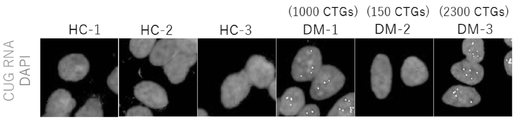
- Cy3-labeled (CAG) 6 -CA DNA / LNA probes were used for each of the undifferentiated cells of iPS cells (DM-1 to 3) derived from DM1 patients and iPS cells (HC-1 to 3) derived from healthy subjects.
- the left side of FIG. 3B is a bar graph showing the average number of RNA aggregates per cell nucleus calculated from the FISH result of FIG. 3A.
- 3B is a bar graph showing the percentage of RNA aggregate-positive cell nuclei detected by DAPI staining, calculated from the FISH results of FIG. 3A.
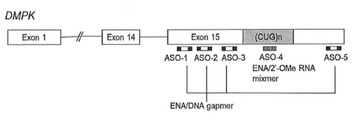
- the schematic diagram which shows the relative positional relationship on DMPK-pre mRNA of the complementary sequence of ASO of this example, and also shows the structural type of ASO.
- ASO-1 to 3 are complementary to the sequence of the non-coding region of exon 15 on DMPK-mRNA
- ASO-4 is complementary to the repetitive sequence of the CUG sequence of the non-coding region of exon 15 on DMPK-mRNA.
- ASO-5 is complementary to the sequence on the 3'end side of the repeat sequence of the non-coding region of exon 15 on DMPK-mRNA.
- ASO-4 is a mixmer consisting of ENA and 2'-OMe-nucleotide analogs, while the other ASO-1 to 3 and 5 are gapmers consisting of ENA in the wing region and unmodified deoxyribonucleotides in the gap region (hereinafter). , "ENA / DNA gapmer”).
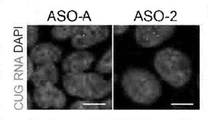
- ENA / DNA gapmer 48 hours after administration of either ASO-C or ASO-1-5 to iPS cells (DM-1) derived from DM1 patients, FISH and DAPI using a Cy3-labeled (CAG) 6 -CA DNA / LNA probe. Fluorescence micrograph with counterstaining.
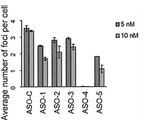
- RNA aggregates per cell nucleus It represents the average number of RNA aggregates per cell nucleus calculated from the FISH results of iPS cells (DM-1) derived from DM1 patients who received either 5 nM or 10 nM ASO-C and ASO-1-5.
- bar graph Positive for RNA aggregates in whole cell nuclei detected by DAPI staining, calculated from FISH results of iPS cells (DM-1) derived from DM1 patients treated with either 5 nM or 10 nM ASO-C and ASO-1-5.
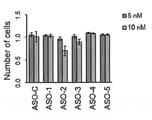
- the vertical axis represents the ratio of the number of cells in which the number of cells of ASO-C is 1.0.
- the relative positional relationship between ASO-2 and 4 of the present embodiment and the corresponding control ASO-A and B on the DMPK-pre mRNA of the complementary sequence is shown, and the structural type of ASO is shown.
- Pattern diagram. ASO-2 and ASO-A are complementary to the same sequence of exon 15 coding region on DMPK-mRNA, and ASO-4 and ASO-B are CUG sequences of exon 15 non-coding region on DMPK-mRNA. Complementary to the same sequence of repeats.
- ASO-2 is an ENA / DNA gapmer
- ASO-A is a gapmer consisting of a MOE-nucleotide analog in the wing region and an unmodified deoxyribonucleotide in the gap region (hereinafter referred to as "MOE / DNA gapmer").
- ASO-4 is a mixmer consisting of ENA and 2'-OMe-nucleotide analogs
- ASO-B consists of 2'-OMe-nucleotide analogs with all nucleotides and all internucleotide linkages are phosphorothio. It's art.
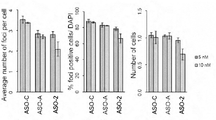
- FIG. 5C left shows RNA aggregates per cell nucleus calculated from FISH results for iPS cells (DM-1) derived from DM1 patients treated with 5 nM or 10 nM ASO-2, ASO-A or ASO-C.
- FIG. 5C in the whole cell nucleus detected by DAPI staining, calculated from the FISH result of iPS cells (DM-1) derived from DM1 patients treated with 5 nM or 10 nM ASO-2, ASO-A or ASO-C.
- the right side of FIG. 5C is a bar graph showing the proliferation and survival status of iPS cells (DM-1) derived from DM1 patients treated with 5 nM or 10 nM ASO-2, ASO-A or ASO-C.
- the vertical axis represents the ratio of the number of cells in which the number of cells of ASO-C is 1.0.
- FIG. 5E left shows RNA aggregates per cell nucleus calculated from FISH results of iPS cells (DM-1) derived from DM1 patients administered with 5 nM or 10 nM ASO-4, ASO-B or ASO-C. A bar graph showing the average number.
- CAG Cy3-labeled
- the right side of FIG. 5E is a bar graph showing the proliferation and survival status of iPS cells (DM-1) derived from DM1 patients treated with 5 nM or 10 nM ASO-4, ASO-B or ASO-C.
- the vertical axis represents the ratio of the number of cells in which the number of cells of ASO-C is 1.0.
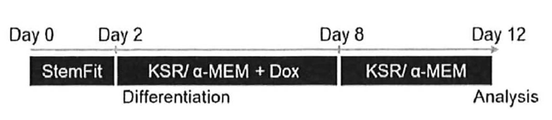
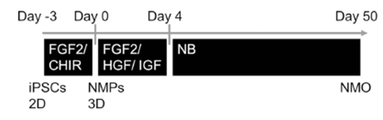
- Procedure of differentiation experiment system from undifferentiated cells to muscle cells of iPS cells (DM-1 to 3) derived from DM1 patients and iPS cells (HC-1 to 3) derived from healthy subjects using a tetracycline-induced MyoD expression system A conceptual diagram showing.
- “StemFit” represents the period of culturing in a medium for undifferentiated iPS cells
- KSR / ⁇ -MEM represents the period of culturing in a medium for differentiated muscle cells
- KSR / ⁇ -MEM + Dox represents a period of culturing.
- the tetracycline-induced MyoD expression system was transfected into undifferentiated iPS cells, and on the 2nd day, the medium was changed to a muscle cell medium supplemented with a differentiation-inducing agent to start differentiation induction, and on the 8th day, differentiation induction was started.
- the medium was changed to a medium for muscle cells containing no differentiation-inducing agent, differentiation induction was completed, and analysis was performed on the 12th day.
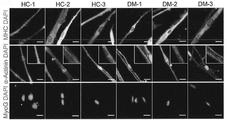
- a panel of fluorescence micrographs showing the expression of muscle differentiation markers in cells induced to differentiate from undifferentiated cells of HC-1-3 and DM-1-3 cells according to the procedure shown in FIG. 6A.
- the upper row is a fluorescence micrograph of a cell nucleus stained with an antibody against myosin heavy chain (MHC) and then counterstained with DAPI.
- the middle row is a fluorescence micrograph of a cell nucleus stained with an antibody against ⁇ -actinine and then counterstained with DAPI.
- the lower row is a fluorescence micrograph of a cell nucleus stained with an antibody against myogenin (MyoG) and then counterstained with DAPI.
- MyoG myogenin
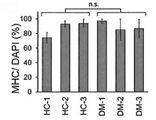
- the vertical axis represents the percentage of cell nuclei (MHC / DAPI) expressing the muscle differentiation marker MHC among the DAPI staining-positive cell nuclei induced to differentiate from undifferentiated cells. "N.s.” indicates that no significant difference is observed between HC-1 to 3 cells and DM-1 to 3 cells.
- a bar graph showing the proportion of ⁇ -actinin-expressing cells among muscle cells differentiated from HC-1 to 3 and DM-1 to 3 cells according to the procedure shown in FIG. 6A.
- the vertical axis represents the percentage of cell nuclei ( ⁇ -Actinin / DAPI) expressing the muscle differentiation marker ⁇ -actinin among the DAPI staining-positive cell nuclei induced to differentiate from undifferentiated cells.
- N.s. indicates that no significant difference is observed between HC-1 to 3 cells and DM-1 to 3 cells.
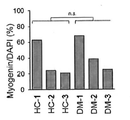
- a bar graph showing the proportion of myogenin-expressing cells among muscle cells differentiated from HC-1 to 3 and DM-1 to 3 cells according to the procedure shown in FIG. 6A.
- the vertical axis represents the percentage of cell nuclei (Myogenin / DAPI) expressing the muscle differentiation marker myogenin among the DAPI staining-positive cell nuclei induced to differentiate from undifferentiated cells.
- Myogenin / DAPI the muscle differentiation marker myogenin among the DAPI staining-positive cell nuclei induced to differentiate from undifferentiated cells.
- N.s. indicates that no significant difference is observed between HC-1 to 3 cells and DM-1 to 3 cells.
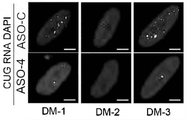
- FIG. 6G left shows the average number of RNA aggregates per cell nucleus calculated from the FISH results for each of the muscle cells differentiated from HC-1 to 3 and DM-1 to 3 cells according to the procedure shown in FIG. 6A.
- the right side of FIG. 6G shows the RNA aggregate in the whole cell nucleus detected by DAPI staining calculated from the FISH results for each of the muscle cells differentiated from HC-1 to 3 and DM-1 to 3 cells according to the procedure shown in FIG. 6A.
- the vertical axis represents the ratio of the number of cells in which the number of cells in the culture (United) to which ASO was not administered is 1.0.
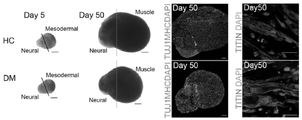
- Scale bar is 200 ⁇ m.
- a panel of composite images (scale bar 20 ⁇ m) of multicolor fluorescence micrographs of sections of neuromuscular organoids on day 50.
- the left side of the panel was stained with neuromuscular organoids with anti-myosin heavy chain (MHC) antibody, TUJ1 antibody (anti- ⁇ -tubulin III antibody), and DAPI.
- MHC myosin heavy chain
- TUJ1 antibody anti- ⁇ -tubulin III antibody
- the upper row is a neuromuscular organoid (HC) derived from a healthy person iPS cell
- the lower row is a neuromuscular organoid (DM) derived from a DM1 patient iPS cell.
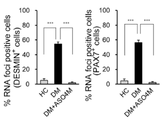
- the upper row is a composite image of the muscle compartment fluorescence micrograph of neuromuscular organoids stained with anti-desmin antibody, anti-PAX7 antibody and DAPI.
- the lower row is a composite image of a fluorescence micrograph of the muscle compartment of a neuromuscular organoid subjected to FISH and DAPI counterstaining using a Cy3-labeled (CAG) 6 -CA DNA / LNA probe.
- CAG Cy3-labeled
- the left is treated with a healthy person iPS cell-derived neuromuscular organoid (HC)
- the center is treated with a DM1 patient iPS cell-derived neuromuscular organoid (DM)
- the right is treated with ASO-4M (same as ASO-4).
- DM1 patient iPS cell-derived neuromuscular organoid (DM ASO-4M) is treated with 20 ⁇ m.
- the numbers are the mean ⁇ standard deviation (SD) obtained from the 5 organoids. "***" indicates that there is a significant difference between HC and DM and between DM and DM + ASO4M (independent two-sided t-test, p ⁇ 0.001).
- the upper row is a composite image of a muscle compartment fluorescence micrograph of a neuromuscular organoid stained with anti-MYOD antibody, anti-PAX7 antibody and DAPI in multiple colors.
- the lower row is a composite image of a muscle compartment fluorescence micrograph of neuromuscular organoids stained with anti-Ki67 antibody, anti-PAX7 antibody and DAPI.
- the left is treated with a healthy person iPS cell-derived neuromuscular organoid (HC)
- the center is treated with a DM1 patient iPS cell-derived neuromuscular organoid (DM)
- the right is treated with ASO-4M (same as ASO-4).
- the upper left is a bar graph showing the percentage of cells expressing PAX7 in all cells.
- the upper right is a bar graph showing the percentage of cells expressing MYOD in all cells.
- the lower left is a bar graph showing the percentage of cells expressing PAX7 in cells expressing MYOD.
- the lower right is a bar graph showing the percentage of cells expressing Ki67 among cells expressing PAX7.
- the numbers are the mean ⁇ standard deviation (SD) obtained from the 5 organoids. "***" indicates that there is a significant difference between HC and DM and between DM and DM + ASO4M (independent two-sided t-test, p ⁇ 0.001).
- HC phase-contrast micrograph
- DM1 phase-contrast micrograph of lens epithelial cells and lens fiber cells differentiated from DM1 patient iPS cells.
- the scale bar represents 100 ⁇ m.
- HC fluorescence micrograph
- DM1 fluorescence micrograph
- HC fluorescence micrograph
- DM1 fluorescence micrograph
- the scale bar represents 200 ⁇ m.
- HC fluorescence micrograph
- CAG Cy3-labeled 6 -CA DNA / LNA probe FISH and DAPI counterstains of lens epithelial cells and lens fiber cells differentiated from healthy iPS cells.
- DM1 fluorescence micrograph
- CAG Cy3-labeled
- LNA Cy3-labeled
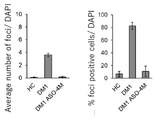
- the left is a bar graph showing the average number ⁇ standard deviation of RNA aggregates per cell nucleus calculated from the FISH results for each of HC, DM1 and DM1 + ASO-4M in FIG. 9C.
- the right is a bar graph showing the average ⁇ standard deviation of the percentage of RNA aggregates in all cells calculated from the FISH results for each of HC, DM1 and DM1 + ASO-4M in FIG. 9C.
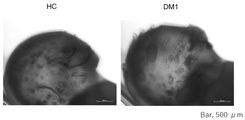
- On the left is a bright-field micrograph (HC) of skin organoids derived from healthy iPS cells after 4 months of culture under differentiation conditions.
- On the right is a bright-field micrograph (DM1) of skin organoids derived from iPS cells of DM1 patients.
- the scale bar represents 500 ⁇ m.
- HC fluorescence micrograph
- DM1 fluorescence micrograph
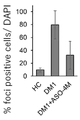
- FIG. 10B is a bar graph showing the average ⁇ standard deviation of the percentage of cells in which RNA aggregates in all cells are detected, calculated from the FISH results for HC, DM1 and DM1 + ASO-4M, respectively.
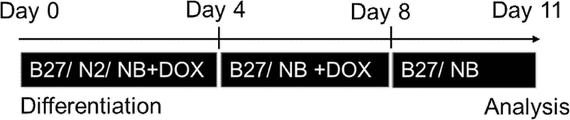
- the medium was changed to a nerve cell-inducing medium to start differentiation induction on the 0th day, and on the 8th day, nerves containing no differentiation-inducing agent.
- the medium was changed to a cell medium to complete the differentiation induction, and the analysis was performed on the 11th day. Fluorescence micrographs of neurons differentiated from DM1 patient-derived iPS cells stained with anti-tubulin ⁇ III antibody and subjected to DAPI counterstaining.
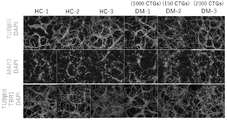
- the scale bar represents 100 ⁇ m.
- Neurons differentiated from iPS cells (HC-1 to 3) derived from healthy subjects and iPS cells (DM-1 to 3) derived from DM1 patients are subjected to anti-tubulin ⁇ III antibody (upper), anti-MAP2 antibody (middle) or anti.
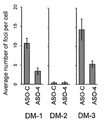
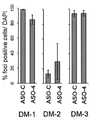
- the left is a bar graph showing the mean number ⁇ standard deviation of RNA aggregates per cell nucleus calculated from the FISH results for each of HC-1 to 3 and DM-1 to 3 in FIG. 11C.
- the right is a bar graph showing the average ⁇ standard deviation of the percentage of RNA aggregates in all cells calculated from the FISH results for HC-1 to HC-1 to HC-1 to DM-1 to 3 in FIG. 11C.
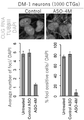
- Above left shows FISH using Cy3-labeled (CAG) 6 -CA DNA / LNA probe, staining with anti-tubulin ⁇ III antibody, and DAPI counterstaining for neurons derived from DM1 patient iPS cells treated with Control ASO.
- FIG. 11F Bar graph representing number ⁇ standard deviation (ASO-4M, Control ASO or United, respectively).
- the lower right is the average percentage of RNA aggregates in all cells of neurons derived from iPS cells of DM1 patients treated with ASO-4M or Control ASO or not treated with ASO, calculated from the FISH results on FIG. 11F. ⁇ Bar graph representing standard deviation (ASO-4M, Control ASO or United, respectively).
- the pharmaceutical composition of the present invention comprises an oligonucleotide having one of the base sequences of a cyclic sequence in which a cytosine-adenine-guanine trinucleotide repeats 5 to 13 times from the 5'end to the 3'end. , RNase H inactive nucleotide analog and / or has a mixmer structure containing at least two internucleotide linkages.
- nucleotide sequences of the oligonucleotides described herein are shown in SEQ ID NOs: 1 to 23 in the sequence listing attached herein. Of these sequences, the correspondence between the base sequence of the repetitive sequence in which the cytosine-adenine-guanine trinucleotide repeats 5 to 13 times from the 5'end to the 3'end and the SEQ ID NO: in the sequence listing attached herein. Is shown in Table 1.
- (CAG) n means an oligonucleotide having n trinucleotide repeats in which cytidine, adenosine and guanosine are linked in this order from the 5'end to the 3'end.
- n is an arbitrary integer from 5 to 13.
- the antisense oligonucleotides administered to iPS cells in the examples of the present specification are ASO-1 to 5, and the ASO used as a control is ASO-A to C.
- the nucleotide sequences of ASO-1 to 3, 4 and 5, respectively, are listed in SEQ ID NOs: 11 to 13, 3 and 14 of the sequence listing attached herein. Table 2 shows these base sequences and structural features.
- nucleotide to the right of the subscript "m” represents a 2'-O-methyl (hereinafter referred to as "2'-OMe”) nucleotide analog.
- 2'-OMe 2'-O-methyl
- ASOs, ASO-C, ASO-1 to 3 and ASO-5 are gapmers in which the nucleoside constituting the wing region is ENA and the nucleoside constituting the gap segment is DNA (hereinafter, "ENA / DNA gap”). It has a structure.
- ENA nucleoside constituting the gap segment
- all the nucleotides of the gapmer pair with the RNA of the DMPK gene of the muscle tonic dystrophy type 1 patient, and the nucleotides constituting the gap segment are DNA, so that the gapmer is described above.
- the gap segment portion becomes a heterodouble strand of DNA and RNA, so that it is degraded by RNase H.
- ASO-4 is an ENA in which a ⁇ -D-ENA-modified form of cytidine, 2'-OMe-adenosine, and 2'-OMe-guanosine are repeated 7 times in parallel from 5'to 3'in this order.
- 2'-O-methylribonucleotide mixmer (hereinafter referred to as "ENA / 2'-OMe ribonucleotide mixmer”) structure.
- ENA / 2'-OMe ribonucleotide mixmer 2'-O-methylribonucleotide mixmer
- the total length of the mixmer is paired with the repetitive sequence of the CUG trinucleotide in the RNA 3'UTR of the DMPK gene in a patient with myotonic dystrophy type 1, but since ASO-4 does not contain DNA, RNase H Not decomposed by.
- the ASO-C of the present invention is an oligonucleotide consisting of a non-specific sequence used in an inhibition experiment with an antisense oligonucleotide in another study (Hagemann, TL et al., Ann Neurol, 83: 27-39 (2016)).
- the wing region of the gapmer is 2'-O-methoxyethyl (hereinafter referred to as "MOE"), although the base sequence is the same as that of the gapmer and the gap segment of the gapmer is a deoxyribonucleotide. Whereas it is a nucleotide analog, the wing region of ASO-C used herein as a control differs in that it is ENA.
- Table 3 below is a table comparing the structures of the ASOs of the embodiments of the present invention with the ASOs of the related prior art. Since the ASO of the embodiment of the present invention has the same base sequence as the ASO of the related prior art, the base sequences of ASO-1 and PS115 are listed in SEQ ID NO: 11 of the sequence listing attached herein.
- the nucleotide sequences of ASO-2 and ASO-A (ISIS445569) are listed in SEQ ID NO: 12.
- the base sequences of ASO-3 and PS116 are listed in SEQ ID NO: 13.
- the base sequences of ASO-4 and ASO-B (PS58) are listed in SEQ ID NO: 3.
- the nucleotide sequences of ASO-5 and ISIS486178 are listed in SEQ ID NO: 14.
- the nucleotide sequence of Control ASO is listed in SEQ ID NO: 23.
- the nucleotide to the right of the subscript "e” represents a 2'-O-methoxyethyl (hereinafter referred to as "MOE") nucleotide analog.
- the nucleotide to the right of the subscript “E” represents ENA.
- the nucleotide to the right of the subscript “m” represents a 2'-OMe nucleotide analog.
- the subscript "s” indicates that the bond between the nucleoside on the left and the nucleotide on the right is not a phosphodiester bond but a phosphorothioate (hereinafter referred to as "PT”) bond. .. "MC” indicates 5-methylcytosine nucleoside.
- PS115 has the same base sequence as ASO-1. However, the bond between all nucleosides is a phosphodiester bond in ASO-1, whereas it is a PT bond in PS115, and ASO-1 is a gapmer whose wing region consists of ENA, whereas PS115. The difference is that they are all deoxyribonucleotides.
- ISIS 445569 (hereinafter, also referred to as "ASO-A") described in Non-Patent Documents 5 and 6.
- ISIS 445569 has the same base sequence as ASO-2 and is common in that it has a gapmer structure consisting of wing regions of the same length.
- the bond between all nucleosides is a phosphodiester bond in ASO-2, whereas it is a PT bond in ISIS 445569, and the wing region of the gapmer is ENA in ASO-2, whereas it is ENA in ISIS 445569.
- PS116 has the same base sequence as ASO-3 in common. However, the bond between all nucleosides is a phosphodiester bond in ASO-3, whereas it is a PT bond in PS116, and ASO-3 is a gapmer whose wing region consists of ENA, whereas PS115. The difference is that they are all deoxyribonucleotides.
- PS58 The prior art related to ASO-4 is PS58 described in Non-Patent Documents 7 and 8.
- PS58 (hereinafter, also referred to as "ASO-B") has the same base sequence as ASO-4, and all adenosine nucleotides and guanosine nucleotides are common in that they are OMe nucleotide analogs.
- PS58 differs in that cytidine nucleotides are also OMe nucleotide analogs, whereas in ASO-4 the cytidine nucleotides are ENA.
- PS58 is also different in that all internucleotide bonds are PT bonds, whereas all internucleotide bonds of ASO-4 are phosphodiester bonds.
- ISIS 486178 has the same base sequence as ASO-5, and has a common point that it has a gapmer structure consisting of wing regions of the same length. However, while ASO-5 is an ENA / DNA gapmer, ISIS 486178 consists of 6'-(S) -CH3 bicyclic (cEt) nucleotides in the wing region and unmodified deoxyribonucleotides in the gap region. It differs in that it is a gapmer (hereinafter referred to as "cEt / DNA gapmer").
- Table 4 shows a set of primers used for triplet repeat prime PCR (hereinafter referred to as "TP-PCR") analysis.
- the base sequence of each primer is listed in SEQ ID NOs: 15 to 22 in the sequence listing attached herein.
- FAM- in the sequence of primer FAM-P1-F in Table 4 means that 6-carboxyfluorescein is covalently attached to the 5'end of the primer oligonucleotide, which is the primer HEX-P2-R in Table 4.
- HEX- in the sequence means that hexachlorofluorescein is covalently attached to the 5'end of the primer oligonucleotide.
- the oligonucleotide according to the present invention has a mixmer structure that is not cleaved by RNase H.
- the "mixer structure” is a structure of a single-stranded oligonucleotide in which an RNase H active nucleotide and an RNase H inactive nucleotide are mixed, and the single-stranded oligonucleotide is paired with a complementary RNA.
- the heterodouble-stranded nucleic acid formed in combination refers to a structure that is not degraded by RNase H. Monia, B. P. According to (J. Biological.
- a gap region in which at least five RNase H active nucleotides are continuous is sandwiched between a wing region of an RNA H inactive nucleotide and a gapmer ASO.
- the degradation activity by RNase H on the hetero double-stranded nucleic acid with RNA complementary to the ASO exceeded 75%, but the gap region in which 4 or less RNase H active nucleotides were continuous was formed by the RNase H inactive nucleotide.
- the degradation activity by RNase H on the hetero double-stranded nucleic acid between the gapmer ASO sandwiched by the wing region and RNA complementary to the ASO was less than 20%.
- the oligonucleotide having the mixmer structure of the present invention may have 5 or 4 or less RNase H active nucleotides, for example, only 5 or 4, 3 or 2 consecutive oligonucleotides.
- “Mixmer ASO” or “Mixmer ASO” refers to an ASO having a mixmer structure.
- whether a particular type of nucleotide analog is RNase H active or RNase H inactive can be determined, for example, by the following procedure.
- a heteroduplex complex is prepared by pairing an oligonucleotide 300 picomols having the gapmer structure with an RNA 1500 picomols paired with the oligonucleotide.
- RNase H3.0 units in a reaction solution for RNase H such as 50 mM Tris-HCl (pH 8.0), 75 mM KCl, 3 mM MgCl 2 , and 10 mM dithiothreitol. Add to the solution to make a total volume of 150 ⁇ L, react at 37 ° C. for 60 minutes, and analyze the reaction product by agarose gel electrophoresis.
- EP 1 222 309 provides an in vitro method for determining RNase H activity that can be used to determine the ability to recruit RNase H.
- nucleoside monomers of the oligonucleotide contained in the pharmaceutical composition of the present invention are bound together via a nucleoside-interlinking group.
- each monomer is linked to a 3'adjacent monomer via a linking group.
- the 5'monomer at the end of the oligonucleotide may or may not contain a 5'terminal group or a linking group for conjugation, but does not contain a 5'linking group.
- linking group means a group capable of forming a dinucleotide by covalently linking two nucleosides.
- Natural nucleotides are linked by phosphodiester bonds via phosphate groups.
- Non-natural forms, i.e., modified nucleotide bonds include, but are not limited to, a phosphorothioate group, a phosphorodithioate group and a boranophosphate group.
- Internucleoside linkages can be used interchangeably with internucleotide linkages.
- oligonucleotides containing modified nucleotide bonds are more membrane permeable and more resistant to intracellular and extracellular nucleases than oligonucleotides linked solely by phosphodiester bonds.
- a hetero double-stranded nucleic acid formed by intracellular hybrid formation of an oligonucleotide containing a modified nucleotide bond and RNA an oligonucleotide and RNA linked only by a phosphodiester bond are hybrid-formed in the cell. It is degraded by RNase H in the same manner as the hetero double-stranded nucleic acid formed in the above process.
- a stereoisomer exists for a sulfur atom, such as a phosphorothioate group.
- the oligonucleotides contained in the pharmaceutical compositions of the present invention may be synthesized such that a modified nucleotide bond of a particular stereoisomer is used for a particular nucleotide-to-nucleotide linkage of an oligonucleotide, and some or all of the nucleotide-to-nucleotide linkages. It may be synthesized so as to be a racemic form.
- the oligonucleotide is (1) Oligonucleotides consisting of any of the nucleotide sequences of SEQ ID NOs: 1 to 9. (2) An oligonucleotide consisting of adenine-guanine, a base sequence of any of SEQ ID NOs: 1 to 9, and a base sequence of cytosine from the 5'end to the 3'end, or (3) An oligonucleotide consisting of a guanine, a base sequence of any of SEQ ID NOs: 1 to 9, and a base sequence of cytosine-adenine may be contained from the 5'end to the 3'end.
- the first oligonucleotide according to the embodiment of the pharmaceutical composition of the present invention that is, the "oligonucleotide consisting of the base sequence of any of SEQ ID NOs: 1 to 9" is citidine in the order of 5'end to 3'end.
- An oligonucleotide consisting of a base sequence in which adenosine and guanosine are linked and the number of trinucleotide repeats is 5 to 13 times.
- the second oligonucleotide according to the embodiment of the pharmaceutical composition of the present invention that is, "from the 5'end to the 3'end, adenin-guanine, the base sequence of any of SEQ ID NOs: 1 to 9, and cytosine.
- the "oligonucleotide consisting of a base sequence consisting of” is an oligonucleotide consisting of a base sequence having a trinucleotide repeat count of 6 to 14 in which adenosine, guanosine and citidine are linked in order from the 5'end to the 3'end.
- the third oligonucleotide according to the embodiment of the pharmaceutical composition of the present invention that is, "guanine from the 5'end to the 3'end, the base sequence of any of SEQ ID NOs: 1 to 9, and cytosine-adenine.
- the "oligonucleotide consisting of a base sequence consisting of” is an oligonucleotide consisting of a base sequence having a trinucleotide repeat count of 6 to 14 times in which guanine, cytosine and adenine are linked in this order from the 5'end to the 3'end.
- the RNase H inactive nucleotide analog is a nucleotide analog modified at the 2'position of ribose and / or the 2'and 4'positions of ribose. It may contain a nucleotide analog that has been cross-linked with.
- the 2'-modified nucleotide analog of ribose contained in the oligonucleotide of the above embodiment is a 2'-F nucleotide analog, a 2'-OMe-nucleotide analog, a MOE-nucleotide analog, 2'-( Includes, but is not limited to, 3-hydroxy) propyl nucleotide analogs and 2'-AP nucleotide analogs.
- the nucleotide analog in which the 2'position of ribose is modified is, for example, the following chemical formula (1) [in the formula, the substituent X bonded to the 2'position of ribose is a fluoro group, a methoxy group, or O-methoxyethyl. Selected from groups, 2'-(3-hydroxy) propyl group and 2'-(3-amino) propyl group, Z and Z * are independently selected from internucleotide linkage, R, terminal group or protective group. B is selected from natural or unnatural nucleotide base moieties (nucleic acid bases), and R is selected from hydrogen, hydroxyl groups, C 1-4 alkyl groups and C 1-4 alkoxy groups].
- the nucleotide analog in which the substituent X attached to the 2'position of ribose is a fluoro group is a 2'-F nucleotide analog, and the substituent X attached to the 2'position of ribose is a methoxy group.
- the nucleotide analog is a 2'-OMe-nucleotide analog, and the nucleotide analog in which the substituent X attached to the 2'position of ribose is an O-methoxyethyl group is a MOE-nucleotide analog, and the 2'position of ribose.
- a nucleotide analog in which the substituent X attached to is a 2'-(3-hydroxy) propyl group is a 2'-(3-hydroxy) propyl nucleotide analog, and the substituent X attached to the 2'position of ribose is 2.
- the nucleotide analog of the'-(3-amino) propyl group is the 2'-AP nucleotide analog.
- Nucleotide analogs in which the 2'-position and the 4'-position of ribose contained in the oligonucleotide of the above embodiment are cross-linked modified are oxy-LNA, thio-LNA, amino-LNA, 5'-methyl-LNA, and the like. Includes, but is not limited to, ENA, cEt and cMOE.
- the nucleotide analog in which the 2'-position and the 4'-position of ribose are cross-linked modified is called a locked nucleic acid or LNA because the conformation between the 2'-position and the 4'-position is locked. Be exposed. Alternatively, it is also called BNA or bicyclic nucleic acid because it is cross-linked. Nucleotide analogs cross-linked between the 2'and 4'positions of ribose include oxy-LNA, thio-LNA, amino-LNA, 5'-methyl-LNA, ENA, cEt and cMOE. ..
- oxy-LNA, thio-LNA, amino-LNA, 5'-methyl-LNA and ENA have ⁇ -D- and ⁇ -L-configuration stereoisomers
- cEt and cMOE have.
- R-type and S-type stereoisomers having a carbon atom as an asymmetric center that bridges between the 2'position and the 4'position of ribose.
- the nucleotide analog in which the 2'-position and the 4'-position of the ribose are cross-modified is, for example, a divalent atomic group bonded to the 2'-position of the ribose in the following chemical formulas (2) and (3).
- "-Y-" is "-O-", "-S-", “-CH 2 -S-", “-N (H)-", “-N ( Ra )-”, “-CH” Selected from 2 -N (H)-"and" -CH 2 -N (R a )-",
- Z and Z * are independently selected from internucleotide linkage, R b , terminal group, or protective group.
- B is selected from natural or unnatural nucleotide base moieties (nucleic acid bases), R a is independently selected from hydrogen and C 1-4 alkyl, and R b is hydrogen, hydroxyl, C 1-4 alkyl. It has a structure selected from a group and a C 1-4 alkoxy group.
- the ⁇ -D-configuration oxy-LNA, thio-LNA and amino-LNA are represented by the general formula (2), and the ⁇ -L-configuration oxy-LNA, thio-LNA and amino-LNA are the general formula (3). It is represented by.
- the nucleotide analog in which the divalent atomic group "-Y-" bound to the 2'position of ribose is "-O-" is oxy-LNA, and the 2'position of ribose.
- the divalent atomic group "-Y-” that binds to is thio-LNA, and the nucleotide analog of "-S-" or " -CH2 -S-” is divalent that binds to the 2'position of ribose.
- the nucleotide analog selected is amino-LNA.
- the 5'-methyl-LNA in the ⁇ -D-configuration is represented by the following chemical formula (4), and the 5'-methyl-LNA in the ⁇ -L-configuration is represented by the following chemical formula (5).
- the ENA of the ⁇ -D-configuration is represented by the following chemical formula (6)
- the ENA of the ⁇ -L-configuration is represented by the following chemical formula (7).
- R-type cEt and cMOE are represented by the following general formula (8)
- S-type cEt and cMOE are represented by the following general formula (9).
- W is selected from a methyl group and a methoxymethyl group
- Z and Z * are internucleotide linkages
- R R is hydrogen, hydroxyl group, C 1-4 alkyl group and C 1 ).
- B has a structure selected from natural or unnatural nucleotide base moieties (nucleic acid bases).
- the nucleotide analog in which W is a methyl group is cEt
- the nucleotide analog in which W is a methoxymethyl group is cMOE.
- the nucleotide analog modified with the oxygen atom at the 2'position of ribose is a 2'-OMe-nucleotide analog and / or a MOE-nucleotide analog. It may be included.
- the nucleotide analog in which the 2'-position and the 4'-position of ribose are cross-linked modified is ⁇ -D-oxy-L-LNA, ⁇ -D-. It may contain ENA and / or R-type cEt.
- all the 2'-modified nucleotide analogs of ribose can have the same modified sugar.
- the 2'-modified nucleotide analog of ribose can have at least two different modified sugars.
- all nucleotide analogs cross-linked between the 2'and 4'positions of ribose can have the same modified sugar.
- the nucleotide analogs cross-linked between the 2'and 4'positions of ribose can have at least two different modified sugars.
- the nucleotide analog in which the oxygen atom at the 2'position of ribose contained in the oligonucleotide is modified is a 2'-OMe-nucleotide analog and / or. It can be a MOE-nucleotide analog.
- the substituent X that binds to the 2'position of ribose is a methoxy group
- the base B is a nucleotide analog of adenine, guanine, thymine or cytosine.
- the substituent X bonded to the 2'position of ribose is an O-methoxyethyl group
- the base B is a nucleotide analog of adenine, guanine, thymine or cytosine.
- the nucleotide analog in which the ribose at the 2'-position and the 4'-position contained in the oligonucleotide is cross-linked and modified is LNA, ENA and / or cEt. can do.
- all the 2'-modified nucleotide analogs of ribose can have the same modified sugar. That is, in the nucleotide analog in which the 2'-position of ribose contained in the oligonucleotide is modified, the substituent attached to the 2'-position of ribose is any one of a fluoro group, a methoxy group or an O-methoxyethyl group. Can be a type.
- the 2'-modified nucleotide analog of ribose can have at least two different modified sugars. That is, in the nucleotide analog in which the 2'-position of ribose is modified contained in the oligonucleotide, the substituent bonded to the 2'-position of ribose is composed of a fluoro group, a methoxy group and an O-methoxyethyl group. It can be two or three types to be selected.
- nucleotide analogs cross-linked between the 2'and 4'positions of ribose can have the same modified sugar. That is, the nucleotide analog in which the 2'-position and the 4'-position of the ribose contained in the oligonucleotide are cross-linked and modified can be any one of LNA, ENA or cEt.
- the nucleotide analogs cross-linked between the 2'and 4'positions of ribose can have at least two different modified sugars. That is, the nucleotide analogs contained in the oligonucleotide in which the ribose positions 2'and 4'are crosslinked and modified are two or three types selected from the group consisting of LNA, ENA and cEt. be able to.
- the oligonucleotide can include ⁇ -D-ENA-cytidine, 2'-OMe-adenosine and 2'-OMe-guanosine.
- all cytidines of said oligonucleotides are ⁇ -D-ENA-cytidines
- all adenosines are 2'-OMe-adenosine
- all guanosines are 2'. It can be -OMe-guanosine.
- the oligonucleotide contained in the pharmaceutical composition of the invention is at least one selected from the group consisting of phosphorothioate, phosphorodithioate and boranophosphate. It may contain nucleotide linkages.
- the pharmaceutical composition of the invention may comprise a pharmaceutically acceptable carrier or diluent.
- a carrier that can be contained in the pharmaceutical composition of the present invention a person skilled in the art can appropriately select a carrier suitable for such a situation.
- Selectable carriers include, for example, preservatives such as sodium benzoate, sodium hydrogen sulfite, methylparaben, propylparaben, and pH adjusters such as sodium dihydrogen phosphate, anhydrous sodium monohydrogen phosphate, citric acid, and sodium citrate.
- isotonic agents such as glucose, sodium chloride and potassium chloride, and divalent ion regulators such as calcium chloride and magnesium chloride.
- these carriers are not limited to being used for the purpose of exerting a single action, and can be used for the purpose of exerting a plurality of actions.
- Diluents that can be included in the pharmaceutical composition of the present invention include, but are not limited to, liquids such as phosphate buffered saline.
- the pharmaceutical composition of the invention may comprise a cell membrane permeation and / or nuclear delivery carrier, wherein the cell membrane permeation and / or nuclear delivery carrier is present. It can bind or associate with an oligonucleotide according to the pharmaceutical composition of the invention.
- the carrier for cell membrane permeation and / or nuclear delivery may contain a peptide.
- Peptides as cell membrane permeation carriers include, for example, oligoarginine such as octaarginine, basic peptides derived from the Tat protein of HIV-1, and cell membrane permeability such as basic helix peptides derived from the antennapedia homeodomain protein of Drosophila. Contains, but is not limited to, peptides.
- the peptide as a carrier for nuclear delivery includes, for example, a peptide derived from SV40 virus large T antigen, c-myc, nucleoplasmin, etc., which is a nuclear localization signal that specifically binds to importin. , Not limited to these.
- the carrier for cell membrane permeation and / or nuclear delivery may contain peptide mimetics.
- Peptide mimetics as a carrier for cell membrane permeation and / or nuclear delivery is a synthetic compound that mimics the structure of the peptide as a carrier for cell membrane permeation and / or nuclear delivery, and is used in the pharmaceutical composition of the present invention. It refers to one that binds to or associates with such an oligonucleotide to promote cell membrane permeation and / or nuclear delivery.
- Peptide mimetics as a carrier for cell membrane permeation and / or nuclear delivery comprises all or a part of the peptide as a carrier for cell membrane permeation and / or nuclear delivery with a heterocycle, a cyclic compound, and an unnatural amino acid.
- D-amino acids and compounds other than natural peptides such as equivalents of various functional groups.
- the carrier for cell membrane permeation and / or nuclear delivery may contain cationic polymers of DEAE dextran, polyereneimine (PEI) and polypropyleneimine (PPI).
- PEI polyereneimine
- PPI polypropyleneimine
- the carrier for cell membrane permeation and / or nuclear delivery may contain lipids.
- the lipid as a carrier for cell membrane permeation and / or nuclear delivery is 1,2-dimyristyl-sn-glycero-3-phosphatidylcholine (DMPC), 1 , 2-Dipalmityl-sn-glycero-3-phosphatidylcholine (DPPC), 1,2-distearoyl-SN-glycero-3-phosphatidylcholine (DSPC), 1-palmitoyle-2-myristoyl-SN-glycero-3-phosphatidylcholine (PMPC), 1-stearoyl-2-myristoyl-SN-glycero-3-phosphatidylcholine (SMPC), soybean-derived hydrogenated lecithin (HSPC), 1-stearoyl-2-oleyl-sn-glycero-3-phosphatidylcholine (SOPC) ), 1-Palmitoil-2-oleyl-sn
- the carrier for cell membrane permeation and / or nuclear delivery may contain lipitoid.
- Lipidoids as the cell membrane permeation and / or nuclear delivery carrier are the peptide and / or peptide mimetics as the cell membrane permeation and / or nuclear delivery carrier and the cell membrane permeation and / or nuclear delivery carrier. Refers to a synthetic compound in which a lipid as a covalent bond is linked.
- the carrier for cell membrane permeation and / or nuclear delivery may include liposomes.
- the liposome as a carrier for cell membrane permeation and / or nuclear delivery is a lipid membrane structure dispersed in an aqueous solvent, and refers to a lipid membrane structure in which an aqueous solvent is encapsulated.
- the lipid membrane of the liposome may be a one-layer or a plurality of layers of a lipid bilayer membrane or a lipid multiplex membrane. Liposomes may be particulate or reticulated.
- the lipid component of the liposome may include, but is not limited to, the lipid as a carrier for cell membrane permeation and / or nuclear delivery.
- the lipid component of the liposome may include lipidoids as the carrier for cell membrane permeation and / or nuclear delivery.
- the liposome as a carrier for cell membrane permeation and / or nuclear delivery can enclose the oligonucleotide according to the pharmaceutical composition of the present invention therein.
- the carrier for cell membrane permeation and / or nuclear delivery may contain lipid nanoparticles (LNP).
- LNP lipid nanoparticles
- the lipid nanoparticles as a carrier for cell membrane permeation and / or nuclear delivery are composed of the same lipid as the lipid component of the liposome and the oligonucleotide according to the pharmaceutical composition of the present invention.
- Lipid nanoparticles may include pH-sensitive lipids that are positively charged in a low pH environment, such as 1,2-diorail-3-dimethylammonium propane (DODAP).
- DODAP 1,2-diorail-3-dimethylammonium propane
- lipid nanoparticles have a single lipid membrane and have a core structure filled with lipids rather than encapsulating an aqueous solvent inside.
- the lipid nanoparticles as a carrier for cell membrane permeation and / or nuclear delivery can contain the oligonucleotide according to the pharmaceutical composition of the present invention in the
- the pharmaceutical composition of the invention comprises subcutaneous administration, intravenous administration, intraarterial administration, intramuscular administration, intraperitoneal administration, intracranial administration and intrathecal administration. It can be delivered by at least one parenteral administration selected from the group.
- the administration may be continuous or long-term, short-term or intermittent.
- the pharmaceutical composition of the present invention is at least 30 days, at least 35 days, at least 40 days, at least 45 days, at least 50 days, at least 55 days, at least 60 days, at least 65 days, at least 70 days, at least 75 days after administration.
- CUG-RNA aggregate formation for at least 80 days, at least 85 days, at least 90 days, at least 95 days, at least 100 days, at least 105 days, at least 110 days, at least 115 days, at least 120 days, or at least one year.
- Downregulation and / or intracellular levels of CUG-RNA or DMPK protein 50%, 55%, 60%, 65%, 70%, 75%, 80%, 85%, 90%, 95% or 100 Brings a% reduction.
- the administration form of the pharmaceutical composition of the present invention may be, for example, oral administration using tablets, capsules, granules, powders, syrups and the like.
- These formulations are excipients (eg, sugar derivatives such as lactose, sucrose, grape sugar, mannitol, sorbitol; starch derivatives such as corn starch, potato starch, alpha starch, dextrin; cellulose derivatives such as crystalline cellulose; Arabic gum; dextran; organic excipients such as purulan: and silicate derivatives such as light anhydrous silicic acid, synthetic aluminum silicate, calcium silicate, magnesium aluminometasilicate; phosphates such as calcium hydrogen phosphate; carbonic acid.
- excipients eg, sugar derivatives such as lactose, sucrose, grape sugar, mannitol, sorbitol
- starch derivatives such as corn starch, potato starch, alpha starch, dextrin
- lubricants eg, metal stearate such as stearic acid, calcium stearate, magnesium stearate.
- Salts starch; colloidal silica; waxes such as bee gum and gay wax; boric acid; adipic acid; sulfates such as sodium sulfate; glycols; fumaric acid; sodium benzoate; DL leucine; fatty acid sodium salts; sodium lauryl sulfate, Lauryl sulfates such as magnesium lauryl sulfate; silicic acids such as anhydrous silicic acid and silicic acid hydrate; and the starch derivatives mentioned above can be mentioned), binders (eg, hydroxypropyl cellulose, hydroxypropyl methyl cellulose, polyvinyl).
- binders eg, hydroxypropyl cellulose, hydroxypropyl methyl cellulose, polyvinyl
- Pyrrolidone, macrogol, and compounds similar to the above excipients can be mentioned), disintegrants (eg, low substitution hydroxypropyl cellulose, carboxy group methyl cellulose, carboxy group methyl cellulose calcium, internal crosslinked carboxy group methyl cellulose sodium).
- disintegrants eg, low substitution hydroxypropyl cellulose, carboxy group methyl cellulose, carboxy group methyl cellulose calcium, internal crosslinked carboxy group methyl cellulose sodium.
- Cellulosic derivatives such as; carboxy group methyl starch, carboxy group methyl starch sodium, chemically modified starches and celluloses such as crosslinked polyvinylpyrrolidone can be mentioned
- stabilizers paraoxy such as methylparaben, propylparaben).
- Benzoic acid esters alcohols such as chlorobutanol, benzyl alcohol, phenylethyl alcohol; benzalconium chloride; phenols such as phenol, cresol; timerosal; dehydroacetic acid; and sorbic acid.
- a flavoring agent for example, commonly used sweeteners, acidulants, fragrances and the like
- other additives are used to produce the starch by a well-known method.
- the active ingredient contained in the pharmaceutical composition of the present invention is the oligonucleotide (for cell membrane permeation and / or nuclear delivery when a carrier for cell membrane permeation and / or nuclear delivery is bound or associated with the oligonucleotide).
- the ratio of the active ingredient contained in the pharmaceutical composition of the present invention can be appropriately set within a range in which the desired effect can be obtained, but is usually 0.01 to 100% by weight, preferably 0.1. It is ⁇ 99.9% by weight, more preferably 0.5-99.5% by weight.
- the dose at which the pharmaceutical composition of the present invention is administered must be carefully adjusted in consideration of the age, body weight and condition of the individual being treated and the route of administration, mode of administration and method of administration, and the exact dose. Must be determined by the doctor.
- the actual dosage is within the discretion of the physician and may vary by setting the dose for the particular circumstances of the invention in order to obtain the desired therapeutic effect.
- the dose of the pharmaceutical composition of the present invention is not unconditionally defined depending on the type of the active ingredient, the body weight and age of the subject to be administered, symptoms, etc., but for example, in the case of parenteral administration, In the case of one oral administration of 0.001 mg / kg body weight (preferably 0.01 mg / kg body weight) as the lower limit and 100 mg / kg body weight (preferably 10 mg / kg body weight) as the upper limit per administration.
- the subject of administration of the pharmaceutical composition of the present invention is a patient with myotonic dystrophy type 1 disease.
- the effect of eliminating RNA aggregates was more remarkable in DM-1 and 3 cells than in DM-2 cells. Therefore, a patient having a large number of repetitions of the CTG sequence of the DMPK gene is the pharmaceutical composition of the present invention. It is preferable as a target for administration of a substance.
- the desired therapeutic effect used in determining the selection of the active ingredient, carrier, dose and dosage of the pharmaceutical composition of the present invention is the clinical symptom of myotonia dystrophy type 1 disease (myotonia phenomenon (prolongation of muscle contraction state)).
- myotonia / atrophy cataract, retinal degeneration, cardiac conduction disorder, myocardial disorder, gastrointestinal symptoms such as swallowing, constipation, diabetic, etc. associated with myotonia disorder, higher brain dysfunction, glucose tolerance disorder, hyperinsulinemia , Diabetes, testicular atrophy, endocrine disorders such as abnormal growth hormone secretion, and skin symptoms such as hyperlipidemia, hair matrix tumor, epithelioma) are most important to suppress and / or alleviate the progression.
- pharmacodynamic biomarkers formation of RNA aggregates in DMPK and / or reduction and / or elimination of deregulation of RNA-binding molecules, including CUG-BP1 and MBNL1 are also available. It can be used to determine the selection of the active ingredient, carrier, dosage and dosage of the pharmaceutical composition of the present invention.
- the pharmaceutical composition of the present invention is percutaneously administered, intraocularly administered, intrathecal administration, intramucosal administration of the gastrointestinal tract, submucosal administration of the gastrointestinal tract, subcutaneous administration, intravenous administration, intraarterial administration, intramuscular administration, intraperitoneal administration. It can be delivered by any one or more parenteral administrations selected from the group consisting of intracranial and intrathecal administration.
- the pharmaceutical composition of the present invention also comprises eye tissues including skeletal muscle, myocardium, smooth muscle, satellite cells, crystalline body, retina, etc., gastrointestinal tract from esophagus to colon, central nervous system and peripheral nervous system, depending on the clinical symptoms of the patient. Administration can be targeted to tissues including, but not limited to, nerves of the nervous system, pancreas, adrenal gland, pituitary gland and endocrine tissues involved in their control, skin tissues, and the like.
- the assay system of the present invention comprises undifferentiated cells of iPS cells established from a human suffering from myotonic dystrophy type 1 disease and a compound to be evaluated. And include.
- the compounds to be evaluated include oligonucleotides that target the RNA of myotonic dystrophy protein kinase in myotonic dystrophy type 1 disease.
- the adnominal adjective "about” that modifies a numerical value means that the numerical value is in the numerical range of 90% or more and 110% or less of the numerical value.
- “about 40 bases” refers to a base in a numerical range of 36 bases or more and 44 bases or less.
- Example 1 Establishment of iPS cells derived from muscle tonic dystrophy patients (1.1) Materials and methods Peripheral blood units collected from 3 muscle tonic dystrophy type 1 patients in the experimental group and 2 healthy subjects in the control group. SOX2, KLF4, OCT4, L-MYC, LIN28, p53 carboxyl-terminal dominant negative fragment and EBNA1 are encoded using nuclear fibroblasts (PBMC) cells and skin fibroblasts collected from one healthy subject in the control group as starting cells. IPS cells were generated by reprogramming with an episomal vector (Okita, K. et al., Stem Cells, 31: 458-466 (2013)).
- iPS cells were prepared from Nakagawa, M. et al. On a culture vessel coated with iMatrix-511 (892012, Nippi Co., Ltd., Tokyo). Cultured and maintained in StemFit® medium (AK02N, Ajinomoto Co., Inc., Tokyo) as described by et al. (Sci Rep, 4: 3594 (2014)).
- TP-PCR The analysis by TP-PCR in the examples of the present specification was performed as follows. Genomic DNA of iPS cells was extracted using the PureLink TM Genome DNA Minikit (Invitrogen, Thermo Fisher Scientific, Waltham, Mass., USA), and Singh, S. et al. Et al. (Front Genet, 5: 94 (2014)) and Non-Patent Document 1 (Chakraborty, S. et al., Currant Polymers in Human Genetics, 91: 9.29.1-9.29.19. (2016)). It was subjected to TP-PCR analysis. The base sequences of the primers used in the TP-PCR analysis are shown in Table 4 above.
- the immunocytochemical analysis in the examples of the present specification was performed as follows. Cells were fixed in PBS containing 4% paraformaldehyde (Nacalai Tesque, Kyoto) for 20 minutes at room temperature, blocking buffer (5% Blocking One (Nacalai Tesque)) and 0.2% Triton-X100 (Nacalai Tesque). Incubated in PBS) containing). A list of sources and dilutions of the primary and secondary antibodies used in the examples herein is shown in Table 5 below. The primary antibody was reacted with the cells at 4 ° C. for 16 hours in the blocking buffer, and the secondary antibody was reacted at room temperature for 1 hour. The nuclei were stained with DAPI. Images were acquired using the Opera Phoenix TM High Content Screening System (PerkinElmer, Waltham, Mass.) Or BZ-X710 microscope (Keyence, Osaka, Japan).
- the ability to differentiate into mesoderm was tested by whether smooth muscle cells expressing smooth muscle actin differentiated.
- the ability to differentiate into endoderm was tested by whether or not the embryonic germ layer cells expressing SOX17 differentiated.
- the ability to differentiate into ectoderm was tested by whether motor neurons expressing ⁇ III-tubulin differentiate.
- the outline is shown in Table 6 below. Individual details are shown in the examples using each differentiated cell.
- Fluorescence in situ hybridization (hereinafter referred to as "FISH") using a Cy3-labeled (CAG) 6 -CA DNA / LNA probe was performed to detect nuclear RNA aggregates.
- the cells were cultured on a transparent bottom microplate (CellCarrier-96 Ultra, PerkinElmer), fixed in 4% paraformaldehyde at room temperature for 30 minutes, permeabilized with 70% ethanol at -30 ° C for at least 2 hours, and then subjected to membrane permeation treatment. It was rehydrated with 1 ⁇ SSC solution prepared with diethyl carbonate (DEPC) water and incubated at 55 ° C. for 2 hours in a hybridization pretreatment buffer [2 ⁇ SSC prepared with DEPC water and 50% formamide].
- DEPC diethyl carbonate
- the cells were then incubated overnight with a hybridization buffer [2 x SSC, 50% formamide, 10% dextrin sulfate and 0.1 ng / ⁇ L Cy3-labeled (CAG) 6 -CA DNA / LNA probe (GeneDesign, Inc., Osaka)]. Incubated at 55 ° C. (de Mezer, M. et al., Nuclear Acids Res, 39: 3852 (2011)). The cells were washed twice with the hybridization pretreatment buffer at 55 ° C. for 20 minutes and twice with a 1 ⁇ SSC solution prepared with DEPC water at room temperature for 5 minutes. The cells were further incubated with 1 ⁇ SSC prepared in DEPC water for 60 minutes at 37 ° C.
- a hybridization buffer [2 x SSC, 50% formamide, 10% dextrin sulfate and 0.1 ng / ⁇ L Cy3-labeled (CAG) 6 -CA DNA / LNA probe (GeneDesign, Inc., Osaka)
- iPS cells derived from 3 DM1 patients in the experimental group and 3 healthy subjects in the control group were named DM-1 to 3 and HC-1 to 3, respectively. No mycoplasma contamination was detected in cell culture.
- Table 7 shows the starting cells of DM-1 to 3 and HC-1 to 3, the sex and age of the donor, the number of repetitions of the CTG sequence analyzed by Southern blotting, the number of repetitions of the sequence, and the induction vector of pluripotent stem cells. Is shown.
- PBMC means peripheral blood mononuclear cells.
- FIG. 1A is a panel of micrographs showing the expression of undifferentiated pluripotent stem cell markers DM-1-3 and HC-1-3.
- the top row is a phase-contrast micrograph of the undifferentiated cell culture of each iPS cell
- the second row is the monolayer culture of the undifferentiated cell of each iPS cell stained with an antibody against NANOG, and the cell nucleus is contrast-stained with DAPI.
- It is a fluorescence micrograph taken.
- the third stage is a fluorescence micrograph in which a monolayer culture of undifferentiated cells of each iPS cell was stained with an antibody against OCT4, and the cell nuclei were counterstained with DAPI.
- the fourth stage is a fluorescence micrograph in which a monolayer culture of undifferentiated cells of each iPS cell was stained with an antibody against SSEA4, and the cell nuclei were counterstained with DAPI.
- the fifth stage is a fluorescence micrograph in which a monolayer culture of undifferentiated cells of each iPS cell was stained with an antibody against TRA-1-60, and the cell nuclei were counterstained with DAPI.
- the scale bar at the bottom right of each micrograph represents 200 ⁇ m.
- both DM-1 to 3 and HC-1 to 3 are human undifferentiated embryonic stem cell-like cells in which cells adhere closely to each other and the boundaries of individual cells cannot be distinguished by a phase-contrast microscope. The morphology of is shown.
- DM-1 to 3 and HC-1 to 3 all express the markers of human iPS undifferentiated cells, NANOG, Oct4, SSEA4 and TRA-1-60, and characterize human iPS undifferentiated cells. I was prepared.
- FIG. 1B is a panel of micrographs showing the expression of trigerm differentiation markers in cells differentiated from DM-1-3 and HC-1-3.
- the first stage is a fluorescence micrograph in which cells differentiated from each iPS cell into mesoderm were stained with an antibody against ⁇ -smooth muscle actin (SMA), and the cell nuclei were counterstained with DAPI.
- the second stage is a fluorescence micrograph in which cells differentiated into endoderms from each iPS cell are stained with an antibody against SOX17, and the cell nuclei are counterstained with DAPI.
- SMA ⁇ -smooth muscle actin
- the third stage is a fluorescence micrograph in which cells differentiated from each iPS cell into an ectoderm were stained with an antibody against ⁇ III-tubulin, and the cell nuclei were counterstained with DAPI.
- the scale bar at the bottom right of each fluorescence micrograph represents 50 ⁇ m.
- DM-1 to 3 and HC-1 to 3 are all mesoderm cells ( ⁇ -smooth muscle actin), endoderm cells (SOX17) and ectoderm cells ( ⁇ III-tube). Lin) Showed the ability to differentiate into all. Therefore, it was proved that both iPS1 to 3 and HC-1 to 3 are pluripotent human iPS undifferentiated cells.
- FIG. 1C is a capillary electrophoresis diagram of the reaction products of TPPCR of DM-1 to 3 and HC-1 to 3. As shown in FIG. 1C, the number of repetitions of the CTG repeats of the DMPK genes DM-1 to 3 and HC-1 to 3 is inconsistent with the number of repetitions of the donor genomic DNA analyzed by Southern blotting shown in Table 7. I didn't.
- FIG. 2 shows fluorescence of fluorescence in situ hybridization (hereinafter referred to as “FISH”) using a Cy3-labeled (CAG) 6 -CA DNA / LNA probe for iPS (DM-3) cells derived from a DM1 patient. It is a panel of micrographs.
- the upper left or lower left is the result of performing FISH without RNase A treatment, and the upper right and lower right are the results of performing FISH after RNase A treatment.
- the upper left and upper right are fluorescence micrographs in which cell nuclei are counterstained with DAPI after FISH, and the lower left and lower right are fluorescence micrographs with only FISH and no DAPI staining.
- the bright spots observed when FISH was performed without RNase A treatment were no longer observed when FISH was performed after RNase A treatment. From this experimental result, it was shown that the bright spot is a signal of CUG-RNA aggregate (CUG-RNA foci) hybridized with the probe.
- FIG. 3A is a panel of fluorescence micrographs of the results of FISH using Cy3-labeled (CAG) 6 -CA DNA / LNA probes on each of the undifferentiated cells DM-1 to 3 and HC-1 to 3. Is.
- the upper right corner of each photo is a high-magnification fluorescence micrograph of one nucleus.
- the scale bar at the bottom right of each fluorescence micrograph represents 10 ⁇ m.
- FIG. 3B The left side of FIG. 3B is a bar graph showing the average number of RNA aggregates per cell nucleus calculated from the FISH result of FIG. 3A.
- the right side of FIG. 3B is a bar graph showing the percentage of RNA aggregate-positive cell nuclei detected by DAPI staining, calculated from the FISH results of FIG. 3A. “**” indicates that there is a significant difference between the values of HC-1 to 3 and the values of DM-1 to 3 (p ⁇ 0.01).
- RNAs as shown in FIG. 3B.
- the number of aggregates was as high as 3.32 ⁇ 0.23 (mean ⁇ standard deviation) for DM-1 and 1.87 ⁇ 0.23 for DM-3.
- DM-2 (more than 150 times), which had a small number of CTG sequence iterations, had a significantly smaller number of RNA aggregates of 0.078 ⁇ 0.009 (p ⁇ 0.01).
- the iPS derived from the DM1 patient created this time has the basic characteristics of pluripotent stem cells and reproduces the cell phenotype of myotonic dystrophy type 1 patients. rice field.
- FIG. 4A shows the relative sequences of ASO complementary sequences of the present example on DMPK-pre mRNA. It is a schematic diagram which shows the positional relationship and also shows the structure type of ASO.
- ASO-1 to 3 are complementary to the sequence of the non-coding region of exon 15 on DMPK-pre mRNA
- ASO-4 is complementary to the repetitive sequence of the CUG sequence of the non-coding region of exon 15 on DMPK-mRNA.
- ASO-5 is complementary to the sequence on the 3'end side of the repetitive sequence of the non-coding region of exon 15 on pre DMPK-mRNA.
- ASO-4 is a mixmer consisting of ENA and 2'-OMe-nucleotide analogs, while the other ASO-1 to 3 and 5 are gapmers consisting of ENA in the wing region and unmodified deoxyribonucleotides in the gap region (hereinafter). , "ENA / DNA gapmer").
- ASO-C used as a negative control in the examples of the present specification is an ENA / DNA gapmer that targets a transcript of a gene completely different from DMPK.
- FIG. 5A shows the relative positional relationship between ASO-2 and 4 of the examples of the present application and the corresponding control ASO-A and B on the DMPK-pre mRNA of the complementary sequence, and also shows the structure of ASO. It is a schematic diagram which shows the type. ASO-2 and ASO-A are complementary to the same sequence of exon 15 coding region on DMPK-mRNA, and ASO-4 and ASO-B are CUG sequences of exon 15 non-coding region on DMPK-mRNA. Complementary to the same sequence of repeats.
- ASO-2 is an ENA / DNA gapmer
- ASO-A is a gapmer consisting of a MOE-nucleotide analog in the wing region and an unmodified deoxyribonucleotide in the gap region (hereinafter referred to as "MOE / DNA gapmer").
- ASO-4 is a mixmer consisting of ENA and 2'-O-Me-nucleotide analogs
- ASO-B has 2'-O-Me-nucleotide analogs (RNase H inactive nucleotides) in which all nucleotides are 2'-O-Me-nucleotide analogs. Consists of.
- ASO-1-5 and ASO-A-C are shown in Tables 2 and 3 in the detailed description of the invention herein.
- the nucleotide sequences of ASO-1 to 4 and 5 are listed in SEQ ID NOs: 11 to 14 and 3 of the sequence listing attached herein, respectively.
- the base sequence of ASO-A is listed in SEQ ID NO: 10.
- ASO-A and B have the same base sequence as ASO-1 and 5, respectively.
- ENA was obtained from KNC Laboratories Co., Ltd. (Kobe) and synthesized oligonucleotides.
- ASOs administered to cultured iPS cells was performed with ASOs at a final concentration of 5 or 10 nM with DharmaFECT1 (Horizon Discovery, Cambridge, UK) according to the manufacturer's instructions. 48 hours after administration of ASO to cultured iPS cells, FISH was performed using a Cy3-labeled (CAG) 6 -CA DNA / LNA probe.
- FIG. 4B shows Cy3-labeled (CAG) 6 48 hours after administration of either ASO-C or ASO-1-5 to undifferentiated iPS cells (DM-1) derived from DM1 patients.
- DM-1 undifferentiated iPS cells
- FIG. 4C shows RNA aggregation per cell nucleus calculated from FISH results of undifferentiated iPS cells (DM-1) derived from DM1 patients treated with either 5 nM or 10 nM ASO-C and ASO-1-5. It is a bar graph showing the average number of aggregates.
- FIG. 4D shows all detected by DAPI staining calculated from FISH results of undifferentiated iPS cells (DM-1) derived from DM1 patients treated with either 5 nM or 10 nM ASO-C and ASO-1-5. It is a bar graph which shows the percentage of the RNA aggregate positive cell nucleus in a cell nucleus.
- RNA aggregates As shown in FIGS. 4B to D, all of ASO-1 to 5 significantly reduced RNA aggregates of undifferentiated iPS cells derived from DM1 patients.
- ASO-5 In ASO-1 to 3 and 5 of the ENA / DNA gapmer, ASO-5 most strongly suppressed the formation of RNA aggregates (FIGS. 4C and D). RNA aggregates completely disappeared when iPS cells were treated with a mixmer ASO-4 consisting of ENA and 2'-OMe-nucleotide analogs targeting CUG repeats (FIGS. 4B-D).
- FIG. 4E is a bar graph showing the proliferation and survival status of undifferentiated iPS cells (DM-1) derived from DM1 patients treated with either 5 nM or 10 nM ASO-C and ASO-1-5.
- the vertical axis represents the ratio of the number of cells in which the number of cells of ASO-C is 1.0.
- ASO-1, 4 and 5 do not affect the proliferation and survival of undifferentiated iPS cells at either 5 nM or 10 nM, but when ASO-2 and 3 are administered, the cells are administered even at low doses. Caused a decline in numbers.
- ASO-2 and ASO-A target sequences on the same DMPK-mRNA.
- ASO-2 is an ENA / DNA gapmer
- ASO-A is a MOE / DNA gapmer.
- ASO-A was reported under the code name ISIS 445569 (Non-Patent Document 5 (Wheeler, TM et al., Nature, 488, 111 (2012))).
- ASO-4 and ASO-B target sequences on the same DMPK-mRNA.
- ASO-4 is a mixmer consisting of ENA and 2'-OMe-nucleotide analogs
- ASO-B is a mixmer consisting of 2'-OMe-nucleotide analogs in all nucleotides. .. ASO-B was reported under the code name PS58 (Non-Patent Document 7 (Mulders, SA et al., Proc Natl Acad Sci USA, 106: 13915 (2009))). Therefore, ASO-A and B were prepared this time and used as positive controls for ASO-2 and 4, respectively.
- FIG. 5B shows a comparison of FISH and DAPI using a Cy3-labeled (CAG) 6 -CA DNA / LNA probe after administration of ASO-2 or ASO-A to undifferentiated iPS cells (DM-1) derived from a DM1 patient. It is a fluorescence micrograph which was stained. The scale bar at the bottom right of each fluorescence micrograph represents 10 ⁇ m.
- FIG. 5C left shows RNA per cell nucleus calculated from FISH results for undifferentiated iPS cells (DM-1) derived from DM1 patients treated with 5 nM or 10 nM ASO-2, ASO-A or ASO-C. It is a bar graph showing the average number of aggregates.
- DM-1 derived from DM1 patients treated with 5 nM or 10 nM ASO-2, ASO-A or ASO-C It is a bar graph which shows the percentage of the RNA aggregate positive cell nucleus in a cell nucleus.
- 5C is a bar graph showing the proliferation and survival status of undifferentiated iPS cells (DM-1) derived from DM1 patients treated with 5 nM or 10 nM ASO-2, ASO-A or ASO-C.
- the vertical axis represents the ratio of the number of cells in which the number of cells of ASO-C is 1.0.
- FIG. 5D shows FISH and DAPI contrasts using Cy3-labeled (CAG) 6 -CA DNA / LNA probes after administration of ASO-4 or ASO-B to undifferentiated iPS cells (DM-1) from DM1 patients. It is a fluorescence micrograph which was stained. The scale bar at the bottom right of each fluorescence micrograph represents 10 ⁇ m.
- FIG. 5E left shows RNA aggregation per cell nucleus calculated from FISH results of undifferentiated iPS cells (DM-1) derived from DM1 patients treated with 5 nM or 10 nM ASO-4, ASO-B or ASO-C. It is a bar graph showing the average number of aggregates.
- 5E is a bar graph showing the proliferation and survival status of undifferentiated iPS cells (DM-1) derived from DM1 patients treated with 5 nM or 10 nM ASO-4, ASO-B or ASO-C.
- the vertical axis represents the ratio of the number of cells in which the number of cells of ASO-C is 1.0.
- ASO-A reduced RNA aggregates without reducing the number of undifferentiated iPS cells, whereas ASO-2 reduced RNA aggregates but not.
- the number of differentiated iPS cells was also reduced. Therefore, the effect of ASO-2 is considered to be due to cytotoxicity.
- both ASO-4 and ASO-B reduced RNA aggregates without reducing the number of undifferentiated iPS cells at both 5 nM and 10 nM, and thus ASO-4 and ASO-B.
- the effect of is not due to cytotoxicity.
- ASO-4 exerts a significantly superior RNA aggregate suppressing effect than ASO-B in which more than half of the RNA aggregates remain, in that RNA aggregates are almost completely eliminated.
- the difference between ASO-B and ASO-4 is that ASO-4 is a mixmer consisting of ENA and 2'-OMe-nucleotide analogs, whereas ASO-B has all nucleotides 2'-OMe-.
- Example 3 Differentiation of muscle cells from iPS cells derived from patients with myotonic dystrophy (3.1) Materials and methods The method for differentiating muscle cells from undifferentiated iPS cells established in the examples of the present invention is as follows. be. Tet-On Inducible MyoD Expression System (Non-Patent Document 22, Shoji, E. et al., Sci Rep, 5, 12831 (2015)) and puromycin resistance marker KW110_PB_TA_ERN (Addgene, Massachusetts, USA) Incorporated in.
- the prepared vector was subjected to DM1 patient-derived iPS cells (DM-1 to 3) together with a pCyL43 vector encoding transfection using Lipofectamine LTX (Thermo Fisher Scientific Co., Ltd.) according to the manufacturer's instructions.
- Undifferentiated cells of iPS cells (HC-1 to 3) derived from healthy subjects were cotransfected.
- iPS cell clones were selected using puromycin (Nacalai Tesque, Inc.).
- iPS cells were seeded on Matrigel-coated cell culture vessels in StemFit medium supplemented with 10 ⁇ M Rock inhibitor Y27632 (Nakalitesk Co., Ltd.), cultured for 2 days, and then the medium was 5% KnockOut TM.
- FIG. 6A shows the differentiation of iPS cells (DM-1 to 3) derived from DM1 patients and iPS cells (HC-1 to 3) derived from healthy subjects from undifferentiated cells to muscle cells using a tetracycline-induced MyoD expression system.
- iPS cells DM-1 to 3 derived from DM1 patients and iPS cells (HC-1 to 3) derived from healthy subjects from undifferentiated cells to muscle cells using a tetracycline-induced MyoD expression system.
- StemFit represents the period of culturing in a medium for undifferentiated iPS cells
- KSR / ⁇ -MEM represents the period of culturing in a medium for differentiated muscle cells
- KSR / ⁇ -MEM + Dox represents a period of culturing.
- the tetracycline-induced MyoD expression system was transfected into undifferentiated iPS cells, and on the 2nd day, the medium was changed to a muscle cell medium supplemented with a differentiation-inducing agent to start differentiation induction, and on the 8th day, differentiation induction was started.
- the medium was changed to a medium for muscle cells containing no differentiation-inducing agent, differentiation induction was completed, and analysis was performed on the 12th day.
- the cells differentiated from undifferentiated cells of DM-1 to 3 and HC-1 to 3 into muscle cells were analyzed using the immunocytochemical method described in Example 1 and the method for detecting nuclear RNA aggregates. ..
- FIG. 6B shows differentiation induction from undifferentiated cells of iPS cells (HC-1 to 3) derived from healthy subjects and iPS cells (DM-1 to 3) derived from DM1 patients according to the procedure shown in FIG. 6A. It is a panel of fluorescence micrographs showing the expression of muscle differentiation markers in the cells.
- the upper row is a fluorescence micrograph of a cell nucleus stained with an antibody against myosin heavy chain (MHC) and then counterstained with DAPI.
- the middle row is a fluorescence micrograph of a cell nucleus stained with an antibody against ⁇ -actinine and then counterstained with DAPI.
- the lower row is a fluorescence micrograph of a cell nucleus stained with an antibody against myogenin (MyoG) and then counterstained with DAPI.
- MHC myosin heavy chain
- MyoG myogenin
- skeletal muscle cells expressing myosin heavy chain (MHC), ⁇ -actinin and myogenin using the tetracycline-induced MyoD expression system for both HC-1 to 3 and DM-1 to 3. It has become possible to induce differentiation into.
- FIG. 6C is a bar graph showing the percentage of cell nuclei (MHC / DAPI) expressing MHC among muscle cells differentiated from undifferentiated cells of HC-1 to 3 and DM-1 to 3 cells according to the procedure shown in FIG. 6A. be. "N.s.” indicates that no significant difference is observed between HC-1 to 3 cells and DM-1 to 3 cells.
- FIG. 6D shows the muscle differentiation marker ⁇ -actinine-expressing cell nuclei ( ⁇ -) among the DAPI-stained positive cell nuclei of muscle cells differentiated from undifferentiated cells of HC-1 to 3 and DM-1 to 3 cells according to the procedure shown in FIG. 6A. It is a bar graph which shows the percentage of Actinin / DAPI). "N.s.” indicates that no significant difference is observed between HC-1 to 3 cells and DM-1 to 3 cells.
- FIG. 6E shows a cell nucleus expressing the muscle differentiation marker myogenin among the DAPI staining-positive cell nuclei of muscle cells induced to differentiate from undifferentiated cells of HC-1 to 3 and DM-1 to 3 cells according to the procedure shown in FIG. 6A. It is a bar graph which shows the percentage of Myogenin / DAPI). "N.s.” indicates that no significant difference is observed between HC-1 to 3 cells and DM-1 to 3 cells.
- muscle cells differentiated from HC-1 to 3 and DM-1 to 3 cells according to the procedure shown in FIG. 6A were subjected to FISH using a Cy3-labeled (CAG) 6 -CA DNA / LNA probe.
- the scale bar at the bottom right of each fluorescence micrograph represents 10 ⁇ m.
- FIG. 6G left shows the average number of RNA aggregates per cell nucleus calculated from the FISH results for each of the muscle cells differentiated from HC-1 to 3 and DM-1 to 3 cells according to the procedure shown in FIG. 6A. It is a bar graph to represent.
- the right side of FIG. 6G shows the RNA aggregate in the whole cell nucleus detected by DAPI staining calculated from the FISH results for each of the muscle cells differentiated from HC-1 to 3 and DM-1 to 3 cells according to the procedure shown in FIG. 6A. It is a bar graph showing the percentage of the aggregate-positive cell nucleus. “**” indicates that there is a significant difference between the values of HC-1 to 3 and the values of DM-1 to 3 (p ⁇ 0.01).
- FIG. 6F shows Cy3-labeled (CAG) 6 -CA DNA / LNA probes for muscle cells differentiated from HC-1-3 and DM-1-3 cells according to the procedure shown in FIG. 6A. It is a panel of the fluorescence micrograph of the result of performing FISH used. The scale bar at the bottom right of each fluorescence micrograph represents 10 ⁇ m.
- FIG. 6G left shows the average number of RNA aggregates per cell nucleus calculated from the FISH results for each of the muscle cells differentiated from HC-1 to 3 and DM-1 to 3 cells according to the procedure shown in FIG. 6A. It is a bar graph to represent.
- the right side of FIG. 6G shows the RNA aggregate in the whole cell nucleus detected by DAPI staining calculated from the FISH results for each of the muscle cells differentiated from HC-1 to 3 and DM-1 to 3 cells according to the procedure shown in FIG. 6A. It is a bar graph showing the percentage of the aggregate-positive cell nucleus. “**” indicates that there is a significant difference between the values of HC-1 to 3 and the values of DM-1 to 3 (p ⁇ 0.01).
- RNA aggregates were detected in muscle cells derived from iPS cells (DM-1 to 3) derived from DM1 patients. Comparing the graphs of FIGS. 3B and 6G, the percentage of RNA aggregate-positive cell nuclei in whole cell nuclei was significantly different between undifferentiated DM-1 to 3 cells and DM-1 to 3 derived muscle cells. However, the average number of RNA aggregates per cell nucleus is between undifferentiated DM-1 and 3 cells (2-3.5) and DM-1 and 3-derived muscle cells (11-16). There is a very big difference in. Almost no RNA aggregates were detected in DM-2-derived muscle cells.
- FIG. 7A shows FISH and DAPI counterstains using a Cy3-labeled (CAG) 6 -CA DNA / LNA probe after administration of 10 nM ASO-C or ASO-4 to DM-1 to 3 derived muscle cells by lipofection. It is a panel of the fluorescence micrograph which was performed.
- FIG. 7B is a bar graph showing the average number of RNA aggregates per cell nucleus calculated from the FISH results of DM-1 to 3 cell-derived muscle cells administered with 10 nM ASO-C or ASO-4.
- FIG. 7C shows the percentage of RNA aggregate-positive cell nuclei detected by DAPI staining, calculated from the FISH results of DM-1 to 3 cell-derived muscle cells administered with 10 nM ASO-C or ASO-4. It is a bar graph showing (assuming 100% of ASO-C-administered muscle cells).
- FIG. 7D is a bar graph showing the proliferation and survival status of DM-1 to 3 cell-derived muscle cells administered with 10 nM ASO-C or ASO-4.
- the vertical axis represents the ratio of the number of cells with the number of cells of ASO-C as 1.0.
- the average number of RNA aggregates per cell nucleus in DM-1 and 3-cell-derived muscle cells was significantly reduced by the administration of ASO-4 as compared with ASO-C.
- Administration of ASO-4 showed almost no change in the average number of RNA aggregates per cell nucleus in DM-2 cell-derived muscle cells. This may be related to the fact that DM-2 cells were derived from patients with a low number of repeats of the CTG sequence of the DMPK gene.
- the DM-2 cell donor has a maximum of 150 CTG sequence iterations, and the DM-1 and 3 cell donors have a CTG sequence iteration count of 1000 to 1000, respectively. Very few compared to 1150 and 2300-2850. Therefore, it is considered that the effect of RNA aggregate reduction by ASO-4 administration is less likely to be manifested in DM-2 cells as compared with DM-1 and 3 cells.
- ASO-4 can reduce RNA aggregates in DM1 patient iPS cell-derived skeletal muscle cells.
- Example 5 Differentiation of Neuromuscular Organoids from iPS Cells Derived from Myotonic Dystrophy Patients (5.1) Materials and Methods Neuromuscular organoids are described in Faustino Martins, J. Mol. M. et al. The protocol published by (Cell Stem Cell, 26: 172-186 e176. (2020)) was prepared with some modifications. Schematically shown in the schematic diagram of FIG. 8A, 70% confluent iPS cells were dissociated into single cells and 10 ⁇ M Y27632, 3 ⁇ M CHIR99021 (Tocris Bioscience) and 40 ng / mL FGF-2 (Wako) were added.
- NB Neurobasal
- NB is Advanced Dulbecco's Modified Medium F12 (Gibco) supplemented with 1 ⁇ N2 (Gibco), 1 ⁇ B27 (Gibco), 2 mM L-glutamine (Gibco), 75 ⁇ g / mL BSA fraction V (Gibco). It was a 1: 1 mixture with Neurobasal medium (Gibco) supplemented with Sigma) and 0.1 mM 2-mercaptoethanol (Gibco).
- NMPs neural mesoderm progenitor cells
- mNMPs were dissociated with Accumax (Innovative Cell Technologies), and 50 ⁇ M Y27632, 10 ng / mL FGF-2, 2 ng / mL IGF and 2 ng / mL HGF (Peprotech) were added per well. 4,500 to 7,200 NMPs suspended in 100 ⁇ L of NB medium were seeded on a PrimeSurfce 96-well plate.
- NB medium supplemented with 2 ng / mL IGF and 2 ng / mL HGF.
- the organoid was maintained in NB medium.
- the organoids were transferred to a 60 mm culture dish and on the 30th day, they were transferred to a 100 mm culture dish.
- Organoids were swirled at 75 rpm and replaced with fresh NB medium twice weekly.
- ASO treatment of organoids the organoids were swirled and cultured in NB medium containing 500 nM ASO.
- Organoids were fixed in 4% paraformaldehyde at room temperature for 15 minutes, washed 3 times in PBS for 10 minutes and subsided in 30% sucrose solution overnight. Organoids were embedded in OCT compound (Sakura Finetech Japan Co., Ltd., Tokyo) and snap frozen in liquid nitrogen. Frozen organoids were prepared into frozen sections with a thickness of 12 ⁇ m using a cryostat (CM1850, Leica Microsystems, Wetzlar, Germany) at -18 ° C to -20 ° C.
- CM1850 Leica Microsystems, Wetzlar, Germany
- sections were permeabilized in 0.5% Triton-X100 / PBS (0.5% PBST) at room temperature for 30 minutes and incubated in Blocking One Hist (Nacalai Tesque) at room temperature for 2 hours. did. Sections were incubated with the primary antibody in a blocking solution at 4 ° C. overnight. After washing 4 times with 0.1% PBST for 15 minutes each, the sample was incubated with the secondary antibody at room temperature for 2 hours in the dark. The samples were then washed 4 times with 0.1% PBST for 15 minutes each and mounted with ProLong TM Gold Antifade Mountain (Thermo Fisher Scientific). Data were acquired using a confocal laser scanning microscope (Nikon A1, Nikon, Tokyo). NIS-Element AR Analysis (version 5.11.0.1, Nikon) was used for image analysis.
- the three-dimensional aggregate grew into an organoid containing the neural region and the mesoderm region by the 5th day, and by the 50th day, the NMOs had a neuron-rich neural compartment expressing TUJ1.
- a skeletal muscle compartment with abundant MHC-expressing cells was observed.
- the expression of the sarcomere protein TITIN was observed in the skeletal muscle fibers from the immunofluorescence analysis of the muscle region of NMOs on the 50th day.
- muscle progenitor cells / satellite cells expressing PAX7 were observed along the muscle cells expressing desmin and muscle ducts in the skeletal muscle compartment of the organoid.
- RNA aggregates were detected in both PAX7-expressing cells and desmin-expressing cells.
- Example 6 Evaluation of ASO using iPS cells derived from DM1 patients (3) Neuromuscular organoids (6.1) Materials and methods Differentiation of neuromuscular organoids from iPS cells derived from healthy subjects and myotonic dystrophy patients, and organoids The immunohistochemical examination of the above was carried out in the same manner as in Example 5. In order to detect nuclear RNA aggregates, FISH using a Cy3-labeled (CAG) 6 -CA DNA / LNA probe was performed in the same manner as in Example 1. For ASO treatment of organoids, the organoids were swirled and cultured for 7 days in NB medium containing 500 nM ASO.
- CAG Cy3-labeled
- the number of muscle progenitor cells / satellite cells expressing PAX7 was significantly reduced in the neuromuscular organoids derived from DM1 patients as compared with the neuromuscular organoids derived from healthy subjects.
- the ratio of the number of muscle-differentiating cells expressing MYOD to the total number of cells, and the ratio of the number of cells expressing Ki67 to the number of muscle progenitor cells / satellite cells expressing PAX7 was that of DM1 patients. There was no change with healthy people. These results suggested that the neuromuscular organoids of DM1 patients had a decrease in satellite cells, but were restored to the same level as the neuromuscular organoids of healthy subjects by ASO-4M treatment.
- DM1-specific nuclear RNA aggregate formation could be detected in both desmin-expressing muscle cells and PAX7-expressing muscle progenitor cells / satellite cells. It was also revealed that the cells expressing PAX7 were reduced in the neuromuscular organoids of DM1 patients. It was suggested that the action of RNA of DMPK in which the repetitive sequence of the CUG sequence was extended may affect the whole process of skeletal muscle differentiation from the behavior of satellite cells to the formation of muscle fibers. Therefore, the experimental system of three-dimensional muscle organoid culture can provide a new aspect as an in vitro disease model.
- Example 7 Differentiation of lens epithelial cells and lens fiber cells from iPS cells derived from patients with myotonic dystrophy (7.1) Materials and methods The lens epithelial cells and lens fiber cells are referred to as Fu, in the references listed in Table 6. Q. et al. It was prepared from undifferentiated iPS cells based on (Invest Opthalmol Vis Sci. 58: 517-527 (2017)). First, about 80 iPS cell colonies of about 20 each were seeded and cultured in mTesR medium (Stemcell, Vancouver, Canada) on a culture dish coated with Matrigel.
- mTesR medium StemTesR medium
- iPS cells Four hours after plating, iPS cells were induced via the 100 ng / ml BMP inhibitor noggin and ectoderm / neuroectoderm until epithelial-like cells first appeared around the colony on day 6 of culture. Was induced to differentiate into. Approximately 50 differentiated iPS cells were then mechanically separated along with surrounding epithelial-like cells, and 30-50 differentiated iPS cell colonies were selected and reseeded in Matrigel-coated culture dishes. The BMP signal was then reactivated via its agonists BMP4 and BMP7 (20 ng / ml). At the same time, bFGF (100 ng / ml) activated the fibroblast growth factor signal.
- lens epithelial cells and lens fiber cells were confirmed using ⁇ A-crystallin as a marker. Immunocytochemical detection of the anti- ⁇ A-crystallin antibody was performed in the same manner as in Example 1. In addition, iPS cell-derived cultures containing cells differentiated into lens epithelial cells and lens fiber cells were analyzed using the method for detecting nuclear RNA aggregates described in Example 1.
- FIG. 9A is a phase-contrast micrograph of iPS cell-derived lens epithelial cells and lens fiber cells (HC and DM1, respectively) of healthy subjects and DM1 patients.
- the scale bar in FIG. 9A represents 100 ⁇ m.
- FIG. 9B is a fluorescence micrograph of iPS cell-derived lens epithelial cells and lens fiber cells (HC and DM1 respectively) of healthy subjects and DM1 patients stained with anti- ⁇ A-crystallin antibody, and further stained with DAPI to contrast cell nuclei. be.
- the scale bar in FIG. 9B represents 200 ⁇ m. From FIG. 9B, it was confirmed that the flat cells observed in FIG. 9A are lens epithelial cells and lens fiber cells because they express ⁇ A-crystallin.
- FIG. 9C is a fluorescence micrograph of iPS cell-derived lens epithelial cells and lens fiber cells (HC and DM1 respectively) of healthy subjects and DM1 patients subjected to FISH and DAPI counterstaining. No RNA aggregates were detected in HC, but RNA aggregates were observed in DM1.
- Example 8 Evaluation of ASO using iPS cells derived from DM1 patients (4) Lens epithelial cells and lens fiber cells (8.1) Materials and methods The lens epithelial cells and lenses derived from iPS cells of DM1 patients described in Example 7 Forty-eight hours after administration of 10 nM ASO to the fibrous cells by lipoffection, FISH was performed using a Cy3-labeled (CAG) 6-CA DNA / LNA probe in the same manner as in Example 7.
- CAG Cy3-labeled
- RNA aggregates were detected in lens epithelial cells and lens fiber cells (DM1) derived from iPS cells of DM1 patients, but RNA aggregates were almost eliminated when treated with ASO-4M. It disappeared.
- the graph on the left of FIG. 9D is a bar graph showing the mean number ⁇ standard deviation of RNA aggregates per cell nucleus calculated from the FISH results for each of HC, DM1 and DM1 + ASO-4M in FIG. 9C.
- Treatment with ASO-4M markedly reduced the average number of RNA aggregates per cell nucleus in DM1 patient cell-derived lens epithelium and fibroblasts.
- the graph on the right of FIG. 9D is a bar graph showing the mean ⁇ standard deviation of the percentages of RNA aggregates in all cells calculated from the FISH results for each of HC, DM1 and DM1 + ASO-4M in FIG. 9C.
- ASO-4M treatment significantly reduced the percentage of cells in which RNA aggregates were detected relative to the total number of lens epithelium and fibrous cells derived from DM1 patient cells. From the above results, it was concluded that ASO-4M treatment can also reduce RNA aggregates in lens epithelium and fibroblasts derived from DM1 patient cells.
- Example 9 Differentiation of skin organoids from iPS cells derived from patients with myotonic dystrophy (9.1) Materials and methods Skin organoids are described in Lee, J. et al. et al. It was created based on (Nature, 582: 399-404. (2020)).
- IPS cells derived from DM1 patients and healthy subjects were dissociated using Accutase and suspended in Ethential 8 Flex (Gibco) medium (hereinafter referred to as E8-20Y medium) supplemented with 20 ⁇ M Y27632 and 100 ⁇ g / ml Normocin.
- E8-20Y medium Ethential 8 Flex
- E6 medium The medium (hereinafter referred to as E6 medium) was transferred to a new round-bottomed 96-well plate together with 100 ⁇ L per well to initiate differentiation into skin organoids.
- E6 medium The medium (hereinafter referred to as E6 medium) was transferred to a new round-bottomed 96-well plate together with 100 ⁇ L per well to initiate differentiation into skin organoids.
- 75 ⁇ L of fresh E6 medium was added to bring the final volume to 200 ⁇ L.
- Half of the medium was replaced on days 8 and 10.
- OMM organoid maturation medium
- the 24-well plates were placed in an orbital shaker shaking at a rate of 65 rpm in a 37 ° C. incubator containing 5% CO2 to suspend and culture the aggregates to maintain constant medium circulation.
- OMM is 1X GlutaMax TM (Gibco), 0.5X B-27 Minus Vitamin A (Gibco), 0.5X in a medium in which Advanced DMEM / F12 (Gibco) and Neurobasal (Gibco) are mixed at a ratio of 1: 1.
- the differentiation of skin organoids was confirmed by the formation of hair follicle structure.
- frozen sections of skin organoids were analyzed using the method for detecting nuclear RNA aggregates in the same manner as in Example 5.
- FIG. 10A hair follicle structures were formed on iPS cell-derived skin organoids (HC and DM1, respectively) of healthy subjects and DM1 patients after 4 months of culture under differentiation conditions.
- FIGS. 10B and C RNA aggregates were detected in the iPS cell-derived skin organoid sections of DM1 patients after 4 months of culture, but the RNA aggregates were detected in the iPS cell-derived skin organoid sections of healthy subjects. Not detected.
- Example 10 Evaluation of ASO using iPS cells derived from DM1 patients (5) Skin organoids (10.1) Materials and methods Differentiation of skin organoids from iPS cells derived from healthy subjects and patients with myotonic dystrophy, and nuclear RNA In order to detect aggregates, FISH using a Cy3-labeled (CAG) 6 -CA DNA / LNA probe was performed in the same manner as in Example 9. For ASO treatment of organoids, the organoids were swirled and cultured in NB medium containing 500 nM ASO-4M.
- CAG Cy3-labeled
- FIG. 10C is a bar graph showing the mean ⁇ standard deviation of the percentage of cells in which RNA aggregates in whole cells are detected, calculated from the FISH results for each of HC, DM1 and DM1 + ASO-4M in FIG. 10B. From FIG. 10C, it was confirmed that the formation of RNA aggregates in skin organoids derived from DM1 patient iPS cells was significantly reduced by ASO-4M treatment.
- FIG. 11A shows the differentiation of iPS cells (DM-1 to 3) derived from DM1 patients and iPS cells (HC-1 to 3) derived from healthy subjects from undifferentiated cells to neurons using a tetracycline-induced NGN2 expression system. It is a conceptual diagram which shows the procedure of an experimental system. As shown in FIG.
- FIG. 11B is a fluorescence micrograph of neurons differentiated from DM1 patient-derived iPS cells stained with an anti-tubulin ⁇ III antibody and subjected to DAPI counterstaining.
- the scale bar represents 100 ⁇ m.
- the procedure of this example uniformly obtains neurons expressing tubulin ⁇ III and having elongated nerve axons.
- FIG. 11C shows neurons differentiated from iPS cells (HC-1 to 3) derived from healthy subjects and iPS cells (DM-1 to 3) derived from DM1 patients with anti-tubulin ⁇ III antibody (upper) and anti-MAP2 antibody (upper).
- DM1 patient-derived iPS cells differentiate into neurons without much difference from healthy subject-derived iPS cells.
- FIG. 11D shows Cy3-labeled (CAG) 6 -CA DNA / LNA probes for neurons differentiated from iPS cells (HC-1-3) derived from healthy subjects and iPS cells (DM-1-3) derived from DM1 patients. It is a fluorescence micrograph which performed the FISH and DAPI counterstaining used. From FIG. 11D, as in Examples 2 and 3, among the iPS cells derived from DM1 patients, the neurons derived from iPS cells DM-2 are more RNA aggregate cell nuclei than the neurons derived from iPS cells DM-1 and DM-3. The average number of RNA aggregates per cell and the percentage of RNA aggregates in all cells are significantly lower. Unlike Examples 2 and 3, the average number of RNA aggregates per cell nucleus of RNA aggregates in neurons derived from iPS cells DM-1 and DM-3 and the percentage of RNA aggregates in all cells are almost different. I could't see it.
- Example 12 Evaluation of ASO using iPS cells derived from DM1 patients (5) Neurons (12.1) Materials and methods 10 nM by lipofection on the 8th day of induction of differentiation into neurons derived from iPS cells of DM1 patients described in Example 11. ASO was administered, and on the 11th day, FISH using a Cy3-labeled (CAG) 6 -CA DNA / LNA probe was performed in the same manner as in Example 7.
- CAG Cy3-labeled
- FIG. 11F shows FISH using a Cy3-labeled (CAG) 6 -CA DNA / LNA probe for iPS cells (DM-1) derived from DM1 patients treated with Control ASO, and counterstain. It is a synthetic image (Control) of the fluorescence micrograph which performed the staining with the tubulin ⁇ III antibody and the DAPI counterstaining.
- the upper right of FIG. 11F shows FISH using a Cy3-labeled (CAG) 6 -CA DNA / LNA probe for iPS cells (DM-1) derived from DM1 patients treated with ASO-4M (same as ASO-4).
- undifferentiated iPS cells derived from DM1 patients and skeletal muscle cells, crystalline epithelial cells, crystalline fiber cells, neurons differentiated from the iPS cells by the ASO treatment of the present invention nuclear RNA aggregates could be reduced in neuromuscular and cutaneous organoids.
- ASO treatment was able to restore satellite cells reduced by neuromuscular organoids derived from DM1 patients to the same extent as neuromuscular organoids derived from healthy subjects. Therefore, the pharmaceutical composition of the present invention is useful for the treatment of diseases including myotonic dystrophy type 1 disease.
- the iPS cells of the present invention or cells and organoids differentiated from the cells are not limited to myotonic dystrophy type 1 diseases, but are therapeutic ASO assay systems for all other triplet diseases for which ASO treatment is effective. It is useful as.
Landscapes
- Health & Medical Sciences (AREA)
- Life Sciences & Earth Sciences (AREA)
- Engineering & Computer Science (AREA)
- Chemical & Material Sciences (AREA)
- Genetics & Genomics (AREA)
- Biomedical Technology (AREA)
- Organic Chemistry (AREA)
- Bioinformatics & Cheminformatics (AREA)
- General Health & Medical Sciences (AREA)
- Biotechnology (AREA)
- Molecular Biology (AREA)
- Wood Science & Technology (AREA)
- Zoology (AREA)
- Biochemistry (AREA)
- Veterinary Medicine (AREA)
- Public Health (AREA)
- Animal Behavior & Ethology (AREA)
- Pharmacology & Pharmacy (AREA)
- Medicinal Chemistry (AREA)
- General Engineering & Computer Science (AREA)
- General Chemical & Material Sciences (AREA)
- Microbiology (AREA)
- Chemical Kinetics & Catalysis (AREA)
- Neurology (AREA)
- Orthopedic Medicine & Surgery (AREA)
- Nuclear Medicine, Radiotherapy & Molecular Imaging (AREA)
- Physical Education & Sports Medicine (AREA)
- Epidemiology (AREA)
- Biophysics (AREA)
- Plant Pathology (AREA)
- Physics & Mathematics (AREA)
- Developmental Biology & Embryology (AREA)
- Transplantation (AREA)
- Cell Biology (AREA)
- Pharmaceuticals Containing Other Organic And Inorganic Compounds (AREA)
Priority Applications (3)
| Application Number | Priority Date | Filing Date | Title |
|---|---|---|---|
| JP2022571599A JP7834290B2 (ja) | 2020-12-22 | 2021-12-22 | 医薬組成物 |
| US18/258,991 US20240052345A1 (en) | 2020-12-22 | 2021-12-22 | Pharmaceutical composition |
| EP21910927.9A EP4268830A4 (en) | 2020-12-22 | 2021-12-22 | PHARMACEUTICAL COMPOSITION |
Applications Claiming Priority (2)
| Application Number | Priority Date | Filing Date | Title |
|---|---|---|---|
| JP2020213000 | 2020-12-22 | ||
| JP2020-213000 | 2020-12-22 |
Publications (1)
| Publication Number | Publication Date |
|---|---|
| WO2022138787A1 true WO2022138787A1 (ja) | 2022-06-30 |
Family
ID=82159838
Family Applications (1)
| Application Number | Title | Priority Date | Filing Date |
|---|---|---|---|
| PCT/JP2021/047754 Ceased WO2022138787A1 (ja) | 2020-12-22 | 2021-12-22 | 医薬組成物 |
Country Status (4)
| Country | Link |
|---|---|
| US (1) | US20240052345A1 (https=) |
| EP (1) | EP4268830A4 (https=) |
| JP (1) | JP7834290B2 (https=) |
| WO (1) | WO2022138787A1 (https=) |
Families Citing this family (1)
| Publication number | Priority date | Publication date | Assignee | Title |
|---|---|---|---|---|
| EP4117718A4 (en) * | 2020-03-09 | 2024-05-08 | University of Houston System | INFLAMMATORY BOWEL DISEASE (IBD)-ASSOCIATED STEM CELLS, AGENTS TARGETING IBD-ASSOCIATED STEM CELLS AND RELATED USES THEREOF |
Citations (1)
| Publication number | Priority date | Publication date | Assignee | Title |
|---|---|---|---|---|
| EP1222309A1 (en) | 1999-09-30 | 2002-07-17 | Isis Pharmaceuticals, Inc. | Human rnase h and oligonucleotide compositions thereof |
Family Cites Families (1)
| Publication number | Priority date | Publication date | Assignee | Title |
|---|---|---|---|---|
| WO2011097614A1 (en) * | 2010-02-08 | 2011-08-11 | Isis Pharmaceuticals, Inc. | Mehods and compositions useful in diseases or conditions related to repeat expansion |
-
2021
- 2021-12-22 EP EP21910927.9A patent/EP4268830A4/en active Pending
- 2021-12-22 JP JP2022571599A patent/JP7834290B2/ja active Active
- 2021-12-22 WO PCT/JP2021/047754 patent/WO2022138787A1/ja not_active Ceased
- 2021-12-22 US US18/258,991 patent/US20240052345A1/en active Pending
Patent Citations (1)
| Publication number | Priority date | Publication date | Assignee | Title |
|---|---|---|---|---|
| EP1222309A1 (en) | 1999-09-30 | 2002-07-17 | Isis Pharmaceuticals, Inc. | Human rnase h and oligonucleotide compositions thereof |
Non-Patent Citations (42)
| Title |
|---|
| ANCHEL GONZÁLEZ-BARRIGA, SUSAN AM MULDERS, JEROEN VAN DE GIESSEN, JEROEN D HOOIJER, SUZANNE BIJL, INGEBORG DG VAN KESSEL, JOSEE VA: "Design and Analysis of Effects of Triplet Repeat Oligonucleotides in Cell Models for Myotonic Dystrophy", MOLECULAR THERAPY — NUCLEIC ACIDS, vol. 2, no. 3, 1 March 2013 (2013-03-01), pages e81, XP055096143, DOI: 10.1038/mtna.2013.9 * |
| CHAKRABORTY, S. ET AL., CURRENT PROTOCOLS IN HUMAN GENETICS, vol. 91, 2016, pages 1 - 19 |
| CHRISTOU MELINA, WENGEL JESPER, SOKRATOUS KLEITOS, KYRIACOU KYRIACOS, NIKOLAOU GEORGIOS, PHYLACTOU LEONIDAS A., MASTROYIANNOPOULOS: "Systemic Evaluation of Chimeric LNA/2′-O-Methyl Steric Blockers for Myotonic Dystrophy Type 1 Therapy", NUCLEIC ACID THERAPEUTICS, MARY ANN LIEBERT, INC. PUBLISHERS, US, vol. 30, no. 2, 1 April 2020 (2020-04-01), US , pages 80 - 93, XP055946181, ISSN: 2159-3337, DOI: 10.1089/nat.2019.0811 * |
| CROOKE, S.T. ET AL., CELL METABOLISM, vol. 27, 2018, pages 714 - 739 |
| DASTIDAR, S. ET AL., NUCLEIC ACIDS RES., vol. 46, 2018, pages 8275 - 8298 |
| DU, J. ET AL., HUM MOL GENET, vol. 22, 2013, pages 5276 - 5287 |
| FAUSTINO MARTINS, J.M. ET AL., CELL STEM CELL, vol. 26, no. e176, 2020, pages 172 - 186 |
| FAUSTINO MARTINS, J.M. ET AL., CELLSTEM CELL, vol. 26, 2020, pages 172 - 186 |
| FU, Q. ET AL., INVEST OPHTHALMOL VIS SCI., vol. 58, 2017, pages 517 - 527 |
| GAO, Y, MOL THER, vol. 24, 2016, pages 1378 - 1387 |
| GONZALEZ-BARRIGA, A. ET AL., MOL THER NUCLEIC ACIDS, vol. 2, 2013, pages e81 |
| HAGEMANN, TL ET AL., ANN NEUROL, vol. 83, 2018, pages 27 - 39 |
| IMAMURA, K. ET AL., SCI REP., vol. 6, 2016, pages 34904 |
| KEITH T. GAGNON, HANNAH M. PENDERGRAFF, GLEN F. DELEAVEY, ERIC E. SWAYZE, PIERRE POTIER, JOHN RANDOLPH, ERIC B. ROESCH, JYOTI CHAT: "Allele-Selective Inhibition of Mutant Huntingtin Expression with Antisense Oligonucleotides Targeting the Expanded CAG Repeat", BIOCHEMISTRY, AMERICAN CHEMICAL SOCIETY, vol. 49, no. 47, 30 November 2010 (2010-11-30), pages 10166 - 10178, XP055033274, ISSN: 00062960, DOI: 10.1021/bi101208k * |
| KIM, E.Y ET AL., JCI INSIGHT, vol. 4, 2019, pages e122686 |
| KLEIN, A.F. ET AL., J CLIN INVEST, vol. 129, 2019, pages 4739 - 4744 |
| KOJI MORITA , CHIKAKO HASEGAWA , MASAKATSU KANEKO , SHINYA TSUTSUNI , JUNKO SONE , TOMI ISHIKAWA , TAKESHI IMANISHI , MAKOTO KOIZU: "2'-O,4'-C-ethylene-bridged nucleic acid (ENA): highly nuclease resistant and thermodinamically stable oligonucleotides for antisense drug", BIOORGANIC & MEDICINAL CHEMISTRY LETTERS, ELSEVIER, AMSTERDAM NL, vol. 12, no. 1, 1 January 2002 (2002-01-01), Amsterdam NL , pages 73 - 76, XP002290399, ISSN: 0960-894X, DOI: 10.1016/S0960-894X(01)00683-7 * |
| KOKUBU, Y. ET AL., STEM CELLS TRANSL MED, 2019 |
| LEE, J. ET AL., NATURE, vol. 582, 2020, pages 399 - 404 |
| LEE, T. ET AL., GENES, vol. 8, 2017, pages 67 |
| MALUEKA, R.G. ET AL., NUCLEIC ACID THERAPEUTICS, vol. 21, 2011, pages 347 - 353 |
| MARTINEAU, L. ET AL., STEM CELL RES, vol. 26, 2018, pages 103 - 106 |
| MATSUO, MASAFUMI; AWANO, HIROYUKI; HASEGAWA, SETSUO; INOUE, SATORU; MAEDA, NAOYUKI; KOMAKI, HIROFUMI: "A PH1/2 Study of ENA Antisense Oligonucleotide (DS-5141B) with Exon 45 Skipping Activity in Patients with DMD", JOURNAL OF NEUROMUSCULAR DISEASES, IOS PRESS, vol. 5, no. s1, 10 July 2018 (2018-07-10), pages S145 - S146, XP009529043, ISSN: 2214-3599 * |
| MATSUZONO, K. ET AL., MOL THER NUCLEIC ACIDS, vol. 8, 2017, pages 211 - 474 |
| MEZER, M. ET AL., NUCLEIC ACIDS RES, vol. 39, 2011, pages 3852 |
| MONDRAGON-GONZALEZ, RPERLIRIGEIRO, R.C.R., DIS MODEL MECH, vol. 11, 2018, pages 034728 |
| MONIA, B.P. ET AL., J. BIOLOGICAL. CHEM., vol. 268, 1993, pages 14514 |
| MORITA, K. ET AL., BIOORGANIC MEDICINAL CHEMISTRY, vol. 11, 2003, pages 2211 - 2226 |
| MULDERS, S.A. ET AL., PROC NATL ACAD SCI U S A, vol. 106, 2009, pages 13915 - 13920 |
| MULDERS, S.A. ET AL., PROC NATL ACAD SCI USA, vol. 106, 2009, pages 13915 |
| NAKAGAWA, M. ET AL., SCI REP, vol. 4, 2014, pages 3594 |
| OKITA, K. ET AL., STEM CELLS, vol. 31, 2013, pages 458 - 466 |
| OVERBY, S.J. ET AL., DRUG DISCOVERY TODAY, vol. 23, 2018, pages 2013 - 2022 |
| PETTERSSON, O.J. ET AL., NUCLEIC ACIDS RESEARCH, vol. 43, 2015, pages 2433 - 2441 |
| See also references of EP4268830A4 |
| SHOJI, E. ET AL., SCI REP, vol. 5, 2015, pages 12831 |
| SINGH, S ET AL., FRONT GENET, vol. 5, 2014, pages 94 |
| SUGA, M. ET AL., STEM CELL RES, vol. 36, 2019, pages 101406 |
| UEKI, J. ET AL., SCI REP, vol. 7, 2017, pages 42522 |
| WHEELER, T.M. ET AL., NATURE, vol. 488, 2012, pages 111 - 115 |
| XIA, G. ET AL., CELLULAR REPROGRAMMING, vol. 15, 2013, pages 166 - 177 |
| XIA, G. ET AL., STEM CELLS, vol. 33, 2015, pages 1829 - 1838 |
Also Published As
| Publication number | Publication date |
|---|---|
| JP7834290B2 (ja) | 2026-03-24 |
| EP4268830A1 (en) | 2023-11-01 |
| EP4268830A4 (en) | 2025-07-16 |
| US20240052345A1 (en) | 2024-02-15 |
| JPWO2022138787A1 (https=) | 2022-06-30 |
Similar Documents
| Publication | Publication Date | Title |
|---|---|---|
| TWI657819B (zh) | 用於調節τ蛋白表現之組合物 | |
| US9862949B2 (en) | Method for the inhibition of angiogenesis | |
| KR101774206B1 (ko) | 유도된 다능성 줄기 세포의 효율적인 확립 방법 | |
| TWI573871B (zh) | 藉由抑制nanog之天然反義轉錄物治療nanog相關疾病 | |
| WO2017081254A1 (en) | Methods for determining the efficacy profile of a drug candidate | |
| CN101472603A (zh) | 通过修饰异常或反常表达基因的表达来治疗性干预个体的遗传病 | |
| CN102575251A (zh) | 通过抑制针对重编程因子的天然反义转录物来治疗重编程因子相关的疾病 | |
| AU2019396450B2 (en) | Methods of treating schizophrenia and other neuropsychiatric disorders | |
| TW201143782A (en) | Treatment of LIM homeobox 2 (LHX2) related diseases by inhibition of natural antisense transcript to LHX2 | |
| CN111868245A (zh) | 用于调节tmem106b表达的寡核苷酸 | |
| TWI910261B (zh) | Rps25基因之表現及/或功能調節劑 | |
| CN111566212A (zh) | miRNA分子,等同物,安塔够妙或其来源用于治疗和/或诊断与神经元缺陷相关的病症和/或疾病或用于神经元生成和/或再生 | |
| JP7834290B2 (ja) | 医薬組成物 | |
| JP2010519913A (ja) | Wnt遺伝子の発現を抑制するための核酸化合物およびその使用 | |
| HK40096731A (en) | Pharmaceutical composition | |
| EP4185693B1 (en) | Combinatorial inhibition of transcription factors for treatment of heart failure | |
| HK40097260A (zh) | 良性成人家族性肌阵挛性癫痫的预防或治疗剂 | |
| JP6194517B2 (ja) | 神経分化促進剤 | |
| EP4729616A1 (en) | Antisense oligonucleotide capable of regulating expression and/or function of rps25 gene | |
| EP4282421A1 (en) | Preventive or therapeutic agent for benign adult familial myoclonic epilepsy | |
| WO2025163033A1 (en) | Compounds for use in the treatment of disorders or diseases through modulation of transcription factor gata4 activity | |
| HK40097491A (en) | Regulator for expression and/or function of rps25 gene | |
| HK40104150A (en) | Preventive or therapeutic agent for benign adult familial myoclonic epilepsy | |
| CN118922543A (zh) | 用于治疗pcdh19相关疾患的组合物和方法 | |
| EA052416B1 (ru) | КОМПОЗИЦИИ мРНК ДЛЯ ВНЕПЕЧЕНОЧНОЙ ДОСТАВКИ И СПОСОБЫ ИХ ПРИМЕНЕНИЯ |
Legal Events
| Date | Code | Title | Description |
|---|---|---|---|
| 121 | Ep: the epo has been informed by wipo that ep was designated in this application |
Ref document number: 21910927 Country of ref document: EP Kind code of ref document: A1 |
|
| ENP | Entry into the national phase |
Ref document number: 2022571599 Country of ref document: JP Kind code of ref document: A |
|
| WWE | Wipo information: entry into national phase |
Ref document number: 18258991 Country of ref document: US |
|
| NENP | Non-entry into the national phase |
Ref country code: DE |
|
| ENP | Entry into the national phase |
Ref document number: 2021910927 Country of ref document: EP Effective date: 20230724 |