WO2022138698A1 - 腸内細菌叢改善剤 - Google Patents
腸内細菌叢改善剤 Download PDFInfo
- Publication number
- WO2022138698A1 WO2022138698A1 PCT/JP2021/047500 JP2021047500W WO2022138698A1 WO 2022138698 A1 WO2022138698 A1 WO 2022138698A1 JP 2021047500 W JP2021047500 W JP 2021047500W WO 2022138698 A1 WO2022138698 A1 WO 2022138698A1
- Authority
- WO
- WIPO (PCT)
- Prior art keywords
- polyphenol
- intestinal
- extract
- improving agent
- oil
- Prior art date
- Legal status (The legal status is an assumption and is not a legal conclusion. Google has not performed a legal analysis and makes no representation as to the accuracy of the status listed.)
- Ceased
Links
Classifications
-
- A—HUMAN NECESSITIES
- A23—FOODS OR FOODSTUFFS; TREATMENT THEREOF, NOT COVERED BY OTHER CLASSES
- A23L—FOODS, FOODSTUFFS OR NON-ALCOHOLIC BEVERAGES, NOT OTHERWISE PROVIDED FOR; PREPARATION OR TREATMENT THEREOF
- A23L33/00—Modifying nutritive qualities of foods; Dietetic products; Preparation or treatment thereof
- A23L33/10—Modifying nutritive qualities of foods; Dietetic products; Preparation or treatment thereof using additives
Definitions
- the present invention relates to an agent that improves the intestinal bacterial flora.
- intestinal bacteria and diseases include obesity, ulcerative colitis, type II diabetes, allergies, cardiovascular diseases, and autoimmune diseases. Examples include acute diarrhea, cancer and mental illness.
- ingestion of dietary fiber increases the composition ratio of gut microbiota, such as Bifidobacterium, Lactococcus, and Lactobacillus, as well as toxins.
- Mechanisms such as a decrease in the composition ratio of bad intestinal bacteria that produce or produce spoilage substances (ammonia, hydrogen sulfide, etc.), such as some Clostridium spp., Are currently being studied.
- intestinal flora intestinal flora
- pathological conditions inflammatory bowel disease, obesity, allergies, diabetes
- the presence of intestinal bacteria It has also been reported that the prevention of obesity may be expected by adjusting the occupancy ratio (hereinafter, also referred to as F / B ratio) of the Firmicutes / Bacteroidetes phylum.
- Non-Patent Document 1 reviews research papers evaluating the effects of dietary components on the intestinal flora. This document provides consistent clinical evidence that dietary fiber, including arabinoxylan, galactooligosaccharides, inulin, and oligofructose, promotes the growth of a range of beneficial bacteria and suppresses the growth of potentially harmful bacteria. It is shown that there is. Preclinical studies have also suggested that the quantity and quality of lipids may regulate beneficial and potentially harmful bacteria, as well as intestinal F / B ratios. .. In this way, further investigation is needed in the future as to how specific ingredients contained in food affect health and how specific food ingredients affect the intestinal flora. It has become.
- Patent Document 1 a food or drink composition containing (a) a compound selected from the group of caffeic acid, chlorogenic acid, ferulic acid, their esters and pharmaceutically acceptable salts thereof, and (b) dietary fiber.
- a compound selected from the group of caffeic acid, chlorogenic acid, ferulic acid, their esters and pharmaceutically acceptable salts thereof and (b) dietary fiber.
- Patent Document 2 shows that an intestinal regulating composition containing a water-soluble dietary fiber, a polyphenol and an insoluble calcium material is expected to produce short-chain fatty acids and bring about an intestinal regulating action. ..
- Patent Document 3 an intestinal flora improving agent containing an organic acid-containing hydrophilic solvent extract of edible carrier bacteria containing polyphenol as an active ingredient suppresses fecal odor and has an intestinal bacterial regulating action. It is shown that. Also mentioned in Non-Patent Document 1, Non-Patent Document 2 suggests that a vegetable / fruit juice-based diet alters the gut microbiota associated with
- the spoilage-producing bacteria classified as bad intestinal bacteria are bacteria that produce substances such as hydrogen sulfide, ammonia, phenols, and indols by metabolizing components such as proteins ingested by the host. Point to. Excessive presence of these metabolites in the large intestine can lead to dysfunction of the large intestine.
- examples of the hydrogen sulfide-producing bacteria include bacteria belonging to the genus Desulfovibrio
- examples of bacteria producing p-cresol include, for example, Clostridium difficile, which produces ammonia.
- bacteria to be used examples include Proteus spp., Klebsiella spp., Pseudomonas spp., Bacteroides spp., Clostridium spp., And the like.
- Escherichia spp., Fusobacterium spp., Clostridium spp., And the like can be mentioned.
- An object of the present invention is to provide a new gut microbiota improving agent capable of improving the gut microbiota, and a product containing the same.
- the o-diphenol type and p-diphenol type polyphenols contained in raw coffee bean extract and the like are converted into polyphenol quinone by the action of polyphenol oxidase contained in gobo extract and prune extract. It is known to be converted. It is known that polyphenol quinones easily bind to sulfur-containing compounds and nitrogen-containing compounds, and deodorants utilizing this action have been developed and put into practical use by the present inventors (DEOATAK®). )). Therefore, we hypothesize that the polyphenol quinone produced by combining polyphenols and polyphenol oxidase may cause changes in the intestinal environment, or changes in the intestinal flora and the state of the host itself. We repeated diligent studies. Then, the present inventors surprisingly found that the combination of polyphenol and polyphenol oxidase can effectively improve the intestinal flora in a short period of time, and completed the present invention. That is, the present invention includes the following aspects.
- An intestinal bacterial flora improving agent containing polyphenol and polyphenol oxidase as active ingredients [2] The intestinal bacterial flora improving agent according to the above [1], wherein the amount of activity of the polyphenol and the polyphenol oxidase is 5000 or more per unit mass (g). [3] The intestinal bacterial flora improving agent according to the above [1] or [2], wherein the polyphenol is an o-diphenol type polyphenol and / or a p-diphenol type polyphenol. [4] The intestinal bacterial flora improving agent according to any one of [1] to [3] above, wherein the polyphenol is derived from a polyphenol-containing plant or an extract thereof.
- a food or drink or a pharmaceutical product for improving the intestinal bacterial flora which contains the intestinal bacterial flora improving agent according to any one of the above [1] to [7].
- the present invention can provide a new gut microbiota improving agent capable of improving the gut microbiota, a product containing the same, and the like.
- the present invention is an intestinal bacterial flora improving agent containing polyphenol and polyphenol oxidase as active ingredients. Further, the present invention may be an intestinal bacterial flora improving agent consisting of only the active ingredient. Further, in the intestinal bacterial flora improving agent of the present invention, the amount of activity of the polyphenol and the polyphenol oxidase is preferably 5000 or more, and more preferably 14000 or more per unit mass (g) of the agent.
- the amount of activity in the present invention means the binding activity between the active ingredient and methyl mercaptan, and is evaluated by the following method.
- methyl mercaptan sodium prepared by preparing 20 mg of a test substance (that is, an intestinal flora improving agent) containing an active ingredient in a cylindrical bottle (inner diameter 3.3 cm, height 6 cm) having a volume of 50 ml. Evaluated by measuring the reduced concentration of volatile methyl mercaptan in the system headspace due to the active ingredient when added to / 50 mM phosphate buffer (pH 6.5), sealed and reacted at 25 ° C. for 20 minutes. Will be done.
- a test substance that is, an intestinal flora improving agent
- the amount of activity in the present invention is defined as the amount of activity that reduces volatile methyl mercaptan in the headspace in the system by 1 ppm in the evaluation system for methyl mercaptan binding activity as one activity amount.
- the polyphenol concentration based on the total amount of the intestinal bacterial flora improving agent is preferably 0.021 mmol / g or more, more preferably 0.42 mmol / g or more in terms of catechol.
- the polyphenol concentration in terms of catechol is a polyphenol having one or more catechol structures in the molecule by the Folin-ciocalteu method (Am.J. Enol. Vitic., 16, 144 (1965)).
- the polyphenol concentration in terms of catechol calculated from the calibration line (relationship between the catechol molecule concentration and the absorbance in the standard substance) used as the standard substance.
- concentration of the polyphenol oxidase based on the total amount of the intestinal bacterial flora improving agent is preferably 9 units / g or more, and more preferably 15 units / g or more.
- the enzyme activity unit (unit) referred to here is a reaction of 1.7 mg / L of chlorogenic acid as a substrate in a 5 ml phosphate buffer solution (pH 6.5) at 25 ° C. for 5 minutes to absorb ultraviolet rays at 420 nm.
- the enzyme activity that increases the absorbance in 1 unit is defined as 1 unit.
- the action of the gut microbiota improving agent in the present invention is a good bacterium growth promoting action, a bad bacterium growth suppressing action, a diversity maintenance or increasing action, an F / B value maintenance or It includes at least one action selected from the group consisting of a lowering action and an action of suppressing the growth of spoilage-producing bacteria, or refers to at least one action selected from the group.
- the good bacteria in the present invention are not particularly limited and include bacteria generally known to contribute to the maintenance of the health of the host, for example, the improvement of the intestinal environment, or the maintenance of the health of the host, for example.
- the good bacteria in the present invention include Bifidobacterium spp., Lactococcus spp., And Lactobacillus spp.
- the bad bacteria of the present invention include bacteria that are harmful to the health of the host, for example, bacteria that are generally known to emit substances that deteriorate the intestinal environment (rot product-producing bacteria), or the host.
- bacteria that are generally known to excrete substances that are harmful to the health of the intestine for example, substances that deteriorate the intestinal environment (rot product-producing bacteria).
- the bad bacteria in the present invention include hydrogen sulfide-producing bacteria contained in spoilage-producing bacteria, such as Desulfovibrio spp., P-cresol-producing bacteria, such as Clostridium difficile, and ammonia.
- Bacteria that produce for example, Proteus spp., Klebsiella spp., Pseudomonas spp., Bacteroides spp., Clostridium spp., And the like, and produce indols.
- the bacterium include Escherichia spp., Fusobacterium spp., Clostridium spp., And the like.
- the Chao1 index is an estimated number of species in an environment.
- the Shannon-Wiener index is a value that reflects the population distribution of species in addition to the number of species, and the higher the number of species, the higher the value, or the more even the population of species, the higher the value. Is shown.
- Phylogenetic diversity is a method of evaluating diversity using a molecular phylogenetic tree, and the diversity is reflected in the length of branches when the molecular phylogenetic tree is drawn.
- the F / B value means the occupancy ratio of the Firmicutes phylum / Bacteroidota phylum of the intestinal bacterium.
- the improvement of the intestinal flora can be confirmed by ingesting the intestinal flora improving agent of the present invention for at least one week, preferably two weeks or more.
- the intestinal bacterial flora improving agent is preferably taken once or twice a day, and is preferably taken daily.
- the activity amount of the intestinal bacterial flora improving agent is 670 or more, preferably 1870 or more per day per 1 kg of the body weight of the ingestor.
- the intake of polyphenols and polyphenol oxidases contained in the intestinal bacterium improving agent is 0.003 mmol / kg or more, preferably 0.05 mmol / kg per day in terms of catechols per ingestor's body weight (kg). It is preferable that the above polyphenols and 1.2 units / kg or more, preferably 2 units / kg or more of polyphenol oxidase are ingested.
- the intestinal flora of the present invention exerts its action in an environment in which water is present. It is considered that the action is difficult to exert in the stomach because it is difficult to exert the action in an acidic environment, but it can be exerted in an environment close to neutral, for example, in the oral cavity or intestine.
- each active ingredient and the like will be described in detail.
- the polyphenol refers to all compounds having a polyphenol structure in which at least two hydroxy groups are bonded to the same benzene ring.
- the polyphenols also include glycosides.
- the polyphenol is preferably one having an o-diphenol structure and / or a p-diphenol structure.
- the polyphenol may be used alone or in combination of two or more.
- polyphenol examples include, for example, apigenin, apigenin glycoside, acasetin, isolamnetin, isolamnetin glycoside, isoquercitrin, epicatechin, epicatechingalate, epigallocatekin, epigallocatekingalate, esculetin, and ethylproto.
- Catechuate ellagic acid, catechol, gamma acid, catechin, gardenin, galocatechin, caffeic acid, caffeic acid ester, chlorogenic acid, kenferol, kenpherol glycoside, quercetin, kercetin glycoside, quercetagenin, genicetin, genicetin Glycosides, gosipetin, gosipetin glycosides, gosipole, 4-dihydroxyanthraquinone, 1,4-dihydroxynaphthalene, cyanidin, cyanidin glycosides, sinensetin, diosmethine, diosmethine glycosides, 3,4'-diphenyldiol, cinnapine Acid, stearyl- ⁇ - (3,5-di-t-butyl-4-hydroxyphenyl) propionate, spinacetin, tangeretine, taxiphorin, tannic acid, daphnetin,
- flavonoids such as quercetin, epicatechol, and epigalocatechol and their glycosides, gallic acid, gallic acid ester, chlorogenic acid, caffeic acid, caffeic acid ester, tannic acid, pyrocatechol, etc.
- Polyphenols having an o-diphenol structure such as nordihydroguaic acid, L-dopa, 4-methylcatechol, 5-methylcatechol, 4-methoxycatechol, 5-methoxycatechol, and hydroquinone are preferable and easy to handle.
- chlorogenic acids or catechols are particularly preferable from the viewpoint of availability and the amount of activity when combined with polyphenol oxidase.
- the polyphenol can be prepared by a known method, but it may be prepared by purchasing a commercially available product or by synthesis.
- the polyphenol is preferably derived from a polyphenol-containing plant or an extract thereof.
- the polyphenol-containing plant means the plant, that is, leaves, flowers, fruits, stems, skins and (sphere) roots, and for example, dried leaves, flowers, fruits, stems, skins and (sphere) roots.
- the dried product, the crushed product (powder) of the dried product, the crushed product (powder) in an undried raw state, and the like are included.
- the polyphenol-containing plant extract is a solution obtained by extracting the plant with water, for example, distilled water or ion-exchanged water, or with a hydrophilic or hydrophobic organic solvent, or a (frozen) dried product of the extract.
- water for example, distilled water or ion-exchanged water, or with a hydrophilic or hydrophobic organic solvent, or a (frozen) dried product of the extract.
- the extraction method is not limited to solvent extraction, and there is no problem with supercritical extraction or the like.
- the extract may be prepared by a known method, or may be commercially available.
- the type of the polyphenol-containing plant is not particularly limited as long as the intended purpose of the present invention is not impaired.
- Examples of the polyphenol-containing plant in the present invention include aloe, anis seed, elder, eleutherocock, obaco, orange flower, all spice, oregano, kanokosou, camo mill, capsicum pepper, cardamon, cassia, garlic, caraway seed, and clove. , Cumin Seed, Cola, Coriander Seed, Gobiko, Saffron, Sansho, Juniper Berry, Cinnamon, Ginger, Star Anis, St.
- rosemary, sunflower seeds, grape peel, apples, carrot leaves, coffee (raw) beans, cacao (raw) beans, grape seeds, green tea leaves, black tea leaves, oolong tea leaves, pericarp, chicken thyme, sage, spare mint, peppermint. , Western pear, banana, thyme, quintuplet, and cocoa are preferred.
- coffee (raw) beans are particularly preferable from the viewpoint of ease of handling, availability, and amount of activity when combined with polyphenol oxidase.
- the polyphenol-containing plant may be one species or a mixture of a plurality of species of plants.
- the polyphenol oxidase is an enzyme having an action of oxidizing the polyphenol to a compound having a quinone structure, or an enzyme having the action of adding a phenolic hydroxyl group and oxidizing the polyphenol to a quinone.
- examples thereof include catechol oxidase, polyphenol oxidase, tyrosinase, laccase, glucose oxidase, peroxidase, ascorbic acid oxidase and the like.
- the polyphenol oxidase can be prepared by a known method, but a commercially available product may be purchased. In addition, polyphenol oxidase obtained from plants and fungi can also be used.
- the polyphenol oxidase is preferably derived from a polyphenol oxidase-containing plant or an extract thereof.
- the polyphenol oxidase-containing plant means leaves, flowers, fruits, stems, skins and (sphere) roots of the plant, for example, leaves, flowers, fruits, stems, skins and (sphere) roots (frozen). ) Includes a dried (frozen) dried product, a crushed product (powder) of the (frozen) dried product, a crushed product (powder) in an undried raw state, and the like.
- a freeze-dried powder obtained by freeze-drying these plants and a hot-air-dried powder obtained by hot-air drying are also included in the plant body of the present invention, and these plants are crushed using a mixer and crushed.
- the plant of the present invention also includes a product which has been immersed in an organic solvent such as acetone or alcohol and then pulverized by filtration and vacuum drying.
- the extract of the polyphenol oxidase-containing plant is the solution itself or the extract (frozen) obtained by extracting the plant with water, for example, distilled water or ion-exchanged water, or with a hydrophilic or hydrophobic organic solvent. ) Includes dried material.
- the extract may be prepared by a known method, or may be commercially available.
- the type of the polyphenol oxidase-containing plant or polyphenol oxidase-containing fungus is not particularly limited as long as the intended purpose of the present invention is not impaired.
- Examples of the polyphenol oxidase-containing fungus include mushrooms of the genus Agaricus such as mushrooms and mushrooms of the genus Boretas such as polylucini.
- Examples of the polyphenol oxidase-containing plant include apples, bananas, pears, pears, strawberries, oysters, pineapples, grapes, apricots, peaches, plums, papayas, marmelos, avocados, mangoes, cherries, apricots, melons, biwa, and figs.
- the polyphenol oxidase-containing plant in the present invention is preferably burdock, prunes, pears, western pears, and apples.
- the polyphenol-containing plant may be one species or a mixture of a plurality of species of plants.
- the present invention also provides foods and drinks or pharmaceutical products containing the above-mentioned gut microbiota improving agent.
- concentration of the intestinal bacterium improving agent in foods and drinks and pharmaceutical products can be appropriately determined by those skilled in the art according to the properties of the target product and the required effect.
- the gut microbiota improving agent can be appropriately set so that an active amount of 670 or more, preferably 1870 or more, can be ingested per day per 1 kg of the body weight of the ingestor.
- food and beverages include fruit juices, fruit juice beverages, fruitless beverages, vegetable beverages, carbonated beverages, sports drinks, coffee beverages, tea, tea, oolong tea, mineral beverages, nutritional drinks, alcohol.
- Seasoning such as powder sauce, fats and oils such as butter or margarine, solid products such as edible sheet foods, curry, stew, hayashi rice, sauces, sauces, dressings, fresh creams, creams, jams, liquid foods and other semi-solid products Examples include fluid products.
- the foods and drinks and pharmaceuticals targeted by the present invention may contain various compounding agents or additives commonly used for these.
- various compounding agents or additives commonly used for these.
- antioxidants known preservatives and antibacterial agents, and pH adjusters, sweeteners, acidulants, bulking agents, pigments, emulsifiers, functional substances, existing flavor improvers, milk components, amino acids, etc.
- nitrogen-containing compounds such as peptides, various flavor materials, surfactants, abrasives, binders, wetting agents, and other solvents. Two or more of these combinations or additives may be used in combination.
- the sweeteners include, for example, sugar, fructose, lactose, glucose, palatinose, malt sugar, trehalose, sorbitol, erythritol, martitol, reduced palatinose, xylitol, laccitol saccharin, oligosaccharide, aspartame, sucralose, and acesulfame.
- examples thereof include potassium, saccharin, saccharin sodium, stevia, stevia extract, stebioside, neotheme, ariteme, somatin, neohesperidin dihydrocalcone, paramethoxycinnamic aldehyde, perilartin, licorice and the like.
- Examples of the acidulant include acetic acid, lactic acid, citric acid and the like.
- Examples of the bulking agent include saccharides, polysaccharides, modified starch, casein, gelatin, carboxymethyl cellulose, lecithin and the like.
- the pigments include natural pigments and organic synthetic pigments, and specific examples thereof include hibiscus pigments, huckleberry pigments, plum pigments, glue pigments, duberry pigments, safflower juice pigments, blackberry pigments, blueberry pigments, mulberry pigments, and morero.
- Cherry pigment red carotene pigment, loganberry pigment, paprika powder, malt extract, rutin, flavonoid, red cabbage pigment, red daikon pigment, azuki pigment, turmeric pigment, olive tea, cowberry pigment, chlorella powder, saffron pigment, perilla pigment , Strawberry pigment, Chicoli pigment, Pecan nut pigment, Safflower pigment, Benibana pigment, Purple sweet potato pigment, Luck pigment, Spirulina pigment, Onion pigment, Tamarind pigment, Togarashi pigment, Cutinashi pigment, Caromel pigment, Sikon pigment, Sitan pigment, Okiami pigment, Examples include orange pigment, carotene carotene, blue No. 1, yellow No. 4, and green No. 3.
- emulsifier examples include fatty acid monoglyceride, fatty acid diglyceride, fatty acid triglyceride, propylene glycol fatty acid ester, sucrose fatty acid ester, polyglycerin fatty acid ester, lecithin, enzyme-treated lecithin, starch, processed starch, dextrin, sorbitan fatty acid ester, and Kiraya extract.
- the functional substance means a substance having a nutritional function and a bioregulatory function, for example, docosahexaenoic acid (DHA), eicosapentaenoic acid (EPA), DHA and / or EPA-containing fish oil, linoleic acid, ⁇ -linolenic acid, ⁇ .
- DHA docosahexaenoic acid
- EPA eicosapentaenoic acid
- EPA eicosapentaenoic acid
- EPA eicosapentaenoic acid
- -Animal and vegetable oils and fats such as linolenic acid, lecithin and diacylglycerol and their derivatives, animal and plant extracts such as rosemary, sage, perilla oil, chitin, chitosan, royal jelly and propolis, vitamin A, vitamin D, vitamin E, vitamin F, Vitamin K, coenzyme Q10, vitamins such as ⁇ -lipoic acid, coenzymes and derivatives thereof, polyphenols such as ⁇ -orizanol, catechin, anthocyanin, isoflavone, rutin, chlorogenic acid, teaflavin, dietary fibers such as indigestible dextrin, Sugars such as palatinose, xylitol and oligosaccharides, salts such as calcium malate citrate (CCM), milk protein-derived substances such as caseinphosphopeptides, lactoferrin and milky peptides, hem iron, sodium fluoride, potassium fluoride, Fluoride such as stannous
- milk component examples include raw milk, milk, whole milk powder, skim milk powder, fresh cream, milk proteins such as casein and whey, those derived from milk such as goats and sheep, and their decomposition products.
- Known flavor improving materials include, for example, sucralose, cyclodextrin, theanine, hesperidin glycoside, sugar cane extract and the like.
- fragrances for example, natural fragrances, natural essential oils, and various synthetic fragrances can be used. These fragrances are not particularly limited as long as they can be used in foods and drinks, pharmaceuticals, cosmetics and oral care products, and for example, esters, aldehydes, (thio) ethers, alcohols, ketones and lactones. , Carboic acids, aliphatic hydrocarbons, nitrogen-containing heterocyclic compounds, sulfur-containing heterocyclic compounds, amines, thiols, phenols, essential oils and the like.
- Specific compounds include acetoaldehyde, ethyl acetoacetate, acetophenone, anetol, anisaldehyde, amyl alcohol, ⁇ -amylcinnamaldehyde, allylcyclohexanepropionate, methyl anthranilate, ambretlide, ionone, isoamyl alcohol, isooigenol.
- Specific essential oils include anis oil, anis star oil, bergamot oil, mebouki oil, laurel leaf West Indian oil, galvanum oil, apple oil, apricot oil, cassia oil, kusunoki oil, buthu leaf oil, and cardamon seed oil.
- the intestinal flora improving agent of the present invention is for the prevention or treatment of obesity, inflammatory bowel disease, type 2 diabetes, allergy, cardiovascular disease, autoimmune disease, acute diarrhea, stool abnormality, cancer, and mental disease. It can be used as a pharmaceutical composition. Further, the pharmaceutical composition may contain an intestinal bacterial flora improving agent, the above-mentioned food and drink, or a pharmaceutical product.
- obesity refers to "a body mass index (BMI) of 25 or more in a state where fat is excessively accumulated in adipose tissue" generally defined on the homepage of the Ministry of Health, Labor and Welfare.
- inflammatory bowel disease is a general term for chronic, ameliorating or relapsed intestinal inflammatory diseases as defined by the guidelines of the Japanese Society of Gastroenterology, and is generally referred to as neoplastic colitis (UC). It shall include Crohn's disease (CD) disease.
- type 2 diabetes is defined as insulin, as shown by, for example, the Japan Endocrine Society, in which insulin resistance due to deterioration of lifestyle as an environmental predisposition is added to a decrease in insulin secretory capacity due to a genetic predisposition. Refers to diabetes that develops when a relative deficiency of insulin occurs.
- the allergy is not particularly limited, and examples thereof include allergies to pollen, mites, and house dust.
- the cardiovascular disease refers to, for example, ischemic heart disease, valvular disease, aortic disease, congenital disease, arrhythmia, peripheral arterial disease and the like.
- autoimmune diseases include, for example, Graves' disease, rheumatoid arthritis, Hashimoto's thyroiditis, type 1 diabetes, systemic lupus erythematosus, vasculitis and the like.
- acute diarrhea refers to acute diarrhea (within one week from the onset) mainly caused by pathogenic microorganisms.
- cancer refers to all commonly known malignant tumors.
- psychiatric disorders include addiction, depression, dissociative disorder, obsessive-compulsive disorder, sleep disorder, eating disorder, bipolar disorder, adjustment disorder and the like.
- the active ingredient of the intestinal bacterial flora improving agent contained therein can be ingested in an active amount of 670 or more, preferably 1870 or more, per 1 kg of the body weight of the ingestor per day. The amount can be set as appropriate.
- administration schedule as described above, for example, administration once or twice a day may be mentioned every day.
- 1.1.2 Rosemary extract I purchased a rosemary extract manufactured by Tokyo Tanabe Co., Ltd. The polyphenol content of this extract was 0.16 mmol / g.
- Sunflower seed extract I purchased a sunflower extract manufactured by Dainippon Ink and Chemicals Co., Ltd. The polyphenol content of this extract was 0.15 mmol / g.
- Grape peel extract After adding ethanol to grape peel (variety: Campbell), the mixture was stirred and extracted at 70 ° C. for 2 hours. The extract was concentrated to dryness to obtain a grape peel extract. The polyphenol content of this extract was 0.56 mmol / g.
- Grape seed extract A grape seed extract manufactured by Kikkoman Co., Ltd. was purchased. The polyphenol content of this extract was 0.73 mmol / g.
- Pear freeze-dried powder Using 100 g of pear, a pear extract was obtained by the same operation as the preparation of the above-mentioned burdock extract. The yield was 15%. The enzyme specific activity was 63 units / g.
- the deodorizing rate was calculated from the measured values according to the following formula.
- the measured value of the blank refers to the measured value when the polyphenol-containing plant extract and the polyphenol oxidase-containing plant were not added.
- Deodorant rate (%) ⁇ (measured value of blank)-(measured value of sample) ⁇ / (measured value of blank) x 100 Table 1 shows the deodorizing rate (%) under each condition.
- the measured value of the blank refers to the measured value when the mixture was not added.
- Activity amount (/ g) ⁇ (measured value of blank)-(measured value of sample) ⁇ / (measured value of sample)
- Table 2 shows the calculation results of the polyphenol content (catechol equivalent amount), polyphenol oxidase activity, and activity amount of each mixture.
- Example 1 Preparation of a mixture of a polyphenol-containing plant extract and a polyphenol oxidase-containing plant freeze-dried powder The raw coffee bean extract obtained in 1.1.1 above and the raw coffee bean extract obtained in 1.2.1 above were obtained. An equal amount of lyophilized coffee bean powder was mixed and 60 mesh pass was used as the sample of Example 1 (Sample A).
- Example 2 Preparation of a mixture of a polyphenol-containing plant extract and a polyphenol oxidase-containing plant extract The raw coffee bean extract obtained in 1.1.1 above and the polyphenol obtained in 1.2.2 above. Equal amounts of oxidase-containing prune lyophilized powder were mixed and 60 mesh pass was used as the sample of Example 2 (Sample C).
- Sample A (a mixture of raw coffee bean extract and frost-dried gobo powder) was ingested by the subject. , The effect of regulating intestinal bacteria was evaluated. Specifically, the following test was conducted on three subjects (male, 31-34 years old, weight 58-64 kg). All subjects were requested not to eat fermented foods, not to eat foods containing a large amount of spices, and not to consume alcohol from 3 days before the start of the test to the end of the test. A sample non-ingestion period was set for 5 days, and early morning stools on the 1st, 3rd, and 5th days of the non-ingestion period were collected.
- sample A was ingested daily at 4 g after lunch and 4 g after dinner per day, and the early morning stools on the 1st, 3rd, and 5th days of ingestion were collected.
- the bacterial composition of the collected feces was analyzed by a next-generation sequencer.
- Bacterial composition analysis of feces was performed by the following method. Bacterial DNA was extracted from the collected feces using a commercially available kit [QuickGene-810 system and QuickGene DNA tissue kit (KURABO)]. The V3-V4 region of 16S rDNA was amplified by PCR by a conventional method according to 16S Metagenomic Sequencing Library Preparation (Document No .: 15044223 Rev. B JPN) provided by Illumina Co., Ltd. Primers used in protocols targeting this region were prepared according to the information obtained from the above document. The obtained amplification product was subjected to sequence analysis using Miseq (Illumina) based on the method provided by Illumina Co., Ltd. The obtained data were analyzed using Quantitative Insights Into Microbial Ecology (QIIME; Pycogent), and the bacterial occupancy rate and diversity index at the genus level were calculated.
- QIIME Quantitative Insights Into Microbial Ecology
- sample A By ingesting sample A for about one week, the occupancy rates of the good intestinal bacteria Bifidobacterium, Lactobacillus, and Lactococcus increased. On the other hand, the occupancy rates of Clostridium spp., Klebsiella spp., Escherichia spp., Fusobacterium spp., And Desulfobibrio spp., Which are considered to be bad intestinal bacteria or intestinal putrefactive bacteria, decreased. In addition, ingestion of sample A increased diversity and decreased F / B ratio. Since the number of good intestinal bacteria increased, the number of bad intestinal bacteria (including intestinal putrefactive bacteria) decreased, and the variety increased, sample A improved the intestinal flora, which can be expected to have various disease-preventing effects. It was considered to be useful as an agent. In addition, since a decrease in the F / B ratio was observed, it was considered that the intake of sample A could be expected to have an obesity-preventing effect.
- each sample was 4 g after lunch and 4 g after dinner per day, for a total of 8 g.
- the stools in the early morning before the start of sample ingestion (day 0) and on the 14th day of sample ingestion were collected.
- the bacterial composition of the collected feces was analyzed by a next-generation sequencer.
Landscapes
- Life Sciences & Earth Sciences (AREA)
- Mycology (AREA)
- Health & Medical Sciences (AREA)
- Nutrition Science (AREA)
- Chemical & Material Sciences (AREA)
- Engineering & Computer Science (AREA)
- Food Science & Technology (AREA)
- Polymers & Plastics (AREA)
- Coloring Foods And Improving Nutritive Qualities (AREA)
- Medicines Containing Plant Substances (AREA)
Abstract
本発明の課題は、腸内細菌叢を改善できる新しい腸内細菌叢改善剤、及びこれを含む製品等を提供することである。課題の解決手段として、本発明は、ポリフェノール及びポリフェノール酸化酵素を有効成分として含む、腸内細菌叢改善剤を提供する。当該剤において、前記ポリフェノールと前記ポリフェノール酸化酵素による活性量が単位質量(g)あたり5000以上であることが好ましく、前記ポリフェノールが、o-ジフェノール型ポリフェノール及び/又はp-ジフェノール型ポリフェノールであることが好ましい。
Description
本発明は、腸内細菌叢を改善する剤に関する。
現在、腸内細菌と疾患との関連性について研究が進められており、腸内細菌に関連する疾患領域として、肥満、潰瘍性大腸炎、二型糖尿病、アレルギー、心血管疾患、自己免疫疾患、急性下痢、がん、精神疾患などが挙げられる。また、食物繊維を摂取することで、腸内善玉菌、例えばビフィドバクテリウム(Bifidobacterium)属菌、ラクトコッカス(Lactococcus)属菌やラクトバシラス(Lactobacillus)属菌の組成比が上がること、並びに、毒素生産や腐敗物質(アンモニア、硫化水素等)生産を行う腸内悪玉菌、例えば一部のクロストリジウム(Clostridium)属菌の組成比が下がることなどのメカニズムについても現在研究が進められている。また、腸内細菌叢(腸内フローラ)における菌多様性を上げることで各種病態(炎症性腸疾患、肥満、アレルギー、糖尿病)の予防や治療につながる可能性があることや、腸内細菌のファーミキューテス(Firmicutes)門/バクテロイデス(Bacteroidetes)門の占有比率(以下、F/B比とも呼ぶ)を調整することによって肥満の予防が期待できる可能性があることなども報告されている。
そして、疾患を予防、寛解、又は治療するための食事や食事パターンの研究において、食事由来成分が腸内細菌叢をどのように調節するかという点に焦点が当てられ始めている。非特許文献1では、食事由来成分が腸内細菌叢に及ぼす影響を評価した研究論文についてレビューしている。本文献には、アラビノキシラン、ガラクトオリゴ糖、イヌリン、オリゴフルクトースを含む食物繊維が、一連の有益な細菌の生育を促進し、有害な可能性のある細菌の生育を抑制するという一貫した臨床的証拠があることが示されている。また、前臨床研究において脂質の量や質が、有益な細菌と有害な可能性のある細菌、ならびに腸内のF/B比を調節する可能性が示唆されていることなども示されている。このように、食品に含まれる特定の成分が健康にどのように影響するかということとともに、特定の食品成分が腸内細菌叢にどのような影響を与えるかということついても今後さらなる調査が必要となっている。
特許文献1では、(a)カフェ酸、クロロゲン酸、フェルラ酸、それらのエステル及びそれらの薬学的に許容される塩の群から選ばれる化合物と(b)食物繊維とを含有する飲食用組成物が、便通異常や高血圧症の改善に効果を有することが示唆されている。
また、特許文献2では、水溶性食物繊維、ポリフェノール及び不溶性カルシウム素材を含有する整腸用組成物が、短鎖脂肪酸が生成し、整腸作用をもたらすことが期待されることが示されている。
また、特許文献3では、ポリフェノールを含む食用担子菌類の有機酸含有親水性溶媒抽出物を有効成分として含有する腸内菌叢改善剤が、便臭を抑制すること、腸内細菌調整作用を有することが示されている。
また、非特許文献1内でも言及されている非特許文献2においては、野菜/フルーツジュースベースの食事が、体重減少に関連する腸内細菌叢を変化させることが示唆されている。
また、特許文献2では、水溶性食物繊維、ポリフェノール及び不溶性カルシウム素材を含有する整腸用組成物が、短鎖脂肪酸が生成し、整腸作用をもたらすことが期待されることが示されている。
また、特許文献3では、ポリフェノールを含む食用担子菌類の有機酸含有親水性溶媒抽出物を有効成分として含有する腸内菌叢改善剤が、便臭を抑制すること、腸内細菌調整作用を有することが示されている。
また、非特許文献1内でも言及されている非特許文献2においては、野菜/フルーツジュースベースの食事が、体重減少に関連する腸内細菌叢を変化させることが示唆されている。
ここで、腸内悪玉菌に分類される腐敗物生成菌とは、宿主が摂取したタンパク質などの成分を代謝することにより、硫化水素やアンモニア、フェノール類、インドール類などの物質を生成する菌を指す。これらの代謝物が大腸に過剰に存在する場合には、大腸の機能障害に繋がる可能性がある。腐敗物生成菌のうち硫化水素生成菌としては、例えばデスルフォビブリオ(Desulfovibrio)属菌が挙げられ、p-クレゾールを生産する菌としては、例えばクロストリジウム ディフィシル(Clostridium difficile)が挙げられ、アンモニアを生産する細菌としては、例えばプロテウス(Proteus)属菌、クレブシエラ(Klebsiella)属菌、シュードモナス(Pseudomonas)属菌、バクテロイデス(Bacteroides)属菌、クロストリジウム属菌等が挙げられ、インドール類を産生する細菌としては例えば、エシェリキア(Escherichia)属菌、フソバクテリウム(Fusobacterium)属菌、クロストリジウム属菌等が挙げられる。
Yang et al. Role of Dietary Nutrients in the Modulation of Gut Microbiota: A Narrative Review. Nutrients 12(2), 381 (2020)
Henning, S. M. et al. Health benefit of vegetable/fruit juice-based diet: Role of microbiome. Scientific Reports 7(1), 2167 (2017)
本発明の目的は、腸内細菌叢を改善できる新しい腸内細菌叢改善剤、及びこれを含む製品等を提供することである。
ここで、生コーヒー豆抽出物などに含有されるo-ジフェノールタイプやp-ジフェノールタイプのポリフェノールは、ゴボウ抽出物やプルーン抽出物に含有されるポリフェノール酸化酵素の働きによって、ポリフェノールキノン体に変換されることが知られている。ポリフェノールキノン体は含硫化合物や含窒素化合物と容易に結合することが知られており、この作用を利用した消臭剤が本発明者らによって開発され、実用化されている(DEOATAK(登録商標))。そこで、本発明者らは、ポリフェノールとポリフェノール酸化酵素を組み合わせることによって生成するポリフェノールキノン体が、腸内環境の変化、あるいは腸内細菌叢や宿主自身の状態変化を引き起こすのではないかと仮定し、鋭意検討を重ねた。そうすると、本発明者らは、驚くべきことに、ポリフェノールとポリフェノール酸化酵素を組み合わせることによって、腸内細菌叢を短期間で効果的に改善できることを見出し、本発明を完成させた。すなわち、本発明は、以下の態様を含むものである。
〔1〕ポリフェノール及びポリフェノール酸化酵素を有効成分として含む、腸内細菌叢改善剤。
〔2〕前記ポリフェノールと前記ポリフェノール酸化酵素による活性量が単位質量(g)あたり5000以上である、前記〔1〕に記載の腸内細菌叢改善剤。
〔3〕前記ポリフェノールが、o-ジフェノール型ポリフェノール及び/又はp-ジフェノール型ポリフェノールである、前記〔1〕又は〔2〕に記載の腸内細菌叢改善剤。
〔4〕前記ポリフェノールが、ポリフェノール含有植物体又はその抽出物に由来する、前記〔1〕~〔3〕のいずれか1項に記載の腸内細菌叢改善剤。
〔5〕前記ポリフェノール酸化酵素が、ポリフェノール酸化酵素含有植物体又はその抽出物に由来する、前記〔1〕又は〔2〕に記載の腸内細菌叢改善剤。
〔6〕前記ポリフェノール濃度がカテコール換算で0.021mmol/g以上であり、かつ、前記ポリフェノール酸化酵素濃度が9ユニット/g以上である、前記〔1〕~〔5〕のいずれか1項に記載の腸内細菌叢改善剤。
〔7〕善玉菌増殖促進作用、悪玉菌増殖抑制作用、多様性維持又は増加作用、F/B値維持又は低下作用、及び、腐敗物生成菌増殖抑制作用からなる群から選択される少なくとも1つの作用を有する、前記〔1〕~〔6〕のいずれか一項に記載の腸内細菌叢改善剤。
〔8〕前記〔1〕~〔7〕のいずれか一項に記載の腸内細菌叢改善剤を含有する、腸内細菌叢改善用の飲食品、又は、医薬品。
〔9〕肥満、炎症性腸疾患、2型糖尿病、アレルギー、心血管疾患、自己免疫疾患、急性下痢、便通異常、がん、精神疾患の予防又は治療のための医薬組成物であって、前記〔1〕~〔7〕のいずれか1項に記載の腸内細菌叢改善剤、又は、前記〔8〕に記載の飲食品若しくは医薬品を含有する、医薬組成物。
〔2〕前記ポリフェノールと前記ポリフェノール酸化酵素による活性量が単位質量(g)あたり5000以上である、前記〔1〕に記載の腸内細菌叢改善剤。
〔3〕前記ポリフェノールが、o-ジフェノール型ポリフェノール及び/又はp-ジフェノール型ポリフェノールである、前記〔1〕又は〔2〕に記載の腸内細菌叢改善剤。
〔4〕前記ポリフェノールが、ポリフェノール含有植物体又はその抽出物に由来する、前記〔1〕~〔3〕のいずれか1項に記載の腸内細菌叢改善剤。
〔5〕前記ポリフェノール酸化酵素が、ポリフェノール酸化酵素含有植物体又はその抽出物に由来する、前記〔1〕又は〔2〕に記載の腸内細菌叢改善剤。
〔6〕前記ポリフェノール濃度がカテコール換算で0.021mmol/g以上であり、かつ、前記ポリフェノール酸化酵素濃度が9ユニット/g以上である、前記〔1〕~〔5〕のいずれか1項に記載の腸内細菌叢改善剤。
〔7〕善玉菌増殖促進作用、悪玉菌増殖抑制作用、多様性維持又は増加作用、F/B値維持又は低下作用、及び、腐敗物生成菌増殖抑制作用からなる群から選択される少なくとも1つの作用を有する、前記〔1〕~〔6〕のいずれか一項に記載の腸内細菌叢改善剤。
〔8〕前記〔1〕~〔7〕のいずれか一項に記載の腸内細菌叢改善剤を含有する、腸内細菌叢改善用の飲食品、又は、医薬品。
〔9〕肥満、炎症性腸疾患、2型糖尿病、アレルギー、心血管疾患、自己免疫疾患、急性下痢、便通異常、がん、精神疾患の予防又は治療のための医薬組成物であって、前記〔1〕~〔7〕のいずれか1項に記載の腸内細菌叢改善剤、又は、前記〔8〕に記載の飲食品若しくは医薬品を含有する、医薬組成物。
本発明は、腸内細菌叢を改善できる新しい腸内細菌叢改善剤、及びこれを含む製品等を提供できる。
<腸内細菌叢改善剤>
本発明は、ポリフェノール及びポリフェノール酸化酵素を有効成分として含む腸内細菌叢改善剤である。また、本発明は、当該有効成分のみからなる腸内細菌叢改善剤であってもよい。また、本発明の腸内細菌叢改善剤は、前記ポリフェノールと前記ポリフェノール酸化酵素による活性量が当該剤の単位質量(g)あたり5000以上であることが好ましく、14000以上であることがより好ましい。ここで、本発明における活性量とは、当該有効成分とメチルメルカプタンの結合活性を意味し、以下の方法によって評価される。即ち、有効成分を含む被験物質(すなわち腸内細菌叢改善剤)20mgを、容積50mlの円筒形の瓶内(内径3.3cm、高さ6cm)に準備した2mlの0.0225%メチルメルカプタンナトリウム/50mMリン酸緩衝液(pH6.5)に添加し、密閉して25℃で20分間反応させた際の、当該有効成分による系内ヘッドスペース中揮発メチルメルカプタンの低下濃度を測定することによって評価される。本発明における活性量は、前記メチルメルカプタン結合活性の評価系において、系内ヘッドスペース中揮発メチルメルカプタンを1ppm低下させる活性を1活性量として定義する。
また、前記腸内細菌叢改善剤の全量をベースとした前記ポリフェノール濃度は、カテコール換算で0.021mmol/g以上であることが好ましく、0.42mmol/g以上であることがより好ましい。本発明において、カテコール換算でのポリフェノール濃度とは、Folin-ciocalteu法(Am.J.Enol.Vitic.,16,144(1965))により、分子内に1つまたは複数のカテコール構造を有するポリフェノールを標準物質とした検量線(標準物質中のカテコール分子濃度と吸光度の関係)から算出されるカテコール換算のポリフェノール濃度とする。また、前記腸内細菌叢改善剤の全量をベースとした前記ポリフェノール酸化酵素濃度は、9ユニット/g以上であることが好ましく、15ユニット/g以上であることがより好ましい。また、腸内細菌叢改善剤のポリフェノール1mmol当たり、酵素活性が10ユニット以上となる量でポリフェノール酸化酵素を含有させることが好ましい。なお、ここでいう酵素活性のユニット(単位)とは、クロロゲン酸1.7mg/Lを基質として5mlリン酸緩衝液(pH6.5)中で25℃、5分間反応させて、紫外線の吸収420nmでの吸光度を1上昇させる酵素活性を1ユニットと定義する。
本発明は、ポリフェノール及びポリフェノール酸化酵素を有効成分として含む腸内細菌叢改善剤である。また、本発明は、当該有効成分のみからなる腸内細菌叢改善剤であってもよい。また、本発明の腸内細菌叢改善剤は、前記ポリフェノールと前記ポリフェノール酸化酵素による活性量が当該剤の単位質量(g)あたり5000以上であることが好ましく、14000以上であることがより好ましい。ここで、本発明における活性量とは、当該有効成分とメチルメルカプタンの結合活性を意味し、以下の方法によって評価される。即ち、有効成分を含む被験物質(すなわち腸内細菌叢改善剤)20mgを、容積50mlの円筒形の瓶内(内径3.3cm、高さ6cm)に準備した2mlの0.0225%メチルメルカプタンナトリウム/50mMリン酸緩衝液(pH6.5)に添加し、密閉して25℃で20分間反応させた際の、当該有効成分による系内ヘッドスペース中揮発メチルメルカプタンの低下濃度を測定することによって評価される。本発明における活性量は、前記メチルメルカプタン結合活性の評価系において、系内ヘッドスペース中揮発メチルメルカプタンを1ppm低下させる活性を1活性量として定義する。
また、前記腸内細菌叢改善剤の全量をベースとした前記ポリフェノール濃度は、カテコール換算で0.021mmol/g以上であることが好ましく、0.42mmol/g以上であることがより好ましい。本発明において、カテコール換算でのポリフェノール濃度とは、Folin-ciocalteu法(Am.J.Enol.Vitic.,16,144(1965))により、分子内に1つまたは複数のカテコール構造を有するポリフェノールを標準物質とした検量線(標準物質中のカテコール分子濃度と吸光度の関係)から算出されるカテコール換算のポリフェノール濃度とする。また、前記腸内細菌叢改善剤の全量をベースとした前記ポリフェノール酸化酵素濃度は、9ユニット/g以上であることが好ましく、15ユニット/g以上であることがより好ましい。また、腸内細菌叢改善剤のポリフェノール1mmol当たり、酵素活性が10ユニット以上となる量でポリフェノール酸化酵素を含有させることが好ましい。なお、ここでいう酵素活性のユニット(単位)とは、クロロゲン酸1.7mg/Lを基質として5mlリン酸緩衝液(pH6.5)中で25℃、5分間反応させて、紫外線の吸収420nmでの吸光度を1上昇させる酵素活性を1ユニットと定義する。
また、本発明における腸内細菌叢改善剤が有する作用、すなわち腸内細菌叢の改善作用は、善玉菌増殖促進作用、悪玉菌増殖抑制作用、多様性維持又は増加作用、F/B値維持又は低下作用、及び、腐敗物生成菌増殖抑制作用からなる群から選択される少なくとも1つの作用を含むか、又は、当該群から選択される少なくとも1つの作用を指す。
ここで、本発明における善玉菌は、特に限定されず、一般に宿主の健康維持、例えば腸内環境の改善に貢献することが一般に知られている菌を含むか、又は、宿主の健康維持、例えば腸内環境の改善に貢献することが一般に知られている菌を指す。本発明における善玉菌の具体例としては、ビフィドバクテリウム(Bifidobacterium)属菌、ラクトコッカス(Lactococcus)属菌やラクトバシラス(Lactobacillus)属菌が挙げられる。
また、本発明の悪玉菌は、宿主の健康に害を及ぼす菌、例えば腸内環境を悪化させる物質を排出することが一般に知られている菌(腐敗物生成菌)を含むか、又は、宿主の健康に害を及ぼす菌、例えば腸内環境を悪化させる物質を排出することが一般に知られている菌(腐敗物生成菌)を指す。本発明における悪玉菌の具体例としては、腐敗物生成菌に含まれる硫化水素生成菌、例えばデスルフォビブリオ(Desulfovibrio)属菌、p-クレゾールを生産する菌、例えばクロストリジウム ディフィシル(Clostridium difficile)、アンモニアを生産する細菌、例えばプロテウス(Proteus)属菌、クレブシエラ(Klebsiella)属菌、シュードモナス(Pseudomonas)属菌、バクテロイデス(Bacteroides)属菌、クロストリジウム(Clostridium)属菌等が挙げられ、インドール類を産生する細菌としては例えば、エシェリキア(Escherichia)属菌、フソバクテリウム(Fusobacterium)属菌、クロストリジウム属菌などが挙げられる。
ここで、本発明における善玉菌は、特に限定されず、一般に宿主の健康維持、例えば腸内環境の改善に貢献することが一般に知られている菌を含むか、又は、宿主の健康維持、例えば腸内環境の改善に貢献することが一般に知られている菌を指す。本発明における善玉菌の具体例としては、ビフィドバクテリウム(Bifidobacterium)属菌、ラクトコッカス(Lactococcus)属菌やラクトバシラス(Lactobacillus)属菌が挙げられる。
また、本発明の悪玉菌は、宿主の健康に害を及ぼす菌、例えば腸内環境を悪化させる物質を排出することが一般に知られている菌(腐敗物生成菌)を含むか、又は、宿主の健康に害を及ぼす菌、例えば腸内環境を悪化させる物質を排出することが一般に知られている菌(腐敗物生成菌)を指す。本発明における悪玉菌の具体例としては、腐敗物生成菌に含まれる硫化水素生成菌、例えばデスルフォビブリオ(Desulfovibrio)属菌、p-クレゾールを生産する菌、例えばクロストリジウム ディフィシル(Clostridium difficile)、アンモニアを生産する細菌、例えばプロテウス(Proteus)属菌、クレブシエラ(Klebsiella)属菌、シュードモナス(Pseudomonas)属菌、バクテロイデス(Bacteroides)属菌、クロストリジウム(Clostridium)属菌等が挙げられ、インドール類を産生する細菌としては例えば、エシェリキア(Escherichia)属菌、フソバクテリウム(Fusobacterium)属菌、クロストリジウム属菌などが挙げられる。
前記多様性増加作用に関しては、多様性を表す指標が多数提唱されているが、Chao1指数、Shannon-Wiener指数、及び/又は、系統学的多様性(PD: phylogenetic diversity)の3つで議論されることが多いため、本発明においては、これら3つのいずれかの評価結果に基づいて常法に則って判断することができる。
Chao1指数とは、ある環境内での種の数を見積もった値を示す。
Shannon-Wiener指数とは、種の数に加えて、種の個体数分布を反映した値であり、種数が増加すればする程、または、種の個体数が均等であればある程高い値を示す。
系統学的多様性は、分子系統樹を利用して多様性を評価する手法であり、当該多様性は、分子系統樹を描いた時の枝の長さに反映される。
Chao1指数とは、ある環境内での種の数を見積もった値を示す。
Shannon-Wiener指数とは、種の数に加えて、種の個体数分布を反映した値であり、種数が増加すればする程、または、種の個体数が均等であればある程高い値を示す。
系統学的多様性は、分子系統樹を利用して多様性を評価する手法であり、当該多様性は、分子系統樹を描いた時の枝の長さに反映される。
前記F/B値とは、上述したように、腸内細菌のファーミキューテス(Firmicutes)門/バクテロイデス(Bacteroidetes)門の占有比率を意味する。
本発明の腸内細菌叢改善剤は、少なくとも1週間、好ましくは2週間以上摂取することで、腸内細菌叢の改善が確認されうる。また、前記腸内細菌叢改善剤は、1日1~2回の摂取が好ましく、毎日の摂取が好ましい。また、腸内細菌叢改善剤は、摂取者の体重1kg当たり、1日に活性量670以上、好ましくは1870以上の活性量が摂取されることが好ましい。また、腸内細菌改善剤に含まれるポリフェノールおよびポリフェノール酸化酵素の摂取量としては、摂取者の体重(kg)当たり、カテコール換算で1日に0.003mmol/kg以上、好ましくは0.05mmol/kg以上のポリフェノールと、1.2ユニット/kg以上、好ましくは2ユニット/kg以上のポリフェノール酸化酵素とが摂取されることが好ましい。
また、本発明の腸内細菌叢は、水分が存在する環境で作用を発揮する。その作用は酸性環境下では作用を発揮しにくいため胃内では効果を発揮しにくいと考えられるが、中性に近い環境例えば口腔内や腸内で効果を発揮しうる。
以下、各有効成分等について詳述する。
本発明の腸内細菌叢改善剤は、少なくとも1週間、好ましくは2週間以上摂取することで、腸内細菌叢の改善が確認されうる。また、前記腸内細菌叢改善剤は、1日1~2回の摂取が好ましく、毎日の摂取が好ましい。また、腸内細菌叢改善剤は、摂取者の体重1kg当たり、1日に活性量670以上、好ましくは1870以上の活性量が摂取されることが好ましい。また、腸内細菌改善剤に含まれるポリフェノールおよびポリフェノール酸化酵素の摂取量としては、摂取者の体重(kg)当たり、カテコール換算で1日に0.003mmol/kg以上、好ましくは0.05mmol/kg以上のポリフェノールと、1.2ユニット/kg以上、好ましくは2ユニット/kg以上のポリフェノール酸化酵素とが摂取されることが好ましい。
また、本発明の腸内細菌叢は、水分が存在する環境で作用を発揮する。その作用は酸性環境下では作用を発揮しにくいため胃内では効果を発揮しにくいと考えられるが、中性に近い環境例えば口腔内や腸内で効果を発揮しうる。
以下、各有効成分等について詳述する。
≪ポリフェノール≫
前記ポリフェノールは、同一ベンゼン環に少なくとも2個のヒドロキシ基が結合したポリフェノール構造を有する化合物全てを指す。前記ポリフェノールには、配糖体も含まれる。前記ポリフェノールは、o-ジフェノール構造及び/又はp-ジフェノール構造を有するものが好ましい。前記ポリフェノールは、単独で使用してもよいし、2種以上を併用してもよい。
前記ポリフェノールは、同一ベンゼン環に少なくとも2個のヒドロキシ基が結合したポリフェノール構造を有する化合物全てを指す。前記ポリフェノールには、配糖体も含まれる。前記ポリフェノールは、o-ジフェノール構造及び/又はp-ジフェノール構造を有するものが好ましい。前記ポリフェノールは、単独で使用してもよいし、2種以上を併用してもよい。
前記ポリフェノールの具体例としては、例えば、アピゲニン、アピゲニン配糖体、アカセチン、イソラムネチン、イソラムネチン配糖体、イソクエルシトリン、エピカテキン、エピカテキンガレート、エピガロカテキン、エピガロカテキンガレート、エスキュレチン、エチルプロトカテキュ酸塩、エラグ酸、カテコール、ガンマ酸、カテキン、ガルデニン、ガロカテキン、カフェ酸、カフェ酸エステル、クロロゲン酸、ケンフェロール、ケンフェロール配糖体、ケルセチン、ケルセチン配糖体、ケルセタゲニン、ゲニセチン、ゲニセチン配糖体、ゴシペチン、ゴシペチン配糖体、ゴシポール、4-ジヒドロキシアントラキノン、1,4-ジヒドロキシナフタレン、シアニジン、シアニジン配糖体、シネンセチン、ジオスメチン、ジオスメチン配糖体、3,4’-ジフェニルジオール、シナピン酸、ステアリル-β-(3,5-ジ-t-ブチル-4-ヒドロキシフェニル)プロピオネート、スピナセチン、タンゲレチン、タキシホリン、タンニン酸、ダフネチン、チロシン、デルフィニジン、デルフィニジン配糖体、テアフラビン、テアフラビンモノガレート、テアフラビンビスガレート、トリセチニジン、L-ドーパ、ドーパミン、ナリンゲニン、ナリンジン、ノルジヒドログアヤレチック酸、ノルアドレナリン、ヒドロキノン、バニリン、パチュレチン、ハーバセチン、バニリルアルコール、バニトロープ、バニリンプロピレングリコールアセタール、バニリン酸、ビス(4-ヒドロキシフェニル)スルホン酸、ビスフェノールA、ピロカテコール、ビテキシン、4,4’-ビフェニルジオール、4-t-ブチルカテコール、2-t-ブチルヒドロキノン、プロトカテキュ酸、フロログルシノール、フェノール樹脂、プロシアニジン、プロデルフィニジン、フロレチン、フロレチン配糖体、フィゼチン、フォリン、フェルバセチン、フラクセチン、フロリジン、ペオニジン、ペオニジン配糖体、ペルオルゴニジン、ペルアグゴニジン配糖体、ペチュニジン、ペチュニジン配糖体、ヘスペレチン、ヘスペレジン、没食子酸、没食子酸エステル(没食子酸メチル、没食子酸エチル、没食子酸ドデシル、没食子酸ラウリル、没食子酸プロピル、没食子酸ブチル、没食子酸オクチル等)、マンジフェリン、マルビジン、マルビジン配糖体、ミリセチン、ミリセチン配糖体、2,2’-メチレンビス(4-メチル-6-t-ブチルフェノール)、2,2’-メチレンビス(4-エチル-6-t-ブチルフェノール)、2,2’-メチレンビス(4-メチル-6-t-ブチルフェノール)、2,2’-メチレンビス(4-エチル-6-t-ブチルフェノール)、メチルアトラレート、4-メチルカテコール、5-メチルカテコール、4-メトキシカテコール、5-メトキシカテコール、メチルカテコール-4-カルボン酸、2-メチルレゾルシノール、5-メチルレゾルシノール、モリン、リモシトリン、リモシトリン配糖体、リモシトロール、ルテオリン、ルテオリン配糖体、ルテオリニジン、ルテオリニジン配糖体、ルチン、レゾルシン、レスベラトロール、レゾルシノール、ロイコシアニジン、ロイコデルフィニジン、ロスマリン酸等が挙げられる。
これらのポリフェノールの中でも、ケルセチン、エピカテキン、及び、エピガロカテキン等のフラボノイド類及びそれらの配糖体、没食子酸、没食子酸エステル、クロロゲン酸、カフェ酸、カフェ酸エステル、タンニン酸、ピロカテコール、ノルジヒドログアイアレクチック酸、L-ドーパ、4-メチルカテコール、5-メチルカテコール、4-メトキシカテコール、5-メトキシカテコール等のo-ジフェノール構造を有するポリフェノール、及び、ヒドロキノンが好ましく、取り扱いの容易さ、入手のし易さ、およびポリフェノール酸化酵素と組み合わせた際の活性量の観点から、クロロゲン酸類またはカテキン類であることが特に好ましい。
前記ポリフェノールは、公知の方法により調製できるが、市販品を購入しても、合成により調製してもよい。本発明において、前記ポリフェノールは、ポリフェノール含有植物体又はその抽出物に由来することが好ましい。前記ポリフェノール含有植物体とは、当該植物体、すなわち葉、花、実、茎、皮及び(球)根などを意味し、例えば、葉、花、実、茎、皮及び(球)根を乾燥してなる乾燥物、前記乾燥物の粉砕物(粉末)、又は未乾燥の生の状態の粉砕物(粉末)などを含む。ポリフェノール含有植物体の抽出物とは、前記植物体を、水、例えば、蒸留水やイオン交換水で、又は親水性若しくは疎水性有機溶媒で抽出した液自体又は抽出液の(凍結)乾燥物を含む。抽出方法は、溶剤抽出に限らず、超臨界抽出等でも何ら問題ない。前記抽出物は公知の方法により調製されたものを使用してもよいし、また市販のものを使用してもよい。
前記ポリフェノール含有植物としては、本発明の所期の目的を損なわない限りその種類は特に制限されない。本発明におけるポリフェノール含有植物としては、例えば、アロエ、アニスシード、エルダー、エレウテロコック、オオバコ、オレンジフラワー、オールスパイス、オレガノ、カノコソウ、カモミル、カプシカムペッパー、カルダモン、カシア、ガーリック、キャラウエイシード、クローブ、クミンシード、コーラ、コリアンダーシード、五倍子、サフラン、サンショウ、ジュニパーベリー、シナモン、ジンジャー、スターアニス、セントジョーンズウオルト、セロリーシード、セサミ(ゴマ)、ダイオウ、タラゴン、ターメリック、チィスル、デイルシード、ナツメグ、ネットル、ハイビスカス、ハマメリス、バーチ、バジル、ビターオレンジ、フェンネル、プリムローズ、フェヌグリーク、ベルベナ、ベイローレル、ホップ、ボルドー、ホースラデイッシュ、ポピーシード、没食子、マリーゴールド、マロー、マジョラム、マスタード、ミルフォイル、ミントリーブス、メリッサ、メース、リンデン、リンドウ、ローズヒップ、ローズマリー、マンネンロウ、ひまわり種子、ブドウ果皮、リンゴ、ニンジン葉、バナナ、イチゴ、アンズ、モモ、プラム、パイナップル、ナシ、カキ、サクランボ、パパイヤ、マンゴー、アボガド、メロン、ビワ、イチジク、キウイ、プルーン、ブルーベリー、ブラックベリー、ラスベリー、ツルコケモモ、コーヒー(生)豆、カカオ(生)豆、ブドウ種子、グレープフルーツ種子、ペカンナッツ、カシューナッツ、クリ、ココナッツ、ピーナツ、クルミ、緑茶葉、紅茶葉、ウーロン茶葉、苦丁茶、マテ茶、ルイボス茶、タバコ、シソ葉、ニワタイム、セージ、ラベンダー、スペアミント、ペパーミント、サントリソウ、ヒソップ、メボウキ、マリーゴールド、タンポポ、アーチチョーク、ドイツカミルレ、キンミズヒキ、カンゾウ、アニス、ノコギリソウ、ユーカリ、ワームウッド、香油、シシウド、コロハ、シシトウガラシ、ウイキョウ、トウガラシ、コエンドロ種子、ヒメウイキョウ種子、ウイキョウ種子、ショウガ、西洋ワサビ、マヨラナ、ハナハッカ、ニホンハッカ、カラシナ、パセリ、コショウ、セイヴォリー、タラゴン、ウコン、ワサビ、イノンド種子、柑橘果実、西洋ナシ、タイム等や、ニンジン、ゴボウ、ピーマン、カブ、ジャガイモなどの野菜類全般が挙げられる。特に、ローズマリー、ひまわり種子、ブドウ果皮、リンゴ、ニンジン葉、コーヒー(生)豆、カカオ(生)豆、ブドウ種子、緑茶葉、紅茶葉、ウーロン茶葉、シソ葉、ニワタイム、セージ、スペアミント、ペパーミント、西洋ナシ、バナナ、タイム、五倍子、没食子が好ましい。また、取り扱いの容易さ、入手のし易さ、およびポリフェノール酸化酵素と組み合わせた際の活性量の観点からコーヒー(生)豆であることが特に好ましい。前記ポリフェノール含有植物は、1種であっても、複数種の植物の混合物であってもよい。
≪ポリフェノール酸化酵素≫
前記ポリフェノール酸化酵素は、上記ポリフェノールを、キノン構造を有する化合物に酸化する作用を有する酵素、あるいは当該作用と共に、フェノール性水酸基を付加させ、キノンに酸化させる作用を有する酵素である。特に限定されるものではないが、例えばカテコールオキシダーゼ、ポリフェノールオキシダーゼ、チロシナーゼ、ラッカーゼ、グルコースオキシダーゼ、ペルオキシダーゼ、アスコルビン酸オキシダーゼなどが挙げられる。
前記ポリフェノール酸化酵素は、公知の方法により調製できるが、市販品を購入してもよい。また、植物や菌類より得られるポリフェノール酸化酵素を用いることもできる。本発明では植物由来の粗酵素(ポリフェノール酸化酵素)を使用することが好ましい。すなわち、前記ポリフェノール酸化酵素は、ポリフェノール酸化酵素含有植物体又はその抽出物に由来することが好ましい。ポリフェノール酸化酵素含有植物体とは、当該植物の葉、花、実、茎、皮及び(球)根などを意味し、例えば、葉、花、実、茎、皮及び(球)根を(凍結)乾燥してなる(凍結)乾燥物、前記(凍結)乾燥物の粉砕物(粉末)、又は未乾燥の生の状態の粉砕物(粉末)などを含む。より具体的には、これら植物を凍結乾燥して得られる凍結乾燥粉末、熱風乾燥して得られる熱風乾燥粉末も本発明の植物体に含まれ、また、これら植物をミキサーを用いて粉砕し、アセトンやアルコール等の有機溶剤に浸漬後、ろ過、真空乾燥により粉末化したものも本発明の植物体に含まれる。また、ポリフェノール酸化酵素含有植物体の抽出物とは、前記植物体を、水、例えば、蒸留水やイオン交換水で、又は親水性若しくは疎水性有機溶媒で抽出した液自体又は抽出液の(凍結)乾燥物を含む。前記抽出物は公知の方法により調製されたものを使用してもよいし、また市販のものを使用してもよい。ポリフェノール酸化酵素の酵素活性は一般的な酵素と同様、熱によって経時的に低下するため、それを得る過程において可能な限り酵素に熱ダメージ(例えば一般的な加熱殺菌や滅菌処理など)を与えない方法で処理される必要がある。
前記ポリフェノール酸化酵素は、上記ポリフェノールを、キノン構造を有する化合物に酸化する作用を有する酵素、あるいは当該作用と共に、フェノール性水酸基を付加させ、キノンに酸化させる作用を有する酵素である。特に限定されるものではないが、例えばカテコールオキシダーゼ、ポリフェノールオキシダーゼ、チロシナーゼ、ラッカーゼ、グルコースオキシダーゼ、ペルオキシダーゼ、アスコルビン酸オキシダーゼなどが挙げられる。
前記ポリフェノール酸化酵素は、公知の方法により調製できるが、市販品を購入してもよい。また、植物や菌類より得られるポリフェノール酸化酵素を用いることもできる。本発明では植物由来の粗酵素(ポリフェノール酸化酵素)を使用することが好ましい。すなわち、前記ポリフェノール酸化酵素は、ポリフェノール酸化酵素含有植物体又はその抽出物に由来することが好ましい。ポリフェノール酸化酵素含有植物体とは、当該植物の葉、花、実、茎、皮及び(球)根などを意味し、例えば、葉、花、実、茎、皮及び(球)根を(凍結)乾燥してなる(凍結)乾燥物、前記(凍結)乾燥物の粉砕物(粉末)、又は未乾燥の生の状態の粉砕物(粉末)などを含む。より具体的には、これら植物を凍結乾燥して得られる凍結乾燥粉末、熱風乾燥して得られる熱風乾燥粉末も本発明の植物体に含まれ、また、これら植物をミキサーを用いて粉砕し、アセトンやアルコール等の有機溶剤に浸漬後、ろ過、真空乾燥により粉末化したものも本発明の植物体に含まれる。また、ポリフェノール酸化酵素含有植物体の抽出物とは、前記植物体を、水、例えば、蒸留水やイオン交換水で、又は親水性若しくは疎水性有機溶媒で抽出した液自体又は抽出液の(凍結)乾燥物を含む。前記抽出物は公知の方法により調製されたものを使用してもよいし、また市販のものを使用してもよい。ポリフェノール酸化酵素の酵素活性は一般的な酵素と同様、熱によって経時的に低下するため、それを得る過程において可能な限り酵素に熱ダメージ(例えば一般的な加熱殺菌や滅菌処理など)を与えない方法で処理される必要がある。
前記ポリフェノール酸化酵素含有植物やポリフェノール酸化酵素含有菌類としては、本発明の所期の目的を損なわない限りその種類は特に制限されない。前記ポリフェノール酸化酵素含有菌類としては、マッシュルームなどのアガリクス属のキノコ及びポリルチーニ等のボレタス属のキノコなどが挙げられる。前記ポリフェノール酸化酵素含有植物としては、リンゴ、バナナ、ナシ、西洋ナシ、イチゴ、カキ、パイナップル、ブドウ、アンズ、モモ、プラム、パパイヤ、マルメロ、アボガド、マンゴー、サクランボ、アプリコット、メロン、ビワ、イチジク、プルーン、キウイ、ブルーベリー、ブラックベリー、ラスベリー、ツルコケモモ、スグリ、ゴボウ、ナス、トマト、ヨモギ、ハスの根、レタス、キャベツ、甜菜、ホップ、バースニップ、ほうれん草、大根、カブ、カリフラワー、チコリ、タマネギ、セロリ、ニンジン、アスパラガス、西洋ワサビ、ショウガ、アロエ、ピーマン、大麦、小麦、トウモロコシ、アルファルファ、モルト、ソラマメ、大豆、アズキ、インゲン、サヤインゲン、ヤエナリ、バレイショ、サツマイモ、サトウキビ、タロイモ、茶、タバコ、オリーブ、ナツメグ、キクなどが挙げられる。
本発明におけるポリフェノール酸化酵素含有植物としては、ゴボウ、プルーン、ナシ、西洋ナシ、リンゴであることが好ましい。前記ポリフェノール含有植物は、1種であっても、複数種の植物の混合物であってもよい。
本発明におけるポリフェノール酸化酵素含有植物としては、ゴボウ、プルーン、ナシ、西洋ナシ、リンゴであることが好ましい。前記ポリフェノール含有植物は、1種であっても、複数種の植物の混合物であってもよい。
<製品>
本発明はまた、前述の腸内細菌叢改善剤を含む飲食品、又は、医薬品を提供する。飲食品、及び、医薬品中の腸内細菌改善剤の濃度は、対象とする製品の性質や必要とされる効果に応じて当業者が適宜決定することができる。例えば、腸内細菌叢改善剤が、摂取者の体重1kg当たり、1日に活性量670以上、好ましくは1870以上の活性量が摂取できるよう適宜設定することができる。
本発明はまた、前述の腸内細菌叢改善剤を含む飲食品、又は、医薬品を提供する。飲食品、及び、医薬品中の腸内細菌改善剤の濃度は、対象とする製品の性質や必要とされる効果に応じて当業者が適宜決定することができる。例えば、腸内細菌叢改善剤が、摂取者の体重1kg当たり、1日に活性量670以上、好ましくは1870以上の活性量が摂取できるよう適宜設定することができる。
限定を意図するものではないが、飲食品としては、果物ジュース、果汁飲料、無果汁飲料、野菜系飲料、炭酸飲料、スポーツドリンク、コーヒー飲料、お茶、紅茶、ウーロン茶、ミネラル飲料、栄養ドリンク、アルコール飲料、ノンアルコール飲料、スープ、麺つゆ等の液体製品、キャンディ、チューイングガム、タブレット、グミ、ゼリー、チョコレート、クッキー又はケーキ等の焼き菓子、綿菓子、パン、アイスクリーム、氷菓、ハム、ソーセージ、スナック、粉末ソース等のシーズニング、バター又はマーガリン等の油脂類、可食シート食品等の固体製品、カレー、シチュー、ハヤシライス、ソース、タレ、ドレッシング、生クリーム、クリーム、ジャム、流動食等の半固体又は流動性製品が挙げられる。
本発明が対象とする飲食品、医薬品は、これらに常用される各種配合剤又は添加剤を含んでもよい。例えば、上述の抗酸化剤、公知の防腐剤や抗菌剤、pH調整剤以外に、甘味料、酸味料、増量剤、色素、乳化剤、機能性物質、既存の風味改善剤、乳成分、アミノ酸やペプチドなどの含窒素化合物、各種フレーバー素材、界面活性剤、研磨剤、粘結剤、湿潤剤、その他溶剤等が挙げられる。これらの配合剤又は添加剤は、いずれの組み合わせで2種以上併用してもよい。
より具体的には、甘味料としては、例えば、砂糖、果糖、乳糖、ブドウ糖、パラチノース、麦芽糖、トレハロース、ソルビトール、エリスリトール、マルチトール、還元パラチノース、キシリトール、ラクチトール水飴、オリゴ糖、アスパルテーム、スクラロース、アセスルファムカリウム、サッカリン、サッカリンナトリウム、ステビア、ステビアエキス、ステビオサイド、ネオテーム、アリテーム、ソーマチン、ネオヘスペリジンジヒドロカルコン、パラメトキシシンナミックアルデヒド、ペリラルチン、甘草等が挙げられる。
酸味料としては、酢酸、乳酸、クエン酸等が挙げられる。
増量剤としては、糖類、多糖類、加工澱粉、カゼイン、ゼラチン、カルボキシメチルセルロース、レシチン等が挙げられる。
酸味料としては、酢酸、乳酸、クエン酸等が挙げられる。
増量剤としては、糖類、多糖類、加工澱粉、カゼイン、ゼラチン、カルボキシメチルセルロース、レシチン等が挙げられる。
色素としては、天然色素、有機合成色素などが挙げられ、具体的には、ハイビスカス色素、ハクルベリー色素、プラム色素、ノリ色素、デュベリー色素、ブドウ果汁色素、ブラックベリー色素、ブルーベリー色素、マルベリー色素、モレロチェリー色素、レッドカーラント色素、ローガンベリー色素、パプリカ粉末、麦芽エキス、ルチン、フラボノイド、アカキャベツ色素、アカダイコン色素、アズキ色素、ウコン色素、オリーブ茶、カウベリー色素、クロレラ末、サフラン色素、シソ色素、ストロベリー色素、チコリ色素、ペカンナッツ色素、ベニコウジ色素、ベニバナ色素、ムラサキイモ色素、ラック色素、スピルリナ色素、タマネギ色素、タマリンド色素、トウガラシ色素、クチナシ色素、カラメル色素、シコン色素、シタン色素、オキアミ色素、オレンジ色素、ニンジンカロテン、青色1号、黄色4号、緑色3号等が挙げられる。
乳化剤としては、例えば、脂肪酸モノグリセライド、脂肪酸ジグリセライド、脂肪酸トリグリセライド、プロピレングリコール脂肪酸エステル、ショ糖脂肪酸エステル、ポリグリセリン脂肪酸エステル、レシチン、酵素処理レシチン、澱粉、加工澱粉、デキストリン、ソルビタン脂肪酸エステル、キラヤ抽出物、アラビアガム、トラガントガム、グアーガム、カラヤガム、キサンタンガム、ペクチン、アルギン酸及びその塩類、カラギーナン、ゼラチン、カゼイン等が挙げられる。
機能性物質とは栄養機能や生体調節機能を有する物質を意味し、例えば、ドコサヘキサエン酸(DHA)、エイコサペンタエン酸(EPA)、DHA及び/又はEPA含有魚油、リノール酸、γ-リノレン酸、α-リノレン酸、レシチン、ジアシルグリセロールなどの動植物油脂類やその誘導体、ローズマリー、セージ、シソ油、キチン、キトサン、ローヤルゼリー、プロポリスなどの動植物抽出物、ビタミンA、ビタミンD、ビタミンE、ビタミンF、ビタミンK、コエンザイムQ10、αリポ酸などのビタミン類、補酵素及びその誘導体、γ-オリザノール、カテキン、アントシアニン、イソフラボン、ルチン、クロロゲン酸、テアフラビンなどのポリフェノール類、難消化デキストリンなどの食物繊維類、パラチノース、キシリトール、オリゴ糖などの糖質、クエン酸リンゴ酸カルシウム(CCM)などの塩類、カゼインホスホペプチド、ラクトフェリン、乳性ペプチドなどの乳タンパク由来物質、ヘム鉄、フッ化ナトリウム、フッ化カリウム、フッ化第1錫、フッ化ストロンチウム、モノフルオロリン酸ナトリウム等のフッ化物、正リン酸のカリウム塩、ナトリウム塩等の水溶性リン酸化合物、トラネキサム酸、イプシロンアミノカプロン酸、酢酸dl-トコフェノール、α-ビサボロール、ジヒドロコレステロール、クロロヘキシジン塩類、アズレン、グリチルレチン、グリチルレチン酸、グリチルリチン酸及びその塩類、銅クロロフィリンナトリウム、クロロフィル、グリセロホスフェート等のキレート性リン酸化合物、グルコン酸銅等の銅化合物、乳酸アルミニウム、塩化ストロンチウム、硝酸カリウム、ヒドロキサム酸及びその誘導体、トリポリリン酸ナトリウム、メトキシエチレン、エピジヒドロコレステリン、アラントインクロルヒドロキシアルミニウム、アスコルビン酸、塩化リゾチーム、イソプロピルメチルフェノール、塩化ベンゼトニウム、塩化セチルピリジニウム、トリクロロカルバニリド、クエン酸亜鉛、オウバクエキス等が挙げられる。
乳成分としては、生乳、牛乳、全粉乳、脱脂粉乳、生クリームの他、カゼインやホエイなどの乳タンパク、さらにヤギやヒツジなどの乳に由来するもの、あるいはそれらの分解物などが挙げられる。
公知の風味改善素材としては、例えば、スクラロース、サイクロデキストリン、テアニン、ヘスペリジン配糖体、サトウキビ抽出物等が挙げられる。
公知の風味改善素材としては、例えば、スクラロース、サイクロデキストリン、テアニン、ヘスペリジン配糖体、サトウキビ抽出物等が挙げられる。
各種フレーバー素材としては、例えば、天然香料、天然精油等や各種合成香料を用いることができる。これらの香料は、飲食品、医薬品、香粧品、オーラルケア製品に使用できるものであれば特に限定されないが、例えば、エステル類、アルデヒド類、(チオ)エーテル類、アルコール類、ケトン類、ラクトン類、カルボン酸、脂肪族炭化水素、含窒素複素環化合物、含硫黄複素環化合物、アミン類、チオール類、フェノール類、精油などが挙げられる。
具体的な化合物としては、アセトアルデヒド、アセト酢酸エチル、アセトフェノン、アネトール、アニスアルデヒド、アミルアルコール、α-アミルシンナムアルデヒド、アリルシクロヘキサンプロピオネート、アントラニル酸メチル、アンブレットリド、イオノン、イソアミルアルコール、イソオイゲノール、イソ吉草酸イソアミル、イソ吉草酸エチル、イソチオシアネート類、イソチオシアン酸アリル、イソバレルアルデヒド、イソブタノール、イソブチルアルデヒド、イソプロパノール、イソペンチルアミン、インドール及びその誘導体、γ-ウンデカラクトン、エチルアセテート、2-エチル-3,5-ジメチルピラジン及び2-エチル-3,6-ジメチルピラジンの混合物、エチルチオアセテート、エチルバニリン、2-エチルピラジン、エチルブチレート、2-エチル-3-メチルピラジン、2-エチル-5-メチルピラジン、5-エチル-2-メチルピラジン、エチルメチルフェニルグリシデート、エチルラクテート、オイゲノール、オクタナール、オクタン酸エチル、カプサイシン、カルビールアセテート、カルボン、ギ酸イソアミル、ギ酸ゲラニル、ギ酸シトロネリル、ケイ皮酸、ケイ皮酸エチル、ケイ皮酸メチル、ケトン類、ゲラニオール、酢酸イソアミル、酢酸エチル、酢酸ゲラニル、酢酸シクロヘキシル、酢酸シトロネリル、酢酸シンナミル、酢酸テルピニル、酢酸フェネチル、酢酸ブチル、酢酸ベンジル、酢酸l-メンチル、酢酸リナリル、サリチル酸エチル、サリチル酸メチル、2,3-ジエチル-5-メチルピラジン、シクロヘキシルプロピオン酸アリル、シトラール、シトロネラール、シトロネロール、1,8-シネオール、ジメチルサルファイド、2,3-ジメチルピラジン、2,5-ジメチルピラジン、2,6-ジメチルピラジン、2,6-ジメチルピリジン、ジンゲロール、シンナミルアルコール、シンナムアルデヒド、スピラントール、チモール、デカナール、デカノール、デカン酸エチル、5,6,7,8-テトラヒドロキノキサリン、2,3,5,6-テトラメチルピラジン、テルピネオール、2,3,5-トリメチルピラジン、γ-ノナラクトン、バニリルブチルエーテル、バニリン、パラメチルアセトフェノン、バレルアルデヒド、ヒドロキシシトロネラール、ヒドロキシシトロネラールジメチルアセタール、ピネン、ピペリジン、ピペリン、ピペロナールピラジン、ピロリジン、フェニル酢酸イソアミル、フェニル酢酸イソブチル、フェニル酢酸エチル、2-(3-フェニルプロピル)ピリジン、フェネチルアミン、フェノキシエチルイソブチレート、フェンコン、ブタノール、ブチルアミン、ブチルアルデヒド、フルフラール及びその誘導体、プレゴン、プロパノール、プロピオンアルデヒド、プロピオン酸、プロピオン酸イソアミル、プロピオン酸エチル、プロピオン酸ベンジル、ヘキサン酸、ヘキサン酸アリル、ヘキサン酸エチル、ヘキサナール、ヘキセノール、ヘプタン酸エチル、ペリルアルデヒド、ベンジルアルコール、ベンズアルデヒド、2-ペンタノール、1-ペンテン-3-オール、d-ボルネオール、マルトール、メチルアンスラニレート、N-メチルアントラニル酸メチル、メチルエピジャスモネート、5-メチルキノキサリン、6-メチルキノリン、5-メチル-6,7-ジヒドロ-5H-シクロペンタピラジン、メチル β-ナフチルケトン、2-メチルピラジン、2-メチルブタノール、3-メチル-2-ブタノール、2-メチルブチルアルデヒド、3-メチル-2-ブテナール、3-メチル-2-ブテノール、メンチルアセテート、l-メントール等のメントール各異性体、メントン、酪酸、酪酸イソアミル、酪酸エチル、酪酸シクロヘキシル、酪酸ブチル、炭素数4~12のガンマ及びデルタラクトン、リナリルアセテート、リナロール、リモネンなどが挙げられる。
具体的な精油としては、アニス油、アニススター油、ベルガモット油、メボウキ油、月桂樹葉ウエストインデアン油、ガルバナム油、リンゴ油、アプリコット油、カッシア油、クスノキ剤油、ブチュ葉油、カルダモン種子油、カッシア樹皮油、クモミル花ローマン油、シナモン樹皮油、肉桂葉油、チョウジ蕾み油、コニャックグリーン油、コエンドロ油、クベバ油、ヒメウイキョウ油、ウイキョウ甘油、ニンニク油、ショウガ油、ペチグレイン油、レモン油、ライムオイル、オレンジ油、柑橘油、杉剤油、シトロネラ油、パッチュリ油、ユーカリ油、ベイ油、グレープフルーツ油、マンダリン油、白檀油、杜松実油、ローズ油、イラン油、タンジェリン油、ゼラニウム油、ウィンターグリーン油、クローブ油、タイム油、セージ油、カルダモン油、コリアンダー油、ライム油、柚子油、ラベンダー油、ローズマリー油、ローレル油、シソ油、カモミル油、キャラウェイ油、マジョラム油、セロリ油、ベイ油、オリガナム油、パインニードル油、ネロリ油、ジャスミン油、パチュリ油、パラクレス油、オリスコンクリート、ローズアブソリュート、オレンジフラワーアブソリュート、バニラアブソリュート、パチュリアブソリュート、あるいは、これらの加工処理物(前溜部カット、後溜部カット、分留、液液抽出、エッセンス化、粉末香料化等)などが挙げられる。
<医薬組成物>
本発明の腸内細菌叢改善剤は、肥満、炎症性腸疾患、2型糖尿病、アレルギー、心血管疾患、自己免疫疾患、急性下痢、便通異常、がん、精神疾患の予防又は治療のための医薬組成物として用いることができる。また、当該医薬組成物は、腸内細菌叢改善剤、又は、上述した飲食品、又は若しくは医薬品を含有するものであってもよい。
本発明において、肥満とは、厚生労働省のホームページ等に一般に定義されている「脂肪組織に脂肪が過剰に蓄積した状態で、体格指数(BMI)25以上のもの」を指す。
本発明において、炎症性腸疾患とは、日本消化器病学会ガイドラインで定義されているように、慢性あるいは寛解又は再燃性の腸管の炎症性疾患を総称し、一般に腫瘍性大腸炎(UC)とクローン病(CD)疾患を含むものとする。
本発明において、2型糖尿病とは、例えば日本内分泌学会等で示されるように、遺伝的素因によるインスリン分泌能の低下に、環境的素因としての生活習慣の悪化に伴うインスリン抵抗性が加わり、インスリンの相対的不足に陥った場合に発症する糖尿病を指す。
本発明の腸内細菌叢改善剤は、肥満、炎症性腸疾患、2型糖尿病、アレルギー、心血管疾患、自己免疫疾患、急性下痢、便通異常、がん、精神疾患の予防又は治療のための医薬組成物として用いることができる。また、当該医薬組成物は、腸内細菌叢改善剤、又は、上述した飲食品、又は若しくは医薬品を含有するものであってもよい。
本発明において、肥満とは、厚生労働省のホームページ等に一般に定義されている「脂肪組織に脂肪が過剰に蓄積した状態で、体格指数(BMI)25以上のもの」を指す。
本発明において、炎症性腸疾患とは、日本消化器病学会ガイドラインで定義されているように、慢性あるいは寛解又は再燃性の腸管の炎症性疾患を総称し、一般に腫瘍性大腸炎(UC)とクローン病(CD)疾患を含むものとする。
本発明において、2型糖尿病とは、例えば日本内分泌学会等で示されるように、遺伝的素因によるインスリン分泌能の低下に、環境的素因としての生活習慣の悪化に伴うインスリン抵抗性が加わり、インスリンの相対的不足に陥った場合に発症する糖尿病を指す。
本発明において、アレルギーとは、特に限定されるものではないが、例えば、花粉やダニ、ハウスダストに対するアレルギーを挙げることができる。
本発明において、心血管疾患とは、例えば、虚血性心疾患や、弁膜症、大動脈疾患、先天性疾患、不整脈及び末梢動脈疾患などを指す。
本発明において、自己免疫疾患には、例えばバセドウ病、関節リウマチ、橋本甲状腺炎、1型糖尿病、全身性エリテマトーデス、血管炎などを含む。
本発明において、急性下痢とは、主に病原微生物が原因である急性(発症から1週間以内)の下痢を指す。
本発明において、がんには、一般的に知られる悪性腫瘍全般を指す。
本発明において、精神疾患には、依存症、うつ病、解離性障害、強迫性障害、睡眠障害、摂食障害、双極性障害、適応障害などを含む。
本発明の医薬組成物は、その中に含有する腸内細菌叢改善剤の有効成分が、摂取者の体重1kg当たり、1日に活性量670以上、好ましくは1870以上の活性量が摂取できるような量に適宜設定することができる。
投与スケジュールについては、上述したように、例えば毎日、1日1~2回の投与が挙げられる。
本発明において、心血管疾患とは、例えば、虚血性心疾患や、弁膜症、大動脈疾患、先天性疾患、不整脈及び末梢動脈疾患などを指す。
本発明において、自己免疫疾患には、例えばバセドウ病、関節リウマチ、橋本甲状腺炎、1型糖尿病、全身性エリテマトーデス、血管炎などを含む。
本発明において、急性下痢とは、主に病原微生物が原因である急性(発症から1週間以内)の下痢を指す。
本発明において、がんには、一般的に知られる悪性腫瘍全般を指す。
本発明において、精神疾患には、依存症、うつ病、解離性障害、強迫性障害、睡眠障害、摂食障害、双極性障害、適応障害などを含む。
本発明の医薬組成物は、その中に含有する腸内細菌叢改善剤の有効成分が、摂取者の体重1kg当たり、1日に活性量670以上、好ましくは1870以上の活性量が摂取できるような量に適宜設定することができる。
投与スケジュールについては、上述したように、例えば毎日、1日1~2回の投与が挙げられる。
以下、実施例により本発明をより詳細に説明するが、本発明はこれらの実施例に限定されるものではない。
1 各試料の調整
1.1 ポリフェノール含有植物抽出物の調製
ポリフェノール含量は、Folin-ciocalteu法(Am.J.Enol.Vitic.,16,144(1965)により測定した。なお、抽出物のポリフェノール濃度はクロロゲン酸を標準物質とした検量線(カテコール分子濃度と吸光度の関係)から算出されるカテコール換算でのポリフェノール濃度として示した。
1.1 ポリフェノール含有植物抽出物の調製
ポリフェノール含量は、Folin-ciocalteu法(Am.J.Enol.Vitic.,16,144(1965)により測定した。なお、抽出物のポリフェノール濃度はクロロゲン酸を標準物質とした検量線(カテコール分子濃度と吸光度の関係)から算出されるカテコール換算でのポリフェノール濃度として示した。
1.1.1 生コーヒー豆抽出物
生コーヒー豆を粉砕機で粉砕後(メッシュ5mm)、水を加えて85~95℃で2時間抽出した。抽出物を濾過後、濾液をXAD-2(オルガノ(株)製)カラムに吸着させた。水で洗浄した後、メタノールで溶出させたものを濃縮乾固し、生コーヒー豆抽出物とした。本抽出物のポリフェノール含量は0.84mmol/gであった。
生コーヒー豆を粉砕機で粉砕後(メッシュ5mm)、水を加えて85~95℃で2時間抽出した。抽出物を濾過後、濾液をXAD-2(オルガノ(株)製)カラムに吸着させた。水で洗浄した後、メタノールで溶出させたものを濃縮乾固し、生コーヒー豆抽出物とした。本抽出物のポリフェノール含量は0.84mmol/gであった。
1.1.2 ローズマリー抽出物
東京田辺製薬(株)製のローズマリー抽出物を購入した。本抽出物のポリフェノール含量は0.16mmol/gであった。
東京田辺製薬(株)製のローズマリー抽出物を購入した。本抽出物のポリフェノール含量は0.16mmol/gであった。
1.1.3 ヒマワリ種子抽出物
大日本インキ化学工業(株)製のヒマワリ抽出物を購入した。本抽出物のポリフェノール含量は0.15mmol/gであった。
大日本インキ化学工業(株)製のヒマワリ抽出物を購入した。本抽出物のポリフェノール含量は0.15mmol/gであった。
1.1.4 ペパーミント抽出物
水蒸気蒸留処理によりオイル分を除去した後の乾燥ペパーミントに対して10倍質量の水を加えて、90~95℃で2時間攪拌抽出した。ろ過後、ろ過液を減圧下で溶剤を留去することによりペパーミント抽出物を得た(対乾燥ペパーミント収率約17.8%)。本抽出物のポリフェノール含量は0.9mmol/gであった。
水蒸気蒸留処理によりオイル分を除去した後の乾燥ペパーミントに対して10倍質量の水を加えて、90~95℃で2時間攪拌抽出した。ろ過後、ろ過液を減圧下で溶剤を留去することによりペパーミント抽出物を得た(対乾燥ペパーミント収率約17.8%)。本抽出物のポリフェノール含量は0.9mmol/gであった。
1.1.5 スペアミント抽出物
水蒸気蒸留処理によりオイル分を除去した後の乾燥スペアミントに対して10倍質量の水を加えて、90~95℃で2時間攪拌抽出した。ろ過後、ろ過液を減圧下で溶剤を留去することによりスペアミント抽出物を得た(対乾燥スペアミント収率約15.8%)。本抽出物のポリフェノール含量は0.93mmol/gであった。
水蒸気蒸留処理によりオイル分を除去した後の乾燥スペアミントに対して10倍質量の水を加えて、90~95℃で2時間攪拌抽出した。ろ過後、ろ過液を減圧下で溶剤を留去することによりスペアミント抽出物を得た(対乾燥スペアミント収率約15.8%)。本抽出物のポリフェノール含量は0.93mmol/gであった。
1.1.6 茶抽出物
三井農林(株)製茶抽出物を購入した。本抽出物のポリフェノール含量は1.95mmol/gであった。
三井農林(株)製茶抽出物を購入した。本抽出物のポリフェノール含量は1.95mmol/gであった。
1.1.7 ブドウ果皮抽出物
ブドウ果皮(品種:キャンベル種)にエタノールを加えた後、70℃、2時間攪拌抽出した。抽出液を濃縮乾固しブドウ果皮抽出物を得た。本抽出物のポリフェノール含量は0.56mmol/gであった。
ブドウ果皮(品種:キャンベル種)にエタノールを加えた後、70℃、2時間攪拌抽出した。抽出液を濃縮乾固しブドウ果皮抽出物を得た。本抽出物のポリフェノール含量は0.56mmol/gであった。
1.1.8 ブドウ種子抽出物
キッコーマン(株)製のブドウ種子抽出物を購入した。本抽出物のポリフェノール含量は0.73mmol/gであった。
キッコーマン(株)製のブドウ種子抽出物を購入した。本抽出物のポリフェノール含量は0.73mmol/gであった。
1.1.9 リンゴ抽出物
ニッカウィスキー(株)製のリンゴ抽出物を購入した。本抽出物のポリフェノール含量は2.09mmol/gであった。
ニッカウィスキー(株)製のリンゴ抽出物を購入した。本抽出物のポリフェノール含量は2.09mmol/gであった。
1.1.10 オリーブ葉抽出物
オリーブの乾燥葉にメタノールを加えて、60℃、3時間リフラックス抽出する。抽出液を濃縮乾固後、水に再溶解させ濾過した。ろ液をヘキサンで3回洗浄し、水層を乾燥してオリーブ葉抽出物とした。本抽出物のポリフェノール含量は0.56mmol/gであった。
オリーブの乾燥葉にメタノールを加えて、60℃、3時間リフラックス抽出する。抽出液を濃縮乾固後、水に再溶解させ濾過した。ろ液をヘキサンで3回洗浄し、水層を乾燥してオリーブ葉抽出物とした。本抽出物のポリフェノール含量は0.56mmol/gであった。
1.2 ポリフェノール酸化酵素含有植物体由来のサンプルの調製
(比活性の測定)
上記各植物体由来のサンプルについて、クロロゲン酸(東京化成)1.7mg/Lを基質として5mlリン酸緩衝液(pH6.5)中で25℃、5分間反応させて、紫外線の吸収420nmでの吸光度を1上昇させる酵素活性を1ユニットと定義した。
(比活性の測定)
上記各植物体由来のサンプルについて、クロロゲン酸(東京化成)1.7mg/Lを基質として5mlリン酸緩衝液(pH6.5)中で25℃、5分間反応させて、紫外線の吸収420nmでの吸光度を1上昇させる酵素活性を1ユニットと定義した。
1.2.1 ゴボウ凍結乾燥粉末
洗浄したゴボウ100gに-20℃のアセトン400mLを入れてミキサーで磨砕した後、吸引ろ過した。残渣は5℃の80%アセトン含水溶液500mlで十分洗浄し、濾液と合わせてアセトン溜去後、凍結乾燥して粉末にした。収率は20%であった。酵素比活性は50ユニット/gであった。
洗浄したゴボウ100gに-20℃のアセトン400mLを入れてミキサーで磨砕した後、吸引ろ過した。残渣は5℃の80%アセトン含水溶液500mlで十分洗浄し、濾液と合わせてアセトン溜去後、凍結乾燥して粉末にした。収率は20%であった。酵素比活性は50ユニット/gであった。
1.2.2 プルーン凍結乾燥粉末
プルーン果実を洗浄後に種抜き、粉砕し水洗後、凍結乾燥して粉末にした。果実からの粉末収率は3%であった。酵素比活性は30ユニット/gであった。
プルーン果実を洗浄後に種抜き、粉砕し水洗後、凍結乾燥して粉末にした。果実からの粉末収率は3%であった。酵素比活性は30ユニット/gであった。
1.2.3 ナシ凍結乾燥粉末
ナシ100gを用いて、上記ゴボウ抽出物の調製と同様な操作によりナシ抽出物を得た。収率は15%であった。酵素比活性は63ユニット/gであった。
ナシ100gを用いて、上記ゴボウ抽出物の調製と同様な操作によりナシ抽出物を得た。収率は15%であった。酵素比活性は63ユニット/gであった。
1.2.4 リンゴ凍結乾燥粉末
リンゴ100gを用いて、上記ゴボウ抽出物の調製と同様な操作によりリンゴ抽出物を得た。収率は18%であった。酵素比活性は53ユニット/gであった。
リンゴ100gを用いて、上記ゴボウ抽出物の調製と同様な操作によりリンゴ抽出物を得た。収率は18%であった。酵素比活性は53ユニット/gであった。
1.3 ポリフェノール酸化酵素非含有植物凍結乾燥粉末の調製
上記1.2.1で得られたゴボウ凍結乾燥粉末500gに水9.5Lを加え、70℃で1時間攪拌した後、凍結乾燥して粉末にした。酵素比活性は0ユニット/gであった
上記1.2.1で得られたゴボウ凍結乾燥粉末500gに水9.5Lを加え、70℃で1時間攪拌した後、凍結乾燥して粉末にした。酵素比活性は0ユニット/gであった
[参考例1]
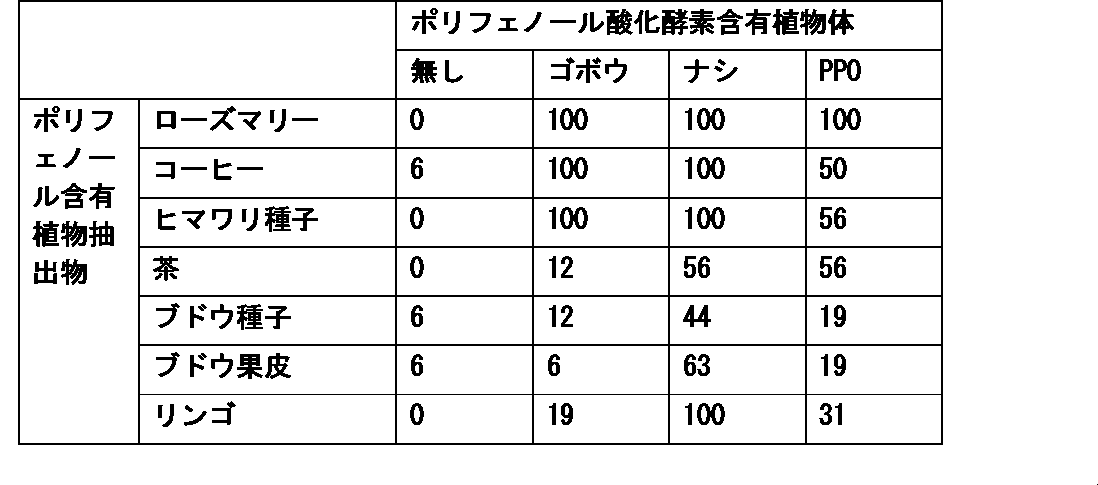
100mlのバイアル瓶に上記で得られた各ポリフェノール含有植物抽出物をポリフェノールの添加量が5.7μmolになるように入れ、さらに1.5mlの50mMリン酸緩衝液(pH7)を入れた後、上記1.2.1で得られたゴボウ凍結乾燥粉末100mgまたは上記1.2.3で得られたナシ凍結乾燥粉末50mgまたは市販のポリフェノールオキシダーゼ(PPO)(SIGMA社製)1mgを加え、15%メチルメルカプタンナトリウム水溶液(東京化成工業(株))2μlを加えた後、パラフィルムで栓をし、24度で10分間振とうした。続いて、バイアル瓶内のガス50mlを検知管(ガステック(株))に通して、ガス内に残存するメチルメルカプタンの濃度を測定した。測定値から下記の式に従い、消臭率を算出した。なお、ブランクの測定値とは、ポリフェノール含有植物抽出物及びポリフェノール酸化酵素含有植物体を添加しなかった時の測定値を指す。
消臭率(%)={(ブランクの測定値)-(サンプルの測定値)}/(ブランクの測定値)×100
各条件での消臭率(%)を表1に示す。
100mlのバイアル瓶に上記で得られた各ポリフェノール含有植物抽出物をポリフェノールの添加量が5.7μmolになるように入れ、さらに1.5mlの50mMリン酸緩衝液(pH7)を入れた後、上記1.2.1で得られたゴボウ凍結乾燥粉末100mgまたは上記1.2.3で得られたナシ凍結乾燥粉末50mgまたは市販のポリフェノールオキシダーゼ(PPO)(SIGMA社製)1mgを加え、15%メチルメルカプタンナトリウム水溶液(東京化成工業(株))2μlを加えた後、パラフィルムで栓をし、24度で10分間振とうした。続いて、バイアル瓶内のガス50mlを検知管(ガステック(株))に通して、ガス内に残存するメチルメルカプタンの濃度を測定した。測定値から下記の式に従い、消臭率を算出した。なお、ブランクの測定値とは、ポリフェノール含有植物抽出物及びポリフェノール酸化酵素含有植物体を添加しなかった時の測定値を指す。
消臭率(%)={(ブランクの測定値)-(サンプルの測定値)}/(ブランクの測定値)×100
各条件での消臭率(%)を表1に示す。
[参考例2]
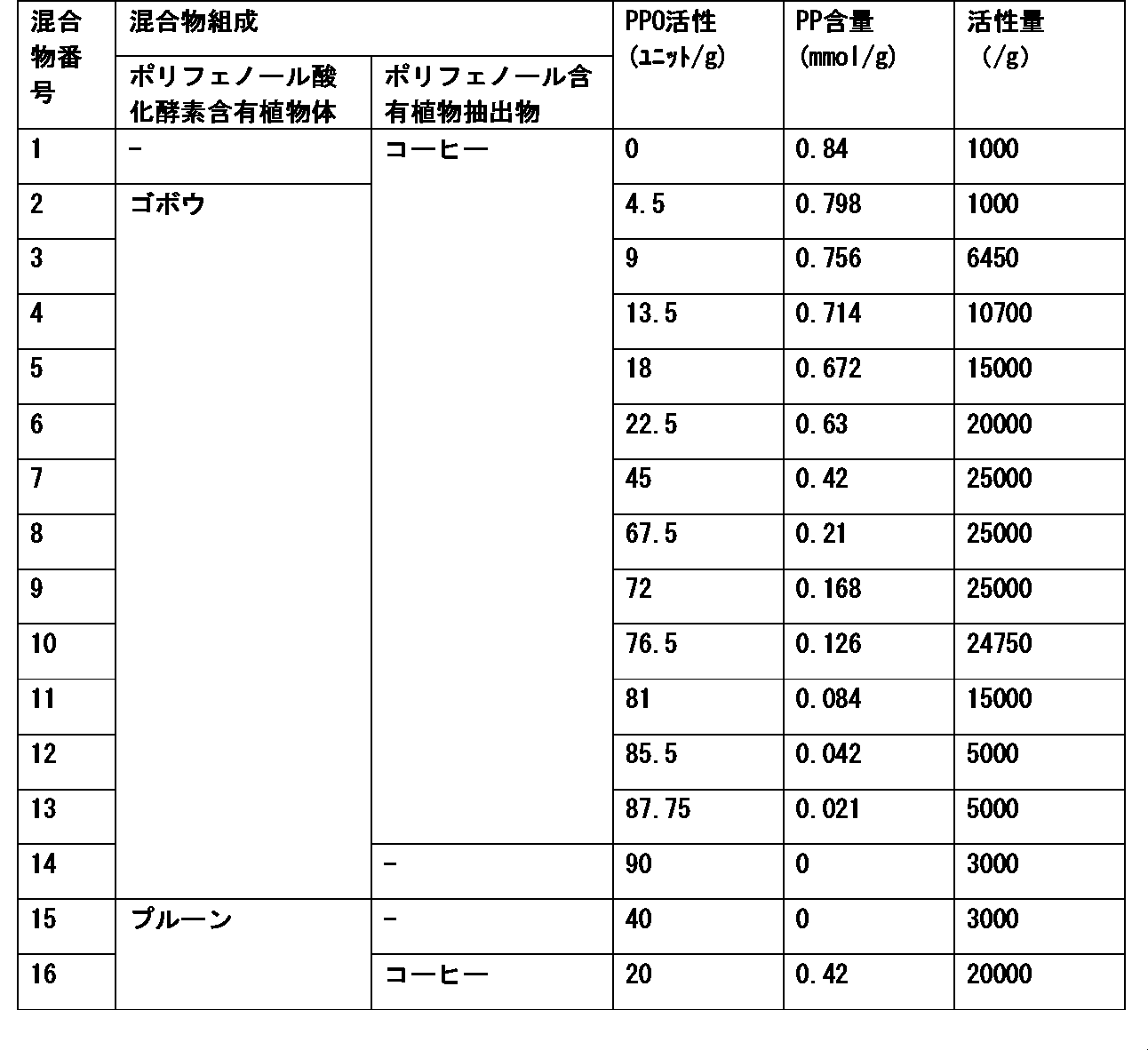
上記1.1.1で得られた生コーヒー豆抽出物と、上記1.2.1と同様の手法で得られたゴボウ凍結乾燥粉末(ポリフェノールオキシダーゼ活性値:90ユニット/g)または上記1.2.2と同様の手法で得られたプルーン凍結乾燥粉末(ポリフェノールオキシダーゼ活性値:40ユニット/g)を所定の割合で混合した。
50mlのバイアル瓶に、それらポリフェノール含有植物抽出物とポリフェノール酸化酵素含有植物体の混合物20mgを入れ、さらに2.0mlの50mMリン酸緩衝液(pH6.5)を入れ、15%メチルメルカプタンナトリウム水溶液3μlを加えた後、パラフィルムで栓をし、25度で20分間振とうした。続いて、バイアル瓶内のガス50mlを検知管(ガステック(株))に通して、ガス内に残存するメチルメルカプタンの濃度を測定した。測定値から下記の式に従い、混合物の単位質量あたりの活性量を算出した。なお、ブランクの測定値とは、混合物を添加しなかった時の測定値を指す。
活性量(/g)={(ブランクの測定値)-(サンプルの測定値)}/(試料質量)
各混合物のポリフェノール含量(カテコール換算量)、ポリフェノール酸化酵素活性及び、活性量の算出結果を表2に示す。
上記1.1.1で得られた生コーヒー豆抽出物と、上記1.2.1と同様の手法で得られたゴボウ凍結乾燥粉末(ポリフェノールオキシダーゼ活性値:90ユニット/g)または上記1.2.2と同様の手法で得られたプルーン凍結乾燥粉末(ポリフェノールオキシダーゼ活性値:40ユニット/g)を所定の割合で混合した。
50mlのバイアル瓶に、それらポリフェノール含有植物抽出物とポリフェノール酸化酵素含有植物体の混合物20mgを入れ、さらに2.0mlの50mMリン酸緩衝液(pH6.5)を入れ、15%メチルメルカプタンナトリウム水溶液3μlを加えた後、パラフィルムで栓をし、25度で20分間振とうした。続いて、バイアル瓶内のガス50mlを検知管(ガステック(株))に通して、ガス内に残存するメチルメルカプタンの濃度を測定した。測定値から下記の式に従い、混合物の単位質量あたりの活性量を算出した。なお、ブランクの測定値とは、混合物を添加しなかった時の測定値を指す。
活性量(/g)={(ブランクの測定値)-(サンプルの測定値)}/(試料質量)
各混合物のポリフェノール含量(カテコール換算量)、ポリフェノール酸化酵素活性及び、活性量の算出結果を表2に示す。
[実施例1] ポリフェノール含有植物抽出物とポリフェノール酸化酵素含有植物凍結乾燥粉末の混合物の調製
上記1.1.1で得られた生コーヒー豆抽出物と、上記1.2.1で得られたゴボウ凍結乾燥粉末とを等量混合し、60メッシュpassしたものを実施例1の試料(試料A)とした。
上記1.1.1で得られた生コーヒー豆抽出物と、上記1.2.1で得られたゴボウ凍結乾燥粉末とを等量混合し、60メッシュpassしたものを実施例1の試料(試料A)とした。
[比較例1] ポリフェノール含有植物抽出物とポリフェノール酸化酵素非含有植物凍結乾燥粉末の混合物の調製
上記1.1.1で得られた生コーヒー豆抽出物と、上記1.3で得られたポリフェノール酸化酵素非含有ゴボウ凍結乾燥粉末とを等量混合し、60メッシュpassしたものを比較例1の試料(試料B)とした。
上記1.1.1で得られた生コーヒー豆抽出物と、上記1.3で得られたポリフェノール酸化酵素非含有ゴボウ凍結乾燥粉末とを等量混合し、60メッシュpassしたものを比較例1の試料(試料B)とした。
[実施例2] ポリフェノール含有植物抽出物とポリフェノール酸化酵素含有植物抽出物の混合物の調製
上記1.1.1で得られた生コーヒー豆抽出物と、上記1.2.2で得られたポリフェノール酸化酵素含有プルーン凍結乾燥粉末とを等量混合し、60メッシュpassしたものを実施例2の試料(試料C)とした。
上記1.1.1で得られた生コーヒー豆抽出物と、上記1.2.2で得られたポリフェノール酸化酵素含有プルーン凍結乾燥粉末とを等量混合し、60メッシュpassしたものを実施例2の試料(試料C)とした。


2 腸内細菌調整作用の評価
2.1 試料Aの腸内細菌調整作用の評価
2.1.1 方法
試料A(生コーヒー豆抽出物とゴボウ凍結乾燥粉末の混合品)を被験者に摂取させて、腸内細菌調整作用を評価した。
具体的には、3名の被験者(男性、31~34才、体重58~64kg)を対象に次の試験を実施した。なお、すべての被検者に対して、試験開始3日前から試験終了まで、発酵食品を喫食しないこと、香辛料を多く含む食品を喫食しないこと、アルコールを摂取しないことを求めた。試料非摂取期間を5日間設け、非摂取期間の1日目、3日目、5日目の早朝の便を回収した。続いて、試料Aを1日あたり昼食後に4g、夕食後に4g毎日摂取させ、摂取1日目、3日目、5日目の早朝の便を回収した。回収した糞便の細菌組成を次世代シーケンサーにより解析した。
2.1 試料Aの腸内細菌調整作用の評価
2.1.1 方法
試料A(生コーヒー豆抽出物とゴボウ凍結乾燥粉末の混合品)を被験者に摂取させて、腸内細菌調整作用を評価した。
具体的には、3名の被験者(男性、31~34才、体重58~64kg)を対象に次の試験を実施した。なお、すべての被検者に対して、試験開始3日前から試験終了まで、発酵食品を喫食しないこと、香辛料を多く含む食品を喫食しないこと、アルコールを摂取しないことを求めた。試料非摂取期間を5日間設け、非摂取期間の1日目、3日目、5日目の早朝の便を回収した。続いて、試料Aを1日あたり昼食後に4g、夕食後に4g毎日摂取させ、摂取1日目、3日目、5日目の早朝の便を回収した。回収した糞便の細菌組成を次世代シーケンサーにより解析した。
糞便の細菌組成解析は以下の方法で行った。回収した糞便から市販キット[QuickGene-810 system及びQuickGene DNA tissue kit(KURABO)]を用いて細菌DNAを抽出した。イルミナ株式会社が提供する16S Metagenomic Sequencing Library Preparation(文書番号:15044223 Rev. B JPN)に従った定法により、16S rDNAのV3-V4領域をPCRで増幅した。この領域をターゲットとするプロトコールで使用するプライマーは、上記文書から得られる情報に従って準備した。
得られた増幅産物をMiseq(イルミナ)を用いて、イルミナ株式会社から提供された方法に基づいてシーケンス解析に供した。得られたデータをQuantitative Insights Into Microbial Ecology(QIIME; Pycogent)を用いて解析し、属レベルでの菌占有率、及び多様性指数を算出した。
得られた増幅産物をMiseq(イルミナ)を用いて、イルミナ株式会社から提供された方法に基づいてシーケンス解析に供した。得られたデータをQuantitative Insights Into Microbial Ecology(QIIME; Pycogent)を用いて解析し、属レベルでの菌占有率、及び多様性指数を算出した。
2.1.2 結果
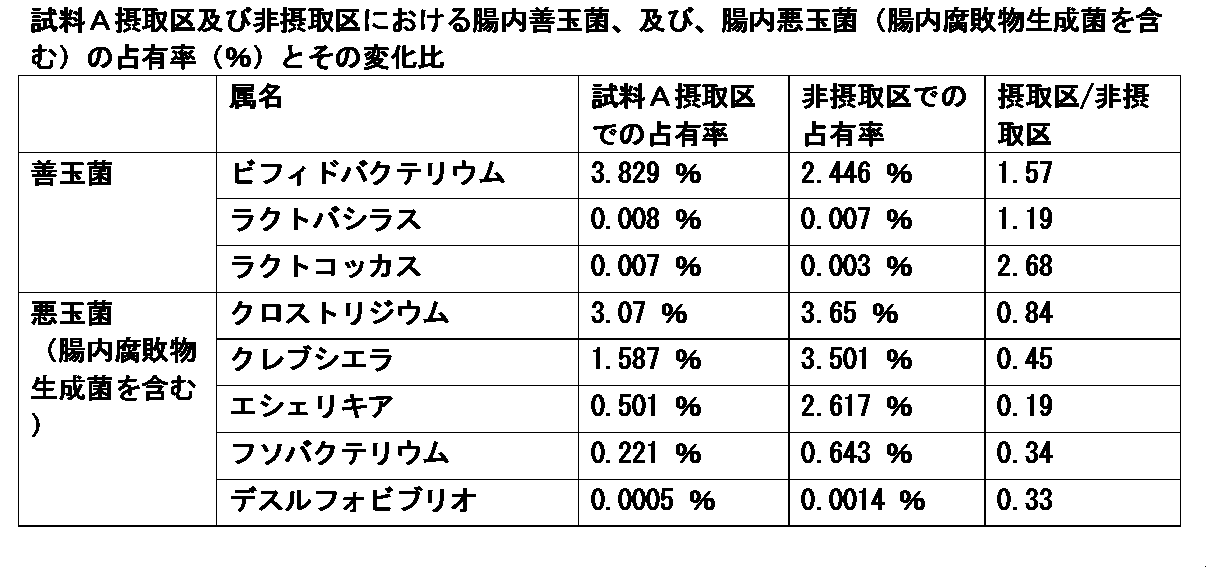
試料A摂取区と試料A非摂取区の腸内における、各菌の占有率の比較を表5に、細菌叢の多様性の比較を表6に、ファーミキューテス門/バクテロイデス門の比較を表7に示す。なお、摂取区と非摂取区との比較は、それぞれの試験区の1日目、3日目、5日目のデータの平均値を比較することによって行った。
試料A摂取区と試料A非摂取区の腸内における、各菌の占有率の比較を表5に、細菌叢の多様性の比較を表6に、ファーミキューテス門/バクテロイデス門の比較を表7に示す。なお、摂取区と非摂取区との比較は、それぞれの試験区の1日目、3日目、5日目のデータの平均値を比較することによって行った。
2.1.2.1 各菌の占有率の比較
試料A摂取区及び非摂取区それぞれの1日目、3日目、5日目の各菌の占有率(%)を算出し、その平均値を比較した。また、非摂取区の各菌の平均占有率に対する摂取区の各菌の平均占有率の比を示した。ここで、ビフィドバクテリウム属菌、ラクトバシラス属菌、ラクトコッカス属菌については腸内善玉菌とし、クロストリジウム属菌、クレブシエラ属菌、エシェリキア属菌、フソバクテリウム属菌、デスルフォビブリオ属菌については、腸内悪玉菌(腸内腐敗物生成菌を含む)とした。
試料A摂取区及び非摂取区それぞれの1日目、3日目、5日目の各菌の占有率(%)を算出し、その平均値を比較した。また、非摂取区の各菌の平均占有率に対する摂取区の各菌の平均占有率の比を示した。ここで、ビフィドバクテリウム属菌、ラクトバシラス属菌、ラクトコッカス属菌については腸内善玉菌とし、クロストリジウム属菌、クレブシエラ属菌、エシェリキア属菌、フソバクテリウム属菌、デスルフォビブリオ属菌については、腸内悪玉菌(腸内腐敗物生成菌を含む)とした。
2.1.2.2 細菌叢の多様性の比較
本実験においては、それぞれの試験区で1日目、3日目、5日目のChao1指数及びShannon-Wiener指数を常法にて算出し、その平均値を比較した。
本実験においては、それぞれの試験区で1日目、3日目、5日目のChao1指数及びShannon-Wiener指数を常法にて算出し、その平均値を比較した。

2.1.2.3 F/B比の比較
非摂取区及び摂取区における1日目、3日目、5日目のファーミキューテス門及びバクテロイデス門の菌占有率を算出し、その平均値を比較した。また、バクテロイデス門の菌占有率に対するファーミキューテス門の菌占有率の比(F/B比)を比較した。
非摂取区及び摂取区における1日目、3日目、5日目のファーミキューテス門及びバクテロイデス門の菌占有率を算出し、その平均値を比較した。また、バクテロイデス門の菌占有率に対するファーミキューテス門の菌占有率の比(F/B比)を比較した。
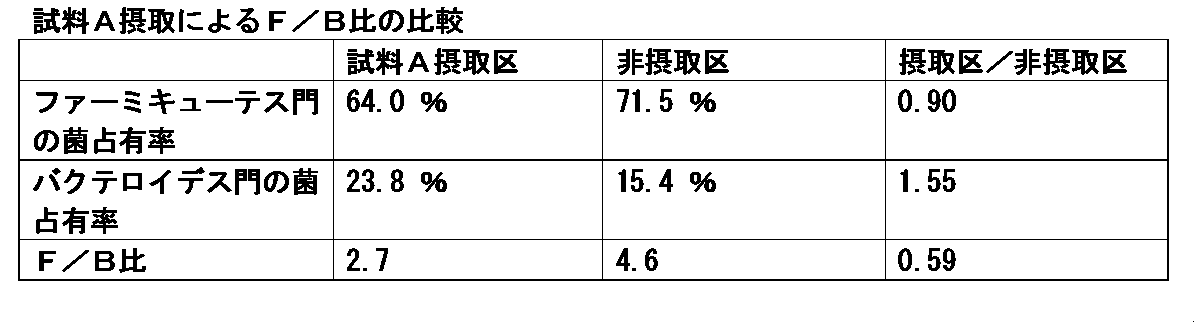
1週間程度の試料Aの摂取により、腸内善玉菌であるビフィドバクテリウム属菌、ラクトバシラス属菌、ラクトコッカス属菌の占有率は増加した。一方、腸内悪玉菌あるいは腸内腐敗物生成菌とされるクロストリジウム属菌、クレブシエラ属菌、エシェリキア属菌、フソバクテリウム属菌、デスルフォビブリオ属菌の占有率は低下した。また、試料Aの摂取により多様性の増加、F/B比の低下が認められた。
腸内善玉菌が増加し、腸内悪玉菌(腸内腐敗物生成菌を含む)が低下し、さらに多様性が増加したことから、試料Aが各種疾患予防効果の期待できる腸内細菌叢改善剤として有用であると考えられた。また、F/B比の低下が認められたことから試料Aの摂取は肥満予防効果も期待できると考えられた。
腸内善玉菌が増加し、腸内悪玉菌(腸内腐敗物生成菌を含む)が低下し、さらに多様性が増加したことから、試料Aが各種疾患予防効果の期待できる腸内細菌叢改善剤として有用であると考えられた。また、F/B比の低下が認められたことから試料Aの摂取は肥満予防効果も期待できると考えられた。
2.2 試料A、試料B、及び試料Cによる腸内細菌改善作用の比較
2.2.1 方法
7名の被験者(男性、29~57才 体重58~85kg)を対象に次の試験を実施した。まず、全ての被験者に試料Bを2週間毎日摂取させた(試料B摂取区)。続いて3週間の試料非摂取期間を設けた。その後、全ての被験者に試料Aを2週間毎日摂取させた(試料A摂取区)。続いて3週間の試料非摂取期間を設けた。その後、全ての被験者に試料Cを2週間毎日摂取させた(試料C摂取区)。各試料の摂取量は1日あたり昼食後4g、夕食後4gの合計8gとした。各試料の摂取期間中、試料摂取開始前(0日目)、試料摂取14日目の早朝の便を回収した。回収した糞便の細菌組成を次世代シーケンサーにより解析した。
2.2.1 方法
7名の被験者(男性、29~57才 体重58~85kg)を対象に次の試験を実施した。まず、全ての被験者に試料Bを2週間毎日摂取させた(試料B摂取区)。続いて3週間の試料非摂取期間を設けた。その後、全ての被験者に試料Aを2週間毎日摂取させた(試料A摂取区)。続いて3週間の試料非摂取期間を設けた。その後、全ての被験者に試料Cを2週間毎日摂取させた(試料C摂取区)。各試料の摂取量は1日あたり昼食後4g、夕食後4gの合計8gとした。各試料の摂取期間中、試料摂取開始前(0日目)、試料摂取14日目の早朝の便を回収した。回収した糞便の細菌組成を次世代シーケンサーにより解析した。
2.2.2 結果
試料A摂取区、試料B摂取区および試料C摂取区の腸内における、各菌の占有率の比較を表8に、細菌叢の多様性の比較を表9に、ファーミキューテス門/バクテロイデス門の比較を表10に示す。なお、各摂取区間の比較は、各摂取区の0日目、14日目のデータの平均値を比較することによって行った。
試料A摂取区、試料B摂取区および試料C摂取区の腸内における、各菌の占有率の比較を表8に、細菌叢の多様性の比較を表9に、ファーミキューテス門/バクテロイデス門の比較を表10に示す。なお、各摂取区間の比較は、各摂取区の0日目、14日目のデータの平均値を比較することによって行った。
2.2.2.1 各菌の占有率の比較
試料A摂取区、試料B摂取区および試料C摂取区のそれぞれの0日目、14日目の各菌の占有率(%)を算出し、その平均値を比較した結果を表8に示す。また、各摂取区における0日目の各菌の平均占有率に対する14日目の各菌の平均占有率の比を表中に括弧書きで記載した。
試料A摂取区、試料B摂取区および試料C摂取区のそれぞれの0日目、14日目の各菌の占有率(%)を算出し、その平均値を比較した結果を表8に示す。また、各摂取区における0日目の各菌の平均占有率に対する14日目の各菌の平均占有率の比を表中に括弧書きで記載した。

2.2.2.2 細菌叢の多様性の比較
本実験においては、各摂取区で0日目、14日目のChao1指数及びShannon-Wiener指数を常法にて算出し、その平均値を比較した。また、各摂取区における0日目の多様性指数に対する14日目の多様性指数の比を表中に括弧書きで記載した。
本実験においては、各摂取区で0日目、14日目のChao1指数及びShannon-Wiener指数を常法にて算出し、その平均値を比較した。また、各摂取区における0日目の多様性指数に対する14日目の多様性指数の比を表中に括弧書きで記載した。

2.2.2.3 F/B比の比較
試料A摂取区、試料B摂取区および試料C摂取区における0日目、14日目のファーミキューテス門及びバクテロイデス門の菌占有率を算出し、その平均値を比較した。また、バクテロイデス門の菌占有率に対するファーミキューテス門の菌占有率の比(F/B比)を比較した。各摂取区における0日目のF/B比に対する14日目のF/B比の比を表中に括弧書きで記載した。
試料A摂取区、試料B摂取区および試料C摂取区における0日目、14日目のファーミキューテス門及びバクテロイデス門の菌占有率を算出し、その平均値を比較した。また、バクテロイデス門の菌占有率に対するファーミキューテス門の菌占有率の比(F/B比)を比較した。各摂取区における0日目のF/B比に対する14日目のF/B比の比を表中に括弧書きで記載した。
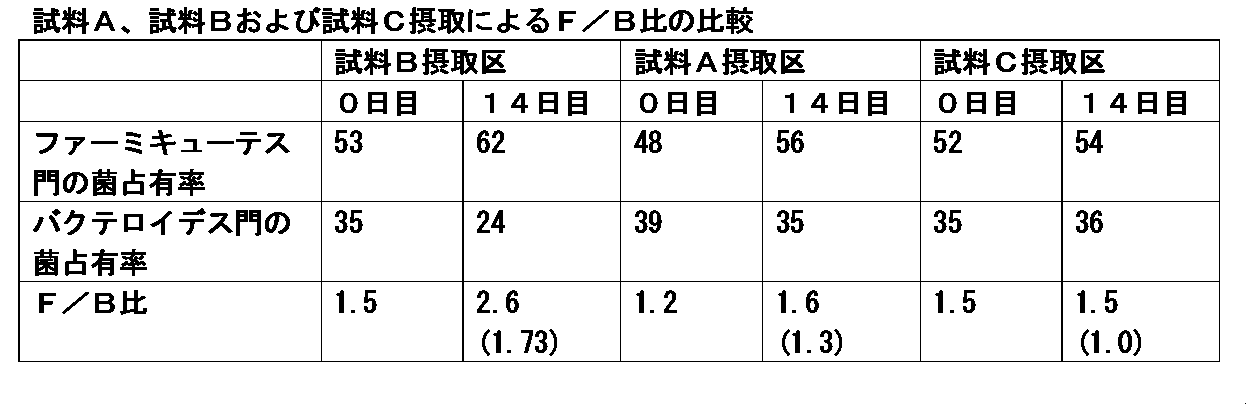
2週間の試料Bの摂取により、腸内善玉菌であるラクトバシラス属菌、ラクトコッカス属菌の占有率は低下した。一方で、2週間の試料Aおよび試料Cの摂取により、腸内善玉菌であるラクトバシラス属菌、ラクトコッカス属菌の占有率は増加した。2週間の試料Bの摂取により、腸内悪玉菌あるいは腸内腐敗物生成菌とされるクロストリジウム属菌、デスルフォビブリオ属菌の占有率は増加した。一方で、2週間の試料Aおよび試料Cの摂取により、クロストリジウム属菌、デスルフォビブリオ属菌の占有率は維持、または低下した。試料A、試料Bおよび試料Cのいずれも摂取により多様性は維持した。試料Bの摂取によりF/B比は増加したが、試料Aおよび試料Cの摂取でF/B比は維持した。
ポリフェノールオキシダーゼ活性を有する試料A、及び、試料Cは、ポリフェノールオキシダーゼ活性を有さない試料Bに比べ、腸内細菌叢を好ましい状態に維持、調整する作用に優れていることが明らかとなった。
生コーヒー豆抽出物に含有されるo-ジフェノールタイプのポリフェノールは、ゴボウ抽出物、及び、プルーン抽出物に含有されるポリフェノール酸化酵素の働きによって、ポリフェノールキノン体に変換されることが知られている。ポリフェノールキノン体は含硫化合物や含窒素化合物と容易に結合することが知られている。ポリフェノールとポリフェノールオキシダーゼを組み合わせることによって生成するポリフェノールキノン体が、腸内環境の変化、あるいは腸内細菌叢や宿主自身の状態変化を引き起こし、腸内細菌叢が改善されたと考えられた。
ポリフェノールオキシダーゼ活性を有する試料A、及び、試料Cは、ポリフェノールオキシダーゼ活性を有さない試料Bに比べ、腸内細菌叢を好ましい状態に維持、調整する作用に優れていることが明らかとなった。
生コーヒー豆抽出物に含有されるo-ジフェノールタイプのポリフェノールは、ゴボウ抽出物、及び、プルーン抽出物に含有されるポリフェノール酸化酵素の働きによって、ポリフェノールキノン体に変換されることが知られている。ポリフェノールキノン体は含硫化合物や含窒素化合物と容易に結合することが知られている。ポリフェノールとポリフェノールオキシダーゼを組み合わせることによって生成するポリフェノールキノン体が、腸内環境の変化、あるいは腸内細菌叢や宿主自身の状態変化を引き起こし、腸内細菌叢が改善されたと考えられた。
Claims (9)
- ポリフェノール及びポリフェノール酸化酵素を有効成分として含む、腸内細菌叢改善剤。
- 前記ポリフェノールと前記ポリフェノール酸化酵素による活性量が単位質量(g)あたり5000以上である、請求項1に記載の腸内細菌叢改善剤。
- 前記ポリフェノールが、o-ジフェノール型ポリフェノール及び/又はp-ジフェノール型ポリフェノールである、請求項1又は2に記載の腸内細菌叢改善剤。
- 前記ポリフェノールが、ポリフェノール含有植物体又はその抽出物に由来する、請求項1~3のいずれか1項に記載の腸内細菌叢改善剤。
- 前記ポリフェノール酸化酵素が、ポリフェノール酸化酵素含有植物体又はその抽出物に由来する、請求項1又は2に記載の腸内細菌叢改善剤。
- 前記ポリフェノール濃度がカテコール換算で0.021mmol/g以上であり、かつ、前記ポリフェノール酸化酵素濃度が9ユニット/g以上である、請求項1~5のいずれか1項に記載の腸内細菌叢改善剤。
- 善玉菌増殖促進作用、悪玉菌増殖抑制作用、多様性維持又は増加作用、F/B値維持又は低下作用、及び、腐敗物生成菌増殖抑制作用からなる群から選択される少なくとも1つの作用を有する、請求項1~6のいずれか一項に記載の腸内細菌叢改善剤。
- 請求項1~7のいずれか一項に記載の腸内細菌叢改善剤を含有する、腸内細菌叢改善用の飲食品、又は、医薬品。
- 肥満、炎症性腸疾患、2型糖尿病、アレルギー、心血管疾患、自己免疫疾患、急性下痢、便通異常、がん、精神疾患の予防又は治療のための医薬組成物であって、請求項1~7のいずれか1項に記載の腸内細菌叢改善剤、又は、請求項8に記載の飲食品若しくは医薬品を含有する、医薬組成物。
Priority Applications (1)
| Application Number | Priority Date | Filing Date | Title |
|---|---|---|---|
| JP2022571537A JPWO2022138698A1 (ja) | 2020-12-25 | 2021-12-22 |
Applications Claiming Priority (2)
| Application Number | Priority Date | Filing Date | Title |
|---|---|---|---|
| JP2020216164 | 2020-12-25 | ||
| JP2020-216164 | 2020-12-25 |
Publications (1)
| Publication Number | Publication Date |
|---|---|
| WO2022138698A1 true WO2022138698A1 (ja) | 2022-06-30 |
Family
ID=82159414
Family Applications (1)
| Application Number | Title | Priority Date | Filing Date |
|---|---|---|---|
| PCT/JP2021/047500 Ceased WO2022138698A1 (ja) | 2020-12-25 | 2021-12-22 | 腸内細菌叢改善剤 |
Country Status (2)
| Country | Link |
|---|---|
| JP (1) | JPWO2022138698A1 (ja) |
| WO (1) | WO2022138698A1 (ja) |
Cited By (1)
| Publication number | Priority date | Publication date | Assignee | Title |
|---|---|---|---|---|
| WO2024048785A1 (ja) * | 2022-09-02 | 2024-03-07 | 天野エンザイム株式会社 | フェニルアセトアルデヒドの製造方法及びその応用 |
Citations (2)
| Publication number | Priority date | Publication date | Assignee | Title |
|---|---|---|---|---|
| JP2006136246A (ja) * | 2004-11-12 | 2006-06-01 | Nogyo Kagaku Kenkyusho:Kk | 便通改善飲食品 |
| WO2020032215A1 (ja) * | 2018-08-09 | 2020-02-13 | 高砂香料工業株式会社 | 消臭剤組成物 |
-
2021
- 2021-12-22 WO PCT/JP2021/047500 patent/WO2022138698A1/ja not_active Ceased
- 2021-12-22 JP JP2022571537A patent/JPWO2022138698A1/ja active Pending
Patent Citations (2)
| Publication number | Priority date | Publication date | Assignee | Title |
|---|---|---|---|---|
| JP2006136246A (ja) * | 2004-11-12 | 2006-06-01 | Nogyo Kagaku Kenkyusho:Kk | 便通改善飲食品 |
| WO2020032215A1 (ja) * | 2018-08-09 | 2020-02-13 | 高砂香料工業株式会社 | 消臭剤組成物 |
Non-Patent Citations (4)
| Title |
|---|
| ANONYMOUS: "Effects and Benefits of "Deotak®"! What Are the Components and Side Effects? Detailed Commentary on the Components and Effects of Noteworthy Supplements and Health Foods", MATERIAL LAB, JP, pages 1 - 11, XP009538042, Retrieved from the Internet <URL:https://web.archive.org/web/20201124170837/https://mate-lab.net/deo-attack/> * |
| MURATA, MASATSUNE: "Enzymatic Browning and Its Regulation", CHEMISTRY AND BIOLOGY, vol. 45, no. 6, 1 January 2007 (2007-01-01), JP , pages 403 - 410, XP009537865, ISSN: 0453-073X, DOI: 10.1271/kagakutoseibutsu1962.45.403 * |
| SAKURA: "Refreshing Deodorizing Supplement "Soumi Seikatsu" - Deotak® Composition. Ouka. Mushrooms.)", AMAZON, JP, pages 1 - 7, XP009538041, Retrieved from the Internet <URL:https://www.amazon.co.jp/%E6%A1%9C%E8%8F%AF-2301-%E3%81%95%E3%82%8F%E3%82%84%E3%81%8B%E6%B6%88%E8%87%AD%E3%82%B5%E3%83%97%E3%83%AA-%E7%88%BD%E7%BE%8E%E7%94%9F%E6%B4%BB-%E3%83%87%E3%82%AA%E3%82%A2%E3%82%BF%E3%83%83%E3%82%AFR%E9%85%8D%E5%90%88/dp/B08BL56ZTK> * |
| SHINOHARA, K. ; OHASHI, Y. ; KAWASUMI, K. ; TERADA, A. ; FUJISAWA, T.: "Effect of apple intake on fecal microbiota and metabolites in humans", ANAEROBE, vol. 16, no. 5, 1 October 2010 (2010-10-01), AMSTERDAM, NL, pages 510 - 515, XP027326395, ISSN: 1075-9964 * |
Cited By (1)
| Publication number | Priority date | Publication date | Assignee | Title |
|---|---|---|---|---|
| WO2024048785A1 (ja) * | 2022-09-02 | 2024-03-07 | 天野エンザイム株式会社 | フェニルアセトアルデヒドの製造方法及びその応用 |
Also Published As
| Publication number | Publication date |
|---|---|
| JPWO2022138698A1 (ja) | 2022-06-30 |
Similar Documents
| Publication | Publication Date | Title |
|---|---|---|
| Wolfe et al. | Apple peels as a value-added food ingredient | |
| Subhash et al. | Current insights into date by-product valorization for sustainable food industries and technology | |
| US20110033392A1 (en) | Deodorizing composition under weak acidity | |
| JP2008231002A (ja) | 抗酸化剤及びラジカル消去活性化剤、並びにそれらいずれかが含まれた食品 | |
| JP2015514435A (ja) | 食品に適用するための食事成分ジヒドロケルセチン(タキシフォリン)、アラビノガラクタンおよびジヒドロケルセチン(タキシフォリン)と組み合わせたアラビノガラクタンを使用する方法 | |
| Dikilitaş Saçkesen et al. | Unveiling the potential of EU PDO registered Malatya apricot (Prunus armeniaca L.): Compositional, functional, nutritional, and economic aspects | |
| Ojha et al. | Diospyros spp.(Diospyros kaki Lf, Diospyros lotus L., Diospyros tomentosa Roxb.) | |
| Boublenza et al. | Carob as source for sustainable ingredients and products | |
| Khaled et al. | Valorization of agri-food crucifer vegetables waste for food, functional food and nutraceuticals applications | |
| WO2022138698A1 (ja) | 腸内細菌叢改善剤 | |
| JP2010265215A (ja) | メチオニナーゼ阻害剤 | |
| JP5282340B2 (ja) | 天然素材の抗酸化作用および/またはリパーゼ阻害活性を増強させる方法、ならびに当該活性が増強された天然素材 | |
| JP5486783B2 (ja) | ペルオキシダーゼを用いた中性下の消臭組成物 | |
| Pinto et al. | Chestnut: Phytochemicals and Biological Activities | |
| Souza et al. | Evaluation of the Technological Potential of Grape Peels through Patent Document Analysis: Agro-industrial Waste with Biotechnological Potential | |
| KR20140080756A (ko) | 혼합 발효 균주를 이용한 기능성이 증진된 발효 천마의 제조 방법 및 상기 방법에 의해 제조된 발효 천마 | |
| KR102179849B1 (ko) | 참까막살 추출물을 유효성분으로 포함하는 항염증용 조성물. | |
| JP2012006905A (ja) | 美肌用組成物 | |
| WO2021235481A1 (ja) | 呈味改善用組成物 | |
| JP2002020784A (ja) | 香料の劣化防止剤 | |
| WO2021235482A1 (ja) | ミント系香料用の呈味改善剤、及びそれを含む香料組成物、並びにミント系香料を含有する香料組成物の呈味改善方法 | |
| Che Sulaiman et al. | Mango peels as a source of nutraceuticals | |
| Maqbool et al. | Cauliflower and Broccoli Waste: Chemistry, Processing and Utilization | |
| JP4829525B2 (ja) | ビフィズス菌増殖促進剤 | |
| WO2020032215A1 (ja) | 消臭剤組成物 |
Legal Events
| Date | Code | Title | Description |
|---|---|---|---|
| 121 | Ep: the epo has been informed by wipo that ep was designated in this application |
Ref document number: 21910838 Country of ref document: EP Kind code of ref document: A1 |
|
| ENP | Entry into the national phase |
Ref document number: 2022571537 Country of ref document: JP Kind code of ref document: A |
|
| NENP | Non-entry into the national phase |
Ref country code: DE |
|
| 122 | Ep: pct application non-entry in european phase |
Ref document number: 21910838 Country of ref document: EP Kind code of ref document: A1 |