WO2022138545A1 - 機械学習装置、及び機械学習方法 - Google Patents
機械学習装置、及び機械学習方法 Download PDFInfo
- Publication number
- WO2022138545A1 WO2022138545A1 PCT/JP2021/046971 JP2021046971W WO2022138545A1 WO 2022138545 A1 WO2022138545 A1 WO 2022138545A1 JP 2021046971 W JP2021046971 W JP 2021046971W WO 2022138545 A1 WO2022138545 A1 WO 2022138545A1
- Authority
- WO
- WIPO (PCT)
- Prior art keywords
- inference
- machine learning
- unit
- data
- model
- Prior art date
- Legal status (The legal status is an assumption and is not a legal conclusion. Google has not performed a legal analysis and makes no representation as to the accuracy of the status listed.)
- Ceased
Links
Images



Classifications
-
- G—PHYSICS
- G06—COMPUTING OR CALCULATING; COUNTING
- G06V—IMAGE OR VIDEO RECOGNITION OR UNDERSTANDING
- G06V10/00—Arrangements for image or video recognition or understanding
- G06V10/70—Arrangements for image or video recognition or understanding using pattern recognition or machine learning
- G06V10/77—Processing image or video features in feature spaces; using data integration or data reduction, e.g. principal component analysis [PCA] or independent component analysis [ICA] or self-organising maps [SOM]; Blind source separation
- G06V10/776—Validation; Performance evaluation
-
- G—PHYSICS
- G06—COMPUTING OR CALCULATING; COUNTING
- G06N—COMPUTING ARRANGEMENTS BASED ON SPECIFIC COMPUTATIONAL MODELS
- G06N3/00—Computing arrangements based on biological models
- G06N3/02—Neural networks
- G06N3/04—Architecture, e.g. interconnection topology
- G06N3/0464—Convolutional networks [CNN, ConvNet]
-
- G—PHYSICS
- G05—CONTROLLING; REGULATING
- G05B—CONTROL OR REGULATING SYSTEMS IN GENERAL; FUNCTIONAL ELEMENTS OF SUCH SYSTEMS; MONITORING OR TESTING ARRANGEMENTS FOR SUCH SYSTEMS OR ELEMENTS
- G05B19/00—Program-control systems
- G05B19/02—Program-control systems electric
- G05B19/04—Program control other than numerical control, i.e. in sequence controllers or logic controllers
- G05B19/042—Program control other than numerical control, i.e. in sequence controllers or logic controllers using digital processors
-
- G—PHYSICS
- G06—COMPUTING OR CALCULATING; COUNTING
- G06N—COMPUTING ARRANGEMENTS BASED ON SPECIFIC COMPUTATIONAL MODELS
- G06N3/00—Computing arrangements based on biological models
- G06N3/02—Neural networks
- G06N3/08—Learning methods
- G06N3/084—Backpropagation, e.g. using gradient descent
-
- G—PHYSICS
- G06—COMPUTING OR CALCULATING; COUNTING
- G06N—COMPUTING ARRANGEMENTS BASED ON SPECIFIC COMPUTATIONAL MODELS
- G06N3/00—Computing arrangements based on biological models
- G06N3/02—Neural networks
- G06N3/08—Learning methods
- G06N3/088—Non-supervised learning, e.g. competitive learning
-
- G—PHYSICS
- G06—COMPUTING OR CALCULATING; COUNTING
- G06N—COMPUTING ARRANGEMENTS BASED ON SPECIFIC COMPUTATIONAL MODELS
- G06N3/00—Computing arrangements based on biological models
- G06N3/02—Neural networks
- G06N3/08—Learning methods
- G06N3/09—Supervised learning
-
- G—PHYSICS
- G06—COMPUTING OR CALCULATING; COUNTING
- G06N—COMPUTING ARRANGEMENTS BASED ON SPECIFIC COMPUTATIONAL MODELS
- G06N3/00—Computing arrangements based on biological models
- G06N3/02—Neural networks
- G06N3/08—Learning methods
- G06N3/0985—Hyperparameter optimisation; Meta-learning; Learning-to-learn
-
- G—PHYSICS
- G06—COMPUTING OR CALCULATING; COUNTING
- G06V—IMAGE OR VIDEO RECOGNITION OR UNDERSTANDING
- G06V10/00—Arrangements for image or video recognition or understanding
- G06V10/70—Arrangements for image or video recognition or understanding using pattern recognition or machine learning
- G06V10/77—Processing image or video features in feature spaces; using data integration or data reduction, e.g. principal component analysis [PCA] or independent component analysis [ICA] or self-organising maps [SOM]; Blind source separation
- G06V10/7715—Feature extraction, e.g. by transforming the feature space, e.g. multi-dimensional scaling [MDS]; Mappings, e.g. subspace methods
-
- G—PHYSICS
- G06—COMPUTING OR CALCULATING; COUNTING
- G06V—IMAGE OR VIDEO RECOGNITION OR UNDERSTANDING
- G06V10/00—Arrangements for image or video recognition or understanding
- G06V10/70—Arrangements for image or video recognition or understanding using pattern recognition or machine learning
- G06V10/87—Arrangements for image or video recognition or understanding using pattern recognition or machine learning using selection of the recognition techniques, e.g. of a classifier in a multiple classifier system
-
- G—PHYSICS
- G06—COMPUTING OR CALCULATING; COUNTING
- G06N—COMPUTING ARRANGEMENTS BASED ON SPECIFIC COMPUTATIONAL MODELS
- G06N3/00—Computing arrangements based on biological models
- G06N3/02—Neural networks
- G06N3/04—Architecture, e.g. interconnection topology
- G06N3/048—Activation functions
Definitions
- the present invention relates to a machine learning device and a machine learning method.
- a trained model for example, a classifier in a classification problem, a neural network, etc.
- an untrained case is used using the generated trained model.
- One solution is to increase the variation of training data for learning.
- a technique has been proposed for performing ensemble learning based on a plurality of trained models generated using a plurality of training data so as to detect various objects. See, for example, Patent Document 1.
- the second solution is to take a long time to devise various training parameters (hereinafter, also referred to as "hyperparameters") included in the trained model.
- various training parameters hereinafter, also referred to as "hyperparameters” included in the trained model.
- hyperparameters various training parameters included in the trained model.
- One aspect of the machine learning device of the present disclosure is a machine learning device, which is a machine learning device based on an acquisition unit that acquires training data and inference data used for machine learning, and the training data and a plurality of sets of learning parameters. It is possible to accept the selection of a learning unit that generates a plurality of trained models, a model evaluation unit that evaluates the quality of the learning results of the plurality of trained models and displays the evaluation results, and a trained model.
- An inference calculation unit that performs inference calculation processing based on a model selection unit, at least a part of the plurality of trained models, and the inference data, and an inference calculation unit that generates inference result candidates, and all or all of the inference result candidates. It includes an inference determination unit that outputs a part or a combination thereof.
- the machine learning method of the present disclosure is a machine learning method realized by a computer, and is based on an acquisition process for acquiring training data and inference data used for machine learning, and the training data and a plurality of sets of learning parameters.
- a learning process that performs machine learning to generate a plurality of trained models, a model evaluation process that evaluates the quality of the learning results of the plurality of trained models and displays the evaluation results, and acceptance of selection of the trained model.
- the inference determination step for outputting a part or a combination thereof is provided.
- the time and effort required to collect training data used for learning can be reduced, and good performance can be obtained even with a small amount of training data.
- FIG. 1 is a diagram showing an example of the configuration of the robot system 1 according to the embodiment.
- the robot system 1 includes a machine learning device 10, a robot control device 20, a robot 30, a measuring instrument 40, a plurality of workpieces 50, and a container 60.
- the machine learning device 10, the robot control device 20, the robot 30, and the measuring instrument 40 may be directly connected to each other via a connection interface (not shown).
- the machine learning device 10, the robot control device 20, the robot 30, and the measuring instrument 40 may be connected to each other via a network (not shown) such as a LAN (Local Area Network) or the Internet.
- a network not shown
- LAN Local Area Network
- the machine learning device 10, the robot control device 20, the robot 30, and the measuring instrument 40 include a communication unit (not shown) for communicating with each other by such a connection.
- FIG. 1 depicts the machine learning device 10 and the robot control device 20 independently, and the machine learning device 10 in this case may be configured by, for example, a computer.
- the machine learning device 10 may be mounted inside the robot control device 20 and integrated with the robot control device 20, for example, without being limited to such a configuration.
- the robot control device 20 is a device known to those skilled in the art for controlling the operation of the robot 30.
- the robot control device 20 receives from the machine learning device 10 the take-out position information of the work 50 selected by the machine learning device 10 described later among the works 50 stacked separately.
- the robot control device 20 generates a control signal for controlling the operation of the robot 30 so as to take out the work 50 at the take-out position received from the machine learning device 10.
- the robot control device 20 outputs the generated control signal to the robot 30.
- the robot control device 20 outputs the execution result of the extraction operation by the robot 30 to the machine learning device 10.
- FIG. 2 is a functional block diagram showing a functional configuration example of the robot control device 20 according to the embodiment.
- the robot control device 20 is a computer known to those skilled in the art, and has a control unit 21 as shown in FIG. Further, the control unit 21 has an operation execution unit 210.
- the control unit 21 has a CPU (Central Processing Unit), a ROM, a RAM (Random Access Memory), a CMOS (Complementary Metal-Oxide-Semicondustor) memory, and the like, and these are configured to be communicable with each other via a bus.
- the CPU is a processor that controls the robot control device 20 as a whole.
- the CPU reads out the system program and the application program stored in the ROM via the bus, and controls the entire robot control device 20 according to the system program and the application program.
- the control unit 21 is configured to realize the function of the operation execution unit 210.
- CMOS memory is backed up by a battery (not shown), and is configured as a non-volatile memory in which the storage state is maintained even when the power of the robot control device 20 is turned off.
- the operation execution unit 210 controls the take-out hand 31 of the robot 30, which will be described later, to take out the work 50 with the take-out hand 31 based on the inference result of the take-out position output by the machine learning device 10 described later. Then, the operation execution unit 210 uses, for example, information indicating whether or not the work 50 has been successfully taken out by the take-out hand 31 as the execution result of the take-out operation based on the signal from the sensor installed in the take-out hand 31. The feedback may be made to the machine learning device 10.
- the robot control device 20 may include a machine learning device 10 as described later.
- the robot 30 is a robot that operates based on the control of the robot control device 20.
- the robot 30 includes a base portion for rotating about an axis in the vertical direction, an arm for moving and rotating, and a take-out hand 31 attached to the arm for holding the work 50.
- the take-out hand 31 may have an arbitrary configuration capable of holding the works 50 one by one.
- the take-out hand 31 may be configured to have a suction type pad for sucking the work 50.
- the suction type hand that sucks the work 50 by utilizing the airtightness of the air may be used, but the suction type hand that does not require the airtightness of the air and has a strong suction force may be used.
- the take-out hand 31 may be configured as a gripping hand having a pair of gripping fingers or three or more gripping fingers that sandwich and hold the work 50, or may be configured to have a plurality of suction pads.
- the take-out hand 31 may be configured to have a magnetic hand that holds the work 50 made of iron or the like by a magnetic force.
- the take-out hand 31 may be equipped with a sensor that detects a change in air pressure inside the hand when the work 50 is not held and when the work 50 is held.
- the taking-out hand 31 may be equipped with a contact sensor, a force sensor, or the like for detecting the presence or absence of holding the work, or may be equipped with a position sensor for detecting the position of the operating gripping finger. ..
- the take-out hand 31 may be equipped with a permanent magnet inside the hand and a position sensor for detecting the position thereof.
- the robot 30 drives the arm and the take-out hand 31 in response to the control signal output by the robot control device 20, moves the take-out hand 31 to the take-out position selected by the machine learning device 10, and is piled up in bulk. Hold the work 50 and remove it from the container 60.
- the operation execution unit 210 of the robot control device 20 automatically obtains information on whether or not the work 50 has been successfully taken out as the execution result of the take-out operation based on the signal from the sensor mounted on the take-out hand 31.
- the collected execution results may be fed back to the machine learning device 10.
- the transfer destination of the removed work 50 is not shown. Further, since the specific configuration of the robot 30 is well known to those skilled in the art, detailed description thereof will be omitted.
- the machine learning device 10 and the robot control device 20 have a machine coordinate system for controlling the robot 30 by calibration performed in advance, and a coordinate system of a measuring instrument 40 to be described later indicating a take-out position of the work 50. Are associated with each other.
- the measuring instrument 40 is configured to include, for example, a camera sensor or the like, and RGB of two-dimensional image data obtained by projecting the loosely stacked workpieces 50 in the container 60 onto a plane perpendicular to the optical axis of the measuring instrument 40. Visible light images such as color images, grayscale images, and depth images may be taken. Further, the measuring instrument 40 may be configured to include an infrared sensor to capture a thermal image, or may be configured to include an ultraviolet sensor to capture an ultraviolet image for inspection of scratches, spots, etc. on the surface of an object. You may. Further, the measuring instrument 40 may be configured to include an X-ray camera sensor and capture an X-ray image, or may be configured to include an ultrasonic sensor and capture an ultrasonic image.
- the measuring instrument 40 may be a three-dimensional measuring instrument, and is converted from the distance between the plane perpendicular to the optical axis of the three-dimensional measuring instrument and each point on the surface of the loosely stacked workpieces 50 in the container 60. It may be configured to acquire three-dimensional information (hereinafter, also referred to as “distance image”) having a value as a pixel value.
- distance image three-dimensional information
- the pixel value of the point A of the work 50 on the distance image is the measuring instrument 40 and the work 50 in the Z-axis direction in the three-dimensional coordinate system (X, Y, Z) of the measuring instrument 40. It is converted from the distance (height from the measuring instrument 40) between the points A and the point A.
- the Z-axis direction of the three-dimensional coordinate system is the optical axis direction of the measuring instrument 40.
- the measuring instrument 40 is composed of, for example, a stereo camera, one camera fixed to the hand of the robot 30 or a moving device, one camera, and a distance sensor such as a laser scanner or a sound wave sensor, and is contained in the container 60.
- the three-dimensional point group data of a plurality of workpieces 50 loaded may be acquired.
- the three-dimensional point cloud data acquired in this way can be displayed in a 3D view that can be confirmed from any viewpoint in the three-dimensional space, and the overlapping state of the plurality of works 50 loaded on the container 60 can be confirmed three-dimensionally. It is the discrete data that can be created.
- the work 50 is randomly placed in the container 60 including the state of being piled up in bulk.
- the work 50 may be any as long as it can be held by the take-out hand 31 attached to the arm of the robot 30, and its shape and the like are not particularly limited.
- FIG. 3 is a functional block diagram showing a functional configuration example of the machine learning device 10 according to the embodiment.
- the machine learning device 10 may be a computer known to those skilled in the art, and has a control unit 11 as shown in FIG. Further, the control unit 11 includes an acquisition unit 110, a parameter extraction unit 111, a learning unit 112, a model evaluation unit 113, a model selection unit 114, an inference calculation unit 115, and an inference determination unit 116. Further, the acquisition unit 110 has a data storage unit 1101.
- the control unit 11 includes a CPU, ROM, RAM, CMOS memory, and the like, which are known to those skilled in the art, which are configured to be communicable with each other via a bus.
- the CPU is a processor that controls the machine learning device 10 as a whole.
- the CPU reads out the system program and the application program stored in the ROM via the bus, and controls the entire machine learning device 10 according to the system program and the application program.
- the control unit 11 functions as an acquisition unit 110, a parameter extraction unit 111, a learning unit 112, a model evaluation unit 113, a model selection unit 114, an inference calculation unit 115, and an inference determination unit 116. Is configured to realize.
- the acquisition unit 110 is configured to realize the function of the data storage unit 1101.
- Various data such as temporary calculation data and display data are stored in the RAM.
- the CMOS memory is backed up by a battery (not shown), and is configured as a non-volatile memory in which the storage state is maintained even when the power of the machine learning device 10 is turned off.
- the acquisition unit 110 may be configured to have a data storage unit 1101 and may be configured to acquire training data used for machine learning from a database 70 on a cloud or an edge device and store it in the data storage unit 1101.
- the acquisition unit 110 transfers training data recorded in a recording medium such as an HDD (Hard Disk Drive) or a USB (Universal Serial Bus) memory from a database 70 on a cloud or an edge device via a network such as a LAN. It is acquired, copied to a recording medium (data storage unit 1101) such as an HDD or a USB memory of the machine learning device 10, and stored.
- the acquisition unit 110 may be configured to acquire inference data used for machine learning from the measuring instrument 40 and store it in the data storage unit 1101.
- the inference data may be image data, but may be 3D point cloud data or a distance image as 3D measurement data.
- the parameter extraction unit 111 may be configured to extract important hyperparameters or the like from all hyperparameters or the like.
- the parameter extraction unit 111 can, for example, define and evaluate the degree of contribution to learning performance, and extract hyperparameters and the like having a high degree of contribution as important hyperparameters and the like.
- the loss function evaluates the difference between the prediction result of the trained model and the teacher data, and the smaller the loss, the better the performance, so the contribution of the hyperparameters in the loss function can be determined. It can be set higher than the contribution of hyperparameters such as learning rate and batch size, and can be extracted as important hyperparameters.
- the parameter extraction unit 111 may check the independence of various hyperparameters and the like, and extract independent ones that do not depend on each other as important hyperparameters and the like.
- the parameter extraction unit 111 may be configured to gradually reduce hyperparameters when performing machine learning for a plurality of hyperparameters to which contributions are given by the above method. Specifically, for example, when machine learning is performed, when the model evaluation unit 113 described later evaluates the quality of the trained model online and determines that the output values and losses predicted by the trained model have almost converged. , The parameter extraction unit 111 determines that the optimum value of the learning rate and the learning epoch is found, and after that, pays attention only to the remaining important hyperparameters, and gradually reduces the types of hyperparameters to be adjusted. It is also good.
- the learning unit 112 may be configured to generate a plurality of trained models by performing machine learning by setting hyperparameters and the like based on the training data acquired by the acquisition unit 110.
- the learning unit 112 may generate a plurality of trained models by performing machine learning a plurality of times by setting a plurality of sets of hyperparameters and the like a plurality of times for one set of training data. good.
- the learning unit 112 generates a plurality of trained models by performing machine learning a plurality of times by setting a plurality of sets of hyperparameters and the like a plurality of times for each of a plurality of sets of training data. May be good.
- the training data used for learning may be composed of learning input data and output data (teacher label data).
- the trained model is composed of a mapping function from the training input data to the output data (teacher label data), and the hyper parameters and the like may be composed of various parameters included in the mapping function.
- the trained model is composed of a classifier (for example, SVM: Support Vector Machine) in a classification problem for classifying from learning input data whose classification label (teacher label data) is known, and hyperparameters and the like are classified. It may be composed of parameters in the loss function defined to solve the problem.
- SVM Support Vector Machine
- the trained model is composed of a neural network that calculates the predicted value of the output data from the training input data, and the hyperparameters are based on the number of layers and units of the neural network, learning rate, batch size, training epoch, etc. It may be configured.
- the training data used for learning may be composed of learning input data.
- the trained model is configured by, for example, a classifier (for example, the k-means clustering method) in a classification problem that classifies from training input data whose classification label is unknown, and hyperparameters and the like are used to solve the classification problem. It may be composed of parameters in the defined loss function and the like.
- the training input data is image data
- the training data is configured to include the image data and the position teaching data (teacher label data) of the extraction position of the work shown on the image data
- the trained model is CNN (Teacher label data). It may be configured by Convolutional Natural Network).
- the structure of the CNN may be configured to include, for example, a three-dimensional (or two-dimensional) Convolution layer, a Batch Normalization layer that maintains normalization of data, an activation function ReLu layer, and the like.
- the training input data is 3D point cloud data (or distance image data)
- the training data includes position teaching data (teacher label data) of the work take-out position on the 3D point cloud data (or distance image data).
- the trained model may be configured by CNN.
- the structure of the CNN may be configured to include, for example, a three-dimensional (or two-dimensional) Convolution layer, a Batch Normalization layer that maintains normalization of data, an activation function ReLu layer, and the like.
- the learning unit 112 sets, for example, the number of layers of the CNN, the number of units, the filter size of the Convolution layer, the learning rate, the batch size, and the learning epoch as one set of hyper parameters and the like.
- Machine learning is performed using one set of training data as training input data by setting it once to a predetermined value, and one trained model (hereinafter, also referred to as "trained model M1"), macroscopic features on the image. It is possible to generate a trained model M1 that is good at identifying (for example, a larger plane).
- the learning unit 112 substitutes one set of image data into the trained model CNN.
- the predicted value of the work take-out position can be calculated and output by CNN.
- the learning unit 112 uses backpropagation (backpropagation) so that the difference between the predicted value of the output work extraction position and the position teaching data which is the teacher label data becomes smaller and smaller. , It is possible to generate one trained model that can output a predicted value close to the position teaching data by performing machine learning.
- the learning unit 112 sets a plurality of sets of hyperparameters and the like a plurality of times for each of the plurality of sets of training data, and performs the machine learning as described above a plurality of times, so that the learning unit 112 has already learned a plurality of times. Models can be generated. Since the training data of the plurality of sets to be used are independent data that do not depend on each other and the hyperparameters of the plurality of sets are independent data that do not depend on each other, the learning unit 112 performs the machine learning as described above a plurality of times. At the same time, it is possible to shorten the total learning time by performing in parallel.
- the learning unit 112 has another set of hyper parameters such as, for example, the number of layers of the CNN, the number of units, the filter size of the Convolution layer, the learning rate, the batch size, and the learning epoch. Is set to a value different from that of the trained model M1 once more, machine learning is performed once again using one set of training data as training input data, and another trained model (hereinafter, "trained model M2") is performed. It is also possible to generate a trained model M2 that is good at identifying microscopic features on the image (for example, the texture of the work indicating the material).
- the learning unit 112 is configured to have a GPU (Graphics Processing Unit) and a recording medium such as an HDD or SSD (Solid State Drive), introduces training data and a trained model into the GPU, and performs machine learning calculations. (For example, the above-mentioned back propagation calculation or the like) may be performed at high speed to generate a plurality of trained models and store them in a recording medium such as an HDD or SSD.
- a GPU Graphics Processing Unit
- HDD or SSD Solid State Drive
- the model evaluation unit 113 may be configured to evaluate the quality of the learning results of the plurality of trained models generated by the learning unit 112 and display the evaluation results.
- the model evaluation unit 113 defines, for example, an Assessment Precision (hereinafter, also referred to as “AP”) as an evaluation function, calculates an AP for test data not used for learning, and determines it in advance.
- the learning result of the trained model having the AP exceeding the threshold may be evaluated as “good”, and the calculated value of AP may be recorded as the evaluation value of the trained model.
- the model evaluation unit 113 has the above-mentioned evaluation results for a plurality of trained models, that is, “good” and “bad”, and AP on a monitor, a tablet, or the like as a display unit (not shown) included in the machine learning device 10. Etc. may be displayed and presented to the user. The model evaluation unit 113 may display the evaluation value numerically or graphically. Further, as described above, the model evaluation unit 113 has a plurality of units generated by the learning unit 112 based on the result information of whether or not the operation execution unit 210 of the robot control device 20 has succeeded in taking out the work 50. It may be configured to evaluate the quality of the trained model.
- the model evaluation unit 113 evaluates the trained model that predicts the inference result candidate with a high extraction success rate as “good” by using the result information indicating the success or failure of the extraction operation collected from the operation execution unit 210.
- a trained model that predicts inference result candidates with a low success rate may be evaluated as "bad”.
- the model evaluation unit 113 may give an evaluation value indicating the degree of goodness of the trained model in proportion to the value of the extraction success rate.
- the model selection unit 114 may be configured to accept selection of trained models.
- the model selection unit 114 receives and records a model selected by a user from a plurality of trained models via a keyboard, mouse, or touch panel as an input unit (not shown) included in the machine learning device 10. It may be configured as follows.
- the model selection unit 114 may accept the selection of one trained model or the selection of two or more trained models. Further, the user confirms the evaluation results of the plurality of trained models by the model evaluation unit 113 displayed on the above-mentioned display unit, so that the model selection unit 114 passes through the input unit (not shown) of the machine learning device 10.
- the selection result including the selected one or more trained models may be accepted and recorded.
- the model selection unit 114 may be configured to automatically select at least one from a plurality of trained models based on the evaluation result calculated by the model evaluation unit 113. For example, the model selection unit 114 may automatically select the trained model having the highest evaluation value from a plurality of trained models evaluated as “good” by the model evaluation unit 113, and evaluate the model. All trained models whose values exceed a predetermined threshold may be automatically selected. Further, the model selection unit 114 is derived from a plurality of trained models generated by the learning unit 112 based on the result information indicating the success or failure of the work 50 retrieval operation by the operation execution unit 210 of the robot control device 20 described above. It may be configured to select at least one. For example, the model selection unit 114 may select the trained model having the highest success rate based on the above-mentioned extraction success rate and use it next time, if necessary, in descending order of success rate. You may select and switch between multiple trained models.
- the inference calculation unit 115 performs inference calculation processing based on the inference data acquired by the acquisition unit 110 and at least a part of the plurality of trained models generated by the learning unit 112, and generates inference result candidates. It may be configured to do so.
- the training data is composed of image data obtained by photographing an existing area of a plurality of works 50 and position teaching data of a work taking-out position reflected on the image data, and the learning unit 112 uses such training data.
- a trained model having the above-mentioned CNN structure is generated by performing machine learning will be described.
- the inference calculation unit 115 substitutes the inference image data as input data into the trained model CNN, calculates a predicted position list of the extraction position of the work 50 shown on the inference image, and calculates the inference result. It can be output as a candidate.
- the inference calculation unit 115 has m pieces of the extraction positions of the work 50 shown on the inference image. Predicted position lists 1 to m can be generated (m is an integer of 1 or more).
- the inference calculation unit 115 is configured to include a data storage unit (not shown), and is configured to store m predicted position lists 1 to m of the fetched positions of the work 50 which are the calculated inference result candidates. May be good.
- the model evaluation unit 113 evaluates the quality of the plurality of trained models generated by the learning unit 112 by using the inference result candidates by the inference calculation unit 115, and the model selection unit 114 evaluates a plurality of evaluated models. It may be configured to select at least one trained model from the trained models. Specifically, for example, when the inference calculation process predicts the extraction position of the work 50 shown on the image from the inference image data obtained by photographing the existing areas of the plurality of works 50 described above, the inference calculation unit 115 may use the inference calculation unit 115. The predicted position list of the extraction position of the work 50 shown on the inference image is calculated and output as an inference result candidate.
- the inference calculation unit 115 When the inference calculation process is performed using a plurality of trained models, for example, CNN1 to CNNm, the inference calculation unit 115 generates and outputs m predicted position lists 1 to m.
- the model evaluation unit 113 assigns a high evaluation value to the trained model corresponding to the list having a large number of candidates for the extraction position from the predicted position lists 1 to m, evaluates the trained model as “good”, and extracts the model.
- a low evaluation value may be given to the trained model corresponding to the list with a small number of position candidates and evaluated as "bad".
- the model selection unit 114 may select a trained model corresponding to the list having the largest number of candidates for extraction positions from the predicted position lists 1 to m, but the total number reaches a predetermined total number.
- a plurality of trained models corresponding to a plurality of necessary lists may be selected in descending order of the number of candidates.
- the machine learning device 10 can predict more extraction position candidates for one inference image taken in one shooting, and can retrieve more work 50 in one retrieval operation. The efficiency of taking out the work 50 can be improved.
- the inference calculation unit 115 is configured to use a trained model evaluated as “good” by the model evaluation unit 113, substitute inference data, perform inference calculation processing, and generate inference result candidates. May be good. By doing so, the machine learning device 10 cannot obtain good inference result candidates even if the inference calculation process is performed using the "bad" trained model generated without being able to learn well. It is possible to eliminate unnecessary inference calculation processing time and improve the efficiency of inference calculation processing.
- the inference determination unit 116 may be configured to output all or part of the inference result candidates calculated by the inference calculation unit 115, or a combination thereof. For example, when the inference calculation unit 115 generates the predicted position lists 1 to m of the extraction position of the work 50 on the above-mentioned inference image as inference result candidates, the inference determination unit 116 has m predicted position lists 1 to 1. Information on the predicted positions included in all the lists of m may be combined to generate and output one position list 100. Further, the inference determination unit 116 may combine a plurality of lists thereof, for example, information on the predicted positions included in the predicted position list 1 and the predicted position list 3, to generate and output as one position list 100. good.
- the inference determination unit 116 may output the list having the largest number of predicted positions (for example, the predicted position list 2) as one position list 100.
- the machine learning device 10 combines the predicted position lists 1 to m predicted by a plurality of biased trained models (CNN1 to CNNm) with one inference image acquired in one measurement. Therefore, more extraction position candidates can be output in one measurement, and more work 50 can be extracted in one extraction operation, and the efficiency of extracting the work 50 can be improved.
- the machine learning device 10 performs machine learning a plurality of times using a plurality of sets of hyperparameters and the like, and uses a plurality of trained models generated. You can get good performance overall.
- the task of continuously extracting a plurality of works 50 by using an image of an existing area of a plurality of works 50 in the container 60 or the measured three-dimensional measurement data is realized by using machine learning. Describe the application to be used.
- the work 50 of the A type is taken out by teaching the taking-out positions of a plurality of places on the work 50 having a complicated shape, and for example, using the training data instructing the taking-out positions A1, A2, A3, etc.
- the take-out position of various works 50 is taught in the mixed situation of various kinds of works, for example, the take-out position B1 on the work 50 of type B, the take-out position C1 on the work 50 of type C, and the work 50 of type D.
- the extraction position of each type of work 50 by using the training data that teaches the extraction positions D1, D2, and the like. In these complicated tasks, no matter how many hyperparameters are adjusted and trained, there is a bias in the generated trained model, so one trained model can obtain good overall performance. Is difficult.
- the machine learning device 10 performs inference prediction of the extraction position B1 on the work 50 of type B and the extraction position C1 on the work 50 of type C by performing learning a plurality of times using a plurality of sets of hyperparameters and the like. Is good at inference prediction of extraction positions on other types of work 50, but is not good at generating trained model CNN1, and is good at inference prediction of extraction positions D1 and D2 on D type work 50, but other types. Also generates a trained model CNN2, which is not good at inferring and predicting the extraction position on the work 50.
- the machine learning device 10 has a trained model CNN1 and a trained model CNN2 for one inference image data obtained by photographing the inside of the container 60 in which the three types of works B, C, and D are mixed.
- the machine learning device 10 can improve the undetected or leftover problem of some of the workpieces 50 and obtain good overall performance.
- the machine learning device 10 may select and switch the trained model CNN1 which is good at inferring and predicting the extraction position of the B type and C type workpieces.
- the model selection unit 114 selects at least one newly trained model from the plurality of trained models, and the inference calculation unit 115 selects the newly selected trained model.
- the inference calculation process may be performed based on the inference calculation process, and the inference determination unit 116 may be configured to output the new inference result candidate.
- the machine learning device 10 selects a newly trained model and moves to the new extraction position inferred and predicted even when there is no prediction information of the extraction position in the above-mentioned prediction position list. Therefore, continuous extraction operation can be realized. As a result, the machine learning device 10 can prevent the operation of the work 50 from being taken out by the hand 31 from being stopped, and can improve the production efficiency of the production line.
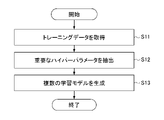
- FIG. 4 is a flowchart illustrating the machine learning process of the machine learning device 10 in the learning phase. Although the flow of FIG. 4 exemplifies batch learning, it may be replaced with online learning or mini-batch learning instead of batch learning.
- step S11 the acquisition unit 110 acquires training data from the database 70.
- step S12 the parameter extraction unit 111 extracts important hyperparameters from all hyperparameters and the like. It is explained here to extract important hyperparameters, but it is not limited to this. For example, when the total number of hyperparameters is small, it is not necessary to extract important hyperparameters in step S12.
- step S13 the learning unit 112 sets a plurality of sets of hyperparameters and the like a plurality of times based on the training data acquired in step S11, performs machine learning a plurality of times, and generates a plurality of trained models. ..
- FIG. 5 is a flowchart illustrating the inference calculation process of the machine learning device 10 in the operation phase.
- step S21 the acquisition unit 110 acquires inference data from the measuring instrument 40.
- step S22 the model evaluation unit 113 evaluates the quality of the learning results of the plurality of learned models generated by the machine learning process of FIG. 4 by the learning unit 112, and displays the evaluation results on the display unit (illustrated) of the machine learning device 10. Do not display).
- the explanation is divided into a learning phase and an operation phase, and after all the learning phases are completed, a plurality of generated trained models may be collectively passed to the model evaluation unit 113 for evaluation. Not limited. For example, even in the middle of step S13 of the learning phase, when one trained model is generated, the training result of the trained model is evaluated online so that the trained model is immediately passed to the model evaluation unit 113 and the training result is evaluated. You may.
- step S23 the model selection unit 114 determines whether or not the user has selected the trained model via the input unit (not shown) of the machine learning device 10. If the user has selected a trained model, the process proceeds to step S25. On the other hand, if the user does not select the trained model, the process proceeds to step S24.
- step S24 the model selection unit 114 selects at least one better trained model from the plurality of trained models based on the evaluation result calculated in step S22.
- step S25 the inference calculation unit 115 performs inference calculation processing based on the inference data acquired in step S21 and the trained model selected in step S23 or step S24, and generates inference result candidates. ..
- step S26 the model evaluation unit 113 re-evaluates the quality of the plurality of trained models by using the inference result candidates generated in step S25.
- this step S26 may be skipped so as to reduce the overall calculation processing time.
- step S27 is also skipped and the process directly proceeds to step S28.
- step S27 the model selection unit 114 determines whether or not to reselect at least one trained model from the plurality of trained models re-evaluated in step S26. When reselecting the trained model, the process returns to step S24. On the other hand, if the trained model is not reselected, the process proceeds to step S28.
- step S28 the inference determination unit 116 outputs all or part of the inference result candidates calculated in step S25, or a combination thereof.
- step S29 the inference determination unit 116 determines whether or not there is no inference result candidate output in step S28. If there is no output, the process returns to step S24 to reselect the trained model. On the other hand, if there is an output, the process proceeds to step S30.
- step S30 the machine learning device 10 uses the inference result candidate output in step S28 as fetch position information, and whether or not the operation execution unit 210 of the robot control device 20 executes the fetch operation based on the fetch position information. To judge. When the take-out operation is executed, the process proceeds to step S31. On the other hand, if the fetch operation is not executed, the inference calculation process is terminated.
- step S31 the machine learning device 10 determines whether or not the feedback of the execution result of the work 50 retrieval operation by the operation execution unit 210 of the robot control device 20 has been received. When the feedback is received, the process returns to steps S22 and S24. On the other hand, if no feedback is received, the inference calculation process ends.
- the machine learning device 10 acquires training data from the database 70, and sets a plurality of sets of hyper parameters to a plurality of times for one set of training data based on the acquired training data. Then machine learning is performed multiple times to generate multiple trained models.
- the machine learning device 10 evaluates the quality of the training result of each of the generated plurality of trained models, and selects at least one better trained model from the plurality of trained models based on the evaluation result.
- the machine learning device 10 performs inference calculation processing based on the inference data acquired from the measuring instrument 40 and the selected learned model, and generates inference result candidates.
- the machine learning device 10 outputs all or a part of the generated inference result candidates or a combination thereof.
- the machine learning device 10 generates a plurality of biased trained models and comprehensively uses them, thereby reducing the time and effort required for collecting training data used for training, and even with a small amount of training data. You can get good performance. That is, the time and effort required to collect the training data used for learning can be reduced, and good performance can be obtained even with a small amount of training data. Further, even if the machine learning device 10 cannot generate a trained model that can be adjusted in any way due to a large number of hyperparameters that need to be adjusted, the machine learning device 10 is generated by using a plurality of biased trained models. By combining multiple biased inference result candidates, or by selecting at least one trained model that is good according to the actual situation, overall good performance can be obtained. Further, the machine learning device 10 can solve the problem of undetected work and the problem of leftover work in image recognition, and can realize high production efficiency.
- the machine learning device 10 is not limited to the above-described embodiment, and includes deformation, improvement, and the like within a range in which the object can be achieved.
- the machine learning device 10 is exemplified as a device different from the robot control device 20, but even if the robot control device 20 is configured to have a part or all of the functions of the machine learning device 10. good.
- a part or all of the acquisition unit 110, the parameter extraction unit 111, the learning unit 112, the model evaluation unit 113, the model selection unit 114, the inference calculation unit 115, and the inference determination unit 116 of the machine learning device 10, for example, a server. May be prepared.
- each function of the machine learning device 10 may be realized by using a virtual server function or the like on the cloud.
- the machine learning device 10 may be a distributed processing system in which each function of the machine learning device 10 is appropriately distributed to a plurality of servers.
- the machine learning device 10 separately executes the machine learning process and the inference calculation process, but the present invention is not limited to this.
- the machine learning device 10 may execute the inference calculation process while executing the machine learning process by online learning.
- each function included in the machine learning device 10 in one embodiment can be realized by hardware, software, or a combination thereof.
- what is realized by software means that it is realized by a computer reading and executing a program.
- Non-transitory computer-readable media include various types of tangible recording media (Tangible studio media). Examples of non-temporary computer-readable media include magnetic recording media (eg, flexible disks, magnetic tapes, hard disk drives), optomagnetic recording media (eg, optomagnetic disks), CD-ROMs (Read Only Memory), CD-. R, CD-R / W, semiconductor memory (for example, mask ROM, PROM (Programmable ROM), EPROM (Erasable PROM), flash ROM, RAM) are included.
- the program may be supplied to the computer by various types of temporary computer-readable media (Transition computer readable medium).
- temporary computer readable media include electrical, optical, and electromagnetic waves.
- the temporary computer-readable medium can supply the program to the computer via a wired communication path such as an electric wire and an optical fiber, or a wireless communication path.
- the step of describing the program to be recorded on the recording medium is not only the processing performed in chronological order but also the processing executed in parallel or individually even if it is not necessarily processed in chronological order. Also includes.
- the machine learning device and the machine learning method of the present disclosure can take various embodiments having the following configurations.
- the machine learning device 10 of the present disclosure is a machine learning device, which is a machine based on an acquisition unit 110 that acquires training data and inference data used for machine learning, training data, and a plurality of sets of learning parameters.
- the learning unit 112 that performs learning and generates a plurality of trained models
- the model evaluation unit 113 that evaluates the quality of the learning results of the plurality of trained models and displays the evaluation results, and the reception of selection of the trained model.
- a possible model selection unit 114, an inference calculation unit 115 that performs inference calculation processing based on at least a part of a plurality of trained models and inference data, and generates inference result candidates, and all inference result candidates.
- the inference determination unit 116 that outputs a part or a combination thereof is provided. According to this machine learning device 10, the time and effort required for collecting training data used for learning can be reduced, and good performance can be obtained even with a small amount of training data.
- the model selection unit 114 may accept a trained model selected by the user based on the evaluation result displayed by the model evaluation unit 113. By doing so, the machine learning device 10 performs inference calculation processing according to the optimum trained model selected according to the actual situation of the site recognized by the user, even if there is an error in the evaluation result calculated by the computer. be able to. Further, it is possible to improve the prediction accuracy of the machine learning device 10 by feeding back the selection result by the user and learning, correcting the calculation error of the computer and improving the machine learning algorithm.
- the machine learning device 10 autonomously selects the optimum trained model according to the rules obtained by learning by itself in an unmanned environment, and performs inference calculation processing using the optimum trained model. be able to.
- the machine learning device 10 according to any one of (1) to (3) further includes a parameter extraction unit 111, which extracts important hyperparameters from a plurality of hyperparameters.
- the learning unit 112 may perform machine learning based on the extracted hyperparameters and generate a plurality of trained models. By doing so, the machine learning device 10 can reduce the time required for adjusting the hyperparameters and improve the learning efficiency.
- the model evaluation unit 113 evaluates the quality of the trained model based on the inference result candidate generated by the inference calculation unit 115. You may. By doing so, the machine learning device 10 can correctly evaluate the ability of the trained model based on the actual inference data that has not been used for training.
- a trained model obtained a better inference result candidate based on the evaluation result by the model evaluation unit 113 based on the inference result candidate generated by the inference calculation unit 115. May be selected. By doing so, the machine learning device 10 can select the best trained model with the best performance.
- the inference calculation unit 115 performs inference calculation processing based on the trained model evaluated as good by the model evaluation unit 113. Inference result candidates may be generated. By doing so, the machine learning device 10 cannot obtain good inference result candidates even if the inference calculation process is performed using the "bad" trained model generated without being able to learn well. It is possible to eliminate unnecessary inference calculation processing time and improve the efficiency of inference calculation processing.
- the model selection unit 114 selects a trained model based on the inference result candidate generated by the inference calculation unit 115. May be good. By doing so, the machine learning device 10 selects a trained model that can predict more extraction position candidates for one inference image taken in one shooting, and thereby performs one extraction operation. More work can be taken out with, and the efficiency of taking out the work can be improved.
- the model selection unit 114 newly sets at least one from the plurality of trained models.
- a trained model is selected
- the inference calculation unit 115 performs inference calculation processing based on at least one newly selected trained model, generates at least one new inference result candidate
- the inference determination unit 116 performs inference calculation processing. All or part of new inference result candidates or a combination thereof may be output.
- the machine learning device 10 can select a newly trained model and move to a new inference-predicted extraction position even if there is no extraction position output as an inference result. , It is possible to prevent the operation of the work 50 take-out operation from being stopped by the hand 31, realize a continuous take-out operation, and improve the production efficiency of the production line.
- the learning unit 112 may perform machine learning based on a plurality of sets of training data. By doing so, the machine learning device 10 learns using training data with many variations, obtains a trained model with good robustness that can infer various situations well, and gives good overall performance. be able to.
- the acquisition unit 110 acquires image data of an existing region of a plurality of works 50 as training data and inference data, and trains.
- the data may include teaching data of at least one feature of the work 50 on the image data.
- the machine learning device 10 can output a predicted value close to the teaching data, and machine a trained model that can identify a feature similar to the feature contained in the teaching data on various inference image data. It can be generated by learning.
- the acquisition unit 110 acquires three-dimensional measurement data of an existing region of a plurality of works 50 as training data and inference data.
- the training data may include teaching data of at least one feature of the work 50 on the three-dimensional measurement data.
- the machine learning device 10 can output a predicted value close to the teaching data, and a trained model that can identify a feature similar to the feature contained in the teaching data on various three-dimensional measurement data for inference. Can be generated by machine learning.
- the learning unit 112 performs machine learning based on the training data, and the inference calculation unit 115 provides information on at least one feature of the work 50. Inference result candidates including may be generated. By doing so, the machine learning device 10 makes good use of a plurality of trained models that can identify features similar to the features contained in the teaching data on various inference data, and obtains overall good performance. Can be done.
- the acquisition unit 110 acquires image data of an existing region of a plurality of works 50 as training data and inference data, and trains.
- the data may include teaching data of at least one extraction position of the work 50 on the image data.
- the machine learning device 10 can output a predicted value close to the teaching data, and can estimate a position similar to the extraction position included in the teaching data on various inference image data. It can be generated by machine learning.
- the acquisition unit 110 measures three-dimensionally the existence region of a plurality of works 50 as training data and inference data.
- the data may be acquired and the training data may include teaching data of at least one extraction position of the work 50 on the three-dimensional measurement data.
- the machine learning device 10 can output a predicted value close to the teaching data, and has been trained so that a position similar to the extraction position included in the teaching data can be estimated on various inference three-dimensional measurement data. Models can be generated by machine learning.
- the learning unit 112 performs machine learning based on the training data, and the inference calculation unit 115 provides information on at least one extraction position of the work 50. Inference result candidates including may be generated.
- the machine learning device 10 makes good use of a plurality of trained models that can estimate positions similar to the extraction positions included in the teaching data on various inference data, and obtains overall good performance. be able to.
- the model evaluation unit 113 causes a robot 30 having a hand 31 to take out the work 50 to execute an operation of taking out the work 50 by the hand 31.
- the robot control device 20 including the robot control device 20 receives the execution result of the take-out operation by the operation execution unit 210 based on the inference result of at least one take-out position of the work 50 output by the machine learning device 10, and is based on the execution result of the take-out operation.
- the quality of the training results of a plurality of trained models may be evaluated. By doing so, the machine learning device 10 can give a high evaluation value to the trained model that predicts the inference result candidate having a high extraction success rate of the work 50.
- the model selection unit 114 causes a robot 30 having a hand 31 to take out the work 50 to execute an operation of taking out the work 50 by the hand 31.
- the robot control device 20 including the execution unit 210 receives the execution result of the extraction operation by the operation execution unit 210 based on the inference result of at least one extraction position of the work 50 output by the machine learning device 10, and executes the extraction operation.
- a trained model may be selected based on the results. By doing so, the machine learning device 10 can select a trained model that predicts inference result candidates having a high extraction success rate of the work 50.
- the machine learning method of the present disclosure is a machine learning method realized by a computer, and includes an acquisition process for acquiring training data and inference data used for machine learning, and training data and a plurality of sets of learning parameters.
- a learning process that performs machine learning based on this to generate multiple trained models, a model evaluation process that evaluates the quality of the learning results of multiple trained models and displays the evaluation results, and acceptance of selection of trained models.
- a model selection process that enables inference calculation processing, an inference calculation process that performs inference calculation processing based on at least a part of a plurality of trained models and inference data, and an inference calculation process that generates inference result candidates, and all or one of inference result candidates. It is provided with a reasoning determination step for outputting a unit or a combination thereof. According to this machine learning method, the same effect as in (1) can be obtained.
- Robot system 10 Machine learning device 11
- Control unit 110 Acquisition unit 111
- Parameter extraction unit 112 Learning unit 113
- Inference calculation unit 116 Inference decision unit 20
- Robot control unit 21 Control unit 210
- Operation execution unit 30 Robot 40 Measuring instrument 50 work 60 container 70 database
Landscapes
- Engineering & Computer Science (AREA)
- Theoretical Computer Science (AREA)
- Physics & Mathematics (AREA)
- General Physics & Mathematics (AREA)
- Evolutionary Computation (AREA)
- Computing Systems (AREA)
- Health & Medical Sciences (AREA)
- General Health & Medical Sciences (AREA)
- Artificial Intelligence (AREA)
- Software Systems (AREA)
- Life Sciences & Earth Sciences (AREA)
- Molecular Biology (AREA)
- Mathematical Physics (AREA)
- General Engineering & Computer Science (AREA)
- Data Mining & Analysis (AREA)
- Computational Linguistics (AREA)
- Biomedical Technology (AREA)
- Biophysics (AREA)
- Computer Vision & Pattern Recognition (AREA)
- Databases & Information Systems (AREA)
- Multimedia (AREA)
- Medical Informatics (AREA)
- Automation & Control Theory (AREA)
- Image Analysis (AREA)
- Manipulator (AREA)
Priority Applications (4)
| Application Number | Priority Date | Filing Date | Title |
|---|---|---|---|
| JP2022571435A JP7556983B2 (ja) | 2020-12-25 | 2021-12-20 | 機械学習装置、及び機械学習方法 |
| US18/038,832 US20230419643A1 (en) | 2020-12-25 | 2021-12-20 | Machine learning device and machine learning method |
| CN202180085154.3A CN116601651A (zh) | 2020-12-25 | 2021-12-20 | 机器学习装置以及机器学习方法 |
| DE112021005280.2T DE112021005280T5 (de) | 2020-12-25 | 2021-12-20 | Maschinelle Lernvorrichtung und ein maschinelles Lernverfahren |
Applications Claiming Priority (2)
| Application Number | Priority Date | Filing Date | Title |
|---|---|---|---|
| JP2020216583 | 2020-12-25 | ||
| JP2020-216583 | 2020-12-25 |
Publications (1)
| Publication Number | Publication Date |
|---|---|
| WO2022138545A1 true WO2022138545A1 (ja) | 2022-06-30 |
Family
ID=82157919
Family Applications (1)
| Application Number | Title | Priority Date | Filing Date |
|---|---|---|---|
| PCT/JP2021/046971 Ceased WO2022138545A1 (ja) | 2020-12-25 | 2021-12-20 | 機械学習装置、及び機械学習方法 |
Country Status (6)
| Country | Link |
|---|---|
| US (1) | US20230419643A1 (https=) |
| JP (1) | JP7556983B2 (https=) |
| CN (1) | CN116601651A (https=) |
| DE (1) | DE112021005280T5 (https=) |
| TW (1) | TWI888681B (https=) |
| WO (1) | WO2022138545A1 (https=) |
Families Citing this family (1)
| Publication number | Priority date | Publication date | Assignee | Title |
|---|---|---|---|---|
| JP7336503B2 (ja) * | 2021-12-27 | 2023-08-31 | Fsx株式会社 | サーバ及びおしぼり管理システム |
Citations (2)
| Publication number | Priority date | Publication date | Assignee | Title |
|---|---|---|---|---|
| JP2019058960A (ja) * | 2017-09-25 | 2019-04-18 | ファナック株式会社 | ロボットシステム及びワーク取り出し方法 |
| JP2019175140A (ja) * | 2018-03-28 | 2019-10-10 | 株式会社パスコ | 建築物抽出システム |
Family Cites Families (17)
| Publication number | Priority date | Publication date | Assignee | Title |
|---|---|---|---|---|
| EP2525306A4 (en) * | 2010-01-14 | 2018-01-10 | Nec Corporation | Pattern recognition device, pattern recognition method and pattern recognition-use program |
| WO2013065220A1 (ja) * | 2011-11-02 | 2013-05-10 | パナソニック株式会社 | 画像認識装置、画像認識方法、及び集積回路 |
| CN104036451B (zh) * | 2014-06-20 | 2018-12-11 | 深圳市腾讯计算机系统有限公司 | 基于多图形处理器的模型并行处理方法及装置 |
| US10229317B2 (en) * | 2016-08-06 | 2019-03-12 | X Development Llc | Selectively downloading targeted object recognition modules |
| CN107945507B (zh) * | 2016-10-13 | 2020-08-11 | 腾讯科技(深圳)有限公司 | 行程时间预测方法及装置 |
| JP6662836B2 (ja) * | 2017-11-24 | 2020-03-11 | ファナック株式会社 | 収容領域又は治具にワークを配置するワーク配置システム |
| US11455501B2 (en) * | 2018-02-21 | 2022-09-27 | Hewlett-Packard Development Company, L.P. | Response based on hierarchical models |
| US20200380362A1 (en) * | 2018-02-23 | 2020-12-03 | Asml Netherlands B.V. | Methods for training machine learning model for computation lithography |
| JP6911798B2 (ja) * | 2018-03-15 | 2021-07-28 | オムロン株式会社 | ロボットの動作制御装置 |
| JP7200610B2 (ja) | 2018-11-08 | 2023-01-10 | 富士通株式会社 | 位置検出プログラム、位置検出方法及び位置検出装置 |
| JP6828762B2 (ja) * | 2019-03-15 | 2021-02-10 | ダイキン工業株式会社 | 機械学習装置、及び、磁気軸受装置 |
| WO2021149118A1 (ja) * | 2020-01-20 | 2021-07-29 | 楽天株式会社 | 情報処理装置、情報処理方法およびプログラム |
| KR20220004453A (ko) * | 2020-07-03 | 2022-01-11 | 삼성전자주식회사 | 객체를 인식하는 전자 장치 및 그 동작 방법 |
| US11288797B2 (en) * | 2020-07-08 | 2022-03-29 | International Business Machines Corporation | Similarity based per item model selection for medical imaging |
| CN116057548A (zh) * | 2020-09-25 | 2023-05-02 | 发那科株式会社 | 推论计算处理装置以及推论计算处理方法 |
| US12397417B2 (en) * | 2020-12-18 | 2025-08-26 | Mitsubishi Electric Corporation | Learning device, diagnostic system, and model generation method to diagnose abnormality based on temperature measurement in a production facility |
| JP7840015B2 (ja) * | 2022-09-21 | 2026-04-03 | グローリー株式会社 | 画像処理装置、学習モデルの生産方法、および推論方法 |
-
2021
- 2021-12-06 TW TW110145504A patent/TWI888681B/zh active
- 2021-12-20 DE DE112021005280.2T patent/DE112021005280T5/de active Pending
- 2021-12-20 US US18/038,832 patent/US20230419643A1/en active Pending
- 2021-12-20 CN CN202180085154.3A patent/CN116601651A/zh active Pending
- 2021-12-20 WO PCT/JP2021/046971 patent/WO2022138545A1/ja not_active Ceased
- 2021-12-20 JP JP2022571435A patent/JP7556983B2/ja active Active
Patent Citations (2)
| Publication number | Priority date | Publication date | Assignee | Title |
|---|---|---|---|---|
| JP2019058960A (ja) * | 2017-09-25 | 2019-04-18 | ファナック株式会社 | ロボットシステム及びワーク取り出し方法 |
| JP2019175140A (ja) * | 2018-03-28 | 2019-10-10 | 株式会社パスコ | 建築物抽出システム |
Also Published As
| Publication number | Publication date |
|---|---|
| JP7556983B2 (ja) | 2024-09-26 |
| TWI888681B (zh) | 2025-07-01 |
| DE112021005280T5 (de) | 2023-11-02 |
| JPWO2022138545A1 (https=) | 2022-06-30 |
| CN116601651A (zh) | 2023-08-15 |
| US20230419643A1 (en) | 2023-12-28 |
| TW202226071A (zh) | 2022-07-01 |
Similar Documents
| Publication | Publication Date | Title |
|---|---|---|
| JP6522488B2 (ja) | ワークの取り出し動作を学習する機械学習装置、ロボットシステムおよび機械学習方法 | |
| US10737385B2 (en) | Machine learning device, robot system, and machine learning method | |
| CN109551459B (zh) | 机器人系统以及工件取出方法 | |
| US20200254622A1 (en) | Machine learning device, robot system, and machine learning method for learning workpiece picking operation | |
| US9044858B2 (en) | Target object gripping apparatus, method for controlling the same and storage medium | |
| CN112966696A (zh) | 一种处理三维点云的方法、装置、设备以及存储介质 | |
| WO2023124734A1 (zh) | 物体抓取点估计、模型训练及数据生成方法、装置及系统 | |
| CA3235569A1 (en) | Automated bin-picking based on deep learning | |
| US11203116B2 (en) | System and method for predicting robotic tasks with deep learning | |
| WO2022024877A1 (ja) | 情報処理装置、及び情報処理方法 | |
| US11673266B2 (en) | Robot control device for issuing motion command to robot on the basis of motion sequence of basic motions | |
| CN111683799A (zh) | 机器人的动作控制装置 | |
| JP2018036770A (ja) | 位置姿勢推定装置、位置姿勢推定方法、及び位置姿勢推定プログラム | |
| KR102888118B1 (ko) | 제품 이미지를 기반으로 불량 제품을 감지하는 인공 지능 장치 및 그 방법 | |
| CN118037670A (zh) | 一种3d打印缺陷的检测方法及相关设备 | |
| Zhang et al. | A fast detection and grasping method for mobile manipulator based on improved faster R-CNN | |
| WO2023091303A1 (en) | Methods and systems for grading devices | |
| WO2022138545A1 (ja) | 機械学習装置、及び機械学習方法 | |
| JP7450517B2 (ja) | 加工面判定装置、加工面判定プログラム、加工面判定方法、及び、加工システム | |
| CN113744181A (zh) | 基于2d3d视觉融合的五金件机器人智能化打磨方法与装置 | |
| JP2015085434A (ja) | ロボット、画像処理方法及びロボットシステム | |
| CN118514941A (zh) | 一种罐体倾倒检测系统 | |
| CN115431258B (zh) | 机械臂控制方法、装置、电子设备和存储介质 | |
| Gupta et al. | Enhancing Road Safety and ITS Efficiency: A Comprehensive Evaluation of Traffic Sign Detection using YOLOv8 | |
| CN116724224A (zh) | 加工面判定装置、加工面判定程序、加工面判定方法、加工系统、推论装置及机器学习装置 |
Legal Events
| Date | Code | Title | Description |
|---|---|---|---|
| 121 | Ep: the epo has been informed by wipo that ep was designated in this application |
Ref document number: 21910690 Country of ref document: EP Kind code of ref document: A1 |
|
| ENP | Entry into the national phase |
Ref document number: 2022571435 Country of ref document: JP Kind code of ref document: A |
|
| WWE | Wipo information: entry into national phase |
Ref document number: 18038832 Country of ref document: US |
|
| WWE | Wipo information: entry into national phase |
Ref document number: 112021005280 Country of ref document: DE |
|
| WWE | Wipo information: entry into national phase |
Ref document number: 202180085154.3 Country of ref document: CN |
|
| 122 | Ep: pct application non-entry in european phase |
Ref document number: 21910690 Country of ref document: EP Kind code of ref document: A1 |