WO2022130501A1 - 航空機 - Google Patents
航空機 Download PDFInfo
- Publication number
- WO2022130501A1 WO2022130501A1 PCT/JP2020/046756 JP2020046756W WO2022130501A1 WO 2022130501 A1 WO2022130501 A1 WO 2022130501A1 JP 2020046756 W JP2020046756 W JP 2020046756W WO 2022130501 A1 WO2022130501 A1 WO 2022130501A1
- Authority
- WO
- WIPO (PCT)
- Prior art keywords
- wing
- aircraft
- rotors
- fuselage
- rotor
- Prior art date
- Legal status (The legal status is an assumption and is not a legal conclusion. Google has not performed a legal analysis and makes no representation as to the accuracy of the status listed.)
- Ceased
Links
Images


Classifications
-
- B—PERFORMING OPERATIONS; TRANSPORTING
- B64—AIRCRAFT; AVIATION; COSMONAUTICS
- B64C—AEROPLANES; HELICOPTERS
- B64C29/00—Aircraft capable of landing or taking-off vertically, e.g. vertical take-off and landing [VTOL] aircraft
- B64C29/0008—Aircraft capable of landing or taking-off vertically, e.g. vertical take-off and landing [VTOL] aircraft having its flight directional axis horizontal when grounded
- B64C29/0016—Aircraft capable of landing or taking-off vertically, e.g. vertical take-off and landing [VTOL] aircraft having its flight directional axis horizontal when grounded the lift during taking-off being created by free or ducted propellers or by blowers
- B64C29/0025—Aircraft capable of landing or taking-off vertically, e.g. vertical take-off and landing [VTOL] aircraft having its flight directional axis horizontal when grounded the lift during taking-off being created by free or ducted propellers or by blowers the propellers being fixed relative to the fuselage
-
- B—PERFORMING OPERATIONS; TRANSPORTING
- B64—AIRCRAFT; AVIATION; COSMONAUTICS
- B64C—AEROPLANES; HELICOPTERS
- B64C1/00—Fuselages; Constructional features common to fuselages, wings, stabilising surfaces or the like
- B64C1/16—Fuselages; Constructional features common to fuselages, wings, stabilising surfaces or the like specially adapted for mounting power plant
-
- B—PERFORMING OPERATIONS; TRANSPORTING
- B64—AIRCRAFT; AVIATION; COSMONAUTICS
- B64C—AEROPLANES; HELICOPTERS
- B64C1/00—Fuselages; Constructional features common to fuselages, wings, stabilising surfaces or the like
- B64C1/26—Attaching the wing or tail units or stabilising surfaces
-
- B—PERFORMING OPERATIONS; TRANSPORTING
- B64—AIRCRAFT; AVIATION; COSMONAUTICS
- B64D—EQUIPMENT FOR FITTING IN OR TO AIRCRAFT; FLIGHT SUITS; PARACHUTES; ARRANGEMENT OR MOUNTING OF POWER PLANTS OR PROPULSION TRANSMISSIONS IN AIRCRAFT
- B64D27/00—Arrangement or mounting of power plants in aircraft; Aircraft characterised by the type or position of power plants
- B64D27/02—Aircraft characterised by the type or position of power plants
-
- B—PERFORMING OPERATIONS; TRANSPORTING
- B64—AIRCRAFT; AVIATION; COSMONAUTICS
- B64D—EQUIPMENT FOR FITTING IN OR TO AIRCRAFT; FLIGHT SUITS; PARACHUTES; ARRANGEMENT OR MOUNTING OF POWER PLANTS OR PROPULSION TRANSMISSIONS IN AIRCRAFT
- B64D27/00—Arrangement or mounting of power plants in aircraft; Aircraft characterised by the type or position of power plants
- B64D27/02—Aircraft characterised by the type or position of power plants
- B64D27/30—Aircraft characterised by electric power plants
- B64D27/33—Hybrid electric aircraft
-
- B—PERFORMING OPERATIONS; TRANSPORTING
- B64—AIRCRAFT; AVIATION; COSMONAUTICS
- B64C—AEROPLANES; HELICOPTERS
- B64C11/00—Propellers, e.g. of ducted type; Features common to propellers and rotors for rotorcraft
- B64C11/001—Shrouded propellers
-
- B—PERFORMING OPERATIONS; TRANSPORTING
- B64—AIRCRAFT; AVIATION; COSMONAUTICS
- B64C—AEROPLANES; HELICOPTERS
- B64C1/00—Fuselages; Constructional features common to fuselages, wings, stabilising surfaces or the like
- B64C2001/0045—Fuselages characterised by special shapes
-
- B—PERFORMING OPERATIONS; TRANSPORTING
- B64—AIRCRAFT; AVIATION; COSMONAUTICS
- B64U—UNMANNED AERIAL VEHICLES [UAV]; EQUIPMENT THEREFOR
- B64U10/00—Type of UAV
- B64U10/20—Vertical take-off and landing [VTOL] aircraft
Definitions
- the present invention relates to an aircraft capable of taking off and landing in the vertical direction and cruising.
- the US Patent Application Publication No. 2020/0115045 shows an aircraft called a vertical take-off and landing aircraft (VTOL).
- the aircraft set forth in US Patent Application Publication No. 2020/0115045 includes a fuselage, front and rear wings (main wings) connected to the fuselage, multiple takeoff and landing rotors located on the left and right sides of the fuselage, and a rear. It comprises a plurality of cruising rotors located above the wings.
- This aircraft uses a takeoff and landing rotor for takeoff and landing and for stop flight, and a cruise rotor for cruising.
- this aircraft uses both a takeoff and landing rotor and a cruise rotor when transitioning from a stopped flight to a cruise flight and when transitioning from a cruise flight to a stopped flight.
- the takeoff and landing rotor is arranged in front of the cruise rotor in a plan view.
- a pair of takeoff and landing rotors located in front of the cruising rotor allow air to flow downward. The air generated at this time interferes with the air guided from the front to the cruising rotor. Then, the air flow guided to the cruising rotor may be disturbed, which may affect the thrust generated by the cruising rotor.
- the fuselage will be located in front of the cruising rotor. Then, the fuselage may obstruct the air flow guided by the cruise rotor. In this case, the thrust generated by the cruising rotor cannot be sufficiently obtained.
- the present invention has been made in consideration of such a problem, and an object of the present invention is to provide an aircraft capable of sufficiently obtaining the thrust generated by a cruise rotor.
- the wings connected to the upper part of the rear part of the fuselage, Two or more cruise rotors located on the right and left sides of the fuselage center axis, respectively, configured to generate thrust during horizontal movement.
- the rear portion of the fuselage has an inclined surface that is displaced from upper to lower as it travels from front to rear so that the area of the overlap portion gradually decreases as it progresses from front to rear.
- the thrust generated by the cruising rotor can be sufficiently obtained.
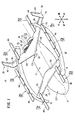
- FIG. 1 is a perspective view of an aircraft according to the present embodiment.
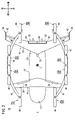
- FIG. 2 is a plan view of the aircraft according to the present embodiment.
- FIG. 3 is a left side view of the aircraft according to the present embodiment.
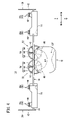
- FIG. 4 is a front view of the aircraft according to the present embodiment.
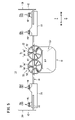
- FIG. 5 is a rear view of the aircraft according to the present embodiment.
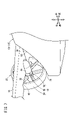
- FIG. 6 is a perspective view of the periphery of the rear part of the fuselage when viewed from diagonally above.
- FIG. 7 is a perspective view of the periphery of the rear part of the fuselage when viewed from diagonally below.
- the vertically upward direction is referred to as an upward direction (upward)
- the vertical downward direction is referred to as a downward direction (downward).
- the moving direction when the aircraft 10 moves (flys) in the horizontal direction is the forward direction (forward)
- the opposite direction is the backward direction (rear).
- the right side direction in the width direction of the aircraft 10 is the right direction (right side)
- the left side direction in the width direction is the left direction (left side).
- viewing each part from a position directly above the aircraft 10 is referred to as a plan view of the aircraft 10. Viewing each part from a position in front of the aircraft 10 is called a front view of the aircraft 10.
- the aircraft 10 includes a fuselage 12, a front wing 14, a rear wing 16, two booms 18, eight takeoff and landing rotors 20, and two cruising rotors 22. As shown in FIG. 2, the structure of the aircraft 10 is symmetrical about a position overlapping the central axis A of the fuselage 12 extending in the front-rear direction in a plan view. In a plan view, the central axis A overlaps with the center of gravity G of the aircraft 10.
- the body 12 is long in the front-rear direction.
- the fuselage 12 has a front portion 12f located in front of the center of gravity G and a rear portion 12r located behind the center of gravity G.
- the front portion 12f is configured so that the front end side is narrowed.
- the rear portion 12r is configured so that the rear end side is narrowed.
- the main body of the body 12 may be partially covered with a fairing.
- the fuselage 12, the front portion 12f, and the rear portion 12r including this fairing are referred to.
- the front wing 14 is connected to the upper part of the front portion 12f of the fuselage 12, and is configured to generate lift when the aircraft 10 moves forward.
- the front wing 14 has a front wing body (also referred to as a horizontal stabilizer) 26 extending from the center to the left and right, and left and right elevators 28 arranged at the trailing edge of the front wing 14.
- the rear wing 16 is connected to the upper part of the rear portion 12r of the fuselage 12 via a pylon 32, and is configured to generate lift when the aircraft 10 moves forward.
- the rear wing 16 includes a rear wing body 34 extending rearward from the center, left and right elevons 36 arranged at the trailing edge of the rear wing 16, and a pair of vertical stabilizers 38 arranged at the left and right wing tips of the rear wing 16. And have.
- Each vertical stabilizer 38 has a tail body 42 (also referred to as a vertical stabilizer) and a rudder 44 arranged at the trailing edge of the vertical stabilizer 38.
- the wing area of the rear wing 16 is larger than the wing area of the front wing 14. Further, the wingspan of the rear wing 16 is longer than the wingspan of the front wing 14. With such a configuration, the lift generated by the rear wing 16 when the aircraft 10 moves forward is larger than the lift generated by the front wing 14. That is, the rear wing 16 functions as the main wing of the aircraft 10. The rear wing 16 is a swept wing that reduces air resistance.
- the front wing 14 functions as a canard of the aircraft 10.
- the front wing 14 and the rear wing 16 also function as support members for supporting the two booms 18.
- the lift generated by the rear wing 16 when the aircraft 10 moves forward may be the same as the lift generated by the front wing 14 when the aircraft 10 moves forward.
- the magnitude relationship between the lift generated by the front wing 14 and the lift generated by the rear wing 16 is appropriately determined by the position of the center of gravity G, the attitude of the aircraft during cruising, and the like. Further, the sizes (wing area, length, etc.) of the front wing 14 and the rear wing 16 are determined so that the desired lift is generated.
- the two booms 18 consist of a right boom 18 arranged to the right of the fuselage 12 and a left boom 18 arranged to the left of the fuselage 12.
- the two booms 18 form a pair and are arranged symmetrically with respect to a position overlapping the central axis A of the body 12 in a plan view.
- the two booms 18 function as support members for supporting the takeoff and landing rotor 20.
- the boom 18 on the right side is a rod member that extends from the front to the rear and curves in an arc shape toward the right (outside in the width direction).
- the right boom 18 is connected to the right wing tip of the front wing 14 and is connected to the inside of the right wing elevon 36 of the rear wing 16.
- the front end of the boom 18 on the right side is located in front of the front wing 14.
- the rear end of the boom 18 on the right side is located behind the rear wing 16.
- the boom 18 on the left side is a rod member that extends from the front to the rear and curves in an arc shape toward the left (outside in the width direction).
- the left boom 18 is connected to the left wing tip of the front wing 14 and is connected to the inside of the left wing elevon 36 of the rear wing 16.
- the front end of the boom 18 on the left side is located in front of the front wing 14.
- the rear end of the boom 18 on the left side is located behind the rear wing 16.
- the takeoff and landing rotor 20 has a rotary mast (not shown) connected to an output shaft of an electric motor (not shown) and a propeller 46 attached to the rotary mast.
- the rotary mast is arranged so as to be parallel to the vertical direction, and can rotate about an axis extending in the vertical direction.
- the propeller 46 is located above the boom 18, front wing 14, and rear wing 16. With such a structure, the propeller 46 can rotate about an axis extending in the vertical direction.
- Each takeoff and landing rotor 20 generates lift by the rotation of the propeller 46.
- the eight takeoff and landing rotors 20 include four takeoff and landing rotors 20a to 20d arranged to the right of the fuselage 12 and four takeoff and landing rotors 20a to 20d arranged to the left of the fuselage 12. ..
- the takeoff and landing rotors 20a to 20d on the right side are supported by the boom 18 on the right side.
- the takeoff and landing rotors 20a to 20d on the left side are supported by the boom 18 on the left side.
- the takeoff and landing rotors 20a to 20d on the right side and the takeoff and landing rotors 20a to 20d on the left side which are in the same position in the front-rear direction, form a pair.
- a pair of takeoff and landing rotors 20a, a front wing 14, a pair of takeoff and landing rotors 20b, a pair of takeoff and landing rotors 20c, and a rear wing. 16 and a pair of takeoff and landing rotors 20d are arranged in that order. That is, the pair of takeoff and landing rotors 20a are arranged in front of the front wing 14. Further, the pair of takeoff and landing rotors 20b are arranged between the front wing 14 and the rear wing 16 and are arranged in front of the pair of takeoff and landing rotors 20c.
- the pair of takeoff and landing rotors 20c are arranged between the front wing 14 and the rear wing 16, and are arranged behind the pair of takeoff and landing rotors 20b. Further, the pair of takeoff and landing rotors 20d are arranged behind the rear wing 16.
- the two cruise rotors 22 are arranged at the rear portion 12r of the fuselage 12.
- the position of the cruising rotor 22 in the left-right direction is inside (on the fuselage 12 side) of the position of each pair of takeoff and landing rotors 20 in the left-right direction.
- the position of the cruise rotor 22 in the front-rear direction is between the pair of takeoff and landing rotors 20c and the pair of takeoff and landing rotors 20d.
- the vertical position of the axis of the cruise rotor 22 is lower than the vertical position of the propeller 46 of the takeoff and landing rotor 20.
- the cruise rotor 22 includes a rotary mast (not shown) connected to an output shaft of an electric motor (not shown), a propeller 52 attached to the front end of the rotary mast, and a propeller 52. It has a cylindrical duct 54 that surrounds the propeller 52.
- the positions of the two cruising rotors 22 in the front-rear direction and the positions in the up-down direction coincide with each other. Further, the two cruise rotors 22 are arranged side by side on the left and right sides.
- One cruise rotor 22 is arranged to the right of the position overlapping the central axis A of the fuselage 12 in a plan view, and is supported by the right wing of the rear wing 16.
- the other cruise rotor 22 is arranged to the left of the position overlapping the central axis A of the fuselage 12 in a plan view, and is supported by the left wing of the rear wing 16.
- the rotary mast is arranged below the rear wing 16 so as to be parallel to the front-rear direction, and can rotate about an axis extending in the front-rear direction.
- the propeller 52 can rotate about an axis extending in the front-rear direction.
- Each cruising rotor 22 generates thrust by the rotation of the propeller 52.
- a plurality of ducts 54 extend in the radial direction of the duct 54 between the tubular portion 56 located on the outside, the central portion 58 located on the central side, and the inner peripheral surface of the tubular portion 56 and the outer peripheral surface of the central portion 58. In this embodiment, it has three) arms 60 and. The outer peripheral surface of the left cylinder portion 56 and the outer peripheral surface of the right cylinder portion 56 are connected to each other.
- the tubular portion 56 has a cylindrical shape centered on a rotating mast and surrounds the propeller 52.
- a recess 62 extending in the front-rear direction, the left-right direction, and the up-down direction is formed between the left and right elevons 36 and the left and right booms 18 in the rear portion of the rear wing 16.
- the tubular portion 56 of the duct 54 is arranged inside the recess 62. However, the tubular portion 56 and the recess 62 are separated from each other. As shown in FIG. 7, a protruding portion 64 projecting downward is formed in the lower part of the left wing and the lower part of the right wing of the rear wing 16. The central portion 58 of the duct 54 is connected to the protruding portion 64.
- a part of the rear wing 16 and a part of the cruising rotor 22 overlap each other in the front view. Further, in front view, the upper portion of the cruising rotor 22 projects above the rear wing 16, and the central portion and the lower portion of the cruising rotor 22 project below the rear wing 16.
- the positional relationship between the rear portion 12r of the fuselage 12 and the cruise rotor 22 will be described.
- FIG. 4 in front view, at least a portion of the fuselage 12 and at least a portion of the two cruising rotors 22 overlap each other.
- the portion where the fuselage 12 and the two cruising rotors 22 overlap each other in the front view is referred to as an overlap portion 66.
- the rear portion 12r is an inclined surface 68 that is displaced from the upper side to the lower side as it goes from the front to the rear so that the area of the overlap portion 66 gradually decreases from the front to the rear.
- the inclined surface 68 extends from the front to the rear and from the top to the bottom.
- the inclined surface 68 is formed on the upper right portion and the upper left portion of the rear portion 12r with the pylon 32 as the center.
- the inclined surface 68 guides a part of the air flowing from the front to the rear above the fuselage 12 to the cruising rotor 22.
- the inclined surface 68 may be a flat surface or a curved surface.
- the shape of the inclined surface 68 may be linear or may be curved downward.
- the shape of the inclined surface 68 may be linear or may be curved downward.
- the outer peripheral surface of the pylon 32 and the inclined surface 68 continuously have a curved shape in a cross section parallel to the left-right direction and the vertical direction.
- the vertical position of the rear end 70 of the inclined surface 68 is lower than the vertical position of the cruising rotor 22.
- the position of the rear end 70 of the inclined surface 68 in the front-rear direction is preferably rearward or the same as the position in the front-rear direction of the cruising rotor 22.
- the position of the rear end 70 of the inclined surface 68 in the front-rear direction may be ahead of the position of the cruising rotor 22 in the front-rear direction.
- the lower surface of the rear portion 12r of the fuselage 12 is displaced from the lower side to the upper side as it progresses from the front to the rear. Therefore, the cross-sectional area of the rear portion 12r of the fuselage 12 parallel to the left-right direction and the vertical direction gradually decreases from the front to the rear.
- the lower surface of the rear portion 12r may be displaced from the upper side to the lower side as it advances from the front to the rear together with the inclined surface 68, or may extend horizontally from the front to the rear.
- the takeoff and landing rotor 20 is used when the aircraft 10 takes off, lands, and stops.
- the cruise rotor 22 is used when the aircraft 10 is cruising.
- the takeoff and landing rotor 20 and the cruise rotor 22 are used when the aircraft 10 shifts from a stopped flight to a cruise flight, and the first speed ( ⁇ 0 km / h) or more and the second speed (> first speed) are forward. ) Is used together when moving below.
- the utilization rate of the cruising rotor 22 is gradually increased in order to accelerate. As the wing accelerates, the lift generated by the wing increases, so the usage rate of the takeoff and landing rotor 20 is gradually reduced.
- the utilization rate of the takeoff and landing rotor 20 is lowered by reducing the rotational speed of the takeoff and landing rotor 20 to reduce the lift.
- the utilization of the takeoff and landing rotor 20 is lowered by changing the pitch angle of each blade to reduce lift.
- the third speed ( ⁇ 0 km / h) or more and the fourth speed (> third speed) are forward. ) Is used together when moving below.
- the utilization rate of the cruising rotor 22 is gradually lowered in order to decelerate.
- the lift generated by the wing becomes smaller, so that the usage rate of the takeoff and landing rotor 20 is gradually increased.
- the utilization rate of the takeoff and landing rotor 20 is lowered by reducing the rotational speed of the takeoff and landing rotor 20 to reduce the lift.
- the utilization of the takeoff and landing rotor 20 is lowered by changing the pitch angle of each blade to reduce lift.
- Torso 12 and A wing connected to the upper part of the rear portion 12r of the fuselage 12 and Two or more cruising rotors 22 arranged on the right side and the left side of the central axis A of the fuselage 12 and configured to generate thrust during horizontal movement, respectively.
- the rear portion 12r of the fuselage 12 has an inclined surface 68 that is displaced from upper to lower as it travels from front to rear so that the area of the overlap portion 66 gradually decreases as it progresses from front to rear.
- the fuselage 12 and the two cruising rotors 22 overlap each other in the front view. That is, the two cruising rotors 22 are brought closer to the fuselage 12 side.
- the inclined surface 68 is formed on the rear portion 12r of the body 12. Since the inclined surface 68 forms a space immediately before the cruising rotor 22, the rear portion 12r of the fuselage 12 does not obstruct the air flow guided by the cruising rotor 22. Further, the inclined surface 68 smoothly guides the air flowing from the front to the rear around the upper part of the fuselage 12 to the cruising rotor 22. Therefore, since the air is sufficiently guided to the cruising rotor 22, the thrust generated by the cruising rotor 22 can be sufficiently obtained.
- the rear portion 12r of the fuselage 12 may extend below the two cruise rotors 22.
- the air flowing from the front can be guided to the cruise rotor 22. Therefore, thrust can be generated efficiently.
- the cross-sectional area of the rear portion 12r of the fuselage 12 parallel to the left-right direction and the vertical direction may gradually decrease from the front to the rear.
- the shape of the fuselage 12 can guide the air flowing from the front to the cruise rotor 22. Therefore, thrust can be generated efficiently.
- the two cruise rotors 22 are connected to the wing (rear wing 16). In front view of the aircraft 10, at least a portion of the wing and at least a portion of the two cruise rotors 22 overlap. The center of each of the cruise rotors 22 may be located below the blades.
- the portion of the cruising rotor 22 protruding above the wing is smaller than the portion of the cruising rotor 22 protruding below the wing, so that the cruising rotor 22 is generated. It is possible to reduce the resistance to be applied.
- the two cruise rotors 22 have a propeller 52 and a duct 54 surrounding the propeller 52.
- the ducts 54 of the two cruise rotors 22 may be connected to each other.
- At least a part of the plurality of takeoff and landing rotors 20 may be arranged behind the two or more cruise rotors 22.
- the air flow generated by the takeoff and landing rotor 20d arranged behind the cruising rotor 22 does not interfere with the air flow guided by the cruising rotor 22. Therefore, the thrust generated by the cruising rotor 22 is not adversely affected.
- the wing (rear wing 16) has moving blades (elevon 36) on the right wing and the left wing, respectively.
- the two cruise rotors 22 may be arranged closer to the fuselage 12 than the left and right blades.
Landscapes
- Engineering & Computer Science (AREA)
- Aviation & Aerospace Engineering (AREA)
- Mechanical Engineering (AREA)
- Toys (AREA)
- Structures Of Non-Positive Displacement Pumps (AREA)
Priority Applications (5)
| Application Number | Priority Date | Filing Date | Title |
|---|---|---|---|
| US18/257,162 US12252243B2 (en) | 2020-12-15 | 2020-12-15 | Aircraft |
| EP20965889.7A EP4265518B1 (en) | 2020-12-15 | 2020-12-15 | Aircraft |
| JP2022569370A JP7496893B2 (ja) | 2020-12-15 | 2020-12-15 | 航空機 |
| CN202080107973.9A CN116635299B (zh) | 2020-12-15 | 2020-12-15 | 航空器 |
| PCT/JP2020/046756 WO2022130501A1 (ja) | 2020-12-15 | 2020-12-15 | 航空機 |
Applications Claiming Priority (1)
| Application Number | Priority Date | Filing Date | Title |
|---|---|---|---|
| PCT/JP2020/046756 WO2022130501A1 (ja) | 2020-12-15 | 2020-12-15 | 航空機 |
Publications (1)
| Publication Number | Publication Date |
|---|---|
| WO2022130501A1 true WO2022130501A1 (ja) | 2022-06-23 |
Family
ID=82057443
Family Applications (1)
| Application Number | Title | Priority Date | Filing Date |
|---|---|---|---|
| PCT/JP2020/046756 Ceased WO2022130501A1 (ja) | 2020-12-15 | 2020-12-15 | 航空機 |
Country Status (5)
| Country | Link |
|---|---|
| US (1) | US12252243B2 (https=) |
| EP (1) | EP4265518B1 (https=) |
| JP (1) | JP7496893B2 (https=) |
| CN (1) | CN116635299B (https=) |
| WO (1) | WO2022130501A1 (https=) |
Cited By (2)
| Publication number | Priority date | Publication date | Assignee | Title |
|---|---|---|---|---|
| EP4331979A1 (en) * | 2022-09-02 | 2024-03-06 | Honda Motor Co., Ltd. | Rotor support device |
| EP4331976A1 (en) | 2022-08-30 | 2024-03-06 | Honda Motor Co., Ltd. | Thrust generating device |
Families Citing this family (2)
| Publication number | Priority date | Publication date | Assignee | Title |
|---|---|---|---|---|
| EP4345001B1 (en) * | 2021-08-27 | 2025-10-15 | SZ DJI Technology Co., Ltd. | Aerial vehicle and control method and apparatus therefor, and storage medium |
| EP4653315A1 (en) * | 2024-05-24 | 2025-11-26 | Leonardo S.p.a. | Convertible aircraft capable of hovering |
Citations (5)
| Publication number | Priority date | Publication date | Assignee | Title |
|---|---|---|---|---|
| JPH0740897A (ja) * | 1993-04-21 | 1995-02-10 | Okabe Kazuo | 無線制御航空機 |
| JP2001071998A (ja) * | 1999-06-29 | 2001-03-21 | Rokuro Hosoda | 航空機および回転力伝達装置 |
| JP2002542116A (ja) * | 1999-04-22 | 2002-12-10 | シコルスキー エアクラフト コーポレイション | 反転ダクトロータとシュラウド付き推進プロペラを有する無人航空機 |
| US20200115045A1 (en) | 2018-09-28 | 2020-04-16 | Airbus Helicopters | Electrically or hybrid powered multirotor aircraft with optimized energy consumption |
| JP2020526436A (ja) * | 2017-03-10 | 2020-08-31 | コルゴ システムズ エルティーディー | バーティカルロータおよび水平ロータを有する自由翼マルチロータ |
Family Cites Families (15)
| Publication number | Priority date | Publication date | Assignee | Title |
|---|---|---|---|---|
| DE3219159A1 (de) * | 1982-05-21 | 1983-11-24 | Dornier Gmbh | Anordnung von mit propellern arbeitenden antriebsanlagen an luftfahrzeugen |
| BR9106696A (pt) * | 1990-07-25 | 1993-06-08 | Sadleir Vtol Aircraft Co Pty L | Unidade de empuxo para aeronave do tipo vtol |
| US5957405A (en) * | 1997-07-21 | 1999-09-28 | Williams International Co., L.L.C. | Twin engine aircraft |
| US6467726B1 (en) | 1999-06-29 | 2002-10-22 | Rokuro Hosoda | Aircraft and torque transmission |
| WO2011140551A1 (en) * | 2010-05-07 | 2011-11-10 | Ohio University | Multi-modal vehicle |
| US10071801B2 (en) * | 2013-08-13 | 2018-09-11 | The United States Of America As Represented By The Administrator Of Nasa | Tri-rotor aircraft capable of vertical takeoff and landing and transitioning to forward flight |
| US12454354B2 (en) * | 2015-09-02 | 2025-10-28 | Jetoptera, Inc. | Configuration for vertical take-off and landing system for aerial vehicles |
| CN105346716A (zh) * | 2015-09-30 | 2016-02-24 | 上海圣尧智能科技有限公司 | 一种无人机动力系统及垂直起降无人机 |
| FR3052743B1 (fr) * | 2016-06-20 | 2018-07-06 | Airbus Operations | Ensemble pour aeronef comprenant des moteurs a propulsion par ingestion de la couche limite |
| EP3412567A1 (en) * | 2017-06-08 | 2018-12-12 | Airbus Defence and Space GmbH | Aerial vehicle |
| US11679871B2 (en) * | 2017-07-06 | 2023-06-20 | Shanghai Autoflight Co., Ltd. | VTOL fixed-wing drone with overlapping propellers attached to linear supports connecting fore and hind wings |
| US9975631B1 (en) | 2017-11-01 | 2018-05-22 | Kitty Hawk Corporation | Tiltwing multicopter with foldable and non-foldable propellers |
| EP3670341A1 (en) * | 2018-12-18 | 2020-06-24 | Bombardier Inc. | Vertical takeoff and landing (vtol) aircraft |
| US11964753B2 (en) * | 2020-09-17 | 2024-04-23 | Doroni Aerospace Inc. | Personal quadcopter aircraft |
| NL2026721B1 (en) * | 2020-10-21 | 2022-06-16 | Erdem Kazakli Ahmet | An amphibious flight vehicle |
-
2020
- 2020-12-15 US US18/257,162 patent/US12252243B2/en active Active
- 2020-12-15 CN CN202080107973.9A patent/CN116635299B/zh active Active
- 2020-12-15 JP JP2022569370A patent/JP7496893B2/ja active Active
- 2020-12-15 EP EP20965889.7A patent/EP4265518B1/en active Active
- 2020-12-15 WO PCT/JP2020/046756 patent/WO2022130501A1/ja not_active Ceased
Patent Citations (5)
| Publication number | Priority date | Publication date | Assignee | Title |
|---|---|---|---|---|
| JPH0740897A (ja) * | 1993-04-21 | 1995-02-10 | Okabe Kazuo | 無線制御航空機 |
| JP2002542116A (ja) * | 1999-04-22 | 2002-12-10 | シコルスキー エアクラフト コーポレイション | 反転ダクトロータとシュラウド付き推進プロペラを有する無人航空機 |
| JP2001071998A (ja) * | 1999-06-29 | 2001-03-21 | Rokuro Hosoda | 航空機および回転力伝達装置 |
| JP2020526436A (ja) * | 2017-03-10 | 2020-08-31 | コルゴ システムズ エルティーディー | バーティカルロータおよび水平ロータを有する自由翼マルチロータ |
| US20200115045A1 (en) | 2018-09-28 | 2020-04-16 | Airbus Helicopters | Electrically or hybrid powered multirotor aircraft with optimized energy consumption |
Non-Patent Citations (1)
| Title |
|---|
| See also references of EP4265518A4 |
Cited By (7)
| Publication number | Priority date | Publication date | Assignee | Title |
|---|---|---|---|---|
| EP4331976A1 (en) | 2022-08-30 | 2024-03-06 | Honda Motor Co., Ltd. | Thrust generating device |
| JP2024033168A (ja) * | 2022-08-30 | 2024-03-13 | 本田技研工業株式会社 | 推力発生装置 |
| JP7768858B2 (ja) | 2022-08-30 | 2025-11-12 | 本田技研工業株式会社 | 推力発生装置 |
| EP4331979A1 (en) * | 2022-09-02 | 2024-03-06 | Honda Motor Co., Ltd. | Rotor support device |
| JP2024035257A (ja) * | 2022-09-02 | 2024-03-14 | 本田技研工業株式会社 | ロータ支持装置 |
| US12269587B2 (en) | 2022-09-02 | 2025-04-08 | Honda Motor Co., Ltd. | Rotor support device |
| JP7819062B2 (ja) | 2022-09-02 | 2026-02-24 | 本田技研工業株式会社 | ロータ支持装置 |
Also Published As
| Publication number | Publication date |
|---|---|
| US20240034466A1 (en) | 2024-02-01 |
| JP7496893B2 (ja) | 2024-06-07 |
| CN116635299A (zh) | 2023-08-22 |
| EP4265518A1 (en) | 2023-10-25 |
| CN116635299B (zh) | 2025-10-31 |
| JPWO2022130501A1 (https=) | 2022-06-23 |
| US12252243B2 (en) | 2025-03-18 |
| EP4265518B1 (en) | 2025-04-16 |
| EP4265518A4 (en) | 2023-12-20 |
Similar Documents
| Publication | Publication Date | Title |
|---|---|---|
| JP7496893B2 (ja) | 航空機 | |
| US8690096B2 (en) | Aircraft with dual flight regimes | |
| EP3670341A1 (en) | Vertical takeoff and landing (vtol) aircraft | |
| CN102180258B (zh) | 涵道机翼系统以及运用涵道机翼系统的飞行器 | |
| CN117360772B (zh) | 垂直起降飞行器及控制方法 | |
| US3149800A (en) | Flying machine and apparatus thereof | |
| US12397910B2 (en) | Flight efficiency improving system for compound helicopter | |
| EP4530181A1 (en) | Aircraft, aircraft control method and device, and computer-readable storage medium | |
| CN108557074A (zh) | 采用三旋翼混合布局的扑翼飞行器以及操纵方法 | |
| JP7496892B2 (ja) | 航空機 | |
| US20200391859A1 (en) | Vtol aircraft with leading edge tilting ducted fans | |
| CN212243812U (zh) | 一种倾转鸭式布局飞行器 | |
| US11897598B2 (en) | Aircraft | |
| US11230373B2 (en) | Assembly and method for helicopter anti-torque | |
| US11858622B2 (en) | Aircraft | |
| CN115675846A (zh) | 具有带护罩的尾部螺旋桨的旋转翼飞行器 | |
| JP2022124436A (ja) | 飛行体 | |
| US11780598B2 (en) | Aircraft | |
| JP2548397B2 (ja) | 回転翼航空機のテイル装置 | |
| JP2024051734A (ja) | ブレード及びロータ | |
| JP2020001509A (ja) | 航空機 | |
| KR102709901B1 (ko) | 추력방향 조절이 가능한 테일로터가 구비된 비행체 | |
| CN222062257U (zh) | 一种紧凑型垂直起降复合翼飞行器 | |
| WO2026077325A1 (zh) | 一种电动机翼单元、机翼以及飞行器 |
Legal Events
| Date | Code | Title | Description |
|---|---|---|---|
| 121 | Ep: the epo has been informed by wipo that ep was designated in this application |
Ref document number: 20965889 Country of ref document: EP Kind code of ref document: A1 |
|
| ENP | Entry into the national phase |
Ref document number: 2022569370 Country of ref document: JP Kind code of ref document: A |
|
| WWE | Wipo information: entry into national phase |
Ref document number: 18257162 Country of ref document: US |
|
| WWE | Wipo information: entry into national phase |
Ref document number: 202080107973.9 Country of ref document: CN |
|
| NENP | Non-entry into the national phase |
Ref country code: DE |
|
| ENP | Entry into the national phase |
Ref document number: 2020965889 Country of ref document: EP Effective date: 20230717 |
|
| WWG | Wipo information: grant in national office |
Ref document number: 18257162 Country of ref document: US |
|
| WWG | Wipo information: grant in national office |
Ref document number: 2020965889 Country of ref document: EP |
|
| WWG | Wipo information: grant in national office |
Ref document number: 202080107973.9 Country of ref document: CN |