WO2022113633A1 - 鉛蓄電池 - Google Patents
鉛蓄電池 Download PDFInfo
- Publication number
- WO2022113633A1 WO2022113633A1 PCT/JP2021/039830 JP2021039830W WO2022113633A1 WO 2022113633 A1 WO2022113633 A1 WO 2022113633A1 JP 2021039830 W JP2021039830 W JP 2021039830W WO 2022113633 A1 WO2022113633 A1 WO 2022113633A1
- Authority
- WO
- WIPO (PCT)
- Prior art keywords
- negative electrode
- lead
- group
- electrode plate
- electrode material
- Prior art date
- Legal status (The legal status is an assumption and is not a legal conclusion. Google has not performed a legal analysis and makes no representation as to the accuracy of the status listed.)
- Ceased
Links
Images
Classifications
-
- H—ELECTRICITY
- H01—ELECTRIC ELEMENTS
- H01M—PROCESSES OR MEANS, e.g. BATTERIES, FOR THE DIRECT CONVERSION OF CHEMICAL ENERGY INTO ELECTRICAL ENERGY
- H01M4/00—Electrodes
- H01M4/02—Electrodes composed of, or comprising, active material
- H01M4/62—Selection of inactive substances as ingredients for active masses, e.g. binders, fillers
-
- H—ELECTRICITY
- H01—ELECTRIC ELEMENTS
- H01M—PROCESSES OR MEANS, e.g. BATTERIES, FOR THE DIRECT CONVERSION OF CHEMICAL ENERGY INTO ELECTRICAL ENERGY
- H01M10/00—Secondary cells; Manufacture thereof
- H01M10/06—Lead-acid accumulators
-
- H—ELECTRICITY
- H01—ELECTRIC ELEMENTS
- H01M—PROCESSES OR MEANS, e.g. BATTERIES, FOR THE DIRECT CONVERSION OF CHEMICAL ENERGY INTO ELECTRICAL ENERGY
- H01M4/00—Electrodes
- H01M4/02—Electrodes composed of, or comprising, active material
- H01M4/14—Electrodes for lead-acid accumulators
-
- H—ELECTRICITY
- H01—ELECTRIC ELEMENTS
- H01M—PROCESSES OR MEANS, e.g. BATTERIES, FOR THE DIRECT CONVERSION OF CHEMICAL ENERGY INTO ELECTRICAL ENERGY
- H01M10/00—Secondary cells; Manufacture thereof
- H01M10/42—Methods or arrangements for servicing or maintenance of secondary cells or secondary half-cells
- H01M2010/4292—Aspects relating to capacity ratio of electrodes/electrolyte or anode/cathode
-
- Y—GENERAL TAGGING OF NEW TECHNOLOGICAL DEVELOPMENTS; GENERAL TAGGING OF CROSS-SECTIONAL TECHNOLOGIES SPANNING OVER SEVERAL SECTIONS OF THE IPC; TECHNICAL SUBJECTS COVERED BY FORMER USPC CROSS-REFERENCE ART COLLECTIONS [XRACs] AND DIGESTS
- Y02—TECHNOLOGIES OR APPLICATIONS FOR MITIGATION OR ADAPTATION AGAINST CLIMATE CHANGE
- Y02E—REDUCTION OF GREENHOUSE GAS [GHG] EMISSIONS, RELATED TO ENERGY GENERATION, TRANSMISSION OR DISTRIBUTION
- Y02E60/00—Enabling technologies; Technologies with a potential or indirect contribution to GHG emissions mitigation
- Y02E60/10—Energy storage using batteries
Definitions
- the PAM / NAM ratio By controlling the PAM / NAM ratio to 1.4 or less, sulfation in the negative electrode plate can be reduced. However, when the PAM / NAM ratio is 1.4 or less, the positive electrode is regulated and the utilization rate of the positive electrode material is increased, so that the softening of the positive electrode material is likely to proceed. When the PAM / NAM ratio is 1.4 or less, gas generation during charging becomes remarkable as described above, and the softened positive electrode electrode material falls off due to the generated gas, and the life of the lead storage battery is reached. Therefore, in reality, even if the PAM / NAM ratio is controlled to 1.4 or less, the PSOC life performance is not so improved.
- the lead-acid battery according to another aspect of the present invention includes at least one cell including a group of plates and an electrolytic solution.
- the electrode plate group includes a negative electrode plate, a positive electrode plate, and a separator interposed between the negative electrode plate and the positive electrode plate.
- the negative electrode plate comprises a negative electrode material.
- the negative electrode material contains a polymer compound containing a repeating structure of oxyC 2-4 alkylene units.
- the positive electrode plate comprises a positive electrode material.
- the mass ratio (PAM / NAM ratio) of the positive electrode material to the negative electrode material is 1 or more and 1.4 or less.
- the polymer compound has one or more hydrophobic groups, and at least one of the hydrophobic groups may be a long-chain aliphatic hydrocarbon group having 8 or more carbon atoms. Due to the action of such a hydrophobic group, excessive coating of the polymer compound on lead sulfate is suppressed, and high charge acceptability can be ensured, so that a higher PSOC life can be obtained.
- the polymer compound preferably contains a repeating structure of oxyethylene units. By including the repeating structure of the oxyethylene unit having high hydrophilicity in the polymer compound, the polymer compound can be selectively adsorbed to lead. The balance between the hydrophobic group and the hydrophilic group makes it possible to more effectively reduce the amount of decrease in the electrolytic solution, and further improve the PSOC life performance by obtaining higher charge acceptability.
- the PAM / NAM ratio is the ratio of the total mass of the positive electrode material contained in one cell of the lead storage battery to the total mass of the negative electrode material contained in one cell.
- each of the total masses of the positive electrode material and the negative electrode material is an average value of the total masses obtained for the two cells.
- each average value is obtained from one cell located at the end of the lead-acid battery and one cell located near the center.
- Mn number average molecular weight
- GPC gel permeation chromatography
- the fully charged state of a liquid lead-acid battery is defined by the definition of JIS D 5301: 2019. More specifically, in a water tank at 25 ° C ⁇ 2 ° C, charging is performed every 15 minutes with a current (A) 0.2 times the value described as the rated capacity (value whose unit is Ah). The state in which the lead-acid battery is charged is regarded as a fully charged state until the terminal voltage (V) of No. 1 or the electrolyte density converted into temperature at 20 ° C. shows a constant value with three valid digits three times in a row.
- V terminal voltage
- the lead alloy used for the negative electrode current collector may be any of Pb—Sb-based alloys, Pb-Ca-based alloys, and Pb-Ca—Sn-based alloys. These leads or lead alloys may further contain, as an additive element, at least one selected from the group consisting of Ba, Ag, Al, Bi, As, Se, Cu and the like.
- the negative electrode current collector may include a surface layer. The composition of the surface layer and the inner layer of the negative electrode current collector may be different. The surface layer may be formed on a part of the negative electrode current collector. The surface layer may be formed on the selvage portion of the negative electrode current collector. The surface layer of the selvage may contain Sn or Sn alloy.
- the polymer compound preferably contains a repeating structure of oxyC 2-4 alkylene units.
- the repeating structure may contain one type of Oxy-C 2-4 alkylene unit or two or more types of Oxy-C 2-4 alkylene unit.
- the polymer compound may contain one kind of the above-mentioned repeating structure, or may contain two or more kinds of the above-mentioned repeating structures.
- an aliphatic hydrocarbon group is preferable from the viewpoint that the polymer compound is thin and easily adheres to the lead surface.
- Aliphatic hydrocarbon groups may be saturated or unsaturated. Examples of the aliphatic hydrocarbon group include an alkyl group, an alkenyl group, an alkynyl group, a dienyl group having two carbon-carbon double bonds, and a trienyl group having three carbon-carbon double bonds.
- the aliphatic hydrocarbon group may be linear or branched.
- the polymer compounds at least one selected from the group consisting of an etherified product of a hydroxy compound having a repeating structure of an oxyC 2-4 alkylene unit and an esterified product of a hydroxy compound having a repeating structure of an oxy C 2-4 alkylene unit. It is preferable to use it because the PSOC life performance can be further enhanced. Further, even when these polymer compounds are used, the amount of decrease in the electrolytic solution can be reduced.
- a polymer compound having a repeating structure of an oxypropylene unit, a polymer compound having a repeating structure of an oxyethylene unit, and the like are preferable.
- Examples of the polymer compound containing at least the repeating structure of the oxypropylene unit include polypropylene glycol, a copolymer containing the repeating structure of the oxypropylene unit, a polypropylene oxide adduct of the above-mentioned polyol, an etherified product or an esterified product thereof.
- Examples of the copolymer include an oxypropylene-oxyalkylene copolymer (however, the oxyalkylene is C 2-4 alkylene other than oxypropylene).
- Examples of the oxypropylene-oxyalkylene copolymer include an oxypropylene-oxyethylene copolymer and an oxypropylene-oxytrimethylene copolymer.
- Examples of the aromatic ring contained in the aromatic compound include a benzene ring and a naphthalene ring.
- the plurality of aromatic rings may be directly bonded or linked by a linking group (for example, an alkylene group (including an alkylidene group), a sulfone group) or the like.
- Examples of such a structure include a bisarene structure (biphenyl, bisphenylalkane, bisphenylsulfone, etc.).
- Examples of the aromatic compound include compounds having the above aromatic ring and at least one selected from the group consisting of a hydroxy group and an amino group.
- the content of the carbonaceous material in the negative electrode electrode material is, for example, 0.05% by mass or more, and may be 0.10% by mass or more.
- the content of the carbonaceous material is, for example, 5% by mass or less, and may be 3% by mass or less.
- the content of the carbonaceous material in the negative electrode material is 0.05% by mass or more and 5% by mass or less, 0.05% by mass or more and 3% by mass or less, 0.10% by mass or more and 5% by mass or less, or 0.10. It may be mass% or more and 3 mass% or less.
- barium sulfate The content of barium sulfate in the negative electrode electrode material is, for example, 0.05% by mass or more, and may be 0.10% by mass or more. The content of barium sulfate in the negative electrode electrode material is, for example, 3% by mass or less, and may be 2% by mass or less.
- the content of barium sulfate in the negative electrode material is 0.05% by mass or more and 3% by mass or less, 0.05% by mass or more and 2% by mass or less, 0.10% by mass or more and 3% by mass or less, or 0.10% by mass. It may be% or more and 2% by mass or less.
- the structural formula of the organic shrinkage proofing agent cannot be specified exactly, so that the same organic shrinkage proofing is applied to the calibration curve.
- the agent may not be available.
- calibration is performed using an organic shrink-proof agent extracted from the negative electrode of the battery and a separately available organic polymer having a similar shape in the ultraviolet-visible absorption spectrum, the infrared spectroscopic spectrum, the NMR spectrum, and the like. By creating a line, the content of the organic shrink-proofing agent is measured using the ultraviolet-visible absorption spectrum.
- the obtained solid content is dispersed in water to prepare a dispersion liquid, and a carbonaceous material and components other than barium sulfate (for example, a reinforcing material) are removed from the dispersion liquid using a sieve.
- the dispersion liquid is suction-filtered using a membrane filter whose mass has been measured in advance, and the membrane filter is dried together with the filtered sample in a dryer at 110 ° C. ⁇ 5 ° C.
- the filtered sample is a mixed sample of a carbonaceous material and barium sulfate.
- the mass of the sample C (M m ) is measured by subtracting the mass of the membrane filter from the total mass of the dried mixed sample (hereinafter referred to as sample C) and the membrane filter.
- the positive electrode plate of a lead storage battery can be classified into a paste type, a clad type and the like. Either a paste type or a clad type positive electrode plate may be used.
- the paste type positive electrode plate includes a positive electrode current collector and a positive electrode material. The configuration of the clad type positive electrode plate is as described above.
- the positive electrode current collector may be formed by casting lead (Pb) or a lead alloy, or may be formed by processing a lead sheet or a lead alloy sheet. Examples of the processing method include expanding processing and punching processing. It is preferable to use a grid-shaped current collector as the positive electrode current collector because it is easy to support the positive electrode material.
- Chemical formation can be performed by charging the electrode plate group in a state where the electrode plate group including the unchemical positive electrode plate is immersed in the electrolytic solution containing sulfuric acid in the electric tank of the lead storage battery. However, the chemical formation may be performed before assembling the lead-acid battery or the electrode plate group.
- the microporous film is a porous sheet mainly composed of components other than fiber components.
- a composition containing a pore-forming agent is extruded into a sheet and then the pore-forming agent is removed to form pores. It is obtained by.
- the microporous membrane is preferably composed of a material having acid resistance, and a microporous membrane mainly composed of a polymer component is preferable.
- the polymer component polyolefin (polyethylene, polypropylene, etc.) is preferable.
- the pore-forming agent include at least one selected from the group consisting of polymer powders and oils.
- the separator may be composed of, for example, only a non-woven fabric or only a microporous membrane. Further, the separator may be a laminate of a non-woven fabric and a microporous film, a material obtained by laminating different or similar materials, or a material in which irregularities are engaged with different or similar materials, as required.
- the sheet-shaped separator may be bent in a bellows shape, and the positive electrode plate and the negative electrode plate may be sandwiched between the bellows-shaped separators so that the separator is interposed between them.
- the separator may be arranged so that the bent portion is along the horizontal direction of the lead storage battery (for example, the bent portion is parallel to the horizontal direction), or along the vertical direction. (For example, the separator may be arranged so that the bent portion is parallel to the vertical direction).
- recesses are alternately formed on both main surface sides of the separator.
- the electrolytic solution is an aqueous solution containing sulfuric acid, and may be gelled if necessary.
- the electrolytic solution may contain the above-mentioned polymer compound.
- the lead-acid battery can be obtained by a manufacturing method including a step of accommodating a group of plates and an electrolytic solution in a cell chamber of an electric tank.
- Each cell of the lead-acid battery includes a group of plates and an electrolytic solution housed in each cell chamber.
- the electrode plate group is assembled by laminating the positive electrode plate, the negative electrode plate, and the separator so that the separator is interposed between the positive electrode plate and the negative electrode plate prior to the accommodation in the cell chamber.
- the positive electrode plate, the negative electrode plate, the electrolytic solution, and the separator are each prepared prior to assembling the electrode plate group.
- the method for manufacturing a lead-acid battery may include, if necessary, a step of forming at least one of a positive electrode plate and a negative electrode plate after a step of accommodating a group of electrode plates and an electrolytic solution in a cell chamber.
- the ratio of cells having a PAM / NAM ratio in the above range and having a group of electrode plates including a negative electrode plate containing a polymer compound is 100% or less. It is preferable that all of the electrode plates included in the lead storage battery have the PAM / NAM ratio in the above range and include the electrode plates including the negative electrode plate containing the polymer compound.
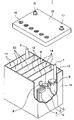
- the negative electrode column 9 is connected to the negative electrode shelf portion 6, and the penetration connecting body 8 is connected to the positive electrode shelf portion 5.
- the negative electrode column 9 is connected to the negative electrode terminal 16 outside the lid 15.
- Each through-connecting body 8 passes through a through-hole provided in the partition wall 13 and connects the electrode plates 11 of the adjacent cell chambers 14 in series.
- each of the PSOC life performance and the amount of decrease in the electrolytic solution is evaluated by the following procedure.
- the rated voltage of the test battery used for the evaluation is 12V, and the rated 20-hour rate capacity is 60Ah.
- the lead-acid batteries according to one aspect of the present invention are summarized below.
- the polymer compound may contain a repeating structure of an oxyC 2-4 alkylene unit.
- the lead-acid battery comprises at least one cell comprising a group of plates and an electrolyte.
- the electrode plate group includes a negative electrode plate, a positive electrode plate, and a separator interposed between the negative electrode plate and the positive electrode plate.
- the negative electrode plate comprises a negative electrode material and is provided with a negative electrode material.
- the negative electrode material contains a polymer compound containing a repeating structure of oxyC 2-4 alkylene units.
- the positive electrode plate comprises a positive electrode material and is provided with a positive electrode material.
- a lead-acid battery having a mass ratio of the positive electrode material to the negative electrode material of 1 or more and 1.4 or less.
- the polymer compound has one or more hydrophobic groups, and at least one of the hydrophobic groups has 8 or more carbon atoms. It may be a long-chain aliphatic hydrocarbon group.
- the polymer compound is an etherified product of polyethylene glycol (alkyl ether or the like), an esterified product of polyethylene glycol (carboxylic acid ester or the like), or an etherified product of a polyethylene oxide adduct of the polyol (alkyl ether). Etc.), and at least one selected from the group consisting of esterified products (such as carboxylic acid esters) of polyethylene oxide adducts of polyols (such as polyols of triol or higher).
- esterified products such as carboxylic acid esters
- the lead-acid battery according to one aspect and the other aspect of the present invention is suitable for use in an idling stop vehicle as, for example, a lead-acid battery for IS that is charged and discharged under PSOC conditions.
- the lead-acid battery can be suitably used, for example, as a power source for starting a vehicle (automobile, motorcycle, etc.) and an industrial power storage device (for example, a power source for an electric vehicle (forklift, etc.)). It should be noted that these are merely examples, and the use of the lead storage battery is not limited to these.
Landscapes
- Chemical & Material Sciences (AREA)
- Chemical Kinetics & Catalysis (AREA)
- Electrochemistry (AREA)
- General Chemical & Material Sciences (AREA)
- Engineering & Computer Science (AREA)
- Manufacturing & Machinery (AREA)
- Secondary Cells (AREA)
Priority Applications (3)
| Application Number | Priority Date | Filing Date | Title |
|---|---|---|---|
| CN202180079724.8A CN116583970A (zh) | 2020-11-27 | 2021-10-28 | 铅蓄电池 |
| JP2022565150A JP7677348B2 (ja) | 2020-11-27 | 2021-10-28 | 鉛蓄電池 |
| EP21897609.0A EP4235855A4 (en) | 2020-11-27 | 2021-10-28 | LEAD-ACTIVE ACCUMULATOR |
Applications Claiming Priority (2)
| Application Number | Priority Date | Filing Date | Title |
|---|---|---|---|
| JP2020197585 | 2020-11-27 | ||
| JP2020-197585 | 2020-11-27 |
Publications (1)
| Publication Number | Publication Date |
|---|---|
| WO2022113633A1 true WO2022113633A1 (ja) | 2022-06-02 |
Family
ID=81755742
Family Applications (1)
| Application Number | Title | Priority Date | Filing Date |
|---|---|---|---|
| PCT/JP2021/039830 Ceased WO2022113633A1 (ja) | 2020-11-27 | 2021-10-28 | 鉛蓄電池 |
Country Status (5)
| Country | Link |
|---|---|
| EP (1) | EP4235855A4 (https=) |
| JP (1) | JP7677348B2 (https=) |
| CN (1) | CN116583970A (https=) |
| TW (1) | TW202224238A (https=) |
| WO (1) | WO2022113633A1 (https=) |
Cited By (2)
| Publication number | Priority date | Publication date | Assignee | Title |
|---|---|---|---|---|
| WO2024005041A1 (ja) * | 2022-06-30 | 2024-01-04 | 株式会社Gsユアサ | 鉛蓄電池 |
| EP4564470A4 (en) * | 2022-09-27 | 2025-06-04 | GS Yuasa International Ltd. | LEAD-ACID BATTERY |
Citations (5)
| Publication number | Priority date | Publication date | Assignee | Title |
|---|---|---|---|---|
| JPS60182662A (ja) * | 1984-02-28 | 1985-09-18 | Japan Storage Battery Co Ltd | 鉛蓄電池 |
| JPH09147869A (ja) * | 1995-11-17 | 1997-06-06 | Shin Kobe Electric Mach Co Ltd | 鉛蓄電池 |
| JP2000149981A (ja) | 1998-11-02 | 2000-05-30 | Jec Service Kk | 鉛蓄電池および鉛蓄電池用添加剤 |
| JP2016177909A (ja) * | 2015-03-19 | 2016-10-06 | 株式会社Gsユアサ | 制御弁式鉛蓄電池 |
| WO2017099144A1 (ja) | 2015-12-11 | 2017-06-15 | 日立化成株式会社 | 鉛蓄電池 |
Family Cites Families (4)
| Publication number | Priority date | Publication date | Assignee | Title |
|---|---|---|---|---|
| JPS5147237A (https=) * | 1974-10-18 | 1976-04-22 | Yuasa Battery Co Ltd | |
| CN101937996B (zh) * | 2010-08-26 | 2012-11-28 | 风帆股份有限公司 | 电动助力车用胶体铅酸蓄电池负极铅膏及制备方法 |
| CN103647051B (zh) * | 2013-11-18 | 2016-05-25 | 河南超威电源有限公司 | 铅膏组合物及其制备方法 |
| CN108630937B (zh) * | 2018-05-10 | 2020-10-09 | 浙江工业大学 | 一种铅炭电池负极铅膏及负极板 |
-
2021
- 2021-10-28 CN CN202180079724.8A patent/CN116583970A/zh active Pending
- 2021-10-28 WO PCT/JP2021/039830 patent/WO2022113633A1/ja not_active Ceased
- 2021-10-28 JP JP2022565150A patent/JP7677348B2/ja active Active
- 2021-10-28 EP EP21897609.0A patent/EP4235855A4/en active Pending
- 2021-11-18 TW TW110142940A patent/TW202224238A/zh unknown
Patent Citations (5)
| Publication number | Priority date | Publication date | Assignee | Title |
|---|---|---|---|---|
| JPS60182662A (ja) * | 1984-02-28 | 1985-09-18 | Japan Storage Battery Co Ltd | 鉛蓄電池 |
| JPH09147869A (ja) * | 1995-11-17 | 1997-06-06 | Shin Kobe Electric Mach Co Ltd | 鉛蓄電池 |
| JP2000149981A (ja) | 1998-11-02 | 2000-05-30 | Jec Service Kk | 鉛蓄電池および鉛蓄電池用添加剤 |
| JP2016177909A (ja) * | 2015-03-19 | 2016-10-06 | 株式会社Gsユアサ | 制御弁式鉛蓄電池 |
| WO2017099144A1 (ja) | 2015-12-11 | 2017-06-15 | 日立化成株式会社 | 鉛蓄電池 |
Non-Patent Citations (1)
| Title |
|---|
| See also references of EP4235855A4 |
Cited By (2)
| Publication number | Priority date | Publication date | Assignee | Title |
|---|---|---|---|---|
| WO2024005041A1 (ja) * | 2022-06-30 | 2024-01-04 | 株式会社Gsユアサ | 鉛蓄電池 |
| EP4564470A4 (en) * | 2022-09-27 | 2025-06-04 | GS Yuasa International Ltd. | LEAD-ACID BATTERY |
Also Published As
| Publication number | Publication date |
|---|---|
| CN116583970A (zh) | 2023-08-11 |
| EP4235855A4 (en) | 2024-12-18 |
| JP7677348B2 (ja) | 2025-05-15 |
| TW202224238A (zh) | 2022-06-16 |
| JPWO2022113633A1 (https=) | 2022-06-02 |
| EP4235855A1 (en) | 2023-08-30 |
Similar Documents
| Publication | Publication Date | Title |
|---|---|---|
| WO2020241878A1 (ja) | 鉛蓄電池 | |
| JP7173322B2 (ja) | 鉛蓄電池 | |
| WO2022113633A1 (ja) | 鉛蓄電池 | |
| JP7677347B2 (ja) | 鉛蓄電池 | |
| JP7661978B2 (ja) | 鉛蓄電池 | |
| JP7718427B2 (ja) | 鉛蓄電池 | |
| JP7786391B2 (ja) | 鉛蓄電池 | |
| JP7694582B2 (ja) | 鉛蓄電池 | |
| JP7798037B2 (ja) | 鉛蓄電池 | |
| WO2020241883A1 (ja) | 鉛蓄電池 | |
| JP7819461B2 (ja) | 鉛蓄電池 | |
| WO2020241886A1 (ja) | 鉛蓄電池 | |
| JP7687348B2 (ja) | 鉛蓄電池 | |
| JP7643017B2 (ja) | 制御弁式鉛蓄電池 | |
| WO2020241880A1 (ja) | 鉛蓄電池 | |
| JP7643016B2 (ja) | 鉛蓄電池 | |
| JP7757982B2 (ja) | 鉛蓄電池 | |
| WO2022113624A1 (ja) | 鉛蓄電池 | |
| JP7679841B2 (ja) | 鉛蓄電池 | |
| JP7647070B2 (ja) | 鉛蓄電池 | |
| JP2025039251A (ja) | 液式鉛蓄電池 | |
| JP2022085747A (ja) | 鉛蓄電池 | |
| WO2022113628A1 (ja) | 鉛蓄電池 | |
| WO2020241881A1 (ja) | 鉛蓄電池 | |
| WO2020241879A1 (ja) | 鉛蓄電池 |
Legal Events
| Date | Code | Title | Description |
|---|---|---|---|
| 121 | Ep: the epo has been informed by wipo that ep was designated in this application |
Ref document number: 21897609 Country of ref document: EP Kind code of ref document: A1 |
|
| ENP | Entry into the national phase |
Ref document number: 2022565150 Country of ref document: JP Kind code of ref document: A |
|
| WWE | Wipo information: entry into national phase |
Ref document number: 202180079724.8 Country of ref document: CN |
|
| ENP | Entry into the national phase |
Ref document number: 2021897609 Country of ref document: EP Effective date: 20230526 |
|
| NENP | Non-entry into the national phase |
Ref country code: DE |