WO2022092228A1 - 情報処理装置、情報処理方法及び情報処理プログラム - Google Patents
情報処理装置、情報処理方法及び情報処理プログラム Download PDFInfo
- Publication number
- WO2022092228A1 WO2022092228A1 PCT/JP2021/039888 JP2021039888W WO2022092228A1 WO 2022092228 A1 WO2022092228 A1 WO 2022092228A1 JP 2021039888 W JP2021039888 W JP 2021039888W WO 2022092228 A1 WO2022092228 A1 WO 2022092228A1
- Authority
- WO
- WIPO (PCT)
- Prior art keywords
- information
- cleaning
- area
- existence
- information processing
- Prior art date
- Legal status (The legal status is an assumption and is not a legal conclusion. Google has not performed a legal analysis and makes no representation as to the accuracy of the status listed.)
- Ceased
Links
Images






Classifications
-
- B—PERFORMING OPERATIONS; TRANSPORTING
- B08—CLEANING
- B08B—CLEANING IN GENERAL; PREVENTION OF FOULING IN GENERAL
- B08B7/00—Cleaning by methods not provided for in a single other subclass or a single group in this subclass
-
- G—PHYSICS
- G06—COMPUTING OR CALCULATING; COUNTING
- G06Q—INFORMATION AND COMMUNICATION TECHNOLOGY [ICT] SPECIALLY ADAPTED FOR ADMINISTRATIVE, COMMERCIAL, FINANCIAL, MANAGERIAL OR SUPERVISORY PURPOSES; SYSTEMS OR METHODS SPECIALLY ADAPTED FOR ADMINISTRATIVE, COMMERCIAL, FINANCIAL, MANAGERIAL OR SUPERVISORY PURPOSES, NOT OTHERWISE PROVIDED FOR
- G06Q50/00—Information and communication technology [ICT] specially adapted for implementation of business processes of specific business sectors, e.g. utilities or tourism
- G06Q50/10—Services
-
- G—PHYSICS
- G16—INFORMATION AND COMMUNICATION TECHNOLOGY [ICT] SPECIALLY ADAPTED FOR SPECIFIC APPLICATION FIELDS
- G16H—HEALTHCARE INFORMATICS, i.e. INFORMATION AND COMMUNICATION TECHNOLOGY [ICT] SPECIALLY ADAPTED FOR THE HANDLING OR PROCESSING OF MEDICAL OR HEALTHCARE DATA
- G16H40/00—ICT specially adapted for the management or administration of healthcare resources or facilities; ICT specially adapted for the management or operation of medical equipment or devices
- G16H40/20—ICT specially adapted for the management or administration of healthcare resources or facilities; ICT specially adapted for the management or operation of medical equipment or devices for the management or administration of healthcare resources or facilities, e.g. managing hospital staff or surgery rooms
Definitions
- This disclosure relates to an information processing device, an information processing method, and an information processing program.
- Japanese Patent Application Laid-Open No. 2009-532097 describes identifying a region having a high possibility of infection and increasing the degree and frequency of sterilization of the region.
- Japanese Patent Application Laid-Open No. 2014-528318 describes that the surface of furniture and equipment in a room in which bacteria are likely to be present is disinfected preferentially over the floor, wall and ceiling in the room. ..
- the present disclosure provides an information processing device, an information processing method, and an information processing program that can be cleaned according to the state of each area.
- the first aspect of the present disclosure is an information processing apparatus, which comprises at least one processor, and the processor acquires existence information for each area, which is information indicating the state of existence of a person in each of a plurality of areas. Then, based on the existence information, cleaning information for instructing cleaning of the area is generated for each of the plurality of areas.
- the second aspect of the present disclosure may include information indicating the number of people present in the area within a predetermined period in the existence information in the first aspect.
- the existence information may include information indicating the total time that a person has existed in the area within a predetermined period.
- the fourth aspect of the present disclosure may be the one in which the existence information is determined based on the protection state of the person present in the area in the second or third aspect.
- a fifth aspect of the present disclosure is that, in the above aspect, the cleaning information includes information on at least one of the necessity of cleaning, the cleaning time, the cleaning means, and the object to be cleaned as the content of the instruction relating to the cleaning of the area. May be.
- the sixth aspect of the present disclosure may include, in the above aspect, a region in which a plurality of regions overlap with other regions.
- the division of a plurality of areas may be preset according to the past achievements regarding the state of existence of a person.
- the division of a plurality of regions may be preset according to the tolerance of contamination of the regions.
- the processor may generate cleaning information based on the tolerance of contamination of the area in addition to the existence information.
- the processor may generate cleaning information based on the air flow in the region in addition to the existence information.
- the processor generates disinfection information for instructing disinfection for each of a plurality of persons existing in any of a plurality of regions based on the existence information. You may.
- the processor may control the display device to instruct the cleaning of the area based on the cleaning information.
- the processor may control the notification device to notify the notification device to instruct the cleaning of the area based on the cleaning information.
- the processor may control the cleaning device to perform cleaning of the area based on the cleaning information.
- a fifteenth aspect of the present disclosure is an information processing method, in which existence information, which is information indicating the state of existence of a person in each of a plurality of areas, is acquired for each area, and a plurality of existence information is obtained based on the existence information. For each of the areas, the computer performs a process of generating cleaning information for instructing the cleaning of the area.
- existence information which is information indicating the state of existence of a person in each of a plurality of areas
- the sixteenth aspect of the present disclosure is an information processing program, in which existence information, which is information indicating the state of existence of a person in each of a plurality of areas, is acquired for each area, and a plurality of existence information is obtained based on the existence information.
- existence information which is information indicating the state of existence of a person in each of a plurality of areas
- a plurality of existence information is obtained based on the existence information.
- the purpose is to cause the computer to execute a process of generating cleaning information for instructing the cleaning of the area.
- the information processing apparatus, information processing method, and information processing program of the present disclosure can be cleaned according to the state of each area.
- the information processing system 10 includes a log acquisition device 12 and an information processing device 20. Further, the information processing system 10 includes at least one of a display device 14, a notification device 16, and a cleaning device 18.
- the information processing device 20 can communicate with each of the log acquisition device 12, the display device 14, the notification device 16, and the cleaning device 18 via a network.
- a log acquisition device 12, an information processing device 20, a display device 14, a notification device 16, and a cleaning device 18 are installed in a hospital will be described.
- the log acquisition device 12 acquires a log recording the entry and exit of a person in each of a plurality of areas in which the hospital is divided in advance, and transmits the acquired log to the information processing device 20.
- the log contains identification information indicating a person, identification information indicating an area where the person entered and exited, an entry time, and an exit time.
- a person is, for example, a patient who visits a hospital, a companion of the patient, a medical worker who works at the hospital, and the like.
- a known device and system capable of acquiring a log of entry and exit of a person in each area can be applied.
- an IC (Integrated Circuit) tag reader is installed in each area, and when a person enters or leaves each area, the IC tag reader can read the IC tag possessed by the person so that the person can enter or leave the area.
- the log may be acquired together with the identification information of the person.
- the identification information of each person is attached to the IC tag possessed by the person.
- the inside of the area may be photographed by a camera, and the captured moving image may be subjected to image analysis processing to acquire the entry / exit logs of people in each area.
- a form may be used in which a log of entry and exit of a person in each area is acquired based on position information obtained by using a mobile terminal, a wearable terminal, a tag, or the like possessed by the person.
- a method for measuring location information a known method using Bluetooth (registered trademark), wireless LAN (Local Area Network), GPS (Global Positioning System), ultrasonic waves, or the like can be applied.
- the display device 14 is a device capable of displaying information on a screen, such as a liquid crystal display and an organic EL (Electro Luminescence) display.
- the display device 14 may be installed, for example, in a place where a worker who cleans each area (hereinafter, referred to as a “cleaning worker”) can view the display device 14. Further, the display device 14 may be a mobile terminal possessed by a cleaning worker.
- the notification device 16 is a device capable of notifying information by lighting an LED (Light Emitting Diode) lamp, sounding a buzzer, or the like.
- the notification device 16 may be installed for each object to be cleaned (for example, ceiling, wall, floor, desk, etc.) in each area.
- the cleaning device 18 is a device capable of cleaning or sterilizing floors, walls, ceilings, desks, air, etc. in hospitals.
- the cleaning device 18 includes, for example, a mobile device having cleaning means (for example, a traveling robot and a drone), an ultraviolet irradiation device, a disinfectant spraying device, and air provided with a dust collecting filter such as a HEPA (High Efficiency Particulate Air) filter.
- a cleaning device or the like can be applied.
- the information processing device 20 is instructed by the display device 14 and the notification device 16 to clean the cleaning operator and the cleaning device 18 to execute cleaning according to the state of the presence of a person in each area. Has the function of performing. It is generally known that the more densely populated and longer-stayed areas are, the more likely the infection will spread. In order to control the spread of infectious diseases, it is considered preferable to intensively clean areas where people are crowded and stay for a long time.
- an example of the configuration of the information processing apparatus 20 according to this exemplary embodiment will be described.
- the information processing apparatus 20 includes a CPU (Central Processing Unit) 81, a non-volatile storage unit 82, and a memory 83 as a temporary storage area. Further, the information processing apparatus 20 includes a display 84 such as a liquid crystal display, an input unit 85 such as a keyboard and a mouse, and a network I / F (InterFace) 86 connected to the network.
- a CPU Central Processing Unit
- the CPU 81, the storage unit 82, the memory 83, the display 84, the input unit 85, and the network I / F86 are connected to each other via a bus 88 such as a system bus and a control bus so that various information can be exchanged.
- a bus 88 such as a system bus and a control bus so that various information can be exchanged.
- the storage unit 82 is realized by a storage medium such as an HDD (Hard Disk Drive), an SSD (Solid State Drive), and a flash memory.
- the information processing program 87 is stored in the storage unit 82.
- the CPU 81 reads the information processing program 87 from the storage unit 82, expands it into the memory 83, and executes the expanded information processing program 87.
- the CPU 81 is an example of the processor of the present disclosure.
- the information processing apparatus 20 includes a first generation unit 22, a second generation unit 24, and a control unit 26.
- the CPU 81 executes the information processing program 87, it functions as a first generation unit 22, a second generation unit 24, and a control unit 26.
- the first generation unit 22 acquires the log transmitted from the log acquisition device 12 via the network I / F86, and based on the log, is information indicating the state of existence of a person in each of the plurality of areas. Is generated for each area.
- the second generation unit 24 acquires the existence information for each area generated by the first generation unit 22, and generates cleaning information for instructing cleaning of each of the plurality of areas based on the existence information. do.
- the method of generating the cleaning information is not particularly limited, but for example, a correspondence table in which the existence information and the cleaning information are associated in advance may be used, or the existence information may be used as a variable and calculated by a mathematical formula for obtaining the cleaning information. ..
- the second generation unit 24 generates cleaning information by a method using the correspondence table T shown in FIG. 4
- the cleaning information corresponding to the existence information is recorded in advance in the correspondence table T.
- the second generation unit 24 collates the existence information acquired from the first generation unit 22 with the correspondence table T for each area, and specifies the cleaning information corresponding to the existence information.
- the correspondence table T is stored in, for example, the storage unit 82.
- the existence information includes the number of people who existed in the area within a predetermined period (hereinafter referred to as "existing number") and the area within a predetermined period. Contains information that indicates the total time a person has been present.
- the predetermined period is, for example, a period from the time when the previous cleaning is performed to the time when the processing by the first generation unit 22 is started.
- the total time is the total time from when one person enters one area to when he / she exits (hereinafter referred to as "existence time”) for all who enter the area.
- the cleaning information according to the present exemplary embodiment includes information on at least one of the necessity of cleaning, the cleaning time, the cleaning means, and the object to be cleaned, as the content of the instruction relating to the cleaning of the area.
- the cleaning means is, for example, a cleaning worker and a cleaning device 18.
- the object to be cleaned is, for example, a ceiling, a wall, a floor, a desk, air, or the like.
- the control unit 26 controls at least one of the display device 14, the notification device 16, and the cleaning device 18 based on the cleaning information generated by the second generation unit 24. Specifically, the control unit 26 controls the display device 14 to display an instruction to clean the area based on the cleaning information. Further, the control unit 26 controls the notification device 16 to notify the cleaning of the area based on the cleaning information. Further, the control unit 26 controls the cleaning device 18 to perform cleaning of the area based on the cleaning information.
- control unit 26 may end the control of the display device 14, the notification device 16, and the cleaning device 18 when the cleaning of the area instructed to be cleaned is completed.
- Completion of cleaning by a cleaning worker can be detected, for example, by image processing a moving image obtained by taking a picture with a camera.
- the completion of cleaning by the cleaning device 18 can be detected by receiving a signal indicating the completion of cleaning from the cleaning device 18.
- the control unit 26 may perform control to notify the display device 14 and the notification device 16 when the cleaning is not completed within a predetermined period after instructing the cleaning.
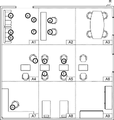
- FIG. 5 is a top view showing a specific example of one room R in the hospital. As shown in FIG. 5, the plurality of regions in this specific example are obtained by subdividing the room R into nine regions A1 to A9. In FIG. 5, people a to n are illustrated by circles.
- FIG. 6 is a diagram that visualizes the entry and exit logs of people a to n in each of the areas A1 to A9. In FIG. 6, the existence time from entry to exit of people a to n in areas A1 to A9 is shown in black.
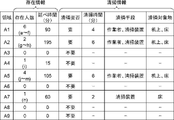
- FIG. 7 is a diagram showing existence information and cleaning information for each of the regions A1 to A9 generated by the first generation unit 22 and the second generation unit 24.
- the process of generating the existence information and the cleaning information for the area A1 will be described.
- the first generation unit 22 calculates the number of people in the area A1 within a predetermined period (9:00 to 11:15) as 6 people (people a to f). Further, the first generation unit 22 calculates the total time of the region A1 within a predetermined period (9:00 to 11:15) as 90 minutes based on the log (see FIG. 6). As shown in FIG. 7, the first generation unit 22 generates information including these values as the existence information of the region A1.
- the second generation unit 24 acquires the existence information generated by the first generation unit 22 and collates it with the correspondence table T (see FIG. 4). Since the number of people in the area A1 is 6 and the total time is 90 minutes, the second generation unit 24 has the cleaning information on the third line from the top of the correspondence table T (see FIG. 4). The time is "4 minutes", the cleaning means is "worker, cleaning device”, and the object to be cleaned is "desktop, floor"), which is generated as cleaning information of the area A1.
- the control unit 26 controls the display device 14 to display a message such as "Please clean the desk in area A1 for 4 minutes.” To instruct. Further, the control unit 26 instructs the cleaning operator to perform cleaning by causing the notification device 16 to notify the notification device 16 which means that the area A1 is to be cleaned. Further, the control unit 26 controls the cleaning device 18 so as to clean the floor of the area A1 for 4 minutes.
- the operation of the information processing apparatus 20 will be described.
- the CPU 81 executes the information processing program 87
- the information processing shown in FIG. 8 is executed.
- the information processing shown in FIG. 8 is executed at a predetermined timing, for example, as a timing at which cleaning such as a break time is possible.
- step S10 of FIG. 8 the first generation unit 22 acquires the log transmitted from the log acquisition device 12 via the network I / F86.
- step S12 the first generation unit 22 generates existence information regarding each of the plurality of regions based on the log acquired in step S10.
- step S14 the second generation unit 24 acquires the existence information generated in step S12, and generates cleaning information for each of the plurality of areas based on the existence information.
- step S16 the control unit 26 controls at least one of the display device 14, the notification device 16, and the cleaning device 18 based on the cleaning information generated in step S14.
- the information processing apparatus includes at least one processor, and the processor provides existence information, which is information indicating the state of existence of a person in each of a plurality of areas, for each area. And, based on the existence information, the cleaning information for instructing the cleaning of the area is generated for each of the plurality of areas. Therefore, since cleaning can be performed according to the condition of each area, it is possible to intensively clean the area where the infectious disease is likely to spread, which is advantageous in suppressing the spread of the infectious disease. In addition, it is possible to omit cleaning in areas where the possibility of infectious disease spreading is low, which is advantageous for improving the efficiency of cleaning work.
- the method of dividing a plurality of areas is not particularly limited.
- one room in a hospital may be subdivided into a plurality of areas (see FIG. 5), one room may be one area, or a plurality of rooms may be combined into one area.
- the concept of zoning and cohorting in a hospital may be applied, and the division of a plurality of areas may be preset according to the tolerance of contamination of the areas.
- the plurality of regions in this exemplary embodiment may include a region that overlaps with another region (hereinafter, referred to as "superimposed region").
- superimposed region a region that overlaps with another region.
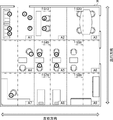
- FIG. 9 in addition to the regions A1 to A9 in the room R similar to that in FIG. 5, overlapping regions S12, S23, S45, S56, S78 and S89 straddling two regions A1 to A9 adjacent to each other in the left-right direction are shown. It is illustrated by a alternate long and short dash line.
- region A when the regions A1 to A9 are not distinguished, it is referred to as “region A”, and when the superimposed regions S12, S23, S45, S56, S78 and S89 are not distinguished, it is referred to as "superimposed region S”.
- the first generation unit 22 and the second generation unit 24 generate existence information and cleaning information not only for the area A but also for the superposed area S.
- FIG. 10 shows existence information and cleaning information generated based on the correspondence table T of FIG. 4 and the log of FIG. 6 for each of the region A and the superimposed region S shown in FIG.
- the control unit 26 has the cleaning information generated for each of the area A and the overlapped area S, which has a longer cleaning time and more cleaning means and cleaning places.
- Various controls are performed by adopting cleaning information.
- control unit 26 performs various controls on the region where the region A4 and the superposed region S45 overlap, based on the cleaning information of the superposed region S45, which has a longer cleaning time and more cleaning means and cleaning locations. According to such a form, it is possible to generate appropriate cleaning information not only in the area where the infectious disease is likely to spread but also in the area in the vicinity thereof. Therefore, the spread of infectious diseases can be further suppressed.
- the division of the plurality of areas in this exemplary embodiment may be preset according to the past achievements regarding the state of existence of a person.
- FIG. 11 illustrates an example in which a room R similar to that in FIG. 5 is divided into regions B1 to B9 according to past achievements regarding the state of existence of a person.
- FIG. 12 shows the presence information and cleaning information generated based on the correspondence table T of FIG. 4 and the log of FIG. 6 for the example of FIG.
- the regions B5 and B6 correspond to regions that are further divided into regions A5 in FIG. 5, but as shown in FIG. 12, different cleaning information is generated according to the existence information related to each region. Therefore, when cleaning the area B5, it is possible to perform cleaning with contents suitable for the area B5 without disturbing other work performed in the area B6, which is advantageous for improving the efficiency of the cleaning work. Become.
- the existence information may be determined based on the protection state of the person existing in the area. This is because protected people are less likely to spread the infection than unprotected people.
- the protective state is determined by, for example, the state of wearing a mask and protective clothing, and the state of performing hand washing, gargling, and alcohol disinfection.
- the first generation unit 22 counts the number of people wearing a mask as 0.5 people, and the weights of the number of people and the time of existence differ depending on whether or not the mask is worn. You may let me. Further, the first generation unit 22 may have different weights of the number of people and the time of existence depending on the type of mask, such as a non-woven fabric mask, a gauze mask, a surgical mask, and a mask for fine particles. It should be noted that the presence / absence of a person's mask and the type of mask can be determined, for example, based on an image obtained by photographing a person with a camera.
- the first generation unit 22 counts the number of existing people as 1.5 people who are insufficiently hand-washed, and weights the number of existing people and the existing time according to the implementation state of hand-washing. May be different. Whether or not hand washing is sufficient can be determined based on whether or not the time determined to be hand washing is equal to or greater than a predetermined threshold value by, for example, a function of a wearable terminal such as a smart watch.
- the existence information includes information indicating the number of people and the total time
- the present invention is not limited to this.
- the existence information may include information indicating only one of the number of people and the total time.
- the first generation unit 22 tracks the movement of a person between regions, and when a person who has left a certain region returns to the same region, the number of people in the region is determined. Existence information may be generated so as not to be counted twice. This is because it is unlikely that the same person will return to the same area to further spread the infectious disease. By generating existence information that does not include the same person in duplicate, cleaning can be performed according to the state of each area. Tracking movement between human territories also helps identify the route of infection. As a method for tracking the movement between human regions, a known method such as a method using identification information of an IC tag and a method using face recognition by a camera can be applied.
- the second generation unit 24 may generate cleaning information by adding various information in addition to the existence information.
- the second generation unit 24 may generate cleaning information based on the degree of contamination tolerance of the area in addition to the existence information. This is because cleaning is performed in areas where high cleanliness is required, such as operating rooms, with a smaller number of people and less total time compared to areas where cleanliness is not so required, such as waste disposal rooms. This is because it is preferable to do so.
- the second generation unit 24 may generate cleaning information using a plurality of correspondence tables T that differ depending on the degree of contamination tolerance of such a region.
- a plurality of correspondence tables T which differ depending on the tolerance of contamination of the region, are stored in the storage unit 82 in advance.
- the tolerance for contamination of an area is determined by, for example, the concept of zoning and cohorting in a hospital. According to such a form, in addition to the state of each area, cleaning can be performed according to the degree of contamination tolerance of the area.
- the second generation unit 24 may generate cleaning information based on the air flow in the region in addition to the existence information. This is because it is considered that the virus that causes the infectious disease is more likely to remain on the downstream side than the upstream side in the air flow formed by the air conditioner, the window, the ventilation port, and the like. That is, it is considered that the area on the downstream side is more likely to spread the infectious disease than the area on the upstream side, and it is preferable to perform cleaning with a smaller number of people and a smaller total time. Therefore, when an air flow is formed over a plurality of regions, the second generation unit 24 uses a plurality of correspondence tables T that are different for each air flow such as the upstream side and the downstream side to provide cleaning information. May be generated.
- a plurality of correspondence tables T which are different for each air flow, are stored in the storage unit 82 in advance.
- a known method such as a method using an infrared camera and a particle image velocimetry can be applied. According to such a form, in addition to the state of each area, cleaning can be performed according to the air flow of the area.
- the second generation unit 24 may generate cleaning information based on the area of the area in addition to the existence information. This is because it is preferable that the smaller the area, the smaller the number of people present and the smaller the total time required for cleaning. Specifically, when the area of each region is different as described in the second modification, the second generation unit 24 may generate cleaning information using a plurality of correspondence tables T different for each area. good. A plurality of correspondence tables T different for each area are stored in the storage unit 82 in advance. According to such a form, cleaning can be performed according to the state of each area.
- the second generation unit 24 generates disinfection information for instructing disinfection for each of a plurality of people existing in any of the plurality of regions based on the existence information. You may.
- the “disinfection” is, for example, hand washing, gargling, alcohol disinfection, and irradiation with ultraviolet rays having a wavelength of 222 nm, which is highly safe for the human body and can inactivate the virus.
- the second generation unit 24 disinfects a person who has existed in an area where the number of people present and the total time are each equal to or more than a predetermined threshold value (hereinafter referred to as "disinfection target area"). Generate disinfection information as instructed.
- control unit 26 controls the display device 14 and the notification device 16 so as to instruct the disinfection of a person based on the disinfection information generated by the second generation unit 24. According to such a form, the spread of the infectious disease can be further suppressed.
- the second generation unit 24 when the person who was present in the disinfection target area moves to another area other than the disinfection target area, the second generation unit 24 is present in another area after the movement.
- disinfection information may be generated that instructs the person to perform disinfection.
- the second generation unit 24 provides cleaning information for instructing the execution of cleaning of the moved area when a person who was present in the disinfection target area moves to another area other than the disinfection target area. May be generated. According to these forms, even if the area is not the target of disinfection by itself, if there is a possibility that the virus has been brought in from the area to be disinfected, the disinfection of the person existing in the area and the disinfection of the area. Since it can be cleaned, the spread of infectious diseases can be further suppressed.
- the second generation unit 24 generates disinfection information in consideration of the time and amount of the person speaking in the area, the direction of the face with respect to the air flow, the degree of proximity to another person, and the like. You may. This information can be obtained, for example, based on an image obtained by photographing a person with a camera. According to such a form, the spread of the infectious disease can be further suppressed.
- control unit 26 may control the area designated by the cleaning information to be cleaned by adding a margin and instructing the cleaning. For example, in addition to the area designated to be cleaned, cleaning may be instructed for other areas adjacent to the area. Further, for example, cleaning may be instructed for an area in which the area designated to be cleaned is expanded by a predetermined area. According to such a form, the spread of the infectious disease can be further suppressed.
- the control unit 26 controls to notify the fact by the display device 14 and the notification device 16 when it detects that cleaning is likely to be necessary based on the cleaning information. May be good.
- the control unit 26 may notify a message such as "This area has become congested and will soon be subject to cleaning.” Whether cleaning is likely to be necessary is determined, for example, whether the total time is within a predetermined range from the lower limit of the total time, which is defined as "necessary" in the correspondence table T shown in FIG. Can be detected by.
- This form assists in the timing of human action to control the spread of infectious diseases, such as exiting the area, restricting entry to the area, isolating people, ventilating and cleaning. It is advantageous to suppress the spread of infectious diseases.
- the present invention is not limited to this.
- the information processing device 20 according to this exemplary embodiment can be applied to various facilities such as offices, schools, accommodation facilities, restaurants, nursing care facilities, and evacuation facilities.
- the mode in which the first generation unit 22 of the information processing apparatus 20 generates the existence information has been described, but the present invention is not limited to this.
- the existence information may be generated by the log acquisition device 12 or any external device and transmitted to the information processing device 20 via the network.
- the hardware structure of the processing unit that executes various processes is as follows.
- the various processors shown can be used.
- the various processors include a CPU, which is a general-purpose processor that executes software (programs) and functions as various processing units, as well as circuits after manufacturing FPGAs (Field Programmable Gate Arrays) and the like.
- Dedicated electricity which is a processor with a circuit configuration specially designed to execute specific processing such as programmable logic device (PLD), ASIC (Application Specific Integrated Circuit), which is a processor whose configuration can be changed. Circuits etc. are included.
- One processing unit may be composed of one of these various processors, or a combination of two or more processors of the same type or different types (for example, a combination of a plurality of FPGAs or a combination of a CPU and an FPGA). It may be composed of a combination). Further, a plurality of processing units may be configured by one processor.
- one processor is configured by a combination of one or more CPUs and software, as represented by a computer such as a client and a server.
- the processor functions as a plurality of processing units.
- SoC System on Chip
- the various processing units are configured by using one or more of the above-mentioned various processors as a hardware-like structure.
- an electric circuit in which circuit elements such as semiconductor elements are combined can be used.
- the information processing program 87 is stored (installed) in the storage unit 82 in advance has been described, but the present invention is not limited to this.
- the information processing program 87 is provided in a form recorded on a recording medium such as a CD-ROM (Compact Disc Read Only Memory), a DVD-ROM (Digital Versatile Disc Read Only Memory), and a USB (Universal Serial Bus) memory. May be good.
- the information processing program 87 may be downloaded from an external device via a network.
- the technique of the present disclosure extends not only to the information processing program but also to a storage medium for storing the information processing program non-temporarily.
Landscapes
- Business, Economics & Management (AREA)
- Health & Medical Sciences (AREA)
- Engineering & Computer Science (AREA)
- General Business, Economics & Management (AREA)
- Primary Health Care (AREA)
- General Health & Medical Sciences (AREA)
- Epidemiology (AREA)
- Biomedical Technology (AREA)
- Public Health (AREA)
- Medical Informatics (AREA)
- Tourism & Hospitality (AREA)
- Human Resources & Organizations (AREA)
- Economics (AREA)
- Theoretical Computer Science (AREA)
- General Physics & Mathematics (AREA)
- Marketing (AREA)
- Physics & Mathematics (AREA)
- Strategic Management (AREA)
- Medical Treatment And Welfare Office Work (AREA)
- Management, Administration, Business Operations System, And Electronic Commerce (AREA)
Priority Applications (2)
| Application Number | Priority Date | Filing Date | Title |
|---|---|---|---|
| JP2022559242A JP7761582B2 (ja) | 2020-10-29 | 2021-10-28 | 情報処理装置、情報処理方法及び情報処理プログラム |
| US18/304,371 US20230260639A1 (en) | 2020-10-29 | 2023-04-21 | Information processing device, information processing method, and information processing program |
Applications Claiming Priority (2)
| Application Number | Priority Date | Filing Date | Title |
|---|---|---|---|
| JP2020181879 | 2020-10-29 | ||
| JP2020-181879 | 2020-10-29 |
Related Child Applications (1)
| Application Number | Title | Priority Date | Filing Date |
|---|---|---|---|
| US18/304,371 Continuation US20230260639A1 (en) | 2020-10-29 | 2023-04-21 | Information processing device, information processing method, and information processing program |
Publications (1)
| Publication Number | Publication Date |
|---|---|
| WO2022092228A1 true WO2022092228A1 (ja) | 2022-05-05 |
Family
ID=81383396
Family Applications (1)
| Application Number | Title | Priority Date | Filing Date |
|---|---|---|---|
| PCT/JP2021/039888 Ceased WO2022092228A1 (ja) | 2020-10-29 | 2021-10-28 | 情報処理装置、情報処理方法及び情報処理プログラム |
Country Status (3)
| Country | Link |
|---|---|
| US (1) | US20230260639A1 (https=) |
| JP (1) | JP7761582B2 (https=) |
| WO (1) | WO2022092228A1 (https=) |
Citations (4)
| Publication number | Priority date | Publication date | Assignee | Title |
|---|---|---|---|---|
| JP2003022309A (ja) * | 2001-07-06 | 2003-01-24 | Hitachi Ltd | 動線情報を基にした施設管理装置 |
| JP2011180974A (ja) * | 2010-03-03 | 2011-09-15 | Mitsubishi Electric Corp | 施設管理システム |
| US20130035966A1 (en) * | 2006-02-01 | 2013-02-07 | Slap Holdings Pty Ltd | Management of room cleaning |
| JP2017198420A (ja) * | 2016-04-28 | 2017-11-02 | シャープ株式会社 | 電子機器、電子機器制御システムおよび電子機器の制御方法 |
Family Cites Families (2)
| Publication number | Priority date | Publication date | Assignee | Title |
|---|---|---|---|---|
| US20090112541A1 (en) * | 2007-10-26 | 2009-04-30 | Joel Anderson | Virtual reality tools for development of infection control solutions |
| CN111095345B (zh) * | 2018-02-14 | 2024-06-21 | 松下知识产权经营株式会社 | 风险评价系统以及风险评价方法 |
-
2021
- 2021-10-28 WO PCT/JP2021/039888 patent/WO2022092228A1/ja not_active Ceased
- 2021-10-28 JP JP2022559242A patent/JP7761582B2/ja active Active
-
2023
- 2023-04-21 US US18/304,371 patent/US20230260639A1/en not_active Abandoned
Patent Citations (4)
| Publication number | Priority date | Publication date | Assignee | Title |
|---|---|---|---|---|
| JP2003022309A (ja) * | 2001-07-06 | 2003-01-24 | Hitachi Ltd | 動線情報を基にした施設管理装置 |
| US20130035966A1 (en) * | 2006-02-01 | 2013-02-07 | Slap Holdings Pty Ltd | Management of room cleaning |
| JP2011180974A (ja) * | 2010-03-03 | 2011-09-15 | Mitsubishi Electric Corp | 施設管理システム |
| JP2017198420A (ja) * | 2016-04-28 | 2017-11-02 | シャープ株式会社 | 電子機器、電子機器制御システムおよび電子機器の制御方法 |
Also Published As
| Publication number | Publication date |
|---|---|
| US20230260639A1 (en) | 2023-08-17 |
| JP7761582B2 (ja) | 2025-10-28 |
| JPWO2022092228A1 (https=) | 2022-05-05 |
Similar Documents
| Publication | Publication Date | Title |
|---|---|---|
| Kang et al. | South Korea's responses to stop the COVID-19 pandemic | |
| Tian | A review on factors related to patient comfort experience in hospitals | |
| Kim et al. | Walk-through screening center for COVID-19: an accessible and efficient screening system in a pandemic situation | |
| JP7398745B2 (ja) | 飛沫感染抑制システム、及び、飛沫感染抑制方法 | |
| JP7133777B2 (ja) | 空間浄化システム、及び、空間浄化方法 | |
| Gammaitoni et al. | Using a mathematical model to evaluate the efficacy of TB control measures | |
| US10302318B1 (en) | Recursive multi-tiered health isolation facility | |
| CN110959181A (zh) | 使用实时定位系统监测医疗保健设施中感染的直接传播和间接传播 | |
| CN111247593A (zh) | 使用实时定位系统和下一代测序在健康护理机构中预测、预防和控制感染传播 | |
| Farook et al. | COVID-19 pandemic: oral health challenges and recommendations | |
| Wagner et al. | Improving operating room contamination control | |
| Shakoor et al. | Hospital preparedness in community measles outbreaks—challenges and recommendations for low-resource settings | |
| Kamar et al. | Field measurement of airborne particulate matters concentration in a hospital’s operating room | |
| Makram et al. | Future hospital building design strategies post COVID-19 pandemic | |
| World Health Organization | Infection prevention and control in the context of COVID-19: a guideline, 21 December 2023 | |
| Gruendemann et al. | Infection prevention in surgical settings | |
| WO2022092228A1 (ja) | 情報処理装置、情報処理方法及び情報処理プログラム | |
| Antoniadou | Infection control during COVID-19 outbreak in a university dental school | |
| Vashisht et al. | Dermatology practice in the times of the COVID-19 pandemic | |
| English et al. | A History of the Changing Concepts on Health-Care Ventilation. | |
| Prakash et al. | An emphasis on engineering controls and administrative controls in the prevention and control of COVID-19 in an orthodontic setting: thinking beyond tomorrow | |
| Mazumdar et al. | Position statement of IACDE for managing dental patients during COVID-19 | |
| Singh | The risk status of waiting areas for airborne infection control in Delhi hospitals | |
| Panahandeh et al. | Attendance and distribution patterns of patients in a private dental clinic during the COVID-19 pandemic | |
| Holtz et al. | The public health response to the World Trade Center disaster |
Legal Events
| Date | Code | Title | Description |
|---|---|---|---|
| 121 | Ep: the epo has been informed by wipo that ep was designated in this application |
Ref document number: 21886345 Country of ref document: EP Kind code of ref document: A1 |
|
| ENP | Entry into the national phase |
Ref document number: 2022559242 Country of ref document: JP Kind code of ref document: A |
|
| NENP | Non-entry into the national phase |
Ref country code: DE |
|
| 122 | Ep: pct application non-entry in european phase |
Ref document number: 21886345 Country of ref document: EP Kind code of ref document: A1 |