WO2022071007A1 - 溶接レール - Google Patents
溶接レール Download PDFInfo
- Publication number
- WO2022071007A1 WO2022071007A1 PCT/JP2021/034463 JP2021034463W WO2022071007A1 WO 2022071007 A1 WO2022071007 A1 WO 2022071007A1 JP 2021034463 W JP2021034463 W JP 2021034463W WO 2022071007 A1 WO2022071007 A1 WO 2022071007A1
- Authority
- WO
- WIPO (PCT)
- Prior art keywords
- rail
- weld
- martensite
- welded
- less
- Prior art date
- Legal status (The legal status is an assumption and is not a legal conclusion. Google has not performed a legal analysis and makes no representation as to the accuracy of the status listed.)
- Ceased
Links
Images




Classifications
-
- C—CHEMISTRY; METALLURGY
- C22—METALLURGY; FERROUS OR NON-FERROUS ALLOYS; TREATMENT OF ALLOYS OR NON-FERROUS METALS
- C22C—ALLOYS
- C22C38/00—Ferrous alloys, e.g. steel alloys
- C22C38/18—Ferrous alloys, e.g. steel alloys containing chromium
- C22C38/32—Ferrous alloys, e.g. steel alloys containing chromium with boron
-
- C—CHEMISTRY; METALLURGY
- C21—METALLURGY OF IRON
- C21D—MODIFYING THE PHYSICAL STRUCTURE OF FERROUS METALS; GENERAL DEVICES FOR HEAT TREATMENT OF FERROUS OR NON-FERROUS METALS OR ALLOYS; MAKING METAL MALLEABLE, e.g. BY DECARBURISATION OR TEMPERING
- C21D8/00—Modifying the physical properties of ferrous metals or ferrous alloys by deformation combined with, or followed by, heat treatment
-
- C—CHEMISTRY; METALLURGY
- C22—METALLURGY; FERROUS OR NON-FERROUS ALLOYS; TREATMENT OF ALLOYS OR NON-FERROUS METALS
- C22C—ALLOYS
- C22C38/00—Ferrous alloys, e.g. steel alloys
-
- C—CHEMISTRY; METALLURGY
- C22—METALLURGY; FERROUS OR NON-FERROUS ALLOYS; TREATMENT OF ALLOYS OR NON-FERROUS METALS
- C22C—ALLOYS
- C22C38/00—Ferrous alloys, e.g. steel alloys
- C22C38/001—Ferrous alloys, e.g. steel alloys containing N
-
- C—CHEMISTRY; METALLURGY
- C22—METALLURGY; FERROUS OR NON-FERROUS ALLOYS; TREATMENT OF ALLOYS OR NON-FERROUS METALS
- C22C—ALLOYS
- C22C38/00—Ferrous alloys, e.g. steel alloys
- C22C38/002—Ferrous alloys, e.g. steel alloys containing In, Mg, or other elements not provided for in one single group C22C38/001 - C22C38/60
-
- C—CHEMISTRY; METALLURGY
- C22—METALLURGY; FERROUS OR NON-FERROUS ALLOYS; TREATMENT OF ALLOYS OR NON-FERROUS METALS
- C22C—ALLOYS
- C22C38/00—Ferrous alloys, e.g. steel alloys
- C22C38/005—Ferrous alloys, e.g. steel alloys containing rare earths, i.e. Sc, Y, Lanthanides
-
- C—CHEMISTRY; METALLURGY
- C22—METALLURGY; FERROUS OR NON-FERROUS ALLOYS; TREATMENT OF ALLOYS OR NON-FERROUS METALS
- C22C—ALLOYS
- C22C38/00—Ferrous alloys, e.g. steel alloys
- C22C38/02—Ferrous alloys, e.g. steel alloys containing silicon
-
- C—CHEMISTRY; METALLURGY
- C22—METALLURGY; FERROUS OR NON-FERROUS ALLOYS; TREATMENT OF ALLOYS OR NON-FERROUS METALS
- C22C—ALLOYS
- C22C38/00—Ferrous alloys, e.g. steel alloys
- C22C38/04—Ferrous alloys, e.g. steel alloys containing manganese
-
- C—CHEMISTRY; METALLURGY
- C22—METALLURGY; FERROUS OR NON-FERROUS ALLOYS; TREATMENT OF ALLOYS OR NON-FERROUS METALS
- C22C—ALLOYS
- C22C38/00—Ferrous alloys, e.g. steel alloys
- C22C38/06—Ferrous alloys, e.g. steel alloys containing aluminium
-
- C—CHEMISTRY; METALLURGY
- C22—METALLURGY; FERROUS OR NON-FERROUS ALLOYS; TREATMENT OF ALLOYS OR NON-FERROUS METALS
- C22C—ALLOYS
- C22C38/00—Ferrous alloys, e.g. steel alloys
- C22C38/08—Ferrous alloys, e.g. steel alloys containing nickel
-
- C—CHEMISTRY; METALLURGY
- C22—METALLURGY; FERROUS OR NON-FERROUS ALLOYS; TREATMENT OF ALLOYS OR NON-FERROUS METALS
- C22C—ALLOYS
- C22C38/00—Ferrous alloys, e.g. steel alloys
- C22C38/12—Ferrous alloys, e.g. steel alloys containing tungsten, tantalum, molybdenum, vanadium, or niobium
-
- C—CHEMISTRY; METALLURGY
- C22—METALLURGY; FERROUS OR NON-FERROUS ALLOYS; TREATMENT OF ALLOYS OR NON-FERROUS METALS
- C22C—ALLOYS
- C22C38/00—Ferrous alloys, e.g. steel alloys
- C22C38/14—Ferrous alloys, e.g. steel alloys containing titanium or zirconium
-
- C—CHEMISTRY; METALLURGY
- C22—METALLURGY; FERROUS OR NON-FERROUS ALLOYS; TREATMENT OF ALLOYS OR NON-FERROUS METALS
- C22C—ALLOYS
- C22C38/00—Ferrous alloys, e.g. steel alloys
- C22C38/16—Ferrous alloys, e.g. steel alloys containing copper
-
- C—CHEMISTRY; METALLURGY
- C22—METALLURGY; FERROUS OR NON-FERROUS ALLOYS; TREATMENT OF ALLOYS OR NON-FERROUS METALS
- C22C—ALLOYS
- C22C38/00—Ferrous alloys, e.g. steel alloys
- C22C38/18—Ferrous alloys, e.g. steel alloys containing chromium
-
- C—CHEMISTRY; METALLURGY
- C22—METALLURGY; FERROUS OR NON-FERROUS ALLOYS; TREATMENT OF ALLOYS OR NON-FERROUS METALS
- C22C—ALLOYS
- C22C38/00—Ferrous alloys, e.g. steel alloys
- C22C38/18—Ferrous alloys, e.g. steel alloys containing chromium
- C22C38/20—Ferrous alloys, e.g. steel alloys containing chromium with copper
-
- C—CHEMISTRY; METALLURGY
- C22—METALLURGY; FERROUS OR NON-FERROUS ALLOYS; TREATMENT OF ALLOYS OR NON-FERROUS METALS
- C22C—ALLOYS
- C22C38/00—Ferrous alloys, e.g. steel alloys
- C22C38/18—Ferrous alloys, e.g. steel alloys containing chromium
- C22C38/22—Ferrous alloys, e.g. steel alloys containing chromium with molybdenum or tungsten
-
- C—CHEMISTRY; METALLURGY
- C22—METALLURGY; FERROUS OR NON-FERROUS ALLOYS; TREATMENT OF ALLOYS OR NON-FERROUS METALS
- C22C—ALLOYS
- C22C38/00—Ferrous alloys, e.g. steel alloys
- C22C38/18—Ferrous alloys, e.g. steel alloys containing chromium
- C22C38/24—Ferrous alloys, e.g. steel alloys containing chromium with vanadium
-
- C—CHEMISTRY; METALLURGY
- C22—METALLURGY; FERROUS OR NON-FERROUS ALLOYS; TREATMENT OF ALLOYS OR NON-FERROUS METALS
- C22C—ALLOYS
- C22C38/00—Ferrous alloys, e.g. steel alloys
- C22C38/18—Ferrous alloys, e.g. steel alloys containing chromium
- C22C38/26—Ferrous alloys, e.g. steel alloys containing chromium with niobium or tantalum
-
- C—CHEMISTRY; METALLURGY
- C22—METALLURGY; FERROUS OR NON-FERROUS ALLOYS; TREATMENT OF ALLOYS OR NON-FERROUS METALS
- C22C—ALLOYS
- C22C38/00—Ferrous alloys, e.g. steel alloys
- C22C38/18—Ferrous alloys, e.g. steel alloys containing chromium
- C22C38/28—Ferrous alloys, e.g. steel alloys containing chromium with titanium or zirconium
-
- C—CHEMISTRY; METALLURGY
- C22—METALLURGY; FERROUS OR NON-FERROUS ALLOYS; TREATMENT OF ALLOYS OR NON-FERROUS METALS
- C22C—ALLOYS
- C22C38/00—Ferrous alloys, e.g. steel alloys
- C22C38/18—Ferrous alloys, e.g. steel alloys containing chromium
- C22C38/30—Ferrous alloys, e.g. steel alloys containing chromium with cobalt
-
- C—CHEMISTRY; METALLURGY
- C22—METALLURGY; FERROUS OR NON-FERROUS ALLOYS; TREATMENT OF ALLOYS OR NON-FERROUS METALS
- C22C—ALLOYS
- C22C38/00—Ferrous alloys, e.g. steel alloys
- C22C38/18—Ferrous alloys, e.g. steel alloys containing chromium
- C22C38/38—Ferrous alloys, e.g. steel alloys containing chromium with more than 1.5% by weight of manganese
-
- C—CHEMISTRY; METALLURGY
- C22—METALLURGY; FERROUS OR NON-FERROUS ALLOYS; TREATMENT OF ALLOYS OR NON-FERROUS METALS
- C22C—ALLOYS
- C22C38/00—Ferrous alloys, e.g. steel alloys
- C22C38/18—Ferrous alloys, e.g. steel alloys containing chromium
- C22C38/40—Ferrous alloys, e.g. steel alloys containing chromium with nickel
- C22C38/42—Ferrous alloys, e.g. steel alloys containing chromium with nickel with copper
-
- C—CHEMISTRY; METALLURGY
- C22—METALLURGY; FERROUS OR NON-FERROUS ALLOYS; TREATMENT OF ALLOYS OR NON-FERROUS METALS
- C22C—ALLOYS
- C22C38/00—Ferrous alloys, e.g. steel alloys
- C22C38/18—Ferrous alloys, e.g. steel alloys containing chromium
- C22C38/40—Ferrous alloys, e.g. steel alloys containing chromium with nickel
- C22C38/44—Ferrous alloys, e.g. steel alloys containing chromium with nickel with molybdenum or tungsten
-
- C—CHEMISTRY; METALLURGY
- C22—METALLURGY; FERROUS OR NON-FERROUS ALLOYS; TREATMENT OF ALLOYS OR NON-FERROUS METALS
- C22C—ALLOYS
- C22C38/00—Ferrous alloys, e.g. steel alloys
- C22C38/18—Ferrous alloys, e.g. steel alloys containing chromium
- C22C38/40—Ferrous alloys, e.g. steel alloys containing chromium with nickel
- C22C38/46—Ferrous alloys, e.g. steel alloys containing chromium with nickel with vanadium
-
- C—CHEMISTRY; METALLURGY
- C22—METALLURGY; FERROUS OR NON-FERROUS ALLOYS; TREATMENT OF ALLOYS OR NON-FERROUS METALS
- C22C—ALLOYS
- C22C38/00—Ferrous alloys, e.g. steel alloys
- C22C38/18—Ferrous alloys, e.g. steel alloys containing chromium
- C22C38/40—Ferrous alloys, e.g. steel alloys containing chromium with nickel
- C22C38/48—Ferrous alloys, e.g. steel alloys containing chromium with nickel with niobium or tantalum
-
- C—CHEMISTRY; METALLURGY
- C22—METALLURGY; FERROUS OR NON-FERROUS ALLOYS; TREATMENT OF ALLOYS OR NON-FERROUS METALS
- C22C—ALLOYS
- C22C38/00—Ferrous alloys, e.g. steel alloys
- C22C38/18—Ferrous alloys, e.g. steel alloys containing chromium
- C22C38/40—Ferrous alloys, e.g. steel alloys containing chromium with nickel
- C22C38/50—Ferrous alloys, e.g. steel alloys containing chromium with nickel with titanium or zirconium
-
- C—CHEMISTRY; METALLURGY
- C22—METALLURGY; FERROUS OR NON-FERROUS ALLOYS; TREATMENT OF ALLOYS OR NON-FERROUS METALS
- C22C—ALLOYS
- C22C38/00—Ferrous alloys, e.g. steel alloys
- C22C38/18—Ferrous alloys, e.g. steel alloys containing chromium
- C22C38/40—Ferrous alloys, e.g. steel alloys containing chromium with nickel
- C22C38/54—Ferrous alloys, e.g. steel alloys containing chromium with nickel with boron
-
- C—CHEMISTRY; METALLURGY
- C22—METALLURGY; FERROUS OR NON-FERROUS ALLOYS; TREATMENT OF ALLOYS OR NON-FERROUS METALS
- C22C—ALLOYS
- C22C38/00—Ferrous alloys, e.g. steel alloys
- C22C38/18—Ferrous alloys, e.g. steel alloys containing chromium
- C22C38/40—Ferrous alloys, e.g. steel alloys containing chromium with nickel
- C22C38/58—Ferrous alloys, e.g. steel alloys containing chromium with nickel with more than 1.5% by weight of manganese
-
- E—FIXED CONSTRUCTIONS
- E01—CONSTRUCTION OF ROADS, RAILWAYS, OR BRIDGES
- E01B—PERMANENT WAY; PERMANENT-WAY TOOLS; MACHINES FOR MAKING RAILWAYS OF ALL KINDS
- E01B11/00—Rail joints
- E01B11/44—Non-dismountable rail joints; Welded joints
- E01B11/50—Joints made by electric welding
-
- E—FIXED CONSTRUCTIONS
- E01—CONSTRUCTION OF ROADS, RAILWAYS, OR BRIDGES
- E01B—PERMANENT WAY; PERMANENT-WAY TOOLS; MACHINES FOR MAKING RAILWAYS OF ALL KINDS
- E01B5/00—Rails; Guard rails; Distance-keeping means for them
- E01B5/02—Rails
-
- B—PERFORMING OPERATIONS; TRANSPORTING
- B23—MACHINE TOOLS; METAL-WORKING NOT OTHERWISE PROVIDED FOR
- B23K—SOLDERING OR UNSOLDERING; WELDING; CLADDING OR PLATING BY SOLDERING OR WELDING; CUTTING BY APPLYING HEAT LOCALLY, e.g. FLAME CUTTING; WORKING BY LASER BEAM
- B23K11/00—Resistance welding; Severing by resistance heating
- B23K11/002—Resistance welding; Severing by resistance heating specially adapted for particular articles or work
-
- B—PERFORMING OPERATIONS; TRANSPORTING
- B23—MACHINE TOOLS; METAL-WORKING NOT OTHERWISE PROVIDED FOR
- B23K—SOLDERING OR UNSOLDERING; WELDING; CLADDING OR PLATING BY SOLDERING OR WELDING; CUTTING BY APPLYING HEAT LOCALLY, e.g. FLAME CUTTING; WORKING BY LASER BEAM
- B23K11/00—Resistance welding; Severing by resistance heating
- B23K11/04—Flash butt welding
-
- B—PERFORMING OPERATIONS; TRANSPORTING
- B23—MACHINE TOOLS; METAL-WORKING NOT OTHERWISE PROVIDED FOR
- B23K—SOLDERING OR UNSOLDERING; WELDING; CLADDING OR PLATING BY SOLDERING OR WELDING; CUTTING BY APPLYING HEAT LOCALLY, e.g. FLAME CUTTING; WORKING BY LASER BEAM
- B23K2101/00—Articles made by soldering, welding or cutting
- B23K2101/26—Railway- or like rails
Definitions
- the present invention relates to a welded rail.
- Flash butt welding is widely used as a rail welding method. It is known that flash butt welding has advantages such as automation, high quality stability, and short welding time.
- Flash butt welding is a technology that melts the end faces of rails by heating and then presses and consolidates the melted surfaces to join the rails to each other.
- the rail is heated from room temperature to near its melting point and then cooled. Therefore, flash butt welding changes the metallographic structure and hardness of the rail.
- the portion where the metallurgical properties, mechanical properties, etc. have changed due to heat such as welding and cutting is called a heat-affected zone (HAZ).
- Patent Document 1 in flash welding of a rail, in order to reduce the HAZ width in the rail longitudinal direction, the length of the rail longitudinal direction on the crown surface is 15 mm or more, and the thickness of the portion in contact with the crown surface is 10 mm or more.
- the pad is set within 20 mm or more and 50 mm or less from the rail end face before welding, and then the rail is flash butt welded to reduce the hardness of the welded joint HAZ to 15 mm or less (rail longitudinal direction). It has been shown that it can be done.
- Patent Document 2 in order to reduce the HAZ width in the rail longitudinal direction in the flash welding of the rail, the late flash speed is set to 2.1 mm / sec or more, the HAZ width is set to 27 mm or less, and the softening width is set to 10 mm or less.
- a flash butt welding method for realizing a rail welding joint is described.
- the pillar cooling region in the rail weld is cooled in at least a part of the temperature range until the transformation from austenite to pearlite is completed; the first pillar cooling step; A second pillar cooling step of cooling the pillar cooling region after the entire pillar is transformed into pearlite; a foot cooling step of cooling the foot in the rail weld; a head in the rail weld.
- the cooling time of the first pillar cooling step and the second pillar cooling step is t (minutes)
- the k value is ⁇ 0.1t + 0.
- a cooling method for a rail welded portion satisfying the formula represented by 63 ⁇ k ⁇ ⁇ 0.1 t + 2.33 is disclosed.
- Patent Document 1 In the method of mounting the pad as in Patent Document 1, it is necessary to mount the pad separately prepared in a designated range. However, since the place where the pad is arranged is very close to the butt end face of the rail, the scattered molten metal adheres to the pad. Therefore, in the method of Patent Document 1, it is not easy to attach / detach the pad, and it is also troublesome to remove the metal adhering to the pad. Therefore, the method of Patent Document 1 has a problem that the efficiency of flash butt welding, which is automated and has high welding efficiency, is impaired. Further, the technique described in Patent Document 1 mainly aims to reduce the unevenness of the welded joint portion, and does not consider improving the fatigue damage resistance and the breakage resistance of the welded joint portion.
- Patent Document 2 by cooling the rail with a pad, a martensite structure that reduces the toughness of the welded joint is likely to be generated, and the possibility of breakage of the rail increases. There was the problem I said.
- the main purpose of Patent Document 2 is to reduce the unevenness of the weld joint portion due to wear, and not to improve the fatigue damage resistance and breakage resistance of the rail weld joint portion. Further, under the welding conditions as shown in Patent Document 2, when the HAZ width is reduced, a coarse martensite structure that reduces toughness is likely to be generated at the rail welding joint portion, and there is a possibility that the rail may be broken. There was a problem that the number increased.
- the main object of the technique described in Patent Document 3 is to reduce the residual stress in the rail after flash butt welding. Reducing the HAZ width is not the object of the technique described in Patent Document 3. Further, when flash butt welding is performed so as to narrow the HAZ width, the temperature gradient from the rail base material portion to the rail welded portion becomes steep, and the residual stress in the rail after welding increases. Therefore, it is not easy to narrow the HAZ width in the technique of Patent Document 3. Further, in the flash butt welding of rails, the cooling speed of the weld joint portion after welding is high. Therefore, a martensite structure having low toughness is likely to be generated at the welded joint portion. In particular, a martensite structure is formed inside the rail head and in the alloy segregated portion of the column portion.
- the present invention has been devised in view of the above-mentioned problems, and an object of the present invention is to improve fatigue damage resistance and breakage resistance in a welded joint portion of a welded rail. It is an object of the present invention to provide a rail capable of satisfying extremely strict fatigue damage resistance and breakage resistance requirements in a flush butt welded joint portion of a rail of a freight railroad having a severe track environment.
- the gist of the present invention lies in the rails shown below.
- the welded rail according to one aspect of the present invention includes a plurality of rail portions having a height h having a head portion and a pillar portion, and a welded joint portion for joining the rail portions.
- C 0.75 to 1.20%
- Si 0.10 to 2.00%
- Mn 0.10 to 2.00%
- Cr 0.10 to 1.
- P ⁇ 0.0250%
- S ⁇ 0.0250%
- Mo 0 to 0.50%
- Co 0 to 1.00%
- B 0 to 0.0050%
- Cu 0 to 1.
- the HAZ width of the welded joint is 60 mm or less, and the outer surface of the crown of the welded joint is a cross section parallel to the longitudinal direction and the vertical direction of the weld rail and passing through the center of the welded joint.
- the area ratio of the martensite structure is 0.0006% or more and 0.1000% or less in the region from 0 to (2/3) ⁇ h and ⁇ 5 mm in the longitudinal direction from the welding center, and the particle size in the region.
- the number of martensite structures of 20 to 200 ⁇ m is 3 to 80.
- the Cr segregation degree in the region of the welded joint portion may be 2.00 or less.
- the rail portion further contains, as the chemical component, Mo: 0.01 to 0.50%, Co: 0.01 in unit mass%.
- B 0.0001 to 0.0050%, Cu: 0.01 to 1.00%, Ni: 0.01 to 1.00%, V: 0.01 to 0.50%, Nb: 0.0010 to 0.0500%, Ti: 0.0030 to 0.0500%, Mg: 0.0005 to 0.0200%, Ca: 0.0005 to 0.0200%, REM: 0.0005 to It may contain one or more of 0.0500%, N: 0.0020 to 0.0200%, Zr: 0.0001 to 0.0200%, and Al: 0.0100 to 1.00%.
- a welded rail having excellent fatigue damage resistance and breakage resistance according to an embodiment of the present invention will be described in detail.
- the mass% in the composition is simply described as%.
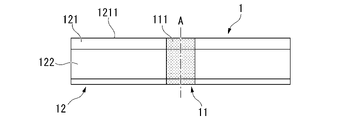
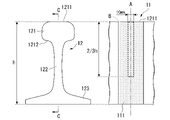
- the welded rail 1 includes a plurality of rail portions 12 having a head portion 121 and a pillar portion 122, and a welded joint portion 11 for joining the rail portions 12.
- the reference numeral "A" in FIG. 1A indicates a welding center described later.
- the rail before welding is distinguished from the welded rail by simply calling it "rail” for convenience. That is, the “rail” is a rail before welding that does not have a welded joint portion 11, and the “welded rail” is a rail after welding that has a welded joint portion 11.
- the “rail portion” is a portion of the weld rail 1 other than the weld joint portion 11.
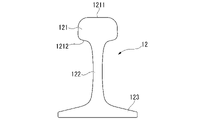
- the rail head (or head) 121 refers to a portion above the constricted portion in the vertical center of the rail portion 12 in the cross section of the rail portion 12 shown in FIG.
- the rail pillar portion (or pillar portion) 122 refers to a constricted portion in the vertical center of the rail portion 12 in the cross section of the rail portion 12 shown in the figure.
- the rail bottom portion (or bottom portion) 123 refers to a portion of the cross section of the rail portion 12 shown in the figure below the constricted portion in the vertical center of the rail.
- the upper outer surface is referred to as a crown surface or a rail crown outer surface 1211.
- the constricted portion of the lower part of the rail head 121 is referred to as a rail lower jaw (or lower jaw) 1212.
- the vertical direction of the welding rail 1 means the vertical direction when the welding rail 1 is used as a track.
- the welded joint portion 11 is a “welded joint” defined in JIS Z 3001-1: 2018, and means a joint portion in which members are united by welding.
- the welded joint portion 11 includes a heat affected zone (HAZ) 111.
- the member is a rail that is a material of the rail portion 12.
- the shape of the weld joint portion 11 is substantially the same as that of the rail portion 12. Therefore, the welded joint portion 11 also has a shape having a portion corresponding to the head portion and the pillar portion, similarly to the rail portion 12.
- the longitudinal cross section of the weld joint portion 11 is a cross section of the weld joint portion 11 and its surroundings that are parallel to the longitudinal direction and the vertical direction of the weld rail 1 and pass through the center of the weld joint portion 11.
- 5A and 5B show schematic views of the longitudinal cross section of the welded joint 11.
- the heat-affected zone (HAZ) means a region between the softened zones shown in FIG. 1B in the weld rail according to the present embodiment.
- FIG. 1B continuously measures the hardness of the welded joint portion 11 at a position 5 mm below the outer surface of the rail crown outer surface of the welded joint portion 11 along the longitudinal direction of the welded rail in the longitudinal cross section of the welded joint portion 11 of the welded rail.
- the graph of the hardness distribution of the longitudinal cross section obtained by the above It is an example of the graph of the hardness distribution of the longitudinal cross section obtained by the above. Normally, in the graph of the hardness distribution of the weld rail obtained by flash butt welding, two valleys occur on both sides of the rail seam. The softest part on the left side and the right side of the rail joint is defined as the softest part of the welded joint portion 11. The region between these two softening zones is defined as the heat affected zone (HAZ) 111. Further, the distance between the two softening portions measured along the longitudinal direction of the weld rail is defined as the HAZ width W. The region discolored after etching the longitudinal cross section of the welded joint 11 with nital generally coincides with HAZ according to the above definition.
- the welding center A means a straight line along the vertical direction of the welding rail passing through the center of the heat-affected zone 111 in the longitudinal cross section of the welding joint portion 11. Normally, the weld center A roughly coincides with the rail seam.
- the present inventors investigated the damage generated in the welded joint portion of the welded rail.
- the damage occurrence form includes (1) breakage starting from the fatigue crack generated from the bottom of the weld rail, and (2) the inside of the head of the weld rail and It was confirmed that there was a breakage originating from a brittle crack generated from the column. Therefore, we investigated the causes of these occurrences.
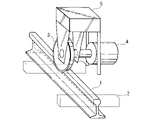
- reference numeral 5 indicates a load stabilizer that presses the wheel 3 rotated by the motor 4.
- the wheel 3 repeatedly rolls the head of the weld rail 1 back and forth along the longitudinal direction while applying a predetermined load to the wheel 3 using the load stabilizer 5.
- the rail before welding, the flash butt welding conditions, the characteristics of the flash butt welded joint, and the conditions for the rolling fatigue test of the welded rail / wheel are as shown below.
- Cooling conditions for welded joints after welding Average cooling rate of the crown: 1.0 ° C / sec (temperature range: 800 to 400 ° C) Average cooling rate of lower jaw and pillars: 1.0 ° C / sec in the temperature range of 800 to 500 ° C. 1.0 ° C / sec in the temperature range of 500 to 400 ° C. Then allow to cool to 50 ° C
- the HAZ width is in the range of 40 mm or more and 60 mm or less
- the unevenness generated in the welded joint portion is reduced, the number of times the wheel passes repeatedly until the fracture exceeds 2 million times, and the number of times the wheel passes repeatedly until the fracture occurs 2 million times. It was in the range of more than 3 million times and less than 3 million times, and met the acceptance criteria.
- the HAZ width is 20 mm or more and less than 40 mm
- the unevenness generated in the welded joint portion is further reduced, and the number of times the wheel passes repeatedly until fracture is in the range of 3 million times or more and less than 4 million times.
- the HAZ width is 10 mm or more and less than 20 mm
- the unevenness generated in the welded joint portion is further reduced, and the wheel does not break even if the number of times the wheel passes repeatedly is 4 million times. From this test, it was found that the service life of the welded joint is further improved as the HAZ width decreases.
- FIGS. 5A and 5B Calculation of area ratio of martensite structure Evaluation site (see FIGS. 5A and 5B): Area B surrounded by a broken line in FIGS. 5A and 5B.
- the region B will be described in detail as follows.
- the left side of FIG. 5A is a cross-sectional view of the weld rail perpendicular to the longitudinal direction of the weld rail.
- the right side of FIG. 5A is a cross-sectional view taken along the line CC shown in the left side of FIG. 5A, that is, the weld joint portion parallel to the longitudinal direction and the vertical direction of the weld rail and the center of the weld joint portion. It is a cross-sectional view through.
- FIG. 5B is a perspective view of a sample for microstructure observation, which is cut out from a welding rail and has a cross section shown on the right side of FIG. 5A.
- the region B has a depth of 0 mm or more (2/3) ⁇ hmm from the rail crown outer shell surface 1211 and a width of ⁇ 5 mm (total width 10 mm) in the longitudinal direction from the welding center A in the longitudinal cross section of the welded joint. It is an area.
- “h” means the height of the welding rail 1.
- this site is referred to as a martensite evaluation region B.
- the martensite evaluation area B is a site heated to A1 point or higher in the flash butt welding, and the martensite structure is most likely to be generated in the flash butt welding test so far. Because it is a welded part.
- Observation of martensite structure After polishing the martensite evaluation region B, nightal etching was performed, observation was performed with an optical microscope, and martensite was photographed.
- polishing conditions Buffing with 1 ⁇ m diamond paste
- Nittal Etch conditions Alcohol + 5% nitrate
- Optical microscope observation conditions 200 times
- Vision Overall of martensite evaluation area B
- Calculation of area ratio of martensite structure of martensite evaluation area B , Take an optical microscope photograph at a magnification of 200 times. Then, using image analysis software, this optical micrograph is binarized. Since martensite is usually displayed in white, the area ratio of the white region to the martensite evaluation region B in the binarized optical micrograph can be regarded as the area ratio of the martensite structure.
- the metal structure other than the martensite structure is a pearlite structure.
- carbide-free martensite appears as a white region and can be clearly distinguished from pearlite.
- a trace amount of bainite structure may be contained in the weld joint portion of the weld rail, in the weld rail according to the present embodiment, the bainite structure in the weld joint portion is regarded as a martensite structure. This is because it is difficult to distinguish between the two by an optical micrograph, and further, the effects of the two on the breakage resistance of the weld rail are almost the same.
- Rail component before welding 0.75 to 1.20% C-0.50% Si-1.00% Mn-0.20% Cr-0.0150% P-0.0120% S (The balance is iron And impurities)
- Rail shape 136 lbs (weight: 67 kg / m).
- Hardness of the outer surface of the crown 420 HV ⁇ Flash butt welding conditions (preheated flash method) Cooling conditions for welded joints after welding
- Initial flash time 15 sec
- Preheating frequency 10 times
- Late flash time 20 sec Average late flash speed: 0.6mm / sec Late flash speed immediately before upset (for 3 sec): 1.8 mm / sec
- Upset load 65kN
- Cooling conditions for welded joints after welding Average cooling rate of the crown: 1.0 ° C / sec (temperature range: 800 to 400 ° C) Average cooling rate of lower jaw and pillars: 0.5 to 2.0 ° C / sec in the temperature range of 800 to 500 ° C. 1.0 ° C / sec in the temperature range of 500 to 400 ° C.
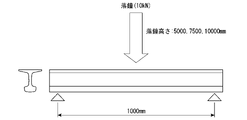
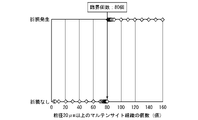
- the particle size and the number density of the martensite structure in the martensite evaluation region B also affect the breakage resistance of the weld rail. Specifically, when the number of martensite structures having a particle size of 20 to 200 ⁇ m in the welded joint portion of the welded rail is more than 80, the welded rail is broken in the drop weight test. Therefore, it was found that it is necessary to control the amount of martensite structure having a particle size of 20 ⁇ m or more in order to control the breakage of the weld rail.
- Cooling conditions for welded joints after welding Average cooling rate of the crown: 1.0 ° C / sec (temperature range: 800 to 400 ° C) Average cooling rate of lower jaw and pillars: 1.0 ° C / sec in the temperature range of 800 to 500 ° C. 0.4 to 2.4 ° C / sec in the temperature range of 500 to 400 ° C. Then allow to cool to 50 ° C
- the proeutectoid phase is ferrite
- suppression of ferrite formation by Mn promotes martensite formation.
- the weld rail according to the present embodiment is hypereutectoid steel, and the initial phase is cementite. Therefore, it is presumed that the effect of Mn on promoting the formation of martensite in hypereutectoid steel is smaller than that in subeutectoid steel.
- the present inventors presume that Cr segregation should be suppressed instead of Mn segregation as a means of suppressing the formation of martensite.
- Cooling conditions for welded joints after welding Average cooling rate of the crown: 1.0 ° C / sec (temperature range: 800 to 400 ° C) Average cooling rate of lower jaw and pillars: 0.5 to 2.0 ° C / sec in the temperature range of 800 to 500 ° C. 0.4 to 1.6 ° C / sec in the temperature range of 500 to 400 ° C. Then allow to cool to 50 ° C
- the element distribution in the range of (1/6) ⁇ h to (3/6) ⁇ h from the outer surface of the crown of the weld rail. Create a map. Based on the element distribution map, a region where Cr enrichment occurs is identified, and this region is identified as a macrosegregation zone. Then, as shown in FIG. 7, the Cr concentration is continuously analyzed along the line crossing the segregation zone (so-called line analysis). If the segregation zone has a shape such as an ellipse, perform line analysis so that it passes through the center of the segregation zone. This line analysis is performed on the entire cross section of the weld joint.
- the Cr segregation degree in the martensite evaluation region B of the welded joint (hereinafter referred to as , "Cr segregation degree of weld joint") was reduced to 2.0 or less, and it was found that the number of martensite structures with a particle size of 20 to 200 ⁇ m decreased in the same HAZ width. rice field.
- the number of martensite structures having a particle size of 20 to 200 ⁇ m was 65 to 80.
- the number of martensite structures having a particle size of 20 to 200 ⁇ m is 35 to 50 in the same HAZ width. It turned out to be decreasing.
- the number of martensite structures having a particle size of 20 to 200 ⁇ m is reduced to 5 to 15 in the same HAZ width. I found out that.
- Table 3 shows the results of the drop test.
- the Cr segregation degree of the weld joint is in the range of more than 2.0 to 2.4 or less, and the number of martensite structures with a particle size of 20 to 200 ⁇ m is 65 to 80 in the weld rail.
- the weld rail was unbroken at a drop weight height of 5000 mm.
- the height of the drop weight is reduced. No breakage occurred even at 7500 mm.
- the drop weight height is reached. It was confirmed that no breakage occurred even at a diameter of 10000 mm, and the breakage resistance was further improved.
- C is an element effective for promoting pearlite transformation, suppressing the formation of martensite structure in the welded joint, and ensuring the wear resistance of the weld rail. If the C content is less than 0.75%, a proeutectoid ferrite structure is formed in this component system, so that the minimum strength and wear resistance required for welded joints mainly composed of pearlite structure cannot be maintained. .. Further, even if the C content is set to less than 0.75%, the effect of suppressing the formation of martensite structure in the welded joint does not occur. On the other hand, when the C content exceeds 1.20%, an initial cementite structure is likely to be formed in the weld joint portion, and the breakage resistance and wear resistance of the pearlite structure are lowered.
- the C content was limited to 0.75 to 1.20%.
- the C content is preferably 0.80% or more, 0.85% or more, or 0.90% or more.
- the C content is preferably 1.15% or less, 1.10% or less, or 1.00% or less. In order to stabilize the formation of the pearlite structure, it is desirable that the C content is 0.80 to 1.10%.
- Si is an element that dissolves in the ferrite phase of the pearlite structure, increases the hardness of the welded joint, and improves wear resistance.
- Si content is less than 0.10%, these effects cannot be fully expected.
- the Si content exceeds 2.00%, the hardenability of the rail steel is remarkably increased, a large amount of martensite structure is generated in the weld joint portion, and the breakage resistance and wear resistance of the weld rail are lowered. do. Therefore, the Si content was limited to 0.10 to 2.00%.
- the Si content is preferably 0.20% or more, 0.30% or more, or 0.50% or more.
- the Si content is preferably 1.80% or less, 1.60% or less, or 1.50% or less. In order to stabilize the formation of the pearlite structure and improve the breakage resistance and wear resistance of the weld rail, it is desirable that the Si content is 0.20 to 1.50%.
- Cr is an element that raises the equilibrium transformation temperature, refines the lamellar spacing of the pearlite structure by increasing the supercooling degree, improves the hardness of the pearlite structure, and improves the wear resistance of the weld joint.
- the Cr content is less than 0.10%, these effects cannot be fully expected.
- the Cr content exceeds 1.50%, the hardenability of the rail steel is remarkably increased, a bainite structure, a martensite structure, etc. are formed in the weld joint, and the wear resistance and breakage resistance of the weld rail are improved. descend. Further, an excessive amount of Cr promotes Cr concentration in the segregated portion and promotes the formation of martensite structure in the welded joint portion.
- the Cr content was limited to 0.10 to 1.50%.
- the Cr content is preferably 0.20% or more, 0.30% or more, or 0.50% or more.
- the Cr content is preferably 1.40% or less, 1.30% or less, or 1.00% or less. In order to stabilize the formation of the pearlite structure and improve the wear resistance of the weld rail, it is desirable to set the Cr content to 0.20 to 1.00%.
- Mn is an element that enhances the hardenability of weld rails, stabilizes pearlite transformation, and at the same time, miniaturizes the lamellar spacing of the pearlite structure, secures the hardness of the weld joint, and further improves wear resistance.
- the Mn content is less than 0.10%, the effect is small, a soft proeutectoid ferrite structure is formed, and the wear resistance of the weld joint portion is lowered.
- the Mn content exceeds 2.00%, the hardenability of the rail steel is remarkably increased, a bainite structure and a martensite structure are formed in the weld joint, and the weld rail has breakage resistance and wear resistance. Decreases.
- the Mn content was limited to 0.10 to 2.00%.
- the Mn content is preferably 0.20% or more, 0.30% or more, or 0.50% or more.
- the Mn content is preferably 1.80% or less, 1.60% or less, or 1.50% or less. In order to stabilize the formation of the pearlite structure and improve the wear resistance and breakage resistance of the welded joint, it is desirable that the Mn content is 0.20 to 1.50%.
- P is an impurity element contained in steel.
- the lower limit of the P content does not have to be limited and may be, for example, 0%, but the lower limit of the P content may be about 0.0020% in consideration of the dephosphorization ability of the refining step.
- the P content is preferably 0.0025% or more, 0.0030% or more, or 0.0050% or more.
- the P content is preferably 0.0200% or less, 0.0150% or less, or 0.0120% or less.
- S is an impurity element contained in steel.
- the lower limit of the S content does not have to be limited and may be, for example, 0%, but the lower limit of the S content may be about 0.0020% in consideration of the desulfurization capacity of the refining step.
- the S content is preferably 0.0025% or more, 0.0030% or more, or 0.0050% or more.
- the S content is preferably 0.0200% or less, 0.0150% or less, or 0.0120% or less.
- the rail portion manufactured with the above composition has improved wear resistance by increasing the hardness of the welded joint portion, improved toughness, prevention of softening of the weld heat affected zone, and cross-sectional hardness inside the head.
- one or more selected from the group consisting of Mo, Co, B, Cu, Ni, V, Nb, Ti, Mg, Ca, REM, N, Zr, and Al may be contained. ..
- the welded rail according to the present embodiment can exert its effect, so that the lower limit of the content of these elements is 0%.
- Mo increases the equilibrium transformation point to make the lamellar spacing of the pearlite structure finer and improve the hardness of the welded joint.
- Co dissolves in the ferrite phase of the pearlite structure to make the lamellar structure just below the rolling surface of the welded joint finer and increase the hardness of the worn surface.
- B reduces the cooling rate dependence of the pearlite transformation temperature and makes the hardness distribution inside the head of the welded joint uniform.
- Cu and Ni dissolve in ferrite in the pearlite structure to increase the hardness of the welded joint and at the same time improve the toughness.
- V, Nb, and Ti improve the fatigue strength of the welded joint portion by precipitation hardening of carbides and nitrides generated in the process of cooling the welded rail after welding the rail.
- V, Nb, and Ti stably generate carbides and nitrides at the time of reheating, and prevent softening of the heat-affected zone of the weld joint.
- Mg, Ca, and REM finely disperse MnS-based sulfides and reduce fatigue damage generated from inclusions in welded joints.
- N promotes the precipitation of carbides and nitrides of V in the subsequent cooling process after welding, and improves the fatigue damage resistance of the welded joint portion.
- Zr suppresses the formation of segregation zones in the center of the slab by increasing the equiaxed crystallization rate of the solidified structure, suppresses the formation of proeutectoid cementite structure and martensite structure, and suppresses the formation of segregated parts of the weld rail. Suppresses Cr enrichment. Further, Al shifts the eutectoid transformation temperature to the high temperature side, suppresses the formation of the eutectic cementite structure, and improves the breakage resistance of the weld joint portion.
- Mo is an element that raises the equilibrium transformation temperature, refines the lamellar spacing of the pearlite structure by increasing the supercooling degree, improves the hardness of the pearlite structure, and improves the wear resistance of the weld joint.
- the Mo content is preferably 0.01% or more.
- the Mo content exceeds 0.50%, the transformation rate may be significantly reduced, a martensite structure may be formed in the welded joint portion, and the breakage resistance of the welded joint portion may be lowered. Therefore, it is desirable to set the Mo content to 0.01 to 0.50%.
- the Mo content is preferably 0.02% or more, 0.05% or more, or 0.10% or more.
- the Mo content is preferably 0.45% or less, 0.40% or less, or 0.30% or less.
- the Co content is preferably 0.01% or more.
- the Co content exceeds 1.00%, the above effect is saturated and the lamella structure cannot be miniaturized according to the Co content.
- the Co content exceeds 1.00%, the economic efficiency is lowered due to the increase in the alloy cost. Therefore, it is desirable to set the Co content to 0.01 to 1.00%.
- the Co content is preferably 0.02% or more, 0.05% or more, or 0.10% or more.
- the Co content is preferably 0.90% or less, 0.80% or less, or 0.60% or less.
- B forms an iron charcoal boride (Fe 23 (CB) 6 ) at the austenite grain boundary, reduces the cooling rate dependence of the pearlite transformation temperature by the effect of promoting pearlite transformation, and reduces the dependence of the pearlite transformation temperature on the cooling rate from the head surface to the inside of the weld joint. It is an element that makes the hardness distribution up to and extends the life of welded rails.
- the B content is preferably 0.0001% or more. On the other hand, if the B content exceeds 0.0050%, coarse iron-carbon boride may be produced, which may promote brittle fracture and reduce the breakage resistance of the welded joint portion.
- the B content is 0.0001 to 0.0050%.
- the B content is preferably 0.0002% or more, 0.0005% or more, or 0.0010% or more.
- the B content is preferably 0.0040% or less, 0.0030% or less, or 0.0020% or less.
- the Cu is an element that dissolves in the ferrite phase of the pearlite structure, improves the hardness of the weld rail by strengthening the solid solution, and improves the wear resistance of the weld joint.
- the Cu content is preferably 0.01% or more.
- the Cu content is preferably 0.02% or more, 0.05% or more, or 0.10% or more.
- the Cu content is preferably 0.90% or less, 0.80% or less, or 0.60% or less. In order to secure the hardness of the welded joint and suppress the formation of martensite structure, it is desirable to control the Cu content to 0.20% or less.
- Ni is an element that improves the toughness of the pearlite structure, and at the same time, improves the hardness of the weld rail by strengthening the solid solution and improves the wear resistance of the weld joint. Further, in the weld heat-affected zone, Ni is an element that binds to Ti and precipitates as a fine intermetallic compound of Ni 3 Ti, and suppresses the softening of the weld joint portion by strengthening the precipitation. Further, when Cu is contained in the weld rail, Ni suppresses the embrittlement of the grain boundaries. In order to obtain the above effects, the Ni content is preferably 0.01% or more.
- Ni content exceeds 1.00%, a martensite structure may be formed in the welded joint due to the remarkable improvement in hardenability of the rail steel, and the wear resistance and the breakage resistance may be lowered. Therefore, it is desirable to set the Ni content to 0.01 to 1.00%.
- the Ni content is preferably 0.02% or more, 0.05% or more, or 0.10% or more.
- the Ni content is preferably 0.90% or less, 0.80% or less, or 0.60% or less.
- V is an element that increases the hardness (strength) of the pearlite structure and improves the fatigue damage resistance of the weld joint by precipitation hardening of V generated in the cooling process after hot rolling with charcoal and nitride.
- the V content is preferably 0.01% or more.
- the V content exceeds 0.50%, the number of fine V charcoal / nitride becomes excessive, the pearlite structure becomes brittle, and the fatigue damage resistance of the welded joint may decrease. Therefore, it is desirable that the V content is 0.01 to 0.50%.
- the V content is preferably 0.02% or more, 0.03% or more, or 0.04% or more.
- the V content is preferably 0.45% or less, 0.40% or less, or 0.30% or less.
- Nb is an element that increases the hardness of the pearlite structure and improves the fatigue damage resistance of the weld joint by precipitation hardening with Nb carbides and Nb nitrides generated in the cooling process after hot rolling. Further, in the weld heat-affected zone reheated to a temperature range of 1 point or less, Nb stably produces Nb carbides and Nb nitrides in a wide temperature range from a low temperature range to a high temperature range, and the weld joint. It is an effective element to prevent the softening of the heat-affected zone. In order to obtain the above-mentioned effects, the Nb content is preferably 0.0010% or more.
- the Nb content is 0.0010 to 0.0500%.
- the Nb content is preferably 0.0020% or more, 0.0025% or more, or 0.0050% or more.
- the Nb content is preferably 0.0400% or less, 0.0300% or less, or 0.0200% or less.
- Ti is an element that increases the hardness of the pearlite structure and improves the fatigue damage resistance of the welded joint by precipitation hardening with Ti carbides and Ti nitrides generated in the cooling process after hot rolling.
- Ti utilizes the fact that Ti carbides and Ti nitrides precipitated during reheating during welding do not dissolve in the matrix, thereby refining the structure of the heat-affected zone heated to the austenite region and forming the weld joint. It is an effective ingredient to prevent brittleness.
- the Ti content is preferably 0.0030% or more.
- the Ti content is 0.0030 to 0.0500%.
- the Ti content is preferably 0.0040% or more, 0.0050% or more, or 0.0080% or more.
- the Ti content is preferably 0.0400% or less, 0.0300% or less, or 0.0200% or less.
- Mg combines with S to form fine sulfides (MgS), which finely disperse MnS, alleviate stress concentration around MnS, and improve fatigue damage resistance of weld joints. It is an element.
- the Mg content is preferably 0.0005% or more.
- the Mg content exceeds 0.0200%, a coarse oxide of Mg is generated, and stress concentration around the coarse oxide tends to generate fatigue cracks, resulting in fatigue resistance damage to the weld joint. Sex may be reduced. Therefore, it is desirable that the Mg content is 0.0005 to 0.0200%.
- the Mg content is preferably 0.0010% or more, 0.0020% or more, or 0.0050% or more.
- the Mg content is preferably 0.0180% or less, 0.0150% or less, or 0.0120% or less.
- the Ca content is preferably 0.0005% or more.
- the Ca content is preferably 0.0010% or more, 0.0020% or more, or 0.0050% or more.
- the Ca content is preferably 0.0180% or less, 0.0150% or less, or 0.0120% or less.
- REM Radar Metals
- REM 2O 2S REM oxysulfide
- the REM content is preferably 0.0005% or more.
- the REM content is 0.0005 to 0.0500%.
- the REM content is preferably 0.0010% or more, 0.0020% or more, or 0.0050% or more.
- the REM content is preferably 0.0400% or less, 0.0300% or less, or 0.0250% or less.
- REM is a total of 17 elements consisting of Sc, Y and La (lanthanoid).
- "REM content” means the total value of the contents of all these REM elements. As long as the total content is within the above range, the same effect can be obtained regardless of whether the number of REM elements is one or more.
- N is an impurity element mixed in the steelmaking process. Even if degassing is actively performed, about 0.0020% of N remains in the steel. According to normal refining, the N content is about 0.0040%. Further, N is an element effective for promoting the pearlite transformation from the austenite grain boundaries by segregating at the austenite grain boundaries and improving the toughness of the weld joint mainly by reducing the pearlite block size. Is. Further, when N and V are contained at the same time, the precipitation of carbonitride of V is promoted in the cooling process after welding of the rail, the hardness of the pearlite structure is increased, and the fatigue damage resistance of the weld joint is improved. ..
- the N content is preferably 0.0020% or more, or 0.0050% or more.
- the N content is 0.0020 to 0.0200%.
- ⁇ -Fe becomes a solidified nucleus of high carbon rail steel which is a solidified primary crystal, and increases the equiaxed crystallization rate of the solidified structure.
- the Zr content is preferably 0.0001% or more.
- the Zr content is 0.0001 to 0.0200%.
- the Zr content is preferably 0.0010% or more, 0.0020% or more, or 0.0050% or more.
- the Zr content is preferably 0.0180% or less, 0.0150% or less, or 0.0120% or less.
- the Al is an element that raises the eutectoid transformation temperature, suppresses the formation of an eutectoid cementite structure that is harmful to toughness, and improves the breakage resistance of welded joints.
- the Al content is preferably 0.0100% or more, and more preferably 0.500% or more.
- the Al content exceeds 1.00%, it becomes difficult to dissolve Al in the steel, coarse alumina-based inclusions are generated, and fatigue cracks are likely to occur from these coarse inclusions. Therefore, the fatigue damage resistance of the welded joint may decrease. Further, if the Al content exceeds 1.00%, oxides may be generated during rail welding, and the rail weldability may be significantly deteriorated.
- the Al content is 0.0100 to 1.00%.
- the Al content is preferably 0.0200% or more, 0.0500% or more, or 0.1000% or more.
- the Al content is preferably 1.80% or less, 1.50% or less, or 1.20% or less.
- the balance of the chemical composition in the rail portion of the weld rail according to the present embodiment contains iron and impurities (elements other than the above-mentioned S, P, N and Al).
- Impurities are components that are mixed in, for example, by raw materials such as ore or scrap, or by various factors in the manufacturing process when industrially manufacturing steel materials, and adversely affect the welding rail according to the present embodiment. It means something that is acceptable to the extent that it does not exist.
- Rail steel having the above composition is melted in a melting furnace that is usually used such as a converter and an electric furnace, and this molten steel is used to produce ingots (blooms) by a continuous casting method. In addition, it is manufactured as a rail through hot rolling. Further, if necessary, heat treatment is performed for the purpose of controlling the metal structure and hardness of the head of the weld rail. The method for manufacturing the rail steel will be described later.
- the HAZ width is in the range of 40 mm or more and 60 mm or less, the unevenness generated in the welded joint portion is reduced, the number of repetitions until fracture exceeds 2 million times, and the acceptance criteria are satisfied.
- the HAZ width is 20 mm or more and less than 40 mm, the unevenness generated in the welded joint portion is further reduced, and the number of repetitions until fracture is in the range of 3 to 4 million times.
- the HAZ width is 10 mm or more and less than 20 mm, the unevenness generated in the welded joint is further reduced, and the welded joint is not broken even if the number of repetitions is 4 million times. Further improve.
- the HAZ width of the welded joint is limited to 60 mm or less.
- the HAZ width of the welded joint portion may be 55 mm or less, 50 mm or less, 40 mm or less, 30 mm or less, or 25 mm or less.
- the lower limit of the HAZ width is not particularly limited. However, in order to reduce the HAZ width, it is necessary to reduce the welding heat input, which may cause rapid cooling of the heat-affected zone and formation of martensite. Therefore, the HAZ width may be 10 mm or more, 15 mm or more, 18 mm or more, or 20 mm or more. Further, the hardness of the HAZ is not particularly limited, but for example, the hardness of the softened portions at both ends of the HAZ may be defined as 230 HV or more, 250 HV or more, or 280 HV or more.
- the area ratio of the martensite structure of the welded joint exceeds 0.1000%, the weld rail will break in the drop test. Therefore, the area ratio of the martensite structure of the welded joint is limited to 0.1000% or less.
- the martensite evaluation site, the reason for selecting the evaluation site, and the calculation method of the area ratio of the martensite structure are as shown above.
- the area ratio of the martensite structure of the welded joint is 0.0800% or less, 0.0600% or less, or 0.0500% or less. For example, by applying the welding conditions described later to the welding rail, the area ratio of the martensite structure can be reduced to 0.1000% or less.
- the area ratio of the martensite structure of the welded joint is small.
- the welded joint is rapidly cooled, and a small amount of martensite is inevitably generated in the welded joint.
- the present inventors have confirmed that even if the welding conditions described later are applied to the weld rail, at least about 0.0006% of martensite is generated in the weld joint portion. Therefore, the lower limit of the area ratio of the martensite structure of the welded joint is 0.0006%.
- the area ratio of the martensite structure of the welded joint may be defined as 0.0010% or more, 0.0020% or more, or 0.0050% or more.
- the particle size in the martensite evaluation region B of the welded joint is 20 to 20.
- the number of 200 ⁇ m martensite structures is controlled. Regarding this requirement, first, the reason why the number of martensite structures having a particle size of 20 to 200 ⁇ m is controlled will be described.
- the particle size and the number of martensite structures in the martensite evaluation region B of the welded joint may be simply referred to as "the particle size of the martensite structure of the welded joint" and "the number of martensite structures of the welded joint". be.
- a martensite structure having a particle size of less than 20 ⁇ m does not cause rail breakage.
- the number of martensite structures having a particle size of less than 20 ⁇ m is not particularly limited in the welded rail according to the present embodiment.
- a martensite structure having a particle size of 20 ⁇ m or more may cause breakage in the weld rail depending on the state of occurrence. Therefore, in the welding rail according to the present embodiment, the number of martensite structures having a particle size of 20 ⁇ m or more is controlled.
- the upper limit of the particle size of the martensite structure whose number is controlled is 200 ⁇ m.
- the number of martensite structures having a particle size of more than 200 ⁇ m is not particularly limited. This is because when a martensite structure having a particle size of more than 200 ⁇ m is generated, the area ratio of the martensite structure is very likely to exceed 0.1000%. In other words, when the area ratio of the martensite structure is defined as 0.1000% or less as described above, there is very little possibility that the weld rail is broken by the martensite structure having a particle size of more than 200 ⁇ m.
- a martensite structure with a particle size of 20 to 200 ⁇ m may cause breakage of the weld rail.
- the weld rail did not break under the above test conditions.
- the above-mentioned test conditions apply a load equal to or higher than the usage environment of the welding rail to the welding rail. Therefore, if the number of martensite structures having a particle size of 20 to 200 ⁇ m is 80 or less, it is highly probable that breakage can be prevented even when the welded rail is actually used.
- the number of martensite structures having a particle size of 20 to 200 ⁇ m exceeds 80, the weld rail is broken. Therefore, the number of martensite structures having a particle size of 20 to 200 ⁇ m in the welded joint is limited to 80 or less. In order to stably suppress breakage of the weld rail, it is desirable that the number of martensite structures having a particle size of 20 to 200 ⁇ m is 70 or less, 60 or less, or 50 or less. From the viewpoint of preventing breakage of the weld rail, it is preferable that the number of martensite structures having a particle size of 20 to 200 ⁇ m is small.
- the lower limit of the number of martensite structures having a particle size of 20 to 200 ⁇ m is three.
- the number of martensite structures having a particle size of 20 to 200 ⁇ m may be 4 or more, 6 or more, or 10 or more.
- the Cr segregation degree in the martensite evaluation region B of the welded joint portion may be simply referred to as “Cr segregation degree of the welded joint portion”.
- the segregated part is defined as the region where Cr is concentrated.
- the bulk Cr concentration is defined as the Cr concentration outside the segregation section.
- the Cr concentration in the segregated portion is defined as the average value of the maximum value of the Cr concentration inside the segregated portion and the bulk Cr concentration.
- the Cr segregation degree in the segregation section is defined as a value obtained by dividing the Cr concentration in the segregation section by the bulk Cr concentration.
- the Cr segregation degree in the martensite evaluation region B of the weld joint is the average of the Cr segregation degrees of 20 places in order from the maximum value among the Cr segregation degrees in the 20 or more segregation parts included in the martensite evaluation area B. Defined as a value.
- the specific method for specifying the segregated portion, the method for measuring the bulk Cr concentration, and the method for measuring the maximum value of the Cr concentration inside the segregated portion are as described above.
- the breakage resistance is further improved.
- the martensite structure having a particle size of 20 to 200 ⁇ m is formed in the weld rail in which the Cr segregation degree of the weld joint is controlled in the range of 1.30 or more and less than 1.60. The number was reduced to 5-15. As a result of a drop test on these weld rails, it was confirmed that breakage did not occur even at a drop weight height of 10000 mm, and the breakage resistance was extremely significantly improved. Therefore, the Cr segregation degree of the welded joint portion may be limited to 2.00 or less, 1.80 or less, 1.60 or less, or 1.40 or less.
- the above-mentioned weld rail having excellent fatigue damage resistance and breakage resistance can be preferably obtained.
- a welded rail that meets the above requirements is excellent in fatigue damage resistance and breakage resistance regardless of the manufacturing method. Therefore, the method for manufacturing the welded rail according to the present embodiment is not particularly limited.
- the manufacturing method described below does not limit the range of the welded rail according to the present embodiment, and should be understood as a desirable example of the manufacturing method.
- the present inventors have found that it is extremely difficult to simultaneously achieve shortening of the HAZ width in the welded joint and suppression of the formation of coarse martensite in the welded joint.
- the amount of heat input during welding was reduced to suppress the temperature rise of the base metal around the welded joint, the amount of heat removed from the welded joint to the base metal was significantly increased. It was clarified that this significantly increased the cooling rate of the welded joint and promoted the formation of martensite.
- the method for manufacturing a welded rail according to the present embodiment obtained based on the above findings is as follows. -The process of casting bloom with the above-mentioned chemical composition and A step of heating the bloom at 1000 to 1350 ° C., a step of hot rolling the bloom with a rolling start temperature of 1000 to 1350 ° C. and a rolling end temperature of 750 to 1100 ° C., and a step of obtaining a rail. A step of cooling the rail, where the cooling start temperature is 700 to 900 ° C, the cooling stop temperature is 500 to 650 ° C, and the average cooling rate between the cooling start temperature and the cooling stop temperature is 1 to 20 ° C / sec.
- the number of preheatings 2 to 14 times
- the late flash time is 10 to 30 sec
- the average late flash speed 0.3 mm / sec or more
- the late flash speed immediately before the upset is 0.
- the flash time is 150 to 250 sec
- the flash speed is 0.10 mm / sec or more
- the ends of the plurality of rails are flash butt welded.
- the average cooling rate of the outer surface of the crown of the welded joint in the temperature range of 800 to 400 ° C is 0.5 to 2.0 ° C / sec, and the outer surface of the lower jaw and the outer shell of the column in the temperature range of 800 to 500 ° C.
- the average cooling rate CR1 of the surface is 0.5 to 2.0 ° C./sec
- the average cooling rate CR2 of the weld joint in the temperature range of 500 to 400 ° C. is 0.4 to 1.6 ° C./sec
- CR2 The process of cooling the weld joint of the weld rail with / CR1 set to 0.80 or less, Have.
- Desirable Flash Butt Welding Conditions in the method for manufacturing a welding rail according to the present embodiment will be described.
- preheating flash method preheating flash method
- continuous flash method continuous flash method.
- any method can be adopted.
- the flash butt welding includes an initial flash process, a preheating process, a late flash process, and an upset process.
- the initial flash process is a flash process that starts from the state where the rail is at room temperature.
- the initial flush process creates a flush between the end faces (ie, welded surfaces) of the pair of rails so that the welded surface is relative to the longitudinal direction of the rail. Adjust vertically.
- the welded surface is heated by the resistance heat generation and the arc heat generation of the flash.
- the time for performing the initial flash step that is, the initial flash time is preferably 10 sec or more and 40 sec or less.
- the preheating process In the preheating process, a large current is passed through the pair of rails for a certain period of time while the opposing welded surfaces of the pair of rails are forcibly brought into contact with each other, and the base metal near the welded surfaces is heated by resistance heat generation. Then pull the pair of rails apart. The contact and separation of the welded surface is repeated one or more times.
- the number of preheatings (contact and separation of welded surfaces) is preferably 2 or more.
- the number of preheatings is more preferably 4 times or more, and further preferably 12 times or more.
- the upper limit of the number of preheatings is not particularly specified, but is, for example, 14 times or less, or 13 times or less.
- the late flash process first, a flash is partially generated between the opposing weld surfaces, and the weld surface is heated by the resistance heat generation and arc heat generation of this flash.
- the flash generated in a part of the welded surface is generated in the entire welded surface by increasing the flash speed, and the entire welded surface is uniformly heated by the resistance heat generation and the arc heat generation of the flash.
- the oxide generated during the preheating step is scattered and reduced by the flash.
- the flash speed is a speed at which jigs for gripping a pair of rails are brought close to each other.
- the late flash time is 10 sec or more and 30 sec or less
- the average late flash speed is 0.3 mm / sec or more
- the late flash speed immediately before the upset (for 3 sec) is 0.5 mm / sec or more. ..
- the average late flash speed is the average value of the flash speeds in the entire late flash process
- the late flash speed immediately before the upset is the average value of the flash speeds in 3 seconds before the start of the upset.
- the late flush allowance that is, the amount of melt damage of the rail in the late flush process is 10 mm or more.
- the upset process After the entire surface of the welded surface is melted by the late flash process, the welded surfaces are rapidly brought into close contact with each other by a large pressing force, most of the molten metal on the welded surface is discharged to the outside, and the high temperature behind the welded surface is reached. Pressurization and deformation are applied to the heated portion, thereby forming a joint. That is, the oxide generated during welding is discharged by the upset process and is finely and dispersed, so that it is possible to reduce the possibility of remaining on the joint surface as a defect that impairs bending performance. .. Further, by discharging most of the molten metal to the outside, it contributes to the reduction of the HAZ width of the welded joint portion. In order to surely reduce the HAZ width of the welded joint, it is desirable that the upset load is 50 kN or more. More preferably, the upset load is 65 kN or more.
- the flash butt welding does not include the preheating step and consists of a flash step and an upset step.
- the HAZ width of the welded joint increases when the flash time is long. Further, when the flash speed is increased, the heat distribution in the vicinity of the welded surface becomes steeper, and as a result, the HAZ width of the welded joint portion is reduced. Therefore, it is desirable that the flash time is 150 sec or more and 250 sec or less, and the flash speed is 0.10 mm / sec or more.
- the upset step in the case of the continuous flash method may have the same conditions as the upset step in the case of the preheated flash method described above.
- Desirable cooling conditions after flash butt welding will be described. Regardless of whether the flash butt welding is a preheating flash method or a continuous flash method, the cooling conditions after the flash butt welding can be controlled in the same manner.
- the welded joint is heated to the austenite region. Therefore, if appropriate cooling is not applied, the hardness of the welded joint portion will decrease. On the other hand, a large amount of martensite structure, which is the starting point of fracture, is generated inside the head of the weld rail and in the column.
- the average cooling rate of the crown outer surface surface 1211 of the weld rail shown in FIG. 2 is set to be within the range of 0.5 to 2.0 ° C./sec. Is desirable.
- the average cooling rate in the temperature range of 800 to 400 ° C. is the time required to lower the temperature from 800 ° C. to 400 ° C., which is obtained by dividing 400 ° C. (that is, the difference between 800 ° C. and 400 ° C.). The value.
- the average cooling rate of the outer surface of the crown in this temperature range is less than 0.5 ° C./sec, the hardness of the weld joint portion decreases and the wear of the crown portion of the weld rail is promoted. Further, if the average cooling rate of the outer surface of the crown in this temperature range exceeds 2.0 ° C./sec, the hardness of the weld joint becomes excessive and the rolling contact fatigue damage resistance of the crown of the weld rail decreases. do. Further, when the average cooling rate of the outer surface of the crown exceeds 2.0 ° C./sec, the martensite structure becomes coarse and the number of martensite structures having a particle size of 20 to 200 ⁇ m becomes more than 80.
- the cooling rate can be controlled by adjusting the temperature and the elapsed time based on the above temperature measurement.
- the cooling conditions that reduce the martensite structure generated inside the head of the weld rail and in the columns will be described.
- the outer surface of the lower jaw 1212 of the weld rail and the outer surface of the column 122 of the weld rail shown in FIG. 2 have an average cooling rate CR1 of 0.5. It is desirable to cool in the range of ⁇ 2.0 ° C / sec.
- the average cooling rate in the temperature range of 800 to 500 ° C. is the time required to lower the temperature from 800 ° C. to 500 ° C., which is obtained by dividing 300 ° C. (that is, the difference between 800 ° C. and 500 ° C.). The value.
- the average cooling rate CR1 of the lower jaw and the outer surface of the column in this temperature range is less than 0.5 ° C / sec, the hardness of the inside of the head and the column decreases, and it is necessary as a weld joint of the weld rail. It becomes difficult to secure the minimum strength that is said to be. Further, when the average cooling rate CR1 of the outer surface of the lower jaw and the outer surface of the pillar in this temperature range exceeds 2.0 ° C./sec, the martensite structure is formed even if the cooling rate in the temperature range of less than 500 ° C. is controlled. The particle size of the martensite structure becomes coarse, and the area ratio of the martensite structure exceeds 0.1000%.
- the cooling rate of the outer surface of the crown is controlled within the range of 800 to 400 ° C, while the cooling rate of the lower jaw and the column is controlled within the temperature range of 800 to 500 ° C. This difference in temperature range is due to the difference in the purpose of cooling rate control.
- the purpose of cooling rate control on the outer surface of the crown is to sufficiently generate pearlite transformation and maintain hardness.
- the purpose of controlling the cooling rate in the lower jaw and the column is to reduce the amount of martensite produced in the segregated part.
- the subsequent cooling that is, the temperature range of 500 to 400 It is desirable to control the average cooling rate CR2 in cooling at ° C. It is desirable that the average cooling rate CR2 in the temperature range of 500 to 400 ° C. in the welded joint is 0.4 to 1.6 ° C./sec.
- the average cooling rate CR2 in the temperature range of 500 to 400 ° C. is the time required to lower the temperature from 500 ° C. to 400 ° C., which is obtained by dividing 100 ° C. (that is, the difference between 500 ° C. and 400 ° C.).
- the average cooling rate in this temperature range is the average cooling rate of the lower jaw of the welding rail and the entire outer surface of the pillar portion of the welding rail.
- the average cooling rate CR2 in this temperature range is less than 0.4 ° C./sec, the pearlite structure of the weld joint is tempered, the hardness of the inside of the head and the column is reduced, and the weld joint of the weld rail is reduced. It becomes difficult to secure the minimum strength required for welding.
- the average cooling rate CR2 in this temperature range exceeds 1.6 ° C./sec, the pearlite transformation is not sufficiently completed, and the number of martensite structures having a particle size of 20 to 200 ⁇ m in the weld joint increases. , The damage resistance of the welded rail is reduced.
- the average cooling rate of the entire outer surface of the lower jaw of the weld rail and the column portion of the weld rail (CR1 )
- CR2 / CR1 becomes 0.80 or less
- the cooling rate in the low temperature region (CR2) which is important for promoting the pearlite transformation, becomes smaller than the cooling rate in the high temperature region (CR1), and the pearlite transformation progresses sufficiently. This is because the amount of martensite produced is reduced.
- the area ratio of the amount of martensite structure formed is 0.1000% or less, and the number of martensite structures having a particle size of 20 to 200 ⁇ m is controlled to 5 to 80.
- the average cooling rate (CR1) immediately after welding 800 to 500 ° C.
- the metal structure of the welded joint is not particularly limited as long as the above-mentioned martensite provisions are satisfied, but the structure described below further improves the fatigue damage resistance and breakage resistance of the weld rail.
- the head of the welded joint (the region from the outer surface of the crown to the depth of 1/3 h) has a pearlite structure other than the above-mentioned limited martensite structure.
- a metal structure other than the pearlite structure may be used as long as the strength, ductility, and toughness required for the weld rail can be secured.
- the conditions for continuous casting of bloom which is the material of the rail, will be described.
- the Cr segregation degree of the flash butt welded joint portion it is preferable to alleviate the segregation in the bloom which is the rolled material of the rail. If the Cr segregation degree is lowered at the bloom stage, the Cr segregation degree of the welded joint portion can also be lowered. It is presumed that this is because the segregation state of the bloom is maintained even after the rail rolling, and the segregation state of the rail is maintained even after the welding process.
- the segregation state of the alloying elements in Bloom can be appropriately controlled by a known method.
- the bloom reheating temperature will be explained. If the bloom reheating temperature is less than 1000 ° C., rolling defects can be ensured in hot formability in rail rolling, and rail manufacturing becomes difficult. Further, if the reheating temperature exceeds 1350 ° C., the steel may melt and it may be difficult to manufacture the rail. Therefore, the bloom reheating temperature is preferably in the range of 1000 to 1350 ° C. With the bloom heated within this temperature range, hot rolling of the bloom is started.
- the final rolling temperature is less than 750 ° C.
- the pearlite transformation starts immediately after the rolling is completed, so that the rail cannot be made harder by the heat treatment after the rolling is completed, and the wear resistance cannot be ensured.
- the final rolling temperature exceeds 1100 ° C.
- the austenite grains become coarse in the rail after rolling, the hardenability is significantly increased, and a bainite structure harmful to wear resistance is generated on the head of the rail. In this case, the wear resistance of the welded rail is lowered, and the minimum ductility required for the welded rail cannot be ensured. Therefore, the final rolling temperature is preferably in the range of 750 to 1100 ° C.
- normal rail hole rolling may be performed while controlling the bloom reheating temperature and the final rolling temperature of the rail as described above. For example, after rough rolling a piece of steel, intermediate rolling by a reverse rolling mill is performed over multiple passes, and then finish rolling by a continuous rolling mill is performed by two or more passes, and the final rolling temperature is set at the time of final rolling of this finish rolling. It may be controlled within the above temperature range.
- the heat treatment conditions after hot rolling are within the range shown below in order to maintain the pearlite structure and control the hardness of the rail head.
- the cooling rate will be explained. If the average cooling rate of the rail after hot rolling is less than 1 ° C./sec, the pearlite transformation temperature rises, the rail cannot be made of high hardness, and the wear resistance of the welded rail cannot be ensured. Further, when the average cooling rate of the rail after hot rolling exceeds 20 ° C./sec, a bainite structure and a martensite structure are formed at the rail head in this component system, and the wear resistance of the rail is lowered. Therefore, the average cooling rate of the rail after hot rolling is set in the range of 1 to 20 ° C./sec. The average cooling rate is a value obtained by dividing the difference between the cooling start temperature and the cooling stop temperature, which will be described later, by the cooling time.
- the cooling start temperature of the rail will be described. If the cooling start temperature of the rail is less than 700 ° C, in this component system, a pearlite structure is generated on the rail in the high temperature range before accelerated cooling, so the rail cannot be made hard and the wear resistance of the welded rail is ensured. Can not. Further, when the cooling start temperature of the rail is less than 700 ° C., an proactive cementite structure may be formed on the rail, and the wear resistance of the welded rail may be lowered. Further, when the cooling start temperature of the rail exceeds 900 ° C., the hardenability of the rail is significantly increased, a bainite structure harmful to the wear resistance is formed on the rail head, and the wear resistance is lowered.
- the cooling start temperature is in the range of 700 to 900 ° C.
- the cooling start temperature is the rail temperature when accelerated cooling to the rail is started.
- the cooling start temperature is the rail temperature when the refrigerant starts to be injected onto the rail.
- the cooling shutdown temperature of the rail will be described.
- the cooling stop temperature of the rail exceeds 650 ° C.
- the pearlite transformation starts in the high temperature range immediately after the cooling stop, so that many pearlite structures having low hardness are generated.
- the hardness of the head cannot be ensured, and it becomes difficult to secure the wear resistance required for the welded rail.
- accelerated cooling is performed to a temperature lower than 500 ° C.
- a large amount of bainite structure which is harmful to wear resistance, is generated immediately after the cooling is stopped in this component system.
- the cooling shutdown temperature is in the range of 500 to 650 ° C.
- the cooling stop temperature is the rail temperature at the end of accelerated cooling to the rail.
- the cooling start temperature is the rail temperature when the refrigerant has been injected onto the rail. Even after the accelerated cooling is completed, the rail temperature will continue to decrease due to heat dissipation, but the rail temperature decrease due to heat dissipation is not included in the accelerated cooling.
- the type of heat-treated refrigerant for the rail is not particularly limited.
- the cooling rate of the rail during heat treatment by air injection cooling, mist cooling, mixed injection cooling of water and air, or a combination thereof is used. Is controlled as described above. If the average cooling rate of the rail in the temperature range of 900 to 500 ° C. is within the above range, the rail after hot rolling may be naturally cooled to room temperature. In this case, the above-mentioned case may be used. The rules for cooling start temperature and cooling stop temperature may be ignored.
- a pearlite structure is desirable for the rail head (1/3 h from the outer surface of the crown).
- a metal structure other than the pearlite structure may be used as long as the strength and ductility required for the rail can be secured.
- the structure of the rail is substantially the same as the structure of the rail portion of the welded rail.
- Welded rails were manufactured by manufacturing rails having the components shown in Tables 4-1 to 4-4 and subjecting them to flash butt welding.
- the manufacturing conditions for welded rails are as follows. The changed conditions are described in the remarks column of Tables 5-3 to 5-4.
- Bloom manufacturing conditions start of light reduction of bloom: Central solid phase ratio 20% Rail manufacturing conditions ⁇ Bloom heating temperature (that is, hot rolling start temperature): 1250 ° C ⁇ Rail finish rolling temperature: 950 ° C ⁇ Rail cooling start temperature: 800 °C ⁇ Rail cooling shutdown temperature: 550 ° C ⁇ Average rail cooling rate: 5.0 ° C / sec Flash butt welding conditions (1)
- preheating flash method corresponding to "preheating" shown in Tables 5-1 and 5-2
- Number of preheating in rail flash butt welding 8 times ⁇ Flash in rail flash butt welding Time: 25 sec ⁇ Average flash speed in flash butt welding of rails: 0.8 mm / sec ⁇ Flash speed just before upset (for 3 sec) in flash butt welding of rail: 2.0 mm / sec ⁇
- continuous flash method corresponding to "continuous” shown in Tables 5-1 and 5-2
- Flash time in flash butt welding of rail 200 sec ⁇
- the HAZ width of the weld joint of the weld rail, the area ratio of the martensite structure in the martensite evaluation region, the number of martensite structures having a particle size of 20 to 200 ⁇ m, and the Cr segregation rate were evaluated. It is shown in Table 5-2.
- the evaluation method for these elements is as described above. Further, fatigue damage resistance and breakage resistance of the welded rail were also evaluated by the above-mentioned methods and are shown in Tables 5-1 to 5-2.
- the definitions of the codes of the evaluation results shown in the table are as follows.
- Example 21 is an example in which the HAZ width of the welded joint (see the “HAZ width” column in the table) exceeds the scope of the invention because the average late flash rate was too low.
- the fatigue damage property did not meet the pass / fail criteria.
- the average cooling rate CR2 and CR2 / CR1 of the weld joint in the temperature range of 500 to 400 ° C. were too large, so that the area ratio of the martensite structure in the martensite evaluation region (“MS area ratio” in the table). (See) is an example beyond the scope of the invention.
- the breakability did not meet the pass / fail criteria.
- Example 26 and 27 the average cooling rate CR2 and CR2 / CR1 of the weld joint in the temperature range of 500 to 400 ° C. were too large, so that the number of martensite structures having a particle size of 20 to 200 ⁇ m in the martensite evaluation region was too large. Is an example beyond the scope of the invention. In these Examples 26 and 27, the breakability did not meet the pass / fail criteria. In Example 28, since the average cooling rate CR1 on the outer surface of the crown of the weld joint in the temperature range of 800 to 400 ° C. was too large, the number of martensite structures having a particle size of 20 to 200 ⁇ m in the martensite evaluation region was within the scope of the invention. This is an example beyond. In this example 25, the breakability did not meet the pass / fail criteria.
- Welding rail 11 Welding joint 111 Heat-affected zone (HAZ) 12 Rail part 121 Head of welded rail (head) 1211 Overhead outer surface of welded rail (overhead outer surface) 1212 Welding rail lower jaw (lower jaw) 122 Welding rail pillar (pillar) 123 Bottom of welded rail (bottom) A Welding center B Martensite evaluation area 2 Sleepers 3 Wheels 4 Motors 5 Load stabilizer
Landscapes
- Chemical & Material Sciences (AREA)
- Engineering & Computer Science (AREA)
- Mechanical Engineering (AREA)
- Materials Engineering (AREA)
- Metallurgy (AREA)
- Organic Chemistry (AREA)
- Architecture (AREA)
- Civil Engineering (AREA)
- Structural Engineering (AREA)
- Thermal Sciences (AREA)
- Crystallography & Structural Chemistry (AREA)
- Physics & Mathematics (AREA)
- Butt Welding And Welding Of Specific Article (AREA)
Priority Applications (5)
| Application Number | Priority Date | Filing Date | Title |
|---|---|---|---|
| BR112023001279-1A BR112023001279B1 (pt) | 2020-09-30 | 2021-09-21 | Trilho soldado |
| JP2022553843A JP7417170B2 (ja) | 2020-09-30 | 2021-09-21 | 溶接レール |
| US18/017,777 US20230193438A1 (en) | 2020-09-30 | 2021-09-21 | Welded rail |
| CA3185907A CA3185907A1 (en) | 2020-09-30 | 2021-09-21 | Welded rail |
| AU2021352012A AU2021352012B2 (en) | 2020-09-30 | 2021-09-21 | Welded rail |
Applications Claiming Priority (2)
| Application Number | Priority Date | Filing Date | Title |
|---|---|---|---|
| JP2020165639 | 2020-09-30 | ||
| JP2020-165639 | 2020-09-30 |
Publications (1)
| Publication Number | Publication Date |
|---|---|
| WO2022071007A1 true WO2022071007A1 (ja) | 2022-04-07 |
Family
ID=80951616
Family Applications (1)
| Application Number | Title | Priority Date | Filing Date |
|---|---|---|---|
| PCT/JP2021/034463 Ceased WO2022071007A1 (ja) | 2020-09-30 | 2021-09-21 | 溶接レール |
Country Status (5)
| Country | Link |
|---|---|
| US (1) | US20230193438A1 (https=) |
| JP (1) | JP7417170B2 (https=) |
| AU (1) | AU2021352012B2 (https=) |
| CA (1) | CA3185907A1 (https=) |
| WO (1) | WO2022071007A1 (https=) |
Cited By (8)
| Publication number | Priority date | Publication date | Assignee | Title |
|---|---|---|---|---|
| WO2023080135A1 (ja) * | 2021-11-05 | 2023-05-11 | 日本製鉄株式会社 | 溶接レール |
| JP7364992B1 (ja) * | 2023-02-10 | 2023-10-19 | 日本製鉄株式会社 | フラッシュバット溶接レールの製造方法 |
| WO2024141872A1 (de) * | 2022-12-30 | 2024-07-04 | Voestalpine Railway Systems GmbH | Verfahren und eine vorrichtung zum verschweissen von befahrbaren komponenten eines gleises mittels abbrennstumpfschweissen |
| JP7553882B1 (ja) * | 2023-07-20 | 2024-09-19 | 日本製鉄株式会社 | フラッシュバット溶接レールの製造方法 |
| WO2025017960A1 (ja) * | 2023-07-20 | 2025-01-23 | 日本製鉄株式会社 | フラッシュバット溶接レールの製造方法 |
| JP7620257B1 (ja) * | 2023-10-12 | 2025-01-23 | 日本製鉄株式会社 | レール |
| WO2025079288A1 (ja) * | 2023-10-12 | 2025-04-17 | 日本製鉄株式会社 | レール |
| JP2025537535A (ja) * | 2023-07-21 | 2025-11-18 | ポスコ カンパニー リミテッド | フラッシュバット接合部材及びフラッシュバット溶接方法 |
Citations (6)
| Publication number | Priority date | Publication date | Assignee | Title |
|---|---|---|---|---|
| JP2007289970A (ja) * | 2006-04-21 | 2007-11-08 | Nippon Steel Corp | レールのフラッシュバット溶接方法 |
| WO2010116680A1 (ja) * | 2009-03-30 | 2010-10-14 | 新日本製鐵株式会社 | レール溶接部の冷却方法、レール溶接部の冷却装置、及びレール溶接継手 |
| WO2011052562A1 (ja) * | 2009-10-30 | 2011-05-05 | 新日本製鐵株式会社 | レール鋼のフラッシュバット溶接方法 |
| JP2012101280A (ja) * | 2010-10-14 | 2012-05-31 | Nippon Steel Corp | レール鋼のフラッシュバット溶接方法 |
| JP5549782B2 (ja) * | 2011-05-25 | 2014-07-16 | 新日鐵住金株式会社 | レール溶接部の再加熱方法 |
| US20190100822A1 (en) * | 2017-09-29 | 2019-04-04 | CF&I Steel L.P. D/B/A EVRAZ Rocky Mountain Steel | Method for joining steel rails with controlled weld heat input |
Family Cites Families (1)
| Publication number | Priority date | Publication date | Assignee | Title |
|---|---|---|---|---|
| WO2014081246A1 (ko) * | 2012-11-22 | 2014-05-30 | 주식회사 포스코 | 극저온강의 용접이음부 및 이를 제조하기 위한 용접 재료 |
-
2021
- 2021-09-21 CA CA3185907A patent/CA3185907A1/en active Pending
- 2021-09-21 JP JP2022553843A patent/JP7417170B2/ja active Active
- 2021-09-21 WO PCT/JP2021/034463 patent/WO2022071007A1/ja not_active Ceased
- 2021-09-21 AU AU2021352012A patent/AU2021352012B2/en active Active
- 2021-09-21 US US18/017,777 patent/US20230193438A1/en active Pending
Patent Citations (6)
| Publication number | Priority date | Publication date | Assignee | Title |
|---|---|---|---|---|
| JP2007289970A (ja) * | 2006-04-21 | 2007-11-08 | Nippon Steel Corp | レールのフラッシュバット溶接方法 |
| WO2010116680A1 (ja) * | 2009-03-30 | 2010-10-14 | 新日本製鐵株式会社 | レール溶接部の冷却方法、レール溶接部の冷却装置、及びレール溶接継手 |
| WO2011052562A1 (ja) * | 2009-10-30 | 2011-05-05 | 新日本製鐵株式会社 | レール鋼のフラッシュバット溶接方法 |
| JP2012101280A (ja) * | 2010-10-14 | 2012-05-31 | Nippon Steel Corp | レール鋼のフラッシュバット溶接方法 |
| JP5549782B2 (ja) * | 2011-05-25 | 2014-07-16 | 新日鐵住金株式会社 | レール溶接部の再加熱方法 |
| US20190100822A1 (en) * | 2017-09-29 | 2019-04-04 | CF&I Steel L.P. D/B/A EVRAZ Rocky Mountain Steel | Method for joining steel rails with controlled weld heat input |
Cited By (11)
| Publication number | Priority date | Publication date | Assignee | Title |
|---|---|---|---|---|
| WO2023080135A1 (ja) * | 2021-11-05 | 2023-05-11 | 日本製鉄株式会社 | 溶接レール |
| JPWO2023080135A1 (https=) * | 2021-11-05 | 2023-05-11 | ||
| JP7723303B2 (ja) | 2021-11-05 | 2025-08-14 | 日本製鉄株式会社 | 溶接レール |
| WO2024141872A1 (de) * | 2022-12-30 | 2024-07-04 | Voestalpine Railway Systems GmbH | Verfahren und eine vorrichtung zum verschweissen von befahrbaren komponenten eines gleises mittels abbrennstumpfschweissen |
| JP7364992B1 (ja) * | 2023-02-10 | 2023-10-19 | 日本製鉄株式会社 | フラッシュバット溶接レールの製造方法 |
| WO2024166374A1 (ja) * | 2023-02-10 | 2024-08-15 | 日本製鉄株式会社 | フラッシュバット溶接レールの製造方法 |
| JP7553882B1 (ja) * | 2023-07-20 | 2024-09-19 | 日本製鉄株式会社 | フラッシュバット溶接レールの製造方法 |
| WO2025017960A1 (ja) * | 2023-07-20 | 2025-01-23 | 日本製鉄株式会社 | フラッシュバット溶接レールの製造方法 |
| JP2025537535A (ja) * | 2023-07-21 | 2025-11-18 | ポスコ カンパニー リミテッド | フラッシュバット接合部材及びフラッシュバット溶接方法 |
| JP7620257B1 (ja) * | 2023-10-12 | 2025-01-23 | 日本製鉄株式会社 | レール |
| WO2025079288A1 (ja) * | 2023-10-12 | 2025-04-17 | 日本製鉄株式会社 | レール |
Also Published As
| Publication number | Publication date |
|---|---|
| AU2021352012A1 (en) | 2023-02-23 |
| AU2021352012B2 (en) | 2024-09-19 |
| JPWO2022071007A1 (https=) | 2022-04-07 |
| US20230193438A1 (en) | 2023-06-22 |
| CA3185907A1 (en) | 2022-04-07 |
| JP7417170B2 (ja) | 2024-01-18 |
| BR112023001279A2 (pt) | 2023-04-11 |
Similar Documents
| Publication | Publication Date | Title |
|---|---|---|
| JP7417170B2 (ja) | 溶接レール | |
| US10047411B2 (en) | Rail | |
| WO2010095354A1 (ja) | 耐摩耗性および靭性に優れたパーライト系レール | |
| JP7453600B2 (ja) | スポット溶接継手及びスポット溶接継手の製造方法 | |
| JP7136324B2 (ja) | レール | |
| WO2017200096A1 (ja) | レール | |
| JP3267772B2 (ja) | 高強度、高延性、高靭性レールの製造法 | |
| JPH1192867A (ja) | 耐摩耗性、溶接性に優れた低偏析性パーライト系レールおよびその製造法 | |
| JP7553882B1 (ja) | フラッシュバット溶接レールの製造方法 | |
| JP7723303B2 (ja) | 溶接レール | |
| CA3230201C (en) | Welded rail | |
| JP7684624B1 (ja) | 溶接レールの溶接継手部、及び溶接レールの溶接継手部の製造方法 | |
| WO2025017960A1 (ja) | フラッシュバット溶接レールの製造方法 | |
| CA2849133C (en) | High carbon steel rail with enhanced ductility | |
| BR112023001279B1 (pt) | Trilho soldado | |
| WO2025173288A1 (ja) | 溶接レールの溶接継手部、及び溶接レールの溶接継手部の製造方法 | |
| JP2017206743A (ja) | 耐摩耗性および靭性に優れたレール | |
| JP6601167B2 (ja) | 耐摩耗性に優れたレール | |
| WO2025211027A1 (ja) | 溶接レールの製造方法 | |
| WO2024134875A1 (ja) | レール |
Legal Events
| Date | Code | Title | Description |
|---|---|---|---|
| 121 | Ep: the epo has been informed by wipo that ep was designated in this application |
Ref document number: 21875309 Country of ref document: EP Kind code of ref document: A1 |
|
| ENP | Entry into the national phase |
Ref document number: 2022553843 Country of ref document: JP Kind code of ref document: A |
|
| ENP | Entry into the national phase |
Ref document number: 3185907 Country of ref document: CA |
|
| REG | Reference to national code |
Ref country code: BR Ref legal event code: B01A Ref document number: 112023001279 Country of ref document: BR |
|
| ENP | Entry into the national phase |
Ref document number: 2021352012 Country of ref document: AU Date of ref document: 20210921 Kind code of ref document: A |
|
| ENP | Entry into the national phase |
Ref document number: 112023001279 Country of ref document: BR Kind code of ref document: A2 Effective date: 20230124 |
|
| NENP | Non-entry into the national phase |
Ref country code: DE |
|
| 122 | Ep: pct application non-entry in european phase |
Ref document number: 21875309 Country of ref document: EP Kind code of ref document: A1 |