WO2022065444A1 - 所望の特異性を有するエフェクター細胞の製造方法 - Google Patents
所望の特異性を有するエフェクター細胞の製造方法 Download PDFInfo
- Publication number
- WO2022065444A1 WO2022065444A1 PCT/JP2021/035150 JP2021035150W WO2022065444A1 WO 2022065444 A1 WO2022065444 A1 WO 2022065444A1 JP 2021035150 W JP2021035150 W JP 2021035150W WO 2022065444 A1 WO2022065444 A1 WO 2022065444A1
- Authority
- WO
- WIPO (PCT)
- Prior art keywords
- cell
- gene
- cells
- tcr
- effector
- Prior art date
- Legal status (The legal status is an assumption and is not a legal conclusion. Google has not performed a legal analysis and makes no representation as to the accuracy of the status listed.)
- Ceased
Links
Images








Classifications
-
- C—CHEMISTRY; METALLURGY
- C12—BIOCHEMISTRY; BEER; SPIRITS; WINE; VINEGAR; MICROBIOLOGY; ENZYMOLOGY; MUTATION OR GENETIC ENGINEERING
- C12N—MICROORGANISMS OR ENZYMES; COMPOSITIONS THEREOF; PROPAGATING, PRESERVING, OR MAINTAINING MICROORGANISMS; MUTATION OR GENETIC ENGINEERING; CULTURE MEDIA
- C12N5/00—Undifferentiated human, animal or plant cells, e.g. cell lines; Tissues; Cultivation or maintenance thereof; Culture media therefor
- C12N5/06—Animal cells or tissues; Human cells or tissues
- C12N5/0602—Vertebrate cells
- C12N5/0634—Cells from the blood or the immune system
-
- C—CHEMISTRY; METALLURGY
- C12—BIOCHEMISTRY; BEER; SPIRITS; WINE; VINEGAR; MICROBIOLOGY; ENZYMOLOGY; MUTATION OR GENETIC ENGINEERING
- C12N—MICROORGANISMS OR ENZYMES; COMPOSITIONS THEREOF; PROPAGATING, PRESERVING, OR MAINTAINING MICROORGANISMS; MUTATION OR GENETIC ENGINEERING; CULTURE MEDIA
- C12N15/00—Mutation or genetic engineering; DNA or RNA concerning genetic engineering, vectors, e.g. plasmids, or their isolation, preparation or purification; Use of hosts therefor
- C12N15/09—Recombinant DNA-technology
- C12N15/63—Introduction of foreign genetic material using vectors; Vectors; Use of hosts therefor; Regulation of expression
-
- C—CHEMISTRY; METALLURGY
- C12—BIOCHEMISTRY; BEER; SPIRITS; WINE; VINEGAR; MICROBIOLOGY; ENZYMOLOGY; MUTATION OR GENETIC ENGINEERING
- C12N—MICROORGANISMS OR ENZYMES; COMPOSITIONS THEREOF; PROPAGATING, PRESERVING, OR MAINTAINING MICROORGANISMS; MUTATION OR GENETIC ENGINEERING; CULTURE MEDIA
- C12N5/00—Undifferentiated human, animal or plant cells, e.g. cell lines; Tissues; Cultivation or maintenance thereof; Culture media therefor
- C12N5/06—Animal cells or tissues; Human cells or tissues
- C12N5/0602—Vertebrate cells
- C12N5/0634—Cells from the blood or the immune system
- C12N5/0636—T lymphocytes
-
- C—CHEMISTRY; METALLURGY
- C12—BIOCHEMISTRY; BEER; SPIRITS; WINE; VINEGAR; MICROBIOLOGY; ENZYMOLOGY; MUTATION OR GENETIC ENGINEERING
- C12N—MICROORGANISMS OR ENZYMES; COMPOSITIONS THEREOF; PROPAGATING, PRESERVING, OR MAINTAINING MICROORGANISMS; MUTATION OR GENETIC ENGINEERING; CULTURE MEDIA
- C12N15/00—Mutation or genetic engineering; DNA or RNA concerning genetic engineering, vectors, e.g. plasmids, or their isolation, preparation or purification; Use of hosts therefor
- C12N15/09—Recombinant DNA-technology
-
- A—HUMAN NECESSITIES
- A61—MEDICAL OR VETERINARY SCIENCE; HYGIENE
- A61K—PREPARATIONS FOR MEDICAL, DENTAL OR TOILETRY PURPOSES
- A61K35/00—Medicinal preparations containing materials or reaction products thereof with undetermined constitution
- A61K35/12—Materials from mammals; Compositions comprising non-specified tissues or cells; Compositions comprising non-embryonic stem cells; Genetically modified cells
- A61K35/14—Blood; Artificial blood
- A61K35/17—Lymphocytes; B-cells; T-cells; Natural killer cells; Interferon-activated or cytokine-activated lymphocytes
-
- A—HUMAN NECESSITIES
- A61—MEDICAL OR VETERINARY SCIENCE; HYGIENE
- A61K—PREPARATIONS FOR MEDICAL, DENTAL OR TOILETRY PURPOSES
- A61K40/00—Cellular immunotherapy
- A61K40/10—Cellular immunotherapy characterised by the cell type used
- A61K40/11—T-cells, e.g. tumour infiltrating lymphocytes [TIL] or regulatory T [Treg] cells; Lymphokine-activated killer [LAK] cells
-
- A—HUMAN NECESSITIES
- A61—MEDICAL OR VETERINARY SCIENCE; HYGIENE
- A61K—PREPARATIONS FOR MEDICAL, DENTAL OR TOILETRY PURPOSES
- A61K40/00—Cellular immunotherapy
- A61K40/30—Cellular immunotherapy characterised by the recombinant expression of specific molecules in the cells of the immune system
- A61K40/32—T-cell receptors [TCR]
-
- A—HUMAN NECESSITIES
- A61—MEDICAL OR VETERINARY SCIENCE; HYGIENE
- A61K—PREPARATIONS FOR MEDICAL, DENTAL OR TOILETRY PURPOSES
- A61K40/00—Cellular immunotherapy
- A61K40/40—Cellular immunotherapy characterised by antigens that are targeted or presented by cells of the immune system
- A61K40/41—Vertebrate antigens
- A61K40/42—Cancer antigens
- A61K40/4267—Cancer testis antigens, e.g. SSX, BAGE, GAGE or SAGE
- A61K40/4269—NY-ESO
-
- C—CHEMISTRY; METALLURGY
- C07—ORGANIC CHEMISTRY
- C07K—PEPTIDES
- C07K14/00—Peptides having more than 20 amino acids; Gastrins; Somatostatins; Melanotropins; Derivatives thereof
- C07K14/435—Peptides having more than 20 amino acids; Gastrins; Somatostatins; Melanotropins; Derivatives thereof from animals; from humans
- C07K14/705—Receptors; Cell surface antigens; Cell surface determinants
- C07K14/70503—Immunoglobulin superfamily
- C07K14/7051—T-cell receptor (TcR)-CD3 complex
-
- C—CHEMISTRY; METALLURGY
- C12—BIOCHEMISTRY; BEER; SPIRITS; WINE; VINEGAR; MICROBIOLOGY; ENZYMOLOGY; MUTATION OR GENETIC ENGINEERING
- C12N—MICROORGANISMS OR ENZYMES; COMPOSITIONS THEREOF; PROPAGATING, PRESERVING, OR MAINTAINING MICROORGANISMS; MUTATION OR GENETIC ENGINEERING; CULTURE MEDIA
- C12N5/00—Undifferentiated human, animal or plant cells, e.g. cell lines; Tissues; Cultivation or maintenance thereof; Culture media therefor
- C12N5/06—Animal cells or tissues; Human cells or tissues
-
- C—CHEMISTRY; METALLURGY
- C12—BIOCHEMISTRY; BEER; SPIRITS; WINE; VINEGAR; MICROBIOLOGY; ENZYMOLOGY; MUTATION OR GENETIC ENGINEERING
- C12N—MICROORGANISMS OR ENZYMES; COMPOSITIONS THEREOF; PROPAGATING, PRESERVING, OR MAINTAINING MICROORGANISMS; MUTATION OR GENETIC ENGINEERING; CULTURE MEDIA
- C12N5/00—Undifferentiated human, animal or plant cells, e.g. cell lines; Tissues; Cultivation or maintenance thereof; Culture media therefor
- C12N5/10—Cells modified by introduction of foreign genetic material
-
- A—HUMAN NECESSITIES
- A61—MEDICAL OR VETERINARY SCIENCE; HYGIENE
- A61K—PREPARATIONS FOR MEDICAL, DENTAL OR TOILETRY PURPOSES
- A61K39/00—Medicinal preparations containing antigens or antibodies
- A61K2039/555—Medicinal preparations containing antigens or antibodies characterised by a specific combination antigen/adjuvant
-
- C—CHEMISTRY; METALLURGY
- C12—BIOCHEMISTRY; BEER; SPIRITS; WINE; VINEGAR; MICROBIOLOGY; ENZYMOLOGY; MUTATION OR GENETIC ENGINEERING
- C12N—MICROORGANISMS OR ENZYMES; COMPOSITIONS THEREOF; PROPAGATING, PRESERVING, OR MAINTAINING MICROORGANISMS; MUTATION OR GENETIC ENGINEERING; CULTURE MEDIA
- C12N2506/00—Differentiation of animal cells from one lineage to another; Differentiation of pluripotent cells
- C12N2506/02—Differentiation of animal cells from one lineage to another; Differentiation of pluripotent cells from embryonic cells
-
- C—CHEMISTRY; METALLURGY
- C12—BIOCHEMISTRY; BEER; SPIRITS; WINE; VINEGAR; MICROBIOLOGY; ENZYMOLOGY; MUTATION OR GENETIC ENGINEERING
- C12N—MICROORGANISMS OR ENZYMES; COMPOSITIONS THEREOF; PROPAGATING, PRESERVING, OR MAINTAINING MICROORGANISMS; MUTATION OR GENETIC ENGINEERING; CULTURE MEDIA
- C12N2506/00—Differentiation of animal cells from one lineage to another; Differentiation of pluripotent cells
- C12N2506/45—Differentiation of animal cells from one lineage to another; Differentiation of pluripotent cells from artificially induced pluripotent stem cells
-
- C—CHEMISTRY; METALLURGY
- C12—BIOCHEMISTRY; BEER; SPIRITS; WINE; VINEGAR; MICROBIOLOGY; ENZYMOLOGY; MUTATION OR GENETIC ENGINEERING
- C12N—MICROORGANISMS OR ENZYMES; COMPOSITIONS THEREOF; PROPAGATING, PRESERVING, OR MAINTAINING MICROORGANISMS; MUTATION OR GENETIC ENGINEERING; CULTURE MEDIA
- C12N2510/00—Genetically modified cells
-
- C—CHEMISTRY; METALLURGY
- C12—BIOCHEMISTRY; BEER; SPIRITS; WINE; VINEGAR; MICROBIOLOGY; ENZYMOLOGY; MUTATION OR GENETIC ENGINEERING
- C12N—MICROORGANISMS OR ENZYMES; COMPOSITIONS THEREOF; PROPAGATING, PRESERVING, OR MAINTAINING MICROORGANISMS; MUTATION OR GENETIC ENGINEERING; CULTURE MEDIA
- C12N2800/00—Nucleic acids vectors
- C12N2800/30—Vector systems comprising sequences for excision in presence of a recombinase, e.g. loxP or FRT
Definitions
- the present application relates to a method for producing an effector cell expressing a desired specific site.
- the present invention is a mature T cell or mature CAR that expresses a T cell receptor (TCR) or a chimeric antigen receptor (CAR) having a desired specificity by a Recombinase-mediated Cassette Exchange (RMCE) method or a genome editing method.
- TCR T cell receptor
- CAR chimeric antigen receptor
- RMCE Recombinase-mediated Cassette Exchange
- the present invention relates to a method for efficiently producing T cells or progenitor cells thereof.
- TILs tumor-infiltrating T-lymphocytes
- This TIL contains a plurality of types of T lymphocytes having different specificities, and if a large amount of TIL can be amplified and administered to a patient, a therapeutic effect can be expected.
- a method of introducing an antigen receptor gene such as TCR or CAR into mature T cells is clinically used, and in particular, CAR has already been approved.
- an antigen receptor gene is randomly introduced into mature T cells with a retrovirus or a lentivirus.
- the TCR gene and CAR gene can be expected to have a physiological expression pattern when knocked in to the original TCR locus.
- the insertion site cannot be controlled, the risk of genome damage, and the expression level are difficult to control.
- Patent Documents 1 to 4 Some of the present inventors have proposed to introduce TCR at the level of pluripotent stem cells, induce differentiation into mature T cells, and use it for cell immunotherapy. Introducing the CAR gene at the level of pluripotent stem cells has also been proposed by another group (Patent Document 5). What is disclosed as feasible is a method of introducing a TCR or CAR gene at the iPS cell stage and then inducing differentiation into effector cells that exert their functions.
- the present inventors have also proposed a method for introducing a desired TCR by providing a cassette for introducing the TCR gene at the TCR locus of ES cells or iPS cells under the control of a promoter and an endogenous enhancer (patented).
- Document 6 a structure such as a cassette deck in which a specific part of a cell's gene is recombined into a foreign sequence (cassette tape) is preliminarily placed in a target cell, and a recombinant enzyme such as Cre or Flippase (FLP) is used.
- RMCE Recombinase-mediated Cassette Exchange
- pluripotent stem cells containing a cassette deck structure equipped with an empty cassette tape gene containing a drug resistance gene so that they are expressed under the expression control mechanism of pluripotent stem cells.
- pluripotent stem cells expressing a foreign TCR gene expressed under the expression control mechanism of the endogenous TCR locus can be produced.
- the obtained pluripotent stem cells can be proliferated as needed, induced to differentiate into mature T cells, and used for cell immunotherapy.
- a material cell having the ability to differentiate into an effector cell a cassette tape gene containing a gene encoding a marker protein in the genome of the material cell is used, and the material cell is used as an effector cell or a precursor of an effector cell.
- Provided is a method for producing an effector cell expressing the protein of.
- the RMCE method or the genome editing method can be used.
- a set of recombinant enzyme target sequences is provided upstream and downstream of the gene encoding the marker protein in step (1).
- the effector cell or its progenitor cell obtained in (3) contains a gene encoding a marker protein sandwiched between a set of recombinant enzyme target sequences.
- step (4) the gene encoding the desired protein is expressed in the material cell so as to disrupt or replace the marker protein gene contained in the effector cell or its progenitor cell by genome editing.
- the process of introducing the protein is exemplified.
- a cassette deck structure containing a cassette tape gene containing a gene encoding a marker protein so that the marker protein can be expressed is provided in the genome, and an extrinsic drug resistance gene is contained.
- To express a desired protein comprising the steps of providing an effector cell or a precursor cell thereof free of the above, and (ii) replacing the marker protein gene of the effector cell or the precursor cell thereof with a gene encoding the desired protein.
- a method for producing effector cells is provided.
- a method for producing a material cell containing a cassette tape gene-containing cassette deck structure which comprises a step of selection and (d) culturing the obtained cells in the presence of a second recombinant enzyme and removing a drug resistance gene. I will provide a.
- the material cell containing the cassette tape gene-containing cassette deck structure of this embodiment is suitably used for cassette tape replacement by the RMCE method.
- the "material cell” is a cell used for introducing a gene encoding a marker protein, and is a cell containing a cassette deck structure containing a cassette tape gene encoding the marker protein. Cells that have not been induced to differentiate into effector cells are also called “material cells.” As the material cells, pluripotent stem cells are preferably used, and ES cells and iPS cells are particularly preferably used.
- effector cells include mature T cells or progenitor cells thereof.
- the marker protein and the desired protein are exemplified by T cell receptor (TCR) or chimeric antigen receptor (CAR).
- TCR T cell receptor
- CAR chimeric antigen receptor
- a fluorescent protein may be used as the marker protein.
- a material cell having only one cassette deck structure containing a cassette tape gene containing a gene encoding a marker protein under an expression control mechanism in the genome of one material cell is preferably prepared.
- To. To exchange the cassette tape gene contained in each cell of an effector cell containing one cassette deck structure in one cell or a clone of a precursor cell thereof, which is produced from such a material cell, at the same time as a plurality of types of cassette tape genes. Allows simultaneous production of multiple types of effector cells expressing distinct proteins.
- the present application also provides a cell preparation for immuno-cell therapy, which comprises a plurality of types of effector cells expressing distinct proteins, which are produced by the method of the present invention.
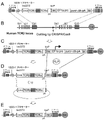
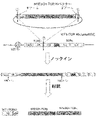
- FIG. 1 shows the outline of the TIC cocktail method in the case of using the RMCE method provided by using the method of this application.
- lox2272 and loxP which are recombinant enzyme target sequences adjacent to the known TCR in the figure, are unnecessary, and a genome editing vector is applied instead of the recombinant enzyme Cre.
- the outline of the TIL cocktail method provided by using the method of this application is shown. It is a figure which shows the outline of the procedure of Example 1.
- FIG. The results of knocking in a vector for introducing a cassette deck into Jurkat cells in Example 1 and then allowing FLP and ganciclovir to act to remove the drug resistance factor are shown. The cells shown in FIG.
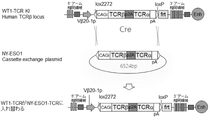
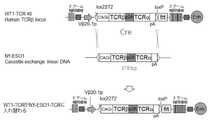
- TCR-expressing cells were further obtained as TCR-expressing cells by FACS Aria. Schematic of the operation of allowing the cassette tape exchange plasmid vector and the Cre recombinase expression vector of the NY-ESO1-specific TCR gene to act on the TCR-expressing cells of FIG. 4, that is, the cassette tape-containing cassette deck KI-Jurkat cells of the WT1-specific TCR. figure. Similar to FIG. 5A, but schematic diagram of an operation using NY-ESO1-specific TCR expression cassette tape replacement linear DNA. To the TCR-expressing cells of FIG.
- a guide RNA for cleaving the WT1-specific TCR (WT1-TCR) gene which is a marker protein gene in the genome editing of Example 4, and a 5'and 3'arm for a knock-in vector that introduces a desired sequence at the cleavage site.
- Diagram showing the design concept Schematic diagram of the NYESO1-specific TCR (NYESO1-TCR) gene knock-in vector used in Example 4.
- FIG. The figure which shows the result of Example 4 (using gRNA # 1).
- Upper row Analysis of TCR ⁇ expression with mouse C ⁇ and NYESO1 expression (NYESO1 tetramer: NYESO1).
- Middle Analysis of TCR ⁇ expression with mouse C ⁇ and human TCR expression.
- effector cell refers to a cell that has a special function in the body after being administered.
- the effector cells include various mature T cells such as helper T cells, regulatory T cells, and cytotoxic T cells, natural killer (NK) cells, NKT cells, macrophages, immune cells such as dendritic cells, and platelets.
- NK natural killer
- NKT natural killer
- macrophages immune cells such as dendritic cells
- platelets typified by mesenchymal stem cells, cells administered in suspension such as nerve cells, and retina, retinal pigment epithelium, skin, where the cells have a two-dimensional structure. Examples include various tissues such as intestinal epithelium and various organs such as heart, liver, and kidney having a three-dimensional structure.
- the method of the present application is particularly preferably used as an effector cell for immune cells such as mature T cells, natural killer (NK) cells, NKT cells, macrophages, and dendritic cells.
- immune cells such as mature T cells, natural killer (NK) cells, NKT cells, macrophages, and dendritic cells.
- NK natural killer
- NKT NKT cells
- macrophages and dendritic cells.
- TCR T cell receptor
- CAR chimeric antigen receptor
- the TCR gene as a gene encoding a desired protein to be introduced into an effector cell is not particularly limited, and even a known reconstituted TCR gene is used for an antigen targeted for cell therapy.
- a TCR gene amplified by a known method from a specific T cell may be used.
- TCR specific to a cancer antigen is exemplified.
- the TCR of a frequently killer T cell clone may be obtained and used by collecting the TIL from the cancer tissue of the patient and analyzing the TIL by a single cell.
- chimeric antigen receptor refers to an antigen-binding domain, a transmembrane domain and a cytoplasmic signaling domain comprising a cytoplasmic sequence of CD3 ⁇ sequences sufficient to stimulate T cells when bound to an antigen, and desired.
- the cytoplasmic sequences of one or more (eg, 2, 3 or 4) co-stimulatory proteins that provide T cell co-stimulation when the antigen-binding domain binds to the antigen eg, CD27, CD28, 4-1BB, Specific to OX40, CD30, CD40L, CD40, PD-1, PD-L1, ICOS, LFA-1, CD2, CD7, CD160, LIGHT, BTLA, TIM3, CD244, CD80, LAG3, NKG2C, B7-H3 and CD83.
- co-stimulatory proteins that provide T cell co-stimulation when the antigen-binding domain binds to the antigen (eg, CD27, CD28, 4-1BB, Specific to OX40, CD30, CD40L, CD40, PD-1, PD-L1, ICOS, LFA-1, CD2, CD7, CD160, LIGHT, BTLA, TIM3, CD244, CD80, LAG3, NKG2C, B7-H3
- Progenitor cell refers to a cell that is in the process of differentiating but has the ability to differentiate into the cell.
- a “material cell capable of differentiating into an effector cell” is a cell capable of differentiating into an effector cell or a progenitor cell thereof in vitro. The material cell is preferably a cell capable of proliferating in vitro as well as having the ability to differentiate into an effector cell.
- Examples of material cells having the ability to differentiate into effector cells include pluripotent stem cells and tissue stem cells.
- tissue stem cells or somatic stem cells include nerve stem cells, hematopoietic stem cells, mesenchymal stem cells, dental pulp stem cells, and the like.
- Pluripotent stem cells are stem cells that have pluripotency that can differentiate into many cells existing in the living body and also have self-proliferative ability.
- Pluripotent stem cells include, for example, embryonic stem (ES) cells, embryonic stem (ntES) cells derived from cloned embryos obtained by nuclear transplantation, sperm stem cells (“GS cells”), embryonic germ cells (“EG cells”). ”), Artificial pluripotent stem (iPS) cells, cultured fibroblasts, pluripotent cells derived from bone marrow stem cells (Muse cells) and the like.
- Pluripotent stem cells are preferably mammalian pluripotent stem cells, more preferably human pluripotent stem cells.
- As the material cells ES cells or iPS cells are preferably used.
- ES cells and iPS cells may be produced by a known method, or commercially available cells may be obtained and used.
- iPS cells those produced from somatic cells obtained from a patient to be treated may be used.
- a method of manipulating HLA of ES cells and iPS cells by genome editing technology to generalize pluripotent stem cells has been proposed (literature), and the material cells of the present application include such generalized pluripotent stem cells. You may use it.
- the method of the present application is particularly preferably used when obtaining mature T cells having a desired TCR or CAR as effector cells.
- an effector cell expressing a desired protein a method for obtaining a mature T cell expressing a desired TCR by the RMCE method will be described as an example.
- a cassette tape gene containing a set of recombinant enzyme target sequences in the genome of pluripotent stem cells, which are material cells, and a gene encoding a marker protein between the target sequences, and the material cells are T cells or T precursors.
- the marker protein examples include known ligands or receptors expressed on the surface of effector cells or progenitor cells thereof. In order to produce mature T cells expressing the desired TCR, known TCRs or CARs for which tetramers are available are preferably used as marker proteins. Alternatively, examples of the marker protein include known fluorescent proteins. Many fluorescent proteins used for genetic engineering are known, and various ones are commercially available. It may be appropriately selected from these known fluorescent proteins.
- a "recombination enzyme” is an enzyme that induces site-specific recombination, and the target sequence of the recombinant enzyme is recognized by the recombinant enzyme and deleted between the two target sequences. An array that can be incorporated and induced to be inverted. Examples of the combination of the recombinant enzyme and its target sequence include Cre recombinase and loxP and their derivatives, Flipperse (FLP) and frt, and chronase and attB / attP / attL / attR.
- Cre recombinase and loxP and their derivatives include Cre recombinase and loxP and their derivatives, Flipperse (FLP) and frt, and chronase and attB / attP / attL / attR.
- a cassette tape gene containing a desired protein gene sandwiched between a set of recombinant enzyme target sequences is sandwiched between the same target arrangements. It is preferable to use a recombinant enzyme system capable of replacing the cassette tape gene containing the marker protein in the same orientation.
- loxP, lox2272, lox511, loxFas and the like are exemplified as target sequences.
- Cre recombinase recombination between the same target sequences is promoted.
- the sequence sandwiched between lox2272 and loxP in the material cell genome can be exchanged with the sequence sandwiched between lox2272 and loxP on the vector.
- the material cell used in the method of the present application can express a marker protein in a cell in which a cassette tape gene containing a gene encoding a marker protein in the genome of the material cell is induced to differentiate into an effector cell or a precursor cell of the effector cell. I have it like that.
- the cassette tape gene is introduced so that the gene encoding the TCR is expressed under the control of the TCR expression control mechanism of the material cell. It may be introduced into a material cell together with an expression control function including a promoter and / or an enhancer involved in TCR expression control.
- the cassette tape gene may be introduced so that it is expressed under the control of the TCR expression control mechanism of the material cell.
- cassette deck structure the structure containing the promoter, the gene encoding the marker protein, and the enhancer from the upstream
- the structure containing the gene encoding the marker protein is referred to as a "cassette tape gene”
- cassette tape gene the structure containing the gene encoding the marker protein
- a cassette tape containing a marker protein under the physiological expression control of the TCR locus after rearrangement is insert the gene. That is, a cassette deck structure containing a cassette tape gene may be constructed between the promoter and enhancer of the reconstituted TCR locus.
- a gene containing a cassette tape gene and an enhancer in the C region of the TCR locus are placed downstream of the promoter of the V region of the material cell TCR locus, in order from the upstream, between the promoter of the V region and the enhancer of the C region. Introduce it so that it is close enough to exert the function of controlling the expression of the sandwiched gene.
- the promoter in the V region and the enhancer in the C region are sufficiently close to exert the function of controlling the expression of the gene sandwiched between them.
- the promoter in the V region is even controlled by the enhancer in the C region.
- the distance between the two is not particularly limited. It is exemplified that the distance between the promoter in the V region and the enhancer in the C region after introducing the cassette tape gene is, for example, about 8 to 50 kbp, about 10 to 40 kbp, about 12 to 32 kbp, or about 14 to 22 kbp. ..
- Enhancer of C region of TCR locus and "promoter of V region of TCR locus” are sequences obtained from cells derived from other individuals of animals of the same species as the material cells, even if they are sequences derived from material cells. It may be a sequence obtained from cells derived from animals of other species.
- the introduction of the cassette deck structure into the material cells may be performed in a single operation or in multiple stages. It can also be carried out by a conventionally known recombination technique, for example, a homologous recombination technique, a genome editing technique, or a technique using a combination of recombinases such as Cre and Flippase.
- a conventionally known recombination technique for example, a homologous recombination technique, a genome editing technique, or a technique using a combination of recombinases such as Cre and Flippase.
- the marker protein contained in the cassette tape gene When reconstituted TCR is used as the marker protein contained in the cassette tape gene, it is preferably a heterodimer of TCR ⁇ and ⁇ .
- the gene encoding the marker protein When expressing the heterodimeric of reconstituted TCR ⁇ and TCR ⁇ , the gene encoding the marker protein is preferably a sequence in which the reconstituted TCR ⁇ gene and the TCR ⁇ gene are linked by a self-cleaving 2A peptide. By placing a self-cleaving 2A peptide between the ⁇ and ⁇ chains, both genes can be expressed under the expression control system of one gene.
- the 2A peptide p2A, T2A, E2A, F2A and the like can be used, and the p2A peptide, which is said to have good cleavage efficiency, is preferably used.
- the TCR ⁇ gene or the TCR ⁇ gene may be introduced upstream, but the poly A sequence is preferably linked to the TCR gene introduced downstream.
- an intron is contained upstream of the TCR gene.
- the intron sequence may include a splice donor sequence and a splice acceptor sequence in addition to the spliced and removed sequence, for example, an intron of the human polypeptide chain elongation factor ⁇ (EF1 ⁇ ) gene, or a chicken ⁇ -actin.
- EF1 ⁇ human polypeptide chain elongation factor ⁇
- CAG human polypeptidelongation factor ⁇
- the TCR locus into which the cassette deck structure containing the cassette tape gene on the material cell genome is introduced may be TCR ⁇ or TCR ⁇ . It is preferable to delete the TCR ⁇ and ⁇ loci that are not used for gene transfer. The deletion of a specific locus may be carried out by appropriately using a known method, and may be carried out by using a known genome editing technique such as CRISPR / Cas9 or Talen.
- Patent Document 6 (WO2020 / 022512) may be used as a method for preparing a vector for expressing a heterodimer of reconstituted TCR ⁇ and ⁇ and a method for introducing the vector into a material cell.
- a method for obtaining material cells for use in the RMCE method will be described by introducing them so that they are sufficiently close to each other to exert the function of controlling the expression of the gene sandwiched between them.
- the material cell may be a cell in which the TCR locus has been reconstituted or a cell in which the TCR locus has not been reconstituted.
- the recombinant enzyme target sequence is inserted into the cassette tape gene adjacent to the upstream and downstream of the gene encoding the marker protein.
- a method for producing a material cell having a cassette deck structure which comprises a step of allowing a second recombinant enzyme to act on the obtained cells to remove a drug resistance gene.
- the first recombinant enzyme is specific to the target sequence of the recombinant enzyme contained in the effector cell having the cassette deck structure described above.
- the combination of the second recombinant enzyme and its target sequence is not particularly limited as long as it does not have cross-reactivity with the first recombinant enzyme.
- the Cre / loxp system is used as the first recombinant enzyme
- the FLP / frt system is exemplified as the second recombinant enzyme.
- the combination of the second recombinant enzyme and the target sequence is such that the site sandwiched between the target sequences is formed by the action of the second recombinant enzyme.
- the first promoter is a promoter capable of inducing the expression of a marker protein in cells that have been induced to differentiate into effector cells.
- a known TCR is used as the marker protein, it is preferably a promoter of the TCR locus of the material cell, and examples thereof include a promoter of the TCR locus V region of the material cell.
- the V region promoter at the TCR locus is not particularly limited and may be appropriately selected.
- the use of the V ⁇ 20-1 promoter is exemplified.
- the promoter sequence can be obtained by designing a primer and amplifying it by PCR so that a DNA fragment of the promoter sequence upstream from immediately before the translation start point in the first exon of the V gene can be obtained.
- the promoter that can be expressed in the material cell is not particularly limited as long as it is a promoter that can induce the expression of the drug resistance gene linked in the cell. Examples include, but are not limited to, the cytomegalovirus (CMV) promoter, the Simian virus 40 (SV40) promoter, the phosphoglycerate kinase (PGK) promoter, and the like.
- CMV cytomegalovirus
- SV40 Simian virus 40
- PGK phosphoglycerate kinase
- the promoter (pPGK) of the mouse phosphoglycerate kinase (PGK) gene is exemplified.
- drug resistance gene a known drug resistance gene that can function as a marker in material cells may be used, and examples thereof include resistance genes against hygromycin, puromycin, neomycin, and the like.
- the drug resistance gene is preferably a fusion gene having a drug susceptibility gene downstream thereof.
- the drug susceptibility gene means a gene capable of inducing cell apoptosis by reacting with a substance added from the outside when expressed.
- a known gene may be appropriately selected and used, and is not particularly limited.
- the thymidine kinase gene of herpes simplex virus and varicella-zoster virus is exemplified.
- Ganciclovir is exemplified as a drug that induces apoptosis in cells incorporating such a gene.
- a poly A sequence is preferably linked downstream of the drug resistance gene.
- a vector used for gene recombination may be appropriately selected and used, and examples thereof include vectors such as viruses, plasmids, and artificial chromosomes.
- the virus vector include a retrovirus vector, a lentivirus vector, an adenovirus vector, an adeno-associated virus vector, and a Sendai virus vector.
- the artificial chromosome vector includes, for example, a human artificial chromosome (HAC), a yeast artificial chromosome (YAC), a bacterial artificial chromosome (BAC, PAC) and the like.
- HAC human artificial chromosome
- YAC yeast artificial chromosome
- BAC bacterial artificial chromosome
- PAC bacterial artificial chromosome
- the plasmid a plasmid for mammalian cells can be used.
- a commercially available vector may be appropriately selected and used according to the purpose.
- the position to be introduced may be any position as long as the C enhancer derived from the material cell can activate the V promoter when the sequence containing the V promoter and the cassette tape gene is introduced in order from the upstream.
- a region that can be introduced without rearrangement of the TCR ⁇ locus and is close to an enhancer is preferable, and is upstream of D ⁇ 2 and downstream of C ⁇ 1.
- Introducing is exemplified.
- a region that can be introduced without rearrangement of the TCR ⁇ locus and is close to an enhancer is preferable, and is upstream and most upstream of the most upstream J ⁇ gene. It is exemplified to introduce it downstream of a downstream V ⁇ gene.
- sequences homologous to the sequences upstream and downstream of the introduction site are introduced as 5'arms and 3'arms, respectively, so that homologous recombination can be performed.
- the "homologous sequence” may be such that the sequences of the 5'arm and the 3'arm each have a degree of homology to the extent that homologous recombination occurs.
- a DNA fragment from about 110 bp upstream of the D ⁇ 2 gene to about 1.6 kbp further upstream is set as a 5'arm sequence. It is exemplified using a DNA fragment from about 50 bp upstream of the D ⁇ 2 gene to a position of about 1.6 kbp downstream as a 3'arm sequence.
- the DNA fragments of each 5'arm and 3'arm can be obtained by PCR amplification using the genomic DNA of the material cell as a template, using a primer capable of specifically amplifying each sequence.
- the targeting vector for introducing the cassette deck the sequence homologous to the 5'side of the introduction site in the TCR gene locus of the material cell genome (5'arm), the promoter sequence of the TCR locus V region, and the first A target sequence of one recombinant enzyme, a cassette tape gene containing a gene encoding a marker protein linked to be expressed under the first promoter sequence and a target sequence of the first recombinant enzyme, and a second recombinant.
- the target sequence of the enzyme, the second promoter sequence that can be expressed in the material cell, the drug resistance gene linked to be expressed under the second promoter that can be expressed in the material cell, and the target sequence of the second recombinant enzyme are examples of the target sequence of the enzyme, the second promoter sequence that can be expressed in the material cell, the drug resistance gene linked to be expressed under the second promoter that can be expressed in the material cell, and the target sequence of the second recombinant enzyme.
- An example is a vector containing a sequence (3'arm) homologous to the 3'side of the material cell introduction site.
- primers are designed so that a DNA sequence for introducing the obtained PCR product into a drug resistance vector is added.
- a vector may be constructed using a known method such as the Gibson assembly method or a commercially available kit.
- the targeting vector for introducing a cassette deck may further contain a promoter and a gene that serves as a marker that can be expressed in material cells on the downstream side of the 3'arm.
- a promoter and a gene that serves as a marker that can be expressed in material cells on the downstream side of the 3'arm examples include a combination of the MC1 promoter and the diphtheria toxin gene (DTA).
- Step (b) The targeting vector for introducing the cassette deck is knocked in to the TCR locus of the material cell by homologous recombination. Knock-in may be performed by a known method, for example, by an electroporation method.
- two single-strand breaks are introduced at the knock-in site, for example, near the start site (upstream) of the 3'arm, before the knock-in of the targeting vector for introducing the cassette deck. It is preferable to do so.
- the introduction of the nick may be carried out by a known method, and it is exemplified that a CRISPR / Cas9n system is adopted.
- Step (c) In the material cells that have succeeded in homologous recombination, the drug resistance gene is expressed by the action of the introduced promoter. Therefore, material cells that have succeeded in homologous recombination can be selected in the presence of a drug to which the drug resistance gene is resistant.
- a marker gene is incorporated downstream of the 3'arm of the targeting vector for introducing a cassette deck, a so-called outer part that does not contain the cassette tape gene and drug resistance gene of the 5'arm sequence and the 3'arm sequence is introduced.
- a cell toxin that serves as a marker is expressed, and the cells cannot survive.
- the surviving cells it is possible to select the cells that have succeeded in knocking in the vector for introducing the cassette deck.
- the selected material cells may be further confirmed by the PCR method, and only the cells in which the V region promoter and the cassette tape gene are knocked in may be selected.
- Step (d) The second recombinant enzyme is allowed to act on the cells in which the cassette deck introduction vector is knocked in.
- a second recombinant enzyme expression vector is introduced into the cell. Expression of the second recombinant enzyme expression vector removes the drug resistance gene and contains a promoter, a set of recombinant enzyme target sequences and a gene encoding a marker protein between the target sequences within the genome of the material cell. It is possible to obtain a material cell containing a cassette tape gene and a cassette deck structure having an enhancer so that the marker protein can be expressed in a cell in which the material cell is induced to differentiate into an effector cell or a precursor cell of the effector cell. ..
- the drug resistance gene is a fusion gene having a drug susceptibility gene downstream thereof
- the drug resistance gene can be removed by further culturing in the presence of a substance capable of inducing apoptosis by the drug susceptibility gene after step (d).
- the failed cells may be removed.
- a material cell capable of differentiating into an effector cell and a set of recombinant enzyme target sequences and the target sequence in the genome of the material cell.
- a cassette deck introduction vector that does not have the first promoter sequence may be prepared.
- (C) a gene containing the cassette tape gene and the enhancer of the C region of the TCR locus are transferred from the upstream to the downstream of the promoter of the V region of the material cell TCR locus, and the promoter of the V region and the enhancer of the C region. Introduces the gene so that it is close enough to exert the function of controlling the expression of the gene sandwiched between them.
- a cassette deck introduction vector contained downstream of the target sequence of the gene or the second recombinant enzyme may be used.
- Step (2) Proliferate the provided material cells.
- the method for proliferating the material cells may be appropriately selected according to the type of the material cells.
- Step (3) The proliferated material cells are differentiated into effector cells.
- the material cell is a pluripotent stem cell and the effector cell is a T cell
- a known method may be used as a method for inducing the differentiation of the pluripotent stem cell into a T cell.
- the methods described in Documents 1 to 5 and the like are exemplified.
- the rearrangement of the TCR may be suppressed by deleting the Rag1 gene or the Rag2 gene. For the Rag1 gene and the Rag2 gene, it is only necessary to delete one of them.
- the T cell is a cell that expresses CD3 and at least one of CD4 and CD8. Depending on the therapeutic purpose, it may be differentiated into either killer T cells expressing CD8 or helper T cells expressing CD4. It may also be a progenitor cell thereof.
- the resulting T-cell contains a promoter, a set of recombinant enzyme target sequences, and a cassette tape gene containing a gene encoding a known TCR, which is a marker protein, between the target sequences, in order from the upstream, and an enhancer. It has a cassette deck structure and expresses a known TCR which is a marker protein.
- TCR which is a marker protein
- Step (4) The marker protein gene of the effector cell or its progenitor cell is replaced with a gene encoding the desired protein.
- a specific example of this step when the RMCE method is used will be described.
- the effector cell or its precursor cell contains a pair of recombinant enzyme target sequences identical to the recombinant enzyme target sequence and a gene encoding a desired protein between the pair of recombinant enzyme target sequences. It is cultured with the vector in the presence of recombinant enzyme to replace the cassette tape gene containing the marker protein gene with the cassette tape gene containing the gene encoding the desired protein.
- the reconstituted TCR gene to be introduced into T cells can be used by amplifying, isolating and isolating the TCR gene from T cells specific for the antigen targeted for cell therapy by a known method.
- TCR specific to a cancer antigen is exemplified.
- the TCR of a frequently killer T cell clone may be obtained and used by collecting the TIL from the cancer tissue of the patient and analyzing the TIL by a single cell.
- the TCR is preferably a heterodimer of TCR ⁇ and ⁇ , similar to TCR as a marker protein.
- the gene encoding the marker protein is preferably a sequence in which the reconstituted TCR ⁇ gene and the TCR ⁇ gene are linked by a self-cleaving 2A peptide. Further, it is preferable that the structure is sandwiched between recombinant enzyme target sequences and has an intron upstream of TCR ⁇ and TCR ⁇ containing a 2A peptide and poly A downstream.
- the vector used for the gene recombination described above may be appropriately selected and used, and examples thereof include vectors such as viruses, plasmids, and artificial chromosomes.
- a linear DNA vector may be used.
- the TCR gene contained in the cassette tape exchange vector and the TCR gene contained as a marker protein are exchanged. be able to.
- Knock-in may be performed by a known method, for example, by an electroporation method.
- the cassette tape exchange can be confirmed by confirming the presence of TCR used as a marker protein in the obtained cells. Confirmation of known TCR can be performed by tetramer or specific antibody.
- the method of the present application can also be performed using a genome editing method.
- the material cell having the cassette deck structure provided in step (1) has a cassette tape gene containing a gene encoding a marker protein in the genome of the material cell, and the material cell is an effector cell or an effector. It is a cell having a marker protein so that it can be expressed in a cell that has been induced to differentiate into a cell precursor cell.
- the "cassette deck structure" is a structure including a promoter, a gene encoding a marker protein, and an enhancer from the upstream, and the gene encoding the marker protein is a cassette tape.
- Step (2) and step (3) are the same as when the RMCE method is used.
- the effector cell containing the cassette tape gene containing the marker protein obtained in step (3) the marker protein gene contained in the effector cell or its precursor cell is disrupted or replaced with the marker protein by genome editing.
- the gene encoding the desired protein is introduced to be expressed in the material cells.
- CRISPR / Cas9 system which is a genome editing method, a method of disrupting a marker protein and introducing another reconstituted TCR in an effector cell containing a cassette tape gene containing the reconstituted TCR as a marker protein. Will be explained.
- RNA for marker protein gene cleavage (see FIG. 10)
- the guide RNA is designed so that the part involved in the specificity of the marker protein gene is cleaved.
- the marker protein is the TCR gene in which TCR ⁇ and TCR ⁇ shown in FIG. 5A are linked by p2A
- it can be designed to cleave any of CDR1 to 3, for example, CDR3, which contributes to the specificity of either TCR chain. good.
- CDR3 the case of cleaving CDR3 in the variable region of the TCR ⁇ chain will be described.
- a guide RNA recognition site for cleaving marker protein is determined in the CDR3 region, and a homologous sequence of about 20 bp upstream from the site of cleavage by CRISPR / Cas9 is a 5'arm and about 20 bp downstream is a homologous sequence of a 3'arm.
- Design of reconstituted TCR gene knock-in vector (see Fig. 11) Create a knock-in vector for introducing TCR. When knocking in a heterodimer of reconstituted TCR ⁇ and TCR ⁇ , a gene encoding an amino acid sequence in which the reconstituted TCR ⁇ gene and the TCR ⁇ gene are linked with a self-cleaving 2A peptide is preferable.
- the sequence to be knocked in is sandwiched between the homologous sequences of the 5'arm and the 3'arm determined in step ii), and the recognition sequence of the guide RNA for KI vector cleavage is placed at both ends.
- a gene encoding a self-cleaving 2A peptide is placed at the most upstream of the knocked-in sequence sandwiched between 5'arms and 3'arms, and a stop codon is placed at the most downstream of the gene encoding the desired protein.
- the reconstituted TCR gene KI vector includes a guide RNA recognition sequence for KI vector cleavage, a 5'arm sequence, a gene encoding a 2A peptide, a gene encoding TCR ⁇ , and a gene encoding a 2A peptide, in order from the upstream.
- a gene encoding TCR ⁇ , a stop codon, a 3'arm sequence, and a guide RNA recognition sequence for KI vector cleavage are exemplified.
- iv) Preparation of vector for CRISPR / Cas9 Create a vector in which the guide RNA sequence for marker gene cleavage and the reconstituted TCR gene knock-in vector guide RNA sequence for cleavage are individually or simultaneously expressed at the same time as the Cas9 gene.
- the vector may be prepared by inserting two guide RNA sequences into a commercially available CRISPR / Cas9 vector so as to be operable downstream of the promoter.
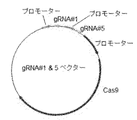
- a schematic diagram of the vector in which the two guide RNAs are inserted is shown in FIG.
- Cas9 gene expression vectors for example, pX330, pCAS-Guide, and pGuide-it are known.
- Knock-in of the reconstituted TCR gene knock-in vector and the KRISPR / Cas9 vector knock-in vector into the material cell may be carried out by a known method, for example, by an electroporation method.
- Knock-in integrates the reconstituted TCR gene by interrupting the specific portion of the marker TCR gene (FIG. 13).
- FIG. 13 the sequence from the start codon of the gene encoding the marker protein of the material cell to the stop codon of the knocked-in reconstituted TCR gene is translated.
- the 5'side fragment of the marker TCR ⁇ chain is cleaved by self-cleavage of the p2A peptide and loses its specificity.
- the rest of the marker TCR is 3'side from the stop codon at the end of the knocked-in reconstituted TCR gene and is not translated.
- the translated reconstituted TCR ⁇ and ⁇ chains are produced as two proteins by self-cleavage of the p2A peptide in between.
- the TCR protein used as a marker is replaced with the desired reconstituted TCR protein.
- a large amount of mature T cells having a cassette deck structure containing a cassette tape gene containing a known reconstituted TCR which is a marker protein or a progenitor cell thereof is produced, and the cassette tape gene is used to obtain a desired TCR gene.
- the cassette tape gene is used to obtain a desired TCR gene.
- mature T cells or their progenitor cells into which only one cassette deck structure is introduced per cell it is possible to simultaneously exchange multiple types of TCR cassette tape genes for multiple mature T cells or their progenitor cells. It is possible (Fig. 1A).
- a TIL cocktail method in which a plurality of types of TCR cassette tapes are exchanged for a clone of a cell having only one cassette deck structure is exemplified.
- clones of regenerated T cells having a cassette deck structure are produced by the method of the present application, and TCR is introduced into the regenerated T cells.
- the present invention is used in the step of introducing TCR into regenerated T cells having this cassette deck structure. In principle, this strategy can be applied to all patients for whom TIL can be collected. Since the T cell itself is versatile and the TCR gene is personalized medicine, it can be said that the strategy is a combination of personalized medicine and personalized medicine.
- the TIC cocktail method When using the RMCE method, the TIC cocktail method 1) inserts the reconstituted TCR gene into the TCR locus of the underlying ES / iPS cells in an arrangement whose expression is controlled under the influence of an endogenous enhancer. (Fig. 1A). 2) By arranging lox2272 and loxp upstream and downstream of the TCR gene to be inserted at this time, the cassette deck has a structure in which the cassette tape is contained. 3) As the TCR gene to be introduced, a known TCR for which the tetramer used for staining is available is used. 4) The TCR locus into which the reconstituted TCR gene has not been inserted is destroyed so that the number of TCR loci expressed in the cell is one.
- lox2272 and loxp are placed upstream and downstream of the TCR gene to be introduced (cassette tape replacement vector). 7) Introduce a mixture of multiple TCR genes into cells together with Cre.
- the TIL cocktail method 1) reconstructs the reconstituted TCR gene at the TCR locus of the underlying ES / iPS cells in such an arrangement that the expression is controlled under the influence of an endogenous enhancer. insert. 2) At that time, the TCR locus in which the reconstituted TCR gene is not inserted is destroyed so that the TCR locus expressed in the cell becomes one. 3) As the TCR gene to be introduced, a known TCR for which the tetramer used for staining is available is used. 4) Regenerate T cells from the ES / iPS cells thus produced.
- a genome editing vector for introducing a desired sequence into a sequence site specific to the introduced TCR gene, and a knock-in vector (cassette tape exchange vector) for introducing the reconstituted TCR gene.
- a knock-in vector cassette tape exchange vector
- a genome editing vector is allowed to act on cells together with a knock-in vector for introducing multiple types of reconstituted TCR genes.
- This method has the effects of 1) gene transfer without the risk of mispairing while mixing multiple types of TCR vectors, and 2) separation of replaced cells as tetramer-negative cells. As a result, a large number of T cells expressing the same TCR as TIL can be produced.
- the present invention can be applied not only to the TIL-derived TCR gene but also to the case where one or more TCR genes and CAR genes for cancer common antigens are inserted into regenerated T cells.
- a cassette tape gene containing a specific gene is referred to as a “cassette tape of the specific gene”.
- cells containing a cassette deck containing a cassette tape of a WT1-specific TCR gene were prepared under the TCR expression control mechanism of Jurkat cells, which are mature T cells.
- the cassette tape of the WT1-specific TCR gene is replaced with the cassette tape of the NY-ESO1-specific TCR gene by allowing the cassette tape of the obtained cassette deck to act on the cassette tape exchange vector of the NY-ESO1-specific TCR gene. I succeeded in doing it.
- a series of procedures is shown in FIG.
- a culture medium having the following composition was used for cell culture.
- each drug was added to the following composition and cultured.
- the composition of the penicillin / streptomycin / L-glutamine solution is penicillin 10,000 U / mL, streptomycin 10,000 ⁇ g ⁇ g / mL, and L-glutamine 29.2 mg / mL, so the final concentrations are 100 U / mL and 100 ⁇ g ⁇ g / mL, respectively. It becomes 292 ⁇ g ⁇ g / mL.
- the electroporation method was used for vector introduction into cells.
- I followed the manual for the Amaxa R Cell Line Nucleofector R Kit V Kit. After suspending the cells and vector in the reagent included in the kit, they were transferred to the cuvette included in the kit, set in Amaxa Nucleofector II (Lonza), and the vector was introduced into the cells using the program X001 included in the instrument.
- J.RT3-T3.5 Jurkat cell line (hereinafter Jurkat ⁇ mutant) (Ohashi et al, Science 316. 606-609) .1985) was used.
- a targeting vector for introducing a cassette deck a targeting vector containing a cassette tape gene in which the reconstituted TCR (corresponding to a marker protein) shown in FIG. 2A was sandwiched between lox2272 and loxP was prepared.
- the vector has a DCT gene and a promoter for its expression downstream of the 3'arm homology region.
- V ⁇ 20-1 promoter and TCR using a cassette deck introduction targeting vector (KI targeting vector) (Fig. 2A) at the approximately 50 bp upstream site of the D ⁇ 2 gene at the TCR ⁇ locus of Jurkat cells, which is a T cell line (Fig. 2B).
- KI targeting vector a cassette deck introduction targeting vector
- FIG. 2C A schematic diagram after insertion is shown (FIG. 2C).
- nicks Two single-strand breaks (nicks) were introduced at the upstream site of about 50 bp of the D ⁇ 2 gene by the CRISPR / Cas9n system.
- a targeting vector for introducing a cassette deck was introduced into Jurkat ⁇ mutant together with the following two CRISPR / Cas9n vectors.
- the fusion gene (Puror ⁇ TK) of the puromycin resistance gene and the kinase domain ( ⁇ TK) of herpesvirus thymidine kinase is expressed by the action of the EF1 ⁇ promoter (Puror ⁇ TK).
- FIG. 2C Therefore, first, a clone in which the drug resistance gene in the targeting vector for introducing a cassette deck was incorporated into the genome was selected using 0.25 ⁇ g / mL puromycin / culture medium (positive selection).
- diphtheria toxin is produced intracellularly in cells in which the vector portion outside the 5'arm sequence and 3'arm sequence of the targeting vector for introducing a cassette deck is incorporated into genomic DNA by random integration. Cannot survive and is removed (negative selection).
- clones incorporating the TCR gene from the V ⁇ 20-1 promoter to frt and the drug resistance gene portion into the TCRD ⁇ 2 gene region were identified by the PCR method.
- cells in which a cassette tape of the TCR gene was inserted into the TCRD ⁇ 2 gene region in only one allele and the vector was not incorporated into the other region in the genomic DNA by random integration were selected by the PCR method.
- the CRISPR / Cas9n vector used is as follows.
- the oligonucleotide of A and B (vector 1) and C and D (vector 2) were annealed and inserted into a plasmid pX460 cleaved with the restriction enzyme BbsI to prepare the oligonucleotide.
- TCR gene was integrated into the TCRD ⁇ 2 gene region by amplifying the 5'arm region and the 3'arm region using the following primers and PCR method.
- PCR was performed using KOD-FX (Toyobo, KFX-101) at 94 ° C, 2 min ⁇ 98 ° C, 10 sec, 68 ° C, 4 min in 35 cycles.
- TCR gene was integrated into only one allele of the TCRD ⁇ 2 gene region using the following primers and PCR reaction conditions.
- PCR was performed using KOD-FX (Toyobo, KFX-101) at 94 ° C., 2 min ⁇ 98 ° C., 10 sec, 60 ° C., 30 sec, 68 ° C., 8 min in 35 cycles.
- DTA diphtheria toxin
- Targeting vector KI-Jurkat cells for introducing a cassette deck.
- the Flipperse expression vector (pCAGGS-FLPe) was introduced into KI-Jurkat cells, a targeting vector for introducing a cassette deck, by an electroporation method. FLP recognizes frt sequences and deletes the regions sandwiched by them.
- 2C and 2D show the TCR ⁇ locus D ⁇ 2 region (FIG. 2C) after knock-in and the TCR ⁇ locus (FIG. 2D) in which the portion sandwiched by the frt sequence was deleted.
- ganciclovir In transient FLP expression by electroporation, cells in which the region sandwiched by frt was deleted and cells in which the deletion did not occur coexist. Therefore, using ganciclovir, cells that failed to be deleted (cells that failed to be recombined by FLP) were removed. Normally, ganciclovir does not act on human cells such as Jurkat cells. On the other hand, in cells in which Puror ⁇ TK is present, ganciclovir becomes a nucleic acid analog when phosphorylated by ⁇ TK, and as a result, inhibits DNA replication and causes cell proliferation arrest or cell death.
- TCR expression cassette deck KI-Jurkat cells After culturing the isolated cells, it was confirmed by PCR that the region sandwiched between the frt sequences was deleted, and reanalysis was performed by FACS. It was confirmed that the isolated cells lacked the region sandwiched by the frt sequence and maintained the expression of TCR (Fig. 4). The obtained cells were used as "TCR expression cassette deck KI-Jurkat cells" in the following experiments. 3) TCR cassette tape exchange in TCR expression cassette deck KI-Jurkat cells using plasmid DNA
- FIG. 2 the steps shown in FIGS. 2D and E.
- the outline is shown again in FIG. 5A.
- the TCR ⁇ locus D ⁇ 2 region of the TCR expression cassette KI-Jurkat cell the vector for exchanging the TCR cassette tape (plasmid vector), and the TCR ⁇ locus after exchanging the cassette tape are schematically shown.
- Downstream of the V ⁇ 20-1 promoter in the D ⁇ 2 region of the TCR ⁇ locus there is an intron-TCR ⁇ -p2A-TCR ⁇ -poly A sandwiched between Lox2272 and Loxp.
- TCR cassette tape replacement vector a plasmid vector having an intron-TCR ⁇ -p2A-TCR ⁇ -poly A sandwiched between Lox2272 and Lox was used.
- TCR ⁇ and ⁇ TCR for NY-ESO1 antigen was used.
- a TCR cassette tape exchange vector and a Cre expression vector (pCAG-nls-Cre) were introduced into TCR expression cassette deck KI-Jurkat cells by an electroporation method. After electroporation, the cells were cultured for 7 days. In order to confirm that the region sandwiched between lox2272 and loxP was replaced by the cassette exchange method, the presence or absence of NY-ESO1 tetramer-positive cells was confirmed using FACS. The results are shown in FIG. NY-ESO1 tetramer-positive cells could not be detected in cells that had not been exchanged with cassette tape, but NY-ESO1 tetramer-positive cells were detected in cells into which the TCR cassette tape exchange vector and Cre expression vector had been introduced.
- TCR expression cassette deck using linear DNA TCR cassette tape exchange in KI-Jurkat cells In order to improve the efficiency of the TCR cassette exchange method, a TCR cassette using a linear DNA smaller in size than the plasmid DNA I tried the exchange method. The outline is shown in FIG. 5B.
- the linear DNA was prepared by amplifying the region sandwiched between lox2272 and loxP of the above TCR cassette tape exchange vector (plasmid vector) using the PCR method (see the material below).
- a linear DNA for exchanging TCR cassette tape and a Cre expression vector (pCAG-nls-Cre) were introduced into TCR expression cassette KI-Jurkat cells by an electroporation method. Also introduced in this example is TCR for the NY-ESO1 antigen.
- NY-ESO1 tetramer-positive cells After culturing for 14 days, the presence or absence of NY-ESO1 tetramer-positive cells was confirmed using FACS in order to confirm that the region sandwiched between lox2272 and loxP was replaced by exchanging cassette tapes. The results are shown in FIG. NY-ESO1 tetramer-positive cells could be detected in the same manner as in the TCR cassette tape exchange using plasmid DNA.
- HKM1 strain Derived from human monosphere (established at the Institute for Frontier Life and Medical Sciences, Kyoto University, Hiroshi Kawamoto Laboratory)
- I14s04 strain Derived from human monocytes (established at the Center for iPS Cell Research and Application, National University Corporation)
- TCR knock-in gene editing using CRISPR / Cas9
- a targeting vector for introducing a cassette deck was prepared in the same manner as in Example 1. The structure of the vector is shown in FIG. 7A.
- TCR As the TCR gene, TCR (KM # 3-3) obtained from WT1-specific TCR was used. Expression vectors of CRISPR / Cas9 and guide RNA mixed in the proportions described above 1. And a targeting vector for introducing a cassette deck 2.
- the plasmid was transfected into iPS cells using electroporation. After 2 days, the cells were collected and reseeded at a ratio of 5 ⁇ 10 4 / well (6-well plate), and from the next day, drug selection was performed using puromycin at the following final concentration.
- iPSC colony pickup 1 ⁇ 10 6 iPS cells were used at one time, a total of 10 ⁇ g of plasmid DNA was used, and NEPA21 was used under the following conditions.
- Day 0 Electroporation
- Day 2 Cell reseeding 5 ⁇ 10 4 cells / well
- Day 3 Puromycin 180 ng / ml
- Day 4 Puromycin 150 ng / ml
- Day 5-9 Normal culture
- Day12 iPSC colony pickup
- Thymidine kinase is expressed downstream of the targeting vector for introducing cassette deck shown in FIG. 7A, and ganciclovir (GCV) is intracellularly expressed.
- GCV ganciclovir
- CD8 single positive T cells were obtained by inducing differentiation from the obtained iPS cells having a cassette deck structure containing a cassette tape of a TCR gene having a lox2272-TCR-loxP structure containing a WT1-specific TCR.
- CTL was induced by the method described in Patent Document 4 (WO2017 / 179720). That is, iPS cells were induced into T cell precursors, which are CD4CD8 double positive cells, and then CD4CD8 double positive cells were isolated. The isolated CD4CD8 double positive cells were further induced into CD8 single positive cells. The results are shown in FIG. CD8 single positive T cells were obtained that were WT1-specific and had a CD8 antigen heterozygous between the CD8 ⁇ chain and the CD8 ⁇ chain. That is, the resulting cells are CD8 single positive T cells having a cassette deck containing a cassette tape of the WT1-specific TCR gene.
- a cassette tape exchange of CD8 single positive T cells having a cassette deck containing the cassette tape of the WT1-specific TCR gene obtained in Example 2 was performed.
- the cassette tape was replaced according to the outline shown in FIG. 5A.
- the cassette tape replacement vector is a circular plasmid vector having an intron-TCR ⁇ -p2A-TCR ⁇ -poly A sandwiched between Lox2272 and Lox.
- TCR ⁇ and ⁇ TCR for NY-ESO1 antigen was used.
- MOCK vector a plasmid vector encoding the GFP gene sandwiched between Lox2272 and Lox so as to be expressible was used.
- a TCR cassette tape replacement vector or Mock vector and a Cre expression vector are electroporated into CD8 SPT cells containing a cassette deck containing a cassette tape of the WT1-specific TCR gene. Introduced by. After electroporation, the cells were cultured for 13 days. In order to confirm that the cells were replaced by the cassette tape exchange method, the presence or absence of NY-ESO1 tetramer-positive cells was confirmed using FACS. Cells whose TCR has been replaced by cassette tape replacement are detected as NY-ESO1 tetramer-positive cells. The results are shown in FIG. Further, as a negative control, 10 ⁇ g of a Mock vector was used instead of the TCR cassette tape replacement vector (NY-ESO1).
- the marker protein TCR was switched to another TCR by genome editing.
- the TCR ⁇ locus of the cell has the structure shown in WT1-TCR KI Human TCR ⁇ locus in FIG. 5A.
- the cells are referred to as "Jurkat WT1-TCR cells".
- genome editing was used to express NYESO1-TCR in place of WT1-TCR in Jurkat WT1-TCR cells.
- FIG. 10 shows a conceptual diagram of the design of the homologous sequence portion of the two types of guide RNA and the 5'arm and 3'arm. In the figure, the vertical line separating the base sequences corresponds to the reading frame of translation into protein.
- another guide RNA gRNA # 5 was used for cleavage of the NYESO-1-TCR knock-in vector.
- gRNA # 5 The recognition sequence of gRNA # 5 is underlined below. 5'- GCATCGTACGCGTACGTGTT TGG-3'(SEQ ID NO: 15) The previously reported sequence was used for the DNA sequence of the gRNA portion of the gRNA # 5 vector (Nature Protocol 11, 118-133, 2016).
- the NYESO1-TCR gene to be exchanged for the WT1-TCR is a chimeric TCR ⁇ chain in which the variable region (V ⁇ ) of the TCR ⁇ chain of a known human TCR that recognizes the NYESO1 antigen is linked to the mouse TCR constant region (mC ⁇ ), and from a similar structure.
- V ⁇ variable region
- mC ⁇ mouse TCR constant region
- FIG. 11 shows a schematic diagram of the NYESO1-TCR gene knock-in vector.
- the NYESO1-TCR knock-in vector is an upstream gRNA # 5 recognition sequence, a 5'arm sequence, a p2A sequence, a p2A sequence in which the TCR ⁇ chain and the TCR ⁇ chain are linked to the NYESO1-TCR gene, the 3'arm sequence, and gRNA # 5. It is a plasmid DNA vector having a recognition sequence. The 3'end of the NYESO1-TCR gene contains a stop codon.
- gRNA # 1, gRNA # 4, gRNA # 5 were introduced into a plasmid vector pX330 capable of expressing both guide RNA and Cas9, respectively, and gRNA # 1 & gRNA # 5, A vector for CRISPR / Cas9 into which gRNA # 4 & gRNA # 5 was introduced was prepared.
- a schematic diagram of a vector expressing gRNA # 1, gRNA # 5 and Cas9 is shown in FIG.
- TCR expression was analyzed by a flow cytometer for eight types of cells from condition 1-1 to condition 2-4 and Jurkat WT1-TCR cells without gene transfer. Two types of antibodies and one type of tetramer shown below were used for the analysis.
- antibody Human TCR ⁇ antibody-PECy7 BioLegend, 306720
- Mouse TCR ⁇ antibody-APC BioLegend, 109212
- Tetramer NYESO1-tetramer-PE MBL, TB-M011-1
- the human TCR ⁇ antibody recognizes the TCR having the human C region, and does not recognize the TCR having the mouse C region.
- the mouse TCR ⁇ antibody recognizes the TCR having the C region of the mouse and does not recognize the TCR having the C region of the human.
- NYESO1-tetramer recognizes only NYESO1-TCR.
- human TCR ⁇ antibody recognizes WT1-TCR (KM # 3-3), and two types, mouse TCR ⁇ antibody and NYESO1-tetrame, are considered to recognize NYESO1-TCR. The results are shown in FIGS. 14A and 14B.
- TCR The expression of TCR (KM # 3-3) recognized by human TCR ⁇ antibody was confirmed in Jurkat WT1-TCR cells without gene transfer, and the expression of TCR recognized by mouse TCR ⁇ antibody and NYESO1-tetramer was completely expressed. Not observed (upper and middle rows of Jurkat WT1-TCR cell rows on the right side of FIGS. 14A and 14).
- the NYESO1-TCR vector and the gRNA / Cas9 expression vector for knocking in the NYESO1-TCR vector into the CDR3 region of the WT1-TCR were co-introduced, NYESO1- Cells expressing TCR were observed (Fig.
- TCR expression was not observed in most of the cells in which NYESO1-TCR expression was observed (Fig. 14A, Conditions 1-1, 1). -2, bottom of each column 1-3 and 1-4) ( Figure 14B, bottom of each column of condition 2-1, 2-2 and 2-4). From these results, it was considered that the TCR expressed in Jurkat WT1-TCR cells changed from WT1-TCR to NYESO1-TCR. From the above, it is possible to switch from already expressed TCR to another TCR expression by using genome editing in T cells expressing a T cell receptor (TCR) that has been transgenically introduced. It has been shown.
- TCR T cell receptor
Landscapes
- Health & Medical Sciences (AREA)
- Life Sciences & Earth Sciences (AREA)
- Engineering & Computer Science (AREA)
- Chemical & Material Sciences (AREA)
- Genetics & Genomics (AREA)
- Organic Chemistry (AREA)
- Biomedical Technology (AREA)
- Zoology (AREA)
- General Health & Medical Sciences (AREA)
- Biotechnology (AREA)
- Bioinformatics & Cheminformatics (AREA)
- Wood Science & Technology (AREA)
- Immunology (AREA)
- Cell Biology (AREA)
- Biochemistry (AREA)
- General Engineering & Computer Science (AREA)
- Microbiology (AREA)
- Animal Behavior & Ethology (AREA)
- Veterinary Medicine (AREA)
- Public Health (AREA)
- Epidemiology (AREA)
- Biophysics (AREA)
- Molecular Biology (AREA)
- Medicinal Chemistry (AREA)
- Hematology (AREA)
- Proteomics, Peptides & Aminoacids (AREA)
- Gastroenterology & Hepatology (AREA)
- Toxicology (AREA)
- Physics & Mathematics (AREA)
- Plant Pathology (AREA)
- Developmental Biology & Embryology (AREA)
- Virology (AREA)
- Pharmacology & Pharmacy (AREA)
- Micro-Organisms Or Cultivation Processes Thereof (AREA)
Priority Applications (8)
| Application Number | Priority Date | Filing Date | Title |
|---|---|---|---|
| EP21872573.7A EP4219707A4 (en) | 2020-09-24 | 2021-09-24 | METHOD FOR PRODUCING AN EFFECTOR CELL WITH DESIRED SPECIFICITY |
| US18/027,306 US20230357715A1 (en) | 2020-09-24 | 2021-09-24 | Method for preparing effector cells with desired specificity |
| CA3193384A CA3193384A1 (en) | 2020-09-24 | 2021-09-24 | Method for preparing effector cells with desired specificity |
| CN202180070920.9A CN116406423A (zh) | 2020-09-24 | 2021-09-24 | 制备具有所需特异性的效应细胞的方法 |
| IL301534A IL301534A (en) | 2020-09-24 | 2021-09-24 | A method for preparing effector cells with the desired specificity |
| KR1020237012583A KR20230074505A (ko) | 2020-09-24 | 2021-09-24 | 원하는 특이성을 갖는 이펙터 세포의 제조 방법 |
| AU2021349574A AU2021349574A1 (en) | 2020-09-24 | 2021-09-24 | Method for producing effector cell having desired specificity |
| JP2022552076A JP7807756B2 (ja) | 2020-09-24 | 2021-09-24 | 所望の特異性を有するエフェクター細胞の製造方法 |
Applications Claiming Priority (2)
| Application Number | Priority Date | Filing Date | Title |
|---|---|---|---|
| JP2020160252 | 2020-09-24 | ||
| JP2020-160252 | 2020-09-24 |
Publications (1)
| Publication Number | Publication Date |
|---|---|
| WO2022065444A1 true WO2022065444A1 (ja) | 2022-03-31 |
Family
ID=80846656
Family Applications (1)
| Application Number | Title | Priority Date | Filing Date |
|---|---|---|---|
| PCT/JP2021/035150 Ceased WO2022065444A1 (ja) | 2020-09-24 | 2021-09-24 | 所望の特異性を有するエフェクター細胞の製造方法 |
Country Status (9)
| Country | Link |
|---|---|
| US (1) | US20230357715A1 (https=) |
| EP (1) | EP4219707A4 (https=) |
| JP (1) | JP7807756B2 (https=) |
| KR (1) | KR20230074505A (https=) |
| CN (1) | CN116406423A (https=) |
| AU (1) | AU2021349574A1 (https=) |
| CA (1) | CA3193384A1 (https=) |
| IL (1) | IL301534A (https=) |
| WO (1) | WO2022065444A1 (https=) |
Families Citing this family (1)
| Publication number | Priority date | Publication date | Assignee | Title |
|---|---|---|---|---|
| TW202020145A (zh) * | 2018-07-13 | 2020-06-01 | 國立大學法人京都大學 | γδT細胞的製造方法 |
Citations (3)
| Publication number | Priority date | Publication date | Assignee | Title |
|---|---|---|---|---|
| CN105316362A (zh) * | 2015-08-19 | 2016-02-10 | 暨南大学 | 一种Dual-RMCE介导的TCR基因置换系统及其方法 |
| WO2017179720A1 (ja) | 2016-04-15 | 2017-10-19 | 国立大学法人京都大学 | Cd8陽性t細胞を誘導する方法 |
| WO2020022512A1 (ja) | 2018-07-26 | 2020-01-30 | 国立大学法人京都大学 | 外来抗原レセプター遺伝子導入細胞の製造方法 |
Family Cites Families (5)
| Publication number | Priority date | Publication date | Assignee | Title |
|---|---|---|---|---|
| WO2014165707A2 (en) | 2013-04-03 | 2014-10-09 | Memorial Sloan-Kettering Cancer Center | Effective generation of tumor-targeted t-cells derived from pluripotent stem cells |
| US12194083B2 (en) | 2014-07-18 | 2025-01-14 | Hiroshi Kawamoto | Method for establishing pluripotent stem cells bearing genes encoding antigen specific T cell receptor |
| JPWO2016010153A1 (ja) | 2014-07-18 | 2017-04-27 | 宏 河本 | 免疫細胞療法用t細胞の誘導方法 |
| AU2015290561A1 (en) | 2014-07-18 | 2017-03-09 | Hiroshi Kawamoto | Method for generating pluripotent stem cells bearing antigen specific T cell receptor genes |
| JP2021525518A (ja) * | 2018-05-31 | 2021-09-27 | ワシントン・ユニバーシティWashington University | 細胞をゲノム編集及び活性化するための方法 |
-
2021
- 2021-09-24 EP EP21872573.7A patent/EP4219707A4/en active Pending
- 2021-09-24 AU AU2021349574A patent/AU2021349574A1/en active Pending
- 2021-09-24 IL IL301534A patent/IL301534A/en unknown
- 2021-09-24 CA CA3193384A patent/CA3193384A1/en active Pending
- 2021-09-24 WO PCT/JP2021/035150 patent/WO2022065444A1/ja not_active Ceased
- 2021-09-24 CN CN202180070920.9A patent/CN116406423A/zh active Pending
- 2021-09-24 US US18/027,306 patent/US20230357715A1/en active Pending
- 2021-09-24 KR KR1020237012583A patent/KR20230074505A/ko active Pending
- 2021-09-24 JP JP2022552076A patent/JP7807756B2/ja active Active
Patent Citations (3)
| Publication number | Priority date | Publication date | Assignee | Title |
|---|---|---|---|---|
| CN105316362A (zh) * | 2015-08-19 | 2016-02-10 | 暨南大学 | 一种Dual-RMCE介导的TCR基因置换系统及其方法 |
| WO2017179720A1 (ja) | 2016-04-15 | 2017-10-19 | 国立大学法人京都大学 | Cd8陽性t細胞を誘導する方法 |
| WO2020022512A1 (ja) | 2018-07-26 | 2020-01-30 | 国立大学法人京都大学 | 外来抗原レセプター遺伝子導入細胞の製造方法 |
Non-Patent Citations (5)
| Title |
|---|
| GONG YING ET AL., JOURNAL OF CELL BIOLOGY, 2015, pages 1481 - 1489 |
| NATURE PROTOCOL, vol. 11, 2016, pages 118 - 133 |
| OHASHI ET AL., SCIENCE, vol. 316, 1985, pages 606 - 609 |
| See also references of EP4219707A4 |
| THEMELI ET AL., NAT BIOTECHNOL., 2013, pages 928 - 33 |
Also Published As
| Publication number | Publication date |
|---|---|
| US20230357715A1 (en) | 2023-11-09 |
| EP4219707A4 (en) | 2024-11-13 |
| JP7807756B2 (ja) | 2026-01-28 |
| IL301534A (en) | 2023-05-01 |
| KR20230074505A (ko) | 2023-05-30 |
| CA3193384A1 (en) | 2022-03-31 |
| CN116406423A (zh) | 2023-07-07 |
| JPWO2022065444A1 (https=) | 2022-03-31 |
| AU2021349574A1 (en) | 2023-05-11 |
| EP4219707A1 (en) | 2023-08-02 |
Similar Documents
| Publication | Publication Date | Title |
|---|---|---|
| US20260043032A1 (en) | Altering gene expression in cart cells and uses thereof | |
| JP7422365B2 (ja) | 外来抗原レセプター遺伝子導入細胞の製造方法 | |
| AU2016379393B2 (en) | Engineered meganucleases with recognition sequences found in the human beta-2 microglobulin gene | |
| KR102614675B1 (ko) | 유전자이식 t 세포 및 키메라 항원 수용체 t 세포 조성물 및 관련 방법 | |
| JP6991131B2 (ja) | Hiv感染症を処置するためにt細胞を再度方向付ける方法 | |
| JP2022511345A (ja) | CRISPR/Casシステムに基づいた細胞の遺伝子編集の方法 | |
| JP2021520211A (ja) | 組換え受容体を発現するt細胞、関連ポリヌクレオチド、および方法 | |
| CN115960204B (zh) | Kras_g12v突变抗原特异性tcr及其与cd8共表达重定向cd4 t细胞 | |
| US20250313606A1 (en) | T cell receptors targeting pik3ca mutations and uses thereof | |
| JP2024534720A (ja) | 遺伝子改変細胞を作製するための方法 | |
| KR102030364B1 (ko) | 멀티플렉스 CRISPR-Cas9 시스템을 이용한 HLA 결핍 세포주로부터 제조된 인공항원제시세포 및 이의 용도 | |
| CN116715750B (zh) | 特异性识别prame抗原的tcr及其与cd8共表达来重定向cd4 t细胞 | |
| JP7807756B2 (ja) | 所望の特異性を有するエフェクター細胞の製造方法 | |
| JP2025506976A (ja) | 低免疫原性幹細胞、幹細胞から分化または由来した低免疫原性細胞およびこの製造方法 | |
| US20210238535A1 (en) | Automated production of car-expressing cells | |
| US20250235477A1 (en) | Method for targeted gene insertion into immune cells | |
| CN120157754A (zh) | Kras_g12d突变抗原特异性tcr及其与cd8共表达重定向cd4 t细胞 | |
| KR102955857B1 (ko) | 유전자이식 t 세포 및 키메라 항원 수용체 t 세포 조성물 및 관련 방법 | |
| JP2024534003A (ja) | 細胞ベースの治療法に向けた細胞の操作、ならびに関連する組成物及び方法 | |
| WO2024058234A1 (ja) | 移植用t細胞およびその製造方法 | |
| CN121844043A (zh) | 使用低免疫原性工程化细胞的免疫疗法 |
Legal Events
| Date | Code | Title | Description |
|---|---|---|---|
| 121 | Ep: the epo has been informed by wipo that ep was designated in this application |
Ref document number: 21872573 Country of ref document: EP Kind code of ref document: A1 |
|
| ENP | Entry into the national phase |
Ref document number: 3193384 Country of ref document: CA |
|
| ENP | Entry into the national phase |
Ref document number: 2022552076 Country of ref document: JP Kind code of ref document: A |
|
| ENP | Entry into the national phase |
Ref document number: 20237012583 Country of ref document: KR Kind code of ref document: A |
|
| NENP | Non-entry into the national phase |
Ref country code: DE |
|
| ENP | Entry into the national phase |
Ref document number: 2021872573 Country of ref document: EP Effective date: 20230424 |
|
| ENP | Entry into the national phase |
Ref document number: 2021349574 Country of ref document: AU Date of ref document: 20210924 Kind code of ref document: A |
|
| WWE | Wipo information: entry into national phase |
Ref document number: 523440171 Country of ref document: SA |
|
| WWE | Wipo information: entry into national phase |
Ref document number: 523440171 Country of ref document: SA |