WO2022049700A1 - 動作評価方法、コンピュータプログラム及び動作評価システム - Google Patents
動作評価方法、コンピュータプログラム及び動作評価システム Download PDFInfo
- Publication number
- WO2022049700A1 WO2022049700A1 PCT/JP2020/033449 JP2020033449W WO2022049700A1 WO 2022049700 A1 WO2022049700 A1 WO 2022049700A1 JP 2020033449 W JP2020033449 W JP 2020033449W WO 2022049700 A1 WO2022049700 A1 WO 2022049700A1
- Authority
- WO
- WIPO (PCT)
- Prior art keywords
- data
- time
- onset
- movement
- section
- Prior art date
- Legal status (The legal status is an assumption and is not a legal conclusion. Google has not performed a legal analysis and makes no representation as to the accuracy of the status listed.)
- Ceased
Links
Images


Classifications
-
- A—HUMAN NECESSITIES
- A61—MEDICAL OR VETERINARY SCIENCE; HYGIENE
- A61B—DIAGNOSIS; SURGERY; IDENTIFICATION
- A61B5/00—Measuring for diagnostic purposes; Identification of persons
- A61B5/72—Signal processing specially adapted for physiological signals or for diagnostic purposes
- A61B5/7235—Details of waveform analysis
- A61B5/7264—Classification of physiological signals or data, e.g. using neural networks, statistical classifiers, expert systems or fuzzy systems
- A61B5/7267—Classification of physiological signals or data, e.g. using neural networks, statistical classifiers, expert systems or fuzzy systems involving training the classification device
-
- A—HUMAN NECESSITIES
- A61—MEDICAL OR VETERINARY SCIENCE; HYGIENE
- A61B—DIAGNOSIS; SURGERY; IDENTIFICATION
- A61B5/00—Measuring for diagnostic purposes; Identification of persons
- A61B5/72—Signal processing specially adapted for physiological signals or for diagnostic purposes
- A61B5/7271—Specific aspects of physiological measurement analysis
- A61B5/7275—Determining trends in physiological measurement data; Predicting development of a medical condition based on physiological measurements, e.g. determining a risk factor
-
- A—HUMAN NECESSITIES
- A61—MEDICAL OR VETERINARY SCIENCE; HYGIENE
- A61B—DIAGNOSIS; SURGERY; IDENTIFICATION
- A61B5/00—Measuring for diagnostic purposes; Identification of persons
- A61B5/103—Measuring devices for testing the shape, pattern, colour, size or movement of the body or parts thereof, for diagnostic purposes
- A61B5/11—Measuring movement of the entire body or parts thereof, e.g. head or hand tremor or mobility of a limb
-
- A—HUMAN NECESSITIES
- A61—MEDICAL OR VETERINARY SCIENCE; HYGIENE
- A61B—DIAGNOSIS; SURGERY; IDENTIFICATION
- A61B5/00—Measuring for diagnostic purposes; Identification of persons
- A61B5/103—Measuring devices for testing the shape, pattern, colour, size or movement of the body or parts thereof, for diagnostic purposes
- A61B5/11—Measuring movement of the entire body or parts thereof, e.g. head or hand tremor or mobility of a limb
- A61B5/1126—Measuring movement of the entire body or parts thereof, e.g. head or hand tremor or mobility of a limb using a particular sensing technique
-
- A—HUMAN NECESSITIES
- A61—MEDICAL OR VETERINARY SCIENCE; HYGIENE
- A61B—DIAGNOSIS; SURGERY; IDENTIFICATION
- A61B5/00—Measuring for diagnostic purposes; Identification of persons
- A61B5/72—Signal processing specially adapted for physiological signals or for diagnostic purposes
- A61B5/7271—Specific aspects of physiological measurement analysis
- A61B5/7278—Artificial waveform generation or derivation, e.g. synthesizing signals from measured signals
-
- A—HUMAN NECESSITIES
- A61—MEDICAL OR VETERINARY SCIENCE; HYGIENE
- A61B—DIAGNOSIS; SURGERY; IDENTIFICATION
- A61B5/00—Measuring for diagnostic purposes; Identification of persons
- A61B5/24—Detecting, measuring or recording bioelectric or biomagnetic signals of the body or parts thereof
- A61B5/316—Modalities, i.e. specific diagnostic methods
- A61B5/389—Electromyography [EMG]
- A61B5/397—Analysis of electromyograms
Definitions
- the present invention relates to an operation evaluation method, a computer program and an operation evaluation system.
- the time-series data related to the movement is data indicating the state of the body of the person acquired continuously in time.
- the time-series data related to the movement is the external output of the body such as the data obtained by continuously measuring the state of the body such as the surface myoelectric potential data, the electrocardiographic data, and the electroencephalogram data in the biological information, and the acceleration data and the pressure data. This is the measured data.
- the time-series data related to the motion generally includes a section T1 including the waveform of the motion to be observed and a section T2 not including the waveform of the motion to be observed.
- the partial time-series data indicating the operation to be analyzed is extracted from the time-series data, and the Eugrid distance between the extracted partial time-series data is obtained. Make an estimate.
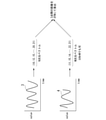
- this method as shown in FIG. 10, first, partial time-series data showing the operation to be analyzed is extracted from each of the time-series data 1 and 2.
- N N is an integer of 1 or more
- the Euclidean distance between the acquired N-dimensional vector and the M-dimensional vector is calculated.
- a method such as DTW (Dynamic Time Warping) that eliminates the weakness of the temporal distortion of the Eugrid distance has also been proposed.
- DTW Dynamic Time Warping
- N pieces of the partial time-series data extracted from the time-series data 3 are sampled to form an N-dimensional vector
- M pieces of the partial time-series data extracted from the time-series data 4 are sampled to obtain an M-dimensional vector.
- the distance between the acquired N-dimensional vector and the M-dimensional vector is calculated by DTW.
- the distance between the data is calculated for each of a plurality of time-series data indicating one operation, and the time-series data is classified using the distance as a feature quantity. Therefore, there is a drawback that the subtle difference in the interlocking between a plurality of time-series data showing one operation is missing as information when calculating the distance between the data, and cannot be expressed. As a result, it is not suitable for evaluating the difference between good and bad for the same operation, for example.
- an object of the present invention is to provide a technique capable of improving the evaluation accuracy of a person's movement.
- One aspect of the present invention is a noise removing step for removing noise in time-series data relating to the movement of a person, and extracting data in an onset section in which the movement of the person is performed from the time-series data from which noise is removed.
- It is a motion evaluation method having an evaluation step for evaluating the motion of the person based on the data of the section.
- One aspect of the present invention is a noise removing step for removing noise in time-series data relating to the movement of a person, and extracting data in an onset section in which the movement of the person is performed from the time-series data from which noise is removed.
- the extraction step to be performed the compression step of aligning the length of the extracted data of the onset section for each onset section and compressing the data of the onset section by downsampling, and the compressed onset.
- It is a computer program for causing a computer to execute an evaluation step of evaluating the movement of the person based on the data of the section.
- the movement of the person is performed from a sensor that acquires time-series data related to the movement of the person, a noise removing unit that removes noise in the time-series data, and time-series data in which noise is removed.
- the length of the extracted onset section data is aligned with the extraction unit that extracts the data of the onset section, and the data of the onset section is compressed by downsampling.
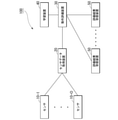
- FIG. 1 is a block diagram of an operation evaluation system 100 according to the present invention.
- the operation evaluation system 100 includes one or more sensors 10-1 to 10-O (O is an integer of 1 or more), a sensor data acquisition device 20, an operation evaluation device 30, a learning device 40, and one or more evaluation result receiving devices 50. Be prepared.
- the sensor 10 acquires human biological information (for example, surface myoelectric potential data, electrocardiographic data, electroencephalogram data) in time series.
- the sensor 10 may measure the external output of the body, such as acceleration data and pressure data.
- the sensor 10 may be a wristband type sensor that can be attached to a person, or may be installed in a place where biometric information, acceleration data, pressure data, and the like can be acquired from the person.
- the sensor 10 transmits the acquired surface myoelectric potential data to the sensor data acquisition device 20.
- the sensor 10 may be transmitted to the sensor data acquisition device 20 each time the acquired surface myoelectric potential data is acquired, or may be collectively transmitted to the sensor data acquisition device 20 for a certain period of time.
- the sensor data acquisition device 20 acquires surface myoelectric potential data transmitted from the sensor 10, and manages the acquired surface myoelectric potential data for each sensor 10. In this way, the sensor data acquisition device 20 holds the time-series data of the surface myoelectric potential data for each sensor 10.
- the sensor data acquisition device 20 transmits the time-series data (hereinafter, simply referred to as “time-series data”) of the held surface myoelectric potential data to the motion evaluation device 30.
- the sensor data acquisition device 20 may transmit the held time-series data to the operation evaluation device 30 at a predetermined timing, or transmit the time-series data requested by the operation evaluation device 30 to the operation evaluation device 30. You may.
- the predetermined timing may be a preset time or a timing after a certain period of time has elapsed.
- the motion evaluation device 30 evaluates the motion of a person using time-series data transmitted from the sensor data acquisition device 20. Evaluating a person's movement means, for example, classifying the person's movement into good or bad, and expressing the person's movement numerically (hereinafter referred to as "scoring"). Hereinafter, the quality of a person's movement and scoring are collectively referred to as an evaluation score.
- the motion evaluation device 30 evaluates the motion of a person by inputting time-series data into, for example, a trained model generated by the learning device 40.
- the operation evaluation device 30 is configured by using an information processing device such as a server, a notebook computer, a smartphone, and a tablet terminal.
- the learning device 40 generates a trained model by learning a learning model by inputting teacher data.
- the teacher data is learning data used for supervised learning, and is data represented by a combination of input data and output data that is assumed to have a correlation with the input data.
- the teacher data input to the learning device 40 is data in which the feature amount obtained based on the time-series data and the evaluation score are associated with each other.
- the feature amount obtained based on the time-series data is generated by a process performed by the motion evaluation device 30 described later.
- the learning device 40 inputs time-series data and generates a trained model trained to output an evaluation score.
- learning is optimizing the coefficients used in the machine learning model.
- learning is adjusting the coefficients used in a machine learning model so that the loss function is minimized.
- the coefficients used in the machine learning model are, for example, weight values and bias values.
- the evaluation result receiving device 50 is a device that receives the evaluation result obtained by the operation evaluation device 30.
- the evaluation result receiving device 50 is a device held by a person to be evaluated for motion or a person related to the person.
- the evaluation result receiving device 50 is configured by using an information processing device such as a personal computer, a notebook computer, a smartphone, and a tablet terminal.
- FIG. 2 is a diagram showing features between time-series data to be captured in the present invention.
- a plurality of time series data 61 to 63 are shown.
- the time-series data 61 represents the time-series data of the surface myoelectric potential data obtained by the sensor 10-1.
- the time-series data 62 represents the time-series data of the surface myoelectric potential data obtained by the sensor 10-2.
- the time-series data 63 represents the time-series data of the surface myoelectric potential data obtained by the sensor 10-3.
- the waveform of the signal to be captured for example, the waveform representing the movement of a person
- the noise are mixed.
- the waveform surrounded by the rectangle 64 is a waveform containing the target signal and noise
- the waveform surrounded by the rectangle 65 is a waveform containing only noise.
- only the waveform of the target signal is extracted by extracting the waveform surrounded by the rectangle 64 from each of the time series data 61 to 63 and performing noise reduction.
- FIG. 2A shows waveforms 61-1, 62-1 and 63-1 after noise is removed from the waveform surrounded by the rectangle 64.
- the waveform 61-1 represents a waveform after noise is removed from the waveform surrounded by the rectangle 64 in the time series data 61.
- the waveform 61-2 represents a waveform after noise is removed from the waveform surrounded by the rectangle 64 in the time series data 62.
- the waveform 61-3 represents a waveform after noise is removed from the waveform surrounded by the rectangle 64 in the time series data 63.
- Waveforms 61-2, 62-2 and 63-2 shown in FIGS. 2B and 2C, and 61-3, 62-3 and 63-3 are waveforms 61-shown in FIG. 2A. It is a waveform at a different time from 1, 62-1 and 63-1. However, each waveform shown in FIGS. 2A to 2C is a waveform obtained by extracting only the target signal from the waveform including the target signal and noise in the same time series data 61, 62, and 63. .. In the present invention, the difference in interlocking between the sensors 10-1 to 10-3 is used as a feature amount.
- FIG. 3 is a block diagram showing a specific example of the functional configuration of the operation evaluation device 30 in the present embodiment.
- the operation evaluation device 30 includes a communication unit 31, a control unit 32, and a storage unit 33.
- the communication unit 31 communicates with other devices. Other devices are, for example, a sensor data acquisition device 20 and an evaluation result receiving device 50.
- the communication unit 31 receives, for example, time-series data transmitted from the sensor data acquisition device 20.
- the communication unit 31 receives, for example, the trained model transmitted from the learning device 40.
- the communication unit 31 transmits the evaluation result to the evaluation result receiving device 50.
- the trained model is recorded on an external recording medium such as a USB (Universal Serial Bus) memory or an SD card, the communication unit 31 receives the trained model via the external recording medium.
- USB Universal Serial Bus
- the learned model 331 and the sensor data 332 are stored in the storage unit 33.
- the storage unit 33 is configured by using a storage device such as a magnetic storage device or a semiconductor storage device.
- the trained model 331 is a trained model trained by the learning device 40.
- the trained model is associated with coefficient information optimized by the learning device 40.
- the sensor data 332 is time-series data for each sensor 10 obtained from the sensor data acquisition device 20.
- the control unit 32 controls the entire operation evaluation device 30.
- the control unit 32 is configured by using a processor such as a CPU (Central Processing Unit) and a memory. By executing the program, the control unit 32 realizes the functions of the acquisition unit 321, the noise reduction unit 322, the rectification unit 323, the data division unit 324, the data processing unit 325, and the evaluation unit 326.
- a processor such as a CPU (Central Processing Unit) and a memory.
- the control unit 32 realizes the functions of the acquisition unit 321, the noise reduction unit 322, the rectification unit 323, the data division unit 324, the data processing unit 325, and the evaluation unit 326.
- Some or all of the functional units of the acquisition unit 321, noise removal unit 322, rectification unit 323, data division unit 324, data processing unit 325, and evaluation unit 326 are ASIC (Application Specific Integrated Circuit) or PLD (Programmable Logic). It may be realized by hardware (including a circuit unit; circuitry) such as Device), FPGA (Field Programmable Gate Array), or by cooperation between software and hardware.
- the program may be recorded on a computer-readable recording medium.
- Computer-readable recording media include, for example, flexible disks, magneto-optical disks, portable media such as ROM (Read Only Memory) and CD-ROM, and non-temporary storage devices such as hard disks built into computer systems. It is a storage medium.
- the program may be transmitted over a telecommunication line.
- Some of the functions of the acquisition unit 321, the noise removal unit 322, the rectification unit 323, the data division unit 324, the data processing unit 325, and the evaluation unit 326 do not need to be mounted on the operation evaluation device 30 in advance, and additional functions are added. It may be realized by installing the application program in the operation evaluation device 30.
- the acquisition unit 321 acquires various information.
- the acquisition unit 321 acquires, for example, time-series data from the sensor data acquisition device 20.
- the acquisition unit 321 acquires, for example, a trained model from the learning device 40.
- the acquisition unit 321 may acquire various types of information dynamically or passively. Dynamic acquisition means that the acquisition unit 321 acquires information by requesting information from the target device.
- the noise reduction unit 322 performs noise reduction processing on the time-series data to be processed.
- the noise reduction unit 322 performs processing such as bandpass filter processing and Wiener filter processing.
- the time-series data to be processed is, for example, the time-series data of the sensor 10 attached to the designated person.
- the rectification unit 323 When the time-series data is signal data, the rectification unit 323 performs rectification processing on the time-series data to which noise reduction processing has been performed.
- a method of taking an absolute value of data, a method of a root mean square, or the like can be used, but this is not particularly specified in the present invention.
- the data division unit 324 estimates at least the onset section of the time-series data to which noise reduction processing has been performed, and divides the time-series data for each estimated onset section.
- the onset section is a point on the time-series data from a point where a person is assumed to have started an action (hereinafter referred to as a "start point") to a point where a person is assumed to have completed an action (hereinafter referred to as an "end point"). It is a section up to).
- the starting point is a point in which the value increases or decreases by the threshold value or more when compared with the average value of the sample in the immediately preceding section in the time series data and compared with the time point where the value changes by the threshold value or more, that is, the value in the fixed section immediately before.
- the end point is the point where the average value is approached again at the time after the start point.
- the data division unit 324 estimates a section that satisfies the above conditions in the time series data as an onset section.
- the data division unit 324 extracts the data of the estimated offset section from the time series data.
- the onset intervals of the plurality of time series data extracted in this way are compared, and the onset intervals that overlap or are included in a certain time before and after are defined as one data group.
- the data processing unit 325 processes the data of the onset section extracted by the data division unit 324. Specifically, the length of the data group of the onset section extracted by the data division unit 324 is not uniform for each onset section. Therefore, the data processing unit 325 sets the start points of all the onset sections to the data with the earliest time at the start point, and all the onsets to the data with the latest time at the end point, while maintaining the time series information. Performs processing to match the end points of the section.
- the data processing unit 325 When matching the start point and the end point, the data processing unit 325 fills all the data corresponding to the outside of the onset section with a value of 0, or puts a fixed value. Further, the data processing unit 325 performs a downsampling process on the data group having a unified data length in the data group to make the length between the data groups constant, and keeps the approximate shape of the data. Compress the dimensions of.
- the similarity calculation by the Euclidean distance of the time series data is performed while retaining the characteristics of the waveform shape of the data consisting of the order between the time series data and the continuity of the onset interval. It is possible to eliminate the time distortion, which was a weak point, and satisfy the condition of fixing the number of samples required for calculation. For example, when the data processing unit 325 processes the data in which the onset sections overlap and the data in which the onset sections hardly overlap, the time per sample in the latter is rather than the time per sample in the former. Becomes shorter. It is possible to calculate the feature amount in consideration of the interlocking within the data group, which cannot be seen only by the distance between each data group.
- the evaluation unit 326 evaluates the movement of the person based on the data group processed by the data processing unit 325.
- the evaluation unit 326 evaluates the movement of the person by inputting the processed data group into the trained model, for example.
- the evaluation unit 326 evaluates the movement of a person, for example, by calculating the distance between the processed data groups.
- the motion evaluation device 30 is any of a notebook computer, a smartphone, and a tablet terminal
- the motion evaluation device 30 is configured to include an input unit and a display unit.
- the display unit is an image display device such as a liquid crystal display, an organic EL (Electro Luminescence) display, and a CRT (Cathode Ray Tube) display.
- the display unit displays the evaluation result according to the operation of the user.
- the display unit may be an interface for connecting the image display device to the operation evaluation device 30. In this case, the display unit generates a video signal for displaying the evaluation result, and outputs the video signal to the image display device connected to the display unit.
- the operation unit is configured by using existing input devices such as a keyboard, a pointing device (mouse, tablet, etc.), a touch panel, and buttons.
- the operation unit is operated by the user when inputting the user's instruction to the motion evaluation device 30.
- the operation unit accepts the input of the evaluation start instruction of the movement of the person.
- the operation unit may be an interface for connecting the input device to the operation evaluation device 30. In this case, the operation unit inputs the input signal generated in response to the user's input in the input device to the operation evaluation device 30.
- FIG. 4 is a block diagram showing a specific example of the functional configuration of the learning device 40 in the present embodiment.
- the learning device 40 includes a CPU, a memory, an auxiliary storage device, and the like connected by a bus, and executes a program.
- the learning device 40 functions as a device including a learning model storage unit 41, a teacher data input unit 42, and a learning unit 43 by executing a program.
- all or a part of each function of the learning apparatus 40 may be realized by using hardware such as ASIC, PLD and FPGA.
- the program may be recorded on a computer-readable recording medium.
- the computer-readable recording medium is, for example, a flexible disk, a magneto-optical disk, a portable medium such as a ROM or a CD-ROM, or a storage device such as a hard disk built in a computer system.
- the program may be transmitted over a telecommunication line.
- the learning model storage unit 41 is configured by using a storage device such as a magnetic storage device or a semiconductor storage device.
- the learning model storage unit 41 stores the learning model in machine learning in advance.
- the learning model is information indicating a machine learning algorithm used when learning the relationship between the input data and the output data.
- There are various regression analysis methods and various algorithms such as decision tree, k-nearest neighbor method, neural network, support vector machine, deep learning, etc. in the learning algorithm of supervised learning, but what kind of learning model is It may be used.
- a neural network such as a multi-layer perceptron is used as a learning model for machine learning will be described as an example.
- the teacher data input unit 42 has a function of inputting teacher data.
- the feature amount obtained based on the time series data is used as the input data, and the evaluation score corresponding to the input feature amount is used as the output data.
- the feature amount input to the teacher data input unit 42 is the information of the evaluation score and the data generated by the data processing unit 325. Then, a combination of the input data and the output data is used as one sample data, and a set of a plurality of sample data is generated in advance as teacher data.
- the teacher data input unit 42 is communicably connected to an external device (not shown) that stores the teacher data generated in this way, and inputs teacher data from the external device via the communication interface. Alternatively, it may be generated by the motion evaluation device 30 and input to the learning device 40. Further, for example, the teacher data input unit 42 may be configured to input teacher data by reading the teacher data from a recording medium that stores the teacher data in advance. The teacher data input unit 42 outputs the teacher data input in this way to the learning unit 43.
- the learning unit 43 generates a trained model by learning the teacher data output from the teacher data input unit 42 based on the learning model.
- the generated trained model is input to the motion evaluation device 30.
- the input of the trained model to the motion evaluation device 30 may be performed via communication between the learning device 40 and the motion evaluation device 30, or may be performed via a recording medium on which the trained model is recorded. good.
- the learning unit 43 calculates an error between the evaluation score obtained by inputting the teacher data into the learning model and the evaluation score included in the teacher data. Then, the learning unit 43 updates the coefficients used in the learning model by solving the minimization problem for the objective function determined based on the calculated error. The learning unit 43 repeatedly updates the coefficients until the coefficients used in the learning model are optimized, or a predetermined number of times.
- the coefficients of the training model are estimated by the error backpropagation method and the stochastic gradient descent method (SGD: Stochastic Gradient Descent).
- SGD Stochastic Gradient Descent
- optimization method an optimization algorithm other than the stochastic gradient descent method may be used as long as the error back propagation method and the following optimization algorithm are combined. Optimization algorithms other than the stochastic gradient descent method include, for example, Adam, Adamax, Adagrad, RMSProp, Addaleta and the like.
- the learning unit 43 outputs the coefficient obtained by the above processing and the learning model to the motion evaluation device 30 as a trained model.
- FIG. 5 is a flowchart showing the flow of the operation evaluation process performed by the operation evaluation device 30 in the embodiment.
- the acquisition unit 321 acquires a plurality of time-series data from the sensor data acquisition device 20 (step S101).
- the acquisition unit 321 records, for example, the time-series data acquired by the sensor 10-1 and the time-series data acquired by the sensor 10-2 in the storage unit 33 as sensor data 332.
- the noise reduction unit 322 performs noise reduction processing on each of the two time-series data recorded in the storage unit 33 as sensor data 332 (step S102).
- the noise reduction unit 322 outputs each time-series data after the noise reduction processing to the rectification unit 323.
- the rectifying unit 323 performs a rectifying process on each time-series data after the noise reduction process (step S103).
- FIG. 6 shows an example in which the rectifying unit 323 performs a root mean square on each time-series data after the noise reduction processing.
- the time-series data 67 and 68 in FIG. 6 are the time-series data obtained by the root mean square.
- the time-series data 67 corresponds to the time-series data obtained by the sensor 10-1
- the time-series data 68 corresponds to the time-series data obtained by the sensor 10-2.
- the data division unit 324 estimates the onset sections of each of the time series data 67 and 68 (step S104).
- the onset section in the time series data 67 is shown by the rectangle 69
- the onset section in the time series data 68 is shown by the rectangle 70.
- the data division unit 324 extracts the data of the estimated offset section from the time series data.
- the data division unit 324 compares the onset sections of the extracted plurality of time series data, and defines the onset sections in which the onset sections overlap or are included in the predetermined time before and after as one data group. This corresponds to the second state from the left in FIG.
- the data processing unit 325 performs processing on the data group of the onset section extracted by the data division unit 324 (step S105). Specifically, first, the data processing unit 325 first processes the data group of each onset section. Processing is performed to align the offset sections for each. At this time, the data processing unit 325 fills all the data corresponding to the outside of the onset section with a value of 0, or inputs a fixed value. As a result, the data length in the data group of each onset section is unified. This corresponds to the third state from the left in FIG.
- the data processing unit 325 combines the data groups of each onset section.
- the combination means superimposing the data groups of each onset interval.
- the data processing unit 325 combines the data of the onset section extracted from the time series data 67 with the data of the onset section extracted from the time series data 68 on the same time axis.
- the data of the onset section extracted from the time series data 67 is six
- the data of the onset section extracted from the time series data 68 is six.
- the data processing unit 325 combines the first data of the onset section extracted from the time series data 67 and the first data of the onset section extracted from the time series data 68.
- the data processing unit 325 combines the data groups of each onset section. This will generate six combined data sets.
- the data processing unit 325 normalizes the number of samples in each of the six data groups and performs downsampling processing to make the length between the data groups constant, so that the dimension of the data is maintained in a state where the outline of the data is maintained.
- Compress step S106. This corresponds to the fourth state from the left in FIG.
- the data group is a feature amount used for learning processing in the learning device 40, and is data used for evaluation of operation.
- the data processing unit 325 outputs the compressed data group to the evaluation unit 326 when only the time series data is input to the operation evaluation device 30, and when the time series data and the evaluation score information are input. Outputs the compressed data group to the learning device 40 as teacher data.
- the evaluation unit 326 evaluates the operation using the data group compressed by the data processing unit 325 (step S107). Specifically, the evaluation unit 326 acquires an evaluation score by inputting the data group compressed by the data processing unit 325 into the trained model 331. The evaluation unit 326 transmits the acquired evaluation score information to the evaluation result receiving device 50 via the communication unit 31.
- FIG. 7 is a schematic diagram showing the flow of the process of learning the teacher data (learning process) and the process of estimating the evaluation score based on the trained model (estimation process) in the present embodiment.
- the teacher data input unit 42 inputs teacher data, and the input teacher data is output to the learning unit 43 (step S201).
- the learning unit 43 acquires the learning model from the learning model storage unit 41 (step S202).
- the learning unit 43 generates a trained model by executing a learning process of teacher data based on the learning model (step S203).
- the trained model generated in this way is recorded in the storage unit 33 of the motion evaluation device 30.
- the operation evaluation device 30 first, the compressed data group obtained in the processes from step S101 to step S106 shown in FIG. 5 is output to the evaluation unit 326 (step S301). Subsequently, the evaluation unit 326 acquires the trained model 331 from the storage unit 33 (step S302). Subsequently, the evaluation unit 326 inputs the acquired compressed data group to the trained model 331, and executes an estimation process for acquiring an evaluation score as its output (step S303). The motion evaluation device 30 can estimate the evaluation score in time series by repeatedly executing the processes of steps S301 to S303.
- FIG. 8 is a diagram showing an example of a main use case of the present invention.
- the sensor 10 collects surface EMG data as data related to a certain movement during exercise.
- the motion evaluation device 30 extracts a section related to the motion to be evaluated from the surface myoelectric data, acquires a feature amount, and evaluates it with the trained model 331.
- the output of the system is each motion.
- the evaluation result about is obtained.
- FIG. 8 it is a use case that it is assumed that the evaluation results for the entire movement including a plurality of movements are output by aggregating the evaluation results for each movement.
- the noise removing unit 322 performs noise removing processing on the acquired time series data
- the data processing unit 325 turns on the length of the data group while maintaining the time series information. Align each set section, perform downsampling processing, and compress the data dimension while maintaining the approximate shape of the data. This eliminates the time distortion that was a weak point of the similarity calculation due to the Eugrid distance of the time series data, while retaining the characteristics of the waveform shape of the data consisting of the order between the time series data and the continuity of the onset interval. Moreover, the fixed condition of the number of samples required for the calculation can be satisfied. Then, the motion evaluation device 30 evaluates the motion of the person based on the compressed data of the onset section. Therefore, it is possible to improve the evaluation accuracy of the movement of the person.
- the data division unit 324 of the operation evaluation device 30 extracts the section from the start point to the end point as an onset section on the time series data. As a result, it is possible to extract the data of the section including the waveform of the movement of the person from the time series data after the noise is removed. Therefore, it is possible to suppress the influence of noise when estimating the movement of a person. Therefore, it is possible to improve the evaluation accuracy of the movement of the person.
- the data division unit 324 of the motion evaluation device 30 compares with the value in the immediately preceding fixed section in the time series data, and approaches the average value again from the start point to the point where the value increases or decreases by the threshold value or more at the time after the start point.
- the point up to the end point is extracted as an onset section.
- the data dividing unit 324 sets the point where the value is increased or decreased by the threshold value or more as the starting point of the movement of the person.
- the data division unit 324 sets the point where the value has settled after the start point, that is, the point where the value approaches the average value, as the end point where the movement of the person is assumed to have ended. In this way, the data division unit 324 can more strictly specify the section in which the movement of the person is assumed to have been performed. Therefore, it is possible to prevent the section containing only noise from being included in the section for evaluating the movement of the person. Therefore, it is possible to improve the evaluation accuracy of the movement of the person.
- the present invention can be applied to a technique for evaluating the movement of a person.
Landscapes
- Health & Medical Sciences (AREA)
- Life Sciences & Earth Sciences (AREA)
- Engineering & Computer Science (AREA)
- Physics & Mathematics (AREA)
- Public Health (AREA)
- Surgery (AREA)
- Veterinary Medicine (AREA)
- Physiology (AREA)
- General Health & Medical Sciences (AREA)
- Biophysics (AREA)
- Pathology (AREA)
- Biomedical Technology (AREA)
- Heart & Thoracic Surgery (AREA)
- Medical Informatics (AREA)
- Molecular Biology (AREA)
- Animal Behavior & Ethology (AREA)
- Artificial Intelligence (AREA)
- Psychiatry (AREA)
- Computer Vision & Pattern Recognition (AREA)
- Signal Processing (AREA)
- Dentistry (AREA)
- Oral & Maxillofacial Surgery (AREA)
- Evolutionary Computation (AREA)
- Fuzzy Systems (AREA)
- Mathematical Physics (AREA)
- Measurement Of The Respiration, Hearing Ability, Form, And Blood Characteristics Of Living Organisms (AREA)
- Measurement And Recording Of Electrical Phenomena And Electrical Characteristics Of The Living Body (AREA)
Priority Applications (3)
| Application Number | Priority Date | Filing Date | Title |
|---|---|---|---|
| PCT/JP2020/033449 WO2022049700A1 (ja) | 2020-09-03 | 2020-09-03 | 動作評価方法、コンピュータプログラム及び動作評価システム |
| JP2022546799A JP7502681B2 (ja) | 2020-09-03 | 2020-09-03 | 動作評価方法、コンピュータプログラム及び動作評価システム |
| US18/021,849 US20230355186A1 (en) | 2020-09-03 | 2020-09-03 | Motion evaluation method, computer program, and motion evaluation system |
Applications Claiming Priority (1)
| Application Number | Priority Date | Filing Date | Title |
|---|---|---|---|
| PCT/JP2020/033449 WO2022049700A1 (ja) | 2020-09-03 | 2020-09-03 | 動作評価方法、コンピュータプログラム及び動作評価システム |
Publications (1)
| Publication Number | Publication Date |
|---|---|
| WO2022049700A1 true WO2022049700A1 (ja) | 2022-03-10 |
Family
ID=80491873
Family Applications (1)
| Application Number | Title | Priority Date | Filing Date |
|---|---|---|---|
| PCT/JP2020/033449 Ceased WO2022049700A1 (ja) | 2020-09-03 | 2020-09-03 | 動作評価方法、コンピュータプログラム及び動作評価システム |
Country Status (3)
| Country | Link |
|---|---|
| US (1) | US20230355186A1 (https=) |
| JP (1) | JP7502681B2 (https=) |
| WO (1) | WO2022049700A1 (https=) |
Cited By (2)
| Publication number | Priority date | Publication date | Assignee | Title |
|---|---|---|---|---|
| JP7536219B1 (ja) * | 2023-06-12 | 2024-08-19 | 三菱電機株式会社 | 学習管理プログラム、学習管理装置、及び、学習システム |
| WO2024247080A1 (ja) * | 2023-05-30 | 2024-12-05 | 日本電信電話株式会社 | 学習装置、評価装置、学習方法、評価方法及びプログラム |
Families Citing this family (1)
| Publication number | Priority date | Publication date | Assignee | Title |
|---|---|---|---|---|
| JP2024027636A (ja) * | 2022-08-18 | 2024-03-01 | セイコーエプソン株式会社 | 情報処理装置、情報処理方法、及びプログラム |
Citations (6)
| Publication number | Priority date | Publication date | Assignee | Title |
|---|---|---|---|---|
| US20160095538A1 (en) * | 2014-10-07 | 2016-04-07 | Samsung Electronics Co., Ltd. | Method and apparatus for recognizing gait motion |
| JP2016049123A (ja) * | 2014-08-28 | 2016-04-11 | 日立マクセル株式会社 | 運動機能評価システム、および、運動機能測定装置 |
| WO2016088564A1 (ja) * | 2014-12-01 | 2016-06-09 | ソニー株式会社 | 計測装置及び計測方法 |
| JP2018008015A (ja) * | 2016-06-29 | 2018-01-18 | カシオ計算機株式会社 | 運動評価装置、運動評価方法及び運動評価プログラム |
| JP2018038753A (ja) * | 2016-09-09 | 2018-03-15 | 花王株式会社 | 歩行分析方法及び歩行分析装置 |
| JP2019098183A (ja) * | 2017-12-01 | 2019-06-24 | 三星電子株式会社Samsung Electronics Co.,Ltd. | 生体信号品質評価装置及び方法 |
Family Cites Families (1)
| Publication number | Priority date | Publication date | Assignee | Title |
|---|---|---|---|---|
| US10588534B2 (en) * | 2015-12-04 | 2020-03-17 | Colorado Seminary, Which Owns And Operates The University Of Denver | Motor task detection using electrophysiological signals |
-
2020
- 2020-09-03 JP JP2022546799A patent/JP7502681B2/ja active Active
- 2020-09-03 WO PCT/JP2020/033449 patent/WO2022049700A1/ja not_active Ceased
- 2020-09-03 US US18/021,849 patent/US20230355186A1/en active Pending
Patent Citations (6)
| Publication number | Priority date | Publication date | Assignee | Title |
|---|---|---|---|---|
| JP2016049123A (ja) * | 2014-08-28 | 2016-04-11 | 日立マクセル株式会社 | 運動機能評価システム、および、運動機能測定装置 |
| US20160095538A1 (en) * | 2014-10-07 | 2016-04-07 | Samsung Electronics Co., Ltd. | Method and apparatus for recognizing gait motion |
| WO2016088564A1 (ja) * | 2014-12-01 | 2016-06-09 | ソニー株式会社 | 計測装置及び計測方法 |
| JP2018008015A (ja) * | 2016-06-29 | 2018-01-18 | カシオ計算機株式会社 | 運動評価装置、運動評価方法及び運動評価プログラム |
| JP2018038753A (ja) * | 2016-09-09 | 2018-03-15 | 花王株式会社 | 歩行分析方法及び歩行分析装置 |
| JP2019098183A (ja) * | 2017-12-01 | 2019-06-24 | 三星電子株式会社Samsung Electronics Co.,Ltd. | 生体信号品質評価装置及び方法 |
Cited By (3)
| Publication number | Priority date | Publication date | Assignee | Title |
|---|---|---|---|---|
| WO2024247080A1 (ja) * | 2023-05-30 | 2024-12-05 | 日本電信電話株式会社 | 学習装置、評価装置、学習方法、評価方法及びプログラム |
| JP7536219B1 (ja) * | 2023-06-12 | 2024-08-19 | 三菱電機株式会社 | 学習管理プログラム、学習管理装置、及び、学習システム |
| WO2024257190A1 (ja) * | 2023-06-12 | 2024-12-19 | 三菱電機株式会社 | 学習管理プログラム、学習管理装置、及び、学習システム |
Also Published As
| Publication number | Publication date |
|---|---|
| JP7502681B2 (ja) | 2024-06-19 |
| US20230355186A1 (en) | 2023-11-09 |
| JPWO2022049700A1 (https=) | 2022-03-10 |
Similar Documents
| Publication | Publication Date | Title |
|---|---|---|
| US11179066B2 (en) | Real-time spike detection and identification | |
| Kyritsis et al. | Modeling wrist micromovements to measure in-meal eating behavior from inertial sensor data | |
| US10950352B1 (en) | System, computer-readable storage medium and method of deep learning of texture in short time series | |
| EP3189779B1 (en) | Electrocardiogram (ecg) authentication method and apparatus | |
| CN107440680A (zh) | 睡眠状态推定装置 | |
| WO2021051944A1 (zh) | 自动推送助眠乐曲方法、装置、计算机设备及存储介质 | |
| CN107536599A (zh) | 提供实时信号分割和基准点对准架构的系统与方法 | |
| WO2022049700A1 (ja) | 動作評価方法、コンピュータプログラム及び動作評価システム | |
| JP7067389B2 (ja) | 生体状態推定装置 | |
| KR102243040B1 (ko) | 전자 장치, 아바타 얼굴 표정 표시 시스템 및 제어 방법 | |
| CN116211305A (zh) | 动态实时情绪检测方法及系统 | |
| Kelsey et al. | Applications of sparse recovery and dictionary learning to enhance analysis of ambulatory electrodermal activity data | |
| Guo et al. | The detection of freezing of gait in Parkinson’s disease using asymmetric basis function TV-ARMA time–frequency spectral estimation method | |
| CN116956063A (zh) | 一种基于多模态最佳数据选取与增强的手势识别方法与系统 | |
| Kurt et al. | Classification of Parkinson’s disease using dynamic time warping | |
| CN111698939B (zh) | 生成与外部对象相关联的心率波动信息的方法及其设备 | |
| He et al. | Early detection of Parkinson’s disease using deep NeuroEnhanceNet with smartphone walking recordings | |
| CN113349796A (zh) | 基于多源信号的睡眠监控方法、设备及存储介质 | |
| JP7521609B2 (ja) | 情報処理装置、特徴量選択方法、教師データ生成方法、推定モデル生成方法、ストレス度の推定方法、およびプログラム | |
| CN119600865B (zh) | 一种基于人工智能的小儿推拿教学辅助系统 | |
| RU2764568C1 (ru) | Способ диагностики болезни паркинсона на основе анализа видеоданных с применением машинного обучения | |
| CN120496874A (zh) | 基于半监督深度学习的bcg睡眠信号医学标定与分析方法 | |
| CN111905229A (zh) | 一种基于5g的钢琴音乐催眠治疗控制系统及方法 | |
| JP5911840B2 (ja) | 診断データ生成装置および診断装置 | |
| CN113906520A (zh) | 用于基于体动记录数据进行用户验证的系统和方法 |
Legal Events
| Date | Code | Title | Description |
|---|---|---|---|
| 121 | Ep: the epo has been informed by wipo that ep was designated in this application |
Ref document number: 20952438 Country of ref document: EP Kind code of ref document: A1 |
|
| ENP | Entry into the national phase |
Ref document number: 2022546799 Country of ref document: JP Kind code of ref document: A |
|
| NENP | Non-entry into the national phase |
Ref country code: DE |
|
| 122 | Ep: pct application non-entry in european phase |
Ref document number: 20952438 Country of ref document: EP Kind code of ref document: A1 |