WO2022049679A1 - 計測システムおよび計測方法 - Google Patents
計測システムおよび計測方法 Download PDFInfo
- Publication number
- WO2022049679A1 WO2022049679A1 PCT/JP2020/033306 JP2020033306W WO2022049679A1 WO 2022049679 A1 WO2022049679 A1 WO 2022049679A1 JP 2020033306 W JP2020033306 W JP 2020033306W WO 2022049679 A1 WO2022049679 A1 WO 2022049679A1
- Authority
- WO
- WIPO (PCT)
- Prior art keywords
- unit
- light
- measurement
- projection
- measurement system
- Prior art date
- Legal status (The legal status is an assumption and is not a legal conclusion. Google has not performed a legal analysis and makes no representation as to the accuracy of the status listed.)
- Ceased
Links
Images










Classifications
-
- G—PHYSICS
- G01—MEASURING; TESTING
- G01B—MEASURING LENGTH, THICKNESS OR SIMILAR LINEAR DIMENSIONS; MEASURING ANGLES; MEASURING AREAS; MEASURING IRREGULARITIES OF SURFACES OR CONTOURS
- G01B11/00—Measuring arrangements characterised by the use of optical techniques
- G01B11/24—Measuring arrangements characterised by the use of optical techniques for measuring contours or curvatures
-
- G—PHYSICS
- G01—MEASURING; TESTING
- G01B—MEASURING LENGTH, THICKNESS OR SIMILAR LINEAR DIMENSIONS; MEASURING ANGLES; MEASURING AREAS; MEASURING IRREGULARITIES OF SURFACES OR CONTOURS
- G01B11/00—Measuring arrangements characterised by the use of optical techniques
- G01B11/24—Measuring arrangements characterised by the use of optical techniques for measuring contours or curvatures
- G01B11/25—Measuring arrangements characterised by the use of optical techniques for measuring contours or curvatures by projecting a pattern, e.g. one or more lines, moiré fringes on the object
Definitions
- the present disclosure relates to a measurement system and a measurement method for measuring an object to be measured, which is partially formed by a transparent member that transmits light.
- Patent Document 1 in an information processing apparatus that irradiates light from an irradiation unit in the image pickup direction of the image pickup unit and recognizes an image captured by the image pickup unit, the reliability of image recognition is increased.
- a technique for controlling an irradiation pattern of light emitted from an irradiation unit is disclosed.
- the object to be measured is partially formed of a transmissive member such as a window such as a building or a vehicle
- the light emitted from the irradiation portion is the transmissive member. It may hit a person who is not a non-measurement target through, and may cause discomfort to the person.
- non-measurement objects such as animals or objects for which it is not preferable to irradiate light.
- the present disclosure has been made in view of the above, and an object of the present disclosure is to obtain a measurement system capable of suppressing light projection to a non-measurement target in the internal space of the measurement target.
- the measurement system of the present disclosure includes a light projection unit, a measurement unit, a determination unit, a light projection range determination unit, and a light projection control unit.
- the light projecting unit projects light onto a measurement object, which is partially formed by a transmissive member that transmits light.
- the measuring unit measures the area of the object to be measured where the light is projected by the light projecting unit.
- the determination unit determines a non-light projecting region, which is a region of the measurement target that may be projected onto the non-measurement target in the internal space of the measurement target via the transmissive member.
- the light projection range determination unit determines the light projection range, which is the range in which the light projection unit performs light projection, among the measurement objects, based on the determination result by the determination unit.
- the light projection control unit causes the light projection unit to perform light projection to the light projection range.
- the figure which shows the other example of the state which the measurement with respect to the measurement object is performed by the measurement system which concerns on Embodiment 1.
- FIG. 11 is a diagram showing a state in which light is projected from a part of the divided light emitting units among the plurality of divided light emitting units included in the light projecting unit shown in FIG.
- the figure which shows an example of still another structure of the light projection part which concerns on Embodiment 1. A flowchart showing an example of processing by the measurement system according to the first embodiment.
- FIG. 1 is a diagram showing a relationship between the measurement system according to the first embodiment and a building whose outer surface is measured by the measurement system.
- FIG. 2 is an enlarged view of a part of the region of FIG. 1 at different angles.
- the measurement system 1 shown in FIGS. 1 and 2 measures the three-dimensional shape of the object to be measured 2.
- the measurement object 2 is a building such as a high-rise building or a tower condominium, and the measurement system 1 measures the three-dimensional shape of the outer surface 4 of the measurement object 2.
- the object 2 to be measured is not limited to a building, and may be any structure as long as it is partially formed of a transparent member that transmits light, and may be, for example, a railroad vehicle or an aircraft.
- a plurality of rails 51 to 548 are laid along the vertical direction on the outer wall 3 of the object to be measured 2.
- each of the plurality of rails 5 1 to 5 48 may be referred to as rail 5.
- each rail 5 has a shape protruding from the outer wall 3 of the measurement object 2, but may be formed by a groove inside the outer wall 3 of the measurement object 2.
- each rail 5 may have a function that the gondola 7 can repeatedly move in the extending direction of the rail 5, and the shape of each rail 5 is not limited to the above-mentioned shape. Further, in the examples shown in FIGS. 1 and 2, the rail 5 extends in the vertical direction, but the extending direction of each rail 5 is not limited to the examples shown in FIGS. 1 and 2. For example, each rail 5 may be laid on the outer wall 3 so as to extend in the horizontal direction.
- the measurement system 1 is arranged at a predetermined position of the gondola 7.
- One end of the wire rope 81 is attached to the gondola 7, and the other end of the wire rope 81 is fixed to the crane 80.
- the crane 80 can move the gondola 7 linearly downward along the rail 5 by pulling out the wire rope 81 from a reel (not shown).
- the crane 80 can move the gondola 7 linearly upward by winding the wire rope 81 with a reel (not shown). Further, a rail 8 is laid on the roof of the measurement target 2, and the crane 80 can move along the rail 8 on the roof of the measurement target 2.
- the drive device for moving the gondola 7 is not limited to the crane 80 and the wire rope 81, and may be a rotary drive device having a motor or the like that rotates a tire rotatably attached to the rail 5 via a transmission mechanism. good.
- the transmission mechanism is, for example, a gear, a belt, or a chain.
- the drive device for moving the gondola 7 may be configured to drive the caterpillar movably attached to the rail 5 by a motor via a transmission mechanism.
- the drive device for moving the gondola 7 may be configured to have a push rod, a pull rod, or the like.
- the configuration including the gondola 7 and the driving device for moving the gondola 7 is an example of the moving mechanism.
- the measurement system 1 may be arranged in the drone as a moving mechanism, for example.
- a worker who performs measurement work using the measurement system 1 may or may not be on the gondola 7 while the outer surface 4 is being measured by the measurement system 1.
- the gondola 7 is, for example, a gondola for cleaning a window, but may be a dedicated gondola for measuring the outer surface 4 by the measurement system 1.
- the moving body on which the measurement system 1 is arranged may be a structure that is attached to the rail 5 and can move along the rail 5, and is not limited to the gondola 7.
- the measurement system 1 measures the three-dimensional shape of the region between the rails 5 of the outer surface 4 of the object 2 to be measured while the gondola 7 is moving.
- the measurement system 1 measures because the gondola 7 is movably attached to the rails 5 2 and 5 3 and moves using the rails 5 2 and 5 3 as a traveling path.
- the area 6 2 between the rails 5 2 and 5 3 of the outer surface 4 of the object 2 is measured.
- the measurement system 1 When the gondola 7 is movably attached to rails 5 1 , 52 and travels along a track consisting of rails 5 1 , 52, the measurement system 1 will have rails 5 1 , 52 of the outer surface 4 . Measure the area 6 1 in between. Further, when the gondola 7 is movably attached to the rails 5 14 and 515 and moves along the track composed of the rails 5 14 and 515, the measurement system 1 determines the rails 514 of the outer surface 4. The region 614 between 5 15 is measured.
- the outer surface 4 includes a plurality of regions 61 to 644 . Hereinafter, when a plurality of regions 6 1 to 6 44 are shown without distinction, they may be referred to as region 6.
- the measurement system 1 Each time the operator changes the combination of the two rails 5 to which the gondola 7 is attached, the operator operates the measurement system 1 while moving the gondola 7 in the vertical direction. As a result, a plurality of regions 61 to 644 are measured by the measurement system 1 .
- the measurement system 1 generates three-dimensional overall shape data, which is data of the overall three-dimensional shape of the outer surface 4, by combining the three-dimensional shapes of the plurality of measured regions 61 to 644 .
- the gondola 7 is attached to two rails 5 and can move up and down along a track composed of the two rails 5, but on one rail 5. It may be configured to be attached and move along a traveling path composed of such one rail 5. Further, the gondola 7 may be attached to three or more rails 5 and may move along a traveling path composed of the three or more rails 5.
- the measurement system 1 may be configured to measure a region larger than the region 6 between the adjacent rails 5. For example, when the gondola 7 moves along a traveling path composed of rails 5, the measurement system 1 may be configured to measure two regions 6 or three or more regions 6.
- the measurement system 1 when the gondola 7 moves along the traveling path composed of the rails 5 2 , 53, the measurement system 1 has the left half of the area 6 1 in FIG. 1, the area 6 2 and the area 63 . It may be configured to measure the right half of 1.
- the region measured by the measurement system 1 while the gondola 7 is moving on the rail 5 is not limited to one region 6, and the measurement system 1 can perform measurement over a plurality of regions 6.
- the measurement system 1 can reduce the burden of measurement work by performing measurement over a plurality of regions 6.
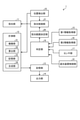
- FIG. 3 is a diagram showing an example of the configuration of the measurement system according to the first embodiment.
- the measurement system 1 includes a position detection unit 10, a light projection unit 11, a measurement unit 12, a storage unit 13, an output unit 14, a first information acquisition unit 15, and a second information. It includes an acquisition unit 16, a sensor unit 17, a light shielding device control unit 18, a determination unit 19, a light projection range determination unit 20, and a light projection control unit 21.
- the measurement system 1 may have, for example, a configuration having a moving mechanism including a gondola 7 and a moving device for moving the gondola 7, or may have a configuration not having a part of the configuration shown in FIG.
- FIG. 4 is a diagram showing an example of how the measurement system according to the first embodiment measures the object to be measured.
- FIG. 5 is a diagram showing another example of how the measurement system according to the first embodiment measures the object to be measured.
- the measurement system 1 determines a region of the measurement object 2 where light may be projected onto the non-measurement target 50 in the internal space of the measurement object 2 via the transmissive member 9, and the determination result is obtained. Based on the above, the light projection range, which is the range in which the light projection unit 11 of the measurement object 2 is to be projected, is determined.
- the projection range is at least a range excluding a region of the measurement object 2 where light may be projected onto the non-measurement target 50 in the internal space of the measurement object 2 via the transmissive member 9. decide. Then, the measurement system 1 projects light by the light projecting unit 11 with respect to the determined light projecting range. As a result, the measurement system 1 can suppress the projection of light onto the non-measurement target 50 in the internal space of the measurement target 2.
- the non-measurement target 50 is, for example, a person, an animal, or an object for which it is not preferable to irradiate light.
- An object for which it is not preferable to irradiate light is, for example, a photosensitive material.
- the transparent member 9 is a glass or a transparent resin that forms a window of the measurement object 2.
- the permeable resin is, for example, polycarbonate or acrylic.
- the transmissive member 9 may be a member that transmits at least a part of the light emitted from the light projecting unit 11, and is, for example, a member such as a screen door having a slit or a member that simply forms an opening. May be good.
- the position detection unit 10 detects the position of the measurement system 1.
- the position detection unit 10 receives a plurality of positioning signals transmitted from the plurality of positioning satellites and an error correction signal transmitted from the quasi-zenith satellite, and is based on the received plurality of positioning signals and the error correction signal. , Calculate the latitude, longitude, and altitude of the measurement system 1.
- the positioning satellite is a GNSS (Global Navigation Satellite System) satellite
- the quasi-zenith satellite is a QZSS (Quasi-Zenith Satellite System) satellite.
- the error correction signal also called a QZSS reinforcement signal or an L6 signal, includes error correction information which is information for performing centimeter-class error correction.
- the quasi-zenith satellite has a function as a positioning satellite, and the position detection unit 10 receives a positioning signal transmitted from the quasi-zenith satellite in addition to a plurality of positioning signals transmitted from the plurality of positioning satellites. , The altitude of the measurement system 1 can also be calculated based on these plurality of positioning signals and error correction signals.
- the position detection unit 10 is not limited to the above-mentioned configuration, and may be configured to detect the position of the measurement system 1 by, for example, a laser Doppler sensor or a microwave Doppler sensor. In this case, the position detection unit 10 calculates the position of the measurement system 1 from the movement amount of the gondola 7 measured by the laser Doppler sensor or the microwave Doppler sensor.
- the position detection unit 10 may include an encoder that measures the winding amount of the winding machine that winds the wire rope 81. In this case, the position detection unit 10 is arranged on the crane 80 and not on the gondola 7.
- the light projecting unit 11 projects light on the measurement target 2.
- the light projecting unit 11 includes a laser light source that emits a linear laser beam.
- the light projecting unit 11 emits a linear laser beam parallel to the direction orthogonal to the moving direction of the gondola 7 to the measurement object 2.
- the laser beam emitted from the light projecting unit 11 is visible light, but may be near infrared rays.
- the measurement unit 12 captures an image of a region of the measurement object 2 where the light is projected by the light projection unit 11 and generates measurement data of the measurement object 2.
- the measurement data of the measurement object 2 generated by the measurement unit 12 is the data of the three-dimensional shape of the measurement object 2.
- the measurement unit 12 includes an image pickup unit 31, a calculation unit 32, a storage unit 33, and a synthesis unit 34.
- the image pickup unit 31 is arranged toward the light projection region, which is a region of the measurement object 2 where the light projection is performed by the light projection unit 11, and images the light projection region.
- the image pickup unit 31 includes, for example, an image pickup element and a lens such as a CMOS (Complementary Metal-Oxide-Semiconductor) image sensor.
- CMOS Complementary Metal-Oxide-Semiconductor
- the calculation unit 32 is irradiated with the laser light of the measurement object 2 based on the irradiation position of the laser light emitted from the light projection unit 11 in the measurement object 2 from the image of the light projection region captured by the image pickup unit 31.
- the partial shape which is the three-dimensional shape of the region, is calculated.
- the calculation unit 32 calculates, for example, a partial shape of the measurement object 2 which is a three-dimensional shape of a region irradiated with a linear laser beam by a light cutting method.
- the storage unit 33 stores the partial shape data calculated by the calculation unit 32 in association with the position data indicating the position of the measurement system 1 measured by the position detection unit 10.
- the synthesis unit 34 joins the data of the plurality of partial shapes based on the data of the plurality of partial shapes stored by the storage unit 33 and the data of the plurality of positions, synthesizes the plurality of partial shapes, and synthesizes the plurality of partial shapes, and the entire measurement object 2. Generates overall shape data, which is the data of the three-dimensional shape of.
- the storage unit 13 stores the overall shape data generated by the measurement unit 12.
- the output unit 14 outputs the overall shape data generated by the measurement unit 12 and stored in the storage unit 13 to the outside.
- the output unit 14 can output the entire shape data to an external cloud server (not shown) by wireless communication or wired communication.
- the first information acquisition unit 15 acquires the first information indicating the possibility that the non-measurement target 50 exists in the internal space of the measurement target 2.
- the first information includes, for example, at least one of entry information, attendance information, device information, locking information, and operating time information.
- the first information acquisition unit 15 acquires the first information by wire communication or wireless communication from a management system or the like that manages the building.
- the first information acquisition unit 15 acquires the first information by wire communication or wireless communication from a boarding management system or the like that manages the boarding of the railroad vehicle.
- the entry information is information indicating whether or not a person has entered the building, the floor inside the building, or the room inside the floor when the measurement object 2 is a building. Further, the approach information is information indicating whether or not a person has entered the railway vehicle when the measurement object 2 is a railway vehicle.
- the presence information is information indicating whether or not a person is present on the floor or room when the measurement object 2 is a building.
- the attendance information is information indicating the presence of a person in the railroad vehicle, and includes, for example, information indicating the sales history of reserved seat tickets.
- the device information is information indicating the operating state of the device placed on the floor or room when the measurement object 2 is a building.
- Equipment placed on the floor or room may be, for example, lighting, an air conditioner, or a personal computer.
- the locking information is information indicating the locked state of the building, floor, or room when the measurement object 2 is a building.
- the operating time information is information indicating the business hours of the business operator who moves into the floor or the room when the measurement object 2 is a building. Further, the operating time information is information indicating the operating time of the railway vehicle when the measurement object 2 is a railway vehicle.
- the second information acquisition unit 16 acquires the second information including the position information indicating the position of the transparent member 9 and the light shielding device information indicating the state of the light shielding device provided corresponding to the transparent member 9.
- the position information is, for example, information indicating the position of a window provided on the measurement object 2.
- the light-shielding device information is, for example, information indicating the state of the light-shielding device provided on the window, and includes a state indicating the control state of the light-shielding device by the light-shielding device control unit 18.
- the second information acquisition unit 16 acquires the second information by wire communication or wireless communication from, for example, a management system that manages the design drawing of the measurement object 2.
- the second information may be information input by the user.
- the sensor unit 17 is arranged so as to face the measurement object 2.
- the sensor unit 17 detects at least one of brightness, temperature, sound, polarization, reflection distance, and operation of the non-measurement target 50.
- the sensor unit 17 includes, for example, a plurality of sensors. Each sensor provided in the sensor unit 17 detects brightness, temperature, sound, polarization, reflection distance, or the operation of the non-measurement target 50.
- the sensor unit 17 detects the brightness, temperature, sound, polarization, reflection distance, or the operation of the non-measurement target 50 in the range projected by the light projecting unit 11 before the light projecting unit 11. For example, when the measurement target 2 is measured by the measurement system 1 while the measurement system 1 is moved downward by the moving mechanism, the sensor unit 17 is arranged below the floodlight unit 11. Further, when the measurement object 2 is measured by the measurement system 1 while the measurement system 1 is moved upward by the moving mechanism, the sensor unit 17 is arranged above the floodlight unit 11.
- the sensor that detects the brightness is, for example, a brightness sensor.
- the sensor that detects the temperature is a temperature sensor.
- the sensor that detects sound is, for example, a microphone.
- the sensor that detects the polarization is a polarization sensor.
- the sensor that detects the reflected distance is, for example, a reflected distance sensor such as a radar that transmits a radio wave such as a millimeter wave and receives the reflected wave of the transmitted radio wave in the measurement object 2.
- the sensor that detects the operation of the non-measurement target 50 is, for example, an image sensor and an operation sensor that analyzes the image captured by the image sensor and detects the operation of the non-measurement target 50.
- the light-shielding device control unit 18 controls the light-shielding device provided on the window.
- the light-shielding device switches between shielding and non-shielding light from the window to the internal space of the structure under the control of the light-shielding device control unit 18.
- Shading devices are, for example, curtains, roll screens, blinds, blinds, shades, screens, shutters, shutters, etc., and are sometimes referred to as blinds.
- the shading device control unit 18 can output a control command to the control system in the building by wire communication or wire communication. When the control system in the building receives the control command, it controls the shading device according to the control command.
- control system in the building controls the light blocking device to put the light from the window into the building into a blocking state in which the light blocking device blocks the light.
- control system in the building controls the light-shielding device to bring the light from the window into the building into an open state in which the light-shielding device does not block the light.
- the light-shielding device may be an electrically controlled light-shielding device provided facing the window, or may be a liquid crystal film attached to the window and capable of switching between transparent and opaque. Further, the light-shielding device may be integrally formed with the window, such as dimming glass having a light-shielding function capable of switching between transparent and opaque.
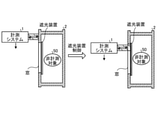
- FIG. 6 is a diagram for explaining the light-shielding device control by the light-shielding device control unit according to the first embodiment.
- the light-shielding device control unit 18 shuts off the light-shielding device before the position where the light is irradiated by the measurement system 1 becomes a window.
- the measurement system 1 can avoid flooding the non-measurement target 50 located inside the measurement target 2.
- the determination unit 19 of the measurement system 1 is used for at least one of the first information acquired by the first information acquisition unit 15, the second information acquired by the second information acquisition unit 16, and the detection result by the sensor unit 17. Based on this, a region of the measurement target 2 in which light may be projected onto the non-measurement target 50 in the internal space of the measurement target 2 via the transmissive member 9 is determined as a non-projection region.
- the determination unit 19 determines that a person has entered the floor inside the building or a room inside the floor based on the entry information included in the first information.
- the area corresponding to the floor or room in which a person is entering is determined as a non-flooding area.
- the area corresponding to the floor is, for example, the outer surface of the third floor of the building when the floor determined to be invaded by a person is the third floor.
- the area corresponding to the room inside the floor is, for example, the outer surface of room 301 on the third floor of the building when the room determined to be invaded by a person is room 301 on the third floor.
- the determination unit 19 determines that a person is present on the floor inside the building or the room inside the floor based on the presence information included in the first information. In this case, the area corresponding to the floor or room in which the person is present is determined as the non-flooding area.
- the determination unit 19 corresponds to the seat determined to have a person.
- the area to be used is determined as a non-projection area.
- the area corresponding to the seat is, for example, a window in the tenth row when the seat determined to have a person is the seat in the tenth row.
- the determination unit 19 determines that the equipment on the floor or room is operating based on the equipment information included in the first information
- the determination unit 19 determines that the equipment is operating on the floor or the floor or in the room.
- the area corresponding to the room is determined as a non-light projecting area.
- the determination unit 19 determines that the floor or room is unlocked based on the lock information included in the first information
- the determination unit 19 corresponds to the unlocked floor or room.
- the area to be used is determined as a non-projection area.
- the determination unit 19 determines that the business hours are the business hours of the business operator occupying the floor or room based on the operating time information included in the first information.
- the area corresponding to the floor or room of the business operator is determined as a non-light projecting area.
- the determination unit 19 determines the region corresponding to the position of the transmissive member 9 as the non-projection region based on the position information included in the second information. For example, assume that the transparent member 9 is a window. In this case, based on the position information and the shading device information included in the second information, the determination unit 19 sets the region corresponding to the window position as the non-light projecting region when the shading device corresponding to the window is in the open state. When the light-shielding device is in the cut-off state, the area corresponding to the position of the window is not determined as the non-light-emitting area.
- the determination unit 19 determines the non-projection region by giving priority to the state determined by the first information over the position of the transmissive member 9 determined by the second information and the state of the light-shielding device. For example, the determination unit 19 is in an area corresponding to the position of the window in which the light shielding device is in the open state, but the person has not entered, the person is absent, the lock is not locked, the device is not operating, or the device is not in business. If it is included in the area corresponding to the floor or room determined to be, it is not determined as a non-light projecting area.
- the determination unit 19 determines that the area corresponding to the position of the window in which the shading device is open is a floor in which a person has entered, a person has been present, unlocked, the device has been operated, or is in business. Or, if it is included in the area corresponding to the room, it is determined as a non-projection area.
- the determination unit 19 even in the area corresponding to the position of the window in which the light shielding device is in the open state, the light shielding device is blocked by the light shielding device control unit 18 before the light is projected by the light emitting unit 11. If it is set to, it is not judged as a non-light projection area.
- the determination unit 19 determines the non-light projection region based on the detection result by the sensor unit 17. For example, the determination unit 19 determines a region where the luminance detected by the luminance sensor is equal to or greater than a preset threshold value as a non-luminance region. Further, the determination unit 19 determines a region where the temperature detected by the temperature sensor is equal to or higher than a preset threshold value as a non-projection region. Further, the determination unit 19 determines a region where the loudness of the sound detected by the microphone is equal to or greater than a preset threshold value as a non-projection region.
- the determination unit 19 determines a region where the reflection distance detected by the reflection distance sensor is equal to or greater than a preset threshold value as a non-projection region.
- the reflection distance sensor detects the reflection distance by receiving the radio wave reflected in the internal space of the measurement object 2 by the radio wave passing through the transmissive member 9.
- the region where the reflection distance detected by the reflection distance sensor is equal to or greater than a preset threshold value is the region of the internal space of the measurement object 2 where the radio wave passes through the transmissive member 9 and reaches.
- the determination unit 19 determines a region where the magnitude of the polarization detected by the polarization sensor is equal to or larger than a preset threshold value as a non-projection region.
- the region where the magnitude of the polarization detected by the polarization sensor is equal to or greater than the preset threshold value is the region where the transmissive member 9 is located.
- the determination unit 19 determines a region in which the magnitude of the motion detected by the motion sensor is equal to or greater than a preset threshold value as a non-projection region.
- the detection target of the motion sensor is, for example, a human or an animal, and the determination unit 19 determines a region in which the magnitude of the motion of the human or animal is equal to or larger than a preset threshold value as a non-flooding region.
- the determination unit 19 determines the non-light projecting region by giving priority to the detection result of the sensor unit 17 over the state determined by the first information and the position of the transmissive member 9 determined by the second information.
- the determination unit 19 is an area corresponding to a floor or room where it is determined that a person has not entered, a person is absent, is unlocked, equipment is not operating, and is not open, and corresponds to the position of a window. Even if it is a region, a region where the detection result of the sensor of the sensor unit 17 is equal to or higher than the threshold value is determined as a non-light projection region.
- the determination unit 19 determines the non-flooding region according to the control state of the light-shielding device by the light-shielding device control unit 18. Can be determined. The determination unit 19 does not determine the area of the window corresponding to the light-shielding device whose control state by the light-shielding device control unit 18 is the cut-off state as the non-light-projecting area. Further, the determination unit 19 determines the area of the window corresponding to the light-shielding device in which the control state by the light-shielding device control unit 18 is in the open state as the non-light-emitting area.
- the method for determining the non-light emitting region by the determination unit 19 is not limited to the above-mentioned example, and is at least one of the first information, the second information, the detection result by the sensor unit 17, and the control state by the light shielding device control unit 18. It suffices if the non-flooding region can be determined based on one.
- the determination unit 19 determines in real time whether or not there is a non-light projection area in the area to be measured in the measurement target area 2 by the measurement system 1. In addition, instead of determining the determination of the non-illuminated region in real time, the determination unit 19 determines all the non-illuminated regions of the measurement object 2 before the measurement of the measurement object 2 by the measurement system 1, for example. It can also be determined.
- the light projection range determination unit 20 determines the light projection range, which is the range in which the light projection unit 11 of the measurement object 2 projects light, based on the non-light projection area determined by the determination unit 19.
- the light projection range determination unit 20 determines the range of the measurement object 2 excluding at least the non-light projection area as the light projection range.
- the floodlight range determination unit 20 determines the floodlight range in the area of the measurement target 2 to be measured by the measurement system 1 in real time. In addition, instead of determining the projection range in real time, the projection range determination unit 20 determines the entire projection range of the measurement object 2 before the measurement of the measurement object 2 by the measurement system 1, for example. Can also be determined.
- the flood control unit 21 sets the measurement target area of the measurement target 2 as the light projection range. , The light projection from the light projection unit 11 to the measurement object 2 is executed. Further, when the non-light projecting area is included in the measurement target area of the measurement target 2 by the measurement system 1, the floodlight control unit 21 sets the light projection range to zero or non-projects the light projection range. The light projecting unit 11 is not allowed to project light to the non-light projecting area so as not to include the light region.
- the light projection control unit 21 can prevent the light projection unit 11 from executing the light projection to the non-light projection area by not causing the light projection unit 11 to execute the light projection to the measurement object 2. By not allowing a part of the light projection from the light projection unit 11 to be performed, it is possible to prevent the light projection unit 11 from executing the light projection to the non-light projection area.
- FIG. 7 is a diagram showing an example of control of the light emitting unit by the light emitting control unit according to the first embodiment.
- the measurement system 1 projects light on the entire outer surface 4 including the transparent member 9 of the measurement object 2 to measure the three-dimensional shape of the measurement object 2.
- FIG. 8 is a diagram showing another example of control of the light projecting unit by the light projecting unit according to the first embodiment.
- the measurement system 1 projects light on the outer surface 4 of the measurement object 2 excluding the transparent member 9 on the second floor or the outer surface 4 of the measurement object 2 excluding the second floor. The three-dimensional shape of the object 2 to be measured is measured.
- FIG. 9 is a diagram showing an example of the light projection range of the measurement system according to the first embodiment.
- the measurement system 1 divides the region 6 of the measurement object 2 into five regions 61, 62, 63, 64, 65 in the left-right direction perpendicular to the moving direction of the gondola 7. measure. That is, in the measurement system 1 shown in FIG. 9, the length in the left-right direction that can be flooded at one time by the light projecting unit 11 is narrower than the length in the left-right direction of the region 6, and is 5 minutes of the length in the left-right direction of the region 6. It is about 1 of.
- the measurement system 1 measures by projecting light while moving in the vertical direction in the order of areas 61, 62, 63, 64, 65, but a part of the areas 62 and 63 is a non-light projecting area. Therefore, no light is projected when the non-light projecting areas of the areas 62 and 63 are reached.
- the length in the left-right direction that can be flooded at one time is shortened by the light projecting unit 11, the length in the left-right direction that can be flooded at one time is the length in the left-right direction of the region 6.
- the light projection range can be set more finely. Therefore, in the measurement system 1, the non-lighting area can be brought closer to the non-lighting area.
- the measurement system 1 measures the measurement object 2 while the gondola 7 in which the measurement system 1 is arranged moves in the vertical direction.
- the gondola 7 is used.
- the measurement system 1 measures the measurement object 2 while moving in the left-right direction.
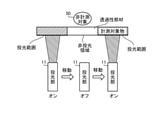
- FIG. 10 is a diagram showing still another example of control of the light projector by the light projector control unit according to the first embodiment.
- the measurement system 1 is moving in the left-right direction, and the light projecting control unit 21 turns on the light projecting unit 11 when the light projecting unit 11 is at a position facing the light emitting range. The light is projected from the light projecting unit 11 into the light projecting range. Further, when the light projecting unit 11 is located at a position facing the non-light projecting area, the light projecting control unit 21 turns off the light projecting unit 11 to prevent the light projecting unit 11 from projecting light into the non-light projecting area.
- the light projecting control unit 21 is not in the non-light emitting area when the position of the light projected by the light projecting unit 11 is in the non-light projecting region while the light projecting unit 11 and the measuring unit 12 are moved by the moving mechanism.
- the light projection by the light projection unit 11 with respect to the light projection area is stopped.
- the measurement system 1 can suppress the projection of light onto the non-measurement target 50 in the internal space of the measurement target 2.
- the light projecting control unit 21 controls whether or not to project the light projecting to the light projecting unit 11.
- the light projecting unit 11 may be configured to narrow the light projecting range.
- the light projecting unit 11 may have a configuration in which a plurality of divided light projecting units capable of projecting light are provided in different regions of the measurement object 2.
- the projection range determination unit 20 determines the projection range not including the non-projection region. .. Then, the projection control unit 21 projects from one or more divided projection units corresponding to the non-projection region among the plurality of divided projection units based on the projection range determined by the projection range determination unit 20. Do not let it shine.
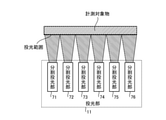
- FIG. 11 is a diagram showing an example of the configuration of the light projecting unit according to the first embodiment.
- FIG. 12 is a diagram showing a state in which light is projected from a part of the divided light emitting units among the plurality of divided light emitting units included in the light projecting unit shown in FIG.
- the light projecting unit 11 shown in FIG. 11 has a plurality of divided light projecting units 71, 72, 73, 74, 75, 76 capable of projecting light in different regions in the left-right direction of the measurement object 2.
- the plurality of divided light projecting units 71, 72, 73, 74, 75, 76 are all on, the laser light is emitted from the light projecting unit 11 to the light projecting range of the object 2 to be measured.
- each of the plurality of divided light emitting units 71, 72, 73, 74, 75, 76 may be referred to as a divided light emitting unit 70.
- the number of the divided light projecting units 70 is not limited to the example shown in FIG. 11, and may be 5 or less, or may be 7 or more.
- the floodlight control unit 21 can individually turn on and off each of the plurality of split floodlight units 71, 72, 73, 74, 75, 76.
- the light emitting range determining unit 20 sets the area facing the divided light emitting units 71, 72, 75, 76 as the light emitting range. decide. In this case, as shown in FIG. 12, the divided light emitting units 71, 72, 75, 76 are turned on and the divided light emitting units 73, 74 are turned off by the floodlight control unit 21. Therefore, the divided light projecting units 71, 72, 75, 76 project light onto the measurement object 2, and the divided light projecting units 73, 74 do not project light onto the measurement object 2.
- the light projecting unit 11 shown in FIGS. 11 and 12 can finely set the light projecting range, and the non-light projecting range can be brought closer to the non-light projecting area.
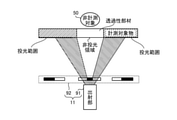
- FIG. 13 is a diagram showing another example of the configuration of the light projecting unit according to the first embodiment.
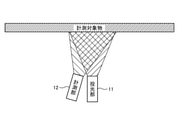
- the light projecting unit 11 shown in FIG. 13 includes an emitting unit 91 that emits linear laser light, and a blocking unit 92 that can block at least a part of the laser light emitted from the emitting unit 91.
- the blocking unit 92 shown in FIG. 13 includes a plate-shaped member having a plurality of fixed slits formed therein, and a driving unit capable of changing the relative position between the emitting unit 91 and the fixed slits.
- the projection control unit 21 emits light from the emission unit 91 by changing the position of the fixed slit through which the laser light emitted from the emission unit 91 passes, based on the projection range determined by the projection range determination unit 20. It is possible to block at least a part of the laser beam. Further, the light projecting control unit 21 sets the position of the fixed slit to a position that does not block the laser light emitted from the light emitting unit 91 based on the light projecting range determined by the light projecting range determining unit 20. The laser beam emitted from the 91 can be irradiated in the projection range without being blocked by the blocking unit 92.
- FIG. 14 is a diagram showing an example of another configuration of the blocking portion in the floodlight portion according to the first embodiment.
- the light projecting unit 11 shown in FIG. 14 includes an emitting unit 91 that emits linear laser light, and a blocking unit 92 that can block at least a part of the laser light emitted from the emitting unit 91.
- the blocking portion 92 shown in FIG. 14 is a variable slit in which a portion through which the laser beam is transmitted can be changed.
- the light projection control unit 21 controls the variable slit based on the light projection range determined by the light projection range determination unit 20, and changes the portion of the blocking unit 92 through which the laser light emitted from the emission unit 91 is passed. .. As a result, the projection control unit 21 does not block at least a part of the laser light emitted from the emission unit 91, or the laser light emitted from the emission unit 91 is not blocked by the blocking unit 92. Can be irradiated.
- FIG. 15 is a diagram showing an example of still another configuration of the blocking portion in the floodlight portion according to the first embodiment.
- the light projecting unit 11 shown in FIG. 15 includes an emitting unit 91 that emits linear laser light, and a blocking unit 92 that can block at least a part of the laser light emitted from the emitting unit 91.
- the blocking portion 92 shown in FIG. 15 is a vertical blind whose portion through which the laser beam is transmitted can be changed.
- the light projection control unit 21 controls the vertical blind based on the light projection range determined by the light projection range determination unit 20, and changes the portion of the blocking unit 92 through which the laser light emitted from the emission unit 91 is passed. .. As a result, the projection control unit 21 does not block at least a part of the laser light emitted from the emission unit 91, or the laser light emitted from the emission unit 91 is not blocked by the blocking unit 92. Can be irradiated.
- FIG. 16 is a diagram showing an example of still another configuration of the light projecting unit according to the first embodiment.
- the light projecting unit 11 shown in FIG. 16 is a projector that projects a linear image.
- the light projection control unit 21 makes the image projected from the light projecting unit 11 into the non-light projecting region black among the linear images based on the light projecting range determined by the light projecting range determining unit 20. As a result, the light projecting unit 11 shown in FIG. 16 can suppress the light projecting to the non-light projecting region.
- FIG. 17 is a flowchart showing an example of processing by the measurement system according to the first embodiment.
- the measurement system 1 detects the position of the measurement system 1 by the position detection unit 10 (step S10).
- the measurement system 1 determines whether or not the measurement timing has been reached based on the position of the measurement system 1 (step S11). In the process of step S11, the measurement system 1 determines that the measurement timing has come, for example, every time the gondola 7 moves a preset distance.
- step S12 When the measurement system 1 determines that the measurement timing has come (step S11: Yes), the measurement system 1 executes the measurement process (step S12).
- the measurement process of step S12 is the process of steps S20 to S24 shown in FIG. 18, which will be described in detail later.
- step S12 determines whether or not the measurement is completed (step S13).
- step S13 for example, when the measurement system 1 moves in the vertical direction from the positions facing the regions 61 to 644 over the regions 61 to 644 shown in FIG. 1 , the measurement is completed. judge.
- step S13: No When the measurement system 1 determines that the measurement has not been completed (step S13: No), the process shifts to step S10. Further, when it is determined that the measurement is completed (step S13: Yes), the measurement system 1 joins and synthesizes the measurement results for each measurement timing (step S14). The measurement system 1 outputs the measurement result synthesized in step S14 (step S15), and ends the process shown in FIG.
- FIG. 18 is a flowchart showing an example of measurement processing by the measurement system according to the first embodiment. As shown in FIG. 18, the measurement system 1 acquires at least one of the first information, the second information, and the detection result of the sensor unit 17 (step S20).
- the determination unit 19 of the measurement system 1 determines the presence or absence of the non-light projection region based on the information acquired in step S20 (step S21). For example, when the determination object 2 determines that a person exists inside the measurement object 2 based on the first information when the measurement object 2 is a building, the determination unit 19 has a person in the internal space of the measurement object 2. Then, the area corresponding to the determined area is determined as the non-projection area. Further, the determination unit 19 determines, for example, a region corresponding to the position of the transmissive member 9 as a non-projection region based on the position information included in the second information. Further, the determination unit 19 determines, for example, a region in which the detection result by the sensor of the sensor unit 17 is equal to or higher than a preset threshold value as a non-projection region.
- the light projection range determination unit 20 of the measurement system 1 determines the light projection range based on the presence or absence of the non-light projection area determined in step S21 (step S22).
- the light projection range is determined in the process of step S22. Determine to zero.
- Zero projection range means that there is no projection range.
- the light projection is performed in the process of step S22.
- the range is determined by the light projecting unit 11 over the entire light projectable range. Further, when the light projection range determination unit 20 has a configuration in which the light projection unit 11 can partially turn on / off the light projection and it is determined in step S21 that there is a non-light projection area, the light projection range determination unit 20 covers the range excluding the non-light projection area. Determine the projection range.
- the light projection control unit 21 of the measurement system 1 causes the light projection range determined in step S22 to be flooded from the light projection unit 11 (step S23). In the process of step S22, the light projection control unit 21 does not cause the light projection unit 11 to execute the light projection when the light projection range is zero. Further, when the light projecting range is the entire light projectable range by the light projecting unit 11, the light projecting control unit 21 causes the light projecting unit 11 to project light over the entire light projectable range. Further, when the light projecting range is a part of the light projectable range by the light projecting unit 11, the light projecting control unit 21 causes the light projecting unit 11 to project light onto a part of the light projectable range.
- the measurement unit 12 of the measurement system 1 images the projection range, calculates the three-dimensional shape of the measurement object 2 in the projection range from the captured image (step S24), and ends the process shown in FIG. do.
- the measurement system 1 determines the light projection range for each measurement timing, but the light projection range may determine the entire light projection range before the measurement of the measurement object 2. can. Further, the measurement system 1 can also determine, for example, the projection range of the region 6 to be measured before measuring the region 6 to be measured among the plurality of regions 6.
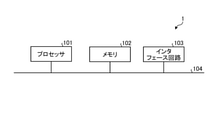
- FIG. 19 is a diagram showing an example of the hardware configuration of the measurement system according to the first embodiment.
- the measurement system 1 includes a processor 101, a memory 102, and a computer including an interface circuit 103.
- the processor 101, the memory 102, and the interface circuit 103 can send and receive information to and from each other by, for example, the bus 104.
- the storage unit 33 is realized by the memory 102.
- the processor 101 reads and executes the calculation unit 32 and the synthesis unit 34 of the measurement unit 12, the first information acquisition unit 15, the second information acquisition unit 16, and the light-shielding device control unit 18.
- the determination unit 19, the projection range determination unit 20, the projection control unit 21, and the like are executed.
- the processor 101 is, for example, an example of a processing circuit, and includes one or more of a CPU (Central Processing Unit), a DSP (Digital Signal Processor), and a system LSI (Large Scale Integration).
- the memory 102 includes one or more of RAM (Random Access Memory), ROM (Read Only Memory), flash memory, EPROM (Erasable Programmable Read Only Memory), and EEPROM (registered trademark) (Electrically Erasable Programmable Read Only Memory). include. Further, the memory 102 includes a recording medium in which a computer-readable program is recorded. Such recording media include one or more of non-volatile or volatile semiconductor memories, magnetic disks, flexible memories, optical discs, compact disks, and DVDs (Digital Versatile Discs).
- the measurement system 1 may include integrated circuits such as ASIC (Application Specific Integrated Circuit) and FPGA (Field Programmable Gate Array).
- the measurement system 1 is composed of one integrally configured device, but may be composed of two or more devices.
- each of the two or more devices has, for example, the hardware configuration shown in FIG. Communication between two or more devices is performed via a communication device (not shown).
- the measurement system 1 may be configured to include a terminal device and a server device.
- the measurement system 1 emits a linear laser beam from the light projecting unit 11 or projects a linear image from the light projecting unit 11, and is a measurement object by a light cutting method or the like.
- the method of measuring the three-dimensional shape of the object 2 to be measured is not limited to the above-mentioned example.
- the measurement system 1 may be configured to measure the three-dimensional shape of the measurement object 2 by a LiDAR (Light Detection And Ringing) method.
- the measurement system 1 has a light receiving unit instead of the imaging unit 31.
- the calculation unit 32 is a region of the measurement object 2 irradiated with the linear laser light from the time until the laser light emitted from the light projecting unit 11 is reflected by the measurement object 2 and received by the light receiving unit.
- a partial shape that is a three-dimensional shape can be calculated.
- the calculation unit 32 determines the phase difference of the diffuse reflection component that is reflected by the measurement object 2 and received by the light receiving unit. It is possible to calculate a partial shape which is a three-dimensional shape of a region irradiated with a linear laser beam in the measurement object 2.
- the measurement system 1 includes a light projection unit 11, a measurement unit 12, a determination unit 19, a light projection range determination unit 20, and a light projection control unit 21.
- the light projecting unit 11 projects light onto the measurement object 2 partially formed by the transmissive member 9 that transmits light.
- the measuring unit 12 measures the area of the measurement object 2 where the light is projected by the light projecting unit 11.
- the determination unit 19 determines a non-light projecting region, which is a region of the measurement target 2 in which light may be projected onto the non-measurement target 50 in the internal space of the measurement target 2 via the transmissive member 9. ..
- the light projection range determination unit 20 determines the light projection range, which is the range in which the light projection unit 11 performs the light projection of the measurement object 2.
- the light projection control unit 21 causes the light projection unit 11 to execute light projection into the light projection range.
- the measurement system 1 can suppress the projection of light onto the non-measurement target 50 in the internal space of the measurement target 2.
- the measurement system 1 acquires the first information indicating the possibility that the non-measurement target 50 exists inside the measurement target 2.
- the determination unit 19 determines the non-light projecting region based on the information acquired by the first information acquisition unit 15. As a result, the measurement system 1 can suppress the projection of light onto the non-measurement target 50 in the internal space of the measurement target 2 based on the acquired information.
- the measurement target 2 is a building
- the non-measurement target 50 is a person.
- the first information acquisition unit 15 includes entry information indicating whether or not a person has entered the building, the floor inside the building, or a room inside the floor, and presence information indicating whether or not a person is present on the floor or room. At least equipment information indicating the operating status of equipment placed on the floor or room, locking information indicating the locked status of the building, floor, or room, and information indicating the business hours of the business operator occupying the floor or room. Acquire one as the first information. As a result, the measurement system 1 can suppress the light projection to the person existing inside the measurement object 2 based on the acquired information.
- the measurement system 1 acquires the second information including the position information indicating the position of the transparent member 9.
- the determination unit 19 determines the non-light projecting region based on the second information acquired by the second information acquisition unit 16. As a result, the measurement system 1 can accurately suppress the projection of light to the person existing inside the measurement object 2 based on the acquired information.
- the transparent member 9 forms a window in the measurement object 2.
- the second information acquisition unit 16 acquires information including light-shielding device information indicating the state of the light-shielding device for switching between shielding and non-shielding of light from the window provided in the window to the internal space of the structure as the second information.
- the measurement system 1 can measure the measurement object 2 according to the state of the light-shielding device even when the light-projecting unit 11 is in a position of projecting light with respect to the window.
- the measurement system 1 includes a light-shielding device control unit 18 that controls the light-shielding device.
- the determination unit 19 determines the non-light projection region based on the control state of the light-shielding device by the light-shielding device control unit 18. As a result, the measurement system 1 can appropriately measure the measurement object 2 according to the control state of the shading device even when the light projecting unit 11 is in a position where the light projecting unit 11 projects light with respect to the window. ..
- the measurement system 1 includes a sensor unit 17 arranged to face the measurement object 2.
- the determination unit 19 determines the non-light projecting region based on the detection result by the sensor unit 17. As a result, the measurement system 1 can accurately determine the non-projection region even when, for example, information is not acquired from the outside.
- the sensor unit 17 detects at least one of brightness, temperature, sound, polarization, reflection distance, and operation of the non-measurement target 50. As a result, the measurement system 1 can determine the non-light projection region more accurately.
- the light projection control unit 21 stops the light projection by the light projection unit 11 for the non-light projection area that is not included in the light projection range determined by the light projection range determination unit 20 of the measurement object 2.
- the measurement system 1 can suppress the projection of light onto the non-measurement target 50 in the internal space of the measurement target 2.
- the light projecting unit 11 includes a plurality of divided light projecting units 71, 72, 73, 74, 75, 76 capable of projecting light into different regions of the measurement object 2.
- the projection control unit 21 stops the projection by some of the divided projection units 71, 72, 73, 74, 75, 76 corresponding to the non-projection region.
- the measurement system 1 can prevent the range in which the light projecting unit 11 does not project light becomes too large with respect to the non-light projecting area.
- the light projection control unit 21 refers to the non-light projecting area when the position of the light projected by the light projecting unit 11 is in the non-light projecting area in a state where the light projecting unit 11 and the measuring unit 12 are moved by the moving mechanism. The light projection by the light projection unit 11 is stopped. As a result, the measurement system 1 can suppress the projection of light onto the non-measurement target 50 in the internal space of the measurement target 2.
- the light projecting unit 11 includes an emitting unit 91 that emits light and a blocking unit 92 that can block at least a part of the light emitted from the emitting unit 91.
- the light projection control unit 21 controls the blocking unit 92 to stop the light projection by the light projection unit 11 with respect to the non-light projection region. As a result, the measurement system 1 can bring the range where the light projecting unit 11 does not project light closer to the non-light projecting area.
- the blocking unit 92 includes a fixed slit that can change the relative position with the emitting unit 91, a variable slit that can change the portion that transmits light, or a vertical blind. As a result, the measurement system 1 can accurately control the range in which the light projecting unit 11 does not project light.
- the light projecting unit 11 is a projector that projects an image.
- the projection control unit 21 turns the image projected from the projector into the non-projection region black. As a result, the measurement system 1 can accurately control the range in which the light projecting unit 11 does not project light.
- the light projecting unit 11 emits linear light.
- the measurement unit 12 includes an image pickup unit 31, a calculation unit 32, and a synthesis unit 34.
- the image pickup unit 31 takes an image of a region of the measurement object 2 irradiated with the laser beam.
- the calculation unit 32 calculates the three-dimensional shape of the non-measurement target 50 based on the image captured by the image pickup unit 31.
- the synthesis unit 34 connects the three-dimensional shapes calculated by the calculation unit 32 to generate data indicating the three-dimensional shape of the measurement target 2.
- the measurement system 1 can accurately measure the three-dimensional shape of the non-measurement target 50 while suppressing the projection of light onto the non-measurement target 50 in the internal space of the measurement target 2.
- the measurement system according to the second embodiment includes a light projecting unit and a drive unit that changes the orientation of each of the measurement units, and can determine a non-light projecting area based on information from a cleaning robot.
- a light projecting unit and a drive unit that changes the orientation of each of the measurement units, and can determine a non-light projecting area based on information from a cleaning robot.
- FIG. 20 is a diagram showing an example of the configuration of the measurement system according to the second embodiment.
- the measurement system 1A according to the second embodiment is further provided with a drive unit 22, and is provided with a second information acquisition unit 16A instead of the second information acquisition unit 16. It is different from the measurement system 1 according to the first embodiment.
- FIG. 21 is a diagram showing how the direction of the light projecting unit is changed by the driving unit according to the second embodiment.
- the drive unit 22 shown in FIG. 20 rotates the light projecting unit 11 to change the direction of the light projecting unit 11.
- the drive unit 22 changes the direction of the measurement unit 12 so that the region projected from the light projecting unit 11 can be imaged in accordance with the change of the direction of the light projecting unit 11.
- the orientations of the light projecting unit 11 and the measuring unit 12 are changed in the left-right direction, and when the gondola 7 moves in the left-right direction, the orientations of the light projecting unit 11 and the measuring unit 12 are changed.
- the orientation is changed up and down.
- the light projection control unit 21 changes the directions of the light projection unit 11 and the measurement unit 12 by the drive unit 22, and the position of the light projection by the light projection unit 11 is in the non-light projection region, the light projection control unit 21 is used.
- the light projecting by the light projecting unit 11 for the non-light projecting area is stopped.
- the measurement system 1A can measure, for example, a plurality of regions 6 collectively without changing the position of the gondola 7.
- the second information acquisition unit 16A shown in FIG. 20 acquires information including detection information, which is information detected by the cleaning robot that cleans the outer surface 4 of the measurement object 2, as the second information.
- the cleaning robot is, for example, a window cleaning robot, but is not limited to the window cleaning robot as long as it is a robot that cleans the outer surface 4 of the measurement object 2.
- the determination unit 19 detects the non-flooding region based on the detection information which is the information detected by the cleaning robot that cleans the outer surface of the measurement object 2.
- the detection information is, for example, information indicating a cleaned position or information indicating a position of a dirty place on the outer surface 4 of the measurement object 2.
- the cleaning robot is a window cleaning robot
- the information indicating the cleaned position is the information indicating the position of the window.
- the dirty place on the outer surface 4 of the object to be measured 2 is, for example, an area other than the window on the outer surface 4.
- the determination unit 19 determines the position of the window based on, for example, information indicating the cleaned position instead of the second information, and the determination result, the first information, the detection result of the sensor unit 17, and the light shielding device control.
- the non-projection region can be determined based on at least one of the control states by the unit 18. Further, the determination unit 19 determines, for example, an area other than the window based on the information indicating the position of the dirty place on the outer surface 4 of the measurement object 2, and the determination result, the first information, and the sensor unit.
- the non-light emitting region can be determined based on the detection result of 17 and at least one of the control states by the light shielding device control unit 18.
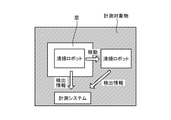
- FIG. 22 is a diagram showing the relationship between the cleaning robot and the measurement system according to the second embodiment.
- the cleaning robot cleans the outer surface 4 of the measurement object 2 while moving on the outer surface of the measurement object 2. Further, the cleaning robot outputs information indicating the cleaned position or information indicating a dirty place on the outer surface of the measurement object 2 to a building management system (not shown) as detection information.
- the measurement system 1A acquires the detection information output from the cleaning robot from a building management system (not shown), and determines the non-flood area based on the acquired detection information.
- the hardware configuration example of the measurement system 1A according to the second embodiment is the same as the hardware configuration of the measurement system 1 shown in FIG.
- the processor 101 reads and executes the calculation unit 32 and the synthesis unit 34 of the measurement unit 12, the first information acquisition unit 15, the second information acquisition unit 16A, and the light shielding device control unit 18.
- the determination unit 19, the projection range determination unit 20, the projection control unit 21, and the drive unit 22 are executed.
- the measurement system 1A is composed of one integrally configured device, but may be composed of two or more devices.
- each of the two or more devices has, for example, the hardware configuration shown in FIG. Communication between two or more devices is performed via a communication device (not shown).
- the measurement system 1A may be configured to include a terminal device and a server device.
- the measurement system 1A may have a configuration having a second information acquisition unit 16 instead of the second information acquisition unit 16A. Further, the measurement system 1A may be configured not to have the drive unit 22.
- the measurement system 1A includes a drive unit 22 that changes the orientation of each of the light projecting unit 11 and the measurement unit 12.
- the light projection control unit 21 changes the directions of the light projection unit 11 and the measurement unit 12 by the drive unit 22, and the position of the light projection by the light projection unit 11 is in the non-light projection region, the light projection control unit 21 is used.
- the light projecting by the light projecting unit 11 for the non-light projecting area is stopped.
- the measurement system 1A can measure a plurality of regions 6 together without changing the position of the gondola 7, for example.
- the second information acquisition unit 16A acquires the second information including the position information indicating the position of the transparent member 9.
- the measurement object 2 is a building or a vehicle
- the transparent member 9 is a glass forming a window in the measurement object 2.
- the second information acquisition unit 16A acquires information including information detected by the cleaning robot that cleans the outer surface 4 of the measurement object 2 as the second information. As a result, the measurement system 1A can accurately determine the position of the transparent member 9.
- Embodiment 3 The measurement system according to the third embodiment is different from the measurement system 1 according to the first embodiment in that it measures a two-dimensional image showing the surface state of the measurement object 2 instead of the three-dimensional shape of the measurement object 2. ..
- the components having the same functions as those of the first embodiment are designated by the same reference numerals and the description thereof will be omitted, and the differences from the measurement system 1 of the first embodiment will be mainly described.
- the measurement system according to the third embodiment has a configuration in which the measurement system 1A according to the second embodiment measures a two-dimensional image showing the surface state of the measurement object 2 instead of the three-dimensional shape of the measurement object 2. May be.
- FIG. 23 is a diagram showing an example of the configuration of the measurement system according to the third embodiment.
- the measurement system 1B according to the third embodiment includes a light projecting unit 11B, a measuring unit 12B, and a storage unit 13B in place of the light projecting unit 11, the measuring unit 12, and the storage unit 13. In that respect, it differs from the measurement system 1 according to the first embodiment.
- the light projecting unit 11B includes an emission unit 91B including a light source that emits illumination light, and a blocking unit 92B that can block at least a part of the illumination light emitted from the emission unit 91B.
- the blocking section 92B is a fixed slit whose relative position to the emitting section 91B can be changed, a variable slit whose portion transmitting the illumination light emitted from the emitting section 91B can be changed, or a vertical blind.
- the light projecting unit 11B may be a projector.
- the illumination light emitted from the light projecting unit 11B is visible light, but may be near infrared rays.
- the measurement unit 12B is different from the measurement unit 12 in that it includes a storage unit 33B and a synthesis unit 34B instead of the storage unit 33 and the synthesis unit 34, and does not have the calculation unit 32.
- the image pickup unit 31 of the measurement unit 12B captures the light projection region of the light projection unit 11B and outputs the data of the two-dimensional image of the light projection region.
- the storage unit 33B of the measurement unit 12B is a position indicating the position of the measurement system 1B measured by the position detection unit 10 for the partial image data which is the data of the two-dimensional image of the region of the measurement object 2 captured by the image pickup unit 31. Store in association with data.
- the synthesis unit 34B joins a plurality of partial image data based on the data of the plurality of partial images stored by the storage unit 33B and the position data of the plurality of measurement systems 1B, synthesizes the plurality of partial images, and measures the target.
- the whole image data which is the data of the two-dimensional image of the whole thing 2 is generated.
- the storage unit 13B stores the entire image data generated by the measurement unit 12B.
- the output unit 14 outputs the entire image data generated by the measurement unit 12B and stored in the storage unit 13B to the outside.
- the output unit 14 can output the entire image data to the outside to a cloud server (not shown) by wireless communication or wired communication.
- the measurement system 1B may be provided with a calculation unit 32 and may be configured to further generate overall shape data in addition to overall image data.
- the measurement system 1B selectively or time-divides the three-dimensional shape measurement mode for measuring the three-dimensional shape of the measurement object 2 and the measurement mode for measuring the two-dimensional image of the measurement object 2. Can be done.
- the hardware configuration example of the measurement system 1B according to the third embodiment is the same as the hardware configuration of the measurement system 1 shown in FIG.
- the processor 101 reads and executes the synthesis unit 34B of the measurement unit 12B, the first information acquisition unit 15, the second information acquisition unit 16, the light-shielding device control unit 18, and the determination unit 19.
- the floodlight range determination unit 20, the floodlight control unit 21, and the like are executed.
- the measurement system 1B is composed of one device integrally configured, but may be composed of two or more devices.
- each of the two or more devices has, for example, the hardware configuration shown in FIG. Communication between two or more devices is performed via a communication device (not shown).
- the measurement system 1B may be configured to include a terminal device and a server device.
- the measurement system 1B includes a light projection unit 11B, a measurement unit 12B, a determination unit 19, a light projection range determination unit 20, and a light projection control unit 21.
- the light projecting unit 11B projects light onto the measurement object 2 partially formed by the transmissive member 9.
- the measuring unit 12B measures a two-dimensional image of a region of the measurement object 2 where the light is projected by the light projecting unit 11B.
- the determination unit 19 determines a non-light projecting region, which is a region of the measurement target 2 in which light may be projected onto the non-measurement target 50 in the internal space of the measurement target 2 via the transmissive member 9. ..
- the light projection range determination unit 20 determines the light projection range, which is the range in which the light projection unit 11B of the measurement target 2 performs the light projection, based on the determination result by the determination unit 19.
- the light projection control unit 21 causes the light projection unit 11B to project light into the light projection range.
- the measurement system 1B can suppress the projection of light onto the non-measurement target 50 inside in the space of the measurement target 2.
- the measurement system 1B can suppress the projection of light onto the non-measurement target 50 in the internal space of the measurement target 2.
- the measurement unit 12B shows a two-dimensional image of the measurement object 2 by connecting the image pickup unit 31 that captures the area of the measurement object 2 irradiated with light and the image captured by the image pickup unit 31. It is provided with a synthesis unit 34B for generating data. As a result, the measurement system 1B can generate data showing a two-dimensional image of the measurement object 2 while suppressing light projection to the non-measurement object in the internal space of the measurement object 2.
- the configuration shown in the above embodiments is an example, and can be combined with another known technique, can be combined with each other, and does not deviate from the gist. It is also possible to omit or change a part of the configuration.
- 1,1A, 1B measurement system 2 measurement object, 3 outer wall, 4 outer surface, 5,5 1-5 48 , 8 rails, 6,6 1-6 44 areas, 7 gondola, 9 permeable member, 10 positions Detection unit, 11,11B floodlight unit, 12,12B measurement unit, 13,13B, 33,33B storage unit, 14 output unit, 15 first information acquisition unit, 16, 16A second information acquisition unit, 17 sensor unit, 18 Shading device control unit, 19 Judgment unit, 20 Floodlight range determination unit, 21 Floodlight control unit, 22 Drive unit, 31 Imaging unit, 32 Calculation unit, 34, 34B synthesis unit, 50 Non-measurement target, 70, 71, 72,73,74,75,76 Divided light projecting section, 80 crane, 81 wire rope, 91,91B emitting section, 92,92B blocking section.
Landscapes
- Physics & Mathematics (AREA)
- General Physics & Mathematics (AREA)
- Engineering & Computer Science (AREA)
- Computer Vision & Pattern Recognition (AREA)
- Length Measuring Devices By Optical Means (AREA)
Priority Applications (2)
| Application Number | Priority Date | Filing Date | Title |
|---|---|---|---|
| JP2022546784A JP7391231B2 (ja) | 2020-09-02 | 2020-09-02 | 計測システムおよび計測方法 |
| PCT/JP2020/033306 WO2022049679A1 (ja) | 2020-09-02 | 2020-09-02 | 計測システムおよび計測方法 |
Applications Claiming Priority (1)
| Application Number | Priority Date | Filing Date | Title |
|---|---|---|---|
| PCT/JP2020/033306 WO2022049679A1 (ja) | 2020-09-02 | 2020-09-02 | 計測システムおよび計測方法 |
Publications (1)
| Publication Number | Publication Date |
|---|---|
| WO2022049679A1 true WO2022049679A1 (ja) | 2022-03-10 |
Family
ID=80491860
Family Applications (1)
| Application Number | Title | Priority Date | Filing Date |
|---|---|---|---|
| PCT/JP2020/033306 Ceased WO2022049679A1 (ja) | 2020-09-02 | 2020-09-02 | 計測システムおよび計測方法 |
Country Status (2)
| Country | Link |
|---|---|
| JP (1) | JP7391231B2 (https=) |
| WO (1) | WO2022049679A1 (https=) |
Citations (2)
| Publication number | Priority date | Publication date | Assignee | Title |
|---|---|---|---|---|
| JP2004309491A (ja) * | 2003-02-21 | 2004-11-04 | Fast:Kk | 建築および土木構造物計測・解析システム |
| JP2018159642A (ja) * | 2017-03-23 | 2018-10-11 | 三菱電機株式会社 | 移動体撮像装置および移動体 |
-
2020
- 2020-09-02 JP JP2022546784A patent/JP7391231B2/ja active Active
- 2020-09-02 WO PCT/JP2020/033306 patent/WO2022049679A1/ja not_active Ceased
Patent Citations (2)
| Publication number | Priority date | Publication date | Assignee | Title |
|---|---|---|---|---|
| JP2004309491A (ja) * | 2003-02-21 | 2004-11-04 | Fast:Kk | 建築および土木構造物計測・解析システム |
| JP2018159642A (ja) * | 2017-03-23 | 2018-10-11 | 三菱電機株式会社 | 移動体撮像装置および移動体 |
Also Published As
| Publication number | Publication date |
|---|---|
| JP7391231B2 (ja) | 2023-12-04 |
| JPWO2022049679A1 (https=) | 2022-03-10 |
Similar Documents
| Publication | Publication Date | Title |
|---|---|---|
| JP7478281B2 (ja) | Lidarシステム及び方法 | |
| CN111521161B (zh) | 确定到目标的方向的方法、勘测装置和机器可读载体 | |
| US11175406B2 (en) | Range imaging system and solid-state imaging device | |
| US10444358B2 (en) | Distance measuring apparatus, distance measuring method, and table creating method | |
| JP5469527B2 (ja) | 撮像装置 | |
| KR20220069930A (ko) | 라이다 정확도를 위한 시계열 측정 처리 | |
| JP6811661B2 (ja) | 移動体撮像装置および移動体 | |
| JP7741778B2 (ja) | 画像取込デバイスを用いて測定ポイントを探し出すデバイス及び方法 | |
| JP7108115B2 (ja) | 車両扉開閉検知装置 | |
| JP2002250607A (ja) | 物体検知センサ | |
| JP2009508276A (ja) | 移動体の識別方法及びシステム、並びに、移動体の放射線結像検査の方法及びシステム | |
| JP7120976B2 (ja) | 計測装置、エレベータシステムおよび計測方法 | |
| TW202021340A (zh) | 用於相機之紅外光預閃光 | |
| US10887563B2 (en) | Projection system, projection method, and program recording medium | |
| JP7170912B2 (ja) | 障害物検出装置および障害物検出方法 | |
| CN101514893A (zh) | 三维形状测量装置及方法 | |
| WO2022049679A1 (ja) | 計測システムおよび計測方法 | |
| CN102159488B (zh) | 滑动门装置及电梯 | |
| JP6934799B2 (ja) | 戸袋移動型ホーム柵システム | |
| JP6934798B2 (ja) | 車両扉位置検知装置 | |
| JP4151571B2 (ja) | 車載用障害物検出装置 | |
| WO2022181129A1 (ja) | 光出力制御装置、および光出力制御方法、並びにプログラム | |
| KR102188933B1 (ko) | 장애물 감지 및 모니터링 시스템 | |
| JPWO2022049679A5 (https=) | ||
| JP2020026688A (ja) | 検知状態記録装置、ズレ検出装置、自動ドア制御装置、自動ドアシステム及びズレ検出システム |
Legal Events
| Date | Code | Title | Description |
|---|---|---|---|
| 121 | Ep: the epo has been informed by wipo that ep was designated in this application |
Ref document number: 20952419 Country of ref document: EP Kind code of ref document: A1 |
|
| ENP | Entry into the national phase |
Ref document number: 2022546784 Country of ref document: JP Kind code of ref document: A |
|
| NENP | Non-entry into the national phase |
Ref country code: DE |
|
| 122 | Ep: pct application non-entry in european phase |
Ref document number: 20952419 Country of ref document: EP Kind code of ref document: A1 |