WO2022024285A1 - 蝶番構成部品および表示装置 - Google Patents
蝶番構成部品および表示装置 Download PDFInfo
- Publication number
- WO2022024285A1 WO2022024285A1 PCT/JP2020/029175 JP2020029175W WO2022024285A1 WO 2022024285 A1 WO2022024285 A1 WO 2022024285A1 JP 2020029175 W JP2020029175 W JP 2020029175W WO 2022024285 A1 WO2022024285 A1 WO 2022024285A1
- Authority
- WO
- WIPO (PCT)
- Prior art keywords
- support
- hinge member
- display device
- convex portion
- display panel
- Prior art date
- Legal status (The legal status is an assumption and is not a legal conclusion. Google has not performed a legal analysis and makes no representation as to the accuracy of the status listed.)
- Ceased
Links
Images










Classifications
-
- G—PHYSICS
- G06—COMPUTING OR CALCULATING; COUNTING
- G06F—ELECTRIC DIGITAL DATA PROCESSING
- G06F1/00—Details not covered by groups G06F3/00 - G06F13/00 and G06F21/00
- G06F1/16—Constructional details or arrangements
- G06F1/1613—Constructional details or arrangements for portable computers
- G06F1/1633—Constructional details or arrangements of portable computers not specific to the type of enclosures covered by groups G06F1/1615 - G06F1/1626
- G06F1/1675—Miscellaneous details related to the relative movement between the different enclosures or enclosure parts
- G06F1/1681—Details related solely to hinges
-
- F—MECHANICAL ENGINEERING; LIGHTING; HEATING; WEAPONS; BLASTING
- F16—ENGINEERING ELEMENTS AND UNITS; GENERAL MEASURES FOR PRODUCING AND MAINTAINING EFFECTIVE FUNCTIONING OF MACHINES OR INSTALLATIONS; THERMAL INSULATION IN GENERAL
- F16C—SHAFTS; FLEXIBLE SHAFTS; ELEMENTS OR CRANKSHAFT MECHANISMS; ROTARY BODIES OTHER THAN GEARING ELEMENTS; BEARINGS
- F16C11/00—Pivots; Pivotal connections
- F16C11/04—Pivotal connections
-
- G—PHYSICS
- G06—COMPUTING OR CALCULATING; COUNTING
- G06F—ELECTRIC DIGITAL DATA PROCESSING
- G06F1/00—Details not covered by groups G06F3/00 - G06F13/00 and G06F21/00
- G06F1/16—Constructional details or arrangements
- G06F1/1613—Constructional details or arrangements for portable computers
- G06F1/1633—Constructional details or arrangements of portable computers not specific to the type of enclosures covered by groups G06F1/1615 - G06F1/1626
- G06F1/1637—Details related to the display arrangement, including those related to the mounting of the display in the housing
- G06F1/1652—Details related to the display arrangement, including those related to the mounting of the display in the housing the display being flexible, e.g. mimicking a sheet of paper, or rollable
-
- H—ELECTRICITY
- H04—ELECTRIC COMMUNICATION TECHNIQUE
- H04M—TELEPHONIC COMMUNICATION
- H04M1/00—Substation equipment, e.g. for use by subscribers
- H04M1/02—Constructional features of telephone sets
-
- H—ELECTRICITY
- H05—ELECTRIC TECHNIQUES NOT OTHERWISE PROVIDED FOR
- H05K—PRINTED CIRCUITS; CASINGS OR CONSTRUCTIONAL DETAILS OF ELECTRIC APPARATUS; MANUFACTURE OF ASSEMBLAGES OF ELECTRICAL COMPONENTS
- H05K5/00—Casings, cabinets or drawers for electric apparatus
- H05K5/02—Details
- H05K5/0217—Mechanical details of casings
- H05K5/0226—Hinges
-
- E—FIXED CONSTRUCTIONS
- E05—LOCKS; KEYS; WINDOW OR DOOR FITTINGS; SAFES
- E05D—HINGES OR SUSPENSION DEVICES FOR DOORS, WINDOWS OR WINGS
- E05D1/00—Pinless hinges; Substitutes for hinges
-
- E—FIXED CONSTRUCTIONS
- E05—LOCKS; KEYS; WINDOW OR DOOR FITTINGS; SAFES
- E05D—HINGES OR SUSPENSION DEVICES FOR DOORS, WINDOWS OR WINGS
- E05D5/00—Construction of single parts, e.g. the parts for attachment
-
- E—FIXED CONSTRUCTIONS
- E05—LOCKS; KEYS; WINDOW OR DOOR FITTINGS; SAFES
- E05Y—INDEXING SCHEME ASSOCIATED WITH SUBCLASSES E05D AND E05F, RELATING TO CONSTRUCTION ELEMENTS, ELECTRIC CONTROL, POWER SUPPLY, POWER SIGNAL OR TRANSMISSION, USER INTERFACES, MOUNTING OR COUPLING, DETAILS, ACCESSORIES, AUXILIARY OPERATIONS NOT OTHERWISE PROVIDED FOR, APPLICATION THEREOF
- E05Y2999/00—Subject-matter not otherwise provided for in this subclass
Definitions
- This disclosure relates to hinge components and display devices.
- a flexible display device that can be folded has been developed by using a flexible display panel and a housing having a rotatable hinge.
- An example of a flexible display device disclosed in Patent Document 1 includes a flexible display, two display support portions that support the flexible display, and a hinge portion that rotatably stops the two display support portions. There is.
- the display panel used in the flexible display device usually has a structure in which a display element and wiring are sandwiched between two flexible resin plates. Therefore, when bending the display panel, it is necessary to increase the radius of curvature of the bent portion to some extent or more in order to avoid damage to the electronic circuit and wiring and deterioration of performance.
- the display panel may be bent with a radius of curvature smaller than expected, or the bending direction of the display panel may change in the middle. As a result, an excessive load is applied to the bent portion of the display panel. Therefore, the display panel may be damaged.
- One aspect of the present disclosure provides a hinge component and a display device in which the load applied to the bent portion of the display panel is reduced.
- the hinge components of the present disclosure include a plate-shaped portion extending along the length direction, a pair of rotating shafts or a pair of bearing portions provided at both ends of the plate-shaped portion in the length direction, and the plate. It has at least one convex portion protruding from the plate-shaped portion in the width direction of the shaped portion.
- the display device of the present disclosure comprises a flexible display panel and a foldable holder that holds the display panel, wherein the holder is a flat plate having a first main surface that supports the display panel.
- a first support having a shape, a flat plate-shaped second support for supporting the display panel, and at least one connection portion for supporting the display panel, the connection portion supporting the display panel.
- the third support having a long flat plate shape and the first support and the third support are arranged on the second main surface opposite to the first main surface of the first support and the third support.
- the long first hinge member connecting the three supports and the second support and the third support are arranged on the opposite side of the first main surface of the second support and the third support.
- the long second hinge member connecting the three supports, the first hinge member and the end of the first support, and the first hinge member and the first support can rotate relative to each other.
- the first support shaft, the first hinge member, and the third support are connected to each other, and the first hinge member and the third support are connected to each other so as to be relatively rotatable, and the first support shaft.
- the portion is provided with a fourth support shaft for connecting the second hinge member and the second support so as to be relatively rotatable, and the holding body is opened so that the display panel is opened 180 degrees.
- the first support, the second support, and the first main surface of the third support are arranged in the same plane and face the first support of the third support.
- One side has a convex portion protruding from the first side and a concave portion in which the first side is cut out, and the side of the first support facing the third support has the first side.
- the convex portion of the first side of the support, the concave portion corresponding to the concave portion, and the convex portion are provided, and the second side of the third support facing the second support has the said portion.
- the convex portion protruding from the second side and the concave portion with the second side cut out are provided, and the third support is provided on a side of the second support facing the third support. It has the convex portion on the second side, the concave portion corresponding to the concave portion, and the convex portion.
- FIG. 1 is a sectional view taken along line VI-VI of FIG.
- FIG. 1 is a sectional view taken along line VII-VII of FIG.
- FIG. 1 is a sectional view taken along line VIII-VIII of FIG.
- FIG. 1 is a sectional view taken along line VI-VI of FIG.
- FIG. 5 is an exploded perspective view showing a state in which the first support and the second support of the display device of the second embodiment are opened and the display panel is removed. It is a perspective view which shows the state which the display panel of the display device of Embodiment 2 is attached, and the 1st support and the 2nd support are closed.
- FIG. 9 is a partially exploded perspective view of a bent portion of the display device shown in FIG. 9 is a partial plan view of the display device when the bent portion of the display device shown in FIG. 9 is viewed from the display panel side.
- 9 is a partial plan view of the display device when the bent portion of the display device shown in FIG. 9 is viewed from a position opposite to the position on the display panel side.
- FIG. 9 is a partially exploded perspective view of a bent portion of the display device shown in FIG. 9 is viewed from the display panel side.
- FIG. 3 is a plan view showing a state in which the first support and the second support of the display device of the second embodiment are opened. It is a top view which shows the state which the 1st support and the 2nd support of the display device of Embodiment 2 are closed.
- FIG. 14 is a partial side view of the display device when the bent portion of the display device shown in FIG. 14 is viewed along the Y direction.
- FIG. 15 is a partial side view of the display device when the bent portion of the display device shown in FIG. 15 is viewed along the Y direction. 14 is a cross-sectional view taken along the line XVIII-XVIII of FIG.
- FIG. 15 is a cross-sectional view taken along the line XIX-XIX of FIG. FIG.
- FIG. 14 is a cross-sectional view taken along the line XX-XX of FIG.
- FIG. 15 is a cross-sectional view taken along the line XXI-XXI of FIG.
- FIG. 14 is a cross-sectional view taken along the line XXII-XXII of FIG.
- FIG. 15 is a cross-sectional view taken along the line XXIII-XXIII of FIG.
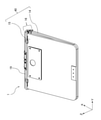
- FIG. 3 is a perspective view showing a state in which the first support and the second support of the display device of the third embodiment are opened. It is a perspective view which shows the state which the 1st support and the 2nd support of the display device of Embodiment 3 are closed.
- FIG. 24 is a sectional view taken along line XXVI-XXVI of FIG. 24.
- FIG. 25 is a sectional view taken along line XXVII-XXVII of FIG.
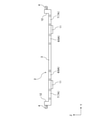
- FIG. 1 is a perspective view showing a hinge component 2 of the first embodiment of the present disclosure.
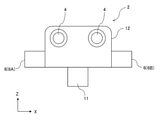
- FIG. 2 is a side view of the hinge component 2 when the hinge component 2 shown in FIG. 1 is viewed along the X direction.
- FIG. 3 is a side view of the hinge component 2 when the hinge component 2 shown in FIG. 1 is viewed along the Y direction.
- the vertical direction of the hinge component 2 orthogonal to each of the X direction and the Y direction is the Z direction.
- the X direction, the Y direction, and the Z direction described above are directions along the three axes of the Cartesian coordinate system, respectively.
- the hinge component 2 includes a plate-shaped portion 3, a pair of rotating shafts 4, and at least one convex portion 6. As shown in FIG. 1, the plate-shaped portion 3 extends along the Y direction, which is the length direction. A pair of rotating shafts 4 are provided at both ends of the plate-shaped portion 3 in the length direction. Each of the at least one convex portion 6 protrudes from the plate-shaped portion 3 in the X direction, which is the width direction of the plate-shaped portion 3. The number of at least one convex portion 6 is 4, but is not limited to, in the present embodiment.
- the plate-shaped portion 3 is the main structure of the hinge component 2 extending linearly along the Y direction.
- the length direction of the plate-shaped portion 3 is the Y direction in FIG.
- the width direction of the plate-shaped portion 3 is the X direction in FIG.
- the plate-shaped portion 3 is, for example, a rectangular plate having irregularities in the width direction, and is formed of metal, hard plastic, or the like.
- the four convex portions 6 have two first convex portions 6A and two second convex portions 6B. As shown in FIG. 1, the two first convex portions 6A each project in the first of the two directions along the X direction. The two second convex portions 6B each project in the X direction in a second direction opposite to the first direction. As shown in FIG. 1, the two first convex portions 6A and the two second convex portions 6B are arranged at a predetermined distance in the Y direction.
- each of the four convex portions 6 in the X direction has two recesses 7A and two recesses 7B.
- the two recesses 7B are recessed in the first direction at positions facing the two first convex portions 6A in the X direction, respectively.
- the two recesses 7A are recessed in the second direction at positions facing the two second convex portions 6B in the X direction, respectively.
- the plate-shaped portion 3 includes two protruding portions 12 that project upward along the Z direction, which is the thickness direction of the plate-shaped portion 3, in the vicinity of both ends in the Y direction. Further, the plate-shaped portion 3 has protrusions 11 protruding downward along the Z direction in the vicinity of both ends in the Y direction.
- each of the two protrusions 12 is provided with the above-mentioned pair of rotating shafts 4.
- the pair of rotating shafts 4 is, for example, a columnar portion provided on the side surface of the protruding portion 12.
- the pair of rotating shafts 4 are provided at two positions at predetermined intervals in the X direction. For example, as shown in FIGS. 1 and 3, two pairs of rotation axes 4 are arranged along the X direction.
- One pair of rotating shafts 4 and the other pair of rotating shafts 4 are provided so as to extend along the same two virtual rotation central axes.
- the pair of rotating shafts 4 constitutes a biaxial hinge.
- a pair of bearing portions 5 are provided at the ends of the plate-shaped portions 3 instead of the pair of rotating shafts 4. Can be considered.
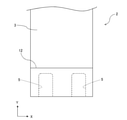
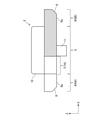
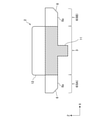
- FIG. 4 is a plan view showing the vicinity of one end of the hinge component 2 provided with the pair of bearing portions 5, and FIG. 5 is a side view of FIG. 4 as viewed from the Y direction.
- the pair of bearing portions 5 is, for example, a round hole or a round groove formed in the plate-shaped portion 3.
- the display device 1 is fitted to the bearing portions 5. It shall have a rotation axis.
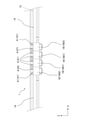
- FIG. 6 is a sectional view taken along line VI-VI of FIG.
- FIG. 7 is a sectional view taken along line VII-VII of FIG.
- FIG. 8 is a sectional view taken along line VIII-VIII of FIG.
- each of the four convex portions 6 has a facing surface 8a facing the hinge member 19 described later, and the thickness of the plate-shaped portion 3 decreases toward the outside in the X direction. It has a tapered surface 8 and the like.
- the cross section of the plate-shaped portion 3 is hatched.
- the first convex portion 6A protrudes in the first direction, and the taper is inclined so that the thickness becomes thinner with respect to the facing surface 8a toward the tip thereof. It has a surface 8.
- the second convex portion 6B has a tapered surface 8 that protrudes in the second direction and is inclined so that the thickness becomes thinner with respect to the facing surface 8a toward the tip thereof.
- the plate-shaped portion 3 includes a protrusion 11 that protrudes downward in the Z direction. More specifically, the plate-shaped portion 3 has a protrusion 11 protruding outward from the main surface of the plate-shaped portion 3 in the Z direction.
- the protrusion 11 is a flat plate-shaped cylinder.
- the display device 1 of the second embodiment of the present disclosure will be described with reference to FIGS. 9 to 23.
- the display device 1 of the present embodiment includes the same hinge component 2 as that of the first embodiment.
- the description of the hinge component 2 of the present embodiment, which is the same as that of the hinge component 2 of the first embodiment, will not be repeated unless it is particularly necessary.
- FIG. 9 and 10 are perspective views showing the display device 1 of the second embodiment of the present disclosure.
- FIG. 9 is an exploded perspective view showing a state in which the first support 14 and the second support 15 of the display device 1 are open and the display panel 13 is removed.
- FIG. 10 is a diagram showing a state in which the display device 1 is closed.
- the direction in which the first support 14, the connecting portion 16, and the second support 15 are lined up is the X direction
- the direction orthogonal to the X direction is the Y direction
- the direction perpendicular to the main surface of each of the first support 14 and the second support 15 orthogonal to the X direction and the Y direction is defined as the Z direction.
- the X direction, the Y direction, and the Z direction described above are directions along the three axes of the Cartesian coordinate system, respectively.
- the display device 1 has a display panel 13, a first support 14 and a second support 15, and a connecting portion 16 connecting them.
- the connection portion 16 includes a plurality of hinge components 2 of the first embodiment.
- the connecting portion 16 includes a third support 17 and a third support 18, which are hinge components 2, and a first hinge member 1902, a second hinge member 1903, and a third hinge member 1901, which are hinge members 19.
- first hinge member 1902, a second hinge member 1903, and a third hinge member 1901 which are hinge members 19.
- the display panel 13 has a structure in which a display element and wiring are sandwiched between two resin plates to form one plate-shaped member. Since the display panel 13 has flexibility, it can be bent at any position.
- the display panel 13 is, for example, a display panel 13 using an OLED: an organic light emitting diode, a QLED: a quantum dot light emitting diode, and a liquid crystal display. Further, the display panel 13 may be provided with a touch panel.
- the holder 40 includes a first support 14, a second support 15, and third supports 17, 18.
- the holding body 40 holds the display panel 13. Further, the holding body 40 can be folded so that the first support 14 and the second support 15 face each other because the connecting portion 16 functions as a bent portion.
- a gap is unlikely to occur between the display panel (touch panel) and the third supports 17 and 18. This is possible to perform a touch operation because a gap is unlikely to occur even when the product is stopped in the middle of bending, for example, when it is opened at 90 degrees or 135 degrees. (If there is a gap, the display panel will be pushed by touch operation and accurate touch operation will not be possible).
- first support 14 and the second support 15 faces the display panel 13 with each other.
- the first support 14 and the second support 15 are members that form a pair of plate-shaped portions to which the display panel 13 is attached. As shown in FIG. 9, both ends of the display panel 13 in the X direction are fixed to the first support 14 and the second support 15.
- the surface of the first support 14 and the surface of the second support 15, which are visible in FIG. 9, are the first main surfaces of each.
- the surface on the opposite side of the first main surface is the second main surface of each of the first support 14 and the second support 15. That is, in the first support 14 and the second support 15, the surface on the side facing the display panel 13 is the first main surface.
- the surface on the side facing the display panel 13 and the surface on the back side of the surface facing the display panel 13 are defined as the first main surface and the second main surface, respectively.
- connection portion 16 is provided between the first support 14 and the second support 15, and the first support 14 and the second support 15 are rotatably connected by a rotation shaft described later.
- the connection portion 16 has, for example, two long flat plate-shaped third supports 17 and one third support 18 that support the display panel 13.
- the connection portion 16 includes the three hinge components 2 described in the first embodiment.
- the connection portion 16 of the present disclosure is not limited to the one including the three hinge components 2, and may include at least one hinge component as a third support.
- the first support 14 and the second support 15 are brought together in the display device 1 by making the connection portion 16 in a curved state or in a state along a plane. , Closed and opened.
- the display panel 13 and the connecting portion 16 are not fixed to each other. That is, the display panel 13 is fixed to the first support 14 and the second support 15, and is movable with respect to the third support 17 and the third support 18.
- the display panel 13 forcibly follows the bending direction of the connecting portion 16 when the first support 14 and the second support 15 of the display device 1 are closed or opened. I can't let you. As a result, it is possible to prevent the display panel 13 from receiving an excessively large bending load due to the operation of opening and closing the first support 14 and the second support 15.
- connection portion 16 includes a third support 17 extending along a direction parallel to the axis of rotation (in the present specification, the direction in which the virtual line extends along the Y axis). Includes a third support 18 extending along a direction parallel to the axis of rotation and adjacent to the third support 17. Further, the connecting portion 16 has another third support 17 extending along a bending line of the connecting portion 16 (meaning a virtual line along the Y axis in the present specification), and two third supports. It includes a support 17 and a third support 18 that extends along a bend line and is sandwiched between two third supports 17 and adjacent to the third support 17.
- the first support 14, the second support 15, the two third supports 17, and the third support are the third.
- the first main surfaces of the support 18 are arranged in the same plane.
- the connecting portion 16 includes a plurality of hinge members 19 rotatably connected to each of the third support 17 and the third support 18. As shown in FIGS. 9 and 10, the hinge member 19 has an elongated shape. The third support 17 and the third support 18 correspond to the hinge component 2 of the first embodiment, respectively.
- FIG. 9 illustrates a configuration in which two third supports 17 and one third support 18 are connected by two hinge members 19. Details of the hinge member 19 will be described later with reference to FIG.
- the first support 14 and the second support 15 are rotatably connected to the two third supports 17, respectively, by a hinge member 19.
- the hinge member 19 that connects the third support 17 and the third support 18 is also referred to as a third hinge member 1901
- the hinge that connects the third support 17 and the first support 14 is referred to as a hinge member 1901
- the member 19 is also referred to as a first hinge member 1902
- the hinge member 19 connecting the third support 17 and the second support 15 is also referred to as a second hinge member 1903.
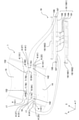
- FIG. 11 is an exploded perspective view of the connection portion 16 of the display device 1 shown in FIG. FIG. 11 shows, for example, a configuration in which the hinge member 19 includes a first connecting member 191 and a second connecting member 192, a connecting member 193, and a fastening member 194.
- the first connecting member 191 and the second connecting member 192 are plate-shaped members extending in one direction, specifically, along the Y direction.
- the first connecting member 191 has a protruding portion 195 protruding in the Z direction at one end.
- the second connecting member 192 has a protruding portion 196 protruding from the main surface in the Z direction at one end.
- a pair of bearing portions 197 are provided in the projecting portion 195 and the projecting portion 196 along the X direction.
- the third supports 17 and 18 and the first support 14 and the second support 15 are rotatably connected by the hinge member 19.
- a pair of rotating shafts 4 (first support shaft 141) of the first support 14 and a pair of rotating shafts 4 (second support shaft 25) of the third support 17 adjacent to the first support 14 are used.
- the pair of rotating shafts 4 (third support shaft 27) of the third support 17 adjacent to the second support 15 and the pair of rotating shafts 4 (fourth support shaft 151) of the second support 15 are connected to each other.
- Two hinge members 1903 are connected.
- a pair of rotating shafts 4 (other support shafts 41) and a third support provided on the third support 17 with respect to the pair of bearing portions 197 provided along the X direction.
- a pair of rotation shafts 4 (other support shafts 41) provided on the body 18 are inserted respectively.
- the hinge member 19 rotatably connects the third support 17 and the third support 18.
- the hinge member 19 is an integral hinge member 19 in which the first connecting member 191 and the second connecting member 192 are connected in the Y direction by the connecting member 193 and the fastening member 194.
- the third support 17 has a pair of first bearing portions
- the third support 18 has a pair of second bearing portions
- the protrusions 195 and 196. May be provided with a pair of bearing portions 197.
- the rotation shaft of another member is inserted into both the pair of first bearing portions, the pair of second bearing portions, and the pair of bearing portions 197.
- the first support 14 and the second support 15 can be rotatably connected by fitting the bearing portion and the rotating shaft.
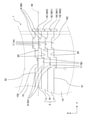
- FIG. 12 is a plan view of the connection portion 16 of the display device 1 shown in FIG. 9 as viewed from the side of the display panel 13 (the first main surface side of the third supports 17 and 18).
- FIG. 13 is a plan view of the display device 1 when the connection portion 16 of the display device 1 is viewed from the side opposite to the side of the display panel 13.
- the hinge member 19 extends in the Y direction along the bending line of the connecting portion 16.
- a gap 20 is provided between the third support 17 and the third support 18 to allow the third support 17 and the third support 18 to rotate with each other. Has been done. Further, a gap 20 is provided between the first support 14 and the third support 17 and between the second support 15 and the third support 17 to allow them to rotate with each other. Has been done.
- the first support The first side 51 facing the 14 has a first convex portion 6A protruding from the first side 51 and a concave portion 7A in which the first side 51 is cut out.
- the side on the side of the adjacent third support 17 is the recess 7B corresponding to the first convex portion 6A of the first side of the adjacent third support 17, and the adjacent third support 17 It has a convex portion 142 corresponding to the concave portion 7A of the first side 51 of the above.
- the second side facing the second support 15 in the third support 17 (the upper third support 17 in FIG.
- the 52 has a second convex portion 6B protruding from the second side 52 and a concave portion 7B in which the second side 52 is cut out.
- the side facing the adjacent third support 17 is the recess 7A corresponding to the second convex portion 6B of the second side 52 of the adjacent third support 17, and the adjacent third support. It has a convex portion 152 corresponding to the concave portion 7B of the second side 52 of the body 17.
- each of the two third supports 17 and the one third support two first convex portions 6A are provided on the side of the first support 14 side. There is. Further, in each of the two third supports 17 and the one third support 18, two second convex portions 6B are provided on the side of the second support 15 side. As can be seen from FIG. 12, in each of the two third supports 17 and the one third support 18, the two first convex portions 6A are on the side of the first support 14 and the side of the second support 15. It is provided at a position that does not face each other with the center line 50 of the side thereof interposed therebetween. The two second convex portions 6B are also provided at positions that do not face each other with the center line 50 interposed therebetween.
- the two first convex portions 6A are arranged at positions offset from each other along the center line 50 on a straight line along the X direction, and the two second convex portions 6B are arranged along the center line 50.
- the load applied to each support is dispersed in the Y direction and is locally large. It is possible to suppress the load.
- the hinge member 19 overlaps the third support 17 and the third support 18 in the X direction, and is a third support. Covers the gap 20 between 17 and the third support 18.
- the hinge member 19 covers the gap 20 between the third support 17 and the first support 14 and the gap 20 between the third support 17 and the second support 15. Therefore, as can be seen from FIG. 13, the gap 20 is covered with the hinge member 19 and is not visible. Thereby, it is possible to prevent the back side of the display panel 13 from being exposed at the connection portion 16.
- the third support 17 and the third support 18 each have a protrusion 11, the first support 14 has a protrusion 1411, and the second support 15 has a protrusion 1511.
- the hinge member 19 has a plurality of notches 19a, and the plurality of notches 19a are fitted into three protrusions 11, one protrusion 1411 and one protrusion 1511, respectively.
- FIG. 14 and 15 are plan views showing the display device 1 of the second embodiment of the present disclosure.
- FIG. 14 is a diagram showing a state in which the display device 1 is opened, and is a diagram in which the display panel 13 is not shown.
- FIG. 15 is a diagram showing a state in which the display device 1 is closed.
- FIG. 14 is a plan view of the display device 1 when the display device 1 shown in FIG. 9 is viewed from the Z direction
- FIG. 15 is a plan view of the display device 1 shown in FIG. 10 from the Z direction. It is a top view of the display device 1 when seen.
- the third support 17 corresponding to the hinge component 2 has a first convex portion 6A and a second convex portion 6B constituting the convex portion 6 shown in FIG. 1 described above.
- the third support 17 includes two first convex portions 6A and two second convex portions 6B in the vicinity of both ends of the third support 17 (see FIG. 1).
- the third support 18 corresponding to the hinge component 2 includes two first convex portions 6A and two second convex portions 6B (see FIG. 1).
- the two first convex portions 6A and the two second convex portions 6B both have a shape protruding in the width direction, that is, in the X direction in a plan view, but the planar shape is not limited to this.
- the convex portions 6 (6A, 6B) protrude in the X direction (see FIG. 1).
- concave portions 7 (7A, 7B) are formed at positions facing the convex portions 6 (6A, 6B) in the X direction (see FIG. 1). More specifically, a plurality of protrusions 6 (on each side of the two third supports 17 and one third support 18 on the side of the first support 14 and the side of the side of the second support 15). 6A, 6B) and a plurality of recesses 7 (7A, 7B) are provided.
- each of the two third supports 17 and one third support 18 the first convex portion 6A is provided on the side of the first support 14 side, and the two third supports 17 and 1 are provided.
- a recess 7A is provided on the side of the second support 15 side.
- the first convex portion 6A and the concave portion 7A are the sides on the first support side and the second support. It is provided at a position facing each other with the center line 50 of the side on the body side interposed therebetween.
- each of the two third supports 17 and the one third support 18 a recess 7B is provided on the side on the side of the first support 14, and a second convex is provided on the side on the side of the second support 15.
- a portion 6B is provided.
- the second convex portion 6B and the concave portion 7B are the sides on the first support side and the sides on the second support side. They are located opposite each other with the center line 50 of the side in between.
- the convex portion and the concave portion are located so as to face each other, so that when the first support 14, the second support 15, and the third support 17 are adjacent to each other, the convex portion fits in the concave portion. Do not interfere with each other. Therefore, the gap 20 between the supports can be reduced.
- the recesses 7A and 7B are the centers of the sides on the first support side and the sides on the second support side. They may be provided at positions that do not face each other across the line 50, that is, at positions that are offset from each other along the center line 50. According to this, there is a portion where the widths of the third support 17 and the third support 18 in the X direction are locally reduced due to the plurality of recesses being arranged in a line on a straight line along the X direction. It disappears. Therefore, the strength of the third support 17 and the third support 18 can be improved.
- the convex portions 6 (6A, 6B) protrude in the X direction (see FIG. 1).
- concave portions 7 (7A, 7B) are formed at positions facing the convex portions 6 (6A, 6B) in the X direction (see FIG. 1).
- a part of the convex portion 6 (6A, 6B) is fitted into the concave portion 7 of the adjacent third support 18, and a part of the convex portion 6 (6A, 6B) is a concave portion of the adjacent third support 17.
- Fits to 7 (7A, 7B) In other words, in two adjacent third supports 17 and one third support 18, the convex portions 6 (6A, 6B) on the sides where one third support 17 and the other third support 18 face each other. ) And the recesses 7 (7A, 7B) are fitted.
- the gap 20 between the third support 17 and the third support 18 is made as small as possible, and the first support 14 and the second support 15 of the display device 1 are combined with each other. Can be opened to a state that extends along the same virtual plane. This is because the facing surface 8a functions as a stopper portion, and this point will be described in detail later.
- the recess 7 is provided at a position facing the convex portion 6 (6A, 6B) of the third support 17, and the third support is provided.
- a convex portion is provided at a position facing the concave portion 7 of the body 17.
- connection portion may include only one third support.
- the first support and the second support are adjacent to one third support.
- the side facing the first support is the first side
- the side facing the second support is the second side.
- the first convex portion provided on the first side of the third support and the second convex portion provided on the second side of the third support sandwich the center line between the first side and the second side. It is provided at a position that does not face each other, that is, a position that is offset along the center line.
- the recess provided on the first side of the third support and the recess provided on the second side of the third support are the first side. It is provided at a position that does not face each other with the center line of the second side and the second side, that is, at a position displaced along the center line.
- the first convex portion provided on the first side of the third support and the concave portion provided on the second side of the third support are the first. They are located opposite each other with the center line of the first side and the second side in between.
- the second convex portion provided on the second side of the third support and the concave portion provided on the first side of the third support face each other with the center line of the first side and the second side interposed therebetween. In position.
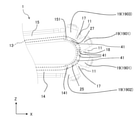
- FIG. 16 is a side view of the display device 1 when the connection portion 16 of the display device 1 shown in FIG. 14 is viewed along the Y direction.
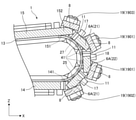
- FIG. 17 is a side view of the display device 1 when the connection portion 16 of the display device 1 shown in FIG. 15 is viewed along the Y direction.
- the display panel 13 is transparent and is shown by a dotted line.
- the first support shaft 141, the second support shaft 25, the third support shaft 27, and the fourth support shaft are viewed along the Y direction.
- 151 has the same height as the display panel 13.
- the plurality of other support shafts 41 are at the same height as the display panel 13 when viewed along the Y direction.
- the display panel 13 has a second support shaft 25 and a third support shaft 27 constituting the pair of rotation shafts 4 shown in FIG. 2 above.
- the other support shaft 41 and the first support shaft 141 and the fourth support shaft 151 are provided so as to cross the space on the extension line in the Y direction.
- the display panel 13 when the first support 14 and the second support 15 of the display device 1 are closed, the display panel 13 can be prevented from being pulled or compressed in the in-plane direction. As a result, the load applied to the display panel 13 can be reduced.
- the first support shaft 141 allows the first hinge member 1902 and the end of the first support 14 to rotate relative to each other, and the first hinge member 1902 and the first support 14 to rotate relative to each other. It is connected to.
- the second support shaft 25 connects the first hinge member 1902 and the third support 17 to the first hinge member 1902 and the third support 17 so as to be relatively rotatable.
- the third support shaft 27 connects the second hinge member 1903 and the third support 17 to the second hinge member 1903 and the third support 17 so as to be relatively rotatable.
- the fourth support shaft 151 connects the second hinge member 1903 and the end portion of the second support 15 with the second hinge member 1903 and the second support 15 so as to be relatively rotatable.
- a third support having a plurality of connecting portions, at least one third hinge member connecting two adjacent third supports among the plurality of third supports, and a third support and a third hinge member. It has a plurality of other hinges, which are connected so as to be relatively rotatable.
- the connecting portion 16 has two third supports 17 and a third support 18 sandwiched between them, and two third hinge members 1901.
- the two third supports 17 and the third support 18 are connected to each other by a plurality of other support shafts 41 so as to be relatively rotatable.
- the display panel 13 may be provided so as to cross the space on the extension line in the Y direction of the pair of first bearing portions and the pair of second bearing portions.
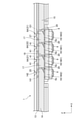
- FIG. 18 is a sectional view taken along line XVIII-XVIII of FIG.
- FIG. 19 is a cross-sectional view taken along the line XIX-XIX of FIG.
- the positions of the second support shaft 25, the third support shaft 27, the first support shaft 141, and the fourth support shaft 151 on the extension line in the Y direction are shown by dotted lines.
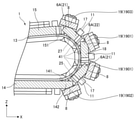
- a plurality of hinge members 19, for example, four hinge members 19, cover the four gaps 20, the first support 14, the two third supports 17, and the third support. It faces any two of 18 and the second support 15 in the Z direction.
- the inner surfaces of the four hinge members 19 face each other on the facing surface 8a of the third support 17 (left side in FIG. 18), the facing surface 8a of the third support 18, and the third support 17, respectively. It faces the surface 8a (right side in FIG. 18).
- the two first convex portions 6A and the two second convex portions 6B each function as four first stopper portions 21 from another viewpoint. The detailed operation of the first stopper portion 21 will be described later.
- a facing surface 8a and a tapered surface 8 are formed on the second main surface thereof, respectively.
- the facing surface 8a and the tapered surface 8 of the two first convex portions 6A and the facing surface 8a and the tapered surface 8 of the two second convex portions 6B are four second stopper portions, respectively. Functions as 22. The detailed operation of the second stopper portion 22 will be described later.
- the size of the portion of the first convex portion 6A and the second convex portion 6B that protrudes in the X direction can be arbitrarily set.
- the recess 7 is located at a position facing the convex portion 6 (6A, 6B) as the first stopper portion 21 of the third support 17.
- a convex portion as the first door stopper portion 142 and a convex portion as the second door stopper portion 152 are provided at positions facing the concave portion 7 of the third support 17, respectively.
- the convex portion as the first door stopper portion 142 and the convex portion as the second door stopper portion 152 have a facing surface 8a and a tapered surface on the second main surface. 8 are formed respectively.
- the first support 14 and the second support 15 are opened at 180 degrees
- the first support 14, the two third supports 17, the third support 18, and the third support 2 Supports 15 are arranged in a straight line along the X direction.
- the protrusion 11 is in contact with the inner surface of the notch 19a of the hinge member 19 (see FIG. 23).
- the inner surfaces of the four hinge members 19 face each other on the facing surface 8a of the third support 17 (left side in FIG. 18), the facing surface 8a of the third support 18, and the third support 17, respectively. It is in contact with the surface 8a (right side in FIG. 18).
- the protrusion 11 is provided on the second main surface of the third support 17 and the third support 18. With the display panel 13 open, the protrusion 11 on the second main surface abuts on the side end surface of the first hinge member 1902 or the second hinge member 1903. As a result, the relative movements of the third support 17 and the first hinge member 1902 and the second hinge member 1903 and the third support 18, respectively, are suppressed.
- FIG. 19 shows a state in which the display device 1 is closed by bending the connection portion 16.
- the convex portions 6 (6A, 6B) of the third support 17 come into contact with the first hinge member 1902 or the second hinge member 1903.
- the change in the relative positional relationship between the third support 17 (upper third support 17 in FIG. 19) and the third support 18 and the two third hinge members 1901 is stopped.
- a part of the contact surface of the convex portion 6 (6A, 6B) of the third support 17 with the first hinge member 1902 or the second hinge member 1903 has a tapered shape. May be good.
- the tapered surface 8 of the above abuts on the inner surface of each of the two third hinge members 1901.
- the change in the relative positional relationship between the third support 17 (the upper third support 17 in FIG. 19) and the third support 18 and the two third hinge members 1901 is the tapered surface 8 and the third. 1 Stops in a state where the inner side surface of the hinge member 1902 or the second hinge member 1903 is in contact with each other.
- the first stopper portion 21 limits the change in the relative positional relationship between the third support 17 and the third hinge member 1901. do. Further, the second stopper portion 22 limits the change in the relative positional relationship between the third support 18 and the third hinge member 1901.
- the tapered surface 8 of the first stopper portion 21 of the third support 17 (lower third support 17 in FIG. 19) abuts on the inner surface of the first hinge member 1902.
- the tapered surface 8 of the second door stopper portion 152 of the second support 15 comes into contact with the inner surface surface of the second hinge member 1903.
- the change in the relative positional relationship between the second support 15 and the third support 17 (upper third support 17 in FIG. 19) and the second hinge member 1903 is stopped.
- connection portion 16 This makes it possible to prevent the display panel 13 in the vicinity of the connection portion 16 from being bent at an acute angle. Further, the bending radius of the connecting portion 16 can be adjusted by the inclination angle of the tapered surface 8 to reduce the load applied to the display panel 13.
- the inclination angle of the tapered surface 8 is adjusted according to the number and dimensions of the hinge components 2 included in the connecting portion 16, and the dimensions, thickness, flexibility, and the like of the display panel 13.
- the tapered surface 8 may not be provided as long as the load applied to the bent display panel 13 is acceptable.
- the third support 17 or the third support 18 includes a facing surface 8a facing the hinge member 19 (third hinge member 1901, first hinge member 1902, second hinge member 1903). That is, the facing surface 8a is included in the second main surface of the third support 17 or the third support 18.
- the plate-shaped portion 3 (third support 17 or third support 18) includes a tapered surface 8 inclined with respect to the facing surface 8a.
- the second main surface of the plate-shaped portion 3 includes a facing surface 8a and a tapered surface 8.
- the tapered surface 8 is formed on the inner surface of the hinge member 19 (third hinge member 1901, first hinge member 1902, second hinge member 1903) when the first support 14 and the second support 15 are closed. It abuts on a first main surface.
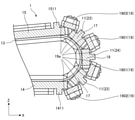
- FIG. 20 is a sectional view taken along line XX-XX of FIG. 21 is a cross-sectional view taken along the line XXI-XXI of FIG. 20 and 21 show a state in which the tapered surfaces 8 of the first stopper portion 21 and the second stopper portion 22 project in the opposite directions to those of FIGS. 18 and 19. Also in FIGS. 20 and 21, the positions of the second support shaft 25, the third support shaft 27, the first support shaft 141, and the fourth support shaft 151 on the extension line in the Y direction are shown by dotted lines.
- a plurality of hinge members 19, for example, four hinge members 19, cover the four gaps 20, the first support 14, the two third supports 17, and the third support. It faces any two of 18 and the second support 15 in the Z direction.
- the inner surfaces of the four hinge members 19 face each other on the facing surface 8a of the third support 17 (left side in FIG. 20), the facing surface 8a of the third support 18, and the third support 17, respectively. It faces the surface 8a (right side in FIG. 20).
- the first support 14 and the second support 15 are opened, the first support 14, the two third supports 17, the third support 18, and the second support 15 are arranged in a straight line along the X direction. That is, the display panel 13 is opened 180 degrees.
- the protrusion 11 is in contact with the inner surface of the notch 19a of the hinge member 19 (see FIG. 23).
- the inner surfaces of the four hinge members 19 face each other on the facing surface 8a of the third support 17 (left side in FIG. 20), the facing surface 8a of the third support 18, and the third support 17, respectively. It is in contact with the surface 8a (right side in FIG. 20).
- FIG. 21 shows a state in which the display device 1 is closed by bending the connection portion 16.
- the tapered surface 8 of the first stopper portion 21 of the third support 17 (lower third support 17 in FIG. 21) and the second stopper portion 22 of the third support 18 is formed.
- Each abuts on the inscribed surface of the two third hinge members 1901.
- the tapered surface 8 of the first stopper portion 21 of the third support 17 comes into contact with the second main surface which is the inner surface of the second hinge member 1903.
- the change in the relative positional relationship between the third support 17 (the upper third support 17 in FIG. 21) and the second hinge member 1903 is stopped.
- the tapered surface 8 of the first door stopper portion 142 of the first support 14 abuts on the second main surface which is the inner surface of the first hinge member 1902.
- the bending radius of the connecting portion 16 can be adjusted by the inclination angle of the tapered surface 8 to reduce the load applied to the display panel 13.
- the first stopper portion 21 of the third support 17 and the second stopper portion 22 of the third support 18 are the first convex portion 6A and the second convex portion 6B, respectively, as described above. Further, as shown in FIG. 14, a plurality of first convex portions 6A and a plurality of second convex portions 6B are arranged in the hinge component 2 with a predetermined distance in the Y direction. Therefore, as shown in FIGS. 19 and 21, the plurality of stopper portions are provided at a distance along the direction in which the folding curve extends, so that the individual stopper portions are provided when the display device 1 is closed. The load applied to is distributed. Therefore, the durability of the connection portion 16 can be improved.
- FIG. 22 is a sectional view taken along line XXII-XXII of FIG.
- FIG. 23 is a sectional view taken along line XXIII-XXIII of FIG.
- the third support 17 has a third stopper portion 23 extending so as to be inserted between the hinge members 19 in the Z direction, which is the thickness direction.
- the third support 18 has a fourth stopper portion 24 extending so as to be inserted between the hinge members 19 in the Z direction, which is the thickness direction.
- Both the third stopper portion 23 and the fourth stopper portion 24 are protrusions 11 of the hinge component 2.
- the protrusion 11 of the third support 17, which is the third stopper portion 23, is also referred to as the first protrusion 11
- the protrusion 11 of the third support 18, which is the fourth stopper portion 24, is the first. Also called 2 protrusions 11.
- the protrusion 1411 of the first support 14 and the protrusion 1511 of the second support 15 have the same shape as the protrusion 11 of the plate-shaped portion 3, respectively.
- the first protrusion 11 projects outward from the surface on the back side of the surface of the third support 17 facing the display panel 13.
- the second protrusion 11 projects outward from the surface on the back side of the surface of the third support 18 facing the display panel 13.
- the two first protrusions 11 as the third stopper portion 23 and the second protrusion 11 as the fourth stopper portion 24 are in the hinge member 19 and the X direction. Contact.
- the first stopper portion 23 is the first.
- the protrusion 11 and the second protrusion 11 as the fourth stopper portion 24 are fitted into the notch 19a of the hinge member 19, respectively. Thereby, the third support 17, the third support 18, and the hinge member 19 are maintained in the state shown in FIG.
- the notch 19a fitted to the first protrusion 11 is also referred to as a first notch 19a
- the notch 19a fitted to the second protrusion 11 is also referred to as a second notch 19a.
- the third stopper portion 23 limits the change in the relative positional relationship between the third support 17 and the hinge member 19 when the first support 14 and the second support 15 are opened.
- the fourth stopper portion 24 limits the change in the relative positional relationship between the third support 18 and the hinge member 19 when the first support 14 and the second support 15 are opened.
- the first support 14 and the second support 15 of the display device 1 when the first support 14 and the second support 15 of the display device 1 are opened, the first support 14 and the second support 15 are in a state along the virtual plane. Become. At this time, the protrusion 1411 of the first support 14 and the protrusion 1511 of the second support 15 abut on the hinge member 19 in the X direction. In other words, when the first support 14 and the second support 15 of the display device 1 are opened, when the connection portion 16 is in a state along the virtual plane, the protrusions 1411 and the first of the first support 14 2 The protrusions 1511 of the support 15 are fitted into the notches 19a of the hinge member 19, respectively. Thereby, as shown in FIG. 22, the first support 14, the second support 15, and the hinge member 19 are maintained along the virtual plane.
- the protrusion 1411 of the first support 14 has a relative positional relationship between the first support 14 and the hinge member 19 (1902) when the first support 14 and the second support 15 are opened.
- the protrusion 1511 of the second support 15 changes the relative positional relationship between the second support 15 and the hinge member 19 (1903) when the first support 14 and the second support 15 are opened. Restrict. This prevents the display panel 13 from being bent at an acute angle near the connection portion 16.
- FIG. 23 shows a state in which the display device 1 is closed by bending the connection portion 16.
- the first protrusion 11, the second protrusion 11, the protrusion 1411 and the protrusion 1511 are separated from the hinge member 19. ..
- the connecting portion 16 is in a bent state
- the first protrusion 11, the second protrusion 11, and the protrusion 1411 The fitting of the protrusion 1511 and the plurality of notches 9a of the hinge member 19 is released.
- FIG. 24 and 25 are perspective views showing the display device 1 of the third embodiment of the present disclosure.
- FIG. 24 shows a state in which the display device 1 is open
- FIG. 25 shows a state in which the display device 1 is closed.
- FIG. 26 is a sectional view taken along line XXVI-XXVI of FIG. 24.
- 27 is a sectional view taken along line XXVII-XXVII of FIG. 25.
- the hinge component 2 and the display device 1 of the present embodiment are different from the hinge component 2 of the first embodiment and the display device 1 of the second embodiment in the following points.
- the display device 1 includes a leaf spring 29 provided so as to face each of the first support 14 and the second support 15.
- the leaf spring 29 is provided so as to cross the direction in which the connecting portion 16 extends in a plan view.
- the portions of the leaf spring 29 in the vicinity of both ends in the X direction face the first support 14 and the second support 15 on the opposite side of the display panel 13.
- the leaf spring 29 has a third along the inner side surface of the hinge member 19 on the first main surface side and the second main surface of the third support 17 and the third support 18. It extends from a position near the support 17 through a position near the hinge member 19 to a position near the third support 18.
- a leaf spring 29 is located between the second main surface of the third support 17 and the third support 18 and the inner surface of the first hinge member 1902 or the inner surface of the second hinge member 1903. Is provided.
- the leaf spring 29 penetrates the connecting portion 16 by avoiding the protrusions and recesses on the first side of the third support 17 and the second side of the third support 18, and the first support 14 and the second support It is slidably connected to the support 15.
- the leaf spring 29 avoids the protrusions and recesses and does not interfere with their function as a stopper.
- the first support 14 includes a first pocket portion 31 having a first opening 32
- the second support 15 has a second opening 34 facing the first opening 32.
- the leaf spring 29 is inserted into each of the first pocket portion 31 and the second pocket portion 33.
- the leaf spring 29 is not fixed at any of the positions of the first pocket portion 31 and the second pocket portion 33, and can slide in the first pocket portion 31 and the second pocket portion 33.
- the leaf spring 29 resists the bending moment, that is, the force that closes the first support 14 and the second support 15, when the bending moment caused by the bending of the connecting portion 16 is applied. At this time, the restoring force of the leaf spring 29 generates a force to open the first support 14 and the second support 15 of the display device 1.
- hooks that can lock each other may be provided at the tips of the first support 14 and the second support 15 on the opposite side of the connection portion 16. According to this, the hook functions to keep the display device 1 closed.
- the display device 1 is automatically opened by the restoring force of the leaf spring 29 without any external force. Further, the leaf spring 29 can hold the angle between the first support 14 and the second support 15 of the display device 1 at 180 degrees.
- both ends of the leaf spring 29 in the X direction can freely slide along the X direction in the first pocket portion 31 and the second pocket portion 33.
- the leaf spring 29 is bent into a shape that follows the bent shape of the connecting portion 16.
Landscapes
- Engineering & Computer Science (AREA)
- Computer Hardware Design (AREA)
- Theoretical Computer Science (AREA)
- General Engineering & Computer Science (AREA)
- Physics & Mathematics (AREA)
- General Physics & Mathematics (AREA)
- Human Computer Interaction (AREA)
- Microelectronics & Electronic Packaging (AREA)
- Mechanical Engineering (AREA)
- Devices For Indicating Variable Information By Combining Individual Elements (AREA)
- Signal Processing (AREA)
- Pivots And Pivotal Connections (AREA)
- Telephone Set Structure (AREA)
Priority Applications (3)
| Application Number | Priority Date | Filing Date | Title |
|---|---|---|---|
| US18/014,435 US12158780B2 (en) | 2020-07-30 | 2020-07-30 | Hinge constituent component and display device |
| JP2022539890A JP7498781B2 (ja) | 2020-07-30 | 2020-07-30 | 蝶番構成部品および表示装置 |
| PCT/JP2020/029175 WO2022024285A1 (ja) | 2020-07-30 | 2020-07-30 | 蝶番構成部品および表示装置 |
Applications Claiming Priority (1)
| Application Number | Priority Date | Filing Date | Title |
|---|---|---|---|
| PCT/JP2020/029175 WO2022024285A1 (ja) | 2020-07-30 | 2020-07-30 | 蝶番構成部品および表示装置 |
Publications (1)
| Publication Number | Publication Date |
|---|---|
| WO2022024285A1 true WO2022024285A1 (ja) | 2022-02-03 |
Family
ID=80037817
Family Applications (1)
| Application Number | Title | Priority Date | Filing Date |
|---|---|---|---|
| PCT/JP2020/029175 Ceased WO2022024285A1 (ja) | 2020-07-30 | 2020-07-30 | 蝶番構成部品および表示装置 |
Country Status (3)
| Country | Link |
|---|---|
| US (1) | US12158780B2 (https=) |
| JP (1) | JP7498781B2 (https=) |
| WO (1) | WO2022024285A1 (https=) |
Citations (4)
| Publication number | Priority date | Publication date | Assignee | Title |
|---|---|---|---|---|
| JP2007198416A (ja) * | 2006-01-24 | 2007-08-09 | Strawberry Corporation | ヒンジ装置並びにヒンジ装置を用いた電子機器 |
| US9348450B1 (en) * | 2014-12-31 | 2016-05-24 | Lg Display Co., Ltd. | Foldable display apparatus |
| JP2017203524A (ja) * | 2016-05-12 | 2017-11-16 | 株式会社ナチュラレーザ・ワン | 3軸ヒンジ並びにこの3軸ヒンジを用いた電子機器 |
| JP2018035904A (ja) * | 2016-09-01 | 2018-03-08 | 株式会社ナチュラレーザ・ワン | 多軸ヒンジ並びにこの多軸ヒンジを用いた電子機器 |
Family Cites Families (4)
| Publication number | Priority date | Publication date | Assignee | Title |
|---|---|---|---|---|
| WO2015163272A1 (ja) | 2014-04-24 | 2015-10-29 | シャープ株式会社 | 表示装置 |
| CN108999882A (zh) * | 2018-10-10 | 2018-12-14 | 东莞市劲丰电子有限公司 | 一种柔性屏应用的同轴190度外折转动机构 |
| US11337321B2 (en) * | 2019-02-28 | 2022-05-17 | Guangdong Oppo Mobile Telecommunications Corp., Ltd. | Foldable terminal |
| US11044825B1 (en) * | 2019-12-18 | 2021-06-22 | Wuhan China Star Optoelectronics Semiconductor Display Technology Co., Ltd. | Foldable display device |
-
2020
- 2020-07-30 US US18/014,435 patent/US12158780B2/en active Active
- 2020-07-30 JP JP2022539890A patent/JP7498781B2/ja active Active
- 2020-07-30 WO PCT/JP2020/029175 patent/WO2022024285A1/ja not_active Ceased
Patent Citations (4)
| Publication number | Priority date | Publication date | Assignee | Title |
|---|---|---|---|---|
| JP2007198416A (ja) * | 2006-01-24 | 2007-08-09 | Strawberry Corporation | ヒンジ装置並びにヒンジ装置を用いた電子機器 |
| US9348450B1 (en) * | 2014-12-31 | 2016-05-24 | Lg Display Co., Ltd. | Foldable display apparatus |
| JP2017203524A (ja) * | 2016-05-12 | 2017-11-16 | 株式会社ナチュラレーザ・ワン | 3軸ヒンジ並びにこの3軸ヒンジを用いた電子機器 |
| JP2018035904A (ja) * | 2016-09-01 | 2018-03-08 | 株式会社ナチュラレーザ・ワン | 多軸ヒンジ並びにこの多軸ヒンジを用いた電子機器 |
Also Published As
| Publication number | Publication date |
|---|---|
| US20230254988A1 (en) | 2023-08-10 |
| US12158780B2 (en) | 2024-12-03 |
| JP7498781B2 (ja) | 2024-06-12 |
| JPWO2022024285A1 (https=) | 2022-02-03 |
Similar Documents
| Publication | Publication Date | Title |
|---|---|---|
| US11516932B2 (en) | Foldable display device | |
| US20200033917A1 (en) | Hinged device | |
| EP3607413B1 (en) | Hinged device | |
| KR102794424B1 (ko) | 힌지 구조물 및 이를 포함하는 폴더블 전자 장치 | |
| CN107632662B (zh) | 便携式信息设备 | |
| KR102716181B1 (ko) | 표시 장치 | |
| JP2019067279A (ja) | 携帯用情報機器 | |
| US10641318B2 (en) | Hinged device | |
| KR102370015B1 (ko) | 표시 장치 | |
| JP6255113B2 (ja) | 表示装置 | |
| US9857831B2 (en) | Flexible hinges for computing devices | |
| JP2018112835A (ja) | 携帯用情報機器 | |
| EP2581613A1 (en) | Hinge device | |
| CN112748764A (zh) | 便携用信息设备及其制造方法 | |
| KR20220035623A (ko) | 링크 힌지 구조 및 이를 포함하는 전자 장치 | |
| US20230240029A1 (en) | Foldable display device and supporting assembly thereof | |
| JP7268853B2 (ja) | フレキシブルディスプレイ用ヒンジ機構 | |
| JP6532972B2 (ja) | 携帯用情報機器 | |
| US20080038050A1 (en) | Rotary mechanisms | |
| WO2022024285A1 (ja) | 蝶番構成部品および表示装置 | |
| JP6945696B1 (ja) | 携帯用情報機器及びカバー装置 | |
| JP7293436B1 (ja) | 電子機器 | |
| JP6928153B2 (ja) | 携帯用情報機器 | |
| JP2024179258A (ja) | 電子機器 | |
| CN116486698B (zh) | 折叠式显示装置及其支撑组件 |
Legal Events
| Date | Code | Title | Description |
|---|---|---|---|
| 121 | Ep: the epo has been informed by wipo that ep was designated in this application |
Ref document number: 20947235 Country of ref document: EP Kind code of ref document: A1 |
|
| ENP | Entry into the national phase |
Ref document number: 2022539890 Country of ref document: JP Kind code of ref document: A |
|
| NENP | Non-entry into the national phase |
Ref country code: DE |
|
| 122 | Ep: pct application non-entry in european phase |
Ref document number: 20947235 Country of ref document: EP Kind code of ref document: A1 |