WO2022019306A1 - ブタ肺胞マクロファージ不死化培養細胞株、ブタ肺胞マクロファージ不死化培養細胞株の製造方法、ブタ肺胞マクロファージ不死化培養細胞株の調製用試薬及びワクチンの製造方法 - Google Patents
ブタ肺胞マクロファージ不死化培養細胞株、ブタ肺胞マクロファージ不死化培養細胞株の製造方法、ブタ肺胞マクロファージ不死化培養細胞株の調製用試薬及びワクチンの製造方法 Download PDFInfo
- Publication number
- WO2022019306A1 WO2022019306A1 PCT/JP2021/027164 JP2021027164W WO2022019306A1 WO 2022019306 A1 WO2022019306 A1 WO 2022019306A1 JP 2021027164 W JP2021027164 W JP 2021027164W WO 2022019306 A1 WO2022019306 A1 WO 2022019306A1
- Authority
- WO
- WIPO (PCT)
- Prior art keywords
- cell line
- immortalized
- cultured
- alveolar macrophage
- pam
- Prior art date
- Legal status (The legal status is an assumption and is not a legal conclusion. Google has not performed a legal analysis and makes no representation as to the accuracy of the status listed.)
- Ceased
Links
Images





Classifications
-
- C—CHEMISTRY; METALLURGY
- C07—ORGANIC CHEMISTRY
- C07K—PEPTIDES
- C07K14/00—Peptides having more than 20 amino acids; Gastrins; Somatostatins; Melanotropins; Derivatives thereof
- C07K14/005—Peptides having more than 20 amino acids; Gastrins; Somatostatins; Melanotropins; Derivatives thereof from viruses
- C07K14/01—DNA viruses
- C07K14/025—Papovaviridae, e.g. papillomavirus, polyomavirus, SV40, BK virus, JC virus
-
- C—CHEMISTRY; METALLURGY
- C12—BIOCHEMISTRY; BEER; SPIRITS; WINE; VINEGAR; MICROBIOLOGY; ENZYMOLOGY; MUTATION OR GENETIC ENGINEERING
- C12N—MICROORGANISMS OR ENZYMES; COMPOSITIONS THEREOF; PROPAGATING, PRESERVING, OR MAINTAINING MICROORGANISMS; MUTATION OR GENETIC ENGINEERING; CULTURE MEDIA
- C12N5/00—Undifferentiated human, animal or plant cells, e.g. cell lines; Tissues; Cultivation or maintenance thereof; Culture media therefor
- C12N5/0006—Modification of the membrane of cells, e.g. cell decoration
-
- C—CHEMISTRY; METALLURGY
- C12—BIOCHEMISTRY; BEER; SPIRITS; WINE; VINEGAR; MICROBIOLOGY; ENZYMOLOGY; MUTATION OR GENETIC ENGINEERING
- C12N—MICROORGANISMS OR ENZYMES; COMPOSITIONS THEREOF; PROPAGATING, PRESERVING, OR MAINTAINING MICROORGANISMS; MUTATION OR GENETIC ENGINEERING; CULTURE MEDIA
- C12N5/00—Undifferentiated human, animal or plant cells, e.g. cell lines; Tissues; Cultivation or maintenance thereof; Culture media therefor
- C12N5/06—Animal cells or tissues; Human cells or tissues
-
- C—CHEMISTRY; METALLURGY
- C12—BIOCHEMISTRY; BEER; SPIRITS; WINE; VINEGAR; MICROBIOLOGY; ENZYMOLOGY; MUTATION OR GENETIC ENGINEERING
- C12N—MICROORGANISMS OR ENZYMES; COMPOSITIONS THEREOF; PROPAGATING, PRESERVING, OR MAINTAINING MICROORGANISMS; MUTATION OR GENETIC ENGINEERING; CULTURE MEDIA
- C12N5/00—Undifferentiated human, animal or plant cells, e.g. cell lines; Tissues; Cultivation or maintenance thereof; Culture media therefor
- C12N5/10—Cells modified by introduction of foreign genetic material
Definitions
- the present invention relates to a method for producing a porcine alveolar macrophage immortalized cell line, a method for producing a porcine alveolar macrophage immortalized cell line, and a method for producing a reagent and a vaccine for preparing a porcine alveolar macrophage immortalized cell line.
- PRRS Porcine reproducive and respiratory syndrome
- PRRS Porcine reproducive and respiratory syndrome
- ASF African swine fever
- ASVV African swine fever virus
- Pig breeding / respiratory disorder syndrome virus (porcine reproducive and respiratory syndrome virus, hereinafter referred to as "PRRSV") that causes PPRS and ASFV are used to inject pig serum or organ emulsion into predetermined cells to indicate the cytopathic effect. Can be detected and separated.
- PRRSV respiratory disorder syndrome virus
- the cells used for virus isolation by cultured cells are porcine alveolar macrophages (PAM), which are highly sensitive to PRRSV and the like. Since PAM is usually obtained by lung lavage of 6-12 week old piglets, it requires a great deal of labor to prepare and involves the sacrifice of piglets. In addition, since PAM is a primary cultured cell, it has poor division and proliferation ability, and subculture is extremely difficult.
- PAM porcine alveolar macrophages
- MA104 cells are also used to isolate the virus.
- MA104 is a cell line derived from the monkey kidney.
- MA104 has the advantage of being easy to prepare due to its high proliferative capacity.
- MA104 is derived from a monkey that is not a host such as PRRSV, its sensitivity to PRRSV and the like is low. Although susceptibility can be increased by adapting PRRSV to MA104, MA104 is not suitable for the isolation of new wild strains such as PRRSV.
- Non-Patent Document 1 discloses a PAM in which the SV40 large T antigen (SV40T) gene, which is a cell carcinogenesis-inducing factor, has been introduced by a gene recombination technique.
- Patent Document 1 discloses a cell line in which the SV40T gene is introduced into PAM using a transposon and is sensitive to PRRSV.
- SV40T SV40 large T antigen
- Non-Patent Document 1 is not sensitive to PPRSV. Therefore, it cannot be used for separating PRRSV. Since the cell line disclosed in Patent Document 1 requires macrophage-colony stimulating factor (M-CSF) to increase, it is necessary to examine conditions such as the optimum concentration of M-CSF.
- M-CSF macrophage-colony stimulating factor
- the present invention has been made in view of the above circumstances, and is a method for producing a porcine alveolar macrophage immortalized cell line and a porcine alveolar macrophage immortalized cell line, which are highly sensitive to PRRSV and ASFV and are easy to prepare.
- the purpose is to provide.
- Another object of the present invention is to provide a reagent for preparing a porcine alveolar macrophage immortalized cell line, which is useful for preparing the porcine alveolar macrophage immortalized cell line.
- LTR Long Thermal Repeat
- a retroviral vector used when introducing the SV40T gene into a cell. Since it causes tumorigenesis, transposons are used to avoid the use of retroviral vectors.
- the inventor has conducted extensive research and found that a pig alveolar macrophage immortalized cultured cell line highly sensitive to PRRSV and ASFV can be established by using pig serum for culturing primary culture PAM even if a retroviral vector is used. Find out and complete the invention.
- the porcine alveolar macrophage immortalized cultured cell line according to the first aspect of the present invention is: Has a viral long-end repeat, Expresses a cell immortalization-inducing gene, Susceptible to at least one of the pig breeding and respiratory distress syndrome virus and the African swine fever virus.
- the cell immortalization-inducing gene is SV40 large T antigen gene, It may be that.
- the viral long-term repeat sequence A viral long-term repeat of the Moloney murine leukemia virus, It may be that.
- the method for producing an immortalized porcine alveolar macrophage cell line according to the second aspect of the present invention is A culture step in which primary cultured alveolar macrophages collected from pigs are cultured in a medium containing pig serum, and Introducing the cell immortalization-inducing gene into the cells cultured in the culture step, and including.
- the cell immortalization-inducing gene is SV40 large T antigen gene, It may be that.
- the cell immortalization-inducing gene is Introduced into the cells with viral long-term repeats, It may be that.
- the primary cultured alveolar macrophages are cultured for 10 to 24 hours. It may be that.
- the reagent for preparing an immortalized cell line of porcine alveolar macrophages according to the third aspect of the present invention is Contains porcine serum.
- the method for producing a vaccine according to the fourth aspect of the present invention is as follows.
- a porcine alveolar macrophage immortalized cultured cell line that is highly sensitive to PRRSV and ASFV and is easy to prepare can be obtained. Further, according to the present invention, there is provided a reagent for preparing a porcine alveolar macrophage immortalized cell line, which is useful for preparing the porcine alveolar macrophage immortalized cell line. Further, according to the present invention, there is provided a method for producing a vaccine using the porcine alveolar macrophage immortalized cultured cell line.
- (A) is a figure which shows the phagocytic ability of the PAM cultured cell line which concerns on Example.
- (B) is a figure which shows the fluorescence intensity of the PAM cultured cell line which concerns on an Example cultured at 4 degreeC and 37 degreeC. It is a figure which shows the fluorescence intensity of the PAM cultured cell line which concerns on an Example labeled via a CD163 molecule. It is a figure which shows the expression of SV40T in the immortalized PAM bulk cell cultured in the presence or absence of pig serum.
- the porcine alveolar macrophage immortalized cultured cell line (hereinafter, also simply referred to as “cell line”) according to the present embodiment is sensitive to at least one of PRRSV and ASFV.
- PRRSV and the like means “PRRSV or ASFV”.
- “Sensitive to PRRSV and the like” means that it can be a host cell infected with PPRSV and the like. Morphological changes (cytopathic effect) are observed in cultured cells infected with PRRSV or the like. The presence or absence of the cytopathic effect can be determined by observing cells exposed to PRRSV or the like with a microscope or the like. The susceptibility of the cell line to PRRSV and the like can be evaluated by a known method such as a plaque assay and a 50% tissue culture infection amount (TCID 50) based on the cytopathic effect.
- TCID 50 tissue culture infection amount
- the cell immortalization-inducing gene is integrated with the LTR in the genome of the cell line according to the present embodiment by transformation. As a result, the cell line is immortalized because it stably expresses the cell immortalization-inducing gene.
- the cell immortalization-inducing gene include SV40T gene, human telomerase reverse transcriptase (hTERT) gene, human papillomavirus (HPV) -E6 gene or E7 gene, Cdk-4 gene, Bmi-1 gene and the like. Be done.
- the cell immortalization-inducing gene may be a tumor suppressor gene, for example, siRNA or shRNA expression plasmid DNA that knocks down p53 and RB (retinoblastoma protein).
- the cell immortalization inducing gene is the SV40T gene.
- the method for producing a cell line includes a culture step and an introduction step.
- the primary culture PAM collected from pigs is cultured in a medium containing pig serum.
- the pig is a piglet.
- the age of the piglet is not particularly limited, but is, for example, 1 to 15 weeks, 1 to 10 weeks, 1 to 6 weeks, or 1 to 3 weeks.
- the pig is a 2 week old pig.
- PAM can be obtained from pigs via known methods such as lung lavage.
- the medium is not particularly limited as long as it is a medium in which PAM can be cultured.
- Pig serum may be collected from pigs or commercially available ones may be used.
- the concentration of porcine serum in the medium is, for example, 3-20%, 5-15% or 8-12%.
- the concentration of porcine serum in the medium is preferably 10%.
- the medium may contain fetal bovine serum, non-essential amino acids, buffer, sodium pyruvate, antibiotics and the like in addition to porcine serum.
- the culture conditions are appropriately set, and are, for example, 37 ° C. and 5% CO 2 conditions.
- the culture time of the primary culture PAM in the culture step is not particularly limited, and is, for example, 8 to 48 hours, 9 to 36 hours, or 10 to 24 hours.
- the cell immortalization-inducing gene is introduced into the PAM cultured in the culture step.
- the SV40T gene as a cell immortalization inducing gene is introduced into the PAM together with the LTR.
- the LTR is a retrovirus LTR that is a single-strand RNA virus.
- the LTR is a repeat sequence possessed by the retrovirus and contains an enhancer sequence, a promoter sequence, a transcription initiation sequence, a transcription terminator sequence, a polyadenylation signal and the like necessary for gene expression of the retrovirus.
- the LTR includes 5'LTR and 3'LTR.
- the LTR contains the U3, R and U5 regions involved in the transcription of viral genes, reverse transcription from the viral genome, and integration of double-stranded DNA synthesized through reverse transcription into host DNA.
- the U3 region has enhancer / promoter activity and is transcribed from the R region of the 5'LTR to the R region of the 3'LTR by RNA polymerase II of the host cell.
- the packaging signal sequence is known as the ⁇ sequence.
- the packaging signal sequence is a non-coding cis-acting sequence required for capsid formation of retroviral RNA strands and packaging into viral particles in the formation of viral particles.
- a retroviral vector is used for the transformation of the gene into PAM in the introduction step.
- the retrovirus vector may be a vector such as oncoretrovirus and lentivirus included in the retrovirus.
- the retroviral vector used for gene transfer has at least a 5'LTR, a packaging signal sequence, an SV40T gene and a 3'LTR in its genome. Gene products such as gag gene, pol gene and env gene may be supplied from packaging cells carrying these genes.
- the LTR and packaging signal sequence of the above retrovirus vector is not particularly limited as long as it is a sequence derived from a retrovirus and a gene can be introduced into PAM. These sequences may be of the same virus-derived sequence, but may be used in combination with different virus-derived sequences that can form virus particles and integrate into the genome of the cell when combined with appropriate packaging cells. You may.
- the "retrovirus-derived LTR” means that the sequence is a retrovirus LTR, a fragment of a retrovirus LTR, or a mutation introduced into the fragment, and the sequence is a retrovirus LTR. Includes being artificially designed and manufactured based on the sequence.
- the LTR and packaging signal sequence contained in the retrovirus vector according to the present embodiment include, for example, Moloney murine leukemia virus (MMLV), mouse embryonic stem cell virus (MESV), mouse stem cell virus (MSCV), which belong to onco-retrovirus. And may be a sequence derived from myeloid proliferative sarcoma virus (MPSV), splenic focal localization virus (SFFV) and the like.
- the LTR of the retroviral vector is preferably an LTR of MMLV or an LTR derived from MMLV.
- the LTR and the packaging signal sequence contained in the retrovirus vector according to the present embodiment are, for example, human immunodeficiency virus (HIV-1, HIV-2) belonging to lentivirus, monkey immunodeficiency virus (SIV), cat. It may be a sequence derived from the immunodeficiency virus (FIV), horse infectious anemia virus (EIAV), and goat arthritis encephalitis virus (CAEV).
- HIV-1 human immunodeficiency virus
- SIV monkey immunodeficiency virus
- FMV immunodeficiency virus
- EIAV horse infectious anemia virus
- CAEV goat arthritis encephalitis virus
- the LTR possessed by the retroviral vector according to the present embodiment may be an LTR having a mutated sequence.
- the U3 region of the 3'LTR or 5'LTR may be replaced with an enhancer sequence and a promoter sequence derived from a virus other than the virus from which the LTR sequence is derived.
- envelope genes of other viruses may be used to increase the efficiency of introduction into PAM (pseudotyping).
- PAM proteaseudotyping
- VSV-G G protein of vesicular stomatitis virus, which binds to phospholipids and the like expressed on the surface of most mammalian cells and mediates the intracellular invasion of viral vectors, is preferable.
- a retroviral vector packaging plasmid in which the SV40T gene is cloned and a vesicular inflammation virus G protein expression plasmid are introduced into the retroviral vector packaging cell.
- the cells into which the plasmid has been introduced are cultured, and the retroviral vector for expressing SV40T produced in the culture supernatant is collected.
- PAM is inoculated with a retroviral vector for expressing SV40T.
- a retroviral vector for expressing SV40T In the post-inoculation culture, cells that survive without dying appear.
- a cell line can be obtained by cloning the cell line from these cells by a known method.
- the cell line according to this embodiment is a monocyte lineage cell. Whether or not the cell is monocyte lineage can be confirmed by evaluating a known marker specific to the monocyte lineage cell. Markers for monocyte lineage cells include, for example, CD163, CD11b, CD68 and the like. In particular, CD163 is preferable as a marker for monocyte lineage cells because it serves as a receptor for PRRSV. Monocyte lineage cells can also be confirmed by NaF-inhibited non-specific esterase activity.
- the cell line according to this embodiment maintains the characteristics of macrophages.
- Characteristics of macrophages are, for example, phagocytic ability, nitric oxide production, cytokine production and the like.
- the characteristics of macrophages can be evaluated by a known method, a commercially available kit, or the like.
- the cell line according to this embodiment shows sensitivity equal to or higher than that of primary cultured PAM to various PRRSVs including field isolates. Therefore, the cell line is useful for the isolation and detection of PRRSV. In addition, the cell line can be used for monitoring the development of PRRS, diagnosing PRRS, and developing a vaccine for preventing PRRS.
- the cell line according to this embodiment is also sensitive to ASFV, as shown in Test Example 5 below. Therefore, the cell line is useful for the isolation and detection of ASFV. The cell line is also useful for monitoring the development of ASFV, diagnosing ASFV, and developing vaccines for preventing ASFV.
- the reagent for preparing a PAM immortalized cell line according to this embodiment contains porcine serum.
- Pig serum can be obtained from blood collected from pigs by a known method.
- porcine serum can be obtained as a supernatant obtained by allowing porcine blood to stand unmixed with an anticoagulant, agglutinating blood clots, and then centrifuging at gravitational acceleration without hemolysis.
- Pig serum may be purified using filter filtration or the like and sterilized by gamma ray irradiation or the like.
- the reagent for preparing a PAM immortalized cultured cell line is preferably provided as a reagent to be added to the medium.
- Reagents for preparing PAM immortalized cell lines may be provided as the above medium.
- the reagent for preparation may contain a medium, amino acids, non-essential amino acids, buffers, nutritional substances, antibiotics and the like in addition to pig serum.
- the reagent for preparing a PAM immortalized cultured cell line according to the present embodiment is suitable for preparing and culturing the PAM immortalized cultured cell line according to the first embodiment.
- the method for producing a vaccine according to the present embodiment includes an infection step, a proliferation step, and an acquisition step.
- the infection step the PAM immortalized cultured cell line according to the first embodiment is infected with PRRS or the like. Infection may be carried out by a known method, for example, PRRS or the like may be inoculated into a medium containing a PAM immortalized cultured cell line.
- PRRS and the like are propagated by culturing an infected PAM immortalized cultured cell line.
- the culture conditions of the PAM immortalized cultured cell line are appropriately set, for example, 5% CO 2 conditions at 37 ° C.
- the culture period is arbitrary, but is, for example, 1 to 10 days, 2 to 8 days, or 3 to 7 days.
- the propagated PRRS etc. are acquired.
- PRRS or the like may be separated from the PAM immortalized cultured cell line or the medium in which the PAM immortalized cultured cell line is cultured, and the separated PRRS or the like may be further purified and concentrated.
- the separation method such as PRRS include filtration of a medium, disruption of cells, and centrifugation, and may be concentrated using ammonium sulfate, a resin column, polyethylene glycol salting out, or the like.
- the obtained PRRS or the like may be used as a live vaccine, attenuated and used, or used as an inactivated vaccine. Further, as long as it has immunogenicity, a part of the obtained PRRS or the like, for example, a protein, a polypeptide, a sugar, a glycoprotein, a lipid, a nucleic acid or the like may be used as a vaccine.
- the attenuated virus is a virus whose toxicity is reduced compared to the virus before attenuation.
- Virus attenuation can be performed by known methods.
- the attenuated virus is, for example, propagated in the presence of a mutagen, adapted to cultured cells by continuous passage in vitro, propagated under conditions deviating from the natural growth environment such as high temperature conditions, and the like. Obtainable.
- the cultured cells used for acclimatization by continuous passage may be the above-mentioned PAM immortalized cultured cell line, but may be another cell, for example, MA104 or the like.
- an attenuated virus can also be obtained by deleting or recombining a specific gene of the virus by using genome editing, gene modification technology, or the like.
- Virus inactivation can be performed using a known method.
- the inactivating method include formaldehyde treatment, UV irradiation, X-ray irradiation, electron beam irradiation, gamma ray irradiation, alkylation treatment, ethylene-imine treatment, thimerosal treatment, ⁇ -propiolactone treatment and glutaraldehyde treatment.
- the vaccine according to this embodiment may contain a pharmacologically acceptable carrier.
- the carrier include stabilizers, excipients, preservatives, surfactants, chelating agents, binders and the like.
- the vaccine according to this embodiment may contain a pharmacologically acceptable medium. Examples of the medium include water, physiological saline, phosphate buffer, Tris-HCl buffer, and the like.
- the vaccine according to the present embodiment may be mixed with an immunostimulant (assistant) or may be used in combination with the immunostimulant.
- immunostimulant include inorganic substances such as aluminum gel adjuvant; microorganisms such as BCG, alumyldipeptide, alum, pertussis toxin and cholera toxin; or substances derived from microorganisms; surfactants such as saponin and deoxycholic acid.
- Activator Emulsion of oily substances such as mineral oil, vegetable oil and animal oil; Alum; Vitamin-E acetate lysate and the like.
- the form of the vaccine is not particularly limited, and may be, for example, a suspension form or a lyophilized form.
- the vaccine according to this embodiment can be administered by intramuscular injection, subcutaneous injection, or intranasal, intratracheal, oral, or intradermal administration.
- the vaccine is administered to animals that can be infected with PRRS and the like, and is particularly administered to 1-week-old, 3-week-old, 6-week-old, or 10-week-old pigs.
- the dose is adjusted accordingly.
- the number of doses of the vaccine is arbitrary, and the boost effect may be obtained by one or a plurality of doses.
- the SV40T gene was amplified by PCR (polymerase chain reaction) using cDNA synthesized from mRNA extracted from 293T cells derived from human kidney according to a conventional method.
- the base sequences of the forward primer and the reverse primer are shown in SEQ ID NOs: 1 and 2, respectively.
- the SV40T gene was cloned into the retroviral vector packaging plasmid pMXs (manufactured by Cell Biolab) to construct pMXs-SV40T.
- the composition and base sequence of pMXs-SV40T are shown in FIG. 1 and SEQ ID NO: 3, respectively.
- Retrovirus vector packaging cell Platinum using pMXs-SV40T and vesicular stomatitis virus G protein expression plasmid pCMV-VSV-G (manufactured by Cell Biolab) using plasmid transfer reagent TransIT-293 (manufactured by Mirus Bio). -Introduced to GP (manufactured by Cell Biolab).
- SV40T produced in the culture supernatant by culturing the cells into which the plasmid was introduced in a high glucose D-MEM medium (manufactured by Fujifilm Wako Pure Chemical Industries, Ltd.) containing 10% fetal bovine serum (manufactured by Capricone) and an antibiotic.
- the retroviral vector for expression was recovered.
- PAM immortalization and cloning Primary cultured PAMs collected from 2-week-old PRRSV-negative piglets are obtained from 10% bovine fetal serum (manufactured by Capricone), 10% pig serum (manufactured by Citiva), non-essential amino acids (manufactured by Nakaraitesk), and pyruvate. Resuspended in RPMI1640 medium (manufactured by Fujifilm Wako Junyaku Co., Ltd.) containing sodium (manufactured by Nakaraitesk), HEPES (manufactured by Nakaraitesk) and antibiotics, and seeded on a cell culture plate, and seeded at 37 ° C., 5% CO.
- the cells were cultured under two conditions. The next day, PAM was inoculated with a retroviral vector for expressing SV40T, and further culturing was continued. While many cells are dying, the surviving cell population is grouped into bulk cells, 12 clone cell lines are randomly cloned from the bulk cells, and 5 clones with a high growth rate are immortalized PAM cells. Selected as a stock.
- Test Example 1 Evaluation of PRRSV susceptibility
- PRRSV Zoetis vaccine strain
- vaccine strain Z in addition to the Zoetis vaccine strain (hereinafter referred to as “vaccine strain Z”), three PRRSV strains (Beringer Ingelheim vaccine strain (hereinafter referred to as “vaccine strain B”), The susceptibility to the field isolate PGL9 and the field isolate 156-K) was evaluated by the same method.
- untreated primary cultured PAM primary cultured PAM
- monkey kidney-derived MA104 cells used in the development of vaccine strain Z
- the susceptibility of 31 both manufactured by ATCC was evaluated by the same method.
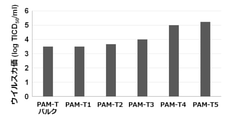
- FIG. 2 shows the virus titers of PAM-T1 to T5.
- FIG. 3 shows the virus titer of each virus in each cell.
- PAM-T4 and PAM-T5 showed sufficient susceptibility to both viruses.
- PAM-T4 and PAM-T5 showed the same sensitivity to the field isolates PGL9 and 156-K as the primary cultured PAM.
- PAM-T4 and PAM-T5 showed high susceptibility to vaccine strains Z, PGL-9 and 156-K.
- Vaccine strain B is a virus attenuated by MA104 and conditioned in monkey cells, and therefore exhibits high susceptibility to MA104. No virus infection was confirmed in the immortalized PAM cell lines 3D4 / 2, 3D4 / 21 and 3D4 / 31 disclosed in Non-Patent Document 1.
- Test Example 2 Evaluation of PRRSV proliferativeness A certain number of primary cultures PAM, MA104, PAM-T4 and PAM-T5 were inoculated with PRRSV vaccine strain Z, vaccine strain B, PGL9 and 156-K at a multiple infection degree of 0.01. Then, the culture supernatant was collected over time. Virus proliferation was assessed by determining virus titers in all collected culture supernatants by the TCID 50 assay described above using MA104 cells.
- FIG. 4 shows the time course of the virus titer of each virus for each cell.
- PAM-T4 and PAM-T5 showed a proliferative property equal to or higher than that of primPAM.
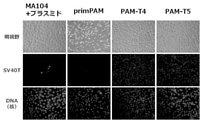
- Test Example 3 Analysis of basic cell line properties (confirmation of SV40T antigen expression) Primary culture PAM seeded on a cell culture plate, MA104 into which an SV40T expression plasmid had been introduced in advance, and PAM-T4 and PAM-T5 were fixed with Mildform 10N (manufactured by Fujifilm Wako Pure Chemical Industries, Ltd.) and 0.3% bovine serum. Membrane permeation was performed with Triton X-100 diluted 0.5% with an albumin-containing sterile phosphate buffered saline (PBS / BSA) solution.
- PBS / BSA albumin-containing sterile phosphate buffered saline
- esterase staining The non-specific esterase activity of PAM-T4 was evaluated using an esterase staining kit (manufactured by Muto Kagaku Co., Ltd.). Immortalized cell line PAM-T4 prepared as a smear using Cytospin 4 (Thermo Fisher Scientific), a cell collector and centrifuge, was fixed with the formalin-acetone buffered fixative included in the kit, and then with the ⁇ -NB reaction solution. After treatment, the presence or absence of brown granules was observed under a microscope. Then, the cells were treated with NaF, and the presence or absence of brown granules was observed again under a microscope.
- the phagocytic ability of PAM-T4 was measured by pH indicator pHrodo Green E. et al. Evaluation was made using the coli BioParticles Conjugate for Phagocytosis kit (manufactured by Thermo Fisher Scientific). After adding pHrodo BioParticles to the culture supernatant of PAM-T4 and PK-15 cells derived from porcine kidney seeded on a cell culture plate and culturing under 37 ° C. and 5% CO 2 conditions, the fluorescence signal was transmitted under a fluorescence microscope. Observed.
- the medium for PK-15 cells was E-MEM medium (manufactured by Fujifilm Wako Pure Chemical Industries, Ltd.) containing 10% fetal bovine serum (manufactured by Capricone) and antibiotics.
- PAM-T4 reacted with pHrodo BioParticles under the condition of 4 ° C. and PAM-T4 additionally cultured under the condition of 37 ° C. and 5% CO 2 after the reaction under the same conditions were added to 1% sodium azide and 0.5%, respectively.
- the cells were resuspended in a BSA-containing PBS solution (FACS buffer), and the fluorescence intensity of each cell was measured and analyzed using a BD FACS caliber (manufactured by BD Bioscience).
- PAM-T4 was resuspended in FACS buffer.
- the cells are reacted with an anti-porcine CD163 molecule mouse monoclonal antibody (clone 2A10 / 11, manufactured by Bio-Rad) or a mouse IgG1 isotype control antibody (clone MG1-45, manufactured by Bio-Legend) diluted 100-fold with FACS buffer.
- an anti-porcine CD163 molecule mouse monoclonal antibody clone 2A10 / 11, manufactured by Bio-Rad
- a mouse IgG1 isotype control antibody clone MG1-45, manufactured by Bio-Legend
- the CD163 molecule expressed on the cell surface was fluorescently labeled by reacting with an anti-mouse IgG1 phycoerythrin-labeled secondary antibody (clone RMG1-1, manufactured by BioLegend) diluted 1000-fold with FACS buffer.
- the fluorescence intensity of each labeled cell was measured and
- FIG. 7A shows an image taken with a fluorescence microscope in the evaluation of phagocytic ability.
- the signal of the fluorescent probe that emits light when phagocytosed was not confirmed in PK-15, but was confirmed in PAM-T4.
- FIG. 7B shows the fluorescence intensity measured for PAM-T4. An increase in fluorescence intensity was observed in PAM-T4 cultured at 37 ° C, as opposed to culture at 4 ° C, where many of the cells' physiological functions were attenuated. From these facts, it was shown that PAM-T4 has a clear phagocytic ability which is a characteristic of macrophages.
- FIG. 8 shows the fluorescence intensity of the labeled cells. It was shown that PAM-T4 stably expresses the CD163 molecule on the cell surface.
- the CD163 molecule is a surface marker of monocyte lineage cells and functions as a receptor for PRRSV. This also indicates that PAM-T4 is a monocyte lineage cell and has high sensitivity to PRRSV.
- Test Example 4 Immortalization with and without porcine serum Immortalization prepared in the same manner as the above-mentioned cell line establishment, except that the cells are cultured in a medium containing no porcine serum, except for the effect of PAM bulk cells on the expression of CD163 molecule.
- the bulk cells of PAM were cultured.
- the cells were seeded on a cell culture plate together with bulk cells of PAM immortalized in the presence of 10% bovine serum, fixed with Mildform 10N (manufactured by Fujifilm Wako Pure Chemical Industries, Ltd.), and diluted to 0.5% with PBS / BSA solution.
- Membrane permeation treatment was performed using Triton X-100.
- Test Example 5 Evaluation of ASFV susceptibility
- a 10-fold serial dilution series of stock solution of ASFV wild strain was prepared, inoculated into an immortalized PAM cell line (PAM-T4 and its subclone PAM-T43), and cultured for 4 days. ..
- the cytopathic effect was evaluated by observing with a microscope.
- both cell lines were inoculated with ASFV, and three days later, erythrocytes separated from pig blood were added, and the presence or absence of a hemad adsorption reaction (HAD) was observed under a microscope.
- HAD hemad adsorption reaction
- PAM-T43 was issued to the Budapest Treaty on June 16, 2021 at the National Institute of Technology and Evaluation Patent Biological Deposit Center (Room 122, Kazusakamatari, Kisarazu City, Chiba Prefecture, Japan 292-0818). Under the regulations, it is entrusted with the entrustment number NITE BP-03482.
- the present invention is useful for the pig farming industry, especially for monitoring the outbreak status of pig breeding / respiratory disorder syndrome and African swine fever and for vaccine development.
Landscapes
- Health & Medical Sciences (AREA)
- Life Sciences & Earth Sciences (AREA)
- Engineering & Computer Science (AREA)
- Chemical & Material Sciences (AREA)
- Genetics & Genomics (AREA)
- Organic Chemistry (AREA)
- Biomedical Technology (AREA)
- Zoology (AREA)
- Wood Science & Technology (AREA)
- Bioinformatics & Cheminformatics (AREA)
- Biotechnology (AREA)
- General Health & Medical Sciences (AREA)
- Biochemistry (AREA)
- Cell Biology (AREA)
- General Engineering & Computer Science (AREA)
- Microbiology (AREA)
- Virology (AREA)
- Gastroenterology & Hepatology (AREA)
- Biophysics (AREA)
- Medicinal Chemistry (AREA)
- Molecular Biology (AREA)
- Proteomics, Peptides & Aminoacids (AREA)
- Micro-Organisms Or Cultivation Processes Thereof (AREA)
Abstract
ブタ肺胞マクロファージ不死化培養細胞株は、ウイルス性長末端反復配列を有し、細胞不死化誘導遺伝子を発現し、豚繁殖・呼吸障害症候群ウイルス及びアフリカ豚熱ウイルスの少なくとも一方に感受性である。
Description
本発明は、ブタ肺胞マクロファージ不死化培養細胞株、ブタ肺胞マクロファージ不死化培養細胞株の製造方法、ブタ肺胞マクロファージ不死化培養細胞株の調製用試薬及びワクチンの製造方法に関する。
豚繁殖・呼吸障害症候群(porcine reproductive and respiratory syndrome、以下“PRRS”とする)は、日本国内外の養豚産業で最も被害が大きい感染症である。国内の養豚におけるPRRSによる損失額は1年間で約280億円である。PRRSの他、中国及び東南アジアで壊滅的な被害をもたらたすアフリカ豚熱(African swine fever、以下“ASF”とする)も問題となっている。ASFは日本国内では発生していないが、ASFの原因となるアフリカ豚熱ウイルス(African swine fever virus、以下“ASFV”とする)が空港等の検疫で繰り返し検出されている。
PPRSを発症させる豚繁殖・呼吸障害症候群ウイルス(porcine reproductive and respiratory syndrome virus、以下“PRRSV”とする)及びASFVは、ブタの血清又は臓器乳剤等を所定の細胞に接種し、細胞変性効果を指標に検出及び分離することができる。
培養細胞によるウイルスの分離に使用される細胞は、PRRSV等に感受性が高いブタ肺胞マクロファージ(PAM)である。PAMは、通常は6~12週齢の子ブタの肺洗浄によって得られるため、その調製に多大な労力を要し、子ブタの犠牲を伴う。また、PAMは、初代培養細胞であることから分裂及び増殖能力が乏しく、継代培養が極めて困難である。
ウイルスの分離には、MA104細胞も使用される。MA104は、サルの腎臓由来の細胞株である。MA104は増殖能力が高いため、調製が容易であるという利点を有する。しかし、MA104はPRRSV等の宿主ではないサルに由来するため、PRRSV等に対する感受性が低い。MA104にPRRSVを順応させることで感受性を高めることはできるものの、PRRSV等の新たな野生株の分離にはMA104は適していない。
PAMのPRRSVに対する感受性を維持しつつ継代培養を可能にするために、PAM由来の培養可能な細胞株が提案されている。例えば、非特許文献1には、細胞がん化誘導因子であるSV40ラージT抗原(SV40T)遺伝子が遺伝子組み換え技術で導入されたPAMが開示されている。特許文献1には、トランスポゾンを使用してSV40T遺伝子をPAMに導入し、PRRSVに感受性を有する細胞株が開示されている。
H.M.Weingartl.、外4名、"Continuous porcine cell lines developed from alveolar macrophages Partial characterization and virus susceptibility"、Journal of Virological Methods、2002年、104(2)、p203-216
非特許文献1に開示された細胞株は、PPRSVに感受性を示さない。このため、PRRSVの分離には使用できない。特許文献1に開示された細胞株は、その増加にマクロファージ-コロニー刺激因子(M-CSF)が必須であるため、M-CSFの最適な濃度等の条件の検討を要する。
本発明は上述の事情に鑑みてなされたものであり、PRRSV及びASFVに対する感受性が高く、かつ調製が容易なブタ肺胞マクロファージ不死化培養細胞株及びブタ肺胞マクロファージ不死化培養細胞株の製造方法を提供することを目的とする。また、当該ブタ肺胞マクロファージ不死化培養細胞株の調製に有用なブタ肺胞マクロファージ不死化培養細胞株の調製用試薬を提供することを目的とする。さらに、当該ブタ肺胞マクロファージ不死化培養細胞株を用いたワクチンの製造方法を提供することを目的とする。
上記の特許文献1では、SV40T遺伝子を細胞に導入する際に使用されるレトロウイルスベクターによって細胞のゲノムに組み込まれるウイルス性長末端反復配列(Long Terminal Repeat、以下、単に“LTR”ともいう)が腫瘍化の原因となるため、レトロウイルスベクターの使用を回避してトランスポゾンを採用している。発明者は、鋭意研究を重ね、レトロウイルスベクターを用いても、初代培養PAMの培養にブタ血清を使用することでPRRSV及びASFVに対する感受性が高いブタ肺胞マクロファージ不死化培養細胞株が樹立できることを見出し、本発明を完成させた。
本発明の第1の観点に係るブタ肺胞マクロファージ不死化培養細胞株は、
ウイルス性長末端反復配列を有し、
細胞不死化誘導遺伝子を発現し、
豚繁殖・呼吸障害症候群ウイルス及びアフリカ豚熱ウイルスの少なくとも一方に感受性である。
ウイルス性長末端反復配列を有し、
細胞不死化誘導遺伝子を発現し、
豚繁殖・呼吸障害症候群ウイルス及びアフリカ豚熱ウイルスの少なくとも一方に感受性である。
この場合、前記細胞不死化誘導遺伝子は、
SV40ラージT抗原遺伝子である、
こととしてもよい。
SV40ラージT抗原遺伝子である、
こととしてもよい。
前記ウイルス性長末端反復配列は、
モロニーマウス白血病ウイルスのウイルス性長末端反復配列である、
こととしてもよい。
モロニーマウス白血病ウイルスのウイルス性長末端反復配列である、
こととしてもよい。
本発明の第2の観点に係るブタ肺胞マクロファージ不死化培養細胞株の製造方法は、
ブタから採取した初代培養肺胞マクロファージを、ブタ血清を含む培地で培養する培養ステップと、
前記培養ステップで培養した細胞に、細胞不死化誘導遺伝子を導入する導入ステップと、
を含む。
ブタから採取した初代培養肺胞マクロファージを、ブタ血清を含む培地で培養する培養ステップと、
前記培養ステップで培養した細胞に、細胞不死化誘導遺伝子を導入する導入ステップと、
を含む。
この場合、前記細胞不死化誘導遺伝子は、
SV40ラージT抗原遺伝子である、
こととしてもよい。
SV40ラージT抗原遺伝子である、
こととしてもよい。
前記細胞不死化誘導遺伝子は、
ウイルス性長末端反復配列とともに前記細胞に導入される、
こととしてもよい。
ウイルス性長末端反復配列とともに前記細胞に導入される、
こととしてもよい。
前記ブタは、
生後2週齢のブタである、
こととしてもよい。
生後2週齢のブタである、
こととしてもよい。
また、前記培養ステップでは、
前記初代培養肺胞マクロファージを10~24時間培養する、
こととしてもよい。
前記初代培養肺胞マクロファージを10~24時間培養する、
こととしてもよい。
本発明の第3の観点に係るブタ肺胞マクロファージ不死化培養細胞株の調製用試薬は、
ブタ血清を含む。
ブタ血清を含む。
本発明の第4の観点に係るワクチンの製造方法は、
上記本発明の第1の観点に係るブタ肺胞マクロファージ不死化培養細胞株に、豚繁殖・呼吸障害症候群ウイルス又はアフリカ豚熱ウイルスを感染させる感染ステップと、
感染した前記ブタ肺胞マクロファージ不死化培養細胞株を培養することで前記豚繁殖・呼吸障害症候群ウイルス又はアフリカ豚熱ウイルスを増殖させる増殖ステップと、
増殖した豚繁殖・呼吸障害症候群ウイルス又はアフリカ豚熱ウイルスを取得する取得ステップと、
を含む。
上記本発明の第1の観点に係るブタ肺胞マクロファージ不死化培養細胞株に、豚繁殖・呼吸障害症候群ウイルス又はアフリカ豚熱ウイルスを感染させる感染ステップと、
感染した前記ブタ肺胞マクロファージ不死化培養細胞株を培養することで前記豚繁殖・呼吸障害症候群ウイルス又はアフリカ豚熱ウイルスを増殖させる増殖ステップと、
増殖した豚繁殖・呼吸障害症候群ウイルス又はアフリカ豚熱ウイルスを取得する取得ステップと、
を含む。
本発明によれば、PRRSV及びASFVに対する感受性が高く、かつ調製が容易なブタ肺胞マクロファージ不死化培養細胞株が得られる。また、本発明によれば、当該ブタ肺胞マクロファージ不死化培養細胞株の調製に有用なブタ肺胞マクロファージ不死化培養細胞株の調製用試薬が提供される。また、本発明によれば、当該ブタ肺胞マクロファージ不死化培養細胞株を用いたワクチンの製造方法が提供される。
本発明に係る実施の形態について図面を参照して説明する。なお、本発明は下記の実施の形態及び図面によって限定されるものではない。なお、下記の実施の形態において、“有する”、“含む”又は“含有する”といった表現は、“からなる”又は“から構成される”という意味も包含する。
(実施の形態1)
本実施の形態に係るブタ肺胞マクロファージ不死化培養細胞株(以下、単に“細胞株”ともいう)は、PRRSV及びASFVの少なくとも一方に感受性である。以下での“PRRSV等”は、“PRRSV又はASFV”を意味する。“PRRSV等に感受性がある”とは、PPRSV等が感染する宿主細胞になり得ることを意味する。PRRSV等に感染した培養細胞には形態変化(細胞変性効果)が見られる。細胞変性効果の有無は、PRRSV等に暴露した細胞を顕微鏡等で観察して判定できる。PRRSV等に対する細胞株の感受性は、プラークアッセイ及び細胞変性効果に基づく50%組織培養感染量(TCID50)等の公知の方法で評価できる。
本実施の形態に係るブタ肺胞マクロファージ不死化培養細胞株(以下、単に“細胞株”ともいう)は、PRRSV及びASFVの少なくとも一方に感受性である。以下での“PRRSV等”は、“PRRSV又はASFV”を意味する。“PRRSV等に感受性がある”とは、PPRSV等が感染する宿主細胞になり得ることを意味する。PRRSV等に感染した培養細胞には形態変化(細胞変性効果)が見られる。細胞変性効果の有無は、PRRSV等に暴露した細胞を顕微鏡等で観察して判定できる。PRRSV等に対する細胞株の感受性は、プラークアッセイ及び細胞変性効果に基づく50%組織培養感染量(TCID50)等の公知の方法で評価できる。
本実施の形態に係る細胞株のゲノムには、形質転換によって、細胞不死化誘導遺伝子がLTRとともに組み込まれている。これにより、当該細胞株は、安定して細胞不死化誘導遺伝子を発現するため、不死化している。細胞不死化誘導遺伝子としては、例えばSV40T遺伝子、ヒトテロメア逆転写酵素(hTERT;Human Telomerase Reverse Transcriptase)遺伝子、ヒトパピローマウイルス(HPV)-E6遺伝子若しくはE7遺伝子、Cdk-4遺伝子及びBmi-1遺伝子等が挙げられる。細胞不死化誘導遺伝子は、癌抑制遺伝子、例えばp53及びRB(retinoblastoma protein)をノックダウンするsiRNA又はshRNA発現プラスミドDNA等であってもよい。好ましくは、細胞不死化誘導遺伝子は、SV40T遺伝子である。
本実施の形態に係る細胞株の製造方法について説明する。細胞株の製造方法は、培養ステップと、導入ステップと、を含む。
培養ステップでは、ブタから採取した初代培養PAMを、ブタ血清を含む培地で培養する。好ましくは、ブタは子ブタである。子ブタの週齢は特に限定されないが、例えば、1~15週齢、1~10週齢、1~6週齢又は1~3週齢である。好ましくは、ブタは生後2週齢のブタである。PAMは肺洗浄等の公知の方法を介してブタから取得できる。
培地は、PAMを培養が可能な培地であれば特に限定されない。ブタ血清は、ブタから採取してもよいし、市販のものを使用してもよい。培地におけるブタ血清の濃度は、例えば、3~20%、5~15%又は8~12%である。培地におけるブタ血清の濃度は、好ましくは、10%である。培地は、ブタ血清以外にウシ胎仔血清、非必須アミノ酸、バッファー、ピルビン酸ナトリウム及び抗生物質等を含有してもよい。培養条件は適宜設定されるが、例えば、37℃、5%CO2条件下である。培養ステップにおける初代培養PAMの培養時間は、特に限定されず、例えば、8~48時間、9~36時間又は10~24時間である。
導入ステップでは、培養ステップで培養したPAMに、細胞不死化誘導遺伝子を導入する。好ましくは、導入ステップでは、細胞不死化誘導遺伝子としてのSV40T遺伝子がLTRとともにPAMに導入される。例えば、LTRは、一本鎖RNAウイルスであるレトロウイルスのLTRである。LTRは、レトロウイルスが有する繰り返し配列で、レトロウイルスの遺伝子発現のための必要なエンハンサー配列、プロモーター配列、転写開始配列、転写ターミネーター配列及びポリアデニル化シグナル等を含む。
レトロウイルスのゲノムには主要な要素として、5’末端から3’末端に向かって、5’LTR、SD配列、パッケージングシグナル配列、gag遺伝子、pol遺伝子、SA配列、env遺伝子及び3’LTR配列が含まれる。LTRは、5’LTR及び3’LTRを包含する。LTRは、ウイルス遺伝子の転写、ウイルスゲノムからの逆転写、及び逆転写を経て合成された二本鎖DNAの宿主DNAへの組み込みに関わるU3、R及びU5の各領域を含む。U3領域にはエンハンサー/プロモーター活性があり、宿主細胞のRNAポリメラーゼIIによって、5’LTRのR領域から3’LTRのR領域までが転写される。
パッケージングシグナル配列はψ配列として知られる。パッケージングシグナル配列は、ウイルス粒子の形成においてレトロウイルスRNA鎖のキャプシド形成及びウイルス粒子へのパッケージングに必要な、非コード性のシス作用性の配列である。
好適には、導入ステップにおけるPAMへの遺伝子の形質転換には、レトロウイルスベクターが用いられる。レトロウイルスベクターは、レトロウイルスに包含されるオンコレトロウイルス及びレンチウイルス等のベクターであってもよい。遺伝子導入に使用するレトロウイルスベクターは、少なくとも5’LTR、パッケージングシグナル配列、SV40T遺伝子及び3’LTRをゲノムに有する。gag遺伝子、pol遺伝子及びenv遺伝子等の遺伝子産物は、これらの遺伝子を保持させたパッケージング細胞より供給されてもよい。
上記のレトロウイルスベクターが有するLTR及びパッケージングシグナル配列は、レトロウイルス由来の配列でPAMに遺伝子を導入することが可能な配列であれば特に限定されない。これらの配列は同一のウイルス由来の配列であってもよいが、適切なパッケージング細胞との組み合わせによりウイルス粒子の形成及び細胞のゲノムへの組み込みが可能な異なるウイルス由来の配列を組み合わせて使用してもよい。
なお、“レトロウイルス由来のLTR”とは、当該配列がレトロウイルスのLTR、レトロウイルスのLTRの断片又は当該断片に変異を導入したものであることの他、当該配列が、レトロウイルスのLTRの配列に基づいて人工的に設計され、製造されていることを包含する。
本実施の形態に係るレトロウイルスベクターが有するLTR及びパッケージングシグナル配列は、例えば、オンコレトロウイルスに属するモロニーマウス白血病ウイルス(MMLV)、マウス胚性幹細胞ウイルス(MESV)、マウス幹細胞ウイルス(MSCV)、及び骨髄増殖性肉腫ウイルス(MPSV)、脾限局巣形成ウイルス(SFFV)等由来の配列であってもよい。レトロウイルスベクターのLTRは、好ましくはMMLVのLTR又はMMLV由来のLTRである。
また、本実施の形態に係るレトロウイルスベクターが有するLTR及びパッケージングシグナル配列は、例えば、レンチウイルスに属するヒト免疫不全ウイルス(HIV-1、HIV-2)、サル免疫不全ウイルス(SIV)、ネコ免疫不全ウイルス(FIV)、ウマ伝染性貧血ウイルス(EIAV)、及びヤギ関節炎脳炎ウイルス(CAEV)由来の配列であってもよい。
本実施の形態に係るレトロウイルスベクターが有するLTRは、配列を変異させたLTRであってもよい。例えば、3’LTR又は5’LTRのU3領域を、そのLTR配列が由来するウイルス以外のウイルスに由来するエンハンサー配列及びプロモーター配列に置換してもよい。
導入ステップでは、PAMへの導入効率を高めるために、他のウイルスのエンベロープ遺伝子を利用してもよい(シュードタイピング)。シュードタイピングには、ほとんどの哺乳類細胞表面上に発現しているリン脂質等に結合し、ウイルスベクターの細胞内侵入を媒介する水疱性口炎ウイルスのGタンパク質(VSV-G)が好ましい。
シュードタイピングを利用したレトロウイルスベクターの調製では、SV40T遺伝子をクローニングしたレトロウイルスベクター・パッケージングプラスミドと水疱性口炎ウイルスGタンパク質発現プラスミドとを、レトロウイルスベクター・パッケージング細胞に導入する。プラスミドを導入した細胞を培養し、培養上清に産生されたSV40T発現用レトロウイルスベクターを回収する。
導入ステップでは、PAMにSV40T発現用レトロウイルスベクターを接種する。接種後の培養において死滅せずに生き残る細胞が現れる。これらの細胞から公知の方法で、細胞株をクローニングすることで細胞株が得られる。
本実施の形態に係る細胞株は、単球系細胞である。細胞が単球系であるか否かは、単球系細胞に特異的な公知のマーカーを評価することで確認できる。単球系細胞のマーカーとしては、例えば、CD163、CD11b及びCD68等が挙げられる。特にCD163は、PRRSVの受容体となるため、単球系細胞のマーカーとして好ましい。また、単球系細胞は、NaFで阻害される非特異的エステラーゼ活性でも確認できる。
本実施の形態に係る細胞株は、マクロファージの特性を維持する。マクロファージの特性は、例えば、貪食能、一酸化窒素産生、及びサイトカイン産生等である。マクロファージの特性は、公知の方法及び市販のキット等で評価することができる。
本実施の形態に係る細胞株は、下記試験例1に示すように、野外分離株を含む種々のPRRSVに対して初代培養PAMと同等以上の感受性を示す。よって、当該細胞株は、PRRSVの分離及び検出に有用である。また、当該細胞株は、PRRSの発生状況の監視、PRRSの診断及びPRRS予防のためのワクチンの開発に利用できる。
また、本実施の形態に係る細胞株は、下記試験例5に示すように、ASFVに対しても感受性を示す。よって、当該細胞株は、ASFVの分離及び検出に有用である。また、当該細胞株は、ASFVの発生状況の監視、ASFVの診断及びASFV予防のためのワクチンの開発にも有用である。
(実施の形態2)
本実施の形態に係るPAM不死化培養細胞株の調製用試薬は、ブタ血清を含む。ブタ血清は、ブタから採取した血液から公知の方法で取得できる。例えば、ブタ血清は、ブタの血液を抗凝固剤と混合せずに静置し、血餅を凝集させた後、溶血しない重力加速度の遠心分離で得られる上清として取得できる。ブタ血清には、フィルターろ過等を用いた精製及びガンマ線照射等の滅菌処理を施してもよい。
本実施の形態に係るPAM不死化培養細胞株の調製用試薬は、ブタ血清を含む。ブタ血清は、ブタから採取した血液から公知の方法で取得できる。例えば、ブタ血清は、ブタの血液を抗凝固剤と混合せずに静置し、血餅を凝集させた後、溶血しない重力加速度の遠心分離で得られる上清として取得できる。ブタ血清には、フィルターろ過等を用いた精製及びガンマ線照射等の滅菌処理を施してもよい。
PAM不死化培養細胞株の調製用試薬は、好ましくは、培地に添加する試薬として提供される。PAM不死化培養細胞株の調製用試薬は、上記の培地として提供されてもよい。PAM不死化培養細胞株の調製用試薬が培地の場合、当該調製用試薬は、ブタ血清の他に培地、アミノ酸、非必須アミノ酸、バッファー、栄養物質及び抗生物質等を含有してもよい。
本実施の形態に係るPAM不死化培養細胞株の調製用試薬は、上記実施の形態1に係るPAM不死化培養細胞株の調製及び培養に好適である。
(実施の形態3)
本実施の形態に係るワクチンの製造方法は、感染ステップと、増殖ステップと、取得ステップと、を含む。感染ステップでは、上記実施の形態1に係るPAM不死化培養細胞株に、PRRS等を感染させる。感染は公知の方法で行えばよく、例えば、PAM不死化培養細胞株を含む培地にPRRS等を接種すればよい。
本実施の形態に係るワクチンの製造方法は、感染ステップと、増殖ステップと、取得ステップと、を含む。感染ステップでは、上記実施の形態1に係るPAM不死化培養細胞株に、PRRS等を感染させる。感染は公知の方法で行えばよく、例えば、PAM不死化培養細胞株を含む培地にPRRS等を接種すればよい。
増殖ステップでは、感染したPAM不死化培養細胞株を培養することでPRRS等を増殖させる。PAM不死化培養細胞株の培養条件は、適宜設定され、例えば37℃で5%CO2条件下である。培養期間は任意であるが、例えば1~10日間、2~8日間又は3~7日間である。
取得ステップでは、増殖したPRRS等を取得する。取得ステップでは、PAM不死化培養細胞株又はPAM不死化培養細胞株を培養した培地からPRRS等を分離し、さらに分離したPRRS等を精製及び濃縮してもよい。PRRS等の分離方法としては、例えば、培地の濾過、細胞の破砕及び遠心分離が挙げられ、硫酸アンモニウム、樹脂カラム又はポリエチレングリコール塩析等を用いて濃縮してもよい。
取得されたPRRS等は、生ワクチンとして用いてもよく、弱毒化して用いてよく、不活化ワクチンとして用いてもよい。さらに、免疫原性を有する限り、取得されたPRRS等の一部、例えばタンパク質、ポリペプチド、糖、糖タンパク質、脂質及び核酸等をワクチンとして用いてもよい。
弱毒化したウイルスは、弱毒化の前のウイルスと比較して毒性が低減したウイルスである。ウイルスの弱毒化は公知の方法で行うことができる。弱毒化したウイルスは、例えば、突然変異誘発物質の存在下での増殖、in vitoでの連続継代による培養細胞への馴化、高温条件等の自然生育環境から逸脱した条件下での増殖等によって得ることができる。なお、連続継代による馴化で使用する培養細胞は、上記のPAM不死化培養細胞株であってもよいが、別の細胞、例えばMA104等であってもよい。また、ゲノム編集及び遺伝子改変技術等を用いて、ウイルスの特定遺伝子を欠損又は組み換えることによっても、弱毒化したウイルスを得ることができる。
ウイルスの不活化は公知の方法を用いて行うことができる。不活化の方法としては、ホルムアルデヒド処理、UV照射、X線照射、電子線照射、ガンマ線照射、アルキル化処理、エチレン-イミン処理、チメロサール処理、β-プロピオラクトン処理及びグルタルアルデヒド処理が挙げられる。
本実施の形態に係るワクチンは薬理学的に許容される担体を含んでもよい。担体としては、例えば、安定剤、賦形剤、防腐剤、界面活性剤、キレート剤及び結合剤等が挙げられる。本実施の形態に係るワクチンは薬理学的に許容される媒体を含んでもよい。媒体としては、例えば、水、生理食塩水、リン酸緩衝液及びTris-HCl緩衝液等が挙げられる。
ワクチン効果を増強するために、本実施の形態に係るワクチンは免疫賦活剤(アジュバント)を混合してもよいし、免疫賦活剤と併用されてもよい。免疫賦活剤としては、例えば、アルミニウムゲルアジュバント等の無機物質;BCG、ムラミルジペプチド、百日せき菌、百日せきトキシン及びコレラトキシン等の微生物若しくは微生物由来物質;サポニン及びデオキシコール酸等の界面活性作用物質;鉱油、植物油及び動物油等の油性物質のエマルジョン;ミョウバン;ビタミン-E酢酸塩溶解物等が挙げられる。
また、ワクチンの性能及び安定性を向上させるために、乳化剤及び安定化剤等の他の物質がワクチンに添加されてもよい。当該ワクチンの形態は特に制限はなく、例えば、懸濁液の形態であってもよく、凍結乾燥された形態であってもよい。
本実施の形態に係るワクチンは筋肉内注射、皮下注射、又は鼻腔内、気管内、経口、皮膚内の各投与により投与することができる。当該ワクチンはPRRS等に感染し得る動物に投与され、特には1週齢、3週齢、6週齢又は10週齢の豚に投与される。投与量は適宜調整される。ワクチンの投与回数は任意であって、1回又は複数回の投与でブースト効果を得るようにしてもよい。
以下の実施例により、本発明をさらに具体的に説明するが、本発明は実施例によって限定されるものではない。
細胞株の樹立
(SV40T発現用レトロウイルスベクターの調製)
常法に従ってヒト腎臓由来293T細胞から抽出したmRNAから合成したcDNAを鋳型として、PCR(polymerase chain reaction)によってSV40T遺伝子を増幅した。フォワードプライマー及びリバースプライマーの塩基配列をそれぞれ配列番号1及び2に示す。レトロウイルスベクター・パッケージングプラスミドpMXs(セルバイオラボ社製)に、SV40T遺伝子をクローニングし、pMXs-SV40Tを構築した。pMXs-SV40Tの構成及び塩基配列をそれぞれ図1及び配列番号3に示す。
(SV40T発現用レトロウイルスベクターの調製)
常法に従ってヒト腎臓由来293T細胞から抽出したmRNAから合成したcDNAを鋳型として、PCR(polymerase chain reaction)によってSV40T遺伝子を増幅した。フォワードプライマー及びリバースプライマーの塩基配列をそれぞれ配列番号1及び2に示す。レトロウイルスベクター・パッケージングプラスミドpMXs(セルバイオラボ社製)に、SV40T遺伝子をクローニングし、pMXs-SV40Tを構築した。pMXs-SV40Tの構成及び塩基配列をそれぞれ図1及び配列番号3に示す。
pMXs-SV40Tと水疱性口炎ウイルスGタンパク質発現プラスミドpCMV-VSV-G(セルバイオラボ社製)とを、プラスミド導入試薬TransIT-293(Mirus Bio社製)を用いてレトロウイルスベクター・パッケージング細胞Platinum-GP(セルバイオラボ社製)に導入した。プラスミドを導入した細胞を、10%ウシ胎仔血清(カプリコーン社製)及び抗生物質を含有する高グルコースD-MEM培地(富士フイルム和光純薬社製)で培養し、培養上清に産生されたSV40T発現用レトロウイルスベクターを回収した。
(PAMの不死化とクローニング)
生後2週齢のPRRSV陰性子ブタから採取した初代培養PAMを、10%ウシ胎仔血清(カプリコーン社製)、10%ブタ血清(サイティバ社製)、非必須アミノ酸(ナカライテスク社製)、ピルビン酸ナトリウム(ナカライテスク社製)、HEPES(ナカライテスク社製)及び抗生物質を含有するRPMI1640培地(富士フイルム和光純薬社製)に再浮遊させて細胞培養プレートへ播種し、37℃、5%CO2条件下で培養した。翌日、PAMにSV40T発現用レトロウイルスベクターを接種し、さらに培養を続けた。多くの細胞が死滅していく中で、生き残った細胞集団をまとめてバルク細胞とし、バルク細胞の中からランダムに12クローンの細胞株をクローニングして、増殖速度の速い5クローンを不死化PAM細胞株として選抜した。
生後2週齢のPRRSV陰性子ブタから採取した初代培養PAMを、10%ウシ胎仔血清(カプリコーン社製)、10%ブタ血清(サイティバ社製)、非必須アミノ酸(ナカライテスク社製)、ピルビン酸ナトリウム(ナカライテスク社製)、HEPES(ナカライテスク社製)及び抗生物質を含有するRPMI1640培地(富士フイルム和光純薬社製)に再浮遊させて細胞培養プレートへ播種し、37℃、5%CO2条件下で培養した。翌日、PAMにSV40T発現用レトロウイルスベクターを接種し、さらに培養を続けた。多くの細胞が死滅していく中で、生き残った細胞集団をまとめてバルク細胞とし、バルク細胞の中からランダムに12クローンの細胞株をクローニングして、増殖速度の速い5クローンを不死化PAM細胞株として選抜した。
試験例1:PRRSV感受性評価
PRRSV(Zoetis社製ワクチン株)のストック液の10倍階段希釈列を作成し、選抜した5クローン(PAM-T1~T5)の不死化PAM細胞株及びバルク細胞に接種して4日間培養した。細胞変性効果を基準に、各細胞におけるウイルス力価(TCID50)を決定することで、PRRSVに対する感受性を評価した。
PRRSV(Zoetis社製ワクチン株)のストック液の10倍階段希釈列を作成し、選抜した5クローン(PAM-T1~T5)の不死化PAM細胞株及びバルク細胞に接種して4日間培養した。細胞変性効果を基準に、各細胞におけるウイルス力価(TCID50)を決定することで、PRRSVに対する感受性を評価した。
PAM-T4及びPAM-T5について、Zoetis社製ワクチン株(以下“ワクチン株Z”とする)に加え、3株のPRRSV(ベーリンガーインゲルハイム社製ワクチン株(以下“ワクチン株B”とする)、野外分離株PGL9及び野外分離株156-K)に対する感受性を同様の手法で評価した。比較のために、未処理の初代培養PAM(primPAM)、ワクチン株Zの開発に使用されたサル腎臓由来MA104細胞、並びに市販されている不死化PAM細胞株3D4/2、3D4/21及び3D4/31(いずれもATCC社製)についても感受性を同様の手法で評価した。
(結果)
図2はPAM-T1~T5のウイルス力価を示す。特にPAM-T4及びPAM-T5に高い感受性が確認された。図3は各細胞における各ウイルスのウイルス力価を示す。PAM-T4及びPAM-T5は、いずれのウイルスにも十分な感受性を示した。特にPAM-T4及びPAM-T5は、野外分離株であるPGL9及び156-Kに対して初代培養PAMと同程度の感受性を示した。MA104と比較した場合、PAM-T4及びPAM-T5は、ワクチン株Z、PGL-9及び156-Kに高い感受性を示した。なお、ワクチン株Bは、MA104で弱毒化され、サルの細胞で順化されたウイルスであるため、MA104に対して高い感受性を示す。上記非特許文献1に開示された不死化PAM細胞株3D4/2、3D4/21及び3D4/31については、ウイルスの感染は確認できなかった。
図2はPAM-T1~T5のウイルス力価を示す。特にPAM-T4及びPAM-T5に高い感受性が確認された。図3は各細胞における各ウイルスのウイルス力価を示す。PAM-T4及びPAM-T5は、いずれのウイルスにも十分な感受性を示した。特にPAM-T4及びPAM-T5は、野外分離株であるPGL9及び156-Kに対して初代培養PAMと同程度の感受性を示した。MA104と比較した場合、PAM-T4及びPAM-T5は、ワクチン株Z、PGL-9及び156-Kに高い感受性を示した。なお、ワクチン株Bは、MA104で弱毒化され、サルの細胞で順化されたウイルスであるため、MA104に対して高い感受性を示す。上記非特許文献1に開示された不死化PAM細胞株3D4/2、3D4/21及び3D4/31については、ウイルスの感染は確認できなかった。
試験例2:PRRSV増殖性評価
一定数の初代培養PAM、MA104、PAM-T4及びPAM-T5に、PRRSVのワクチン株Z、ワクチン株B、PGL9及び156-Kを多重感染度0.01で接種し、経時的に培養上清を回収した。回収した全ての培養上清中のウイルス力価を、MA104細胞を用いた上述のTCID50アッセイにより決定することで、ウイルスの増殖性を評価した。
一定数の初代培養PAM、MA104、PAM-T4及びPAM-T5に、PRRSVのワクチン株Z、ワクチン株B、PGL9及び156-Kを多重感染度0.01で接種し、経時的に培養上清を回収した。回収した全ての培養上清中のウイルス力価を、MA104細胞を用いた上述のTCID50アッセイにより決定することで、ウイルスの増殖性を評価した。
(結果)
図4は各細胞に対する各ウイルスのウイルス力価の経時変化を示す。PAM-T4及びPAM-T5は、primPAMと同等以上の増殖性を示した。
図4は各細胞に対する各ウイルスのウイルス力価の経時変化を示す。PAM-T4及びPAM-T5は、primPAMと同等以上の増殖性を示した。
試験例3:細胞株の基本性状の解析
(SV40T抗原の発現確認)
細胞培養プレートへ播種した初代培養PAM、あらかじめSV40T発現プラスミドを導入したMA104、並びにPAM-T4及びPAM-T5をマイルドホルム10N(富士フイルム和光純薬社製)で固定し、0.3%ウシ血清アルブミン含有滅菌リン酸緩衝食塩水(PBS/BSA)溶液で0.5%に希釈したTriton X-100を用いて膜透過処理した。これらの細胞に、PBS/BSA溶液で1000倍に希釈した抗SV40Tマウスモノクローナル抗体(clone PAb416、メルクミリポア社製)、及びPBS/BSA溶液で2000倍に希釈したDyLight 488標識抗マウスIgG(H+L)二次抗体(ベクターラボラトリーズ社製)を順に反応させ、さらにPBS溶液で2000倍に希釈したHoechst 33342(サーモフィッシャーサイエンティフィック社製)で処理してDNA(核)を可視化させた上で、蛍光シグナルを蛍光顕微鏡下で観察した。
(SV40T抗原の発現確認)
細胞培養プレートへ播種した初代培養PAM、あらかじめSV40T発現プラスミドを導入したMA104、並びにPAM-T4及びPAM-T5をマイルドホルム10N(富士フイルム和光純薬社製)で固定し、0.3%ウシ血清アルブミン含有滅菌リン酸緩衝食塩水(PBS/BSA)溶液で0.5%に希釈したTriton X-100を用いて膜透過処理した。これらの細胞に、PBS/BSA溶液で1000倍に希釈した抗SV40Tマウスモノクローナル抗体(clone PAb416、メルクミリポア社製)、及びPBS/BSA溶液で2000倍に希釈したDyLight 488標識抗マウスIgG(H+L)二次抗体(ベクターラボラトリーズ社製)を順に反応させ、さらにPBS溶液で2000倍に希釈したHoechst 33342(サーモフィッシャーサイエンティフィック社製)で処理してDNA(核)を可視化させた上で、蛍光シグナルを蛍光顕微鏡下で観察した。
(エステラーゼ染色)
PAM-T4の非特異的エステラーゼ活性を、エステラーゼ染色キット(武藤化学社製)を用いて評価した。集細胞遠心装置サイトスピン4(サーモフィッシャーサイエンティフィック社製)を用いて塗抹標本にした不死化細胞株PAM-T4を、キット付属のホルマリンアセトン緩衝固定液で固定し、α-NB反応液で処理して、茶褐色顆粒の有無を顕微鏡下で観察した。その後、同細胞をNaFで処理して、あらためて茶褐色顆粒の有無を顕微鏡下で観察した。
PAM-T4の非特異的エステラーゼ活性を、エステラーゼ染色キット(武藤化学社製)を用いて評価した。集細胞遠心装置サイトスピン4(サーモフィッシャーサイエンティフィック社製)を用いて塗抹標本にした不死化細胞株PAM-T4を、キット付属のホルマリンアセトン緩衝固定液で固定し、α-NB反応液で処理して、茶褐色顆粒の有無を顕微鏡下で観察した。その後、同細胞をNaFで処理して、あらためて茶褐色顆粒の有無を顕微鏡下で観察した。
(貪食能評価)
PAM-T4の貪食能を、pHインジケーターであるpHrodo Green E.coli BioParticles Conjugate for Phagocytosisキット(サーモフィッシャーサイエンティフィック社製)を用いて評価した。細胞培養プレートへ播種したPAM-T4及びブタ腎臓由来PK-15細胞の培養上清にpHrodo BioParticlesを添加し、37℃、5%CO2条件下で培養した上で、蛍光シグナルを蛍光顕微鏡下で観察した。なお、PK-15細胞の培地は、10%ウシ胎仔血清(カプリコーン社製)及び抗生物質を含有するE-MEM培地(富士フイルム和光純薬社製)とした。4℃条件下でpHrodo BioParticlesを反応させたPAM-T4、及び同条件で反応後37℃、5%CO2条件下で追加培養したPAM-T4を、それぞれ1%アジ化ナトリウム及び0.5%BSA含有PBS溶液(FACSバッファー)に再浮遊させ、各細胞の蛍光強度を、BD FACSキャリバー(BDバイオサイエンス社製)を用いて測定し、解析した。
PAM-T4の貪食能を、pHインジケーターであるpHrodo Green E.coli BioParticles Conjugate for Phagocytosisキット(サーモフィッシャーサイエンティフィック社製)を用いて評価した。細胞培養プレートへ播種したPAM-T4及びブタ腎臓由来PK-15細胞の培養上清にpHrodo BioParticlesを添加し、37℃、5%CO2条件下で培養した上で、蛍光シグナルを蛍光顕微鏡下で観察した。なお、PK-15細胞の培地は、10%ウシ胎仔血清(カプリコーン社製)及び抗生物質を含有するE-MEM培地(富士フイルム和光純薬社製)とした。4℃条件下でpHrodo BioParticlesを反応させたPAM-T4、及び同条件で反応後37℃、5%CO2条件下で追加培養したPAM-T4を、それぞれ1%アジ化ナトリウム及び0.5%BSA含有PBS溶液(FACSバッファー)に再浮遊させ、各細胞の蛍光強度を、BD FACSキャリバー(BDバイオサイエンス社製)を用いて測定し、解析した。
(CD163分子の発現確認)
PAM-T4を、FACSバッファーに再浮遊させた。この細胞をFACSバッファーで100倍に希釈した抗ブタCD163分子マウスモノクローナル抗体(clone 2A10/11、Bio-Rad社製)又はマウスIgG1アイソタイプコントロール抗体(clone MG1-45、バイオレジェンド社製)と反応させ、さらにFACSバッファーで1000倍に希釈した抗マウスIgG1フィコエリスリン標識二次抗体(clone RMG1-1、バイオレジェンド社製)と反応させることで、細胞表面に発現するCD163分子を蛍光標識した。各標識細胞の蛍光強度は、BD FACSキャリバーを用いて測定し、解析した。
PAM-T4を、FACSバッファーに再浮遊させた。この細胞をFACSバッファーで100倍に希釈した抗ブタCD163分子マウスモノクローナル抗体(clone 2A10/11、Bio-Rad社製)又はマウスIgG1アイソタイプコントロール抗体(clone MG1-45、バイオレジェンド社製)と反応させ、さらにFACSバッファーで1000倍に希釈した抗マウスIgG1フィコエリスリン標識二次抗体(clone RMG1-1、バイオレジェンド社製)と反応させることで、細胞表面に発現するCD163分子を蛍光標識した。各標識細胞の蛍光強度は、BD FACSキャリバーを用いて測定し、解析した。
(結果)
図5に示すように、PAM-T4及びPAM-T5は不死化の要因であるSV40Tを安定的に発現していることが示された。
図5に示すように、PAM-T4及びPAM-T5は不死化の要因であるSV40Tを安定的に発現していることが示された。
図6に示すように、非特異的エステラーゼ染色において茶褐色顆粒が確認された。この茶褐色顆粒はNaFによって消失した。これにより、PAM-T4が単球系の細胞であることが示された。
図7(A)は、貪食能評価において蛍光顕微鏡で撮像された画像を示す。貪食されると発光する蛍光プローブのシグナルがPK-15では確認されなかったが、PAM-T4では確認された。図7(B)は、PAM-T4について測定された蛍光強度を示す。細胞の多くの生理機能が減弱する4℃での培養に対して、37℃で培養されたPAM-T4に蛍光強度の増大を認めた。これらのことから、PAM-T4は、マクロファージの特性である明瞭な貪食能を有することが示された。
図8は、標識細胞の蛍光強度を示す。PAM-T4は、細胞表面にCD163分子を安定的に発現していることが示された。CD163分子は、単球系の細胞の表面マーカーであり、PRRSVの受容体として機能する。このことからもPAM-T4が単球系の細胞であること、及びPRRSVに高い感受性を有することが示された。
試験例4:ブタ血清の有無による不死化PAMバルク細胞のCD163分子発現への影響の検討
ブタ血清を含まない培地で培養する点を除いて、上述の細胞株の樹立と同様に調製した不死化したPAMのバルク細胞を培養した。10%ブタ血清存在下で不死化したPAMのバルク細胞とともに細胞培養プレートへ播種してマイルドホルム10N(富士フイルム和光純薬社製)で固定し、PBS/BSA溶液で0.5%に希釈したTriton X-100を用いて膜透過処理した。これらの細胞に、PBS/BSA溶液で1000倍に希釈した上記の抗ブタCD163分子マウスモノクローナル抗体及びPBS/BSA溶液で2000倍に希釈したDyLight 488標識抗マウスIgG(H+L)二次抗体(ベクターラボラトリーズ社製)を順に反応させた。さらにPBS溶液で2000倍に希釈したHoechst 33342で処理してDNA(核)を可視化させた上で、蛍光シグナルを蛍光顕微鏡下で観察した。
ブタ血清を含まない培地で培養する点を除いて、上述の細胞株の樹立と同様に調製した不死化したPAMのバルク細胞を培養した。10%ブタ血清存在下で不死化したPAMのバルク細胞とともに細胞培養プレートへ播種してマイルドホルム10N(富士フイルム和光純薬社製)で固定し、PBS/BSA溶液で0.5%に希釈したTriton X-100を用いて膜透過処理した。これらの細胞に、PBS/BSA溶液で1000倍に希釈した上記の抗ブタCD163分子マウスモノクローナル抗体及びPBS/BSA溶液で2000倍に希釈したDyLight 488標識抗マウスIgG(H+L)二次抗体(ベクターラボラトリーズ社製)を順に反応させた。さらにPBS溶液で2000倍に希釈したHoechst 33342で処理してDNA(核)を可視化させた上で、蛍光シグナルを蛍光顕微鏡下で観察した。
(結果)
図9に示すように、ブタ血清非存在下で培養した不死化PAMバルク細胞ではCD163分子の発現が認められなかった。CD163分子はPRRSVの受容体として機能することから、ブタ血清非存在下で培養した不死化PAMバルク細胞はPRRSVに対する感受性を有していないことが示唆された。
図9に示すように、ブタ血清非存在下で培養した不死化PAMバルク細胞ではCD163分子の発現が認められなかった。CD163分子はPRRSVの受容体として機能することから、ブタ血清非存在下で培養した不死化PAMバルク細胞はPRRSVに対する感受性を有していないことが示唆された。
試験例5:ASFV感受性評価
ASFV野生株のストック液の10倍階段希釈列を作成し、不死化PAM細胞株(PAM-T4及びそのサブクローンであるPAM-T43)に接種して4日間培養した。顕微鏡で観察して細胞変性効果を評価した。さらに、両細胞株にASFVを接種し、その3日後に豚の血液から分離した赤血球を添加し、血球吸着反応(HAD)の有無を顕微鏡で観察した。赤血球凝集能を有するASFVが細胞内で増殖すると細胞表面に赤血球が吸着できるようになるため、ロゼットが形成される。
ASFV野生株のストック液の10倍階段希釈列を作成し、不死化PAM細胞株(PAM-T4及びそのサブクローンであるPAM-T43)に接種して4日間培養した。顕微鏡で観察して細胞変性効果を評価した。さらに、両細胞株にASFVを接種し、その3日後に豚の血液から分離した赤血球を添加し、血球吸着反応(HAD)の有無を顕微鏡で観察した。赤血球凝集能を有するASFVが細胞内で増殖すると細胞表面に赤血球が吸着できるようになるため、ロゼットが形成される。
(結果)
ASFV接種後4日目のPAM-T4及びPAM-T43は、いずれも明瞭な細胞変性効果を示した。また、ASFV接種後3日目に赤血球を添加したPAM-T4及びPAM-T43では、HADによる明瞭なロゼットが認められた。本試験例により、本実施例に係る不死化PAM細胞株はASFVにも感受性を有することが示された。
ASFV接種後4日目のPAM-T4及びPAM-T43は、いずれも明瞭な細胞変性効果を示した。また、ASFV接種後3日目に赤血球を添加したPAM-T4及びPAM-T43では、HADによる明瞭なロゼットが認められた。本試験例により、本実施例に係る不死化PAM細胞株はASFVにも感受性を有することが示された。
PAM-T43は、2021年6月16日付で独立行政法人製品評価技術基盤機構特許生物寄託センター(〒292-0818 日本国千葉県木更津市かずさ鎌足2-5-8 122号室)にブダペスト条約の規定下で受託番号NITE BP-03482として受託されている。
上述した実施の形態は、本発明を説明するためのものであり、本発明の範囲を限定するものではない。すなわち、本発明の範囲は、実施の形態ではなく、特許請求の範囲によって示される。そして、特許請求の範囲内及びそれと同等の発明の意義の範囲内で施される様々な変形が、本発明の範囲内とみなされる。
本出願は、2020年7月22日に出願された日本国特許出願2020-125310号に基づく。本明細書中に日本国特許出願2020-125310号の明細書、特許請求の範囲、図面全体を参照として取り込むものとする。
本発明は、養豚産業、特には豚繁殖・呼吸障害症候群及びアフリカ豚熱に関する発生状況の監視及びワクチン開発に有用である。
Claims (10)
- ウイルス性長末端反復配列を有し、
細胞不死化誘導遺伝子を発現し、
豚繁殖・呼吸障害症候群ウイルス及びアフリカ豚熱ウイルスの少なくとも一方に感受性である、
ブタ肺胞マクロファージ不死化培養細胞株。 - 前記細胞不死化誘導遺伝子は、
SV40ラージT抗原遺伝子である、
請求項1に記載のブタ肺胞マクロファージ不死化培養細胞株。 - 前記ウイルス性長末端反復配列は、
モロニーマウス白血病ウイルスのウイルス性長末端反復配列である、
請求項1又は2に記載のブタ肺胞マクロファージ不死化培養細胞株。 - ブタから採取した初代培養肺胞マクロファージを、ブタ血清を含む培地で培養する培養ステップと、
前記培養ステップで培養した細胞に、細胞不死化誘導遺伝子を導入する導入ステップと、
を含む、ブタ肺胞マクロファージ不死化培養細胞株の製造方法。 - 前記細胞不死化誘導遺伝子は、
SV40ラージT抗原遺伝子である、
請求項4に記載のブタ肺胞マクロファージ不死化培養細胞株の製造方法。 - 前記細胞不死化誘導遺伝子は、
ウイルス性長末端反復配列とともに前記細胞に導入される、
請求項4又は5に記載のブタ肺胞マクロファージ不死化培養細胞株の製造方法。 - 前記ブタは、
生後2週齢のブタである、
請求項4から6のいずれか一項に記載のブタ肺胞マクロファージ不死化培養細胞株の製造方法。 - 前記培養ステップでは、
前記初代培養肺胞マクロファージを10~24時間培養する、
請求項4から7のいずれか一項に記載のブタ肺胞マクロファージ不死化培養細胞株の製造方法。 - ブタ血清を含む、
ブタ肺胞マクロファージ不死化培養細胞株の調製用試薬。 - 請求項1から3のいずれか一項に記載のブタ肺胞マクロファージ不死化培養細胞株に、豚繁殖・呼吸障害症候群ウイルス又はアフリカ豚熱ウイルスを感染させる感染ステップと、
感染した前記ブタ肺胞マクロファージ不死化培養細胞株を培養することで前記豚繁殖・呼吸障害症候群ウイルス又はアフリカ豚熱ウイルスを増殖させる増殖ステップと、
増殖した豚繁殖・呼吸障害症候群ウイルス又はアフリカ豚熱ウイルスを取得する取得ステップと、
を含む、ワクチンの製造方法。
Priority Applications (1)
| Application Number | Priority Date | Filing Date | Title |
|---|---|---|---|
| JP2022538023A JP7730563B2 (ja) | 2020-07-22 | 2021-07-20 | ブタ肺胞マクロファージ不死化培養細胞株、ブタ肺胞マクロファージ不死化培養細胞株の製造方法、ブタ肺胞マクロファージ不死化培養細胞株の調製用試薬及びワクチンの製造方法 |
Applications Claiming Priority (2)
| Application Number | Priority Date | Filing Date | Title |
|---|---|---|---|
| JP2020-125310 | 2020-07-22 | ||
| JP2020125310 | 2020-07-22 |
Publications (1)
| Publication Number | Publication Date |
|---|---|
| WO2022019306A1 true WO2022019306A1 (ja) | 2022-01-27 |
Family
ID=79729168
Family Applications (1)
| Application Number | Title | Priority Date | Filing Date |
|---|---|---|---|
| PCT/JP2021/027164 Ceased WO2022019306A1 (ja) | 2020-07-22 | 2021-07-20 | ブタ肺胞マクロファージ不死化培養細胞株、ブタ肺胞マクロファージ不死化培養細胞株の製造方法、ブタ肺胞マクロファージ不死化培養細胞株の調製用試薬及びワクチンの製造方法 |
Country Status (2)
| Country | Link |
|---|---|
| JP (1) | JP7730563B2 (ja) |
| WO (1) | WO2022019306A1 (ja) |
Cited By (3)
| Publication number | Priority date | Publication date | Assignee | Title |
|---|---|---|---|---|
| CN118389443A (zh) * | 2024-04-25 | 2024-07-26 | 上海交通大学 | 猪GSDMD敲除细胞系的构建方法及在PDCoV感染中的应用 |
| WO2025065909A1 (zh) * | 2023-09-25 | 2025-04-03 | 南京农业大学 | 表达Cre基因猪骨髓巨噬细胞系的构建方法及其应用 |
| WO2025182870A1 (ja) * | 2024-02-26 | 2025-09-04 | 国立研究開発法人農業・食品産業技術総合研究機構 | 不死化カワイノシシマクロファージ |
Citations (2)
| Publication number | Priority date | Publication date | Assignee | Title |
|---|---|---|---|---|
| JP2017500029A (ja) * | 2013-12-12 | 2017-01-05 | インターベット インターナショナル ベー. フェー. | 不死化ブタ肺胞マクロファージ |
| CN109517797A (zh) * | 2018-07-25 | 2019-03-26 | 中国农业科学院哈尔滨兽医研究所(中国动物卫生与流行病学中心哈尔滨分中心) | 表达猪繁殖障碍与呼吸综合症病毒受体cd163的猪永生化肺泡巨噬细胞细胞系及其应用 |
-
2021
- 2021-07-20 JP JP2022538023A patent/JP7730563B2/ja active Active
- 2021-07-20 WO PCT/JP2021/027164 patent/WO2022019306A1/ja not_active Ceased
Patent Citations (2)
| Publication number | Priority date | Publication date | Assignee | Title |
|---|---|---|---|---|
| JP2017500029A (ja) * | 2013-12-12 | 2017-01-05 | インターベット インターナショナル ベー. フェー. | 不死化ブタ肺胞マクロファージ |
| CN109517797A (zh) * | 2018-07-25 | 2019-03-26 | 中国农业科学院哈尔滨兽医研究所(中国动物卫生与流行病学中心哈尔滨分中心) | 表达猪繁殖障碍与呼吸综合症病毒受体cd163的猪永生化肺泡巨噬细胞细胞系及其应用 |
Non-Patent Citations (2)
| Title |
|---|
| WANG TONG-YUN, LIU YONG-GANG, LI LIANG, WANG GANG, WANG HAI-MING, ZHANG HONG-LIANG, ZHAO SHI-FEI, GAO JIA-CONG, AN TONG-QING, TIAN: "Porcine alveolar macrophage CD163 abundance is a pivotal switch for porcine reproductive and respiratory syndrome virus infection", ONCOTARGET, IMPACT JOURNALS LLC, UNITED STATES, vol. 9, no. 15, 23 February 2018 (2018-02-23), United States , pages 12174 - 12185, XP055899617, ISSN: 1949-2553, DOI: 10.18632/oncotarget.24040 * |
| WEINGARTL H M; SABARA M; PASICK J; VAN MOORLEHEM E; BABIUK L: "Continuous porcine cell lines developed from alveolar macrophages: Partial characterization and virus susceptibility", JOURNAL OF VIROLOGICAL METHODS, ELSEVIER BV, NL, vol. 104, no. 2, 1 July 2002 (2002-07-01), NL , pages 203 - 216, XP002604365, ISSN: 0166-0934, DOI: 10.1016/S0166-0934(02)00085-X * |
Cited By (3)
| Publication number | Priority date | Publication date | Assignee | Title |
|---|---|---|---|---|
| WO2025065909A1 (zh) * | 2023-09-25 | 2025-04-03 | 南京农业大学 | 表达Cre基因猪骨髓巨噬细胞系的构建方法及其应用 |
| WO2025182870A1 (ja) * | 2024-02-26 | 2025-09-04 | 国立研究開発法人農業・食品産業技術総合研究機構 | 不死化カワイノシシマクロファージ |
| CN118389443A (zh) * | 2024-04-25 | 2024-07-26 | 上海交通大学 | 猪GSDMD敲除细胞系的构建方法及在PDCoV感染中的应用 |
Also Published As
| Publication number | Publication date |
|---|---|
| JPWO2022019306A1 (ja) | 2022-01-27 |
| JP7730563B2 (ja) | 2025-08-28 |
Similar Documents
| Publication | Publication Date | Title |
|---|---|---|
| ES2926513T3 (es) | Métodos para evaluar la presencia o ausencia de virus competente en replicación | |
| JP3866760B2 (ja) | 一過性トランスフェクションによる高力価のヘルパーフリーのレトロウイルスの生産 | |
| RU2729385C2 (ru) | Биопроизводство лентивирусных векторов | |
| JP6916209B2 (ja) | 特に免疫応答に関与する細胞への、rnaの転移のためのウイルス粒子 | |
| JP7730563B2 (ja) | ブタ肺胞マクロファージ不死化培養細胞株、ブタ肺胞マクロファージ不死化培養細胞株の製造方法、ブタ肺胞マクロファージ不死化培養細胞株の調製用試薬及びワクチンの製造方法 | |
| CN119286938B (zh) | PSR.Syn.CD19.CD38 CAR-T细胞的制备方法及其细胞和应用 | |
| Gao et al. | Rapid adaptation of a recombinant vesicular stomatitis virus to a targeted cell line | |
| Galli et al. | Essential role of human T cell leukemia virus type 1 orf-I in lethal proliferation of CD4+ cells in humanized mice | |
| Goldeck et al. | Establishment of systems to enable isolation of porcine monoclonal antibodies broadly neutralizing the porcine reproductive and respiratory syndrome virus | |
| McCurley et al. | HIV transmitted/founder vaccines elicit autologous tier 2 neutralizing antibodies for the CD4 binding site | |
| CN103946385B (zh) | 作为对抗hiv-1的疫苗的嵌合非整合型慢病毒基因组 | |
| EP1468094A1 (en) | Method of transducing es cells | |
| WO2023072178A1 (en) | Methods for developing a cell line for producing virus in suspension cell culture | |
| CN112714790A (zh) | 用于生产vsv-g假型逆转录病毒载体颗粒或其病毒颗粒的ldlr阴性包装细胞系 | |
| Gómez et al. | Immunogenicity, security and protection against small ruminant lentivirus (SRLV) challenge in sheep, induced by intranasal immunization with a recombinant Sendai virus vector expressing SRLV gag-P25 | |
| Gros et al. | Endogenous cytotoxic T-cell response contributes to the long-term antiretroviral protection induced by a short period of antibody-based immunotherapy of neonatally infected mice | |
| EP3604502B1 (en) | Stable production of virulent enterovirus 71 and use thereof | |
| WO2010009465A2 (en) | Htlv-ii vector and methods of use | |
| Sugahara et al. | Identification of a protective CD4+ T-cell epitope in p15 gag of Friend murine leukemia virus and role of the MA protein targeting the plasma membrane in immunogenicity | |
| JP4649145B2 (ja) | ワクチン製造用株化細胞およびウイルス | |
| Chan et al. | A novel human suspension culture packaging cell line for production of high–titre retroviral vectors | |
| Avidan et al. | Effect of non-H-2-linked genes on anti-virus immune responses and long-term survival in mice persistently infected with E-55+ murine leukemia virus | |
| JP2001097885A (ja) | ネコ・レトロウイルスワクチン、およびその調製方法 | |
| Fu et al. | Development and Application of Respiratory Pseudovirus Packaging System | |
| Schatz et al. | Generation of Antibodies Selectively Recognizing Epitopes in a Formaldehyde-Fixed Cell-Surface Antigen Using Virus-like Particle Display and Hybridoma Technology. Antibodies 2023, 12, 57 |
Legal Events
| Date | Code | Title | Description |
|---|---|---|---|
| 121 | Ep: the epo has been informed by wipo that ep was designated in this application |
Ref document number: 21844622 Country of ref document: EP Kind code of ref document: A1 |
|
| ENP | Entry into the national phase |
Ref document number: 2022538023 Country of ref document: JP Kind code of ref document: A |
|
| NENP | Non-entry into the national phase |
Ref country code: DE |
|
| 122 | Ep: pct application non-entry in european phase |
Ref document number: 21844622 Country of ref document: EP Kind code of ref document: A1 |