WO2022019035A1 - インクセット及びメンテナンス方法 - Google Patents
インクセット及びメンテナンス方法 Download PDFInfo
- Publication number
- WO2022019035A1 WO2022019035A1 PCT/JP2021/023646 JP2021023646W WO2022019035A1 WO 2022019035 A1 WO2022019035 A1 WO 2022019035A1 JP 2021023646 W JP2021023646 W JP 2021023646W WO 2022019035 A1 WO2022019035 A1 WO 2022019035A1
- Authority
- WO
- WIPO (PCT)
- Prior art keywords
- mass
- ink
- pigment
- polymer particles
- maintenance
- Prior art date
- Legal status (The legal status is an assumption and is not a legal conclusion. Google has not performed a legal analysis and makes no representation as to the accuracy of the status listed.)
- Ceased
Links
Classifications
-
- B—PERFORMING OPERATIONS; TRANSPORTING
- B41—PRINTING; LINING MACHINES; TYPEWRITERS; STAMPS
- B41J—TYPEWRITERS; SELECTIVE PRINTING MECHANISMS, i.e. MECHANISMS PRINTING OTHERWISE THAN FROM A FORME; CORRECTION OF TYPOGRAPHICAL ERRORS
- B41J2/00—Typewriters or selective printing mechanisms characterised by the printing or marking process for which they are designed
- B41J2/005—Typewriters or selective printing mechanisms characterised by the printing or marking process for which they are designed characterised by bringing liquid or particles selectively into contact with a printing material
- B41J2/01—Ink jet
- B41J2/135—Nozzles
- B41J2/165—Prevention or detection of nozzle clogging, e.g. cleaning, capping or moistening for nozzles
-
- C—CHEMISTRY; METALLURGY
- C09—DYES; PAINTS; POLISHES; NATURAL RESINS; ADHESIVES; COMPOSITIONS NOT OTHERWISE PROVIDED FOR; APPLICATIONS OF MATERIALS NOT OTHERWISE PROVIDED FOR
- C09D—COATING COMPOSITIONS, e.g. PAINTS, VARNISHES OR LACQUERS; FILLING PASTES; CHEMICAL PAINT OR INK REMOVERS; INKS; CORRECTING FLUIDS; WOODSTAINS; PASTES OR SOLIDS FOR COLOURING OR PRINTING; USE OF MATERIALS THEREFOR
- C09D11/00—Inks
- C09D11/30—Inkjet printing inks
- C09D11/32—Inkjet printing inks characterised by colouring agents
- C09D11/322—Pigment inks
-
- C—CHEMISTRY; METALLURGY
- C09—DYES; PAINTS; POLISHES; NATURAL RESINS; ADHESIVES; COMPOSITIONS NOT OTHERWISE PROVIDED FOR; APPLICATIONS OF MATERIALS NOT OTHERWISE PROVIDED FOR
- C09D—COATING COMPOSITIONS, e.g. PAINTS, VARNISHES OR LACQUERS; FILLING PASTES; CHEMICAL PAINT OR INK REMOVERS; INKS; CORRECTING FLUIDS; WOODSTAINS; PASTES OR SOLIDS FOR COLOURING OR PRINTING; USE OF MATERIALS THEREFOR
- C09D11/00—Inks
- C09D11/30—Inkjet printing inks
- C09D11/32—Inkjet printing inks characterised by colouring agents
- C09D11/324—Inkjet printing inks characterised by colouring agents containing carbon black
-
- C—CHEMISTRY; METALLURGY
- C11—ANIMAL OR VEGETABLE OILS, FATS, FATTY SUBSTANCES OR WAXES; FATTY ACIDS THEREFROM; DETERGENTS; CANDLES
- C11D—DETERGENT COMPOSITIONS; USE OF SINGLE SUBSTANCES AS DETERGENTS; SOAP OR SOAP-MAKING; RESIN SOAPS; RECOVERY OF GLYCEROL
- C11D7/00—Compositions of detergents based essentially on non-surface-active compounds
- C11D7/22—Organic compounds
Definitions
- This disclosure relates to ink sets and maintenance methods.
- the image recording method by the inkjet recording method is a method of recording an image by ejecting droplet-shaped ink onto a substrate from a large number of nozzles provided in the inkjet head. Since high-quality images can be recorded on a wide variety of substrates, an image recording method using an inkjet recording method is widely used.
- the ink ejection stability may be impaired.
- the ink adhering to the vicinity of the nozzle thickens or solidifies with the passage of time, so that the ejection port of the nozzle may be blocked, resulting in poor ink ejection.
- Patent Document 1 describes a record for ejecting a water-based ink containing a pigment dispersed by the action of an anionic group or a nonionic group. 5.
- a cleaning liquid characterized by being 00% by mass or more and 30.00% by mass or less is described.
- the ejection surface of the inkjet head By wiping the ejection surface of the inkjet head with a wipe member, it is possible to remove the deposits adhering to the ejection surface (for example, near the nozzle). However, when the ink contains a pigment and the ejection surface of the inkjet head is wiped with a wipe member, the ejection surface may be worn.
- the present disclosure has been made in view of such circumstances, and the problem to be solved by the embodiment of the present invention is to suppress the residual deposits on the ejection surface in the maintenance operation of the inkjet head, and to solve the problem. It is an object of the present invention to provide an ink set and a maintenance method capable of suppressing wear of a ejection surface.
- the disclosure includes the following aspects: ⁇ 1> An ink containing a pigment and a maintenance liquid containing polymer particles are provided, and the content of the polymer particles is 3% by mass to 25% by mass with respect to the total amount of the maintenance liquid, and the average of the polymer particles. An ink set whose particle size is 3.5 times or more the average particle size of the pigment.
- the pigment is the ink set according to ⁇ 1>, which is an inorganic pigment.
- ⁇ 3> The ink set according to ⁇ 1> or ⁇ 2>, wherein the pigment is carbon black or titanium dioxide.
- the polymer particles are a polymer containing at least one selected from the group consisting of structural units derived from vinyl compounds and structural units derived from vinylidene compounds, urethane resins, ether resins, ester resins, amino resins, amide resins, and the like.
- the polymer particles are composed of a (meth) acrylic compound-derived structural unit, a styrene-derived structural unit, an ethylene-derived structural unit, a propylene-derived structural unit, a vinyl chloride-derived structural unit, and a vinyl acetate-derived structural unit.
- the present invention according to any one of ⁇ 1> to ⁇ 4>, which comprises a polymer containing at least one selected from the group, a urethane resin, and at least one polymer selected from the group consisting of an ester resin.
- Ink set. ⁇ 6> The ink set according to any one of ⁇ 1> to ⁇ 5>, wherein the average particle size of the polymer particles is 400 nm to 5000 nm.
- a maintenance method including a maintenance liquid applying step of applying a maintenance liquid to at least one of them, and a step of wiping the discharge surface with a wipe member after applying the maintenance liquid.
- the wipe member is at least one selected from the group consisting of a cloth, a non-woven fabric, a blade, and a sponge.
- the inkjet head has a liquid repellent film.
- the liquid repellent film contains a fluorine compound.
- an ink set and a maintenance method capable of suppressing the residue of deposits on the ejection surface and suppressing the wear of the ejection surface in the maintenance operation of the inkjet head.
- the numerical range indicated by using "-" in the present specification means a range including the numerical values before and after "-" as the minimum value and the maximum value, respectively.
- the upper limit value or the lower limit value described in one numerical range may be replaced with the upper limit value or the lower limit value of the numerical range described in another stepwise description.
- the upper limit value or the lower limit value described in a certain numerical range may be replaced with the value shown in the examples.
- the amount of each component in the composition is the total amount of the plurality of substances present in the composition unless otherwise specified, when a plurality of substances corresponding to each component are present in the composition. Means. In the present specification, a combination of two or more preferred embodiments is a more preferred embodiment.
- the term "process" is included in this term as long as the intended purpose of the process is achieved, not only in an independent process but also in cases where it cannot be clearly distinguished from other processes. Is done.
- image means the whole film
- image recording means the formation of an image (that is, a film).
- image in the present specification also includes a solid image.
- (meth) acrylate is a concept including both acrylate and methacrylate.
- (meth) acrylic is a concept that includes both acrylic and methacrylic.
- silicone resin is a concept including silicone rubber.
- the "ejection surface of the inkjet head” means the surface of the inkjet head on the side where the ink is ejected.
- the surface of the liquid-repellent film is referred to as "ejection surface”.
- the ink set of the present disclosure includes an ink containing a pigment and a maintenance liquid containing polymer particles.
- the content of the polymer particles is 3% by mass to 25% by mass with respect to the total amount of the maintenance liquid.
- the average particle size of the polymer particles is 3.5 times or more the average particle size of the pigment.
- the maintenance liquid contains polymer particles, the content of the polymer particles is 3% by mass to 25% by mass with respect to the total amount of the maintenance liquid, and the average particle size of the polymer particles is. It is 3.5 times or more the average particle size of the pigment.
- the average particle size of the polymer particles is 3.5 times or more the average particle size of the pigment, the polymer particles function as a cushioning material, and when the ejection surface of the inkjet head is wiped with a wipe member, the pigment is used. Rubbing is reduced.
- the wear of the discharge surface can be suppressed.
- the content of the polymer particles is 3% by mass to 25% by mass with respect to the total amount of the maintenance liquid, so that the residual deposits on the discharge surface are suppressed.
- the maintenance liquid in the ink set of the present disclosure contains polymer particles.
- the polymer particles contained in the maintenance liquid are polymers and urethanes containing at least one selected from the group consisting of structural units derived from vinyl compounds and structural units derived from vinylidene compounds from the viewpoint of stability and detergency of the maintenance liquid. It is preferable to contain at least one polymer selected from the group consisting of resins, ether resins, ester resins, amino resins, amide resins, phenol resins, fluororesins, and silicone resins.
- a polymer containing at least one selected from the group consisting of a structural unit derived from a vinyl compound and a structural unit derived from a vinylidene compound is referred to as a “specific polymer”.
- Examples of the vinyl compound include (meth) acrylic compounds, styrenes, olefins, vinyl halides, vinyl ethers, vinyl esters, vinyl alcohols, allyl compounds and (meth) acrylonitrile.
- Examples of the (meth) acrylic compound include (meth) acrylic acid, (meth) acrylic acid ester, and (meth) acrylamide.
- styrenes examples include styrene, ⁇ -methylstyrene, o-methoxystyrene, m-methoxystyrene, p-methoxystyrene, ot-butoxystyrene, mt-butoxystyrene, pt-butoxystyrene, and the like.
- o-chloromethylstyrene m-chloromethylstyrene, p-chloromethylstyrene, p-hydroxymethylstyrene, p- (2-hydroxyethyl) styrene, p- (2-hydroxyethyloxycarbonyl) styrene, o-methoxystyrene , M-methoxystyrene, p-methoxystyrene, ot-butoxystyrene, mt-butoxystyrene, pt-butoxystyrene, o-chloromethylstyrene, m-chloromethylstyrene, p-chloromethylstyrene, Examples thereof include p-hydroxymethylstyrene, p- (2-hydroxyethyl) styrene, and p- (2-hydroxyethyloxycarbonyl) styrene
- olefin examples include ethylene, propylene, 1-butene, and 1,3-butadiene.
- vinyl halides examples include vinyl chloride and vinyl fluoride.
- vinyl ether examples include methyl vinyl ether, ethyl vinyl ether, n-propyl vinyl ether, i-propyl vinyl ether, i-butyl vinyl ether, t-butyl vinyl ether, dodecyl vinyl ether and stearyl vinyl ether.
- vinyl esters examples include vinyl acetate and isopropenyl acetate.
- allyl compound examples include allyl acetate and allyl chloride.
- Examples of the vinylidene compound include vinylidene chloride and vinylidene fluoride.
- Urethane resin is a polymer that has an intramolecular urethane bond.
- the urethane resin can be obtained, for example, by reacting a polyol, a polyisocyanate, and a polyamine, if necessary.
- Known compounds can be used for polyols, polyisocyanates and polyamines.
- the polyol may be a polyether polyol or a polyester polyol. Even when the polymer contains an ether bond or an ester bond in addition to the urethane bond, the urethane resin is used and is distinguished from the ether resin and the ester resin described later.
- the ether resin is a polymer having an ether bond in the molecule.
- examples of the ether resin include a polyether sulfone resin.
- Ester resin is a polymer that has an ester bond in the molecule.
- the ester resin is obtained by reacting a polycarboxylic acid derivative with a polyol.
- Known compounds can be used for polycarboxylic acid derivatives and polyols.
- amino resin examples include benzoguanamine resin, urea resin, and melamine resin.
- amide resin examples include nylon.
- Phenol resin can be obtained, for example, by reacting phenols with aldehydes.
- Known compounds can be used for phenols and aldehydes.
- Silicone resin is a polymer that has a siloxane bond in the molecule.
- the silicone resin preferably has a structure in which dimethylpolysiloxane is crosslinked.
- the specific polymer is preferably a polymer containing a structural unit derived from a vinyl compound, and is a structural unit derived from a (meth) acrylic compound, a structural unit derived from styrene, a structural unit derived from ethylene, a structural unit derived from propylene, and chloride. It is more preferable that the polymer contains at least one selected from the group consisting of a structural unit derived from vinyl and a structural unit derived from vinyl acetate.
- the specific polymer includes a homopolymer composed of structural units derived from (meth) acrylic acid ester, structural units derived from (meth) acrylic acid, and structural units derived from (meth) acrylic acid ester.
- the specific polymer preferably contains a structural unit derived from a (meth) acrylic acid ester, and more preferably contains a structural unit derived from a (meth) acrylic acid alkyl ester.
- the number of carbon atoms of the alkyl group is preferably 1 to 6, and more preferably 1 to 4.
- the specific polymer preferably contains a structural unit derived from methyl (meth) acrylate.
- the specific polymer may have a crosslinked structure. For example, by copolymerizing methyl (meth) acrylate and a polyfunctional monomer, a copolymer having a crosslinked structure can be obtained.
- the polymer particles are selected from the group consisting of structural units derived from (meth) acrylic compounds, structural units derived from styrene, structural units derived from ethylene, structural units derived from propylene, structural units derived from vinyl chloride and structural units derived from vinyl acetate. It is preferable to contain at least one polymer selected from the group consisting of a polymer containing at least one of the above, a urethane resin, and an ester resin.
- the polymer particles may be core-shell type particles.
- the core-shell type particles include particles in which the shell portion is a urethane resin and the core portion is a polymer containing a structural unit derived from a (meth) acrylic compound.
- the weight average molecular weight of the polymer contained in the polymer particles is not particularly limited, and is, for example, 1000 to 100,000.
- Weight average molecular weight means a value measured by gel permeation chromatography (GPC).
- GPC gel permeation chromatography
- HLC registered trademark
- -8020GPC manufactured by Tosoh
- TSKgel registered trademark
- Super Multipore HZ-H 4.6 mm ID x 15 cm, manufactured by Tosoh
- THF tetrahydrofuran
- the measurement is performed using an RI detector with a sample concentration of 0.45% by mass, a flow velocity of 0.35 ml / min, a sample injection amount of 10 ⁇ l, and a measurement temperature of 40 ° C.
- the calibration curve is "Standard sample TSK standard, polystyrene” manufactured by Tosoh Co., Ltd .: “F-40", “F-20”, “F-4", “F-1”, "A-5000", "A-” It is made from 8 samples of "2500", "A-1000", and "n-propylbenzene".
- the average particle size of the polymer particles (in other words, the average primary particle size) is preferably 400 nm to 5000 nm, more preferably 400 nm to 4000 nm, and even more preferably 400 nm to 3000 nm.
- the average particle size of the polymer particles is 400 nm or more, the ratio of the average particle size of the polymer particles to the average particle size of the pigment tends to be 3.5 times or more. Therefore, when the average particle size of the polymer particles is 400 nm or more, the residual deposits on the discharge surface are suppressed and the wear of the discharge surface is suppressed. Further, when the average particle size of the polymer particles is 5000 nm or less, the maintenance liquid is excellent in storage stability.
- the average particle size of the polymer particles is measured by a dynamic light scattering method using a nanotrack particle size distribution measuring device (product name "UPA-EX150", manufactured by Nikkiso Co., Ltd.), and is obtained as a volume average particle size.
- the measurement is performed after adjusting the solid content concentration of the polymer particles in the maintenance liquid to be 2% by mass.
- the average particle size of the polymer particles is 3.5 times or more, preferably 4.0 times or more, the average particle size of the pigment contained in the ink described later.
- the upper limit of the ratio of the average particle size of the polymer particles to the average particle size of the pigment is not particularly limited, and is, for example, 50 times.
- the ratio of the average particle size of the polymer particles to the average particle size of the pigment is 3.5 times or more and 10 times or less, the residual deposits on the discharge surface are suppressed and the wear of the discharge surface is suppressed.
- the content of the polymer particles contained in the maintenance liquid is 3% by mass to 25% by mass, preferably 3% by mass to 20% by mass, and 5% by mass to 15% by mass with respect to the total amount of the maintenance liquid. It is more preferable to have.
- wear of the discharge surface is suppressed. It is considered that this is because the polymer particles function as a cushioning material when the content is 3% by mass or more.
- the content is 25% by mass or less, the residual deposits on the discharge surface are suppressed.
- the deposits adhering to the ejection surface are removed by the maintenance operation of the inkjet, and the deposits derived from the maintenance liquid are ejected. This is thought to be because it is less likely to remain on the surface.
- the maintenance liquid preferably contains water.
- the content of water is not particularly limited, and for example, it is preferably 30% by mass or more, more preferably 40% by mass or more, and further preferably 50% by mass or more with respect to the total amount of the maintenance liquid. ..
- the upper limit of the water content is appropriately adjusted according to the content of other components.
- the upper limit of the water content is, for example, 80% by mass.
- the maintenance liquid preferably contains at least one organic solvent.
- the organic solvent is preferably a water-soluble organic solvent.
- Water solubility means that the solubility in water at 25 ° C. is 1% by mass or more.
- the organic solvent examples include ester-based solvents, ketone-based solvents, alcohol-based solvents, amide-based solvents, ether-based solvents, and hydrocarbon-based solvents.
- the organic solvent is preferably at least one selected from the group consisting of an ether solvent and an alcohol solvent, and more preferably a combination of an ether solvent and an alcohol solvent.
- ether solvent examples include alkyl ethers such as diethyl ether, ethyl methyl ether, and tetrahydrofuran; Dimethylene Glycol Monomethyl Ether, Dimethylene Glycol Monoethyl Ether, Dimethylene Glycol Monopropyl Ether, Dimethylene Glycol Monobutyl Ether, Trimethylene Glycol Monomethyl Ether, Trimethylene Glycol Monoethyl Ether, Trimethylene Glycol Monopropyl Ether, Trimethylene Glycol Mono Butyl ether, ethylene glycol monomethyl ether, ethylene glycol monoethyl ether, ethylene glycol monopropyl ether, ethylene glycol monobutyl ether, ethylene glycol mono-2-ethylhexyl ether, diethylene glycol monomethyl ether, diethylene glycol monoethyl ether, diethylene glycol monopropyl ether, diethylene glycol monobutyl ether.
- alkyl ethers such as diethyl ether
- the ether solvent is preferably (poly) alkylene glycol monoalkyl ether.
- the number of carbon atoms of the alkyl group is preferably 1 to 6, and more preferably 2 to 4. Further, in the alkylene glycol monoalkyl ether, the number of carbon atoms of the alkylene chain is preferably 1 to 4, the number of repetitions of the alkylene chain is preferably 1 to 6, the number of carbon atoms of the alkylene chain is 1 to 3, and the alkylene chain is chained. The number of repetitions of alkylene chain is more preferably 1 to 4, the number of carbon atoms of the alkylene chain is 2 or 3, and the number of repetitions of the alkylene chain is more preferably 1 to 3.
- alcohol-based solvent examples include alcohols such as methanol, n-propanol, iso-propanol, n-butanol, and tert-butanol; ethylene glycol, propylene glycol, butylene glycol, hexylene glycol, diethylene glycol, triethylene glycol, and tetraethylene.
- Glycol pentaethylene glycol, dipropylene glycol, 2-butene-1,4-diol, 2-ethyl-1,3-hexanediol, 2-methyl-2,4-pentanediol, 1,2-octanediol, 1 (Poly) alkylene glycols such as 2-hexanediol, 1,2-pentanediol, 4-methyl-1,2-pentanediol; and glycerin, 1,2,4-butanetriol, 1,2,6- Triols such as hexanetriol can be mentioned.
- the alcohol solvent is more preferably (poly) alkylene glycol.
- the number of carbon atoms of the alkylene chain is preferably 1 to 4, the number of repetitions of the alkylene chain is preferably 1 to 6, the number of carbon atoms of the alkylene chain is 1 to 3, and the number of repetitions of the alkylene chain is repeated.
- the number is more preferably 1 to 4, the number of carbon atoms in the alkylene chain is 2 or 3, and the number of repetitions of the alkylene chain is more preferably 1 to 3.
- the organic solvent contained in the maintenance liquid is preferably a combination of (poly) alkylene glycol monoalkyl ether and (poly) alkylene glycol.
- the ratio of the (poly) alkylene glycol monoalkyl ether to the organic solvent contained in the maintenance liquid is preferably 50% by mass or more, more preferably 60% by mass or more, and more preferably 65% by mass or more. More preferred.
- the upper limit of the above ratio is not particularly limited, and is, for example, 95% by mass.
- the content of the organic solvent contained in the maintenance liquid is preferably 15% by mass to 50% by mass, more preferably 20% by mass to 40% by mass, based on the total amount of the maintenance liquid.
- the maintenance liquid preferably contains at least one basic compound.
- a pH buffering action can be imparted to the maintenance liquid.
- the basic compound is not particularly limited as long as it is a compound having a pH buffering ability in the range of 6.0 to 9.0, which is a preferable pH of the maintenance solution.
- the basic compound preferably has a pKa value of 6.0 to 9.0, preferably 6.5 to 8.4, in that it has an effective pH buffering capacity in the pH range of 6.0 to 9.0. More preferably, it is more preferably 6.8 to 8.3.
- Basic compounds having a pKa value of 6.0 to 8.5 include, for example, cacodyllic acid (pKa: 6.2), 2,2-bis (hydroxymethyl) -2,2', 2 "-nitrilotriethanol. (PKa: 6.5), piperazine-N, N'-bis- (2-ethanesulfate) (pKa: 6.8), phosphoric acid (pKa2: 6.86), imidazole (pKa: 7.0), N'-2-hydroxyethylpiperazine-N-2-ethanesulfuric acid (pKa: 7.6), N-methylmorpholin (pKa: 7.8), triethanolamine (pKa: 7.8), hydrazine (pKa::: 8.11) and trishydroxymethylaminomethane (pKa: 8.3) can be mentioned.
- PKa: 6.5 cacodyllic acid
- pKa: 6.8 2,2-bis (hydroxymethyl) -2,2', 2 "-nitri
- the basic compound may be either an inorganic base or an organic base.
- the basic compound is preferably an organic base from the viewpoint of easy acquisition of pKa in a desired range and solubility in a maintenance solution.
- the pKa value when the basic compound is an organic base is the pKa value of the conjugate acid.
- the content of the basic compound contained in the maintenance liquid is 0.05% by mass to 0.5% by mass with respect to the total amount of the maintenance liquid from the viewpoint of maintaining detergency and imparting a pH buffering action. It is preferably 0.1% by mass to 0.3% by mass, and more preferably 0.1% by mass to 0.3% by mass.
- the maintenance liquid preferably contains at least one acidic compound together with the basic compound.
- the pH buffering action of the maintenance solution can be enhanced.
- the pH buffering action in a preferable pH range of the maintenance solution can be enhanced.
- the acidic compound may be either an inorganic acid or an organic acid.
- the inorganic acid include hydrochloric acid, sulfuric acid, sulfurous acid, nitric acid, and phosphoric acid.
- the organic acid include acetic acid, tartaric acid, salicylic acid, sulfosalicylic acid, and benzoic acid.
- the acidic compound is preferably an inorganic acid.
- the acidic compound may be either a strong acid or a weak acid. From the viewpoint of enhancing the pH buffering action, the acidic compound is preferably a strong acid.
- the preferred combination of the basic compound and the acidic compound is an organic base and an inorganic acid having a pKa value of 6.0 to 8.5.
- the content of the acidic compound contained in the maintenance liquid is preferably 0.05 equivalent to 0.95 equivalent, preferably 0.10 equivalent to 0. Equivalent, in terms of acid equivalent, from the viewpoint of enhancing the pH buffering action of the maintenance liquid. 90 equivalents are more preferred, and 0.15 equivalents to 0.85 equivalents are even more preferred.
- the maintenance liquid preferably contains at least one surfactant.
- the surfactant may be any of a nonionic surfactant, a cationic surfactant, an anionic surfactant, and a betaine-type surfactant. From the viewpoint of storage stability of the maintenance liquid, the surfactant is preferably a nonionic surfactant.
- nonionic surfactant examples include polyoxyethylene alkyl ether, polyoxyethylene alkyl allyl ether, polyoxyethylene fatty acid ester, sorbitan fatty acid ester, polyoxyethylene sorbitan fatty acid ester, acetylene diol derivative, polyoxyethylene alkyl amine, and glycerin.
- examples include fatty acid esters and oxyethylene oxypropylene block copolymers.
- the content of the surfactant contained in the maintenance liquid is preferably 0.5% by mass to 10% by mass, more preferably 1% by mass to 4% by mass, based on the total amount of the maintenance liquid.
- the maintenance liquid preferably contains at least one antifoaming agent.
- the defoaming agent include silicone-based defoaming agents.
- the silicone-based defoaming agent is preferably a compound having a polysiloxane structure.
- the content of the defoaming agent contained in the maintenance liquid is preferably 0.005% by mass to 0.05% by mass with respect to the total amount of the maintenance liquid.
- the maintenance liquid preferably contains at least one colloidal silica.
- Colloidal silica is preferably a colloid composed of particles of an inorganic oxide containing silicon.
- Colloidal silica may contain silicon dioxide or a hydrate of silicon dioxide as a main component, and may contain aluminate as a small amount component.
- aluminate which may be contained as a small amount component include sodium aluminate and potassium aluminate.
- the colloidal silica may contain an inorganic salt such as sodium hydroxide, potassium hydroxide, lithium hydroxide and ammonium hydroxide, or an organic salt such as tetramethylammonium hydroxide.
- inorganic and organic salts act as colloidal stabilizers.
- the dispersion medium of colloidal silica is not particularly limited, and examples thereof include water, an organic solvent, and a mixture thereof.
- the organic solvent as the dispersion medium may be either a water-soluble organic solvent or a water-insoluble organic solvent, but a water-soluble organic solvent is preferable.
- Examples of the water-soluble organic solvent include methanol, ethanol, isopropanol, and n-propanol.
- the average particle size of the particles contained in colloidal silica is not particularly limited, but is preferably 1 nm to 200 nm, more preferably 1 nm to 100 nm, and more preferably 2 nm to 50 nm from the viewpoint of storage stability of the maintenance liquid. It is preferably 3 nm to 25 nm, more preferably 5 nm to 20 nm, and particularly preferably 5 nm to 20 nm.
- the average particle size of the particles is 200 nm or less, the effect that the storage stability of the maintenance liquid is excellent and the durability of the inkjet head is improved can be obtained.
- colloidal silica exerts an effect of repairing the nozzle plate.
- the average particle size of the particles is 1 nm or more, it is possible to obtain colloidal silica having improved productivity and less variation in performance.
- the average particle size of colloidal silica is measured by a dynamic light scattering method using a nanotrack particle size distribution measuring device (product name "UPA-EX150", manufactured by Nikkiso Co., Ltd.), and is obtained as a volume average particle size.
- the colloidal silica and the polymer particles can be distinguished from each other by using a transmission electron microscope (TEM).
- the shape of colloidal silica is not particularly limited, and examples thereof include a spherical shape, a long shape, a needle shape, and a bead shape.
- Colloidal silica may be a commercially available product.
- Commercially available products include, for example, Ludox AM, Ludox AS, Ludox LS, Ludox TM, and Ludox HS (manufactured by EI Du Pont de Nemouvs &Co); Snowtex S, Snowtex XS, Snowtex 20, Snowtex 20 30, Snowtex 40, Snowtex N, Snowtex C, and Snowtex O (manufactured by Nissan Chemical Co., Ltd.); Syton C-30, and SytonZOO (manufactured by Mons anto Co); Nalco Chem Co); Methanol sol, IPA sol, MEK sol, and Toluene sol (manufactured by Fuso Chemical Industry Co., Ltd.); Catalyst-S, Catalyst-F120, Catalyst SI-350, Catalyst SI-500, Catalyst SI-30, Catalyst S.
- colloidal silica for example, Snowtex ST-UP, Snowtex PS-S, Snowtex PS-M, Snowtex ST-OUP, Snowtex PS-SO, and Snowtex PS-MO (Nissan Chemical). Made by the company).
- the content of colloidal silica contained in the maintenance liquid is preferably 0.005% by mass to 5% by mass, more preferably 0.01% by mass to 3% by mass, based on the total amount of the maintenance liquid. It is more preferably 0.02% by mass to 1% by mass.
- the maintenance liquid may be, for example, a fading inhibitor, an emulsion stabilizer, a penetration accelerator, an ultraviolet absorber, a preservative, an antifungal agent, a pH adjuster, a viscosity regulator, and the like. Additives may be included.
- the pH of the maintenance liquid is preferably 6.0 to 9.0, more preferably 7.5 to 8.8, and even more preferably 8.0 to 8.5.
- the pH is measured at 25 ° C. using a pH meter, and is measured, for example, using a desktop pH meter (product name: LAQUAF-74S, manufactured by HORIBA, Ltd.).
- the pH of the maintenance liquid is 7.0 or higher, aggregation when mixed with ink can be suppressed.
- the pH is 9.5 or less, deterioration of the inkjet head can be suppressed.
- the viscosity of the maintenance liquid is preferably 1 mPa ⁇ s to 50 mPa ⁇ s, more preferably 1 mPa ⁇ s to 10 mPa ⁇ s, and 2 mPa ⁇ s to 5 mPa ⁇ s from the viewpoint of workability. More preferred.
- Viscosity is measured at 30 ° C. using a viscometer, for example, using a viscometer (product name "TVB-22L", manufactured by Toki Sangyo Co., Ltd.).
- the maintenance liquid contains substantially no pigment.
- the content of the pigment is 1 mass with respect to the total amount of the maintenance liquid. Means less than%.
- the ink contained in the ink set of the present disclosure contains a pigment.
- the pigment contained in the ink may be one kind or two or more kinds.
- the pigment may be either an organic pigment or an inorganic pigment that is usually commercially available.
- pigments include Seishiro Ito's “Encyclopedia of Pigments” (2000), W.A. Herbst, K. et al.
- examples thereof include pigments described in Hunger “Industrial Organic Pigments", JP-A-2002-12607, JP-A-2002-188025, JP-A-2003-26978 and JP-A-2003-342503.
- the pigment may be a water-insoluble pigment that can be dispersed in water by a dispersant, or may be a self-dispersing pigment.
- the self-dispersing pigment is a pigment that can be dispersed in water without using a dispersant.
- the self-dispersion pigment is, for example, at least one selected from the group consisting of hydrophilic groups such as carbonyl group, hydroxyl group, carboxyl group, sulfo group, phosphate group and salts thereof, directly or other group. It is a compound that is chemically bonded to the surface of the pigment via.
- organic pigments include azo pigments, polycyclic pigments, dye chelate, nitro pigments, nitroso pigments, and aniline black.
- examples of the azo pigment include azo lakes, insoluble azo pigments, condensed azo pigments, and chelate azo pigments.
- examples of the polycyclic pigment include phthalocyanine pigment, perylene pigment, perinone pigment, anthraquinone pigment, quinacridone pigment, dioxazine pigment, indigo pigment, thioindigo pigment, isoindolinone pigment, and quinophthalone pigment.
- examples of the dye chelate include a basic dye type chelate and an acid dye type chelate.
- examples of the inorganic pigment include titanium oxide, iron oxide, calcium carbonate, barium sulfate, aluminum hydroxide, barium yellow, cadmium red, chrome yellow, and carbon black.
- the pigment contained in the ink is preferably an inorganic pigment, more preferably carbon black or titanium dioxide.
- Inorganic pigments have higher hardness than organic pigments. Therefore, when the ink contains an inorganic pigment, when the deposits adhering to the ejection surface (for example, dried ink) are wiped off with a wipe member in the maintenance operation of the inkjet head, the ejection surface is rubbed by the inorganic pigment. In some cases, wear on the discharge surface progressed. In the ink set of the present disclosure, wear of the ejection surface can be suppressed even when the ink contains an inorganic pigment.
- the average particle size of the pigment is preferably 30 nm to 300 nm, more preferably 80 nm to 250 nm, from the viewpoint of ink ejection property and ink storage stability.
- the average particle size of the pigment is measured, for example, by the following method.
- the ink is diluted with a solvent and adjusted so that the solid content concentration of the pigment in the ink is 2% by mass.
- the diluted ink is measured at 25 ° C. by a dynamic light scattering method using a nanotrack particle size distribution measuring device (product name “UPA-EX150”, manufactured by Nikkiso Co., Ltd.).
- the average particle size of the pigment is obtained as a volume average particle size.
- the average particle size of the pigment means the average particle size of the pigment coated with the dispersant.
- the content of the pigment contained in the ink is preferably 0.5% by mass to 15% by mass, and 1% by mass to 12% by mass, based on the total amount of the ink, from the viewpoint of the obtained image density and storage stability. %, More preferably 2% by mass to 10% by mass.
- the ink contains two or more kinds of pigments, it is preferable that the total content of the two or more kinds of pigments is in the above range.
- the pigment is titanium dioxide
- the content of the pigment contained in the ink is 5% by mass to 20% by mass with respect to the total amount of the ink from the viewpoint of the obtained image density and storage stability. It is preferably 8% by mass to 15% by mass, and more preferably 8% by mass to 15% by mass.
- the ink preferably contains at least one dispersant.
- the pigment can be contained in the ink by mixing the pigment and the dispersant to prepare a pigment dispersion liquid, and then mixing the pigment dispersion liquid with other components.
- the dispersant generally known ones can be used.
- the dispersant is preferably a compound having both a hydrophilic structure and a hydrophobic structure from the viewpoint of dispersion stability.
- dispersant examples include higher fatty acid salts, alkyl sulfates, alkyl ester sulfates, alkyl sulfonates, sulfosuccinates, naphthalene sulfonates, alkyl phosphates, polyoxyalkylene alkyl ether phosphates, and polyoxys.
- examples thereof include low molecular weight dispersants having a molecular weight of less than 1000, such as alkylene alkylphenyl ether, polyoxyethylene polyoxypropylene glycol, glycerin fatty acid ester, sorbitan fatty acid ester, polyoxyethylene fatty acid amide, and amine oxide.
- examples of the dispersant include a high molecular weight dispersant having a molecular weight of 1000 or more obtained by copolymerizing a hydrophilic monomer and a hydrophobic monomer.
- the hydrophilic monomer is preferably a dissociative group-containing monomer, and is preferably a dissociative group-containing monomer having a dissociative group and an ethylenically unsaturated bond.
- examples of the dissociable group-containing monomer include a carboxy group-containing monomer, a sulfonic acid group-containing monomer, and a phosphoric acid group-containing monomer.
- the hydrophobic monomer is an aromatic group-containing monomer having an aromatic group and an ethylenically unsaturated bond, or an aliphatic hydrocarbon having an aliphatic hydrocarbon group and an ethylenically unsaturated bond. It is preferably a group-containing monomer.
- the polymer may be either a random copolymer or a block copolymer.
- the dispersant may be a commercially available product.
- a commercial product for example DISPERBYK-101, DISPERBYK-102, DISPERBYK-103, DISPERBYK-106, DISPERBYK-110, DISPERBYK-111, DISPERBYK-161, DISPERBYK-162, DISPERBYK-163, DISPERBYK-164, DISPERBYK-164 168, DISPERBYK-170, DISPERBYK-171, DISPERBYK-174, DISPERBYK-182 (BYK Chemie Co.); and SOLSPERSE3000, SOLSPERSE5000, SOLSPERSE9000, SOLSPERSE12000, SOLSPERSE13240, SOLSPERSE13940, SOLSPERSE17000, SOLSPERSE22000, SOLSPERSE24000, SOLSPERSE26000, SOLSPERSE28000, SOLSPERSE32000, SOLSPERSE36000 ,
- a known disperser can be used, and examples thereof include a ball mill, a sand mill, a bead mill, a roll mill, a jet mill, a paint shaker, an attritor, an ultrasonic disperser, and a disper.
- the ratio of the content of the dispersant to the content of the pigment in the ink (that is, the content of the dispersant / the content of the pigment) is 0.05 to 1.0 on a mass basis from the viewpoint of dispersion stability. It is preferably 0.1 to 0.8, and more preferably 0.1 to 0.8.
- the ink included in the ink set of the present disclosure may be a water-based ink or an active energy ray-curable ink.
- the water-based ink is an ink containing water.
- the active energy ray-curable ink is an ink that does not contain water.
- active energy linear ink when the ink is applied onto the base material and then irradiated with the active energy rays, the ink is cured and fixed on the base material.
- the ink contained in the ink set of the present disclosure is a water-based ink
- the ink contains water.
- the content of water is not particularly limited, and for example, it is preferably 30% by mass or more, more preferably 40% by mass or more, and further preferably 50% by mass or more with respect to the total amount of the maintenance liquid. ..
- the upper limit of the water content is appropriately adjusted according to the content of other components.
- the upper limit of the water content is, for example, 80% by mass.
- the ink preferably contains at least one polymer particle.
- the inclusion of polymer particles in the ink improves the scratch resistance of the resulting image.
- the polymer constituting the polymer particles is preferably a water-insoluble polymer.
- Water insoluble in a water-insoluble polymer means the property that the amount dissolved in 100 g of distilled water at 25 ° C. is less than 2 g.
- the polymer particles are selected from the group consisting of structural units derived from (meth) acrylic compounds, structural units derived from styrene, structural units derived from ethylene, structural units derived from propylene, structural units derived from vinyl chloride and structural units derived from vinyl acetate. It is preferable to contain at least one polymer selected from the group consisting of a polymer containing at least one of the above, a urethane resin, and an ester resin. Further, the polymer particles are more preferably particles made of a polymer containing a structural unit derived from a (meth) acrylic compound.
- a polymer containing a structural unit derived from a (meth) acrylic compound may be referred to as an “acrylic resin”.
- the polymer constituting the polymer particles contains a structural unit derived from (meth) acrylate having an aromatic ring structure or an alicyclic structure, a structural unit derived from (meth) acrylic acid, and an alkyl group having 1 to 4 carbon atoms. It is preferably an acrylic resin containing a structural unit derived from an alkyl (meth) acrylate containing.
- the (meth) acrylate having an alicyclic structure is preferably an alkyl (meth) acrylate having a cycloalkyl group having 3 to 10 carbon atoms, and is preferably cyclohexyl (meth) acrylate), isobornyl (meth) acrylate, or adamantyl (meth).
- Acrylate preferably at least one selected from the group consisting of dicyclopentanyl (meth) acrylate, from isobornyl (meth) acrylate, adamantyl (meth) acrylate, and dicyclopentanyl (meth) acrylate. It is more preferable that it is at least one selected from the group.
- the (meth) acrylate having an aromatic ring structure is preferably phenoxyethyl (meth) acrylate or benzyl (meth) acrylate.
- Examples of the polymer constituting the polymer particles include phenoxyethyl acrylate / methyl methacrylate / acrylic acid copolymer (50/45/5) and phenoxyethyl acrylate / benzyl methacrylate / isobutyl methacrylate / methacrylic acid copolymer (30/35).
- the acid value of the polymer constituting the polymer particles is preferably 25 mgKOH / g to 100 mgKOH / g, more preferably 30 mgKOH / g to 90 mgKOH / g, and further preferably 35 mgKOH / g to 80 mgKOH / g. preferable.
- the acid value is measured according to the method described in JIS K0070: 1992.
- the weight average molecular weight of the polymer constituting the polymer particles is preferably 1,000 to 300,000, more preferably 2,000 to 200,000, and preferably 5,000 to 100,000. More preferred.
- Weight average molecular weight means a value measured by gel permeation chromatography (GPC).
- GPC gel permeation chromatography
- HLC registered trademark
- -8020GPC manufactured by Tosoh
- TSKgel registered trademark
- Super Multipore HZ-H (4.6 mm ID x 15 cm, manufactured by Tosoh) is used as the column.
- THF tetrahydrofuran
- the measurement is performed using an RI detector with a sample concentration of 0.45% by mass, a flow velocity of 0.35 ml / min, a sample injection amount of 10 ⁇ L, and a measurement temperature of 40 ° C.
- the calibration curve is "Standard sample TSK standard, polystyrene” manufactured by Tosoh Co., Ltd .: “F-40", “F-20”, “F-4", “F-1”, "A-5000", "A-” It is made from 8 samples of "2500", "A-1000", and "n-propylbenzene".
- the average particle size of the polymer particles is preferably 1 nm to 200 nm, more preferably 3 nm to 200 nm, and even more preferably 5 nm to 50 nm from the viewpoint of ink ejection property.
- the average particle size of the polymer particles is measured by a dynamic light scattering method using a nanotrack particle size distribution measuring device (product name "UPA-EX150", manufactured by Nikkiso Co., Ltd.), and is obtained as a volume average particle size.
- the content of the polymer particles contained in the ink is preferably 0.1% by mass to 15% by mass, more preferably 0.5% by mass to 10% by mass, and 2% by mass with respect to the total amount of the ink. It is more preferably% to 8% by mass.
- the ink preferably contains at least one organic solvent.
- the organic solvent is preferably a water-soluble organic solvent.
- Water solubility means that the solubility in water at 25 ° C. is 1% by mass or more.
- organic solvent examples include ester-based solvents, ketone-based solvents, alcohol-based solvents, amide-based solvents, ether-based solvents, and hydrocarbon-based solvents. Above all, the organic solvent is preferably at least one selected from the group consisting of an ether solvent and an alcohol solvent.
- Examples of the ether solvent and the alcohol solvent include the compounds exemplified in the above maintenance liquid column.
- the content of the organic solvent contained in the ink is preferably 5% by mass to 50% by mass, more preferably 10% by mass to 30% by mass, based on the total amount of the ink.
- the ink preferably contains a water-soluble polymer.
- the ink contains a water-soluble polymer, the ejection property of the ink is improved.
- the ink preferably contains at least one defoaming agent.
- the defoaming agent include silicone-based defoaming agents.
- the silicone-based defoaming agent is preferably a compound having a polysiloxane structure.
- the content of the defoaming agent contained in the ink is preferably 0.005% by mass to 0.05% by mass with respect to the total amount of the ink.
- the ink may be, for example, a solid wetting agent, a wax, a surfactant, an anti-fading agent, an emulsion stabilizer, a penetration accelerator, an ultraviolet absorber, an antiseptic, an antifungal agent, and a pH.
- a solid wetting agent for example, a wax, a surfactant, an anti-fading agent, an emulsion stabilizer, a penetration accelerator, an ultraviolet absorber, an antiseptic, an antifungal agent, and a pH.
- a surfactant for example, a surfactant, an anti-fading agent, an emulsion stabilizer, a penetration accelerator, an ultraviolet absorber, an antiseptic, an antifungal agent, and a pH.
- an ultraviolet absorber for example, a surfactant, an anti-fading agent, an emulsion stabilizer, a penetration accelerator, an ultraviolet absorber, an antiseptic, an antifungal agent, and a pH.
- Other additives such as regulators and viscosity regulators
- the ink contains a polymerizable compound.
- the polymerizable compound is not particularly limited as long as it is a compound having a polymerizable group, and known compounds can be used.
- the pH of the ink is preferably 6.0 to 11.0, more preferably 7.0 to 10.0, and 7.0 to 9.0 from the viewpoint of storage stability of the ink. Is even more preferable.
- the pH is measured at 25 ° C. using a pH meter, and is measured, for example, using a desktop pH meter (product name: LAQUAF-74S, manufactured by HORIBA, Ltd.).
- the viscosity of the ink is preferably 1.0 mPa ⁇ s to 15.0 mPa ⁇ s, more preferably 2.0 mPa ⁇ s to 10.0 mPa ⁇ s, from the viewpoint of ink ejection property. It is more preferably 0 mPa ⁇ s to 8.0 mPa ⁇ s.
- Viscosity is measured at 30 ° C. using a viscometer, for example, using a viscometer (product name "TVB-22L", manufactured by Toki Sangyo Co., Ltd.).
- the surface tension of the ink is preferably 20 mN / m to 60 mN / m, more preferably 25 mN / m to 45 mN / m, from the viewpoint of ink ejection property.
- the surface tension is measured at 25 ° C. using a surface tension meter, and is measured by a plate method using, for example, an automatic surface tension meter (product name "DY-300", manufactured by Kyowa Interface Science Co., Ltd.).
- the ink contained in the ink set of the present disclosure is used for recording an image using an inkjet recording method. That is, the ink included in the ink set of the present disclosure is an ink jet recording ink.
- the ink ejection method in the inkjet recording method is not particularly limited, and known methods such as a charge control method for ejecting ink by using electrostatic attraction and a drop-on-demand method (pressure) using the vibration pressure of a piezo element. (Pulse method), an acoustic inkjet method that converts an electric signal into an acoustic beam and irradiates the ink to eject the ink using radiation pressure, and a thermal inkjet method that heats the ink to form bubbles and uses the generated pressure. Any of the bubble jet (registered trademark) method may be used.
- the ink subjected to the action of heat energy causes a rapid volume change, and the ink is ejected from the nozzle by the acting force due to this state change.
- the inkjet recording method for ejecting can be effectively used.
- the inkjet recording method the method described in paragraphs 093 to 0105 of JP-A-2003-306623 can also be applied.
- Ink is applied onto the substrate by the inkjet recording method by ejecting the ink from the nozzle of the inkjet head.
- the inkjet head usually has a nozzle substrate in which a plurality of nozzles are formed. It is preferable that a liquid-repellent film containing a fluoropolymer or the like is formed on the surface of the nozzle substrate on the side where the ink is ejected in order to suppress the adhesion of the ink.
- the maintenance method of the present disclosure uses the above ink set to apply a maintenance liquid to at least one of the ejection surface of the inkjet head and the wipe member that wipes the ejection surface after the ink is ejected from the nozzle of the inkjet head. It includes a step and a wiping step of wiping the discharge surface with a wipe member after applying the maintenance liquid.
- the maintenance liquid applying step is a step of applying the maintenance liquid to at least one of the ejection surface of the inkjet head and the wipe member that wipes the ejection surface after the ink is ejected from the nozzle of the inkjet head.
- Examples of the method of applying the maintenance liquid include application using a roller and spraying.
- the maintenance liquid may be applied to the ejection surface of the inkjet head, may be applied to the wipe member that wipes the ejection surface, or may be applied to both the ejection surface and the wipe member of the inkjet head.
- the inkjet head is provided with a nozzle plate, and the nozzle plate has a liquid-repellent film.
- the liquid repellent film preferably contains a fluorine compound.
- Examples of the nozzle plate include paragraphs 0206 to 0214 of Japanese Patent Application Laid-Open No. 2013-223598, the nozzle plate shown in FIGS. 3 and 4, and the nozzle plate shown in FIG. 1C of Japanese Patent Laid-Open No. 2008-544852. Be done.
- SP value of the liquid-repellent film is not particularly limited, from the viewpoint of further improving the cutting properties of the ink, preferably 16.00MPa 1/2 or less, more preferably 15.00MPa 1/2 or less, 13.00MPa 1/2 The following are particularly preferred.
- the SP value referred to here is a value calculated by the Okitsu method.
- the fluorine compound contained in the liquid repellent film is preferably a compound having an alkyl fluoride group.
- the liquid-repellent film is preferably a liquid-repellent film prepared by using a fluoroalkylsilane compound or a compound having a perfluoropolyether structure.
- the fluorinated alkylsilane compound is preferably a fluorinated alkylsilane compound represented by the following formula (F).
- the fluorinated alkylsilane compound represented by the formula (F) is a silane coupling compound.
- n represents an integer of 1 or more
- m represents 0 or an integer of 1 or more
- X represents an alkoxy group, an amino group, or a halogen atom. In addition, a part of X may be substituted with an alkyl group.
- fluoride alkylsilane compound examples include C 8 F 17 C 2 H 4 SiCl 3 (also referred to as “1H, 1H, 2H, 2H-perfluorodecyltrichlorosilane” or “FDTS”), CF 3 (CF 2 ).
- Fluoroalkyltrichlorosilanes such as 8 C 2 H 4 SiCl 3 ; CF 3 (CF 2 ) 8 C 2 H 4 Si (OCH 3 ) 3 , 3, 3,3-trifluoropropyltrimethoxysilane, tridecafluoro-1 , 1,2,2-tetrahydrooctyltrimethoxysilane, heptadecafluoro-1,1,2,2-tetrahydrodecyltrimethoxysilane and other fluoroalkylalkoxysilanes.
- the fluoroalkylsilane compound represented by the formula (F) has n as an integer of 1 to 14 and m as an integer of 0 or 1 to 5.
- X is preferably an alkoxy group or a halogen atom
- n is an integer of 1 to 12
- m is an integer of 0 to 3
- X is more preferably an alkoxy group or a halogen atom.
- the fluoroalkylsilane compound represented by the formula (F) is preferably C 8 F 17 C 2 H 4 SiCl 3.
- perfluoropolyether structure examples include structures represented by the following formulas 1 to 3. Above all, the perfluoropolyether structure is preferably a structure represented by the following formula 1.
- Equation 1 CF 3 O- (CF 2 O) n- (CF 2 CF 2 O) m- * ...
- m represents an integer of 0 to 200
- n represents an integer of 0 to 300
- m + n is 1 or more. * Indicates the binding position with other structures in the compound.
- Equation 1 m is preferably an integer of 0 to 50, and more preferably an integer of 1 to 50. Further, n is preferably an integer of 0 to 50, and more preferably an integer of 1 to 50.
- n represents an integer from 1 to 100. * Indicates the binding position with other structures in the compound.
- n represents an integer from 1 to 300. * Indicates the binding position with other structures in the compound.
- the thickness of the liquid-repellent film is not particularly limited, but is preferably 0.2 nm to 30 nm, more preferably 0.4 nm to 20 nm.
- the thickness of the liquid-repellent film is not particularly problematic even in the range of more than 30 nm, but when it is 30 nm or less, it is advantageous in terms of film uniformity, and when it is 0.2 nm or more, the water repellency to the ink is good. be.
- liquid-repellent film examples include a monolayer of a fluoroalkylsilane compound (in other words, a SAM film) and a laminated film of a fluoroalkylsilane compound.
- the laminated film of the fluorinated alkylsilane compound includes not only a film in which the fluorinated alkylsilane compound is laminated without being polymerized, but also a polymer film of the fluorinated alkylsilane compound.
- the liquid-repellent film can be formed, for example, by the method described in paragraphs 0114 to 0124 of Japanese Patent Application Laid-Open No. 2011-11527.
- the liquid-repellent film is formed by vapor deposition by a chemical vapor deposition method, fluororesin coating, coagulation plating with a fluorine-based polymer, fluorine silane treatment, aminosilane treatment, or fluorocarbon plasma polymerization. be able to.
- the following method can be mentioned as a method for forming the liquid-repellent film.
- a method of reacting fluoroalkyltrichlorosilane such as CF 3 (CF 2 ) 8 C 2 H 4 SiCl 3 with a substrate to form a water-repellent monolayer or polymer film a method of forming a water-repellent monolayer or polymer film. See, for example, Japanese Patent No. 250016, Japanese Patent No. 2525536).
- CF 3 (CF 2) 8 C 2 H 4 SiCl 3 CF 3 (CF 2) 8 C 2 H 4 - is a fluoroalkyl group, -SiCl 3 is a trichlorosilyl group.
- the substrate on which active hydrogen is present is exposed to a solution in which fluoroalkyltrichlorosilane is dissolved, and the chlorosilyl group (-SiCl) is reacted with active hydrogen to form a Si—O bond with the substrate. ..
- the fluoroalkyl group is fixed to the substrate via Si—O.
- the fluoroalkyl group imparts liquid repellency to the film.
- the liquid-repellent film may be a monolayer or a polymerized film.
- a porous substrate impregnated with a compound having a fluoroalkyl group such as fluoroalkylalkoxysilane such as CF 3 (CF 2 ) 8 C 2 H 4 Si (OCH 3 ) 3 is placed in vacuum.
- a method of heating to evaporate a compound having a fluoroalkyl group to make the surface of the substrate water repellent see, for example, Japanese Patent Application Laid-Open No. 6-143586).
- an intermediate layer such as silicon dioxide may be provided in order to improve the adhesion between the liquid repellent film and the base material.
- oxide fine particles such as zirconia and alumina
- a compound such as fluoroalkylchlorosilane and fluoroalkylalkoxysilane on the surface of the substrate (for example, JP-A-6). -171094 (see).
- a mixed solution of fluoroalkylalkoxysilane and metal alkoxide is hydrolyzed and dehydrated and polymerized, and then this solution is applied to a substrate and fired to form a fluoroalkyl chain in the metal oxide.
- Examples thereof include a method of forming a liquid-repellent film in which molecules having the above are mixed (see, for example, Patent No. 268,060, Patent No. 2874391, Patent No. 2729714, and Patent No. 2555797).
- the fluoroalkyl chain imparts water repellency to the membrane and the metal oxide imparts high mechanical strength to the membrane.
- the chemical vapor deposition method mentioned as the third example is preferable.
- a container containing an alkylfluorinated silane compound and a nozzle plate (for example, a nozzle plate made from a silicon substrate) are placed in a closed container made of Teflon (registered trademark), and this closed container is used.
- Teflon registered trademark
- An embodiment is mentioned in which molecules of the alkylfluorinated silane compound are deposited on the surface of the nozzle plate by placing the whole in an electric furnace to raise the temperature and evaporating the alkylfluorinated silane compound.
- a monolayer of a fluoroalkylsilane compound can be formed on a nozzle plate.
- the vapor deposition surface of the nozzle plate is hydrophilized.
- a nozzle plate made of a silicon substrate with ultraviolet rays (wavelength 172 nm)
- organic impurities are removed and a clean surface can be obtained.
- the silicon surface is naturally oxidized and covered with the SiO 2 film, water vapor in the atmosphere is immediately adsorbed on the surface and the surface is covered with hydroxyl groups to become a hydrophilic surface.
- Another aspect of the chemical vapor deposition method is the following method.
- a liquid repellent film is deposited on the surface of a silicon substrate by introducing a fluoroalkyltrichlorosilane compound such as CF 3 (CF 2 ) 8 C 2 H 4 SiCl 3 and water vapor into a CVD reactor at low pressure. Can be done.
- a fluoroalkyltrichlorosilane compound such as CF 3 (CF 2 ) 8 C 2 H 4 SiCl 3 and water vapor into a CVD reactor at low pressure.
- the partial pressure of the fluoroalkyltrichlorosilane compound such as CF 3 (CF 2 ) 8 C 2 H 4 SiCl 3 is preferably 0.05 torr to 1 torr (ie, 6.67 Pa to 133.3 Pa) (more preferably). is, 0.1 ⁇ 0.5torr (13.3 ⁇ 66.5Pa )), the partial pressure of H 2 O is preferably between (preferably the 0.05 torr ⁇ 20 torr, a 0.1 torr ⁇ 2 torr) ..
- the deposition temperature can be between room temperature and 100 ° C.
- the coating process is described, for example, in Applied Micro Circuits, Inc. It can be carried out using a Molecular Vapor Deposition (MVD) TM machine from.
- VMD Molecular Vapor Deposition
- the wiping step is a step of wiping the discharge surface with a wipe member.
- the wipe member is preferably at least one selected from the group consisting of cloth, non-woven fabric, blade, and sponge. Further, the material forming the wipe member may be at least one selected from the group consisting of resin, rubber and a composite material thereof.
- the weight average molecular weight was measured by gel permeation chromatography (GPC). Specifically, for the measurement by GPC, HLC (registered trademark) -8020 GPC (manufactured by Tosoh Corporation) is used as the measuring device, and TSKgel (registered trademark) Super Multipore HZ-H (4.6 mm ID ⁇ 15 cm, Tosoh) is used as the column. 3 bottles (manufactured by the same company) were used, and THF (tetrahydrofuran) was used as the eluent.
- GPC gel permeation chromatography
- the measurement was performed using an RI detector with a sample concentration of 0.45% by mass, a flow velocity of 0.35 ml / min, a sample injection amount of 10 ⁇ l, and a measurement temperature of 40 ° C.
- the calibration curve is "Standard sample TSK standard, polystyrene” manufactured by Tosoh Co., Ltd .: "F-40", “F-20”, “F-4", “F-1”, "A-5000", "A-” It was made from 8 samples of "2500", "A-1000", and "n-propylbenzene".
- the acid value was measured according to the method described in JIS K0070: 1992.
- the average particle size of the pigment contained in the ink was measured by the following method. First, the ink was diluted with water and adjusted so that the solid content concentration of the pigment in the ink was 2% by mass. Next, the diluted ink was measured at 25 ° C. by a dynamic light scattering method using a nanotrack particle size distribution measuring device (product name “UPA-EX150”, manufactured by Nikkiso Co., Ltd.).
- the pH of the ink was measured at 25 ° C. using a desktop pH meter (product name: LAQUAF-74S, manufactured by HORIBA, Ltd.).
- the surface tension of the ink was measured at 25 ° C by the plate method using an automatic surface tension meter (product name "DY-300", manufactured by Kyowa Interface Science Co., Ltd.).
- the viscosity of the ink was measured at 30 ° C. using a viscometer (product name "TVB-22L", manufactured by Toki Sangyo Co., Ltd.).
- aqueous dispersion B1 of polymer particles- 293 g of methyl ethyl ketone was placed in a 2-liter three-necked flask equipped with a stirrer, a thermometer, a reflux condenser, and a nitrogen gas introduction tube, and the temperature was raised to 80 ° C. While maintaining the temperature inside the reaction vessel at 80 ° C., 165.7 g of methyl methacrylate, 63.7 g of isobornyl methacrylate, 25.5 g of methacrylic acid, 48 g of methyl ethyl ketone, and 2,2'-azobis (isobutyric acid) dimethyl (product name).
- the weight average molecular weight (Mw) of the polymer was 72,000, and the acid value was 62.9 mgKOH / g.
- 588.2 g of the polymer solution was weighed, 165 g of isopropanol and 120.8 mL of a 1 mol / L sodium hydroxide aqueous solution were added to the polymer solution, and the temperature inside the reaction vessel was raised to 80 ° C.
- 718.0 g of distilled water was added dropwise to the reaction vessel at a rate of 20 mL / min. Then, the temperature inside the reaction vessel was kept at 80 ° C. for 2 hours, 85 ° C. for 2 hours, and 90 ° C.
- the average particle size of the pigment contained in the black ink K1 was 110 nm.
- the black ink K1 had a pH of 8.2, a viscosity of 5.0 mPa ⁇ s, and a surface tension of 37.2 mN / m.
- a titanium dioxide dispersion T1 used for preparing the white ink W1 was prepared. Moreover, the dispersant P1 used for the preparation of the dispersion liquid T1 of titanium dioxide was prepared.
- 1% by mass of t-butylperoxy-2-ethylhexanoate (product name "Perbutyl O", manufactured by Nichiyu Co., Ltd.) with respect to the total mass of the above-mentioned monomer is 20% by mass with respect to the total mass of the above-mentioned monomer.
- Solution 2 was dissolved in dipropylene glycol of the above to obtain Solution 2.
- Solution 1 was added dropwise to the three-necked flask over 4 hours, and solution 2 was added dropwise over 5 hours. After completion of the dropping, the reaction was further carried out for 2 hours, the temperature was raised to 95 ° C., and the mixture was stirred for 3 hours to react all the monomers.
- the disappearance of the monomer was confirmed by 1 H-NMR (Nuclear Magnetic Resonance).
- the temperature of the obtained reaction solution was raised to 70 ° C., 20.0 mol equivalents of dimethylethanolamine was added to the reaction solution, propylene glycol was added, and the mixture was stirred. This gave a 30% by weight solution of the polymer.
- the obtained polymer was used as a dispersant P1.
- the weight average molecular weight (Mw) of the dispersant P1 was 22,000.
- the dispersant P1 has a ratio (mass ratio) of a structural unit derived from stearyl methacrylate, a structural unit derived from benzyl methacrylate, a structural unit derived from hydroxyethyl methacrylate and a structural unit derived from methacrylic acid at 20:39:27. : It was 14. The above mass ratio was confirmed by 1 H-NMR. The mass ratio is a value that does not contain dimethylaminoethanol.
- Titanium Dioxide Dispersion T1- In a zirconia container, 45 parts by mass of titanium dioxide (trade name "PF-690", manufactured by Ishihara Sangyo Co., Ltd., average primary particle size: 210 nm), 15 parts by mass of a 30% by mass solution of the dispersant P1, and ultrapure water. 40 parts by mass of water was added. Further, 40 parts by mass of 0.5 mm ⁇ zirconia beads (product name “Tracelam beads”, manufactured by Toray Industries, Inc.) were added and lightly mixed with a spatula.
- the mixture was dispersed at a rotation speed of 1,000 rpm (revolutions per minute) for 5 hours. After the dispersion was completed, the beads were removed by filtration through a filter cloth to obtain a dispersion liquid T1 of titanium dioxide having a solid content concentration of 45% by mass.
- the average particle size of the pigment contained in the white ink W1 was 220 nm.
- the white ink W1 had a pH of 8.1, a viscosity of 5.6 mPa ⁇ s, and a surface tension of 36.0 mN / m.
- Tables 1 and 2 The details of the ingredients shown in Tables 1 and 2 are as follows.
- the content of colloidal silica and polymer particles indicates the content as a solid content.
- the total content of the maintenance liquid is 100% by mass, and the remaining amount is the water content.
- "-" is described.
- -DEG Diethylene glycol-DEGmBE: Diethylene glycol monobutyl ether-Nonion Surfactant: Product name "Pionin D-1706-N", manufactured by Takemoto Yushi Co., Ltd., main component polyoxyethylene decyl ether, colloidal silica: Product name "Snowtex XS” (Aqueous dispersion of colloidal silica, solid content concentration 20% by mass), manufactured by Nissan Chemical Industries, Ltd., average particle diameter 5 nm -Silicone defoaming agent 1: Product name "BYK-024", manufactured by Big Chemie Japan Co., Ltd.-Polymer particles 1: Product name "Epostal MX050W” (Aqueous crosslinked particles aqueous dispersion, solid content concentration 10% by mass, Japan (Manufactured by Catalyst), average particle diameter 70 nm -Polymer particles 2: Product name "Eposter MX100W” (aqueous dispersion of acrylic crosslinked particles, solid content
- An inkjet head having a liquid-repellent film containing a compound having a perfluoroalkyl structure formed on the surface of the ejection side was prepared.
- the contact angle (°) between the liquid-repellent film and water was measured before performing the wear operation described later.
- a silicone rubber roller with a diameter of 40 mm was prepared, and a cloth (product name "Toraysee (registered trademark), manufactured by Toray Industries, Inc.) was wrapped around the outer peripheral surface of the roller.
- black ink was wrapped around the cloth wrapped around the roller.
- K1 (1 mL) and the maintenance liquid (1 mL) were impregnated.
- the fabric and the liquid-repellent film were brought into contact with each other, and the roller was pressed against the liquid-repellent film so that the contact pressure between the two was 40 kPa.
- the roller was reciprocated 3500 times at a speed of 50 reciprocations per minute to rub the liquid-repellent film with the cloth.
- this operation is referred to as "wear operation”.
- the fabric was additionally impregnated with black ink K1 (0.5 mL) every 50 round trips, and the fabric was replaced every 1000 round trips.
- the contact angle (°) between the liquid repellent film and water after the wear operation was measured.
- the evaluation criteria are as follows. It was determined that the smaller the degree of decrease in the contact angle, the more the progress of wear on the discharge surface was suppressed.
- a and B are levels at which there is no practical problem.
- C The degree of decrease in the contact angle was 15 ° or more and less than 25 °.
- D The degree of decrease in the contact angle was 25 ° or more and less than 30 °.
- E The degree of decrease in the contact angle was 30 ° or more.
- An inkjet head having a liquid-repellent film formed on the surface on the ejection side was prepared. 1 mL of black ink K1 was dropped on the liquid repellent film. The ink was allowed to dry at room temperature for 2 days. A silicone rubber roller with a diameter of 40 mm was prepared, and a cloth (product name "Toraysee (registered trademark), manufactured by Toray Corporation) was wrapped around the outer peripheral surface of the roller. Next, a maintenance liquid (2 mL) was wrapped around the cloth wrapped around the roller. The cloth and the liquid-repellent film were brought into contact with each other, and the roller was pressed against the liquid-repellent film so that the contact pressure between the two was 40 kPa.
- a cloth product name "Toraysee (registered trademark), manufactured by Toray Corporation
- the roller was reciprocated at a speed of 50 reciprocations per minute.
- the dry material of the ink formed on the liquid-repellent film was rubbed with the cloth soaked with the maintenance liquid by reciprocating the motion three times. After that, the residue on the liquid-repellent film was visually observed.
- the detergency was evaluated based on the amount of the substance. The evaluation criteria are as follows. It was judged that the smaller the amount of the residue, the better the detergency.
- a to C are levels that do not cause any practical problem. Is. A: There was no residue. B: The amount of residue was extremely small. C: The amount of residue was small. D: The amount of residue was rather large. E: The amount of residue was extremely large.
- the ink contains a pigment
- the maintenance liquid contains polymer particles containing an acrylic resin
- the content of the polymer particles is 3 with respect to the total amount of the maintenance liquid. Since it is by mass% to 25% by mass and the average particle size of the polymer particles is 3.5 times or more the average particle size of the pigment, the residue of deposits on the discharge surface is suppressed and the discharge surface is suppressed. It was found that the wear of the particles was suppressed.
- Comparative Example 1 it was found that the maintenance liquid did not contain polymer particles and the wear of the discharge surface progressed.
- Comparative Example 5 it was found that the content of the polymer particles was less than 3% by mass with respect to the total amount of the maintenance liquid, and the wear of the discharge surface proceeded.
- Comparative Example 6 and Comparative Example 7 it was found that the content of the polymer particles exceeded 25% by mass with respect to the total amount of the maintenance liquid, and the deposits remained on the discharge surface.
- -DEGmEE Diethylene glycol monoethyl ether-Silicone defoamer 2: Product name "BYK-093", manufactured by Big Chemie Japan Co., Ltd.-Polymer particles 5: Product name "Tuftic F-167” (aqueous dispersion of acrylic particles, Solid content concentration 27% by mass, manufactured by Japan Exlan Co., Ltd.), average particle diameter 0.3 ⁇ m -Polymer particles 6: Product name "Tuftic F-200” (aqueous dispersion of acrylic particles, solid content concentration 30% by mass, manufactured by Japan Exlan Co., Ltd.), average particle diameter 3.0 ⁇ m
- Examples 7 to 8, Comparative Example 8 to Comparative Example 13 When the inkjet head was maintained using the black ink K1 and the white ink W1 and the maintenance liquids CL14 to CL17, the progress of wear of the ejection surface of the inkjet head and the cleanability were evaluated. The evaluation results are shown in Table 5. The evaluation method is the same as in Example 1.
- the ink contains a pigment
- the maintenance liquid contains polymer particles containing an acrylic resin
- the content of the polymer particles is 3 with respect to the total amount of the maintenance liquid. Since it is by mass% to 25% by mass and the average particle size of the polymer particles is 3.5 times or more the average particle size of the pigment, the residue of deposits on the discharge surface is suppressed and the discharge surface is suppressed. It was found that the wear of the particles was suppressed.
- Comparative Example 8 and Comparative Example 11 it was found that the average particle size of the polymer particles was less than 3.5 times the average particle size of the pigment, and the wear of the discharge surface proceeded.
- Comparative Example 10 and Comparative Example 13 it was found that the content of the polymer particles exceeded 25% by mass with respect to the total amount of the maintenance liquid, and the deposits remained on the discharge surface.
- Triethylene glycol polymer particles 7 Product name "SB latex 0561” (aqueous dispersion of styrene-butadiene copolymer, solid content concentration 69% by mass, manufactured by JSR Corporation), average particle diameter 700 nm -Polymer particles 8: Product name "KM-9729” (silicone rubber aqueous dispersion, solid content concentration 52% by mass, manufactured by Shin-Etsu Chemical Co., Ltd.), average particle diameter 2.0 ⁇ m -Polymer particles 9: Product name "X-52-1133” (silicone rubber aqueous dispersion, solid content concentration 51% by mass, manufactured by Shin-Etsu Chemical Co., Ltd.), average particle diameter 5.0 ⁇ m -Polymer particles 10: Product name "Tospearl 130" (silicone resin particles, manufactured by Momentive Performance Materials Japan), average particle diameter 3.0 ⁇ m -Polymer particles 11: Product name "Tospearl 145" (silicone resin particles,
- Example 9 to 21 When the inkjet head was maintained using the black ink K1 and the white ink W1 and the maintenance liquids CL18 to CL24, the progress of wear of the ejection surface of the inkjet head and the cleanability were evaluated. The evaluation results are shown in Table 7. The evaluation method is the same as in Example 1.
- the ink contains a pigment
- the maintenance liquid contains polymer particles containing a styrene / butadiene copolymer, a silicone resin, a fluororesin, or a urethane resin, and is a polymer. Since the content of the particles is 3% by mass to 25% by mass with respect to the total amount of the maintenance liquid, and the average particle size of the polymer particles is 3.5 times or more the average particle size of the pigment, it is sent to the ejection surface. It was found that the residual deposits of the polymer were suppressed and the wear of the discharge surface was suppressed.
- Example 1 the same effect was obtained when the water-repellent film was changed to a compound having a perfluoropolyether structure.
Landscapes
- Chemical & Material Sciences (AREA)
- Life Sciences & Earth Sciences (AREA)
- Engineering & Computer Science (AREA)
- Wood Science & Technology (AREA)
- Organic Chemistry (AREA)
- Materials Engineering (AREA)
- Chemical Kinetics & Catalysis (AREA)
- Oil, Petroleum & Natural Gas (AREA)
- Inks, Pencil-Leads, Or Crayons (AREA)
- Ink Jet (AREA)
- Detergent Compositions (AREA)
Abstract
インクジェットヘッドのメンテナンス操作において、吐出面への付着物の残留を抑制し、かつ、吐出面の摩耗を抑制することが可能なインクセット及びメンテナンス方法を提供する。インクセット及びメンテナンス方法は、顔料を含有するインクと、ポリマー粒子を含有するメンテナンス液と、を備え、ポリマー粒子の含有量は、前記メンテナンス液の全量に対して3質量%~25質量%であり、ポリマー粒子の平均粒子径は、前記顔料の平均粒子径に対して3.5倍以上である。
Description
本開示は、インクセット及びメンテナンス方法に関する。
インクジェット記録方式による画像記録方法は、インクジェットヘッドに設けられた多数のノズルから、液滴状のインクを基材に対して吐出することにより画像を記録する方法である。多種多様な基材に対して高品位の画像を記録することができるため、インクジェット記録方式による画像記録方法は広く利用されている。
微細なノズルからインクを吐出するインクジェット記録方式においては、ノズル近傍にインク、ゴミ等が付着すると、インクの吐出安定性が阻害される場合がある。また、ノズル近傍に付着したインクが時間の経過と共に増粘したり、固化する等により、ノズルの吐出口が塞がれ、インクの吐出不良が生じる場合がある。
そこで、ノズル近傍に付着した付着物を除去するために、画像記録前、画像記録中又は画像記録後に、インクジェットヘッドの吐出面をワイプ部材で払拭し、洗浄する方法が知られている。
洗浄に用いる洗浄液(クリーニング液又はメンテナンス液ともいう)として、例えば、特許文献1には、アニオン性基、又はノニオン性基の作用によって分散している顔料を含有する水性インクを吐出するための記録ヘッドの吐出口面に供給されるクリーニング液であって、クリーニング液が、アニオン性ユニット、又はノニオン性ユニットを有する樹脂を含有し、樹脂の含有量が、クリーニング液全質量を基準として、5.00質量%以上30.00質量%以下であることを特徴とするクリーニング液が記載されている。
インクジェットヘッドの吐出面をワイプ部材で払拭すると、吐出面(例えば、ノズル近傍)に付着した付着物を除去することが可能である。しかし、インクが顔料を含む場合に、インクジェットヘッドの吐出面をワイプ部材で払拭すると、吐出面の摩耗が進行する場合があった。
本開示はこのような事情に鑑みてなされたものであり、本発明の実施形態が解決しようとする課題は、インクジェットヘッドのメンテナンス操作において、吐出面への付着物の残留を抑制し、かつ、吐出面の摩耗を抑制することが可能なインクセット及びメンテナンス方法を提供することにある。
本開示は以下の態様を含む。
<1>顔料を含有するインクと、ポリマー粒子を含有するメンテナンス液と、を備え、ポリマー粒子の含有量は、メンテナンス液の全量に対して3質量%~25質量%であり、ポリマー粒子の平均粒子径は、顔料の平均粒子径に対して3.5倍以上である、インクセット。
<2>顔料は、無機顔料である<1>に記載のインクセット。
<3>顔料は、カーボンブラック又は二酸化チタンである、<1>又は<2>に記載のインクセット。
<4>ポリマー粒子は、ビニル化合物由来の構造単位及びビニリデン化合物由来の構造単位からなる群より選択される少なくとも1種を含む重合体、ウレタン樹脂、エーテル樹脂、エステル樹脂、アミノ樹脂、アミド樹脂、フェノール樹脂、フッ素樹脂、並びに、シリコーン樹脂からなる群より選択される少なくとも1種のポリマーを含む、<1>~<3>のいずれか1つに記載のインクセット。
<5>ポリマー粒子は、(メタ)アクリル化合物由来の構造単位、スチレン由来の構造単位、エチレン由来の構造単位、プロピレン由来の構造単位、塩化ビニル由来の構造単位及び酢酸ビニル由来の構造単位からなる群より選択される少なくとも1種を含む重合体、ウレタン樹脂、並びに、エステル樹脂からなる群より選択される少なくとも1種のポリマーを含む、<1>~<4>のいずれか1つに記載のインクセット。
<6>ポリマー粒子の平均粒子径は、400nm~5000nmである、<1>~<5>のいずれか1つに記載のインクセット。
<7><1>~<6>のいずれか1つに記載のインクセットが用いられ、インクがインクジェットヘッドのノズルから吐出された後に、インクジェットヘッドの吐出面及び吐出面を払拭するワイプ部材の少なくとも一方にメンテナンス液を付与するメンテナンス液付与工程と、メンテナンス液を付与した後に、吐出面をワイプ部材で払拭する工程と、を含むメンテナンス方法。
<8>ワイプ部材は、布帛、不織布、ブレード及びスポンジからなる群より選択される少なくとも1種である、<7>に記載のメンテナンス方法。
<9>インクジェットヘッドは撥液膜を有する、<7>又は<8>に記載のメンテナンス方法。
<10>撥液膜は、フッ素化合物を含む、<9>に記載のメンテナンス方法。
<1>顔料を含有するインクと、ポリマー粒子を含有するメンテナンス液と、を備え、ポリマー粒子の含有量は、メンテナンス液の全量に対して3質量%~25質量%であり、ポリマー粒子の平均粒子径は、顔料の平均粒子径に対して3.5倍以上である、インクセット。
<2>顔料は、無機顔料である<1>に記載のインクセット。
<3>顔料は、カーボンブラック又は二酸化チタンである、<1>又は<2>に記載のインクセット。
<4>ポリマー粒子は、ビニル化合物由来の構造単位及びビニリデン化合物由来の構造単位からなる群より選択される少なくとも1種を含む重合体、ウレタン樹脂、エーテル樹脂、エステル樹脂、アミノ樹脂、アミド樹脂、フェノール樹脂、フッ素樹脂、並びに、シリコーン樹脂からなる群より選択される少なくとも1種のポリマーを含む、<1>~<3>のいずれか1つに記載のインクセット。
<5>ポリマー粒子は、(メタ)アクリル化合物由来の構造単位、スチレン由来の構造単位、エチレン由来の構造単位、プロピレン由来の構造単位、塩化ビニル由来の構造単位及び酢酸ビニル由来の構造単位からなる群より選択される少なくとも1種を含む重合体、ウレタン樹脂、並びに、エステル樹脂からなる群より選択される少なくとも1種のポリマーを含む、<1>~<4>のいずれか1つに記載のインクセット。
<6>ポリマー粒子の平均粒子径は、400nm~5000nmである、<1>~<5>のいずれか1つに記載のインクセット。
<7><1>~<6>のいずれか1つに記載のインクセットが用いられ、インクがインクジェットヘッドのノズルから吐出された後に、インクジェットヘッドの吐出面及び吐出面を払拭するワイプ部材の少なくとも一方にメンテナンス液を付与するメンテナンス液付与工程と、メンテナンス液を付与した後に、吐出面をワイプ部材で払拭する工程と、を含むメンテナンス方法。
<8>ワイプ部材は、布帛、不織布、ブレード及びスポンジからなる群より選択される少なくとも1種である、<7>に記載のメンテナンス方法。
<9>インクジェットヘッドは撥液膜を有する、<7>又は<8>に記載のメンテナンス方法。
<10>撥液膜は、フッ素化合物を含む、<9>に記載のメンテナンス方法。
本開示によれば、インクジェットヘッドのメンテナンス操作において、吐出面への付着物の残留を抑制し、かつ、吐出面の摩耗を抑制することが可能なインクセット及びメンテナンス方法が提供される。
以下、本開示のインクセット及びメンテナンス方法について詳細に説明する。
本明細書において「~」を用いて示された数値範囲は、「~」の前後に記載される数値をそれぞれ最小値及び最大値として含む範囲を意味する。
本明細書に段階的に記載されている数値範囲において、ある数値範囲で記載された上限値又は下限値は、他の段階的な記載の数値範囲の上限値又は下限値に置き換えてもよい。また、本明細書に記載されている数値範囲において、ある数値範囲で記載された上限値又は下限値は、実施例に示されている値に置き換えてもよい。
本明細書に段階的に記載されている数値範囲において、ある数値範囲で記載された上限値又は下限値は、他の段階的な記載の数値範囲の上限値又は下限値に置き換えてもよい。また、本明細書に記載されている数値範囲において、ある数値範囲で記載された上限値又は下限値は、実施例に示されている値に置き換えてもよい。
本明細書において、組成物中の各成分の量は、組成物中に各成分に該当する物質が複数存在する場合には、特に断らない限り、組成物中に存在する複数の物質の合計量を意味する。
本明細書において、2以上の好ましい態様の組み合わせは、より好ましい態様である。
本明細書において、「工程」という語は、独立した工程だけでなく、他の工程と明確に区別できない場合であっても、その工程の所期の目的が達成されれば、本用語に含まれる。
本明細書において、2以上の好ましい態様の組み合わせは、より好ましい態様である。
本明細書において、「工程」という語は、独立した工程だけでなく、他の工程と明確に区別できない場合であっても、その工程の所期の目的が達成されれば、本用語に含まれる。
本明細書において、「画像」とは、膜全般を意味し、「画像記録」とは、画像(すなわち、膜)の形成を意味する。また、本明細書における「画像」の概念には、ベタ画像(solid image)も包含される。
本明細書において、「(メタ)アクリレート」は、アクリレート及びメタクリレートの両方を包含する概念である。また、「(メタ)アクリル」は、アクリル及びメタクリルの両方を包含する概念である。
本明細書において、「シリコーン樹脂」は、シリコーンゴムを包含する概念である。
本明細書において、「インクジェットヘッドの吐出面」とは、インクジェットヘッドにおける、インクが吐出される側の表面を意味する。インクジェットヘッドにおいて、インクが吐出される側の面(例えば、ノズルプレートの表面)に撥液膜が設けられている場合には、撥液膜の表面を「吐出面」という。
[インクセット]
本開示のインクセットは、顔料を含有するインクと、ポリマー粒子を含有するメンテナンス液と、を備える。ポリマー粒子の含有量は、メンテナンス液の全量に対して3質量%~25質量%である。ポリマー粒子の平均粒子径は、顔料の平均粒子径に対して3.5倍以上である。
本開示のインクセットは、顔料を含有するインクと、ポリマー粒子を含有するメンテナンス液と、を備える。ポリマー粒子の含有量は、メンテナンス液の全量に対して3質量%~25質量%である。ポリマー粒子の平均粒子径は、顔料の平均粒子径に対して3.5倍以上である。
従来、インクジェットヘッドの吐出面をワイプ部材で払拭すると、吐出面(例えば、ノズル近傍)に付着した付着物を除去することが可能である一方、インクが顔料を含む場合に、吐出面の摩耗が進行する場合があった。これは、インクジェットヘッドの吐出面をワイプ部材で払拭する際に、インクに含まれる顔料によって吐出面が擦られるためであると考えられる。
本開示のインクセットでは、メンテナンス液がポリマー粒子を含有し、ポリマー粒子の含有量が、メンテナンス液の全量に対して3質量%~25質量%であり、かつ、ポリマー粒子の平均粒子径は、顔料の平均粒子径に対して3.5倍以上である。これにより、インクジェットヘッドのメンテナンス操作において、吐出面への付着物の残留が抑制され、かつ、吐出面の摩耗が抑制される。ポリマー粒子の平均粒子径が、顔料の平均粒子径に対して3.5倍以上であると、ポリマー粒子がクッション材として機能し、インクジェットヘッドの吐出面をワイプ部材で払拭する際に、顔料による擦りが低減される。その結果、吐出面の摩耗を抑制することができると考えられる。また、ポリマー粒子の含有量が、メンテナンス液の全量に対して3質量%~25質量%であることにより、吐出面への付着物の残留が抑制されると考えられる。
<メンテナンス液>
(ポリマー粒子)
本開示のインクセットにおけるメンテナンス液は、ポリマー粒子を含有する。メンテナンス液に含まれるポリマー粒子は、メンテナンス液の安定性及び洗浄性の観点から、ビニル化合物由来の構造単位及びビニリデン化合物由来の構造単位からなる群より選択される少なくとも1種を含む重合体、ウレタン樹脂、エーテル樹脂、エステル樹脂、アミノ樹脂、アミド樹脂、フェノール樹脂、フッ素樹脂、並びに、シリコーン樹脂からなる群より選択される少なくとも1種のポリマーを含むことが好ましい。以下、ビニル化合物由来の構造単位及びビニリデン化合物由来の構造単位からなる群より選択される少なくとも1種を含む重合体を「特定重合体」という。
(ポリマー粒子)
本開示のインクセットにおけるメンテナンス液は、ポリマー粒子を含有する。メンテナンス液に含まれるポリマー粒子は、メンテナンス液の安定性及び洗浄性の観点から、ビニル化合物由来の構造単位及びビニリデン化合物由来の構造単位からなる群より選択される少なくとも1種を含む重合体、ウレタン樹脂、エーテル樹脂、エステル樹脂、アミノ樹脂、アミド樹脂、フェノール樹脂、フッ素樹脂、並びに、シリコーン樹脂からなる群より選択される少なくとも1種のポリマーを含むことが好ましい。以下、ビニル化合物由来の構造単位及びビニリデン化合物由来の構造単位からなる群より選択される少なくとも1種を含む重合体を「特定重合体」という。
ビニル化合物とは、ビニル基(CH2=CH-)を有する化合物である。ビニル化合物としては、例えば、(メタ)アクリル化合物、スチレン類、オレフィン、ハロゲン化ビニル、ビニルエーテル、ビニルエステル、ビニルアルコール、アリル化合物及び(メタ)アクリロニトリルが挙げられる。
(メタ)アクリル化合物は、アクリロイル基(CH2=CH-C(=O)-)又はメタクリロイル基(CH2=C(CH3)-C(=O)-)を有する化合物である。(メタ)アクリル化合物としては、例えば、(メタ)アクリル酸、(メタ)アクリル酸エステル、及び(メタ)アクリルアミドが挙げられる。
スチレン類としては、例えば、スチレン、α-メチルスチレン、o-メトキシスチレン、m-メトキシスチレン、p-メトキシスチレン、o-t-ブトキシスチレン、m-t-ブトキシスチレン、p-t-ブトキシスチレン、o-クロロメチルスチレン、m-クロロメチルスチレン、p-クロロメチルスチレン、p-ヒドロキシメチルスチレン、p-(2-ヒドロキシエチル)スチレン、p-(2-ヒドロキシエチルオキシカルボニル)スチレン、o-メトキシスチレン、m-メトキシスチレン、p-メトキシスチレン、o-t-ブトキシスチレン、m-t-ブトキシスチレン、p-t-ブトキシスチレン、o-クロロメチルスチレン、m-クロロメチルスチレン、p-クロロメチルスチレン、p-ヒドロキシメチルスチレン、p-(2-ヒドロキシエチル)スチレン、及びp-(2-ヒドロキシエチルオキシカルボニル)スチレンが挙げられる。
オレフィンとしては、例えば、エチレン、プロピレン、1-ブテン、及び1,3-ブタジエンが挙げられる。
ハロゲン化ビニルとしては、例えば、塩化ビニル及びフッ化ビニルが挙げられる。
ビニルエーテルとしては、例えば、メチルビニルエーテル、エチルビニルエーテル、n-プロピルビニルエーテル、i-プロピルビニルエーテル、i-ブチルビニルエーテル、t-ブチルビニルエーテル、ドデシルビニルエーテル及びステアリルビニルエーテルが挙げられる。
ビニルエステルとしては、例えば、酢酸ビニル及び酢酸イソプロペニルが挙げられる。
アリル化合物としては、例えば、酢酸アリル及び塩化アリルが挙げられる。
ビニリデン化合物とは、ビニリデン基(CH2=C<)を有する化合物である。ビニリデン化合物としては、例えば、塩化ビニリデン及びフッ化ビニリデンが挙げられる。
ウレタン樹脂は、分子内にウレタン結合を有するポリマーである。ウレタン樹脂は、例えば、ポリオールと、ポリイソシアネートと、必要に応じてポリアミンとを反応させることにより得られる。ポリオール、ポリイソシアネート及びポリアミンについては、公知の化合物を用いることができる。ポリオールは、ポリエーテルポリオール又はポリエステルポリオールであってもよい。なお、ポリマーに、ウレタン結合以外に、エーテル結合又はエステル結合が含まれている場合にも、ウレタン樹脂とし、後述するエーテル樹脂及びエステル樹脂とは区別される。
エーテル樹脂は、分子内にエーテル結合を有するポリマーである。エーテル樹脂としては、例えば、ポリエーテルスルホン樹脂が挙げられる。
エステル樹脂は、分子内にエステル結合を有するポリマーである。エステル樹脂は、ポリカルボン酸誘導体と、ポリオールとを反応させることにより得られる。ポリカルボン酸誘導体及びポリオールについては、公知の化合物を用いることができる。
アミノ樹脂としては、例えば、ベンゾグアナミン樹脂、尿素樹脂、メラミン樹脂が挙げられる。
アミド樹脂としては、例えば、ナイロンが挙げられる。
フェノール樹脂は、例えば、フェノール類とアルデヒド類とを反応させることにより得られる。フェノール類及びアルデヒド類については、公知の化合物を用いることができる。
シリコーン樹脂は、分子内にシロキサン結合を有するポリマーである。シリコーン樹脂は、ジメチルポリシロキサンが架橋した構造を有することが好ましい。
特定重合体は、ビニル化合物由来の構造単位を含む重合体であることが好ましく、(メタ)アクリル化合物由来の構造単位、スチレン由来の構造単位、エチレン由来の構造単位、プロピレン由来の構造単位、塩化ビニル由来の構造単位及び酢酸ビニル由来の構造単位からなる群より選択される少なくとも1種を含む重合体であることがより好ましい。
特定重合体として、具体的には、(メタ)アクリル酸エステル由来の構造単位からなる単独重合体、(メタ)アクリル酸由来の構造単位と(メタ)アクリル酸エステル由来の構造単位とを含む共重合体、2種以上の(メタ)アクリル酸エステル由来の構造単位を含む共重合体、スチレン由来の構造単位と(メタ)アクリル酸由来の構造単位とを含む共重合体、スチレン由来の構造単位と(メタ)アクリル酸由来の構造単位と(メタ)アクリル酸エステル由来の構造単位とを含む共重合体、エチレン由来の構造単位とプロピレン由来の構造単位を含む共重合体、スチレン由来の構造単位と1,3-ブタジエン由来の構造単位を含む共重合体、エチレン由来の構造単位と塩化ビニル由来の構造単位を含む共重合体、ポリエチレン、ポリプロピレン、及びポリ塩化ビニルが挙げられる。
中でも、特定重合体は、(メタ)アクリル酸エステル由来の構造単位を含むことが好ましく、(メタ)アクリル酸アルキルエステル由来の構造単位を含むことがより好ましい。(メタ)アクリル酸アルキルエステルにおいて、アルキル基の炭素数は1~6であることが好ましく、1~4であることがより好ましい。具体的には、特定重合体は、(メタ)アクリル酸メチル由来の構造単位を含むことが好ましい。また、特定重合体が(メタ)アクリル酸メチル由来の構造単位を含む場合に、特定重合体は架橋構造を有していてもよい。例えば、(メタ)アクリル酸メチルと、多官能モノマーとを共重合させることにより、架橋構造を有する共重合体が得られる。
ポリマー粒子は、(メタ)アクリル化合物由来の構造単位、スチレン由来の構造単位、エチレン由来の構造単位、プロピレン由来の構造単位、塩化ビニル由来の構造単位及び酢酸ビニル由来の構造単位からなる群より選択される少なくとも1種を含む重合体、ウレタン樹脂、並びに、エステル樹脂からなる群より選択される少なくとも1種のポリマーを含むことが好ましい。
ポリマー粒子は、コアシェル型の粒子であってもよい。コアシェル型の粒子としては、例えば、シェル部が、ウレタン樹脂であり、コア部が(メタ)アクリル化合物由来の構造単位を含む重合体である粒子が挙げられる。
ポリマー粒子に含まれるポリマーの重量平均分子量は特に限定されず、例えば、1000~100,000である。重量平均分子量は、ゲルパーミエーションクロマトグラフィー(GPC)によって測定された値を意味する。GPCによる測定は、測定装置として、HLC(登録商標)-8020GPC(東ソー社製)を用い、カラムとして、TSKgel(登録商標)Super Multipore HZ-H(4.6mmID×15cm、東ソー社製)を3本用い、溶離液として、THF(テトラヒドロフラン)を用いる。また、測定は、試料濃度を0.45質量%、流速を0.35ml/min、サンプル注入量を10μl、及び測定温度を40℃とし、RI検出器を用いて行う。検量線は、東ソー社製の「標準試料TSK standard,polystyrene」:「F-40」、「F-20」、「F-4」、「F-1」、「A-5000」、「A-2500」、「A-1000」、及び「n-プロピルベンゼン」の8サンプルから作製する。
ポリマー粒子の平均粒子径(言い換えると、平均一次粒子径)は、400nm~5000nmであることが好ましく、400nm~4000nmであることがより好ましく、400nm~3000nmであることがさらに好ましい。ポリマー粒子の平均粒子径が400nm以上であると、顔料の平均粒子径に対するポリマー粒子の平均粒子径の比率が3.5倍以上となりやすい。そのため、ポリマー粒子の平均粒子径が400nm以上であると、吐出面への付着物の残留が抑制され、かつ、吐出面の摩耗が抑制される。また、ポリマー粒子の平均粒子径が5000nm以下であると、メンテナンス液が保存安定性に優れる。
ポリマー粒子の平均粒子径は、ナノトラック粒度分布測定装置(製品名「UPA-EX150」、日機装社製)を用いて、動的光散乱法により測定され、体積平均粒子径として得られる。メンテナンス液中のポリマー粒子の固形分濃度が2質量%となるように調整した後、測定する。
また、ポリマー粒子の平均粒子径は、後述するインクに含まれる顔料の平均粒子径に対して3.5倍以上であり、4.0倍以上であることが好ましい。顔料の平均粒子径に対するポリマー粒子の平均粒子径の比率(すなわち、ポリマー粒子の平均粒子径/顔料の平均粒子径)の上限値は特に限定されず、例えば、50倍である。顔料の平均粒子径に対するポリマー粒子の平均粒子径の比率が3.5倍以上10倍以下であると、吐出面への付着物の残留が抑制され、かつ、吐出面の摩耗が抑制される。
メンテナンス液に含まれるポリマー粒子の含有量は、メンテナンス液の全量に対して3質量%~25質量%であり、3質量%~20質量%であることが好ましく、5質量%~15質量%であることがより好ましい。含有量が3質量%以上であると、吐出面の摩耗が抑制される。これは、含有量が3質量%以上であると、ポリマー粒子がクッション材として機能するためであると考えられる。一方、含有量が25質量%以下であると、吐出面への付着物の残留が抑制される。これは、含有量が25質量%以下であると、インクジェットのメンテナンス操作により、吐出面に付着した付着物(例えば、インクの乾燥物)が除去され、かつ、メンテナンス液に由来する付着物が吐出面に残留しにくくなるためであると考えられる。
(水)
メンテナンス液は、水を含有することが好ましい。水の含有量は特に限定されず、例えば、メンテナンス液の全量に対して30質量%以上であることが好ましく、40質量%以上であることがより好ましく、50質量%以上であることがさらに好ましい。水の含有量の上限値は、他の成分の含有量によって適宜調整される。水の含有量の上限値は、例えば、80質量%である。
メンテナンス液は、水を含有することが好ましい。水の含有量は特に限定されず、例えば、メンテナンス液の全量に対して30質量%以上であることが好ましく、40質量%以上であることがより好ましく、50質量%以上であることがさらに好ましい。水の含有量の上限値は、他の成分の含有量によって適宜調整される。水の含有量の上限値は、例えば、80質量%である。
(有機溶剤)
メンテナンス液は、少なくとも1種の有機溶剤を含有することが好ましい。メンテナンス液が水を含有する場合、有機溶剤は、水溶性の有機溶剤であることが好ましい。水溶性とは、25℃で水に対する溶解度が1質量%以上であることを意味する。
メンテナンス液は、少なくとも1種の有機溶剤を含有することが好ましい。メンテナンス液が水を含有する場合、有機溶剤は、水溶性の有機溶剤であることが好ましい。水溶性とは、25℃で水に対する溶解度が1質量%以上であることを意味する。
有機溶剤としては、例えば、エステル系溶剤、ケトン系溶剤、アルコール系溶剤、アミド系溶剤、エーテル系溶剤、及び炭化水素系溶剤が挙げられる。中でも、有機溶剤は、エーテル系溶剤及びアルコール系溶剤からなる群より選択される少なくとも1種であることが好ましく、エーテル系溶剤とアルコール系溶剤との併用であることがより好ましい。
エーテル系溶剤としては、例えば、ジエチルエーテル、エチルメチルエーテル、テトラヒドロフラン等のアルキルエーテル;
ジメチレングリコールモノメチルエーテル、ジメチレングリコールモノエチルエーテル、ジメチレングリコールモノプロピルエーテル、ジメチレングリコールモノブチルエーテル、トリメチレングリコールモノメチルエーテル、トリメチレングリコールモノエチルエーテル、トリメチレングリコールモノプロピルエーテル、トリメチレングリコールモノブチルエーテル、エチレングリコールモノメチルエーテル、エチレングリコールモノエチルエーテル、エチレングリコールモノプロピルエーテル、エチレングリコールモノブチルエーテル、エチレングリコールモノ-2-エチルヘキシルエーテル、ジエチレングリコールモノメチルエーテル、ジエチレングリコールモノエチルエーテル、ジエチレングリコールモノプロピルエーテル、ジエチレングリコールモノブチルエーテル、ジエチレングリコールモノヘキシルエーテル、ジエチレングリコールモノ-2-エチルヘキシルエーテルトリエチレングリコールモノメチルエーテル、トリエチレングリコールモノエチルエーテル、トリエチレングリコールモノプロピルエーテル、トリエチレングリコールモノブチルエーテル、プロピレングリコールモノメチルエーテル、プロピレングリコールモノエチルエーテル、プロピレングリコールモノプロピルエーテル、プロピレングリコールモノブチルエーテル、ジプロピレングリコールモノメチルエーテル、ジプロピレングリコールモノエチルエーテル、ジプロピレングリコールモノプロピルエーテル、ジプロピレングリコールモノブチルエーテル、トリプロピレングリコールモノメチルエーテル、トリプロピレングリコールモノエチルエーテル、トリプロピレングリコールモノプロピルエーテル、トリプロピレングリコールモノブチルエーテル等の(ポリ)アルキレングリコールモノアルキルエーテル;
ジメチレングリコールモノフェニルエーテル、ジメチレングリコールモノベンジルエーテル、ジメチレングリコールモノトリルエーテル、トリメチレングリコールモノフェニルエーテル、トリメチレングリコールモノベンジルエーテル、トリメチレングリコールモノトリルエーテル、エチレングリコールモノフェニルエーテル、エチレングリコールモノベンジルエーテル、エチレングリコールモノトリルエーテル、ジエチレングリコールモノフェニルエーテル、ジエチレングリコールモノベンジルエーテル、ジエチレングリコールモノトリルエーテル、トリエチレングリコールモノフェニルエーテル、トリエチレングリコールモノベンジルエーテル、トリエチレングリコールモノトリルエーテル、プロピレングリコールモノフェニルエーテル、プロピレングリコールモノベンジルエーテル、プロピレングリコールモノトリルエーテル、ジプロピレングリコールモノフェニルエーテル、ジプロピレングリコールモノベンジルエーテル、ジプロピレングリコールモノトリルエーテル、トリプロピレングリコールモノフェニルエーテル、トリプロピレングリコールモノベンジルエーテル、トリプロピレングリコールモノトリルエーテル等の(ポリ)アルキレングリコールモノアリルエーテル;
エチレングリコールジメチルエーテル、ジエチレングリコールジメチルエーテル、ジエチレングリコールジエチルエーテル等の(ポリ)アルキレングリコールジアルキルエーテル;及び、
ポリオキシエチレングリセリルエーテル、ポリオキシプロピレングリセリルエーテル等のグリセリン誘導体が挙げられる。
ジメチレングリコールモノメチルエーテル、ジメチレングリコールモノエチルエーテル、ジメチレングリコールモノプロピルエーテル、ジメチレングリコールモノブチルエーテル、トリメチレングリコールモノメチルエーテル、トリメチレングリコールモノエチルエーテル、トリメチレングリコールモノプロピルエーテル、トリメチレングリコールモノブチルエーテル、エチレングリコールモノメチルエーテル、エチレングリコールモノエチルエーテル、エチレングリコールモノプロピルエーテル、エチレングリコールモノブチルエーテル、エチレングリコールモノ-2-エチルヘキシルエーテル、ジエチレングリコールモノメチルエーテル、ジエチレングリコールモノエチルエーテル、ジエチレングリコールモノプロピルエーテル、ジエチレングリコールモノブチルエーテル、ジエチレングリコールモノヘキシルエーテル、ジエチレングリコールモノ-2-エチルヘキシルエーテルトリエチレングリコールモノメチルエーテル、トリエチレングリコールモノエチルエーテル、トリエチレングリコールモノプロピルエーテル、トリエチレングリコールモノブチルエーテル、プロピレングリコールモノメチルエーテル、プロピレングリコールモノエチルエーテル、プロピレングリコールモノプロピルエーテル、プロピレングリコールモノブチルエーテル、ジプロピレングリコールモノメチルエーテル、ジプロピレングリコールモノエチルエーテル、ジプロピレングリコールモノプロピルエーテル、ジプロピレングリコールモノブチルエーテル、トリプロピレングリコールモノメチルエーテル、トリプロピレングリコールモノエチルエーテル、トリプロピレングリコールモノプロピルエーテル、トリプロピレングリコールモノブチルエーテル等の(ポリ)アルキレングリコールモノアルキルエーテル;
ジメチレングリコールモノフェニルエーテル、ジメチレングリコールモノベンジルエーテル、ジメチレングリコールモノトリルエーテル、トリメチレングリコールモノフェニルエーテル、トリメチレングリコールモノベンジルエーテル、トリメチレングリコールモノトリルエーテル、エチレングリコールモノフェニルエーテル、エチレングリコールモノベンジルエーテル、エチレングリコールモノトリルエーテル、ジエチレングリコールモノフェニルエーテル、ジエチレングリコールモノベンジルエーテル、ジエチレングリコールモノトリルエーテル、トリエチレングリコールモノフェニルエーテル、トリエチレングリコールモノベンジルエーテル、トリエチレングリコールモノトリルエーテル、プロピレングリコールモノフェニルエーテル、プロピレングリコールモノベンジルエーテル、プロピレングリコールモノトリルエーテル、ジプロピレングリコールモノフェニルエーテル、ジプロピレングリコールモノベンジルエーテル、ジプロピレングリコールモノトリルエーテル、トリプロピレングリコールモノフェニルエーテル、トリプロピレングリコールモノベンジルエーテル、トリプロピレングリコールモノトリルエーテル等の(ポリ)アルキレングリコールモノアリルエーテル;
エチレングリコールジメチルエーテル、ジエチレングリコールジメチルエーテル、ジエチレングリコールジエチルエーテル等の(ポリ)アルキレングリコールジアルキルエーテル;及び、
ポリオキシエチレングリセリルエーテル、ポリオキシプロピレングリセリルエーテル等のグリセリン誘導体が挙げられる。
中でも、洗浄性を向上させる観点から、エーテル系溶剤は、(ポリ)アルキレングリコールモノアルキルエーテルであることが好ましい。
メンテナンス液の安定性の観点から、(ポリ)アルキレングリコールモノアルキルエーテルにおいて、アルキル基の炭素数は1~6であることが好ましく、2~4であることがより好ましい。また、アルキレングリコールモノアルキルエーテルにおいて、アルキレン鎖の炭素数は1~4であり、アルキレン鎖の繰り返し数は1~6であることが好ましく、アルキレン鎖の炭素数は1~3であり、アルキレン鎖の繰り返し数は1~4であることがより好ましく、アルキレン鎖の炭素数は2又は3であり、アルキレン鎖の繰り返し数は1~3であることがさらに好ましい。
アルコール系溶剤としては、例えば、メタノール、n-プロパノール、iso-プロパノール、n-ブタノール、tert-ブタノール等のアルコール;エチレングリコール、プロピレングリコール、ブチレングリコール、ヘキシレングリコール、ジエチレングリコール、トリエチレングリコール、テトラエチレングリコール、ペンタエチレングリコール、ジプロピレングリコール、2-ブテン-1,4-ジオール、2-エチル-1,3-ヘキサンジオール、2-メチル-2,4-ペンタンジオール、1,2-オクタンジオール、1,2-ヘキサンジオール、1,2-ペンタンジオール、4-メチル-1,2-ペンタンジオール等の(ポリ)アルキレングリコール;及び、グリセリン、1,2,4-ブタントリオール、1,2,6-ヘキサントリオール等のトリオールが挙げられる。
中でも、洗浄性を向上させる観点から、アルコール系溶剤は、(ポリ)アルキレングリコールであることがより好ましい。(ポリ)アルキレングリコールにおいて、アルキレン鎖の炭素数は1~4であり、アルキレン鎖の繰り返し数は1~6であることが好ましく、アルキレン鎖の炭素数は1~3であり、アルキレン鎖の繰り返し数は1~4であることがより好ましく、アルキレン鎖の炭素数は2又は3であり、アルキレン鎖の繰り返し数は1~3であることがさらに好ましい。
メンテナンス液に含まれる有機溶剤は、(ポリ)アルキレングリコールモノアルキルエーテルと(ポリ)アルキレングリコールとの併用であることが好ましい。メンテナンス液に含まれる有機溶剤に占める(ポリ)アルキレングリコールモノアルキルエーテルの割合は、50質量%以上であることが好ましく、60質量%以上であることがより好ましく、65質量%以上であることがさらに好ましい。上記割合の上限値は特に限定されず、例えば、95質量%である。メンテナンス液に(ポリ)アルキレングリコールモノアルキルエーテルと(ポリ)アルキレングリコールが含まれていると、インクジェットヘッドにおける付着物のメンテナンス液への溶解性が向上し、付着物の残留が抑制される。
メンテナンス液に含まれる有機溶剤の含有量は、メンテナンス液の全量に対して、15質量%~50質量%であることが好ましく、20質量%~40質量%であることがより好ましい。
(塩基性化合物)
メンテナンス液は、少なくとも1種の塩基性化合物を含有することが好ましい。メンテナンス液に塩基性化合物を含有させることにより、メンテナンス液にpH緩衝作用を付与することができる。
メンテナンス液は、少なくとも1種の塩基性化合物を含有することが好ましい。メンテナンス液に塩基性化合物を含有させることにより、メンテナンス液にpH緩衝作用を付与することができる。
塩基性化合物は、メンテナンス液の好ましいpHである6.0~9.0の範囲にpH緩衝能を有する化合物であれば、特に限定されない。
塩基性化合物は、pH6.0~9.0の範囲で有効にpH緩衝能を有する点で、pKa値が6.0~9.0であることが好ましく、6.5~8.4であることがより好ましく、6.8~8.3であることがさらに好ましい。
pKa値が6.0~8.5である塩基性化合物としては、例えば、カコジル酸(pKa:6.2)、2,2-ビス(ヒドロキシメチル)-2,2’,2”-ニトリロトリエタノール(pKa:6.5)、ピペラジン-N,N’-ビス-(2-エタン硫酸)(pKa:6.8)、リン酸(pKa2:6.86)、イミダゾール(pKa:7.0)、N’-2-ヒドロキシエチルピペラジン-N-2-エタン硫酸(pKa:7.6)、N-メチルモルホリン(pKa:7.8)、トリエタノールアミン(pKa:7.8)、ヒドラジン(pKa:8.11)及びトリスヒドロキシメチルアミノメタン(pKa:8.3)が挙げられる。
塩基性化合物は、無機塩基及び有機塩基のいずれであってもよい。所望の範囲のpKaが得やすいこと、メンテナンス液への溶解性の観点から、塩基性化合物は、有機塩基であることが好ましい。塩基性化合物が有機塩基である場合のpKa値は、共役酸のpKa値である。
メンテナンス液に含まれる塩基性化合物の含有量は、洗浄性を維持し、かつ、pH緩衝作用を付与する観点から、メンテナンス液の全量に対して0.05質量%~0.5質量%であることが好ましく、0.1質量%~0.3質量%であることがより好ましい。
(酸性化合物)
メンテナンス液は、塩基性化合物とともに、少なくとも1種の酸性化合物を含有することが好ましい。塩基性化合物と酸性化合物とを併用することにより、メンテナンス液のpH緩衝作用を高めることができる。特に、pKa値が6.0~8.5の塩基性化合物と、酸性化合物とを併用することにより、メンテナンス液の好ましいpH領域でのpH緩衝作用を高めることができる。
メンテナンス液は、塩基性化合物とともに、少なくとも1種の酸性化合物を含有することが好ましい。塩基性化合物と酸性化合物とを併用することにより、メンテナンス液のpH緩衝作用を高めることができる。特に、pKa値が6.0~8.5の塩基性化合物と、酸性化合物とを併用することにより、メンテナンス液の好ましいpH領域でのpH緩衝作用を高めることができる。
酸性化合物は、無機酸及び有機酸のいずれであってもよい。無機酸としては、例えば、塩酸、硫酸、亜硫酸、硝酸、及びリン酸が挙げられる。有機酸としては、酢酸、酒石酸、サリチル酸、スルホサリチル酸、及び安息香酸が挙げられる。中でも、酸性化合物は、無機酸であることが好ましい。また、酸性化合物は、強酸及び弱酸のいずれであってもよい。pH緩衝作用を高める観点から、酸性化合物は、強酸であることが好ましい。
塩基性化合物と酸性化合物との好ましい組み合わせは、pKa値が6.0~8.5の有機塩基と無機酸である。
メンテナンス液に含まれる酸性化合物の含有量は、メンテナンス液のpH緩衝作用を高める観点から、酸当量で、塩基性化合物の0.05当量~0.95当量が好ましく、0.10当量~0.90当量がより好ましく、0.15当量~0.85当量がさらに好ましい。
(界面活性剤)
メンテナンス液は、少なくとも1種の界面活性剤を含有することが好ましい。界面活性剤は、ノニオン界面活性剤、カチオン界面活性剤、アニオン界面活性剤、及びベタイン型界面活性剤のいずれであってもよい。メンテナンス液の保存安定性の観点から、界面活性剤は、ノニオン界面活性剤であることが好ましい。
メンテナンス液は、少なくとも1種の界面活性剤を含有することが好ましい。界面活性剤は、ノニオン界面活性剤、カチオン界面活性剤、アニオン界面活性剤、及びベタイン型界面活性剤のいずれであってもよい。メンテナンス液の保存安定性の観点から、界面活性剤は、ノニオン界面活性剤であることが好ましい。
ノニオン界面活性剤としては、例えば、ポリオキシエチレンアルキルエーテル、ポリオキシエチレンアルキルアリルエーテル、ポリオキシエチレン脂肪酸エステル、ソルビタン脂肪酸エステル、ポリオキシエチレンソルビタン脂肪酸エステル、アセチレンジオール誘導体、ポリオキシエチレンアルキルアミン、グリセリン脂肪酸エステル、及びオキシエチレンオキシプロピレンブロックコポリマーが挙げられる。
メンテナンス液に含まれる界面活性剤の含有量は、メンテナンス液の全量に対して、0.5質量%~10質量%であることが好ましく、1質量%~4質量%であることがより好ましい。
(消泡剤)
メンテナンス液は、少なくとも1種の消泡剤を含有することが好ましい。消泡剤としては、例えば、シリコーン系消泡剤が挙げられる。シリコーン系消泡剤は、ポリシロキサン構造を有する化合物であることが好ましい。
メンテナンス液は、少なくとも1種の消泡剤を含有することが好ましい。消泡剤としては、例えば、シリコーン系消泡剤が挙げられる。シリコーン系消泡剤は、ポリシロキサン構造を有する化合物であることが好ましい。
メンテナンス液に含まれる消泡剤の含有量は、メンテナンス液の全量に対して、0.005質量%~0.05質量%であることが好ましい。
(コロイダルシリカ)
メンテナンス液は、少なくとも1種のコロイダルシリカを含有することが好ましい。コロイダルシリカは、ケイ素を含む無機酸化物の粒子からなるコロイドであることが好ましい。
メンテナンス液は、少なくとも1種のコロイダルシリカを含有することが好ましい。コロイダルシリカは、ケイ素を含む無機酸化物の粒子からなるコロイドであることが好ましい。
コロイダルシリカは、主成分として二酸化ケイ素又は二酸化ケイ素の水和物を含み、少量成分としてアルミン酸塩を含んでいてもよい。少量成分として含まれることがあるアルミン酸塩としては、例えば、アルミン酸ナトリウム及びアルミン酸カリウムが挙げられる。
また、コロイダルシリカには、水酸化ナトリウム、水酸化カリウム、水酸化リチウム、水酸化アンモニウム等の無機塩、又は、テトラメチルアンモニウムヒドロキシド等の有機塩が含まれていてもよい。無機塩及び有機塩は、コロイドの安定化剤として作用する。
コロイダルシリカの分散媒としては特に制限はなく、例えば、水、有機溶剤、及びこれらの混合物が挙げられる。分散媒である有機溶剤は、水溶性有機溶剤及び非水溶性有機溶剤のいずれであってもよいが、水溶性有機溶剤であることが好ましい。水溶性有機溶剤としては、例えば、メタノール、エタノ-ル、イソプロパノール、及びn-プロパノールが挙げられる。
コロイダルシリカに含まれる粒子の平均粒子径は特に制限されないが、メンテナンス液の保存安定性の観点から、1nm~200nmであることが好ましく、1nm~100nmであることがより好ましく、2nm~50nmがより好ましく、3nm~25nmがさらに好ましく、5nm~20nmであることが特に好ましい。
粒子の平均粒子径が200nm以下であると、メンテナンス液の保存安定性に優れ、かつ、インクジェットヘッドの耐久性が向上するという効果が得られる。特に、インクジェットのノズルプレートにシリコン層が含まれている場合に、コロイダルシリカがノズルプレートを修復させる効果を発揮する。一方、粒子の平均粒子径が1nm以上であると、生産性が向上し、かつ、性能のバラツキの少ないコロイダルシリカを得ることができる。
コロイダルシリカの平均粒子径は、ナノトラック粒度分布測定装置(製品名「UPA-EX150」、日機装社製)を用いて、動的光散乱法により測定され、体積平均粒子径として得られる。なお、コロイダルシリカとポリマー粒子とは、透過型電子顕微鏡(TEM)を用いることにより、判別することが可能である。
コロイダルシリカの形状は、特に限定されず、例えば、球状、長尺の形状、針状、及び数珠状が挙げられる。
コロイダルシリカは、市販品であってもよい。市販品としては、例えば、Ludox AM、Ludox AS、Ludox LS、Ludox TM、及びLudox HS(E.I.Du Pont de Nemouvs & Co製);スノーテックスS、スノーテックスXS、スノーテックス20、スノーテックス30、スノーテックス40、スノーテックスN、スノーテックスC、及びスノーテックスO(日産化学社製);Syton C-30、及びSytonZOO(Mons anto Co製);Nalcoag-1060、及びNalcoag-ID21~64(Nalco Chem Co製);メタノールゾル、IPAゾル、MEKゾル、及びトルエンゾル(扶桑化学工業社製);Cataloid-S、Cataloid-F120、Cataloid SI-350、Cataloid SI-500、Cataloid SI-30、Cataloid S-20L、Cataloid S-20H、CataloidS-30L、Cataloid S-30H、Cataloid SI-40、及びOSCAL-1432(日揮触媒化成社製);並びに、アデライト(ADEKA社製)が挙げられる。また、数珠状のコロイダルシリカとして、例えば、スノーテックスST-UP、スノーテックスPS-S、スノーテックスPS-M、スノーテックスST-OUP、スノーテックスPS-SO、及びスノーテックスPS-MO(日産化学社製)が挙げられる。
メンテナンス液に含まれるコロイダルシリカの含有量は、メンテナンス液の全量に対して0.005質量%~5質量%であることが好ましく、0.01質量%~3質量%であることがより好ましく、0.02質量%~1質量%であることがさらに好ましい。
(添加剤)
メンテナンス液は、上記の成分に加え、必要に応じて、例えば、褪色防止剤、乳化安定剤、浸透促進剤、紫外線吸収剤、防腐剤、防黴剤、pH調整剤、粘度調整剤等のその他の添加剤を含有してもよい。
メンテナンス液は、上記の成分に加え、必要に応じて、例えば、褪色防止剤、乳化安定剤、浸透促進剤、紫外線吸収剤、防腐剤、防黴剤、pH調整剤、粘度調整剤等のその他の添加剤を含有してもよい。
(物性)
メンテナンス液のpHは、6.0~9.0であることが好ましく、7.5~8.8であることがより好ましく、8.0~8.5であることがさらに好ましい。pHは、pH計を用いて25℃で測定され、例えば、卓上型pHメーター(製品名:LAQUAF-74S、堀場製作所製)を用いて測定される。
メンテナンス液のpHは、6.0~9.0であることが好ましく、7.5~8.8であることがより好ましく、8.0~8.5であることがさらに好ましい。pHは、pH計を用いて25℃で測定され、例えば、卓上型pHメーター(製品名:LAQUAF-74S、堀場製作所製)を用いて測定される。
メンテナンス液のpHが7.0以上であると、インクと混合した際の凝集を抑制することができる。pHが9.5以下であると、インクジェットヘッドの劣化を抑制することができる。
メンテナンス液の粘度は、作業性の観点から、1mPa・s~50mPa・sであることが好ましく、1mPa・s~10mPa・sであることがより好ましく、2mPa・s~5mPa・sであることがさらに好ましい。
粘度は、粘度計を用いて30℃で測定され、例えば、粘度計(製品名「TVB-22L」、東機産業社製)を用いて測定される。
メンテナンス液は、顔料を実質的に含有しないことが好ましい。メンテナンス液が顔料を実質的に含まないとは、メンテナンス液が顔料を含有しないか、又は、メンテナンス液が顔料を含有する場合には、顔料の含有量がメンテナンス液の全量に対して、1質量%未満であることを意味する。
<インク>
(顔料)
本開示のインクセットに含まれるインクは、顔料を含む。インクに含まれる顔料は、1種であってもよく、2種以上であってもよい。
(顔料)
本開示のインクセットに含まれるインクは、顔料を含む。インクに含まれる顔料は、1種であってもよく、2種以上であってもよい。
顔料は、通常市販されている有機顔料及び無機顔料のいずれであってもよい。顔料としては、例えば、伊藤征司郎編「顔料の事典」(2000年刊)、W.Herbst,K.Hunger「Industrial Organic Pigments」、特開2002-12607号公報、特開2002-188025号公報、特開2003-26978号公報及び特開2003-342503号公報に記載の顔料が挙げられる。
また、顔料は、分散剤によって水に分散可能な水不溶性の顔料であってもよく、自己分散型顔料であってもよい。自己分散型顔料とは、分散剤を使用しなくても水に分散可能な顔料である。自己分散型顔料とは、例えば、カルボニル基、ヒドロキシル基、カルボキシル基、スルホ基、リン酸基等の親水性基及びそれらの塩からなる群より選択される少なくとも1種が、直接又は他の基を介して、顔料の表面と化学結合している化合物である。
有機顔料としては、例えば、アゾ顔料、多環式顔料、染料キレート、ニトロ顔料、ニトロソ顔料、及びアニリンブラックが挙げられる。アゾ顔料としては、例えば、アゾレーキ、不溶性アゾ顔料、縮合アゾ顔料、及びキレートアゾ顔料が挙げられる。多環式顔料としては、例えば、フタロシアニン顔料、ぺリレン顔料、ぺリノン顔料、アントラキノン顔料、キナクリドン顔料、ジオキサジン顔料、インジゴ顔料、チオインジゴ顔料、イソインドリノン顔料、及びキノフタロン顔料が挙げられる。染料キレートとしては、例えば、塩基性染料型キレート、及び酸性染料型キレートが挙げられる。
無機顔料としては、例えば、酸化チタン、酸化鉄、炭酸カルシウム、硫酸バリウム、水酸化アルミニウム、バリウムイエロー、カドミウムレッド、クロムイエロー、及びカーボンブラックが挙げられる。
中でも、インクに含まれる顔料は、無機顔料であることが好ましく、カーボンブラック又は二酸化チタンであることがより好ましい。
無機顔料は、有機顔料と比較して硬度が高い。そのため、インクが無機顔料を含む場合に、インクジェットヘッドのメンテンナンス操作において、吐出面に付着した付着物(例えば、インクの乾燥物)をワイプ部材で払拭すると、吐出面が無機顔料によって擦られて、吐出面の摩耗が進行する場合があった。本開示のインクセットでは、インクが無機顔料を含む場合であっても、吐出面の摩耗を抑制することができる。
顔料の平均粒子径は、インクの吐出性及びインクの保存安定性の観点から、30nm~300nmであることが好ましく、80nm~250nmであることがより好ましい。顔料の平均粒子径は、例えば、以下の方法で測定される。
まず、インクを溶媒で希釈し、インク中の顔料の固形分濃度が2質量%になるように調整する。希釈されたインクについて、ナノトラック粒度分布測定装置(製品名「UPA-EX150」、日機装社製)を用いて、動的光散乱法により25℃で測定する。顔料の平均粒子径は、体積平均粒子径として得られる。
なお、顔料が後述する分散剤によって被覆されている場合には、顔料の平均粒子径とは、分散剤に被覆された顔料の平均粒子径を意味する。
インクに含まれる顔料の含有量は、得られる画像濃度及び保存安定性の観点から、インクの全量に対して、0.5質量%~15質量%であることが好ましく、1質量%~12質量%であることがより好ましく、2質量%~10質量%がさらに好ましい。インクに含まれる顔料が2種以上である場合には、2種以上の顔料の合計含有量が上記範囲であることが好ましい。なお、顔料が二酸化チタンである場合には、インクに含まれる顔料の含有量は、得られる画像濃度及び保存安定性の観点から、インクの全量に対して、5質量%~20質量%であることが好ましく、8質量%~15質量%であることがより好ましい。
(分散剤)
顔料として、水不溶性の顔料を用いる場合、インクは、少なくとも1種の分散剤を含有することが好ましい。例えば、顔料と分散剤を混合し、顔料分散液を調製した後、顔料分散液と他の成分とを混合することにより、インクに顔料を含有させることができる。
顔料として、水不溶性の顔料を用いる場合、インクは、少なくとも1種の分散剤を含有することが好ましい。例えば、顔料と分散剤を混合し、顔料分散液を調製した後、顔料分散液と他の成分とを混合することにより、インクに顔料を含有させることができる。
分散剤としては、通常公知のものを用いることができる。分散剤は、分散安定性の観点から、親水性の構造と疎水性の構造の両方を有する化合物であることが好ましい。
分散剤としては、例えば、高級脂肪酸塩、アルキル硫酸塩、アルキルエステル硫酸塩、アルキルスルホン酸塩、スルホコハク酸塩、ナフタレンスルホン酸塩、アルキルリン酸塩、ポリオキシアルキレンアルキルエーテルリン酸塩、ポリオキシアルキレンアルキルフェニルエーテル、ポリオキシエチレンポリオキシプロピレングリコール、グリセリン脂肪酸エステル、ソルビタン脂肪酸エステル、ポリオキシエチレン脂肪酸アミド、アミンオキシド等の分子量1000未満の低分子量分散剤が挙げられる。
また、分散剤としては、親水性モノマーと疎水性モノマーとを共重合させることにより得られる分子量1000以上の高分子量分散剤が挙げられる。親水性モノマーは、分散安定性の観点から、解離性基含有モノマーであることが好ましく、解離性基とエチレン性不飽和結合とを有する解離性基含有モノマーであることが好ましい。解離性基含有モノマーとしては、例えば、カルボキシ基含有モノマー、スルホン酸基含有モノマー及びリン酸基含有モノマーが挙げられる。疎水性モノマーは、分散安定性の観点から、芳香族基とエチレン性不飽和結合とを有する芳香族基含有モノマー、又は、脂肪族炭化水素基とエチレン性不飽和結合とを有する脂肪族炭化水素基含有モノマーであることが好ましい。ポリマーは、ランダム共重合体及びブロック共重合体のいずれであってもよい。
分散剤は、市販品であってもよい。市販品としては、例えば、
DISPERBYK-101、DISPERBYK-102、DISPERBYK-103、DISPERBYK-106、DISPERBYK-110、DISPERBYK-111、DISPERBYK-161、DISPERBYK-162、DISPERBYK-163、DISPERBYK-164、DISPERBYK-166、DISPERBYK-167、DISPERBYK-168、DISPERBYK-170、DISPERBYK-171、DISPERBYK-174、DISPERBYK-182(BYKケミー社製);及びSOLSPERSE3000、SOLSPERSE5000、SOLSPERSE9000、SOLSPERSE12000、SOLSPERSE13240、SOLSPERSE13940、SOLSPERSE17000、SOLSPERSE22000、SOLSPERSE24000、SOLSPERSE26000、SOLSPERSE28000、SOLSPERSE32000、SOLSPERSE36000、SOLSPERSE39000、SOLSPERSE41000、SOLSPERSE71000(Lubrizol社製)が挙げられる。
DISPERBYK-101、DISPERBYK-102、DISPERBYK-103、DISPERBYK-106、DISPERBYK-110、DISPERBYK-111、DISPERBYK-161、DISPERBYK-162、DISPERBYK-163、DISPERBYK-164、DISPERBYK-166、DISPERBYK-167、DISPERBYK-168、DISPERBYK-170、DISPERBYK-171、DISPERBYK-174、DISPERBYK-182(BYKケミー社製);及びSOLSPERSE3000、SOLSPERSE5000、SOLSPERSE9000、SOLSPERSE12000、SOLSPERSE13240、SOLSPERSE13940、SOLSPERSE17000、SOLSPERSE22000、SOLSPERSE24000、SOLSPERSE26000、SOLSPERSE28000、SOLSPERSE32000、SOLSPERSE36000、SOLSPERSE39000、SOLSPERSE41000、SOLSPERSE71000(Lubrizol社製)が挙げられる。
顔料を分散するための分散装置としては、公知の分散装置を用いることができ、例えば、ボールミル、サンドミル、ビーズミル、ロールミル、ジェットミル、ペイントシェイカー、アトライター、超音波分散機及びディスパーが挙げられる。
インク中、顔料の含有量に対する分散剤の含有量の比率(すなわち、分散剤の含有量/顔料の含有量)は、分散安定性の観点から、質量基準で0.05~1.0であることが好ましく、0.1~0.8であることがより好ましい。
(水)
本開示のインクセットに含まれるインクは、水系インクであってもよく、活性エネルギー線硬化型インクであってもよい。水系インクとは、水を含むインクである。水系インクの場合、基材上にインクが付与されると、乾燥によって水等の溶媒が蒸発することによって、インクが固化し、基材上に定着する。一方、活性エネルギー線硬化型インクとは、水を含まないインクである。活性エネルギー線型インクの場合、基材上にインクが付与された後、活性エネルギー線が照射されると、インクが硬化し、基材上に定着する。
本開示のインクセットに含まれるインクは、水系インクであってもよく、活性エネルギー線硬化型インクであってもよい。水系インクとは、水を含むインクである。水系インクの場合、基材上にインクが付与されると、乾燥によって水等の溶媒が蒸発することによって、インクが固化し、基材上に定着する。一方、活性エネルギー線硬化型インクとは、水を含まないインクである。活性エネルギー線型インクの場合、基材上にインクが付与された後、活性エネルギー線が照射されると、インクが硬化し、基材上に定着する。
本開示のインクセットに含まれるインクが水系インクである場合には、インクは、水を含有する。水の含有量は特に限定されず、例えば、メンテナンス液の全量に対して30質量%以上であることが好ましく、40質量%以上であることがより好ましく、50質量%以上であることがさらに好ましい。水の含有量の上限値は、他の成分の含有量によって適宜調整される。水の含有量の上限値は、例えば、80質量%である。
(ポリマー粒子)
インクは、少なくとも1種のポリマー粒子を含有することが好ましい。インクにポリマー粒子を含有させると、得られる画像の耐擦過性が向上する。
インクは、少なくとも1種のポリマー粒子を含有することが好ましい。インクにポリマー粒子を含有させると、得られる画像の耐擦過性が向上する。
ポリマー粒子を構成するポリマーは、水不溶性ポリマーであることが好ましい。水不溶性ポリマーにおける「水不溶性」とは、25℃の蒸留水100gに対する溶解量が2g未満である性質を意味する。
ポリマー粒子は、(メタ)アクリル化合物由来の構造単位、スチレン由来の構造単位、エチレン由来の構造単位、プロピレン由来の構造単位、塩化ビニル由来の構造単位及び酢酸ビニル由来の構造単位からなる群より選択される少なくとも1種を含む重合体、ウレタン樹脂、並びに、エステル樹脂からなる群より選択される少なくとも1種のポリマーを含むことが好ましい。また、ポリマー粒子は、(メタ)アクリル化合物由来の構造単位を含むポリマーからなる粒子であることがより好ましい。以下、(メタ)アクリル化合物由来の構造単位を含むポリマーを、「アクリル樹脂」と称することがある。
ポリマー粒子を構成するポリマーは、芳香環構造又は脂環式構造を有する(メタ)アクリレートに由来する構造単位と、(メタ)アクリル酸に由来する構造単位と、炭素数1~4のアルキル基を含むアルキル(メタ)アクリレートに由来する構造単位と、を含むアクリル樹脂であることが好ましい。
脂環式構造を有する(メタ)アクリレートは、炭素数3~10のシクロアルキル基を有するアルキル(メタ)アクリレートであることが好ましく、シクロヘキシル(メタ)アクリレート)、イソボルニル(メタ)アクリレート、アダマンチル(メタ)アクリレート、及びジシクロペンタニル(メタ)アクリレートからなる群より選択される少なくとも1種であることが好ましく、イソボルニル(メタ)アクリレート、アダマンチル(メタ)アクリレート、及びジシクロペンタニル(メタ)アクリレートからなる群より選択される少なくとも1種であることがより好ましい。
芳香環構造を有する(メタ)アクリレートは、フェノキシエチル(メタ)アクリレート又はベンジル(メタ)アクリレートであることが好ましい。
ポリマー粒子を構成するポリマーとしては、例えば、フェノキシエチルアクリレート/メチルメタクリレート/アクリル酸共重合体(50/45/5)、フェノキシエチルアクリレート/ベンジルメタクリレート/イソブチルメタクリレート/メタクリル酸共重合体(30/35/29/6)、フェノキシエチルメタクリレート/イソブチルメタクリレート/メタクリル酸共重合体(50/44/6)、フェノキシエチルアクリレート/メチルメタクリレート/エチルアクリレート/アクリル酸共重合体(30/55/10/5)、ベンジルメタクリレート/イソブチルメタクリレート/メタクリル酸共重合体(35/59/6)、スチレン/フェノキシエチルアクリレート/メチルメタクリレート/アクリル酸共重合体(10/50/35/5)、ベンジルアクリレート/メチルメタクリレート/アクリル酸共重合体(55/40/5)、フェノキシエチルメタクリレート/ベンジルアクリレート/メタクリル酸共重合体(45/47/8)、スチレン/フェノキシエチルアクリレート/ブチルメタクリレート/アクリル酸共重合体(5/48/40/7)、ベンジルメタクリレート/イソブチルメタクリレート/シクロヘキシルメタクリレート/メタクリル酸共重合体(35/30/30/5)、フェノキシエチルアクリレート/メチルメタクリレート/ブチルアクリレート/メタクリル酸共重合体(12/50/30/8)、ベンジルアクリレート/イソブチルメタクリレート/アクリル酸共重合体(93/2/5)、メチルメタクリレート/メトキシエチルアクリレート/ベンジルメタクリレート/アクリル酸共重合体(44/15/35/6)、スチレン/ブチルアクリレート/アクリル酸共重合体(62/35/3)、メチルメタクリレート/フェノキシエチルアクリレート/アクリル酸共重合体(45/51/4)、メチルメタクリレート/イソボルニルメタクリレート/メタクリル酸共重合体(20/72/8)、メチルメタクリレート/イソボルニルメタクリレート/メタクリル酸共重合体(40/52/8)、メチルメタクリレート/イソボルニルメタクリレート/メタクリル酸共重合体(65/25/10)、メチルメタクリレート/イソボルニルメタクリレート/ジシクロペンタニルメタクリレート/メタクリル酸共重合体(20/62/10/8)、メチルメタクリレート/ジシクロペンタニルメタクリレート/メタクリル酸共重合体(20/72/8)及びメチルメタクリレート/イソボルニルメタクリレート/メタクリル酸/メタクリル酸ナトリウム(70/20/5/5)が挙げられる。なお、括弧内は、モノマーに由来する構造単位の質量比を表す。
ポリマー粒子を構成するポリマーの酸価は、25mgKOH/g~100mgKOH/gであることが好ましく、30mgKOH/g~90mgKOH/gであることがより好ましく、35mgKOH/g~80mgKOH/gであることがさらに好ましい。酸価は、JIS K0070:1992に記載の方法に準拠して測定される。
ポリマー粒子を構成するポリマーの重量平均分子量は、1,000~300,000であることが好ましく、2,000~200,000であることがより好ましく、5,000~100,000であることがさらに好ましい。重量平均分子量は、ゲルパーミエーションクロマトグラフィー(GPC)によって測定された値を意味する。GPCによる測定は、測定装置として、HLC(登録商標)-8020GPC(東ソー社製)を用い、カラムとして、TSKgel(登録商標)Super Multipore HZ-H(4.6mmID×15cm、東ソー社製)を3本用い、溶離液として、THF(テトラヒドロフラン)を用いる。また、測定は、試料濃度を0.45質量%、流速を0.35ml/min、サンプル注入量を10μL、及び測定温度を40℃とし、RI検出器を用いて行う。検量線は、東ソー社製の「標準試料TSK standard,polystyrene」:「F-40」、「F-20」、「F-4」、「F-1」、「A-5000」、「A-2500」、「A-1000」、及び「n-プロピルベンゼン」の8サンプルから作製する。
ポリマー粒子の平均粒子径は、インクの吐出性の観点から、1nm~200nmであることが好ましく、3nm~200nmであることがより好ましく、5nm~50nmであることがさらに好ましい。なお、ポリマー粒子の平均粒子径は、ナノトラック粒度分布測定装置(製品名「UPA-EX150」、日機装社製)を用いて、動的光散乱法により測定され、体積平均粒子径として得られる。
インクに含まれるポリマー粒子の含有量は、インクの全量に対して0.1質量%~15質量%であることが好ましく、0.5質量%~10質量%であることがより好ましく、2質量%~8質量%であることがさらに好ましい。
(有機溶剤)
インクは、少なくとも1種の有機溶剤を含有することが好ましい。インクに有機溶剤を含有させると、インクの吐出性が向上する。インクが水を含有する場合、有機溶剤は、水溶性の有機溶剤であることが好ましい。水溶性とは、25℃で水に対する溶解度が1質量%以上であることを意味する。
インクは、少なくとも1種の有機溶剤を含有することが好ましい。インクに有機溶剤を含有させると、インクの吐出性が向上する。インクが水を含有する場合、有機溶剤は、水溶性の有機溶剤であることが好ましい。水溶性とは、25℃で水に対する溶解度が1質量%以上であることを意味する。
有機溶剤としては、例えば、エステル系溶剤、ケトン系溶剤、アルコール系溶剤、アミド系溶剤、エーテル系溶剤、及び炭化水素系溶剤が挙げられる。中でも、有機溶剤は、エーテル系溶剤及びアルコール系溶剤からなる群より選択される少なくとも1種であることが好ましい。
エーテル系溶剤及びアルコール系溶剤としては、上記メンテナンス液の欄で例示した化合物が挙げられる。
インクに含まれる有機溶剤の含有量は、インクの全量に対して、5質量%~50質量%であることが好ましく、10質量%~30質量%であることがより好ましい。
(水溶性ポリマー)
水系インクの場合、インクは、水溶性ポリマーを含有することが好ましい。インクに水溶性ポリマーを含有させると、インクの吐出性が向上する。
水系インクの場合、インクは、水溶性ポリマーを含有することが好ましい。インクに水溶性ポリマーを含有させると、インクの吐出性が向上する。
(消泡剤)
インクは、少なくとも1種の消泡剤を含有することが好ましい。消泡剤としては、例えば、シリコーン系消泡剤が挙げられる。シリコーン系消泡剤は、ポリシロキサン構造を有する化合物であることが好ましい。
インクは、少なくとも1種の消泡剤を含有することが好ましい。消泡剤としては、例えば、シリコーン系消泡剤が挙げられる。シリコーン系消泡剤は、ポリシロキサン構造を有する化合物であることが好ましい。
インクに含まれる消泡剤の含有量は、インクの全量に対して、0.005質量%~0.05質量%であることが好ましい。
(その他の成分)
インクは、上記の成分に加え、必要に応じて、例えば、固体湿潤剤、ワックス、界面活性剤、褪色防止剤、乳化安定剤、浸透促進剤、紫外線吸収剤、防腐剤、防黴剤、pH調整剤、粘度調整剤等のその他の添加剤を含有してもよい。
インクは、上記の成分に加え、必要に応じて、例えば、固体湿潤剤、ワックス、界面活性剤、褪色防止剤、乳化安定剤、浸透促進剤、紫外線吸収剤、防腐剤、防黴剤、pH調整剤、粘度調整剤等のその他の添加剤を含有してもよい。
また、活性エネルギー線硬化型インクの場合、インクは重合性化合物を含有することが好ましい。重合性化合物は、重合性基が有する化合物であれば特に限定されず、公知の化合物を用いることができる。
(物性)
インクのpHは、インクの保存安定性の観点から、6.0~11.0であることが好ましく、7.0~10.0であることがより好ましく、7.0~9.0であることがさらに好ましい。
インクのpHは、インクの保存安定性の観点から、6.0~11.0であることが好ましく、7.0~10.0であることがより好ましく、7.0~9.0であることがさらに好ましい。
pHは、pH計を用いて25℃で測定され、例えば、卓上型pHメーター(製品名:LAQUAF-74S、堀場製作所製)を用いて測定される。
インクの粘度は、インクの吐出性の観点から、1.0mPa・s~15.0mPa・sであることが好ましく、2.0mPa・s~10.0mPa・sであることがより好ましく、3.0mPa・s~8.0mPa・sであることがさらに好ましい。
粘度は、粘度計を用いて30℃で測定され、例えば、粘度計(製品名「TVB-22L」、東機産業社製)を用いて測定される。
インクの表面張力は、インクの吐出性の観点から、20mN/m~60mN/mであることが好ましく、25mN/m~45mN/mであることがより好ましい。
表面張力は、表面張力計を用いて25℃で測定され、例えば、自動表面張力計(製品名「DY-300」、協和界面科学社製)を用い、プレート法により測定される。
本開示のインクセットに含まれるインクは、インクジェット記録方式を用いて画像を記録するために用いられる。すなわち、本開示のインクセットに含まれるインクは、インクジェット記録用インクである。
インクジェット記録方式におけるインクの吐出方式は特に制限されず、公知の方式、例えば、静電誘引力を利用してインクを吐出させる電荷制御方式、ピエゾ素子の振動圧力を利用するドロップオンデマンド方式(圧力パルス方式)、電気信号を音響ビームに変えインクに照射して放射圧を利用してインクを吐出させる音響インクジェット方式、及びインクを加熱して気泡を形成し、生じた圧力を利用するサーマルインクジェット(バブルジェット(登録商標))方式のいずれであってもよい。
インクジェット記録方式としては、特に、特開昭54-59936号公報に記載の方法で、熱エネルギーの作用を受けたインクが急激な体積変化を生じ、この状態変化による作用力によって、インクをノズルから吐出させるインクジェット記録方式を有効に利用することができる。インクジェット記録方式として、特開2003-306623号公報の段落番号0093~0105に記載の方法も適用できる。
基材上へのインクジェット記録方式によるインクの付与は、インクジェットヘッドのノズルからインクを吐出することにより行われる。インクジェットヘッドは、通常、複数のノズルが形成されているノズル基板を有する。ノズル基板における、インクが吐出される側の表面には、インクの付着を抑制するために、含フッ素ポリマー等を含む撥液膜が形成されていることが好ましい。
<メンテナンス方法>
本開示のメンテナンス方法は、上記インクセットを用い、インクがインクジェットヘッドのノズルから吐出された後に、インクジェットヘッドの吐出面及び吐出面を払拭するワイプ部材の少なくとも一方にメンテナンス液を付与するメンテナンス液付与工程と、メンテナンス液を付与した後に、吐出面をワイプ部材で払拭する払拭工程と、を含む。
本開示のメンテナンス方法は、上記インクセットを用い、インクがインクジェットヘッドのノズルから吐出された後に、インクジェットヘッドの吐出面及び吐出面を払拭するワイプ部材の少なくとも一方にメンテナンス液を付与するメンテナンス液付与工程と、メンテナンス液を付与した後に、吐出面をワイプ部材で払拭する払拭工程と、を含む。
(メンテナンス液付与工程)
メンテナンス液付与工程は、インクがインクジェットヘッドのノズルから吐出された後に、インクジェットヘッドの吐出面及び吐出面を払拭するワイプ部材の少なくとも一方にメンテナンス液を付与する工程である。
メンテナンス液付与工程は、インクがインクジェットヘッドのノズルから吐出された後に、インクジェットヘッドの吐出面及び吐出面を払拭するワイプ部材の少なくとも一方にメンテナンス液を付与する工程である。
メンテナンス液の付与方法としては、例えば、ローラーを用いた塗布、及び、噴霧が挙げられる。
メンテンナンス液をインクジェットヘッドの吐出面に付与してもよく、吐出面を払拭するワイプ部材に付与してもよく、インクジェットヘッドの吐出面とワイプ部材の両方に付与してもよい。
インクジェットヘッドは、ノズルプレートを備え、ノズルプレートは撥液膜を有することが好ましい。撥液膜は、フッ素化合物を含むことが好ましい。
ノズルプレートとしては、例えば、特開2013-223958号公報の段落0206~0214、並びに、図3及び図4に記載されたノズルプレート、特表2008-544852の図1Cに記載されたノズルプレートが挙げられる。
撥液膜のSP値は特に限定されないが、インクの切れ性をより向上させる観点から、16.00MPa1/2以下が好ましく、15.00MPa1/2以下がより好ましく、13.00MPa1/2以下が特に好ましい。 なお、ここでいうSP値は、沖津法によって計算された値である。
撥液膜に含まれるフッ素化合物は、フッ化アルキル基を有する化合物であることが好ましい。
撥液膜は、フッ化アルキルシラン化合物又はパーフルオロポリエーテル構造を有する化合物を用いて作製された撥液膜であることが好ましい。
フッ化アルキルシラン化合物は、下記式(F)で表されるフッ化アルキルシラン化合物であることが好ましい。式(F)で表されるフッ化アルキルシラン化合物は、シランカップリング化合物である。
CnF2n+1-CmH2m-Si-X3 …(F)
式(F)において、nは1以上の整数を表し、mは0又は1以上の整数を表す。Xは、アルコキシ基、アミノ基、又はハロゲン原子を表す。なお、Xの一部がアルキル基で置換されていてもよい。
CnF2n+1-CmH2m-Si-X3 …(F)
式(F)において、nは1以上の整数を表し、mは0又は1以上の整数を表す。Xは、アルコキシ基、アミノ基、又はハロゲン原子を表す。なお、Xの一部がアルキル基で置換されていてもよい。
フッ化アルキルシラン化合物としては、例えば、C8F17C2H4SiCl3(「1H,1H,2H,2H-パーフルオロデシルトリクロロシラン」又は「FDTS」ともいう)、CF3(CF2)8C2H4SiCl3等のフルオロアルキルトリクロロシラン;CF3(CF2)8C2H4Si(OCH3)3、3,3,3-トリフルオロプロピルトリメトキシシラン、トリデカフルオロ-1,1,2,2-テトラヒドロオクチルトリメトキシシラン、ヘプタデカフルオロ-1,1,2,2-テトラヒドロデシルトリメトキシシラン等のフルオロアルキルアルコキシシランが挙げられる。
中でも、撥液性及び耐久性の観点から、式(F)で表されるフッ化アルキルシラン化合物は、nが1~14の整数であって、mが0又は1~5の整数であって、Xがアルコキシ基又はハロゲン原子である化合物が好ましく、nが1~12の整数であって、mが0~3の整数であって、Xがアルコキシ基又はハロゲン原子である化合物がより好ましい。特に、 式(F)で表されるフッ化アルキルシラン化合物は、C8F17C2H4SiCl3であることが好ましい。
パーフルオロポリエーテル構造としては、例えば、下記式1~式3で表される構造が挙げられる。中でも、パーフルオロポリエーテル構造は下記式1で表される構造であることが好ましい。
CF3O-(CF2O)n-(CF2CF2O)m-* ・・・(1)
式1中、mは0~200の整数を表し、nは0~300の整数を表し、m+nは1以上である。*は、化合物中の他の構造との結合位置を示す。
式1中、mは0~200の整数を表し、nは0~300の整数を表し、m+nは1以上である。*は、化合物中の他の構造との結合位置を示す。
式1中、mは0~50の整数であることが好ましく、1~50の整数であることがより好ましい。また、nは0~50の整数であることが好ましく、1~50の整数であることがより好ましい。
CF3-(CF2OCF2O)n-* ・・・(2)
式2中、nは1~100の整数を表す。*は、化合物中の他の構造との結合位置を示す。
式2中、nは1~100の整数を表す。*は、化合物中の他の構造との結合位置を示す。
CF3-(CF2O)n-* ・・・(3)
式3中、nは1~300の整数を表す。*は、化合物中の他の構造との結合位置を示す。
式3中、nは1~300の整数を表す。*は、化合物中の他の構造との結合位置を示す。
撥液膜の厚さは、特に限定されないが、0.2nm~30nmが好ましく、0.4nm~20nmがより好ましい。撥液膜の厚さは、30nmを超える範囲でも特に問題はないが、30nm以下であると膜の均一性の点で有利であり、0.2nm以上であるとインクへの撥水性が良好である。
撥液膜としては、例えば、フッ化アルキルシラン化合物の単分子膜(言い換えると、SAM膜)、及びフッ化アルキルシラン化合物の積層膜が挙げられる。フッ化アルキルシラン化合物の積層膜には、フッ化アルキルシラン化合物が重合せずに積層されている膜のほか、フッ化アルキルシラン化合物の重合膜も含まれる。
撥液膜は、例えば、特開2011-111527号公報の段落0114~0124に記載された方法によって形成することができる。
具体的には、撥液膜は、化学気相蒸着法による蒸着、フッ素樹脂のコーティング、フッ素系高分子等との共析メッキ、フッ素シラン処理、アミノシラン処理、又はフッ化炭素プラズマ重合によって形成することができる。
撥液膜の形成方法として、より具体的には、以下の方法が挙げられる。
第1の例として、CF3(CF2)8C2H4SiCl3等のフルオロアルキルトリクロロシランを基材と反応させて、撥水性の単分子膜又は重合膜を形成する方法が挙げられる(例えば、特許第2500816号、特許第2525536号参照)。
CF3(CF2)8C2H4SiCl3において、CF3(CF2)8C2H4-がフルオロアルキル基であり、-SiCl3がトリクロロシリル基である。
この方法では、活性水素が表面に存在する基材を、フルオロアルキルトリクロロシランが溶解した溶液にさらし、クロロシリル基(-SiCl)と活性水素とを反応させて基材とSi-O結合を形成させる。この結果、フルオロアルキル基はSi-Oを介して基材に固定される。ここで、フルオロアルキル基が膜に撥液性を付与する。膜の形成条件によって、撥液膜は単分子膜又は重合膜となる。
第2の例として、CF3(CF2)8C2H4Si(OCH3)3等のフルオロアルキルアルコキシシランなどのフルオロアルキル基を有する化合物を含浸した多孔質性の基材を真空中で加熱し、フルオロアルキル基を有する化合物を蒸発させて基材表面を撥水性にする方法が挙げられる(例えば、特開平6-143586号公報参照)。
この方法では、撥液膜と基材との密着性を高めるために、二酸化珪素等の中間層を設けてもよい。
第3の例として、CF3(CF2)8C2H4SiCl3等のフルオロアルキルトリクロロシランなどの化合物を用いて、基材表面にフルオロアルキルシランを化学気相蒸着法により形成する方法が挙げられる(例えば、特開2000-282240号公報参照)。
第4の例として、ジルコニア、アルミナ等の酸化物微粒子を基材表面に形成した後、その上にフルオロアルキルクロロシラン、フルオロアルキルアルコキシシランなどの化合物を塗布する方法が挙げられる(例えば、特開平6-171094号公報参照)。
第5の例として、フルオロアルキルアルコキシシランに金属アルコキシドを加えた混合溶液を加水分解及び脱水重合させた後に、この溶液を基材に塗布して焼成することにより、金属酸化物中にフルオロアルキル鎖を有する分子が混合した撥液膜を形成する方法が挙げられる(例えば、特許第2687060号、特許第2874391号、特許第2729714号、及び特許第2555797号参照)。
この方法では、フルオロアルキル鎖が膜に撥水性を付与し、金属酸化物が膜に高い機械的強度を付与する。
上記形成方法の中では、第3の例として挙げた化学気相蒸着法が好ましい。
化学気相蒸着法としては、テフロン(登録商標)製の密閉容器の中にフッ化アルキルシラン化合物を入れた容器とノズルプレート(例えば、シリコン基板から作製されたノズルプレート)を入れ、この密閉容器全体を電気炉中に置いて昇温し、フッ化アルキルシラン化合物を蒸発させることにより、ノズルプレートの表面にフッ化アルキルシラン化合物の分子を堆積させる態様が挙げられる。
化学気相蒸着法により、例えば、フッ化アルキルシラン化合物の単分子膜をノズルプレート上に形成することができる。この場合、ノズルプレートの蒸着面は親水化されていることが好ましい。例えば、シリコン基板から作製されたノズルプレートの表面を紫外線(波長172nm)を用いて洗浄することで、有機不純物が除去されて清浄表面が得られる。このとき、シリコン表面は自然酸化してSiO2膜で覆われているため、表面に直ちに大気中の水蒸気が吸着して表面が水酸基で覆われ親水性の表面となる。
化学気相蒸着法の別の態様として、以下の方法が挙げられる。
即ち、低圧力でCF3(CF2)8C2H4SiCl3などのフルオロアルキルトリクロロシラン化合物及び水蒸気をCVDリアクタの中に導入することによって、シリコン基板の表面に撥液膜を堆積させることができる。
CF3(CF2)8C2H4SiCl3などのフルオロアルキルトリクロロシラン化合物の分圧は、0.05torr~1torr(すなわち、6.67Pa~133.3Pa)であることが好ましく、(より好ましくは、0.1~0.5torr(13.3~66.5Pa))、H2Oの分圧は、0.05torr~20torrの間(好ましくは、0.1torr~2torr)であることが好ましい。
堆積温度は、室温と100℃との間とすることができる。コーティングプロセスは、例えば、Applied Micro Structures, Inc.からのMolecular Vapor Deposition(MVD)TMマシンを用いて実施することができる。
(払拭工程)
払拭工程は、吐出面をワイプ部材で払拭する工程である。ワイプ部材は、布帛、不織布、ブレード、及びスポンジからなる群より選択される少なくとも1種であることが好ましい。また、ワイプ部材を形成する素材は、樹脂、ゴム及びそれらの複合材からなる群より選択される少なくとも1種であってもよい。
払拭工程は、吐出面をワイプ部材で払拭する工程である。ワイプ部材は、布帛、不織布、ブレード、及びスポンジからなる群より選択される少なくとも1種であることが好ましい。また、ワイプ部材を形成する素材は、樹脂、ゴム及びそれらの複合材からなる群より選択される少なくとも1種であってもよい。
以下、本開示を実施例によりさらに具体的に説明するが、本開示はその主旨を超えない限り、以下の実施例に限定されるものではない。
実施例において、重量平均分子量は、ゲル透過クロマトグラフ(GPC)により測定した。具体的には、GPCによる測定は、測定装置として、HLC(登録商標)-8020GPC(東ソー社製)を用い、カラムとして、TSKgel(登録商標)Super Multipore HZ-H(4.6mmID×15cm、東ソー社製)を3本用い、溶離液として、THF(テトラヒドロフラン)を用いた。また、測定は、試料濃度を0.45質量%、流速を0.35ml/min、サンプル注入量を10μl、及び測定温度を40℃とし、RI検出器を用いて行った。検量線は、東ソー社製の「標準試料TSK standard,polystyrene」:「F-40」、「F-20」、「F-4」、「F-1」、「A-5000」、「A-2500」、「A-1000」、及び「n-プロピルベンゼン」の8サンプルから作製した。
酸価は、JIS K0070:1992に記載の方法に準拠して測定した。
インクに含まれる顔料の平均粒子径は、以下の方法で測定した。まず、インクを水で希釈し、インク中の顔料の固形分濃度が2質量%になるように調整した。次に、希釈されたインクについて、ナノトラック粒度分布測定装置(製品名「UPA-EX150」、日機装社製)を用いて、動的光散乱法により25℃で測定した。
インクのpHは、卓上型pHメーター(製品名:LAQUAF-74S、堀場製作所製)を用いて25℃で測定した。
インクの表面張力は、自動表面張力計(製品名「DY-300」、協和界面科学社製)を用い、プレート法により25℃で測定した。
インクの粘度は、粘度計(製品名「TVB-22L」、東機産業社製)を用いて30℃で測定した。
<ブラックインクK1の調製>
まず、ブラックインクK1の調製に用いる、ポリマー粒子の水分散液B1を調製した。
まず、ブラックインクK1の調製に用いる、ポリマー粒子の水分散液B1を調製した。
-ポリマー粒子の水分散液B1の調製-
攪拌機、温度計、還流冷却管、及び窒素ガス導入管を備えた2リットル三口フラスコに、メチルエチルケトン293gを仕込んで、80℃まで昇温した。反応容器内の温度を80℃に保ちながら、メチルメタクリレート165.7g、イソボルニルメタクリレート63.7g、メタクリル酸25.5g、メチルエチルケトン48g、及び2,2’-アゾビス(イソ酪酸)ジメチル(製品名「V-601」、富士フイルム和光純薬社製)1.25gからなる混合溶液を、2時間で滴下が完了するように等速で滴下した。滴下完了後、「V-601」0.60g及びメチルエチルケトン5.0gを混合した混合溶液を加え、さらに2時間攪拌した。その後、上記混合溶液を加えて2時間撹拌する工程を4回繰り返し、さらに「V-601」0.60g及びメチルエチルケトン5.0gを混合した混合溶液を加え、3時間攪拌した。これにより、ポリマー溶液を得た。ポリマーの重量平均分子量(Mw)は、72、000であり、酸価は62.9mgKOH/gであった。
次に、ポリマー溶液588.2gを秤量し、ポリマー溶液に、イソプロパノール165g及び1mol/Lの水酸化ナトリウム水溶液120.8mLを加え、反応容器内の温度を80℃に昇温した。次に、反応容器内に蒸留水718.0gを20mL/分の速度で滴下した。その後、大気圧下にて反応容器内の温度を80℃として2時間、85℃として2時間、90℃として2時間保った後、反応容器内を減圧し、イソプロパノール、メチルエチルケトン、及び蒸留水を合計量で913.7g留去した。これにより、固形分濃度23.0質量%のポリマー粒子の水分散液B1を得た。ポリマー粒子の含まれるポリマーは、メチルメタクリレートに由来する構造単位、イソボルニルメタクリレートに由来する構造単位、及びメタクリル酸に由来する構造単位の比率(質量比)が、65:25:10であった。
攪拌機、温度計、還流冷却管、及び窒素ガス導入管を備えた2リットル三口フラスコに、メチルエチルケトン293gを仕込んで、80℃まで昇温した。反応容器内の温度を80℃に保ちながら、メチルメタクリレート165.7g、イソボルニルメタクリレート63.7g、メタクリル酸25.5g、メチルエチルケトン48g、及び2,2’-アゾビス(イソ酪酸)ジメチル(製品名「V-601」、富士フイルム和光純薬社製)1.25gからなる混合溶液を、2時間で滴下が完了するように等速で滴下した。滴下完了後、「V-601」0.60g及びメチルエチルケトン5.0gを混合した混合溶液を加え、さらに2時間攪拌した。その後、上記混合溶液を加えて2時間撹拌する工程を4回繰り返し、さらに「V-601」0.60g及びメチルエチルケトン5.0gを混合した混合溶液を加え、3時間攪拌した。これにより、ポリマー溶液を得た。ポリマーの重量平均分子量(Mw)は、72、000であり、酸価は62.9mgKOH/gであった。
次に、ポリマー溶液588.2gを秤量し、ポリマー溶液に、イソプロパノール165g及び1mol/Lの水酸化ナトリウム水溶液120.8mLを加え、反応容器内の温度を80℃に昇温した。次に、反応容器内に蒸留水718.0gを20mL/分の速度で滴下した。その後、大気圧下にて反応容器内の温度を80℃として2時間、85℃として2時間、90℃として2時間保った後、反応容器内を減圧し、イソプロパノール、メチルエチルケトン、及び蒸留水を合計量で913.7g留去した。これにより、固形分濃度23.0質量%のポリマー粒子の水分散液B1を得た。ポリマー粒子の含まれるポリマーは、メチルメタクリレートに由来する構造単位、イソボルニルメタクリレートに由来する構造単位、及びメタクリル酸に由来する構造単位の比率(質量比)が、65:25:10であった。
-ブラックインクK1の調製-
下記成分を混合し、攪拌した後、ポアサイズ0.2μmのミクロフィルター(富士フイルム社製)を用いて加圧濾過し、ブラックインクK1を調製した。
・シアン顔料分散液:ピグメント・ブルー15:3を含有する顔料分散液(製品名「Pro-jet Cyan APD1000」、FUJIFILM Imaging Colorants社製、顔料濃度14.0質量%) …3.40質量%
・マゼンタ顔料分散液:ピグメント・レッド122を含有する顔料分散液(製品名「Pro-Jet Magenta APD1000」、顔料濃度14.0質量%) …5.00質量%
・ブラック顔料分散液:ピグメント・ブラック7を含有する顔料分散液(製品名「Pro-Jet Black APD1000」、顔料濃度14.0質量%) …18.30質量%
・ポリマー粒子の水分散液B1(固形分濃度:23.0質量%) …28.40質量%
・1,2-プロパンジオール …2.40質量%
・ポリオキシプロピレングリセリルエーテル:製品名「サンニックス GP-250」、三洋化成工業社製 …6.40質量%
・ポリエチレングリコール:製品名「PEG200」、三洋化成工業社製 …2.50質量%
・トリプロピレングリコールモノメチルエーテル:製品名「MFTG」、日本乳化剤社製
…2.00質量%
・ポリビニルピロリドン:製品名「PVP K15」、東京化成工業社製 …0.10質量%
・尿素 …5.00質量%
・アセチレングリコール系界面活性剤:製品名「オルフィンE1020」、日信化学工業社製 …1.30質量%
・エステルワックスの水分散液:製品名「セロゾール524D」、中京油脂社製、固形分濃度20質量% …6.50質量%
・コロイダルシリカの水分散液:製品名「スノーテックスXS」、日産化学工業社製、平均粒子径5nm、固形分濃度20質量% …0.27質量%
・シリコーン系消泡剤:製品名「BYK-024」、ビックケミー・ジャパン社製 …0.01質量%
・フッ素系界面活性剤:製品名「Capstone FS-63」、デュポン社製 …0.02質量%
・水 …18.40質量%
下記成分を混合し、攪拌した後、ポアサイズ0.2μmのミクロフィルター(富士フイルム社製)を用いて加圧濾過し、ブラックインクK1を調製した。
・シアン顔料分散液:ピグメント・ブルー15:3を含有する顔料分散液(製品名「Pro-jet Cyan APD1000」、FUJIFILM Imaging Colorants社製、顔料濃度14.0質量%) …3.40質量%
・マゼンタ顔料分散液:ピグメント・レッド122を含有する顔料分散液(製品名「Pro-Jet Magenta APD1000」、顔料濃度14.0質量%) …5.00質量%
・ブラック顔料分散液:ピグメント・ブラック7を含有する顔料分散液(製品名「Pro-Jet Black APD1000」、顔料濃度14.0質量%) …18.30質量%
・ポリマー粒子の水分散液B1(固形分濃度:23.0質量%) …28.40質量%
・1,2-プロパンジオール …2.40質量%
・ポリオキシプロピレングリセリルエーテル:製品名「サンニックス GP-250」、三洋化成工業社製 …6.40質量%
・ポリエチレングリコール:製品名「PEG200」、三洋化成工業社製 …2.50質量%
・トリプロピレングリコールモノメチルエーテル:製品名「MFTG」、日本乳化剤社製
…2.00質量%
・ポリビニルピロリドン:製品名「PVP K15」、東京化成工業社製 …0.10質量%
・尿素 …5.00質量%
・アセチレングリコール系界面活性剤:製品名「オルフィンE1020」、日信化学工業社製 …1.30質量%
・エステルワックスの水分散液:製品名「セロゾール524D」、中京油脂社製、固形分濃度20質量% …6.50質量%
・コロイダルシリカの水分散液:製品名「スノーテックスXS」、日産化学工業社製、平均粒子径5nm、固形分濃度20質量% …0.27質量%
・シリコーン系消泡剤:製品名「BYK-024」、ビックケミー・ジャパン社製 …0.01質量%
・フッ素系界面活性剤:製品名「Capstone FS-63」、デュポン社製 …0.02質量%
・水 …18.40質量%
ブラックインクK1に含まれる顔料の平均粒子径は、110nmであった。ブラックインクK1は、pHが8.2であり、粘度が5.0mPa・sであり、表面張力が37.2mN/mであった。
<ホワイトインクW1の調製>
まず、ホワイトインクW1の調製に用いる、二酸化チタンの分散液T1を調製した。また、二酸化チタンの分散液T1の調製に用いる、分散剤P1を調製した。
まず、ホワイトインクW1の調製に用いる、二酸化チタンの分散液T1を調製した。また、二酸化チタンの分散液T1の調製に用いる、分散剤P1を調製した。
-分散剤P1の調製-
撹拌機、冷却管を備えた三口フラスコに、後述するモノマーの全量と同質量のジプロピレングリコールを加え、窒素雰囲気下で85℃まで昇温した。ステアリルメタクリレート9.1モル当量、ベンジルメタクリレート34.0モル当量、ヒドロキシエチルメタクリレート31.9モル当量、メタクリル酸25.0モル当量、及び、2-メルカプトプロピオン酸0.8モル当量を混合し、溶液1を得た。また、上記モノマーの全質量に対し1質量%のt-ブチルパーオキシ-2-エチルヘキサノエート(製品名「パーブチルO」、日油社製)を、上記モノマーの全質量に対し20質量%のジプロピレングリコールに溶解させ、溶液2を得た。上記三口フラスコに、溶液1を4時間かけて滴下し、溶液2を5時間かけて滴下した。滴下終了後、さらに2時間反応させ、95℃まで昇温し、3時間撹拌してモノマーを全て反応させた。モノマーの消失は1H-NMR(核磁気共鳴)で確認した。得られた反応溶液を70℃まで昇温し、反応溶液に、ジメチルエタノールアミンを20.0モル当量添加した後、プロピレングリコールを加えて撹拌した。これにより、ポリマーの30質量%溶液を得た。得られたポリマーを分散剤P1とした。分散剤P1の重量平均分子量(Mw)は22,000であった。分散剤P1は、ステアリルメタクリレートに由来する構造単位、ベンジルメタクリレートに由来する構造単位、ヒドロキシエチルメタクリレートに由来する構造単位及びメタクリル酸に由来する構造単位の比率(質量比)が、20:39:27:14であった。上記質量比は、1H-NMRで確認した。上記質量比は、ジメチルアミノエタノールを含まない値である。
撹拌機、冷却管を備えた三口フラスコに、後述するモノマーの全量と同質量のジプロピレングリコールを加え、窒素雰囲気下で85℃まで昇温した。ステアリルメタクリレート9.1モル当量、ベンジルメタクリレート34.0モル当量、ヒドロキシエチルメタクリレート31.9モル当量、メタクリル酸25.0モル当量、及び、2-メルカプトプロピオン酸0.8モル当量を混合し、溶液1を得た。また、上記モノマーの全質量に対し1質量%のt-ブチルパーオキシ-2-エチルヘキサノエート(製品名「パーブチルO」、日油社製)を、上記モノマーの全質量に対し20質量%のジプロピレングリコールに溶解させ、溶液2を得た。上記三口フラスコに、溶液1を4時間かけて滴下し、溶液2を5時間かけて滴下した。滴下終了後、さらに2時間反応させ、95℃まで昇温し、3時間撹拌してモノマーを全て反応させた。モノマーの消失は1H-NMR(核磁気共鳴)で確認した。得られた反応溶液を70℃まで昇温し、反応溶液に、ジメチルエタノールアミンを20.0モル当量添加した後、プロピレングリコールを加えて撹拌した。これにより、ポリマーの30質量%溶液を得た。得られたポリマーを分散剤P1とした。分散剤P1の重量平均分子量(Mw)は22,000であった。分散剤P1は、ステアリルメタクリレートに由来する構造単位、ベンジルメタクリレートに由来する構造単位、ヒドロキシエチルメタクリレートに由来する構造単位及びメタクリル酸に由来する構造単位の比率(質量比)が、20:39:27:14であった。上記質量比は、1H-NMRで確認した。上記質量比は、ジメチルアミノエタノールを含まない値である。
-二酸化チタンの分散液T1の調製-
ジルコニア製の容器に、二酸化チタン(商品名「PF-690」、石原産業社製、平均一次粒子径:210nm、)45質量部、上記分散剤P1の30質量%溶液15質量部、及び超純水40質量部を加えた。さらに、0.5mmφジルコニアビーズ(製品名「トレセラムビーズ」、東レ社製)40質量部を加えて、スパチュラで軽く混合した。分散機(製品名「レディーミル モデルLSG-4U-08」、アイメックス社製)を使用し、回転数1,000rpm(revolutions per minute)で5時間分散した。分散終了後、ろ布でろ過してビーズを取り除き、固形分濃度が45質量%である二酸化チタンの分散液T1を得た。
ジルコニア製の容器に、二酸化チタン(商品名「PF-690」、石原産業社製、平均一次粒子径:210nm、)45質量部、上記分散剤P1の30質量%溶液15質量部、及び超純水40質量部を加えた。さらに、0.5mmφジルコニアビーズ(製品名「トレセラムビーズ」、東レ社製)40質量部を加えて、スパチュラで軽く混合した。分散機(製品名「レディーミル モデルLSG-4U-08」、アイメックス社製)を使用し、回転数1,000rpm(revolutions per minute)で5時間分散した。分散終了後、ろ布でろ過してビーズを取り除き、固形分濃度が45質量%である二酸化チタンの分散液T1を得た。
-ホワイトインクW1の調製-
下記成分を混合し、攪拌した後、ポアサイズ0.2μmのミクロフィルター(富士フイルム社製)を用いて加圧濾過し、ホワイトインクW1を調製した。
・二酸化チタンの分散液T1(固形分濃度:45質量%) …22.50質量%
・ポリマー粒子の水分散液B1(固形分濃度:23.0質量%) …21.00質量%
・1,2-プロパンジオール …27.00質量%
・ポリビニルピロリドン:製品名「PVP K15」、東京化成工業社製 …0.10質量%
・アセチレングリコール系界面活性剤:製品名「オルフィンE1020」、日信化学工業社製 …1.30質量%
・コロイダルシリカの水分散液:製品名「スノーテックスXS」、日産化学工業社製、平均粒子径5nm、固形分濃度20質量% …0.29質量%
・シリコーン系消泡剤:製品名「BYK-024」、ビックケミー・ジャパン社製 …0.01質量%
・水 …27.80質量%
下記成分を混合し、攪拌した後、ポアサイズ0.2μmのミクロフィルター(富士フイルム社製)を用いて加圧濾過し、ホワイトインクW1を調製した。
・二酸化チタンの分散液T1(固形分濃度:45質量%) …22.50質量%
・ポリマー粒子の水分散液B1(固形分濃度:23.0質量%) …21.00質量%
・1,2-プロパンジオール …27.00質量%
・ポリビニルピロリドン:製品名「PVP K15」、東京化成工業社製 …0.10質量%
・アセチレングリコール系界面活性剤:製品名「オルフィンE1020」、日信化学工業社製 …1.30質量%
・コロイダルシリカの水分散液:製品名「スノーテックスXS」、日産化学工業社製、平均粒子径5nm、固形分濃度20質量% …0.29質量%
・シリコーン系消泡剤:製品名「BYK-024」、ビックケミー・ジャパン社製 …0.01質量%
・水 …27.80質量%
ホワイトインクW1に含まれる顔料の平均粒子径は、220nmであった。ホワイトインクW1は、pHが8.1であり、粘度が5.6mPa・sであり、表面張力が36.0mN/mであった。
<メンテナンス液CL1~CL13の調製>
表1及び表2に記載の含有量(質量%)になるように、表1及び表2に記載の各成分を混合した。その後、必要により炭酸水素ナトリウム又は酢酸を添加してpHを8.0~8.8に調整した。得られた混合物を、プラスチック製のディスポーサブルシリンジに接続したポリフッ化ビニリデン(PVDF)5μmフィルター(製品名「Millex SV」、ミリポア社製、直径:25mm)を用いて濾過して、メンテナンス液CL1~CL13を得た。
表1及び表2に記載の含有量(質量%)になるように、表1及び表2に記載の各成分を混合した。その後、必要により炭酸水素ナトリウム又は酢酸を添加してpHを8.0~8.8に調整した。得られた混合物を、プラスチック製のディスポーサブルシリンジに接続したポリフッ化ビニリデン(PVDF)5μmフィルター(製品名「Millex SV」、ミリポア社製、直径:25mm)を用いて濾過して、メンテナンス液CL1~CL13を得た。

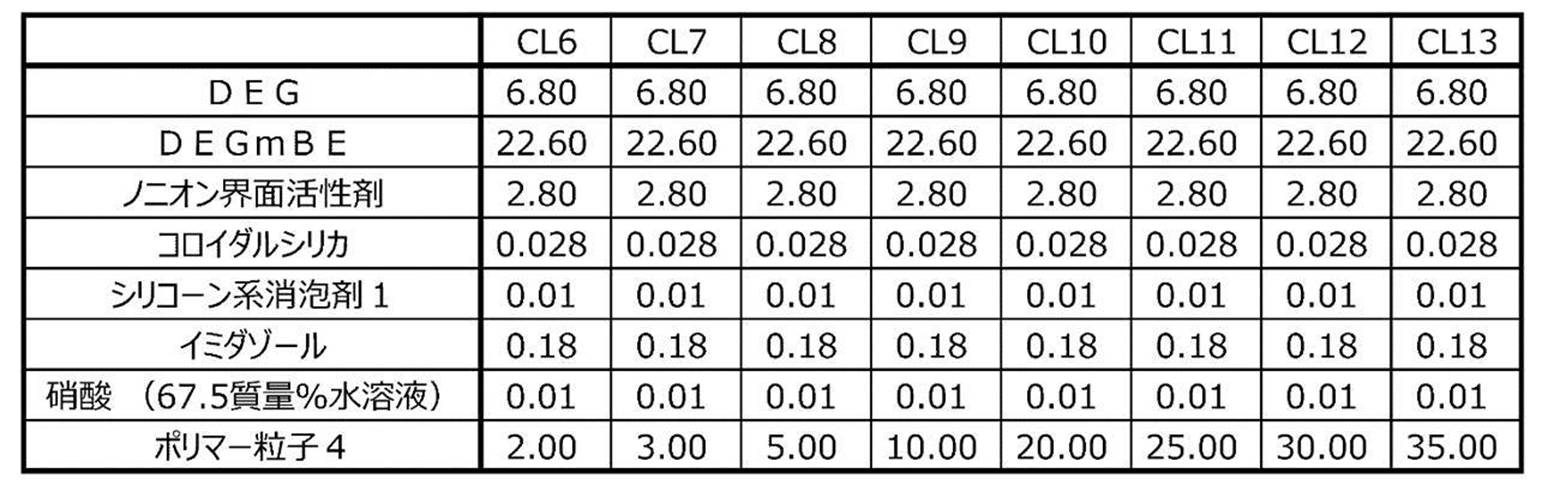
表1及び表2に記載の成分の詳細は以下のとおりである。表1及び表2中、コロイダルシリカ及びポリマー粒子の含有量は、固形分としての含有量を示す。また、メンテナンス液の合計含有量は100質量%であり、残量は、水の含有量である。含有しない成分については「-」を記載した。
・DEG:ジエチレングリコール
・DEGmBE:ジエチレングリコールモノブチルエーテル
・ノニオン界面活性剤:製品名「パイオニンD-1706-N」、竹本油脂社製、主成分ポリオキシエチレンデシルエーテル
・コロイダルシリカ:製品名「スノーテックスXS」(コロイダルシリカの水分散液、固形分濃度20質量%)、日産化学工業社製、平均粒子径5nm
・シリコーン系消泡剤1:製品名「BYK-024」、ビックケミー・ジャパン社製
・ポリマー粒子1:製品名「エポスターMX050W」(アクリル系架橋粒子の水分散液、固形分濃度10質量%、日本触媒社製)、平均粒子径70nm
・ポリマー粒子2:製品名「エポスターMX100W」(アクリル系架橋粒子の水分散液、固形分濃度10質量%、日本触媒社製)、平均粒子径150nm
・ポリマー粒子3:製品名「エポスターMX200W」(アクリル系架橋粒子の水分散液、固形分濃度10質量%、日本触媒社製)、平均粒子径350nm
・ポリマー粒子4:製品名「エポスターMX300W」(アクリル系架橋粒子の水分散液、固形分濃度10質量%、日本触媒社製)、平均粒子径450nm
・DEGmBE:ジエチレングリコールモノブチルエーテル
・ノニオン界面活性剤:製品名「パイオニンD-1706-N」、竹本油脂社製、主成分ポリオキシエチレンデシルエーテル
・コロイダルシリカ:製品名「スノーテックスXS」(コロイダルシリカの水分散液、固形分濃度20質量%)、日産化学工業社製、平均粒子径5nm
・シリコーン系消泡剤1:製品名「BYK-024」、ビックケミー・ジャパン社製
・ポリマー粒子1:製品名「エポスターMX050W」(アクリル系架橋粒子の水分散液、固形分濃度10質量%、日本触媒社製)、平均粒子径70nm
・ポリマー粒子2:製品名「エポスターMX100W」(アクリル系架橋粒子の水分散液、固形分濃度10質量%、日本触媒社製)、平均粒子径150nm
・ポリマー粒子3:製品名「エポスターMX200W」(アクリル系架橋粒子の水分散液、固形分濃度10質量%、日本触媒社製)、平均粒子径350nm
・ポリマー粒子4:製品名「エポスターMX300W」(アクリル系架橋粒子の水分散液、固形分濃度10質量%、日本触媒社製)、平均粒子径450nm
[実施例1~実施例6、比較例1~比較例7]
ブラックインクK1と、メンテナンス液CL1~CL13とを用いて、インクジェットヘッドのメンテナンスを行った場合における、インクジェットヘッドの吐出面の摩耗の進行度、及び洗浄性について評価した。評価結果を表3に示す。評価方法は以下のとおりである。
ブラックインクK1と、メンテナンス液CL1~CL13とを用いて、インクジェットヘッドのメンテナンスを行った場合における、インクジェットヘッドの吐出面の摩耗の進行度、及び洗浄性について評価した。評価結果を表3に示す。評価方法は以下のとおりである。
(吐出面の摩耗の進行度)
吐出側の表面にパーフルオロアルキル構造を有する化合物を含む撥液膜が形成されているインクジェットヘッドを準備した。後述する摩耗操作を行う前に、撥液膜と水との接触角(°)を測定した。次に、直径40mmのシリコーンゴム製のローラーを準備し、ローラーの外周面に布地(製品名「トレシー(登録商標)、東レ社製)を巻き付けた。次に、ローラーに巻き付けた布地にブラックインクK1(1mL)と、メンテナンス液(1mL)とを染み込ませた。次に、布地と撥液膜とを接触させ、両者の接触圧が40kPaとなるように、ローラーを撥液膜に、押し付けた。この状態で、ローラーを、1分間に50往復の速度で3500回往復運動させることにより、布地で撥液膜を擦った。以下、この操作を「摩耗操作」という。摩耗操作における3500回の往復運動では、50往復ごとにブラックインクK1(0.5mL)を布地に追加で染み込ませ、1000往復ごとに布地を新しく交換した。摩耗操作の終了後、摩耗操作後の撥液膜と水との接触角(°)を測定した。
摩耗操作を行う前の接触角から、摩耗操作後の接触角を差し引き、接触角の低下度を算出した。算出した接触角の低下度に基づいて、吐出面の摩耗の進行度を評価した。評価基準は以下のとおりである。接触角の低下度が少ないほど、吐出面の摩耗の進行が抑制されていると判定した。A及びBは、実用上問題ないレベルである。
A:接触角の低下度が10°未満であった。
B:接触角の低下度が10°以上15°未満であった。
C:接触角の低下度が15°以上25°未満であった。
D:接触角の低下度が25°以上30°未満であった。
E:接触角の低下度が30°以上であった。
吐出側の表面にパーフルオロアルキル構造を有する化合物を含む撥液膜が形成されているインクジェットヘッドを準備した。後述する摩耗操作を行う前に、撥液膜と水との接触角(°)を測定した。次に、直径40mmのシリコーンゴム製のローラーを準備し、ローラーの外周面に布地(製品名「トレシー(登録商標)、東レ社製)を巻き付けた。次に、ローラーに巻き付けた布地にブラックインクK1(1mL)と、メンテナンス液(1mL)とを染み込ませた。次に、布地と撥液膜とを接触させ、両者の接触圧が40kPaとなるように、ローラーを撥液膜に、押し付けた。この状態で、ローラーを、1分間に50往復の速度で3500回往復運動させることにより、布地で撥液膜を擦った。以下、この操作を「摩耗操作」という。摩耗操作における3500回の往復運動では、50往復ごとにブラックインクK1(0.5mL)を布地に追加で染み込ませ、1000往復ごとに布地を新しく交換した。摩耗操作の終了後、摩耗操作後の撥液膜と水との接触角(°)を測定した。
摩耗操作を行う前の接触角から、摩耗操作後の接触角を差し引き、接触角の低下度を算出した。算出した接触角の低下度に基づいて、吐出面の摩耗の進行度を評価した。評価基準は以下のとおりである。接触角の低下度が少ないほど、吐出面の摩耗の進行が抑制されていると判定した。A及びBは、実用上問題ないレベルである。
A:接触角の低下度が10°未満であった。
B:接触角の低下度が10°以上15°未満であった。
C:接触角の低下度が15°以上25°未満であった。
D:接触角の低下度が25°以上30°未満であった。
E:接触角の低下度が30°以上であった。
(洗浄性)
吐出側の表面に撥液膜が形成されているインクジェットヘッドを準備した。撥液膜上にブラックインクK1を1mL垂らした。室温で2日間放置して、インクを乾燥させた。直径40mmのシリコーンゴム製のローラーを準備し、ローラーの外周面に布地(製品名「トレシー(登録商標)、東レ社製)を巻き付けた。次に、ローラーに巻き付けた布地にメンテナンス液(2mL)を染み込ませた。布地と撥液膜とを接触させ、両者の接触圧が40kPaとなるように、ローラーを撥液膜に、押し付けた。この状態で、ローラーを、1分間に50往復の速度で3回往復運動させることにより、メンテナンス液が染み込んだ布地で、撥液膜上に形成されているインクの乾燥物を擦った。その後、撥液膜上の残存物を目視で観察した。残存物の量に基づいて、洗浄性を評価した。評価基準は以下のとおりである。残存物の量が少ないほど、洗浄性に優れていると判定した。A~Cは、実用上問題ないレベルである。
A:残存物は全くなかった。
B:残存物の量は、極めてわずかであった。
C:残存物の量は、わずかであった。
D:残存物の量は、やや多かった。
E:残存物の量は、極めて多かった。
吐出側の表面に撥液膜が形成されているインクジェットヘッドを準備した。撥液膜上にブラックインクK1を1mL垂らした。室温で2日間放置して、インクを乾燥させた。直径40mmのシリコーンゴム製のローラーを準備し、ローラーの外周面に布地(製品名「トレシー(登録商標)、東レ社製)を巻き付けた。次に、ローラーに巻き付けた布地にメンテナンス液(2mL)を染み込ませた。布地と撥液膜とを接触させ、両者の接触圧が40kPaとなるように、ローラーを撥液膜に、押し付けた。この状態で、ローラーを、1分間に50往復の速度で3回往復運動させることにより、メンテナンス液が染み込んだ布地で、撥液膜上に形成されているインクの乾燥物を擦った。その後、撥液膜上の残存物を目視で観察した。残存物の量に基づいて、洗浄性を評価した。評価基準は以下のとおりである。残存物の量が少ないほど、洗浄性に優れていると判定した。A~Cは、実用上問題ないレベルである。
A:残存物は全くなかった。
B:残存物の量は、極めてわずかであった。
C:残存物の量は、わずかであった。
D:残存物の量は、やや多かった。
E:残存物の量は、極めて多かった。

表3に示すように、実施例1~実施例6では、インクが顔料を含有し、メンテナンス液がアクリル樹脂を含むポリマー粒子を含有し、ポリマー粒子の含有量がメンテナンス液の全量に対して3質量%~25質量%であり、ポリマー粒子の平均粒子径が、顔料の平均粒子径に対して3.5倍以上であるため、吐出面への付着物の残留が抑制され、かつ、吐出面の摩耗が抑制されることが分かった。
一方、比較例1では、メンテナンス液にポリマー粒子が含まれておらず、吐出面の摩耗が進行することが分かった。
比較例2~比較例4では、ポリマー粒子の平均粒子径が、顔料の平均粒子径に対して3.5倍未満であり、吐出面の摩耗が進行することが分かった。
比較例5では、ポリマー粒子の含有量がメンテナンス液の全量に対して3質量%未満であり、吐出面の摩耗が進行することが分かった。
比較例6及び比較例7では、ポリマー粒子の含有量がメンテナンス液の全量に対して25質量%超えであり、吐出面へ付着物が残留することが分かった。
<メンテナンス液CL14~CL17の調製>
表4に記載の含有量(質量%)になるように、表4に記載の各成分を混合し、メンテナンス液CL1と同様の方法で、メンテナンス液CL14~CL17を調製した。
表4に記載の含有量(質量%)になるように、表4に記載の各成分を混合し、メンテナンス液CL1と同様の方法で、メンテナンス液CL14~CL17を調製した。

表4に記載の成分の詳細は以下のとおりである。メンテナンス液CL1~CL13と同じ成分については、説明を省略する。表4中、コロイダルシリカ及びポリマー粒子の含有量は、固形分としての含有量を示す。また、メンテナンス液の合計含有量は100質量%であり、残量は、水の含有量である。含有しない成分については「-」を記載した。
・DEGmEE:ジエチレングリコールモノエチルエーテル
・シリコーン系消泡剤2:製品名「BYK-093」、ビックケミー・ジャパン社製
・ポリマー粒子5:製品名「タフチックF-167」(アクリル系粒子の水分散液、固形分濃度27質量%、日本エクスラン工業社製)、平均粒子径0.3μm
・ポリマー粒子6:製品名「タフチックF-200」(アクリル系粒子の水分散液、固形分濃度30質量%、日本エクスラン工業社製)、平均粒子径3.0μm
・シリコーン系消泡剤2:製品名「BYK-093」、ビックケミー・ジャパン社製
・ポリマー粒子5:製品名「タフチックF-167」(アクリル系粒子の水分散液、固形分濃度27質量%、日本エクスラン工業社製)、平均粒子径0.3μm
・ポリマー粒子6:製品名「タフチックF-200」(アクリル系粒子の水分散液、固形分濃度30質量%、日本エクスラン工業社製)、平均粒子径3.0μm
[実施例7~実施例8、比較例8~比較例13]
ブラックインクK1及びホワイトインクW1と、メンテナンス液CL14~CL17とを用いて、インクジェットヘッドのメンテナンスを行った場合における、インクジェットヘッドの吐出面の摩耗の進行度、及び洗浄性について評価した。評価結果を表5に示す。評価方法は、実施例1と同じである。
ブラックインクK1及びホワイトインクW1と、メンテナンス液CL14~CL17とを用いて、インクジェットヘッドのメンテナンスを行った場合における、インクジェットヘッドの吐出面の摩耗の進行度、及び洗浄性について評価した。評価結果を表5に示す。評価方法は、実施例1と同じである。
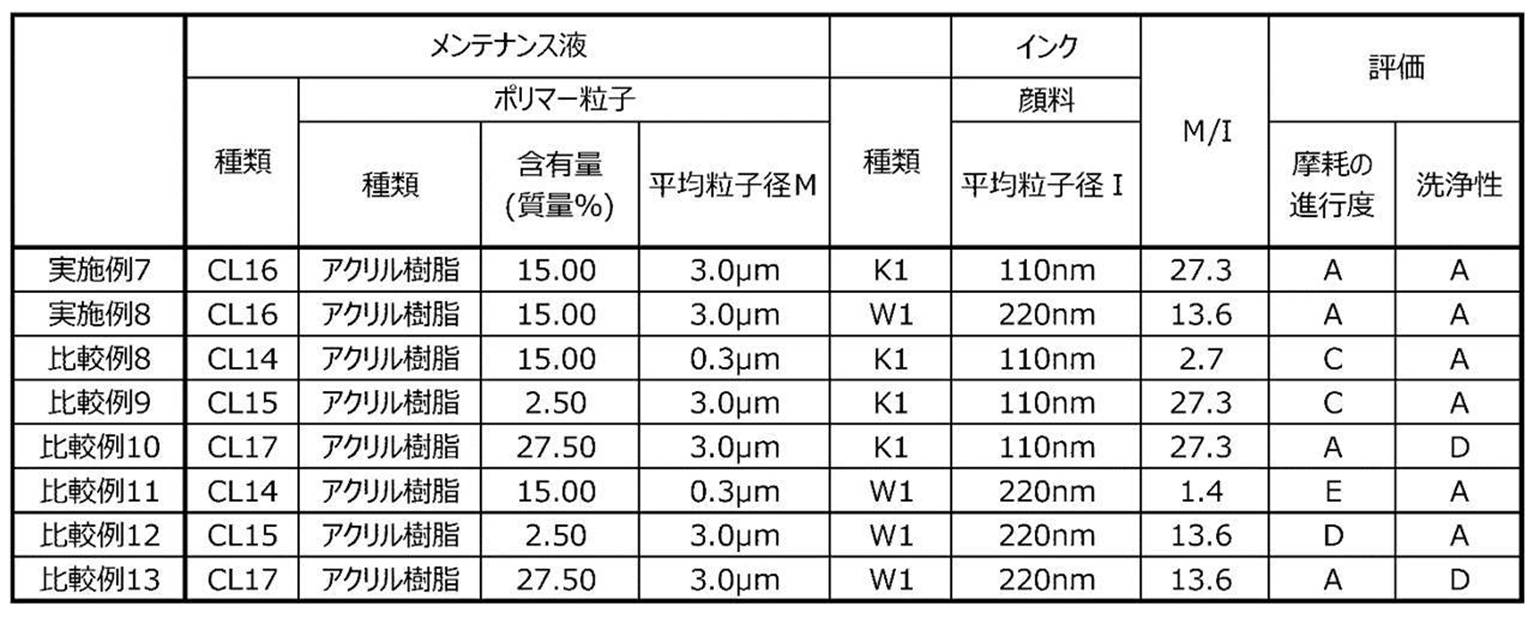
表5に示すように、実施例7及び実施例8では、インクが顔料を含有し、メンテナンス液がアクリル樹脂を含むポリマー粒子を含有し、ポリマー粒子の含有量がメンテナンス液の全量に対して3質量%~25質量%であり、ポリマー粒子の平均粒子径が、顔料の平均粒子径に対して3.5倍以上であるため、吐出面への付着物の残留が抑制され、かつ、吐出面の摩耗が抑制されることが分かった。
一方、比較例8及び比較例11では、ポリマー粒子の平均粒子径が、顔料の平均粒子径に対して3.5倍未満であり、吐出面の摩耗が進行することが分かった。
比較例9及び比較例12では、ポリマー粒子の含有量がメンテナンス液の全量に対して3質量%未満であり、吐出面の摩耗が進行することが分かった。
比較例10及び比較例13では、ポリマー粒子の含有量がメンテナンス液の全量に対して25質量%超えであり、吐出面へ付着物が残留することが分かった。
<メンテナンス液CL18~CL24の調製>
表6に記載の含有量(質量%)になるように、表6に記載の各成分を混合し、メンテナンス液CL1と同様の方法で、メンテナンス液CL18~CL24を調製した。
表6に記載の含有量(質量%)になるように、表6に記載の各成分を混合し、メンテナンス液CL1と同様の方法で、メンテナンス液CL18~CL24を調製した。

表6に記載の成分の詳細は以下のとおりである。メンテナンス液CL1~CL13と同じ成分については、説明を省略する。表6中、コロイダルシリカ及びポリマー粒子の含有量は、固形分としての含有量を示す。また、メンテナンス液の合計含有量は100質量%であり、残量は、水の含有量である。含有しない成分については「-」を記載した。
・TEG:トリエチレングリコール
・ポリマー粒子7:製品名「SBラテックス0561」(スチレン・ブタジエン系共重合体の水分散液、固形分濃度69質量%、JSR社製)、平均粒子径700nm
・ポリマー粒子8:製品名「KM-9729」(シリコーンゴムの水分散液、固形分濃度52質量%、信越化学工業社製)、平均粒子径2.0μm
・ポリマー粒子9:製品名「X-52-1133」(シリコーンゴムの水分散液、固形分濃度51質量%、信越化学工業社製)、平均粒子径5.0μm
・ポリマー粒子10:製品名「トスパール130」(シリコーン樹脂の粒子、モメンティブ・パフォーマンス・マテリアルズ・ジャパン社製)、平均粒子径3.0μm
・ポリマー粒子11:製品名「トスパール145」(シリコーン樹脂の粒子、モメンティブ・パフォーマンス・マテリアルズ・ジャパン社製)、平均粒子径4.5μm
・ポリマー粒子12:製品名「FLUOTRON115」(フッ素樹脂の水分散液、固形分濃度42質量%、日本ルーブリゾール社製)、平均粒子径2.8μm
・ポリマー粒子13:製品名「ハイドランWLI-611」(ウレタン樹脂の水分散液、固形分濃度39.5質量%、DIC社製)、平均粒子径0.4μm
・ポリマー粒子7:製品名「SBラテックス0561」(スチレン・ブタジエン系共重合体の水分散液、固形分濃度69質量%、JSR社製)、平均粒子径700nm
・ポリマー粒子8:製品名「KM-9729」(シリコーンゴムの水分散液、固形分濃度52質量%、信越化学工業社製)、平均粒子径2.0μm
・ポリマー粒子9:製品名「X-52-1133」(シリコーンゴムの水分散液、固形分濃度51質量%、信越化学工業社製)、平均粒子径5.0μm
・ポリマー粒子10:製品名「トスパール130」(シリコーン樹脂の粒子、モメンティブ・パフォーマンス・マテリアルズ・ジャパン社製)、平均粒子径3.0μm
・ポリマー粒子11:製品名「トスパール145」(シリコーン樹脂の粒子、モメンティブ・パフォーマンス・マテリアルズ・ジャパン社製)、平均粒子径4.5μm
・ポリマー粒子12:製品名「FLUOTRON115」(フッ素樹脂の水分散液、固形分濃度42質量%、日本ルーブリゾール社製)、平均粒子径2.8μm
・ポリマー粒子13:製品名「ハイドランWLI-611」(ウレタン樹脂の水分散液、固形分濃度39.5質量%、DIC社製)、平均粒子径0.4μm
[実施例9~実施例21]
ブラックインクK1及びホワイトインクW1と、メンテナンス液CL18~CL24とを用いて、インクジェットヘッドのメンテナンスを行った場合における、インクジェットヘッドの吐出面の摩耗の進行度、及び洗浄性について評価した。評価結果を表7に示す。評価方法は、実施例1と同じである。
ブラックインクK1及びホワイトインクW1と、メンテナンス液CL18~CL24とを用いて、インクジェットヘッドのメンテナンスを行った場合における、インクジェットヘッドの吐出面の摩耗の進行度、及び洗浄性について評価した。評価結果を表7に示す。評価方法は、実施例1と同じである。
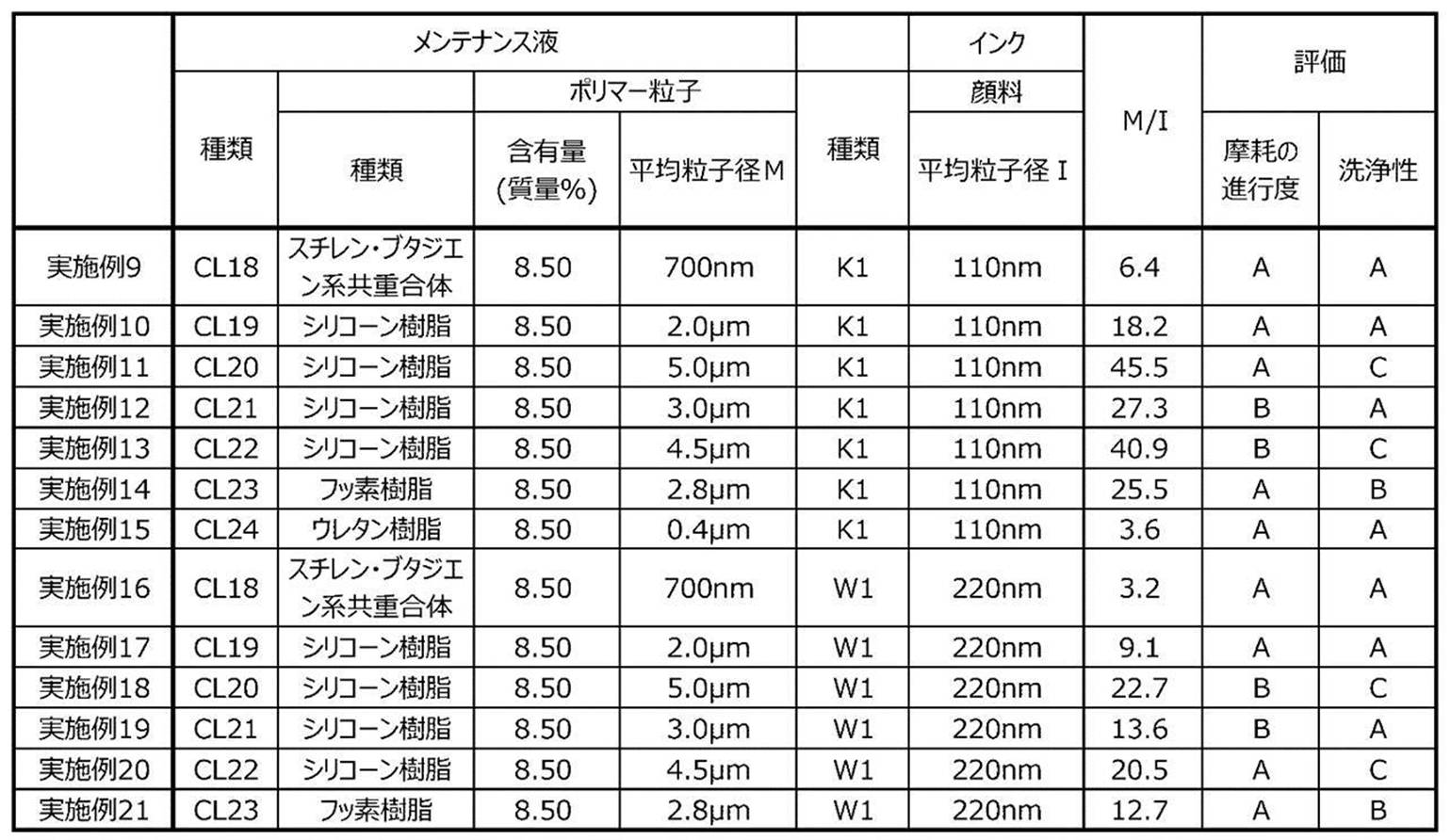
表7に示すように、実施例9~実施例21では、インクが顔料を含有し、メンテナンス液がスチレン・ブタジエン共重合体、シリコーン樹脂、フッ素樹脂又はウレタン樹脂を含むポリマー粒子を含有し、ポリマー粒子の含有量がメンテナンス液の全量に対して3質量%~25質量%であり、ポリマー粒子の平均粒子径が、顔料の平均粒子径に対して3.5倍以上であるため、吐出面への付着物の残留が抑制され、かつ、吐出面の摩耗が抑制されることが分かった。
実施例1において、撥水膜をパーフルオロポリエーテル構造を有する化合物に変更した場合にも同様の効果が得られた。
Claims (10)
- 顔料を含有するインクと、
ポリマー粒子を含有するメンテナンス液と、
を備え、
前記ポリマー粒子の含有量は、前記メンテナンス液の全量に対して3質量%~25質量%であり、
前記ポリマー粒子の平均粒子径は、前記顔料の平均粒子径に対して3.5倍以上である、インクセット。 - 前記顔料は、無機顔料である請求項1に記載のインクセット。
- 前記顔料は、カーボンブラック又は二酸化チタンである、請求項1又は請求項2に記載のインクセット。
- 前記ポリマー粒子は、ビニル化合物由来の構造単位及びビニリデン化合物由来の構造単位からなる群より選択される少なくとも1種を含む重合体、ウレタン樹脂、エーテル樹脂、エステル樹脂、アミノ樹脂、アミド樹脂、フェノール樹脂、フッ素樹脂、並びに、シリコーン樹脂からなる群より選択される少なくとも1種のポリマーを含む、請求項1~請求項3のいずれか1項に記載のインクセット。
- 前記ポリマー粒子は、(メタ)アクリル化合物由来の構造単位、スチレン由来の構造単位、エチレン由来の構造単位、プロピレン由来の構造単位、塩化ビニル由来の構造単位及び酢酸ビニル由来の構造単位からなる群より選択される少なくとも1種を含む重合体、ウレタン樹脂、並びに、エステル樹脂からなる群より選択される少なくとも1種のポリマーを含む、請求項1~請求項4のいずれか1項に記載のインクセット。
- 前記ポリマー粒子の平均粒子径は、400nm~5000nmである、請求項1~請求項5のいずれか1項に記載のインクセット。
- 請求項1~請求項6のいずれか1項に記載のインクセットが用いられ、
前記インクがインクジェットヘッドのノズルから吐出された後に、前記インクジェットヘッドの吐出面及び前記吐出面を払拭するワイプ部材の少なくとも一方に前記メンテナンス液を付与するメンテナンス液付与工程と、
前記メンテナンス液を付与した後に、前記吐出面を前記ワイプ部材で払拭する工程と、を含むメンテナンス方法。 - 前記ワイプ部材は、布帛、不織布、ブレード及びスポンジからなる群より選択される少なくとも1種である、請求項7に記載のメンテナンス方法。
- 前記インクジェットヘッドは撥液膜を有する、請求項7又は請求項8に記載のメンテナンス方法。
- 前記撥液膜は、フッ素化合物を含む、請求項9に記載のメンテナンス方法。
Applications Claiming Priority (2)
| Application Number | Priority Date | Filing Date | Title |
|---|---|---|---|
| JP2020125555A JP2023159466A (ja) | 2020-07-22 | 2020-07-22 | インクセット及びメンテナンス方法 |
| JP2020-125555 | 2020-07-22 |
Publications (1)
| Publication Number | Publication Date |
|---|---|
| WO2022019035A1 true WO2022019035A1 (ja) | 2022-01-27 |
Family
ID=79729418
Family Applications (1)
| Application Number | Title | Priority Date | Filing Date |
|---|---|---|---|
| PCT/JP2021/023646 Ceased WO2022019035A1 (ja) | 2020-07-22 | 2021-06-22 | インクセット及びメンテナンス方法 |
Country Status (2)
| Country | Link |
|---|---|
| JP (1) | JP2023159466A (ja) |
| WO (1) | WO2022019035A1 (ja) |
Cited By (1)
| Publication number | Priority date | Publication date | Assignee | Title |
|---|---|---|---|---|
| EP4527892A4 (en) * | 2022-08-30 | 2025-11-12 | Dainippon Ink & Chemicals | URETHAN RESIN COMPOSITION |
Citations (2)
| Publication number | Priority date | Publication date | Assignee | Title |
|---|---|---|---|---|
| JP2007254550A (ja) * | 2006-03-22 | 2007-10-04 | Fujifilm Corp | インク洗浄液及びクリーニング方法 |
| JP2014210359A (ja) * | 2013-04-17 | 2014-11-13 | 東洋インキScホールディングス株式会社 | 活性エネルギー線硬化型インクジェットインキ用溶解液 |
-
2020
- 2020-07-22 JP JP2020125555A patent/JP2023159466A/ja active Pending
-
2021
- 2021-06-22 WO PCT/JP2021/023646 patent/WO2022019035A1/ja not_active Ceased
Patent Citations (2)
| Publication number | Priority date | Publication date | Assignee | Title |
|---|---|---|---|---|
| JP2007254550A (ja) * | 2006-03-22 | 2007-10-04 | Fujifilm Corp | インク洗浄液及びクリーニング方法 |
| JP2014210359A (ja) * | 2013-04-17 | 2014-11-13 | 東洋インキScホールディングス株式会社 | 活性エネルギー線硬化型インクジェットインキ用溶解液 |
Cited By (1)
| Publication number | Priority date | Publication date | Assignee | Title |
|---|---|---|---|---|
| EP4527892A4 (en) * | 2022-08-30 | 2025-11-12 | Dainippon Ink & Chemicals | URETHAN RESIN COMPOSITION |
Also Published As
| Publication number | Publication date |
|---|---|
| JP2023159466A (ja) | 2023-11-01 |
Similar Documents
| Publication | Publication Date | Title |
|---|---|---|
| US10190007B2 (en) | Ink, ink container, image forming method, image forming apparatus, and image formed matter | |
| JP5491806B2 (ja) | インクジェットヘッド洗浄用メンテナンス液、インクセット及びメンテナンス方法 | |
| JP5490474B2 (ja) | 画像形成方法及びインク組成物 | |
| JP5402095B2 (ja) | インクジェット記録用インク、インクカートリッジ、インクジェット記録装置、インク記録物 | |
| JP2016193980A (ja) | インクジェット用インク組成物、インクセット、及び画像形成方法 | |
| JP6686366B2 (ja) | インク、画像形成方法、画像形成装置、及び画像形成物 | |
| JPWO2001008895A1 (ja) | 記録媒体に二液を用いて印刷する記録方法 | |
| JP2019006978A (ja) | インク、インクセット、インク容器、画像形成方法、及び画像形成装置 | |
| JP2018075751A (ja) | インク吐出装置及びインク吐出方法 | |
| WO2011041273A1 (en) | Pigment based inks for inkjet printing | |
| CN104228381B (zh) | 中间转印构件和图像记录方法 | |
| JP6844120B2 (ja) | 記録装置及び記録方法 | |
| JP6249686B2 (ja) | インクセット及びインクジェット記録方法 | |
| JP2001106951A (ja) | インクジェット用水性顔料インクおよびインクジェット記録方法 | |
| JP2014070185A (ja) | 画像形成方法 | |
| JP7163410B2 (ja) | インクジェットインク組成物及び画像記録方法 | |
| KR20170139503A (ko) | 백색 안료 분산액 | |
| KR20170139504A (ko) | 백색 잉크 | |
| JP2019108518A (ja) | インク組成物、インクセット、インク容器、画像形成方法、画像形成装置、及び記録物 | |
| JP5198745B2 (ja) | インクジェット記録用水系インク | |
| WO2019188856A1 (ja) | インクジェットインク組成物、メンテナンス方法、画像記録方法、及び、画像記録物 | |
| WO2022019035A1 (ja) | インクセット及びメンテナンス方法 | |
| JP2017019277A (ja) | インクジェット記録装置 | |
| JP5330814B2 (ja) | インクジェット記録用水系インク | |
| CN102190927A (zh) | 油墨组以及使用该油墨组的记录方法 |
Legal Events
| Date | Code | Title | Description |
|---|---|---|---|
| 121 | Ep: the epo has been informed by wipo that ep was designated in this application |
Ref document number: 21845183 Country of ref document: EP Kind code of ref document: A1 |
|
| NENP | Non-entry into the national phase |
Ref country code: DE |
|
| 122 | Ep: pct application non-entry in european phase |
Ref document number: 21845183 Country of ref document: EP Kind code of ref document: A1 |
|
| NENP | Non-entry into the national phase |
Ref country code: JP |