WO2022018861A1 - アルゴンベ-スの大気圧プラズマ処理方法及び大気圧プラズマ化学気相加工方法 - Google Patents
アルゴンベ-スの大気圧プラズマ処理方法及び大気圧プラズマ化学気相加工方法 Download PDFInfo
- Publication number
- WO2022018861A1 WO2022018861A1 PCT/JP2020/028462 JP2020028462W WO2022018861A1 WO 2022018861 A1 WO2022018861 A1 WO 2022018861A1 JP 2020028462 W JP2020028462 W JP 2020028462W WO 2022018861 A1 WO2022018861 A1 WO 2022018861A1
- Authority
- WO
- WIPO (PCT)
- Prior art keywords
- gas
- argon
- atmospheric pressure
- pressure plasma
- plasma
- Prior art date
- Legal status (The legal status is an assumption and is not a legal conclusion. Google has not performed a legal analysis and makes no representation as to the accuracy of the status listed.)
- Ceased
Links
Images




Classifications
-
- H—ELECTRICITY
- H05—ELECTRIC TECHNIQUES NOT OTHERWISE PROVIDED FOR
- H05H—PLASMA TECHNIQUE; PRODUCTION OF ACCELERATED ELECTRICALLY-CHARGED PARTICLES OR OF NEUTRONS; PRODUCTION OR ACCELERATION OF NEUTRAL MOLECULAR OR ATOMIC BEAMS
- H05H1/00—Generating plasma; Handling plasma
- H05H1/24—Generating plasma
Definitions
- the present invention relates to an argon-based atmospheric pressure plasma processing method and an atmospheric pressure plasma chemical vapor deposition processing method, and more specifically, it is possible to process the surface of a work such as a crystal with high quality using atmospheric pressure argon plasma.
- the present invention relates to an argon-based atmospheric pressure plasma processing method and an atmospheric pressure plasma chemical vapor deposition processing method.
- the vacuum vessel is exhausted to the ultimate pressure, and then the process gas is introduced to the predetermined pressure.
- the process gas pressure is set to a value of several 100 mPa to several tens of Pa, and a high frequency voltage of several 100 KHz to several tens of MHz is applied to the electrodes from the high frequency power supply (Patent Document 1).
- low-pressure plasma has excellent plasma stability, the material removal rate is low due to the low density of etchants.
- high vacuum equipment is required for the equipment, which also increases the size and cost of the equipment.
- etching and processing methods that use atmospheric pressure plasma.
- the basic principle of atmospheric pressure plasma chemical vaporization machining is described in Patent Document 2, and numerically controlled machining in which the machined electrode is machined by changing it relative to the machined surface.
- the method is described in Patent Document 3 and has been developed at Osaka University to which the present inventors belong.
- the AP-PCVM has the advantage that the partial pressure of the reaction gas is also high, so that the density of the etchant is high and the removal rate is high, and the vacuum equipment can be unnecessary or simplified, but the gas temperature is high. It becomes high and tends to shift to an arc discharge to reach a thermal equilibrium state, and when exposed to such plasma, it causes damage to the work. Therefore, it is necessary to maintain the plasma so that it does not shift to arc discharge, and to maintain a non-equilibrium state in which the gas temperature is sufficiently low, that is, the ion temperature is lower than the electron temperature.
- Non-Patent Document 1 a method of processing a crystal wafer, which is a material of a crystal oscillator, with high efficiency and high accuracy by using AP-PCVM has been proposed.
- helium gas which can easily generate plasma under atmospheric pressure, has been used as a carrier gas, but helium gas is expensive because it is 100% imported in Japan, and it is a strategy.
- Ar which can be industrially produced by fractional distillation of liquid air, as the carrier gas.
- argon since argon has a high breakdown voltage, there is a problem that electrons rapidly increase after the breakdown and an arc discharge that damages the crystal wafer is likely to occur.
- perfluorocarbon (PFC) gas particularly CF 4 is often used as the reaction gas.
- PFC perfluorocarbon
- the present inventors have found that even if the AP-PCVM, the addition of a small amount of ethanol in the process gas, together with the finding that the CF 4 containing Ar atmospheric pressure plasma can be stably generated, by the addition of ethanol , C-based products decomposed from ethanol are deposited on the surface of the work, solving a new problem that the etching process is hindered, and the present invention has been completed.
- the present invention provides an argon-based atmospheric pressure plasma processing method and an atmospheric pressure plasma chemical vapor deposition processing method, which are configured below, in order to solve the above-mentioned problems.
- an argon-based atmospheric pressure plasma treatment method in which the work surface is treated with an atmospheric pressure plasma generated by a process gas in which a carrier gas containing at least an argon gas and a reaction gas are mixed.
- a carrier gas a gas having an ionization potential smaller than that of the semi-stable level of argon is added, and a stabilizing gas that is ionized by the penning effect to generate electrons necessary for plasma generation and maintenance is added.
- argon-based atmospheric pressure plasma chemical gas phase processing method in which the work surface is etched by an atmospheric pressure plasma generated by a process gas in which a carrier gas containing at least an argon gas and a reaction gas are mixed.
- a carrier gas a gas having an ionization potential smaller than that of the semi-stable level of argon is added, and a stabilizing gas that is ionized by the penning effect to generate electrons necessary for generating and maintaining plasma is added, and the reaction is performed.
- argon-based atmospheric pressure plasma chemical gas phase processing characterized by adding a required amount of oxygen gas that acts on carbon generated in the etching process and can be vaporized and removed from the fluorogas.
- CF 4 when CF 4 is used as the reaction gas, stable plasma can be generated by adjusting the flow rate of argon, CF 4 , O 2, ethanol, the processing gap, and the like. We were able to find the optimum processing conditions in which twins do not occur in the quartz wafer. Further, when Ar is used as the carrier gas under the same conditions as compared with the case where the conventional He is used as the carrier gas, the same etching rate can be obtained.
- FIG. 1 is a schematic diagram of an experimental setup used for AP-PCVM.
- FIG. 2A is an image of AP-PCVM on a crystal wafer by argon plasma without adding ethanol
- FIG. 2B is an image of AP-PCVM on a crystal wafer by argon plasma with ethanol added.
- 3 (a) to 3 (e) are photographs of removal spots formed on the crystal wafer by AP-PCVM using ethanol-added argon as a carrier gas
- FIGS. 3 (f) to 3 (j) are used in AP-PCVM.
- FIG. 3 (k) to 3 (o), are the X-ray photoelectron spectroscopy (XPS) measurement results of the plasma used in AP-PCVM.
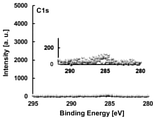
- FIG. 4 is an X-ray photoelectron spectroscopy (XPS) measurement result of the surface of the crystal wafer before the plasma treatment.
- FIG. 5 is a graph showing the amount of crystal wafer removed for 60 seconds at different O 2 flow rates.
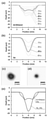
- FIG. 6 (a) shows a cross-sectional profile of the removal spots formed on the crystal wafer by AP-PCVM with a scanning white light interferometer (SWLI) using ethanol-added argon as the carrier gas, FIG. 6 (A).
- SWLI scanning white light interferometer
- FIG. 6 (c) is a carrier.
- FIG. 6 (d) is a 2D image of a removal spot formed by applying helium as a carrier gas
- FIG. 6 (e) is a carrier. It is a cross-sectional profile of a removal spot formed by etching for 45 seconds when using ethanol-added argon and helium as a gas.
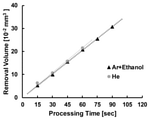
- FIG. 7 is a graph showing the relationship between the processing time and the removal amount of the removal spot formed by AP-PCVM (RF power: 60 W, ethanol: 0.003 g / min, carrier He / Ar: 600 sccm, CF 4). : 10 sccm, O 2 : 4 sccm).
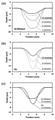
- FIG. 8 (a) shows a cross-sectional profile of a groove formed in a crystal wafer by AP-PCVM at different scanning rates using ethanol-added argon as the carrier gas
- FIG. 8 (b) uses helium as the carrier gas.
- FIG. 8 (a) shows a cross-sectional profile of a groove formed in a crystal wafer by AP-PCVM at different scanning rates using ethanol-added argon as the carrier gas
- FIG. 8 (b) uses helium as the carrier gas.
- FIG. 8 (b) uses helium as the carrier gas.
- FIG. 8 (c) is formed by etching at a scanning speed of 12 mm / min when using ethanol-added argon and helium as carrier gases. It is a cross-sectional profile of the groove.
- FIG. 9 (a) is a graph showing the relationship between the scan rate and the cross-sectional area of the etched groove formed by the AP-PCVM
- FIG. 9 (b) is the residence time and the etched groove formed by the AP-PCVM.
- the present invention relates to an argon-based atmospheric pressure plasma treatment method for treating a work surface with an atmospheric pressure plasma generated by a process gas in which a carrier gas containing at least argon (Ar) gas and a reaction gas are mixed, as the carrier gas.
- Argon base characterized by adding a gas having an ionization potential smaller than that of the semi-stable level of argon and adding a stabilizing gas that is ionized by the penning effect to generate electrons necessary for the generation and maintenance of plasma. This is the atmospheric pressure plasma processing method.
- the stabilized gas is one or more selected from alcohol, hydrocarbon gas, and ammonia (NH 3).
- the alcohol include methanol, ethanol, propanol and the like.
- the hydrocarbon gas include methane, ethane, propane, butane and the like. Among them, ethanol is the most preferable because it is inexpensive and easy to handle.
- Table 1 shows the ionization potential and semi-stable energy of helium (He), argon (Ar), nitrogen (N 2 ), ethanol (C 2 H 5 OH) and ammonia (NH 3).
- the ionization potential of ethanol and ammonia is slightly lower than the metastable energy of argon. Ionization by the Penning effect occurs when the ionization potential of the target molecule is lower than the metastable energy of the excited atom or molecule.
- a reaction gas selected according to the purpose can be mixed with the process gas and applied to various plasma treatments.
- plasma treatment include etching, film formation, modification, oxidation and the like.
- AP-PCVM atmospheric pressure plasma chemical vaporization
- AP-PCVM turns the process gas into plasma in an atmospheric pressure atmosphere, causes an etchant (reaction species) consisting of generated neutral radicals and ions to act on the work surface, and removes volatile substances generated by a chemical reaction.
- etchant reaction species
- This is a method for processing the work surface with high precision.
- the "atmospheric pressure" in the present invention is not limited to the literal atmospheric pressure, but is a concept including a pressure in a slightly depressurized state performed to exhaust the process gas after use.
- the process gas consists of a carrier gas and a reaction gas.
- the carrier gas is mainly composed of an inert gas and has an action of diluting the reaction gas to generate and maintain a stable plasma.
- the reaction gas produces an etchant, and the etchant produces a volatile compound by a chemical reaction with the atoms constituting the work, and the etching process proceeds by removing the volatile compound from the surface of the work.
- PCVM limits the region to be etched by generating local plasma in a range sufficiently narrower than the machining region of the work, and numerically removes spots (machining marks) formed by local etching with respect to the machining region of the work. It is characterized by being able to partially control and scan and partially determine the amount of processing on the work surface, which is different from ordinary plasma etching that uniformly removes a wide area.
- a stabilizing gas that generates a large amount of electrons, it is possible to generate a glow discharge atmospheric pressure argon plasma that spreads stably and uniformly.
- a small amount of ethanol is added as a stabilizing gas.
- a processing experiment using AP-PCVM was performed using a mixed gas of argon and ethanol as the carrier gas, CF 4 and O 2 as the process gas, and a quartz wafer as the work. By applying the ethanol-containing process gas, a uniform and stable glow discharge plasma was generated, and good removal characteristics for correcting the thickness deviation of the quartz wafer were obtained.
- argon is used as the carrier gas, and in order to stabilize the argon plasma, an appropriate amount of ethanol is vaporized and mixed with argon.
- a fluorine-based gas capable of good etching on a work of a wide range of materials such as Si single crystal and Si compound is used.
- the fluorine-based gas is fluorine or a fluorine compound.
- the fluorine compound perfluorocarbon (PFC) gas or an inorganic fluorine compound can be satisfactorily used.
- the perfluorocarbon (PFC) gas is any one or more of CF 4 , C 2 F 6 , and C 3 F 8.
- the inorganic fluorine compound is any one or two of SF 6 and NF 3. Select the optimum reaction gas according to the material of the work.
- the crystal unit has good frequency temperature characteristics near room temperature. Furthermore, since the crystal unit is physically and chemically stable, the frequency change due to aging is small. Due to these excellent characteristics, crystal units are widely used in communication devices such as mobile phones and consumer devices such as digital cameras and computers in order to provide accurate reference signals. In order to increase the communication speed, it is necessary to reduce the thickness of the crystal wafer and increase the resonance frequency of the crystal oscillator. In recent commercial production of crystal units, wafer processes have been intensively developed to improve the productivity of the oscillators. In order to shorten the processing time of frequency adjustment and improve productivity, it is indispensable to make the thickness of the crystal wafer uniform.
- quartz wafers formed by conventional mechanical manufacturing processes such as wire saw cutting, wrapping, ion beam processing, and polishing typically have a thickness deviation of ⁇ 0.1%. .. This value is about 100 times the margin of error required for a crystal unit.
- AP-PCVM has been applied as a highly efficient and damage-free thickness correction technique to improve the thickness uniformity of quartz wafers.
- AP-PCVM is an ultra-precision modeling technology that uses fluorine radicals generated by atmospheric pressure plasma to transform the surface atoms of the work into volatile reaction products to form the desired shape.
- AP-PCVM is a non-contact chemical shaping technique that does not mechanically load the workpiece, thus preventing breakage of thin brittle materials and preventing the formation of subsurface damage (SSD) layers during the chemical removal process.
- SSD subsurface damage
- AP-PCVM is an atmospheric pressure process, no vacuum chamber is required.
- ICP inductively coupled plasma
- CCP capacitively coupled plasma
- plasma jet microwave plasma
- ICP and microwave plasmas generate hot gases above 200 ° C., increasing the likelihood of both crystal twins and quartz wafer breakage. Therefore, in this embodiment, the CCP is used in the AP-PCVM to process the quartz wafer.
- the thickness uniformity has been improved from 250 nm to 2 nm without forming SSD in one thickness correction process for commercially available crystal wafers, and it has already been used for electronic devices such as smartphones and wearables.
- the world's smallest crystal oscillator (1.0 x 0.8 mm) has been developed.
- AP-PCVM has used helium gas as a carrier gas so far.
- Helium gas used in industry is mainly produced from natural gas, and there are widespread concerns about problems such as depletion of natural resources and high cost.
- the present inventors have proposed using argon gas instead of helium gas as the carrier gas in the generation of atmospheric pressure plasma.
- Argon gas can be industrially produced by fractional distillation of liquid air, is easily available and inexpensive.
- the breakdown voltage for argon is much higher than the breakdown voltage for helium.
- the electrons increase rapidly after the breakdown, forming filamentary arc streamers.
- the addition of ethanol to argon has proven to be very useful for producing atmospheric pressure glow discharge plasmas.
- argon was used as the carrier gas for AP-PCVM together with a small amount of ethanol instead of helium. Ethanol AP-PCVM using argon based atmospheric CF 4 plasma was added by investigating the etching characteristics of the crystal wafer experiment was conducted.
- FIG. 1 shows an experimental setup of AP-PCVM.
- the electrode nozzle 1 has a structure in which an insulating ceramic cover 3 is coaxially arranged around the electrode 2 arranged in the center, and a gas supply hole 4 provided in the center on the base end side of the electrode 2 is provided. Is.
- a gas flow path 5 is provided between the electrode 2 and the cover 3, communicates with the gas supply hole 4 through a branch hole 6, and the process gas supplied from the gas supply hole 4 passes through the branch hole 6 to the gas flow path. It is supplied to 5.
- the tip of the electrode 2 is set at a position retracted by 3 mm from the tip of the cover 3, and a predetermined gap is set between the work 8 held on the work table 7 and the tip of the cover 3.
- High-frequency power is applied to the electrode 2 from the high-frequency power supply 9 via the matching unit 10, and the work table 7 is grounded.
- the electrode 2 is made of an aluminum alloy
- the cover 3 is made of alumina (Al 2 O 3 ).
- the frequency of the high frequency power supply 9 is a radio frequency (RF) of 13.56 MHz.
- the gas supply system 11 has four channels, one for carrier gas, one for ethanol, and two for reaction gas (CF 4 and O 2 ).
- reference numeral 12 indicates an argon gas cylinder
- 13 indicates an ethanol container
- 14 indicates a CF 4 gas cylinder
- 15 indicates an oxygen gas cylinder.
- the flow rates of the argon gas and the reaction gas were controlled using a mass flow controller (MFC) 16.
- MFC mass flow controller
- Ethanol concentration 99.5%
- LMFC liquid mass flow controller
- Argon gas mixed with ethanol by this gas-liquid mixing vaporization method and reaction gas (CF 4 and O 2 ) are mixed and supplied to the gas supply hole 4 as a process gas.
- an AT-cut crystal wafer (size: 54 mm ⁇ 50 mm ⁇ 90 ⁇ m) was used.
- the following AP-PCVM experiments were performed at room temperature (23.3 ° C.) without heating the quartz wafer. Further, the crystal wafer was held on the work table 7 by a vacuum chuck.
- the diameter of the electrode is 3 mm
- the distance between the tip of the electrode 2 and the crystal wafer (work 8) is 3.5 mm
- the distance between the tip of the cover 3 and the crystal wafer is 0.5 mm.
- a radio frequency (RF) power of 13.56 MHz is applied between the electrode 2 and the work table 7 from the high frequency power source 9, and argon at atmospheric pressure is applied in the space near the tip of the electrode 2 and between the work 8.
- RF radio frequency
- Fluorine radicals which are thought to be the etchants that etch quartz, are generated by the dissociation of CF 4 in atmospheric pressure argon plasma.
- FIG. 2A shows a photograph of argon plasma generated on a quartz wafer without the addition of ethanol.
- the breakdown voltage of argon was high, filamentary arc streamers were formed, and the high temperature caused by local arc discharge easily damaged the quartz wafer. Moreover, since the state of the local arc discharge was unstable, the reproducibility of the removal spot formation was low.
- FIG. 2 (b) shows a photograph of an ethanol-added argon plasma generated on a quartz wafer. The addition of ethanol formed a stable glow discharge plasma without filamentary arc streamers and did not break the quartz wafer. The reproducibility of removal spot formation has also improved. Therefore, it is possible to accurately correct the thickness distribution of the quartz wafer by numerically controlled AP-PCVM using argon to which ethanol is added instead of helium as the carrier gas.
- ethanol flow rate 0.003 g / min
- Ar 600 sccm
- the reaction gas is CF 4 (10 sccm) and O 2 (0 to 8 sccm)
- the RF power 60 W.
- the flow rate of ethanol determines the flow rate of argon according to the specifications of the electrode nozzle 1, and under the condition that the RF power is fixed at 60 W, plasma is stably generated, and the shape stability of the removal spot (machining mark) is stable.
- the minimum value was decided in consideration of the above.
- FIG. 3 shows the measurement results at oxygen flow rates of 0, 1, 2, 3, and 4 sccm, and photographs of removal spots of the crystal wafer formed by AP-PCVM using ethanol-added argon as a carrier gas in order from the left.
- FIG. 3 (a)-(e) shows emission spectroscopy (OES) spectra
- FIGS. 3 (f)-(j) emission spectroscopy (OES) spectra
- XPS X-ray photoelectron spectroscopy
- FIGS. 3 (b), (g), and (l) the case where 1 sccm of oxygen is added to the process gas is shown in FIGS. 3 (b), (g), and (l). Carbon deposits are still present, but their color is lighter and the deposit area is smaller. The emission of the C 2 swan band was weak compared to the OES spectrum of the plasma without the addition of oxygen. The XPS measurement results show that the CC peak is weakened. It is considered that a part of the incompletely decomposed carbon was oxidized by adding oxygen to the process gas. Thus, it is predicted that the addition of oxygen can suppress the formation of carbon deposits on the quartz surface.
- FIG. 4 is an XPS spectrum of the crystal wafer before plasma treatment, and since this result is almost the same as the XPS spectrum when the oxygen flow rate is 4 sccm (FIG. 3 (o)), the carbon deposit disappears. You can see that it is doing.
- FIG. 5 shows the relationship between the etching rate of the quartz wafer and the oxygen flow rate.
- the oxygen flow rate was changed from 1 to 8 sccm, and other processing conditions were fixed as described above.
- the processing time is 60 seconds.
- the O 2 is added 4 sccm, carbon deposits that are described above which has lost.
- the etching rate decreased.
- Oxygen itself does not contribute to the etching reaction of the crystal, and the generation of both O and F radicals requires energy from the active argon, so due to the competition between O 2 and CF 4 , the oxygen fraction is high. It is considered that the cause is that the etching rate decreases.
- the flow rate of argon was fixed at 600 sccm
- the flow rate of ethanol was fixed at 0.003 g / min
- the flow rate of CF 4 was fixed at 10 sccm
- the flow rate of O 2 was fixed at 4 sccm
- the RF power was fixed at 60 W.
- the helium-based process gas is He (flow rate: 600 sccm), CF 4 (flow rate: 10 sccm), and O 2 (flow rate: 4 sccm).
- the RF power is 60 W and the processing time is 15 to 90 seconds.
- FIG. 6 (a) shows the cross-sectional profile of the removal spots formed on the crystal wafer by AP-PCVM at different treatment times using argon (argon-based) with ethanol added as the carrier gas
- FIG. 6 (b). Show the cross-sectional profile of the removal spots formed on the crystal wafer by AP-PCVM at different processing times using helium (helium base) as the carrier gas.
- a scan of a white light interferometer (SWLI) image of a removal spot formed by etching helium and argon with ethanol as a carrier gas for 45 seconds and a comparison of cross-sectional profiles are shown in FIGS. 6 (c) to 6 (c). Shown in e).
- SWLI white light interferometer
- FIG. 6 (c) is a white light interferometer (SWLI) image of the argon-based removal spot
- FIG. 6 (d) is a white light interferometer (SWLI) image of the helium-based removal spot
- FIG. 6 (e). ) Show the cross-sectional profile of both removal spots.
- SWLI white light interferometer
- FIG. 7 shows the relationship between the removal amount of the removal spot and the processing time. It was found that the amount of removal using the argon-based and helium-based plasmas was almost the same in the same treatment time. In both cases, the removal amount was proportional to the processing time. The above results show that the same etching rate can be obtained and the operating cost can be reduced by using argon with ethanol added as the carrier gas of AP-PCVM instead of helium.
- the cross-sectional profile of the removal spot may affect the generation of twins in quartz processing.
- the cross-sectional profile of the steep and deep removal spot is obtained, but it is assumed that the temperature gradient of the quartz wafer becomes large, which increases the thermal stress and easily induces twinning. In other words, when processing quartz while suppressing the generation of twins, the removal rate cannot be increased so much.
- the cross-sectional profile of the removal spot is wide and shallow, the temperature gradient of the quartz wafer is small, and the thermal stress can be inferred to be small, and it is assumed that twinning is unlikely to be induced. That is, it is a remarkable feature that the argon-based AP-PCVM may be able to correct the thickness without twinning even if the removal rate is increased.
- the helium-based process gas is He (flow rate: 600 sccm), CF 4 (flow rate: 10 sccm), and O 2 (flow rate: 4 sccm). Both RF powers are 60W. Scan speeds are 3, 6, 9, and 12 mm / min.
- FIG. 8 (a) shows a cross-sectional profile of a groove formed in a quartz wafer in an AP-PCVM at different scan rates using an argon-based plasma
- FIG. 8 (b) shows a helium-based plasma. It is used to show the cross-sectional profile of the grooves formed in the quartz wafer during AP-PCVM at different scan rates.
- FIG. 8 (c) shows a comparison of cross-sectional profiles of grooves formed by etching at a scanning speed of 12 mm / min when an argon-based plasma is used and when a helium-based plasma is used.
- the removal spot was formed by the argon-based plasma treatment, the central cross-sectional shape of the removal spot became complicated as shown in FIG. 6, but in the case of the line scan experiment, the argon-based plasma treatment is also the helium-based plasma treatment.
- the grooves formed by the AP-PCVM were smoothed by the integration of the removal spot shapes along the scanning direction.
- FIG. 9A shows the relationship between the cross-sectional area of the groove formed in the crystal wafer by the line scan in AP-PCVM and the scanning speed. This result shows that the cross-sectional area correlates with the scan rate. Since the reciprocal of the scanning speed is regarded as the residence time of plasma, the relationship between the residence time and the cross-sectional area of the groove is shown in FIG. 9 (b). It was found that the cross-sectional area of the groove is proportional to the residence time of the plasma.
- argon has a higher breakdown voltage than helium, a filament arc streamer may be formed and the crystal wafer may be destroyed. Therefore, the thickness of the crystal wafer is increased by using argon as the carrier gas in AP-PCVM.
- the distribution of helium has not been modified so far.
- the present invention is widely and industrially applicable not only to the processing of quartz but also to the processing of Si single crystals or Si compounds.
- the Si compound include Si oxide and quartz, which can be applied to the processing of SiO 2 glass and thin films.
- it is also applicable to machining of SiC and Si 3 N 4. Specifically, it can be applied to the thickness correction of a crystal wafer and used in a process of manufacturing a high-precision crystal oscillator. Further, it can be applied to the thickness correction of the SiC wafer and used in the process of manufacturing a power device.
- the present invention can be applied to other than the method of directly removing the work by converting it into a volatile compound by an etching process.
- it can be applied to plasma-assisted polishing that modifies the surface of a hard and brittle difficult-to-process material to facilitate polishing.
- plasma-assisted polishing plasma generated by a process gas of argon, ethanol, and CF 4 (or SF 6 , NF 3 ) is applied to AlN (aluminum nitride) to apply AlF 3 (aluminum fluoride). Polishing can be facilitated if it is modified to.
- the technology for stabilizing atmospheric pressure argon plasma is plasma-assisted polishing that oxidizes SiC and facilitates polishing using a process gas in which O 2 or H 2 O is added as a reaction gas to argon and ethanol (). It is also applicable to Patent No. 5614677).
- Electrode nozzle 1 Electrode nozzle 2 Electrode 3 Cover 4 Gas supply hole 5 Gas flow path 6 Branch hole 7 Work table 8 Work 9 High frequency power supply 10 Matcher 11 Gas supply system 12 Argon gas cylinder 13 Ethanol container 14 CF 4 Gas cylinder 15 Oxygen gas cylinder 16 Mass flow controller ( MFC) 17 Liquid Mass Flow Controller (LMFC) 18 Liquid vaporizer
Landscapes
- Physics & Mathematics (AREA)
- Engineering & Computer Science (AREA)
- Plasma & Fusion (AREA)
- Spectroscopy & Molecular Physics (AREA)
- Drying Of Semiconductors (AREA)
Abstract
【課題】安価なアルゴンベースの大気圧プラズマを安定に発生させて、反応ガスを用いたプロセスによってワーク表面を処理するアルゴンベ-スの大気圧プラズマ処理方法を提供する。また、大気圧アルゴンプラズマの安定化技術を適用して、エッチングプロセス中で発生するC系生成物のワーク表面への堆積を防止し、ヘリウムベースのプラズマを用いる場合と同等の除去レートを実現できるアルゴンベ-スの大気圧プラズマ化学気相加工方法を提供する。 【解決手段】キャリアガスとして、アルゴンに、アルゴンの準安定準位よりもイオン化ポテンシャルの小さなガスを添加してペニング効果によりイオン化してプラズマの生成・維持に必要な電子を生成する安定化ガスを添加する。反応ガスとして、フッ素系ガスにエッチングプロセスで発生する炭素に作用し、炭素を気化させて除去し得る必要量の酸素ガスを添加する。
Description
本発明は、アルゴンベ-スの大気圧プラズマ処理方法及び大気圧プラズマ化学気相加工方法に係わり、更に詳しくは大気圧アルゴンプラズマを用いて水晶等のワークの表面を高品位に加工することが可能なアルゴンベ-スの大気圧プラズマ処理方法及び大気圧プラズマ化学気相加工方法に関するものである。
通常、プラズマエッチングは、真空容器を到達圧力まで排気し、次にプロセスガスを所定圧力まで導入する。プロセスガス圧力は、数100mPa~数10Paの値に設定し、電極には高周波電源より数100KHz~数10MHzの高周波電圧が印加される(特許文献1)。低圧プラズマは、プラズマの安定性に優れているものの、エッチャントの密度が低いので、材料の除去レートは低い。また、装置においては高真空設備が必要となり、装置の大型化とコスト高になるという側面もある。
それに対して、大気圧プラズマを用いるエッチングや加工法がある。大気圧プラズマ化学気相加工(Atmospheric pressure plasma chemical vaporization machining:AP-PCVM)の基本原理は特許文献2に記載され、また加工電極を加工面に対して相対的に変化させて加工する数値制御加工方法は特許文献3に記載され、本発明者らが所属する大阪大学で開発されてきた。AP-PCVMでは、反応ガスの分圧も高いため、エッチャントの密度も高くなって除去レートが高くなり、真空設備が不要又は簡略化することが可能であるという利点がある一方で、ガス温度が高くなり、アーク放電に移行して熱平衡状態になりやすく、そのようなプラズマに曝されるとワークにダメージを生じさせる。そこで、プラズマをアーク放電に移行しないように維持し、ガス温度が十分に低い、つまりイオン温度が電子温度より低い非平衡状態を保つ必要がある。
従来から、AP-PCVMによって、水晶振動子の材料となる水晶ウエハを高能率、高精度に加工する方法が提案されている(非特許文献1)。これまで、水晶ウエハに対するPCVM加工においては、大気圧下で容易にプラズマを発生できるヘリウムガスをキャリアガスとして使用してきたが、我が国においてヘリウムガスは100%輸入であることから高価であり、また戦略的な観点から将来的には安定供給に不安があるため、液体空気の分留によって工業的に製造できるArをキャリアガスに用いることが工業的には望ましい。しかしながら、アルゴンはブレークダウン電圧が高いために、ブレークダウン後に電子が急速に増加し、水晶ウエハが破損するアーク放電が発生しやすいという問題があった。
この問題に対しては、純アルゴンガスに少量のエタノールやアンモニアを添加することで、大気圧条件で安定したグロー放電プラズマを発生させることができることが他者の先行研究で分かっている(非特許文献2,3)。
Yamamura K, Shimada S, Mori Y (2008) Damage-free improvement of thickness uniformity of quartz crystal wafer by plasma chemical vaporization machining. Ann. CIRP 57:567-570.
Sun W T, Li G, Li H P, et al. Journal of applied physics, 2007, 101(12): 123302.
Chang Z S, Yao C W, Chen S L, et al. Physics of Plasmas, 2016, 23(9): 093503.
プラズマエッチングプロセスにおいては、反応ガスとしてパーフルオロカーボン(PFC)ガス、特にCF4を使用することが多い。本発明者らは、AP-PCVMの場合でも、プロセスガス中に少量のエタノールを添加すると、CF4含有Ar大気圧プラズマを安定に発生させることが可能であることを見出すとともに、エタノールの添加によって、エタノールから分解したC系生成物がワーク表面に堆積し、エッチングプロセスが阻害されるという新たな課題を解決し、本発明を完成するに至った。
そこで、本発明が前述の状況に鑑み、解決しようとするところは、安価なアルゴンベースの大気圧プラズマを安定に発生させて、反応ガスを用いたプロセスによってワーク表面を処理するアルゴンベ-スの大気圧プラズマ処理方法を提供する。また、大気圧アルゴンプラズマの安定化技術を適用して、エッチングプロセス中で発生するC系生成物のワーク表面への堆積を防止し、またヘリウムベースのプラズマを用いる場合と同等の除去レートを実現できるアルゴンベ-スの大気圧プラズマ化学気相加工方法を提供する点にある。
本発明は、前述の課題解決のために、以下に構成するアルゴンベ-スの大気圧プラズマ処理方法及び大気圧プラズマ化学気相加工方法を提供する。
(1)
少なくともアルゴンガスを含むキャリアガスと反応ガスを混合したプロセスガスによって発生させた大気圧プラズマによりワーク表面を処理するアルゴンベ-スの大気圧プラズマ処理方法において、
前記キャリアガスとして、アルゴンの準安定準位よりもイオン化ポテンシャルの小さなガスを添加してペニング効果によりイオン化してプラズマの生成・維持に必要な電子を生成する安定化ガスを添加することを特徴とするアルゴンベ-スの大気圧プラズマ処理方法。
少なくともアルゴンガスを含むキャリアガスと反応ガスを混合したプロセスガスによって発生させた大気圧プラズマによりワーク表面を処理するアルゴンベ-スの大気圧プラズマ処理方法において、
前記キャリアガスとして、アルゴンの準安定準位よりもイオン化ポテンシャルの小さなガスを添加してペニング効果によりイオン化してプラズマの生成・維持に必要な電子を生成する安定化ガスを添加することを特徴とするアルゴンベ-スの大気圧プラズマ処理方法。
(2)
前記安定化ガスが、アルコール、炭化水素系ガス、アンモニアから選ばれる1種又は2種以上である(1)記載のアルゴンベ-スの大気圧プラズマ処理方法。
前記安定化ガスが、アルコール、炭化水素系ガス、アンモニアから選ばれる1種又は2種以上である(1)記載のアルゴンベ-スの大気圧プラズマ処理方法。
(3)
前記安定化ガスが、エタノールである(1)又は(2)記載のアルゴンベ-スの大気圧プラズマ処理方法。
前記安定化ガスが、エタノールである(1)又は(2)記載のアルゴンベ-スの大気圧プラズマ処理方法。
(4)
少なくともアルゴンガスを含むキャリアガスと反応ガスを混合したプロセスガスによって発生させた大気圧プラズマによりワーク表面をエッチングするアルゴンベ-スの大気圧プラズマ化学気相加工方法において、
前記キャリアガスとして、アルゴンの準安定準位よりもイオン化ポテンシャルの小さなガスを添加してペニング効果によりイオン化してプラズマの生成・維持に必要な電子を生成する安定化ガスを添加するとともに、前記反応ガスとして、フッ素系ガスにエッチングプロセスで発生する炭素に作用し、該炭素を気化させて除去し得る必要量の酸素ガスを添加することを特徴とするアルゴンベ-スの大気圧プラズマ化学気相加工方法。
少なくともアルゴンガスを含むキャリアガスと反応ガスを混合したプロセスガスによって発生させた大気圧プラズマによりワーク表面をエッチングするアルゴンベ-スの大気圧プラズマ化学気相加工方法において、
前記キャリアガスとして、アルゴンの準安定準位よりもイオン化ポテンシャルの小さなガスを添加してペニング効果によりイオン化してプラズマの生成・維持に必要な電子を生成する安定化ガスを添加するとともに、前記反応ガスとして、フッ素系ガスにエッチングプロセスで発生する炭素に作用し、該炭素を気化させて除去し得る必要量の酸素ガスを添加することを特徴とするアルゴンベ-スの大気圧プラズマ化学気相加工方法。
(5)
前記安定化ガスが、アルコール、炭化水素系ガス、アンモニアから選ばれる1種又は2種以上である(4)記載のアルゴンベ-スの大気圧プラズマ化学気相加工方法。
前記安定化ガスが、アルコール、炭化水素系ガス、アンモニアから選ばれる1種又は2種以上である(4)記載のアルゴンベ-スの大気圧プラズマ化学気相加工方法。
(6)
前記安定化ガスが、エタノールである(4)又は(5)記載のアルゴンベ-スの大気圧プラズマ化学気相加工方法。
前記安定化ガスが、エタノールである(4)又は(5)記載のアルゴンベ-スの大気圧プラズマ化学気相加工方法。
(7)
前記フッ素系ガスが、フッ素又はフッ素化合物である(4)~(6)何れか1項に記載のアルゴンベ-スの大気圧プラズマ化学気相加工方法。
前記フッ素系ガスが、フッ素又はフッ素化合物である(4)~(6)何れか1項に記載のアルゴンベ-スの大気圧プラズマ化学気相加工方法。
(8)
前記フッ素化合物が、パーフルオロカーボン(PFC)ガスである(7)記載のアルゴンベ-スの大気圧プラズマ化学気相加工方法。
前記フッ素化合物が、パーフルオロカーボン(PFC)ガスである(7)記載のアルゴンベ-スの大気圧プラズマ化学気相加工方法。
(9)
前記パーフルオロカーボン(PFC)ガスが、CF4、C2F6,C3F8の何れか1種又は2種以上である(8)記載のアルゴンベ-スの大気圧プラズマ化学気相加工方法。
前記パーフルオロカーボン(PFC)ガスが、CF4、C2F6,C3F8の何れか1種又は2種以上である(8)記載のアルゴンベ-スの大気圧プラズマ化学気相加工方法。
(10)
前記フッ素化合物が、無機フッ素化合物である(7)記載のアルゴンベ-スの大気圧プラズマ化学気相加工方法。
前記フッ素化合物が、無機フッ素化合物である(7)記載のアルゴンベ-スの大気圧プラズマ化学気相加工方法。
(11)
前記無機フッ素化合物が、SF6、NF3の何れか1種又は2種である(10)記載のアルゴンベ-スの大気圧プラズマ化学気相加工方法。
前記無機フッ素化合物が、SF6、NF3の何れか1種又は2種である(10)記載のアルゴンベ-スの大気圧プラズマ化学気相加工方法。
(12)
前記ワークの材料が、Si単結晶又はSi化合物である(4)~(11)いずれか1項に記載のアルゴンベ-スの大気圧プラズマ化学気相加工方法。
前記ワークの材料が、Si単結晶又はSi化合物である(4)~(11)いずれか1項に記載のアルゴンベ-スの大気圧プラズマ化学気相加工方法。
(13)
前記Si化合物が、Si酸化物又は水晶である(12)記載のアルゴンベ-スの大気圧プラズマ化学気相加工方法。
前記Si化合物が、Si酸化物又は水晶である(12)記載のアルゴンベ-スの大気圧プラズマ化学気相加工方法。
(14)
前記Si化合物が、SiC、Si3N4である(12)記載のアルゴンベ-スの大気圧プラズマ化学気相加工方法。
前記Si化合物が、SiC、Si3N4である(12)記載のアルゴンベ-スの大気圧プラズマ化学気相加工方法。
以上にしてなる本発明のアルゴンベ-スの大気圧プラズマ処理方法及び大気圧プラズマ化学気相加工方法によれば、以下に示す効果を奏する。
本発明によれば、キャリアガスとして、ヘリウムガスを安価なアルゴンガスへ代えても、エタノールを添加することにより、安定な大気圧アルゴンプラズマを発生させることができる。そして、反応ガスに酸素を添加することにより、C系生成物がワーク表面に堆積するのを防止することができる。
また、本発明によれば、反応ガスとしてCF4を用いた場合、アルゴン、CF4、O2、エタノールの流量、加工ギャップ等を調整することで、安定なプラズマを発生させることができるとともに、水晶ウエハに双晶が発生しない最適加工条件を見出すことできた。更に、従来のHeをキャリアガスとして使用した場合と比較して、同条件でArをキャリアガスとして使用すると、同等のエッチングレートが得られる。
以上により、AP-PCVMにおいて、キャリアガスとしてヘリウムガスを安価なアルゴンガスへ代えることにより、エッチングレートが変わらずに、ガスコストを抑えることを可能とし、工業的に有用であることを水晶の加工において示すことできた。
本発明は、少なくともアルゴン(Ar)ガスを含むキャリアガスと反応ガスを混合したプロセスガスによって発生させた大気圧プラズマによりワーク表面を処理するアルゴンベ-スの大気圧プラズマ処理方法において、前記キャリアガスとして、アルゴンの準安定準位よりもイオン化ポテンシャルの小さなガスを添加してペニング効果によりイオン化してプラズマの生成・維持に必要な電子を生成する安定化ガスを添加することを特徴とするアルゴンベ-スの大気圧プラズマ処理方法である。
ここで、前記安定化ガスが、アルコール、炭化水素系ガス、アンモニア(NH3)から選ばれる1種又は2種以上である。アルコールとしては、メタノール、エタノール、プロパノール等が挙げられる。炭化水素系ガスとしては、メタン、エタン、プロパン、ブタン等が挙げられる。その中で、安価で扱いやすいことから、エタノールが最も好ましい。

表1には、ヘリウム(He)、アルゴン(Ar)、窒素(N2)、エタノール(C2H5OH)及びアンモニア(NH3)のイオン化ポテンシャルと準安定エネルギーを示す。アルゴンの準安定エネルギーより、エタノールとアンモニアのイオン化ポテンシャルの方が若干低い。ペニング効果によるイオン化は、ターゲット分子のイオン化ポテンシャルが励起状態の原子又は分子の準安定エネルギーよりも低い場合に発生する。
大気圧アルゴンプラズマを発生させ、安定に維持することができれば、目的に応じて選択した反応ガスをプロセスガスに混合して、各種プラズマ処理に適用することができる。プラズマ処理の例としては、エッチング、成膜、改質、酸化等が挙げられる。本実施形態では、アルゴンベースの大気圧プラズマ化学気相加工(Atmospheric pressure plasma chemical vaporization machining:AP-PCVM)の方法について説明する。
AP-PCVM)は、大気圧雰囲気でプロセスガスをプラズマ化し、生成した中性ラジカルやイオンからなるエッチャント(反応種)をワーク表面に作用させ、化学反応によって生成した揮発性物質を除去して、ワーク表面を高精度に加工する方法である。ここで、本発明における「大気圧」とは、文字通りの大気圧に限定されることはなく、使用後のプロセスガスを排気するために行う若干の減圧状態の圧力を含む概念である。
プロセスガスは、キャリアガスと反応ガスからなる。キャリアガスは、主に不活性ガスで構成され、反応ガスを希釈して安定なプラズマを発生し、維持する作用がある。反応ガスは、エッチャントを生成し、エッチャントがワークを構成する原子との化学反応によって揮発性化合物を生成し、ワーク表面から除去することでエッチングプロセスが進行する。PCVMは、ワークの加工領域よりも十分に狭い範囲の局所的なプラズマを生成してエッチングする領域を制限し、局所エッチングにより形成される除去スポット(加工痕)をワークの加工領域に対して数値的に制御して走査し、ワーク表面における加工量を部分的に決定できることが特徴であり、広い領域を均一に除去する通常のプラズマエッチングとは異なる。
これまで、ヘリウム(He)をキャリアガスとしたAP-PCVMは、水晶ウエハを均一な厚さにするために、高性能の水晶振動子の量産に実用化されてきたが、コストが高くなるという問題があった。そこで、ヘリウムの代わりに安価で入手が容易なアルゴン(Ar)を使用することが提案された。大気圧でのアルゴンプラズマは不安定になる傾向があるが、アルゴンガスに、アルゴンの準安定準位よりもイオン化ポテンシャルの小さなガスを添加してペニング効果によりイオン化してプラズマの生成・維持に必要な電子を生成する安定化ガスを添加することにより、安定して均一に広がるグロー放電大気圧アルゴンプラズマを発生させることができる。具体的には、本実施形態では、安定化ガスとして少量のエタノールを添加する。AP-PCVMによる加工実験が、キャリアガスとしてアルゴンとエタノールの混合ガスを使用し、プロセスガスとしてCF4とO2を使用して、ワークとして水晶ウエハを用いて行われた。エタノール含有プロセスガスを適用することにより、均一で安定したグロー放電プラズマが生成され、水晶ウエハの厚みずれを補正する良好な除去特性が得られた。
本発明では、キャリアガスとして、アルゴンを用いることを前提とし、アルゴンプラズマの安定化のためにエタノールを適量気化させてアルゴンに混合する。反応ガスとしては、Si単結晶やSi化合物等の広範囲の材質のワークに対して良好なエッチングが可能なフッ素系ガスを用いる。フッ素系ガスは、フッ素又はフッ素化合物である。前記フッ素化合物として、パーフルオロカーボン(PFC)ガスあるいは無機フッ素化合物を良好に使用することができる。ここで、前記パーフルオロカーボン(PFC)ガスは、CF4、C2F6,C3F8の何れか1種又は2種以上である。そして、前記無機フッ素化合物は、SF6、NF3の何れか1種又は2種である。反応ガスは、ワークの材質に応じて最適なものを選択する。
PCVMの場合、反応ガスとしてパーフルオロカーボン(PFC)ガス、特にCF4を使用することが多いが、プロセスガス中に少量のエタノール(C2H5OH)を添加すると、CF4含有Ar大気圧プラズマを安定に発生させることが可能である。ところが、エタノールから分解したC系生成物がワーク表面に堆積し、エッチングプロセスが阻害されるという問題がある。C系生成物は、反応ガスやワークに炭素を含む場合、反応ガスやワークからも発生するので、エッチングプロセスが阻害されないように、これら全てのC系生成物を除去する必要がある。そこで、本発明では、この対策として、プロセスガスに酸素ガス(O2)を添加することにより、C系生成物をCO2などの揮発性生成物に変え、堆積物の形成を防止することで、エッチングプロセスを促進するのである。
また、アルゴン、CF4、O2、エタノールの流量、加工ギャップ等を調整することで、安定なプラズマが発生するとともに、水晶ウエハに双晶が発生しない最適加工条件を見出すことができる。更に、従来のHeをキャリアガスとして使用した場合と比較して、Arをキャリアガスとして使用しても、プロセスガス以外は同条件で同等のエッチングレートが得られることが確認できた。以上により、ヘリウムガスを安価なアルゴンガスへ代えることにより、エッチングレートが変わらずに、ガスコストを抑えることを可能とし、工業的に有用であることを示した。
水晶振動子は、室温付近で良好な周波数温度特性を備えている。更に、水晶振動子は物理的にも化学的にも非常に安定しているため、経年変化による周波数の変化は僅かである。これらの優れた特性により、水晶振動子は正確な基準信号を提供するために、携帯電話などの通信機器やデジタルカメラやコンピューターなどの民生機器で広く使用されている。通信速度を上げるには、水晶ウエハの厚みを薄くして水晶振動子の共振周波数を上げる必要がある。最近の水晶振動子の商業生産では、振動子の生産性を向上させるためにウエハプロセスが集中的に開発されてきた。周波数調整の処理時間を短縮して生産性を向上させるためには、水晶ウエハの厚みを均一にすることが不可欠である。しかしながら、ワイヤーソーでの切断、ラッピング、イオンビーム加工、及び研磨などの従来の機械的製造プロセスによって形成される市販の水晶ウエハは、通常、±0.1%の厚さの偏差を持っている。この値は、水晶振動子として必要な許容誤差の約100倍である。更に、平行度の悪さや表面下の損傷の存在により、共振特性を悪化させるスプリアスピークが共振曲線に多数観測される。非常に効率的で損傷のない厚さ補正技術として、AP-PCVMが適用され、水晶ウエハの厚さの均一性が改善されている。
AP-PCVMは、大気圧プラズマによって生成されたフッ素ラジカルを使用して、ワークの表面原子を揮発性反応生成物に変化させ、目的の形状を形成する超精密な造形技術である。AP-PCVMはワークに機械的負荷をかけない非接触の化学的造形技術であるため、薄い脆性材料の破損が防止され、化学的除去プロセス中に表面下損傷(SSD)層が形成されない。更に、AP-PCVMは大気圧プロセスであるため、真空チャンバーは必要ない。これまで、大気圧でのプラズマ生成に最も広く使用されている方法は、主に誘導結合プラズマ(ICP)、容量結合プラズマ(CCP)、及びマイクロ波プラズマ(プラズマジェット)である。ICPとマイクロ波プラズマは、200℃を超える高温ガスを生成するため、水晶の双晶と水晶ウエハの破損の両方の可能性が増加する。従って、本実施形態では、CCPをAP-PCVMで使用して水晶ウエハを処理する。
これまでに、市販の水晶ウエハに対して、1回の厚さ補正プロセスで、SSDを形成せずに厚さの均一性が250nmから2nmに改善し、既にスマートフォン、ウェアラブルなどの電子機器向けに世界最小の水晶振動子(1.0×0.8mm)が開発されている。但し、AP-PCVMではこれまでキャリアガスとしてヘリウムガスを使用してきた。産業で使用されるヘリウムガスは、主に天然ガスから生成され、天然資源の枯渇や高コストなどの問題が広く懸念されている。これらの問題を解決するために、本発明者らは、大気圧プラズマの生成におけるキャリアガスとして、ヘリウムガスの代わりにアルゴンガスを使用することを提案した。アルゴンガスは、液体空気の分別蒸留によって工業的に生産でき、入手が容易で安価である。これにより運用コストは削減されるが、アルゴンのブレークダウン電圧はヘリウムのブレークダウン電圧よりもはるかに高くなる。よく知られているように、ブレークダウン電圧が高いと、ブレークダウン後に電子が急速に増加し、フィラメント状のアークストリーマが形成される。アルゴンへのエタノールの添加は、大気圧グロー放電プラズマを生成するために非常に有用であることが証明されている。本発明では、AP-PCVMのキャリアガスとして、ヘリウムの代わりに少量のエタノールとともにアルゴンを使用した。エタノールを添加したアルゴンベースの大気圧CF4プラズマを使用したAP-PCVMによる水晶ウエハのエッチング特性を調査する実験が行われた。
次に、添付図面に示した実施形態に基づき、本発明を更に詳細に説明する。図1にAP-PCVMの実験的なセットアップを示す。電極ノズル1は、中心部に配置した電極2の周囲に、同軸状に絶縁性のセラミックス製カバー3を配置し、電極2の基端側の中心部に設けたガス供給孔4を設けた構造である。前記電極2とカバー3の間にはガス流路5が設けられ、前記ガス供給孔4に分岐孔6で連通し、前記ガス供給孔4から供給されたプロセスガスが分岐孔6を通してガス流路5に供給される。前記電極2の先端は前記カバー3の先端より3mmだけ後退位置に設定され、ワークテーブル7に保持したワーク8と前記カバー3の先端間に所定の隙間を設定している。前記電極2には、高周波電源9から整合器10を介して高周波電力が印加され、ワークテーブル7は接地されている。ここで、前記電極2はアルミニウム合金とし、前記カバー3はアルミナ(Al2O3)とした。また、前記高周波電源9の周波数は13.56MHzの無線周波数(RF)である。
ガス供給系11には、4つの流路があり、1つはキャリアガス用、1つはエタノール用、2つは反応ガス用(CF4及びO2)である。図中符号12はアルゴンガスボンベ、13はエタノール容器、14はCF4ガスボンベ、15は酸素ガスボンベを示している。アルゴンガスと反応ガスの流量は、マスフローコントローラー(MFC)16を使用して制御した。エタノール(濃度99.5%)は、液体マスフローコントローラー(LMFC)17を使用して制御され、液体気化器18内で加熱されてエタノール蒸気となって、アルゴンガスと混合される。この気液混合気化法によってエタノールを混合したアルゴンガスと、反応ガス(CF4及びO2)が混合されて、プロセスガスとして前記ガス供給孔4に供給される。
ここで、前記ワーク8として、ATカット水晶ウエハ(サイズは54mm×50mm×90μm)を用いた。以下のAP-PCVM実験では、水晶ウエハを加熱せずに室温(23.3℃)で実施した。また、水晶ウエハは真空チャックにより前記ワークテーブル7に保持した。前記電極の直径は3mm、前記電極2の先端と水晶ウエハ(ワーク8)との距離は3.5mm、カバー3の先端と水晶ウエハとの距離は0.5mmである。そして、前記高周波電源9から13.56MHzの無線周波数(RF)電力を前記電極2とワークテーブル7の間に印加して、電極2の先端近傍とワーク8との間の空間で大気圧のアルゴンベースのCF4プラズマを発生させた。水晶をエッチングするエッチャントと考えられるフッ素ラジカルは、大気圧アルゴンプラズマ中でのCF4の解離により発生する。
図2(a)は、エタノールを添加せずに水晶ウエハ上に生成されたアルゴンプラズマの写真を示している。アルゴンの絶縁破壊電圧が高いと、フィラメント状のアークストリーマが形成され、局部的なアーク放電による高温のため、水晶ウエハは簡単に破損した。また、局部アーク放電の状態が不安定であったため、除去スポット形成の再現性が低かった。図2(b)は、水晶ウエハ上に生成されたエタノール添加アルゴンプラズマの写真を示している。エタノールを加えることにより、フィラメント状のアークストリーマのない安定したグロー放電プラズマが形成され、水晶ウエハは壊れなかった。除去スポット形成の再現性も向上した。従って、キャリアガスとしてヘリウムの代わりにエタノールが添加されたアルゴンを使用して数値制御されたAP-PCVMにより、水晶ウエハの厚さ分布を正確に補正することが可能である。
次に、AP-PCVMにおけるエッチング特性を調査するために、異なる酸素流量を適用して水晶ウエハを加工する実験を行った。キャリアガスは、Ar(600sccm)にエタノール(流量は0.003g/min)を添加し、反応ガスは、CF4(10sccm)とO2(0~8sccm)であり、RF電力は60Wである。ここで、エタノールの流量は、電極ノズル1のスペックに応じてアルゴンの流量を決定し、RF電力を60Wに固定した条件で、安定にプラズマが生成し、除去スポット(加工痕)の形状安定性も考慮して最小限の値に決定した。
図3は、酸素流量が0、1、2、3、4sccmでの測定結果であり、左から順にAP-PCVMによってキャリアガスとしてエタノール添加アルゴンを使用して形成された水晶ウエハの除去スポットの写真(図3(a)~(e))、AP-PCVMで使用されるプラズマの発光分光(OES)スペクトル(図3(f)~(j))、及びX線光電子分光(XPS)スペクトル(図3(k)~(o))を示している。
先ず、プロセスガスに酸素を加えなかった状態(O2:0sccm)では、図3(a)に示すように、除去スポットの周囲に濃い黒色の堆積物が形成された。図3(f)に示すプラズマのOESスペクトルから、C2スワンバンドピークの強い発光が観測された。更に、プラズマは大気圧で生成されたため、周囲からプラズマに混入したN2も解離及び励起されたため、N2からの放出がOESスペクトルで観測された。次に、XPSを使用して、黒い堆積物がある領域を測定した(図3(k))。黒い堆積物がある領域から得られたC1sスペクトルに強いピークが観察された。黒い堆積物の組成を解明するために、C1sのデコンボリューションスペクトルを、284.8 eVのC-Cピークに対する化学シフトから評価した。C-Cピークに加えて、C-OH(285.3eV)、C-O-C(286.0eV)、C=O(287.9eV)、及びπ-π*(290.4eV)に起因する4つのピークが現れた。π電子に割り当てられたシェイクアップサテライトピーク(π-π*、290.4eV)は、グラファイトの芳香族ネットワークで非局在化し、酸化の増加(O2流量の増加)に伴って消失した。炭素堆積物(C系生成物)に加えて、エタノール添加アルゴンプラズマからのC2スワンバンドも観察されている。従って、黒色の堆積物はエタノールからの不完全に分解された炭素に由来すると考えられる。
次に、プロセスガスに1sccmの酸素を追加した場合を図3(b)、(g)、(l)に示す。炭素堆積物はまだ存在しているが、その色は薄く、堆積面積は小さくなった。酸素を追加しない場合のプラズマのOESスペクトルと比較して、C2スワンバンドの発光は弱かった。XPS測定結果は、C-Cピークが弱くなることを示している。プロセスガスに酸素を添加することにより、不完全に分解された炭素の一部が酸化されたと考えられる。このように、酸素の添加により、水晶表面への炭素堆積物の形成を抑制できると予測されている。
図3のOESスペクトルに示すように、酸素流量を0から4sccmに増やすと、原子状酸素からの発光が強くなり、C2スワンバンドからの発光が弱くなる。尚、酸素流量が2sccmの場合は図3(c)、(h)、(m)に示し、酸素流量が3sccmの場合は図3(d)、(i)、(n)に示し、酸素流量が4sccmの場合は図3(e)、(j)、(o)に示している。酸素流量を4sccmに増やすと、プラズマのC2スワンバンドからの発光がほとんどなくなる。また、XPSスペクトルにはCピークは存在しない。因みに、図4は、プラズマ処理前の水晶ウエハのXPSスペクトルであり、この結果と酸素流量が4sccmの場合のXPSスペクトル(図3(o))と比較するとほぼ同じことから、炭素堆積物が消失していることが分かる。これらの結果は、プロセスガスへの酸素の添加が水晶ウエハ上の炭素堆積物の形成を抑制できることを証明している。
水晶ウエハのエッチングレートと酸素流量の関係を図5に示す。酸素流量を1~8sccmまで変化させ、その他の加工条件は前述と同じに固定した。処理時間は60秒間である。O2を4sccm添加することにより、炭素堆積物は消失したことは前述の通りである。しかしながら、酸素流量が増加するにつれて、エッチング速度は減少した。酸素自体は水晶のエッチング反応に寄与せず、OラジカルとFラジカルの生成はどちらも活性状態のアルゴンからのエネルギーを必要とするため、O2とCF4の競合により、高酸素分率でのエッチング速度が減少するのが原因と考えられる。
また、エタノールと酸素を増やし過ぎると、エタノールの燃焼が生じるので、エタノールはアルゴンプラズマを安定化させる最小限で良く、また酸素の流量も過剰は好ましくない。そこで、以後の実験では、アルゴンの流量は600sccm、エタノールの流量は0.003g/min、CF4の流量は10sccm、O2の流量は4sccm、RF電力は60Wと固定した。
以上の結果から、アルゴンベースの大気圧CF4プラズマの安定したグロー放電が水晶ウエハの加工に使用できることが確認された。以前の研究では、AP-PCVMのキャリアガスとしてヘリウムガスが使用されていた。そこで、ヘリウムベースとアルゴンベースのCF4プラズマによるAP-PCVMの違いを調べるために、比較実験を行った。アルゴンベースのプロセスガスは、Ar(流量:600sccm)、エタノール(流量:0.003g/min)、CF4(流量:10sccm)、O2(流量:4sccm)である。一方、ヘリウムベースのプロセスガスは、He(流量:600sccm)、CF4(流量:10sccm)、O2(流量:4sccm)である。RF電力は60W、処理時間は15~90秒である。
図6(a)は、キャリアガスとしてエタノールを添加したアルゴン(アルゴンベース)を使用して、AP-PCVMによって異なる処理時間で水晶ウエハに形成された除去スポットの断面プロファイルを示し、図6(b)は、キャリアガスとしてヘリウム(ヘリウムベース)を使用して、AP-PCVMによって異なる処理時間で水晶ウエハに形成された除去スポットの断面プロファイルを示している。例として、ヘリウムと、エタノールを添加したアルゴンをキャリアガスとして45秒間エッチングして形成された除去スポットの白色光干渉計(SWLI)画像のスキャンと、断面プロファイルの比較を図6(c)~(e)に示す。図6(c)は、アルゴンベースの除去スポットの白色光干渉計(SWLI)画像、図6(d)は、ヘリウムベースの除去スポットの白色光干渉計(SWLI)画像であり、図6(e)は、両方の除去スポットの断面プロファイルを示している。
アルゴンベースのプラズマ処理により除去された除去スポットの直径は、ヘリウムベースのプラズマ処理により除去された除去スポットの直径よりも大きかったが、最大深さは低かった。除去スポットの除去量と処理時間の関係を図7に示す。アルゴンベースとヘリウムベースのプラズマを用いた除去量は、同じ処理時間でほぼ同じであることが分かった。また、どちらの場合も除去量は処理時間に比例した。上記の結果は、ヘリウムの代わりにAP-PCVMのキャリアガスとしてエタノールを添加したアルゴンを使用することにより、同じエッチングレートが得られ、運用コストが削減されることを示している。
除去スポットの断面プロファイルが、水晶の加工において双晶の発生に影響を及ぼす可能性がある。ヘリウムベースのAP-PCVMでは、急峻で深い除去スポットの断面プロファイルになるが、水晶ウエハの温度勾配が大きくなり、それにより熱応力が大きくなって双晶が誘起され易いことが想定される。つまり、双晶の発生を抑制しながら水晶を加工する場合、除去レートをあまり高めることができないということになる。一方、アルゴンベースのAP-PCVMでは、除去スポットの断面プロファイルは広く浅い形状になり、水晶ウエハの温度勾配が小さく、熱応力も小さいと推測でき、双晶が誘起され難いと想定される。つまり、アルゴンベースのAP-PCVMでは、除去レートを高めても双晶を生じなく厚さ補正できる可能性があることは注目すべき特徴である。
以上より、ヘリウムの代わりにエタノールを添加したアルゴンをキャリアガスとして使用し、加工条件の最適化を図ることにより安定したグロープラズマを生成し、同等のエッチングレートを得ることができた。実際の製造工程では、厚さ均一性の高い水晶ウエハを実現するために、静止点処理ではなく滞留時間を制御することで、プラズマをラスタスキャン処理に使用している。従って、除去体積とプラズマの走査速度との関係を定義する必要がある。そこで、ラインスキャン実験が、水晶ウエハ上で行われた。アルゴンベースのプロセスガスは、Ar(流量:600sccm)、エタノール(流量:0.003g/min)、CF4(流量:10sccm)、O2(流量:4sccm)である。一方、ヘリウムベースのプロセスガスは、He(流量:600sccm)、CF4(流量:10sccm)、O2(流量:4sccm)である。RF電力はどちらも60Wである。スキャン速度は3、6、9、及び12mm/minである。
図8(a)は、アルゴンベースのプラズマを使用して、異なるスキャン速度でAP-PCVM中に水晶ウエハに形成された溝の断面プロファイルを示し、図8(b)は、ヘリウムベースのプラズマを使用して、異なるスキャン速度でAP-PCVM中に水晶ウエハに形成された溝の断面プロファイルを示している。図8(c)に、アルゴンベースのプラズマを使用した場合と、ヘリウムベースのプラズマを使用した場合のスキャン速度12mm/minでエッチングして形成された溝の断面プロファイルの比較を示す。アルゴンベースのプラズマ処理によって除去スポットを形成した場合、図6に示すように除去スポットの中心断面形状が複雑になったが、ラインスキャン実験の場合、アルゴンベースのプラズマ処理もヘリウムベースのプラズマ処理と同様に、AP-PCVMによって形成された溝は、スキャン方向に沿った除去スポット形状の統合により、滑らかになった。
アルゴンベースのプラズマ処理とヘリウムベースのプラズマ処理で形成された溝の断面積を計算して除去率を評価した。図9(a)は、AP-PCVM中のラインスキャンによって水晶ウエハに形成された溝の断面積と走査速度の関係を示している。この結果は、断面積がスキャン速度と相関していることを示している。走査速度の逆数はプラズマの滞留時間と見なされるため、滞留時間と溝の断面積の関係を図9(b)に示す。溝の断面積は、プラズマの滞留時間に比例することが分かった。上記の結果から、エタノールを添加したアルゴンをキャリアガスとして使用したAP-PCVMでも、ヘリウムをキャリアガスとして使用した場合のAP-PCVMと同様の溝の断面形状が得られた。従って、キャリアガスとしてヘリウムの代わりにエタノール添加アルゴンを用いたAP-PCVMでも、この関係に従って走査速度を制御することにより、厚み均一性の高い水晶ウエハを実現することができる。
以上により、アルゴンはヘリウムより絶縁破壊電圧が高いので、フィラメントアークストリーマが形成され、水晶ウエハを破壊する可能性があるため、AP-PCVMでキャリアガスとしてアルゴンを使用して、水晶ウエハの厚さの分布を修正することはこれまで行われてなかった。本発明では、エタノール添加アルゴンベースの大気圧CF4プラズマを用いたAP-PCVMによる水晶ウエハのエッチング特性を調べた。少量のエタノールをアルゴンに添加すると、アークストリーマの代わりに安定したグロー放電状態の大気圧プラズマを生成できることが確認できた。エッチング中に水晶ウエハにC系化合物が堆積するのを防ぐために、プロセスガスにO2を加えることが有効に機能した。最適条件は電極の構造や大きさに依存するが、実験に用いた装置では4sccmのO2流量は、炭素の堆積なしで高いエッチング速度が得られるため、適切であると考えられる。AP-PCVMのキャリアガスとしてヘリウムの代わりにアルゴンを使用すると、天然資源の枯渇や高コストなどの問題を効果的に解決できる。
本発明は、水晶の加工のみならず、Si単結晶又はSi化合物の加工にも広く工業的に適用可能である。例えば、Si化合物としては、Si酸化物又は水晶が挙げられ、SiO2ガラスや薄膜の加工にも適用できる。更に、SiCやSi3N4の加工にも適用可能である。具体的には、水晶ウエハの厚さ補正に適用し、高精度の水晶振動子を製造する工程に利用することができる。また、SiCウエハの厚さ補正に適用し、パワーデバイスを製造する工程に利用することができる。
本発明は、ワークをエッチングプロセスによって、揮発性化合物に変えて直接除去する方法以外にも適用することが可能である。例えば、硬脆難加工材料の表面を改質して研磨を容易にするプラズマ援用研磨にも適用できる。具体的には、プラズマ援用研磨の場合、アルゴン、エタノール、CF4(又はSF6、NF3)のプロセスガスで生成したプラズマを、AlN(窒化アルミニウム)に適用してAlF3(フッ化アルミニウム)に改質すれば研磨を容易にできる。また、大気圧アルゴンプラズマを安定化する技術は、アルゴン、エタノールに、反応ガスとしてO2若しくはH2Oを添加したプロセスガスを用いて、SiCを酸化させて研磨を容易にするプラズマ援用研磨(特許第5614677号)にも適用可能である。
1 電極ノズル
2 電極
3 カバー
4 ガス供給孔
5 ガス流路
6 分岐孔
7 ワークテーブル
8 ワーク
9 高周波電源
10 整合器
11 ガス供給系
12 アルゴンガスボンベ
13 エタノール容器
14 CF4ガスボンベ
15 酸素ガスボンベ
16 マスフローコントローラー(MFC)
17 液体マスフローコントローラー(LMFC)
18 液体気化器
2 電極
3 カバー
4 ガス供給孔
5 ガス流路
6 分岐孔
7 ワークテーブル
8 ワーク
9 高周波電源
10 整合器
11 ガス供給系
12 アルゴンガスボンベ
13 エタノール容器
14 CF4ガスボンベ
15 酸素ガスボンベ
16 マスフローコントローラー(MFC)
17 液体マスフローコントローラー(LMFC)
18 液体気化器
Claims (14)
- 少なくともアルゴンガスを含むキャリアガスと反応ガスを混合したプロセスガスによって発生させた大気圧プラズマによりワーク表面を処理するアルゴンベ-スの大気圧プラズマ処理方法において、
前記キャリアガスとして、アルゴンの準安定準位よりもイオン化ポテンシャルの小さなガスを添加してペニング効果によりイオン化してプラズマの生成・維持に必要な電子を生成する安定化ガスを添加することを特徴とするアルゴンベ-スの大気圧プラズマ処理方法。 - 前記安定化ガスが、アルコール、炭化水素系ガス、アンモニアから選ばれる1種又は2種以上である請求項1記載のアルゴンベ-スの大気圧プラズマ処理方法。
- 前記安定化ガスが、エタノールである請求項1又は2記載のアルゴンベ-スの大気圧プラズマ処理方法。
- 少なくともアルゴンガスを含むキャリアガスと反応ガスを混合したプロセスガスによって発生させた大気圧プラズマによりワーク表面をエッチングするアルゴンベ-スの大気圧プラズマ化学気相加工方法において、
前記キャリアガスとして、アルゴンの準安定準位よりもイオン化ポテンシャルの小さなガスを添加してペニング効果によりイオン化してプラズマの生成・維持に必要な電子を生成する安定化ガスを添加するとともに、前記反応ガスとして、フッ素系ガスにエッチングプロセスで発生する炭素に作用し、該炭素を気化させて除去し得る必要量の酸素ガスを添加することを特徴とするアルゴンベ-スの大気圧プラズマ化学気相加工方法。 - 前記安定化ガスが、アルコール、炭化水素系ガス、アンモニアから選ばれる1種又は2種以上である請求項4記載のアルゴンベ-スの大気圧プラズマ化学気相加工方法。
- 前記安定化ガスが、エタノールである請求項4又は5記載のアルゴンベ-スの大気圧プラズマ化学気相加工方法。
- 前記フッ素系ガスが、フッ素又はフッ素化合物である請求項4~6何れか1項に記載のアルゴンベ-スの大気圧プラズマ化学気相加工方法。
- 前記フッ素化合物が、パーフルオロカーボン(PFC)ガスである請求項7記載のアルゴンベ-スの大気圧プラズマ化学気相加工方法。
- 前記パーフルオロカーボン(PFC)ガスが、CF4、C2F6,C3F8の何れか1種又は2種以上である請求項8記載のアルゴンベ-スの大気圧プラズマ化学気相加工方法。
- 前記フッ素化合物が、無機フッ素化合物である請求項7記載のアルゴンベ-スの大気圧プラズマ化学気相加工方法。
- 前記無機フッ素化合物が、SF6、NF3の何れか1種又は2種である請求項10記載のアルゴンベ-スの大気圧プラズマ化学気相加工方法。
- 前記ワークの材料が、Si単結晶又はSi化合物である請求項4~11いずれか1項に記載のアルゴンベ-スの大気圧プラズマ化学気相加工方法。
- 前記Si化合物が、Si酸化物又は水晶である請求項12記載のアルゴンベ-スの大気圧プラズマ化学気相加工方法。
- 前記Si化合物が、SiC、Si3N4である請求項12記載のアルゴンベ-スの大気圧プラズマ化学気相加工方法。
Priority Applications (2)
| Application Number | Priority Date | Filing Date | Title |
|---|---|---|---|
| JP2022538557A JPWO2022018861A1 (ja) | 2020-07-22 | 2020-07-22 | |
| PCT/JP2020/028462 WO2022018861A1 (ja) | 2020-07-22 | 2020-07-22 | アルゴンベ-スの大気圧プラズマ処理方法及び大気圧プラズマ化学気相加工方法 |
Applications Claiming Priority (1)
| Application Number | Priority Date | Filing Date | Title |
|---|---|---|---|
| PCT/JP2020/028462 WO2022018861A1 (ja) | 2020-07-22 | 2020-07-22 | アルゴンベ-スの大気圧プラズマ処理方法及び大気圧プラズマ化学気相加工方法 |
Publications (1)
| Publication Number | Publication Date |
|---|---|
| WO2022018861A1 true WO2022018861A1 (ja) | 2022-01-27 |
Family
ID=79729352
Family Applications (1)
| Application Number | Title | Priority Date | Filing Date |
|---|---|---|---|
| PCT/JP2020/028462 Ceased WO2022018861A1 (ja) | 2020-07-22 | 2020-07-22 | アルゴンベ-スの大気圧プラズマ処理方法及び大気圧プラズマ化学気相加工方法 |
Country Status (2)
| Country | Link |
|---|---|
| JP (1) | JPWO2022018861A1 (ja) |
| WO (1) | WO2022018861A1 (ja) |
Cited By (1)
| Publication number | Priority date | Publication date | Assignee | Title |
|---|---|---|---|---|
| WO2023237271A1 (de) * | 2022-06-08 | 2023-12-14 | Fraunhofer-Gesellschaft zur Förderung der angewandten Forschung e.V. | Ringförmige vorrichtung zum erzeugen von beschleunigten elektronen |
Citations (3)
| Publication number | Priority date | Publication date | Assignee | Title |
|---|---|---|---|---|
| JPH0785997A (ja) * | 1993-09-20 | 1995-03-31 | Ii C Kagaku Kk | 大気圧グロ−放電プラズマ処理法 |
| WO2009113402A1 (ja) * | 2008-03-13 | 2009-09-17 | 積水化学工業株式会社 | シリコン含有膜のエッチング方法および装置 |
| JP2010013735A (ja) * | 2009-09-29 | 2010-01-21 | Konica Minolta Holdings Inc | 樹脂フィルムの製造方法及び該樹脂フィルムを用いた有機エレクトロルミネッセンス素子 |
-
2020
- 2020-07-22 WO PCT/JP2020/028462 patent/WO2022018861A1/ja not_active Ceased
- 2020-07-22 JP JP2022538557A patent/JPWO2022018861A1/ja active Pending
Patent Citations (3)
| Publication number | Priority date | Publication date | Assignee | Title |
|---|---|---|---|---|
| JPH0785997A (ja) * | 1993-09-20 | 1995-03-31 | Ii C Kagaku Kk | 大気圧グロ−放電プラズマ処理法 |
| WO2009113402A1 (ja) * | 2008-03-13 | 2009-09-17 | 積水化学工業株式会社 | シリコン含有膜のエッチング方法および装置 |
| JP2010013735A (ja) * | 2009-09-29 | 2010-01-21 | Konica Minolta Holdings Inc | 樹脂フィルムの製造方法及び該樹脂フィルムを用いた有機エレクトロルミネッセンス素子 |
Cited By (1)
| Publication number | Priority date | Publication date | Assignee | Title |
|---|---|---|---|---|
| WO2023237271A1 (de) * | 2022-06-08 | 2023-12-14 | Fraunhofer-Gesellschaft zur Förderung der angewandten Forschung e.V. | Ringförmige vorrichtung zum erzeugen von beschleunigten elektronen |
Also Published As
| Publication number | Publication date |
|---|---|
| JPWO2022018861A1 (ja) | 2022-01-27 |
Similar Documents
| Publication | Publication Date | Title |
|---|---|---|
| KR102691272B1 (ko) | 부바이어스를 사용하는 peald로 막을 증착하는 방법 | |
| JP6568822B2 (ja) | エッチング方法 | |
| CN101515542B (zh) | 用硫基蚀刻剂等离子体蚀刻含碳层 | |
| US11060189B2 (en) | Method to enable high temperature processing without chamber drifting | |
| TWI686862B (zh) | 多孔質膜之蝕刻方法 | |
| KR20180137030A (ko) | 고온에서 프로세싱 챔버 내의 붕소-탄소 잔류물들을 제거하기 위한 세정 프로세스 | |
| JP7485870B2 (ja) | プラズマ処理のための3フェーズパルス印加システム及び方法 | |
| KR20210019398A (ko) | 에칭 방법 및 플라즈마 처리 장치 | |
| Sun et al. | Etching characteristics of quartz crystal wafers using argon-based atmospheric pressure CF4 plasma stabilized by ethanol addition | |
| US20230399739A1 (en) | Hard mask deposition using direct current superimposed radio frequency plasma | |
| KR102436614B1 (ko) | 피처리체를 처리하는 방법 | |
| CN110835748B (zh) | 沉积氮化硅的方法和设备 | |
| JP2024113055A (ja) | プラズマエッチング方法 | |
| US7833911B2 (en) | Method of manufacturing semiconductor device, apparatus of manufacturing semiconductor device and semiconductor device | |
| WO2022018861A1 (ja) | アルゴンベ-スの大気圧プラズマ処理方法及び大気圧プラズマ化学気相加工方法 | |
| JP3649650B2 (ja) | 基板エッチング方法、半導体装置製造方法 | |
| KR20220097483A (ko) | 재료 표면 거칠기를 감소시키기 위한 방법들 | |
| KR20240137719A (ko) | 드라이 에칭 방법, 드라이 에칭제, 및 그 보존 용기 | |
| JPWO2010016249A1 (ja) | 半導体装置の製造方法およびプラズマエッチング装置 | |
| JPH08330278A (ja) | 表面処理方法および表面処理装置 | |
| KR20240052809A (ko) | 탄소 함유 층을 에칭하기 위한 방법 및 장치 | |
| US20260052919A1 (en) | Selective etching of silicon-containing material | |
| US20260052918A1 (en) | Selective etching of silicon-and-germanium-containing material | |
| CN121358192A (zh) | 一种半导体的刻蚀方法及等离子体设备 | |
| WO2026078383A1 (en) | Methods of manufacture and surface treatment of semiconductor structures |
Legal Events
| Date | Code | Title | Description |
|---|---|---|---|
| 121 | Ep: the epo has been informed by wipo that ep was designated in this application |
Ref document number: 20945859 Country of ref document: EP Kind code of ref document: A1 |
|
| ENP | Entry into the national phase |
Ref document number: 2022538557 Country of ref document: JP Kind code of ref document: A |
|
| NENP | Non-entry into the national phase |
Ref country code: DE |
|
| 122 | Ep: pct application non-entry in european phase |
Ref document number: 20945859 Country of ref document: EP Kind code of ref document: A1 |