WO2021260928A1 - 吸収係数画像生成方法、核医学診断装置および学習済みモデルの作成方法 - Google Patents
吸収係数画像生成方法、核医学診断装置および学習済みモデルの作成方法 Download PDFInfo
- Publication number
- WO2021260928A1 WO2021260928A1 PCT/JP2020/025275 JP2020025275W WO2021260928A1 WO 2021260928 A1 WO2021260928 A1 WO 2021260928A1 JP 2020025275 W JP2020025275 W JP 2020025275W WO 2021260928 A1 WO2021260928 A1 WO 2021260928A1
- Authority
- WO
- WIPO (PCT)
- Prior art keywords
- image
- absorption coefficient
- tissue
- machine learning
- learning model
- Prior art date
- Legal status (The legal status is an assumption and is not a legal conclusion. Google has not performed a legal analysis and makes no representation as to the accuracy of the status listed.)
- Ceased
Links
Images









Classifications
-
- G—PHYSICS
- G06—COMPUTING OR CALCULATING; COUNTING
- G06T—IMAGE DATA PROCESSING OR GENERATION, IN GENERAL
- G06T12/00—Tomographic reconstruction from projections
- G06T12/10—Image preprocessing, e.g. calibration, positioning of sources or scatter correction
-
- A—HUMAN NECESSITIES
- A61—MEDICAL OR VETERINARY SCIENCE; HYGIENE
- A61B—DIAGNOSIS; SURGERY; IDENTIFICATION
- A61B6/00—Apparatus or devices for radiation diagnosis; Apparatus or devices for radiation diagnosis combined with radiation therapy equipment
- A61B6/02—Arrangements for diagnosis sequentially in different planes; Stereoscopic radiation diagnosis
- A61B6/03—Computed tomography [CT]
- A61B6/037—Emission tomography
-
- A—HUMAN NECESSITIES
- A61—MEDICAL OR VETERINARY SCIENCE; HYGIENE
- A61B—DIAGNOSIS; SURGERY; IDENTIFICATION
- A61B6/00—Apparatus or devices for radiation diagnosis; Apparatus or devices for radiation diagnosis combined with radiation therapy equipment
- A61B6/40—Arrangements for generating radiation specially adapted for radiation diagnosis
- A61B6/4057—Arrangements for generating radiation specially adapted for radiation diagnosis by using radiation sources located in the interior of the body
-
- A—HUMAN NECESSITIES
- A61—MEDICAL OR VETERINARY SCIENCE; HYGIENE
- A61B—DIAGNOSIS; SURGERY; IDENTIFICATION
- A61B6/00—Apparatus or devices for radiation diagnosis; Apparatus or devices for radiation diagnosis combined with radiation therapy equipment
- A61B6/50—Apparatus or devices for radiation diagnosis; Apparatus or devices for radiation diagnosis combined with radiation therapy equipment specially adapted for specific body parts; specially adapted for specific clinical applications
- A61B6/502—Apparatus or devices for radiation diagnosis; Apparatus or devices for radiation diagnosis combined with radiation therapy equipment specially adapted for specific body parts; specially adapted for specific clinical applications for diagnosis of breast, i.e. mammography
-
- A—HUMAN NECESSITIES
- A61—MEDICAL OR VETERINARY SCIENCE; HYGIENE
- A61B—DIAGNOSIS; SURGERY; IDENTIFICATION
- A61B6/00—Apparatus or devices for radiation diagnosis; Apparatus or devices for radiation diagnosis combined with radiation therapy equipment
- A61B6/52—Devices using data or image processing specially adapted for radiation diagnosis
- A61B6/5205—Devices using data or image processing specially adapted for radiation diagnosis involving processing of raw data to produce diagnostic data
-
- A—HUMAN NECESSITIES
- A61—MEDICAL OR VETERINARY SCIENCE; HYGIENE
- A61B—DIAGNOSIS; SURGERY; IDENTIFICATION
- A61B6/00—Apparatus or devices for radiation diagnosis; Apparatus or devices for radiation diagnosis combined with radiation therapy equipment
- A61B6/52—Devices using data or image processing specially adapted for radiation diagnosis
- A61B6/5211—Devices using data or image processing specially adapted for radiation diagnosis involving processing of medical diagnostic data
- A61B6/5217—Devices using data or image processing specially adapted for radiation diagnosis involving processing of medical diagnostic data extracting a diagnostic or physiological parameter from medical diagnostic data
-
- A—HUMAN NECESSITIES
- A61—MEDICAL OR VETERINARY SCIENCE; HYGIENE
- A61B—DIAGNOSIS; SURGERY; IDENTIFICATION
- A61B6/00—Apparatus or devices for radiation diagnosis; Apparatus or devices for radiation diagnosis combined with radiation therapy equipment
- A61B6/52—Devices using data or image processing specially adapted for radiation diagnosis
- A61B6/5211—Devices using data or image processing specially adapted for radiation diagnosis involving processing of medical diagnostic data
- A61B6/5229—Devices using data or image processing specially adapted for radiation diagnosis involving processing of medical diagnostic data combining image data of a patient, e.g. combining a functional image with an anatomical image
- A61B6/5235—Devices using data or image processing specially adapted for radiation diagnosis involving processing of medical diagnostic data combining image data of a patient, e.g. combining a functional image with an anatomical image combining images from the same or different ionising radiation imaging techniques, e.g. PET and CT
-
- A—HUMAN NECESSITIES
- A61—MEDICAL OR VETERINARY SCIENCE; HYGIENE
- A61B—DIAGNOSIS; SURGERY; IDENTIFICATION
- A61B6/00—Apparatus or devices for radiation diagnosis; Apparatus or devices for radiation diagnosis combined with radiation therapy equipment
- A61B6/52—Devices using data or image processing specially adapted for radiation diagnosis
- A61B6/5258—Devices using data or image processing specially adapted for radiation diagnosis involving detection or reduction of artifacts or noise
- A61B6/5282—Devices using data or image processing specially adapted for radiation diagnosis involving detection or reduction of artifacts or noise due to scatter
-
- A—HUMAN NECESSITIES
- A61—MEDICAL OR VETERINARY SCIENCE; HYGIENE
- A61B—DIAGNOSIS; SURGERY; IDENTIFICATION
- A61B6/00—Apparatus or devices for radiation diagnosis; Apparatus or devices for radiation diagnosis combined with radiation therapy equipment
- A61B6/52—Devices using data or image processing specially adapted for radiation diagnosis
- A61B6/5294—Devices using data or image processing specially adapted for radiation diagnosis involving using additional data, e.g. patient information, image labeling, acquisition parameters
-
- G—PHYSICS
- G01—MEASURING; TESTING
- G01T—MEASUREMENT OF NUCLEAR OR X-RADIATION
- G01T1/00—Measuring X-radiation, gamma radiation, corpuscular radiation, or cosmic radiation
- G01T1/16—Measuring radiation intensity
- G01T1/161—Applications in the field of nuclear medicine, e.g. in vivo counting
-
- G—PHYSICS
- G06—COMPUTING OR CALCULATING; COUNTING
- G06T—IMAGE DATA PROCESSING OR GENERATION, IN GENERAL
- G06T12/00—Tomographic reconstruction from projections
- G06T12/20—Inverse problem, i.e. transformations from projection space into object space
-
- G—PHYSICS
- G06—COMPUTING OR CALCULATING; COUNTING
- G06T—IMAGE DATA PROCESSING OR GENERATION, IN GENERAL
- G06T12/00—Tomographic reconstruction from projections
- G06T12/30—Image post-processing, e.g. metal artefact correction
-
- A—HUMAN NECESSITIES
- A61—MEDICAL OR VETERINARY SCIENCE; HYGIENE
- A61B—DIAGNOSIS; SURGERY; IDENTIFICATION
- A61B6/00—Apparatus or devices for radiation diagnosis; Apparatus or devices for radiation diagnosis combined with radiation therapy equipment
- A61B6/50—Apparatus or devices for radiation diagnosis; Apparatus or devices for radiation diagnosis combined with radiation therapy equipment specially adapted for specific body parts; specially adapted for specific clinical applications
- A61B6/501—Apparatus or devices for radiation diagnosis; Apparatus or devices for radiation diagnosis combined with radiation therapy equipment specially adapted for specific body parts; specially adapted for specific clinical applications for diagnosis of the head, e.g. neuroimaging or craniography
-
- G—PHYSICS
- G06—COMPUTING OR CALCULATING; COUNTING
- G06T—IMAGE DATA PROCESSING OR GENERATION, IN GENERAL
- G06T2210/00—Indexing scheme for image generation or computer graphics
- G06T2210/41—Medical
Definitions
- the present invention relates to a method for generating an absorption coefficient image, a nuclear medicine diagnostic device, and a method for creating a trained model.
- Patent Document 1 a method of generating an absorption coefficient image for a nuclear medicine diagnostic device. Such a method is disclosed, for example, in US Patent Application Publication No. 2019/0130569 (hereinafter, simply referred to as "Patent Document 1").
- Patent Document 1 discloses a method for generating an absorption coefficient image for a positron emission tomography apparatus (nuclear medicine diagnostic apparatus).
- a machine learning model trained in advance is used to generate an absorption coefficient image.
- a PET image generated from PET (Positron Emission Tomography) data is input to the machine learning model.
- the absorption coefficient image is output from the machine learning model.
- an absorption coefficient image is generated from PET data (measurement data) by a machine learning model without performing CT (Computed Tomography) imaging or MR (Magnetic Resonance) imaging of the subject.
- the present invention has been made to solve the above-mentioned problems, and one object of the present invention is to obtain an absorption coefficient image from measurement data without performing CT imaging or MR imaging on a subject. It is an object of the present invention to provide an absorption coefficient image generation method and a nuclear medicine diagnostic apparatus capable of ensuring that the absorption coefficient of an absorption coefficient image is within an appropriate range (normally possible value) even when the image is generated. ..
- the absorption coefficient image generation method in the first aspect of the present invention is an absorption coefficient image generation method for a nuclear medicine diagnostic apparatus that generates an absorption coefficient image in a subject, and is from the subject.
- the measurement data acquired based on the detection of emitted radiation is imaged to generate an input image, and based on the input image, an intermediate image including an image relating to the tissue region is generated. It comprises a step of generating an absorption coefficient image based on the intermediate image and a known absorption coefficient of the tissue region.
- the "tissue” means, for example, the brain, bones, skin, muscles, internal organs, and body cavities.
- the nuclear medicine diagnostic apparatus captures a radioactivity distribution image in the subject based on a detection unit that detects the radiation generated from the radioactive agent in the subject and the detection of the radiation by the detection unit.
- the processing unit includes a processing unit for generating, and the processing unit generates an input image by performing an imaging process on the measurement data acquired based on the detection of the radiation emitted from the subject, and the input image is used. Based on, it is configured to generate an intermediate image containing an image of the tissue region and, based on the intermediate image and the known absorption coefficient of the tissue region, generate an absorption coefficient image for generating a radioactivity distribution image. There is.
- the method for creating a trained model in the third aspect of the present invention is a method for creating a trained model for a nuclear medicine diagnostic apparatus, which is a step of preparing a tissue label image showing a tissue to which each pixel belongs. , Create pseudo-measurement data by performing simulation calculations based on the steps to create a pseudo-radiation distribution image and pseudo-absorption coefficient image based on the tissue label image and the pseudo-radiation distribution image and pseudo-absorption coefficient image.
- a step of generating a pseudo image by performing an imaging process on the pseudo measurement data, and a step of creating a trained model using the pseudo image as training data are provided.
- an input image is generated, an intermediate image including an image relating to the tissue region is generated based on the input image, and an absorption coefficient image is generated based on the intermediate image and a known absorption coefficient of the tissue region.
- an absorption coefficient image is generated based on the intermediate image and a known absorption coefficient of the tissue region.
- a step of preparing a tissue label image showing the tissue to which each pixel belongs and a pseudo-radioactivity distribution based on the tissue label image A step to create an image and a pseudo-absorption coefficient image, a step to create a pseudo-measurement data by performing a simulation calculation based on a pseudo-radioactivity distribution image and a pseudo-absorption coefficient image, and an imaging for the pseudo-measurement data.
- It includes a step of generating a pseudo image by performing processing and a step of creating a trained model using the pseudo image as training data.
- This makes it possible to create a trained model using the pseudo image obtained by the simulation calculation as training data.
- it is not necessary to collect a large number of clinical images. This makes it possible to create a trained model without going through the difficult task of collecting a large number of clinical images from the viewpoint of personal information protection.
- the PET device 1 is a device for photographing the subject 100 by detecting radiation (gamma rays) generated from the inside of the subject 100 due to a radioactive agent previously administered to the subject 100.
- the subject 100 is a human.
- a ray (gamma ray) is annihilation radiation generated in the subject 100 due to pair annihilation of a positron generated from a radioactive agent and an electron possessed by an atom in the vicinity of the positron.
- the PET device 1 is configured to generate a radioactivity distribution image 10 (see FIG. 3) of the subject 100 based on the shooting result of the subject 100.
- the PET device 1 may be configured to be capable of photographing the entire body of the subject 100, or may be configured to be capable of photographing a part of the subject 100 (breast, head, etc.). Further, the PET device 1 is an example of the "nuclear medicine diagnostic device" in the claims.
- the PET device 1 includes a detector ring 2 that surrounds the subject 100.
- the detector ring 2 is provided so that a plurality of layers are stacked in the body axis direction of the subject 100.
- a plurality of radiation (gamma ray) detectors 3 are provided inside the detector ring 2.
- the detector ring 2 is configured to detect radiation (gamma rays) generated from the radioactive agent in the subject 100.
- the detector ring 2 is an example of a "detection unit" in the claims.
- the PET device 1 includes a control unit 4.
- the control unit 4 includes a coincidence circuit 40 and a processing circuit 41.
- FIG. 1 shows only two wirings from the radiation detector 3 (see FIG. 2) to the control unit 4 (coincidence circuit 40), in reality, the photomultiplier tube described later in the radiation detector 3 is shown. It is connected to the control unit 4 (coincidence circuit 40) for the total number of channels of the photomultiplier tube (PMT: Photo Multiplier Tube) 33 (see FIG. 2).
- the processing circuit 41 is an example of a "processing unit" in the claims. Further, a sensor other than PMT, for example, a sensor such as SiPM (Silicon Photomultiplier) may be used.
- the radiation detector 3 includes a scintillator block 31, a light guide 32, and a photomultiplier tube 33.
- the light guide 32 may not be used.
- the scintillator block 31 converts radiation (gamma rays) generated from the subject 100 (see FIG. 1) to which the radiopharmaceutical is administered into light.
- a radiopharmaceutical is administered to the subject 100, two radiations (gamma rays) are generated by the disappearance of the positron-emitting RI positron.
- Each scintillator element constituting the scintillator block 31 converts radiation (gamma rays) into light by emitting light with the incident of radiation (gamma rays).
- the light guide 32 is optically coupled to each of the scintillator block 31 and the photomultiplier tube 33.
- the light emitted in the scintillator element of the scintillator block 31 is diffused in the scintillator block 31 and input to the photomultiplier tube 33 via the light guide 32.
- the photomultiplier tube 33 multiplies the light input via the light guide 32 and converts it into an electric signal. This electrical signal is transmitted to the coincidence circuit 40 (see FIG. 1).
- the coincidence circuit 40 (see FIG. 1) generates detection signal data (count value) based on the electric signal transmitted from the photomultiplier tube 33.
- the coincidence circuit 40 (see FIG. 1) checks the position of the scintillator block 31 and the incident timing of radiation (gamma rays), and is located on both sides of the subject 100 (on the diagonal line centered on the subject 100). Only when radiation (gamma rays) are simultaneously incident on the two scintillator blocks 31, the transmitted electric signal is determined to be appropriate data. That is, in the coincidence counting circuit 40, radiation (gamma rays) are simultaneously observed (that is, simultaneous counting) by two radiation detectors 3 on both sides of the subject 100 (on the diagonal line centered on the subject 100) based on the above-mentioned electric signal. ) Is detected.
- the detection signal data (count value) composed of appropriate data determined to be coincident counting by the coincidence counting circuit 40 is transmitted to the processing circuit 41 (see FIG. 1).
- the processing circuit 41 generates a radioactivity distribution image 10 (see FIG. 3) in the subject 100 based on the detection of radiation (gamma rays) by the detector ring 2.
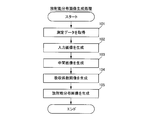
- radioactivity distribution image generation process by the PET apparatus 1 of the embodiment will be described with reference to the flowchart of FIG. 3 and FIGS. 4 to 6.
- the radioactivity distribution image generation process is performed by the processing circuit 41 of the control unit 4.
- step 101 the measurement data 5 is acquired based on the detection of the radiation emitted from the subject 100.
- the input image 6 is generated by performing an imaging process on the measurement data 5.
- the input image 6 is generated by performing an imaging process by histogram formation, an imaging process by machine learning, or a process including a back projection process.
- the imaging process by histogram formation a method of imaging by adding an event to the position having the highest probability based on the TOF (Time Of Flight) information included in the measurement data 5 can be adopted.
- the image processing by machine learning a method of imaging using a machine learning model that converts the measurement data 5 into the input image 6 can be adopted.
- the process including the back projection process for example, a simple back projection process, a reconstruction process, and the like can be adopted.
- an analytical reconstruction process for example, an analytical reconstruction process, a successive approximation reconstruction process, and the like can be adopted.
- the analytical reconstruction process for example, an FBP (Filtered Back Projection) method or the like can be adopted.
- the successive approximation reconstruction process for example, an OSEM (Ordered Subsets Expectation Maximization) method or the like can be adopted.
- a reconstruction process is performed. In this case, the input image 6 is a reconstructed image.
- the input image 6 is an image showing the inside of the subject 100.
- the input image 6 is a three-dimensional image, an axial cross-sectional image, a coronal cross-sectional image, a sagittal cross-sectional image, a patch image obtained by cutting out a part of the area from the three-dimensional image, a patch image obtained by cutting out a part of the area from the axial cross-sectional image, and a coronal. It contains at least one of a patch image obtained by cutting out a part of a region from a cross-sectional image and a patch image obtained by cutting out a part of a region from a sagittal cross-sectional image.
- the "cross-sectional image” means a two-dimensional image of one slice.
- the axial cross-sectional image means an image of a cross section orthogonal to the body axis.
- the coronal cross-sectional image means an image of a cross-section of a cross section parallel to the body axis.
- the sagittal cross-sectional image means an image of a vertical cross-section parallel to the body axis.
- the input image 6 may be only one slice or may be several consecutive slices.
- the input image 6 is generated without performing at least one of the absorption correction process and the scattering correction process.
- the absorption correction process is a process for correcting the absorption of radiation in the subject 100.
- the scattering correction process is a process for correcting the scattering of radiation in the subject 100.
- the input image 6 without correction in which at least one of the absorption correction process and the scattering correction process is not performed is generated from the measurement data 5.
- the image quality conversion process may not be performed, the image quality conversion process may be performed, or the area identification process may be performed.
- the input image 6 may include at least one of an image to which the image quality conversion process is not applied, an image to which the image quality conversion process is applied, and an image to which the area identification process is applied.
- the image quality conversion process for example, a gamma correction process, a histogram flattening process, a smoothing process, an edge detection process, and the like can be adopted.
- a process of adding random noise of a distribution such as a uniform distribution, a normal distribution, a Poisson distribution, and a Laplace distribution can be adopted.
- the image quality conversion process a process of multiplying the entire image or a specific area of the image by a constant can be adopted.
- the area identification process a process of identifying the contour of the subject 100 in the image can be adopted.
- an intermediate image 7 including an image relating to the tissue region is generated based on the input image 6.
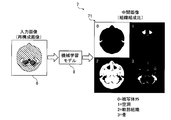
- the intermediate image 7 is generated by applying the machine learning model 8 learned in advance to the input image 6.
- the machine learning model 8 is a machine learning model that inputs an input image 6 and outputs an intermediate image 7.
- the machine learning model 8 is a machine learning model that inputs a three-dimensional image, a machine learning model that inputs an axial cross-sectional image, a machine learning model that inputs a coronal cross-sectional image, and a machine that inputs a sagittal cross-sectional image.
- a learning model a machine learning model that inputs a patch image cut out from a three-dimensional image, a machine learning model that inputs a patch image cut out from an axial cross-sectional image, and a patch image cut out from a coronal cross-sectional image as input. It includes at least one of a machine learning model and a machine learning model that inputs a patch image cut out from a sagittal cross section image.
- the machine learning model 8 inputs an input image 6 which is an axial cross-sectional image, and an intermediate image 7 corresponding to the axial cross-sectional image 7 is used. An example of outputting is shown in the figure.
- the intermediate image 7 is composed of a combination of N (finite) tissues having a known absorption coefficient, such as brain, bone, skin, muscle, and internal organs.
- N finite tissues having a known absorption coefficient
- the elements (tissues) constituting the image relating to the tissue region of the intermediate image 7 are the background (outside the subject), the cavity (nasal cavity and oral cavity, etc.), and the soft tissue. It contains at least one of tissue (such as brain and skin) and bone (skull).
- the element (tissue) constituting the image relating to the tissue region of the intermediate image 7 is at least the background (outside the subject) and the soft tissue. Includes one.
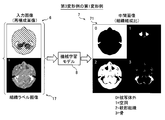
- the intermediate image 7 includes a tissue composition ratio image 71 showing the proportion of the tissue contained in each pixel as an image relating to the tissue region.
- the tissue composition ratio image 71 is a multi-channel image in which the ratio of a plurality of tissues included in each pixel is used as a pixel value.
- the tissue composition ratio image 71 is an image of the human head and includes four channel images of background, cavity, soft tissue and bone.
- the image of the background channel is configured with the ratio of the background included in each pixel as the pixel value.
- the image of the channel of the cavity is configured with the ratio of the cavity included in each pixel as the pixel value.
- the image of the channel of the soft tissue is configured with the ratio of the soft tissue contained in each pixel as the pixel value.
- the image of the bone channel is configured with the ratio of the bone contained in each pixel as the pixel value. Since the pixel value of each image of 4 channels indicates a ratio, the sum of the pixel values of the images of 4 channels for a certain pixel is 1.
- an absorption coefficient image 9 is generated based on the intermediate image 7 and the known absorption coefficient of the tissue region.
- the absorption coefficient image 9 is generated by assigning the absorption coefficient to the tissue in the tissue composition ratio image 71 based on the known absorption coefficient.
- the absorption coefficient image 9 is generated by performing a linear combination process of the tissue composition ratio image 71 of each tissue using the known absorption coefficient as a coefficient. More specifically, according to the following equation (1), a linear combination process of the tissue composition ratio image 71 of each tissue using a known absorption coefficient as a coefficient is performed.
- the tissue composition ratio image 71 is an image of a human head and includes images of four channels of background, cavity, soft tissue and bone, it is generally known that the background absorption coefficient ⁇ . * 0, the absorption coefficient of the cavity mu * 1, the absorption coefficient mu * 2 of soft tissue, and, using the absorption coefficient mu * 3 bone, the above equation (1), the known absorption coefficients each tissue was coefficients The linear combination process of the tissue composition ratio image 71 of the above is performed.
- the radioactivity distribution image 10 is generated by performing the reconstruction process based on the absorption coefficient image 9 and the measurement data 5. At this time, at least one of the absorption correction process and the scattering correction process is performed based on the absorption coefficient image 9. For example, in step 105, absorption correction processing is performed based on the absorption coefficient image 9, and scattering correction processing is performed based on the scattering distribution data acquired based on the absorption coefficient image 9 and the measurement data 5. In step 105, a quantitative radioactivity distribution image 10 that has undergone absorption correction processing and scattering correction processing is generated.
- the machine learning model 8 included in the PET device 1 of the embodiment will be described with reference to FIGS. 7 to 9.
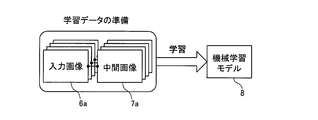
- the input image 6 and the intermediate image 7 as learning data will be referred to as an input image 6a and an intermediate image 7a, respectively.
- the machine learning model 8 is learned by supervised learning using a pair of a plurality of input images 6a and an intermediate image 7a as learning data. Specifically, the machine learning model 8 is trained by using the input image 6a prepared in advance as an input and the intermediate image 7a prepared in advance as a teacher image (correct answer image). The details of learning of the machine learning model 8 will be described later.
- the machine learning model 8 includes a deep neural network. Further, the deep neural network of the machine learning model 8 includes a convolution process. That is, the machine learning model 8 includes a deep convolutional neural network.
- the deep convolutional neural network of the machine learning model 8 for example, a U-shaped network (U-Net) having a skip connection can be adopted. Further, the Softmax function can be adopted as the activation function of the deep convolutional neural network of the machine learning model 8.
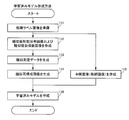
- a method of creating a machine learning model 8 (a method of creating a trained model) included in the PET device 1 of one embodiment will be described with reference to the flowchart of FIG. 8 and FIG.
- a tissue label image 11 indicating the tissue to which each pixel belongs by a label is prepared.
- the tissue label image 11 can be prepared by subjecting a medical image such as an MR image and a CT image to a region dividing process. Further, the tissue label image 11 can be prepared by obtaining a tissue label image (for example, BrainWeb) published on the Internet.
- a tissue label image for example, BrainWeb
- the pseudo-radioactivity distribution image 12 and the pseudo-absorption coefficient image 13 are created based on the tissue label image 11.
- the pseudo-radioactivity distribution image 12 is created by assigning the radioactivity concentration to each tissue of the tissue label image 11.
- the pseudo-absorption coefficient image 13 is created by assigning an absorption coefficient to each tissue of the tissue label image 14 created by integrating the labels of each tissue of the tissue label image 11.
- the tissue label image 14 is an image in which the number of labels is reduced with respect to the tissue label image 11 by integrating the labels.
- the pseudo measurement data 15 is created by performing a simulation calculation based on the pseudo-radioactivity distribution image 12 and the pseudo absorption coefficient image 13.
- the pseudo-measurement data 15 is created by inputting the pseudo-radioactivity distribution image 12, the pseudo-absorption coefficient image 13, and various simulation conditions and performing the simulation calculation.
- the simulation calculation for example, a Monte Carlo simulation calculation, an analytical simulation calculation, or the like can be adopted.
- the machine learning model 8 is trained using the Monte Carlo simulation calculation and the pseudo-measurement data 15 generated based on at least one of the analytical simulation calculations.
- the machine learning model 8 is trained using the Monte Carlo simulation calculation and the pseudo measurement data 15 generated based on the analytical simulation calculation among the analytical simulation calculations.
- the pseudo-reconstructed image 16 is generated by performing a process (imaging process) including a back projection process on the pseudo measurement data 15. Specifically, in step 114, the pseudo-reconstructed image 16 is generated by inputting various reconstruction conditions including the pseudo-measurement data 15 and the pixel size and performing the reconstruction process. In the reconstruction process, resolution information (pixel size information) is input as a parameter.
- the pseudo-reconstructed image 16 is an example of a "pseudo-image" in the claims.
- a normalized pseudo-reconstructed image 16 is generated by performing a normalization process for normalizing the pixel value range to [0, 1] on the pseudo-reconstructed image 16. .. Further, in step 114, the normalized pseudo-reconstructed image 16 may be multiplied by a coefficient larger than 0 and smaller than 1, or the normalized pseudo-reconstructed image 16 or the pre-normalized pseudo-reconstructed image 16. A positive coefficient may be multiplied for a specific area of the pseudo-reconstructed image 16. By doing so, it is possible to train the machine learning model 8 by using the pseudo-reconstructed image 16 having various pixel values.
- the input image 6a (pseudo-reconstructed image 16) as the training data of the machine learning model 8 is larger than 0 and 1 with respect to the normalized image in which the pixel value range is normalized and the normalized image. It contains at least one of an image multiplied by a smaller factor and an image multiplied by a positive factor for a particular region of the normalized or unnormalized image.
- n 2 to 10 (in increments of 1)
- n 20 to 100 (in increments of 10)
- n 200 to 1000 (in increments of 100).
- a large number of input images 6a can be generated.
- an organizational unit area can be adopted as the specific area.
- the normalized image is an image of the human head
- the gray matter of the brain, white matter, cerebellum, skin of the head, and muscles of the head can be employed as specific areas. This makes it possible to learn the machine learning model 8 in consideration of the diversity of radioactivity distribution caused by individual differences and differences in radiopharmaceuticals.
- the image quality conversion process may not be performed, the image quality conversion process may be performed, or the area identification process may be performed.
- the input image 6a includes at least one of an image to which the image quality conversion process is not applied, an image to which the image quality conversion process is applied, and an image to which the area identification process is applied.
- the image quality conversion process for example, a gamma correction process, a histogram flattening process, a smoothing process, an edge detection process, and the like can be adopted.
- a process of adding random noise of a distribution such as a uniform distribution, a normal distribution, a Poisson distribution, and a Laplace distribution can be adopted.
- the image quality conversion process a process of multiplying the entire image or a specific area of the image by a constant can be adopted. By doing so, it is possible to train the machine learning model 8 by input images 6a having various pixel values. Further, for example, as the area identification process, a process of identifying the contour of the subject 100 in the image can be adopted.
- an intermediate image (teacher image) 7a as learning data is created based on the tissue label image 11.
- the intermediate image 7a is created based on the tissue label image 14 created by integrating the labels of each tissue of the tissue label image 11. More specifically, assuming the same low-resolution pixel size as the pseudo-reconstructed image 16, the ratio (composition ratio) of each tissue contained in one pixel is calculated with respect to the high-resolution tissue label image 14. As a result, an intermediate image 7a as a tissue composition ratio image is created.
- a machine learning model 8 as a trained model is created using a large number of pseudo-reconstructed images 16 and intermediate images 7a as training data.
- the machine learning model 8 is trained using the Monte Carlo simulation calculation and the pseudo-reconstructed image 16 generated based on at least one of the analytical simulation calculations.
- the input image 6 is generated by performing imaging processing on the measurement data 5 acquired based on the detection of the radiation emitted from the subject 100, and the input image 6 is generated.
- An intermediate image 7 including an image relating to the tissue region is generated based on the above, and an absorption coefficient image 9 is generated based on the intermediate image 7 and a known absorption coefficient of the tissue region.
- the absorption coefficient image 9 can be generated based on the intermediate image 7 including the image relating to the tissue region.
- the absorption coefficient of the absorption coefficient image 9 is within an appropriate range (normally taken). It can be guaranteed that the value will be obtained).
- the intermediate image 7 includes the tissue composition ratio image 71 showing the proportion of the tissue contained in each pixel as an image relating to the tissue region.
- the absorption coefficient image 9 having an absorption coefficient within an appropriate range can be easily obtained based on the ratio of the tissue contained in each pixel of the tissue composition ratio image 71. Can be generated.
- the step of generating the absorption coefficient image 9 includes a step of assigning an absorption coefficient to the tissue in the tissue composition ratio image 71 based on the known absorption coefficient of each tissue region. ..
- the absorption coefficient image 9 having a value within an appropriate range of the absorption coefficient can be easily generated based on the tissue composition ratio image 71 to which the absorption coefficient is assigned based on the known absorption coefficient.
- the step of generating the input image 6 includes a step of generating the input image 6 without performing at least one of the absorption correction process and the scattering correction process. ..
- the absorption correction process and the scattering correction process is performed as compared with the case where at least one of the absorption correction process and the scattering correction process is performed to generate the input image 6.
- the process for generating the input image 6 can be easily performed as much as possible.
- the step of generating the input image 6 includes a step of performing a process including a back projection process on the measurement data 5.
- the input image 6 can be easily generated by performing a process including a back projection process on the measurement data 5.
- the input image 6 is an image to which the image quality conversion processing is not applied, an image to which the image quality conversion processing is applied, and an area of the measurement data 5 that has been imaged. Includes at least one of the images to which the identification process has been applied.
- the intermediate image 7 can be generated based on at least one of the image to which the image quality conversion process is applied and the image to which the area identification process is applied to the imaged measurement data 5. can.
- the step of generating the intermediate image 7 includes the step of applying the machine learning model 8 learned in advance to the input image 6.
- the intermediate image 7 can be easily generated only by applying the machine learning model 8 learned in advance to the input image 6.
- the input image 6a as the training data of the machine learning model 8 is larger than 0 and 1 with respect to the normalized image in which the pixel value range is normalized and the normalized image. Includes an image multiplied by a smaller coefficient and at least one of a normalized or unnormalized image multiplied by a positive coefficient for a particular region of the image.
- the machine learning model 8 can be trained by the input images 6a having various pixel values. As a result, it is possible to create a machine learning model 8 that is resistant to variations in pixel values.
- the machine learning model 8 inputs a machine learning model 8 that inputs a three-dimensional image, a machine learning model 8 that inputs an axial cross-sectional image, and a coronal cross-sectional image.
- Machine learning model 8 to input machine learning model 8 to input machine learning model 8 to input, machine learning model 8 to input sagittal cross-sectional image, machine learning model 8 to input patch image cut out from 3D image, and patch image cut out from axial cross-sectional image as input.
- It includes at least one of a machine learning model 8 and a machine learning model 8 in which a patch image cut out from a coronal cross-sectional image is input, and a machine learning model 8 in which a patch image cut out from a sagittal cross-sectional image is input. ..
- An intermediate image 7 can be generated by inputting a patch image cut out from the image.
- the machine learning model 8 includes a deep neural network. As a result, learning can be effectively performed by the machine learning model 8 including the deep neural network.
- the deep neural network includes a convolution process.
- learning can be performed more effectively by the deep neural network including the convolution process.
- the machine learning model 8 is trained using the pseudo-reconstructed image 16 generated based on at least one of the Monte Carlo simulation calculation and the analytical simulation calculation. ing.
- the machine learning model 8 can be created by using the pseudo-reconstructed image 16 generated based on at least one of the Monte Carlo simulation calculation and the analytical simulation calculation.
- the machine learning model 8 can be easily created.
- the tissue composition ratio image of each tissue using the known absorption coefficient as a coefficient is used.
- a step of performing a linear combination process of 71 is included.
- the absorption coefficient has a value within an appropriate range by performing a linear combination process of the tissue composition ratio image 71 of each tissue using a known absorption coefficient as a coefficient.
- the absorption coefficient image 9 can be easily generated.
- the measurement data 5 is the measurement data of the human head
- the elements constituting the image relating to the tissue region of the intermediate image 7 are the background, the cavity, the soft tissue, and the soft tissue. Contains at least one of the bones.
- the measurement data 5 is the measurement data of the human breast
- the elements constituting the image relating to the tissue region of the intermediate image 7 are at least the background and the soft tissue. Includes one.
- the absorption coefficient image 9 having an absorption coefficient within an appropriate range can be easily generated from the intermediate image 7 including the image relating to the tissue region. ..
- the processing circuit 41 is configured to perform at least one of the absorption correction process and the scattering correction process based on the absorption coefficient image 9. Thereby, an appropriate absorption correction process or an appropriate scattering correction process can be performed based on the absorption coefficient image 9 whose absorption coefficient is within an appropriate range.
- the method of creating the trained model is based on the step of preparing the tissue label image 11 showing the tissue to which each pixel belongs and the pseudo-radioactivity distribution image based on the tissue label image 11.
- 12 and a step of creating a pseudo absorption coefficient image 13 a step of creating a pseudo measurement data 15 by performing a simulation calculation based on the pseudo radioactivity distribution image 12 and the pseudo absorption coefficient image 13, and a pseudo measurement data 15.
- a step of generating a pseudo-reconstructed image 16 by performing an imaging process on the image 16 and a step of creating a trained model (machine learning model 8) using the pseudo-reconstructed image 16 as training data are provided.
- a trained model (machine learning model 8) can be created using the pseudo-reconstructed image 16 obtained by the simulation calculation as training data.
- a trained model (machine learning model 8) using an actual reconstructed image (clinical image) as training data, it is not necessary to collect a large number of clinical images. This makes it possible to create a trained model (machine learning model 8) without going through the difficult work of collecting a large number of clinical images from the viewpoint of personal information protection.
- the intermediate image 7 includes a tissue label image 72 showing the tissue to which each pixel belongs as an image relating to the tissue region.
- the absorption coefficient image 9 having an absorption coefficient within an appropriate range can be easily generated based on the tissue to which each pixel of the tissue label image 72 belongs. ..
- the tissue label image 72 when a plurality of tissues are mixed in one pixel, the pixel is labeled as belonging to the tissue occupying the largest proportion.
- the tissue label image 72 is an image of the human head and includes four labels: background, cavity, soft tissue and bone.
- the area of the background label is configured with the pixel value assigned to the background label as the pixel value.
- the area of the label of the cavity is configured with the pixel value assigned to the label of the cavity as the pixel value.
- the area of the label of the soft tissue is configured with the pixel value assigned to the label of the soft tissue as the pixel value.
- the area of the bone label is configured with the pixel value assigned to the bone label as the pixel value. Note that the four labels are assigned different pixel values (integer values) from each other.
- the absorption coefficient image 9 is generated based on the tissue label image 72 of the intermediate image 7 and the known absorption coefficient of the tissue region. Specifically, an absorption coefficient is assigned to the tissue in the tissue label image 72 based on a known absorption coefficient. Thereby, the absorption coefficient image 9 having a value within the appropriate range of the absorption coefficient can be easily generated based on the tissue label image 72 to which the absorption coefficient is assigned based on the known absorption coefficient. More specifically, a known absorption coefficient allocation process corresponding to the label value of the tissue label image 72 is performed. As a result, when the intermediate image 7 includes the tissue label image 72, the absorption coefficient image 9 having an absorption coefficient within an appropriate range is performed by performing a known absorption coefficient allocation process corresponding to the label value of the tissue label image 72. Can be easily generated.
- the known absorption coefficient allocation processing corresponding to the label value of the tissue label image 72 is performed by the following equation (3).
- j Pixel number l j : Label value (organization number) of pixel j ⁇ j : Absorption coefficient of pixel j ⁇ * l : Absorption coefficient of label value l (known absorption coefficient) Is.
- the tissue label image 72 is an image of a human head and contains four labels: background, cavity, soft tissue and bone
- the background absorption coefficient ⁇ * 0. Cavity absorption coefficient ⁇ * 1 , soft tissue absorption coefficient ⁇ * 2 , and bone absorption coefficient ⁇ * 3 , according to the above equation (3), known corresponding to the label value of the tissue label image 72.
- the absorption coefficient allocation process is performed.
- the machine learning model 8 that outputs the tissue label image 72 basically does not directly output the tissue label image 72, but outputs the reliability for each pixel as an intermediate output.
- Reliability is an index that can have probabilistic implications for determining which label a pixel belongs to.
- the machine learning model 8 that outputs the tissue label image 72 finally outputs the tissue label image 72, assuming that the pixel belongs to the label with the highest reliability acquired.
- the reliability can be a value of 0 to 1, and the sum of the reliabilitys of all the labels can be 1. Therefore, it is also possible to generate the absorption coefficient image 9 by reading the tissue composition ratio in the above embodiment as reliability and performing the linear combination process in the same manner as in the tissue composition ratio image 71 of the above embodiment.
- the absorption coefficient image 9 may be generated by performing a linear combination process of the reliability image which is an intermediate output of the tissue label image 72 using a known absorption coefficient as a coefficient.
- the absorption coefficient is within an appropriate range by performing a linear combination process of the reliability image which is the intermediate output of the tissue label image 72 with the known absorption coefficient as the coefficient.
- the absorption coefficient image 9 of the value in can be easily and accurately generated.
- step 115 of the above embodiment the same low resolution pixel size as the pseudo-reconstructed image 16 is assumed, and one pixel is used for the high resolution tissue label image 14.
- An intermediate image 7a as a tissue label image is created by calculating the ratio (composition ratio) of each tissue contained in the image and attaching a label assuming that the pixel belongs to the tissue occupying the maximum ratio.
- the machine learning model 8 is a machine learning model for an axial cross section, a machine learning model for a coronal cross section, and a machine learning model for a sagittal cross section. It contains three machine learning models.
- the machine learning model for an axial cross section is learned by inputting an input image 6a which is an axial cross section image and using an intermediate image 7a corresponding to the axial cross section image as a teacher image.
- the machine learning model for the coronal cross section is learned by inputting the input image 6a which is the coronal cross section image and using the intermediate image 7a corresponding to the coronal cross section image as the teacher image.
- the machine learning model for the sagittal cross section is learned by inputting the input image 6a which is the sagittal cross section image and using the intermediate image 7a corresponding to the sagittal cross section image as the teacher image.
- step 102 of the embodiment three input images 6 of an axial cross-sectional image, a coronal cross-sectional image, and a sagittal cross-sectional image are generated. To.
- the tissue composition ratio image corresponding to the axial cross-sectional image, the tissue composition ratio image corresponding to the coronal cross-sectional image, and the sagittal cross-sectional image correspond to each other.
- Three intermediate images 7 with the tissue composition ratio image are generated.
- the tissue composition ratio image corresponding to the axial cross-sectional image, the tissue composition ratio image corresponding to the coronal cross-sectional image, and the sagittal cross-sectional image correspond to each other.
- An absorption coefficient image 9 is generated based on the three intermediate images 7 with the tissue composition ratio image. Specifically, any two of the tissue composition ratio image corresponding to the axial cross-section image, the structure composition ratio image corresponding to the coronal cross-section image, and the structure composition ratio image corresponding to the sagittal cross-section image are the remaining two.
- the cross-section conversion process is performed so that the image corresponds to one cross-section.
- an average image (average tissue composition ratio image) of the three tissue composition ratio images having the same cross section is generated.
- a simple averaging process may be performed, or a weighted averaging process in which a cross section with high accuracy is weighted may be performed.
- the absorption coefficient image 9 is generated by performing the linear combination processing of the average tissue composition ratio image.
- step 103 of the embodiment the tissue label image corresponding to the axial cross-sectional image and the tissue label image corresponding to the coronal cross-section image are shown. And three intermediate images 7 of the structure label image corresponding to the sagittal cross-sectional image are generated.
- the tissue label image corresponding to the axial cross-sectional image, the tissue label image corresponding to the coronal cross-section image, and the sagittal cross-section image are obtained.
- the absorption coefficient image 9 is generated based on the three intermediate images 7 with the tissue label image corresponding to. Specifically, any two of the tissue label image corresponding to the axial cross-section image, the tissue label image corresponding to the coronal cross-section image, and the tissue label image corresponding to the sagittal cross-section image are the remaining one cross-section.
- the cross-section conversion process is performed so that the image corresponds to.
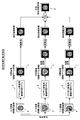
- a majority decision image (majority decision tissue label image) in which the label value of each pixel is determined by a majority vote of three tissue label images having the same cross section is generated.
- the label value of the predetermined cross section may be adopted.
- the absorption coefficient image 9 is generated by performing the allocation processing of the majority voting organization label image.
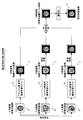
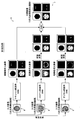
- the absorption coefficient image 9 can also be generated by a method other than majority voting. Specifically, as shown in FIG. 14, in the second modification of the second modification of the above embodiment, unlike the first modification of the second modification of the above embodiment, the three modified examples have the same cross section. Three absorption coefficient images are generated corresponding to each of the tissue label images. Then, an absorption coefficient image as an average image of the three absorption coefficient images is generated as the final absorption coefficient image 9.
- the machine learning model 8 outputs the tissue composition ratio image 71 of the intermediate image 7 based on the two types of input images 6.
- the combination of the input images 6 is not limited to the combination of the reconstructed image generated by performing the reconstruction process and the back projection image generated by performing the simple back projection process.
- the combination of the input images 6 may be a combination of a plurality of types of reconstructed images having different reconstruction algorithms from each other.
- the combination of the input images 6 may be a combination of a plurality of types of reconstructed images in which the number of iterations of the successive approximation image reconstruction process is different from each other.
- the combination of the input images 6 may be a plurality of types of reconstructed images having different resolutions from each other.
- the input image 6 includes images having two or more kinds of resolutions.
- the intermediate image 7 can be generated based on the input images 6 having various types of resolutions, as compared with the case where the images having only one type of resolution are included.
- the combination of the input images 6 may be a combination of a plurality of types of reconstructed images that have been subjected to image processing different from each other. Further, the combination of the input images 6 may be a combination of these images.
- the machine learning model 8 outputs the tissue composition ratio image 71 of the intermediate image 7 based on the input image 6 and the tissue label image 17 as auxiliary information. ..
- the machine learning model 8 outputs the tissue composition ratio image 71 of the intermediate image 7 based on the input image 6 and the subject area indication image 18 as auxiliary information. do.
- a single tissue area indicating image showing an area of a single tissue may be used.
- the input image (reconstructed image) 6 and the mixed structure number image 19 showing the number of types of tissues included in the pixels are shown. These two types are the inputs of the machine learning model 8.
- the machine learning model 8 outputs the tissue composition ratio image 71 of the intermediate image 7 based on the input image 6 and the mixed tissue number image 19 as auxiliary information. do.
- the input image (reconstructed image) 6 and the information 20 regarding the spatial position of the input image 6 which is non-image information are obtained.
- These two types are the inputs of the machine learning model 8. That is, in the fourth modification of the third modification of the above embodiment, the machine learning model 8 inputs information 20 regarding the spatial position of the input image 6 in addition to the input image 6. As a result, not only the input image 6 but also the information 20 regarding the spatial position of the input image 6 can be effectively generated as the input.
- the information 20 regarding the spatial position of the input image 6 for example, the distance from the center of gravity of the subject and the relative distance can be adopted.
- the machine learning model 8 has the tissue composition of the intermediate image 7 based on the input image 6 and the information 20 regarding the spatial position of the input image 6 as auxiliary information.
- the ratio image 71 is output.
- the intermediate image 7 including the tissue composition ratio image 71, and the reconstructed image to which at least one of the absorption correction process and the scattering correction process is applied.
- Two types of images with 21 are the outputs of the machine learning model 8.
- the machine learning model 8 simultaneously outputs the reconstructed image 21 to which at least one of the absorption correction process and the scattering correction process is applied, in addition to the intermediate image 7.
- the configuration image 21 can also be generated.
- the machine learning model 8 outputs an intermediate image 7 and a reconstructed image 21 to which absorption correction processing is applied.
- the machine learning model 8 is a multi-output type (multitask type) deep convolutional neural network that outputs two types of images, an intermediate image 7 and a reconstructed image 21. Includes.
- the machine learning model 8 includes a plurality of machine learning models corresponding to each tissue of the tissue composition ratio image 71 of the intermediate image 7.
- the tissue composition ratio image 71 is an image of a human head.
- the machine learning model 8 includes four machine learning models: a machine learning model for the background, a machine learning model for the cavity, a machine learning model for the soft tissue, and a machine learning model for the bone.
- the machine learning model for the background takes the input image 6 as an input and outputs the tissue composition ratio image 71 corresponding to the background.
- the machine learning model for the cavity takes the input image 6 as an input and outputs the tissue composition ratio image 71 corresponding to the cavity.
- the machine learning model for the soft tissue takes the input image 6 as an input and outputs the tissue composition ratio image 71 corresponding to the soft tissue.
- the machine learning model for bone takes the input image 6 as an input and outputs the tissue composition ratio image 71 corresponding to the bone.
- the linear combination process of the tissue composition ratio image 71 of each tissue using the known absorption coefficient as a coefficient is performed by the following formula (4). .. here, n: tissue number j: pixel number ⁇ j : absorption coefficient of pixel j ⁇ * n : absorption coefficient of tissue n (known absorption coefficient) r nj : Composition ratio of the structure n of the pixel j (0 ⁇ r nj ⁇ 1) Is.
- the tissue composition ratio image 71 of each tissue is generated by a machine learning model independent of each other. Therefore, unlike the above embodiment, the condition that the sum of the composition ratios is 1 is automatically set. Not satisfied. Therefore, in the fifth modification of the above embodiment, as shown in the above equation (4), a normalization process (a process of dividing by the denominator term of the above equation (4)) is performed at the time of the linear combination process. There is.
- the machine learning model 8 includes a deep neural network for an axial cross section, a deep neural network for a coronal cross section, and a deep neural network for a sagittal cross section.
- the deep neural network for the axial cross section takes the input image 6 which is a three-dimensional axial cross section image as an input, and outputs the tissue composition ratio image corresponding to the axial cross section image.
- the deep neural network for the coronal cross section takes the input image 6 which is a three-dimensional coronal cross section image as an input, and outputs the tissue composition ratio image corresponding to the coronal cross section image.
- the deep neural network for the sagittal cross section takes the input image 6 which is a three-dimensional sagittal cross section image as an input, and outputs the tissue composition ratio image corresponding to the sagittal cross section image.
- the machine learning model 8 has a tissue composition ratio image corresponding to an axial cross-sectional image, a tissue composition ratio image corresponding to a coronal cross-sectional image, and a tissue composition corresponding to a sagittal cross-sectional image. Any two of the ratio images are configured to perform cross-section conversion processing so that the image corresponds to the remaining one cross-section. Further, in the sixth modification of the above embodiment, the machine learning model 8 inputs three tissue composition ratio images having a uniform cross section, and has a three-dimensional tissue composition corresponding to the three tissue composition ratio images having the same cross section. It contains a deep neural network that outputs ratio images. As a result, in the sixth modification of the above embodiment, the intermediate image 7 is generated as a three-dimensional tissue composition ratio image.
- the nuclear medicine diagnostic device is a PET device
- the present invention is not limited to this.
- the nuclear medicine diagnostic apparatus may be a SPECT (Single photon emission computed tomography) apparatus other than the PET apparatus.
- the normalization range may be any range such as [-1,1] other than [0,1].
- the machine learning model may be trained using both a pseudo image and a real image (an image of an actual subject). As a result, the machine learning model can be trained with various data. As a result, it is possible to create a machine learning model that is resistant to variations among subjects. Further, the machine learning model may be additionally trained using a real image using the machine learning model learned by the pseudo image as a base model. As a result, the machine learning model can be efficiently trained even when the machine learning model is trained using both the pseudo image and the real image.
- an input image is generated without performing at least one of absorption correction processing and scattering correction processing is shown, but the present invention is not limited to this.
- an input image in which both the absorption correction process and the scattering correction process are performed may be generated.
- an absorption coefficient image is generated by performing a linear combination process of the tissue composition ratio image of each tissue using a known absorption coefficient as a coefficient.
- the absorption coefficient image is obtained by performing a known absorption coefficient allocation process corresponding to the tissue having the maximum tissue composition ratio in each pixel. May be generated.
- the machine learning model has three machine learning models: a machine learning model for an axial section, a machine learning model for a coronal section, and a machine learning model for a sagittal section.
- a machine learning model for an axial section a machine learning model for a coronal section
- a machine learning model for a sagittal section a machine learning model for a sagittal section.
- an example in which two types of images, an intermediate image and a reconstructed image, are outputs of a machine learning model has been described, but the present invention is not limited to this. ..
- three or more types of images may be the output of the machine learning model.
- the intermediate image and the image other than the reconstructed image may be the output of the machine learning model.
- an intermediate image and a mixed tissue number image showing the number of tissue types contained in the pixels may be the output of the machine learning model.
- each process of the processing circuit has been described using a “flow drive type” flowchart, but the present invention is not limited to this.
- each of the above processes may be performed by an "event-driven type" that is executed in event units. In this case, it may be completely event-driven, or it may be a combination of event-driven and flow-driven.
- An absorption coefficient image generation method for a nuclear medicine diagnostic device that generates an absorption coefficient image in a subject.
- a step of generating an input image by performing an imaging process on the measurement data acquired based on the detection of the radiation emitted from the subject.
- Based on the input image a step of generating an intermediate image including an image relating to a tissue region, and
- a method for generating an absorption coefficient image comprising: a step of generating an absorption coefficient image based on the intermediate image and a known absorption coefficient of a tissue region.
- Item 1 includes the intermediate image including at least one of a tissue composition ratio image showing the proportion of tissue contained in each pixel and a tissue label image showing the tissue to which each pixel belongs as an image relating to a tissue region. The absorption coefficient image generation method described.
- the input image is at least one of an image to which the image quality conversion process is not applied, an image to which the image quality conversion process is applied, and an image to which the area identification process is applied to the measured data that has been imaged.
- the absorption coefficient image generation method according to item 1 wherein the input image includes images having two or more types of resolutions.
- the step of generating the intermediate image includes a step of applying a machine learning model learned in advance to the input image.
- the input image as training data of the machine learning model is a normalized image in which a pixel value range is normalized, an image obtained by multiplying the normalized image by a coefficient larger than 0 and smaller than 1.
- the absorption coefficient image generation method according to item 8 further comprising at least one of the normalized image or an image obtained by multiplying a specific region of the unnormalized image by a positive coefficient.
- Item 10 (Item 10) Item 8. The absorption coefficient image generation method according to item 8, wherein the machine learning model simultaneously outputs a reconstructed image to which at least one of an absorption correction process and a scattering correction process is applied in addition to the intermediate image.
- the machine learning model is A machine learning model that inputs 3D images and A machine learning model that inputs an axial cross-section image, A machine learning model that inputs a coronal cross-section image, A machine learning model that inputs a sagittal cross-section image, A machine learning model that inputs a patch image cut out from a 3D image, A machine learning model that inputs a patch image cut out from an axial cross-section image, A machine learning model that inputs a patch image cut out from a coronal cross-section image, A machine learning model that inputs a patch image cut out from a sagittal cross-section image,
- the absorption coefficient image generation method according to item 8, which comprises at least one of.
- the step of generating the absorption coefficient image is When the intermediate image includes the tissue composition ratio image, a step of performing a linear combination process of the tissue composition ratio image of each tissue using a known absorption coefficient as a coefficient is included.
- the method for generating an absorption coefficient image according to item 3 wherein when the intermediate image includes the tissue label image, the step of assigning a known absorption coefficient corresponding to the label value of the tissue label image is included.
- the step of generating the absorption coefficient image is a step of performing linear coupling processing of a reliability image which is an intermediate output of the tissue label image using a known absorption coefficient as a coefficient when the intermediate image includes the tissue label image.
- the measurement data is measurement data of the human head, and is The absorption coefficient image generation method according to item 1, wherein the elements constituting the image relating to the tissue region include at least one of a background, a cavity, a soft tissue, and a bone.
- the measurement data is measurement data of a human breast, and is The absorption coefficient image generation method according to item 1, wherein the elements constituting the image relating to the tissue region include at least one of a background and a soft tissue.
- a detector that detects radiation generated by radioactive agents in the subject, A processing unit that generates a radioactivity distribution image in the subject based on the detection of radiation by the detection unit is provided.
- the processing unit An input image is generated by performing an imaging process on the measurement data acquired based on the detection of the radiation emitted from the subject. Based on the input image, an intermediate image including an image relating to the tissue region is generated.
- a nuclear medicine diagnostic apparatus configured to generate an absorption coefficient image for generating the radioactivity distribution image based on the intermediate image and a known absorption coefficient of the tissue region.
- (Item 23) Item 22.
Landscapes
- Health & Medical Sciences (AREA)
- Life Sciences & Earth Sciences (AREA)
- Engineering & Computer Science (AREA)
- Medical Informatics (AREA)
- Physics & Mathematics (AREA)
- High Energy & Nuclear Physics (AREA)
- Molecular Biology (AREA)
- Biomedical Technology (AREA)
- General Health & Medical Sciences (AREA)
- Nuclear Medicine, Radiotherapy & Molecular Imaging (AREA)
- Optics & Photonics (AREA)
- Radiology & Medical Imaging (AREA)
- Animal Behavior & Ethology (AREA)
- Veterinary Medicine (AREA)
- Biophysics (AREA)
- Pathology (AREA)
- Public Health (AREA)
- Heart & Thoracic Surgery (AREA)
- Surgery (AREA)
- Computer Vision & Pattern Recognition (AREA)
- General Physics & Mathematics (AREA)
- Theoretical Computer Science (AREA)
- Dentistry (AREA)
- Oral & Maxillofacial Surgery (AREA)
- Neurology (AREA)
- Neurosurgery (AREA)
- Physiology (AREA)
- Spectroscopy & Molecular Physics (AREA)
- Nuclear Medicine (AREA)
- Image Analysis (AREA)
- Algebra (AREA)
- Mathematical Analysis (AREA)
- Mathematical Optimization (AREA)
- Mathematical Physics (AREA)
- Pure & Applied Mathematics (AREA)
Priority Applications (4)
| Application Number | Priority Date | Filing Date | Title |
|---|---|---|---|
| JP2022532213A JP7517420B2 (ja) | 2020-06-26 | 2020-06-26 | 吸収係数画像生成方法、核医学診断装置および学習済みモデルの作成方法 |
| CN202080102355.5A CN115702365A (zh) | 2020-06-26 | 2020-06-26 | 吸收系数图像生成方法、核医学诊断装置以及学习完毕模型的制作方法 |
| PCT/JP2020/025275 WO2021260928A1 (ja) | 2020-06-26 | 2020-06-26 | 吸収係数画像生成方法、核医学診断装置および学習済みモデルの作成方法 |
| US18/012,846 US20230281889A1 (en) | 2020-06-26 | 2020-06-26 | Attenuation coefficient image generation method, nuclear medicine diagnostic apparatus, and trained model generation method |
Applications Claiming Priority (1)
| Application Number | Priority Date | Filing Date | Title |
|---|---|---|---|
| PCT/JP2020/025275 WO2021260928A1 (ja) | 2020-06-26 | 2020-06-26 | 吸収係数画像生成方法、核医学診断装置および学習済みモデルの作成方法 |
Publications (1)
| Publication Number | Publication Date |
|---|---|
| WO2021260928A1 true WO2021260928A1 (ja) | 2021-12-30 |
Family
ID=79282200
Family Applications (1)
| Application Number | Title | Priority Date | Filing Date |
|---|---|---|---|
| PCT/JP2020/025275 Ceased WO2021260928A1 (ja) | 2020-06-26 | 2020-06-26 | 吸収係数画像生成方法、核医学診断装置および学習済みモデルの作成方法 |
Country Status (4)
| Country | Link |
|---|---|
| US (1) | US20230281889A1 (https=) |
| JP (1) | JP7517420B2 (https=) |
| CN (1) | CN115702365A (https=) |
| WO (1) | WO2021260928A1 (https=) |
Cited By (2)
| Publication number | Priority date | Publication date | Assignee | Title |
|---|---|---|---|---|
| US20220318997A1 (en) * | 2021-03-30 | 2022-10-06 | Fujifilm Corporation | Image processing device, learning device, radiography system, image processing method, learning method, image processing program, and learning program |
| WO2024150791A1 (ja) * | 2023-01-11 | 2024-07-18 | 国立大学法人九州大学 | 画像変換装置、画像変換方法及び画像変換プログラム |
Families Citing this family (2)
| Publication number | Priority date | Publication date | Assignee | Title |
|---|---|---|---|---|
| US12141900B2 (en) * | 2021-12-06 | 2024-11-12 | GE Precision Healthcare LLC | Machine learning generation of low-noise and high structural conspicuity images |
| CN117611750B (zh) * | 2023-12-05 | 2024-07-19 | 北京思博慧医科技有限公司 | 三维成像模型的构建方法、装置、电子设备和存储介质 |
Citations (7)
| Publication number | Priority date | Publication date | Assignee | Title |
|---|---|---|---|---|
| JP2010008164A (ja) * | 2008-06-25 | 2010-01-14 | Fujita Gakuen | 減弱係数マップ作成装置、減弱係数マップ作成方法およびプログラム |
| JP2013185855A (ja) * | 2012-03-06 | 2013-09-19 | Shimadzu Corp | Pet用乳房パッドおよびそれを用いたマンモ用pet装置 |
| JP2019032211A (ja) * | 2017-08-07 | 2019-02-28 | 株式会社島津製作所 | 核医学診断装置 |
| US20190130569A1 (en) * | 2017-10-26 | 2019-05-02 | Wisconsin Alumni Research Foundation | Deep learning based data-driven approach for attenuation correction of pet data |
| WO2019172181A1 (ja) * | 2018-03-09 | 2019-09-12 | 日本メジフィジックス株式会社 | 診断支援装置、プログラム、学習済みモデル、および学習装置 |
| JP2019531783A (ja) * | 2016-08-26 | 2019-11-07 | エレクタ、インク.Elekta, Inc. | 畳み込みニューラルネットワークを用いた画像セグメンテーションのためのシステムおよび方法 |
| WO2019240257A1 (ja) * | 2018-06-15 | 2019-12-19 | キヤノン株式会社 | 医用画像処理装置、医用画像処理方法及びプログラム |
Family Cites Families (8)
| Publication number | Priority date | Publication date | Assignee | Title |
|---|---|---|---|---|
| JP5126049B2 (ja) * | 2007-12-28 | 2013-01-23 | 株式会社島津製作所 | 核医学診断装置、形態断層撮影診断装置、核医学用データ演算処理方法および形態断層画像演算処理方法 |
| US9342903B2 (en) * | 2012-03-28 | 2016-05-17 | National Institute Of Radiological Services | Method for generating image for PET attenuation correction from MR image and computer program |
| JP6188400B2 (ja) * | 2013-04-26 | 2017-08-30 | オリンパス株式会社 | 画像処理装置、プログラム及び画像処理方法 |
| US20180197317A1 (en) * | 2017-01-06 | 2018-07-12 | General Electric Company | Deep learning based acceleration for iterative tomographic reconstruction |
| KR102210474B1 (ko) * | 2018-02-23 | 2021-02-01 | 서울대학교산학협력단 | 양전자방출 단층촬영 시스템 및 그것을 이용한 영상 재구성 방법 |
| EP3564906A1 (de) * | 2018-05-04 | 2019-11-06 | Siemens Healthcare GmbH | Verfahren zur erzeugung von bilddaten bei einem computertomographiegerät, bilderzeugungsrechner, computertomographiegerät, computerprogrammprodukt und computerlesbarer datenträger |
| US11234666B2 (en) * | 2018-05-31 | 2022-02-01 | Canon Medical Systems Corporation | Apparatus and method for medical image reconstruction using deep learning to improve image quality in position emission tomography (PET) |
| CN111105472B (zh) * | 2019-11-26 | 2024-03-22 | 上海联影智能医疗科技有限公司 | Pet图像的衰减校正方法、装置、计算机设备和存储介质 |
-
2020
- 2020-06-26 JP JP2022532213A patent/JP7517420B2/ja active Active
- 2020-06-26 CN CN202080102355.5A patent/CN115702365A/zh active Pending
- 2020-06-26 US US18/012,846 patent/US20230281889A1/en active Pending
- 2020-06-26 WO PCT/JP2020/025275 patent/WO2021260928A1/ja not_active Ceased
Patent Citations (7)
| Publication number | Priority date | Publication date | Assignee | Title |
|---|---|---|---|---|
| JP2010008164A (ja) * | 2008-06-25 | 2010-01-14 | Fujita Gakuen | 減弱係数マップ作成装置、減弱係数マップ作成方法およびプログラム |
| JP2013185855A (ja) * | 2012-03-06 | 2013-09-19 | Shimadzu Corp | Pet用乳房パッドおよびそれを用いたマンモ用pet装置 |
| JP2019531783A (ja) * | 2016-08-26 | 2019-11-07 | エレクタ、インク.Elekta, Inc. | 畳み込みニューラルネットワークを用いた画像セグメンテーションのためのシステムおよび方法 |
| JP2019032211A (ja) * | 2017-08-07 | 2019-02-28 | 株式会社島津製作所 | 核医学診断装置 |
| US20190130569A1 (en) * | 2017-10-26 | 2019-05-02 | Wisconsin Alumni Research Foundation | Deep learning based data-driven approach for attenuation correction of pet data |
| WO2019172181A1 (ja) * | 2018-03-09 | 2019-09-12 | 日本メジフィジックス株式会社 | 診断支援装置、プログラム、学習済みモデル、および学習装置 |
| WO2019240257A1 (ja) * | 2018-06-15 | 2019-12-19 | キヤノン株式会社 | 医用画像処理装置、医用画像処理方法及びプログラム |
Cited By (3)
| Publication number | Priority date | Publication date | Assignee | Title |
|---|---|---|---|---|
| US20220318997A1 (en) * | 2021-03-30 | 2022-10-06 | Fujifilm Corporation | Image processing device, learning device, radiography system, image processing method, learning method, image processing program, and learning program |
| US12315145B2 (en) * | 2021-03-30 | 2025-05-27 | Fujifilm Corporation | Image processing device, learning device, radiography system, image processing method, learning method, image processing program, and learning program |
| WO2024150791A1 (ja) * | 2023-01-11 | 2024-07-18 | 国立大学法人九州大学 | 画像変換装置、画像変換方法及び画像変換プログラム |
Also Published As
| Publication number | Publication date |
|---|---|
| JP7517420B2 (ja) | 2024-07-17 |
| CN115702365A (zh) | 2023-02-14 |
| JPWO2021260928A1 (https=) | 2021-12-30 |
| US20230281889A1 (en) | 2023-09-07 |
Similar Documents
| Publication | Publication Date | Title |
|---|---|---|
| US9619905B2 (en) | Apparatus and method for generation of attenuation map | |
| JP7517420B2 (ja) | 吸収係数画像生成方法、核医学診断装置および学習済みモデルの作成方法 | |
| KR100991640B1 (ko) | 핵의학 진단장치, 형태단층촬영 진단장치, 핵의학용 데이터연산처리방법 및 형태단층화상 연산처리방법 | |
| EP3224801B1 (en) | Multi-modality imaging system and method | |
| CN106061393B (zh) | 辐射检测器和包括辐射检测器的计算机断层扫描设备 | |
| CN108242068B (zh) | 用于成像系统的方法和ct/pet系统 | |
| US7840052B2 (en) | Restoration of the nuclear medicine 2D planar image by iterative constrained deconvolution | |
| CN106415317B (zh) | 单光子发射计算机化断层摄影术中的多个发射能量 | |
| CN111436958B (zh) | 一种用于pet图像衰减校正的ct图像生成方法 | |
| US20120305812A1 (en) | Spect targeted volume molecular imaging using multiple pinhole apertures | |
| EP1891899A1 (en) | Method and system for performing local tomography | |
| US8605988B2 (en) | Image registration system and method | |
| JP2023094592A (ja) | 核医学診断装置、画像処理方法及びプログラム | |
| JP7681419B2 (ja) | 画像処理装置、画像処理方法および断層画像取得システム | |
| US7756310B2 (en) | System and method for segmentation | |
| US20080073538A1 (en) | Application-driven optimization of acquisition and reconstruction of SPECT/PET projection data | |
| US20200085397A1 (en) | Attenuation coefficient image estimation method, attenuation coefficient image estimation program, and positron ct apparatus equipped with the same | |
| Cuddy‐Walsh et al. | Patient‐specific estimation of spatially variant image noise for a pinhole cardiac SPECT camera | |
| JP2024015834A (ja) | 画像処理方法、画像処理装置および核医学診断装置 | |
| JP2018013419A (ja) | 被ばく線量計測方法および被ばく線量計測装置 | |
| US20090072131A1 (en) | Estimation of Crystal Efficiency With Axially Compressed Sinogram | |
| US20260080653A1 (en) | Image procesing method, image processing device, and program | |
| US20240037814A1 (en) | Convolutional neural network for dynamic pet frame clustering | |
| Tadesse et al. | Attenuation Correction for Dedicated Cardiac SPECT Imaging Without Using Transmission Data | |
| Caucci | Task performance with list-mode data |
Legal Events
| Date | Code | Title | Description |
|---|---|---|---|
| 121 | Ep: the epo has been informed by wipo that ep was designated in this application |
Ref document number: 20941891 Country of ref document: EP Kind code of ref document: A1 |
|
| ENP | Entry into the national phase |
Ref document number: 2022532213 Country of ref document: JP Kind code of ref document: A |
|
| NENP | Non-entry into the national phase |
Ref country code: DE |
|
| 122 | Ep: pct application non-entry in european phase |
Ref document number: 20941891 Country of ref document: EP Kind code of ref document: A1 |