WO2021241577A1 - 異常変調原因表示装置、異常変調原因表示方法及び異常変調原因表示プログラム - Google Patents
異常変調原因表示装置、異常変調原因表示方法及び異常変調原因表示プログラム Download PDFInfo
- Publication number
- WO2021241577A1 WO2021241577A1 PCT/JP2021/019799 JP2021019799W WO2021241577A1 WO 2021241577 A1 WO2021241577 A1 WO 2021241577A1 JP 2021019799 W JP2021019799 W JP 2021019799W WO 2021241577 A1 WO2021241577 A1 WO 2021241577A1
- Authority
- WO
- WIPO (PCT)
- Prior art keywords
- cause
- process data
- modulation
- degree
- abnormality
- Prior art date
- Legal status (The legal status is an assumption and is not a legal conclusion. Google has not performed a legal analysis and makes no representation as to the accuracy of the status listed.)
- Ceased
Links
Images









Classifications
-
- G—PHYSICS
- G05—CONTROLLING; REGULATING
- G05B—CONTROL OR REGULATING SYSTEMS IN GENERAL; FUNCTIONAL ELEMENTS OF SUCH SYSTEMS; MONITORING OR TESTING ARRANGEMENTS FOR SUCH SYSTEMS OR ELEMENTS
- G05B23/00—Testing or monitoring of control systems or parts thereof
- G05B23/02—Electric testing or monitoring
- G05B23/0205—Electric testing or monitoring by means of a monitoring system capable of detecting and responding to faults
- G05B23/0259—Electric testing or monitoring by means of a monitoring system capable of detecting and responding to faults characterized by the response to fault detection
- G05B23/0275—Fault isolation and identification, e.g. classify fault; estimate cause or root of failure
-
- G—PHYSICS
- G05—CONTROLLING; REGULATING
- G05B—CONTROL OR REGULATING SYSTEMS IN GENERAL; FUNCTIONAL ELEMENTS OF SUCH SYSTEMS; MONITORING OR TESTING ARRANGEMENTS FOR SUCH SYSTEMS OR ELEMENTS
- G05B23/00—Testing or monitoring of control systems or parts thereof
- G05B23/02—Electric testing or monitoring
- G05B23/0205—Electric testing or monitoring by means of a monitoring system capable of detecting and responding to faults
- G05B23/0259—Electric testing or monitoring by means of a monitoring system capable of detecting and responding to faults characterized by the response to fault detection
- G05B23/0262—Confirmation of fault detection, e.g. extra checks to confirm that a failure has indeed occurred
-
- G—PHYSICS
- G05—CONTROLLING; REGULATING
- G05B—CONTROL OR REGULATING SYSTEMS IN GENERAL; FUNCTIONAL ELEMENTS OF SUCH SYSTEMS; MONITORING OR TESTING ARRANGEMENTS FOR SUCH SYSTEMS OR ELEMENTS
- G05B23/00—Testing or monitoring of control systems or parts thereof
- G05B23/02—Electric testing or monitoring
- G05B23/0205—Electric testing or monitoring by means of a monitoring system capable of detecting and responding to faults
- G05B23/0218—Electric testing or monitoring by means of a monitoring system capable of detecting and responding to faults characterised by the fault detection method dealing with either existing or incipient faults
- G05B23/0224—Process history based detection method, e.g. whereby history implies the availability of large amounts of data
- G05B23/024—Quantitative history assessment, e.g. mathematical relationships between available data; Functions therefor; Principal component analysis [PCA]; Partial least square [PLS]; Statistical classifiers, e.g. Bayesian networks, linear regression or correlation analysis; Neural networks
-
- Y—GENERAL TAGGING OF NEW TECHNOLOGICAL DEVELOPMENTS; GENERAL TAGGING OF CROSS-SECTIONAL TECHNOLOGIES SPANNING OVER SEVERAL SECTIONS OF THE IPC; TECHNICAL SUBJECTS COVERED BY FORMER USPC CROSS-REFERENCE ART COLLECTIONS [XRACs] AND DIGESTS
- Y02—TECHNOLOGIES OR APPLICATIONS FOR MITIGATION OR ADAPTATION AGAINST CLIMATE CHANGE
- Y02P—CLIMATE CHANGE MITIGATION TECHNOLOGIES IN THE PRODUCTION OR PROCESSING OF GOODS
- Y02P90/00—Enabling technologies with a potential contribution to greenhouse gas [GHG] emissions mitigation
- Y02P90/02—Total factory control, e.g. smart factories, flexible manufacturing systems [FMS] or integrated manufacturing systems [IMS]
Definitions
- the step is reset by the PLC (Programmable Logic Controller, sequencer) in the plant 3 connected to the control station 2, it is appropriate (for example, in the PLC) according to the timing of communication between the control station 2 and the plant 3.
- the serial number of the process data output from the control station 2 may be adopted (after the set time has elapsed after the step is switched). Further, the set time may be set for each production line or for each subdivided process.
- FIG. 11 is a diagram for explaining a process data synchronization process. For each value that is an element included in the time series data of batch processing with different serial numbers, the shortest distance between the values included in the different time series data is calculated as a whole, and the integrated value of the shortest distance is minimized. In addition, the time series data is slid in the time axis direction for alignment.
- a plurality of time-series data are synchronized based on the similarity of the time-series data.
- the degree of abnormality is calculated by the k-nearest neighbor method or the hoteling theory based on the integrated value of the distances between the synchronized time series data.
- anomalies can be detected based on the degree of similarity between time series data.
- the connection structure between the layers is not limited to full coupling.
- the learning process is performed using the process data in the normal state as training data, and a model is created in which the parameters are adjusted so that the difference between the value of the input layer and the value of the output layer becomes small.
- the process data to be verified is input, and the degree of abnormality is calculated according to the difference between the value of the input layer and the value of the output layer. That is, when abnormal process data is input, the information compressed in the intermediate layer cannot be properly restored in the output layer, and the difference between the values of the input layer and the output layer becomes large. Abnormality detection can be performed based on this. According to the autoencoder, an abnormality can be detected based on the characteristics of the relationship between output values between a plurality of sensors.
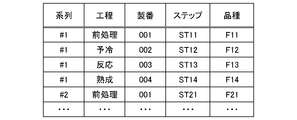
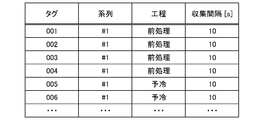
- the preprocessing unit 142 processes the process data when creating the abnormality detection model. For example, the preprocessing unit 142 associates the process data with the serial number. That is, based on the above-mentioned traceability information held in the storage device 12 in advance, the process data corresponding to a predetermined tag, system and serial number in batch processing, and the process data corresponding to a predetermined tag in continuous processing and at a predetermined timing. Associate with the output process data. In addition, data for a predetermined period used for abnormality determination is extracted based on the set values in a table such as a knowledge base, and feature quantities corresponding to each method are calculated. In the learning process, the pre-processing unit 142 performs data cleansing and extracts training data by excluding data in the unsteady operation period, data at the time of abnormality, and outliers such as noise. good.
- the abnormality determination unit 144 calculates the degree of abnormality using the process data and the abnormality detection model. That is, in the learning process, the abnormality determination unit 144 calculates the degree of abnormality using the test data for performing cross-validation and the abnormality detection model. Further, in the abnormality determination process, the degree of abnormality is calculated using the process data acquired from the plant 3.
- the preprocessing unit 142 extracts the process data at a predetermined timing and period, and the instantaneous value which is the process data itself, the maximum value, the minimum value, and the integral of the process data. A value, a difference, an integral value of the reaction rate, a differential coefficient at a predetermined time point, and the like are calculated and stored in the storage device 12.
- the time-series process data is vectorized or matrixed.
- synchronous processing is performed on a plurality of process data, and average time-series data is obtained.
- synchronization processing is performed for a plurality of process data.
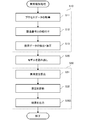
- the abnormality determination unit 144 of the abnormality modulation cause identification device 1 calculates the degree of abnormality using the created abnormality detection model and the test data (FIG. 16: S31). In this step, the abnormality determination unit 144 calculates the abnormality degree according to the method of calculating the abnormality degree. For example, when calculating the degree of anomaly by the hoteling method, the sample mean and sample standard deviation of the population are estimated using the process data, and the degree of anomaly is obtained based on the distance from the average of the population to the process data to be verified. ..
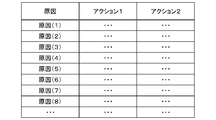
- FIG. 17 is a diagram showing an example of an action table.
- the table of FIG. 17 includes the cause, action 1, and action 2 attributes.
- the cause field the cause corresponding to the assumed cause of the knowledge base is registered.
- information indicating the action to be taken by the operator of the plant 3 in order to eliminate the corresponding cause is registered.
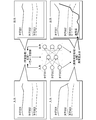
- FIG. 19 is a diagram showing an example of a screen output to the input / output device 13.
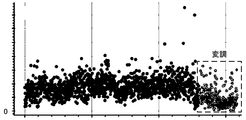
- FIG. 19 is an example of the main control chart, and shows the transition of individual process data as a line graph.
- the area 131 displayed on the input / output device 13 displays a plurality of combinations of the identification information of the process data acquired from the plant 3 and the latest value.
- the control chart of the area 132 shows the transition of the value for a specific process data as a line graph.
- the vertical axis represents the value of the process data, and the horizontal axis represents the time axis.
- the solid line represents the true value and the broken line represents the estimated value.
- the true value is the process data itself for which the degree of abnormality is calculated, and the estimated value may be an estimated value by regression analysis of the process data for which the degree of abnormality is calculated.
- the thin broken line represents the upper limit and the lower limit of the normal range (in other words, the threshold value for abnormality detection).
- the numerical value of the process data at the time indicated by the pointer is displayed. You may.
- the cause of the modulation of the process data displayed in the region 132 or the tag that can identify it is displayed on the horizontal axis, and the vertical axis represents the degree of establishment of the cause as a bar graph.
- the above-described embodiment has been described by taking a chemical plant as an example, it can be applied to a manufacturing process in a general production facility.
- the lot number may be used as a processing unit, and the processing according to the batch process in the embodiment may be applied.
- the present disclosure also includes a method for executing the above-mentioned processing, a computer program, and a computer-readable recording medium on which the program is recorded.
- the recording medium on which the program is recorded can perform the above-mentioned processing by causing the computer to execute the program.
Landscapes
- Physics & Mathematics (AREA)
- Engineering & Computer Science (AREA)
- General Physics & Mathematics (AREA)
- Automation & Control Theory (AREA)
- Artificial Intelligence (AREA)
- Evolutionary Computation (AREA)
- Mathematical Physics (AREA)
- Testing And Monitoring For Control Systems (AREA)
Priority Applications (4)
| Application Number | Priority Date | Filing Date | Title |
|---|---|---|---|
| US17/928,186 US20230205194A1 (en) | 2020-05-29 | 2021-05-25 | Abnormal irregularity cause display device, abnormal irregularity cause display method, and abnormal irregularity cause display program |
| JP2022526580A JP7719063B2 (ja) | 2020-05-29 | 2021-05-25 | 異常変調原因表示装置、異常変調原因表示方法及び異常変調原因表示プログラム |
| EP21811906.3A EP4160338A4 (en) | 2020-05-29 | 2021-05-25 | Abnormal modulation cause display device, abnormal modulation cause display method, and abnormal modulation cause display program |
| CN202180039068.9A CN115698880B (zh) | 2020-05-29 | 2021-05-25 | 异常调制原因显示装置、异常调制原因显示方法以及异常调制原因显示程序 |
Applications Claiming Priority (2)
| Application Number | Priority Date | Filing Date | Title |
|---|---|---|---|
| JP2020-095037 | 2020-05-29 | ||
| JP2020095037 | 2020-05-29 |
Publications (1)
| Publication Number | Publication Date |
|---|---|
| WO2021241577A1 true WO2021241577A1 (ja) | 2021-12-02 |
Family
ID=78744076
Family Applications (1)
| Application Number | Title | Priority Date | Filing Date |
|---|---|---|---|
| PCT/JP2021/019799 Ceased WO2021241577A1 (ja) | 2020-05-29 | 2021-05-25 | 異常変調原因表示装置、異常変調原因表示方法及び異常変調原因表示プログラム |
Country Status (5)
| Country | Link |
|---|---|
| US (1) | US20230205194A1 (https=) |
| EP (1) | EP4160338A4 (https=) |
| JP (1) | JP7719063B2 (https=) |
| CN (1) | CN115698880B (https=) |
| WO (1) | WO2021241577A1 (https=) |
Cited By (1)
| Publication number | Priority date | Publication date | Assignee | Title |
|---|---|---|---|---|
| WO2024204765A1 (ja) | 2023-03-31 | 2024-10-03 | 株式会社ダイセル | ガイダンス表示方法、ガイダンス表示システム及びガイダンス表示プログラム |
Families Citing this family (1)
| Publication number | Priority date | Publication date | Assignee | Title |
|---|---|---|---|---|
| EP4250035A1 (en) * | 2022-03-24 | 2023-09-27 | Rolls-Royce Deutschland Ltd & Co KG | System and method for machine diagnosis |
Citations (4)
| Publication number | Priority date | Publication date | Assignee | Title |
|---|---|---|---|---|
| JPH06309584A (ja) * | 1993-04-27 | 1994-11-04 | Toshiba Corp | プラント運転支援装置 |
| JP3699676B2 (ja) | 2001-11-29 | 2005-09-28 | ダイセル化学工業株式会社 | プラント制御監視装置 |
| WO2017109903A1 (ja) * | 2015-12-24 | 2017-06-29 | 株式会社 東芝 | 異常原因推定装置及び異常原因推定方法 |
| WO2018104985A1 (ja) * | 2016-12-08 | 2018-06-14 | 日本電気株式会社 | 異常分析方法、プログラムおよびシステム |
Family Cites Families (13)
| Publication number | Priority date | Publication date | Assignee | Title |
|---|---|---|---|---|
| US4862950A (en) * | 1988-11-22 | 1989-09-05 | Gribble Robert L | Apparatus and method for controlling the environment in a substantially enclosed and pressurized work area such as a textile manufacturing plant |
| JPH02236199A (ja) * | 1989-03-09 | 1990-09-19 | Toshiba Corp | プロセス診断装置 |
| US6907545B2 (en) * | 2001-03-02 | 2005-06-14 | Pitney Bowes Inc. | System and method for recognizing faults in machines |
| JP2006276924A (ja) | 2005-03-28 | 2006-10-12 | Hitachi Ltd | 設備機器診断装置及び設備機器診断プログラム |
| JP2009284119A (ja) * | 2008-05-21 | 2009-12-03 | Yokogawa Electric Corp | フィールドバス通信システム及びデータ管理装置 |
| JP2014056598A (ja) * | 2013-11-14 | 2014-03-27 | Hitachi Ltd | 異常検知方法及びそのシステム |
| CN104298225B (zh) * | 2014-09-25 | 2017-07-04 | 中国石油化工股份有限公司 | 化工过程异常工况因果关系推理模型建模与图形化展示方法 |
| CN107196780A (zh) * | 2016-03-15 | 2017-09-22 | 伊姆西公司 | 用于管理设备的故障的方法和装置 |
| US10169133B2 (en) * | 2016-04-26 | 2019-01-01 | Juniper Networks, Inc. | Method, system, and apparatus for debugging networking malfunctions within network nodes |
| EP3598350A4 (en) * | 2017-03-15 | 2020-04-22 | FUJIFILM Corporation | OPTIMAL SOLUTION EVALUATION METHOD, OPTIMAL SOLUTION EVALUATION PROGRAM, AND OPTIMAL SOLUTION EVALUATION DEVICE |
| EP3726437A4 (en) * | 2017-12-11 | 2020-12-16 | NEC Corporation | ERROR ANALYSIS DEVICE, ERROR ANALYSIS PROCEDURE AND ERROR ANALYSIS PROGRAM |
| JP6698715B2 (ja) * | 2018-01-23 | 2020-05-27 | 三菱重工業株式会社 | 設備状態監視装置および設備状態監視方法 |
| CN108596229B (zh) * | 2018-04-13 | 2021-09-10 | 北京华电智慧科技产业有限公司 | 在线异常的监测诊断方法和系统 |
-
2021
- 2021-05-25 EP EP21811906.3A patent/EP4160338A4/en active Pending
- 2021-05-25 JP JP2022526580A patent/JP7719063B2/ja active Active
- 2021-05-25 US US17/928,186 patent/US20230205194A1/en active Pending
- 2021-05-25 WO PCT/JP2021/019799 patent/WO2021241577A1/ja not_active Ceased
- 2021-05-25 CN CN202180039068.9A patent/CN115698880B/zh active Active
Patent Citations (4)
| Publication number | Priority date | Publication date | Assignee | Title |
|---|---|---|---|---|
| JPH06309584A (ja) * | 1993-04-27 | 1994-11-04 | Toshiba Corp | プラント運転支援装置 |
| JP3699676B2 (ja) | 2001-11-29 | 2005-09-28 | ダイセル化学工業株式会社 | プラント制御監視装置 |
| WO2017109903A1 (ja) * | 2015-12-24 | 2017-06-29 | 株式会社 東芝 | 異常原因推定装置及び異常原因推定方法 |
| WO2018104985A1 (ja) * | 2016-12-08 | 2018-06-14 | 日本電気株式会社 | 異常分析方法、プログラムおよびシステム |
Non-Patent Citations (1)
| Title |
|---|
| See also references of EP4160338A4 |
Cited By (2)
| Publication number | Priority date | Publication date | Assignee | Title |
|---|---|---|---|---|
| WO2024204765A1 (ja) | 2023-03-31 | 2024-10-03 | 株式会社ダイセル | ガイダンス表示方法、ガイダンス表示システム及びガイダンス表示プログラム |
| EP4692970A1 (en) | 2023-03-31 | 2026-02-11 | Daicel Corporation | Guidance display method, guidance display system, and guidance display program |
Also Published As
| Publication number | Publication date |
|---|---|
| JP7719063B2 (ja) | 2025-08-05 |
| EP4160338A4 (en) | 2024-07-10 |
| CN115698880A (zh) | 2023-02-03 |
| JPWO2021241577A1 (https=) | 2021-12-02 |
| EP4160338A1 (en) | 2023-04-05 |
| US20230205194A1 (en) | 2023-06-29 |
| CN115698880B (zh) | 2026-02-24 |
Similar Documents
| Publication | Publication Date | Title |
|---|---|---|
| JP7664918B2 (ja) | 異常変調原因特定装置、異常変調原因特定方法及び異常変調原因特定プログラム | |
| JP7604486B2 (ja) | 異常変調原因特定装置、異常変調原因特定方法及び異常変調原因特定プログラム | |
| EP2905665B1 (en) | Information processing apparatus, diagnosis method, and program | |
| EP4459404A1 (en) | Abnormality detection device, abnormality detection method, and abnormality detection program | |
| JP7664919B2 (ja) | 異常変調原因特定装置、異常変調原因特定方法及び異常変調原因特定プログラム | |
| JP7664920B2 (ja) | 異常変調原因特定装置、異常変調原因特定方法及び異常変調原因特定プログラム | |
| Lai et al. | Accelerated multiple alarm flood sequence alignment for abnormality pattern mining | |
| JP7719063B2 (ja) | 異常変調原因表示装置、異常変調原因表示方法及び異常変調原因表示プログラム | |
| EP4102322B1 (en) | Prediction device, prediction method, and program | |
| JP7724720B2 (ja) | 制御装置、制御方法及びプログラム | |
| Wang et al. | An intelligent process fault diagnosis system integrating Andrews plot, PCA and neural networks | |
| WO2024204765A1 (ja) | ガイダンス表示方法、ガイダンス表示システム及びガイダンス表示プログラム |
Legal Events
| Date | Code | Title | Description |
|---|---|---|---|
| 121 | Ep: the epo has been informed by wipo that ep was designated in this application |
Ref document number: 21811906 Country of ref document: EP Kind code of ref document: A1 |
|
| ENP | Entry into the national phase |
Ref document number: 2022526580 Country of ref document: JP Kind code of ref document: A |
|
| NENP | Non-entry into the national phase |
Ref country code: DE |
|
| ENP | Entry into the national phase |
Ref document number: 2021811906 Country of ref document: EP Effective date: 20230102 |