WO2021230302A1 - 塗布圧評価方法、塗布圧評価システム、及び塗布圧評価システムにおける適正範囲の設定方法 - Google Patents
塗布圧評価方法、塗布圧評価システム、及び塗布圧評価システムにおける適正範囲の設定方法 Download PDFInfo
- Publication number
- WO2021230302A1 WO2021230302A1 PCT/JP2021/018113 JP2021018113W WO2021230302A1 WO 2021230302 A1 WO2021230302 A1 WO 2021230302A1 JP 2021018113 W JP2021018113 W JP 2021018113W WO 2021230302 A1 WO2021230302 A1 WO 2021230302A1
- Authority
- WO
- WIPO (PCT)
- Prior art keywords
- face
- appropriate range
- myoelectric potential
- evaluation system
- pressure
- Prior art date
- Legal status (The legal status is an assumption and is not a legal conclusion. Google has not performed a legal analysis and makes no representation as to the accuracy of the status listed.)
- Ceased
Links
Images









Classifications
-
- A—HUMAN NECESSITIES
- A45—HAND OR TRAVELLING ARTICLES
- A45D—HAIRDRESSING OR SHAVING EQUIPMENT; EQUIPMENT FOR COSMETICS OR COSMETIC TREATMENTS, e.g. FOR MANICURING OR PEDICURING
- A45D44/00—Other cosmetic or toiletry articles, e.g. for hairdressers' rooms
Definitions
- the present invention is appropriate in a coating pressure evaluation method for evaluating a coating pressure when a user manually applies cosmetics to a face, a coating pressure evaluation system including a coating pressure measuring device and an information processing device, and a coating pressure evaluation system. Regarding how to set the range.
- Non-Patent Document 1 the emotions evoked by the sense of touch differ between the hairless parts such as fingers, palms and soles of the human body and the hairy parts such as the arms and face, and the hairy parts are specified. It was proposed that stroking with the pressure and speed of the hair would evoke a pleasant sensation of comfort.
- Patent Document 1 discloses that the pleasant feeling is evoked by the tactile sensation of stroking with an appropriate pressure and speed on the arm, and the texture on the skin is improved by the pleasant feeling.
- Non-Patent Document 1 and Patent Document 1 were realized by a stroke operated by a fixed external device, and was not realized by a human hand. Therefore, even if it was found that pleasant emotions were aroused, it was difficult for me to reproduce it myself. In addition, the evaluation of these experiments was to collect samples such as blood of the subject, and real-time evaluation could not be performed.
- Patent Document 2 in which a tactile detection unit for the entire palm is provided as shown in FIG. 1A, or a fingertip as shown in FIG. 1B.
- Patent Document 3 a configuration in which a sensor is provided on the upper side and the side surface of a finger as shown in FIG. 1C (Patent Document 4) are disclosed.
- Patent Document 5 also proposes that the sensor is made into a conductive film and used as a flexible sensor device for a body surface to be attached to a hand or the like.
- Japanese Unexamined Patent Publication No. 2019-105619 Japanese Unexamined Patent Publication No. 2008-032511 Re-table 2017/175868A Japanese Unexamined Patent Publication No. 2013-003782 Japanese Patent No. 6292665
- the senor may be used depending on the components of the cosmetics used. There is a risk that the film that composes the product will melt.
- an object of the present invention is to provide a coating pressure evaluation method capable of evaluating the pressure on the face by a fingertip or a hand in real time without providing a sensor on the fingertip or the hand.
- a cosmetic is applied to the face by the user by using a measuring device attached to either the user's upper arm, forearm, or wrist.
- a detection step for detecting the coating pressure at the time of coating by a change in the measured value a comparison step for comparing whether or not the detected value obtained from the measured value is within an appropriate range, and a comparison step for obtaining the measured value. It has a notification step for notifying the user whether the value is within or outside the appropriate range.
- the application pressure evaluation method can evaluate the pressure on the face by the fingertip or hand in real time without providing a sensor on the fingertip or hand.
- FIG. 1 shows an example of the press method at the time of setting an appropriate range used for the coating pressure evaluation flow by 1st Embodiment. It is a functional block diagram of the analysis system at the time of setting an appropriate range used for the coating pressure evaluation flow by 1st Embodiment. It is a measurement / analysis flowchart for setting an appropriate range in the coating pressure evaluation system by 1st Embodiment.
- the present invention is an appropriate range in a coating pressure evaluation method for evaluating a coating pressure when a user manually applies cosmetics to a face, a coating pressure evaluation system including an electromyogram and an information processing device, and a coating pressure evaluation system. Regarding the setting method of.
- FIG. 2 is a schematic view of the coating pressure evaluation system 10 according to the first embodiment.
- FIG. 3 is a functional block diagram of the coating pressure evaluation system 10 according to the first embodiment.
- the first embodiment is a case where the coating pressure is measured by an electromyogram.
- the coating pressure evaluation system 10 according to the first embodiment includes an electromyogram 1 and an information processing device 2.
- an example in which the electromyogram 1 is used as the measuring device and the application pressure is detected by the change of the myoelectric potential (measured value) will be described, but the measuring device and the measured value are not limited to this.
- the electromyogram (EMG) 1 is attached to the forearm of the user, and the application pressure when the user applies the cosmetic to the face by hand is changed to the myoelectric potential of the forearm. Detected by. As shown in FIG. 2, it is preferable to attach the EMG 1 to the position of the pronator teres muscle or the palmaris longus muscle on the inside of the forearm and near the bending wrinkles on the inside of the elbow. ..
- the pronator teres muscle or palmaris longus muscle of the forearm is a site where the myoelectric potential changes with the movement of the hand (the part from the wrist to the fingertip).
- the information processing device 2 can communicate with the EMG 1, can acquire the myoelectric potential from the EMG 1, and evaluates and notifies the application pressure based on the myoelectric potential.
- the information processing device 2 is an information processing terminal for evaluation, and is, for example, a smartphone, a tablet, a mobile phone, or a notebook computer capable of outputting voice and / or an image. Alternatively, it may be a dedicated information processing terminal for the coating pressure evaluation system 10.
- the information processing device 2 shown in FIG. 2 is an information processing device for evaluation.
- a speaker, a projector, or the like may be connected to the information processing device 2, and in that case, the notification function may be executed by the sound from the speaker or the projected image from the projector. good.
- Communication between the information processing device 2 and the EMG 1 is realized by, for example, Bluetooth (registered trademark), infrared communication, WiFi (registered trademark), or the like.
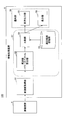
- the information processing apparatus 2 includes a myoelectric potential acquisition unit 21, an RMS calculation unit 22, a resting RMS value temporary storage unit 23, an RMS change rate calculation unit 24, and an appropriate range storage unit 25. , A comparison unit 26, an audio output unit 27, and a display unit 28. The voice output unit 27 and the display unit 28 are combined to form a notification unit 29.
- the myoelectric potential acquisition unit 21 is an acquisition unit that acquires the myoelectric potential, and acquires the myoelectric potential measured by the EMG 1 by communication.
- the RMS calculation unit 22 calculates the root mean square (RMS: Rot Mean Square) of the amplitude of the myoelectric potential.
- the resting RMS value temporary storage unit 23 temporarily stores the RMS of the amplitude of the myoelectric potential at rest.
- the RMS change rate calculation unit 24 calculates the change rate of the RMS of the myoelectric potential amplitude compared with the RMS of the myoelectric potential amplitude at rest. Since the amplitude in the electromyogram (EMG) is a relative value, by using the RMS rate of change (%) ( ⁇ RMS) at the time of application with respect to the RMS value at rest, such an type of electromyogram can be obtained. Even if it is used, it can be treated in the same way.
- the RMS calculation unit 22 and the RMS change rate calculation unit 24 are calculation units.
- the appropriate range storage unit 25 is a storage unit and stores an appropriate range of the RMS change rate in advance.
- the comparison unit 26 compares whether or not the RMS change rate calculated from the acquired myoelectric potential is within an appropriate range.
- the notification unit 29 notifies whether the RMS change rate of the myoelectric potential, which is a value obtained from the acquired myoelectric potential, is within an appropriate range or outside, based on the comparison result of the comparison unit 26.
- the voice output unit 27 When notifying by voice, the voice output unit 27 notifies by voice whether the RMS change rate of the detected myoelectric potential is within an appropriate range or outside. In the case of voice, the notification may be made only when the RMS change rate is outside the appropriate range, or may be notified only when the RMS change rate is within the appropriate range.
- the display unit 28 displays the rate of change (%) of the RMS of the amplitude of the myoelectric potential and the value in the appropriate range in an superimposed manner.
- the display may be, for example, a liquid crystal display panel, an organic EL (Electro-luminescence) display panel, an OLED (Organic Light Emitting Diode) display panel, or the like.
- the notification in the notification unit 29 the notification by display and the notification by voice may be combined.
- the functions of the RMS calculation unit 22, the resting RMS value temporary storage unit 23, the RMS change rate calculation unit 24, the appropriate range storage unit 25, and the comparison unit 26 in the information processing apparatus 2 are installed in a program such as an application. It will be executed by launching the application.
- the information processing apparatus 2 performs information processing and the like related to basic operations, for example, a CPU (Central Processing Unit), a RAM (Random Access Memory), and a ROM (Read Only). Memory), HDD (Hard Disk Drive), input / output interface, electronic parts including internal bus, etc. are also included.
- a CPU Central Processing Unit
- RAM Random Access Memory
- ROM Read Only Memory
- HDD Hard Disk Drive
- input / output interface electronic parts including internal bus, etc.
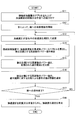
- FIG. 4 is a flow for evaluating the application pressure on the face when the application pressure evaluation system according to the first embodiment is used.
- S1 as a preparation, launch the application of the information processing device 2 and attach the EMG 1 to the user's forearm. At this time, the electromyogram 1 measures the myoelectric potential at rest and transmits it to the information processing apparatus 2.
- the information processing apparatus 2 calculates the RMS value of the myoelectric potential at rest.
- the EMG 1 measures the myoelectric potential of the forearm and transmits the measured myoelectric potential in real time to the information processing apparatus 2.
- the calculation units 22 and 24 of the information processing apparatus 2 calculate the RMS change rate of the amplitude of the acquired myoelectric potential. This is the detection step.
- the comparison unit 26 of the information processing apparatus 2 compares the RMS change rate of the amplitude of the myoelectric potential with the stored appropriate range (comparison step).
- the EMG is attached to the user's forearm, it is possible to evaluate the pressure on the face by the fingertip or hand in real time without providing a sensor on the fingertip or hand. Therefore, since the hands are open during the evaluation, the user can carry out and evaluate the usual application method without considering the contact between the sensor and the face.
- an appropriate range for evaluating the strength of pressing when applying cosmetics to the face is set in advance by an experiment by a plurality of subjects. The following describes how to set the appropriate range for the coating pressure evaluation system.
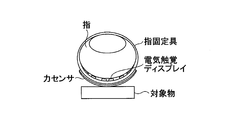
- FIG. 5 is a diagram showing an example of a pressing method for setting an appropriate range used for the coating pressure evaluation flow according to the first embodiment.
- the pressure is applied at the same position without moving.
- the cheeks of the face may be pressed multiple times for a few seconds (predetermined time) to change the press position on the face, but when moving the press position, do not apply force to the face. do.
- FIG. 6 is a functional block diagram of an analysis system for setting an appropriate range used for the coating pressure evaluation flow according to the first embodiment.
- the analysis system 20 has an electromyogram 1 and an information processing device 3 for analysis.
- the information processing apparatus 3 for analysis is an information processing apparatus for analysis having a different configuration from the information processing apparatus 2 for evaluation described above will be described, but the information processing apparatus 2 for evaluation and the information processing apparatus 2 for analysis will be described.
- the functions of the information processing apparatus 3 may be integrated into one information processing apparatus.
- the EMG 1 is preferably of the same type as the EMG used by the user shown in FIG. 2, for example, but is another type because the RMS rate of change is used for the calculation as described above. You may use the EMG of.
- the information processing apparatus 3 for analysis includes a myoelectric potential acquisition unit 311, an RMS calculation unit 312, a resting RMS value temporary storage unit 313, an RMS change rate calculation unit 314, an RMS change rate storage unit 315, and subject information acquisition. It has a unit 321, a correlation analysis unit 322, an appropriate range setting unit 323, an appropriate range storage unit 324, and a transmission unit 325.
- the myoelectric potential acquisition unit 311, the RMS calculation unit 312, the resting RMS value temporary storage unit 313, and the RMS change rate calculation unit 314 are the myoelectric potential acquisition unit 3 of the above-mentioned information processing apparatus 2. It has the same functions as the unit 21, the RMS calculation unit 22, the resting RMS value temporary storage unit 23, and the RMS change rate calculation unit 24.
- the information processing apparatus 2 for evaluation calculates the RMS rate of change for the myoelectric potential from one EMG 1, while the information processing apparatus 3 for analysis calculates a plurality of EMGs attached to a plurality of subjects. Based on the plurality of myoelectric potentials measured in 1, the RMS change rate is calculated for each of the plurality of persons.
- the RMS change rate storage unit 315 stores the RMS change rate calculated by the RMS change rate calculation unit 314 for each person and each strength.
- the subject information acquisition unit 321 includes evaluation values (comfort, likes and dislikes) of the subject's emotional information before, during, and / or after pressing, and measurement information of the subject (skin water content, skin water evaporation amount (transience). Acquire the skin moisture evaporation amount TEWL: Trans Epidermal Water Loss)) and the like.
- the subject information acquisition unit 321 is a communication unit, and if the communication method is the same, it may be realized by the same communication member as the myoelectric potential acquisition unit 311.
- the correlation analysis unit 322 associates the strength of the press pressure on the face with the evaluation value or measurement information of emotional information.
- the appropriate range setting unit 323 sets the appropriate range of the RMS rate of change based on the associated correlation.
- the appropriate range may be provided with an upper and lower limit, or only an upper limit or a lower limit may be set.
- the appropriate range storage unit 324 stores the appropriate range of the set RMS rate of change.
- the transmission unit 325 outputs an appropriate range of the stored RMS rate of change.
- the information in the appropriate range may be output as software or an application together with the calculation method, or the appropriate range of the RMS change rate may be output independently. For example, when the population parameter of the subject increases, only the appropriate range of the RMS rate of change can be independently updated.
- the transmission unit 325 is a communication unit, and if the communication method is the same, it may be realized by the same communication member as the myoelectric potential acquisition unit 311 and / or the subject information acquisition unit 321. Alternatively, it may be stored in the appropriate range storage unit 324 so that it can be acquired by the user accessing the server.
- FIG. 7 is a measurement / analysis flowchart for setting an appropriate range in the coating pressure evaluation system according to the first embodiment.
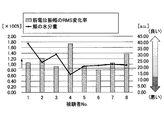
- data were acquired from eight subjects (No. 1 to No. 8) in their thirties to forties as a plurality of subjects as shown in FIG. 8 below.
- the EMG 1 measures the myoelectric potential at rest and information processing for analysis. It is transmitted to the device 3. In this measurement for analysis, the EMG 1 used a wireless myoelectric potential sensor manufactured by Oisaka Electronics.
- the information processing apparatus 3 calculates the RMS value of the resting myoelectric potential of each subject.
- the electromyogram 1 measures the myoelectric potential of the forearm during pressing and transmits the myoelectric potential to the information processing apparatus 3 for analysis.
- the transmission of the myoelectric potential from the electromyogram 1 to the information processing apparatus 3 for analysis in the analysis flow may be transmitted in real time during pressing, or may be transmitted collectively after pressing.
- the skin water content and the water evaporation amount (percutaneous water evaporation amount: TEWL) of each subject's cheek are measured. Measured by GmbH (Germany)), the transdermal water evaporation amount TEWL was measured by a portable water evaporation meter VapoMeter® (Delfin Technologies (Finland)) as a water evaporation amount measuring instrument, and the measurement information thereof. Is transmitted to the information processing apparatus 3 for analysis.
- the RMS change rate of the myoelectric potential amplitude of each subject's forearm measured and calculated in S205 is correlated with the skin water content measured in S207.
- the RMS change rate of the myoelectric potential amplitude of each subject's forearm measured and calculated in S205 is correlated with the amount of water evaporation of the skin measured in S207.
- the information processing apparatus 3 for analysis calculates the RMS change rate of the myoelectric potential amplitude of the forearm.
- the pressing strength as "strong” in S214 and start pressing on the face.
- the cheeks are pressed 5 times in 5 seconds by hand with a stronger force than usual.
- the analytical information processing apparatus 3 calculates the RMS change rate of the myoelectric potential amplitude of each person's forearm even in the "strong" press method, and in S212, the RMS change rate of the myoelectric potential amplitude of the forearm. Is calculated.
- each of the multiple subjects After pressing with three different strengths (as usual, strong and weak) (Yes in S213), in S215, each of the multiple subjects evaluated the facial sensation for each pressing strength (comfort, preference). (Whether you like it or not)), the information processing apparatus 3 for analysis acquires the evaluation value.
- the information processing apparatus 3 for analysis correlates the measured / calculated RMS change rate of the myoelectric potential amplitude of the forearm with the evaluation value.
- the myoelectric potential of the forearm based on the correlation with the skin water content calculated in S208, the correlation with the skin water evaporation amount calculated in S209, and / or the correlation with the evaluation value calculated in S216.
- the threshold value (upper limit, lower limit) of the appropriate range of RMS of the amplitude is calculated and set.
- the appropriate threshold value set in S217 is stored in the appropriate range storage unit 324 of the information processing apparatus 3 for analysis, and the flow is terminated.
- Example 1 According to the procedure shown in FIG. 7, the myoelectric potential amplitude when a plurality of subjects press their faces with three types of strengths, "weak”, “normal”, and “strong”, as shown in FIG. Data on the RMS rate of change, subject subjectivity (comfort, preference), cheek water content, and cheek water evaporation were obtained.
- press pressure as usual means “strength of application pressure on the face applied on a daily basis", and "weak” means weaker than “usually” and is “strong”. Means stronger than “as usual”.
- VAS visual analog scale
- FIG. 9A and 9B are diagrams showing the correlation between the RMS change rate of the myoelectric potential amplitude of the forearm by the plurality of press methods of FIG. 8 and the comfort.
- the information processing apparatus 3 for analysis correlates the strength of the application pressure (press) on the face with the correlation of the evaluation value of comfort, and corresponds to the strength of the application pressure on the face having a high evaluation value of comfort. Then, the appropriate range of the RMS change rate of the amplitude of the myoelectric potential is set.
- FIG. 9A is a diagram showing the correlation between the RMS change rate of the amplitude of the myoelectric potential and the comfort
- FIG. 9B is a diagram showing the distribution of the number of people when an appropriate range is provided.
- the horizontal axis shows the RMS change rate of the amplitude of the myoelectric potential for 5 seconds
- the vertical axis shows the index of comfort.
- the horizontal axis indicates the number of measurement data below the appropriate range, within the appropriate range, and above the appropriate range
- the vertical axis indicates an index of comfort.
- the appropriate range is set to 50% to 150% in the RMS change rate of the amplitude of the myoelectric potential, as shown in FIG. 9B, within the set appropriate range, from outside the appropriate range.
- the index of comfort can be increased.
- 10A and 10B are diagrams showing the correlation between the RMS change rate of the amplitude of the myoelectric potential of the forearm by the pressing method of the plurality of strengths of FIG. 8 and the preference.
- the information processing apparatus 3 for analysis associates the strength of the application pressure (press) on the face with the correlation of the evaluation value of preference, and corresponds to the strength of the application pressure on the face having a high evaluation value of preference. Set an appropriate range with an upper limit and a lower limit.
- FIG. 10A is a diagram showing the correlation between the RMS change rate of the amplitude of the myoelectric potential and the preference
- FIG. 10B is a diagram showing the distribution of the number of people when an appropriate range is provided.
- the horizontal axis is the RMS change rate of the amplitude of the myoelectric potential
- the vertical axis is the favorite index
- the horizontal axis represents the number of measurement data below the appropriate range, within the appropriate range, and above the appropriate range
- the vertical axis indicates a favorite index.
- the appropriate range of the RMS change rate of the amplitude of the myoelectric potential is set to 50% to 150%
- the appropriate range set as shown in FIG. 10B is higher than the outside of the appropriate range. , You can increase your preference index.
- FIG. 11 is a diagram showing the correlation between the RMS change rate of the myoelectric potential amplitude of the forearm and the water content of the cheek when the press is performed as usual.
- the electromyogram 1 is attached to the forearms of a plurality of subjects, and each of the plurality of subjects uses the usual (strength of daily application) to apply the cosmetic by hand.
- the change in the myoelectric potential of the forearm was detected when the face was pressed with the same strength as when applied to the face, and the RMS change rate was calculated.
- the skin moisture content of the cheeks of each of the plurality of subjects was acquired by a corneometer. Since the value of the skin moisture content is a measured value, it is more objective data than comfort and preference.
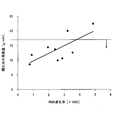
- FIG. 11 is a diagram showing the correlation between the RMS change rate of the myoelectric potential amplitude of the forearm and the water content of the cheek when the press is performed as usual.
- the water content of the cheeks measured by the corneometer is the water content contained in about 15 ⁇ m (mainly the stratum corneum) from the skin surface, and the higher the water content, the better the skin condition.
- the No. 4 person who normally presses with a stronger force than other people and has an RMS change rate of 174%, has an extremely low cheek water content as compared with other people.
- the water content of the cheeks is not so low for the No. 8 person who normally presses with the second strongest force at an RMS change rate of 136%.
- the upper limit of the appropriate range of the RMS change rate of the amplitude of the myoelectric potential between 136 and 174%, for example, 150% or 160%.
- the information processing apparatus 3 for analysis sets an appropriate range of the RMS change rate of the amplitude of the myoelectric potential so as to obtain the application pressure applied by the subject having a high amount of water in the cheeks with reference to this result. be able to.
- FIG. 12 is a diagram showing the correlation between the RMS volatility of the amplitude of the myoelectric potential when the press is performed as usual and the amount of water evaporation on the cheek.
- the method for measuring the myoelectric potential of this press is the same as in FIG. 11, and the strength is the same as when the cosmetics are applied to the face by hand, with each of the plurality of subjects as usual (strength applied on a daily basis). Now, the myoelectric potential of the forearm when pressing is detected.
- FIG. 12 is a diagram showing the correlation between the RMS change rate of the myoelectric potential amplitude of the forearm and the percutaneous water evaporation amount of the cheek.
- the transdermal water evaporation amount TEWL is a numerical value that measures how much water in the skin escapes to the outside.
- a low TEWL value means that the amount of water that escapes from the inside of the skin is small, and a large TEWL value means that a large amount of water escapes from the inside of the skin. Therefore, the higher the TEWL, the more likely it is that the skin is rough.
- the No. 4 person who presses with an RMS change rate of 174% which is stronger than other people, has a higher TEWL than other people.
- the No. 8 person who normally presses with an RMS change rate of 136% has a higher TEWL than other people.
- the No. 7 person who normally presses with an RMS change rate of 102% has a high TEWL, but the No. 2 person who normally presses with a 126% RMS change rate does not have a very high TEWL.
- the upper limit of the RMS change rate of the amplitude of the myoelectric potential it is preferable to specify, for example, the upper limit of the RMS change rate of the amplitude of the myoelectric potential to 103 to 135%.
- the information processing apparatus 3 for analysis can set an appropriate range of the RMS change rate of the amplitude of the myoelectric potential so that the application pressure applied by the subject having a small cheek TEWL is obtained.
- the degree of aging differs between the 30-year-old person and the 49-year-old person, and the basic skin condition differs. Will be done.
- FIGS. 11 and 12 an example of analyzing the correlation using the measured data as it is has been described.
- the skin moisture content and the skin TEWL are corrected according to the age, and after the correction. Correlation may be analyzed.
- the correlation may be analyzed for the measured values of the skin water content and the skin TEWL of each subject by using the relative values of the measured values with respect to the average value of each subject's age.
- the appropriate standard range may be changed depending on the age, skin condition, and other external factors.
- the skin condition is, for example, the presence or absence of rough skin due to dry skin due to the season, the presence or absence of acne due to skin oil, the presence or absence of sunburn, and the like.
- External factors are, for example, outside air temperature, weather (humidity), and the like.
- personal tastes like strength, like weakness
- the heart rate may be measured and an appropriate range for the heart rate may be set in addition to the appropriate range for the myoelectric potential.
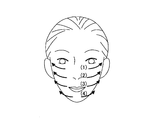
- FIG. 13 is a diagram showing an example of a stroke method for setting an appropriate range used for the coating pressure evaluation flow according to the first embodiment.
- FIG. 13A shows how the hand is moving
- FIG. 13B is a diagram showing an example of the trajectory of the pressure of the hand on the face.
- the position of the hand is moved substantially laterally (constant direction) with respect to the face (cheek) to move the stroke multiple times, and the position where the most force is applied is from (1) to FIG. 13B.
- the cosmetic used is so-called “toner” and contains oils such as fatty acid esters that reduce friction.
- the oil contained in the cosmetic water that reduces the friction on the skin may be a fatty acid ether, a hydrocarbon, a silicone oil, a fluorine-based oil, or the like, in addition to the fatty acid ester.
- Table 1 shows the measurement results of the RMS change rate of the amplitude of the myoelectric potential of the subject's forearm and the amount of water evaporation of the cheek (TEWL of the cheek) when applied by the stroke method.
- FIG. 14 is a diagram showing the correlation between the RMS change rate of the myoelectric potential of the forearm and the amount of water evaporation of the cheek when the cosmetic is applied by the stroke method.
- the information processing apparatus 3 for analysis can be specified, for example, to set the RMS change rate in an appropriate range to 400% or less so as to exclude people with a high amount of transepidermal water loss on the skin.
- 15A and 15B are diagrams comparing the RMS change rate of the amplitude of the myoelectric potential by the stroke method when the cosmetic substance is applied and when the cosmetic solution is applied after the beauty essence is applied.
- FIG. 15A shows the RMS change rate with the elapsed time
- FIG. 15B shows the average value of the RMS change rate over the entire coating time.
- the cosmetic liquid is, for example, a cosmetic liquid
- the beauty liquid is, for example, a booster (introduced cosmetic water), an essence, a milky lotion, or the like.
- the main difference between lotion and serum is viscosity.
- a beauty essence is generally a base having a higher viscosity and thickening than a lotion having a low viscosity such as water. Since the beauty essence used in this test contains a thickener to moderate the viscosity, it is thought that applying the beauty essence reduces friction on the skin and softens the skin. ..
- FIG. 16 is a schematic diagram when the coating pressure evaluation system according to the first embodiment is used by an individual.
- the application pressure evaluation system 10A can be used as an application for an individual user U for evaluation of pressure during daily skin care.
- the information processing device 2 is a smartphone S, and by notifying by voice, the individual user U can take care of the information processing device 2 by applying cosmetics with appropriate strength while looking at the mirror M. Can be continued. Further, in the smartphone S, the RMS rate of change of the myoelectric potential amplitude may be displayed together with the appropriate range on the display together with the voice.
- the individual user U can appropriately apply the cosmetics during daily application, and by accumulating appropriate application pressures on a daily basis, accumulated damage during application can be achieved. Can be reduced and skin quality can be improved.
- FIG. 17 is a schematic diagram when a beauty professional instructes a customer on a coating pressure using the coating pressure evaluation system according to the first embodiment.
- the same electromyograms 1 and 1' are attached to, for example, beauty advisor B, who is a beauty professional, and the forearm of customer C.
- the information processing apparatus 2 personal computer P
- visually or auditorily applies the pressure to the customer C so that the same pressure can be reproduced when the customer C's face is comfortably and appropriately pressed by the beauty advisor B.
- the beauty advisor B who is a beauty professional
- the information processing apparatus 2 visually or auditorily applies the pressure to the customer C so that the same pressure can be reproduced when the customer C's face is comfortably and appropriately pressed by the beauty advisor B. Can be taught.
- the customer C can reproduce the appropriate pressure by the beauty advisor B, which was difficult to realize by himself / herself, by being suggested by the coating pressure evaluation system 10B.
- FIG. 18 is a schematic diagram when the cosmetology instructor T teaches the cosmetology student BS using the application pressure evaluation system according to the first embodiment.
- the same electromyograms 1 and 1' are attached to the forearms of the beauty instructor T and the beauty student BS. Then, the application pressure data is displayed on the display of the information processing device 2 (personal computer P) as a sample of the state in which the face of a person imitating a customer is comfortably and appropriately pressed by a beauty professional instructor T. Show to.
- the information processing device 2 personal computer P
- the beauty student BS can reproduce the application pressure by pressing so that the pressure is similar to the numerical value shown as a sample.
- the application pressure which is difficult to transmit to other people, can be transmitted visually or by sound.
- FIG. 18 shows an example of pressing the face of a person dressed as a customer different from the beauty instructor T and the beauty student BS. You may instruct by applying application pressure using the face of.
- the beauty students in this instruction are, for example, beauty advisor trainees, beautician trainees, and various massage trainees.
- the pressure at the time of application to the face by a finger or a hand which was difficult to visualize or evaluate, can be obtained without providing a sensor on the fingertip or the hand. , Can be expressed and evaluated in real time.
- the pressure evaluation system can similarly measure and evaluate the pressure on the face when applying cosmetics via a puff or cotton when applied to the face.
- FIG. 19 is a schematic view of the coating pressure evaluation system 100 according to the second embodiment.
- FIG. 20 is a functional block diagram of the coating pressure evaluation system 100 according to the second embodiment.
- the coating pressure evaluation system 100 of the second embodiment uses an accelerometer 4 (measuring device) to detect the acceleration (measured value) when the user applies cosmetics to the face by hand, thereby applying the coating pressure. Is different from the coating pressure evaluation system 10 of the first embodiment in that the above is evaluated. The method of setting the appropriate range is the same as that of the first embodiment.
- the coating pressure evaluation system 100 of the present embodiment includes an accelerometer 4 and an information processing device 5.
- the accelerometer 4 is attached to the wrist of the user, and detects the application pressure when the user applies the cosmetic to the face by hand by the acceleration. As shown in FIG. 19, the accelerometer 4 is attached to the wrist, and the direction orthogonal to the contact surface between the palm and the cheek is the direction of motion. In this embodiment, the accelerometer 4 is attached to the wrist, but may be attached to the upper arm or the forearm.
- the accelerometer 4 is, for example, a 3-axis accelerometer that detects acceleration in the x-axis direction, the y-axis direction, and the z-axis direction. Specific examples thereof include smartphones, myoelectric sensors, inertial measurement units, etc., which have a built-in 3-axis accelerometer.
- the information processing device 5 can communicate with the accelerometer 4, can acquire the acceleration from the accelerometer 4, evaluates the coating pressure based on the acceleration, and notifies the accelerometer 4.
- the information processing device 5 may be an information processing terminal for evaluation, and may be, for example, a smartphone, a tablet, a mobile phone, or a notebook computer capable of outputting voice and / or an image. Alternatively, it may be a dedicated information processing terminal for the coating pressure evaluation system 100.
- a speaker, a projector, or the like may be connected to the information processing device 5, and in that case, the notification function may be executed by the sound from the speaker or the projected image from the projector.
- Communication between the information processing device 5 and the accelerometer 4 is realized by, for example, Bluetooth (registered trademark), infrared communication, WiFi (registered trademark), or the like.
- the information processing apparatus 5 includes an acceleration acquisition unit 51, a frequency power spectrum calculation unit 52, an appropriate range storage unit 53, a comparison unit 54, an audio output unit 55, and a display unit 56.
- the voice output unit 55 and the display unit 56 are combined to form a notification unit 58.
- the frequency power spectrum calculation unit 52, the appropriate range storage unit 53, and the comparison unit 54 are combined to form the evaluation unit 57.
- the acceleration acquisition unit 51 is an acquisition unit that acquires acceleration, and acquires the acceleration measured by the accelerometer 4 by communication.
- an application for recording acceleration may be used as the acceleration acquisition unit 51.
- the frequency power spectrum calculation unit 52 acquires the acceleration when the cosmetic is applied in a specific cycle for a data length sufficient for extracting the frequency component to be detected, and the gravity included in the acquired acceleration waveform. After reducing the effects of acceleration and noise with a frequency filter, a high-speed Fourier transform (FFT: Fast Fourier Transform) is performed to obtain a frequency power spectrum. Then, the power value of the frequency to be detected is detected from the obtained frequency power spectrum. At this time, the highest power value among the x-axis, y-axis, and z-axis may be used.
- FFT Fast Fourier Transform
- the appropriate range storage unit 53 is a storage unit and stores in advance an appropriate range of power values of frequencies to be detected.
- the comparison unit 54 compares whether or not the obtained power value of the detection target frequency is within an appropriate range.
- the notification unit 58 notifies whether the power value obtained from the acquired acceleration is within or outside the appropriate range based on the comparison result of the comparison unit 54.
- the voice output unit 55 When notifying by voice, the voice output unit 55 notifies by voice whether the detected power value is within the appropriate range or outside. In the case of voice, the notification may be made only when the power value is outside the appropriate range, or may be notified only when the power value is within the appropriate range.
- the display unit 56 displays the power value of the frequency to be detected and the value in the appropriate range by superimposing them.
- the display may be, for example, a liquid crystal display panel, an EL (Electro-luminescence) display panel, an OLED (Organic Light Emitting Diode) display panel, or the like.
- the notification in the notification unit 58 the notification by display and the notification by voice may be combined.
- the functions of the frequency power spectrum calculation unit 52, the appropriate range storage unit 53, and the comparison unit 54 in the information processing apparatus 5 are installed in a program such as an application and can be executed by launching the application.
- the information processing apparatus 5 performs information processing and the like related to basic operations, for example, a CPU (Central Processing Unit), a RAM (Random Access Memory), and a ROM (Read Only). Memory), HDD (Hard Disk Drive), input / output interface, electronic parts including internal bus, etc. are also included.
- a CPU Central Processing Unit
- RAM Random Access Memory
- ROM Read Only Memory
- HDD Hard Disk Drive
- input / output interface electronic parts including internal bus, etc.
- FIG. 21 is a flow for evaluating the application pressure on the face when the application pressure evaluation system 100 of the second embodiment is used.
- the accelerometer 4 measures the acceleration of the forearm or the wrist and transmits the measured acceleration to the information processing device 5.
- the frequency power spectrum calculation unit 52 of the information processing apparatus 5 calculates the frequency power spectrum (power spectrum) from the acquired acceleration waveform, and detects the power value of the frequency to be detected from the frequency power spectrum (here). Up to is the detection step).
- the comparison unit 54 of the information processing apparatus 5 compares the power value of the frequency to be detected obtained from the frequency power spectrum of the acceleration waveform with the stored appropriate range (comparison step).
- the intensity information is notified based on the comparison result with respect to the appropriate range of the power value of the frequency to be detected obtained from the frequency power spectrum of the acceleration waveform (notification step).
- the accelerometer 4 is removed from the forearm or wrist in S18, and the flow is terminated.
- the accelerometer is attached to the user's forearm or wrist, and the hand is open during evaluation, so the user can apply as usual without considering the contact between the sensor and the face. Can be implemented and evaluated.
- an appropriate range for evaluating the strength of pressing when applying cosmetics to the face is set in advance by an experiment by a plurality of subjects.
- the method of setting an appropriate range for the coating pressure evaluation system will be described below.
- the accelerometer 4 is attached to one place selected from the upper arm, forearm, and wrist of each of the plurality of subjects, and the subject presses the face once per second by the same pressing method as in the first embodiment. Repeat the operation for 30 seconds. At this time, the subject may be instructed to generate a sound from the speaker once per second and perform a press in accordance with the sound stimulus.
- the press cycle is not limited to once per second, and may be any cycle. However, when changing the cycle, it can be assumed that (1) a sine wave of the frequency to be detected is sufficiently included in the data section to be analyzed, and (2) the exercise cycle can be comfortably carried out by the subject. It is necessary to satisfy the two conditions of that.
- the time for repeating the press is not limited to 30 seconds and can be any time only when the above two conditions are satisfied.
- the accelerometer 4 measures the acceleration during pressing and transmits the acceleration to the information processing apparatus 5.
- the acceleration data may be transmitted from the accelerometer 4 to the information processing apparatus 5 in real time during pressing, or may be transmitted collectively after pressing.
- the same analysis information processing apparatus 3 as in the first embodiment may be used.
- the above-mentioned press operation is performed with four types of strength: normal force, half normal force, twice normal force, and the most comfortable force.
- the usual force means the amount of force when hand-pressing skin care cosmetics.
- About half of the usual force means about half (1/2) of the above-mentioned usual force.
- About twice the usual force means about twice the usual force as described above.
- the force that feels most comfortable means the force that feels most comfortable.
- an appropriate range is set by detecting the power value of the frequency to be detected from the obtained frequency power spectrum. For example, the average value of a plurality of subjects may be taken for the power value of the axis having the highest peak of the frequency power spectrum when pressed with about half the normal force, and the lower limit value in the appropriate range may be set. Further, the average value of a plurality of subjects may be taken for the power value of the axis having the highest peak of the frequency power spectrum when the force is about twice as much as usual, and the upper limit value of the appropriate range may be set.
- the appropriate range may be provided with an upper and lower limit, or only an upper limit or a lower limit may be set.
- the method for analyzing the peak of the frequency power spectrum is not limited to the above-mentioned method, and any method can be used. Further, the correlation between the power value of the frequency to be detected obtained from the frequency power spectrum and the evaluation value of the emotional information of the subject, the water content of the cheek, the water evaporation amount of the cheek, etc. shown in the first embodiment is obtained. Based on this, an appropriate range may be set.
- the appropriate range set as described above is stored in the appropriate range storage unit 53.
- Example 2 As mentioned above, for multiple subjects, the face is pressed in one second with four types of strength: normal power, half normal power, twice normal power, and the most comfortable power.
- the acceleration when pressed once (1 Hz) was measured for 45 seconds.
- the iPhone (registered trademark) was used for the measurement of the acceleration, and the iPhone (registered trademark) was attached so that the back surface of the iPhone (registered trademark) was in contact with the outside of the upper arm of the subject.
- To acquire the acceleration data use the iPhone (registered trademark) and the SensorLog app (Mosenia et al., 2018), and the acceleration waveform when pressed with the usual force (Fig. 22A), with about half the usual force. Acceleration waveforms when pressed (Fig.
- FIGS. 22A to 22D are data of one of a plurality of subjects. Of the 45 seconds of measurement time, the first 15 seconds was used as the break-in period for grasping the motion rhythm of 1 Hz, and the subsequent 30 seconds was used for data analysis.
- a high-pass filter was applied to the obtained acceleration waveforms of FIGS. 22A to 22D in order to reduce the influence of the included gravitational acceleration and noise.
- a Butterworth type second-order zero phase filter having a cutoff frequency of 0.05 Hz was applied.
- a 4096-point FFT was performed on the signal after applying the high-pass filter. Specifically, after applying the cosine taper (cos10 taper) window function to the data for 30 seconds (3000 points), zero padding was performed and FFT was performed.
- the Discrete Fourier Transform was scaled by the length of the input signal and then squared to the amplitude spectral values of all frequencies except 0 and the Nyquist frequency to obtain the frequency power spectrum.
- the power value of the axis having the highest peak among the x-axis, y-axis, and z-axis was used.
- the power value of the axis with the highest peak is 1.06G 2 (y-axis) in the frequency power spectrum when pressed with normal force, and the frequency power spectrum when pressed with about half the normal force.
- 0.41G 2 (y-axis) in the frequency power spectrum at the time of the press in daily about twice the force
- 2.63G 2 (y-axis) in the frequency power spectrum when pressed with a force that feels most comfortable is , 0.42G 2 (y-axis).
- the power value of the axis with the highest peak was used as well.
- a range of 50% of the difference between the normal force and the most comfortable force can be set as the appropriate value, centering on the "force that feels most comfortable”. That is, in this experimental example, it is 0.10G 2 or more and 0.72G 2 or less calculated by 0.42 ⁇ 0.5 ⁇
- the application pressure to be pressed together with the cosmetics has been described, but the system of the present invention is applied to the pressing evaluation (for example, how to press the acupoints and how to massage) without applying the cosmetics. May be good.
- Information processing device for analysis 4 Accelerometer 10,10A, 10B, 10C, 100 Coating pressure evaluation system 20 Analysis system 21 Myoelectric potential acquisition unit 22 RMS calculation unit (calculation unit) ) 23 Resting RMS value temporary storage unit 24 RMS rate of change calculation unit (calculation unit) 25,53 Appropriate range storage unit (storage unit) 26,54 Comparison unit 27,55 Voice output unit 28,56 Display unit 57 Evaluation unit 29,58 Notification unit 311 Myoelectric potential acquisition unit 312 RMS calculation unit (calculation unit) 313 Resting RMS value temporary storage unit 314 RMS change rate calculation unit 315 RMS change rate storage unit 321 Subject information acquisition unit 322 Correlation analysis unit 323 Appropriate range setting unit 324 Appropriate range storage unit 325 Transmission unit U Individual user (user) B Beauty professional (beauty advisor) C Customer T Cosmetology instructor BS Cosmetology student S Smartphone P PC
Landscapes
- Measurement And Recording Of Electrical Phenomena And Electrical Characteristics Of The Living Body (AREA)
Priority Applications (2)
| Application Number | Priority Date | Filing Date | Title |
|---|---|---|---|
| CN202180028345.6A CN115397283A (zh) | 2020-05-13 | 2021-05-12 | 涂抹压评价方法、涂抹压评价系统以及涂抹压评价系统中的适当范围的设定方法 |
| JP2022522184A JP7776235B2 (ja) | 2020-05-13 | 2021-05-12 | 塗布圧評価方法、塗布圧評価システム、及び塗布圧評価システムにおける適正範囲の設定方法 |
Applications Claiming Priority (2)
| Application Number | Priority Date | Filing Date | Title |
|---|---|---|---|
| JP2020-084782 | 2020-05-13 | ||
| JP2020084782 | 2020-05-13 |
Publications (1)
| Publication Number | Publication Date |
|---|---|
| WO2021230302A1 true WO2021230302A1 (ja) | 2021-11-18 |
Family
ID=78524480
Family Applications (1)
| Application Number | Title | Priority Date | Filing Date |
|---|---|---|---|
| PCT/JP2021/018113 Ceased WO2021230302A1 (ja) | 2020-05-13 | 2021-05-12 | 塗布圧評価方法、塗布圧評価システム、及び塗布圧評価システムにおける適正範囲の設定方法 |
Country Status (3)
| Country | Link |
|---|---|
| JP (1) | JP7776235B2 (https=) |
| CN (1) | CN115397283A (https=) |
| WO (1) | WO2021230302A1 (https=) |
Citations (2)
| Publication number | Priority date | Publication date | Assignee | Title |
|---|---|---|---|---|
| JP2017073101A (ja) * | 2015-10-05 | 2017-04-13 | 株式会社ミライセンス | 触力覚情報提示システム |
| JP2019083875A (ja) * | 2017-11-02 | 2019-06-06 | ポーラ化成工業株式会社 | 肌状態評価システム、肌状態評価方法、肌状態評価プログラム及び肌評価用組成物 |
Family Cites Families (5)
| Publication number | Priority date | Publication date | Assignee | Title |
|---|---|---|---|---|
| US7854166B2 (en) * | 2007-07-09 | 2010-12-21 | The Yokohama Rubber Co., Ltd. | Method for evaluating an instrument operating force |
| KR200454377Y1 (ko) * | 2009-08-13 | 2011-07-01 | 이승호 | 의수의 파지 제어장치 |
| CN106037648A (zh) * | 2016-05-24 | 2016-10-26 | 云南中医学院 | 一种穿戴式推拿手法测定仪 |
| CN110811632A (zh) * | 2019-11-26 | 2020-02-21 | 上海中医药大学 | 一种网络化智能推拿手法参数测定采集系统 |
| CN111110533A (zh) * | 2019-12-31 | 2020-05-08 | 天津大学 | 一种推拿按摩智能监测预警系统及方法 |
-
2021
- 2021-05-12 CN CN202180028345.6A patent/CN115397283A/zh active Pending
- 2021-05-12 JP JP2022522184A patent/JP7776235B2/ja active Active
- 2021-05-12 WO PCT/JP2021/018113 patent/WO2021230302A1/ja not_active Ceased
Patent Citations (2)
| Publication number | Priority date | Publication date | Assignee | Title |
|---|---|---|---|---|
| JP2017073101A (ja) * | 2015-10-05 | 2017-04-13 | 株式会社ミライセンス | 触力覚情報提示システム |
| JP2019083875A (ja) * | 2017-11-02 | 2019-06-06 | ポーラ化成工業株式会社 | 肌状態評価システム、肌状態評価方法、肌状態評価プログラム及び肌評価用組成物 |
Also Published As
| Publication number | Publication date |
|---|---|
| JPWO2021230302A1 (https=) | 2021-11-18 |
| JP7776235B2 (ja) | 2025-11-26 |
| CN115397283A (zh) | 2022-11-25 |
Similar Documents
| Publication | Publication Date | Title |
|---|---|---|
| Giannakakis et al. | Review on psychological stress detection using biosignals | |
| Udovičić et al. | Wearable emotion recognition system based on GSR and PPG signals | |
| Cowley et al. | The psychophysiology primer: a guide to methods and a broad review with a focus on human–computer interaction | |
| Caramiaux et al. | Understanding gesture expressivity through muscle sensing | |
| CA3007215C (en) | Systems, computer medium and methods for management training systems | |
| Anttonen et al. | Emotions and heart rate while sitting on a chair | |
| Gonzalez et al. | Psycho-physiological assessment of a prosthetic hand sensory feedback system based on an auditory display: a preliminary study | |
| Knapp et al. | Physiological signals and their use in augmenting emotion recognition for human–machine interaction | |
| Ganglbauer et al. | Applying psychophysiological methods for measuring user experience: possibilities, challenges and feasibility | |
| Guo et al. | A human-machine interface based on single channel EOG and patchable sensor | |
| Lupu et al. | Brain-computer interface: Challenges and research perspectives | |
| Maia et al. | A study about psychophysiological measures in user experience monitoring and evaluation | |
| Kirsch et al. | Harnessing tactile waves to measure skin-to-skin interactions | |
| Zhang | Stress recognition from heterogeneous data | |
| Daşdemir | Locomotion techniques with EEG signals in a virtual reality environment | |
| Weiß et al. | Effects of image realism on the stress response in virtual reality | |
| Caldas et al. | Behavioral and psychophysiological measures of engagement during dynamic difficulty adjustment in immersive virtual reality | |
| Al-Megren et al. | Comparing fatigue when using large horizontal and vertical multi-touch interaction displays | |
| JP7776235B2 (ja) | 塗布圧評価方法、塗布圧評価システム、及び塗布圧評価システムにおける適正範囲の設定方法 | |
| Mavridou | Affective state recognition in Virtual Reality from electromyography and photoplethysmography using head-mounted wearable sensors. | |
| CN113729733B (zh) | 基于行为测试的运动想象神经响应能力检测装置 | |
| JP7477354B2 (ja) | 感触評価方法 | |
| Kaur et al. | Comparison of muscles activity of abled bodied and amputee subjects for around shoulder movement | |
| Gao et al. | User experience evaluation | |
| JP7827495B2 (ja) | 評価方法 |
Legal Events
| Date | Code | Title | Description |
|---|---|---|---|
| 121 | Ep: the epo has been informed by wipo that ep was designated in this application |
Ref document number: 21804126 Country of ref document: EP Kind code of ref document: A1 |
|
| ENP | Entry into the national phase |
Ref document number: 2022522184 Country of ref document: JP Kind code of ref document: A |
|
| NENP | Non-entry into the national phase |
Ref country code: DE |
|
| 122 | Ep: pct application non-entry in european phase |
Ref document number: 21804126 Country of ref document: EP Kind code of ref document: A1 |