WO2021229717A1 - 認証方法、認証プログラム、および情報処理装置 - Google Patents
認証方法、認証プログラム、および情報処理装置 Download PDFInfo
- Publication number
- WO2021229717A1 WO2021229717A1 PCT/JP2020/019108 JP2020019108W WO2021229717A1 WO 2021229717 A1 WO2021229717 A1 WO 2021229717A1 JP 2020019108 W JP2020019108 W JP 2020019108W WO 2021229717 A1 WO2021229717 A1 WO 2021229717A1
- Authority
- WO
- WIPO (PCT)
- Prior art keywords
- authentication
- image
- biometric information
- face
- camera
- Prior art date
- Legal status (The legal status is an assumption and is not a legal conclusion. Google has not performed a legal analysis and makes no representation as to the accuracy of the status listed.)
- Ceased
Links
Images



Classifications
-
- G—PHYSICS
- G06—COMPUTING OR CALCULATING; COUNTING
- G06F—ELECTRIC DIGITAL DATA PROCESSING
- G06F21/00—Security arrangements for protecting computers, components thereof, programs or data against unauthorised activity
- G06F21/30—Authentication, i.e. establishing the identity or authorisation of security principals
- G06F21/31—User authentication
- G06F21/32—User authentication using biometric data, e.g. fingerprints, iris scans or voiceprints
-
- G—PHYSICS
- G06—COMPUTING OR CALCULATING; COUNTING
- G06F—ELECTRIC DIGITAL DATA PROCESSING
- G06F21/00—Security arrangements for protecting computers, components thereof, programs or data against unauthorised activity
- G06F21/70—Protecting specific internal or peripheral components, in which the protection of a component leads to protection of the entire computer
- G06F21/82—Protecting input, output or interconnection devices
- G06F21/84—Protecting input, output or interconnection devices output devices, e.g. displays or monitors
Definitions
- This case relates to an authentication method, an authentication program, and an information processing device.
- a biometric authentication technique is disclosed in which candidates are narrowed down by authentication using first biometric information (for example, facial features) and personal authentication is performed by authentication using second biometric information (for example, palm vein features) (for example).
- first biometric information for example, facial features
- second biometric information for example, palm vein features
- the authentication method acquires a photographed image taken by a camera, and is any of the plurality of face images based on the position on the photographed image of each of the plurality of face images included in the acquired photographed image.
- the face image is selected, and the storage unit that stores the biometric information associated with each of the plurality of face images is referred to, and the face image is associated with the face image whose similarity with the selected face image meets the criteria.
- the computer executes a process of performing authentication by collating the received biometric information with the specified biometric information.
- the authentication method is an authentication method in which an authentication process is performed by collating the biometric information detected by the sensor with the registered biometric information, and the captured image taken by the camera includes a face image. , The biometric information obtained by detecting the biometric information associated with the facial image having a similarity with the facial image satisfying the criteria among the registered biometric information based on the position of the facial image on the captured image. The computer executes a process that determines whether or not to match with.
- the authentication method acquires a captured image captured by a camera, and when the acquired captured image includes a plurality of facial images, the operation information on a display unit that displays operation information related to authentication.
- the computer executes a process of selecting one of the face images from the plurality of face images based on the display position of the above and performing authentication using the selected face images.
- the authentication time can be shortened.
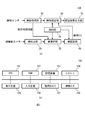
- (A) is a block diagram illustrating the overall configuration of the information processing device
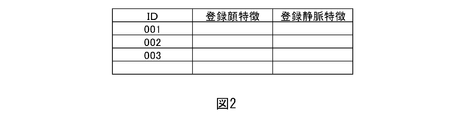
- (b) is a block diagram illustrating the hardware configuration of the information processing device. It is a figure which illustrates the table stored in the storage part.
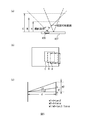
- (A) and (b) are diagrams illustrating the installation location of the face photography camera
- (c) is a diagram illustrating the visible range
- (d) is the viewable range stored in the storage unit. It is a figure exemplifying the information
- (e) is a figure exemplifying the displacement of the position of the face image.
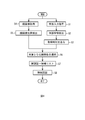
- It is a flowchart which shows an example of the processing of an information processing apparatus.
- (A) to (c) are diagrams illustrating the relationship between the shooting angle of view and the visible range.
- FIGS. 1 and (b) are diagrams illustrating the case where a visual restriction is provided on a part of the screen. It is a figure which illustrates the case where the visible range is provided in another direction. It is a figure which illustrates the case where the position of the operation information is specified and displayed on the screen of a display device.
- Biometric authentication is a technology that uses biometric features such as fingerprints, faces, and veins to verify identity.
- biometric authentication the collation biometric information acquired by the sensor in a situation where confirmation is required is compared (collated) with the registered biometric information registered in advance, and whether or not the similarity is equal to or higher than the identity verification threshold is determined.
- Identity verification is performed by making a judgment.
- Biometric authentication is used in various fields such as bank ATMs and room entry / exit management, and in recent years, it has begun to be used for cashless payments in supermarkets and convenience stores.
- Biometric authentication includes 1: 1 authentication that confirms matching with registered biometric information specified by ID or card, and 1: N authentication that searches for matching registered biometric information from multiple registered biometric information. .. In stores and the like, 1: N certification is often desired from the viewpoint of convenience.
- 1: N certification is often desired from the viewpoint of convenience.
- the biometric information fluctuates depending on the acquisition status and the like, the possibility of erroneous collation increases as the number of registered biometric information to be searched increases. For this reason, operations such as narrowing down with a simple PIN code or the like, making the search set sufficiently small, and then performing 1: N authentication are performed. How small it should be to reach a practical level depends on the biometric authentication method. However, even if it is simple, PIN code input impairs convenience, so a biometric authentication system that does not require an ID or card is desired.
- Modality is a type of biological feature, such as a fingerprint, vein, iris, face shape, palm shape, and the like. Therefore, fingerprints and veins on the same finger are of different modality. Since it is inconvenient to input multiple modality individually, a method of acquiring the palm vein at the same time as fingerprint input and a method of taking a facial image at the time of palm vein input have been proposed.
- N authentication using the palm vein in the set of the obtained ID list by creating an ID list of N candidates for face authentication is performed. It is executed and processing such as identifying the user is performed.
- a plurality of faces may be captured at the same time. For example, when the faces of three people are acquired, the obtained ID list is for N ⁇ 3 people, so that the verification time for palm vein authentication is lengthened.
- the initially set N is the performance upper limit of 1: N authentication of palm vein authentication, the risk of accepting others increases.
- the processing time of face recognition may increase, and depending on the accuracy of face recognition, it may be missed (the correct answerer does not enter the narrowing list). ..
- FIG. 1A is a block diagram illustrating the overall configuration of the information processing apparatus 100.
- the information processing apparatus 100 includes a storage unit 10, a face detection unit 20, a face selection unit 30, a face recognition unit 40, a vein acquisition unit 50, a vein authentication unit 60, and an authentication result output unit. It functions as 70 and so on.
- FIG. 1B is a block diagram illustrating a hardware configuration of the information processing apparatus 100.
- the information processing device 100 includes a CPU 101, a RAM 102, a storage device 103, an interface 104, a display device 105, an input device 106, a face photographing camera 107, a vein sensor 108, and the like.
- the CPU (Central Processing Unit) 101 is a central processing unit.
- the CPU 101 includes one or more cores.
- the RAM (Random Access Memory) 102 is a volatile memory that temporarily stores a program executed by the CPU 101, data processed by the CPU 101, and the like.
- the storage device 103 is a non-volatile storage device. As the storage device 103, for example, a ROM (Read Only Memory), a solid state drive (SSD) such as a flash memory, a hard disk driven by a hard disk drive, or the like can be used.
- the storage device 103 stores the authentication program.
- the interface 104 is an interface device with an external device.
- the interface 104 is an interface device with a LAN (Local Area Network).
- the display device 105 is a display device such as an LCD (Liquid Crystal Device).
- the input device 106 is an input device such as a keyboard and a mouse.
- the face photographing camera 107 is a MOS (Metal Oxide Semiconductor) sensor, a CCD (Charged Coupled Device) sensor, or the like.
- the vein sensor 108 may include a MOS sensor, a CCD sensor, and the like, as well as near-infrared illumination and the like.
- the storage unit 10 When the CPU 101 executes the authentication program, the storage unit 10, the face detection unit 20, the face selection unit 30, the face authentication unit 40, the vein acquisition unit 50, the vein authentication unit 60, and the authentication result output unit 70 are realized.
- Hardware such as a dedicated circuit may be used as the storage unit 10, the face detection unit 20, the face selection unit 30, the face authentication unit 40, the vein acquisition unit 50, the vein authentication unit 60, and the authentication result output unit 70. ..
- the storage unit 10 stores a plurality of types of biometric information of users registered in advance.
- two different types of modality are used as a plurality of types of biometric information.
- a face feature is stored as a registered face feature and a vein feature is stored as a registered vein feature in association with each user's ID. ..
- the display device 105 displays operation information related to authentication.
- the display device 105 displays the content instructing the user to hold the palm over the vein sensor 108.
- the user inputs the palm image to the vein sensor 108 according to the instruction.
- the face photographing camera 107 acquires an image including the user's face.
- the display device 105 has directivity in the visible range of the user. Therefore, the face position of the user who visually recognizes the information displayed on the display device 105 is determined within an approximate range.
- the candidate for the person is narrowed down. After that, personal authentication is performed by performing vein authentication for the narrowed down candidates. The details will be described below.
- the face photographing camera 107 is installed in a place where the user can photograph the face of the user when the display content of the display device 105 is visually recognized by the user.
- a face photographing camera 107 is installed on the upper part of the display device 105 or the like.
- FIGS. 3 (a) and 3 (b) are diagrams illustrating the installation location of the face photographing camera 107.
- FIG. 3A is a front view.
- FIG. 3B is a top view.
- the face photographing camera 107 is installed on the upper part of the display device 105.
- the vein sensor 108 is installed at the lower part of the display device 105 or the like.
- the shooting angle of view of the face shooting camera 107 is set to include the visible range of the display device 105 by the user. In this case, as illustrated in FIG. 3C, the visible range is included in the captured image acquired by the face photographing camera 107.
- a hood or a peep prevention film can be used as a method of limiting the visible angle range.
- the peep prevention film arranges fine louvers (feather plates) to limit the light emission direction of the display screen.
- the visible range is preferably a range that can be visually recognized by one user. Since the visible range is limited by the angle, the area of the visible range becomes wider as the distance from the face photographing camera 107 increases, and the visible range becomes visible to a plurality of users. However, in order to perform key operations, vein input, and the like, the user comes close to the input device 106 and the vein sensor 108 within reach. It is preferable that the area of the visible range at that distance is about one user.
- the storage unit 10 stores information on the visible range in the captured image acquired by the face photographing camera 107.
- FIG. 3D is a diagram illustrating information in a visible range stored in the storage unit 10.
- the visible range is a part of the captured image. For example, the range from Y1 (> 0%) to Y2 ( ⁇ 100%) on the vertical axis of the captured image, and the range from X1 (> 0%) to X2 ( ⁇ 100%) on the horizontal axis of the captured image, etc. Is set to. For example, it is assumed that the lowermost position of the vertical axis of the captured image is 0%, the uppermost end position is 100%, the leftmost position of the horizontal axis is 0%, and the rightmost position is 100%. By referring to the information in FIG. 3D, it is possible to determine the face image to be selected in the captured image.
- the user is not always positioned so as to fit within the visible range as shown in FIG. 3 (c). It is possible to visually recognize even from a position slightly shifted to the left and right as shown in FIG. 3 (e). In this case, if only the visible range is photographed, only an image in which a part of the face is missing can be obtained. It causes trouble. Therefore, it may be possible to prevent the face image from being damaged by photographing a range wider than the visible range and selecting the face detected to be the largest (larger area) in the visible range.
- FIG. 4 is a flowchart showing an example of processing of the information processing apparatus 100.
- the vein acquisition unit 50 causes the display device 105 to display information related to the vein input instruction (step S1).
- the user visually recognizes the vein input instruction displayed on the screen of the display device 105, the user holds the palm over the vein sensor 108.
- the vein acquisition unit 50 receives the palm image from the vein sensor 108, it extracts the vein feature from the palm image as a matching vein feature (step S2).
- the vein acquisition unit 50 sends the time when the palm image was acquired to the face selection unit 30 (step S3).
- steps S4 to S5 are executed in parallel with steps S1 to S3.
- the face detection unit 20 acquires a photographed image in a predetermined time range including the time received in step S3 from the face photographing camera 107 (step S4). By doing so, the accuracy of selecting the facial image of the user holding his / her hand over the vein sensor 108 is improved.
- the face detection unit 20 detects the face image position by acquiring the visible range stored in the storage unit 10 (step S5).
- the face selection unit 30 selects a target face image from the captured images (step S6). For example, when one face image is included in the visible range, the face selection unit 30 selects the face image as a target. When there are a plurality of face images included in the visible range, the face image detected to be the largest (larger area) in the visible range is selected.
- the face recognition unit 40 performs face recognition using the face image selected in step S6 (step S7).
- the face recognition unit 40 extracts a face feature as a matching face feature from the face image.
- the face feature for collation used here is data for narrowing down with an emphasis on the high speed of collation.
- the face recognition unit 40 collates the matching face feature with each registered face feature, and acquires an ID associated with the registered face feature whose similarity (narrowing score) with the matching face feature is equal to or higher than the threshold value.
- some IDs among the IDs stored in the storage unit 10 can be narrowed down as a personal candidate list.
- the vein authentication unit 60 collates the matching vein feature extracted in step S2 with the registered vein feature associated with the ID of the personal candidate list acquired in step S7 (step S8).
- the authentication result output unit 70 outputs information related to successful authentication.
- the collation score is less than the personal determination threshold value
- the authentication result output unit 70 outputs information related to the authentication failure.
- the information output by the authentication result output unit 70 is displayed on the display device 105.
- a target face image is selected from a plurality of face images based on the positions on the shot images of each of the plurality of face images included in the shot images taken by the face shooting camera 107.
- the face to be used for narrowing down can be specified, and the narrowing down time can be shortened without deteriorating the face recognition accuracy.
- the authentication time can be shortened.
- faces other than the user can be excluded from the matching target, which is also effective in terms of privacy protection.
- the storage unit 10 is an example of a storage unit that stores biometric information associated with each of a plurality of facial images.
- the matching vein feature is an example of biometric information detected by a sensor.
- This is an example of a selection unit in which the face selection unit 30 selects one of the face images from the plurality of face images based on the positions on the captured images of the plurality of face images included in the captured images captured by the camera.
- a certain face authentication unit 40 refers to a storage unit that stores biometric information associated with each of a plurality of face images, and is associated with a face image whose similarity with the selected face image satisfies the criteria. This is an example of a specific part that identifies biometric information.
- the vein authentication unit 60 receives the biometric information detected by the sensor, it is an example of an authentication unit that performs authentication by collating the received biometric information with the specified biometric information. Further, the vein authentication unit 60 is the position of the authentication unit that executes the authentication process by collating the biometric information detected by the sensor with the registered biometric information. Further, when the face image is included in the captured image captured by the camera, the face selection unit 30 and the face authentication unit 40 are among the registered biometric information based on the position of the face image on the captured image. This is an example of a determination unit for determining whether or not the biological information associated with the facial image whose similarity with the facial image satisfies the standard is to be collated with the detected biological information.
- Modification 1 It is difficult to arrange the display device 105 and the face photographing camera 107 coaxially (the center positions are the same and they face the same direction). Therefore, it is common to install the face photographing camera 107 at a place away from the center of the screen of the display device 105. For example, as illustrated in FIG. 5 (a), when installed on the upper side of the screen slightly offset from the center in the horizontal direction, the area corresponding to the visible range is the distance as illustrated in FIG. 5 (b). The position will be shifted accordingly. Therefore, the distance from the face photographing camera 107 to the face may be detected and the position of the determination area may be finely adjusted.
- the area difference between the shooting range and the visible range is caused by the difference between the shooting angle of view and the visible angle.
- w1 with respect to w0 can be expressed by the following equation (3).
- w1 / w0 tan ⁇ / tan ⁇ (3)
- the relative size of the visible range within the shooting range is constant regardless of the distance. That is, when the display device 105 and the face photographing camera 107 are coaxial, the visible range within the photographing range can be regarded as invariant. Strictly speaking, since the size of the display area is superimposed as an offset, the area is larger as the distance is shorter and smaller as the distance is far. Even when the display device 105 and the face photographing camera 107 are not coaxial, the relationship between the sizes of the regions is the same as in the case of coaxial. If it is not coaxial, the position of the area shifts with distance. The amount of deviation is determined by the difference in position between the display device 105 and the face photographing camera 107, the difference in the optical axis, and the distance.
- a screen for a projector having a high diffuse reflectance can be placed in front of the display screen and observed by the face photographing camera 107 to obtain a bright-looking area.
- the distance may be roughly determined based on the size of the face.
- the reference size is held in advance, and when the face is larger than the reference, the distance is short, and when the face is smaller than the reference, the distance is long.
- the boundary of the area is determined because the judgment of the area is not exactly whether the face is within the area, and the visual field limitation by the louver does not suddenly disappear from a certain angle, but the amount of light gradually decreases near the boundary. Since it is blurred, a short-form distance judgment is sufficient.
- the visual field limitation may be provided not only on the entire screen of the display device 105 but only in a part of the area for displaying the operation information related to the authentication. For example, an angle limit is provided so that only a part of the screen that can be seen from a wide range can be seen from the front (or a specific direction).
- the visual field limitation may be provided only in a part of the area 105b on the screen 105a of the display device 105.
- the area 105b is viewed from a visible range.
- the operation information is easy to see in the area 105b.
- FIG. 6B is a view of the area 105b viewed from outside the visible range. As shown in FIG. 6B, the operation information is difficult to see in the area 105b.
- an instruction is displayed on the normal screen and authentication is performed.
- a display can be first displayed in a visible area from a wide range, and the face can be moved to a limited area according to an instruction to use the detected face as a user.
- partial visible areas may be assigned in different directions.
- the display can be performed in a visible area in a direction corresponding to the detection position.
- the range A, the range B, and the range C are assigned in different directions.
- a display is displayed from a wide range to a viewable area, the range A is set as a visible range, then the range B is set as a visible range, and then the range C is set as a visible range. By doing so, the user moves with the switching of the visible range.
- the moved face may be used for face recognition.
- Example 1 the face image used for face authentication was selected according to the position in the image acquired by the face photographing camera 107, but the present invention is not limited to this.
- a face image used for face authentication may be selected according to the position of the operation information displayed on the display device 105.
- the vein acquisition unit 50 designates the position of the operation information of the vein sensor 108 on the screen of the display device 105 and displays it on the display device 105.
- the display device 105 has a large screen, the user moves to a position where the information can be visually recognized according to the position of the information displayed on the screen of the display device 105.
- the face selection unit 30 selects a face image located in a position range corresponding to the display position of the display device 105 in the image acquired by the face photographing camera 107 within a predetermined time range including the time when the vein image is extracted. After selecting the face image, the same processing as in Example 1 may be performed.
- the face selection unit 30 when the face selection unit 30 includes a plurality of face images in the captured image captured by the camera, the face selection unit 30 is based on the display position of the operation information on the display unit that displays the operation information related to authentication.
- This is an example of a selection unit that selects one of the face images from the plurality of face images.
- the vein authentication unit 60 is an example of an authentication unit that performs authentication using the face image selected by the selection unit.
- Storage unit 20 Face detection unit 30 Face selection unit 40 Face recognition unit 50 Venous acquisition unit 60 Venous authentication unit 70 Authentication result output unit 100 Information processing device 105 Display device 107 Face photography camera 108 Venous sensor
Landscapes
- Engineering & Computer Science (AREA)
- Theoretical Computer Science (AREA)
- Computer Security & Cryptography (AREA)
- Computer Hardware Design (AREA)
- Software Systems (AREA)
- Physics & Mathematics (AREA)
- General Engineering & Computer Science (AREA)
- General Physics & Mathematics (AREA)
- Collating Specific Patterns (AREA)
Priority Applications (5)
| Application Number | Priority Date | Filing Date | Title |
|---|---|---|---|
| PCT/JP2020/019108 WO2021229717A1 (ja) | 2020-05-13 | 2020-05-13 | 認証方法、認証プログラム、および情報処理装置 |
| EP20934943.0A EP4152181A4 (en) | 2020-05-13 | 2020-05-13 | AUTHENTICATION METHOD, AUTHENTICATION PROGRAM AND INFORMATION PROCESSING DEVICE |
| CN202080100444.6A CN115485683A (zh) | 2020-05-13 | 2020-05-13 | 认证方法、认证程序以及信息处理装置 |
| JP2022522167A JP7364965B2 (ja) | 2020-05-13 | 2020-05-13 | 認証方法、認証プログラム、および情報処理装置 |
| US17/963,588 US20230047264A1 (en) | 2020-05-13 | 2022-10-11 | Authentication method, storage medium, and information processing apparatus |
Applications Claiming Priority (1)
| Application Number | Priority Date | Filing Date | Title |
|---|---|---|---|
| PCT/JP2020/019108 WO2021229717A1 (ja) | 2020-05-13 | 2020-05-13 | 認証方法、認証プログラム、および情報処理装置 |
Related Child Applications (1)
| Application Number | Title | Priority Date | Filing Date |
|---|---|---|---|
| US17/963,588 Continuation US20230047264A1 (en) | 2020-05-13 | 2022-10-11 | Authentication method, storage medium, and information processing apparatus |
Publications (1)
| Publication Number | Publication Date |
|---|---|
| WO2021229717A1 true WO2021229717A1 (ja) | 2021-11-18 |
Family
ID=78525460
Family Applications (1)
| Application Number | Title | Priority Date | Filing Date |
|---|---|---|---|
| PCT/JP2020/019108 Ceased WO2021229717A1 (ja) | 2020-05-13 | 2020-05-13 | 認証方法、認証プログラム、および情報処理装置 |
Country Status (5)
| Country | Link |
|---|---|
| US (1) | US20230047264A1 (https=) |
| EP (1) | EP4152181A4 (https=) |
| JP (1) | JP7364965B2 (https=) |
| CN (1) | CN115485683A (https=) |
| WO (1) | WO2021229717A1 (https=) |
Cited By (1)
| Publication number | Priority date | Publication date | Assignee | Title |
|---|---|---|---|---|
| WO2026014231A1 (ja) * | 2024-07-10 | 2026-01-15 | 株式会社日立製作所 | 認証システム及び認証方法 |
Families Citing this family (1)
| Publication number | Priority date | Publication date | Assignee | Title |
|---|---|---|---|---|
| US12547687B2 (en) * | 2020-06-29 | 2026-02-10 | Zkteco Usa | System and method for biometric authentication |
Citations (5)
| Publication number | Priority date | Publication date | Assignee | Title |
|---|---|---|---|---|
| JP2004062846A (ja) * | 2002-07-31 | 2004-02-26 | Waimachikku Kk | 個人識別装置の入力装置 |
| JP2007072861A (ja) * | 2005-09-08 | 2007-03-22 | Omron Corp | なりすまし検出装置及び顔認証装置 |
| JP2018116353A (ja) * | 2017-01-16 | 2018-07-26 | 高知信用金庫 | 金融機関における利用者特定システム及び取引方法 |
| JP2018197980A (ja) * | 2017-05-24 | 2018-12-13 | シャープ株式会社 | 画像表示装置、画像形成装置、制御プログラムおよび制御方法 |
| JP2019128880A (ja) | 2018-01-26 | 2019-08-01 | 富士通フロンテック株式会社 | 認証システム、認証装置、認証プログラム、および認証方法 |
Family Cites Families (6)
| Publication number | Priority date | Publication date | Assignee | Title |
|---|---|---|---|---|
| JP2008278467A (ja) * | 2007-03-30 | 2008-11-13 | Sanyo Electric Co Ltd | 画像処理装置および画像処理方法 |
| JP5765071B2 (ja) * | 2011-06-14 | 2015-08-19 | 富士通株式会社 | 生体情報処理装置、生体情報処理方法、および生体情報処理プログラム |
| CN106447815A (zh) * | 2016-09-27 | 2017-02-22 | 南京苗苗智能科技有限公司 | 一种物联网门锁考勤机及其方法 |
| CN111832535B (zh) * | 2018-08-24 | 2024-09-06 | 创新先进技术有限公司 | 人脸识别方法及装置 |
| EP3862895B1 (en) * | 2018-10-03 | 2023-08-16 | Fujitsu Limited | Biometric authentication device, biometric authentication method, and biometric authentication program |
| CN111125799B (zh) * | 2019-12-24 | 2023-06-23 | 联想(北京)有限公司 | 用于显示屏的控制方法和装置 |
-
2020
- 2020-05-13 EP EP20934943.0A patent/EP4152181A4/en not_active Withdrawn
- 2020-05-13 CN CN202080100444.6A patent/CN115485683A/zh active Pending
- 2020-05-13 WO PCT/JP2020/019108 patent/WO2021229717A1/ja not_active Ceased
- 2020-05-13 JP JP2022522167A patent/JP7364965B2/ja active Active
-
2022
- 2022-10-11 US US17/963,588 patent/US20230047264A1/en not_active Abandoned
Patent Citations (5)
| Publication number | Priority date | Publication date | Assignee | Title |
|---|---|---|---|---|
| JP2004062846A (ja) * | 2002-07-31 | 2004-02-26 | Waimachikku Kk | 個人識別装置の入力装置 |
| JP2007072861A (ja) * | 2005-09-08 | 2007-03-22 | Omron Corp | なりすまし検出装置及び顔認証装置 |
| JP2018116353A (ja) * | 2017-01-16 | 2018-07-26 | 高知信用金庫 | 金融機関における利用者特定システム及び取引方法 |
| JP2018197980A (ja) * | 2017-05-24 | 2018-12-13 | シャープ株式会社 | 画像表示装置、画像形成装置、制御プログラムおよび制御方法 |
| JP2019128880A (ja) | 2018-01-26 | 2019-08-01 | 富士通フロンテック株式会社 | 認証システム、認証装置、認証プログラム、および認証方法 |
Cited By (1)
| Publication number | Priority date | Publication date | Assignee | Title |
|---|---|---|---|---|
| WO2026014231A1 (ja) * | 2024-07-10 | 2026-01-15 | 株式会社日立製作所 | 認証システム及び認証方法 |
Also Published As
| Publication number | Publication date |
|---|---|
| JPWO2021229717A1 (https=) | 2021-11-18 |
| CN115485683A (zh) | 2022-12-16 |
| JP7364965B2 (ja) | 2023-10-19 |
| EP4152181A1 (en) | 2023-03-22 |
| EP4152181A4 (en) | 2023-06-07 |
| US20230047264A1 (en) | 2023-02-16 |
Similar Documents
| Publication | Publication Date | Title |
|---|---|---|
| JP4924603B2 (ja) | 顔認証装置、顔認証方法およびプログラム | |
| JP4862447B2 (ja) | 顔認識システム | |
| CN100468444C (zh) | 认证装置、认证方法、认证程序及计算机可读取记录介质 | |
| JP6754642B2 (ja) | 生体検知装置 | |
| CN104185849B (zh) | 用于提供关于面部识别环境的通知的方法、装置和用于执行该方法的计算机可读记录介质 | |
| JP7674149B2 (ja) | 生体の認証システムおよび認証方法 | |
| JP7207521B2 (ja) | 認証方法、認証装置、プログラム | |
| US20100157088A1 (en) | Authentication apparatus and authentication method | |
| US9292752B2 (en) | Image processing device and image processing method | |
| JP2018169943A (ja) | 顔認証処理装置、顔認証処理方法及び顔認証処理システム | |
| JP2019159573A (ja) | ログイン支援システム | |
| US20230047264A1 (en) | Authentication method, storage medium, and information processing apparatus | |
| JP2010108200A (ja) | 個人認証装置及び個人認証方法 | |
| JP6187262B2 (ja) | 生体情報処理装置、生体情報処理方法及び生体情報処理用コンピュータプログラム | |
| JP6947202B2 (ja) | 照合システム | |
| TWM566865U (zh) | 基於臉部辨識進行驗證的交易系統 | |
| TWI661398B (zh) | 基於臉部辨識進行驗證的交易系統及其方法 | |
| KR102151474B1 (ko) | 스마트 단말기를 이용한 비접촉 지문인증 방법 | |
| JP4899552B2 (ja) | 認証装置、認証方法、認証プログラム、これを記録したコンピュータ読み取り可能な記録媒体 | |
| JP4862518B2 (ja) | 顔登録装置、顔認証装置および顔登録方法 | |
| JP7708221B2 (ja) | 入場管理装置、入場管理方法およびコンピュータプログラム | |
| JP2017162010A (ja) | 本人照合システムおよび本人照合方法 | |
| JP5791557B2 (ja) | 連絡操作支援システム、連絡操作支援装置および連絡操作方法 | |
| KR20180027957A (ko) | 사용자 인증 방법, 사용자 인증 장치, 그리고 사용자 인증 프로그램 | |
| CN208077174U (zh) | 用于身份认证的识别装置 |
Legal Events
| Date | Code | Title | Description |
|---|---|---|---|
| 121 | Ep: the epo has been informed by wipo that ep was designated in this application |
Ref document number: 20934943 Country of ref document: EP Kind code of ref document: A1 |
|
| ENP | Entry into the national phase |
Ref document number: 2022522167 Country of ref document: JP Kind code of ref document: A |
|
| NENP | Non-entry into the national phase |
Ref country code: DE |
|
| ENP | Entry into the national phase |
Ref document number: 2020934943 Country of ref document: EP Effective date: 20221213 |