WO2021220556A1 - 機械学習システム、機械学習装置、及び機械学習方法 - Google Patents
機械学習システム、機械学習装置、及び機械学習方法 Download PDFInfo
- Publication number
- WO2021220556A1 WO2021220556A1 PCT/JP2021/001234 JP2021001234W WO2021220556A1 WO 2021220556 A1 WO2021220556 A1 WO 2021220556A1 JP 2021001234 W JP2021001234 W JP 2021001234W WO 2021220556 A1 WO2021220556 A1 WO 2021220556A1
- Authority
- WO
- WIPO (PCT)
- Prior art keywords
- machine learning
- information
- target
- scent
- control unit
- Prior art date
- Legal status (The legal status is an assumption and is not a legal conclusion. Google has not performed a legal analysis and makes no representation as to the accuracy of the status listed.)
- Ceased
Links
Images







Classifications
-
- G—PHYSICS
- G06—COMPUTING OR CALCULATING; COUNTING
- G06N—COMPUTING ARRANGEMENTS BASED ON SPECIFIC COMPUTATIONAL MODELS
- G06N20/00—Machine learning
-
- A—HUMAN NECESSITIES
- A61—MEDICAL OR VETERINARY SCIENCE; HYGIENE
- A61M—DEVICES FOR INTRODUCING MEDIA INTO, OR ONTO, THE BODY; DEVICES FOR TRANSDUCING BODY MEDIA OR FOR TAKING MEDIA FROM THE BODY; DEVICES FOR PRODUCING OR ENDING SLEEP OR STUPOR
- A61M15/00—Inhalators
- A61M15/0001—Details of inhalators; Constructional features thereof
- A61M15/0003—Details of inhalators; Constructional features thereof with means for dispensing more than one drug
-
- A—HUMAN NECESSITIES
- A61—MEDICAL OR VETERINARY SCIENCE; HYGIENE
- A61M—DEVICES FOR INTRODUCING MEDIA INTO, OR ONTO, THE BODY; DEVICES FOR TRANSDUCING BODY MEDIA OR FOR TAKING MEDIA FROM THE BODY; DEVICES FOR PRODUCING OR ENDING SLEEP OR STUPOR
- A61M15/00—Inhalators
- A61M15/08—Inhaling devices inserted into the nose
-
- A—HUMAN NECESSITIES
- A61—MEDICAL OR VETERINARY SCIENCE; HYGIENE
- A61M—DEVICES FOR INTRODUCING MEDIA INTO, OR ONTO, THE BODY; DEVICES FOR TRANSDUCING BODY MEDIA OR FOR TAKING MEDIA FROM THE BODY; DEVICES FOR PRODUCING OR ENDING SLEEP OR STUPOR
- A61M21/00—Other devices or methods to cause a change in the state of consciousness; Devices for producing or ending sleep by mechanical, optical, or acoustical means, e.g. for hypnosis
-
- G—PHYSICS
- G06—COMPUTING OR CALCULATING; COUNTING
- G06F—ELECTRIC DIGITAL DATA PROCESSING
- G06F3/00—Input arrangements for transferring data to be processed into a form capable of being handled by the computer; Output arrangements for transferring data from processing unit to output unit, e.g. interface arrangements
- G06F3/16—Sound input; Sound output
- G06F3/165—Management of the audio stream, e.g. setting of volume, audio stream path
-
- G—PHYSICS
- G06—COMPUTING OR CALCULATING; COUNTING
- G06N—COMPUTING ARRANGEMENTS BASED ON SPECIFIC COMPUTATIONAL MODELS
- G06N3/00—Computing arrangements based on biological models
- G06N3/004—Artificial life, i.e. computing arrangements simulating life
- G06N3/006—Artificial life, i.e. computing arrangements simulating life based on simulated virtual individual or collective life forms, e.g. social simulations or particle swarm optimisation [PSO]
-
- G—PHYSICS
- G06—COMPUTING OR CALCULATING; COUNTING
- G06Q—INFORMATION AND COMMUNICATION TECHNOLOGY [ICT] SPECIALLY ADAPTED FOR ADMINISTRATIVE, COMMERCIAL, FINANCIAL, MANAGERIAL OR SUPERVISORY PURPOSES; SYSTEMS OR METHODS SPECIALLY ADAPTED FOR ADMINISTRATIVE, COMMERCIAL, FINANCIAL, MANAGERIAL OR SUPERVISORY PURPOSES, NOT OTHERWISE PROVIDED FOR
- G06Q30/00—Commerce
- G06Q30/02—Marketing; Price estimation or determination; Fundraising
- G06Q30/0241—Advertisements
- G06Q30/0251—Targeted advertisements
-
- A—HUMAN NECESSITIES
- A61—MEDICAL OR VETERINARY SCIENCE; HYGIENE
- A61M—DEVICES FOR INTRODUCING MEDIA INTO, OR ONTO, THE BODY; DEVICES FOR TRANSDUCING BODY MEDIA OR FOR TAKING MEDIA FROM THE BODY; DEVICES FOR PRODUCING OR ENDING SLEEP OR STUPOR
- A61M11/00—Sprayers or atomisers specially adapted for therapeutic purposes
-
- A—HUMAN NECESSITIES
- A61—MEDICAL OR VETERINARY SCIENCE; HYGIENE
- A61M—DEVICES FOR INTRODUCING MEDIA INTO, OR ONTO, THE BODY; DEVICES FOR TRANSDUCING BODY MEDIA OR FOR TAKING MEDIA FROM THE BODY; DEVICES FOR PRODUCING OR ENDING SLEEP OR STUPOR
- A61M21/00—Other devices or methods to cause a change in the state of consciousness; Devices for producing or ending sleep by mechanical, optical, or acoustical means, e.g. for hypnosis
- A61M2021/0005—Other devices or methods to cause a change in the state of consciousness; Devices for producing or ending sleep by mechanical, optical, or acoustical means, e.g. for hypnosis by the use of a particular sense, or stimulus
- A61M2021/0016—Other devices or methods to cause a change in the state of consciousness; Devices for producing or ending sleep by mechanical, optical, or acoustical means, e.g. for hypnosis by the use of a particular sense, or stimulus by the smell sense
-
- A—HUMAN NECESSITIES
- A61—MEDICAL OR VETERINARY SCIENCE; HYGIENE
- A61M—DEVICES FOR INTRODUCING MEDIA INTO, OR ONTO, THE BODY; DEVICES FOR TRANSDUCING BODY MEDIA OR FOR TAKING MEDIA FROM THE BODY; DEVICES FOR PRODUCING OR ENDING SLEEP OR STUPOR
- A61M21/00—Other devices or methods to cause a change in the state of consciousness; Devices for producing or ending sleep by mechanical, optical, or acoustical means, e.g. for hypnosis
- A61M2021/0005—Other devices or methods to cause a change in the state of consciousness; Devices for producing or ending sleep by mechanical, optical, or acoustical means, e.g. for hypnosis by the use of a particular sense, or stimulus
- A61M2021/0027—Other devices or methods to cause a change in the state of consciousness; Devices for producing or ending sleep by mechanical, optical, or acoustical means, e.g. for hypnosis by the use of a particular sense, or stimulus by the hearing sense
-
- A—HUMAN NECESSITIES
- A61—MEDICAL OR VETERINARY SCIENCE; HYGIENE
- A61M—DEVICES FOR INTRODUCING MEDIA INTO, OR ONTO, THE BODY; DEVICES FOR TRANSDUCING BODY MEDIA OR FOR TAKING MEDIA FROM THE BODY; DEVICES FOR PRODUCING OR ENDING SLEEP OR STUPOR
- A61M21/00—Other devices or methods to cause a change in the state of consciousness; Devices for producing or ending sleep by mechanical, optical, or acoustical means, e.g. for hypnosis
- A61M2021/0005—Other devices or methods to cause a change in the state of consciousness; Devices for producing or ending sleep by mechanical, optical, or acoustical means, e.g. for hypnosis by the use of a particular sense, or stimulus
- A61M2021/0044—Other devices or methods to cause a change in the state of consciousness; Devices for producing or ending sleep by mechanical, optical, or acoustical means, e.g. for hypnosis by the use of a particular sense, or stimulus by the sight sense
- A61M2021/005—Other devices or methods to cause a change in the state of consciousness; Devices for producing or ending sleep by mechanical, optical, or acoustical means, e.g. for hypnosis by the use of a particular sense, or stimulus by the sight sense images, e.g. video
-
- A—HUMAN NECESSITIES
- A61—MEDICAL OR VETERINARY SCIENCE; HYGIENE
- A61M—DEVICES FOR INTRODUCING MEDIA INTO, OR ONTO, THE BODY; DEVICES FOR TRANSDUCING BODY MEDIA OR FOR TAKING MEDIA FROM THE BODY; DEVICES FOR PRODUCING OR ENDING SLEEP OR STUPOR
- A61M21/00—Other devices or methods to cause a change in the state of consciousness; Devices for producing or ending sleep by mechanical, optical, or acoustical means, e.g. for hypnosis
- A61M2021/0005—Other devices or methods to cause a change in the state of consciousness; Devices for producing or ending sleep by mechanical, optical, or acoustical means, e.g. for hypnosis by the use of a particular sense, or stimulus
- A61M2021/0066—Other devices or methods to cause a change in the state of consciousness; Devices for producing or ending sleep by mechanical, optical, or acoustical means, e.g. for hypnosis by the use of a particular sense, or stimulus with heating or cooling
-
- A—HUMAN NECESSITIES
- A61—MEDICAL OR VETERINARY SCIENCE; HYGIENE
- A61M—DEVICES FOR INTRODUCING MEDIA INTO, OR ONTO, THE BODY; DEVICES FOR TRANSDUCING BODY MEDIA OR FOR TAKING MEDIA FROM THE BODY; DEVICES FOR PRODUCING OR ENDING SLEEP OR STUPOR
- A61M21/00—Other devices or methods to cause a change in the state of consciousness; Devices for producing or ending sleep by mechanical, optical, or acoustical means, e.g. for hypnosis
- A61M21/02—Other devices or methods to cause a change in the state of consciousness; Devices for producing or ending sleep by mechanical, optical, or acoustical means, e.g. for hypnosis for inducing sleep or relaxation, e.g. by direct nerve stimulation, hypnosis, analgesia
-
- A—HUMAN NECESSITIES
- A61—MEDICAL OR VETERINARY SCIENCE; HYGIENE
- A61M—DEVICES FOR INTRODUCING MEDIA INTO, OR ONTO, THE BODY; DEVICES FOR TRANSDUCING BODY MEDIA OR FOR TAKING MEDIA FROM THE BODY; DEVICES FOR PRODUCING OR ENDING SLEEP OR STUPOR
- A61M2202/00—Special media to be introduced, removed or treated
- A61M2202/02—Gases
- A61M2202/0208—Oxygen
-
- A—HUMAN NECESSITIES
- A61—MEDICAL OR VETERINARY SCIENCE; HYGIENE
- A61M—DEVICES FOR INTRODUCING MEDIA INTO, OR ONTO, THE BODY; DEVICES FOR TRANSDUCING BODY MEDIA OR FOR TAKING MEDIA FROM THE BODY; DEVICES FOR PRODUCING OR ENDING SLEEP OR STUPOR
- A61M2202/00—Special media to be introduced, removed or treated
- A61M2202/02—Gases
- A61M2202/0225—Carbon oxides, e.g. Carbon dioxide
-
- A—HUMAN NECESSITIES
- A61—MEDICAL OR VETERINARY SCIENCE; HYGIENE
- A61M—DEVICES FOR INTRODUCING MEDIA INTO, OR ONTO, THE BODY; DEVICES FOR TRANSDUCING BODY MEDIA OR FOR TAKING MEDIA FROM THE BODY; DEVICES FOR PRODUCING OR ENDING SLEEP OR STUPOR
- A61M2202/00—Special media to be introduced, removed or treated
- A61M2202/02—Gases
- A61M2202/0241—Anaesthetics; Analgesics
-
- A—HUMAN NECESSITIES
- A61—MEDICAL OR VETERINARY SCIENCE; HYGIENE
- A61M—DEVICES FOR INTRODUCING MEDIA INTO, OR ONTO, THE BODY; DEVICES FOR TRANSDUCING BODY MEDIA OR FOR TAKING MEDIA FROM THE BODY; DEVICES FOR PRODUCING OR ENDING SLEEP OR STUPOR
- A61M2205/00—General characteristics of the apparatus
- A61M2205/12—General characteristics of the apparatus with interchangeable cassettes forming partially or totally the fluid circuit
- A61M2205/123—General characteristics of the apparatus with interchangeable cassettes forming partially or totally the fluid circuit with incorporated reservoirs
-
- A—HUMAN NECESSITIES
- A61—MEDICAL OR VETERINARY SCIENCE; HYGIENE
- A61M—DEVICES FOR INTRODUCING MEDIA INTO, OR ONTO, THE BODY; DEVICES FOR TRANSDUCING BODY MEDIA OR FOR TAKING MEDIA FROM THE BODY; DEVICES FOR PRODUCING OR ENDING SLEEP OR STUPOR
- A61M2205/00—General characteristics of the apparatus
- A61M2205/33—Controlling, regulating or measuring
- A61M2205/3331—Pressure; Flow
-
- A—HUMAN NECESSITIES
- A61—MEDICAL OR VETERINARY SCIENCE; HYGIENE
- A61M—DEVICES FOR INTRODUCING MEDIA INTO, OR ONTO, THE BODY; DEVICES FOR TRANSDUCING BODY MEDIA OR FOR TAKING MEDIA FROM THE BODY; DEVICES FOR PRODUCING OR ENDING SLEEP OR STUPOR
- A61M2205/00—General characteristics of the apparatus
- A61M2205/33—Controlling, regulating or measuring
- A61M2205/3368—Temperature
-
- A—HUMAN NECESSITIES
- A61—MEDICAL OR VETERINARY SCIENCE; HYGIENE
- A61M—DEVICES FOR INTRODUCING MEDIA INTO, OR ONTO, THE BODY; DEVICES FOR TRANSDUCING BODY MEDIA OR FOR TAKING MEDIA FROM THE BODY; DEVICES FOR PRODUCING OR ENDING SLEEP OR STUPOR
- A61M2205/00—General characteristics of the apparatus
- A61M2205/35—Communication
- A61M2205/3546—Range
- A61M2205/3553—Range remote, e.g. between patient's home and doctor's office
-
- A—HUMAN NECESSITIES
- A61—MEDICAL OR VETERINARY SCIENCE; HYGIENE
- A61M—DEVICES FOR INTRODUCING MEDIA INTO, OR ONTO, THE BODY; DEVICES FOR TRANSDUCING BODY MEDIA OR FOR TAKING MEDIA FROM THE BODY; DEVICES FOR PRODUCING OR ENDING SLEEP OR STUPOR
- A61M2205/00—General characteristics of the apparatus
- A61M2205/50—General characteristics of the apparatus with microprocessors or computers
- A61M2205/502—User interfaces, e.g. screens or keyboards
- A61M2205/505—Touch-screens; Virtual keyboard or keypads; Virtual buttons; Soft keys; Mouse touches
-
- A—HUMAN NECESSITIES
- A61—MEDICAL OR VETERINARY SCIENCE; HYGIENE
- A61M—DEVICES FOR INTRODUCING MEDIA INTO, OR ONTO, THE BODY; DEVICES FOR TRANSDUCING BODY MEDIA OR FOR TAKING MEDIA FROM THE BODY; DEVICES FOR PRODUCING OR ENDING SLEEP OR STUPOR
- A61M2205/00—General characteristics of the apparatus
- A61M2205/50—General characteristics of the apparatus with microprocessors or computers
- A61M2205/52—General characteristics of the apparatus with microprocessors or computers with memories providing a history of measured variating parameters of apparatus or patient
-
- F—MECHANICAL ENGINEERING; LIGHTING; HEATING; WEAPONS; BLASTING
- F24—HEATING; RANGES; VENTILATING
- F24F—AIR-CONDITIONING; AIR-HUMIDIFICATION; VENTILATION; USE OF AIR CURRENTS FOR SCREENING
- F24F11/00—Control or safety arrangements
- F24F11/62—Control or safety arrangements characterised by the type of control or by internal processing, e.g. using fuzzy logic, adaptive control or estimation of values
Definitions
- This technology relates to machine learning systems, machine learning devices, and machine learning methods.
- Patent Document 1 discloses "a sales promotion system that provides consumers with sales promotion information that induces consumption and promotes sales by using a computer network". In Patent Document 1, it is described that machine learning is performed based on the behavior of a consumer after the sales promotion information is provided.
- Patent Document 1 Conventionally, in order to encourage human behavior to target behavior, a technique of providing information to a person in a direct expression, such as the provision of sales promotion information explained in Patent Document 1, has been used.
- this technology provides a machine learning system, a machine learning device, and a machine learning method that promotes a person's behavior to a target behavior by machine learning the correlation between the person's behavior and the environment around the person.
- the main purpose is that.
- the present technology evaluates a state acquisition unit that acquires at least state information related to a person's behavior, environmental information about the environment around the person when the state information is acquired, and the state information to obtain a value function. It is provided with at least an evaluation unit to obtain and a machine learning classifier that strengthens and learns the value function and selects the environmental information when the value function becomes the highest in order to encourage the action to the target action. , Provides a machine learning system.
- the evaluation unit calculates a reward based on the difference between the target state information related to the target behavior and the state information, and the value function is based on the reward, the environmental information, and the state information. May be calculated.
- the machine learning system may possess target state-related information including a plurality of target behavior information.
- the target state-related information may include hourly target state information and / or staged target state information.
- the environmental information may include information on scent, lighting, temperature, humidity, video, or audio.
- a scent control unit is further provided, and the scent control unit may control the generated scent based on the environmental information selected by the machine learning classifier. Further provided with a scent adhering portion, the scent adhering portion attaches a scent to an object based on the environmental information selected by the machine learning classifier, and the machine learning classifier is based on the environmental information. , The scent control unit or the scent adhesion unit may determine which of the scents is generated.
- a lighting control unit is further provided, and the lighting control unit may control the light to be emitted based on the environmental information selected by the machine learning classifier.
- It may further include an air regulator, which may control temperature and / or humidity based on the environmental information selected by the machine learning classifier.
- An image control unit is further provided, and the image control unit may control the image to be displayed based on the environmental information selected by the machine learning classifier.
- a voice control unit is further provided, and the voice control unit may control the voice to be reproduced based on the environmental information selected by the machine learning classifier.
- the value function is divided into a plurality of value groups, and the machine learning classifier can use the value function owned by each of the plurality of value groups.
- a plurality of state acquisition units and an achievement difficulty calculation unit are further provided, and the achievement difficulty calculation unit is based on the state information acquired by each of the plurality of state acquisition units, and the achievement difficulty regarding the target action is achieved.
- the degree may be calculated.
- the achievement difficulty level may include an achievement rate indicating the ratio of the target action.
- the achievement difficulty level may include a standard achievement time indicating a standard time until the target action is prompted.
- the achievement difficulty level may include an average number of environmental items indicating the average number of items of the environmental information when prompted to the target action.
- the present technology evaluates and values a state acquisition unit that acquires at least state information related to a person's behavior, environmental information about the environment around the person when the state information is acquired, and the state information. It is provided with at least an evaluation unit that obtains a function and a machine learning classifier that strengthens and learns the value function and selects the environmental information when the value function becomes the highest in order to encourage the action to be a target action.
- the present technology evaluates at least the acquisition of state information regarding a person's behavior, the environmental information regarding the environment around the person when the state information is acquired, and the state information, and obtains a value function.
- a machine learning method that includes at least obtaining and selecting the environmental information when the value function is the highest by reinforcement learning of the value function in order to encourage the action to be a target action. I will provide a.
- This is a database showing an example of target state-related information according to an embodiment of the present technology.
- It is a block diagram which shows the hardware structure of the machine learning apparatus 10 which concerns on one Embodiment of this technique.
- It is a block diagram which shows the structure of the machine learning system 1 which concerns on one Embodiment of this technique.
- It is a block diagram which shows the structure of the machine learning system 1 which concerns on one Embodiment of this technique.
- It is a flowchart which shows the procedure of the machine learning system 1 which concerns on one Embodiment of this technique.
- This is an example of a database used by the machine learning device 10 according to an embodiment of the present technology. It is a flowchart which shows an example of the procedure of the machine learning apparatus 10 which concerns on one Embodiment of this technique.
- the present technology will be described in the following order. 1.
- First Embodiment of the present technology (Example 1 of a machine learning system) (1) Overview (2) Evaluation unit (3) Machine learning classifier (4) Behavioral transformation flow (5) Multiple target state information (6) Hardware configuration 2.
- Second Embodiment of the present technology (Example 2 of machine learning system) (1) Overview (2) Fragrance control unit (3) Fragrance adhesion unit (4) Lighting control unit (5) Air adjustment unit (6) Video control unit (7) Audio control unit 3.
- Third Embodiment of the present technology Example 3 of machine learning system
- Fourth Embodiment of the present technology (Example 4 of machine learning system) 5.
- Fifth Embodiment of the present technology (Example 5 of machine learning system) (1) Overview (2) Achievement difficulty 6.
- Sixth Embodiment of this technology (machine learning method)
- the machine learning system evaluates information on a person's behavior and information on the environment around the person and performs machine learning to obtain a correlation between the behavior and the environment. Can be done. As a result, it becomes possible to encourage human behavior to target behavior by controlling the environment.
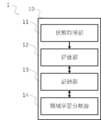
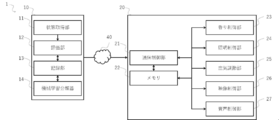
- FIG. 1 is a block diagram showing a configuration of a machine learning system 1 according to an embodiment of the present technology.
- the machine learning system 1 can include, for example, a machine learning device 10.
- the machine learning device 10 can include, for example, a state acquisition unit 11, an evaluation unit 12, a recording unit 13, a machine learning classifier 14, and the like.
- the state acquisition unit 11 acquires at least state information related to human behavior. As a result, the machine learning system 1 can grasp the behavioral changes of a person in response to changes in the environment.
- the status information includes, for example, Cookie used for browsing websites, purchase history on EC (Electronic Commerce) sites, location information obtained using GPS (Global Positioning System), conversation history such as chat, and others. Information obtained by using sensing technology is included.
- the state information may include information on the weather or temperature in the area where the person exists.
- the machine learning system 1 can grasp the behavioral changes peculiar to the weather or temperature in the area where the person exists.
- the evaluation unit 12 evaluates the environmental information regarding the environment around the person when the state information is acquired and the state information to obtain a value function. As a result, the correlation between the environmental information and the state information can be obtained. Specific evaluation means will be described later.
- Environmental information includes, for example, information on scent, lighting, temperature, humidity, video, or audio. Specific examples of environmental information will be described later.
- the recording unit 13 records state information, environmental information, and the like.
- the machine learning system 1 uses a system that acquires state information but records environmental information without acquiring it.
- the machine learning classifier 14 reinforces the value function and selects the environmental information when the value function becomes the highest in order to encourage the human behavior to the target behavior. This provides a correlation between behavior and the environment.
- the machine learning method is not particularly limited, but for example, reinforcement learning can be used.
- Reinforcement learning is a type of machine learning that deals with the problem that software observes the current state (state information in this technology) and determines the action to be taken (change of environmental information in this technology).
- the agent (machine learning classifier 14 in the present technology) can determine the action when the value is the highest by performing reinforcement learning by trial and error of the action.
- the machine learning device 10 may have a control unit that controls each component, a communication interface that communicates via a communication network, and the like.
- the evaluation unit 12 evaluates the environmental information about the environment around the person when the state information is acquired and the state information to obtain the value function.
- the evaluation unit 12 can have a reward calculation unit (not shown) and a value calculation unit (not shown).
- the state information related to human behavior can change according to changes in environmental information.
- the reward calculation unit calculates the reward R based on the difference between the target state information related to the target behavior and the state information when the machine learning system 1 changes the environmental information. The larger the value of the reward R, the smaller the difference between the target state information and the state information. That is, the larger the value of the reward R, the closer the human behavior is to the target behavior.
- the reward R can be expressed by, for example, the following equation (1) using the score Pt according to the target state information and the score Pm according to the state information.
- the action of "purchasing product A using the EC site" is set as the target action. Then, when a person performs a target action by changing the environmental information, 5 points are set as a score.
- the score Pt according to the target state information is "5".
- the score Pm according to the state information is also "5".
- the reward R becomes "1".
- the score Pm according to the state information is set to "0".
- the reward R is also "0".
- the reward calculation unit calculates the reward R when the environmental information is changed when the reward R becomes the highest.
- the value calculation unit calculates the value function Q based on the reward R, the environmental information, and the state information.
- the value calculation unit calculates the value function Q based on the state information when the environmental information is changed when the reward R is the highest. For example the value function when the environment information change a t is made to state information s t at time t is expressed as Q (s t, a t) .
- This value function Q may be recorded by, for example, the recording unit 13. More specifically, the recording unit 13 may record the value function Q on the table for each state information or environmental information.
- Machine learning classifier 14 reinforces the value function Q and selects the environmental information when the value function Q becomes the highest.
- the machine learning classifier 14 automatically performs trial and error and learning so that the value function Q is the highest. The higher the value function Q, the closer the human behavior is to the target behavior. By reinforcement learning so that the value function Q is the highest, the machine learning classifier 14 can prompt the human behavior to the target behavior.
- the machine learning classifier 14 updates the value function Q when the environmental information at which the value function Q is the highest is determined. Against state information s t at e.g. time t, change is made a t environmental information, when a transition is made to state information s t + 1 at time t + 1, value function Q (s t, a t) is the following formula ( Updated using 2).
- ⁇ is a learning coefficient.
- the learning coefficient ⁇ is set to a value larger than 0 and 1 or less, but a value of about 0.1 is often used.
- R t + 1 is the reward obtained by the transition of this state information.
- the discount rate ⁇ is the discount rate.
- the discount rate ⁇ is set to a value larger than 0 and 1 or less, but a value of about 0.9 to 0.99 is often used.
- maxQ (st + 1 , a) is the ideal value function for the future.
- maxQ (s t + 1 , a) is a value function when the action a when the value function Q becomes the highest is selected in the state s t + 1 at the time t + 1.
- This value function maxQ (st + 1 , a) is multiplied by the discount rate ⁇ .
- the machine learning classifier 14 keeps updating the value function Q using the above mathematical formula (2), and selects the environmental information when the value function Q becomes the highest. As a result, the machine learning classifier 14 can select environmental information that can prompt the target behavior.
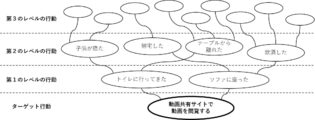
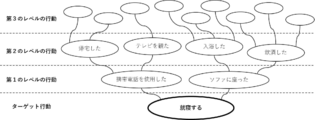
- FIG. 2 is a conceptual diagram showing an example of behavioral change according to the present embodiment.
- the behavior of "viewing a video on a video sharing site” is set as the target behavior.
- a plurality of behavioral transformation flows are set to encourage this target behavior.
- the machine learning classifier 14 can construct this behavior change flow by repeating reinforcement learning. By following this flow, the machine learning classifier 14 can promote a person's behavior to a target behavior.
- human behavior is divided into multiple levels according to the proximity to the target behavior.
- the action set at the first level may be the action closest to the target action.
- the action set at the second level may be the action next to the target action.
- the value function Q related to the first level behavior is higher than the value function Q related to the second level behavior.
- the actions of "going to the bathroom” and “sitting on the sofa” are set to the first level.
- the behaviors of "the child went to bed”, “goed home”, “away from the table”, and “drinked” are set.
- a flow of behavior change is constructed. For example, in this characteristic of individual behavioral transformation, it is shown that when the behavior of "children went to bed” is performed, the behavior of "going to the toilet” tends to be performed.
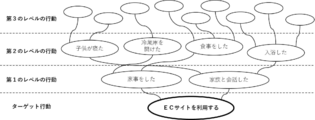
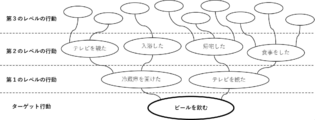
- FIG. 3 to 7 are conceptual diagrams showing an example of behavioral transformation according to the present embodiment.
- FIG. 3 shows an example of a behavioral transformation flow for encouraging a target behavior of “using an EC site”.
- FIG. 4 shows an example of a behavioral transformation flow for encouraging a target behavior of “browsing an SNS (Social Networking Service)”.
- FIG. 5 shows an example of a behavioral change flow for encouraging the target behavior of “shopping for a large amount of money”.
- FIG. 6 shows an example of a behavioral transformation flow for encouraging the target behavior of “drinking beer”.
- FIG. 7 shows an example of a behavioral transformation flow for encouraging the target behavior of “going to bed”. In this way, various behavioral transformation flows are constructed according to the target behavior.
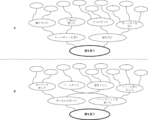
- FIG. 8 is a conceptual diagram showing an example of behavioral transformation according to the present embodiment.
- FIG. 8A shows an example of behavioral change of an individual. As shown in FIG. 8A, the action of "purchasing clothing" is set as the target action.
- FIG. 8B shows an example of behavioral transformation of an individual who is not an individual shown in FIG. 8A.
- the target behavior is the same as that in FIG. 8A, but the flow of behavioral transformation for encouraging the target behavior is different.
- the machine learning device 10 may have target state information related to one target action, but may have a plurality of target state information related to a plurality of target actions. Some or all of these plurality of target actions can be set, for example, by time and / or by stage.
- Part or all of a plurality of target actions can be set for each time, for example.
- some or all of the plurality of target behaviors are the target behavior in the first time zone (for example, 0 to 6 am) of the day and the second time zone (for example, in the morning). It can be set as a target action in the 7 to 7 pm range) and a target action in the third time zone (for example, the 8 to 11 pm range).
- the target behavior in the first time zone may be, for example, "getting sleep”.
- the target behavior in the second time zone may be, for example, "eating food S”.
- the target behavior in the third time zone (for example, 8 to 11 pm) may be, for example, "drinking beverage T".
- the target actions can be flexibly set according to the time zone.
- the machine learning device 10 can prompt the target action of "eating food S at 3:00 pm".
- some or all of the plurality of target actions can be set for each stage, for example.
- some or all of the plurality of target behaviors can be set as the target behavior in the first stage and the target behavior in the second stage.
- the target action in the first stage may be, for example, "going to the store U”.
- the target action in the second stage may be, for example, "eating food S”.
- a plurality of target actions having a series of flows can be set.
- the machine learning device 10 can prompt the target action of "eating food S when going to the store U".
- some or all of the plurality of target actions can be set, for example, by time and by stage.
- the target behavior in the first and second stages can be set.
- a plurality of target actions having a series of flows can be flexibly set according to the time zone.
- the machine learning device 10 can prompt the target action of "eating food S when going to the store U in the morning".
- the machine learning device 10 may have target state-related information including a plurality of target state information.
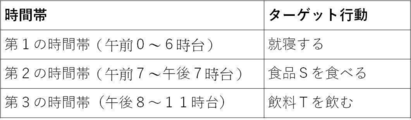
- FIG. 9 is a database showing an example of target state-related information according to the present embodiment.
- the time zone and the target behavior are related.
- the target behavior in the first time zone (midnight to 6 am) is "go to bed”.
- the target behavior in the second time zone (7 am to 7 pm) is "eat food S”.
- the target behavior in the third time zone (8 to 11 pm) is, for example, "drinking beverage T”. The same applies to the target state-related information set for each stage.
- the target state-related information can be recorded in, for example, a recording unit 13 included in the machine learning device 10.
- the target state-related information may be held by another computer device of the machine learning device 10.
- the target state related information may be held in a server on the cloud.
- the machine learning device 10 may receive the target state-related information from the server via the information communication network.
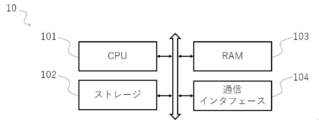
- FIG. 10 is a block diagram showing a hardware configuration of the machine learning device 10 according to the present embodiment.
- the machine learning device 10 can include a CPU 101, a storage 102, a RAM (Random Access Memory) 103, and a communication interface 104 as components. Each component is connected by a bus, for example, as a data transmission line.
- a bus for example, as a data transmission line.
- the CPU 101 is realized by, for example, a microcomputer, and controls each component of the machine learning device 10.
- the CPU 101 can function as, for example, an evaluation unit 12 or a machine learning classifier 14.
- the machine learning classifier 14 can be realized, for example, by a program. This program can function by being read by the CPU 101.
- the storage 102 stores control data such as programs and calculation parameters used by the CPU 101.
- the storage 102 can be realized by using, for example, an HDD (Hard Disk Drive) or an SSD (Solid State Drive).
- the storage 102 can function as, for example, a recording unit 13.
- the RAM 103 temporarily stores, for example, a program executed by the CPU 101.
- the communication interface 104 has a function of communicating via an information communication network by using communication technology such as Wi-Fi, Bluetooth (registered trademark), LTE (Long Term Evolution) and the like.
- the program that realizes the machine learning classifier 14 and the like may be stored in another computer device or computer system of the machine learning system 1.
- the machine learning system 1 can use the cloud service that provides the function of this program.
- this cloud service include SaaS (Software as a Service), IaaS (Infrastructure as a Service), and PaaS (Platform as a Service).
- Non-temporary computer-readable media include various types of tangible storage mediums. Examples of non-temporary computer-readable media are magnetic recording media (eg flexible disks, magnetic tapes, hard disk drives), magneto-optical recording media (eg magneto-optical disks), CompactDisc ReadOnlyMemory (CD-ROM), CD- Includes R, CD-R / W, and semiconductor memory (eg, mask ROM, Programmable ROM (PROM), Erasable PROM (EPROM), flash ROM, Random Access Memory (RAM)).
- the above program may be supplied to a computer by various types of temporary computer readable media (transitory computer readable medium). Examples of temporary computer-readable media include electrical, optical, and electromagnetic waves.
- the temporary computer-readable medium can supply the above program to the computer via a wired communication path such as an electric wire and an optical fiber, or a wireless communication path.
- the machine learning system 1 may include an environment control device for controlling the environment around a person.
- the environment control device controls the environment around the person based on the environment information selected by the machine learning classifier 14.
- the machine learning system 1 can prompt the human behavior to the target behavior.
- the machine learning system 1 can promote sales, for example, by encouraging human behavior to target behavior.
- the machine learning system 1 can control the internal or external environment of the store in order to make the customer purchase the product.
- the machine learning system 1 is not limited to the actual store, and may be an EC site, for example.
- the machine learning system 1 can also be used for content to be downloaded or streamed or a website, and can promote browsing of the content or website.
- the machine learning system 1 can improve a person's lifestyle, for example, by encouraging a person's behavior to a target behavior.
- the machine learning system 1 can control the environment in order to encourage smoking cessation and abstinence from drinking.
- the machine learning system 1 may be used for improving, for example, shopping dependence, lack of sleep, lack of exercise, and the like.
- the machine learning system 1 can be sent to vote in an election, for example, by encouraging human behavior to target behavior.
- the machine learning system 1 can improve public health, morals, etc. by encouraging human behavior to target behavior.
- the machine learning system 1 may be used for separating garbage, suppressing littering of garbage and rushing in, observing cough etiquette and washing hands, aligning, and suppressing violence.
- the machine learning system 1 can improve work efficiency, for example, by encouraging human behavior to target behavior.
- the machine learning system 1 may be used for improving concentration, suppressing looking away, switching on / off, and the like.
- FIG. 11 is a block diagram showing the configuration of the machine learning system 1 according to the present embodiment.
- the same components as those in the first embodiment are designated by the same reference numerals, and detailed description thereof will be omitted.
- the machine learning system 1 may further include an environmental control device 20.
- the environment control device 20 and the machine learning device 10 are connected via the information communication network 40.
- the environment control device 20 controls an environment such as fragrance, lighting, temperature, humidity, video, or voice based on the environment information selected by the machine learning classifier 14.
- the environment control device 20 can include, for example, a communication control unit 21, a memory 22, a scent control unit 23, a lighting control unit 24, an air control unit 25, a video control unit 26, a voice control unit 27, and the like.
- the environment control device 20 does not have to have all of these components. It suffices to have at least one of the components.
- the machine learning system 1 may include a plurality of environmental control devices 20.
- one environmental control device 20 has a scent control unit 23 and the other environmental control device 20 has a lighting control unit 24. You may.
- the communication control unit 21 can communicate information with the machine learning device 10 via the information communication network 40. Further, the communication control unit 21 may control each component.
- the memory 22 can record information used by the environmental control device 20, such as environmental information.
- the machine learning classifier 14 included in the machine learning device 10 may be provided in, for example, the environment control device 20, or may be provided in other computer devices.
- the environmental control device 20 may include, for example, a scent control unit 23.
- the scent control unit 23 controls the generated scent based on the environmental information selected by the machine learning classifier 14.
- the environment control device 20 including the scent control unit 23 can be realized by using, for example, an aroma diffuser.
- the scent includes not only those that can be recognized as scents by humans, but also those that cannot be recognized as scents by humans but have some effect on humans by being inhaled.
- the scent includes a medical sedative that is inhaled, or a gas that is odorless but acts on a person's physical condition by being inhaled, such as oxygen and carbon dioxide.
- a person is unawarely prompted to take a target action by sucking a scent optimized for the person controlled by the scent control unit 23.
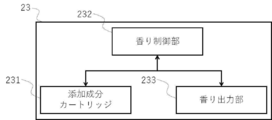
- FIG. 12 is a block diagram showing the configuration of the scent control unit 23 according to the present embodiment.
- the scent control unit 23 can include, for example, an additive component cartridge 231, a scent control unit 232, a scent output unit 233, and the like.
- the additive component cartridge 231 is a component that houses the scent additive component.
- the additive component cartridge 231 may be replaceable.
- the additive component cartridge 231 includes, for example, a container such as a cylinder, a bottle, or a can containing the additive component, a material such as paper, a non-woven fabric, or stone adsorbing the additive component, or a solid substance such as wax or soap mixed with the additive component. It may be.
- the additive component may be a solid, a liquid, a gas containing, for example, a powder or a gel, or a mixture thereof.
- the additive component may be, for example, a natural fragrance extracted from nature, a synthetic fragrance obtained from chemical synthesis, or a blended fragrance in which these are blended. Alternatively, the additive component may not contain a fragrance.
- the scent control unit 232 controls the additive components for generating the scent based on the environmental information.
- the scent control unit 232 can determine, for example, the ratio of each additive component when the additive component is mixed. Alternatively, the scent control unit 232 may determine the dilution ratio. The ratio or the dilution ratio is determined according to the environmental information selected by the machine learning classifier 14.
- the scent control unit 233 may control, for example, the injection pressure and the number of injections related to the output of the scent.
- the injection pressure or the number of injections is determined according to the environmental information selected by the machine learning classifier 14.
- the scent output unit 233 outputs a scent based on the information determined by the scent control unit 232.
- the machine learning system 1 provided with the scent control unit 23 can encourage a person's behavior to a target behavior by causing a person to suck a specific scent. For example, by making a person inhale a scent that makes him / her physiologically want to purchase a specific product, the machine learning system 1 causes the person to purchase a specific product by mail order or to go to a store. Can be done.
- the scent and content may be associated.
- the machine learning system 1 can make a person unconsciously learn the association between the scent and the content before the reinforcement learning.
- the machine learning system 1 can make a person suck a specific scent and let a person watch a specific video content.
- This video content includes, for example, an advertisement related to a specific product.
- the machine learning system 1 can make a person unconsciously learn the association between a specific scent and a specific product. By letting a person inhale this specific scent, the machine learning system 1 can make the person purchase a specific product by mail order or go to a store.
- scent and environment may be associated.
- This environment is an environment related to places or things that people actually experience. This location includes, for example, stores, public transport, movie theaters, theaters, theme parks, and the like. As a result, the machine learning system 1 can make a person unconsciously learn the association between fragrance and the environment before reinforcement learning.
- the machine learning system 1 can make a person who visits a specific store inhale a specific scent. As a result, the machine learning system 1 can make a person unconsciously learn a specific scent and a specific store association. By letting a person inhale this specific scent at a place different from the store, the machine learning system 1 can direct the person to the store or purchase the products displayed in the store by mail order. can.
- the machine learning system 1 can suck the scent generated from a specific product by experiencing, for example, drinking coffee. As a result, the machine learning system 1 can make a person unconsciously learn the association between a specific scent and a specific product.
- the scent control unit 23 When the scent control unit 23 generates this specific scent, the machine learning system 1 may make the specific product purchased by mail order or direct the specific product to the store where the specific product is displayed. can.
- the scent may be attached to the object.
- the object may be, for example, clothing, books, miscellaneous goods, promotional materials, packing materials, etc. delivered to a person who promotes the target action. A person is unknowingly encouraged to target behavior by inhaling a scent that is attached to an object and optimized for that person.
- FIG. 13 is a block diagram showing the configuration of the machine learning system 1 according to the present embodiment.
- the same components as those in the first embodiment are designated by the same reference numerals, and detailed description thereof will be omitted.
- the machine learning system 1 further includes a scent adhering portion 30.
- the scent adhering portion 30 and the machine learning device 10 are connected via the information communication network 40.
- the scent adhering portion 30 may have the same configuration as the scent control unit 23.
- the above-mentioned scent control unit 23 is arranged around the person who is prompted by the target action.
- the scent adhering portion 30 is arranged, for example, in a factory where goods are shipped.
- the scent adhering portion 30 attaches the scent to an object based on the environmental information selected by the machine learning classifier 14.
- the machine learning classifier 14 determines which of the scent control unit 23 and the scent adhesion unit 30 generates the scent based on the environmental information.
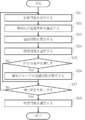
- FIG. 14 is a flowchart showing the procedure of the machine learning system 1 according to the present embodiment.
- the machine learning classifier 14 reinforces the correlation between fragrance and behavior (step S11), and the machine learning classifier 14 selects environmental information (step). S12), the machine learning classifier 14 determines that the scent control unit 23 generates the scent (step S13), and the scent control unit 23 controls the scent around the person (step S14). Steps S11 to S14 are repeated until the correlation between the scent and the behavior can be sufficiently learned (step S15: No).
- step S15 the machine learning classifier 14 determines that the scent adhering portion 30 generates the scent (step S16), and the scent adhering portion 30 Adheres the scent to the object (step S17).
- the machine learning system 1 can more flexibly control the scent around the person.
- the machine learning classifier 14 changes the scent while the scent control unit 23 arranged around the person changes the scent in a short period of time. Reinforcement learning of correlation with behavior with high efficiency.
- the machine learning classifier 14 determines the optimum scent for the target behavior.
- the machine learning classifier 14 continuously reinforces the correlation between the scent and the behavior.
- the environment control device 20 may include, for example, a lighting control unit 24.
- the lighting control unit 24 controls the emitted light based on the environmental information selected by the machine learning classifier 14.
- the environment control device 20 including the lighting control unit 24 can be realized by using, for example, a light bulb (including a so-called smart light bulb).
- a person is unknowingly urged to take a target action by visually recognizing the light optimized for the person emitted by the lighting control unit 24.
- FIG. 15 is a block diagram showing the configuration of the lighting control unit 24 according to the present embodiment.
- the illumination control unit 24 may include, for example, an optical control unit 241 and an optical output unit 242.
- the light control unit 241 controls the expression of the output light.
- the optical control unit 241 can determine, for example, the color temperature and brightness of light.
- the color temperature or the brightness is determined according to the environmental information selected by the machine learning classifier 14.
- the color temperature may be determined to be 3500 to 3900K, and the brightness may be determined to be 3000 to 4000 lm.
- the optical control unit 241 may randomly determine the value from the range.
- the machine learning device 10 can narrow this range while accumulating reinforcement learning. The same applies to the other components described below.
- the light output unit 242 outputs light based on the information determined by the light control unit 241.
- the environmental control device 20 may include, for example, an air regulating unit 25.
- the air control unit 25 controls the temperature and / or humidity based on the environmental information selected by the machine learning classifier 14.
- the environment control device 20 including the air adjusting unit 25 can be realized by using, for example, an air conditioner or the like.
- a person is unknowingly urged to target behavior by the temperature and / or humidity optimized for the person controlled by the air conditioning unit 25.
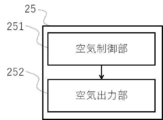
- FIG. 16 is a block diagram showing the configuration of the air adjusting unit 25 according to the present embodiment.
- the air adjusting unit 25 can include, for example, an air control unit 251 and an air output unit 252.
- the air control unit 251 can determine the temperature and / or humidity of the air.
- the temperature and / or the humidity is determined according to the environmental information selected by the machine learning classifier 14. For example, the temperature may be determined to be 25.5 to 27.5 degrees, and the humidity may be determined to be 45 to 50%.
- the air output unit 252 outputs air based on the information determined by the air control unit 251.
- the environment control device 20 may include, for example, an image control unit 26.
- the image control unit 26 controls the image to be displayed based on the environmental information selected by the machine learning classifier 14.
- the environment control device 20 including the image control unit 26 can be realized by using, for example, a television, a portable game machine, a PC, a tablet, a smartphone, an HMD (Head Mounted Display), a wearable device, a car navigation system, or the like.
- the video includes still images as well as moving images.
- the video may include audio.
- a person is unknowingly urged to take a target action by visually recognizing an image optimized for the person displayed by the image control unit 26.
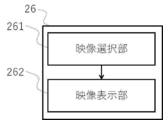
- FIG. 17 is a block diagram showing the configuration of the video control unit 26 according to the present embodiment.
- the video control unit 26 can include, for example, a video selection unit 261 and a video display unit 262.
- the video selection unit 261 selects the video to be output.
- the means for selecting the video is not particularly limited, but for example, the video selection unit 261 can determine the video file by using an address in which the video file is recorded, an advertisement banner code, or the like. The address, code, and the like are determined according to the environmental information selected by the machine learning classifier 14. Further, the video selection unit 261 may synthesize or edit a plurality of video files. Further, the image selection unit 261 may adjust the color temperature, the brightness, and the like of the image.
- the video file may be recorded inside the video control unit 26, or may be recorded outside the video control unit 26.
- the video display unit 262 outputs a video based on the information determined by the video selection unit 261.
- the environment control device 20 may include, for example, a voice control unit 27.
- the voice control unit 27 controls the voice to be reproduced based on the environmental information selected by the machine learning classifier 14.
- the environment control device 20 including the voice control unit 27 can be realized by using, for example, a speaker (including a so-called smart speaker or a speaker with a streaming function), a tablet, a smartphone, headphones, a wearable device, a car stereo, or the like.
- a person is unknowingly urged to take a target action by viewing a voice optimized for the person played by the voice control unit 27.
- FIG. 18 is a block diagram showing the configuration of the voice control unit 27 according to the present embodiment.
- the voice control unit 27 may include, for example, a voice selection unit 271 and a voice output unit 272.
- the voice selection unit 271 selects the voice to be reproduced.
- the means for selecting the voice is not particularly limited, but for example, the voice selection unit 271 can be determined by using an address in which the voice file is recorded, an advertisement banner code, or the like. The address, code, and the like are determined according to the environmental information selected by the machine learning classifier 14.
- the voice selection unit 271 may synthesize or edit a plurality of voice files. Further, the voice selection unit 271 may adjust the pitch, volume, and the like.
- the voice file may be recorded inside the voice control unit 27, or may be recorded outside the voice control unit 27.
- the voice output unit 272 outputs voice based on the information determined by the voice selection unit 271.
- the machine learning device 10 can record the value function Q, the state information s, and the change a of the environmental information for each target action. Then, the machine learning device 10 can select environmental information that can be promoted to the target behavior by reinforcing learning the correlation between the behavior of the person and the environment around the person.
- multiple people with similar correlations between behavior and the environment can be set in one value group. For example, a plurality of people who are likely to be prompted by a specific target behavior when they feel a scent and a temperature change can be set as one group.
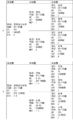
- FIG. 19 is an example of a database used by the machine learning device 10 according to the present embodiment.
- this database holds the value function Q, the state information s, and the change a of the environmental information for each target action.
- This value function Q is divided into a plurality of value groups Q1 to Q8 according to the degree of similarity of the correlation between the state information s and the change a of the environmental information.
- Persons h01 to 32 belonging to the value group are associated with each of the plurality of value groups Q1 to Q8.
- Attribute information A to C indicating the characteristics of the person may be associated with each person.
- the machine learning device 10 can use information such as the value function Q related to this value group. By using information such as the value function Q that has already been reinforcement-learned, the machine learning device 10 can omit, for example, a part of the process of reinforcement learning, and can perform reinforcement learning in a shorter period of time.
- the machine learning device 10 can start reinforcement learning by setting the information that has already been strengthened learning as an initial value.
- information such as the value function Q that has already been reinforcement-learned may be used for reinforcement learning regarding the behavior of another person who belongs to the same value group.
- information such as the value function Q that has been reinforcement-learned about the behavior of the person h13 belonging to the value group Q4 is used for reinforcement learning about the behavior of the person h14 belonging to the same value group Q4. be able to.
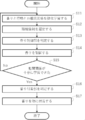
- FIG. 20 is a flowchart showing an example of the procedure of the machine learning device 10 according to the present embodiment.
- the state acquisition unit 11 included in the machine learning device 10 acquires the state information (step S21).
- the evaluation unit 12 included in the machine learning device 10 calculates the reward and the value function based on the state information (step S22).
- the machine learning classifier 14 included in the machine learning device 10 updates the value function (step S23).
- the machine learning classifier 14 selects environmental information in order to learn further behavior change (step S24).
- the machine learning classifier 14 determines whether or not the predetermined condition is satisfied (step S25).
- This determination condition is not particularly limited, but may be determined based on whether or not the number of updates of the value function exceeds a predetermined threshold value, for example.
- the machine learning classifier 14 refers to the database, such as the value function Q of a similar group or the change a of the environmental information for which a high reward has been obtained in the past. Acquire information (step S26).
- This database may be provided by the machine learning device 10, or may be provided by another computer device of the machine learning device 10. As a result, the machine learning device 10 can perform reinforcement learning using the information that has already been reinforcement-learned.
- step S25 when the predetermined condition is not satisfied (step S25: No), the value function of a similar group is not acquired.
- the machine learning classifier 14 determines whether or not to end reinforcement learning (step S27).
- This determination condition is not particularly limited, but may be determined, for example, by whether or not the value function is higher than a predetermined threshold value.
- step S27: No When it is determined that the machine learning is not completed (step S27: No), the steps S21 to 26 are repeated.
- step S27 When it is determined that the machine learning is finished (step S27: Yes), the machine learning classifier 14 selects the environmental information (step S28).
- Target actions may be set randomly.
- the machine learning classifier 14 can reinforce the correlation between the behavior and the environment by encouraging various target behaviors without being fixed to a specific target behavior. By this reinforcement learning, the machine learning classifier 14 can discover regularities such as signs of behavior and continuity even in changes in the environment that are considered to have a low relationship with behavior, for example.
- Attribute information indicating the characteristics of each of the plurality of people registered in this database is associated with each other.
- the attribute A may be a person having the characteristic that "when the color temperature of the illumination is 3650K, the brightness of the illumination is 3000 lm, and the temperature is 26.5 degrees, there is a tendency to drink beer".
- the attribute C may be a person having the characteristic that "when the temperature is 25 degrees, the humidity is 48%, and the scent contains the additive component T, there is a tendency to browse the EC site”. ..
- the value function of a randomly selected group may be acquired.
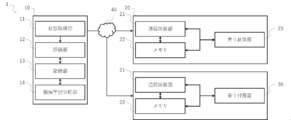
- the machine learning system 1 may include a plurality of machine learning devices. This will be described with reference to FIG. FIG. 21 is a block diagram showing a configuration of a machine learning system 1 according to an embodiment of the present technology.
- the machine learning system 1 can include, for example, a plurality of machine learning devices 10a to 10d.
- Each of the plurality of machine learning devices 10a to 10d can include, for example, state acquisition units 11a to 11d, evaluation units 12a to 12d, recording units 13a to 13d, machine learning classifiers 14a to 14d, and the like.
- an environment control device (not shown) may be connected to each of the plurality of machine learning devices 10a to 10d.
- the number of machine learning devices is not particularly limited.
- the machine learning system 1 can include the achievement difficulty calculation device 50.
- the achievement difficulty calculation device 50 may have a hardware configuration as shown in FIG.
- the achievement difficulty calculation device 50 is connected to each of the plurality of machine learning devices 10a to 10d via, for example, an information communication network 40, and aggregates the information obtained from each of the plurality of machine learning devices 10a to 10d.
- the tendency of the correlation between the state information and the environmental information can be obtained.
- the achievement difficulty calculation device 50 can calculate the achievement difficulty related to the target action. When defined as having achieved what prompted the target behavior, achievement difficulty indicates this difficulty in achievement. A detailed explanation of this achievement difficulty will be described later.
- the achievement difficulty calculation device 50 can include, for example, an information acquisition unit 51, a subject information recording unit 52, an action information recording unit 53, and an achievement difficulty calculation unit 54.
- the information acquisition unit 51 acquires the state information obtained by each of the plurality of machine learning devices 10a to 10d.
- the information acquisition unit 51 can be realized by using, for example, a communication interface 104 or the like.
- the subjects targeted by each of the plurality of machine learning devices 10a to 10d may be different.
- the subject information recording unit 52 holds information about the subject to be targeted by each of the plurality of machine learning devices 10a to 10d. This information includes, for example, the subject's identification number, gender, or age.
- the subject information recording unit 52 can be realized by using, for example, a storage 102 or the like.
- the behavior information recording unit 53 holds information on the behavior targeted by each of the plurality of machine learning devices 10a to 10d. This information includes, for example, information about the target behavior, state information, historical information about the state information, and the like.
- the action information recording unit 53 can be realized by using, for example, a storage 102 or the like.
- the achievement difficulty calculation unit 54 can calculate the achievement difficulty related to the target action based on the state information acquired by each of the plurality of state acquisition units 11a to 11d.
- the achievement difficulty calculation unit 54 can be realized by using, for example, a CPU 101 and a program.
- the achievement difficulty calculation unit 54 may be provided by the achievement difficulty calculation device 50, may be provided by each of the plurality of machine learning devices 10a to 10d, or may be provided by a plurality of environmental control devices (not shown). ) May be provided.
- the machine learning system 1 can be provided with a plurality of achievement difficulty calculation devices.
- the plurality of achievement difficulty calculation devices there may be an achievement difficulty calculation device for relay that aggregates information obtained from a specific machine learning device among the plurality of machine learning devices.
- the achievement difficulty indicates the difficulty when prompting the target action.
- the machine learning system 1 derives, for example, a subject who is easily or less likely to be prompted by the target behavior, or derives environmental information which is easily or less likely to be encouraged by the target behavior. Can be done.
- the group of subjects who are easily encouraged by the target behavior is defined as the adaptive group, and the group of subjects who are not easily encouraged by the target behavior is defined as the challenge group.
- the machine learning system 1 can derive a target group of products, for example, in product development or advertising activities.
- This target group includes, for example, age and gender.
- POS Point of sale
- a local event for example, an athletic meet or a fireworks display.
- the machine learning system 1 can derive a product that is easy to purchase at the time of holding this event, a target layer of this product, and the like.
- Adaptive groups can be used for the former development and advertising activities, and challenge groups can be used for the latter development and advertising activities.
- the target behavior can be classified into a basic basic target behavior and an applied target behavior associated with this basic target behavior.
- the basic target behavior is a rough classification of the types of behavior, such as going out, eating and drinking, or purchasing.
- Applied target behaviors are more specific representations of basic target behaviors, such as going to a specific store on a sale day, going on a trip to a specific location, participating in a local event activity, and so on. ..
- the machine learning system 1 first derives an adaptive group that is easily prompted by applied target behavior.
- the machine learning system 1 can derive an adaptive group for each of a plurality of applied target behaviors, and by appealing information about the adaptive group, it can derive an adaptive group for the basic target behavior. That is, the machine learning system 1 can obtain a tendency common to a plurality of adaptive groups. As a result, for example, in product development, a new target layer that has not been noticed until now can be derived.
- the achievement difficulty level may include, for example, the achievement rate r indicating the ratio of prompting the target action. Subjects with a high achievement rate r are classified into the adaptive group.
- the achievement rate r is determined by, for example, the following equation (3), using the number n of state information prompted by the target action and the number n all of all state information including the state information not prompted by the target action. Can be expressed.
- the achievement difficulty level may include, for example, a standard achievement time s indicating a standard time until the target action is prompted. Subjects with a short standard achievement time s are classified into the adaptive group.
- the standard achievement time s is expressed by, for example, the following equation (4) using the achievement time x indicating the time until the target action is prompted and the average achievement time p indicating the average time until the target action is prompted. can.
- the average achievement time p is the sum of the achievement time x, and the number of all state information n all. It can be calculated by dividing by.
- the standard achievement time s is calculated using the standard deviation so as not to be affected by the subject whose achievement time is extremely long, but the average achievement time p using the average instead of the standard deviation is included in the achievement difficulty level. May be.
- the achievement difficulty level may include, for example, the average number of environmental items q indicating the average number of items of environmental information when prompted to the target action.
- Items of this environmental information include, for example, scent, lighting, temperature, humidity, video, audio, and the like.
- Subjects with a small average number of environmental items q are classified into adaptive groups. For example, subjects who are only affected by scent are more likely to be motivated by target behavior than subjects who are not affected by both scent and temperature.
- the average number of environmental items q can be expressed by, for example, the following equation (5) using the number n of state information urged to the target action and the number e of the items of environmental information urged to the target action.
- the achievement difficulty calculation unit 54 may calculate the standard deviation as in the equation (4) instead of the average.
- the name of the item of the environmental information may be recorded together with the calculation of the average number of environmental items q.
- the action information recording unit 53 can record the name of the item of the environmental information.
- the machine learning system 1 can derive an adaptive group in which behavior change is likely to be promoted by specific environmental information.
- the machine learning system 1 can derive an adaptive group in which a scent is likely to promote behavior change.
- the achievement difficulty level may include at least one of the achievement rate r, the standard achievement time s, and the average number of environmental items q.
- the adaptive group can be derived more than when only the achievement rate r is included in the achievement difficulty level. It will be easier.
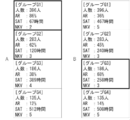
- FIG. 22 is a diagram illustrating the achievement difficulty level calculated by the achievement difficulty level calculation unit 54 according to the present embodiment. As shown in FIG. 22, the achievement rate (AR: Achievement rate), the standard achievement time (SAT: Standard achievement time), and the average number of environmental items (NKV: Number of key variables) included in the achievement difficulty level are shown. There is.
- FIG. 22A shows the degree of difficulty achieved when the target action of "exercising” is urged to the subject who does not exercise on a daily basis.
- the subjects encouraged by this target behavior are men and women aged 20 to 59 years.
- the achievement rate of all the subjects is 30%
- the standard achievement time is 54 hours
- the average number of environmental items is 2.
- the middle classification is a subdivision of the major classification. Here, as an example, it is subdivided based on gender.
- the achievement rate of male subjects is 31%
- the standard achievement time is 55 hours
- the average number of environmental items is 1.
- the achievement rate of female subjects is 29%
- the standard achievement time is 53 hours
- the average number of environmental items is 3. From this, it can be seen that the achievement rate is higher in male subjects than in female subjects. In other words, focusing on the achievement rate, it can be said that men fall under the adaptive group.
- the subdivision of the middle classification is the subdivision.
- it is subdivided based on age.
- the achievement rate of the male subject group aged 20 to 39 years is 34%
- the standard achievement time is 38 hours
- the average number of environmental items is 1.
- this group has the highest achievement rate, the shortest standard achievement time, and the lowest average number of environmental items.
- this group is an adaptive group.
- the machine learning system 1 can derive the adaptive group in this way. For this adaptive group, sales promotion activities related to products and services related to the target behavior of "exercising" can be carried out.
- FIG. 22B shows the difficulty level of achievement when urging a subject who has never been to an election in the past five years to perform a target action of "going to an election".
- the female subject group aged 50-79 years has the highest achievement rate, the shortest standard achievement time, and the lowest average number of environmental items. In other words, it can be said that this group is an adaptive group.
- the machine learning system 1 can derive an adaptive group by calculating the achievement rate, the standard achievement time, or the average number of environmental items. For example, the machine learning system 1 can derive an adaptive group having an achievement rate of 80% or more and a standard achievement time of 3 hours or less with respect to the target behavior of “purchasing beer”.
- the beer company can advertise the new product to the adaptive group at the start of sales of the new product.
- the machine learning system 1 derives an adaptive group having an achievement rate of 90% or more and an average number of environmental items of 2 or less with respect to the target behavior of "watching a video such as a television broadcast or a video distribution service". be able to.
- the video subscription service operator can carry out advertising activities related to the subscription of the video subscription service to this adaptive group.
- the business operator can carry out advertising activities for the adaptive group to encourage the continuation of the contract.
- FIG. 23 is a diagram illustrating the achievement difficulty level calculated by the achievement difficulty level calculation unit 54 according to the present embodiment.
- FIG. 23A shows the degree of difficulty achieved when encouraging the target action of "purchasing product S more than once".
- the achievement rate is 100% if the product S is purchased twice, and the achievement rate is 50% if the product S is purchased once.
- the subjects are classified into a plurality of groups based on the achievement difficulty level.
- the first group G1 the number of subjects is 396, the achievement rate is 86%, the standard achievement time is 67 hours, and the average number of environmental items is 2.
- the second group G2 the number of subjects was 283, the achievement rate was 62%, the standard achievement time was 120 hours, and the average number of environmental items was 3.
- the first group G1 and the second group G2 have a relatively high achievement rate, a short standard achievement time, and a small average number of environmental items. That is, it can be said that the first group G1 and the second group G2 are adaptive groups.
- the sales company of the product S can encourage the adaptive group to take the target action regarding the product S.
- the machine learning system 1 prompts the first group G1 and the second group G2 for the target action regarding the product S, and the third group G3 and the fourth group, which are relatively challenge groups.
- FIG. 23B shows the difficulty level of achievement when encouraging the target action of "purchasing product T twice or more".
- the achievement rate is 68%
- the standard achievement time is 258 hours
- the average number of environmental items is 3.
- the third group G3 has a relatively high achievement rate, a short standard achievement time, and a small average number of environmental items. That is, it can be said that this third group G3 is an adaptive group.
- the target layer of the product S as the first group G1 and the second group G2 and the target layer of the product T as the third group G3, for example, improvement of product sales or efficiency of sales promotion activities. And so on.
- the machine learning method according to the embodiment of the present technology is a method of machine learning the correlation between a person's behavior and the environment around the person by using a computer device.
- the machine learning method according to the present embodiment will be described with reference to FIG. 24.
- FIG. 24 is a flowchart showing the procedure of the machine learning method according to the present embodiment. As shown in FIG. 24, in the machine learning method according to the present embodiment, at least acquisition of state information relating to human behavior (step S1) and an environment relating to the environment surrounding the person when the state information is acquired are obtained.
- step S2 When the value function is obtained by evaluating the information and the state information (step S2), and the value function is strengthened and learned in order to promote the action to the target action, and the value function becomes the highest. At least including selecting the above-mentioned environmental information (step S3).
- the machine learning method according to the present embodiment may use the techniques according to the first to fourth embodiments. Therefore, the description of this technique will be omitted again.
- the present technology can also have the following configurations.
- a state acquisition unit that acquires at least state information related to human behavior
- An evaluation unit that evaluates the environmental information about the environment around the person when the state information is acquired and the state information to obtain a value function.
- a machine learning system including at least a machine learning classifier that reinforces and learns the value function and selects the environmental information when the value function becomes the highest in order to encourage the action to be a target action.
- the evaluation unit The reward is calculated based on the difference between the target state information related to the target action and the state information.
- the value function is calculated based on the reward, the environmental information, and the state information.
- the machine learning system according to [1].
- the target state-related information includes hourly target state information and / or staged target state information.
- the environmental information includes information on scent, lighting, temperature, humidity, video, or audio.
- the machine learning system according to any one of [1] to [4].
- It also has a scent control unit, The scent control unit controls the generated scent based on the environmental information selected by the machine learning classifier.
- the machine learning classifier determines which of the scent control unit and the scent adhesion unit generates the scent based on the environmental information.
- the machine learning system according to [6].
- It also has a lighting control unit, The lighting control unit controls the emitted light based on the environmental information selected by the machine learning classifier.
- the machine learning system according to any one of [1] to [7].
- It also has an air control unit, The air regulator controls temperature and / or humidity based on the environmental information selected by the machine learning classifier.
- the machine learning system according to any one of [1] to [8].
- the machine learning system according to any one of [1] to [9]. [11] It also has a voice control unit, The voice control unit controls the voice to be reproduced based on the environmental information selected by the machine learning classifier. The machine learning system according to any one of [1] to [10]. [12] The value function is divided into multiple value groups, The machine learning classifier uses a value function possessed by each of the plurality of value groups. The machine learning system according to any one of [1] to [11]. [13] With multiple status acquisition units It also has an achievement difficulty calculation unit. The achievement difficulty calculation unit calculates the achievement difficulty related to the target action based on the state information acquired by each of the plurality of state acquisition units. The machine learning system according to any one of [1] to [12].
- the achievement difficulty includes an achievement rate indicating the rate of prompting the target action.
- the machine learning system according to [13].
- the achievement difficulty includes a standard achievement time indicating a standard time until the target action is prompted.
- the machine learning system according to [13] or [14].
- the achievement difficulty includes an average number of environmental items indicating the average number of items of the environmental information when prompted to the target action.
- the machine learning system according to any one of [13] to [15].
- a state acquisition unit that acquires at least state information related to human behavior
- An evaluation unit that evaluates the environmental information about the environment around the person when the state information is acquired and the state information to obtain a value function.
- a machine learning device comprising at least a machine learning classifier that reinforces and learns the value function and selects the environmental information when the value function becomes the highest in order to encourage the action to be a target action.
- At least getting state information about human behavior To obtain a value function by evaluating the environmental information about the environment around the person when the state information is acquired and the state information.
- a machine learning method that includes, at least, reinforcement learning of the value function and selection of the environmental information when the value function is the highest in order to encourage the action to be a target action.
- Machine learning system 10 Machine learning device 11: State acquisition unit 12: Evaluation unit 13: Recording unit 14: Machine learning classifier 20: Environmental control device 23: Fragrance control unit 24: Lighting control unit 25: Air control unit 26 : Video control unit 27: Voice control unit 30: Fragrance adhesion unit 40: Information communication network 50: Achievement difficulty calculation device 51: Information acquisition unit 52: Subject information recording unit 53: Action information recording unit 54: Achievement difficulty calculation unit S1: Acquire at least the state information S2: Evaluate the environmental information and the state information to obtain a value function S3: Select the environmental information
Landscapes
- Engineering & Computer Science (AREA)
- Health & Medical Sciences (AREA)
- Theoretical Computer Science (AREA)
- Physics & Mathematics (AREA)
- Software Systems (AREA)
- General Physics & Mathematics (AREA)
- General Engineering & Computer Science (AREA)
- General Health & Medical Sciences (AREA)
- Mathematical Physics (AREA)
- Artificial Intelligence (AREA)
- Data Mining & Analysis (AREA)
- Evolutionary Computation (AREA)
- Computing Systems (AREA)
- Life Sciences & Earth Sciences (AREA)
- Biomedical Technology (AREA)
- Computer Vision & Pattern Recognition (AREA)
- Medical Informatics (AREA)
- Anesthesiology (AREA)
- Hematology (AREA)
- Bioinformatics & Cheminformatics (AREA)
- Business, Economics & Management (AREA)
- Veterinary Medicine (AREA)
- Public Health (AREA)
- Heart & Thoracic Surgery (AREA)
- Animal Behavior & Ethology (AREA)
- Development Economics (AREA)
- Strategic Management (AREA)
- Pulmonology (AREA)
- Accounting & Taxation (AREA)
- Finance (AREA)
- Audiology, Speech & Language Pathology (AREA)
- Molecular Biology (AREA)
- Human Computer Interaction (AREA)
- Pharmacology & Pharmacy (AREA)
- Marketing (AREA)
- Biophysics (AREA)
- Computational Linguistics (AREA)
- Economics (AREA)
- Multimedia (AREA)
- General Business, Economics & Management (AREA)
Priority Applications (5)
| Application Number | Priority Date | Filing Date | Title |
|---|---|---|---|
| KR1020227035189A KR20230002390A (ko) | 2020-04-28 | 2021-01-15 | 기계 학습 시스템, 기계 학습 장치 및 기계 학습 방법 |
| CN202180029984.4A CN115461767A (zh) | 2020-04-28 | 2021-01-15 | 机器学习系统、机器学习设备和机器学习方法 |
| EP21796215.8A EP4145360A4 (en) | 2020-04-28 | 2021-01-15 | MACHINE LEARNING SYSTEM, MACHINE LEARNING DEVICE AND MACHINE LEARNING METHOD |
| US17/915,353 US20230144616A1 (en) | 2020-04-28 | 2021-01-15 | Machine learning system, machine learning device and machine learning method |
| JP2022518600A JP7586174B2 (ja) | 2020-04-28 | 2021-01-15 | 機械学習システム、機械学習装置、及び機械学習方法 |
Applications Claiming Priority (4)
| Application Number | Priority Date | Filing Date | Title |
|---|---|---|---|
| JP2020078883 | 2020-04-28 | ||
| JP2020-078883 | 2020-04-28 | ||
| JP2020116497 | 2020-07-06 | ||
| JP2020-116497 | 2020-07-06 |
Publications (1)
| Publication Number | Publication Date |
|---|---|
| WO2021220556A1 true WO2021220556A1 (ja) | 2021-11-04 |
Family
ID=78331934
Family Applications (1)
| Application Number | Title | Priority Date | Filing Date |
|---|---|---|---|
| PCT/JP2021/001234 Ceased WO2021220556A1 (ja) | 2020-04-28 | 2021-01-15 | 機械学習システム、機械学習装置、及び機械学習方法 |
Country Status (6)
| Country | Link |
|---|---|
| US (1) | US20230144616A1 (cg-RX-API-DMAC7.html) |
| EP (1) | EP4145360A4 (cg-RX-API-DMAC7.html) |
| JP (1) | JP7586174B2 (cg-RX-API-DMAC7.html) |
| KR (1) | KR20230002390A (cg-RX-API-DMAC7.html) |
| CN (1) | CN115461767A (cg-RX-API-DMAC7.html) |
| WO (1) | WO2021220556A1 (cg-RX-API-DMAC7.html) |
Cited By (1)
| Publication number | Priority date | Publication date | Assignee | Title |
|---|---|---|---|---|
| JP2025082601A (ja) * | 2023-11-17 | 2025-05-29 | ダイキン工業株式会社 | 環境制御装置 |
Families Citing this family (3)
| Publication number | Priority date | Publication date | Assignee | Title |
|---|---|---|---|---|
| JP2021143988A (ja) * | 2020-03-13 | 2021-09-24 | ソニーグループ株式会社 | 粒子解析システムおよび粒子解析方法 |
| US12190213B2 (en) * | 2023-02-22 | 2025-01-07 | Linda Lee Richter | Apparatus and method for generating tailored user specific encouragement prompts |
| DE102023121293A1 (de) * | 2023-07-05 | 2025-01-09 | Brainbox Gmbh | Verfahren und Vorrichtung zum Ausbringen einer olfaktorisch wirksamen Substanz |
Citations (3)
| Publication number | Priority date | Publication date | Assignee | Title |
|---|---|---|---|---|
| JP2019028899A (ja) | 2017-08-03 | 2019-02-21 | 株式会社アスコン | 販売促進システム、機械学習装置、機械学習用データ提供装置およびプログラム |
| WO2019087854A1 (ja) * | 2017-11-06 | 2019-05-09 | パナソニックIpマネジメント株式会社 | 片付け支援システム、片付け支援方法およびプログラム |
| WO2020027174A1 (ja) * | 2018-07-31 | 2020-02-06 | 大日本印刷株式会社 | 機械学習装置、出力装置、出力装置制御システム、出力システム、照明装置制御システム、壁および天井 |
Family Cites Families (12)
| Publication number | Priority date | Publication date | Assignee | Title |
|---|---|---|---|---|
| US8990688B2 (en) * | 2003-09-05 | 2015-03-24 | Samsung Electronics Co., Ltd. | Proactive user interface including evolving agent |
| US20140365310A1 (en) * | 2013-06-05 | 2014-12-11 | Machine Perception Technologies, Inc. | Presentation of materials based on low level feature analysis |
| US11030535B1 (en) * | 2015-06-24 | 2021-06-08 | Amazon Technologies, Inc. | Machine learned merchant ratings |
| US9919217B2 (en) * | 2016-03-08 | 2018-03-20 | Electronic Arts Inc. | Dynamic difficulty adjustment |
| US10452410B2 (en) * | 2016-10-25 | 2019-10-22 | International Business Machines Corporation | Context aware user interface |
| US10795326B2 (en) * | 2016-12-07 | 2020-10-06 | Sony Corporation | Information processing apparatus, and method |
| GB201705655D0 (en) * | 2017-04-07 | 2017-05-24 | Farfetch Uk Ltd | Tracking user interaction in a retail environment |
| KR102057463B1 (ko) * | 2018-03-07 | 2019-12-19 | 이정우 | 강화학습을 이용한 수면 환경 조절 장치 |
| CN109003143A (zh) * | 2018-08-03 | 2018-12-14 | 阿里巴巴集团控股有限公司 | 利用深度强化学习进行推荐营销的方法及装置 |
| WO2021025217A1 (ko) * | 2019-08-08 | 2021-02-11 | 엘지전자 주식회사 | 인공지능 서버 |
| JP7380691B2 (ja) * | 2019-09-05 | 2023-11-15 | 日本電信電話株式会社 | 情報提示装置、学習装置、情報提示方法、学習方法、情報提示プログラム、及び学習プログラム |
| JP7477813B2 (ja) * | 2019-11-26 | 2024-05-02 | 日本電気株式会社 | 環境管理システム、環境管理方法およびプログラム |
-
2021
- 2021-01-15 CN CN202180029984.4A patent/CN115461767A/zh not_active Withdrawn
- 2021-01-15 WO PCT/JP2021/001234 patent/WO2021220556A1/ja not_active Ceased
- 2021-01-15 KR KR1020227035189A patent/KR20230002390A/ko not_active Withdrawn
- 2021-01-15 US US17/915,353 patent/US20230144616A1/en active Pending
- 2021-01-15 JP JP2022518600A patent/JP7586174B2/ja active Active
- 2021-01-15 EP EP21796215.8A patent/EP4145360A4/en not_active Withdrawn
Patent Citations (3)
| Publication number | Priority date | Publication date | Assignee | Title |
|---|---|---|---|---|
| JP2019028899A (ja) | 2017-08-03 | 2019-02-21 | 株式会社アスコン | 販売促進システム、機械学習装置、機械学習用データ提供装置およびプログラム |
| WO2019087854A1 (ja) * | 2017-11-06 | 2019-05-09 | パナソニックIpマネジメント株式会社 | 片付け支援システム、片付け支援方法およびプログラム |
| WO2020027174A1 (ja) * | 2018-07-31 | 2020-02-06 | 大日本印刷株式会社 | 機械学習装置、出力装置、出力装置制御システム、出力システム、照明装置制御システム、壁および天井 |
Non-Patent Citations (2)
| Title |
|---|
| See also references of EP4145360A4 |
| YAMAZAKI, ATSUHIRO : "Complex- valued reinforcement learning in sequentially- partitioned problem space", IEICE TRANSACTIONS ON INFORMATION AND SYSTEMS, vol. J94-D, no. 5, 1 May 2011 (2011-05-01), JP, pages 872 - 880, XP009531936 * |
Cited By (2)
| Publication number | Priority date | Publication date | Assignee | Title |
|---|---|---|---|---|
| JP2025082601A (ja) * | 2023-11-17 | 2025-05-29 | ダイキン工業株式会社 | 環境制御装置 |
| JP7770373B2 (ja) | 2023-11-17 | 2025-11-14 | ダイキン工業株式会社 | 環境制御装置 |
Also Published As
| Publication number | Publication date |
|---|---|
| JPWO2021220556A1 (cg-RX-API-DMAC7.html) | 2021-11-04 |
| CN115461767A (zh) | 2022-12-09 |
| EP4145360A4 (en) | 2023-10-18 |
| KR20230002390A (ko) | 2023-01-05 |
| US20230144616A1 (en) | 2023-05-11 |
| JP7586174B2 (ja) | 2024-11-19 |
| EP4145360A1 (en) | 2023-03-08 |
Similar Documents
| Publication | Publication Date | Title |
|---|---|---|
| US12506918B2 (en) | Computerized method and system for providing customized entertainment content | |
| Knoferle et al. | It is all in the mix: The interactive effect of music tempo and mode on in-store sales | |
| JP7586174B2 (ja) | 機械学習システム、機械学習装置、及び機械学習方法 | |
| US11379417B2 (en) | Information processing device, information processing method, and program | |
| RU2646367C2 (ru) | Определение будущего участка представляемой в данный момент медийной программы | |
| CN105474246A (zh) | 信息处理设备、信息处理方法和程序 | |
| WO2015148693A1 (en) | Computerized method and system for providing customized entertainment content | |
| WO2019191516A1 (en) | Systems and methods for digital retail offers | |
| JP7424766B2 (ja) | サーバシステム、自動購入システム及び購入サービス提供方法 | |
| US11232469B1 (en) | System and method of identifying audience demographics and delivering relative content to audience | |
| Dalgic et al. | Utilizing consumer psychology in business strategy | |
| JP2009276377A (ja) | 広告提供方法、広告提供装置及び広告提供プログラム | |
| Babin et al. | Oh yeah, I remember that store! Memory, experience, and value | |
| World Health Organization | Global youth tobacco survey (GYTS) Timor-Leste 2019 | |
| JP2021012421A (ja) | サーバシステム及び自動購入システム | |
| VanDerslice | How female online businesses and brands are using Instagram stories | |
| Linehan | Consumer behaviour: Irish patterns and perspectives | |
| Gao et al. | An Exploration of the Relationship Between Consumption Plans and Impulse Buying Through the Lens of Framing Effect | |
| Han | The Effects of Scarcity Message on Sales Promotions Based on Self-Monitoring Levels in T-Commerce. | |
| Herur | Exploring The Role of Public Relations In IMC | |
| Gupta | AN ANALYSIS OF NEW MEDIA AND OTHER IMC OPTIONS | |
| Sakhanenko | Modern Marketing Management Techniques for Generations X, Z, and Y in the Hospitality Industry: the case of the Rixos Hotels chain | |
| Vaccaro | In-store music's influence on consumer responses: the development and test of a music-retail environment model | |
| Strutzel et al. | The Power of Posiitve Selling | |
| Karlsson | How virtual reality can be used in the tourism industry |
Legal Events
| Date | Code | Title | Description |
|---|---|---|---|
| 121 | Ep: the epo has been informed by wipo that ep was designated in this application |
Ref document number: 21796215 Country of ref document: EP Kind code of ref document: A1 |
|
| ENP | Entry into the national phase |
Ref document number: 2022518600 Country of ref document: JP Kind code of ref document: A |
|
| NENP | Non-entry into the national phase |
Ref country code: DE |
|
| ENP | Entry into the national phase |
Ref document number: 2021796215 Country of ref document: EP Effective date: 20221128 |
|
| WWW | Wipo information: withdrawn in national office |
Ref document number: 1020227035189 Country of ref document: KR |
|
| WWW | Wipo information: withdrawn in national office |
Ref document number: 2021796215 Country of ref document: EP |