WO2021201233A1 - 染色方法及び顕微鏡観察方法、並びに染色剤及び染色キット - Google Patents
染色方法及び顕微鏡観察方法、並びに染色剤及び染色キット Download PDFInfo
- Publication number
- WO2021201233A1 WO2021201233A1 PCT/JP2021/014173 JP2021014173W WO2021201233A1 WO 2021201233 A1 WO2021201233 A1 WO 2021201233A1 JP 2021014173 W JP2021014173 W JP 2021014173W WO 2021201233 A1 WO2021201233 A1 WO 2021201233A1
- Authority
- WO
- WIPO (PCT)
- Prior art keywords
- staining
- fluorescence
- sample
- compound
- reactive group
- Prior art date
- Legal status (The legal status is an assumption and is not a legal conclusion. Google has not performed a legal analysis and makes no representation as to the accuracy of the status listed.)
- Ceased
Links
- 0 *c(c(*)c1C(*)=C2*)c(*)c(*)c1OC2=O Chemical compound *c(c(*)c1C(*)=C2*)c(*)c(*)c1OC2=O 0.000 description 2
- GLNDAGDHSLMOKX-UHFFFAOYSA-N CC(c(c(O1)c2)ccc2N)=CC1=O Chemical compound CC(c(c(O1)c2)ccc2N)=CC1=O GLNDAGDHSLMOKX-UHFFFAOYSA-N 0.000 description 1
- LPSFRICPAAWXGP-UHFFFAOYSA-N CC1(C)c(cc(C=C(c2nc3ccccc3[s]2)C(O2)=O)c2c2)c2N(CCOC(CCC(ON(C(CC2)=O)C2=O)=O)=O)CC1 Chemical compound CC1(C)c(cc(C=C(c2nc3ccccc3[s]2)C(O2)=O)c2c2)c2N(CCOC(CCC(ON(C(CC2)=O)C2=O)=O)=O)CC1 LPSFRICPAAWXGP-UHFFFAOYSA-N 0.000 description 1
Images







Classifications
-
- G—PHYSICS
- G01—MEASURING; TESTING
- G01N—INVESTIGATING OR ANALYSING MATERIALS BY DETERMINING THEIR CHEMICAL OR PHYSICAL PROPERTIES
- G01N1/00—Sampling; Preparing specimens for investigation
- G01N1/28—Preparing specimens for investigation including physical details of (bio-)chemical methods covered elsewhere, e.g. G01N33/50, C12Q
- G01N1/30—Staining; Impregnating ; Fixation; Dehydration; Multistep processes for preparing samples of tissue, cell or nucleic acid material and the like for analysis
-
- C—CHEMISTRY; METALLURGY
- C09—DYES; PAINTS; POLISHES; NATURAL RESINS; ADHESIVES; COMPOSITIONS NOT OTHERWISE PROVIDED FOR; APPLICATIONS OF MATERIALS NOT OTHERWISE PROVIDED FOR
- C09B—ORGANIC DYES OR CLOSELY-RELATED COMPOUNDS FOR PRODUCING DYES, e.g. PIGMENTS; MORDANTS; LAKES
- C09B57/00—Other synthetic dyes of known constitution
- C09B57/02—Coumarine dyes
-
- C—CHEMISTRY; METALLURGY
- C09—DYES; PAINTS; POLISHES; NATURAL RESINS; ADHESIVES; COMPOSITIONS NOT OTHERWISE PROVIDED FOR; APPLICATIONS OF MATERIALS NOT OTHERWISE PROVIDED FOR
- C09K—MATERIALS FOR MISCELLANEOUS APPLICATIONS, NOT PROVIDED FOR ELSEWHERE
- C09K11/00—Luminescent materials, e.g. electroluminescent or chemiluminescent
- C09K11/06—Luminescent materials, e.g. electroluminescent or chemiluminescent containing organic luminescent materials
-
- G—PHYSICS
- G01—MEASURING; TESTING
- G01N—INVESTIGATING OR ANALYSING MATERIALS BY DETERMINING THEIR CHEMICAL OR PHYSICAL PROPERTIES
- G01N1/00—Sampling; Preparing specimens for investigation
- G01N1/02—Devices for withdrawing samples
- G01N1/04—Devices for withdrawing samples in the solid state, e.g. by cutting
- G01N1/06—Devices for withdrawing samples in the solid state, e.g. by cutting providing a thin slice, e.g. microtome
-
- G—PHYSICS
- G01—MEASURING; TESTING
- G01N—INVESTIGATING OR ANALYSING MATERIALS BY DETERMINING THEIR CHEMICAL OR PHYSICAL PROPERTIES
- G01N1/00—Sampling; Preparing specimens for investigation
- G01N1/28—Preparing specimens for investigation including physical details of (bio-)chemical methods covered elsewhere, e.g. G01N33/50, C12Q
- G01N1/36—Embedding or analogous mounting of samples
-
- G—PHYSICS
- G01—MEASURING; TESTING
- G01N—INVESTIGATING OR ANALYSING MATERIALS BY DETERMINING THEIR CHEMICAL OR PHYSICAL PROPERTIES
- G01N21/00—Investigating or analysing materials by the use of optical means, i.e. using sub-millimetre waves, infrared, visible or ultraviolet light
- G01N21/62—Systems in which the material investigated is excited whereby it emits light or causes a change in wavelength of the incident light
- G01N21/63—Systems in which the material investigated is excited whereby it emits light or causes a change in wavelength of the incident light optically excited
- G01N21/64—Fluorescence; Phosphorescence
- G01N21/6428—Measuring fluorescence of fluorescent products of reactions or of fluorochrome labelled reactive substances, e.g. measuring quenching effects, using measuring "optrodes"
-
- G—PHYSICS
- G01—MEASURING; TESTING
- G01N—INVESTIGATING OR ANALYSING MATERIALS BY DETERMINING THEIR CHEMICAL OR PHYSICAL PROPERTIES
- G01N33/00—Investigating or analysing materials by specific methods not covered by groups G01N1/00 - G01N31/00
- G01N33/48—Biological material, e.g. blood, urine; Haemocytometers
- G01N33/50—Chemical analysis of biological material, e.g. blood, urine; Testing involving biospecific ligand binding methods; Immunological testing
-
- G—PHYSICS
- G01—MEASURING; TESTING
- G01N—INVESTIGATING OR ANALYSING MATERIALS BY DETERMINING THEIR CHEMICAL OR PHYSICAL PROPERTIES
- G01N33/00—Investigating or analysing materials by specific methods not covered by groups G01N1/00 - G01N31/00
- G01N33/48—Biological material, e.g. blood, urine; Haemocytometers
- G01N33/50—Chemical analysis of biological material, e.g. blood, urine; Testing involving biospecific ligand binding methods; Immunological testing
- G01N33/58—Chemical analysis of biological material, e.g. blood, urine; Testing involving biospecific ligand binding methods; Immunological testing involving labelled substances
- G01N33/581—Chemical analysis of biological material, e.g. blood, urine; Testing involving biospecific ligand binding methods; Immunological testing involving labelled substances with enzyme label (including co-enzymes, co-factors, enzyme inhibitors or substrates)
-
- G—PHYSICS
- G01—MEASURING; TESTING
- G01N—INVESTIGATING OR ANALYSING MATERIALS BY DETERMINING THEIR CHEMICAL OR PHYSICAL PROPERTIES
- G01N33/00—Investigating or analysing materials by specific methods not covered by groups G01N1/00 - G01N31/00
- G01N33/48—Biological material, e.g. blood, urine; Haemocytometers
- G01N33/50—Chemical analysis of biological material, e.g. blood, urine; Testing involving biospecific ligand binding methods; Immunological testing
- G01N33/58—Chemical analysis of biological material, e.g. blood, urine; Testing involving biospecific ligand binding methods; Immunological testing involving labelled substances
- G01N33/582—Chemical analysis of biological material, e.g. blood, urine; Testing involving biospecific ligand binding methods; Immunological testing involving labelled substances with fluorescent label
-
- C—CHEMISTRY; METALLURGY
- C09—DYES; PAINTS; POLISHES; NATURAL RESINS; ADHESIVES; COMPOSITIONS NOT OTHERWISE PROVIDED FOR; APPLICATIONS OF MATERIALS NOT OTHERWISE PROVIDED FOR
- C09K—MATERIALS FOR MISCELLANEOUS APPLICATIONS, NOT PROVIDED FOR ELSEWHERE
- C09K2211/00—Chemical nature of organic luminescent or tenebrescent compounds
- C09K2211/10—Non-macromolecular compounds
- C09K2211/1018—Heterocyclic compounds
-
- G—PHYSICS
- G01—MEASURING; TESTING
- G01N—INVESTIGATING OR ANALYSING MATERIALS BY DETERMINING THEIR CHEMICAL OR PHYSICAL PROPERTIES
- G01N1/00—Sampling; Preparing specimens for investigation
- G01N1/28—Preparing specimens for investigation including physical details of (bio-)chemical methods covered elsewhere, e.g. G01N33/50, C12Q
- G01N1/30—Staining; Impregnating ; Fixation; Dehydration; Multistep processes for preparing samples of tissue, cell or nucleic acid material and the like for analysis
- G01N2001/302—Stain compositions
-
- G—PHYSICS
- G01—MEASURING; TESTING
- G01N—INVESTIGATING OR ANALYSING MATERIALS BY DETERMINING THEIR CHEMICAL OR PHYSICAL PROPERTIES
- G01N1/00—Sampling; Preparing specimens for investigation
- G01N1/28—Preparing specimens for investigation including physical details of (bio-)chemical methods covered elsewhere, e.g. G01N33/50, C12Q
- G01N1/36—Embedding or analogous mounting of samples
- G01N2001/364—Embedding or analogous mounting of samples using resins, epoxy
-
- G—PHYSICS
- G01—MEASURING; TESTING
- G01N—INVESTIGATING OR ANALYSING MATERIALS BY DETERMINING THEIR CHEMICAL OR PHYSICAL PROPERTIES
- G01N21/00—Investigating or analysing materials by the use of optical means, i.e. using sub-millimetre waves, infrared, visible or ultraviolet light
- G01N21/62—Systems in which the material investigated is excited whereby it emits light or causes a change in wavelength of the incident light
- G01N21/63—Systems in which the material investigated is excited whereby it emits light or causes a change in wavelength of the incident light optically excited
- G01N21/64—Fluorescence; Phosphorescence
- G01N21/6428—Measuring fluorescence of fluorescent products of reactions or of fluorochrome labelled reactive substances, e.g. measuring quenching effects, using measuring "optrodes"
- G01N2021/6439—Measuring fluorescence of fluorescent products of reactions or of fluorochrome labelled reactive substances, e.g. measuring quenching effects, using measuring "optrodes" with indicators, stains, dyes, tags, labels, marks
Definitions
- the present invention relates to a dyeing method and a microscopic observation method, as well as a dyeing agent and a dyeing kit.
- the present application claims priority based on Japanese Patent Application No. 2020-066711 filed in Japan on April 2, 2020, the contents of which are incorporated herein by reference.
- the present invention is a staining method and a staining method thereof capable of subjecting a single section sample to fluorescence staining, osmium treatment, and epoxy resin embedding treatment in advance, followed by fluorescence microscope observation and electron microscope observation.
- a method for observing a obtained section sample under a microscope and a staining agent and a staining kit useful for the staining method.
- the present inventors have found that the coumarin-based fluorescent dye is difficult to decompose even after being embedded with osmium tetroxide and epoxy resin, and completed the present invention.
- a fluorescently stained sample obtained by dyeing a biological sample with a coumarin-based fluorescent dye represented by the following formula (I) is obtained, the fluorescently stained sample is brought into contact with osmium tetroxide, and further, the sample is placed in an epoxy resin.
- a staining method for obtaining a section sample containing the fluorescently stained sample by embedding and then sectioning is obtained.
- a primary antibody or a secondary antibody having peroxidase is bound to the biological sample, and the tyramide compound having the coumarin fluorescent dye is radicalized by the catalytic action of the peroxidase in the presence of hydrogen peroxide.
- the dyeing agent according to [12], wherein the labeled substance is at least one selected from the group consisting of an antibody, avidin, streptavidin, and a tyramide compound.
- a dyeing kit comprising the dyeing agent according to any one of [10] to [14], which is used for dyeing a biological sample to be subjected to electron microscopic observation.
- the labeled substance is indirectly applied to a dye containing one or more labeled substances according to any one of [12] to [14] and any primary antibody that binds to a biological sample.
- the staining kit according to [15] which comprises one or more reagents to be bound.
- the reagent contains a secondary antibody having biotin and binding to the primary antibody, and the label contains avidin or streptavidin to which the reactive group of the coumarin fluorescent dye is chemically bonded.
- the reagent contains a secondary antibody having peroxidase and binding to the primary antibody, and the label is a tyramide compound to which the reactive group of the coumarin fluorescent dye is chemically bonded.
- the dyeing kit according to [16] which comprises hydrogen oxide.
- the biological sample to be subjected to the CLEM method can be further subjected to osmium treatment and epoxy resin embedding treatment after fluorescent dyeing using a coumarin-based fluorescent dye.
- the same section sample can be observed with a fluorescence microscope without performing the treatments required in the conventional CLEM method (such as the sample already used for fluorescence microscope observation, osmium treatment, epoxy resin embedding treatment, etc.). Electron microscope observation can be performed continuously.
- FIG. 3 is an observation image A3 of a section sample subjected to fluorescent immunostaining of Example 3.
- FIG. 3 is an observation image B3 of a section sample subjected to DAB staining of Comparative Example 1. It is an image C3 which superposed the observation image A3 obtained in Example 3 and the observation image B3 obtained in Comparative Example 1.
- the staining method of the present invention can be applied to biological samples such as cells, biological tissues, microorganisms and viruses. In order to observe the stained sample by the CLEM method, it is necessary to cut the sample into sections having a thickness suitable for electron microscope observation.
- the sample to be used for the staining method of the present invention may be previously sliced into a paraffin-embedded section, a frozen section, or the like, or may be sectioned by a conventional method after performing fluorescent staining described later.
- paraffin-embedded section When the paraffin-embedded section is used as a staining target, it is preferable to perform deparaffin treatment by a known method of immersing it in xylene, ethanol, and ion-exchanged water in this order before performing fluorescent staining.
- the first aspect of the present invention is a dyeing method including a fluorescent dyeing step and an epoxy resin embedding step.
- the fluorescence staining step is a step of obtaining a fluorescence-stained sample obtained by staining a biological sample with a coumarin-based fluorescent dye represented by the following formula (I).
- the epoxy resin embedding step is a step of contacting the fluorescent dyed sample with osmium tetroxide, further embedding it in the epoxy resin, and then sectioning the sample to obtain a section sample containing the fluorescent dyed sample.
- each step will be described.
- the coumarin-based fluorescent dye is directly or indirectly bound to the target substance contained in the biological sample by contacting the staining solution containing the coumarin-based fluorescent dye with the biological sample to be stained.
- the coumarin-based fluorescent dye represented by the following formula (I) may be referred to as compound (I) below.
- R 1 to R 6 are independently hydrogen atoms or arbitrary substituents, respectively. At least one selected from R 1 , R 2 and R 5 contains a reactive group and contains The reactive group is a functional group capable of forming a chemical bond with an aldehyde, amine, or thiol.
- R 1 may have an aromatic ring, and one or more hydrogen atoms bonded to the aromatic ring may be substituted by the reactive group via a linker.
- the aromatic ring is an aromatic heterocycle having a hetero atom other than a carbon atom
- the reactive group may be bonded to the hetero atom via a linker.
- R 4 and R 6 may independently form a ring with R 5.
- the aromatic ring may be a monovalent or divalent monocyclic ring or a monovalent or divalent polycyclic ring.
- the aromatic ring may be a monovalent or divalent aromatic hydrocarbon, or may be a monovalent or divalent aromatic heterocycle.
- functional groups capable of forming a chemical bond with an aldehyde include, for example, an amino group (-NH 2 ), a hydrazide group (-CONH-NH 2 ), an aminoxy group (-O-NH 2 ) and the like.
- functional groups capable of forming a chemical bond with an amine include, for example, an N-hydroxysuccinimidyl group (NHS group) represented by the following formula (Q-1) and the following formula (Q-).
- Examples thereof include an imide ester group represented by 2).
- Examples of the functional group capable of forming a chemical bond with the thiol among the reactive groups include a maleimide group represented by the following formula (Q-3).
- * represents a bond to another atom
- X represents a hydrogen atom or a sulfonate (for example, Na sulfonate)
- Y represents a methyl group or an ethyl group.
- the reactive group may be directly bonded to the coumarin ring structure to which R 1 to R 6 are bonded, or may be indirectly bonded to the coumarin ring structure via a linker.
- the linker is a divalent organic group.
- the linker can directly or indirectly link the reactive group to the coumarin ring structure.
- Examples of the linker include linear aliphatic hydrocarbon groups having 1 to 10 carbon atoms.
- the one or more methylene groups constituting the aliphatic hydrocarbon group are an ether group (-O-), a thioether group (-S-), and an ester group (-CO-), except when oxygen atoms are bonded to each other.
- One or more methylene groups constituting the aliphatic hydrocarbon group may be replaced with a cyclic aliphatic hydrocarbon group having 5 to 8 carbon atoms.
- This cyclic group is a divalent group from which any two hydrogen atoms attached to cyclic aliphatic hydrocarbons have been removed.
- the trivalent carbon atom (-CH ⁇ ) from which the hydrogen atom constituting the cyclic group has been removed may be replaced with a nitrilo group (-N ⁇ ).
- each of the arbitrary substituents is independently, for example, a linear or branched fat having 1 to 10 carbon atoms. family saturated hydrocarbon group, linear or branched aliphatic unsaturated hydrocarbon group of 1 to 8 carbon atoms, a sulfonic acid group (-SO 3 H), a carboxylic acid group (-COOH), an acetyl group (-COCH 3 ), An alkoxy group having 1 to 4 carbon atoms, a halogen atom, a hydroxyl group and the like.
- -O- is provided except that one or more methylene groups constituting the aliphatic saturated hydrocarbon group or the aliphatic unsaturated hydrocarbon group are bonded to each other.
- the acid group may form a salt such as a sodium salt or a potassium salt.
- the positive charge may form a salt with an arbitrary counter anion or has a negative charge. It may form an intramolecular salt with any other substituent.
- the hydrogen atom of any of the substituents may be substituted with a halogen atom.
- the optional substituent preferably does not contain a negatively charged carboxylic acid group. By not containing the acid group, it is possible to prevent the acid group from reacting with an epoxy compound given from the outside.
- one or more hydrogen atoms bonded to the aromatic ring of R 1 may be substituted with the substituent R 11.
- Substituent R 11 has a linker which is a divalent organic group and the reactive group attached to the end of the linker. Examples of the linker contained in the substituent R 11 include the above-mentioned divalent organic group.
- One or more hydrogen atoms bonded to the aromatic ring may be substituted with any substituent other than a substituent R 11.
- Examples of the substituent R 11 include ⁇ (CH 2 ) r ⁇ Q.
- Q represents any of the reactive groups, and r represents an integer of 0 to 10.
- )-, -NH-, -SO 2- , or -S- may be substituted.
- the substituents R 11 may be the same as or different from each other.
- Compound (I) is a compound represented by the following formulas (IA) to (IH) because it sufficiently exhibits resistance to osmium treatment and epoxy resin embedding treatment and has excellent fluorescence characteristics. Is preferable.
- Q represents the reactive group
- L represents the linker
- Ar represents a divalent aromatic ring.
- the "-LQ" group of the following formula (IG) may be substituted with an arbitrary hydrogen atom possessed by Ar, or may be bonded to a hetero atom constituting Ar. In the latter case, the hetero atom may have a positive charge, - it represents the Any counter anion for the positive charge (Z). In the former case, (Z -) may not exist.
- the heteroatom having a positive charge and an arbitrary acid group in the molecule may form an intramolecular salt, in which case (Z ⁇ ) may not be present.
- Ar represents an aromatic heterocycle having a nitrogen atom, and represents that an "-LQ" group is bonded to this nitrogen atom.
- the nitrogen atom has a positive charge and (Z ⁇ ) represents any counter anion.
- Examples of the counter anion include a halide ion, a sulfonic acid anion, a hexafluorophosphate anion, a tetrafluoroborate anion, a p-chlorobenzene sulfonic acid anion, a p-toluene sulfonic acid anion, a benzene sulfonic acid anion, and a trifluoromethane sulfone.
- Examples thereof include monovalent anions such as acid anions and trifluoroacetate anions.
- any acid groups in said nitrogen atom and molecule having a positive charge may form an intramolecular salt, in which case - may not be present (Z).
- the compound (I) include compounds represented by the following formulas (1) to (17).
- the following formula (1) and the following formula (4) are NKX-4023 and NKX-4190 used in the examples described later, respectively.
- the reference compounds represented by the following formulas (101) to (112) do not correspond to the compound (I) in that they do not have the reactive group, but have the same coumarin ring structure as the compound (I). Therefore, the compound (I) according to the present invention can be obtained by binding the reactive group to the reference compound exemplified here or another reference compound having a similar coumarin ring structure.
- the reactive group may be attached directly to the reference compound or may be attached via the linker.
- the reactive group and the linker which may be optionally intervened, may be bonded by substituting a hydrogen atom of the reference compound, or may be bonded to a hetero atom of the reference compound.
- a staining solution containing one or more kinds of compound (I) By contacting a staining solution containing one or more kinds of compound (I) with a biological sample to be stained and staining (hereinafter referred to as fluorescent staining), biology is performed according to the type of the reactive group.
- Compound (I) can be bound to the desired substance contained in the target sample.
- an aldehyde group may be formed in a desired molecule in advance by pretreating a biological sample. For example, when a cell (glandular cell) that produces mucus containing a polysaccharide is fluorescently stained, a tissue section containing the cell is treated with periodic acid and the polysaccharide contained in the cell is oxidized to obtain a polysaccharide molecule.
- a pretreatment for oxidizing the hydroxyl group inside to an aldehyde group can be mentioned. This pretreatment is known as a treatment in PAS staining.
- the polysaccharide is not particularly limited as long as it is a polysaccharide that is oxidized by an oxidizing agent to generate an aldehyde group, and examples thereof include a polysaccharide having glucose as a constituent unit. Specific examples thereof include glycogen, mucous protein, glycoprotein, glycolipid and the like.
- the glycoprotein also includes an antibody in which the Fc region is modified with a polysaccharide.
- a reductive amination reagent for the purpose of stabilizing the bond (Schiff base) formed after binding compound (I) to a substance having an aldehyde group contained in a biological sample by fluorescent staining by a Schiff reaction. May be used.
- the reductive amination reagent include 2-picoline borane.
- the reductive amination reagent can be added in advance to a staining solution containing compound (I) used in fluorescent staining at an appropriate concentration.
- compound (I) When the reactive group of compound (I) binds to an amino group, compound (I) can be bound to a substance having an amino group contained in a biological sample.
- substances having an amino group include proteins having lysine (Lys) residue and arginine (Arg) residue.
- the compound (I) When a stain containing a compound (I) having a reactive group that binds to an amino group is brought into contact with a biological sample, the compound (I) is non-specific to the protein contained in the biological sample. Join.
- compound (I) is bound only to the protein of interest, it is preferable to use an antibody that binds to the protein of interest. That is, the purpose is to prepare a labeled antibody in which compound (I) is previously bound to the amino group of the antibody used as a reagent, and utilize the antigen specificity of this labeled antibody to include the labeled antibody in a biological sample. By binding to the protein of, compound (I) can be bound to the target protein via the labeled antibody.
- compound (I) When the reactive group of compound (I) binds to a thiol group, compound (I) can be bound to a substance having a thiol group contained in a biological sample.
- substances having a thiol group include proteins having a cysteine (Cys) residue and a disulfide bond (—S—S—).
- the disulfide bond can be converted to a thiol group by reducing it with dithiothreitol (DTT) or ⁇ -mercaptoethanol.
- the compound (I) When a stain containing a compound (I) having a reactive group that binds to a thiol group is brought into contact with a biological sample, the compound (I) is non-specific to the protein contained in the biological sample. Join.
- compound (I) is bound only to the protein of interest, it is preferable to use an antibody that binds to the protein of interest. That is, the purpose is to prepare a labeled antibody in which compound (I) is previously bound to the thiol group of the antibody used as a reagent, and utilize the antigen specificity of this labeled antibody to include the labeled antibody in a biological sample. By binding to the protein of, compound (I) can be bound to the target protein via the labeled antibody.
- fluorescent staining for example, a first-labeled antibody in which the first antibody (I) is bound to the first antibody and a second-labeled antibody in which the second compound (I) is bound to the second antibody. And each can be prepared, and the sample can be subjected to multiple fluorescent staining using these two types of labeled antibodies. In this case, it is preferable that the fluorescence wavelength of each compound (I) is different and the antigen specificity of each antibody is different.
- the antibody labeled with compound (I) may be a primary antibody, a secondary antibody, or directly or indirectly to the primary antibody. It may be another molecule that specifically binds to.
- Compound (I) can also be applied to a labeling system (avidin / biotin-system) utilizing the specific binding property of avidin / biotin.
- avidin / biotin-system utilizing the specific binding property of avidin / biotin.
- Compound (I) can also be applied to a signal amplification system using an enzyme called a CARD (Catalyzed reporter deposition) method.
- a CARD method using peroxidase (HRP) derived from horseradish and a tyramide substrate is known.
- HRP peroxidase
- the secondary antibody is labeled with HRP and the tyramide substrate is added in the presence of hydrogen peroxide, which is the substrate of HRP
- the tyramide substrate is converted into a highly reactive radical intermediate and is located in the vicinity. It forms a non-specific covalent bond with tyrosine residues and tryptophan residues in existing proteins.
- a section of a biological sample is immersed in a staining solution containing one or more of compound (I) at an arbitrary concentration at room temperature for about 15 to 60 minutes, and then taken out.
- a method of washing the excess compound with water examples include a method of washing the excess compound with water.
- the total concentration of the compound (I) contained in the dyeing solution may be the same as the concentration of the fluorescent dye used in the conventional fluorescent dyeing, and examples thereof include 0.01 g / L to 0.2 g / L.
- the concentration of compound (I) contained in the staining solution is appropriately set according to the concentration of these antibody, avidin, tyramide substrate or the like. ..
- the biological sample is preferably an individualized sample that has been fragmented (blocked) in advance, or a sectioned sample that has been segmented.
- the thickness of the section sample can be, for example, about 1 ⁇ m to 50 ⁇ m.
- the sectioning of the biological sample is carried out by a conventional method such as paraffin embedding the biological sample, freezing it, and then sectioning it with a microtome or the like.
- the fluorescently stained sample obtained by fluorescently staining the biological sample by this step is subjected to the next epoxy resin embedding step.
- the fluorescence-stained sample obtained in the previous step is subjected to a known immobilization treatment and a resin embedding treatment performed on the sample to be observed with a transmission electron microscope.
- a reducing agent solution containing glutaraldehyde or formaldehyde may be brought into contact with the fluorescently stained sample for pre-fixation.
- This pre-fixation is an arbitrary treatment, and the protein contained in the fluorescence-stained sample can be denatured and fixed.
- an antibody, avidin, or the like is used in the fluorescent staining in the previous stage, the antibody or avidin bound to the antigen or biotin can be immobilized.
- the compound (I) having a coumarin ring skeleton can maintain its chemical structure to the extent that fluorescence observation can be performed later.
- Pre-fixation is an arbitrary treatment, and osmium tetroxide treatment may be performed without pre-fixation, but pre-fixation can sufficiently maintain the cell structure and can be observed with an electron microscope. The accuracy can be improved.
- Pre-fixation may be performed at about 4 ° C. for 1 hour to overnight.
- the fluorescence-stained sample is brought into contact with an oxidizing agent solution containing osmium tetroxide to perform post-fixation.
- an oxidizing agent solution containing osmium tetroxide By performing post-fixation following pre-fixation, the cell structure can be sufficiently maintained and the accuracy of electron microscope observation can be improved.
- Post-fixing may be performed at an ice-cooled temperature (0 to 4 ° C.) for about 15 minutes to 1 hour.
- heavy metal staining with uranium is preferred. Specifically, it is preferable to contact a post-fixed fluorescence-stained sample with a heavy metal solution containing uranyl acetate for staining. Since heavy metals preferentially adsorb proteins and some lipids contained in fluorescently stained samples, these contrasts can be enhanced in electron microscopic observation. Further, the fluorescence-stained sample may be subjected to lead staining instead of the uranyl acetate staining or in addition to the uranyl acetate staining. A specific lead dyeing method can be carried out by a conventional method.
- the fluorescent-stained sample subjected to heavy metal staining is brought into contact with a water-soluble organic solvent such as ethanol or acetone to dehydrate the water contained in the fluorescent-stained sample.
- a water-soluble organic solvent such as ethanol or acetone
- a 50-70% ethanol aqueous solution is first brought into contact with the ethanol aqueous solution, and the ethanol aqueous solution is gradually replaced with an ethanol concentration, and finally the ethanol is replaced with 100% ethanol.
- it is replaced with a liquid epoxy compound such as propylene oxide (propylene oxide) or an epoxy resin
- the water contained in the fluorescent dyed sample is replaced with the epoxy compound or the epoxy resin, and then the mixture is cured by thermal polymerization at about 60 ° C.
- an embedded sample is obtained in which the fluorescence-stained sample is fixed and embedded in an epoxy resin.
- the embedded sample is a mass of epoxy resin, it can be sliced into sections having a thickness suitable for observation with a transmission electron microscope, for example, 50 nm to 120 nm, according to a conventional method.
- the section sample obtained in the above steps is subjected to both fluorescence staining for fluorescence observation and osmium treatment for electron microscope observation.
- Compound (I) bound to the section sample fluoresces after being excited by light. By observing this fluorescence with a fluorescence microscope or the like, it is possible to investigate the distribution of substances having an aldehyde group in a section sample, the localization of an antigen that specifically binds to an antibody, and the like.
- the fluorescence wavelength emitted by compound (I) is dominated by the coumarin ring structure of compound (I), and the fluorescence wavelength changes depending on the substituent.
- it can be excited at a wavelength of around 320 nm to 530 nm, a wavelength of around 340 nm to 450 nm, or a wavelength of around 365 nm to 405 nm, and can be observed as fluorescence having a wavelength in the visible region.
- Heavy metals such as osmium and uranium bound to the section sample change the direction of the electron beam irradiated to the section sample, so that the region where the heavy metal of the section sample is adsorbed is a dark region like a shadow with few transmitted electrons. Detected.
- light atoms such as hydrogen, carbon, oxygen, and nitrogen that make up the living body do not have a great influence on the permeation of electrons, so the region in which these are present is detected as a bright region in which many permeating electrons are present.
- an image in which some of the proteins and lipids that are easily adsorbed by heavy metals are shadowed can be obtained.
- compound (I) is used as the fluorescent labeling substance in the dyeing method of the present invention, fluorescence observation can be sufficiently performed even after the treatment for electron microscope observation. Therefore, the same section sample can be continuously observed with a fluorescence microscope and an electron microscope. For example, a known CLEM method can be applied. It is extremely advantageous in the field of pathological examination to be able to continuously perform both fluorescence microscope observation and electron microscope observation for the same section sample. That is, in the section sample to be subjected to the pathological examination, the same part of the same section can be observed with an electron microscope without changing the section for the part of interest by the observation with the fluorescence microscope.
- the section sample is first fluorescently stained, and when a part to be examined is identified, the section sample is fixed and epoxy resin embedded in order to be observed with an electron microscope. After that, a process of cutting out a thinner section is performed.
- the thickness of the section sample observed by fluorescence and the thickness of the section sample observed by an electron microscope are different, and shear stress and torsional stress are applied when the section is sliced thinly, so that a physical state other than the thickness is applied. Strictly speaking, it also changes. Therefore, it is possible that the substance or biological structural information contained in the section sample for fluorescence observation is not contained in the section sample for electron microscopy. Therefore, there is a concern that the conventional method cannot always make an accurate pathological diagnosis.
- the second aspect of the present invention is a microscope observation method in which a section sample obtained by the staining method of the first aspect is observed using both a fluorescence microscope and an electron microscope.
- a fluorescence microscope used a known one having a light source for exciting the compound (I) and a detector for receiving the fluorescence of the compound (I) can be applied.
- the electron microscope used a known transmission electron microscope can be applied.
- a known method can be applied as a specific observation method. The order of observing the sections may be as follows: observation with a fluorescence microscope and then observation with an electron microscope, observation with an electron microscope and then observation with a fluorescence microscope, or observation with a fluorescence microscope and an electron microscope.
- a device capable of performing observations at the same time they may be performed at the same time. For example, there is an observation method in which observation is performed with a fluorescence microscope having a relatively low magnification, a portion to be observed in more detail is specified, and then the specific portion is observed with an electron microscope.
- the operation of the microscope and the image processing can be carried out in the same manner as the known CLEM method.
- the conventional CLEM method it was not possible to perform both fluorescence microscopic observation and electron microscopic observation on the same section sample.
- both fluorescence microscope observation and electron microscope observation can be performed on the same section sample without adding any additional treatment.
- a third aspect of the present invention is a dye containing a coumarin-based fluorescent dye (compound (I)) represented by the formula (I).
- the stain agent of this embodiment is used for staining a biological sample to be subjected to electron microscopy.
- a fourth aspect of the present invention is a stain containing a labeled substance in which a reactive group of a coumarin-based fluorescent dye (compound (I)) represented by the formula (I) is chemically bonded.
- the stain agent of this embodiment is used for staining a biological sample to be subjected to electron microscopy.
- the dyeing method of the first aspect and the microscopic observation method of the second aspect can be carried out. Since the description of the compound (I) of the third to fourth aspects is the same as the description of the compound (I) of the first aspect, a duplicate description will be omitted here.
- the compound (I) contained in the dyeing agent may be one kind or two or more kinds.
- the form of the dyeing agent may be a solid such as a powder or a tablet containing the compound (I), or a liquid in which the compound (I) is dissolved or dispersed in an arbitrary solvent at an arbitrary concentration. May be good.
- the solvent is not particularly limited as long as it can dissolve or disperse compound (I), for example, purified water, primary alcohols such as methanol, ethanol and isopropanol, and other organic solvents such as acetonitrile, DMSO and hexane. And so on.
- the labeled substance to which the reactive group of the compound (I) is chemically bonded for example, as described above, one or more kinds of the compound (I) are chemically bonded to the primary antibody or the secondary antibody.
- examples thereof include one in which one or more compounds (I) are chemically bonded to avidin or streptavidin, and one in which one or more compounds (I) are chemically bonded to a tyramide substrate.
- a fifth aspect of the present invention is a dyeing kit comprising the dyeing agent of the third or fourth aspect.
- the staining kit A comprises an electron microscope comprising the staining agent of the third aspect and one or more reagents that directly or indirectly bind the compound (I) to any primary antibody that binds to a biological sample.
- the staining kit B comprises the staining agent of the fourth aspect and one or more reagents that indirectly bind the labeled substance contained in the staining agent to any primary antibody that binds to a biological sample. It is a dyeing kit.
- the reagent preferably contains a secondary antibody having biotin and binding to the primary antibody, and avidin or streptavidin to which the reactive group of compound (I) is chemically bonded.
- the secondary antibody has biotin, it means that the secondary antibody is labeled with biotin, that is, biotin is bound to the secondary antibody.
- the binding of biotin to the antibody is carried out by a known method.
- the staining kit B contains, as the reagent, a secondary antibody having peroxidase and binding to the primary antibody, a tyramide compound in which the reactive group of compound (I) is chemically bonded, and hydrogen peroxide. Is preferable.
- the secondary antibody When the secondary antibody has peroxidase, it means that peroxidase is bound to the secondary antibody.
- the form in which the peroxidase and the antibody bind to each other is not particularly limited, and a known conjugation method can be applied.
- biotin is bound to the secondary antibody and avidin or streptavidin is bound to the peroxidase
- the form of binding "secondary antibody-biotin-avidin or streptavidin-peroxidase” is possible. ..
- the staining kit A and the staining kit B may contain any primary antibody that binds to the biological sample.
- AMC 7-amino-4-methylcoumarin
- the cells were transferred, centrifuged at 14,000 G for 5 minutes, and concentrated to about 20 ⁇ l.
- the concentrate was transferred to a 1.5 ml Eppendorf tube, 0.1 M sodium hydrogen carbonate buffer (pH 8.4) was added, and the volume was adjusted to 200 ⁇ l.
- NKX-4190 was removed to obtain an NKX-4190 fluorescently labeled antibody solution.
- ⁇ Osmium tetroxide aqueous solution A 2% aqueous solution of osmium tetroxide (2.5 ml), a 0.2 M phosphate buffer solution (5 ml), and distilled water (2.5 ml) are mixed to produce 0.5% osmium tetroxide / 0.1 M phosphorus. An acid buffer (10 ml) was obtained.
- Example 1 Paraffin-embedded sections of human tissue prepared by a conventional method were deparaffinized by a known method of immersing them in the order of xylene, ethanol, and ion-exchanged water to obtain tissue sections.
- the tissue section was immersed in a 0.5% aqueous sodium periodate solution at room temperature for 10 minutes and then washed with water.
- oxidation treatment at least a part of the hydroxyl groups of the polysaccharide in the tissue section was changed to an aldehyde group.
- the tissue section was immersed in 50 ml of the fluorescent stain (1) at room temperature for 5 minutes and then washed with water.
- a fluorescence-staining sample in which NKX-4023 was bound to the polysaccharide on which an aldehyde group was formed was obtained.
- the fluorescence-stained sample was immersed in 10 ml of an osmium tetroxide aqueous solution on ice for 10 minutes for post-fixation. Then, it was immersed in ascending series ethanol at room temperature for 3 minutes each to dehydrate it, and then immersed in propylene oxide at room temperature for 5 minutes. Then, the sample was embedded in an epoxy resin, and the fluorescently stained sample was placed in a constant temperature bath at 60 ° C. for 24 hours to obtain an embedded sample in which the epoxy resin was cured. Next, a section sample sliced to a thickness of 100 nm was cut out from the embedded sample by a conventional method using an ultramicrotome. Finally, staining was performed using uranyl acetate and a lead staining solution.
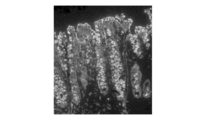
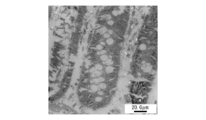
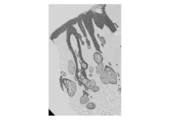
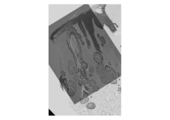
- the section sample obtained above was observed by the CLEM method, and the image A1 observed with a fluorescence microscope, the image B1 observed with an electron microscope, and the image C1 obtained by superimposing the image A1 and the image B1 are shown in FIGS. 1 and 2, respectively.
- FIG. As shown in the figure, although the section sample obtained above has been subjected to immobilization treatment for electron microscope observation, sufficient fluorescence derived from NKX-4023 is applied to cells containing mucus and sugar chains. was detected. This means that the structure of NKX-4023 has not changed due to the fixing process or the like.
- the region where fluorescence was observed by fluorescence microscope observation was confirmed to be mucus and specific cells by electron microscope observation, and the detailed cell structure and the like were clarified at high magnification. These images were of high quality to the extent that useful information for pathological diagnosis and the like could be extracted.
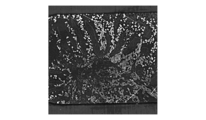
- Example 2 Except for the fact that instead of the paraffin-embedded section, the frozen section obtained by immersing the tissue in sucrose and then freezing and sectioning was used, and instead of the fluorescent dye (1), the fluorescent dye (2) was used. Section samples were obtained in the same manner as in Example 1. This section sample was observed by the CLEM method, and the image A2 observed with a fluorescence microscope, the image B2 observed with an electron microscope, and the image C2 obtained by superimposing the image A2 and the image B2 are shown in FIGS. 4, 5, and 6, respectively. Shown in. As shown in the figure, an image of excellent quality was obtained as in Example 1.
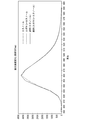
- Reference experiment 1 3 ml of a solution prepared by dissolving 0.5 g of propylene oxide, which is an epoxy compound, in 10 ml of alcohol (ethanol) was poured into a test tube, and the fluorescence spectrum was measured at an excitation wavelength of 405 nm. Then, 3 ⁇ L of NKX-4023 solution (1 mg / ml) was added to the solution in the test tube, and the fluorescence spectrum was measured in the same manner. As a result, strong fluorescence with a peak around 465 nm was observed (see FIG. 7).
- NKX-4023 has sufficient fluorescence intensity even after contact with the epoxy compound, which is consistent with the result of Example 1. Therefore, it is considered that the coumarin-based fluorescent dye that does not lose its fluorescence in the same reference experiment can be used as the compound (I) of the present invention.
- the result of measuring the solution of propylene oxide dissolved in alcohol (ethanol) is shown by a solid line.
- the result of measuring the solution in which NKX-4023 was dissolved in alcohol (ethanol) containing propylene oxide is shown by a broken line.
- the result of measuring the solution in which NKX-4023 was dissolved in alcohol (ethanol) is shown by a two-dot chain line.
- the vertical axis is the fluorescence intensity (arbitrary unit: Arbitrary unit), and the horizontal axis is the fluorescence wavelength (nm).
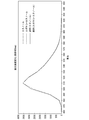
- the result of measuring the solution of propylene oxide dissolved in alcohol (ethanol) is shown by a solid line.
- the result of measuring the solution in which AMC was dissolved in alcohol (ethanol) containing propylene oxide is shown by a broken line.
- the result of measuring the solution in which AMC was dissolved in alcohol (ethanol) is shown by a two-dot chain line.
- the vertical axis is the fluorescence intensity (arbitrary unit), and the horizontal axis is the fluorescence wavelength (nm).
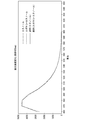
- the result of measuring the solution of propylene oxide dissolved in alcohol (ethanol) is shown by a solid line.
- the result of measuring the solution in which FITC was dissolved in alcohol (ethanol) containing propylene oxide is shown by a broken line.
- the result of measuring the solution in which FITC was dissolved in alcohol (ethanol) is shown by a two-dot chain line.
- the vertical axis is the fluorescence intensity (arbitrary unit), and the horizontal axis is the fluorescence wavelength (nm).
- the coumarin-based fluorescent dye corresponding to the compound (I) is not subjected to the structural change due to the epoxy compound, and the FITC not corresponding to the compound (I) is subjected to the structural change (or decomposed) by the epoxy compound and is fluorescent.
- the FITC not corresponding to the compound (I) is subjected to the structural change (or decomposed) by the epoxy compound and is fluorescent.
- the reference compound 101 was affected by the decrease in fluorescence intensity due to contact with the epoxy compound, but did not lose the fluorescence intensity. Therefore, the reference compound 101 can be used as the compound (I) of the present invention if the reactive group is introduced.
- the result of measuring only ethanol is shown by a two-dot chain line.
- the results of measuring a solution of propylene oxide, which is an epoxy compound, dissolved in ethanol are shown by broken lines.
- the results of measuring the solution of the reference compound as a sample dissolved in ethanol are shown by the solid line.
- the result of measuring the solution in which the reference compound as a sample was dissolved in ethanol containing propylene oxide is shown by the alternate long and short dash line.
- the vertical axis is the fluorescence intensity (arbitrary unit), and the horizontal axis is the fluorescence wavelength (nm).
- the measurement results are similarly shown in FIGS. 11 to 20.
- the reference compound 104 has a strong fluorescence intensity even after contact with the epoxy compound. Therefore, the reference compound 104 can be used as the compound (I) of the present invention if the reactive group is introduced.
- Reference experiment 8 3 ml of a solution prepared by dissolving 0.5 g of propylene oxide in 10 ml of ethanol was poured into a test tube, and the fluorescence spectrum was measured at an excitation wavelength of 387 nm. Then, 3 ⁇ L of a solution (1 mg / ml) of the reference compound 105 represented by the above formula (105) was added to the solution in the test tube, and the fluorescence spectrum was measured in the same manner. As a result, fluorescence with a peak around 460 nm was observed (see FIG. 14).
- Reference experiment 12 3 ml of a solution prepared by dissolving 0.5 g of propylene oxide in 10 ml of ethanol was poured into a test tube, and the fluorescence spectrum was measured at an excitation wavelength of 435 nm. Then, 3 ⁇ L of a solution (1 mg / ml) of the reference compound 109 represented by the above formula (109) was added to the solution in the test tube, and the fluorescence spectrum was measured in the same manner. As a result, fluorescence with a peak around 475 nm was observed (see FIG. 18).
- the reference compound 111 has a strong fluorescence intensity even after contact with the epoxy compound. Therefore, the reference compound 111 can be used as the compound (I) of the present invention if the reactive group is introduced.
- Reference experiment 14 3 ml of a solution prepared by dissolving 0.5 g of propylene oxide in 10 ml of ethanol was poured into a test tube, and the fluorescence spectrum was measured at an excitation wavelength of 528 nm. Then, 3 ⁇ L of a solution (1 mg / ml) of the reference compound 112 represented by the above formula (112) was added to the solution in the test tube, and the fluorescence spectrum was measured in the same manner. As a result, fluorescence with a peak around 570 nm was observed (see FIG. 20).
- the reference compound 112 has a strong fluorescence intensity even after contact with the epoxy compound. Therefore, the reference compound 112 can be used as the compound (I) of the present invention if the reactive group is introduced.
- the above reference experiment is useful for simply examining whether or not the fluorescent dye contained in the section sample is structurally changed by the epoxy compound when the section sample to be observed under an electron microscope is embedded in an epoxy resin.
- the method If the fluorescent dye maintains a structure that emits fluorescence after the fluorescent dye and the epoxy compound are brought into contact with each other in a test tube, the fluorescent dye is packaged in an epoxy resin in a section sample to be observed under an electron microscope. It is considered to be resistant to burial treatment. That is, the fluorescent dye having that resistance is a preferable fluorescent dye that can be used in the microscopic observation method of the present invention.
- ⁇ Preparation of skin tissue section sample> Two paraffin-embedded sections of human skin tissue were prepared by a conventional method. These two skin sections are cut out from approximately the same position in the skin tissue. As will be described in detail later, one of the skin sections was subjected to fluorescent immunostaining using the labeled antibody solution of the fluorescent staining agent (3). The other skin section was DAB stained with a commercially available antibody labeled with a peroxidase enzyme.
- Example 3 Fluorescent immunostaining
- Paraffin-embedded sections of human skin tissue samples prepared by a conventional method were deparaffinized by a known method of immersing them in the order of xylene, ethanol, and ion-exchanged water to obtain tissue sections. Further, the tissue section was immersed in a 10 mM citric acid buffer (pH 6.0) heated to 95 ° C. in a warm bath, incubated for 45 minutes, and allowed to stand at room temperature for 30 minutes for antigen activation.
- a 10 mM citric acid buffer pH 6.0
- the above tissue sections were placed in a blocking reagent prepared by dissolving 4 g of a blocking agent (manufacturer: DS Pharma Biomedical, product number: UK-B80) in 100 ml of PBS buffer at room temperature. Soaked for 30 minutes.
- An anti-cytokeratin antibody solution (manufacturer: DAKO, product number: Z0622) was diluted 500-fold with the above blocking reagent to obtain a primary antibody solution.
- the tissue section subjected to the blocking treatment was immersed in this solution at 4 ° C. overnight, reacted with the primary antibody, and then the tissue section was washed with PBS buffer.
- the labeled antibody solution of the fluorescent dye (3) was diluted 100-fold with the blocking reagent to obtain a secondary antibody solution.
- the tissue section was immersed in this solution at room temperature for 4 hours, reacted with a secondary antibody, and then washed with PBS buffer to obtain a fluorescent immunostaining sample.
- the fluorescent immunostaining sample is immersed in 10 ml of a 0.5% glutaraldehyde aqueous solution at room temperature for 5 minutes, washed with PBS buffer, and then immersed in 10 ml of a 0.5% osmium tetroxide aqueous solution at room temperature. Soaked for minutes and washed with water.
- the fluorescent immunostaining sample subjected to this series of treatments was dehydrated by immersing it in ascending series ethanol at room temperature for 3 minutes each. Then, the dehydrated fluorescent immunostaining sample is immersed in propylene oxide at room temperature for 5 minutes, and the fluorescent immunostaining sample permeated with propylene oxide is placed in a constant temperature bath at 60 ° C. for 24 hours to cure the propylene oxide. A sample embedded in (embedded sample) was obtained. Next, a sliced sample having a thickness of 500 nm was cut out from the embedded sample by a conventional method using an ultramicrotome.
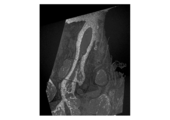
- Image A3 of this section sample observed with a fluorescence microscope is shown in FIG.
- observation was performed at an excitation wavelength of 385 nm using a filter or the like used for fluorescence observation of DAPI, which is a known dye.
- DAPI a filter or the like used for fluorescence observation of DAPI
- strong blue fluorescence was shown in the region where keratin was considered to be present, and the morphology of the tissue was highlighted.
- the blue fluorescence is derived from NKX-4190 bound to the labeled antibody.
- the ultrathin section cut out at a thickness of 100 nm was observed with a fluorescence microscope.
- blue fluorescence was shown in the region where keratin was considered to be present, and the morphology of the tissue could be confirmed.
- DAB staining was performed with an automatic immunostaining apparatus (manufactured by Leica: BOND MAX) according to a conventional method. At this time, a color development kit (BOND Polymer Refine Detection, product code: DS9800) was used.
- the skin section is reacted with an anti-keratin antibody and then an enzyme-labeled antibody that binds to the anti-keratin antibody is reacted as a secondary antibody.
- DAB which is a substrate for the enzyme
- the region where the anti-keratin antibody and the enzyme-labeled antibody are present is dyed brown.
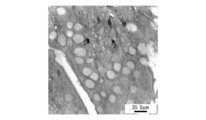
- Image B3 of a DAB-stained section sample observed under a microscope is shown in FIG. Since it is known that the anti-keratin antibody binds specifically to keratin, it is clear that the region where keratinocytes (keratinocytes having keratin) are present is dyed brown.
- FIG. 23 shows the result of image C3 in which the fluorescence observation image A3 shown in FIG. 21 and the observation image B3 of DAB staining shown in FIG. 22 are superposed.
- this image C3 the region where fluorescence is observed and the region where brown is observed are very well matched. Therefore, in the section sample of the skin tissue, it was confirmed that the region where the keratinocyte was present was fluorescently indicated by the binding of the secondary antibody labeled with NKX-4190 to the anti-keratin antibody.
- the section sample used for this fluorescence observation has already been pretreated for electron microscope observation (fixation with glutaraldehyde, post-fixation with osmium tetroxide, embedding in epoxy resin). Therefore, it can be observed with an electron microscope without performing another pretreatment. Further, it was confirmed that NKX-4190 did not change its structure and its fluorescence was not inactivated even after undergoing the above-mentioned pretreatment for electron microscope observation.
- the present invention can be widely applied to technical fields for staining cells and tissue sections, for example, medicine and medical fields such as pathological diagnosis and research on cell histology.
Landscapes
- Health & Medical Sciences (AREA)
- Life Sciences & Earth Sciences (AREA)
- Chemical & Material Sciences (AREA)
- Immunology (AREA)
- Engineering & Computer Science (AREA)
- Physics & Mathematics (AREA)
- Pathology (AREA)
- General Physics & Mathematics (AREA)
- General Health & Medical Sciences (AREA)
- Analytical Chemistry (AREA)
- Biochemistry (AREA)
- Biomedical Technology (AREA)
- Molecular Biology (AREA)
- Hematology (AREA)
- Urology & Nephrology (AREA)
- Medicinal Chemistry (AREA)
- Food Science & Technology (AREA)
- Microbiology (AREA)
- Cell Biology (AREA)
- Biotechnology (AREA)
- Organic Chemistry (AREA)
- Chemical Kinetics & Catalysis (AREA)
- Optics & Photonics (AREA)
- Nuclear Medicine, Radiotherapy & Molecular Imaging (AREA)
- Materials Engineering (AREA)
- Investigating Or Analysing Biological Materials (AREA)
Priority Applications (3)
| Application Number | Priority Date | Filing Date | Title |
|---|---|---|---|
| EP21782016.6A EP4130288A1 (en) | 2020-04-02 | 2021-04-01 | Staining method, microscopic observation method, staining agent and staining kit |
| JP2022511134A JPWO2021201233A1 (https=) | 2020-04-02 | 2021-04-01 | |
| US17/915,376 US20230134948A1 (en) | 2020-04-02 | 2021-04-01 | Staining method, microscopic observation method, staining agent and staining kit |
Applications Claiming Priority (2)
| Application Number | Priority Date | Filing Date | Title |
|---|---|---|---|
| JP2020-066711 | 2020-04-02 | ||
| JP2020066711 | 2020-04-02 |
Publications (1)
| Publication Number | Publication Date |
|---|---|
| WO2021201233A1 true WO2021201233A1 (ja) | 2021-10-07 |
Family
ID=77929215
Family Applications (1)
| Application Number | Title | Priority Date | Filing Date |
|---|---|---|---|
| PCT/JP2021/014173 Ceased WO2021201233A1 (ja) | 2020-04-02 | 2021-04-01 | 染色方法及び顕微鏡観察方法、並びに染色剤及び染色キット |
Country Status (4)
| Country | Link |
|---|---|
| US (1) | US20230134948A1 (https=) |
| EP (1) | EP4130288A1 (https=) |
| JP (1) | JPWO2021201233A1 (https=) |
| WO (1) | WO2021201233A1 (https=) |
Families Citing this family (1)
| Publication number | Priority date | Publication date | Assignee | Title |
|---|---|---|---|---|
| CN117417737A (zh) * | 2023-10-23 | 2024-01-19 | 河南赛诺特生物技术有限公司 | 一种酪酰胺信号放大系统用荧光增强组合物和荧光增强液 |
Citations (9)
| Publication number | Priority date | Publication date | Assignee | Title |
|---|---|---|---|---|
| JPH06271599A (ja) * | 1993-01-29 | 1994-09-27 | Bayer Ag | スルホクマリン−含有ヌクレオチド及び核酸検出法におけるそれらの利用 |
| JPH10500409A (ja) * | 1994-05-11 | 1998-01-13 | トラスティーズ、アヴ、ボースタン、ユーニヴァーサティ | 生体分子の検出および単離のための光分解性の反応剤ならびにコンジュゲート |
| JP2007309872A (ja) * | 2006-05-22 | 2007-11-29 | Nitto Denko Corp | 透過型電子顕微鏡用試料の調製方法 |
| US20100040554A1 (en) * | 2008-07-01 | 2010-02-18 | Board Of Regents | Conjugates of photo-activatable dyes |
| JP2010528292A (ja) * | 2007-05-22 | 2010-08-19 | ベクトン・ディキンソン・アンド・カンパニー | 代謝産物を検出するために比率測定蛍光応答を有する色素 |
| JP2015227831A (ja) * | 2014-06-02 | 2015-12-17 | 日本電子株式会社 | 電子顕微鏡観察用染色剤および電子顕微鏡観察用試料の染色方法 |
| JP2017006070A (ja) | 2015-06-24 | 2017-01-12 | 国立研究開発法人情報通信研究機構 | 細胞内膜構造形成方法および細胞内膜構造観察方法 |
| JP2018162986A (ja) * | 2017-03-24 | 2018-10-18 | 公立大学法人名古屋市立大学 | 染色方法、染色剤、及び染色キット |
| JP2020066711A (ja) | 2018-10-26 | 2020-04-30 | セイコーエプソン株式会社 | 捺染インクジェットインク組成物および記録方法 |
Family Cites Families (9)
| Publication number | Priority date | Publication date | Assignee | Title |
|---|---|---|---|---|
| US4279992A (en) * | 1978-03-13 | 1981-07-21 | Miles Laboratories, Inc. | Specific binding assay employing an enzyme-cleavable substrate as label |
| US4261974A (en) * | 1979-11-13 | 1981-04-14 | Miles Laboratories, Inc. | Valproic acid immunogen conjugates and antibodies thereto |
| US4292425A (en) * | 1979-11-13 | 1981-09-29 | Miles Laboratories, Inc. | βGalactosyl-umbelliferone valproic acid conjugates |
| AU1325201A (en) * | 1999-07-16 | 2001-02-05 | Board Of Regents, The University Of Texas System | Detection system based on an analyte reactive particle |
| US7022517B1 (en) * | 1999-07-16 | 2006-04-04 | Board Of Regents, The University Of Texas System | Method and apparatus for the delivery of samples to a chemical sensor array |
| US20050069962A1 (en) * | 2001-10-12 | 2005-03-31 | Archer Robert M | Antibody complexes and methods for immunolabeling |
| AU2011248607B2 (en) * | 2010-04-27 | 2015-02-05 | Ventana Medical Systems, Inc. | Antibody-nanoparticle conjugates and methods for making and using such conjugates |
| CN103201609A (zh) * | 2010-09-21 | 2013-07-10 | Fei公司 | 制备供电子显微镜和荧光显微镜观察的生物样品的方法 |
| WO2013035681A1 (ja) * | 2011-09-06 | 2013-03-14 | 学校法人久留米大学 | 電子顕微鏡用包埋樹脂組成物及び当該組成物を用いた電子顕微鏡による試料の観察方法 |
-
2021
- 2021-04-01 JP JP2022511134A patent/JPWO2021201233A1/ja active Pending
- 2021-04-01 US US17/915,376 patent/US20230134948A1/en not_active Abandoned
- 2021-04-01 EP EP21782016.6A patent/EP4130288A1/en not_active Withdrawn
- 2021-04-01 WO PCT/JP2021/014173 patent/WO2021201233A1/ja not_active Ceased
Patent Citations (9)
| Publication number | Priority date | Publication date | Assignee | Title |
|---|---|---|---|---|
| JPH06271599A (ja) * | 1993-01-29 | 1994-09-27 | Bayer Ag | スルホクマリン−含有ヌクレオチド及び核酸検出法におけるそれらの利用 |
| JPH10500409A (ja) * | 1994-05-11 | 1998-01-13 | トラスティーズ、アヴ、ボースタン、ユーニヴァーサティ | 生体分子の検出および単離のための光分解性の反応剤ならびにコンジュゲート |
| JP2007309872A (ja) * | 2006-05-22 | 2007-11-29 | Nitto Denko Corp | 透過型電子顕微鏡用試料の調製方法 |
| JP2010528292A (ja) * | 2007-05-22 | 2010-08-19 | ベクトン・ディキンソン・アンド・カンパニー | 代謝産物を検出するために比率測定蛍光応答を有する色素 |
| US20100040554A1 (en) * | 2008-07-01 | 2010-02-18 | Board Of Regents | Conjugates of photo-activatable dyes |
| JP2015227831A (ja) * | 2014-06-02 | 2015-12-17 | 日本電子株式会社 | 電子顕微鏡観察用染色剤および電子顕微鏡観察用試料の染色方法 |
| JP2017006070A (ja) | 2015-06-24 | 2017-01-12 | 国立研究開発法人情報通信研究機構 | 細胞内膜構造形成方法および細胞内膜構造観察方法 |
| JP2018162986A (ja) * | 2017-03-24 | 2018-10-18 | 公立大学法人名古屋市立大学 | 染色方法、染色剤、及び染色キット |
| JP2020066711A (ja) | 2018-10-26 | 2020-04-30 | セイコーエプソン株式会社 | 捺染インクジェットインク組成物および記録方法 |
Also Published As
| Publication number | Publication date |
|---|---|
| US20230134948A1 (en) | 2023-05-04 |
| JPWO2021201233A1 (https=) | 2021-10-07 |
| EP4130288A1 (en) | 2023-02-08 |
Similar Documents
| Publication | Publication Date | Title |
|---|---|---|
| Zheng et al. | Simultaneous dual-colour tracking lipid droplets and lysosomes dynamics using a fluorescent probe | |
| CN109641922B (zh) | 点击化学用于ihc和ish测定中的信号扩增的应用 | |
| JP7097885B2 (ja) | 水溶性ポリマー色素 | |
| US10041952B2 (en) | Composition for detecting proteins containing tyrosine oxide-coupled biomaterial | |
| US11603388B2 (en) | Peptide nucleic acid conjugates | |
| Matsubayashi et al. | Fluorescent double-labeling with carbocyanine neuronal tracing and immunohistochemistry using a cholesterol-specific detergent digitonin | |
| WO2024125179A1 (en) | Chaotropes-assisted deep immunostaining | |
| JP2016513794A (ja) | H&e染色された生体試料を分析する方法 | |
| JP5323261B2 (ja) | 細胞又は組織試料の固定のためのビス−マレイン酸無水物架橋剤の使用 | |
| EP0607422A1 (en) | Enhancement of immunochemical staining in aldehyde-fixed tissues | |
| WO2021201233A1 (ja) | 染色方法及び顕微鏡観察方法、並びに染色剤及び染色キット | |
| JP6950922B2 (ja) | 染色方法、染色剤、及び染色キット | |
| US9354237B2 (en) | Methods for isolating proteins | |
| Humbel et al. | Chemical fixation | |
| US20230151361A1 (en) | Peptide nucleic acid conjugates | |
| Say et al. | Investigation of photosensitively bioconjugated targeted quantum dots for the labeling of Cu/Zn superoxide dismutase in fixed cells and tissue sections | |
| WO1983004255A1 (en) | Reporter compounds | |
| JP5301206B2 (ja) | 界面活性剤を使用した組織の染色方法 | |
| Adams et al. | Fe-TAMLs as a new class of small molecule peroxidase probes for correlated light and electron microscopy | |
| Nässel et al. | Detection of neuropeptides by immunocytochemistry | |
| Pavlyukov et al. | Lateral heterogeneity of cholesterol distribution in cell plasma membrane: investigation by microfluorimetry, immunofluorescence, and TOF-SIMS | |
| CN120294329B (zh) | 一种基于铈基纳米酶的双靶向肿瘤细胞检测试剂制备方法 | |
| JP2025528965A (ja) | 凍結保護組織の低温処理 | |
| WO2022118862A1 (ja) | 生体分子構造検出用プローブ、生体分子構造検出用キット、及び生体分子構造の検出方法 | |
| USRE40835E1 (en) | Enhancement of immunochemical staining in aldehyde-fixed tissue |
Legal Events
| Date | Code | Title | Description |
|---|---|---|---|
| 121 | Ep: the epo has been informed by wipo that ep was designated in this application |
Ref document number: 21782016 Country of ref document: EP Kind code of ref document: A1 |
|
| ENP | Entry into the national phase |
Ref document number: 2022511134 Country of ref document: JP Kind code of ref document: A |
|
| NENP | Non-entry into the national phase |
Ref country code: DE |
|
| ENP | Entry into the national phase |
Ref document number: 2021782016 Country of ref document: EP Effective date: 20221102 |