WO2021187071A1 - センター装置,配信パッケージの生成方法及び配信パッケージ生成用プログラム - Google Patents
センター装置,配信パッケージの生成方法及び配信パッケージ生成用プログラム Download PDFInfo
- Publication number
- WO2021187071A1 WO2021187071A1 PCT/JP2021/007692 JP2021007692W WO2021187071A1 WO 2021187071 A1 WO2021187071 A1 WO 2021187071A1 JP 2021007692 W JP2021007692 W JP 2021007692W WO 2021187071 A1 WO2021187071 A1 WO 2021187071A1
- Authority
- WO
- WIPO (PCT)
- Prior art keywords
- vehicle
- data
- ecu
- information
- package
- Prior art date
- Legal status (The legal status is an assumption and is not a legal conclusion. Google has not performed a legal analysis and makes no representation as to the accuracy of the status listed.)
- Ceased
Links
Images







































































































Classifications
-
- G—PHYSICS
- G07—CHECKING-DEVICES
- G07C—TIME OR ATTENDANCE REGISTERS; REGISTERING OR INDICATING THE WORKING OF MACHINES; GENERATING RANDOM NUMBERS; VOTING OR LOTTERY APPARATUS; ARRANGEMENTS, SYSTEMS OR APPARATUS FOR CHECKING NOT PROVIDED FOR ELSEWHERE
- G07C5/00—Registering or indicating the working of vehicles
- G07C5/008—Registering or indicating the working of vehicles communicating information to a remotely located station
-
- G—PHYSICS
- G06—COMPUTING OR CALCULATING; COUNTING
- G06F—ELECTRIC DIGITAL DATA PROCESSING
- G06F13/00—Interconnection of, or transfer of information or other signals between, memories, input/output devices or central processing units
-
- G—PHYSICS
- G06—COMPUTING OR CALCULATING; COUNTING
- G06F—ELECTRIC DIGITAL DATA PROCESSING
- G06F8/00—Arrangements for software engineering
- G06F8/60—Software deployment
- G06F8/65—Updates
Definitions
- the present disclosure relates to a center device that manages data to be written in a plurality of electronic control devices mounted on a vehicle, a method and a program for generating a distribution package containing the data.
- Patent Document 1 discloses a technique of distributing an ECU update program from a server to an in-vehicle device by OTA (Over The Air) and rewriting the update program on the vehicle side.
- This disclosure has been made in view of the above circumstances, and its purpose is to generate a center device capable of generating a distribution package containing information necessary for rewriting the update program on the vehicle side, a distribution package generation method, and a distribution package.
- the purpose is to provide a generation program.
- the vehicle-related information receiving unit identifies the device for each of the plurality of electronic control devices transmitted from the vehicle and the vehicle-related information related to the identification of the data stored in the device.
- the update data storage unit stores the update data of the target device whose data is to be updated among the plurality of electronic control devices mounted on the vehicle.
- vehicle-related information related to device identification for each of the plurality of electronic control devices and identification of data stored in the device is stored together with the vehicle type.
- the device-related information storage unit stores update data-related information related to the attributes of the target device and update data.
- the specification data generation unit transmits the specification data to be transmitted to the vehicle together with the update data to be written in the target device to the vehicle information storage unit and the device-related information storage unit. Based on the stored information, it is generated so as to include the device type of the target device, the attributes of the target device, the update data related information of the target device, and the information indicating the rewriting environment regarding the data update of the target device. Further, the package generation unit generates a distribution package including the update data acquired from the update data storage unit and the specification data. As a result, the device on the vehicle side receives the specification data transmitted together with the update data, and can appropriately select the target device based on the specification data and write the update data.
- the distribution package storage unit stores the distribution package generated in response to the generation instruction for the vehicle type, and the vehicle-related information received by the vehicle-related information receiving unit includes the vehicle-related information. It contains a dynamically generated flag that indicates whether to generate the delivery package at that time. Then, if the dynamic generation flag is in the reset state, the package generation unit reads and distributes the distribution package stored in the distribution package storage unit, and if the dynamic generation flag is in the set state, the package distribution unit reads and distributes the distribution package. , The package generation unit generates a distribution package, and the package distribution unit distributes the generated distribution package. With this configuration, depending on the state of the dynamically generated flag included in the vehicle-related information, the pre-generated distribution package can be read and used, or the dynamically generated distribution package at that time can be used. Can be flexibly selected.
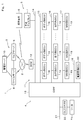
- FIG. 1 is a diagram showing an overall configuration of a vehicle information communication system in the first embodiment.
- FIG. 2 is a diagram showing the electrical configuration of the CGW.
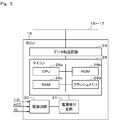
- FIG. 3 is a diagram showing an electrical configuration of the ECU.
- FIG. 4 is a diagram showing a connection mode of the power supply line.
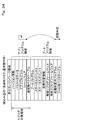
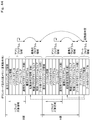
- FIG. 5 is a diagram showing an aspect of packaging the reprolog data and the distribution specification data.
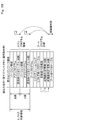
- FIG. 6 is a diagram showing a mode in which the distribution package is unpackaged.
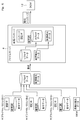
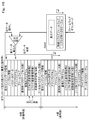
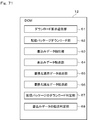
- FIG. 7 is a diagram showing blocks mainly related to each function of the server in the center device.
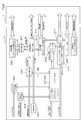
- FIG. 8 is an image diagram showing a processing flow in the center device.
- FIG. 1 is a diagram showing an overall configuration of a vehicle information communication system in the first embodiment.
- FIG. 2 is a diagram showing the electrical configuration of the CGW.
- FIG. 3 is a diagram showing an electrical configuration of the ECU.
- FIG. 4 is a diagram showing a connection mode of the power supply line.
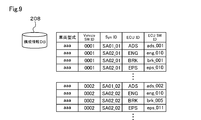
- FIG. 9 is a diagram showing an example of vehicle configuration information registered in the configuration information DB.
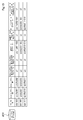
- FIG. 10 is a diagram showing an example of programs and data registered in the ECU repro data DB.
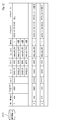
- FIG. 11 is a diagram showing an example of specification data registered in the ECU metadata DB.
- FIG. 12 is a diagram showing an example of vehicle configuration information registered in the individual vehicle information DB.
- FIG. 13 is a diagram showing an example of distribution package data registered in the package DB.
- FIG. 14 is a diagram showing an example of campaign data registered in the campaign DB.
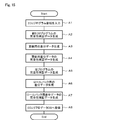
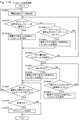
- FIG. 15 is a flowchart showing a process of generating a program and data registered in the ECU repro data DB.
- FIG. 16 is a flowchart showing a process of generating an example of specification data registered in the ECU metadata DB.
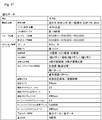
- FIG. 17 is a diagram showing an example of specification data.
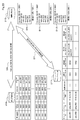
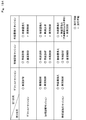
- FIG. 18 is a diagram showing an example of a bus load table.
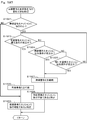
- FIG. 19 is a flowchart showing a process of generating a distribution package registered in the package DB.
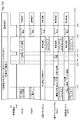
- FIG. 20 is a diagram showing the contents of the package file as an image.
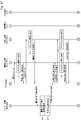
- FIG. 21 is a sequence diagram showing a processing procedure executed between the center device and the vehicle side system in the second embodiment.
- FIG. 22 is a flowchart showing the processing performed by the center device.
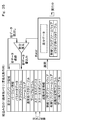
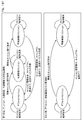
- FIG. 23 is a diagram imaginatively showing the processing contents performed in steps D6 and D7 of the flowchart shown in FIG. 22.
- FIG. 24 is a flowchart showing a process when a hash value is transmitted from the vehicle side system to the center device.
- FIG. 25 is a diagram showing an example of programs and data registered in the ECU repro data DB in the third embodiment.
- FIG. 26 is a diagram showing an example of vehicle configuration information registered in the individual vehicle information DB.
- FIG. 27 is a flowchart showing the processing performed by the center device.
- FIG. 28 is a flowchart showing a process of generating difference data.
- FIG. 29 is a flowchart showing a process of generating a distribution package.
- FIG. 30 is a diagram showing rewriting specification data for DCM.
- FIG. 31 is a diagram showing rewriting specification data for CGW.
- FIG. 32 is a diagram showing distribution specification data.
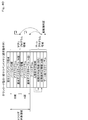
- FIG. 33 is a diagram showing a mode in which the distribution package is unpackaged.
- FIG. 33 is a diagram showing a mode in which the distribution package is unpackaged.
- FIG. 34 is a diagram showing a mode during normal operation in the embedded single-sided single-sided memory.
- FIG. 35 is a diagram showing an aspect of the rewriting operation in the embedded one-sided single memory.
- FIG. 36 is a diagram showing a mode during normal operation in a download-type single-sided single-sided memory.
- FIG. 37 is a diagram showing a mode at the time of rewriting operation in the download type single-sided single memory.
- FIG. 38 is a diagram showing a mode during normal operation in the embedded one-sided suspend memory.
- FIG. 39 is a diagram showing a mode during the rewriting operation in the embedded one-sided suspend memory.
- FIG. 40 is a diagram showing a mode of normal operation in the download type one-sided suspend memory.
- FIG. 40 is a diagram showing a mode of normal operation in the download type one-sided suspend memory.
- FIG. 41 is a diagram showing a mode during the rewriting operation in the download type one-sided suspend memory.
- FIG. 42 is a diagram showing a mode during normal operation in the embedded two-sided memory.
- FIG. 43 is a diagram showing an aspect of the rewriting operation in the embedded two-sided memory.
- FIG. 44 is a diagram showing a mode of normal operation in the download type two-sided memory.
- FIG. 45 is a diagram showing a mode during the rewriting operation in the download type two-sided memory.
- FIG. 46 is a diagram showing a mode in which the application program is rewritten.
- FIG. 47 is a diagram showing a mode in which the application program is rewritten.
- FIG. 48 is a diagram showing a mode in which the application program is rewritten.
- FIG. 46 is a diagram showing a mode in which the application program is rewritten.
- FIG. 49 is a timing chart showing a mode in which the application program is rewritten by power control.
- FIG. 50 is a timing chart showing a mode in which the application program is rewritten by power control.
- FIG. 51 is a timing chart showing a mode in which the application program is rewritten by self-holding the power supply.
- FIG. 52 is a timing chart showing a mode in which the application program is rewritten by self-holding the power supply.
- FIG. 53 is a diagram showing phases.
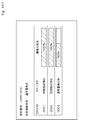
- FIG. 54 is a diagram showing a screen in a normal state.
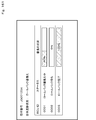
- FIG. 55 is a diagram showing a screen when a campaign notification is generated.
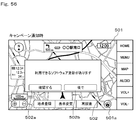
- FIG. 56 is a diagram showing a screen at the time of campaign notification.
- FIG. 57 is a diagram showing a screen at the time of download acceptance.
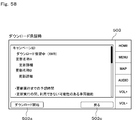
- FIG. 58 is a diagram showing a screen at the time of download acceptance.
- FIG. 59 is a diagram showing a screen during download execution.
- FIG. 60 is a diagram showing a screen during download execution.
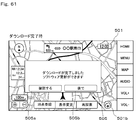
- FIG. 61 is a diagram showing a screen when the download is completed.
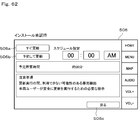
- FIG. 62 is a diagram showing a screen when the installation is approved.
- FIG. 63 is a diagram showing a screen when the installation is approved.
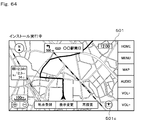
- FIG. 64 is a diagram showing a screen during installation.
- FIG. 65 is a diagram showing a screen during installation.
- FIG. 66 is a diagram showing a screen at the time of acceptance of activation.
- FIG. 67 is a diagram showing a screen when the IG is on.
- FIG. 68 is a diagram showing a screen at the time of the confirmation operation.
- FIG. 70 is a functional block diagram of the center device.
- FIG. 71 is a functional block diagram of the DCM.
- FIG. 72 is a functional block diagram of the CGW.
- FIG. 73 is a functional block diagram of the CGW.
- FIG. 74 is a functional block diagram of the ECU.
- FIG. 75 is a functional block diagram of the vehicle-mounted display.
- FIG. 76 is a functional block diagram of the transmission determination unit of the distribution package.
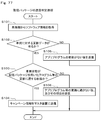
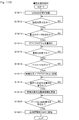
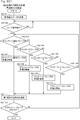
- FIG. 77 is a flowchart showing a transmission determination process of the distribution package.
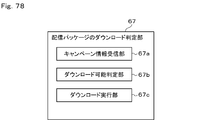
- FIG. 78 is a functional block diagram of the download determination unit of the distribution package.
- FIG. 79 is a flowchart showing the download determination process of the distribution package.
- FIG. 79 is a flowchart showing the download determination process of the distribution package.
- FIG. 80 is a functional block diagram of the write data transfer determination unit.
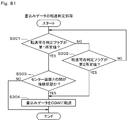
- FIG. 81 is a flowchart showing the transfer determination process of the write data.
- FIG. 82 is a functional block diagram of the write data acquisition determination unit.
- FIG. 83 is a flowchart showing the acquisition determination process of the write data.
- FIG. 84 is a functional block diagram of the installation instruction determination unit.
- FIG. 85 is a flowchart showing an installation instruction determination process.
- FIG. 86 is a diagram showing a mode for instructing installation.
- FIG. 87 is a diagram showing a mode for instructing installation.
- FIG. 88 is a diagram showing an aspect of generating a random number value.
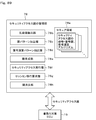
- FIG. 89 is a functional block diagram of the management unit of the security access key.
- FIG. 89 is a functional block diagram of the management unit of the security access key.
- FIG. 90 is a flowchart showing a security access key generation process.
- FIG. 91 is a diagram showing an aspect of generating a security access key.
- FIG. 92 is a flowchart showing the process of erasing the security access key.
- FIG. 93 is a diagram showing a flow of processing involved in verification of written data.
- FIG. 94 is a functional block diagram of the write data verification unit.
- FIG. 95 is a flowchart showing the verification process of the write data.
- FIG. 96 is a diagram showing a mode in which the processes involved in the verification of the written data are distributed.
- FIG. 97 is a diagram showing a mode in which the processes involved in the verification of the written data are distributed.
- FIG. 91 is a diagram showing an aspect of generating a security access key.
- FIG. 92 is a flowchart showing the process of erasing the security access key.
- FIG. 93 is a diagram showing a flow of processing involved in verification of written data
- FIG. 98 is a diagram showing a mode in which the processes involved in the verification of the written data are distributed.
- FIG. 99 is a diagram showing a mode in which the processes involved in the verification of the written data are distributed.
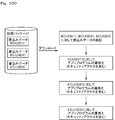
- FIG. 100 is a diagram showing a flow of verification of written data and rewriting of an application program.
- FIG. 101 is a diagram showing a flow of verification of written data and rewriting of an application program.
- FIG. 102 is a functional block diagram of the data storage surface information transmission control unit.
- FIG. 103 is a flowchart showing a transmission control process of data storage surface information.
- FIG. 104 is a sequence diagram showing a mode for notifying the two-sided rewriting information.
- FIG. 105 is a functional block diagram of the power management unit to be non-rewritten.
- FIG. 106 is a flowchart showing a power supply management process to be non-rewritten.
- FIG. 107 is a diagram showing transitions between a start state, a stop state, and a sleep state.
- FIG. 108 is a diagram showing transitions between a start state, a stop state, and a sleep state.
- FIG. 109 is a diagram showing a connection mode of the power supply line.
- FIG. 110 is a flowchart showing a battery remaining amount monitoring process.
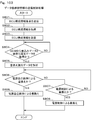
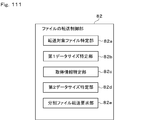
- FIG. 111 is a functional block diagram of the file transfer control unit.
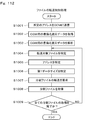
- FIG. 112 is a flowchart showing a file transfer control process.
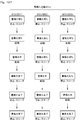
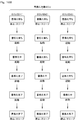
- FIG. 113 is a diagram showing a mode in which files are exchanged.
- FIG. 114 is a diagram showing a mode in which files are exchanged.
- FIG. 107 is a diagram showing transitions between a start state, a stop state, and a sleep state.
- FIG. 109 is a diagram showing a connection mode of the power
- FIG. 115 is a diagram showing a split file and a write file.
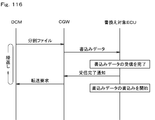
- FIG. 116 is a diagram showing a mode in which the CGW transmits a transfer request to the DCM.
- FIG. 117 is a diagram showing a mode in which the CGW transmits a transfer request to the DCM.
- FIG. 118 is a diagram showing a mode in which the CGW distributes the write data to the rewrite target ECU.
- FIG. 119 is a diagram showing a mode in which the CGW distributes the write data to the rewrite target ECU.
- FIG. 120 is a diagram showing a mode in which the CGW distributes the write data to the rewrite target ECU.
- FIG. 121 is a diagram showing a connection mode of the ECU.
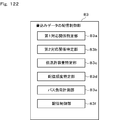
- FIG. 122 is a functional block diagram of the write data distribution control unit.
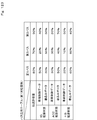
- FIG. 123 is a diagram showing a bus load table.
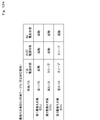
- FIG. 124 is a diagram showing a table belonging to the ECU to be rewritten.
- FIG. 125 is a flowchart showing the distribution control process of the write data.
- FIG. 126 is a diagram showing a mode in which write data is distributed.
- FIG. 127 is a diagram showing a mode in which write data is distributed.
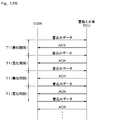
- FIG. 128 is a diagram showing a mode in which the written data while the vehicle is traveling is distributed.
- FIG. 129 is a diagram showing a mode in which write data during parking is distributed.
- FIG. 130 is a diagram showing a distribution amount of write data.
- FIG. 131 is a diagram showing a distribution amount of write data.
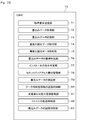
- FIG. 132 is a functional block diagram of the activation request indicator.
- FIG. 133 is a flowchart showing the instruction processing of the activation request.
- FIG. 134 is a diagram showing an aspect of instructing an activation request.
- FIG. 135 is a functional block diagram of the activation execution control unit.
- FIG. 136 is a flowchart showing the rewriting process.
- FIG. 137 is a flowchart showing the execution control process of activation.
- FIG. 138 is a functional block diagram of the grouping unit to be rewritten.
- FIG. 139 is a flowchart showing the group management process to be rewritten.
- FIG. 140 is a flowchart showing a group management process to be rewritten.
- FIG. 141 is a diagram showing an aspect of grouping rewrite targets.
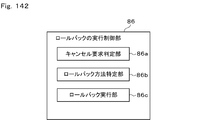
- FIG. 142 is a functional block diagram of the rollback execution control unit.
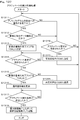
- FIG. 143 is a flowchart showing a specific process of the rollback method.
- FIG. 144 is a flowchart showing a cancellation request determination process.
- FIG. 145 is a flowchart showing a cancellation request determination process.
- FIG. 146 is a flowchart showing a cancellation request determination process.
- FIG. 147 is a flowchart showing a cancellation request determination process.
- FIG. 148 is a flowchart showing a cancellation request determination process.
- FIG. 149 is a diagram showing a mode in which rollback is executed.
- FIG. 150 is a diagram showing a mode in which rollback is performed.
- FIG. 151 is a diagram showing a mode in which rollback is executed.
- FIG. 149 is a diagram showing a mode in which rollback is executed.
- FIG. 152 is a diagram showing a mode in which rollback is performed.
- FIG. 153 is a diagram showing a mode in which rollback is executed.
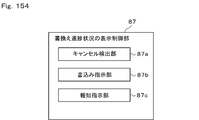
- FIG. 154 is a functional block diagram of the display control unit of the rewriting progress status.
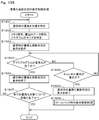
- FIG. 155 is a flowchart showing the display control process of the rewriting progress status.
- FIG. 156 is a flowchart showing the display control process of the rewriting progress status.
- FIG. 157 is a diagram showing a screen of the rewriting progress status.
- FIG. 158 is a diagram showing a screen of the rewriting progress status.
- FIG. 159 is a diagram showing a screen of the rewriting progress status.
- FIG. 160 is a diagram showing a screen of the rewriting progress status.
- FIG. 161 is a diagram showing a screen of the rewriting progress status.
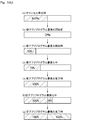
- FIG. 162 is a diagram showing a transition of the progress graph display.
- FIG. 163 is a diagram showing a transition of the progress graph display.
- FIG. 164 is a diagram showing a transition of the progress graph display.
- FIG. 165 is a diagram showing a transition of the progress graph display.
- FIG. 166 is a diagram showing a screen of the rewriting progress status.
- FIG. 167 is a functional block diagram of the consistency determination unit for the difference data.
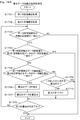
- FIG. 168 is a flowchart showing the consistency determination process of the difference data.
- FIG. 169 is a diagram showing a mode for determining the consistency of the difference data.
- FIG. 170 is a diagram showing a mode for determining the consistency of the difference data.
- FIG. 171 is a functional block diagram of the rewriting execution control unit.
- FIG. 172 is a flowchart showing a normal operation process.
- FIG. 173 is a flowchart showing the rewriting operation process.
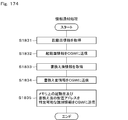
- FIG. 174 is a flowchart showing the information notification process.
- FIG. 175 is a flowchart showing the verification process of the rewriting program.
- FIG. 176 is a diagram showing a mode in which identification information and write data are transmitted.
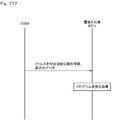
- FIG. 177 is a diagram showing a mode in which identification information and write data are transmitted.
- FIG. 178 is a flowchart showing an installation instruction process.
- FIG. 179 is a functional block diagram of the session establishment unit.
- FIG. 172 is a flowchart showing a normal operation process.
- FIG. 173 is a flowchart showing the rewriting operation process.
- FIG. 174 is
- FIG. 180 is a diagram showing a program configuration.
- FIG. 181 is a diagram showing a state transition.
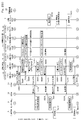
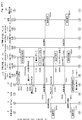
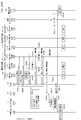
- FIG. 182 is a diagram showing a state transition.
- FIG. 183 is a diagram showing a state transition.
- FIG. 184 is a diagram showing session arbitration.
- FIG. 185 is a diagram showing session arbitration.
- FIG. 186 is a flowchart showing the state transition management process of the first state.
- FIG. 187 is a flowchart showing the state transition management process of the first state.
- FIG. 188 is a flowchart showing the state transition management process of the first state.
- FIG. 189 is a flowchart showing the state transition management process of the second state.
- FIG. 190 is a flowchart showing the state transition management process of the second state.
- FIG. 191 is a diagram showing the structure of the program.
- FIG. 192 is a diagram showing a state transition.
- FIG. 193 is a functional block diagram of a specific portion of the retry point.
- FIG. 194 is a diagram showing a configuration of a flash memory.
- FIG. 195 is a flowchart showing a processing flag setting process.
- FIG. 196 is a flowchart showing a processing flag determination process.
- FIG. 197 is a flowchart showing a processing flag determination process.
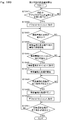
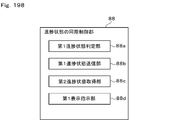
- FIG. 198 is a functional block diagram of the synchronization control unit in the progress state.
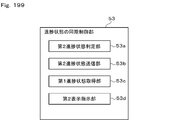
- FIG. 199 is a functional block diagram of the synchronization control unit in the progress state.
- FIG. 200 is a diagram showing a mode in which a progress status signal is transmitted / received.
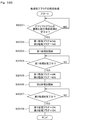
- FIG. 201 is a flowchart showing the synchronization control process of the progress state.
- FIG. 202 is a flowchart showing the synchronization control process of the progress state.
- FIG. 203 is a flowchart showing the progress status display process.
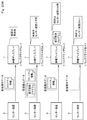
- FIG. 204 is a functional block diagram of the display control information transmission control unit.
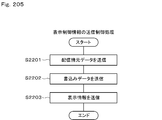
- FIG. 205 is a flowchart showing a transmission control process of display control information.
- FIG. 206 is a functional block diagram of the display control information reception control unit.
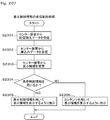
- FIG. 207 is a flowchart showing a reception control process of display control information.
- FIG. 208 is a diagram showing information included in the distribution specification data.
- FIG. 209 is a functional block diagram of the screen display control unit for progress display.
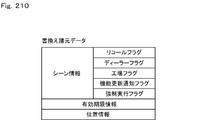
- FIG. 210 is a diagram showing rewriting specification data.
- FIG. 211 is a diagram showing a screen when a menu is selected.
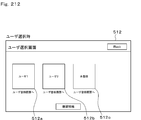
- FIG. 212 is a diagram showing a screen at the time of user selection.
- FIG. 213 is a diagram showing a screen at the time of user registration.
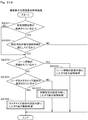
- FIG. 214 is a flowchart showing the screen display control process of the progress display.
- FIG. 215 is a flowchart showing the screen display control process of the progress display.
- FIG. 216 is a diagram showing a message frame.
- FIG. 217 is a diagram showing a screen at the time of acceptance of activation.
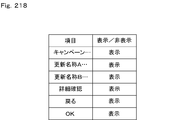
- FIG. 218 is a diagram showing the setting of whether or not to display the item.
- FIG. 219 is a diagram showing the setting of whether or not to display the item.
- FIG. 211 is a diagram showing a screen when a menu is selected.
- FIG. 212 is a diagram showing a screen at the time of user selection.
- FIG. 213 is a diagram showing a screen at the time of user registration.
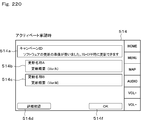
- FIG. 220 is a diagram showing a screen at the time of acceptance of activation.
- FIG. 221 is a diagram showing a mode of data communication.
- FIG. 222 is a diagram showing a message frame at the time of campaign notification.
- FIG. 223 is a diagram showing a message frame at the time of download acceptance.
- FIG. 224 is a diagram showing a message frame when the installation is accepted.
- FIG. 225 is a diagram showing a message frame at the time of acceptance of activation.
- FIG. 226 is a diagram showing screen transitions.
- FIG. 227 is a diagram showing a screen when a campaign notification is generated.
- FIG. 228 is a diagram showing a screen at the time of download acceptance.
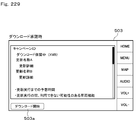
- FIG. 229 is a diagram showing a screen at the time of download acceptance.
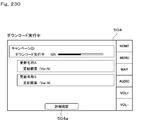
- FIG. 230 is a diagram showing a screen during download execution.
- FIG. 231 is a diagram showing a screen when the download is completed.
- FIG. 232 is a diagram showing a screen when the installation is approved.
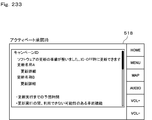
- FIG. 233 is a diagram showing a screen at the time of acceptance of activation.
- FIG. 234 is a functional block diagram of the program update notification control unit.
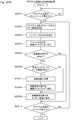
- FIG. 235 is a flowchart showing a program update notification control process.
- FIG. 236 is a diagram showing a notification mode of the indicator.
- FIG. 237 is a diagram showing a transition of the notification mode when the rewriting target is a two-sided memory.
- FIG. 238 is a diagram showing a transition of the notification mode when the rewriting target is the one-sided suspend memory.
- FIG. 239 is a diagram showing a transition of the notification mode when the rewriting target is a single-sided single memory.
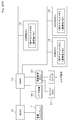
- FIG. 240 is a diagram showing a connection mode.
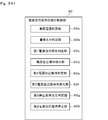
- FIG. 241 is a functional block of the execution control unit for self-holding the power supply in the CGW.
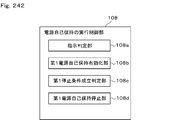
- FIG. 242 shows a functional block of the execution control unit for self-holding the power supply in the ECU.
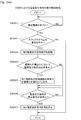
- FIG. 243 is a flowchart showing the execution control process of power supply self-holding in CGW.
- FIG. 244 is a flowchart showing the execution control process of power supply self-holding in the ECU.
- FIG. 245 is a diagram showing a period in which power supply self-holding is required.
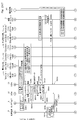
- FIG. 246 is an overall sequence diagram showing a mode in which the application program is rewritten.
- FIG. 247 is an overall sequence diagram showing a mode in which the application program is rewritten.
- FIG. 248 is an overall sequence diagram showing a mode in which the application program is rewritten.
- FIG. 249 is an overall sequence diagram showing a mode in which the application program is rewritten.
- FIG. 250 is an overall sequence diagram showing a mode in which the application program is rewritten.
- FIG. 251 is an overall sequence diagram showing a mode in which the application program is rewritten.
- FIG. 252 is an overall sequence diagram showing a mode in which the application program is rewritten.
- FIG. 253 is an overall sequence diagram showing a mode in which the application program is rewritten.
- FIG. 254 is an overall sequence diagram showing a mode in which the application program is rewritten.
- FIG. 255 is an overall sequence diagram showing a mode in which the application program is rewritten.
- FIG. 256 is an overall sequence diagram showing a mode in which the application program is rewritten.
- the vehicle program rewriting system is a system that can rewrite application programs such as vehicle control and diagnosis of the ECU mounted on the vehicle by OTA.
- the vehicle program rewriting system 1 includes a center device 3 on the communication network 2 side, a vehicle side system 4 on the vehicle side, and a display terminal 5.
- the communication network 2 includes, for example, a mobile communication network using a 4G line or the like, the Internet, WiFi (Wireless Fidelity) (registered trademark), and the like.
- the display terminal 5 is a terminal having a function of accepting operation input from a user and a function of displaying various screens.
- a mobile terminal 6 such as a smartphone or tablet that can be carried by the user, or a navigation function arranged in a vehicle interior.
- the mobile terminal 6 can be connected to the communication network 2 as long as it is within the communication range of the mobile communication network.
- the in-vehicle display 7 is connected to the vehicle-side system 4.
- the user inputs operations while checking various screens involved in the rewriting of the application program on the mobile terminal 6, and performs the procedure related to the rewriting of the application program. It is possible. In the vehicle interior, the user can perform an operation input while checking various screens involved in the rewriting of the application program on the in-vehicle display 7, and perform a procedure related to the rewriting of the application program. That is, the user can properly use the mobile terminal 6 and the in-vehicle display 7 outside and inside the vehicle, and can perform procedures related to the rewriting of the application program.
- the center device 3 controls the OTA function on the communication network 2 side in the vehicle program rewriting system 1 and functions as an OTA center.
- the center device 3 has a file server 8, a web server 9, and a management server 10, and the servers 8 to 10 are configured to enable data communication with each other.
- the file server 8 has an application program management function transmitted from the center device 3 to the vehicle side system 4, and includes an ECU program provided by a supplier or the like that is a provider of the application program, information associated therewith, and an OEM (Original).
- Equipment Manufacturer is a server that manages distribution specification data, vehicle status acquired from the vehicle side system 4, and the like.
- the file server 8 can perform data communication with the vehicle side system 4 via the communication network 2, and when a download request for the distribution package occurs, the vehicle side distributes the distribution package that packages the replog data and the distribution specification data.
- the web server 9 is a server that manages web information, and provides the mobile terminal 6 with various screens involved in rewriting the application program.
- the management server 10 manages the personal information and the like of the user registered in the application program rewriting service, and manages the application program rewriting history and the like for each vehicle.
- the vehicle side system 4 has a master device 11.
- the master device 11 has a DCM 12 and a CGW 13, and the DCM 12 and the CGW 13 are connected to each other via a first bus 14 so as to be capable of data communication.
- the DCM12 is an in-vehicle communication device that performs data communication with the center device 3 via the communication network 2.
- the write data is extracted from the distribution package and transferred to the CGW 13. ..
- the CGW 13 is a vehicle gateway device having a data relay function, and when the write data is acquired from the DCM12, the write data is distributed to the rewrite target ECU that rewrites the application program.
- the master device 11 controls the OTA function on the vehicle side in the vehicle program rewriting system 1 and functions as an OTA master.
- FIG. 1 illustrates a configuration in which the DCM 12 and the vehicle-mounted display 7 are connected to the same first bus 14, the DCM 12 and the vehicle-mounted display 7 may be connected to different buses.
- the second bus 15, the third bus 16, the fourth bus 17, and the fifth bus 18 are connected to the CGW 13 as buses inside the vehicle, and various ECUs 19 are connected via the buses 15 to 17. Is connected, and the power management ECU 20 is connected via the bus 18.
- the second bus 15 is, for example, a body network bus.
- the ECU 19 connected to the second bus 15 is, for example, a door ECU that controls door lock / unlock, a meter ECU that controls meter display, an air conditioner ECU that controls air conditioner drive, and a window ECU that controls window opening / closing. It is an ECU that controls the body system such as.
- the third bus 16 is, for example, a bus of a traveling network.
- the ECU 19 connected to the third bus 16 is, for example, an engine ECU that controls the drive of the engine, a brake ECU that controls the drive of the brake, and an ECT (ETC (Electronic Toll Collection System, registered trademark) that controls the drive of the automatic transmission. ))
- An ECU that controls the traveling system such as an ECU and a power steering ECU that controls the drive of the power steering.
- the fourth bus 17 is, for example, a multimedia network bus.
- the ECU 19 connected to the fourth bus 17 is an ECU that controls multimedia systems such as a navigation ECU for controlling a navigation system, an electronic toll collection system, that is, an ETC ECU for controlling an ECT system.
- Buses 15 to 17 may be buses of a system other than the body network bus, the traveling network bus, and the multimedia network bus. Further, the number of buses and the number of ECUs 19 are not limited to the illustrated configuration.
- the power supply management ECU 20 is an ECU having a function of performing power supply management of the DCM12, CGW13, various ECUs 19, and the like.
- the sixth bus 21 is connected to the CGW 13 as a bus outside the vehicle.
- a DLC (Data Link Coupler) connector 22 to which the tool 23 is detachably connected is connected to the sixth bus 21.
- Buses 14 to 18 on the inside of the vehicle and buses 21 on the outside of the vehicle are composed of, for example, CAN (Controller Area Network, registered trademark) buses, and CGW 13 is based on CAN data communication standards and diagnostic communication standards (UDS: ISO14229). Therefore, data communication is performed with the DCM12, various ECUs 19, and the tool 23.
- the DCM12 and the CGW 13 may be connected by an Ethernet, or the DLC connector 22 and the CGW 13 may be connected by an Ethernet.
- the rewrite target ECU 19 When the rewrite target ECU 19 receives the write data from the CGW 13, it writes the write data to the flash memory and rewrites the application program.
- the CGW 13 when the CGW 13 receives the write data acquisition request from the rewrite target ECU 19, the CGW 13 functions as a reprolog master that distributes the write data to the rewrite target ECU 19.
- the rewrite target ECU 19 When the rewrite target ECU 19 receives the write data from the CGW 13, the rewrite target ECU 19 writes the write data to the flash memory and functions as a replog slave for rewriting the application program.
- the mode of rewriting the application program includes a mode of rewriting by wire and a mode of rewriting by wireless.
- the mode of rewriting the application program by wire when the tool 23 is connected to the DLC connector 22, the tool 23 transfers the written data to the CGW 13.
- the CGW 13 relays or distributes the write data transferred from the tool 23 to the rewrite target ECU 19.
- the mode of wirelessly rewriting the application program as described above, when the DCM12 downloads the distribution package from the file server 8, it extracts the write data from the distribution package and transfers the write data to the CGW 13.
- the CGW 13 has a microcomputer (hereinafter referred to as a microcomputer) 24, a data transfer circuit 25, a power supply circuit 26, and a power supply detection circuit 27 as electrical functional blocks.
- the microcomputer 24 has a CPU (Central Processing Unit) 24a, a ROM (Read Only Memory) 24b, a RAM (Random Access Memory) 24c, and a flash memory 24d.
- the microcomputer 24 executes various control programs stored in the non-transitional substantive storage medium to perform various processes, and controls the operation of the CGW 13.
- the data transfer circuit 25 controls data communication between buses 14 to 18 and 21 in accordance with CAN data communication standards and diagnostic communication standards.
- the power supply circuit 26 inputs a battery power supply (hereinafter referred to as + B power supply), an accessory power supply (hereinafter referred to as ACC power supply), and an ignition power supply (hereinafter referred to as IG power supply).
- the power supply detection circuit 27 detects the voltage value of the + B power supply, the voltage value of the ACC power supply, and the voltage value of the IG power supply input by the power supply circuit 26, compares these detected voltage values with a predetermined voltage threshold value, and compares them. The result is output to the microcomputer 24.
- the microcomputer 24 determines whether the + B power supply, the ACC power supply, and the IG power supply supplied to the CGW 13 from the outside are normal or abnormal based on the comparison result input from the power supply detection circuit 27.
- the ECU 19 has a microcomputer 28, a data transfer circuit 29, a power supply circuit 30, and a power supply detection circuit 31 as electrical functional blocks.
- the microcomputer 28 has a CPU 28a, a ROM 28b, a RAM 28c, and a flash memory 28d.
- the microcomputer 28 executes various control programs stored in the non-transitional substantive storage medium to perform various processes, and controls the operation of the ECU 19.
- the data transfer circuit 29 controls data communication between the buses 15 to 17 in accordance with the CAN data communication standard.
- the power supply circuit 30 inputs + B power supply, ACC power supply, and IG power supply.
- the power supply detection circuit 31 detects the voltage value of the + B power supply, the voltage value of the ACC power supply, and the voltage value of the IG power supply input by the power supply circuit 30, compares these detected voltage values with a predetermined voltage threshold value, and compares them. The result is output to the microcomputer 28.
- the microcomputer 28 determines whether the + B power supply, the ACC power supply, and the IG power supply supplied to the ECU 19 from the outside are normal or abnormal based on the comparison result input from the power supply detection circuit 27.
- the ECU 19 has basically the same configuration because the loads of the sensors and actuators to be connected are different.
- the basic configuration of the DCM12, the in-vehicle display 7, and the power supply management ECU is the same as that of the ECU 19 shown in FIG.
- the power management ECU 20, CGW 13, and ECU 19 are connected to the + B power supply line 32, the ACC power supply line 33, and the IG power supply line 34.
- the + B power supply line 32 is connected to the positive electrode of the vehicle battery 35.
- the ACC power supply line 33 is connected to the positive electrode of the vehicle battery 35 via the ACC switch 36. When the user performs the ACC operation, the ACC switch 36 is switched from off to on, and the output voltage of the vehicle battery 35 is applied to the ACC power supply line 33.
- the ACC operation is, for example, in the case of a vehicle in which the key is inserted into the insertion port, the key is inserted into the insertion port and the operation is rotated from the "OFF" position to the "ACC" position, and the start button is pressed. In the case of a push-type vehicle, the start button is pressed once.
- the IG power supply line 34 is connected to the positive electrode of the vehicle battery 35 via the IG switch 37.
- the IG switch 37 is switched from off to on, and the output voltage of the vehicle battery 35 is applied to the IG power supply line 34.
- the IG operation is an operation in which the key is inserted into the insertion port and rotated from the "OFF" position to the "ON" position, and the start button is pressed.
- the start button is pressed twice.
- the negative electrode of the vehicle battery 35 is grounded.
- both the ACC switch 36 and the IG switch 37 are off, only + B power is supplied to the vehicle side system 4.
- the state in which only the + B power supply is supplied to the vehicle side system 4 is referred to as the + B power supply state.
- the ACC switch 36 is on and the IG switch 37 is off, the ACC power supply and the + B power supply are supplied to the vehicle side system 4.
- the state in which the ACC power supply and the + B power supply are supplied to the vehicle side system 4 is referred to as an ACC power supply state.
- the + B power supply, the ACC power supply, and the IG power supply are supplied to the vehicle side system 4.
- the state in which the + B power supply, the ACC power supply, and the IG power supply are supplied to the vehicle side system 4 is referred to as an IG power supply state.
- the ECU 19 has different start conditions depending on the power supply state, and is classified into a + B system ECU that starts in the + B power supply state, an ACC system ECU that starts in the ACC power supply state, and an IG system ECU that starts in the IG power supply state.
- the ECU 19 that is driven for purposes such as vehicle theft is a + B system ECU.
- the ECU 19 that is driven for non-traveling applications such as audio is an ACC ECU.
- the ECU 19 that is driven for traveling system applications such as engine control is an IG system ECU.
- the CGW 13 By transmitting a start-up request to the ECU 19 in the sleep state, the CGW 13 shifts the ECU 19 to which the start-up request is sent from the sleep state to the start-up state. Further, the CGW 13 transmits a sleep request to the ECU 19 in the activated state to shift the ECU 19 to which the sleep request is transmitted from the activated state to the sleep state.
- the CGW 13 selects an ECU 19 to which a start request or a sleep request is transmitted from a plurality of ECUs, for example, by making the waveforms of transmission signals transmitted to the buses 15 to 17 different.
- the power supply control circuit 38 is connected in parallel to the ACC switch 36 and the IG switch 37.
- the CGW 13 transmits a power supply control request to the power supply management ECU 20 and causes the power supply management ECU 20 to control the power supply control circuit 38. That is, the CGW 13 transmits a power supply start request as a power supply control request to the power supply management ECU 20, and connects the ACC power supply line 33 or the IG power supply line 34 and the positive electrode of the vehicle battery 35 inside the power supply control circuit 38. In this state, the ACC power supply and the IG power supply are supplied to the vehicle side system 4 even when the ACC switch 36 and the IG switch 37 are off.
- the CGW 13 transmits a power supply stop request to the power supply management ECU 20 as a power supply control request, and interrupts the ACC power supply line 33, the IG power supply line 34, and the positive electrode of the vehicle battery 35 inside the power supply control circuit 38.
- DCM12, CGW13, ECU19 have a power supply self-holding function. That is, if the vehicle power supply is switched from the ACC power supply or the IG power supply to the + B power supply while the DCM12, CGW13, and ECU19 are in the activated state, the started state may be changed to the sleep state or the stopped state immediately after the switching. However, even immediately after the switching, the start-up state is continuously maintained for a predetermined time to self-hold the drive power supply.
- the DCM12, CGW 13, and ECU 19 shift from the start state to the sleep state or the stop state after a predetermined time (for example, several seconds) has elapsed immediately after the vehicle power supply is switched from the ACC power supply or the IG power supply to the + B power supply.
- reprolog data is generated from the written data provided by the supplier who is the provider of the application program and the rewriting specification data mainly provided by the OEM.
- the write data provided by the supplier includes difference data corresponding to the difference between the old application program and the new application program, and all data corresponding to the entire new application program. Difference data and all data may be compressed by a well-known data compression technique.
- difference data is provided as write data from suppliers A to C, and the encrypted difference data of the ECU (ID1) provided by the supplier A and the authenticator, and the encryption of the ECU (ID2) provided by the supplier B.
- the reprolog data is generated from the already encrypted difference data and certifier, the encrypted difference data and certifier of the ECU (ID3) provided by the supplier C, and the rewriting specification data provided by the OEM. There is. An authenticator is assigned to each write data.
- FIG. 5 shows the difference data when updating from the old application program to the new application program, but the difference data for rollback for writing back from the new application program to the old application program is also combined into the replog data. It may be a configuration to include. For example, when the rewriting target ECU 19 is a one-sided memory, the rollback difference data is included in the reprolog data.
- the rewriting specification data provided by the OEM includes information that can specify the rewriting target ECU 19 as information related to the rewriting of the application program, information that can specify the rewriting order when there are a plurality of rewriting target ECUs 19, and a role described later. It is data that includes information that can specify the back method and defines the operations involved in rewriting in the DCM12, CGW 13, and the rewriting target ECU 19.
- the rewriting specification data is divided into rewriting specification data for DCM used by DCM12 and rewriting specification data for CGW used by CGW 13.
- the rewrite specification data for DCM describes information necessary for reading a file corresponding to the rewrite target ECU 19.
- the CGW rewrite specification data describes information necessary for controlling the rewrite in the rewrite target ECU 19.
- the DCM 12 acquires the rewrite specification data for DCM, it analyzes the rewrite specification data for DCM and controls the operations involved in the rewrite such as the transfer of the write data to the CGW 13 according to the analysis result.
- the CGW 13 acquires the rewrite specification data for the CGW, it analyzes the rewrite specification data for the CGW, acquires the write data from the DCM12 according to the analysis result, distributes the write data to the rewrite target ECU 19, and the like. Control the actions involved in rewriting.
- the above-mentioned riplog data is registered in the file server 8, and the distribution specification data provided by the OEM is also registered.
- the distribution specification data provided by the OEM is data that defines the operations involved in the display of various screens on the display terminal 5.
- the file server 8 When the replog data and the distribution specification data are registered, the file server 8 encrypts the replog data and authenticates the package. The file server 8 encrypts the replog data and authenticates the package. Generate a delivery package packaged in a file. When the file server 8 receives the download request of the distribution package from the outside, the file server 8 transmits the distribution package to the DCM12. Note that, in FIG. 5, the file server 8 exemplifies a case where a distribution package storing the replog data and the distribution specification data is generated and the replog data and the distribution specification data are simultaneously transmitted to the DCM12. And the distribution specification data may be transmitted separately to the DCM12.
- the file server 8 may first transmit the distribution specification data to the DCM12, and then transmit the replog data to the DCM12. Further, the file server 8 may use the reprolog data and the distribution specification data as one file of the distribution package, and transmit the distribution package and the package certifier to the DCM12.
- the DCM12 downloads the distribution package from the file server 8, it verifies the package certifier stored in the distribution package and the encrypted replog data, and if the verification result is positive, it verifies the encrypted replog data.
- Decrypt When the DCM12 decrypts the encrypted replog data, it unpackages the decrypted riplog data, and the encrypted difference data and certifier for each ECU, the rewrite specification data for DCM, and the rewrite data for CGW. Generate the original data.
- the encrypted difference data and the authenticator of the ECU ID1
- the encrypted difference data and the authenticator of the ECU (ID2) the encrypted difference data and the authenticator of the ECU (ID3)
- the rewriting specification data Is illustrated in the case of generating.
- FIG. 7 shows a block diagram of parts mainly related to each function of the servers 8 to 10 in the center device 3. Further, FIG. 8 shows an outline of the processing performed by the center device 3 regarding the program update of the ECU.
- “database” may be referred to as "DB”.
- the center device 3 includes a package management unit 3A, a configuration information management unit 3B, an individual vehicle information management unit 3C, and a campaign management unit 3D.
- the package management unit 3A has a specification data generation unit 201, a package generation unit 202, and a package distribution unit 203, and an ECU repro data DB 204, an ECU metadata DB 205, and a package DB 206.
- the configuration information management unit 3B has a configuration information registration unit 207 and a configuration information DB 208.
- the supplier registers individual ECU data using the input unit 218 and the display unit 219, which are the user interface (UI) functions of the management server 10.
- the data for each ECU includes program files such as new programs and difference data, program file-related information such as verification data and size of the program file, encryption method, and ECU attribute information such as the memory structure of the ECU 19.
- the program file is stored in the ECU repro data DB 204.
- the ECU attribute information is stored in the ECU metadata DB 205.
- the program file-related information may be stored in the ECU repro data DB 204 or may be stored in the ECU metadata DB 205.
- the ECU replog data DB 204 is an example of an update data storage unit.
- the ECU metadata DB 205 is an example of a device-related information storage unit.
- the OEM registers the regular configuration information in the configuration information DB 208 for each vehicle model via the configuration information registration unit 207.
- the formal configuration information is the configuration information of the vehicle approved by a public institution.
- the configuration information is identification information regarding the hardware and software of the ECU 19 mounted on the vehicle, and is an example of vehicle-related information.
- the configuration information also includes identification information of a system configuration composed of a plurality of ECUs 19 and identification information of a vehicle configuration composed of a plurality of systems.
- vehicle constraint information regarding program updates may be registered as configuration information. For example, ECU group information, bus load table, battery load information, etc. described in the rewrite specification data may be registered.
- the ECU metadata DB 205 is an example of a device-related information storage unit.
- the configuration information DB 208 is an example of a vehicle information storage unit.
- the specification data generation unit 201 refers to each DB and generates rewritten specification data.
- the package generation unit 202 generates a distribution package including the rewrite specification data and the replog data, and registers the distribution package in the package DB 206.
- the package generation unit 202 may generate a distribution package including distribution specification data.
- the package distribution unit 203 distributes the registered distribution package to the vehicle side system 4.
- the delivery package corresponds to a file.
- the individual vehicle information management unit 3C has an individual vehicle information registration unit 209, a configuration information confirmation unit 210, an update presence / absence confirmation unit 211, an SMS transmission control unit 212, and an individual vehicle information DB 213.
- the individual vehicle information registration unit 209 registers the individual vehicle information uploaded from each vehicle in the individual vehicle information DB 213.
- the individual vehicle information registration unit 209 may register individual vehicle information at the time of vehicle production or sale in the individual vehicle information DB 213 as an initial value.
- the configuration information confirmation unit 210 collates the individual vehicle information with the configuration information of the vehicle of the same model registered in the configuration information DB 208.
- the update presence / absence confirmation unit 211 confirms whether or not the individual vehicle information is updated by a new program, that is, whether or not there is a campaign.
- the SMS transmission control unit 212 transmits a message regarding the update to the corresponding vehicle by SMS (Short Message Service).
- the campaign management unit 3D includes a campaign generation unit 214, a campaign distribution unit 215, an instruction notification unit 216, and a campaign DB 217.
- the OEM generates the campaign information, which is the information related to the program update, by the campaign generation unit 214, and registers it in the campaign DB 217.
- the campaign information here corresponds to the above-mentioned "delivery specification data", and is mainly information related to the updated contents displayed by the vehicle side system 4.
- the campaign distribution unit 215 distributes the campaign information to the vehicle.
- the instruction notification unit 216 notifies the vehicle of necessary instructions related to the program update. In the vehicle-side system 4, for example, the user determines whether or not to download the update program based on the campaign information transmitted from the center device 3, and downloads the update program if necessary.
- the parts of each management unit 3A to 3D except for each database are functions realized by computer hardware and software.
- the vehicle communication unit 222 is a functional block for wirelessly communicating data between the center device 3 and the vehicle side system 4.
- the following data is registered in the configuration information DB 208 as an example.
- “Vehicle model” indicates the vehicle type.
- the “Vehicle SW ID” is a software ID for the entire vehicle and corresponds to the vehicle software ID. Only one "Vehicle SW ID” is given to each vehicle, and it is updated as the version of the application program of any one or more ECUs is updated.
- the "System ID” is the ID of the system, assuming that a group of a plurality of ECUs 19 mounted on each vehicle is a "system".
- the group of the body system ECU 19 is the body system system
- the group of the traveling system ECU 19 is the traveling system system.
- the “System ID” is updated as the version of the application program of any one or more ECUs constituting the system is updated.
- the "ECU ID” is an ID for device identification indicating the type of each ECU.
- the "ECU SW ID” is a software ID for each ECU and corresponds to the ECU software ID.
- the "ECU ID” is shown with the software version attached.
- the "ECU SW ID” is updated as the version of the application program of the ECU is updated. Further, even if the same "ECU ID” and the same program version are used, if the hardware configuration is different, a different "ECU SW ID” is used. That is, the "ECU SW ID” is also information indicating the product number of the ECU.
- ECUs 19 mounted on the vehicle an automatic driving ECU (ADS), an engine ECU (ENG), a brake ECU (BRK), and an electric power steering ECU (EPS) are illustrated.
- ADS automatic driving ECU
- ENG engine ECU
- BK brake ECU
- EPS electric power steering ECU
- the initial value is registered in the configuration information DB 208 at the time of production or sale of the vehicle, and is subsequently updated as the version of the application program of any one or more ECUs is updated. That is, the configuration information DB 208 indicates the configuration information that normally exists in the market for each vehicle model.
- the following programs and data are registered in the ECU repro data DB 204 as an example.
- an automatic driving ECU (ADS), a brake ECU (BRK), and an electric power steering ECU (EPS) are illustrated as ECUs 19 for which the application program is updated. ..
- Sex verification data, rollback data file, which is also difference data, completeness verification data of rollback data, etc. are registered.
- the integrity verification data is a hash value obtained by applying a hash function to the data value. When the update data is replaced with the difference data and used as all the data of the new program, the integrity verification data of the update data becomes equal to the same data of the new program.
- FIG. 10 shows the data structure for the latest "ECU SW ID", when the data for the old "ECU SW ID” is saved, the old program file is one old "ECU SW ID”. It may be configured to refer to the new program file of "ID”. Further, each integrity verification data may be in a format in which the value calculated by the supplier is registered, or in a format in which the center device 3 is calculated and registered.
- the following ECU individual specification data is registered in the ECU metadata DB 205 as an example.
- the latest "ECU SW ID” if the size of the update data file, the size of the rollback data file, and the flash memory 28d provided in the ECU 19 have two or more sides, any of the A side, B side, C side, etc.
- the surface information indicating whether the program is a surface, the transfer size, the address for reading the program file, etc. These are examples of update data related information.
- attribute information indicating the attributes of the ECU 19 is also registered in the ECU metadata DB 205.
- the attribute information is information indicating hardware attributes and software attributes related to the ECU.
- the "transfer size” is the transfer size when the rewritten data is divided and transferred from the CGW 13 to the ECU 19, and the “key” is the key used when the CGW 13 securely accesses the ECU 19.
- These are examples of software attribute information.
- the memory configuration of the flash memory 28d included in the ECU 19 the type of bus to which the ECU 19 is connected, the type of the power supply connected to the ECU 19, and the like are also included. These are examples of hardware attribute information.
- the memory configuration "1 side” is a 1-sided independent memory having a flash side on 1 side
- "2 side” is a 2-sided memory having a flash side on 2 sides
- "suspend” is a flash side. It is a one-sided suspend type memory that has two pseudo sides.
- the hardware attribute information and the software attribute information are information used for rewriting control of each ECU 19 in the vehicle side system 4.
- the hardware attribute information can be stored in advance by the CGW 13, but in this embodiment, it is managed by the center device 3 in order to reduce the management load on the vehicle side system 4.
- the software attribute information is data that directly specifies the rewriting operation of each ECU 19. It was decided to manage by the center device 3 so that the flexible control in the vehicle side system 4 can be realized.
- the following data for each individual vehicle is registered in the individual vehicle information DB 213 as an example.
- the configuration information for each individual vehicle and the status information of the individual vehicle for the program update are registered.
- the configuration information is "Vehicle SW ID”, “System ID”, “ECU ID”, “ECU SW ID” and the like.
- the “Digest” value which is a hash value for these configuration information, is also calculated and stored in the center device 3.
- the “operation side” is a side in which the program currently operated by the ECU 19 is written when the memory configuration has two sides, and the uploaded value is registered together with the configuration information.
- the “access log” is the date and time when the vehicle uploaded the individual vehicle information to the center device 3.
- the “repro status” indicates the status of the reprolog in the vehicle, and includes, for example, “campaign issued”, “activation completed”, “download completed”, and the like. In other words, from this progress status, it is possible to know to which phase the riplog in the vehicle has progressed and in which phase it has stagnated.
- the configuration information or the like is uploaded from the vehicle side system 4 to the center device 3, the "VIN" of each vehicle is added to the information or the like.
- the distribution package ID, the distribution package file, and the data for verifying the integrity of the distribution package are registered in the package DB 206.
- campanhas As shown in FIG. 14, the following data is registered in the campaign DB 217.
- Campaign information ID distribution package ID, message information such as texts indicating specific update contents as campaign contents
- list of "VIN” which is the ID of the vehicle targeted for the campaign
- “Vehicle SW ID” before and after the update A list of "ECU SW ID” before and after the update.
- the "target VIN” list can be registered by collating the individual vehicle information DB 213 with the campaign DB 217.
- these campaign information may be registered together with the package DB 206.
- FIG. 15 describes the registration process in the ECU repro data DB 204 in the package management unit 3A.
- the display unit 219 and the input unit 218 activate the screen for registering the repro data of the management server 10 and accept the input of the old and new program files of the ECU 19 from the worker of the supplier (A1).
- a UI or the like for registering a file in which configuration information is entered in CSV format or the like as a file may be used.
- the package management unit 3A generates the integrity verification data of the new program (A2), and as the difference data for update, the difference data file when updating to the new program based on the old program and the difference data for update. Generate integrity verification data (A3, A4).
- the difference data file when updating to the old program based on the new program and the integrity verification data of the data are generated (A5, A6).
- These program files and verification data are registered in the ECU repro data DB204, and a new "ECU SW ID" is generated and registered based on the one old "ECU SW ID" (A7).
- the step related to the difference data can be omitted.
- the integrity verification data is, for example, a hash value generated by applying a hash function.
- a hash function For example, when SHA-256 (Secure Hash Algorithm 256-bit) is used as the hash function, the data value is divided into message blocks every 64 bytes. Then, the data value of the first message block is applied to the initial hash value, and when a hash value having a length of 32 bytes is obtained, the data value of the next message block is applied to the hash value, and the hash value is similarly 32 bytes long. Obtaining the hash value is repeated in sequence.
- SHA-256 Secure Hash Algorithm 256-bit
- FIG. 16 describes the rewriting specification data generation process in the specification data generation unit 201.
- the center device 3 activates the specification data generation program of the specification data generation unit 201, and receives the input from the OEM worker via the display unit 219 and the input unit 218.
- the specification data generation unit 201 determines the ECU 19 to be updated.
- the specification data generation unit 201 accesses the ECU repro data DB 204 and displays a display screen 219 on which the registered “ECU SW ID” can be selected to be updated.
- the specification data generation unit 201 holds one or more "ECU SW IDs" selected by the OEM operator via the input unit 218 in a specific ECU order (B1).
- the ECU order indicates the rewriting order of the ECU 19 in the vehicle side system 4.
- the specification data generation unit 201 sets the order specified by the OEM operator as the specific ECU order.
- the specification data generation unit 201 may access the configuration information DB 208 and determine the ECU 19 to be updated without receiving the input from the OEM worker.
- the specification data generation unit 201 refers to the "ECU SW ID" for the latest "Vehicle SW ID” and the "ECU SW ID” for the one older "Vehicle SW ID”, and extracts the updated ECU 19. ..
- “ADS”, “BRK”, and “EPS” are the update target ECU 19.
- the specification data generation unit 201 sets the order registered in the configuration information DB 208 as a specific ECU order.
- the specification data generation unit 201 generates group information for the ECU having a plurality of "ECU SW IDs" to be updated (B2).
- group ID is used, for example, group 1 is grouped by “ECU ID” whose "Sys ID” is “SA01_02”, and group 2 is grouped by “Sys ID” is “SA02_02".
- group 1 is referred to as "ADS”
- group 2 is referred to as "BRK” for the first and "EPS” for the second.
- the specification data generation unit 201 determines the ECU to be updated, the group to which the ECU belongs, and the order of the ECUs in the group.
- the specification data generation unit 201 accesses the ECU metadata DB 205 and acquires update data-related information, hardware attribute information, and software attribute information as specification data related to the ECU 19 to be updated (B3). ).
- the update data related information includes "update program version”, “update program acquisition address”, “update program size”, “rollback program version”, “rollback program acquisition address”, “rollback program size”, and “rollback program size”. "Writing data type” and "Writing surface”.
- the hardware attribute information is "connection bus", “connection power supply”, and “memory type”.
- the software attribute information is "rewriting surface information", “security access key information”, "rewriting method”, and "transfer size”.
- the "rewriting method” is whether to rewrite the power supply self-holding circuit as valid when switching from IG on to off (power supply self-holding), or to rewrite according to IG on and IG off (power supply control). It is the data which shows. Information other than the key may be included as "security access key information”.
- the "write data type” is a type indicating whether the program is differential data or all data.
- the write data type for the update program and the write data type for the rollback program may be described separately.
- the "writing surface” is information indicating to which surface the program is to be written to the ECU 19 of the two-sided memory.
- the "connection bus” is information for identifying the bus to which the ECU 19 is connected.
- Connected power supply is information indicating the power supply state to which the ECU 19 is connected, and a value indicating any one of battery power supply (+ B power supply), accessory power supply (ACC power supply), and ignition power supply (IG power supply) is described.
- NS Battery power supply (+ B power supply), accessory power supply (ACC power supply), and ignition power supply (IG power supply) is described.
- the "memory type” is information for identifying the memory configuration of the ECU 19, and a value indicating a two-sided memory, a one-sided suspend type memory (pseudo two-sided memory), a one-sided memory, or the like is described.
- -"Rewriting surface information is information indicating which surface of the ECU 19 is the starting surface (operating surface) and which surface is the rewriting surface (non-operating surface).
- -"Security access key information is information for performing access authentication to the ECU 19 using a key, and includes information on a key derivation key, a key pattern, and a decryption calculation pattern.
- the "transfer size” is the data size when the program is divided and transferred to the ECU 19.
- the specification data generation unit 201 acquires information for all ECUs (B4; YES), it specifies "rewrite environment information" for the vehicle to be updated (B5).
- the "rewriting environment information” is information used for rewriting control in the vehicle side system 4 for the group of ECUs or the entire vehicle, and is data for directly designating the rewriting operation. For example, as the rewriting environment information for the entire vehicle, it indicates whether the program update in the vehicle side system 4 is performed while the vehicle is running (while the IG switch is on) or while the vehicle is parked (when the IG switch is off).
- Vehicle status "Battery load (remaining battery level)” indicating the restriction on the remaining battery level that can execute program update in the vehicle side system 4, and the restriction on the bus load that can transfer write data in the vehicle side system 4. It is the bus load table information to be shown.
- the rewriting environment information for the group is the ECU 19 belonging to the group, the order of the ECUs in the group, and the like.
- the vehicle-side system 4 controls the program updates to be synchronized in group units, and executes writing to the ECU 19 in a designated ECU order.
- the specification data generation unit 201 activates the screen for registering the rewriting environment information and accepts the input from the OEM worker. Alternatively, it may be in a format for importing Excel (registered trademark) in which rewriting environment information is input. Alternatively, it may be in a format for extracting the constraint information registered in the configuration information DB 208.
- the specification data generation unit 201 uses the generation result of step B2 described above as the rewriting environment information for the group.
- the bus load table is a table that shows the correspondence between the power supply status and the transmission capacity of the bus.
- the transmission allowable amount is the total of the transmission amounts of the vehicle control data and the write data that can be transmitted with respect to the maximum transmission allowable amount.
- the transmission allowance is "80%" with respect to the maximum transmission allowance, so that the CGW 13 has a transmission allowance of vehicle control data with respect to the maximum transmission allowance in the IG power supply state. Allows "50%” and allows "30%” as the transmission allowable amount of written data with respect to the maximum transmission allowable amount.
- the CGW 13 allows "30%” as the transmission allowable amount of the vehicle control data with respect to the maximum transmission allowable amount, and “50%” as the transmission allowable amount of the write data with respect to the maximum transmission allowable amount. Tolerate. Further, in the + B power supply state, the CGW 13 allows "20%” as the transmission allowance of vehicle control data with respect to the maximum transmission allowance, and “60%” as the transmission allowance of write data with respect to the maximum transmission allowance. Tolerate. The same applies to the second bus and the third bus.
- the specification data generation unit 201 arranges each generated or acquired data according to a predetermined data structure, and generates rewritten specification data as shown in FIG. 17 (B6). That is, the specification data generation unit 201 generates rewritten specification data with a data structure that can be interpreted by the vehicle-side system 4. It is preferable that each ECU information is described in the rewrite specification data in ascending order of the group and in the order of ECUs in the group. For example, in FIG. 9, when the group 1 is "ADS", the group 2 is "BRK" and the second is "EPS", the ECU information column of the specification data is first the ECU of "ADS". Information, then "BRK" ECU information, and finally "EPS” ECU information will be lined up.
- the "ECU ID” to “transfer size” of the ECU information are examples of the target device-related information including the type of the target ECU 19, and correspond to the above-mentioned hardware attribute information and software attribute information. do.
- “update program version” to “writing surface” are examples of update data-related information.
- the "rewriting environment” for the ECU group or the entire vehicle is an example of the update processing information for designating the update processing in the vehicle.
- the center device 3 activates the package generation unit 202 of the package management unit 3A, triggered by the instruction of the operator. This activation serves as an instruction to generate a distribution package to the package generation unit 202.
- the package generation unit 202 determines the "ECU SW ID" to be updated in the same manner as in step B1 (C1).
- the package generation unit 202 acquires each data corresponding to the "ECU SW ID" to be updated from the ECU repro data DB 204 and generates one reprolog data (C2). For example, in FIG.
- the package generation unit 201 includes the completeness verification data of the new program, the update data which is the difference data, the completeness verification data of the update data, the completeness verification data of the old program, and the rollback data which is the difference data. , And rollback data integrity verification data is acquired and replog data is generated. Then, the generated reprolog data and the corresponding rewriting specification data described in steps B1 to B6 are integrated to generate one distribution package file (C3). Next, integrity verification data for the generated package file is generated (C4) and registered in the package DB 206 together with the package file (C5).
- FIG. 20 is an image showing the contents of the package file generated as described above.
- the update data and integrity verification data corresponding to the "ADS", "BRK” and "EPS" to be updated are integrated into one replog data according to the ECU order, and further integrated with the rewrite specification data to be delivered as one. Shows the image that will generate the package file.
- the rollback data may be included in the replog data only when the memory configuration of the ECU 19 to be updated is one surface. When the memory configuration is two-sided or suspended, the rollback data, which is the old program, can be omitted because the operation side is not rewritten.
- the ECU repro data DB 204 of the center device 3 stores the data of the update program of the ECU 19 to which the application program is updated among the plurality of ECUs 19 mounted on the vehicle. NS.
- vehicle-related information such as "ECU ID" for each of a plurality of ECUs 19 mounted on the vehicle and "ECU SW ID" of the application program stored in the ECU 19 is stored together with the vehicle type.
- the ECU metadata DB 205 the attributes of the ECU 19 to be rewritten and the update data-related information related to the update data are stored.
- the specification data generation unit 201 transmits the specification data to be transmitted to the vehicle together with the update data written in the target ECU 19, based on the information stored in the configuration information DB 208 and the ECU metadata DB 205, the type of the target ECU 19. Generate to include attributes, update data related information, and information indicating the rewrite environment for data update. Further, the package generation unit 202 generates a distribution package including the specification data and the replog data, and registers the distribution package in the package DB 206. Then, the package distribution unit 203 distributes the registered distribution package to the vehicle side system 4. As a result, the vehicle-side system 4 receives the specification data transmitted together with the update data, appropriately selects the target ECU 19 based on the specification data, and appropriately performs the writing process using the update data. It becomes possible to control.
- the specification data generation unit 201 generates the specification data for the plurality of ECUs 19 as one file
- the package generation unit 202 further packages the specification data for the plurality of ECUs 19 as one file, so that the vehicle side system 4 can write update data to a plurality of ECUs 19 if one distribution package is received.
- the vehicle side system 4 selects the target ECU 19 according to the order defined by the group information.
- Update data can be written. For example, when there are a large number of ECUs 19 to be improved in a certain function, the group 1 is the body ECU 19, the group 2 is the traveling ECU 19, and the group 3 is the MM ECU 19, so that the program update in the vehicle side system 4 can be performed by 3. It is possible to execute it in batches. Therefore, the waiting time of the user for each time can be shortened as compared with the case where the program update is executed collectively for all the ECUs.
- the vehicle side system 4 is based on these information.
- the timing for writing the update data can be determined. That is, the service provider using the OEM or the center device 3 can operate the flexible program update by designating the execution constraint condition for the vehicle as the rewriting environment information.
- the vehicle side system 4 since the specification data generation unit 201 generates the specification data according to the predetermined data structure in order from the preset information about the ECU 19 having the earliest rewriting order, the vehicle side system 4 has the specification data.
- Update data can be written according to the arrangement order of ECU IDs. That is, by grouping the ECUs 19 having processes that cooperate with each other into one group, considering the contents of the processes that cooperate with each other, and defining the ECU order, the update timing to the new program can be set in the vehicle side system 4. Even if it is not completely synchronized, the program update can be completed without any inconvenience.
- the new program of the ECU (ID1) has a process of transmitting a predetermined message to the ECU (ID2), and the new program of the ECU (ID2) cannot receive the predetermined message transmitted from the ECU (ID1).
- the ECU order it is preferable to specify the ECU order so that the ECU (ID1) is updated first and the ECU (ID2) is updated later.
- the second embodiment relates to “vehicle configuration information synchronization” in which the vehicle-side system 4 first transmits to the center device 3 in FIG.
- the CGW 13 transmits a "synchronization start request" to the DCM12.
- the DCM12 returns a "configuration information collection request” to the CGW 13.
- the CGW 13 inquires about the program version to each ECU 19.
- Each ECU 19 returns the "ECU SW ID" to the CGW 13.
- the ECU 19 having a two-sided memory configuration or a suspended memory also returns to the CGW 13 surface information indicating which of the plurality of surfaces is the operational surface and which is the non-operational surface. Further, each ECU 19 may also transmit the calibration information of the actuator to be controlled, the license information for receiving the program update service, and the failure code generated in the ECU 19 to the CGW 13.
- the DCM12 targets all "ECU SW IDs” and generates one hash value, which is a digest value, using, for example, a hash function.
- SHA-256 is used as the hash function, the data values obtained by serially concatenating all the "ECU SW ID” values are divided into message blocks every 64 bytes, and the first hash value is first.
- the data value of the message block is applied to obtain a hash value having a length of 32 bytes, and the data value of the subsequent message block is sequentially applied to the hash value to finally obtain a hash value having a length of 32 bytes.
- the DCM12 may generate one hash value for values including not only all "ECU SW IDs” but also "Vehicle SW IDs", “Systems IDs", surface information and calibration information. ..
- the DCM12 transmits the digest value of the "ECU SW ID” obtained as described above to the center device 3 together with the "VIN”. Further, the DCM12 may transmit the failure code and the license information together with the digest value.
- the digest value may be referred to as "configuration information digest”
- all data values of the original "ECU SW ID” may be referred to as “configuration information all”.
- the “configuration information all” may include "Vehicle SW ID", “System ID”, surface information, and calibration information.
- the center device 3 compares the digest values and updates the individual vehicle information DB 213, as will be described later.
- the center device 3 that synchronizes the configuration information confirms whether or not the program has been updated, and if there is an update, notifies the vehicle side system 4 of the campaign information. After that, the vehicle-side system 4 downloads the distribution package, installs it in the target ECU 19, and activates the new program. With the completion of these update processes, the CGW 13 transmits a "synchronization start request" to the DCM12, and thereafter performs the same process as described above until the synchronization completion notification. Further, the above-mentioned processing performed when the IG switch 37 is turned on may be performed even after the program is updated.
- the individual vehicle information management unit 3C of the center device 3 receives the "configuration information digest" from the vehicle side system 4 (D1)
- the corresponding individual vehicle information DB 213 registered at that time corresponds to the individual vehicle information management unit 3C. It is collated with the "configuration information digest" of the vehicle, and it is determined whether or not the two match (D2).
- the value calculated in advance may be registered in the individual vehicle information DB 213, or the configuration information registered in the individual vehicle information DB 213 is used when the value is received from the vehicle side system 4.
- the digest value may be calculated.
- step D6 it is determined whether or not the individual vehicle information of the vehicle conforms to the regular combination registered in the configuration information DB 208 (D6). Since the configuration information DB 208 may be updated at a predetermined timing, the determination in step D6 is performed even if both match in step D2 (YES) or if they do not match (NO). do.
- the "SW ID” is "brk_003”, and these two ECUs 19 are different from the configuration information registered in the configuration information DB 208. Therefore, in step D6, it is determined as "NO”, that is, it is non-regular and "NG”, and the configuration information confirmation unit 210 is a device that manages the information of the produced vehicle such as the vehicle side system 4 and the OEM. Notify the indicating management device 220 of the abnormality (D12).
- the abnormality is notified by, for example, the SMS transmission control unit 212 using SMS.
- the SMS transmission control unit 212 is an example of a communication unit. Even if these two ECUs 19 are not the ECUs to be updated by the new program, the center device 3 determines that the vehicle is non-regular and does not perform the processing after step D7.
- the configuration information confirmation unit 210 may determine whether the vehicle C is regular or non-regular depending on whether or not the combination of the "ECU SW ID" of the vehicle C exists in the configuration information DB 208. Further, in addition to the "Vehicle SW ID", the "System ID” may be added as a material for judgment.
- the campaign information corresponds to the update notification information, and the campaign DB 217 is an example of the update notification information storage unit.
- the campaign DB 217 is provided with the “System ID” before and after the update, it is possible to confirm the presence or absence of the update by the "System ID”. Further, instead of the "Vehicle SW ID", the uploaded "ECU SW ID” list may be compared with the "pre-update ECU SW ID list" of the campaign DB 217 to determine whether or not there is an update.
- the vehicle-side system 4 acquires the campaign file corresponding to the ID from the center device 3 using the notified campaign ID as a key (D9).
- the campaign file contains a text sentence explaining the content of the campaign, restrictions on executing the program update, and the like. The restrictions are conditions for executing download and installation, such as the remaining battery level, the amount of free RAM required for downloading the distribution package, the current position of the vehicle, and the like.
- the vehicle-side system 4 analyzes the campaign file and displays the campaign content and the like using the in-vehicle display 7. The user refers to the message displayed on the in-vehicle display 7 according to the content of the campaign, and decides whether or not to update the application program of the ECU 19.
- the CGW 13 When the user's consent operation is accepted via the in-vehicle display 7, the CGW 13 notifies the center device 3 that the update is approved via the DCM12. Then, the center device 3 transmits the distribution package file of the package ID corresponding to the campaign ID and the integrity verification data to the vehicle side system 4 (D10).
- step D7 If there is no update in step D7 (NO), the vehicle side system 4 is notified of "no update” (D11).
- NS No update
- the center device 3 requests the vehicle side system 4 to transmit the "configuration information all” (D3). This transmission corresponds to "notification of all data transmission request".
- the center device 3 receives it (D4).
- the individual vehicle information management unit 3C of the center device 3 updates the information of the vehicle registered in the individual vehicle information DB 213 (D4).
- the process proceeds to step D6.
- the individual vehicle information DB 213 is an example of a vehicle-side configuration information storage unit.
- the individual vehicle information registration unit 209 is an example of an information update unit.
- the transmission of the "synchronization start request" by the CGW 13 may be performed at the timing when the IG switch 37 is turned off or the like.
- the vehicle side system 4 when the vehicle side system 4 receives the configuration information regarding the configuration of each ECU 19 from the plurality of ECUs 19, it generates a hash value based on the data values of the plurality of configuration information.
- the hash value is transmitted to the center device 3.
- the center device 3 has the individual vehicle information DB 213, and compares the hash value transmitted from the vehicle side system 4 with the hash value of the vehicle configuration information stored in the individual vehicle information DB 213. Then, if the two do not match, the vehicle side system 4 is requested to transmit "configuration information all".
- the vehicle side system 4 receives the transmission and transmits the "configuration information all" to the center device 3, and when the center device 3 receives the "configuration information all", the individual vehicle information is based on the data value.
- the configuration information stored in DB 213 is updated.
- the vehicle-side system 4 initially transmits the hash value of the configuration information to the center device 3, and only when the comparison results of the hash values in the center device 3 do not match, all of the configuration information.
- the data value of is transmitted to the center device 3.
- the size of the data transmitted by the vehicle-side system 4 can be reduced, so that even if the vehicle-side system 4 is mounted on a large number of vehicles, the amount of communication can be reduced as a whole.
- the vehicle-side system 4 when the configuration information is uploaded at a predetermined timing such as when the IG is turned on, a time zone in which the communication is concentrated may occur. Therefore, the communication load can be reduced by reducing the amount of transmitted data by using the hash value.
- the CGW 13 receives the configuration information from all the ECUs 19 for which the update data is to be rewritten, generates a hash value based on all the data values, and the DCM12 has the ignition switch 37 of the vehicle turned on or off. Since the hash value is transmitted at the timing, the hash value can be transmitted to the center device 3 at the timing when the vehicle starts or ends running. Therefore, the center device 3 can appropriately synchronize the configuration information of the individual vehicle information DB 213 with the vehicle.
- the vehicle side system 4 receives the "ECU SW ID" of each ECU 19 from the plurality of ECUs 19, it transmits a configuration information list combining them with the "Vehicle SW ID” to the center device 3.
- the center device 3 compares the "ECU SW ID” list transmitted from the vehicle side system 4 with the corresponding vehicle's regular ECU SW ID list stored in the configuration information DB 208, and the transmitted list. If it is determined that the combination of the above is non-regular, the abnormality detection is transmitted to the vehicle side system 4 and the management device 220.
- the center device 3 detects as an abnormality that the combination of vehicle configuration information is in a state in which a plurality of ECUs 19 cannot cooperate with each other and hinders the running of the vehicle, and the vehicle side.
- System 4 can be notified.
- the vehicle-side system 4 can take measures such as prohibiting the traveling of the vehicle.
- the center device 3 does not perform the update presence / absence confirmation process (D7) for a vehicle whose combination of vehicle configuration information is non-regular. Therefore, it is possible to prevent the program update from being executed in a non-genuine vehicle. Even if the non-genuine ECU 19 is not the ECU to be updated by the new program, the center device 3 does not perform the update presence / absence confirmation process (D7).
- the program update is executed in the vehicle side system 4, control for the ECU 19 which is not the update target is also generated. Therefore, in a vehicle having a non-regular ECU 19, the program update may not be completed normally, and the center device 3 prevents the program update from being executed for the vehicle.
- the center device 3 is provided with a campaign DB 217 in which campaign information used for notifying the vehicle side that an update by a new program has occurred is stored, and responds to a vehicle determined to be legitimate. Check for vehicle campaign information. If there is an update, the campaign information is transmitted to the vehicle side system 4. As a result, it is possible to present the campaign information to the user and prompt the user to update the application program.
- the center device 3 executes the synchronization of the configuration information, the determination of whether or not the configuration information is legitimate, and the confirmation of the presence or absence of the update as a series of processes with the upload of the configuration information from the vehicle as an opportunity to make the appropriate vehicle. On the other hand, it is possible to promptly notify the update of the program.
- the center device 3 requests the vehicle-side system 4 to transmit a combination list of the configuration information of each ECU 16 when the comparison results of the hash values of both are the same. Then, when the combination list is received, the processes of steps D6 to D12 may be performed. -The center device 3 may refer to the campaign DB 217 even when the comparison results of the hash values of both are the same, and confirm the presence or absence of the campaign information of the corresponding vehicle.
- the hash value may be transmitted from the vehicle side system 4 to the center device 3 as shown in FIG. 24.
- FIG. 24 is a flowchart showing the processing of CGW 13. For example, when the IG switch 37 is turned on, the CGW 13 collects configuration information from each ECU 19 (D21) and generates a hash value for the data value of the collected configuration information (D22). Then, the generated hash value is compared with the hash value (previously generated value) stored in the flash memory 24d, and it is determined whether or not there is a difference (D23). If there is a difference (YES), the hash value generated this time is stored in the flash memory 24d (D24), and the hash value is transmitted to the center device 3.
- step D23 if there is no difference between the hash values of both, the (NO) process ends. It is assumed that the hash value with respect to the initial value of the configuration information is stored in the flash memory 24d in advance. As a result, the number of times the vehicle-side system 4 uploads the configuration information to the center device 3 can be reduced.
- the center device 3 In the first embodiment, the center device 3 generates the distribution package in advance, but in the third embodiment, the center device 3 is accessed from the vehicle side system 4 at the timing when the IG switch 37 is turned on, for example. At that time, the delivery package is dynamically generated according to the conditions.
- the vehicle communication unit 222 corresponds to a vehicle-related information receiving unit.
- FIG. 25 shows the data registered in the ECU repro data DB 204 in a mode different from that of FIG.
- the ADS, BRK, and EPS of the "ECU ID" indicate the automatic operation ECU, the brake ECU, and the electric power steering ECU, respectively, as in FIG.
- ECU SW IDs _001 to _003 There are “ECU SW IDs _001 to _003” for each of these update target ECUs 19, and there are “ECU programs _001 to _003” and "integrity verification data _001 to _003” corresponding to each "ECU SW ID”.
- ECU programs _001 to _003 and "integrity verification data _001 to _003” corresponding to each "ECU SW ID”.
- the system whose operation has been confirmed as a system combining these is registered in the ECU repro data DB 204.
- FIG. 26 shows the data registered in the individual vehicle information DB 213 centering on the update history corresponding to the ID "VIN" of each vehicle.
- a "special flag” has been added as ECU information.
- the center device 3 is accessed from this vehicle at the timing when the IG switch 37 is turned on next time, for example, a package for updating the version to the latest "003" is generated and distributed.
- step D21 the individual vehicle information management unit 3C of the center device 3 executes steps D4 and D5
- it determines whether or not the ECU information of the individual vehicle information DB 213 is written in the "special flag". (D21). If information such as "ECU exchange” is written in the "special flag” as in "VIN 0003" in FIG. 27 (YES), the process proceeds to step D22 and the same determination as in step D7 is performed. If no information is written in the "special flag", the process proceeds to (NO) step D6. Steps D6 to D12 are executed in the same manner as in the first embodiment.
- step D6 can be omitted depending on the content of the program. It is essential if it is a program related to the firmware of ECU 19, but it may be omitted if it is an application program.
- the "special flag" may also be "initialization”. For example, if the version is initialized when the vehicle is sold, there is no problem even if the combination is non-genuine. A non-regular combination without the "special flag” is treated as abnormal because it means that the program has been tampered with without permission. Further, the determination of whether or not to update in step D7 is performed for each ECU.
- the information corresponding to the "special flag" can be provided to the ECU 19 and uploaded to the center device 3.
- the information registered in the ECU 19 on the vehicle side in this way is referred to as a "dynamically generated flag".
- step D22 difference data is generated at this point (D23), specification data is generated (D24), a distribution package is further generated (D25), and a package file is transmitted (D26). ..
- step D23 For the generation of the difference data in step D23, first select the old and new ECU programs (A11), as shown in FIG. 28. “Old” is the current "ECU SW ID”, and “new” is the latest "ECU SW ID”. After that, when steps A2 to A6 are executed in the same manner as in the first embodiment, the generated difference data is temporarily saved in a work area or the like of the memory (A12).
- the generation of the specification data in step D24 is the same as in the first embodiment.
- the data of the generated package is registered in the individual vehicle information DB 213 (C11).
- the distribution package generated in advance is stored in the package DB 206, and the information of the vehicle on which the target device is mounted is stored in the campaign DB 217.
- the vehicle-related information includes a special flag indicating whether or not to generate a distribution package at that time, and the package generation unit 202 generates a distribution package when a package generation instruction is input and packages DB206. If the special flag is in the reset state, the distribution package stored in the package DB 206 is read and transferred to the package distribution 203. On the other hand, if the special flag is set, the package generation unit 202 generates the distribution package at that time. With this configuration, it is possible to flexibly select whether to read and use the pre-generated distribution package or to use the dynamically generated distribution package at that time according to the state of the special flag.
- the center device 3 dynamically generates the distribution package, so that the distribution package can be appropriately generated according to the latest state of the vehicle-side system 4.
- a configuration is adopted as necessary to selectively execute whether to use a distribution package statically generated in advance or a dynamically generated one according to the state of the special flag. This may be done, and the distribution package may always be dynamically generated when the vehicle-related information is received from the vehicle-side system 4. Further, when the distribution package is always dynamically generated, it goes without saying that the one applied to the distribution package generated in advance in the first and second embodiments may be similarly applied.
- the statically generated distribution package is a package that should be uniformly distributed to vehicles of the same model, and the dynamically generated distribution package is distributed to each "individual vehicle". Should be a package. Therefore, when the "special flag" of the third embodiment is registered in the individual vehicle information DB 213 as a result of being included in the vehicle-related information transmitted from the vehicle side, the "special flag" is "moving". Target generation flag ".
- the rewrite specification data for DCM includes specification data information and ECU information.
- the specification data information includes the address information and the file name.
- the ECU information includes as many address information as the number of rewrite target ECUs 19 to be referred to when transmitting the update program (written data) of each rewrite target ECU 19 to the CGW 13.
- the ECU information acquires an ID for identifying the ECU (ECU (ID)), a reference address for acquiring an update program (update program acquisition address), an update program size, and a rollback program. Includes at least the reference address (rollback program acquisition address) and the rollback program size.
- the rollback program is a program (written data) for returning the application program to the original version when the rewriting of the application program is canceled in the middle.
- the rewriting specification data for CGW includes group information, a bus load table, a battery load, a vehicle state at the time of rewriting, and ECU information.
- the rewriting specification data for CGW may include rewriting procedure information, display scene information, and the like.
- the group information is information indicating the group to which the rewriting target ECU 19 belongs and the rewriting order.
- the application program is rewritten in the order of ECU (ID1), ECU (ID2), and ECU (ID3).
- the second group information it is stipulated that the application program is rewritten in the order of ECU (ID4), ECU (ID5), and ECU (ID6).
- the bus load table is a table shown in FIG. 136, which will be described later, and details will be described later.
- the battery load is information indicating a lower limit value of the remaining battery level of the vehicle battery 40 that can be tolerated in the vehicle.
- the vehicle state at the time of rewriting is information indicating when the vehicle state is to be rewritten.
- the ECU information is information about the ECU 19 to be rewritten, and is rewritten with ECU_ID (corresponding to device identification information), connection bus (corresponding to bus identification information), connection power supply, security access key information, memory type, and so on.
- ECU_ID corresponding to device identification information
- connection bus corresponding to bus identification information
- connection power supply corresponding to bus identification information
- security access key information corresponding to memory type, and so on.
- Method, power supply self-holding time, rewrite information, update version, update acquisition address, update size, rollback program version, rollback program acquisition address, rollback program size, and write Includes at least the data type.
- the connection bus indicates a bus to which the ECU 19 is connected.
- the connected power supply indicates a power supply line to which the ECU 19 is connected.
- the security access key information indicates key information used for authentication for the CGW 13 to access the rewrite target ECU 19, and includes a random value or unique information, a key pattern, and a decryption calculation pattern.
- the memory type indicates whether the memory mounted on the rewrite target ECU 19 is a one-sided independent memory, a one-sided suspend memory (also referred to as a pseudo two-sided memory), or a two-sided memory.
- the rewriting method indicates whether the rewriting is by self-holding the power supply or by controlling the power supply.
- the power supply self-holding time indicates the time for continuing the power supply self-holding when the rewriting method is rewriting by power supply self-holding.
- the rewrite surface information indicates which aspect is the operational aspect and which aspect is the non-operational aspect.
- the operational side is also called the start-up side, and the non-operational side is also called the rewrite side.
- the update program version indicates the update program version.
- the update program acquisition address indicates the update program address.
- the update program size indicates the data size of the update program.
- the rollback program version indicates the version of the rollback program.
- the rollback program acquisition address indicates the address of the rollback program.
- the rollback program size indicates the data size of the rollback program.
- the write data type indicates whether the write data is a difference data or a total data type.
- the rewrite specification data can include information uniquely defined by the system.
- the DCM12 When the DCM12 acquires the rewrite specification data for DCM, it analyzes the acquired rewrite specification data for DCM. When the DCM 12 analyzes the rewrite specification data for the DCM, it acquires the write data from the address where the update program of the rewrite target ECU 19 is stored, and transfers the acquired write data to the CGW 13 and other operations related to the rewrite. Control.
- the CGW 13 When the CGW 13 acquires the rewriting specification data for CGW, it analyzes the acquired rewriting specification data for CGW. When the CGW 13 analyzes the rewrite specification data for the CGW, it requests the DCM12 to transfer the update program of the rewrite target ECU 19 for a predetermined size according to the analysis result, or the write data is sent to the rewrite target ECU 19 in the specified order. Controls operations related to rewriting such as distribution.
- the above-mentioned riplog data is registered in the file server 8, and the distribution specification data provided by the OEM is also registered.
- the distribution specification data provided by the OEM is data that defines the operations involved in the display of various screens on the display terminal 5. As shown in FIG. 45, the distribution specification data includes language information, display wording, package information, image data, display patterns, display control programs, and the like.
- the display terminal 5 When the display terminal 5 acquires distribution specification data from CGW 13, it analyzes the acquired distribution specification data and controls the display of various screens according to the analysis result. For example, the display terminal 5 superimposes and displays the display wording acquired from the distribution specification data on the display frame held in advance, or executes the display control program acquired from the distribution specification data.
- the distribution specification data can include information uniquely defined by the system.
- the file server 8 When the replog data and the distribution specification data are registered, the file server 8 encrypts the registered replog data and authenticates the package, the encrypted replog data, and the distribution specifications. Generate a delivery package that stores the data.
- the authenticator is data given to verify the integrity of the replog data and the distribution specification data, and is generated from, for example, the key information associated with the CGW 13, the replog data, and the distribution specification data.
- the file server 8 receives the download request of the distribution package from the outside, the file server 8 transmits the distribution package to the DCM12.
- FIG. 42 illustrates a case where the file server 8 generates a distribution package storing the reprolog data and the distribution specification data, and simultaneously transmits the reprolog data and the distribution specification data as one file to the DCM12.
- the reprog data and the distribution specification data may be transmitted to the DCM12 as separate files. That is, the file server 8 may first transmit the distribution specification data to the DCM12, and then transmit the replog data to the DCM12. In that case, it is advisable to assign an authenticator to each of the distribution specification data and the replog data.
- the DCM12 downloads the distribution package from the file server 8, it verifies the integrity of the encrypted replog data by using the package certifier stored in the downloaded distribution package. If the verification result is positive, the DCM12 decrypts the encrypted replog data. When the DCM12 decrypts the encrypted replog data, it unpacks the decrypted replog data (hereinafter, also referred to as unpackaging), and the encrypted difference data and the authenticator, the rewrite specification data for DCM, and the CGW. Rewrite specifications for use Divide into data and extract.
- unpackaging the decrypted replog data
- the flash memory 33d of the ECU 19 has a one-sided independent memory having a flash surface on one side, a one-sided suspend memory having a pseudo two-sided flash surface, and a substantially two-sided flash surface, depending on the memory configuration. It is divided into two-sided memory.
- the ECU 19 equipped with the one-sided independent memory is referred to as a one-sided independent memory ECU
- the ECU 19 equipped with the one-sided suspend memory is referred to as a one-sided suspend memory ECU
- the ECU 19 equipped with the two-sided memory is referred to as a two-sided memory ECU.
- the one-sided independent memory has a configuration having a flash side on one side, there is no concept of an operational side and a non-operational side, and the application program cannot be rewritten while the application program is being executed.
- the one-sided suspend memory and the two-sided memory have a configuration in which the flash side is provided on two sides, so there is a concept of an operational side and a non-operational side.
- the program can be rewritten. Since the two-sided memory has a configuration in which the flash side is completely separated into two sides, the application program can be rewritten at any timing such as when the vehicle is running.
- the one-sided suspend memory has a configuration in which the one-sided independent memory is pseudo-divided into two sides, there are restrictions on the timing at which reading and writing can be performed normally, and the application program cannot be rewritten while the vehicle is running. The app program can be rewritten while parking with the IG power off.
- the one-sided independent memory, one-sided suspend memory, and two-sided memory are a replog firmware built-in type (hereinafter referred to as a built-in type) in which the replog firmware is incorporated, and a riplog firmware download type in which the replog firmware is downloaded from the outside. (Hereinafter referred to as download type).
- Replog firmware is firmware for rewriting application programs.
- the embedded single-sided single-sided memory will be described with reference to FIGS. 47 and 48.
- the embedded one-sided independent memory has a difference engine work area, an application program area, and a boot program area.
- version information, parameter data, an application program, firmware, and a vector table at normal times are arranged.
- boot area a boot program, a progress status point 2, a progress status point 1, a boot judgment information, a wireless replog firmware, a wired replog firmware, a boot judgment program, and a boot vector table are arranged. ing.
- the microcomputer 33 executes a start determination program during normal operation for executing application processing such as vehicle control processing and diagnostic processing, and refers to the boot time vector table and the normal time vector table. Search for the start address and execute the specified address of the application program.
- the microcomputer 33 executes wireless or wired reprog firmware instead of the application program during the rewriting operation for executing the rewriting process of the application program.
- FIG. 35 shows an operation of rewriting the application program using the difference data as the update program.
- the microcomputer 33 temporarily saves the application program as old data in the difference engine work area.
- the microcomputer 33 reads the old data temporarily saved in the difference engine work area, and restores the new data from the read old data and the difference data stored in the RAM 33c by the difference engine included in the embedded reprog firmware. do.
- the microcomputer 33 When the microcomputer 33 generates new data from the old data and the difference data, the microcomputer 33 writes the new data to a predetermined address in the memory and rewrites the application program.
- the download type single-sided single-sided memory will be described with reference to FIGS. 36 and 37.
- the download type is different from the built-in type described above in that the wireless replog firmware and the wired replog firmware are downloaded from the outside, the application program is rewritten, and then the wireless replog firmware and the wired replog firmware are deleted.
- the wireless replog firmware executed by each ECU 19 is included in the replog data shown in FIG.
- the ECU 19 receives the wireless replog firmware for its own ECU from the CGW 13, and stores the received wireless replog firmware for its own ECU in the RAM.
- the microcomputer 33 executes a start determination program in the same manner as the embedded type, and performs a boot vector table and a normal operation.
- the start address is searched by referring to the vector table, and the predetermined address of the application program is executed.
- the microcomputer 33 temporarily saves the application program as old data in the difference engine work area during the rewriting operation for executing the rewriting process of the application program.
- the microcomputer 33 reads the old data temporarily saved in the difference engine work area, and the difference engine included in the reprog firmware downloaded from the outside reads the old data read out and the new data from the difference data stored in the RAM 33c. Restore.
- the microcomputer 33 When the microcomputer 33 generates new data from the old data and the difference data, the microcomputer 33 writes the new data and rewrites the application program.
- the built-in one-sided suspend memory will be described with reference to FIGS. 38 and 39.
- the embedded one-sided suspend memory has a difference engine work area, an application program area, and a boot program area.
- the reprog firmware that updates the program is located in the boot program area as well as the one-sided independent memory, and is not subject to the program update.
- the application program area to be updated has pseudo-sides A and B, and version information, an application program, and a normal vector table are arranged on the A-side and B-side, respectively. ..
- a boot program, a replog firmware, a replog vector table, a boot surface determination function, a boot surface determination information, and a boot vector table are arranged.
- the microcomputer 33 executes a boot program to determine each of the A-side and B-side startup surfaces by the startup surface determination function. From the information, it is determined which of the A side and the B side is the operational side.
- the microcomputer 33 determines that the A side is the operation side, the microcomputer 33 searches for the start address by referring to the normal time vector table of the A side, and executes the application program of the A side.
- the microcomputer 33 determines that the B side is the operation side
- the microcomputer 33 searches for the start address by referring to the normal time vector table of the B side, and executes the application program of the B side.
- the replog firmware is arranged in the boot program area, but the replog firmware may also be the target of the program update and may be arranged so as to be arranged in each area of the A side or the B side.
- the microcomputer 33 temporarily saves the non-operational application program as old data in the difference engine work area during the rewriting operation for executing the rewriting process of the non-operational application program.
- the microcomputer 33 reads the old data temporarily saved in the difference engine work area, and restores the new data from the read old data and the difference data stored in the RAM 33c by the difference engine in the embedded reprog firmware. ..
- the microcomputer 33 When the microcomputer 33 generates new data from the old data and the difference data, the microcomputer 33 writes the new data in the non-operational side and rewrites the non-operational side application program.
- FIG. 39 illustrates a case where the A side is the operational side and the B side is the non-operational side.
- the download type one-sided suspend memory will be described with reference to FIGS. 40 and 41.
- the download type is different from the built-in type described above in that the replog firmware and the replog time vector table are downloaded from the outside, the application program is rewritten, and then the replog firmware and the replog time vector table are deleted.
- the microcomputer 33 executes a boot program and executes the boot program by the startup surface determination function in the same manner as the embedded type.
- the old and new are determined from each start surface determination information of the surface, and which of the A surface and the B surface is the operational surface is determined.
- the microcomputer 33 determines that the A side is the operation side
- the microcomputer 33 searches for the start address by referring to the normal time vector table of the A side, and executes the application program of the A side.
- the microcomputer 33 determines that the B side is the operation side
- the microcomputer 33 searches for the start address by referring to the normal time vector table of the B side, and executes the application program of the B side.
- the microcomputer 33 temporarily saves the non-operational application program as old data in the difference engine work area during the rewriting operation for executing the rewriting process of the application program.
- the microcomputer 33 reads the old data temporarily saved in the difference engine work area, and restores the new data from the read old data and the difference data stored in the RAM 33c by the difference engine in the reprog firmware downloaded from the outside. do.
- the microcomputer 33 When the microcomputer 33 generates new data from the old data and the difference data, the microcomputer 33 writes the new data and rewrites the application program.
- FIG. 41 illustrates a case where the A side is the operational side and the B side is the non-operational side. In this way, in the one-sided suspend memory, it is possible to rewrite the B-side application program in the background while executing the A-side application program.
- the embedded two-sided memory will be described with reference to FIGS. 42 and 43.
- the built-in one-sided independent memory has an application program area and a rewriting program area on the A side, an application program area and a rewriting program area on the B side, and a boot program area.
- the boot program is placed in the boot area as non-rewritable.
- the boot program includes a boot swap function and a boot-time vector table. Version information, parameter data, application program, firmware, and normal vector table are arranged in each application program area.
- In each rewrite program area there are a program for controlling rewriting, replog progress management information 2, replog progress management information 1, startup surface judgment information, wireless replog firmware, wired replog firmware, and a vector table at boot time. It is arranged.
- a boot program, a boot swap function, and a boot-time vector table are arranged in the boot area.
- the microcomputer 33 executes the boot program both during the normal operation of executing the application processing such as vehicle control processing and the diagnostic processing and during the rewriting operation of executing the rewriting processing of the non-operational application program.
- the old and new are determined by the boot swap function from the start surface determination information of the A surface and the B surface, and which of the A surface and the B surface is the operational surface is determined.
- the microcomputer 33 determines that the A side is the operation side, the microcomputer 33 searches for the start address by referring to the boot vector table on the A side and the normal time vector table on the A side, and executes the application program on the A side.
- the microcomputer 33 searches for the start address by referring to the boot vector table on the B side and the normal time vector table on the B side, and executes the application program on the B side. ..
- the microcomputer 33 temporarily saves the non-operational application program as old data in the difference engine work area.
- the microcomputer 33 reads the old data temporarily saved in the difference engine work area, and restores the new data from the read old data and the difference data stored in the RAM 33c by the difference engine in the embedded reprog firmware. ..
- the microcomputer 33 When the microcomputer 33 generates new data from the old data and the difference data, the microcomputer 33 writes the new data in the non-operational side and rewrites the non-operational side application program.
- the old data temporarily saved in the difference engine work area may be targeted at an operational application program or a non-operational application program.
- the non-operational data is deleted before writing the new data.
- the replog data acquired from the outside of the vehicle is not the difference data but all the data (full data)
- the acquired replog data is written as new data on the non-operational side.
- FIG. 56 illustrates a case where the A side is the operational side and the B side is the non-operational side.
- the old data temporarily saved in the difference engine work area may be targeted at an operational application program or a non-operational application program. When it is necessary to match the execution address of the application program, the non-operational application program is saved as old data.
- the download type two-sided memory will be described with reference to FIGS. 44 and 45.
- the download type is different from the built-in type described above in that the wireless replog firmware and the wired replog firmware are downloaded from the outside, the application program is rewritten, and then the wireless replog firmware and the wired replog firmware are deleted.
- the microcomputer 33 is the same as the built-in type during the normal operation of executing the application processing such as the vehicle control processing and the diagnostic processing and the rewriting operation of executing the rewriting processing of the non-operational application program.
- Execute the boot program judge the old and new by the boot swap function from each boot side judgment information of side A and side B, judge which of side A or side B is the operation side, and the application program of the operation side. To execute the application process.
- the microcomputer 33 temporarily saves the non-operational application program as old data in the difference engine work area during the rewriting operation for executing the rewriting process of the application program.
- the microcomputer 33 reads the old data temporarily saved in the difference engine work area, and restores the new data from the read old data and the difference data stored in the RAM 33c by the reprog firmware downloaded from the outside.
- the microcomputer 33 When the microcomputer 33 generates new data from the old data and the difference data, the microcomputer 33 writes the new data in the non-operational side and rewrites the non-operational side application program.
- the old data temporarily saved in the difference engine work area may be targeted at an operational application program or a non-operational application program.
- the non-operational data is deleted before writing the new data.
- the replog data acquired from the outside of the vehicle is not the difference data but all the data (full data)
- the acquired replog data is written as new data on the non-operational side.
- FIG. 45 the case where the A side is the operational side and the B side is the non-operational side is illustrated.
- the old data temporarily saved in the difference engine work area may be targeted at an operational application program or a non-operational application program. In this way, in the two-sided memory, it is possible to rewrite the application program on the B side in the background while executing the application program on the A side.
- the application program and the rewriting program for rewriting the application program are arranged in each application area.
- the application program is shown as a replog target in FIGS. 43 and 45, the rewrite program may also be a replog target.
- a program for wired rewriting may be arranged in the boot area so that the rewriting by wire via the tool 23 can be reliably performed at a dealer or the like.
- the distribution package transmitted from the center device 3 to the DCM 12 stores the write data of one or more rewrite target ECUs 19. That is, if there is one rewrite target ECU 19, one write data for the one rewrite target ECU 19 is stored in the distribution package, and if there are a plurality of rewrite target ECUs 19, the plurality of rewrite target ECUs 19 Multiple write data for each is stored.
- rewrite target ECUs 19 there are two rewrite target ECUs 19, and the two rewrite target ECUs 19 are referred to as a rewrite target ECU (ID1) and a rewrite target ECU (ID2). Further, the ECU 19 other than the rewrite target ECU (ID1) and the rewrite target ECU (ID2) is referred to as another ECU.
- the rewrite target ECU (ID1) and the rewrite target ECU (ID2) have received, for example, a version notification signal transmission request from the master device 11, it is determined that the version notification signal transmission condition is satisfied.
- the rewrite target ECU (ID1) transmits the version notification signal including the version information of the application program stored by itself and the ECU (ID) capable of identifying itself to the master device 11. do.
- the master device 11 receives the version notification signal from the rewrite target ECU (ID1), the master device 11 transmits the received version notification signal to the center device 3.
- the rewrite target ECU (ID2) masters the version notification signal including the version of the application program stored by itself and the ECU (ID) capable of identifying itself. Send to 11.
- the master device 11 receives the version notification signal from the rewrite target ECU (ID2), the master device 11 transmits the received version notification signal to the center device 3.
- the center device 3 When the center device 3 receives the version notification signal from the rewrite target ECU (ID1) and the rewrite target ECU (ID2), the center device 3 identifies the version and ECU (ID) of the application program included in the received version notification signal, and identifies the version. It is determined whether or not there is written data to be delivered to the rewrite target ECU 19 of the transmission source of the notification signal. The center device 3 identifies the version of the current application program of the rewrite target ECU 19 from the version notification signal received from the rewrite target, and collates the current application program version with the latest managed version.
- the center device 3 If the version specified from the version notification signal has the same value as the latest version managed by the center device 3, there is no write data to be delivered to the rewrite target ECU 19 of the transmission source of the version notification signal, and the center device 3 is a rewrite target. It is determined that it is not necessary to update the application program stored in the ECU 19. On the other hand, if the version specified from the version notification signal is smaller than the latest version managed by the center device 3, there is write data to be delivered to the rewrite target ECU 19 of the transmission source of the version notification signal. , It is determined that the application program stored in the rewrite target ECU 19 needs to be updated.
- the center device 3 determines that the application program stored in the rewrite target ECU 19 needs to be updated, the center device 3 notifies the mobile terminal 6 that the update is necessary.
- the mobile terminal 6 displays a delivery availability screen (A1).
- the delivery availability screen is the same as the campaign notification screen described later. The user can confirm that the update is necessary from the distribution availability screen displayed on the mobile terminal 6, and can select whether or not to update.
- the mobile terminal 6 When the user selects to update on the mobile terminal 6 (A2), the mobile terminal 6 notifies the center device 3 of the download request of the distribution package. When the mobile terminal 6 notifies the center device 3 of the download request of the distribution package, the center device 3 transmits the distribution package to the master device 11.
- the master device 11 downloads the distribution package from the center device 3, the master device 11 starts the package authentication process for the downloaded distribution package (B1).
- the master device 11 authenticates the distribution package and completes the package authentication process, the master device 11 starts the write data extraction process (B2).
- the master device 11 extracts the write data from the distribution package, and when the write data extraction process is completed, the master device 11 transmits a download completion notification signal to the center device 3.
- the center device 3 When the center device 3 receives the download completion notification signal from the master device 11, it notifies the mobile terminal 6 of the completion of the download. When the center device 3 notifies the completion of the download, the mobile terminal 6 displays the download completion notification screen (A3). The user can confirm that the download is completed on the download completion notification screen displayed on the mobile terminal 6, and can set the rewriting start time of the application program on the vehicle side.
- the mobile terminal 6 When the user sets the rewriting start time of the application program on the vehicle side on the mobile terminal 6 (A4), the mobile terminal 6 notifies the center device 3 of the rewriting start time. When the mobile terminal 6 notifies the rewriting start time, the center device 3 stores the rewriting start time set by the user as the set start time. When the current time reaches the set start time (A5), the center device 3 transmits a rewrite instruction signal to the master device 11.
- the master device 11 When the master device 11 receives the rewrite instruction signal from the center device 3, it transmits a power start request to the power management ECU 20, and stops the rewrite target ECU (ID1), the rewrite target ECU (ID2), and other ECUs in the stopped state or the sleep state. To shift to the startup state from (X1).
- the master device 11 starts distribution of write data to the rewrite target ECU (ID1), and instructs the rewrite target ECU (ID1) to write the write data.
- the rewrite target ECU (ID1) starts receiving the write data from the master device 11, and when the write data is instructed to write, starts writing the write data and starts the program rewrite process (C1).
- the rewrite target ECU (ID1) completes the reception of the write data from the master device 11, the writing of the write data is completed, and the program rewrite process is completed, the rewrite completion notification signal is transmitted to the master device 11.
- the master device 11 When the master device 11 receives the rewrite completion notification signal from the rewrite target ECU (ID1), the master device 11 starts distribution of the write data to the rewrite target ECU (ID2) and instructs the rewrite target ECU (ID2) to write the write data. ..
- the rewrite target ECU (ID2) starts receiving the write data from the master device 11, and when the write data is instructed to write, starts writing the write data and starts the program rewrite process (D1).
- the rewrite target ECU (ID2) completes the reception of the write data from the master device 11, the writing of the write data is completed, and the program rewrite process is completed, the rewrite completion notification signal is transmitted to the master device 11.
- the master device 11 receives the rewrite completion notification signal from the rewrite target ECU (ID2), the master device 11 transmits the rewrite completion notification signal to the center device 3.
- the center device 3 When the center device 3 receives the rewrite completion notification signal from the master device 11, it notifies the mobile terminal 6 of the completion of rewriting of the application program. When the center device 3 notifies the completion of the rewriting of the application program, the mobile terminal 6 displays the rewriting completion notification screen (A6). The user can confirm that the rewriting of the application program has been completed on the rewriting completion notification screen displayed on the mobile terminal 6, and can set the execution of synchronization as the activation.
- the mobile terminal 6 When the user sets the execution of synchronization on the mobile terminal 6 (A7), that is, when the user sets the consent for the activation of the new program, the mobile terminal 6 notifies the center device 3 of the execution of synchronization. When the mobile terminal 6 notifies the center device 3 of the execution of synchronization, the center device 3 transmits a synchronization switching instruction signal to the master device 11. When the master device 11 receives the synchronization switching instruction signal from the center device 3, the master device 11 distributes the received synchronization switching instruction signal to the rewrite target ECU (ID1) and the rewrite target ECU (ID2).
- the rewrite target ECU (ID1) and the rewrite target ECU (ID2) When the rewrite target ECU (ID1) and the rewrite target ECU (ID2) receive the synchronization switching instruction signal from the master device 11, they start the program switching process of switching the application program to be started next time from the old application program to the new application program. (C2, D2).
- the rewrite target ECU (ID1) and the rewrite target ECU (ID2) each complete the program switching process, the rewrite target ECU (ID1) transmits a switching completion notification signal to the master device 11.
- the master device 11 When the master device 11 receives the switching completion notification signal from the rewrite target ECU (ID1) and the rewrite target ECU (ID2), the master device 11 distributes the version read signal to the rewrite target ECU (ID1) and the rewrite target ECU (ID2).
- the rewrite target ECU (ID1) and the rewrite target ECU (ID2) each receive the version read signal from the master device 11, they read the version of the application program to be operated thereafter (C3, D3), and include the read version.
- the latest version notification signal is transmitted to the master device 11.
- the master device 11 checks the software version and rolls back if necessary.
- the master device 11 When the master device 11 receives the version notification signal from the rewrite target ECU (ID1) and the rewrite target ECU (ID2), the master device 11 transmits a power stop request to the power management ECU 20, and the rewrite target ECU (ID1) and the rewrite target ECU (ID2). , Other ECUs are shifted from the started state to the stopped state or the sleep state (X2).
- the master device 11 transmits the latest version notification signal to the center device 3.
- the center device 3 receives the latest version notification signal from the master device 11, it identifies the latest version of the application program of the rewrite target ECU (ID1) and the rewrite target ECU (ID2) from the received latest version notification signal, and identifies the latest version thereof. Notify the mobile terminal 6 of the latest identified version.
- the mobile terminal 6 displays the latest version notification screen indicating the notified latest version on the mobile terminal 6 (A8). The user can confirm the latest version on the latest version notification screen displayed on the mobile terminal 6, and can confirm that the activation is completed.
- FIGS. 49 to 52 the operation timing charts of the DCM12, CGW13, and ECU19 to be rewritten when the application program is rewritten will be described with reference to FIGS. 49 to 52.
- parking is performed during the period when the IG switch 42 is turned on by the user operation, that is, after the application program of the two-sided memory ECU is rewritten while the vehicle can run and the IG switch 42 is turned off by the user operation.
- a case of rewriting the application programs of the one-sided suspend memory ECU and the one-sided independent memory ECU will be described. Further, a case where the application program is rewritten by power control and a case where the application program is rewritten by self-holding of power supply will be described.
- Rewriting the application program by power control means a configuration in which the rewriting operation is controlled according to the switching of the power supply without using the power supply self-holding circuit.
- the DCM12, CGW 13, two-sided memory ECU, one-sided suspend memory ECU, and one-sided independent memory ECU operate normally. Is started (t1).
- the DCM 12 shifts from the normal operation to the download operation and starts downloading the distribution package from the center device 3 (t2).
- the DCM12 should download the distribution package in the background while performing normal operation.
- the DCM 12 completes the download of the distribution package from the center device 3
- the DCM 12 returns from the download operation to the normal operation (t3).
- the DCM12 shifts from the normal operation to the data transfer / center communication operation and starts the data transfer / center communication operation (t4). That is, the DCM12 extracts the write data from the distribution package, starts transferring the write data to the CGW 13, acquires the progress of the rewrite from the CGW 13, and starts notifying the progress of the rewrite to the center device 3. ..
- the CGW 13 When the CGW 13 starts acquiring write data from the DCM12, it shifts from the normal operation to the riplog master operation, starts the riplog master operation, starts distributing the write data to the two-sided memory ECU, and instructs the writing of the write data. do.
- the two-sided memory ECU starts receiving the write data from the CGW 13
- the two-sided memory ECU starts a programming phase (hereinafter, also referred to as an installation phase) in a normal operation. That is, the two-sided memory ECU installs the application program in the background while performing normal operation.
- the two-sided memory ECU starts writing the received write data to the flash memory and starts rewriting the application program.
- the DCM12 interrupts the data transfer / center communication operation.
- the CGW 13 interrupts the reprog master operation, and the two-sided memory ECU interrupts the installation phase and interrupts the rewriting of the application program (t5).
- the DCM12 resumes the data transfer / center communication operation
- the CGW 13 resumes the replog master operation.
- the two-sided memory ECU restarts the installation phase and restarts the rewriting of the application program (t6). That is, the vehicle power supply is switched from the IG power supply to the + B power supply when the user switches from the IG switch on to the off, and then the vehicle power supply is switched from the + B power supply to the IG power supply when the user switches from the IG switch off to the on. Instead, each time a trip occurs, the two-sided memory ECU repeatedly suspends and resumes the rewriting of the application program (t7, t8).
- the two-sided memory ECU ends the installation phase and shifts from the normal operation to the activation waiting. That is, the two-sided memory ECU does not start on the new side (B side) in which the application program is rewritten when the activation phase is not performed, and remains activated on the old side (A side) (t9).
- the CGW 13 tells. A power start request is transmitted to the power management ECU 20.
- the DCM12 resumes the data transfer / center communication operation, and the CGW 13 resumes the reprog master operation. Distribution of write data to the one-sided suspend memory ECU and the one-sided independent memory ECU is started.
- the one-sided suspend memory ECU and the one-sided independent memory ECU start receiving the write data from the CGW 13, they shift from the normal operation to the boot process and start the installation phase in the boot process (t11). That is, the one-sided suspend memory ECU and the one-sided independent memory ECU are not installed in parallel with the normal operation, but are installed in the boot process in which the application program is not operating.
- the one-sided suspend memory ECU starts rewriting the application program
- the IG switch 42 is switched from off to on by a user operation before the rewriting of the application program is completed, the rewriting of the application program is interrupted.
- the one-side suspend memory ECU returns from the operation side (A side) as the start side instead of the non-operation side (B side) where the rewriting of the application program is interrupted.
- the one-sided independent memory ECU starts the rewriting of the application program, the rewriting of the application program is continued even if the IG switch 42 is switched from off to on by the user operation before the rewriting of the application program is completed.
- the one-sided independent memory ECU is interrupted during the rewriting of the application program, it cannot be restored as a normal operation.
- the one-sided suspend memory ECU When the one-sided suspend memory ECU completes the writing of the write data and completes the rewriting of the application program, it ends the installation phase in the boot process and shifts from the boot process to waiting for activation. That is, the one-side suspend memory ECU does not start on the new side (B side) in which the application program is rewritten when the activation phase is not performed, and remains activated on the old side (A side).
- the one-sided independent memory ECU completes the writing of the write data and completes the rewriting of the application program, it ends the installation phase in the boot process and waits for activation (t12).
- the two-sided memory ECU and the one-sided suspend memory ECU each switch from the old side to the new side and start up on the new side.
- the post-programming phase (hereinafter, also referred to as the activation phase) is started in the new surface startup.
- the one-sided independent memory ECU starts a restart, and starts an activation phase at the restart after the installation is completed (t13, t14). In activation, confirmation that the new program starts correctly and notification of version information to CGW 13 are performed.
- the DCM12 shifts from the data transfer / center communication operation to the sleep / stop operation and sleep / stop operation.
- the CGW 13 shifts from the replog master operation to the sleep / stop operation and starts the sleep / stop operation.
- the two-sided memory ECU, the one-sided suspend memory ECU, and the one-sided single-sided memory ECU shift from the new surface start to the sleep / stop operation (t15).
- the two-sided memory ECU and the one-sided suspend memory ECU start the new side (B side) respectively.
- the new application program is started as, and the one-sided independent memory ECU starts the new application program (t16).
- Rewriting the application program by self-holding the power supply means a configuration in which the rewriting operation is controlled by using the self-holding power supply circuit.
- the center device 3 When the center device 3 notifies that the DCM12 has started downloading, that is, when it is notified that there is an update by a new program, the DCM12 shifts from the normal operation to the download operation and starts downloading the distribution package from the center device 3 ( t22). When the DCM12 completes the download of the distribution package from the center device 3, the DCM12 returns from the download operation to the normal operation (t23).
- the DCM12 shifts from the normal operation to the data transfer / center communication operation and starts the data transfer / center communication operation (t24). That is, the DCM12 extracts the write data from the distribution package, starts transferring the write data to the CGW 13, acquires the progress of the rewrite from the CGW 13, and starts notifying the progress of the rewrite to the center device 3. ..
- the CGW 13 When the CGW 13 starts acquiring write data from the DCM12, it shifts from the normal operation to the riplog master operation, starts the riplog master operation, starts distributing the write data to the two-sided memory ECU, and instructs the writing of the write data. do.
- the two-sided memory ECU starts receiving the write data from the CGW 13
- the two-sided memory ECU starts a programming phase (hereinafter, also referred to as an installation phase) in a normal operation. That is, the two-sided memory ECU installs the application program in the background while performing normal operation.
- the two-sided memory ECU starts writing the received write data to the flash memory and starts rewriting the application program.
- the vehicle power supply When the vehicle power supply is switched from the IG power supply to the + B power supply by the user switching from the IG switch on to the + B power supply during the rewriting of the application program in the two-sided memory ECU (t25), the vehicle power supply is turned off from the IG power supply to the + B power supply.
- the DCM12 continues the data transfer / center communication operation
- the CGW 13 continues the replog master operation
- the two-sided memory ECU continues the installation phase and continues the rewriting of the application program.
- the DCM12 interrupts the data transfer / center communication operation
- the CGW 13 interrupts the replog master operation.
- the two-sided memory ECU interrupts the installation phase and interrupts the rewriting of the application program (t26). That is, the installation is continued by supplying electric power from the vehicle battery 40 until a predetermined time elapses after the IG switch 42 is turned off.
- the DCM12 resumes the data transfer / center communication operation
- the CGW 13 resumes the replog master operation.
- the two-sided memory ECU restarts the installation phase and restarts the rewriting of the application program (t27). That is, the vehicle power supply is switched from the IG power supply to the + B power supply when the user switches from the IG switch on to the off, and then the vehicle power supply is switched from the + B power supply to the IG power supply when the user switches from the IG switch off to the on.
- the two-sided memory ECU repeatedly suspends and restarts the rewriting of the application program (t28 to t30).
- the DCM12 continues the data transfer / center communication operation, and the CGW 13 continues the replog master operation until the self-retention period elapses after the vehicle power supply is switched from the IG power supply to the + B power supply.
- the ECU continues the installation phase and continues to rewrite the application program.
- the two-sided memory ECU ends the installation phase and shifts from the normal operation to the activation waiting. That is, the two-sided memory ECU does not start on the new side (B side) in which the application program is rewritten when the activation phase is not performed, and remains activated on the old side (A side) (t31).
- the vehicle power supply is switched from the IG power supply to the + B power supply, and at that time, if the rewriting of the application program is completed in the two-sided memory ECU, the one-sided suspend memory ECU and 1
- Each of the surface-independent memory ECUs shifts from the normal operation to the boot process, starts the boot process, and starts the installation phase in the boot process (t32).
- the one-sided suspend memory ECU and the independent memory ECU each complete the writing of the write data, and when the rewriting of the application program is completed, the installation phase ends in the boot process (t33).
- the vehicle power supply is switched from the + B power supply to the IG power supply by the CGW 13 transmitting the power supply start request to the power supply management ECU 20, the DCM 12 resumes the data transfer / center communication operation (t34).
- the one-sided suspend memory ECU shifts from the boot process to waiting for activation when the writing of the writing data is completed and the rewriting of the application program is completed. That is, the one-side suspend memory ECU does not start on the new side (B side) in which the application program is rewritten when the activation phase is not performed, and remains activated on the old side (A side).
- the one-sided independent memory ECU completes the writing of the write data and completes the rewriting of the application program, it ends the installation phase in the boot process and waits for activation (t35).
- the power management ECU 20 switches the vehicle power supply from the IG power supply to the + B power supply according to the activation instruction from the CGW 13, the two-sided memory ECU and the one-sided suspend memory ECU each switch from the old side to the new side and start up on the new side. Then, the activation phase is started in the new surface startup.
- the one-sided independent memory ECU starts a restart, and starts an activation phase at the restart after the installation is completed (t36, t37).
- the DCM12 shifts from the data transfer / center communication operation to the sleep / stop operation and sleep / stop operation.
- the CGW 13 shifts from the replog master operation to the sleep / stop operation and starts the sleep / stop operation.
- the two-sided memory ECU, the one-sided suspend memory ECU, and the one-sided single-sided memory ECU shift from the new surface start to the sleep / stop operation (t38).
- the two-sided memory ECU and the one-sided suspend memory ECU start the new side (B side) respectively.
- the new application program is started as the above, and the one-sided independent memory ECU starts the new application program (t39).
- the CGW 13 performs the following checks before downloading the distribution package from the center device 3 and before distributing the written data to the rewriting target ECU 19.
- the CGW 13 checks the radio wave environment, the remaining battery level of the vehicle battery 40, and the memory capacity of the DCM 12 so that the download can be performed normally.
- the CGW 13 detects an intrusion sensor and locks the door as a check of the manned environment so that the write data can be delivered normally so as not to destabilize the installation environment. Detection, curtain detection, and IG off detection are performed, and the version and abnormality occurrence are checked as a check for whether or not the rewrite target ECU 19 is writable.
- the CGW 13 performs a tampering check, an access authentication, a version check, etc. before starting the installation as a check of the written data to be delivered to the rewrite target ECU 19, and during the installation, a communication interruption check and an abnormality occur. After the installation is completed, version check, integrity check, DTC (Diagnostic Trouble Code, error code) check, etc. are performed.
- the campaign notification is a notification of program update.
- the campaign notification is that the master device 11 downloads the distribution specification data and the like in response to the determination that the application program has been updated in the center device 3.
- the display terminal 5 displays a screen in each phase as the rewriting of the application program progresses.
- the screen displayed by the in-vehicle display 7 will be described.
- the CGW 13 causes the vehicle-mounted display 7 to display a navigation screen 501 such as a well-known route guidance screen, which is one of the navigation functions, in the normal time before the campaign notification.
- a campaign notification is generated from this state, the CGW 13 displays a campaign notification icon 501a indicating the occurrence of the campaign notification at the lower right of the navigation screen 501, as shown in FIG. 55.
- the user can grasp the occurrence of the campaign notification regarding the update of the application program.
- the CGW 13 pops up the campaign notification screen 502 on the navigation screen 501 as shown in FIG. 56.
- the CGW 13 is not limited to displaying the campaign notification screen 502 in a pop-up, and other display modes may be adopted.
- the CGW 13 displays, for example, the guidance "There is a software update available" to notify the user of the occurrence of the campaign notification, and displays the "confirm” button 502a and the “later” button 502b. , Wait for user operation. In this case, the user can proceed to the next screen for starting the rewriting of the application program by operating the "confirm" button 502a.
- the CGW 13 deletes the pop-up display of the campaign notification screen 502 and returns to the screen displaying the campaign notification icon 501a shown in FIG. 32.
- the CGW 13 switches the display from the navigation screen 501 to the download acceptance screen 503 and displays the download acceptance screen 503 on the in-vehicle display 7, as shown in FIG. 57.
- the CGW 13 informs the user of the campaign ID and the update name, displays the "download start” button 503a, the "detailed confirmation” button 503b, and the “back” button 503c, and waits for the user's operation.
- the user can start the download by operating the "download start” button 503a, and can display the download details by operating the "detail confirmation” button 503b, and "return".
- the button 503c By displaying the button 503c, the download can be rejected and the previous screen can be returned.
- the "back” button 503c is operated, the user can proceed to the screen for starting the download by operating the campaign notification icon 501a.
- the CGW 13 switches the display contents of the download consent screen 503 as shown in FIG. 58, and displays the download details on the in-vehicle display 7. To display.
- the CGW 13 uses the received distribution specification data as the download details to display the update contents, the time required for the update, the restrictions on the vehicle function due to the update, and the like. Further, when the user operates the "download start” button 503a, the CGW 13 starts downloading the distribution package via the DCM12.
- the CGW 13 switches the display from the download acceptance screen 503 to the navigation screen 501, displays the navigation screen 501 again on the in-vehicle display 7, and displays the navigation screen as shown in FIG. 59.
- the download executing icon 501b indicating that the download is being executed is displayed at the lower right of 501. By confirming the display of the download executing icon 501b, the user can grasp the download execution of the distribution package.
- the CGW 13 switches the display from the navigation screen 501 to the download executing screen 504 and displays the download executing screen 504 on the in-vehicle display 7, as shown in FIG. 60. ..
- the CGW 13 notifies the user that the download is being executed, displays the "detail confirmation" button 504a, the "back” button 504b, and the "cancel” button 504c, and waits for the user's operation.
- the user can display the details of the download being executed by operating the "detail confirmation" button 504a, and can interrupt the download by operating the "cancel” button 504c.
- the CGW 13 pops up the download completion notification screen 505 on the navigation screen 501 as shown in FIG. 61.
- the CGW 13 displays, for example, a guidance "Download completed.
- Software can be updated” to notify the user of the completion of the download, and also has a "confirm” button 505a and a “later” button. Display 505b and wait for user operation. In this case, the user can proceed to the screen for starting the installation by operating the "confirm" button 505a.
- the CGW 13 switches the display from the navigation screen 501 to the installation consent screen 506, and displays the installation consent screen 506 on the vehicle-mounted display 7.
- the CGW 13 informs the user of the time required for installation, restrictions, and schedule settings, and displays the "immediate update” button 506a, the "reserve and update” button 506b, and the "back” button 506c. , Wait for user operation.
- the user can start the installation immediately by operating the "update immediately” button 506a.
- the user can reserve and start the installation by setting the time when he / she wants to execute the installation and operating the "reserve and update” button 506b.
- the user can refuse the installation and return to the previous screen by operating the "back” button 506c.
- the "back” button 506c is operated, the user can proceed to the screen for starting the installation by operating the download executing icon 501b.
- the CGW 13 switches the display content of the installation consent screen 506 as shown in FIG. 63, and displays the installation details on the in-vehicle display 7.
- the CGW 13 accepts the installation request and notifies the user that the installation is to be started.
- the display is switched from the installation consent screen 506 to the navigation screen 501, the navigation screen 501 is displayed again on the in-vehicle display 7, and the installation is being executed at the lower right of the navigation screen 501.
- the installation execution icon 501c indicating is displayed. The user can grasp the installation execution by confirming the display of the installation execution icon 501c.
- the CGW 13 switches the display from the navigation screen 501 to the installation execution screen 507, and displays the installation execution screen 507 on the in-vehicle display 7. ..
- the CGW 13 notifies the user that the installation is being executed on the installation execution screen 507. For example, the CGW 13 may display the remaining time required for installation and the progress percentage on the installation execution screen 507.
- the CGW 13 switches the display from the navigation screen 501 to the activation consent screen 508, and displays the activation consent screen 508 on the vehicle-mounted display 7.
- the CGW 13 notifies the user of the content of the activation, displays the "back" button 508a and the "OK” button 508b, and waits for the user's operation.
- the user can refuse the activation and return to the previous screen by operating the "back” button 508a.
- the user can approve the activation by operating the "OK” button 508b.
- the "back" button 508a is operated, the user can proceed to the screen for executing the activation by operating the installation execution icon 501c. It should be noted that these displays and consents can be omitted without being displayed depending on the user's settings and the program scene.
- the CGW 13 pops up the activation completion notification screen 509 on the navigation screen 501 as shown in FIG. 67.
- the CGW 13 displays, for example, a guidance of "software update is completed” to notify the user of the completion of activation, and displays an "OK" button 509a and a "detailed confirmation” button 509b. Wait for user operation.
- the user can delete the pop-up display of the activation completion notification screen 509 by operating the "OK" button 509a, and can confirm the details of the activation completion by operating the "detail confirmation” button 509b. It can be displayed.
- the CGW 13 switches the display from the navigation screen 501 to the confirmation operation screen 510 as shown in FIG. 68, and displays the confirmation operation screen 510 on the vehicle-mounted display 7.
- the CGW 13 notifies the user of the completion of activation, displays the "detailed confirmation” button 510a and the "OK” button 510b, and waits for the user's operation. In this case, the user can display the details of the completion of activation by operating the "detail confirmation" button 510a.
- the CGW 13 switches the display content of the confirmation operation screen 510 as shown in FIG. 69, and displays the details of the completion of activation on the in-vehicle display 7.
- the CGW 13 displays the functions added or changed by the update as update details, and displays the "OK” button 510b.
- the CGW 13 determines that the user has confirmed the completion of the software update when the user operates the "OK" buttons 509a and 510b.
- the vehicle-side system 4 controls each operation phase such as campaign notification, download, installation, activation, and update completion, and presents a display according to each operation phase to the user.
- the CGW 13 controls the display, but the in-vehicle display 7 may be configured to receive the operation phase and distribution specification data from the CGW 13 and display the data.
- the vehicle program rewriting system 1 performs the following characteristic processing.
- Distribution package transmission judgment processing (2) Distribution package download judgment processing (3) Write data transfer judgment processing (4) Write data acquisition judgment processing (5) Installation instruction judgment processing (6) Security access key (7) Write data verification process (8) Data storage surface information transmission control process (9) Non-rewrite target power supply management process (10) File transfer control process (11) Write data distribution control process (11) 12) Activation request instruction processing (13) Activation execution control processing (14) Rewrite target group management processing (15) Rollback execution control processing (16) Rewriting progress display control processing (17) Difference data matching Gender judgment processing (18) Rewriting execution control processing (19) Session establishment processing (20) Retry point identification processing (21) Progress status synchronization control processing (22) Display control information transmission control processing (23) Display control Information reception control processing (24) Progress display screen display control processing (25) Program update notification control processing (26) Power supply self-holding execution control processing
- the center device 3, DCM12, CGW13, ECU19, and in-vehicle display 7 each have the following functional blocks as a configuration for performing the characteristic processing of (1) to (26) described above.
- the center device 3 has a distribution package transmission unit 51.
- the distribution package transmission unit 51 Upon receiving the distribution package download request from the DCM12, the distribution package transmission unit 51 transmits the distribution package to the DCM12.
- the center device 3 has a distribution package transmission determination unit 52, a progress status synchronization control unit 53, a display control information transmission control unit 54, and write data as a configuration for performing characteristic processing. It has a selection unit 55 (corresponding to an update data selection unit).
- the write data selection unit 55 (corresponding to the update data selection unit) receives the data storage surface information from the master device 11, it is not operated based on the software version and the operation surface specified by the received data storage surface information. Select the write data that matches the surface. That is, the distribution package transmission unit 51 transmits the distribution package including the write data selected by the write data selection unit 55 to the DCM12.
- the functional blocks that perform characteristic processing will be described later.
- the DCM12 includes a download request transmission unit 61, a distribution package download unit 62, a write data extraction unit 63, a write data transfer unit 64, a rewrite specification data extraction unit 65, and a rewrite specification. It has a data transfer unit 66.
- the download request transmission unit 61 transmits a download request for the distribution package to the center device 3.
- the distribution package download unit 62 downloads the distribution package from the center device 3.
- the write data extraction unit 63 extracts the write data from the downloaded distribution package.
- the write data transfer unit 64 transfers the extracted write data to the CGW 13.
- the rewrite specification data extraction unit 65 extracts the rewrite specification data from the downloaded distribution package.
- the rewrite specification data transfer unit 66 transfers the extracted rewrite specification data to the CGW 13.
- the DCM12 has a distribution package download determination unit 67 and a write data transfer determination unit 68 as a configuration for performing characteristic processing. The functional blocks that perform characteristic processing will be described later.
- the CGW 13 includes an acquisition request transmission unit 71, a write data acquisition unit 72 (corresponding to an update data storage unit), and a write data distribution unit 73 (corresponding to an update data distribution unit). It also has a rewrite specification data acquisition unit 74 and a rewrite specification data analysis unit 75.
- the write data acquisition unit 72 acquires the write data from the DCM 12 by transferring the write data from the DCM 12.
- the write data distribution unit 73 distributes the acquired write data to the rewrite target ECU 19 at the distribution timing of the write data.
- the rewrite specification data acquisition unit 74 acquires the rewrite specification data from the DCM 12 by transferring the rewrite specification data from the DCM 12.
- the rewrite specification data analysis unit 75 analyzes the acquired rewrite specification data.
- the CGW 13 has a write data acquisition determination unit 76, an installation instruction determination unit 77, a security access key management unit 78, and a write data verification unit 79 as a configuration for performing characteristic processing.
- the ECU 19 has a write data receiving unit 101 and a program rewriting unit 102.
- the write data receiving unit 101 receives the write data from the CGW 13.
- the program rewriting unit 102 writes the received write data to the flash memory to rewrite the application program.
- the ECU 19 includes a difference data consistency determination unit 103, a rewrite execution control unit 104, a session establishment unit 105, and a retry point identification unit 106 as configurations for performing characteristic processing. , It has an execution control unit 107 for activation and an execution control unit 108 for self-holding the power supply. The functional blocks that perform characteristic processing will be described later.
- the vehicle-mounted display 7 has a distribution specification data reception control unit 111.
- the distribution specification data reception control unit 111 controls the reception of the distribution specification data.
- the transmission determination process of the distribution package in the center device 3 will be described with reference to FIGS. 76 and 77, and the download determination process of the distribution package in the master device 11 will be described with reference to FIGS. 78 and 79.
- the center device 3 has a software information acquisition unit 52a, an update presence / absence determination unit 52b, an update suitability determination unit 52c, and a campaign information transmission unit 52d in the distribution package transmission determination unit 52.
- the software information acquisition unit 52a acquires software information of each ECU 19 from the vehicle side. Specifically, the software information acquisition unit 52a acquires ECU configuration information including software information such as a version and a writing surface and hardware information from the vehicle side.
- the software information acquisition unit 52a may acquire vehicle status information such as a failure code, an anti-theft alarm function setting, and license contract information from the vehicle side together with the ECU configuration information.
- the update presence / absence determination unit 52b determines the presence / absence of update data for the vehicle based on the acquired software information. That is, the update presence / absence determination unit 52b compares the acquired software information version with the latest software information version managed by itself, determines whether or not they match, and has the presence / absence of update data for the vehicle. To judge. If the update presence / absence determination unit 52b determines that the two match, it determines that there is no update data for the vehicle, and if it determines that the two do not match, it determines that there is update data for the vehicle.
- the update suitability determination unit 52c determines whether or not the vehicle state is suitable for updating a program or the like using the distribution package. Specifically, the renewal suitability determination unit 52c enables the setting of the alarm function of the vehicle, whether or not the license contract has been established, whether or not the vehicle position is within the predetermined range registered in advance by the user. It is determined whether or not the failure information of the ECU 19 has occurred, and whether or not the vehicle state is suitable for downloading the distribution package. That is, the update suitability determination unit 52c determines whether or not the vehicle may be updated against the user's will, or even if the download is successful, the installation after the download may fail. judge.
- the renewal suitability determination unit 52c has a license agreement, the vehicle position is within the predetermined range registered in advance by the user, the setting of the alarm function of the vehicle is enabled, and the failure information of the ECU 19 is generated. If it is determined that the vehicle is not in the state, it is determined that the vehicle condition is suitable for updating the program or the like using the distribution package. In the renewal suitability determination unit 52c, the license contract has not been established, the vehicle position is not within the predetermined range registered in advance by the user, the setting of the alarm function of the vehicle is not activated, and the failure information of the ECU 19 is generated. If it is determined that it is at least one of them, it is determined that the vehicle state is not suitable for updating the program or the like using the distribution package.
- the campaign information transmission unit 52d transmits the campaign information to the master device 11. If the update suitability determination unit 52c determines that the vehicle state is not suitable for updating a program or the like using the distribution package, the campaign information transmission unit 52d does not transmit the campaign information to the master device 11.
- the campaign information transmission unit 52d stores the information about the vehicle that did not transmit the campaign information to the master device 11 by performing the above-mentioned determination.
- the center device 3 may display information about the vehicle for which the campaign information has not been transmitted to the master device 11.
- the center device 3 executes the transmission determination program of the distribution package and performs the transmission determination process of the distribution package.
- the center device 3 When the center device 3 starts the transmission determination process of the distribution package, it acquires software information from the vehicle side (S101, which corresponds to the software information acquisition procedure). That is, the center device 3 determines whether or not there is a software update for the vehicle. The center device 3 determines the presence / absence of update data for the vehicle based on the acquired software information (S102, corresponding to the update presence / absence determination procedure). When the center device 3 determines that there is update data for the vehicle (S102: YES), the center device 3 determines whether or not the vehicle state is suitable for updating a program or the like using the distribution package (S103, update suitability determination procedure). Corresponds to).
- the center device 3 determines that the vehicle state is suitable for updating a program or the like using the distribution package (S103: YES)
- the center device 3 transmits the campaign information to the master device 11 (S104, which corresponds to the campaign information transmission procedure). ), Ends the transmission determination process of the distribution package.
- the center device 3 determines that there is no update data for the vehicle (S102: NO), it transmits to the master device 11 that it is not the transmission target of the distribution package, that is, that there is no update of the application program (S105), and the distribution package. Ends the transmission determination process of.
- the center device 3 determines that the vehicle state is not suitable for updating the program or the like using the distribution package (S103: NO)
- the center device 3 transmits to the master device 11 that it is not suitable for updating the program or the like (S106). ), Ends the transmission determination process of the distribution package.
- the master device 11 causes the in-vehicle display 7 to indicate that it is not suitable for updating the program or the like and the reason thereof.
- the master device 11 displays, for example, "The program cannot be updated because the license is invalid. Please consult the dealer.” On the in-vehicle display 7. As a result, the reason why it is not suitable for updating the program or the like can be presented to the user, and appropriate information can be presented to the user.
- the center device 3 performs the transmission determination process of the distribution package before the transmission of the distribution package to the master device 11 and before the transmission of the campaign information, so that the program or the like using the distribution package can be used. It is possible to determine whether or not the state is suitable for updating. Then, the center device 3 may transmit the campaign information to the master device 11 in order to transmit the distribution package to the master device 11 only when it is determined that the state is suitable for updating the program or the like using the distribution package. can.
- the center device 3 As a case where the center device 3 is suitable for updating a program or the like using the distribution package, a license agreement has been established, the vehicle position is within a predetermined range registered in advance by the user, and the alarm function of the vehicle is set.
- the campaign information can be transmitted to the master device 11. That is, in the center device 3, the license contract has not been established, the vehicle position is out of a predetermined range such as a position far away from the home, the setting of the alarm function of the vehicle is invalidated, or the ECU 19 fails. It is possible to avoid the situation where the campaign information is transmitted to the master device 11 when the information is generated. In this way, the center device 3 transfers campaign information to the master device 11 for vehicles that may be updated against the user's will or for vehicles that may fail in installation even if the download is successful. You can prevent it from being sent.
- the center device 3 may perform the transmission determination process of the distribution package during the transmission of the distribution package. In this case, if the center device 3 determines that the vehicle state is suitable for updating the program or the like using the distribution package during the transmission of the distribution package, the center device 3 continues the transmission of the distribution package, but during the transmission of the distribution package. If it is determined that the vehicle state is not suitable for updating a program or the like using the distribution package, the transmission of the distribution package is interrupted. That is, the center device 3 interrupts the transmission of the distribution package when, for example, failure information of the ECU 19 occurs during the transmission of the distribution package.
- the vehicle program rewriting system 1 performs download determination processing of the distribution package in the master device 11.
- the above-mentioned (1) distribution package transmission determination process is a determination process performed by the center device 3 in the campaign notification phase before the download phase, while the distribution package download determination process is a determination performed by the master device 11 in the download phase. It is a process.
- the case where the DCM12 performs the download determination process of the distribution package in the master device 11 will be described.
- the CGW 13 since the CGW 13 has the function of the DCM12, the CGW 13 may perform the download determination process of the distribution package. ..
- the DCM12 has a campaign information receiving unit 67a, a downloadable determination unit 67b, and a download execution unit 67c in the download determination unit 67 of the distribution package.
- the campaign information receiving unit 67a receives the campaign information from the center device 3.
- the campaign notification icon 501a shown in FIG. 55 is displayed.
- the downloadable determination unit 67b determines whether or not the vehicle state is the state in which the distribution package can be downloaded.
- the downloadable determination unit 67b determines whether or not the radio wave environment for communicating with the center device 3 is good, whether or not the remaining battery level of the vehicle battery 40 is equal to or greater than a predetermined capacity, and whether or not the free memory capacity of the DCM 12 is determined. It is determined whether or not the capacity is equal to or greater than the predetermined capacity, and whether or not the vehicle state is in a state where the distribution package can be downloaded.
- the vehicle status downloads the distribution package. Judge that it is possible.
- the downloadable determination unit 67b determines at least one of the radio wave environment is not good, the remaining battery level of the vehicle battery 40 is not more than the predetermined capacity, and the free memory capacity of the DCM12 is not more than the predetermined capacity, the vehicle state is changed. Determine that the delivery package is not ready for download.
- the downloadability determination unit 67b determines whether or not there is a possibility that the download cannot be completed normally.
- the determination by the downloadable determination unit 67b is performed on the condition that the user operates the "download start" button 503a on the download consent screen 503 shown in FIGS. 57 and 58.
- the downloadable determination unit 67b may be configured to determine the determination items in the center device 3. That is, the downloadable determination unit 67b determines that the downloadable state is available, for example, when the setting of the alarm function of the vehicle is enabled or when the failure information of the ECU 19 is not generated.
- the download execution unit 67c downloads the distribution package from the center device 3 when the downloadability determination unit 67b determines that the vehicle state is the state in which the distribution package can be downloaded. That is, the download execution unit 67c executes the download of the distribution package after confirming that the download can be completed normally.
- the download execution unit 67c does not download the distribution package from the center device 3 when the downloadability determination unit 67b determines that the vehicle state is not the state in which the distribution package can be downloaded. That is, the download execution unit 67c does not download the distribution package when there is a possibility that the download cannot be completed normally. In this case, the download execution unit 67c instructs the vehicle-mounted display 7 to display a pop-up screen indicating that the download could not be started and the reason for the download on the navigation screen 501.
- the master device 11 executes the distribution package download determination program and performs the distribution package download determination process.
- the master device 11 When the master device 11 starts the download determination process of the distribution package, the master device 11 receives the campaign information from the center device 3 (S201, which corresponds to the campaign information receiving procedure). The master device 11 determines whether or not the vehicle state is a state in which the distribution package can be downloaded (S202, corresponding to the downloadability determination procedure). When the master device 11 determines that the vehicle state is the state in which the distribution package can be downloaded (S202: YES), the master device 11 downloads the distribution package corresponding to the campaign from the center device 3 (S203, corresponding to the download execution procedure). , Ends the download judgment process of the distribution package. When the master device 11 determines that the vehicle state is not the downloadable state of the distribution package (S202: NO), the master device 11 does not download the distribution package from the center device 3 and ends the download determination process of the distribution package.
- the master device 11 performs the download determination process of the distribution package before downloading the distribution package from the center device 3, and whether or not the vehicle state is the state in which the distribution package can be downloaded. Can be determined. Then, the master device 11 can download the distribution package only when the vehicle state is the state in which the distribution package can be downloaded.
- the master device 11 is suitable for downloading a distribution package when the radio wave environment is good, the remaining battery capacity of the vehicle battery 40 is equal to or greater than a predetermined capacity, and the free memory capacity of the DCM 12 is equal to or greater than a predetermined capacity.
- the distribution package can be downloaded from the center device 3. That is, when the radio wave environment is not good, the remaining battery level of the vehicle battery 40 is less than the predetermined capacity, or the free memory capacity of the DCM 12 is less than the predetermined capacity, the distribution package is downloaded from the center device 3. The situation can be avoided.
- the master device 11 may perform the download determination process of the distribution package during the download of the distribution package. In this case, if the master device 11 determines that the vehicle state is the downloadable state of the distribution package during the download of the distribution package, the master device 11 continues to download the distribution package from the center device 3, but during the download of the distribution package. If it is determined that the vehicle state is not the state in which the distribution package can be downloaded, the download of the distribution package from the center device 3 is interrupted. That is, the master device 11 distributes when, for example, the radio wave environment becomes unfavorable, the remaining battery capacity of the vehicle battery 40 becomes less than the predetermined capacity, or the free memory capacity of the DCM 12 becomes less than the predetermined capacity during the download of the distribution package. Suspend package download.
- the center device 3 determines whether or not the vehicle may be updated against the user's will or the installation may fail, and the master device 11 fails to download. By determining whether or not there is a possibility of this, it is possible to suppress the transmission of unnecessary campaign information and distribution packages from the center device 3 to the master device 11.
- the center device 3 has the following configuration.
- a software information acquisition unit 52a that acquires software information of an electronic control device from the vehicle side, and an update presence / absence determination unit 52b that determines the presence / absence of update data for the vehicle based on the software information acquired by the software information acquisition unit.
- the update suitability determination unit 52c that determines whether or not the vehicle state is suitable for update, and the vehicle state that the vehicle state is suitable for update are described above.
- the master device 11 has the following configuration.
- the campaign information receiving unit 67a that receives the campaign information from the center device, and when the campaign information is received by the campaign information receiving unit, the vehicle state can be downloaded to determine whether or not the distribution package can be downloaded. It includes a determination unit 67b and a download execution unit 67c that downloads the distribution package from the center device when the downloadability determination unit determines that the vehicle state is in a state where the distribution package can be downloaded.
- the write data transfer determination process will be described with reference to FIGS. 80 and 81, the write data acquisition determination process will be described with reference to FIGS. 82 and 83, and the installation instruction determination process will be described with reference to FIGS. 84 to 87. It will be explained with reference to it.
- the vehicle program rewriting system 1 performs a transfer determination process of written data in the DCM12. Here, it is assumed that the distribution package transmitted from the center device 3 to the DCM 12 is unpackaged and the write data is extracted from the distribution package.
- the DCM12 has an acquisition request reception unit 68a and a communication state determination unit 68b in the write data transfer determination unit 68.
- the acquisition request receiving unit 68a receives a write data acquisition request from the CGW 13.
- the communication state determination unit 68b sets the center device 3 and the DCM12 together, for example, when the transfer enable / disable determination flag preset by the user is the first predetermined value. Determine the status of data communication between.
- the transfer possibility determination flag is, for example, 1 (first predetermined value) when checking a predetermined condition at the time of installation, and 0 (second predetermined value) when the check is omitted.
- the write data transfer unit 64 transfers the write data to the CGW 13 on condition that the communication state determination unit 68b determines that the data communication between the center device 3 and the DCM 12 is in the connected state.
- the DCM12 executes a write data transfer determination program and performs a write data transfer determination process.
- the processing when the CGW 13 requests the DCM12 to acquire the write data according to the installation instruction from the center device 3 will be described.
- the DCM12 determines that it has received the write data acquisition request from the CGW 13, it starts the write data transfer determination process.
- the DCM12 determines the transfer enable / disable determination flag (S301, S302).
- the DCM12 determines the state of data communication between the center device 3 and itself (S303).
- the DCM 12 determines that the data communication between the center device 3 and itself is in the connected state (S303: YES)
- the DCM 12 transfers the write data to the CGW 13 (S304), and ends the write data transfer determination process.
- the DCM 12 determines that the data communication between the center device 3 and itself is not in the connected state but in the interrupted state (S303: NO)
- the DCM 12 does not transfer the write data to the CGW 13 and ends the write data transfer determination process. ..
- the DCM12 determines that the transfer enablement / rejection flag is the second predetermined value (S302: YES)
- the DCM12 transfers the written data to the CGW 13 without determining the state of data communication between the center device 3 and itself. , Ends the transfer determination process of the write data.
- the DCM 12 performs the transfer determination process of the write data before the transfer of the write data to the CGW 13, so that the transfer possibility determination glag is between the center device 3 and itself when the first predetermined value is set. Judge the status of data communication.
- the DCM12 determines that the data communication is in the connected state, it starts the transfer of the write data, and when it determines that the data communication is in the interrupted state, it waits without starting the transfer of the write data.
- the written data can be transferred to the CGW 13, and the installation can be executed in the rewrite target ECU 19.
- the DCM12 may perform the write data transfer determination process during the transfer of the write data. In this case, if the DCM12 determines that the data communication is in the connected state during the transfer of the write data, the transfer of the write data is continued, but if it determines that the data communication is in the interrupted state during the transfer of the write data, the write is performed. Suspend data transfer.
- the vehicle program rewriting system 1 performs a write data acquisition determination process in the CGW 13.
- the above-mentioned (3) write data transfer determination process is a determination process performed by the DCM12 in the installation phase, and the write data acquisition determination process is a determination process performed by the CGW 13 in the same installation phase.
- the CGW 13 has an event occurrence determination unit 76a and a communication state determination unit 76b in the write data acquisition determination unit 76.
- the event occurrence determination unit 76a determines the event occurrence of the write data acquisition request (installation instruction) from the center device 3.
- the communication state determination unit 76b is the center device 3 when, for example, the acquisition availability determination flag set in advance by the user is the first predetermined value. Determine the status of data communication between and DCM12.
- the acquisition availability determination flag is, for example, 1 (first predetermined value) when checking a predetermined condition at the time of installation, and 0 (second predetermined value) when the check is omitted.
- the event occurrence determination unit 76a may determine the event occurrence based on the user instructing the installation. For example, the user has performed an installation instruction operation (see FIG. 62) on the in-vehicle display 7. Upon receiving the notification, it is determined that the event of the write data acquisition request has occurred.
- the CGW 13 executes a write data acquisition determination program and performs a write data acquisition determination process.
- the CGW 13 determines that an event for a write data acquisition request has occurred, the CGW 13 starts the write data acquisition determination process.
- the CGW 13 determines the acquisition availability determination flag (S401, S402).
- the CGW 13 determines that the acquisition availability determination flag is the first predetermined value (S401: YES)
- the CGW 13 determines the state of data communication between the center device 3 and the DCM12 (S403 :.
- the CGW 13 is the center device 3 and When it is determined that the data communication with the DCM12 is a connection (S403: YES), a write data acquisition request is transmitted to the DCM12 (S404), and the write data acquisition determination process is terminated.
- the write data is transferred from the DCM12, the transferred write data is distributed to the rewrite target ECU 19.
- the CGW 13 determines that the data communication between the center device 3 and the DCM 12 is interrupted instead of being connected (S403). : NO)
- the write data acquisition request is not transmitted to the DCM12, and the write data acquisition determination process is terminated.
- the CGW 13 determines that the acquisition availability determination flag is the second predetermined value (S402: YES)
- the CGW 13 makes a write data acquisition request to the DCM12 without determining the state of data communication between the center device 3 and the DCM12. And ends the acquisition judgment process of the write data.
- the CGW 13 performs the acquisition determination process of the write data before the acquisition of the write data from the DCM12, so that the acquisition possibility determination glag is between the center device 3 and the DCM12 when the first predetermined value is set. Judge the data communication status of.
- the CGW 13 determines that the data communication is in the connected state, it starts acquiring the write data, and when it determines that the data communication is in the interrupted state, it waits without starting the acquisition of the write data.
- write data can be acquired from the DCM12, and installation can be executed in the rewrite target ECU 19.
- the progress status of the installation can be notified from the in-vehicle system 4 to the center device 3, and the progress status can be displayed one by one on the mobile terminal 6.
- the CGW 13 may perform the write data acquisition determination process while the write data is being acquired. In this case, if the CGW 13 determines that the data communication is in the connected state during the acquisition of the write data, the acquisition of the write data is continued, but if it is determined that the data communication is in the interrupted state during the acquisition of the write data, the writing is performed. Suspend data acquisition.
- the acquisition of the write data is one of the processes related to the installation, and here, the installation instruction determination process will be described with reference to FIGS. 84 to 87.
- the vehicle program rewriting system 1 performs installation instruction determination processing in the CGW 13.
- the above-mentioned (1) distribution package transmission determination process and (2) distribution package download determination process are determination processes performed in the download phase, (3) write data transfer determination process, and (4) write data acquisition determination process.
- the process is a process performed in the installation phase after the download is completed, and (5) the installation instruction determination process is a process performed in the installation phase and the activation phase.
- the distribution package is downloaded to the DCM12, and as shown in FIG. 33, the write data (update data, difference data) to the write target ECU 19 is in an unpackaged state.
- the installation condition determination unit 77a determines whether or not the first condition, the second condition, the third condition, the fourth condition, and the fifth condition are satisfied.
- the first condition is that the user consent for the installation has been obtained.
- the user consent regarding the installation indicates, for example, the user consent operation for the installation (for example, pressing the "immediate update" button 506a) on the screen shown in FIG. 62.
- the process from download to activation may be regarded as one update, and the user's consent operation for the update may be performed.
- the second condition is that the CGW 13 can perform data communication with the center device 3.
- the third condition is that the vehicle state can be installed.
- the fourth condition is that the rewrite target ECU 19 can be installed.
- the fourth condition includes not only that the rewrite target ECU 19 to be installed can be installed, but also that the rewrite target ECU 19 that cooperates with the rewrite target ECU 19 to be installed can be installed.
- the fifth condition is that the written data is normal data.
- the normal data includes data suitable for the rewriting target ECU 19, data that has not been tampered with, and the like.
- the installation instruction unit 77b rewrites the installation of the application program. Instruct the target ECU 19. That is, the installation instruction unit 77b has obtained the user's consent regarding the installation, the CGW 13 is capable of data communication with the center device 3, the vehicle state is in a state in which it can be installed, and the rewrite target ECU 19 is in a state in which it can be installed.
- the installation condition determination unit 77a determines that the written data is normal data, the installation of the application program is instructed to the rewriting target ECU 19.
- the installation instruction unit 77b acquires the write data from the DCM12 and transfers the acquired write data to the rewrite target ECU 19.
- the installation condition determination unit 77a determines that at least one of the first condition, the second condition, the third condition, the fourth condition, and the fifth condition is not satisfied
- the installation instruction unit 77b installs the application program. Is not instructed to the rewriting target ECU 19, and the user is presented with the fact that the standby or installation cannot be started and the reason.
- the vehicle condition information acquisition unit 77c acquires vehicle condition information from the center device 3.
- the activation condition determination unit 77d determines whether or not the sixth condition, the seventh condition, and the eighth condition are satisfied when the installation of the application program is completed in all of the rewrite target ECU 19.
- the sixth condition is that the user consent for activation has been obtained.
- the user consent regarding activation indicates, for example, the user consent operation for activation (for example, pressing the "OK" button 508b) on the screen shown in FIG. 66.
- the process from download to activation may be regarded as one update, and the user's consent operation for the update may be performed.
- the seventh condition is that the vehicle state is in an activateable state.
- the eighth condition is that the rewrite target ECU 19 is in a state in which it can be activated.
- the activation instruction unit 77e instructs the rewriting target ECU 19 to activate the application program. Specifically, it will be described in (12) Activation request instruction processing described later. That is, when the activation instruction unit 77e is determined by the activation condition determination unit 77d that the user consent regarding the activation has been obtained, the vehicle state is in the activateable state, and the rewrite target ECU 19 is in the activateable state. Instruct the rewriting target ECU 19 to activate the application program. By activating, the update program written in the rewrite target ECU 19 is activated.
- the activation instruction unit 77e When the activation condition determination unit 77d determines that at least one of the sixth condition, the seventh condition, and the eighth condition is not satisfied, the activation instruction unit 77e does not instruct the rewriting target ECU 19 to activate the application program. , Show the user that the wait or activation cannot be started and the reason.
- the CGW 13 executes an installation instruction determination program and performs an installation instruction determination process.
- the CGW 13 When the CGW 13 starts the installation instruction determination process, it determines whether or not the first condition is satisfied, and determines whether or not the user consent regarding the installation has been obtained (S501, a part of the installation condition determination procedure). Corresponds to). When the CGW 13 determines that the user consent regarding the installation has been obtained (S501: YES), the CGW 13 determines whether or not the second condition is satisfied, and determines whether or not data communication with the center device 3 is possible. (S502, which corresponds to a part of the installation condition determination procedure). The CGW 13 determines whether or not data communication is possible with the center device 3 based on the communication radio wave condition in the DCM12.
- the CGW 13 determines whether or not the third condition is satisfied, and determines whether or not the vehicle state can be installed (S503). , Corresponds to a part of the installation condition judgment procedure). In the CGW 13, for example, whether or not the remaining battery level of the vehicle battery 40 is equal to or greater than a predetermined capacity, and when the memory configuration of the rewrite target ECU 19 is a one-sided memory, the vehicle is in a parked state (IG off state). It is determined whether or not the vehicle condition is installable.
- These vehicle state conditions may be configured to refer to the received rewrite specification data (see FIG. 31).
- the remaining battery level of the vehicle battery 40 is equal to or greater than the predetermined capacity specified in the rewrite specification data, and the vehicle state (parking state only, running state only, or parking) specified in the rewrite specification data is possible. It is determined that the vehicle state can be installed when the state and the running state are met).
- the CGW 13 determines whether or not the fourth condition is satisfied, and determines whether or not the rewrite target ECU 19 can be installed (S504, Corresponds to part of the installation condition judgment procedure).
- the CGW 13 determines that the rewrite target ECU 19 can be installed, for example, when the failure code does not occur in the rewrite target ECU 19 and the security access to the rewrite target ECU 19 is successful.
- whether or not a failure code has occurred may be confirmed not only for the rewrite target ECU 19 for writing the written data, but also for the ECU 19 that performs cooperative control with the rewrite target ECU 19. That is, the CGW 13 determines whether or not a failure code has occurred not only for the rewrite target ECU 19 but also for the ECU 19 that performs cooperative control with the rewrite target ECU 19.
- the CGW 13 determines whether or not the fifth condition is satisfied, and determines whether or not the written data is normal data (S505, YES). Corresponds to part of the installation condition judgment procedure).
- the CGW 13 is write data that matches the write surface (non-operational surface) of the rewrite target ECU 19, and when the verification result of the integrity of the write data is normal, it is determined that the write data is normal data. ..
- the CGW 13 instructs the rewrite target ECU 19 to install the application program (S506, which corresponds to the installation instruction procedure).
- the CGW 13 determines the fifth condition.
- the CGW 13 instructs the rewriting target ECU 19 to install the application program.
- the CGW 13 determines that the user consent for installation has not been obtained (S501: NO), determines that data communication with the center device 3 is not possible (S502: NO), and determines that the vehicle state is not installable (S502: NO).
- S503: NO if it is determined that the rewrite target ECU 19 cannot be installed (S504: NO), and if it is determined that the write data is not normal data (S505: NO), the installation of the application program is not instructed to the rewrite target ECU 19.
- the configuration for determining the condition for which the user consent for the installation has been obtained is determined before the other conditions has been described, but the configuration for determining the condition after the other conditions may be used.
- the CGW 13 When the CGW 13 instructs the rewrite target ECU 19 to install the application program, the CGW 13 distributes the written data to the rewrite target ECU 19 (S507) and determines whether or not the installation is completed (S508). When the CGW 13 determines that the installation is completed (S508: YES), it determines whether or not the sixth condition is satisfied, and determines whether or not the user consent regarding activation has been obtained (S509). When the CGW 13 determines that the user consent regarding activation has been obtained (S509: YES), it determines whether or not the seventh condition is satisfied, and determines whether or not the vehicle state is in an activateable state. (S510).
- the CGW 13 determines whether or not the eighth condition is satisfied, and determines whether or not the rewrite target ECU 19 is in an activable state. (S511).
- the CGW 13 determines that the rewrite target ECU 19 is in an activateable state (S511: YES)
- the CGW 13 may instruct the installation individually or collectively.
- the CGW 13 determines whether or not the installation condition is satisfied for the ECU (ID1) as shown in FIG. 86 in the mode of individually instructing the installation. do.
- the CGW 13 determines that the installation conditions for the ECU (ID1) are satisfied
- the CGW 13 instructs the ECU (ID1) to install the ECU (ID1).
- the CGW 13 determines whether or not the installation conditions for the ECU (ID2) are satisfied.
- the CGW 13 may determine whether or not the fourth condition and the fifth condition are satisfied for the ECU (ID2) as the installation conditions. When the CGW 13 determines that the installation conditions for the ECU (ID2) are satisfied, the CGW 13 instructs the ECU (ID2) to install the ECU (ID2).
- the CGW 13 determines whether or not the installation condition is satisfied for the ECU (ID1) as shown in FIG. 87 in the mode of collectively instructing the installation. do. That is, the CGW 13 determines the first to third conditions and the fourth and fifth conditions for the ECU (ID1). When the CGW 13 determines that the installation condition is satisfied for the ECU (ID1), it determines whether or not the installation condition is satisfied for the ECU (ID2). That is, the CGW 13 determines the fourth condition and the fifth condition for the ECU (ID2).
- the CGW 13 instructs the ECU (ID1) and the ECU (ID2) to install the ECU (ID2). For example, the CGW 13 simultaneously transfers the rewriting data to the ECU (ID1) and transfers the rewriting data to the ECU (ID2) in parallel. In this way, the CGW 13 determines the first to third conditions and the fourth and fifth conditions for all the ECUs to be rewritten in the mode of collectively instructing the installation. Then, CGW 13 instructs the installation after satisfying all these conditions.
- the CGW 13 can perform data communication with the center device 3, the first condition for which the user consent regarding the installation has been obtained, by performing the installation instruction determination process before instructing the ECU 19 to be rewritten to install.
- the second condition is that the vehicle state is installable
- the third condition that the vehicle state is installable the fourth condition that the rewrite target ECU 19 is installable
- the fifth condition that the write data is normal data are all satisfied.
- the security access key management process will be described with reference to FIGS. 88 to 92.
- the security access key is a key for performing device authentication when the CGW 13 accesses the rewrite target ECU 19 before installing the write data.
- the vehicle program rewriting system 1 manages the security access key in the CGW 13.
- the CGW 13 is in a state where the write data can be acquired from the DCM 12 by the above-mentioned (3) write data transfer determination process or (4) write data acquisition determination process.
- the device authentication using the security access key corresponds to the fourth condition (step S505) in the above-mentioned (5) installation instruction determination process.
- the CGW 13 When the CGW 13 distributes the written data to the rewrite target ECU 19, it is necessary for the CGW 13 to perform security access (device authentication) with the rewrite target ECU 19 using the security access key.
- the CGW 13 requests the rewriting target ECU 19 to generate a random number value, acquires the random number value generated by the rewriting target ECU 19 from the rewriting target ECU 19, calculates the acquired random number value, and generates a security access key.
- a method can be considered. However, in such a method, if the random value is acquired from the rewrite target ECU 19 even when the application program is not rewritten, the security access key can be held, so that there may be a risk of leakage of the security access key.
- the security access key is not held. Therefore, the risk of leakage of the security access key can be reduced.
- the waiting time until the rewriting target ECU 19 acquires the random number value from the center device 3 becomes long, and it becomes difficult to satisfy the time regulation of the diagnostic communication. Under these circumstances, the following configuration is adopted in this embodiment.
- the supplier encrypts the security access key for each ECU 19 to be rewritten using the encryption / decryption key of the security access key to generate a random value.
- the random value referred to here means a random value including any value different from the value used in the past and the same value as the value used in the past.
- the random number value is an encrypted security access key.
- the supplier provides the generated random number value together with the replog data.
- the security access key, the encryption / decryption key of the security access key, and the random number value are unique keys for each ECU 19.
- the OEM When the OEM provides a random number value together with the reprolog data from the supplier, the OEM associates the provided random number value with the ECU (ID) that identifies the ECU 19 and stores it in the rewrite specification data for CGW shown in FIG. do.
- the OEM also stores the key pattern and the decoding operation pattern required for decoding the random number value in the rewriting specification data for CGW.
- the key pattern stores a method such as a common key / public key, a key length, and the like
- the decryption operation pattern stores the type of algorithm used for the decryption operation.
- the OEM When the OEM stores the random number value, the key pattern, and the decryption operation pattern in the rewriting specification data for CGW, the OEM provides the rewriting specification data for CGW storing the random number value to the center device 3 together with the reprolog data.
- the information provided by these suppliers is stored in the ECU repro data DB and the ECU metadata DB, which will be described later.
- the center device 3 When the center device 3 is provided with the rewrite specification data (rewrite specification data for DCM and rewrite specification data for CGW) together with the replog data from the OEM, the provided rewrite specification data and the replog data are combined.
- the including distribution package is transmitted to the master device 11.
- the DCM 12 transfers the rewrite specification data and the write data to the CGW 13 when the distribution package is downloaded from the center device 3.
- the CGW 13 includes a secure area 78a (corresponding to the decryption key storage unit), a random number value extraction unit 78b (corresponding to the key derivation value extraction unit), and the security access key management unit 78. It has a key pattern extraction unit 78c, a decryption calculation pattern extraction unit 78d, a key generation unit 78e, a security access execution unit 78f, a session transition request unit 78g, and a key erasing unit 78h. Information cannot be read from the outside of the ECU 19 in the secure area 78a, and the encryption / decryption key of the security access key and the decryption calculation algorithm are arranged.
- the random number value extraction unit 78b extracts a random number value (key derivation value) included in the rewrite specification data from the analysis result of the rewrite specification data for CGW.
- the random number value is a value that is encrypted in association with the ECU (ID) of the ECU 19 to be rewritten.
- the key pattern extraction unit 78c extracts the key pattern included in the rewrite specification data from the analysis result of the rewrite specification data for CGW.
- the decoding operation pattern extraction unit 78d extracts the decoding operation pattern included in the rewriting specification data from the analysis result of the rewriting specification data for CGW.
- the key generation unit 78e searches the secure area 78a and uses the extracted random number value as the decryption key of the security access key arranged in the secure area 78a.
- a security access key is generated by decoding from the bundle using the decryption key corresponding to the ECU (ID).
- the key generation unit 78e uses the decryption key specified by the key pattern extracted by the key pattern extraction unit 78c, and the key derivation value is specified by the decoding operation pattern extracted by the decoding operation pattern extraction unit 78d. Decoding is performed according to the decoding operation method.
- a plurality of key patterns and a plurality of decryption calculation patterns are prepared, and the key pattern and the decryption calculation pattern are specified by the rewriting specification data for CGW, so that the key generation unit 78e can perform the key pattern and the decryption.
- the security access execution unit 78f executes security access to the rewrite target ECU 19 using the generated security access key. Specifically, the security access execution unit 78f transmits encrypted data obtained by encrypting the ECU (ID) using, for example, a security access key, and requests access to the rewrite target ECU 19.
- the rewriting target ECU 19 receives the encrypted data
- the rewritten target ECU 19 decrypts the received encrypted data by using the security access key held by itself. Then, the rewrite target ECU 19 compares the decrypted data generated by the decoding with its own ECU (ID), permits access to itself when both match, and self when both do not match. Do not allow access to.
- the session transition request unit 78g requests the transition to the rewrite session.
- the security access execution unit 78f executes security access.
- security access may be performed after shifting to a session other than the default session (for example, a diagnostic session), and then shifting to a rewriting session.
- the key erasing unit 78h erases the security access key generated by the key generation unit 78e after the security access to the rewriting target ECU 19 is executed by the security access execution unit 78f and the rewriting of the application program of the rewriting target ECU 19 is completed. ..
- the CGW 13 executes a security access key management program and performs a security access key management process.
- the CGW 13 performs a security access key generation process and a security access key erasure process as a security access key management process.
- each process will be described in sequence.
- the CGW 13 When the CGW 13 starts the security access key generation process, it analyzes the rewrite specification data acquired from the DCM12 (S601, which corresponds to the rewrite specification data analysis procedure), and the random value and the key are obtained from the rewrite specification data for the CGW. The pattern and the decoding operation pattern are extracted (S602, corresponding to the key derivation value extraction procedure).
- the CGW 13 searches the secure area 78a, and the random value extracted from the rewriting specification data for the CGW corresponds to the ECU (ID) from the bundle of decryption keys of the security access key arranged in the secure area 78a. Decrypt using the decryption key to generate a security access key (S603, corresponding to the key generation procedure)
- the CGW 13 generates a security access key from the rewriting specification data for the CGW.
- the CGW 13 makes a session transition request to a rewrite session that makes the write data writable (S604), and uses the security access key to execute security access to the rewrite target ECU 19 (S605), and the CGW 13 executes the security access.
- the write data is distributed to the rewrite target ECU 19 (S606), and a session maintenance request is made (S607).
- the CGW 13 determines that the installation is completed (S608: YES)
- the CGW 13 ends the security access key generation process.
- the CGW 13 When the CGW 13 starts the erasing process of the security access key, it determines whether or not the rewriting of the application program of the rewriting target ECU 19 is completed (S611). When the CGW 13 determines that the rewriting of the application program of the rewriting target ECU 19 is completed (S611: YES), the CGW 13 executes the security access key generation process and erases the generated security access key (S612), and erases the security access key. End the process.
- the CGW 13 performs the security access key management process, extracts the random number value corresponding to the rewrite target ECU 19 from the analysis result of the rewrite specification data, and stores the random number value in the secure area 78a.
- the security access key is generated by decoding using the decryption key corresponding to the rewrite target ECU 19 that has been rewritten.
- the CGW 13 When there are a plurality of ECUs 19 to be rewritten, it is desirable that the CGW 13 performs a security access key generation process immediately before installing each write data. That is, if the ECU 19 to be rewritten is an ECU (ID1), an ECU (ID2), or an ECU (ID3), the CGW 13 generates a security access key for the ECU (ID1) and installs data written to the ECU (ID1). , ECU (ID2) security access key generation process, ECU (ID2) write data installation, ECU (ID3) security access key generation process, ECU (ID3) write data installation. Is desirable. For example, as shown in FIG.
- the CGW 13 performs security access processing as one of whether or not the installation condition for the ECU (ID1) is satisfied, and when the access is normally permitted, the CGW 13 performs the security access process for the ECU (ID1). And instruct the installation. After that, the CGW 13 performs a security access process as one of whether or not the installation condition for the ECU (ID2) is satisfied, and when the access is normally permitted, the CGW 13 instructs the ECU (ID2) to install.
- the security access is canceled by receiving the session transition request from the CGW 13 and the write data is written to the flash memory.
- the session transition request is, for example, a “rewrite session transition request” in the second state shown in FIG. 181. If the rewrite target ECU 19 does not receive the session transition request from the CGW 13 within a predetermined time (for example, 5 seconds) after permitting access to itself, the timeout occurs, the security access is locked, and the reception of the session transition request is accepted. No.
- the CGW 13 If the CGW 13 does not send the session transition request to the rewrite target ECU 19 within a predetermined time after specifying the permission to access the rewrite target ECU 19, the CGW 13 sends the session maintenance request to the rewrite target ECU 19 and the rewrite target ECU 19 times out. It is necessary to hold the session so that it does not occur and send the session transition request to the rewrite target ECU 19.
- the version 1.0 application program is written on the operational side and the version 2.0 application program is written on the non-operational side due to the cancellation operation in the middle of rewriting, and that state.
- a campaign notification to version 2.0 occurs from, you only have to activate it without installing it, so you may omit the security access process.
- the write data verification process will be described with reference to FIGS. 93 to 101.
- the vehicle program rewriting system 1 performs a write data verification process in the CGW 13.
- the CGW 13 may perform the write data verification process described in the present embodiment before acquiring the access permission in the above-mentioned (6) security access key management process, or after acquiring the access permission. good.
- the write data may be a new program to be updated, or may be difference data from the old program to the new program.
- the supplier or OEM applies encryption using a predetermined key (key value) to the data verification value to generate an authenticator, and registers the written data and the authenticator in the center device 3 in association with each other. .. Specifically, these data are stored in the repro data DB described later for each ECU 19. Then, the center device 3 generates a distribution package including the write data and the authenticator, and stores it in the package DB.
- the center device 3 When the center device 3 receives a download request for the distribution package from the master device 11, the center device 3 transmits the distribution package including the write data and the authenticator to the master device 11 in accordance with the download request.
- the written data transmitted from the center device 3 to the master device 11 is in cryptic text
- the certifier transmitted from the center device 3 to the master device 11 is also in cryptic text.
- the authenticator transmitted from the center device 3 to the master device 11 may be in plain text. When the authenticator transmitted from the center device 3 to the master device 11 is in plain text, the decryption process described later is unnecessary.
- the master device 11 downloads the distribution package from the center device 3, it extracts the write data of the rewrite target ECU 19 from the downloaded distribution package, and before distributing the write data to the rewrite target ECU 19, the validity of the write data.
- the master device 11 sequentially executes the decoding process, the first verification value calculation process, the second verification value calculation process, the comparison process, and the determination process to verify the written data.
- the decryption process is a process of decrypting the authenticator transmitted in secret.
- the first verification value calculation process is a process of calculating the first data verification value, which is an expected value, from the decrypted authenticator using the key (key value).
- the second verification value calculation process is a process of calculating the second data verification value from the written data by using the data verification value calculation algorithm.
- the comparison process is a process of comparing the first data verification value and the second data verification value.
- the determination process is a process of determining the validity of the written data from the comparison result of the comparison process.
- the CGW 13 has a writable determination unit 79a, a processing execution request unit 79b, a processing result acquisition unit 79c, and a verification unit 79d in the write data verification unit 79.
- the writable determination unit 79a determines whether or not the write data can be written in the rewrite target ECU 19.
- the process execution request unit 79b determines that the write data can be written in the rewrite target ECU 19 by the writable determination unit 69a
- the process execution request unit 79b notifies the DCM 12 of the process execution request and requests the DCM 12 to execute the process. ..
- the process execution request unit 68b notifies the DCM12 of at least one of the decryption process, the first verification value calculation process, the second verification value calculation process, the comparison process, and the determination process.
- the processing result acquisition unit 68c acquires the processing result from the DCM12 when the processing result is notified from the DCM12.
- the verification unit 79d verifies the written data using the processing result. That is, in the above configuration, the CGW 13 corresponds to the first device and the first functional unit, and the DCM12 corresponds to the second device and the second functional unit.
- the CGW 13 executes a write data verification program and performs write data verification processing.
- the CGW 13 When the CGW 13 starts the verification process of the write data, it notifies the DCM12 of the process execution request and requests the DCM12 to execute the process (S701, which corresponds to the process execution request procedure). The CGW 13 notifies the DCM12 of at least one of the above-mentioned decoding process, first verification value calculation process, second verification value calculation process, comparison process, and determination process.
- the CGW 13 acquires the processing result from the DCM12 (S702, which corresponds to the processing result acquisition procedure)
- the CGW 13 verifies the written data using the acquired processing result (S703, which corresponds to the verification procedure).
- the CGW 13 notifies the DCM12 of the processing execution request.
- the CGW 13 notifies the DCM12 of a processing execution request for the decoding process, the first verification value calculation process, and the second verification value calculation process.
- the DCM12 sequentially executes the decoding process, the first verification value calculation process, and the second verification value calculation process. do.
- the DCM12 executes the processing result notification process, and notifies the CGW 13 of the first data verification value calculated by the first verification value calculation process and the second data verification value calculated by the second verification value calculation process as the processing result.
- the CGW 13 executes the processing result acquisition process and acquires the first data verification value and the second data verification value from the DCM12
- the CGW 13 sequentially performs the comparison process and the determination process using the first data verification value and the second data verification value.
- the CGW 13 verifies the written data based on the correctness of the determination result of the determination process.
- the DCM12 holds the key for calculating the first data validation value.
- the CGW 13 notifies the DCM12 of a processing execution request for the decoding process and the second verification value calculation process.
- the DCM12 sequentially executes the decoding process and the second verification value calculation process, and the second data calculated by the second verification value calculation process.
- the CGW 13 executes the processing result acquisition process and acquires the second data verification value from the DCM12
- the CGW 13 executes the first verification value calculation process, and the first data verification value calculated by the first verification value calculation process, the second of which.
- the comparison process and the judgment process are executed in sequence.
- the CGW 13 verifies the written data based on the correctness of the determination result of the determination process. In this example, the CGW 13 holds the key for calculating the first data verification value.
- the CGW 13 notifies the DCM12 of a processing execution request for the decoding process, the first verification value calculation process, the second verification value calculation process, and the comparison process.
- the CGW 13 notifies the DCM12 of the processing execution request of the decoding process, the first verification value calculation process, the second verification value calculation process, and the comparison process
- the DCM12 performs the decoding process, the first verification value calculation process, and the second verification value calculation process.
- the comparison process is executed sequentially.
- the DCM12 executes the processing result notification processing and notifies the CGW 13 of the comparison result of the comparison processing as the processing result.
- the CGW 13 executes the processing result acquisition process, and when the comparison result is acquired from the DCM12, the CGW 13 executes the determination process using the comparison result.
- the CGW 13 verifies the written data based on the correctness of the determination result of the determination process.
- the DCM12 holds the key for calculating the first data validation value.
- the CGW 13 notifies the DCM12 of a processing execution request for the decoding process, the first verification value calculation process, the second verification value calculation process, the comparison process, and the determination process.
- the CGW 13 notifies the DCM12 of the processing execution request of the decoding process, the first verification value calculation process, the second verification value calculation process, the comparison process, and the determination process
- the DCM12 performs the decoding process, the first verification value calculation process, and the second verification.
- Value calculation processing, comparison processing, and judgment processing are executed in sequence.
- the DCM12 executes the processing result notification process and notifies the CGW 13 of the determination result of the determination process as the processing result.
- the CGW 13 executes the processing result acquisition process and acquires the processing result from the DCM12, the CGW 13 verifies the written data according to the correctness of the determination result indicated by the processing result.
- the DCM12 holds the key for calculating the first data validation value.
- the CGW 13 When there are a plurality of rewrite target ECUs 19, the CGW 13 performs the write data verification process for the plurality of rewrite target ECUs 19 as follows. When there are a plurality of rewrite target ECUs 19, the CGW 13 has a method of collectively verifying the written data for the plurality of rewrite target ECUs 19 and a method of individually verifying the write data.
- the CGW 13 is a method of collectively verifying the write data for a plurality of rewrite target ECUs 19, and as shown in FIG. 100, for example, the write data of the ECU (ID1), the write data of the ECU (ID2), and the ECU (ID3).
- the write data is collectively verified, delivered to the ECU (ID1) to which the write data of the ECU (ID1) can be written, delivered to the ECU (ID2) to which the write data of the ECU (ID2) can be written, and the ECU (ID2).
- the write data of ID3) is distributed to the write target ECU (ID3).
- the time required from the start of the verification of the write data for the plurality of rewrite target ECUs 19 to the completion of the program rewrite can be shortened. That is, it is possible to shorten the time required from the start of verification of the write data for the plurality of rewrite target ECUs 19 to the completion of the program rewrite, as compared with the configuration in which the write data is individually verified for the plurality of rewrite target ECUs 19.
- the CGW 13 verifies the write data of the ECU (ID1), for example, and writes the write data of the ECU (ID1), as shown in FIG. E. Distribute to the target ECU (ID1), verify the write data of the ECU (ID2), distribute the write data of the ECU (ID2) to the target ECU (ID2), and verify the write data of the ECU (ID3). Then, the write data of the ECU (ID3) is distributed to the write target ECU (ID2). In this case, by verifying the write data immediately before delivering the write data, unauthorized access can be avoided and reliability can be improved.
- the time from the completion of the verification to the distribution of the write data differs depending on the rewrite order, and the write data is written after the verification is completed. If it takes a long time to deliver the data, there is a concern that there is a risk of falsification due to unauthorized access during that time, but by verifying the write data immediately before delivering the write data, such a situation occurs. Can be avoided.
- the CGW 13 performs the write data verification process so that at least a part of the processes related to the write data verification is executed by the DCM12 that downloads the distribution package from the center device 3. bottom. Even if the area for storing the write data cannot be secured in the CGW 13 or the rewrite target ECU 19 or the verification arithmetic program cannot be mounted, before the write data is written in the rewrite target ECU 19. The written data can be properly verified.
- the CGW 13 holds the key (key value) and performs the verification process without transmitting the key to the DCM12, so that the DCM12 performs the first verification value.
- Security can be improved as compared with a configuration in which calculation processing is performed.
- the first verification value calculation process may be performed using a common key (key value) common to the plurality of rewrite target ECUs 19, or the plurality of rewrite target ECUs 19 may be different individually.
- the first verification value calculation process may be performed using the key (key value).
- the configuration in which the CGW 13 notifies the processing execution request to the DCM12 has been illustrated.
- the navigation device is used instead of the DCM12.
- an ECU other than the rewrite target ECU 19 may be used to notify the processing execution request to the navigation device or the ECU other than the rewrite target ECU 19.
- a processing execution request may be requested to its own processing execution unit. For example, it may be performed between different soft components in the same ECU.
- the above invention may be applied to the master device 11 configured as one integrated ECU having the functions of DCM12 and CGW13.
- the processing function in the CGW 13 is the first function unit
- the processing function in the DCM12 is the second function unit
- the first function unit notifies the second function unit of the processing execution request
- the second function unit Returns the execution result to the first function unit.
- an ECU other than the navigation device and the ECU 19 to be rewritten May notify the processing execution request to.
- one value may be calculated for the entire application program, or a plurality of values may be calculated for each block of the application program. If the write data is all data, it can be used for integrity verification after the write data is completed.
- the security access is a method of verifying whether or not the CGW 13 and the rewrite target ECU 19 may be connected, whereas the write data verification is performed by the center device 3 which is the delivery destination of the write data. That (connection by TLS communication, mutual authentication), that the communication path for downloading the write data from the center device 3 is legitimate (concealment and encryption of the communication path), and that the write data downloaded from the center device 3 has been tampered with. It includes the concept that there is no tampering (tampering detection) and that the written data downloaded from the center device 3 cannot be tampered with (encryption).
- the CGW 13 may verify the write data at the time of rollback when it is downloaded from the center device 3, but the write data for rollback is distributed to the rewrite target ECU 19 due to the occurrence of the write cancellation request. It is good to verify just before.
- the data storage surface information transmission control process will be described with reference to FIGS. 102 to 104.
- the vehicle program rewriting system 1 performs a data storage surface information transmission control process in the CGW 13.
- the CGW 13 includes a data storage surface information acquisition unit 80a, a data storage surface information transmission unit 80b, a rewrite method identification unit 80c, and a rewrite method instruction unit. Has 80d and.
- the data storage surface information acquisition unit 80a acquires information on hardware and software from each ECU 19 as ECU configuration information. Specifically, in the case of a two-sided memory ECU having a plurality of data storage surfaces and a one-sided suspend memory ECU, the software ID including the version information of each data storage surface and the information that can identify the operation side are rewritten on two sides (two-sided rewriting information). Hereinafter, it is acquired as surface information).
- the data storage surface information transmission unit 80b uses the acquired surface information as one of the ECU configuration information from the DCM12 to the center device 3. Send it.
- the data storage surface information transmission unit 80b may transmit the ECU configuration information to the center device 3 each time the IG switch 42 is switched on and off, or may send the ECU configuration information to the center device 3 in response to a request from the center device 3. May be sent to. Further, the data storage surface information transmission unit 80b may transmit not only the two-sided memory ECU and the one-sided suspend memory ECU but also the one-sided single-sided memory ECU together with the ECU configuration including the surface information.
- the rewriting method specifying unit 80c specifies the rewriting method from the analysis result of the rewriting specification data for CGW 13.
- the rewriting method shows a power supply switching method at the time of installation in the rewriting target ECU 19.
- the rewriting method instruction unit 80d instructs the rewriting target ECU 19 to rewrite the application program by the specified rewriting method. That is, when the rewriting method by the power supply self-holding is specified by the rewriting method specifying unit 80c, the rewriting method instruction unit 80d instructs the rewriting target ECU 19 to rewrite the application program by the power supply self-holding.
- the rewriting method instruction unit 80d instructs the rewriting target ECU 19 to rewrite the application program by the power supply control without using the power supply self-holding.
- the CGW 13 executes a data storage surface information transmission control program and performs data storage surface information transmission control processing.
- the CGW 13 When the CGW 13 starts the data storage surface information transmission control process, it transmits an ECU configuration information request including surface information to all ECUs 19 (S801), and acquires ECU configuration information including surface information from all ECUs 19 (S802, data). Corresponds to the storage surface information acquisition procedure).
- the CGW 13 acquires the ECU configuration information from each rewrite target ECU 19, it transmits the acquired ECU configuration information to the DCM12 (S803, which corresponds to the data storage surface information transmission procedure), and writes data from the DCM12 and rewrite specification data. (S804).
- the CGW 13 may acquire surface information or the like only from the specified rewriting target ECU 19.
- the DCM12 When the DCM12 receives the ECU configuration information from the CGW 13, the received ECU configuration information is temporarily accumulated, and when it is time to transmit (upload) the ECU configuration information to the center device 3, the ECU configuration information is transmitted to the center device. Send to 3.
- the center device 3 receives the ECU configuration information from the DCM 12, the center device 3 saves and analyzes the received ECU configuration information.
- the center device 3 specifies the version of the application program on each side of each ECU 19 that is the source of the surface information and which side is the operational side, and the version of the application program and the operational side for the specified two sides. Identify the write data that conforms to (corresponds to the update data selection procedure).
- the A side is the operation side
- the application program stored in the operation side is version 2.0
- the B side is the non-operation side
- the center device 3 is stored in the non-operation side.
- the application program is version 1.0
- the write data of version 3.0 for the B side is specified as the write data.
- the center device 3 specifies the difference data to be updated from version 1.0 to version 3.0.
- the center device 3 specifies the write data, the center device 3 transmits the distribution package including the specified write data and the rewrite specification data to the DCM12 (corresponding to the distribution package transmission procedure).
- the center device 3 may statically select the distribution package to be transmitted to the DCM12, or may dynamically generate the distribution package.
- the center device 3 statically selects the distribution package to be transmitted to the DCM 12, it manages a plurality of distribution packages in which the write data is stored, selects the write data suitable for the non-operational aspect, and selects the write data.
- the distribution package in which the selected write data is stored is selected from a plurality of distribution packages and transmitted to the DCM12.
- the center device 3 dynamically generates a distribution package to be transmitted to the DCM 12
- the center device 3 when the write data suitable for the non-operational aspect is specified, the center device 3 generates a distribution package containing the specified write data and transmits the distribution package to the DCM 12. do.
- the DCM12 downloads the distribution package from the center device 3, it extracts the write data and the rewrite specification data from the downloaded distribution package, and transfers the extracted write data and the rewrite specification data to the CGW 13.
- the CGW 13 determines that the write data and the rewrite specification data have been acquired from the DCM12 (S804: YES)
- the CGW 13 analyzes the acquired rewrite specification data (S805), and from the analysis result of the rewrite specification data, the rewrite target ECU 19 (S806, S807).
- the CGW 13 determines that the rewriting method is rewriting by self-holding the power supply (S806: YES)
- the CGW 13 transmits a write data acquisition request to the DCM12 on condition that the vehicle is in an installable vehicle state, and acquires the write data from the DCM12.
- the acquired write data is distributed to the rewrite target ECU 19, the application program is rewritten by self-holding the power supply (S808), and the transmission control process of the data storage surface information is completed.
- the method of rewriting the application program by self-holding the power supply is as described in the case of (a) rewriting the application program by self-holding the power supply using FIGS. 51 and 52 described above.
- the CGW 13 determines that the rewriting method is rewriting by power supply control (S807: YES)
- the CGW 13 transmits a write data acquisition request to the DCM12 on condition that the vehicle is parked, acquires the write data from the DCM12, and acquires the write data.
- the written data is distributed to the rewrite target ECU 19, the application program is rewritten by power control (S809), and the data storage surface information transmission control process is completed.
- the method of rewriting the application program by power control is as described in the case of (a) rewriting the application program by power control using FIGS. 49 and 50 described above.
- the CGW 13 notifies the center device 3 of the ECU configuration information including the surface information by performing the transmission control process of the data storage surface information, and the distribution package including the write data matching the ECU configuration information. Is downloaded from the center device 3 to the DCM12. The CGW 13 acquires write data matching the surface information from the DCM12 and distributes the write data to the rewrite target ECU 19.
- the application program can be appropriately rewritten.
- the mode in which the center device 3 distributes the distribution package includes the following first to third distribution modes.
- the center device 3 distributes one distribution package containing, for example, version 2.0 write data for the A side and version 2.0 write data for the B side.
- the DCM12 extracts the version 2.0 write data for the A side and the version 2.0 write data for the B side from the distribution package downloaded from the center device 3, and transfers the extracted write data to the CGW 13.
- the CGW 13 selects one of them and delivers it to the rewrite target ECU 19. That is, the write data corresponding to each data storage surface is included in the distribution package, and the master device 11 selects the rewrite data suitable for the rewrite target ECU 19.
- the center device 3 receives, for example, either a distribution package containing version 2.0 write data for the A side or a distribution package containing the version 2.0 write data for the B side. Select and deliver.
- the DCM12 extracts the write data from the distribution package downloaded from the center device 3, and transfers the extracted write data to the CGW 13.
- the CGW 13 distributes the write data transferred from the DCM 12 to the rewrite target ECU 19. That is, the center device 3 selects the distribution package including the write data for the non-operational surface based on the surface information uploaded from the DCM12.
- the center device 3 distributes a distribution package that stores, for example, the shared version 2.0 write data for the A side and the B side.
- the DCM12 extracts the shared version 2.0 write data for the A side and the B side from the distribution package downloaded from the center device 3, and transfers the extracted write data to the CGW 13.
- the CGW 13 distributes the version 2.0 write data shared for the A side and the B side transferred from the DCM12 to the rewrite target ECU 19.
- the rewrite target ECU 19 receives the shared version 2.0 write data for the A side and the B side from the CGW 13, the rewritten target ECU 19 writes the received write data to either the A side or the B side.
- the address resolution function of the microcomputer operates, so that the written data operates appropriately regardless of whether the written data is written on the A side or the B side. That is, the center device 3 and the master device 11 can operate without being aware of the surface by solving the difference in the execution address due to the difference in the surface of the microcomputer of the write target ECU 19.
- the ECU configuration information including the surface information transmitted from the CGW 13 to the center device 3 via the DCM12 includes vehicle identification information, system identification information, and ECU, in addition to information that can identify the version and operation surface of the application program for two surfaces. Specific information, usage environment information, etc. may be included.
- the vehicle identification information is unique information for identifying the vehicle to which the distribution package is distributed, for example, VIN (Vehicle Identification Number).
- VIN Vehicle Identification Number
- Vehicles that comply with OBD (On-board diagnostics) regulations can use VIN according to the provisions of OBD regulations, but vehicles that do not comply with OBD regulations, such as EV vehicles, cannot use VIN.
- Individual vehicle identification information may be adopted instead of VIN.
- the system specific information is unique information for identifying what kind of replog system it is.
- the CGW 13 can be wirelessly rewritten for a system capable of wired rewriting using diag communication managed by itself, but cannot be wirelessly rewritten for other proprietary systems. That is, it is a system that updates the program acquired via wireless by using the mechanism of updating the program acquired via wire. Therefore, in the center device 3, it is necessary to determine which distribution package should be distributed to which system, and it is necessary to manage what kind of system is installed in the vehicle by using the system specific information. Is possible. By determining the system specific information, the center device 3 can determine the rewriting method for each system, the rewriting order when a plurality of systems are to be rewritten, and the like.
- the ECU specific information is unique information for identifying the rewrite target ECU 19, and is a software version and a hardware version for uniquely identifying the rewrite ECU and the application program written in the rewrite target ECU 19. Information including and.
- the ECU specific information also corresponds to the ECU part number. If you want to write the latest software with all the data, you only need the hardware version. It is also possible to define information that can be specified by the application program such as the specification version and configuration version, and further define the microcomputer ID, sub-microcomputer ID, flash ID, software child version, software grandchild version, and the like. Is also possible.
- the usage environment information is unique information for specifying the environment in which the user uses the vehicle.
- the center device 3 can distribute an application program suitable for the environment in which the user uses the vehicle. For example, an application program specialized for acceleration is distributed to users who prefer sudden acceleration driving from a stop, and an application program specialized for eco-driving is distributed to users who prefer eco-driving, although the acceleration performance is inferior. , It becomes possible to distribute an application program suitable for the environment in which the user uses the vehicle.
- the flash memory is mounted on the microcomputer of the rewrite target ECU 19
- the external memory is equivalent to the two-sided memory.
- the write data is written by dividing the write area of the external memory into two.
- the program stored in the external memory is temporarily copied (copied) to the memory of the microcomputer.
- the external memory is generally used as a storage area for the operation log of the ECU, when the writing of the write data to the external memory is started, the storage of the operation log is interrupted and the external memory is stored. It is desirable to restart the storage of the operation log when the writing of the write data of is completed.
- the power management process of the non-rewrite target ECU 19 will be described with reference to FIGS. 105 to 110.
- the vehicle program rewriting system 1 performs power management processing of the non-rewriting target ECU 19 in the CGW 13.
- the download of the distribution package is completed by the DCM 12, the CGW 13 acquires the rewrite specification data, and the CGW 13 distributes the write data to the rewrite target ECU 19 while the vehicle is parked.
- the CGW 13 requests the power management ECU 20 to turn on the IG power, and puts all the ECUs 19 into the activated state.
- the CGW 13 includes a rewrite target specifying unit 81a, an installable determination unit 81b, a state transition control unit 81c, and a rewriting order specifying unit 81d in the power management unit 81 of the non-rewriting target ECU 19. .
- the rewrite target identification unit 81a identifies the rewrite target ECU 19 and the non-rewrite target ECU 19 from the analysis result of the rewrite specification data.
- the installability determination unit 81b determines whether or not the installation is possible for the rewrite target ECU 19.
- the state transition control unit 81c can shift the state of the ECU 19, and shifts the stopped or sleeping ECU 19 to the activated state (wake-up state), or shifts the activated ECU 19 to the stopped or sleep state. do. Further, the state transition control unit 81c shifts the ECU 19 in the normal operating state to the power saving operating state, or shifts the ECU 19 in the power saving operating state to the normal operating state.
- the installability determination unit 81b determines that the installation is possible
- the state transition control unit 81c controls at least one non-rewrite target ECU 19 to be in a stopped state, a sleep state, or a power saving operation state. ..
- the rewriting order specifying unit 81d specifies the rewriting order of the rewriting target ECU 19 from the analysis result of the rewriting specification data.
- the CGW 13 executes the power management program for the non-rewrite target and performs the power management process for the non-rewrite target.
- a case where all the ECUs 19 managed by the CGW 13 are in the activated state will be described.
- the rewrite target ECU 19 and the non-rewrite target ECU 19 are specified based on the analysis result of the rewrite specification data for CGW (S901), and the analysis result of the rewrite specification data is used.
- the rewriting order of one or more rewriting target ECUs 19 is specified (S902).
- the CGW 13 determines whether or not the write data can be written (S903, which corresponds to the writable determination procedure) and determines that the write data can be written (S903: YES), the power off request (S903: YES).
- Solid request is transmitted to the ACC system non-rewrite target ECU 19 and the IG system non-rewrite target ECU 19 to shift the ACC system non-rewrite target ECU 19 and the IG system non-rewrite target ECU 19 from the started state to the stopped state (S904, Corresponds to the state transition control procedure).
- the CGW 13 determines whether or not the power-off request has been transmitted to all the corresponding ECUs 19 (S905), and determines that the power-off request has been transmitted to all the corresponding ECUs 19 (S905: YES). Is transmitted to the non-rewrite target ECU 19 of the + B power supply system to shift the non-rewrite target ECU 19 of the + B power supply system from the activated state to the sleep state (S906, corresponding to the state transition control procedure).
- the CGW 13 may shift the states of the plurality of rewrite target ECUs 19 individually, or may shift the states of the plurality of rewrite target ECUs 19 together. That is, FIG. 106 shows a process in which the CGW 13 transmits a power-off request or a sleep request to the non-rewrite target ECU 19.
- FIGS. 107 and 108 shown below a case where power management processing for the rewriting target ECU 19 is performed in addition to power management processing for the non-rewriting target ECU 19 will be described.
- the CGW 13 individually shifts the states of the plurality of rewrite target ECUs 19 will be described with reference to FIG. 107.
- the ECU 19 to be rewritten is an ECU (ID1), an ECU (ID2), and an ECU (ID3), and the ECU (ID1), the ECU (ID2), and the ECU (ID3) are rewritten in order from the earliest.
- ID1, ID2, and ID3 are rewritten in order from the earliest.
- the CGW 13 shifts all of the ECU (ID1), ECU (ID2), and ECU (ID3) from the stopped state or the sleep state to the started state.
- the CGW 13 holds the ECU (ID1) to be rewritten first in the activated state, shifts the ECU (ID2) and the ECU (ID3) from the started state to the stopped state or the sleep state, and distributes the written data to the ECU (ID1). do.
- the CGW 13 completes the distribution of the write data to the ECU (ID1)
- the CGW shifts the ECU (ID1) from the started state to the stopped state or the sleep state, and activates the ECU (ID2) to be rewritten second from the stopped state or the sleep state.
- the state is shifted, the ECU (ID3) is held in the stopped state or the sleep state, and the written data is distributed to the ECU (ID2).
- the CGW 13 When the CGW 13 completes the distribution of the write data to the ECU (ID2), the CGW 13 holds the ECU (ID1) in the stopped state or the sleep state, shifts the ECU (ID2) from the started state to the stopped state or the sleep state, and 3 The second ECU (ID3) to be rewritten is shifted from the stopped state or the sleep state to the activated state, and the written data is distributed to the ECU (ID3).
- the CGW 13 completes the distribution of the write data to the ECU (ID3)
- the CGW 13 holds the ECU (ID1) and the ECU (ID2) in the stopped state or the sleep state, and keeps the ECU (ID3) in the stopped state or the sleep state from the started state. Migrate to. In this way, the CGW 13 controls so that only the ECU 19 currently being rewritten among the plurality of ECUs 19 to be rewritten is in the activated state.
- the CGW 13 collectively shifts the states of the plurality of rewrite target ECUs 19
- the ECU 19 to be rewritten is an ECU (ID1), an ECU (ID2), and an ECU (ID3)
- the ECU (ID1), the ECU (ID2), and the ECU (ID3) are rewritten in order from the earliest.
- a case where the rewriting target ECU 19 specified in the above is rewritten while the vehicle is parked will be described.
- the CGW 13 shifts all of the ECU (ID1), ECU (ID2), and ECU (ID3) from the stopped state or the sleep state to the started state.
- the CGW 13 holds all of the ECU (ID1), the ECU (ID2), and the ECU (ID3) in the activated state, and distributes the written data to the ECU (ID1).
- the CGW 13 distributes the write data to the ECU (ID2).
- the CGW 13 distributes the write data to the ECU (ID3).
- the CGW 13 When the CGW 13 completes the distribution of the write data to the ECU (ID3), the CGW 13 shifts all of the ECU (ID1), the ECU (ID2), and the ECU (ID3) from the started state to the stopped state or the sleep state. In this way, the CGW 13 controls all of the plurality of rewrite target ECUs 19 to be in the activated state until all the installations are completed.
- the CGW 13 may simultaneously deliver the write data to the ECU (ID1), the ECU (ID2), and the ECU (ID3).
- the supply voltage to the rewriting target ECU 19 is not necessarily stable, so there is a concern that the vehicle battery 40 may run out during the rewriting of the application program.
- NS the supply voltage to the rewriting target ECU 19 is not necessarily stable, so there is a concern that the vehicle battery 40 may run out during the rewriting of the application program.
- the time required for rewriting the application program becomes long, so that the possibility that the vehicle battery 40 runs out during the rewriting of the application program increases.
- the non-rewrite target ECU 19 in the stopped state or the sleep state as described above, it is possible to prevent the situation where the remaining battery level of the vehicle battery 40 becomes insufficient during the rewriting of the program. Further, the power consumption can be further suppressed by putting the ECU 19 to be rewritten, which is not currently being rewritten, into a stopped state or a sleep state.
- the CGW 13 has a configuration.
- the ECU 44 which does not need to be operated, is shifted from the started state to the stopped state or the sleep state while the vehicle is running.
- the ECU 44 is an ECU having a function of preventing theft, for example. That is, the CGW 13 shifts the ECU 44, which does not require operation and is not a target for rewriting, to a stopped state or a sleep state while all the ECUs 19 are in the activated state while the vehicle is running. As a result, it is possible to suppress an increase in power consumption due to installation while the vehicle is running.
- the CGW 13 monitors the remaining battery level of the vehicle battery 40 and performs the power management process for the non-rewriting target described above.
- the monitoring process of the remaining battery level will be described with reference to FIG. 110.
- the CGW 13 starts the battery remaining amount monitoring process, the CGW 13 monitors the battery remaining amount while delivering the written data to the rewriting target ECU 19 (S911), and either the battery remaining amount is equal to or more than the first predetermined capacity or the battery remaining amount is low. It is determined whether the capacity is less than the first predetermined capacity and is greater than or equal to the second predetermined capacity, and whether the remaining battery capacity is less than the second predetermined capacity (S912 to S914).
- the CGW 13 determines that the remaining battery capacity is equal to or greater than the first predetermined capacity (S912: YES)
- the CGW 13 holds the non-rewrite target ECU 19 in the activated state and continues to deliver the written data to the rewrite target ECU 19 (S915). ..
- the CGW 13 determines that the remaining battery capacity is less than the first predetermined capacity and is equal to or greater than the second predetermined capacity (S913: YES)
- the non-rewrite target ECU 19 is stopped or sleeps when the ECU 19 that does not need to be operated is stopped. And continue to deliver the write data to the rewrite target ECU 19 (S916).
- the CGW 13 determines whether or not the rewriting can be interrupted (S917).
- the CGW 13 determines whether or not the rewriting has been completed (S920), and if it determines that the rewriting has not been completed (S920: NO), returns to step S911 and repeats steps S911 and subsequent steps.
- the CGW 13 determines that the rewriting is completed (S920: YES)
- the CGW 13 shifts the rewriting target ECU 19 in the stopped state or the sleep state to the activated state (S921), and ends the battery remaining amount monitoring process.
- the CGW 13 may have the values in advance, or the values specified by the rewrite specification data may be used.
- the CGW 13 excludes the ECU 19 having a specific function such as an alarm function from the target of shifting to the stopped state or the sleep state, and activates the non-rewriting target ECU 19 excluding the ECU 19 having the specific function. May be shifted from to a stopped state or a sleep state.
- the CGW 13 may put the non-rewrite target ECU 19 other than the ECU 19 that can communicate with the rewrite target ECU 19 into a stopped state or a sleep state.
- the CGW 13 stops the rewrite target ECU 19 when the rewriting condition is satisfied, for example, the vehicle position becomes a predetermined position or the current time becomes a predetermined time.
- the sleep state may be changed to the wake-up state.
- the CGW 13 uses any of the start power supply (+ B power supply system ECU, ACC system ECU, IG system ECU), domain group (body system, traveling system, multimedia system), and synchronization timing for the rewrite target ECU 19 or the non-rewrite target ECU 19.
- the rewrite target ECU 19 may be put into a start state in a group unit, or the non-rewrite target ECU 19 may be put into a stop state or a sleep state in a group unit.
- the CGW 13 may be configured to control the power supply for each bus. That is, when the CGW 13 determines that all the ECUs 19 connected to the specific bus are the non-rewrite target ECUs 19, all the ECUs connected to the specific bus are turned off by turning off the power of the specific bus.
- the non-rewriting target ECU 19 may be shifted to a stopped state or a sleep state.
- the CGW 13 determines that the non-rewrite target ECU 19 can be installed by performing the power management process of the non-rewrite target
- the CGW 13 stops at least one non-rewrite target ECU 19 and sleeps.
- the state or the power saving operation state is set. It is possible to avoid a situation in which the remaining battery level of the vehicle battery 40 becomes insufficient during the rewriting of the application program. Further, when the non-rewrite target ECU 19 is in a stopped state, a sleep state, or a power saving operation state, an increase in communication load can be suppressed.
- the file transfer control process will be described with reference to FIGS. 111 to 120.
- the vehicle program rewriting system 1 performs file transfer control processing in the CGW 13.
- the rewriting data held by the DCM12 (corresponding to the first device) is transmitted to the rewriting target ECU 19 (corresponding to the third device) via the CGW 13 (corresponding to the second device). It is the processing of.
- the CGW 13 includes a transfer target file identification unit 82a, a first data size identification unit 82b, an acquisition information identification unit 82c, and a second data size identification unit 82d. , And a split file transfer request unit 82e.
- the transfer target file specifying unit 82a specifies a file including the write data written in the rewrite target ECU 19 as the transfer target file by using the analysis result of the rewrite specification data.
- the transfer target file identification unit 82a is, for example, the ECU (ID1), the ECU (ID2), and the ECU (ID3)
- the transfer target file identification unit 82a can be described in the ECU (ID1), ECU (ID2) from the rewrite specification data for CGW shown in FIG. )
- ECU (ID3) ECU information is acquired, and a file including write data is specified as a transfer target file from the acquired ECU information.
- the address or index at the time of acquiring the file may be specified, or the file name of the file may be specified.
- the first data size specifying unit 82b specifies the first data size for acquiring the transfer target file when the transfer target file is specified by the transfer target file specifying unit 82a.
- the acquisition information specifying unit 82c specifies the address as the acquisition information for acquiring the transfer target file.
- the address is specified as the acquisition information for acquiring the transfer target file, but the acquisition information for acquiring the transfer target file is not limited to the address, but the file name or ECU (ID). Etc. may be used.
- the second data size specifying unit 82d specifies the second data size for distributing the written data to the rewrite target ECU 19. That is, the first data size is the data transfer size from the DCM12 to the CGW 13, and the second data size is the data transfer size from the CGW 13 to the rewrite target ECU 19.
- the divided file transfer requesting unit 82e designates the address and the first data size in the DCM12. Requests DCM12 to transfer the split file. For example, when the amount of data of the write file to be delivered to the ECU (ID1) is 1 Mbyte, the divided file transfer request unit 82e requests that the write data be transferred from the address 0x10000000 every 1 kbyte.
- the CGW 13 executes a file transfer control program and performs a file transfer control process.
- the CGW 13 determines that the unpackaging completion notification signal has been received from the DCM12, the CGW 13 starts the file transfer control process.
- the unpackaging is a process of dividing the distribution package file into data for each ECU and data for each rewriting specification.
- the CGW 13 transmits a predetermined address to the DCM12 (S1001).
- the DCM12 receives a predetermined address from the CGW 13
- the DCM 12 transfers the rewriting specification data for the CGW to the CGW 13 with the reception of the predetermined address as an opportunity.
- the CGW 13 acquires the rewriting specification data for the CGW by transferring the rewriting specification data for the CGW from the DCM12 (S1002).
- the CGW 13 When the CGW 13 acquires the rewriting specification data for CGW from the DCM12, it analyzes the acquired rewriting specification data for CGW (S1003) and identifies the transfer target file from the analysis result of the rewriting specification data (S1004, Corresponds to the procedure for identifying the file to be transferred).
- the CGW 13 specifies the address corresponding to the transfer target file (S1005, which corresponds to the acquisition information specifying procedure), and specifies the first data size corresponding to the transfer target file (S1006, in the first data size specifying procedure). Equivalent to).
- the CGW 13 transmits the specified address and data size to the DCM12 in accordance with the provisions of the SID (Service Identifier) 35, specifies the address and the data size in the memory area, and requests the DCM12 to transfer the divided file (S1007). ..
- SID Service Identifier
- the DCM 12 When the DCM 12 receives the address and data size from the CGW 13, it analyzes the rewrite specification data for DCM and transfers the file corresponding to the address and data size to the CGW 13 as a divided file.
- the CGW 13 acquires the divided file by transferring the divided file from the DCM12 (S1008). In this case, the CGW 13 may store the acquired file in the RAM and then store it in the flash memory.
- the CGW 13 determines whether or not the acquisition of all the divided files to be acquired has been completed (S1009). For example, when the data amount of the write file to be delivered to the ECU (ID1) is 1 Mbyte, the CGW 13 acquires the divided file every 1 kbyte and repeatedly acquires the divided file every 1 kbyte to obtain the data amount of 1 Mbyte. Determine if the acquisition is complete. When the CGW 13 determines that the acquisition of all the divided files to be acquired has not been completed (S1009: NO), the CGW returns to step S1004 and repeats step S1004 and subsequent steps. When the CGW 13 determines that the acquisition of all the files to be acquired has been completed (S1009: YES), the CGW 13 ends the file transfer control process. When there are a plurality of rewrite target ECUs 19, the CGW 13 repeats the above-mentioned file transfer control process for each rewrite target ECU 19.
- the CGW 13 notifies the ECU (ID2) when the distribution of the write data to the ECU (ID1) is completed.
- the file transfer control process is performed, and when the distribution of the write data to the ECU (ID2) is completed, the file transfer control process is performed to the ECU (ID3).
- the CGW 13 may sequentially perform transfer control processing for a plurality of ECUs 19 to be rewritten, or may perform the transfer control processing in parallel.
- the write data file of the ECU (ID1) is stored in the memory of the DCM12 at the addresses “1000” to “3999”, and the write data file of the ECU (ID2) is stored in the addresses “4000” to “6999”. , which indicates the case where the write data file of the ECU (ID3) is stored in the address “7000” or higher.
- the CGW 13 when the CGW 13 receives the unpackaging completion notification signal from the DCM12, it transmits the address "0000" to the DCM12 and acquires the rewriting specification data from the DCM12. That is, the DCM12 determines that the reception of the address "0000” is a request for acquiring the rewriting data for the CGW, and transmits the rewriting specification data for the CGW to the CGW 13.
- the CGW 13 specifies the ECU (ID1) as the transfer target of the write data, specifies the address "1000" and the data size "1 kbyte", and of the ECU (ID1) stored in the addresses "1000" to "1999".
- the divided file containing the write data is acquired from the DCM12.
- the CGW 13 distributes the write data included in the divided file to the ECU (ID1).
- the CGW 13 subsequently specifies the ECU (ID1) as the transfer target of the write data, specifies the address "2000" and the data size "1 kbyte", and stores the ECUs (2999) in the addresses "2000" to "2999".
- a divided file containing the write data of ID1) is acquired from the DCM12.
- the CGW 13 distributes the write data included in the divided file to the ECU (ID1).
- the CGW 13 repeatedly acquires the divided file every 1 kbyte from the DCM12 until all the writing of the written data to the ECU (ID1) is completed, and distributes the written data contained in the divided file to the ECU (ID1). Repeat.
- the CGW 13 when the CGW 13 acquires 1 kbyte of write data from the DCM12, it transmits the 1 kbyte of write data to the rewrite target ECU 19, and when the transmission to the rewrite target ECU 19 is completed, the next 1 kbyte of write data is transmitted from the DCM12. get. The CGW 13 repeats these processes until all the writing is completed.
- the CGW 13 When the writing of the write data is normally completed in the ECU (ID1), the CGW 13 specifies the ECU (ID2) as the transfer target of the write data, specifies the address "4000” and the data size "1 kbyte", and the address "4000".
- a divided file including the writing data of the ECU (ID2) stored in "4999" is acquired from the DCM12.
- the CGW 13 distributes the write data included in the divided file to the ECU (ID2).
- the CGW 13 When the writing of the write data is normally completed in the ECU (ID2), the CGW 13 specifies the ECU (ID3) as the transfer target of the write data, specifies the address "7000" and the data size "1 kbyte", and the address "7000".
- a divided file including the writing data of the ECU (ID2) stored in "7999" is acquired from the DCM12.
- the CGW 13 distributes the write data included in the divided file to the ECU (ID2).
- the CGW 13 specifies the transfer target file from the analysis result of the rewrite specification data by performing the file transfer control process, and specifies the address and the data size corresponding to the transfer target file.
- the CGW 13 specifies the address and data size to the DCM12, requests the DCM12 to transfer the divided file obtained by dividing the transfer target file, and acquires the divided file from the DCM12.
- the write data can be delivered to the ECU 19 while the write data having a large capacity is held in the memory of the DCM12. That is, the CGW 13 does not need to prepare a memory for storing a large-capacity file, and the memory capacity of the CGW 13 can be reduced.
- the relationship between the data amount of the divided file transferred from the DCM12 to the CGW 13 and the data amount of the write file delivered from the CGW 13 to the rewrite target ECU 19 will be described.
- the data amount of the divided file transferred from the DCM12 to the CGW 13 is 1 kbyte has been described, but the data amount of the divided file transferred from the DCM12 to the CGW 13 and the CGW13
- the relationship with the amount of data of the write file delivered to the rewrite target ECU 19 may be any.
- the CGW 13 distributes the data amount of the write file to the rewrite target ECU 19 in 4 kbyte units.
- the CGW 13 acquires 4 divided files from the DCM12 and then delivers 4 kbytes to the rewrite target ECU 19. That is, the amount of data in the divided file transferred from the DCM12 to the CGW 13 is smaller than the amount of data in the write file delivered from the CGW 13 to the rewrite target ECU 19.
- the acquisition of the divided file from the DCM 12 and the distribution of the write data to the rewrite target ECU 19 can be performed in parallel while suppressing the increase in the memory capacity.
- the memory of the CGW 13 is used.
- the capacity needs to be 8 kbytes.
- the memory capacity of the CGW 13 is secured to 5 kbytes, and the CGW 13 distributes the 4 kbytes that have been acquired from the DCM12 to the rewrite target ECU 19 and acquires the next 1 kbytes from the DCM12. Then, after the delivery of 4 kbytes to the rewrite target ECU 19 is completed, the CGW 13 further acquires the next 1 kbytes from the DCM12.
- the CGW 13 distributes the write data to the rewrite target ECU 19 in 128 bytes.
- the CGW 13 acquires one divided file from the DCM12 and then delivers 128 bytes to the rewrite target ECU 19. That is, the amount of data in the divided file transferred from the DCM12 to the CGW 13 is larger than the amount of data in the write file delivered from the CGW 13 to the rewrite target ECU 19.
- the memory capacity of the CGW 13 is secured at 2 kbytes, and the CGW 13 distributes the 1 kbytes that have been acquired from the DCM12 to the rewrite target ECU 19 in units of 128 bytes, and acquires the next 1 kbytes from the DCM12. Then, after the delivery of 128 bytes ⁇ 8 times to the rewrite target ECU 19 is completed, the CGW 13 further acquires the next 1 kbyte from the DCM12.
- the amount of data in the divided file transferred from the DCM12 to the CGW 13 is set to a fixed value (for example, 1 kbyte), and the amount of data in the write file delivered from the CGW 13 to the rewrite target ECU 19 is a variable value according to the specifications of the rewrite target ECU 19. It should be done.
- the CGW 13 may determine the amount of data to be delivered to the rewrite target ECU 19 by using, for example, the data transfer size of each ECU specified in the rewrite specification data.
- the CGW 13 transmits a transfer request to the DCM12 and requests the DCM12 to transfer the divided file. There are a first request mode and a second request mode as a mode for requesting the transfer of the divided file to the DCM12.
- the rewriting target ECU 19 When the rewriting target ECU 19 completes the reception of the write data, it transmits a reception completion notification indicating that the reception of the write data is completed to the CGW 13, and when the writing of the write data is completed, it indicates that the writing of the write data is completed.
- a write completion notification is sent to CGW 13.
- the first delivery mode will be described with reference to FIG. 116.
- the CGW 13 acquires the divided file from the DCM12, the CGW 13 distributes the acquired divided file as write data to the rewrite target ECU 19.
- the rewriting target ECU 19 completes the reception of the write data, it transmits a reception completion notification to the CGW 13 and starts the write data writing process.
- the CGW 13 receives the reception completion notification of the write data from the rewrite target ECU 19, it transmits a transfer request to the DCM12 and requests the DCM12 to transfer the next divided file.
- the CGW 13 acquires the next divided file from the DCM12, the CGW 13 distributes the acquired next divided file as write data to the rewrite target ECU 19.
- the CGW 13 acquires the next write data from the DCM12 and distributes it to the rewrite target ECU 19 without waiting for the completion of writing the write data in the rewrite target ECU 19. Therefore, in the first distribution mode, if the rewrite target ECU 19 has not completed writing the write data in the CGW 13, even if the next divided file is acquired from the DCM12 and the next write data is distributed to the rewrite target ECU 19. There is a risk that the ECU 19 to be rewritten with the next write data cannot be received. However, if the rewrite target ECU 19 has completed writing the write data, the next divided file can be promptly acquired from the DCM12 and the next write data can be promptly distributed to the rewrite target ECU 19.
- the second distribution mode will be described with reference to FIG. 117.
- the CGW 13 acquires the divided file from the DCM12, the CGW 13 distributes the acquired divided file as write data to the rewrite target ECU 19.
- the rewriting target ECU 19 completes the reception of the write data, it transmits a reception completion notification to the CGW 13 and starts the write data writing process.
- the rewriting completion notification is transmitted to the CGW 13.
- the CGW 13 receives the write completion notification from the rewrite target ECU 19, it transmits a transfer request to the DCM12 and requests the DCM12 to transfer the next divided file.
- the CGW 13 acquires the next divided file from the DCM12, the CGW 13 distributes the acquired next divided file as write data to the rewrite target ECU 19.
- the CGW 13 waits for the completion of writing the write data in the rewrite target ECU 19 and then acquires the next write data from the DCM 12 and distributes it to the rewrite target ECU 19. Therefore, in the second distribution mode, in the CGW 13, it takes time to acquire the next divided file from the DCM12, but the transfer of the divided file is requested to the DCM12 in the state where the rewrite target ECU 19 has completed the writing of the write data. Can be done. Therefore, when the next divided file is acquired from the DCM12 and the next write data is distributed to the rewrite target ECU 19, the next write data can be reliably distributed to the rewrite target ECU 19.
- the CGW 13 distributes the write data to the rewrite target ECU 19 by SIDs 34, 36, and 37, and there are a first distribution mode and a second distribution mode as modes for distributing the write data to the rewrite target ECU 19.
- the CGW 13 divides the write data to be distributed into a predetermined amount of data (for example, 1 kbyte) and distributes the data.
- the CGW 13 In the second distribution mode, as shown in FIG. 119, the CGW 13 collectively distributes the write data to be distributed without dividing it.
- the CGW 13 selects either the first distribution mode or the second distribution mode by the SID 34 that is first distributed to the rewrite target ECU 19. As shown in FIG.
- the CGW 13 identifies the reception of the write data in the rewrite target ECU 19 by receiving the ACK (SID74) for the SID 37 finally delivered to the rewrite target ECU 19.
- the ACK for the SID 37 corresponds to the reception completion notification of the write data described in FIGS. 116 and 117. That is, in the first distribution mode, when the CGW 13 receives the ACK for the SID 37 that is finally distributed to the rewrite target ECU 19, the address of the next write data is incremented to distribute the next write data to the rewrite target ECU 19 at the same time. Then, the next write data is acquired from DCM12.
- the address and the file are associated with each other, but as a method of associating the address with the file, for example, a folder structure is devised and the specification data is stored in the folder 1.
- the file 1 may be stored in the folder 2 and the file 2 may be stored and managed in the folder 3, or may be managed in the order of the file names.
- the rewrite specification data for DCM and the rewrite specification data for CGW are stored in the folder 1
- the certifier and the difference data of the ECU (ID1) are stored in the folder 2, and the folder is used.
- the authenticator of the ECU (ID2) and the difference data are stored and managed in 3.
- the CGW 13 when the CGW 13 interrupts the distribution of the write data to the rewrite target ECU 19 for some reason such as communication interruption, the CGW 13 acquires the information that can identify the address where the writing of the write data is completed from the rewrite target ECU 19.
- the DCM12 is requested to transfer the divided file containing the written data from the time when the writing is not completed.
- the CGW 13 may request the DCM12 to transfer the divided file including the write data from the beginning.
- the CGW 13 performs the file transfer control process to specify the file including the write data written in the rewrite target ECU 19 as the transfer target file, and the address and the address for acquiring the transfer target file.
- the first data size is specified, the transfer of the divided file is requested to the DCM12, and when the divided file is transferred from the DCM12, the write data is rewritten and distributed to the ECU. It is possible to efficiently transfer the write data from the DCM12 to the CGW 13 and distribute the write data from the CGW 13 to the rewrite target ECU 19.
- the distribution control process of the written data will be described with reference to FIGS. 121 to 131.
- the vehicle program rewriting system 1 performs distribution control processing of written data in the CGW 13. Since the CGW 13 transmits the write data to the ECU 19 via the bus in the vehicle, the write data distribution control process is performed so that the bus load during the distribution of the write data does not become unnecessarily high.
- the + B power supply system ECU, the ACC system ECU, and the IG system ECU are connected to the same bus.
- the + B power supply state only the + B power supply system ECU is started, and the ACC system ECU and the IG system ECU are stopped, so that the vehicle control data of only the + B power supply system ECU is transmitted to the bus. ..
- the ACC power supply state is set, the + B power supply system ECU and the ACC system ECU are started, and the IG system ECU is stopped. Therefore, the vehicle control data of the + B power supply system ECU and the ACC system ECU are transmitted to the bus.
- NS the + B power supply system ECU and the ACC system ECU are connected to the same bus.
- the vehicle control data of the + B power supply system ECU, the ACC system ECU, and the IG system ECU are transmitted to the bus. .. That is, the transmission amount of the vehicle control data is in the IG power supply state, the ACC power supply state, and the + B power supply state in descending order.
- the CGW 13 includes a first correspondence relationship identification unit 83a, a second correspondence relationship identification unit 83b, a transmission allowable amount identification unit 83c, and a distribution frequency identification unit 83d. And a bus load measuring unit 83e and a distribution control unit 83f.
- the first correspondence relationship specifying unit 83a specifies the first correspondence relationship showing the relationship between the power supply state and the transmission allowable amount of the bus from the analysis result of the rewriting specification data, and specifies the bus load table shown in FIG. 124.
- the transmission allowable amount is a value of a transmission load capable of transmitting and receiving data in a situation where data collision or delay does not occur.
- the bus load table is a table showing the correspondence between the power supply status and the transmission capacity of the bus, and is specified for each bus.
- the transmission allowance is the sum of the transmission amounts of the vehicle control data and the write data that can be transmitted with respect to the maximum transmission allowance.
- the CGW 13 since the transmission allowance is "80%" with respect to the maximum transmission allowance for the first bus, the CGW 13 has a maximum transmission allowance as a transmission allowance of vehicle control data in the IG power supply state. "50%” is allowed for the maximum transmission capacity, and “30%” is allowed for the maximum transmission capacity of the write data. Regarding the first bus, the CGW 13 allows "30%" of the maximum transmission allowance as the transmission allowance of vehicle control data in the ACC power supply state, and reaches the maximum transmission allowance as the transmission allowance of write data. On the other hand, "50%" is allowed.
- the CGW 13 allows "20%” as the maximum transmission allowance for vehicle control data, and reaches the maximum transmission allowance as the transmission allowance for write data. On the other hand, "60%" is allowed. As shown in FIG. 123, the second bus and the third bus are similarly defined.
- the second correspondence relationship specifying unit 83b specifies the second correspondence relationship indicating the relationship between the bus to which the rewrite target ECU 19 belongs and the power supply system from the analysis result of the rewrite specification data, and sets the rewrite target ECU affiliation table shown in FIG. 124. Identify.
- the rewrite target ECU affiliation table is a table showing the bus to which the rewrite target ECU 19 belongs and the power supply system.
- the CGW 13 is a + B power supply system ECU because the first rewrite target ECU 19 is connected to the first bus and is activated in any of the + B power supply state, the ACC power supply state, and the IG power supply state.
- the CGW 13 identifies the second rewrite target ECU 19 as an ACC system ECU because it is connected to the second bus and stops in the + B power supply state but starts in the ACC power supply state and the IG power supply state. ..
- the CGW 13 is connected to the third bus for the third rewrite target ECU 19, and stops in the + B power supply state and the ACC power supply state, but starts in the IG power supply state. Therefore, the third rewrite target ECU 19 is IG system. Identify as an ECU.
- the CGW 13 uses the data of the "connection bus” and the "connection power supply” among the rewrite specification data shown in FIG. 31 to determine which bus the rewrite target ECU 19 is connected to and which power supply system it is. Identify. If this information can be specified, it is not always necessary to hold it in the form of a table.
- the transmission allowable amount specifying unit 83c is the transmission allowable amount of the bus to which the rewriting target ECU 19 belongs according to the specific result of the first correspondence relationship and the specific result of the second correspondence relationship, and is the power supply state of the vehicle when updating the program. Identify the transmission allowance corresponding to. Specifically, the transmission allowable amount specifying unit 83c specifies the bus to which the rewrite target ECU 19 belongs by using the rewrite target ECU belonging table which is the second correspondence relationship, and uses the bus load table which is the first correspondence relationship. Then, the transmission allowable amount for each power supply state is specified for the specified bus.
- the distribution frequency specifying unit 83d specifies the distribution frequency of the write data corresponding to the power supply state at the time of installation by using the correspondence relationship between the power supply state and the distribution frequency of the write data determined in advance. Specifically, the distribution frequency specifying unit 83d uses the bus load table to determine the transmission allowance allocated for distributing the write data among the transmission allowances specified by the transmission allowance specifying unit 83c. Identify and identify the delivery frequency of write data.
- the distribution frequency specifying unit 83d specifies, for example, that the bus to which the rewrite target ECU 19 belongs is the first bus, and specifies that the power supply state at the time of installation is the IG power supply state, and specifies that the transmission allowable amount is "80%”. Then, by specifying the transmission allowance allocated for distributing the write data as "30%", the distribution frequency of the write data is specified.
- the transmission allowance allocated for distributing the write data corresponds to the transmission constraint information.
- the bus load measuring unit 83e measures the bus load of the bus to which the rewriting target ECU 19 belongs.
- the bus load measuring unit 83e measures the bus load by, for example, counting the number of frames or bits received in a unit time.
- the distribution control unit 83f controls the distribution of the write data according to the distribution frequency specified by the distribution frequency specifying unit 83d.
- the CGW 13 executes the write data distribution control program and performs the write data distribution control process.
- the CGW 13 When the CGW 13 receives the unpackaging completion notification signal from the DCM12, the CGW 13 starts the distribution control process of the write data.
- the CGW 13 acquires rewriting specification data for CGW from DCM12 (S1101), and specifies a bus load table and a table belonging to the ECU to be rewritten from the rewriting specification data for CGW (S1102).
- the CGW 13 specifies the bus to which the rewrite target ECU 19 belongs from the rewrite target ECU affiliation table (S1103).
- the CGW 13 is a bus to which the rewriting target ECU 19 belongs, and specifies a transmission allowable amount corresponding to the power supply state of the vehicle at the time of updating from the bus load table.
- the CGW 13 specifies the distribution frequency of the write data in consideration of the specified transmission allowable amount (S1104, which corresponds to the distribution frequency specification procedure). For example, when the CGW 13 distributes the write data to the ECU (ID1) which is the first rewrite target ECU 19 while the vehicle is running, the CGW 13 refers to the transmission allowable amount of the first bus in the IG power supply state. In the example of FIG. 123, the transmission allowable amount of the first bus in the IG power supply state is "80%", of which "50%” is permitted for vehicle control data and "30%" is transmitted for written data. Permissible. The transmission allowable amount is a value for showing an example to the last, and the numerical value is set within the allowable range according to the applicable communication specifications.
- the CGW 13 specifies the distribution frequency of the write data by determining the interrupt generated on the bus.
- the CGW 13 starts measuring the number of frames received in a unit time, starts measuring the bus load (S1105), determines whether or not the measured bus load exceeds the transmission allowable amount (S1106), and delivers the message. Set the interval.
- the distribution interval is a time interval until the write data is distributed to the rewrite target ECU 19 in the CGW 13, the write completion notification (ACK) is received from the rewrite target ECU 19, and the next write data is transmitted to the rewrite target ECU 19.
- the CGW 13 determines that the measured bus load does not exceed the transmission allowable amount (S1106: NO)
- the CGW 13 sets the distribution interval of the write data to the shortest preset interval, and writes as shown in FIG. 126.
- Distribution of data to the target ECU 19 for rewriting is started (S1107, corresponding to the distribution control procedure). That is, the CGW 13 sets the distribution interval of one frame on the CAN to the shortest preset interval, and starts distribution of the write data to the rewrite target ECU 19.
- One frame on the CAN includes write data having an amount of data of 8 bytes.
- One frame on CAN FD (CAN with Flexible Data-Rate) includes write data with a data amount of 64 bytes.
- the CGW 13 determines that the measured bus load exceeds the transmission allowable amount (S1106: YES)
- the CGW 13 calculates the interval at which the bus load does not exceed the transmission allowable amount (S1108), and sets the distribution interval of the write data.
- the calculated interval is set, and as shown in FIG. 127, distribution of the write data to the rewrite target ECU 19 is started (S1109, which corresponds to the distribution control procedure).
- the CGW 13 determines whether or not the bus load exceeds the transmission allowable amount of "80%" with respect to the first bus in the IG power supply state, and determines that the bus load does not exceed the transmission allowable amount.
- the distribution interval T1 is set so that the transmission allowable amount of the write data is "30%". That is, as shown in the bus load table of FIG. 123, the CGW 13 sets the distribution interval T1 using "30%", which is the transmission allowable amount of the write data in the first bus in the IG power supply state. The CGW 13 sets the distribution interval T1 so as to obtain the maximum allowable transmission amount.
- the CGW 13 may measure the bus load by narrowing down the measurement target to the frame of the write data and determine whether or not the bus load due to the write data exceeds the transmission allowance "30%" of the write data. ..
- the distribution interval T2 (> T1) at which the bus load does not exceed the transmission allowable amount is set according to the amount of the bus load exceeding the transmission allowable amount. change. In this way, after acquiring the write data from the DCM 12, the CGW 13 waits until the set distribution interval is reached and distributes the write data to the rewrite target ECU 19.
- the CGW 13 When the CGW 13 starts distribution of the write data to the rewrite target ECU 19, it determines whether or not the distribution of the write data to the rewrite target ECU 19 is completed, and whether or not the measured bus load exceeds the transmission allowable amount. Is continuously determined (S1110, S1011). When the CGW 13 determines that the measured bus load does not exceed the transmission allowable amount (S1111: NO), the CGW 13 sets the distribution interval of the write data to the shortest preset interval, and sets the write data to the rewrite target ECU 19. The delivery interval is changed (S1112).
- the CGW 13 determines that the measured bus load exceeds the transmission allowable amount (S1111: YES)
- the CGW 13 calculates the interval at which the bus load does not exceed the transmission allowable amount (S1113), and sets the distribution interval of the write data.
- the calculated interval is set, and the distribution interval of the write data to the rewrite target ECU 19 is changed (S1114).
- the CGW 13 determines that the distribution of the write data to the rewrite target ECU 19 is completed (S1110: YES)
- the CGW 13 stops the measurement of the number of frames received in a unit time, stops the measurement of the bus load (S1115), and writes the write data. Ends the delivery control process of.
- the CGW 13 performs write data distribution control processing for installation in all the rewrite target ECUs 19.
- the CGW 13 performs the write data distribution control process to distribute the write data to the rewrite target ECU 19 by using a predetermined correspondence relationship between the power supply state and the write data distribution frequency.
- the frequency is specified, and the distribution of write data is controlled according to the distribution frequency. It is possible to suppress data collisions and delays during installation. Further, the distribution of the write data can coexist without interfering with the distribution of the vehicle control data on the same bus.
- CGW 13 the configuration in which the bus load table is specified from the analysis result of the rewrite specification data is illustrated in CGW 13, but the configuration in which the bus load table is held in advance may be used. Further, in CGW 13, the configuration for specifying the rewrite target ECU affiliation table from the analysis result of the rewrite specification data has been illustrated, but a configuration for preliminarily holding the rewrite target ECU affiliation table may be used.
- the amount of write data delivered may be relatively small when the vehicle is in a running power state, and the amount of write data delivered may be relatively large when the vehicle is parked in a power state. That is, as shown in FIG. 128, when the IG power supply while the vehicle is running is on, the CGW 13 can perform vehicle control, diagnosis, etc. by transmitting the CAN frame by the IG system ECU, the ACC system ECU, and the + B power supply system ECU. Since the transmission amount of application data is relatively large, the distribution amount of write data is relatively small. Further, as shown in FIG.
- the CGW 13 adjusts the distribution amount of the write data within the free capacity that does not interfere with the transmission of application data such as vehicle control and diagnosis.
- the frequency of interrupts increases by receiving the event frame, and the bus load increases.
- the distribution amount of the write data may be relatively large.
- the transmission interval of the application data such as vehicle control and diagnosis is lengthened to the maximum allowable interval. This may reduce the bus load.
- the bus load is reduced by lengthening the transmission interval of the application data by the vehicle system, so that the distribution amount of the write data may be relatively increased.
- the bus load table incorporated in the rewrite specification data is uniformly set by the vehicle manufacturer regardless of the vehicle type, grade, etc., for example. For example, if the ECU equipment differs greatly depending on the vehicle type and grade, the bus load will differ greatly, and if the optimum bus load table is set individually for each vehicle type and grade, it will take man-hours to verify it. This is to avoid such complicated man-hours.
- the distribution control process of the written data is performed even when the vehicle is installed while the vehicle is parked.
- the ECU 19 to be rewritten is a + B power supply system ECU
- the update can be performed in the + B power supply state, so the transmission allowable amount in the + B power supply state in the bus load table is referred to.
- the rewriting target ECU 19 is an IG system ECU
- the installation is performed in the IG power supply state, so the transmission allowable amount in the IG power supply state in the bus load table is referred to.
- the rewriting target ECU 19 is an ACC system ECU
- the transmission capacity of the IG power supply state in the bus load table is referred to.
- any table may be held as long as the distribution frequency of the write data for each power supply state can be specified.
- the activation request instruction processing will be described with reference to FIGS. 132 to 133.
- the vehicle program rewriting system 1 processes the activation request instruction in the CGW 13.
- the CGW 13 makes an activation request to the plurality of rewrite target ECUs 19 that have completed the rewriting of the application program in order to activate the rewritten program.
- the CGW 13 is in a state of grasping the group of the rewriting target ECU 19 by analyzing the rewriting specification data for the CGW.
- the CGW 13 makes an activation request only while the vehicle is parked, and does not make an activation request while the vehicle is running.
- the CGW 13 has a rewrite target specifying unit 84a, a rewriting completion determination unit 84b, an activation executable determination unit 84c, and an activation request instruction unit 84d in the activation request instruction unit 84.
- the rewrite target identification unit 84a targets a plurality of rewrite target ECUs 19 to be linked and controlled, and specifies a plurality of rewrite target ECUs 19.
- the rewrite completion determination unit 84b determines whether or not the program rewriting is completed in all of the specified rewrite target ECUs 19.
- the activation execution enablement determination unit 84c determines whether or not the activation can be executed.
- the activation execution enablement determination unit 84c determines that the activation can be executed when the user has consented to the activation and the vehicle is in the parked state.
- the activation request instruction unit 84d instructs the activation request when the activation execution enablement determination unit 84c determines that the activation can be executed. Specifically, the activation request instruction unit 84d activates by instructing a reset request, monitoring a session transition timeout, or monitoring an internal reset of the rewrite target ECU 19 after instructing a switching request to a new surface. Direct the request.
- the application program is activated by starting the application program on the new surface (non-operational surface) in which the application program is written.
- the application program is activated by restarting.
- the rewrite target ECU 19 may be configured to reset by itself after being instructed to switch to the new surface, regardless of the activation request.
- the CGW 13 executes the activation request instruction program and performs the activation request instruction processing.
- the CGW 13 When the CGW 13 starts the activation request instruction processing, it identifies a plurality of rewrite target ECUs 19 (S1201, corresponding to the rewrite target identification procedure). Specifically, the CGW 13 specifies the rewrite target ECU 19 by referring to the ECU (ID) described in the rewrite specification data. The CGW 13 determines whether or not the rewriting of the application program has been completed in all of the specified plurality of rewriting target ECUs 19 (S1202, corresponding to the rewriting completion determination procedure).
- the CGW 13 performs installation to the rewrite target ECU 19 in order according to the order of the ECU (ID) described in the rewrite specification data, and when the installation to the last described ECU (ID) is completed, all the rewrite target ECU 19s. It is determined that the writing is completed.
- the CGW 13 determines whether or not the activation can be executed (S1203, the activation execution enablement determination procedure). Corresponds to). Specifically, the CGW 13 determines whether the user's consent for the update has been obtained, whether the vehicle is in a parked state, or the like, and if these conditions are satisfied, it is determined that the activation can be executed.
- the user consent may be the consent for the entire update process or the consent for activation.
- the CGW 13 determines that the activation can be executed (S1203: YES)
- the CGW 13 subsequently instructs a plurality of rewrite target ECUs 19 at the same time (corresponding to the activation request instruction procedure).
- the ECU (ID1), the ECU (ID2), and the ECU (ID3) are the rewrite target ECUs 19 of the same group.
- the CGW 13 When the CGW 13 determines that the ECU (ID1), the ECU (ID2), and the ECU (ID3) can be activated, the CGW 13 starts the activation request instruction processing. When the CGW 13 starts the activation request instruction processing, it instructs the rewrite target ECU 19 to switch to the new surface (S1204).
- the CGW 13 requests the power management ECU 20 to switch the IG power supply from off to on (S1205).
- the CGW 13 switches the IG power supply from off to on in order to activate the vehicle, although the vehicle is parked and the IG switch 42 is off.
- S1205 When activating the CGW 13 following the installation, since the IG power supply is on, S1205 is not performed, and a start request (wakeup request) is made to the rewrite target ECU 19 in the sleep state.
- the CGW 13 transmits a software reset request to the rewrite target ECU 19 and instructs the rewrite target ECU 19 to instruct the software reset request (S1206). If the specifications of the rewrite target ECU 19 correspond to the software reset request, when the software reset request is received from the CGW 13, the software is reset and restarted, and the application program is activated. When the rewrite target ECU 19 is a one-sided single memory ECU, the rewrite target ECU 19 is switched from the old application program to the new application program by restarting with the new application program.
- the rewriting target ECU 19 When the rewriting target ECU 19 is a one-sided suspend memory ECU or a two-sided memory ECU, the rewriting target ECU 19 updates the operational side information (A side or B side) stored in the flash memory, and the new application pro program is executed. By switching the written side to the operational side, the old app program is switched to the new app program.
- the operational side information A side or B side
- the CGW 13 requests the power management ECU 20 to switch the IG power supply from on to off, switch the IG power supply from off to on, instructs the power supply reset request to the rewrite target ECU 19, and restarts the rewrite target ECU 19.
- Instruct (S1207) The ECU 19 to be rewritten resets itself and restarts when the IG power supply is switched from on to off and the IG power supply is switched from off to on, even if the specifications do not correspond to the software reset request, and the application program is started. Activate. Also in this case, when the rewrite target ECU 19 is a one-sided single memory ECU, the rewrite target ECU 19 is switched from the old application program to the new application program by restarting with the new application program.
- the rewriting target ECU 19 When the rewriting target ECU 19 is a one-sided suspend memory ECU or a two-sided memory ECU, the rewriting target ECU 19 updates the operational side information (A side or B side) stored in the flash memory, and the new application pro program is executed. By switching the written side to the operational side, the old app program is switched to the new app program. Further, the CGW 13 monitors the session transition timeout (S1208) and monitors the internal reset of the rewrite target ECU 19 (S1209).
- the CGW 13 cannot instruct activation even if the software reset request is transmitted to the rewrite target ECU 19, so that the power supply reset request is to be rewritten.
- the ECU 19 By instructing the ECU 19, the ECU 19 to be rewritten with specifications that do not correspond to the software reset request is activated.
- an IG system ECU such as an engine ECU, since it is configured to be always reset when the power is turned on and off, it is often configured not to respond to a software reset request.
- activation starts with a new program
- a software reset request is instructed by the CGW 13
- a power reset request is instructed by the CGW 13
- a session transition timeout is instructed by the CGW 13
- an internal reset is performed by the CGW 13
- the rewrite target ECU 19 corresponding to the software reset request forcibly resets and activates itself.
- the CGW 13 instructs the rewrite target ECU 19 of the ACC system or IG system ECU
- the power supply is forcibly stopped, so that the power supply is reset and activated at the next power supply.
- the rewrite target ECU 19 of the + B power supply system ECU is always supplied with power, and therefore is activated by a session transition timeout or an internal reset.
- the activation method for each rewrite target ECU 19 is specified by the rewrite specification data.
- the CGW 13 When the CGW 13 is notified by all the rewrite target ECUs 19 that the new application program has started normally, the CGW 13 transmits a switching completion notification to the DCM12 (S1210).
- the DCM12 notifies the center device 3 that the activation of the update program is completed.
- the CGW 13 requests the power management ECU 20 to switch the IG power supply from on to off, and ends the activation synchronization instruction process of the application.
- the CGW 13 transmits the program version of each ECU, the starting surface, and the like to the DCM12.
- the DCM12 notifies the center device 3 of the information of each ECU 19 received from the CGW 13.
- FIG. 134 shows a case where the rewrite target ECU 19 is a two-sided memory ECU or a one-sided suspend memory ECU.
- the activation execution control process is a process performed by the rewrite target ECU 19 in which the activation request is instructed by the CGW 13 as the CGW 13 performs the above-mentioned (12) activation request instruction process.
- the vehicle program rewriting system 1 performs activation execution control processing in the rewriting target ECU 19.
- the rewrite target ECU 19 has a plurality of data storage surfaces such as a one-sided suspend type memory and a two-sided memory.
- the rewrite target ECU 19 has a first data storage surface and a second data storage surface, and it is assumed that the rewrite data has been installed on the non-operational surface (new surface).
- the ECU 19 has an operation surface information update unit 107a, an execution condition determination unit 107b, an execution control unit 107c, and a notification unit 107d in the activation execution control unit 107.
- the operation side information update unit 107a updates the start side determination information (operation side information) of the flash memory for the next restart. For example, the operation side information update unit 107a is currently activated on the A side, and when a new program is written on the B side, the operation side information is updated from the A side to the B side.
- the execution condition determination unit 107b determines, as the execution condition of activation, whether or not the software reset request is instructed by the CGW 13, whether or not the power supply management ECU 20 is instructed by the CGW 13 to reset the power supply, and whether the communication with the CGW 13 is interrupted. Determine if the time has continued.
- the execution condition determination unit 107b determines that the activation execution condition is satisfied when any one of the conditions is satisfied. Whether or not the power reset request is instructed may be detected by the power supply detection circuit 36 instead of the instruction from the CGW 13.
- the execution control unit 107c changes the start surface from the old surface (currently operating surface) to the new surface (currently operated) according to the operation surface information. Perform new surface switching (activate) to switch to the non-existing surface).
- the notification unit 107d notifies the CGW 13 of notification information such as operational information and version information.
- the rewrite target ECU 19 executes the activation execution control program and performs the activation execution control process.
- the rewrite target ECU 19 When the rewrite target ECU 19 starts the rewrite process, it performs processing up to immediately before memory erasure such as product number reading and authentication as pre-rewrite processing (S1301). The rewrite target ECU 19 determines whether or not the rewrite surface information has been received from the center device 3 (S1302). The rewrite target ECU 19 determines whether or not the rewrite surface information has been received, for example, depending on whether or not the rewrite surface information described in the rewrite specification data included in the distribution package has been acquired from the CGW 13.
- the rewrite surface information is collated with the rewrite surface information (operational surface information) managed by itself, and both of them collate with each other. It is determined whether or not they match (S1303).
- the rewriting surface information is described in, for example, the rewriting specification data transmitted from the center device 3.
- the rewriting side information managed by oneself is the operational side A side and the non-operation side is the B side
- the rewriting side information described in the rewriting specification data is the non-operation side (B).
- the surface is indicated, it is determined that the two match, and when the rewritten surface information described in the specification data indicates the operational surface (A surface), it is determined that the two do not match.
- the rewrite target ECU 19 determines that the two match (S1303: YES), it performs memory erasure, write data writing, and verification as the rewrite process (S1304), and ends the rewrite process.
- the verification is, for example, the integrity verification of the data written in the flash memory.
- the rewriting target ECU 19 determines that the two do not match (S1303: NO), it transmits a negative response to the CGW 13 (S1305), and ends the rewriting process.
- the non-operation side is set as the rewrite side, and it is determined whether or not the rewriting of the application program to the rewrite side is completed (S1311).
- the rewriting target ECU 19 determines that the rewriting of the application program to the rewriting surface is completed (S1311: YES)
- the rewriting target ECU 19 determines that the data verification after rewriting is positive (S1312: YES)
- the rewriting completion flag of the new surface is set to "OK" and stored (S1313).
- the rewrite target ECU 19 determines whether or not the activation request is instructed by the CGW 13 (S1314).
- the rewrite target ECU 19 determines that the activation request has been instructed (S1314: YES)
- the operational aspect information is updated (S1316, which corresponds to the operational aspect information update procedure).
- the rewrite target ECU 19 has the operation side when the rewriting to the rewrite side of the application program is completed with the B side as the rewrite side.
- the operational side information indicating that the A side and the non-operation side is the B side is updated to the operational side information indicating that the operational side is the B side and the non-operation side is the A side.
- the rewrite target ECU 19 When the rewrite target ECU 19 is updated to the operational information, whether or not the software reset request has been received from the CGW 13, whether or not the power supply management ECU 20 has been instructed to reset the power supply, and after the software reset request has been instructed. It is determined whether or not the communication interruption with the CGW 13 has continued for a predetermined time, and it is determined whether or not the activation execution condition is satisfied (S1317, which corresponds to the execution condition determination procedure).
- the restart target ECU 19 is restarted when any of these activation execution conditions is satisfied, and the restart conditions are determined for each ECU.
- the rewrite target ECU 19 is one of the following: a software reset request is instructed by the CGW 13, a power reset request is instructed by the CGW 13 to the power management ECU 20, and a predetermined time has elapsed since the software reset request was instructed. Is determined, and if it is determined that the activation execution condition is satisfied (S1317: YES), restart (reset) is executed. By executing the restart, the rewrite target ECU 19 starts the new side (side B) as the start side according to the updated operation side information (S1318, which corresponds to the start control procedure), and performs the activation execution control process. finish. That is, the rewrite target ECU 19 is started on the B side in which the application program is installed after the restart.
- the activation request is instructed.
- S1319 determines whether or not the activation request has been performed (S1319) and it is determined that the activation request has been instructed (S1319: YES)
- a negative response is transmitted to the CGW 13 (S1320), and the process returns to step S1311.
- the activation execution control process may be terminated and a process such as rollback may be performed.
- the rewriting target ECU 19 determines that the rewriting completion flag on the new surface is not "OK" (S1315: NO)
- the rewrite target ECU 19 performs the activation execution control process, and when the activation request is instructed by the CGW 13, the operational information is updated for the next restart, and the activation execution condition.
- the startup surface is switched from the old surface to the new surface according to the operation surface information. That is, even if the installation of the update program is completed, the rewrite target ECU 19 does not start with the update program unless the activation is instructed by the CGW 13. For example, even if the rewrite target ECU 19 is restarted due to the user operating the IG switch off 42 from off to on, if the activation is not instructed by the CGW 13, the IG switch off 42 is started in the same operation aspect.
- the CGW 13 instructs a plurality of rewrite target ECUs 19 to activate at the same time, and then a restart is executed by a software reset, a power reset, or a session timeout, so that the update programs of the plurality of rewrite target ECUs 19 can be activated at the same time. ..
- a software reset a power reset, or a session timeout
- the CGW 13 completes the rewriting of the application program by performing the activation request instruction processing for the plurality of rewrite target ECUs 19 that have completed the rewriting of the application program. Avoid the situation where a plurality of ECUs 19 to be rewritten switch from the old program to the new program at their own timings, and appropriately align the switching timings from the old program to the new program in the plurality of ECUs 19 to be rewritten. Can be done.
- the group management process to be rewritten will be described with reference to FIGS. 138 to 141.
- the vehicle program rewriting system 1 performs group management processing to be rewritten in the CGW 13.
- the CGW 13 simultaneously instructs one or more rewrite target ECUs 19 belonging to the same group to activate the application program.
- CGW 13 controls from installation to activation in group units.
- the ECU (ID1) and the ECU (ID2) are the rewrite target ECU 19 of the first group
- the ECU (ID11), the ECU (ID12) and the ECU (ID13) are the rewrite target ECU 19 of the second group. ..
- the CGW 13 has a group generation unit 85a and an instruction execution unit 85b in the group management unit 85 to be rewritten.
- the group generation unit 85a groups the rewrite target ECU 19 to be upgraded at the same time according to the analysis result of the rewrite specification data for CGW to generate a group.
- the instruction execution unit 85b gives an installation instruction in a predetermined order with the group as a unit, and when the installation is completed, gives an activation instruction with the group as a unit.
- the CGW 13 executes the rewriting target grouping program and performs the rewriting target group management process.
- the CGW 13 acquires the rewriting specification data for CGW from the DCM12 (S1401, corresponding to the rewriting specification data acquisition procedure), and analyzes the acquired rewriting specification data (corresponding to the rewriting specification data acquisition procedure). (S1402, corresponding to the rewriting specification data analysis procedure), the group to which the rewriting target ECU 19 belongs is determined.
- the CGW 13 may refer to the information about the ECU of the rewrite specification data and specify which group it belongs to, or refer to the information about the group of the rewrite specification data and which ECU belongs to the group. You may specify whether you belong.
- the CGW 13 determines whether or not the first rewrite target ECU 19 is rewritten for one group (S1403), and determines whether or not the rewrite target ECU 19 belongs to the same group as the previous rewrite target ECU 19. (S1404), it is determined whether or not the rewrite target ECU 19 belongs to a group different from the previous rewrite target ECU 19 (S1405, corresponding to the group generation procedure).
- the CGW 13 determines that it is a rewrite of the first rewrite target ECU 19 (S1403: YES), or determines that it is a rewrite of the rewrite target ECU 19 belonging to the same group as the previous rewrite target ECU 19 (S1404: YES), the application program Is instructed to the rewriting target ECU 19 to rewrite the application program of the rewriting target ECU 19 (S1406). Then, the CGW 13 determines whether or not the next rewriting target ECU 19 exists (S1407). When the CGW 13 determines that the next rewriting target ECU 19 in the same group exists (S1407: YES), the CGW returns to steps S1403 to S1405 described above, and repeats S1403 to S1405.
- the CGW 13 When the CGW 13 starts the activation request instruction processing, it determines whether or not the next rewriting target ECU 19 exists (S1411). That is, the CGW 13 determines whether or not there is a group whose installation has not been completed. When the CGW 13 determines that the next rewrite target ECU 19 exists (S1411: YES), the CGW 13 instructs the rewrite target ECU 19 belonging to the group that has completed the rewrite to activate (S1412). That is, if the CGW 13 has not yet installed the rewrite target ECU 19 belonging to the second group, the CGW 13 instructs the rewrite target ECU (ID1) and the ECU (ID2) of the first group that have already completed the rewrite to activate.
- the CGW 13 instructs the rewrite target ECU 19 to reset the software, switches the power supply from on to off via the power management ECU 20, and instructs the rewrite target ECU 19 to restart by switching from off to on, thereby instructing the rewrite target ECU 19.
- the ECU (ID1) and ECU (ID2) application programs are started at the same time.
- the CGW 13 determines the rewriting timing of the next rewriting target ECU 19 (S1413, S1314). That is, the CGW 13 determines the rewriting timing of the rewriting target ECU 19 belonging to the second group.
- the CGW 13 determines that the rewriting timing of the next rewriting target ECU 19 is the time of switching from the next user boarding to disembarking (S1413: YES)
- the IG power supply is switched from on to off (S1415), and the activation request instruction processing is performed. And return to the group management process to be rewritten.
- the CGW 13 instructs the power management ECU 20 to turn off the IG power supply in order to return to the original parking state.
- the CGW 13 determines whether or not the remaining battery level of the vehicle battery 40 is equal to or greater than the threshold value (S1414: YES). S1417).
- the threshold value may be a preset value or a value acquired from the rewriting specification data for CGW.
- the CGW 13 instructs the power management ECU 20 to switch the IG power supply from on to off (S1415), and ends the activation request instruction processing.
- the CGW 13 determines that the remaining battery level of the vehicle battery 40 is equal to or higher than the threshold value (S1416: YES)
- the CGW 13 continues to turn on the IG power supply (S1417), ends the activation request instruction process, and rewrites the group management process.
- the CGW 13 rewrites the application program of the rewrite target ECU 19 belonging to the second group.
- the CGW 13 determines that the next rewrite target ECU 19 does not exist (S1411: NO)
- the CGW 13 instructs the rewrite target ECU 19 belonging to the group that has completed the rewrite to activate (S1418), and switches the IG power supply from on to off (S1419). ), Ends the activation request instruction process, and returns to the group management process to be rewritten.
- the CGW 13 instructs the ECU (ID11), the ECU (ID12), and the ECU (ID12) to activate the update program, and after the activation is completed, instructs the power management ECU 20 to turn off the IG power supply.
- the ECU (ID1) and the ECU (ID2) are linked and controlled. If there is a relationship in which the ECU (ID11), the ECU (ID12), and the ECU (ID13) are linked and controlled, the ECU (ID1) and the ECU (ID2) belong to the rewrite target ECU 19 as the first group in the distribution package, and the second The ECU (ID11), ECU (ID12), and ECU (ID13) belong to the rewrite target ECU 19 as two groups.
- the CGW 13 instructs the ECU (ID1) and the ECU (ID2) at the same time to request activation. After that, the CGW 13 executes the rewriting of the application program in the ECU (ID11), the ECU (ID12) and the ECU (ID13) belonging to the second group, and when all are completed, the ECU (ID11), the ECU (ID12) and the ECU (ID13). ), Instruct the activation request. It should be noted that the rewrite target ECU 19 which is the one-sided independent memory is instructed to restart by instructing the activation.
- the CGW 13 instructs the activation request in units of the group by performing the group management process of the ECU 19 to be rewritten of the activation request. It is possible to upgrade the versions of a plurality of ECUs that are linked and controlled at the same time. That is, it is possible to prevent the versions of the application programs of the plurality of rewrite target ECUs 19 that are related to the cooperative control from becoming inconsistent and causing inconvenience in the process of the cooperative control. Further, the CGW 13 is installed in a predetermined order in units of the group. That is, the CGW 13 controls so that the process from installation to activation is performed in group units.
- the rewrite target ECU 19 belonging to the first group is activated, and then the installation of the rewrite target ECU 19 belonging to the second group is completed. After that, the rewrite target ECU 19 belonging to the second group is activated.
- the activation for the rewrite target ECU 19 belonging to the first group and the activation for the rewrite target ECU 19 belonging to the second group may be continuously performed. That is, the installation of the rewrite target ECU 19 belonging to the first group is completed, the installation of the rewrite target ECU 19 belonging to the second group is completed, and then the rewrite target ECU 19 belonging to the first group is activated and belongs to the second group.
- the rewriting target ECU 19 may be activated. In this case, the rewriting target ECU 19 belonging to the first group and the second group may be activated at the same time.
- the instruction to install the one-sided independent memory ECU may be the last in the group.
- the rewrite target ECU 19 that operates as the data transmitting side is instructed to install first, and then the rewriting target ECU that operates as the data receiving side is instructed to install. You may instruct the installation.
- the CGW 13 refers to the memory type of the rewrite specification data, and determines the installation order according to the memory type of the rewrite target ECU 19. For example, the order is two-sided memory, one-sided suspend memory, and one-sided independent memory. Further, the CGW 13 has in advance whether it is the data transmitting side or the data receiving side as the information of the ECU 19 having a cooperative operation relationship, and determines the installation order of the rewriting target ECU 19 based on the information.
- the installation order may be determined based on, for example, urgency, safety, function, time, and the like.
- the urgency is an index of whether or not it is necessary to install immediately, and if it is relatively likely to lead to man-made disasters or accidents if left uninstalled, the urgency is high and it should be installed. If there is a relatively low possibility that it will lead to a man-made disaster or an accident even if it is left unattended, the group with low urgency and high urgency should be installed with priority.
- the degree of safety is an index of restrictions depending on the type of microcomputer at the time of installation, and installation is performed in the order of less restrictions, that is, two-sided memory, one-sided suspend memory, and one-sided independent memory.
- a function is an index of convenience for a user, and preferentially installs a group that is highly convenient for the user.
- Time is an index of the time required for installation, and the group with the shortest installation time is prioritized for installation.
- the CGW 13 instructs the first rewrite target ECU 19 and the second rewrite target ECU 19 belonging to the same group to install
- the first rewrite target ECU 19 succeeds in the installation and the second rewrite target ECU 19 fails to install.
- the rollback is instructed to the second rewrite target ECU 19, and the rollback is instructed to the first rewrite target ECU 19.
- the CGW 13 instructs the rewrite target ECU 19 belonging to the first group and the rewrite target ECU 19 belonging to the second group to install, and if the installation fails in the rewrite target ECU 19 belonging to the first group, the installation is performed second. Instruct the rewrite target ECU 19 belonging to the group. For example, in FIG. 139, when the installation of the rewrite target ECU 19 belonging to the first group fails and the second group is rewritten (S1405; YES), the CGW 13 indicates the activation request to the first group (S1408). ) Is skipped, and the process proceeds to step S1407.
- step S1403 the CGW 13 returns to step S1403, starts the installation of the second group, and when the installation is completed, performs an activation request instruction process for the second group (S1408). That is, the CGW 13 executes the update for the second group even if the update for the first group fails.
- the user's consent operation for the campaign and the user's consent operation for the download are performed once, and the user's consent operation for the installation and the user's for activation.
- the CGW 13 may have a configuration in which the group to which the rewrite target ECU 19 belongs is stored.
- the rollback execution control process will be described with reference to FIGS. 142 to 153.
- the vehicle program rewriting system 1 performs rollback execution control processing in the CGW 13.
- Rollback is writing or rewriting for returning the memory of the rewriting target ECU 19 to a predetermined state, such as returning the application program to the original version when rewriting the application program is interrupted, and rewriting from the user's point of view. This is to return the state of the target ECU 19 to the state before the writing of the writing data is started.
- the CGW 13 has a cancel request determination unit 86a, a rollback method specifying unit 86b, and a rollback execution unit 86c in the rollback execution control unit 86.
- the cancellation request determination unit 86a determines whether or not a cancellation request for rewriting has occurred during the rewriting of the application program. For example, when the user operates the mobile terminal 6 and selects the cancellation of the program rewriting, the center device 3 that has acquired the cancellation information notifies the CGW 13 of the cancellation request of the program rewriting via the DCM12.
- an abnormality of the system is, for example, a case where writing to one rewrite target ECU 19 is successful, but writing to another rewrite target ECU 19 which is linked and controlled with the one rewrite target ECU 19 fails. If even one of the plurality of rewrite target ECUs 19 that are linked and controlled in this way fails to write, it is determined that the system is abnormal, and the rewrite target ECU 19 that has been successfully written is programmed from the center device 3 to the CGW 13 via the DCM12. You will be notified of a request to cancel the rewrite. That is, the factors that cause the cancellation request include the operation by the user and the occurrence of an abnormality in the system.
- the rollback method specifying unit 86b starts writing the write data of the state of the rewrite target ECU 19 according to the memory type of the flash memory mounted on the rewrite target ECU 19 and the data type of the write data of the new program or the old program. Identify the rollback method to return to the state before it was done. That is, the rollback method specifying unit 86b specifies whether the flash memory is a one-sided single-sided memory, a one-sided suspend memory, or a two-sided memory as the memory type of the rewrite target ECU 19, and sets it as the data type of the write data. , Specify whether the written data is all data or differential data.
- the rollback method specifying unit 86b specifies the first rollback process, the second rollback process, or the third rollback process according to these memory types and data types.
- the rollback execution unit 86c instructs the rewrite target ECU 19 to roll back according to the rollback method, and operates the rewrite target ECU 19 in the old program. That is, the rollback execution unit 86c performs rollback to return the operating state of the rewrite target ECU 19 to the state before starting the rewriting of the application program.
- the CGW 13 executes the rollback execution control program and performs the rollback execution control process.
- the CGW 13 performs a rollback method specification process and a cancellation request determination process. Each process will be described below.
- the CGW 13 When the CGW 13 starts the process of specifying the rollback method, it analyzes the rewriting specification data for CGW acquired from the DCM12 (S1501), specifies the rollback method from the analysis result (S1502), and specifies the rollback method. End the process.
- the CGW 13 acquires the memory type and the data type of the rollback program from the rewrite specification data shown in FIG. 31, and specifies the rollback method. If the data type is the same for both the new program and the old program (rollback program), the rollback method may be specified using the data type of the new program.
- the CGW 13 immediately interrupts the distribution of all data as a rollback method when a cancellation request occurs.
- the method (first rollback process) of writing the data of the old application program in the rewriting area and rewriting to the old application program in the rewriting target ECU 19 is specified.
- the old application program (rewrite data for rollback) for one-sided independent memory is included in the distribution package together with the update program, and the CGW 13 distributes the old application program to the rewrite target ECU 19 in the same way as the new application program. do.
- the CGW 13 continues to deliver the differential data as a rollback method when a cancellation request occurs, and is subject to rewriting.
- a method of writing the difference data in the rewriting area in the ECU 19 and rewriting it into the new application program, then distributing the difference data of the old application program, writing the old data in the rewriting area in the rewriting target ECU 19 and rewriting it in the old application program ( Second rollback process) is specified.
- the rewrite target ECU 19 restores the new application program using the current application program written in the flash memory and the difference data acquired from the CGW 13, and writes the new application program. ..
- the write target ECU 19 cannot restore the new application program from the difference data. Therefore, in the one-sided single memory, it is necessary to temporarily rewrite the new application program.
- the rewrite program (rewrite data) is the difference for updating version 1.0 to version 2.0. It is data, and the rollback rewrite data is difference data for updating version 2.0 to version 1.0.
- the CGW 13 continues to deliver the write data, and the rewrite target ECU 19 has an operational side A and a non-operational side B.
- the written data is written to the non-operational side B to install the new application program, but a method (third rollback process) for suppressing the switching of the operational side from the A side to the B side is specified.
- the CGW 13 determines whether or not the rewriting of the application program has started in the rewriting target ECU 19, it starts the cancellation request determination process, determines whether or not the rewriting of the application program has been completed (S1511), and whether the cancellation request has occurred. Whether or not it is determined (S1512). That is, as described above, the CGW 13 determines whether or not the cancellation request has occurred due to an operation by the user, an abnormality in the system, or the like.
- the CGW 13 determines that the cancellation request has occurred before the rewriting of the application program is completed, that is, the cancellation request has occurred during the installation (S1512: YES), the CGW 13 specifies the rewriting target ECU 19 to be rolled back (S1513).
- the rewrite target ECU 19 belonging to the same group is an ECU (ID1), an ECU (ID2), and an ECU (ID3), the ECU (ID1) is a one-sided independent memory, and the ECU (ID2) and the ECU (ID3) are two-sided memories.
- the CGW 13 determines in S1413 whether or not rollback is necessary for all the rewrite target ECUs 19 belonging to the first group.
- the CGW 13 specifies that the ECU (ID1) in which the application program has been completely rewritten and the ECU (ID2) in which the application program has been partially rewritten are the rollback targets.
- the CGW 13 determines the memory type of the flash memory of the rewrite target ECU 19 to be rewritten for the specified rollback target, and determines which of the one-sided single-sided memory, the one-sided suspend memory, and the two-sided memory is the flash memory (S1514). , S1515).
- the CGW 13 determines that the flash memory is a single-sided independent memory (S1514: YES)
- the CGW 13 determines the data type of the rollback program, and determines whether the rollback write data is all data or difference data. (S1516, S1517).
- the CGW 13 determines that the rollback write data is all data (S1516: YES), it shifts to the first rollback process (S1518, which corresponds to the rollback execution procedure).
- the CGW 13 starts the first rollback process, the distribution of the write data, which is a new program, is immediately interrupted (S1531).
- the CGW 13 acquires the rollback write data (old program) which is all the data from the DCM12 and distributes it to the rewrite target ECU 19.
- the rewrite target ECU 19 writes the data of the old application program acquired from the CGW 13 to the flash memory, rewrites it to the old application program (S1532), ends the first rollback process, and returns to the cancel request determination process.
- the CGW 13 determines that the rollback write data is the difference data (S1517: YES), it shifts to the second rollback process (S1519, which corresponds to the rollback execution procedure).
- the CGW 13 starts the second rollback process, it continues to deliver the write data which is a new program (S1541), restores the difference data in the rewrite target ECU 19, writes it in the flash memory, and rewrites it into the new application program. (S1542).
- the CGW 13 distributes the write data of the old application program acquired from the DCM12 to the rewriting target ECU 19 (S1543).
- the rewrite target ECU 19 restores the difference data which is the write data of the old application program, writes it to the flash memory, rewrites it to the old application program (S1544), ends the second rollback process, and returns to the cancel request determination process.
- the CGW 13 determines that the rewrite target ECU 19 is a one-sided suspend memory ECU or a two-sided memory ECU (S1515: YES), it shifts to the third rollback process (S1520, which corresponds to the rollback execution procedure). In this case, the CGW 13 shifts to the third rollback process regardless of the rewrite data type.
- the CGW 13 starts the third rollback process, it continues to deliver the written data (S1551), writes the written data to the non-operational side (B side) in the rewrite target ECU 19, and rewrites it into the new application program (S1552). ).
- the CGW 13 suppresses the switching of the operation side from the old side (operation side: A side) to the new side (non-operation side: B side) (S1553), ends the third rollback process, and determines the cancellation request.
- the CGW 13 is in a state before rewriting the non-operational aspect in which version 2.0 is written to the new application program (for example, version 1.0), as shown in FIG. 113. You may write it back to.
- the CGW 13 determines whether or not the rollback process has been performed on all the rollback target rewrite target ECUs 19 (S1521).
- the CGW 13 first rolls with respect to the one-sided independent memory ECU (ID1) that was in the process of being installed.
- the first rollback process or the second rollback process is performed according to the back data type.
- the CGW 13 performs a third rollback process on the ECU (ID2) of the two-sided memory for which the installation has been completed.
- the CGW 13 performs a first rollback process or a second rollback process on the ECU (ID1), which is a single-sided independent memory, according to the rewrite data type.
- ID1 which is a single-sided independent memory
- the CGW 13 determines that the rollback process has not been performed on all the rollback target ECUs 19 to be rewritten (S1521: NO)
- the CGW returns to step S1513 and repeats steps S1513 and subsequent steps.
- the CGW 13 determines that the rollback processing has been performed on all the rewriting target ECUs 19 to be rolled back (S1521: YES)
- the CGW 13 ends the cancellation request determination processing.
- the CGW 13 simultaneously instructs the ECU (ID1), the ECU (ID2), and the ECU (ID3) belonging to the first group that have performed the rollback process to activate the old application program.
- the ECU (ID1) which is a single-sided independent memory, switches to the old application program by restarting.
- the ECU (ID2) and the ECU (ID3) which are two-sided memories, are activated not on the non-operation side (side B) in which the update program is written, but on the same operation side (side A) as before.
- the new application program is written in the ECU (ID1) and the ECU (ID3), but the ECU (ID2) is already non-operational. Since the new application program is already installed in, writing is omitted.
- the CGW 13 determines whether the activation is completed (S1522), and determines whether the cancellation request has occurred. (S1523).
- the CGW 13 determines whether or not the activation instruction has reached the rewrite target ECU 19. Then, it is determined whether or not the switching of the operation side is completed (S1524).
- the CGW 13 determines that the activation instruction has not reached the rewrite target ECU 19 and determines that the switching of the operation surface has not been completed (S1524: NO), the CGW 13 performs the fourth rollback process (S1525).
- the CGW 13 does not switch the operation side as the fourth rollback process.
- the CGW 13 may return to the state before rewriting the non-operational aspect to the new application program without switching the operational aspect.
- the CGW 13 leaves the side on which version 1.0 is written as the operation side and non-the side on which version 2.0 is written, as shown in FIG. 150. Leave the operational side as it is.
- the CGW 13 determines that the activation instruction has reached the rewrite target ECU 19 and determines that the operational switching has been completed (S1524: YES)
- the CGW 13 performs the fifth rollback process.
- the switching of the operation side is completed, as shown in FIG. 152, the side in which version 2.0 is written is switched from the non-operation side to the operation side, and the side of version 1.0 is changed from the operation side to the non-operation side. Indicates the switched state.
- the CGW 13 switches the operation side or switches the operation side after returning the non-operation side to the state before rewriting to the new application program.
- the CGW 13 switches the side on which version 2.0 is written from the operation side to the non-operation side as shown in FIG. 153, and the side on which version 1.0 is written is written. Is switched from the non-operational side to the operational side.
- the CGW 13 is the operational aspect in which version 2.0 is written, as shown in FIG. 154. Is rewritten to the state before rewriting to the new application program (for example, version 1.0), and the surface returned to the state before rewriting to the new application program is switched from the operational side to the non-operational side, and version 1.0 is Switch the written side from the non-operational side to the operational side.
- the CGW 13 performs the rollback execution control process, and when a cancellation request for rewriting occurs during the rewriting of the application program, the operation state of the rewriting target ECU 19 is viewed from the user and the application program. Restore to the state before starting the rewriting of. As a result, all the rewrite target ECUs 19 belonging to the same group can be returned to the original program version at the same time. Further, even when the difference data is used in the next program update, the written data can be restored correctly.
- the display control process of the rewriting progress status will be described with reference to FIGS. 154 to 166.
- the vehicle program rewriting system 1 performs display control processing of the rewriting progress status in the CGW 13.
- the mobile terminal 6 and the in-vehicle display 7, which are the display terminals 5, display the progress.
- the progress status to be displayed includes not only the case of updating the program but also the case of rolling back due to, for example, a user canceling operation or an update failure.
- the CGW 13 has a cancellation detection unit 87a, a write instruction unit 87b, and a notification instruction unit 87c in the rewrite progress status display control unit 87.
- the cancellation detection unit 87a detects cancellation regarding the rewriting of the program for rewriting the first write data stored in the rewrite target ECU 19 to the second write data acquired from the center device 3.
- the cancellation detection unit 87a detects an abnormality such as a cancellation operation by the user or a failure to write to the rewriting target ECU 19.
- the cancellation detection unit 87a may detect a predetermined abnormality such as when the write data is incompatible with the rewrite target ECU 19, when the write data is detected to be tampered with, or when a write error occurs in the rewrite target ECU 19. Since the rollback process is performed, the detection of these abnormalities is also regarded as the detection of cancellation.
- the write instruction unit 87b distributes the second write data to the rewrite target ECU 19 and instructs the write of the second write data.
- the notification instruction unit 87c instructs the notification of the progress status regarding the rewriting of the application program.
- the notification instruction unit 87c is instructed by the write instruction unit 87b to notify the progress status regarding the rewriting of the application program by the first aspect while the second write data is being distributed, and when the cancellation detection unit 87a detects the cancellation, the application Instruct to notify the progress of program rewriting by the second aspect.
- the write instruction unit 87b detects the cancellation by the cancel detection unit 87a during the distribution of the second write data
- the write instruction unit 87b continues the distribution of the second write data.
- the CGW 13 specifies the rewriting of the application program in the rewriting target ECU 19 by either specifying the internal state of the rewriting target ECU 19, specifying the instruction from the center device 3, or specifying the user operation.
- the CGW 13 determines whether it is a rewriting (installation) at the time of normal operation or a rewriting (uninstallation) at the time of rollback.
- the CGW 13 can be rewritten at the time of normal operation or at the time of rollback by specifying the internal state of the ECU 19 to be rewritten, specifying the instruction from the center device 3, or specifying the user operation.
- the progress status of rewriting at the time of normal operation or rollback is calculated based on the determination result, and the display terminal 5 is instructed to display the calculated progress status.
- the CGW 13 instructs the display terminal 5 to display the progress status at the normal time or the progress status at the time of rollback according to the rewrite determination result indicating whether the rewrite is at the normal time or the rewrite at the time of rollback.
- the CGW 13 instructs the display to distinguish between the progress display showing the progress status of the rewriting at the normal time and the progress display showing the progress status of the rewriting at the time of rollback. That is, the CGW 13 displays the progress status in the first mode in the case of rewriting at the normal time, and displays the progress status in the second mode different from the first mode in the case of rewriting at the time of rollback.
- the CGW 13 distinguishes characters, items, colors, numerical values, blinking, etc.
- the CGW 13 distinguishes between the normal time and the rollback time by distinguishing sound, vibration, etc. from the normal time and the rollback time as an aspect other than the display when the progress display is displayed, so that the progress display at the normal time and the progress display at the time of rollback can be obtained. Distinguish.
- the CGW 13 executes a rewrite progress status display control program and performs a rewrite progress status display control process.
- the CGW 13 When the CGW 13 receives the rewrite start signal indicating that the program rewrite has started in the rewrite target ECU 19 (when the installation in the rewrite target ECU 19 is started), the CGW 13 starts the rewrite progress status display control process. When the CGW 13 starts the display control process of the rewriting progress status, it analyzes the rewriting specification data for the CGW, specifies the memory type and the writing data type of the flash memory of the rewriting target ECU 19, and specifies the rewriting target ECU 19 at the normal time. (S1601).
- the CGW 13 When the CGW 13 specifies the memory type, the write data type, and the size of the update program of the flash memory of the rewrite target ECU 19 (S1602), the CGW 13 calculates the rewriting progress status in the normal time according to the specific result, and rewrites the calculated normal time. Instruct the display of the progress status (S1603).
- the display terminal 5 displays in a normal rewriting display mode according to an instruction from the CGW 13.
- the CGW 13 determines whether or not the rewriting of the application program has been completed (S1604), and determines whether or not a cancellation request has occurred (S1605, which corresponds to the cancellation detection procedure).
- the CGW 13 repeats S1604 and S1605 during installation to, for example, the rewrite target ECU (ID1), and updates and displays the progress status as needed.
- the CGW 13 When the CGW 13 receives the rewrite completion signal indicating that the rewriting of the application program is completed in the rewriting target ECU 19 and determines that the rewriting of the application program is completed without generating the cancellation request (S1604: YES), the normal time The display of the rewriting progress status of the above is finished (S1606), and it is determined whether or not the rewriting of all the rewriting target ECUs 19 is completed (S1607). For example, when the installation of the rewrite target ECU (ID1) is completed, the CGW 13 displays the progress status of the ECU (ID1) as 100%.
- the CGW 13 determines that the rewriting of all the rewriting target ECUs 19 has not been completed yet (S1607: NO)
- the CGW returns to step S1601 and repeats steps S1601 and subsequent steps. For example, in S1601 or later, the CGW 13 displays the progress of the rewrite target ECU (ID2) to be installed next.
- the CGW 13 determines that the cancellation request has occurred before the rewriting of the application program is completed (S1605: YES)
- the CGW 13 ends the display of the rewriting progress status at the normal time (S1608), and performs the display control process at the time of rollback. Transition (S1609, corresponding to the notification instruction procedure).
- the cancellation request includes a cancellation request by the user and a cancellation request by the system based on a write failure to the rewriting target ECU 19.
- the rewrite target ECU 19 at the time of rollback is specified (S1611), the memory type of the flash memory of the rewrite target ECU 19 at the time of rollback, the data type of the rollback program, and the data type of the rollback program.
- the size S1612.
- the rewriting target ECU 19 belonging to the same group is the ECU (ID1), the ECU (ID2), and the ECU (ID3), the installation of the ECU (ID1) and the ECU (ID2) is completed, and the installation of the ECU (ID3) is completed. It is assumed that a cancellation request occurs on the way.
- the CGW 13 specifies the necessity of rollback and the rollback method according to the memory type and the write data type of each rewrite target ECU 19.
- the CGW 13 specifies the memory type and the write data type of the flash memory of the rewrite target ECU 19 to be rolled back, and specifies the necessity of rollback and the rollback method (the first rollback process of S1518 described above, S1519). Second rollback process, third rollback process of S1520).
- the CGW 13 calculates the progress status according to the specific result, displays the progress status, and instructs the display of the rewriting progress status at the time of rollback (S1613).
- the amount of data to be written in the CGW 13 differs depending on each of the first to third rollback processes. Therefore, the CGW 13 determines the total amount of written data according to the first to third rollback processes, and calculates the progress (what percentage of the written data) from the ratio with the written data amount.
- the CGW 13 determines whether or not the rewriting of the application program as the rollback process is completed (S1614).
- the CGW 13 distributes the write data to the rewrite target ECU 19 until the rewrite as the rollback process is completed, and repeats the above-mentioned progress calculation and display instruction.
- the CGW 13 displays the calculated progress status in the display mode at the time of rollback.
- the CGW 13 determines, for example, whether or not the rollback of the ECU (ID3), which was in the process of being rewritten, is normally completed.
- the CGW 13 determines that the rollback for the rewrite target ECU 19 to be rolled back is completed (S1614: YES)
- the CGW 13 ends the display of the rewriting progress status at the time of rollback (S1615). For example, the CGW 13 continues to display that the rollback is 100% completed for the ECU (ID3).
- the CGW 13 determines whether or not the rewriting at the time of rollback is completed for all the rollback target ECUs 19 (S1616). When the CGW 13 determines that the rewriting at the time of rollback has not been completed for all the rollback target ECUs 19 (S1616: NO), the CGW returns to step S1611 and repeats steps S1611 and subsequent steps.
- the CGW 13 displays the rewriting progress status at the time of rollback (S1613).
- the installed ECU (ID2) is a two-sided memory and rollback is unnecessary, the ECU (ID2) is excluded from the rewriting target at the time of rollback.
- the CGW 13 completes the rewriting of all the rewriting target ECUs 19 of the rollback target (S1616: YES), and ends the display control process at the time of rollback.
- the CGW 13 performs the display control process at the time of rollback, but the in-vehicle display ECU 7 and the center device 3 perform the display control process at the time of rollback while acquiring the necessary information from the CGW 13. It may be configured as follows. Further, the CGW 13 may be used for rewriting and progress calculation during rollback, and the in-vehicle display ECU 7 or the center device 3 may be used for display control during rollback. That is, the configuration is not limited to the configuration in which only the CGW 13 has the functions of the display control device, and the functions of the display control device may be distributed among the CGW 13 and the in-vehicle display ECU 7, and the functions of the display control device may be distributed between the CGW 13 and the center device 3. The configuration may be dispersed with and.
- the display terminal 5 displays the overall progress status as "normal rewriting” in the display of the rewriting progress status at the normal time, and makes the user understand that the rewriting progress status at the normal time is displayed. .. "Normal rewriting” may be displayed as "installation”. As the first aspect, the display terminal 5 displays the rewriting progress status at the normal time.
- the display terminal 5 displays the progress status of the rewrite target ECU 19 in the state of waiting for the synchronization instruction to complete the rewriting of the application program and activate the update program as "waiting for the synchronization instruction", and is in the state of being rewritten.
- the progress status is displayed as "normally being rewritten”.
- the "waiting for synchronization instruction” may be displayed as “waiting for activation”.
- "Normal rewriting” may be displayed as "Installing”.
- FIG. 157 illustrates a case where the ECU (ID0001) and the ECU (ID0002) have completed the rewriting of the application program and are in a state of waiting for a synchronization instruction, and the ECU (ID0003) is in a state of being normally rewritten.
- the display terminal 5 pops up a message such as "Cancellation accepted. Restores to the state before rewriting. Please wait.” As shown in FIG. 158. Make the user aware that the cancellation has been accepted. As the second aspect, the display terminal 5 displays that the cancellation has been accepted.
- the display terminal 5 When the display terminal 5 completes the preparation for rewriting at the time of rollback by the CGW 13, the display terminal 5 displays the overall progress status as "rollback rewriting” as shown in FIG. 159, and displays the rewriting progress status at the time of rollback. To let the user understand. "Rollback rewrite” may be displayed as "Uninstall”. The display terminal 5 displays the progress status of all the rewrite target ECUs 19 as “waiting for rollback”, and displays the numerical value of the progress graph showing the progress of the rewrite status as "0%”. "Waiting for rollback” may be displayed as "Waiting for uninstallation”.
- FIG. 159 is a mode in which one overall progress status is shown and the progress status of each rewrite target ECU 19 is displayed.
- the display terminal 5 displays the rewriting progress status at the time of rollback.
- FIG. 160 illustrates a case where the ECU (ID0003) is in the state of being rewritten by rollback.
- the display terminal 5 displays the progress status of the rewrite target ECU 19 that has completed the rewrite as "rollback completed” at 100% as shown in FIG. 161.
- the display terminal 5 when the rollback target ECU 19 is a one-sided independent memory ECU and all data is rewritten, the display of the progress graph is changed as shown in FIG. That is, when the rollback target ECU 19 is a one-sided independent memory ECU and all data is rewritten, the distribution of all data is immediately interrupted, and the rewrite target ECU 19 writes the data of the old application program to the flash memory. Rewrite to the old application program (first rollback process).
- FIGS. 162 and 163 to 165 described below show the progress display of each ECU.
- the display terminal 5 when the rollback target ECU 19 is a one-sided single memo ECU and the difference data is rewritten, the display of the progress graph is changed as shown in FIG. 163 or FIG. That is, when the rollback target ECU 19 is a single-sided independent memory and the difference data is rewritten, the CGW 13 continues to deliver the difference data and writes the difference data to the flash memory in the rewrite target ECU 19 to write a new application program. Rewrite to.
- the CGW 13 distributes the data of the old application program to the rewrite target ECU 19, writes the old data in the flash memory in the rewrite target ECU 19, and rewrites the old application program (second rollback process).
- the display terminal 5 increases the numerical value of the progress graph according to the progress in which the rewriting target ECU 19 writes the difference data of the new program distributed from the CGW 13 (FIGS. 163 (d), (e), 164 (d), FIG. (E)).
- the display terminal 5 displays the numerical value of the progress graph according to the progress in which the rewrite target ECU 19 writes the difference data of the old application program distributed from the CGW 13 after the rewrite target ECU 19 completes the rewrite of the new application program.
- Increase FIGS. 163 (f), (g), 164 (f), (g)). That is, the display terminal 5 displays the progress status of writing the new program and the progress status of writing the old program in accordance with the continuous installation of the new program and the installation of the old program as the rollback process.
- the display terminal 5 is used as a rewrite of the new application program as shown in FIG. 163.
- the entire width of the progress graph may be set to "200%".
- the display terminal 5 calculates the progress percentage of the new application program from the file size of the new application program and the cumulative data size of the written new application program, and calculates the file size of the old application program and the written old application. Calculate the progress percentage of the old application program from the cumulative data size of the program and display the progress.
- the display terminal 5 sets the rewrite amount of the new application program to "50%” and the rewrite amount of the old application program to "50%", so that the entire width of the progress graph is "50%". It may be "100%”.
- the display terminal 5 has the total value of the file size of the new application program and the file size of the old application program, and the total value of the cumulative data size of the written new application program and the cumulative data size of the old application program. From, the progress percentage is calculated and displayed.
- the display terminal 5 shifts the display of the progress graph as shown in FIG. 165. That is, when the rollback target ECU 19 is a rewrite of the one-sided suspend memory ECU or the two-sided memory ECU, the CGW 13 continues to deliver the write data to the rewrite target ECU 19 and writes the write data in the rewrite target ECU 19 on the non-operational side. Rewrite to a new application program (third rollback process).
- the display terminal 5 displays the numerical value of the progress graph as "0%" (FIG. 165 (FIG. 165). b)).
- the rewrite target ECU 19 validates the difference data that has been written up to that point, and continues to write the difference data distributed from the CGW 13. That is, the display of "0%” is switched to the progress display indicating that the installation is completed at the ratio corresponding to the valid "50%" (FIG. 165 (c)).
- the display terminal 5 increases the numerical value of the progress graph according to the progress of writing the write data distributed from the CGW 13 by the rewrite target ECU 19 (FIGS. 165 (d) and 165 (e)).
- the CGW 13 performs the rewrite progress status display control process, but the display terminal 5 may perform the rewrite progress status display control process.
- the display terminal 5 performs the rewrite progress status display control process, and based on the rollback process, whether the rewrite of the application program is a normal rewrite (installation) or a rollback.
- the progress status is displayed in a display mode that distinguishes whether it is a time rewrite (uninstallation). The user can know that the cancellation of the update program has been accepted and the rollback is in progress.
- the configuration for displaying the progress status for each rewrite target ECU 19 has been described above, as shown in FIG. 166, the rewrite target ECU 19 may be collectively displayed for the progress status. In this case, the display terminal 5 displays the progress display for the three rewrite target ECUs 19 as one progress state instead of individually.
- the CGW 13 calculates the progress from the ratio of the written data amount to the total written data amount generated by the three rewrite target ECUs 19 as the rollback process.
- the consistency determination process of the difference data will be described with reference to FIGS. 167 to 170.
- the vehicle program rewriting system 1 performs the consistency determination process of the difference data before starting the installation in the rewriting target ECU 19.
- the ECU 19 includes a difference data acquisition unit 103a, a consistency determination unit 103b, a write data restoration unit 103c, a data write unit 103d, and a data verification value. It has a calculation unit 103e, a rewrite specification data acquisition unit 103f, a data identification information acquisition unit 103g, and a rewrite surface information acquisition unit 103h.
- the difference data acquisition unit 103a acquires the difference data indicating the difference between the old data and the new data, which is the data for rewriting the data storage area of the electronic control device of the rewrite target ECU 19.
- the consistency determination unit 103b collects the difference data based on the first determination information regarding the stored data stored in the data storage area of the flash memory and the second determination information acquired in a form linked to the difference data. Determine whether it is consistent with the storage area or stored data.
- the first determination information is a data verification value for stored data
- the second determination information is a data verification value for old data or a data verification value for new data.
- the write data restoration unit 103c restores the write data using the difference data and the stored data, and the consistency of the difference data is inconsistent. If it is determined by the consistency determination unit 103b, the written data is not restored.
- the data writing unit 103d stores the restored write data in the data storage area.
- the data verification value calculation unit 103e calculates the data verification value for each block in which the stored data is divided into 1 or more. Further, the data verification value calculation unit 103e acquires the data verification value for each block received together with the difference data.
- the rewriting specification data acquisition unit 103f acquires the rewriting specification data corresponding to itself among the rewriting specification data for CGW from the CGW 13.
- the data identification information acquisition unit 103g acquires the data identification information stored in the difference data and the data identification information of the old application program which is the old data.
- the data identification information is information that can identify whether or not the difference data is data for itself, and is, for example, data calculated by applying a predetermined algorithm to old data.
- the rewriting surface information acquisition unit 103h acquires the rewriting surface information stored in the rewriting specification data acquired from the CGW 13 and the rewriting surface information of the old application program which is the old data.
- the rewrite surface information is information indicating to which surface of the flash memory the difference data, which is the write data, is to be written, and when the rewrite target ECU 19 is a two-sided memory or a one-sided suspend memory, Side A or side B is designated. When the rewriting target ECU 19 is a single-sided independent memory, the rewriting surface information is not used.
- the consistency determination unit 103b determines the consistency of the difference data at least one of the data identification information, the data verification value, and the rewriting surface information. Judgment is made using one.
- the rewrite target ECU 19 executes the difference data consistency determination program and performs the difference data consistency determination process.
- the rewriting target ECU 19 starts the consistency determination process of the difference data, it acquires the data identification information, the data verification value, and the rewrite surface information regarding the difference data as the first determination information for determining the consistency of the difference data ( S1701).
- the rewrite target ECU 19 acquires data identification information, data verification value of old data, data verification value of new data, and rewrite surface information as second determination information (S1702).
- the rewrite target ECU 19 determines whether the data identification information of the first determination information and the data identification information of the second determination information match, and whether the rewrite surface information of the first determination information and the rewrite surface information of the second determination information match. Whether or not it is determined (S1703). In the rewrite target ECU 19, if the data identification information of the first determination information and the data identification information of the second determination information do not match, or the rewrite surface information of the first determination information and the rewrite surface information of the second determination information do not match. If it is determined (S1703: NO), it is determined that the data is inappropriately written, the error information is notified to the CGW 13, and the consistency determination process of the difference data is terminated.
- the rewrite target ECU 19 determines that the data identification information of the first determination information and the data identification information of the second determination information match, and that the rewrite surface information of the first determination information and the rewrite surface information of the second determination information match. Then (S1703: YES), the data verification value of the first determination information and the data verification value of the new data of the second determination information are collated, and it is determined whether or not they match (S1704, consistency determination procedure). Corresponds to). When the rewriting target ECU 19 determines that the two do not match (S1704: NO), the data verification value of the first determination information and the data verification value of the old data of the second determination information are collated, and whether or not the two match. (S1705, corresponding to the consistency determination procedure).
- the rewrite target ECU 19 determines that the two match (S1705: YES)
- the write data is restored (S1706, the write data corresponds to the restoration procedure), and the restored write data is written to the flash memory (S1707, data write).
- S1708 it is determined whether or not all the writing is completed (S1708).
- the rewriting target ECU 19 determines that all the writing has not been completed (S1708: NO)
- the rewrite target ECU 19 determines that all the writing has been completed (S1708: YES)
- the rewriting target ECU 19 ends the consistency determination process of the difference data.
- the rewriting target ECU 19 determines that the data verification value of the first judgment information and the data verification value of the new data of the second judgment information do not match (S1704: NO), and the data verification value of the first judgment information and the second If it is determined that the data verification value of the old data of the determination information does not match (S1705: NO), it is determined whether or not the data is written for the first block (S1709).
- the rewrite target ECU 19 determines that the writing is for the first block (S1709: YES), it is in a state where the writing for the first block is not completed, so it is determined whether or not all the writing is completed (S1708). ).
- the rewrite target ECU 19 determines that the writing is not for the first block, that is, the writing is for the second and subsequent blocks (S1709: NO), the writing is retried (S1710), and it is determined whether or not all the writing is completed. (S1708).
- the case where the rewrite target ECU 19 is a one-sided single memory ECU will be described with reference to FIG. 169.
- Data identification information (old) and CRC value (data verification value) calculated for each block of old data are attached to the difference data distributed from CGW 13.
- the data identification information (old) is data calculated by applying a predetermined algorithm to the old data (old application program).
- the rewrite target ECU 19 has the data identification information (old) attached to the difference data and the data identification information (old data) of the program (old data) stored in the flash memory. ) And the consistency of the difference data is judged.
- the data identification information (old) stored in the flash memory is information that is also stored when the program is written in the flash memory of the rewrite target ECU 19.
- the predetermined number of bits from the start address of the program written in the flash memory may be regarded as the data identification information (old).
- the rewrite target ECU 19 calculates the CRC value for each block of the program stored in the flash memory, and the CRC value (CRC (CRC)) with respect to the old data attached to the received difference data. B1 to Bn)) and the CRC value for the new data (CRC (B1'to Bn') are compared with the calculated CRC value to determine the consistency of the difference data.
- the new program is written in the flash memory. In the non-rewritten state, the received CRC value and the calculated CRC value in all the blocks match.
- the rewrite target ECU 19 is in a state in which the new program is written up to the m ( ⁇ n) block of the flash memory.
- the writing process (S1706 and S1707) is skipped because the CRC values (CRC (B1'to Bn') for the new data are matched up to the blocks 1 to m.
- the rewrite target ECU 19 performs the writing process (S1706 and S1707) from the block m + 1 after checking the coincidence with the CRC values (CRC (B1 to Bn)) for the old data.
- the data identification information (new) of the new program (new data) and the CRC value for each block (CRC (B1'to Bn')) may be attached to the difference data.
- the rewrite target ECU 19 writes the difference data to the flash memory, and when the installation of the new program is completed, also stores the data identification information (new) and uses it for the consistency determination in the next program update. Further, when the installation of the new program is completed, the rewrite target ECU 19 reads the new program written in the flash memory for each block, calculates the CRC value, compares it with the CRC value attached to the difference data, and writes correctly. Verify whether it was included.
- the rewrite target ECU 19 is a two-sided memory ECU will be described with reference to FIG. 170.
- the rewrite target ECU 19 calculates the CRC value for each block of the program stored in the flash memory, and the CRC for the old data attached to the received difference data.
- the value (CRC (B1 to Bn)) and the CRC value (CRC (B1'to Bn') for the new data are collated with the calculated CRC value to determine the consistency of the difference data. In the state where is not written, the CRC value received in all the blocks and the calculated CRC value match.
- a new program is written up to the m ( ⁇ n) block of the flash memory.
- the writing process (S1706 and S1707) is skipped because the CRC values (CRC (B1'to Bn') for the new data are matched up to blocks 1 to m.
- the rewrite target ECU 19 performs the writing process (S1706 and S1707) from the block m + 1 after checking the coincidence with the CRC value (CRC (B1 to Bn)) for the old data.
- the A side of the flash memory is the operational side and version 2.0
- the B side is the non-operational side and version 1.0
- the difference data is the difference data for updating the B side to version 3.0 (version 1).
- the difference data distributed from CGW 13 includes data identification information (information indicating old (version 1.0)), CRC value calculated for each block of old data (old program (version 1.0)), and new data.
- the CRC value calculated for each block of data (new program (version 3.0)) is attached.
- the rewrite specification data includes rewrite surface information indicating which surface of the flash memory the difference data for the rewrite target ECU 19 is to be written.
- the rewrite target ECU 19 collates the rewrite surface information acquired from the rewrite specification data with the non-operational surface information (B surface) of the rewrite target ECU 19 to check the consistency of the difference data. judge.
- the data identification information is used as the determination information, the rewrite target ECU 19 is stored in the data identification information (old (version 1.0)) attached to the difference data and the non-operational surface (side B) of the flash memory.
- the consistency of the difference data is determined by collating with the data identification information (old) of the old program (version 1.0).
- the rewrite target ECU 19 calculates the CRC value for each block of the old program (version 1.0) stored in the non-operation side (B side) of the flash memory, and the difference data.
- the CRC value (CRC (B1 to Bn)) attached to the above is collated with the calculated CRC value, and the consistency of the difference data is determined.
- the data identification information and the data verification value are attached to the difference data and are distributed from the CGW 13 together with the difference data.
- these data identification information and data verification value may be attached as header information of the difference data, and the header information may be distributed to the rewrite target ECU 19 before the CGW 13 distributes the difference data to the rewrite target ECU 19.
- the rewrite target ECU 19 receives the header information from the CGW 13, the rewrite target ECU 19 determines the consistency of the difference data using the data identification information and the data verification value.
- the rewrite target ECU 19 performs the consistency determination processing of the difference data, and writes the write data generated based on the difference data only when the consistency of the difference data is positive. It is executed to avoid the situation where the write data generated based on the difference data is written when the consistency of the difference data is inconsistent. For example, when the distribution package contains the difference data for writing to the A side of the rewrite target ECU 19 whose B side of the flash memory is the non-operation side, inconsistency is created before writing the difference data to the flash memory. Can be detected. Further, when the difference data for other ECUs or the difference data whose versions do not match is included in the distribution package as the difference data for itself, the inconsistency can be detected before writing the difference data to the flash memory.
- the rewriting target ECU 19 interrupts the writing of the write data and then restarts the writing, the data verification value for the stored data of the flash memory, the data verification value of the old data accompanying the received difference data, and the data of the new data. Judge the consistency of the difference data based on the verification value.
- the rewriting target ECU 19 determines the consistency of the difference data based on the data verification value for the stored data and the verification value of the received new data, and the stored data is stored from the final block for which the determination result is determined to be negative.
- the consistency of the difference data may be determined based on the data validation value for the data and the data validation value of the received old data.
- the rewrite target ECU 19 skips writing the write data up to at least the previous block of the final block determined to be inconsistent with the difference data, and writes the write data from the final block or the subsequent block of the final block.
- the rewrite target ECU 19 skips writing the write data up to at least the previous block of the final block determined to be inconsistent with the difference data, and writes the write data from the final block or the subsequent block of the final block.
- the block size and the data size of the write area of the write data are equal, the writing of the write data is completed up to the final block, so the writing to the final block is skipped and the writing is started from the subsequent block of the final block. Just restart.
- the block size and the data size of the write area of the write data are not equal, the writing of the write data may be interrupted in the final block, so it is necessary to restart the writing from the final block. ..
- the rewriting execution control process will be described with reference to FIGS. 171 to 178.
- the vehicle program rewriting system 1 performs rewriting execution control processing in the ECU 19.
- the ECU 19 includes a program execution unit 104a, a switching request reception unit 104b, a data acquisition unit 104c, a surface information notification unit 104d, and a firmware acquisition unit 104e. It has an installation execution unit 104f and an activation execution unit 104g.
- the program execution unit 104a rewrites the non-operational aspect by executing the operational aspect rewriting program while executing the operational aspect application program and parameter data.
- the switching request receiving unit 104b receives an activation request from the CGW 13.
- the data acquisition unit 104c acquires the write data of the non-operational area that needs to be rewritten from the outside.
- the surface information notification unit 104d notifies the outside of the two-sided rewriting information (hereinafter referred to as surface information).
- the firmware acquisition unit 104e acquires the firmware of the rewriting program from the outside.
- the installation execution unit 104f writes the write data to the flash memory and executes the installation.
- the activation execution unit 104g executes the activation to switch the operation side in preparation for the restart.
- the rewrite target ECU 19 executes the rewrite execution control program and performs the rewrite execution control process.
- the rewrite target ECU 19 performs normal operation processing, rewriting operation processing, information notification processing, and application program verification processing as rewriting execution control processing. Each process will be described below.
- the case where the rewrite target ECU 19 is a two-sided memory ECU or a one-sided suspend memory ECU will be described.
- the rewrite target ECU 19 starts the normal operation process when the state shifts from the stopped state or the sleep state to the started state when the IG power is turned on or the like.
- the start surface is specified based on the start surface determination information of the A side and the B side (S1801), and the start surface is started (S1802).
- the rewrite target ECU 19 verifies the integrity of the program stored in the start-up surface (operation side), and determines whether or not the start-up surface is positive (S1803).
- the rewrite target ECU 19 determines that the verification result of the integrity of the starting surface is negative and determines that the starting surface is negative (S1803: NO), it indicates that the verification result of the integrity of the starting surface is negative.
- the indicated error information is transmitted to the CGW 13 (S1804), and the normal operation process is terminated.
- the CGW 13 receives the error information from the rewrite target ECU 19, the CGW 13 transmits the error information to the DCM12.
- the DCM 12 receives the error information from the CGW 13, the DCM 12 uploads the received error information to the center device 3. That is, when the rewriting target ECU 19 determines that the verification result of the integrity of the starting surface is negative, the CGW 13, DCM12, and the center device 3 are notified to that effect.
- the program stored in the rewriting surface (non-operating surface) The integrity is verified and it is determined whether or not the rewrite surface is positive (S1805).
- the rewrite target ECU 19 determines that the verification result of the integrity of the rewrite surface is negative and determines that the rewrite surface is negative (S1805: NO), it indicates that the verification result of the completeness of the rewrite surface is negative.
- the indicated error information is transmitted to the CGW 13 (S1806).
- the CGW 13 receives the error information from the rewrite target ECU 19, the CGW 13 transmits the error information to the DCM12.
- the DCM 12 receives the error information from the CGW 13, the DCM 12 uploads the received error information to the center device 3. That is, when the rewriting target ECU 19 determines that the verification result of the integrity of the rewriting surface is negative, the CGW 13, DCM12, and the center device 3 are notified to that effect.
- the above-mentioned integrity verification process is executed by the boot program before the application program is executed.
- the boot vector table placement address is specified (S1807)
- the normal time vector table placement address is specified (S1808)
- the start address of the application program is specified (S1809). , Execute the application program and end the normal operation processing.
- the rewrite target ECU 19 When the rewrite target ECU 19 receives the rewrite request from the CGW 13, the rewrite operation process is started. When the rewrite target ECU 19 starts the rewrite operation process, it authenticates with the CGW 13 using the security access key (S1811). When the rewrite target ECU 19 determines that the authentication result is positive (S1812: YES), the rewrite target ECU 19 waits for the reception of the write data (S1813). When it is determined that the write data is received from the CGW 13 (S1813: YES), the rewrite target ECU 19 is arranged on the rewrite surface (non-operation surface) while executing the application program arranged on the start surface (operation surface). Rewrite the existing application program (S1814).
- the rewrite target ECU 19 determines whether or not the rewriting of the application program is completed (S1815), and determines whether or not the rewriting of the application program is completed (S1815: YES), and determines whether or not the verification is positive (S1815). S1816). When the rewrite target ECU 19 determines that the verification is positive (S1816: YES), the rewrite completion flag is set to “OK” (S1817). Verification is the integrity verification of an application program written on the non-operational side.
- the rewrite target ECU 19 determines whether or not an activation request has been received from the CGW 13 (S1818). When the rewrite target ECU 19 determines that the activation request has been received from the CGW 13 (S1818: YES), for example, the numerical value of the start surface information of the rewrite surface is incremented and the start surface information of the rewrite surface is updated (S1819). That is, after that, the information is updated to indicate that the rewriting surface is activated.
- the rewrite target ECU 19 determines whether or not the version read signal has been received from the CGW 13 (S1820) and determines that the version read signal has been received (S1820: YES), the operational version information and the non-operational version information , The identification information that can identify which side is the operational side is transmitted to the CGW 13 (S1821), and the rewriting operation process is completed.
- the rewrite target ECU 19 may execute all the processes from S1811 to S1821 by the application program on the operation side (old side) before switching.
- the rewrite target ECU 19 executes the process from S1811 to S1819 by the application program on the operation side (old side) before switching, performs S1819, and then restarts the process after switching the process from S1820 to S1821.
- the operation side (new side) of the application program may be executed.
- the rewrite target ECU 19 starts the information notification process when the state shifts from the stopped state or the sleep state to the activated state, or when, for example, the IG power is turned on or a notification request is received from the CGW 13.
- the rewrite target ECU 19 uniquely identifies the identification information that can uniquely identify the application program and parameter data related to the operational and non-operational aspects, and the location on the memory of the operational and non-operational aspects. Notify CGW 13 of possible identification information. That is, the rewrite target ECU 19 acquires the start surface information regarding the start surface (S1831) and transmits the start surface information to the CGW 13 (S1832).
- the rewrite target ECU 19 transmits to the CGW 13 information as to which side of the A side and the B side is the starting side, the version information of the starting side, and the like as the starting side information.
- the rewrite target ECU 19 When the rewrite target ECU 19 completes the transmission of the start surface information to the CGW 13, it acquires the rewrite surface information (hereinafter, also referred to as surface information) regarding the rewrite surface (S1833), and transmits the acquired rewrite surface information to the CGW 13 (S1833). S1834).
- the rewrite target ECU 19 transmits information on which side of the A side and the B side is the rewrite side, version information of the rewrite side, and the like as the rewrite side information to the CGW 13.
- the rewriting target ECU 19 When the rewriting target ECU 19 completes the transmission of the rewriting surface information to the CGW 13, it transmits identification information capable of identifying the start surface and the arrangement address of the rewriting surface on the memory to the CGW 13 (S1835), and ends the information notification process.
- the rewriting target ECU 19 transmits, for example, the start address and end address of the A surface and the start address and end address of the B surface in the flash memory as identification information that can identify the address to the CGW 13.
- the rewrite target ECU 19 When the rewrite target ECU 19 starts the verification process of the rewrite program, it determines whether or not it has acquired the identification information that can identify the address for executing the rewrite program (S1841). When the rewrite target ECU 19 determines that the address for executing the rewrite program has acquired the identifiable identification information (S1841: YES), whether or not the identification information and the start surface information of the rewrite target ECU 19 match. Is determined (S1842). Specifically, the rewrite target ECU 19 determines whether or not the surface information indicating the activation surface of the activation surface information and the identification information match.
- the rewrite target ECU 19 determines that the identification information and the start surface information of the rewrite target ECU 19 match (S1842: YES), the rewrite target ECU 19 acquires the rewrite program (S1843) and specifies the address for rewriting the application program. It is determined whether or not possible identification information has been acquired (S1844).
- the rewrite target ECU 19 has a built-in configuration in which the rewrite program is incorporated in the flash memory in advance, in S1843, the write program on the start surface is acquired from the flash memory and executed on the RAM.
- the rewrite target ECU 19 downloads the rewrite program to the RAM and executes it in S1843.
- the rewrite target ECU 19 determines that the address for rewriting the application program has acquired the identifiable identification information (S1844: YES), whether or not the identification information and the start surface information of the rewrite target ECU 19 match. (S1845). Specifically, the rewrite target ECU 19 determines whether or not the surface information indicating the non-starting surface of the starting surface information and the identification information match. When the rewrite target ECU 19 determines that the identification information and the activation surface information of the ECU 19 match (S1845: YES), the rewrite target ECU 19 rewrites the application program (S1846), and ends the verification process of the rewrite program.
- the rewrite target ECU 19 determines that the identification information and the start surface information of the ECU 19 do not match (S1842: NO), or determines that the identification information and the start surface information of the rewrite target ECU 19 do not match (S1845:). NO), it is determined that the application program or parameter data is not executable in terms of operation or non-operation, a negative response is transmitted to CGW 13 (S1847), and the verification process of the rewrite program is completed.
- the address for executing the rewriting program is the address of the A side which is the operational side, and the application program.
- the address for rewriting is the address of the B side, which is the non-operational side.
- the rewrite target ECU 19 may acquire the identification information whose address can be specified from the CGW 13 before acquiring the write data from the CGW 13. Further, as shown in FIG. 174, the rewriting target ECU 19 may acquire identification information capable of specifying an address when acquiring write data from the CGW 13. For example, the rewrite target ECU 19 receives the rewrite specification data from the CGW 13 before acquiring the write data, and acquires the rewrite surface information. Since the rewrite surface information includes data that can identify which surface is the activation surface and which surface is the rewrite surface, the identifiable data can be used as identification information that can identify the address. Used as.
- the rewrite target ECU 19 performs the above-mentioned (18-2) rewrite operation process in response to the CGW 13 performing the installation instruction process.
- the installation instruction processing performed by the CGW 13 will be described.
- the CGW 13 When the CGW 13 starts the installation instruction process, it identifies the rewrite specification data (S1851), and either all the rewrite target ECUs 19 are specified to be installed while parked, or all the rewrite target ECUs 19 are specified to be installed while the vehicle is running. It is determined whether or not the installation is specified for each memory type of the rewrite target ECU 19 (S1852 to S1854).
- the memory type is two-sided memory, one-sided suspend memory, or one-sided independent memory according to the rewrite specification data. (S1857, S1858).
- the CGW 13 is conditioned on the condition that the memory type of the rewriting target ECU 19 is a two-sided memory, and if it is determined that the first predetermined condition is satisfied (S1857: YES), the installation consent has been obtained and the vehicle is running. , Instruct the rewriting target ECU 19 to install (S1859). When it is determined that the memory type of the rewriting target ECU 19 is one-sided suspend memory or one-sided independent memory and the second predetermined condition is satisfied (S1858: YES), the CGW 13 has obtained the consent of installation and is parked. On condition that there is, the installation is instructed to the rewrite target ECU 19 (S1860).
- the CGW 13 determines whether or not the installation is completed in all the rewrite target ECUs 19 (S1861), and if it determines that the installation is not completed in all the rewrite target ECUs 19 (S1861: NO), returns to step S1851 and steps. Repeat after S1851.
- the CGW 13 instructs the installation while the vehicle can travel.
- the two-sided memory ECU is installed while the vehicle is running (corresponding to the installation execution procedure) by being instructed to install by the CGW 13 while the vehicle is running.
- the CGW 13 instructs installation during parking.
- the one-sided suspend memory ECU and the one-sided independent memory ECU are installed during parking (corresponding to the installation execution procedure) when the CGW 13 instructs the installation during parking.
- the CGW 13 determines whether or not the vehicle is parked (S1862), and determines that the vehicle is parked (S1862: YES), the vehicle is parked.
- the activation is instructed to the rewriting target ECU 19 (S1863), and the installation instruction process is terminated.
- the rewrite target ECU 19 is activated by being instructed to activate by the CGW 13 while parking (corresponding to the activation execution procedure).
- the rewrite target ECU 19 executes the rewrite execution control process to execute the operational rewrite program while executing the operational application program in a configuration having a plurality of data storage surfaces. And rewrite the non-operational aspect.
- the period during which the application program can be rewritten is not limited to the parked state, and the application program can be rewritten even while the vehicle is running. If the ECU 19 to be rewritten is a two-sided memory ECU, it can be installed while the vehicle is running by being instructed to install by the CGW 13 while the vehicle is running. If the ECU 19 to be rewritten is a one-sided suspend memory ECU or a one-sided independent memory ECU, it can be installed during parking by being instructed to install by CGW 13 during parking.
- the session establishment process will be described with reference to FIGS. 179 to 192.
- the vehicle program rewriting system 1 performs a session establishment process in the rewriting target ECU 19.
- the ECU 19 has an application execution unit 105a, a wireless rewriting request specifying unit 105b, and a wired rewriting request specifying unit 105c in the session establishment unit 105.
- the application execution unit 105a has a function of arbitrating the execution of each program.
- the wireless rewriting request specifying unit 105b has a function of specifying a program rewriting request via radio.
- the wired rewriting request specifying unit 105c has a function of specifying a program rewriting request via a wire.
- FIG. 180 shows the configuration of each program stored in the flash memory.
- the vehicle control program is a program for realizing a vehicle control function (for example, a steering control function) mounted on the ECU 19 itself.
- the wired diagnosis program is a program for diagnosing the ECU 19 itself from the outside of the vehicle via a wire.
- the wireless diagnosis program is a program for diagnosing the ECU 19 itself from outside the vehicle via wireless communication.
- the wireless rewriting program is a program for rewriting a program acquired from outside the vehicle via radio.
- the wired rewriting program is a program for rewriting a program acquired from outside the vehicle via a wire.
- the vehicle control program is arranged in the application area as the first program.
- the wired diagnosis program and the wired rewriting program are arranged as a second program in the application area.
- the radio diagnostic program and the radio rewrite program are arranged as a third program in the application area.
- the second program is a program that performs special processing via wire other than vehicle control
- the third program is a program that performs special processing via radio other than vehicle control.
- the wired rewriting program may not be placed in the application area but may be placed in the boot area as the fourth program.
- the application execution unit 105a controls (non-exclusive control) so that the first program, the second program, and the third program can be executed at the same time.
- the application execution unit 105a can execute, for example, a vehicle control program, a wired diagnosis program, and a wireless diagnosis program at the same time. That is, the application execution unit 105a can simultaneously execute the vehicle control, the wire diagnosis of the ECU 19, and the wireless diagnosis of the ECU 19.
- the application execution unit 105a can execute the vehicle control program, the wired diagnosis program, and the wireless rewriting program at the same time, and can execute the vehicle control program, the wired rewriting program, and the wireless diagnostic program at the same time.
- the control program, the wired rewriting program, and the wireless rewriting program are controlled so as to be able to be executed at the same time.
- the application execution unit 105a exclusively controls each program in the second program so that it cannot be executed at the same time. Similarly, exclusive control is performed so that each program in the third program cannot be executed at the same time.
- the application execution unit 105a exclusively controls, for example, the wired diagnosis program and the wired rewriting program, and exclusively controls the wireless diagnostic program and the wireless rewriting program. That is, the application execution unit 105a executes only one program of the special processing via the wire. Similarly, the application execution unit 105a executes only one program of the special processing via radio.
- the wireless rewriting program is located inside the wireless diagnostic program and can be said to be incorporated as part of the wireless diagnostic program. That is, the application execution unit 105a has a configuration in which the wireless rewriting program is arranged inside the wireless diagnostic program, so that the wireless rewriting session is changed from the default session or the wireless diagnostic session while the vehicle control program and the wired diagnostic program are being executed. When the state is changed to, the wireless rewriting program is controlled to be executed while the execution of the vehicle control program and the wired diagnosis program is continued.
- the application execution unit 105a can execute the vehicle control program, the wired diagnostic program, and the wireless rewriting program at the same time by starting the execution of the wireless rewriting program while continuing the execution of the vehicle control program and the wired diagnostic program. do. That is, the application execution unit 105a controls the vehicle control, the diagnosis of the ECU 19 by wire, and the rewriting of the application program wirelessly so as to be able to be executed at the same time.
- the application execution unit 105a exclusively controls the wired diagnostic program and the wireless diagnostic program according to the specific contents of the process or request, and exclusively controls the wired rewriting program and the wireless rewriting program. Further, depending on the content of the diagnostic process, it may occur that normal vehicle control cannot be continued.
- the application execution unit 105a performs arbitration control in which the vehicle control program is made to stand by and the wired or wireless diagnostic program is executed.
- the application execution unit 105a performs arbitration control partially different from the above.
- the wired rewriting program is arranged as a fourth program outside the wired diagnostic program, and is not incorporated as a part of the wired diagnostic program.
- the application execution unit 105a performs exclusive control so as to terminate the first to third programs. That is, the application execution unit 105a switches from the mode for executing the first to third programs to the dedicated mode for executing the fourth program.
- the wired rewriting program changes from a wired diagnostic session to a wired rewriting session during execution of the vehicle control program and the wireless diagnostic program due to the configuration in which the wired rewriting program is arranged outside the wired diagnostic program.
- the application execution unit 105a stops the execution of the vehicle control program and the wireless diagnostic program and starts the execution of the wired rewriting program, so that the vehicle control program, the wireless diagnostic program, and the wired rewriting program cannot be executed at the same time.
- Only the wired rewriting program can be executed. That is, the application execution unit 105a does not enable simultaneous execution of vehicle control, wireless diagnosis of the ECU 19, and rewriting of the wired application program, but only rewrites the wired application program. Control.
- the application execution unit 105a has a default state (default session), a wired diagnosis state (wired diagnosis session), and a wired rewriting state (wired rewriting session) as the first state related to the special processing by wire. ) Is managed. Further, as the second state related to the special processing by wireless, the default state (default session) and the wireless rewriting state (wireless rewriting session) are managed, and the internal state of the operation is managed.
- the application execution unit 105a has a default session capable of controlling the vehicle in accordance with the diagnostic communication standard, a wired diagnostic session capable of diagnosing the ECU 19 from the outside of the vehicle via a wire, and an external vehicle.
- the state transition is exclusively performed with the wired rewriting session that can rewrite the application program acquired from.
- Exclusive state transition of a session makes it impossible to establish a session at the same time, and non-exclusive state transition of a session makes it possible to establish a session at the same time.
- the default session in the first state is a mode indicating a state in which special processing by wire is not performed, and is a state in which vehicle control can be executed. It can be said that the default session is a mode in which a process that does not affect the vehicle control at all, for example, a diagnostic program that is not related to the vehicle control may be executed.
- the diagnostic program that is not related to vehicle control is a program for reading information such as a failure code.
- the wired diagnosis session is a mode for executing a diagnosis program related to the diagnosis of the ECU 19. At the very least, if the vehicle control can be affected by executing the diagnostic program, the default session is shifted to the wired diagnostic session.
- the diagnostic program related to the diagnosis of the ECU 19 is a program for stopping communication, performing a diagnostic mask, driving an actuator, and the like.
- the wired rewriting session is a mode for rewriting an application program acquired from outside the vehicle via a wire.
- the application execution unit 105a performs the state transition of the session in the first state as follows.
- a wired diagnosis request is generated in the state of the first default session
- the application execution unit 105a shifts from the first default session to the wired diagnostic session by the diagnostic session transition request, and executes the wired diagnostic process.
- the session return request occurs, the timeout occurs, the power is turned off, or the legal service is received in the state of the wired diagnostic session
- the application execution unit 105a shifts from the wired diagnostic session to the first default session.
- the application execution unit 105a shifts from the first default session to the wired diagnostic session by the diagnostic session migration request, and then rewrites from the wired diagnostic session by the rewrite session migration request. Move to session and execute wired rewriting process.
- the application execution unit 105a shifts from the wired rewriting session to the first default session. Further, the application execution unit 105a maintains the current session without shifting it by the session maintenance request.
- the application execution unit 105a has a default session capable of controlling the vehicle in accordance with the diagnostic communication standard and a wireless rewriting session related to rewriting the application program acquired from outside the vehicle via radio. Make a state transition exclusively.
- the wireless rewriting session is a mode in which the rewriting of the application program acquired wirelessly from the outside of the vehicle is executed.
- the application execution unit 105a performs the state transition of the session in the second state as follows.
- the application execution unit 105a shifts from the second default session to the wireless rewriting session by the rewriting session transition request, and executes the wireless rewriting process.
- the application execution unit 105a shifts from the wireless rewriting session to the second default session when a session return request occurs, a timeout occurs, or the power is turned off in the state of the wireless rewriting session. Further, the application execution unit 105a maintains the current session without shifting it by the session maintenance request.
- the application execution unit 105a manages the first state related to the special processing by wire and the second state related to the special processing by wireless while executing the vehicle control program as the first program. For example, when a wired diagnosis request is generated in the default session in both the first state and the second state, the application execution unit 105a shifts the first state to the wired diagnosis session while continuing the vehicle control program, and transfers the first state to the wired diagnosis program. Start execution. In this state, when the wireless rewriting request occurs, the application execution unit 105a shifts the second state to the wireless rewriting session while continuing the execution of the vehicle control program and the wired diagnostic program, and starts executing the wireless rewriting program. do.
- the application execution unit 105a In this state, when the wired rewriting request occurs, the application execution unit 105a, for example, ends the execution of the wireless rewriting program, shifts the second state to the default session, ends the execution of the wired diagnostic program, and ends the execution of the first state. To a wired rewriting session and start executing the wired rewriting program.
- the application execution unit 105a exclusively makes a state transition so that the wired rewriting session in the first state and the wireless rewriting session in the second state are not established at the same time in order to prevent the writing processes to the same memory area from colliding. (Exclusively control).
- the wireless rewriting request specifying unit 105b determines the identification information of the rewriting request received from the outside and identifies the wireless rewriting request. That is, when the replog data is downloaded from the center device 3 to the DCM12 and the CGW 13 distributes the replog data transferred from the DCM12 to the rewrite target ECU 19, the wireless rewrite request specifying unit 105b identifies the wireless rewrite request together with the replog data from the CGW 13. Identify the wireless rewrite request by receiving the information.
- the wired rewriting request specifying unit 105c determines the identification information of the rewriting request received from the outside, and identifies the wired rewriting request. That is, when the tool 23 is connected to the DLC connector 22 and the CGW 13 distributes the reprolog data transferred from the tool 23 to the rewriting target ECU 19, the wired rewriting request specifying unit 105c receives the identification information indicating the wired rewriting request together with the reprolog data from the CGW 13. Is received to identify the wired rewrite request.
- the identification information may be, for example, information corresponding to different identification IDs in the wired rewriting request and the wireless rewriting request, or information corresponding to different data having the same identification ID in the wired rewriting request and the wireless rewriting request. There may be. That is, any information may be used as long as the wired rewriting request and the wireless rewriting request can be distinguished.
- FIG. 181 a configuration for managing two states of a default session and a wireless rewriting session as a second state related to wireless special processing has been described, but as shown in FIGS. 182 and 183.
- the second state a configuration that manages three states of a default session, a radio diagnostic session, and a radio rewrite session may be used.
- the wireless diagnosis session is a mode in which a wireless diagnosis program for diagnosing the ECU 19 from outside the vehicle via radio is executed. At the very least, if you want to run a radio diagnostic program that can affect vehicle control, move on to a radio diagnostic session.
- the application execution unit 105a performs the state transition of the second state as follows.
- the application execution unit 105a shifts from the second default session to the wireless diagnostic session according to the diagnostic session transition request, and executes the wireless diagnostic process.
- the application execution unit 105a shifts from the wireless diagnostic session to the second default session when a session return request occurs, a timeout occurs, or the power is turned off in the state of the wireless diagnostic session.
- the application execution unit 105a shifts from the second default session to the wireless diagnostic session by the diagnostic session transition request, and then wirelessly rewrites from the wireless diagnostic session by the rewrite session transition request. Move to the session and execute the wireless rewriting process.
- the application execution unit 105a shifts from the wireless rewriting session to the second default session when a session return request occurs, a timeout occurs, or the power is turned off in the state of the wireless rewriting session.
- the application execution unit 105a performs the state transition of the second state as follows.
- the application execution unit 105a shifts from the second default session to the wireless diagnostic session according to the diagnostic session transition request, and executes the wireless diagnostic process.
- the application execution unit 105a shifts from the wireless diagnostic session to the second default session when a session return request occurs, a timeout occurs, or the power is turned off in the state of the wireless diagnostic session.
- the application execution unit 105a shifts from the second default session to the wireless diagnostic session by the diagnostic session transition request, and then wirelessly rewrites from the wireless diagnostic session by the rewrite session transition request.
- the session is transferred, or the second default session is shifted to the wireless rewriting session by the rewriting session transition request, and the wireless rewriting process is executed.
- the application execution unit 105a shifts from the wireless rewriting session to the second default session when a session return request occurs, a timeout occurs, or the power is turned off in the state of the wireless rewriting session.
- the wired diagnostic session in the first state and the wireless diagnostic session in the second state may execute the same diagnostic program or may execute different diagnostic programs.
- the wired rewriting session in the first state and the wireless rewriting session in the second state may execute the same rewriting program or may execute different rewriting programs.
- a common rewriting program such as erasing or writing a memory may be executed.
- the wired diagnostic program is arranged in the application area as the second program
- the wireless diagnostic program and the wireless rewriting program are arranged in the application area as the third program
- the wired diagnostic program is booted as the fourth program.
- the arbitration of the program execution in each session of the first state and the second state is as shown in FIG. 184.
- the application execution unit 105a executes the wireless rewriting program while executing the vehicle control program.
- the application execution unit 105a executes the wireless rewriting program and the wired diagnostic program at the same time while executing the vehicle control program.
- the application execution unit 105a terminates the vehicle control program and executes only the wired rewriting program.
- the application execution unit 105a terminates the wireless diagnostic program and the vehicle control program, and executes only the wired rewriting program. That is, the application execution unit 105a exclusively controls the first to third programs as a dedicated mode for executing only the wired rewriting program which is the fourth program.
- the arbitration of each program is partially different from that in FIG. 184. That is, in a configuration in which the wireless rewriting program is incorporated as a part of the wireless diagnostic program and the wired rewriting program is incorporated as a part of the wired diagnostic program, the program execution in each session of the first state and the second state is executed. The arbitration is as shown in FIG. 185.
- the application execution unit 105a executes the wired rewriting program while executing the vehicle control program.
- the application execution unit 105a executes the wired rewriting program and the wireless diagnostic program at the same time while executing the vehicle control program.
- the microcomputer 33 executes the session establishment program and performs the session establishment process.
- the microcomputer 33 When the microcomputer 33 detects the power-on and starts up, it executes the session establishment program to perform the state transition management process, and manages the state transition management process that manages the state transition of the first state and the state transition of the second state. Performs state transition management processing.
- the application execution unit 105a manages the second state by the configuration shown in FIG. 181, that is, the configuration without the wireless diagnosis session will be described.
- the microcomputer 33 When the microcomputer 33 detects the power-on and starts up and starts the state transition management process of the first state, it determines the rewrite completion flag and determines whether or not the previous rewrite of the application program has been completed normally ( S1901). When the microcomputer 33 determines that the rewriting completion flag is positive and determines that the rewriting of the previous application program has been completed normally (S1901: YES), the first state is shifted to the default session (S1902). That is, the microcomputer 33 starts the vehicle control process by shifting the first state to the default session.
- the microcomputer 33 executes the vehicle control program and starts the vehicle control process, it determines whether or not a wired diagnosis request has occurred during the vehicle control process (S1903), and whether or not a wired rewrite request has occurred. (S1904), and it is determined that the completion condition of the state transition management is satisfied (S1905).
- the microcomputer 33 determines that a wired diagnosis request has occurred during the vehicle control process (S1903: YES)
- the microcomputer 33 shifts the first state from the default session to the wired diagnostic session (S1906), and executes the wired diagnostic program.
- the wired diagnostic process is started (S1907).
- the microcomputer 33 determines that the completion condition of the wired diagnosis process is satisfied (S1908) and determines that the completion condition of the wired diagnosis process is satisfied (S1908: YES), the microcomputer 33 terminates the wired diagnosis program and ends the wired diagnosis process. (S1909), the first state is transitioned from the wired diagnostic session to the default session (S1910).
- the microcomputer 33 determines that a wired rewriting request has occurred during the vehicle control processing (S1904: YES)
- the microcomputer 33 starts the rewriting exclusive processing when the wired rewriting request occurs (S1911). That is, it is a process for performing exclusive control so that the wired rewriting process and the wireless rewriting process do not collide with each other.
- the microcomputer 33 starts the rewrite exclusive process when the wired rewrite request is generated, it determines whether or not the transition to the wireless rewrite session is in progress in the second state, that is, whether or not the second state is the wireless rewrite session. (S1921).
- the microcomputer 33 determines that the second state is not shifting to the wireless rewriting session (S1921: NO)
- the microcomputer 33 identifies that the first state can be shifted to the wired rewriting session (S1922).
- the microcomputer 33 ends the rewrite exclusive process when the wired rewrite request occurs, and returns to the state transition management process of the first state.
- the microcomputer 33 determines which of the wired rewriting session and the wireless rewriting session is prioritized for exclusive control. Specifically, the microcomputer 33 determines whether or not any of the wired rewriting session priority condition, the wireless rewriting session priority condition, and the transitional rewriting session priority condition is satisfied (S1923 to S1925).
- the wired rewriting session priority condition is a condition in which the wired rewriting session is prioritized over the wireless rewriting session.
- the wireless rewriting session priority condition is a condition in which the wireless rewriting session is prioritized over the wired rewriting session.
- the transitional rewrite session priority condition is a condition in which the transitional rewrite session is prioritized, that is, the previously migrated session is prioritized. Which of these priority conditions is to be adopted is set in advance. For example, a priority condition flag may be set for the vehicle, or a priority condition flag may be set for each rewriting ECU.
- the microcomputer 33 When the microcomputer 33 determines that the wired rewriting session priority condition is satisfied (S1923: YES), the microcomputer 33 shifts the wireless rewriting session to the default session by the session return request in the second state to interrupt the wireless rewriting (S1926). Identify that the first state can be transitioned to a wired rewrite session (S1922). The microcomputer 33 terminates the wireless rewriting program as the default session shifts. The microcomputer 33 ends the rewrite exclusive process when the wired rewrite request occurs, and returns to the state transition management process of the first state.
- the microcomputer 33 determines that the wireless rewriting session priority condition is satisfied (S1924: YES)
- the microcomputer 33 discards the wired rewriting request and continues the wireless rewriting (S1927). That is, the microcomputer 33 maintains the second state in the wireless rewriting session, continues the execution of the wireless rewriting program, and specifies that the first state cannot be transferred to the wired rewriting session (S1928).
- the microcomputer 33 ends the rewrite exclusive process when the wired rewrite request occurs, and returns to the state transition management process of the first state.
- the microcomputer 33 determines that the rewriting session priority condition during the transition is satisfied (S1925: YES), the microcomputer 33 also discards the wired rewriting request and continues the wireless rewriting (S1927). That is, the microcomputer 33 maintains the second state in the wireless rewriting session, continues the execution of the wireless rewriting program, and specifies that the first state cannot be transferred to the wired rewriting session (S1928).
- the microcomputer 33 ends the rewrite exclusive process when the wired rewrite request occurs, and returns to the state transition management process of the first state.
- the microcomputer 33 exclusively controls the wired rewriting session and the wireless rewriting session by executing the rewriting exclusive processing when the wired rewriting request occurs in this way, and prevents the session from being established at the same time.
- the microcomputer 33 determines whether or not it is possible to shift to the wired rewrite session as a result of the rewrite exclusive process when the wired rewrite request occurs (S1912).
- the microcomputer 33 determines that it is possible to shift to the wired rewrite session by the rewrite exclusive process when the wired rewrite request occurs (S1912: YES)
- the first state is diagnosed by wire from the default session. It shifts to the wired rewriting session via the session (S1913), interrupts the vehicle control process, and starts the wired rewriting process (S1914).
- the microcomputer 33 terminates the vehicle control program as the wired rewriting session shifts.
- the microcomputer 33 determines that the completion condition of the wired rewriting process is satisfied (S1915) and determines that the completion condition of the wired rewriting process is satisfied (S1915: YES), the wired rewriting process is completed (S1916), and the first state is set. Is transferred from the wired rewriting session to the default session (S1917).
- the completion condition of the wired rewriting process is, for example, the case where all the writing of the application program is completed and the integrity verification is executed.
- the microcomputer 33 determines that the transfer is not possible by the rewrite exclusive process when the wired rewrite request is generated and determines that the transfer is not possible (S1912: NO)
- the first state is changed from the default session to the wired diagnostic session. Do not transition to a wired rewrite session via. That is, the microcomputer 33 maintains the first state in the default session.
- the microcomputer 33 determines that the completion condition of the state transition management is satisfied (S1905: YES)
- the microcomputer 33 completes the state transition management process of the first state.
- the microcomputer 33 determines that the wireless rewriting session is being transferred in the second state in the rewriting exclusive processing when the wired rewriting request is generated, and determines that the wired rewriting session priority condition is satisfied.
- the wireless rewriting is interrupted in the second state has been described, it may be determined whether or not to interrupt the wireless rewriting session according to the unrewritten remaining amount of the wireless rewriting.
- the microcomputer 33 determines that the wireless rewriting session is in progress. In the session, it is determined whether or not the unrewritten remaining amount of wireless rewriting is a predetermined amount or more (for example, 20% or more) (S1931). When the microcomputer 33 determines that the remaining amount of unrewritten wireless rewriting is equal to or greater than a predetermined amount (S1931: YES), the microcomputer 33 shifts the second state from the wireless rewriting session to the default session and interrupts the wireless rewriting (S1926).
- the microcomputer 33 terminates the wireless rewriting program with the transition to the default session.
- the microcomputer 33 determines that the remaining amount of unrewritten wireless rewriting is not equal to or greater than a predetermined amount (S1931: NO)
- the microcomputer 33 discards the wired rewriting request and continues wireless rewriting (S1927). That is, the microcomputer 33 interrupts the wireless rewriting session if the remaining time until the wireless rewriting is completed is relatively long, but interrupts the wireless rewriting session if the remaining time until the wireless rewriting is completed is relatively short. Continue without.
- the microcomputer 33 When the microcomputer 33 detects the power-on and starts up and starts the state transition management process of the second state, it determines the rewrite completion flag and determines whether or not the previous rewrite of the application program has been completed normally ( S1941). When the microcomputer 33 determines that the rewriting completion flag is positive and determines that the rewriting of the previous application program has been completed normally (S1941: YES), the second state shifts to the default session (S1942). That is, the microcomputer 33 executes the vehicle control program and starts the vehicle control process by shifting the second state to the default session.
- the microcomputer 33 determines whether or not a wireless rewriting request has occurred (S1943), and determines that the state transition management completion condition is satisfied (S1944).
- the microcomputer 33 determines that the wireless rewrite request has occurred during the vehicle control process (S1943: YES)
- the microcomputer 33 starts the rewrite exclusive process when the wireless rewrite request occurs (S1944).
- the microcomputer 33 starts the rewrite exclusive process when the wireless rewrite request is generated, it determines whether or not the transition to the wired rewrite session is in progress in the first state, that is, whether or not the first state is the wired rewrite session. (S1961).
- the microcomputer 33 determines that the transition to the wired rewriting session is not in progress in the first state (S1961: NO)
- the microcomputer 33 identifies that the transition to the wireless rewriting session is possible (S1962).
- the microcomputer 33 ends the rewrite exclusive process when the wireless rewrite request occurs, and returns to the state transition management process of the second state.
- the microcomputer 33 determines which of the wired rewriting session and the wireless rewriting session is prioritized for exclusive control. Specifically, the microcomputer 33 determines whether or not any of the wireless rewriting session priority condition, the wired rewriting session priority condition, and the transitional rewriting session priority condition is satisfied (S1963 to S1965).
- the microcomputer 33 When the microcomputer 33 determines that the wireless rewriting session priority condition is satisfied (S1963: YES), the microcomputer 33 shifts the wired rewriting session to the default session by the session return request in the first state to interrupt the wired rewriting (S1966). Identify that the second state can be transitioned to a radio rewrite session (S1962). The microcomputer 33 terminates the wired rewriting program with the transition to the default session. The microcomputer 33 ends the rewrite exclusive process when the wireless rewrite request occurs, and returns to the state transition management process of the second state.
- the microcomputer 33 determines that the wired rewriting session priority condition is satisfied (S1964: YES)
- the microcomputer 33 discards the wireless rewriting request and continues the wired rewriting (S1967). That is, the microcomputer 33 maintains the first state in the wired rewriting session, continues the execution of the wired rewriting program, and specifies that the second state cannot be transferred to the wireless rewriting session (S1968).
- the microcomputer 33 ends the rewrite exclusive process when the wireless rewrite request occurs, and returns to the state transition management process of the second state.
- the microcomputer 33 determines that the rewriting session priority condition during the transition is satisfied (S1965: YES), the microcomputer 33 also discards the wireless rewriting request and continues the wired rewriting (S1967). That is, the microcomputer 33 maintains the first state in the wired rewriting session, continues the execution of the wired rewriting program, and specifies that the second state cannot be transferred to the wireless rewriting session (S1968).
- the microcomputer 33 ends the rewrite exclusive process when the wireless rewrite request occurs, and returns to the state transition management process of the second state. By executing the rewrite exclusive process when the wireless rewrite request is generated in this way, the microcomputer 33 exclusively controls the wired rewrite session and the wireless rewrite session, and does not establish the session at the same time.
- the microcomputer 33 determines whether or not it is possible to shift to the wireless rewrite session as a result of the rewrite exclusive process when the wireless rewrite request occurs (S1945).
- the microcomputer 33 determines that it is possible to shift to the wireless rewrite session by the rewrite exclusive process when the wireless rewrite request occurs (S1945: YES)
- the second state is wirelessly rewritten from the default session.
- the session is started (S1946), the wireless rewriting program is executed, and the wireless rewriting process is started (S1847).
- the microcomputer 33 determines that the completion condition of the wireless rewriting process is satisfied (S1948) and determines that the completion condition of the wireless rewrite process is satisfied (S1948: YES), the wireless rewrite process is terminated (S1949), and the second state is reached. Is transferred from the wireless rewriting session to the default session (S1950). The microcomputer 33 terminates the wireless rewriting program with the transition to the default session.
- the completion condition of the wireless rewriting process is, for example, the case where all the writing of the application program is completed and the integrity verification is executed.
- the microcomputer 33 determines that it is not possible to shift to the wireless rewrite session by the rewrite exclusive process when the wireless rewrite request is generated and determines that the transition is not possible (S1945: NO)
- the second state is changed from the default session to the wireless rewrite session. Do not move to. That is, the microcomputer 33 maintains the second state in the default session.
- the microcomputer 33 determines that the completion condition of the state transition management is satisfied (S1951: YES)
- the microcomputer 33 ends the state transition management process of the second state.
- the wired special processing is executed.
- the configuration may be such that the diagnostic program and the wireless diagnostic program are shared.
- the vehicle control program is arranged in the application area as the first program, and the diagnostic program (wired diagnostic program and wireless diagnostic program) and the wireless rewriting program are arranged in the application area as the second program.
- the wired rewriting program may be arranged in the application area as the second program, or may be arranged in the boot area as the third program.
- the application execution unit 105a executes the first program and the second program at the same time.
- the application execution unit 105a controls the vehicle control program and the common diagnostic program so that they can be executed at the same time.
- the application execution unit 105a exclusively controls the execution of each program constituting the second program. That is, only one of the wired diagnostic program, the wireless diagnostic program, the wireless rewriting program, and the wired rewriting program is controlled to operate.
- the application execution unit 105a has a default state (default session), a diagnostic state (diagnosis session), a wired rewriting state (wired rewriting session), and a wireless rewriting state (wireless rewriting session). ) Will be managed, and the internal state of operation will be managed.
- the states managed here are not those that manage the states independently for wired and wireless, but those that are mixed and managed as one state.
- the application execution unit 105a starts executing the diagnostic program while executing the vehicle control program. Further, the application execution unit 105a starts executing the wireless rewriting program and the wired rewriting program while executing the vehicle control program. On the other hand, the application execution unit 105a exclusively controls the execution of the wireless diagnostic program and the wired diagnostic program. Further, the application execution unit 105a exclusively controls the execution of the wired diagnosis program and the wireless diagnostic program, and the wired rewriting program and the wireless rewriting program. That is, the application execution unit 105a exclusively controls the execution of each program constituting the second program.
- the application execution unit 105a exclusively controls the execution of the third program and the first and second programs. That is, when the wired rewriting program is executed, the first program and the second program are terminated and operated as a dedicated mode.
- the application execution unit 105a shifts to the diagnosis session while continuing the execution of the vehicle control program, and starts the execution of the diagnosis program.
- the application execution unit 105a terminates the diagnostic program, shifts to the wireless rewriting session, and starts executing the wireless rewriting program. Execution of the vehicle control program remains ongoing.
- the application execution unit 105a terminates the diagnostic program and the vehicle control program, shifts to the wired rewriting session, and starts executing the wired rewriting program.
- the application execution unit 105a can see the vehicle control program and the diagnostic program when the state transitions from the diagnostic session to the wireless rewriting session during execution of the vehicle control program and the diagnostic program.
- the execution of the wireless rewriting program is started after interrupting the execution of. If no session is involved, the process can be continued.
- the application execution unit 105a determines the vehicle control program and the wireless diagnosis when the state transitions from the diagnostic session to the wired rewriting session while the vehicle control program and the diagnostic program are being executed.
- the program stops running and the wired rewrite program starts running. That is, the application execution unit 105a cannot execute vehicle control, diagnosis of the ECU 19 by wire or wireless, and rewriting of the application program by wire at the same time, and can only rewrite the application program by wire. Become.
- the ECU 19 executes the state transition management process of the first state and the state transition management process of the second state by performing the session establishment process, and each of the first state and the second state.
- the state transition of the session is managed, and the default session or the wired diagnostic session of the first state and the wireless rewriting session of the second state are established non-exclusively.
- the vehicle control program or ECU 19 diagnostic program and wireless rewriting program are controlled to be executed non-exclusively, and various types from the outside are used. Appropriate mediation can be made to the request.
- the wired rewriting session and the wireless rewriting session are exclusively established.
- the wired rewriting program and the wireless rewriting program can be controlled to be executed exclusively, and the rewriting of the wired program and the rewriting of the wireless program can be appropriately arbitrated.
- the wired rewriting session priority condition when the wired rewriting session priority condition is satisfied, the wired rewriting session is prioritized over the wireless rewriting session.
- the wired rewriting session priority condition it is possible to execute the rewriting of the wired program with priority over the rewriting of the wireless program. For example, rewriting of a wired program instructed by a maintenance person at a dealer or the like can be executed with priority over rewriting of a wireless program instructed by a vehicle user.
- the wireless rewriting session priority condition when the wireless rewriting session priority condition is satisfied, the wireless rewriting session is prioritized over the wired rewriting session.
- the wireless program rewriting can be executed with priority over the wired program rewriting. For example, the rewriting of the wireless program instructed by the user of the vehicle can be executed with priority over the rewriting of the wired program instructed by the maintenance person at the dealer or the like.
- the transitional rewriting session priority condition if the transitional rewriting session priority condition is satisfied, the transitional rewriting session is prioritized.
- the rewriting session priority condition By setting the rewriting session priority condition during migration, rewriting during migration can be prioritized and executed. That is, it is possible to continue the wired rewriting and the wireless rewriting, whichever started earlier, without interruption.
- a vehicle control program, a diagnostic program, and a wireless rewriting program are arranged in each application area, and the vehicle control program or diagnostic program and the wireless rewriting program are arranged in parallel. Changed to execute (at the same time).
- the vehicle control program or the diagnostic program and the wireless rewriting program can be executed in parallel.
- a wireless rewrite request was specified while the vehicle control program or wired diagnostic program was being executed, the vehicle control program or wired diagnostic program was continued to be executed, and the wireless rewrite program was executed.
- the vehicle control program or the wired diagnostic program and the wireless rewriting program can be executed in parallel (simultaneously).
- a vehicle control request or a wired diagnosis request is specified while the wireless rewriting program is being executed, the execution of the wireless rewriting program is continued and the vehicle control program or the wired diagnostic program is executed.
- the wireless rewriting program and the vehicle control program or the wired diagnostic program can be executed in parallel (simultaneously).
- the rewrite program is executed using the firmware located in the application area. It is possible to execute the rewriting process of the non-operational application program without downloading the replog firmware from the outside.
- the rewrite program is executed using the firmware downloaded from the outside. It is possible to execute the rewriting process of the non-operational application program after reducing the capacity of the rewriting program in the application area.
- the flash memory 26d of the CGW 13 may have a two-sided configuration having the same configuration as the flash memory 30d of the ECU 19, and the microcomputer 26 may have the same function as the microcomputer 33 of the ECU 19.
- the retry point identification process will be described with reference to FIGS. 193 to 197.
- the vehicle program rewriting system 1 performs a retry point identification process in the rewriting target ECU 19.
- the retry point is a method of writing the write data in multiple times, and when the writing of the write data is interrupted, how far the process is completed in order to restart the writing of the interrupted write data from the middle. This is the information to be shown.
- the writing of the written data may be interrupted, for example, when a cancellation occurs due to a user operation, an abnormality such as a communication interruption occurs, or the ignition is switched from off to on in a parked state.
- the program rewriting unit 102 shares a series of processes related to the rewriting of the application program among a plurality of rewriting programs.
- the program rewriting unit 102 has a first rewriting program that performs the first processing and a second rewriting program that performs the second processing, and sequentially executes the respective rewriting programs.
- the first process performed by the first rewrite program is, for example, a memory erase process for erasing data in a flash memory, a data write process for writing write data, and the like.
- the second process performed by the second rewrite program is, for example, a verification process, a falsification check process, and the like.
- the ECU 19 has a first processing flag setting unit 106a, a second processing flag setting unit 106b, and a retry point identification unit 106c in the retry point identification unit 106.
- the first processing flag setting unit 106a determines whether or not the program rewriting unit 102 has completed the first processing by the first rewriting program, and determines whether or not the determination result is obtained.
- the first processing flag to be shown is set.
- the first processing flag setting unit 106a sets the first processing flag to "OK".
- the second processing flag setting unit 106b determines whether or not the program rewriting unit 102 has completed the second processing by the second rewriting program, and determines whether or not the determination result is obtained. The second processing flag shown is set. When the program rewriting unit 102 determines that the second processing is completed, the second processing flag setting unit 106b sets the second processing flag to "OK".
- the retry point specifying unit 106c sets the retry point when the program rewriting unit 102 retries the rewriting of the application program as the first processing flag and the second processing when a part of the processing related to the program rewriting is interrupted. Identify according to the flag. Further, the retry point specifying unit 106c stores the amount of update data written up to the time of interruption, and when resuming the process related to program rewriting, the update based on the amount of stored update data written. Requests the CGW 13 to transmit data. As shown in FIG. 194, the first processing flag and the second processing flag are stored in the same block of the flash memory of the rewrite target ECU 19.
- the rewrite target ECU 19 executes a retry point specifying program and performs a retry point specifying process.
- the rewrite target ECU 19 performs processing flag setting processing and processing flag determination processing as retry point identification processing. Each process will be described below.
- the rewriting target ECU 19 When the rewriting target ECU 19 starts the processing flag setting process, it determines whether or not the pre-processing before the rewriting of the application program is completed (S2001). When the rewrite target ECU 19 determines that the pre-processing before rewriting of the application program is completed (S2001: YES), the first processing flag is set to "NG” and the second processing flag is set to "NG”. , Store (corresponds to S2002, first processing flag setting procedure, second processing flag setting procedure).
- the rewrite target ECU 19 When the rewrite target ECU 19 receives the write data from the CGW 13, the first process is started (S2003), and it is determined whether or not the first process is completed (S2004). When the rewrite target ECU 19 determines that the first process has been completed (S2004: YES), the first process flag is set to "OK" and stored (S2005, S2005) while maintaining the second process flag at "NG”. Corresponds to the first processing flag setting procedure and the second processing flag setting procedure). At the same time, the rewrite target ECU 19 stores a write completion address indicating how far the write is completed in the flash memory.
- the rewrite target ECU 19 starts a second process such as a write completion notification to the CGW 13 (S2006), and determines whether or not the second process is completed (S2007).
- S2007 determines whether or not the second process is completed
- the second process flag is set to "OK” and stored while the first process flag is maintained at "OK” (S2008, (Corresponding to the first processing flag setting procedure and the second processing flag setting procedure), the processing flag setting process is completed.
- the rewrite target ECU 19 When the rewrite target ECU 19 is started from the sleep or stopped state, when the processing flag determination process is started, the rewrite target ECU 19 is activated from the boot program (S2011), reads the first processing flag and the second processing flag from the flash memory, and determines (S). S2012-S2015).
- the rewrite target ECU 19 determines that the first processing flag is "NG” and the second processing flag is "NG” (S2012: YES), the retry point is specified at the beginning of the first processing, and the first process is performed.
- the retry request from the beginning of the process is notified to the CGW 13 (S2016, which corresponds to the retry point identification procedure), and the retry point identification process is terminated. That is, the rewriting target ECU 19 requests the CGW 13 to deliver the write data.
- the CGW 13 specifies which of the write data to be divided and distributed should be distributed.
- the rewrite target ECU 19 determines that the first processing flag is "NG” and the second processing flag is "OK” (S2013: YES)
- the retry point is also specified at the beginning of the first processing. (S2016, which corresponds to the retry point specifying procedure), notifies the CGW 13 of the retry request from the beginning of the first process (S2017), and ends the process flag determination process.
- the rewrite target ECU 19 determines that the first processing flag is "OK” and the second processing flag is "NG” (S2014: YES)
- the retry point is specified at the beginning of the second processing (S2018, (Corresponding to the retry point specifying procedure)
- the retry request from the beginning of the second process is notified to the CGW 13 (S2019), and the process flag determination process is terminated.
- the ECU 19 notifies the CGW 13 to which address, for example, the writing is completed.
- the rewrite target ECU 19 determines that the first processing flag is "OK” and the second processing flag is "OK” (S2015: YES)
- the rewrite target ECU 19 notifies the CGW 13 of the completion of the processing related to the rewriting of the application program. (S2020), the processing flag determination process is terminated.
- the CGW 13 divides and distributes the write data
- the rewrite target ECU 19 sets the retry point described above in the divided write data units.
- the rewrite target ECU 19 sets the first processing flag indicating whether or not the first processing is completed by performing the retry point specifying processing, and whether or not the second processing is completed.
- the second processing flag indicating is set, and the retry point is specified according to the first processing flag and the second processing flag. For example, when the rewrite target ECU 19 is restarted in a state where the first process is completed and the second process is not completed, it is possible to suppress rewriting the same write data.
- the rewrite target ECU 19 stores the amount of written data that has been written, that is, how many bytes the writing of the writing data has been completed, and when the writing of the writing data is restarted, the number of bytes. Requests the CGW 13 to transmit from the written data of. The number of bytes of the write data written by the rewrite target ECU 19 is stored, and when restarting, the CGW 13 is requested to transmit from what byte of the write data, so that at the time of restart. , CGW 13 can avoid the waste of retransmitting the transmitted write data, and the rewrite target ECU 19 can write the write data from the next write area where the writing of the write data is completed.
- the rewrite target ECU 19 which does not have a function of storing how many bytes of writing of such write data is completed causes the CGW 13 to transmit from the first write data when resuming the writing of the write data. Request against.
- the progress state synchronization control process will be described with reference to FIGS. 198 to 203.
- the vehicle program rewriting system 1 performs synchronous control processing of the progress state in the CGW 13 and the center device 3.
- the vehicle program rewriting system 1 has a mobile terminal 6 and an in-vehicle display 7 as display terminals 5 capable of input operations by the user.
- the in-vehicle display 7 displays a progress screen showing the progress of rewriting in cooperation with the CGW 13.
- the mobile terminal 6 displays a progress screen showing the progress of rewriting provided by the center device 3.
- the CGW 13 and the center device 3 perform a progress synchronization control process in order to synchronize the information displayed on the mobile terminal 6 and the in-vehicle display 7.
- a campaign notification phase of notifying the rewriting of the application program and obtaining the user's consent from the center device 3 to the DCM 12 Rewrite the application program according to the download phase that executes the download of the write data, the installation phase that executes the distribution of the write data from the CGW 13 to the rewrite target ECU 19, and the activation phase that switches the startup surface from the old surface to the new surface at the next startup.
- the user operates the mobile terminal 6 and the in-vehicle display 7, and proceeds with a series of procedures involved in the rewriting of the application program, such as consenting to the execution of each phase.
- the CGW 13 includes a first progress status determination unit 88a, a first progress status transmission unit 88b, a second progress status acquisition unit 88c, and a first display instruction. It has a part 88d.
- the first progress status determination unit 88a determines the first progress status related to the rewriting of the program, and determines the progress status of, for example, the campaign notification phase, the download phase, the installation phase, and the activation phase.
- the campaign notification phase is a phase in which the campaign is received, the screens shown in FIGS. 55 to 56 are displayed, and the user consent is obtained.
- the download phase is a phase in which the screens shown in FIGS.
- the installation phase is a phase in which the download is completed, the screens shown in FIGS. 60 to 65 are displayed, and the installation is executed with the user's consent.
- the activation phase is a phase in which the screen shown in FIG. 66 is displayed and activation is executed with the consent of the user.
- the first progress status determination unit 88a when the user is on board, the user selects "accept execution of program update" on the in-vehicle display 7, and performs an operation to advance the phase to the next, the user operation signal is in-vehicle. By transmitting from the display 7 to the CGW 13, the operation performed by the user on the in-vehicle display 7 is specified, and the first progress state is determined.
- selecting "accept execution of program update” means that the "download start" button 503a shown in FIG. 57, the "immediate update” button 506a shown in FIG. 62, the “reserve and update” button 506b, and the like. It corresponds to operating any one of the "OK" buttons 508b shown in 66.
- the first progress state determination unit 88a determines the first progress state, the first progress state determined is managed as the current progress state.
- the first progress status transmission unit 88b transmits the determined first progress status to the center device 3, and also transmits the determined first progress status to the in-vehicle display 7 and the like. Send to the in-vehicle display device.
- the second progress status acquisition unit 88c acquires the second progress status related to the rewriting of the program from the center device 3.
- the first display instruction unit 88d when the first progress status is determined by the first progress status determination unit 88a and the second progress status is acquired by the second progress status acquisition unit, the determined first progress status and the determined first progress status and Based on the acquired second progress state, an instruction is given to create content that can be displayed on the in-vehicle display 7.
- the first progress status determination unit 88a if the second progress status is a phase prior to the current progress status.
- the second progress status is managed as the current progress status. That is, the first progress state is updated with the value of the second progress state.
- the first progress state transmission unit 88b transmits the first progress state, which is the current progress state, to the center device 3. For example, when the first progress state is the "download waiting phase” and the user consent operation is performed on the mobile terminal 6, the second progress state acquisition unit 88c acquires the "download executing phase" as the second progress state from the center device 3. do.
- the first progress status determination unit 88a sets the first progress status, which is the current progress status, as the value of the second progress status.
- the updated first progress state is transmitted to the center device 3 and transmitted to various in-vehicle display devices such as the in-vehicle display 7.
- "download completion X%” indicating the degree of download progress may be transmitted.
- the first display instruction unit 88d instructs the creation of content based on the first progress state determined by the first progress state determination unit 88a. Further, when the user operation signal is generated in the mobile terminal 6, the first display instruction unit 88d instructs the creation of the content based on the second progress state acquired by the second progress state acquisition unit 88c. If the configuration is such that the first progress status determined by the first progress status determination unit 88a is always in the current progress status, that is, the master device 11 manages the current progress status, the first display instruction is given. Part 88d may instruct the creation of the content based on the first progress state.
- the center device 3 includes a second progress status determination unit 53a, a second progress status transmission unit 53b, a first progress status acquisition unit 53c, and a second. It has a display instruction unit 53d.
- the second progress status determination unit 53a determines the second progress status related to the rewriting of the program, and determines the progress status of, for example, the campaign notification phase, the download phase, the installation phase, and the activation phase.
- the second progress status determination unit 53a is carried. If the terminal 6 and the center device 3 are capable of data communication, the user operation signal transmitted from the mobile terminal 6 is received.
- the second progress status determination unit 53a has a second progress based on the current progress status, which is the first progress status received from the master device 11 by the first progress status acquisition unit 53c, and the user operation signal. Determine the state. For example, when the second progress status determination unit 53a receives a user operation signal indicating "acceptance" when the current progress status is the "installation waiting phase", the second progress status determination unit 53a determines that the second progress status is the "installation in progress phase”. .. Further, the second progress status determination unit 53a may determine that "the user has consented in the installation waiting phase".
- the user operation signal in the mobile terminal 6 is transmitted from the center device 3 to the DCM 12 if the center device 3 and the DCM 12 are in an environment where data communication is possible. Then, by transferring the user operation signal from the DCM12 to the CGW 13, the CGW 13 can determine the operation performed by the user on the mobile terminal 6 and determine the progress state.
- the second progress status transmission unit 53b transmits the determined second progress status to the master device 11.
- the first progress status acquisition unit 53c acquires the first progress status related to the rewriting of the program from the master device 11 and manages it as the current progress status. As the current progress status, the second progress status may be updated with the value of the first progress status.
- the second display instruction unit 53d when the second progress status is determined by the second progress status determination unit 53a and the first progress status is acquired by the first progress status acquisition unit 53d, the determined second progress status is obtained. And, based on the acquired first progress state, the creation of the content that can be displayed on the mobile terminal 6 is instructed.
- the second display instruction unit 53d may instruct the creation of the content based on the second progress state. After that, when the user operation signal on the in-vehicle display 7 is generated, the second display instruction unit 53d instructs the creation of the content based on the acquired first progress state.
- the mobile terminal 6 When the mobile terminal 6 receives the SMS as a progress signal from the center device 3, for example, the mobile terminal 6 connects to the center device 3 by selecting the URL described in the SMS, and displays a screen of a predetermined phase provided by the center device 3. indicate.
- the master device 11 and the center device 3 synchronize the display of the phase progress status on the mobile terminal 6 and the vehicle-mounted display 7 by transmitting and receiving the first progress status signal and the second progress status signal.
- the master device 11 updates the first progress status, which is the current progress status
- the master device 11 transmits the first progress status signal to the center device 3 and transmits the first progress status signal to various vehicle-mounted display devices such as the vehicle-mounted display 7.
- the center device 3 transmits the first progress status signal as the current progress status to the mobile terminal 6.
- the display of the progress status of the phase on the mobile terminal 6 and the in-vehicle display 7 is synchronized.
- the center device 3 transmits a second progress status signal to the master device 11 based on the user consent operation in the mobile terminal 6, so that if the mobile terminal 6 can access the center device 3, the mobile terminal 6 and the vehicle are mounted on the vehicle. Synchronize the display of the progress status of the phase on the display 7.
- the master device 11 that has acquired the second progress status signal updates the first progress status, which is the current progress status, and then transmits the first progress status to each in-vehicle display device such as the center device 3 and the in-vehicle display 7. good. That is, the master device 11 functions as a phase management device by transmitting the current progress status to each in-vehicle display device such as the center device 3 and the in-vehicle display 7.
- the second progress status signal transmitted from the mobile terminal 6, the in-vehicle display 7, and the center device 3 may be a notification indicating any phase, but may be a notification indicating that the user consent operation has been performed. It may be a notification indicating the meaning of the operated button.
- the distribution specification data is transmitted to the in-vehicle display 7 (S2101).
- the distribution specification data includes text and contents displayed by the in-vehicle display 7 toward the user.
- the CGW 13 determines whether or not the user has performed an operation on the vehicle-mounted display 7 or the mobile terminal 6 based on the notification from the vehicle-mounted display 7 or the center device 3 (S2102).
- the CGW 13 determines which phase the operation is based on the first progress state (S2103 to S2106). , Corresponds to the first progress status determination procedure).
- the CGW 13 determines that it is in the campaign notification phase (S2103: YES), it executes the processing of the campaign notification phase (S2107), and sends the first progress status signal indicating the progress status of the processing of the campaign notification phase to the in-vehicle display 7 and the vehicle-mounted display 7. It is transmitted to the center device 3 (S2111).
- the processing of the campaign notification phase is to acquire a user's input operation on the in-vehicle display 7 or the mobile terminal 6.
- the CGW 13 approves or disapproves the update of the program from, for example, the in-vehicle display 7 or the mobile terminal 6 via the center device 3, and also acquires conditions such as the date and time and the place where the execution is permitted.
- the CGW 13 acquires from the center device 3 via the DCM 12 that the user has input an operation to consent on the mobile terminal 6, the in-vehicle display 7 is notified of the progress of the consent.
- the CGW 13 acquires from the vehicle-mounted display 7 that the user has input an operation to consent on the vehicle-mounted display 7, it notifies the center device 3 of the progress that the consent has been completed.
- the CGW 13 determines that it is in the download phase (S2104: YES), it executes the process of the download phase (S2108), and sends a first progress state signal indicating the progress state of the process of the download phase to the in-vehicle display 7 and the center device. Transmit (S2111).
- the process of the download phase is, for example, calculating what percentage of the download of the distribution package is completed.
- the CGW 13 determines what percentage of the download is completed based on the notification from the center device 3.
- the CGW 13 notifies the in-vehicle display 7 and the center device 3 of the progress indicating what percentage of the download is completed.
- the CGW 13 repeats these processes until the download of the distribution package is completed.
- the CGW 13 notifies the in-vehicle display 7 and the center device 3 of the progress of the completion of the download phase.
- the CGW 13 determines that it is in the installation phase (S2104: YES), it executes the processing of the installation phase (S2108), and transmits a progress status signal indicating the progress status of the processing of the installation phase to the vehicle-mounted display 7 and the DCM12 (S2104: YES). S2111).
- the process of the installation phase is, for example, to calculate what percentage of the installation in the rewrite target ECU 19 is completed.
- the CGW 13 determines what percentage of the installation is completed based on the notification from the rewrite target ECU 19.
- the CGW 13 notifies the in-vehicle display 7 and the center device 3 of the progress indicating what percentage of the installation is completed.
- the CGW 13 repeats these processes until the installation on all the rewrite target ECUs 19 is completed.
- the CGW 13 notifies the in-vehicle display 7 and the center device 3 of the progress that the installation phase is completed.
- the CGW 13 determines that it is in the activation phase (S2104: YES), it executes the activation phase process (S2108), and transmits a progress status signal indicating the progress status of the activation phase phase process to the vehicle-mounted display 7 and the DCM12. (S2111, corresponding to the first progress status transmission procedure).
- the process of the activation phase is, for example, to calculate what percentage of activation of one or more rewrite target ECUs 19 belonging to the same group is completed.
- the CGW 13 determines what percentage of activation is completed based on the notification from the rewrite target ECU 19.
- the CGW 13 notifies the in-vehicle display 7 and the center device of the progress indicating what percentage of the activation is completed.
- the CGW 13 determines whether or not the activation phase has been completed (S2112), and if it determines that the activation phase has been completed (S2112: YES), the CGW 13 ends the progress status synchronization control process. When the CGW 13 determines that the activation phase has not been completed (S2112: NO), it returns to S2102. Then, the CGW 13 advances the processing of each phase and calculates what percentage of the processing is completed (S2107 to S2110). The CGW 13 periodically transmits to the center device 3 that the phase and X% have been completed as the first progress state (S2111).
- the center device 3 When the center device 3 transmits the distribution specification data and starts the progress status synchronization control process, the center device 3 monitors the reception of the first progress status signal transmitted from the DCM12 (S2121). When the center device 3 determines that the first progress status signal has been received from the DCM12 (S2121: YES), the center device 3 permits access from the mobile terminal 6 (S2122), and in which phase is specified by the first progress status signal. It is determined whether or not there is (S2123 to S2126).
- the center device 3 determines that it is in the campaign notification phase (S2123: YES), it executes the processing of the campaign notification phase (S2127). That is, the center device 3 creates a screen of the campaign notification phase, transmits a display instruction signal instructing the display of the screen of the campaign notification phase to the mobile terminal 6, and connects the mobile terminal 6 to the center device 3. Display the screen of the campaign notification phase.
- the center device 3 determines that it is in the download phase (S2124: YES), it executes the process of the download phase (S2128). That is, the center device 3 creates a screen for the download phase, transmits a display instruction signal instructing the display of the screen for the download phase to the mobile terminal 6, and connects the mobile terminal 6 to the center device 3 for the download phase. Display the screen.
- the center device 3 is notified by the DCM12 of the progress indicating how much the download is completed, the center device 3 updates the download phase screen.
- the center device 3 determines that it is in the installation phase (S2125: YES), it executes the process of the installation phase (S2129). That is, the center device 3 creates the screen of the installation phase, transmits a display instruction signal instructing the display of the screen of the installation phase to the mobile terminal 6, and connects the mobile terminal 6 to the center device 3 to enter the installation phase. Display the screen.
- the center device 3 is notified by the DCM12 of the progress indicating the percentage of completion of the installation, the center device 3 updates the screen of the installation phase.
- the center device 3 executes the processing of the activation phase (S2130). That is, the center device 3 creates the screen of the activation phase, transmits a display instruction signal instructing the display of the screen of the activation phase to the mobile terminal 6, and connects the mobile terminal 6 to the center device 3 to perform the activation phase. Display the screen.
- the center device 3 updates the activation phase screen.
- the center device 3 transmits a second progress status signal to the master device 11 (S2131), and ends the progress status synchronization control process. do.
- the in-vehicle display 7 When the in-vehicle display 7 receives the distribution specification data from the CGW 13, the progress display process is started, and the reception of the progress status signal transmitted from the CGW 13 is monitored (S2141). When the vehicle-mounted display 7 determines that the progress status signal has been received from the CGW 13 (S2141: YES), the vehicle-mounted display 7 permits user operation on the vehicle-mounted display 7 (S2142), and determines which phase is specified by the progress status signal. (S2143 to S2146).
- the in-vehicle display 7 determines that it is in the campaign notification phase (S2143: YES)
- the in-vehicle display 7 displays the screen of the campaign notification phase using the text, contents, etc. included in the distribution specification data (S2147).
- the vehicle-mounted display 7 determines that the download phase is in progress (S2144: YES)
- the vehicle-mounted display 7 displays the download phase screen (S2148).
- the in-vehicle display 7 updates the download phase screen when the CGW 13 notifies the progress indicating what percentage of the download is completed.
- the installation phase screen is displayed (S2149).
- the in-vehicle display 7 updates the screen of the installation phase when the CGW 13 notifies the progress indicating the percentage of completion of the installation.
- the vehicle-mounted display 7 determines that the activation phase is in effect (S2146: YES)
- the vehicle-mounted display 7 displays the screen of the activation phase (S2150).
- the in-vehicle display 7 updates the activation phase screen when the CGW 13 notifies the progress indicating what percentage of the activation is completed.
- the first progress state and the second progress state are transmitted and received between the master device 11 and the center device 3. For example, even if the mobile terminal 6 is accessible to the center device 3 and the in-vehicle display 7 is inaccessible to the center device 3, the first progress state and the second progress state and the second are between the master device 11 and the center device 3.
- the progress status of rewriting the application program can be appropriately synchronized with a plurality of display terminals.
- the transmission control process of the display control information in the center device 3 will be described with reference to FIGS. 204 and 205, and the reception control process of the display control information in the master device 11 will be described with reference to FIGS. 206 to 208.
- the center device 3 includes a write data storage unit 54a (corresponding to an update data storage unit), a display control information storage unit 54b, and an information transmission unit 54c. And have.
- the write data storage unit 54a stores the write data for the plurality of rewrite target ECUs 19 as one campaign for rewriting the application program for the plurality of rewrite target ECUs 19.
- the display control information storage unit 54b stores distribution specification data including display control information.
- the display control information is information necessary for displaying the display information related to the rewriting of the application program in the rewriting target ECU 19 on the in-vehicle display 7, and is the display control program and property information.
- the display information is data that constitutes various screens (campaign notification screen, installation screen, etc.) related to the rewriting of the application program.
- the display control program is a program that realizes the same function as a web browser.
- Property information is information that defines display characters, display positions, colors, and the like.
- the information transmission unit 54c transmits the write data stored in the write data storage unit 54a and the display control information stored in the display control information storage unit 54b to the master device 11.
- the information transmission unit 54c transmits the data written to the plurality of rewrite target ECUs 19 to the master device 11 as one package.
- the display control information may include phase identification information indicating in which phase the information is to be displayed. For example, it is phase identification information indicating which phase of the campaign notification phase, the download phase, the installation phase, and the activation phase is to be displayed.
- the center device 3 executes a display control information transmission control program and performs display control information transmission control processing.
- the center device 3 When the center device 3 starts the transmission control process of the display control information, the distribution specification data is transmitted to the CGW 13 via the DCM12 (S2201, corresponding to the control information transmission procedure), and the written data is sent to the CGW 13 via the DCM12. Transmit (S2202).
- the center device 3 transmits the display information to the CGW 13 via the DCM12 (S2203, which corresponds to the display information transmission procedure), and ends the display control information transmission control process.
- the center device 3 transmits the display control information corresponding to each phase of the campaign notification phase, the download phase, the installation phase, and the activation phase, the display control information corresponding to each phase is collected in one file.
- the timing at which the center device 3 transmits the distribution specification data may be configured to be transmitted in response to a request from the master device 11.
- the CGW 13 has an information receiving unit 89a, a rewriting instruction unit 89b, and a display instruction unit 89c in the display control information reception control unit 89.
- the information receiving unit 89a receives the write data and the display control information from the center device 3.
- the rewrite instruction unit 89b instructs the rewrite target ECU 19 to write the received write data.
- the display instruction unit 89c instructs the in-vehicle display 7 to display information related to the campaign by using the display control information before the rewrite instruction unit 89b instructs the rewrite target ECU 19 to write the write data.
- the display instruction unit 89c may instruct to display information about the campaign as history information after all the writing of the writing data is completed.
- the CGW 13 executes a display control information reception control program and performs display control information reception control processing.
- the CGW 13 When the CGW 13 starts the reception control process of the display control information, the CGW 13 receives the distribution specification data from the center device 3 via the DCM12 (S2301, corresponding to the control information reception procedure). Write data is received from the center device 3 via the DCM12 (S2302). The CGW 13 receives display information from the center device 3 via the DCM12 (S2303, which corresponds to the display information receiving procedure). The CGW 13 determines whether or not to use the display control information included in the distribution specification data from the center device 3 (S2304). When the CGW 13 determines that the display control information is used (S2304: YES), the CGW 13 instructs the vehicle-mounted display 7 to display the display information using the display control information (S2305).
- the CGW 13 instructs the in-vehicle display 7 to display the screen involved in the rewriting of the application program by using the display control information.
- the in-vehicle display 7 displays the display information using the display control information according to the instruction from the CGW 13.
- the CGW 13 determines that the display control information is not used (S2304: NO)
- the CGW 13 instructs the in-vehicle display 7 to display the display information using the content held in advance (S2306). That is, the CGW 13 instructs the in-vehicle display 7 to display the screen involved in the rewriting of the application program using the content held in advance.
- the in-vehicle display 7 displays the display information using the contents held in advance according to the instruction from the CGW 13.
- the display control information corresponding to each phase is collectively received from the center device 3.
- the display control information corresponding to the next phase may be received from the center device 3 each time the phase is completed.
- the in-vehicle display 7 does not have the function of a web browser, and the distribution specification data transmitted from the center device 3 to the in-vehicle display 7 via the DCM12 and the CGW 13 includes the property information.
- the in-vehicle display 7 displays the display information on a simple screen using the contents and frames held in advance.
- the property information is data such as text, its display position, size, and the like, and is the same as the property information used on the screen created by the center device 3. That is, the screen image displayed by the vehicle-mounted display 7 is the same as that of the center device 3, although there are differences in the background, bitmap, and the like from the screen image created by the center device 3.
- the in-vehicle display 7 does not have the function of a web browser and the distribution specification data transmitted from the center device 3 to the in-vehicle display 7 via the DCM12 and the CGW 13 includes the display control program and the property information.
- the in-vehicle display 7 displays the display information on a screen equivalent to that of the center device 3.
- the display control program and the property information included in the distribution specification data are the same as those used on the screen created by the center device 3.
- the in-vehicle display 7 displays the display information on a screen equivalent to that of the center device 3.
- the display control program held by the vehicle-mounted display 7 is different in version from, for example, the display control program used on the screen created by the center device 3.
- the in-vehicle display 7 displays the display information on the same screen as the center device 3 by connecting to the center device.
- the center device 3 transmits the display control information to the vehicle-mounted display 7 by performing the display control information transmission control process, and displays the display information on the vehicle-mounted display 7 according to the display control information.
- the CGW 13 receives the display control information from the center device 3, receives the display information from the center device 3, and displays the display information according to the display control information.
- the screen display control process of the progress display will be described with reference to FIGS. 209 to 233.
- the vehicle program rewriting system 1 performs screen display control processing of progress display in CGW 13.
- the CGW 13 has a mode determination unit 90a and a screen display instruction unit 90b in the progress display screen display control unit 90.
- the mode determination unit 90a determines whether or not the customization mode is set by the user's customization operation. Further, the mode determination unit 90a determines whether or not an external mode is set from the outside based on the scene information included in the rewrite specification data. That is, the mode determination unit 90a refers to the scene information included in the rewrite specification data shown in FIG. 44. As shown in FIGS. 31 and 210, scene information, expiration date information, and position information are stored in the rewrite specification data. The scene information indicates the scene (type, scene, etc.) of this update, and at the same time, specifies the screen display of this update. Specifically, there are a recall flag, a dealer flag, a factory flag, a function update notification flag, and a forced execution flag.
- the recall flag is a flag that specifies the screen display when rewriting the application program in response to the recall. Recall is to take measures such as free repair, replacement, or collection at the discretion of the manufacturer or seller when it is found that the product is defective due to a design or manufacturing error. ..
- the dealer flag is a flag that specifies the screen display when the dealer rewrites the application program.
- the factory flag is a flag that specifies the screen display when the application program is rewritten in the factory.
- the function update notification flag is a flag that specifies the screen display when the application program is rewritten in response to the function update notification.
- the function update notification is to update a specific function.
- the function update notification flag is a flag that specifies a screen display in a program update for adding a new function for a fee (or free of charge).
- the forced execution flag is a flag that specifies the screen display when the application program is rewritten according to the forced execution.
- the forced execution is to forcibly rewrite the application program because the campaign notification is repeated a predetermined number of times but the application program is not rewritten.
- the forced execution flag is a flag that specifies the screen display when the program is forcibly updated.
- the flags indicating these scene information are all set to 0 (flag not established) if not applicable, and 1 (flag established) if applicable.
- the mode determination unit 90a determines that the recall mode is set, and when the dealer flag is established, determines that the dealer mode is set, and the factory flag is set.
- the factory flag determines that the factory mode is set
- the function update notification flag is established
- the forced execution flag is established, it is determined. Judge that the forced execution mode is set.
- the expiration date information is information indicating the expiration date, and is information that serves as a criterion for determining whether or not to rewrite the application program.
- CGW 13 executes the rewriting of the application program if the current time is within the expiration date indicated by the expiration date information, and does not execute the rewriting of the application program if the current time is outside the expiration date indicated by the expiration date information. .. That is, after downloading the distribution package, the CGW 13 refers to the expiration date information when installing the program, and if the current time is outside the expiration date, the CGW 13 does not install the program and discards the distribution package. ..
- the location information is information indicating the location, and is information that serves as a criterion for determining whether or not to rewrite the application program, and there are a permitted area and a prohibited area.
- the CGW 13 executes the rewriting of the application program if the current position of the vehicle is within the permitted area indicated by the position information, and the current position of the vehicle is based on the position information. If it is outside the indicated permitted area, the application program will not be rewritten.
- the CGW 13 rewrites the application program if the current position of the vehicle is outside the prohibited area indicated by the position information, and the current position of the vehicle is based on the position information.
- the CGW 13 refers to the location information when installing the program, and if the current location is outside the permitted area, the program is not installed until it is within the permitted area. Wait for installation.
- the screen display instruction unit 90b instructs the display terminal 5 to display the screen according to the rewriting of the application program.
- the screen display instruction unit 90b indicates whether or not to display the screen corresponding to the rewriting phase of the application program, instructs whether or not to display the items on the screen, and instructs to change the display contents of the items on the screen. Instruct the display terminal 5 to display the screen.
- the CGW 13 causes the vehicle-mounted display 7 to display the menu selection screen 511 as shown in FIG. 211.
- the CGW 13 displays the "software update” button 511a, the "update result confirmation” button 511b, the "software version list” button 511c, the "update history” button 511d, and the "user information registration” button 511e on the menu selection screen 511. , Wait for user operation.
- the CGW 13 displays the user selection screen 512 on the vehicle-mounted display 7 as shown in FIG. 212.
- the CGW 13 displays the "user" buttons 512a to 512c on the user selection screen 512, and waits for the user's operation.
- the CGW 13 displays the user registration screen 513 on the in-vehicle display 7 as shown in FIG. 214.
- the CGW 13 displays an input field for e-mail address and VIN information (individual vehicle identification information) as personal information registration, and displays a credit card number and expiration date input field for billing information registration, and is an application program.
- the "on / off" buttons 513a to 513d of the campaign notification, download, installation, and activation are displayed, the "detailed information” button 513e is displayed, and the user's operation is awaited.
- buttons 513a to 513d for campaign notification, download, installation, and activation are buttons for selecting whether or not to display the screen for campaign notification, download, installation, and activation. Specifically, when receiving a campaign notification, when starting a download, when starting an installation, or when starting an activation, a button that allows the user to select in advance whether or not to display content that requires user consent. Is.
- the "detailed information” button 513e is a button for registering the above-mentioned expiration date information and location information. The information set by these users is transmitted to the center device 3 via the DCM12. When the user sets these information on the mobile terminal 6, the CGW 13 acquires the information from the center device 3 via the DCM12.
- buttons 513a to 513d may be set to off.
- the display of content that requires user consent will be omitted.
- Button 513b may be used to set it off
- installation may be set to off with the "on / off” button 513c
- activation may be set to on with the "on / off” button 513d.
- the display terminal 5 displays the campaign notification screen according to the rewriting phase of the application program and accepts the download.
- the screen and the download execution screen are not displayed, the installation consent screen and the installation execution screen are not displayed, and the activation screen is displayed. That is, in the campaign notification, download, installation, and activation phases, if the user is set to on, the screen of the phase set to be turned on is displayed, and if set to off, the screen of the phase set to be turned off is displayed.
- the screen display can be customized without being displayed. Such screen display on / off settings may be set individually for each phase, or all phases may be set at once.
- the user wants to register the expiration date, the permitted area, and the prohibited area, he / she may operate the "detailed information" button 513e to set the expiration date, the permitted area, and the prohibited area.
- the user can customize the expiration date for permitting the rewriting of the application program as the expiration date information, and can customize the permitted area for permitting the rewriting of the application program and the prohibited area for prohibiting the rewriting of the application program as the location information.
- the CGW 13 executes a progress display screen display control program and performs progress display screen display control processing.
- the CGW 13 When the CGW 13 starts the screen display control process of the progress display, it determines whether or not the expiration date information is stored in the rewrite specification data and whether or not the expiration date information is set in the customization information (S2401). .. When the CGW 13 determines that the expiration date information is stored in the rewrite specification data (S2401: YES), the CGW 13 determines whether or not the current time satisfies the expiration date information (S2402). When the expiration date information stored in the rewrite specification data and the expiration date information set as the customization information exist, the CGW 13 determines whether or not both are satisfied. When the CGW 13 determines that the current time is outside the expiration date indicated by the expiration date information and the current time does not satisfy the expiration date information (S2402: NO), the CGW 13 ends the screen display control process of the progress display.
- the CGW 13 determines that the current time is within the expiration date indicated by the expiration date information and the current time satisfies the expiration date information (S2402: YES), whether or not the scene information is stored in the rewrite specification data. (S2403).
- the CGW 13 determines that the scene information is stored in the rewrite specification data (S2403: YES)
- it determines that the external mode is set, and shifts to the display instruction processing according to the setting contents of the scene information (S2403: YES).
- the in-vehicle display 7 is instructed to display the screen according to the rewriting of the application program according to the mode of the established flag.
- the CGW 13 instructs the in-vehicle display 7 to display the screen according to the rewriting of the application program according to the recall mode.
- the CGW 13 instructs the in-vehicle display 7 to display the screen according to the rewriting of the application program according to the dealer mode.
- the CGW 13 determines whether or not the customization mode is set by the user's customization operation (S2405, corresponding to the customization mode determination procedure). do).
- the CGW 13 determines that the customization mode is set (S2405: YES)
- the in-vehicle display 7 is instructed to display the screen according to the customized mode.
- the CGW 13 determines that the customize mode is not set (S2405: NO), it shifts to the display instruction process according to the setting contents of the initial setting (S2407, which corresponds to the screen display instruction procedure), and responds to the rewriting of the application program.
- the in-vehicle display 7 is instructed to display the screen according to the customized mode. That is, the CGW 13 preferentially applies the scene information stored in the rewrite specification data, and applies the customize mode when the scene information is not stored. If neither the scene information nor the customize mode exists, the initial settings are applied.
- the initial setting is a preset value, and for example, a setting that turns on any of the settings of campaign notification, download, installation, and activation is set as the initial setting.
- the screen display instruction processing of S2404, S2406, and S2407 will be described with reference to FIG. 215.
- the screen display instruction processing in the installation phase is illustrated, but the same applies to the other phases.
- the CGW 13 shifts to the display instruction process, it sets whether or not to display the screen (S2411), sets whether or not to display the items on the screen (S2412), and instructs to change the display contents of the items on the screen (S2413).
- the CGW 13 transmits a screen display request notification to the DCM12, causes the screen display request to be transmitted from the DCM12 to the vehicle-mounted display 7 (S2414), and waits for the reception of the operation result information from the DCM12 (S2415).
- the operation result information is information indicating which button the user has operated.
- the CGW 13 may directly transmit the screen display request notification to the in-vehicle display 7 to receive the operation result information.
- the CGW 13 determines that the operation result information is received from the DCM12 because the operation result is transmitted from the in-vehicle display 7 to the DCM12 (S2415: YES), the CGW 13 confirms the consent based on the operation result information, and the user applies the application. It is determined whether or not the program has been rewritten (S2416).
- the CGW 13 determines whether or not the location information is stored in the rewriting specification data (S2417).
- S2417 and S2418 may be omitted except in the installation phase.
- the CGW 13 determines that the current position of the vehicle satisfies the position information if the current position of the vehicle is within the permitted area (S2418: YES), and continues rewriting the application program. (S2419).
- the CGW 13 determines that the current position of the vehicle does not satisfy the position information, cancels the rewriting of the application program without continuing, and ends the screen display instruction processing. do.
- the CGW 13 determines that the current position of the vehicle satisfies the position information if the current position of the vehicle is outside the prohibited area (S2418: YES), and continues rewriting the application program. (S2419), the screen display instruction processing is terminated. If the current position of the vehicle is within the prohibited area, the CGW 13 determines that the current position of the vehicle does not satisfy the position information, stops the rewriting of the application program without continuing, and ends the display instruction process.
- the screen display request notification transmitted from the CGW 13 to the DCM12 and the operation result information transmitted from the DCM12 to the CGW 13 will be described.
- the screen display request notification transmitted from the CGW 13 to the DCM 12 includes a phase ID, a scene ID, and screen configuration information.
- the phase ID is an ID that identifies each phase of campaign notification, download, installation, and activation.
- the scene ID is an ID that identifies the scene information shown in FIG. 210.
- the operation result information transmitted from the DCM12 to the CGW 13 includes a source information, a phase ID, a scene ID, an operation result, and additional information.
- the CGW 13 collates the phase ID and the scene ID stored in the screen display request notification with the phase ID and the scene ID stored in the operation result information, and confirms the divergence and arbitration.
- the CGW 13 has the same condition. It is determined that the screen display request notification and the operation result information are consistent, the screen display request notification and the operation result information do not deviate from each other, and it is not necessary to perform arbitration. On the other hand, if the phase ID and the scene ID stored in the screen display request notification transmitted to the DCM12 and the phase ID and the scene ID stored in the operation result information received from the DCM12 do not match, the CGW 13 has to match.
- the CGW 13 arbitrates whether or not to perform processing according to the operation result information received from the DCM12.
- the screen configuration information is information indicating a component of the screen.
- the "campaign ID " button 514a for example, on the activation consent screen 514, the "campaign ID " button 514a, the "update name A ! button 514b, and the "update name B"
- a "" button 514c a "detailed confirmation” button 514d
- a "back” button 514e for example, on the activation consent screen 514.
- the user can use the "campaign ID " button 514a, the "update name A ! button 514b, the “update name B ! button 514c, the “detail confirmation” button 514d, the "back” button 514e, and the “OK” button 514f. Either can be operated.
- the "back” button 514e is not displayed. That is, the user can operate any of the “campaign ID " button 514a, the "update name A ! button 514b, the “update name B ! button 514c, the “detail confirmation” button 514d, and the “OK” button 514f. However, since the “back” button 514e is not displayed, the “back” button 514e cannot be operated.
- the screen display transmitted / received between the CGW 13, the DCM12, the in-vehicle display 7, the center device 3, and the meter device 45, and a message framework related to user operations will be described.
- the CGW 13 and the DCM12 are connected by CAN or Ethernet, and the DCM12 and the vehicle-mounted display 7 are connected by USB.
- the CGW 13 performs data communication with the center device 3 via the DCM12.
- the data transmitted from the CGW 13 by the diagnostic communication is protocol-converted by the DCM12 and received from the DCM12 to the center device 3 by the HTTP communication.
- the CGW 13 transmits data indicating the current progress status such as the current phase and the progress ratio to the center device 3 via the DCM12.
- the data transmitted from the center device 3 by HTTP communication is protocol-converted by DCM12 and received from DCM12 to CGW 13 by diagnostic communication.
- the CGW 13 performs data communication with the in-vehicle display 7 via the DCM12.
- the data transmitted from the CGW 13 by the diagnostic communication is protocol-converted by the DCM12 and received from the DCM12 by the in-vehicle display 7 by the USB communication.
- the data transmitted from the in-vehicle display 7 by USB communication is protocol-converted by the DCM12 and received from the DCM12 to the CGW 13 by the diagnostic communication.
- the CGW 13 acquires information regarding user operations on the vehicle-mounted display 7 via the DCM12.
- the DCM 12 is provided with a protocol conversion function so that the mobile terminal 6 and the in-vehicle display 7 can be handled in the same manner by the CGW 13. Further, by aggregating the information related to the user operation in the CGW 13, the CGW 13 can arbitrate the user operation results in the plurality of operation terminals and manage the current progress state.
- phase ID is set to "03" in the campaign notification and the phase ID is set in the download. It is set to "04”, the phase ID is set to "05" for installation, and the phase ID is set to "06" for activation.
- the order of sending and receiving message frames is the same, and the phases are divided by different phase IDs.
- FIG. 222 illustrates the campaign notification phase.
- the CGW 13 currently manages the progress status, specifies the phase ID, the scene ID, and the screen configuration information, and transmits the screen display request notification to the DCM12.
- the DCM 12 Upon receiving the screen display request notification from the CGW 13, the DCM 12 transmits the screen display request to the vehicle-mounted display 7.
- the in-vehicle display 7 receives the screen display request from the DCM12, the in-vehicle display 7 displays the screen at the time of the campaign notification, and when the user confirms the campaign notification, the operation result is transmitted to the DCM12.
- the DCM 12 Upon receiving the operation result from the vehicle-mounted display 7, the DCM 12 transmits the operation result information to the CGW 13.
- the source information, phase ID, scene ID, operation result, and additional information are specified in the operation result information received by the CGW 13.
- the CGW 13 updates the current progress status based on the operation result information received from the DCM12.
- the CGW 13 updates the current progress status to the download phase when there is a consent operation in the campaign notification phase. do.
- FIG. 223 illustrates the download phase.
- the CGW 13 currently manages the progress status, specifies the phase ID, the scene ID, and the screen configuration information, and transmits the screen display request notification to the DCM12.
- the DCM 12 Upon receiving the screen display request notification from the CGW 13, the DCM 12 transmits the screen display request to the vehicle-mounted display 7.
- the in-vehicle display 7 receives the screen display request from the DCM12, the in-vehicle display 7 displays the screen at the time of accepting the download, and when the user performs the download consent operation, the operation result is transmitted to the DCM12.
- the DCM 12 Upon receiving the operation result from the vehicle-mounted display 7, the DCM 12 transmits the operation result information to the CGW 13.
- the source information, phase ID, scene ID, operation result, and additional information are specified in the operation result information received by the CGW 13.
- the CGW 13 updates the current progress status based on the operation result information received from the DCM12.
- the CGW 13 updates the current progress status to the installation phase when there is a consent operation in the download phase.
- FIG. 224 illustrates the installation phase.
- the CGW 13 currently manages the progress status, specifies the phase ID, the scene ID, and the screen configuration information, and transmits the screen display request notification to the DCM12.
- the DCM 12 Upon receiving the screen display request notification from the CGW 13, the DCM 12 transmits the screen display request to the vehicle-mounted display 7.
- the in-vehicle display 7 receives the screen display request from the DCM12, the in-vehicle display 7 displays the screen at the time of the installation approval, and when the user performs the installation approval operation, the operation result is transmitted to the DCM12.
- the DCM 12 Upon receiving the operation result from the vehicle-mounted display 7, the DCM 12 transmits the operation result information to the CGW 13.
- the source information, phase ID, scene ID, operation result, and additional information are specified in the operation result information received by the CGW 13.
- the CGW 13 updates the current progress status based on the operation result information received from the DCM12.
- the CGW 13 updates the current progress status to the activate phase when there is a consent operation in the installation phase.
- FIG. 225 illustrates the activation phase.
- the CGW 13 currently manages the progress status, specifies the phase ID, the scene ID, and the screen configuration information, and transmits the screen display request notification to the DCM12.
- the DCM 12 Upon receiving the screen display request notification from the CGW 13, the DCM 12 transmits the screen display request to the vehicle-mounted display 7.
- the in-vehicle display 7 receives the screen display request from the DCM12, the in-vehicle display 7 displays the screen at the time of accepting the activation, and when the user performs the act of accepting the activation, the operation result is transmitted to the DCM12.
- the DCM 12 Upon receiving the operation result from the vehicle-mounted display 7, the DCM 12 transmits the operation result information to the CGW 13.
- the source information, phase ID, scene ID, operation result, and additional information are specified in the operation result information received by the CGW 13.
- the CGW 13 updates the current progress status based on the operation result information received from the DCM12.
- the screen display will be described with reference to FIGS. 226 to 233.
- the CGW 13 displays the screen display according to the rewriting of the application program according to the contents of the initial setting. Instruct the terminal 5 (S2407). If the initial setting of the CGW 13 is to turn on all of the campaign notification, download, installation, and activation, the CGW 13 has the navigation screen 501, the campaign notification screen 502, as shown in FIGS. 54 to 69 described above. Download acceptance screen 503, download execution screen 504, download completion notification screen 505, installation approval screen 506, installation execution screen 507, activation approval screen 508, activation completion notification screen 509, confirmation operation screen 510 are displayed in sequence.
- the CGW 13 instructs the display terminal 5 to display the screen according to the rewriting of the application program according to the contents of the customization mode (S2406).
- the CGW 13 displays the campaign notification screen 502, and then the download acceptance screen 503, the download execution screen 504, and the like.
- the display terminal 5 is instructed to display the screen display so that the download completion notification screen 505, the installation consent screen 506, and the installation execution screen 507 are not displayed, and the activation consent screen 508 is displayed.
- the CGW 13 instructs the display terminal 5 to display the screen according to the rewrite of the application program according to the contents of the recall mode (S2404).
- the CGW 13 hides the "later" button 502a on the campaign notification screen 502, as shown in FIG. 227.
- the CGW 13 hides the "back” button 503c on the download consent screen 503.
- the CGW 13 hides the "back” button 504b on the download executing screen 504.
- the CGW 13 hides the "back” button 505b on the installation consent screen 505.
- the CGW 13 hides the "back” button on the activation consent screen 518.
- the recall flag when the recall flag is set in the scene information of the rewrite specification data, the "later” button and the “back” button are set to be hidden as described above, so that the "later” button is displayed. Or “Back” button should not be displayed.
- the display of the installation consent screen 505 and the activation consent screen 518 may be omitted.
- the dealer flag is set in the scene information of the rewrite specification data
- a dedicated screen display in the repair process is required in the dealer environment, so the dealer is not the screen for the user. All you have to do is display a dedicated screen for. That is, since the dealer's worker performs the operation related to the rewriting of the application program instead of the user performing the operation related to the rewriting of the application program, the "later" button and the “back” button are set to be displayed for the dealer's work. By doing so, the "later” button and the "back” button may be displayed. In addition, for example, a guidance such as "Please rewrite at the dealer" may be displayed to encourage the dealer to receive the vehicle.
- the screen display is not required in the manufacturing process in the factory environment, so the screen may not be displayed.
- the screen for the user may be displayed regardless of the customization setting. That is, even if the user determines that the consent is unnecessary, the consent may be forcibly enforced and the consent screen may be forcibly displayed. Therefore, as described above, the "later" button or “return” By setting the “” button to display, the “later” button and the “back” button may be displayed.
- the forced execution flag is set in the scene information of the rewrite specification data, the user has set the display required by customization, and even if the user does not consent, the software of the vehicle is surely updated. Since forced execution is required to do so, the screen for the user may be displayed regardless of the customization settings. That is, since the application program is rewritten even if the user determines that consent is required but consent is not required, the "later" button and “back” button are set to be hidden as described above, so that “later”. You can hide the "" button and "back” button. Further, since the function is premised on consent, the rewriting may be executed assuming that consent has been obtained without displaying the screen itself.
- the CGW 13 performs the screen display control process of the progress display so that when the customize mode is set, the display terminal 5 is instructed to display the screen according to the setting contents of the customize mode. I made it.
- the user can customize the screen display according to the progress of rewriting.
- the program update notification control process will be described with reference to FIGS. 234 to 240.
- the vehicle program rewriting system 1 performs a program update notification control process in the CGW 13.
- the CGW 13 includes a phase identification unit 91a, a display instruction unit 91b, an indicator display control unit 91c, an icon display control unit 91d, and a detailed information display control unit. It includes a 91e and an invalidation instruction unit 91f.
- the phase specifying unit 91a identifies the phase as the progress of the program update.
- the phase specifying unit 91a identifies the campaign notification, download consent, download execution, installation consent, installation execution, activation consent, activation execution, and update completion as the program update phase.
- the display instruction unit 91b instructs the display instruction unit 91b to display the indicator in an manner corresponding to the specified program update phase.
- the indicator display control unit 91c controls the display of the indicator according to the instruction. Specifically, the indicator display control unit 91c controls the lighting of the indicator 46 in the meter device 45.
- the icon display control unit 91d follows the indicator display control unit 91c to control the display of the indicator, and controls the display of the icon on the vehicle-mounted display 7.
- the detailed information display control unit 91e follows the indicator display control unit 91c for display control of the indicator, and displays and controls the icon and detailed information related to the program update on the vehicle-mounted display 7 or the mobile terminal 6.
- the icon is the campaign notification icon 501a shown in FIG. 55, and the detailed information is, for example, the campaign notification screen 502 displayed in a pop-up shown in FIG. 56, the download consent screen shown in FIGS. 57 and 58, and the like.
- the detailed information display control unit 91e is instructed to display an icon in a mode corresponding to the phase of the program update specified by the phase specifying unit 91a, or displays a detailed information screen according to the phase and user operation. Or give instructions.
- the invalidation instruction unit 91f instructs the power management ECU 20 and each ECU 19 related to the user operation to invalidate the reception of the user operation even when the power management ECU 20 controls the power supply by updating the program during parking. do.
- the memory structure of the rewrite target ECU 19 is a one-sided memory, and when installation is performed while parking, the user starts the engine. Even if the operation is performed, the reception is invalidated and the engine is suppressed from starting.
- the memory structure of the rewriting target ECU 19 is a one-sided memory, and when the IG power is turned on during parking and the installation is performed, the user turns on the IG power. Even if the operation to turn off is performed, the reception is invalidated and the IG power supply is suppressed so as not to be turned off.
- the invalidation instruction unit 91f may instruct the vehicle-mounted display 7 to notify that the reception of the user operation is invalidated.
- the CGW 13 executes a program update notification control program and executes a program update notification control process.
- the CGW 13 When the CGW 13 starts the program update notification control process, it determines whether or not a program update campaign has occurred (S2501). When the CGW 13 determines that the program update campaign has occurred (S2501: YES), the CGW 13 specifies the program update phase and the memory configuration (S2502, which corresponds to the phase specifying procedure). The CGW 13 instructs the meter device 45 to display the indicator 46 in a manner corresponding to the specified program update phase (S2503, corresponding to the display instruction procedure). The vehicle-mounted display 7 is instructed to display an icon corresponding to the specified program update phase (S2504).
- the CGW 13 determines whether or not there is a detailed display request (S2505), determines whether or not there is a detailed display request (S2505: YES), and determines whether or not data communication is possible with the in-vehicle display 7 (S2506).
- the CGW 13 determines that there is a detailed display request when, for example, the user presses the campaign notification icon 501a shown in FIG. 55, the "confirm” button 502a shown in FIG. 56, the "detailed confirmation” button 503b shown in FIG. 57, and the like. ..
- the CGW 13 determines that data communication with the vehicle-mounted display 7 is possible (S2506: YES)
- the CGW 13 acquires detailed information (S2507), instructs the vehicle-mounted display 7 to display the detailed information (S2508), and displays the detailed information. Instruct the center device 3 to display (S2509).
- the CGW 13 acquires the notification content received together with the campaign notification and the notification content of the distribution specification data, notifies the in-vehicle display 7 and instructs the display of detailed information. Further, the CGW 13 notifies the center device 3 of the phase and the user's operation content as a display instruction of detailed information so that the same content as that of the in-vehicle display 7 is displayed on the mobile terminal 6.
- CGW 13 determines whether or not the program update event has ended (S2510).
- the CGW 13 determines that the event has ended when, for example, the user confirms that the activation is completed and the program update is completed.
- the CGW 13 determines that the program update event has not ended (S2510: NO)
- the CGW returns to step S2502 and repeats steps S2502 and subsequent steps.
- CGW 13 repeats step S2502 and subsequent steps in each phase of campaign notification, download acceptance, download execution, installation consent, installation execution, activation approval, activation execution, and update completion.
- the CGW 13 determines that the program update event has ended (S2510: YES)
- the CGW 13 ends the program update notification control process.
- the meter device 45 has an indicator 46 arranged at a predetermined position that can be confirmed by the user, and when a notification request notification is received from the CGW 13, the indicator 46 is turned on or blinks as a notification during rewriting of the application program.
- a lighting display that is emphasized more than a normal lighting display such as changing the color of the indicator 46 or increasing the brightness may be used. That is, the display may be emphasized more than the normal display.
- the indicator 46 regarding the program update is one, and is composed of one design.
- the meter device 45 makes the notification mode of the indicator different in each phase depending on whether the rewriting target of the application program is a two-sided memory, a one-sided suspend memory, or a one-sided independent memory. Specifically, the meter device 45 specifies the notification mode of the indicator 46 according to the phase and the memory configuration designated by the CGW 13, and notifies according to the specified notification mode. Further, instead of the meter device 45, the indicator display control unit 91c may control the notification mode of the indicator 46, and the indicator display control unit 91c identifies the notification mode of the indicator 46 and lights the indicator 46 in the notification mode. The meter device 45 may be instructed to control.
- the indicator display control unit 91c blinks the indicator 46 in green, for example, in a phase such as installation or activation where the running of the vehicle may be restricted.
- the indicator display control unit 91c blinks and displays only in the phase during activation.
- the indicator display control unit 91c blinks and displays in the phase during installation execution during IG off, the phase for accepting activation, and the phase during execution execution.
- the indicator display control unit 91c blinks and displays in the phase during installation execution, the phase of approval for activation, and the phase during execution of activation.
- the display of the indicator 46 in the campaign notification phase, the download phase, and the phase after activation is completed is common regardless of the memory configuration, but in the installation phase and activation phase.
- the display of the indicator 46 has a different display mode depending on the memory configuration.
- the IG off time shown in FIG. 236 is a display mode when the activation is executed during parking and the IG power is turned off when the activation is completed, and the indicator 46 is turned off when the IG power is turned off.
- the indicator 46 is turned on. This is to notify the user that all program updates have been completed.
- the confirmation operation screen 510 shown in FIG. 68 when the user presses the "OK" button 510b, it is determined that the confirmation operation has been performed, and the indicator 46 is turned off.
- FIG. 250 shows an indicator notification mode when the memory type of the rewrite target ECU 19 is a two-sided memory.
- the meter device 45 Based on the instruction from the CGW 13, the meter device 45 lights the indicator 46 in the phase from the campaign notification to the activation approval, and blinks the indicator 46 in the phase during the activation execution. After that, the meter device 45 turns off the indicator 46 when the IG is off, turns on the indicator 46 when the IG is on, and turns off the indicator 46 when the user performs a confirmation operation for the completion of the update.
- the traveling of the vehicle may be restricted only during the activation execution. Since only the activation is performed while the vehicle is parked, it is a period during which the vehicle cannot be driven. Therefore, the meter device 45 blinks the indicator 46 in the phase during activation.
- the indicator here is a predetermined design, and if it is progressing normally, it is displayed in green.
- FIG. 238 shows the notification mode of the indicator when the memory type of the rewrite target ECU 19 is the one-sided suspend memory.
- the meter device 45 lights the indicator 46 in the phase from the campaign notification to the installation approval when the target of rewriting of the application program is the one-sided suspend memory, and the indicator is turned on by IG during the installation execution.
- the 46 is turned on, and the indicator 46 is blinked when the IG is off. That is, the meter device 45 lights the indicator 46 because the writing to the flash memory of the one-sided suspend memory ECU is not executed in the IG on state, but the writing to the flash memory is executed in the IG off state.
- the indicator 46 is blinked.
- the meter device 45 blinks the indicator 46 in the phase from the acceptance of activation to the execution of activation. After that, when the IG is off, the indicator 46 is turned off, when the IG is on, the indicator 46 is turned on, and when the user performs a confirmation operation for the completion of the update, the indicator 46 is turned off. That is, in the case of the one-sided suspend memory, the running of the vehicle may be restricted from the execution of the installation with the IG off to the execution of the activation. Therefore, the meter device 45 blinks the indicator 46 in these phases.
- the meter device 45 blinks the indicator 46 in these phases.
- the blinking display may be performed only during the activation in which the vehicle cannot be driven.
- FIG. 239 shows the notification mode of the indicator when the memory type of the rewrite target ECU 19 is a single-sided memory.
- the meter device 45 lights the indicator 46 in the phase from the campaign notification to the installation approval when the target of rewriting of the application program is the single memory on one side, and from the execution of the installation to the execution of the activation.
- the indicator 46 is blinked.
- the meter device 45 blinks the indicator 46 in these phases.
- the meter device 45 includes an ECU 19 having a two-sided memory, a one-sided suspend memory, and a one-sided independent memory as the program rewrite target ECU 19 in one campaign notification, the two-sided memory and the one-sided suspend memory, The application program of the ECU 19 is rewritten according to the order of the one-sided independent memory.
- the CGW 13 performs from the approval of download to the ECU 19 of the two-sided memory to the execution of installation, and the meter device 45 lights the indicator 46 during this period.
- the CGW 13 finishes the phase in which the two-sided memory is being installed on the ECU 19, the one-sided suspend memory is approved for download to the ECU 19 and the installation is being executed.
- the meter device 45 lights the indicator 46.
- the CGW 13 finishes the phase in which the installation of the one-sided suspend memory on the ECU 19 is being executed, the CGW 13 performs from the download approval to the installation approval of the one-sided independent memory to the ECU 19, and the meter device 45 lights the indicator 46 during this period.
- the meter device 45 blinks the indicator 46 from the time when the one-sided independent memory is being installed to the time when the activation of the three types of ECUs 19 having different memory types is being executed.
- the meter device 45 turns off the indicator 46 when the IG is turned off, turns on the indicator 46 when the IG is turned on, and turns off the indicator 46 when the user performs a confirmation operation for the completion of the update.
- the meter device 45 may be controlled as follows when the ECU 19 for rewriting the program includes the ECU 19 having a two-sided memory, a one-sided suspend memory, and a one-sided independent memory in one campaign notification.
- the meter device 45 rewrites the application program of the ECU 19 according to the order of the two-sided memory, the one-sided suspend memory, and the one-sided independent memory.
- the CGW 13 instructs the green predetermined design to be turned on as the download consent and download execution indicator 46 of the distribution package containing the update data of the rewrite target ECU 19.
- the CGW 13 instructs the green predetermined design to be turned on as the installation consent indicator 46.
- the installation consent here also serves as the activation consent because the ECU 19 of the single-sided independent memory is included.
- the CGW 13 first executes the installation of the two-sided memory in the ECU 19. While executing the installation of the two-sided memory into the ECU 19, the meter device 45 turns on the indicator 46.
- the CGW 13 finishes the phase in which the two-sided memory is being installed on the ECU 19, the one-sided suspend memory is installed on the ECU 19. While executing the installation of the one-sided suspend memory in the ECU 19, the meter device 45 turns on the indicator 46.
- the CGW 13 executes the installation of the one-sided independent memory to the ECU 19.
- the meter device 45 blinks the indicator 46.
- the CGW 13 executes activation while keeping the indicator 46 blinking.
- the CGW 13 instructs the meter device 45 to turn off the indicator 46 when the IG is turned off, instructs the meter device 45 to turn on the indicator 46 when the IG is turned on, and when the user performs a confirmation operation for the completion of the update, the indicator 46 is used. Is instructed to turn off the meter device 46.
- the CGW 13 In each phase shown in FIGS. 237 to 239, the CGW 13 also instructs the in-vehicle display 7 to display an icon.
- the CGW 13 instructs to display the campaign notification icon 501a shown in FIG. 55 in the campaign notification phase.
- the CGW 13 continues to display the campaign notification icon 501a even in the download acceptance phase.
- the CGW 13 instructs to display the download executing icon 501b shown in FIG. 59 in the download executing phase.
- the CGW 13 may continue to display the download executing icon 501b, or may instruct the campaign notification icon 501a to be displayed again.
- the CGW 13 instructs the installation execution icon 501c shown in FIG. 64 to be displayed in the installation execution phase.
- the CGW 13 may continue to display the installation-executing icon 501c, or may instruct the campaign notification icon 501a to be displayed again.
- the CGW 13 does not display the icon during the activation executing phase and the subsequent IG off.
- the CGW 13 may instruct the campaign notification icon 501a to be displayed again, or may display the activation completion notification screen 509 in a pop-up manner as shown in FIG. 67.
- the CGW 13 does not display the icon when the user confirms the completion of the update.
- the CGW 13 instructs the indicator 46 to notify during the rewriting of the application program as described above, if an abnormality occurs during the rewriting of the application program, the notification mode is different from that at the normal time.
- the CGW 13 instructs, for example, a green lighting display or a blinking display, and when an abnormality occurs, the CGW 13 instructs, for example, a yellow or red lighting display or a blinking display.
- the color of the CGW 13 may be different depending on the degree of abnormality. For example, when the degree of abnormality is relatively large, the lighting display or blinking display is instructed in red, and when the degree of abnormality is relatively small, the lighting display or display is yellow. You may instruct the blinking display.
- the abnormality referred to here includes a state in which the distribution package cannot be downloaded, a state in which write data cannot be installed, a state in which write data cannot be written in the rewrite target ECU 19, a state in which the write data is invalid, and the like.
- the in-vehicle display 7 has the above-mentioned campaign notification screen 502, download approval screen 503, download execution screen 504, download completion notification screen 505, installation approval 506, installation execution screen 507, activation approval screen 508, and IG on as detailed displays.
- the hour screen 509 and the update completion confirmation operation screen 510 are sequentially displayed based on the user's operation.
- the same detailed display as the in-vehicle display 7 can also be displayed on the mobile terminal 6 communicably connected to the center device 3.
- the CGW 13 requests the center device 3 to display the detailed display via the DCM12.
- the center device 3 creates the content of the detailed display, and the mobile terminal 6 displays the content, so that the user can confirm the detailed information on the mobile terminal 6.
- the CGW 13 forcibly starts the power supply management ECU 20 when rewriting the application program of the one-sided suspend memory or the one-sided independent memory of the IG system ECU or the ACC system ECU while parking. Turn on the vehicle power.
- the meter device 45 and the in-vehicle display 7 are started by the operation of the power supply management ECU 20. Therefore, the CGW 13 instructs the meter device 45 and the in-vehicle display 7 to suppress the notification regarding the program update.
- the CGW 13 instructs the meter device 45 to suppress the notification of the program update, the meter device 45 does not turn on or blink the indicator 46 described above.
- the in-vehicle display 7 When the CGW 13 instructs the in-vehicle display 7 to suppress the notification of the program update, the in-vehicle display 7 does not perform the above-mentioned detailed display. That is, in the installation or activation performed while parking, when the user is not on board, the notification regarding the program update is unnecessary, and therefore the notification is controlled so as not to be performed.
- the engine can be controlled by accepting the operation of the push switch from the user, but the CGW 13 disables the reception of the user operation.
- the power management ECU 20 is instructed, and the meter device 45, the in-vehicle display 7, and the ECU 19 related to the user operation are instructed to notify the invalidation of the reception of the user operation.
- the CGW 13 instructs the meter device 45 to invalidate the reception of the user operation
- the meter device 45 invalidates the reception of the operation even if the user performs an operation on the meter device 45.
- the in-vehicle display 7 invalidates the reception of the operations even if the user performs an operation on the in-vehicle display 7. Further, when the CGW 13 instructs the engine ECU 47 to invalidate the reception of the user operation, even if the user performs an operation of starting the engine by the push switch, the reception of the operation is invalidated so that the engine does not start. Suppress.
- the CGW 13 is instructed to notify the meter device 45 during the rewriting of the application program by performing the notification control process of the program update. Even in a situation where the mobile terminal 6 or the in-vehicle display 7 cannot notify the user that the application program is being rewritten, the meter device 45 notifies the user that the application program is being rewritten, thereby appropriately informing the user that the application program is being rewritten. be able to.
- the CGW 13 may change the notification mode according to the progress of rewriting the application program.
- the execution control process for self-holding the power supply will be described with reference to FIGS. 241 to 245.
- the vehicle program rewriting system 1 performs execution control processing of power supply self-holding in the CGW 13, the ECU 19, the in-vehicle display 7, and the power supply management ECU 20.
- the CGW 13 instructs the ECU 19, the in-vehicle display 7, and the power management ECU 20 to self-hold the power supply. That is, the CGW 13 corresponds to the vehicle master device, and the ECU 19, the vehicle-mounted display 7, and the power management ECU 20 correspond to the vehicle slave device.
- the CGW 13 has a second power supply self-holding circuit, and the vehicle slave device has a first power supply self-holding circuit.
- the CGW 13 includes a vehicle power supply determination unit 92a, a rewriting middle determination unit 92b, a first power supply self-holding determination unit 92c, and a power supply self-holding instruction unit 92d.
- the vehicle power supply determination unit 92a determines whether the vehicle power supply is on or off.
- the rewriting determination unit 92b determines whether or not the application program is being rewritten.
- the rewriting in-progress determination unit 95b also determines which rewriting target ECU 19 is being rewritten.
- the first power supply self-holding activation unit 92c determines in the vehicle slave device that the program is being rewritten. Determine the need to self-hold the power supply. That is, the first power supply self-holding activation unit 92c refers to the rewriting specification data shown in FIG.
- the first power supply self-holding enabling unit 92c self-holds the power supply. It is determined that there is a need, and if it is specified for power supply control, it is determined that there is no need to self-hold the power supply.
- the vehicle slave device activates the first power supply self-holding circuit. Instruct.
- the power supply self-holding instruction unit 92d sets a mode for designating the completion time of the power supply self-holding, a mode for instructing the extension time of the power supply self-holding, and a self-holding request as modes for instructing the activation of the first power supply self-holding circuit. There is a mode in which the output is continuously output to the slave device.
- the power supply self-holding instruction unit 92d refers to the rewriting specification data shown in FIG. 31, and activates the first power supply self-holding circuit according to the time specified by the power supply self-holding time of the ECU information of the rewriting target ECU 19. Instruct the vehicle slave device.
- the power supply self-holding instruction unit 92d designates the time obtained by adding the time specified in the rewrite specification data from the current time as the completion time.
- the power supply self-holding instruction unit 92d designates the time specified in the rewriting specification data as the extension time if the extension time of the power supply self-holding is specified. If the power supply self-holding instruction unit 92d has a mode in which the self-holding request is periodically output to the vehicle slave device, the power supply self-holding instruction unit 92d sends the self-holding request to the vehicle slave device until the time specified in the rewrite specification data elapses. Continue to output regularly to.
- the second power supply self-holding determination unit 92e self-holds the power supply when the vehicle power supply determination unit 92a determines that the vehicle power supply is off and the rewriting in-progress determination unit 92b determines that the program is being rewritten. Determine the need to do. That is, the necessity of self-holding the power supply is determined in consideration of the configuration in which the CGW 13 is an IG power supply system or an ACC power supply system.
- the second power supply self-holding determination unit 92e determines that the second power supply self-holding activation unit 92f needs to self-hold the power supply by itself, the second power supply self-holding activation unit 92f activates the second power supply self-holding circuit.
- the second power supply self-holding activation unit 92f activates the second power supply self-holding circuit by activating the second power supply self-holding circuit when the second power supply self-holding circuit is stopped. ..
- the second power supply self-holding activation unit 92f activates the power supply self-holding circuit by extending the operation period of the second power supply self-holding circuit.
- the second stop condition establishment determination unit 92g determines whether or not the stop condition for the power supply self-holding of the second power supply self-holding circuit is satisfied. Specifically, the second stop condition establishment determination unit 92g monitors the remaining battery level of the vehicle battery 40, the occurrence of a timeout, and the completion of rewriting in the rewriting target ECU 19, and the remaining battery level of the vehicle battery 40 becomes less than the predetermined capacity. When it is determined that the rewriting target ECU 19 has completed the rewriting, it is determined that the power supply self-holding stop condition of the second power supply self-holding circuit is satisfied. The second power supply self-holding stop unit 92h stops the second power supply self-holding circuit when the second stop condition establishment determination unit 92g determines that the power supply self-holding stop condition of the second power supply self-holding circuit is satisfied. ..
- the ECU 19 includes an instruction determination unit 108a, a first power supply self-holding activation unit 108b, a first stop condition establishment determination unit 108c, and a first power supply. It has a self-holding stop portion 108d.
- the instruction determination unit 108a determines whether or not the CGW 13 has instructed the activation of the first power supply self-holding circuit.
- the first power supply self-holding activation unit 108b activates the first power supply self-holding circuit when the instruction determination unit 108a determines that the activation of the first power supply self-holding circuit has been instructed.
- the first power supply self-holding activation unit 108b activates the first power supply self-holding circuit until the designated completion time.
- the first power supply self-holding activation unit 108b activates the first power supply self-holding circuit from the current time until the designated extension time elapses.
- the self-holding request is input from the CGW 13
- the first power supply self-holding activation unit 108b activates the first power supply self-holding circuit as long as the self-holding request is continuously input.
- the first power supply self-holding activation unit 108b activates the first power supply self-holding circuit by activating the first power supply self-holding circuit when the first power supply self-holding circuit is stopped. ..
- the first power supply self-holding activation unit 108b activates the first power supply self-holding circuit by extending the operation period of the first power supply self-holding circuit. ..
- the first power supply self-holding activation unit 108b holds the default power supply self-holding time, and even if the activation of the first power supply self-holding circuit is not instructed, the first power supply self-holding time is the default. 1 Enable the power supply self-holding circuit.
- the longer of the default power supply self-holding time and the power supply self-holding time instructed by the CGW 13. Is prioritized to enable the first power supply self-holding circuit.
- the first stop condition establishment determination unit 108c determines whether or not the stop condition for the self-holding of the power supply of the first power supply self-holding circuit is satisfied. Specifically, if the target of the power supply self-holding is the rewrite target ECU 19, the first stop condition establishment determination unit 108c monitors the occurrence of a timeout and the stop instruction from the CGW 13, and the timeout occurs or the CGW 13 sends a time-out. When it is determined that the stop instruction has been received, it is determined that the stop condition for the power supply self-holding of the first power supply self-holding circuit is satisfied.
Landscapes
- Engineering & Computer Science (AREA)
- Theoretical Computer Science (AREA)
- General Engineering & Computer Science (AREA)
- Software Systems (AREA)
- Physics & Mathematics (AREA)
- General Physics & Mathematics (AREA)
- Computer Security & Cryptography (AREA)
- Stored Programmes (AREA)
Priority Applications (4)
| Application Number | Priority Date | Filing Date | Title |
|---|---|---|---|
| DE112021001659.8T DE112021001659T8 (de) | 2020-03-16 | 2021-03-01 | Zentralvorrichtung, verfahren zum erzeugen von verteilungspaket und programm zum erzeugen von verteilungspaket |
| CN202180021136.9A CN115398387A (zh) | 2020-03-16 | 2021-03-01 | 中心装置、分发数据包的生成方法以及分发数据包生成用程序 |
| JP2022508180A JP7338785B2 (ja) | 2020-03-16 | 2021-03-01 | センター装置,配信パッケージの生成方法及び配信パッケージ生成用プログラム |
| US17/943,825 US12499718B2 (en) | 2020-03-16 | 2022-09-13 | Center device, method for generating distribution package, and non-transitory computer readable medium for generating distribution package |
Applications Claiming Priority (2)
| Application Number | Priority Date | Filing Date | Title |
|---|---|---|---|
| JP2020045410 | 2020-03-16 | ||
| JP2020-045410 | 2020-03-16 |
Related Child Applications (1)
| Application Number | Title | Priority Date | Filing Date |
|---|---|---|---|
| US17/943,825 Continuation US12499718B2 (en) | 2020-03-16 | 2022-09-13 | Center device, method for generating distribution package, and non-transitory computer readable medium for generating distribution package |
Publications (1)
| Publication Number | Publication Date |
|---|---|
| WO2021187071A1 true WO2021187071A1 (ja) | 2021-09-23 |
Family
ID=77770851
Family Applications (1)
| Application Number | Title | Priority Date | Filing Date |
|---|---|---|---|
| PCT/JP2021/007692 Ceased WO2021187071A1 (ja) | 2020-03-16 | 2021-03-01 | センター装置,配信パッケージの生成方法及び配信パッケージ生成用プログラム |
Country Status (5)
| Country | Link |
|---|---|
| US (1) | US12499718B2 (https=) |
| JP (1) | JP7338785B2 (https=) |
| CN (1) | CN115398387A (https=) |
| DE (1) | DE112021001659T8 (https=) |
| WO (1) | WO2021187071A1 (https=) |
Cited By (17)
| Publication number | Priority date | Publication date | Assignee | Title |
|---|---|---|---|---|
| US20230143096A1 (en) * | 2019-06-07 | 2023-05-11 | Anthony Macaluso | Systems and methods for managing a vehicle's energy via a wireless network |
| US11685276B2 (en) | 2019-06-07 | 2023-06-27 | Anthony Macaluso | Methods and apparatus for powering a vehicle |
| JP2023101939A (ja) * | 2022-01-11 | 2023-07-24 | トヨタ自動車株式会社 | 制御システム、および、制御システムの制御方法 |
| US11738641B1 (en) | 2022-03-09 | 2023-08-29 | Anthony Macaluso | Flexible arm generator |
| US11757332B2 (en) | 2019-06-07 | 2023-09-12 | Anthony Macaluso | Power generation from vehicle wheel rotation |
| US11837411B2 (en) | 2021-03-22 | 2023-12-05 | Anthony Macaluso | Hypercapacitor switch for controlling energy flow between energy storage devices |
| US11850963B2 (en) | 2022-03-09 | 2023-12-26 | Anthony Macaluso | Electric vehicle charging station |
| JP2024011960A (ja) * | 2022-07-15 | 2024-01-25 | トヨタ自動車株式会社 | 車両用情報処理装置、車両用情報処理システム及び車両用情報処理方法 |
| US11904708B2 (en) | 2019-06-07 | 2024-02-20 | Anthony Macaluso | Methods, systems and apparatus for powering a vehicle |
| US11955875B1 (en) | 2023-02-28 | 2024-04-09 | Anthony Macaluso | Vehicle energy generation system |
| US12107455B2 (en) | 2023-01-30 | 2024-10-01 | Anthony Macaluso | Matable energy storage devices |
| WO2025084013A1 (ja) * | 2023-10-20 | 2025-04-24 | トヨタ自動車株式会社 | 車載ネットワークシステム、管理装置、記憶媒体、及び対象装置の起動方法 |
| JP2025096600A (ja) * | 2022-10-05 | 2025-06-26 | トヨタ自動車株式会社 | 車両、サーバ、およびソフトウェア更新方法 |
| US12407219B2 (en) | 2023-02-28 | 2025-09-02 | Anthony Macaluso | Vehicle energy generation system |
| US12412430B2 (en) | 2023-12-22 | 2025-09-09 | Anthony Macaluso | Systems and methods for managing a vehicle's energy via a wireless network |
| WO2025225283A1 (ja) * | 2024-04-26 | 2025-10-30 | 株式会社デンソー | マスタ装置、車両システム、アクティベートの実行制御方法及びアクティベートの実行制御プログラム |
| US12463448B2 (en) | 2021-03-22 | 2025-11-04 | Anthony Macaluso | Hypercapacitor apparatus for storing and providing energy |
Families Citing this family (9)
| Publication number | Priority date | Publication date | Assignee | Title |
|---|---|---|---|---|
| JP7136046B2 (ja) * | 2019-08-15 | 2022-09-13 | 株式会社デンソー | 制御装置 |
| WO2023277742A1 (en) * | 2021-06-30 | 2023-01-05 | Telefonaktiebolaget Lm Ericsson (Publ) | Managing a communication device software version |
| US12482360B2 (en) * | 2021-08-20 | 2025-11-25 | Nesh Technologies Private Limited | Automated provisioning and control of telematics OEM services |
| JP7666251B2 (ja) * | 2021-09-07 | 2025-04-22 | 株式会社オートネットワーク技術研究所 | 車載システム、車載装置、及びソフトウェア切替方法 |
| JP7668204B2 (ja) * | 2021-10-26 | 2025-04-24 | 本田技研工業株式会社 | 車載制御システム |
| JP7675371B2 (ja) * | 2022-01-21 | 2025-05-14 | Astemo株式会社 | ソフトウェア更新装置 |
| JP7848671B2 (ja) * | 2022-12-01 | 2026-04-21 | トヨタ自動車株式会社 | 車両用情報管理装置、情報管理プログラム、及び情報管理方法 |
| KR102763977B1 (ko) * | 2022-12-23 | 2025-02-05 | 현대오토에버 주식회사 | 차량 제어기 최적 업데이트 장치 및 방법 |
| US20250272079A1 (en) * | 2024-02-24 | 2025-08-28 | Honda Motor Co., Ltd. | program update method, program update system and mobile object |
Citations (2)
| Publication number | Priority date | Publication date | Assignee | Title |
|---|---|---|---|---|
| JP2017117446A (ja) * | 2015-12-22 | 2017-06-29 | インテル コーポレイション | 動的なデータ差分生成および配送 |
| WO2020032200A1 (ja) * | 2018-08-10 | 2020-02-13 | 株式会社デンソー | センター装置,諸元データの生成方法及び諸元データ生成用プログラム |
Family Cites Families (11)
| Publication number | Priority date | Publication date | Assignee | Title |
|---|---|---|---|---|
| CN104572141B (zh) * | 2013-10-10 | 2019-03-12 | 上海信耀电子有限公司 | 车用电控单元ecu的引导程序的在线更新方法 |
| JP6216730B2 (ja) | 2015-03-16 | 2017-10-18 | 日立オートモティブシステムズ株式会社 | ソフト更新装置、ソフト更新方法 |
| JP6754622B2 (ja) | 2016-06-13 | 2020-09-16 | クラリオン株式会社 | ソフトウェア更新装置およびソフトウェア更新システム |
| JP6755158B2 (ja) | 2016-09-30 | 2020-09-16 | 株式会社日立製作所 | 計算機システム、計算機システムによるソフトウェアの更新方法、及び、そのためのプログラム |
| JP6666281B2 (ja) | 2017-02-16 | 2020-03-13 | 株式会社日立製作所 | ソフトウェア更新システム、サーバ |
| WO2020032196A1 (ja) | 2018-08-10 | 2020-02-13 | 株式会社デンソー | 車両情報通信システム |
| JP7439402B2 (ja) * | 2018-08-10 | 2024-02-28 | 株式会社デンソー | 表示制御装置、書換え進捗状況の表示制御方法及び書換え進捗状況の表示制御プログラム |
| US11163549B2 (en) | 2018-08-10 | 2021-11-02 | Denso Corporation | Vehicle information communication system |
| JP7408936B2 (ja) | 2018-08-10 | 2024-01-09 | 株式会社デンソー | センター装置,諸元データの生成方法及び諸元データ生成用プログラム |
| US11579865B2 (en) | 2018-08-10 | 2023-02-14 | Denso Corporation | Vehicle information communication system |
| WO2020032043A1 (ja) * | 2018-08-10 | 2020-02-13 | 株式会社デンソー | 車両用電子制御システム、配信パッケージのダウンロード判定方法及び配信パッケージのダウンロード判定プログラム |
-
2021
- 2021-03-01 JP JP2022508180A patent/JP7338785B2/ja active Active
- 2021-03-01 DE DE112021001659.8T patent/DE112021001659T8/de active Active
- 2021-03-01 WO PCT/JP2021/007692 patent/WO2021187071A1/ja not_active Ceased
- 2021-03-01 CN CN202180021136.9A patent/CN115398387A/zh active Pending
-
2022
- 2022-09-13 US US17/943,825 patent/US12499718B2/en active Active
Patent Citations (2)
| Publication number | Priority date | Publication date | Assignee | Title |
|---|---|---|---|---|
| JP2017117446A (ja) * | 2015-12-22 | 2017-06-29 | インテル コーポレイション | 動的なデータ差分生成および配送 |
| WO2020032200A1 (ja) * | 2018-08-10 | 2020-02-13 | 株式会社デンソー | センター装置,諸元データの生成方法及び諸元データ生成用プログラム |
Cited By (44)
| Publication number | Priority date | Publication date | Assignee | Title |
|---|---|---|---|---|
| US12377734B2 (en) | 2019-06-07 | 2025-08-05 | Anthony Macaluso | Methods, systems and apparatus for powering a vehicle |
| US11685276B2 (en) | 2019-06-07 | 2023-06-27 | Anthony Macaluso | Methods and apparatus for powering a vehicle |
| US12496914B2 (en) | 2019-06-07 | 2025-12-16 | Anthony Macaluso | Energy management system and methods |
| US11722869B2 (en) | 2019-06-07 | 2023-08-08 | Anthony Macaluso | Systems and methods for managing a vehicle's energy via a wireless network |
| US12495284B2 (en) | 2019-06-07 | 2025-12-09 | Anthony Macaluso | Managing vehicles over a wireless network |
| US11757332B2 (en) | 2019-06-07 | 2023-09-12 | Anthony Macaluso | Power generation from vehicle wheel rotation |
| US12434570B2 (en) | 2019-06-07 | 2025-10-07 | Anthony Macaluso | Methods, systems and apparatus for powering a vehicle |
| US12420647B2 (en) | 2019-06-07 | 2025-09-23 | Anthony Macaluso | Methods, systems and apparatus for powering a vehicle |
| US12409747B2 (en) | 2019-06-07 | 2025-09-09 | Anthony Macaluso | Methods and apparatus for powering a vehicle |
| US20230143096A1 (en) * | 2019-06-07 | 2023-05-11 | Anthony Macaluso | Systems and methods for managing a vehicle's energy via a wireless network |
| US11904708B2 (en) | 2019-06-07 | 2024-02-20 | Anthony Macaluso | Methods, systems and apparatus for powering a vehicle |
| US11916466B2 (en) | 2019-06-07 | 2024-02-27 | Anthony Macaluso | Power generation from vehicle wheel rotation |
| US11919412B2 (en) | 2019-06-07 | 2024-03-05 | Anthony Macaluso | Methods and apparatus for powering a vehicle |
| US12249896B2 (en) | 2019-06-07 | 2025-03-11 | Anthony Macaluso | Power generation from vehicle wheel rotation |
| US11919413B2 (en) | 2019-06-07 | 2024-03-05 | Anthony Macaluso | Methods and apparatus for powering a vehicle |
| US12103416B2 (en) | 2019-06-07 | 2024-10-01 | Anthony Macaluso | Energy management system and methods |
| US11970073B2 (en) | 2019-06-07 | 2024-04-30 | Anthony Macaluso | Vehicle energy generation with flywheel |
| US11985579B2 (en) * | 2019-06-07 | 2024-05-14 | Anthony Macaluso | Systems and methods for managing a vehicle's energy via a wireless network |
| US12096324B2 (en) | 2019-06-07 | 2024-09-17 | Anthony Macaluso | Systems and methods for managing a vehicle's energy via a wireless network |
| US11999250B2 (en) | 2019-06-07 | 2024-06-04 | Anthony Macaluso | Methods and apparatus for powering a vehicle |
| US11837411B2 (en) | 2021-03-22 | 2023-12-05 | Anthony Macaluso | Hypercapacitor switch for controlling energy flow between energy storage devices |
| US12463448B2 (en) | 2021-03-22 | 2025-11-04 | Anthony Macaluso | Hypercapacitor apparatus for storing and providing energy |
| JP7501545B2 (ja) | 2022-01-11 | 2024-06-18 | トヨタ自動車株式会社 | 制御システム、および、制御システムの制御方法 |
| JP2023101939A (ja) * | 2022-01-11 | 2023-07-24 | トヨタ自動車株式会社 | 制御システム、および、制御システムの制御方法 |
| US12090844B2 (en) | 2022-03-09 | 2024-09-17 | Anthony Macaluso | Flexible arm generator |
| US11850963B2 (en) | 2022-03-09 | 2023-12-26 | Anthony Macaluso | Electric vehicle charging station |
| US11738641B1 (en) | 2022-03-09 | 2023-08-29 | Anthony Macaluso | Flexible arm generator |
| US11919387B1 (en) | 2022-03-09 | 2024-03-05 | Anthony Macaluso | Flexible arm generator |
| US12252026B2 (en) | 2022-03-09 | 2025-03-18 | Anthony Macaluso | Electric vehicle charging station |
| US12157366B2 (en) | 2022-03-09 | 2024-12-03 | Anthony Macaluso | Flexible arm generator |
| US11897355B2 (en) | 2022-03-09 | 2024-02-13 | Anthony Macaluso | Electric vehicle charging station |
| JP7666430B2 (ja) | 2022-07-15 | 2025-04-22 | トヨタ自動車株式会社 | 車両用情報処理装置、車両用情報処理システム及び車両用情報処理方法 |
| JP2024011960A (ja) * | 2022-07-15 | 2024-01-25 | トヨタ自動車株式会社 | 車両用情報処理装置、車両用情報処理システム及び車両用情報処理方法 |
| JP2025096600A (ja) * | 2022-10-05 | 2025-06-26 | トヨタ自動車株式会社 | 車両、サーバ、およびソフトウェア更新方法 |
| US12160132B2 (en) | 2023-01-30 | 2024-12-03 | Anthony Macaluso | Matable energy storage devices |
| US12107455B2 (en) | 2023-01-30 | 2024-10-01 | Anthony Macaluso | Matable energy storage devices |
| US12407219B2 (en) | 2023-02-28 | 2025-09-02 | Anthony Macaluso | Vehicle energy generation system |
| US11955875B1 (en) | 2023-02-28 | 2024-04-09 | Anthony Macaluso | Vehicle energy generation system |
| US12003167B1 (en) | 2023-02-28 | 2024-06-04 | Anthony Macaluso | Vehicle energy generation system |
| JP2025070731A (ja) * | 2023-10-20 | 2025-05-02 | トヨタ自動車株式会社 | 車載ネットワークシステム、管理装置、対象装置の起動プログラム、及び対象装置の起動方法 |
| WO2025084013A1 (ja) * | 2023-10-20 | 2025-04-24 | トヨタ自動車株式会社 | 車載ネットワークシステム、管理装置、記憶媒体、及び対象装置の起動方法 |
| JP7838559B2 (ja) | 2023-10-20 | 2026-04-01 | トヨタ自動車株式会社 | 車載ネットワークシステム、管理装置、対象装置の起動プログラム、及び対象装置の起動方法 |
| US12412430B2 (en) | 2023-12-22 | 2025-09-09 | Anthony Macaluso | Systems and methods for managing a vehicle's energy via a wireless network |
| WO2025225283A1 (ja) * | 2024-04-26 | 2025-10-30 | 株式会社デンソー | マスタ装置、車両システム、アクティベートの実行制御方法及びアクティベートの実行制御プログラム |
Also Published As
| Publication number | Publication date |
|---|---|
| DE112021001659T8 (de) | 2023-05-04 |
| DE112021001659T5 (de) | 2023-03-09 |
| US12499718B2 (en) | 2025-12-16 |
| JP7338785B2 (ja) | 2023-09-05 |
| JPWO2021187071A1 (https=) | 2021-09-23 |
| US20230005305A1 (en) | 2023-01-05 |
| CN115398387A (zh) | 2022-11-25 |
Similar Documents
| Publication | Publication Date | Title |
|---|---|---|
| JP6984636B2 (ja) | 車両用電子制御システム、電源自己保持の実行制御方法及び電源自己保持の実行制御プログラム | |
| JP7024765B2 (ja) | 車両用マスタ装置、更新データの配信制御方法及び更新データの配信制御プログラム | |
| JP7003976B2 (ja) | 車両用マスタ装置、更新データの検証方法及び更新データの検証プログラム | |
| JP6973449B2 (ja) | 車両用電子制御システム、配信パッケージのダウンロード判定方法及び配信パッケージのダウンロード判定プログラム | |
| JP6973450B2 (ja) | 車両用マスタ装置、インストールの指示判定方法及びインストールの指示判定プログラム | |
| WO2021187071A1 (ja) | センター装置,配信パッケージの生成方法及び配信パッケージ生成用プログラム | |
| WO2021039796A1 (ja) | 車両用電子制御システム、車両用マスタ装置、特定モードによる書換え指示方法及び特定モードによる書換え指示プログラム | |
| JP2021009658A (ja) | 車両用電子制御システム、進捗表示の画面表示制御方法及び進捗表示の画面表示制御プログラム | |
| WO2021039326A1 (ja) | 車両用電子制御システム、車両用マスタ装置、コンフィグ情報の上書きによる書換え指示方法及びコンフィグ情報の上書きによる書換え指示プログラム | |
| JP2020027670A (ja) | 車両情報通信システム,車両情報通信方法,車両情報通信プログラム及びセンター装置 | |
| WO2020032200A1 (ja) | センター装置,諸元データの生成方法及び諸元データ生成用プログラム | |
| WO2020032122A1 (ja) | 電子制御装置、車両用電子制御システム、書換えの実行制御方法、書換えの実行制御プログラム及び諸元データのデータ構造 | |
| WO2021039795A1 (ja) | 車両用電子制御システム、車両用マスタ装置、コンフィグ情報の書戻しによる書換え指示方法及びコンフィグ情報の書戻しによる書換え指示プログラム | |
| JP7047819B2 (ja) | 電子制御装置、車両用電子制御システム、アクティベートの実行制御方法及びアクティベートの実行制御プログラム | |
| WO2020032046A1 (ja) | 車両用電子制御システム、ファイルの転送制御方法、ファイルの転送制御プログラム及び諸元データのデータ構造 | |
| JP2020027634A (ja) | 電子制御装置、車両用電子制御システム、差分データの整合性判定方法及び差分データの整合性判定プログラム | |
| JP2022065167A (ja) | 車両情報通信システム、車外通信装置、車内通信装置及びセンター装置、車両情報通信方法並びにコンピュータプログラム | |
| JP2022034019A (ja) | 車両情報通信システム,センター装置、メッセージ送信方法及びコンピュータプログラム | |
| JP2022031446A (ja) | 電子制御装置、更新データの検証プログラム及び処理結果送信プログラム | |
| JP2020027633A (ja) | 車両用マスタ装置、書換え対象のグループ管理方法、書換え対象のグループ管理プログラム及び諸元データのデータ構造 | |
| WO2020032043A1 (ja) | 車両用電子制御システム、配信パッケージのダウンロード判定方法及び配信パッケージのダウンロード判定プログラム | |
| JP2020027665A (ja) | 車両用電子制御システム | |
| WO2020032044A1 (ja) | 車両用マスタ装置、インストールの指示判定方法及びインストールの指示判定プログラム | |
| WO2020032118A1 (ja) | 車両用マスタ装置、車両用電子制御システム、アクティベート要求の指示方法及びアクティベート要求の指示プログラム | |
| JP2022010389A (ja) | 車両用電子制御システム、車両用スレーブ装置、車両用マスタ装置、電源自己保持の実行制御方法、電源自己保持の実行制御プログラム及び電源自己保持の指示制御プログラム |
Legal Events
| Date | Code | Title | Description |
|---|---|---|---|
| 121 | Ep: the epo has been informed by wipo that ep was designated in this application |
Ref document number: 21771281 Country of ref document: EP Kind code of ref document: A1 |
|
| ENP | Entry into the national phase |
Ref document number: 2022508180 Country of ref document: JP Kind code of ref document: A |
|
| 122 | Ep: pct application non-entry in european phase |
Ref document number: 21771281 Country of ref document: EP Kind code of ref document: A1 |