WO2021186949A1 - 非水電解質二次電池 - Google Patents
非水電解質二次電池 Download PDFInfo
- Publication number
- WO2021186949A1 WO2021186949A1 PCT/JP2021/004631 JP2021004631W WO2021186949A1 WO 2021186949 A1 WO2021186949 A1 WO 2021186949A1 JP 2021004631 W JP2021004631 W JP 2021004631W WO 2021186949 A1 WO2021186949 A1 WO 2021186949A1
- Authority
- WO
- WIPO (PCT)
- Prior art keywords
- positive electrode
- active material
- electrode active
- aqueous electrolyte
- secondary battery
- Prior art date
- Legal status (The legal status is an assumption and is not a legal conclusion. Google has not performed a legal analysis and makes no representation as to the accuracy of the status listed.)
- Ceased
Links
Images

Classifications
-
- H—ELECTRICITY
- H01—ELECTRIC ELEMENTS
- H01M—PROCESSES OR MEANS, e.g. BATTERIES, FOR THE DIRECT CONVERSION OF CHEMICAL ENERGY INTO ELECTRICAL ENERGY
- H01M10/00—Secondary cells; Manufacture thereof
- H01M10/05—Accumulators with non-aqueous electrolyte
- H01M10/052—Li-accumulators
-
- H—ELECTRICITY
- H01—ELECTRIC ELEMENTS
- H01M—PROCESSES OR MEANS, e.g. BATTERIES, FOR THE DIRECT CONVERSION OF CHEMICAL ENERGY INTO ELECTRICAL ENERGY
- H01M10/00—Secondary cells; Manufacture thereof
- H01M10/05—Accumulators with non-aqueous electrolyte
- H01M10/052—Li-accumulators
- H01M10/0525—Rocking-chair batteries, i.e. batteries with lithium insertion or intercalation in both electrodes; Lithium-ion batteries
-
- C—CHEMISTRY; METALLURGY
- C01—INORGANIC CHEMISTRY
- C01G—COMPOUNDS CONTAINING METALS NOT COVERED BY SUBCLASSES C01D OR C01F
- C01G53/00—Compounds of nickel
- C01G53/40—Complex oxides containing nickel and at least one other metal element
- C01G53/42—Complex oxides containing nickel and at least one other metal element containing alkali metals, e.g. LiNiO2
- C01G53/44—Complex oxides containing nickel and at least one other metal element containing alkali metals, e.g. LiNiO2 containing manganese
- C01G53/50—Complex oxides containing nickel and at least one other metal element containing alkali metals, e.g. LiNiO2 containing manganese of the type (MnO2)n-, e.g. Li(NixMn1-x)O2 or Li(MyNixMn1-x-y)O2
-
- H—ELECTRICITY
- H01—ELECTRIC ELEMENTS
- H01M—PROCESSES OR MEANS, e.g. BATTERIES, FOR THE DIRECT CONVERSION OF CHEMICAL ENERGY INTO ELECTRICAL ENERGY
- H01M4/00—Electrodes
- H01M4/02—Electrodes composed of, or comprising, active material
- H01M4/36—Selection of substances as active materials, active masses, active liquids
- H01M4/362—Composites
- H01M4/364—Composites as mixtures
-
- H—ELECTRICITY
- H01—ELECTRIC ELEMENTS
- H01M—PROCESSES OR MEANS, e.g. BATTERIES, FOR THE DIRECT CONVERSION OF CHEMICAL ENERGY INTO ELECTRICAL ENERGY
- H01M4/00—Electrodes
- H01M4/02—Electrodes composed of, or comprising, active material
- H01M4/36—Selection of substances as active materials, active masses, active liquids
- H01M4/48—Selection of substances as active materials, active masses, active liquids of inorganic oxides or hydroxides
- H01M4/50—Selection of substances as active materials, active masses, active liquids of inorganic oxides or hydroxides of manganese
- H01M4/505—Selection of substances as active materials, active masses, active liquids of inorganic oxides or hydroxides of manganese of mixed oxides or hydroxides containing manganese for inserting or intercalating light metals, e.g. LiMn2O4 or LiMn2OxFy
-
- H—ELECTRICITY
- H01—ELECTRIC ELEMENTS
- H01M—PROCESSES OR MEANS, e.g. BATTERIES, FOR THE DIRECT CONVERSION OF CHEMICAL ENERGY INTO ELECTRICAL ENERGY
- H01M4/00—Electrodes
- H01M4/02—Electrodes composed of, or comprising, active material
- H01M4/36—Selection of substances as active materials, active masses, active liquids
- H01M4/48—Selection of substances as active materials, active masses, active liquids of inorganic oxides or hydroxides
- H01M4/52—Selection of substances as active materials, active masses, active liquids of inorganic oxides or hydroxides of nickel, cobalt or iron
- H01M4/525—Selection of substances as active materials, active masses, active liquids of inorganic oxides or hydroxides of nickel, cobalt or iron of mixed oxides or hydroxides containing iron, cobalt or nickel for inserting or intercalating light metals, e.g. LiNiO2, LiCoO2 or LiCoOxFy
-
- C—CHEMISTRY; METALLURGY
- C01—INORGANIC CHEMISTRY
- C01P—INDEXING SCHEME RELATING TO STRUCTURAL AND PHYSICAL ASPECTS OF SOLID INORGANIC COMPOUNDS
- C01P2002/00—Crystal-structural characteristics
- C01P2002/50—Solid solutions
- C01P2002/52—Solid solutions containing elements as dopants
-
- C—CHEMISTRY; METALLURGY
- C01—INORGANIC CHEMISTRY
- C01P—INDEXING SCHEME RELATING TO STRUCTURAL AND PHYSICAL ASPECTS OF SOLID INORGANIC COMPOUNDS
- C01P2002/00—Crystal-structural characteristics
- C01P2002/50—Solid solutions
- C01P2002/52—Solid solutions containing elements as dopants
- C01P2002/54—Solid solutions containing elements as dopants one element only
-
- C—CHEMISTRY; METALLURGY
- C01—INORGANIC CHEMISTRY
- C01P—INDEXING SCHEME RELATING TO STRUCTURAL AND PHYSICAL ASPECTS OF SOLID INORGANIC COMPOUNDS
- C01P2004/00—Particle morphology
- C01P2004/51—Particles with a specific particle size distribution
-
- C—CHEMISTRY; METALLURGY
- C01—INORGANIC CHEMISTRY
- C01P—INDEXING SCHEME RELATING TO STRUCTURAL AND PHYSICAL ASPECTS OF SOLID INORGANIC COMPOUNDS
- C01P2004/00—Particle morphology
- C01P2004/60—Particles characterised by their size
- C01P2004/61—Micrometer sized, i.e. from 1-100 micrometer
-
- C—CHEMISTRY; METALLURGY
- C01—INORGANIC CHEMISTRY
- C01P—INDEXING SCHEME RELATING TO STRUCTURAL AND PHYSICAL ASPECTS OF SOLID INORGANIC COMPOUNDS
- C01P2006/00—Physical properties of inorganic compounds
- C01P2006/10—Solid density
-
- C—CHEMISTRY; METALLURGY
- C01—INORGANIC CHEMISTRY
- C01P—INDEXING SCHEME RELATING TO STRUCTURAL AND PHYSICAL ASPECTS OF SOLID INORGANIC COMPOUNDS
- C01P2006/00—Physical properties of inorganic compounds
- C01P2006/11—Powder tap density
-
- C—CHEMISTRY; METALLURGY
- C01—INORGANIC CHEMISTRY
- C01P—INDEXING SCHEME RELATING TO STRUCTURAL AND PHYSICAL ASPECTS OF SOLID INORGANIC COMPOUNDS
- C01P2006/00—Physical properties of inorganic compounds
- C01P2006/12—Surface area
-
- C—CHEMISTRY; METALLURGY
- C01—INORGANIC CHEMISTRY
- C01P—INDEXING SCHEME RELATING TO STRUCTURAL AND PHYSICAL ASPECTS OF SOLID INORGANIC COMPOUNDS
- C01P2006/00—Physical properties of inorganic compounds
- C01P2006/16—Pore diameter
-
- C—CHEMISTRY; METALLURGY
- C01—INORGANIC CHEMISTRY
- C01P—INDEXING SCHEME RELATING TO STRUCTURAL AND PHYSICAL ASPECTS OF SOLID INORGANIC COMPOUNDS
- C01P2006/00—Physical properties of inorganic compounds
- C01P2006/16—Pore diameter
- C01P2006/17—Pore diameter distribution
-
- C—CHEMISTRY; METALLURGY
- C01—INORGANIC CHEMISTRY
- C01P—INDEXING SCHEME RELATING TO STRUCTURAL AND PHYSICAL ASPECTS OF SOLID INORGANIC COMPOUNDS
- C01P2006/00—Physical properties of inorganic compounds
- C01P2006/40—Electric properties
-
- H—ELECTRICITY
- H01—ELECTRIC ELEMENTS
- H01M—PROCESSES OR MEANS, e.g. BATTERIES, FOR THE DIRECT CONVERSION OF CHEMICAL ENERGY INTO ELECTRICAL ENERGY
- H01M4/00—Electrodes
- H01M4/02—Electrodes composed of, or comprising, active material
- H01M2004/026—Electrodes composed of, or comprising, active material characterised by the polarity
- H01M2004/027—Negative electrodes
-
- H—ELECTRICITY
- H01—ELECTRIC ELEMENTS
- H01M—PROCESSES OR MEANS, e.g. BATTERIES, FOR THE DIRECT CONVERSION OF CHEMICAL ENERGY INTO ELECTRICAL ENERGY
- H01M4/00—Electrodes
- H01M4/02—Electrodes composed of, or comprising, active material
- H01M2004/026—Electrodes composed of, or comprising, active material characterised by the polarity
- H01M2004/028—Positive electrodes
-
- Y—GENERAL TAGGING OF NEW TECHNOLOGICAL DEVELOPMENTS; GENERAL TAGGING OF CROSS-SECTIONAL TECHNOLOGIES SPANNING OVER SEVERAL SECTIONS OF THE IPC; TECHNICAL SUBJECTS COVERED BY FORMER USPC CROSS-REFERENCE ART COLLECTIONS [XRACs] AND DIGESTS
- Y02—TECHNOLOGIES OR APPLICATIONS FOR MITIGATION OR ADAPTATION AGAINST CLIMATE CHANGE
- Y02E—REDUCTION OF GREENHOUSE GAS [GHG] EMISSIONS, RELATED TO ENERGY GENERATION, TRANSMISSION OR DISTRIBUTION
- Y02E60/00—Enabling technologies; Technologies with a potential or indirect contribution to GHG emissions mitigation
- Y02E60/10—Energy storage using batteries
-
- Y—GENERAL TAGGING OF NEW TECHNOLOGICAL DEVELOPMENTS; GENERAL TAGGING OF CROSS-SECTIONAL TECHNOLOGIES SPANNING OVER SEVERAL SECTIONS OF THE IPC; TECHNICAL SUBJECTS COVERED BY FORMER USPC CROSS-REFERENCE ART COLLECTIONS [XRACs] AND DIGESTS
- Y02—TECHNOLOGIES OR APPLICATIONS FOR MITIGATION OR ADAPTATION AGAINST CLIMATE CHANGE
- Y02P—CLIMATE CHANGE MITIGATION TECHNOLOGIES IN THE PRODUCTION OR PROCESSING OF GOODS
- Y02P70/00—Climate change mitigation technologies in the production process for final industrial or consumer products
- Y02P70/50—Manufacturing or production processes characterised by the final manufactured product
Definitions
- This disclosure relates to a non-aqueous electrolyte secondary battery.
- the non-aqueous electrolyte secondary battery has an electrode body in which positive electrodes and negative electrodes are alternately laminated via a separator, and a non-aqueous electrolyte, and the positive electrode is a positive electrode mixture containing a positive electrode core and a positive electrode active material. It has a layer (for example, Patent Document 1).
- the non-hydrolytic secondary battery is used as a power source for driving a hybrid vehicle and an electric vehicle, and is used in a low temperature and normal temperature environment.
- the density of the positive electrode mixture layer is increased and the particle size of the positive electrode active material is decreased, the pore size of the positive electrode mixture layer is reduced and the impregnation property of the non-aqueous electrolyte is lowered.
- the positive electrode it takes a long time for the positive electrode to be impregnated with the non-aqueous electrolyte after the non-aqueous electrolyte is injected, resulting in a decrease in production efficiency.
- the non-aqueous electrolyte secondary battery includes an electrode body in which positive electrodes and negative electrodes are alternately laminated via a separator, and a non-aqueous electrolyte, and the positive electrode has a positive electrode core and a positive electrode core.
- a non-aqueous electrolyte secondary battery having a positive electrode mixture layer containing a positive electrode active material, the positive electrode active material having a volume-based median diameter (D50) of 5.0 to 7.0 ⁇ m and a positive electrode active material.
- the BET specific surface area is 2.00 to 3.00 m 2 / g
- the TAP density of the positive electrode active material is 1.30 to 1.70 g / cm 3
- the density of the positive electrode mixture layer is 2. It is 3 to 2.5 g / cm 3 .
- FIG. 1 is a perspective view showing a non-aqueous electrolyte secondary battery which is an example of the embodiment.
- the secondary battery 10 provided with the square metal outer body 12 is illustrated, but the outer body is not limited to the square shape, and may be, for example, a cylindrical shape, a coin shape, or the like, and the metal layer.
- a battery case made of a laminated sheet including a resin layer and a resin layer may be used.
- a winding type electrode body 11 in which a positive electrode and a negative electrode are wound via a separator is illustrated, a stack in which a plurality of positive electrodes and a plurality of negative electrodes are alternately laminated one by one via a separator. It may be a type electrode body.
- each mixture layer is formed on both sides of each core body is illustrated, but the case where each mixture layer is formed on both sides of each core body is not limited to the case where each mixture layer is formed on both sides of each core body. It may be formed on at least one surface.
- the secondary battery 10 has a wound electrode body 11 in which a positive electrode and a negative electrode are wound via a separator, and has a flat portion and a pair of curved portions, and an electrolyte. And an exterior body 12 for accommodating the electrode body 11 and the electrolyte.
- the exterior body 12 and the sealing plate 13 are both made of metal, for example, made of aluminum or an aluminum alloy.
- the exterior body 12 has a bottom portion having a substantially rectangular shape when viewed from the bottom surface, and a side wall portion erected on the peripheral edge of the bottom portion.
- the side wall is formed perpendicular to the bottom.
- the dimensions of the exterior body 12 are not particularly limited, but as an example, the outer body 12 has a lateral length of 60 to 160 mm, a height of 60 to 100 mm, and a thickness of 10 to 40 mm.
- the positive electrode is a long body having a metal positive electrode core body and positive electrode mixture layers formed on both sides of the core body, and is a positive electrode core body along the longitudinal direction at one end in the lateral direction.
- the strip-shaped positive electrode core body exposed portion 15 is formed.
- the negative electrode is a long body having a negative electrode core made of metal and a negative electrode mixture layer formed on both sides of the core, along the longitudinal direction at one end in the lateral direction.
- a band-shaped negative electrode core body exposed portion 16 is formed in which the negative electrode core body is exposed.
- the positive electrode and the negative electrode are arranged via a separator with the positive electrode core body exposed portion 15 of the positive electrode arranged on one end side in the axial direction and the negative electrode core body exposed portion 16 of the negative electrode arranged on the other end side in the axial direction. It has a wound structure.
- the positive electrode current collector 17 is connected to the laminated portion of the positive electrode core body exposed portion 15 of the positive electrode, and the negative electrode current collector 18 is connected to the laminated portion of the negative electrode core body exposed portion 16 of the negative electrode.
- a suitable positive electrode current collector 17 is made of aluminum or an aluminum alloy.
- a suitable negative electrode current collector 18 is made of copper or a copper alloy.
- the positive electrode terminal 21 is inserted into a positive electrode external conductive portion 22 arranged on the outer side of the battery of the sealing plate 13, a positive electrode bolt portion 23 connected to the positive electrode external conductive portion 22, and a through hole provided in the sealing plate 13. It has a positive electrode insertion portion 24 and is electrically connected to the positive electrode current collector 17.
- the negative electrode terminal 25 is provided in a negative electrode external conductive portion 26 arranged on the outer side of the battery of the sealing plate 13, a negative electrode bolt portion 27 connected to the negative electrode external conductive portion 26, and a through hole provided in the sealing plate 13. It has a negative electrode insertion portion 28 to be inserted, and is electrically connected to the negative electrode current collector 18.
- the positive electrode terminal 21 and the positive electrode current collector 17 are fixed to the sealing plate 13 via the inner side insulating member and the outer side insulating member, respectively.
- the internal insulating member is arranged between the sealing plate 13 and the positive electrode current collector 17, and the external insulating member is arranged between the sealing plate 13 and the positive electrode terminal 21.
- the negative electrode terminal 25 and the negative electrode current collector 18 are fixed to the sealing plate 13 via the internal insulating member and the external insulating member, respectively.
- the internal insulating member is arranged between the sealing plate 13 and the negative electrode current collector 18, and the external insulating member is arranged between the sealing plate 13 and the negative electrode terminal 25.
- the electrode body 11 is housed in the exterior body 12.
- the sealing plate 13 is connected to the opening edge of the exterior body 12 by laser welding or the like.
- the sealing plate 13 has an electrolyte injection hole 32, and the electrolyte injection hole 32 is sealed with a sealing plug after the electrolyte is injected into the exterior body 12.
- the sealing plate 13 is formed with a gas discharge valve 31 for discharging gas when the pressure inside the battery exceeds a predetermined value.
- the positive electrode, the negative electrode, and the separator constituting the electrode body 11 will be described in detail, and in particular, the positive electrode mixture layer and the positive electrode active material constituting the positive electrode will be described in detail.
- the positive electrode has a positive electrode core body and a positive electrode mixture layer formed on the surface of the positive electrode core body.
- a foil of a metal stable in the potential range of the positive electrode such as aluminum or an aluminum alloy, a film in which the metal is arranged on the surface layer, or the like can be used.
- the thickness of the positive electrode core is, for example, 10 ⁇ m to 20 ⁇ m.
- the thickness of the positive electrode mixture layer is, for example, 10 ⁇ m to 150 ⁇ m on one side of the positive electrode core body.
- the positive electrode can be produced by applying a positive electrode mixture slurry containing a positive electrode active material, a conductive material, a binder, and the like to the surface of the positive electrode core, drying the coating film, and then compressing the coating film.
- Examples of the conductive material contained in the positive electrode mixture layer include carbon materials such as carbon black, acetylene black, ketjen black, carbon nanotubes, and graphite.
- Examples of the binder contained in the positive electrode mixture layer include fluororesins such as polytetrafluoroethylene (PTFE) and polyvinylidene fluoride (PVdF), polyacrylonitrile (PAN), polyimides, acrylic resins, and polyolefins. These resins may be used in combination with carboxymethyl cellulose (CMC) or a salt thereof, polyethylene oxide (PEO) and the like.
- the positive electrode active material is a metal oxide containing at least lithium and a transition metal element, and the transition metal element is, for example, Mn, Ni, Co, or the like.
- the additive element of the lithium-containing transition metal oxide is not limited to Mn, Ni and Co, and may contain other additive elements.
- examples of other additive elements include alkali metal elements other than lithium, transition metal elements other than Mn, Ni and Co, alkaline earth metal elements, Group 12 elements, Group 13 elements and Group 14 elements. ..
- Specific examples of other additive elements include, for example, Zr, B, Mg, Al, Ti, Fe, Cu, Zn, Sn, Na, K, Ba, Sr and Ca. Of these, Zr is preferred.
- the content of Zr in the lithium-containing transition metal oxide is preferably 0.05 mol% or more and 10.00 mol% or less, more preferably 0.10 mol% or more and 5.00 mol% or less, based on the total amount of metals excluding Li. It is particularly preferably 0.20 mol% or more and 3.00 mol% or less.
- the positive electrode active material is, for example, a lithium metal composite oxide containing at least one element selected from Ni, Co, and Mn.
- the volume-based median diameter (D50) of the positive electrode active material is preferably 5.0 to 7.0 ⁇ m, and more preferably 6.0 to 7.0 ⁇ m.
- the median diameter (D50) is a particle size at which the volume integrated value is 50% in the particle size distribution measured by the laser diffraction / scattering method, and is also called a 50% particle size or a median diameter.
- the positive electrode active material D50 is measured using a laser diffraction type particle size distribution measuring device (SALD-2200 manufactured by SHIMAZU). Further, BET specific surface area of the positive electrode active material is preferably 2.00 ⁇ 3.00m 2 / g, more preferably 2.20 ⁇ 2.40m 2 / g.
- the reaction area of the positive electrode active material is increased and the charge transfer resistance at the interface between the positive electrode active material and the electrolyte is reduced, so that the output characteristics of the secondary battery 10 in a low temperature environment can be improved.
- the TAP density of the positive electrode active material is preferably 1.30 to 1.70 g / cm 3 , and more preferably 1.60 to 1.70 g / cm 3 .
- the TAP density is a bulk density measured by vibrating the powder when it is packed in a container to further fill the powder.
- the TAP density can be measured using a powder reduction measuring device (TPM-1 manufactured by Tsutsui Rikagaku Kikai Co., Ltd.). Specifically, 50 g of a sample (powder) is placed in a 150 ml glass graduated cylinder, and the powder filling density when tapped 1000 times with a stroke of 30 mm using a powder reduction measuring device is obtained, and the density is TAP. It can be measured as a density.
- the density of the positive electrode mixture layer is preferably 2.3 to 2.5 g / cm 3 , and more preferably 2.4 g / cm 3. As a result, the output characteristics of the secondary battery 10 can be improved by securing the conductive path in the positive electrode and reducing the internal resistance.
- the density of the positive electrode mixture layer is increased in order to improve the output characteristics in a low temperature and normal temperature environment, and the specific surface area BET of the positive electrode active material is increased in order to improve the output characteristics in a low temperature environment.
- the particle size is reduced, the pore size of the positive electrode mixture layer is reduced and the impregnation property of the non-aqueous electrolyte is lowered.
- the adverse effect of reducing the pore size of the positive electrode mixture layer does not occur.
- the volume-based median pore diameter of the positive electrode mixture layer is preferably 0.5 to 0.7 ⁇ m, more preferably 0.6 to 0.7 ⁇ m.
- the median pore diameter is a volume-based median pore diameter measured by the mercury intrusion method, and can be measured using an automatic mercury porosimeter (Shimadzu-Micromeritix Co., Ltd. Autopore V9620). As a result, it is possible to prevent the impregnation property of the non-aqueous electrolyte from being lowered.
- the positive electrode active material of this embodiment is manufactured as follows. First, a solution is prepared in which a solvent is added and dissolved in a Ni source composed of a nickel compound, a Co source composed of a cobalt compound, and an Mn source composed of a manganese compound. An appropriate amount of alkali is added to the solution under appropriate mixing conditions to obtain a precipitate. Then, it is washed with water, dehydrated, and dried to produce a precursor of a lithium nickel-cobalt-manganese composite oxide (hereinafter referred to as an NCM precursor). The precursor and the Li raw material are mixed in an appropriate amount, fired, and crushed under appropriate conditions to prepare the above-mentioned positive electrode active material having a particle size.
- the D50, BET specific surface area, TAP density, density of the positive electrode mixture layer, median pore diameter, and the like of the positive electrode active material of the present embodiment can be adjusted to the desired range by changing the crystallization conditions and the firing conditions.
- the negative electrode has a negative electrode core body and a negative electrode mixture layer formed on both sides of the negative electrode core body.
- a metal foil stable in the potential range of the negative electrode such as copper or a copper alloy, a film in which the metal is arranged on the surface layer, or the like can be used.
- the negative electrode mixture layer contains a negative electrode active material and a binder.
- the thickness of the negative electrode mixture layer is, for example, 10 ⁇ m to 150 ⁇ m on one side of the negative electrode core body.
- a negative electrode mixture slurry containing a negative electrode active material, a binder, etc. is applied to the surface of the negative electrode core, the coating film is dried, and then rolled to form negative electrode mixture layers on both sides of the negative electrode core. It can be produced by doing so.
- the negative electrode active material contained in the negative electrode mixture layer is not particularly limited as long as it can reversibly occlude and release lithium ions, and a carbon material such as graphite is generally used.
- the graphite may be any of natural graphite such as scaly graphite, lump graphite and earthy graphite, and artificial graphite such as lump artificial graphite and graphitized mesophase carbon microbeads.
- a metal alloying with Li such as Si and Sn, a metal compound containing Si and Sn and the like, a lithium titanium composite oxide and the like may be used. Further, those provided with a carbon film may be used.
- Si-containing compounds represented by SiO x (0.5 ⁇ x ⁇ 1.6) or lithium silicate phases represented by Li 2y SiO (2 + y) (0 ⁇ y ⁇ 2) contain fine particles of Si. Dispersed Si-containing compounds and the like may be used in combination with graphite.
- a fluororesin such as PTFE or PVdF, a PAN, a polyimide, an acrylic resin, a polyolefin or the like may be used as in the case of the positive electrode, but styrene-butadiene is preferable. Rubber (SBR) is used.
- the negative electrode mixture layer may contain CMC or a salt thereof, polyacrylic acid (PAA) or a salt thereof, polyvinyl alcohol (PVA) and the like.
- the separator for example, a porous sheet having ion permeability and insulating property is used.
- the porous sheet include a microporous thin film, a woven fabric, and a non-woven fabric.
- the material of the separator polyolefins such as polyethylene and polypropylene, cellulose and the like are suitable.
- the separator may have a single-layer structure or a laminated structure. Further, the surface of the separator may be provided with a resin layer having high heat resistance such as an aramid resin and a filler layer containing a filler of an inorganic compound.
- the non-aqueous electrolyte includes, for example, a non-aqueous solvent and an electrolyte salt dissolved in the non-aqueous solvent.
- a non-aqueous solvent for example, esters, ethers, nitriles such as acetonitrile, amides such as dimethylformamide, and a mixed solvent of two or more of these can be used.
- the non-aqueous solvent may contain a halogen substituent in which at least a part of hydrogen in these solvents is substituted with a halogen atom such as fluorine.
- halogen substituent examples include a fluorinated cyclic carbonate such as fluoroethylene carbonate (FEC), a fluorinated chain carbonate, and a fluorinated chain carboxylic acid ester such as methyl fluoropropionate (FMP).
- FEC fluoroethylene carbonate
- FMP fluorinated chain carboxylic acid ester
- esters examples include cyclic carbonate esters such as ethylene carbonate (EC), propylene carbonate (PC) and butylene carbonate, dimethyl carbonate (DMC), ethyl methyl carbonate (EMC), diethyl carbonate (DEC) and methylpropyl carbonate.
- cyclic carbonate esters such as ethylene carbonate (EC), propylene carbonate (PC) and butylene carbonate, dimethyl carbonate (DMC), ethyl methyl carbonate (EMC), diethyl carbonate (DEC) and methylpropyl carbonate.
- Ethylpropyl carbonate chain carbonate such as methylisopropylcarbonate, cyclic carboxylic acid ester such as ⁇ -butyrolactone (GBL), ⁇ -valerolactone (GVL), methyl acetate, ethyl acetate, propyl acetate, methyl propionate (MP) ), A chain carboxylic acid ester such as ethyl propionate (EP), and the like.
- ethers examples include 1,3-dioxolane, 4-methyl-1,3-dioxolane, tetrahydrofuran, 2-methyltetrahexyl, propylene oxide, 1,2-butylene oxide, 1,3-dioxane, 1,4.
- -Cyclic ethers such as dioxane, 1,3,5-trioxane, furan, 2-methylfuran, 1,8-cineole, crown ether, 1,2-dimethoxyethane, diethyl ether, dipropyl ether, diisopropyl ether, dibutyl ether , Dihexyl ether, ethyl vinyl ether, butyl vinyl ether, methyl phenyl ether, ethyl phenyl ether, butyl phenyl ether, pentyl phenyl ether, methoxy toluene, benzyl ethyl ether, diphenyl ether, dibenzyl ether, o-dimethoxybenzene, 1,2-diethoxy Chain ethers such as ethane, 1,2-dibutoxyethane, diethylene glycol dimethyl ether, diethylene glycol diethyl ether, diethylene glycol dibutyl
- the electrolyte salt is preferably a lithium salt.
- the lithium salt LiBF 4, LiClO 4, LiPF 6, LiAsF 6, LiSbF 6, LiAlCl 4, LiSCN, LiCF 3 SO 3, LiCF 3 CO 2, Li (P (C 2 O 4) F 4), LiPF 6-x (C n F 2n + 1 ) x (1 ⁇ x ⁇ 6, n is 1 or 2), LiB 10 Cl 10 , LiCl, LiBr, LiI, lithium chloroborane, lithium lower aliphatic carboxylate, Li 2 B 4 O 7, Li (B ( C 2 O 4) F 2) boric acid salts such as, LiN (SO 2 CF 3) 2, LiN (C l F 2l + 1 SO 2) (C m F 2m + 1 SO 2) ⁇ l , M is an integer of 0 or more ⁇ and other imide salts.
- lithium salt these may be used individually by 1 type, or a plurality of types may be mixed and used. Of these, LiPF 6 is preferably used from the viewpoint of ionic conductivity, electrochemical stability, and the like.
- concentration of the lithium salt is, for example, 0.8 mol to 1.8 mol per 1 L of the non-aqueous solvent. Further, a vinylene carbonate or a propane sultone-based additive may be further added.
- Example 1 [Preparation of positive electrode active material] A solvent was added to a Ni source composed of a nickel compound, a Co source composed of a cobalt compound, and an Mn source composed of a manganese compound to prepare a solution in which each raw material was dissolved. An appropriate amount of alkali was added to the solution under appropriate mixing conditions to obtain a precipitate. Then, the NCM precursor was prepared by washing with water, dehydrating, and drying. The NCM precursor and the Li raw material were mixed in an appropriate amount, fired, and crushed under appropriate conditions to prepare a positive electrode active material having a median diameter (D50) of 5.9 ⁇ m.
- D50 median diameter
- PVdF polyvinylidene fluoride
- NMP N-Methyl-2-pyrrolidone
- the mass ratio of the positive electrode active material, the conductive material, and the binder contained in the positive electrode mixture slurry was set to 90: 7: 3.
- the positive electrode mixture slurry prepared by the above method is applied to both sides of an aluminum foil having a thickness of 15 ⁇ m as a positive electrode core by a die coater. Then, the positive electrode mixture slurry is dried to remove NMP as a dispersion medium. The positive electrode active material mixture layer was compressed using a pair of compression rollers. Then, the positive electrode plate is cut to a predetermined size so that an exposed portion of the positive electrode core body in which the positive electrode active material mixture layer is not formed on both sides is formed on one end of the positive electrode plate.
- Graphite powder as a negative electrode active material, carboxymethyl cellulose (CMC) as a thickener, and styrene-butadiene rubber (SBR) as a binder are 99.2: 0.6: 0 in mass ratio. Disperse in water at a ratio of .2 to prepare a negative electrode mixture slurry.
- the negative electrode mixture slurry prepared by the above method is applied to both sides of a copper foil having a thickness of 8 ⁇ m as a negative electrode core by a die coater.
- the negative electrode mixture slurry is dried to remove water as a dispersion medium, and compressed to a predetermined thickness by a roll press.
- the negative electrode plate is cut to a predetermined size so that exposed portions of the negative electrode core body in which the negative electrode active material mixture layer is not formed on both sides are formed at both ends in the width direction of the negative electrode plate.
- Ethylene carbonate (EC), ethyl methyl carbonate (EMC), dimethyl carbonate (DMC) and methylene propionate (MP) were mixed in a volume ratio (25 ° C., 1 atm) at a volume ratio of 25:37:35: 3.
- EC Ethylene carbonate
- EMC ethyl methyl carbonate
- DMC dimethyl carbonate
- MP methylene propionate
- An electrode body in which a positive electrode plate and a negative electrode plate are wound via a separator is placed in an exterior body made of an aluminum laminated film, and the electrolytic solution is injected and then sealed to prepare a non-aqueous electrolyte secondary battery having a design capacity of 0.14 Ah. bottom.
- TAP density of positive electrode active material 50 g of a sample (positive electrode active material powder) was placed in a 150 cm 3 glass graduated cylinder, and the powder packing density was obtained when tapped 1000 times with a stroke of 30 mm using a powder reduction measuring device, and the density was calculated as the TAP density. Measured as.
- [Density of positive electrode mixture layer] A measuring piece of 10 cm 2 was cut out from the positive electrode plate, the thickness and mass of the measuring piece were measured, and the thickness, area, and mass of the positive electrode mixture layer obtained by subtracting the thickness and mass of the positive electrode core were calculated.
- the non-aqueous electrolyte secondary battery was charged with CCCV at a charging current of 1/10 It in an environment of 25 ° C. until the charging depth (SOC) reached 50%. Then, the non-aqueous electrolyte secondary battery was left in an environment of 25 ° C. for 2 hours. Then, in an environment of 25 ° C., discharge was performed for 10 seconds with currents of 1It, 2It, 4It, 8It, 10It, 12It, and 16It, and the respective battery voltages were measured.
- the output (W) was calculated from the IV characteristics at the time of discharging by plotting each current value and the battery voltage, and used as the normal temperature output characteristics.
- the charging depth deviated by the discharge was returned to the original charging depth by charging with a constant current of 1 It.
- the non-aqueous electrolyte secondary battery was charged with CCCV at a charging current of 1/10 It in an environment of 25 ° C. until the charging depth (SOC) reached 50%. Then, the non-aqueous electrolyte secondary battery was left in an environment of ⁇ 30 ° C. for 2 hours. Then, in an environment of ⁇ 30 ° C., discharge is performed for 10 seconds with currents of 1It, 2.4It, 3.6It, 4.8It, 6.0It, 7.2It, and 8.4It, and the respective battery voltages are adjusted. It was measured.
- the output (W) was calculated from the IV characteristics at the time of discharging by plotting each current value and the battery voltage, and used as the low temperature output characteristics.
- the original charging depth was restored by charging with a constant current having a charging depth of 0.2 It that was deviated by the discharge.
- Example 2 In the preparation conditions of the positive electrode active material, the crystallization conditions and the firing conditions were changed so that the D50, BET specific surface area, TAP density, density of the positive electrode mixture layer, and median pore size of the positive electrode active material shown in Table 1 could be obtained. A battery was produced in the same manner as in Example 1 except for the above.
- the particle size of the positive electrode active material is 5.0 to 7.0 ⁇ m, and the density of the positive electrode mixture layer is 2.3 to 2.5 g / cm 3 , so that the median pore diameter of the positive electrode mixture layer is Since the value is 0.5 to 0.7 ⁇ m, the impregnation time at the time of injecting the non-aqueous electrolyte solution can be shortened.
- the impregnation time at the time of injecting liquid is long. This is because the particle size is about 4.0 ⁇ m, so that the pore size of the positive electrode mixture layer is small.
- the impregnation time at the time of injecting liquid is long. It is considered that this is because the density of the positive electrode mixture layer is about 2.8 g / cm 3 and the pore diameter is reduced.
- the low temperature discharge resistance is large. It is considered that this is because the BET specific surface area of the positive electrode active material is small and the charge transfer resistance at the interface between the non-aqueous electrolytic solution and the positive electrode active material is large.
- Non-aqueous electrolyte secondary battery 11
- Electrode body 12 Exterior body 13
- Seal plate 15 Positive electrode core body exposed part 16
- Negative electrode current collector 21 Positive electrode terminal 22
- Negative electrode bolt part 28 Negative electrode insertion part 31
Landscapes
- Chemical & Material Sciences (AREA)
- Chemical Kinetics & Catalysis (AREA)
- Electrochemistry (AREA)
- General Chemical & Material Sciences (AREA)
- Inorganic Chemistry (AREA)
- Engineering & Computer Science (AREA)
- Composite Materials (AREA)
- Manufacturing & Machinery (AREA)
- Organic Chemistry (AREA)
- Materials Engineering (AREA)
- Secondary Cells (AREA)
- Battery Electrode And Active Subsutance (AREA)
Abstract
Description
以下、本開示の実施形態の一例について詳細に説明する。本実施形態では、角形の金属製の外装体12を備えた二次電池10を例示するが、外装体は角形に限定されず、例えば、円筒形、コイン形等であってもよく、金属層及び樹脂層を含むラミネートシートで構成された電池ケースであってもよい。また、正極と負極とがセパレータを介して巻回された巻回型の電極体11を例示するが、複数の正極と複数の負極とがセパレータを介して交互に1枚ずつ積層されてなる積層型の電極体であってもよい。また、正極及び負極の両方において、各合材層が各芯体の両面に形成される場合を例示するが、各合材層は、各芯体の両面に形成される場合に限定されず、少なくとも一方の表面に形成されればよい。
正極は、正極芯体と、正極芯体の表面に形成された正極合材層とを有する。正極芯体に、アルミニウム、アルミニウム合金など、正極の電位範囲で安定な金属の箔、当該金属を表層に配置したフィルム等を用いることができる。正極芯体の厚みは、例えば、10μm~20μmである。正極合材層の厚みは、例えば、正極芯体の片側で10μm~150μmである。正極は、正極芯体の表面に正極活物質、導電材、及び結着材等を含む正極合材スラリーを塗布し、塗膜を乾燥させた後、圧縮することにより作製できる。
正極活物質としては、リチウム及び遷移金属元素を少なくとも含む金属酸化物であり、遷移金属元素としては、例えば、Mn、Ni及びCo等である。リチウム含有遷移金属酸化物の添加元素は、Mn、Ni及びCoに制限されるものではなく、他の添加元素を含んでいてもよい。他の添加元素としては、例えば、リチウム以外のアルカリ金属元素、Mn、Ni及びCo以外の遷移金属元素、アルカリ土類金属元素、第12族元素、第13族元素及び第14族元素が挙げられる。他の添加元素の具体例としては、例えば、Zr、B、Mg、Al、Ti、Fe、Cu、Zn、Sn、Na、K、Ba、Sr及びCa等が挙げられる。これらの中では、Zrが好適である。Zrを含有することにより、リチウム含有遷移金属酸化物の結晶構造が安定化され、正極合材層の高温での耐久性、及び、サイクル性が向上すると考えられている。リチウム含有遷移金属酸化物におけるZrの含有量は、Liを除く金属の総量に対して、0.05mol%以上10.00mol%以下が好ましく、0.10mol%以上5.00mol%以下がより好ましく、0.20mol%以上3.00mol%以下が特に好ましい。
負極は、負極芯体と、負極芯体の両面に形成された負極合材層とを有する。負極芯体には、銅、銅合金等の負極の電位範囲で安定な金属の箔、当該金属を表層に配置したフィルムなどを用いることができる。負極合材層は、負極活物質、及び結着材を含む。負極合材層の厚みは、例えば負極芯体の片側で10μm~150μmである。負極は、負極芯体の表面に負極活物質、結着材等を含む負極合材スラリーを塗布し、塗膜を乾燥させた後、圧延して負極合材層を負極芯体の両面に形成することにより作製できる。
セパレータには、例えば、イオン透過性及び絶縁性を有する多孔性シートが用いられる。多孔性シートの具体例としては、微多孔薄膜、織布、不織布等が挙げられる。セパレータの材質としては、ポリエチレン、ポリプロピレン等のポリオレフィン、セルロースなどが好適である。セパレータは、単層構造であってもよく、積層構造を有していてもよい。また、セパレータの表面には、アラミド樹脂等の耐熱性の高い樹脂層、無機化合物のフィラーを含むフィラー層が設けられていてもよい。
非水電解質は、例えば、非水溶媒と、非水溶媒に溶解した電解質塩とを含む。非水溶媒には、例えばエステル類、エーテル類、アセトニトリル等のニトリル類、ジメチルホルムアミド等のアミド類、及びこれらの2種以上の混合溶媒等を用いることができる。非水溶媒は、これら溶媒の水素の少なくとも一部をフッ素等のハロゲン原子で置換したハロゲン置換体を含有していてもよい。ハロゲン置換体としては、フルオロエチレンカーボネート(FEC)等のフッ素化環状炭酸エステル、フッ素化鎖状炭酸エステル、フルオロプロピオン酸メチル(FMP)等のフッ素化鎖状カルボン酸エステルなどが挙げられる。
以下、実施例により本開示を更に説明するが、本開示はこれらの実施例に限定されるものではない。
[正極活物質の作製]
ニッケル化合物からなるNi源、コバルト化合物からなるCo源、マンガン化合物からなるMn源に溶媒を入れ、各原料を溶解させた溶液を作製した。前記溶液に対し適切な混合条件化でアルカリを適量添加し沈殿物を得た。そして、水洗および脱水を行い、乾燥させることによってNCM前駆体を作製した。NCM前駆体とLi原料を適切な量で混合して焼成し、適切な条件で解砕することでメジアン径(D50)が5.9μmの正極活物質を作製した。
正極活物質としてLiNi0.35Co0.35Mn0.30O2で表されるリチウムニッケルコバルトマンガン複合酸化物、導電材としての炭素粉末、及び結着材としてのポリフッ化ビニリデン(PVdF)を、分散媒としてのN-メチル-2―ピロリドン(NMP)と混合して正極合材スラリーを作製する。ここで、正極合材スラリーに含まれる正極活物質、導電材、結着材の質量比は、90:7:3とした。
負極活物質としての黒鉛粉末と、増粘材としてのカルボキシメチルセルロース(CMC)と、結着材としてのスチレン-ブタジエンゴム(SBR)とを、それぞれの質量比で99.2:0.6:0.2の割合で水に分散させ負極合材スラリーを作製する。
エチレンカーボネート(EC)とエチルメチルカーボネート(EMC)とジメチルカーボネート(DMC)とメチレンプロピオネート(MP)を体積比(25℃、1気圧)で25:37:35:3となるように混合した混合溶媒を作製する。この混合溶媒に、溶質としてLiPF6を1.15mol/Lとなるように添加し、さらに、非水電解液に対してフルオロスルホン酸リチウム1質量%を添加し、非水電解液とする。
正極板と負極板をセパレータを介して巻回した電極体を、アルミラミネートフィルムからなる外装体に入れ、電解液を注液後封口して設計容量0.14Ahの非水電解質二次電池を作製した。
レーザー回折式/散乱法(SHIMAZU製 SALD-2200)で粒度分布を測定した。
BET1点法(マウンテック製 Macsorb)で測定した。
試料(正極活物質粉体)50gを150cm3のガラス製メスシリンダーに入れ、粉体減少度測定器を用いてストローク30mmで1000回タップした時の粉体充填密度を求め、当該密度をTAP密度として測定した。
自動水銀ポロシメーター(島津製作所-マイクロメリティックス社製 オートポアV9620)を用い、水銀圧入法にてメジアン細孔径を測定した。
正極板から10cm2の測定片を切り出して測定片の厚さと質量を測定し、正極芯体の厚さと質量を差し引いた正極合材層の厚さと面積、質量から計算した。
非水電解質二次電池を25℃の環境下において1/10Itの充電電流で充電深度(SOC)が50%になるまでCCCV充電した。そして、非水電解質二次電池を25℃の環境下で2時間放置した。その後、25℃の環境下で、1It、2It、4It、8It、10It、12It、及び16Itの電流で10秒間放電を行い、それぞれの電池電圧を測定した。各電流値と電池電圧とをプロットして放電時におけるI-V特性から出力(W)を算出し常温出力特性とした。なお、放電によりずれた充電深度は1Itの定電流で充電することにより元の充電深度に戻した。
非水電解質二次電池を25℃の環境下において1/10Itの充電電流で充電深度(SOC)が50%になるまでCCCV充電した。そして、非水電解質二次電池を-30℃の環境下で2時間放置した。その後、-30℃の環境下で、1It、2.4It、3.6It、4.8It、6.0It、7.2It、及び8.4Itの電流で10秒間放電を行い、それぞれの電池電圧を測定した。各電流値と電池電圧とをプロットして放電時におけるI-V特性から出力(W)を算出し低温出力特性とした。なお、放電によりずれた充電深度0.2Itの定電流で充電することにより元の充電深度に戻した。
正極板表面にプロピレンカーボネートを1cm3マイクロピペッターで滴下後、液滴が含侵するまでの時間を含侵時間として測定した。
正極活物質の作製条件において、表1に示す正極活物質のD50、BET比表面積、TAP密度、正極合材層の密度、メジアン細孔径が得られるように晶析条件及び焼成条件を変更したこと以外は、実施例1と同様にして電池を作製した。
正極活物質の作製条件において、表1に示す正極活物質のD50、BET比表面積、TAP密度、正極合材層の密度、メジアン細孔径が得られるように晶析条件及び焼成条件を制御すること以外は、実施例1と同様にして電池を作製した。
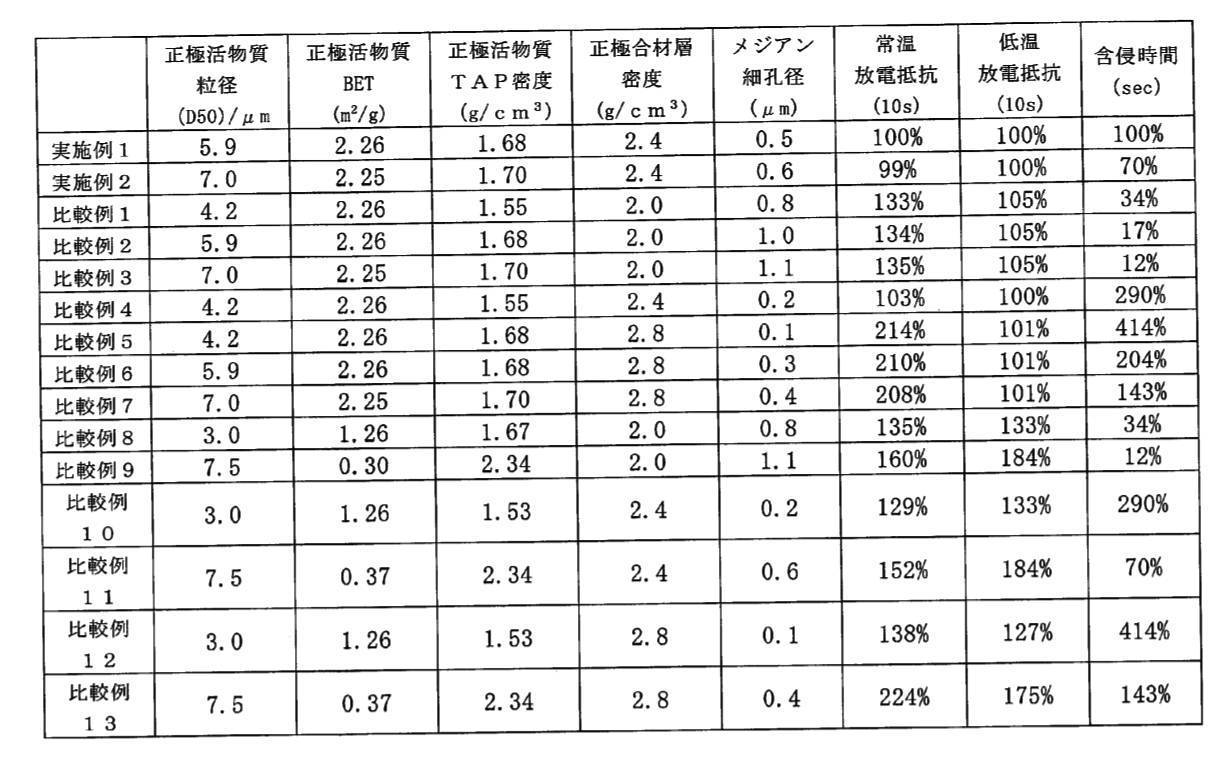
実施例1、2の非水電解質二次電池では、正極活物質のBET比表面積2.00~3.00m2/gであることから、正極活物質の反応面積が大きくなり、低温放電時の電荷移動抵抗が小さくなることによって、低温環境下において出力特性が向上した。また、正極活物質のTAP密度が1.30~1.70g/cm3であり、正極合材層の密度が2.3~2.5g/cm3であることから、正極の導電パスが確保され、内部抵抗が小さくなることによって、常温環境下において出力特性が向上した。さらに、正極活物質の粒子径が5.0~7.0μmであり、かつ正極合材層の密度が2.3~2.5g/cm3であることで、正極合材層のメジアン細孔径が0.5~0.7μmであることから、非水電解液注液時の含侵時間を短くすることができた。
比較例1~3の非水電解質二次電池では、常温放電抵抗が大きくなっている。これは、粒子径が5.0~7.0μmであり、BET比表面積2.00~3.00m2/gであるものの、正極合材層の密度が約2.0g/cm3であるため、正極合材層の導電パスが十分に確保できず、内部抵抗が大きくなったためと考えられる。
11 電極体
12 外装体
13 封口板
15 正極芯体露出部
16 負極芯体露出部
17 正極集電体
18 負極集電体
21 正極端子
22 正極外部導電部
23 正極ボルト部
24 正極挿入部
25 負極端子
26 負極外部導電部
27 負極ボルト部
28 負極挿入部
31 電解質注液孔
32 ガス排出弁
Claims (3)
- 正極と負極とがセパレータを介して交互に積層された電極体と、非水電解質と、を有し、前記正極は、正極芯体と、正極活物質を含む正極合材層と、を有する非水電解質二次電池であって、
前記正極活物質の体積基準のメジアン径(D50)が5.0~7.0μmであって、
前記正極活物質のBET比表面積は、2.00~3.00m2/gであって、
前記正極活物質のTAP密度が1.30~1.70g/cm3であって、
前記正極合材層の密度が2.3~2.5g/cm3である
非水電解質二次電池。 - 請求項1記載の非水電解質二次電池であって、
前記正極合材層のメジアン細孔径が0.5~0.7μmである、
非水電解質二次電池。 - 請求項1又は2に記載の非水電解質二次電池であって、
前記正極活物質が、一般式Li1+xNiaMnbCocO2で表されるリチウム金属複合酸化物であって、前記一般式では、a+b+c=1、0<x≦0.3、a≧b、a≧c、0<c/(a+b)<0.65、1.0≦a/b≦3.0の条件を満たす、
非水電解質二次電池。
Priority Applications (3)
| Application Number | Priority Date | Filing Date | Title |
|---|---|---|---|
| JP2022508128A JP7664225B2 (ja) | 2020-03-18 | 2021-02-08 | 非水電解質二次電池 |
| US17/910,974 US12362378B2 (en) | 2020-03-18 | 2021-02-08 | Nonaqueous electrolyte secondary battery |
| CN202180021269.6A CN115298850B (zh) | 2020-03-18 | 2021-02-08 | 非水电解质二次电池 |
Applications Claiming Priority (2)
| Application Number | Priority Date | Filing Date | Title |
|---|---|---|---|
| JP2020-047222 | 2020-03-18 | ||
| JP2020047222 | 2020-03-18 |
Related Child Applications (2)
| Application Number | Title | Priority Date | Filing Date |
|---|---|---|---|
| US13/813,615 A-371-Of-International US9100955B2 (en) | 2010-09-03 | 2011-08-19 | Terminal, base station and signal transmission control method |
| US14/748,013 Continuation US9706569B2 (en) | 2010-09-03 | 2015-06-23 | Terminal, base station and signal transmission control method |
Publications (1)
| Publication Number | Publication Date |
|---|---|
| WO2021186949A1 true WO2021186949A1 (ja) | 2021-09-23 |
Family
ID=77770886
Family Applications (1)
| Application Number | Title | Priority Date | Filing Date |
|---|---|---|---|
| PCT/JP2021/004631 Ceased WO2021186949A1 (ja) | 2020-03-18 | 2021-02-08 | 非水電解質二次電池 |
Country Status (4)
| Country | Link |
|---|---|
| US (1) | US12362378B2 (ja) |
| JP (1) | JP7664225B2 (ja) |
| CN (1) | CN115298850B (ja) |
| WO (1) | WO2021186949A1 (ja) |
Cited By (2)
| Publication number | Priority date | Publication date | Assignee | Title |
|---|---|---|---|---|
| EP4435895A1 (en) | 2023-03-22 | 2024-09-25 | Prime Planet Energy & Solutions, Inc. | Nonaqueous electrolyte secondary battery |
| EP4492488A2 (en) | 2023-07-12 | 2025-01-15 | Prime Planet Energy & Solutions, Inc. | Nonaqueous electrolyte secondary battery |
Families Citing this family (1)
| Publication number | Priority date | Publication date | Assignee | Title |
|---|---|---|---|---|
| EP4184614A4 (en) * | 2020-07-14 | 2024-07-17 | Proterial, Ltd. | POSITIVE ELECTRODE ACTIVE MATERIAL FOR LITHIUM-ION SECONDARY BATTERY AND LITHIUM-ION SECONDARY BATTERY THEREOF |
Citations (5)
| Publication number | Priority date | Publication date | Assignee | Title |
|---|---|---|---|---|
| JP2008108649A (ja) * | 2006-10-27 | 2008-05-08 | Toyota Motor Corp | 車両用リチウム二次電池正極の製造方法 |
| WO2009031619A1 (ja) * | 2007-09-04 | 2009-03-12 | Mitsubishi Chemical Corporation | リチウム遷移金属系化合物粉体、その製造方法及びその焼成前駆体となる噴霧乾燥体、並びに、それを用いたリチウム二次電池用正極及びリチウム二次電池 |
| JP2014060029A (ja) * | 2012-09-18 | 2014-04-03 | Sanyo Electric Co Ltd | 非水電解質二次電池 |
| JP2018106824A (ja) * | 2016-12-22 | 2018-07-05 | 日揮触媒化成株式会社 | 非水電解質二次電池用正極活物質、正極及び非水電解質二次電池 |
| JP2018116840A (ja) * | 2017-01-18 | 2018-07-26 | Tdk株式会社 | リチウム二次電池 |
Family Cites Families (12)
| Publication number | Priority date | Publication date | Assignee | Title |
|---|---|---|---|---|
| JP3262566B2 (ja) * | 1991-07-05 | 2002-03-04 | 日本電池株式会社 | 非水電解質二次電池用負極 |
| JP4781004B2 (ja) * | 2005-04-28 | 2011-09-28 | パナソニック株式会社 | 非水電解液二次電池 |
| DE602006017836D1 (de) * | 2005-06-02 | 2010-12-09 | Panasonic Corp | Elektrode für eine sekundärbatterie mit wasserfreiem elektrolyt, sekundärbatterie mit wasserfreiem elektrolyt und damit ausgestattetes automobil, elektrowerkzeug oder stationäre einrichtung |
| KR20130090913A (ko) * | 2005-10-20 | 2013-08-14 | 미쓰비시 가가꾸 가부시키가이샤 | 리튬 2 차 전지 및 그것에 사용하는 비수계 전해액 |
| KR101071336B1 (ko) * | 2008-03-25 | 2011-10-07 | 주식회사 에너세라믹 | 리튬 전지용 올리빈형 양극 활물질 전구체, 및 이의 제조 방법 |
| EP2544280B1 (en) * | 2010-03-05 | 2018-06-06 | JX Nippon Mining & Metals Corporation | Positive-electrode active material for lithium ion battery, positive electrode for lithium battery, and lithium ion battery |
| JP5822123B2 (ja) * | 2011-10-04 | 2015-11-24 | 大日本印刷株式会社 | セキュリティトークン、データの更新方法及びコンピュータプログラム |
| CN105794026B (zh) * | 2013-12-02 | 2018-10-12 | 株式会社杰士汤浅国际 | 锂二次电池用正极活性物质、锂二次电池用电极和锂二次电池 |
| CN106463765A (zh) * | 2014-06-10 | 2017-02-22 | 日立化成株式会社 | 锂离子电池 |
| JP6377983B2 (ja) | 2014-07-23 | 2018-08-22 | 住友化学株式会社 | 正極活物質、リチウムイオン二次電池用正極およびリチウムイオン二次電池 |
| US10535874B2 (en) * | 2015-11-30 | 2020-01-14 | Lg Chem, Ltd. | Positive electrode active material for secondary battery, method for preparing same, and secondary battery comprising same |
| JP2018056425A (ja) * | 2016-09-30 | 2018-04-05 | 旭化成株式会社 | 非水系リチウム型蓄電素子 |
-
2021
- 2021-02-08 WO PCT/JP2021/004631 patent/WO2021186949A1/ja not_active Ceased
- 2021-02-08 JP JP2022508128A patent/JP7664225B2/ja active Active
- 2021-02-08 US US17/910,974 patent/US12362378B2/en active Active
- 2021-02-08 CN CN202180021269.6A patent/CN115298850B/zh active Active
Patent Citations (5)
| Publication number | Priority date | Publication date | Assignee | Title |
|---|---|---|---|---|
| JP2008108649A (ja) * | 2006-10-27 | 2008-05-08 | Toyota Motor Corp | 車両用リチウム二次電池正極の製造方法 |
| WO2009031619A1 (ja) * | 2007-09-04 | 2009-03-12 | Mitsubishi Chemical Corporation | リチウム遷移金属系化合物粉体、その製造方法及びその焼成前駆体となる噴霧乾燥体、並びに、それを用いたリチウム二次電池用正極及びリチウム二次電池 |
| JP2014060029A (ja) * | 2012-09-18 | 2014-04-03 | Sanyo Electric Co Ltd | 非水電解質二次電池 |
| JP2018106824A (ja) * | 2016-12-22 | 2018-07-05 | 日揮触媒化成株式会社 | 非水電解質二次電池用正極活物質、正極及び非水電解質二次電池 |
| JP2018116840A (ja) * | 2017-01-18 | 2018-07-26 | Tdk株式会社 | リチウム二次電池 |
Cited By (3)
| Publication number | Priority date | Publication date | Assignee | Title |
|---|---|---|---|---|
| EP4435895A1 (en) | 2023-03-22 | 2024-09-25 | Prime Planet Energy & Solutions, Inc. | Nonaqueous electrolyte secondary battery |
| EP4492488A2 (en) | 2023-07-12 | 2025-01-15 | Prime Planet Energy & Solutions, Inc. | Nonaqueous electrolyte secondary battery |
| KR20250010553A (ko) | 2023-07-12 | 2025-01-21 | 프라임 플래닛 에너지 앤드 솔루션즈 가부시키가이샤 | 비수전해질 이차 전지 |
Also Published As
| Publication number | Publication date |
|---|---|
| CN115298850B (zh) | 2026-03-17 |
| JP7664225B2 (ja) | 2025-04-17 |
| US12362378B2 (en) | 2025-07-15 |
| CN115298850A (zh) | 2022-11-04 |
| US20230142602A1 (en) | 2023-05-11 |
| JPWO2021186949A1 (ja) | 2021-09-23 |
Similar Documents
| Publication | Publication Date | Title |
|---|---|---|
| EP4207355B1 (en) | Positive electrode for nonaqueous electrolyte secondary batteries, and nonaqueous electrolyte secondary battery | |
| WO2013099278A1 (ja) | 非水電解質二次電池用負極およびそれを用いた非水電解質二次電池 | |
| WO2016103657A1 (ja) | 非水電解質二次電池 | |
| JP7731342B2 (ja) | 非水電解質二次電池 | |
| CN113097446B (zh) | 非水电解质二次电池用负极和非水电解质二次电池 | |
| US12362378B2 (en) | Nonaqueous electrolyte secondary battery | |
| JPWO2020174794A1 (ja) | 非水電解質二次電池用正極活物質、及び非水電解質二次電池 | |
| WO2018003477A1 (ja) | 正極活物質、正極、及び非水電解質二次電池 | |
| WO2016151979A1 (ja) | 非水電解質二次電池用負極及び非水電解質二次電池 | |
| US20240204198A1 (en) | Non-aqueous electrolyte secondary battery | |
| JP2018170240A (ja) | 非水電解質二次電池 | |
| JP7814013B2 (ja) | 非水電解質二次電池用正極活物質、及び非水電解質二次電池 | |
| JP7728183B2 (ja) | 二次電池用非水電解質および非水電解質二次電池 | |
| WO2022044489A1 (ja) | 非水電解質二次電池用正極活物質および非水電解質二次電池 | |
| JP7011427B2 (ja) | 非水電解質二次電池用正極、及び非水電解質二次電池 | |
| US20250192234A1 (en) | Non-aqueous electrolyte secondary battery | |
| US20250070152A1 (en) | Positive electrode active material for non-aqueous electrolyte secondary battery, and non-aqueous electrolyte secondary battery | |
| US20250046856A1 (en) | Non-aqueous electrolyte secondary battery | |
| US20230014664A1 (en) | Nonaqueous electrolyte secondary battery positive electrode, and nonaqueous electrolyte secondary battery | |
| US20240063384A1 (en) | Positive electrode active material for nonaqueous electrolyte secondary batteries, and nonaqueous electrolyte secondary battery | |
| TW202515006A (zh) | 非水電解質二次電池 | |
| CN116601785A (zh) | 非水电解质二次电池用正极活性物质和非水电解质二次电池 | |
| WO2021261358A1 (ja) | 非水電解質二次電池用負極及び非水電解質二次電池 | |
| WO2022092273A1 (ja) | 非水電解質二次電池 |
Legal Events
| Date | Code | Title | Description |
|---|---|---|---|
| 121 | Ep: the epo has been informed by wipo that ep was designated in this application |
Ref document number: 21771419 Country of ref document: EP Kind code of ref document: A1 |
|
| ENP | Entry into the national phase |
Ref document number: 2022508128 Country of ref document: JP Kind code of ref document: A |
|
| NENP | Non-entry into the national phase |
Ref country code: DE |
|
| 122 | Ep: pct application non-entry in european phase |
Ref document number: 21771419 Country of ref document: EP Kind code of ref document: A1 |
|
| WWG | Wipo information: grant in national office |
Ref document number: 17910974 Country of ref document: US |