WO2021186942A1 - 導電性組成物およびそれを含む導電膜、センサ、生体センサ、フレキシブルデバイス、ならびに導電性布帛およびそれを含む生体電極、ウェアラブルデバイス - Google Patents
導電性組成物およびそれを含む導電膜、センサ、生体センサ、フレキシブルデバイス、ならびに導電性布帛およびそれを含む生体電極、ウェアラブルデバイス Download PDFInfo
- Publication number
- WO2021186942A1 WO2021186942A1 PCT/JP2021/004536 JP2021004536W WO2021186942A1 WO 2021186942 A1 WO2021186942 A1 WO 2021186942A1 JP 2021004536 W JP2021004536 W JP 2021004536W WO 2021186942 A1 WO2021186942 A1 WO 2021186942A1
- Authority
- WO
- WIPO (PCT)
- Prior art keywords
- group
- conductive
- polymer
- conductive composition
- repeating unit
- Prior art date
- Legal status (The legal status is an assumption and is not a legal conclusion. Google has not performed a legal analysis and makes no representation as to the accuracy of the status listed.)
- Ceased
Links
Images






Classifications
-
- C—CHEMISTRY; METALLURGY
- C08—ORGANIC MACROMOLECULAR COMPOUNDS; THEIR PREPARATION OR CHEMICAL WORKING-UP; COMPOSITIONS BASED THEREON
- C08G—MACROMOLECULAR COMPOUNDS OBTAINED OTHERWISE THAN BY REACTIONS ONLY INVOLVING UNSATURATED CARBON-TO-CARBON BONDS
- C08G61/00—Macromolecular compounds obtained by reactions forming a carbon-to-carbon link in the main chain of the macromolecule
- C08G61/12—Macromolecular compounds containing atoms other than carbon in the main chain of the macromolecule
-
- C—CHEMISTRY; METALLURGY
- C08—ORGANIC MACROMOLECULAR COMPOUNDS; THEIR PREPARATION OR CHEMICAL WORKING-UP; COMPOSITIONS BASED THEREON
- C08L—COMPOSITIONS OF MACROMOLECULAR COMPOUNDS
- C08L23/00—Compositions of homopolymers or copolymers of unsaturated aliphatic hydrocarbons having only one carbon-to-carbon double bond; Compositions of derivatives of such polymers
-
- C—CHEMISTRY; METALLURGY
- C08—ORGANIC MACROMOLECULAR COMPOUNDS; THEIR PREPARATION OR CHEMICAL WORKING-UP; COMPOSITIONS BASED THEREON
- C08L—COMPOSITIONS OF MACROMOLECULAR COMPOUNDS
- C08L33/00—Compositions of homopolymers or copolymers of compounds having one or more unsaturated aliphatic radicals, each having only one carbon-to-carbon double bond, and only one being terminated by only one carboxyl radical, or of salts, anhydrides, esters, amides, imides or nitriles thereof; Compositions of derivatives of such polymers
- C08L33/04—Homopolymers or copolymers of esters
- C08L33/06—Homopolymers or copolymers of esters of esters containing only carbon, hydrogen and oxygen, which oxygen atoms are present only as part of the carboxyl radical
-
- C—CHEMISTRY; METALLURGY
- C08—ORGANIC MACROMOLECULAR COMPOUNDS; THEIR PREPARATION OR CHEMICAL WORKING-UP; COMPOSITIONS BASED THEREON
- C08L—COMPOSITIONS OF MACROMOLECULAR COMPOUNDS
- C08L75/00—Compositions of polyureas or polyurethanes; Compositions of derivatives of such polymers
- C08L75/04—Polyurethanes
-
- D—TEXTILES; PAPER
- D06—TREATMENT OF TEXTILES OR THE LIKE; LAUNDERING; FLEXIBLE MATERIALS NOT OTHERWISE PROVIDED FOR
- D06M—TREATMENT, NOT PROVIDED FOR ELSEWHERE IN CLASS D06, OF FIBRES, THREADS, YARNS, FABRICS, FEATHERS OR FIBROUS GOODS MADE FROM SUCH MATERIALS
- D06M15/00—Treating fibres, threads, yarns, fabrics, or fibrous goods made from such materials, with macromolecular compounds; Such treatment combined with mechanical treatment
- D06M15/19—Treating fibres, threads, yarns, fabrics, or fibrous goods made from such materials, with macromolecular compounds; Such treatment combined with mechanical treatment with synthetic macromolecular compounds
- D06M15/37—Macromolecular compounds obtained otherwise than by reactions only involving carbon-to-carbon unsaturated bonds
-
- H—ELECTRICITY
- H01—ELECTRIC ELEMENTS
- H01B—CABLES; CONDUCTORS; INSULATORS; SELECTION OF MATERIALS FOR THEIR CONDUCTIVE, INSULATING OR DIELECTRIC PROPERTIES
- H01B1/00—Conductors or conductive bodies characterised by the conductive materials; Selection of materials as conductors
- H01B1/06—Conductors or conductive bodies characterised by the conductive materials; Selection of materials as conductors mainly consisting of other non-metallic substances
- H01B1/12—Conductors or conductive bodies characterised by the conductive materials; Selection of materials as conductors mainly consisting of other non-metallic substances organic substances
-
- H—ELECTRICITY
- H01—ELECTRIC ELEMENTS
- H01B—CABLES; CONDUCTORS; INSULATORS; SELECTION OF MATERIALS FOR THEIR CONDUCTIVE, INSULATING OR DIELECTRIC PROPERTIES
- H01B1/00—Conductors or conductive bodies characterised by the conductive materials; Selection of materials as conductors
- H01B1/20—Conductive material dispersed in non-conductive organic material
Definitions
- the present invention relates to a conductive composition and a conductive film containing the same, a sensor, a biosensor, a flexible device, and a conductive fabric and a bioelectrode including the conductive cloth, and a wearable device.
- Organic conductive substances are expected from the viewpoint of solving the problem of resource depletion of indium tin oxide (ITO), which is widely used at present, and being able to form a coating on a flexible substrate.
- ITO indium tin oxide
- Organic conductive materials have similar functions to existing materials, such as the formation of solar cells on curved surfaces, rather than simply replacing existing electronic materials, but they may be used in different places.
- PEDOT: PSS is seen as promising (see, for example, Patent Document 3 and Non-Patent Document 1).
- Various researches and developments are being energetically carried out in order to solve the problems of PEDOT: PSS and put organic conductive substances into practical use.
- a technique for increasing compatibility with a hard coat resin and exhibiting scratch resistance on a coating film see, for example, Patent Document 4
- polymerizing thiophene in the presence of a resin having a sulfonic acid group and an organic acid is disclosed.
- the present invention has a conductive composition containing (a) a polymer having a repeating unit represented by the following formula (1), and (b) a polymer according to any one of the following [1] to [3]. It is a thing.
- a polymer having a repeating unit represented by the following formula (2) and having no repeating unit represented by the following formula (3) and having a weight average molecular weight of 2100 or more and 38,000 or less hereinafter, simply It may be referred to as "[1] polymer”).
- a polymer having no repeating unit represented by the following formula (2) and having a repeating unit represented by the following formula (3) hereinafter, may be simply referred to as "[2] polymer”. be.
- a polymer having both a repeating unit represented by the following formula (2) and a repeating unit represented by the following formula (3) hereinafter, simply referred to as "[3] polymer”). There is.).
- R 11 and R 12 independently represent a hydrogen atom, a hydroxy group, an alkyl group, a cycloalkyl group, an alkenyl group, a cycloalkenyl group, an alkynyl group, an alkoxy group, an alkylthio group, and a monoalkylamino. It is selected from the group consisting of a group, a dialkylamino group, an aryl ether group, an aryl thioether group, an aryl group, a heteroaryl group, a heterocyclic group and a halogen atom.
- a ring may be formed by R 11 and R 12.
- X is an oxygen atom, a sulfur atom, a selenium atom, or an N-R 13
- R 13 is a hydrogen atom, an alkyl group, a cycloalkyl group, an alkenyl group, a cycloalkenyl group, an alkynyl group, an aryl group, or a heteroaryl group. And selected from the group consisting of heterocyclic groups.
- Ar 2 is a trivalent aromatic hydrocarbon or a trivalent aromatic heterocycle.
- L 21 is selected from the group consisting of a single bond, an oxygen atom, an alkylene group, an alkenylene group, an alkynylene group, an arylene group and a heteroarylene group.
- R 21 is selected from the group consisting of an alkylene group, an alkaneylene group and an alkynylene group.
- R 22 is a sulfonic acid group or a salt thereof.
- Ar 3 is a (3 + k) -valent aromatic hydrocarbon or a (3 + k) -valent aromatic heterocycle.
- K is an integer of 1 or more and 3 or less.
- L 31 is selected from the group consisting of a single bond, an oxygen atom, an alkylene group, an alkenylene group, an alkynylene group, an arylene group and a heteroarylene group.
- R 31 is selected from the group consisting of an alkylene group, an alkaneylene group and an alkynylene group.
- R 32 is a sulfonic acid group or a salt thereof.
- R 33 is an alkyl group, a cycloalkyl group, an alkenyl group, a cycloalkenyl group, an alkynyl group, an aryl group and a heteroaryl group, an alkoxy group having 2 or more carbon atoms, a thioalkoxy group having 2 or more carbon atoms, and -L 32- R 34.
- L 32 is selected from the group consisting of a carbonyl group, an ester group, a thioester group, an amide group, a carbonate group, a thiocarbonate group and a dithiocarbonate group.
- R 34 is selected from the group consisting of an alkyl group, a cycloalkyl group, an alkenyl group, a cycloalkenyl group, an alkynyl group, an aryl group and a heteroaryl group.
- the present invention comprises (c) a polymer having a repeating unit represented by the following formula (1), (d) a weight having a repeating unit represented by the following formula (5) and / or the following formula (6).
- R 11 and R 12 independently represent a hydrogen atom, a hydroxy group, an alkyl group, a cycloalkyl group, an alkenyl group, a cycloalkenyl group, an alkynyl group, an alkoxy group, an alkylthio group, and a monoalkylamino. It is selected from the group consisting of a group, a dialkylamino group, an aryl ether group, an aryl thioether group, an aryl group, a heteroaryl group, a heterocyclic group and a halogen atom.
- a ring may be formed by R 11 and R 12.
- X is an oxygen atom, a sulfur atom, a selenium atom, or an N-R 13
- R 13 is a hydrogen atom, an alkyl group, a cycloalkyl group, an alkenyl group, a cycloalkenyl group, an alkynyl group, an aryl group, or a heteroaryl group. And selected from the group consisting of heterocyclic groups.
- Ar 5 is a trivalent aromatic hydrocarbon or a trivalent aromatic heterocycle.
- L 51 is selected from the group consisting of a single bond, an oxygen atom, an alkylene group, an alkenylene group, an alkynylene group, an arylene group and a heteroarylene group.
- R 51 is selected from the group consisting of an alkylene group, an alkaneylene group and an alkynylene group.
- R 52 is a sulfonic acid group or a salt thereof.
- Ar 6 is a (3 + m) -valent aromatic hydrocarbon or a (3 + m) -valent aromatic heterocycle.
- M is an integer of 1 or more and 3 or less.
- L 61 is selected from the group consisting of a single bond, an oxygen atom, an alkylene group, an alkenylene group, an alkynylene group, an arylene group and a heteroarylene group.
- R 61 is selected from the group consisting of an alkylene group, an alkaneylene group and an alkynylene group.
- R 62 is a sulfonic acid group or a salt thereof.
- R 63 is an alkyl group, a cycloalkyl group, an alkenyl group, a cycloalkenyl group, an alkynyl group, an aryl group and a heteroaryl group, an alkoxy group having 2 or more carbon atoms, a thioalkoxy group having 2 or more carbon atoms, and -L 32- R 34.
- L 32 is selected from the group consisting of a carbonyl group, an ester group, a thioester group, an amide group, a carbonate group, a thiocarbonate group and a dithiocarbonate group.
- R 34 is selected from the group consisting of an alkyl group, a cycloalkyl group, an alkenyl group, a cycloalkenyl group, an alkynyl group, an aryl group and a heteroaryl group.
- the present invention it is possible to inexpensively provide a conductive composition having high conductivity and high durability against water. Further, it is possible to provide a conductive fabric having high conductivity and excellent durability against water.
- UV-Vis spectrum of PEDOT UV-Vis spectrum of PSS PEDOT UV-Vis spectrum of PSS
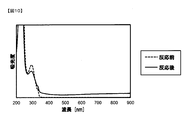
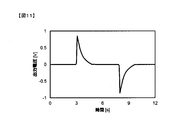
- UV-Vis spectrum before and after the reaction of the conductive composition of Example 1 of the present invention UV-Vis spectrum before and after the reaction of the conductive composition of Example 9 of the present invention Time-Voltage Plot at Pressure Application in Example 67
- the present invention is not limited to the following embodiments, and can be variously modified and implemented according to an object and an application.
- the conductive composition according to the embodiment of the present invention is (a) a polymer having a repeating unit represented by the following formula (1), and (b) any one of the following [1] to [3].
- [1] A polymer having a repeating unit represented by the following formula (2) and having no repeating unit represented by the following formula (3) and having a weight average molecular weight of 2100 or more and 38,000 or less.
- [2] A polymer having no repeating unit represented by the following formula (2) and having a repeating unit represented by the following formula (3).
- R 11 and R 12 independently represent a hydrogen atom, a hydroxy group, an alkyl group, a cycloalkyl group, an alkenyl group, a cycloalkenyl group, an alkynyl group, an alkoxy group, an alkylthio group, and a monoalkylamino group. , Dialkylamino group, aryl ether group, aryl thioether group, aryl group, heteroaryl group, heterocyclic group and halogen atom.
- a ring may be formed by R 11 and R 12.
- X is an oxygen atom, a sulfur atom, a selenium atom, or an N-R 13
- R 13 is a hydrogen atom, an alkyl group, a cycloalkyl group, an alkenyl group, a cycloalkenyl group, an alkynyl group, an aryl group, or a heteroaryl group. And selected from the group consisting of heterocyclic groups.
- Ar 2 is a trivalent aromatic hydrocarbon ring or a trivalent aromatic heterocycle.
- L 21 is selected from the group consisting of a single bond, an oxygen atom, an alkylene group, an alkenylene group, an alkynylene group, an arylene group and a heteroarylene group.
- R 21 is selected from the group consisting of an alkylene group, an alkaneylene group and an alkynylene group.
- R 22 is a sulfonic acid group or a salt thereof.
- Ar 3 is a (3 + k) -valent aromatic hydrocarbon ring or a (3 + k) -valent aromatic heterocycle.
- k is an integer greater than or equal to 1 and less than or equal to 3.
- L 31 is selected from the group consisting of a single bond, an oxygen atom, an alkylene group, an alkenylene group, an alkynylene group, an arylene group and a heteroarylene group.
- R 31 is selected from the group consisting of an alkylene group, an alkaneylene group and an alkynylene group.
- R 32 is a sulfonic acid group or a salt thereof.
- R 33 is an alkyl group, a cycloalkyl group, an alkenyl group, a cycloalkenyl group, an alkynyl group, an aryl group and a heteroaryl group, an alkoxy group having 2 or more carbon atoms, a thioalkoxy group having 2 or more carbon atoms, and -L 32- R 34.
- L 32 is selected from the group consisting of a carbonyl group, an ester group, a thioester group, an amide group, a carbonate group, a thiocarbonate group and a dithiocarbonate group.
- R 34 is selected from the group consisting of an alkyl group, a cycloalkyl group, an alkenyl group, a cycloalkenyl group, an alkynyl group, an aryl group and a heteroaryl group.
- hydrogen may be deuterium or tritium.
- the substituted or unsubstituted aryl group having 6 to 40 carbon atoms is 6 to 40 including the carbon number contained in the substituent substituted with the aryl group, and defines the carbon number. The same applies to other substituents.
- the alkyl group refers to a saturated aliphatic hydrocarbon group such as a methyl group, an ethyl group, an n-propyl group, an isopropyl group, an n-butyl group, a sec-butyl group and a tert-butyl group, which are substituents. May or may not have.
- the additional substituent when substituted is not particularly limited, and examples thereof include an alkyl group, an aryl group, and a heteroaryl group, and this point is also common to the following description.
- the number of carbon atoms of the alkyl group is not particularly limited, but is preferably 1 or more and 20 or less, more preferably 1 or more and 12 or less, and particularly preferably 1 or more and 8 or less, from the viewpoint of availability and cost. The range.
- the cycloalkyl group means, for example, a saturated alicyclic hydrocarbon group such as a cyclopropyl group, a cyclohexyl group, a norbornyl group, and an adamantyl group, which may or may not have a substituent.
- the number of carbon atoms in the alkyl group moiety is not particularly limited, but is preferably in the range of 3 or more and 20 or less.
- the alkenyl group refers to an unsaturated aliphatic hydrocarbon group containing a double bond such as a vinyl group, an allyl group, or a butadienyl group, which may or may not have a substituent.
- the carbon number of the alkenyl group is not particularly limited, but is preferably in the range of 2 or more and 20 or less.
- the cycloalkenyl group refers to an unsaturated alicyclic hydrocarbon group containing a double bond such as a cyclopentenyl group, a cyclopentadienyl group, a cyclohexenyl group, etc., which may have a substituent. You don't have to.
- the number of carbon atoms of the cycloalkenyl group is not particularly limited, but is preferably in the range of 4 or more and 20 or less.
- the alkynyl group refers to an unsaturated aliphatic hydrocarbon group containing a triple bond such as an ethynyl group, which may or may not have a substituent.
- the number of carbon atoms of the alkynyl group is not particularly limited, but is preferably in the range of 2 or more and 20 or less.
- the alkoxy group refers to a functional group to which an aliphatic hydrocarbon group is bonded via an ether bond such as a methoxy group, an ethoxy group, or a propoxy group, and even if the aliphatic hydrocarbon group has a substituent. You do not have to have it.
- the number of carbon atoms of the alkoxy group is not particularly limited, but is preferably in the range of 1 or more and 20 or less.
- the alkylthio group is one in which the oxygen atom of the ether bond of the alkoxy group is replaced with a sulfur atom.
- the hydrocarbon group of the alkylthio group may or may not have a substituent.
- the number of carbon atoms of the alkylthio group is not particularly limited, but is preferably in the range of 1 or more and 20 or less.
- the aryl ether group refers to a functional group to which an aromatic hydrocarbon group is bonded via an ether bond, for example, a phenoxy group, and the aromatic hydrocarbon group may or may not have a substituent. good.
- the number of carbon atoms of the aryl ether group is not particularly limited, but is preferably in the range of 6 or more and 40 or less.
- the arylthio ether group is one in which the oxygen atom of the ether bond of the aryl ether group is replaced with a sulfur atom.
- the aromatic hydrocarbon group in the aryl ether group may or may not have a substituent.
- the number of carbon atoms of the aryl ether group is not particularly limited, but is preferably in the range of 6 or more and 40 or less.
- the aromatic hydrocarbon ring is a hydrocarbon ring composed of a monocyclic ring or a fused ring having aromatic properties.
- Examples include benzene ring, naphthalene ring, inden ring, anthracene ring, fluorene ring, phenanthrene ring, pyrene ring, fluorene ring, phenanthrene ring, benzo [a] anthracene ring, fluoranthene ring, dibenzo [a, h] anthracene ring, dibenzo.
- Examples thereof include [a, h] pyrene ring, 3,4-benzopyrene ring, chrysene ring, tetracene ring, pentacene ring, naphtho [2,3-a] pyrene ring, perylene ring, colannene ring, coronene ring and the like.
- the number of carbon atoms in the aromatic hydrocarbon ring is not particularly limited, but is preferably in the range of 6 or more and 40 or less, and more preferably in the range of 6 or more and 24 or less from the viewpoint of availability and cost.
- it is a benzene ring or a naphthalene ring.
- An aryl group is a group containing at least one benzene ring structure and having one hydrogen atom removed from an aromatic hydrocarbon ring or an aggregate of aromatic hydrocarbon rings.
- the aggregate of aromatic hydrocarbon rings is a group of units in which the aromatic hydrocarbon rings are connected by a single bond.
- Specific examples of the aryl group include a phenyl group, a naphthyl group, a biphenyl group, a terphenyl group, a phenanthryl group, an anthracenyl group, a pyrenyl group, a fluoranthenyl group and the like.
- the aryl group may or may not have a substituent.
- the number of carbon atoms of the aryl group is not particularly limited, but is preferably in the range of 6 or more and 40 or less, more preferably in the range of 6 or more and 24 or less, and further preferably in the range of phenyl group, 1-naphthyl group, 2-. It is a naphthyl group.
- the arylene group is a group formed by removing two hydrogen atoms from an aromatic hydrocarbon ring or an aggregate of aromatic hydrocarbon rings containing at least one benzene ring structure.
- Specific examples include a phenylene group, a biphenylene group, a naphthylene group, a fluoreneylene group and the like. More specifically, 1,4-phenylene group, 1,3-phenylene group, 1,2-phenylene group, 4,4'-biphenylene group, 4,3'-biphenylene group, 3,3'-biphenylene group.
- 1,4-naphthalenylene group 1,5-naphthalenylene group, 2,5-naphthalenylene group, 2,6-naphthalenylene group, 2,7-naphthalenylene group, 1,3,5-phenylene group and the like.
- the arylene group may or may not have a substituent.
- the carbon number of the arylene group is not particularly limited, but is preferably in the range of 6 or more and 40 or less, more preferably in the range of 6 or more and 24 or less, and further preferably in the range of 1,4-phenylene group, 1,3. -Phenylene group, 4,4'-biphenylene group, 4,3'-biphenylene group.
- An aromatic heterocycle is an aromatic monocyclic or condensed ring having one or more atoms other than carbon in the ring.
- Examples include furan ring, benzofuran ring, dibenzofuran ring, thiophene ring, benzothiophene ring, dibenzothiophene ring, isothiazole ring, thiazazole ring, thiazole ring, pyridine ring, quinoline ring, pyrimidine ring, pyrazine ring, triazine ring, quinoxaline.
- Examples include a ring, a quinazoline ring, an indrill ring, an aclysin ring, and a porphyrin ring.
- the number of carbon atoms of the aromatic heterocycle is not particularly limited, but is preferably in the range of 2 or more and 30 or less. More preferably, it is a pyridine ring, a pyrimidine ring, a triazine ring, a quinoline ring, a quinazoline ring, or a carbazole ring.
- a heteroaryl group is a group containing at least one aromatic heterocyclic structure and having one hydrogen atom removed from an aromatic heterocycle or an aggregate of aromatic heterocycles.
- An aggregate of aromatic heterocycles is a group of units in which aromatic heterocycles are connected by a single bond.
- heteroaryl group examples include a furanyl group, a thiophenyl group, a pyridyl group, a quinolinyl group, an isoquinolinyl group, a pyrazinyl group, a pyrimidyl group, a naphthylyl group, a triazinyl group, a benzofuranyl group, a benzothiophenyl group, an indolyl group and a dibenzofuranyl.
- examples include a group, a dibenzothiophenyl group, a carbazolyl group, a bipyridyl group and the like.
- the number of carbon atoms of the heteroaryl group is not particularly limited, but is preferably in the range of 2 or more and 30 or less. More preferably, it is a pyridyl group, a pyrimidyl group, a triazinyl group, a quinolyl group, or a carbazolyl group.
- a heteroarylene group is a group containing at least one aromatic heterocyclic structure and having one hydrogen atom removed from an aromatic heterocycle or an aggregate of aromatic heterocycles.
- Specific examples include 2,6-pyridylene group, 2,5-pyridylene group, 2,4-pyridylene group, 3,5-pyridylene group, 3,6-pyridylene group, 2,4,6-pyridylene group, 2 , 4-pyrimidylene group, 2,5-pyrimidylene group, 4,6-pyrimidylene group, 4,6-pyrimidylene group, 2,4,6-pyrimidylene group, 2,4,6-triadinylene group, 4,6-dibenzo Examples thereof include a furanylene group, a 2,6-dibenzofuranylene group, a 2,8-dibenzofuranylene group and a 3,7-dibenzofuranylene group.
- the heteroarylene group may or may not have a substituent. The number of carbon atoms of the hetero
- a halogen atom is an atom belonging to Group 17 such as fluorine, chlorine, bromine, and iodine.
- the monoalkylamino group represents a group in which a hydrogen atom and the above alkyl group are bonded to a nitrogen atom.
- the dialkylamino group represents a group in which the above two alkyl groups are bonded to a nitrogen atom.
- the two alkyl groups may be the same or different.
- a ring may be formed by two alkyl groups.
- the heterocyclic group refers to an aliphatic ring having an atom other than carbon such as a pyran ring, a piperidine ring, and a cyclic amide in the ring, which may or may not have a substituent. ..
- the heterocycle may have one or more double bonds in the ring as long as the conjugates are not cyclically linked to become aromatic.
- the number of carbon atoms of the heterocyclic group is not particularly limited, but is preferably in the range of 2 or more and 20 or less.
- the alkylene group includes, for example, a methylene group, an ethylene group, an n-propylene group, an isopropylene group, an n-butylene group, a sec-butylene group, a tert-butylene group, a cyclopropylene group, a cyclohexylene group, a norbornylene group and the like. It shows a saturated aliphatic hydrocarbon group of valence, which may or may not have a substituent.
- the additional substituent when having a substituent is not particularly limited, and examples thereof include an alkoxy group such as an alkyl group, a methoxy group, and an ethoxy group, and these further have a substituent. You may.
- the carbon number of the alkylene group is not particularly limited, but is preferably 1 or more and 20 or less, and more preferably 1 or more and 8 or less, from the viewpoint of availability and cost.
- the alkenylene group refers to a divalent unsaturated aliphatic hydrocarbon group containing a double bond such as a vinylene group, a propenylene group, or a butadienylene group, which may or may not have a substituent. May be good.
- the carbon number of the alkenyl group is not particularly limited, but is preferably in the range of 2 or more and 20 or less.
- the alkynylene group refers to a divalent unsaturated aliphatic hydrocarbon group containing a triple bond such as an ethynylene group, a propynylene group, or a butadinirene group, which may or may not have a substituent. good.
- the number of carbon atoms of the alkynyl group is not particularly limited, but is preferably in the range of 2 or more and 20 or less.
- Forming a ring with R 11 and R 12 means that at least one atom contained in R 11 and at least one atom contained in R 12 are connected.
- the polymer of any one of (b) [1] to [3] (hereinafter, may be simply referred to as "(b) polymer”) is a dopant.
- a positive charge is generated in a polymer having a repeating unit represented by the general formula (1) (hereinafter, may be simply referred to as "(a) polymer")
- the conductivity is improved. It is considered.
- the polymer (a) and the polymer (b) form a complex.
- the "complex” is a state in which two or more kinds of compound components are derived, and each component exists integrally by some interaction between the components and exhibits properties different from the original individual properties. Say what is in. That is, only two or more kinds of compound components are present in the system, and each component is different from the "mixture” in which the original properties are maintained.
- a characteristic of a conductive substance is that when a complex is formed, its electronic state changes from that of a mixture.
- Matrix-assisted laser desorption / ionization time-of-flight mass spectrometry is a method for confirming that two or more compound components are integrally present by interaction between the components. Be done.
- spectroscopic methods in general can be used, and examples thereof include absorptiometry (ultraviolet-visible (UV-Vis) spectrophotometric method), Raman spectroscopy, and X-ray photoelectron spectroscopy (XPS). ..
- absorptiometry method is adopted in the present specification as a method for confirming complex formation. If a spectrum different from the superposition of the spectra of the original components is obtained in the absorptiometry, it is considered that a complex is formed because there is an electronic interaction between the compounds. ..
- PEDOT which exists alone, has an absorption spectrum as shown in FIG.
- PSS has an absorption spectrum as shown in FIG.
- PEDOT shows effective light absorption in the range of 350 nm to 750 nm
- PSS shows effective light absorption in the range of 440 nm or less.
- the absorption spectrum is as shown in FIG. 3, and light absorption is exhibited in a wide region having a wavelength of 500 nm or more. Since neither PEDOT nor PSS, which are the components constituting the complex, have light absorption in the range of 750 nm to 900 nm, an electronic interaction exists between these components to form the complex. Can be confirmed.
- Infrared absorption spectroscopy IR
- solid-state nuclear magnetic resonance NMR
- thermal decomposition gas chromatography GC
- mass spectrometry MS
- the repeating unit and the mass of the partial structure can be obtained by thermal decomposition GC-MS.
- IR Infrared absorption spectroscopy
- NMR solid-state nuclear magnetic resonance
- MS thermal decomposition gas chromatography
- the repeating unit and the mass of the partial structure can be obtained by thermal decomposition GC-MS.
- the polymer (a) and the polymer (b) form a complex.
- (a) a positive charge is generated on the polymer.
- the polymer preferably has a structure that stabilizes its charge. As such a structure, for example, there is a structure containing an oxygen atom or a nitrogen atom having a lone electron pair.
- R 11 and R 12 are independently hydrogen atoms, alkyl groups, alkoxy groups, alkylthio groups, aryl ether groups, aryl thioether groups, aryl groups, and heteroaryl groups, respectively.
- a heterocyclic group is preferable, and a hydrogen atom, an alkyl group, an alkoxy group, and an alkylthio group are more preferable.
- R 11 and R 12 form a ring because (a) the main chain of the polymer is made rigid and high conductivity can be obtained.
- X is preferably a sulfur atom. This is from the viewpoint that the reactivity of the monomer is high and the polymerization is easy, and because the molecular orbital of the produced polymer is large, the transfer of charge carriers is easy and high conductivity can be obtained.
- the polymer (a) is preferably a polymer having a repeating unit represented by the following formula (4).
- R 14 and R 15 are independently selected from the group consisting of a hydrogen atom, an alkyl group, a cycloalkyl group, an alkenyl group, a cycloalkenyl group, an alkynyl group, an aryl group and a heteroaryl group.
- a ring may be formed by R 14 and R 15.
- R 14 and R 15 are independently each of an alkyl group having 1 to 6 carbon atoms, a cycloalkyl group, an alkenyl group, a cycloalkenyl group, an alkynyl group and an aryl group. It is preferable that the group is selected from the group consisting of, or a ring is formed by R 14 and R 15. With such a structure, the hydrophobic interaction between the polymer having the repeating unit represented by the formula (4) and the polymer (b) becomes large. This makes the complex more stable. Further, when the two interact strongly, the doping level of the polymer having the repeating unit represented by the formula (4) can be raised, and thus the conductivity is improved.
- a ring is formed between R 14 and R 15, and the weight (a) is heavy.
- the coalescence is more preferably a structure represented by the following formula (7).
- the repeating unit represented by the formula (1) has a 3,4-ethylenedioxythiophene structure represented by the following formula (8).
- the weight average molecular weight of the polymer is preferably 1000 or more from the viewpoint of obtaining high conductivity, and preferably 10000 or less from the viewpoint of ease of handling.
- the polymer (b) has a role as a dopant that charges the polymer having the repeating unit represented by the general formula (1). It also has the role of stabilizing the charge after it has been charged.
- a halogen disubstituted product of an aromatic hydrocarbon ring or an aromatic heterocycle and an alkyne are reacted with a palladium complex and copper (I) halide as a catalyst for a sorghum-head coupling reaction.
- a method of introducing a sulfonic acid group by an aromatic electrophilic substitution reaction using fuming sulfuric acid, or an aromatic hydrocarbon ring or aromatic heterocycle into which a sulfonic acid group has been introduced is dehydrated and condensed with formaldehyde. The method etc. can be mentioned.
- the weight average molecular weight of the polymer is 2100 or more, preferably 2500 or more, more preferably 2800 or more, still more preferably 3000 or more, from the viewpoint of dispersion stabilization. Further, from the viewpoint of suppressing gelation, it is 38,000 or less, preferably 30,000 or less, more preferably 25,000 or less, and even more preferably 17,000 or less.
- the steric hindrance of R 33 promotes the steric spread of the polymer (b), suppresses the formation of a gel, and enhances the dispersibility.
- the effect of molecular weight is smaller than that of [1] polymer.
- R 33 improves the interaction with the polymer (a), the chemical driving force for complex formation is large, and the doping level and thus the conductivity are improved.
- the weight average molecular weights of the [2] polymer and the [3] polymer are preferably 1000 or more and 100,000 or less, more preferably 2100 or more and 38,000 or less, further preferably 2500 or more and 30,000 or less, and further preferably 2800 or more and 25,000 or less. More preferably, 3000 or more and 17,000 or less are particularly preferable.
- Ar 2 in the formula (2) and Ar 3 in the formula (3) preferably have the ability to hydrophobically interact with the polymer (a), an aromatic hydrocarbon ring is preferable. Further, in consideration of obtaining a highly dispersed state for using the conductive composition of the present invention in the state of a dispersion liquid and ensuring stability against oxidation by oxygen or the like, the ⁇ -electron system should not be too large. good.
- Ar 2 and Ar 3 are benzene ring, naphthalene ring, benzodithiophene ring, dibenzofuran ring, carbazole ring, anthracene ring, phenanthrene ring, pyrene ring, fluorantene ring, pyridine ring, pyrimidine ring, triazine ring, Kinolin ring, isoquinolin ring, quinazoline ring, quinoxalin ring, naphthylidine ring, aclysine ring, tetracene ring, triphenylene ring, chrysene ring, pentacene ring, anthradithiophene ring, picene ring, perylene ring, naphthalene ring are preferable, and naphthalene ring is preferable.
- Rings, anthracene rings, phenanthrene rings, pyrene rings, aclysin rings, tetracene rings, and perylene rings are more preferable, naphthalene rings, anthracene rings, and phenanthrene rings are more preferable, and naphthalene rings are particularly preferable.
- Ar 3 is an aromatic hydrocarbon ring or an aromatic heterocycle having 10 or more carbon atoms and 22 or less carbon atoms. That is, it is preferable that the polymer (b) is a [2] or [3] polymer, and Ar 3 is an aromatic hydrocarbon ring or an aromatic heterocycle having 10 or more carbon atoms and 22 or less carbon atoms.
- Specific examples of such an aromatic hydrocarbon ring or an aromatic heterocycle are preferably a naphthalene ring, an anthracene ring, an acridine ring, and a phenanthrene ring, and a naphthalene ring is particularly preferable.
- examples of the sulfonate include alkali metal salts, alkaline earth metal salts, ammonium salts, tetraalkylammonium salts and the like. Of these, monovalent salts such as alkali metal salts, ammonium salts and tetraalkylammonium salts are preferable. If the salt cations are monovalent, one cation interacts with only one polymer. Therefore, (b) the polymers do not interact with each other and can be easily separated. This is because the dispersibility of the dispersion liquid is enhanced and the conductive path is easily formed in the conductive film.
- L 21 is preferably a single bond. This is because it is preferable that Ar 2 and R 22 are sterically close to each other.
- the repeating unit represented by the general formula (1) is constantly converted between the neutral state and the doped cationic state. In the neutral state, the ⁇ -electron interaction between the repeating unit represented by the general formula (1) and Ar 2 in the general formula (2) becomes predominant, and in the cationic state, it is represented by the general formula (1).
- the electrostatic interaction between the repeating unit and R 22 in the general formula (2) predominates. Since the conversion between these two states is very fast, it is preferable that both Ar 2 and R 22 are always close enough to interact with the repeating unit of the general formula (1).
- R 21 is preferably an alkylene group from the viewpoint of increasing the flexibility of the polymer having the repeating unit represented by the formula (2) in order to increase the ease of forming a complex with the polymer (a). Further, a methylene group is more preferable because of ease of synthesis.
- R 33 is responsible for the hydrophobic interaction with the polymer (a)
- k is 1 or more.
- the hydrophobic interaction is enhanced, but (a) three-dimensional repulsion with the polymer is generated. Therefore, k is 1 or more and 3 or less, preferably 1 or more and 2 or less, and more preferably 1.
- the plurality of R 33s may be the same or different from each other.
- R 33 Since R 33 is responsible for hydrophobic interaction, it preferably has 2 or more carbon atoms when it has a heteroatom expressing hydrophilicity.
- R 33 is an alkoxy group or a thioalkoxy group, the upper limit of the number of carbon atoms is not particularly limited, but 30 or less is preferable, and 20 or less is more preferable, from the viewpoint of easy availability and handling.
- R 33 is more preferably an alkyl group, a cycloalkyl group, an alkenyl group, or an aryl group, and an alkyl group, a cycloalkyl group, or an aryl group is preferable from the viewpoint of hydrophobicity and avoiding the above-mentioned steric repulsion. More preferably, an alkyl group and an aryl group are particularly preferable. Among the alkyl groups, those having 1 or more carbon atoms and 8 or less carbon atoms are more preferable. That is, it is preferable that the polymer (b) is a [2] or [3] polymer, and R 33 is an alkyl group having 1 or more carbon atoms and 8 or less carbon atoms. The number of carbon atoms of the alkyl group is more preferably 2 or more and 7 or less, and particularly preferably 3 or more and 6 or less.
- k is 1
- Ar 3 is a naphthalene ring
- R 33 and -L 31- R 32 are different rings of two benzene rings constituting naphthalene. It is preferable that each of them is bound to. This is because R 33 is responsible for hydrophobic interaction, while -L 31- R 32 is responsible for electrostatic interaction. That is, it is preferable that R 33 is bonded to different rings because the influence of the electric charge received from -L 31- R 32 is small and the hydrophobic interaction can be effectively performed.
- R 31 and -L 31- R 32 are bonded to each other to different rings of two benzene rings constituting naphthalene. Is preferable. That is, it is particularly preferable that R 31 and R 33 are bonded to the same benzene ring among the two benzene rings constituting naphthalene, and -L 31- R 32 is bonded to a benzene ring different from that. ..
- R 32 are the same as for R 22 .
- Preferred examples of L 31 are the same as for L 21 .
- Preferred examples of R 31 are the same as for R 21 .
- R 22 in the formula (2) and / or R 32 in the formula (3) electrostatically interact with the cation state of the repeating unit represented by the formula (1).
- the strong interaction between the electrostatically interacting region and polar molecules such as water molecules was the cause of the decrease in water resistance.
- the weight average molecular weight of the polymer is within the above range, or at least one R 33 is introduced into Ar 3 ((b) the polymer has a repeating unit represented by the formula (3). ) By doing so, it is effective to enhance the hydrophobic interaction. This can prevent the approach of polar molecules such as water molecules to the electrostatic interaction field of R 22 and / or R 32, and improve water resistance.
- the structure represented by the formula (3) is contained in a molar amount of 0.3 times or more and 3 times or less with respect to the structure represented by the formula (2). ..
- the structure represented by the formula (3) is a [3] polymer containing 1 times the molar amount of the structure represented by the formula (2).
- the number of repeating units represented by the formula (2) and / or the formula (3) is the number of repeating units represented by the formula (1).
- the molar amount is preferably 0.1 times or more and 30 times or less, more preferably 0.5 times or more and 20 times or less, and further preferably 0.75 times or more and 10 times or less. It is particularly preferable that the value is 1 time or more and 7 times or less.
- a case of a conductive composition in which (a) the polymer is PEDOT and (b) the polymer is a naphthalene sulfonic acid formalin condensate, as described later, will be described.
- the formula amount of the 3,4-ethylenedioxythiophene unit, which is the repeating unit of the polymer, is 140.15 g / mol
- the formula amount of the naphthalene sulfonate formalin condensate is 220.24 g / mol. That is, in the conductive composition synthesized and / or prepared so that the amount of PEDOT is 140.15 g and the amount of naphthalene sulfonate formalin condensate is 220.24 g, the repetition represented by the formulas (2) and / or the formula (3) is repeated.
- the number of units is 1 times the number of repeating units represented by the formula (1) in terms of molar amount.
- the method for producing the conductive composition according to the embodiment of the present invention is not particularly limited, but the simplest and most economical method is (b) in the presence of the polymer, (a) the polymer. A method of oxidatively polymerizing the monomer giving the above is preferable.
- Examples of the oxidizing agent used in the oxidative polymerization reaction include peroxodisulfuric acid, sodium peroxodisulfate, potassium peroxodisulfate, ammonium peroxodisulfate, inorganic ferric oxide, organic ferric oxide, hydrogen peroxide, and permanganate. Examples thereof include potassium acid, potassium dichromate, alkali permanganate, and copper salt. Of these, peroxodisulfate, sodium peroxodisulfate, potassium peroxodisulfate and ammonium peroxodisulfate are most preferred.
- the pH of the reaction solution at the time of oxidative polymerization is preferably 2 or less, more preferably 1.5 or less.
- peroxodisulfuric acid is selected from the above oxidizing agents, it is preferable to add it to the reaction system because the pH is usually 1.5 or less.
- the pH of the reaction system can be adjusted by adding an acid as needed.
- the polymerization temperature is 0 to 100 ° C., preferably 0 to 50 ° C., and more preferably 0 to 30 ° C. from the viewpoint of suppressing side reactions.
- the time for carrying out the polymerization reaction depends on the type and amount of the oxidizing agent, the polymerization temperature, the pH of the reaction solution, and the like, but is preferably 1 to 100 hours, more preferably 10 to 48 hours.
- the conductive composition according to the embodiment of the present invention is in the state of a dispersion liquid. It is preferable to use it. Further, the dispersion liquid can also be used for producing a conductive fabric described later.
- the solvent will be described, but in the present specification, one that completely dissolves the conductive composition and / or other components (that is, “solvent") and one that disperses the insoluble component (that is, “dispersion medium”). ”) Is not particularly distinguished, and both are described as“ solvent ”.
- the solvent used is not particularly limited, and for example, water; Monohydric or polyhydric alcohols such as methanol, ethanol, 1-propanol, 2-propanol, 1-butanol, ethylene glycol, propylene glycol, glycerin and their ether and acetate derivatives; N-Methyl-2-pyrrolidone (NMP), N, N-dimethylacetamide (DMA), N-methylformamide, N, N-dimethylformamide (DMF), acetamide, N-ethylacetamide, N-phenyl-N-propyl Amides such as acetamide and benzamide; Ketones such as acetone and 2-butanone; Dimethyl sulfoxide (DMSO); Tetrahydrofuran; Acetonitrile; And so on.
- NMP N, N-dimethylacetamide
- DMA N-dimethylacetamide
- DMF N-methylformamide
- acetamide N-ethylace
- solvents water, methanol, ethanol, 1-propanol, 2-propanol, 1-butanol, ethylene glycol, acetone, 2-butanone, DMF, DMSO and NMP are more preferable, and water, ethylene glycol, DMF and DMSO. , NMP is more preferred.
- solvents may be used alone or in combination of two or more.
- the concentration of the conductive composition in the conductive composition dispersion is preferably 0.1% by weight to 10% by weight.
- the average particle size of the conductive composition is preferably 1 nm or more and 5 ⁇ m or less. This is because it is easier to maintain a stable dispersed state when the average particle size is 5 ⁇ m or less, and it is easier to maintain the particle structure when the average particle size is 1 nm or more.
- the average particle size is 1 nm or more and 1 ⁇ m.
- the following is more preferable, and 5 nm or more and 500 nm or less are particularly preferable.
- the particles that have infiltrated deep into the fiber gaps are strongly supported, and the durability against physical impact is also increased.
- the average particle size of the particles can be determined as the median diameter (D50) in the dynamic light scattering method (DLS).
- the dispersion liquid may be dispersed together with the binder resin instead of the dispersion liquid of the conductive composition alone.
- the binder resin By using the binder resin, the support of the conductive polymer on the substrate and the fiber is strengthened, and further improvement in water resistance can be expected.
- the binder resin used may be a thermosetting resin or a thermoplastic resin.
- Polyesters such as polyethylene terephthalate, polybutylene terephthalate, polyethylene naphthalate; Polyimide; Polyamide-imide; Polyamides such as polyamide 6, polyamides 6, 6, polyamide 12, and polyamide 11; Fluororesin such as polyvinylidene fluoride, polyvinyl fluoride, polytetrafluoroethylene, ethylene tetrafluoroethylene copolymer, polychlorotrifluoroethylene; Vinyl resins such as polyvinyl alcohol, polyvinyl ether, polyvinyl butyral, polyvinyl acetate, and polyvinyl chloride; Epoxy resin; Xylene resin; Aramid resin; Olefin resins such as polyethylene, polypropylene, cycloolefin polymers (cyclic polyolefins), polymers modified from them, and olefin-modified polymers such as polyviny
- binder resins may be dissolved in an organic solvent, may be made into an aqueous solution by adding a functional group such as a sulfonic acid group or a carboxylic acid group, or may be dispersed in water such as emulsified. .. Further, these may be used alone or in combination of two or more.
- urethane resin one or more of urethane resin, polyester, acrylic resin, polyamide, polyimide, epoxy resin, olefin resin, and polyimide silicone is preferable because they can be easily mixed.
- the urethane resin includes a polyether type, a polyester type, a polycarbonate type and the like depending on the type of the diol (polyol) monomer to be condensed, but a polyester type or a polycarbonate type urethane resin is more preferable.
- the conductive composition dispersion liquid may further contain a conductivity improver.
- the conductivity improver is not particularly limited, but for example, a compound having a boiling point of 100 ° C. or higher and having two or more hydroxy groups in the molecule, and a compound having a boiling point of 100 ° C. or higher and having at least one sulfinyl group in the molecule. Examples thereof include a compound having a boiling point of 60 ° C. or higher and having at least one carbonyl group in the molecule, a compound having a boiling point of 100 ° C. or higher and having at least one amide group in the molecule, and the like. These conductivity improvers may be used alone or in combination of two or more.
- the compound having a "boiling point of 100 ° C. or higher” does not necessarily have to exhibit a boiling point, and may be a compound that decomposes at a temperature higher than 100 ° C. and does not exhibit a boiling point.
- Examples of the compound having a boiling point of 100 ° C. or higher and having two or more hydroxy groups in the molecule include ethylene glycol, diethylene glycol, propylene glycol, trimethylene glycol, ⁇ -thiodiglycol, triethylene glycol, tripropylene glycol, and 1 , 4-butanediol, 1,5-pentanediol, 1,3-butanediol, 1,6-hexanediol, neopentyl glycol, catechol, cyclohexanediol, cyclohexanedimethanol, glycerin, erythritol, inmator, lactitol, maltitol , Mannitol, sorbitol, xylitol, sucrose and the like.
- Examples of the compound having a boiling point of 100 ° C. or higher and having at least one sulfinyl group in the molecule include dimethyl sulfoxide (DMSO) and the like.
- Examples of compounds having a boiling point of 60 ° C. or higher and having at least one carbonyl group in the molecule include acrylic acid, methacrylic acid, methanic acid, ethane acid, propanoic acid, butanoic acid, pentanoic acid, hexanoic acid, octanoic acid and decane.
- Acids dodecanoic acid, benzoic acid, p-toluic acid, p-chlorobenzoic acid, p-nitrobenzoic acid, 1-naphthoic acid, 2-naphthoic acid, phthalic acid, isophthalic acid, oxalic acid, malonic acid, succinic acid, Examples thereof include adipic acid, maleic acid and fumaric acid.
- Examples of the compound having a boiling point of 100 ° C. or higher and having at least one amide group in the molecule include N-methyl-2-pyrrolidone, N, N-dimethylacetamide, N-methylformamide, N, N-dimethylformamide and acetamide. , N-Ethylacetamide, N-phenyl-N-propylacetamide, benzamide and the like.
- the content thereof is not particularly limited, but is preferably 0.01 to 100,000 parts by mass and 0.1 to 10,000 parts by mass with respect to 100 parts by mass of the conductive composition. Parts by mass are more preferred. This is because a sufficient conductivity improving effect can be obtained when the content of the conductivity improving agent is 0.01 part by mass or more, and it is good in the drying step after coating or impregnating the substrate or the conductive cloth with 100,000 parts by mass or less. This is because a good dryness can be obtained.
- the conductive composition dispersion may further contain a surfactant, a leveling agent, an antifoaming agent and the like.
- the surfactant and the leveling agent may be the same compound, or the surfactant and the leveling agent may be different compounds. Further, a plurality of types of surfactants and a plurality of types of leveling agents may be used in combination.
- the conductive composition according to the embodiment of the present invention is a dispersion liquid dispersed in a polar solvent such as water, and can be easily applied by a spin coating method, a screen printing method, or the like. By drying such a coating film, a conductive film can be obtained.
- This film is a conductive film containing the conductive composition according to the embodiment of the present invention.
- the conductive film according to the embodiment of the present invention can be applied to, for example, an electrode of a solar cell or an organic electroluminescent element. Since the conductive composition according to the embodiment of the present invention does not have a large absorption in the visible light region, high conversion efficiency can be expected when applied to a solar cell, and high light when applied to an organic electroluminescent device. Extraction efficiency can be expected. In addition, as will be described later, it is preferably used as an electrode of a piezoelectric element, a chemical sensor, or an actuator, and can also be used as a detection unit of a chemical sensor. Further, the conductive composition itself according to the embodiment of the present invention can be used as a soft actuator material, or the conductive composition according to the embodiment of the present invention and a fiber can be combined to form a conductive fabric. You can also do it.
- a piezoelectric element is an element that converts its energy into a voltage when pressure is applied.
- a conductive film according to an embodiment of the present invention on a piezoelectric polymer (for example, polyvinylidene fluoride (PVDF)) by a printing method such as a spin coating method or screen printing, and using this as an electrode.
- PVDF polyvinylidene fluoride
- a piezoelectric element containing the conductive composition according to the embodiment of the present invention can be produced.
- the piezoelectric element according to the embodiment of the present invention can be used for an automatic door sensor, a button switch, a touch panel, and the like. It may also be combined with a wearable device described later. For example, it is conceivable to equip the sole of a shoe-type wearable device with a piezoelectric element to monitor the bias of weight load, or to equip an underwear-type wearable device with a piezoelectric element to detect a pulse wave.
- a sensor is an element that converts a physical quantity of an object to be known into a signal that can be handled. It is classified into force (pressure) sensor, speed sensor, flow rate sensor, temperature sensor, light (electromagnetic wave / radiation) sensor, magnetic sensor, dimension sensor, displacement sensor, chemical sensor, biosensor, etc. according to the physical quantity to be converted.
- the conductive composition according to the embodiment of the present invention can be applied to the sensor in various forms.
- it can be used for sensor wiring, electrodes, detection units, heating elements, substrates, exteriors / housings, and the like.
- the conductive composition according to the embodiment of the present invention has high conductivity, it can be used as a wiring material in a sensor, and can be used as an electrode material in electrochemical detection and semiconductor type detection.
- sensing can be performed from the change in the resistance value of the conductive composition.
- a method in which a sensitive film that interacts with a specific compound is formed on a conductive film containing the conductive composition according to the embodiment of the present invention, and the resistance value is changed by the interaction with the compound. A method of detecting temperature from a change in resistance value due to a change in temperature, a method of detecting gamma rays from a change in resistance due to destruction of a conductive composition by radiation such as gamma rays, and the like. It is also possible to utilize the change in color of the conductive composition.
- a conductive composition containing PEDOT and a formalin naphthalene sulfonate condensate exhibits a light purple color, the color of which changes with pH. It is also possible to use a sensor that detects pH by such a change in color.
- the conducting wire containing the conductive composition according to the embodiment of the present invention is intentionally lengthened between the voltage application electrodes.
- the resistance of the conductive composition is increased and the conductive composition is used as a heating element. It is also possible to do.
- This heating element can be used to heat a sensor that does not operate at room temperature, such as a gas sensor.
- the conductive composition according to the embodiment of the present invention can also be molded into a film and used as a substrate for a sensor.
- the conductive composition according to the embodiment of the present invention can also be used for the exterior and housing of the sensor. It is conceivable to protect a detection unit that is sensitive to electromagnetic waves.
- the conductive composition according to the embodiment of the present invention can be applied to the exterior or housing, or by molding the conductive composition itself into a film to form the exterior or housing, the conductive composition is conductive to the exterior or housing. It is possible to impart the property and exhibit the effect of shielding electromagnetic waves.
- a chemical sensor is a sensor that detects the presence of a specific compound.
- the subject may be either a gas, a liquid or a solid.
- a humidity sensor a gas sensor for detecting a compound in a city gas leak or an exhaled breath
- a biosensor for detecting a biomarker in a biological sample and the like can be mentioned.
- the detection principle includes a field effect transistor type, an electrochemical electrode type, a chemical reaction type, and the like, but any of them may be used.
- a chemical sensor containing the conductive composition according to the embodiment of the present invention can be produced.
- the conductive film according to the embodiment of the present invention can be used as an electrode of a chemical sensor.
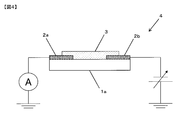
- the conductive film according to the embodiment of the present invention is formed as a first electrode 2a and a second electrode 2b at positions facing each other on the substrate 1a, and a semiconductor-type carbon nanotube or the like is formed between them.
- a semiconductor-type chemical sensor 4 or the like in which the semiconductor material 3 of the above is arranged can be considered.
- the conductive film according to the embodiment of the present invention can also be used as a detection unit of a chemical sensor.
- the first electrode 5a and the second electrode 5b are formed on the substrate 1b by metals such as gold, silver, and platinum at positions facing each other so as to cover the electrodes and the region between them.
- a chemical sensor 8 is also conceivable in which the conductive film 6 according to the embodiment of the present invention is arranged, and a sensitive layer 7 that causes a chemical change by a specific gas is arranged on the conductive electrode 6.
- the sensitive layer include a sensitive layer containing polyethylene glycol, polyethyleneimine, and a copper chelate complex.
- FIG. 5B the one shown in FIG. 5B can be considered.
- a thin film 5c of a metal such as gold, silver, or platinum is formed on the substrate 1c, a conductive film 6b according to an embodiment of the present invention is formed on the thin film 5c, and a compound that interacts with a specific ion is further formed on the thin film 6b.
- the sensitive film 7b containing the film is formed.
- the sensitive membrane 7b and the reference electrode 21 made of, for example, Ag / AgCl are brought into contact with the sample liquid for measurement.
- the potential difference between the sensitive film 7b and the reference electrode 21 changes. By reading the change, the presence of a specific ion can be detected.
- the sensitive membrane examples include a polyvinyl chloride membrane containing valinomycin and tetrakis (4-chlorophenyl) potassium borate in the case of a sensitive membrane to potassium ions.
- the conductive film according to the embodiment of the present invention functions as an ion-electron transducer.
- a biosensor is a sensor that detects the amount of physical quantities and substances related to the vital activities of living organisms, especially animals. Life activity can be said to be an activity necessary to maintain life. More specifically, information such as body temperature, electrocardiogram, myoelectricity, blood pressure, heart rate, cardiac output, blood sugar level, blood oxygen concentration, respiratory rate, and venous shape of animals such as humans is provided as an electrical signal or light. Examples include sensors that convert to signals. Examples of the form of the biosensor include a non-contact type, a touch type, a patch type, and a wearable type.
- the conductive composition according to the embodiment of the present invention has high conductivity, it can be applied to the wiring of a biosensor.
- it may be used for wiring for communication connection between the detection unit and the data logger, or may be used for power supply to the detection unit.
- the conductive composition according to the embodiment of the present invention can also be applied to a detection unit in a biosensor.
- a biosensor provided with such a detection unit the body temperature is measured by changing the resistance value of the conductive composition, or the action potential of the myocardium or skeletal muscle by the pad containing the conductive composition is measured to measure the heart. It can detect electricity and myocardium.
- the detection unit in the form of the above-mentioned piezoelectric element, blood pressure and heart rate can be measured.
- the action potential can be measured by arranging a pattern of the conductive composition according to the embodiment of the present invention on a cardiomyocyte culture dish, and an antenna material for power supply and communication in a non-contact biosensor. It is also possible to use the conductive composition according to the embodiment of the present invention.
- An actuator means an element that converts input signals such as electricity, heat, magnetic field, light, and molecular sorption (adsorption and absorption occur at the same time) into physical motion. Since the conductive film according to the embodiment of the present invention has high durability against a polar solvent, it can be applied as an electrode material for an actuator. As a form of an element that converts an electric signal into a physical motion, for example, a gel containing an ionic liquid is arranged between the conductive films according to the embodiment of the present invention. By doing so, ions move in the gel by applying a voltage to both ends of the manufactured device, causing a difference in the degree of swelling on both sides of the gel, and the device bends.
- the conductive composition according to the embodiment of the present invention it is possible to change the strength of the interaction between the (a) polymer and the (b) polymer, and it is easily reversible. Since it is possible to cause a volume change, the conductive composition itself can be applied as a soft actuator material.
- the soft actuator material is a material that can operate as an actuator by having elasticity in itself.
- a thin film of a metal such as gold is formed on a thin film, and the conductive composition according to the embodiment of the present invention is further formed on the thin film as a film containing water. Further, when a circuit is formed on the film so that the metal thin film serves as a working electrode and a voltage is applied, the water content in the formed film is vaporized by the electric energy.
- the film of the conductive composition shrinks, and the film bends accordingly.
- the film swells due to the absorption of moisture in the air and returns to its original state or bends in the opposite direction. Using this principle, it is possible to make a very small robot arm.
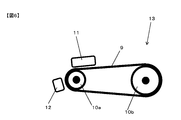
- an actuator 13 that is driven by adsorption / desorption of gas molecules without using electric energy or the like can be considered.
- the film 9 made of the conductive composition according to the embodiment of the present invention is molded into a belt shape and hung on the rotating bodies 10a and 10b.
- the organic compound gas generation source 11 holds the organic compound as a gas so that it can be separated, and for example, absorbent cotton impregnated with acetone can be considered.
- the steam generation source 12 is brought closer to this. Then, the water vapor is adsorbed on the film 9 and expands, so that a force is generated in which the film tends to bend inward.
- a flexible device is a flexible and bendable electronic circuit and a device containing the electronic circuit.
- flexible devices include stretchable devices that have elasticity, bendable devices that can be bent, rollable devices that can be rolled, and the like.
- flexible devices include flexible displays and flexible sensors. Since the conductive composition according to the embodiment of the present invention has high transparency when thinned, it is suitably used as a transparent conductive film for a flexible display.
- the flexible sensor include a wearable sensor that detects biological information in a form integrated with clothing, a body pressure distribution sensor placed on or inside a bed, and the like. Wearable sensors that are integrated with clothing are expected to enable measurement in a wide range of situations over a long period of time and to obtain more information because the wearable sensor has less restrictions on behavior and mental load associated with wearing. NS.
- the body pressure distribution sensor there is one in which a piezoelectric element containing the conductive composition according to the embodiment of the present invention is arranged on a flexible substrate. From the time variation of the body pressure distribution measured by this body pressure distribution sensor, information such as turning over and body movement can be obtained, which can be utilized for improving the quality of sleep.
- the conductive fabric according to the embodiment of the present invention is (c) a polymer having a repeating unit represented by the above formula (1) (the same as (a) a polymer), (d) formula (5). ) And / or a polymer having a repeating unit represented by the formula (6) (hereinafter, may be simply referred to as “(d) polymer”), and fibers.
- the (d) polymer also has a role as a dopant that gives an electric charge to the (a) polymer, like the (b) polymer. It also has the role of stabilizing the charge after it has been charged.
- a method for synthesizing the polymer (d) the same method as that for the polymer (b) can be adopted.
- the weight average molecular weight of the polymer (d) is preferably 1000 or more and 100,000 or less, more preferably 2100 or more and 38,000 or less, further preferably 2500 or more and 30,000 or less, and further preferably 2800 or more and 25,000 or less. More preferably, 3000 or more and 17,000 or less are particularly preferable.
- L 51 is preferably a single bond. That is, it is preferable that the polymer (d) has at least a repeating unit represented by the formula (5) and L 51 is a single bond. The reason for this is the same as for L 21 .
- R 51 is the same as that for R 21 .
- R 63 is responsible for the hydrophobic interaction with the polymer (a) like R 33, m is 1 or more. Further, when a plurality of R 33s are present, the hydrophobic interaction is enhanced, but (a) three-dimensional repulsion with the polymer is generated. Therefore, m is 1 or more and 3 or less, preferably 1 or more and 2 or less, and more preferably 1. When m is 2 or more, the plurality of R 63s may be the same or different from each other. A preferred example of R 63 is the same as for R 33 .
- the polymer (d) has a unit represented by the formula (6)
- m is 1 and Ar 6 is a naphthalene ring for the same reason as the polymer (b).
- R 63 and -L 61- R 62 are bonded to each other to different rings of the two benzene rings constituting naphthalene.
- R 61 and -L 61- R 62 are bonded to each other to different rings of two benzene rings constituting naphthalene.
- R 61 and R 63 are bonded to the same benzene ring among the two benzene rings constituting naphthalene, and -L 61- R 62 is bonded to a benzene ring different from that. ..
- R 62 are the same as for R 32 .
- L 61 is the same as for L 31 . That is, it is preferable that the polymer (d) has at least a repeating unit represented by the formula (6) and L 61 is a single bond.
- R 61 is the same as that for R 21 .
- conductive fabric in the present specification refers to not only a composite composed of (c) polymer and (d) polymer and woven fabric, but also (c) polymer and (d) polymer, knitted fabric, non-woven fabric and the like. Refers to a composite with general textile products.
- the method for producing the conductive fabric is not particularly limited.
- an aqueous solution of a water-soluble polymer fiber such as polyvinyl alcohol and an aqueous dispersion of the conductive composition according to the embodiment of the present invention are mixed and spun.
- examples thereof include a method in which the undiluted solution is extruded into an organic solvent such as acetone at a low temperature of 0 ° C. or lower, coagulated, and then dried and wound.
- the conductive composition is held on the surface of the single fibers constituting the conductive cloth and in the gap between the single fibers and the single fibers, and the conductive composition is continuous. Since a layer can be formed, high conductivity can be expected.
- the dipping method or the coating method is preferable from the viewpoint that a large amount of the conductive composition can be contained in the fiber gaps and the productivity is high.
- the method of polymerizing the monomer of the polymer (c) and the monomer of the polymer (c) in a state where the polymer is impregnated in the cloth product the conductive composition is uniformly formed even inside the conductive cloth. be able to.
- the method of (c) polymerizing the monomer of the polymer by oxidative polymerization is convenient and preferable.
- the fiber to be combined with the conductive composition is not particularly limited, and synthetic fibers such as polyester fiber, acrylic fiber, polyamide fiber, vinylon fiber, polyurethane fiber and polypropylene fiber, and natural fiber such as cotton, linen, wool, silk and cashmere, Regenerated fibers such as rayon, polynosic and cupra, semi-synthetic fibers such as nitrocellulose, acetate and biscous rayon, and special fibers such as cellulose nanofibers can be used.
- synthetic fibers such as polyester fiber, acrylic fiber, polyamide fiber, vinylon fiber, polyurethane fiber and polypropylene fiber, and natural fiber such as cotton, linen, wool, silk and cashmere, Regenerated fibers such as rayon, polynosic and cupra, semi-synthetic fibers such as nitrocellulose, acetate and biscous rayon, and special fibers such as cellulose nanofibers can be used.
- polyester fibers or polyamide fibers are more preferable, and polyester fibers that easily hold the conductive composition by controlling the cross-sectional shape are particularly preferable.
- polyester fiber may be used in combination with other types of fibers instead of the polyester fiber alone.
- polyester fibers include fibers made of polyethylene terephthalate (PET), polybutylene terephthalate (PBT), and the like.
- the fiber diameter is preferably 1 nm or more and 2000 nm or less, and more preferably 100 nm or more and 1000 nm or less.
- the fiber diameter can be measured by observing the cross section of the fiber with a scanning electron microscope (SEM) and performing as follows. 150 fibers are randomly extracted from the image obtained as a result of SEM observation, the diameter of the circumscribed circle is measured for all the fibers, and the average value is calculated.
- the morphology of the fiber may be either monofilament yarn or multifilament yarn, and the cross-sectional shape of the fiber is round, triangular, flat, star-shaped, hollow, octalobal, Y-shaped, and has a high degree of deformation.
- the shape of the irregular cross section is not particularly limited.
- the conductive fabric according to the embodiment of the present invention comprises at least a multifilament yarn, and is conductive on the surface of the monofilaments constituting the multifilament yarn and / or in the gap between the monofilaments and the monofilaments. It is preferred that the composition is present.
- a fiber having a fiber diameter of 1 nm or more and 2000 nm or less as described above it is more preferable to use a mixed fiber such as 22T-24F in terms of productivity.
- the form of the conductive cloth may be mesh, papermaking, woven fabric, knitted fabric, non-woven fabric, ribbon, string, etc., but is not particularly limited as long as it is in a form suitable for the purpose of use.
- the conductive fabric of the present invention is required to have high breathability in order to suppress stuffiness and rash caused by sweat on the skin surface from the viewpoint of adhesion and followability to the skin surface and a flexible and soft texture. Therefore, the form of the conductive fabric is preferably the shape of a woven fabric, a knitted fabric, or a non-woven fabric.
- the conductive fabric it is preferable to further contain the above-mentioned binder resin, and the preferable binder resin in that case is the same as described above.
- the content thereof is not particularly limited, but is preferably 0.1 to 1000 parts by mass with respect to 100 parts by mass of the solid content of the conductive composition, and 5 to 500 parts by mass.
- the portion is more preferable. This has the effect that sufficient strength can be obtained as a conductive fabric in the range of 0.1 parts by mass or more, and the relative content of the conductive composition in the conductive fabric is sufficient in the range of 1000 parts by mass or less. Due to the effect of being obtained and exhibiting high conductivity.
- the conductive fabric may further contain a flexibility-imparting agent.
- the flexibility-imparting agent is not particularly limited, and examples thereof include polyglycerin, polyethylene glycol, polyethylene glycol-polypropylene glycol copolymer, and the like. These may be used alone or in combination of two or more.
- the conductive fabric according to the embodiment of the present invention may be used in the form of a string in clothes, shoes, or the like, or may be used in the form of an insole of an antistatic shoe or the like.
- the conductive cloth according to the embodiment of the present invention can also be used as a bioelectrode.
- a bioelectrode is a member that receives potential (or impedance) fluctuations from a living body such as heart rate, respiratory rate, blood pressure, electrocardiogram, electromyogram, and electroencephalogram.
- the term "living body” here refers to the body of an animal in general, and the target is not limited to humans. Since bioelectrodes play a role in receiving information on living organisms, they are often used in contact with the skin.
- the bioelectrode using the conductive cloth can easily follow the movement of the body and acquire biometric information. There are many scenes that can be used for. Further, since the bioelectrode according to the embodiment of the present invention can receive the potential (or impedance) fluctuation of the living body even if it is not in the gel state, it is less likely to cause damage to the skin such as a rash, and contains metal. Because it does not, it is excellent in that it does not cause metal allergies.
- Examples of the form of the conductive fabric used for the bioelectrode include woven fabrics, knitted fabrics and non-woven fabrics. It is preferable that a sufficient amount of the conductive composition is contained in the conductive cloth, and the weight of the conductive cloth per unit area is preferably 50 g / m 2 or more and 300 g / m 2 or less.
- the amount becomes 50 g / m 2 or more, and when it is 300 g / m 2 or less, there is little discomfort during mounting. More preferably, it is 60 g / m 2 or more and 250 g / m 2 or less.
- the thickness of the conductive cloth is preferably 0.2 mm or more and 2.0 mm or less. More preferably, it is 0.3 mm or more and 1.5 mm or less.
- the size of the bioelectrode is not particularly limited as long as the signal can be detected, but it is preferable that the vertical dimension and the horizontal dimension are 2 cm or more and 20 cm or less, respectively. With this, electrical information can be acquired when the noise is small at 2 cm or more, and there is little discomfort when worn at 20 cm or less. More preferably, the vertical dimension and the horizontal dimension are 2.5 cm or more and 18 cm or less, respectively.
- a resin layer is laminated on one side of the conductive cloth.
- a resin layer is formed on the surface of the bioelectrode on the opposite side of the surface in contact with the human skin surface.
- the type and shape of the polymer constituting the resin layer are not limited as long as the humidity can be controlled, but it is preferable that the polymer is a waterproof and breathable layer having insulating properties in view of the required characteristics as a bioelectrode.
- the waterproof / breathable layer include a PTFE (polytetrafluoroethylene) porous film, a hydrophilic polyester resin, a non-porous film made of a hydrophilic elastomer such as a polyurethane resin, and a polyurethane resin microporous film from the viewpoint of discharging sweat vapor.
- the waterproof / moisture-permeable layer is preferably one in which a stretchable polyurethane resin microporous film is laminated and adhered by laminating from the viewpoint of followability to the conductive fabric.
- connection between the bioelectrode and the wiring is preferably attached with a metal snap button from the viewpoint of convenience that the bioelectrode can be easily attached and detached and replaced.
- ⁇ Wearable device> It is also preferable to use the conductive fabric according to the embodiment of the present invention to make a wearable device containing a bioelectrode.
- a wearable device having a function of collecting and analyzing information detected by a bioelectrode.
- Information that can be detected by the bioelectrode includes, but is not limited to, electrocardiographic information, myoelectric information, and electroencephalogram information.
- electrocardiographic information arrhythmia can be detected, by collecting myoelectric information, it can be determined whether or not unnecessary force is applied during sports, and by collecting brain wave information, for example, while driving a car. It is thought that it is possible to detect drowsiness and upset feelings.
- wearable devices can also be used as devices that send electricity to the body, such as low-frequency massagers and muscle stimulation muscle strengthening devices.
- a wearable device that acquires electrocardiographic information and myoelectric information is particularly preferable in order to utilize the features of the wearable device according to the embodiment of the present invention such as flexibility and elasticity.
- wearable device forms include wear (shirts), pants, spats, trousers, gloves, socks, brassieres, headbands, wristbands, armbands, legbands, footbands, neckbands, hats, bellybands, supporters, etc.
- Examples include shoes, glasses, headbands, hair ornaments, earphones, headphones, watches, etc., but are not limited to those that come into direct contact with the living body.
- a form in which a bioelectrode according to an embodiment of the present invention is contained in a grip portion of a golf club or a tennis racket is also a kind of wearable device.
- a clothing shape including the chest close to the heart of the living body is desirable, and for example, a shape such as a wear (shirt), a brassiere, or a belly band is desirable. Further, in order to acquire electrocardiographic information with high accuracy, it is desirable that the wearable device is in close contact with the skin, so that the wearable device may be brought into close contact with the skin from the outside using a belt or the like.
- FIG. 7A shows, as a wearable device according to the first embodiment of the present invention, a shirt 16 in which two bioelectrodes 15a and 15b according to the embodiment of the present invention are arranged at positions on both sides of the heart of the wearer 14. show.
- the electrocardiographic information acquired through the bioelectrodes 15a and 15b is recorded as data in the measuring / recording device 17.
- a method of transmitting the acquired / processed electrocardiographic information to a smartphone or the like and recording / displaying it is also conceivable.
- FIG. 7B shows a wearable device according to the second embodiment of the present invention.
- the second embodiment is the same as the first embodiment except that the third bioelectrode 15c is provided.
- the third bioelectrode 15c is provided to acquire electrocardiographic information more stably and accurately.
- FIG. 8 shows a wearable device according to the third embodiment of the present invention. This is to acquire myoelectric information during exercise.
- Armbands 18a and 18b and wristbands 19a and 19b are examples of those that acquire myoelectric information of arm muscles.
- leg bands 20a to 20d may be mentioned in order to acquire the myoelectric information of the foot.
- the arm bands 18a and 18b, the wristbands 19a and 19b, and the leg bands 20a to 20d are in the form of independent bands, respectively. It can also be an integrated wearable device. Further, in the third embodiment, the measurement / recording device 17a on the upper body side and the measurement / recording device 17b on the lower body side have separate configurations, but they can be integrated into either one.
- EDOT 3,4-Ethylenedioxythiophene
- PEDOT Poly (3,4-ethylenedioxythiophene).
- Example 1 (1) Synthesis of formalin condensate of naphthalene sulfonic acid 208 g of 2-naphthalene sulfonic acid (manufactured by Combi-Blocks) and 40 mL of pure water were placed in a 200 mL three-necked flask, and the inside of the flask was replaced with nitrogen. Next, the temperature was raised to 90 ° C. with stirring, and 57 g of a 37% formaldehyde aqueous solution (manufactured by Fujifilm Wako Pure Chemical Industries, Ltd.) was added dropwise over 4 hours using a dropping funnel. Then, the temperature was further raised to 102 ° C., and the mixture was stirred for 6 hours.
- a 37% formaldehyde aqueous solution manufactured by Fujifilm Wako Pure Chemical Industries, Ltd.
- the reaction was stopped by adding 160 mL of water and lowering the temperature, and 100 g of calcium carbonate was added for neutralization. After removing the generated calcium sulfate by filtration, 105 g of sodium carbonate (manufactured by Fujifilm Wako Pure Chemical Industries, Ltd.) was added, the calcium was replaced with sodium, and the sodium salt of the naphthalene sulfonic acid formarin condensate (condensation A) was added. Obtained.
- the weight average molecular weight was 2120.
- the UV-Vis spectrum after stirring for 24 hours was measured and used as the UV-Vis spectrum after the reaction.
- the UV-Vis spectrum before and after the reaction is shown in FIG. 9, and it can be seen that the absorbance increases in the wavelength region of 350 nm to 900 nm.
- the region of 750 nm to 900 nm is a wavelength region in which neither PEDOT nor the condensate A has an absorption, whereby PEDOT and the condensate A form a complex, which is different from the original individual one. It can be seen that it is in an electronic state. Absorption in the long wavelength region of 750 nm to 900 nm is due to the state in which PEDOT is doped and transitions between various energies are possible.
- the obtained reaction solution was treated with a cation exchange resin (manufactured by Organo Corporation, Amberlite 200CTH (trade name)) and an anion exchange resin (manufactured by Organo Corporation, Amberlite IRA98 (trade name)) to conduct conductivity.
- the sex composition A was obtained.
- the conductive composition A contains (a) a polymer having a repeating unit represented by the formula (8) as a polymer, and (b) having a repeating unit represented by the formula (2) as a polymer. It does not have a repeating unit represented by the formula (3), and contains a [1] polymer in which Ar 2 is a naphthalene ring, L 21 is a single bond, R 21 is a methylene group, and R 22 is a sulfonic acid group. Further, since the EDOT unit in the conductive composition A is 3.51 mmol and the repeating unit represented by the formula (2) is 7.03 mmol, (a) the repeating unit of the polymer is (a). b) A conductive composition containing twice the molar amount of repeating units of the polymer.
- the obtained conductive composition A was homogenized by passing it through a wet jet mill (manufactured by Yoshida Kikai Kogyo Co., Ltd., NanoVeta (trade name)) eight times to obtain a conductive composition dispersion liquid A. rice field.
- the dispersion state of the conductive composition dispersion liquid A was evaluated. First, the dispersion stability was evaluated. 10 mL of the conductive composition dispersion A was placed in a colorless and transparent 12 mL glass bottle, covered with a lid, and then miscible 10 times. Furthermore, it was allowed to stand on a horizontal table. Visual observation of the color intensity of the upper and lower parts of the dispersion after standing for 1 day, 1 week, and 1 month showed no difference after standing for 1 day, but after 1 week, A slight difference in color intensity was observed. From this, the dispersion stability of the conductive composition dispersion liquid A was set to "B".
- the presence or absence of gelation was evaluated. Similar to the dispersion stability evaluation, the glass bottle containing the conductive composition dispersion A, which has passed 1 day, 1 week, and 1 month after being mixed and allowed to stand, is slowly turned over 180 ° in the vertical direction and observed. bottom. At any time, it was confirmed that all the conductive composition dispersion liquid A smoothly flowed downward and did not gel.
- F indicates that gelation and / or lumps occur within 1 day
- E indicates that gelation and / or lumps occur within 1 day or more and less than 1 week
- D indicates that gelling and / or lumps occur within one week or more and less than one month.
- the evaluation of the dispersed state and the evaluation of the presence or absence of gelling are originally different indexes, but since the evaluation of the dispersed state is not important in the dispersion liquid in which gelation is observed, the evaluation of the dispersed state and the gel state are shown in Table 1. Either one of the evaluations of the presence or absence of conversion is described in the "dispersion state" column.
- Example 2 A naphthalene sulfonate formalin condensate (condensate B) was obtained in the same manner as in Example 1 (1) except that the stirring time after raising the temperature to 102 ° C. was 7 hours instead of 6 hours.
- the weight average molecular weight measured by GPC was 2540.
- a conductive composition dispersion B was obtained in the same manner as in Example 1 (2) except that the condensate B was used instead of the condensate A.
- the result of the dispersion state evaluation was "B".
- a conductive film B was obtained in the same manner as in Example 1 (3) except that the conductive composition dispersion liquid B was used instead of the conductive composition dispersion liquid A.
- the initial surface resistance value was 709 ⁇ / ⁇
- the surface resistance value after the water resistance test was 1000 ⁇ / ⁇ .
- Example 3 A naphthalene sulfonate formalin condensate (condensate C) was obtained in the same manner as in Example 1 (1) except that the stirring time after raising the temperature to 102 ° C. was 9 hours instead of 6 hours.
- the weight average molecular weight measured by GPC was 2880.
- a conductive composition dispersion C was obtained in the same manner as in Example 1 (2) except that the condensate C was used instead of the condensate A.
- the result of the dispersion state evaluation was "B".
- a conductive film C was obtained in the same manner as in Example 1 (3) except that the conductive composition dispersion liquid C was used instead of the conductive composition dispersion liquid A.
- the initial surface resistance value was 700 ⁇ / ⁇
- the surface resistance value after the water resistance test was 979 ⁇ / ⁇ .
- Example 4 A naphthalene sulfonic acid formalin condensate (condensate D) was obtained in the same manner as in Example 1 (1) except that the stirring time after raising the temperature to 102 ° C. was 10 hours instead of 6 hours.
- the weight average molecular weight measured by GPC was 3080.
- a conductive composition dispersion D was obtained in the same manner as in Example 1 (2) except that the condensate D was used instead of the condensate A.
- the result of the dispersion state evaluation was "A”.
- a conductive film D was obtained in the same manner as in Example 1 (3) except that the conductive composition dispersion liquid D was used instead of the conductive composition dispersion liquid A.
- the initial surface resistance value was 603 ⁇ / ⁇
- the surface resistance value after the water resistance test was 794 ⁇ / ⁇ .
- Example 5 Naphthalene sulfonate formalin condensation by the same method as in Example 1 (1) except that 79 g was used instead of 57 g of the 37% formaldehyde aqueous solution and the stirring time after raising the temperature to 102 ° C. was 15 hours instead of 6 hours. A product (condensate E) was obtained. The weight average molecular weight measured by GPC was 16890.
- a conductive composition dispersion E was obtained in the same manner as in Example 1 (2) except that the condensate E was used instead of the condensate A.
- the result of the dispersion state evaluation was "A”.
- a conductive film E was obtained in the same manner as in Example 1 (3) except that the conductive composition dispersion E was used instead of the conductive composition dispersion A.
- the initial surface resistance value was 605 ⁇ / ⁇
- the surface resistance value after the water resistance test was 795 ⁇ / ⁇ .
- Example 6 A naphthalene sulfonate formalin condensate (condensate F) was obtained in the same manner as in Example 5 except that the stirring time after raising the temperature to 102 ° C. was 18 hours instead of 15 hours.
- the weight average molecular weight measured by GPC was 19920.
- a conductive composition dispersion F was obtained in the same manner as in Example 1 (2) except that the condensate F was used instead of the condensate A.
- the result of the dispersion state evaluation was "A”.
- a conductive film F was obtained in the same manner as in Example 1 (3) except that the conductive composition dispersion liquid F was used instead of the conductive composition dispersion liquid A.
- the initial surface resistance value was 618 ⁇ / ⁇
- the surface resistance value after the water resistance test was 819 ⁇ / ⁇ .
- Example 7 A naphthalene sulfonate formalin condensate (condensate G) was obtained in the same manner as in Example 5 except that the stirring time after raising the temperature to 102 ° C. was 23 hours instead of 15 hours.
- the weight average molecular weight measured by GPC was 24370.
- a conductive composition dispersion G was obtained in the same manner as in Example 1 (2) except that the condensate G was used instead of the condensate A.
- the result of the dispersion state evaluation was "A”.
- a conductive film G was obtained in the same manner as in Example 1 (3) except that the conductive composition dispersion liquid G was used instead of the conductive composition dispersion liquid A.
- the initial surface resistance value was 629 ⁇ / ⁇
- the surface resistance value after the water resistance test was 840 ⁇ / ⁇ .
- Example 8 A naphthalene sulfonate formalin condensate (condensate H) was obtained in the same manner as in Example 5 except that the stirring time after raising the temperature to 102 ° C. was 38 hours instead of 15 hours.
- the weight average molecular weight measured by GPC was 37100.
- a conductive composition dispersion H was obtained in the same manner as in Example 1 (2) except that the condensate H was used instead of the condensate A.
- the result of the dispersion state evaluation was "E".
- a conductive film H was obtained in the same manner as in Example 1 (3) except that the conductive composition dispersion liquid H was used instead of the conductive composition dispersion liquid A.
- the initial surface resistance value was 701 ⁇ / ⁇
- the surface resistance value after the water resistance test was 983 ⁇ / ⁇ .
- Example 9 A conductive composition dispersion I was obtained in the same manner as in Example 4 except that 0.425 g was used instead of 1.70 g of the condensate D.
- the EDOT unit in the conductive composition I is 3.52 mmol
- the repeating unit represented by the formula (2) is 1.76 mmol.
- a conductive film I was obtained in the same manner as in Example 1 (3) except that the conductive composition dispersion liquid I was used instead of the conductive composition dispersion liquid A.
- the initial surface resistance value was 694 ⁇ / ⁇
- the surface resistance value after the water resistance test was 972 ⁇ / ⁇ .
- Example 10 A conductive composition dispersion J was obtained in the same manner as in Example 4 except that 0.85 g was used instead of 1.70 g of the condensate D.
- the EDOT unit in the conductive composition J is 3.52 mmol
- the repeating unit represented by the formula (2) is also 3.52 mmol.
- a conductive film J was obtained in the same manner as in Example 1 (3) except that the conductive composition dispersion liquid J was used instead of the conductive composition dispersion liquid A.
- the initial surface resistance value was 648 ⁇ / ⁇
- the surface resistance value after the water resistance test was 874 ⁇ / ⁇ .
- Example 11 A conductive composition dispersion K was obtained in the same manner as in Example 4 except that 5.95 g was used instead of 1.70 g of the condensate D.
- the EDOT unit in the conductive composition K is 3.52 mmol
- the repeating unit represented by the formula (2) is 24.6 mmol. Therefore, with respect to the repeating unit of the polymer (a), (B) A conductive composition containing 7 times the amount of repeating units of the polymer. The result of the dispersion state evaluation was "A".
- a conductive film K was obtained in the same manner as in Example 1 (3) except that the conductive composition dispersion liquid K was used instead of the conductive composition dispersion liquid A.
- the initial surface resistance value was 652 ⁇ / ⁇
- the surface resistance value after the water resistance test was 877 ⁇ / ⁇ .
- Example 12 A conductive composition dispersion L was obtained in the same manner as in Example 4 except that 6.80 g was used instead of 1.70 g of the condensate D.
- the EDOT unit in the conductive composition L is 3.52 mmol
- the repeating unit represented by the formula (2) is also contained in 28.1 mmol.
- a conductive film L was obtained in the same manner as in Example 1 (3) except that the conductive composition dispersion liquid L was used instead of the conductive composition dispersion liquid A.
- the initial surface resistance value was 697 ⁇ / ⁇
- the surface resistance value after the water resistance test was 961 ⁇ / ⁇ .
- Example 13 Instead of 208 g of 2-naphthalene sulfonic acid, 104 g of 2-naphthalene sulfonic acid and 20 mL of pure water are dissolved, and then treated with a strongly acidic cation resin column (LEWATTIT MONOPLUS S108H manufactured by LANXESS) to remove sodium ions and protons. Same as Example 5 except that the exchanged butylnaphthalene sulfonic acid (manufactured by Tokyo Kasei Kogyo Co., Ltd.) was 132 g and the stirring time after raising the temperature to 102 ° C. was 14 hours instead of 15 hours.
- a strongly acidic cation resin column LEOXESS
- N-BN cocondensate I Naphthalene sulfonic acid-butylnaphthalene sulfonic acid formarin cocondensate
- the N-BN cocondensate is a [3] polymer having both a repeating unit represented by the formula (2) and a repeating unit represented by the formula (3).
- the weight average molecular weight measured by GPC was 13450.
- a conductive composition dispersion M was obtained in the same manner as in Example 1 (2) except that 1.90 g of the N-BN cocondensate was used instead of 1.70 g of the condensate A.
- the result of the dispersion state evaluation was "S".
- a conductive film M was obtained in the same manner as in Example 1 (3) except that the conductive composition dispersion liquid M was used instead of the conductive composition dispersion liquid A.
- the UV-Vis spectrum before and after the reaction is shown in FIG. 10, and it can be seen that the absorbance increases in the wavelength region of 350 nm to 900 nm. As mentioned above, this indicates that PEDOT and the N-BN copolymer I form a complex in the conductive composition.
- Example 14 After 264 g of sodium butylnaphthalene sulfonate was dissolved in 40 mL of pure water, it was treated with a strong acid cation resin column to exchange sodium ions with protons.
- Example 1 except that the obtained butylnaphthalene sulfonic acid was used instead of 208 g of 2-naphthalene sulfonic acid and the stirring time after raising the temperature to 102 ° C. was 5 hours instead of 6 hours.
- the same reaction as in (1) was carried out to obtain a sodium salt of a butylnaphthalene sulfonic acid formarin condensate (condensation J).
- the weight average molecular weight measured by GPC was 2040.
- a conductive composition dispersion N was obtained in the same manner as in Example 1 (2) except that 2.10 g of the condensate J was used instead of 1.70 g of the condensate A.
- the result of the dispersion state evaluation was "A".
- the conductive composition N contains (a) a polymer having a repeating unit represented by the formula (8) as a polymer, and (b) having a repeating unit represented by the formula (3) as a polymer. It does not have a repeating unit represented by the formula (2), k is 1, Ar 3 is a tetravalent naphthalene ring, L 31 is a single bond, R 31 is a methylene group, R 32 is a sulfonic acid group, and R 33. Is a butyl group [2] containing a polymer.
- the EDOT unit in the conductive composition N is 3.52 mmol and the repeating unit represented by the formula (3) is 7.03 mmol
- (a) the repeating unit of the polymer is (a).
- a conductive film N was obtained in the same manner as in Example 1 (3) except that the conductive composition dispersion liquid N was used instead of the conductive composition dispersion liquid A.
- the initial surface resistance value was 857 ⁇ / ⁇
- the surface resistance value after the water resistance test was 1101 ⁇ / ⁇ .
- Example 15 A butylnaphthalene sulfonic acid formalin condensate (condensate K) was obtained in the same manner as in Example 14 except that the stirring time after raising the temperature to 102 ° C. was 6 hours instead of 5 hours.
- the conductive composition dispersion liquid O was obtained in the same manner as in Example 14 except that the condensate K was used instead of the condensate A.
- the result of the dispersion state evaluation was "S".
- a conductive film O was obtained in the same manner as in Example 1 (3) except that the conductive composition dispersion liquid O was used instead of the conductive composition dispersion liquid A.
- the initial surface resistance value was 773 ⁇ / ⁇
- the surface resistance value after the water resistance test was 930 ⁇ / ⁇ .
- Example 16 A butylnaphthalene sulfonic acid formalin condensate (condensate L) was obtained in the same manner as in Example 14 except that the stirring time after raising the temperature to 102 ° C. was 7 hours instead of 5 hours.
- a conductive composition dispersion P was obtained in the same manner as in Example 14 except that the condensate L was used instead of the condensate J.
- the result of the dispersion state evaluation was "S".
- a conductive film P was obtained in the same manner as in Example 1 (3) except that the conductive composition dispersion liquid P was used instead of the conductive composition dispersion liquid A.
- the initial surface resistance value was 759 ⁇ / ⁇
- the surface resistance value after the water resistance test was 910 ⁇ / ⁇ .
- Example 17 A butylnaphthalene sulfonic acid formalin condensate (condensate M) was obtained in the same manner as in Example 14 except that the stirring time after raising the temperature to 102 ° C. was 11 hours instead of 5 hours.
- a conductive composition dispersion Q was obtained in the same manner as in Example 14 except that the condensate M was used instead of the condensate J.
- the result of the dispersion state evaluation was "S".
- a conductive film Q was obtained in the same manner as in Example 1 (3) except that the conductive composition dispersion Q was used instead of the conductive composition dispersion A.
- the initial surface resistance value was 748 ⁇ / ⁇
- the surface resistance value after the water resistance test was 892 ⁇ / ⁇ .
- Example 18 A butylnaphthalene sulfonic acid formalin condensate (butylnaphthalene sulfonic acid formalin condensate) in the same manner as in Example 14 except that 79 g was used instead of 57 g of the 37% formaldehyde aqueous solution and the stirring time after raising the temperature to 102 ° C. was 16 hours instead of 5 hours. Condensate N) was obtained. The weight average molecular weight measured by GPC was 16100.
- a conductive composition dispersion R was obtained in the same manner as in Example 14 except that the condensate N was used instead of the condensate J.
- the result of the dispersion state evaluation was "S".
- a conductive film R was obtained in the same manner as in Example 1 (3) except that the conductive composition dispersion liquid R was used instead of the conductive composition dispersion liquid A.
- the initial surface resistance value was 746 ⁇ / ⁇
- the surface resistance value after the water resistance test was 888 ⁇ / ⁇ .
- Example 19 A butylnaphthalene sulfonic acid formalin condensate (condensate O) was obtained in the same manner as in Example 18 except that the stirring time after raising the temperature to 102 ° C. was 18 hours instead of 16 hours.
- a conductive composition dispersion S was obtained in the same manner as in Example 14 except that the condensate O was used instead of the condensate J.
- the result of the dispersion state evaluation was "S".
- a conductive film S was obtained in the same manner as in Example 1 (3) except that the conductive composition dispersion liquid S was used instead of the conductive composition dispersion liquid A.
- the initial surface resistance value was 760 ⁇ / ⁇
- the surface resistance value after the water resistance test was 910 ⁇ / ⁇ .
- Example 20 A butylnaphthalene sulfonic acid formalin condensate (condensate P) was obtained in the same manner as in Example 18 except that the stirring time after raising the temperature to 102 ° C. was 38 hours instead of 16 hours.
- the weight average molecular weight measured by GPC was 37,200.
- the conductive composition dispersion liquid T was obtained in the same manner as in Example 14 except that the condensate P was used instead of the condensate J.
- the result of the dispersion state evaluation was "S".
- a conductive film T was obtained in the same manner as in Example 1 (3) except that the conductive composition dispersion liquid T was used instead of the conductive composition dispersion liquid A.
- the initial surface resistance value was 774 ⁇ / ⁇
- the surface resistance value after the water resistance test was 930 ⁇ / ⁇ .
- Example 21 A butylnaphthalene sulfonic acid formalin condensate (condensed product Q) was obtained in the same manner as in Example 18 except that the stirring time after raising the temperature to 102 ° C. was 40 hours instead of 16 hours.
- the weight average molecular weight measured by GPC was 38,600.
- a conductive composition dispersion U was obtained in the same manner as in Example 14 except that the condensate Q was used instead of the condensate J.
- the result of the dispersion state evaluation was "D".
- a conductive film U was obtained in the same manner as in Example 1 (3) except that the conductive composition dispersion U was used instead of the conductive composition dispersion A.
- the initial surface resistance value was 856 ⁇ / ⁇
- the surface resistance value after the water resistance test was 1098 ⁇ / ⁇ .
- Example 22 A conductive composition dispersion V was obtained in the same manner as in Example 17 except that 0.525 g was used instead of 2.10 g of the condensate.
- the EDOT unit in the conductive composition V is 3.52 mmol
- the repeating unit represented by the formula (3) is 1.76 mmol. Therefore, with respect to the repeating unit of the polymer (a), (B) A conductive composition containing 0.5 times the amount of repeating units of the polymer. The result of the dispersion state evaluation was "S".
- a conductive film V was obtained in the same manner as in Example 1 (3) except that the conductive composition dispersion liquid V was used instead of the conductive composition dispersion liquid A.
- the initial surface resistance value was 851 ⁇ / ⁇
- the surface resistance value after the water resistance test was 1069 ⁇ / ⁇ .
- Example 23 A conductive composition dispersion W was obtained in the same manner as in Example 17 except that 1.05 g was used instead of 2.10 g of the condensate. In this case, the EDOT unit in the conductive composition W is 3.52 mmol, and the repeating unit represented by the formula (3) is also 3.52 mmol.
- B A conductive composition containing 1 times the amount of repeating units of the polymer. The result of the dispersion state evaluation was "S".
- a conductive film W was obtained in the same manner as in Example 1 (3) except that the conductive composition dispersion liquid W was used instead of the conductive composition dispersion liquid A.
- the initial surface resistance value was 797 ⁇ / ⁇
- the surface resistance value after the water resistance test was 975 ⁇ / ⁇ .
- Example 24 A conductive composition dispersion X was obtained in the same manner as in Example 17 except that 7.34 g was used instead of 2.10 g of the condensate.
- the EDOT unit in the conductive composition X is 3.52 mmol
- the repeating unit represented by the formula (3) is 24.6 mmol. Therefore, with respect to the repeating unit of the polymer (a), (B) A conductive composition containing 7 times the amount of repeating units of the polymer.
- S The result of the dispersion state evaluation was "S".
- a conductive film X was obtained in the same manner as in Example 1 (3) except that the conductive composition dispersion liquid X was used instead of the conductive composition dispersion liquid A.
- the initial surface resistance value was 802 ⁇ / ⁇
- the surface resistance value after the water resistance test was 978 ⁇ / ⁇ .
- Example 25 A conductive composition dispersion Y was obtained in the same manner as in Example 17 except that 8.39 g was used instead of 2.10 g of the condensate.
- the EDOT unit in the conductive composition Y is 3.52 mmol
- the repeating unit represented by the formula (3) is 28.1 mmol. Therefore, with respect to the repeating unit of the polymer (a), (B) A conductive composition containing 8 times the amount of repeating units of the polymer.
- S The result of the dispersion state evaluation was "S".
- a conductive film Y was obtained in the same manner as in Example 1 (3) except that the conductive composition dispersion liquid Y was used instead of the conductive composition dispersion liquid A.
- the initial surface resistance value was 853 ⁇ / ⁇
- the surface resistance value after the water resistance test was 1068 ⁇ / ⁇ .
- Example 26 Except for the fact that 280 g of sodium 2-anthracene sulfonate (manufactured by Sigma-Aldrich) was used instead of 264 g of sodium butylnaphthalene sulfonate, and that the stirring time after raising the temperature to 102 ° C. was 14 hours instead of 15 hours. Synthesized an anthracene sulfonic acid formarin condensate (condensate R) in the same manner as in Example 5. The weight average molecular weight measured by GPC was 12260.
- a conductive composition dispersion Z was obtained in the same manner as in Example 1 (2) except that 1.90 g of the condensate R was used instead of 1.70 g of the condensate A.
- the conductive composition Z contains (a) a polymer having a repeating unit represented by the formula (8) as a polymer, and (b) having a repeating unit represented by the formula (2) as a polymer. It does not have a repeating unit represented by the formula (3), and contains a [1] polymer in which Ar 2 is an anthracene ring, L 21 is a single bond, R 21 is a methylene group, and R 22 is a sulfonic acid group.
- a conductive film Z was obtained in the same manner as in Example 1 (3) except that the conductive composition dispersion liquid Z was used instead of the conductive composition dispersion liquid A.
- the initial surface resistance value was 732 ⁇ / ⁇
- the surface resistance value after the water resistance test was 1039 ⁇ / ⁇ .
- Comparative Example 1 Examples except that 1.30 g of poly (4-styrene sulfonic acid) (manufactured by Sigma-Aldrich, weight average molecular weight 75,000 (manufacturer's published value)) was used instead of 1.70 g of the naphthalene sulfonic acid formarin condensate. The reaction was carried out in the same manner as in 1 (2) to obtain a conductive composition dispersion AA. The result of the dispersion state evaluation was "E".
- poly (4-styrene sulfonic acid) manufactured by Sigma-Aldrich, weight average molecular weight 75,000 (manufacturer's published value)
- a conductive film AA was obtained in the same manner as in Example 1 (3) except that the conductive composition dispersion liquid AA was used instead of the conductive composition dispersion liquid A.
- the initial surface resistance value was 904 ⁇ / ⁇
- the surface resistance value after the water resistance test was 1524 ⁇ / ⁇ .
- Comparative Example 2 The reaction was carried out in the same manner as in Example 1 (1) except that 1.46 g of 2-naphthalene sulfonic acid was used instead of 1.70 g of the condensate A to obtain a conductive composition dispersion liquid AB. The result of the dispersion state evaluation was "C".
- a conductive film AB was obtained in the same manner as in Example 1 (3) except that the conductive composition dispersion AB was used instead of the conductive composition dispersion A.
- the initial surface resistance value was 1264 ⁇ / ⁇ , and the surface resistance value after the water resistance test was equal to or higher than the upper limit of measurement.
- a conductive composition dispersion AC was obtained in the same manner as in Example 1 (2) except that Demol N was used instead of the condensate A. The result of the dispersion state evaluation was "C".
- a conductive film AC was obtained in the same manner as in Example 1 (3) except that the conductive composition dispersion AC was used instead of the conductive composition dispersion A.
- the initial surface resistance value was 1035 ⁇ / ⁇
- the surface resistance value after the water resistance test was 1627 ⁇ / ⁇ .
- Comparative Example 4 A naphthalene sulfonic acid formalin condensate (condensate S) was obtained in the same manner as in Example 5 except that the stirring time after raising the temperature to 102 ° C. was 40 hours instead of 15 hours.
- the weight average molecular weight measured by GPC was 38260.
- a conductive composition dispersion AD was obtained in the same manner as in Example 1 (2) except that the condensate S was used instead of the condensate A.
- a conductive film AD was obtained in the same manner as in Example 1 (3) except that the conductive composition dispersion liquid AD was used instead of the conductive composition dispersion liquid A.
- the result of the dispersion state evaluation was "F".
- the conductive film AD before drying has a portion where the viscosity is locally very high and a portion where the viscosity is not (so-called “lump” is formed). Was observed.
- the initial surface resistance value was 1043 ⁇ / ⁇
- the surface resistance value after the water resistance test was 1622 ⁇ / ⁇ .
- Such a high initial surface resistance value and a low water resistance are considered to be due to the above-mentioned "lump" formation.
- Example 27 (1) Preparation of conductive fabric 66T-9F (sea island) of alkaline hot water soluble polyester composed of polyethylene terephthalate as an island component and a copolymer of terephthalic acid and 5-sodium sulfoisophthalic acid as an acid component of polyester as a sea component.
- a circular knitted fabric was knitted with a smooth structure using microfibers having a ratio of 20%: 80% and 70 islands / F). Next, the knitted fabric was immersed in a 3% by mass aqueous solution of sodium hydroxide (75 ° C., bath ratio 1:30) to remove easily soluble components, and a knitted fabric A as a microfiber fiber structure was obtained.
- the multifilament extracted from the fiber of the obtained knitted fabric A was embedded in an epoxy resin, frozen by a FC / 4E type cryosectioning system manufactured by Reichert, and cut with a Reichert Nissei ultracut N (ultramicrotome) equipped with a diamond knife. After that, the cut surface was photographed with a VE-7800 scanning electron microscope (SEM) manufactured by KEYENCE CORPORATION at a magnification of 1000. 150 randomly selected ultrafine fibers were extracted from the obtained photographs, and all the circumscribed circle diameters (fiber diameters) of the photographs were measured using image processing software (WINROOF), and the average value was calculated. The obtained fiber diameter was 2700 nm.
- the conductive composition dispersion D was applied to the knitted fabric A by a knife coating method so that the chemical application amount was 15 g / m 2, and heated at 120 ° C. to 130 ° C. for 5 minutes to obtain a conductive fabric A. ..
- Example 28 The same treatment as in Example 27 (1) was performed except that 75T-112F (sea island ratio 30%: 70%, number of islands 127 islands / F) polyester nanofibers were used instead of 66T-9F microfibers. The process was carried out to obtain a knitted fabric B which is a nanofiber fiber structure.
- the fiber diameter of the fiber of the knitted fabric B was measured by the same method as in Example 27 (1) except that the SEM magnification was observed at 5000 times, and the fiber diameter was 700 nm.
- a conductive composition dispersion D was applied to the knitted fabric B in the same manner as in Example 27 (1) to obtain a conductive fabric B.
- Example 29 A conductive cloth C was obtained in the same manner as in Example 28 except that the conductive composition dispersion liquid A was used instead of the conductive composition dispersion liquid D.
- the initial resistance value was 30.6 ⁇ and the resistance value after the washing test was 41.0 ⁇ .
- Example 30 A conductive cloth D was obtained in the same manner as in Example 28 except that the conductive composition dispersion liquid G was used instead of the conductive composition dispersion liquid D.
- the initial resistance value was 31.4 ⁇ and the resistance value after the washing test was 42.0 ⁇ .
- Example 31 The same treatment as in Example 27 (1) was performed except that 100T-30F (sea island ratio 30%: 70%, number of islands 2048 islands / F) polyester nanofibers were used instead of 66T-9F microfibers. The process was carried out to obtain a knitted fabric C which is a nanofiber fiber structure.
- the fiber diameter of the fiber of the knitted fabric C was measured by the same method as in Example 28, the fiber diameter was 300 nm.
- a conductive composition dispersion D was applied to the obtained knitted fabric C in the same manner as in Example 27 (1) to obtain a conductive fabric E.
- Example 32 The same treatment as in Example 27 (1) was performed except that 120T-60F (sea island ratio 50%: 50%, number of islands 2048 islands / F) polyester nanofibers were used instead of 66T-9F microfibers. The process was carried out to obtain a knitted fabric D which is a nanofiber fiber structure.
- the fiber diameter of the fiber of the knitted fabric D was measured by the same method as in Example 28, the fiber diameter was 200 nm.
- a conductive composition dispersion D was applied to the obtained knitted fabric D in the same manner as in Example 27 (1) to obtain a conductive cloth F.
- Example 33 Put 0.5 g of EDOT, 1.70 g of Demol N, and 100 g of water in a 300 mL Erlenmeyer flask, and after stirring for a while with a stirrer, a 10 cm ⁇ 10 cm test piece of knitted fabric B, 0.98 g of sodium persulfate, iron (II) sulfate. 0.2 g of heptahydrate was added and stirred for 24 hours. Then, the knitted fabric was taken out, washed well with water, 2-propanol, and water in this order, and heated at 130 ° C. for 5 minutes to obtain a conductive cloth G. This method of imparting a conductive composition to a knitted fabric is called a "polymerization method in cloth".
- the obtained initial resistance value and the resistance value after the washing test were slightly inferior to those of Example 28, but comparable to those of Comparative Examples 5 to 7, which will be described later. That is, in the case of the conductive fabric, the influence of the weight average molecular weight of the polymer (d) was not confirmed.
- This has a structure in which (a) a polymer and (d) a network of polymers are three-dimensionally intricate with a knitted network, forming a conductive path that exhibits high conductivity and withstanding washing. It is considered that this is due to the development of the mechanical strength that can be obtained.
- Example 34 Polymerization in the cloth was carried out in the same manner as in Example 33 except that 1.70 g of the condensate S was added instead of 1.70 g of Demol N to obtain a conductive cloth H.
- Example 35 A conductive cloth I was obtained in the same manner as in Example 28 except that the conductive composition dispersion I was used instead of the conductive composition dispersion D.
- the initial resistance value was 35.1 ⁇ and the resistance value after the washing test was 48.5 ⁇ .
- Example 36 A conductive cloth J was obtained in the same manner as in Example 28 except that the conductive composition dispersion liquid J was used instead of the conductive composition dispersion liquid D.
- the initial resistance value was 30.3 ⁇ and the resistance value after the washing test was 41.1 ⁇ .
- Example 37 A conductive cloth K was obtained in the same manner as in Example 28 except that the conductive composition dispersion K was used instead of the conductive composition dispersion D.
- the initial resistance value was 30.7 ⁇ and the resistance value after the washing test was 41.4 ⁇ .
- Example 38 A conductive cloth L was obtained in the same manner as in Example 28 except that the conductive composition dispersion liquid L was used instead of the conductive composition dispersion liquid D.
- the initial resistance value was 36.2 ⁇ and the resistance value after the washing test was 49.7 ⁇ .
- Example 39 A conductive cloth M was obtained in the same manner as in Example 28 except that the conductive composition dispersion liquid M was used instead of the conductive composition dispersion liquid D.
- the initial resistance value was 43.8 ⁇ and the resistance value after the washing test was 49.4 ⁇ .
- Example 40 A conductive cloth N was obtained in the same manner as in Example 28 except that the conductive composition dispersion liquid N was used instead of the conductive composition dispersion liquid D.
- the initial resistance value was 54.6 ⁇ and the resistance value after the washing test was 63.8 ⁇ .
- Example 41 A conductive cloth O was obtained in the same manner as in Example 28 except that the conductive composition dispersion liquid O was used instead of the conductive composition dispersion liquid D.
- the initial resistance value was 46.0 ⁇ and the resistance value after the washing test was 52.1 ⁇ .
- Example 42 A conductive cloth T was obtained in the same manner as in Example 28 except that the conductive composition dispersion liquid T was used instead of the conductive composition dispersion liquid D.
- the initial resistance value was 45.7 ⁇ and the resistance value after the washing test was 51.8 ⁇ .
- Example 43 A conductive cloth U was obtained in the same manner as in Example 28 except that the conductive composition dispersion liquid U was used instead of the conductive composition dispersion liquid D.
- the initial resistance value was 55.4 ⁇ and the resistance value after the washing test was 64.7 ⁇ .
- Example 44 A conductive cloth V was obtained in the same manner as in Example 28 except that the conductive composition dispersion liquid V was used instead of the conductive composition dispersion liquid D.
- the initial resistance value was 52.1 ⁇ and the resistance value after the washing test was 60.1 ⁇ .
- Example 45 A conductive cloth W was obtained in the same manner as in Example 28 except that the conductive composition dispersion liquid W was used instead of the conductive composition dispersion liquid D.
- the initial resistance value was 47.4 ⁇ and the resistance value after the washing test was 53.8 ⁇ .
- Example 46 A conductive cloth X was obtained in the same manner as in Example 28 except that the conductive composition dispersion liquid X was used instead of the conductive composition dispersion liquid D.
- the initial resistance value was 48.6 ⁇ and the resistance value after the washing test was 55.3 ⁇ .
- Example 47 A conductive cloth Y was obtained in the same manner as in Example 28 except that the conductive composition dispersion liquid Y was used instead of the conductive composition dispersion liquid D.
- the initial resistance value was 54.0 ⁇ and the resistance value after the washing test was 62.3 ⁇ .
- Example 48 A conductive cloth Z was obtained in the same manner as in Example 28 except that the conductive composition dispersion liquid Z was used instead of the conductive composition dispersion liquid D.
- the initial resistance value was 34.9 ⁇ and the resistance value after the washing test was 49.4 ⁇ .
- Comparative Example 5 A conductive cloth AA was obtained in the same manner as in Example 28 except that the conductive composition dispersion liquid AA was used instead of the conductive composition dispersion liquid D.
- the initial resistance value was 109 ⁇ and the resistance value after the washing test was 193 ⁇ . From this result, it can be seen that the conductive fabric according to the embodiment of the present invention has significantly improved conductivity and water resistance as compared with the conventional conductive fabric using PEDOT: PSS.
- Comparative Example 6 A conductive cloth AB was obtained in the same manner as in Example 28 except that the conductive composition dispersion liquid AB was used instead of the conductive composition dispersion liquid D.
- the initial resistance value was 1240 ⁇ and the resistance value after the washing test was 24130 ⁇ . From this result, it can be seen that the conductive fabric using low molecular weight butylnaphthalene sulfonic acid as a dopant is inferior in both conductivity and water resistance to the conductive fabric according to the embodiment of the present invention.
- Comparative Example 7 Polymerization in the cloth was carried out in the same manner as in Example 33 except that 1.30 g of poly (4-styrene sulfonic acid) was added instead of 1.70 g of Demol N to obtain a conductive cloth AC.
- Example 49 A conductive composition dispersion AE was obtained in the same manner as in Example 17 except that 0.296 g of thiophene (manufactured by Tokyo Chemical Industry Co., Ltd.) was used instead of 0.5 g of EDOT. The evaluation results are shown in Table 3.
- Example 50 Conductive composition dispersion in the same manner as in Example 17 except that 0.592 g of 3-hexylthiophene (hereinafter referred to as "3HT", manufactured by Tokyo Chemical Industry Co., Ltd.) was used instead of 0.5 g of EDOT. Obtained AF. The evaluation results are shown in Table 3.
- 3HT 3-hexylthiophene
- Example 51 The conductive composition was prepared in the same manner as in Example 17 except that 0.507 g of 3,4-dimethoxythiophene (hereinafter referred to as “DMT”, manufactured by Tokyo Chemical Industry Co., Ltd.) was used instead of 0.5 g of EDOT. A dispersion AG was obtained. The evaluation results are shown in Table 3.
- DMT 3,4-dimethoxythiophene
- Example 52 0.963 g of pyrrole (manufactured by Fujifilm Wako Pure Chemical Industries, Ltd.) instead of 0.5 g of EDOT, 8.57 g instead of 2.10 g of condensate, 0.98 g of sodium persulfate and iron (II) sulfate seven waters.
- a conductive composition dispersion AH was obtained in the same manner as in Example 17 except that 5.35 g of iron (III) chloride (anhydrous) (manufactured by Nacalai Tesque, Inc.) was used instead of 0.2 g of Japanese product. rice field. The evaluation results are shown in Table 3.
- Example 53 Conductive composition dispersion in the same manner as in Example 52, except that 1.82 g of 3,4-dimethoxypyrrole (hereinafter referred to as "DMP", manufactured by BOC Sciences) was used instead of 0.963 g of pyrrole. I got AI. The evaluation results are shown in Table 3.
- DMP 3,4-dimethoxypyrrole
- Example 54 A conductive composition in the same manner as in Example 52, except that 1.80 g of 3,4-ethylenedioxypyrrole (hereinafter referred to as "EDOP", manufactured by BOC Sciences) was used instead of 0.963 g of pyrrole. A dispersion liquid AJ was obtained. The evaluation results are shown in Table 3.
- EDOP 3,4-ethylenedioxypyrrole
- Example 55 1.74 g of p-phenol sulfonic acid (manufactured by Fujifilm Wako Pure Chemical Industries, Ltd.), 1.20 g of bromoethane (manufactured by Fujifilm Wako Pure Chemical Industries, Ltd.), potassium carbonate (Fujifilm Wako Pure Chemical Industries, Ltd.) in a 100 mL three-mouthed flask. ), 4.15 g and 50 mL of acetone were added, and the mixture was stirred in a nitrogen atmosphere for 24 hours. After distilling off the solvent, the residue was washed in the order of 150 mL of pure water and 150 mL of chloroform.
- Example 1 (1) Except for using 202 g of 4-ethoxybenzene sulfonic acid obtained instead of 208 g of 2-naphthalene sulfonic acid and setting the stirring time after raising the temperature to 102 ° C. to 12 hours instead of 6 hours.
- the same reaction as in Example 1 (1) was carried out to obtain a sodium salt of 4-ethoxybenzenesulfonic acid formarin condensate (condensation T).
- the weight average molecular weight measured by GPC was 4130.
- a conductive composition dispersion AK was obtained in the same manner as in Example 1 (2) except that 1.51 g of the condensate T was used instead of 1.70 g of the condensate A.
- the conductive composition AK contains (a) a polymer having a repeating unit represented by the formula (8) as a polymer, and (b) having a repeating unit represented by the formula (3) as a polymer. It does not have a repeating unit represented by the formula (2), k is 1, Ar 3 is a tetravalent benzene ring, L 31 is a single bond, R 31 is a methylene group, R 32 is a sulfonic acid group, and R 33. Contains the [2] polymer, which is an ethoxy group having 2 carbon atoms. The evaluation results are shown in Table 3.
- Example 56 The same reaction as in Example 55 was carried out except that 3.98 g of 1-bromoeikosan (manufactured by Fujifilm Wako Pure Chemical Industries, Ltd.) was used instead of 1.20 g of bromoethane, and 4-eicosanoxybenzenesulfonic acid was used. Got Further, the same reaction as in Example 55 was carried out except that 455 g of 4-eicosanoxybenzenesulfonic acid was used instead of 202 g of 4-ethoxybenzenesulfonic acid, and the sodium salt of 4-eicosanoxybenzenesulfonic acid formalin condensate was carried out. (Condensate U) was obtained. The weight average molecular weight measured by GPC was 4520.
- a conductive composition dispersion AL was obtained in the same manner as in Example 1 (2) except that 3.29 g of the condensate U was used instead of 1.70 g of the condensate A.
- the conductive composition AL contains (a) a polymer having a repeating unit represented by the formula (8) as a polymer, and (b) having a repeating unit represented by the formula (3) as a polymer. It does not have a repeating unit represented by the formula (2), k is 1, Ar 3 is a tetravalent benzene ring, L 31 is a single bond, R 31 is a methylene group, R 32 is a sulfonic acid group, and R 33. Contains the [2] polymer, which is an ecosanoxy group having 20 carbon atoms. The evaluation results are shown in Table 3.
- Example 57 The same reaction as in Example 55 was carried out except that 4.28 g of 1-bromodocosane (manufactured by Combi-Blocks) was used instead of 1.20 g of bromoethane to obtain 4-docosanoxybenzenesulfonic acid. Further, the same reaction as in Example 55 was carried out except that 483 g of 4-docosanonexybenzenesulfonic acid was used instead of 202 g of 4-ethoxybenzenesulfonic acid, and the sodium salt of 4-docosanonexybenzenesulfonic acid formalin condensate was carried out. (Condensate V) was obtained. The weight average molecular weight measured by GPC was 4610.
- a conductive composition dispersion AM was obtained in the same manner as in Example 1 (2) except that 3.49 g of the condensate V was used instead of 1.70 g of the condensate A.
- the conductive composition AM contains (a) a polymer having a repeating unit represented by the formula (8) as a polymer, and (b) having a repeating unit represented by the formula (3) as a polymer. It does not have a repeating unit represented by the formula (2), k is 1, Ar 3 is a tetravalent benzene ring, L 31 is a single bond, R 31 is a methylene group, R 32 is a sulfonic acid group, and R 33. Contains the [2] polymer, which is a docosyl group having 22 carbon atoms. The evaluation results are shown in Table 3.
- Example 58 Binder A (“Arrow Base SB-1030N” manufactured by Unitika Ltd.), which is a polyolefin binder resin, is added to the conductive composition dispersion liquid M prepared in Example 13 so as to have a concentration of 1 wt%, and the conductivity is increased.
- the sex composition dispersion liquid AN was used. The evaluation results are shown in Table 3.
- Example 59 Binder B (“Binder EN-ME” manufactured by Matsui Dye Chemical Industry Co., Ltd.), which is a polyacrylic binder resin, is added to the conductive composition dispersion liquid M prepared in Example 13 so that the concentration is 1 wt%. It was added to prepare a conductive composition dispersion liquid AO.
- Binder B (“Binder EN-ME” manufactured by Matsui Dye Chemical Industry Co., Ltd.), which is a polyacrylic binder resin, is added to the conductive composition dispersion liquid M prepared in Example 13 so that the concentration is 1 wt%. It was added to prepare a conductive composition dispersion liquid AO.
- Table 3 Binder EN-ME” manufactured by Matsui Dye Chemical Industry Co., Ltd.
- Example 60 Binder C (“Ucoat DA-100” manufactured by Sanyo Chemical Industries, Ltd.), which is an ether-based polyurethane binder resin, is added to the conductive composition dispersion M prepared in Example 13 so as to have a concentration of 1 wt%. Then, it was used as a conductive composition dispersion liquid AP. The evaluation results are shown in Table 3.
- Example 61 Binder D (“U-coat UWS-145” manufactured by Sanyo Chemical Industries, Ltd.), which is an ester-based polyurethane binder resin, is added to the conductive composition dispersion M prepared in Example 13 so as to have a concentration of 1 wt%. Then, it was used as a conductive composition dispersion liquid AQ. The evaluation results are shown in Table 3.
- Example 62 Binder E (“Permarin UA368T” manufactured by Sanyo Chemical Industries, Ltd.), which is a carbonate-based polyurethane binder resin, was added to the conductive composition dispersion liquid M prepared in Example 13 so as to have a concentration of 1 wt%.
- the conductive composition dispersion liquid AR was used. The evaluation results are shown in Table 3.
- Comparative Example 8 The same reaction as in Example 55 was carried out except that 1.04 g of bromomethane (manufactured by Tokyo Chemical Industry Co., Ltd.) was used instead of 1.20 g of bromoethane to obtain 4-methoxybenzenesulfonic acid. Further, the same reaction as in Example 55 was carried out except that 188 g of 4-methoxybenzene sulfonic acid was used instead of 202 g of 4-ethoxybenzene sulfonic acid, and the sodium salt of 4-methoxybenzene sulfonic acid formarin condensate (condensed product W) was carried out. ) Was obtained. The weight average molecular weight measured by GPC was 4070.
- a conductive composition dispersion AS was obtained in the same manner as in Example 1 (2) except that 1.41 g of the condensate W was used instead of 1.70 g of the condensate A.
- the conductive composition AS contains (a) a polymer having a repeating unit represented by the formula (8), and (b) a polymer having a repeating unit represented by the formula (3). It does not have a repeating unit represented by the formula (2), k is 1, Ar 3 is a tetravalent benzene ring, L 31 is a single bond, R 31 is a methylene group, R 32 is a sulfonic acid group, and R 33. Contains the [2] polymer, which is a methoxy group having 1 carbon atom. The evaluation results are shown in Table 3. From the comparison with Example 55, it can be seen that when R 33 is an alkoxy group, the number of carbon atoms is 2 or more.
- Example 63 A conductive cloth AD was obtained in the same manner as in Example 39 except that the conductive composition dispersion AN prepared in Example 58 was used instead of the conductive composition dispersion M. The evaluation results are shown in Table 4.
- Example 64 A conductive cloth AE was obtained in the same manner as in Example 39 except that the conductive composition dispersion AO prepared in Example 59 was used instead of the conductive composition dispersion M. The evaluation results are shown in Table 4.
- Example 65 A conductive cloth AF was obtained in the same manner as in Example 39 except that the conductive composition dispersion AP prepared in Example 60 was used instead of the conductive composition dispersion M. The evaluation results are shown in Table 4.
- Example 66 A conductive cloth AG was obtained in the same manner as in Example 39 except that the conductive composition dispersion AQ prepared in Example 61 was used instead of the conductive composition dispersion M. The evaluation results are shown in Table 4.
- Example 67 A conductive cloth AH was obtained in the same manner as in Example 39 except that the conductive composition dispersion liquid AR prepared in Example 62 was used instead of the conductive composition dispersion liquid M. The evaluation results are shown in Table 4.
- Example 63 to 67 the initial resistance value was reduced as compared with Example 39 even though the non-conductive binder was added. It is considered that this is because the property is improved and the conductive composition layer is uniformly formed inside the conductive cloth. In addition, it can be seen that the addition of the binder greatly improved the washing durability and made it practically usable.
- Example 68 The conductive composition coating liquid A obtained in Example 1 (3) was spin-coated (1000 rpm, 30 seconds) on a 4 cm ⁇ 4 cm polyimide film (manufactured by Toray DuPont Co., Ltd., trade name “Kapton”). The solvent was volatilized by transferring onto a hot plate and heating at 110 ° C. for 30 minutes. This is called a "lower electrode”. On top of that, a solution of poly (vinylidene fluoride-co-trifluoroethylene) (P (VDF-TrFE)) (manufactured by Solvay) dissolved in DMF so as to be 10 wt% was spin-coated at 1000 rpm for 30 seconds.
- P (VDF-TrFE) poly (vinylidene fluoride-co-trifluoroethylene)
- the piezoelectric element A is a piezoelectric element formed on a flexible base material, and can be bent together with the base material, and can be regarded as a flexible pressure sensor.
- Example 69 Gold was vacuum-deposited on a 4 cm ⁇ 4 cm polyimide film with a thickness of 150 nm using a metal mask so as to form a 1 cm ⁇ 1 cm gold electrode with wiring. The surrounding area was masked with Kapton tape.
- the conductive composition coating liquid A was spin-coated (1000 rpm, 30 seconds) and heated on a hot plate at 110 ° C. for 30 minutes to volatilize the solvent.
- Potassium chloride was dissolved in pure water so as to be 4 mM, the prepared chemical sensor A and the Ag / AgCl reference electrode were immersed therein, and the potential difference between them was measured and found to be 0.337 V.
- concentration of the potassium chloride solution was 8 mM, the potential difference was 0.343 V, and when it was 16 mM, the potential difference was 0.350 V.
- lithium chloride having the same concentration was added, no clear change in potential difference was observed. From the above, it was confirmed that the produced chemical sensor A functions as a chemical sensor that selectively detects potassium ions.
- the chemical sensor A is a chemical sensor formed on a flexible base material, and can be bent together with the base material, and can be regarded as a flexible chemical sensor.
- Example 70 A silver-plated thread "AGpos 110T-34F” manufactured by Mitsufuji Corporation was sewn and connected to a conductive cloth M produced by the method of Example 39 and cut into a size of 5 cm in length and 5 cm in width. "Tegaderm Smooth Film Roll” manufactured by 3M Japan Ltd. was attached to the surface where the silver-plated thread was located, and used as the bioelectrode A according to the embodiment of the present invention.
- the conductive cloth M produced by the method of Example 39 was cut into a size of 5 cm in length and 5 cm in width, and "Tegaderm Smooth Film Roll” manufactured by 3M Japan Ltd., which was cut into the same size, was attached. Further, a prong and a socket manufactured by YKK Snap Fastener Co., Ltd. were attached so that the side to which the film roll was attached was the attachment side, and the bioelectrode B according to the embodiment of the present invention was produced.
- the bioelectrode C was produced by the same method as the bioelectrode B except that the conductive cloth AH produced by the method of Example 67 was used.
- Bioelectrodes A were sewn with thread at three locations on the inside of a commercially available stretch sports inner, at positions 10 cm below the left side of the chest, the right side of the chest, and the left side of the chest. Further, a silver-plated thread "AGpos 110T-34F” manufactured by Mitsufuji Corporation was sewn with a thread so as not to come into contact with each other from each bioelectrode to the left clavicle.
- the wiring part was insulated and coated by attaching a waterproof seam tape " ⁇ E-110" manufactured by Toray Cortex Co., Ltd. to the front and back of the wiring part.
- a wearable device A shown in FIG. 7B which can measure an electrocardiographic waveform just by wearing it, was produced.
- Example 71 Posts and studs manufactured by YKK Snap Fastener Co., Ltd. are attached to three locations on the inside of a commercially available stretch-type sports inner, on the left side of the chest, the right side of the chest, and 10 cm below the left side of the chest.
- the wiring was attached in the same way as above.
- Example 72 A wearable device C was produced in the same manner as in Example 71 except that the bioelectrode C produced in Example 70 was used instead of the bioelectrode B.
- the bioelectrode C produced in Example 70 was used instead of the bioelectrode B.
Landscapes
- Chemical & Material Sciences (AREA)
- Chemical Kinetics & Catalysis (AREA)
- Health & Medical Sciences (AREA)
- Medicinal Chemistry (AREA)
- Polymers & Plastics (AREA)
- Organic Chemistry (AREA)
- Physics & Mathematics (AREA)
- Spectroscopy & Molecular Physics (AREA)
- Dispersion Chemistry (AREA)
- Engineering & Computer Science (AREA)
- Textile Engineering (AREA)
- Compositions Of Macromolecular Compounds (AREA)
Abstract
(a)特定の繰り返し単位を有する重合体、および、(b)以下の[1]~[3]のいずれかの重合体を含む、導電性組成物; [1]特定の繰り返し単位を有し、別の特定の繰り返し単位を有さない、重量平均分子量が2100以上、38000以下の重合体; [2]特定の繰り返し単位を有さず、別の特定の繰り返し単位を有する、重合体; [3]特定の繰り返し単位と、別の特定の繰り返し単位とのいずれをも有する、重合体; により、高い導電性を有し、かつ水に対する耐久性に優れた導電性組成物を提供する。
Description
本発明は、導電性組成物およびそれを含む導電膜、センサ、生体センサ、フレキシブルデバイス、ならびに導電性布帛およびそれを含む生体電極、ウェアラブルデバイスに関する。
有機導電性物質は、現在広く利用されているインジウムスズ酸化物(ITO)の資源不足の課題解決や、柔軟性を有する基板上への塗布形成が可能という点から、期待されている。有機導電性物質の用途として、既存のエレクトロニクス材料の単なる置き換えではなく、曲面への太陽電池の形成といった、既存材料と類似の機能を有するが、使用箇所が異なる場面も想定される。さらには、生体電極やウェアラブルデバイスのような、柔軟性を有する素材への機能性付与や(例えば、特許文献1参照)、アクチュエータといった、全く新しい分野への応用も考えられる(例えば、特許文献2参照)。
有機導電性物質の中でも特に、高い導電性と可視光領域での高い透明性を兼ね備えていることから、ポリ(3,4-エチレンジオキシチオフェン):ポリ(4-スチレンスルホン酸)複合体(PEDOT:PSS)が有望視されている(例えば、特許文献3および非特許文献1参照)。PEDOT:PSSが有する課題を解決し、有機導電性物質を実用化するために、種々の研究開発が精力的に行われている。例えば、ハードコート樹脂との相溶性を高くし、塗膜に耐傷付き性を発揮させる技術(例えば、特許文献4参照)や、スルホン酸基を有する樹脂と有機酸の存在下でチオフェンを重合することで、導電性と耐熱性に優れた導電体とする技術(例えば、特許文献5参照)が開示されている。
"Advanced Materials",(米国),2000年,12巻,p.481-494
しかしながら、これまでに開発されている有機導電性物質は、水に対する耐久性が十分ではなく、また、水に対する耐久性と高い導電性とを両立させる技術は知られていなかった。そしてそのことが幅広い応用の妨げの一つとなっていた。
本発明は、かかる課題を解決し、高い導電性を有し、かつ水に対する耐久性に優れた導電性組成物を提供することを目的とする。また、高い導電性を有し、かつ水に対する耐久性に優れた導電性布帛を提供することを目的とする。
すなわち本発明は、(a)下記式(1)で表される繰り返し単位を有する重合体、および、(b)以下の[1]~[3]のいずれかの重合体を含む、導電性組成物である。
[1]下記式(2)で表される繰り返し単位を有し、下記式(3)で表される繰り返し単位を有さない、重量平均分子量が2100以上、38000以下の重合体(以下、単に「[1]重合体」と称する場合がある。)。
[2]下記式(2)で表される繰り返し単位を有さず、下記式(3)で表される繰り返し単位を有する、重合体(以下、単に「[2]重合体」と称する場合がある。)。
[3]下記式(2)で表される繰り返し単位と、下記式(3)で表される繰り返し単位とのいずれをも有する、重合体(以下、単に「[3]重合体」と称する場合がある。)。
[1]下記式(2)で表される繰り返し単位を有し、下記式(3)で表される繰り返し単位を有さない、重量平均分子量が2100以上、38000以下の重合体(以下、単に「[1]重合体」と称する場合がある。)。
[2]下記式(2)で表される繰り返し単位を有さず、下記式(3)で表される繰り返し単位を有する、重合体(以下、単に「[2]重合体」と称する場合がある。)。
[3]下記式(2)で表される繰り返し単位と、下記式(3)で表される繰り返し単位とのいずれをも有する、重合体(以下、単に「[3]重合体」と称する場合がある。)。

(式(1)において、R11およびR12は、それぞれ独立に、水素原子、ヒドロキシ基、アルキル基、シクロアルキル基、アルケニル基、シクロアルケニル基、アルキニル基、アルコキシ基、アルキルチオ基、モノアルキルアミノ基、ジアルキルアミノ基、アリールエーテル基、アリールチオエーテル基、アリール基、ヘテロアリール基、複素環基およびハロゲン原子からなる群より選ばれる。R11とR12とで環を形成していてもよい。
Xは、酸素原子、硫黄原子、セレン原子、またはN-R13であり、R13は、水素原子、アルキル基、シクロアルキル基、アルケニル基、シクロアルケニル基、アルキニル基、アリール基、ヘテロアリール基および複素環基からなる群より選ばれる。)
Xは、酸素原子、硫黄原子、セレン原子、またはN-R13であり、R13は、水素原子、アルキル基、シクロアルキル基、アルケニル基、シクロアルケニル基、アルキニル基、アリール基、ヘテロアリール基および複素環基からなる群より選ばれる。)

(式(2)において、Ar2は、3価の芳香族炭化水素または3価の芳香族複素環である。
L21は、単結合、酸素原子、アルキレン基、アルケニレン基、アルキニレン基、アリーレン基およびヘテロアリーレン基からなる群より選ばれる。
R21はアルキレン基、アルケニレン基およびアルキニレン基からなる群より選ばれる。
R22はスルホン酸基またはその塩である。)
L21は、単結合、酸素原子、アルキレン基、アルケニレン基、アルキニレン基、アリーレン基およびヘテロアリーレン基からなる群より選ばれる。
R21はアルキレン基、アルケニレン基およびアルキニレン基からなる群より選ばれる。
R22はスルホン酸基またはその塩である。)

(式(3)において、Ar3は、(3+k)価の芳香族炭化水素または(3+k)価の芳香族複素環である。kは1以上、3以下の整数である。
L31は、単結合、酸素原子、アルキレン基、アルケニレン基、アルキニレン基、アリーレン基およびヘテロアリーレン基からなる群より選ばれる。
R31はアルキレン基、アルケニレン基およびアルキニレン基からなる群より選ばれる。
R32はスルホン酸基またはその塩である。
R33はアルキル基、シクロアルキル基、アルケニル基、シクロアルケニル基、アルキニル基、アリール基およびヘテロアリール基、炭素数2以上のアルコキシ基、炭素数2以上のチオアルコキシ基および-L32-R34からなる群より選ばれる。L32は、カルボニル基、エステル基、チオエステル基、アミド基、カーボネート基、チオカーボネート基およびジチオカーボネート基からなる群より選ばれる。R34は、アルキル基、シクロアルキル基、アルケニル基、シクロアルケニル基、アルキニル基、アリール基およびヘテロアリール基からなる群より選ばれる。)
また、本発明は、(c)下記式(1)で表される繰り返し単位を有する重合体、(d)下記式(5)および/または下記式(6)で表される繰り返し単位を有する重合体、ならびに繊維を含有する、導電性布帛である。
L31は、単結合、酸素原子、アルキレン基、アルケニレン基、アルキニレン基、アリーレン基およびヘテロアリーレン基からなる群より選ばれる。
R31はアルキレン基、アルケニレン基およびアルキニレン基からなる群より選ばれる。
R32はスルホン酸基またはその塩である。
R33はアルキル基、シクロアルキル基、アルケニル基、シクロアルケニル基、アルキニル基、アリール基およびヘテロアリール基、炭素数2以上のアルコキシ基、炭素数2以上のチオアルコキシ基および-L32-R34からなる群より選ばれる。L32は、カルボニル基、エステル基、チオエステル基、アミド基、カーボネート基、チオカーボネート基およびジチオカーボネート基からなる群より選ばれる。R34は、アルキル基、シクロアルキル基、アルケニル基、シクロアルケニル基、アルキニル基、アリール基およびヘテロアリール基からなる群より選ばれる。)
また、本発明は、(c)下記式(1)で表される繰り返し単位を有する重合体、(d)下記式(5)および/または下記式(6)で表される繰り返し単位を有する重合体、ならびに繊維を含有する、導電性布帛である。

(式(1)において、R11およびR12は、それぞれ独立に、水素原子、ヒドロキシ基、アルキル基、シクロアルキル基、アルケニル基、シクロアルケニル基、アルキニル基、アルコキシ基、アルキルチオ基、モノアルキルアミノ基、ジアルキルアミノ基、アリールエーテル基、アリールチオエーテル基、アリール基、ヘテロアリール基、複素環基およびハロゲン原子からなる群より選ばれる。R11とR12とで環を形成していてもよい。
Xは、酸素原子、硫黄原子、セレン原子、またはN-R13であり、R13は、水素原子、アルキル基、シクロアルキル基、アルケニル基、シクロアルケニル基、アルキニル基、アリール基、ヘテロアリール基および複素環基からなる群より選ばれる。)
Xは、酸素原子、硫黄原子、セレン原子、またはN-R13であり、R13は、水素原子、アルキル基、シクロアルキル基、アルケニル基、シクロアルケニル基、アルキニル基、アリール基、ヘテロアリール基および複素環基からなる群より選ばれる。)

(式(5)において、Ar5は、3価の芳香族炭化水素または3価の芳香族複素環である。
L51は、単結合、酸素原子、アルキレン基、アルケニレン基、アルキニレン基、アリーレン基およびヘテロアリーレン基からなる群より選ばれる。
R51はアルキレン基、アルケニレン基およびアルキニレン基からなる群より選ばれる。
R52はスルホン酸基またはその塩である。)
L51は、単結合、酸素原子、アルキレン基、アルケニレン基、アルキニレン基、アリーレン基およびヘテロアリーレン基からなる群より選ばれる。
R51はアルキレン基、アルケニレン基およびアルキニレン基からなる群より選ばれる。
R52はスルホン酸基またはその塩である。)
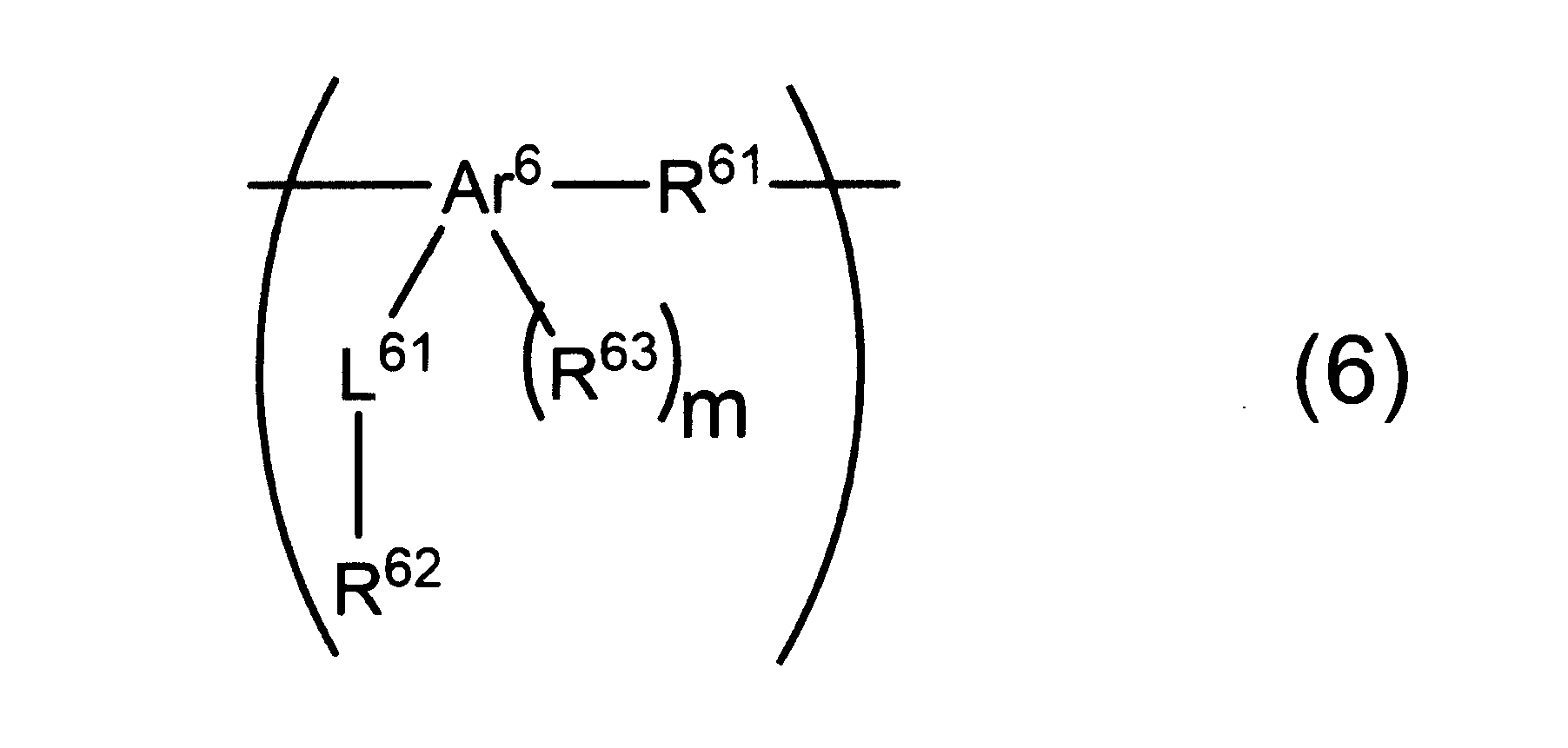
(式(6)において、Ar6は、(3+m)価の芳香族炭化水素または(3+m)価の芳香族複素環である。mは1以上、3以下の整数である。
L61は、単結合、酸素原子、アルキレン基、アルケニレン基、アルキニレン基、アリーレン基およびヘテロアリーレン基からなる群より選ばれる。
R61はアルキレン基、アルケニレン基およびアルキニレン基からなる群より選ばれる。
R62はスルホン酸基またはその塩である。
R63はアルキル基、シクロアルキル基、アルケニル基、シクロアルケニル基、アルキニル基、アリール基およびヘテロアリール基、炭素数2以上のアルコキシ基、炭素数2以上のチオアルコキシ基および-L32-R34からなる群より選ばれる。L32は、カルボニル基、エステル基、チオエステル基、アミド基、カーボネート基、チオカーボネート基およびジチオカーボネート基からなる群より選ばれる。R34は、アルキル基、シクロアルキル基、アルケニル基、シクロアルケニル基、アルキニル基、アリール基およびヘテロアリール基からなる群より選ばれる。)
L61は、単結合、酸素原子、アルキレン基、アルケニレン基、アルキニレン基、アリーレン基およびヘテロアリーレン基からなる群より選ばれる。
R61はアルキレン基、アルケニレン基およびアルキニレン基からなる群より選ばれる。
R62はスルホン酸基またはその塩である。
R63はアルキル基、シクロアルキル基、アルケニル基、シクロアルケニル基、アルキニル基、アリール基およびヘテロアリール基、炭素数2以上のアルコキシ基、炭素数2以上のチオアルコキシ基および-L32-R34からなる群より選ばれる。L32は、カルボニル基、エステル基、チオエステル基、アミド基、カーボネート基、チオカーボネート基およびジチオカーボネート基からなる群より選ばれる。R34は、アルキル基、シクロアルキル基、アルケニル基、シクロアルケニル基、アルキニル基、アリール基およびヘテロアリール基からなる群より選ばれる。)
本発明によれば、高い導電性を有し、かつ水に対する高い耐久性を示す導電性組成物を安価に提供することができる。また、高い導電性を有し、かつ水に対する耐久性に優れた導電性布帛を提供することができる。
以下、本発明に係る導電性組成物、およびそれを含む導電膜、圧電素子、化学センサ、アクチュエータ、ならびに導電性布帛およびそれを含む生体電極、ウェアラブルデバイスの好適な実施の形態を詳細に説明する。ただし、本発明は、以下の実施の形態に限定されるものではなく、目的や用途に応じて種々に変更して実施することができる。
<導電性組成物>
本発明の実施の形態に係る導電性組成物は、(a)下記式(1)で表される繰り返し単位を有する重合体、および、(b)以下の[1]~[3]のいずれかの重合体を含む。
[1]下記式(2)で表される繰り返し単位を有し、下記式(3)で表される繰り返し単位を有さない、重量平均分子量が2100以上、38000以下の重合体。
[2]下記式(2)で表される繰り返し単位を有さず、下記式(3)で表される繰り返し単位を有する、重合体。
[3]下記式(2)で表される繰り返し単位と、下記式(3)で表される繰り返し単位とのいずれをも有する、重合体。
本発明の実施の形態に係る導電性組成物は、(a)下記式(1)で表される繰り返し単位を有する重合体、および、(b)以下の[1]~[3]のいずれかの重合体を含む。
[1]下記式(2)で表される繰り返し単位を有し、下記式(3)で表される繰り返し単位を有さない、重量平均分子量が2100以上、38000以下の重合体。
[2]下記式(2)で表される繰り返し単位を有さず、下記式(3)で表される繰り返し単位を有する、重合体。
[3]下記式(2)で表される繰り返し単位と、下記式(3)で表される繰り返し単位とのいずれをも有する、重合体。
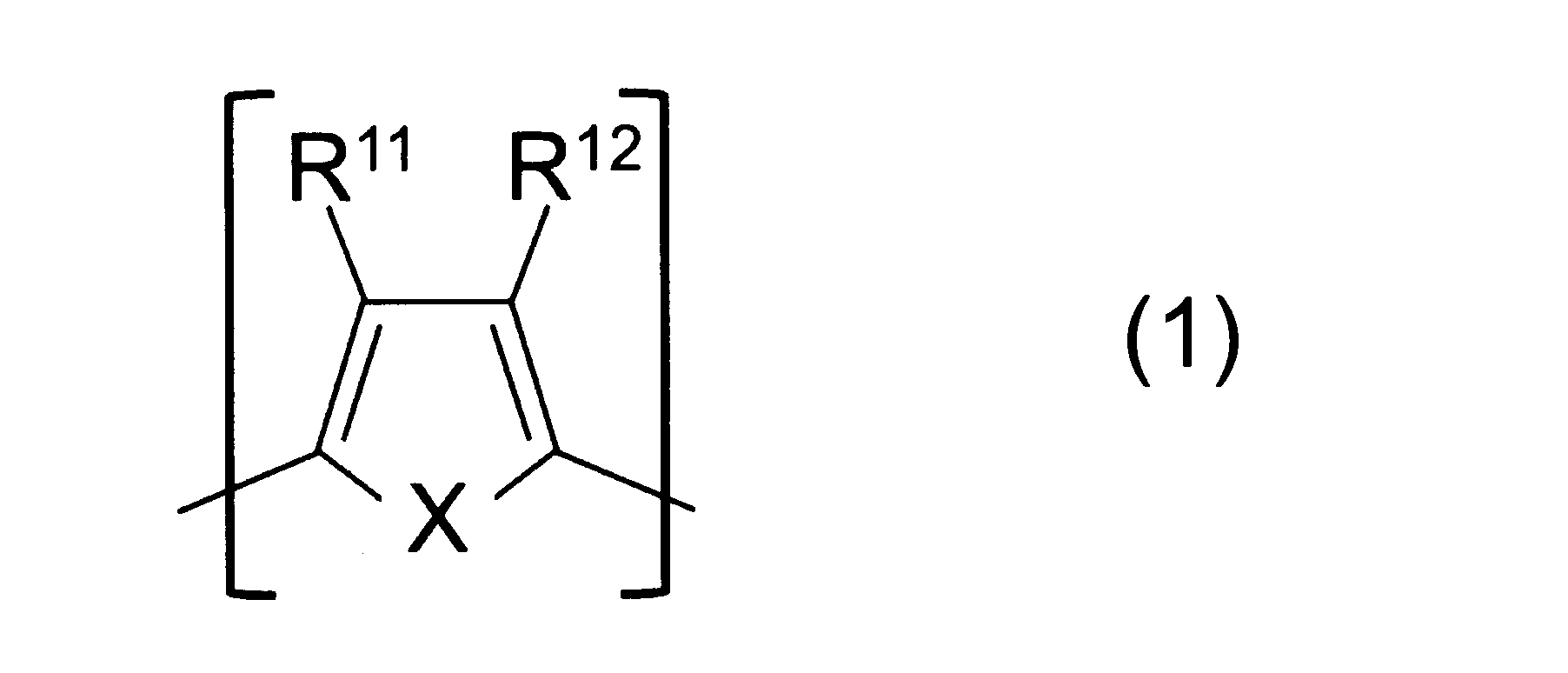
式(1)において、R11およびR12は、それぞれ独立に、水素原子、ヒドロキシ基、アルキル基、シクロアルキル基、アルケニル基、シクロアルケニル基、アルキニル基、アルコキシ基、アルキルチオ基、モノアルキルアミノ基、ジアルキルアミノ基、アリールエーテル基、アリールチオエーテル基、アリール基、ヘテロアリール基、複素環基およびハロゲン原子からなる群より選ばれる。R11とR12とで環を形成していてもよい。
Xは、酸素原子、硫黄原子、セレン原子、またはN-R13であり、R13は、水素原子、アルキル基、シクロアルキル基、アルケニル基、シクロアルケニル基、アルキニル基、アリール基、ヘテロアリール基および複素環基からなる群より選ばれる。
Xは、酸素原子、硫黄原子、セレン原子、またはN-R13であり、R13は、水素原子、アルキル基、シクロアルキル基、アルケニル基、シクロアルケニル基、アルキニル基、アリール基、ヘテロアリール基および複素環基からなる群より選ばれる。

式(2)において、Ar2は、3価の芳香族炭化水素環または3価の芳香族複素環である。
L21は、単結合、酸素原子、アルキレン基、アルケニレン基、アルキニレン基、アリーレン基およびヘテロアリーレン基からなる群より選ばれる。
R21はアルキレン基、アルケニレン基およびアルキニレン基からなる群より選ばれる。
R22はスルホン酸基またはその塩である。
L21は、単結合、酸素原子、アルキレン基、アルケニレン基、アルキニレン基、アリーレン基およびヘテロアリーレン基からなる群より選ばれる。
R21はアルキレン基、アルケニレン基およびアルキニレン基からなる群より選ばれる。
R22はスルホン酸基またはその塩である。
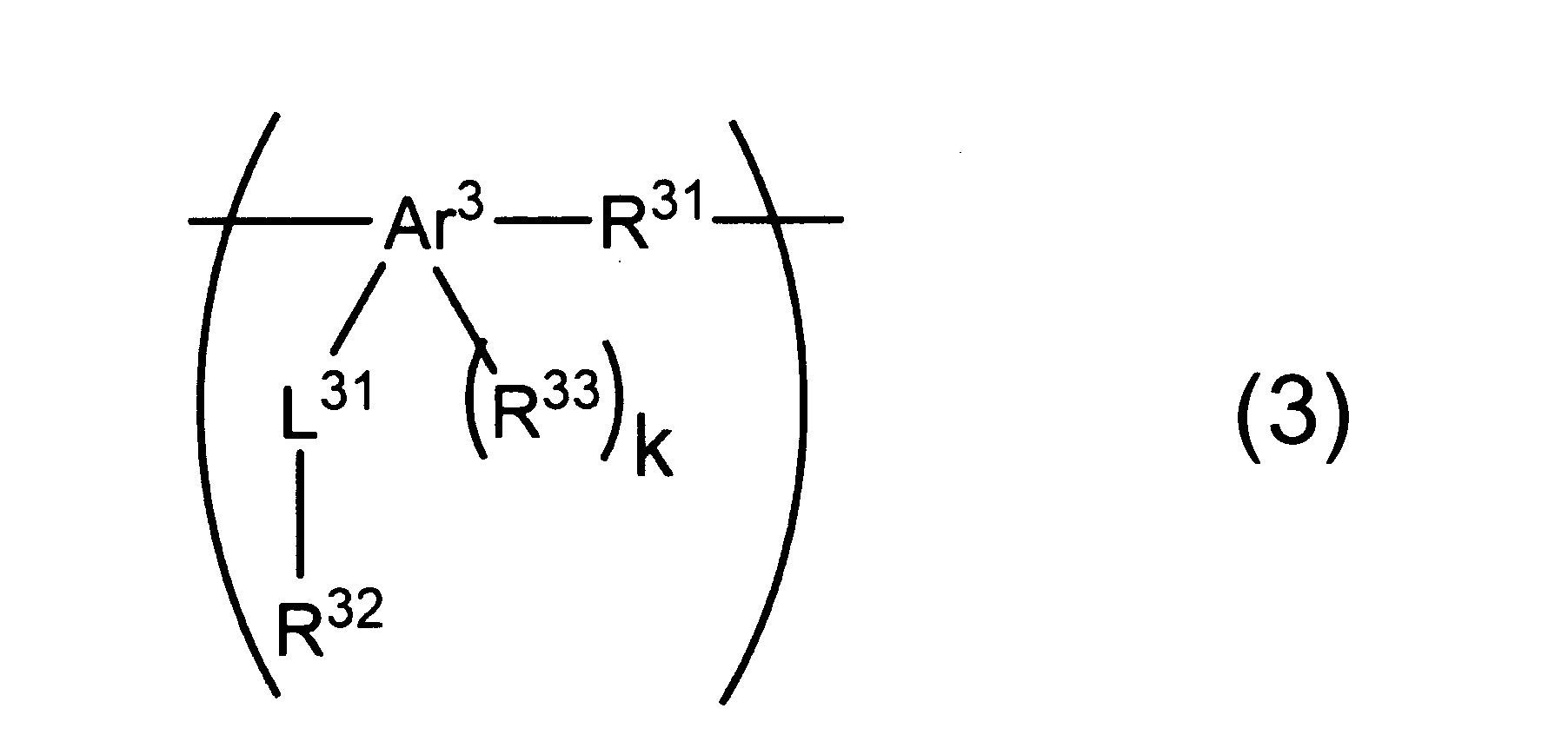
式(3)において、Ar3は、(3+k)価の芳香族炭化水素環または(3+k)価の芳香族複素環である。kは1以上、3以下の整数である。
L31は、単結合、酸素原子、アルキレン基、アルケニレン基、アルキニレン基、アリーレン基およびヘテロアリーレン基からなる群より選ばれる。
R31はアルキレン基、アルケニレン基およびアルキニレン基からなる群より選ばれる。
R32はスルホン酸基またはその塩である。
R33はアルキル基、シクロアルキル基、アルケニル基、シクロアルケニル基、アルキニル基、アリール基およびヘテロアリール基、炭素数2以上のアルコキシ基、炭素数2以上のチオアルコキシ基および-L32-R34からなる群より選ばれる。L32は、カルボニル基、エステル基、チオエステル基、アミド基、カーボネート基、チオカーボネート基およびジチオカーボネート基からなる群より選ばれる。R34は、アルキル基、シクロアルキル基、アルケニル基、シクロアルケニル基、アルキニル基、アリール基およびヘテロアリール基からなる群より選ばれる。
L31は、単結合、酸素原子、アルキレン基、アルケニレン基、アルキニレン基、アリーレン基およびヘテロアリーレン基からなる群より選ばれる。
R31はアルキレン基、アルケニレン基およびアルキニレン基からなる群より選ばれる。
R32はスルホン酸基またはその塩である。
R33はアルキル基、シクロアルキル基、アルケニル基、シクロアルケニル基、アルキニル基、アリール基およびヘテロアリール基、炭素数2以上のアルコキシ基、炭素数2以上のチオアルコキシ基および-L32-R34からなる群より選ばれる。L32は、カルボニル基、エステル基、チオエステル基、アミド基、カーボネート基、チオカーボネート基およびジチオカーボネート基からなる群より選ばれる。R34は、アルキル基、シクロアルキル基、アルケニル基、シクロアルケニル基、アルキニル基、アリール基およびヘテロアリール基からなる群より選ばれる。
上記の全ての基において、水素は重水素や三重水素であってもよい。また、以下の説明において例えば炭素数6~40の置換もしくは無置換のアリール基とは、アリール基に置換した置換基に含まれる炭素数も含めて6~40であり、炭素数を規定している他の置換基もこれと同様である。
アルキル基とは、例えば、メチル基、エチル基、n-プロピル基、イソプロピル基、n-ブチル基、sec-ブチル基、tert-ブチル基などの飽和脂肪族炭化水素基を示し、これは置換基を有していても有していなくてもよい。置換されている場合の追加の置換基には特に制限は無く、例えば、アルキル基、アリール基、ヘテロアリール基等を挙げることができ、この点は、以下の記載にも共通する。また、アルキル基の炭素数は特に限定されないが、入手の容易性やコストの点から、好ましくは1以上20以下、より好ましくは1以上12以下の範囲であり、特に好ましくは1以上8以下の範囲である。
シクロアルキル基とは、例えば、シクロプロピル基、シクロヘキシル基、ノルボルニル基、アダマンチル基などの飽和脂環式炭化水素基を示し、これは置換基を有していても有していなくてもよい。アルキル基部分の炭素数は特に限定されないが、好ましくは、3以上20以下の範囲である。
アルケニル基とは、例えば、ビニル基、アリル基、ブタジエニル基などの二重結合を含む不飽和脂肪族炭化水素基を示し、これは置換基を有していても有していなくてもよい。アルケニル基の炭素数は特に限定されないが、好ましくは、2以上20以下の範囲である。
シクロアルケニル基とは、例えば、シクロペンテニル基、シクロペンタジエニル基、シクロヘキセニル基などの二重結合を含む不飽和脂環式炭化水素基を示し、これは置換基を有していても有していなくてもよい。シクロアルケニル基の炭素数は特に限定されないが、好ましくは、4以上20以下の範囲である。
アルキニル基とは、例えば、エチニル基などの三重結合を含む不飽和脂肪族炭化水素基を示し、これは置換基を有していても有していなくてもよい。アルキニル基の炭素数は特に限定されないが、好ましくは、2以上20以下の範囲である。
アルコキシ基とは、例えば、メトキシ基、エトキシ基、プロポキシ基などのエーテル結合を介して脂肪族炭化水素基が結合した官能基を示し、この脂肪族炭化水素基は置換基を有していても有していなくてもよい。アルコキシ基の炭素数は特に限定されないが、好ましくは、1以上20以下の範囲である。
アルキルチオ基とは、アルコキシ基のエーテル結合の酸素原子が硫黄原子に置換されたものである。アルキルチオ基の炭化水素基は置換基を有していても有していなくてもよい。アルキルチオ基の炭素数は特に限定されないが、好ましくは、1以上20以下の範囲である。
アリールエーテル基とは、例えば、フェノキシ基など、エーテル結合を介した芳香族炭化水素基が結合した官能基を示し、芳香族炭化水素基は置換基を有していても有していなくてもよい。アリールエーテル基の炭素数は特に限定されないが、好ましくは、6以上40以下の範囲である。
アリールチオエーテル基とは、アリールエーテル基のエーテル結合の酸素原子が硫黄原子に置換されたものである。アリールエーテル基における芳香族炭化水素基は置換基を有していても有していなくてもよい。アリールエーテル基の炭素数は特に限定されないが、好ましくは、6以上40以下の範囲である。
芳香族炭化水素環とは、芳香族性を有する、単環または縮合環からなる炭化水素環である。例として、ベンゼン環、ナフタレン環、インデン環、アントラセン環、フルオレン環、フェナントレン環、ピレン環、フルオレン環、フェナントレン環、ベンゾ[a]アントラセン環、フルオランテン環、ジベンゾ[a,h]アントラセン環、ジベンゾ[a,h]ピレン環、3,4-ベンゾピレン環、クリセン環、テトラセン環、ペンタセン環、ナフト[2,3-a]ピレン環、ペリレン環、コランヌレン環、コロネン環などが挙げられる。芳香族炭化水素環の炭素数は特に限定されないが、好ましくは、6以上40以下の範囲であり、入手の容易性やコストの点から、より好ましくは、6以上24以下の範囲であり、更に好ましくは、ベンゼン環、ナフタレン環である。
アリール基とは、少なくともベンゼン環構造を1つ含有する、芳香族炭化水素環または芳香族炭化水素環の集合体から水素原子一個を取り去ってなる基である。芳香族炭化水素環の集合体とは、芳香族炭化水素環同士が単結合で連結した範囲のひとまとまりのユニットをいう。アリール基の具体例としては、フェニル基、ナフチル基、ビフェニル基、ターフェニル基、フェナントリル基、アントラセニル基、ピレニル基、フルオランテニル基などが挙げられる。アリール基は、置換基を有していても有していなくてもよい。アリール基の炭素数は特に限定されないが、好ましくは、6以上40以下の範囲であり、より好ましくは、6以上24以下の範囲であり、更に好ましくは、フェニル基、1-ナフチル基、2-ナフチル基である。
アリーレン基とは、少なくともベンゼン環構造を1つ含有する芳香族炭化水素環または芳香族炭化水素環の集合体から水素原子二個を取り去ってなる基である。具体例としては、フェニレン基、ビフェニレン基、ナフチレン基、フルオレニレン基などが挙げられる。より具体的には、1,4-フェニレン基、1,3-フェニレン基、1,2-フェニレン基、4,4’-ビフェニレン基、4,3’-ビフェニレン基、3,3’-ビフェニレン基、1,4-ナフタレニレン基、1,5-ナフタレニレン基、2,5-ナフタレニレン基、2,6-ナフタレニレン基、2,7-ナフタレニレン基、1,3,5-フェニレン基などが挙げられる。アリーレン基は、置換基を有していても有していなくてもよい。アリーレン基の炭素数は特に限定されないが、好ましくは、6以上40以下の範囲であり、より好ましくは、6以上24以下の範囲であり、更に好ましくは、1,4-フェニレン基、1,3-フェニレン基、4,4’-ビフェニレン基、4,3’-ビフェニレン基である。
芳香族複素環とは、炭素以外の原子を一個または複数個環内に有する、芳香族性の、単環または縮合環である。例としては、フラン環、ベンゾフラン環、ジベンゾフラン環、チオフェン環、ベンゾチオフェン環、ジベンゾチオフェン環、イソチアゾール環、チアジアゾール環、チアゾール環、ピリジン環、キノリン環、ピリミジン環、ピラジン環、トリアジン環、キノキサリン環、キナゾリン環、インドリル環、アクリジン環、ポルフィリン環などが挙げられる。芳香族複素環の炭素数は特に限定されないが、好ましくは、2以上30以下の範囲である。より好ましくは、ピリジン環、ピリミジン環、トリアジン環、キノリン環、キナゾリン環、カルバゾール環である。
ヘテロアリール基とは、少なくとも芳香族複素環構造を1つ含有する、芳香族複素環または芳香族複素環の集合体から水素原子一個を取り去ってなる基である。芳香族複素環の集合体とは、芳香族複素環同士が単結合で連結した範囲のひとまとまりのユニットをいう。ヘテロアリール基の具体例としては、フラニル基、チオフェニル基、ピリジル基、キノリニル基、イソキノリニル基、ピラジニル基、ピリミジル基、ナフチリジル基、トリアジニル基、ベンゾフラニル基、ベンゾチオフェニル基、インドリル基、ジベンゾフラニル基、ジベンゾチオフェニル基、カルバゾリル基、ビピリジル基などが挙げられる。炭素以外の原子を一個または複数個環内に有する環状芳香族基を示し、これは無置換でも置換されていてもかまわない。ヘテロアリール基の炭素数は特に限定されないが、好ましくは、2以上30以下の範囲である。より好ましくは、ピリジル基、ピリミジル基、トリアジニル基、キノリル基、カルバゾリル基である。
ヘテロアリーレン基とは、少なくとも芳香族複素環構造を1つ含有する、芳香族複素環または芳香族複素環の集合体から水素原子一個を取り去ってなる基である。具体例としては、2,6-ピリジレン基、2,5-ピリジレン基、2,4-ピリジレン基、3,5-ピリジレン基、3,6-ピリジレン基、2,4,6-ピリジレン基、2,4-ピリミジレン基、2,5-ピリミジレン基、4,6-ピリミジレン基、4,6-ピリミジレン基、2,4,6-ピリミジレン基、2,4,6-トリアジニレン基、4,6-ジベンゾフラニレン基、2,6-ジベンゾフラニレン基、2,8-ジベンゾフラニレン基、3,7-ジベンゾフラニレン基などが挙げられる。ヘテロアリーレン基は、置換基を有していても有していなくてもよい。ヘテロアリーレン基の炭素数は特に限定されないが、好ましくは、2~30の範囲である。
ハロゲン原子とは、より具体的には、フッ素、塩素、臭素、ヨウ素などの第17族に属する原子である。
モノアルキルアミノ基とは、窒素原子に水素原子と上記のアルキル基が結合した基を表す。
ジアルキルアミノ基とは、窒素原子に上記のアルキル基が2つ結合した基を表す。この場合に、それら2つのアルキル基は同一であっても、異なっていてもよい。また、2つのアルキル基で環を形成していてもよい。
複素環基とは、例えば、ピラン環、ピペリジン環、環状アミドなどの炭素以外の原子を環内に有する脂肪族環を示し、これは置換基を有していても有していなくてもよい。複素環は、共役が環状に連結して芳香族性とならない限り、環内に二重結合を1つ以上有していてもよい。複素環基の炭素数は特に限定されないが、好ましくは、2以上20以下の範囲である。
アルキレン基とは、例えば、メチレン基、エチレン基、n-プロピレン基、イソプロピレン基、n-ブチレン基、sec-ブチレン基、tert-ブチレン基、シクロプロピレン基、シクロヘキシレン基、ノルボルニレン基などの2価の飽和脂肪族炭化水素基を示し、これは置換基を有していても有していなくてもよい。置換基を有している場合の追加の置換基には特に制限はなく、例えば、アルキル基やメトキシ基、エトキシ基などのアルコキシ基などを挙げることができ、これらはさらに置換基を有していてもよい。また、アルキレン基の炭素数は、特に限定されないが、入手の容易性やコストの点から、1以上20以下が好ましく、より好ましくは1以上8以下である。
アルケニレン基とは、例えば、ビニレン基、プロペニレン基、ブタジエニレン基などの二重結合を含む2価の不飽和脂肪族炭化水素基を示し、これは置換基を有していても有していなくてもよい。アルケニル基の炭素数は特に限定されないが、好ましくは、2以上20以下の範囲である。
アルキニレン基とは、例えば、エチニレン基、プロピニレン基、ブタジイニレン基などの三重結合を含む2価の不飽和脂肪族炭化水素基を示し、これは置換基を有していても有していなくてもよい。アルキニル基の炭素数は特に限定されないが、好ましくは、2以上20以下の範囲である。
R11とR12とで環を形成するとは、R11に含まれる原子の少なくとも1つとR12に含まれる原子の少なくとも1つとが連結していることをいう。
本発明の実施の形態に係る導電性組成物においては、(b)[1]~[3]のいずれかの重合体(以下、単に「(b)重合体」と称する場合がある)がドーパントの役割を担い、一般式(1)で表される繰り返し単位を有する重合体(以下、単に「(a)重合体」と称する場合がある)に正電荷が生じることによって、導電性が向上すると考えられている。このようなドーピング現象の発現と、生じる電荷の安定化のため、(a)重合体と、(b)重合体とが複合体を形成していることが好ましい。
ここで、「複合体」とは、2種類以上の化合物成分に由来し、各成分が、成分間の何らかの相互作用によって一体的に存在し、かつ元の個々の性質とは異なる性質を示す状態にあるもの、を言う。すなわち、単に系中に2種類以上の化合物成分が存在しているだけで、各成分が、元の性質を保ったままの状態にある「混合物」とは異なるものである。導電性物質においては、複合体を形成している場合は、その電子的状態が混合物の場合から変化することが特徴である。
2種類以上の化合物成分が、成分間の相互作用によって一体的に存在していることを確認する方法としては、マトリックス支援レーザー脱離イオン化飛行時間型質量分析(MALDI-TOF-MS)法が挙げられる。また、電子的状態の変化は、分光法全般を用いることができ、吸光光度法(紫外可視(UV-Vis)分光光度法)、ラマン分光法、X線光電子分光法(XPS)などが挙げられる。これらの中でも、明瞭な変化が簡便に得られるため、本明細書では複合体形成を確認する手法として、吸光光度法を採用する。吸光光度法において、元の成分のスペクトルの重ね合わせとは異なるスペクトルが得られた場合には、化合物間で電子的な相互作用が存在しているため、複合体が形成されていると考えられる。
原料化合物の吸光スペクトルの形状が鋭い場合は、特に判別しやすい。例えば、PEDOTとPSSとからなる導電性組成物の場合について説明する。単独で存在するPEDOTは、図1に示すような吸光スペクトルを有する。また、PSSは図2に示すような吸光スペクトルを有する。このように、PEDOTは350nm~750nmの範囲に、PSSは440nm以下の範囲に、それぞれ有効な光吸収を示す。これに対し、PSS存在下でPEDOTを合成し、それらが複合体を形成した状態とすると、図3に示すような吸光スペクトルとなり、波長500nm以上の広い領域に光吸収を示すようになる。複合体を構成する成分であるPEDOT、PSSいずれも750nm~900nmの範囲には、光吸収を有さないため、これらの成分間で電子的な相互作用が存在し、複合体を形成していることが確認できる。
導電性組成物に含まれる(a)重合体や(b)重合体の化学構造の決定には、赤外吸収分光法(IR)、固体核磁気共鳴法(NMR)および、熱分解ガスクロマトグラフィー(GC)-質量分析法(MS)を用いる。熱分解GC-MSによって繰り返し単位や、部分構造の質量を求めることができる。その質量の情報と、IRおよび固体NMRから得られる情報を組み合わせることで、官能基の種類および各官能基の連結様式を特定することができる。
導電性組成物に含まれる重合体の化学構造の決定には、赤外吸収分光法(IR)、固体核磁気共鳴法(NMR)および、熱分解ガスクロマトグラフィー(GC)-質量分析法(MS)を用いる。熱分解GC-MSによって繰り返し単位や、部分構造の質量を求めることができる。その質量の情報と、IRおよび固体NMRから得られる情報を組み合わせることで、官能基の種類および各官能基の連結様式を特定することができる。
<(a)一般式(1)で表される繰り返し単位を有する重合体>
先述の通り、本発明の実施の形態に係る導電性組成物においては、(a)重合体と(b)重合体とが複合体を形成していることが好ましい。その場合、(a)重合体上には正電荷が生じる。(a)重合体はその電荷を安定化する構造を有していることが好ましい。そのような構造として、例えば、孤立電子対を有する酸素原子や窒素原子を含む構造がある。
先述の通り、本発明の実施の形態に係る導電性組成物においては、(a)重合体と(b)重合体とが複合体を形成していることが好ましい。その場合、(a)重合体上には正電荷が生じる。(a)重合体はその電荷を安定化する構造を有していることが好ましい。そのような構造として、例えば、孤立電子対を有する酸素原子や窒素原子を含む構造がある。
一般式(1)で表される繰り返し単位において、R11およびR12は、それぞれ独立に、水素原子、アルキル基、アルコキシ基、アルキルチオ基、アリールエーテル基、アリールチオエーテル基、アリール基、ヘテロアリール基、複素環基であることが好ましく、水素原子、アルキル基、アルコキシ基、アルキルチオ基であることがより好ましい。また、R11とR12とで環を形成していることも、(a)重合体の主鎖を剛直にし、高い導電性が得られるため、好ましい。
一般式(1)で表される繰り返し単位において、Xは硫黄原子であることが好ましい。単量体の反応性が高く、重合が容易であるという観点と、生成した重合体の分子軌道が大きいために、電荷キャリアの受け渡しが容易で高い導電性が得られるという観点とからである。
(a)重合体は、下記式(4)で表される繰り返し単位を有する重合体であることが好ましい。
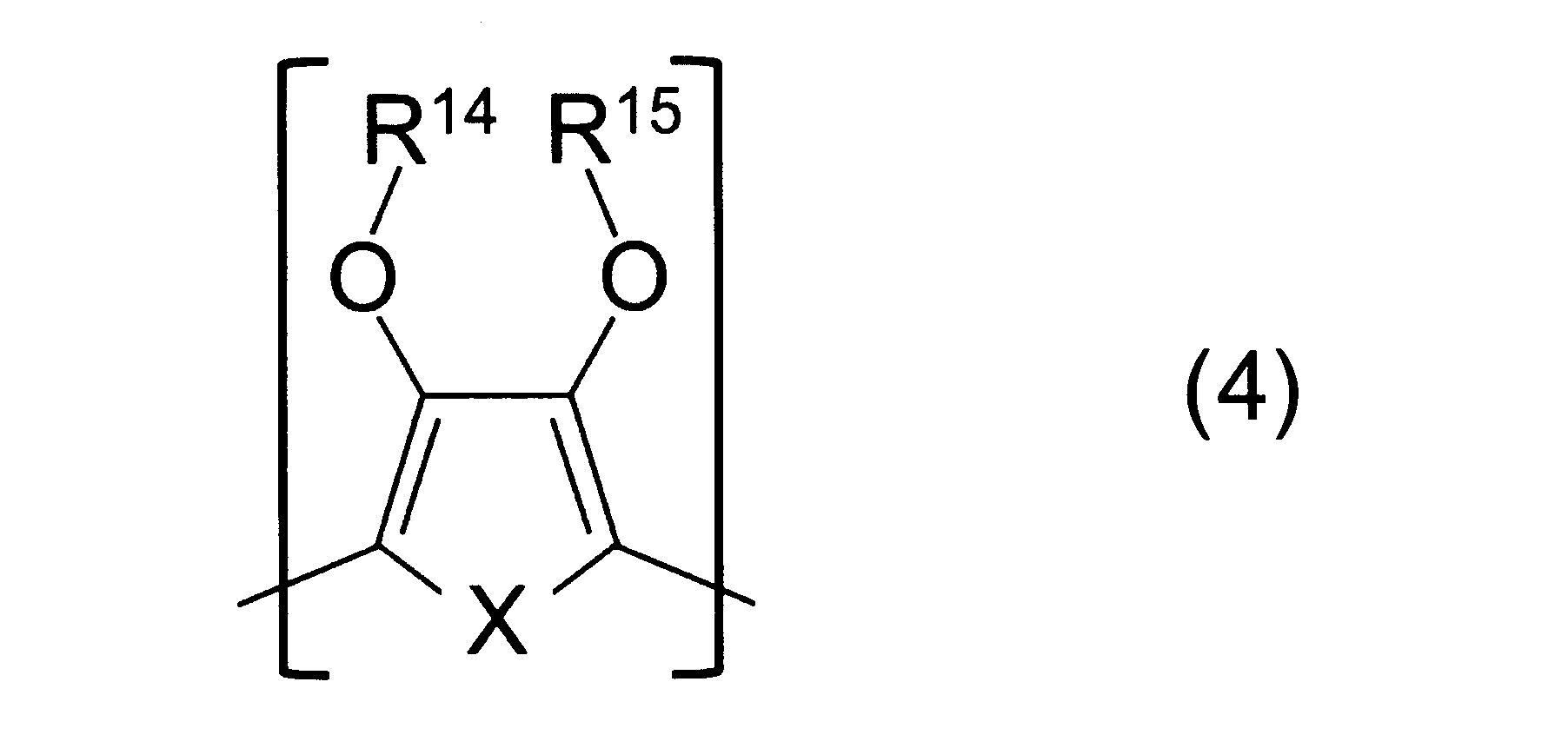
式(4)において、R14およびR15は、それぞれ独立に、水素原子、アルキル基、シクロアルキル基、アルケニル基、シクロアルケニル基、アルキニル基、アリール基およびヘテロアリール基からなる群より選ばれる。R14とR15とで環を形成していてもよい。
また、式(4)で表される繰り返し単位において、R14およびR15が、それぞれ独立に、炭素数1~6のアルキル基、シクロアルキル基、アルケニル基、シクロアルケニル基、アルキニル基およびアリール基からなる群より選ばれる基であるか、R14とR15で環を形成していることが好ましい。このような構造であることにより、式(4)で表される繰り返し単位を有する重合体と(b)重合体との間の疎水性相互作用が大きくなる。これにより複合体がより安定化する。また、両者が強く相互作用している方が、式(4)で表される繰り返し単位を有する重合体のドーピングレベルを上げられ、ひいては導電性が向上する。
さらに、式(4)で表される繰り返し単位どうしの相互作用を大きくし、導電性を向上させるために、R14とR15とで環を形成していることがより好ましく、(a)重合体は、下記式(7)で表される構造であることがより好ましい。

式(1)で表される繰り返し単位は、下記式(8)で表される3,4-エチレンジオキシチオフェン構造であることが特に好ましい。
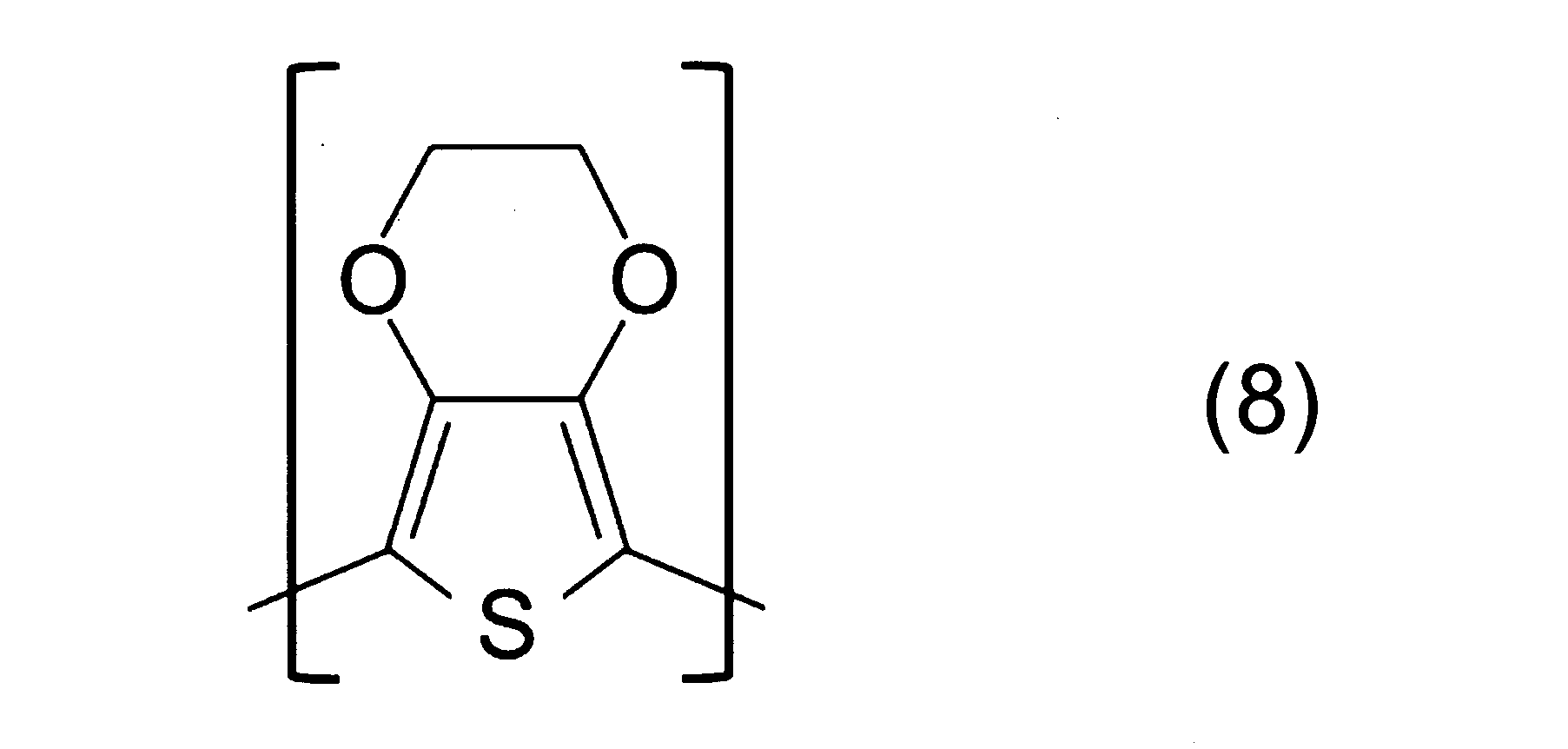
(a)重合体の重量平均分子量は、高い導電性を得る観点から1000以上が好ましく、取り扱いやすさの観点から10000以下が好ましい。
<(b)重合体>
上述のように、(b)重合体は、一般式(1)で表される繰り返し単位を有する重合体に電荷を与えるドーパントとしての役割を有する。また、電荷を与えた後、その電荷を安定化する役割もある。
上述のように、(b)重合体は、一般式(1)で表される繰り返し単位を有する重合体に電荷を与えるドーパントとしての役割を有する。また、電荷を与えた後、その電荷を安定化する役割もある。
(b)重合体を合成する方法としては、芳香族炭化水素環または芳香族複素環のハロゲン二置換体とアルキンを、パラジウム錯体とハロゲン化銅(I)を触媒として、薗頭カップリング反応させることによって重合した後、発煙硫酸を用いた芳香族求電子置換反応によってスルホン酸基を導入する方法や、スルホン酸基を導入した芳香族炭化水素環または芳香族複素環とホルムアルデヒドとを脱水縮合させる方法などが挙げられる。アルキニレン基に対してLindlar触媒による接触水素化を行えば、アルケニレン基によって連結された重合体が得られる。重合反応の際にR33を有する芳香族環を用いれば、一般式(3)で表される繰り返し単位を有する重合体を得ることができる。
[1]重合体の重量平均分子量は、分散安定化の観点から2100以上であり、2500以上が好ましく、2800以上がより好ましく、3000以上がさらに好ましい。また、ゲル状化抑制の観点から38000以下であり、30000以下が好ましく、25000以下がより好ましく、17000以下がさらに好ましい。
[2]重合体および[3]重合体は、R33の立体障害によって(b)重合体の立体的な広がりが促され、ゲル状になることが抑制されるとともに、分散性が高まるため、分子量の影響は[1]重合体と比べ小さい。加えて、R33によって(a)重合体との相互作用が向上するため、複合体形成の化学的駆動力が大きく、ドーピングレベル、ひいては導電性が向上する。
[2]重合体および[3]重合体の重量平均分子量は、1000以上、100000以下が好ましく、2100以上、38000以下がより好ましく、2500以上、30000以下がさらに好ましく、2800以上、25000以下がさらにより好ましく、3000以上、17000以下が特に好ましい。
本明細書における重量平均分子量は、以下の条件のGPC(ゲル透過クロマトグラフィー)測定の結果得られるものを用いる。
溶離液:30mM CH3COONa:CH3CN=6:4
検出波長:280nm
標準物質:ポリスチレンスルホン酸ナトリウム換算。
溶離液:30mM CH3COONa:CH3CN=6:4
検出波長:280nm
標準物質:ポリスチレンスルホン酸ナトリウム換算。
式(2)中のAr2および式(3)中のAr3は、(a)重合体と疎水性相互作用する能力を備えていることが好ましいため、芳香族炭化水素環が好ましい。また、本発明の導電性組成物を分散液の状態で用いるための高い分散状態を得ることや、酸素等による酸化に対する安定性を担保することを考慮すると、π電子系は大き過ぎない方がよい。
これらのことから、Ar2およびAr3は、ベンゼン環、ナフタレン環、ベンゾジチオフェン環、ジベンゾフラン環、カルバゾール環、アントラセン環、フェナントレン環、ピレン環、フルオランテン環、ピリジン環、ピリミジン環、トリアジン環、キノリン環、イソキノリン環、キナゾリン環、キノキサリン環、ナフチリジン環、アクリジン環、テトラセン環、トリフェニレン環、クリセン環、ペンタセン環、アントラジチオフェン環、ピセン環、ペリレン環、コランヌレン環が好ましく、これらの中でもナフタレン環、アントラセン環、フェナントレン環、ピレン環、アクリジン環、テトラセン環、ペリレン環がより好ましく、ナフタレン環、アントラセン環、フェナントレン環がさらに好ましく、ナフタレン環が特に好ましい。
疎水性相互作用をより強力なものとするため、Ar3が炭素数10以上、22以下の芳香族炭化水素環または芳香族複素環であることが好ましい。すなわち、(b)重合体が、[2]または[3]重合体であり、Ar3が炭素数10以上、22以下の芳香族炭化水素環または芳香族複素環であることが好ましい。そのような芳香族炭化水素環または芳香族複素環の具体例としては、ナフタレン環、アントラセン環、アクリジン環、フェナントレン環が好ましく、ナフタレン環が特に好ましい。
R22に関し、スルホン酸塩としては、アルカリ金属塩、アルカリ土類金属塩、アンモニウム塩、テトラアルキルアンモニウム塩、などが挙げられる。中でも、アルカリ金属塩、アンモニウム塩、テトラアルキルアンモニウム塩といった一価の塩が好ましい。塩のカチオンが一価であると、一つのカチオンが一つの重合体としか相互作用しない。そのため、(b)重合体どうしが相互作用せずに分離しやすくなる。それによって、分散液の分散性が高まり、また、導電膜中で導電経路が形成されやすくなるからである。
L21は単結合であることが好ましい。これは、Ar2とR22とが互いに立体的に近くに存在していることが好ましいからである。その理由は以下のように推定される。本発明の導電性組成物において、一般式(1)で表される繰り返し単位は、中性状態と、ドーピングされたカチオン状態との間で常に変換されている。中性状態においては、一般式(1)で表される繰り返し単位と一般式(2)中のAr2とのπ電子相互作用が優勢となり、カチオン状態においては、一般式(1)で表される繰り返し単位と一般式(2)中のR22との静電相互作用が優勢となる。これら二つの状態間の変換は非常に速いため、Ar2とR22の両方が常に一般式(1)の繰り返し単位と相互作用できる程度に近傍に存在していることが好ましい。
R21は、(a)重合体との複合体の形成しやすさを高めるために、式(2)で表される繰り返し単位を有する重合体の屈曲性を高める観点からアルキレン基が好ましい。また、合成の容易さから、メチレン基がさらに好ましい。
前述の通り、R33は(a)重合体との疎水性相互作用を担うため、kは1以上である。また、R33が複数存在すると、疎水性相互作用は増強されるが、(a)重合体との間の立体的な反発が発生するようになる。よって、kは1以上3以下であり、1以上2以下であることが好ましく、1であることがさらに好ましい。なお、kが2以上の場合、複数のR33は互いに同一でも、異なっていてもよい。
R33は疎水性相互作用を担うために、親水性を発現するヘテロ原子を有する場合は炭素数が2以上であることが好ましい。また、R33がアルコキシ基またはチオアルコキシ基である場合は、炭素数の上限としては特に制限はないが、入手の容易性や扱いやすさなどから、30以下が好ましく、20以下がより好ましい。
R33は、疎水性の観点と、前述のような立体的な反発を避けるという観点から、アルキル基、シクロアルキル基、アルケニル基、アリール基がより好ましく、アルキル基、シクロアルキル基、アリール基がさらに好ましく、アルキル基、アリール基が特に好ましい。アルキル基の中でも炭素数が1以上、8以下のものがより好ましい。すなわち、(b)重合体が[2]または[3]重合体であり、R33が炭素数1以上、8以下のアルキル基であることが好ましい。アルキル基の炭素数は2以上、7以下がさらに好ましく、3以上、6以下が特に好ましい。
式(3)の最も好ましい形態の一つとして、kが1であり、Ar3がナフタレン環であり、R33と-L31-R32が互いに、ナフタレンを構成する2つのベンゼン環の異なる環にそれぞれ結合していることが好ましい。これは、R33が疎水性相互作用を担うのに対し、-L31-R32は静電相互作用を担うことに起因する。すなわち、互いに異なる環に結合している方が、R33が-L31-R32から受ける電荷の影響が小さくなり、有効に疎水性相互作用できるため好ましい。また、同様に、隣接する繰り返し単位へ電荷の影響が伝わらない方が良いため、R31と-L31-R32が互いに、ナフタレンを構成する2つのベンゼン環の異なる環にそれぞれ結合していることが好ましい。すなわち、R31とR33とがナフタレンを構成する2つのベンゼン環のうち同一のベンゼン環に結合し、-L31-R32がそれとは異なる方のベンゼン環に結合していることが特に好ましい。
R32について好ましい例としては、R22に対するものと同様である。L31について好ましい例としては、L21に対するものと同様である。R31について好ましい例としては、R21に対するものと同様である。
先述の通り、式(2)中のR22、および/または式(3)中のR32は、式(1)で表される繰り返し単位のカチオン状態と静電相互作用する。この静電相互作用している領域と、水分子のような極性分子との相互作用が強くなることが、耐水性を低下させる原因であった。
これに対し、[1]重合体の重量平均分子量を上記範囲とするか、Ar3にR33を少なくとも一つ導入する((b)重合体に式(3)で表される繰り返し単位をもたせる)ことによって、疎水性相互作用を高めることが有効である。これによって、R22および/またはR32の静電相互作用場への、水分子のような極性分子の接近を阻害し、耐水性を向上させることができる。
[3]重合体の場合、式(2)で表される構造に対して式(3)で表される構造が、モル量で0.3倍以上、3倍以下含まれていることが好ましい。例えば、後述するようなナフタレンスルホン酸-ブチルナフタレンスルホン酸ホルマリン共縮合物の場合、ナフタレンスルホン酸とブチルナフタレンスルホン酸を等モル量仕込んでナフタレンスルホン酸-ブチルナフタレンスルホン酸ホルマリン共縮合物とすると、式(2)で表される構造に対して式(3)で表される構造が、モル量で1倍含まれた[3]重合体ということになる。
本発明の実施の形態に係る導電性組成物においては、式(2)および/または式(3)で表される繰り返し単位の数が、式(1)で表される繰り返し単位の数の、モル量で0.1倍以上、30倍以下であることが好ましく、0.5倍以上、20倍以下であることがより好ましく、0.75倍以上、10倍以下であることがさらに好ましく、1倍以上、7倍以下であることが特に好ましい。例えば、後述するような、(a)重合体がPEDOTであり、(b)重合体がナフタレンスルホン酸ホルマリン縮合物である導電性組成物の場合について説明する。(a)重合体の繰り返し単位である3,4-エチレンジオキシチオフェン単位の式量は140.15g/molであり、ナフタレンスルホン酸ホルマリン縮合物の式量は220.24g/molである。すなわち、PEDOTが140.15g、ナフタレンスルホン酸ホルマリン縮合物が220.24gとなるように合成および/または調合した導電性組成物においては式(2)および/または式(3)で表される繰り返し単位の数が、式(1)で表される繰り返し単位の数の、モル量で1倍となる。
<導電性組成物の製造方法>
本発明の実施の形態に係る導電性組成物の製造方法は特に限定されるものではないが、最も簡便で経済的な方法としては、(b)重合体の存在下において、(a)重合体を与えるモノマーを酸化重合する方法が好ましい。
本発明の実施の形態に係る導電性組成物の製造方法は特に限定されるものではないが、最も簡便で経済的な方法としては、(b)重合体の存在下において、(a)重合体を与えるモノマーを酸化重合する方法が好ましい。
酸化重合反応を行う際の酸化剤としては、ペルオキソ二硫酸、ペルオキソ二硫酸ナトリウム、ペルオキソ二硫酸カリウム、ペルオキソ二硫酸アンモニウム、無機酸化第二鉄塩、有機酸化第二鉄塩、過酸化水素、過マンガン酸カリウム、二クロム酸カリウム、過ホウ酸アルカリ塩、および銅塩などが挙げられる。これらのうち、ペルオキソ二硫酸、ペルオキソ二硫酸ナトリウム、ペルオキソ二硫酸カリウムおよびペルオキソ二硫酸アンモニウムが最も好適である。
酸化重合時における反応液のpHは2以下であることが好ましく、1.5以下であることがより好ましい。上記の酸化剤の中で、ペルオキソ二硫酸を選択した場合には、これを反応系に加えると、通常、pHが1.5以下となるので好適である。反応系には、必要に応じて酸を加えることによりpHを調整することができる。
重合温度は、比較的低温とすることにより、重合速度が遅くなり多くの重合体が複合される。しかしながら、重合速度が遅くなりすぎると、重合体が効率よく得られない。そのため、重合温度は0~100℃であり、副反応を抑制する観点から、好ましくは0~50℃であり、さらに好ましくは0~30℃である。
また、重合反応を行う時間は、酸化剤の種類、量、重合温度および反応液のpHなどに依存するが、1~100時間が好ましく、10~48時間がより好ましい。
その他の重合方法として、(a)重合体を与えるモノマーを電極上での電気化学反応によって重合させる、電解重合も可能である。
<導電性組成物分散液>
導電性組成物を含有する導電膜、圧電素子、センサ、化学センサ、生体センサ、アクチュエータ、フレキシブルデバイスなどを作製するために、本発明の実施の形態に係る導電性組成物は分散液の状態で用いることが好ましい。また、該分散液は後述する導電性布帛の作製に用いることもできる。以下、溶媒について説明するが、本明細書においては、導電性組成物および/またはその他成分を完全に溶解させるもの(即ち、「溶媒」)と、不溶成分を分散させるもの(即ち、「分散媒」)とは特に区別せずに、いずれも「溶媒」と記載する。
導電性組成物を含有する導電膜、圧電素子、センサ、化学センサ、生体センサ、アクチュエータ、フレキシブルデバイスなどを作製するために、本発明の実施の形態に係る導電性組成物は分散液の状態で用いることが好ましい。また、該分散液は後述する導電性布帛の作製に用いることもできる。以下、溶媒について説明するが、本明細書においては、導電性組成物および/またはその他成分を完全に溶解させるもの(即ち、「溶媒」)と、不溶成分を分散させるもの(即ち、「分散媒」)とは特に区別せずに、いずれも「溶媒」と記載する。
用いる溶媒としては、特に限定されず、例えば、
水;
メタノール、エタノール、1-プロパノール、2-プロパノール、1-ブタノール、エチレングリコール、プロピレングリコール、グリセリンなどの1価または多価のアルコール類ならびにそれらのエーテル誘導体およびアセテート誘導体;
N-メチル-2-ピロリドン(NMP)、N,N-ジメチルアセトアミド(DMA)、N-メチルホルムアミド、N,N-ジメチルホルムアミド(DMF)、アセトアミド、N-エチルアセトアミド、N-フェニル-N-プロピルアセトアミド、ベンズアミドなどのアミド類;
アセトン、2-ブタノンなどのケトン類;
ジメチルスルホキシド(DMSO);
テトラヒドロフラン;
アセトニトリル;
などが挙げられる。
水;
メタノール、エタノール、1-プロパノール、2-プロパノール、1-ブタノール、エチレングリコール、プロピレングリコール、グリセリンなどの1価または多価のアルコール類ならびにそれらのエーテル誘導体およびアセテート誘導体;
N-メチル-2-ピロリドン(NMP)、N,N-ジメチルアセトアミド(DMA)、N-メチルホルムアミド、N,N-ジメチルホルムアミド(DMF)、アセトアミド、N-エチルアセトアミド、N-フェニル-N-プロピルアセトアミド、ベンズアミドなどのアミド類;
アセトン、2-ブタノンなどのケトン類;
ジメチルスルホキシド(DMSO);
テトラヒドロフラン;
アセトニトリル;
などが挙げられる。
これらの溶媒の中でも、水、メタノール、エタノール、1-プロパノール、2-プロパノール、1-ブタノール、エチレングリコール、アセトン、2-ブタノン、DMF、DMSO、NMPがより好ましく、水、エチレングリコール、DMF、DMSO、NMPがさらに好ましい。これらの溶媒は単独で用いても良いし、2種類以上を併用しても良い。
導電性組成物分散液中の導電性組成物濃度は、0.1重量%~10重量%が好ましい。
分散液においては、導電性組成物の平均粒径は1nm以上、5μm以下であることが好ましい。これは、平均粒径が5μm以下の方が分散状態を安定に保ちやすく、平均粒径が1nm以上の方が粒子構造を保ちやすいからである。
さらに、導電膜に適用する場合における膜形成時の平滑性の観点や、導電性布帛や生体電極に適用する場合における繊維間への浸潤しやすさの観点から、平均粒径は1nm以上、1μm以下がより好ましく、5nm以上、500nm以下が特に好ましい。繊維間隙の奥まで浸潤した粒子は強力に担持され、物理衝撃に対する耐久性も高まる。
粒子の平均粒径は動的光散乱法(DLS)におけるメジアン径(D50)として求めることができる。
また、導電性組成物単独の分散液ではなく、バインダー樹脂とともに分散させた分散液としてもよい。バインダー樹脂を用いることにより、基板や繊維への導電性高分子の担持が強固になるとともに、耐水性のさらなる向上が期待できる。
使用するバインダー樹脂としては、熱硬化性樹脂であってもよいし、熱可塑性樹脂であってもよい。例えば、
ポリエチレンテレフタレート、ポリブチレンテレフタレート、ポリエチレンナフタレートなどのポリエステル;
ポリイミド;
ポリアミドイミド;
ポリアミド6、ポリアミド6,6、ポリアミド12、ポリアミド11などのポリアミド;
ポリフッ化ビニリデン、ポリフッ化ビニル、ポリテトラフルオロエチレン、エチレンテトラフルオロエチレンコポリマー、ポリクロロトリフルオロエチレンなどのフッ素樹脂;
ポリビニルアルコール、ポリビニルエーテル、ポリビニルブチラール、ポリ酢酸ビニル、ポリ塩化ビニルなどのビニル樹脂;
エポキシ樹脂;
キシレン樹脂;
アラミド樹脂;
ポリエチレン、ポリプロピレン、シクロオレフィンポリマー(環状ポリオレフィン)、それらを変性したポリマーや、ポリ塩化ビニル、ポリスチレンなどをオレフィン変性したポリマー、などのオレフィン樹脂;
ポリイミドシリコーン;
ポリウレタン(ウレタン樹脂);
ポリウレア;
メラミン樹脂;
フェノール樹脂;
ポリエーテル;
アクリル樹脂及びこれらの共重合体
などが挙げられる。
ポリエチレンテレフタレート、ポリブチレンテレフタレート、ポリエチレンナフタレートなどのポリエステル;
ポリイミド;
ポリアミドイミド;
ポリアミド6、ポリアミド6,6、ポリアミド12、ポリアミド11などのポリアミド;
ポリフッ化ビニリデン、ポリフッ化ビニル、ポリテトラフルオロエチレン、エチレンテトラフルオロエチレンコポリマー、ポリクロロトリフルオロエチレンなどのフッ素樹脂;
ポリビニルアルコール、ポリビニルエーテル、ポリビニルブチラール、ポリ酢酸ビニル、ポリ塩化ビニルなどのビニル樹脂;
エポキシ樹脂;
キシレン樹脂;
アラミド樹脂;
ポリエチレン、ポリプロピレン、シクロオレフィンポリマー(環状ポリオレフィン)、それらを変性したポリマーや、ポリ塩化ビニル、ポリスチレンなどをオレフィン変性したポリマー、などのオレフィン樹脂;
ポリイミドシリコーン;
ポリウレタン(ウレタン樹脂);
ポリウレア;
メラミン樹脂;
フェノール樹脂;
ポリエーテル;
アクリル樹脂及びこれらの共重合体
などが挙げられる。
これらバインダー樹脂は、有機溶剤に溶解されていてもよいし、スルホン酸基やカルボン酸基などの官能基が付与されて水溶液化されていてもよいし、乳化など水に分散されていてもよい。また、これらは単独で用いても良いし、2種以上を併用しても良い。
バインダー樹脂の中でも、容易に混合できることから、ウレタン樹脂、ポリエステル、アクリル樹脂、ポリアミド、ポリイミド、エポキシ樹脂、オレフィン樹脂、ポリイミドシリコーンのいずれか1種以上が好ましい。これらの中でも、ウレタン樹脂、アクリル樹脂およびオレフィン樹脂のうち1種を含むことがより好ましく、ウレタン樹脂またはオレフィン樹脂がさらに好ましい。ウレタン樹脂は、縮合させるジオール(ポリオール)モノマーの種類により、ポリエーテル系、ポリエステル系、ポリカーボネート系などがあるが、ポリエステル系またはポリカーボネート系のウレタン樹脂がより好ましい。
導電性組成物分散液はさらに導電性向上剤を含んでいてもよい。導電性向上剤としては、特に限定されないが、例えば、沸点が100℃以上で分子内に2つ以上のヒドロキシ基を有する化合物、沸点が100℃以上で分子内に少なくとも1つのスルフィニル基を有する化合物、沸点が60℃以上で分子内に少なくとも1つのカルボニル基を有する化合物、沸点が100℃以上で分子内に少なくとも1つのアミド基を有する化合物等が挙げられる。これらの導電性向上剤は、単独で用いても良いし、2種以上を併用しても良い。なお、「沸点が100℃以上」の化合物は、必ずしも沸点を示す必要は無く、100℃よりも高い温度で分解し、沸点を示さない化合物でもよい。
沸点が100℃以上で分子内に2つ以上のヒドロキシ基を有する化合物としては、例えば、エチレングリコール、ジエチレングリコール、プロピレングリコール、トリメチレングリコール、β-チオジグリコール、トリエチレングリコール、トリプロピレングリコール、1,4-ブタンジオール、1,5-ペンタンジオール、1,3-ブタンジオール、1,6-ヘキサンジオール、ネオペンチルグリコール、カテコール、シクロヘキサンジオール、シクロヘキサンジメタノール、グリセリン、エリトリトール、インマトール、ラクチトール、マルチトール、マンニトール、ソルビトール、キシリトール、スクロースなどが挙げられる。
沸点が100℃以上で分子内に少なくとも1つのスルフィニル基を有する化合物としては、例えば、ジメチルスルホキシド(DMSO)などが挙げられる。
沸点が60℃以上で分子内に少なくとも1つのカルボニル基を有する化合物としては、例えば、アクリル酸、メタクリル酸、メタン酸、エタン酸、プロパン酸、ブタン酸、ペンタン酸、ヘキサン酸、オクタン酸、デカン酸、ドデカン酸、安息香酸、p-トルイル酸、p-クロロ安息香酸、p-ニトロ安息香酸、1-ナフトエ酸、2-ナフトエ酸、フタル酸、イソフタル酸、シュウ酸、マロン酸、コハク酸、アジピン酸、マレイン酸、フマル酸などが挙げられる。
沸点が100℃以上で分子内に少なくとも1つのアミド基を有する化合物としては、例えば、N-メチル-2-ピロリドン、N,N-ジメチルアセトアミド、N-メチルホルムアミド、N,N-ジメチルホルムアミド、アセトアミド、N-エチルアセトアミド、N-フェニル-N-プロピルアセトアミド、ベンズアミドなどが挙げられる。
導電性組成物分散液が導電性向上剤を含有する場合、その含有量は特に限定されないが、導電性組成物100質量部に対して0.01~100000質量部が好ましく、0.1~10000質量部がより好ましい。これは、導電性向上剤の含有量が0.01質量部以上で十分な導電性向上効果が得られ、100000質量部以下で基板や導電性布帛へ塗布や含浸させた後の乾燥工程で良好な乾燥性が得られるからである。
導電性組成物分散液はさらに、界面活性剤、レベリング剤、消泡剤などを含有していてもよい。界面活性剤とレベリング剤が同一の化合物であってもよいし、界面活性剤とレベリング剤とが異なる化合物であってもよい。また、複数種の界面活性剤や複数種のレベリング剤を併用しても良い。
<導電膜>
本発明の実施の形態に係る導電性組成物は、水などの極性溶媒へ分散させた状態の分散液とし、スピンコート法、スクリーン印刷法などによって容易に塗布することが可能である。このような塗布膜を乾燥させることで、導電膜とすることができる。この膜は、本発明の実施の形態に係る導電性組成物を含む導電膜である。
本発明の実施の形態に係る導電性組成物は、水などの極性溶媒へ分散させた状態の分散液とし、スピンコート法、スクリーン印刷法などによって容易に塗布することが可能である。このような塗布膜を乾燥させることで、導電膜とすることができる。この膜は、本発明の実施の形態に係る導電性組成物を含む導電膜である。
本発明の実施の形態に係る導電膜は、例えば、太陽電池や有機電界発光素子の電極への適用が考えられる。本発明の実施の形態に係る導電性組成物は、可視光域に大きな吸収を持たないため、太陽電池へ適用した場合、高い変換効率が期待でき、有機電界発光素子へ適用した場合、高い光取出し効率が期待できる。その他にも、後述するように、圧電素子、化学センサ、またはアクチュエータの電極としても好適に用いられるし、化学センサの検出部として用いることもできる。また、本発明の実施の形態に係る導電性組成物自体を、ソフトアクチュエータ材料として用いることもできるし、本発明の実施の形態に係る導電性組成物と繊維と組み合わせることにより導電性布帛とすることもできる。
<圧電素子>
圧電素子とは、圧力が加えられた場合に、そのエネルギーを電圧に変換する素子のことである。圧電性重合体(例えばポリフッ化ビニリデン(PVDF))上に、スピンコート法やスクリーン印刷などの印刷法によって、本発明の実施の形態に係る導電膜を形成し、これを電極とすることにより、本発明の実施の形態に係る導電性組成物を含む圧電素子を作製することができる。本発明の実施の形態に係る圧電素子は、自動扉のセンサやボタンスイッチ、タッチパネルなどに利用することができる。また、後述するウェアラブルデバイスと組み合わせてもよい。例えば、靴型のウェアラブルデバイスの靴底に圧電素子を備えて体重負荷の偏りをモニタリングしたり、下着型のウェアラブルデバイスに圧電素子を備えて脈波を検出したりすることが考えられる。
圧電素子とは、圧力が加えられた場合に、そのエネルギーを電圧に変換する素子のことである。圧電性重合体(例えばポリフッ化ビニリデン(PVDF))上に、スピンコート法やスクリーン印刷などの印刷法によって、本発明の実施の形態に係る導電膜を形成し、これを電極とすることにより、本発明の実施の形態に係る導電性組成物を含む圧電素子を作製することができる。本発明の実施の形態に係る圧電素子は、自動扉のセンサやボタンスイッチ、タッチパネルなどに利用することができる。また、後述するウェアラブルデバイスと組み合わせてもよい。例えば、靴型のウェアラブルデバイスの靴底に圧電素子を備えて体重負荷の偏りをモニタリングしたり、下着型のウェアラブルデバイスに圧電素子を備えて脈波を検出したりすることが考えられる。
<センサ>
センサとは、知ろうとする対象の物理量を、扱うことのできる信号に変換する素子のことをいう。変換する物理量により、力(圧力)センサ、速度センサ、流量センサ、温度センサ、光(電磁波・放射線)センサ、磁気センサ、寸法センサ、変位センサ、化学センサ、生体センサなどに分類される。
センサとは、知ろうとする対象の物理量を、扱うことのできる信号に変換する素子のことをいう。変換する物理量により、力(圧力)センサ、速度センサ、流量センサ、温度センサ、光(電磁波・放射線)センサ、磁気センサ、寸法センサ、変位センサ、化学センサ、生体センサなどに分類される。
本発明の実施の形態に係る導電性組成物は、種々の形態でセンサに適用することができる。例えば、センサの配線、電極、検出部、加温(加熱)エレメント、基板、外装・筐体などに用いることができる。
本発明の実施の形態に係る導電性組成物は高い導電性を有するため、センサにおける配線材料として使用することができるし、電気化学的検出や半導体式検出における電極材料として使用することができる。
本発明の実施の形態に係る導電性組成物それ自体を検出部に用いる場合は、導電性組成物の抵抗値の変化からセンシングを行うことができる。例えば、本発明の実施の形態に係る導電性組成物を含む導電膜上に特定の化合物と相互作用するような感応膜を形成することで、その化合物との相互作用によって抵抗値を変化させる方法、温度の変化による抵抗値の変化から温度を検出する方法、ガンマ線などの放射線によって導電性組成物が破壊されることによる抵抗変化からガンマ線を検出する方法などが挙げられる。また、導電性組成物の色の変化を利用することも可能である。例えば、PEDOTとナフタレンスルホン酸ホルマリン縮合物を含有する導電性組成物は薄い紫色を呈するが、その色はpHによって変化する。このような色の変化によってpHを検出するセンサとすることも可能である。
本発明の実施の形態に係る導電性組成物は高い導電性を示すが、本発明の実施の形態に係る導電性組成物を含有する導線を、電圧印加電極間に、あえて導通距離を長くするように蛇行パターンで形成したり、本発明の実施の形態に係る導電性組成物と他の成分と混合したりすることにより、導電性組成物の抵抗を増し、加温(加熱)エレメントとして使用することも可能である。この加温(加熱)エレメントは、ガスセンサなど、室温では動作しないセンサを加温(加熱)するために使用できる。
本発明の実施の形態に係る導電性組成物は、フィルム状に成形してセンサの基板として用いることも可能である。この場合は、(a)重合体と(b)重合体の少なくともどちらか一方は、その重量平均分子量が10000以上であることが好ましい。
本発明の実施の形態に係る導電性組成物は、センサの外装や筐体へ使用することも可能である。電磁波などに敏感な検出部を保護する場合などが考えられる。本発明の実施の形態に係る導電性組成物を外装や筐体へ塗布したり、導電性組成物自体をフィルム状に成形して外装や筐体としたりすることで、外装や筐体へ導電性を付与し、電磁波を遮蔽する効果を発現させることができる。
本発明の実施の形態に係るセンサをいくつか例示したが、本発明に係るセンサの形態はこれらに限定されない。以下、化学センサおよび生体センサについてより詳しく説明する。
<化学センサ>
化学センサとは、特定の化合物の存在を検出するセンサのことである。被検体は気体、液体または固体のいずれであってもよい。例えば、湿度センサ、都市ガスの漏れや呼気中の化合物を検出するガスセンサ、生体試料中のバイオマーカーを検出するバイオセンサなどが挙げられる。また、検出原理は、電界効果トランジスタ型、電気化学電極型、化学反応型などがあるが、いずれでもよい。本発明の実施の形態に係る導電性組成物を含む化学センサを作製することができる。
化学センサとは、特定の化合物の存在を検出するセンサのことである。被検体は気体、液体または固体のいずれであってもよい。例えば、湿度センサ、都市ガスの漏れや呼気中の化合物を検出するガスセンサ、生体試料中のバイオマーカーを検出するバイオセンサなどが挙げられる。また、検出原理は、電界効果トランジスタ型、電気化学電極型、化学反応型などがあるが、いずれでもよい。本発明の実施の形態に係る導電性組成物を含む化学センサを作製することができる。
本発明の実施の形態に係る導電膜を化学センサの電極として用いることができる。例えば、図4に示すように、本発明の実施の形態に係る導電膜を、基板1a上の互いに対向する位置に第一電極2a、第二電極2bとして形成し、その間に半導体型カーボンナノチューブなどの半導体性物質3を配置した、半導体式化学センサ4などが考えられる。
また、別の実施形態として、本発明の実施の形態に係る導電膜は化学センサの検出部としても用いることができる。例えば、図5Aに示すように、基板1b上に、金、銀、白金といった金属によって、互いに対向する位置に第一電極5a、第二電極5bを形成し、それら電極とその間の領域を覆うように本発明の実施の形態に係る導電膜6を配置し、さらにその上に特定のガスによって化学的変化を起こす感応層7を配置した化学センサ8も考えられる。感応層の例としては、ポリエチレングリコール、ポリエチレンイミン、および銅キレート錯体を含有する感応層が挙げられる。この感応層に二酸化炭素が吸着すると、水分と反応して水素イオンを発生する。発生した水素イオンによって、銅(II)イオンの発生が促進され、発生した銅(II)イオンによって、導電膜中の(b)重合体のドーピング状態が変化する。その結果、導電膜の抵抗値が変化し、電極5a、5b間の抵抗値の変化として検出される。すなわち、前記構成とすることにより、二酸化炭素に対して応答する化学センサとすることができる。
また、さらに別の実施の形態として図5Bに示すようなものも考えられる。基板1c上に、金、銀、白金といった金属の薄膜5cを形成し、その上に本発明の実施の形態に係る導電膜6bを形成し、さらにその上に特定のイオンと相互作用する化合物を含む感応膜7bを形成したものである。感応膜7bと、例えばAg/AgClからなる参照電極21とをサンプル液に接触させて測定する。感応膜7bにおいて特定のイオンとの相互作用が生じると、感応膜7bと参照電極21との電位差が変化する。その変化を読み取ることによって、特定のイオンの存在を検出することができる。感応膜の例として、カリウムイオンに対する感応膜の場合は、バリノマイシンとテトラキス(4-クロロフェニル)ホウ酸カリウムを含むポリ(塩化ビニル)膜などが挙げられる。この場合、本発明の実施の形態に係る導電膜はイオン-電子トランスデューサとしての機能を担う。
<生体センサ>
生体センサとは、生物、特に動物の生命活動に関係する物理量や物質の量について検出するセンサである。生命活動は生命を維持するために必要な活動ともいえる。より具体的には、ヒトなどの動物の体温、心電、筋電、血圧、心拍数、心拍出量、血糖値、血中酸素濃度、呼吸速度、静脈形などの情報を電気信号や光信号へ変換するセンサが挙げられる。生体センサの形態としては、非接触型、タッチ型、パッチ型、ウェアラブル型などが挙げられる。
生体センサとは、生物、特に動物の生命活動に関係する物理量や物質の量について検出するセンサである。生命活動は生命を維持するために必要な活動ともいえる。より具体的には、ヒトなどの動物の体温、心電、筋電、血圧、心拍数、心拍出量、血糖値、血中酸素濃度、呼吸速度、静脈形などの情報を電気信号や光信号へ変換するセンサが挙げられる。生体センサの形態としては、非接触型、タッチ型、パッチ型、ウェアラブル型などが挙げられる。
本発明の実施の形態に係る導電性組成物は、高い導電性を有するため、生体センサの配線へ適用することが可能である。例えば検出部とデータロガーとの通信接続などのための配線に用いてもよいし、検出部への電力供給のために用いてもよい。
また、本発明の実施の形態に係る導電性組成物は、生体センサにおける検出部へ適用することも可能である。そのような検出部を備えた生体センサにおいては、導電性組成物の抵抗値の変化により体温を測定したり、導電性組成物を含有するパッドによる心筋や骨格筋の活動電位を測定して心電や筋電を検出したりすることができる。また、検出部を前述の圧電素子の形態とすることで、血圧や心拍数を計測することができる。
その他にも、心筋細胞の培養皿に本発明の実施の形態に係る導電性組成物をパターン配置することでその活動電位を測定することや、非接触型生体センサにおける給電や通信用のアンテナ材料として本発明の実施の形態に係る導電性組成物を用いることも可能である。
<アクチュエータ>
アクチュエータとは、入力された電気、熱、磁場、光、分子の収着(吸着と吸収が同時に起こること)などの信号を物理的な運動に変換する素子を意味する。本発明の実施の形態に係る導電膜は極性溶媒に対する耐久性が高いため、アクチュエータの電極材料として適用できる。電気信号を物理的な運動に変換する素子の形態としては、例えば、本発明の実施の形態に係る導電膜の間に、イオン液体を含むゲルを配置する。そのようにすれば、作製した素子の両端への電圧印加によってゲル中をイオンが移動し、ゲルの両面において膨潤の程度に差異が生まれ、素子が曲がる。
アクチュエータとは、入力された電気、熱、磁場、光、分子の収着(吸着と吸収が同時に起こること)などの信号を物理的な運動に変換する素子を意味する。本発明の実施の形態に係る導電膜は極性溶媒に対する耐久性が高いため、アクチュエータの電極材料として適用できる。電気信号を物理的な運動に変換する素子の形態としては、例えば、本発明の実施の形態に係る導電膜の間に、イオン液体を含むゲルを配置する。そのようにすれば、作製した素子の両端への電圧印加によってゲル中をイオンが移動し、ゲルの両面において膨潤の程度に差異が生まれ、素子が曲がる。
また、本発明の実施の形態に係る導電性組成物においては、(a)重合体と(b)重合体との間の相互作用の強さを変化させることが可能で、容易に可逆的な体積変化を引き起こすことが可能なため、導電性組成物それ自体をソフトアクチュエータ材料として適用できる。ソフトアクチュエータ材料とは、それ自体が伸縮性を有することによってアクチュエータとして動作しうる材料のことである。薄いフィルム上に、金などの金属の薄膜を形成し、さらにその上に本発明の実施の形態に係る導電性組成物を、水分を含んだ状態の膜として形成する。さらに、金属薄膜が作用電極となるようにフィルム上に回路を形成し電圧を印加すると、電気エネルギーによって、形成した膜中の水分が気化する。すると、上記導電性組成物の膜が収縮し、それに伴ってフィルムが曲がる。電圧印加を停止すると、空気中の水分の吸収によって膜が膨潤し、元に戻るか、さらに逆方向に曲がる。この原理を利用すれば、非常に小さなロボットアームを作製することも可能である。
また、別の実施形態として、例えば図6に示すような、電気エネルギーなどを使用せず、気体分子の吸着・脱着によって駆動するアクチュエータ13も考えられる。本発明の実施の形態に係る導電性組成物からなるフィルム9をベルト状に成型し、回転体10aおよび10bに掛ける。有機化合物気体発生源11は有機化合物を気体として離脱可能なように保持するものであり、例えばアセトンをしみ込ませた脱脂綿などが考えられる。ここへ、水蒸気発生源12を近づける。すると、水蒸気がフィルム9に吸着し、膨張することによって、フィルムが内側に曲がろうとする力が生じる。一方で、有機化合物気体発生源11の近くでは、有機化合物の吸着によってポリマー分子鎖間から水分子が追い出されるとともに、有機化合物の吸着に伴いフィルムの疎水性が増すことによって、水分子が失われ、元のまっすぐな形に戻ろうとする。すなわち、水蒸気の吸着・脱着によって駆動するモーターとなる。
<フレキシブルデバイス>
フレキシブルデバイスとは、柔軟で曲げられる電子回路とそれを含有するデバイスのことである。本明細書においては、フレキシブルデバイスには、伸縮性を有するストレッチャブルデバイス、曲げられるベンダブルデバイス、丸めることができるローラブルデバイスなどが含まれる。
フレキシブルデバイスとは、柔軟で曲げられる電子回路とそれを含有するデバイスのことである。本明細書においては、フレキシブルデバイスには、伸縮性を有するストレッチャブルデバイス、曲げられるベンダブルデバイス、丸めることができるローラブルデバイスなどが含まれる。
フレキシブルデバイスの具体例として、フレキシブルディスプレイ、フレキシブルセンサなどが挙げられる。本発明の実施の形態に係る導電性組成物は、薄膜化すると透明性が高いため、フレキシブルディスプレイ用透明導電膜として好適に用いられる。フレキシブルセンサの例としては、衣服と一体化した形態で生体の情報を検出するウェアラブルセンサや、ベッドの上や内部に配置した体圧分布センサなどが挙げられる。衣服と一体化した形態のウェアラブルセンサは、着用者にとって着用に伴う行動の制限や精神的負荷が小さいため、長時間かつ幅広い場面で測定が可能となり、より多くの情報が得られるものと期待される。また、体圧分布センサの一例としては、フレキシブルな基板上に本発明の実施の形態に係る導電性組成物を含有する圧電素子を配置したおものが挙げられる。この体圧分布センサで測定される体圧分布の時間変動から、寝返りや体動などの情報が得られ、睡眠の質の改善に活用することができる。
<導電性布帛とその製造方法>
本発明の実施の形態に係る導電性布帛は、(c)上記式(1)で表される繰り返し単位を有する重合体((a)重合体と同一である。)、(d)式(5)および/または式(6)で表される繰り返し単位を有する重合体(以下、単に「(d)重合体」と称する場合がある)、ならびに繊維を含有するものである。
本発明の実施の形態に係る導電性布帛は、(c)上記式(1)で表される繰り返し単位を有する重合体((a)重合体と同一である。)、(d)式(5)および/または式(6)で表される繰り返し単位を有する重合体(以下、単に「(d)重合体」と称する場合がある)、ならびに繊維を含有するものである。
(c)重合体について好ましい構造は、(a)重合体についてのものと同様である。
(d)重合体も、(b)重合体と同様、(a)重合体に電荷を与えるドーパントとしての役割を有する。また、電荷を与えた後、その電荷を安定化する役割もある。(d)重合体を合成する方法としては、(b)重合体と同様の方法を採ることができる。
導電性布帛の形態の場合、含有されている導電性組成物の分散性や性状の影響は極めて小さい。そのため、(d)重合体に対しては、[1]重合体について記載したような重量平均分子量の影響は考慮しなくてよい。あえて記載するならば、(d)重合体の重量平均分子量は、1000以上、100000以下が好ましく、2100以上、38000以下がより好ましく、2500以上、30000以下がさらに好ましく、2800以上、25000以下がさらにより好ましく、3000以上、17000以下が特に好ましい。
(d)重合体が、式(5)で表される繰り返し単位を有する場合、Ar5の好ましい例はAr2に対するものと同様である。R52についての好ましい例も、R22に対するものと同様である。
(d)重合体が少なくとも式(5)で表される単位を有する場合、L51は単結合であることが好ましい。すなわち、(d)重合体が少なくとも式(5)で表される繰り返し単位を有し、L51が単結合であることが好ましい。この理由は、L21に対するものと同様である。
R51についても好ましい例としてはR21に対するものと同様である。
(d)重合体が式(6)で表される繰り返し単位を有する場合、Ar6の好ましい例はAr3に対するものと同様である。
R63は、R33と同様に(a)重合体との疎水性相互作用を担うため、mは1以上である。また、R33が複数存在すると、疎水性相互作用は増強されるが、(a)重合体との間の立体的な反発が発生するようになる。よって、mは1以上3以下であり、1以上2以下であることが好ましく、1であることがより好ましい。なお、mが2以上の場合、複数のR63は互いに同一でも、異なっていてもよい。R63の好ましい例はR33の場合と同様である。
(d)重合体が式(6)で表される単位を有する場合の最も好ましい形態の一つとして、(b)重合体と同様の理由から、mが1であり、Ar6がナフタレン環であり、R63と-L61-R62が互いに、ナフタレンを構成する2つのベンゼン環の異なる環にそれぞれ結合していることが好ましい。また、R61と-L61-R62が互いに、ナフタレンを構成する2つのベンゼン環の異なる環にそれぞれ結合していることが好ましい。すなわち、R61とR63とがナフタレンを構成する2つのベンゼン環のうち同一のベンゼン環に結合し、-L61-R62がそれとは異なる方のベンゼン環に結合していることが特に好ましい。
R62についての好ましい例としては、R32に対するものと同様である。
(d)重合体が少なくとも式(6)で表される単位を有する場合の、L61について好ましい例としてはL31に対するものと同様である。すなわち、(d)重合体が少なくとも式(6)で表される繰り返し単位を有し、L61が単結合であることが好ましい。
R61についても好ましい例としてはR21に対するものと同様である。
本明細書における導電性布帛という言葉は、(c)重合体と(d)重合体、および織物からなる複合物だけでなく、(c)重合体と(d)重合体、および編物や不織布など布製品全般との複合物を指す。
導電性布帛の製造方法としては、特に限定されない。例えば、導電性組成物と繊維とを混紡する方法、布や不織布に本発明の実施の形態に係る導電性組成物の分散液を、浸漬法、コーティング法、スプレー法などの方法によって付与する方法、(c)重合体のモノマーと(d)重合体を布製品に含浸させた状態で(c)重合体のモノマーを重合させる方法、などが挙げられる。
導電性組成物と繊維とを混紡する方法としては、ポリビニルアルコールのような水溶性高分子繊維の水溶液と、本発明の実施の形態に係る導電性組成物の水分散液とを混合し、紡糸原液としたものを、0℃以下の低温にしたアセトンなどの有機溶媒中へ押し出し、凝固させた後、乾燥、巻き取りを行う方法などが挙げられる。
布や不織布に導電性組成物分散液を付与する方法ならば、導電性布帛を構成する単繊維の表面および単繊維と単繊維の間隙に導電性組成物が保持され、導電性組成物の連続層を形成することができるので、高い導電性が期待できる。導電性組成物を繊維間隙に多く含ませることができ、かつ生産性が高いという観点から、浸漬法やコーティング法が好ましい。
(c)重合体のモノマーと(d)重合体を布製品に含浸させた状態で(c)重合体のモノマーを重合させる方法ならば、導電性布帛内部まで均一に導電性組成物を形成することができる。この方法においては、(c)重合体のモノマーを酸化重合によって重合する方法が簡便で好ましい。
導電性組成物と組み合わせる繊維としては、特に限定されず、ポリエステル繊維、アクリル繊維、ポリアミド繊維、ビニロン繊維、ポリウレタン繊維、ポリプロピレン繊維といった合成繊維や、木綿、麻、羊毛、絹、カシミヤといった天然繊維、レーヨン、ポリノジック、キュプラといった再生繊維、ニトロセルロース、アセテート、ビスコースレーヨンといった半合成繊維、さらには、セルロースナノファイバーのような特殊な繊維を用いることができる。
生産性と、導電性組成物との相互作用との観点から、ポリエステル繊維またはポリアミド繊維がより好ましく、断面形状制御によって導電性組成物を保持しやすいポリエステル繊維が特に好ましい。なお、ポリエステル繊維単独ではなく、他の種類の繊維と組み合わせて用いても良い。ポリエステル繊維の例としては、ポリエチレンテレフタレート(PET)、ポリブチレンテレフタレート(PBT)などからなる繊維が挙げられる。
繊維径が小さいと、繊維間隙の奥まで導電性組成物を保持しやすい。一方で、繊維径が大きいと、導電性布帛としての十分な強度が得られやすい。これら二つの効果の兼ね合いから、繊維径は、1nm以上、2000nm以下であることが好ましく、100nm以上、1000nm以下であることがより好ましい。繊維径は繊維の断面を走査型電子顕微鏡(SEM)で観察し、以下のようにすることにより、測定することができる。SEM観察の結果得られた画像から無作為に150本の繊維を抽出し、全ての繊維について外接円径を測長し、平均値を算出する。
繊維の形態は、モノフィラメント糸、マルチフィラメント糸のいずれでもかまわず、繊維の断面形状については、丸形、三角形、扁平形、星形、中空、八葉形、Y形、その他、異形度が高い異形断面の形状でも特に限定されるものではない。これらの中でも、本発明の実施の形態に係る導電性布帛は、少なくともマルチフィラメント糸を含んでなり、該マルチフィラメント糸を構成する単繊維の表面および/または単繊維と単繊維の間隙に導電性組成物が存在していることが好ましい。先述のような、繊維径が1nm以上、2000nm以下の繊維を用いる場合、22T-24Fのような高収縮糸を混繊して用いると、生産性の面でより好ましい。
導電性布帛の形態は、メッシュ、抄紙、織物、編物、不織布、リボン、紐などが上げられるが使用目的に応じた形態であれば良く、特に限定されない。
本発明の導電性布帛は、肌面への密着性・追随性の観点や、フレキシブルかつソフトな風合いで、肌面の汗によるムレ、カブレの抑制のためには高い通気性が要求されることから、導電性布帛の形態は、織物、編物、不織布の形状が好ましい。
導電性布帛の場合も、前述のバインダー樹脂をさらに含有することが好ましく、その場合の好ましいバインダー樹脂も前述と同様である。
導電性布帛において、前述のバインダー樹脂を含有する場合、その含有量は特に限定されないが、導電性組成物の固形分100質量部に対して0.1~1000質量部が好ましく、5~500質量部がより好ましい。これは、0.1質量部以上の範囲において、導電性布帛として十分な強度が得られるという効果と、1000質量部以下の範囲において、導電性布帛中の導電性組成物の相対含有量が十分得られ、高い導電性が発現するという効果による。
導電性布帛は、さらに柔軟性付与剤を含有してもよい。柔軟性付与剤としては、特に限定されないが、例えば、ポリグリセリン、ポリエチレングリコール、ポリエチレングリコール‐ポリプロピレングリコールコポリマーなどが挙げられる。これらは単独で用いても良いし、2種以上を併用しても良い。
本発明の実施の形態に係る導電性布帛を用いて衣服や靴を作製すれば、帯電防止服や帯電防止靴とすることができる。その他にも、本発明の実施の形態に係る導電性布帛は服や靴などにおける紐の形態で用いてもよいし、帯電防止靴のインソールなどの形態で用いてもよい。
<生体電極>
本発明の実施の形態に係る導電性布帛を用いて、生体電極とすることもできる。生体電極とは、心拍数、呼吸数、血圧、心電図、筋電図、脳波といった、生体からの電位(またはインピーダンス)変動を受け取る部材である。なお、ここで言う「生体」は動物一般の体のことを指し、対象はヒトに限定されない。生体電極は生体の情報を受け取る役割を担うため、皮膚に接触した状態で使用されることが多い。本発明の実施の形態に係る導電性布帛は金属やフィルムと比較して、柔軟性や伸縮性に優れるため、その導電性布帛を利用した生体電極は身体の動きに追随しやすく、生体情報取得に使用できる場面が多い。また、本発明の実施の形態に係る生体電極はゲル状態でなくても生体の電位(またはインピーダンス)変動を受け取ることができるため、かぶれなどの皮膚へのダメージが起こりにくい点、金属を含んでいないため、金属アレルギーを引き起こさない点で優れている。
本発明の実施の形態に係る導電性布帛を用いて、生体電極とすることもできる。生体電極とは、心拍数、呼吸数、血圧、心電図、筋電図、脳波といった、生体からの電位(またはインピーダンス)変動を受け取る部材である。なお、ここで言う「生体」は動物一般の体のことを指し、対象はヒトに限定されない。生体電極は生体の情報を受け取る役割を担うため、皮膚に接触した状態で使用されることが多い。本発明の実施の形態に係る導電性布帛は金属やフィルムと比較して、柔軟性や伸縮性に優れるため、その導電性布帛を利用した生体電極は身体の動きに追随しやすく、生体情報取得に使用できる場面が多い。また、本発明の実施の形態に係る生体電極はゲル状態でなくても生体の電位(またはインピーダンス)変動を受け取ることができるため、かぶれなどの皮膚へのダメージが起こりにくい点、金属を含んでいないため、金属アレルギーを引き起こさない点で優れている。
生体電極に使用する導電性布帛の形態としては、織物、編物および不織布が挙げられる。導電性布帛中に十分な量の導電性組成物を含有させることが好ましく、導電性布帛の単位面積当たりの重量は、50g/m2以上300g/m2以下であることが好ましい。
導電性布帛として、導電性組成物を十分量含有させると50g/m2以上となり、300g/m2以下ならば、装着時の違和感が少ない。より好ましくは、60g/m2以上250g/m2以下である。また、同様の導電性と装着時の使用感の観点から、導電性布帛の厚みは、0.2mm以上2.0mm以下であることが好ましい。より好ましくは0.3mm以上1.5mm以下である。
また、生体電極の大きさは、信号が検出できれば特に限定されないが、縦寸法・横寸法がそれぞれ2cm以上、20cm以下であることが好ましい。これは、2cm以上でノイズが小さい状態で電気情報を取得でき、20cm以下で着用時の違和感が少ない。より好ましくは、縦寸法・横寸法がそれぞれ2.5cm以上、18cm以下であることが好ましい。
本発明の実施の形態に係る生体電極では、導電性布帛の片面に、樹脂層が積層されていることが好ましい。特にウェアラブルデバイス中の生体電極の場合、生体電極の人体肌面と接する面の反対側の面に樹脂層が形成されることが好ましい。生体電極が樹脂層を有することにより、生体電極中の導電性布帛が水分を保持したり、湿度をコントロールすることが可能となり、安定した導電性の発現が可能となる。また、生体電極の片面が樹脂層で覆われることにより、導電性布帛からの導電性組成物の脱落が抑制され、生体電極の耐久性が向上する。
樹脂層を構成するポリマーの種類、および形状は、湿度コントロールが可能であれば限定されないが、生体電極としての要求特性上、絶縁性を有する防水透湿層であることが好ましい。防水透湿層としては、汗蒸気の排出の観点から、PTFE(ポリテトラフルオロエチレン)多孔膜、親水性のポリエステル樹脂、ポリウレタン樹脂など親水性エラストマーからなる無孔膜、ポリウレタン樹脂微多孔膜など、既知の膜、フィルム、積層物、樹脂などをコーティング、ラミネート方式で積層した形態が挙げられるが、これらに限定されない。防水透湿層は、導電性布帛への追随性の観点から、伸縮性を有するポリウレタン樹脂微多孔膜をラミネートにより積層接着したものが好ましい。
生体電極と配線との接続部は、生体電極の脱着・交換が容易という利便性の観点から、金属製のスナップボタンによる取り付けが好ましい。
<ウェアラブルデバイス>
本発明の実施の形態に係る導電性布帛を用いて、生体電極を含有するウェアラブルデバイスとすることも好ましい。例えば、生体電極で検出した情報を収集・解析する機能を備えたウェアラブルデバイスとすることが考えられる。生体電極で検出できる情報としては、心電情報、筋電情報、脳波情報などが挙げられるが、これらに限られない。心電情報を収集することで不整脈を発見したり、筋電情報を収集することでスポーツ中に無駄な力が入っていないかを判定したり、脳波情報を収集することで例えば自動車の運転中の眠気や気持ちの動揺を検出したりすることができると考えられる。
本発明の実施の形態に係る導電性布帛を用いて、生体電極を含有するウェアラブルデバイスとすることも好ましい。例えば、生体電極で検出した情報を収集・解析する機能を備えたウェアラブルデバイスとすることが考えられる。生体電極で検出できる情報としては、心電情報、筋電情報、脳波情報などが挙げられるが、これらに限られない。心電情報を収集することで不整脈を発見したり、筋電情報を収集することでスポーツ中に無駄な力が入っていないかを判定したり、脳波情報を収集することで例えば自動車の運転中の眠気や気持ちの動揺を検出したりすることができると考えられる。
また、ウェアラブルデバイスはセンシング用途以外にも、電気を身体に送る装置として、低周波マッサージ器や筋肉刺激筋力増強装置などの用途も考えられる。柔軟性、伸縮性といった、本発明の実施の形態に係るウェアラブルデバイスの特長を活かせるため、心電情報、筋電情報を取得するウェアラブルデバイスが特に好ましい。
ウェアラブルデバイスの形態の例としては、ウェア(シャツ)、パンツ、スパッツ、ズボン、手袋、靴下、ブラジャー、ヘッドバンド、リストバンド、アームバンド、レッグバンド、フットバンド、首巻、帽子、腹巻、サポーター、靴、めがね、カチューシャ、髪飾り貼付材、イヤホン、ヘッドフォン、時計などが挙げられるが、直接生体に接するものであればこれらに限られない。これらの他にも、ゴルフクラブやテニスラケットのグリップ部に本発明の実施の形態に係る生体電極を含有する形態も、一種のウェアラブルデバイスである。
心電情報の取得を目的とするウェアラブルデバイスの場合は生体の心臓に近い胸部を含む着衣形状が望ましく、例えばウェア(シャツ)やブラジャー、腹巻きといった形状が望ましい。また、心電情報を精度よく取得するためには、ウェアラブルデバイスは皮膚に密着することが望ましいため、外部からベルトなどを用いて密着させてもよい。
ウェアラブルデバイスの具体例としては、図7Aに示すような、着用者の心電情報を取得するものが考えられる。図7Aには、本発明の実施の形態1に係るウェアラブルデバイスとして、本発明の実施の形態に係る生体電極15aおよび15bを、着用者14の心臓の両側の位置に2つ配置したシャツ16を示す。生体電極15aおよび15bを通じて取得した心電情報は、データとして測定・記録機器17に記録される。別の形態として、取得・処理した心電情報を、スマートフォンなどに送信し、記録・表示する方式も考えられる。
図7Bには、本発明の実施の形態2に係るウェアラブルデバイスを示す。この実施の形態2は、第3の生体電極15cを備えること以外は実施の形態1と同様である。第3の生体電極15cは、心電情報をより安定して、かつ、精度よく取得するために備えられる。
図8には、本発明の実施の形態3に係るウェアラブルデバイスを示す。これは、運動時の筋電情報を取得するものである。腕の筋肉の筋電情報を取得するものとして、アームバンド18aおよび18b、およびリストバンド19aおよび19bが挙げられる。また、足の筋電情報を取得するために、レッグバンド20a~20dが挙げられる。ウェアラブルデバイスを着用した状態で運動すると、各筋肉の筋電情報から、運動量や無駄な力(いわゆる力み)に関する情報を取得することができる。
本実施の形態3では、アームバンド18aおよび18b、リストバンド19aおよび19b、ならびにレッグバンド20a~20dは、それぞれ独立したバンドの形態をとっているが、ウェアを長袖、長ズボンとすることにより、一体のウェアラブルデバイスとすることもできる。また、本実施の形態3では、上半身側の測定・記録機器17aと下半身側の測定・記録機器17bとを別々の構成としているが、いずれか一方に集約することもできる。
以下、本発明を実施例に基づいてさらに具体的に説明する。なお、本発明は下記実施例になんら限定されるものではない。
用いた化合物のうち略語を使用したものについて、以下に示す。
EDOT:3,4-エチレンジオキシチオフェン
PEDOT:ポリ(3,4-エチレンジオキシチオフェン)。
EDOT:3,4-エチレンジオキシチオフェン
PEDOT:ポリ(3,4-エチレンジオキシチオフェン)。
実施例1
(1)ナフタレンスルホン酸ホルマリン縮合物の合成
200mL三口フラスコに2-ナフタレンスルホン酸(Combi-Blocks社製)208gと純水40mLを入れ、フラスコ内を窒素置換した。次に、攪拌しながら90℃に昇温し、滴下ロートを用いて37%ホルムアルデヒド水溶液57g(富士フイルム和光純薬(株)製)を、4時間かけて滴下した。その後、さらに102℃まで昇温し、6時間攪拌した。水160mLを加えるとともに降温することによって反応を停止し、炭酸カルシウム100gを加え、中和した。生じた硫酸カルシウムを濾過によって取り除いた後、炭酸ナトリウム105g(富士フイルム和光純薬(株)製)を加え、カルシウムをナトリウムで置換し、ナフタレンスルホン酸ホルマリン縮合物(縮合物A)のナトリウム塩を得た。
(1)ナフタレンスルホン酸ホルマリン縮合物の合成
200mL三口フラスコに2-ナフタレンスルホン酸(Combi-Blocks社製)208gと純水40mLを入れ、フラスコ内を窒素置換した。次に、攪拌しながら90℃に昇温し、滴下ロートを用いて37%ホルムアルデヒド水溶液57g(富士フイルム和光純薬(株)製)を、4時間かけて滴下した。その後、さらに102℃まで昇温し、6時間攪拌した。水160mLを加えるとともに降温することによって反応を停止し、炭酸カルシウム100gを加え、中和した。生じた硫酸カルシウムを濾過によって取り除いた後、炭酸ナトリウム105g(富士フイルム和光純薬(株)製)を加え、カルシウムをナトリウムで置換し、ナフタレンスルホン酸ホルマリン縮合物(縮合物A)のナトリウム塩を得た。
得られた縮合物Aについて、ポリスチレンスルホン酸ナトリウム((株)ゼネラルサイエンスコーポレーション製)を標準として、GPC測定(カラム:東ソー(株)製G4000SWXL+G2000SWXL、溶離液:30mM酢酸ナトリウム/アセトニトリル=6/4)を行ったところ、重量平均分子量は2120であった。
(2)導電性組成物Aの調製
10℃に冷却した300mL三口フラスコに、純水100mL、EDOT(東京化成工業(株)製)0.5g、縮合物A1.70gを入れ、しばらく攪拌し、反応液を均一化した後、反応前の状態として、UV-Visスペクトル(測定装置:(株)日立ハイテクサイエンス製分光光度計U-3010)を測定した。その後、過硫酸ナトリウム0.98g(富士フイルム和光純薬(株)製)、硫酸鉄(II)七水和物(富士フイルム和光純薬(株)製)0.2gを入れ、ダイヤフラムポンプによる脱気の後に窒素ガスを充填する操作を3回繰り返し、窒素雰囲気中で24時間攪拌した。
10℃に冷却した300mL三口フラスコに、純水100mL、EDOT(東京化成工業(株)製)0.5g、縮合物A1.70gを入れ、しばらく攪拌し、反応液を均一化した後、反応前の状態として、UV-Visスペクトル(測定装置:(株)日立ハイテクサイエンス製分光光度計U-3010)を測定した。その後、過硫酸ナトリウム0.98g(富士フイルム和光純薬(株)製)、硫酸鉄(II)七水和物(富士フイルム和光純薬(株)製)0.2gを入れ、ダイヤフラムポンプによる脱気の後に窒素ガスを充填する操作を3回繰り返し、窒素雰囲気中で24時間攪拌した。
24時間攪拌後のUV-Visスペクトルを測定し、反応後のUV-Visスペクトルとした。反応前後のUV-Visスペクトルは図9に示すようになり、波長350nm~900nmの領域において、吸光度が上昇していることが分かる。このことは、PEDOTと縮合物Aとが導電性組成物中で複合体を形成していることを示している。すなわち、モノマーであるEDOTは、250nm以下の短波長領域に吸収を有すること、および前述の図1とから、300nm~750nm付近の領域は、PEDOTの吸収波長領域であることが分かる。そして、図9における300nm~750nm付近の領域の吸光度の上昇は、PEDOTと縮合物Aとを含有する組成物中において、複合体形成に直接関与していないために、正電荷を有していない部分のPEDOTによるものである。すなわちこのことから、EDOTの重合反応が進行し、PEDOTが生成したことが確認できる。そして、750nm~900nmの領域は、PEDOTおよび縮合物Aのいずれも吸光をもたなかった波長領域であり、これによりPEDOTと縮合物Aが複合体を形成し、元の個々のものとは異なる電子状態にあることが分かる。750nm~900nmという長波長領域の吸光は、PEDOTがドープされ、種々のエネルギー間の遷移が可能になった状態によるものである。
得られた反応液を陽イオン交換樹脂(オルガノ(株)製、アンバーライト200CTH(商品名))および陰イオン交換樹脂(オルガノ(株)製、アンバーライトIRA98(商品名))で処理し、導電性組成物Aを得た。
導電性組成物Aは、(a)重合体として式(8)で表される繰り返し単位を有する重合体を含み、(b)重合体として式(2)で表される繰り返し単位を有し、式(3)で表される繰り返し単位を有さず、Ar2がナフタレン環、L21が単結合、R21がメチレン基、R22がスルホン酸基である[1]重合体を含むものである。また、導電性組成物A中のEDOT単位は3.51mmol、式(2)で表される繰り返し単位は7.03mmol含まれていることから、(a)重合体の繰り返し単位に対して、(b)重合体の繰り返し単位をモル量で2倍量含む導電性組成物である。
さらに得られた導電性組成物Aを湿式ジェットミル(吉田機械興業(株)製、ナノヴェイタ(商品名))で8回通液処理をすることで均質化し、導電性組成物分散液Aを得た。
(3)分散状態評価
導電性組成物分散液Aについて、分散状態の評価を行った。まず、分散安定性の評価を行った。導電性組成物分散液A10mLを、無色透明の12mLガラス瓶へ入れ蓋をした後、10回転倒混和した。さらに水平な台上で静置した。1日、1週間、1箇月静置後の、分散液の上部と下部の色の濃さを目視観察したところ、1日静置後においては違いは認められなかったが、1週間経過以後はわずかに色の濃さの違いが認められた。このことから、導電性組成物分散液Aの分散安定性は「B」とした。
導電性組成物分散液Aについて、分散状態の評価を行った。まず、分散安定性の評価を行った。導電性組成物分散液A10mLを、無色透明の12mLガラス瓶へ入れ蓋をした後、10回転倒混和した。さらに水平な台上で静置した。1日、1週間、1箇月静置後の、分散液の上部と下部の色の濃さを目視観察したところ、1日静置後においては違いは認められなかったが、1週間経過以後はわずかに色の濃さの違いが認められた。このことから、導電性組成物分散液Aの分散安定性は「B」とした。
これとは別に、ゲル状化有無の評価を行った。分散安定性評価と同様に転倒混和、静置後、1日、1週間、1箇月経過した導電性組成物分散液Aが入ったガラス瓶を、縦方向にゆっくり180°転倒させ、その様子を観察した。いずれの時点においても導電性組成物分散液Aは全て下側へ滑らかに流動し、ゲル状化はしていないことが確認された。
下表においては、分散状態の評価において、目視観察で1日以内に均一状態でなくなるものを「C」、1日以上、1週間未満均一状態とみなせるものを「B」、1週間以上、1箇月未満均一状態とみなせるものを「A」、1箇月以上均一状態とみなせるものを「S」、とそれぞれ表記する。
また、ゲル状化有無の評価において、1日以内にゲル状化および/またはダマ発生するものを「F」、1日以上、1週間未満でゲル状化および/またはダマ発生するものを「E」、1週間以上、1箇月未満でゲル状化および/またはダマ発生するものを「D」と表記する。
分散状態の評価とゲル状化有無の評価は本来別の指標であるが、ゲル状化が認められる分散液においては分散状態の評価は重要でないため、表1においては分散状態の評価とゲル状化有無の評価のどちらか一方を「分散状態」欄に記載した。
(3)基板への導電性組成物分散液Aの塗布
導電性組成物分散液Aに対して、10重量%となるようにエチレングリコール(富士フイルム和光純薬(株)製)を、0.5重量%となるようにTriton X-100(ナカライテスク(株)製)を、それぞれ加え、導電性組成物塗布液Aとした。それを4cm四方のガラス基板上へスピンコート(500rpm、30秒)し、ホットプレート上へ移し30分間110℃で加熱することにより溶媒を揮発させ、導電膜Aを得た。
導電性組成物分散液Aに対して、10重量%となるようにエチレングリコール(富士フイルム和光純薬(株)製)を、0.5重量%となるようにTriton X-100(ナカライテスク(株)製)を、それぞれ加え、導電性組成物塗布液Aとした。それを4cm四方のガラス基板上へスピンコート(500rpm、30秒)し、ホットプレート上へ移し30分間110℃で加熱することにより溶媒を揮発させ、導電膜Aを得た。
(4)表面抵抗値測定
導電膜Aについて、抵抗率計((株)三菱ケミカルアナリテック製、ロレスタEP MCP-T360)の四探針測定を3回行い、その平均値を計算した。その結果、導電膜Aの表面抵抗値は718Ω/□であった。これを「初期表面抵抗値」とする。
導電膜Aについて、抵抗率計((株)三菱ケミカルアナリテック製、ロレスタEP MCP-T360)の四探針測定を3回行い、その平均値を計算した。その結果、導電膜Aの表面抵抗値は718Ω/□であった。これを「初期表面抵抗値」とする。
(5)耐水性評価
導電膜Aの耐水性評価を行った。スピンコーター上で導電膜Aの中央に純水1mLを滴下し、500rpm、30秒間回転させる操作を20回繰り返した。風乾後、(4)記載の方法で導電膜Aの表面抵抗値を再度測定したところ、1020Ω/□であった。これを「耐水性試験後の表面抵抗値」とする。すなわち、初期値と比較した導電性の低下率((「耐水性試験後の表面抵抗値」-「初期表面抵抗値」)/「初期表面抵抗値」)は42.1%であった。
導電膜Aの耐水性評価を行った。スピンコーター上で導電膜Aの中央に純水1mLを滴下し、500rpm、30秒間回転させる操作を20回繰り返した。風乾後、(4)記載の方法で導電膜Aの表面抵抗値を再度測定したところ、1020Ω/□であった。これを「耐水性試験後の表面抵抗値」とする。すなわち、初期値と比較した導電性の低下率((「耐水性試験後の表面抵抗値」-「初期表面抵抗値」)/「初期表面抵抗値」)は42.1%であった。
実施例2
102℃まで昇温した後の攪拌時間を6時間の代わりに7時間としたこと以外は実施例1(1)と同様の方法でナフタレンスルホン酸ホルマリン縮合物(縮合物B)を得た。GPC測定による重量平均分子量は2540であった。
102℃まで昇温した後の攪拌時間を6時間の代わりに7時間としたこと以外は実施例1(1)と同様の方法でナフタレンスルホン酸ホルマリン縮合物(縮合物B)を得た。GPC測定による重量平均分子量は2540であった。
縮合物Aの代わりに縮合物Bを用いたこと以外は、実施例1(2)と同様の方法で導電性組成物分散液Bを得た。分散状態評価の結果は、「B」であった。導電性組成物分散液Aの代わりに導電性組成物分散液Bを用いたこと以外は実施例1(3)と同様の方法で導電膜Bを得た。導電膜Bについて実施例1(4)、(5)と同様の操作を行ったところ、初期表面抵抗値は709Ω/□、耐水性試験後の表面抵抗値は1000Ω/□であった。
実施例3
102℃まで昇温した後の攪拌時間を6時間の代わりに9時間としたこと以外は実施例1(1)と同様の方法でナフタレンスルホン酸ホルマリン縮合物(縮合物C)を得た。GPC測定による重量平均分子量は2880であった。
102℃まで昇温した後の攪拌時間を6時間の代わりに9時間としたこと以外は実施例1(1)と同様の方法でナフタレンスルホン酸ホルマリン縮合物(縮合物C)を得た。GPC測定による重量平均分子量は2880であった。
縮合物Aの代わりに縮合物Cを用いたこと以外は、実施例1(2)と同様の方法で導電性組成物分散液Cを得た。分散状態評価の結果は、「B」であった。導電性組成物分散液Aの代わりに導電性組成物分散液Cを用いたこと以外は実施例1(3)と同様の方法で導電膜Cを得た。導電膜Cについて実施例1(4)、(5)と同様の操作を行ったところ、初期表面抵抗値は700Ω/□、耐水性試験後の表面抵抗値は979Ω/□であった。
実施例4
102℃まで昇温した後の攪拌時間を6時間の代わりに10時間としたこと以外は実施例1(1)と同様の方法でナフタレンスルホン酸ホルマリン縮合物(縮合物D)を得た。GPC測定による重量平均分子量は3080であった。
102℃まで昇温した後の攪拌時間を6時間の代わりに10時間としたこと以外は実施例1(1)と同様の方法でナフタレンスルホン酸ホルマリン縮合物(縮合物D)を得た。GPC測定による重量平均分子量は3080であった。
縮合物Aの代わりに縮合物Dを用いたこと以外は、実施例1(2)と同様の方法で導電性組成物分散液Dを得た。分散状態評価の結果は、「A」であった。導電性組成物分散液Aの代わりに導電性組成物分散液Dを用いたこと以外は実施例1(3)と同様の方法で導電膜Dを得た。導電膜Dについて実施例1(4)、(5)と同様の操作を行ったところ、初期表面抵抗値は603Ω/□、耐水性試験後の表面抵抗値は794Ω/□であった。
実施例5
37%ホルムアルデヒド水溶液57gの代わりに79gとし、102℃まで昇温した後の攪拌時間を6時間の代わりに15時間としたこと以外は実施例1(1)と同様の方法でナフタレンスルホン酸ホルマリン縮合物(縮合物E)を得た。GPC測定による重量平均分子量は16890であった。
37%ホルムアルデヒド水溶液57gの代わりに79gとし、102℃まで昇温した後の攪拌時間を6時間の代わりに15時間としたこと以外は実施例1(1)と同様の方法でナフタレンスルホン酸ホルマリン縮合物(縮合物E)を得た。GPC測定による重量平均分子量は16890であった。
縮合物Aの代わりに縮合物Eを用いたこと以外は、実施例1(2)と同様の方法で導電性組成物分散液Eを得た。分散状態評価の結果は、「A」であった。導電性組成物分散液Aの代わりに導電性組成物分散液Eを用いたこと以外は実施例1(3)と同様の方法で導電膜Eを得た。導電膜Eについて実施例1(4)、(5)と同様の操作を行ったところ、初期表面抵抗値は605Ω/□、耐水性試験後の表面抵抗値は795Ω/□であった。
実施例6
102℃まで昇温した後の攪拌時間を15時間の代わりに18時間としたこと以外は実施例5と同様の方法でナフタレンスルホン酸ホルマリン縮合物(縮合物F)を得た。GPC測定による重量平均分子量は19920であった。
102℃まで昇温した後の攪拌時間を15時間の代わりに18時間としたこと以外は実施例5と同様の方法でナフタレンスルホン酸ホルマリン縮合物(縮合物F)を得た。GPC測定による重量平均分子量は19920であった。
縮合物Aの代わりに縮合物Fを用いたこと以外は、実施例1(2)と同様の方法で導電性組成物分散液Fを得た。分散状態評価の結果は、「A」であった。導電性組成物分散液Aの代わりに導電性組成物分散液Fを用いたこと以外は実施例1(3)と同様の方法で導電膜Fを得た。導電膜Fについて実施例1(4)、(5)と同様の操作を行ったところ、初期表面抵抗値は618Ω/□、耐水性試験後の表面抵抗値は819Ω/□であった。
実施例7
102℃まで昇温した後の攪拌時間を15時間の代わりに23時間としたこと以外は実施例5と同様の方法でナフタレンスルホン酸ホルマリン縮合物(縮合物G)を得た。GPC測定による重量平均分子量は24370であった。
102℃まで昇温した後の攪拌時間を15時間の代わりに23時間としたこと以外は実施例5と同様の方法でナフタレンスルホン酸ホルマリン縮合物(縮合物G)を得た。GPC測定による重量平均分子量は24370であった。
縮合物Aの代わりに縮合物Gを用いたこと以外は、実施例1(2)と同様の方法で導電性組成物分散液Gを得た。分散状態評価の結果は、「A」であった。導電性組成物分散液Aの代わりに導電性組成物分散液Gを用いたこと以外は実施例1(3)と同様の方法で導電膜Gを得た。導電膜Gについて実施例1(4)、(5)と同様の操作を行ったところ、初期表面抵抗値は629Ω/□、耐水性試験後の表面抵抗値は840Ω/□であった。
実施例8
102℃まで昇温した後の攪拌時間を15時間の代わりに38時間としたこと以外は実施例5と同様の方法でナフタレンスルホン酸ホルマリン縮合物(縮合物H)を得た。GPC測定による重量平均分子量は37100であった。
102℃まで昇温した後の攪拌時間を15時間の代わりに38時間としたこと以外は実施例5と同様の方法でナフタレンスルホン酸ホルマリン縮合物(縮合物H)を得た。GPC測定による重量平均分子量は37100であった。
縮合物Aの代わりに縮合物Hを用いたこと以外は、実施例1(2)と同様の方法で導電性組成物分散液Hを得た。分散状態評価の結果は、「E」であった。導電性組成物分散液Aの代わりに導電性組成物分散液Hを用いたこと以外は実施例1(3)と同様の方法で導電膜Hを得た。導電膜Hについて実施例1(4)、(5)と同様の操作を行ったところ、初期表面抵抗値は701Ω/□、耐水性試験後の表面抵抗値は983Ω/□であった。
実施例9
縮合物D1.70gの代わりに、0.425gを用いたこと以外は、実施例4と同様の方法で導電性組成物分散液Iを得た。この場合、導電性組成物I中のEDOT単位は3.52mmol、式(2)で表される繰り返し単位は1.76mmol含まれていることから、(a)重合体の繰り返し単位に対して、(b)重合体の繰り返し単位を0.5倍量含む導電性組成物である。分散状態評価の結果は、「A」であった。
縮合物D1.70gの代わりに、0.425gを用いたこと以外は、実施例4と同様の方法で導電性組成物分散液Iを得た。この場合、導電性組成物I中のEDOT単位は3.52mmol、式(2)で表される繰り返し単位は1.76mmol含まれていることから、(a)重合体の繰り返し単位に対して、(b)重合体の繰り返し単位を0.5倍量含む導電性組成物である。分散状態評価の結果は、「A」であった。
導電性組成物分散液Aの代わりに導電性組成物分散液Iを用いたこと以外は実施例1(3)と同様の方法で導電膜Iを得た。導電膜Iについて実施例1(4)、(5)と同様の操作を行ったところ、初期表面抵抗値は694Ω/□、耐水性試験後の表面抵抗値は972Ω/□であった。
実施例10
縮合物D1.70gの代わりに、0.85gを用いたこと以外は、実施例4と同様の方法で導電性組成物分散液Jを得た。この場合、導電性組成物J中のEDOT単位は3.52mmol、式(2)で表される繰り返し単位も3.52mmol含まれていることから、(a)重合体の繰り返し単位に対して、(b)重合体の繰り返し単位を1倍量含む導電性組成物である。分散状態評価の結果は、「A」であった。
縮合物D1.70gの代わりに、0.85gを用いたこと以外は、実施例4と同様の方法で導電性組成物分散液Jを得た。この場合、導電性組成物J中のEDOT単位は3.52mmol、式(2)で表される繰り返し単位も3.52mmol含まれていることから、(a)重合体の繰り返し単位に対して、(b)重合体の繰り返し単位を1倍量含む導電性組成物である。分散状態評価の結果は、「A」であった。
導電性組成物分散液Aの代わりに導電性組成物分散液Jを用いたこと以外は実施例1(3)と同様の方法で導電膜Jを得た。導電膜Jについて実施例1(4)、(5)と同様の操作を行ったところ、初期表面抵抗値は648Ω/□、耐水性試験後の表面抵抗値は874Ω/□であった。
実施例11
縮合物D1.70gの代わりに、5.95gを用いたこと以外は、実施例4と同様の方法で導電性組成物分散液Kを得た。この場合、導電性組成物K中のEDOT単位は3.52mmol、式(2)で表される繰り返し単位は24.6mmol含まれていることから、(a)重合体の繰り返し単位に対して、(b)重合体の繰り返し単位を7倍量含む導電性組成物である。分散状態評価の結果は、「A」であった。
縮合物D1.70gの代わりに、5.95gを用いたこと以外は、実施例4と同様の方法で導電性組成物分散液Kを得た。この場合、導電性組成物K中のEDOT単位は3.52mmol、式(2)で表される繰り返し単位は24.6mmol含まれていることから、(a)重合体の繰り返し単位に対して、(b)重合体の繰り返し単位を7倍量含む導電性組成物である。分散状態評価の結果は、「A」であった。
導電性組成物分散液Aの代わりに導電性組成物分散液Kを用いたこと以外は実施例1(3)と同様の方法で導電膜Kを得た。導電膜Kについて実施例1(4)、(5)と同様の操作を行ったところ、初期表面抵抗値は652Ω/□、耐水性試験後の表面抵抗値は877Ω/□であった。
実施例12
縮合物D1.70gの代わりに、6.80gを用いたこと以外は、実施例4と同様の方法で導電性組成物分散液Lを得た。この場合、導電性組成物L中のEDOT単位は3.52mmol、式(2)で表される繰り返し単位も28.1mmol含まれていることから、(a)重合体の繰り返し単位に対して、(b)重合体の繰り返し単位を8倍量含む導電性組成物である。分散状態評価の結果は、「A」であった。
縮合物D1.70gの代わりに、6.80gを用いたこと以外は、実施例4と同様の方法で導電性組成物分散液Lを得た。この場合、導電性組成物L中のEDOT単位は3.52mmol、式(2)で表される繰り返し単位も28.1mmol含まれていることから、(a)重合体の繰り返し単位に対して、(b)重合体の繰り返し単位を8倍量含む導電性組成物である。分散状態評価の結果は、「A」であった。
導電性組成物分散液Aの代わりに導電性組成物分散液Lを用いたこと以外は実施例1(3)と同様の方法で導電膜Lを得た。導電膜Lについて実施例1(4)、(5)と同様の操作を行ったところ、初期表面抵抗値は697Ω/□、耐水性試験後の表面抵抗値は961Ω/□であった。
実施例13
2-ナフタレンスルホン酸208gの代わりに、2-ナフタレンスルホン酸104gと、純水20mLに溶解した後、強酸性陽イオン樹脂カラム(LANXESS社製、LEWATIT MONOPLUS S108H)で処理し、ナトリウムイオンとプロトンを交換したブチルナフタレンスルホン酸(東京化成工業(株)製)132gとしたことと、102℃まで昇温した後の攪拌時間を15時間の代わりに14時間としたこと以外は、実施例5と同様の方法で、ナフタレンスルホン酸-ブチルナフタレンスルホン酸ホルマリン共縮合物(以下、「N-BN共縮合物I」と記載)を合成した。N-BN共縮合物は、式(2)で表される繰り返し単位と、式(3)で表される繰り返し単位のいずれも有する[3]重合体である。GPC測定による重量平均分子量は13450であった。
2-ナフタレンスルホン酸208gの代わりに、2-ナフタレンスルホン酸104gと、純水20mLに溶解した後、強酸性陽イオン樹脂カラム(LANXESS社製、LEWATIT MONOPLUS S108H)で処理し、ナトリウムイオンとプロトンを交換したブチルナフタレンスルホン酸(東京化成工業(株)製)132gとしたことと、102℃まで昇温した後の攪拌時間を15時間の代わりに14時間としたこと以外は、実施例5と同様の方法で、ナフタレンスルホン酸-ブチルナフタレンスルホン酸ホルマリン共縮合物(以下、「N-BN共縮合物I」と記載)を合成した。N-BN共縮合物は、式(2)で表される繰り返し単位と、式(3)で表される繰り返し単位のいずれも有する[3]重合体である。GPC測定による重量平均分子量は13450であった。
縮合物A1.70gの代わりにN-BN共縮合物I1.90gを用いたこと以外は、実施例1(2)と同様の方法で導電性組成物分散液Mを得た。分散状態評価の結果は、「S」であった。導電性組成物分散液Aの代わりに導電性組成物分散液Mを用いたこと以外は実施例1(3)と同様の方法で導電膜Mを得た。反応前後のUV-Visスペクトルは図10に示すようになり、波長350nm~900nmの領域において、吸光度が上昇していることが分かる。先述の通り、このことはPEDOTとN-BN共縮合物Iとが導電性組成物中で複合体を形成していることを示している。
導電膜Mについて実施例1(4)、(5)と同様の操作を行ったところ、初期表面抵抗値は745Ω/□、耐水性試験後の表面抵抗値は886Ω/□であった。
実施例14
ブチルナフタレンスルホン酸ナトリウム264gを純水40mLに溶解した後、強酸性陽イオン樹脂カラムで処理し、ナトリウムイオンとプロトンを交換した。
ブチルナフタレンスルホン酸ナトリウム264gを純水40mLに溶解した後、強酸性陽イオン樹脂カラムで処理し、ナトリウムイオンとプロトンを交換した。
得られたブチルナフタレンスルホン酸を、2-ナフタレンスルホン酸208gの代わりに用いたことと、102℃まで昇温した後の攪拌時間を6時間の代わりに5時間としたこと以外は、実施例1(1)と同様の反応を行い、ブチルナフタレンスルホン酸ホルマリン縮合物ナトリウム塩(縮合物J)を得た。GPC測定による重量平均分子量は2040であった。
縮合物A1.70gの代わりに縮合物J2.10gを用いたこと以外は、実施例1(2)と同様の方法で導電性組成物分散液Nを得た。分散状態評価の結果は、「A」であった。
導電性組成物Nは、(a)重合体として式(8)で表される繰り返し単位を有する重合体を含み、(b)重合体として式(3)で表される繰り返し単位を有し、式(2)で表される繰り返し単位を有さず、kが1で、Ar3が4価のナフタレン環、L31が単結合、R31がメチレン基、R32がスルホン酸基、R33がブチル基である[2]重合体を含むものである。また、導電性組成物N中のEDOT単位は3.52mmol、式(3)で表される繰り返し単位は7.03mmol含まれていることから、(a)重合体の繰り返し単位に対して、(b)重合体の繰り返し単位をモル量で2倍量含む導電性組成物である。
導電性組成物分散液Aの代わりに導電性組成物分散液Nを用いたこと以外は実施例1(3)と同様の方法で導電膜Nを得た。導電膜Nについて実施例1(4)、(5)と同様の操作を行ったところ、初期表面抵抗値は857Ω/□、耐水性試験後の表面抵抗値は1101Ω/□であった。
実施例15
102℃まで昇温した後の攪拌時間を5時間の代わりに6時間としたこと以外は実施例14と同様の方法でブチルナフタレンスルホン酸ホルマリン縮合物(縮合物K)を得た。GPC測定による重量平均分子量は2130であった。
102℃まで昇温した後の攪拌時間を5時間の代わりに6時間としたこと以外は実施例14と同様の方法でブチルナフタレンスルホン酸ホルマリン縮合物(縮合物K)を得た。GPC測定による重量平均分子量は2130であった。
縮合物Aの代わりに縮合物Kを用いたこと以外は、実施例14と同様の方法で導電性組成物分散液Oを得た。分散状態評価の結果は、「S」であった。導電性組成物分散液Aの代わりに導電性組成物分散液Oを用いたこと以外は実施例1(3)と同様の方法で導電膜Oを得た。導電膜Oについて実施例1(4)、(5)と同様の操作を行ったところ、初期表面抵抗値は773Ω/□、耐水性試験後の表面抵抗値は930Ω/□であった。
実施例16
102℃まで昇温した後の攪拌時間を5時間の代わりに7時間としたこと以外は実施例14と同様の方法でブチルナフタレンスルホン酸ホルマリン縮合物(縮合物L)を得た。GPC測定による重量平均分子量は2890であった。
102℃まで昇温した後の攪拌時間を5時間の代わりに7時間としたこと以外は実施例14と同様の方法でブチルナフタレンスルホン酸ホルマリン縮合物(縮合物L)を得た。GPC測定による重量平均分子量は2890であった。
縮合物Jの代わりに縮合物Lを用いたこと以外は、実施例14と同様の方法で導電性組成物分散液Pを得た。分散状態評価の結果は、「S」であった。導電性組成物分散液Aの代わりに導電性組成物分散液Pを用いたこと以外は実施例1(3)と同様の方法で導電膜Pを得た。導電膜Pについて実施例1(4)、(5)と同様の操作を行ったところ、初期表面抵抗値は759Ω/□、耐水性試験後の表面抵抗値は910Ω/□であった。
実施例17
102℃まで昇温した後の攪拌時間を5時間の代わりに11時間としたこと以外は実施例14と同様の方法でブチルナフタレンスルホン酸ホルマリン縮合物(縮合物M)を得た。GPC測定による重量平均分子量は3540であった。
102℃まで昇温した後の攪拌時間を5時間の代わりに11時間としたこと以外は実施例14と同様の方法でブチルナフタレンスルホン酸ホルマリン縮合物(縮合物M)を得た。GPC測定による重量平均分子量は3540であった。
縮合物Jの代わりに縮合物Mを用いたこと以外は、実施例14と同様の方法で導電性組成物分散液Qを得た。分散状態評価の結果は、「S」であった。導電性組成物分散液Aの代わりに導電性組成物分散液Qを用いたこと以外は実施例1(3)と同様の方法で導電膜Qを得た。導電膜Qについて実施例1(4)、(5)と同様の操作を行ったところ、初期表面抵抗値は748Ω/□、耐水性試験後の表面抵抗値は892Ω/□であった。
実施例18
37%ホルムアルデヒド水溶液57gの代わりに79gとし、102℃まで昇温した後の攪拌時間を5時間の代わりに16時間としたこと以外は実施例14と同様の方法でブチルナフタレンスルホン酸ホルマリン縮合物(縮合物N)を得た。GPC測定による重量平均分子量は16100であった。
37%ホルムアルデヒド水溶液57gの代わりに79gとし、102℃まで昇温した後の攪拌時間を5時間の代わりに16時間としたこと以外は実施例14と同様の方法でブチルナフタレンスルホン酸ホルマリン縮合物(縮合物N)を得た。GPC測定による重量平均分子量は16100であった。
縮合物Jの代わりに縮合物Nを用いたこと以外は、実施例14と同様の方法で導電性組成物分散液Rを得た。分散状態評価の結果は、「S」であった。導電性組成物分散液Aの代わりに導電性組成物分散液Rを用いたこと以外は実施例1(3)と同様の方法で導電膜Rを得た。導電膜Rについて実施例1(4)、(5)と同様の操作を行ったところ、初期表面抵抗値は746Ω/□、耐水性試験後の表面抵抗値は888Ω/□であった。
実施例19
102℃まで昇温した後の攪拌時間を16時間の代わりに18時間としたこと以外は実施例18と同様の方法でブチルナフタレンスルホン酸ホルマリン縮合物(縮合物O)を得た。GPC測定による重量平均分子量は18430であった。
102℃まで昇温した後の攪拌時間を16時間の代わりに18時間としたこと以外は実施例18と同様の方法でブチルナフタレンスルホン酸ホルマリン縮合物(縮合物O)を得た。GPC測定による重量平均分子量は18430であった。
縮合物Jの代わりに縮合物Oを用いたこと以外は、実施例14と同様の方法で導電性組成物分散液Sを得た。分散状態評価の結果は、「S」であった。導電性組成物分散液Aの代わりに導電性組成物分散液Sを用いたこと以外は実施例1(3)と同様の方法で導電膜Sを得た。導電膜Sについて実施例1(4)、(5)と同様の操作を行ったところ、初期表面抵抗値は760Ω/□、耐水性試験後の表面抵抗値は910Ω/□であった。
実施例20
102℃まで昇温した後の攪拌時間を16時間の代わりに38時間としたこと以外は実施例18と同様の方法でブチルナフタレンスルホン酸ホルマリン縮合物(縮合物P)を得た。GPC測定による重量平均分子量は37200であった。
102℃まで昇温した後の攪拌時間を16時間の代わりに38時間としたこと以外は実施例18と同様の方法でブチルナフタレンスルホン酸ホルマリン縮合物(縮合物P)を得た。GPC測定による重量平均分子量は37200であった。
縮合物Jの代わりに縮合物Pを用いたこと以外は、実施例14と同様の方法で導電性組成物分散液Tを得た。分散状態評価の結果は、「S」であった。導電性組成物分散液Aの代わりに導電性組成物分散液Tを用いたこと以外は実施例1(3)と同様の方法で導電膜Tを得た。導電膜Tについて実施例1(4)、(5)と同様の操作を行ったところ、初期表面抵抗値は774Ω/□、耐水性試験後の表面抵抗値は930Ω/□であった。
実施例21
102℃まで昇温した後の攪拌時間を16時間の代わりに40時間としたこと以外は実施例18と同様の方法でブチルナフタレンスルホン酸ホルマリン縮合物(縮合物Q)を得た。GPC測定による重量平均分子量は38600であった。
102℃まで昇温した後の攪拌時間を16時間の代わりに40時間としたこと以外は実施例18と同様の方法でブチルナフタレンスルホン酸ホルマリン縮合物(縮合物Q)を得た。GPC測定による重量平均分子量は38600であった。
縮合物Jの代わりに縮合物Qを用いたこと以外は、実施例14と同様の方法で導電性組成物分散液Uを得た。分散状態評価の結果は、「D」であった。導電性組成物分散液Aの代わりに導電性組成物分散液Uを用いたこと以外は実施例1(3)と同様の方法で導電膜Uを得た。導電膜Uについて実施例1(4)、(5)と同様の操作を行ったところ、初期表面抵抗値は856Ω/□、耐水性試験後の表面抵抗値は1098Ω/□であった。
実施例22
縮合物M2.10gの代わりに、0.525gを用いたこと以外は、実施例17と同様の方法で導電性組成物分散液Vを得た。この場合、導電性組成物V中のEDOT単位は3.52mmol、式(3)で表される繰り返し単位は1.76mmol含まれていることから、(a)重合体の繰り返し単位に対して、(b)重合体の繰り返し単位を0.5倍量含む導電性組成物である。分散状態評価の結果は、「S」であった。
縮合物M2.10gの代わりに、0.525gを用いたこと以外は、実施例17と同様の方法で導電性組成物分散液Vを得た。この場合、導電性組成物V中のEDOT単位は3.52mmol、式(3)で表される繰り返し単位は1.76mmol含まれていることから、(a)重合体の繰り返し単位に対して、(b)重合体の繰り返し単位を0.5倍量含む導電性組成物である。分散状態評価の結果は、「S」であった。
導電性組成物分散液Aの代わりに導電性組成物分散液Vを用いたこと以外は実施例1(3)と同様の方法で導電膜Vを得た。導電膜Vについて実施例1(4)、(5)と同様の操作を行ったところ、初期表面抵抗値は851Ω/□、耐水性試験後の表面抵抗値は1069Ω/□であった。
実施例23
縮合物M2.10gの代わりに、1.05gを用いたこと以外は、実施例17と同様の方法で導電性組成物分散液Wを得た。この場合、導電性組成物W中のEDOT単位は3.52mmol、式(3)で表される繰り返し単位も3.52mmol含まれていることから、(a)重合体の繰り返し単位に対して、(b)重合体の繰り返し単位を1倍量含む導電性組成物である。分散状態評価の結果は、「S」であった。
縮合物M2.10gの代わりに、1.05gを用いたこと以外は、実施例17と同様の方法で導電性組成物分散液Wを得た。この場合、導電性組成物W中のEDOT単位は3.52mmol、式(3)で表される繰り返し単位も3.52mmol含まれていることから、(a)重合体の繰り返し単位に対して、(b)重合体の繰り返し単位を1倍量含む導電性組成物である。分散状態評価の結果は、「S」であった。
導電性組成物分散液Aの代わりに導電性組成物分散液Wを用いたこと以外は実施例1(3)と同様の方法で導電膜Wを得た。導電膜Wについて実施例1(4)、(5)と同様の操作を行ったところ、初期表面抵抗値は797Ω/□、耐水性試験後の表面抵抗値は975Ω/□であった。
実施例24
縮合物M2.10gの代わりに、7.34gを用いたこと以外は、実施例17と同様の方法で導電性組成物分散液Xを得た。この場合、導電性組成物X中のEDOT単位は3.52mmol、式(3)で表される繰り返し単位は24.6mmol含まれていることから、(a)重合体の繰り返し単位に対して、(b)重合体の繰り返し単位を7倍量含む導電性組成物である。分散状態評価の結果は、「S」であった。
縮合物M2.10gの代わりに、7.34gを用いたこと以外は、実施例17と同様の方法で導電性組成物分散液Xを得た。この場合、導電性組成物X中のEDOT単位は3.52mmol、式(3)で表される繰り返し単位は24.6mmol含まれていることから、(a)重合体の繰り返し単位に対して、(b)重合体の繰り返し単位を7倍量含む導電性組成物である。分散状態評価の結果は、「S」であった。
導電性組成物分散液Aの代わりに導電性組成物分散液Xを用いたこと以外は実施例1(3)と同様の方法で導電膜Xを得た。導電膜Xについて実施例1(4)、(5)と同様の操作を行ったところ、初期表面抵抗値は802Ω/□、耐水性試験後の表面抵抗値は978Ω/□であった。
実施例25
縮合物M2.10gの代わりに、8.39gを用いたこと以外は、実施例17と同様の方法で導電性組成物分散液Yを得た。この場合、導電性組成物Y中のEDOT単位は3.52mmol、式(3)で表される繰り返し単位は28.1mmol含まれていることから、(a)重合体の繰り返し単位に対して、(b)重合体の繰り返し単位を8倍量含む導電性組成物である。分散状態評価の結果は、「S」であった。
縮合物M2.10gの代わりに、8.39gを用いたこと以外は、実施例17と同様の方法で導電性組成物分散液Yを得た。この場合、導電性組成物Y中のEDOT単位は3.52mmol、式(3)で表される繰り返し単位は28.1mmol含まれていることから、(a)重合体の繰り返し単位に対して、(b)重合体の繰り返し単位を8倍量含む導電性組成物である。分散状態評価の結果は、「S」であった。
導電性組成物分散液Aの代わりに導電性組成物分散液Yを用いたこと以外は実施例1(3)と同様の方法で導電膜Yを得た。導電膜Yについて実施例1(4)、(5)と同様の操作を行ったところ、初期表面抵抗値は853Ω/□、耐水性試験後の表面抵抗値は1068Ω/□であった。
実施例26
ブチルナフタレンスルホン酸ナトリウム264gの代わりに2-アントラセンスルホン酸ナトリウム(Sigma-Aldrich社製)280gとしたことと、102℃まで昇温した後の攪拌時間を15時間の代わりに14時間としたこと以外は、実施例5と同様の方法で、アントラセンスルホン酸ホルマリン縮合物(縮合物R)を合成した。GPC測定による重量平均分子量は12260であった。
ブチルナフタレンスルホン酸ナトリウム264gの代わりに2-アントラセンスルホン酸ナトリウム(Sigma-Aldrich社製)280gとしたことと、102℃まで昇温した後の攪拌時間を15時間の代わりに14時間としたこと以外は、実施例5と同様の方法で、アントラセンスルホン酸ホルマリン縮合物(縮合物R)を合成した。GPC測定による重量平均分子量は12260であった。
縮合物A1.70gの代わりに縮合物R1.90gを用いたこと以外は、実施例1(2)と同様の方法で導電性組成物分散液Zを得た。導電性組成物Zは、(a)重合体として式(8)で表される繰り返し単位を有する重合体を含み、(b)重合体として式(2)で表される繰り返し単位を有し、式(3)で表される繰り返し単位を有さず、Ar2がアントラセン環、L21が単結合、R21がメチレン基、R22がスルホン酸基である[1]重合体を含むものである。また、導電性組成物Z中のEDOT単位は3.52mmol、式(2)で表される繰り返し単位は7.03mmol含まれていることから、(a)重合体の繰り返し単位に対して、(b)重合体の繰り返し単位をモル量で2倍量含む導電性組成物である。分散状態評価の結果は、「A」であった。
導電性組成物分散液Aの代わりに導電性組成物分散液Zを用いたこと以外は実施例1(3)と同様の方法で導電膜Zを得た。導電膜Zについて実施例1(4)、(5)と同様の操作を行ったところ、初期表面抵抗値は732Ω/□、耐水性試験後の表面抵抗値は1039Ω/□であった。
比較例1
ナフタレンスルホン酸ホルマリン縮合物1.70gの代わりに、ポリ(4-スチレンスルホン酸)(Sigma-Aldrich社製、重量平均分子量75000(メーカー公表値))1.30gを用いたこと以外は、実施例1(2)と同様に反応を行い、導電性組成物分散液AAを得た。分散状態評価の結果は、「E」であった。
ナフタレンスルホン酸ホルマリン縮合物1.70gの代わりに、ポリ(4-スチレンスルホン酸)(Sigma-Aldrich社製、重量平均分子量75000(メーカー公表値))1.30gを用いたこと以外は、実施例1(2)と同様に反応を行い、導電性組成物分散液AAを得た。分散状態評価の結果は、「E」であった。
導電性組成物分散液Aの代わりに導電性組成物分散液AAを用いたこと以外は実施例1(3)と同様の方法で導電膜AAを得た。導電膜AAについて実施例1(4)、(5)と同様の操作を行ったところ、初期表面抵抗値は904Ω/□、耐水性試験後の表面抵抗値は1524Ω/□であった。
比較例2
縮合物A1.70gの代わりに2-ナフタレンスルホン酸1.46gを用いたこと以外は、実施例1(1)と同様にして反応を行い、導電性組成物分散液ABを得た。分散状態評価の結果は、「C」であった。
縮合物A1.70gの代わりに2-ナフタレンスルホン酸1.46gを用いたこと以外は、実施例1(1)と同様にして反応を行い、導電性組成物分散液ABを得た。分散状態評価の結果は、「C」であった。
導電性組成物分散液Aの代わりに導電性組成物分散液ABを用いたこと以外は実施例1(3)と同様の方法で導電膜ABを得た。導電膜ABについて実施例1(4)、(5)と同様の操作を行ったところ、初期表面抵抗値は1264Ω/□、耐水性試験後の表面抵抗値は測定上限以上であった。
比較例3
市販のナフタレンスルホン酸ホルマリン縮合物である、デモールN(商品名、花王(株)製)の、GPC測定による重量平均分子量は2000であった。
市販のナフタレンスルホン酸ホルマリン縮合物である、デモールN(商品名、花王(株)製)の、GPC測定による重量平均分子量は2000であった。
縮合物Aの代わりにデモールNを用いたこと以外は、実施例1(2)と同様の方法で導電性組成物分散液ACを得た。分散状態評価の結果は、「C」であった。導電性組成物分散液Aの代わりに導電性組成物分散液ACを用いたこと以外は実施例1(3)と同様の方法で導電膜ACを得た。導電膜ACについて実施例1(4)、(5)と同様の操作を行ったところ、初期表面抵抗値は1035Ω/□、耐水性試験後の表面抵抗値は1627Ω/□であった。
比較例4
102℃まで昇温した後の攪拌時間を15時間の代わりに40時間としたこと以外は実施例5と同様の方法でナフタレンスルホン酸ホルマリン縮合物(縮合物S)を得た。GPC測定による重量平均分子量は38260であった。
102℃まで昇温した後の攪拌時間を15時間の代わりに40時間としたこと以外は実施例5と同様の方法でナフタレンスルホン酸ホルマリン縮合物(縮合物S)を得た。GPC測定による重量平均分子量は38260であった。
縮合物Aの代わりに縮合物Sを用いたこと以外は、実施例1(2)と同様の方法で導電性組成物分散液ADを得た。導電性組成物分散液Aの代わりに導電性組成物分散液ADを用いたこと以外は実施例1(3)と同様の方法で導電膜ADを得た。分散状態評価の結果は、「F」であった。導電性組成物分散液ADを塗布した段階の、乾燥前の導電膜ADには、局所的に粘度が非常に高い部分と、そうでない部分ができた状態(いわゆる「ダマ」ができた状態)が観察された。
導電膜ADについて実施例1(4)、(5)と同様の操作を行ったところ、初期表面抵抗値は1043Ω/□、耐水性試験後の表面抵抗値は1622Ω/□であった。このような、高い初期表面抵抗値と、低い耐水性は、先述の「ダマ」形成によるものであると考えられる。
<導電性布帛の作製と評価>
実施例27
(1)導電性布帛の作製
島成分がポリエチレンテレフタレート、海成分がポリエステルの酸成分としてテレフタル酸と5-ナトリウムスルホイソフタル酸の共重合体からなるアルカリ熱水可溶型ポリエステルの66T-9F(海島比率20%:80%、島数70島/F)のマイクロファイバーを用いて、スムース組織で丸編物を製編した。次いで、製編した布帛を水酸化ナトリウム3質量%水溶液(75℃、浴比1:30)に浸漬することで易溶解成分を除去し、マイクロファイバー繊維構造物である編物Aを得た。
実施例27
(1)導電性布帛の作製
島成分がポリエチレンテレフタレート、海成分がポリエステルの酸成分としてテレフタル酸と5-ナトリウムスルホイソフタル酸の共重合体からなるアルカリ熱水可溶型ポリエステルの66T-9F(海島比率20%:80%、島数70島/F)のマイクロファイバーを用いて、スムース組織で丸編物を製編した。次いで、製編した布帛を水酸化ナトリウム3質量%水溶液(75℃、浴比1:30)に浸漬することで易溶解成分を除去し、マイクロファイバー繊維構造物である編物Aを得た。
得られた編物Aの繊維から抜き出したマルチフィラメントをエポキシ樹脂で包埋し、Reichert社製FC・4E型クライオセクショニングシステムで凍結し、ダイヤモンドナイフを具備したReichert Nissei ultracut N(ウルトラミクロトーム)で切削した後、その切削面を株式会社キーエンス製VE-7800型走査型電子顕微鏡(SEM)にて、1000倍で撮影した。得られた写真から無作為に選定した150本の極細繊維を抽出し、写真について画像処理ソフト(WINROOF)を用いて全ての外接円径(繊維径)を測定し、その平均値を算出した。得られた繊維径は2700nmであった。
編物Aに、導電性組成物分散液Dを、薬剤塗布量が15g/m2になるようにナイフコーティング法で塗布し、120℃~130℃で5分間加熱して導電性布帛Aを得た。
(2)抵抗値測定
導電性布帛Aについて、抵抗率計((株)三菱ケミカルアナリテック製、ロレスタEP MCP-T360)の四探針測定を3回行い、その平均値を計算した。その結果、導電性布帛Aの抵抗値は35.5Ωであった。これを「初期抵抗値」とする。
導電性布帛Aについて、抵抗率計((株)三菱ケミカルアナリテック製、ロレスタEP MCP-T360)の四探針測定を3回行い、その平均値を計算した。その結果、導電性布帛Aの抵抗値は35.5Ωであった。これを「初期抵抗値」とする。
(3)洗濯耐久性試験
10cm×10cmの試験片をJIS L0217(1995)103法に準拠した20回繰り返し法で試験した後、(2)と同様の方法で抵抗値を測定したところ、抵抗値は、48.1Ωであった。これを「洗濯試験後の抵抗値」とする。なお、洗濯機は、全自動洗濯機(National製NA-F50Z8)を使用した。
10cm×10cmの試験片をJIS L0217(1995)103法に準拠した20回繰り返し法で試験した後、(2)と同様の方法で抵抗値を測定したところ、抵抗値は、48.1Ωであった。これを「洗濯試験後の抵抗値」とする。なお、洗濯機は、全自動洗濯機(National製NA-F50Z8)を使用した。
実施例28
66T-9Fのマイクロファイバーの代わりに、75T-112F(海島比率30%:70%、島数127島/F)のポリエステルナノファイバーを用いたこと以外は、実施例27(1)と同じ処理を行ってナノファイバー繊維構造物である編物Bを得た。
66T-9Fのマイクロファイバーの代わりに、75T-112F(海島比率30%:70%、島数127島/F)のポリエステルナノファイバーを用いたこと以外は、実施例27(1)と同じ処理を行ってナノファイバー繊維構造物である編物Bを得た。
編物Bの繊維について、SEMの拡大倍率を5000倍で観察したこと以外は実施例27(1)と同様の方法で繊維径を測定したところ、繊維径は700nmであった。
編物Bに、実施例27(1)と同様の方法で導電性組成物分散液Dを塗布して導電性布帛Bを得た。
導電性布帛Bについて実施例27(2)、(3)と同様の操作を行ったところ、初期抵抗値は30.2Ω、洗濯試験後の抵抗値は40.2Ωであった。
実施例29
導電性組成物分散液Dの代わりに導電性組成物分散液Aを用いたこと以外は実施例28と同様の方法で導電性布帛Cを得た。導電性布帛Cについて実施例27(2)、(3)と同様の操作を行ったところ、初期抵抗値は30.6Ω、洗濯試験後の抵抗値は41.0Ωであった。
導電性組成物分散液Dの代わりに導電性組成物分散液Aを用いたこと以外は実施例28と同様の方法で導電性布帛Cを得た。導電性布帛Cについて実施例27(2)、(3)と同様の操作を行ったところ、初期抵抗値は30.6Ω、洗濯試験後の抵抗値は41.0Ωであった。
実施例30
導電性組成物分散液Dの代わりに導電性組成物分散液Gを用いたこと以外は実施例28と同様の方法で導電性布帛Dを得た。導電性布帛Dについて実施例27(2)、(3)と同様の操作を行ったところ、初期抵抗値は31.4Ω、洗濯試験後の抵抗値は42.0Ωであった。
導電性組成物分散液Dの代わりに導電性組成物分散液Gを用いたこと以外は実施例28と同様の方法で導電性布帛Dを得た。導電性布帛Dについて実施例27(2)、(3)と同様の操作を行ったところ、初期抵抗値は31.4Ω、洗濯試験後の抵抗値は42.0Ωであった。
実施例31
66T-9Fのマイクロファイバーの代わりに、100T-30F(海島比率30%:70%、島数2048島/F)のポリエステルナノファイバーを用いたこと以外は、実施例27(1)と同じ処理を行ってナノファイバー繊維構造物である編物Cを得た。
66T-9Fのマイクロファイバーの代わりに、100T-30F(海島比率30%:70%、島数2048島/F)のポリエステルナノファイバーを用いたこと以外は、実施例27(1)と同じ処理を行ってナノファイバー繊維構造物である編物Cを得た。
編物Cの繊維について、実施例28と同様の方法で繊維径を測定したところ、繊維径は300nmであった。
得られた編物Cに、実施例27(1)と同様の方法で導電性組成物分散液Dを塗布して導電性布帛Eを得た。
導電性布帛Eについて実施例27(2)、(3)と同様の操作を行ったところ、初期抵抗値は30.4Ω、洗濯試験後の抵抗値は40.6Ωであった。
実施例32
66T-9Fのマイクロファイバーの代わりに、120T-60F(海島比率50%:50%、島数2048島/F)のポリエステルナノファイバーを用いたこと以外は、実施例27(1)と同じ処理を行ってナノファイバー繊維構造物である編物Dを得た。
66T-9Fのマイクロファイバーの代わりに、120T-60F(海島比率50%:50%、島数2048島/F)のポリエステルナノファイバーを用いたこと以外は、実施例27(1)と同じ処理を行ってナノファイバー繊維構造物である編物Dを得た。
編物Dの繊維について、実施例28と同様の方法で繊維径を測定したところ、繊維径は200nmであった。
得られた編物Dに、実施例27(1)と同様の方法で導電性組成物分散液Dを塗布して導電性布帛Fを得た。
導電性布帛Fについて実施例27(2)、(3)と同様の操作を行ったところ、初期抵抗値は30.8Ω、洗濯試験後の抵抗値は41.1Ωであった。
実施例33
300mL三角フラスコへ、EDOT0.5g、デモールN1.70g、水100gを入れ、攪拌子を用いてしばらく攪拌した後、編物Bの10cm×10cm試験片、過硫酸ナトリウム0.98g、硫酸鉄(II)七水和物0.2gを入れ、24時間攪拌した。その後、編物を取り出し、水、2-プロパノール、水の順によく洗浄し、130℃で5分間加熱して導電性布帛Gを得た。編み物に対して導電性組成物を付与するこの方法を「布中重合法」と呼ぶ。
300mL三角フラスコへ、EDOT0.5g、デモールN1.70g、水100gを入れ、攪拌子を用いてしばらく攪拌した後、編物Bの10cm×10cm試験片、過硫酸ナトリウム0.98g、硫酸鉄(II)七水和物0.2gを入れ、24時間攪拌した。その後、編物を取り出し、水、2-プロパノール、水の順によく洗浄し、130℃で5分間加熱して導電性布帛Gを得た。編み物に対して導電性組成物を付与するこの方法を「布中重合法」と呼ぶ。
導電性布帛Gについて実施例27(2)、(3)と同様の操作を行ったところ、初期抵抗値は42.0Ω、洗濯試験後の抵抗値は60.2Ωであった。
得られた初期抵抗値、および洗濯試験後の抵抗値は、実施例28と比較してやや劣るものの遜色無いものであり、後述する比較例5~7よりも優れたものであった。つまり、導電性布帛の場合は、(d)重合体の重量平均分子量の影響は確認されなかった。これは、(a)重合体と(d)重合体によるネットワークが編物のネットワークと三次元的に入り組んだ構造をしており、高い導電性が発現する導電経路が形成されるとともに、洗濯に耐えうる機械的強度が発現したことによるものと考えられる。
実施例34
デモールN1.70gの代わりに、縮合物S1.70gを入れたこと以外は実施例33と同様の方法で布中重合を行い、導電性布帛Hを得た。
デモールN1.70gの代わりに、縮合物S1.70gを入れたこと以外は実施例33と同様の方法で布中重合を行い、導電性布帛Hを得た。
導電性布帛Hについて実施例27(2)、(3)と同様の操作を行ったところ、初期抵抗値は43.2Ω、洗濯試験後の抵抗値は61.5Ωであった。
得られた初期抵抗値、および洗濯試験後の抵抗値は、実施例28と比較してやや劣るものの遜色無いものであり、後述する比較例5~7よりも優れたものであった。(d)重合体の重量平均分子量が高い場合の導電性組成物は「ダマ」が見られたが、導電性布帛の場合は、(d)重合体の重量平均分子量の影響は確認されなかった。これは、(a)重合体と(d)重合体とが複合体を形成する前に(d)重合体が編物内へ均一に染みこんだ状態になってから(a)重合体が生成し、複合体となるため、「ダマ」が形成されず、均一な導電経路が形成されるためと考えられる。これにより、導電性布帛では(d)重合体の重量平均分子量が38000以上でも、高い導電性と耐水性が発現する。
実施例35
導電性組成物分散液Dの代わりに導電性組成物分散液Iを用いたこと以外は実施例28と同様の方法で導電性布帛Iを得た。導電性布帛Iについて実施例27(2)、(3)と同様の操作を行ったところ、初期抵抗値は35.1Ω、洗濯試験後の抵抗値は48.5Ωであった。
導電性組成物分散液Dの代わりに導電性組成物分散液Iを用いたこと以外は実施例28と同様の方法で導電性布帛Iを得た。導電性布帛Iについて実施例27(2)、(3)と同様の操作を行ったところ、初期抵抗値は35.1Ω、洗濯試験後の抵抗値は48.5Ωであった。
実施例36
導電性組成物分散液Dの代わりに導電性組成物分散液Jを用いたこと以外は実施例28と同様の方法で導電性布帛Jを得た。導電性布帛Jについて実施例27(2)、(3)と同様の操作を行ったところ、初期抵抗値は30.3Ω、洗濯試験後の抵抗値は41.1Ωであった。
導電性組成物分散液Dの代わりに導電性組成物分散液Jを用いたこと以外は実施例28と同様の方法で導電性布帛Jを得た。導電性布帛Jについて実施例27(2)、(3)と同様の操作を行ったところ、初期抵抗値は30.3Ω、洗濯試験後の抵抗値は41.1Ωであった。
実施例37
導電性組成物分散液Dの代わりに導電性組成物分散液Kを用いたこと以外は実施例28と同様の方法で導電性布帛Kを得た。導電性布帛Kについて実施例27(2)、(3)と同様の操作を行ったところ、初期抵抗値は30.7Ω、洗濯試験後の抵抗値は41.4Ωであった。
導電性組成物分散液Dの代わりに導電性組成物分散液Kを用いたこと以外は実施例28と同様の方法で導電性布帛Kを得た。導電性布帛Kについて実施例27(2)、(3)と同様の操作を行ったところ、初期抵抗値は30.7Ω、洗濯試験後の抵抗値は41.4Ωであった。
実施例38
導電性組成物分散液Dの代わりに導電性組成物分散液Lを用いたこと以外は実施例28と同様の方法で導電性布帛Lを得た。導電性布帛Lについて実施例27(2)、(3)と同様の操作を行ったところ、初期抵抗値は36.2Ω、洗濯試験後の抵抗値は49.7Ωであった。
導電性組成物分散液Dの代わりに導電性組成物分散液Lを用いたこと以外は実施例28と同様の方法で導電性布帛Lを得た。導電性布帛Lについて実施例27(2)、(3)と同様の操作を行ったところ、初期抵抗値は36.2Ω、洗濯試験後の抵抗値は49.7Ωであった。
実施例39
導電性組成物分散液Dの代わりに、導電性組成物分散液Mを用いたこと以外は実施例28と同様の方法で導電性布帛Mを得た。導電性布帛Mについて実施例27(2)、(3)と同様の操作を行ったところ、初期抵抗値は43.8Ω、洗濯試験後の抵抗値は49.4Ωであった。
導電性組成物分散液Dの代わりに、導電性組成物分散液Mを用いたこと以外は実施例28と同様の方法で導電性布帛Mを得た。導電性布帛Mについて実施例27(2)、(3)と同様の操作を行ったところ、初期抵抗値は43.8Ω、洗濯試験後の抵抗値は49.4Ωであった。
実施例40
導電性組成物分散液Dの代わりに、導電性組成物分散液Nを用いたこと以外は実施例28と同様の方法で導電性布帛Nを得た。導電性布帛Nについて実施例27(2)、(3)と同様の操作を行ったところ、初期抵抗値は54.6Ω、洗濯試験後の抵抗値は63.8Ωであった。
導電性組成物分散液Dの代わりに、導電性組成物分散液Nを用いたこと以外は実施例28と同様の方法で導電性布帛Nを得た。導電性布帛Nについて実施例27(2)、(3)と同様の操作を行ったところ、初期抵抗値は54.6Ω、洗濯試験後の抵抗値は63.8Ωであった。
実施例41
導電性組成物分散液Dの代わりに、導電性組成物分散液Oを用いたこと以外は実施例28と同様の方法で導電性布帛Oを得た。導電性布帛Oについて実施例27(2)、(3)と同様の操作を行ったところ、初期抵抗値は46.0Ω、洗濯試験後の抵抗値は52.1Ωであった。
導電性組成物分散液Dの代わりに、導電性組成物分散液Oを用いたこと以外は実施例28と同様の方法で導電性布帛Oを得た。導電性布帛Oについて実施例27(2)、(3)と同様の操作を行ったところ、初期抵抗値は46.0Ω、洗濯試験後の抵抗値は52.1Ωであった。
実施例42
導電性組成物分散液Dの代わりに、導電性組成物分散液Tを用いたこと以外は実施例28と同様の方法で導電性布帛Tを得た。導電性布帛Tについて実施例27(2)、(3)と同様の操作を行ったところ、初期抵抗値は45.7Ω、洗濯試験後の抵抗値は51.8Ωであった。
導電性組成物分散液Dの代わりに、導電性組成物分散液Tを用いたこと以外は実施例28と同様の方法で導電性布帛Tを得た。導電性布帛Tについて実施例27(2)、(3)と同様の操作を行ったところ、初期抵抗値は45.7Ω、洗濯試験後の抵抗値は51.8Ωであった。
実施例43
導電性組成物分散液Dの代わりに、導電性組成物分散液Uを用いたこと以外は実施例28と同様の方法で導電性布帛Uを得た。導電性布帛Uについて実施例27(2)、(3)と同様の操作を行ったところ、初期抵抗値は55.4Ω、洗濯試験後の抵抗値は64.7Ωであった。
導電性組成物分散液Dの代わりに、導電性組成物分散液Uを用いたこと以外は実施例28と同様の方法で導電性布帛Uを得た。導電性布帛Uについて実施例27(2)、(3)と同様の操作を行ったところ、初期抵抗値は55.4Ω、洗濯試験後の抵抗値は64.7Ωであった。
実施例44
導電性組成物分散液Dの代わりに、導電性組成物分散液Vを用いたこと以外は実施例28と同様の方法で導電性布帛Vを得た。導電性布帛Vについて実施例27(2)、(3)と同様の操作を行ったところ、初期抵抗値は52.1Ω、洗濯試験後の抵抗値は60.1Ωであった。
導電性組成物分散液Dの代わりに、導電性組成物分散液Vを用いたこと以外は実施例28と同様の方法で導電性布帛Vを得た。導電性布帛Vについて実施例27(2)、(3)と同様の操作を行ったところ、初期抵抗値は52.1Ω、洗濯試験後の抵抗値は60.1Ωであった。
実施例45
導電性組成物分散液Dの代わりに、導電性組成物分散液Wを用いたこと以外は実施例28と同様の方法で導電性布帛Wを得た。導電性布帛Wについて実施例27(2)、(3)と同様の操作を行ったところ、初期抵抗値は47.4Ω、洗濯試験後の抵抗値は53.8Ωであった。
導電性組成物分散液Dの代わりに、導電性組成物分散液Wを用いたこと以外は実施例28と同様の方法で導電性布帛Wを得た。導電性布帛Wについて実施例27(2)、(3)と同様の操作を行ったところ、初期抵抗値は47.4Ω、洗濯試験後の抵抗値は53.8Ωであった。
実施例46
導電性組成物分散液Dの代わりに、導電性組成物分散液Xを用いたこと以外は実施例28と同様の方法で導電性布帛Xを得た。導電性布帛Xについて実施例27(2)、(3)と同様の操作を行ったところ、初期抵抗値は48.6Ω、洗濯試験後の抵抗値は55.3Ωであった。
導電性組成物分散液Dの代わりに、導電性組成物分散液Xを用いたこと以外は実施例28と同様の方法で導電性布帛Xを得た。導電性布帛Xについて実施例27(2)、(3)と同様の操作を行ったところ、初期抵抗値は48.6Ω、洗濯試験後の抵抗値は55.3Ωであった。
実施例47
導電性組成物分散液Dの代わりに、導電性組成物分散液Yを用いたこと以外は実施例28と同様の方法で導電性布帛Yを得た。導電性布帛Yについて実施例27(2)、(3)と同様の操作を行ったところ、初期抵抗値は54.0Ω、洗濯試験後の抵抗値は62.3Ωであった。
導電性組成物分散液Dの代わりに、導電性組成物分散液Yを用いたこと以外は実施例28と同様の方法で導電性布帛Yを得た。導電性布帛Yについて実施例27(2)、(3)と同様の操作を行ったところ、初期抵抗値は54.0Ω、洗濯試験後の抵抗値は62.3Ωであった。
実施例48
導電性組成物分散液Dの代わりに、導電性組成物分散液Zを用いたこと以外は実施例28と同様の方法で導電性布帛Zを得た。導電性布帛Zについて実施例27(2)、(3)と同様の操作を行ったところ、初期抵抗値は34.9Ω、洗濯試験後の抵抗値は49.4Ωであった。
導電性組成物分散液Dの代わりに、導電性組成物分散液Zを用いたこと以外は実施例28と同様の方法で導電性布帛Zを得た。導電性布帛Zについて実施例27(2)、(3)と同様の操作を行ったところ、初期抵抗値は34.9Ω、洗濯試験後の抵抗値は49.4Ωであった。
比較例5
導電性組成物分散液Dの代わりに、導電性組成物分散液AAを用いたこと以外は実施例28と同様の方法で導電性布帛AAを得た。導電性布帛AAについて実施例27(2)、(3)と同様の操作を行ったところ、初期抵抗値は109Ω、洗濯試験後の抵抗値は193Ωであった。この結果から、本発明の実施の形態に係る導電性布帛は、従来のPEDOT:PSSを用いた導電性布帛と比較して、導電性および耐水性が大幅に向上していることが分かる。
導電性組成物分散液Dの代わりに、導電性組成物分散液AAを用いたこと以外は実施例28と同様の方法で導電性布帛AAを得た。導電性布帛AAについて実施例27(2)、(3)と同様の操作を行ったところ、初期抵抗値は109Ω、洗濯試験後の抵抗値は193Ωであった。この結果から、本発明の実施の形態に係る導電性布帛は、従来のPEDOT:PSSを用いた導電性布帛と比較して、導電性および耐水性が大幅に向上していることが分かる。
比較例6
導電性組成物分散液Dの代わりに、導電性組成物分散液ABを用いたこと以外は実施例28と同様の方法で導電性布帛ABを得た。導電性布帛ABについて実施例27(2)、(3)と同様の操作を行ったところ、初期抵抗値は1240Ω、洗濯試験後の抵抗値は24130Ωであった。この結果から、低分子量のブチルナフタレンスルホン酸をドーパントとして用いた導電性布帛は、導電性、耐水性ともに本発明の実施の形態に係る導電性布帛よりも劣っていることが分かる。
導電性組成物分散液Dの代わりに、導電性組成物分散液ABを用いたこと以外は実施例28と同様の方法で導電性布帛ABを得た。導電性布帛ABについて実施例27(2)、(3)と同様の操作を行ったところ、初期抵抗値は1240Ω、洗濯試験後の抵抗値は24130Ωであった。この結果から、低分子量のブチルナフタレンスルホン酸をドーパントとして用いた導電性布帛は、導電性、耐水性ともに本発明の実施の形態に係る導電性布帛よりも劣っていることが分かる。
比較例7
デモールN1.70gの代わりに、ポリ(4-スチレンスルホン酸)1.30gを入れたこと以外は実施例33と同様の方法で布中重合を行い、導電性布帛ACを得た。
デモールN1.70gの代わりに、ポリ(4-スチレンスルホン酸)1.30gを入れたこと以外は実施例33と同様の方法で布中重合を行い、導電性布帛ACを得た。
導電性布帛ACについて実施例27(2)、(3)と同様の操作を行ったところ、初期抵抗値は116Ω、洗濯試験後の抵抗値は207Ωであった。ポリ(4-スチレンスルホン酸)をドーパントとした場合は、布中重合をしても耐水性の向上は見られなかった。この原因は定かではないが、PSSは主鎖中に芳香族環を有さないために、主鎖の熱運動が活発で、主鎖が布帛から剥がれやすいからであると推測される。
実施例49
EDOT0.5gの代わりにチオフェン(東京化成工業(株)製)0.296gを用いたこと以外は実施例17と同様の方法で導電性組成物分散液AEを得た。その評価結果を表3に記した。
EDOT0.5gの代わりにチオフェン(東京化成工業(株)製)0.296gを用いたこと以外は実施例17と同様の方法で導電性組成物分散液AEを得た。その評価結果を表3に記した。
実施例50
EDOT0.5gの代わりに3-ヘキシルチオフェン(以下、「3HT」と記載、東京化成工業(株)製)0.592gを用いたこと以外は実施例17と同様の方法で導電性組成物分散液AFを得た。その評価結果を表3に記した。
EDOT0.5gの代わりに3-ヘキシルチオフェン(以下、「3HT」と記載、東京化成工業(株)製)0.592gを用いたこと以外は実施例17と同様の方法で導電性組成物分散液AFを得た。その評価結果を表3に記した。
実施例51
EDOT0.5gの代わりに3,4-ジメトキシチオフェン(以下、「DMT」と記載、東京化成工業(株)製)0.507gを用いたこと以外は実施例17と同様の方法で導電性組成物分散液AGを得た。その評価結果を表3に記した。
EDOT0.5gの代わりに3,4-ジメトキシチオフェン(以下、「DMT」と記載、東京化成工業(株)製)0.507gを用いたこと以外は実施例17と同様の方法で導電性組成物分散液AGを得た。その評価結果を表3に記した。
実施例52
EDOT0.5gの代わりにピロール(富士フイルム和光純薬(株)製)0.963gを、縮合物M2.10gの代わりに8.57gを、過硫酸ナトリウム0.98gと硫酸鉄(II)七水和物0.2gの代わりに塩化鉄(III)(無水)(ナカライテスク(株)製)5.35gをそれぞれ用いた以外は実施例17と同様の方法で導電性組成物分散液AHを得た。その評価結果を表3に記した。
EDOT0.5gの代わりにピロール(富士フイルム和光純薬(株)製)0.963gを、縮合物M2.10gの代わりに8.57gを、過硫酸ナトリウム0.98gと硫酸鉄(II)七水和物0.2gの代わりに塩化鉄(III)(無水)(ナカライテスク(株)製)5.35gをそれぞれ用いた以外は実施例17と同様の方法で導電性組成物分散液AHを得た。その評価結果を表3に記した。
実施例53
ピロール0.963gの代わりに3,4-ジメトキシピロール(以下、「DMP」と記載、BOC Sciences社製)1.82gを用いたこと以外は実施例52と同様の方法で導電性組成物分散液AIを得た。その評価結果を表3に記した。
ピロール0.963gの代わりに3,4-ジメトキシピロール(以下、「DMP」と記載、BOC Sciences社製)1.82gを用いたこと以外は実施例52と同様の方法で導電性組成物分散液AIを得た。その評価結果を表3に記した。
実施例54
ピロール0.963gの代わりに3,4-エチレンジオキシピロール(以下、「EDOP」と記載、BOC Sciences社製)1.80gを用いたこと以外は実施例52と同様の方法で導電性組成物分散液AJを得た。その評価結果を表3に記した。
ピロール0.963gの代わりに3,4-エチレンジオキシピロール(以下、「EDOP」と記載、BOC Sciences社製)1.80gを用いたこと以外は実施例52と同様の方法で導電性組成物分散液AJを得た。その評価結果を表3に記した。
実施例55
100mL三口フラスコにp-フェノールスルホン酸(富士フイルム和光純薬(株)製)1.74g、ブロモエタン(富士フイルム和光純薬(株)製)1.20g、炭酸カリウム(富士フイルム和光純薬(株)製)4.15g、アセトン50mLを入れ、窒素雰囲気中で24時間攪拌した。溶媒留去した後、残渣を純水150mL、クロロホルム150mLの順に洗浄した。さらに、残渣を乾燥テトラヒドロフランに懸濁し、その懸濁液が透明になるまで窒素雰囲気下で塩化水素ガスをパージした。有機層を分取し、乾燥させ、ヘキサンで再結晶することにより、4-エトキシベンゼンスルホン酸の白色固体1.62g(収率80%)を得た。
100mL三口フラスコにp-フェノールスルホン酸(富士フイルム和光純薬(株)製)1.74g、ブロモエタン(富士フイルム和光純薬(株)製)1.20g、炭酸カリウム(富士フイルム和光純薬(株)製)4.15g、アセトン50mLを入れ、窒素雰囲気中で24時間攪拌した。溶媒留去した後、残渣を純水150mL、クロロホルム150mLの順に洗浄した。さらに、残渣を乾燥テトラヒドロフランに懸濁し、その懸濁液が透明になるまで窒素雰囲気下で塩化水素ガスをパージした。有機層を分取し、乾燥させ、ヘキサンで再結晶することにより、4-エトキシベンゼンスルホン酸の白色固体1.62g(収率80%)を得た。
2-ナフタレンスルホン酸208gの代わりに得られた4-エトキシベンゼンスルホン酸202gを用いたことと、102℃まで昇温した後の攪拌時間を6時間の代わりに12時間としたこと以外は、実施例1(1)と同様の反応を行い、4-エトキシベンゼンスルホン酸ホルマリン縮合物ナトリウム塩(縮合物T)を得た。GPC測定による重量平均分子量は4130であった。
縮合物A1.70gの代わりに縮合物T1.51gを用いたこと以外は、実施例1(2)と同様の方法で導電性組成物分散液AKを得た。導電性組成物AKは、(a)重合体として式(8)で表される繰り返し単位を有する重合体を含み、(b)重合体として式(3)で表される繰り返し単位を有し、式(2)で表される繰り返し単位を有さず、kが1で、Ar3が4価のベンゼン環、L31が単結合、R31がメチレン基、R32がスルホン酸基、R33が炭素数2のエトキシ基である[2]重合体を含むものである。その評価結果を表3に記した。
実施例56
ブロモエタン1.20gの代わりに1-ブロモエイコサン(富士フイルム和光純薬(株)製)3.98gを用いたこと以外は実施例55と同様の反応を行い、4-エイコサノキシベンゼンスルホン酸を得た。さらに、4-エトキシベンゼンスルホン酸202gの代わりに4-エイコサノキシベンゼンスルホン酸455gを用いたこと以外は実施例55と同様の反応を行い、4-エイコサノキシベンゼンスルホン酸ホルマリン縮合物ナトリウム塩(縮合物U)を得た。GPC測定による重量平均分子量は4520であった。
ブロモエタン1.20gの代わりに1-ブロモエイコサン(富士フイルム和光純薬(株)製)3.98gを用いたこと以外は実施例55と同様の反応を行い、4-エイコサノキシベンゼンスルホン酸を得た。さらに、4-エトキシベンゼンスルホン酸202gの代わりに4-エイコサノキシベンゼンスルホン酸455gを用いたこと以外は実施例55と同様の反応を行い、4-エイコサノキシベンゼンスルホン酸ホルマリン縮合物ナトリウム塩(縮合物U)を得た。GPC測定による重量平均分子量は4520であった。
縮合物A1.70gの代わりに縮合物U3.29gを用いたこと以外は、実施例1(2)と同様の方法で導電性組成物分散液ALを得た。導電性組成物ALは、(a)重合体として式(8)で表される繰り返し単位を有する重合体を含み、(b)重合体として式(3)で表される繰り返し単位を有し、式(2)で表される繰り返し単位を有さず、kが1で、Ar3が4価のベンゼン環、L31が単結合、R31がメチレン基、R32がスルホン酸基、R33が炭素数20のエイコサノキシ基である[2]重合体を含むものである。その評価結果を表3に記した。
実施例57
ブロモエタン1.20gの代わりに1-ブロモドコサン(Combi-Blocks社製)4.28gを用いたこと以外は実施例55と同様の反応を行い、4-ドコサノキシベンゼンスルホン酸を得た。さらに、4-エトキシベンゼンスルホン酸202gの代わりに4-ドコサノキシベンゼンスルホン酸483gを用いたこと以外は実施例55と同様の反応を行い、4-ドコサノキシベンゼンスルホン酸ホルマリン縮合物ナトリウム塩(縮合物V)を得た。GPC測定による重量平均分子量は4610であった。
ブロモエタン1.20gの代わりに1-ブロモドコサン(Combi-Blocks社製)4.28gを用いたこと以外は実施例55と同様の反応を行い、4-ドコサノキシベンゼンスルホン酸を得た。さらに、4-エトキシベンゼンスルホン酸202gの代わりに4-ドコサノキシベンゼンスルホン酸483gを用いたこと以外は実施例55と同様の反応を行い、4-ドコサノキシベンゼンスルホン酸ホルマリン縮合物ナトリウム塩(縮合物V)を得た。GPC測定による重量平均分子量は4610であった。
縮合物A1.70gの代わりに縮合物V3.49gを用いたこと以外は、実施例1(2)と同様の方法で導電性組成物分散液AMを得た。導電性組成物AMは、(a)重合体として式(8)で表される繰り返し単位を有する重合体を含み、(b)重合体として式(3)で表される繰り返し単位を有し、式(2)で表される繰り返し単位を有さず、kが1で、Ar3が4価のベンゼン環、L31が単結合、R31がメチレン基、R32がスルホン酸基、R33が炭素数22のドコシル基である[2]重合体を含むものである。その評価結果を表3に記した。
実施例58
実施例13で調合した導電性組成物分散液Mへ、ポリオレフィンバインダー樹脂であるバインダーA(ユニチカ(株)製「アローベースSB-1030N」)を、濃度が1wt%となるように添加し、導電性組成物分散液ANとした。その評価結果を表3に示す。
実施例13で調合した導電性組成物分散液Mへ、ポリオレフィンバインダー樹脂であるバインダーA(ユニチカ(株)製「アローベースSB-1030N」)を、濃度が1wt%となるように添加し、導電性組成物分散液ANとした。その評価結果を表3に示す。
実施例59
実施例13で調合した導電性組成物分散液Mへ、ポリアクリルバインダー樹脂であるバインダーB((株)松井色素化学工業所製「バインダーEN-ME」)を、濃度が1wt%となるように添加し、導電性組成物分散液AOとした。その評価結果を表3に示す。
実施例13で調合した導電性組成物分散液Mへ、ポリアクリルバインダー樹脂であるバインダーB((株)松井色素化学工業所製「バインダーEN-ME」)を、濃度が1wt%となるように添加し、導電性組成物分散液AOとした。その評価結果を表3に示す。
実施例60
実施例13で調合した導電性組成物分散液Mへ、エーテル系ポリウレタンバインダー樹脂であるバインダーC(三洋化成工業(株)製「ユーコートDA-100」)を、濃度が1wt%となるように添加し、導電性組成物分散液APとした。その評価結果を表3に示す。
実施例13で調合した導電性組成物分散液Mへ、エーテル系ポリウレタンバインダー樹脂であるバインダーC(三洋化成工業(株)製「ユーコートDA-100」)を、濃度が1wt%となるように添加し、導電性組成物分散液APとした。その評価結果を表3に示す。
実施例61
実施例13で調合した導電性組成物分散液Mへ、エステル系ポリウレタンバインダー樹脂であるバインダーD(三洋化成工業(株)製「ユーコートUWS-145」)を、濃度が1wt%となるように添加し、導電性組成物分散液AQとした。その評価結果を表3に示す。
実施例13で調合した導電性組成物分散液Mへ、エステル系ポリウレタンバインダー樹脂であるバインダーD(三洋化成工業(株)製「ユーコートUWS-145」)を、濃度が1wt%となるように添加し、導電性組成物分散液AQとした。その評価結果を表3に示す。
実施例62
実施例13で調合した導電性組成物分散液Mへ、カーボネート系ポリウレタンバインダー樹脂であるバインダーE(三洋化成工業(株)製「パーマリンUA368T」)を、濃度が1wt%となるように添加し、導電性組成物分散液ARとした。その評価結果を表3に示す。
実施例13で調合した導電性組成物分散液Mへ、カーボネート系ポリウレタンバインダー樹脂であるバインダーE(三洋化成工業(株)製「パーマリンUA368T」)を、濃度が1wt%となるように添加し、導電性組成物分散液ARとした。その評価結果を表3に示す。
比較例8
ブロモエタン1.20gの代わりにブロモメタン(東京化成工業(株)製)1.04gを用いたこと以外は実施例55と同様の反応を行い、4-メトキシベンゼンスルホン酸を得た。さらに、4-エトキシベンゼンスルホン酸202gの代わりに4-メトキシベンゼンスルホン酸188gを用いたこと以外は実施例55と同様の反応を行い、4-メトキシベンゼンスルホン酸ホルマリン縮合物ナトリウム塩(縮合物W)を得た。GPC測定による重量平均分子量は4070であった。
ブロモエタン1.20gの代わりにブロモメタン(東京化成工業(株)製)1.04gを用いたこと以外は実施例55と同様の反応を行い、4-メトキシベンゼンスルホン酸を得た。さらに、4-エトキシベンゼンスルホン酸202gの代わりに4-メトキシベンゼンスルホン酸188gを用いたこと以外は実施例55と同様の反応を行い、4-メトキシベンゼンスルホン酸ホルマリン縮合物ナトリウム塩(縮合物W)を得た。GPC測定による重量平均分子量は4070であった。
縮合物A1.70gの代わりに縮合物W1.41gを用いたこと以外は、実施例1(2)と同様の方法で導電性組成物分散液ASを得た。導電性組成物ASは、(a)重合体として式(8)で表される繰り返し単位を有する重合体を含み、(b)重合体として式(3)で表される繰り返し単位を有し、式(2)で表される繰り返し単位を有さず、kが1で、Ar3が4価のベンゼン環、L31が単結合、R31がメチレン基、R32がスルホン酸基、R33が炭素数1のメトキシ基である[2]重合体を含むものである。その評価結果を表3に記した。実施例55との比較から、R33がアルコキシ基である場合は炭素数が2以上必要であることが分かる。
実施例63
導電性組成物分散液Mの代わりに実施例58で調製した導電性組成物分散液ANを用いたこと以外は実施例39と同様の方法で導電性布帛ADを得た。その評価結果を表4に示した。
導電性組成物分散液Mの代わりに実施例58で調製した導電性組成物分散液ANを用いたこと以外は実施例39と同様の方法で導電性布帛ADを得た。その評価結果を表4に示した。
実施例64
導電性組成物分散液Mの代わりに実施例59で調製した導電性組成物分散液AOを用いたこと以外は実施例39と同様の方法で導電性布帛AEを得た。その評価結果を表4に示した。
導電性組成物分散液Mの代わりに実施例59で調製した導電性組成物分散液AOを用いたこと以外は実施例39と同様の方法で導電性布帛AEを得た。その評価結果を表4に示した。
実施例65
導電性組成物分散液Mの代わりに実施例60で調製した導電性組成物分散液APを用いたこと以外は実施例39と同様の方法で導電性布帛AFを得た。その評価結果を表4に示した。
導電性組成物分散液Mの代わりに実施例60で調製した導電性組成物分散液APを用いたこと以外は実施例39と同様の方法で導電性布帛AFを得た。その評価結果を表4に示した。
実施例66
導電性組成物分散液Mの代わりに実施例61で調製した導電性組成物分散液AQを用いたこと以外は実施例39と同様の方法で導電性布帛AGを得た。その評価結果を表4に示した。
導電性組成物分散液Mの代わりに実施例61で調製した導電性組成物分散液AQを用いたこと以外は実施例39と同様の方法で導電性布帛AGを得た。その評価結果を表4に示した。
実施例67
導電性組成物分散液Mの代わりに実施例62で調製した導電性組成物分散液ARを用いたこと以外は実施例39と同様の方法で導電性布帛AHを得た。その評価結果を表4に示した。
導電性組成物分散液Mの代わりに実施例62で調製した導電性組成物分散液ARを用いたこと以外は実施例39と同様の方法で導電性布帛AHを得た。その評価結果を表4に示した。
実施例63~67において、非導電性のバインダーを添加したにも関わらず実施例39と比較して初期抵抗値が低減したのは、バインダー樹脂によって各導電性組成物分散液の編物Bに対する濡れ性が改善し、導電性布帛内部に均一に導電性組成物層が形成されたからであると考えられる。また、バインダー添加によって、洗濯耐久性が大幅に向上し、実用に耐えうるものとなったことが分かる。
実施例68
実施例1(3)で得た導電性組成物塗布液Aを、4cm×4cmポリイミドフィルム(東レ・デュポン(株)製、商品名「カプトン」)上へスピンコート(1000rpm、30秒)し、ホットプレート上へ移し30分間110℃で加熱することにより溶媒を揮発させた。これを「下部電極」と呼ぶ。その上に、10wt%となるようにポリ(フッ化ビニリデン-co-トリフルオロエチレン)(P(VDF-TrFE))(Solvay社製)をDMFに溶解した溶液を、1000rpm、30秒でスピンコートし、ホットプレート上で150℃、30分間加熱乾燥した。さらにその上に導電性組成物塗布液Aを300μLドロップキャストし、150℃、30分加熱乾燥した。これを「上部電極」と呼ぶ。上部電極、下部電極それぞれに導線を取り付け、150MV/mの電界を印加することによりポーリング処理を行い、圧電素子Aとした。
実施例1(3)で得た導電性組成物塗布液Aを、4cm×4cmポリイミドフィルム(東レ・デュポン(株)製、商品名「カプトン」)上へスピンコート(1000rpm、30秒)し、ホットプレート上へ移し30分間110℃で加熱することにより溶媒を揮発させた。これを「下部電極」と呼ぶ。その上に、10wt%となるようにポリ(フッ化ビニリデン-co-トリフルオロエチレン)(P(VDF-TrFE))(Solvay社製)をDMFに溶解した溶液を、1000rpm、30秒でスピンコートし、ホットプレート上で150℃、30分間加熱乾燥した。さらにその上に導電性組成物塗布液Aを300μLドロップキャストし、150℃、30分加熱乾燥した。これを「上部電極」と呼ぶ。上部電極、下部電極それぞれに導線を取り付け、150MV/mの電界を印加することによりポーリング処理を行い、圧電素子Aとした。
圧電素子Aに対し、引張圧縮試験機((株)今田製作所製、SDT-203NB)を用いて、測定開始3秒後に圧力1.5MPaを印加し、測定開始8秒後にそれを取り除いた。その時の上部電極、下部電極間の電圧を測定したところ、図11に示すようになった。この結果から、圧電素子Aが圧電素子としての機能を有することが確認できた。なお、圧電素子Aは、フレキシブルな基材の上に形成された圧電素子であり、基材ごと曲げることも可能であり、フレキシブル圧力センサと見なすことができる。
実施例69
4cm×4cmポリイミドフィルムに金を厚み150nm、メタルマスクを使用して引き回し配線付き1cm×1cm金電極となるように真空蒸着した。その周囲をカプトンテープでマスクした。そこへ、導電性組成物塗布液Aをスピンコート(1000rpm、30秒)し、ホットプレート上で110℃、30分間加熱することにより溶媒を揮発させた。さらにその上へ、バリノマイシン(富士フイルム和光純薬(株)製)2mg、テトラキス(4-クロロフェニル)ホウ酸カリウム(Sigma-Aldrich社製)0.5mg、ポリ塩化ビニル(Sigma-Aldrich社製)32.7mg、セバシン酸ビス(2-エチルヘキシル)(東京化成工業(株)製)を、テトラヒドロフラン350μLに溶解させた溶液10μLをドロップキャストし、ホットプレート上30℃で一晩静置し乾燥させた。以上のようにして、図5Bに示した形態の化学センサAを作製した。
4cm×4cmポリイミドフィルムに金を厚み150nm、メタルマスクを使用して引き回し配線付き1cm×1cm金電極となるように真空蒸着した。その周囲をカプトンテープでマスクした。そこへ、導電性組成物塗布液Aをスピンコート(1000rpm、30秒)し、ホットプレート上で110℃、30分間加熱することにより溶媒を揮発させた。さらにその上へ、バリノマイシン(富士フイルム和光純薬(株)製)2mg、テトラキス(4-クロロフェニル)ホウ酸カリウム(Sigma-Aldrich社製)0.5mg、ポリ塩化ビニル(Sigma-Aldrich社製)32.7mg、セバシン酸ビス(2-エチルヘキシル)(東京化成工業(株)製)を、テトラヒドロフラン350μLに溶解させた溶液10μLをドロップキャストし、ホットプレート上30℃で一晩静置し乾燥させた。以上のようにして、図5Bに示した形態の化学センサAを作製した。
4mMとなるように、純水に塩化カリウムを溶解させ、そこに作製した化学センサAとAg/AgCl参照電極を浸し、それらの間の電位差を測定したところ、0.337Vであった。塩化カリウム溶液の濃度を8mMとしたところ、電位差は0.343Vに、16mMとしたところ、電位差は0.350Vとなった。それに対し、同濃度の塩化リチウムを添加した場合は、明確な電位差の変化は認められなかった。以上のことから、作製した化学センサAはカリウムイオンを選択的に検出する化学センサとして機能することが確かめられた。なお、化学センサAは、フレキシブルな基材の上に形成された化学センサであり、基材ごと曲げることも可能であり、フレキシブル化学センサと見なすことができる。
実施例70
実施例39の方法で作製し、縦5cm、横5cmの大きさに裁断した導電性布帛Mに対し、ミツフジ(株)製銀メッキ糸「AGposs 110T-34F」を縫い込み接続した。銀メッキ糸が位置する面にスリーエムジャパン(株)製「テガダーム スムースフィルムロール」を貼り付け、本発明の実施の形態に係る生体電極Aとした。
実施例39の方法で作製し、縦5cm、横5cmの大きさに裁断した導電性布帛Mに対し、ミツフジ(株)製銀メッキ糸「AGposs 110T-34F」を縫い込み接続した。銀メッキ糸が位置する面にスリーエムジャパン(株)製「テガダーム スムースフィルムロール」を貼り付け、本発明の実施の形態に係る生体電極Aとした。
実施例39の方法で作製した導電性布帛Mを縦5cm、横5cmの大きさに裁断し、同じ大きさに裁断したスリーエムジャパン(株)製「テガダーム スムースフィルムロール」を貼り付けた。さらに、フィルムロールを貼り付けた側が取り付け側となるように、YKKスナップファスナー(株)製のプロングとソケットを取り付け、本発明の実施の形態に係る生体電極Bを作製した。
実施例67の方法で作製した導電性布帛AHを用いたこと以外は生体電極Bと同様の方法で生体電極Cを作製した。
市販のストレッチ系スポーツインナーの内側の、胸部左側、胸部右側、および胸部左側の下方10cmの位置の3箇所に、生体電極Aを糸で縫い付けた。さらに、ミツフジ(株)製銀メッキ糸「AGposs 110T-34F」を、各生体電極から左鎖骨部まで互いに接触しないよう糸で縫い付けた。この配線部の表裏に東レコーテックス(株)製防水シームテープ「αE-110」を貼り付けることで配線部を絶縁被覆した。左鎖骨部まで引き回した銀メッキ糸に信号検出装置を接続することにより、着用するだけで心電波形を測定することができる、図7Bに示すウェアラブルデバイスAを作製した。
作製したウェアラブルデバイスAを、ボランティアが着用し、心電測定を行ったところ、QRS波のみでなく、P波やT波も明瞭に確認でき、ウェアラブルデバイスAは着用するだけで心電図が取得可能であることが確認できた。
実施例71
市販のストレッチ系スポーツインナーの内側の、胸部左側、胸部右側、および胸部左側の下方10cmの位置の3箇所に、YKKスナップファスナー(株)製のポストとスタッドを取り付け、そこを基点として実施例70と同様にして配線を取り付けた。実施例70で作製した生体電極Bをドットボタンへ取り付けることにより、本発明の実施の形態に係るウェアラブルデバイスBを作製した。作製したウェアラブルデバイスBを、ボランティアが着用し、心電測定を行ったところ、QRS波のみでなく、P波やT波も明瞭に確認でき、ウェアラブルデバイスBは着用するだけで心電図が取得可能であることが確認できた。
市販のストレッチ系スポーツインナーの内側の、胸部左側、胸部右側、および胸部左側の下方10cmの位置の3箇所に、YKKスナップファスナー(株)製のポストとスタッドを取り付け、そこを基点として実施例70と同様にして配線を取り付けた。実施例70で作製した生体電極Bをドットボタンへ取り付けることにより、本発明の実施の形態に係るウェアラブルデバイスBを作製した。作製したウェアラブルデバイスBを、ボランティアが着用し、心電測定を行ったところ、QRS波のみでなく、P波やT波も明瞭に確認でき、ウェアラブルデバイスBは着用するだけで心電図が取得可能であることが確認できた。
実施例72
生体電極Bの代わりに実施例70で作製した生体電極Cを用いたこと以外は実施例71と同様の方法でウェアラブルデバイスCを作製した。作製したウェアラブルデバイスCを、ボランティアが着用し、心電測定を行ったところ、QRS波のみでなく、P波やT波も明瞭に確認でき、ウェアラブルデバイスCは着用するだけで心電図が取得可能であることが確認できた。さらに、階段昇降などの運動時の体動ノイズが低減され、より高い心電図取得能力を有することが分かった。
生体電極Bの代わりに実施例70で作製した生体電極Cを用いたこと以外は実施例71と同様の方法でウェアラブルデバイスCを作製した。作製したウェアラブルデバイスCを、ボランティアが着用し、心電測定を行ったところ、QRS波のみでなく、P波やT波も明瞭に確認でき、ウェアラブルデバイスCは着用するだけで心電図が取得可能であることが確認できた。さらに、階段昇降などの運動時の体動ノイズが低減され、より高い心電図取得能力を有することが分かった。
1a、1b、1c 基板
2a、2b 電極
3 半導体性物質
4 半導体式化学センサ
5a、5b、5c 電極
6、6b 導電膜
7、7b 感応層
8、8b 化学センサ
9 フィルム
10a、10b 回転体
11 有機化合物気体発生源
12 水蒸気発生源
13 アクチュエータ
14 着用者
15a~15c 生体電極
16 シャツ
17、17a、17b 測定・記録機器
18a、18b アームバンド
19a、19b リストバンド
20a~20d レッグバンド
21 参照電極
2a、2b 電極
3 半導体性物質
4 半導体式化学センサ
5a、5b、5c 電極
6、6b 導電膜
7、7b 感応層
8、8b 化学センサ
9 フィルム
10a、10b 回転体
11 有機化合物気体発生源
12 水蒸気発生源
13 アクチュエータ
14 着用者
15a~15c 生体電極
16 シャツ
17、17a、17b 測定・記録機器
18a、18b アームバンド
19a、19b リストバンド
20a~20d レッグバンド
21 参照電極
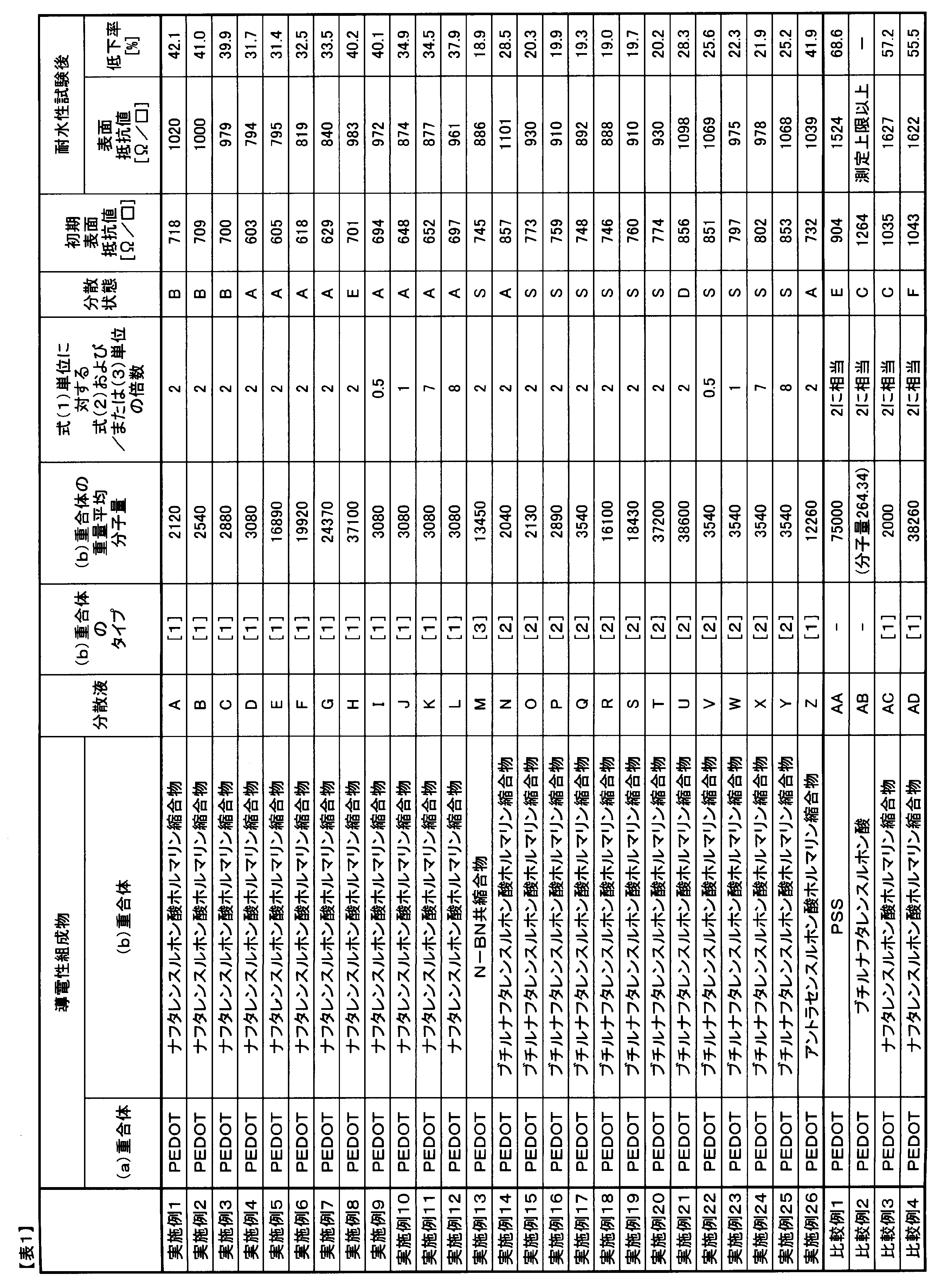
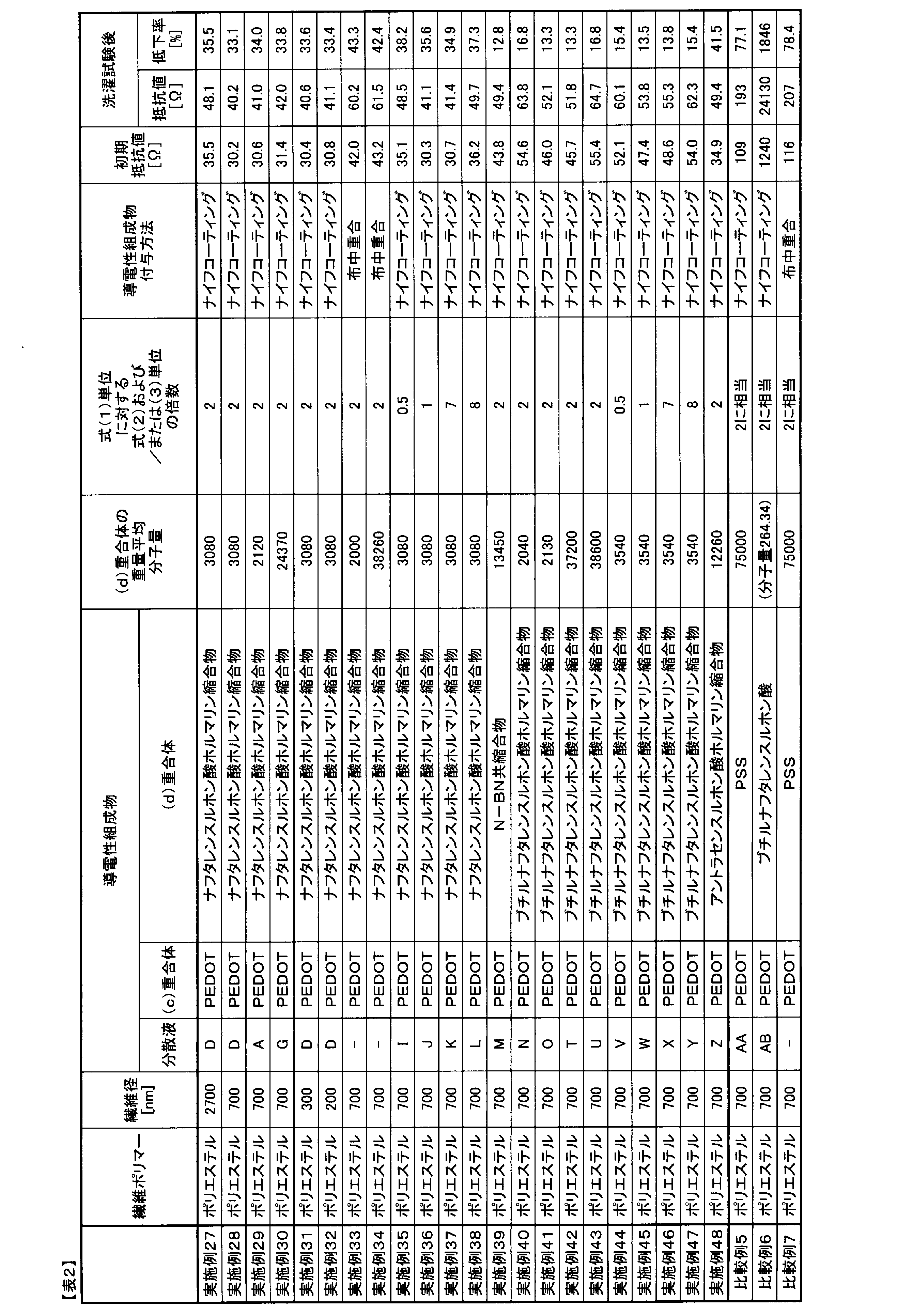

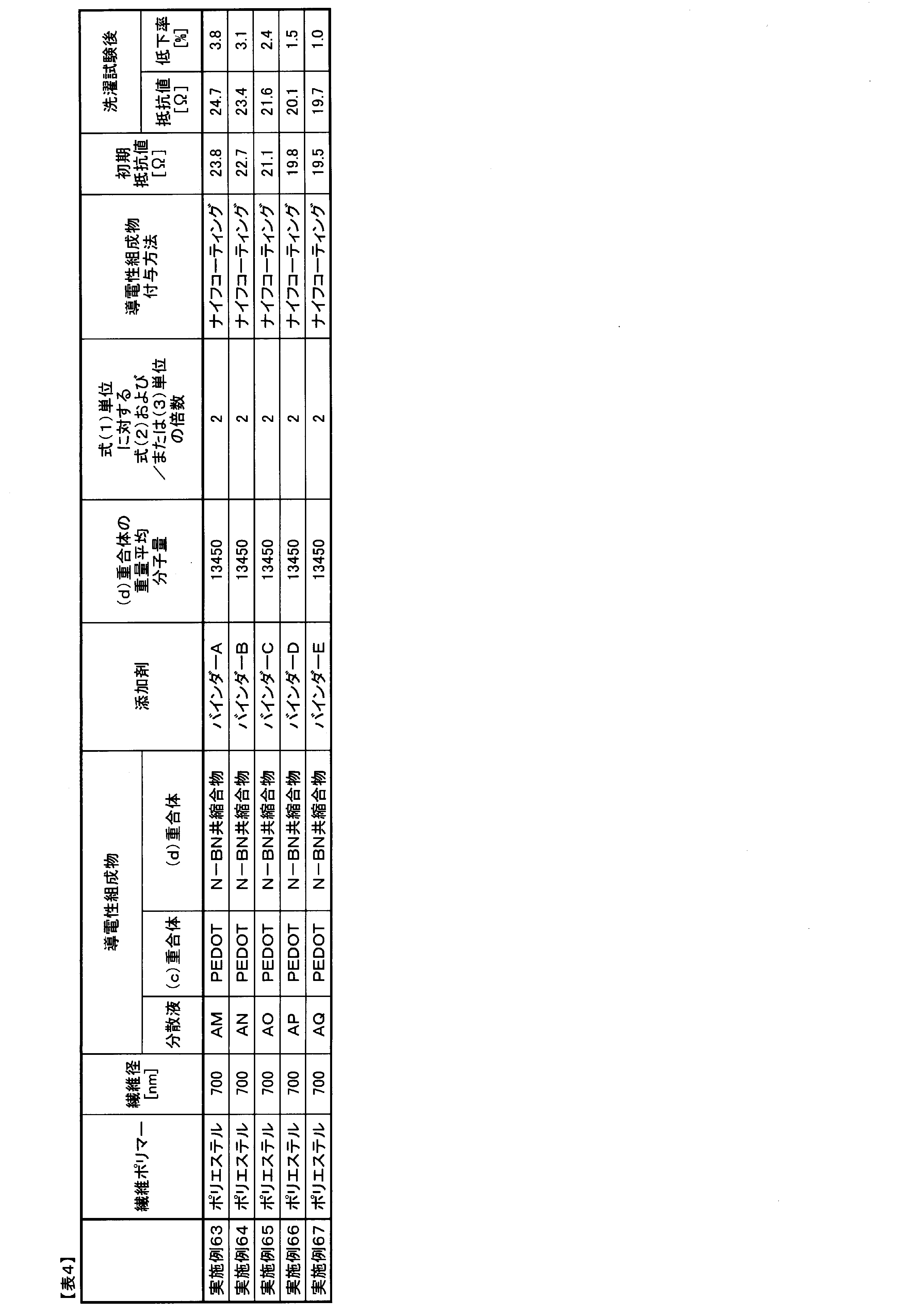
Claims (28)
- (a)下記式(1)で表される繰り返し単位を有する重合体、および、(b)以下の[1]~[3]のいずれかの重合体を含む、導電性組成物。
[1]下記式(2)で表される繰り返し単位を有し、下記式(3)で表される繰り返し単位を有さない、重量平均分子量が2100以上、38000以下の重合体。
[2]下記式(2)で表される繰り返し単位を有さず、下記式(3)で表される繰り返し単位を有する、重合体。
[3]下記式(2)で表される繰り返し単位と、下記式(3)で表される繰り返し単位とのいずれをも有する、重合体。

Xは、酸素原子、硫黄原子、セレン原子、またはN-R13であり、R13は、水素原子、アルキル基、シクロアルキル基、アルケニル基、シクロアルケニル基、アルキニル基、アリール基、ヘテロアリール基および複素環基からなる群より選ばれる。)
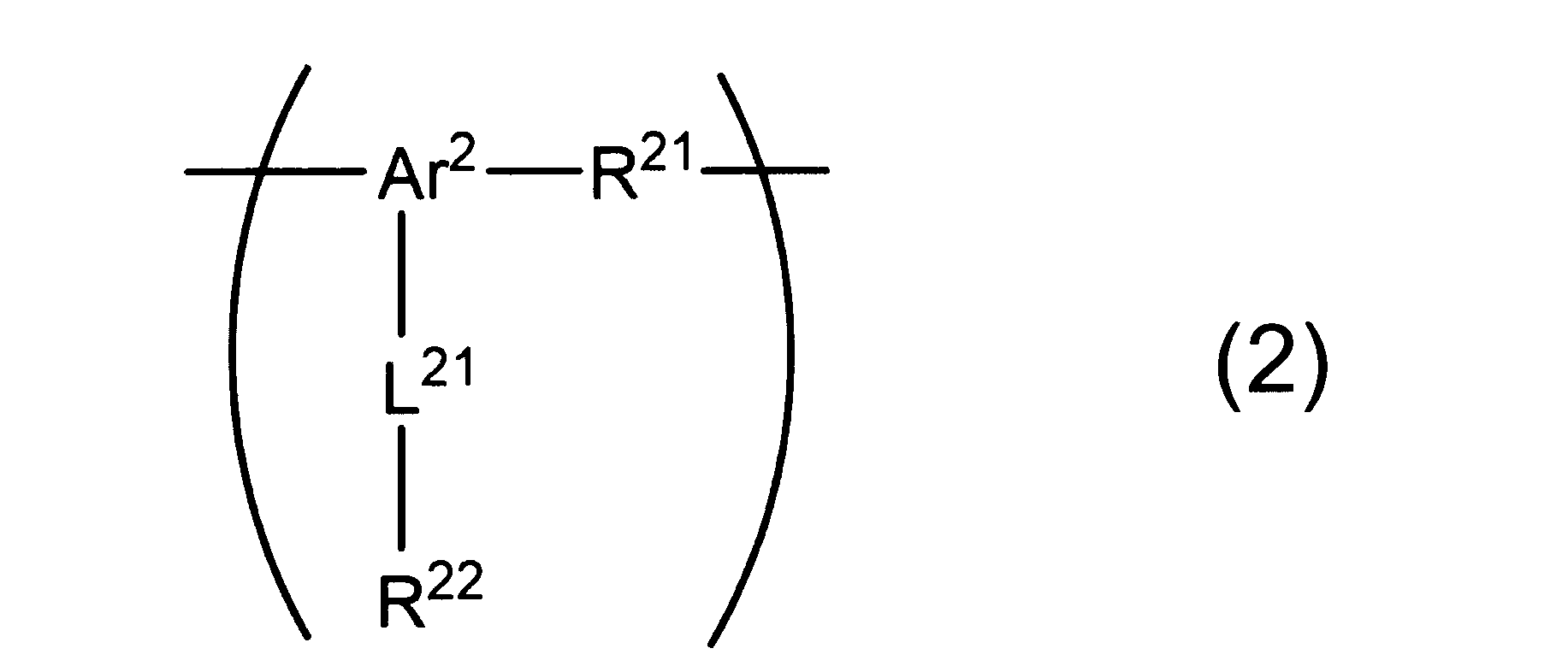
L21は、単結合、酸素原子、アルキレン基、アルケニレン基、アルキニレン基、アリーレン基およびヘテロアリーレン基からなる群より選ばれる。
R21はアルキレン基、アルケニレン基およびアルキニレン基からなる群より選ばれる。
R22はスルホン酸基またはその塩である。)

L31は、単結合、酸素原子、アルキレン基、アルケニレン基、アルキニレン基、アリーレン基およびヘテロアリーレン基からなる群より選ばれる。
R31はアルキレン基、アルケニレン基およびアルキニレン基からなる群より選ばれる。
R32はスルホン酸基またはその塩である。
R33はアルキル基、シクロアルキル基、アルケニル基、シクロアルケニル基、アルキニル基、アリール基およびヘテロアリール基、炭素数2以上のアルコキシ基、炭素数2以上のチオアルコキシ基および-L32-R34からなる群より選ばれる。L32は、カルボニル基、エステル基、チオエステル基、アミド基、カーボネート基、チオカーボネート基およびジチオカーボネート基からなる群より選ばれる。R34は、アルキル基、シクロアルキル基、アルケニル基、シクロアルケニル基、アルキニル基、アリール基およびヘテロアリール基からなる群より選ばれる。) - 前記式(1)で表される繰り返し単位において、Xが硫黄原子である、請求項1に記載の導電性組成物。
- (a)前記式(1)で表される繰り返し単位が、下記式(4)で表される繰り返し単位である、請求項1または2に記載の導電性組成物。

- 前記(b)[1]~[3]のいずれかの重合体が[1]重合体であり、Ar2が炭素数10以上、22以下の芳香族炭化水素環または芳香族複素環である、請求項1~3のいずれかに記載の導電性組成物。
- 前記式(2)で表される繰り返し単位において、Ar2がナフタレン環である、請求項4に記載の導電性組成物。
- 前記(b)[1]~[3]のいずれかの重合体が[2]または[3]重合体であり、Ar3が炭素数10以上、22以下の芳香族炭化水素環または芳香族複素環である、請求項1~3のいずれかに記載の導電性組成物。
- 前記式(3)で表される繰り返し単位において、Ar3がナフタレン環である、請求項6に記載の導電性組成物。
- 前記(b)重合体が[2]または[3]重合体であり、R33が炭素数1以上、8以下のアルキル基である、請求項1~3,6,7のいずれかに記載の導電性組成物。
- さらにバインダー樹脂を含んでなる請求項1~8のいずれかに記載の導電性組成物。
- 前記バインダー樹脂がオレフィン樹脂、アクリル樹脂およびウレタン樹脂からなる群より選ばれる少なくとも1種である、請求項9に記載の導電性組成物。
- 請求項1~10のいずれかに記載の導電性組成物を含む導電膜。
- 請求項1~10のいずれかに記載の導電性組成物を含むセンサ。
- 請求項1~10のいずれかに記載の導電性組成物を含む生体センサ。
- 請求項1~10のいずれかに記載の導電性組成物を含むフレキシブルデバイス。
- (c)下記式(1)で表される繰り返し単位を有する重合体、(d)下記式(5)および/または下記式(6)で表される繰り返し単位を有する重合体、ならびに繊維を含有する、導電性布帛。

Xは、酸素原子、硫黄原子、セレン原子、またはN-R13であり、R13は、水素原子、アルキル基、シクロアルキル基、アルケニル基、シクロアルケニル基、アルキニル基、アリール基、ヘテロアリール基および複素環基からなる群より選ばれる。)
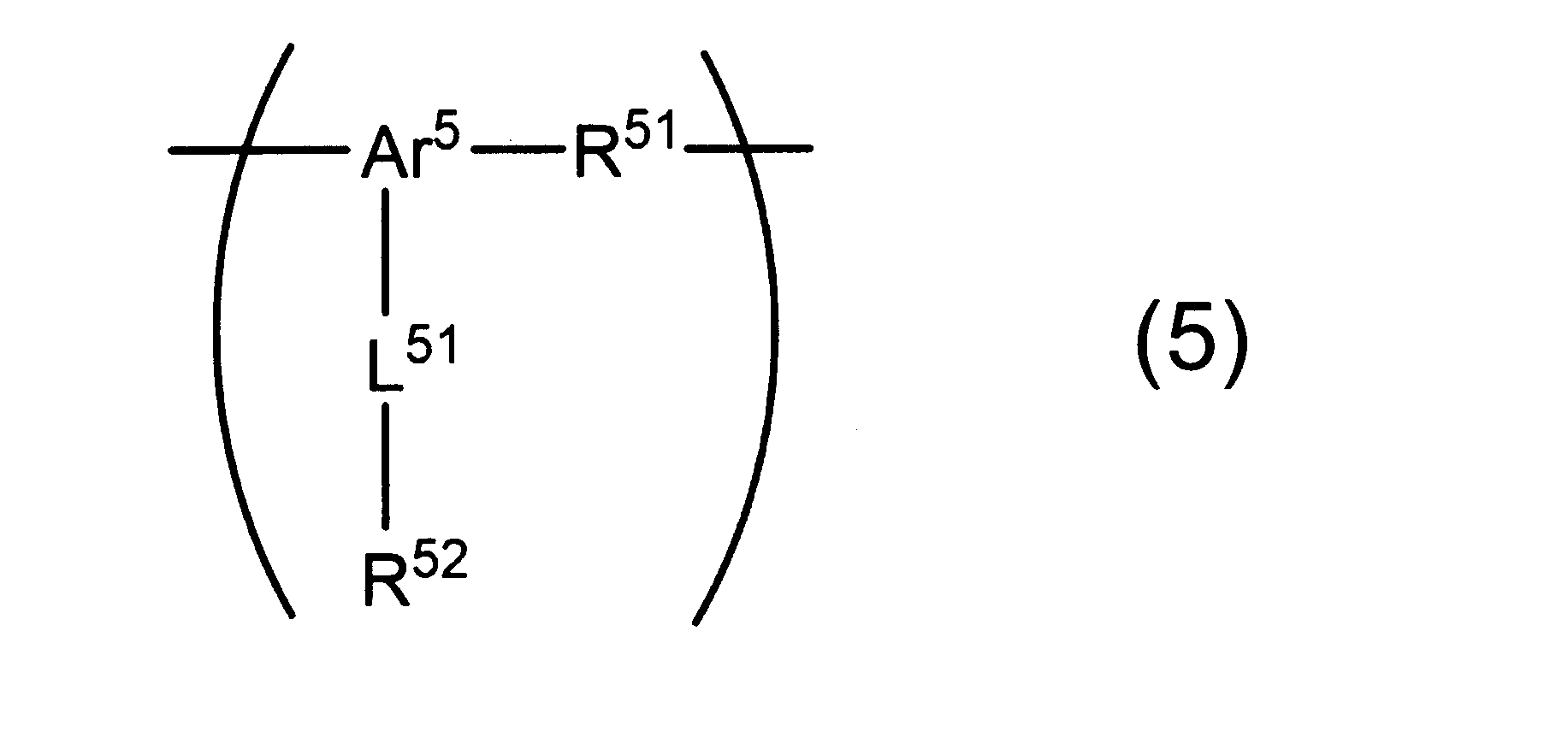
L51は、単結合、酸素原子、アルキレン基、アルケニレン基、アルキニレン基、アリーレン基およびヘテロアリーレン基からなる群より選ばれる。
R51はアルキレン基、アルケニレン基およびアルキニレン基からなる群より選ばれる。
R52はスルホン酸基またはその塩である。)
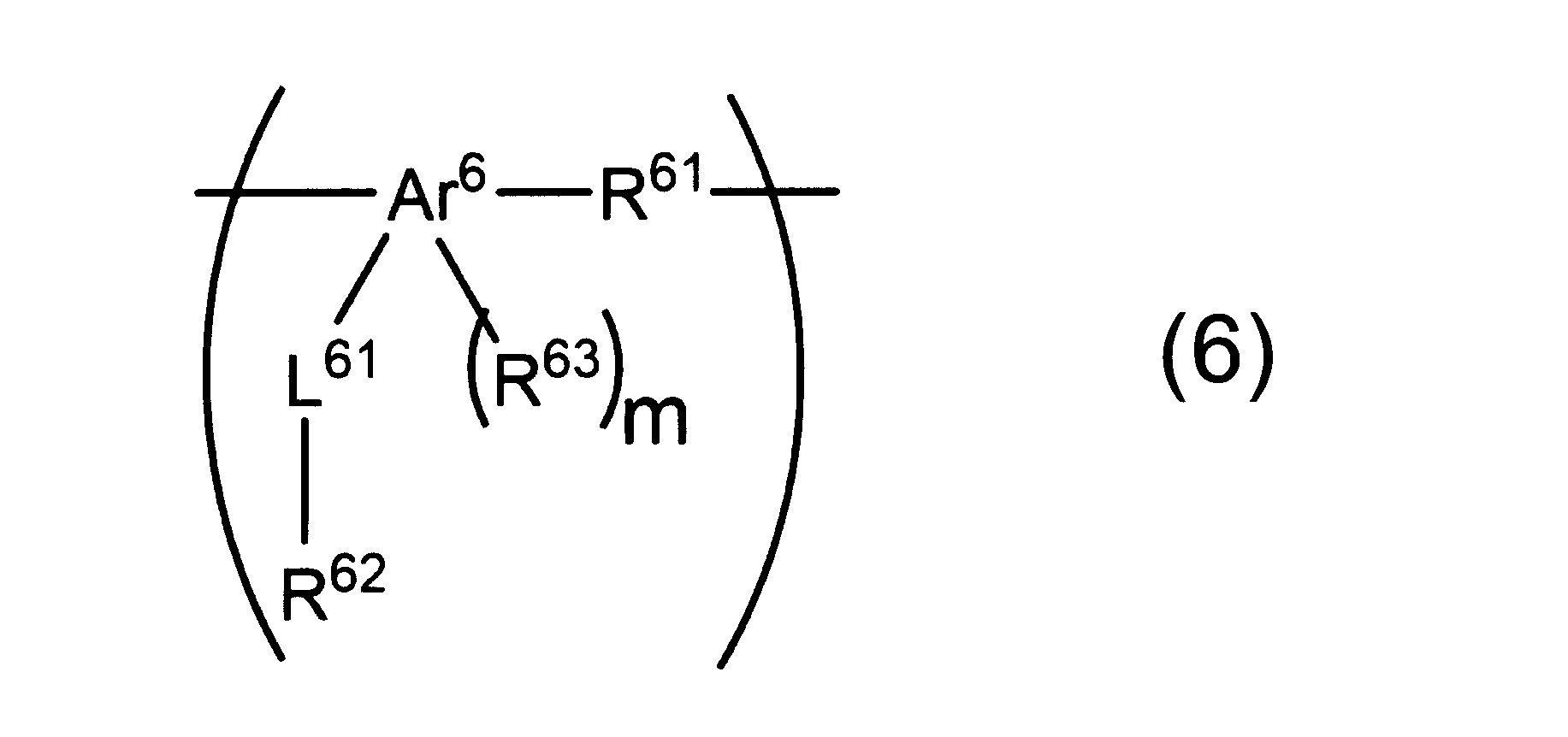
L61は、単結合、酸素原子、アルキレン基、アルケニレン基、アルキニレン基、アリーレン基およびヘテロアリーレン基からなる群より選ばれる。
R61はアルキレン基、アルケニレン基およびアルキニレン基からなる群より選ばれる。
R62はスルホン酸基またはその塩である。
R63はアルキル基、シクロアルキル基、アルケニル基、シクロアルケニル基、アルキニル基、アリール基およびヘテロアリール基、炭素数2以上のアルコキシ基、炭素数2以上のチオアルコキシ基および-L32-R34からなる群より選ばれる。L32は、カルボニル基、エステル基、チオエステル基、アミド基、カーボネート基、チオカーボネート基およびジチオカーボネート基からなる群より選ばれる。R34は、アルキル基、シクロアルキル基、アルケニル基、シクロアルケニル基、アルキニル基、アリール基およびヘテロアリール基からなる群より選ばれる。) - 前記式(1)で表される繰り返し単位において、Xが硫黄原子である、請求項15に記載の導電性布帛。
- 前記式(1)で表される繰り返し単位が、下記式(4)で表される繰り返し単位である、請求項15または16に記載の導電性布帛。

- (d)式(5)および/または(6)で表される繰り返し単位を有する重合体が、式(5)で表される繰り返し単位を有する重合体であり、該重合体の重量平均分子量が2100以上、38000以下である、請求項15~17のいずれかに記載の導電性布帛。
- 前記式(5)で表される繰り返し単位において、Ar5が炭素数10以上、22以下の芳香族炭化水素環または芳香族複素環である、請求項18に記載の導電性布帛。
- 前記式(5)で表される繰り返し単位において、Ar5がナフタレン環である、請求項18または19のいずれかに記載の導電性布帛。
- (d)式(5)および/または(6)で表される繰り返し単位を有する重合体が、式(6)で表される繰り返し単位を有する重合体であり、Ar6が炭素数10以上、22以下の芳香族炭化水素環または芳香族複素環である、請求項15~17のいずれかに記載の導電性布帛。
- 前記式(6)で表される繰り返し単位において、Ar6がナフタレン環である、請求項21に記載の導電性布帛。
- 前記式(6)で表される繰り返し単位において、R63が炭素数1以上、8以下のアルキル基である、請求項15~17,21,22のいずれかに記載の導電性布帛。
- さらにバインダー樹脂を含んでなる請求項15~23のいずれかに記載の導電性布帛。
- 前記バインダー樹脂がオレフィン樹脂、アクリル樹脂およびウレタン樹脂からなる群より選ばれる少なくとも1種である、請求項24に記載の導電性布帛。
- 前記繊維の繊維径が1nm以上、2000nm以下である、請求項15~25のいずれかに記載の導電性布帛。
- 前記繊維がポリエステル繊維またはポリアミド繊維である、請求項15~26のいずれかに記載の導電性布帛。
- 請求項15~27のいずれかに記載の導電性布帛を含む生体電極。
Priority Applications (1)
| Application Number | Priority Date | Filing Date | Title |
|---|---|---|---|
| JP2021507708A JPWO2021186942A1 (ja) | 2020-03-19 | 2021-02-08 |
Applications Claiming Priority (2)
| Application Number | Priority Date | Filing Date | Title |
|---|---|---|---|
| JP2020048853 | 2020-03-19 | ||
| JP2020-048853 | 2020-03-19 |
Publications (1)
| Publication Number | Publication Date |
|---|---|
| WO2021186942A1 true WO2021186942A1 (ja) | 2021-09-23 |
Family
ID=77771831
Family Applications (1)
| Application Number | Title | Priority Date | Filing Date |
|---|---|---|---|
| PCT/JP2021/004536 Ceased WO2021186942A1 (ja) | 2020-03-19 | 2021-02-08 | 導電性組成物およびそれを含む導電膜、センサ、生体センサ、フレキシブルデバイス、ならびに導電性布帛およびそれを含む生体電極、ウェアラブルデバイス |
Country Status (3)
| Country | Link |
|---|---|
| JP (1) | JPWO2021186942A1 (ja) |
| TW (1) | TW202136347A (ja) |
| WO (1) | WO2021186942A1 (ja) |
Cited By (1)
| Publication number | Priority date | Publication date | Assignee | Title |
|---|---|---|---|---|
| JP2023007679A (ja) * | 2021-07-02 | 2023-01-19 | 信越ポリマー株式会社 | 導電性高分子含有液及びその製造方法、並びに導電性積層体及びその製造方法 |
Families Citing this family (3)
| Publication number | Priority date | Publication date | Assignee | Title |
|---|---|---|---|---|
| CN113152100B (zh) * | 2021-04-06 | 2022-12-27 | 湖南绿斯达生物科技有限公司 | 导电纤维材料的制备方法及纤维材料和应用 |
| TWI826171B (zh) * | 2022-12-07 | 2023-12-11 | 準訊生醫股份有限公司 | 生理訊號感測裝置 |
| TWI843669B (zh) * | 2023-10-17 | 2024-05-21 | 財團法人金屬工業研究發展中心 | 訊號偵測裝置 |
Citations (9)
| Publication number | Priority date | Publication date | Assignee | Title |
|---|---|---|---|---|
| JP2976293B1 (ja) * | 1998-06-18 | 1999-11-10 | 日本電気株式会社 | 配線基板検査用コンタクトピンの製造方法及び配線基板検査装置 |
| WO2001043215A1 (fr) * | 1999-12-10 | 2001-06-14 | Nitto Denko Corporation | Pile a combustible |
| WO2009131011A1 (ja) * | 2008-04-21 | 2009-10-29 | テイカ株式会社 | 導電性組成物の分散液、導電性組成物およびその用途 |
| CN102516784A (zh) * | 2011-12-02 | 2012-06-27 | 华南理工大学 | 一种含有聚(3,4-乙撑二氧噻吩)/木质素磺酸的导电性组合物及其制备方法 |
| WO2013035548A1 (ja) * | 2011-09-06 | 2013-03-14 | テイカ株式会社 | 導電性高分子の分散液、導電性高分子およびその用途 |
| JP2013219278A (ja) * | 2012-04-11 | 2013-10-24 | Shin Etsu Polymer Co Ltd | 有機エレクトロルミネッセンス素子 |
| JP2016106877A (ja) * | 2014-12-08 | 2016-06-20 | 日本電信電話株式会社 | 生体電極および衣類 |
| JP2018191725A (ja) * | 2017-05-12 | 2018-12-06 | 東レ株式会社 | 生体情報測定装置及び生体情報測定装置の制御方法 |
| JP2019126509A (ja) * | 2018-01-24 | 2019-08-01 | 日本電信電話株式会社 | ウェアラブルデバイス |
-
2021
- 2021-02-08 JP JP2021507708A patent/JPWO2021186942A1/ja active Pending
- 2021-02-08 WO PCT/JP2021/004536 patent/WO2021186942A1/ja not_active Ceased
- 2021-03-10 TW TW110108439A patent/TW202136347A/zh unknown
Patent Citations (9)
| Publication number | Priority date | Publication date | Assignee | Title |
|---|---|---|---|---|
| JP2976293B1 (ja) * | 1998-06-18 | 1999-11-10 | 日本電気株式会社 | 配線基板検査用コンタクトピンの製造方法及び配線基板検査装置 |
| WO2001043215A1 (fr) * | 1999-12-10 | 2001-06-14 | Nitto Denko Corporation | Pile a combustible |
| WO2009131011A1 (ja) * | 2008-04-21 | 2009-10-29 | テイカ株式会社 | 導電性組成物の分散液、導電性組成物およびその用途 |
| WO2013035548A1 (ja) * | 2011-09-06 | 2013-03-14 | テイカ株式会社 | 導電性高分子の分散液、導電性高分子およびその用途 |
| CN102516784A (zh) * | 2011-12-02 | 2012-06-27 | 华南理工大学 | 一种含有聚(3,4-乙撑二氧噻吩)/木质素磺酸的导电性组合物及其制备方法 |
| JP2013219278A (ja) * | 2012-04-11 | 2013-10-24 | Shin Etsu Polymer Co Ltd | 有機エレクトロルミネッセンス素子 |
| JP2016106877A (ja) * | 2014-12-08 | 2016-06-20 | 日本電信電話株式会社 | 生体電極および衣類 |
| JP2018191725A (ja) * | 2017-05-12 | 2018-12-06 | 東レ株式会社 | 生体情報測定装置及び生体情報測定装置の制御方法 |
| JP2019126509A (ja) * | 2018-01-24 | 2019-08-01 | 日本電信電話株式会社 | ウェアラブルデバイス |
Non-Patent Citations (1)
| Title |
|---|
| SATOH, MASAHARU ET AL.: "Highly conducting polypyrrole prepared by electrochemical oxidation method in aqueous solution", JAPANESE JOURNAL OF APPLIED PHYSICS, vol. 24, no. 6, 1985, pages 423 - 424, XP001264590 * |
Cited By (2)
| Publication number | Priority date | Publication date | Assignee | Title |
|---|---|---|---|---|
| JP2023007679A (ja) * | 2021-07-02 | 2023-01-19 | 信越ポリマー株式会社 | 導電性高分子含有液及びその製造方法、並びに導電性積層体及びその製造方法 |
| JP7499738B2 (ja) | 2021-07-02 | 2024-06-14 | 信越ポリマー株式会社 | 導電性高分子含有液及びその製造方法、並びに導電性積層体及びその製造方法 |
Also Published As
| Publication number | Publication date |
|---|---|
| JPWO2021186942A1 (ja) | 2021-09-23 |
| TW202136347A (zh) | 2021-10-01 |
Similar Documents
| Publication | Publication Date | Title |
|---|---|---|
| WO2021186942A1 (ja) | 導電性組成物およびそれを含む導電膜、センサ、生体センサ、フレキシブルデバイス、ならびに導電性布帛およびそれを含む生体電極、ウェアラブルデバイス | |
| US20230248311A1 (en) | Conductive polymer electrodes, wiring elements, and use thereof in health and sports monitoring | |
| Islam et al. | Textile sensors for wearable applications: A comprehensive review | |
| Choudhry et al. | Textronics—a review of textile‐based wearable electronics | |
| Afroj et al. | Engineering graphene flakes for wearable textile sensors via highly scalable and ultrafast yarn dyeing technique | |
| Pani et al. | Survey on textile electrode technologies for electrocardiographic (ECG) monitoring, from metal wires to polymers | |
| Grancarić et al. | Conductive polymers for smart textile applications | |
| Cao et al. | Stretchable and self-adhesive PEDOT: PSS blend with high sweat tolerance as conformal biopotential dry electrodes | |
| Li et al. | Advanced electrospun AgNPs/rGO/PEDOT: PSS/TPU nanofiber electrodes: Stretchable, self-healing, and perspiration-resistant wearable devices for enhanced ECG and EMG monitoring | |
| Sinha et al. | Screen-printed PEDOT: PSS electrodes on commercial finished textiles for electrocardiography | |
| JP6301969B2 (ja) | 生体信号検出衣料 | |
| Yuan et al. | Epidermal visualized health monitoring system based on stretchable and washable TPU hybrid conductive microtextiles | |
| Kang et al. | Recent progress in the development of flexible wearable electrodes for electrocardiogram monitoring during exercise | |
| Alzaidi et al. | Smart textiles based wireless ECG system | |
| JPWO2015115440A1 (ja) | 電極部材および装置 | |
| EP3785280A1 (en) | Flexible fabric antenna system comprising conductive polymers and method of making same | |
| CN108018021B (zh) | 可与生物接触的传感材料、用于感测生理参数的可与生物接触的单元及其制造方法 | |
| JP2021098846A (ja) | 導電性複合体、その製造方法ならびにそれを含む導電膜、センサ、生体センサ、フレキシブルデバイス、導電性布帛、生体電極およびウェアラブルデバイス | |
| WO2020160510A1 (en) | Compositions, systems, and methods for sensing | |
| Li et al. | High stretchability and conductive stability of flexible hybrid electronic materials for smart clothing | |
| Sinha et al. | Integrated dry poly (3, 4-ethylenedioxythiophene): polystyrene sulfonate electrodes on finished textiles for continuous and simultaneous monitoring of electrocardiogram, electromyogram and electrodermal activity | |
| KR101273346B1 (ko) | 은도금 나노섬유 웹 및 이를 이용한 건식 전극 | |
| Huang et al. | Flexible dry electrocardiography electrodes obtained from waste face masks, PEDOT: PSS, and biosynthetic polymers | |
| Firew Adamu et al. | Electronic textiles | |
| Homayounfar et al. | Humidity‐resistant, broad‐range pressure sensors for garment‐integrated health, motion, and grip strength monitoring in natural environments |
Legal Events
| Date | Code | Title | Description |
|---|---|---|---|
| ENP | Entry into the national phase |
Ref document number: 2021507708 Country of ref document: JP Kind code of ref document: A |
|
| 121 | Ep: the epo has been informed by wipo that ep was designated in this application |
Ref document number: 21770986 Country of ref document: EP Kind code of ref document: A1 |
|
| NENP | Non-entry into the national phase |
Ref country code: DE |
|
| 122 | Ep: pct application non-entry in european phase |
Ref document number: 21770986 Country of ref document: EP Kind code of ref document: A1 |