WO2021182290A1 - 車両用ガラス、枠部材及び車両用ガラスの製造方法 - Google Patents
車両用ガラス、枠部材及び車両用ガラスの製造方法 Download PDFInfo
- Publication number
- WO2021182290A1 WO2021182290A1 PCT/JP2021/008413 JP2021008413W WO2021182290A1 WO 2021182290 A1 WO2021182290 A1 WO 2021182290A1 JP 2021008413 W JP2021008413 W JP 2021008413W WO 2021182290 A1 WO2021182290 A1 WO 2021182290A1
- Authority
- WO
- WIPO (PCT)
- Prior art keywords
- vehicle
- far
- glass
- glass substrate
- frame member
- Prior art date
- Legal status (The legal status is an assumption and is not a legal conclusion. Google has not performed a legal analysis and makes no representation as to the accuracy of the status listed.)
- Ceased
Links
Images






Classifications
-
- B—PERFORMING OPERATIONS; TRANSPORTING
- B60—VEHICLES IN GENERAL
- B60J—WINDOWS, WINDSCREENS, NON-FIXED ROOFS, DOORS, OR SIMILAR DEVICES FOR VEHICLES; REMOVABLE EXTERNAL PROTECTIVE COVERINGS SPECIALLY ADAPTED FOR VEHICLES
- B60J3/00—Antiglare equipment associated with windows or windscreens; Sun visors for vehicles
- B60J3/007—Sunglare reduction by coatings, interposed foils in laminar windows, or permanent screens
-
- B—PERFORMING OPERATIONS; TRANSPORTING
- B32—LAYERED PRODUCTS
- B32B—LAYERED PRODUCTS, i.e. PRODUCTS BUILT-UP OF STRATA OF FLAT OR NON-FLAT, e.g. CELLULAR OR HONEYCOMB, FORM
- B32B17/00—Layered products essentially comprising sheet glass, or glass, slag, or like fibres
- B32B17/06—Layered products essentially comprising sheet glass, or glass, slag, or like fibres comprising glass as the main or only constituent of a layer, next to another layer of a specific material
- B32B17/10—Layered products essentially comprising sheet glass, or glass, slag, or like fibres comprising glass as the main or only constituent of a layer, next to another layer of a specific material of synthetic resin
- B32B17/10005—Layered products essentially comprising sheet glass, or glass, slag, or like fibres comprising glass as the main or only constituent of a layer, next to another layer of a specific material of synthetic resin laminated safety glass or glazing
- B32B17/10009—Layered products essentially comprising sheet glass, or glass, slag, or like fibres comprising glass as the main or only constituent of a layer, next to another layer of a specific material of synthetic resin laminated safety glass or glazing characterized by the number, the constitution or treatment of glass sheets
- B32B17/10036—Layered products essentially comprising sheet glass, or glass, slag, or like fibres comprising glass as the main or only constituent of a layer, next to another layer of a specific material of synthetic resin laminated safety glass or glazing characterized by the number, the constitution or treatment of glass sheets comprising two outer glass sheets
-
- B—PERFORMING OPERATIONS; TRANSPORTING
- B32—LAYERED PRODUCTS
- B32B—LAYERED PRODUCTS, i.e. PRODUCTS BUILT-UP OF STRATA OF FLAT OR NON-FLAT, e.g. CELLULAR OR HONEYCOMB, FORM
- B32B17/00—Layered products essentially comprising sheet glass, or glass, slag, or like fibres
- B32B17/06—Layered products essentially comprising sheet glass, or glass, slag, or like fibres comprising glass as the main or only constituent of a layer, next to another layer of a specific material
- B32B17/10—Layered products essentially comprising sheet glass, or glass, slag, or like fibres comprising glass as the main or only constituent of a layer, next to another layer of a specific material of synthetic resin
- B32B17/10005—Layered products essentially comprising sheet glass, or glass, slag, or like fibres comprising glass as the main or only constituent of a layer, next to another layer of a specific material of synthetic resin laminated safety glass or glazing
- B32B17/10165—Functional features of the laminated safety glass or glazing
- B32B17/10293—Edge features, e.g. inserts or holes
-
- B—PERFORMING OPERATIONS; TRANSPORTING
- B32—LAYERED PRODUCTS
- B32B—LAYERED PRODUCTS, i.e. PRODUCTS BUILT-UP OF STRATA OF FLAT OR NON-FLAT, e.g. CELLULAR OR HONEYCOMB, FORM
- B32B17/00—Layered products essentially comprising sheet glass, or glass, slag, or like fibres
- B32B17/06—Layered products essentially comprising sheet glass, or glass, slag, or like fibres comprising glass as the main or only constituent of a layer, next to another layer of a specific material
- B32B17/10—Layered products essentially comprising sheet glass, or glass, slag, or like fibres comprising glass as the main or only constituent of a layer, next to another layer of a specific material of synthetic resin
- B32B17/10005—Layered products essentially comprising sheet glass, or glass, slag, or like fibres comprising glass as the main or only constituent of a layer, next to another layer of a specific material of synthetic resin laminated safety glass or glazing
- B32B17/10165—Functional features of the laminated safety glass or glazing
- B32B17/10339—Specific parts of the laminated safety glass or glazing being colored or tinted
- B32B17/10348—Specific parts of the laminated safety glass or glazing being colored or tinted comprising an obscuration band
-
- B—PERFORMING OPERATIONS; TRANSPORTING
- B32—LAYERED PRODUCTS
- B32B—LAYERED PRODUCTS, i.e. PRODUCTS BUILT-UP OF STRATA OF FLAT OR NON-FLAT, e.g. CELLULAR OR HONEYCOMB, FORM
- B32B17/00—Layered products essentially comprising sheet glass, or glass, slag, or like fibres
- B32B17/06—Layered products essentially comprising sheet glass, or glass, slag, or like fibres comprising glass as the main or only constituent of a layer, next to another layer of a specific material
- B32B17/10—Layered products essentially comprising sheet glass, or glass, slag, or like fibres comprising glass as the main or only constituent of a layer, next to another layer of a specific material of synthetic resin
- B32B17/10005—Layered products essentially comprising sheet glass, or glass, slag, or like fibres comprising glass as the main or only constituent of a layer, next to another layer of a specific material of synthetic resin laminated safety glass or glazing
- B32B17/10165—Functional features of the laminated safety glass or glazing
- B32B17/10431—Specific parts for the modulation of light incorporated into the laminated safety glass or glazing
- B32B17/1044—Invariable transmission
- B32B17/10449—Wavelength selective transmission
-
- B—PERFORMING OPERATIONS; TRANSPORTING
- B32—LAYERED PRODUCTS
- B32B—LAYERED PRODUCTS, i.e. PRODUCTS BUILT-UP OF STRATA OF FLAT OR NON-FLAT, e.g. CELLULAR OR HONEYCOMB, FORM
- B32B17/00—Layered products essentially comprising sheet glass, or glass, slag, or like fibres
- B32B17/06—Layered products essentially comprising sheet glass, or glass, slag, or like fibres comprising glass as the main or only constituent of a layer, next to another layer of a specific material
- B32B17/10—Layered products essentially comprising sheet glass, or glass, slag, or like fibres comprising glass as the main or only constituent of a layer, next to another layer of a specific material of synthetic resin
- B32B17/10005—Layered products essentially comprising sheet glass, or glass, slag, or like fibres comprising glass as the main or only constituent of a layer, next to another layer of a specific material of synthetic resin laminated safety glass or glazing
- B32B17/10807—Making laminated safety glass or glazing; Apparatus therefor
-
- B—PERFORMING OPERATIONS; TRANSPORTING
- B32—LAYERED PRODUCTS
- B32B—LAYERED PRODUCTS, i.e. PRODUCTS BUILT-UP OF STRATA OF FLAT OR NON-FLAT, e.g. CELLULAR OR HONEYCOMB, FORM
- B32B3/00—Layered products comprising a layer with external or internal discontinuities or unevennesses, or a layer of non-planar shape; Layered products comprising a layer having particular features of form
- B32B3/26—Layered products comprising a layer with external or internal discontinuities or unevennesses, or a layer of non-planar shape; Layered products comprising a layer having particular features of form characterised by a particular shape of the outline of the cross-section of a continuous layer; characterised by a layer with cavities or internal voids ; characterised by an apertured layer
- B32B3/266—Layered products comprising a layer with external or internal discontinuities or unevennesses, or a layer of non-planar shape; Layered products comprising a layer having particular features of form characterised by a particular shape of the outline of the cross-section of a continuous layer; characterised by a layer with cavities or internal voids ; characterised by an apertured layer characterised by an apertured layer, the apertures going through the whole thickness of the layer, e.g. expanded metal, perforated layer, slit layer regular cells B32B3/12
-
- B—PERFORMING OPERATIONS; TRANSPORTING
- B60—VEHICLES IN GENERAL
- B60J—WINDOWS, WINDSCREENS, NON-FIXED ROOFS, DOORS, OR SIMILAR DEVICES FOR VEHICLES; REMOVABLE EXTERNAL PROTECTIVE COVERINGS SPECIALLY ADAPTED FOR VEHICLES
- B60J1/00—Windows; Windscreens; Accessories therefor
- B60J1/008—Windows; Windscreens; Accessories therefor of special shape, e.g. beveled edges, holes for attachment, bent windows, peculiar curvatures such as when being integrally formed with roof, door, etc.
-
- B—PERFORMING OPERATIONS; TRANSPORTING
- B60—VEHICLES IN GENERAL
- B60J—WINDOWS, WINDSCREENS, NON-FIXED ROOFS, DOORS, OR SIMILAR DEVICES FOR VEHICLES; REMOVABLE EXTERNAL PROTECTIVE COVERINGS SPECIALLY ADAPTED FOR VEHICLES
- B60J1/00—Windows; Windscreens; Accessories therefor
- B60J1/02—Windows; Windscreens; Accessories therefor arranged at the vehicle front, e.g. structure of the glazing, mounting of the glazing
-
- C—CHEMISTRY; METALLURGY
- C03—GLASS; MINERAL OR SLAG WOOL
- C03C—CHEMICAL COMPOSITION OF GLASSES, GLAZES OR VITREOUS ENAMELS; SURFACE TREATMENT OF GLASS; SURFACE TREATMENT OF FIBRES OR FILAMENTS MADE FROM GLASS, MINERALS OR SLAGS; JOINING GLASS TO GLASS OR OTHER MATERIALS
- C03C17/00—Surface treatment of glass, not in the form of fibres or filaments, by coating
- C03C17/02—Surface treatment of glass, not in the form of fibres or filaments, by coating with glass
- C03C17/04—Surface treatment of glass, not in the form of fibres or filaments, by coating with glass by fritting glass powder
-
- C—CHEMISTRY; METALLURGY
- C03—GLASS; MINERAL OR SLAG WOOL
- C03C—CHEMICAL COMPOSITION OF GLASSES, GLAZES OR VITREOUS ENAMELS; SURFACE TREATMENT OF GLASS; SURFACE TREATMENT OF FIBRES OR FILAMENTS MADE FROM GLASS, MINERALS OR SLAGS; JOINING GLASS TO GLASS OR OTHER MATERIALS
- C03C17/00—Surface treatment of glass, not in the form of fibres or filaments, by coating
- C03C17/28—Surface treatment of glass, not in the form of fibres or filaments, by coating with organic material
- C03C17/32—Surface treatment of glass, not in the form of fibres or filaments, by coating with organic material with synthetic or natural resins
-
- C—CHEMISTRY; METALLURGY
- C03—GLASS; MINERAL OR SLAG WOOL
- C03C—CHEMICAL COMPOSITION OF GLASSES, GLAZES OR VITREOUS ENAMELS; SURFACE TREATMENT OF GLASS; SURFACE TREATMENT OF FIBRES OR FILAMENTS MADE FROM GLASS, MINERALS OR SLAGS; JOINING GLASS TO GLASS OR OTHER MATERIALS
- C03C27/00—Joining pieces of glass to pieces of other inorganic material; Joining glass to glass other than by fusing
- C03C27/06—Joining glass to glass by processes other than fusing
- C03C27/10—Joining glass to glass by processes other than fusing with the aid of adhesive specially adapted for that purpose
-
- G—PHYSICS
- G02—OPTICS
- G02B—OPTICAL ELEMENTS, SYSTEMS OR APPARATUS
- G02B5/00—Optical elements other than lenses
- G02B5/20—Filters
- G02B5/208—Filters for use with infrared or ultraviolet radiation, e.g. for separating visible light from infrared and/or ultraviolet radiation
-
- B—PERFORMING OPERATIONS; TRANSPORTING
- B32—LAYERED PRODUCTS
- B32B—LAYERED PRODUCTS, i.e. PRODUCTS BUILT-UP OF STRATA OF FLAT OR NON-FLAT, e.g. CELLULAR OR HONEYCOMB, FORM
- B32B2605/00—Vehicles
- B32B2605/006—Transparent parts other than made from inorganic glass, e.g. polycarbonate glazings
-
- C—CHEMISTRY; METALLURGY
- C03—GLASS; MINERAL OR SLAG WOOL
- C03C—CHEMICAL COMPOSITION OF GLASSES, GLAZES OR VITREOUS ENAMELS; SURFACE TREATMENT OF GLASS; SURFACE TREATMENT OF FIBRES OR FILAMENTS MADE FROM GLASS, MINERALS OR SLAGS; JOINING GLASS TO GLASS OR OTHER MATERIALS
- C03C2217/00—Coatings on glass
- C03C2217/20—Materials for coating a single layer on glass
- C03C2217/29—Mixtures
Definitions
- the present invention relates to a vehicle glass, a frame member, and a method for manufacturing a vehicle glass.
- sensors may be installed for the purpose of improving the safety of automobiles.
- sensors attached to automobiles include cameras, LiDAR (Light Detecting and Ringing), millimeter-wave radars, infrared sensors, and the like.
- Infrared rays are classified into near infrared rays (for example, wavelengths of 0.7 ⁇ m to 2 ⁇ m), mid-infrared rays (for example, wavelengths of 3 ⁇ m to 5 ⁇ m), and far infrared rays (for example, wavelengths of 8 ⁇ m to 13 ⁇ m) according to their wavelength bands. ..
- Infrared sensors that detect these infrared rays include touch sensors in the near infrared, near-infrared cameras and LiDAR, gas analysis and mid-infrared spectroscopic analysis (functional group analysis) in the mid-infrared, and night vision and thermo in the far-infrared.
- a viewer hereinafter referred to as a far-infrared camera
- a far-infrared camera A viewer (hereinafter referred to as a far-infrared camera) and the like can be mentioned.
- the far infrared camera Since the window glass of an automobile normally does not transmit far infrared rays having a wavelength of 8 ⁇ m to 13 ⁇ m, the far infrared camera is conventionally installed outside the vehicle interior, more specifically on the front grille, as in Patent Document 1, for example. There were many. However, when the far-infrared camera is installed outside the vehicle interior, the structure becomes more complicated in order to ensure robustness, water resistance, dust resistance, etc., which leads to high cost. By installing the far-infrared camera in the vehicle interior and in the operating area of the wiper, the far-infrared camera is protected by the window glass and dirt and the like can be wiped off, so that such a problem can be solved. However, as described above, since the window glass has a problem of not transmitting far infrared rays, the far infrared camera is not usually arranged in the vehicle interior.
- Patent Document 2 discloses a window member in which a through hole is formed in a part of the window glass and the through hole is filled with an infrared transmissive member.
- the present invention has been made in view of the above problems, and an object of the present invention is to provide a vehicle glass, a frame member, and a method for manufacturing vehicle glass, which can suppress a decrease in wiping property by a wiper and an increase in a load of the wiper. do.
- the vehicle glass according to the present disclosure is a vehicle glass having a glass substrate and having a light-shielding region, and is formed on the glass substrate in the light-shielding region.
- An opening to be formed and a far-infrared transmitting region provided with a far-infrared transmitting member arranged in the opening are formed, and the glass substrate and the far-infrared transmitting member are joined via a frame member to form the above.
- the frame member has the longest straight line length of D among the straight lines connecting arbitrary two points on the inner circumference on the side facing the opening in the outer surface of the vehicle, from the outer surface of the vehicle glass. Assuming that the thickness of the protruding portion is t, D 2 / t is larger than 1250 and t is 2.5 mm or less.
- the frame member according to the present disclosure is provided continuously with the first holding portion and the first holding portion, and the inner diameter is larger than the inner diameter of the first holding portion. It also has a small second holding portion and a flange portion provided on the side of the first holding portion opposite to the side on which the second holding portion is provided, and is arbitrary on the inner circumference of the first holding portion. Assuming that the length of the longest straight line connecting the two points is D and the thickness of the flange portion is t, D 2 / t is larger than 1250 and t is 2.5 mm or less.
- the above-mentioned method for manufacturing glass for vehicles has the opening formed by joining two glass substrates via an intermediate layer and penetrating in the thickness direction.
- the frame member is assembled to the peripheral edge of the far-infrared transmitting member, and the far-infrared transmitting member to which the frame member is assembled is arranged in the opening.
- FIG. 1 is a schematic view showing a state in which the vehicle glass according to the first embodiment is mounted on the vehicle.
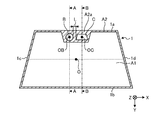
- FIG. 2 is a schematic plan view of the vehicle glass according to the first embodiment.
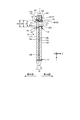
- FIG. 3 is a cross-sectional view taken along the line AA of FIG.
- FIG. 4 is a cross-sectional view taken along the BB cross section of FIG.
- FIG. 5 is an enlarged cross-sectional view of the periphery of the far-infrared ray transmitting region in the vehicle glass.
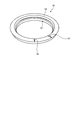
- FIG. 6 is a perspective view of a frame member in vehicle glass.
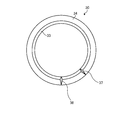
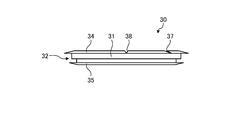
- FIG. 7 is a front view of a frame member in vehicle glass.
- FIG. 8 is a side view of a frame member in vehicle glass.
- FIG. 1 is a schematic view showing a state in which the vehicle glass according to the first embodiment is mounted on the vehicle.
- FIG. 2 is a schematic plan view of the vehicle glass according to the first embodiment.
- FIG. 3 is a cross-sectional view taken
- FIG. 9 is a cross-sectional view of a frame member in vehicle glass.
- FIG. 10 is a diagram showing a configuration example when a far-infrared camera is attached to vehicle glass.
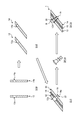
- FIG. 11 is a schematic view illustrating an example of a method for manufacturing vehicle glass according to the first embodiment.
- FIG. 12 is an enlarged cross-sectional view of the periphery of the far-infrared ray transmitting region in the vehicle glass according to the second embodiment.
- FIG. 1 is a schematic view showing a state in which the vehicle glass 1 according to the first embodiment is mounted on the vehicle V.
- the vehicle glass 1 according to the first embodiment is mounted on the vehicle V.
- the vehicle glass 1 is a window member applied to the windshield of the vehicle V. That is, the vehicle glass 1 is used as a front window of the vehicle V, in other words, a windshield.
- a far-infrared camera CA1 and a visible light camera CA2 are mounted inside the vehicle V (inside the vehicle).
- the inside of the vehicle V (inside the vehicle) refers to, for example, the interior of the vehicle in which the driver's seat is provided.
- the vehicle glass 1, the far-infrared camera CA1 and the visible light camera CA2 constitute the camera unit 100 according to the first embodiment.
- the far-infrared camera CA1 is a camera that detects far-infrared rays.
- the far-infrared camera CA1 captures a thermal image of the outside of the vehicle V by detecting far-infrared rays from the outside of the vehicle V.
- the visible light camera CA2 is a camera that detects visible light.
- the visible light camera CA2 captures an image of the outside of the vehicle V by detecting visible light from the outside of the vehicle V.
- the camera unit 100 may further include, for example, LiDAR (Light Detection And Ringing) or a millimeter-wave radar.
- LiDAR Light Detection And Ringing
- the far infrared ray is, for example, an electromagnetic wave having a wavelength of 8 ⁇ m or more and 13 ⁇ m or less
- the visible light is, for example, an electromagnetic wave having a wavelength of 360 nm or more and 830 nm or less.
- FIG. 2 is a schematic plan view of the vehicle glass 1 according to the first embodiment.
- FIG. 3 is a cross-sectional view taken along the line AA of FIG.
- FIG. 4 is a cross-sectional view taken along the BB cross section of FIG.
- the upper edge of the vehicle glass 1 is referred to as an upper edge portion 1a
- the lower edge is referred to as a lower edge portion 1b
- one side edge is referred to as a side edge portion 1c
- the other side edge is used.
- the upper edge portion 1a is an edge portion located on the upper side in the vertical direction when the vehicle glass 1 is mounted on the vehicle V.
- the lower edge portion 1b is an edge portion located on the lower side in the vertical direction when the vehicle glass 1 is mounted on the vehicle V.
- the side edge portion 1c is an edge portion located on one side side when the vehicle glass 1 is mounted on the vehicle V.
- the side edge portion 1d is an edge portion located on the other side side when the vehicle glass 1 is mounted on the vehicle V.
- the direction from the upper edge portion 1a to the lower edge portion 1b is defined as the Y direction (first direction), and the direction from the side edge portion 1c to the side edge portion 1d.
- the X direction is orthogonal to each other.
- the direction orthogonal to the surface of the vehicle glass 1, that is, the thickness direction of the vehicle glass 1 is defined as the Z direction.
- the Z direction is, for example, a direction from the outside of the vehicle V to the inside of the vehicle when the vehicle glass 1 is mounted on the vehicle V.
- the X and Y directions are along the surface of the vehicle glass 1.
- the direction is the direction in contact with the surface of the vehicle glass 1 at the center point O of the vehicle glass 1. It may be.
- the center point O is the center position of the vehicle glass 1 when the vehicle glass 1 is viewed from the Z direction.
- a light-transmitting region A1 and a light-shielding region A2 are formed on the vehicle glass 1.
- the translucent region A1 is an region that occupies the central portion of the vehicle glass 1 when viewed from the Z direction.
- the translucent region A1 is an region for securing the driver's field of view.
- the light transmitting region A1 is a region that transmits visible light.
- the light-shielding region A2 is a region formed around the light-transmitting region A1 when viewed from the Z direction.
- the light-shielding region A2 is a region that shields visible light.
- a far infrared ray transmitting region B and a visible light transmitting region C are formed in the shading region A2a which is a portion of the light shielding region A2 on the upper edge portion 1a side.
- the far-infrared transmissive region B is a region that transmits far-infrared rays and is a region in which the far-infrared camera CA1 is provided. That is, the far-infrared camera CA1 is provided at a position overlapping the far-infrared transmission region B when viewed from the optical axis direction of the far-infrared camera CA1.
- the visible light transmission region C is a region that transmits visible light and is a region in which the visible light camera CA2 is provided. That is, the visible light camera CA2 is provided at a position overlapping the visible light transmission region C when viewed from the optical axis direction of the visible light camera CA2.
- the light-shielding region A2 emits far-infrared rays other than the region in which the far-infrared transmitting region B is formed. It shields visible light except for the region where the visible light transmitting region C is formed.
- a light-shielding region A2a is formed around the far-infrared ray transmitting region B and the visible light transmitting region C. It is preferable that the light-shielding region A2a is provided around the sensor because various sensors are protected from sunlight. Since the wiring of various sensors cannot be seen from the outside of the vehicle, it is also preferable from the viewpoint of design. A detailed description of the far-infrared ray transmitting region B and the visible light transmitting region C will be described later.
- the vehicle glass 1 includes a glass substrate 12 (first glass substrate), a glass substrate 14 (second glass substrate), an intermediate layer 16, and a light-shielding layer 18.
- the glass substrate 12, the intermediate layer 16, the glass substrate 14, and the light-shielding layer 18 are laminated in this order in the Z direction.
- the glass substrate 12 and the glass substrate 14 are fixed (adhered) to each other via the intermediate layer 16.
- the glass substrates 12 and 14 for example, soda lime glass, borosilicate glass, aluminosilicate glass and the like can be used.
- the intermediate layer 16 is an adhesive layer that adheres the glass substrate 12 and the glass substrate 14.
- a polyvinyl butyral (hereinafter, also referred to as PVB) modifying material, an ethylene-vinyl acetate copolymer (EVA) -based material, a urethane resin material, a vinyl chloride resin material, or the like can be used.
- the glass substrate 12 includes one surface 12A and the other surface 12B, and the other surface 12B comes into contact with one surface 16A of the intermediate layer 16 and is fixed (adhered) to the intermediate layer 16.
- the glass substrate 14 includes one surface 14A and the other surface 14B, and one surface 14A is in contact with the other surface 16B of the intermediate layer 16 and is fixed (adhered) to the intermediate layer 16. .
- the vehicle glass 1 is a laminated glass in which the glass substrate 12 and the glass substrate 14 are laminated.
- the vehicle glass 1 is not limited to laminated glass, and may have a configuration including, for example, only one of a glass substrate 12 and a glass substrate 14. In this case, the intermediate layer 16 may not be provided either.
- the glass substrates 12 and 14 are not distinguished, they are described as the glass substrate 10.
- the light-shielding layer 18 includes one surface 18A and the other surface 18B, and one surface 18A is in contact with and fixed to the other surface 14B of the glass substrate 14.
- the light-shielding layer 18 is a layer that shields visible light.
- a ceramic light-shielding layer or a light-shielding film can be used as the light-shielding layer.
- a ceramic layer made of a conventionally known material such as a black ceramic layer can be used.
- the light-shielding film for example, a light-shielding polyethylene terephthalate (PET) film, a light-shielding polyethylene naphthalate (PEN) film, a light-shielding polymethylmethacrylate (PMMA) film, or the like can be used.
- PET polyethylene terephthalate
- PEN light-shielding polyethylene naphthalate
- PMMA light-shielding polymethylmethacrylate
- the side of the vehicle glass 1 provided with the light-shielding layer 18 is the inside side of the vehicle V (inside the vehicle), and the glass substrate 12 is the outside side of the vehicle V (outside the vehicle).
- the light-shielding layer 18 may be on the outer side of the vehicle V.
- the light-shielding layer 18 may be formed between the glass substrate 12 and the glass substrate 14.
- the light-shielding region A2 is formed by providing the light-shielding layer 18 on the glass substrate 10. That is, the light-shielding region A2 is a region where the glass substrate 10 includes the light-shielding layer 18. That is, the light-shielding region A2 is a region in which the glass substrate 12, the intermediate layer 16, the glass substrate 14, and the light-shielding layer 18 are laminated.
- the light-transmitting region A1 is a region in which the glass substrate 10 does not include the light-shielding layer 18. That is, the light-transmitting region A1 is a region in which the glass substrate 12, the intermediate layer 16, and the glass substrate 14 are laminated, and the light-shielding layer 18 is not laminated.
- the visible light transmitting region C is a region in which the glass substrate 10 does not have the light shielding layer 18 in the Z direction, similarly to the light transmitting region A1. That is, the visible light transmission region C is a region in which the glass substrate 12, the intermediate layer 16, and the glass substrate 14 are laminated, and the light-shielding layer 18 is not laminated.
- FIG. 5 is an enlarged cross-sectional view of the periphery of the far-infrared ray transmitting region B in the vehicle glass 1.
- the vehicle glass 1 is formed with an opening 19 penetrating from one surface (here, surface 12A) to the other surface (here, surface 14B) in the Z direction. ..
- a far-infrared ray transmitting member 20 having a frame member 30 provided on a peripheral edge portion is provided.
- the region in which the opening 19 is formed and the far-infrared ray transmitting member 20 is provided is the far-infrared ray transmitting region B.
- the far-infrared ray transmitting region B is an region in which the opening 19 and the far-infrared ray transmitting member 20 arranged in the opening 19 are provided.
- the far-infrared ray transmitting region B is not provided with the light-shielding layer 18. That is, in the far-infrared transmitting region B, the glass substrate 12, the intermediate layer 16, the glass substrate 14, and the light-shielding layer 18 are not provided, and the far-infrared transmitting member 20 is provided in the formed opening 19. ..
- the far-infrared ray transmitting member 20 has an average transmittance of far infrared rays having a wavelength of 8 to 13 ⁇ m of preferably 25% or more, more preferably 40% or more, further preferably 50% or more, 70. It is more preferably% or more, and particularly preferably 85% or more. Further, the far infrared ray transmitting member 20 preferably has an average transmittance of far infrared rays having a wavelength of 8 to 13 ⁇ m of 100% or less. In order to improve the average transmittance of far infrared rays to 85% or more, it is preferable to provide an antireflection film. When the average transmittance of far-infrared rays falls within this numerical range, far-infrared rays can be appropriately transmitted and the performance of the far-infrared camera CA1 can be fully exhibited.
- the material of the far-infrared transmitting member 20 is not particularly limited, and examples thereof include ZnS, Ge, Si, and chalcogenite glass.
- the preferred composition of chalcogenite glass is In atomic% display, Ge + Ga; 7% to 25%, Sb; 0% -35%, Bi; 0% to 20%, Zn; 0% to 20%, Sn; 0% to 20%, Si; 0% to 20%, La; 0% to 20%, S + Se + Te; 55% -80%, Ti; 0.005% -0.3%, Li + Na + K + Cs; 0% to 20%, F + Cl + Br + I; a composition containing 0% to 20%.
- the glass preferably has a glass transition point (Tg) of 140 ° C. to 550 ° C.
- the far-infrared ray transmitting member 20 is attached to the opening 19 via the frame member 30 as described later.
- the far-infrared ray transmitting member 20 preferably has a vehicle outer surface formed flush with (continuously) with the vehicle outer surface of the light-shielding region A2.
- the vehicle outer surface 20A of the far-infrared transmitting member 20 is attached so as to be continuous with the surface 12A of the glass substrate 12.
- the far-infrared ray transmitting member 20 is preferably formed according to the curved surface shape of the applied vehicle glass 1.
- the molding method of the far-infrared ray transmitting member 20 is not particularly limited, but polishing or molding is selected depending on the curved surface shape and the member.
- the far-infrared ray transmitting member 20 may be coated on the outer surface of the vehicle or the inner surface of the vehicle.
- an antireflection film may be provided on the outer surface (surface 20A) of the vehicle.
- the antireflection film is preferably 3 to 12 layers, and the material is not particularly limited, but Ge, Si, ZnS, ZnSe, As 2 S 3 , As 2 Se 3 , and metal oxide (Al 2 O).
- the outermost layer of the antireflection film is preferably a film having a Mohs hardness of 7 or more and a high transmittance of far infrared rays. It is particularly preferable that the outermost layer of the antireflection film is a diamond-like carbon film.
- the shape of the far-infrared ray transmitting member 20 is not particularly limited, but it is preferably a plate-like shape that matches the shape of the opening 19. That is, for example, when the opening 19 is circular, the far-infrared ray transmitting member 20 is preferably disc-shaped (cylindrical). Further, from the viewpoint of design, the surface shape of the far-infrared ray transmitting member 20 on the outside of the vehicle may be processed so as to match the curvature of the outer surface shape of the glass substrate 12. Further, the far-infrared transmitting member 20 may have a lens shape for the purpose of achieving both a wide viewing angle of the far-infrared camera CA1 and an improvement in mechanical characteristics.
- the number of lens-shaped far-infrared ray transmitting members 20 is preferably 1 to 3, and typically 2 is preferable. Further, it is particularly preferable that the lens-shaped far-infrared transmitting member 20 is pre-aligned and modularized, and is integrated with a housing or a bracket for adhering the far-infrared camera CA1 to the vehicle glass 1.
- the area of the opening 19 on the inner surface of the vehicle is smaller than the area of the opening 19 on the outer surface of the vehicle, and the shape of the far infrared transmitting member 20 is also adjusted accordingly. It is preferable that the area on the inner surface of the vehicle is smaller than the area on the outer surface of the vehicle. With such a configuration, the strength against impact from the outside of the vehicle is improved. Furthermore, when the vehicle glass 1 of the present embodiment is a laminated glass including a glass substrate 12 (outside the vehicle) and a glass substrate 14 (inside the vehicle), the opening 19 is the opening 12a of the glass substrate 12. And the opening 14a of the glass substrate 14 are formed so as to overlap each other.
- the area of the opening 12a of the glass substrate 12 is made larger than the area of the opening 14a of the glass substrate 14, and the far-infrared transmitting member 20 that matches the size of the opening 12a of the glass substrate 12 is attached to the glass substrate 12. It may be arranged in the opening 12a.
- the thickness of the far-infrared ray transmitting member 20 is preferably 1.5 mm or more, more preferably 2.0 mm or more, still more preferably 3.0 mm or more.
- the upper limit of the thickness of the far-infrared ray transmitting member 20 is not particularly limited, but is usually 5.0 mm or less.
- the thickness here is the length of the far-infrared ray transmitting member 20 in the Z direction.
- FIG. 6 is a perspective view of the frame member 30 in the vehicle glass 1.
- FIG. 7 is a front view of the frame member 30 in the vehicle glass 1.
- FIG. 8 is a side view of the frame member 30 in the vehicle glass 1.
- FIG. 9 is a cross-sectional view of the frame member 30 in the vehicle glass 1.
- the frame member 30 is interposed between the far-infrared ray transmitting member 20 and the glass substrate 10 and functions as a sealing material.
- the frame member 30 is arranged between the inner peripheral surface of the opening 19 of the glass substrate 10 and the far-infrared ray transmitting member 20.
- the shape of the frame member 30 is not particularly limited, but when the far-infrared ray transmitting member 20 is on a disk, it is formed in a tubular shape and is arranged on the peripheral edge of the far-infrared ray transmitting member 20.
- the frame member 30 includes a tubular portion 33 arranged between the far-infrared ray transmitting member 20 and the glass substrate 10, and a first flange portion 34 (flange portion) formed on the outer side of the vehicle with respect to the tubular portion 33.
- a second flange portion 35 formed inside the vehicle with respect to the tubular portion 33.
- the tubular portion 33 includes a first holding portion 31 that holds the far-infrared transmitting member 20, a second holding portion 32 that is formed inside the vehicle from the first holding portion 31 and holds the glass substrate 10, and a first holding portion. It has a wall portion 36 that connects the portion 31 and the second holding portion 32.
- the tubular portion 33 is formed in a cylindrical shape that covers the peripheral edge portion of the far infrared ray transmitting member 20.
- the tubular portion 33 is formed in a stepped shape in which the inner diameter of the second holding portion 32 is smaller than the inner diameter of the first holding portion 31 so that the inner diameter of the inside of the vehicle is smaller than that of the outside of the vehicle.
- the first holding portion 31 of the tubular portion 33 is a tubular member extending in the Z direction.
- the wall portion 36 is a disk-shaped member extending radially inward from the peripheral edge portion inside the vehicle of the first holding portion 31.
- the second holding portion 32 is a tubular member extending in the Z direction from the peripheral edge portion on the inner side in the radial direction of the wall portion 36.
- the first flange portion 34 is arranged on the outer peripheral edge of the first holding portion 31 on the outer side of the vehicle.
- the first flange portion 34 extends radially inside and radially outside with respect to the first holding portion 31.
- the first flange portion 34 covers the boundary between the far-infrared ray transmitting member 20 and the glass substrate 10 and is outside the vehicle from the far infrared ray transmitting member 20 and the glass substrate 10. This is the part that protrudes into the glass.
- the second flange portion 35 is arranged on the peripheral edge portion inside the vehicle of the second holding portion 32.
- the second flange portion 35 is a portion that protrudes inward from the far-infrared ray transmitting member 20 and the glass substrate 10 when the frame member 30 is attached to the vehicle glass 1.
- the second flange portion 35 extends radially outward with respect to the second holding portion 32.
- the inner peripheral surface 31a of the first holding portion 31 is joined to the peripheral edge portion (outer peripheral surface) of the far-infrared ray transmitting member 20, and is a portion of the first flange portion 34 that projects inward in the radial direction.
- the inner surface 34a is joined to the vehicle outer surface 20A of the far infrared transmitting member 20, and the vehicle outer surface 36a of the wall portion 36 is joined to the vehicle inner surface 20B of the far infrared transmitting member 20. That is, the frame member 30 is fixed to the far-infrared ray transmitting member 20 at the inner peripheral surface 31a, the surface 34a, and the surface 36a.
- an adhesive is applied to the inner peripheral surface 31a, the surface 34a, and the surface 36a to hold the far-infrared ray transmitting member 20.
- the outer peripheral surface 31b of the first holding portion 31 is joined to the inner peripheral surface of the opening 12a of the glass substrate 12, and the inner surface 34b of the portion of the first flange portion 34 protruding outward in the radial direction is glass. It is joined to the surface 12A on the outer side of the vehicle of the base 12.
- the inner surface 36b of the wall portion 36 is joined to the outer surface 14A of the peripheral portion of the opening 14a of the glass substrate 14, and the outer peripheral surface 32a of the second holding portion 32 is the opening of the glass substrate 14.
- the surface 35a on the outside of the vehicle which is joined to the inner peripheral surface of 14a and protrudes outward in the radial direction of the second flange portion 35, is joined to the surface 18B of the light-shielding layer 18. That is, the frame member 30 is fixed to the glass substrate 10 (glass substrates 12, 14) by the outer peripheral surface 31b, the surface 34b, the surface 36b, the outer peripheral surface 32a, and the surface 35a. More specifically, an adhesive is applied to the outer peripheral surface 31b, the surface 34b, the surface 36b, the outer peripheral surface 32a, and the surface 35a to hold the glass substrate 10. With such a configuration, the peripheral edge portion of the far-infrared ray transmitting member 20, the wall portion 36, and the peripheral edge portion facing the opening 19 of the glass substrate 14 are arranged so as to overlap each other in the Z direction.
- the radial inner peripheral edge of the first flange 34 is located at the same position as the radial inner peripheral edge of the second flange 35, or is located on the outer side.
- the radial outer peripheral edge portion of the first flange portion 34 is located outside the radial outer peripheral edge portion of the second flange portion 35.
- the vehicle outer surface 34c of the portion of the first flange portion 34 protruding inward in the radial direction has an inclination angle ⁇ 1 with respect to the vehicle inner surface 34a.
- the vehicle outer surface 34d of the portion of the first flange portion 34 protruding outward in the radial direction has an inclination angle ⁇ 2 with respect to the vehicle inner surface 34b.
- the tilt angle ⁇ 1 is larger than the tilt angle ⁇ 2.
- the frame member 30 has a length (inner diameter) D of the longest straight line among straight lines connecting arbitrary two points on the inner circumference on the side facing the opening 19 in the outer surface of the vehicle.
- D 2 / t is preferably larger than 1250 and t is preferably 2.5 mm or less. More preferably, D 2 / t is 1400 or more and t is 1.5 mm or less, and particularly preferably D 2 / t is 2000 or more and t is 1.0 mm or less.
- the inner diameter D is the inner diameter of the frame member 30 on the outer side of the vehicle, in other words, the inner diameter of the first flange portion 34.
- the thickness t is the thickness of the first flange portion 34, in other words, the thickness from the surface 12A of the glass substrate 12 to the top portion 34e of the first flange portion 34.
- the frame member 30 does not have to be an integral type.
- the tubular portion 33, the first flange portion 34, and the second flange portion 35 may be made into a plurality as necessary from the viewpoint of resin moldability and cost. For example, it may be divided into two or three. Further simplifying, a plurality of (for example, two or three) O-rings having different diameters may be provided with the functions of the tubular portion 33, the first flange portion 34, and the second flange portion 35.
- the frame member 30 may be tapered so that the area becomes smaller from the outside of the vehicle to the inside of the vehicle.
- the inner diameter D is preferably 18 mm or more and 76 mm or less, more preferably 25 mm or more and 70 mm or less, and further preferably 30 mm or more and 60 mm or less.
- the inner diameter D is in this range, the area covered by the far infrared ray transmitting member 20 can be kept in an appropriate range.
- the length (outer diameter) of the longest straight line connecting arbitrary two points on the outer circumference of the frame member 30 on the side facing the opening 19 in the outer surface of the vehicle is defined as the outer diameter DL. ..
- the outer diameter DL is preferably 22 mm or more and 100 mm or less, more preferably 29 mm or more and 94 mm or less, and further preferably 34 mm or more and 84 mm or less.
- the outer diameter DL is in this range, it is possible to prevent the width of the frame member 30 from becoming too large.
- the frame member 30 has at least one or more grooves formed on the outer surface of the vehicle.
- a groove 37 and a groove 38 are formed on the vehicle outer surface of the first flange portion 34.
- the groove 37 and the groove 38 are formed along the radial direction of the first flange portion 34.
- the groove 37 and the groove 38 are provided within the wiping range of the wiper when the wiper of the vehicle V operates.
- the groove 38 is arranged in the lower part of the first flange portion 34.
- the groove 37 is arranged at a position deviated from the groove 38 in the circumferential direction of the first flange portion 34 by about 45 °.
- the grooves 37 and the grooves 38 arranged in this way smoothly discharge the water accumulated inside the frame member 30 in the radial direction on the outer surface of the frame member 30 to the outside of the frame member 30.
- the frame member 30 is made of a black synthetic resin material, for example, ABS resin, PP (polypropylene), PC (polycarbonate), modified PPE (polyphenylene ether), PVC (polyvinyl chloride), polyamide such as PA6 or PA66, or a rubber material.
- a black synthetic resin material for example, ABS resin, PP (polypropylene), PC (polycarbonate), modified PPE (polyphenylene ether), PVC (polyvinyl chloride), polyamide such as PA6 or PA66, or a rubber material.
- it is preferably formed of IIR (butyl rubber), EPDM (ethylene / propylene rubber), CR (chloroprene rubber), TPE (thermoplastic elastomer), or a composite material thereof.
- the frame member 30 is preferably a synthetic resin material, a rubber material, or a composite material thereof having ultraviolet resistance.
- the far-infrared ray transmitting region B is formed in the vicinity of the upper edge portion 1a of the vehicle glass 1 in the Y direction and near the center of the vehicle glass 1 in the X direction.
- the opening 19 and the far-infrared ray transmitting member 20 are formed in the vicinity of the upper edge portion 1a of the vehicle glass 1 in the Y direction and near the center of the vehicle glass 1 in the X direction.
- the length DA of the longest straight line among the straight lines connecting arbitrary two points on the outer surface of the vehicle is 80 mm or less. ..
- the length DA is preferably 70 mm or less, more preferably 65 mm or less, still more preferably 50 mm or less.
- the length DA is preferably 25 mm or more, more preferably 30 mm or more, still more preferably 35 mm or more.
- the length DA is the length of the longest straight line (that is, the first holding portion) of the straight lines connecting arbitrary two points on the inner circumference of the first holding portion 31 of the frame member 30 in the same plane parallel to the Z direction.
- the opening 19 of the far-infrared ray transmitting region B preferably has a length DB of 80 mm or less, which is the longest straight line among straight lines connecting arbitrary two points on the outer surface of the vehicle.
- the length DB is more preferably 70 mm or less, still more preferably 65 mm or less, still more preferably 50 mm or less.
- the length DB is preferably 25 mm or more, more preferably 30 mm or more, still more preferably 35 mm or more.
- the length DB can also be said to be the length of the longest straight line among the straight lines connecting arbitrary two points on the outer circumference of the opening 19 on the vehicle outer surface (surface 12A) of the vehicle glass 1.
- the length DB is the length of the longest straight line (that is, the first holding) among the straight lines connecting arbitrary two points on the outer circumference of the first holding portion 31 of the frame member 30 in the same plane parallel to the Z direction. It can also be said that the outer diameter of the portion 31).
- the lengths DA and DB are lengths corresponding to the diameter of the outer surface of the vehicle when the shape of the outer surface of the far infrared ray transmitting member 20 is circular.
- the lengths DA and DB refer to the length in a state where the vehicle glass 1 is mounted on the vehicle V.
- the length DA and DB are used.
- DB is the length in the state after bending. The same applies to the description of dimensions and positions other than the length DA and DB unless otherwise specified.
- the visible light transmission region C is preferably provided in the vicinity of the far infrared transmission region B.
- the center of the far infrared ray transmitting region B seen from the Z direction is set as the center point OB
- the center of the visible light transmitting region C seen from the Z direction is set as the center point OC.
- the distance L is preferably larger than 0 mm and 100 mm or less. It is more preferably 10 mm or more and 80 mm or less.
- the far infrared camera CA1 and the visible light camera CA2 By setting the visible light transmission region C to a position in this range with respect to the far infrared transmission region B, it is possible for the far infrared camera CA1 and the visible light camera CA2 to capture an image at a close position, and the visible light is visible.
- the amount of fluoroscopic distortion in the light transmission region C can be suppressed, and an image can be appropriately captured by the visible light camera CA2.
- the load of arithmetic processing of the data obtained from each camera is reduced, and the power supply and signal cable routing are also suitable. Become.
- the visible light transmitting region C and the far infrared transmitting region B are located side by side in the X direction. That is, it is preferable that the visible light transmitting region C is not located on the Y direction side of the far infrared transmitting region B and is aligned with the far infrared transmitting region B in the X direction.
- the visible light transmitting region C can be arranged in the vicinity of the upper edge portion 1a. Therefore, the driver's field of view in the translucent region A1 can be appropriately secured.
- the visible light transmitting region C is preferably located in the vicinity of the upper edge portion 1a in the Y direction and in the vicinity of the far infrared transmitting region B in the X direction, similarly to the far infrared transmitting region B.
- FIG. 10 is a diagram showing a configuration example when the far-infrared camera CA1 is attached to the vehicle glass 1.
- the camera unit 100 of the present embodiment includes a vehicle glass 1, a far-infrared camera CA1, and a visible light camera CA2.
- the vehicle glass 1 is as described above.
- the far-infrared camera CA1 is attached to the vehicle glass 1 so that an external thermal image can be captured through the far-infrared transmission region B of the vehicle glass 1.
- the far-infrared camera CA1 is provided at a position facing the far-infrared transmission region B inside the vehicle V (inside the vehicle).
- the type of the far-infrared camera CA1 is not particularly limited, and a known far-infrared camera can be used.
- the far-infrared camera CA1 is attached to the vehicle glass 1 by, for example, a bracket 40.
- the far-infrared camera CA1 is usually mounted so that the optical axis LX is substantially horizontal.
- the visible light camera CA2 is attached to the vehicle glass 1 so that an external image can be captured through the visible light transmission region C of the vehicle glass 1.
- the visible light camera CA2 is provided at a position facing the visible light transmission region C inside the vehicle V (inside the vehicle).
- the visible light camera CA2 is preferably mounted so that the optical axis LX of the far-infrared camera CA1 and the optical axis of the visible light camera CA2 are substantially parallel to each other.
- the term "substantially parallel” is a concept that includes not only the case where these optical axes are completely parallel but also the case where they are slightly deviated from parallel to the extent of an error. By doing so, the optical axis LX of the far-infrared camera CA1 and the center of the field of view of the visible light camera CA2 substantially coincide with each other, which is preferable when processing images obtained from these cameras in combination.
- FIG. 11 is a schematic view illustrating an example of a method for manufacturing the vehicle glass 1 according to the first embodiment.
- flat glass substrates 12 and 14 are prepared, and openings 12a and 14a are formed in them (step S10).
- step S10 each of the flat glass substrates 12 and 14 on which the openings 12a and 14a are formed is bent (step S12) to form a shape that fits the windshield of the vehicle V.
- step S14 the bent glass substrate 12 and the glass substrate 14 are joined via the intermediate layer 16 to form a laminated glass
- the glass substrate 12 and the glass substrate 14 are joined so that the opening 12a and the opening 14a communicate with each other and the intermediate layer 16 is not formed at the communicating portion.
- the intermediate layer 16 may be communicated by removing only the portion overlapping the opening 12a and the opening 14a by a thermal or chemical method.
- the opening 12a and the opening 14a communicate with each other to form the opening 19.
- the frame member 30 is assembled to the peripheral edge of the far infrared ray transmitting member 20 (step S16).
- an adhesive is applied to the peripheral surface of the first holding portion 31.
- the far-infrared ray transmitting member 20 is held by the first holding portion 31.
- the far-infrared ray transmitting member 20 to which the frame member 30 is assembled is arranged in the opening 19 (step S18), and the production of the vehicle glass 1 is completed.
- an adhesive is applied to the peripheral surface of the second holding portion 32.
- the glass substrate 10 is held by the second holding portion 32.
- the light shielding layer 18 may be formed.
- the light-shielding layer 18 may be formed at any stage from step S10 to step S18, and may be formed, for example, before bending.
- the vehicle glass 1 has a glass substrate 10 and includes a light-shielding region A2.
- the vehicle glass 1 has an opening 19 formed in the glass substrate 10 and a far-infrared transmitting region B in which the far-infrared transmitting member 20 arranged in the opening 19 is provided in the light-shielding region A2. ..
- the glass substrate 10 and the far-infrared ray transmitting member 20 are joined via the frame member 30.
- the frame member 30 has a length of the longest straight line among straight lines connecting arbitrary two points on the inner circumference on the side facing the opening 19 in the outer surface of the vehicle, D, and the length of the glass substrate 10 of the glass substrate 10.
- the thickness of the portion protruding from the outer surface of the vehicle is t
- D 2 / t is larger than 1250 and t is 2.5 mm or less.
- the frame member 30 since the frame member 30 does not protrude too much to the outside of the vehicle, it is possible to suppress a decrease in the wipeability of the wiper and an increase in the load of the wiper.
- the frame member 30 since the frame member 30 does not protrude too much to the outside of the vehicle, the design as the vehicle V is impaired, and dust or the like is generated on the step between the frame member 30, the vehicle glass 1 and the far infrared ray transmitting member 20. The risk of accumulation can be suppressed.
- the frame member 30 is arranged on the outside of the vehicle so as to cover the boundary between the vehicle glass 1 and the far-infrared ray transmitting member 20.
- the far-infrared ray transmitting member 20 is held by the adhesive applied to the peripheral surface of the first holding portion 31.
- the glass substrate 10 is held by the adhesive applied to the peripheral surface of the second holding portion 32.
- the peripheral edge portion of the far-infrared ray transmitting member 20, the wall portion 36, and the peripheral edge portion facing the opening 19 of the glass substrate 14 are arranged so as to overlap each other in the Z direction.
- the present embodiment it is possible to prevent dirt such as dust and foreign matter from entering the inside of the vehicle from the boundary between the frame member 30, the vehicle glass 1 and the far-infrared ray transmitting member 20. In this embodiment, a high antifouling effect can be obtained. According to the present embodiment, it is possible to suppress a decrease in soundproofing at the boundary between the frame member 30, the vehicle glass 1 and the far-infrared transmitting member 20. According to this embodiment, it is possible to regulate that the adhesive for joining the frame member 30, the vehicle glass 1 and the far-infrared ray transmitting member 20 is exposed to the outside of the vehicle and the inside of the vehicle. This embodiment can protect the adhesive from the outside environment.
- the vehicle glass 1 includes a glass substrate 12 (first glass substrate) and a glass substrate 14 (second glass substrate) provided inside the vehicle and facing the glass substrate 12.
- the opening 12a of the glass substrate 12 and the opening 14a of the glass substrate 14 communicate with each other to form the opening 19.
- the far-infrared ray transmitting member 20 is provided in the opening 12a of the glass substrate 12.
- the frame member 30 has a tubular portion 33 arranged in the opening 19, and the tubular portion 33 includes a first holding portion 31 and a second holding portion 32.
- the first holding portion 31 is provided between the far-infrared ray transmitting member 20 and the inner peripheral surface of the opening 12a of the glass substrate 12.
- the second holding portion 32 is provided in the opening 14a of the glass substrate 14.
- the glass substrate 12 and the far-infrared ray transmitting member 20 can be appropriately held by the first holding portion 31 and the second holding portion 32.
- the tubular portion 33 is formed in a stepped shape in which the inner diameter of the second holding portion 32 is smaller than the inner diameter of the first holding portion 31.
- the frame member 30 has such a stepped shape, so that it is possible to prevent water from penetrating into the inside.
- the peripheral portion of the surface 20B of the far-infrared transmitting member 20 is held by the surface 36a of the wall portion 36. According to this embodiment, it is possible to suppress a decrease in strength against an impact from the outside of the vehicle.
- the frame member 30 has at least one or more grooves, for example, grooves 37 and grooves 38 formed on the outer surface of the vehicle. According to the present embodiment, on the outer surface of the frame member 30, the water accumulated in the radial direction can be smoothly drained to the outside.
- the frame member 30 is made of a black material. According to the present embodiment, it is possible to prevent the frame member 30 provided in the light-shielding region A2a from being conspicuous from the surroundings when visually recognized from the outside of the vehicle. In this embodiment, the appearance and design of the vehicle glass 1 can be maintained.
- the frame member 30 joins the far-infrared ray transmitting member 20 arranged in the opening 19 formed in the glass substrate 10 of the vehicle glass 1 and the glass substrate 10.
- the frame member 30 is provided with the first holding portion 31 and the second holding portion 32 which is continuously provided with the first holding portion 31 and whose inner diameter is smaller than the inner diameter of the first holding portion 31, and the first holding portion 31. 2 It has a collar portion (first collar portion 34) provided on the side opposite to the side on which the holding portion 32 is provided.
- the frame member 30 when attached to the vehicle glass 1, it is possible to suppress a decrease in the wiping property of the wiper and an increase in the load of the wiper.
- a frame member 30 having an inner diameter D and an outer diameter DL and a thickness t different from each other was prepared.
- the inner diameter D is the length of the longest straight line connecting arbitrary two points on the peripheral edge portion facing the opening 19 in the vehicle outer surface of the frame member 30.
- the outer diameter DL is the length of the longest straight line among the straight lines connecting arbitrary two points in the vehicle outer surface of the frame member 30.
- the wiper used has a width of 5 mm and a length of 700 mm on the driver's seat side and a width of 5 mm and a length of 375 mm on the passenger's seat side.
- Example 3 the inner diameter D was 25 mm, the outer diameter DL was 36 mm, the thickness t was 1.0 mm, and D 2 / t was 625.
- Example 4 the inner diameter D was 36 mm, the outer diameter DL was 50 mm, the thickness t was 0.25 mm, and D 2 / t was 5184.
- Example 5 the inner diameter D was 36 mm, the outer diameter DL was 50 mm, the thickness t was 0.5 mm, and D 2 / t was 2592.
- Example 6 the inner diameter D was 36 mm, the outer diameter DL was 50 mm, the thickness t was 1.0 mm, and D 2 / t was 1296.
- Example 7 the inner diameter D was 46 mm, the outer diameter DL was 60 mm, the thickness t was 0.5 mm, and D 2 / t was 4232.
- Example 8 the inner diameter D was 46 mm, the outer diameter DL was 60 mm, the thickness t was 1.0 mm, and D 2 / t was 2116.
- Example 9 the inner diameter D was 46 mm, the outer diameter DL was 60 mm, the thickness t was 1.5 mm, and D 2 / t was 1410.667.
- Example 10 the inner diameter D was 46 mm, the outer diameter DL was 60 mm, the thickness t was 3.0 mm, and D 2 / t was 705.3333.
- Examples 1 and 4 to 9 passed " ⁇ ", and favorable results were obtained.
- D 2 / t is larger than 1250.
- Examples 2, 3 and 10 were rejected “x”, and favorable results were not obtained.
- D 2 / t is 1250 or less.
- Example 1 to 9 passed “ ⁇ ”, and favorable results were obtained. In Examples 1 to 9, the thickness t is 1.5 mm or less. Example 10 was a reject "x”, and no favorable result was obtained. In Example 10, the thickness t is larger than 1.5 mm.
- the second embodiment is different from the first embodiment in that the frame member 30A is composed of a plurality of members.
- FIG. 12 is a schematic view of the frame member according to the second embodiment.
- the frame member 30A according to the second embodiment includes a first frame member 30A1 and a second frame member 30A2.
- the first frame member 30A1 and the second frame member 30A2 are O-rings in this example.
- the first frame member 30A1 is provided between the outer peripheral surface of the far infrared ray transmitting member 20 and the inner peripheral surface of the opening 12a of the glass substrate 12.
- the first frame member 30A1 is filled between the outer peripheral surface of the far-infrared transmitting member 20 and the inner peripheral surface of the glass substrate 12, and is between the outer peripheral surface of the far-infrared transmitting member 20 and the inner peripheral surface of the glass substrate 12. To seal.
- the first frame member 30A1 has the function of the first holding portion 31 of the first embodiment. Further, the first frame member 30A1 protrudes from between the outer peripheral surface of the far-infrared transmitting member 20 and the inner peripheral surface of the glass substrate 12 to the outside of the vehicle, and transmits far-infrared rays on the outer surface of the vehicle glass 1. It covers the boundary between the member 20 and the glass substrate 12. That is, it can be said that the first frame member 30A1 has the function of the first flange portion 34 in addition to the function of the first holding portion 31 of the first embodiment.
- the second frame member 30A2 is arranged on the inner peripheral surface of the glass substrate 14.
- the second frame member 30A2 seals the space between the glass substrate 12 and the glass substrate 14, that is, the space inside the intermediate layer 16 in the radial direction. That is, it can be said that the second frame member 30A2 has the function of the second holding portion 32 of the first embodiment.
- the frame member 30A may be composed of three or more members.
- the frame member 30 may be configured such that an O-ring is interposed between the first frame member 30A1 and the second frame member 30A2. In this case, the O-ring may have the function of the second holding portion 32 of the first embodiment.
- the material of the O-ring is preferably a rubber material or a composite material of a synthetic resin and rubber.
- the material of the first frame member 30A1 and the second frame member 30A2 may be the above-mentioned synthetic resin material having ultraviolet resistance, a rubber material, a composite material thereof, or a metal material such as stainless steel.
- the frame member 30A composed of a plurality of members is used in this way, it is possible to suppress a decrease in the wipeability of the wiper and an increase in the load of the wiper.
- the shape of the frame member is not limited to the examples of the first embodiment and the second embodiment.
- the embodiments of the present invention have been described above, the embodiments are not limited by the contents of the embodiments.
- the above-mentioned components include those that can be easily assumed by those skilled in the art, those that are substantially the same, that is, those in a so-called equal range.
- the components described above can be combined as appropriate. Further, various omissions, replacements or changes of the components can be made without departing from the gist of the above-described embodiment.
- Vehicle glass 1a Upper edge 1b Lower edge 1c, 1d Side edge 10, 12, 14 Glass substrate 16 Intermediate layer 18 Light-shielding layer 19 Opening 20 Far-infrared light transmitting member 30 Frame member 33 Cylindrical part 34 First flange Part 35 Second flange 40 Bracket 100 Camera unit A1 Translucent area A2 Shading area B Far infrared transmissive area C Visible light transmissive area CA1 Far infrared camera CA2 Visible light camera D Inner diameter t Thickness V Vehicle
Landscapes
- Engineering & Computer Science (AREA)
- Chemical & Material Sciences (AREA)
- Mechanical Engineering (AREA)
- Organic Chemistry (AREA)
- Chemical Kinetics & Catalysis (AREA)
- General Chemical & Material Sciences (AREA)
- Geochemistry & Mineralogy (AREA)
- Materials Engineering (AREA)
- Life Sciences & Earth Sciences (AREA)
- Physics & Mathematics (AREA)
- Health & Medical Sciences (AREA)
- Toxicology (AREA)
- General Physics & Mathematics (AREA)
- Optics & Photonics (AREA)
- Ceramic Engineering (AREA)
- Joining Of Glass To Other Materials (AREA)
Priority Applications (4)
| Application Number | Priority Date | Filing Date | Title |
|---|---|---|---|
| JP2022505998A JP7444237B2 (ja) | 2020-03-11 | 2021-03-04 | 車両用ガラス、枠部材及び車両用ガラスの製造方法 |
| CN202180019892.8A CN115279606B (zh) | 2020-03-11 | 2021-03-04 | 车辆用玻璃、框构件以及车辆用玻璃的制造方法 |
| EP21767358.1A EP4119511B1 (en) | 2020-03-11 | 2021-03-04 | Vehicle glass, frame member, and method for manufacturing vehicle glass |
| US17/900,912 US12420618B2 (en) | 2020-03-11 | 2022-09-01 | Glass for vehicles, frame member, and manufacturing method for glass for vehicles |
Applications Claiming Priority (2)
| Application Number | Priority Date | Filing Date | Title |
|---|---|---|---|
| JP2020042426 | 2020-03-11 | ||
| JP2020-042426 | 2020-03-11 |
Related Child Applications (1)
| Application Number | Title | Priority Date | Filing Date |
|---|---|---|---|
| US17/900,912 Continuation US12420618B2 (en) | 2020-03-11 | 2022-09-01 | Glass for vehicles, frame member, and manufacturing method for glass for vehicles |
Publications (1)
| Publication Number | Publication Date |
|---|---|
| WO2021182290A1 true WO2021182290A1 (ja) | 2021-09-16 |
Family
ID=77672046
Family Applications (1)
| Application Number | Title | Priority Date | Filing Date |
|---|---|---|---|
| PCT/JP2021/008413 Ceased WO2021182290A1 (ja) | 2020-03-11 | 2021-03-04 | 車両用ガラス、枠部材及び車両用ガラスの製造方法 |
Country Status (5)
| Country | Link |
|---|---|
| US (1) | US12420618B2 (https=) |
| EP (1) | EP4119511B1 (https=) |
| JP (1) | JP7444237B2 (https=) |
| CN (1) | CN115279606B (https=) |
| WO (1) | WO2021182290A1 (https=) |
Cited By (10)
| Publication number | Priority date | Publication date | Assignee | Title |
|---|---|---|---|---|
| WO2024014506A1 (ja) * | 2022-07-13 | 2024-01-18 | Agc株式会社 | 車両用ガラス |
| EP4385776A4 (en) * | 2021-09-28 | 2024-12-18 | Fuyao Glass Industry Group Co., Ltd. | VEHICLE WINDOW AND VEHICLE ASSEMBLY |
| DE112023002441T5 (de) | 2022-05-30 | 2025-03-06 | AGC Inc. | Fahrzeugscheibe und Kameraeinheit |
| WO2025146805A1 (ja) * | 2024-01-05 | 2025-07-10 | Agc株式会社 | 車両用ガラス |
| WO2025146804A1 (ja) * | 2024-01-05 | 2025-07-10 | Agc株式会社 | 遠赤外線透過ユニットおよび車両用ガラス |
| WO2026071068A1 (ja) * | 2024-09-26 | 2026-04-02 | Agc株式会社 | 車両用ガラス |
| WO2026071067A1 (ja) * | 2024-09-26 | 2026-04-02 | Agc株式会社 | 車両用ガラス |
| WO2026071074A1 (ja) * | 2024-09-26 | 2026-04-02 | Agc株式会社 | 車両用ガラス |
| WO2026071062A1 (ja) * | 2024-09-26 | 2026-04-02 | Agc株式会社 | カメラユニット |
| WO2026071072A1 (ja) * | 2024-09-26 | 2026-04-02 | Agc株式会社 | 車両用ガラス |
Families Citing this family (8)
| Publication number | Priority date | Publication date | Assignee | Title |
|---|---|---|---|---|
| FR3124978B1 (fr) * | 2021-07-07 | 2023-11-24 | Saint Gobain | ÉLÉMENT vitrÉ pour la transmission de rayons lumineux infrarouges et procÉdÉ de fabrication de cet ÉlÉment vitrÉ |
| DE102023000267A1 (de) | 2023-01-30 | 2024-08-01 | Mercedes-Benz Group AG | Fahrzeugscheibe für einen Kraftwagen und Verfahren zum Herstellen einer Fahrzeugscheibe |
| FR3160650A1 (fr) * | 2024-03-29 | 2025-10-03 | Saint-Gobain Glass France | Ensemble comportant un vitrage de véhicule doté d’un trou traversant pour utiliser une caméra infrarouge |
| US20250305885A1 (en) * | 2024-03-29 | 2025-10-02 | Lynred | Infrared camera and outer window assembly for a vehicle glazing |
| WO2026071061A1 (ja) * | 2024-09-26 | 2026-04-02 | Agc株式会社 | 車両用ガラス |
| WO2026071065A1 (ja) * | 2024-09-26 | 2026-04-02 | Agc株式会社 | 車両用ガラス |
| WO2026071064A1 (ja) * | 2024-09-26 | 2026-04-02 | Agc株式会社 | 車両用ガラスおよびカメラユニット |
| WO2026071063A1 (ja) * | 2024-09-26 | 2026-04-02 | Agc株式会社 | 車両用ガラス |
Citations (6)
| Publication number | Priority date | Publication date | Assignee | Title |
|---|---|---|---|---|
| GB2271139A (en) | 1992-10-03 | 1994-04-06 | Pilkington Plc | Vehicle window with insert of high infra-red transmittance |
| JPH10250498A (ja) * | 1997-03-13 | 1998-09-22 | Asahi Sakai Kk | 字光式ナンバープレート |
| US20030169491A1 (en) | 2000-07-10 | 2003-09-11 | Eliyahu Bender | Impaired vision assist system and method |
| JP2017081520A (ja) * | 2015-10-30 | 2017-05-18 | 日本板硝子株式会社 | ウインドシールド |
| JP2017149185A (ja) * | 2016-02-22 | 2017-08-31 | トヨタ自動車株式会社 | 車両用ピラー構造 |
| JP2017194489A (ja) * | 2016-04-18 | 2017-10-26 | 日本電気硝子株式会社 | 遮光プレート |
Family Cites Families (5)
| Publication number | Priority date | Publication date | Assignee | Title |
|---|---|---|---|---|
| US20070216768A1 (en) * | 2006-03-14 | 2007-09-20 | Ford Global Technologies, Llc | Device and method for outwardly looking ir camera mounted inside vehicles particularly suited for pre-crash sensing and pedestrian detection |
| US20160332424A1 (en) * | 2014-01-31 | 2016-11-17 | Sekisui Chemical Co., Ltd. | Intermediate film for laminated glass, laminated glass and method for fitting laminated glass |
| JP6480249B2 (ja) * | 2014-11-04 | 2019-03-06 | 日本板硝子株式会社 | ウインドシールド |
| WO2018021499A1 (ja) * | 2016-07-29 | 2018-02-01 | 日本板硝子株式会社 | ウインドシールド及びウインドシールドの製造方法 |
| CN109626848B (zh) * | 2017-10-05 | 2022-12-20 | Agc株式会社 | 夹层玻璃 |
-
2021
- 2021-03-04 JP JP2022505998A patent/JP7444237B2/ja active Active
- 2021-03-04 WO PCT/JP2021/008413 patent/WO2021182290A1/ja not_active Ceased
- 2021-03-04 CN CN202180019892.8A patent/CN115279606B/zh active Active
- 2021-03-04 EP EP21767358.1A patent/EP4119511B1/en active Active
-
2022
- 2022-09-01 US US17/900,912 patent/US12420618B2/en active Active
Patent Citations (6)
| Publication number | Priority date | Publication date | Assignee | Title |
|---|---|---|---|---|
| GB2271139A (en) | 1992-10-03 | 1994-04-06 | Pilkington Plc | Vehicle window with insert of high infra-red transmittance |
| JPH10250498A (ja) * | 1997-03-13 | 1998-09-22 | Asahi Sakai Kk | 字光式ナンバープレート |
| US20030169491A1 (en) | 2000-07-10 | 2003-09-11 | Eliyahu Bender | Impaired vision assist system and method |
| JP2017081520A (ja) * | 2015-10-30 | 2017-05-18 | 日本板硝子株式会社 | ウインドシールド |
| JP2017149185A (ja) * | 2016-02-22 | 2017-08-31 | トヨタ自動車株式会社 | 車両用ピラー構造 |
| JP2017194489A (ja) * | 2016-04-18 | 2017-10-26 | 日本電気硝子株式会社 | 遮光プレート |
Non-Patent Citations (1)
| Title |
|---|
| See also references of EP4119511A4 |
Cited By (10)
| Publication number | Priority date | Publication date | Assignee | Title |
|---|---|---|---|---|
| EP4385776A4 (en) * | 2021-09-28 | 2024-12-18 | Fuyao Glass Industry Group Co., Ltd. | VEHICLE WINDOW AND VEHICLE ASSEMBLY |
| DE112023002441T5 (de) | 2022-05-30 | 2025-03-06 | AGC Inc. | Fahrzeugscheibe und Kameraeinheit |
| WO2024014506A1 (ja) * | 2022-07-13 | 2024-01-18 | Agc株式会社 | 車両用ガラス |
| WO2025146805A1 (ja) * | 2024-01-05 | 2025-07-10 | Agc株式会社 | 車両用ガラス |
| WO2025146804A1 (ja) * | 2024-01-05 | 2025-07-10 | Agc株式会社 | 遠赤外線透過ユニットおよび車両用ガラス |
| WO2026071068A1 (ja) * | 2024-09-26 | 2026-04-02 | Agc株式会社 | 車両用ガラス |
| WO2026071067A1 (ja) * | 2024-09-26 | 2026-04-02 | Agc株式会社 | 車両用ガラス |
| WO2026071074A1 (ja) * | 2024-09-26 | 2026-04-02 | Agc株式会社 | 車両用ガラス |
| WO2026071062A1 (ja) * | 2024-09-26 | 2026-04-02 | Agc株式会社 | カメラユニット |
| WO2026071072A1 (ja) * | 2024-09-26 | 2026-04-02 | Agc株式会社 | 車両用ガラス |
Also Published As
| Publication number | Publication date |
|---|---|
| EP4119511B1 (en) | 2025-07-30 |
| US20230001772A1 (en) | 2023-01-05 |
| CN115279606A (zh) | 2022-11-01 |
| EP4119511A1 (en) | 2023-01-18 |
| JPWO2021182290A1 (https=) | 2021-09-16 |
| US12420618B2 (en) | 2025-09-23 |
| JP7444237B2 (ja) | 2024-03-06 |
| EP4119511A4 (en) | 2024-04-10 |
| CN115279606B (zh) | 2024-05-14 |
Similar Documents
| Publication | Publication Date | Title |
|---|---|---|
| JP7444237B2 (ja) | 車両用ガラス、枠部材及び車両用ガラスの製造方法 | |
| CN111409314B (zh) | 一种汽车夹层玻璃 | |
| US12194927B2 (en) | Glass for vehicles and camera unit | |
| JP7838618B2 (ja) | 車両用外装部材 | |
| US12549833B2 (en) | Vehicle glass and vehicle glass manufacturing method | |
| JP7708124B2 (ja) | 車両用ガラス | |
| US12265202B2 (en) | Far-infrared ray transmission member and method for manufacturing far-infrared ray transmission member | |
| US20230228925A1 (en) | Far-infrared ray transmission member and method for manufacturing far-infrared ray transmission member | |
| WO2025146804A1 (ja) | 遠赤外線透過ユニットおよび車両用ガラス | |
| WO2025146805A1 (ja) | 車両用ガラス | |
| WO2026071064A1 (ja) | 車両用ガラスおよびカメラユニット | |
| WO2025057933A1 (ja) | 車両用赤外線センサ装置及び画像処理方法 | |
| WO2025057934A1 (ja) | 車両用ガラス及び車両用赤外線センサ装置 | |
| WO2026071072A1 (ja) | 車両用ガラス | |
| WO2026071065A1 (ja) | 車両用ガラス | |
| CN119255926A (zh) | 车辆用玻璃和摄像头单元 | |
| WO2026071061A1 (ja) | 車両用ガラス |
Legal Events
| Date | Code | Title | Description |
|---|---|---|---|
| 121 | Ep: the epo has been informed by wipo that ep was designated in this application |
Ref document number: 21767358 Country of ref document: EP Kind code of ref document: A1 |
|
| ENP | Entry into the national phase |
Ref document number: 2022505998 Country of ref document: JP Kind code of ref document: A |
|
| NENP | Non-entry into the national phase |
Ref country code: DE |
|
| ENP | Entry into the national phase |
Ref document number: 2021767358 Country of ref document: EP Effective date: 20221011 |
|
| WWG | Wipo information: grant in national office |
Ref document number: 2021767358 Country of ref document: EP |