WO2021182245A1 - 技能評価装置及び技能評価方法 - Google Patents
技能評価装置及び技能評価方法 Download PDFInfo
- Publication number
- WO2021182245A1 WO2021182245A1 PCT/JP2021/008210 JP2021008210W WO2021182245A1 WO 2021182245 A1 WO2021182245 A1 WO 2021182245A1 JP 2021008210 W JP2021008210 W JP 2021008210W WO 2021182245 A1 WO2021182245 A1 WO 2021182245A1
- Authority
- WO
- WIPO (PCT)
- Prior art keywords
- skill
- unit
- period
- worker
- index
- Prior art date
- Legal status (The legal status is an assumption and is not a legal conclusion. Google has not performed a legal analysis and makes no representation as to the accuracy of the status listed.)
- Ceased
Links
Images







Classifications
-
- G—PHYSICS
- G06—COMPUTING OR CALCULATING; COUNTING
- G06Q—INFORMATION AND COMMUNICATION TECHNOLOGY [ICT] SPECIALLY ADAPTED FOR ADMINISTRATIVE, COMMERCIAL, FINANCIAL, MANAGERIAL OR SUPERVISORY PURPOSES; SYSTEMS OR METHODS SPECIALLY ADAPTED FOR ADMINISTRATIVE, COMMERCIAL, FINANCIAL, MANAGERIAL OR SUPERVISORY PURPOSES, NOT OTHERWISE PROVIDED FOR
- G06Q50/00—Information and communication technology [ICT] specially adapted for implementation of business processes of specific business sectors, e.g. utilities or tourism
- G06Q50/04—Manufacturing
-
- G—PHYSICS
- G06—COMPUTING OR CALCULATING; COUNTING
- G06Q—INFORMATION AND COMMUNICATION TECHNOLOGY [ICT] SPECIALLY ADAPTED FOR ADMINISTRATIVE, COMMERCIAL, FINANCIAL, MANAGERIAL OR SUPERVISORY PURPOSES; SYSTEMS OR METHODS SPECIALLY ADAPTED FOR ADMINISTRATIVE, COMMERCIAL, FINANCIAL, MANAGERIAL OR SUPERVISORY PURPOSES, NOT OTHERWISE PROVIDED FOR
- G06Q10/00—Administration; Management
- G06Q10/06—Resources, workflows, human or project management; Enterprise or organisation planning; Enterprise or organisation modelling
- G06Q10/063—Operations research, analysis or management
- G06Q10/0639—Performance analysis of employees; Performance analysis of enterprise or organisation operations
- G06Q10/06398—Performance of employee with respect to a job function
-
- G—PHYSICS
- G06—COMPUTING OR CALCULATING; COUNTING
- G06Q—INFORMATION AND COMMUNICATION TECHNOLOGY [ICT] SPECIALLY ADAPTED FOR ADMINISTRATIVE, COMMERCIAL, FINANCIAL, MANAGERIAL OR SUPERVISORY PURPOSES; SYSTEMS OR METHODS SPECIALLY ADAPTED FOR ADMINISTRATIVE, COMMERCIAL, FINANCIAL, MANAGERIAL OR SUPERVISORY PURPOSES, NOT OTHERWISE PROVIDED FOR
- G06Q10/00—Administration; Management
- G06Q10/06—Resources, workflows, human or project management; Enterprise or organisation planning; Enterprise or organisation modelling
- G06Q10/063—Operations research, analysis or management
- G06Q10/0631—Resource planning, allocation, distributing or scheduling for enterprises or organisations
- G06Q10/06311—Scheduling, planning or task assignment for a person or group
- G06Q10/063112—Skill-based matching of a person or a group to a task
-
- G—PHYSICS
- G06—COMPUTING OR CALCULATING; COUNTING
- G06Q—INFORMATION AND COMMUNICATION TECHNOLOGY [ICT] SPECIALLY ADAPTED FOR ADMINISTRATIVE, COMMERCIAL, FINANCIAL, MANAGERIAL OR SUPERVISORY PURPOSES; SYSTEMS OR METHODS SPECIALLY ADAPTED FOR ADMINISTRATIVE, COMMERCIAL, FINANCIAL, MANAGERIAL OR SUPERVISORY PURPOSES, NOT OTHERWISE PROVIDED FOR
- G06Q10/00—Administration; Management
- G06Q10/06—Resources, workflows, human or project management; Enterprise or organisation planning; Enterprise or organisation modelling
- G06Q10/063—Operations research, analysis or management
- G06Q10/0639—Performance analysis of employees; Performance analysis of enterprise or organisation operations
Definitions
- This disclosure relates to a skill evaluation device and a skill evaluation method.
- Patent Document 1 a method of evaluating a worker's proficiency level based on a worker's tact has been known (see, for example, Patent Document 1).
- the present disclosure provides a skill evaluation device and a skill evaluation method capable of equally evaluating the skills of workers.
- the skill evaluation device includes a plurality of first product varieties produced in the first period, a plurality of facilities used for producing the plurality of first products, and the plurality of first products.
- the acquisition unit that acquires the first information indicating the skill indexes of a plurality of workers involved in the production of the product and the first information
- the probability distribution of the standard skill index in the first period is estimated.
- a model generation unit that generates an estimated model, an aggregation unit that calculates a skill index of the specific worker by aggregating the production results of a specific worker in the second period, and the specific worker are the first.
- Second information indicating the product types of the plurality of second products engaged in production in the two periods and one or more facilities used by the specific worker in the second period is input to the estimation model as input data. Therefore, the estimation unit that estimates the probability distribution of the skill index of the specific worker, the calculation unit that calculates the degree of deviation between the probability distribution estimated by the estimation unit and the skill index calculated by the aggregation unit. And an output unit that outputs information based on the degree of deviation.
- the skill evaluation method includes a plurality of first product varieties produced in the first period, a plurality of facilities used for producing the plurality of first products, and the plurality of first products. Estimating the probability distribution of the standard skill index in the first period using the step of acquiring the first information indicating the skill index of a plurality of workers involved in the production of the product and the first information. A step of generating a model, a step of calculating a skill index of the specific worker by aggregating the production results of a specific worker in the second period, and a step of producing by the specific worker in the second period.
- the said The step of estimating the probability distribution of the skill index of a specific worker, the step of calculating the degree of deviation between the probability distribution estimated in the estimation step and the skill index calculated in the calculation step, and the deviation. Includes steps to output degree-based information.
- one aspect of the present disclosure can be realized as a program for causing a computer to execute the above skill evaluation method.
- it can be realized as a computer-readable non-temporary recording medium in which the program is stored.
- FIG. 1 is a diagram showing a configuration of a production system according to the first embodiment.
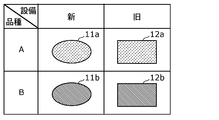
- FIG. 2 is a diagram showing a relationship between a variety and equipment in the production system shown in FIG.
- FIG. 3 is a diagram showing an example of production record data stored in the storage device according to the first embodiment.
- FIG. 4 is a block diagram showing a functional configuration of the skill evaluation device according to the first embodiment.
- FIG. 5 is a diagram for explaining the degree of deviation between the standard productivity index distribution and the worker's productivity index.
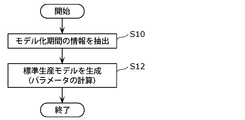
- FIG. 6 is a flowchart showing a process of generating a standard production model among the operations of the skill evaluation device according to the first embodiment.
- FIG. 1 is a diagram showing a configuration of a production system according to the first embodiment.
- FIG. 2 is a diagram showing a relationship between a variety and equipment in the production system shown in FIG.
- FIG. 3 is a diagram showing an example of production record data stored in the storage device according to the first embodiment.
- FIG. 4 is a
- FIG. 7 is a flowchart showing a process of evaluating the productivity of the worker among the operations of the skill evaluation device according to the first embodiment.
- FIG. 8 is a flowchart showing a process of evaluating the productivity of each worker among the operations of the skill evaluation device according to the first embodiment.
- FIG. 9 is a diagram showing an example of displaying a score by the skill evaluation device according to the first embodiment.
- FIG. 10 is a diagram showing an example of stop history data stored in the storage device according to the second embodiment.
- FIG. 11 is a block diagram showing a functional configuration of the skill evaluation device according to the second embodiment.
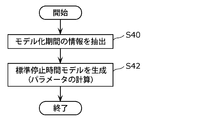
- FIG. 12 is a flowchart showing a process of generating a standard downtime model among the operations of the skill evaluation device according to the second embodiment.
- FIG. 13 is a flowchart showing a process of evaluating the stop time of the worker in the operation of the skill evaluation device according to the second embodiment.
- FIG. 14 is a diagram showing an example of displaying a score by the skill evaluation device according
- the skill evaluation device includes a plurality of first product varieties produced in the first period, a plurality of facilities used for producing the plurality of first products, and the plurality of first products.
- the acquisition unit that acquires the first information indicating the skill indexes of a plurality of workers involved in the production of the product and the first information
- the probability distribution of the standard skill index in the first period is estimated.
- a model generation unit that generates an estimated model, an aggregation unit that calculates a skill index of the specific worker by aggregating the production results of a specific worker in the second period, and the specific worker are the first.
- Second information indicating the product types of the plurality of second products engaged in production in the two periods and one or more facilities used by the specific worker in the second period is input to the estimation model as input data. Therefore, the estimation unit that estimates the probability distribution of the skill index of the specific worker, the calculation unit that calculates the degree of deviation between the probability distribution estimated by the estimation unit and the skill index calculated by the aggregation unit. And an output unit that outputs information based on the degree of deviation.
- the probability distribution of the skill index of a specific worker estimated by the estimation unit is based on the estimation model that estimates the probability distribution of the standard skill index, and the information on the product type and equipment handled by the specific worker. Since it is obtained by inputting, it represents the probability distribution of the standard skill index under the production conditions of a specific worker. Therefore, by comparing the probability distribution of the estimated skill index with the skill index obtained from the aggregated result of the production performance of the specific worker, it is possible to judge the skill level of the specific worker. Specifically, the calculated degree of divergence is a numerical value that quantifies the level of skill of a specific worker. As described above, according to the skill evaluation device according to this aspect, the skill level can be determined based on the probability distribution of the standard skill index, so that the skill of the worker can be evaluated equally.
- the skill index may be an index indicating the productivity of the worker.
- the skill index may be the downtime required for the worker to restart the stopped equipment.
- the totaling unit calculates the stop time for each of the stop factors by totaling the production results of the specific worker in the second period for each stop factor of the equipment, and the calculation unit can calculate the stop time for each stop factor.
- the degree of deviation may be calculated for each of the stopping factors.
- the restarting ability can be evaluated for each stop factor, so that the skills that the worker is good at and the skills that the worker lacks can be identified.
- the calculation unit may identify the skill lacking in the specific worker based on the degree of deviation for each of the stop factors.
- the aggregation unit calculates the skill index for each specific worker, and the estimation unit calculates the probability of the skill index for each specific worker.
- the distribution may be calculated, and the calculation unit may calculate the degree of deviation for each specific worker.
- the skill evaluation device may further include an input unit that accepts inputs between the second period and one or more of the specific workers.
- the skill evaluation method includes a plurality of first product varieties produced in the first period, a plurality of facilities used for producing the plurality of first products, and the plurality of first products.
- the step of acquiring the first information indicating the skill indexes of a plurality of workers involved in the production of the first product and the first information the probability distribution of the standard skill index in the first period is estimated.
- a step of estimating the probability distribution of the skill index of the specific worker a step of calculating the degree of deviation between the probability distribution estimated in the estimation step and the skill index calculated in the calculation step, It includes a step of outputting information based on the degree of deviation.
- the program according to one aspect of the present disclosure is a program that causes a computer to execute the above skill evaluation method.
- each figure is a schematic view and is not necessarily exactly illustrated. Therefore, for example, the scales and the like do not always match in each figure. Further, in each figure, substantially the same configuration is designated by the same reference numerals, and duplicate description will be omitted or simplified.
- FIG. 1 is a diagram showing a configuration of a production system according to the present embodiment.
- a product is produced by going through three steps A to C in order.
- Steps A to C are, for example, an assembly step, a welding step, and a packaging step, respectively.
- the number of steps and specific examples of the steps are merely examples, and are not limited thereto.
- the product produced by the production system 1 is, for example, an electric appliance, but may be a mounting board on which a plurality of circuit components are mounted, or may be a circuit component.
- the production system 1 is a system equipped with a plurality of facilities and produces a plurality of products of a plurality of varieties.
- the production system 1 is provided with a plurality of facilities for each process. As shown in FIG. 1, two workers are assigned to each process. Each of the workers U1 to U6 is assigned four facilities. Each worker produces a product by operating the equipment in charge. In addition, each worker performs maintenance on the equipment in charge and restarts the equipment when the equipment in charge is stopped.
- the types of equipment and product types handled by workers U1 to U6 are different for each worker.
- the combination of the type of equipment and the type of product is represented by the difference in the shape and shading of the figure schematically representing the equipment.
- FIG. 2 is a diagram showing the relationship between the product type and the equipment in the production system shown in FIG.
- the workers I can't decide the level of skill. For example, if the product A is easier to produce than the product B, the workers U3 and U6 who handle a large number of the product A are advantageous in the example shown in FIG. Further, when the new equipment is more productive than the old equipment, the workers U1 and U6 who use a lot of the new equipment are advantageous. As described above, an index showing productivity such as takt time cannot be used as an index for evaluating skills equally among workers.
- workers U1 to U6 are not always involved in the production of products of the same type with the same equipment. Depending on the day or time of day, the equipment and varieties in charge may change. Since the combinations of equipment and varieties that the workers U1 to U6 are involved in are diverse, it is difficult to set uniform conditions among the workers and compare their skills.
- the skill evaluation device generates an estimation model that estimates the probability distribution of a standard skill index based on the production results of a plurality of workers.
- the estimation model it is possible to obtain a probability distribution of a standard skill index under the production conditions of a specific worker. Since the skill level can be determined based on the probability distribution of the standard skill index, the skill of the worker can be evaluated equally.
- a productivity index which is an index indicating the productivity of the worker, is used.
- FIG. 3 is a diagram showing an example of production record data stored in the storage device according to the present embodiment.
- the identification number (product ID) of the product As shown in FIG. 3, in the production record data, the identification number (product ID) of the product, the time when the product was produced, the productivity index information 191 and the product type information 192, and the equipment are used for each product.
- Information 193, environment information 194, and worker information 195 are associated with each other.
- the equipment information 193, the worker information 195, and the productivity index information 191 are associated with each process.
- Productivity index information 191 is information indicating the productivity index of workers involved in the production of the corresponding product (first product).
- the productivity index is, for example, takt time. The shorter the takt time, the more products can be produced in a short period of time, and the higher the productivity.
- the productivity index may be the number of products produced per unit time. The higher the number of products produced per unit time, the higher the productivity.
- Product type information 192 is information indicating the product type of the corresponding product.
- the variety indicated by the variety information 192 may mean a category for each variety. That is, the product type information 192 may be classification information indicating a category in which the product product type is further classified.
- Equipment information 193 is information indicating the equipment used in the production of the corresponding product.
- Environmental information 194 is information indicating an environmental value during production of the corresponding product.
- Environmental values include room temperature and humidity in the space where the product is produced. Alternatively, the environmental value may be the temperature of the product or equipment.
- Worker information 195 is information indicating a worker involved in the production of the corresponding product.
- the production record data is generated based on the production log information of the production system 1.
- the data format of the production record data is not particularly limited.
- the production record data may be associated with each information for each facility.
- the production record data may be associated with each information for each worker.
- the production record data does not have to include the environmental information 194.
- FIG. 4 is a block diagram showing a functional configuration of the skill evaluation device according to the present embodiment.
- the skill evaluation device 100 includes a first extraction unit 110, a model generation unit 120, an input unit 130, a second extraction unit 140, an index estimation unit 150, and an aggregation unit 160. It includes an evaluation unit 170 and a display unit 180.
- the skill evaluation device 100 evaluates the skill of the worker using the information stored in the storage device 190.
- the storage device 190 stores, for example, the production record data shown in FIG. That is, the storage device 190 stores the productivity index information 191 and the product type information 192, the equipment information 193, the environmental information 194, and the worker information 195.
- the storage device 190 is a non-volatile storage element such as an HDD (Hard Disk Drive) or a flash memory.
- the first extraction unit 110 is an example of an acquisition unit that acquires the first information.
- the first information includes a plurality of first product varieties produced during the modeling period, a plurality of facilities used for the production of the plurality of first products, and a plurality of operations involved in the production of the plurality of first products. It is information indicating the productivity index of the person.
- the first information includes productivity index information 191 and product type information 192, and equipment information 193.
- the first information further includes environmental information 194. From the production record data stored in the storage device 190, the first extraction unit 110 includes productivity index information 191, product type information 192, equipment information 193, and environmental information associated with the time included in the modeling period. 194 and are extracted.
- the modeling period is an example of the first period, which is the period during which production was performed to obtain production performance data used for generating an estimated model.
- the modeling period is a period earlier than the time when the skill of the worker is evaluated and the time when the estimation model is generated.
- the modeling period is a fixed period such as one day, one week, one month or one year.
- the modeling period is, for example, a past period in which a product of the same variety as the product currently being produced was produced using the same equipment as the equipment currently in use.
- the modeling period may be the entire period from the construction of the production system 1 to the present.
- the model generation unit 120 uses the first information acquired by the first extraction unit 110 to generate an estimation model that estimates the probability distribution of a standard productivity index during the modeling period.
- the model generation unit 120 generates an estimation model based on, for example, Bayesian estimation. Specifically, the model generation unit 120 calculates a plurality of parameters that define the estimation model using the first information. More specifically, the model generation unit 120 calculates the parameters of the hierarchical Bayes model using the information of the modeling period.
- the hierarchical Bayesian model according to the present embodiment is a model in which the product type information and the equipment information are used as explanatory variables, the productivity index for each production condition and its frequency are estimated, and the overall productivity index is estimated.
- the overall productivity index is the sum of products of the productivity index and the frequency divided by the frequency (average).
- the estimation model is a standard production model, which estimates the probability distribution of a standard productivity index under predetermined production conditions.
- the model generation unit 120 generates a standard production model by using all of the production record data in the modeling period among the past production record data. Specifically, all of the production record data during the modeling period are productivity index information 191 and product type information 192, equipment information 193, and environmental information 194. At this time, the environmental information 194 may not be included.
- the standard productivity model when the production conditions of a specific worker are input as input data, the probability distribution of the standard productivity index under the production conditions of the specific worker as output data (hereinafter referred to as the probability distribution). , Described as standard productivity index distribution) is output.
- the production conditions are defined by the combination of product type, equipment and environmental value. Production conditions may be defined by a combination of varieties and equipment, excluding environmental values.
- the input unit 130 accepts the evaluation period and the input of a specific worker.
- a specific worker is a worker who is subject to skill evaluation.
- the evaluation period is an example of the second period, and is the period subject to skill evaluation.
- the evaluation period is different from the modeling period.
- the evaluation period may be a part of the modeling period or may be a period including a part of the modeling period.
- the input unit 130 is realized by an input device such as a touch panel display, a keyboard or a mouse, for example.
- the input unit 130 displays a text box for inputting an evaluation period, list information for selecting a specific worker, and the like on the display.
- the list information is, for example, information indicating all the workers included in the production record data.
- the user of the skill evaluation device 100 can input the evaluation period and a specific worker, and the input unit 130 evaluates the input period and the worker. And accept as a specific worker.
- the input unit 130 may be realized by a microphone and may accept voice input.
- the evaluation period and the input format of a specific worker are not particularly limited.
- the evaluation period is a predetermined period such as 1 hour, 1 day, 1 week, 1 month, and is not particularly limited. Further, the input unit 130 may accept only the input of a specific worker without accepting the input of the evaluation period. The input unit 130 may accept inputs from a plurality of specific workers.
- the second extraction unit 140 extracts the evaluation period received by the input unit 130 and the production record data related to a specific worker from the storage device 190. Specifically, the second extraction unit 140 extracts production record data relating to a product (second product) produced within the evaluation period and a product in which a specific worker is involved in the production of the product. For example, in the example shown in FIG. 3, when the evaluation period is one day of 2020/2/26 and the specific worker is the worker U4, the second extraction unit 140 has the product ID “00002”.
- the product type information 192, the equipment information 193 related to the process B, the productivity index information 191 and the environmental information 194 are extracted for each of "00003".
- the index estimation unit 150 provides second information indicating the types of a plurality of products (second products) produced by a specific worker during the evaluation period and one or more facilities used by the specific worker during the evaluation period. Is input to the estimation model as input data to estimate the probability distribution of the productivity index of a specific worker.
- the second information further indicates an environmental value (eg, room temperature) for a particular worker during the evaluation period. That is, the index estimation unit 150 inputs the product type information 192, the equipment information 193, and the environmental information 194 related to the specific worker in the evaluation period into the estimation model as input data.
- the estimated probability distribution is the probability distribution of the standard productivity index under the production conditions of a specific worker during the evaluation period.
- the aggregation unit 160 calculates the productivity index of a specific worker by aggregating the production results of the specific worker during the evaluation period. Specifically, the aggregation unit 160 calculates statistical values such as the average or variance of the productivity index of a specific worker during the evaluation period as the productivity index of the specific worker. For example, when a specific worker handles a plurality of varieties and a plurality of facilities during the evaluation period, the aggregation unit 160 calculates the average or variance of the productivity index for each combination of the varieties and the facilities.
- the evaluation unit 170 is an example of a calculation unit that calculates the degree of deviation between the probability distribution estimated by the index estimation unit 150 (that is, the standard productivity index distribution) and the productivity index calculated by the aggregation unit 160. For example, the evaluation unit 170 compares the average of the standard productivity index distribution (hereinafter referred to as the standard average) with the average calculated by the aggregation unit 160 (hereinafter referred to as the actual average). Alternatively, the evaluation unit 170 may compare the variance of the standard productivity index distribution with the variance calculated by the aggregation unit 160.
- FIG. 5 is a diagram for explaining the degree of deviation between the standard productivity index distribution and the worker's productivity index. As shown in FIG. 5, the evaluation unit 170 can calculate the difference between the standard average and the actual average as the degree of deviation. The degree of divergence may be the difference between these two variances. Alternatively, the degree of divergence may be the ratio of mean or variance.
- the evaluation unit 170 converts the degree of divergence into a score.
- the score is an evaluation value indicating the high level of skill.
- the score is expressed in the range of 0 to 10 points, for example, and the higher the value, the higher the skill.
- the score can be expressed by a linear function of the degree of divergence.
- the degree of divergence is a value obtained by subtracting the standard average from the actual average
- the degree of divergence is 0, it means that the skill of the worker is standard. Therefore, for example, when the degree of deviation is 0, the evaluation unit 170 sets the score to 5 points, which is an intermediate value.
- the degree of deviation is a positive value, it means that the skill of the worker is higher than the standard, so the evaluation unit 170 determines the score to a value larger than 5 points and 10 points or less.
- the degree of deviation is a negative value, it means that the skill of the worker is lower than the standard, so the evaluation unit 170 determines the score to a value of 0 points or more and less than 5 points.
- the evaluation unit 170 is calculated by the standard productivity index distribution and the aggregation unit 160 for each combination of the varieties and equipments. Based on the productivity index, the degree of divergence is calculated for each combination of product type and equipment. Further, the evaluation unit 170 converts the calculated degree of deviation into a score for each combination of product type and equipment. The evaluation unit 170 weights the score for each combination by the ratio of the period in which a specific worker handles the combination of varieties and equipment to the evaluation period and the number of products produced by the combination. Then, calculate the total score. The calculated total score is the score of a specific worker during the evaluation period.
- the display unit 180 is an example of an output unit that outputs information based on the degree of deviation.
- the display unit 180 displays the score of a specific worker. A display example by the display unit 180 will be described later.
- the display unit 180 is, for example, a liquid crystal display device, but is not limited to this.
- the display unit 180 may be an organic EL (Electroluminescence) display device.
- the skill evaluation device 100 may include an audio output unit such as a speaker or a communication unit in place of the display unit 180 or in addition to the display unit 180.
- the audio output unit outputs information based on the degree of deviation as audio.
- the communication unit may transmit a signal including information based on the degree of deviation to another device.
- the communication by the communication unit may be either wired or wireless.
- the skill evaluation device 100 is, for example, a computer device.
- the skill evaluation device 100 is realized by a non-volatile memory in which the program is stored, a volatile memory which is a temporary storage area for executing the program, an input / output port, a processor for executing the program, and the like.
- each processing unit other than the input unit 130 and the display unit 180 is realized by, for example, an LSI (Large Scale Integration) which is an integrated circuit (IC: Integrated Circuit).
- the integrated circuit is not limited to the LSI, and may be a dedicated circuit or a general-purpose processor.
- each processing unit may be a microcontroller.
- each processing unit may be a programmable FPGA (Field Programmable Gate Array) or a reconfigurable processor in which the connection and setting of circuit cells in the LSI can be reconfigured.
- the function executed by each processing unit may be realized by software or hardware.
- Each processing unit may share hardware resources such as a memory and a processor.
- FIG. 6 is a flowchart showing a process of generating a standard production model among the operations of the skill evaluation device according to the present embodiment.
- the first extraction unit 110 extracts information on the modeling period (S10). Specifically, the first extraction unit 110 extracts all the production record data of the modeling period from the past production record data stored in the storage device 190, excluding the worker information 195. That is, the first extraction unit 110 extracts all the productivity index information 191 and the variety information 192, the equipment information 193, and the environmental information 194 without filtering by the worker, the equipment, the product type, the environmental value, and the like.
- the model generation unit 120 generates a standard production model based on the extracted information (S12). Specifically, the model generation unit 120 calculates a plurality of parameters that define a standard production model based on Bayesian inference.
- the standard production model generation process shown above is performed as a pre-process for evaluating the productivity of a specific worker.
- the generation process of the standard production model may be repeated every time the production record data is accumulated.
- the generation process of the standard production model may be performed every day or week.
- FIG. 7 is a flowchart showing a process of evaluating the productivity of the worker among the operations of the skill evaluation device according to the present embodiment.
- the second extraction unit 140 extracts information on the evaluation period of a specific worker (S20).
- the specific worker and evaluation period are the worker and period accepted by the input unit 130.
- the second extraction unit 140 extracts the productivity index information 191 and the variety information 192, the equipment information 193 and the environmental information 194 of the product in which the specific worker was involved in the production within the evaluation period with reference to the worker information 195. ..
- the aggregation unit 160 calculates the productivity index of a specific worker (S22). Specifically, the totaling unit 160 calculates the average of the productivity indexes by totaling the production results of a specific worker.
- the index estimation unit 150 estimates the standard productivity index distribution of a specific worker based on the standard production model generated by the process shown in FIG. 6 (S24). Specifically, the index estimation unit 150 inputs the product type information 192, the equipment information 193, and the environmental information 194 extracted by the second extraction unit 140 as input data into the standard production model, so that the standard productivity index distribution To estimate.
- processing by the aggregation unit 160 and the processing by the index estimation unit 150 may be performed first or in parallel.
- the evaluation unit 170 calculates the degree of deviation between the standard productivity index distribution and the productivity index (S26). Further, the evaluation unit 170 converts the calculated degree of deviation into a score (S28). Next, the display unit 180 displays the score converted by the evaluation unit 170 (S30).
- the standard productivity index distribution can be obtained based on the estimation model, so that the productivity of the worker can be suppressed by suppressing the influence of the equipment and the product type. Can be evaluated equally. Moreover, since the productivity index can be quantitatively calculated for each worker, it is possible to compare the high and low productivity among the workers.
- FIG. 8 is a flowchart showing a process of evaluating the productivity of each worker among the operations of the skill evaluation device according to the present embodiment.
- the second extraction unit 140 selects one worker as a specific worker to be calculated for the productivity index (S19). For example, when a plurality of workers are input by the input unit 130, the second extraction unit 140 is a worker whose degree of divergence and score have not been calculated from among the plurality of input workers, that is, productivity. Select an unevaluated worker who has not yet been evaluated as a specific worker.
- the actual data of the evaluation period is extracted (S20), the productivity index is calculated (S22), and the standard productivity index distribution is estimated for the selected specific worker. (S24), the degree of deviation is calculated (S26), and the score is converted (S28).
- the second extraction unit 140 determines whether or not there is an unevaluated worker (S29). When there is an unevaluated worker (Yes in S29), the second extraction unit 140 selects one of the unevaluated workers as a specific worker (S19) and repeats the processes of steps S20 to S29. .. When there are no unrated workers (No in S29), that is, when the evaluation of all the workers to be evaluated is completed, the display unit 180 displays the score for each worker (S30).
- FIG. 8 shows an example of evaluating the productivity of each worker for a plurality of workers
- the productivity of one or a plurality of workers is evaluated for a plurality of evaluation periods. You may.
- the input unit 130 accepts inputs for a plurality of periods. In this case, the processes of steps S19 to S29 shown in FIG. 8 are performed for each evaluation period.
- FIG. 9 is a diagram showing an example of displaying a score by the skill evaluation device according to the present embodiment.
- the display unit 180 displays the scores of each of the plurality of workers in a tabular format for each evaluation period. In this way, the display unit 180 displays the score for each worker on the same screen, so that the difference in skill between the workers can be easily discriminated. Therefore, for example, a worker who lacks skills and needs training can be easily identified.
- the display example by the display unit 180 is not particularly limited.
- the display unit 180 may display the workers side by side in descending order of score. In this case, the display unit 180 does not have to display the numerical value of the score itself. Further, when there is only one worker to be evaluated, the display unit 180 may display the score of one or a plurality of periods of one worker.
- the equipment downtime is used instead of the productivity index as the skill index of the worker.
- the differences from the first embodiment will be mainly described, and the common points will be omitted or simplified.
- FIG. 10 is a diagram showing an example of stop history data stored in the storage device according to the present embodiment.
- the stop history data is an example of production record data by the production system 1.
- the time when the stop of the equipment occurred the product type information 192, the environmental information 194, the worker information 195, and the stop information 296 are added to the equipment information 193. Are associated with each other.
- the product type information 192 is information indicating the product type that was processed when the corresponding equipment stopped.
- Equipment information 193 is, for example, information indicating a unique identifier (equipment ID) assigned to each equipment.
- Environmental information 194 is information indicating an environmental value when the corresponding equipment is stopped.
- Worker information 195 is information indicating a worker who handles the corresponding equipment and who has restarted the equipment.
- the stop information 296 includes the stop time and the stop factor.
- the downtime is the time required to restart the corresponding downed equipment.
- the outage factor is the cause of the outage of the corresponding equipment.
- the stop history data is generated based on the production log information of the production system 1.
- the data format of the stop history data is not particularly limited.
- the stop history data may be associated with each information for each product ID, as in the production record data shown in FIG.
- the stop history data may be associated with each information for each worker.
- the stop history data may not include the environment information 194.
- the stop history data may include the productivity index information 191.
- FIG. 11 is a block diagram showing a functional configuration of the skill evaluation device according to the present embodiment.
- the skill evaluation device 200 includes a first extraction unit 210, a model generation unit 220, an input unit 130, a second extraction unit 240, an index estimation unit 250, and an aggregation unit 260. It includes an evaluation unit 270 and a display unit 280.
- the input unit 130 is the same as that of the first embodiment.
- the skill evaluation device 200 evaluates the skill of the worker using the information stored in the storage device 290.
- the storage device 290 stores, for example, the stop history data shown in FIG. That is, the storage device 290 stores the product type information 192, the equipment information 193, the environmental information 194, the worker information 195, and the stop information 296.
- the storage device 290 may store the productivity index information 191.
- the storage device 290 is a non-volatile storage element such as an HDD or a flash memory.
- the first extraction unit 210 is an example of an acquisition unit that acquires the first information.
- the first information includes a plurality of first product varieties produced during the modeling period, a plurality of facilities used for the production of the plurality of first products, and a plurality of operations involved in the production of the plurality of first products. It is information indicating the downtime required for each person to restart the stopped equipment.
- the first information includes the product type information 192, the equipment information 193, and the stop information 296.
- the first information further includes environmental information 194.
- the first extraction unit 210 uses the stop history data stored in the storage device 290 to provide stop information 296, product type information 192, and equipment information 193 associated with the time included in the modeling period. And the environmental information 194 are extracted.
- the modeling period is an example of the first period as in the first embodiment, and is the period during which production is performed to obtain the stop history data used for generating the estimation model.
- the model generation unit 220 uses the first information acquired by the first extraction unit 210 to generate an estimation model that estimates the probability distribution of the standard stop time in the modeling period.
- the model generation unit 220 generates an estimation model based on, for example, Bayesian estimation. Specifically, the model generation unit 220 calculates a plurality of parameters that define the estimation model using the first information. More specifically, the model generation unit 220 calculates the parameters of the hierarchical Bayes model using the information of the modeling period.
- the hierarchical Bayes model according to the present embodiment is a model in which the product type information and the equipment information are used as explanatory variables, the stop time and its frequency for each stop factor are estimated, and the total stop time is estimated. The total stop time corresponds to the sum of the product of the stop time and the frequency for each stop factor.
- the estimation model is a standard downtime model, which estimates the probability distribution of the standard downtime under predetermined production conditions.
- the model generation unit 220 generates a standard stop time model by using all of the stop history data of the modeling period among the past stop history data. Specifically, all of the stop history data in the modeling period are stop information 296, product type information 192, equipment information 193, and environmental information 194. At this time, the environmental information 194 may not be included.
- the probability distribution when the production conditions of a specific worker are input as input data, the probability distribution of the standard downtime under the production conditions of the specific worker as output data (hereinafter referred to as the probability distribution). , Described as standard downtime distribution) is output.
- the second extraction unit 240 extracts the evaluation period received by the input unit 130 and the stop history data related to the specific worker from the storage device 290. Specifically, the second extraction unit 240 extracts stop history data related to products produced within the evaluation period (second products) and products in which a specific worker is involved in the production of the products. For example, in the example shown in FIG. 10, when the evaluation period is one day of 2020/2/26 and the specific worker is the worker U4, the second extraction unit 240 has the equipment ID “M013”. The stop information 296, the product type information 192, the environmental information 194, and the worker information 195 are extracted.
- the index estimation unit 250 provides second information indicating the types of a plurality of products (second products) produced by a specific worker during the evaluation period and one or more facilities used by the specific worker during the evaluation period. Is input to the estimation model as input data to estimate the probability distribution of the stop time of a specific worker.
- the second information further indicates an environmental value (eg, room temperature) for a particular worker during the evaluation period. That is, the index estimation unit 250 inputs the product type information 192, the equipment information 193, and the environmental information 194 related to the specific worker in the evaluation period into the estimation model as input data.
- the estimated probability distribution is the standard downtime probability distribution under the production conditions of a specific worker during the evaluation period. By comparing the actual values of specific workers with the estimated probability distribution as a comparison target, it is possible to determine the length of the stop time of a specific worker.
- the index estimation unit 250 estimates the probability distribution of the stop time for each stop factor.
- the totaling unit 260 calculates the downtime of a specific worker by totaling the production results of the specific worker during the evaluation period. Specifically, the aggregation unit 260 calculates statistical values such as the average or variance of the downtime of a specific worker during the evaluation period as the downtime of the specific worker. The totaling unit 260 may calculate the downtime for each outage factor by totaling the production results for each outage factor of the equipment. For example, when a specific worker handles a plurality of types and a plurality of facilities during the evaluation period, the aggregation unit 260 calculates the average or variance of the stop time for each stop factor of each facility and for each type. do.
- the evaluation unit 270 is an example of a calculation unit that calculates the degree of deviation between the probability distribution estimated by the index estimation unit 250 (that is, the standard stop time distribution) and the stop time calculated by the aggregation unit 260. For example, the evaluation unit 270 compares the average of the standard downtime distribution (hereinafter referred to as the standard average) with the average calculated by the aggregation unit 260 (hereinafter referred to as the actual average). Alternatively, the evaluation unit 270 may compare the variance of the standard downtime distribution with the variance calculated by the aggregation unit 260.
- the evaluation unit 270 converts the degree of divergence into a score.
- the score is the same as that of the first embodiment, and can be expressed by, for example, a linear function of the degree of divergence. For example, when the degree of divergence is a value obtained by subtracting the standard average from the actual average, when the degree of divergence is 0, it means that the stop time of the worker is standard. Therefore, for example, when the degree of deviation is 0, the evaluation unit 270 sets the score to 5 points, which is an intermediate value. Further, when the degree of deviation is a negative value, it means that the stop time by the operator is shorter than the standard. Therefore, when the degree of deviation is a negative value, the evaluation unit 270 is larger than 5 points.
- the score is determined to a value of 10 points or less.
- the degree of deviation is a positive value, it means that the stop time by the worker is longer than the standard, so the evaluation unit 270 determines the score to a value of 0 points or more and less than 5 points. Further, when the downtime is calculated for each stop factor of the equipment by the aggregation unit 260, the evaluation unit 270 may calculate the degree of deviation for each stop factor and convert it into a score.
- the evaluation unit 270 When a specific worker handles a plurality of varieties and a plurality of facilities during the evaluation period, the evaluation unit 270 has a standard stop time distribution for each stop factor and each type calculated by the aggregation unit 260. The degree of deviation for each variety is calculated based on the stop time, and the calculated degree of deviation is converted into a score. The evaluation unit 270 weights the score for each variety by the ratio of the period in which a specific worker handles the variety to the evaluation period and the number of products produced, thereby stopping the overall score. Calculated for each. The calculated total score is the score for each stop factor in the evaluation period of a specific worker.
- the evaluation unit 270 identifies the skills that a specific worker lacks based on the degree of divergence for each stop factor. Specifically, the evaluation unit 270 compares the score for each stop factor with the threshold value, and identifies the score below the threshold value. The evaluation unit 270 identifies the skill for restarting the equipment stopped by the stop factor corresponding to the specified score as the skill lacking for a specific worker.
- the display unit 280 is an example of an output unit that outputs information based on the degree of deviation.
- the display unit 280 displays the score of a specific worker.
- the display unit 280 displays the score for each stop factor.
- a display example by the display unit 280 will be described later.
- FIG. 12 is a flowchart showing a process of generating a standard downtime model among the operations of the skill evaluation device according to the present embodiment.
- the first extraction unit 210 extracts information on the modeling period (S40). Specifically, the first extraction unit 210 extracts all the stop history data of the modeling period from the past stop history data stored in the storage device 290, excluding the worker information 195. That is, the first extraction unit 210 extracts all the stop information 296, the product type information 192, the equipment information 193, and the environmental information 194 without filtering by the worker, the equipment, the product type, the stop factor, the environmental value, and the like.
- the model generation unit 220 generates a standard downtime model based on the extracted information (S42). Specifically, the model generation unit 220 calculates a plurality of parameters that define a standard downtime model based on Bayesian inference.
- the standard downtime model generation process shown above is performed as a pre-process for evaluating the downtime of a specific worker.
- the generation process of the standard stop time model may be repeated every time the stop history data is accumulated.
- a standard downtime model generation process may be performed every day or week.
- FIG. 13 is a flowchart showing a process of evaluating the stop time of the worker in the operation of the skill evaluation device according to the present embodiment.
- the second extraction unit 240 selects one stop factor from the plurality of stop factors (S49). For example, the second extraction unit 240 selects an unevaluated stop factor for which the stop time has not yet been evaluated.
- the second extraction unit 240 extracts information on the evaluation period of a specific worker (S50).
- the specific worker and evaluation period are the worker and period accepted by the input unit 130.
- the second extraction unit 240 extracts the stop information 296, the product type information 192, the equipment information 193, and the environmental information 194 of the product in which the specific worker is engaged in the production within the evaluation period with reference to the worker information 195.
- the aggregation unit 260 calculates the stop time based on the selected stop factor for a specific worker (S52). Specifically, the totaling unit 260 calculates the average stop time by totaling the production results of a specific worker.
- the index estimation unit 250 estimates the standard downtime distribution of a specific worker based on the standard downtime model generated by the process shown in FIG. 11 (S54). Specifically, the index estimation unit 250 inputs the product type information 192, the equipment information 193, and the environmental information 194 extracted by the second extraction unit 240 as input data into the standard downtime model, so that the standard downtime distribution is distributed. To estimate.
- processing by the aggregation unit 260 and the processing by the index estimation unit 250 may be performed first or in parallel.
- the evaluation unit 270 calculates the degree of deviation between the standard downtime distribution and the worker's downtime specifically (S56). Further, the evaluation unit 270 converts the calculated degree of deviation into a score (S58).
- the calculated score is an evaluation value that evaluates the shortness of the stop time based on the stop factor of a specific worker. The higher the score, the shorter the downtime of a particular worker and the higher the ability to restore equipment.
- the second extraction unit 240 determines whether or not there is an unevaluated stop factor (S59). When there is an unevaluated stop factor (Yes in S59), the second extraction unit 240 selects the unevaluated stop factor (S49) and repeats the processes of steps S50 to S59. When there is no unevaluated stop factor (No in S59), that is, when the evaluation of all the stop factors to be evaluated is completed, the display unit 280 displays the score for each worker (S60).
- FIG. 14 is a diagram showing an example of displaying a score by the skill evaluation device according to the present embodiment.
- the display unit 280 displays the score for each stop factor for a specific worker in a tabular format.
- the display unit 280 displays the score for each stop factor on the same screen, so that the difference in recovery ability between the stop factors can be easily determined. That is, it is possible to discriminate between skills that are superior and skills that are inferior to a specific worker. By determining the inferior skill, the training content of the worker can be appropriately determined, and the improvement of the skill can be supported.
- the display example by the display unit 280 is not particularly limited.
- the display unit 280 may display the stop factors in descending order of score. In this case, the display unit 280 does not have to display the numerical value of the score itself.
- the standard downtime distribution can be obtained based on the estimation model, so that the influence of the equipment and the type of equipment can be suppressed and the equipment can be restored by the operator. High ability can be evaluated equally.
- the score for each stop factor may be calculated for each of the plurality of specific workers. Alternatively, the score may be calculated for each worker regardless of the stopping factor.
- the communication method between the devices described in the above embodiment is not particularly limited.
- the wireless communication method is, for example, short-range wireless communication such as ZigBee (registered trademark), Bluetooth (registered trademark), or wireless LAN (Local Area Network).
- the wireless communication method may be communication via a wide area communication network such as the Internet.
- wired communication may be performed between the devices instead of wireless communication.
- the wired communication includes power line communication (PLC: Power Line Communication) or communication using a wired LAN.
- another processing unit may execute the processing executed by the specific processing unit. Further, the order of the plurality of processes may be changed, or the plurality of processes may be executed in parallel. Further, the distribution of the components of the skill evaluation device to a plurality of devices is an example. For example, the components of one device may be included in another device.
- the processing described in the above embodiment may be realized by centralized processing using a single device (system), or may be realized by distributed processing using a plurality of devices. good.
- the number of processors that execute the above program may be singular or plural. That is, centralized processing may be performed, or distributed processing may be performed.
- control unit may be configured by dedicated hardware, or may be realized by executing a software program suitable for each component. May be good.
- Each component may be realized by a program execution unit such as a CPU (Central Processing Unit) or a processor reading and executing a software program recorded on a recording medium such as an HDD or a semiconductor memory.
- program execution unit such as a CPU (Central Processing Unit) or a processor reading and executing a software program recorded on a recording medium such as an HDD or a semiconductor memory.
- a component such as a control unit may be composed of one or a plurality of electronic circuits.
- the one or more electronic circuits may be general-purpose circuits or dedicated circuits, respectively.
- One or more electronic circuits may include, for example, a semiconductor device, an IC, an LSI, or the like.
- the IC or LSI may be integrated on one chip or may be integrated on a plurality of chips.
- it is called IC or LSI, but the name changes depending on the degree of integration, and it may be called system LSI, VLSI (Very Large Scale Integration), or ULSI (Ultra Large Scale Integration).
- an FPGA programmed after the LSI is manufactured can be used for the same purpose.
- the general or specific aspects of the present disclosure may be realized by a system, an apparatus, a method, an integrated circuit or a computer program.
- a computer-readable non-temporary recording medium such as an optical disk, HDD or semiconductor memory in which the computer program is stored.
- it may be realized by any combination of a system, a device, a method, an integrated circuit, a computer program and a recording medium.
- This disclosure can be used as a skill evaluation device or the like capable of equally evaluating the skills of workers, and can be used, for example, in a factory production system or the like.
Landscapes
- Business, Economics & Management (AREA)
- Human Resources & Organizations (AREA)
- Engineering & Computer Science (AREA)
- Strategic Management (AREA)
- Economics (AREA)
- Educational Administration (AREA)
- Entrepreneurship & Innovation (AREA)
- Development Economics (AREA)
- General Physics & Mathematics (AREA)
- General Business, Economics & Management (AREA)
- Theoretical Computer Science (AREA)
- Marketing (AREA)
- Tourism & Hospitality (AREA)
- Physics & Mathematics (AREA)
- Game Theory and Decision Science (AREA)
- Quality & Reliability (AREA)
- Operations Research (AREA)
- Manufacturing & Machinery (AREA)
- Health & Medical Sciences (AREA)
- General Health & Medical Sciences (AREA)
- Primary Health Care (AREA)
- General Factory Administration (AREA)
- Management, Administration, Business Operations System, And Electronic Commerce (AREA)
Priority Applications (4)
| Application Number | Priority Date | Filing Date | Title |
|---|---|---|---|
| US17/800,477 US20230106962A1 (en) | 2020-03-11 | 2021-03-03 | Skill evaluation device and skill evaluation method |
| CN202180013832.5A CN115104118A (zh) | 2020-03-11 | 2021-03-03 | 技能评价装置以及技能评价方法 |
| JP2022505976A JP7599105B2 (ja) | 2020-03-11 | 2021-03-03 | 技能評価装置及び技能評価方法 |
| DE112021001541.9T DE112021001541T5 (de) | 2020-03-11 | 2021-03-03 | Fertigkeitsbewertungsvorrichtung und Fertigkeitsbewertungsverfahren |
Applications Claiming Priority (2)
| Application Number | Priority Date | Filing Date | Title |
|---|---|---|---|
| JP2020042472 | 2020-03-11 | ||
| JP2020-042472 | 2020-03-11 |
Publications (1)
| Publication Number | Publication Date |
|---|---|
| WO2021182245A1 true WO2021182245A1 (ja) | 2021-09-16 |
Family
ID=77671627
Family Applications (1)
| Application Number | Title | Priority Date | Filing Date |
|---|---|---|---|
| PCT/JP2021/008210 Ceased WO2021182245A1 (ja) | 2020-03-11 | 2021-03-03 | 技能評価装置及び技能評価方法 |
Country Status (5)
| Country | Link |
|---|---|
| US (1) | US20230106962A1 (https=) |
| JP (1) | JP7599105B2 (https=) |
| CN (1) | CN115104118A (https=) |
| DE (1) | DE112021001541T5 (https=) |
| WO (1) | WO2021182245A1 (https=) |
Families Citing this family (1)
| Publication number | Priority date | Publication date | Assignee | Title |
|---|---|---|---|---|
| JP2024091181A (ja) * | 2022-12-23 | 2024-07-04 | 富士通株式会社 | 情報処理プログラム、情報処理方法および情報処理装置 |
Citations (1)
| Publication number | Priority date | Publication date | Assignee | Title |
|---|---|---|---|---|
| JPH05282323A (ja) * | 1992-03-31 | 1993-10-29 | Nippon Steel Corp | 標準時間集計装置 |
Family Cites Families (17)
| Publication number | Priority date | Publication date | Assignee | Title |
|---|---|---|---|---|
| JP2003288476A (ja) * | 2002-03-28 | 2003-10-10 | Hitachi Ltd | 生産ラインの統合ライン能力評価・管理運用システム、および、その統合ライン能力評価・管理運用方法 |
| JP4700302B2 (ja) * | 2004-07-22 | 2011-06-15 | 株式会社ジャステック | ソフトウェア開発生産管理システム、コンピュータプログラム及び記録媒体 |
| JP2006171184A (ja) * | 2004-12-14 | 2006-06-29 | Toshiba Corp | 技能評価システムおよび技能評価方法 |
| JP2007065759A (ja) * | 2005-08-29 | 2007-03-15 | Sharp Corp | 作業習熟度判定システムおよび作業習熟度判定方法 |
| JP6009317B2 (ja) * | 2012-10-31 | 2016-10-19 | Kddi株式会社 | スキル評価方法および装置 |
| JP6464358B2 (ja) * | 2014-10-30 | 2019-02-06 | パナソニックIpマネジメント株式会社 | 作業者支援システム、及び作業者支援方法、並びに部品実装装置 |
| JP2018025932A (ja) * | 2016-08-09 | 2018-02-15 | ファナック株式会社 | センサと機械学習部を備えた作業管理システム |
| US10394871B2 (en) * | 2016-10-18 | 2019-08-27 | Hartford Fire Insurance Company | System to predict future performance characteristic for an electronic record |
| JP7133775B2 (ja) * | 2017-07-14 | 2022-09-09 | パナソニックIpマネジメント株式会社 | 表示装置、製造システム及び表示方法 |
| US10915850B2 (en) * | 2018-02-22 | 2021-02-09 | International Business Machines Corporation | Objective evidence-based worker skill profiling and training activation |
| JP7103078B2 (ja) * | 2018-08-31 | 2022-07-20 | オムロン株式会社 | 作業支援装置、作業支援方法及び作業支援プログラム |
| GB201817061D0 (en) * | 2018-10-19 | 2018-12-05 | Sintef Tto As | Manufacturing assistance system |
| US11017339B2 (en) * | 2019-02-05 | 2021-05-25 | International Business Machines Corporation | Cognitive labor forecasting |
| CN113424119A (zh) * | 2019-02-13 | 2021-09-21 | 松下知识产权经营株式会社 | 作业效率评价方法、作业效率评价装置以及程序 |
| JP2020181574A (ja) * | 2019-04-24 | 2020-11-05 | 株式会社エイチ・ピィ・ピィ・ティ | 情報処理装置、情報処理方法及びプログラム |
| AU2021252927A1 (en) * | 2020-04-07 | 2022-11-10 | Assia Spe, Llc | Systems and methods for remote collaboration |
| US11346751B1 (en) * | 2020-12-10 | 2022-05-31 | Sas Institute Inc. | Interactive diagnostics for evaluating designs for measurement systems analysis |
-
2021
- 2021-03-03 DE DE112021001541.9T patent/DE112021001541T5/de active Pending
- 2021-03-03 JP JP2022505976A patent/JP7599105B2/ja active Active
- 2021-03-03 US US17/800,477 patent/US20230106962A1/en not_active Abandoned
- 2021-03-03 CN CN202180013832.5A patent/CN115104118A/zh active Pending
- 2021-03-03 WO PCT/JP2021/008210 patent/WO2021182245A1/ja not_active Ceased
Patent Citations (1)
| Publication number | Priority date | Publication date | Assignee | Title |
|---|---|---|---|---|
| JPH05282323A (ja) * | 1992-03-31 | 1993-10-29 | Nippon Steel Corp | 標準時間集計装置 |
Also Published As
| Publication number | Publication date |
|---|---|
| JP7599105B2 (ja) | 2024-12-13 |
| CN115104118A (zh) | 2022-09-23 |
| JPWO2021182245A1 (https=) | 2021-09-16 |
| US20230106962A1 (en) | 2023-04-06 |
| DE112021001541T5 (de) | 2022-12-29 |
Similar Documents
| Publication | Publication Date | Title |
|---|---|---|
| JP7825681B2 (ja) | 時系列予測 | |
| JP6817426B2 (ja) | マシンラーニング基盤の半導体製造の収率予測システム及び方法 | |
| US20180268258A1 (en) | Automated decision making using staged machine learning | |
| CN105867341B (zh) | 一种烟草加工设备的在线设备健康状态自检方法及系统 | |
| AU2016247051A1 (en) | Resource evaluation for complex task execution | |
| US20180174090A1 (en) | Production Management Support Apparatus, Production Management Support Method, and Production Management Support Program | |
| US11853042B2 (en) | Part, sensor, and metrology data integration | |
| CN111859047A (zh) | 一种故障解决方法及装置 | |
| JP2017037645A (ja) | スマートアラートのためのシステム及び方法 | |
| Staron et al. | A method for forecasting defect backlog in large streamline software development projects and its industrial evaluation | |
| TWI590095B (zh) | 軟體功能驗證系統及其驗證方法 | |
| CN107077132A (zh) | 使用分布式控制系统来管理加工厂的子系统的方法 | |
| CN118917390B (zh) | 基于知识大模型的服务知识库管理系统及方法 | |
| CN112200459B (zh) | 一种配电网数据质量分析评价方法及系统 | |
| JP7599105B2 (ja) | 技能評価装置及び技能評価方法 | |
| US20190205804A1 (en) | Information processing device, information processing method and computer readable medium | |
| Onggo et al. | Extending simulation modeling methodology for digital twin applications | |
| Khemiri et al. | Improving business process in semiconductor manufacturing by discovering business rules | |
| CN111445006A (zh) | 开源社区中开发者代码提交次数的预测方法及系统 | |
| US20190205802A1 (en) | Information processing device, information processing method and computer readable medium | |
| CN118586782A (zh) | 一种基于质量管理决策系统的数理统计分析方法 | |
| CN115879696A (zh) | 数据处理方法及相关数据处理装置、存储介质和程序产品 | |
| CN113377822A (zh) | 一种基于能源大数据的数据处理系统 | |
| CN118278719B (zh) | 一种智能车间刀具资源预测方法、装置、设备和介质 | |
| CN112422312B (zh) | 一种基于众包的工业互联网系统日志处理方法 |
Legal Events
| Date | Code | Title | Description |
|---|---|---|---|
| 121 | Ep: the epo has been informed by wipo that ep was designated in this application |
Ref document number: 21768645 Country of ref document: EP Kind code of ref document: A1 |
|
| ENP | Entry into the national phase |
Ref document number: 2022505976 Country of ref document: JP Kind code of ref document: A |
|
| 122 | Ep: pct application non-entry in european phase |
Ref document number: 21768645 Country of ref document: EP Kind code of ref document: A1 |