WO2021157023A1 - 認証方法、情報処理装置、及び認証プログラム - Google Patents
認証方法、情報処理装置、及び認証プログラム Download PDFInfo
- Publication number
- WO2021157023A1 WO2021157023A1 PCT/JP2020/004603 JP2020004603W WO2021157023A1 WO 2021157023 A1 WO2021157023 A1 WO 2021157023A1 JP 2020004603 W JP2020004603 W JP 2020004603W WO 2021157023 A1 WO2021157023 A1 WO 2021157023A1
- Authority
- WO
- WIPO (PCT)
- Prior art keywords
- image
- face
- biometric information
- authentication
- registered
- Prior art date
- Legal status (The legal status is an assumption and is not a legal conclusion. Google has not performed a legal analysis and makes no representation as to the accuracy of the status listed.)
- Ceased
Links
Images




Classifications
-
- G—PHYSICS
- G06—COMPUTING OR CALCULATING; COUNTING
- G06F—ELECTRIC DIGITAL DATA PROCESSING
- G06F21/00—Security arrangements for protecting computers, components thereof, programs or data against unauthorised activity
- G06F21/30—Authentication, i.e. establishing the identity or authorisation of security principals
- G06F21/31—User authentication
- G06F21/32—User authentication using biometric data, e.g. fingerprints, iris scans or voiceprints
-
- G—PHYSICS
- G06—COMPUTING OR CALCULATING; COUNTING
- G06F—ELECTRIC DIGITAL DATA PROCESSING
- G06F21/00—Security arrangements for protecting computers, components thereof, programs or data against unauthorised activity
- G06F21/30—Authentication, i.e. establishing the identity or authorisation of security principals
- G06F21/45—Structures or tools for the administration of authentication
-
- G—PHYSICS
- G06—COMPUTING OR CALCULATING; COUNTING
- G06T—IMAGE DATA PROCESSING OR GENERATION, IN GENERAL
- G06T7/00—Image analysis
- G06T7/0002—Inspection of images, e.g. flaw detection
- G06T7/0012—Biomedical image inspection
- G06T7/0014—Biomedical image inspection using an image reference approach
-
- G—PHYSICS
- G06—COMPUTING OR CALCULATING; COUNTING
- G06T—IMAGE DATA PROCESSING OR GENERATION, IN GENERAL
- G06T7/00—Image analysis
- G06T7/70—Determining position or orientation of objects or cameras
-
- G—PHYSICS
- G06—COMPUTING OR CALCULATING; COUNTING
- G06V—IMAGE OR VIDEO RECOGNITION OR UNDERSTANDING
- G06V40/00—Recognition of biometric, human-related or animal-related patterns in image or video data
- G06V40/10—Human or animal bodies, e.g. vehicle occupants or pedestrians; Body parts, e.g. hands
- G06V40/12—Fingerprints or palmprints
- G06V40/13—Sensors therefor
-
- G—PHYSICS
- G06—COMPUTING OR CALCULATING; COUNTING
- G06V—IMAGE OR VIDEO RECOGNITION OR UNDERSTANDING
- G06V40/00—Recognition of biometric, human-related or animal-related patterns in image or video data
- G06V40/10—Human or animal bodies, e.g. vehicle occupants or pedestrians; Body parts, e.g. hands
- G06V40/14—Vascular patterns
-
- G—PHYSICS
- G06—COMPUTING OR CALCULATING; COUNTING
- G06V—IMAGE OR VIDEO RECOGNITION OR UNDERSTANDING
- G06V40/00—Recognition of biometric, human-related or animal-related patterns in image or video data
- G06V40/10—Human or animal bodies, e.g. vehicle occupants or pedestrians; Body parts, e.g. hands
- G06V40/16—Human faces, e.g. facial parts, sketches or expressions
- G06V40/168—Feature extraction; Face representation
-
- G—PHYSICS
- G06—COMPUTING OR CALCULATING; COUNTING
- G06V—IMAGE OR VIDEO RECOGNITION OR UNDERSTANDING
- G06V40/00—Recognition of biometric, human-related or animal-related patterns in image or video data
- G06V40/10—Human or animal bodies, e.g. vehicle occupants or pedestrians; Body parts, e.g. hands
- G06V40/16—Human faces, e.g. facial parts, sketches or expressions
- G06V40/172—Classification, e.g. identification
-
- G—PHYSICS
- G06—COMPUTING OR CALCULATING; COUNTING
- G06V—IMAGE OR VIDEO RECOGNITION OR UNDERSTANDING
- G06V40/00—Recognition of biometric, human-related or animal-related patterns in image or video data
- G06V40/10—Human or animal bodies, e.g. vehicle occupants or pedestrians; Body parts, e.g. hands
- G06V40/18—Eye characteristics, e.g. of the iris
- G06V40/193—Preprocessing; Feature extraction
-
- G—PHYSICS
- G06—COMPUTING OR CALCULATING; COUNTING
- G06V—IMAGE OR VIDEO RECOGNITION OR UNDERSTANDING
- G06V40/00—Recognition of biometric, human-related or animal-related patterns in image or video data
- G06V40/50—Maintenance of biometric data or enrolment thereof
Definitions
- the present invention relates to an authentication method, an information processing device, and an authentication program.
- Biometric authentication is a technology for verifying identity using biometric features such as fingerprints, palm prints, veins, and faces.
- biometric authentication the biometric features acquired from the person to be authenticated are compared (verified) with the biometric features registered in advance in the registration template, and based on the comparison result indicating whether or not the biometric features match. Authentication is performed for the person to be authenticated.
- the biological features registered in the registration template are sometimes called registration data.
- Biometric authentication is used in various fields such as bank ATMs (Automated Teller Machines) and entry / exit management, and in recent years, it has begun to be used for cashless payments in stores such as supermarkets and convenience stores.
- 1: 1 authentication and 1: N authentication are known as authentication methods for biometric authentication.
- the 1: 1 authentication is an authentication method that compares the biological characteristics of the person to be authenticated with the registered data specified by an ID, a card, or the like such as a PIN (Personal Identification Number) code.
- 1: N authentication is an authentication method that searches a plurality of registered data for registered data that matches the biological characteristics of the person to be authenticated. In stores, etc., 1: N certification is often adopted from the viewpoint of convenience.
- the registered data is narrowed down by a simple PIN code or the like, the set of registered data to be searched is made sufficiently small, and then 1: N authentication is performed. How small the set of registered data should be to reach a practical level depends on the type of biological characteristics. However, even if it is a simple PIN code, forcing the authentication target person to input the PIN code impairs convenience.
- Non-Patent Document 1 Non-Patent Document 1
- a line-of-sight tracking technique using a person's face image is also known (see, for example, Non-Patent Documents 2 to 4).
- Non-Patent Document 1 when the biometric authentication technology described in Non-Patent Document 1 is used to narrow down the set of registered data with a face image and authenticate the person to be authenticated with the palm vein, the load of the authentication process may increase.
- the present invention aims to reduce the load of authentication processing in biometric authentication using a face image and biometric information other than the face image.
- the computer accepts the authentication target biometric information detected by the biosensor.
- the computer uses the face image of any of the persons included in the photographed image based on the direction of the line of sight or the direction of the face of one or more persons in the photographed image captured by the imaging device when the biometric information to be authenticated is detected. To identify.
- the computer selects the registered biometric information associated with the registered facial image information similar to the specified facial image from the registered biometric information associated with each of the plurality of registered facial image information.
- the computer authenticates the biometric information to be authenticated based on the comparison result of comparing the biometric information to be authenticated with the registered biometric information selected.
- the load of the authentication process can be reduced.
- a biometric authentication system that narrows down a set of registered data with a face image and authenticates a person to be authenticated with a palm vein will be examined.
- this biometric authentication system for example, by performing face authentication, a list of N candidates (N is an integer of 1 or more) for the authentication target person is generated. Then, by performing 1: N authentication using the registration data of the palm vein of each candidate included in the generated list, the authentication process for the authentication target person is performed.
- a plurality of faces may be photographed at the same time depending on the installation status of the camera that captures the face image or the usage status of the user who is the authentication target. For example, when the face images of three people are acquired, a list for three people is generated, so that the number of people subject to palm vein recognition is 3N, and the processing time of palm vein recognition is acquired by one person's face image. It will be three times as much as if it were done. Further, when the initially set N is the upper limit value of 1: N authentication using the palm vein, the risk of accepting another person who mistakenly authenticates another person as the person increases.
- FIG. 1 shows an example of a functional configuration of the information processing device (computer) of the embodiment.
- the information processing device 101 of FIG. 1 includes a reception unit 111, a specific unit 112, a selection unit 113, and an authentication unit 114.
- FIG. 2 is a flowchart showing an example of biometric authentication processing performed by the information processing device 101 of FIG.
- the reception unit 111 receives the authentication target biometric information detected by the biosensor (step 201).
- the identification unit 112 is included in any of the captured images based on the direction of the line of sight or the orientation of the face of one or more persons in the captured image captured by the imaging device at the time of detecting the biometric information to be authenticated. (Step 202).
- the selection unit 113 selects the registered biometric information associated with the registered facial image information similar to the specified face image from the registered biometric information associated with each of the plurality of registered facial image information. (Step 203). Then, the authentication unit 114 authenticates the authentication target biometric information based on the comparison result of comparing the authentication target biometric information with the selected registered biometric information (step 204).
- the load of the authentication process can be reduced in the biometric authentication using the face image and the biometric information other than the face image.
- FIG. 3 shows a specific example of the information processing device 101 of FIG.
- the information processing device 301 of FIG. 3 includes a storage unit 311, a biometric information acquisition unit 312, an image acquisition unit 313, a face detection unit 314, a gaze direction detection unit 315, a face identification unit 316, a face recognition unit 317, and a biometric information selection unit 318. , Biometric authentication unit 319, and output unit 320.
- the information processing device 301 may be, for example, a server included in a financial processing system of a financial institution, an entry / exit management system, or a payment system of a retail store.
- the biometric information acquisition unit 312, the face identification unit 316, the biometric information selection unit 318, and the biometric authentication unit 319 correspond to the reception unit 111, the specific unit 112, the selection unit 113, and the authentication unit 114 in FIG. 1, respectively.
- the biological sensor 302 is, for example, a vein sensor, a fingerprint sensor, an image sensor (camera), or the like, and photographs a living body such as a palm or a finger to acquire a biological image such as a vein image, a fingerprint image, or a palm print image.
- the biosensor 302 is a vein sensor
- the biosensor 302 irradiates the palm with near infrared rays or the like to photograph blood vessels or the like inside the hand.
- the biosensor 302 outputs the acquired bioimage information to the information processing device 101 as authentication target biometric information 333.
- the biometric information to be authenticated may be a biometric image or a pattern generated from the biometric image.
- the patterns generated from the biological image are a vein pattern, a fingerprint pattern, a palm print pattern, and the like.
- the image pickup device 303 is a camera having an image pickup element such as a CCD (Charge-Coupled Device) or a CMOS (Complementary Metal-Oxide-Semiconductor), and captures an image 334 of a person to be authenticated.
- the video captured by the image pickup apparatus 303 includes a plurality of time-series images. The image at each time is an example of a photographed image. The image at each time is sometimes called a frame.
- the image pickup apparatus 303 outputs the captured image 334 to the information processing apparatus 101.
- the biometric information acquisition unit 312 receives the authentication target biometric information 333 by acquiring the authentication target biometric information 333 from the biosensor 302, and stores the authentication target biometric information 333 in the storage unit 311.
- the image acquisition unit 313 acquires the image 334 from the image pickup apparatus 303, receives the image 334, and stores the image 334 in the storage unit 311.
- the storage unit 311 stores the registered biometric information 331 and the registered face image information 332 of each of the plurality of registrants.
- the registered biometric information 331 of each person includes the user ID and biometric information of the person.
- the biological information may be a biological image or a pattern generated from the biological image.
- the registered face image information 332 of each person includes the user ID and face image information of the person.
- the face image information may be a face image or a feature amount indicating the features of the face image.
- As the feature amount of the face image for example, HOG (Histograms of) Oriented Gradients) Feature, SIFT (Scaled Invariance Feature) Transform) features, SURF (Speeded-Up Robust Features) features, etc. can be used.
- the feature amount of the facial image may be a BRIEF (Binary Robust Independent Elementary Features) feature amount or Saliency.
- the biometric information included in the registered biometric information 331 of each person and the facial image information included in the registered facial image information 332 of each person are associated with each other via the user ID.
- the faces of a plurality of persons including the authentication target person may be simultaneously reflected in the image 334.
- the person to be authenticated inputs a biological image to the biological sensor 302, it is difficult to hold his / her hand by groping without looking at the biological sensor 302. Therefore, the person to be authenticated usually visually confirms the position of the biological sensor 302. After that, I will hold my hand over it.
- FIG. 4 shows an example of a photographed image in which the faces of a plurality of people are shown.
- the captured image of FIG. 4 includes a face image 401 to a face image 403.
- the face image 403 corresponds to the face image of the person to be authenticated
- the face image 401 and the face image 402 correspond to the face image of a person other than the person to be authenticated.
- the authentication target person is gazing at the biosensor 302 in order to hold his / her hand 411 over the biosensor 302, and the gaze direction 412 of the authentication target person is a direction from the position of the eyes of the authentication target person toward the position of the biosensor 302. It becomes.
- a person other than the person to be authenticated does not pay attention to the biosensor 302.
- the set of registered biometric information 331 to be compared with the authentication target biometric information 333 can be narrowed down from the registered biometric information 331 of a large number of registrants.
- the total number of registrants is about 1 million, and the number of registrants after narrowing down is about 10,000.
- the face detection unit 314 detects a face image showing a person's face from each image included in the image 334, and assigns a face ID to the detected face image.
- a face ID In the example of FIG. 4, "A”, "B”, and “C” are assigned as face IDs of the face image 401, the face image 402, and the face image 403, respectively.
- the face detection unit 314 assigns the same face ID to the face images of the same person detected from different images by tracking the object among the plurality of images included in the image 334. As a result, the face images of the same person are associated with each other among the plurality of images.
- the gaze direction detection unit 315 detects the gaze direction of the person in the face image for each face image.
- the gaze direction detection unit 315 detects the gaze direction of the person based on, for example, the direction of the line of sight of the person or the direction of the face of the person.
- the orientation of the face can be estimated from the positional relationship of the eyes, nose, and mouth shown in the face image, and the orientation of the line of sight can be estimated from the orientation of the face and the position of the black eyes in the eyes.
- the gaze direction detected based on the direction of the line of sight has higher detection accuracy than the gaze direction detected based only on the direction of the face.
- the direction of the face and the direction of the line of sight may be estimated by image processing or machine learning such as deep learning.
- image processing for example, the line-of-sight tracking technique described in Non-Patent Document 2 can be used.
- the line-of-sight tracking technique described in Non-Patent Document 3 or Non-Patent Document 4 can be used.
- the gaze direction detection unit 315 faces the position of the biosensor 302 based on the gaze direction of each of the plurality of face images having the same face ID among the face images in the images taken at each of the plurality of times. Calculate the period of time. Then, the gaze direction detection unit 315 stores the calculated period as the gaze period 335 corresponding to the face ID in the storage unit 311.
- the face identification unit 316 compares the reception time of the authentication target biometric information 333 with the gaze period 335 corresponding to each face ID, and identifies the face ID indicating the face image of the authentication target person based on the comparison result. For example, when the gaze period 335 including the specific period before the authentication target biometric information 333 is accepted is recorded, the face identification unit 316 uses the face ID corresponding to the gaze period 335 as the face ID of the authentication target person. Identify. Then, the face identification unit 316 extracts the face image 336 indicated by the specified face ID from any of the images taken within the specific period, and stores it in the storage unit 311.
- FIG. 5 shows an example of the gaze period 335 corresponding to the face ID shown in FIG.
- the horizontal axis represents time.
- the authentication target person holds his / her hand 411 over the biosensor 302, and the input of the authentication target biometric information 333 by the biosensor 302 is started.
- the input of the authentication target biometric information 333 is continued. Therefore, the reception time of the authentication target biological information 333 is the time t0.
- the gaze period 335 corresponding to the face ID "A” is the period 501 and the period 502, and the gaze period 335 corresponding to the face ID "B” is the period 503, and the gaze period 335 corresponding to the face ID "C” is. Is period 504 and period 505.
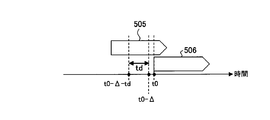
- FIG. 6 shows an example of the relationship between the time t0 and the period 506 shown in FIG.
- the time td represents the minimum gaze time at which the authentication target person gazes at the biosensor 302.
- the person to be authenticated holds his / her hand 411 over the biosensor 302
- the period from the time t0- ⁇ -td to the time t0- ⁇ corresponds to the specific period before the authentication target biometric information 333 is accepted, and the time td represents the length of the specific period.
- the time ⁇ is sufficiently shorter than the time td, and the time t0 ⁇ is the time immediately before the time t0.
- the person to be authenticated continues to watch the biosensor 302 even during the period from time t0- ⁇ to time t0, but in the case of the person to be authenticated who is accustomed to the biosensor 302, the biosensor 302 is immediately before time t0. It is possible to take your eyes off the line. Therefore, even if the period from time t0- ⁇ to time t0 is not included in the gaze period 335, if the specific period before that is included in the gaze period 335, the gaze period 335 corresponds to the person to be authenticated. Then it is judged.
- the input authentication target biometric information 333 is the biometric information of the person. It can be estimated whether or not. Further, by detecting the gaze direction of the person from each of the plurality of images taken in the specific period and calculating the gaze period 335, the estimation accuracy of the person corresponding to the authentication target biometric information 333 can be improved.
- the face recognition unit 317 performs face recognition on the face image 336 by comparing the face image 336 with each registered face image information 332.
- the face recognition unit 317 calculates, for example, the degree of similarity between the face image 336 and each registered face image information 332.
- the face authentication unit 317 uses the feature amount F1 of the face image 336 and the feature amount of the face image included in the registered face image information 332. F2 is calculated, and the similarity is calculated using the feature amount F1 and the feature amount F2.
- the face recognition unit 317 calculates the feature amount F1 of the face image 336 and uses the feature amount F1 and the feature amount F2 to determine the degree of similarity. To calculate.
- the biometric information selection unit 318 selects a predetermined number of registered face image information 332s in descending order of similarity calculated by the face recognition unit 317. Then, the biometric information selection unit 318 generates a candidate list 337 including the user ID of the selected registered face image information 332 and stores it in the storage unit 311. The biometric information selection unit 318 selects the registered biometric information 331 corresponding to each user ID in the candidate list 337 by generating the candidate list 337. Thereby, the set of the registered biometric information 331 to be compared with the authentication target biometric information 333 can be narrowed down from the registered biometric information 331 of a plurality of persons.
- the biometric authentication unit 319 performs biometric authentication on the authentication target biometric information 333 by comparing the authentication target biometric information 333 with the registered biometric information 331 corresponding to each user ID in the candidate list 337. Then, the biometric authentication unit 319 generates the authentication result 338 and stores it in the storage unit 311.
- the biometric authentication unit 319 calculates, for example, the similarity between the biometric information 333 to be authenticated and each registered biometric information 331, and stores the user ID of the registered biometric information 331 having the highest similarity as the authentication result 338. Store in 311.
- the output unit 320 outputs the authentication result 338.
- the information processing device 301 of FIG. 3 even when the faces of a plurality of persons are shown in the image 334, it is possible to identify the face image that is likely to be the authentication target person.
- the set of registered biometric information 331 is appropriately narrowed down.
- the load of the detection process of the gaze direction, the identification process of the face image 336 according to the gaze direction, and the narrowing process of the registered biometric information 331 by the face image 336 is smaller than the load of the biometric authentication process using the authentication target biometric information 333. .. Therefore, the load of biometric authentication on the biometric information 333 to be authenticated is reduced, and high-speed and highly accurate biometric authentication processing is realized.
- the face image of a person other than the person to be authenticated is excluded from the processing target of face recognition, the privacy of the photographed person can be appropriately protected.
- the information processing device 301 may try to identify the face image by applying another determination criterion different from the gaze direction of each user. Another criterion is that it is difficult to conclude that the user who is gazing at the biosensor 302 is the person to be authenticated, but the probability of being presumed to be the person to be authenticated is high.
- the estimated distance from the biosensor 302 to each user, the position of each user's face in the captured image, and the like can be used.
- a user closer to the biosensor 302 is more likely to be presumed to be an authentication target than a user farther from the biosensor 302.
- a face near the center of the captured image is more likely to be presumed to be an authentication target than a face far from the center of the captured image.
- the information processing device 301 may perform a predetermined predetermined process without specifying the face image.
- the predetermined processing includes, for example, a process of instructing the authentication target person to re-enter biometric information, a process of generating a candidate list 337 using each of the facial images of a plurality of users who are gazing at the biosensor 302, and the like. Can be mentioned.
- FIG. 7 is a flowchart showing a specific example of the biometric authentication process performed by the information processing device 301 of FIG.
- the image pickup device 303 starts shooting the image 334 at the same time as the biometric authentication process is started, and the image acquisition unit 313 acquires the image 334 from the image pickup device 303.
- the face detection unit 314 detects a face image from each image included in the image 334, and assigns a face ID to the detected face image (step 701).
- the gaze direction detection unit 315 detects the gaze direction of the person in each face image (step 702), and calculates the gaze period 335 corresponding to each face ID (step 703).
- the biometric information acquisition unit 312 instructs the person to be authenticated to input the biometric information (step 704).
- the biosensor 302 inputs the authentication target biometric information 333
- the biometric information acquisition unit 312 acquires the authentication target biometric information 333 from the biosensor 302 (step 705).
- the biometric information acquisition unit 312 acquires the input start time of the authentication target biometric information 333 as the reception time (step 706).
- the face identification unit 316 compares the reception time of the authentication target biometric information 333 with the gaze period 335 corresponding to each face ID, and identifies the face ID indicating the face image of the authentication target person based on the comparison result. (Step 707). Then, the face identification unit 316 extracts the face image 336 indicated by the specified face ID from the image 334.
- the face recognition unit 317 performs face recognition on the face image 336, and the biometric information selection unit 318 generates a candidate list 337 based on the result of the face recognition (step 708).
- the biometric authentication unit 319 performs biometric authentication on the authentication target biometric information 333 using the candidate list 337, and the output unit 320 outputs the authentication result 338 (step 709).
- FIG. 8 is a flowchart showing an example of a biometric authentication process in which the face identification process is omitted when only the face of the authentication target person is shown.
- the face detection unit 314 detects a face image from each image included in the image 334, and assigns a face ID to the detected face image (step 801). Then, the face detection unit 314 checks whether or not the detected face image is only the face image of one person (step 802).
- steps 802, YES When only the face image of one person is detected (steps 802, YES), the information processing device 301 performs the processes of steps 804 and 805.
- the processing of steps 804 and 805 is the same as the processing of steps 708 and 709 of FIG.
- the information processing device 301 performs the face identification process (step 803).
- the face identification process is the same as the process of steps 702 to 707 of FIG. Then, the information processing device 301 performs the processes of step 804 and step 805.
- the position of the biosensor 302 used for detecting the gaze direction may be a position preset by the installation information of the biosensor 302, or at a position determined by the position determination process. There may be. In the position-fixing process, the position of the biosensor 302 is determined based on the gaze direction of the person in the image taken before the specific period.
- FIG. 9 is a flowchart showing an example of biometric authentication processing including position determination processing.
- the gaze direction detection unit 315 checks whether or not the position of the biosensor 302 has been set (step 901).
- the information processing device 301 performs the biometric authentication process (step 903).
- the biometric authentication process of step 903 is the same as the biometric authentication process of FIG. 7 or FIG.
- the information processing apparatus 301 performs the position determination process (step 902). Then, the information processing device 301 performs the biometric authentication process (step 903).
- FIG. 10 is a flowchart showing an example of the position determination process in step 902 of FIG.
- the image acquisition unit 313 acquires the image 334 from the image pickup device 303
- the biometric information acquisition unit 312 acquires the authentication target biometric information 333 from the biometric sensor 302, as in the biometric authentication process of FIG. do.
- steps 1001 and 1002 are the same as the processing of steps 801 and 802 of FIG.
- the gaze direction detection unit 315 detects and learns the gaze direction of the person (step 1004).
- the gaze direction detection unit 315 narrows down the face images of the person to be processed from the face images of the plurality of people (step 1003), and steps. The process of 1004 is performed.
- the gaze direction detection unit 315 displays, for example, the detected face images side by side on the screen of a display device (not shown), and selects the face image of the person to be processed by the operator via the user interface. You may let me. Further, the gaze direction detection unit 315 performs face authentication and biometric authentication of the person corresponding to all the detected face images in the same manner as the processes of steps 708 and 709 of FIG. 7, and the authentication result is successful.
- the face image of the person to be shown may be extracted. The person whose authentication result shows success corresponds to the person who inputs the authentication target biometric information 333 after gazing at the biosensor 302.
- the gaze direction of the person who is not gazing at the biosensor 302 can be excluded as noise, and only the gaze direction of the person who is gazing at the biosensor 302 can be selectively selected. It becomes possible to learn.
- the gaze direction detection unit 315 may learn the gaze direction by machine learning, or may learn the gaze direction by calculating statistical values of a plurality of gaze directions.
- the statistical value in the gaze direction an average value, a median value, or the like can be used.
- the gaze direction detection unit 315 checks whether or not the end condition is satisfied (step 1005). If the end condition is not satisfied (steps 1005, NO), the information processing apparatus 301 repeats the processes after step 1001, and if the end condition is satisfied (steps 1005, YES), the information processing apparatus 301 processes. To finish. By repeating the processes of steps 1001 to 1004, it is possible to increase the number of samples in the gaze direction to be learned.
- the learning method in step 1004 is machine learning
- the condition that the estimation accuracy of machine learning is higher than a certain value can be used as the end condition.
- the learning method is the calculation of statistical values
- the condition that the variation of the sample is smaller than the specified value can be used as the end condition.
- the sample variation for example, dispersion in the gaze direction or standard deviation is used.
- the gaze direction detection unit 315 may detect and learn the gaze directions of all the persons without narrowing down the face images of the persons to be processed. good.
- the position of the biometric sensor 302 is determined by the position determination process, and the gaze direction of the person who is gazing at the biometric sensor 302. Can be detected.
- step 903 of FIG. 9 the information processing apparatus 301 may continue the same position determination process as in step 902. As a result, the gaze direction of the person whose authentication result shows success, which is detected in the biometric authentication process, can be learned, so that the accuracy of the position of the biometric sensor 302 is improved.
- the configuration of the information processing device 101 of FIG. 1 and the information processing device 301 of FIG. 3 is only an example, and some components may be omitted or changed depending on the use or conditions of the information processing device.
- the registered biometric information 331 and the registered face image information 332 may be stored in a database outside the information processing device 301.
- the information processing device 301 acquires the registered biometric information 331 and the registered face image information 332 from an external database and stores them in the storage unit 311.
- FIGS. 2 and 7 to 10 are merely examples, and some processes may be omitted or changed depending on the configuration or conditions of the information processing device 101 or the information processing device 301.
- the captured image shown in FIG. 4 is only an example, and the captured image changes depending on the person existing in the imaging area of the image pickup apparatus 303.
- the gaze period 335 shown in FIGS. 5 and 6 is only an example, and the gaze period 335 changes according to the image 334.
- FIG. 11 shows a hardware configuration example of the information processing device 101 of FIG. 1 and the information processing device 301 of FIG.
- the information processing device of FIG. 11 includes a CPU (Central Processing Unit) 1101, a memory 1102, an input device 1103, an output device 1104, an auxiliary storage device 1105, a medium drive device 1106, and a network connection device 1107. These components are hardware and are connected to each other by bus 1108.
- the biosensor 302 and the imaging device 303 of FIG. 3 may be connected to the bus 1108.
- the memory 1102 is, for example, a semiconductor memory such as a ROM (ReadOnlyMemory), a RAM (RandomAccessMemory), or a flash memory, and stores a program and data used for processing.
- the memory 1102 can be used as the storage unit 311 of FIG.
- the CPU 1101 (processor) operates as a reception unit 111, a specific unit 112, a selection unit 113, and an authentication unit 114 in FIG. 1 by executing a program using, for example, the memory 1102.
- the CPU 1101 executes the biometric information acquisition unit 312, the image acquisition unit 313, the face detection unit 314, the gaze direction detection unit 315, the face identification unit 316, the face authentication unit 317, and the biometric information selection unit 318 in FIG. , And also operates as a biometric authentication unit 319.
- the input device 1103 is, for example, a keyboard, a pointing device, or the like, and is used for inputting instructions or information from an operator or a user.
- the output device 1104 is, for example, a display device, a printer, a speaker, or the like, and is used for making an inquiry to an operator or a user or outputting a processing result.
- the output device 1104 can be used as the output unit 320 of FIG.
- the processing result may be the authentication result 338.
- the auxiliary storage device 1105 is, for example, a magnetic disk device, an optical disk device, a magneto-optical disk device, a tape device, or the like.
- the auxiliary storage device 1105 may be a flash memory or a hard disk drive.
- the information processing device can store programs and data in the auxiliary storage device 1105 and load them into the memory 1102 for use.
- the auxiliary storage device 1105 can be used as the storage unit 311 of FIG.
- the medium driving device 1106 drives the portable recording medium 1109 and accesses the recorded contents.
- the portable recording medium 1109 is a memory device, a flexible disk, an optical disk, a magneto-optical disk, or the like.
- the portable recording medium 1109 may be a CD-ROM (Compact Disk Read Only Memory), a DVD (Digital Versatile Disk), a USB (Universal Serial Bus) memory, or the like.
- the operator or the user can store the programs and data in the portable recording medium 1109 and load them into the memory 1102 for use.
- the computer-readable recording medium that stores the programs and data used for processing is physical (non-temporary) recording, such as memory 1102, auxiliary storage device 1105, or portable recording medium 1109. It is a medium.
- the network connection device 1107 is a communication interface circuit that is connected to a communication network such as LAN (Local Area Network) or WAN (Wide Area Network) and performs data conversion associated with communication.
- the information processing device can receive programs and data from an external device via the network connection device 1107, load them into the memory 1102, and use them.
- the network connection device 1107 can be used as the output unit 320 of FIG.
- the network connection device 1107 may receive the authentication target biometric information 333 and the video 334 from the biosensor 302 and the imaging device 303 of FIG. 3 via the communication network, respectively.
- the information processing device does not have to include all the components shown in FIG. 11, and some components may be omitted depending on the application or conditions. For example, when the information processing device does not use the portable recording medium 1109 or the communication network, the medium driving device 1106 or the network connecting device 1107 may be omitted.
Landscapes
- Engineering & Computer Science (AREA)
- Theoretical Computer Science (AREA)
- Physics & Mathematics (AREA)
- General Physics & Mathematics (AREA)
- Human Computer Interaction (AREA)
- Multimedia (AREA)
- Computer Security & Cryptography (AREA)
- Health & Medical Sciences (AREA)
- General Health & Medical Sciences (AREA)
- Computer Vision & Pattern Recognition (AREA)
- Oral & Maxillofacial Surgery (AREA)
- Computer Hardware Design (AREA)
- Software Systems (AREA)
- General Engineering & Computer Science (AREA)
- Vascular Medicine (AREA)
- Ophthalmology & Optometry (AREA)
- Medical Informatics (AREA)
- Nuclear Medicine, Radiotherapy & Molecular Imaging (AREA)
- Radiology & Medical Imaging (AREA)
- Quality & Reliability (AREA)
- Collating Specific Patterns (AREA)
Priority Applications (6)
| Application Number | Priority Date | Filing Date | Title |
|---|---|---|---|
| CN202080092275.6A CN114930323A (zh) | 2020-02-06 | 2020-02-06 | 认证方法、信息处理装置以及认证程序 |
| EP20917417.6A EP4102383A4 (en) | 2020-02-06 | 2020-02-06 | AUTHENTICATION METHOD, INFORMATION PROCESSING DEVICE AND AUTHENTICATION PROGRAM |
| KR1020227023409A KR20220108167A (ko) | 2020-02-06 | 2020-02-06 | 인증 방법, 정보 처리 장치 및 인증 프로그램 |
| PCT/JP2020/004603 WO2021157023A1 (ja) | 2020-02-06 | 2020-02-06 | 認証方法、情報処理装置、及び認証プログラム |
| JP2021575197A JPWO2021157023A1 (https=) | 2020-02-06 | 2020-02-06 | |
| US17/851,372 US20220327191A1 (en) | 2020-02-06 | 2022-06-28 | Authentication method, information processing device, and non-transitory computer-readable storage medium for storing authentication program |
Applications Claiming Priority (1)
| Application Number | Priority Date | Filing Date | Title |
|---|---|---|---|
| PCT/JP2020/004603 WO2021157023A1 (ja) | 2020-02-06 | 2020-02-06 | 認証方法、情報処理装置、及び認証プログラム |
Related Child Applications (1)
| Application Number | Title | Priority Date | Filing Date |
|---|---|---|---|
| US17/851,372 Continuation US20220327191A1 (en) | 2020-02-06 | 2022-06-28 | Authentication method, information processing device, and non-transitory computer-readable storage medium for storing authentication program |
Publications (1)
| Publication Number | Publication Date |
|---|---|
| WO2021157023A1 true WO2021157023A1 (ja) | 2021-08-12 |
Family
ID=77199464
Family Applications (1)
| Application Number | Title | Priority Date | Filing Date |
|---|---|---|---|
| PCT/JP2020/004603 Ceased WO2021157023A1 (ja) | 2020-02-06 | 2020-02-06 | 認証方法、情報処理装置、及び認証プログラム |
Country Status (6)
| Country | Link |
|---|---|
| US (1) | US20220327191A1 (https=) |
| EP (1) | EP4102383A4 (https=) |
| JP (1) | JPWO2021157023A1 (https=) |
| KR (1) | KR20220108167A (https=) |
| CN (1) | CN114930323A (https=) |
| WO (1) | WO2021157023A1 (https=) |
Cited By (1)
| Publication number | Priority date | Publication date | Assignee | Title |
|---|---|---|---|---|
| JP7636502B1 (ja) | 2023-11-01 | 2025-02-26 | 株式会社バンダイ | 情報処理装置、システム及びコンピュータプログラム |
Citations (3)
| Publication number | Priority date | Publication date | Assignee | Title |
|---|---|---|---|---|
| JP2004062846A (ja) * | 2002-07-31 | 2004-02-26 | Waimachikku Kk | 個人識別装置の入力装置 |
| JP2007072861A (ja) * | 2005-09-08 | 2007-03-22 | Omron Corp | なりすまし検出装置及び顔認証装置 |
| JP2018116353A (ja) * | 2017-01-16 | 2018-07-26 | 高知信用金庫 | 金融機関における利用者特定システム及び取引方法 |
Family Cites Families (5)
| Publication number | Priority date | Publication date | Assignee | Title |
|---|---|---|---|---|
| JP4762805B2 (ja) * | 2006-06-29 | 2011-08-31 | 富士通株式会社 | 生体認証方法及び生体認証システム |
| EP2444933B1 (en) * | 2009-06-17 | 2019-07-10 | Fujitsu Limited | Biometric authentication device, biometric authentication method and computer program for biometric authentication |
| CN107016270A (zh) * | 2015-12-01 | 2017-08-04 | 由田新技股份有限公司 | 结合脸部认证或手部认证的动态图形眼动认证系统、方法 |
| US11720655B2 (en) * | 2017-09-18 | 2023-08-08 | Dov Moran | System, device and method for logging-in by staring at a display device |
| US20190156003A1 (en) * | 2017-11-20 | 2019-05-23 | Motorola Mobility Llc | Methods and Systems for Launching Additional Authenticators in an Electronic Device |
-
2020
- 2020-02-06 KR KR1020227023409A patent/KR20220108167A/ko not_active Ceased
- 2020-02-06 CN CN202080092275.6A patent/CN114930323A/zh active Pending
- 2020-02-06 JP JP2021575197A patent/JPWO2021157023A1/ja not_active Ceased
- 2020-02-06 WO PCT/JP2020/004603 patent/WO2021157023A1/ja not_active Ceased
- 2020-02-06 EP EP20917417.6A patent/EP4102383A4/en not_active Withdrawn
-
2022
- 2022-06-28 US US17/851,372 patent/US20220327191A1/en not_active Abandoned
Patent Citations (3)
| Publication number | Priority date | Publication date | Assignee | Title |
|---|---|---|---|---|
| JP2004062846A (ja) * | 2002-07-31 | 2004-02-26 | Waimachikku Kk | 個人識別装置の入力装置 |
| JP2007072861A (ja) * | 2005-09-08 | 2007-03-22 | Omron Corp | なりすまし検出装置及び顔認証装置 |
| JP2018116353A (ja) * | 2017-01-16 | 2018-07-26 | 高知信用金庫 | 金融機関における利用者特定システム及び取引方法 |
Non-Patent Citations (4)
| Title |
|---|
| "Fujitsu Develops Non-Contact Biometric Integration Technology as an Optimal Solution for a Cashless Society", 4 October 2018, FUJITSU LABORATORIES LTD., PRESS RELEASE |
| EN TENG WONG ET AL.: "Gaze Estimation Using Residual Neural Network", IEEE INTERNATIONAL CONFERENCE ON PERVASIVE COMPUTING AND COMMUNICATIONS WORKSHOPS (PERCOM WORKSHOPS, 2019, pages 411 - 414, XP033558346, DOI: 10.1109/PERCOMW.2019.8730846 |
| HAOPING DENG ET AL.: "Monocular Free-head 3D Gaze Tracking with Deep Learning and Geometry Constraints", IEEE INTERNATIONAL CONFERENCE ON COMPUTER VISION (ICCV, 2017, pages 3162 - 3171, XP033283184, DOI: 10.1109/ICCV.2017.341 |
| S.V. SHEELA ET AL.: "Iris Detection for Gaze Tracking Using Video Frames", IEEE INTERNATIONAL ADVANCE COMPUTING CONFERENCE (IACC, 2015, pages 629 - 633, XP033172931, DOI: 10.1109/IADCC.2015.7154783 |
Cited By (3)
| Publication number | Priority date | Publication date | Assignee | Title |
|---|---|---|---|---|
| JP7636502B1 (ja) | 2023-11-01 | 2025-02-26 | 株式会社バンダイ | 情報処理装置、システム及びコンピュータプログラム |
| WO2025094919A1 (ja) * | 2023-11-01 | 2025-05-08 | 株式会社バンダイ | 情報処理装置及びコンピュータプログラム |
| JP2025076114A (ja) * | 2023-11-01 | 2025-05-15 | 株式会社バンダイ | 情報処理装置、システム及びコンピュータプログラム |
Also Published As
| Publication number | Publication date |
|---|---|
| KR20220108167A (ko) | 2022-08-02 |
| US20220327191A1 (en) | 2022-10-13 |
| JPWO2021157023A1 (https=) | 2021-08-12 |
| CN114930323A (zh) | 2022-08-19 |
| EP4102383A1 (en) | 2022-12-14 |
| EP4102383A4 (en) | 2023-02-22 |
Similar Documents
| Publication | Publication Date | Title |
|---|---|---|
| US7092555B2 (en) | System for registering and authenticating human face using support vector machines and method thereof | |
| US9245172B2 (en) | Authentication apparatus, authentication method, and non-transitory computer readable medium | |
| JP7674149B2 (ja) | 生体の認証システムおよび認証方法 | |
| US20230059121A1 (en) | Authentication method, information processing device, and non-transitory computer-readable storage medium for storing authentication program | |
| JP2010152706A (ja) | 生体認証装置 | |
| JP2017010322A (ja) | 認証処理装置及び認証処理方法 | |
| JP7269897B2 (ja) | データ登録装置、生体認証装置、およびデータ登録プログラム | |
| Rahouma et al. | Design and implementation of a face recognition system based on API mobile vision and normalized features of still images | |
| JP4760049B2 (ja) | 顔認証装置、その顔認証方法、その顔認証装置を組み込んだ電子機器およびその顔認証プログラムを記録した記録媒体 | |
| US20230252820A1 (en) | Authentication method, information processing device, and non-transitory computer-readable recording medium storing authentication program | |
| Ahmed et al. | Security system based on hand geometry and palmprint for user authentication in E-correction system | |
| US20220327191A1 (en) | Authentication method, information processing device, and non-transitory computer-readable storage medium for storing authentication program | |
| US10984085B2 (en) | Biometric recognition for uncontrolled acquisition environments | |
| JP7415640B2 (ja) | 認証方法、情報処理装置、及び認証プログラム | |
| Muthukumaran et al. | Face and Iris based Human Authentication using Deep Learning | |
| JP7359044B2 (ja) | 認証方法、情報処理装置、及び認証プログラム | |
| Cheng et al. | Special point representations for reducing data space requirements of finger-vein recognition applications | |
| KR20050065132A (ko) | 다중 생체 정보를 이용한 개인 등록 및 인증 시스템과 그방법 | |
| US20230229746A1 (en) | Authentication method, control method, and information processing device | |
| KR102714901B1 (ko) | 딥러닝 기반 비접촉식 장문 인식 시스템 및 방법 | |
| JP6798285B2 (ja) | 生体認証装置、生体認証方法及びプログラム | |
| Miyazaki et al. | RGB-D Video based Hand Authentication using Deep Neural Network. | |
| Parihar et al. | Palm vein recognition system for human authentication: A review | |
| Štruc et al. | A comparison of feature normalization techniques for PCA-based palmprint recognition | |
| KR101965749B1 (ko) | 카메라 기반의 비접촉식 지문인식 장치 |
Legal Events
| Date | Code | Title | Description |
|---|---|---|---|
| 121 | Ep: the epo has been informed by wipo that ep was designated in this application |
Ref document number: 20917417 Country of ref document: EP Kind code of ref document: A1 |
|
| ENP | Entry into the national phase |
Ref document number: 2021575197 Country of ref document: JP Kind code of ref document: A |
|
| ENP | Entry into the national phase |
Ref document number: 20227023409 Country of ref document: KR Kind code of ref document: A |
|
| NENP | Non-entry into the national phase |
Ref country code: DE |
|
| ENP | Entry into the national phase |
Ref document number: 2020917417 Country of ref document: EP Effective date: 20220906 |