WO2021153513A1 - 植物ホルモンのセンシング方法、及びそれを用いた植物の病気感染の早期検出方法 - Google Patents
植物ホルモンのセンシング方法、及びそれを用いた植物の病気感染の早期検出方法 Download PDFInfo
- Publication number
- WO2021153513A1 WO2021153513A1 PCT/JP2021/002482 JP2021002482W WO2021153513A1 WO 2021153513 A1 WO2021153513 A1 WO 2021153513A1 JP 2021002482 W JP2021002482 W JP 2021002482W WO 2021153513 A1 WO2021153513 A1 WO 2021153513A1
- Authority
- WO
- WIPO (PCT)
- Prior art keywords
- methyl salicylate
- general formula
- boron
- sensor
- oxygen compound
- Prior art date
- Legal status (The legal status is an assumption and is not a legal conclusion. Google has not performed a legal analysis and makes no representation as to the accuracy of the status listed.)
- Ceased
Links
Images







Classifications
-
- G—PHYSICS
- G01—MEASURING; TESTING
- G01N—INVESTIGATING OR ANALYSING MATERIALS BY DETERMINING THEIR CHEMICAL OR PHYSICAL PROPERTIES
- G01N21/00—Investigating or analysing materials by the use of optical means, i.e. using sub-millimetre waves, infrared, visible or ultraviolet light
- G01N21/62—Systems in which the material investigated is excited whereby it emits light or causes a change in wavelength of the incident light
- G01N21/63—Systems in which the material investigated is excited whereby it emits light or causes a change in wavelength of the incident light optically excited
- G01N21/64—Fluorescence; Phosphorescence
-
- G—PHYSICS
- G01—MEASURING; TESTING
- G01N—INVESTIGATING OR ANALYSING MATERIALS BY DETERMINING THEIR CHEMICAL OR PHYSICAL PROPERTIES
- G01N21/00—Investigating or analysing materials by the use of optical means, i.e. using sub-millimetre waves, infrared, visible or ultraviolet light
- G01N21/75—Systems in which material is subjected to a chemical reaction, the progress or the result of the reaction being investigated
- G01N21/77—Systems in which material is subjected to a chemical reaction, the progress or the result of the reaction being investigated by observing the effect on a chemical indicator
-
- G—PHYSICS
- G01—MEASURING; TESTING
- G01N—INVESTIGATING OR ANALYSING MATERIALS BY DETERMINING THEIR CHEMICAL OR PHYSICAL PROPERTIES
- G01N33/00—Investigating or analysing materials by specific methods not covered by groups G01N1/00 - G01N31/00
- G01N33/48—Biological material, e.g. blood, urine; Haemocytometers
- G01N33/50—Chemical analysis of biological material, e.g. blood, urine; Testing involving biospecific ligand binding methods; Immunological testing
- G01N33/74—Chemical analysis of biological material, e.g. blood, urine; Testing involving biospecific ligand binding methods; Immunological testing involving hormones or other non-cytokine intercellular protein regulatory factors such as growth factors, including receptors to hormones and growth factors
-
- G—PHYSICS
- G01—MEASURING; TESTING
- G01N—INVESTIGATING OR ANALYSING MATERIALS BY DETERMINING THEIR CHEMICAL OR PHYSICAL PROPERTIES
- G01N21/00—Investigating or analysing materials by the use of optical means, i.e. using sub-millimetre waves, infrared, visible or ultraviolet light
- G01N21/75—Systems in which material is subjected to a chemical reaction, the progress or the result of the reaction being investigated
- G01N21/77—Systems in which material is subjected to a chemical reaction, the progress or the result of the reaction being investigated by observing the effect on a chemical indicator
- G01N2021/7769—Measurement method of reaction-produced change in sensor
- G01N2021/7786—Fluorescence
-
- G—PHYSICS
- G01—MEASURING; TESTING
- G01N—INVESTIGATING OR ANALYSING MATERIALS BY DETERMINING THEIR CHEMICAL OR PHYSICAL PROPERTIES
- G01N2333/00—Assays involving biological materials from specific organisms or of a specific nature
- G01N2333/415—Assays involving biological materials from specific organisms or of a specific nature from plants
Definitions
- the present invention relates to a method for sensing a plant hormone released when a plant is infected with a disease, and a method for detecting a plant disease infection at an early stage.
- Non-Patent Document 1 it is also known that when a plant is infected with a pathogen or damaged by a pest, there is a mechanism for not only the damaged plant itself but also surrounding plants. Specifically, salicylic acid, which is synthesized when infected with a pathogen, is methylated to methyl salicylate, which is released from the plant as a volatile signal substance to notify the surrounding plants of the infection of the pathogen, thereby providing a defense mechanism in advance. prompt. It is also known that jasmonic acid, which is synthesized when damaged by pests, is also methylated to methyl jasmonate, which becomes a volatile signal and is released from plants, thereby inducing resistance to surrounding plants in advance. ..
- plants release plant hormones as signal substances when they are damaged by pests, and it is possible to detect pest damage at an early stage by sensing the signal substances as soon as possible.
- a monitor plant carrying a photoprotein gene is cultivated together with the cultivated crop, and then A method is disclosed that utilizes a phenomenon in which a monitor plant senses methyl jasmonate released when a crop is damaged by a pest and the monitor plant emits light (Patent Document 1).
- An object of the present invention is to provide a method for sensing methyl salicylate, which is a plant hormone released at the time of disease infection in the cultivation of plants including agricultural crops, and the sensor, thereby early infection of the plant with disease.
- the purpose is to provide a method for on-the-spot detection.
- the present invention utilizes as a sensing receptor a compound having a specific structure having a boron-oxygen bond that selectively recognizes methyl salicylate, which is a volatile plant hormone, to form a complex. Further, the present invention utilizes the fluorescence emission phenomenon of a complex formed by the reaction of methyl salicylate and a compound having a specific structure having a boron-oxygen bond to detect disease infection of a plant at an early stage. Furthermore, the present invention utilizes a phenomenon in which methyl salicylate reacts with a compound having a specific structure having a boron-oxygen bond to change the electrochemical behavior, thereby detecting a disease infection of a plant at an early stage.
- the compound having a specific structure having a boron-oxygen bond of the present invention it is possible to selectively sense the volatile plant hormone methyl salicylate released when a plant is infected with a pathogenic bacterium, and further, methyl salicylate and boron-oxygen. It is possible to detect infection by plant pathogens at an early stage by utilizing the fluorescence emission phenomenon from a complex formed by the reaction of a compound having a specific structure with a bond, or by utilizing the change in electrochemical behavior. Become.
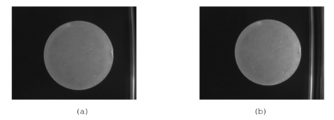
- FIG. 1 shows whether or not fluorescence emission can be observed by shining the light of a UV lamp on a filter paper on which only tetraacetoxydiboroxane (TBO) (a) and tetraacetoxydiboroxane + methyl salicylate (b) are dropped. It is a photograph showing the result of confirming.
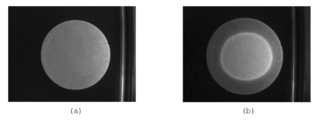
- FIG. 2 shows whether or not fluorescence emission can be observed by shining the light of a UV lamp on a filter paper on which only tetraacetoxydiboroxane (TBO) (a) and tetraacetoxydiboroxane + methyl jasmonate (b) are dropped. It is a photograph showing the result of confirming.
- TBO tetraacetoxydiboroxane
- TBO tetraacetoxydiboroxane + methyl jasmonate
- FIG. 4 shows the result of irradiating the filter paper on which only phenylboronic acid (PB) (PB) (a) and phenylboronic acid + methyl salicylate (b) were dropped with the light of a UV lamp and confirming whether or not fluorescence emission was observed. It is a photograph showing.
- PB phenylboronic acid
- PB phenylboronic acid + methyl salicylate
- FIG. 7 shows 2,4,6-tris (3,4,5-trifluorophenyl) boroxine (TFBP) only (a) and 2,4,6-tris (3,4,5-trifluorophenyl). It is a photograph showing the result of irradiating the filter paper on which boroxine + methyl salicylate (b) was dropped with the light of a UV lamp and confirming whether or not fluorescence emission can be seen.
- FIG. 9 shows 2,4,6-tris (3,4,5-trifluorophenyl) boroxine (TFBP) only (a) and 2,4,6-tris (3,4,5-trifluorophenyl). It is a photograph showing the result of irradiating the filter paper on which boroxine + methyl jasmonate (b) was dropped with the light of a UV lamp and confirming whether or not fluorescence emission can be seen.
- TFBP 2,4,6-tris (3,4,5-trifluorophenyl) boroxine
- MSA concentration 0.1 mol / L
- FIG. 11 is a diagram in which a mixed solution is prepared by changing the ratio of TBO and MSA, the fluorescence spectrum at an excitation wavelength of 348 nm is measured, the fluorescence intensity at a wavelength of 384 nm is obtained, and the obtained fluorescence intensity is plotted. ..
- FIG. 12 is a diagram showing measurement results of cyclic voltammetry (CV) of an acetonitrile solution of TBO (broken line) and an acetonitrile solution of TBO + MSA (solid line).
- FIG. 13 is a diagram showing measurement results of cyclic voltammetry (CV) of an acetonitrile solution of TBO (broken line) and an acetonitrile solution of TBO + methyl jasmonate (MJA) (solid line).
- methyl salicylate which is a volatile signal substance released when a plant is infected with a pathogen, can be selectively sensed by using a compound having a specific structure having a boron-oxygen bond, and completed the present invention.
- ⁇ Receptor of methyl salicylate a compound having a specific structure having a boron-oxygen bond>
- Examples of the compound having a specific structure having a boron-oxygen bond include a boron-oxygen compound having a structure represented by the general formula (1).
- R represents a methyl group, an ethyl group, a propyl group, a butyl group, or a phenyl group.
- each R may be the same or different.
- X represents a hydrogen atom, an alkyl group having 1 to 4 carbon atoms, an alkoxy group, a mercapto group, a mercapto-substituted alkyl group, or a mercapto-substituted alkoxy group
- n represents an integer of 1 to 5.
- each X may be the same or different.
- Examples thereof include boroxine derivatives represented by the following general formula (4).
- Z represents an alkyl group having 1 to 4 carbon atoms, or a substituted or unsubstituted phenyl group.
- each Z may be the same or different.
- the substituted phenyl group may be used.
- Examples include, for example, alkyl-substituted phenyl groups, alkoxy-substituted phenyl groups, hydroxy-substituted phenyl groups, halogen-substituted phenyl groups (eg, fluorine-substituted phenyl groups), alkyl halide-substituted phenyl groups, amino-substituted phenyl groups, and nitro-substituted phenyls. Includes groups and carboxy-substituted phenyl groups.)
- the diboroxane derivative can selectively recognize methyl salicylate by forming a boron complex with methyl salicylate by a reaction represented by the following formula (1).
- phenylboronic acid derivative and booxine derivative can also selectively recognize methyl salicylate by reacting with methyl salicylate to form a complex.
- some embodiments of the present invention are represented by a boron-oxygen compound having a structure represented by the general formula (1), a diboroxine derivative represented by the general formula (2), and a general formula (3).
- the present invention relates to a method for detecting methyl salicylate, which comprises a step of reacting a phenylboronic acid derivative or a boroxine derivative represented by the general formula (4) with methyl salicylate to form a complex.
- a receptor that selectively recognizes methyl salicylate a boron-oxygen compound having a structure represented by the general formula (1) and a diboroxine represented by the general formula (2).
- the present invention relates to a method for sensing methyl salicylate using a derivative, a phenylboronic acid derivative represented by the general formula (3), or a boroxine derivative represented by the general formula (4).
- TBO tetraacetoxydiboroxane
- PB phenylboronic acid
- TFBP 2,4,6-triphenylboroxine acid
- TPB 2,4,6-tris (3,4,5) -Trifluorophenyl) Boroxine
- the reaction of a boron-oxygen compound having a structure represented by the general formula (1) with methyl salicylate is carried out in a solution.
- the solution can be, for example, an acetonitrile solution or a methanol solution, but is not limited thereto.
- the concentration of the boron-oxygen compound having the structure represented by the general formula (1) is, for example, in the range of 0.00001 mol / L to 5 mol / L, for example, 0.00004 mol / L to 0.4 mol. The concentration can be in the range of / L.
- the reaction of the boron-oxygen compound having the structure represented by the general formula (1) with methyl salicylate is carried out in a solid medium containing the boron-oxygen compound.
- the solid medium can be, for example, paper or resin (eg, polymethylmethacrylate, polyethylene, polypropylene, polyvinyl chloride, polystyrene, nylon resin, polyamide, polycarbonate, polyethylene terephthalate, polybutylene terephthalate, polyphenylene oxide, polyvinyl alcohol, etc.). However, it is not limited to these.
- the complex formed by the reaction of a compound having a specific structure having a boron-oxygen bond and methyl salicylate newly exhibits fluorescence emission. Specifically, fluorescence emission is exhibited by irradiating a complex formed by the reaction of a compound having a specific structure having a boron-oxygen bond with methyl salicylate with excitation light having a wavelength of 200 to 400 nm. On the other hand, only a compound having a specific structure having a boron-oxygen bond does not exhibit fluorescence emission, which makes it possible to detect methyl salicylate.
- some embodiments of the present invention have (i) a boron-oxygen compound having a structure represented by the general formula (1), a diboroxine derivative represented by the general formula (2), and a general formula (3).
- a step of reacting a phenylboronic acid derivative represented by the representative or a boroxine derivative represented by the general formula (4) with methyl salicylate to form a complex (ii) a step of exposing the complex to excitation light, (iii) the complex.
- the present invention relates to a method for detecting methyl salicylate, which comprises a step of detecting the fluorescence emitted by the derivative.
- an appropriate wavelength in the range of 200-400 nm is selected as the excitation wavelength.
- a step of determining the concentration of methyl salicylate can also be performed by comparing the detected fluorescence intensity with a predetermined reference value.
- methyl salicylate is a boron-oxygen compound having a structure represented by the general formula (1), a diboroxine derivative represented by the general formula (2), and a general formula (3).
- the present invention relates to a method for sensing methyl salicylate, which utilizes a phenomenon in which a boron complex is formed by reacting with a phenylboronic acid derivative represented by the above formula or a boronoxine derivative represented by the general formula (4) to emit fluorescent light.
- the complex formed by the reaction of a compound having a specific structure having a boron-oxygen bond and methyl salicylate exhibits an electrochemical behavior different from that of a compound having a specific structure having a boron-oxygen bond of a receptor.
- the measurement of cyclic voltammetry of an electrochemical cell containing a compound having a specific structure having a boron-oxygen bond and a complex composed of methyl salicylate causes a large change in the current value. This makes it possible to detect methyl salicylate by monitoring this current value.
- some embodiments of the present invention include (i) a boron-oxygen compound having a structure represented by the general formula (1) in a solution, a diboroxine derivative represented by the general formula (2), and a general formula ( A step of reacting a phenylboronic acid derivative represented by 3) or a booxine derivative represented by the general formula (4) with methyl salicylate to form a complex, (ii) a current flowing through a solution under a constant voltage. (Iii) The present invention relates to a method for detecting methyl salicylate, which comprises a step of detecting a change in current value caused by the formation of a complex. In some embodiments, a suitable voltage value in the range 1.6-2.2V is selected.
- the solution may include, but is not limited to, the supporting electrolyte, for example, tetrabutylammoniumtetrafluoroborate.
- a step of determining the concentration of methyl salicylate may be performed by comparing the detected change in current value with a predetermined reference value.
- methyl salicylate is a boron-oxygen compound having a structure represented by the general formula (1), a diboroxine derivative represented by the general formula (2), and a general formula (3).
- a method for sensing methyl salicylate which comprises utilizing a phenomenon in which the electrochemical behavior changes due to the reaction between the phenylboronic acid derivative represented by the above formula or the boroxine derivative represented by the general formula (4) and methyl salicylate.
- methyl salicylate is a boron-oxygen compound having a structure represented by the general formula (1), a diboroxine derivative represented by the general formula (2), and a general formula (3).
- the present invention relates to a method for sensing methyl salicylate, which comprises utilizing a change in the current value caused by a reaction between a phenylboronic acid derivative represented by the above formula or a boroxine derivative represented by the general formula (4) and methyl salicylate.
- the methyl salicylate sensing method of the present invention can be used to detect pathogen infections in crops.
- the methyl salicylate sensor using a compound having a specific structure having a boron-oxygen bond as a receptor of the present invention is composed of at least a recognition unit for methyl salicylate and a detection unit for detecting that methyl salicylate is recognized in the recognition unit.
- the recognition unit contains at least a compound having a specific structure having a boron-oxygen bond which is a receptor. Since a compound having a specific structure having a boron-oxygen bond does not react with and does not recognize other plant hormones other than methyl salicylate, such as methyl jasmonate, methyl salicylate can be selectively recognized.
- the detection unit is configured to be able to optically and / or electrochemically detect that methyl salicylate has been recognized by the recognition unit for methyl salicylate.
- an optical detection unit is composed of at least an excitation light source and a detection element, and salicylate is formed from a change in fluorescence intensity. Detection of methyl and its concentration are measured.
- an electrode is set so as to detect a current generated by oxidation of a complex formed of methyl salicylate and a compound having a specific structure having a boron-oxygen bond.
- the electrochemical cell (detection element) to have is constructed, and the detection of methyl salicylate and its concentration are measured by using the change in the electrochemical behavior of the electrochemical cell (for example, the change in the current value at a certain potential). ..
- some embodiments of the present invention are a methyl salicylate sensor that detects methyl salicylate and is a receptor that selectively recognizes methyl salicylate, which is a boron-oxygen having a specific structure represented by the general formula (1).
- the present invention relates to a methyl salicylate sensor, which comprises at least a recognition unit for methyl salicylate having a compound and a detection unit for detecting that methyl salicylate is recognized in the recognition unit.
- the methyl salicylate sensor of the present invention detects the plant hormone methyl salicylate released when a crop is infected with a pathogen. Therefore, the methyl salicylate sensor of the present invention can be used as a sensor for detecting pathogen infection in agricultural products.
- the methyl salicylate sensor of the present invention can selectively detect methyl salicylate as compared to methyl jasmonate.
- a part of the embodiment of the present invention is a methyl salicylate sensor that detects methyl salicylate, and has (i) a recognition unit for methyl salicylate having a boron-oxygen compound having a structure represented by the general formula (1).
- the present invention relates to a methyl salicylate sensor, which comprises at least a detection unit for optically detecting that methyl salicylate is recognized in the recognition unit.
- the optical detector includes at least an excitation light source and a detector element.
- the methyl salicylate sensor of the present invention can detect and / or measure the concentration of methyl salicylate based on the observed change in fluorescence intensity.
- a part of the embodiment of the present invention is a methyl salicylate sensor for detecting methyl salicylate, which comprises (i) a recognition unit for methyl salicylate having a boron-oxygen compound having a structure represented by the general formula (1).
- the present invention relates to a methyl salicylate sensor having at least a detection unit that electrochemically detects that methyl salicylate is recognized in the recognition unit.
- the electrochemical detector comprises an electrochemical cell having an electrode that detects a current generated by oxidation of a complex formed by a boron-oxygen compound and methyl salicylate.
- the methyl salicylate sensor of the present invention can detect and / or measure the concentration of methyl salicylate based on changes in the current value of the electrochemical cell.
- the detector may include a computer that executes a program that processes the detection and / or concentration measurement of methyl salicylate.
- a program is, for example, a step of receiving a signal from an optical and / or electrochemical detection element into a computer, a step of analyzing the received signal to determine the presence or absence of methyl salicylate and / or its concentration.
- analysis of the received signal may include determining the presence and / or concentration of methyl salicylate, for example, by comparing the received signal with a predetermined reference value.
- the analysis result may be output to, for example, a display device connected to a sensor, another device connected via a network, or the like.
- some embodiments of the present invention are a methyl salicylate sensor that detects methyl salicylate and is a receptor that selectively recognizes methyl salicylate, which is a boron-oxygen having a specific structure represented by the general formula (1).
- a computer is provided with at least a recognition unit for methyl salicylate having a compound and a detection unit for detecting that methyl salicylate is recognized in the recognition unit, and the detection unit includes a detection element and a computer in a methyl salicylate sensor.
- the step of receiving a signal from an optical and / or electrochemical detection element (ii) the step of analyzing the received signal to determine the presence and / or concentration of methyl salicylate, and (iii) analysis results.
- the program that executes the stage of outputting.
- methyl salicylate sensor of the present invention it is possible to detect pathogen infection of crops at an early stage by installing a methyl salicylate sensor near the planted crop and detecting methyl salicylate with the sensor. Is.
- a part of the embodiment of the present invention relates to a method in which a methyl salicylate sensor is installed in the vicinity of a crop and the pathogen infection of the crop is detected by detecting methyl salicylate by the sensor.
- the methyl salicylate sensor is a recognition unit for methyl salicylate having a specific structure of a boron-oxygen compound represented by the general formula (1), which is a receptor for selectively recognizing methyl salicylate, and recognition thereof. It is a methyl salicylate sensor that includes at least a detection unit that detects the recognition of methyl salicylate.
- the methyl salicylate sensor has (i) a recognition unit for methyl salicylate having a boron-oxygen compound having a structure represented by the general formula (1), and (ii) methyl salicylate in the recognition unit. It is a methyl salicylate sensor that includes at least a detector that optically and / or electrochemically detects that is recognized.
- Agricultural products that can be monitored include, for example, cucumbers, watermelons, tomatoes, eggplants, peppers, shishito, melons, hakusai, cabbage, daikon, lettuce, leeks, broccoli, onions, garlic, yamanoimo, asparagus, carrots, potatoes, and ceruley. , Cigarettes, leeks, and strawberry, but are not limited to these.
- Diseases that can be detected include, for example, ring-spot disease, white spot disease, brown ring-spot disease, leaf mold disease, wilt disease, root rot wilt disease, half-body wilt disease, brown root rot disease, gray plague, root rot disease, and black spots.
- Root rot white silk disease, seedling blight, brown spot disease, beetle disease, udonko disease, gray mold disease, charcoal scab, scab, mycorrhizal disease, vine blight, spot disease, epidemic, mosaic disease , Yellow leaf curl disease, yellow leaf curl disease, bacterial wilt disease, soft rot disease, squash disease, stem disease, black spot bacterial disease, spot bacterial disease, etc., but is not limited to these.
- the pathogenic bacterial infection that can be detected includes, but is not limited to, infection by the causative organism of the above-mentioned diseases.
- neighbors include, for example, within 2 m, within 1 m, within 75 cm, within 50 cm, within 40 cm, within 30 cm from the crop being monitored. Distances within, within 20 cm, within 10 cm, or within 5 cm are examples, but are not limited, and an appropriate distance is appropriately selected in consideration of various factors. A person skilled in the art will be able to appropriately set the position where the sensor is installed in consideration of various conditions.
- some embodiments of the present invention relate to the use of a methyl salicylate sensor in the detection of pathogen infections in crops.
- some embodiments of the present invention include a boron-oxygen compound having a structure represented by the general formula (1), a diboroxine derivative represented by the general formula (2), and a general formula in the production of a methyl salicylate sensor.
- the present invention relates to the use of a phenylboronic acid derivative represented by (3) or a boroxine derivative represented by the general formula (4).
- Example 1 0.2 ml of a solution prepared by dissolving 0.1 g of tetraacetoxydiboroxane (TBO) in 3 ml of acetonitrile was added dropwise to a circular filter paper (45 mm ⁇ ) and dried to obtain a filter paper containing TBO. The obtained filter paper was excited with a UV lamp (wavelength 365 nm) and confirmed to have fluorescence emission (Fig. 1 (a)).
- TBO tetraacetoxydiboroxane
- TBO can selectively sense methyl salicylate released by plants when infected with a pathogen.
- Example 2 0.2 ml of a solution prepared by dissolving 0.1 g of tetraacetoxydiboroxane (TBO) in 3 ml of acetonitrile was added dropwise to a circular filter paper (45 mm ⁇ ) and dried to obtain a filter paper containing TBO.
- this filter paper and 0.05 g of methyl salicylate were placed in a petri dish and stored in a desiccator so that it would not come into direct contact with the desiccator.
- the filter paper was taken out, excited by a UV lamp (wavelength 365 nm), and evaluated for fluorescence emission. As a result, blue fluorescence was confirmed (Fig. 3). From this result, it was found that methyl salicylate released by plants during pathogen infection can be sensed as a volatile signal.
- Example 3 0.2 ml of a solution prepared by dissolving 0.1 g of phenylboronic acid (PB) in 3 ml of methanol was added dropwise to a circular filter paper (45 mm ⁇ ) and dried to obtain a filter paper containing PB. The obtained filter paper was excited with a UV lamp (wavelength 365 nm) and confirmed to have fluorescence emission (Fig. 4 (a)). Next, 0.03 ml of an acetonitrile solution (0.1 mol / L) of methyl salicylate (MSA) released when the plant was infected with a pathogenic bacterium was added dropwise to the filter paper, dried, and the obtained filter paper was similarly excited with a UV lamp. It was confirmed whether there was fluorescence emission (Fig. 4 (b)). As a result, it was found that PB reacts with methyl salicylate, exhibits fluorescence emission, and can sense methyl salicylate.
- MSA methyl salicylate
- Example 3 From the results of Example 3 and Comparative Example 2, it was found that PB can selectively sense methyl salicylate released by plants when infected with a pathogen.
- Example 4 0.2 ml of a solution prepared by dissolving 0.1 g of 2,4,6-triphenylboroxic acid (TPB) in 3 ml of methanol was added dropwise to a circular filter paper (45 mm ⁇ ) and dried to obtain a filter paper containing PB. The obtained filter paper was excited with a UV lamp (wavelength 365 nm) to confirm whether or not it had fluorescence emission (Fig. 6 (a)).
- TPB 2,4,6-triphenylboroxic acid
- TPB can selectively sense methyl salicylate released by plants when infected with a pathogen.
- Example 5 0.2 ml of a solution of 0.1 g of 2,4,6-tris (3,4,5-trifluorophenyl) boroxine (TFBPB) in 3 ml of methanol is added dropwise to a circular filter paper (45 mm ⁇ ) and dried to obtain a filter paper containing TFBP.
- TFBPB 2,4,6-tris (3,4,5-trifluorophenyl) boroxine
- Example 5 From the results of Example 5 and Comparative Example 4, it was found that TFBP can selectively sense methyl salicylate released by plants when infected with a pathogen.
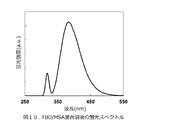
- Example 6 [Quantitative evaluation of fluorescence intensity] Add 1 ml of TBO acetonitrile solution (concentration 0.1 mol / L) and 1 ml of MSA acetonitrile solution (concentration 0.1 mol / L), dilute 2000 times after 10 minutes, put the solution in a quartz cell, and fluoresce at an excitation wavelength of 348 nm. As a result of measuring the spectrum, the fluorescence spectrum curve shown in FIG. 10 was obtained. The peak wavelength at that time was 384 nm.
- Example 7 [Measurement of electrochemical behavior]
- tetrabutylammonium tetrafluoroborate is dissolved in acetonitrile to prepare an electrolytic solution (concentration: 0.1 mol / L), 10 ml of the electrolytic solution is placed in a glass container, and a three-electrode method consisting of a working electrode, a counter electrode, and a reference electrode is used. Constructed an electrochemical cell. Glassy carbon was used as the working electrode, Pt was used as the counter electrode, and Ag / Ag + electrode was used as the reference electrode.
- the obtained current-voltage curve (cyclic voltamogram) is shown in FIG.
- the broken line is only TBO, and the solid line is the measurement result after adding MSA to TBO. From this result, it was found that after MSA addition, the current value changed significantly in the potential range of 1.6 to 2.2V as compared with before addition. This can be done, for example, by monitoring the current value flowing through the electrode at a voltage (Ag / Ag + 1.6 to 2.2V with respect to the electrode) at which the current value changes significantly before and after the addition of MSA. It shows that methyl salicylate can be sensed.
- X represents a hydrogen atom, an alkyl group having 1 to 4 carbon atoms, an alkoxy group, a mercapto group, a mercapto-substituted alkyl group, or a mercapto-substituted alkoxy group
- n represents an integer of 1 to 5, and n represents 2.
- each X may be the same or different.
- Appendix 4 The sensing method according to Appendix 1, wherein in the sensing method, the boron-oxygen compound is a boronoxine derivative represented by the following general formula (4).
- Z represents an alkyl group having 1 to 4 carbon atoms or a substituted or unsubstituted phenyl group, and each Z may be the same or different.
- Appendix 5 The sensing method according to any one of Supplementary note 1 to 4, wherein in the sensing, a phenomenon in which methyl salicylate reacts with the boron-oxygen compound to form a boron complex to emit fluorescence is utilized.
- Appendix 6 The sensing method according to any one of Supplementary note 1 to 4, which utilizes a phenomenon in which the electrochemical behavior changes due to the reaction between the boron-oxygen compound and methyl salicylate in the sensing.
- Appendix 7 The sensing method according to Appendix 6, wherein in the sensing, a change in the current value caused by the reaction between the boron-oxygen compound and methyl salicylate is used.
- Appendix 8 A methyl salicylate sensor that detects methyl salicylate. i) A recognition unit for methyl salicylate having a boron-oxygen compound having a structure represented by the general formula (1), and ii) A methyl salicylate sensor having at least a detection unit for detecting that methyl salicylate has been recognized in the recognition unit.
- Appendix 9 A method for detecting pathogen infection in a crop by installing the methyl salicylate sensor according to Appendix 8 in the vicinity of the crop and detecting methyl salicylate with the sensor.
- Appendix 10 A recognition unit for methyl salicylate having a specific structure of a boron-oxygen compound represented by the general formula (1), which is a methyl salicylate sensor that detects methyl salicylate and is a receptor that selectively recognizes methyl salicylate, and its recognition.
- a methyl salicylate sensor comprising at least a detection unit for detecting the recognition of methyl salicylate, the detection unit including an optical and / or electrochemical detection element and a computer, and the computer.
- a methyl salicylate sensor having a program that executes a step of ii) analyzing a received signal to determine the presence / absence and / or concentration of methyl salicylate, and iii) a step of outputting an analysis result.
- Appendix 13 The detection method according to Appendix 11 or 12, further comprising a step of determining the concentration of methyl salicylate by comparing the detected fluorescence intensity with a predetermined reference value.
- Appendix 14 (I) A boron-oxygen compound having a structure represented by the general formula (1), a diboroxane derivative represented by the general formula (2), a phenylboronic acid derivative represented by the general formula (3), or a phenylboronic acid derivative having a structure represented by the general formula (1) in a solution.
- a method for detecting methyl salicylate which comprises a step of detecting a change in the generated current value.
- Appendix 15 The detection method according to Appendix 14, wherein the voltage value is in the range of 1.6 to 2.2V.
- Appendix 16 The detection method according to Appendix 14 or 15, wherein the solution contains tetrabutylammonium tetrafluoroborate as a supporting electrolyte.
- the boron-oxygen compounds having the structure represented by the general formula (1) are tetraacetoxydiboroxane (TBO), phenylboronic acid (PB), 2,4,6-triphenylboroxic acid (TPB), and The detection method according to any one of Supplementary note 10 to 17, which is selected from the group consisting of 2,4,6-tris (3,4,5-trifluorophenyl) boroxine (TFBP).
- a methyl salicylate sensor that detects methyl salicylate, which recognizes (i) methyl salicylate having a boron-oxygen compound having a structure represented by the general formula (1), and (ii) methyl salicylate in the recognition section.
- a methyl salicylate sensor that has at least a detector that optically detects what has been done.
- a methyl salicylate sensor that detects methyl salicylate, which recognizes (i) methyl salicylate having a boron-oxygen compound having a structure represented by the general formula (1), and (ii) methyl salicylate in the recognition section.
- a methyl salicylate sensor that at least has a detector that electrochemically detects what has been done.
- the methyl salicylate sensor according to Appendix 21, wherein the electrochemical detector comprises an electrochemical cell having an electrode for detecting a current generated by oxidation of a complex formed by a boron-oxygen compound and methyl salicylate.
- (Appendix 23) A method of detecting pathogen infection in a crop by installing a methyl salicylate sensor in the vicinity of the crop and detecting methyl salicylate with the sensor.
- (Appendix 24) The method for detecting pathogen infection in a crop according to Appendix 9 or Appendix 23, wherein the sensor is installed within 2 m from the crop.
- (Appendix 25) A recognition unit for methyl salicylate having a specific structure of a boron-oxygen compound represented by the general formula (1), which is a methyl salicylate sensor that detects methyl salicylate and is a receptor that selectively recognizes methyl salicylate, and its recognition.
- a methyl salicylate sensor that includes at least a detection unit that detects the recognition of methyl salicylate, and the detection unit includes an optical and / or electrochemical detection element and a computer, the computer.
- the step of receiving a signal from an optical and / or electrochemical detection element A program that executes a step of ii) analyzing a received signal to determine the presence / absence and / or its concentration of methyl salicylate, and iii) a step of outputting an analysis result.
- Sensing using a compound having a specific structure having a boron-oxygen bond as a receptor for detecting methyl salicylate, which is a plant hormone, according to the embodiment of the present invention selectively forms a complex with methyl salicylate, and causes a fluorescence emission phenomenon or electricity. Since it expresses changes in chemical behavior, it makes it possible to selectively detect methyl salicylate, which is a plant hormone released by plants when infected with pathogens.
- a sensor whose recognition unit is a compound having a specific structure having a boron-oxygen bond
- a sensor capable of detecting a disease infection of an agricultural product at an early stage It can be used as a new sensor for agricultural ICT in facility gardening such as houses.
Landscapes
- Health & Medical Sciences (AREA)
- Life Sciences & Earth Sciences (AREA)
- Chemical & Material Sciences (AREA)
- Engineering & Computer Science (AREA)
- Immunology (AREA)
- Physics & Mathematics (AREA)
- Molecular Biology (AREA)
- Pathology (AREA)
- General Health & Medical Sciences (AREA)
- General Physics & Mathematics (AREA)
- Analytical Chemistry (AREA)
- Biochemistry (AREA)
- Hematology (AREA)
- Urology & Nephrology (AREA)
- Biomedical Technology (AREA)
- Chemical Kinetics & Catalysis (AREA)
- Plasma & Fusion (AREA)
- Cell Biology (AREA)
- Biotechnology (AREA)
- Microbiology (AREA)
- Endocrinology (AREA)
- Food Science & Technology (AREA)
- Medicinal Chemistry (AREA)
- Nuclear Medicine, Radiotherapy & Molecular Imaging (AREA)
- Investigating, Analyzing Materials By Fluorescence Or Luminescence (AREA)
- Electrochemistry (AREA)
- Investigating Or Analysing Materials By The Use Of Chemical Reactions (AREA)
Priority Applications (2)
| Application Number | Priority Date | Filing Date | Title |
|---|---|---|---|
| JP2021574029A JP7359227B2 (ja) | 2020-01-27 | 2021-01-25 | 植物ホルモンのセンシング方法、及びそれを用いた植物の病気感染の早期検出方法 |
| US17/794,840 US12480875B2 (en) | 2020-01-27 | 2021-01-25 | Method for sensing plant hormone, and method for early detection of disease infection in plant using same |
Applications Claiming Priority (2)
| Application Number | Priority Date | Filing Date | Title |
|---|---|---|---|
| JP2020-010620 | 2020-01-27 | ||
| JP2020010620 | 2020-01-27 |
Publications (1)
| Publication Number | Publication Date |
|---|---|
| WO2021153513A1 true WO2021153513A1 (ja) | 2021-08-05 |
Family
ID=77078264
Family Applications (1)
| Application Number | Title | Priority Date | Filing Date |
|---|---|---|---|
| PCT/JP2021/002482 Ceased WO2021153513A1 (ja) | 2020-01-27 | 2021-01-25 | 植物ホルモンのセンシング方法、及びそれを用いた植物の病気感染の早期検出方法 |
Country Status (3)
| Country | Link |
|---|---|
| US (1) | US12480875B2 (https=) |
| JP (1) | JP7359227B2 (https=) |
| WO (1) | WO2021153513A1 (https=) |
Cited By (1)
| Publication number | Priority date | Publication date | Assignee | Title |
|---|---|---|---|---|
| JP2023173271A (ja) * | 2022-05-25 | 2023-12-07 | 日本電気株式会社 | テルビウム-スルホキシド錯体を用いたサリチル酸メチルのセンシング方法、サリチル酸メチルセンサー、及び農作物の病原菌感染の検出方法 |
Families Citing this family (1)
| Publication number | Priority date | Publication date | Assignee | Title |
|---|---|---|---|---|
| JP2023018230A (ja) * | 2021-07-27 | 2023-02-08 | 日本電気株式会社 | 検出用装置、支援装置、支援方法及びプログラム |
Citations (4)
| Publication number | Priority date | Publication date | Assignee | Title |
|---|---|---|---|---|
| CN100493212C (zh) * | 2007-05-24 | 2009-05-27 | 中国科学院合肥物质科学研究院 | 大田作物病虫害智能预警系统 |
| US20180142277A1 (en) * | 2015-04-15 | 2018-05-24 | University Of Georgia Research Foundation, Inc. | Electrochemical sensors and methods for using electrochemical sensors to detect plant pathogen infection |
| WO2018122860A1 (en) * | 2017-01-02 | 2018-07-05 | Ministry Of Agriculture | System and method for early detection for prevention of postharvest chilling injury |
| WO2019082942A1 (ja) * | 2017-10-24 | 2019-05-02 | 国立大学法人筑波大学 | 植物のストレスの検出方法及び植物における発光タンパク質の検出方法 |
Family Cites Families (13)
| Publication number | Priority date | Publication date | Assignee | Title |
|---|---|---|---|---|
| JPS5987360A (ja) | 1982-11-11 | 1984-05-19 | Tsumura Juntendo Inc | 微量揮発性成分のクロマトグラフイ−による分析法 |
| CA2388964C (en) | 1999-12-10 | 2009-11-17 | Btg International Limited | Cis-jasmone as semiochemical |
| JP4247350B2 (ja) | 2003-03-17 | 2009-04-02 | 静岡県 | 生理活性検定法及び装置 |
| JP6557100B2 (ja) | 2014-09-16 | 2019-08-07 | 株式会社三井E&Sエンジニアリング | 植物の診断方法及び診断装置 |
| CN106124476A (zh) * | 2016-06-21 | 2016-11-16 | 中山大学 | 基于表面增强拉曼散射和双分子探针的葡萄糖检测方法 |
| WO2018122880A1 (en) | 2017-01-02 | 2018-07-05 | Jothimurugan Amirthalingam | Transport belt for transporting fibre strand and a method for making same |
| JP7400967B2 (ja) * | 2020-06-03 | 2023-12-19 | 日本電気株式会社 | 希土類化合物を用いた植物ホルモンのセンシング方法、それを用いたセンサー、及び植物の病気感染の早期検出方法 |
| US20230304931A1 (en) * | 2020-08-03 | 2023-09-28 | Nec Corporation | Method for sensing plant hormone using hydrazine derivative, sensor using the same, and method for early detection of plant disease infection |
| US20240183779A1 (en) * | 2021-03-20 | 2024-06-06 | Nec Corporation | Method for sensing methyl salicylate, methyl salicylate sensor, and method for detecting pathogen infection of plants |
| JP2023018230A (ja) * | 2021-07-27 | 2023-02-08 | 日本電気株式会社 | 検出用装置、支援装置、支援方法及びプログラム |
| JP2023173271A (ja) * | 2022-05-25 | 2023-12-07 | 日本電気株式会社 | テルビウム-スルホキシド錯体を用いたサリチル酸メチルのセンシング方法、サリチル酸メチルセンサー、及び農作物の病原菌感染の検出方法 |
| US20240010912A1 (en) * | 2022-07-05 | 2024-01-11 | Nec Corporation | Reagent for detecting methyl salicylate, methyl slicylate sensor, method for sensing methyl salicylate using same, and method for detecting pathogen infection in plant |
| JP2024142368A (ja) * | 2023-03-30 | 2024-10-11 | 日本電気株式会社 | サリチル酸メチルを検出するための試薬、サリチル酸メチルセンサー、それらを用いたサリチル酸メチルのセンシング方法、及び植物の病原菌感染の検出方法 |
-
2021
- 2021-01-25 JP JP2021574029A patent/JP7359227B2/ja active Active
- 2021-01-25 WO PCT/JP2021/002482 patent/WO2021153513A1/ja not_active Ceased
- 2021-01-25 US US17/794,840 patent/US12480875B2/en active Active
Patent Citations (4)
| Publication number | Priority date | Publication date | Assignee | Title |
|---|---|---|---|---|
| CN100493212C (zh) * | 2007-05-24 | 2009-05-27 | 中国科学院合肥物质科学研究院 | 大田作物病虫害智能预警系统 |
| US20180142277A1 (en) * | 2015-04-15 | 2018-05-24 | University Of Georgia Research Foundation, Inc. | Electrochemical sensors and methods for using electrochemical sensors to detect plant pathogen infection |
| WO2018122860A1 (en) * | 2017-01-02 | 2018-07-05 | Ministry Of Agriculture | System and method for early detection for prevention of postharvest chilling injury |
| WO2019082942A1 (ja) * | 2017-10-24 | 2019-05-02 | 国立大学法人筑波大学 | 植物のストレスの検出方法及び植物における発光タンパク質の検出方法 |
Non-Patent Citations (1)
| Title |
|---|
| LI, Y. ET AL.: "A reagent-assisted method in SERS detection of methyl salicylate", SPECTROCHIMICA ACTA PART A: MOLECULAR AND BIOMOLECULAR SPECTROSCOPY, vol. 195, 31 January 2018 (2018-01-31), pages 172 - 175, XP055845271, DOI: 10.1016/j.saa. 2018.01.07 3 * |
Cited By (2)
| Publication number | Priority date | Publication date | Assignee | Title |
|---|---|---|---|---|
| JP2023173271A (ja) * | 2022-05-25 | 2023-12-07 | 日本電気株式会社 | テルビウム-スルホキシド錯体を用いたサリチル酸メチルのセンシング方法、サリチル酸メチルセンサー、及び農作物の病原菌感染の検出方法 |
| US12613189B2 (en) | 2022-05-25 | 2026-04-28 | Nec Corporation | Method for sensing methyl salicylate, methyl salicylate sensor, and method for detecting pathogen infection of crops using terbium-sulfoxide complex |
Also Published As
| Publication number | Publication date |
|---|---|
| US20230096785A1 (en) | 2023-03-30 |
| JP7359227B2 (ja) | 2023-10-11 |
| JPWO2021153513A1 (https=) | 2021-08-05 |
| US12480875B2 (en) | 2025-11-25 |
Similar Documents
| Publication | Publication Date | Title |
|---|---|---|
| JP7732492B2 (ja) | 希土類化合物を用いた植物ホルモンのセンシング方法、それを用いたセンサー、及び植物の病気感染の早期検出方法 | |
| US6673625B2 (en) | Saccharide sensing molecules having enhanced fluorescent properties | |
| CA2599254C (en) | Method for the determination of the concentration of a non-volatile analyte | |
| US6682938B1 (en) | Glucose sensing molecules having selected fluorescent properties | |
| Hooda et al. | Deep red emissive octacoordinated heteroleptic Sm (III) complexes: preparation and spectroscopic investigation | |
| WO2021153513A1 (ja) | 植物ホルモンのセンシング方法、及びそれを用いた植物の病気感染の早期検出方法 | |
| US20020043651A1 (en) | Fluorescent lifetime assays for non-invasive quantification of analytes such as glucose | |
| WO2001020334A1 (en) | Glucose sensing molecules having selected fluorescent properties | |
| JP7616353B2 (ja) | サリチル酸メチルをセンシングする方法、サリチル酸メチルセンサー、及び植物の病気感染の検出方法 | |
| Schroeder et al. | Luminescent dual sensor for time-resolved imaging of p CO2 and p O2 in aquatic systems | |
| Zheng et al. | Lighting up electrochemiluminescence-inactive dyes via grafting enabled by intramolecular resonance energy transfer | |
| CN102876323A (zh) | 一种镉离子荧光探针及制备方法和用途 | |
| Marcotte et al. | Carboxy SNARF-4F as a fluorescent pH probe for ensemble and fluorescence correlation spectroscopies | |
| CN104592987A (zh) | 一种具有pH响应的恢复型近红外荧光探针及其制备方法和应用 | |
| US12613189B2 (en) | Method for sensing methyl salicylate, methyl salicylate sensor, and method for detecting pathogen infection of crops using terbium-sulfoxide complex | |
| WO2022030237A1 (ja) | ヒドラジン誘導体を用いた植物ホルモンのセンシング方法、それを用いたセンサー、及び植物の病気感染の早期検出方法 | |
| US20240327704A1 (en) | Reagent for detecting methyl salicylate, methyl salicylate sensor, method for sensing methyl salicylate using the same and methods for detecting plant pathogen infections | |
| Cary et al. | Rhenium bipyridine complexes for the recognition of glucose | |
| US20240010912A1 (en) | Reagent for detecting methyl salicylate, methyl slicylate sensor, method for sensing methyl salicylate using same, and method for detecting pathogen infection in plant | |
| KR20110054119A (ko) | 신규한 솔바토크로믹 염료 및 이를 이용한 휘발성 유기화합물 검출 방법 | |
| Tao et al. | A near-infrared fluorescent probe based on purine for glyphosate detection in real sample, living cells and zebrafish | |
| JP2026005381A (ja) | サリチル酸メチルを検出するための試薬、サリチル酸メチルセンサー、それらを用いたサリチル酸メチルのセンシング方法、及び植物の病原菌感染の検出方法 | |
| CN102849690A (zh) | 一种对硫磷农药的荧光纳米CdSe量子点探针及其应用 | |
| JP2025086973A (ja) | サリチル酸メチルを検出するための試薬、サリチル酸メチルセンサー、それらを用いたサリチル酸メチルのセンシング方法、及び植物の病原菌感染の検出方法 | |
| Luedeker et al. | Laser-induced leaf fluorescence: a tool for vegetation status and stress monitoring and optical-aided agriculture |
Legal Events
| Date | Code | Title | Description |
|---|---|---|---|
| 121 | Ep: the epo has been informed by wipo that ep was designated in this application |
Ref document number: 21747823 Country of ref document: EP Kind code of ref document: A1 |
|
| ENP | Entry into the national phase |
Ref document number: 2021574029 Country of ref document: JP Kind code of ref document: A |
|
| NENP | Non-entry into the national phase |
Ref country code: DE |
|
| 122 | Ep: pct application non-entry in european phase |
Ref document number: 21747823 Country of ref document: EP Kind code of ref document: A1 |
|
| WWG | Wipo information: grant in national office |
Ref document number: 17794840 Country of ref document: US |