WO2021149573A1 - 投写型映像表示装置 - Google Patents
投写型映像表示装置 Download PDFInfo
- Publication number
- WO2021149573A1 WO2021149573A1 PCT/JP2021/000962 JP2021000962W WO2021149573A1 WO 2021149573 A1 WO2021149573 A1 WO 2021149573A1 JP 2021000962 W JP2021000962 W JP 2021000962W WO 2021149573 A1 WO2021149573 A1 WO 2021149573A1
- Authority
- WO
- WIPO (PCT)
- Prior art keywords
- light
- light source
- solid
- source array
- diffusion
- Prior art date
- Legal status (The legal status is an assumption and is not a legal conclusion. Google has not performed a legal analysis and makes no representation as to the accuracy of the status listed.)
- Ceased
Links
Images













Classifications
-
- G—PHYSICS
- G03—PHOTOGRAPHY; CINEMATOGRAPHY; ANALOGOUS TECHNIQUES USING WAVES OTHER THAN OPTICAL WAVES; ELECTROGRAPHY; HOLOGRAPHY
- G03B—APPARATUS OR ARRANGEMENTS FOR TAKING PHOTOGRAPHS OR FOR PROJECTING OR VIEWING THEM; APPARATUS OR ARRANGEMENTS EMPLOYING ANALOGOUS TECHNIQUES USING WAVES OTHER THAN OPTICAL WAVES; ACCESSORIES THEREFOR
- G03B21/00—Projectors or projection-type viewers; Accessories therefor
- G03B21/14—Details
- G03B21/20—Lamp housings
- G03B21/2006—Lamp housings characterised by the light source
- G03B21/2033—LED or laser light sources
- G03B21/204—LED or laser light sources using secondary light emission, e.g. luminescence or fluorescence
-
- F—MECHANICAL ENGINEERING; LIGHTING; HEATING; WEAPONS; BLASTING
- F21—LIGHTING
- F21S—NON-PORTABLE LIGHTING DEVICES; SYSTEMS THEREOF; VEHICLE LIGHTING DEVICES SPECIALLY ADAPTED FOR VEHICLE EXTERIORS
- F21S2/00—Systems of lighting devices, not provided for in main groups F21S4/00 - F21S10/00 or F21S19/00, e.g. of modular construction
-
- F—MECHANICAL ENGINEERING; LIGHTING; HEATING; WEAPONS; BLASTING
- F21—LIGHTING
- F21V—FUNCTIONAL FEATURES OR DETAILS OF LIGHTING DEVICES OR SYSTEMS THEREOF; STRUCTURAL COMBINATIONS OF LIGHTING DEVICES WITH OTHER ARTICLES, NOT OTHERWISE PROVIDED FOR
- F21V3/00—Globes; Bowls; Cover glasses
-
- G—PHYSICS
- G03—PHOTOGRAPHY; CINEMATOGRAPHY; ANALOGOUS TECHNIQUES USING WAVES OTHER THAN OPTICAL WAVES; ELECTROGRAPHY; HOLOGRAPHY
- G03B—APPARATUS OR ARRANGEMENTS FOR TAKING PHOTOGRAPHS OR FOR PROJECTING OR VIEWING THEM; APPARATUS OR ARRANGEMENTS EMPLOYING ANALOGOUS TECHNIQUES USING WAVES OTHER THAN OPTICAL WAVES; ACCESSORIES THEREFOR
- G03B21/00—Projectors or projection-type viewers; Accessories therefor
- G03B21/14—Details
- G03B21/20—Lamp housings
- G03B21/2006—Lamp housings characterised by the light source
- G03B21/2013—Plural light sources
-
- G—PHYSICS
- G03—PHOTOGRAPHY; CINEMATOGRAPHY; ANALOGOUS TECHNIQUES USING WAVES OTHER THAN OPTICAL WAVES; ELECTROGRAPHY; HOLOGRAPHY
- G03B—APPARATUS OR ARRANGEMENTS FOR TAKING PHOTOGRAPHS OR FOR PROJECTING OR VIEWING THEM; APPARATUS OR ARRANGEMENTS EMPLOYING ANALOGOUS TECHNIQUES USING WAVES OTHER THAN OPTICAL WAVES; ACCESSORIES THEREFOR
- G03B21/00—Projectors or projection-type viewers; Accessories therefor
- G03B21/14—Details
- G03B21/20—Lamp housings
- G03B21/2006—Lamp housings characterised by the light source
- G03B21/2033—LED or laser light sources
-
- G—PHYSICS
- G03—PHOTOGRAPHY; CINEMATOGRAPHY; ANALOGOUS TECHNIQUES USING WAVES OTHER THAN OPTICAL WAVES; ELECTROGRAPHY; HOLOGRAPHY
- G03B—APPARATUS OR ARRANGEMENTS FOR TAKING PHOTOGRAPHS OR FOR PROJECTING OR VIEWING THEM; APPARATUS OR ARRANGEMENTS EMPLOYING ANALOGOUS TECHNIQUES USING WAVES OTHER THAN OPTICAL WAVES; ACCESSORIES THEREFOR
- G03B21/00—Projectors or projection-type viewers; Accessories therefor
- G03B21/14—Details
- G03B21/20—Lamp housings
- G03B21/208—Homogenising, shaping of the illumination light
-
- F—MECHANICAL ENGINEERING; LIGHTING; HEATING; WEAPONS; BLASTING
- F21—LIGHTING
- F21Y—INDEXING SCHEME ASSOCIATED WITH SUBCLASSES F21K, F21L, F21S and F21V, RELATING TO THE FORM OR THE KIND OF THE LIGHT SOURCES OR OF THE COLOUR OF THE LIGHT EMITTED
- F21Y2115/00—Light-generating elements of semiconductor light sources
- F21Y2115/30—Semiconductor lasers
Definitions
- the present disclosure relates to a projection type image display device including a light source device that diffuses light emitted from a solid-state light source array with a diffuser plate and homogenizes the diffused light with a light homogenizing element.
- Patent Document 1 discloses a projection type image display device that adjusts the divergence angle ratio of the long axis and the short axis of the laser luminous flux by using an angle distribution control element in order to improve the uniformity of the emitted laser luminous flux. There is.
- the present disclosure provides a projection type image display device provided with a light source device capable of suppressing speckle noise.
- speckle noise can be suppressed.
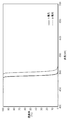
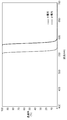
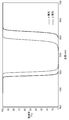
- Characteristic diagram of the half mirror according to the first embodiment Characteristic diagram of the dichroic mirror 140 according to the first embodiment Characteristic diagram of dichroic mirrors 141 and 142 according to the first embodiment Characteristic diagram of the dichroic mirror 143 according to the first embodiment
- Top view showing the state of light rays in the second embodiment Side view showing the state of the light beam in the second embodiment
- Top view showing the state of diffusion on the diffusion plate in the second embodiment
- Side view showing the state of diffusion with the diffusion plate in Embodiment 2.
- Projection-type image display device showing the state of light rays in the third embodiment Side view showing the state of the light beam in the third embodiment Top view showing the state of diffusion on the diffusion plate in the third embodiment Side view showing the state of diffusion with the diffusion plate in Embodiment 3.
- Schematic diagram showing the state of diffusion on the diffusion plate in the third embodiment The figure which shows the light intensity distribution on the incident surface of the rod integrator in Embodiment 1.
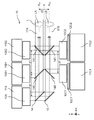
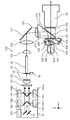
- FIG. 1 is a diagram showing an optical configuration of the projection type image display device 100 according to the first embodiment.
- the rod integrator 30 is a solid rod made of a transparent member such as glass.
- the rod integrator 30 equalizes the light emitted from the light source device 10.
- the rod integrator 30 may be a hollow rod whose inner wall is formed of a mirror surface.
- the rod integrator 30 is an example of a light homogenizing element that homogenizes the light transmitted through the diffuser plate 21, which will be described later.
- DMD40R, DMD40G and DMD40B are provided as DMDs.
- the DMD40R modulates the red component light R based on the red video signal.
- the DMD 40G modulates the green component light G based on the green video signal.
- the DMD 40B modulates the blue component light B based on the blue video signal.
- the DMD is an example of a light modulation element that generates video light by modulating light obtained from a rod integrator with a video signal.
- the projection type image display device 100 has a necessary lens group and a mirror group.
- the lens group includes lenses 121 to 125
- the mirror group includes a mirror 13, a half mirror 14, a mirror 131, and a dichroic mirror 140 to 143.
- the projection type image display device 100 has a necessary diffuser plate 20 and a diffuser plate 21.
- the lens 121 and the lens 122 are condenser lenses that collect the emitted light from the first solid-state light source array 10A, the second solid-state light source array 10B1, 10B2, and the third solid-state light source array 10C1 and 10C2, and guide them to the rod integrator 30.
- the lens 123, the lens 124, and the lens 125 are relay lenses that substantially image the light emitted from the rod integrator 30 on each of the DMDs 40R, 40G, and 40B.
- the projection type image display device 100 has a necessary prism group.
- a prism 210, a prism 220, a prism 230, a prism 240 and a prism 250 are provided.
- the prism 220 is composed of a translucent member and has a surface 221 and a surface 222.
- the surface 222 is a dichroic mirror surface that transmits the red component light R and the green component light G and reflects the blue component light B. Therefore, of the light reflected on the surface 211, the red component light R and the green component light G pass through the surface 222, and the blue component light B is reflected on the surface 222. The blue component light B reflected by the surface 222 is reflected by the surface 221.
- An air gap is provided between the prism 210 (surface 212) and the prism 220 (surface 221), and the blue component light B first reflected by the surface 222 and the blue component light B emitted from the DMD 40B are surface surfaces. Since the angle incident on 221 (incident angle) is larger than the total reflection angle, the blue component light B first reflected on the surface 222 and the blue component light B emitted from the DMD 40B are reflected on the surface 221. The blue component light B reflected by the surface 222 is reflected by the surface 221 and incident on the DMD 40B, and the DMD 40B reflects the incident light and emits it as an emitted light.
- the prism 230 is composed of a translucent member and has a surface 231 and a surface 232.
- the surface 232 is a dichroic mirror surface that transmits the green component light G and reflects the red component light R. Therefore, of the light transmitted through the surface 231 the green component light G is transmitted through the surface 232 and the red component light R is reflected by the surface 232. The red component light R reflected by the surface 232 is reflected by the surface 231.
- the green component light G emitted from the DMD 40G passes through the surface 232.
- the angle (incident angle) at which the red component light R emitted from the DMD 40R and reflected on the surface 231 and then reflected on the surface 232 again enters the surface 231 is smaller than the total reflection angle, it is emitted from the DMD 40R.
- the red component light R reflected on the surface 231 and then reflected on the surface 232 passes through the surface 231.
- the prism 250 is composed of a translucent member and has a surface 251.
- FIG. 2 is a diagram showing a light source device 10 according to the first embodiment.
- the light source device 10 used in the projection type image display device shown in FIG. 1 is mainly a first solid-state light source array 10A, a second solid-state light source array 10B1, 10B2, and a third solid-state light source array 10C1, 10C2. , Half mirror 14, mirror 13 and dichroic mirrors 140 to 143.
- the third solid-state light source array 10C1 and the third solid-state light source array 10C2 are on one side. Are arranged at a center spacing d1 apart, and the first solid-state light source array 10A and the second solid-state light source array 10B1 and the second solid-state light source array 10B1 and the second solid-state light source array 10B2 are arranged at a center spacing d1 on the other side. NS.
- the luminous flux reflected by the half mirror 14 the green light emitted from the second solid-state light source array 10B1, and the red light emitted from the third solid-state light source array 10C2.
- the blue light emitted from the first solid-state light source array 10A the light beam transmitted through the half mirror 14 and reflected by the mirror 13, the green light emitted from the second solid-state light source array 10B2, and the third solid-state light source array 10C1
- the emitted red light is combined by a dichroic mirror 142 that reflects red light and transmits blue light and a dichroic mirror 143 that reflects green light and transmits blue light and red light, and constitutes a light beam LB of white light. Proceed along the second light path 17B.
- the center distance d2 between the light flux LA traveling in the first optical path 17A and the light flux LB traveling in the second optical path 17B is set to be adjacent to the solid light source array (second solid light source array 10B1, 10B2, or ,
- the center spacing d1 of the colored light emitted from the third solid-state light source array 10C1, 10C2) is narrower.
- the center spacing d1 of the solid-state light source array is a common value, but it can be adjusted as appropriate.
- the light source device 10 includes a necessary cooling mechanism group.
- the cooling mechanism group includes a cooling mechanism 11A attached to the first solid light source array 10A, a cooling mechanism 11B1 attached to the second solid light source array 10B1, a cooling mechanism 11B2 attached to the second solid light source array 10B2, and a third solid light source array 10C1. It is composed of a cooling mechanism 11C1 attached to the third solid light source array 10C2 and a cooling mechanism 11C2 attached to the third solid light source array 10C2.
- the cooling mechanism 11A, the cooling mechanism 11B1 and the cooling mechanism 11B2 are a first solid light source array 10A, a second solid light source array 10B1 and a second solid light source that can be used under high temperature conditions of a laser case temperature of 50 ° C. to 70 ° C. It is a cooling mechanism for cooling each of the arrays 10B2.
- the fact that the laser case temperature can be used under high temperature conditions of 50 ° C. to 70 ° C. is defined as the target cooling temperatures of the first solid-state light source array 10A, the second solid-state light source array 10B1 and the second solid-state light source array 10B2. It means that the case temperature of the laser of the solid light source array is set to 50 ° C. to 70 ° C.
- the cooling mechanism 11C1 and the cooling mechanism 11C2 are for cooling the third solid-state light source array 10C1 and the third solid-state light source array 10C2, which need to be used under the low temperature condition of the laser case temperature of 20 ° C. to 40 ° C., respectively. It is a cooling mechanism, and is attached to the third solid-state light source array 10C1 and the third solid-state light source array 10C2, respectively, with the Pelche element 12C1 and the Pelche element 12C2 interposed therebetween.
- the laser case temperature of each solid light source array is set to 20 as the target cooling temperature of the third solid light source arrays 10C1 and 10C2. It means to change from ° C to 40 ° C. Therefore, in the present embodiment, the third solid-state light source arrays 10C1 and 10C2 are the light source arrays that require the lowest target cooling temperature among the first to third solid-state light source arrays.
- the cooling mechanism group is adhered to the back surface of the first solid light source array, the second solid light source array, or the third solid light source array, respectively, via, for example, heat conductive grease.
- the cooling mechanism group is an example of a cooling device.
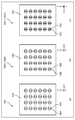
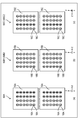
- FIG. 3A shows a first solid-state light source array 10A viewed in the + x direction of FIG. 2, and FIG. 3B shows a second solid-state light source array 10B1 and a second solid-state light source array 10B2.
- 3C is a view of the third solid-state light source array 10C1 and the third solid-state light source array 10C2 as viewed in the ⁇ x direction of FIG.
- the first solid-state light source array 10A includes a plurality of laser diodes 16A that emit blue light (first color light) having a main wavelength of 465 nm, and the second solid-state light source arrays 10B1 and 10B2 are green having a main wavelength of 525 nm.
- the third solid-state light source arrays 10C1 and 10C2 include a plurality of laser diodes 16B that emit light (second color light), and the third solid-state light source arrays 10C1 and 10C2 emit a plurality of laser diodes 16C that emit red light (third color light) having a main wavelength of 640 nm. including.
- the blue light may have other wavelengths within the range of 440 to 470 nm, the green light may have 515 to 550 nm, and the red light may have 630 to 660 nm, or a plurality of wavelengths within the above range may be used.
- the blue and green laser diodes have relatively good temperature characteristics, can maintain reliability even under high temperature conditions of a case temperature of 50 to 70 ° C, and have a relatively small decrease in light output.
- the red laser diode has poor temperature characteristics, it is difficult to maintain reliability under high temperature conditions, and the light output is lowered. Therefore, it is necessary to keep the case temperature at 20 to 40 ° C.
- the first solid-state light source array 10A, the second solid-state light source array 10B1, the second solid-state light source array 10B2, the third solid-state light source array 10C1 and the third solid-state light source array 10C2 are four in the horizontal direction and six in the vertical direction, for a total of 24.
- the laser diodes 16A, 16B, and 16C are arranged.
- the laser diodes 16A, 16B, and 16C include emitters 18A, 18B, and 18C from which light is emitted, respectively, and are integrated with a collimated lens that collimates the emitted light from the laser diodes 16A, 16B, and 16C. Emits almost parallel light.
- the emitters 18A, 18B, and 18C are arranged so that the x-axis direction is the short side and the y-axis direction is the long side, the x-axis direction is the Fast axis, and the y-axis direction is the Slow axis.
- the long side direction of the image of the emitter on the incident surface of the rod integrator 30 the same as the long side direction of the rod integrator 30, the luminous flux can be incident into the rod integrator more efficiently.
- the first solid-state light source array 10A that emits blue light (first color light) and the second solid-state light source array 10B1 and 10B2 that emit green light (second color light) are polarized in the Slow axis direction, that is, in the y-axis direction.
- the third solid-state light source arrays 10C1 and 10C2 that emit red light (third color light) are in the Fast axis direction, that is, the x-axis direction is the polarization direction.
- the number and arrangement of the laser diodes 16A, 16B, 16C included in the solid light source array is not limited to this.
- FIG. 4 is a diagram showing the arrangement of the luminous flux L incident on the lens 121, and the luminous flux L includes a luminous flux LA traveling in the first optical path 17A and a luminous flux LB traveling in the second optical path 17B.
- the luminous fluxes LA and LB include images 19 of the emitters (a) to (c) of FIG. 3, and the image 19 of each emitter is blue light (first color light), green light (second color light), and red light. It is a white image in which (third colored light) is synthesized. Assuming that the width in the x direction is the luminous flux width Wx and the width in the y direction is the luminous flux width Wy, the luminous flux L is Wx> Wy.
- the images of the emitters of each color of blue light, green light, and red light are heavy in the image 19 of the emitter. It can be an arrangement that does not become.
- FIG. 5B is a characteristic diagram of the dichroic mirror 140, which has a characteristic of transmitting light having a wavelength of 480 nm or less and reflecting light having a wavelength of 510 nm or more for both s-polarized light and p-polarized light.
- the dichroic mirror 140 transmits the s-polarized blue light (first color light) having a main wavelength of 465 nm emitted from the first solid light source array 10A, and the main wavelength emitted from the second solid light source array 10B1. It reflects 525 nm, s-polarized green light (second color light).
- FIG. 5C is a characteristic diagram of the dichroic mirrors 141 and 142.
- the dichroic mirror 141 is derived from the main wavelength 465 nm, s-polarized blue light (first color light) emitted from the first solid light source array 10A, the second solid light source array 10B1 and the second solid light source array 10B2.
- the dichroic mirror 142 transmits blue light having a main wavelength of 465 nm and s-polarized light emitted from the first solid-state light source array 10A, and has a main wavelength of 640 nm and p-polarized red light emitted from the third solid-state light source array 10C1. Reflects light.
- FIG. 5D is a characteristic diagram of the dichroic mirror 143, which transmits light having a wavelength of 480 nm or less and 630 nm or more with respect to incident light of both s-polarized light and p-polarized light, and has a wavelength in the range of 510 nm to 540 nm. It has the property of reflecting light.
- the dichroic mirror 143 transmits the s-polarized blue light (first color light) having a main wavelength of 465 nm emitted from the first solid light source array 10A, and the main wavelength emitted from the second solid light source array 10B2.
- a dichroic mirror having the characteristics shown in FIG. 5D may be used in order to standardize the specifications with the dichroic mirror 143.
- the pair of the dichroic mirror 140 and the dichroic mirror 142 and the pair of the dichroic mirror 141 and the dichroic mirror 143 are held at the same angle as in FIG. Even if the positions of are exchanged, the light beams LA and LB of white light can be formed.
- the luminous flux LA traveling in the first optical path 17A is the luminous flux reflected by the half mirror 14 among the blue light emitted from the first solid-state light source array 10A and the green light emitted from the second solid-state light source array 10B2.
- the luminous flux LB traveling in the second optical path 17B includes the luminous flux transmitted through the half mirror 14 among the blue light emitted from the first solid-state light source array 10A, the green light emitted from the second solid-state light source array 10B1, and the third. It is composed of red light emitted from the solid-state light source array 10C2.
- the dichroic mirrors 140 to 143 can minimize the difference in the optical path lengths in which the colored lights of the same color travel when the arrangement shown in FIG. 1 is adopted. That is, the optical path length difference between the green light (second color light) emitted from the second solid-state light source array 10B1 and the green light (second color light) emitted from the second solid-state light source array 10B2, the third solid-state light source array.
- the difference in optical path length between the red light (third color light) emitted from the 10C1 and the red light (third color light) emitted from the third solid-state light source array 10C2 can be minimized.
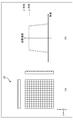
- FIG. 6A is a diagram showing the shape of the diffusion plate 20.
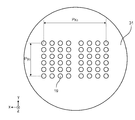
- the diffuser plate 20 has a flat surface on one side, and has a shape in which square microlenses are squarely arranged on the other side. Further, the diffuser plate 20 has a square shape in which each microlens has the same size in the x direction and the y direction.
- FIG. 6B is a diagram showing the diffusion angle characteristics of the diffusion plate 20.
- the diffuser plate 20 is isotropic in that the light transmitted through the diffuser plate 20 is diffused in a top hat shape in the x direction and the y direction perpendicular to the x direction, and is diffused at substantially the same angle in the x direction and the y direction. It has characteristics.
- the x direction is an example of the first direction
- the y direction is an example of the second direction.
- the diffusing plate 20 may have another shape having the same diffusing characteristics, or may have a shape in which the microlenses are randomly arranged in order to reduce coherence.
- the diffusion plate 20 may have a Gaussian type diffusion characteristic instead of a top hat type diffusion characteristic. Although the details will be described later, it is desirable to increase the diffusion angle as much as possible so that the light incident on the rod integrator 30 is not lost.
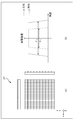
- FIG. 7A is a diagram showing the shape of the diffusion plate 21.
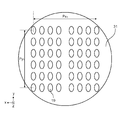
- the diffuser plate 21 has a flat surface on one side, and has a shape in which rectangular microlenses are squarely arranged on the other side. Further, the diffuser plate 21 has a rectangular shape in which each microlens is longer in the y direction than in the x direction.
- FIG. 7B is a diagram showing the diffusion angle characteristics of the diffusion plate 21.
- the diffuser plate 21 has an anisotropic characteristic that the light transmitted through the diffuser plate 21 is diffused in a top hat shape in the y direction perpendicular to the x direction and the x direction and diffused at a larger angle in the y direction than the x direction.
- the diffusing plate 21 may have another shape having the same diffusing characteristics, or may have a shape in which the microlenses are randomly arranged in order to reduce coherence. Further, the diffusion plate 21 may have a Gaussian type diffusion characteristic instead of a top hat type diffusion characteristic. Further, the diffuser plate 21 may be a cylindrical lens array that diffuses only in the y direction.
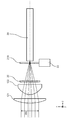
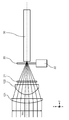
- FIG. 8A is a top view (x-z cross-sectional view) showing a state of light rays emitted from the light source device 10 and entering the rod integrator 30.
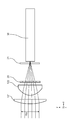
- the lens 121 and the lens 122 collect substantially parallel light having a luminous flux width Wx (see FIG. 4) emitted from the light source device 10 and are located near the incident surface of the rod integrator 30. Condensing.
- FIG. 8B is a side view (yz cross-sectional view) showing a state of light rays emitted from the light source device 10 and entering the rod integrator 30.
- the lens 121 and the lens 122 collect substantially parallel light having a luminous flux width Wy (see FIG. 4) emitted from the light source device 10 and are located near the incident surface of the rod integrator 30. Condensing.
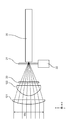
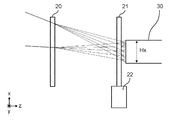
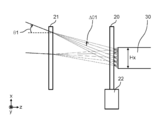
- FIG. 9A is a top view (x-z cross-sectional view) showing how the light rays are diffused by the diffuser plate 20 and the diffuser plate 21.
- the diffusing plate 20 diffuses the incident light rays on the diffusing surface (the surface on the exit side of the diffusing plate 20).
- the light diffused by the diffuser plate 20 spreads as it travels in the z direction, and illuminates the diffuser plate 21 over a fairly wide area.
- the diffusing plate 21 further diffuses the light diffused by the diffusing plate 20 on the diffusing surface (the surface on the exit side of the diffusing plate 21).
- a light beam incident on the diffusion plate 21 at an angle between the optical axis and the diffusion angle component ⁇ 1 (first diffusion angle component) in the x direction is further diffused at the diffusion plate 21 in the x direction ⁇ 1 (first diffusion angle component).
- the light diffused by the diffuser 21 is incident on the rod integrator 30.
- the diffuser plate 20 reduces the light density in the vicinity of the incident surface of the diffuser plate 21 and the rod integrator 30 without condensing the light at one point, so that damage to the diffuser plate 21 and the rod integrator 30 can be prevented. can.
- the diffuser plate 20 illuminates a wide area of the diffuser plate 21, the light uniformity effect can be enhanced, which can contribute to the uniformity of the projected light and the reduction of speckle noise. It is desirable that the degree of diffusion by the diffuser plate 20 be as large as possible so that the incident light is not lost with respect to the width Hx in the x direction of the rod integrator 30.
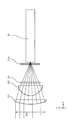
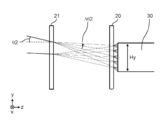
- FIG. 9B is a side view (yz cross-sectional view) showing the state of light diffusing by the diffusing plate 20 and the diffusing plate 21.
- the light rays incident on the diffuser plate 20 are shown only for the outermost light rays and the light rays near the center.
- the diffusing plate 20 diffuses the incident light rays on the diffusing surface (the surface on the exit side of the diffusing plate 20).
- the light diffused by the diffuser plate 20 spreads as it travels in the z direction, and illuminates the diffuser plate 21 over a fairly wide area.
- the diffusing plate 21 further diffuses the light diffused by the diffusing plate 20 on the diffusing surface (the surface on the exit side of the diffusing plate 21).
- the light rays incident on the diffusion plate 21 at an angle between the optical axis and the diffusion angle component ⁇ 2 (second diffusion angle component) in the y direction are further diffused at the diffusion plate 21 in the y direction ⁇ 2 (second diffusion angle component).
- ⁇ 2 ⁇ y / 2
- the diffuser plate 20 reduces the light density in the vicinity of the incident surface of the diffuser plate 21 and the rod integrator 30 without condensing the light at one point, so that damage to the diffuser plate 21 and the rod integrator 30 can be prevented. can.
- the diffuser plate 20 illuminates a wide area of the diffuser plate 21, the light uniformity effect can be enhanced, which can contribute to the uniformity of the projected light and the reduction of speckle noise. It is desirable that the degree of diffusion by the diffuser plate 20 be as large as possible so that the incident light is not lost with respect to the width Hy of the rod integrator 30 in the y direction.
- the moving mechanism 22 is a mechanism that vibrates the diffuser plate 21 in the x direction at regular intervals.
- the diffusing plate 21 vibrates due to the moving mechanism 22, so that the coherence can be reduced.
- the diffusion plate 21 may not move in the rotation direction, may be vibration in the y direction, or may be a vibration movement.
- the diffuser plate 20 may be vibrated at regular intervals by a moving mechanism. In this case, since the diffusion characteristic of the diffusion plate 20 is isotropic, it may be vibration that moves in the rotation direction. By vibrating the diffuser plate 20, the coherence can be further reduced.
- the location of the diffuser plate 20 is not limited to between the lens 122 and the diffuser plate 21 shown in FIG.
- the lens 121 and the diffuser plate 20 are arranged. It may be arranged between the lenses 122, or may be arranged between the light source device 10 and the lens 121.
- FIG. 10A is a schematic view showing the angular distribution of the incident light on the rod integrator 30 when the diffuser plate 21 is not provided as a comparative example. Since the light emitted from the light source device 10 is focused by the lens 121 and the lens 122, the angular distribution in FIG. 10A is substantially similar to the luminous flux distribution emitted from the light source device 10 shown in FIG. That is, the ratio of the luminous flux width Wx and the light flux width Wy in FIG 4, is substantially equal to the ratio of the angular distribution width Px 0 and y direction at an angle distribution width Py 0 in the x direction in FIG.
- the angle distribution width Px 0 in the x direction is larger than the angle distribution width Py 0 in the y direction (Px 0 > Py 0 ).
- the distribution of the image 19 of the emitter is more generous in the y direction than in the x direction with respect to the maximum allowable incident angle 31 on the rod integrator 30.
- FIG. 10B is a schematic view showing the angular distribution of the incident light on the rod integrator 30 when the diffuser plate 21 is present (Embodiment 1).
- FIG. 10B since the diffusion plate 21 has a characteristic of being diffused more strongly in the y direction than in the x direction, FIG. 10B has an angle distribution as if the angle distribution of FIG. 10A was stretched in the y direction, and the angle distribution is in the x direction.
- the angle distribution width Px 1 in the y direction and the angle distribution width Py 1 in the y direction are substantially the same (Px 1 ⁇ Py 1 ).
- the angle distribution of the incident light is distributed in the same range in the x direction and the y direction with respect to the maximum allowable angle of incidence 31 on the rod integrator 30 (that is, the vertical and horizontal directions of the angle distribution of the incident light).
- the ratio is approximately 1), and the angle distribution is widened to the very limit.
- the diffusion characteristic of the diffusion plate 21 is an image of the emitter based on the difference in the components (diffusion angle components) between the x direction and the y direction at the incident angle of the incident light on the diffusion plate 21 by the anisotropic diffusion angle.
- the characteristic is that the aspect ratio of the angle distribution formed in 19 is corrected so as to be approximately 1.
- the sum of the angle of the incident light with respect to the optical axis in the x direction (diffusion angle component ⁇ 1) and the diffusion angle ⁇ 1 is the sum of the angle of the incident light with respect to the optical axis in the y direction (diffusion angle component ⁇ 2) and the diffusion angle ⁇ 2. Is approximately equal to ( ⁇ 1 + ⁇ 1 ⁇ ⁇ 2 + ⁇ 2). Further, the image 19 of each emitter appearing on the angular distribution shown in FIG. 10B has an elliptical shape that is greatly stretched in the y direction rather than the x direction.
- a method of angle superimposition that multiplexes the angles of light rays incident on one point of the screen is used. be.
- 10A and 10B have been described as the angular distribution of the incident light on the rod integrator 30, but at the same time, it can be read as the light intensity distribution on the exit pupil of the projection unit 50, and is shown by the maximum allowable incident angle 31.
- the circle can be read as the exit pupil diameter of the projection unit 50.
- the exit pupil of the projection unit 50 has a light intensity distribution as close as possible to the size of the exit pupil diameter. Due to the effect, speckle noise can be effectively reduced, and since the light intensity distribution is within the exit pupil diameter, light loss can also be reduced.
- the aspect ratio of the angular distribution of the incident light on the rod integrator 30 is determined by the diffuser plate 21 that diffuses more strongly in the y direction than in the x direction.
- FIG. 11 is a diagram showing an optical configuration of the projection type image display device 200 according to the second embodiment.
- the projection type image display device 200 differs from the first embodiment in that the first solid-state light source array 60A, the second solid-state light source array 60B1, the second solid-state light source array 60B2, and the second solid-state light source array 60B2.
- It has a light source device 60 including a three-solid light source array 60C1 and a third solid-state light source array 60C2, and in the optical system from the lens 121 to the rod integrator 30, mirrors 144 and 145 for optical path folding are arranged. ing.
- FIG. 12 is a diagram showing a light source device 60 according to the second embodiment.
- the light source device 60 used in the projection type image display device shown in FIG. 11 is mainly a first solid light source array 60A, a second solid light source array 60B1, 60B2, and a third solid light source array 60C1, 60C2. , Half mirror 14, mirror 13 and dichroic mirrors 140 to 143.
- a third solid-state light source array 60C1 and a third solid-state light source array 60C2 are located on one side of the optical axis A of the luminous flux L emitted from the photosynthetic unit including the half mirror 14, the mirror 13, and the dichroic mirrors 140 to 143.
- the first solid-state light source array 60A and the second solid-state light source array 60B1 and the second solid-state light source array 60B1 and the second solid-state light source array 60B2 are arranged at a center distance d1 apart from each other. ..
- the luminous flux reflected by the half mirror 14 the green light emitted from the second solid-state light source array 60B1, and the red light emitted from the third solid-state light source array 60C2.
- the blue light emitted from the first solid-state light source array 60A the light beam transmitted through the half mirror 14 and reflected by the mirror 13, the green light emitted from the second solid-state light source array 60B2, and the third solid-state light source array 60C1
- the emitted red light is combined by a dichroic mirror 142 that reflects red light and transmits blue light and a dichroic mirror 143 that reflects green light and transmits blue light and red light, and constitutes a light beam LB of white light. Proceed along the second light path 67B.
- the center distance d2 between the light flux LA traveling in the first optical path 67A and the light flux LB traveling in the second optical path 67B is set to be adjacent to the solid light source arrays (second solid light source arrays 60B1, 60B2, or 60B2, or , or ,
- the center spacing d1 of the colored light emitted from the third solid-state light source array 60C1, 60C2) is narrower.
- the center spacing d1 of the solid-state light source array is a common value, but it can be adjusted as appropriate.
- the light source device 60 includes a group of necessary cooling mechanisms.
- the cooling mechanism group includes a cooling mechanism 61A attached to the first solid light source array 60A, a cooling mechanism 61B1 attached to the second solid light source array 60B1, a cooling mechanism 61B2 attached to the second solid light source array 60B2, and a third solid light source array 60C1. It is composed of a cooling mechanism 61C1 attached to the third solid light source array 60C2 and a cooling mechanism 61C2 attached to the third solid light source array 60C2.
- the cooling mechanism 61A, the cooling mechanism 61B1 and the cooling mechanism 61B2 are a first solid light source array 60A, a second solid light source array 60B1 and a second solid light source that can be used under high temperature conditions of a laser case temperature of 50 ° C. to 70 ° C. It is a cooling mechanism for cooling each of the arrays 60B2.
- the fact that the laser case temperature can be used under high temperature conditions of 50 ° C. to 70 ° C. is defined as the target cooling temperatures of the first solid-state light source array 60A, the second solid-state light source array 60B1, and the second solid-state light source array 60B2. It means that the case temperature of the laser of the solid light source array is set to 50 ° C. to 70 ° C.
- the cooling mechanism 61C1 and the cooling mechanism 61C2 are for cooling the third solid light source array 60C1 and the third solid light source array 60C2, which need to be used under the low temperature condition of the laser case temperature of 20 ° C. to 40 ° C., respectively. It is a cooling mechanism, and is attached to the third solid-state light source array 60C1 and the third solid-state light source array 60C2, respectively, with the Pelche element 62C1 and the Pelche element 62C2 interposed therebetween.
- the third solid-state light source array 60C1 and the third solid-state light source array 60C2 are light source arrays that require the lowest target cooling temperature among the first to third solid-state light source arrays.
- the cooling mechanism group is adhered to the back surface of the first solid light source array, the second solid light source array, or the third solid light source array, respectively, via, for example, heat conductive grease.
- the cooling mechanism group is an example of a cooling device.
- FIG. 13 (a) is a view of the first solid-state light source array 60A viewed in the + x direction of FIG. 12, and FIG. 13 (b) is a view of the second solid-state light source array 60B1 and the second solid-state light source array 60B2.
- 13 (c) is a view of the third solid-state light source array 60C1 and the third solid-state light source array 60C2 as viewed in the ⁇ x direction of FIG.
- the first solid-state light source array 60A, the second solid-state light source array 60B1, the second solid-state light source array 60B2, the third solid-state light source array 60C1 and the third solid-state light source array 60C2 are 4 in the horizontal direction.
- a total of 24 laser diodes 16A, 16B, 16C, six in the vertical direction, are arranged, and two units arranged on the light source blocks 15A, 15B, 15C) are arranged side by side in the y direction.
- the number and arrangement of the laser diodes 16A, 16B, 16C included in the solid light source array is not limited to this.
- FIG. 14 is a diagram showing the arrangement of the luminous flux L incident on the lens 121, and the luminous flux L includes a luminous flux LA traveling in the first optical path 67A and a luminous flux LB traveling in the second optical path 67B.
- the luminous fluxes LA and LB include images 19 of the emitters (a) to (c) of FIG. 13, and the image 19 of each emitter is blue light (first color light), green light (second color light), and red light. It is a white image in which (third colored light) is synthesized.
- the luminous flux L is Wx ⁇ Wy, where the width in the x direction is the luminous flux width Wx and the width in the y direction is the luminous flux width Wy.
- the images of the emitters of each color of blue light, green light, and red light are heavy in the image 19 of the emitter. It can be an arrangement that does not become.
- FIG. 15A is a diagram showing the shape of the diffusion plate 21A.
- the diffuser plate 21A has a flat surface on one side and a rectangular microlenses arranged squarely on the other side. Further, the diffuser plate 21A has a rectangular shape in which each microlens is longer in the x direction than in the y direction.
- the diffuser plate 21A is an example of the first diffuser plate.
- FIG. 15B is a diagram showing the diffusion angle characteristics of the diffusion plate 21A.
- the diffuser plate 21A has an anisotropic characteristic that the light transmitted through the diffuser plate 21A is diffused in a top hat shape in the x-direction and the y-direction, and is diffused at a larger angle in the x-direction than the y-direction.
- the diffusion angle (FWHM) in the x direction is the diffusion angle ⁇ x
- the diffusion angle (FWHM) in the y direction is the diffusion angle ⁇ y , ⁇ x > ⁇ y .
- the diffusing plate 21A may have another shape having the same diffusing characteristics, or may have a shape in which the microlenses are randomly arranged in order to reduce coherence. Further, the diffusion plate 21A may have a Gaussian type diffusion characteristic instead of a top hat type diffusion characteristic. Further, the diffuser plate 21A may be a cylindrical lens array that diffuses only in the x direction.
- FIG. 16A is a top view (x-z cross-sectional view) showing a state of light rays emitted from the light source device 60 and entering the rod integrator 30.
- the lens 121 and the lens 122 collect substantially parallel light having a luminous flux width Wx (see FIG. 14) emitted from the light source device 60 and are located near the incident surface of the rod integrator 30. Condensing.
- FIG. 16B is a side view (yz cross-sectional view) showing a state of light rays emitted from the light source device 60 and entering the rod integrator 30.
- the lens 121 and the lens 122 collect substantially parallel light having a luminous flux width Wy (see FIG. 14) emitted from the light source device 60, and are located near the incident surface of the rod integrator 30. Condensing.
- FIG. 17A is a top view (x-z cross-sectional view) showing how the light rays are diffused by the diffuser plate 20 and the diffuser plate 21A.
- the diffusing plate 20 diffuses the incident light rays on the diffusing surface (the surface on the exit side of the diffusing plate 20).
- the light diffused by the diffuser plate 20 spreads as it travels in the z direction, and illuminates the diffuser plate 21A over a fairly wide area.
- the diffusing plate 21A further diffuses the light diffused by the diffusing plate 20 on the diffusing surface (the surface on the exit side of the diffusing plate 21A).
- the light diffused by the diffuser 21 is incident on the rod integrator 30.
- the diffuser plate 20 reduces the light density in the vicinity of the incident surface of the diffuser plate 21A and the rod integrator 30 without condensing the light at one point, so that damage to the diffuser plate 21A and the rod integrator 30 can be prevented. can.
- the diffuser plate 20 illuminates a wide area of the diffuser plate 21A, the light uniformity effect can be enhanced, which can contribute to the uniformity of the projected light and the reduction of speckle noise.
- the degree of diffusion by the diffuser plate 20 be as large as possible so that the incident light is not lost with respect to the width Hx in the x direction of the rod integrator 30.
- FIG. 17B is a side view (yz cross-sectional view) showing the state of light diffusing by the diffusing plate 20 and the diffusing plate 21A.
- the light rays incident on the diffuser plate 20 are shown only for the outermost light rays and the light rays near the center.
- the diffusing plate 20 diffuses the incident light rays on the diffusing surface (the surface on the exit side of the diffusing plate 20).
- the light diffused by the diffuser plate 20 spreads as it travels in the z direction, and illuminates the diffuser plate 21A over a fairly wide area.
- the diffusing plate 21A further diffuses the light diffused by the diffusing plate 20 on the diffusing surface (the surface on the exit side of the diffusing plate 21A).
- the light rays incident on the diffusion plate 21A at an angle between the optical axis and the diffusion angle component ⁇ 2 (second diffusion angle component) in the y direction are further diffused angle ⁇ 2 (second diffusion angle component) in the y direction by the diffusion plate 21A.
- ⁇ 2 ⁇ y / 2
- the diffuser plate 20 reduces the light density in the vicinity of the incident surface of the diffuser plate 21A and the rod integrator 30 without condensing the light at one point, so that damage to the diffuser plate 21A and the rod integrator 30 can be prevented. can.
- the diffuser plate 20 illuminates a wide area of the diffuser plate 21A, the light uniformity effect can be enhanced, which can contribute to the uniformity of the projected light and the reduction of speckle noise.
- the degree of diffusion by the diffuser plate 20 be as large as possible so that the incident light is not lost with respect to the width Hy of the rod integrator 30 in the y direction.
- the moving mechanism 22 is a mechanism that vibrates the diffuser plate 21A in the x direction at regular intervals.
- the diffusing plate 21A vibrates due to the moving mechanism 22, so that the coherence can be reduced.
- the diffusion plate 21A may not move in the rotation direction, may be vibration in the y direction, or may be a vibration movement.
- the location of the diffuser plate 20 is not limited to the space between the mirror 145 and the diffuser plate 21 shown in FIG. 11, but the lens 121 and the lens 121 if it is between the light source device 60 (solid light source array) and the diffuser plate 21A. It may be arranged between the lenses 122, or may be arranged between the light source device 60 and the lens 121.
- FIG. 18A is a schematic view showing the angular distribution of the incident light on the rod integrator 30 when the diffuser plate 21A is not provided as a comparative example. Since the light emitted from the light source device 60 is focused by the lens 121 and the lens 122, the angular distribution in FIG. 18A is substantially similar to the luminous flux distribution emitted from the light source device 10 shown in FIG. That is, the ratio of luminous flux width Wx and the light flux width Wy in FIG 14, is substantially equal to the ratio of the x-direction of angular distribution width Px 0 and y direction at an angle distribution width Py 0 in FIG.
- the angle distribution width Px 0 in the x direction is smaller than the angle distribution width Py 0 in the y direction (Px 0 ⁇ Py 0 ).
- the distribution of the image 19 of the emitter is more generous in the x direction than in the y direction with respect to the maximum allowable incident angle 31 on the rod integrator 30.
- FIG. 18B is a schematic view showing the angular distribution of the incident light on the rod integrator 30 when the diffuser plate 21A is present (the second embodiment).
- FIG. 18B since the diffusion plate 21A has a characteristic of being diffused more strongly in the x direction than in the y direction, FIG. 18B has an angle distribution as if the angle distribution of FIG. 18A was extended in the x direction, and the angle distribution is in the x direction.
- the angle distribution width Px 1 in the y direction and the angle distribution width Py 1 in the y direction are substantially the same (Px 1 ⁇ Py 1 ).
- the angle distribution of the incident light is distributed in the same range in the x direction and the y direction with respect to the maximum allowable angle of incidence 31 on the rod integrator 30 (that is, the vertical and horizontal directions of the angle distribution of the incident light).
- the ratio is approximately 1), and the angle distribution is widened to the very limit.
- the diffusion characteristic of the diffusion plate 21A is an image of the emitter based on the difference in the component (diffusion angle component) between the x direction and the y direction at the incident angle of the incident light on the diffuser plate 21A, depending on the anisotropic diffusion angle.
- the characteristic is that the aspect ratio of the angle distribution formed in 19 is corrected so as to be approximately 1.
- the sum of the angle of the incident light with respect to the optical axis in the x direction (diffusion angle component ⁇ 1) and the diffusion angle ⁇ 1 is the sum of the angle of the incident light with respect to the optical axis in the y direction (diffusion angle component ⁇ 2) and the diffusion angle ⁇ 2. Is approximately equal to ( ⁇ 1 + ⁇ 1 ⁇ ⁇ 2 + ⁇ 2). Further, the image 19 of each emitter appearing on the angle distribution of FIG. 18B has an elliptical shape that is greatly stretched in the x direction rather than the y direction.
- a method of angle superimposition that multiplexes the angles of light rays incident on one point of the screen is used. be.
- 18A and 18B have been described as the light intensity distribution of the incident light on the rod integrator 30, but at the same time, it can be read as the light intensity distribution (spatial distribution) on the exit pupil of the projection unit 50, which is the maximum permissible.
- the circle indicated by the incident angle 31 can be read as the exit pupil diameter of the projection unit 50.
- the exit pupil of the projection unit 50 has a light intensity distribution as close as possible to the size of the exit pupil diameter. Due to the effect, speckle noise can be effectively reduced, and since the light intensity distribution is within the exit pupil diameter, light loss can also be reduced.
- the aspect ratio of the angular distribution of the incident light on the rod integrator 30 is approximately 1 by the diffuser plate 21A that diffuses strongly in the x direction than the y direction.
- the folded portion of the mirror 144 and the mirror 145 can be compactly configured.
- FIG. 19 is a diagram showing a projection type image display device according to the third embodiment.
- the same components as those of the projection type image display device 100 of the first embodiment in the projection type image display device 300 of the third embodiment are designated by the same reference numerals, and detailed description thereof will be omitted.
- the diffuser plate 21 first diffuser plate
- the diffuser plate 20 second diffuser plate
- the diffuser plate 20 is provided with a moving mechanism 22.
- the moving mechanism 22 vibrates the diffuser plate 20 in the x direction at regular intervals.
- the diffusing plate 20 vibrates due to the moving mechanism 22, so that the coherence can be reduced.
- the movement of the diffusion plate 20 may be vibration in the y direction, vibration in the rotation direction, or vibration.
- the diffuser plate 21 may be vibrated at regular intervals by a moving mechanism. In this case, since the diffusion characteristic of the diffusion plate 21 is anisotropic, it is necessary to vibrate the diffusion plate 21 so as not to move in the rotation direction. By vibrating the diffuser plate 21, the coherence can be further reduced.
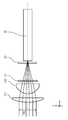
- 20A and 20B are a top view (xx cross-sectional view) and a side view (yz cross-sectional view) showing the state of light rays emitted from the light source device 10 in the third embodiment and entering the rod integrator 30. ).
- the arrangement of the diffuser plate 21 and the diffuser plate 20 is different from that of the first embodiment.
- 21A and 21B are a top view (x-z cross-sectional view) and a survey view (yz cross-sectional view) showing the state of diffusion of light rays by the diffusing plate 21 and the diffusing plate 20 in the third embodiment, respectively. ..
- the light beam emitted from the light source device 10 is incident on the diffusion plate 21 at an angle between the optical axis and the diffusion angle component ⁇ 1 (first diffusion angle component) in the x direction, and is further diffused in the x direction by the diffusion plate 21.
- ⁇ 1 first diffusion angle
- a ray Given ⁇ 1 (first diffusion angle), a ray has a diffusion angle ( ⁇ 1 + ⁇ 1) that is the sum of the diffusion angle component ⁇ 1 and the diffusion angle ⁇ 1 in the x direction.
- the light beam emitted from the light source device 10 is incident on the diffusion plate 21 at an angle between the optical axis and the diffusion angle component ⁇ 2 (second diffusion angle component) in the y direction, and further in the y direction by the diffusion plate 21. Is given a diffusion angle ⁇ 2 (second diffusion angle), and a ray having a diffusion angle ( ⁇ 2 + ⁇ 2) that is the sum of the diffusion angle component ⁇ 2 and the diffusion angle ⁇ 2 in the y direction.
- the diffusion angle in the x direction ( ⁇ 1 + ⁇ 1) and the diffusion angle in the y direction ( ⁇ 2 + ⁇ 2) are substantially the same, pass through the diffusion plate 20, and are further given a diffusion angle equal to the x direction and the y direction, and are incident on the rod integrator 30. do.
- FIG. 22 is a schematic view showing the angular distribution of the incident light on the rod integrator 30. Similar to the case of the first embodiment (FIG. 10B), since the diffusion plate 21 has a characteristic of diffusing more strongly in the y direction than in the x direction, the angle distribution in FIG. 10A is as if it were stretched in the y direction. next, angular distribution width Py 1 angular distribution width Px 1 and y direction in the x direction is substantially the same (Px 1 ⁇ Py 1). Further, the image 19 of each emitter appearing on the angular distribution in FIG. 22 has an elliptical shape that is greatly stretched in the y direction rather than the x direction.
- FIG. 23 is a schematic diagram showing the state of diffusion on the diffusion plate in the third embodiment
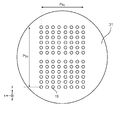
- FIG. 24A is a diagram showing the light intensity distribution on the incident surface of the rod integrator in the first embodiment
- FIG. 24B is the embodiment. It is a figure which shows the light intensity distribution on the incident surface of the rod integrator in mode 3.
- the light flux is distributed in the luminous flux distribution range L0 with respect to the rod integrator incident surface 301.
- the distance between the diffuser plate 21 having an anisotropic diffusion characteristic and the incident surface 301 of the rod integrator is small, and the effect of expanding the light beam distribution by the diffuser plate 21 in the y direction is limited.
- the aspect ratio of the light beam distribution range L 0 that is, the ratio of the length Lx0 in the x direction to the length Ly0 in the y direction is substantially the same as the ratio of the light beam width Wx and the light beam width Wy shown in FIGS. 20A and 20B.
- the aspect ratio of the luminous flux L emitted from the light source device 10 is different from the aspect ratio of the cross-sectional shape of the rod integrator, that is, the ratio of the width Hx in the x direction and the width Hy in the y direction of the rod integrator 30, the luminous flux is different.
- the entire rod integrator incident surface 301 cannot be irradiated.
- the luminous flux is distributed in the luminous flux distribution range L1 with respect to the rod integrator incident surface 301.
- the diffusion plate 21 having different diffusion characteristics in the x-direction and the y-direction is installed farther from the rod integrator incident surface 301 than the projection type image display device 100 of the first embodiment. Therefore, the aspect ratio of the luminous flux can be changed relatively large after passing through the diffuser plate 21. Specifically, since the diffusion plate 21 has the diffusion characteristics shown in FIG. 7, the luminous flux width of the light flux L transmitted through the diffusion plate 21 is larger in the y direction than in the x direction.
- the aspect ratio of the light beam distribution range L1 of the rod integrator incident surface 301 that is, the ratio of the length Lx1 in the x direction to the length Ly1 in the y direction is the aspect ratio of the cross-sectional shape of the rod integrator, that is, x of the rod integrator 30.
- the ratio of the width Hx in the direction and the width Hy in the y direction can be substantially matched, and the entire rod integrator incident surface 301 can be uniformly irradiated.
- 25A and 25B show the light intensity distribution at the exit pupil 51 in the projection lens.
- the aspect ratio of the distribution range is approximately 1
- the spread of the image 19P of each emitter on the exit pupil 51 is small, and the image of the emitter with respect to the exit pupil 51.
- the ratio (filling rate) of 19P is low.
- the spread of the image 19P of each emitter is increased to the extent that they overlap each other, and the filling rate is improved.
- the light beam uniformly irradiates the entire rod integrator incident surface 301 in the projection lens in the third embodiment.
- the filling rate of the light intensity distribution in the exit pupil of the lens is improved.
- the positions of the diffuser plate 20 and the diffuser plate 21A are exchanged with each other, and a rectangular rod integrator having a long cross-sectional shape of the incident surface of the rod integrator in the x direction is used. Therefore, it is possible to configure a projection type image display device in which the light flux from the light source device 10 uniformly irradiates the entire incident surface of the rod integrator.
Landscapes
- Physics & Mathematics (AREA)
- General Physics & Mathematics (AREA)
- Engineering & Computer Science (AREA)
- Optics & Photonics (AREA)
- General Engineering & Computer Science (AREA)
- Multimedia (AREA)
- Projection Apparatus (AREA)
- Planar Illumination Modules (AREA)
Priority Applications (2)
| Application Number | Priority Date | Filing Date | Title |
|---|---|---|---|
| JP2021573102A JP7588303B2 (ja) | 2020-01-20 | 2021-01-14 | 投写型映像表示装置 |
| US17/838,793 US20220308434A1 (en) | 2020-01-20 | 2022-06-13 | Projection display apparatus |
Applications Claiming Priority (2)
| Application Number | Priority Date | Filing Date | Title |
|---|---|---|---|
| JP2020-006914 | 2020-01-20 | ||
| JP2020006914 | 2020-01-20 |
Related Child Applications (1)
| Application Number | Title | Priority Date | Filing Date |
|---|---|---|---|
| US17/838,793 Continuation US20220308434A1 (en) | 2020-01-20 | 2022-06-13 | Projection display apparatus |
Publications (1)
| Publication Number | Publication Date |
|---|---|
| WO2021149573A1 true WO2021149573A1 (ja) | 2021-07-29 |
Family
ID=76992309
Family Applications (1)
| Application Number | Title | Priority Date | Filing Date |
|---|---|---|---|
| PCT/JP2021/000962 Ceased WO2021149573A1 (ja) | 2020-01-20 | 2021-01-14 | 投写型映像表示装置 |
Country Status (3)
| Country | Link |
|---|---|
| US (1) | US20220308434A1 (https=) |
| JP (1) | JP7588303B2 (https=) |
| WO (1) | WO2021149573A1 (https=) |
Cited By (2)
| Publication number | Priority date | Publication date | Assignee | Title |
|---|---|---|---|---|
| WO2023193784A1 (zh) * | 2022-04-08 | 2023-10-12 | 深圳迈塔兰斯科技有限公司 | 一种投影系统 |
| JP7533552B2 (ja) | 2022-10-19 | 2024-08-14 | セイコーエプソン株式会社 | 光源装置およびプロジェクター |
Citations (6)
| Publication number | Priority date | Publication date | Assignee | Title |
|---|---|---|---|---|
| JPH0973650A (ja) * | 1995-09-01 | 1997-03-18 | Pioneer Electron Corp | 光学装置 |
| US20070053275A1 (en) * | 2005-09-02 | 2007-03-08 | Hon Hai Precision Industry Co., Ltd. | Optical system for collimating elliptical light beam and optical device using the same |
| JP2013120250A (ja) * | 2011-12-07 | 2013-06-17 | Sanyo Electric Co Ltd | 投写型映像表示装置 |
| US20150138516A1 (en) * | 2013-11-21 | 2015-05-21 | Coretronic Corporation | Illumination system and projection apparatus |
| JP2015114621A (ja) * | 2013-12-13 | 2015-06-22 | 大日本印刷株式会社 | 照明装置、投射装置、照射装置および光学素子 |
| JP2018063448A (ja) * | 2017-12-27 | 2018-04-19 | カシオ計算機株式会社 | 光源装置及び投影装置 |
Family Cites Families (6)
| Publication number | Priority date | Publication date | Assignee | Title |
|---|---|---|---|---|
| US7646518B2 (en) * | 2005-02-25 | 2010-01-12 | Panasonic Corporation | Two dimensional image forming device |
| JP5313029B2 (ja) * | 2009-04-23 | 2013-10-09 | オリンパス株式会社 | 投射型表示装置 |
| CN103207509B (zh) * | 2012-01-12 | 2015-06-24 | 三菱电机株式会社 | 光源装置和投影式显示装置 |
| JP5920095B2 (ja) * | 2012-07-31 | 2016-05-18 | 株式会社Jvcケンウッド | 画像表示装置 |
| JP2017135026A (ja) * | 2016-01-28 | 2017-08-03 | セイコーエプソン株式会社 | 光源装置、照明装置及びプロジェクター |
| CN209590516U (zh) * | 2019-01-18 | 2019-11-05 | 中强光电股份有限公司 | 照明系统及投影装置 |
-
2021
- 2021-01-14 JP JP2021573102A patent/JP7588303B2/ja active Active
- 2021-01-14 WO PCT/JP2021/000962 patent/WO2021149573A1/ja not_active Ceased
-
2022
- 2022-06-13 US US17/838,793 patent/US20220308434A1/en active Pending
Patent Citations (6)
| Publication number | Priority date | Publication date | Assignee | Title |
|---|---|---|---|---|
| JPH0973650A (ja) * | 1995-09-01 | 1997-03-18 | Pioneer Electron Corp | 光学装置 |
| US20070053275A1 (en) * | 2005-09-02 | 2007-03-08 | Hon Hai Precision Industry Co., Ltd. | Optical system for collimating elliptical light beam and optical device using the same |
| JP2013120250A (ja) * | 2011-12-07 | 2013-06-17 | Sanyo Electric Co Ltd | 投写型映像表示装置 |
| US20150138516A1 (en) * | 2013-11-21 | 2015-05-21 | Coretronic Corporation | Illumination system and projection apparatus |
| JP2015114621A (ja) * | 2013-12-13 | 2015-06-22 | 大日本印刷株式会社 | 照明装置、投射装置、照射装置および光学素子 |
| JP2018063448A (ja) * | 2017-12-27 | 2018-04-19 | カシオ計算機株式会社 | 光源装置及び投影装置 |
Cited By (2)
| Publication number | Priority date | Publication date | Assignee | Title |
|---|---|---|---|---|
| WO2023193784A1 (zh) * | 2022-04-08 | 2023-10-12 | 深圳迈塔兰斯科技有限公司 | 一种投影系统 |
| JP7533552B2 (ja) | 2022-10-19 | 2024-08-14 | セイコーエプソン株式会社 | 光源装置およびプロジェクター |
Also Published As
| Publication number | Publication date |
|---|---|
| JP7588303B2 (ja) | 2024-11-22 |
| JPWO2021149573A1 (https=) | 2021-07-29 |
| US20220308434A1 (en) | 2022-09-29 |
Similar Documents
| Publication | Publication Date | Title |
|---|---|---|
| JP6979596B1 (ja) | 投写型映像表示装置 | |
| US10372027B2 (en) | Illuminator and projector | |
| US10108076B2 (en) | Light source apparatus and projector | |
| JP5673247B2 (ja) | 光源装置及びプロジェクター | |
| US20170343891A1 (en) | Light source apparatus and projector | |
| JP6676940B2 (ja) | 光源装置、照明装置及びプロジェクター | |
| US9568817B2 (en) | Illumination apparatus and projector | |
| JP6421930B2 (ja) | 照明装置及び投写型映像表示装置 | |
| JP7607190B2 (ja) | 光源装置および投写型映像表示装置 | |
| JP6244558B2 (ja) | 光源装置及び投写型映像表示装置 | |
| US10877364B2 (en) | Illuminator and projector | |
| JP5803377B2 (ja) | プロジェクター | |
| JP4353287B2 (ja) | プロジェクタ | |
| JP7588303B2 (ja) | 投写型映像表示装置 | |
| JP7009910B2 (ja) | 光源装置およびプロジェクター | |
| US20190243225A1 (en) | Light source apparatus, illuminator, and projector | |
| JP2011043703A (ja) | 照明装置及びこの照明装置を用いた投射型映像表示装置 | |
| JP2011215531A (ja) | プロジェクター | |
| US20170242266A1 (en) | Illumination device and projector | |
| US11490059B2 (en) | Light source device and projection type display device | |
| JP7329665B1 (ja) | 投射型表示装置 | |
| JP2016173391A (ja) | 照明装置およびプロジェクター | |
| JP2012145756A (ja) | 投写型映像表示装置および光源装置 | |
| JP2024056163A (ja) | 光源装置および投射型画像表示装置 |
Legal Events
| Date | Code | Title | Description |
|---|---|---|---|
| 121 | Ep: the epo has been informed by wipo that ep was designated in this application |
Ref document number: 21744136 Country of ref document: EP Kind code of ref document: A1 |
|
| ENP | Entry into the national phase |
Ref document number: 2021573102 Country of ref document: JP Kind code of ref document: A |
|
| NENP | Non-entry into the national phase |
Ref country code: DE |
|
| 122 | Ep: pct application non-entry in european phase |
Ref document number: 21744136 Country of ref document: EP Kind code of ref document: A1 |