WO2021054244A1 - 記録装置、記録方法、記録プログラム、及び磁気テープ - Google Patents
記録装置、記録方法、記録プログラム、及び磁気テープ Download PDFInfo
- Publication number
- WO2021054244A1 WO2021054244A1 PCT/JP2020/034326 JP2020034326W WO2021054244A1 WO 2021054244 A1 WO2021054244 A1 WO 2021054244A1 JP 2020034326 W JP2020034326 W JP 2020034326W WO 2021054244 A1 WO2021054244 A1 WO 2021054244A1
- Authority
- WO
- WIPO (PCT)
- Prior art keywords
- relevance
- target data
- recording
- degree
- data
- Prior art date
- Legal status (The legal status is an assumption and is not a legal conclusion. Google has not performed a legal analysis and makes no representation as to the accuracy of the status listed.)
- Ceased
Links
Images








Classifications
-
- G—PHYSICS
- G11—INFORMATION STORAGE
- G11B—INFORMATION STORAGE BASED ON RELATIVE MOVEMENT BETWEEN RECORD CARRIER AND TRANSDUCER
- G11B5/00—Recording by magnetisation or demagnetisation of a record carrier; Reproducing by magnetic means; Record carriers therefor
- G11B5/008—Recording on, or reproducing or erasing from, magnetic tapes, sheets, e.g. cards, or wires
- G11B5/00813—Recording on, or reproducing or erasing from, magnetic tapes, sheets, e.g. cards, or wires magnetic tapes
- G11B5/00878—Recording on, or reproducing or erasing from, magnetic tapes, sheets, e.g. cards, or wires magnetic tapes transducing different track configurations or formats on the same tape
-
- G—PHYSICS
- G06—COMPUTING OR CALCULATING; COUNTING
- G06F—ELECTRIC DIGITAL DATA PROCESSING
- G06F3/00—Input arrangements for transferring data to be processed into a form capable of being handled by the computer; Output arrangements for transferring data from processing unit to output unit, e.g. interface arrangements
- G06F3/06—Digital input from, or digital output to, record carriers, e.g. RAID, emulated record carriers or networked record carriers
- G06F3/0601—Interfaces specially adapted for storage systems
- G06F3/0668—Interfaces specially adapted for storage systems adopting a particular infrastructure
- G06F3/0671—In-line storage system
- G06F3/0673—Single storage device
- G06F3/0674—Disk device
- G06F3/0676—Magnetic disk device
-
- G—PHYSICS
- G11—INFORMATION STORAGE
- G11B—INFORMATION STORAGE BASED ON RELATIVE MOVEMENT BETWEEN RECORD CARRIER AND TRANSDUCER
- G11B27/00—Editing; Indexing; Addressing; Timing or synchronising; Monitoring; Measuring tape travel
- G11B27/10—Indexing; Addressing; Timing or synchronising; Measuring tape travel
- G11B27/102—Programmed access in sequence to addressed parts of tracks of operating record carriers
- G11B27/107—Programmed access in sequence to addressed parts of tracks of operating record carriers of operating tapes
-
- G—PHYSICS
- G06—COMPUTING OR CALCULATING; COUNTING
- G06F—ELECTRIC DIGITAL DATA PROCESSING
- G06F3/00—Input arrangements for transferring data to be processed into a form capable of being handled by the computer; Output arrangements for transferring data from processing unit to output unit, e.g. interface arrangements
- G06F3/06—Digital input from, or digital output to, record carriers, e.g. RAID, emulated record carriers or networked record carriers
- G06F3/0601—Interfaces specially adapted for storage systems
- G06F3/0602—Interfaces specially adapted for storage systems specifically adapted to achieve a particular effect
- G06F3/061—Improving I/O performance
-
- G—PHYSICS
- G06—COMPUTING OR CALCULATING; COUNTING
- G06F—ELECTRIC DIGITAL DATA PROCESSING
- G06F3/00—Input arrangements for transferring data to be processed into a form capable of being handled by the computer; Output arrangements for transferring data from processing unit to output unit, e.g. interface arrangements
- G06F3/06—Digital input from, or digital output to, record carriers, e.g. RAID, emulated record carriers or networked record carriers
- G06F3/0601—Interfaces specially adapted for storage systems
- G06F3/0628—Interfaces specially adapted for storage systems making use of a particular technique
- G06F3/0638—Organizing or formatting or addressing of data
-
- G—PHYSICS
- G06—COMPUTING OR CALCULATING; COUNTING
- G06F—ELECTRIC DIGITAL DATA PROCESSING
- G06F3/00—Input arrangements for transferring data to be processed into a form capable of being handled by the computer; Output arrangements for transferring data from processing unit to output unit, e.g. interface arrangements
- G06F3/06—Digital input from, or digital output to, record carriers, e.g. RAID, emulated record carriers or networked record carriers
- G06F3/0601—Interfaces specially adapted for storage systems
- G06F3/0628—Interfaces specially adapted for storage systems making use of a particular technique
- G06F3/0653—Monitoring storage devices or systems
-
- G—PHYSICS
- G06—COMPUTING OR CALCULATING; COUNTING
- G06F—ELECTRIC DIGITAL DATA PROCESSING
- G06F3/00—Input arrangements for transferring data to be processed into a form capable of being handled by the computer; Output arrangements for transferring data from processing unit to output unit, e.g. interface arrangements
- G06F3/06—Digital input from, or digital output to, record carriers, e.g. RAID, emulated record carriers or networked record carriers
- G06F3/0601—Interfaces specially adapted for storage systems
- G06F3/0668—Interfaces specially adapted for storage systems adopting a particular infrastructure
- G06F3/0671—In-line storage system
- G06F3/0673—Single storage device
- G06F3/0682—Tape device
-
- G—PHYSICS
- G11—INFORMATION STORAGE
- G11B—INFORMATION STORAGE BASED ON RELATIVE MOVEMENT BETWEEN RECORD CARRIER AND TRANSDUCER
- G11B20/00—Signal processing not specific to the method of recording or reproducing; Circuits therefor
- G11B20/10—Digital recording or reproducing
-
- G—PHYSICS
- G11—INFORMATION STORAGE
- G11B—INFORMATION STORAGE BASED ON RELATIVE MOVEMENT BETWEEN RECORD CARRIER AND TRANSDUCER
- G11B27/00—Editing; Indexing; Addressing; Timing or synchronising; Monitoring; Measuring tape travel
- G11B27/02—Editing, e.g. varying the order of information signals recorded on, or reproduced from, record carriers
- G11B27/031—Electronic editing of digitised analogue information signals, e.g. audio or video signals
- G11B27/032—Electronic editing of digitised analogue information signals, e.g. audio or video signals on tapes
-
- G—PHYSICS
- G11—INFORMATION STORAGE
- G11B—INFORMATION STORAGE BASED ON RELATIVE MOVEMENT BETWEEN RECORD CARRIER AND TRANSDUCER
- G11B5/00—Recording by magnetisation or demagnetisation of a record carrier; Reproducing by magnetic means; Record carriers therefor
- G11B5/008—Recording on, or reproducing or erasing from, magnetic tapes, sheets, e.g. cards, or wires
- G11B5/00813—Recording on, or reproducing or erasing from, magnetic tapes, sheets, e.g. cards, or wires magnetic tapes
- G11B5/00817—Recording on, or reproducing or erasing from, magnetic tapes, sheets, e.g. cards, or wires magnetic tapes on longitudinal tracks only, e.g. for serpentine format recording
-
- G—PHYSICS
- G11—INFORMATION STORAGE
- G11B—INFORMATION STORAGE BASED ON RELATIVE MOVEMENT BETWEEN RECORD CARRIER AND TRANSDUCER
- G11B5/00—Recording by magnetisation or demagnetisation of a record carrier; Reproducing by magnetic means; Record carriers therefor
- G11B2005/0002—Special dispositions or recording techniques
- G11B2005/0005—Arrangements, methods or circuits
- G11B2005/001—Controlling recording characteristics of record carriers or transducing characteristics of transducers by means not being part of their structure
-
- G—PHYSICS
- G11—INFORMATION STORAGE
- G11B—INFORMATION STORAGE BASED ON RELATIVE MOVEMENT BETWEEN RECORD CARRIER AND TRANSDUCER
- G11B27/00—Editing; Indexing; Addressing; Timing or synchronising; Monitoring; Measuring tape travel
- G11B27/002—Programmed access in sequence to a plurality of record carriers or indexed parts, e.g. tracks, thereof, e.g. for editing
Definitions
- This disclosure relates to a recording device, a recording method, a recording program, and a magnetic tape.
- Japanese Patent Application Laid-Open No. 2016-522484 describes, as an example of the dimension of information regarding data objects, access history, access frequency, access patterns, relationships between data objects, and the like obtained by analyzing access information.
- the present disclosure provides a recording device, a recording method, a recording program, and a magnetic tape that can shorten the data reading time for recording target data for which access information does not exist.
- the first aspect of the present disclosure is a recording device, wherein the incidental information associated with each of the plurality of recording target data to be recorded on the recording medium is other than the recording target data accompanied by the same information as the incidental information.
- a plurality of recording target data based on the acquisition unit that acquires the first relevance degree, which is the relevance degree between incidental information according to the frequency of reading the data within a predetermined period, and the first relevance degree.
- the second relevance degree for deriving the second relevance degree which is the relevance degree between the data representing the possibility that the plurality of recording target data included in the combination is read out within the period. It includes a derivation unit and a control unit that classifies a plurality of recording target data into groups based on the second degree of relevance and controls recording of each group on a recording medium.
- the second degree of relevance is a value derived for each of the combination of the plurality of recording target data, and the combination of the plurality of recording target data is within the period.
- the value is larger as the possibility of being read out is higher, and the control unit may classify each of the plurality of recording target data included in the combination having the second relevance degree equal to or higher than the threshold value into the same group.
- control unit has a predetermined value for the number of data to be recorded included in the same group or the size of the data to be recorded included in the same group.
- a plurality of data to be recorded may be classified into groups while changing the threshold value as follows.
- the fourth aspect of the present disclosure may further include a first degree of relevance derivation unit for deriving the first degree of relevance in the above aspect.
- the fifth aspect of the present disclosure may further include a storage unit for storing the first degree of relevance in the above aspect.
- the recording medium may be a magnetic tape in the above aspect.
- the seventh aspect of the present disclosure is a recording method, in which the incidental information associated with each of the plurality of recording target data to be recorded on the recording medium is other than the recording target data accompanied by the same information as the incidental information.
- the data acquires the first relevance degree, which is the relevance degree between incidental information according to the frequency read out within a predetermined period, and is included in a plurality of recording target data based on the first relevance degree.
- the second relevance degree which is the relevance degree between the data indicating the possibility that the plurality of recording target data included in the combination is read within the period, is derived, and is based on the second relevance degree. Therefore, the computer executes a process of classifying a plurality of data to be recorded into groups and controlling the recording of each group on a recording medium.
- the eighth aspect of the present disclosure is a recording program, in which the incidental information associated with each of the plurality of recording target data to be recorded on the recording medium is other than the recording target data accompanied by the same information as the incidental information.
- the data acquires the first relevance degree, which is the relevance degree between incidental information according to the frequency read out within a predetermined period, and is included in a plurality of recording target data based on the first relevance degree.
- the second relevance degree which is the relevance degree between the data indicating the possibility that the plurality of recording target data included in the combination is read within the period, is derived, and is based on the second relevance degree.
- the purpose is to have the computer execute a process of classifying a plurality of data to be recorded into groups and controlling the recording of each group on a recording medium.
- a ninth aspect of the present disclosure is a magnetic tape on which a plurality of data to be recorded is recorded, and the incidental information associated with each of the plurality of data to be recorded is recorded with the same information as the incidental information.
- a plurality of data other than the target data included in the plurality of recording target data derived based on the first relevance degree, which is the relevance degree between the incidental information according to the frequency read out within a predetermined period.
- a plurality of recording target data are classified based on the second relevance degree, which is the relevance degree between the data indicating the possibility that the plurality of recording target data included in the combination is read within the period.
- a plurality of data to be recorded are recorded for each group.
- a tenth aspect of the present disclosure is a recording device comprising a memory for storing instructions to be executed by a computer and a processor configured to execute the stored instructions, wherein the processor is a recording medium.
- the incidental information associated with each of the plurality of recording target data to be recorded in data other than the recording target data accompanied by the same information as the above incidental information is read out within a predetermined period according to the frequency.
- the first relevance which is the relevance between the accompanying information, is acquired, and based on the first relevance, a plurality of records included in the combination are obtained for each combination of the plurality of recording target data included in the plurality of recording target data.
- the second degree of relevance which is the degree of relevance between the data indicating the possibility that the target data will be read within the period, is derived, and based on the second degree of relevance, a plurality of recording target data are classified into groups and recorded for each group. Controls recording on a medium.
- the recording device, the recording method, the recording program, and the magnetic tape of the present disclosure can shorten the data reading time for the recording target data in which the access information does not exist.
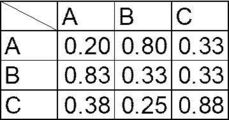
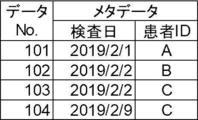
- FIG. It is a figure which shows the 1st relevance degree score table in a specific example 1. It is a figure which shows the data to be recorded in the specific example 1.
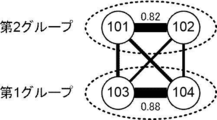
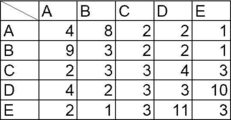
- FIG. It is a figure which shows the 2nd degree of relevance in a specific example 1. It is a figure which shows the network structure based on the 2nd relevance degree in a specific example 1. It is a figure which shows the accompanying information accompanying the recorded data in a specific example 2. It is a figure which shows the read log in a specific example 2 and the accompanying information accompanying the read data. It is a figure for demonstrating the derivation process of the 1st relevance degree in a specific example 2. It is a figure for demonstrating the derivation process of the 1st relevance degree in a specific example 2.
- the recording / reading system 10 includes an information processing device 12 and a tape library 14.
- the tape library 14 is connected to the information processing device 12.
- the information processing device 12 and the plurality of terminals 16 are connected to the network N, and communication is possible via the network N.
- the tape library 14 includes a plurality of slots (not shown) and a plurality of tape drives 18, and each slot stores a magnetic tape T as an example of a recording medium.
- An example of the magnetic tape T is an LTO (Linear Tape-Open) tape.
- the magnetic tape T to be written or read is loaded from the slot into any of the tape drives 18.
- the information processing device 12 completes writing or reading the magnetic tape T loaded on the tape drive 18, the magnetic tape T is unloaded from the tape drive 18 into the slot originally stored.
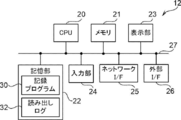
- the hardware configuration of the information processing device 12 according to this exemplary embodiment will be described with reference to FIG.
- Examples of the information processing device 12 include a server computer and the like. Further, the information processing device 12 is an example of a recording device that records data on the magnetic tape T.
- the information processing device 12 includes a CPU (Central Processing Unit) 20, a memory 21 as a temporary storage area, and a non-volatile storage unit 22. Further, the information processing device 12 includes a display unit 23 such as a liquid crystal display, an input unit 24 such as a keyboard and a mouse, a network I / F (InterFace) 25 connected to the network N, and an external I to which the tape library 14 is connected. / F26 is included.
- the CPU 20, the memory 21, the storage unit 22, the display unit 23, the input unit 24, the network I / F25, and the external I / F26 are connected to the bus 27.
- the storage unit 22 is realized by an HDD (Hard Disk Drive), an SSD (Solid State Drive), a flash memory, or the like.
- the recording program 30 is stored in the storage unit 22 as a storage medium.
- the CPU 20 reads the recording program 30 from the storage unit 22, expands it into the memory 21, and executes the expanded recording program 30.
- the read log 32 is stored in the storage unit 22.
- the read log 32 is associated with the identification information of the data recorded on the recording medium (hereinafter referred to as "recorded data") read by the terminal 16 and the date and time when the recorded data was read. Will be recorded.
- the read log 32 is not limited to the read log by the terminal 16 from the magnetic tape T according to this exemplary embodiment, but is a read log by the terminal 16 from another recording medium (for example, the storage unit 22). May be good.
- the date and time when the data in the read log 32 is read may be, for example, the date and time when the data read is started, the date and time when the data read is completed, or both of them. Further, in the present exemplary embodiment, it is assumed that the read log 32 does not include a log in which the recording target data to be recorded on the magnetic tape T by the information processing apparatus 12 is read.
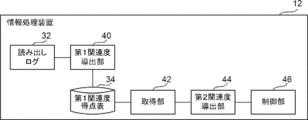
- the information processing apparatus 12 includes a first relevance degree derivation unit 40, an acquisition unit 42, a second relevance degree derivation unit 44, and a control unit 46.
- the information processing device 12 functions as a first relevance degree derivation unit 40, an acquisition unit 42, a second relevance degree derivation unit 44, and a control unit 46 when the CPU 20 executes the recording program 30.
- the first relevance degree derived by the first relevance degree derivation unit 40 is stored in the format of the first relevance degree score table 34.
- the first relevance derivation unit 40 Based on the read log 32, the first relevance derivation unit 40 simultaneously collects data other than the recording target data to which the incidental information associated with each of the plurality of recording target data is accompanied by the same information as the incidental information.
- the degree of relevance between the accompanying information according to the frequency of reading (hereinafter referred to as "first relevance degree") is derived. Further, the first relevance degree derivation unit 40 stores the derived first relevance degree in the storage unit 22 in the form of the first relevance degree score table 34.
- the “recording target data” is data recorded on the magnetic tape T.
- the “data other than the data to be recorded” includes, for example, the above-mentioned recorded data.
- the "accompanying information” includes, for example, an element of a metadata tag related to data. Specifically, for example, when the data is medical data used for an electronic medical record, the "accompanying information" includes "patient ID (IDentification)" for identifying which patient's data each data is. The value of is mentioned.
- patient ID IDentification
- “simultaneous” may be within a predetermined period. For example, when an instruction to read a plurality of data at a time is input by one user and a plurality of data are read continuously, “simultaneous” is also used. It corresponds to. Further, for example, when a data read instruction is input by each of a plurality of users within a predetermined period and a plurality of data desired by each of the plurality of users are read, the case also corresponds to "simultaneous". Hereinafter, the same applies to the case of describing "simultaneously".
- the first relevance derivation unit 40 analyzes the status of simultaneous reading of data other than the recording target data from the reading log 32, and thereby relates the incidental information associated with the data other than the recording target data.
- the first degree of relevance indicating the degree is derived. Therefore, the first degree of relevance takes a value according to the frequency with which data other than the data to be recorded is read at the same time.
- the acquisition unit 42 sets the first relevance degree regarding the incidental information associated with each of the plurality of recording target data recorded on the magnetic tape T as the first relevance degree score created from the read log 32 for the data other than the recording target data. Obtained from Table 34.
- the second relevance degree derivation unit 44 is a plurality of recording targets (two in this exemplary embodiment) included in all the recording target data based on the first relevance degree of the recording target data acquired by the acquisition unit 42. For each combination of data, the degree of relevance between the data (hereinafter, referred to as "second relevance degree") indicating the possibility that a plurality of recording target data included in the combination can be read at the same time is derived.
- the second degree of relevance indicates the degree of relevance between the recording target data, and corresponds to the first degree of relevance indicating the degree of relevance between the accompanying information associated with each of the plurality of recording target data included in the combination. Take a value.
- the second degree of relevance is a value derived for each of the combinations of the plurality of recording target data, and is a value that increases as the possibility that the combination of the plurality of recording target data is read out at the same time is high.
- the second relevance derivation unit 44 derives the second relevance for each combination of a plurality of recording target data included in a part of three or more recording target data among all the recording target data. May be good.
- the control unit 46 classifies a plurality of recording target data into groups based on the second relevance degree derived by the second relevance degree derivation unit 44, and controls recording of each group on the magnetic tape T. Specifically, the control unit 46 classifies each of the plurality of recording target data included in the combination having the second relevance degree equal to or higher than the threshold value into the same group. Then, the control unit 46 outputs the recording target data included in the group and the recording instruction of the recording target data to the tape drive 18 for each classified group. As a result, the tape drive 18 packs the data to be recorded included in the group and records it on the magnetic tape T.
- the tape drive 18 may record the recording target data included in the group on the magnetic tape T so that the reading time can be shortened when the recording target data included in the group is read at the same time after recording. It may be recorded at a position close to.
- control unit 46 may set various restrictions on the number of recording target data included in the same group and the number of groups when all the recording target data are classified into groups. As the information regarding these restrictions, for example, information input by the user via the input unit 24 can be used.
- control unit 46 may classify a plurality of recording target data into groups while changing the threshold value so that the number of recording target data included in the same group is equal to or less than a predetermined maximum value. Further, the control unit 46 may classify a plurality of recording target data into groups while changing the threshold value so that the number of recording target data included in the same group becomes equal to or more than a predetermined minimum value. Further, the control unit 46 groups a plurality of recording target data into groups while changing the threshold value so that the number of recording target data included in the same group is equal to or more than a predetermined minimum value and equal to or less than the maximum value. It may be classified.
- control unit 46 groups a plurality of recording target data into groups while changing the threshold value so that the number of groups when all the recording target data are classified into groups is a predetermined number of groups. It may be classified.
- control unit 46 may classify a plurality of recording target data based on the number of recording target data included in the same group as described above based on the size of the recording target data included in the same group. In this case, the control unit 46 classifies the recording target data into groups so that the total size of the recording target data included in each group is equal to or less than a predetermined upper limit value.
- the information processing apparatus 12 derives the second relevance degree indicating the relevance degree between the data in the recording target data in which the read log does not exist by referring to the read log 32 of the recorded data. Derived based on the first degree of relevance, which indicates the degree of relevance between information. That is, the second relevance degree for the recording target data for which there is no read log is derived from the incidental information accompanying the recording target data and the corresponding first relevance degree.
- the information processing device 12 controls to classify the data to be recorded, which is presumed to be highly likely to be read at the same time, into the same group based on the second degree of relevance, and record the data on the magnetic tape T for each group.
- a plurality of data can be recorded on the recording medium for each group in consideration of the possibility of being read at the same time after recording even for the data to be recorded in which the access information such as the read log does not exist. Therefore, it is possible to shorten the data read time for the recording target data for which the access information does not exist.
- the first relevance degree derivation unit 40 derives the first relevance degree
- the second relevance degree derivation unit 44 derives the second relevance degree
- the control unit 46 A specific example of the recording process by
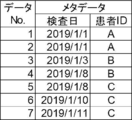
- FIG. 4 is a diagram showing attribute information as an example of incidental information accompanying the recorded data in the specific example 1. Metadata is attached to each of the recorded data, and the metadata includes attribute information indicating the attributes of the corresponding recorded data. In addition, each attribute name is tagged and included in the metadata of these attribute information.
- the metadata is tagged with the attribute information regarding the examination date tagged with "examination date” and the tag "patient ID”. Contains attribute information to identify the patient. Further, as the attribute information with the patient ID tag, the information of "A", "B", and "C" assigned to each patient is included. In the following, an example using a patient ID assigned to each patient as incidental information will be described.
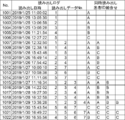
- FIG. 5 is a diagram showing the read log 32 in the specific example 1 and incidental information accompanying the read data, and shows the history of the recorded data shown in FIG. 4 being read in the past.
- the read log 32 contains the read date and time of the read recorded data and the data No. which is the identification information of the read recorded data. And are associated and recorded.
- the first relevance derivation unit 40 refers to the read log 32 and counts the number of times N1 in which the recorded data accompanied by the attribute information included in the combination is simultaneously read for each combination of the attribute information. ..
- FIG. 6 is a diagram showing the number of times N1 simultaneously read for each combination of the attribute information “A”, “B”, and “C” obtained from the read log 32 of FIG.
- the upper left cell in the table of FIG. 6 indicates the number of times N1 that the recorded data accompanied by the attribute information "A" is read at the same time as other recorded data accompanied by the attribute information "A".
- the first relevance derivation unit 40 shows that this combination is No. Once at 1007, No. Once at 1015, No. It is counted as being read at the same time three times in total, once at 1019.
- the upper right cell in the table of FIG. 6 indicates the number of times N1 that the recorded data accompanied by the attribute information "A" is read at the same time as other recorded data accompanied by the attribute information "C”. .. From the read log 32, the first relevance derivation unit 40 shows that this combination is No. Once at 1009, No. Once at 1012, No. It is counted that 1021 is read 3 times, for a total of 5 times.
- the lower left cell in the table of FIG. 6 indicates the number of times N1 that the recorded data accompanied by the attribute information “C” is read at the same time as other recorded data accompanied by the attribute information “A”. .. From the read log 32, the first relevance derivation unit 40 shows that this combination is No. Once at 1009, No. Once at 1012, No. It is counted that 1021 is read once, for a total of three times.
- the first relevance derivation unit 40 refers to the read log 32 and counts the number of times N2 in which the recorded data associated with the attribute information is read for each attribute information.
- the number of times N2 in which the recorded data accompanied by the attribute information “C” obtained from the read log 32 in FIG. 5 is read is No. 1006, 1009, 1012, 1013, 1014, 1020, 1021, 1022, a total of eight times.
- the number of times N2 that the recorded data accompanied by the attribute information "A" is read is 15 times
- the number of times N2 that the recorded data accompanied by the attribute information "B” is read is 12 times.
- No. When attribute information indicating the same content is attached to each of a plurality of recorded data read at the same time as in 1014, it is counted as one time.
- the first relevance degree derivation unit 40 obtains a score obtained by dividing the number of times N1 read at the same time for each combination of attribute information by the number of times N2 read for each attribute information.
- This score is hereinafter referred to as "directed score” because the attribute information "C” for the attribute information "A” and the attribute information "A” for the attribute information "C” are distinguished. ..
- the directed score becomes a larger value as the number of times N1 read at the same time for each combination of attribute information increases.
- FIG. 7 is a diagram showing a score table of directed scores in Specific Example 1. For example, for each value in the upper row of the table of FIG. 7, each value in the upper row of the table of FIG. 6 is divided by 15 which is the number of times N2 of the recorded data accompanied by the attribute information "A" is read. The value.
- the first relevance degree derivation unit 40 derives the value obtained by converting the directed score into the undirected score as the first relevance degree, and the first relevance degree is in the form of the first relevance degree score table 34. It is stored in the storage unit 22. Specifically, for example, the first relevance degree derivation unit 40 has a directed score of the attribute information "C" for the attribute information "A” and an attribute information "A” for the attribute information "C". And the average value of the directed score of is derived as the first degree of relevance between the attribute information "A" and the attribute information "C". That is, the first degree of relevance is an unsuitable score indicating the degree of relevance between the attribute information "A" and the attribute information "C".
- the directed score when the recorded data accompanied by the attribute information “A” is read out at the same time as the other recorded data accompanied by the attribute information “C” is 0.33. ..
- the directed score when the recorded data accompanied by the attribute information "C” is read out at the same time as the other recorded data accompanied by the attribute information "A” is 0.38.
- the first relevance degree derivation unit 40 calculates 0.35, which is the average of these, as the first relevance degree between the attribute information “A” and the attribute information “C”.
- the first relevance score table 34 in the specific example 1 thus obtained is shown in FIG.
- the acquisition unit 42 acquires the corresponding first relevance degree from the first relevance degree score table 34 for the attribute information associated with each of the plurality of recording target data.
- FIG. 9 is a diagram showing the attribute information accompanying the recording target data in the specific example 1, and the attribute information of the recording target data is the same attribute information as the recorded data.
- the acquisition unit 42 is a combination of attribute information "A”, "B", "C", and "C" associated with each of the data to be recorded (AB, AC, BC, CC).
- the first relevance degree is obtained from the first relevance degree score table 34 illustrated in FIG.
- the second relevance degree derivation unit 44 derives the second relevance degree for each combination of recording target data based on the first relevance degree acquired by the acquisition unit 42. Specifically, the second relevance derivation unit 44 sets the first relevance between the attribute information associated with each of the plurality of recording target data included in the combination, and sets the first relevance between the plurality of recording target data included in the combination. 2 Derived as the degree of relevance.
- FIG. 10 shows the data No. of the data to be recorded, which was obtained based on the first relevance score table 34 of FIG. It is a figure which shows the 2nd relevance degree for each combination of 101 to 104.
- the second relevance degree derivation unit 44 has the data No. of the attribute information “A”. 101 and the data No. of the attribute information "B".
- the second degree of relevance of the combination with 102 is derived from the first degree of relevance between the attribute information "A” and the attribute information "B". In this case, since the first degree of relevance between the attribute information "A” and the attribute information "B" is 0.82, the data No. 101 and data No. The second degree of association with 102 is 0.82.
- FIG. 11 is a schematic diagram showing the second degree of relevance for each combination of data to be recorded in Specific Example 1 as a network structure.
- the network structure is such that the larger the second degree of relevance shown in FIG. 10, the thicker the straight line connecting the data.
- the control unit 46 sets a threshold value, and based on the second relevance degree derived by the second relevance degree derivation unit 44, each of the plurality of recording target data included in the combination having the second relevance degree equal to or higher than the threshold value is set in the same group. Classify into.
- the threshold value for example, a representative value such as a maximum value, an average value, or a minimum value calculated from the second degree of relevance can be applied.
- control unit 46 sets the threshold value to 0.88, which is the maximum value of the second relevance degree shown in FIG. 10, and the data No. 1 included in the combination having the second relevance degree of 0.88 or more. 103 and data No.
- Each of the 104 is classified into the first group, which is the same group.
- the control unit 46 lowers the threshold value and classifies the combinations of the unclassified recording target data having the second relevance degree equal to or higher than the threshold value into the same group.
- the control unit 46 has unclassified data No.
- the threshold value is lowered by a predetermined step size (for example, 0.01) until a second degree of relevance having a value equal to or higher than the threshold value appears from the second degree of relevance for each of the data 101 and 102.
- the control unit 26 includes the data No. 2 included in the combination having the second relevance degree of 0.82 or more. 101 and data No.
- Each of the 102 is classified into a second group, which is the same group.
- control unit 46 controls to record a plurality of recording target data on the magnetic tape T for each classified group.
- Specific Example 2 will be described with reference to FIGS. 12 to 19.
- Specific Example 2 is an example in which the types of attribute information with the patient ID tag of the recorded data and the recording target data in the specific example 1 are increased, and the number of the recording target data is increased. Since the derivation process of the first relevance degree by the first relevance degree derivation unit 40 and the derivation process of the second relevance degree by the second relevance degree derivation unit 44 are the same as those in the first embodiment, the description thereof will be omitted.
- FIG. 12 is a diagram showing attribute information as an example of incidental information accompanying the recorded data in the specific example 2.
- the information of “A”, “B”, “C”, “D”, and “E” assigned to each patient is included.
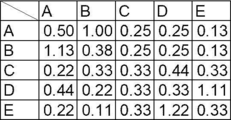
- FIG. 13 is a diagram showing the read log 32 in the second embodiment and incidental information associated with the read data.
- FIG. 14 is a diagram showing the number of times N1 of the attribute information “A”, “B”, “C”, “D”, and “E” obtained from the read log 32 of FIG. 13 being simultaneously read. Is.
- FIG. 15 is a diagram showing a score table of directed scores in Specific Example 2.
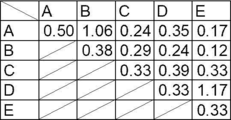
- FIG. 16 is a diagram showing a first relevance score table 34 in the second embodiment.
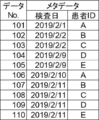
- FIG. 17 is a diagram showing attribute information associated with the data to be recorded in the second embodiment.
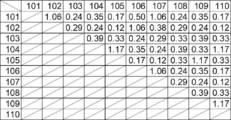
- FIG. 18 shows the data No. of the data to be recorded, which was obtained based on the first relevance score table 34 of FIG. It is a figure which shows the 2nd relevance degree for each combination of 101 to 110.
- FIG. 19 is a schematic diagram showing a part of the second degree of relevance for each combination of data to be recorded in Specific Example 2 as a network structure.
- the control unit 46 sets the threshold value to 1.17, which is the maximum value of the second relevance degree shown in FIG. 18, and the data No. included in the combination having the second relevance degree of 1.17 or more. .. 104 and data No.
- Each of the 105 is classified into the first group, which is the same group.
- the control unit 46 has data No. With respect to 109, the data No. classified into the first group. Since the second degree of relevance of the combination with 105 is 1.17 or more, it is classified into the same first group.
- the control unit 46 has data No. With respect to 110, the data No.
- the control unit 46 has the data No.
- Each of 104, 105, 109, and 110 is classified into the first group, which is the same group.
- the control unit 46 lowers the threshold value and classifies the unclassified recording target data into the same group with combinations having a second relevance degree equal to or higher than the threshold value.
- the control unit 46 has unclassified data No.
- the threshold value is lowered by a predetermined step size (for example, 0.01) until a second degree of relevance having a value equal to or higher than the threshold value appears from the second degree of relevance for each of the data 101 to 103 and 106 to 108. ..
- the control unit 26 determines that the data No. 2 included in the combination having the second relevance degree of 1.06 or more.
- Each of 101, 102, 106, and 107 is classified into a second group, which is the same group.
- the control unit 46 repeats the above-described processing until all the data to be recorded are classified.
- the control unit 46 has unclassified data No.
- the threshold value is lowered by 0.01 until a second degree of relevance having a value equal to or higher than the threshold value appears from the second degree of relevance for each of the data 103 and 108.
- the control unit 26 has the data No. 2 included in the combination having the second relevance degree of 0.39 or more.
- Each of 103, 104, 108, 109 is classified into the same group. Data No. Since 104 and 109 have already been classified into the first group, the control unit 46 has the data No. 103 and 108 are also classified into the first group.
- control unit 46 limits the number of data to be recorded included in the same group and the number of groups when all the data to be recorded are classified into groups. , Classify the groups to meet the constraints.
- the control unit 46 has the data No. 103 and 108 may be classified as individual third and fourth groups, respectively.
- the control unit 46 is set to No.
- Each of 103 and 108 is classified into a third group which is the same group.
- control unit 46 controls the data No. 46 as described above.
- 103 and 108 are not classified as individual groups, but are classified into a third group which is the same group.
- control unit 46 controls to record a plurality of recording target data on the magnetic tape T for each classified group.
- the operation of the information processing device 12 according to this exemplary embodiment will be described.
- the CPU 20 executes the recording program 30, the recording process shown in FIG. 20 is executed.
- the recording process shown in FIG. 20 is executed, for example, when a data recording instruction is input by the user via the input unit 24.
- the first relevance degree deriving unit 40 derives the first relevance degree with respect to the incidental information associated with each of the plurality of recording target data, as described above.
- the second relevance degree derivation unit 44 derives the second relevance degree for each combination of the plurality of recording target data included in the plurality of recording target data, as described above.
- the control unit 46 sets the threshold value to the maximum value of the second degree of relevance as described above.
- step S16 the control unit 46 determines whether or not there is data equal to or greater than the threshold value for the second relevance degree regarding the unclassified recording target data. If step S16 is an affirmative determination, in step S18, the control unit 46 classifies each of the plurality of recording target data included in the combination having the second relevance degree equal to or higher than the threshold value into the same group. On the other hand, when step S16 is a negative determination, in step S22, the control unit 46 lowers the threshold value and returns to step S16.
- step S20 the control unit 46 determines whether or not all the data to be recorded have been classified. When various restrictions are provided regarding the classification of the group as described above, in step S20, the control unit 46 determines whether or not the restrictions are satisfied. If step S20 is a negative determination, in step S22, the control unit 46 lowers the threshold value and returns to step S16. On the other hand, when the affirmative determination is made in step S20, in step S24, the control unit 46 controls to record the data to be recorded on the magnetic tape T for each group. When the process of step S24 is completed, the main recording process is completed.
- the incidental information associated with each of the plurality of recording target data to be recorded on the recording medium is other than the recording target data accompanied by the same information as the incidental information.
- the first degree of relevance which is the degree of relevance between incidental information according to the frequency with which the data is read within a predetermined period, is acquired. Further, for each combination of the plurality of recording target data included in the plurality of recording target data based on the acquired first relevance degree, data indicating the possibility that the plurality of recording target data included in the combination is read out within the period.
- the second degree of relevance which is the degree of relevance between them, is derived.
- a plurality of recording target data are classified into groups based on the derived second degree of relevance, and each group is recorded on a recording medium. Therefore, even for recording target data such as read logs for which access information does not exist, a plurality of data can be recorded on the recording medium for each group in consideration of the possibility of simultaneous reading after recording, and recording target for which access information does not exist. For data, the data read time can be shortened.
- the present invention is not limited to this.
- a recording medium other than the magnetic tape may be applied as the recording medium.
- the first relevance degree deriving unit 40 may derive the first relevance degree at a predetermined timing based on the read log 32 and store it in the storage unit. According to such a form, since the first relevance degree has already been derived at the timing when the recording instruction to the magnetic tape T of the data to be recorded is input to the information processing apparatus 12, the time for deriving the first relevance degree is derived. Can be shortened, and the time required for recording processing can be shortened.
- An example of a predetermined timing in this case is a regular timing such as once a day.
- the mode in which the first relevance degree derivation unit 40 derives the first relevance degree based on the read log 32 has been described, but the present invention is not limited to this.
- the first relevance may be derived by a device other than the information processing device 12 such as the terminal 16, and the acquisition unit 42 may acquire the first relevance from a device other than the information processing device 12.
- the first degree of relevance is derived for one type of attribute information among the incidental information attached to each of the data to be recorded, and based on the first degree of relevance for one type of attribute information.
- An example of deriving the second degree of relevance has been described, but the present invention is not limited to this.
- the first relevance degree derivation unit 40 may derive the first relevance degree for each of a plurality of types of attribute information among the incidental information attached to each of the recording target data.
- the second relevance derivation unit 44 sets a representative value such as an average value, a weighted average value, a maximum value, or a minimum value for each of the first relevance of the plurality of types of attribute information attached to the data to be recorded. Based on this, the second degree of relevance may be derived.
- first relevance degree derivation process by the first relevance degree derivation unit 40 the second relevance degree derivation process by the second relevance degree derivation unit 44, and the recording process by the control unit 46 shown in the above exemplary embodiment are performed. It is an example, and is not limited to the example shown in the above exemplary embodiment.
- a hardware-like structure of a processing unit that executes various processes such as a first relevance degree derivation unit 40, a second relevance degree derivation unit 44, and a control unit 46.
- various processors processors shown below can be used.
- the various processors include CPUs, which are general-purpose processors that execute software (programs) and function as various processing units, as well as circuits after manufacturing FPGAs (Field Programmable Gate Arrays) and the like.
- Dedicated electricity which is a processor with a circuit configuration specially designed to execute specific processing such as programmable logic device (PLD), ASIC (Application Specific Integrated Circuit), which is a processor whose configuration can be changed. Circuits and the like are included.
- PLD programmable logic device
- ASIC Application Specific Integrated Circuit
- One processing unit may be composed of one of these various processors, or a combination of two or more processors of the same type or different types (for example, a combination of a plurality of FPGAs or a combination of a CPU and an FPGA). It may be composed of a combination). Further, a plurality of processing units may be configured by one processor. As an example of configuring a plurality of processing units with one processor, first, one processor is configured by a combination of one or more CPUs and software, as represented by a computer such as a client and a server. There is a form in which a processor functions as a plurality of processing units.
- SoC System on Chip
- a processor that realizes the functions of the entire system including a plurality of processing units with one IC (Integrated Circuit) chip is used.
- the various processing units are configured by using one or more of the above-mentioned various processors as a hardware structure.
- an electric circuit in which circuit elements such as semiconductor elements are combined can be used.
- the mode in which the recording program 30 is stored (installed) in the storage unit 22 in advance has been described, but the present invention is not limited to this. Even if the recording program 30 is provided in a form recorded on a recording medium such as a CD-ROM (Compact Disc Read Only Memory), a DVD-ROM (Digital Versatile Disc Read Only Memory), and a USB (Universal Serial Bus) memory. Good. Further, the recording program 30 may be downloaded from an external device via a network.
- a recording medium such as a CD-ROM (Compact Disc Read Only Memory), a DVD-ROM (Digital Versatile Disc Read Only Memory), and a USB (Universal Serial Bus) memory.
- the recording program 30 may be downloaded from an external device via a network.
Landscapes
- Engineering & Computer Science (AREA)
- Theoretical Computer Science (AREA)
- Human Computer Interaction (AREA)
- Physics & Mathematics (AREA)
- General Engineering & Computer Science (AREA)
- General Physics & Mathematics (AREA)
- Multimedia (AREA)
- Signal Processing (AREA)
- Signal Processing For Digital Recording And Reproducing (AREA)
Priority Applications (4)
| Application Number | Priority Date | Filing Date | Title |
|---|---|---|---|
| JP2021546642A JP7321279B2 (ja) | 2019-09-20 | 2020-09-10 | 記録装置、記録方法、記録プログラム、及び磁気テープ |
| EP20865432.7A EP4033344A4 (en) | 2019-09-20 | 2020-09-10 | RECORDING DEVICE, RECORDING METHOD, RECORDING PROGRAM AND MAGNETIC TAPE |
| CN202080065717.8A CN114521249A (zh) | 2019-09-20 | 2020-09-10 | 记录装置、记录方法、记录程序及磁带 |
| US17/694,612 US20220208218A1 (en) | 2019-09-20 | 2022-03-14 | Recording device, recording method, recording program, and magnetic tape |
Applications Claiming Priority (2)
| Application Number | Priority Date | Filing Date | Title |
|---|---|---|---|
| JP2019171509 | 2019-09-20 | ||
| JP2019-171509 | 2019-09-20 |
Related Child Applications (1)
| Application Number | Title | Priority Date | Filing Date |
|---|---|---|---|
| US17/694,612 Continuation US20220208218A1 (en) | 2019-09-20 | 2022-03-14 | Recording device, recording method, recording program, and magnetic tape |
Publications (1)
| Publication Number | Publication Date |
|---|---|
| WO2021054244A1 true WO2021054244A1 (ja) | 2021-03-25 |
Family
ID=74883183
Family Applications (1)
| Application Number | Title | Priority Date | Filing Date |
|---|---|---|---|
| PCT/JP2020/034326 Ceased WO2021054244A1 (ja) | 2019-09-20 | 2020-09-10 | 記録装置、記録方法、記録プログラム、及び磁気テープ |
Country Status (6)
| Country | Link |
|---|---|
| US (1) | US20220208218A1 (https=) |
| EP (1) | EP4033344A4 (https=) |
| JP (1) | JP7321279B2 (https=) |
| CN (1) | CN114521249A (https=) |
| TW (1) | TW202127226A (https=) |
| WO (1) | WO2021054244A1 (https=) |
Families Citing this family (1)
| Publication number | Priority date | Publication date | Assignee | Title |
|---|---|---|---|---|
| WO2021054243A1 (ja) * | 2019-09-17 | 2021-03-25 | 富士フイルム株式会社 | 記録装置、記録方法、記録プログラム、及び磁気テープ |
Citations (6)
| Publication number | Priority date | Publication date | Assignee | Title |
|---|---|---|---|---|
| JPH0887432A (ja) * | 1994-09-16 | 1996-04-02 | Toshiba Corp | 情報記録再生装置のデータ配置方法 |
| US20070226443A1 (en) * | 2006-03-07 | 2007-09-27 | Dominic Giampaolo | File systems for data processing systems |
| JP2016522484A (ja) | 2013-04-25 | 2016-07-28 | アマゾン・テクノロジーズ・インコーポレーテッド | オブジェクト情報の複数の次元を用いたオブジェクトストレージ |
| WO2016147279A1 (ja) * | 2015-03-13 | 2016-09-22 | 富士通株式会社 | データ管理制御プログラム、データ管理制御装置、及びデータ管理制御方法 |
| JP2018190393A (ja) * | 2017-05-01 | 2018-11-29 | 富士通株式会社 | 情報処理装置、ファイル格納方法およびプログラム |
| JP2019171509A (ja) | 2018-03-28 | 2019-10-10 | アイシン・エィ・ダブリュ株式会社 | 金型の表面仕上げ方法 |
Family Cites Families (3)
| Publication number | Priority date | Publication date | Assignee | Title |
|---|---|---|---|---|
| JPH08263335A (ja) * | 1995-03-20 | 1996-10-11 | Toshiba Corp | データ記憶装置 |
| JP5199003B2 (ja) * | 2008-09-25 | 2013-05-15 | 株式会社日立製作所 | 管理装置及び計算機システム |
| JP6269048B2 (ja) * | 2013-12-26 | 2018-01-31 | 富士通株式会社 | データ配置制御プログラム、データ配置制御方法およびデータ配置制御装置 |
-
2020
- 2020-09-10 WO PCT/JP2020/034326 patent/WO2021054244A1/ja not_active Ceased
- 2020-09-10 JP JP2021546642A patent/JP7321279B2/ja active Active
- 2020-09-10 EP EP20865432.7A patent/EP4033344A4/en not_active Withdrawn
- 2020-09-10 CN CN202080065717.8A patent/CN114521249A/zh active Pending
- 2020-09-15 TW TW109131732A patent/TW202127226A/zh unknown
-
2022
- 2022-03-14 US US17/694,612 patent/US20220208218A1/en not_active Abandoned
Patent Citations (6)
| Publication number | Priority date | Publication date | Assignee | Title |
|---|---|---|---|---|
| JPH0887432A (ja) * | 1994-09-16 | 1996-04-02 | Toshiba Corp | 情報記録再生装置のデータ配置方法 |
| US20070226443A1 (en) * | 2006-03-07 | 2007-09-27 | Dominic Giampaolo | File systems for data processing systems |
| JP2016522484A (ja) | 2013-04-25 | 2016-07-28 | アマゾン・テクノロジーズ・インコーポレーテッド | オブジェクト情報の複数の次元を用いたオブジェクトストレージ |
| WO2016147279A1 (ja) * | 2015-03-13 | 2016-09-22 | 富士通株式会社 | データ管理制御プログラム、データ管理制御装置、及びデータ管理制御方法 |
| JP2018190393A (ja) * | 2017-05-01 | 2018-11-29 | 富士通株式会社 | 情報処理装置、ファイル格納方法およびプログラム |
| JP2019171509A (ja) | 2018-03-28 | 2019-10-10 | アイシン・エィ・ダブリュ株式会社 | 金型の表面仕上げ方法 |
Non-Patent Citations (1)
| Title |
|---|
| See also references of EP4033344A4 |
Also Published As
| Publication number | Publication date |
|---|---|
| JP7321279B2 (ja) | 2023-08-04 |
| EP4033344A4 (en) | 2022-11-09 |
| TW202127226A (zh) | 2021-07-16 |
| JPWO2021054244A1 (https=) | 2021-03-25 |
| US20220208218A1 (en) | 2022-06-30 |
| CN114521249A (zh) | 2022-05-20 |
| EP4033344A1 (en) | 2022-07-27 |
Similar Documents
| Publication | Publication Date | Title |
|---|---|---|
| US20220208218A1 (en) | Recording device, recording method, recording program, and magnetic tape | |
| US11783852B2 (en) | Information processing device, information processing method, and information processing program | |
| US20220382463A1 (en) | Information processing apparatus, information processing method, and information processing program | |
| US20210350824A1 (en) | Recording device, recording method, recording program, and magnetic tape | |
| US11915726B2 (en) | Recording device, readout device, recording method, recording program, readout method, readout program, and magnetic tape capable of shortening the reading of data recorded on a recording medium | |
| US20220197525A1 (en) | Recording device, recording method, recording program, and magnetic tape | |
| US20220382462A1 (en) | Information processing apparatus, information processing method, and information processing program | |
| US20230186945A1 (en) | Information processing apparatus, information processing method, and information processing program | |
| US20220413767A1 (en) | Information processing device, information processing method, and information processing program | |
| JP2024035507A (ja) | 情報処理装置、情報処理方法、及び情報処理プログラム | |
| US20220382479A1 (en) | Information processing apparatus, information processing method, and information processing program | |
| US20230065229A1 (en) | Information processing apparatus, information processing method, and information processing program | |
| US20220413746A1 (en) | Transfer device, transfer method, and transfer program | |
| EP4220418A1 (en) | Information processing apparatus, information processing method, and information processing program | |
| EP4235666A1 (en) | Information processing apparatus, information processing method, and information processing program | |
| US20220391142A1 (en) | Information processing device, information processing method, and information processing program | |
| US20230176756A1 (en) | Information processing apparatus, information processing method, information processing program, and magnetic tape cartridge | |
| WO2022044434A1 (ja) | 情報処理装置、情報処理方法、及び情報処理プログラム | |
| WO2022168399A1 (ja) | 情報処理装置、情報処理方法、及び情報処理プログラム | |
| WO2022176345A1 (ja) | 情報処理装置、情報処理方法、及び情報処理プログラム | |
| WO2022176344A1 (ja) | 情報処理装置、情報処理方法、及び情報処理プログラム | |
| WO2022163078A1 (ja) | 情報処理装置、情報処理方法、及び情報処理プログラム | |
| WO2022044433A1 (ja) | 情報処理装置、情報処理方法、及び情報処理プログラム |
Legal Events
| Date | Code | Title | Description |
|---|---|---|---|
| 121 | Ep: the epo has been informed by wipo that ep was designated in this application |
Ref document number: 20865432 Country of ref document: EP Kind code of ref document: A1 |
|
| ENP | Entry into the national phase |
Ref document number: 2021546642 Country of ref document: JP Kind code of ref document: A |
|
| NENP | Non-entry into the national phase |
Ref country code: DE |
|
| ENP | Entry into the national phase |
Ref document number: 2020865432 Country of ref document: EP Effective date: 20220420 |