WO2021038743A1 - 分光計測装置 - Google Patents
分光計測装置 Download PDFInfo
- Publication number
- WO2021038743A1 WO2021038743A1 PCT/JP2019/033652 JP2019033652W WO2021038743A1 WO 2021038743 A1 WO2021038743 A1 WO 2021038743A1 JP 2019033652 W JP2019033652 W JP 2019033652W WO 2021038743 A1 WO2021038743 A1 WO 2021038743A1
- Authority
- WO
- WIPO (PCT)
- Prior art keywords
- light
- sample
- wavelength
- detector
- pulsed laser
- Prior art date
- Legal status (The legal status is an assumption and is not a legal conclusion. Google has not performed a legal analysis and makes no representation as to the accuracy of the status listed.)
- Ceased
Links
Images




Classifications
-
- G—PHYSICS
- G01—MEASURING; TESTING
- G01N—INVESTIGATING OR ANALYSING MATERIALS BY DETERMINING THEIR CHEMICAL OR PHYSICAL PROPERTIES
- G01N21/00—Investigating or analysing materials by the use of optical means, i.e. using sub-millimetre waves, infrared, visible or ultraviolet light
- G01N21/17—Systems in which incident light is modified in accordance with the properties of the material investigated
- G01N21/25—Colour; Spectral properties, i.e. comparison of effect of material on the light at two or more different wavelengths or wavelength bands
- G01N21/31—Investigating relative effect of material at wavelengths characteristic of specific elements or molecules, e.g. atomic absorption spectrometry
- G01N21/35—Investigating relative effect of material at wavelengths characteristic of specific elements or molecules, e.g. atomic absorption spectrometry using infrared light
- G01N21/3504—Investigating relative effect of material at wavelengths characteristic of specific elements or molecules, e.g. atomic absorption spectrometry using infrared light for analysing gases, e.g. multi-gas analysis
-
- G—PHYSICS
- G01—MEASURING; TESTING
- G01N—INVESTIGATING OR ANALYSING MATERIALS BY DETERMINING THEIR CHEMICAL OR PHYSICAL PROPERTIES
- G01N21/00—Investigating or analysing materials by the use of optical means, i.e. using sub-millimetre waves, infrared, visible or ultraviolet light
- G01N21/17—Systems in which incident light is modified in accordance with the properties of the material investigated
- G01N21/25—Colour; Spectral properties, i.e. comparison of effect of material on the light at two or more different wavelengths or wavelength bands
- G01N21/31—Investigating relative effect of material at wavelengths characteristic of specific elements or molecules, e.g. atomic absorption spectrometry
- G01N21/33—Investigating relative effect of material at wavelengths characteristic of specific elements or molecules, e.g. atomic absorption spectrometry using ultraviolet light
-
- G—PHYSICS
- G01—MEASURING; TESTING
- G01J—MEASUREMENT OF INTENSITY, VELOCITY, SPECTRAL CONTENT, POLARISATION, PHASE OR PULSE CHARACTERISTICS OF INFRARED, VISIBLE OR ULTRAVIOLET LIGHT; COLORIMETRY; RADIATION PYROMETRY
- G01J3/00—Spectrometry; Spectrophotometry; Monochromators; Measuring colours
- G01J3/02—Details
- G01J3/0205—Optical elements not provided otherwise, e.g. optical manifolds, diffusers, windows
-
- G—PHYSICS
- G01—MEASURING; TESTING
- G01J—MEASUREMENT OF INTENSITY, VELOCITY, SPECTRAL CONTENT, POLARISATION, PHASE OR PULSE CHARACTERISTICS OF INFRARED, VISIBLE OR ULTRAVIOLET LIGHT; COLORIMETRY; RADIATION PYROMETRY
- G01J3/00—Spectrometry; Spectrophotometry; Monochromators; Measuring colours
- G01J3/02—Details
- G01J3/0205—Optical elements not provided otherwise, e.g. optical manifolds, diffusers, windows
- G01J3/0208—Optical elements not provided otherwise, e.g. optical manifolds, diffusers, windows using focussing or collimating elements, e.g. lenses or mirrors; performing aberration correction
-
- G—PHYSICS
- G01—MEASURING; TESTING
- G01J—MEASUREMENT OF INTENSITY, VELOCITY, SPECTRAL CONTENT, POLARISATION, PHASE OR PULSE CHARACTERISTICS OF INFRARED, VISIBLE OR ULTRAVIOLET LIGHT; COLORIMETRY; RADIATION PYROMETRY
- G01J3/00—Spectrometry; Spectrophotometry; Monochromators; Measuring colours
- G01J3/02—Details
- G01J3/0205—Optical elements not provided otherwise, e.g. optical manifolds, diffusers, windows
- G01J3/0224—Optical elements not provided otherwise, e.g. optical manifolds, diffusers, windows using polarising or depolarising elements
-
- G—PHYSICS
- G01—MEASURING; TESTING
- G01J—MEASUREMENT OF INTENSITY, VELOCITY, SPECTRAL CONTENT, POLARISATION, PHASE OR PULSE CHARACTERISTICS OF INFRARED, VISIBLE OR ULTRAVIOLET LIGHT; COLORIMETRY; RADIATION PYROMETRY
- G01J3/00—Spectrometry; Spectrophotometry; Monochromators; Measuring colours
- G01J3/02—Details
- G01J3/0205—Optical elements not provided otherwise, e.g. optical manifolds, diffusers, windows
- G01J3/0232—Optical elements not provided otherwise, e.g. optical manifolds, diffusers, windows using shutters
-
- G—PHYSICS
- G01—MEASURING; TESTING
- G01J—MEASUREMENT OF INTENSITY, VELOCITY, SPECTRAL CONTENT, POLARISATION, PHASE OR PULSE CHARACTERISTICS OF INFRARED, VISIBLE OR ULTRAVIOLET LIGHT; COLORIMETRY; RADIATION PYROMETRY
- G01J3/00—Spectrometry; Spectrophotometry; Monochromators; Measuring colours
- G01J3/02—Details
- G01J3/0286—Constructional arrangements for compensating for fluctuations caused by temperature, humidity or pressure, or using cooling or temperature stabilization of parts of the device; Controlling the atmosphere inside a spectrometer, e.g. vacuum
-
- G—PHYSICS
- G01—MEASURING; TESTING
- G01J—MEASUREMENT OF INTENSITY, VELOCITY, SPECTRAL CONTENT, POLARISATION, PHASE OR PULSE CHARACTERISTICS OF INFRARED, VISIBLE OR ULTRAVIOLET LIGHT; COLORIMETRY; RADIATION PYROMETRY
- G01J3/00—Spectrometry; Spectrophotometry; Monochromators; Measuring colours
- G01J3/02—Details
- G01J3/10—Arrangements of light sources specially adapted for spectrometry or colorimetry
-
- G—PHYSICS
- G01—MEASURING; TESTING
- G01J—MEASUREMENT OF INTENSITY, VELOCITY, SPECTRAL CONTENT, POLARISATION, PHASE OR PULSE CHARACTERISTICS OF INFRARED, VISIBLE OR ULTRAVIOLET LIGHT; COLORIMETRY; RADIATION PYROMETRY
- G01J3/00—Spectrometry; Spectrophotometry; Monochromators; Measuring colours
- G01J3/28—Investigating the spectrum
- G01J3/42—Absorption spectrometry; Double beam spectrometry; Flicker spectrometry; Reflection spectrometry
-
- G—PHYSICS
- G01—MEASURING; TESTING
- G01J—MEASUREMENT OF INTENSITY, VELOCITY, SPECTRAL CONTENT, POLARISATION, PHASE OR PULSE CHARACTERISTICS OF INFRARED, VISIBLE OR ULTRAVIOLET LIGHT; COLORIMETRY; RADIATION PYROMETRY
- G01J3/00—Spectrometry; Spectrophotometry; Monochromators; Measuring colours
- G01J3/28—Investigating the spectrum
- G01J3/42—Absorption spectrometry; Double beam spectrometry; Flicker spectrometry; Reflection spectrometry
- G01J3/433—Modulation spectrometry; Derivative spectrometry
-
- G—PHYSICS
- G02—OPTICS
- G02F—OPTICAL DEVICES OR ARRANGEMENTS FOR THE CONTROL OF LIGHT BY MODIFICATION OF THE OPTICAL PROPERTIES OF THE MEDIA OF THE ELEMENTS INVOLVED THEREIN; NON-LINEAR OPTICS; FREQUENCY-CHANGING OF LIGHT; OPTICAL LOGIC ELEMENTS; OPTICAL ANALOGUE/DIGITAL CONVERTERS
- G02F1/00—Devices or arrangements for the control of the intensity, colour, phase, polarisation or direction of light arriving from an independent light source, e.g. switching, gating or modulating; Non-linear optics
- G02F1/35—Non-linear optics
- G02F1/37—Non-linear optics for second-harmonic generation
-
- H—ELECTRICITY
- H01—ELECTRIC ELEMENTS
- H01S—DEVICES USING THE PROCESS OF LIGHT AMPLIFICATION BY STIMULATED EMISSION OF RADIATION [LASER] TO AMPLIFY OR GENERATE LIGHT; DEVICES USING STIMULATED EMISSION OF ELECTROMAGNETIC RADIATION IN WAVE RANGES OTHER THAN OPTICAL
- H01S3/00—Lasers, i.e. devices using stimulated emission of electromagnetic radiation in the infrared, visible or ultraviolet wave range
-
- G—PHYSICS
- G01—MEASURING; TESTING
- G01J—MEASUREMENT OF INTENSITY, VELOCITY, SPECTRAL CONTENT, POLARISATION, PHASE OR PULSE CHARACTERISTICS OF INFRARED, VISIBLE OR ULTRAVIOLET LIGHT; COLORIMETRY; RADIATION PYROMETRY
- G01J3/00—Spectrometry; Spectrophotometry; Monochromators; Measuring colours
- G01J3/28—Investigating the spectrum
- G01J3/42—Absorption spectrometry; Double beam spectrometry; Flicker spectrometry; Reflection spectrometry
- G01J2003/423—Spectral arrangements using lasers, e.g. tunable
-
- G—PHYSICS
- G01—MEASURING; TESTING
- G01N—INVESTIGATING OR ANALYSING MATERIALS BY DETERMINING THEIR CHEMICAL OR PHYSICAL PROPERTIES
- G01N21/00—Investigating or analysing materials by the use of optical means, i.e. using sub-millimetre waves, infrared, visible or ultraviolet light
- G01N21/17—Systems in which incident light is modified in accordance with the properties of the material investigated
- G01N21/1717—Systems in which incident light is modified in accordance with the properties of the material investigated with a modulation of one or more physical properties of the sample during the optical investigation, e.g. electro-reflectance
- G01N2021/1725—Modulation of properties by light, e.g. photoreflectance
-
- G—PHYSICS
- G01—MEASURING; TESTING
- G01N—INVESTIGATING OR ANALYSING MATERIALS BY DETERMINING THEIR CHEMICAL OR PHYSICAL PROPERTIES
- G01N21/00—Investigating or analysing materials by the use of optical means, i.e. using sub-millimetre waves, infrared, visible or ultraviolet light
- G01N21/17—Systems in which incident light is modified in accordance with the properties of the material investigated
- G01N21/25—Colour; Spectral properties, i.e. comparison of effect of material on the light at two or more different wavelengths or wavelength bands
- G01N21/31—Investigating relative effect of material at wavelengths characteristic of specific elements or molecules, e.g. atomic absorption spectrometry
- G01N21/33—Investigating relative effect of material at wavelengths characteristic of specific elements or molecules, e.g. atomic absorption spectrometry using ultraviolet light
- G01N2021/335—Vacuum UV
-
- G—PHYSICS
- G01—MEASURING; TESTING
- G01N—INVESTIGATING OR ANALYSING MATERIALS BY DETERMINING THEIR CHEMICAL OR PHYSICAL PROPERTIES
- G01N2201/00—Features of devices classified in G01N21/00
- G01N2201/06—Illumination; Optics
- G01N2201/061—Sources
- G01N2201/06113—Coherent sources; lasers
Definitions
- the present invention relates to a tabletop high energy resolution spectroscopic measuring device in the vacuum ultraviolet region.
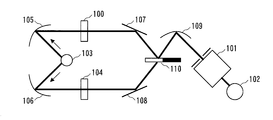
- FIG. 4 is a block diagram showing the configuration of the distributed spectroscopic measuring device disclosed in Non-Patent Document 1
- FIG. 5 is a block diagram showing the configuration of the interference type spectroscopic measuring device disclosed in Non-Patent Document 1.
- the light after passing through the sample 100 to be measured is dispersed by the diffraction grating 101, and each wavelength is sequentially detected by the detector 102.
- 103 is a light source
- 104 is a sample on the reference side
- 105 to 109 are mirrors
- 110 is a sector for alternately sending light transmitted through the sample 100 and light transmitted through the sample 104 on the reference side to the detector 102. It is a mirror.
- the signal (transmittance or absorbance) detected from the sample is plotted and displayed as a graph as a function of wavelength or wave number.
- the graph obtained is called a spectrum and shows a pattern peculiar to the substance.
- the intrinsic frequency of the quantum state can be obtained from the peak frequency of the spectrum, and the lifetime of the quantum state can be obtained from the line width of the peak.
- the energy resolution in the distributed spectroscopic measuring device is determined by the diffraction grating 101.
- an interferometer is used as shown in FIG. Specifically, the light emitted from the light source 200 is split into two optical paths by using the beam splitter 201. The light reflected by the beam splitter 201 travels to the movable mirror 202 side, and the light transmitted through the beam splitter 201 travels to the fixed mirror 203 side. The movable mirror 202 moves in the direction of arrow 204 with time. The light reflected by the movable mirror 202 and the fixed mirror 203 returns to the beam splitter 201, so that the light interferes with each other. The detector 206 detects the interference light after passing through the sample 205. The spectrum can be obtained by Fourier transforming the output of the detector 206 with a computer and calculating each wavelength component. In the case of the interference type, the energy resolution can be improved by extending the moving distance of the interferometer.
- FIG. 6 is a block diagram showing a configuration of a spectroscopic measuring device disclosed in Non-Patent Document 2.
- the pump-probe method is a method of measuring the optical constant of a sample in an excited state by the probe light after exciting the sample by the pump light.
- the pulsed light from the mode lock laser 300 is divided into a pump light 302 and a probe light 303 by a half mirror 301.
- the pump light 302 enters the sample 308 via the mirror 304, the shaker 305, the mirror 306, and the lens 307.
- the shaker 305 periodically changes the optical path length of the pump light 302 by vibrating in the direction of arrow 309.
- the probe light 303 is incident on the sample 308 via the stage 310, the 1/2 wavelength plate 311 and the half mirror 312 and the lens 307.
- the probe light 303 reflected by the sample 308 passes through the half mirror 312 and enters the detector 313.
- a part of the probe light 303 that has entered the half mirror 312 through the 1/2 wave plate 311 passes through the half mirror 312 and is incident on the detector 315 via the mirror 314.
- the superposition state (wave packet) is generated by the pump light. can do. Since the wave packet modulates the optical constant of the sample at a period determined by h ⁇ , the natural frequency (h ⁇ ) and lifetime of each quantum state can be determined by analyzing the vibrational structure of the probe light obtained from the sample (h ⁇ ). See Non-Patent Document 3).
- the devices shown in FIGS. 4 to 6 have been used for evaluating the physical properties of various substances in the infrared / visible region where the light source and the optical element are sufficiently aligned.
- VUV vacuum ultraviolet
- the VUV region is light having a wavelength of 200 nm to 10 nm, and is an energy region corresponding to outer shell excitation of atoms and molecules, first ionization energy to inner shell excitation, and inner shell ionization.
- electron excited states such as Rydberg state, two-electron excited state, automatic ionization state, and inner shell excited state can be observed. These highly excited states can be observed with the advent of synchrotron radiation facilities that can supply high-intensity VUV light, and many studies have been conducted so far.
- the energy resolution of the spectrum depends on the size of the diffraction grating and the spectroscope. For example, a large spectroscope of 10 m is required to obtain an energy resolution of 0.5 meV for 20 eV of incident light (see Non-Patent Document 4). Further, in order to obtain a signal with such a high energy resolution, a high-intensity VUV light source is indispensable, and spectroscopic measurement cannot be easily performed in a laboratory.
- the present invention has been made to solve the above problems, and an object of the present invention is to provide a compact spectroscopic measurement device capable of realizing spectroscopic measurement with high energy resolution in the vacuum ultraviolet region.
- the spectroscopic measuring apparatus of the present invention includes a pulsed laser light source that emits pulsed laser light, a beam splitter configured to divide the pulsed laser light into a first light and a second light, and the second light.
- a delay circuit configured to change the delay time of the first light with respect to the light, a chopper configured to intensity-modulate the first light, and wavelength conversion of the second light into vacuum ultraviolet light.
- the wavelength converter configured to perform the above, and the intensity-modulated first light and the wavelength-converted second light are directed to the sample to be measured installed in the vacuum chamber. It is characterized by including an optical system and a detector configured to detect a second light reflected by the sample or a second light transmitted through the sample.
- spectroscopic measurement with high energy resolution can be realized in the vacuum ultraviolet region by a device of a scale that can be constructed in a laboratory.
- FIG. 1 is a block diagram showing a configuration of a spectroscopic measuring device according to an embodiment of the present invention.
- FIG. 2 is a diagram showing measurement results of an embodiment of the present invention.
- FIG. 3 is a diagram showing the results of plotting the frequency of phonons with respect to the intensity of pump light.
- FIG. 4 is a block diagram showing a configuration of a conventional distributed spectroscopic measuring device.
- FIG. 5 is a block diagram showing a configuration of a conventional interference type spectroscopic measuring device.
- FIG. 6 is a block diagram showing a configuration of a conventional spectroscopic measuring apparatus using a pump-probe method.
- the measurement is performed by the following procedure.
- (Procedure 1) A high-intensity ultrashort pulse laser that can be handled in a laboratory is used, and VUV ultrashort pulse light obtained by a high-order harmonics generation (HHG) is used.
- HHG high-order harmonics generation
- the natural frequency and lifetime of each quantum state are determined by pump-probe spectroscopy using the VUV ultrashort pulsed light obtained in step 1.
- the device can be miniaturized.
- the energy resolution is determined by the range of the delay time difference between the pump and the probe light.
- the upper limit of the detectable energy is determined by the energy width of the pump light and the probe light (time width assuming the Fourier limit).
- FIG. 1 is a block diagram showing a configuration of a spectroscopic measuring device according to an embodiment of the present invention.
- the spectroscopic measurement device includes a pulse laser light source 1 that emits high-intensity ultrashort pulse laser light, a mirror 2 that reflects pulse laser light emitted from the pulse laser light source 1, and pump light (first light) of the pulse laser light.
- a 2% beam splitter 3 that separates the light from the probe light (second light), a mirror 4 that reflects the pump light, a delay circuit 5 that changes the delay time of the pump light with respect to the probe light, and a lens that collects the pump light.
- the 1/2 wavelength plate 7 the polarizer 8, the chopper 9 that intensity-modulates the pump light, the mirrors 10 and 11 that reflect the probe light, the 1/2 wavelength plate 12, and the polarizer 13. It includes a lens 14 that collects probe light, and a vacuum chamber 15 in which a sample to be measured is installed.
- the spectroscopic measurement device includes a current amplifier 16 that amplifies the output of the detector, which will be described later, and a box car integrator 17 that integrates the output signal of the detector using the synchronization signal of the repeating pulse train of the pulse laser light source 1 as a trigger signal.
- a lock-in detector 18 for detecting a signal having a modulation frequency of the chopper 9 among the signals integrated by the box car integrator 17 is provided.
- the total length of the spectroscopic measuring device of FIG. 1 is 5 m.
- the vacuum chamber 15 includes a window 150 for introducing pump light, a window 151 for introducing probe light, mirrors 152 and 153 that reflect pump light, and a sample in the vacuum chamber 15 that reflects pump light and probe light. It includes a concave mirror 154 that leads to 20, a rare gas introduction unit 155, a metal thin film filter 156, and a detector 157 that detects the probe light reflected by the sample 20.
- the rare gas introduction unit 155 and the metal thin film filter 156 constitute a wavelength converter 160 that converts the wavelength of probe light into vacuum ultraviolet light.
- the mirrors 152 and 153 and the concave mirror 154 form an optical system 161 that guides the pump light and the probe light to the sample 20.
- the pulse laser light source 1 As the pulse laser light source 1, a commercially available product having a repetition frequency of 3 kHz, an energy per pulse of 2.2 mJ / pulse, a center wavelength of 780 nm, and a time width of 20 fs was used.
- the pulsed laser light emitted from the pulsed laser light source 1 enters the 2% beam splitter 3 through the mirror 2 and is split into the pump light 30 and the probe light 31 by the 2% beam splitter 3.
- the pump light 30 is incident on the chopper 9 via the mirror 4, the delay circuit 5, the lens 6, the 1/2 wavelength plate 7, and the polarizer 8.
- the delay circuit 5 includes a retroreflector 50 and reflects the incident pump light 30 in a direction parallel to and opposite to the incident direction. Then, the delay circuit 5 can change the optical path length (delay time) of the pump light 30 by moving the retroreflector 50 along the direction of the arrow 51.
- the delay circuit 5 allows the pump light 30 and the probe light 31 to have a time lag. Further, the polarization and intensity of the pump light 30 can be adjusted by the 1/2 wavelength plate 7 and the polarizer 8.
- the chopper 9 intensity-modulates (on-off-modulates) the pump light 30 at a frequency half the repetition frequency of the pulsed laser light source 1. Then, the pump light 30 is introduced into the vacuum chamber 15 through the window 150, and is incident on the sample 20 to be measured via the mirrors 152 and 153 and the concave mirror 154.
- the focal length of the concave mirror 154 is 250 mm.
- the probe light 31 passes through the mirrors 10 and 11, the 1/2 wave plate 12, the polarizer 13, and the lens 14.
- the polarization and intensity of the probe light 31 can be adjusted by the 1/2 wavelength plate 12 and the polarizer 13.
- the polarization direction of the probe light 31 is adjusted so as to be perpendicular to the polarization direction of the pump light 30, for example.
- the probe light 31 focused by the lens 14 is introduced into the vacuum chamber 15 through the window 151.
- Rare gas is introduced into the rare gas introduction section 155 of the vacuum chamber 15.
- Ar gas is used as the rare gas.
- the probe light 31 enters the rare gas in the rare gas introduction unit 155, the probe light 31 is wavelength-converted by the HHG phenomenon, and VUV ultrashort pulse light which is a high-order harmonic is generated.
- the generated VUV ultrashort pulsed light is separated from the fundamental wave having a wavelength of 780 nm by passing through the metal thin film filter 156.
- Al having a film thickness of 300 nm is used as the metal thin film filter 156.
- the VUV ultrashort pulsed light that has passed through the metal thin film filter 156 is used as the probe light 32.
- the probe light 32 is incident on the sample 20 through the concave mirror 154 in the vacuum chamber 15.
- the probe light 32 reflected by the sample 20 enters the detector 157 installed in the vacuum chamber 15 and is converted into an electric signal.
- a photomultiplier tube is used as the detector 157.
- the current amplifier 16 amplifies the photocurrent output from the detector 157 and converts it into a voltage.
- the box car integrator 17 integrates the output signal of the current amplifier 16 using the synchronization signal of the repeating pulse train of the pulsed laser light source 1 as a trigger signal.
- the lock-in detector 18 uses the drive signal of the chopper 9 as a reference signal.
- the lock-in detector 18 detects a signal having a frequency of a reference signal (modulation frequency of the chopper 9) among the signals integrated by the boxcar integrator 17. In this way, the integrator signal obtained by the box car integrator 17 is processed by the lock-in detector 18 synchronized with the chopper 9, and only the modulation component of the pump light is detected as a function of the delay time generated by the delay circuit 5. can do.
- a computer (not shown) controls the delay circuit 5 and captures the signal of the lock-in detector 18 as a function of the delay time.
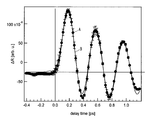
- FIG. 2 shows the measurement results when bismuth (Bi) having a film thickness of 200 nm was used as the sample 20.
- the vertical axis of FIG. 2 is the time change of the reflectance of the probe light 32
- the horizontal axis is the time difference between the pump light 30 and the probe lights 31 and 32 (delay time generated by the delay circuit 5).
- the reflectance of the probe light 32 can be calculated based on the intensity of the reflected light indicated by the output of the lock-in detector 18 and the known intensity of the probe light 32 incident on the sample 20.
- the circle A in FIG. 2 shows the measurement result obtained from the output of the lock-in detector 18, and the curve B shows the result obtained by fitting.
- the periodic vibration component of the measurement result is derived from Bi's A1g optical phonon mode.
- the time change ⁇ R of the reflectance of the probe light 32 can be expressed by the equation (1).
- t is the time difference between the pump light 30 and the probe lights 31 and 32
- a ph is the initial amplitude of the phonon
- ⁇ ph is the frequency of the phonon
- ⁇ ph is the relaxation time of the phonon
- ⁇ ph is the phase of the phonon.
- FIG. 3 The result of plotting the phonon frequency with respect to the intensity of the pump light 30 is shown in FIG. From FIG. 3, it can be seen that phonons with an energy (frequency) of 11 meV can be observed. Furthermore, according to the pump light intensity dependence of the phonon frequency shown in FIG. 3, it can be seen that a frequency shift of about 0.2 meV can be systematically observed.
- spectroscopic measurement with high energy resolution can be realized with a device of a scale that can be constructed in a laboratory.
- the application target of this embodiment can be observed if two or more quantum states can be superposed by pump light with respect to the system (electrons, vibrations, rotations) forming the quantum states.
- the energy resolution of this embodiment is determined by the length (delay time) of the delay circuit 5.
- the energy resolution is determined by an optical element such as a diffraction grating used in a spectroscope, there is a problem that the spectroscopic measuring device becomes large when the energy of the probe light becomes high.
- the total length of the spectroscopic measuring device is within 5 m, and the device has been successfully miniaturized.
- the lower limit of observable energy is determined by the length of the delay circuit 5. Specifically, when the delay time of the delay circuit 5 is lengthened, the lower limit of the observable energy becomes lower.
- the upper limit of observable energy is determined by the energy width of the pump light (time width assuming the Fourier limit). Specifically, when the pulse width of the pump light is shortened, the upper limit of the observable energy becomes higher.
- the reflected light from the sample is detected by the detector, but it can also be applied to the configuration in which the transmitted light from the sample is detected by the detector. If reflected light or transmitted light can be obtained from the sample, it is possible to realize versatility that can be measured regardless of the state of the sample (gas, liquid, solid).
- the polarization of the probe light 32 can be freely set for the sample.
- the polarization of the probe light must be set so that the diffraction intensity can be high with respect to the diffraction grating.
- the energy of the probe light is selected by changing the type of gas used for HHG (He, Ne, Ar, Kr, Xe, etc.) and the type of metal thin film filter 156 (Al, Ti, Be, etc.). be able to.
- the present invention can be applied to spectroscopic measurement in the vacuum ultraviolet region.
- Pulse laser light source 2,4,10,11,152,153 ... Mirror, 3 ... 2% beam splitter, 5 ... Delay circuit, 6,14 ... Lens, 7,12 ... 1/2 wave plate, 8, 13 ... Polarizer, 9 ... Chopper, 15 ... Vacuum chamber, 16 ... Current amplifier, 17 ... Box car integrator, 18 ... Lock-in detector, 20 ... Sample, 30 ... Pump light, 31, 32 ... Probe light, 150 , 151 ... window, 154 ... concave mirror, 155 ... rare gas introduction part, 156 ... metal thin film filter, 157 ... detector, 160 ... wavelength converter, 161 ... optical system.
Landscapes
- Physics & Mathematics (AREA)
- Spectroscopy & Molecular Physics (AREA)
- General Physics & Mathematics (AREA)
- Nonlinear Science (AREA)
- Chemical & Material Sciences (AREA)
- Analytical Chemistry (AREA)
- Biochemistry (AREA)
- General Health & Medical Sciences (AREA)
- Life Sciences & Earth Sciences (AREA)
- Immunology (AREA)
- Pathology (AREA)
- Health & Medical Sciences (AREA)
- Optics & Photonics (AREA)
- Electromagnetism (AREA)
- Engineering & Computer Science (AREA)
- Plasma & Fusion (AREA)
- Investigating Or Analysing Materials By Optical Means (AREA)
Priority Applications (3)
| Application Number | Priority Date | Filing Date | Title |
|---|---|---|---|
| PCT/JP2019/033652 WO2021038743A1 (ja) | 2019-08-28 | 2019-08-28 | 分光計測装置 |
| JP2021541862A JPWO2021038743A1 (https=) | 2019-08-28 | 2019-08-28 | |
| US17/633,881 US11781978B2 (en) | 2019-08-28 | 2019-08-28 | Spectroscopic measurement device |
Applications Claiming Priority (1)
| Application Number | Priority Date | Filing Date | Title |
|---|---|---|---|
| PCT/JP2019/033652 WO2021038743A1 (ja) | 2019-08-28 | 2019-08-28 | 分光計測装置 |
Publications (1)
| Publication Number | Publication Date |
|---|---|
| WO2021038743A1 true WO2021038743A1 (ja) | 2021-03-04 |
Family
ID=74683936
Family Applications (1)
| Application Number | Title | Priority Date | Filing Date |
|---|---|---|---|
| PCT/JP2019/033652 Ceased WO2021038743A1 (ja) | 2019-08-28 | 2019-08-28 | 分光計測装置 |
Country Status (3)
| Country | Link |
|---|---|
| US (1) | US11781978B2 (https=) |
| JP (1) | JPWO2021038743A1 (https=) |
| WO (1) | WO2021038743A1 (https=) |
Families Citing this family (1)
| Publication number | Priority date | Publication date | Assignee | Title |
|---|---|---|---|---|
| EP3907482A1 (en) * | 2020-05-06 | 2021-11-10 | Ams Ag | Spectrometer, portable device and method for detecting electromagnetic radiation |
Citations (3)
| Publication number | Priority date | Publication date | Assignee | Title |
|---|---|---|---|---|
| JPH11511240A (ja) * | 1995-08-25 | 1999-09-28 | ブラウン ユニバーシティー リサーチ ファウンデーション | 変化した材料の特性測定に対する光技術 |
| JP2001324477A (ja) * | 2000-05-17 | 2001-11-22 | Japan Science & Technology Corp | 高次高調波発生・分光システム |
| US9030733B2 (en) * | 2011-04-12 | 2015-05-12 | Max-Planck-Gesellschaft Zur Foerderung Der Wissenschaften E.V. | Spatially relaying radiation components |
Family Cites Families (3)
| Publication number | Priority date | Publication date | Assignee | Title |
|---|---|---|---|---|
| CN1295561C (zh) * | 2004-02-16 | 2007-01-17 | 中国科学院上海光学精密机械研究所 | 超快脉冲x射线相衬成像装置 |
| JP2012237714A (ja) * | 2011-05-13 | 2012-12-06 | Sony Corp | 非線形ラマン分光装置、顕微分光装置及び顕微分光イメージング装置 |
| JP6646519B2 (ja) * | 2016-05-20 | 2020-02-14 | 浜松ホトニクス株式会社 | 全反射分光計測装置及び全反射分光計測方法 |
-
2019
- 2019-08-28 JP JP2021541862A patent/JPWO2021038743A1/ja active Pending
- 2019-08-28 US US17/633,881 patent/US11781978B2/en active Active
- 2019-08-28 WO PCT/JP2019/033652 patent/WO2021038743A1/ja not_active Ceased
Patent Citations (3)
| Publication number | Priority date | Publication date | Assignee | Title |
|---|---|---|---|---|
| JPH11511240A (ja) * | 1995-08-25 | 1999-09-28 | ブラウン ユニバーシティー リサーチ ファウンデーション | 変化した材料の特性測定に対する光技術 |
| JP2001324477A (ja) * | 2000-05-17 | 2001-11-22 | Japan Science & Technology Corp | 高次高調波発生・分光システム |
| US9030733B2 (en) * | 2011-04-12 | 2015-05-12 | Max-Planck-Gesellschaft Zur Foerderung Der Wissenschaften E.V. | Spatially relaying radiation components |
Non-Patent Citations (2)
| Title |
|---|
| CIRRI, A. ET AL.: "Achieving Surface Sensitivity in Ultrafast XUV Spectroscopy: M2,3-Edge Reflection-Absorption of Transition Metal Oxides", THE JOURNAL OF PHYSICAL CHEMISTRY C, vol. 121, no. 29, 27 July 2017 (2017-07-27), pages 15861 - 15869, XP055794580, DOI: 10.1021/acs.jpcc.7b05127 * |
| TOUME, KENTO ET AL.: "Time-resolved ARPES based on 8-fs high-harmonic source in the extreme ultraviolet region", CONFERENCE ON LASERS AND ELECTRO-OPTICS. THE 65TH JSAP SPRING MEETING, 13 May 2018 (2018-05-13), pages 1 - 2, XP033381385 * |
Also Published As
| Publication number | Publication date |
|---|---|
| JPWO2021038743A1 (https=) | 2021-03-04 |
| US20220276158A1 (en) | 2022-09-01 |
| US11781978B2 (en) | 2023-10-10 |
Similar Documents
| Publication | Publication Date | Title |
|---|---|---|
| McCamant et al. | Femtosecond broadband stimulated Raman spectroscopy: Apparatus and methods | |
| US5946090A (en) | Spectrometric method and apparatus for spectrometry | |
| Megerle et al. | Sub-50 fs broadband absorption spectroscopy with tunable excitation: putting the analysis of ultrafast molecular dynamics on solid ground | |
| US4512660A (en) | Picosecond broadband cars probe using the picosecond continuum | |
| DK2979080T3 (en) | Device and method for stimulated raman detection | |
| JP6386655B2 (ja) | テラヘルツ波発生装置及びそれを用いた分光装置 | |
| US8653462B2 (en) | Methods and systems for detecting terahertz radiation by radiation enhanced emission of fluorescence | |
| US7570349B2 (en) | Cars/absorption dual mode electro-optic sensor | |
| JP2012237714A (ja) | 非線形ラマン分光装置、顕微分光装置及び顕微分光イメージング装置 | |
| JP2012237714A5 (https=) | ||
| JP2006516730A (ja) | シングルパルスアンチストークスラマン散乱顕微鏡法および分光法 | |
| EP2994741A1 (en) | A system and method for stimulated raman spectroscopy | |
| US11181423B2 (en) | Birefringent interferometer for measuring photoluminescence properties of samples | |
| US4269509A (en) | Photoacoustic Raman spectroscopy | |
| CN111239090A (zh) | 一种单脉冲激光诱导瞬态分子荧光光谱的测量方法及系统 | |
| Mallick et al. | Design and development of stimulated Raman spectroscopy apparatus using a femtosecond laser system | |
| US11781978B2 (en) | Spectroscopic measurement device | |
| JP3691813B2 (ja) | 非線形ラマン分光方法及び装置 | |
| US10132754B2 (en) | Device and method for illuminating a sample | |
| Brown et al. | Water-vapor detection using asynchronous THz sampling | |
| Beadie et al. | Towards a FAST-CARS anthrax detector: CARS generation in a DPA surrogate molecule | |
| Patel et al. | A review on photoacoustic spectroscopy | |
| WO2002016913A1 (fr) | Instrument pour mesurer la duree de vie de fluorescence | |
| WO2014125775A1 (ja) | 赤外光スペクトル計測装置及び方法 | |
| JP6103008B2 (ja) | 非線形ラマン分光装置、顕微分光装置及び顕微分光イメージング装置 |
Legal Events
| Date | Code | Title | Description |
|---|---|---|---|
| 121 | Ep: the epo has been informed by wipo that ep was designated in this application |
Ref document number: 19943788 Country of ref document: EP Kind code of ref document: A1 |
|
| ENP | Entry into the national phase |
Ref document number: 2021541862 Country of ref document: JP Kind code of ref document: A |
|
| NENP | Non-entry into the national phase |
Ref country code: DE |
|
| 122 | Ep: pct application non-entry in european phase |
Ref document number: 19943788 Country of ref document: EP Kind code of ref document: A1 |