WO2021024334A1 - 端末及び通信方法 - Google Patents
端末及び通信方法 Download PDFInfo
- Publication number
- WO2021024334A1 WO2021024334A1 PCT/JP2019/030615 JP2019030615W WO2021024334A1 WO 2021024334 A1 WO2021024334 A1 WO 2021024334A1 JP 2019030615 W JP2019030615 W JP 2019030615W WO 2021024334 A1 WO2021024334 A1 WO 2021024334A1
- Authority
- WO
- WIPO (PCT)
- Prior art keywords
- terminal
- scheduling
- base station
- communication
- setting
- Prior art date
- Legal status (The legal status is an assumption and is not a legal conclusion. Google has not performed a legal analysis and makes no representation as to the accuracy of the status listed.)
- Ceased
Links
Images




Classifications
-
- H—ELECTRICITY
- H04—ELECTRIC COMMUNICATION TECHNIQUE
- H04W—WIRELESS COMMUNICATION NETWORKS
- H04W4/00—Services specially adapted for wireless communication networks; Facilities therefor
- H04W4/30—Services specially adapted for particular environments, situations or purposes
- H04W4/40—Services specially adapted for particular environments, situations or purposes for vehicles, e.g. vehicle-to-pedestrians [V2P]
- H04W4/46—Services specially adapted for particular environments, situations or purposes for vehicles, e.g. vehicle-to-pedestrians [V2P] for vehicle-to-vehicle communication [V2V]
Definitions
- the present invention relates to a terminal (user device) and a communication method in a wireless communication system.
- Non-Patent Document 1 In LTE (Long Term Evolution) and LTE successor systems (for example, LTE-A (LTE Advanced), NR (New Radio) (also called 5G)), communication devices such as UEs directly communicate with each other without going through the base station gNB.
- LTE-A Long Term Evolution Advanced
- NR New Radio
- a side link also called D2D (Device to Device)
- D2D Device to Device
- V2X Vehicle to Everything
- V2X is a part of ITS (Intelligent Transport Systems), V2V (Vehicle to Vehicle) which means a communication form performed between automobiles, and a roadside machine (RSU: Road) installed between an automobile and a roadside.
- ITS Intelligent Transport Systems
- V2V Vehicle to Vehicle
- RSU Road
- -V2I Vehicle to Infrastructure
- V2N Vehicle to Nomadic device
- V2P Vehicle to Pedestrian
- V2P Vehicle to Pedestrian
- the following channels are included in the channels for direct communication between terminals used in direct communication between terminals (side link technology).
- the channel for transmitting control information such as SCI (Siderink Control Information) is referred to as PSCCH (Physical Sidelink Control Channel), and the channel for transmitting data is referred to as PSCH (Physical Sidelink Sharp Channel).
- PSCCH Physical Sidelink Control Channel
- PSCH Physical Sidelink Sharp Channel
- HARQ Hybrid Automatic Repeat Request
- SFCI Sidelink Feedback Control Information
- the SFCI is transmitted on the terminal-to-terminal direct communication feedback channel (Physical Sidelink Feedback Channel (PSFCH)).
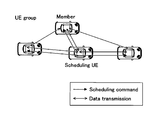
- the scheduling terminal schedules the member terminal in the terminal group (UE group) composed of the scheduling terminal (scheduling UE) and the member terminal (member UE).
- the transmission mode may be referred to as a side link transmission mode 2-d, or may have a different name.
- the scheduling terminal may be called a header terminal (header UE) or the like, and the member terminal may be called a non-scheduling terminal, a non-header terminal or the like.
- the scheduling terminal is not limited to a terminal related to a vehicle such as V2X, and is expected to be widely used as a terminal for a wide range of purposes.
- the functions and costs will be higher than those of terminals that are not scheduling terminals.
- the merit suitable for the terminal that performs scheduling for other terminals is not clearly defined.
- the present invention has been made in view of the above points, and provides preferential treatment for a terminal having a function of controlling communication of another terminal such as scheduling of another terminal.
- the purpose is to provide technology.
- the present invention is not limited to terminal-to-terminal communication in V2X, and may be applied to any terminal. Further, the present invention is not limited to terminals, and may be applied to, for example, base stations, access points, nodes, and IAB nodes. Further, the scheduling in the present invention is not limited to direct communication between terminals, and may be communication between a base station and terminals.
- a terminal having a transmitting / receiving unit for transmitting or receiving is provided.
- a technology for providing preferential treatment to a terminal having a function of controlling communication of another terminal is provided.
- FIG. 1 is a diagram for explaining four types of side link transmission modes in NR-V2X.
- the terminal 20A transmits PSCCH / PSCH to the terminal 20B based on the SL scheduling by the base station apparatus 10.
- PSCCH / PSCH transmission is performed based on the resource selection of the terminal itself.
- the side link transmission mode 2 of the NR-V2X is further subdivided.
- the terminal 20A has a PSCCH with respect to the terminal 20B based on the resource selection of the terminal 20A itself.
- / PSSCH is transmitted, and the terminal 20B transmits PSCCH / PSCH to the terminal A based on the resource selection of the terminal 20B itself.
- the terminal 20A attaches to the terminal 20B according to the RRC-config of the resource pattern (reserve pattern) notified from the base station apparatus 10 or determined by the specification. Send PSCH.
- the terminal 20A performs scheduling for transmission of the terminal 20B by transmitting SL scheduling to the terminal 20B, and the terminal 20B is based on the scheduling.
- PSCCH / PSSCH is transmitted to the terminal 20A.
- a scheduling terminal (scheduling UE) in NR-V2X will be described.
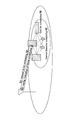
- FIG. 2 is a diagram for explaining a scheduling terminal.
- a concept is considered in which a scheduling terminal schedules (controls) transmissions for nearby terminals.
- a mechanism is not supported in Release 16 of NR-V2X, but it is considered that it will be supported in Release 17 in which the side link of NR is extended. In the future, it is conceivable that the terminal will control other terminals in this way. Further, such a mechanism is not limited to terminals related to vehicles such as V2X, and is expected to be widely used in terminals for all purposes.
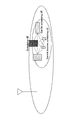
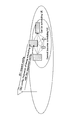
- FIG. 3 is a diagram for explaining the problem.
- FIG. 3 shows a terminal that executes the function of the scheduling terminal, a terminal that can be the scheduling terminal, but does not perform the function of the scheduling terminal, and a terminal that cannot be the scheduling terminal.
- a terminal that can be a scheduling terminal is considered to have high functionality and high cost. However, if there is no merit in becoming a terminal that schedules transmission of other terminals, it is possible that there will be no terminals that try to become scheduling terminals, and the concept (mechanism) of scheduling terminals will become widespread. It will hinder.
- all terminals support the function of the scheduling terminal (for example, if it is specified as an essential function as a D2D terminal), the cost of all terminals will be high. For example, in a type of D2D terminal that is required to have a low price, it is conceivable that the price will increase in order to support the function of the scheduling terminal.
- terminal operating as a scheduling terminal may be replaced with a “terminal that can be a scheduling terminal”.
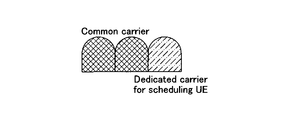
- FIG. 4 is a diagram showing an example of preferential treatment.
- a dedicated carrier may be provided in addition to the common carrier to the terminal operating as the scheduling terminal.
- Carriers may be replaced by carrier components, BWPs (Bandwidth Part), frequency ranges.
- FIG. 5 is a diagram showing another example of preferential treatment.
- more resources may be provided to the terminal operating as the scheduling terminal.
- a more SR (Scheduling Request) transmission opportunity may be provided.
- the SR transmission opportunity to a normal terminal has a frequency of once in 5 slots
- the SR transmission opportunity to a terminal operating as a scheduling terminal has a frequency of 3 times in 5 slots.
- SR transmission opportunities are provided in all slots where SR can be transmitted). By doing so, the terminal operating as the scheduling terminal can transmit the SR immediately when it wants to transmit the SR.
- the cycle of CG may be shortened (eg: 1 slot) or increased in frequency with respect to a terminal operating as a scheduling terminal.
- the period of the downlink SPS (Semi Persistence Scheduling) may be shortened or increased in frequency with respect to the terminal operating as the scheduling terminal.
- the aggregation level (aggregation level) may be increased by PDCCH (Physical Downlink Control Channel) with respect to the terminal operating as the scheduling terminal (example: 4 or more).
- the terminal operating as a scheduling terminal may not receive a rejection (RRCReject) for an RRC connection request from the network.
- RRCReject rejection
- FIG. 6 is a diagram for explaining inter-UE multiplexing (inter-UE mux for URLLC) for URLLC (Ultra-Reliable Low-Latency Communication).
- inter-UE mux for URLLC for URLLC
- URLLC Ultra-Reliable Low-Latency Communication
- a normal terminal is a PUSCH (Physical Uplink). (Shared Channel) cannot be transmitted, and a terminal operating as a scheduling terminal can transmit PUSCH. Further, regarding the cancellation notification transmitted for each terminal, the terminal operating as the scheduling terminal may not receive the cancellation notification.
- PUSCH Physical Uplink
- Shared Channel Shared Channel
- the transmission resource of the terminal operating as the scheduling terminal has increased the transmission power (power-boosted). It may not be duplicated with the transmission of the terminal (for example, the URLLC terminal).
- Preemption notification As preferential treatment for a terminal operating as a scheduling terminal, regarding preemption notification by transmission to another terminal in downlink transmission, regarding reception resources of the terminal operating as a scheduling terminal, other terminals. Preemption by (for example, a URLLC terminal) may not be performed.
- the priority acquisition notification (preemption indication) is that after the transmission of the downlink is set, the transmission to the other terminal set later is preferentially acquired, and the transmission of the downlink set earlier is canceled. It is a notification indicating that it has been done.
- A7 As a priority treatment for a terminal operating as a scheduling terminal, a higher priority is set or notified to transmission / reception of a terminal operating as a scheduling terminal than transmission / reception of other terminals. You may.
- providing a high priority to a terminal operating as a scheduling terminal can be considered to be a motivation for becoming a terminal having a function of a scheduling terminal.
- the base station apparatus 10 may request the terminal 20 to report its ability to operate as a scheduling terminal.
- the terminal 20 may report to the base station apparatus 10 whether or not it has the ability to operate as a scheduling terminal.
- FIG. 7 is a diagram for explaining an example of sending and receiving a message between the terminal and the base station device.
- a terminal capable of operating as a scheduling terminal requests / suggests a desirable configuration (preferred configuration) of uplink / downlink (UL / DL) from the base station apparatus 10. May provide information about the desired setting. For example, desired cells and resources may be requested / suggested / provided.
- the terminal 20 may receive, for example, the setting notified / provided from the base station apparatus 10.
- the setting to be notified may be the same as the setting requested by the terminal 20.
- the setting to be notified may be a setting different from the setting requested by the terminal 20.
- the notification may or may not be performed.
- the terminal 20 may respond whether or not to accept the setting / notification.
- the terminal 20 may operate as a scheduling terminal after feeding back the acceptance of the setting / notification to the base station apparatus 10. If the setting / notification is not accepted, the terminal 20 may give feedback that the setting / notification is not accepted (reception).
- FIG. 8 is a diagram for explaining another example of sending and receiving a message between the terminal and the base station device.
- the terminal 20 may receive a new setting candidate for uplink / downlink (UL / DL) from the base station apparatus 10 before being set / notified as a scheduling terminal.
- the terminal 20 may give feedback to the base station apparatus 10 to accept the new setting candidate.
- the terminal 20 may be set / notified as a scheduling terminal.
- the above new settings may be received again.
- the terminal 20 may assume that the new settings presented above will be available when the terminal 20 is set / notified as a scheduling terminal.
- the terminal 20 may notify that it does not accept becoming a scheduling terminal (reception).
- the candidate for the new setting received by the terminal 20 may be only a part that is changed with respect to the current setting.
- FIG. 9 is a diagram for explaining still another example of sending and receiving a message between the terminal and the base station device.
- the terminal 20 that can be a scheduling terminal may request the base station apparatus 10 that the terminal 20 becomes a scheduling terminal.
- the physical resource used when requesting the base station apparatus 10 may be set as a periodic resource (such as a periodic resource for SR).
- the physical resource used when requesting the base station apparatus 10 may be set as a semi-persistent resource (such as SP-CSI) and activated / released (deactivated or released).
- the terminal 20 may receive whether or not the request has been accepted. Upon receiving the acceptance, the terminal 20 starts operating as a scheduling terminal.
- the settings for operating as a scheduling terminal may be provided in advance, may be provided together with the above acceptance, or may be provided after the above acceptance.
- the terminal 20 may not be able to request for a predetermined period (eg, X) from the refusal of acceptance.
- the predetermined period (X) may be specified by a slot, a request opportunity, a time, a counter, or the like. It may be specified by the method of.
- the value of X may be specified, set, or notified.
- the terminal 20 may receive a setting / notification to be a scheduling terminal.
- Settings for operating as a scheduling terminal and / or new settings for uplink / downlink (UL / DL) are periodic or semi-persistent (periodical / semi).
- -Persistent may be associated with request settings / resources / IDs.
- the terminal 20 can determine whether or not to operate as the scheduling terminal in consideration of the advantages and disadvantages when operating as the scheduling terminal.
- the network (base station apparatus 10) provides preferential treatment to the terminal 20 that operates as a scheduling terminal.
- the network (base station device 10) may set a higher priority than other terminals 20 for the terminal 20 that operates as a scheduling terminal.
- the network may provide resources with higher priority to the terminal 20 that operates as a scheduling terminal.
- the network may provide a terminal 20 operating as a scheduling terminal with more carriers (for example, CC) than other terminals 20.
- the network may consider the communication volume of the terminal 20 operating as the scheduling terminal to be smaller than the actual communication volume. For example, it may be regarded as X% of the actual traffic (X ⁇ 100).
- the network (base station device 10) sets the maximum communication amount of the terminal 20 operating as a scheduling terminal higher than the maximum communication amount of the other terminals 20 with respect to the maximum communication amount that can be communicated without any scheduling limitation. May be good.
- the network (base station apparatus 10) schedules settings as scheduling terminals and / or new settings for uplink / downlink (UL / DL) (eg, settings for preferential treatment). You may negotiate with a terminal 20 that can operate as a terminal.
- UL / DL uplink / downlink
- the base station apparatus 10 and the terminal 20 include a function of carrying out the above-described embodiment.
- the base station apparatus 10 and the terminal 20 may each have only a part of the functions in the embodiment.
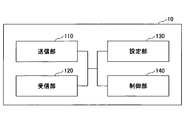
- FIG. 10 is a diagram showing an example of the functional configuration of the base station apparatus 10.
- the base station apparatus 10 includes a transmission unit 110, a reception unit 120, a setting unit 130, and a control unit 140.
- the functional configuration shown in FIG. 7 is only an example. Any function classification and name of the functional unit may be used as long as the operation according to the embodiment of the present invention can be executed.
- the transmission unit 110 includes a function of generating a signal to be transmitted to the terminal 20 side and transmitting the signal wirelessly. Further, the transmission unit 110 transmits information such as SL scheduling to the terminal 20.
- the receiving unit 120 includes a function of receiving various signals transmitted from the terminal 20 and acquiring information of, for example, a higher layer from the received signals.
- the setting unit 130 stores preset setting information and various setting information to be transmitted to the terminal 20 in the storage device, and reads the setting information from the storage device as needed.
- the content of the setting information is, for example, information related to the setting of V2X.
- control unit 140 performs processing related to the setting for the terminal 20 to perform V2X. Further, the function unit related to signal transmission in the control unit 140 may be included in the transmission unit 110, and the function unit related to signal reception in the control unit 140 may be included in the reception unit 120.
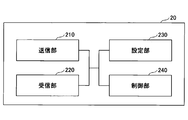
- FIG. 11 is a diagram showing an example of the functional configuration of the terminal 20.
- the terminal 20 has a transmitting unit 210, a receiving unit 220, a setting unit 230, and a control unit 240.
- the functional configuration shown in FIG. 11 is only an example. Any function classification and name of the functional unit may be used as long as the operation according to the embodiment of the present invention can be executed.
- the transmission unit 210 creates a transmission signal from the transmission data and wirelessly transmits the transmission signal.
- the receiving unit 220 wirelessly receives various signals and acquires a signal of a higher layer from the received signal of the physical layer.
- the setting unit 230 stores various setting information received from the base station device 10 or the terminal 20 by the receiving unit 220 in the storage device, and reads it out from the storage device as needed.
- the setting unit 230 also stores preset setting information.
- the content of the setting information is, for example, information related to V2X and HARQ processing.
- the control unit 240 controls the D2D communication executed with the other terminal 20 as described in the embodiment. In addition, the control unit 240 executes V2X and HARQ processing.
- the function unit related to signal transmission in the control unit 240 may be included in the transmission unit 210, and the function unit related to signal reception in the control unit 240 may be included in the reception unit 220.
- each functional block may be realized by one device in which a plurality of elements are physically and / or logically combined, or two or more devices physically and / or logically separated from each other directly and. / Or indirectly (eg, wired and / or wireless) may be connected and realized by these plurality of devices.
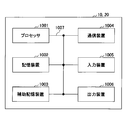
- FIG. 12 is a diagram showing an example of the hardware configuration of the wireless communication device which is the base station device 10 or the terminal 20 according to the embodiment of the present invention.
- the above-mentioned base station device 10 and terminal 20 are physically configured as computer devices including a processor 1001, a storage device 1002, an auxiliary storage device 1003, a communication device 1004, an input device 1005, an output device 1006, a bus 1007, and the like. May be done.
- the word “device” can be read as a circuit, device, unit, etc.
- the hardware configuration of the base station device 10 and the terminal 20 may be configured to include one or more of the devices shown by 1001 to 1006 shown in the figure, or may be configured not to include some of the devices. You may.
- the processor 1001 For each function of the base station device 10 and the terminal 20, the processor 1001 performs an operation by loading predetermined software (program) on the hardware such as the processor 1001 and the storage device 1002, and the communication device 1004 communicates and stores the data. It is realized by controlling the reading and / or writing of data in the device 1002 and the auxiliary storage device 1003.
- the processor 1001 operates, for example, an operating system to control the entire computer.
- the processor 1001 may be composed of a central processing unit (CPU: Central Processing Unit) including an interface with a peripheral device, a control device, an arithmetic unit, a register, and the like.
- CPU Central Processing Unit
- the processor 1001 reads a program (program code), a software module or data from the auxiliary storage device 1003 and / or the communication device 1004 into the storage device 1002, and executes various processes according to these.
- a program program code
- the program a program that causes a computer to execute at least a part of the operations described in the above-described embodiment is used.
- the transmission unit 110, the reception unit 120, the setting unit 130, and the control unit 140 of the base station device 10 shown in FIG. 10 may be stored in the storage device 1002 and realized by a control program that operates in the processor 1001. Further, for example, even if the transmission unit 210, the reception unit 220, the setting unit 230, and the control unit 240 of the terminal 20 shown in FIG.
- processor 1001. Good are stored in the storage device 1002 and realized by a control program operated by the processor 1001. Good. Although it has been described that the various processes described above are executed by one processor 1001, they may be executed simultaneously or sequentially by two or more processors 1001. Processor 1001 may be mounted on one or more chips. The program may be transmitted from the network via a telecommunication line.
- the storage device 1002 is a computer-readable recording medium, and is, for example, at least one such as a ROM (Read Only Memory), an EPROM (Erasable Programmable ROM), an EEPROM (Electrically Erasable Programmable ROM), and a RAM (Random Access Memory). It may be configured.
- the storage device 1002 may be referred to as a register, a cache, a main memory (main storage device), or the like.
- the storage device 1002 can store a program (program code), a software module, or the like that can be executed to carry out the process according to the embodiment of the present invention.
- the auxiliary storage device 1003 is a computer-readable recording medium, and is, for example, an optical disk such as a CD-ROM (Compact Disc ROM), a hard disk drive, a flexible disk, an optical magnetic disk (for example, a compact disk, a digital versatile disk, Blu).
- -It may be composed of at least one of a ray (registered trademark) disk), a smart card, a flash memory (for example, a card, a stick, a key drive), a floppy (registered trademark) disk, a magnetic strip, and the like.
- the auxiliary storage device 1003 may be referred to as an auxiliary storage device.
- the storage medium described above may be, for example, a database, server or other suitable medium containing the storage device 1002 and / or the auxiliary storage device 1003.
- the communication device 1004 is hardware (transmission / reception device) for communicating between computers via a wired and / or wireless network, and is also referred to as, for example, a network device, a network controller, a network card, a communication module, or the like.
- the transmission unit 110 and the reception unit 120 of the base station device 10 may be realized by the communication device 1004.
- the transmission unit 210 and the reception unit 220 of the terminal 20 may be realized by the communication device 1004.
- the input device 1005 is an input device (for example, a keyboard, a mouse, a microphone, a switch, a button, a sensor, etc.) that receives an input from the outside.
- the output device 1006 is an output device (for example, a display, a speaker, an LED lamp, etc.) that outputs to the outside.
- the input device 1005 and the output device 1006 may have an integrated configuration (for example, a touch panel).
- each device such as the processor 1001 and the storage device 1002 is connected by a bus 1007 for communicating information.
- the bus 1007 may be composed of a single bus or may be composed of different buses between the devices.
- the base station device 10 and the terminal 20 are a microprocessor, a digital signal processor (DSP: Digital Signal Processor), an ASIC (Application Specific Integrated Circuit), a PLD (Programmable Logic Device), an FPGA (Field Programmable Gate Array), etc., respectively. It may be configured to include hardware, and the hardware may realize a part or all of each functional block. For example, processor 1001 may be implemented on at least one of these hardware.
- the boundary of the functional unit or the processing unit in the functional block diagram does not always correspond to the boundary of the physical component.
- the operation of the plurality of functional units may be physically performed by one component, or the operation of one functional unit may be physically performed by a plurality of components. With respect to the processing procedure described in the embodiment, the order of processing may be changed as long as there is no contradiction.
- the base station device 10 and the terminal 20 have been described with reference to functional block diagrams, but such devices may be implemented in hardware, software, or a combination thereof.
- the software operated by the processor of the base station apparatus 10 according to the embodiment of the present invention and the software operated by the processor of the terminal 20 according to the embodiment of the present invention are random access memory (RAM), flash memory, and read-only, respectively. It may be stored in a memory (ROM), EPROM, EEPROM, registers, hard disk (HDD), removable disk, CD-ROM, database, server or any other suitable storage medium.
- information notification includes physical layer signaling (for example, DCI (Downlink Control Information), UCI (Uplink Control Information)), higher layer signaling (for example, RRC (Radio Resource Control) signaling, MAC (Medium Access Control) signaling, etc. Broadcast information (MIB (Master Information Block), SIB (System Information Block)), other signals or a combination thereof may be used.
- RRC signaling may be referred to as an RRC message, for example, RRC. It may be a connection setup (RRCConnectionSetup) message, an RRC connection reconfiguration (RRCConnectionReconfiguration) message, or the like.
- Each aspect / embodiment described in the present specification includes LTE (Long Term Evolution), LTE-A (LTE-Advanced), SUPER 3G, IMT-Advanced, 4G, 5G, FRA (Future Radio Access), W-CDMA. (Registered Trademarks), GSM (Registered Trademarks), CDMA2000, UMB (Ultra Mobile Broadband), IEEE 802.11 (Wi-Fi), IEEE 802.16 (WiMAX), IEEE 802.20, UWB (Ultra-WideBand), It may be applied to systems utilizing Bluetooth®, other suitable systems and / or next-generation systems extended based on them.
- the specific operation performed by the base station apparatus 10 in the present specification may be performed by its upper node (upper node).
- various operations performed for communication with the terminal 20 are performed other than the base station device 10 and / or the base station device 10. It is clear that it can be done by other network nodes (eg, MME or S-GW, etc., but not limited to these).
- MME or S-GW network nodes
- the case where there is one network node other than the base station apparatus 10 is illustrated above, it may be a combination of a plurality of other network nodes (for example, MME and S-GW).
- the terminal 20 may be a subscriber station, a mobile unit, a subscriber unit, a wireless unit, a remote unit, a mobile device, a wireless device, a wireless communication device, a remote device, a mobile subscriber station, an access terminal, a mobile terminal, or a wireless device. It may also be referred to as a terminal, remote terminal, handset, user agent, mobile client, client, or some other suitable term.
- the base station apparatus 10 may be referred to by those skilled in the art by NB (NodeB), eNB (evolvedNodeB), gNB, BaseStation, or some other suitable term.
- NB NodeB
- eNB evolvedNodeB
- gNB BaseStation
- determining and “determining” used in this specification may include a wide variety of actions.
- “Judgment” and “decision” are, for example, judgment (judging), calculation (calculating), calculation (computing), processing (processing), derivation (deriving), investigating (investigating), searching (looking up) (for example, table , Searching in a database or another data structure), confirming (ascertaining) may be regarded as “judgment” or “decision”.
- judgment and “decision” are receiving (for example, receiving information), transmitting (for example, transmitting information), input (input), output (output), and access.
- (Accessing) for example, accessing data in memory) may be regarded as "judgment” or “decision”.
- judgment and “decision” mean that “resolving”, “selecting”, “choosing”, “establishing”, “comparing”, etc. are regarded as “judgment” and “decision”. Can include. That is, “judgment” and “decision” may include that some action is regarded as “judgment” and “decision”.
- Scheduling of other terminals is an example of controlling communication of other terminals, and information on the ability to operate as a scheduling terminal and information requesting to operate as a scheduling terminal are information on communication of other terminals. This is an example of information related to control.
- the desirable configuration (preferred configuration) of the uplink / downlink (UL / DL) and the new setting candidate of the uplink / downlink (UL / DL) are examples of information related to the preferential treatment setting. Is.
- Base station device 110 Transmission unit 120 Reception unit 130 Setting unit 140 Control unit 20 Terminal 210 Transmission unit 220 Reception unit 230 Setting unit 240 Control unit 1001 Processor 1002 Storage device 1003 Auxiliary storage device 1004 Communication device 1005 Input device 1006 Output device
Landscapes
- Engineering & Computer Science (AREA)
- Computer Networks & Wireless Communication (AREA)
- Signal Processing (AREA)
- Mobile Radio Communication Systems (AREA)
Priority Applications (3)
| Application Number | Priority Date | Filing Date | Title |
|---|---|---|---|
| PCT/JP2019/030615 WO2021024334A1 (ja) | 2019-08-02 | 2019-08-02 | 端末及び通信方法 |
| JP2021538551A JPWO2021024334A1 (https=) | 2019-08-02 | 2019-08-02 | |
| JP2024114359A JP2024150573A (ja) | 2019-08-02 | 2024-07-17 | 端末及び通信方法 |
Applications Claiming Priority (1)
| Application Number | Priority Date | Filing Date | Title |
|---|---|---|---|
| PCT/JP2019/030615 WO2021024334A1 (ja) | 2019-08-02 | 2019-08-02 | 端末及び通信方法 |
Publications (2)
| Publication Number | Publication Date |
|---|---|
| WO2021024334A1 true WO2021024334A1 (ja) | 2021-02-11 |
| WO2021024334A9 WO2021024334A9 (ja) | 2021-03-25 |
Family
ID=74502883
Family Applications (1)
| Application Number | Title | Priority Date | Filing Date |
|---|---|---|---|
| PCT/JP2019/030615 Ceased WO2021024334A1 (ja) | 2019-08-02 | 2019-08-02 | 端末及び通信方法 |
Country Status (2)
| Country | Link |
|---|---|
| JP (2) | JPWO2021024334A1 (https=) |
| WO (1) | WO2021024334A1 (https=) |
Family Cites Families (3)
| Publication number | Priority date | Publication date | Assignee | Title |
|---|---|---|---|---|
| US9924496B2 (en) * | 2013-08-26 | 2018-03-20 | Kyocera Corporation | Network apparatus and user terminal |
| JP7019949B2 (ja) * | 2017-02-03 | 2022-02-16 | ソニーグループ株式会社 | リレー通信装置、基地局、方法及び記録媒体 |
| CN109963265A (zh) * | 2017-12-26 | 2019-07-02 | 索尼公司 | 无线通信系统中的装置和方法、计算机可读存储介质 |
-
2019
- 2019-08-02 JP JP2021538551A patent/JPWO2021024334A1/ja active Pending
- 2019-08-02 WO PCT/JP2019/030615 patent/WO2021024334A1/ja not_active Ceased
-
2024
- 2024-07-17 JP JP2024114359A patent/JP2024150573A/ja active Pending
Non-Patent Citations (4)
| Title |
|---|
| INTERDIGITAL INC.: "Mode 2a and Mode 2d for NR V2X Resource Allocation.", 3GPP DRAFT; R1-1900769 (R16 V2X WI AI72414 RESOURCE ALLOCATION), 3RD GENERATION PARTNERSHIP PROJECT (3GPP), MOBILE COMPETENCE CENTRE ; 650, ROUTE DES LUCIOLES ; F-06921 SOPHIA-ANTIPOLIS CEDEX ; FRANCE, vol. RAN WG1, no. Taipei, Taiwan; 20190121 - 20190125, 12 January 2019 (2019-01-12), Mobile Competence Centre ; 650, route des Lucioles ; F-06921 Sophia-Antipolis Cedex ; France, XP051576307 * |
| INTERDIGITAL INC.: "Sidelink Resource Allocation Mechanism for NR V2X", 3GPP DRAFT; R1-1902598 SIDELINK RESOURCE ALLOCATION MECHANISM FOR NR V2X_FINAL, 3RD GENERATION PARTNERSHIP PROJECT (3GPP), MOBILE COMPETENCE CENTRE ; 650, ROUTE DES LUCIOLES ; F-06921 SOPHIA-ANTIPOLIS CEDEX ; FRANCE, vol. RAN WG1, no. Athens, Greece; 20190225 - 20190301, 16 February 2019 (2019-02-16), Mobile Competence Centre ; 650, route des Lucioles ; F-06921 Sophia-Antipolis Cedex ; France, XP051600291 * |
| ITRI: "Discussion on NR Sidelink Resource Allocation for Mode 2", 3GPP DRAFT; R1-1905077, 3RD GENERATION PARTNERSHIP PROJECT (3GPP), MOBILE COMPETENCE CENTRE ; 650, ROUTE DES LUCIOLES ; F-06921 SOPHIA-ANTIPOLIS CEDEX ; FRANCE, vol. RAN WG1, no. Xi'an, China; 20190408 - 20190412, 1 April 2019 (2019-04-01), Mobile Competence Centre ; 650, route des Lucioles ; F-06921 Sophia-Antipolis Cedex ; France, XP051707378 * |
| NTT DOCOMO, INC.: "Sidelink resource allocation mechanism for NR V2X", 3GPP DRAFT; R1-1902801 SL RESOURCE ALLOCATION_FINAL, 3RD GENERATION PARTNERSHIP PROJECT (3GPP), MOBILE COMPETENCE CENTRE ; 650, ROUTE DES LUCIOLES ; F-06921 SOPHIA-ANTIPOLIS CEDEX ; FRANCE, vol. RAN WG1, no. Athens, Greece; 20190225 - 20190301, 16 February 2019 (2019-02-16), Mobile Competence Centre ; 650, route des Lucioles ; F-06921 Sophia-Antipolis Cedex ; France, XP051600496 * |
Also Published As
| Publication number | Publication date |
|---|---|
| WO2021024334A9 (ja) | 2021-03-25 |
| JPWO2021024334A1 (https=) | 2021-02-11 |
| JP2024150573A (ja) | 2024-10-23 |
Similar Documents
| Publication | Publication Date | Title |
|---|---|---|
| US11997716B2 (en) | Electronic device for wireless communication system, method and storage medium | |
| CN116368853B (zh) | 用于资源分配和ue间协调消息的编码的系统和方法 | |
| CN113196856B (zh) | 通信装置及通信方法 | |
| JP2022071153A (ja) | 端末、通信システム、及び送信方法 | |
| JPWO2020017012A1 (ja) | ユーザ装置及び基地局装置 | |
| US20210321421A1 (en) | User equipment and base station device | |
| JP7082133B2 (ja) | 端末及び通信方法 | |
| US10728881B2 (en) | User equipment and signal transmission method | |
| CN116325885B (zh) | 用于无线通信中的ue间协调资源分配的方法和装置 | |
| WO2017026511A1 (ja) | ユーザ装置及び信号送信方法 | |
| JP7313432B2 (ja) | 端末、通信システム及び通信方法 | |
| JP7312257B2 (ja) | 端末、通信システム及び通信方法 | |
| CN116171644A (zh) | 上行链路控制信息的复用 | |
| US20220030553A1 (en) | User equipment and communication method | |
| WO2020230213A1 (ja) | ユーザ装置 | |
| WO2018203412A1 (ja) | ユーザ装置、及び通信方法 | |
| WO2021024334A1 (ja) | 端末及び通信方法 | |
| WO2020166035A1 (ja) | ユーザ装置 | |
| EP3923659A1 (en) | User device and communication method | |
| WO2020202486A1 (ja) | ユーザ装置及び通信方法 | |
| WO2020188757A1 (ja) | ユーザ装置 |
Legal Events
| Date | Code | Title | Description |
|---|---|---|---|
| 121 | Ep: the epo has been informed by wipo that ep was designated in this application |
Ref document number: 19940709 Country of ref document: EP Kind code of ref document: A1 |
|
| ENP | Entry into the national phase |
Ref document number: 2021538551 Country of ref document: JP Kind code of ref document: A |
|
| NENP | Non-entry into the national phase |
Ref country code: DE |
|
| 122 | Ep: pct application non-entry in european phase |
Ref document number: 19940709 Country of ref document: EP Kind code of ref document: A1 |