WO2021006136A1 - 金属酸水素化物の製造方法、金属酸水素化物、及びそれを用いたアンモニア合成方法 - Google Patents
金属酸水素化物の製造方法、金属酸水素化物、及びそれを用いたアンモニア合成方法 Download PDFInfo
- Publication number
- WO2021006136A1 WO2021006136A1 PCT/JP2020/025765 JP2020025765W WO2021006136A1 WO 2021006136 A1 WO2021006136 A1 WO 2021006136A1 JP 2020025765 W JP2020025765 W JP 2020025765W WO 2021006136 A1 WO2021006136 A1 WO 2021006136A1
- Authority
- WO
- WIPO (PCT)
- Prior art keywords
- metal
- hydride
- reaction
- ammonia
- ammonia synthesis
- Prior art date
- Legal status (The legal status is an assumption and is not a legal conclusion. Google has not performed a legal analysis and makes no representation as to the accuracy of the status listed.)
- Ceased
Links
Images


Classifications
-
- B—PERFORMING OPERATIONS; TRANSPORTING
- B01—PHYSICAL OR CHEMICAL PROCESSES OR APPARATUS IN GENERAL
- B01J—CHEMICAL OR PHYSICAL PROCESSES, e.g. CATALYSIS OR COLLOID CHEMISTRY; THEIR RELEVANT APPARATUS
- B01J23/00—Catalysts comprising metals or metal oxides or hydroxides, not provided for in group B01J21/00
- B01J23/38—Catalysts comprising metals or metal oxides or hydroxides, not provided for in group B01J21/00 of noble metals
- B01J23/54—Catalysts comprising metals or metal oxides or hydroxides, not provided for in group B01J21/00 of noble metals combined with metals, oxides or hydroxides provided for in groups B01J23/02 - B01J23/36
- B01J23/56—Platinum group metals
- B01J23/63—Platinum group metals with rare earths or actinides
-
- B—PERFORMING OPERATIONS; TRANSPORTING
- B01—PHYSICAL OR CHEMICAL PROCESSES OR APPARATUS IN GENERAL
- B01J—CHEMICAL OR PHYSICAL PROCESSES, e.g. CATALYSIS OR COLLOID CHEMISTRY; THEIR RELEVANT APPARATUS
- B01J23/00—Catalysts comprising metals or metal oxides or hydroxides, not provided for in group B01J21/00
- B01J23/02—Catalysts comprising metals or metal oxides or hydroxides, not provided for in group B01J21/00 of the alkali- or alkaline earth metals or beryllium
-
- B—PERFORMING OPERATIONS; TRANSPORTING
- B01—PHYSICAL OR CHEMICAL PROCESSES OR APPARATUS IN GENERAL
- B01J—CHEMICAL OR PHYSICAL PROCESSES, e.g. CATALYSIS OR COLLOID CHEMISTRY; THEIR RELEVANT APPARATUS
- B01J23/00—Catalysts comprising metals or metal oxides or hydroxides, not provided for in group B01J21/00
- B01J23/10—Catalysts comprising metals or metal oxides or hydroxides, not provided for in group B01J21/00 of rare earths
-
- B—PERFORMING OPERATIONS; TRANSPORTING
- B01—PHYSICAL OR CHEMICAL PROCESSES OR APPARATUS IN GENERAL
- B01J—CHEMICAL OR PHYSICAL PROCESSES, e.g. CATALYSIS OR COLLOID CHEMISTRY; THEIR RELEVANT APPARATUS
- B01J23/00—Catalysts comprising metals or metal oxides or hydroxides, not provided for in group B01J21/00
- B01J23/38—Catalysts comprising metals or metal oxides or hydroxides, not provided for in group B01J21/00 of noble metals
- B01J23/40—Catalysts comprising metals or metal oxides or hydroxides, not provided for in group B01J21/00 of noble metals of the platinum group metals
- B01J23/46—Ruthenium, rhodium, osmium or iridium
- B01J23/462—Ruthenium
-
- B—PERFORMING OPERATIONS; TRANSPORTING
- B01—PHYSICAL OR CHEMICAL PROCESSES OR APPARATUS IN GENERAL
- B01J—CHEMICAL OR PHYSICAL PROCESSES, e.g. CATALYSIS OR COLLOID CHEMISTRY; THEIR RELEVANT APPARATUS
- B01J23/00—Catalysts comprising metals or metal oxides or hydroxides, not provided for in group B01J21/00
- B01J23/38—Catalysts comprising metals or metal oxides or hydroxides, not provided for in group B01J21/00 of noble metals
- B01J23/54—Catalysts comprising metals or metal oxides or hydroxides, not provided for in group B01J21/00 of noble metals combined with metals, oxides or hydroxides provided for in groups B01J23/02 - B01J23/36
- B01J23/56—Platinum group metals
- B01J23/58—Platinum group metals with alkali- or alkaline earth metals
-
- B—PERFORMING OPERATIONS; TRANSPORTING
- B01—PHYSICAL OR CHEMICAL PROCESSES OR APPARATUS IN GENERAL
- B01J—CHEMICAL OR PHYSICAL PROCESSES, e.g. CATALYSIS OR COLLOID CHEMISTRY; THEIR RELEVANT APPARATUS
- B01J23/00—Catalysts comprising metals or metal oxides or hydroxides, not provided for in group B01J21/00
- B01J23/70—Catalysts comprising metals or metal oxides or hydroxides, not provided for in group B01J21/00 of the iron group metals or copper
- B01J23/74—Iron group metals
- B01J23/745—Iron
-
- B—PERFORMING OPERATIONS; TRANSPORTING
- B01—PHYSICAL OR CHEMICAL PROCESSES OR APPARATUS IN GENERAL
- B01J—CHEMICAL OR PHYSICAL PROCESSES, e.g. CATALYSIS OR COLLOID CHEMISTRY; THEIR RELEVANT APPARATUS
- B01J23/00—Catalysts comprising metals or metal oxides or hydroxides, not provided for in group B01J21/00
- B01J23/70—Catalysts comprising metals or metal oxides or hydroxides, not provided for in group B01J21/00 of the iron group metals or copper
- B01J23/74—Iron group metals
- B01J23/75—Cobalt
-
- B—PERFORMING OPERATIONS; TRANSPORTING
- B01—PHYSICAL OR CHEMICAL PROCESSES OR APPARATUS IN GENERAL
- B01J—CHEMICAL OR PHYSICAL PROCESSES, e.g. CATALYSIS OR COLLOID CHEMISTRY; THEIR RELEVANT APPARATUS
- B01J23/00—Catalysts comprising metals or metal oxides or hydroxides, not provided for in group B01J21/00
- B01J23/70—Catalysts comprising metals or metal oxides or hydroxides, not provided for in group B01J21/00 of the iron group metals or copper
- B01J23/76—Catalysts comprising metals or metal oxides or hydroxides, not provided for in group B01J21/00 of the iron group metals or copper combined with metals, oxides or hydroxides provided for in groups B01J23/02 - B01J23/36
- B01J23/83—Catalysts comprising metals or metal oxides or hydroxides, not provided for in group B01J21/00 of the iron group metals or copper combined with metals, oxides or hydroxides provided for in groups B01J23/02 - B01J23/36 with rare earths or actinides
-
- B—PERFORMING OPERATIONS; TRANSPORTING
- B01—PHYSICAL OR CHEMICAL PROCESSES OR APPARATUS IN GENERAL
- B01J—CHEMICAL OR PHYSICAL PROCESSES, e.g. CATALYSIS OR COLLOID CHEMISTRY; THEIR RELEVANT APPARATUS
- B01J37/00—Processes, in general, for preparing catalysts; Processes, in general, for activation of catalysts
- B01J37/08—Heat treatment
-
- B—PERFORMING OPERATIONS; TRANSPORTING
- B01—PHYSICAL OR CHEMICAL PROCESSES OR APPARATUS IN GENERAL
- B01J—CHEMICAL OR PHYSICAL PROCESSES, e.g. CATALYSIS OR COLLOID CHEMISTRY; THEIR RELEVANT APPARATUS
- B01J37/00—Processes, in general, for preparing catalysts; Processes, in general, for activation of catalysts
- B01J37/16—Reducing
- B01J37/18—Reducing with gases containing free hydrogen
-
- C—CHEMISTRY; METALLURGY
- C01—INORGANIC CHEMISTRY
- C01B—NON-METALLIC ELEMENTS; COMPOUNDS THEREOF; METALLOIDS OR COMPOUNDS THEREOF NOT COVERED BY SUBCLASS C01C
- C01B13/00—Oxygen; Ozone; Oxides or hydroxides in general
- C01B13/14—Methods for preparing oxides or hydroxides in general
-
- C—CHEMISTRY; METALLURGY
- C01—INORGANIC CHEMISTRY
- C01B—NON-METALLIC ELEMENTS; COMPOUNDS THEREOF; METALLOIDS OR COMPOUNDS THEREOF NOT COVERED BY SUBCLASS C01C
- C01B33/00—Silicon; Compounds thereof
- C01B33/113—Silicon oxides; Hydrates thereof
-
- C—CHEMISTRY; METALLURGY
- C01—INORGANIC CHEMISTRY
- C01C—AMMONIA; CYANOGEN; COMPOUNDS THEREOF
- C01C1/00—Ammonia; Compounds thereof
- C01C1/02—Preparation, purification or separation of ammonia
- C01C1/04—Preparation of ammonia by synthesis
- C01C1/0405—Preparation of ammonia by synthesis from N2 and H2 in presence of a catalyst
- C01C1/0411—Preparation of ammonia by synthesis from N2 and H2 in presence of a catalyst characterised by the catalyst
-
- C—CHEMISTRY; METALLURGY
- C01—INORGANIC CHEMISTRY
- C01F—COMPOUNDS OF THE METALS BERYLLIUM, MAGNESIUM, ALUMINIUM, CALCIUM, STRONTIUM, BARIUM, RADIUM, THORIUM, OR OF THE RARE-EARTH METALS
- C01F11/00—Compounds of calcium, strontium, or barium
-
- C—CHEMISTRY; METALLURGY
- C01—INORGANIC CHEMISTRY
- C01F—COMPOUNDS OF THE METALS BERYLLIUM, MAGNESIUM, ALUMINIUM, CALCIUM, STRONTIUM, BARIUM, RADIUM, THORIUM, OR OF THE RARE-EARTH METALS
- C01F11/00—Compounds of calcium, strontium, or barium
- C01F11/02—Oxides or hydroxides
-
- C—CHEMISTRY; METALLURGY
- C01—INORGANIC CHEMISTRY
- C01F—COMPOUNDS OF THE METALS BERYLLIUM, MAGNESIUM, ALUMINIUM, CALCIUM, STRONTIUM, BARIUM, RADIUM, THORIUM, OR OF THE RARE-EARTH METALS
- C01F17/00—Compounds of rare earth metals
- C01F17/10—Preparation or treatment, e.g. separation or purification
-
- C—CHEMISTRY; METALLURGY
- C01—INORGANIC CHEMISTRY
- C01F—COMPOUNDS OF THE METALS BERYLLIUM, MAGNESIUM, ALUMINIUM, CALCIUM, STRONTIUM, BARIUM, RADIUM, THORIUM, OR OF THE RARE-EARTH METALS
- C01F17/00—Compounds of rare earth metals
- C01F17/30—Compounds containing rare earth metals and at least one element other than a rare earth metal, oxygen or hydrogen, e.g. La4S3Br6
- C01F17/32—Compounds containing rare earth metals and at least one element other than a rare earth metal, oxygen or hydrogen, e.g. La4S3Br6 oxide or hydroxide being the only anion, e.g. NaCeO2 or MgxCayEuO
-
- C—CHEMISTRY; METALLURGY
- C01—INORGANIC CHEMISTRY
- C01F—COMPOUNDS OF THE METALS BERYLLIUM, MAGNESIUM, ALUMINIUM, CALCIUM, STRONTIUM, BARIUM, RADIUM, THORIUM, OR OF THE RARE-EARTH METALS
- C01F7/00—Compounds of aluminium
- C01F7/02—Aluminium oxide; Aluminium hydroxide; Aluminates
- C01F7/16—Preparation of alkaline-earth metal aluminates or magnesium aluminates; Aluminium oxide or hydroxide therefrom
- C01F7/168—Barium aluminates
-
- C—CHEMISTRY; METALLURGY
- C01—INORGANIC CHEMISTRY
- C01G—COMPOUNDS CONTAINING METALS NOT COVERED BY SUBCLASSES C01D OR C01F
- C01G23/00—Compounds of titanium
-
- C—CHEMISTRY; METALLURGY
- C01—INORGANIC CHEMISTRY
- C01G—COMPOUNDS CONTAINING METALS NOT COVERED BY SUBCLASSES C01D OR C01F
- C01G23/00—Compounds of titanium
- C01G23/003—Titanates
- C01G23/006—Alkaline earth titanates
-
- C—CHEMISTRY; METALLURGY
- C01—INORGANIC CHEMISTRY
- C01G—COMPOUNDS CONTAINING METALS NOT COVERED BY SUBCLASSES C01D OR C01F
- C01G25/00—Compounds of zirconium
-
- B—PERFORMING OPERATIONS; TRANSPORTING
- B01—PHYSICAL OR CHEMICAL PROCESSES OR APPARATUS IN GENERAL
- B01J—CHEMICAL OR PHYSICAL PROCESSES, e.g. CATALYSIS OR COLLOID CHEMISTRY; THEIR RELEVANT APPARATUS
- B01J2231/00—Catalytic reactions performed with catalysts classified in B01J31/00
- B01J2231/60—Reduction reactions, e.g. hydrogenation
- B01J2231/62—Reductions in general of inorganic substrates, e.g. formal hydrogenation, e.g. of N2
-
- B—PERFORMING OPERATIONS; TRANSPORTING
- B01—PHYSICAL OR CHEMICAL PROCESSES OR APPARATUS IN GENERAL
- B01J—CHEMICAL OR PHYSICAL PROCESSES, e.g. CATALYSIS OR COLLOID CHEMISTRY; THEIR RELEVANT APPARATUS
- B01J2235/00—Indexing scheme associated with group B01J35/00, related to the analysis techniques used to determine the catalysts form or properties
- B01J2235/15—X-ray diffraction
-
- B—PERFORMING OPERATIONS; TRANSPORTING
- B01—PHYSICAL OR CHEMICAL PROCESSES OR APPARATUS IN GENERAL
- B01J—CHEMICAL OR PHYSICAL PROCESSES, e.g. CATALYSIS OR COLLOID CHEMISTRY; THEIR RELEVANT APPARATUS
- B01J31/00—Catalysts comprising hydrides, coordination complexes or organic compounds
- B01J31/02—Catalysts comprising hydrides, coordination complexes or organic compounds containing organic compounds or metal hydrides
- B01J31/12—Catalysts comprising hydrides, coordination complexes or organic compounds containing organic compounds or metal hydrides containing organo-metallic compounds or metal hydrides
- B01J31/121—Metal hydrides
-
- C—CHEMISTRY; METALLURGY
- C01—INORGANIC CHEMISTRY
- C01P—INDEXING SCHEME RELATING TO STRUCTURAL AND PHYSICAL ASPECTS OF SOLID INORGANIC COMPOUNDS
- C01P2002/00—Crystal-structural characteristics
- C01P2002/70—Crystal-structural characteristics defined by measured X-ray, neutron or electron diffraction data
- C01P2002/72—Crystal-structural characteristics defined by measured X-ray, neutron or electron diffraction data by d-values or two theta-values, e.g. as X-ray diagram
-
- Y—GENERAL TAGGING OF NEW TECHNOLOGICAL DEVELOPMENTS; GENERAL TAGGING OF CROSS-SECTIONAL TECHNOLOGIES SPANNING OVER SEVERAL SECTIONS OF THE IPC; TECHNICAL SUBJECTS COVERED BY FORMER USPC CROSS-REFERENCE ART COLLECTIONS [XRACs] AND DIGESTS
- Y02—TECHNOLOGIES OR APPLICATIONS FOR MITIGATION OR ADAPTATION AGAINST CLIMATE CHANGE
- Y02P—CLIMATE CHANGE MITIGATION TECHNOLOGIES IN THE PRODUCTION OR PROCESSING OF GOODS
- Y02P20/00—Technologies relating to chemical industry
- Y02P20/50—Improvements relating to the production of bulk chemicals
- Y02P20/52—Improvements relating to the production of bulk chemicals using catalysts, e.g. selective catalysts
Definitions
- the present invention relates to a method for producing a metal hydride, a metal hydride, and a method for synthesizing ammonia using the same.
- the present application claims priority based on Japanese Patent Application No. 2019-127224 filed in Japan on July 8, 2019, the contents of which are incorporated herein by reference.
- Non-Patent Documents 1 to 3 are materials that are attracting attention in various fields due to their unique properties derived from H - ions, but because of the complicated synthesis method, they are synthesized types. Not many yet.
- Non-Patent Document 4 there is a description of the magnetic properties of BaLn 2 O 4, hydride ion oxygen BaLn 2 O 4 - there is no disclosure regarding substituted acid hydride in (H ions), in particular the acid hydrides Is not disclosed as a catalyst for ammonia synthesis.
- the present inventor has found a method for producing a metal hydride by reacting an oxide composed of only one kind of non-oxygen element with a metal hydride in a short time under reaction conditions close to normal pressure. It came to.
- the gist of the present invention is as follows.
- [1] A method for producing a metal hydride by reacting an oxide and a metal hydride in a hydrogen atmosphere.
- the non-oxygen element constituting the oxide is composed of only one kind of non-oxygen element.
- the pressure condition of the reaction is 0.1 to 0.9 MPa.
- a production method characterized in that the temperature of the reaction is 500 to 1000 ° C.
- a mixing step of mixing the oxide and the metal hydride to obtain a mixture and A heating step of heating the mixture in a hydrogen atmosphere at a pressure of 0.1 to 0.9 MPa and a temperature of 500 to 1000 ° C.
- the oxide (a M is non-oxygen elements, m is 1 or 2; n represents a number represented by 2 or 3) M m O n is, M m O n is Sc It is one type selected from the group consisting of 2 O 3 , Y 2 O 3 , LnO 2 , ZrO 2 , TiO 2 , SiO 2 and Al 2 O 3 .
- the metal hydride is AeH 2 (Ae: a kind of alkaline earth metal selected from the group consisting of Mg, Ca, Ba, Sr).
- the production method according to any one of [1] to [4], wherein the metal hydride is a metal hydride represented by the following general formula (1).
- Ae is at least one alkaline earth metal selected from the group consisting of Mg, Ca, Ba, Sr; M is Sc, Y, Ln, Zr, Ti, Si, And one non-oxygen element selected from the group consisting of Al; r is 1 or 2; p is 1 or 2; q is 3 or 4; x is 0.1 ⁇ x. Represents a number represented by ⁇ 3.0; y represents a number represented by 0.2 ⁇ y ⁇ 3.0) [6]
- the metal hydride is BaH 2 .
- a metal hydride represented by the following general formula (1).
- Ae is at least one alkaline earth metal selected from the group consisting of Mg, Ca, Ba, Sr; M is Sc, Y, Ln, Zr, Ti, Si, And one non-oxygen element selected from the group consisting of Al; r is 1 or 2; p is 1 or 2; q is 3 or 4; x is 0.1 ⁇ x.
- a metal carrier in which a transition metal is supported on a carrier is a composition containing the metal hydride according to any one of [8] to [10].
- a supported metal catalyst comprising the metal carrier according to any one of [11] to [13].
- a catalyst for ammonia synthesis comprising the metal carrier according to any one of [11] to [13].
- a catalyst for ammonia synthesis which comprises the composition containing the metal hydride according to any one of [8] to [10].
- a method for synthesizing ammonia which comprises reacting nitrogen with hydrogen in the presence of the supported metal catalyst according to [14].
- the method for producing a metal hydride of the present invention is suitable as a method for synthesizing a metal hydride because it can be produced in a short time under reaction conditions close to normal pressure.
- the metal hydride can be synthesized under reaction conditions close to normal pressure, which is excellent in terms of productivity and cost.
- the metal acid hydride such as BaCe 2 O 4-x H y obtained when used as a catalyst for ammonia synthesis has a high ammonia synthesis activity at low reaction temperatures and low reaction pressure, and the synthesis reaction No decrease in catalytic activity is observed even after repeating. Therefore, the metal hydride is suitable as a catalyst for ammonia synthesis.
- the method for producing a metal hydride of the present invention is a method for producing a metal hydride by reacting an oxide and a metal hydride in a hydrogen atmosphere.
- the non-oxygen element constituting the oxide is composed of only one kind of non-oxygen element.
- the pressure condition of the reaction is 0.1 to 0.9 MPa, and the temperature of the reaction is 500 to 1000 ° C.
- the metal hydride obtained by the production method of the present invention contains the metal element constituting the metal hydride, the non-oxygen element composed of the oxide, oxygen, and hydrogen, and the metal element and the metal element. It is preferable that the element is different from the non-oxygen element.
- the pressure condition of the reaction is preferably 0.1 to 0.4 MPa.
- the temperature of the reaction is preferably 600 to 800 ° C.
- the reaction time is preferably 0.5 to 24 hours. More preferably, the reaction time is 10 to 24 hours.
- One embodiment of the method for producing a metal hydride of the present invention is, as shown in FIG. 1, a mixing step of mixing the oxide and the metal hydride to obtain a mixture, and the mixture in a hydrogen atmosphere. It is preferable to have a step of heating at a pressure of 0.1 to 0.9 MPa and a temperature of 500 to 1000 ° C. It is preferable that the pressure condition of the reaction is 0.1 to 0.4 MPa, the temperature of the reaction is 600 to 800 ° C., and the reaction time is 0.5 to 24 hours. More preferably, the reaction time is 10 to 24 hours.
- the mixing step is preferably carried out in an atmosphere of an inert gas such as argon.
- the method of mixing is not particularly limited, and examples thereof include a method of mixing using an agate mortar and a method of mixing using a ball mill.
- the oxide and the metal hydride used in the mixing step are preferably in the form of powder.
- the average particle size of the oxide is preferably several nm to several ⁇ m.
- the average particle size of the metal hydride is preferably several tens of nm to several ⁇ m.
- the raw material form of the oxide and metal hydride used is preferably powder.
- an example of the oxide used is CeO 2
- a commercially available CeO 2 powder manufactured by Aldrich average particle size: less than 25 nm
- the metal hydride used is BaH 2
- BaH 2 can be obtained by synthesizing a commercially available reagent, Ba metal (manufactured by Aridrich, lump shape) by a known method such as heating in a hydrogen atmosphere.
- the charging ratio of the oxide and the metal hydride is, for example, when the final metal hydride is represented by the following general formula (8) described later (that is, r is 1 or 2; p is. (1 or 2), the molar ratio of the non-oxygen element M to the metal X of the metal hydride is in the range of p: 0.5r (mol: mol) to p: 2.5r (mol: mol). Is preferable. For example, it is preferably in the range of p: 0.7r (mol: mol) to p: 1.1r (mol: mol). It may be p: r (molar: mol) or p: 0.8r (molar: mol).
- the oxide and the metal hydride are CeO 2 and BaH 2 , respectively
- the molar ratio (Ce: Ba) of Ce and Ba is 0.5: 1.0 to 1.0: It is preferable to mix so as to be 0.5 (mol / mol), more preferably 0.8: 1.0 to 1.0: 0.8, and 0.95: 1.0 to 1.0. : 0.95 is more preferable. That is, for the metal acid hydride BaCe 2 O 4-x H y be synthesized, excessive addition amount of the metal hydride BaH 2.
- the molar ratio (Si: Ba) of Si and Ba is 1.0: 1.5 to 1.
- the mixture is preferably mixed so as to be 0: 2.5 (mol / mol), more preferably 1.0: 1.8 to 1.0: 2.2, and 1.0: 1.95 to 1. It is more preferably 2.0: 2.05. That is, for the metal acid hydride Ba 2 SiO 4-x H y be synthesized, the molar ratio of Si and Ba the amount of metal hydride BaH 2 in the metal acid hydrides: added in accordance with the (Si Ba).
- a pretreatment step of dehydrating the oxide as a raw material to be mixed before the mixing step includes a method of vacuum heat treatment at 300 ° C. or higher and lower than 900 ° C., preferably 400 ° C. or higher and lower than 800 ° C., and more preferably 500 ° C. or higher and lower than 700 ° C.
- the mixture obtained in the mixing step is placed in a hydrogen atmosphere and heated at 500 to 1000 ° C, preferably 600 to 800 ° C.
- the pressure in the heating step is close to normal pressure, that is, 0.1 to 0.9 MPa, more preferably 0.1 to 0.7 MPa, still more preferably 0.1 to 0.4 MPa.
- the heating method is not particularly limited, but it is preferable to heat in a hydrogen stream.
- Examples of the heat treatment include a method of heat treatment at 500 to 1000 ° C., preferably 600 to 800 ° C. in a hydrogen stream.
- the reaction end time can be determined, for example, by the XRD diffraction pattern (X-ray diffraction pattern) of the obtained powder.
- the reaction time is preferably 0.5 to 24 hours, more preferably 10 to 24 hours.
- One of the features of the present invention is that it is not necessary to heat-treat at a high pressure. Even under pressure conditions close to atmospheric pressure, it is possible to suppress the release of hydrogen in the mixture, and the metal hydride of the present invention can be produced.
- the oxide according to the production method of the present invention is not particularly limited as long as the non-oxygen element constituting the oxide is one kind of non-oxygen element.
- the oxide according to the production method of the present invention includes a transition metal oxide and a main group element oxide.
- the oxide according to the production method of the present invention is preferably an oxide of the non-oxygen element M represented by the general formula (9).
- M represents at least one non-oxygen element selected from the group consisting of group 1 to 3 transition metals and group 12 to group 14 typical elements; m is 1 or 2. Yes; n is 1-5.
- the non-oxygen element M constituting the oxide according to the production method of the present invention includes a transition metal containing a first transition metal, a second transition metal, and a third transition metal, and a group 12 typical element and a group 13 typical element. And typical elements including Group 14 typical elements.
- Specific examples of the first transition metal are Sc (scandium), Ti (titanium), V (vanadium), Cr (chromium), Mn (manganese), Fe (iron), Co (cobalt), Ni (nickel), and Contains Cu (copper).
- Specific examples of the second transition metal are Y (yttrium), Zr (zirconium), Nb (niobium), Mo (molybdenum), Tc (technetium), Ru (ruthenium), Rh (rhodium), Pd (palladium), and Contains Ag (silver).
- Specific examples of the third transition metal are Ln (lanthanoid), Hf (hafnium), Ta (tantalum), W (tungsten), Re (rhenium), Os (osmium), Ir (iridium), Pt (platinum), and Includes Au (gold).
- Specific examples of Group 12 main group elements include Zn (zinc).
- Specific examples of Group 13 main group elements include Al (aluminum), Ga (gallium), and In (indium).
- Specific examples of Group 14 main group elements include Si (silicon), Ge (germanium), and Sn (tin).
- Ln (lanthanoid) is La (lantern), Ce (cerium), Pr (praseodymium), Nd (neodymium), Pm (promethium), Sm (samarium), Eu (uropium), Gd (gadolinium), Tb (terbium). , Dy (dysprosium), Ho (formium), Er (erbium), Tm (thulium), Yb (ytterbium), or Lu (lutetium).
- the non-oxygen element M constituting the oxide according to the production method of the present invention is Sc (scandium), Y (yttrium), Ln (lanthanoid), Ti (titanium), Zr (zirconium), Si (silicon), Al ( Aluminum) is preferred.
- Ln (lanthanoid) La (lanthanum), Ce (cerium), Pr (praseodymium), and Sm (samarium) are more preferable.
- the oxide M m O n in accordance with the manufacturing method of the present invention Sc 2 O 3, Y 2 O 3, LnO 2, TiO 2, ZrO 2, it is preferred that SiO 2, Al 2 O 3.
- the LnO 2 of the, La 2 O 3, CeO 2 , PrO 2, SmO 2 is more preferable.
- Metal hydride The metal hydride according to the production method of the present invention is preferably a hydride of the metal element X represented by the general formula (10).
- X represents at least one selected from Group 1 atoms, Group 2 atoms, Group 3 atoms, or lanthanoid atoms in the periodic table, and n is 1 ⁇ n ⁇ 3. Represents the number represented.
- X represents at least one selected from Group 1 atoms, Group 2 atoms, Group 3 atoms, and lanthanoid atoms in the periodic table.
- the atom used for X is not particularly limited, but may be one kind or may contain two or more kinds of elements. When two or more kinds of elements are contained, it is not particularly limited, but it is preferable that atoms of the same group or lanthanoid atoms are contained.
- the Group 2 atom (hereinafter, simply referred to as Group 2 atom and may be abbreviated as Ae) in the periodic table is not particularly limited, but is preferably Mg, Ca, Sr, Ba, and more preferably. , Ba, Ca, Sr. More preferably, it is Ba. This is because the activity is high when the metal carrier is used as a supported metal catalyst described later.
- the Group 3 atom (hereinafter referred to as Group 3 atom) in the periodic table is not particularly limited, but is preferably Y. This is because it is an element with a higher abundance.
- the lanthanoid atom is not particularly limited, but is preferably La, Ce, Pr, Nd, Sm, Eu, Pr, and Yb. This is because it is a more versatile material. More preferably, it is La, Ce, Nd, Sm. This is because the abundance is relatively large. More preferably, La and Ce. This is because the activity is high when the metal carrier is used as a supported metal catalyst described later.
- X When X is a lanthanoid atom, it may contain a plurality of lanthanoid atoms, and specifically, it may be a misch metal.
- mischmetal is a common name for an alloy containing a plurality of rare earth elements (rare earths), and is generally known as an alloy containing a large amount of Ce as a component thereof.
- the Group 3 atom and the lanthanoid atom may be collectively abbreviated as Re below.
- the X is preferably a Group 2 atom or a lanthanoid atom. This is because the abundance of elements is large and the activity is high when the metal carrier is used as a supported metal catalyst described later. More preferably, it is a Group 2 atom.
- the X is preferably a Ca, Mg, Sr, Ba, Y, or lanthanoid atom, and more preferably Ca, Mg, Sr, Ba, Y, La, Ce, Pr, Nd, Sm, Eu. Pr and Yb, more preferably Ba and Sr.
- N in the general formula (4) represents a numerical value of 1 ⁇ n ⁇ 3.
- the n is not particularly limited, but is preferably 1.
- the n is not particularly limited, but is preferably 2.
- X is a Group 3 atom or a lanthanoid atom
- n usually represents an arbitrary numerical value of 2 to 3, and is preferably 2 or 3.
- the Ae and the Re usually form an ion-bonded hydride.
- Hydrogen contained in ionically hydride, hydride ion - exists as (H ions), by the said hydrogen and water or an acid is contacted, hydrogen (H 2) and hydroxide ions - and (OH) To generate.
- ReH n As the hydride of Re (hereinafter referred to as ReH n ), both a dihydride which is a general hydride and a trihydride which is a high-density hydride are known. Then, a high-density metal hydride having a value between the dihydride and the trihydride can be formed. In the high-density metal hydride, the value between the dihydride and the trihydride can be continuously changed.
- the X may further contain an atom other than X, and specifically, at least one kind of alkali metal atom may be contained, as long as the effect of the present invention is not impaired.
- the metal hydride used in the present invention is not particularly limited, but a commercially available reagent or industrial raw material may be used as it is, or the corresponding metal may be synthesized by a known method such as heating in a hydrogen atmosphere. You may use what is.
- hydride ion in the framework of the oxide - not particularly limited as long as it has a (H ions).
- it may be a metal hydride represented by the following general formula (8).
- X is similar to X of the metal hydride; M is similar to the non-oxygen element in the oxide; r is 1 or 2; p is 1 or 2. Yes; q is a positive number from 1 to 4; x represents a number represented by 0.1 ⁇ x ⁇ 3.0; y represents a number represented by 0.2 ⁇ y ⁇ 3.0. Represent. x preferably represents a number represented by 0.1 ⁇ x / r ⁇ 1.5; y preferably represents a number represented by 0.1 ⁇ y / r ⁇ 1.5.
- the molar ratio y / r of H and X is preferably y / r ⁇ 0.1, and the molar ratio y / r of H and X is more preferably y / r> 0.5. , Y / r ⁇ 1.0 is more preferable.
- metal hydride of the present invention for example, hydrogen metal acid formed by partially substituting the oxygen side of a composite oxide composed of a non-oxygen element (M) with hydride ions (H - ions).
- M non-oxygen element
- H - ions hydride ions
- examples include compounds.
- a specific example thereof is, for example, a metal hydride represented by the following general formula (1).
- Ae is at least one alkaline earth metal selected from the group consisting of Mg, Ca, Ba, and Sr; M is Sc, Y, Ln, Zr, Ti, Si, And one non-oxygen element selected from the group consisting of Al; r is 1 or 2; p is 1 or 2; q is a positive number 3 or 4; x is 0. .1 represents a number represented by ⁇ x ⁇ 3.0; y represents a number represented by 0.2 ⁇ y ⁇ 3.0. x preferably represents a number represented by 0.1 ⁇ x / r ⁇ 1.5; y preferably represents a number represented by 0.1 ⁇ y / r ⁇ 1.5.
- the molar ratio y / r of H and Ae is preferably y / r ⁇ 0.1, more preferably y / r> 0.5, and y / r ⁇ 1.0. More preferred.
- M is a metal hydride represented by the following general formula (2).
- Ae is preferably Ba; Ln is Ce; x represents a number represented by 0.1 ⁇ x ⁇ 2.0; y is 0.2 ⁇ . Represents a number represented by y ⁇ 2.0. That is, it is a metal hydride represented by the following general formula (11). x represents a number represented by 0.2 ⁇ x ⁇ 1.5; y more preferably represents a number represented by 0.2 ⁇ y ⁇ 1.5.
- the metal hydride of the present invention is, for example, a metal acid obtained by partially substituting the oxygen side of a composite oxide composed of SiO 2 , Al 2 O 3 , TIO 2 , and ZrO 2 with hydride ions (H - ions). It may be a hydride. Specific examples thereof include metal hydrides represented by the following general formulas (3) to (6), respectively.
- x preferably represents a number represented by 0.1 ⁇ x ⁇ 2.0; y is preferably 0.2 ⁇ y ⁇ 2.0. Represents the number represented. x is more preferred and represents a number represented by 0.1 ⁇ x ⁇ 1.5; y is more preferred and represents a number represented by 0.2 ⁇ y ⁇ 1.5.
- the metal hydride of the present invention may be, for example, a metal hydride obtained by partially substituting oxygen sites of a composite oxide composed of vanadium oxide with hydride ions (H ⁇ ions).
- a specific example thereof is, for example, a metal hydride represented by the following general formula (12).
- Ae is, for example, an alkaline earth metal such as Ca, Ba, Sr.
- x represents a number represented by 0.1 ⁇ x ⁇ 1.5;
- y represents a number represented by 0.2 ⁇ y ⁇ 2.0.
- metal oxide hydrides of the present invention BaLa 2 O 4-x H y, BaPr 2 O 4-x H y, BaSc 2 O 4-x H y, BaSm 2 O 4-x H y, BaY 2 O 4-x H y, CaSc 2 O 4-x H y, MgSc 2 O 4-x H y, SrCe 2 O 4-x H y, SrPr 2 O 4-x H y, SrY 2 O 4-x H y, KLaO 2-x H y , KScO 2-x H y, KYO 2-x H y, LiLaO 2-x H y, LiCeO 2-x H y, LiScO 2-x H y, LiYO 2-x H y , NaScO 2-x H y, NaYO 2-x H y, Ba 2 SiO 4-x H y, BaAl 2 O 4-x H y, BaTiO 3-x H y, BaZrO 3-x H y, SrZ
- Hydride ion contained in the metal oxide hydrides of the present invention - the amount of (H ions) is not particularly limited.
- the metal hydride is a metal hydride represented by the above general formula (8)
- the crystal structure of the metal hydride does not contain hydride ions and is a composite oxide represented by the following general formula (13). It is preferable to maintain the crystal structure of.
- ⁇ 0 is preferable.
- ⁇ represents, for example, a number represented by ⁇ 0.5 ⁇ ⁇ ⁇ + 0.5 in order to maintain charge neutrality. That is, the general formulas (8), general formulas (1), general formulas (2) to (6), general formulas (11) and general formulas (12) are the following general formulas (8A) and general formulas, respectively.
- (1A) general formulas (2A) to (6A), general formulas (11A) and general formulas (12A) may be used.
- X, M, Ae, r, p, q, y are the general formula (8), the general formula (1), the general formulas (2) to (6), the general formula (11) and It is the same as the general formula (12), and ⁇ represents a number represented by ⁇ 0.5 ⁇ ⁇ ⁇ + 0.5. ⁇ preferably represents a number represented by ⁇ 0.25 ⁇ ⁇ ⁇ + 0.25.
- Example 8 a metal hydride represented by Ba 2 SiO 2 H 2.68 e 1.32 was synthesized (however, the oxygen value is considered to be a maximum of 2 and electrons are present at the anion site. If you assume that). When it is considered that the oxidation number of Si changes, these metal hydrides can be represented by Ba 2 SiO 2.66- ⁇ H 2.68 (the meaning of ⁇ is the same as the above general formula). ..
- Example 9 a metal acid hydride represented by BaAl 2 O 3 H 0.22 e 1.78 was synthesized (however, the oxygen value is considered to be a maximum of 3 and electrons are present at the anion site. If you assume that). When it is considered that the oxidation number of Al changes, these metal hydrides can be represented by BaAl 2 O 3.89- ⁇ H 0.22 (the meaning of ⁇ is the same as the above general formula). ..
- Example 10 it was synthesized metal acid hydrides represented by BaTiO 2 H 1.33 (however, the value of the oxygen is considered to be maximum 2, if it is assumed that electrons are present in the anionic sites ). When it is considered that the oxidation number of Ti changes, these metal hydrides can be represented by BaTIO 2.33- ⁇ H 1.33 (the meaning of ⁇ is the same as the above general formula).
- Example 11 a metal acid hydride represented by BaZrO 2 H 1.62 e 0.38 was synthesized (provided that the oxygen value is considered to be a maximum of 2 and electrons are present at the anion site. If you do).
- these metal hydrides can be represented by BaZrO 2.19- ⁇ H 1.62 (the meaning of ⁇ is the same as the above general formula).
- Example 12 a metal acid hydride represented by SrZrO 2 H 1.86 e 0.13 was synthesized (provided that the oxygen value is considered to be a maximum of 2 and electrons are present at the anion site. If you do).
- these metal hydrides can be represented by SrZrO 2.07- ⁇ H 1.86 (the meaning of ⁇ is the same as the above general formula).
- the amount of desorbed hydrogen can be determined by analyzing the synthesized metal acid hydride with a thermal desorption analyzer (BELCATA). Based on the eliminated the amount of hydrogen results, hydride ion contained in the metal acid hydride - ratio of (H ions) is obtained. For example, in the examples below, based on the result of analysis by a thermal desorption spectrometer (BELCATA) (FIG. 6), BaCe 2 O 3.33 H 1 a BaCe 2 O 4-x H y synthesized in 600 ° C.
- BELCATA thermal desorption spectrometer
- the metal carrier of the present invention is one in which a transition metal is supported on a carrier.
- the carrier is a composition containing the above-mentioned metal hydride of the present invention.
- the metal carrier of one embodiment of the present invention (hereinafter, may also be referred to as the metal carrier of the present embodiment) is a carrier on which a transition metal is supported.
- the carrier is preferably a metal hydride represented by the following general formula (1).
- Ae is at least one alkaline earth metal selected from the group consisting of Mg, Ca, Ba, Sr; M is Sc, Y, Ln, Zr, Ti, Si, and A non-oxygen element selected from the group consisting of Al; r is 1 or 2; p is 1 or 2; q is a positive number 3 or 4; x is 0.
- x preferably represents a number represented by 0.1 ⁇ / r ⁇ 1.5; y preferably represents a number represented by 0.1 ⁇ y / r ⁇ 1.5.
- the molar ratio y / r of H and Ae is preferably y / r ⁇ 0.1, more preferably y / r> 0.5, and y / r ⁇ 1.0. More preferred.
- the carrier is preferably, for example, a metal hydride represented by the following general formula (2).
- Ae is preferably Ba; Ln is Ce; x represents a number represented by 0.1 ⁇ x ⁇ 2.0; y is 0.2. Represents a number represented by ⁇ y ⁇ 2.0. That is, it is a metal hydride represented by the following general formula (11). x represents a number represented by 0.2 ⁇ x ⁇ 1.5; y more preferably represents a number represented by 0.2 ⁇ y ⁇ 1.5.
- the carrier is, for example, a metal acid hydride obtained by partially substituting the oxygen side of a composite oxide composed of SiO 2 , Al 2 O 3 , TIO 2 , and ZrO 2 with hydride ions (H ⁇ ions). May be good. Specific examples thereof include metal hydrides represented by the following general formulas (3) to (6), respectively.
- x preferably represents a number represented by 0.1 ⁇ x ⁇ 2.0; y is preferably 0.2 ⁇ y ⁇ 2. Represents a number represented by 0. x more preferably represents a number represented by 0.1 ⁇ x ⁇ 1.5; y more preferably represents a number represented by 0.2 ⁇ y ⁇ 1.5.
- the amount of the transition metal supported on the metal carrier of the present invention is not particularly limited, but is preferably 0.01 parts by mass or more and 50 parts by mass or less with respect to 100 parts by mass of the carrier.
- the amount of the transition metal supported on the metal carrier of the present invention is not particularly limited, but is usually 0.5 wt% or more, preferably 1 wt% or more, more preferably 2 wt% with respect to the total amount of the catalyst.
- the above is usually 30 wt% or less, preferably 20 wt% or less, and more preferably 10 wt% or less. If it is at least the lower limit value, the effect of the present invention can be obtained, and if it is at least the upper limit value, the effect of the present invention can be obtained in proportion to the amount of support and the cost.
- the metal carrier of this embodiment is a carrier on which a transition metal is supported. It is preferable that the carrier is a composition containing the metal acid hydride obtained by heating the oxide and the metal hydride in a hydrogen atmosphere.
- the metal hydride obtained by a production method including a mixing step of mixing the oxide and the metal hydride and a heat treatment step of heat-treating the mixture obtained in the mixing step in a hydrogen atmosphere is included.
- the composition is more preferred.
- Prior to the mixing step it is preferable to further include a pretreatment step of dehydrating the oxide. In that case, in the mixing step, it is preferable to mix the dehydrated oxide and the metal hydride in a rare gas atmosphere such as in an Ar glove box.
- the preferable heat treatment temperature, preferable heating time, preferable raw material charge ratio, and the like are the same as the above-mentioned method for producing a metal hydride of the present invention.
- the transition metal according to the metal carrier of the present invention is not particularly limited, but is usually a transition metal of Group 6, 7, 8, 9, and 10 of the periodic table, and is preferable. It is a Group 6, 8 or 9 transition metal, more preferably a Group 8 or Group 9 metal.
- the specific metal element is not particularly limited, but is usually Cr, Mo, Mn, Re, Fe, Ru, Os, Co, Rh, Ni, Pd, and Pt.
- it is Mo, Re, Fe, Ru, Os, Co. This is because the binding energy between these metal elements and nitrogen is high. More preferably, it is Ru, Co or Fe. This is because when the catalyst for ammonia synthesis is used as the catalyst for ammonia synthesis, it has ammonia synthesis activity.
- each of the above metal elements may be used alone or in combination of two or more. Further, intermetallic compounds of these metal elements, for example, Co 3 Mo 3 N, Fe 3 Mo 3 N, Ni 2 Mo 3 N, Mo 2 N and the like can also be used. It is preferable to use each metal element alone or in combination of two or more kinds, and more preferably, it is advantageous in terms of cost to use each metal element alone.
- powdered metal acid hydrides obtained by the aforementioned method (for example, BaCe 2 O 4-x H y) and, carried Is inserted into a silica glass tube, and the temperature is raised to 200
- the metal carrier Ru-supported BaCe 2 O 4 -x H y (Ru / BaCe 2 O 4-x H y abbreviated), Co supported BaCe 2 O 4-x H y (Co / BaCe 2 O 4-x H y abbreviated), Fe supported BaCe 2 O 4 -x H y (Fe / BaCe 2 O 4-x H y hereinafter), (abbreviated as Ru / Ba 2 SiO 4-x H y) Ru carrying Ba 2 SiO 4-x H y , Ru supported BaAl 2 O 4 -x H y (Ru / BaAl 2 O 4-x H y hereinafter), (abbreviated as Ru / TiO 3-x H y ) Ru supported BaTiO 3-x H y, Ru supported BaZrO 3-x H y (Ru /
- the shape of the metal carrier of the present embodiment is not particularly limited, but may be any shape such as a lump, a powder, and a film, but is usually a powder.
- the particle size of the powdered metal carrier is not particularly limited, but is usually 1 nm or more and 10 ⁇ m or less.
- the particle size of the transition metal in the metal carrier of the present embodiment is not particularly limited, but is usually 1 nm or more and 100 nm or less. It is preferably 20 nm or less, more preferably 10 nm or less. This is because the number of step sites, which are the active sites of nitrogen dissociation, increases when used as a catalyst for ammonia synthesis.
- the supported metal catalyst of the present embodiment comprises the above-mentioned metal-supported material.
- the supported metal catalyst of the present embodiment includes a transition metal and a carrier supporting the transition metal, and the carrier is the above-mentioned metal acid hydride.
- the carrier is preferably a metal hydride represented by the following general formula (1).
- Ae is at least one alkaline earth metal selected from the group consisting of Mg, Ca, Ba, Sr; M is Sc, Y, Ln, Zr, Ti, Si, and A non-oxygen element selected from the group consisting of Al; r is 1 or 2; p is 1 or 2; q is a positive number 3 or 4; x is 0.
- x preferably represents a number represented by 0.1 ⁇ / r ⁇ 1.5; y preferably represents a number represented by 0.1 ⁇ y / r ⁇ 1.5.
- the molar ratio y / r of H and Ae is preferably y / r ⁇ 0.1, more preferably y / r> 0.5, and y / r ⁇ 1.0. More preferred.
- the catalyst for ammonia synthesis of the present invention has a transition metal supported on a carrier.
- the catalyst for ammonia synthesis of the present embodiment includes a transition metal and a carrier supporting the transition metal.
- the carrier is a composition containing the above-described metal hydride.
- the carrier is preferably a composition containing a metal hydride represented by the following general formula (1).
- Ae is at least one alkaline earth metal selected from the group consisting of Mg, Ca, Ba, Sr; M is Sc, Y, Ln, Zr, Ti, Si, and A non-oxygen element selected from the group consisting of Al; r is 1 or 2; p is 1 or 2; q is a positive number 3 or 4; x is 0.
- x preferably represents a number represented by 0.1 ⁇ / r ⁇ 1.5; y preferably represents a number represented by 0.1 ⁇ y / r ⁇ 1.5.
- the molar ratio y / r of H and Ae is preferably y / r ⁇ 0.1, more preferably y / r> 0.5, and y / r ⁇ 1.0. More preferred.
- the transition metal used in the present embodiment is not particularly limited, but is usually a transition metal of Group 6, 7, 8, 9, and 10 of the periodic table, and is preferably the sixth group. It is a Group, Group 8 or Group 9 transition metal, more preferably a Group 8 or Group 9 metal.
- the specific metal element is not particularly limited, but is usually Cr, Mo, Mn, Re, Fe, Ru, Os, Co, Rh, Ni, Pd, and Pt. Preferably, it is Mo, Re, Fe, Ru, Os, Co. This is because the binding energy between these metal elements and nitrogen is high. More preferably, it is Ru, Co or Fe.
- the catalyst for ammonia synthesis when used as the catalyst for ammonia synthesis, it has ammonia synthesis activity. More preferably, it is Ru. This is because it has the highest catalytic activity.
- Each of the above metal elements may be used alone or in combination of two or more. Further, intermetallic compounds of these metal elements, for example, Co 3 Mo 3 N, Fe 3 Mo 3 N, Ni 2 Mo 3 N, Mo 2 N and the like can also be used. It is preferable to use each metal element alone or in combination of two or more kinds, and more preferably, it is advantageous in terms of cost to use each metal element alone.
- the catalyst for ammonia synthesis of the present invention has a transition metal supported on a carrier.
- the carrier is a composition containing the above-mentioned metal hydride of the present invention.
- the catalyst for ammonia synthesis of the present embodiment is produced by supporting the transition metal on the carrier containing the composition containing the metal hydride.
- the production method is not particularly limited, but usually, it is produced by supporting a transition metal or a compound serving as a precursor of the transition metal (hereinafter referred to as a transition metal compound) on the carrier.
- composition of the metal hydride which is a raw material of the catalyst for ammonia synthesis of the present embodiment may be obtained by using a commercially available reagent or an industrial raw material as it is, or by synthesizing it from a corresponding metal by a known method. You may use the one given.
- the metal hydride composition used in the present embodiment is pretreated by heating it in a hydrogen atmosphere at about 200 to 500 ° C. for several hours, for example, 340 ° C. for 2 hours, and then in the transition metal supporting step described later.
- the transition metal can be carried.
- the carrier A catalyst produced using a sample preheated in a hydrogen atmosphere for example, when used in an ammonia synthesis reaction, obtains high activity immediately after the start of the reaction.
- the method for supporting the transition metal on the carrier used in the present embodiment is not particularly limited, but a known method can be used. Usually, a method is used in which a transition metal compound that is a supported transition metal compound and can be converted into a transition metal by reduction, thermal decomposition, or the like is supported on the carrier and then converted into a transition metal.
- the transition metal compound is not particularly limited, but an inorganic compound or an organic transition metal complex of a transition metal that is easily thermally decomposed can be used. Specifically, transition metal complexes, transition metal oxides, transition metal salts such as nitrates and hydrochlorides, and the like can be used.
- examples of the Ru compound include ruthenium dodecacarbonyl [Ru 3 (CO) 12 ], dichlorotetrax (triphenylphosphine) ruthenium (II) [RuCl 2 (PPh 3 ) 4 ], and dichlorotris (triphenylphosphine) ruthenium ( II) [RuCl 2 (PPh 3 ) 3], tris (acetylacetonato) ruthenium (III) [Ru (acac) 3], ruthenocene [Ru (C 5 H 5) ], nitrosyl ruthenium nitrate [Ru (NO) ( NO 3 ) 3 ], potassium rutheniumate, ruthenium oxide, ruthenium nitrate, ruthenium chloride and the like can be mentioned. Tris (acetylacetonato) ruthenium (III) [Ru (acac) 3 ] is preferred.
- Fe compound examples include pentacarbonyl iron [Fe (CO) 5 ], dodecacarbonyl triiron [Fe 3 (CO) 12 ], nonacarbonyl iron [Fe 2 (CO) 9 ], and tetracarbonyl iron iodide [Fe (CO). ) 4 I 2], tris (acetylacetonato) iron (III) [Fe (acac) 3], ferrocene [Fe (C 5 H 5) 2], iron oxide, iron nitrate, such as iron chloride (FeCl 3) is Can be mentioned.
- Co compounds include cobalt octacarbonyl [Co 2 (CO) 8 ], tris (acetylacetonato) cobalt (III) [Co (acac) 3 ], cobalt (II) acetylacetonato [Co (acac) 2 ], Cobaltacene [Co (C 5 H 5 ) 2 ], cobalt oxide, cobalt nitrate, cobalt chloride and the like can be mentioned.
- transition metal compounds [Ru 3 (CO) 12 ], [Fe (CO) 5 ], [Fe 3 (CO) 12 ], [Fe 2 (CO) 9 ], [Co 2 (CO) 8] ]
- transition metal carbonyl complexes are supported and then heated to support the transition metal. Therefore, in producing the catalyst for ammonia synthesis of the present embodiment, the reduction treatment described later can be omitted. Is preferable.
- the amount of the transition metal compound used is not particularly limited, but an amount for achieving a desired supported amount can be appropriately used. Usually, it is usually 2 wt% or more, preferably 10 wt% or more, more preferably 20 wt% or more, and usually 50 wt% or less, preferably 40 wt% or less, more preferably 30 wt% or less, based on the mass of the carrier used. Is.
- Specific examples of the method for supporting the transition metal compound on the carrier include a physical mixing method, a CVD method (chemical vapor deposition method), and a sputtering method.
- the physical mixing method is a method in which the carrier and the transition metal compound are solid-mixed and then heated in an inert gas stream such as nitrogen, argon, or helium, or under vacuum.
- the heating temperature at this time is not particularly limited, but is usually 200 ° C. or higher and 600 ° C. or lower.
- the heating time is not particularly limited, but is usually preferably 2 hours or more.
- the transition metal is usually supported at this stage, and the obtained carrier serves as the catalyst for ammonia synthesis of the present embodiment.
- the reduced product obtained by usually reducing the transition metal compound becomes the catalyst for ammonia synthesis of the present embodiment.
- the method for reducing the transition metal compound (hereinafter referred to as reduction treatment) is not particularly limited as long as the object of the present invention is not impaired. For example, a method for reducing the transition metal compound in an atmosphere containing a reducing gas or the transition metal compound can be used.
- Examples thereof include a method of adding a reducing agent such as NaBH 4 , NH 2 NH 2 or formalin to the containing solution to precipitate it on the surface of the metal hydride.
- the method performed in an atmosphere containing a reducing gas is preferable.
- the reducing gas include hydrogen, ammonia, methanol (steam), ethanol (steam), methane, ethane and the like.
- a component other than the reducing gas, which does not inhibit the object of the present invention, particularly the ammonia synthesis reaction may coexist in the reaction system.
- a gas such as argon or nitrogen that does not inhibit the reaction may coexist in addition to the reducing gas such as hydrogen. It is preferable that nitrogen coexists.
- the reduction treatment When the reduction treatment is carried out in a gas containing hydrogen, the reduction treatment can be carried out in parallel with the production of ammonia, which will be described later, by allowing nitrogen to be present together with hydrogen. That is, when the ammonia synthesis catalyst of the present embodiment is used as the ammonia synthesis catalyst described later, the transition metal compound supported on the metal hydride is placed in the reaction conditions of the ammonia synthesis reaction. Therefore, the transition metal compound may be reduced and converted into a transition metal.
- the temperature at the time of the reduction treatment is not particularly limited, but is usually 200 ° C. or higher, preferably 300 ° C. or higher. Further, it is more preferable that the temperature is lower than 700 ° C. More preferably, it is 400 ° C. or higher and lower than 700 ° C. This is because the growth of the transition metal occurs in a sufficiently and preferable range by performing the reduction treatment within the temperature range.
- the pressure during the reduction treatment is not particularly limited, but is usually 0.01 MPa or more and 10 MPa or less. If the pressure during the reduction treatment is the same as the ammonia synthesis conditions described later, complicated operations are not required, which is advantageous in terms of production efficiency.
- the time of the reduction treatment is not particularly limited, but when it is carried out at normal pressure, it is usually 1 hour or more, preferably 2 hours or more. Further, when the reaction pressure is high, for example, 1 MPa or more, the reduction treatment time is preferably 1 hour or more.
- the transition metal compound contained in the solid mixture is reduced by a usual method in the same manner as the above-mentioned reduction treatment method. Therefore, the catalyst for ammonia synthesis of the present embodiment can be obtained.
- SiO 2 , Al 2 O 3 , ZrO 2 , MgO, activated carbon, graphite, SiC and the like may be further contained as the carrier of the metal hydride. Good.
- the catalyst for ammonia synthesis of this embodiment can be used in the form of a molded body molded by using a normal molding technique. Specific examples include granular, spherical, tablet, ring, macaroni, four-leaf, dice, and honeycomb shapes. Further, the catalyst for ammonia synthesis of the present embodiment can be used after being coated on an appropriate support.
- the catalyst for ammonia synthesis of the present embodiment When the catalyst for ammonia synthesis of the present embodiment is used, its reaction activity is not particularly limited, but when the reaction activity at a reaction temperature of 300 ° C. and a reaction pressure of 0.9 MPa is taken as an example, 1.0 mmol / g ⁇ . It is preferably h or more. More preferably, it is 2.0 mmol / g ⁇ h or more. This is because it is suitable for practical manufacturing conditions. It is more preferably 3.0 mmol / g ⁇ h or more. This is because it is suitable for more efficient manufacturing conditions. Most preferably, it is 5.0 mmol / g ⁇ h or more. This is because it is suitable for more efficient manufacturing conditions.
- ammonia production method (ammonia synthesis method)
- the method for producing ammonia of the present embodiment (hereinafter, may be referred to as the production method of the present embodiment) is a method of reacting nitrogen with hydrogen in the presence of a supported metal catalyst of the present embodiment. That is, it is a method of synthesizing ammonia by reacting hydrogen and nitrogen on the catalyst using the supported metal catalyst of the present embodiment or the catalyst for ammonia synthesis of the present embodiment as a catalyst.
- the specific production method is not particularly limited as long as it is a method of synthesizing ammonia by contacting hydrogen and nitrogen on the catalyst, but it can be appropriately produced according to a known production method.
- ammonia is usually produced by heating the catalyst when hydrogen and nitrogen are brought into contact with each other on the catalyst.
- the reaction temperature in the production method of the present embodiment is not particularly limited, but is usually 200 ° C. or higher, preferably 250 ° C. or higher, more preferably 300 ° C. or higher, usually 600 ° C. or lower, preferably 500 ° C. or lower. It is more preferably 450 ° C. or lower. Since ammonia synthesis is an exothermic reaction, the low temperature region is more advantageous for ammonia production in terms of chemical equilibrium, but it is preferable to carry out the reaction in the above temperature range in order to obtain a sufficient ammonia production rate.
- the molar ratio of nitrogen and hydrogen brought into contact with the catalyst is not particularly limited, but is usually 0 as the ratio of hydrogen to nitrogen (H 2 / N 2 (volume / volume)). .4 or more, preferably 0.5 or more, more preferably 1 or more, usually 10 or less, preferably 5 or less.
- the reaction pressure in the production method of the present embodiment is not particularly limited, but the pressure of the mixed gas containing nitrogen and hydrogen is usually 0.01 MPa or more, preferably 0.1 MPa or more, usually 20 MPa or less, preferably 15 MPa or less. More preferably, it is 10 MPa or less. Further, considering practical use, pressurization conditions above atmospheric pressure are preferable.
- water and oxides adhering to the catalyst are separated by a dehydrating material, a deep cold separation method, hydrogen gas, or the like. It is preferable to remove it. Examples of the removal method include reduction treatment.
- the water content in nitrogen and hydrogen used in the production method of the present embodiment is small.
- the water content in nitrogen and hydrogen used in the production method of the present embodiment is not particularly limited, but usually, the total water content in the mixed gas of nitrogen and hydrogen is 100 ppm or less, preferably 50 ppm or less. Is preferable.
- the type of the reaction vessel is not particularly limited, but a reaction vessel that can be usually used for the ammonia synthesis reaction can be used.
- a specific reaction type for example, a batch type reaction type, a closed circulation system reaction type, a distribution system reaction type, or the like can be used.
- the distribution reaction type is preferable from a practical point of view.
- either one type of reactor filled with a catalyst, a method of connecting a plurality of reactors, or a method of a reactor having a plurality of reaction layers in the same reactor can be used.
- reaction for synthesizing ammonia from hydrogen and nitrogen is an exothermic reaction accompanied by volume shrinkage
- it is industrially preferable to remove the heat of reaction in order to increase the yield of ammonia and a commonly used heat removing means is used.
- a known reaction device may be used. For example, specifically, a method of connecting a plurality of reactors filled with a catalyst in series and installing an intercooler at the outlet of each reactor to remove heat may be used.
- the metal hydride powder obtained in the above embodiment can be used as it is as a catalyst for ammonia synthesis without supporting a transition metal (does not contain a supported metal).
- the metal hydride powder is preferably a composition containing a metal hydride represented by the following general formula (2).
- Ae is at least one alkaline earth metal selected from the group consisting of Mg, Ca, Ba, Sr; x is represented by 0.1 ⁇ x ⁇ 3.0. Represents a number; y represents a number represented by 0.2 ⁇ y ⁇ 3.0. x preferably represents a number represented by 0.1 ⁇ x ⁇ 1.5; y preferably represents a number represented by 0.1 ⁇ y ⁇ 1.5. y is preferably y ⁇ 0.1, more preferably y> 0.5, and even more preferably y ⁇ 1.0.
- the metal hydride powder is a composition containing a metal hydride represented by the following general formula (11).
- x and y have the same meaning as the general formula (1). Further, x represents a number represented by 0.2 ⁇ x ⁇ 1.5; y preferably represents a number represented by 0.2 ⁇ y ⁇ 1.5.
- Ammonia synthesis using metal hydride powder ⁇ Ammonia synthesis reaction>
- the ammonia synthesis reaction can be carried out under the same conditions as in the above embodiment. For example, as shown in Example 7 and Figure 5 below using BaCe 2 O 4-x H y powder, 400 ° C., rate of synthesis of ammonia in the 0.9MPa was 0.4mmol / g / hr. The synthesis rate of ammonia at 500 ° C. and 0.9 MPa was 1.7 mmol / g / hr.
- the catalyst for ammonia synthesis obtained by the production method of the present embodiment can be used alone or in combination with other known catalysts that can be usually used for ammonia synthesis. May be good.
- the amount of NH 3 produced is quantified using a gas chromatograph, or the produced NH 3 is dissolved in a sulfuric acid aqueous solution, and then the obtained solution is used as a sample, and the amount of NH 3 contained in the sample is determined.
- Ammonia production rate was determined by quantification using an ion chromatograph, and the ammonia synthesis activity was evaluated based on the obtained ammonia production rate.
- Equipment Shimadzu Prominence Detector: Electrical conductivity detector CDD-10Avp (manufactured by Shimadzu Corporation) Column: Column IC-C4 for ion chromatogram (manufactured by Shimadzu Corporation) Eluent: 3.0 mM oxalic acid + 2.0 mM 18-crown-6-ether aqueous solution Flow rate: 1.0 mL / min Column temperature: 40 ° C
- Example 1 (Preparation of catalyst for ammonia synthesis) ⁇ Metal acid hydride BaCe 2 O 4-x Synthesis of H y powder>
- ⁇ Metal acid hydride BaCe 2 O 4-x Synthesis of H y powder> By vacuum heat-treating CeO 2 at 600 ° C., water adsorbed on the surface and the like were removed. The obtained dehydrated CeO 2 and BaH 2 were mixed in an Ar glove box using an agate mortar so that the molar ratio of Ce and Ba was 1: 1. Powder resulting mixture with H 2 in a stream, by performing the 20 hours of heat treatment at 600 ° C., to obtain a powdery BaCe 2 O 4-x H y reddish brown.
- Example 2 [Supporting of BaCe 2 O 4-x H Co to y] And BaCe 2 O 4-x H y 95 mg powder obtained by the above method, with respect to Co 2 (CO) 8 14.5 mg (BaCe 2 O 4-x H y, as metals Co carried (Equivalent to 5% by mass) was placed in a quartz glass reaction tube, and the temperature was raised to 400 ° C. for 2 hours while passing 15 mL / min of oxygen and 45 mL / min of hydrogen (60 mL / min in total).
- the carrier Ru / BaCeO 3 was prepared by supporting the metal Ru so as to be 5% by mass with respect to BaCeO 3 using the same method as in Example 1. Next, in the following examples, ammonia synthesis was carried out using the obtained carrier as a catalyst for ammonia synthesis.
- Example 7 [BaCe 2 O 4-x H y powder consisting catalyst for ammonia synthesis] Powder BaCe 2 O 4-x H y obtained in Example 1, without carrying a transition metal, (not including supported metal) was used as it is as a catalyst for ammonia synthesis.
- Example 8 ⁇ Synthesis of Ba 2 SiO 4-x Hy powder>
- SiO 2 and BaH 2 were mixed in an Ar glove box using an agate mortar so that the molar ratio of Si and Ba was 1: 2.
- Example 9 ⁇ Synthesis of BaAl 2 O 4-x H y powder>
- Al 2 O 3 By vacuum heat-treating Al 2 O 3 at 600 ° C., water adsorbed on the surface and the like were removed.
- the obtained dehydrated Al 2 O 3 and Ba H 2 were mixed in an Ar glove box using an agate mortar so that the molar ratio of Al and Ba was 2: 1.
- Example 10 ⁇ Synthesis of BaTiO 3-x H y powder> Water adsorbed on the surface was removed by vacuum heat-treating TiO 2 at 600 ° C. The selected dehydrated TiO 2 and BaH 2 were mixed in an Ar glove box using an agate mortar so that the molar ratio of Ti to Ba was 1: 1. Powder resulting mixture with H 2 in a stream, by performing the 20 hours of heat treatment at 800 ° C., to obtain a powdery BaTiO 3-x H y black.
- Non-Patent Documents 1 and 2 that reported by the Yinyama Group (Non-Patent Documents 1 and 2) (BaTIO 2.5 H 0.5 ).
- the oxygen value is considered to be a maximum of 2.
- the charge balance if it is assumed that electrons are present at the anion site, Badio 2 H 1.33 It can also be expressed as e 0.67 . It is presumed that there are two possibilities whether this electron exists in isolation or the valences of Ti and Ba are reduced.
- the supported material with a fixed Ru to BaZrO 3-x H y (hereinafter, Ru / BaZrO 3-x H y) was obtained .
- ammonia synthesis was carried out using the obtained carrier as a catalyst for ammonia synthesis.
- the supported material with a fixed Ru to SrZrO 3-x H y (hereinafter, Ru / BaZrO 3-x H y) was obtained .
- ammonia synthesis was carried out using the obtained carrier as a catalyst for ammonia synthesis.
Landscapes
- Chemical & Material Sciences (AREA)
- Organic Chemistry (AREA)
- Chemical Kinetics & Catalysis (AREA)
- Inorganic Chemistry (AREA)
- Materials Engineering (AREA)
- Engineering & Computer Science (AREA)
- Geology (AREA)
- Life Sciences & Earth Sciences (AREA)
- Analytical Chemistry (AREA)
- General Life Sciences & Earth Sciences (AREA)
- Environmental & Geological Engineering (AREA)
- Physics & Mathematics (AREA)
- Thermal Sciences (AREA)
- Catalysts (AREA)
- Inorganic Compounds Of Heavy Metals (AREA)
- Silicon Compounds (AREA)
- Compounds Of Alkaline-Earth Elements, Aluminum Or Rare-Earth Metals (AREA)
Abstract
Description
本願は、2019年7月8日に、日本国に出願された特願2019-127224号に基づき優先権を主張し、その内容をここに援用する。
〔1〕 酸化物と金属水素化物とを水素雰囲気下で反応させて金属酸水素化物を製造する方法であって、
前記酸化物に構成する非酸素元素が、1種類の非酸素元素のみからなり、
前記反応の圧力条件が0.1~0.9MPaであり、
前記反応の温度が、500~1000℃である
ことを特徴とする製造方法。
〔2〕 前記金属酸水素化物が
前記金属水素化物に構成する金属元素と、
前記酸化物に構成する前記非酸素元素と、
酸素と、
水素と、
を含み、
前記金属元素と前記非酸素元素とは異なる元素である〔1〕に記載の製造方法。
〔3〕 前記酸化物と前記金属水素化物とを混合して混合物を得る混合工程と、
前記混合物を水素雰囲気で、0.1~0.9MPaの圧力と500~1000℃の温度で加熱する加熱工程と、
を有する〔1〕又は〔2〕に記載の製造方法。
〔4〕 前記混合工程の前に、前記酸化物を脱水処理する前処理工程をさらに含む〔3〕に記載の製造方法。
〔5〕 前記酸化物が、MmOn(Mが非酸素元素であり、mが1又は2であり;nが2又は3で表わされる数を表す)であり、MmOnはSc2O3、Y2O3、LnO2、ZrO2、TiO2、SiO2及びAl2O3からなる群から選択される1種であり、
前記金属水素化物が、AeH2(Ae:Mg、Ca、Ba、Srからなる群から選択される1種のアルカリ土類金属)であり、
前記金属酸水素化物が、下記一般式(1)で表わされる金属酸水素化物である
〔1〕~〔4〕のいずれかに記載の製造方法。
AerMpOq-xHy (1)
(前記一般式(1)において、AeがMg、Ca、Ba、Srからなる群から選択される少なくとも1種のアルカリ土類金属であり;MがSc、Y、Ln、Zr、Ti、Si、及びAlからなる群から選択される1種の非酸素元素であり;rが1又は2であり;pが1又は2であり;qが3又は4であり;xが、0.1≦x≦3.0で表わされる数を表し;yが、0.2≦y≦3.0で表わされる数を表す。)
〔6〕 前記金属水素化物が、BaH2であり、
前記一般式(1)において、AeがBaである〔5〕に記載の製造方法。
〔7〕 前記酸化物と前記金属水素化物との仕込みモル比が、p:0.5r ~ p:2.5rである〔5〕又は〔6〕に記載の製造方法。
〔8〕 下記一般式(1)で表わされる金属酸水素化物。
AerMpOq-xHy (1)
(前記一般式(1)において、AeがMg、Ca、Ba、Srからなる群から選択される少なくとも1種のアルカリ土類金属であり;MがSc、Y、Ln、Zr、Ti、Si、及びAlからなる群から選択される1種の非酸素元素であり;rが1又は2であり;pが1又は2であり;qが3又は4であり;xは、0.1≦x≦3.0で表わされる数を表し;yは、0.2≦y≦3.0で表わされる数を表す。)
〔9〕 前記一般式(1)において、AeがBaである〔8〕に記載の金属酸水素化物。
〔10〕 下記一般式(2)~(7)の何れか1つで表わされる〔8〕又は〔9〕に記載の金属酸水素化物。
AeLn2O4-xHy (2)
Ae2SiO4-xHy (3)
AeAl2O4-xHy (4)
AeTiO3-xHy (5)
AeZrO3-xHy (6)
(前記一般式(2)~(6)において、Ae、x、yが前記一般式(1)におけるAe、x、yと同じものを示す。)
〔11〕 担体に遷移金属を担持した金属担持物であって、
前記担体が、〔8〕~〔10〕のいずれかに記載の金属酸水素化物を含む組成物である
ことを特徴とする金属担持物。
〔12〕 前記遷移金属の担持量が、前記担体100質量部に対して0.01質量部以上、50質量部以下である〔11〕に記載の金属担持物。
〔13〕 前記遷移金属が、Ru、CoおよびFeからなる群から選ばれる少なくとも一種である〔11〕又は〔12〕に記載の金属担持物。
〔14〕 〔11〕~〔13〕のいずれか1項に記載の金属担持物からなる担持金属触媒。
〔15〕 〔11〕~〔13〕のいずれか1項に記載の金属担持物からなるアンモニア合成用触媒。
〔16〕 〔8〕~〔10〕のいずれかに記載の金属酸水素化物を含む組成物である
ことを特徴とするアンモニア合成用触媒。
〔17〕 〔14〕に記載の担持金属触媒の存在下、窒素と水素とを反応させることを特徴とするアンモニア合成方法。
また、得られたBaCe2O4-xHyなどの金属酸水素化物は、アンモニア合成用触媒として用いる場合には、低い反応温度かつ低い反応圧力でも高いアンモニア合成活性を有し、かつ合成反応を繰り返しても触媒活性の低下が見られない。そのため、その金属酸水素化物がアンモニア合成用触媒として好適である。
本発明の金属酸水素化物の製造方法は、酸化物と金属水素化物とを水素雰囲気下で反応させて金属酸水素化物を製造する方法である。前記酸化物に構成する非酸素元素が、1種類の非酸素元素のみからなる。前記反応の圧力条件が0.1~0.9MPaであり、前記反応の温度が500~1000℃である。
本発明の製造方法で得られる金属酸水素化物は、前記金属水素化物に構成する金属元素と、前記酸化物に構成する前記非酸素元素と、酸素と、水素と、を含み、前記金属元素と前記非酸素元素とは異なる元素であることが好ましい。
また、前記反応の圧力条件が0.1~0.4MPaであることが好ましい。前記反応の温度が600~800℃であることが好ましい。前記反応時間が0.5~24時間であることが好ましい。前記反応時間が10~24時間であることがより好ましい。
本発明の金属酸水素化物の製造方法の一実施態様は、図1に示すように、前記酸化物と前記金属水素化物とを混合して混合物を得る混合工程と、前記混合物を水素雰囲気で、0.1~0.9MPaの圧力と500~1000℃の温度で加熱する工程と、を有することが好ましい。前記反応の圧力条件が0.1~0.4MPaであり、前記反応の温度が600~800℃であり、前記反応時間が0.5~24時間であることが好ましい。前記反応時間が10~24時間であることがより好ましい。
本発明の製造方法に係る酸化物は、その酸化物に構成する非酸素元素が1種類の非酸素元素であれば特に限定されない。本発明の製造方法に係る酸化物が遷移金属酸化物と典型元素酸化物とを含む。
本発明の製造方法に係る酸化物は、一般式(9)で表わされる非酸素元素Mの酸化物であることが好ましい。
本発明の製造方法に係る酸化物に構成する非酸素元素Mとしては、第一遷移金属と第二遷移金属と第三遷移金属とを含む遷移金属、第12族典型元素と第13族典型元素と第14族典型元素とを含む典型元素などが挙げられる。第一遷移金属の具体例は、Sc(スカンジウム)、Ti(チタン)、V(バナジウム)、Cr(クロム)、Mn(マンガン)、Fe(鉄)、Co(コバルト)、Ni(ニッケル)、及びCu(銅)を含む。第二遷移金属の具体例は、Y(イットリウム)、Zr(ジルコニウム)、Nb(ニオブ)、Mo(モリブデン)、Tc(テクネチウム)、Ru(ルテニウム)、Rh(ロジウム)、Pd(パラジウム)、及びAg(銀)を含む。第三遷移金属の具体例は、Ln(ランタノイド)、Hf(ハフニウム)、Ta(タンタル)、W(タングステン)、Re(レニウム)、Os(オスミウム)、Ir(イリジウム)、Pt(白金)、及びAu(金)を含む。第12族典型元素の具体例は、Zn(亜鉛)を含む。第13族典型元素の具体例は、Al(アルミニウム)、Ga(ガリウム)、In(インジウム)を含む。第14族典型元素の具体例は、Si(シリコン)、Ge(ゲルマニウム)、Sn(スズ)を含む。
本発明の製造方法に係る金属水素化物は、一般式(10)で表わされる金属元素Xの水素化物(ハイドライド)であることが好ましい。
前記Xに用いられる原子は、特に限定されないが、1種類であっても2種類以上の元素が含まれていてもよい。2種類以上の元素が含まれる場合には、特に限定されないが、同じ族の原子同士、又はランタノイド原子同士が含まれることが好ましい。
ランタノイド原子としては、特に限定はされないが、好ましくは、La、Ce、Pr、Nd、Sm、Eu、Pr、Ybである。これは、より汎用的な材料であるためである。より好ましくは、La、Ce、Nd、Smである。これは、存在量が比較的多いためである。さらに好ましくは、La、Ceである。これは、金属担持物を後述する担持金属触媒として用いた際の活性が高いためである。
Xがランタノイド原子の場合には、複数のランタノイド原子を含んでいてもよく、具体的には、ミッシュメタル(Misch Metal)であってもよい。ここで「ミッシュメタル」とは、複数の希土類元素(レアアース)が含まれた合金の通称であり、一般的にはCeをその含有成分として多く含む合金として知られている。
なお前記第3族原子とランタノイド原子とを総称して、以下Reと略すことがある。
前記Xとして、好ましくは、第2族原子、又はランタノイド原子である。これは、元素の存在量が多く、金属担持物を後述する担持金属触媒として用いた際の活性が高いためである。より好ましくは、第2族原子である。これは、元素の存在量が多いためである。
また前記Xとして、好ましくは、Ca、Mg、Sr、Ba、Y、又はランタノイド原子であり、より好ましくは、Ca、Mg、Sr、Ba、Y、La、Ce、Pr、Nd、Sm、Eu、Pr、Ybであり、さらに好ましくは、Ba、Srである。
前記nは、Xが第1族原子である場合には、特に限定はされないが、好ましくは1である。前記nは、Xが第2族原子である場合には、特に限定されないが、好ましくは2である。
前記nは、Xが第3族原子、又はランタノイド原子の場合には、通常2から3の任意の数値を表わし、好ましくは2又は3である。
前記Reの水素化物(以下、ReHnという)は、一般的な水素化物である2水素化物と、高密度水素化物である3水素化物との両者が知られている。そして、2水素化物と3水素化物との間の値を有する、高密度金属水素化物を形成することができる。尚、当該高密度金属水素化物において、2水素化物と3水素化物との間の値が連続的に変化することも可能である。
本発明の製造方法に係る金属酸水素化物は、酸化物の骨格中にヒドリドイオン(H-イオン)を有するものであれば特に限定されない。例えば、下記一般式(8)で表わされる金属酸水素化物であってもよい。
前記一般式(2)において、Ae、x、yは、一般式(1)と同じ意味である。
BaCe2O4-xHy (11)
一般式(13)において、X、M、r、p、qは一般式(8)と同じ意味である。
すなわち、上記一般式(8)、一般式(1)、一般式(2)~(6)、一般式(11)および一般式(12)は、それぞれ、以下の一般式(8A)、一般式(1A)、一般式(2A)~(6A)、一般式(11A)および一般式(12A)であってもよい。
後述の実施例8において、Ba2SiO2H2.68e1.32で表わされる金属酸水素化物を合成した(但し、酸素の値は最大2であると考えられ、アニオンサイトに電子が存在すると仮定している場合)。Siの酸化数が変化すると考えられる場合には、これら金属酸水素化物を、Ba2SiO2.66-δH2.68で表わすことができる(σの意味は上記一般式と同じである)。
合成した金属酸水素化物を、昇温脱離分析装置(BELCATA)で分析することにより、脱離した水素量を求めることができる。脱離した水素量の結果に基づき、金属酸水素化物に含まれるヒドリドイオン(H-イオン)の割合が得られる。例えば、後の実施例において、昇温脱離分析装置(BELCATA)で分析した結果に基づき(図6)、600℃で合成したBaCe2O4-xHyをBaCe2O3.33H1.34(但し、全てのCeの酸化数を3価とする。)と表すことができ、また800℃で合成したBaCe2O4-xHyをBaCe2O3.62H0.76(但し、全てのCeの酸化数を3価とする。)と表すことができる。
本発明の金属担持物は、担体に遷移金属を担持したものである。
前記担体が、上記の本発明の金属酸水素化物を含む組成物である。本発明の一実施形態の金属担持物(今後、本実施形態の金属担持物ともいうことがある。)は、担体に遷移金属を担持したものである。前記担体が、下記一般式(1)で表わされる金属酸水素化物であることが好ましい。
また、本発明の金属担持物に係る前記遷移金属の担持量は、特に限定されないが、その触媒の全体量に対して、通常0.5wt%以上、好ましくは1wt%以上、より好ましくは2wt%以上であり、通常30wt%以下、好ましくは20wt%以下、より好ましくは10wt%以下である。前記下限値以上であれば、本発明の効果が得られ、前記上限値以下であれば、担持量とコストとが見合った本発明の効果が得られる。
本発明の金属担持物に係る遷移金属は、特に限定されないが、通常、周期表の第6族、第7族、第8族、第9族、第10族の遷移金属であり、好ましくは、第6族、第8族、又は第9族の遷移金属であり、より好ましくは第8族又は第9族金属である。
また具体的な金属元素としては、特に限定されないが、通常、Cr、Mo、Mn、Re、Fe、Ru、Os、Co、Rh、Ni、Pd、Ptである。好ましくは、Mo、Re、Fe、Ru、Os、Coである。これは、これらの金属元素と窒素との結合エネルギーが高いためである。より好ましくは、Ru、Co又はFeである。これは、アンモニア合成用触媒をアンモニア合成用触媒として用いた際に、アンモニア合成活性を有するためである。更に好ましくは、Ruである。これは、最も高い触媒活性を有するためである。
前記の各金属元素は単独で用いても、2種類以上を組み合わせて用いてもよい。またこれらの金属元素の金属間化合物、例えば、Co3Mo3N、Fe3Mo3N、Ni2Mo3N、Mo2N等を用いることもできる。好ましくは各金属元素を単独又は2種類以上の組み合わせであり、より好ましくは、単独で用いることがコストの面で有利である。
金属酸水素化物への遷移金属の担持方法は特に限定されないが、例えば、前記の方法で得られた粉末状金属酸水素化物(例えば、BaCe2O4-xHy)と、担持される金属の化合物とをシリカガラス管内に挿入し、これを、水素+窒素気流中(N2:H2=1:3、流量:8ml/min)200℃まで2時間昇温する。その後引き続き400℃まで2時間昇温し、次いで400℃で2時間加熱することにより、粉末状金属酸水素化物に遷移金属Me(例えば、Ru)を固定した担持物(以下、Me/金属酸水素化物、例えば、Ru/BaCe2O4-xHy)を得ることができる。
本実施形態の金属担持物の形状は、特に限定されないが、具体的には塊状、粉末状、被膜状等のいずれの形状でもよいが、通常は粉末状である。粉末状の金属担持物の粒子径は、特に限定されないが、通常、1nm以上、10μm以下である。
本実施形態の金属担持物における遷移金属の粒子径は、特に限定されないが、通常、1nm以上、100nm以下である。好ましくは、20nm以下、より好ましくは10nm以下である。これは、アンモニア合成用触媒として使用した際に、窒素解離の活性点であるステップサイト数が多くなるためである。
本実施形態の担持金属触媒は、上記金属担持物からなるものである。本実施形態の担持金属触媒は、遷移金属と前記遷移金属を担持する担体とを含み、前記担体が前述の金属酸水素化物である。例えば、前記担体は、下記一般式(1)で表わされる金属酸水素化物であることが好ましい。
本発明のアンモニア合成用触媒は、担体に遷移金属を担持したものである。本実施形態のアンモニア合成用触媒は、遷移金属と前記遷移金属を担持する担体とを含む。前記担体が、前記説明した金属酸水素化物を含む組成物であることが好ましい。例えば、前記担体は、下記一般式(1)で表わされる金属酸水素化物を含む組成物であることが好ましい。
本実施形態において用いられる遷移金属は、特に限定されないが、通常、周期表の第6族、第7族、第8族、第9族、第10族の遷移金属であり、好ましくは、第6族、第8族、又は第9族の遷移金属であり、より好ましくは第8族又は第9族金属である。
また具体的な金属元素としては、特に限定されないが、通常、Cr、Mo、Mn、Re、Fe、Ru、Os、Co、Rh、Ni、Pd、Ptである。好ましくは、Mo、Re、Fe、Ru、Os、Coである。これは、これらの金属元素と窒素との結合エネルギーが高いためである。より好ましくは、Ru、Co又はFeである。これは、アンモニア合成用触媒をアンモニア合成用触媒として用いた際に、アンモニア合成活性を有するためである。更に好ましくは、Ruである。これは、最も高い触媒活性を有するためである。
前記の各金属元素は単独で用いても、2種類以上を組み合わせて用いてもよい。またこれらの金属元素の金属間化合物、例えば、Co3Mo3N、Fe3Mo3N、Ni2Mo3N、Mo2N等を用いることもできる。好ましくは各金属元素を単独又は2種類以上の組み合わせであり、より好ましくは、単独で用いることがコストの面で有利である。
本発明のアンモニア合成用触媒は、担体に遷移金属を担持したものである。前記担体が、前述の本発明の金属酸水素化物を含む組成物である。本実施形態のアンモニア合成用触媒は、前記金属酸水素化物を含む組成物を含む前記担体に、前記遷移金属を担持させて製造する。製造方法は特に限定されないが、通常は、前記担体に対し、遷移金属、又は遷移金属の前駆体となる化合物(以下、遷移金属化合物)を担持させて製造する。
前記担体予め水素雰囲気下で加熱した試料を用いて製造した触媒では、例えば、アンモニア合成反応に用いられる場合には、反応開始後すぐに高い活性が得られる。
例えば、Ru化合物としては、トリルテニウムドデカカルボニル[Ru3(CO)12]、ジクロロテトラキス(トリフェニルホスフィン)ルテニウム(II)[RuCl2(PPh3)4]、ジクロロトリス(トリフェニルホスフィン)ルテニウム(II)[RuCl2(PPh3)3]、トリス(アセチルアセトナト)ルテニウム(III)[Ru(acac)3]、ルテノセン[Ru(C5H5)]、ニトロシル硝酸ルテニウム[Ru(NO)(NO3)3]、ルテニウム酸カリウム、酸化ルテニウム、硝酸ルテニウム、塩化ルテニウム等が挙げられる。トリス(アセチルアセトナト)ルテニウム(III)[Ru(acac)3]が好ましい。
これらの遷移金属化合物のうち、[Ru3(CO)12]、[Fe(CO)5]、[Fe3(CO)12]、[Fe2(CO)9]、[Co2(CO)8]等の遷移金属のカルボニル錯体は、担持した後、加熱することにより、遷移金属が担持されることから、本実施形態のアンモニア合成用触媒を製造する上で、後述する還元処理を省略できる点で好ましい。
熱分解により遷移金属に変換される遷移金属化合物以外のものを用いた場合には、遷移金属化合物を通常還元することにより、得られた還元処理物が本実施形態のアンモニア合成用触媒となる。
前記遷移金属化合物を還元する方法(以下、還元処理という)は、本発明の目的を阻害しない限りにおいて特に限定されないが、例えば、還元性ガスを含む雰囲気下で行なう方法や、前記遷移金属化合物を含む溶液に、NaBH4、NH2NH2又は、ホルマリン等の還元剤を加えて前記金属水素化物の表面に析出させる方法が挙げられる。還元性ガスを含む雰囲気下で行なう方法が好ましい。前記還元性ガスとしては、水素、アンモニア、メタノール(蒸気)、エタノール(蒸気)、メタン、エタン等が挙げられる。
また前記還元処理の際に、本発明の目的、特にアンモニア合成反応を阻害しない、還元性ガス以外の成分が反応系を共存していてもよい。具体的には、還元処理の際に、水素等の還元性ガスの他に反応を阻害しないアルゴンや窒素等のガスを共存させてもよい。窒素を共存させることが好ましい。
前記還元処理の際の圧力は、特に限定されないが、通常、0.01MPa以上、10MPa以下である。還元処理時の圧力は、後述するアンモニア合成条件と同じ条件にすると、煩雑な操作は不要になり製造効率の面で有利である。
前記還元処理の時間は、特に限定されないが、常圧で実施する場合には、通常1時間以上であり、好ましくは2時間以上である。
また反応圧力の高い条件、例えば1MPa以上で行う場合には、前記還元処理の時間としては、1時間以上が好ましい。
本実施形態のアンモニアの製造方法(以下、本実施形態の製造方法ということがある)は、本実施形態の担持金属触媒存在下、窒素と水素とを反応させる方法である。すなわち、本実施形態の担持金属触媒又は本実施形態のアンモニア合成用触媒を触媒として用い、水素と窒素とを前記触媒上で反応させてアンモニアを合成する方法である。
具体的な製造方法としては、水素と窒素とを前記触媒上で接触させてアンモニアを合成する方法であれば、特に限定されないが、適宜既知の製造方法に準じて製造することができる。
本実施形態の製造方法における反応温度は、特に限定されないが、通常200℃以上、好ましくは250℃以上であり、より好ましくは300℃以上であり、通常600℃以下であり、好ましくは500℃以下であり、より好ましくは450℃以下である。アンモニア合成は発熱反応であることから、低温領域のほうが化学平衡論的にアンモニア生成に有利であるが、十分なアンモニア生成速度を得るためには上記の温度範囲で反応を行うことが好ましい。
本実施形態の製造方法において、前記触媒に接触させる窒素と水素とのモル比率は、特に限定されないが、通常、窒素に対する水素の比率(H2/N2(体積/体積))として、通常0.4以上、好ましくは0.5以上、より好ましくは1以上、通常10以下、好ましくは5以下である。
本実施形態の製造方法においては、より良好なアンモニア収率を得るためには、本実施形態の製造方法に用いる窒素及び水素中の水分含有量が少ないことが好ましい。本実施形態の製造方法に用いる窒素及び水素中の水分含有量は、特に限定されないが、通常、窒素と水素との混合ガス中の総水分含有量が100ppm以下、好ましくは、50ppm以下であることが好ましい。
水素と窒素とからアンモニアを合成する反応は、体積収縮を伴う発熱反応であることから、アンモニア収率を上げるために工業的には反応熱を除去することが好ましく、通常用いられる除熱手段を伴う既知の反応装置を用いてもよい。例えば具体的には、触媒が充填された反応器を直列に複数個連結し、各反応器の出口にインタークーラーを設置して除熱する方法等を用いてもよい。
[金属酸水素化物粉末からなるアンモニア合成用触媒]
前記実施形態で得られた金属酸水素化物粉末を、遷移金属を担持せず、そのままアンモニア合成用触媒としても用いることができる(担持金属を含まない)。前記金属酸水素化物粉末は、下記一般式(2)で表わされる金属酸水素化物を含む組成物であることが好ましい。
<アンモニア合成反応>
前記実施形態と同じ条件でアンモニア合成反応を実施することができる。例えば、BaCe2O4-xHy粉末を用いる後述の実施例7及び図5に示すように、400℃、0.9MPaにおけるアンモニアの合成速度は0.4mmol/g/hrであった。500℃、0.9 MPaにおけるアンモニアの合成速度は1.7mmol/g/hrであった。
反応容器から排出されたアンモニアガスを5mM硫酸水溶液に溶解させることにより捕捉したアンモニウムイオン(NH4 +)を、イオンクロマトグラフを用いて分析した。分析条件は以下の通りである。
装置 :島津製作所社製 Prominence
検出器:電気伝導度検出器CDD―10Avp (島津製作所社製)
カラム:イオンクロマトグラム用カラムIC-C4(島津製作所社製)
溶離液:3.0mM シュウ酸+2.0mM 18-クラウン-6-エーテル水溶液 流速 :1.0 mL/分
カラム温度:40℃
(アンモニア合成用触媒の調製)
<金属酸水素化物BaCe2O4-xHy粉末の合成>
CeO2を600℃で真空加熱処理することにより、表面に吸着している水などを除去した。得られた脱水処理後のCeO2と、BaH2とを、Arグローブボックス中で、CeとBaとのモル比が1:1になるように、メノウ乳鉢を用いて混合した。得られた混合物の粉体をH2気流中で、600℃で20時間加熱処理を行うことにより、赤褐色の粉末状のBaCe2O4-xHyを得た。
前記の方法で得られた粉末状のBaCe2O4-xHy 0.50gと、Ru3(CO)12(Aldrich社製、99%)0.056g(BaCe2O4-xHyに対し、担持される金属Ruとして5質量%に相当)とを、シリカガラス管内に挿入し、これを水素+窒素気流中(N2:H2=1:3、流量:8ml/min)200℃まで2時間昇温した。その後引き続き400℃まで2時間昇温し、次いで400℃で2時間加熱することにより、BaCe2O4-xHyにRuを固定した担持物(以下、Ru/BaCe2O4-xHy)を得た。
次に、以下の実施例において、得られた担持物をアンモニア合成用触媒として用いて、アンモニア合成を行なった。
<アンモニア合成反応>
前記Ru/BaCe2O4-xHyを触媒とし、この触媒を窒素と水素との混合ガスと接触させることにより、アンモニア合成反応を行った。前記Ru/BaCe2O4-xHy 0.1gをSUS製反応管に詰め、これを備える固定床流通式反応装置を用いてアンモニア合成反応を行った。原料の窒素ガスの水分濃度と原料の水素ガスの水分濃度とは、それぞれ検出限界以下であった。この反応時の両原料ガスの流量は、窒素が15mL/minであり、水素が45mL/min(計60mL/min)であった。またこの反応時の反応圧力は0.9MPaであり、反応温度は300℃であり、反応時間は30時間であった。
前記固定床流通式反応装置から出てきたガスを0.005M硫酸水溶液中にバブリングさせることにより、前記ガス中のアンモニアを前記硫酸水溶液中に溶解させた後、生じたアンモニウムイオンを、イオンクロマトグラフを用いた前記の方法により定量した。アンモニア合成反応によって生成したアンモニアの生成速度を経時的にイオンクロマトグラフを用いて測定した結果、アンモニア生成速度は5.66mmol/g/hrであった。この値は、後述の比較例1で得られたRu/BaCeO3(0.63mmol/g/hr)よりもはるかに高い値であった。結果を表1に示した。
また、前記アンモニア合成反応の反応温度を変化させて同様な実験を行うことにより、アンモニア生成速度の反応温度依存性を評価した。結果を図4に示した。
[BaCe2O4-xHyへのCoの担持]
前記の方法で得られた粉末状のBaCe2O4-xHy 95 mgと、Co2(CO)8 14.5 mg(BaCe2O4-xHyに対し、担持される金属Coとして5質量%に相当)とを、石英ガラス反応管に入れ、これに窒素15mL/minと水素45mL/min(計60mL/min)とを流通させながら、400℃まで2時間昇温した。次いで、その温度で5時間維持することにより、BaCe2O4-xHyにCoを固定した担持物(以下、Co/BaCe2O4-xHy)を得た。
次に、以下の実施例において、得られた担持物をアンモニア合成用触媒として用いて、アンモニア合成を行なった。
<アンモニア合成反応>
実施例1で用いられたRu/BaCe2O4-xHyに代えて、前記Co/BaCe2O4-xHyを触媒として用いたこと以外は、実施例1と同様の方法および条件により、アンモニア(NH3)を生成させる反応(以下、アンモニア合成反応)を行った。
実施例1と同様の方法により、アンモニア合成反応によって生成したアンモニアの生成速度を経時的にイオンクロマトグラフを用いて測定した結果、アンモニア生成速度は2.43mmol/g/hrであった。結果を表1に示した。
また、実施例1と同様の方法により、アンモニア生成速度の反応温度依存性を評価した。結果を図5に示した。
[BaCe2O4-xHyへのFeの担持]
前記の方法で得られた粉末状のBaCe2O4-xHy 95 mgと、Fe2(CO)9 16.3 mg(BaCe2O4-xHyに対し、担持される金属Feとして5質量%に相当)とを、石英ガラス反応管に入れ、これに窒素15mL/minと水素45mL/min(計60mL/min)とを流通させながら、400℃まで2時間昇温した。次いで、その温度で5時間維持することにより、BaCe2O4-xHyにFeを固定した担持物(以下、Fe/BaCe2O4-xHy)を得た。
次に、以下の実施例において、得られた担持物をアンモニア合成用触媒として用いて、アンモニア合成を行なった。
<アンモニア合成反応>
実施例1で用いられたRu/BaCe2O4-xHyに代えて、前記Fe/BaCe2O4-xHyを触媒として用いたこと以外は、実施例1と同様の方法および条件により、アンモニア(NH3)を生成させる反応(以下、アンモニア合成反応)を行った。
実施例1と同様の方法により、アンモニア合成反応によって生成したアンモニアの生成速度を経時的にイオンクロマトグラフを用いて測定した結果、アンモニア生成速度は1.78mmol/g/hrであった。結果を表1に示した。
また、実施例1と同様の方法により、アンモニア生成速度の反応温度依存性を評価した。結果を図5に示した。
[BaCeO3粉末の合成]
硝酸バリウム5.23g(0.02 mol)及び硝酸セリウム6水和物8.68g(0.02 mol)及びクエン酸38.4g(0.2mol)を水に溶解させた。得られた水溶液にジエチレングリコール42.4g(0.4mol)を加えた後、一時間攪拌した。その後、得られた混合物を120℃で4時間加熱しゲル化させた。その後、得られたゲル化物を450℃で5時間加熱して、炭化させた。炭化した混合粉体を900℃で6時間過熱することにより、粉末状のBaCeO3を調製した。
実施例1と同様の方法を用いて、金属RuがBaCeO3に対して5質量%となるように担持させることにより、担持物Ru/BaCeO3を調製した。
次に、以下の実施例において、得られた担持物をアンモニア合成用触媒として用いて、アンモニア合成を行なった。
実施例1で用いられたRu/BaCe2O4-xHyに代えて、前記のRu/BaCeO3を触媒として用いたこと以外は、実施例1と同様の方法および条件により、アンモニア合成反応を行った。
実施例1と同様の方法により、アンモニア合成反応によって生成したアンモニアの生成速度を経時的にイオンクロマトグラフを用いて測定した結果、アンモニアの生成速度は0.63mmol/g/hrであった。結果を表1に示した。
[BaCeO3へのCoの担持]
比較例1と同様の方法を用いて、金属CoがBaCeO3に対して5質量%となるように担持させることにより、担持物Co/BaCeO3を調製した。
<アンモニア合成反応>
前記のCo/BaCeO3を触媒として用いたこと以外は、実施例1と同様の方法および条件により、アンモニア合成反応を行った。
実施例1と同様の方法により、アンモニア合成反応によって生成したアンモニアの生成速度を経時的にイオンクロマトグラフを用いて測定した結果、アンモニアの生成速度は0mmol/g/hrであった。結果を表1に示した。
[BaCeO3へのFeの担持]
比較例1と同様の方法を用いて、金属FeがBaCeO3に対して5質量%となるように担持させることにより、担持物Fe/BaCeO3を調製した。
<アンモニア合成反応>
前記のFe/BaCeO3を触媒として用いたこと以外は、実施例1と同様の方法および同条件により、アンモニア合成反応を行った。
実施例1と同様の方法により、アンモニア合成反応によって生成したアンモニアの生成速度を経時的にイオンクロマトグラフを用いて測定した結果、アンモニアの生成速度は0mmol/g/hrであった。結果を表1に示した。
[Cs/MgOへのRuの担持]
実施例1で用いられたBaCe2O4-xHyに代えて、Csを添加したMgO(Cs/MgOと表記する)を用いたこと以外は、実施例1と同様の方法により、5wt%Cs-Ru/MgO触媒(Cs/Ru元素比=1)を調製した。
<アンモニア合成反応>
実施例1と同様の方法および条件により、アンモニア合成反応を実施した。300℃、0.9MPaにおけるアンモニアの合成速度は表1に示すとおり、0.55mmol/g/hrであった。結果を表1に示した。
また、実施例1と同様の方法および条件により、アンモニア生成速度の反応温度依存性を評価した。結果を図4に示した。
[CeO2へのRuの担持]
実施例1で用いられたBaCe2O4-xHyに代えて、CeO2を用いたこと以外は、実施例1と同様の方法により、5wt%Ru/CeO2触媒を調製した。
<アンモニア合成反応>
実施例1と同様の方法および条件により、アンモニア合成反応を実施した。300℃、0.9 MPaにおけるアンモニアの合成速度は表1に示すとおり、0.72mmol/g/hrであった。結果を表1に示した。
また、実施例1と同様の方法および条件により、アンモニア生成速度の反応温度依存性を評価した。結果を図4に示した。
[C12A7:e-へのRuの担持]
実施例1で用いられたBaCe2O4-xHyに代えて、C12A7:e-を用いたこと以外は、実施例1と同様の方法により、2wt%Ru/C12A7:e-触媒を調製した。
<アンモニア合成反応>
実施例1と同様の方法および条件により、アンモニア合成反応を実施した。300℃、0.9 MPaにおけるアンモニアの合成速度は表1に示すとおり、0.76mmol/g/hrであった。結果を表1に示した。
[Ca2NへのRuの担持]
実施例1で用いられたBaCe2O4-xHyに代えて、Ca2Nを用いたこと以外は、実施例1と同様の方法により、5wt%Ru/Ca2N触媒を調製した。
<アンモニア合成反応>
実施例1と同様の方法および条件により、アンモニア合成反応を実施した。300℃、0.9 MPaにおけるアンモニアの合成速度は表1に示すとおり、1.74mmol/g/hrであった。結果を表1に示した。
[様々な温度で合成したBaCe2O4-xHy粉末の評価]
実施例1で設定された水素気流中での加熱処理温度である600℃に代えて、それぞれ表2に示す加熱処理温度を用いること以外は、実施例1と同様の方法により、BaCe2O4-xHy粉末を調製した。
上述した方法により実施例1、4~6において合成した試料のXRDの回折パターンを図2に示す。600℃より低温で合成した試料では、複数のピークが混在した回折パターンが観察され、単相の試料は得られなかった。一方、600℃以上で合成した試料では、観察された回折パターンから、BaCe2O4とほぼ同じ単相の材料が得られたことがわかった。また、本手法で合成した試料は、いずれもBaCe2O4と比較して、低角度側にピークがシフトすることがわかった。これは、BaCe2O4の酸素のサイトにイオン半径の大きい水素が入ったためであると考えられる。さらに、実施例4で合成したBaCe2O4-xHy粉末を大気中または水中に2日間保管しても、XRDの回折パターンは全く変化せず、試料の色(赤褐色)も維持されたままであることがわかった(図3)。そして本材料は、水や大気中でも安定な酸水素化物であることが明らかとなった。
600℃(実施例1)及び800℃(実施例4)で合成したBaCe2O4-xHyを、昇温脱離分析装置(BELCATA)で分析した結果を図6に示す。100℃付近から水素の脱離が観察され、700℃付近で最大値を示し、800℃程度まで水素の脱離が観察された。脱離した水素量から600℃及び800℃で合成した試料は、それぞれBaCe2O3.33H1.34、BaCe2O3.62H0.76(但し、全てのCeの酸化数を3価とする。)と表すことができる。(全てのCeの酸化数を3価とするため、酸素の値は最大3であると考えられる。また、電荷のバランスを考えるとアニオンサイトに電子が存在すると仮定している場合、BaCe2O3H1.34e1.67、BaCe2O3H0.76e1.38と表すこともできる。この電子が孤立して存在するか、CeやBaの価数を減少させているかは、2つの可能性があると推測する。)
実施例1で用いられたBaCe2O4-xHyに代えて、実施例4~6で得られた粉末状のBaCe2O4-xHyを用いたこと以外は、実施例1と同様の方法により、BaCe2O4-xHyにRuを固定した担持物(以下、Ru/BaCe2O4-xHy)を得た。
<アンモニア合成反応>
実施例4で用いられたRu/BaCe2O4-xHyを触媒として用いたこと以外は実施例1と同様の方法および条件下により、アンモニア合成反応を行った。因みに、実施例5と実施例6との両者において、用いられたBaCe2O4-xHyに多くの不純物が含まれていたため、その触媒活性については調べなかった。
実施例1と同様の方法により、アンモニア合成反応によって生成したアンモニアの生成速度を経時的にイオンクロマトグラフを用いて測定した結果、アンモニアの合成速度は1.15mmol/g/hrであった。実施例4におけるアンモニア生成速度は、実施例1におけるアンモニア生成速度よりも遅かった。
[BaCe2O4-xHy粉末からなるアンモニア合成用触媒]
実施例1で得られたBaCe2O4-xHyの粉末を、遷移金属を担持せず、そのままアンモニア合成用触媒として用いた(担持金属を含まない)。
<アンモニア合成反応>
400℃を用いること以外は実施例1と同様な方法および条件により、アンモニア合成反応を行った。400℃、0.9MPaにおけるアンモニアの合成速度は0.4mmol/g/hrであった。また、実施例1と同様の方法および条件により、アンモニア生成速度の反応温度依存性を評価した。結果を図5に示した。

触媒量:0.1g、反応温度:300℃、反応ガス流量:60mL/min、
反応ガス組成:N2/H2=1/3(v/v)、反応圧力:0.9MPa。
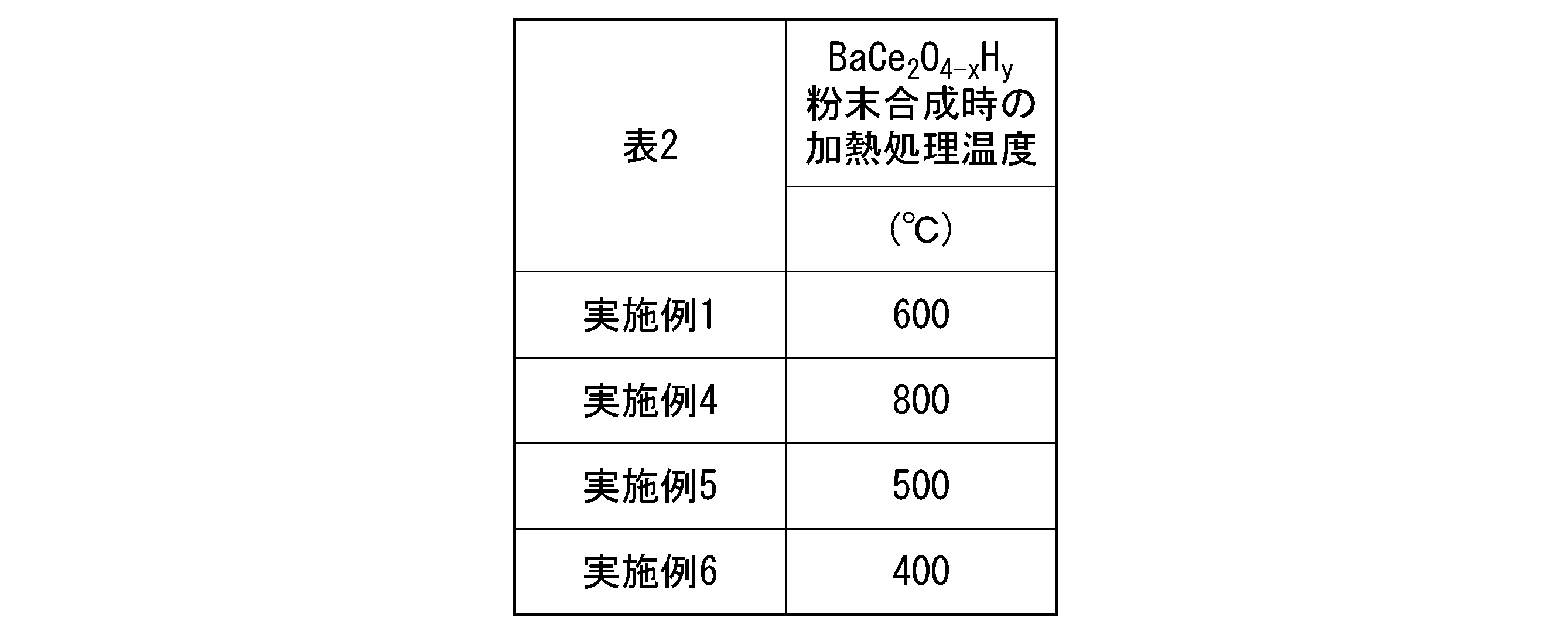
<Ba2SiO4-xHy粉末の合成>
SiO2を600℃で真空加熱処理することにより、表面に吸着している水などを除去した。得られた脱水処理後のSiO2と、BaH2とを、Arグローブボックス中で、SiとBaとのモル比が1:2になるように、メノウ乳鉢を用いて混合した。得られた混合物の粉体をH2気流中で、650℃で20時間加熱処理を行うことにより、黒色の粉末状のBa2SiO4-xHyを得た。
上述した方法を用いて合成した試料のXRDの回折パターンを図7に示す。当該試料では、観察された回折パターンから、Ba2SiO4とほぼ同じ単相の材料が得られることがわかった。また、本手法を用いて合成した試料は、いずれもBa2SiO4と比較して、低角度側にピークがシフトすることがわかった。これは、Si4+よりも低価数のSiが形成され、イオン半径が大きくなったためであると考えられる。
合成したBa2SiO4-xHyを、昇温脱離分析装置(BELCATA)で分析した結果を図8に示す。50℃付近から水素の脱離が観察され、730℃付近で最大値を示し、800℃程度まで水素の脱離が観察された。脱離した水素の量から合成した試料はBa2SiO2.66H2.68と表すことができる(但し、全てのSiの酸化数を4価とする。)。(原料がSiO2であるため、酸素の値は最大2であると考えられる。また、電荷のバランスを考えるとアニオンサイトに電子が存在すると仮定している場合には、Ba2SiO2H2.68e1.32と表すこともできる。この電子が孤立して存在するか、SiやBaの価数を減少させているかは、2つの可能性があると推測する。)
前記の方法で得られた粉末状のBa2SiO4-xHy 0.50gと、Ru3(CO)12(Aldrich社製、99%)0.056g(Ba2SiO4-xHyに対し、担持される金属Ruとして5質量%に相当)とを、シリカガラス管内に挿入し、これを水素+窒素気流中(N2:H2=1:3、 流量:8 ml/min)200℃まで2時間昇温した。その後引き続き400℃まで2時間昇温し、次いで400℃で2時間加熱することにより、Ba2SiO4-xHyにRuを固定した担持物(以下、Ru/Ba2SiO4-xHy)を得た。
次に、以下の実施例において、得られた担持物をアンモニア合成用触媒として用いて、アンモニア合成を行なった。
<アンモニア合成反応>
前記Ru/Ba2SiO4-xHyを触媒とし、この触媒を窒素と水素との混合ガスと接触させることにより、アンモニア合成反応を行った。前記Ru/Ba2SiO4-xHy 0.1gをSUS製反応管に詰め、これを備える固定床流通式反応装置を用いてアンモニア合成反応を行った。原料の窒素ガスの水分濃度と原料の水素ガスの水分濃度とは、それぞれ検出限界以下であった。この反応時の両原料ガスの流量は、窒素が15mL/minであり、水素が45mL/min(計60mL/min)であった。またこの反応時の反応圧力は0.9MPaであり、反応温度は300℃であり、反応時間は30時間であった。
前記固定床流通式反応装置から出てきたガスを0.005M硫酸水溶液中にバブリングさせることにより、前記ガス中のアンモニアを前記硫酸水溶液中に溶解させた後、生じたアンモニウムイオンを、イオンクロマトグラフを用いた前記の方法により定量した。アンモニア合成反応によって生成したアンモニアの生成速度を経時的にイオンクロマトグラフを用いて測定した結果、アンモニア生成速度は10.95mmol/g/hrであった。結果を表3に示した。
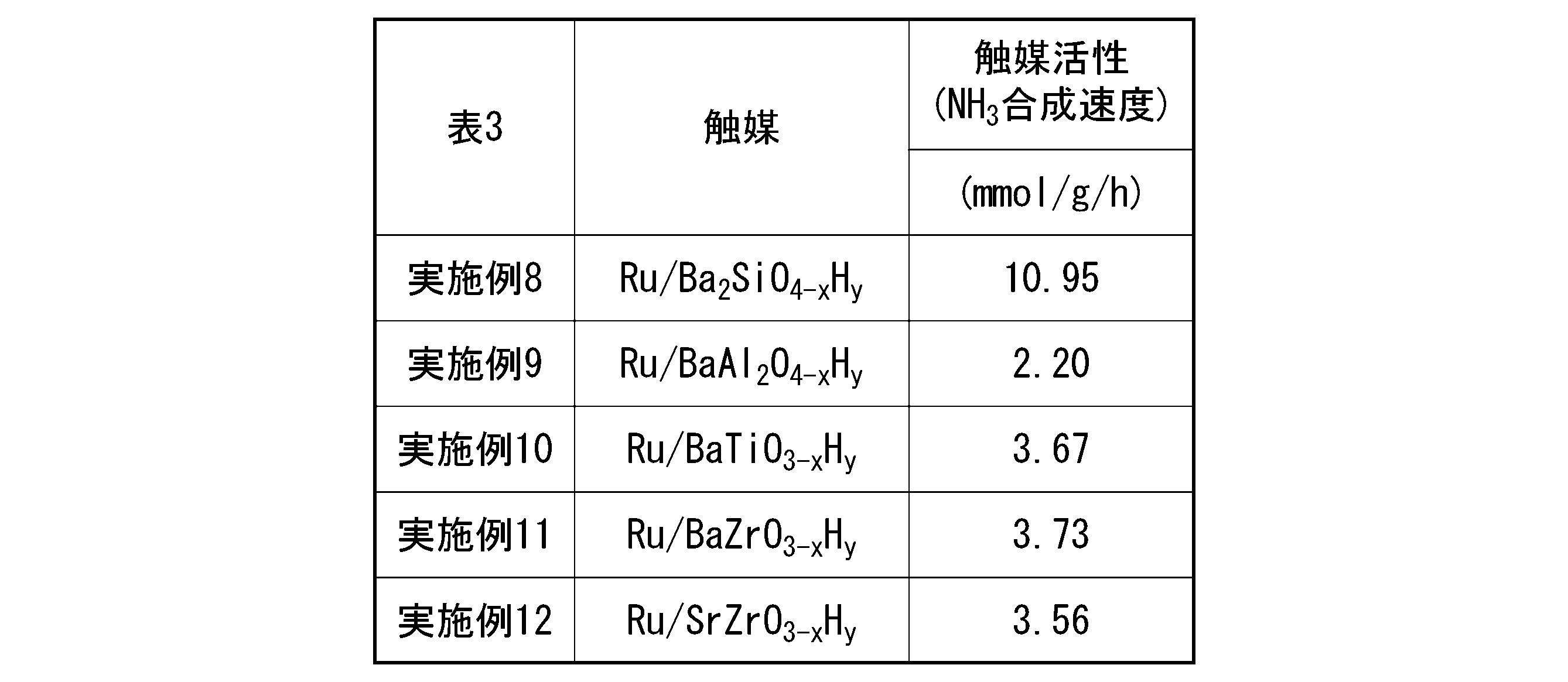
触媒量:0.1g、反応温度:300℃、反応ガス流量:60mL/min、
反応ガス組成:N2/H2=1/3(v/v)、反応圧力:0.9MPa。
<BaAl2O4-xHy粉末の合成>
Al2O3を600℃で真空加熱処理することにより、表面に吸着している水などを除去した。得られた脱水処理後のAl2O3とBaH2とを、Arグローブボックス中で、AlとBaとのモル比が2:1になるように、メノウ乳鉢を用いて混合した。得られた混合物の粉体をH2気流中で、800℃で20時間加熱処理を行うことにより、黒色の粉末状のBaAl2O4-xHyを得た。
上述した方法を用いて合成した試料のXRDの回折パターンを図9に示す。当該試料では、観察された回折パターンから、BaAl2O4とほぼ同じ単相の材料が得られることがわかった。また、本手法を用いて合成した試料は、いずれもBaAl2O4と比較して、低角度側にピークがシフトすることがわかった。これは、Al3+よりも低価数のAlが形成され、イオン半径が大きくなったためであると考えられる。
合成したBaAl2O4-xHyを、昇温脱離分析装置(BELCATA)で分析した結果を図10に示す。50℃付近から水素の脱離が観察され、600℃付近で最大値を示し、1000℃程度まで水素の脱離が観察された。脱離した水素の量から合成した試料はBaAl2O3.89H0.22と表すことができる(但し、全てのAlの酸化数を3価とする。)。(原料がAl2O3であるため、酸素の値は最大3であると考えられる。また、電荷のバランスを考えるとアニオンサイトに電子が存在すると仮定している場合には、BaAl2O3H0.22e1.78と表すこともできる。この電子が孤立して存在するか、AlやBaの価数を減少させているかは、2つの可能性があると推測する。)
前記の方法で得られた粉末状のBaAl2O4-xHy 0.50gと、Ru3(CO)12(Aldrich社製、99%)0.056g(BaAl2O4-xHyに対し、担持される金属Ruとして5質量%に相当)とを、シリカガラス管内に挿入し、これを水素+窒素気流中(N2:H2=1:3、 流量:8 ml/min)200℃まで2時間昇温した。その後引き続き400℃まで2時間昇温し、次いで400℃で2時間加熱することにより、BaAl2O4-xHy にRuを固定した担持物(以下、Ru/BaAl2O4-xHy)を得た。
次に、以下の実施例において、選られた担持物をアンモニア合成用触媒として用いて、アンモニア合成を行なった。
<アンモニア合成反応>
前記Ru/BaAl2O4-xHy を触媒とし、この触媒を窒素と水素との混合ガスと接触させることにより、アンモニア合成反応を行った。前記Ru/BaAl2O4-xHy 0.1gをSUS製反応管に詰め、これを備える固定床流通式反応装置を用いてアンモニア合成反応を行った。原料の窒素ガスの水分濃度と原料の水素ガスの水分濃度とは、それぞれ検出限界以下であった。この反応時の両原料ガスの流量は、窒素が15mL/minであり、水素が45mL/min(計60mL/min)であった。またこの反応時の反応圧力は0.9MPaであり、反応温度は300℃であり、反応時間は30時間であった。
前記固定床流通式反応装置から出てきたガスを0.005M硫酸水溶液中にバブリングさせることにより、前記ガス中のアンモニアを前記硫酸水溶液中に溶解させた後、生じたアンモニウムイオンを、イオンクロマトグラフを用いた前記の方法により定量した。アンモニア合成反応によって生成したアンモニアの生成速度を経時的にイオンクロマトグラフを用いて測定した結果、アンモニア生成速度は2.20mmol/g/hrであった。結果を表3に示した。
<BaTiO3-xHy粉末の合成>
TiO2を600℃で真空加熱処理することにより、表面に吸着している水などを除去した。選られた脱水処理後のTiO2と、BaH2とを、Arグローブボックス中で、TiとBaとのモル比が1:1になるように、メノウ乳鉢を用いて混合した。得られた混合物の粉体をH2気流中で、800℃で20時間加熱処理を行うことにより、黒色の粉末状のBaTiO3-xHyを得た。
上述した方法を用いて合成した試料のXRDの回折パターンを図11に示す。当該試料では、観察された回折パターンから、BaTiO3とほぼ同じ単相の材料が得られることがわかった。また、本手法を用いて合成した試料は、いずれもBaTiO3と比較して、低角度側にピークがシフトすることがわかった。これは、Ti4+よりも低価数のTiが形成され、イオン半径が大きくなったためであると考えられる。
合成したBaTiO3-xHyを、昇温脱離分析装置(BELCATA)で分析した結果を図12に示す。150℃付近から水素の脱離が観察され、500℃付近で最大値を示し、950℃程度まで水素の脱離が観察された。脱離した水素の量から合成した試料はBaTiO2.33H1.33と表すことができる(但し、全てのTiの酸化数を4価とする。)。これは、陰山グループ(非特許文献1~2)が報告している(BaTiO2.5H0.5)よりも高濃度でヒドリドイオンが導入されていることが分かる。(原料がTiO2であるため、酸素の値は最大2であると考えられる。また、電荷のバランスを考えるとアニオンサイトに電子が存在すると仮定している場合には、BaTiO2H1.33e0.67と表すこともできる。この電子が孤立して存在するか、TiやBaの価数を減少させているかは、2つの可能性があると推測する。)
前記の方法で得られた粉末状のBaTiO3-xHy 0.50gと、Ru3(CO)12(Aldrich社製、99%)0.056g(BaTiO3-xHyに対し、担持される金属Ruとして5質量%に相当)とを、シリカガラス管内に挿入し、これを水素+窒素気流中(N2:H2=1:3、 流量:8ml/min)200℃まで2時間昇温した。その後引き続き400℃まで2時間昇温し、次いで400℃で2時間加熱することにより、BaTiO3-xHyにRuを固定した担持物(以下、Ru/BaTiO3-xHy)を得た。
次に、以下の実施例において、選られた担持物をアンモニア合成用触媒として用いて、アンモニア合成を行なった。
<アンモニア合成反応>
前記Ru/BaTiO3-xHy を触媒とし、この触媒を窒素と水素との混合ガスと接触させることにより、アンモニア合成反応を行った。前記Ru/BaTiO3-xHy 0.1gをSUS製反応管に詰め、これを備える固定床流通式反応装置を用いてアンモニア合成反応を行った。原料の窒素ガスの水分濃度と原料の水素ガスの水分濃度とは、それぞれ検出限界以下であった。この反応時の両原料ガスの流量は、窒素が15mL/minであり、水素が45mL/min(計60mL/min)であった。またこの反応時の反応圧力は0.9MPaであり、反応温度は300℃であり、反応時間は30時間であった。
前記固定床流通式反応装置から出てきたガスを0.005M硫酸水溶液中にバブリングさせることにより、前記ガス中のアンモニアを前記硫酸水溶液中に溶解させた後、生じたアンモニウムイオンを、イオンクロマトグラフを用いた前記の方法により定量した。アンモニア合成反応によって生成したアンモニアの生成速度を経時的にイオンクロマトグラフを用いて測定した結果、アンモニア生成速度は3.67mmol/g/hrであった。結果を表3に示した。
<BaZrO3-xHy粉末の合成>
ZrO2を600℃で真空加熱処理することにより、表面に吸着している水などを除去した。得られた脱水処理後のZrO2と、BaH2とを、Arグローブボックス中で、ZrとBaとのモル比が1:1になるように、メノウ乳鉢を用いて混合した。得られた混合物の粉体をH2気流中で、800℃で20時間加熱処理を行うことにより、黒色の粉末状のBaZrO3-xHyを得た。
上述した方法を用いて合成した試料のXRDの回折パターンを図13に示す。当該試料では、観察された回折パターンから、BaZrO3とほぼ同じ単相の材料が得られることがわかった。しかしながら、不純物としてZrH2が形成されることが分かった。また、本手法を用いて合成した試料は、いずれもBaZrO3と比較して、やや高角度側にピークがシフトすることがわかった。この理由はよく分かっていない。
合成したBaZrO3-xHyを、昇温脱離分析装置(BELCATA)で分析した結果を図12に示す。50℃付近から水素の脱離が観察され、600℃付近で最大値を示し、1000℃程度まで水素の脱離が観察された。脱離した水素の量から合成した試料はBaZrO2.19H1.62と表すことができる(但し、全てのZrの酸化数を4価とする。)。(原料がZrO2であるため、酸素の値は最大2であると考えられる。また、電荷のバランスを考えるとアニオンサイトに電子が存在すると仮定している場合には、BaZrO2H1.62e0.38と表すこともできる。この電子が孤立して存在するか、ZrやBaの価数を減少させているかは、2つの可能性があると推測する。)
前記の方法で得られた粉末状のBaZrO3-xHy 0.50gと、Ru3(CO)12(Aldrich社製、99%)0.056g(BaZrO3-xHyに対し、担持される金属Ruとして5質量%に相当)とを、シリカガラス管内に挿入し、これを水素+窒素気流中(N2:H2=1:3、流量:8ml/min)200℃まで2時間昇温した。その後引き続き400℃まで2時間昇温し、次いで400℃で2時間加熱することにより、BaZrO3-xHy にRuを固定した担持物(以下、Ru/BaZrO3-xHy)を得た。
次に、以下の実施例において、得られた担持物をアンモニア合成用触媒として用いて、アンモニア合成を行なった。
<アンモニア合成反応>
前記Ru/BaZrO3-xHyを触媒とし、この触媒を窒素と水素との混合ガスと接触させることにより、アンモニア合成反応を行った。前記Ru/BaZrO3-xHy 0.1gをSUS製反応管に詰め、これを備える固定床流通式反応装置を用いてアンモニア合成反応を行った。原料の窒素ガスの水分濃度と原料の水素ガスの水分濃度とは、それぞれ検出限界以下であった。この反応時の両原料ガスの流量は、窒素が15mL/minであり、水素が45mL/min(計60mL/min)であった。またこの反応時の反応圧力は0.9MPaであり、反応温度は300℃であり、反応時間は30時間であった。
前記固定床流通式反応装置から出てきたガスを0.005M硫酸水溶液中にバブリングさせることにより、前記ガス中のアンモニアを前記硫酸水溶液中に溶解させた後、生じたアンモニウムイオンを、イオンクロマトグラフを用いた前記の方法により定量した。アンモニア合成反応によって生成したアンモニアの生成速度を経時的にイオンクロマトグラフを用いて測定した結果、アンモニア生成速度は3.73mmol/g/hrであった。結果を表3に示した。
<SrZrO3-xHy粉末の合成>
ZrO2を600℃で真空加熱処理することにより、表面に吸着している水などを除去した。得られた脱水処理後のZrO2と、SrH2とを、Arグローブボックス中で、ZrとSrとのモル比が1:1になるように、メノウ乳鉢を用いて混合した。得られた混合物の粉体をH2気流中で、800℃で20時間加熱処理を行うことにより、黒色の粉末状のSrZrO3-xHyを得た。
上述した方法を用いて合成した試料のXRDの回折パターンを図15に示す。当該試料では、観察された回折パターンから、SrZrO3とほぼ同じ単相の材料が得られることがわかった。しかしながら、不純物としてZrH2が形成されることが分かった。また、本手法を用いて合成した試料は、いずれもSrZrO3と比較して、やや高角度側にピークがシフトすることがわかった。この理由はよく分かっていない。
合成したBaZrO3-xHyを、昇温脱離分析装置(BELCATA)で分析した結果を図16(データ取得中)に示す。50℃付近から水素の脱離が観察され、700~800℃付近で最大値を示し、1000℃程度まで水素の脱離が観察された。脱離した水素の量から合成した試料はSrZrO2.07H1.86と表すことができる(但し、全てのZrの酸化数を4価とする。)。(原料がZrO2であるため、酸素の値は最大2であると考えられる。また、電荷のバランスを考えるとアニオンサイトに電子が存在すると仮定している場合には、SrZrO2H1.86e0.13と表すこともできる。この電子が孤立して存在するか、ZrやBaの価数を減少させているかは、2つの可能性があると推測する。)
前記の方法で得られた粉末状のSrZrO3-xHy 0.50gと、Ru3(CO)12(Aldrich社製、99%)0.056g(SrZrO3-xHyに対し、担持される金属Ruとして5質量%に相当)とを、シリカガラス管内に挿入し、これを水素+窒素気流中(N2:H2=1:3、流量:8ml/min)200℃まで2時間昇温した。その後引き続き400℃まで2時間昇温し、次いで400℃で2時間加熱することにより、SrZrO3-xHyにRuを固定した担持物(以下、Ru/BaZrO3-xHy)を得た。
次に、以下の実施例において、得られた担持物をアンモニア合成用触媒として用いて、アンモニア合成を行なった。
<アンモニア合成反応>
前記Ru/SrZrO3-xHyを触媒とし、この触媒を窒素と水素との混合ガスと接触させることにより、アンモニア合成反応を行った。前記Ru/SrZrO3-xHy 0.1gをSUS製反応管に詰め、これを備える固定床流通式反応装置を用いてアンモニア合成反応を行った。原料の窒素ガスの水分濃度と原料の水素ガスの水分濃度とは、それぞれ検出限界以下であった。この反応時の両原料ガスの流量は、窒素が15mL/minであり、水素が45mL/min(計60mL/min)であった。またこの反応時の反応圧力は0.9MPaであり、反応温度は300℃であり、反応時間は30時間であった。
前記固定床流通式反応装置から出てきたガスを0.005M硫酸水溶液中にバブリングさせることにより、前記ガス中のアンモニアを前記硫酸水溶液中に溶解させた後、生じたアンモニウムイオンを、イオンクロマトグラフを用いた前記の方法により定量した。アンモニア合成反応によって生成したアンモニアの生成速度を経時的にイオンクロマトグラフを用いて測定した結果、アンモニア生成速度は3.56mmol/g/hrであった。結果を表3に示した。
Claims (17)
- 酸化物と金属水素化物とを水素雰囲気下で反応させて金属酸水素化物を製造する方法であって、
前記酸化物に構成する非酸素元素が、1種類の非酸素元素のみからなり、
前記反応の圧力条件が0.1~0.9MPaであり、
前記反応の温度が、500~1000℃である
ことを特徴とする製造方法。 - 前記金属酸水素化物が
前記金属水素化物に構成する金属元素と、
前記酸化物に構成する前記非酸素元素と、
酸素と、
水素と、
を含み、
前記金属元素と前記非酸素元素とは異なる元素である請求項1に記載の製造方法。 - 前記酸化物と前記金属水素化物とを混合して混合物を得る混合工程と、
前記混合物を水素雰囲気で、0.1~0.9MPaの圧力と500~1000℃の温度で加熱する加熱工程と、
を有する請求項1又は2に記載の製造方法。 - 前記混合工程の前に、前記酸化物を脱水処理する前処理工程をさらに含む請求項3に記載の製造方法。
- 前記酸化物が、MmOn(Mが非酸素元素であり、mが1又は2であり;nが2又は3で表わされる数を表す)であり、MmOnはSc2O3、Y2O3、LnO2、ZrO2、TiO2、SiO2及びAl2O3からなる群から選択される1種であり、
前記金属水素化物が、AeH2(Ae:Mg、Ca、Ba、Srからなる群から選択される1種のアルカリ土類金属)であり、
前記金属酸水素化物が、下記一般式(1)で表わされる金属酸水素化物である
請求項1~4のいずれか1項に記載の製造方法。
AerMpOq-xHy (1)
(前記一般式(1)において、AeがMg、Ca、Ba、及びSrからなる群から選択される少なくとも1種のアルカリ土類金属であり;MがSc、Y、Ln、Zr、Ti、Si、及びAlからなる群から選択される1種の非酸素元素であり;rが1又は2であり;pが1又は2であり;qが3又は4であり;xが、0.1≦x≦3.0で表わされる数を表し;yが、0.2≦y≦3.0で表わされる数を表す。) - 前記金属水素化物が、BaH2であり、
前記一般式(1)において、AeがBaである請求項5に記載の製造方法。 - 前記酸化物と前記金属水素化物との仕込みモル比が、p:0.5r ~ p:2.5rである請求項5又は6に記載の製造方法。
- 下記一般式(1)で表わされる金属酸水素化物。
AerMpOq-xHy (1)
(前記一般式(1)において、AeがMg、Ca、Ba、及びSrからなる群から選択される少なくとも1種のアルカリ土類金属であり;MがSc、Y、Ln、Zr、Ti、Si、及びAlからなる群から選択される1種の非酸素元素であり;rが1又は2であり;pが1又は2であり;qが3又は4であり;xが、0.1≦x≦3.0で表わされる数を表し;yが、0.2≦y≦3.0で表わされる数を表す。) - 前記一般式(1)において、AeがBaである請求項8に記載の金属酸水素化物。
- 下記一般式(2)~(6)の何れか1つで表わされる請求項8又は9に記載の金属酸水素化物。
AeLn2O4-xHy (2)
Ae2SiO4-xHy (3)
AeAl2O4-xHy (4)
AeTiO3-xHy (5)
AeZrO3-xHy (6)
(前記一般式(2)~(6)において、Ae、x、yが前記一般式(1)におけるAe、x、yと同じものを示す。) - 担体に遷移金属を担持した金属担持物であって、
前記担体が、請求項8~10のいずれか1項に記載の金属酸水素化物を含む組成物である
ことを特徴とする金属担持物。 - 前記遷移金属の担持量が、前記担体100質量部に対して0.01質量部以上、50質量部以下である請求項11に記載の金属担持物。
- 前記遷移金属が、Ru、CoおよびFeからなる群から選ばれる少なくとも一種である請求項11又は12に記載の金属担持物。
- 請求項11~13のいずれか1項に記載の金属担持物からなる担持金属触媒。
- 請求項11~13のいずれか1項に記載の金属担持物からなるアンモニア合成用触媒。
- 請求項8~10のいずれか1項に記載の金属酸水素化物を含む組成物である
ことを特徴とするアンモニア合成用触媒。 - 請求項14に記載の担持金属触媒の存在下、窒素と水素とを反応させることを特徴とするアンモニア合成方法。
Priority Applications (3)
| Application Number | Priority Date | Filing Date | Title |
|---|---|---|---|
| JP2021530639A JP7285024B2 (ja) | 2019-07-08 | 2020-07-01 | 金属酸水素化物の製造方法、金属酸水素化物、及びそれを用いたアンモニア合成方法 |
| CN202080043703.6A CN113993818B (zh) | 2019-07-08 | 2020-07-01 | 金属氧氢化物的制造方法、金属氧氢化物、及使用其的氨合成方法 |
| US17/597,101 US12343704B2 (en) | 2019-07-08 | 2020-07-01 | Method of producing metal oxyhydride, metal oxyhydride, and method of synthesizing ammonia using same |
Applications Claiming Priority (2)
| Application Number | Priority Date | Filing Date | Title |
|---|---|---|---|
| JP2019127224 | 2019-07-08 | ||
| JP2019-127224 | 2019-07-08 |
Publications (1)
| Publication Number | Publication Date |
|---|---|
| WO2021006136A1 true WO2021006136A1 (ja) | 2021-01-14 |
Family
ID=74114590
Family Applications (1)
| Application Number | Title | Priority Date | Filing Date |
|---|---|---|---|
| PCT/JP2020/025765 Ceased WO2021006136A1 (ja) | 2019-07-08 | 2020-07-01 | 金属酸水素化物の製造方法、金属酸水素化物、及びそれを用いたアンモニア合成方法 |
Country Status (4)
| Country | Link |
|---|---|
| US (1) | US12343704B2 (ja) |
| JP (1) | JP7285024B2 (ja) |
| CN (1) | CN113993818B (ja) |
| WO (1) | WO2021006136A1 (ja) |
Cited By (8)
| Publication number | Priority date | Publication date | Assignee | Title |
|---|---|---|---|---|
| WO2021172107A1 (ja) * | 2020-02-26 | 2021-09-02 | 国立研究開発法人科学技術振興機構 | 典型元素酸化物を含む金属担持物、アンモニア合成用触媒、及びアンモニアの合成方法 |
| JP2023088762A (ja) * | 2021-12-15 | 2023-06-27 | 株式会社豊田中央研究所 | アンモニア合成触媒用担体の製造方法及びアンモニア合成触媒の製造方法 |
| JP2023128076A (ja) * | 2022-03-02 | 2023-09-14 | 大学共同利用機関法人自然科学研究機構 | ヒドリドイオン導電体及びその製造方法並びに全固体電池 |
| JP2023146955A (ja) * | 2022-03-29 | 2023-10-12 | 本田技研工業株式会社 | 二酸化炭素還元触媒、メタノール生成装置、一酸化炭素及びギ酸生成装置、二酸化炭素処理装置、並びに二酸化炭素還元方法 |
| WO2024204654A1 (ja) | 2023-03-30 | 2024-10-03 | 日本碍子株式会社 | 反応器、金属窒化物触媒の製造方法及びアンモニアの合成方法 |
| WO2024247448A1 (ja) * | 2023-05-26 | 2024-12-05 | 国立研究開発法人科学技術振興機構 | 触媒組成物、アンモニア合成方法、アンモニア分解方法およびペロブスカイト型酸水素化物の製造方法 |
| JP2025114784A (ja) * | 2025-05-13 | 2025-08-05 | ニューヨークゼネラルグループインク | アニオン欠陥を有するバリウム-ケイ素オルトシリケート系オキシニトリド-ハイドライドの構造制御による高機能触媒及びその多元的応用方法 |
| WO2025244126A1 (ja) * | 2024-05-24 | 2025-11-27 | つばめBhb株式会社 | 触媒組成物、アンモニア合成触媒及びアンモニア合成方法 |
Families Citing this family (4)
| Publication number | Priority date | Publication date | Assignee | Title |
|---|---|---|---|---|
| CN114653363A (zh) * | 2022-03-23 | 2022-06-24 | 雷振东 | 一种合成氨催化剂的制备方法及应用 |
| CN115869936B (zh) * | 2022-11-17 | 2024-08-13 | 安徽元琛环保科技股份有限公司 | 一种宽温铈基脱硝催化剂的制备方法及用其制备的催化剂 |
| CN116273023A (zh) * | 2023-03-31 | 2023-06-23 | 上海大学 | 一种铁基氧氢化钇催化剂及其制备方法和其在合成氨方面的应用 |
| CN120790242B (zh) * | 2025-08-29 | 2026-05-26 | 天祥安氢(上海)科技有限公司 | 一种用于合成氨的钌基催化剂及其制备方法与应用 |
Citations (2)
| Publication number | Priority date | Publication date | Assignee | Title |
|---|---|---|---|---|
| WO2015136954A1 (ja) * | 2014-03-13 | 2015-09-17 | 国立研究開発法人科学技術振興機構 | アンモニア合成触媒及びアンモニア合成方法 |
| JP2017098067A (ja) * | 2015-11-24 | 2017-06-01 | 国立大学法人東京工業大学 | ヒドリドイオン導電体およびその製造方法 |
Family Cites Families (3)
| Publication number | Priority date | Publication date | Assignee | Title |
|---|---|---|---|---|
| CH704017B1 (fr) | 2010-10-16 | 2013-09-30 | France Services Environnement Sarl | Procédé de préparation d'un oxyhydrure contenant au moins une terre rare et son utilisation pour catalyser une oxydation partielle d'un alcane. |
| US9440228B2 (en) * | 2011-07-08 | 2016-09-13 | Japan Science And Technology Agency | Perovskite oxide containing hydride ion, and method for manufacturing same |
| GB201309173D0 (en) | 2013-05-21 | 2013-07-03 | Roberts Mark P | Novel process and product |
-
2020
- 2020-07-01 CN CN202080043703.6A patent/CN113993818B/zh active Active
- 2020-07-01 WO PCT/JP2020/025765 patent/WO2021006136A1/ja not_active Ceased
- 2020-07-01 JP JP2021530639A patent/JP7285024B2/ja active Active
- 2020-07-01 US US17/597,101 patent/US12343704B2/en active Active
Patent Citations (2)
| Publication number | Priority date | Publication date | Assignee | Title |
|---|---|---|---|---|
| WO2015136954A1 (ja) * | 2014-03-13 | 2015-09-17 | 国立研究開発法人科学技術振興機構 | アンモニア合成触媒及びアンモニア合成方法 |
| JP2017098067A (ja) * | 2015-11-24 | 2017-06-01 | 国立大学法人東京工業大学 | ヒドリドイオン導電体およびその製造方法 |
Cited By (12)
| Publication number | Priority date | Publication date | Assignee | Title |
|---|---|---|---|---|
| WO2021172107A1 (ja) * | 2020-02-26 | 2021-09-02 | 国立研究開発法人科学技術振興機構 | 典型元素酸化物を含む金属担持物、アンモニア合成用触媒、及びアンモニアの合成方法 |
| JP2023088762A (ja) * | 2021-12-15 | 2023-06-27 | 株式会社豊田中央研究所 | アンモニア合成触媒用担体の製造方法及びアンモニア合成触媒の製造方法 |
| JP7884752B2 (ja) | 2021-12-15 | 2026-07-06 | 株式会社豊田中央研究所 | アンモニア合成触媒用担体の製造方法及びアンモニア合成触媒の製造方法 |
| JP2023128076A (ja) * | 2022-03-02 | 2023-09-14 | 大学共同利用機関法人自然科学研究機構 | ヒドリドイオン導電体及びその製造方法並びに全固体電池 |
| JP7803524B2 (ja) | 2022-03-02 | 2026-01-21 | 大学共同利用機関法人自然科学研究機構 | ヒドリドイオン導電体及びその製造方法並びに全固体電池 |
| JP2023146955A (ja) * | 2022-03-29 | 2023-10-12 | 本田技研工業株式会社 | 二酸化炭素還元触媒、メタノール生成装置、一酸化炭素及びギ酸生成装置、二酸化炭素処理装置、並びに二酸化炭素還元方法 |
| JP7708702B2 (ja) | 2022-03-29 | 2025-07-15 | 本田技研工業株式会社 | 二酸化炭素還元触媒、メタノール生成装置、一酸化炭素及びギ酸生成装置、二酸化炭素処理装置、並びに二酸化炭素還元方法 |
| WO2024204654A1 (ja) | 2023-03-30 | 2024-10-03 | 日本碍子株式会社 | 反応器、金属窒化物触媒の製造方法及びアンモニアの合成方法 |
| EP4691635A1 (en) | 2023-03-30 | 2026-02-11 | NGK Insulators, Ltd. | Reactor, method for producing metal nitride catalyst, and method for synthesizing ammonia |
| WO2024247448A1 (ja) * | 2023-05-26 | 2024-12-05 | 国立研究開発法人科学技術振興機構 | 触媒組成物、アンモニア合成方法、アンモニア分解方法およびペロブスカイト型酸水素化物の製造方法 |
| WO2025244126A1 (ja) * | 2024-05-24 | 2025-11-27 | つばめBhb株式会社 | 触媒組成物、アンモニア合成触媒及びアンモニア合成方法 |
| JP2025114784A (ja) * | 2025-05-13 | 2025-08-05 | ニューヨークゼネラルグループインク | アニオン欠陥を有するバリウム-ケイ素オルトシリケート系オキシニトリド-ハイドライドの構造制御による高機能触媒及びその多元的応用方法 |
Also Published As
| Publication number | Publication date |
|---|---|
| US20220241754A1 (en) | 2022-08-04 |
| JPWO2021006136A1 (ja) | 2021-01-14 |
| CN113993818A (zh) | 2022-01-28 |
| JP7285024B2 (ja) | 2023-06-01 |
| CN113993818B (zh) | 2024-04-30 |
| US12343704B2 (en) | 2025-07-01 |
Similar Documents
| Publication | Publication Date | Title |
|---|---|---|
| JP7285024B2 (ja) | 金属酸水素化物の製造方法、金属酸水素化物、及びそれを用いたアンモニア合成方法 | |
| JP6890788B2 (ja) | 遷移金属担持金属間化合物、担持金属触媒、及びアンモニアの製造方法 | |
| JP6802544B2 (ja) | 金属担持物、担持金属触媒及び該触媒を用いるアンモニア合成法 | |
| JP6675619B2 (ja) | アンモニア合成用触媒の製造方法及びアンモニアの製造方法 | |
| JP7418849B2 (ja) | 酸窒素水素化物、酸窒素水素化物を含む金属担持物、及びアンモニア合成用触媒 | |
| CN111183115A (zh) | 复合氧化物、金属担载物以及氨合成催化剂 | |
| JP7023457B2 (ja) | アンモニア合成用触媒及び該触媒を用いるアンモニア合成法 | |
| JP7090253B2 (ja) | 金属間化合物、水素吸放出材料、触媒及びアンモニアの製造方法 | |
| JP6737455B2 (ja) | ラーベス相金属間化合物、金属間化合物を用いた触媒、及びアンモニア製造方法 | |
| US12350654B2 (en) | Oxynitride-hydride, metal-supported material containing oxynitride-hydride, and ammonia synthesis catalyst | |
| WO2021172107A1 (ja) | 典型元素酸化物を含む金属担持物、アンモニア合成用触媒、及びアンモニアの合成方法 | |
| US20220126276A1 (en) | Catalyst for ammonia synthesis and method for synthesizing ammonia using the same | |
| WO2025244126A1 (ja) | 触媒組成物、アンモニア合成触媒及びアンモニア合成方法 | |
| CN121240929A (zh) | 催化剂组合物、氨合成方法、氨分解方法及钙钛矿型氧氢化物的制造方法 |
Legal Events
| Date | Code | Title | Description |
|---|---|---|---|
| 121 | Ep: the epo has been informed by wipo that ep was designated in this application |
Ref document number: 20836635 Country of ref document: EP Kind code of ref document: A1 |
|
| ENP | Entry into the national phase |
Ref document number: 2021530639 Country of ref document: JP Kind code of ref document: A |
|
| 122 | Ep: pct application non-entry in european phase |
Ref document number: 20836635 Country of ref document: EP Kind code of ref document: A1 |
|
| WWG | Wipo information: grant in national office |
Ref document number: 17597101 Country of ref document: US |