WO2021002356A1 - 放射線画像判定装置、検査システム及びプログラム - Google Patents
放射線画像判定装置、検査システム及びプログラム Download PDFInfo
- Publication number
- WO2021002356A1 WO2021002356A1 PCT/JP2020/025661 JP2020025661W WO2021002356A1 WO 2021002356 A1 WO2021002356 A1 WO 2021002356A1 JP 2020025661 W JP2020025661 W JP 2020025661W WO 2021002356 A1 WO2021002356 A1 WO 2021002356A1
- Authority
- WO
- WIPO (PCT)
- Prior art keywords
- image
- data
- unit
- inspection
- radiographic
- Prior art date
- Legal status (The legal status is an assumption and is not a legal conclusion. Google has not performed a legal analysis and makes no representation as to the accuracy of the status listed.)
- Ceased
Links
Images



Classifications
-
- A—HUMAN NECESSITIES
- A61—MEDICAL OR VETERINARY SCIENCE; HYGIENE
- A61B—DIAGNOSIS; SURGERY; IDENTIFICATION
- A61B6/00—Apparatus or devices for radiation diagnosis; Apparatus or devices for radiation diagnosis combined with radiation therapy equipment
-
- G—PHYSICS
- G01—MEASURING; TESTING
- G01N—INVESTIGATING OR ANALYSING MATERIALS BY DETERMINING THEIR CHEMICAL OR PHYSICAL PROPERTIES
- G01N23/00—Investigating or analysing materials by the use of wave or particle radiation, e.g. X-rays or neutrons, not covered by groups G01N3/00 – G01N17/00, G01N21/00 or G01N22/00
- G01N23/02—Investigating or analysing materials by the use of wave or particle radiation, e.g. X-rays or neutrons, not covered by groups G01N3/00 – G01N17/00, G01N21/00 or G01N22/00 by transmitting the radiation through the material
- G01N23/04—Investigating or analysing materials by the use of wave or particle radiation, e.g. X-rays or neutrons, not covered by groups G01N3/00 – G01N17/00, G01N21/00 or G01N22/00 by transmitting the radiation through the material and forming images of the material
- G01N23/041—Phase-contrast imaging, e.g. using grating interferometers
-
- G—PHYSICS
- G01—MEASURING; TESTING
- G01N—INVESTIGATING OR ANALYSING MATERIALS BY DETERMINING THEIR CHEMICAL OR PHYSICAL PROPERTIES
- G01N23/00—Investigating or analysing materials by the use of wave or particle radiation, e.g. X-rays or neutrons, not covered by groups G01N3/00 – G01N17/00, G01N21/00 or G01N22/00
- G01N23/02—Investigating or analysing materials by the use of wave or particle radiation, e.g. X-rays or neutrons, not covered by groups G01N3/00 – G01N17/00, G01N21/00 or G01N22/00 by transmitting the radiation through the material
- G01N23/06—Investigating or analysing materials by the use of wave or particle radiation, e.g. X-rays or neutrons, not covered by groups G01N3/00 – G01N17/00, G01N21/00 or G01N22/00 by transmitting the radiation through the material and measuring the absorption
- G01N23/18—Investigating the presence of flaws defects or foreign matter
-
- G—PHYSICS
- G06—COMPUTING OR CALCULATING; COUNTING
- G06T—IMAGE DATA PROCESSING OR GENERATION, IN GENERAL
- G06T7/00—Image analysis
Definitions
- the present invention relates to a radiographic image determination device, an inspection system and a program.
- Patent Document 1 In the X-ray imaging apparatus using the Talbot effect (Patent Document 1), an absorption image, a small-angle scattered image, and a differential phase image are each acquired with good contrast. There is a technique that enables detection and identification of an object that was difficult to identify only by a conventional absorption image by comparing two or three types of images (Patent Document 2).
- An object of the present invention is to provide a radiographic image determination device, an inspection system, and a program capable of more easily and surely perform an inspection in which a plurality of captured images are integrated.
- the invention according to claim 1 is An acquisition unit that acquires multiple types of radiographic images related to the object to be imaged, and A determination unit having a learned model that outputs characteristic information of the object in response to input of the plurality of types of radiographic images, and a determination unit.
- the determination unit A generator that convolves each of the plurality of types of radiographic images to generate a feature map of a predetermined size, respectively.
- An integration unit that generates integrated data that integrates the contents of multiple feature maps, A determination processing unit that outputs the characteristic information based on the integrated data, It is a radiation image determination device having.
- the invention according to claim 2 is the radiation image determination apparatus according to claim 1.
- the integration unit one-dimensionally arranges each pixel value of the plurality of feature maps to generate integrated data.
- the invention according to claim 3 is the radiation image determination apparatus according to claim 1.
- the integrated part Each pixel value of the plurality of feature maps is one-dimensionally arranged. Two-dimensional data in which the positions of the one-dimensional array are associated with each other according to the pixel positions in the feature map and arranged in two dimensions is generated. The integrated data is generated by unidimensionally arranging the pixel values of the feature map obtained by performing the convolution process on the two-dimensional data.
- the invention according to claim 4 is the radiation image determination apparatus according to claim 1.
- the integrated part A three-dimensional data is generated by superimposing the plurality of feature maps in a direction perpendicular to the two-dimensional plane of the feature map.
- the three-dimensional data is convolved and converted into a two-dimensional feature map in the two-dimensional plane.
- the integrated data is generated by arranging each pixel value of the converted two-dimensional feature map in one dimension.
- the invention according to claim 5 is the radiation image determination apparatus according to claim 3.
- the determination processing unit reduces the number of dimensions of the two-dimensional data by VAE, and outputs the characteristic information based on the latent variable obtained by reducing the number of dimensions.
- the invention according to claim 6 is the radiation image determination apparatus according to claim 5.
- the VAE was learned by using the plurality of types of radiographic image data when there is no abnormality in the object.
- the determination processing unit restores the radiographic image input based on the latent variable, and obtains the characteristic information based on the difference between the restored image and the radiographic image.
- the invention according to claim 7 is the radiation image determining apparatus according to any one of claims 1 to 6.
- the acquisition unit acquires the plurality of types of radiographic images for each of the plurality of states of the object.
- the generation unit generates the feature map for each of the plurality of types of radiographic images in the plurality of states.
- the integrated unit generates the integrated data based on the plurality of feature maps.
- the invention according to claim 8 is the radiation image determination apparatus according to any one of claims 1 to 7.
- the radiographic image includes two or more of an absorption image, a small-angle scattered image and a differential phase image obtained by a Talbot-type X-ray imaging apparatus, and an image obtained by an operation based on these.
- the invention according to claim 9 is the radiation image determination apparatus according to any one of claims 1 to 8.
- the characteristic information includes at least of voids, cracks, gaps in the object, welds, peeling, foreign substances, abnormal precipitation and aggregation of specific components due to resin flow, and local abnormalities in the orientation or dispersion of microstructures. Either is included.
- the invention according to claim 10 is the radiation image determining apparatus according to any one of claims 1 to 9.
- An area setting unit for setting an area in which the characteristic information output by the determination unit satisfies a predetermined reference condition is provided.
- the invention according to claim 11 is the radiation image determination apparatus according to claim 10.
- the reference condition is a condition relating to the necessity of inspection by a predetermined inspection device.
- the invention according to claim 12 The radiographic image determination device according to any one of claims 1 to 11.
- the inspection device is an inspection system including an inspection setting unit that sets an area required for inspection by the own machine based on the characteristic information output by the determination unit.
- the invention according to claim 13
- Computer Acquisition means for acquiring multiple types of radiographic images related to the object to be imaged
- a determination means having a learned model that outputs characteristic information of the object in response to input of the plurality of types of radiographic images.
- a generation means for generating a feature map of a predetermined size by convolving each of the plurality of types of radiographic images.
- An integration means for generating integrated data that integrates the contents of a plurality of the feature maps, and A determination processing means that outputs the characteristic information based on the integrated data, and It is a program that has.
- FIG. 1 is a diagram showing a configuration of an inspection system 100 including a processing device 1 which is an embodiment of a radiation image determination device.
- the inspection system 100 includes a processing device 1, a radiography apparatus 50, and an inspection device 60.
- the processing device 1 is, for example, a normal computer (PC), and includes a control unit 11, a storage unit 12, a communication unit 13, an operation reception unit 14, a display unit 15, and the like.
- PC normal computer
- the control unit 11 is a processor that includes a CPU (Central Processing Unit), a RAM (Random Access Memory), and the like, performs various arithmetic processes, and controls the operation of the processing device 1 in an integrated manner.
- a CPU Central Processing Unit
- RAM Random Access Memory
- the storage unit 12 includes a non-volatile memory such as a flash memory and / or an HDD (Hard Disc Drive) and the like, and stores a program 121 for various control processes and setting data.
- the storage unit 12 may store the input image data, its processing data, and the like.
- the storage unit 12 may include a volatile memory, and data or the like being processed may be stored in the volatile memory.
- the data storage area being processed may be appropriately divided from the RAM of the control unit 11.
- the program 121 includes a program related to the determination device learning process described later and a program related to the abnormality inspection process.
- the setting data includes data of the trained model 122 for image determination and the like.
- the communication unit 13 controls communication with an external device in accordance with a predetermined communication standard, for example, TCP / IP.
- the communication unit 13 includes, for example, a network card or the like.
- the external device may include various inspection devices (including a radiography imaging device 50) in the inspection system 100, a management server for imaging data and its analysis and inspection results, and the like.
- the operation reception unit 14 receives an input operation from the outside such as a user and outputs it to the control unit 11 as an input signal.
- Examples of the operation receiving unit 14 include a pointing device such as a mouse and a touch panel, and / or a keyboard.
- the display unit 15 displays the menu, status, data before and after processing, the result of image processing, and the like on the display screen based on the control of the control unit 11.
- Examples of the display screen include a liquid crystal display screen.
- the radiography apparatus 50 is an X-ray radiographing apparatus (Talbot type radiographing apparatus) using the Talbot effect (Talbot low interference).
- the inspection device 60 is a device that performs other predetermined inspections, and includes a control unit 61 (inspection setting unit).
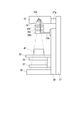
- FIG. 2 is a schematic view showing the overall configuration of the radiography apparatus 50.
- the radiography apparatus 50 includes an X-ray generator 51, a radiation source grid 52 (0th grid), a subject stand 53, a first grid 54, a second grid 55, an X-ray detector 56, and a support column 57. And a base portion 58.
- the X-ray generator 51 is attached to the support column 57 by a support portion 57a, and has a radiation source 51a.
- the X-rays emitted from the radiation source 51a are emitted downward in FIG.
- the radiation source 51a itself is not attached to the X-ray generator 51, but may be attached to the base portion 58 attached to the support column 57 by the support portion 52a.
- the radiation source grid 52 is attached to the base portion 58 by a support portion 52a, and is located in the immediate vicinity of the radiation source 51a in the X-ray emission direction from the radiation source 51a.
- the source grid 52 divides the emitted X-rays into a plurality of lines having a minute width and irradiates the subject H, which is an object to be imaged.
- a filtration filter 591, an irradiation field aperture 592, an irradiation field lamp 593, and the like are all attached to the support portion 52a between the radiation source grid 52 and the subject H, and are provided at appropriate positions with respect to the radiation source 51a. You may be.
- the filtration filter 591 is used for converting the quality of X-rays that have passed through the source grid 52.
- the irradiation field aperture 592 adjusts the X-ray irradiation range according to the size of the subject H and the like.
- the irradiation field lamp 593 irradiates visible light according to the irradiation range of X-rays. This visible light is used for positioning the subject H and the like.
- the subject H is placed on the subject stand 53.
- the subject base 53 is attached to the base portion 58.
- the subject stand 53 does not affect the X-rays when they are transmitted.
- the first grid 54 is incident with emitted X-rays to generate a Talbot effect.
- the second grid 55 is positioned so as to overlap the image diffracted by the first grid 54 to generate a moire image.
- the subject H is located on the upper surface side of the first grid 54 or between the first grid 54 and the second grid 55, the image formed by the first grid is deformed.
- the moire image is imaged (imaging) by incident on the X-ray detector 56.
- a differential phase image and a small-angle scattered image are acquired.
- the method for reconstructing and acquiring these a plurality of types of images is not particularly limited, but for example, a fringe scanning method or the like may be used.
- the fringe scanning method one of a plurality of lattices has a slit period of 1 / M (M is a positive integer, absorption image is M> 2, differential phase image and small angle scattered image is M> 3).
- Reconstruction is performed using the moire image taken M times by moving in the direction to obtain a high-definition reconstructed image. Further, it may be possible to output an image (composite image) that has been further calculated by combining the obtained images.
- the radiography apparatus 50 is used here for non-destructive inspection of the internal structure of an object and the like.
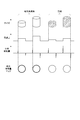
- FIG. 3 is a diagram illustrating detection of a light element foreign substance in the subject H (object). If voids (including cracks) or mixed foreign substances, especially light elements that are lighter than a predetermined material and absorb less X-rays, are mixed inside the member, the absorption in these parts is reduced and permeated. The amount increases and the brightness of the absorbed image increases. The degree of increase in brightness depends on whether the voids or foreign matter are used, and the larger the size of these voids or foreign matter, the greater the degree of increase. That is, for example, when the presence of a foreign substance is a detection target, it is difficult to distinguish the foreign substance from the void only by the absorption image.
- a small-sized (microscale, etc.) structure here, scattering of X-rays with a small angle generated at the boundary between these voids and foreign matter is detected.
- the magnitude of scattering differs depending on whether it is a void or a foreign matter, and the larger the void or the foreign matter, the larger the scattering. That is, for example, when the presence of a foreign substance is a detection target, it is difficult to distinguish the foreign substance from the void only by the small-angle scattered image.
- the rate of change differs between the foreign matter and the void in the absorbed image and the small-angle scattered image, it is possible to distinguish which one is by combining the two. That is, accurate determination is made by aligning a plurality of types of images and combining the analysis results for each pixel position.
- the small-angle scattering amount at the boundary is smaller than the absorption amount, it can be determined as a light element foreign substance.
- Such a determination is possible by extracting the features of the absorption amount and the small-angle scattering amount and then integrating them with appropriate weights (here, an integrated feature map is generated).
- the acquired plurality of types (two or more) of radiographic images are input and integrated while maintaining the positional relationship of the characteristic structure in each, and the comprehensive detection result is extracted. Perform processing. In addition, the inspection result is acquired and output based on the extracted result.
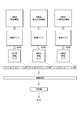
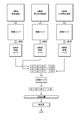
- FIG. 4 is a diagram schematically showing an inspection result acquisition procedure in the processing device 1 of the present embodiment.
- a learning model by a convolutional neural network (CNN) is used for the inspection using each image.
- the detection target is almost determined in advance according to the type of the captured image and the object to be captured, but the position, size, and number thereof are undefined.
- a feature map in which convolution processing is performed up to a predetermined stage (predetermined size) for each reconstructed image here, a total of N pixels
- M pixels here, a total of M pixels by convolution k times
- a characteristic value distribution that is, a numerical distribution that reflects the characteristic structure while retaining the position information (generation unit).
- a feature map of two-dimensional data a feature map of three-dimensional data having a depth corresponding to the number of filters may be generated. Further, the pooling process may be performed between the k times of convolution.
- Each M pixel value of the feature map obtained for each of a plurality of types of images is combined (integrated) by being one-dimensionally arranged (flattened) in parallel.
- the flattened data obtained by integration is fully combined by weighting with a weighting coefficient in the fully connected layer to obtain fully connected data.
- This fully combined data is input to the judgment device, converted into a probability value related to the presence / absence and type of the feature structure at each position using an appropriate function, and binarized as necessary as characteristic information. It is output.
- the learning model that uses the flattening data in which the feature maps related to the above-mentioned multiple images are integrated, in addition to the positional relationship of each of the multiple types of images, the magnitude relation of the numerical values, the correlation, etc. are also learned as features, and thus comprehensive
- the type of structure is specified, and the inspection result, that is, the probability that the detected content is a specific structure is obtained as characteristic information.
- voids in the object spaces created by various factors including cracks, gaps, peeling, welds generated by the flow of the resin, etc.
- foreign substances such as light elements (specific components).
- these abnormal states For example, data (including at least one of them) showing information such as local abnormalities such as orientation and unevenness of the dispersed state, and regions where changes occur) is output.
- the training model is generated by giving a large number of image data (learning data) related to the characteristic structure of each image and teacher data storing the correct answer associated with the image data in advance, and is a filter related to convolution. The coefficient (weighting coefficient) and the weighting coefficient at the time of full connection are determined.
- the part that is finally judged to be abnormal by the judgment device based on the probability data is reflected in the output data.
- the structure and its position information may be directly presented. Alternatively, a process may be performed to make the original image identifiable by highlighting a portion determined to be abnormal.
- the area required for inspection by the predetermined inspection device 60 and / or when reading the image data by another device or the like is known. It may be made available and noticed (area setting unit). Alternatively, the information of the determined area may be added to the header of the image data. This information may be read, for example, during inspection of other inspection equipment (such as a CT device) and used to selectively or intensively inspect the area.
- the area requiring inspection may be set by the control unit 61 in the inspection device 60 itself, or by another control device that collectively processes inspection data.
- FIG. 5 is a flowchart showing a control procedure of the model learning process executed by the processing device 1 of the present embodiment.
- the control unit 11 reads the input image data set for learning (including a predetermined number of reconstructed combinations of a plurality of types of images) (step S201).
- the predetermined number is a sufficiently large number as used in conventional learning.
- the control unit 11 sequentially adds correct answer data for the image, that is, data of characteristic information of the object determined by a human corresponding to the combination of the images, in response to the input operation received by the operation reception unit 14 (Ste S202).
- the characteristic information of the correct answer here is the distribution of foreign substances (voids, the same applies hereinafter), the presence or absence of foreign substances, the content rate of foreign substances and / or the content probability of foreign substances.
- the control unit 11 sequentially displays the learning images on the display unit 15 and causes the display unit 15 to input the correct answer.
- the correct answer data may be added to the input image data set for learning from the beginning, and in this case, the process of step S202 is unnecessary.
- the control unit 11 sequentially inputs the image data of the image data set with the correct answer, performs convolution processing to generate a feature map, further integrates and fully combines these, and inputs them to the determination device (step S203). ..
- the control unit 11 collates the determination result with the correct answer data, back-propagates the difference (error) in the result, and adjusts each weighting coefficient related to the total coupling and the coefficient of the convolution filter to adjust the learning model. Let them learn. If the learning process is not performed by the processing device 1, the image data set and the learning request may be output to the external device. Then, when all the processing of the image data set is completed, the control unit 11 stores and saves the settings such as the obtained coefficients. Then, the control unit 11 ends the model learning process. As a result, trained model data in which the correspondence between the plurality of radiographic images and the characteristics of the object is learned is generated.
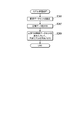
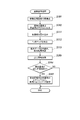
- FIG. 6 is a flowchart showing a control procedure of the abnormality inspection process executed by the processing device 1 of the present embodiment. This process is started by inputting the captured image of the radiographic imaging apparatus 50.
- the processes of steps S111 to S113 are the processing contents as the determination unit (determination means) using the trained model 122.
- the control unit 11 reconstructs a plurality of types of radiographic image data (absorption image, small angle scattering image, and differential phase image). Alternatively, the control unit 11 acquires the reconstructed image data from the radiography apparatus 50 (step S101; acquisition unit, acquisition means). The control unit 11 inputs these plurality of types of image data into the trained model (step S102). The control unit 11 performs a process of convolving each input image (step S111; generation unit, generation means). At this time, the pooling process may be performed according to the setting of the learning model. The control unit 11 integrates the feature maps obtained by convolution (step S112; integration unit, integration means).
- the control unit 11 fully combines the integrated data and determines the integrated result related to the characteristic information by the determination device (step S113: determination processing unit, determination processing means).
- the control unit 11 may output an inspection (judgment) request together with necessary data to an external device to perform the inspection (judgment). ..
- the control unit 11 acquires the output information of the determination device (step S103).
- the control unit 11 determines whether or not it is determined that there is an area satisfying the abnormality criterion (step S104). If it is determined that there is no such condition (“NO” in step S104), the control unit 11 ends the abnormality inspection process. If it is determined that there is (“YES” in step S104), the control unit 11 sets the alpha channel ( ⁇ channel) of each pixel data in the region determined to satisfy the abnormality criterion according to the content of the abnormality. The flag is set (step S105). Then, the control unit 11 ends the abnormality inspection process.
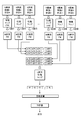
- FIG. 7 is a diagram schematically showing a modified example 1 of the inspection result acquisition procedure.
- each pixel value of the feature map obtained in the same manner as above for the plurality of images is arranged in a one-dimensional array (number of elements M), and is associated with the pixel position of the feature map among the one-dimensional arrays. It is integrated as two-dimensional data (3 ⁇ M integrated feature map) arranged in different rows (two-dimensional arrangement) according to the arranged column positions. The two-dimensional data is further convolved one or more times to reduce the number of pixels, and then the pixel values (number of pixels L) of the obtained feature map are one-dimensionally arranged and flattened. The flattened data are fully coupled with the weights obtained by training in the fully coupled layer. When this fully combined data is input to the determination device, the probability distribution related to the abnormality of each pixel is output.
- the filter for convolution of the integrated feature map is weighted for the combination between each image, and is set to be learned separately from the filter for the previous individual convolution.
- the learning may be performed by back-propagating the deviation according to the difference (loss function) between the teacher data and the output and updating the parameters.
- FIG. 8 is a diagram schematically showing a modified example 2 of the inspection result acquisition procedure.
- the two-dimensional feature maps obtained for each of the plurality of images are three-dimensional data (l) in which the pixel values are not arranged one-dimensionally but are superimposed in the direction perpendicular to the two-dimensional plane (three-dimensional direction).
- ⁇ r ⁇ 3 integrated feature map is integrated.
- each element (L pixel) is arranged in one dimension and flattened data (d1 to dL). ). Then, the flattening data is fully combined with a predetermined weighting coefficient, and the fully combined data is obtained. This fully combined data is input to the determiner to obtain an output related to the characteristics. Also in this case, the features of the plurality of (three) images at the same position are convoluted in the two-dimensional plane while leaving the position information.
- Mode 3 instead of processing the image data as it is, it may be converted into a latent variable indicating the characteristics of the image to reduce the number of dimensions.
- VAE Vehicle Auto Encoder
- VAE Visional Auto Encoder
- learning with unsupervised learning data is required in advance, and the unsupervised data includes, for example, image data in which a predetermined abnormality does not exist among the above-mentioned learning data (for example, the above-mentioned light element foreign matter). It may be the one selected (without contamination).
- FIG. 9 is a diagram schematically showing a modified example 3 of the inspection result acquisition procedure.
- This modification 3 is the same as the modification 1 up to the point where it is integrated into the 3 ⁇ M two-dimensional array data.
- this two-dimensional array is encoded by the trained VAE (encoder) and converted into a latent variable Z having a predetermined dimension.
- Subsequent processing performed based on the latent variable Z may be one of the following plurality of methods, or may be integrated after the plurality of methods are performed.
- flattening data is generated by unidimensionally arranging each element dimensionally compressed (for example, K dimension) in the latent variable Z, and this is weighted by a weighting coefficient in the fully connected layer and fully connected. Input the fully combined data to the judgment device.
- the encoded data is decoded again to generate two-dimensional restored data, and the restored data is compared with the original acquired (input) two-dimensional image data.
- the restored image after VAE processing learned based on the data without abnormalities and the original two-dimensional image have a difference in the abnormal part (array element) when an abnormality exists.
- Abnormality is determined (detected) based on the difference (difference).
- a predetermined reference value may be set for the latent variable Z, and an abnormality may be determined according to the magnitude relationship with the reference value.
- FIG. 10 is a diagram schematically showing a modified example 4 of the inspection result acquisition procedure.
- a case where a set of three types of images 1 to 3 is acquired in four frames (in a plurality of states) of states A to D is shown as an example.
- the plurality of images in each state are individually convolved in the same manner as in the above embodiment to generate a feature map (FM) of M pixels.
- FM feature map
- two-dimensional array data as shown in the modified example 3 are generated respectively.
- the two-dimensional array data is further superimposed in the row direction so that the ones having the same pixel position are in the same column position among a plurality of states. That is, here, 12 ⁇ M two-dimensional array data is generated.
- the two-dimensional array data is further convolved an appropriate number of times and converted into a feature map of L pixels, and then the L pixels are arranged in one dimension to generate flattening data.
- the flattened data is fully combined according to the weighting coefficient, and the obtained fully combined data is input to the determination device to obtain an inspection result.
- the processing device 1 of the present embodiment includes the control unit 11, and the control unit 11 includes a plurality of acquisition units for acquiring a plurality of types of X-ray captured images related to the object to be imaged (subject H). It operates as a determination unit having a learned model 122 that outputs characteristic information of an object in response to input of a type of X-ray photographed image.
- the control unit 11 as a determination unit further convolves a plurality of types of X-ray images as a generation unit to generate a feature map of a predetermined size, and integrates a plurality of feature maps as an integration unit to generate integrated data. It has a trained model 122 that is generated and outputs characteristic information based on integrated data as a determination processing unit.
- each image is convoluted to obtain a feature map. After generating them individually, these feature maps are integrated and the integrated data are fully combined to obtain characteristic information. That is, for each image data, each feature is extracted while maintaining its position information, and then these are integrated. Therefore, it is possible to appropriately retain the feature amounts obtained from a plurality of types of images and the information on their positions, and to clearly define their relationships. Therefore, in this processing device 1, the characteristics of the object can be more appropriately acquired based on a plurality of types of captured images.
- control unit 11 as a determination unit (integration unit), one-dimensionally arranges each pixel value of a plurality of feature maps and generates flattening data as integrated data. That is, since the pixel values of the plurality of feature maps are arranged in parallel and fully combined by the operation as the determination processing unit, it is possible to detect the characteristic structure while reliably maintaining the position information, and a plurality of features. It is possible to accurately judge the correspondence between the images of. Therefore, in this processing device 1, it is possible to appropriately balance the extraction of the characteristic structure and the accuracy of specifying the positional relationship of the characteristic structure in a plurality of types of images.
- control unit 11 as a determination unit (integration unit), arranges each pixel value of a plurality of feature maps in one dimension, and arranges the positions of the one-dimensional array in two dimensions according to the pixel positions in the feature map.
- the data related to each captured image may be integrated by generating the two-dimensional data.
- flattening data integrated data is generated by one-dimensionally arranging each pixel value of the feature map obtained by performing convolution processing on the two-dimensional data obtained by integration. Even in this case, since the convolution is performed once individually, it is possible to integrate the characteristics and the positions where the characteristics appear in each image in a state of being appropriately shown.
- control unit 11 as a determination unit (integration unit), generates and integrates three-dimensional data in which a plurality of feature maps are superimposed in a direction perpendicular to the two-dimensional plane of the feature map, and integrates the three-dimensional data.
- the convolution process may be performed to convert to a two-dimensional feature map in a two-dimensional plane, and each pixel value of the converted two-dimensional feature map may be one-dimensionally arranged to generate flattening data (integrated data).
- the three-dimensional data is generated in this way, as in the case of the two-dimensional data, the characteristics are emphasized by being individually convolved first, and the positions of the characteristics are properly indicated and integrated. Since the position information is maintained and processed into flattened data at the time of integration, accurate inspection can be performed while achieving both the extraction of characteristic structures and the accuracy of identifying the positional relationship of the characteristic structures using multiple types of images. It can be carried out.
- control unit 11 reduces the number of dimensions of the two-dimensional data by VAE as a determination unit (determination processing unit), and extracts and outputs characteristic information based on the latent variable obtained by reducing the number of dimensions. You may. By encoding the two-dimensional data in which the feature and the position information (positional relationship) of the feature are maintained as described above by VAE, the characteristic to be detected can be extracted more appropriately.
- the VAE is learned by using a plurality of types of radiographic image data when there is no predetermined abnormality (for example, contamination of a light element foreign substance) in the object (subject H), and the control unit 11
- a determination unit determination processing unit
- the input original radiographic image is restored based on (decoded) the latent variable obtained by VAE.
- the above-mentioned predetermined abnormality is detected as characteristic information.
- control unit 11 acquires a plurality of types of X-ray images for each of a plurality of states of the object as an acquisition unit, and provides a feature map for each of the plurality of types of radiographic images in the plurality of states as a determination unit. Generate (generation part) and integrate these multiple feature maps (integration part). That is, when the state of the X-ray photographed image changes, the pixel positions of the plurality of states are aligned and integrated into the two-dimensional data after the multiple types of images in the plurality of states are individually convolved. It is possible to appropriately detect the characteristics in consideration of the state change at the same position.
- the radiographic image includes two or more of an absorption image, a small-angle scattered image and a differential phase image obtained by a Talbot-type X-ray imaging device, and an image obtained by an operation based on these.
- the Talbot-type X-ray imaging device With the Talbot-type X-ray imaging device, the above three types of images can be easily acquired by reconstruction. Therefore, by making it possible to output a combination of these images, the user makes a comparative judgment based on experience. It is possible to appropriately summarize conventional tests and evaluate them more quantitatively.
- the characteristic information includes at least of voids, cracks, gaps in the object, welds due to resin flow, peeling, foreign matter, abnormal precipitation and aggregation of specific components, and local abnormalities in the orientation or dispersion of microstructures. Either is included. In this way, by making it possible to appropriately quantitatively evaluate a combination of a plurality of types of images, it is possible to appropriately detect an abnormal portion inside an object in a non-destructive manner.
- control unit 11 sets an area in which the characteristic information output as the determination unit satisfies a predetermined reference condition as the area setting unit. That is, it is possible not only to output the characteristic information but also to make it easier for the user to know the area that needs attention based on the inspection result.
- the above standard conditions are conditions related to the necessity of inspection by a predetermined inspection device. That is, by setting an area that requires further inspection with another inspection device, it is possible to prevent omission of inspection settings. Further, by making it possible to acquire the information of this setting area with the other inspection device or the like, it is possible to easily inspect the area of interest without the user having to manually set the information.
- the inspection system 100 of the present embodiment includes the above-mentioned processing device 1 and a predetermined inspection device 60, and the control unit 61 of the inspection device 60 is based on the characteristic information output by the control unit 11.
- the present invention is not limited to the above embodiment, and various modifications can be made.
- a convolutional process and a fully connected layer are used as an example, but the process is capable of extracting the feature amount of the image data while retaining the position information. If so, it is not limited to the convolution process, and if the characteristic information can be extracted from the integrated map, it does not have to be fully combined.
- the images of different states may be taken at different timings, or may be taken by different radiography apparatus or different setting conditions. ..
- the image may be an image obtained by another radiography apparatus, and may be used.
- a combination of a plurality of types of images obtained by different radiographic apparatus may be used. If there is a slight deviation in the position (imaging range) of a plurality of types of images, a one-dimensional array, two-dimensional data, or three-dimensional data may be generated in consideration of the deviation at the time of integration. The resulting blank part may be filled with zero-value data or the like.
- the detection target is not limited to the voids of the object or the light element foreign matter, regardless of whether the image is taken by the Talbot type X-ray apparatus. It may be something else.
- the radiography apparatus 50 and the processing apparatus 1 located in the inspection system 100 have been described as having images acquired from the radiography apparatus 50, but the image data is externally obtained via the Internet. It may be acquired from, or it may be input by a portable storage medium such as a DVD or a flash memory.
- the storage unit 12 having an auxiliary storage device such as a non-volatile memory and / or an HDD as a computer-readable medium of the program 121 related to the processing operation of the control unit 11 according to the present invention is taken as an example.
- a portable storage medium such as a CD-ROM or a DVD disc can be applied.
- a carrier wave is also applied to the present invention as a medium for providing data of a program according to the present invention via a communication line.
- the specific configuration, the content and procedure of the processing operation shown in the above embodiment can be appropriately changed without departing from the spirit of the present invention.
- the present invention relates to a radiographic image determination device, an inspection system and a program.
- Processing device 11 Control unit 12 Storage unit 121 Program 122 Learned model 13 Communication unit 14 Operation reception unit 15 Display unit 50 Radiation imaging device 51 X-ray generator 51a Source 52 Source grid 52a Support unit 53 Subject 54 1st Lattice 55 2nd lattice 56 X-ray detector 57 Support 57a Support 58 Base 591 Filtration filter 592 Irradiation field Aperture 593 Irradiation field lamp 60 Inspection device 61 Control unit 100 Inspection system H Subject
Landscapes
- Health & Medical Sciences (AREA)
- Life Sciences & Earth Sciences (AREA)
- Physics & Mathematics (AREA)
- Engineering & Computer Science (AREA)
- Pathology (AREA)
- General Health & Medical Sciences (AREA)
- General Physics & Mathematics (AREA)
- Biochemistry (AREA)
- Medical Informatics (AREA)
- Nuclear Medicine, Radiotherapy & Molecular Imaging (AREA)
- Analytical Chemistry (AREA)
- Radiology & Medical Imaging (AREA)
- Chemical & Material Sciences (AREA)
- Immunology (AREA)
- Heart & Thoracic Surgery (AREA)
- Animal Behavior & Ethology (AREA)
- Surgery (AREA)
- Public Health (AREA)
- Veterinary Medicine (AREA)
- Computer Vision & Pattern Recognition (AREA)
- Molecular Biology (AREA)
- Theoretical Computer Science (AREA)
- Biomedical Technology (AREA)
- Optics & Photonics (AREA)
- High Energy & Nuclear Physics (AREA)
- Biophysics (AREA)
- Analysing Materials By The Use Of Radiation (AREA)
Priority Applications (1)
| Application Number | Priority Date | Filing Date | Title |
|---|---|---|---|
| JP2021530035A JPWO2021002356A1 (https=) | 2019-07-02 | 2020-06-30 |
Applications Claiming Priority (2)
| Application Number | Priority Date | Filing Date | Title |
|---|---|---|---|
| JP2019123312 | 2019-07-02 | ||
| JP2019-123312 | 2019-07-02 |
Publications (1)
| Publication Number | Publication Date |
|---|---|
| WO2021002356A1 true WO2021002356A1 (ja) | 2021-01-07 |
Family
ID=74100683
Family Applications (1)
| Application Number | Title | Priority Date | Filing Date |
|---|---|---|---|
| PCT/JP2020/025661 Ceased WO2021002356A1 (ja) | 2019-07-02 | 2020-06-30 | 放射線画像判定装置、検査システム及びプログラム |
Country Status (2)
| Country | Link |
|---|---|
| JP (1) | JPWO2021002356A1 (https=) |
| WO (1) | WO2021002356A1 (https=) |
Cited By (1)
| Publication number | Priority date | Publication date | Assignee | Title |
|---|---|---|---|---|
| WO2025018614A1 (ko) * | 2023-07-19 | 2025-01-23 | 에스케이텔레콤 주식회사 | 근골격 질환에 대한 엑스레이 이미지를 분석하는 방법 및 장치 |
Citations (13)
| Publication number | Priority date | Publication date | Assignee | Title |
|---|---|---|---|---|
| JP2013134193A (ja) * | 2011-12-27 | 2013-07-08 | Hitachi-Ge Nuclear Energy Ltd | 検査画像品質評価システム、方法、プログラム、及びデジタイザ保証システム |
| US20130338496A1 (en) * | 2010-12-13 | 2013-12-19 | The Trustees Of Columbia University In The City New York | Medical imaging devices, methods, and systems |
| US20150312495A1 (en) * | 2014-04-29 | 2015-10-29 | Canon Kabushiki Kaisha | Wavelet denoising of fringe image |
| JP2017044603A (ja) * | 2015-08-27 | 2017-03-02 | 国立大学法人東北大学 | 放射線画像生成装置 |
| JP2018011870A (ja) * | 2016-07-22 | 2018-01-25 | キヤノン株式会社 | 画像処理装置、画像処理システム、画像処理方法、およびプログラム |
| WO2018039368A1 (en) * | 2016-08-26 | 2018-03-01 | Elekta, Inc. | Image segmentation using neural network method |
| WO2018048575A1 (en) * | 2016-09-07 | 2018-03-15 | Elekta, Inc. | System and method for learning models of radiotherapy treatment plans to predict radiotherapy dose distributions |
| US20180144209A1 (en) * | 2016-11-22 | 2018-05-24 | Lunit Inc. | Object recognition method and apparatus based on weakly supervised learning |
| JP2018531648A (ja) * | 2015-08-15 | 2018-11-01 | セールスフォース ドット コム インコーポレイティッド | 3dバッチ正規化を伴う三次元(3d)畳み込み |
| US20190050992A1 (en) * | 2016-08-26 | 2019-02-14 | Elekta, Inc. | System and methods for image segmentation using convolutional neural network |
| JP2019093137A (ja) * | 2017-11-22 | 2019-06-20 | ゼネラル・エレクトリック・カンパニイ | 放射線学的所見のためのポイントオブケア警報を送達するためのシステムおよび方法 |
| JP2019184450A (ja) * | 2018-04-12 | 2019-10-24 | コニカミノルタ株式会社 | X線撮影システム |
| US20200027254A1 (en) * | 2018-07-20 | 2020-01-23 | The Board Of Trustees Of The Leland Stanford Junior University | Correction of sharp-edge artifacts in differential phase contrast ct images and its improvement in automatic material identification |
-
2020
- 2020-06-30 JP JP2021530035A patent/JPWO2021002356A1/ja active Pending
- 2020-06-30 WO PCT/JP2020/025661 patent/WO2021002356A1/ja not_active Ceased
Patent Citations (13)
| Publication number | Priority date | Publication date | Assignee | Title |
|---|---|---|---|---|
| US20130338496A1 (en) * | 2010-12-13 | 2013-12-19 | The Trustees Of Columbia University In The City New York | Medical imaging devices, methods, and systems |
| JP2013134193A (ja) * | 2011-12-27 | 2013-07-08 | Hitachi-Ge Nuclear Energy Ltd | 検査画像品質評価システム、方法、プログラム、及びデジタイザ保証システム |
| US20150312495A1 (en) * | 2014-04-29 | 2015-10-29 | Canon Kabushiki Kaisha | Wavelet denoising of fringe image |
| JP2018531648A (ja) * | 2015-08-15 | 2018-11-01 | セールスフォース ドット コム インコーポレイティッド | 3dバッチ正規化を伴う三次元(3d)畳み込み |
| JP2017044603A (ja) * | 2015-08-27 | 2017-03-02 | 国立大学法人東北大学 | 放射線画像生成装置 |
| JP2018011870A (ja) * | 2016-07-22 | 2018-01-25 | キヤノン株式会社 | 画像処理装置、画像処理システム、画像処理方法、およびプログラム |
| US20190050992A1 (en) * | 2016-08-26 | 2019-02-14 | Elekta, Inc. | System and methods for image segmentation using convolutional neural network |
| WO2018039368A1 (en) * | 2016-08-26 | 2018-03-01 | Elekta, Inc. | Image segmentation using neural network method |
| WO2018048575A1 (en) * | 2016-09-07 | 2018-03-15 | Elekta, Inc. | System and method for learning models of radiotherapy treatment plans to predict radiotherapy dose distributions |
| US20180144209A1 (en) * | 2016-11-22 | 2018-05-24 | Lunit Inc. | Object recognition method and apparatus based on weakly supervised learning |
| JP2019093137A (ja) * | 2017-11-22 | 2019-06-20 | ゼネラル・エレクトリック・カンパニイ | 放射線学的所見のためのポイントオブケア警報を送達するためのシステムおよび方法 |
| JP2019184450A (ja) * | 2018-04-12 | 2019-10-24 | コニカミノルタ株式会社 | X線撮影システム |
| US20200027254A1 (en) * | 2018-07-20 | 2020-01-23 | The Board Of Trustees Of The Leland Stanford Junior University | Correction of sharp-edge artifacts in differential phase contrast ct images and its improvement in automatic material identification |
Cited By (1)
| Publication number | Priority date | Publication date | Assignee | Title |
|---|---|---|---|---|
| WO2025018614A1 (ko) * | 2023-07-19 | 2025-01-23 | 에스케이텔레콤 주식회사 | 근골격 질환에 대한 엑스레이 이미지를 분석하는 방법 및 장치 |
Also Published As
| Publication number | Publication date |
|---|---|
| JPWO2021002356A1 (https=) | 2021-01-07 |
Similar Documents
| Publication | Publication Date | Title |
|---|---|---|
| CN100496402C (zh) | 图像处理方法、图像处理系统以及x-射线ct系统 | |
| US9311720B2 (en) | Automated saw cut correction for 3D core digital modeling from computerized tomography scanner (CTS) images | |
| US8204291B2 (en) | Method and system for identifying defects in a radiographic image of a scanned object | |
| JP4595979B2 (ja) | 放射線非破壊検査システム及び配管の検査方法 | |
| CN103118597A (zh) | X射线ct装置及管电流决定方法 | |
| CN115205406B (zh) | 用于利用深度学习网络来校正计算机断层摄影检测器中的不良像素的系统和方法 | |
| WO2016174926A1 (ja) | 画像処理装置及び画像処理方法及びプログラム | |
| JP6987352B2 (ja) | 医用画像処理装置および医用画像処理方法 | |
| CN110895812A (zh) | Ct图像的检测方法、装置、存储介质及电子设备 | |
| CN107525815B (zh) | 用于检测成像系统中的行李的系统和方法 | |
| JP2018536211A5 (https=) | ||
| KR101095270B1 (ko) | 방사선 화상처리장치 및 방사선 화상처리 프로그램을 기록한 컴퓨터로 읽을 수 있는 매체 | |
| JP2021036969A (ja) | 機械学習装置、機械学習方法及びプログラム | |
| JP4935895B2 (ja) | エッジ評価方法とエッジ検出方法と画像補正方法と画像処理システム | |
| KR20220111214A (ko) | 인공지능 기반 제품 결함 검사 방법, 장치 및 컴퓨터 프로그램 | |
| WO2021002356A1 (ja) | 放射線画像判定装置、検査システム及びプログラム | |
| US12310779B2 (en) | Method and device of correction of ring artifact in CT image and computer program medium | |
| KR20230160754A (ko) | 학습 모델을 이용한 결함 검사 수행 장치, 방법, 시스템 및 프로그램 | |
| JP7562513B2 (ja) | 測定空間域の測定からの測定データを圧縮するためのコンピュータ実装方法 | |
| WO2011080808A1 (ja) | 放射線画像処理装置および放射線画像処理プログラム | |
| CN108593687B (zh) | 一种基于三维层析成像的快速缺陷检测方法 | |
| JP5992848B2 (ja) | 体動表示装置および方法 | |
| US8348508B2 (en) | Wave ramp test method and apparatus | |
| JP7844285B2 (ja) | 情報処理装置、情報処理方法、及びプログラム | |
| KR102597081B1 (ko) | 인공 지능 기반 대상체 앙상블 비파괴 검사 방법, 장치 및 시스템 |
Legal Events
| Date | Code | Title | Description |
|---|---|---|---|
| 121 | Ep: the epo has been informed by wipo that ep was designated in this application |
Ref document number: 20835278 Country of ref document: EP Kind code of ref document: A1 |
|
| ENP | Entry into the national phase |
Ref document number: 2021530035 Country of ref document: JP Kind code of ref document: A |
|
| NENP | Non-entry into the national phase |
Ref country code: DE |
|
| 122 | Ep: pct application non-entry in european phase |
Ref document number: 20835278 Country of ref document: EP Kind code of ref document: A1 |