WO2020256010A1 - 高強度鋼板 - Google Patents
高強度鋼板 Download PDFInfo
- Publication number
- WO2020256010A1 WO2020256010A1 PCT/JP2020/023742 JP2020023742W WO2020256010A1 WO 2020256010 A1 WO2020256010 A1 WO 2020256010A1 JP 2020023742 W JP2020023742 W JP 2020023742W WO 2020256010 A1 WO2020256010 A1 WO 2020256010A1
- Authority
- WO
- WIPO (PCT)
- Prior art keywords
- less
- steel sheet
- ferrite
- strength
- steel
- Prior art date
- Legal status (The legal status is an assumption and is not a legal conclusion. Google has not performed a legal analysis and makes no representation as to the accuracy of the status listed.)
- Ceased
Links
Classifications
-
- C—CHEMISTRY; METALLURGY
- C21—METALLURGY OF IRON
- C21D—MODIFYING THE PHYSICAL STRUCTURE OF FERROUS METALS; GENERAL DEVICES FOR HEAT TREATMENT OF FERROUS OR NON-FERROUS METALS OR ALLOYS; MAKING METAL MALLEABLE, e.g. BY DECARBURISATION OR TEMPERING
- C21D8/00—Modifying the physical properties of ferrous metals or ferrous alloys by deformation combined with, or followed by, heat treatment
- C21D8/02—Modifying the physical properties of ferrous metals or ferrous alloys by deformation combined with, or followed by, heat treatment during manufacturing of plates or strips
-
- C—CHEMISTRY; METALLURGY
- C21—METALLURGY OF IRON
- C21D—MODIFYING THE PHYSICAL STRUCTURE OF FERROUS METALS; GENERAL DEVICES FOR HEAT TREATMENT OF FERROUS OR NON-FERROUS METALS OR ALLOYS; MAKING METAL MALLEABLE, e.g. BY DECARBURISATION OR TEMPERING
- C21D9/00—Heat treatment, e.g. annealing, hardening, quenching or tempering, adapted for particular articles; Furnaces therefor
- C21D9/46—Heat treatment, e.g. annealing, hardening, quenching or tempering, adapted for particular articles; Furnaces therefor for sheet metals
-
- C—CHEMISTRY; METALLURGY
- C22—METALLURGY; FERROUS OR NON-FERROUS ALLOYS; TREATMENT OF ALLOYS OR NON-FERROUS METALS
- C22C—ALLOYS
- C22C38/00—Ferrous alloys, e.g. steel alloys
-
- C—CHEMISTRY; METALLURGY
- C22—METALLURGY; FERROUS OR NON-FERROUS ALLOYS; TREATMENT OF ALLOYS OR NON-FERROUS METALS
- C22C—ALLOYS
- C22C38/00—Ferrous alloys, e.g. steel alloys
- C22C38/08—Ferrous alloys, e.g. steel alloys containing nickel
-
- C—CHEMISTRY; METALLURGY
- C22—METALLURGY; FERROUS OR NON-FERROUS ALLOYS; TREATMENT OF ALLOYS OR NON-FERROUS METALS
- C22C—ALLOYS
- C22C38/00—Ferrous alloys, e.g. steel alloys
- C22C38/16—Ferrous alloys, e.g. steel alloys containing copper
Definitions
- the present invention relates to high-strength steel sheets.
- the present application claims priority based on Japanese Patent Application No. 2019-112081 filed in Japan on June 17, 2019, the contents of which are incorporated herein by reference.
- the steel sheet When a steel sheet having a high yield strength and a low ductility is used for an automobile part, the steel sheet may break due to insufficient elongation at the time of an automobile collision. When the steel sheet is broken in this way, the steel sheet cannot sufficiently absorb the impact, and the performance due to the high yield strength may not be sufficiently exhibited.
- Auto parts may be manufactured by press forming a steel plate.
- seizure hardening occurs on the steel sheet.
- Seizure hardening is a phenomenon in which the yield strength of a steel sheet increases due to strain aging, and is also called strain aging hardening.
- Baking hardening is caused by intrusive elements such as solid solution C and solid solution N in steel. Since DP steel and TRIP steel contain a large amount of C, the amount of seizure hardening (the amount of increase in the yield strength of the steel sheet due to strain aging) is large.
- the ductility of conventional automobile parts made of DP steel or TRIP steel may decrease even if the yield strength increases due to seizure hardening.
- a technique for reducing hard phases such as martensite and bainite in the steel structure while ensuring the strength of the steel sheet is being studied.
- Patent Document 1 discloses a steel sheet in which a small amount of hard phase such as bainite and martensite is suppressed.
- the steel sheet described in Patent Document 1 contains ferrite as the main phase, contains 2 to 12% of pearlite and 3% or less of martensite in terms of volume fraction, and the balance is composed of a low temperature generated phase.
- Patent Document 1 has a tensile strength of 440 MPa class, and is insufficient in strength to be applied to a shock absorbing member used in recent automobiles and the like. Further, Patent Document 1 does not mention the ductility of a steel sheet when paint baking is performed after press molding.
- an object of the present invention is to provide a high-strength steel sheet in which a decrease in ductility due to baking hardening is suppressed.
- a predetermined amount of Ni and Al are simultaneously contained to form a columnar precipitation phase of Ni—Al (an intermetallic compound of Ni—Al), and a structure composed of ferrite, cementite and / or pearlite is the main phase.
- the steel plate containing a small amount of the hard phase of bainite and / or martensite has a tensile strength of 590 MPa or more, and the amount of change in elongation in the tensile test is BH-treated (after 2% prestrain is applied, 20 at 170 ° C.). It becomes 4% or less before and after (heat treatment for minutes).
- B In order to obtain a steel sheet having a steel structure as described above, it is important to control the cooling rate after hot rolling and the subsequent quenching conditions and winding temperature.
- strain aging hardening is a phenomenon in which carbon adheres to dislocations introduced by processing to stabilize dislocations and increase resistance to dislocation motion, thereby increasing yield strength.
- the phase transformation from austenite to martensite or bainite involves the formation of dislocations. Therefore, when compared with steel sheets of similar strength, the dislocation density of the steel sheet according to the present invention containing a small amount of bainite and / or martensite is lower than the dislocation density of a conventional steel sheet containing a large amount of martensite and / or bainite. ..
- the dislocation density of the steel sheet according to the present invention is lower than the dislocation density of the conventional steel sheet.
- the steel sheet according to the present invention having a low structure fraction of bainite and / or martensite has a small amount of dislocations stabilized by strain age hardening and suppresses a decrease in ductility.
- the present invention has been made based on the above findings, and the gist thereof is as follows.
- the high-strength steel sheet according to one aspect of the present invention has a component composition of mass%.
- C 0.0150% or more and 0.3000% or less
- Si More than 0% and less than 3.000%
- Mn 0.050% or more and 3.600% or less
- P More than 0% and less than 0.030%
- S More than 0% and less than 0.0200%
- Al More than 0% and less than 0.0200%
- Al More500% or more and 5.000% or less
- N More than 0% and less than 0.0100%
- Cu 0% or more and 4.800% or less
- Mo 0% or more and 2.500% or less
- Ca 0% or more and 0.0200% or less
- Mg 0% or more and 0.0200% or less
- REM 0% or more and 0.0200% or less
- the balance is composed of
- the high-strength steel sheet according to the above [1] has a component composition of mass%. Cu: 0.050% or more and 4.800% or less, Mo: 0.030% or more and 2.500% or less, Ca: 0.0001% or more and 0.0200% or less, It may contain at least one selected from Mg: 0.0001% or more and 0.0200% or less, and REM: 0.0001% or more and 0.0200% or less.
- the high-strength steel sheet according to the above [1] or [2] may have a hot-dip galvanized layer or an alloyed hot-dip galvanized layer on the surface.
- the above aspect of the present invention it is possible to provide a high-strength steel sheet in which a decrease in ductility due to baking hardening is suppressed.
- the high-strength steel sheet according to the above aspect is suitable for a shock absorbing member that requires collision resistance.
- a high-strength steel sheet according to an embodiment of the present invention (hereinafter, may be referred to as a high-strength steel sheet or simply a steel sheet according to the present embodiment) will be described.
- the high-strength steel sheet according to this embodiment has a component composition (chemical composition) and a metal structure described below.
- the "high-strength steel sheet” means a steel sheet having a tensile strength (TS) of 590 MPa or more.
- C 0.0150% or more and 0.3000% or less
- C is an essential element for forming carbides in steel to obtain bainite, martensite and retained austenite. If the C content is less than 0.0150%, the total area ratio of martensite, bainite and retained austenite cannot be 1.0% or more. Therefore, the C content is set to 0.0150% or more. On the other hand, when the C content exceeds 0.3000%, seizure hardening is excessively developed as the amount of solid solution carbon in the steel increases, and the ductility of the steel sheet after baking hardening is significantly deteriorated. Therefore, the C content is set to 0.3000% or less.
- Si: more than 0% and less than 3.000% Si is an element that thermodynamically stabilizes ferrite, and is a useful element that dissolves in ferrite to develop solid solution hardening.
- Si is an element that promotes the formation of martensite by inhibiting the formation of carbides. In order to obtain these effects, the Si content is set to more than 0%.
- Si is also an element that enhances the hardenability of steel. Therefore, if the Si content is too high, the transformation from austenite to ferrite is delayed in the cooling process after hot rolling, and bainite and / or martensite is likely to be formed.
- the Si content is set to 3.000% or less in order to generate a desired amount of ferrite in the cooling process after hot rolling.
- Mn 0.050% or more and 3.600% or less
- Mn is an element that thermodynamically stabilizes austenite. Further, Mn is an element useful for reducing surface defects during hot rolling by S. In order to obtain these effects, the Mn content is set to 0.050% or more.
- Mn enhances hardenability, if the Mn content is too large, the transformation from austenite to ferrite is delayed in the cooling process after hot rolling, and bainite and / or martensite is likely to be formed.
- the Mn content is set to 3.600% or less in order to suppress an increase in the area ratio of bainite and / or martensite to obtain a desired steel structure.
- P More than 0% and less than 0.030%
- P is an element that easily segregates at grain boundaries. If the P content is too high, embrittlement may be promoted in the high-strength steel sheet and the workability may be lowered. Therefore, the P content is set to 0.030% or less.
- P is also an element that enhances the strength of the steel sheet by hardening the solid solution. Further, if the P content is excessively reduced, the refining cost increases. Therefore, the P content may be more than 0% or 0.001% or more.
- S More than 0% and less than 0.0200% S exists as an inclusion in the steel. If the S content exceeds 0.0200%, the amount of inclusions may increase, and the inclusions may become the starting point of fracture during processing of the steel sheet and the formability of the steel sheet may decrease. Therefore, while the S content is 0.0200% or less, if the S content is excessively reduced, the refining cost increases. Therefore, the S content may be more than 0% or 0.0001% or more.
- Al 0.500% or more and 5.000% or less
- Al is an element that thermodynamically stabilizes ferrite and also an element that inhibits the formation of carbides in steel.
- Al is an element that increases the strength of the steel sheet when it is contained at the same time as a predetermined amount of Ni. It is considered that the increase in strength of the steel sheet by simultaneously containing Al and Ni is due to the formation of the columnar precipitation phase (Ni-Al intermetallic compound) of Ni—Al and the solid solution cluster. Further, in order to obtain the effect, it is considered necessary to promote the ferrite transformation after hot rolling. If the Al content is less than 0.500%, a sufficient amount of ferrite is not produced and the above effect cannot be obtained.
- the Al content is set to 0.500% or more.
- the Al content exceeds 5.000%, ferrite will be formed during hot rolling.
- processed austenite and processed ferrite are formed during hot rolling, so that a mixed structure consisting of ferrite formed by transformation of processed austenite during cooling and ferrite formed by recovery and recrystallization of processed ferrite is formed. Will be done.
- the mechanical properties of such mixed structures fluctuate sharply with their formation rate. Therefore, when the steel structure of the steel sheet has a mixed structure as described above, industrially stable mechanical properties cannot be obtained. Therefore, the Al content is set to 5.000% or less.
- N More than 0% and less than 0.0100%
- N is an penetrating element and is an element that contributes to strain age hardening.
- Al aluminum nitride
- the N content is set to 0.0100% or less.
- the N content may be more than 0% or 0.0001% or more.
- Ni 1.000% or more and 12.300% or less
- Ni is an element that thermodynamically stabilizes austenite and is also an element that inhibits the formation of carbides in steel.
- Ni is an element that increases the strength of the steel sheet when it is contained at the same time as a predetermined amount of Al. The reason for this is not clear, but it is presumed that a columnar precipitation phase (Ni-Al intermetallic compound) of Ni and Al and a solid solution cluster are formed. In order to obtain the effect of increasing the strength of the steel sheet by simultaneously containing Ni and Al, the Ni content is set to 1.000% or more.
- the Ni content exceeds 12.300%, the transformation from austenite to ferrite is delayed in the cooling process after hot rolling, and a large amount of bainite and / or martensite is formed to obtain a desired steel structure. Absent. Therefore, the Ni content is set to 12.300% or less.
- elements other than the above-mentioned elements that is, the balance is Fe and impurities.
- Impurities are elements that are inevitably mixed from steel raw materials or scrap, or elements that are inevitably mixed in the steelmaking process, and the high-strength steel sheet according to the present embodiment has the effect of the high-strength steel sheet according to the present embodiment. Elements that are acceptable within the playable range can be exemplified.
- the total content of impurities is preferably 0.100% or less. Of the impurities, the content of O is preferably 0.010% or less.
- the high-strength steel sheet according to the present embodiment may contain one or more of the optional elements shown below in place of a part of the remaining Fe.
- the lower limit of the content of the optional elements is 0%.
- Cu: 0% or more and 4.800% or less Cu, like Mn and Ni, is an element that thermodynamically stabilizes the austenite phase. In order to surely obtain this effect, it is preferable that the Cu content is 0.050% or more. On the other hand, if the Cu content is too high, a desired amount of ferrite cannot be produced in the cooling process after hot rolling. Therefore, even when it is contained, the Cu content is set to 4.800% or less.
- Mo: 0% or more and 2.500% or less Mo, like Si and Al, is an element that stabilizes the ferrite phase. In order to surely obtain this effect, the Mo content is preferably 0.030% or more. On the other hand, if the Mo content is too high, a desired amount of ferrite cannot be produced in the cooling process after hot rolling. Therefore, even when it is contained, the Mo content is 2.500% or less.
- Ca, Mg and REM are all elements that control the shape of inclusions such as oxides and sulfides. Specifically, it is an element that finely disperses inclusions, reduces the factors of the starting point of fracture during processing, and contributes to the improvement of workability of the steel sheet. In order to surely exhibit these effects, it is preferable that the content of even one of Ca, Mg and REM is 0.0001% or more.
- the contents of Ca, Mg and REM are set to 0.0001% or more and 0.0200% or less, respectively.
- REM refers to 17 elements from scandium, yttrium, lanthanum to lutetium, and is generally called a rare earth element or rare earth.
- the above-mentioned content of REM means the total content of these elements.
- C%, Si%, Mn%, Al%, Ni%, Cu% and Mo% are the contents of C, Si, Mn, Al, Ni, Cu and Mo in mass%, respectively. If not, substitute 0.
- the above equation (1) is a conditional equation for hot rolling in the single-phase region of austenite without forming ferrite during hot rolling. Further, the formula (1) is also a conditional formula showing an index for improving the strength-ductility balance of the steel sheet by the columnar precipitation phase of Ni—Al and suppressing the decrease in ductility after baking and curing.
- the former influence on the steel sheet characteristics will be described. If the content of the element that stabilizes ferrite such as Si, Al and Mo is higher than the content of the element that stabilizes austenite such as C, Mn, Ni and Cu, not only austenite but also ferrite will be generated during hot rolling. Will be generated.
- austenite and ferrite mixed during hot rolling become processed austenite and processed ferrite by hot rolling, respectively, the former is the ferrite generated by transformation during cooling, and the latter is recovery / recrystallization. It becomes ferrite formed by crystals and forms a mixed structure. Since the mechanical properties of such a mixed structure vary greatly depending on their formation ratio, it is not possible to obtain industrially stable mechanical properties. Next, the latter effect on the steel sheet characteristics will be described.
- the Ni atom that stabilizes austenite is uniformly dispersed in the austenite phase, but the Al atom that stabilizes ferrite segregates at the grain boundaries of austenite rather than being dissolved in the austenite phase.
- the strength-ductility balance and the decrease in ductility after seizure hardening are suppressed by forming a columnar precipitation phase at the ferrite grain boundaries (including the vicinity) in the steel after hot rolling.
- a row-like precipitation phase is formed at the ferrite grain boundaries, the deformation resistance near the ferrite grain boundaries increases, and when the steel plate before the seizure hardening treatment is deformed, it is inside the ferrite grains of the steel. It is considered that the growth of dislocations is less likely to accumulate at the ferrite grain boundaries, so that the formation of voids due to deformation is suppressed and the strength-ductility balance is improved.
- the reason why the ductility after the baking hardening treatment is deteriorated in the conventional steel is that the dislocation mobility is lowered by performing the baking heat treatment in the state where the dislocations are excessively accumulated at the ferrite grain boundaries, and the ferrite grain boundaries are reduced. It is understood that it is possible to suppress the decrease in ductility after the baking hardening treatment by suppressing the excessive accumulation of dislocations on the surface. Therefore, in the high-strength steel sheet according to the present embodiment, in addition to the content of each element being in a predetermined range in the component composition, it is necessary to satisfy the above equation (1).
- Equation (2) above is a conditional equation for generating ferrite during cooling after hot rolling.
- the present inventors have shown that the development of high strength by simultaneously containing Ni and Al occurs when a columnar precipitation phase is formed at the ferrite grain boundary after the formation of a ferrite structure having a bcc crystal structure. Is getting.
- the amount of elements that enhance the hardenability exceeds a certain amount, ferrite is not sufficiently generated during cooling after hot rolling, and the formation of a row-precipitated phase at the ferrite grain boundaries is suppressed, so that the strength of the steel sheet is increased. High ductility cannot be achieved. Therefore, in the component composition of the high-strength steel sheet according to the present embodiment, in addition to the content of each element being in a predetermined range, it is necessary to satisfy the above equation (2).
- the above formula (3) is a conditional formula that defines the required Ni content from the viewpoint of preventing hot brittleness due to the molten phase of Cu. From the viewpoint of preventing hot brittleness due to Cu, the Cu content is allowed up to 2.0 times the Ni content. When the Ni content is half (0.5 times) or more of the Cu content, hot brittleness can be suppressed. Therefore, the composition of the high-strength steel sheet according to the present embodiment needs to satisfy the above equation (3).
- the steel structure of the high-strength steel plate according to the present embodiment has a total area ratio of 85.0% or more and 99.0% or less of ferrite, cementite and pearlite, and a total of 1.0% or more and 15.0% or less. Consists of martensite, bainite and retained austenite.
- the area ratio of each tissue can be measured by the following method. Samples are taken so that the cross section of the thickness parallel to the rolling direction of the steel sheet is the observation surface. A region of 100 ⁇ m ⁇ 100 ⁇ m in the range of t / 8 to 3 t / 8 in the plate thickness direction centered on the position of 1/4 of the plate thickness t (position of t / 4) from the surface of the steel plate on the observation surface. The observation area. This observation area is corroded by repeller etching, and the tissue image of the corroded surface is analyzed using an optical microscope to calculate the area ratio of each tissue.
- the steel structure of the high-strength steel plate according to the present embodiment is composed of a combination of a plurality of structures among ferrite, cementite, pearlite, bainite, martensite and retained austenite.
- the captured tissue image can be distinguished into a black part, a gray part, and a white part.
- the gray part contains ferrite and bainite
- the black part contains cementite and pearlite
- the white part contains martensite and retained austenite. Therefore, the white part is regarded as martensite and retained austenite.
- the lath-like structure is regarded as bainite
- the structure other than the lath-like structure is regarded as ferrite.
- the tissue arranged in dots in the black portion is regarded as cementite
- the tissue in which the black portions are arranged in rows or exist as a mass having a diameter of more than 1.0 ⁇ m is regarded as pearlite.
- the area ratio of each tissue is obtained by analyzing the tissue images of at least three observation regions and calculating the average value of the area ratio of each tissue.
- the area ratios of ferrite, cementite and pearlite are 85.0% or more and 99.0% or less in total.
- the area ratio of ferrite alone in the above structure is preferably 40.0% or more.
- the structure other than ferrite, cementite and pearlite is one or more of martensite, bainite and retained austenite.
- the deformed portion and the undeformed portion coexist, and the deformation is locally concentrated in the thin portion where the deformation has progressed, and the plate fracture occurs at an early stage. That is, the ductility of the steel sheet becomes low. Therefore, adding 1.0% or more of martensite, bainite and retained austenite suppresses an excessive increase in yield elongation.
- these structures contribute to the increase in strength, but as the area ratio increases, the amount of baking hardening also increases, and the ductility of the steel sheet after the coating baking treatment deteriorates. Therefore, the area ratio of martensite, bainite and retained austenite shall be 15.0% or less.
- a row-like precipitation phase of Ni—Al exists on the grain boundaries of ferrite, and the coverage of the ferrite grain boundaries by the row-like precipitation phase is 5.0% or more of the total grain boundary length. Is present on the ferrite grain boundaries (covers the ferrite grain boundaries), and the coverage of the ferrite grain boundaries by the columnar precipitation phase of Ni—Al is 5.0% or more, which is a high value according to the present embodiment. With a strong steel plate, high strength of 590 MPa or more can be obtained even if the area ratio of structures such as bainite and martensite is small.
- the upper limit of the coverage is not particularly limited, but is preferably 90.0% or less in terms of suppressing an excessive increase in yield elongation.
- Ni-Al intermetallic compounds having a rod-like shape having a diameter of 20 nm or less and a length of 500 nm or less are precipitated in rows or dots, and the distance between adjacent Ni-Al intermetallic compounds.
- the massive structure dispersed so that the thickness is within 100 nm is defined as one row-like precipitation phase.
- a material for observation is cut out from a steel plate using a precision cutting machine, and this is cut and polished with emery paper to a thickness of 1/4 of the plate thickness direction, which is the observation position, and the material thickness is adjusted to 0.1 mm.
- a sample for TEM observation is prepared by performing double-sided jet electropolishing on a sample punched from a material having a diameter of 3 mm by a punching punch.
- a region of 4.0 ⁇ m ⁇ 4.0 ⁇ m was randomly selected, and Ni-Al was analyzed by elemental analysis by EDS and crystal structure analysis by nanobeam diffraction (NBD / Nano Beam Diffraction) method.
- the location of the metallographic compound in the metal is identified, and a TEM photograph is taken so that the location is included.
- the grain boundary length of ferrite in contact with the columnar precipitation phase of Ni—Al is divided by the total grain boundary length of ferrite to cover the ferrite grain boundary. Find the rate.
- the length of the ferrite grain boundaries in contact with the columnar precipitation phase is determined by the following procedure by image analysis. In the columnar precipitation phase (region where the intermetallic compound is dispersed and precipitated) existing in one ferrite grain, a circle with a radius of 100 nm is drawn around each of the Ni—Al intermetallic compounds located at the outermost periphery thereof.
- the range obtained by connecting these circles is defined as the boundary region of the columnar precipitation phase, and the length of the ferrite grain boundaries contained in this boundary region is defined as the boundary region of the columnar precipitation phase.
- the ferrite grain boundary is a boundary in which the crystal orientation difference is 15 ° or more in the ferrite phase having a body-centered cubic lattice crystal structure, and the crystal is crystallized by the EBSD (Electron Backscattered Diffraction Pattern) method or TEM electron diffraction pattern analysis. It can be obtained from the identification of the orientation.
- the high-strength steel sheet according to the present embodiment may be provided with a plating layer on its surface for the purpose of improving corrosion resistance and the like. That is, the high-strength steel plate according to the present embodiment may include a hot-dip galvanized layer, an alloyed hot-dip galvanized layer, or an electrogalvanized layer.
- the amount of adhesion of the plating layer is not particularly limited, and may be a general amount of adhesion.
- a steel piece having the above-mentioned composition is produced.
- the method for producing this steel piece is not particularly limited.
- the steel pieces may be produced by a general method such as continuous casting or thin slab casters.
- the obtained steel piece is used as it is, or once the temperature of the steel sheet is lowered to room temperature, the steel piece is heated.
- the heating temperature at this time is preferably 900 ° C. or higher and 1300 ° C. or lower. If the heating temperature is less than 900 ° C., the austenite transformation cannot be sufficiently performed, the solution of the precipitate becomes insufficient, and the desired strength may not be obtained. On the other hand, when the heating temperature exceeds 1300 ° C., the amount of scale generated increases, and the surface flaws associated therewith may increase.
- the heating time in the temperature range of 900 ° C. or higher and 1300 ° C. or lower is preferably 60 minutes or longer in order to sufficiently transform austenite. Moreover, the heating time is preferably 240 minutes or less from the viewpoint of suppressing scale formation.
- the final rolling temperature is set to 750 ° C. or higher.
- the processed ferrite is in a state where high-density dislocations are left in the ferrite grains, and the above-mentioned columnar precipitation phase of Ni—Al is preferentially generated on the dislocations in the ferrite grains rather than the ferrite grain boundaries. Therefore, when processed ferrite is generated, the formation of a columnar precipitation phase of Ni—Al at the ferrite grain boundaries is suppressed. Therefore, the final rolling temperature is set to 750 ° C. or higher. The final rolling temperature is the surface temperature of the steel sheet on the exit side of the finish rolling mill.
- This cooling step includes a first cooling step of cooling so that the average cooling rate in a temperature range of 550 ° C. or higher and 750 ° C. or lower is 1 ° C./sec or higher and 20 ° C./sec or lower, and a temperature range of 550 ° C. or lower and 300 ° C. or higher. It consists of a second cooling step of cooling to 300 ° C. or lower so that the average cooling rate in the above is 30 ° C./sec or more and 300 ° C./sec or less.
- the average cooling rate in the first cooling step is a value obtained by dividing the temperature drop width from 750 ° C. to 550 ° C. by the time required for cooling from 750 ° C.
- the average cooling rate in the second cooling step is a value obtained by dividing the temperature drop width from 550 ° C. to 300 ° C. by the time required for cooling from 550 ° C. to 300 ° C.
- the average cooling rate in the first cooling step and the second cooling step is adjusted, for example, by adjusting the amount of water injected from the nozzle toward the steel plate on the cooling floor.
- the average cooling rate in the temperature range of 550 ° C. or higher and 750 ° C. or lower is 1 ° C./sec or more and 20 ° C./sec or lower.
- the average cooling rate in the above temperature range is preferably 1 ° C./sec or more.
- the steel sheet is cooled to 300 ° C. or lower so that the average cooling rate in the temperature range of 300 ° C. or higher and 550 ° C. or lower is 30 ° C./sec or more and 300 ° C./sec or lower. Then, the steel sheet is wound at 300 ° C. or lower.
- austenite that has not been transformed up to 550 ° C. is transformed into bainite and / or martensite.
- the average cooling rate in the temperature range of 300 ° C. or higher and 550 ° C. or lower is set to 30 ° C./sec or higher. If the average cooling rate in the above temperature range exceeds 300 ° C., uneven cooling is likely to occur, and the shape of the steel sheet may deteriorate. Therefore, the average cooling rate in the above temperature range is preferably 300 ° C./sec or less.
- the winding temperature of the steel sheet is preferably 50 ° C. or higher and 300 ° C. or lower.
- the reason for this is that it is possible to generate fine Ni—Al columnar precipitation phases at the ferrite grain boundaries, improve the strength-ductility balance of the hot-rolled steel sheet, and remarkably obtain the effect of suppressing deterioration of ductility after baking and curing. Because it can be done.
- the grain size of the ferrite grains generated in the austenite grains in the above-mentioned first cooling step increases during the first cooling step, the movement of the austenite / ferrite interface at this time segregates Al atoms and the like. Pinned at the austenite grain boundary.
- a hot-dip galvanized steel sheet is obtained by forming a hot-dip galvanized layer on the high-strength steel sheet according to the present embodiment, the steel sheet wound as described above is rewound, then descaled, and then hot-dip galvanized. Should be applied. Further, when a hot-dip galvanized steel sheet is obtained by forming an alloyed hot-dip galvanized layer, the hot-dip galvanized steel sheet may be alloyed.
- the linear precipitation phase of Ni—Al produced by hot rolling has high thermal stability, and the columnar precipitation phase formed at the ferrite grain boundaries is not completely melted unless it is heated to 1000 ° C. or higher. When heated to a temperature of 1000 ° C.
- the austenite grains become abnormally coarse, and even if the steel sheet is subsequently given a cooling history within the range shown in the hot spreading conditions of the present invention, the structure morphology shown in the present invention cannot be obtained. Therefore, in order to obtain the structure of the present invention even after the plating treatment, when the steel sheet before the plating treatment is heated, the temperature is limited to the temperature range of 400 ° C. or higher and 730 ° C. or lower, which is the ferrite region. There is a need to.
- the conditions in the examples are one condition example adopted for confirming the feasibility and effect of the present invention.
- the present invention is not limited to this one-condition example.
- the present invention may adopt various conditions as long as the gist of the present invention is not deviated and the object of the present invention is achieved.
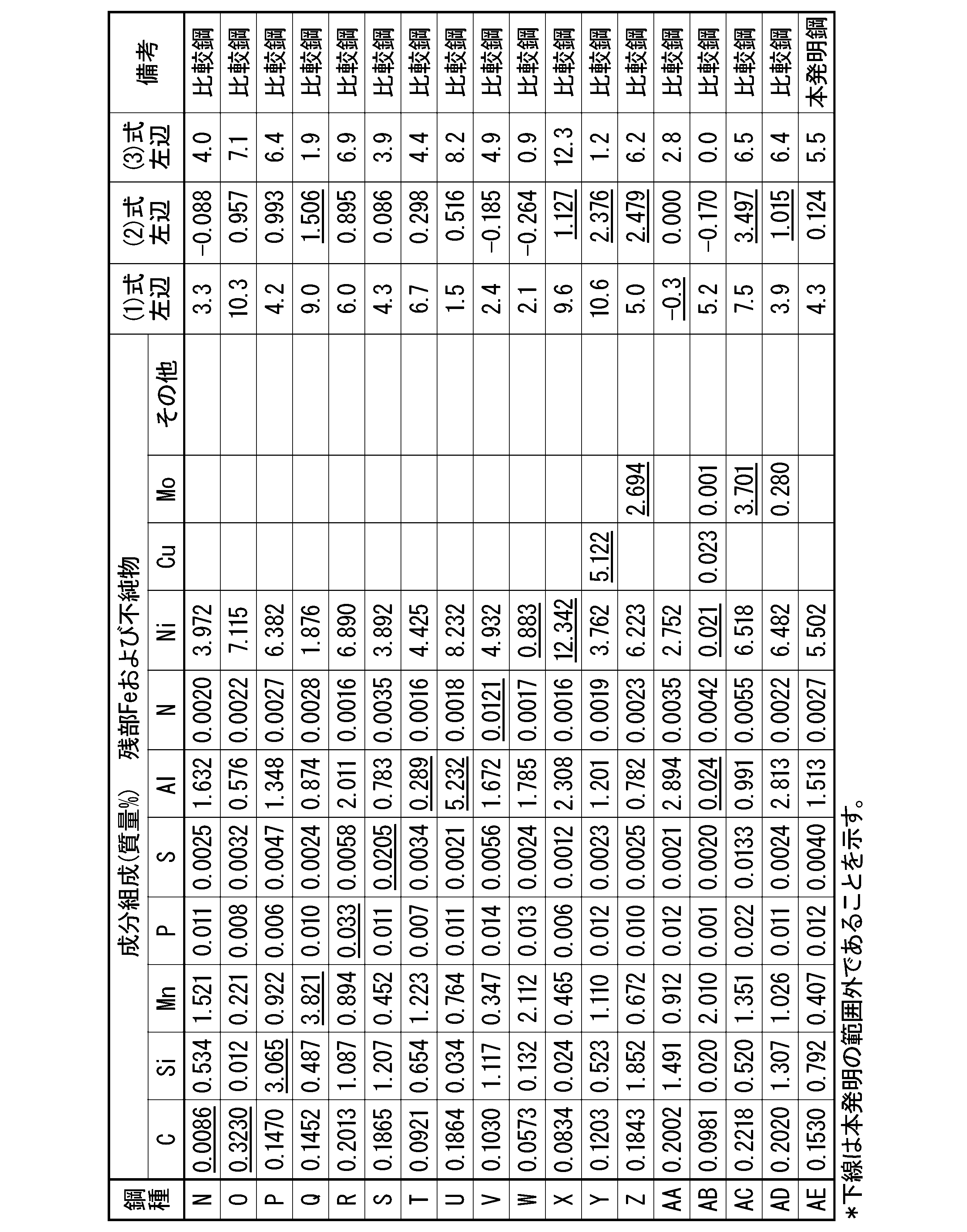
- Example 1 Steels having the component compositions shown in Tables 1A and 1B were melted, cast, and solidified to obtain steel pieces. Then, the steel piece is hot-rolled as it is, or once cooled to room temperature, heated at 1050 ° C or higher and 1300 ° C or lower for 60 minutes or longer and 240 minutes or shorter, and hot-rolled under the conditions shown in Tables 2A and 2B. Manufactured steel plate. The thickness of the hot-rolled steel sheet was 3.2 mm. In Tables 1A and 1B, the values on the left sides of the above equations (1), (2) and (3) are also shown.
- Yield strength (YP) and tensile (maximum) strength (TS) are obtained by collecting test pieces from the manufactured hot-rolled steel sheet so that the direction perpendicular to the rolling direction is the longitudinal direction and conducting a tensile test. , Elongation (El) was measured.
- the yield strength, tensile strength and elongation were measured using the No. 5 test piece described in JIS Z 2241: 2011 according to the method described in JIS Z 2241: 2011.
- TS tensile strength
- TS ⁇ El (MPa ⁇ %) was determined from the obtained tensile strength (TS) and elongation (El), and the strength-ductility balance was evaluated. When TS ⁇ El was 15,000 MPa ⁇ % or more, it was judged that the strength-ductility balance was excellent. Further, after applying 2% tensile deformation to the No. 5 test piece collected from the hot-rolled steel sheet so that the direction perpendicular to the rolling direction is the longitudinal direction, a strain aging hardening treatment at 170 ° C. for 20 minutes (hereinafter, hereinafter, BH treatment) was applied. This strain age hardening treatment was performed to simulate the coating baking treatment.
- BH treatment strain aging hardening treatment
- the tensile strength (TS), yield strength (YP) and elongation (El) after the BH treatment were measured by carrying out a tensile test according to the method described in JIS Z 2241: 2011.
- TS tensile strength
- YiP yield strength
- El elongation
- the composition of the steel was in a preferable range, but the average cooling rate at 550 to 300 ° C. was small, so that the desired amounts of martensite, bainite and retained austenite could not be obtained, and the ductile deterioration was large.
- the composition of the steel was in a preferable range, but the winding temperature was low, the proportion of ferrite in the steel structure decreased, and at the same time, the coverage of ferrite grain boundaries due to the columnar precipitation phase of Ni—Al decreased. Therefore, the ductile deterioration was large. No. In No. In No. 31, the composition of the steel was in a preferable range, but the average cooling rate at 550 to 300 ° C. was small, so that the desired amounts of martensite, bainite and retained austenite could not be obtained, and the ductile deterioration was large.
- the composition of the steel was in a preferable range, but the winding temperature was low, the proportion of ferrite in the steel structure decreased, and at the
- Example 2 The hot-dip galvanized steel sheets of sample codes 1 and 8 produced in Example 1 were heated to 660 to 720 ° C. and subjected to hot-dip galvanizing treatment to obtain hot-dip galvanized steel sheets.
- Sample code 8 was obtained as an alloyed hot-dip galvanized steel sheet by performing an alloying treatment at 540 to 580 ° C. after the hot-dip galvanizing treatment.
- the obtained hot-dip galvanized steel sheet (sample code 1) and alloyed hot-dip galvanized steel sheet (sample code 8) were subjected to microstructure observation and evaluation of mechanical properties in the same manner as in Example 1. The results are shown in Table 3.
- the high-strength steel sheet according to the above aspect is suitable for a shock absorbing member that requires collision resistance.
- fuel efficiency is improved by reducing the weight of the vehicle body and collision safety is achieved. Since it can contribute to the further improvement of the industrial value, it has extremely high industrial utility value.
Landscapes
- Chemical & Material Sciences (AREA)
- Engineering & Computer Science (AREA)
- Mechanical Engineering (AREA)
- Materials Engineering (AREA)
- Metallurgy (AREA)
- Organic Chemistry (AREA)
- Physics & Mathematics (AREA)
- Thermal Sciences (AREA)
- Crystallography & Structural Chemistry (AREA)
- Heat Treatment Of Sheet Steel (AREA)
Abstract
本発明の高強度鋼板は、所定の成分組成を有すると共に、C、Si、Mn、Al、Ni、CuおよびMoの質量%での含有量が所定の関係を満足するものであり、鋼組織が、面積率で、合計で85.0%以上99.0%以下のフェライト、セメンタイトおよびパーライト、並びに、合計で1.0%以上15.0%以下のマルテンサイト、ベイナイトおよび残留オーステナイトから構成され、Ni-Alの列状析出相がフェライトの粒界上に存在し、前記列状析出相による前記フェライト粒界の被覆率が、総粒界長さの5.0%以上であり、引張強さが590MPa以上のものである。
Description
本発明は、高強度鋼板に関する。
本願は、2019年06月17日に、日本に出願された特願2019-112081号に基づき優先権を主張し、その内容をここに援用する。
本願は、2019年06月17日に、日本に出願された特願2019-112081号に基づき優先権を主張し、その内容をここに援用する。
近年、自動車の燃費や衝突安全性などの向上を目的に、自動車部品において高強度鋼板の使用比率が高まっている。鋼板は高強度化に伴って加工性が劣化する傾向があることから、従来、DP(Dual Phase)鋼やTRIP(Transformation Induced Plasticity)鋼などの高強度と加工性とを両立し得る鋼板が開発されている。また、自動車の衝突安全性をより高める観点からは、衝突時の吸収エネルギーを増加させることも自動車部品に要求される。この要求に対しては、自動車部品を構成する鋼板の降伏強さを高めることが有効である。しかし、鋼板は、降伏強さが高いほど延性が低下し易い。降伏強さが高く延性が低い鋼板が自動車部品に用いられる場合、当該鋼板は、自動車の衝突時に伸びが不足して破断する場合がある。このように鋼板が破断すると、その鋼板は、衝撃を十分に吸収できず、降伏強さが高いことによる性能を十分に発揮できない場合がある。
自動車部品は鋼板をプレス成形して製造される場合がある。鋼板をプレス成形して得られた自動車部品を車体骨格に組み上げた後の塗装工程(塗装焼付処理)では、鋼板に焼付硬化が発現する。焼付硬化は、歪み時効に起因して鋼板の降伏強さが高くなる現象であり、歪み時効硬化とも呼ばれる。焼付硬化は、鋼中の固溶Cや固溶N等の侵入型元素に起因して発現する。DP鋼やTRIP鋼はCを多量に含むため、焼付硬化量(歪み時効に起因する鋼板の降伏強さの上昇量)が大きい。そのため、従来のDP鋼やTRIP鋼からなる自動車部品は、焼付硬化によって降伏強さが高くなっても、延性が低下する場合がある。このような課題に対して、焼付硬化後の延性を確保するために、鋼板の強度を確保しつつ、鋼組織中のマルテンサイトやベイナイトなどの硬質相を少なくする技術が検討されている。
例えば、特許文献1には、ベイナイトやマルテンサイトなどの硬質相を少量に抑えた鋼板が開示されている。特許文献1に記載されている鋼板は、フェライトを主相とし、体積率で、パーライトを2~12%、マルテンサイトを3%以下含み、残部が低温生成相からなるものである。
しかしながら、特許文献1に記載の鋼板は、引張強さが440MPa級であり、近年の自動車等に用いられる衝撃吸収部材に適用するには強度が不十分である。また、特許文献1には、プレス成形後、塗装焼付を行った場合の鋼板の延性について言及されていない。
上記のように、従来の高強度鋼板は、焼付硬化による降伏強さの上昇に伴って延性が低下し易い場合がある。本発明は、係る事情に鑑み、焼付硬化による延性の低下が抑制される高強度鋼板を提供することを目的とする。
本発明者らは、塗装焼付処理後の鋼板の延性について種々検討を重ねた結果、実験結果から以下の知見(a)および(b)を得た。
(a)所定量のNiおよびAlを同時に含有させ、Ni-Alの列状析出相(Ni-Alの金属間化合物)を生成させるとともに、フェライト、セメンタイトおよび/またはパーライトとからなる組織を主相とし、ベイナイトおよび/またはマルテンサイトの硬質相を少量含む鋼板は、590MPa以上の引張強さを有し、且つ引張試験における伸びの変化量がBH処理(予歪み2%付与後、170℃で20分の熱処理)前後で4%以下となる。
(b)上記のような鋼組織を有する鋼板を得るためには、熱間圧延後の冷却速度と、その後の急冷条件及び巻取温度とを制御することが重要である。
(a)所定量のNiおよびAlを同時に含有させ、Ni-Alの列状析出相(Ni-Alの金属間化合物)を生成させるとともに、フェライト、セメンタイトおよび/またはパーライトとからなる組織を主相とし、ベイナイトおよび/またはマルテンサイトの硬質相を少量含む鋼板は、590MPa以上の引張強さを有し、且つ引張試験における伸びの変化量がBH処理(予歪み2%付与後、170℃で20分の熱処理)前後で4%以下となる。
(b)上記のような鋼組織を有する鋼板を得るためには、熱間圧延後の冷却速度と、その後の急冷条件及び巻取温度とを制御することが重要である。
上記鋼板において塗装焼付処理後の延性が良好な理由は明確でないが、本発明者らは、以下のように推測する。歪み時効硬化(焼付硬化)は、加工により導入された転位に炭素が固着して転位を安定化し、転位運動に対する抵抗が高まることで、降伏強さが上昇する現象である。オーステナイトからマルテンサイトやベイナイトに相変態する際には転位の生成を伴う。したがって、強度が同程度の鋼板で比較すると、ベイナイトおよび/またはマルテンサイトを少量含む本発明に係る鋼板の転位密度は、マルテンサイトおよび/またはベイナイトを多量に含む従来の鋼板の転位密度よりも低い。予歪み付与後も同様に、本発明に係る鋼板の転位密度は、従来の鋼板の転位密度よりも低い。これらの理由から、ベイナイトおよび/またはマルテンサイトの組織分率が少ない本発明に係る鋼板では、歪み時効硬化により安定化する転位の量が少なく、延性の低下が抑制されると推測できる。
本発明は、以上の知見に基づいてなされたものであり、その要旨は以下の通りである。
[1]本発明の一態様に係る高強度鋼板は、成分組成が、質量%で、
C:0.0150%以上0.3000%以下、
Si:0%超3.000%以下、
Mn:0.050%以上3.600%以下、
P:0%超0.030%以下、
S:0%超0.0200%以下、
Al:0.500%以上5.000%以下、
N:0%超0.0100%以下、
Ni:1.000%以上12.300%以下、
Cu:0%以上4.800%以下、
Mo:0%以上2.500%以下、
Ca:0%以上0.0200%以下、
Mg:0%以上0.0200%以下、および
REM:0%以上0.0200%以下
を含有し、残部がFeおよび不純物からなり、
下記(1)式、(2)式および(3)式の関係を同時に満足し、
鋼組織が、面積率で、合計で85.0%以上99.0%以下のフェライト、セメンタイトおよびパーライト、並びに、合計で1.0%以上15.0%以下のマルテンサイト、ベイナイトおよび残留オーステナイトから構成され、
Ni-Alの列状析出相がフェライトの粒界上に存在し、前記列状析出相による前記フェライト粒界の被覆率が、総粒界長さの5.0%以上であり、
引張強さが590MPa以上である。
(Ni%+12.00×C%+2.00×Mn%+1.20×Cu%)-2.00×(Al%+0.50×Si%+0.25×Mo%)≧0.0 (1)
3.725×C%+0.160×Si%+0.630×Mn%-0.110×Al%+0.210×Ni%+0.450×Cu%+0.620×Mo%-1.818≦1.000 (2)
Ni%-0.5×Cu%≧0.0 (3)
ここで、C%、Si%、Mn%、Al%、Ni%、Cu%およびMo%は、それぞれC、Si、Mn、Al、Ni、CuおよびMoの質量%での含有量であり、含有しない場合は0を代入する。
[2]上記[1]に記載の高強度鋼板は、前記成分組成が、質量%で、
Cu:0.050%以上4.800%以下、
Mo:0.030%以上2.500%以下、
Ca:0.0001%以上0.0200%以下、
Mg:0.0001%以上0.0200%以下、および
REM:0.0001%以上0.0200%以下
のうちから選ばれる少なくとも1種を含有してもよい。
[3]上記[1]または[2]に記載の高強度鋼板は、溶融亜鉛めっき層または合金化溶融亜鉛めっき層を表面に有してもよい。
[1]本発明の一態様に係る高強度鋼板は、成分組成が、質量%で、
C:0.0150%以上0.3000%以下、
Si:0%超3.000%以下、
Mn:0.050%以上3.600%以下、
P:0%超0.030%以下、
S:0%超0.0200%以下、
Al:0.500%以上5.000%以下、
N:0%超0.0100%以下、
Ni:1.000%以上12.300%以下、
Cu:0%以上4.800%以下、
Mo:0%以上2.500%以下、
Ca:0%以上0.0200%以下、
Mg:0%以上0.0200%以下、および
REM:0%以上0.0200%以下
を含有し、残部がFeおよび不純物からなり、
下記(1)式、(2)式および(3)式の関係を同時に満足し、
鋼組織が、面積率で、合計で85.0%以上99.0%以下のフェライト、セメンタイトおよびパーライト、並びに、合計で1.0%以上15.0%以下のマルテンサイト、ベイナイトおよび残留オーステナイトから構成され、
Ni-Alの列状析出相がフェライトの粒界上に存在し、前記列状析出相による前記フェライト粒界の被覆率が、総粒界長さの5.0%以上であり、
引張強さが590MPa以上である。
(Ni%+12.00×C%+2.00×Mn%+1.20×Cu%)-2.00×(Al%+0.50×Si%+0.25×Mo%)≧0.0 (1)
3.725×C%+0.160×Si%+0.630×Mn%-0.110×Al%+0.210×Ni%+0.450×Cu%+0.620×Mo%-1.818≦1.000 (2)
Ni%-0.5×Cu%≧0.0 (3)
ここで、C%、Si%、Mn%、Al%、Ni%、Cu%およびMo%は、それぞれC、Si、Mn、Al、Ni、CuおよびMoの質量%での含有量であり、含有しない場合は0を代入する。
[2]上記[1]に記載の高強度鋼板は、前記成分組成が、質量%で、
Cu:0.050%以上4.800%以下、
Mo:0.030%以上2.500%以下、
Ca:0.0001%以上0.0200%以下、
Mg:0.0001%以上0.0200%以下、および
REM:0.0001%以上0.0200%以下
のうちから選ばれる少なくとも1種を含有してもよい。
[3]上記[1]または[2]に記載の高強度鋼板は、溶融亜鉛めっき層または合金化溶融亜鉛めっき層を表面に有してもよい。
本発明に係る上記態様によれば、焼付硬化による延性の低下が抑制される高強度鋼板を提供することができる。上記態様に係る高強度鋼板は、耐衝突特性が要求される衝撃吸収部材に好適である。
以下、本発明の一実施形態に係る高強度鋼板(以下、本実施形態に係る高強度鋼板または単に鋼板と記載する場合がある)について説明する。ただし、本発明は本実施形態に開示の構成のみに制限されることなく、本発明の趣旨を逸脱しない範囲で種々の変更が可能である。
本実施形態に係る高強度鋼板は、以下に説明する成分組成(化学組成)および金属組織を有する。本実施形態において「高強度鋼板」とは、引張強さ(TS)が590MPa以上である鋼板を意味する。
本実施形態に係る高強度鋼板は、以下に説明する成分組成(化学組成)および金属組織を有する。本実施形態において「高強度鋼板」とは、引張強さ(TS)が590MPa以上である鋼板を意味する。
(成分組成)
まず、本実施形態に係る高強度鋼板の成分組成について説明する。各元素の含有量についての「%」は全て「質量%」を意味する。
まず、本実施形態に係る高強度鋼板の成分組成について説明する。各元素の含有量についての「%」は全て「質量%」を意味する。
「C:0.0150%以上0.3000%以下」
Cは、鋼中に炭化物を形成してベイナイト、マルテンサイトおよび残留オーステナイトを得るために必須の元素である。C含有量が0.0150%未満では、マルテンサイト、ベイナイトおよび残留オーステナイトの面積率を合計で1.0%以上とすることができない。そのため、C含有量は0.0150%以上とする。
一方、C含有量が0.3000%を超えると、鋼中の固溶炭素量の増加に伴って焼付硬化が過剰に発現し、焼付硬化後の鋼板の延性が顕著に劣化する。そのため、C含有量は0.3000%以下とする。
Cは、鋼中に炭化物を形成してベイナイト、マルテンサイトおよび残留オーステナイトを得るために必須の元素である。C含有量が0.0150%未満では、マルテンサイト、ベイナイトおよび残留オーステナイトの面積率を合計で1.0%以上とすることができない。そのため、C含有量は0.0150%以上とする。
一方、C含有量が0.3000%を超えると、鋼中の固溶炭素量の増加に伴って焼付硬化が過剰に発現し、焼付硬化後の鋼板の延性が顕著に劣化する。そのため、C含有量は0.3000%以下とする。
「Si:0%超3.000%以下」
Siは、熱力学的にフェライトを安定化する元素であり、フェライトに固溶して固溶体硬化を発現させる有用な元素である。また、Siは、炭化物の形成を阻害することで、マルテンサイトの生成を促進する元素である。これらの効果を得るため、Si含有量は0%超とする。
一方、Siは、鋼の焼入れ性を高める元素でもある。そのため、Si含有量が多すぎると、熱間圧延後の冷却過程においてオーステナイトからフェライトへの変態が遅れ、ベイナイトおよび/またはマルテンサイトが形成されやすくなる。熱間圧延後の冷却過程において所望量のフェライトを生成させるために、Si含有量は3.000%以下とする。
Siは、熱力学的にフェライトを安定化する元素であり、フェライトに固溶して固溶体硬化を発現させる有用な元素である。また、Siは、炭化物の形成を阻害することで、マルテンサイトの生成を促進する元素である。これらの効果を得るため、Si含有量は0%超とする。
一方、Siは、鋼の焼入れ性を高める元素でもある。そのため、Si含有量が多すぎると、熱間圧延後の冷却過程においてオーステナイトからフェライトへの変態が遅れ、ベイナイトおよび/またはマルテンサイトが形成されやすくなる。熱間圧延後の冷却過程において所望量のフェライトを生成させるために、Si含有量は3.000%以下とする。
「Mn:0.050%以上3.600%以下」
Mnは、熱力学的にオーステナイトを安定化する元素である。また、Mnは、Sによる熱間圧延時の表面疵を低減するのに有用な元素である。これら効果を得るために、Mn含有量は0.050%以上とする。
一方、Mnは焼入れ性を高めるので、Mn含有量が多すぎると、熱間圧延後の冷却過程においてオーステナイトからフェライトへの変態が遅れ、ベイナイトおよび/またはマルテンサイトが形成されやすくなる。ベイナイトおよび/またはマルテンサイトの面積率が増加することを抑制して所望の鋼組織を得るため、Mn含有量は3.600%以下とする。
Mnは、熱力学的にオーステナイトを安定化する元素である。また、Mnは、Sによる熱間圧延時の表面疵を低減するのに有用な元素である。これら効果を得るために、Mn含有量は0.050%以上とする。
一方、Mnは焼入れ性を高めるので、Mn含有量が多すぎると、熱間圧延後の冷却過程においてオーステナイトからフェライトへの変態が遅れ、ベイナイトおよび/またはマルテンサイトが形成されやすくなる。ベイナイトおよび/またはマルテンサイトの面積率が増加することを抑制して所望の鋼組織を得るため、Mn含有量は3.600%以下とする。
「P:0%超0.030%以下」
Pは粒界に偏析しやすい元素である。P含有量が多すぎると、高強度鋼板においては脆化が助長され、加工性が低下する場合がある。そのため、P含有量は0.030%以下とする。
一方、Pは、固溶体硬化により鋼板の強度を高める元素でもある。また、P含有量を過剰に低減すると精錬コストが上昇する。そのため、P含有量は0%超、または0.001%以上としてもよい。
Pは粒界に偏析しやすい元素である。P含有量が多すぎると、高強度鋼板においては脆化が助長され、加工性が低下する場合がある。そのため、P含有量は0.030%以下とする。
一方、Pは、固溶体硬化により鋼板の強度を高める元素でもある。また、P含有量を過剰に低減すると精錬コストが上昇する。そのため、P含有量は0%超、または0.001%以上としてもよい。
「S:0%超0.0200%以下」
Sは、鋼中で介在物として存在する。S含有量が0.0200%を超えると、介在物量が増加し、鋼板の加工時に介在物が破断の起点となって鋼板の成形性が低下する場合がある。そのため、S含有量は0.0200%以下とする
一方、S含有量を過剰に低減すると精錬コストが上昇する。そのため、S含有量は0%超、または0.0001%以上としてもよい。
Sは、鋼中で介在物として存在する。S含有量が0.0200%を超えると、介在物量が増加し、鋼板の加工時に介在物が破断の起点となって鋼板の成形性が低下する場合がある。そのため、S含有量は0.0200%以下とする
一方、S含有量を過剰に低減すると精錬コストが上昇する。そのため、S含有量は0%超、または0.0001%以上としてもよい。
「Al:0.500%以上5.000%以下」
Alは、Siと同様に熱力学的にフェライトを安定化する元素であるとともに、鋼中で炭化物の形成を阻害する元素である。また、Alは、所定量のNiと同時に含有されると、鋼板を高強度化させる元素である。AlとNiとを同時に含有させることによる鋼板の高強度化は、Ni-Alの列状析出相(Ni-Al金属間化合物)ならびに固溶クラスターの形成によると考えられる。また、その効果を得るためには、熱間圧延後のフェライト変態を促進する必要があると考えられる。
Al含有量が0.500%未満では、十分な量のフェライトが生成せず、上記の効果が得られない。そのため、Al含有量は0.500%以上とする。
一方、Al含有量が5.000%を超えると、熱間圧延中にフェライトが生成してしまう。その結果、熱間圧延時に加工オーステナイトおよび加工フェライトが形成されることで、冷却時に加工オーステナイトが変態して生成したフェライトと、加工フェライトが回復・再結晶で生成したフェライトとからなる混合組織が形成される。このような混合組織の機械特性は、それらの形成割合で鋭敏に変動する。そのため、鋼板の鋼組織を上記のような混合組織とした場合には、工業的に安定した機械特性を得ることができない。したがって、Al含有量は5.000%以下とする。
Alは、Siと同様に熱力学的にフェライトを安定化する元素であるとともに、鋼中で炭化物の形成を阻害する元素である。また、Alは、所定量のNiと同時に含有されると、鋼板を高強度化させる元素である。AlとNiとを同時に含有させることによる鋼板の高強度化は、Ni-Alの列状析出相(Ni-Al金属間化合物)ならびに固溶クラスターの形成によると考えられる。また、その効果を得るためには、熱間圧延後のフェライト変態を促進する必要があると考えられる。
Al含有量が0.500%未満では、十分な量のフェライトが生成せず、上記の効果が得られない。そのため、Al含有量は0.500%以上とする。
一方、Al含有量が5.000%を超えると、熱間圧延中にフェライトが生成してしまう。その結果、熱間圧延時に加工オーステナイトおよび加工フェライトが形成されることで、冷却時に加工オーステナイトが変態して生成したフェライトと、加工フェライトが回復・再結晶で生成したフェライトとからなる混合組織が形成される。このような混合組織の機械特性は、それらの形成割合で鋭敏に変動する。そのため、鋼板の鋼組織を上記のような混合組織とした場合には、工業的に安定した機械特性を得ることができない。したがって、Al含有量は5.000%以下とする。
「N:0%超0.0100%以下」
Nは、侵入型元素であり、歪み時効硬化に寄与する元素である。しかしながら、本実施形態に係る高強度鋼板はAlを必須元素として含むため、Nは鋼中で主に窒化アルミニウム(AlN)として存在する。N含有量が0.0100%を超えると粗大なAlN量が増加し、鋼板の加工時に粗大なAlNが破断起点となって鋼板の成形性が劣化する場合がある。したがって、N含有量を0.0100%以下とする。
一方、N含有量を過剰に低減すると精錬コストが上昇する。そのため、N含有量は0%超、または0.0001%以上としてもよい。
Nは、侵入型元素であり、歪み時効硬化に寄与する元素である。しかしながら、本実施形態に係る高強度鋼板はAlを必須元素として含むため、Nは鋼中で主に窒化アルミニウム(AlN)として存在する。N含有量が0.0100%を超えると粗大なAlN量が増加し、鋼板の加工時に粗大なAlNが破断起点となって鋼板の成形性が劣化する場合がある。したがって、N含有量を0.0100%以下とする。
一方、N含有量を過剰に低減すると精錬コストが上昇する。そのため、N含有量は0%超、または0.0001%以上としてもよい。
「Ni:1.000%以上12.300%以下」
Niは、Mnと同様に熱力学的にオーステナイトを安定化する元素であり、鋼中で炭化物の形成を阻害する元素でもある。また、Niは、所定量のAlと同時に含有されると、鋼板を高強度化させる元素である。この理由は定かではないが、NiおよびAlの列状析出相(Ni-Al金属間化合物)および固溶クラスターが形成されるためと推測される。NiとAlとを同時に含有させることによる鋼板の高強度化の効果を得るために、Ni含有量は1.000%以上とする。
一方、Ni含有量が12.300%を超えると、熱間圧延後の冷却過程においてオーステナイトからフェライトへの変態が遅れ、ベイナイトおよび/またはマルテンサイトが多量に形成され、所望の鋼組織が得られない。そのため、Ni含有量は12.300%以下とする。
Niは、Mnと同様に熱力学的にオーステナイトを安定化する元素であり、鋼中で炭化物の形成を阻害する元素でもある。また、Niは、所定量のAlと同時に含有されると、鋼板を高強度化させる元素である。この理由は定かではないが、NiおよびAlの列状析出相(Ni-Al金属間化合物)および固溶クラスターが形成されるためと推測される。NiとAlとを同時に含有させることによる鋼板の高強度化の効果を得るために、Ni含有量は1.000%以上とする。
一方、Ni含有量が12.300%を超えると、熱間圧延後の冷却過程においてオーステナイトからフェライトへの変態が遅れ、ベイナイトおよび/またはマルテンサイトが多量に形成され、所望の鋼組織が得られない。そのため、Ni含有量は12.300%以下とする。
本実施形態に係る高強度鋼板の成分組成において、上述の元素以外、すなわち残部はFeおよび不純物である。不純物としては、鋼原料もしくはスクラップから不可避的に混入する元素又は製鋼過程で不可避的に混入する元素であって、本実施形態に係る高強度鋼板が上記本実施形態に係る高強度鋼板の効果を奏し得る範囲で許容される元素を例示することができる。不純物の合計含有量は、0.100%以下であることが好ましい。不純物のうち、Oは、その含有量を0.010%以下とすることが好ましい。
本実施形態に係る高強度鋼板には、残部のFeの一部に代えて、下記に示す任意元素の1種以上を含有させてもよい。ただし、下記に示す任意元素を含有させなくても本実施形態に係る高強度鋼板はその課題を解決することができるので、任意元素の含有量の下限は0%である。
本実施形態に係る高強度鋼板には、残部のFeの一部に代えて、下記に示す任意元素の1種以上を含有させてもよい。ただし、下記に示す任意元素を含有させなくても本実施形態に係る高強度鋼板はその課題を解決することができるので、任意元素の含有量の下限は0%である。
「Cu:0%以上4.800%以下」
Cuは、MnおよびNiと同様に、熱力学的にオーステナイト相を安定化する元素である。この効果を確実に得るためには、Cu含有量を0.050%以上とすることが好ましい。
一方、Cu含有量が多すぎると、熱間圧延後の冷却過程において所望量のフェライトを生成させることができない。そのため、含有させる場合でも、Cu含有量は4.800%以下とする。
Cuは、MnおよびNiと同様に、熱力学的にオーステナイト相を安定化する元素である。この効果を確実に得るためには、Cu含有量を0.050%以上とすることが好ましい。
一方、Cu含有量が多すぎると、熱間圧延後の冷却過程において所望量のフェライトを生成させることができない。そのため、含有させる場合でも、Cu含有量は4.800%以下とする。
「Mo:0%以上2.500%以下」
Moは、SiおよびAlと同様に、フェライト相を安定化させる元素である。この効果を確実に得るためには、Mo含有量を0.030%以上とすることが好ましい。
一方、Mo含有量が多すぎると、熱間圧延後の冷却過程において所望量のフェライトを生成させることができない。そのため、含有させる場合でも、Mo含有量は2.500%以下とする。
Moは、SiおよびAlと同様に、フェライト相を安定化させる元素である。この効果を確実に得るためには、Mo含有量を0.030%以上とすることが好ましい。
一方、Mo含有量が多すぎると、熱間圧延後の冷却過程において所望量のフェライトを生成させることができない。そのため、含有させる場合でも、Mo含有量は2.500%以下とする。
「Ca:0%以上0.0200%以下」
「Mg:0%以上0.0200%以下」
「REM:0%以上0.0200%以下」
Ca、MgおよびREMは、いずれも酸化物や硫化物などの介在物の形状を制御する元素である。具体的には、介在物を微細分散化し、加工時の破断起点の要因を減少させ、鋼板の加工性向上に寄与する元素である。これらの効果を確実に発現させるには、Ca、MgおよびREMのうち1種でもその含有量を0.0001%以上とすることが好ましい。ただし、Ca、MgおよびREMのうち1種でもその含有量が0.0200%を超えると、介在物の総数が増加し、鋼板の内部品質が悪化する。したがって、Ca、MgおよびREMの含有量はそれぞれ、0.0001%以上0.0200%以下とする。
REMは、スカンジウム、イットリウム、ランタンからルテチウムまでの17元素を指し、一般的に希土類元素、あるいはレアアースと呼ばれている。REMが複数種類含まれる場合、REMの上記含有量は、これらの元素の合計含有量を意味する。
「Mg:0%以上0.0200%以下」
「REM:0%以上0.0200%以下」
Ca、MgおよびREMは、いずれも酸化物や硫化物などの介在物の形状を制御する元素である。具体的には、介在物を微細分散化し、加工時の破断起点の要因を減少させ、鋼板の加工性向上に寄与する元素である。これらの効果を確実に発現させるには、Ca、MgおよびREMのうち1種でもその含有量を0.0001%以上とすることが好ましい。ただし、Ca、MgおよびREMのうち1種でもその含有量が0.0200%を超えると、介在物の総数が増加し、鋼板の内部品質が悪化する。したがって、Ca、MgおよびREMの含有量はそれぞれ、0.0001%以上0.0200%以下とする。
REMは、スカンジウム、イットリウム、ランタンからルテチウムまでの17元素を指し、一般的に希土類元素、あるいはレアアースと呼ばれている。REMが複数種類含まれる場合、REMの上記含有量は、これらの元素の合計含有量を意味する。
前述の元素のうち、C、Si、Mn、Al、Ni、CuおよびMoの含有量は下記(1)式、(2)式および(3)式を同時に満たす必要がある。
(Ni%+12.00×C%+2.00×Mn%+1.20×Cu%)-2.00×(Al%+0.50×Si%+0.25×Mo%)≧0.0 (1)
3.725×C%+0.160×Si%+0.630×Mn%-0.110×Al%+0.210×Ni%+0.450×Cu%+0.620×Mo%-1.818≦1.000 (2)
Ni%-0.5×Cu%≧0.0 (3)
ここで、C%、Si%、Mn%、Al%、Ni%、Cu%およびMo%は、それぞれC、Si、Mn、Al、Ni、CuおよびMoの質量%での含有量であり、含有しない場合は0を代入する。
(Ni%+12.00×C%+2.00×Mn%+1.20×Cu%)-2.00×(Al%+0.50×Si%+0.25×Mo%)≧0.0 (1)
3.725×C%+0.160×Si%+0.630×Mn%-0.110×Al%+0.210×Ni%+0.450×Cu%+0.620×Mo%-1.818≦1.000 (2)
Ni%-0.5×Cu%≧0.0 (3)
ここで、C%、Si%、Mn%、Al%、Ni%、Cu%およびMo%は、それぞれC、Si、Mn、Al、Ni、CuおよびMoの質量%での含有量であり、含有しない場合は0を代入する。
上記(1)式は、熱間圧延中にフェライトを生成せず、オーステナイトの単相域で熱間圧延するための条件式である。また、(1)式は、Ni-Alの列状析出相による鋼板の強度-延性バランスの向上ならびに焼付硬化後の延性の低下を抑えるための指標を示す条件式でもある。
まず、鋼板特性に与える前者の影響を述べる。C、Mn、NiおよびCuといったオーステナイトを安定化する元素の含有量に比べ、Si、AlおよびMoといったフェライトを安定化する元素の含有量が多いと、熱間圧延中にオーステナイトだけでなくフェライトが生成される。Al含有量の限定理由でも述べたが、熱間圧延中に混在するオーステナイトおよびフェライトは、熱間圧延により各々加工オーステナイトと加工フェライトとなり、冷却時に前者は変態で生成したフェライト、後者は回復・再結晶で生成したフェライトとなり、混合組織を形成する。このような混合組織の機械特性はそれらの形成割合により大きく変動することから、工業上、安定した機械特性を得ることができない。
続いて、鋼板特性に与える後者の影響を述べる。前述の熱間圧延においてオーステナイトを安定化させるNi原子はオーステナイト相中に均一分散するものの、フェライトを安定化させるAl原子はオーステナイト相中に固溶するよりもオーステナイトの粒界に偏析する。本実施形態に係る高強度鋼板では、熱間圧延後の鋼におけるフェライト粒界(近傍を含む)に列状析出相が生成することにより強度-延性バランスおよび焼付硬化後の延性の低下が抑制される。詳細なメカニズムは明らかではないものの、フェライト粒界に列状析出相が生成するとフェライト粒界近傍の変形抵抗が上昇し、焼付硬化処理前の鋼板に変形を与えたときに鋼のフェライト粒内で増殖する転位がフェライト粒界に集積しにくくなることで、変形に伴うボイドの生成が抑制され、強度-延性バランスが向上すると考えられる。また、従来の鋼において焼付硬化処理後の延性を劣化させる原因は、フェライト粒界に過度に転位が集積した状態で焼付の熱処理を与えて転位の移動度を低下させたためであり、フェライト粒界への転位の過度な集積を抑えることで、焼付硬化処理後の延性低下を抑えることが可能と理解される。そのため、本実施形態に係る高強度鋼板では、成分組成において、各元素の含有量が所定の範囲であることに加え、上記(1)式を満足する必要がある。
まず、鋼板特性に与える前者の影響を述べる。C、Mn、NiおよびCuといったオーステナイトを安定化する元素の含有量に比べ、Si、AlおよびMoといったフェライトを安定化する元素の含有量が多いと、熱間圧延中にオーステナイトだけでなくフェライトが生成される。Al含有量の限定理由でも述べたが、熱間圧延中に混在するオーステナイトおよびフェライトは、熱間圧延により各々加工オーステナイトと加工フェライトとなり、冷却時に前者は変態で生成したフェライト、後者は回復・再結晶で生成したフェライトとなり、混合組織を形成する。このような混合組織の機械特性はそれらの形成割合により大きく変動することから、工業上、安定した機械特性を得ることができない。
続いて、鋼板特性に与える後者の影響を述べる。前述の熱間圧延においてオーステナイトを安定化させるNi原子はオーステナイト相中に均一分散するものの、フェライトを安定化させるAl原子はオーステナイト相中に固溶するよりもオーステナイトの粒界に偏析する。本実施形態に係る高強度鋼板では、熱間圧延後の鋼におけるフェライト粒界(近傍を含む)に列状析出相が生成することにより強度-延性バランスおよび焼付硬化後の延性の低下が抑制される。詳細なメカニズムは明らかではないものの、フェライト粒界に列状析出相が生成するとフェライト粒界近傍の変形抵抗が上昇し、焼付硬化処理前の鋼板に変形を与えたときに鋼のフェライト粒内で増殖する転位がフェライト粒界に集積しにくくなることで、変形に伴うボイドの生成が抑制され、強度-延性バランスが向上すると考えられる。また、従来の鋼において焼付硬化処理後の延性を劣化させる原因は、フェライト粒界に過度に転位が集積した状態で焼付の熱処理を与えて転位の移動度を低下させたためであり、フェライト粒界への転位の過度な集積を抑えることで、焼付硬化処理後の延性低下を抑えることが可能と理解される。そのため、本実施形態に係る高強度鋼板では、成分組成において、各元素の含有量が所定の範囲であることに加え、上記(1)式を満足する必要がある。
上記(2)式は、熱間圧延後の冷却中にフェライトを生成させるための条件式である。本発明者らは、NiとAlとを同時に含有させることによる高強度化の発現は、bcc結晶構造を持つフェライト組織の生成後にフェライト粒界に列状析出相が生成することによって起こるという実験結果を得ている。焼入れ性を高める元素が一定量以上になると熱間圧延後の冷却中にフェライトが十分に生成せず、フェライト粒界での列状析出相の生成が抑制されるので、鋼板の高強度化および高延性化が図れない。そのため、本実施形態に係る高強度鋼板の成分組成では、各元素の含有量が所定の範囲であることに加え、上記(2)式を満足する必要がある。
上記(3)式は、Cuの溶融相による熱間脆性を防止する観点から必要なNi含有量を規定する条件式である。Cuによる熱間脆性防止の観点からは、Cu含有量はNi含有量の2.0倍まで許容される。Ni含有量がCu含有量の半分(0.5倍)以上であれば、熱間脆性を抑制できる。そのため、本実施形態に係る高強度鋼板の成分組成では、上記(3)式を満足する必要がある。
次に、本実施形態に係る高強度鋼板の鋼組織(ミクロ組織)について説明する。
(鋼組織)
本実施形態に係る高強度鋼板の鋼組織は、面積率で、合計で85.0%以上99.0%以下のフェライト、セメンタイトおよびパーライト、並びに、合計で1.0%以上15.0%以下のマルテンサイト、ベイナイトおよび残留オーステナイトからなる。
本実施形態に係る高強度鋼板の鋼組織は、面積率で、合計で85.0%以上99.0%以下のフェライト、セメンタイトおよびパーライト、並びに、合計で1.0%以上15.0%以下のマルテンサイト、ベイナイトおよび残留オーステナイトからなる。
各組織の面積率は、以下の方法により測定することができる。
鋼板の圧延方向に平行な板厚断面が観察面となるように試料を採取する。観察面のうち鋼板表面から板厚tの1/4の位置(t/4の位置)を中心とする、板厚方向でt/8~3t/8の範囲内における、100μm×100μmの領域を観察領域とする。この観察領域をレペラーエッチングで腐食し、光学顕微鏡を用いて腐食された面を撮影した組織画像を解析して、各組織の面積率を算出する。
鋼板の圧延方向に平行な板厚断面が観察面となるように試料を採取する。観察面のうち鋼板表面から板厚tの1/4の位置(t/4の位置)を中心とする、板厚方向でt/8~3t/8の範囲内における、100μm×100μmの領域を観察領域とする。この観察領域をレペラーエッチングで腐食し、光学顕微鏡を用いて腐食された面を撮影した組織画像を解析して、各組織の面積率を算出する。
本実施形態に係る高強度鋼板の鋼組織は、上記のように、フェライト、セメンタイト、パーライト、ベイナイト、マルテンサイトおよび残留オーステナイトのうち複数の組織の組み合わせからなる。撮影された組織画像は黒色部分と灰色部分と白色部分とに区別できる。このうち灰色部分にフェライトおよびベイナイトが含まれ、黒色部分にセメンタイトおよびパーライトが含まれ、白色部分にマルテンサイトおよび残留オーステナイトが含まれる。そのため、白色部分をマルテンサイトおよび残留オーステナイトとみなす。灰色部分において、ラス状の組織をベイナイトとみなし、ラス状の組織以外の組織をフェライトとみなす。また、黒色部分において点状に並ぶ組織をセメンタイト、黒色部分が列状に並びあるいは直径1.0μm超の塊状として存在する組織をパーライトとみなす。少なくとも3つの観察領域の組織画像を解析し、各組織の面積率の平均値を算出することで、各組織の面積率を得る。
「フェライト、セメンタイトおよびパーライトの面積率:合計で85.0%以上99.0%以下」
本発明者らは、種々の実験から、冷却中の高強度化の効果は、フェライトまたはパーライト組織によって発現されることを知見した。すなわち、鋼板を十分に高強度化するためには、所望量のフェライトまたはパーライトを含ませることが重要である。本実施形態に係る高強度鋼板の成分組成においてフェライトおよび/またはパーライトを生成させた場合には、少量のセメンタイトも生成される。そのため、本実施形態では、フェライト、セメンタイトおよびパーライトの合計の面積率を規定する。本実施形態では、フェライト、セメンタイトおよびパーライトの面積率は、合計で85.0%以上99.0%以下とする。十分な効果を得るためには上記組織のうちフェライト単独の面積率は40.0%以上であることが好ましい。
本発明者らは、種々の実験から、冷却中の高強度化の効果は、フェライトまたはパーライト組織によって発現されることを知見した。すなわち、鋼板を十分に高強度化するためには、所望量のフェライトまたはパーライトを含ませることが重要である。本実施形態に係る高強度鋼板の成分組成においてフェライトおよび/またはパーライトを生成させた場合には、少量のセメンタイトも生成される。そのため、本実施形態では、フェライト、セメンタイトおよびパーライトの合計の面積率を規定する。本実施形態では、フェライト、セメンタイトおよびパーライトの面積率は、合計で85.0%以上99.0%以下とする。十分な効果を得るためには上記組織のうちフェライト単独の面積率は40.0%以上であることが好ましい。
「マルテンサイト、ベイナイトおよび残留オーステナイトの面積率:合計で1.0%以上15.0%以下」
本実施形態に係る高強度鋼板の鋼組織において、フェライト、セメンタイトおよびパーライト以外の組織は、マルテンサイト、ベイナイトおよび残留オーステナイトの1種以上である。
本実施形態では、所望量のマルテンサイト、ベイナイトおよび/または残留オーステナイトを含ませることが重要である。そのため、本実施形態では、マルテンサイト、ベイナイトおよび残留オーステナイトの合計の面積率を規定する。マルテンサイト、ベイナイトおよび残留オーステナイトを含まず、フェライト、セメンタイトおよび/またはパーライトからなる鋼組織では、降伏伸びが顕著に高くなる。降伏伸びが生じた部分は、変形が進んだ部分と未変形の部分とが混存し、変形の進んだ板厚の薄い部分で局所的に変形が集中し、早期に板破断が発生する。すなわち、鋼板の延性が低くなる。そのため、マルテンサイト、ベイナイトおよび残留オーステナイトを1.0%以上含ませることで、降伏伸びが過剰に上昇することを抑制する。一方、これらの組織は、強度上昇に寄与するが、面積率が増えるほど焼付硬化量も増加させ、塗装焼付処理後の鋼板の延性を劣化させる。そのため、マルテンサイト、ベイナイトおよび残留オーステナイトの面積率は15.0%以下とする。
本実施形態に係る高強度鋼板の鋼組織において、フェライト、セメンタイトおよびパーライト以外の組織は、マルテンサイト、ベイナイトおよび残留オーステナイトの1種以上である。
本実施形態では、所望量のマルテンサイト、ベイナイトおよび/または残留オーステナイトを含ませることが重要である。そのため、本実施形態では、マルテンサイト、ベイナイトおよび残留オーステナイトの合計の面積率を規定する。マルテンサイト、ベイナイトおよび残留オーステナイトを含まず、フェライト、セメンタイトおよび/またはパーライトからなる鋼組織では、降伏伸びが顕著に高くなる。降伏伸びが生じた部分は、変形が進んだ部分と未変形の部分とが混存し、変形の進んだ板厚の薄い部分で局所的に変形が集中し、早期に板破断が発生する。すなわち、鋼板の延性が低くなる。そのため、マルテンサイト、ベイナイトおよび残留オーステナイトを1.0%以上含ませることで、降伏伸びが過剰に上昇することを抑制する。一方、これらの組織は、強度上昇に寄与するが、面積率が増えるほど焼付硬化量も増加させ、塗装焼付処理後の鋼板の延性を劣化させる。そのため、マルテンサイト、ベイナイトおよび残留オーステナイトの面積率は15.0%以下とする。
Ni-Alの列状析出相がフェライトの粒界上に存在し、列状析出相によるフェライト粒界の被覆率が、総粒界長さの5.0%以上
Ni-Alの列状析出相がフェライトの粒界上に存在し(フェライト粒界を被覆し)、Ni-Alの列状析出相によるフェライト粒界の被覆率が5.0%以上であることで、本実施形態に係る高強度鋼板では、ベイナイトやマルテンサイトなどの組織の面積率が小さくても、590MPa以上の高強度を得ることができる。
被覆率の上限は特に限定されないが、降伏伸びが過剰に上昇することを抑制する点で90.0%以下であることが好ましい。
Ni-Alの列状析出相がフェライトの粒界上に存在し(フェライト粒界を被覆し)、Ni-Alの列状析出相によるフェライト粒界の被覆率が5.0%以上であることで、本実施形態に係る高強度鋼板では、ベイナイトやマルテンサイトなどの組織の面積率が小さくても、590MPa以上の高強度を得ることができる。
被覆率の上限は特に限定されないが、降伏伸びが過剰に上昇することを抑制する点で90.0%以下であることが好ましい。
Ni-Alの列状析出相の同定とフェライト粒界の被覆率の測定とは、以下に示すように透過型電子顕微鏡(TEM)で得た組織観察写真により行う。本実施形態では、直径が20nm以下かつ長さが500nm以下の棒状の形状を有するNi-Al金属間化合物が列状あるいは点状に析出し、かつ隣接するNi-Alの金属間化合物同士の間隔が100nm以内となるように分散した塊状組織を、1つの列状析出相とする。
まず、鋼板から精密切断機を用いて観察用の素材を切り出し、これを観察位置である板厚方向の1/4位置の厚さまでエメリー紙にて切削研磨し、素材厚みを0.1mmに調整後、打抜きパンチで3mmφの試料を素材から打抜いた試料に両面ジェット電解研磨を行うことで、TEM観察用の試料を作製する。このTEM観察用試料において、4.0μm×4.0μmの領域をランダムに選択し、EDSによる元素分析とナノビーム回折(NBD/Nano Beam Diffraction;微小部電子回折)法による結晶構造解析によってNi-Alの金属間化合物の生成場所を同定し、その生成場所が含まれるようにTEM写真を撮影する。この操作を繰り返し行うことで得た25枚のTEM写真において、Ni-Alの列状析出相と接するフェライトの粒界長さを、フェライトの総粒界長さで割ることによりフェライト粒界の被覆率を求める。
列状析出相に接するフェライト粒界の長さは、画像解析により次の手順で求める。1つのフェライト粒内に存在する列状析出相(金属間化合物が分散析出している領域)において、その最外周に位置するNi-Alの金属間化合物のそれぞれを中心として半径100nmの円を描き、この円を連結させて得られる範囲(いずれかの円に含まれる範囲)を列状析出相の境界領域とし、この境界領域の中に含まれるフェライト粒界の長さを、列状析出相に接するフェライト粒界の長さとする。
また、フェライト粒界とは体心立方格子の結晶構造をもつフェライト相において結晶方位差が15°以上の境界であり、EBSD(Electron Back Scattered Diffraction Pattern)法やTEMの電子線回折パターン解析による結晶方位の同定から求めることができる。
まず、鋼板から精密切断機を用いて観察用の素材を切り出し、これを観察位置である板厚方向の1/4位置の厚さまでエメリー紙にて切削研磨し、素材厚みを0.1mmに調整後、打抜きパンチで3mmφの試料を素材から打抜いた試料に両面ジェット電解研磨を行うことで、TEM観察用の試料を作製する。このTEM観察用試料において、4.0μm×4.0μmの領域をランダムに選択し、EDSによる元素分析とナノビーム回折(NBD/Nano Beam Diffraction;微小部電子回折)法による結晶構造解析によってNi-Alの金属間化合物の生成場所を同定し、その生成場所が含まれるようにTEM写真を撮影する。この操作を繰り返し行うことで得た25枚のTEM写真において、Ni-Alの列状析出相と接するフェライトの粒界長さを、フェライトの総粒界長さで割ることによりフェライト粒界の被覆率を求める。
列状析出相に接するフェライト粒界の長さは、画像解析により次の手順で求める。1つのフェライト粒内に存在する列状析出相(金属間化合物が分散析出している領域)において、その最外周に位置するNi-Alの金属間化合物のそれぞれを中心として半径100nmの円を描き、この円を連結させて得られる範囲(いずれかの円に含まれる範囲)を列状析出相の境界領域とし、この境界領域の中に含まれるフェライト粒界の長さを、列状析出相に接するフェライト粒界の長さとする。
また、フェライト粒界とは体心立方格子の結晶構造をもつフェライト相において結晶方位差が15°以上の境界であり、EBSD(Electron Back Scattered Diffraction Pattern)法やTEMの電子線回折パターン解析による結晶方位の同定から求めることができる。
(めっき層)
本実施形態に係る高強度鋼板は、耐食性の向上等を目的として、その表面にめっき層を備えるものであってもよい。すなわち、本実施形態に係る高強度鋼板は、溶融亜鉛めっき層、合金化溶融亜鉛めっき層または電気亜鉛めっき層を備えるものであってもよい。めっき層の付着量は特に制限されず、一般的な付着量とすればよい。
本実施形態に係る高強度鋼板は、耐食性の向上等を目的として、その表面にめっき層を備えるものであってもよい。すなわち、本実施形態に係る高強度鋼板は、溶融亜鉛めっき層、合金化溶融亜鉛めっき層または電気亜鉛めっき層を備えるものであってもよい。めっき層の付着量は特に制限されず、一般的な付着量とすればよい。
(製造方法)
次に、本実施形態に係る高強度鋼板を得るための好ましい製造方法について説明する。以下の説明は、本実施形態に係る高強度鋼板を得るための製造方法の単なる例示を意図するものであって、以下の製造方法に限定することを意図するものではない。
次に、本実施形態に係る高強度鋼板を得るための好ましい製造方法について説明する。以下の説明は、本実施形態に係る高強度鋼板を得るための製造方法の単なる例示を意図するものであって、以下の製造方法に限定することを意図するものではない。
従来、Ni―Alの金属間化合物による高強度化の効果を発現させるためには、マルエージ鋼に代表されるように、鋼板温度が室温まで低下した鋼板を、例えば、450~550℃の温度域で5時間程度の時効処理を施すことが必要とされていた。この方法は、熱延鋼板の製造においては、熱処理を施す追加工程が必要であり、生産性が低い。本発明者らは、成分組成と熱間圧延後の冷却履歴とを適正範囲内に制御することによって、追加の熱処理を施すことなく鋼板を高強度化できることを知見した。また、従来の方法では必ずしも金属間化合物が列状析出相として粒界を被覆するように形成されず、十分な強度向上効果を得られない場合があることも分かった。この知見に基づいて得られた、本実施形態に係る高強度鋼板の製造方法について以下に詳細に説明する。
以下に記載する温度は、鋼板の表面温度のことをいう。
以下に記載する温度は、鋼板の表面温度のことをいう。
本実施形態に係る高強度鋼板の製造方法では、まず、上記成分組成を有する鋼片を製造する。この鋼片を製造する方法は特に限定されない。例えば、連続鋳造、薄スラブキャスターなどの一般的な方法で鋼片を製造すればよい。
得られた鋼片をそのまま、あるいは一旦室温まで鋼板温度を低下させた後、当該鋼片を加熱する。このときの加熱温度は、900℃以上1300℃以下であることが好ましい。加熱温度が900℃未満では十分にオーステナイト変態させることができず、析出物の溶体化が不十分となり、所望の強度が得られない場合がある。一方、加熱温度が1300℃を超えると、スケール生成量が増加し、それに付随した表面疵が増加する場合がある。900℃以上1300℃以下の温度域での加熱時間は、十分にオーステナイト変態させるため、60分以上とすることが好ましい。また、加熱時間は、スケール生成抑制の観点から、240分以下とすることが好ましい。
鋼片を加熱した後、熱間圧延を行う。この熱間圧延工程では、最終圧延温度を750℃以上とする。750℃以上の温度で熱間圧延を終了することによって、熱間圧延の途中でフェライトが生成して、加工オーステナイトと加工フェライトとが混在することを抑制できる。加工オーステナイトおよび加工フェライトは、後の冷却時に、前者は変態で生成したフェライト、後者は回復・再結晶で生成したフェライトとなり、混合組織を形成する。このような混合組織の機械特性はその形成割合により大きく変動することから、工業上、安定した機械特性を得ることができない。また、加工フェライトはフェライト粒内に高密度の転位が残された状態であり、前述したNi-Alの列状析出相はフェライト粒界よりもフェライト粒内の転位上に優先的に生成する。そのため、加工フェライトが生成するとフェライト粒界へのNi-Alの列状析出相の生成は抑制されるようになる。そのため、最終圧延温度を750℃以上とする。最終圧延温度とは、仕上げ圧延機出側の鋼板の表面温度である。
熱間圧延後、鋼板を冷却する。この冷却工程は、550℃以上750℃以下の温度域における平均冷却速度が1℃/秒以上20℃/秒以下となるように冷却する第1冷却工程と、550℃以下300℃以上の温度域における平均冷却速度が30℃/秒以上300℃/秒以下となるように300℃以下まで冷却する第2冷却工程とからなる。第1冷却工程における平均冷却速度とは、750℃から550℃までの温度降下幅を、750℃から550℃までの冷却に要した時間で除した値のことをいう。また、第2冷却工程における平均冷却速度とは、550℃から300℃までの温度降下幅を、550℃から300℃までの冷却に要した時間で除した値のことをいう。
第1の冷却工程と第2の冷却工程とにおける平均冷却速度は、例えば、冷却床上の鋼板に向けてノズルから噴射される水量を調整することにより、調整される。
第1の冷却工程と第2の冷却工程とにおける平均冷却速度は、例えば、冷却床上の鋼板に向けてノズルから噴射される水量を調整することにより、調整される。
第1冷却工程では、550℃以上750℃以下の温度域における平均冷却速度が1℃/秒以上20℃/秒以下となるように冷却する。550℃以上750℃以下の温度域における平均冷却速度を20℃/秒以下とすることにより、オーステナイトの粒内からフェライトが生成するとともに、後述の巻取り工程においてフェライト粒界を被覆するようにNi-Alの列状析出相が形成されやすくなり、鋼板の強度を高めることができる。上記温度域の冷却速度が遅いほど、鋼板の強度は上昇する。ただし、上記温度域の冷却速度が遅すぎると、鋼板の表面に生成するスケール量が増加し、表面疵やスケールを除去する酸洗工程でのコストが上昇するため、生産コストの面で好ましくない。そのため、上記温度域における平均冷却速度は1℃/秒以上であることが好ましい。
第2冷却工程では、300℃以上550℃以下の温度域における平均冷却速度が30℃/秒以上300℃/秒以下となるように、300℃以下まで鋼板を冷却する。その後、300℃以下で鋼板を巻き取る。300℃以上550℃以下の温度域における平均冷却速度を30℃/秒以上とすることにより、550℃まで未変態であったオーステナイトがベイナイトおよび/またはマルテンサイトに変態する。この際のベイナイトおよび/またはマルテンサイトの面積率が多いと、焼付硬化量が増加して鋼板の強度上昇が顕著になり、焼付硬化後の延性が低下する。一方、マルテンサイトおよびベイナイトを含まず、フェライト、セメンタイトおよびパーライトからなる組織では、降伏伸びが発生し易くなる。降伏伸びが発生した部分では、変形が進んだ部分と変形が少ない部分とが生じ(不均一変形が生じ)、鋼板に板厚差が生じる。この状態でさらに変形すると加工硬化が始まるが、板厚が薄い部分に集中して変形が進むため、延性が劣化する。そのため、所望量のベイナイトおよび/またはマルテンサイトを含ませ、降伏伸びが過度に上昇することを抑制し、均一変形を促す必要がある。所望量のベイナイトおよび/またはマルテンサイトを得るために、300℃以上550℃以下の温度域における平均冷却速度を30℃/秒以上とする。上記温度域における平均冷却速度が300℃超になると、冷却ムラが生じやすく、鋼板形状が悪化する場合がある。そのため、上記温度域における平均冷却速度は300℃/秒以下とすることが好ましい。
第2冷却工程後、鋼板を巻き取る。鋼板の巻取温度は50℃以上、300℃以下が好ましい。この理由は、フェライト粒界へ微細なNi-Alの列状析出相を生成させ、熱延鋼板の強度-延性バランスの向上とともに、焼付硬化後の延性の劣化を抑える効果を顕著に得ることができるためである。前述の第1冷却工程においてオーステナイトの粒内で生成したフェライト粒は第1冷却工程の間にその粒径は増加するものの、この時のオーステナイト/フェライトの界面の移動は、Al原子等が偏析したオーステナイト粒界でピン止めされる。また、隣接するオーステナイト粒のそれぞれにおいて、粒内からのフェライト生成およびオーステナイト粒界でのオーステナイト/フェライト界面移動のピン止めがそれぞれ起こるため、Al原子等が偏析したオーステナイト粒界では、隣接するオーステナイト粒内から生成したフェライトの界面が接触し、フェライト粒界を生むようになる。このように生成したフェライト粒界ではAlが濃化しているため、50℃以上、300℃以下で巻取ることで、フェライト粒界に濃化したAlを利用してNi-Alの列状析出相がフェライト粒界を起点として生成する。巻取温度が300℃超であると、高温で保持される時間が増加するため、フェライト粒界に偏析していたAlが粒界から粒内に体拡散し、フェライト粒界におけるAl濃度が低下することで、Ni-Alの列状析出相によるフェライトの被覆率が低下すると考えられる。また、巻取温度が50℃未満の場合は、フェライト粒界に濃化したAlのフェライト粒内への拡散頻度が著しく低下するため、Ni-Alの列状析出相によるフェライト粒界の被覆率が低下すると考えられる。
本実施形態に係る高強度鋼板に溶融亜鉛めっき層を形成させて溶融亜鉛めっき鋼板を得る場合は、上記のように巻き取った鋼板を巻き戻した後、脱スケール処理を施し、溶融亜鉛めっき処理を施せばよい。また、合金化溶融亜鉛めっき層を形成させて溶融亜鉛めっき鋼板を得る場合は、溶融亜鉛めっき鋼板に合金化処理を施せばよい。熱間圧延で生成したNi-Alの列状析出相の熱的安定性は高く、フェライト粒界に生成した列状析出相は1000℃以上に加熱しない限り、完全には溶解しない。1000℃以上の温度に加熱するとオーステナイト粒が異常に粗大化し、その後に本発明の熱延条件で示す範囲の冷却履歴を鋼板に与えたとしても、本発明で示す組織形態は得られない。したがって、本発明の組織形態をめっき処理後にも得るためには、めっき処理を与える前の鋼板を加熱する場合において、フェライト域である400℃以上、730℃以下の温度範囲への昇温に制限する必要がある。
次に、実施例により本発明の一態様の効果を更に具体的に説明するが、実施例での条件は、本発明の実施可能性および効果を確認するために採用した一条件例であり、本発明はこの一条件例に限定されるものではない。本発明は、本発明の要旨を逸脱せず、本発明の目的を達成する限りにおいて、種々の条件を採用し得る。
(実施例1)
表1A、表1Bに示す成分組成を有する鋼を溶製し、鋳造し、凝固させて鋼片を得た。その後、鋼片をそのまま、あるいは一旦室温まで冷却した後に、1050℃以上1300℃以下で60分以上240分以下加熱し、表2A、表2Bに示す条件で熱間圧延を施すことで、熱延鋼板を製造した。熱延鋼板の板厚は3.2mmであった。表1A、表1Bには上記式(1)、式(2)および式(3)の各左辺の値を併記した。
表1A、表1Bに示す成分組成を有する鋼を溶製し、鋳造し、凝固させて鋼片を得た。その後、鋼片をそのまま、あるいは一旦室温まで冷却した後に、1050℃以上1300℃以下で60分以上240分以下加熱し、表2A、表2Bに示す条件で熱間圧延を施すことで、熱延鋼板を製造した。熱延鋼板の板厚は3.2mmであった。表1A、表1Bには上記式(1)、式(2)および式(3)の各左辺の値を併記した。

製造した熱延鋼板から、圧延方向と直角な方向が長手方向となるように試験片を採取し、引張試験を実施することで、降伏強さ(YP)、引張(最大)強さ(TS)、伸び(El)を測定した。ここで、降伏強さ、引張強さおよび伸びはJIS Z 2241:2011に記載の5号試験片を用いて、JIS Z 2241:2011記載の方法に従って測定した。引張強さ(TS)が590MPa以上の場合、所望の強度を有するとして合格と判定し、590MPa未満の場合、所望の強度を有しないとして不合格と判定した。得られた引張強さ(TS)と伸び(El)とからTS×El(MPa・%)を求め、強度-延性バランスを評価した。TS×Elが15000MPa・%以上の場合、強度-延性バランスに優れると判断した。
また、熱延鋼板から、圧延方向と直角な方向が長手方向となるように採取した5号試験片に2%の引張変形を付与した後、170℃で20分の歪み時効硬化処理(以下、BH処理と呼ぶ)を施した。この歪み時効硬化処理は、塗装焼付処理を模擬するために行った。その後、JIS Z 2241:2011に記載の方法に従って引張試験を実施することで、BH処理後の引張強さ(TS)、降伏強さ(YP)および伸び(El)を測定した。BH処理後の引張強さ(TS)が590MPa以上の場合、所望の強度を有するとして合格と判定し、590MPa未満の場合、所望の強度を有しないとして不合格と判定した。BH処理前後の伸びの減少代が4%以下である場合、焼付硬化による延性の低下が抑制されると判断して、合格と判定した。一方、伸びの減少代が4%超の場合、焼付硬化による延性の低下が抑制されていないと判断して、不合格と判定した。
熱延鋼板における各組織の面積率は、上述した方法により得た。
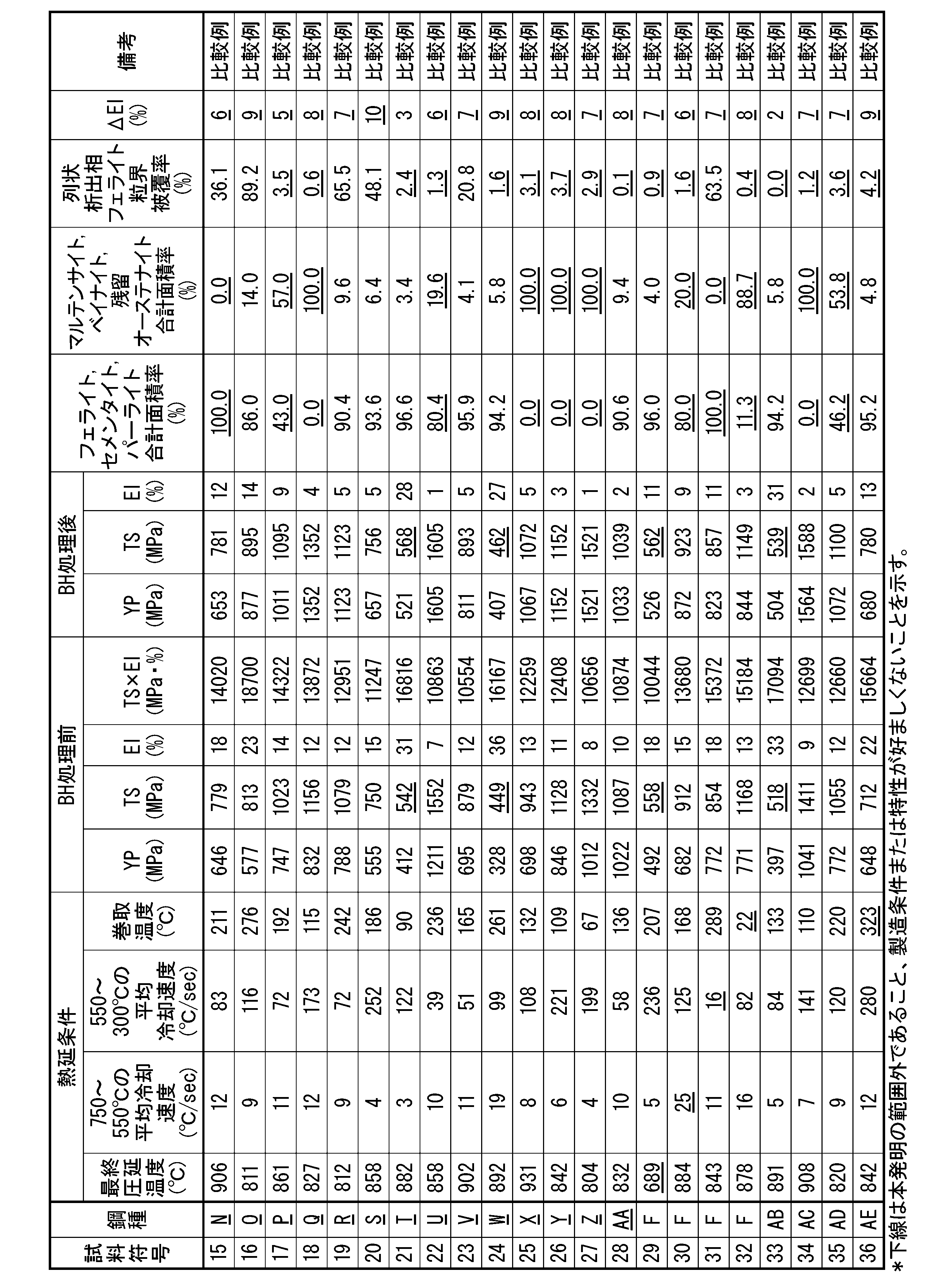
以上の結果を表2A、表2Bに示す。
また、熱延鋼板から、圧延方向と直角な方向が長手方向となるように採取した5号試験片に2%の引張変形を付与した後、170℃で20分の歪み時効硬化処理(以下、BH処理と呼ぶ)を施した。この歪み時効硬化処理は、塗装焼付処理を模擬するために行った。その後、JIS Z 2241:2011に記載の方法に従って引張試験を実施することで、BH処理後の引張強さ(TS)、降伏強さ(YP)および伸び(El)を測定した。BH処理後の引張強さ(TS)が590MPa以上の場合、所望の強度を有するとして合格と判定し、590MPa未満の場合、所望の強度を有しないとして不合格と判定した。BH処理前後の伸びの減少代が4%以下である場合、焼付硬化による延性の低下が抑制されると判断して、合格と判定した。一方、伸びの減少代が4%超の場合、焼付硬化による延性の低下が抑制されていないと判断して、不合格と判定した。
熱延鋼板における各組織の面積率は、上述した方法により得た。
以上の結果を表2A、表2Bに示す。
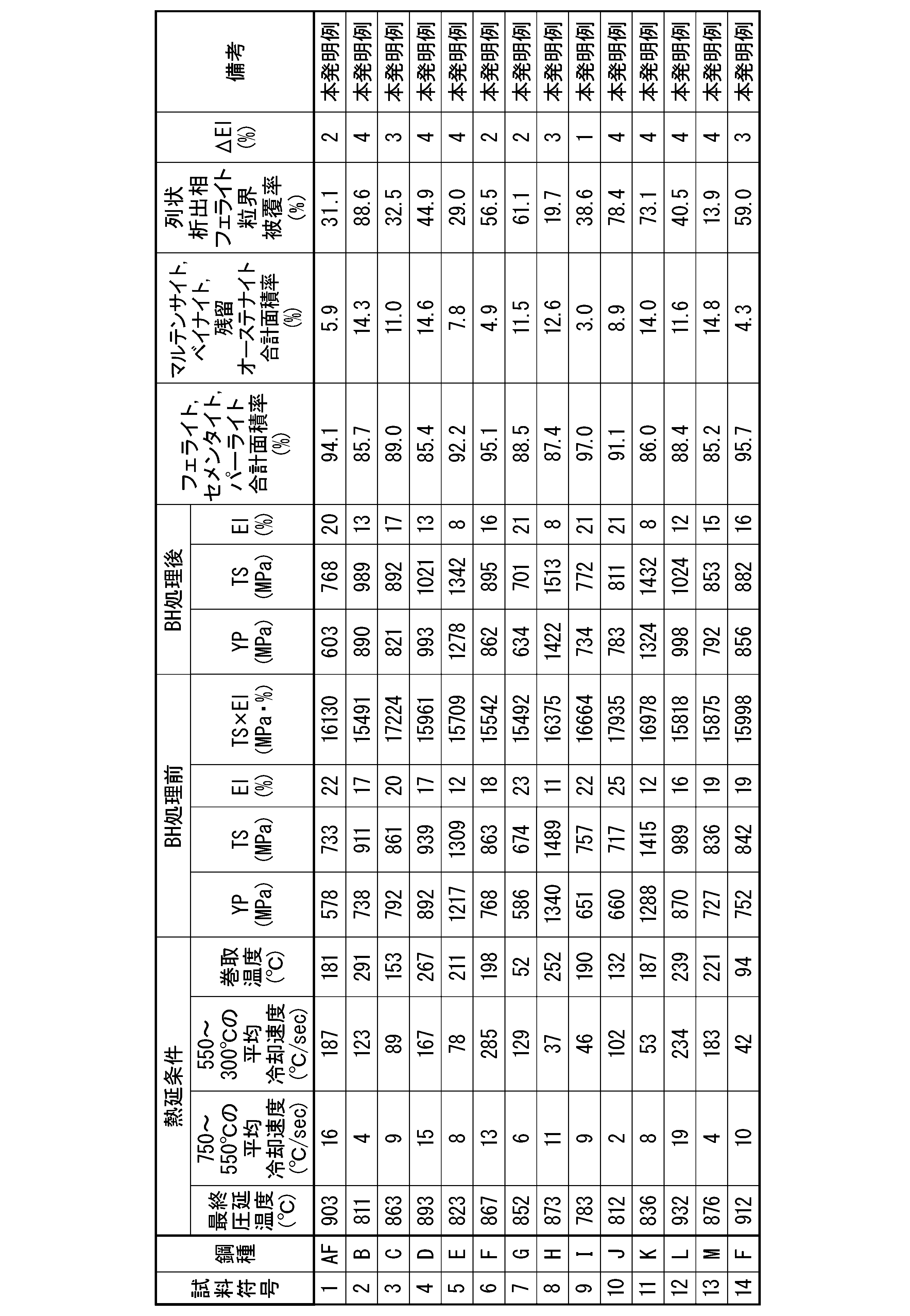
本発明例のNo.1~14は引張強さが590MPa以上で、BH処理後に降伏強さが上昇しても、延性の劣化が少ないことが分かる。また、強度-延性バランスに優れることから、プレス成形性にも優れると考えられる。
No.15~36は、強度、ΔElのいずれか1つ以上の特性が劣る比較例である。
No.15~36は、強度、ΔElのいずれか1つ以上の特性が劣る比較例である。
No.15は、C含有量が少なかったため、十分な量のマルテンサイト、ベイナイトおよび残留オーステナイトを得られず、BH処理後の延性が劣化した。
No.16は、C含有量が多かったため、BH処理後のBH量が増加し、降伏強さと引張強さの増加が顕著となり、延性劣化が大きかった。
No.17およびNo.18はそれぞれ、Si含有量およびMn含有量が多かったため、さらにNo.18は上記(2)式を満たさなかったため、マルテンサイトの面積率が大きくなり、BH処理後の強度上昇代が大きく、延性劣化が大きかった。
No.19およびNo.20はそれぞれ、P含有量およびS含有量が多かったため、延性劣化が大きかった。
No.21、No.24およびNo.33はそれぞれ、Al含有量およびNiの含有量が少なかったため、BH処理前後での引張強さが590MPa未満となり、強度不足となった。また、Ni-Alの列状析出相によるフェライト粒界の被覆率が低下したため、延性劣化が大きかった。
No.22はAl含有量が多かったため、熱間圧延の途中でフェライトが生成したことにより、圧延によって加工を受けた加工フェライトと、熱間圧延後の冷却過程で生成したフェライトとが巻取り後の組織において不均一に混じったことで、Al含有による強度上昇は大きいものの組織の不均一性により延性が著しく劣り、また延性劣化が大きかった。
No.23はN含有量が多かったため、粗大な窒化アルミニウム(AlN)が生成して加工時の破断の起点となり、強度-延性バランスが著しく劣り、また延性劣化が大きかった。
No.25、No.26、No.27およびNo.34はそれぞれ、Ni含有量、Cu含有量およびMo含有量が多く、上記(2)式を満たさなかったため、マルテンサイトが生成し、BH処理後の強度上昇代が大きく、延性劣化が大きかった。
No.28は上記(1)式を満たさなかったため、熱間圧延中にフェライトが生成し、回復・再結晶フェライトを含んで組織が不均一となったため、延性が劣り、また延性劣化が大きかった。
No.29は、鋼の成分組成は好ましい範囲にあったが、最終圧延温度が低かったため、熱間圧延の途中でフェライトが生成したことにより、巻取り後の組織において不均一に混じることから、強度が不足し、延性が劣化した。
No.30は、鋼の成分組成は好ましい範囲にあったが、750~550℃における平均冷却速度が大きかったため、マルテンサイト量が増加し、BH処理後の延性が大きく劣化した。
No.31は、鋼の成分組成は好ましい範囲にあったが、550~300℃における平均冷却速度が小さかったため、所望量のマルテンサイト、ベイナイトおよび残留オーステナイトを得ることができず、延性劣化が大きかった。
No.32は、鋼の成分組成は好ましい範囲にあったが、巻取り温度が低く、鋼組織に占めるフェライトの割合が低下し、同時にNi-Alの列状析出相によるフェライト粒界の被覆率が低下したため、延性劣化が大きかった。
No.35は、上記(2)式を満たさなかったため、マルテンサイトが生成し、BH処理後の強度上昇代が大きく、延性劣化が大きかった。
No.36は、鋼の成分組成は好ましい範囲にあったが、巻取り温度が高く、Ni-Alの列状析出相によるフェライト粒界の被覆率が低下したため、延性劣化が大きかった。
No.16は、C含有量が多かったため、BH処理後のBH量が増加し、降伏強さと引張強さの増加が顕著となり、延性劣化が大きかった。
No.17およびNo.18はそれぞれ、Si含有量およびMn含有量が多かったため、さらにNo.18は上記(2)式を満たさなかったため、マルテンサイトの面積率が大きくなり、BH処理後の強度上昇代が大きく、延性劣化が大きかった。
No.19およびNo.20はそれぞれ、P含有量およびS含有量が多かったため、延性劣化が大きかった。
No.21、No.24およびNo.33はそれぞれ、Al含有量およびNiの含有量が少なかったため、BH処理前後での引張強さが590MPa未満となり、強度不足となった。また、Ni-Alの列状析出相によるフェライト粒界の被覆率が低下したため、延性劣化が大きかった。
No.22はAl含有量が多かったため、熱間圧延の途中でフェライトが生成したことにより、圧延によって加工を受けた加工フェライトと、熱間圧延後の冷却過程で生成したフェライトとが巻取り後の組織において不均一に混じったことで、Al含有による強度上昇は大きいものの組織の不均一性により延性が著しく劣り、また延性劣化が大きかった。
No.23はN含有量が多かったため、粗大な窒化アルミニウム(AlN)が生成して加工時の破断の起点となり、強度-延性バランスが著しく劣り、また延性劣化が大きかった。
No.25、No.26、No.27およびNo.34はそれぞれ、Ni含有量、Cu含有量およびMo含有量が多く、上記(2)式を満たさなかったため、マルテンサイトが生成し、BH処理後の強度上昇代が大きく、延性劣化が大きかった。
No.28は上記(1)式を満たさなかったため、熱間圧延中にフェライトが生成し、回復・再結晶フェライトを含んで組織が不均一となったため、延性が劣り、また延性劣化が大きかった。
No.29は、鋼の成分組成は好ましい範囲にあったが、最終圧延温度が低かったため、熱間圧延の途中でフェライトが生成したことにより、巻取り後の組織において不均一に混じることから、強度が不足し、延性が劣化した。
No.30は、鋼の成分組成は好ましい範囲にあったが、750~550℃における平均冷却速度が大きかったため、マルテンサイト量が増加し、BH処理後の延性が大きく劣化した。
No.31は、鋼の成分組成は好ましい範囲にあったが、550~300℃における平均冷却速度が小さかったため、所望量のマルテンサイト、ベイナイトおよび残留オーステナイトを得ることができず、延性劣化が大きかった。
No.32は、鋼の成分組成は好ましい範囲にあったが、巻取り温度が低く、鋼組織に占めるフェライトの割合が低下し、同時にNi-Alの列状析出相によるフェライト粒界の被覆率が低下したため、延性劣化が大きかった。
No.35は、上記(2)式を満たさなかったため、マルテンサイトが生成し、BH処理後の強度上昇代が大きく、延性劣化が大きかった。
No.36は、鋼の成分組成は好ましい範囲にあったが、巻取り温度が高く、Ni-Alの列状析出相によるフェライト粒界の被覆率が低下したため、延性劣化が大きかった。
(実施例2)
実施例1で製造した試料符号1および8の熱延鋼板を660~720℃に加熱し、溶融亜鉛めっき処理を行うことで溶融亜鉛めっき鋼板を得た。試料符号8については、溶融亜鉛めっき処理後に540~580℃での合金化処理を行うことで、合金化溶融亜鉛めっき鋼板とした。得られた溶融亜鉛めっき鋼板(試料符号1)および合金化溶融亜鉛めっき鋼板(試料符号8)について、実施例1と同様の方法で組織観察および機械特性の評価を実施した。結果を表3に示す。
実施例1で製造した試料符号1および8の熱延鋼板を660~720℃に加熱し、溶融亜鉛めっき処理を行うことで溶融亜鉛めっき鋼板を得た。試料符号8については、溶融亜鉛めっき処理後に540~580℃での合金化処理を行うことで、合金化溶融亜鉛めっき鋼板とした。得られた溶融亜鉛めっき鋼板(試料符号1)および合金化溶融亜鉛めっき鋼板(試料符号8)について、実施例1と同様の方法で組織観察および機械特性の評価を実施した。結果を表3に示す。

表3に示すように、いずれのめっき鋼板においても実施例と同様の結果が得られ、溶融亜鉛めっき処理、あるいは、合金化処理を行ったとしても、本発明で所望する特性が確保できることが確認できた。
本発明に係る上記態様によれば、焼付硬化による延性の低下が抑制される高強度鋼板を提供することができる。上記態様に係る高強度鋼板は、耐衝突特性が要求される衝撃吸収部材に好適であり、例えば、自動車や輸送機器等の部品に適用されることにより、車体軽量化による燃費向上や衝突安全性の更なる向上に寄与し得るため、産業上の利用価値が極めて大きい。
Claims (3)
- 成分組成が、質量%で、
C:0.0150%以上0.3000%以下、
Si:0%超3.000%以下、
Mn:0.050%以上3.600%以下、
P:0%超0.030%以下、
S:0%超0.0200%以下、
Al:0.500%以上5.000%以下、
N:0%超0.0100%以下、
Ni:1.000%以上12.300%以下、
Cu:0%以上4.800%以下、
Mo:0%以上2.500%以下、
Ca:0%以上0.0200%以下、
Mg:0%以上0.0200%以下、および
REM:0%以上0.0200%以下
を含有し、残部がFeおよび不純物からなり、
下記(1)式、(2)式および(3)式の関係を同時に満足し、
鋼組織が、面積率で、合計で85.0%以上99.0%以下のフェライト、セメンタイトおよびパーライト、並びに、合計で1.0%以上15.0%以下のマルテンサイト、ベイナイトおよび残留オーステナイトから構成され、
Ni-Alの列状析出相がフェライトの粒界上に存在し、前記列状析出相による前記フェライト粒界の被覆率が、総粒界長さの5.0%以上であり、
引張強さが590MPa以上である
ことを特徴とする高強度鋼板。
(Ni%+12.00×C%+2.00×Mn%+1.20×Cu%)-2.00×(Al%+0.50×Si%+0.25×Mo%)≧0.0 (1)
3.725×C%+0.160×Si%+0.630×Mn%-0.110×Al%+0.210×Ni%+0.450×Cu%+0.620×Mo%-1.818≦1.000 (2)
Ni%-0.5×Cu%≧0.0 (3)
ここで、C%、Si%、Mn%、Al%、Ni%、Cu%およびMo%は、それぞれC、Si、Mn、Al、Ni、CuおよびMoの質量%での含有量であり、含有しない場合は0を代入する。 - 前記成分組成が、質量%で、
Cu:0.050%以上4.800%以下、
Mo:0.030%以上2.500%以下、
Ca:0.0001%以上0.0200%以下、
Mg:0.0001%以上0.0200%以下、および
REM:0.0001%以上0.0200%以下
のうちから選ばれる少なくとも1種を含有する
ことを特徴とする請求項1に記載の高強度鋼板。 - 溶融亜鉛めっき層または合金化溶融亜鉛めっき層を表面に有する、請求項1または2に記載の高強度鋼板。
Priority Applications (1)
| Application Number | Priority Date | Filing Date | Title |
|---|---|---|---|
| JP2021526837A JP7092264B2 (ja) | 2019-06-17 | 2020-06-17 | 高強度鋼板 |
Applications Claiming Priority (2)
| Application Number | Priority Date | Filing Date | Title |
|---|---|---|---|
| JP2019-112081 | 2019-06-17 | ||
| JP2019112081 | 2019-06-17 |
Publications (1)
| Publication Number | Publication Date |
|---|---|
| WO2020256010A1 true WO2020256010A1 (ja) | 2020-12-24 |
Family
ID=74040825
Family Applications (1)
| Application Number | Title | Priority Date | Filing Date |
|---|---|---|---|
| PCT/JP2020/023742 Ceased WO2020256010A1 (ja) | 2019-06-17 | 2020-06-17 | 高強度鋼板 |
Country Status (2)
| Country | Link |
|---|---|
| JP (1) | JP7092264B2 (ja) |
| WO (1) | WO2020256010A1 (ja) |
Citations (3)
| Publication number | Priority date | Publication date | Assignee | Title |
|---|---|---|---|---|
| WO2000050658A1 (en) * | 1999-02-22 | 2000-08-31 | Nippon Steel Corporation | High strength galvanized steel plate excellent in adhesion of plated metal and formability in press working and high strength alloy galvanized steel plate and method for production thereof |
| JP2006193789A (ja) * | 2005-01-14 | 2006-07-27 | Nisshin Steel Co Ltd | 熱処理強化型高強度フェライト系ステンレス鋼及びその製造方法 |
| JP2016028174A (ja) * | 2014-07-08 | 2016-02-25 | 新日鐵住金株式会社 | 伸びフランジ性と打ち抜き性に優れた高強度熱延鋼板及び溶融亜鉛めっき高強度熱延鋼板とそれらの製造方法 |
-
2020
- 2020-06-17 WO PCT/JP2020/023742 patent/WO2020256010A1/ja not_active Ceased
- 2020-06-17 JP JP2021526837A patent/JP7092264B2/ja active Active
Patent Citations (3)
| Publication number | Priority date | Publication date | Assignee | Title |
|---|---|---|---|---|
| WO2000050658A1 (en) * | 1999-02-22 | 2000-08-31 | Nippon Steel Corporation | High strength galvanized steel plate excellent in adhesion of plated metal and formability in press working and high strength alloy galvanized steel plate and method for production thereof |
| JP2006193789A (ja) * | 2005-01-14 | 2006-07-27 | Nisshin Steel Co Ltd | 熱処理強化型高強度フェライト系ステンレス鋼及びその製造方法 |
| JP2016028174A (ja) * | 2014-07-08 | 2016-02-25 | 新日鐵住金株式会社 | 伸びフランジ性と打ち抜き性に優れた高強度熱延鋼板及び溶融亜鉛めっき高強度熱延鋼板とそれらの製造方法 |
Also Published As
| Publication number | Publication date |
|---|---|
| JPWO2020256010A1 (ja) | 2021-10-21 |
| JP7092264B2 (ja) | 2022-06-28 |
Similar Documents
| Publication | Publication Date | Title |
|---|---|---|
| KR102635009B1 (ko) | 고강도 열연 강판 및 그 제조 방법 | |
| EP2267175B1 (en) | Hot rolled steel sheet possessing excellent fatigue properties and stretch-flange ability and process for producing the hot rolled steel sheet | |
| KR101749948B1 (ko) | 고강도 열연 강판 및 그의 제조 방법 | |
| EP2937433B1 (en) | High-strength cold-rolled steel sheet with low yield ratio and method for manufacturing the same | |
| KR20200124293A (ko) | 고강도 냉연 강판 및 그의 제조 방법 | |
| JP7095818B2 (ja) | 被覆鋼部材、被覆鋼板およびそれらの製造方法 | |
| KR101706441B1 (ko) | 양호한 연성, 신장 플랜지성, 재질 균일성을 갖는 고강도 열연 강판 및 그 제조 방법 | |
| JPWO2018011978A1 (ja) | 溶融亜鉛めっき鋼板 | |
| KR102858559B1 (ko) | 열연 강판 | |
| JP7680679B2 (ja) | 熱延鋼板 | |
| KR102861316B1 (ko) | 열연 강판 | |
| KR20190045298A (ko) | 강판 | |
| CN116113508B (zh) | 热轧钢板 | |
| CN115943224B (zh) | 热轧钢板 | |
| WO2016157258A1 (ja) | 高強度鋼板およびその製造方法 | |
| KR20230049120A (ko) | 핫 스탬프용 강판 및 그 제조 방법, 그리고, 핫 스탬프 부재 및 그 제조 방법 | |
| CN115244203B (zh) | 热轧钢板 | |
| KR20250110867A (ko) | 아연 도금 강판 및 부재, 그리고 그것들의 제조 방법 | |
| KR102325874B1 (ko) | 강판 및 도금 강판 | |
| WO2016157257A1 (ja) | 高強度鋼板およびその製造方法 | |
| JP6901417B2 (ja) | 高強度鋼板および高強度亜鉛めっき鋼板、並びにそれらの製造方法 | |
| JP7688288B2 (ja) | 熱延鋼板 | |
| KR102936919B1 (ko) | 열연 강판 | |
| JP7092264B2 (ja) | 高強度鋼板 | |
| JP7092265B2 (ja) | 鋼板 |
Legal Events
| Date | Code | Title | Description |
|---|---|---|---|
| 121 | Ep: the epo has been informed by wipo that ep was designated in this application |
Ref document number: 20825461 Country of ref document: EP Kind code of ref document: A1 |
|
| ENP | Entry into the national phase |
Ref document number: 2021526837 Country of ref document: JP Kind code of ref document: A |
|
| NENP | Non-entry into the national phase |
Ref country code: DE |
|
| 122 | Ep: pct application non-entry in european phase |
Ref document number: 20825461 Country of ref document: EP Kind code of ref document: A1 |